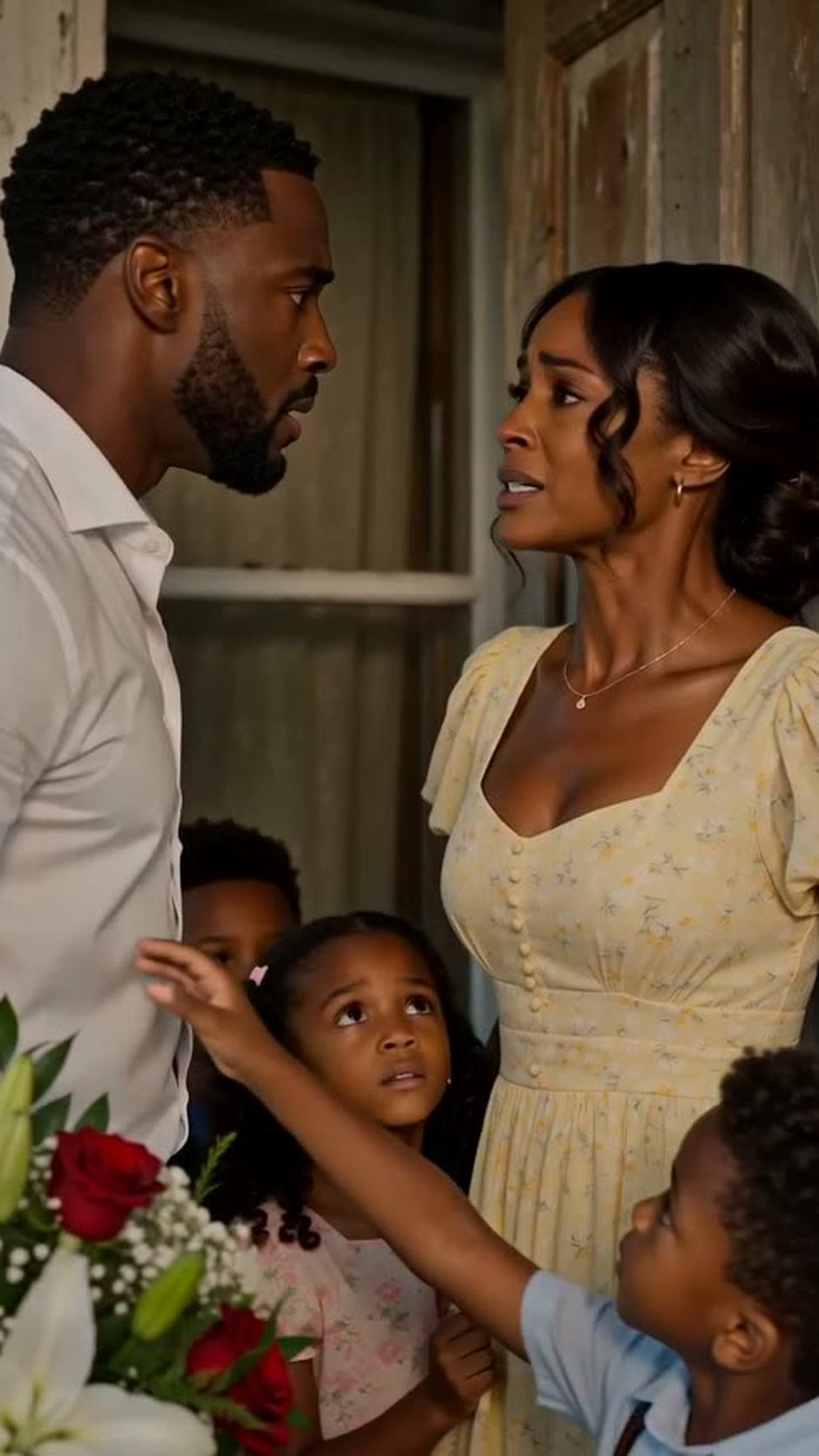
They did it in the library, because the library had doors that closed.
Daniel would remember that detail for nine years — that he had chosen a room with doors that closed, like a man executing a contract. He laid the evidence on the desk in a row, the way Sloane had laid it out for him: the photographs, the receipt, the audit summary, the email thread. He watched Emily come in still smiling, watched the smile falter as she took in the tableau — his mother standing at the window like a magistrate, Garrett seated in the leather chair with his ankle crossed over his knee, Daniel behind the desk. Behind the desk. He had put a desk between himself and his wife.
"What is this?" Emily said.
"You tell me." Daniel's voice was not his own. It was his mother's voice, drawn from some cold inheritance in his blood. "Anthony Reyes. Tell me about Anthony Reyes."
"A volunteer. He consulted on the port-city literacy—" She stopped. She was looking at the photographs now, picking one up with the tips of her fingers, the way you pick up something dropped in the street. "Daniel. This is the summer benefit. He asked me about the silent auction. There were four hundred people—"
"And the hotel?"
"The what?" She looked at the receipt. "I've never — Daniel, I have never been to the Regency Grand in my life. Where did this—" She turned, and her eyes went to Garrett, and something in her face changed — the beginning of an understanding she would not complete for years. "Garrett. Where did you get this?"
"Don't," Vivian said from the window, without turning around. "Do not perform innocence at us, Emily. The money, at least, you cannot photograph your way out of. Forty thousand dollars, out of an account with your code on it."
"Then the code was used," Emily said. "I didn't — Vivian, I have never taken a dollar. I send my own salary to my sister; ask Hannah, ask anyone, look at my accounts, look at everything—"
"We have looked at everything." Daniel stood. He heard his voice climb and could not stop it. "Four months of meetings. In secret. A hotel room in your name. Money moving out of the foundation in the exact same weeks. Was I not enough of a story for you? Was the penthouse not— did you marry me for the — " He stopped, because she had gone very still.
Emily set the photograph down with great care, precisely aligned with the edge of the desk.
"Ask me," she said quietly, "whether I love you. Ask me that one. Not this — " her hand moved over the row of paper, not touching it, "— not any of this. You have stood in a hundred rooms with me, Daniel. You held the chair. You know my face. You know I cannot lie; you've said it yourself, you said it was the first thing—" Her voice cracked. "So ask me. Ask me if there is anything — anything — between me and any other man on this earth, and then watch my face and decide."
The silence in the library was total.
Daniel looked at his wife across nine feet of desk and evidence. He looked at her face — the face that could not hide weather — and for one instant he saw it plain: terror, and grief, and not one shadow of guilt. One instant. Garrett cleared his throat, very softly, in the leather chair, the way a man reminds a room of the agenda. Vivian said, "Every adulteress in history has asked to be judged by her face, Daniel. That is what the evidence is for."
And Daniel Whitmore, who would go on to make a thousand correct decisions about money, made the one incorrect decision about the only thing that had ever mattered, and he made it in a single word.
He did not say it loudly. That was the refinement of the cruelty he would have to live with: he said it the way you dismiss a tradesman, the way his mother dismissed staff, without heat, without even looking at her anymore, looking instead at the row of paper as if it were a wife he preferred.
"Leave."
Emily stood in the library for perhaps ten seconds after the word landed. Later she would tell Hannah that the strange thing was how quiet everything got — that she could hear the clock. She took off her wedding ring. She did not throw it. She placed it on the desk, beside the photograph of herself laughing with a stranger, and she aligned it, too, with the edge, as if neatness were the last courtesy left to her.
"One day," she said, in a voice she had to build out of nothing, "you will know what you did today. I won't be there to see it. I want you to know that I won't be there to see it."
A security man she had never seen before walked her through the penthouse to collect her coat. He was young, and he would not meet her eyes, and in the kitchen — passing through, because the hall route took them past the kitchen — Emily stopped.
On the refrigerator, held by a magnet shaped like a strawberry June's mother had once thought was funny, was the photograph of the leaning farmhouse under the Kentucky sky.
Emily took it down.
"That stays," Vivian said from the doorway. She had followed them, soundless, the way weather follows a coast. "Everything in this house stays."
"It is a photograph of my grandmother's house," Emily said. "It has never been in this house. It has only been visiting." She put it in the pocket of her coat, and her hand, in the pocket, held on to it, the way you hold a rail in the dark. "Like me."
Something crossed Vivian's face — the chess player's expression, revising — and for one second Emily thought the woman might say the thing that would change everything, might call it back. The second passed. The face closed like a well-kept house.
"Go, then," Vivian said, and turned away first, so that she would not have to watch it, which Emily, years later, would recognize as the only mercy her mother-in-law had ever shown her.
Security had her suitcase ready in the hall — Vivian's efficiency — with her clothes folded by someone else's hands. She was not permitted to take the car. She was not permitted to take anything purchased after the wedding, which was everything. A cab was called, not by her. Daniel did not come out of the library. Through the door she heard nothing at all, and that nothing would ring in her ears for years.
Hannah met her at the airport in Louisville with the old pickup and a face wet with fury, and drove her south through the dark, one hand on the wheel and one hand gripping Emily's, up the long dirt road to their grandmother's farmhouse, where the porch light had been left burning for her — Hannah had called ahead to a neighbor — as if the house itself had been told: *she is coming home, and she will not be coming out again for a long time.*
Emily did not cry that night. She cried three weeks later, in the farmhouse bathroom, at five in the morning, standing at the cracked mirror with a plastic stick in her hand, watching a second line bloom on it like a verdict being reversed.
She was pregnant.
She sat down on the cold bathroom floor in her grandmother's house, in the dark, with her back against the tub, and she held the test in both hands and laughed once — one single, cracked, astonished laugh — and then she did the arithmetic that women have done since the beginning of the world. Nine months from now there would be a child. Daniel Whitmore's child. The child of a man who had looked at her face and chosen paper.
The weeks between the bathroom floor and the letter were the darkest of Emily's life, darker even than the library, because the library had at least been quick.
The farmhouse had not been lived in since her grandmother's death. There was dust on everything like a second, grayer set of furniture. The well pump had opinions. Mice had taken the pantry in a coup. Emily cleaned the house the way she did everything, completely and in order, room by room, with the radio on for company and her sister's casseroles appearing on the porch with the regularity of tides. She did not tell Hannah about the baby for almost a month. She told the house first. She told the porch rail and the well pump and the leaning fence. *There's going to be a child,* she said, out loud, shelling peas at the kitchen table where her grandmother had shelled peas, *and the child is going to be told the truth about everything, so the truth had better be livable.*
What she could not decide was whether the truth included a father in Manhattan who had chosen paper over her face.
Hannah, when she finally heard, in the garden, among the tomato starts, sat down hard on an upturned bucket and said a word their grandmother would have washed out of her mouth with well water. Then she said, "Tell him. Not because he deserves it — *because June-or-whatever deserves it*, and because you're going to have to live with whichever woman you are about this for the rest of your life. You're the one who says the truest things are the ones nobody claps for. So say it true, Em. Once. And then let him be whoever he's going to be about it, and we'll know."
"And if he never answers?"
"Then he's answered," Hannah said, "and we'll raise this baby so loved it makes the whole state jealous, and he'll have missed it, and that will be *his* furniture to dust for the rest of *his* life." She reached over and took Emily's hand, in the dirt, among the tomatoes. "But you have to give him the chance to miss it honestly. Otherwise you'll spend sixty years telling yourself he never knew, and you'll never know if you were protecting him or protecting yourself from finding out."
Emily thought about the library. She thought about the ring, aligned with the edge of the desk. She thought about the eleven good months and the one word at the end of them, and about a face in a hospital not yet born, a face that might have his eyes.
By sunrise she had decided. Not for money. Not for revenge. She would tell him because the child was his, and because whatever he had become in that library, the man who had held her chair deserved the chance — one chance — to know.
She wrote the letter at the kitchen table, in her plain hand, without a single flourish. *Daniel — I am writing once, and only once. I am pregnant. The baby is yours; there has never been anyone else, and the fact that I must write that sentence is the saddest thing I own. I am not asking you for anything. I am telling you because you are the father and because I will not begin my child's life with a lie between us. If you want to know your child, you know where I am. If you do not — burn this, and I will never trouble you again. Emily.*
She put it in an envelope. She wrote the penthouse address from memory. She walked it down the dirt road to the mailbox with the red flag, and raised the flag, and stood with her hand on the warm metal for a moment, believing — believing completely — that she had done the last brave thing this story would ever ask of her.
What Emily Whitmore did not know, standing in the Kentucky sun with her hand on the mailbox, was that the letter was as good as burned already.
It would be nine years before she learned why he never came.