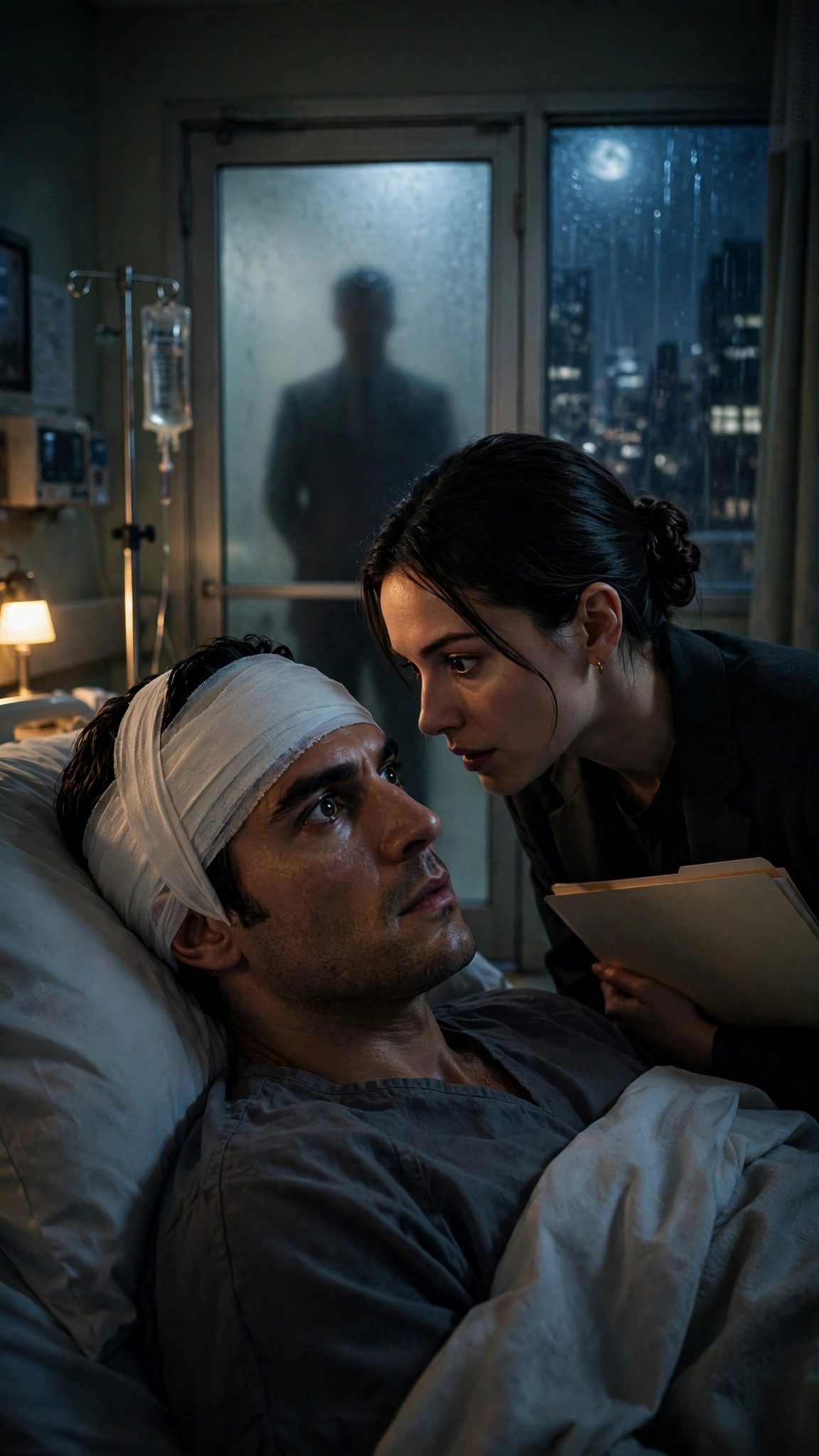
The next morning, I walked into my office for the first time since the shooting, and I did not pretend.
I walked in through the front door, in a dark suit, with the bandage still on my head but my back straight and my eyes clear, and Emily was beside me, and Marco was behind me, and Frankie and Leo were behind him, and every captain in the family was already there, waiting, because word had traveled through the city the way word always travels in my world: fast, and in whispers, and with half the story missing.
They stood when I came in. All of them. Twenty men in dark suits, standing in my office, looking at me the way men look at a ghost, because the last time most of them had seen me, I had been on a stretcher with a bullet in my head, and now here I was, walking, and talking, and very much alive.
"Gentlemen," I said, and my voice was my own voice, and it filled the room the way it used to fill the room, before the shooting, before the hospital, before the pretending. "Sit down. I have something to tell you, and I am only going to say it once."
They sat. The room went quiet. Even the traffic outside seemed to go quiet, as if the city itself were listening.
"Three weeks ago," I said, "I was shot in a private room at Santoro's restaurant. A bullet grazed my temple and fractured my skull. I woke up in a hospital, and I remembered everything. Every detail. The room. The lights. The gunfire. The five people who knew where I would be. I remembered it all."
I let that settle. I watched their faces. I watched the captains look at each other, and I watched the younger men look at the floor, and I watched the older men look at me, the way men look at a boss who has just told them something they did not expect.
"But I told the world I remembered nothing," I said. "I told the doctors. I told the nurses. I told Marco. I told all of you. I pretended to have lost my memory, because I knew that one of the five people I trusted had sold me to a gunman, and I knew that if the traitor believed I remembered nothing, he would feel safe, and if he felt safe, he would make a mistake."
I paused, and I looked around the room, at the twenty faces, at the men who had worked for my father and for me, at the men who had stood beside me through wars and funerals and nights when one wrong decision could have wiped us all out.
"Yesterday, on Pier Nine, Sal DeLuca walked into a trap, and the FBI arrested him, and Vincent Castellano was arrested at the same time, in his house in Brooklyn. Sal sold the meeting. Castellano paid for it. The proof is in the hands of the law, and Sal has agreed to testify. Castellano will spend the rest of his life in prison. Sal will spend eight years there, and when he comes out, he will be an old man, and he will have to live with what he did."
The room was silent. No one moved. No one spoke. I could hear the clock on the wall, ticking, the way it had ticked for nine years, through every meeting, through every decision, through every night I had sat in this office and wondered whether I was doing the right thing.
"I am telling you this," I said, "because I owe you the truth. I pretended to be weak so that I could find the man who tried to kill me, and I found him, and I did it without firing a shot. I did it with the law. I did it because I am done with the old way. I am done with blood for blood. I am done with funerals. The docks are going legitimate, as I planned. The businesses are going legitimate, all of them, every one. The family is going to be a family that does business in the daylight, and pays its taxes, and does not need to hide its meetings in private rooms at the back of restaurants."
I looked at Marco, and he nodded, and I looked at Frankie, and he nodded, and I looked at Leo, and he nodded, and I looked at Emily, who was standing beside my desk with the folder under her arm, and she nodded, too, and I felt the weight of nine years lift off my shoulders, all at once, the way a weight lifts when you finally set it down and walk away from it.
"There is one more thing," I said, and I turned to Emily, and I took the folder from her hands, gently, and I set it down on the desk, and I took her hand, and I held it, in front of all twenty men, in front of the whole family, and I did not care who saw it, because I was done pretending about that, too.
"For three years," I said, "Emily Carter has managed my life. She has scheduled my meetings. She has kept my secrets. She has carried information in her head that would have destroyed this family if it had ever fallen into the wrong hands, and she has never once let it slip. She knew I was pretending, from the first minute, because she knows me better than anyone in this room. She found the proof against Sal. She found the phone records. She found the photographs. She found the man on Pier Nine. Without her, I would be dead. Without her, Sal would still be free. Without her, Castellano would still be trying to kill me. She saved my life, and she saved this family, and she did it quietly, the way she does everything, without asking for anything in return."
I looked at her, and her eyes were shining, and her hand was warm in mine, and it did not tremble, and I said the thing I had been waiting to say since the morning she told me she loved me, in the white room with the morning light coming through the window.
"Emily Carter," I said, "will you marry me? Not as my secretary. Not as the woman who knows everything. As my wife. As the woman I love. As the woman who is going to stand beside me while I make this family into something my father would have been proud of, and something your mother would have been proud of, too."
The room was silent. Twenty men in dark suits, holding their breath. And Emily, standing beside my desk, with tears in her eyes and a smile on her face, the third smile I had seen from her in three years, said the one word I had been waiting to hear.
"Yes."
The room erupted. Not with shouting. Not with applause. With something quieter, and better: the sound of twenty men standing up, and coming forward, one by one, to shake my hand, and to shake Emily's hand, and to say, in their own ways, the same thing — congratulations, boss, congratulations, Mrs. Moretti, we are glad you are alive, we are glad you are home.
Marco was the first. He took my hand, and he held it, and he said, "Boss. I never doubted you. Not for one second. Even when you looked at me like a stranger, I never doubted you. Because I know you. And I know that a man who pretends to forget is a man who remembers everything."
Frankie was next, and Leo, and then the captains, one by one, and by the time they had all come forward, the sun was coming through the windows of my office, gold and warm, and the city outside was waking up, and I was standing in the middle of it, alive, with the woman I loved beside me, and the men I trusted behind me, and the law on my side, and the future in front of me, clean and open, the way a road looks when you have finally cleared it of everything that was blocking it.
That evening, I took Emily to dinner. A real dinner, the way she had asked for, in a small restaurant in the Village, with candles on the tables and a violin playing in the corner, and no bodyguards at the door, and no folder on the table, and no pretending. Just a man and a woman, sitting across from each other, talking about the future, about the wedding, about the businesses, about her mother, about my father, about the life we were going to build together, in the daylight, without secrets, without lies, without bullets.
"I have one question," she said, over dessert, with a smile that was the fourth smile I had seen from her in three years, and the best one yet. "When did you know? That you loved me?"
I thought about it. I thought about the three years she had worked for me, and the way she filed, and the way she remembered my mother's name, and the way she had looked at Marco in the hospital room, and the way she had whispered in my ear, and the way she had sat in the chair by my bed, watching the door, while the man who had tried to kill me was on his way to the police.
"I think," I said, "I knew the first day. When you told me that a man who cannot find his own papers cannot find his own enemies. I thought, that is the smartest thing anyone has said to me in years. And I have been listening to you ever since. I just did not know I was listening with my heart until you told me you loved me, and my heart answered before my head could stop it."
She laughed, and the violin played, and the candles burned low, and outside the window, Manhattan glittered, cold and beautiful and indifferent, the way it always had, and the way it always would.
But inside the restaurant, at a small table with candles on it, a man who had pretended to forget sat across from a woman who knew everything, and neither of them was pretending anymore.
Six months later, we were married in a small church in the Village, with Marco as my best man and Frankie driving us to the reception in the same black car he had driven me in for five years, and Leo cooking the dinner himself, because he would not let anyone else cook for his friend's wedding. Emily wore a simple white dress, with a small blue ribbon sewn into the hem — her mother's ribbon, from her own wedding day, thirty years before — and her mother sat in the front row, healthy now, and smiling, and my mother would have been proud, I think, of the woman I had chosen, because Emily was the kind of woman my mother had always said I should find: a woman who tells the truth, even when the truth is hard, and who stays, even when staying is hard. The whole family was there, every captain, every driver, every man who had stood by me, and when the priest asked if anyone objected, the only sound in the church was the rain on the windows, soft and steady, like applause from a long way off.
Sal DeLuca testified in court, as Agent Reyes had promised he would. He told the jury everything: the money, the phone calls, the meeting at Santoro's, the hospital, the boy with the pillow. He wept on the stand, and the jury wept with him, and the judge sentenced him to eight years, and he thanked the court, and he asked me, through his lawyer, to tell his son that he was sorry, and I did. I went to see his son myself, in Brooklyn, and I told him his father had made a terrible mistake, and that he had paid for it, and that the family would take care of him while his father was gone, because that is what a family does, even for the son of a man who betrayed it.
Vincent Castellano was sentenced to life in prison, without the possibility of parole. The jury took less than a day to decide. The evidence was overwhelming: the phone records, the payments, the testimony of Sal, and of Tommy Falco, and of Danny Cole, the boy from the hospital, who told the court about the five thousand dollars and the man in the black coat, and whose mother now has her medicine, paid for by a fund Emily set up in her name, because Emily believes, the way I have come to believe, that mercy is not weakness, and that a man who tells the truth deserves a second chance.
The docks went legitimate, as I had planned. The businesses went legitimate, all of them, every one. The family became a family that does business in the daylight, and pays its taxes, and does not need to hide its meetings in private rooms at the back of restaurants. Marco runs the legitimate shipping company now, and Frankie runs the transportation division, and Leo's restaurant has a second location, in Brooklyn, and Emily runs the foundation we started together, which helps the families of men who were hurt in the old wars, and the children of men who are in prison, and anyone else who needs a hand, because she believes, and I believe with her, that a family that only takes is a family that will one day have nothing left to take.
And that, I thought, was the best ending of all. Not a war. Not a funeral. Not revenge. Just the truth, told at last, and a life, begun at last, in the daylight, with the woman I loved beside me, and the memory of everything I had survived behind me, and the future, clean and open, in front of us both.
The boss who had pretended to forget had finally remembered who he was.
And he was never going to pretend again.
The End.
THE END