The candles had burned down to stubs before anyone noticed the silence.
It was Lorenzo Moretti's thirty-sixth birthday, and the grand ballroom of his mansion on Long Island had been dressed for it the way his mother used to dress it: crystal chandeliers blazing overhead, red curtains drawn against the October night, the long marble tables polished until they threw back the light. A hundred guests filled the room in evening dress — his men in their best suits, their wives in gowns, friends of the family, the waitstaff moving quiet and quick between the tables with trays of champagne. The air smelled of roast lamb and cigar smoke and the cold rain that had been falling since dusk, drumming softly against the tall windows.
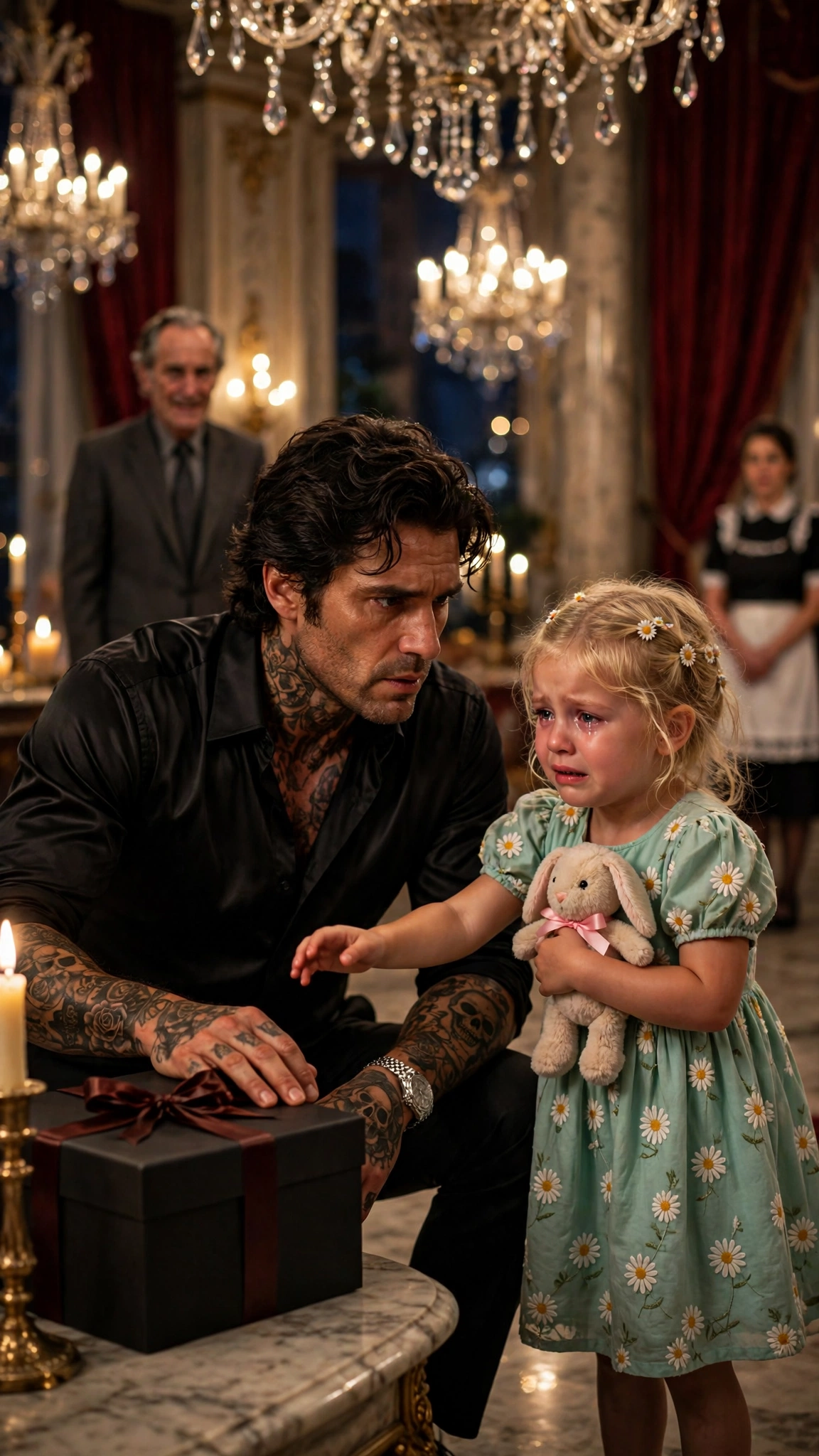
At the center of the main table, where the roast should have been, sat a gift.
It was a black box, large and square, tied with a dark red ribbon and a bow so perfect it looked like it had been tied by a machine. There was no card. No name. Only the box, sitting where everyone could see it, waiting.
Lorenzo stood at the head of the table with his hand on the ribbon.
He was a handsome man, tall and broad in a black satin shirt, open at the collar, the sleeves rolled to his forearms. Heavy black tattoos covered his neck and chest and arms, curling up from beneath his collar and down to his wrists, and a silver watch caught the candlelight on his left wrist. He had been smiling a moment before — the easy, practiced smile of a man who had survived thirty-six years in a business that killed most men before thirty — and the smile was still on his face. But his eyes had gone still.
Because his daughter was standing beside him, and she was frightened.
Mia Moretti was five years old. She was small even for five, with long blonde hair that fell past her shoulders, small daisy clips holding it back from her face, and wide blue eyes that were too watchful for a child. She wore the mint-green dress Rosa had laid out for her that evening, white daisies embroidered on the skirt, lace at the collar, small white shoes that barely made a sound on the marble floor. In her arms she held Mr. Buttons, her stuffed bunny with the pink ribbon around its neck, hugging him so tight his long ears were bent double. She had been allowed to stay up past her bedtime for her father's birthday, and she had been so proud of it, sitting on the chair Rosa had pulled close to the table, swinging her legs, eating her cake in small careful bites.
Now she was on her feet. She had stepped forward without anyone seeing her move, and her small hand had closed around her father's wrist, over the silver watch, and she was looking up at him with the absolute seriousness of a child who has seen something she cannot explain and knows, with all of her small heart, that it matters.
"Don't open it! He put something inside!" Mia cried. Her voice was high and sharp, and it cut through the music and the laughter like a bell.
The ballroom went silent. A hundred guests turned. A waiter froze with a tray in his hands. Somewhere near the red curtains, a glass was set down too hard, and the sound of it was very loud in the quiet.
Lorenzo looked down at her. "Mia—"
"He put something inside," Mia said again, and her voice shook, but she did not let go of his wrist. "Don't open it, Daddy. Please."
Lorenzo's fingers tightened on the ribbon. He did not pull it. He looked at his daughter, and then he looked at the box, and then, slowly, he crouched down until he was on her level, his black satin shirt catching the candlelight, his tattoos dark against his skin, his gray-brown eyes steady on her face.
"Who did you see, sweetheart?" he asked quietly. "Tell me. Who did you see?"
Mia leaned close to him, rising on her toes, her small hand resting on the box now, her fingers spread on the black lid as if she could hold it closed by will alone. She glanced across the ballroom, toward the red curtains, where the light did not quite reach.
"Uncle Marcus, he said just open it," she whispered.
And then the whole room was holding its breath, and Lorenzo Moretti — the most feared man in New York, the man whose name made restaurant owners lock their doors and policemen look the other way — rose slowly to his feet, and turned his head, and looked across the ballroom at the man standing near the red curtains.
Marcus Bellini stood very still, a glass of champagne in his hand, lean and elegant in his charcoal suit, his graying hair slicked back, his dark tie perfectly knotted. He was smiling. It was a good smile — warm, practiced, the smile of a man who had stood at Lorenzo's right hand for twenty-five years. But the smile did not reach his eyes. His eyes were cold and calculating, and for one fraction of a second, before he caught himself, they flickered toward the box.
Lorenzo saw it. He saw it the way a man who has survived this long sees everything: in the space between heartbeats, in the things people do not say.
He turned back to the box. He looked at his daughter, and he nodded, just once. And then, with the whole ballroom watching, with a hundred guests holding their breath, Lorenzo Moretti untied the dark red ribbon with slow, deliberate fingers, and he lifted the lid of the box.
Inside, nestled in white tissue paper, there was a small matte-black voice recorder, no bigger than a matchbox, with a single red light blinking on its side.
And then, in the silence, the recorder spoke.
"Happy birthday—" it said, in a thin, metallic voice, a voice Lorenzo knew, a voice he had heard a hundred times across a table, a voice that belonged to Vincent De Luca.
Lorenzo's hand came down on the lid. He slammed it shut before the voice could say another word. The ballroom was so quiet he could hear the rain on the windows, and his own breathing, and the small, fast breathing of his daughter beside him.
Across the room, Marcus Bellini took a step forward. His hand reached out, toward the box, toward the recorder inside it, as if he meant to take it back, as if he meant to make it disappear.
"Marcus, don't touch it," Lorenzo said. His voice was calm. It was the calm that made grown men put down their glasses and sit up straighter.
Marcus froze, his hand in the air. For a moment, no one in the ballroom moved. The chandeliers blazed overhead. The candles burned down. The red curtains hung still against the windows. And Lorenzo Moretti stood with his hand on the lid of a black box, with his daughter's hand on his wrist, and he looked at the man who had been his best friend for twenty-five years, and he understood, all at once, that the world he thought he lived in was not the world he actually lived in.
"Rosa," he said quietly, without taking his eyes off Marcus. "Take Mia upstairs."
Rosa was already moving. She crossed the ballroom in quick, sure strides, her dark uniform neat, her white apron bright, her small silver cross catching the light, and she took Mia's hand, and she pulled the little girl gently behind her, the way a mother pulls a child behind her when a car is coming too fast. Mia went without a sound, her eyes wide, Mr. Buttons clutched tight to her chest, her small white shoes silent on the marble floor. She looked back once, over Rosa's shoulder, at her father. He looked back at her. He nodded, just once. It was enough.
"Friends," Lorenzo said, and his voice was calm, and it filled the ballroom the way it always filled a room when he wanted it to. "The party is over for tonight. Go home to your families. I will see you in the morning."
There was a moment of confusion — a ripple of surprise, a few exchanged glances, a glass set down too hard. But no one argued. When Lorenzo Moretti told a hundred guests to go home, they went home. They filed out in silence, their shoes loud on the marble of the hall, their voices low. Within ten minutes the ballroom was empty except for two men: Lorenzo Moretti and Marcus Bellini, who had not moved from his place by the red curtains. And between them, on the marble table, the black box, its lid closed again, its dark red ribbon untied and lying loose across the black paper — and twenty-five years of history between them.
Lorenzo did not open the box again. Not then. Not in front of Marcus, with the recorder inside it still blinking its small red light. He did something else. He did the thing that had kept him alive for fifteen years at the top of a business that killed most men before thirty. He stopped. He looked. And he waited.
—
Twelve hours earlier, the gift had not existed yet, and Lorenzo Moretti had woken up in a quiet house to the sound of rain.
It was a gray October morning, and the mansion on the hill above the water was still asleep when he came down the stairs in his shirtsleeves, his hair still damp from the shower, his watch the only jewelry he wore. He liked the house at that hour. Before the men arrived, before the phones started, before the day filled up with the business that had owned him since he was nineteen, the house belonged to the people who actually lived in it: to Rosa, who was already in the kitchen with the coffee on, and to Mia, who was still asleep upstairs under her quilt, one arm thrown over Mr. Buttons.
"Happy birthday, Mr. Moretti," Rosa said, without looking up from the stove. She said it the way she said everything: warm, dry, and entirely without ceremony, as if she had not just wished a happy birthday to one of the most dangerous men in America. She had been saying it to him for twenty years, since she had first come to work in this house as a girl of twenty-eight, hired to help his mother. She had stayed through his mother's death, through his marriage, through Elena's death, and through every year after, when the house had needed someone who knew where everything was and who could be trusted with everything that mattered.
"Rosa," Lorenzo said, and took the coffee she handed him. "You remembered."
"I remember every year. You forget every year. That is the arrangement." She set a plate of toast in front of him. "Mia has a surprise for you. She has been working on it since Tuesday. Do not pretend you do not know, or she will be heartbroken."
"I know nothing," Lorenzo said solemnly. "I am a man who knows nothing, and I am very good at it."
Rosa snorted. It was a sound she had perfected over two decades. "You are a man who pretends to know nothing. There is a difference, and your daughter knows it. She told me yesterday, 'Daddy is a very good pretender, Rosa. But I can always tell.'"
Lorenzo smiled into his coffee. That was the thing about Mia. She was five years old and she could always tell. She could tell when he was lying about being fine. She could tell when one of his men was afraid. She could tell when Rosa was sad, even when Rosa smiled. Elena had been like that too, his wife, Mia's mother — she had seen straight through people, through their noise and their performance, to the small true thing underneath. Elena had died when Mia was two, a fever that came on fast in the night and did not leave, and Lorenzo had spent three years since trying to be both parents to a little girl who saw everything and forgave almost everything, except absence.
He was absent too much. He knew it. That was why this birthday mattered to him in a way birthdays had not mattered since he was a boy. He had promised Mia he would be home all day. No meetings. No calls after six. A party in the ballroom, his men and their wives and friends of the family, and a cake with thirty-six candles that Mia had insisted on counting herself, twice, to make sure there were enough.
"Where is she?" he asked.
"Still asleep. I told her she could sleep until eight, because it is a special day. She argued. She lost. She will be down by eight-fifteen at the latest, and she will be furious that she missed anything." Rosa wiped her hands on her apron. Her silver cross necklace swung as she moved. "Marcus called. He will be here at ten to go over the arrangements. He said he has something special for tonight."
Lorenzo nodded. Marcus Bellini. His oldest friend. They had grown up on the same street in Bensonhurst, two skinny boys stealing peaches from the market and running from the shopkeeper, and they had come up together through the family the same way, shoulder to shoulder, until Lorenzo had inherited the top and Marcus had taken the place at his right hand. Marcus was Mia's godfather. He had held her at the christening, in the church with the candles, and he had cried, which Lorenzo had never forgotten and never mentioned. Marcus was the man Lorenzo trusted with his life, his money, and his daughter.
"Good," Lorenzo said. "Tell him ten is fine."
The morning went the way mornings in the house went when Lorenzo was home. Mia came down at eight-fifteen, exactly as Rosa had predicted, furious and radiant, her blonde hair still tangled from sleep, a daisy clip in her hand instead of in her hair, demanding that Rosa fix it immediately because it was Daddy's birthday and she had to look like a princess. Rosa fixed it. Lorenzo ate toast with her on his knee and let her steal the crusts, which she did with great ceremony, announcing each theft as if it were a military victory. She showed him the drawing she had been working on since Tuesday — a picture of the three of them, himself and Mia and Rosa, standing in front of the house, all of them smiling, the sun yellow and enormous in the corner — and he told her it was the best drawing he had ever seen, which was true, and she beamed so hard her cheeks went pink.
Then, at ten o'clock, Marcus arrived, and the day changed.
He came in through the kitchen door, the way he always did, shaking the rain off his coat, and he kissed Rosa on the cheek and swung Mia up into the air, and she shrieked with delight, and for a moment everything was exactly as it had always been. But Lorenzo, who had known this man for twenty-five years, saw something in his face that he did not like. Marcus was smiling, and his suit was perfect, and his hair was perfect, and his eyes were tired in a way Lorenzo had never seen before. There were lines around them that had not been there a month ago. He looked like a man who had not slept.
"You look terrible," Lorenzo said, when Mia had run off to fetch her drawing to show her godfather.
"Thank you," Marcus said. "You look old."
"Thirty-six is not old."
"It is old for us." Marcus poured himself a coffee. His hand shook, just slightly, as he lifted the cup. Lorenzo saw it. He said nothing. "I have the arrangements for tonight. The guests will be here at seven. Dinner at seven-thirty. The cake at nine. Rosa has the menu."
"And the special thing?" Lorenzo asked.
Marcus looked at him for a long moment. "It comes in the morning," he said. "A gift. From an old friend. I thought it would be nice, something for the table."
"A gift from an old friend," Lorenzo repeated. "Which old friend?"
"An admirer," Marcus said, and smiled, and the smile did not reach his eyes. "You have admirers, Lorenzo. You forget that sometimes."
Lorenzo watched him. He had known Marcus Bellini for twenty-five years. He knew the man's tells — the way he touched his tie when he was nervous, the way his voice went a fraction too light when he was lying. Marcus was not touching his tie. His voice was not too light. There was nothing to catch. And yet Lorenzo felt the small cold tug in his gut that had kept him alive for fifteen years at the top, the instinct that said: something is wrong here, and I do not yet know what it is.
He let it go. It was his birthday. His daughter was showing her godfather a drawing. The rain was falling outside, and the house was warm, and for once he was going to be home.
That was his first mistake. He would remember it later, in the ballroom, with his hand on the dark red ribbon and his daughter's hand on his wrist, and he would think: I knew. I knew at ten o'clock in the morning, and I let it go.
The gift arrived at noon.
It came to the gate in a black car with no plates that anyone could remember afterward, driven by a man nobody in the house had seen before, who handed the box to the gate guard with a small, polite nod and said, "For the boss. Happy birthday." Then he drove away, and the rain washed the tire tracks off the drive within the hour.
The guard brought the box into the house. It was heavy — heavier than a box that size should have been, he said later, though nobody could say why. Rosa took one look at it and frowned. There was no card. No name. No return address. Just a black box and a dark red ribbon and a bow so perfect it looked tied by a machine.
"Put it in the ballroom," Marcus said, when Rosa asked what to do with it. "On the marble table. In the center. It is the boss's birthday. The gift should be where everyone can see it."
Rosa did not like it. She told Lorenzo so, in the kitchen, in a low voice, while Mia was upstairs changing into her mint-green dress.
"There is no card, Mr. Moretti," she said. "A gift with no card, from no one, delivered by a man no one knows. I do not like it."
"Marcus says it is from an old friend," Lorenzo said.
"Marcus says many things," Rosa said. "And he has looked like a ghost all day."
Lorenzo thought about that. He thought about the tired eyes, and the shaking hand, and the smile that did not reach Marcus's eyes. He thought about the cold tug in his gut, which had not gone away since ten o'clock. And then he thought about the fact that it was his birthday, and that his daughter was upstairs putting on a mint-green dress with daisies on the skirt, and that he had promised her a party.
"Leave it," he said. "It is a gift. We will open it at the table, in front of everyone, like a celebration. If there is something wrong with it, I would rather know in front of my guests than alone in the dark."
Rosa looked at him for a long moment. Then she nodded, because that was who he was, and because she had known him for twenty years, and because she trusted his judgment even when she did not agree with it. She went back to the kitchen. Lorenzo went upstairs to change into his black satin shirt.
He did not know that two days earlier, his five-year-old daughter had been playing hide-and-seek in the study, and had seen something she did not understand, and had been carrying it inside her small chest ever since, waiting for the right moment to say it.
He did not know that the moment would come at his own birthday table, in front of a hundred guests, with the candles burning down and the rain falling outside and the whole room holding its breath.
He did not know that his daughter was about to save his life.
But Mia knew. Mia had known for two days. And when her father put his hand on the dark red ribbon, she did the bravest thing she had ever done in her short life.
She stepped forward, and she told him the truth.