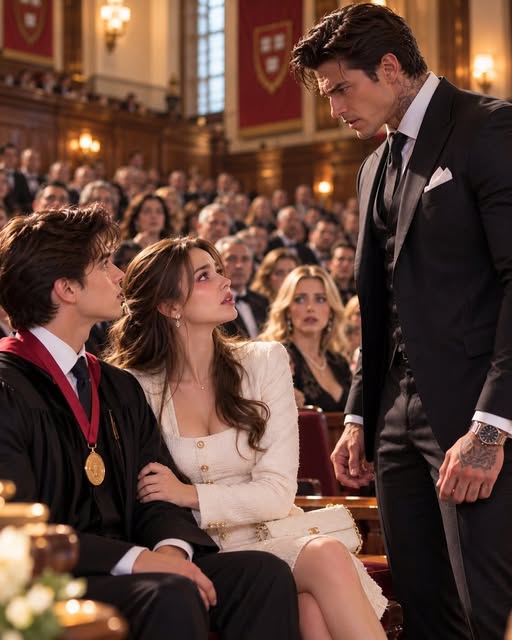
Story Genres: MAFIA BOSS

  • Chapter 1: The Boy Beneath the Lights

    Chapter 1: The Boy Beneath the Lights

    The auditorium smelled of polished wood, fresh flowers, and other people's certainty. I sat in the third row with my hands folded so tightly in my lap that my knuckles had gone white, and I told myself, the way I had told myself a thousand times in eighteen years, that I could get through one more public moment without falling apart.

    Then they said his name.

    "Noah Bennett."

    The applause rose like weather. My son stood from his seat two rows ahead of me — tall, dark-haired, wearing the only suit we owned between us, the one I had taken in at the waist with my own needle the night before — and walked toward the stage with the unhurried calm of a boy who had never once been handed anything and had learned to carry himself accordingly.

    Eighteen years old. The highest distinction in Harvard's incoming-student assessment. A room full of deans and donors and proud, wealthy families rising to applaud a kid who had done his homework at a kitchen table with a wobble in one leg, in an apartment where the radiator clanked like a tired drummer all winter.

    I was so proud I could barely breathe.

    I did not know, sitting there, that three rows behind me and slightly to the left sat the one man on earth I had built my entire life around avoiding.

    Let me tell you what I knew in that moment, and only that.

    Eighteen years ago, my name was Claire Moretti. I was twenty-six years old, a bookkeeper's daughter from Cicero, and I was married to Vincent Moretti — a man whose name made Chicago police detectives lower their voices and Chicago politicians raise their glasses. I had loved him with the whole, stupid, unguarded heart of a girl who believed that a man's tenderness behind closed doors was the truest thing about him. He kept my hand warm inside his coat pocket when we walked. He learned how I took my coffee. He stood in our kitchen at midnight, the feared Vincent Moretti, and asked me to show him again how to fold a fitted sheet because it made me laugh, and my laughter — he said — was the only sound in his life nobody was trying to buy.

    Our marriage ended the week I learned about Ethan.

    Vincent had a son with another woman. Sophia Reynolds — elegant, patient, and woven into his family's world long before I arrived in it. Their boy was two years old, beautiful, and already being raised in a house Vincent paid for across the city, with a nanny Vincent had chosen and a future Vincent had planned, all of it behind my back, all of it while I was setting a table for two and believing my husband's late nights were the price of the life he'd been born into.

    I didn't scream. I want that understood. I didn't compete with Sophia, and I didn't beg, and I didn't throw his ring into the river the way women do in films. I sat across from him in his study, in the chair where his lawyers sat, and I asked for a divorce in the same level voice I would have used to read him a weather report. Because I knew, down to my bones, that I could not stay married to a man who had built an entire second family in the dark and still come home and hold my hand inside his coat pocket.

    How I learned about Ethan is almost embarrassingly ordinary, and I have never forgiven the ordinariness of it. I kept the household books in those years — Vincent trusted no accountant the way he trusted me — and in the spring I found a line in the family ledger I could not make behave: a house on Kenilworth Avenue that appeared in no portfolio, a salary for a nanny I had never hired, a tuition deposit for a school I had never heard of. I told myself it was a safe house, a cousin, a debt of his father's. I told myself that for six weeks, because a person can tell herself anything for exactly as long as she refuses to drive across the city.

    On a Tuesday I drove. The house had a garden and a low iron gate, and through the gate I saw a little boy — two years old, dark-haired, laughing — riding high on the shoulders of my husband, who was walking him around a rose bed with a care I recognized in my marrow, because I had watched that care aimed at me and believed it was mine alone. On the porch, with a cup of tea, sat Sophia Reynolds, watching them the way a woman watches her own life: without surprise.

    I did not get out of the car. I sat there for one hour with my hands at ten and two on the wheel like a student driver, and then I drove home, and I hung up my coat, and I made Vincent's dinner, and I listened to him tell me about his day. I watched him eat. I watched him ask, with real interest, whether the foundation's books were balancing. The following week I sat down across from him in his study and asked for the divorce — because the books, in the end, had balanced perfectly. They had simply never been only mine.

    What Vincent never knew — what I carried out of Chicago in a two-year-old sedan with everything I owned in the trunk — was that I was pregnant too.

    I gave birth to Noah in a county hospital in Ohio with a nurse named Delia holding my hand because there was no one else. The first time they laid him on my chest, red and furious and perfect, I made him a promise out loud, like a vow in a church: You will never have to compete for your father's love. You will never stand in a doorway wondering why another boy was chosen. You will have less of almost everything in this world, but you will never, ever have to wonder if you are enough.

    So I raised him alone. I worked as a bookkeeper for a dental practice, then for two. I cleaned offices at night for one brutal year when the transmission died and the rent went up in the same month. I learned which grocery stores marked down bread at eight in the evening. I learned to make a celebration out of a library card. And Noah — Noah made it easy to believe the universe had a sense of mercy. He loved mathematics the way other children love dogs. He devoured books whole. By fourteen he was working through problems that made his teachers call me at work just to say, Mrs. Bennett, do you understand what you have here?

    I did. I had always understood.

    People imagine that raising a gifted child alone is a montage of proud moments. It is mostly logistics wearing a brave face. When Noah was seven he asked me, with the terrible directness of seven, why other children's fathers came to soccer games, and I — who had played one season of softball in 1998 and retained nothing — coached his team for two years with a whistle, a rulebook from the library, and absolutely no shame, because my son was not going to stand on a sideline scanning the fence for a face that wasn't coming. He knew better than to ask twice. That was the part that cost me sleep: not what he asked, but how quickly he learned what not to ask.

    When he was twelve he won the regional mathematics bee, and the trophy lived for years on a shelf I built from a fruit crate and optimism. During the night-cleaning year I would come home at four in the morning with my shoes in my hand so as not to wake him, and check his homework at the kitchen table in my coat, in the dark-adjacent glow of the stove light, because a boy whose mother works all night still deserves to have his long division witnessed. Our landlord, Mr. Petrakis, fixed our radiator twice without billing me after Noah started tutoring his granddaughter in algebra at that same table. "The boy pays the rent his own way," he said, and would not discuss it further.

    The Christmas Noah was ten, I wrapped a secondhand telescope in the Sunday comics and he cried — not because it was secondhand, but because I had remembered, across three jobs and a hundred small emergencies, a thing he had mentioned once, in September, in passing. Children do not keep accounts of what things cost. They keep accounts of being remembered.

    The afternoon he opened his Harvard acceptance letter at our kitchen table, he read it twice in silence, and then he looked up at me with his father's dark eyes and whispered, "Mom. I got in." I cried so hard he had to make the tea.

    Weeks later, Harvard invited him to this symposium to receive his honor. Neither of us knew that the Moretti family — donors, now, patrons of some new institute — would be seated in the same hall. Neither of us knew that Vincent would be there beside Sophia, with Ethan, grown and confident at twenty, in the row behind me.

    Noah reached the podium. He accepted the award with both hands and a small, embarrassed nod, the way he accepts everything, as if praise were a package he ought to sign for politely. Then he stepped to the microphone, and the hall quieted.

    "Success isn't just intelligence," he said. "It's continuing when nobody is watching. When nobody is applauding. When the outcome is uncertain, and the only person who knows you're still trying is you."

    He paused. His voice changed — softened, the way it does when he's made a decision he's nervous about.

    "There's one person who deserves to share this with me."

    My throat closed.

    "My mom."

    He looked out over the lights, found me, and smiled. "Mom, please come up here."

    I stood on legs that did not feel like mine. The applause came again, generous and warm, and I walked toward the stage the way you walk in a dream — slowly, and with the terrible sense that the floor might be altered at any moment. I passed rows of strangers. I did not look left. If I had looked left, three rows back, I would have seen a man go as still as a held breath.

    Noah took my hand and pulled me gently into the light. The host, a kind-faced woman with silver hair, beamed at us both.

    "Ms. Bennett," she said, "raising such an accomplished young man must have been an extraordinary journey. Was your husband also able to support you along the way?"

    It was an innocent question. A kind question. The kind of question that assumes a life shaped like other people's lives.

    I looked at my son. Noah squeezed my hand — he knew this terrain; he'd navigated questions about his father since he was six years old, with a grace that used to break my heart in the school parking lot.

    Then, God help me, I looked out at the audience.

    And I saw him.

    Vincent Moretti was sitting on the aisle, eighteen years older and somehow exactly the same, his hair silvered at the temples, his face — that face I had once known better than my own — utterly rigid. Beside him, Sophia Reynolds had gone the color of paper. Between them sat a young man with Vincent's jaw and Sophia's eyes, staring at the stage, at Noah, with the first flicker of arithmetic dawning in his expression.

    Vincent's eyes moved from my face to Noah's face. Back to mine. I watched him do the math that eighteen years of distance could not protect me from. Noah was eighteen. Our divorce had been eighteen years ago. And the resemblance — the dark hair, the set of the jaw, the way my son stood with his weight slightly on one foot, exactly as his father stood — was impossible to unsee.

    I lifted the microphone. My voice, when it came, was quiet and perfectly steady.

    "My husband died the day my son was born."

    The room fell silent in that particular way rooms do when a sentence lands heavier than anyone expected.

    The host touched my arm. "I'm so sorry," she whispered.

    I gave her a small smile. Beside me, Noah took my hand properly then, threading his fingers through mine, eighteen years old and still, in front of all those people, my boy.

    But across the auditorium, something was happening that the applause, when it finally rose again, could not cover. Vincent's hands had closed into fists on his knees. His knuckles were white as bone. His eyes were bloodshot, fixed on Noah with an expression I had never seen on that man's face in all the years I had known him — not when rivals threatened him, not when the police took his brother in, not when his own father died in his arms.

    For eighteen years, Vincent Moretti had believed I simply vanished from his life.

    Now he was sitting twenty feet from the son he had never held, never raised, never known existed.

    And for the first time since I had met him, the most powerful man in Chicago looked completely, helplessly powerless.


  • Chapter 7: A Quieter Father

    Chapter 7: A Quieter Father

    One year to the week after the worst night of my working life, Dominic Vale rented the whole of Bellamy's Steakhouse.

    A Tuesday in February. Snow coming down sideways off the lake, sidewalks like black glass, half the city canceling its plans — the same weather, the same room, the same long white tablecloths. But this time, I came in through the front door on Caleb's arm, wearing a dress that had never met an apron, and Priya — Priya, working the floor in my old section, because the world keeps its sense of humor — met us with two glasses of champagne and an expression of purest, most unprofessional delight.

    "You are a guest," she whispered at me, scandalized and thrilled. "In table twelve's room. Hannah. Sit down before I cry on the mayor."

    Raymond, the manager — Raymond, who had run his floor like an air-traffic controller for six years and had never once used my first name — came out of the kitchen in a suit I didn't know he owned, shook Caleb's hand with both of his, and said, "Miss Mercer. Mr. Vale. Your room is ready." Then he'd turned to the assembled staff and done something I'd never seen in six years of Tuesday nights: he'd lined them up. Cooks, servers, Dana from the host stand. A year ago I'd stood in that line in an apron, invisible as furniture. That night the line stood for us, and as we passed, Dana — Dana, who'd whispered "Vale. He didn't call ahead" like a death sentence — signed welcome with the careful, wobbling hands of a woman who'd been taught by a coworker in a pass-through over months of slow shifts, and half the line signed it with her.

    In the car on the way there, Caleb had asked me if I was nervous. I'd signed back, You? — and he'd considered it with the gravity he brought to all intelligence questions.

    Not nervous, he'd decided. Located. For fourteen years every room in my father's world had me in the wrong place in it — the corner, the chair, the edge of the photograph. Tonight I'm in the right place. It's a new feeling. I'm thinking of keeping it.

    I'd thought about Evan then — Evan, who never got a room like that, whose whole life had been other people deciding where he fit in theirs. And I'd understood, with the champagne still an hour away and the snow coming down, whose name was going to be over the door of everything Caleb built. Some people you lose all at once, in a February. Some people you get back by inches, in other people's rooms, for the rest of your life.

    The room filled the way it had filled a year before — power first, then family. Captains and lawyers. Agnes Brennan at the place of honor, a year older and no softer. Doyle, who now signed weather and wine and a total of perhaps forty words, all deployed with the confidence of a man who'd learned them under fire. Sam Delgado in a wheelchair by the window, dressed like a bridegroom, with a nurse dismissed to the bar and a glass he was not supposed to have in his hand. Walt at the door — some posts a man doesn't surrender — with Rosa beside him in her good coat, because the housekeeper of River Forest was, by then, family in every sense the word survives translation.

    And Dominic, at the head of table twelve, in the seat where he'd sat a year ago and ordered me to mock his son.

    He'd had a year of Tuesdays and Thursdays in a kitchen in Evanston. A year of flashcards Rosa made him — colored paper, the way Elena once made them for a boy in a hospital bed, a fact that had undone everyone in that kitchen at least once. A year of being bad at something in front of witnesses, which for Dominic Vale was a more radical act than any violence he'd ever ordered.

    When the room had settled, he stood.

    He did not speak. He raised his hands, and in the sudden, total quiet of Bellamy's Steakhouse, the most feared man in Chicago signed his toast — slowly, carefully, and correctly — to his son, in front of everyone who mattered in his world.

    A year ago, he signed, I brought my son to this room and made a joke of him. I did it because it was easier than learning how to talk to him. Easier is the most expensive word in our family. It cost my wife her life. It cost my son fourteen years. It nearly cost me both of them.

    He paused. His hands — the stiff, impatient hands — found the next words the way you find a step in the dark.

    Tonight the joke is retired. This family has an heir. He is not broken. He never was. The broken thing was us — and we're under repair.

    Then, because he was Dominic Vale and some part of every room he stood in belonged to him, he did speak — aloud, for the hearing, while Caleb watched his mouth the way he'd watched mouths all his life.

    "One more announcement. As of this spring, the Vale Foundation endows the Evan Mercer Program." He looked down the table at me, and something in his face was almost gentle. "Interpreters. Free ones, certified ones — in every hospital, courthouse, and school in this city that needs them, for every deaf kid who's ever sat in a room while the room talked over his head. Scholarships for the deaf students. Training for the hearing ones. It carries the name of a young man I never met — a young man whose sister taught this family what a language is for." His mouth did something complicated. "Her brother's name was Evan Mercer. The program is his. The debt is ours."

    I don't remember deciding to cry. I remember Caleb's hand finding mine under the table and holding on like a sentence he meant, and Priya, at the service station, signing applause — hands up, fingers waving, the way the deaf applaud, because she'd been practicing too, all year, in the pass-through, for exactly this — and one by one around that room, captains and lawyers and one silver-haired crime matriarch, the whole hearing world raising its hands and waving them in silent, glittering applause for a boy most of them had never met.

    When it settled, Caleb stood.

    He signed his acceptance the way he did everything — precisely, completely, with the full weight of the room's attention a thing he no longer had to armor against. His father stays as chairman. The legitimate businesses come under his hand. The docks would run clean — he'd redrawn them already. And there would be interpreters at every family table from this night forward, not because the heir required one, but because, as he put it, a family that can't hear all its members isn't a family. It's an audience.

    Then he turned to me, and the room changed temperature one more time.

    This part, I am told, I should have seen coming. Dominic claims he saw it coming in August. Caleb signed it slowly, the way you sign things you have rehearsed in a mirror and a car and a bookshop and a cemetery:

    Hannah Mercer. A year ago, in this room, my father ordered you to mock me, and you refused — the first person in fourteen years who ever said no for me. You gave me back my voice by refusing to steal it. Then you gave me back my family by teaching it my language. I have one more thing to ask you to translate for the rest of our lives. Marry me.

    He went down on one knee — the heir of the Vale family, at table twelve, in front of the captains and the Brennans and his father and God — with a ring that had been his mother's, resized by a jeweler who'd been told, in writing, that his life was easier if he asked no questions.

    And before I could answer, there was a voice from the head of the table — Dominic's voice, loud, wet, and absolutely delighted, translating his son aloud for the room. All of it. Word for word, no softening, exactly as signed — the first time in his life Dominic Vale had ever interpreted for Caleb, and he did it like a man ringing a church bell.

    A year ago he had demanded of a terrified waitress: What did he say?

    Now he couldn't say it fast enough.

    "Yes," I signed, because my voice was nowhere to be found, and then I found it, and said it aloud too, for the room, for the record, in both his languages at once. "Yes. In every language there is."

    The applause — the hearing kind and the waving kind, both, together — went up like weather. Sam Delgado laughed into his forbidden champagne. Rosa cried without any attempt at dignity whatsoever.

    Later, when the room had loosened into dinner and music and the kind of warmth that only comes into rooms where nobody is performing anymore, Sam caught Caleb's sleeve and pressed something into his palm — a smooth, flat lake stone, gray as the water it came from. "Your mother's," Sam said, while I gave his words hands for Caleb. "Kept it in the boathouse, in the ledger drawer. Said it was the finest skip her boy ever threw — eight, that day, she counted them. Told me if I ever got the chance—" the old man's voice thinned out "—I was to give it back to you proper. I'm fourteen years late, son. Add it to the list of my sorries. It's the last one. The list is closed."

    Caleb turned the stone over in his fingers for a long time. Then he did the thing Elena must have done a hundred times at that lake: he weighed it, smiled, and pocketed it — a man keeping his mother's luck where his hands could find it.

    And later still — near the end of the night, when the candles were low — Dominic found me alone by the window with the snow coming down over Chicago the way it had the night everything started. He didn't speak. He raised his hands and signed, with enormous, deliberate care, the newest word in his vocabulary.

    Daughter.

    "Okafor charged me double for that one," he said aloud, gruff, blinking hard at the snow. "Said some words cost more because of what you owe on them. He's an extortionist. I've put him on retainer."

    I signed it back to him — father — because some words cost more because of what you owe on them, and some cost more because of what you've been given, and the arithmetic of that night was beyond me entirely.

    And Dominic, standing at the head of table twelve with his son's ring on my hand and his family — all of it, every last member — finally in one language, turned to Caleb with his hands up and his grin wide, and signed the question he'd been saving, I later learned, for months. He asked it purely for the pleasure of the answer:

    And what, exactly, does the heir want for dinner?

    Caleb looked at his father. He looked at me. Fourteen years of silence and one year of noise arranged themselves into an expression I hope I remember on my deathbed.

    Ribeye, he signed. Medium rare. Potatoes. Coffee.

    A beat. The grin.

    And a quieter father.

    Dominic translated it himself, at full volume, laughing so hard he had to sit down — the big, warm laugh from a year ago, finally meaning what it had always pretended to mean. A room full of dangerous people laughed with him, and under the table, where only I could see, Caleb's hand found mine and finished the sentence his father had interrupted a year before, in this room, at this table, when a frightened waitress had lied to a mafia boss to protect a stranger's secret:

    Thank you, he signed, for hearing me.

    He hadn't spoken to his father in years, Dominic once told me — the night he tried to make a joke of his own son, in a restaurant full of people who laughed because objecting might not be free.

    He speaks every day now.

    With his hands. Out loud. In front of everyone.

    And everyone — everyone — has learned how to listen.

  • Chapter 6: Learning to Say It With His Hands

    Chapter 6: Learning to Say It With His Hands

    Marco Vale left Chicago before the sun came up, and by the end of that week the state's attorney had a file with his name on it thick enough to stand on. I don't know everything that happened to him after — exile in his world came with paperwork, lawyers, and eventually, we heard, a plea arrangement in a case built out of a notebook, a work order, and an old man's recorded voice. Caleb never asked me to find out more. "He took my mother's life and tried to take my father's," he signed once, when the subject came up. "The world can have the rest of him. I'm not spending another hour of my eyes on that man."

    Sam Delgado gave his formal statement to two investigators with Walt beside him and a nurse on call, and when it was done he reportedly slept fourteen hours straight, the sleep of a man who has finally set down a bag he's carried so long he thought it was part of his body. Caleb sent him a chess set and a standing Sunday phone call — by video, with me interpreting at first, and later, as Sam's own hands remembered the little they'd once known from a boy at a lake house, without me at all.

    The organization did what organizations do after an earthquake: it surveyed the damage and started moving furniture. The port contract was renegotiated with Agnes Brennan at numbers printed on the first page instead of hidden in a second letter. And Caleb — Caleb went to work.

    That was the revelation nobody at Sunday dinner had priced in. The "broken heir" had spent a decade watching the Vale logistics operation the way a chess master watches a board he isn't allowed to touch, and within a month he had redrawn the security company's route structure in ways that saved it, by the accountants' own startled arithmetic, eleven percent in a quarter. He ran meetings with me at his right hand and Walt at his left, and slowly the men who had talked across him for fourteen years learned the strange new discipline of addressing the person they were actually speaking to.

    "They look at my face now," he signed to me one evening, in the bookshop, with something in his expression I had never seen there before — not triumph, exactly. Something quieter. "Eleven years of boardrooms and it's the looking that feels strangest. Like the world's been rotated two degrees."

    But the real education of that spring was happening at the house in River Forest, on Tuesday and Thursday evenings, in Dominic Vale's study.

    Walt found Mr. Okafor. Of course Walt found Mr. Okafor — retired in Evanston, seventy-four years old, still built like the ward he used to mop, still, when a sixty-year-old mafia boss was seated across his kitchen table with a notebook and a pen, the calmest man in any room. Marco had transferred him off Caleb's floor twenty years of silence ago; Dominic hired him back at a consultant's fee that made Okafor laugh out loud, and twice a week, the most feared man in Chicago sat in that kitchen and learned to talk to his son.

    He was, by all reports, a terrible student and a magnificent one. Terrible hands — stiff, impatient, a typist's nightmare. Magnificent pride-in-reverse: he practiced on Rosa, on Walt, on the mirror, on his driver. He learned the way he'd built everything in his life, by refusing to leave the room until the thing surrendered.

    There were casualties along the way. In March, intending to tell Walt proud of you, Dominic produced something Okafor translated, with a mourner's face, as "I am embarrassed by the soup," and then refused Walt's correction for a full minute on the grounds that the soup had it coming. In April he attempted to compliment Rosa on dinner and instead informed her, in flawless grammar, that the chicken was legally her husband now. Rosa — who by then was taking the Thursday lesson after his, a fact nobody had consulted Dominic about — corrected him in sign, then in Spanish, then in English, in ascending order of volume, while the head of the Vale family stood in his own kitchen taking notes like a schoolboy. He didn't fire her. He doubled her salary and demanded to know why nobody had told him his housekeeper was smarter than his lawyers. "We did, sir," Rosa said. "For nineteen years. You weren't listening in any language."

    I saw the results in stages. The first time I watched Dominic sign to his son in earnest was a Sunday in April, at the family table — the same table, the same room, half the same men. Dominic set down his fork, squared himself like a man about to lift something heavy, and signed, slowly and correctly, the sentence he had failed at in the council room:

    I'm sorry. For the years. I'm learning.

    Caleb looked at his father's hands for a long moment. And then — because he was Elena's son and his mother's humor had survived the fire even if nothing else in that house had — he signed back: Grammar's terrible. Meaning's perfect. Don't stop.

    Dominic laughed. Out loud, in front of everyone — the same big laugh from the restaurant in February, except that this time it wasn't a performance and it wasn't cruel. It was a man surprising himself. The whole table laughed with him, and Doyle, the captain who'd once toasted "the heir" too loudly, caught Caleb's eye and signed — carefully, from phrasebook hands — more wine? And Caleb, delighted, signed back yes, and the room learned what rooms in that house had never known: the sound of the Vale family enjoying its heir.

    The public apology, though, was only the door. The room behind it took longer to enter.

    In June, through me, Dominic asked his son the question he'd apparently been carrying since February the way you'd carry a stone in a shoe. They sat in the study — Dominic in his chair, Caleb in the one across the desk, me to the side where both could see me — and Dominic said, "What do you remember about your mother that I don't?"

    It wasn't small talk. It was a man asking for the inventory of everything his failures had cost him, and Caleb — who could have made it hurt, who had fourteen years of hurt in storage and the legal right to all of it — chose, instead, to be generous with the precision of a surgeon.

    "She was beating me at sign language," he signed. "In the hospital. She'd come in with flashcards she'd made herself, colored paper, and she'd drill me like it was the World Series. She said when I came home she'd have the whole house signing if she had to hold classes at gunpoint. She said—" his hands slowed "—she said the lake house weekend was the last one where things would be the way they'd been. She'd found something wrong in the accounts. She was going to tell you after. She told me, 'Your father is a lot of things, but he protects what's his. Once he knows, we're safe.'"

    Dominic sat very still.

    "She believed that," I said, when Caleb had finished, because his hands had started to shake and he'd set them flat on his knees to stop it. "She believed you'd burn the world down once you knew. She was just waiting for you to know."

    "And I've spent fourteen years protecting the man who lit the match," Dominic said. "At my right hand. At my table. In front of my son — while my son watched, and understood, and couldn't—" He stopped. Men like Dominic don't finish sentences like that; there's no furniture in that room of their house. But his hands came up off the desk — slowly, the new language still heavy in them — and he signed, to Caleb, not to me:

    Thank you. For not letting me stay fooled.

    And Caleb, after a moment, signed the thing I think about more than anything else from that whole winter and spring:

    She'd have liked how long it took you. She always said you finish what you start.

    Hannah Mercer, meanwhile, had a decision to make.

    Dominic's lawyers sent a contract — a real one this time, negotiated, with a salary that made me sit down and a title that made me stand back up: Director of Communications, Vale Industries. I read it twice in my kitchen, and then I did the thing six years at Bellamy's had trained out of me and one winter with the Vales had trained back in. I made a list of terms. I wanted my certification finished — the program, the exams, paid for and scheduled around. I wanted my own apartment kept and my name on my own door. And I wanted it in writing that my loyalty was to the person I interpreted for — that an interpreter's silence was part of the job description, not a breach of it.

    Dominic read my terms at his desk while I stood in the window light. He was quiet for a while.

    "My brother spent fourteen years buying the people around my son," he said at last. "And the one person he couldn't buy writes me a contract about it." He picked up his pen. "Vale Industries accepts, Miss Mercer. On one condition of my own." A pause. "When you marry him, I don't want it sprung on me in a restaurant. I've had enough of learning things about my son in restaurants."

    I kept my face like a church window. "Mr. Vale, your son hasn't asked me anything."

    "He will." Dominic signed the contract with a flourish. "He's a Vale. We're slow, and then we're certain."

    In August, I sat the first of my certification practicums — the thing I'd abandoned at nineteen with forty credits and a hole in my chest. The evaluation was a simulated medical appointment: a deaf patient, a doctor with bad news and worse communication habits, and me in the middle, where the important things get said. Six years earlier the thought of that room had made my hands shake. That morning they didn't. I interpreted a hard conversation cleanly, completely, without editing, without leaking, without shrinking — and when the examiner asked how I'd learned to keep a face like a church window under pressure, I thought about a long table in Rush Street and a man standing up out of fourteen years of furniture, and I said, "Practice."

    Caleb was waiting outside with two coffees and an expression he was trying to keep casual.

    "Well?" he signed.

    "Passed," I signed. "Top marks for accuracy. Minor deduction for—" I couldn't keep it in "—'excessive composure,' apparently."

    He laughed silently, there on the steps, in the sun, and spun me once like we were in a movie neither of us would have admitted to watching. Six years I'd carried plates past other people's celebrations. It felt very strange, and very good, to be the celebration for once.

    In September, Caleb took me to Evan's grave.

    He'd asked — awkwardly, for him — whether he could come, and I'd said yes before I'd known I was going to. Graceland Cemetery in the early fall is all green hills and old stone, and Evan's plot sits under a maple that was young when we buried him and had just begun to turn at the edges. I stood there with the lilies we'd brought and did the thing I always do: I talked to him in sign, telling him the news in the language of our house, the winter and the council room and the old man in Evanston teaching his father how to say sorry.

    When I finished, Caleb stepped forward. He set his flowers down with care. And then he raised his hands to my brother's name, and he signed, slowly, the way you speak to someone whose house you've entered as a guest:

    I never met you. Your sister kept your language alive in a room that tried to bury mine. I owe you a debt I can't pay. So I'll pay it forward instead. Every deaf kid in this city who needs a voice in a room — I'll make sure the room provides one. That's yours. That's your name on it.

    We stood there a while in the autumn quiet, the three of us — one living man, one living woman, and the boy who'd made us both fluent in survival.

    Walking back to the car, Caleb took my hand for the first time. He held it the way he did everything important: deliberately, completely, like a sentence he meant.

    "Tell me something true," he signed, one-handed, clumsy with it, smiling.

    "My hands are cold," I signed back.

    "That's not—" he started, and then laughed, silently, shoulders shaking, and warmed both my hands between his the whole drive home.

  • Chapter 5: I Saw Everything

    Chapter 5: I Saw Everything

    Sam Delgado lived in a nursing home outside Milwaukee with a view of a frozen pond, and he had the eyes of a man who has been reading a door for fourteen years.

    We'd driven up at dawn, the three of us, with the notebook in its sleeve on the back seat like a fourth passenger. Caleb sat in front with Walt and watched Wisconsin go by — flat fields, white fences, the lake somewhere off to the right being invisible and enormous. Halfway there he signed to me in the rearview mirror's reflection: He taught me to skip stones. Every summer. He had a rule — you get one stone for every year you've been good, and two for every year you only looked good. Then his hands had dropped into his lap and stayed there the rest of the drive, and nobody had said anything at all, in any language.

    He was nervous, I realized. Underneath the fourteen years of iron discipline, the heir of the Vale family was a thirteen-year-old boy about to see the last living man who'd known his mother in her final week — a man whose silence had helped build the wall around him. Whatever Sam said in that room, forgiveness or the opposite, Caleb was going to have to carry it out of there with him. I watched his hands in his lap, still as held breath, and I did the only thing I knew how to do: I sat where he could see me, and I waited with him.

    He was eighty-one, shrunk into a cardigan, with hands that still had the mechanic's map of scars across the knuckles. Walt set the notebook on the tray table between them like an offering. Sam looked at it for a long time before he touched it.

    "Elena's book," he said. "She wrote down everything. Deliveries, weather, who came up the drive. Drove the office crazy." His finger traced a water-stained page, stopped at the shorthand in the back. "There. That was the week. 'Regulator — replaced Tues. Not our usual man.' She asked me about that, you know. Day before. She said, Sam, did you change a regulator? I said no, ma'am, nobody told me to. She went quiet in a way I didn't like." He looked up at Caleb, and his eyes filled with an old, managed grief. "I should have gone up to that house that night. I want it said somewhere that I know that. I should have gone."

    "You were ordered away," Walt said.

    "I was ordered away by Marco's office. First time in twenty years. And I went." Sam's voice didn't rise; it did something worse, it steadied. "Two weeks after your mother was in the ground, a man I didn't know came to my cottage with an envelope and a deed to a little house with my name already on it. Retire, he said. You've earned it. Nobody said threaten. Nobody had to. I had a wife with a bad heart and I did the arithmetic every coward does."

    He reached into the drawer of his nightstand and brought out a manila envelope of his own — newer, postmarked, and inside it, kept in a zip bag like the relic it was: a copy of a work order on Vale letterhead, dated three days before the explosion, authorizing replacement of the lake house propane regulator by an outside subcontractor nobody had ever heard of, and authorizing it over a signature.

    The signature was Marco Vale's.

    "I kept the copy because even a coward wants one thing in the world that says he isn't crazy," Sam said. "And I've been recording—" Walt lifted the phone he'd set running on the nightstand, and Sam nodded at it like an old friend "—I want it on that. All of it. The order, the envelope, the house, and the man who came last Tuesday asking if I'd been writing anything down. Let the record show Samuel Delgado is of sound mind, and that he has been a coward for fourteen years, and that he's done."

    Caleb's hands were shaking when he signed to him — just one sentence, which I gave to Sam in a voice that did its best:

    "He says: you came to every one of my birthdays until I was thirteen. He says he remembers. He says thank you for finishing it."

    Sam Delgado covered his face with both scarred hands and wept like a man being unburied.

    The council met that night in the long room behind Dominic's private club on Rush Street, because Marco had called it there — neutral ground, family ground, with the captains of four allied houses and Agnes Brennan at the table as witness, and the agenda, printed on cards at every place like a wedding, listed exactly two items: the Brennan port contract, and The Question of Succession.

    Marco presented his brother's son like a doctor presenting an illness. He was gentle. He was sorrowful. He itemized fourteen years of silence as fourteen years of incapacity, he referenced doctors — Marco's doctors — and he proposed, "with a heavy heart," that the family record Caleb Vale as permanently unable to inherit, and prepare an interim successor, "so that this house is never again one accident away from chaos."

    He meant himself. Every person in the room heard it. Dominic sat at the head of the table with his hands flat on the wood and said nothing at all, and I stood behind Caleb's chair with my heart going like a drum in a parade, and I watched the heir of the Vale family sit in his performed stillness and let his uncle bury him politely, item by item —

    — and then Caleb stood up.

    He didn't make a sound. He didn't need to. A man who has been furniture for fourteen years does not stand up in a room like that without the whole room feeling the floor move. He walked — slowly, the length of the table, past the captains, past the lawyers — and he set three things in front of his father, one at a time.

    His mother's notebook, swollen and water-stained, in a clear evidence sleeve.

    A work order with his uncle's signature on it.

    And Walt's phone, which he set face-up on the table and pressed, himself, with one deliberate finger.

    Sam Delgado's voice came out of it thin and old and absolutely clear, and it told the room about a regulator, an order to stay away, an envelope, a house, and a sound mind, and by the time it finished, nobody at that table was looking at Caleb anymore. They were looking at Marco, the way you look at weather coming over the lake.

    Then Caleb came back to his chair. He turned so the whole table could see his hands. And he signed his statement, and I gave it a voice — his voice, the first time most of those men had ever heard it.

    "I have been in every meeting of this family for ten years," I said, as his hands moved. "I heard nothing. I saw everything. I saw my uncle sell the second dock in a side letter in December. I saw him pay the doctors who called me broken, and the interpreters who told my father I had nothing to say. I have dates. I have faces. I remember every word ever spoken in front of me by men who forgot that eyes are ears.

    "Fourteen years ago my mother found my uncle's hand in this family's accounts. She wrote it in a book and hid it in a boathouse, and three days later a man with my uncle's signature on a work order changed a valve in our house, and my mother died in fire, and I woke up in a world with no sound in it. I have spent fourteen years in that world, learning it. I am not broken. I was buried. There's a difference — and the man who buried me is sitting at my father's right hand."

    The silence afterward was total. Even the building seemed to hold still.

    Marco stood. He was smiling the family's smile, the one from the restaurant, and it didn't reach anywhere anymore. "Theater," he said. "A servant's telephone recording and a drowned book. The boy invents — doctors have said—"

    "My doctors," said Agnes Brennan, into the silence, in her gavel voice. "Let us be precise, Marco. The Brennans keep copies of their correspondence. Shall I tell the table what your office wrote to mine in December about 'managing the succession problem'? Because I brought it. Old women bring everything."

    And Marco Vale did the thing that fourteen years of whispering had been built to avoid: he panicked in public. His hand went inside his jacket — and three things happened in the same second. Walt moved. A captain named Doyle, who had toasted the heir at Sunday dinner, moved faster, and took the gun out of the moment with a crack of wrist against the chair rail. And Dominic Vale — sixty years old, a man who had not touched his son in affection or anger in fourteen years — stood up and put his own body between Marco and Caleb, facing his brother, with his back to the heir.

    "Enough," Dominic said. He didn't shout. He sounded, for the first time since I'd met him, like an old man. "Enough. You will not. Not him. Not again."

    The council did what councils do. It was quick, and it was cold, and it was unanimous in the way avalanches are unanimous. Marco Vale was stripped of every office, every share, every name the family could take back, and given until sunrise to be out of Chicago, with an evidence package — notebook, work order, recording, and one side letter concerning a second dock — delivered by midnight to a state's attorney whose name Agnes Brennan supplied from memory. Men who had eaten at his table for twenty years watched him walk out between two captains, and not one of them stood.

    At the door, Marco stopped. He turned back — to Caleb, of course, because men like Marco always take one last measurement of the person who beat them — and he did what he had done at a hundred family tables for fourteen years: he spoke at Caleb with his face half-turned away, so the boy couldn't read him, the small, practiced cruelty of a man who had built an empire on a child's silence.

    "Whatever he's telling you I said," Marco said, to me, "it's—"

    Caleb closed his eyes.

    It was the simplest thing in the world. A deaf man ends a conversation by closing his eyes, and there is nothing — no money, no army, no fourteen years of whispers — that can make him hear you. Marco stood there with his sentence dying in the air, talking to a closed door, and for the first time in his life he got to feel, for exactly four seconds, what it was to speak and not be received.

    "Take him out," Dominic said, not loud, and they did.

    When the room had emptied down to the family — to Dominic, and Walt, and me — Caleb walked around the table to his father.

    He raised his hands. Dominic flinched — actually flinched, at his own son's hands, the way you flinch at a language you're about to fail an exam in.

    But Caleb only signed one thing, slowly, so slowly that even his father could follow the shapes of the words if not their meaning, and he looked at me to give it voice.

    "He says," I said, and had to stop, and start again. "He says: you stood in front of me. Fourteen years, and you stood in front of me. He says — that's a place to start."

    Dominic Vale looked at his son for a long moment. And then — in that emptied room, with the agenda cards still sitting at every place like place settings at a funeral — the most powerful man in Chicago raised his hands.

    It was clumsy. It was wrong in the way of a man who had learned three signs off a telephone at midnight from a housekeeper and practiced them on a mirror: the shapes were approximate, the grammar nonexistent. But the intention stood there naked in the air between them, and the intention said: son. And then, fumbling, sorry — except it wasn't quite sorry; it was the sign for something else entirely, close but not the word, and Dominic froze with his hands up and his failure hanging off them like a coat that didn't fit, sixty years old and suddenly thirteen himself, desperate to be understood by the person standing in front of him.

    Caleb looked at his father's hands for a moment. Then he reached out — gently, the way you steady a glass that's about to tip — and took them, and lowered them, and held on.

    "Not tonight," he signed, when he'd let go. "Tonight, the standing was enough. The words can learn to walk later. Like everything else in this family — they can learn."

  • Chapter 4: The Language He Never Learned

    Chapter 4: The Language He Never Learned

    Walt arrived in nineteen minutes with a thermos, a tarp, and the unhurried manner of a man who has cleaned up worse than a smashed car before breakfast. He covered the windows, swept the glass into a bag — he kept the bag, and the crayons — and drove me to the bookshop, where Caleb was waiting in the back room with his coat still on and a fury on him that he was holding the way you hold a pot of boiling water: carefully, with both hands, away from the body.

    I told them everything. The foyer. The fifty thousand. The credit card — the detail that still shamed me most, because it proved the research had been done long before I'd ever carried a tray to table twelve.

    Marco hadn't picked me out of a room. He'd priced me.

    Caleb listened the way he did everything, with his whole attention, and when I finished his hands came up slowly.

    "He offered you fifty thousand dollars," he signed, "to tell him what I say in private."

    "Yes."

    "He'll offer a hundred next." No triumph in it. Just bookkeeping. "When he does, I need you to know something, so it isn't a surprise. I have proof of the lake house. Not all of it. Enough to be dangerous, not enough to be safe. That's why he whispers instead of shooting. He's not afraid of me, Hannah. He's afraid of what might exist."

    Then he told me about the notebook.

    Elena Vale had kept a household ledger for the lake house — suppliers, deliveries, repairs, the ordinary archaeology of a rich family's summers. In the last spring of her life she'd begun keeping a second set of notes in the back of it, in her own shorthand: dates Marco's people had visited the property. Questions about invoices. The name of a propane subcontractor that Marco's office had substituted for the family's regular supplier, six weeks before the explosion. She'd hidden it in the boathouse, under the floorboards where the life jackets were stored — the one room on the property a thirteen-year-old boy knew better than any adult, because it was his.

    "The fire took the main house," Caleb signed. "The boathouse stands at the water. The floor was wet through. Half the pages—" he made a gesture like smoke dispersing "—gone. What was left, I got at sixteen, the first summer I could make them take me back there. I've had it eleven years. Eleven years, Hannah. It's in a safe place. It's my mother's handwriting and it's ashes at the edges and it is not enough, because dead women don't testify and paper can't say who held the match."

    "Who can?" I asked.

    "Sam Delgado." Walt said it from the doorway, and Caleb nodded. "Caretaker. Grounds, boats, furnace, propane. Worked for the family twenty years. The night of the explosion, he was told to stay away from the property — told by Marco's office, on Marco's say-so, the one weekend all year he was ever told that. Two weeks after the funeral, he retired. Suddenly. To a nice little house in Wisconsin that a groundskeeper's pension does not buy."

    "He knows whose signature was on the work order," Caleb signed. "He knows whose man changed the regulator valve — my mother wrote that a regulator was changed, three days before. If Sam talks, the notebook becomes a story with a witness. If he doesn't—" He looked at the bag of broken glass on the table between us, at the crayons Walt had set beside it like evidence at a trial. "If he doesn't, Marco wins every room like Sunday's, forever, one vote at a time."

    I asked him then how a thirteen-year-old boy in a hospital bed had turned himself into the most observant man in Chicago, and his hands went quiet for a moment, and then slower, the way people's voices go when they talk about the dead.

    "The blast took the hearing all at once," he signed. "I woke up and the world had been muted. People leaned over my bed and their mouths moved and nothing arrived. I screamed for two days. Not from pain. From that." He touched the side of his head, once. "There was a janitor on my floor. Mr. Okafor. Deaf since childhood, Nigerian, sixty years old, mopped the ward at night. He saw me watching the doctors' mouths and going crazy, and he started teaching me — on a whiteboard he stole from a supply closet. Lip-reading first, because it was survival. Signs after, because they were freedom. My mother visited every day with a notebook of her own. She was learning too — racing me. The plan—" his hands stopped, then finished it "—the plan was tutors, a school, everything, 'after this weekend.' We went to the lake house first. It was supposed to be the last weekend of the old world."

    "Your father never hired the tutors," I said.

    "My uncle handled the arrangements." The flatness of it said everything. "Mr. Okafor got transferred off my floor the week I went home. I never saw him again. I taught myself the rest from library books and the internet, in a house where everyone believed there was nothing in me to teach. Fourteen years of conversations, Hannah. Boardrooms. Funerals. My father's lawyers, discussing me, in front of me, in the third person. I have a memory like a recording studio. It's the family gift. My father has it too — he just uses his ears."

    "And Sam won't talk?" I asked.

    "Sam is eighty-one years old and terrified," Walt said. "I've driven up there four times in two years. He makes me coffee. He asks about the kid. He looks at the door a lot. He hasn't said no. He hasn't said anything. There's a difference, and it matters, and it's closing."

    That afternoon I was summoned to Vale Industries.

    Dominic's office occupied the top floor of a building his security company owned, all glass and dark wood and a view of the river. He didn't offer me a seat. He stood at the window with his back to it — a silhouette, a technique — and got straight to it.

    "On Sunday, my son accused my brother of treason at my own table. In front of the Brennans."

    "He asked a question," I said. "I translated it."

    "Don't." The word was quiet and absolute. "Don't stand in my office and polish it. I've had three days of lawyers polishing it. What I want from you is very simple, Miss Mercer. What does my son say when I'm not in the room?"

    My hands wanted to move — answering in sign would have been armor, a language he couldn't enter — and I made them be still, because that would have been a cheap trick and we both would have known it.

    "Ask him," I said. "I'll be there. I'll translate every word he signs, exactly as he signs it. That's what I'm for."

    "That's not what I asked."

    "I know, sir."

    "He's planning something. With you. The driver. Half my household is suddenly very busy being loyal in directions I didn't assign." He turned around then, and I saw that the silhouette had been hiding something: Dominic Vale looked tired. Not weak — tired in the marrow, the way men look in the third year of a war. "I am trying to protect him."

    Something in me — the part that had signed a eulogy at twenty-two — decided to spend the truth instead of saving it.

    "Can I tell you what the last fourteen years looked like from inside your son's chair, Mr. Vale? You hired interpreters. They came back to you with reports. Let me guess what the reports said. That he refused. That there was nothing there to translate. That the boy didn't want to communicate."

    His face changed. Slowly, the way ice changes.

    "Every one of them," he said. "For fourteen years."

    "They were lying to you. Two of them were bought and the other one was frightened, and all three of them found it easier to tell a powerful man that his son was empty than to tell him his son had questions." I kept my voice level, because level was all that stood between this conversation and the street. "He has been communicating the entire time, sir. In full sentences. In two languages. The only person in that house who never received a single one of his words is you — because receiving them would have meant learning how."

    "Careful," Dominic said quietly. It was somehow worse than shouting would have been.

    "From his uncle?" I said. "Or from being known?"

    The silence that followed had a texture. I'd overstepped — deliberately, but still. A waitress. Six days.

    "You're fired," Dominic said at last, without heat, the way he might have ordered a car. "Vale Industries will settle your contract in full. You'll sign the nondisclosure on your way out — the standard one, the one my other interpreters signed. If you're asked, you were let go for discretion concerns. That's all. That's the whole story."

    I thought about fifty thousand dollars in a foyer. I thought about sixty-four crayons. I thought about Evan, who had needed exactly one thing from the hearing world and almost never gotten it: to be talked to, not about.

    "Mr. Vale," I said, "with respect — you don't get to fire me from your son. He hired me. In his own language, in his own words, which I translated for you the way I translate everything: exactly. If Caleb tells me I'm finished, I'll go. Until then, you don't have a say. That's the whole arrangement. It's the first one he's ever made for himself."

    I walked to the elevator with my heart in my throat and my legs doing a credible impression of working order, and I made it all the way to the street before I had to stop and lean on a mailbox and shake.

    What I didn't know — what I learned weeks later, from Walt, who learned it from the housekeeper — was what happened that night in River Forest.

    Caleb had never once, in fourteen years, initiated a communication with his father. Not a note. Not a message. Not a word through any of the intermediaries Dominic had bought and placed around him like sandbags. The embargo was total, and it was Caleb's, and everyone in that house understood it the way you understand weather.

    That night, Dominic came home from his office and found an envelope on his desk in the study. No stamp. No courier. Inside, one sheet of paper, and on it, in the small, precise handwriting I would have recognized from a comment card across a crowded restaurant, a single sentence:

    You stopped trying to learn my language the year Mom died.

    Dominic read it, apparently, for a long time. Then he did something no one in that organization had ever seen him do, before or since.

    He asked the housekeeper — a woman named Rosa who had run his home for nineteen years — whether she had ever learned any sign language. And when she said no, he asked whether she knew where a man went to learn.

    Walt called me at midnight, the night before the council meeting Marco had called to finish what Sunday started.

    "Sam Delgado just phoned the garage," he said. "First time in two years he's dialed it himself. He says he'll talk. He says bring the boy and the notebook and the girl who signs. But Hannah—" the line crackled with highway noise "—he says last Tuesday, a man came to the nursing home. Said he was the family's lawyer. Asked Sam a lot of friendly questions about his memory, and his health, and whether he'd been writing anything down. Sam played deaf—" a sound that might have been a laugh "—his words. But he says the man left a card, and the card says Marco's law firm, and Sam says we don't have weeks anymore. He says we have days."

    "Then we go tomorrow," I said. "Before the council meeting. Walt — if Sam talks, we take it all into that room the same night. Marco doesn't get a second move."

    "That's the kid's thinking exactly." A pause. "He also said to tell you something, and I'm only the messenger, so don't shoot me. He says if it goes wrong in that room, you walk out and you don't look back. His words were—" I heard paper, or a match, or Walt deciding how much of a man's heart he was willing to carry "—he says you've buried enough people who never learned your language. He won't be another one."

    I sat in my dark kitchen with the phone getting warm against my ear, and I signed to no one, to the empty room, to Evan, to Caleb, to myself:

    Then we'd just have to make sure it didn't go wrong.

  • Chapter 3: Sunday Dinner

    Chapter 3: Sunday Dinner

    The Vale house in River Forest was not a house. It was a statement — eleven thousand square feet of limestone and black glass behind a gate that opened only after a man in a booth had looked at my driver's license, my face, and some list that apparently contained both. Walt drove me in Caleb's car, a plain dark sedan, and on the way he gave me the only briefing anyone offered.

    "Rules," he said, eyes on the road. "You translate. You don't react. You don't answer questions about the kid — any question, from anybody, you smile and say you'll have to ask Mr. Vale. And whatever happens in that room, you keep your hands where people can see them and your face like a church window. Got it?"

    "Got it."

    "You scared?"

    "Terrified," I said.

    "Good." He turned in at the gate. "Scared people pay attention."

    The dining room seated twenty-four and was full. I have waited on senators and a sitting governor at Bellamy's and I have never been in a room that quiet with that many people in it. Captains in dark suits. Two lawyers with the stillness of paid furniture. A silver-haired woman introduced as the head of the Brennan family's Chicago interests — Mrs. Agnes Brennan, seventy if she was a day, with eyes like an audit. And at Dominic's right hand, in the seat of honor, Marco Vale.

    Marco was Dominic with the edges rearranged — younger by six years, softer in the face, warmer in the voice, and the only person in the room who smiled at me like a friend.

    "The miracle worker," he said, rising to shake my hand. "Dominic told me about the restaurant. Ribeye, wasn't it? And coffee." His grip was warm and dry. "We've had such rotten luck with interpreters for my nephew. They never seem to — translate well. I do hope you'll break the streak, Miss Mercer."

    "So do I," I said.

    Caleb sat at his father's left, in the heir's seat, performing the role he'd performed for fourteen years: eyes down, face empty, hands still in his lap. He didn't look at me. We'd agreed on that — agreed on all of it, in the bookshop, in the car. I stood behind and to the side of his chair, where he could see me without turning his head, and I understood that my job was to be invisible until the moment I wasn't.

    For two hours, I was. The dinner was a ballet of courses and coded language — tonnage and timetables, unions and inspectors, a judge's retirement discussed like a weather system. I translated the small talk that drifted Caleb's way, and there was almost none. These men had spent fourteen years not talking to the empty chair, and habit is stronger than courtesy. Marco, I noticed, talked across Caleb twice to reach Dominic, the way you talk across a centerpiece.

    An hour in, Marco tested me. I didn't recognize it as a test until later, which I suppose was the point of it.

    Someone — a captain named Doyle, halfway down the table — got expansive on the second bottle and raised his glass in Caleb's general direction. "To the heir," he said, too loudly, the way hearing people always talk too loudly around the deaf, as if volume were a ramp. "Health."

    The table drank. Caleb, who had read it off Doyle's face, raised his glass a careful half-second behind everyone else, and I watched twenty-three people relax at how well he still performed being less than he was.

    Then Marco leaned into his nephew's sightline, caught his eye, and signed at him. Slowly. Clumsily. The way a tourist speaks a language from a phrasebook — big blocky movements, the grammar of a greeting card. Family. Food. Good. It was, I realized with a drop in my stomach, the entire vocabulary most of Caleb's family had ever bothered to learn: a dozen signs, learned once, probably for a photograph, and worn ever since as proof of effort.

    "Tell him—" Marco turned to me, still smiling "—tell him his uncle says the kitchen has outdone itself. And that we're all very proud of how well he's doing tonight."

    He hadn't signed any of that. He'd signed family, food, good.

    Caleb was watching me. The whole point of the exercise — Marco's point — suddenly assembled itself in front of me like a trap springing in reverse: if I translated what Marco said he'd said, I was Marco's creature, and Caleb would know it, and whatever fragile thing had been built in a bookshop in Pilsen would be finished. If I translated what he'd actually signed, Marco would know I couldn't be handled, and the evening would change in some way I couldn't predict.

    I translated what Marco had signed. Word for word. Sign for sign.

    "'Family. Food. Good,'" I said to Caleb, and let my face do nothing at all.

    Something moved in Caleb's expression — relief so sharp it was almost anger. He nodded slowly. And his hands, low, below the level of the table where only I could see, signed: Now he knows. Good. Let him know.

    Marco was still smiling. But he'd stopped eating, I noticed. He'd put his fork down very carefully, the way a man sets down something he suddenly suspects is loaded.

    Then the port contract came up, and the room changed temperature.

    Agnes Brennan walked the table through the agreement in a voice like a gavel — two Vale docks, Brennan crews, five years, numbers that were read aloud slowly so everyone could pretend to do the math. Dominic listened with his chin in his hand. Marco smiled the smile of a man watching his own signature dry.

    And Caleb's hands moved.

    It was small at first — small enough that for a second I thought he was adjusting his cuff. Then it sharpened into sign, angled across his body toward me, fast and precise and absolutely unmistakable.

    Ask my uncle a question for me, he signed. Ask him what the Brennans are paying for the second dock. The price in that contract — or the price in the letter he signed in December?

    My mouth went dry. Twenty-three people. Two families. A deal six months in the making, and the "broken" heir had just handed me a lit match.

    I thought about Evan — about interpreters who edit being liars, and interpreters who leak being thieves, and what you call an interpreter who stands in a room full of wolves and decides, for the comfort of everyone present, to translate a man into someone smaller than he is.

    You call her an accomplice.

    "Mr. Vale," I said, and my voice came out steadier than I felt, "Caleb has a question for his uncle."

    The room stopped. Forks stopped. Agnes Brennan's eyebrows went up a full centimeter. Dominic turned his head toward his son with the slow care of a man who has just heard a sound in a house he thought was empty.

    Caleb nodded at me once. Go on.

    "He asks," I said, "what the Brennans are paying for the second dock. The price in this contract — or the price in the letter he signed in December?"

    You could have heard the snow land outside.

    Marco laughed — he was good, I'll give him that, he laughed like a man delighted by a child's nonsense — but he laughed a half-second too late, and Agnes Brennan wasn't laughing at all. She was looking at Marco the way she'd been looking at the numbers.

    "Well," Marco said. "The miracle worker has a sense of theater." He spread his hands at the table. "There's no letter, Dominic. There's a confused young man and a waitress who's discovered that drama pays better than—"

    "She translates what she's given," Caleb signed, and I said it aloud as his hands moved, word for word, no softening, the way we'd agreed. "Nothing more. Nothing less. If my uncle says there is no letter, let him say it to my face. He knows I can read his lips. Everyone at this table should know it. I have always been able to read your lips."

    Fourteen years of silence, detonated over the fish course.

    I won't pretend the room erupted — rooms like that don't erupt; they go very, very quiet and rearrange themselves around the new fact. Dominic was staring at his son as if Caleb had stood up out of a coffin. Marco's smile had not moved, but something behind it had — the warmth was gone, and what was left was arithmetic.

    Dinner ended twenty minutes later in a fog of unfinished business. The Brennan party left early, Agnes pausing at the door to look at Caleb for a long moment with an expression I couldn't read. Dominic withdrew with Marco into his study — a closed door, voices too low and too turned-away for Caleb to read, a fact I registered and filed.

    I was collecting my coat in the foyer when Marco found me.

    He didn't raise his voice. He didn't need to. He stood close enough that it was almost courteous and he said, conversationally, "You have a gift, Miss Mercer. It would be a shame for it to be wasted on a fantasy. My nephew is unwell. The accident — you know about the accident. Sometimes he invents. He'll invent more, now that someone's listening. It's cruel, actually, encouraging him."

    "I'm an interpreter, Mr. Vale. I don't encourage. I translate."

    "Of course." He smiled. "Then translate this. Fifty thousand dollars, for a simple kindness: you tell me what he says when the family isn't in the room. What he plans. What he believes. Think of it as—" he searched for the word, enjoying himself "—context. Interpreters provide context, don't they?"

    "No," I said. "We don't."

    His smile thinned. "Bellamy's pays you what, thirty an hour? And your brother's funeral — that went on a credit card, I believe. Six years ago and still not cleared. That's a long time to carry a dead boy, Miss Mercer."

    The foyer was very cold. He'd done homework. Of course he'd done homework. Men like Marco always know the price of the furniture before they sit on it.

    "Drive carefully tonight," he said, pleasantly, and went back to the party.

    I drove home with my hands at ten and two, checking the mirrors the way Walt had taught me without teaching me, and twice on the expressway a black SUV with no front plate paced me in the next lane — not passing, not falling back, just there, a car's length off my shoulder, until I took an exit I didn't need and watched it continue past.

    I told myself I'd imagined the menace in it. I told myself that all the way up the stairs to my apartment, and through three locks, and into bed.

    In the morning, my car was sitting in the lot below my window with every window smashed in.

    Nothing was stolen. My cheap stereo was untouched. The glove compartment hung open and empty. And on the driver's seat, placed neatly in the center of the broken glass like a garnish on a plate, was a brand-new box of crayons.

    Sixty-four colors. Unopened.

    I stood in the frozen lot in my bathrobe and slippers, with my phone in my hand and glass glittering all over the seats of a car I still owed eleven payments on, and I want to tell you that I was brave. I wasn't. My hands were shaking so hard I had to take the photographs three times before one of them was in focus.

    I didn't call the police. Even then, six days into the Vale family's gravity, I'd already learned that much: there are events you report, and there are events that are messages, and a message you report to the police is a message you've answered wrong.

    I called Walt.

    He didn't ask questions. He said, "Don't touch anything. Don't go back inside alone. I'm twenty minutes out," and then, after a pause that had something almost gentle in it, "He knows about the crayons thing, doesn't he? The restaurant. It was the first thing the kid told me about that night — what his father said. Marco knew it would—" He stopped. "Twenty minutes. Stay where people can see you."

    I stayed. I stood in the cold with my smashed car and my unopened box of sixty-four crayons, and I understood, all the way down to my bones, the thing Caleb had been trying to tell me in the bookshop.

    This was how Marco Vale had kept a bright, furious, fully competent man silent for fourteen years. Not with locks. Not with threats you could point to.

    With reminders. One small, deniable, perfectly aimed reminder at a time.

  • Chapter 2: What I Didn’t Translate

    Chapter 2: What I Didn’t Translate

    There is a particular silence that falls in a room full of powerful men when one of them is deciding whether to be angry. It's not empty. It's loaded, the way the air is loaded before lightning.

    I picked up my order pad, mostly to give my hands something to do, and I lied to Dominic Vale in a calm, professional voice.

    "Ribeye," I said. "Medium rare. Potatoes. And coffee."

    Dominic didn't blink. "That's all?"

    "That's the order, sir."

    "It looked longer."

    "He asked what the potatoes were tonight." I heard myself inventing it with the smoothness of a woman who had been smoothing over other people's messes for six years. "I told him garlic mash. He said fine."

    Caleb was watching his father's face, not mine. I want to be honest about what I saw there, because I thought about it for a long time afterward: it wasn't the face of a man checking whether his waitress was lying. It was the face of a man reading a room for threats — shoulders set, weight balanced, eyes doing small, constant math. He had understood every word Dominic had said all evening. Every joke. Every time his father had called him broken in front of strangers, in restaurants, at tables like this one. Years of it. He'd sat there and taken it all in through his eyes and said nothing, because saying nothing was the only armor he had.

    Dominic kept looking at me another three seconds. I kept my waitress smile in place and thought about Evan, who had once told me my poker face was a war crime.

    "How do you know sign language?" Dominic asked.

    "My brother was deaf, sir."

    "Was."

    "He died six years ago."

    Something crossed Dominic's face — quick, involuntary, gone before I could name it. Grief recognizes grief; it doesn't ask permission. Then it was gone, and he was a businessman again.

    "Bring the bourbon," he said. "And whatever he pointed at. Exactly what he ordered — if he ordered it."

    I went to the kitchen with my heart still hammering and put in an order for a ribeye, medium rare, garlic mash potatoes, and a coffee, and I stood in the pass-through breathing in steam and dish soap until my hands stopped shaking. Priya materialized beside me with a water pitcher and the expression of a woman who has witnessed a crime.

    "Okay," she whispered. "What the hell was that?"

    "That," I said, "was me not getting fired. Probably."

    "You know sign language?"

    "Fluently."

    "And he — the son — he did it back? Like, fast?"

    "Fluently," I said again.

    Priya stared at me. "Hannah. The whole city says that man can't—"

    "I know what the whole city says."

    The dinner that followed was the longest two hours of my working life. Dominic ate like a man at a negotiation — slowly, watching everything. Caleb ate like a man at a play he'd already seen. Twice, Caleb's eyes flicked to me across the room; twice, I was careful to be absolutely ordinary. I refilled water. I cleared plates. When Dominic signaled for the check, he also signaled me over, and this time he spoke quietly enough that it was almost private.

    "My son has had interpreters," he said. "Three of them, over the years. For doctors. Lawyers. Family business, when it couldn't be avoided." He turned his glass a quarter turn on the tablecloth. "They all quit."

    "Why?" I asked, before I could decide not to.

    "Ask them." He almost smiled. "Oh. You can't. Nondisclosure agreements." He studied me the way he'd studied his son — like I was a ledger that didn't balance. "Vale Industries, Thursday, ten a.m. Ask for my office. There's a contract rate. It's more than this place pays you in a month, Miss Mercer."

    I hadn't told him my last name. It was on my name tag, but still — he'd read it, filed it, and used it in the space of one dinner, the way men like him do, to let you know the remembering had already happened.

    "I have a job, sir."

    "Have two." He stood, and the bodyguards stood with him, and Caleb stood a half-second after — watching for the motion, the way he must have watched for everything, all the time. "Thursday. Bring identification. And Miss Mercer—" he paused at the edge of the table "—my son smiled tonight. I don't pay for smiles. But I notice them."

    The check was paid by one of the bodyguards. The tip, left in cash under the bourbon glass, was five thousand dollars.

    I stood in the service station counting it twice, certain it was a mistake, and then I reached into my apron pocket for my pen and found something that hadn't been there before: a folded Bellamy's comment card.

    I knew without opening it when it had gotten there. There had been exactly one moment all night when Caleb Vale's hand had come anywhere near my apron — when I'd leaned across him to clear his coffee cup and he'd shifted in his chair, and his fingers had brushed the pocket with an apology in them that I'd read, at the time, as embarrassment.

    I opened the card in the walk-in cooler, standing between the butter and the cream, because it was the only place in the restaurant where nobody could see my face.

    The handwriting was small, precise, and completely steady.

    Thursday won't work. Tomorrow, 4 P.M. Salt & Cedar Books, Pilsen. Come alone. Tell no one — not even that you were asked. Please. I will explain everything. — C

    I read it four times. Then I did what any sensible woman does when a mafia heir slips her a secret note: I went home, locked my door, took a shower, and lay awake until three in the morning rehearsing all the reasons I was absolutely not going.

    Then I got up, made tea, and started rehearsing the questions I'd ask when I got there.

    Salt & Cedar Books was a narrow storefront on 18th Street with a bell over the door and a café counter in the back, and it was owned — I learned this later — by a deaf couple who'd run it for thirty years. It was the first place in a long time where my hands felt like they were at home. I arrived at ten to four with my coat still damp from the snow.

    Caleb was at a corner table with two coffees and a man built like a retired linebacker gone soft — sixtyish, gray buzz cut, hands scarred at the knuckles. He stood when I came in, which surprised me; men in Caleb's world didn't usually stand for waitresses.

    "This is Walt," Caleb signed, and the older man nodded at me with a respect I didn't entirely trust yet. "He drove for my mother. Then for me. He's the only person in my father's organization who has never once repeated anything I said. Mostly—" the ghost of that smile again "—because he doesn't know sign language and I write very small."

    "Smart system," I said, and Walt laughed, and Caleb's hands were already moving, faster now, with the ease of a man taking off a coat he's worn for fourteen years.

    Then, over the next hour, in a quiet corner of a bookshop in Pilsen, Caleb Vale told me the truth he'd been carrying alone since he was thirteen years old.

    He lip-read. Fluently — better than fluently. He'd taught himself out of survival before he was fifteen, sitting at his father's tables, and nobody had ever tested the "broken" boy carefully enough to notice. He understood every word spoken in front of him, and had done for years. He'd listened — with his eyes — to business and betrayal and casual cruelty in roughly equal measure, and he remembered all of it, because memory was the one room nobody could search.

    "Why hide it?" I asked. "Why not just—"

    "At first?" His hands slowed. "Because my uncle told me what would happen if I made trouble. I was thirteen. I'd just buried my mother. He put his hand on my shoulder at her funeral and he smiled at the cameras, and that night he told my father I was 'gone in the head.' His words. He said a boy who couldn't hear couldn't be trusted to keep family secrets, so the family would keep its secrets from me. For my own protection." Bitterness moved through his signing like weather. "And my father believed him, because believing him was easier than learning my language."

    "Your uncle," I said carefully. "Marco."

    "Marco Vale. My father's younger brother. His right hand. His consigliere." Caleb's hands went very still on the table. "Here's the part I have never told another living person, Hannah. The explosion at the lake house was not an accident. My mother found something — money moving where it shouldn't, my uncle's money — and she was going to tell my father that weekend. She told me that morning. She said, 'After this weekend, everything changes.' That night the house blew up with her in it."

    The café sounds went on around us — cups, the bell over the door, somebody laughing at the counter — and none of it reached the table.

    "I've spent fourteen years watching my uncle stand at my father's right hand," Caleb signed. "I have watched him lie to my father's face in rooms where everyone thought I was furniture. I know things about his deals that he doesn't know I know. But knowing isn't proof. And a deaf boy's memories against the word of Marco Vale — my father would choose him. He already has. Every day for fourteen years, he has."

    "Why me?" I asked. "Why now?"

    "Because last night, my father mocked me in front of forty people, and a stranger refused to help him do it." His eyes held mine. "Fourteen years, Hannah. You're the first person who ever said no for me. I don't actually know if I can trust you. I only know I can't keep carrying it alone — and Marco is moving on something big. Sunday dinner. The whole family. I need an interpreter in that room who works for me. Not for him. Not for my father. For me."

    "Tell me about Sunday," I signed.

    And he did. Sunday dinner at the Vale house in River Forest was not a meal; it was a parliament. Captains, lawyers, the heads of two allied families. This Sunday came with an agenda Marco had spent six months building. Item one: ratify a port contract with the Brennan family that would hand Brennan crews control of two Vale docks — docks that were, Caleb had lip-read from a closed-door meeting in December, already promised in a side letter to a Brennan cousin at half the stated price, with the difference routed through one of Marco's shell companies. Item two, listed in the language of lawyers, was "succession stability." Marco intended to ask the room — with Dominic presiding, with minutes taken — to formally record that Caleb Vale was incapable of inheriting, and to name an interim successor to be "prepared" in case of Dominic's death or incapacity.

    "He isn't stealing the family on Sunday," Caleb signed. "He's asking my father to hand it to him. In front of witnesses. And my father is going to do it, because as far as my father knows, the alternative is leaving everything to a son who can't order his own dinner."

    Walt shifted in his chair. "Tell her the rest, kid."

    Caleb's jaw worked. "If the vote happens, it's finished. Not just for me. Whatever Marco is to the Brennans, whatever he's promised them — men like that collect. My father thinks he's buying peace. He's selling the docks, the routes, and eventually the whole organization, one signature at a time. And the worst part—" his hands faltered, just once "—is that my father will sign it believing he's protecting me."

    I sat with that for a moment. I thought about Evan at our kitchen table, aged nine, doing long division in his head faster than I could do it on paper, while a school administrator explained to my mother — over his head, in front of him — that a special facility might be "more realistic." I thought about how the world decides a person's size by the size of the door it's willing to open for them.

    "What do you need me to do on Sunday?" I signed.

    "Exactly what you did last night." Caleb leaned forward. "Translate what I sign. All of it — no softening, no protecting me from how it lands. And if my uncle tries to put words in my hands that I didn't sign, say so. Out loud. In front of everyone."

    "That's a dangerous job description," I said.

    "Yes." He didn't look away. "That's why the last three interpreters work for my uncle now. He bought them or he scared them. You're the first one he didn't get to first."

    Outside the window, the snow had started again, thin and sideways.

    "Tell me what happens at Sunday dinner," I said.

  • Chapter 1: The Night the Waitress Signed Back

    Chapter 1: The Night the Waitress Signed Back

    At 8:17 P.M. on a freezing Tuesday in February, Chicago's most feared mafia boss ordered me to speak to his deaf twenty-seven-year-old son — and then burst out laughing.

    "Go ahead, sweetheart. Ask him if he wants steak, chicken, or crayons."

    The entire restaurant went silent.

    My name is Hannah Mercer. I'm twenty-eight years old, and for the last six years I've worked as a waitress at Bellamy's Steakhouse in downtown Chicago, the kind of place where the steaks cost more than my first car and the wine list has its own security detail. I've served rude businessmen who snapped their fingers at me like I was a dog. I've served celebrities who tipped four hundred dollars and still managed to make me feel two inches tall. I've served men who believed a generous tip purchased the right to humiliate anyone standing in front of them holding a tray.

    There was a version of my life where I didn't end up carrying plates at all. When I was nineteen, I was halfway through an interpreter certification program — American Sign Language was my first real language in every way that mattered, and I was good at it, good enough that my instructors used words like "gifted" and "a natural." The plan was hospital work, court work, the kind of interpreting that puts you in the room where the important things get said. Then Evan died, and for a long while I couldn't walk into a room where people were signing without my hands starting to shake. I dropped out of the program with forty credits and a hole in my chest. Bellamy's hired me three weeks after the funeral because I could smile on command and carry four plates at once, and six years went by the way six years do — quietly, and then all at once.

    The money is good, as serving money goes. Good enough for a one-bedroom in Logan Square with a radiator that clanks like a dropped toolbox, good enough to slowly pay down the credit card that Evan's funeral went on, good enough that I don't think about it much. What Bellamy's takes in exchange is your evenings and your dignity in small, regular installments — and most nights, most of us consider it a fair trade.

    Tuesday nights are usually the gentlest of the week. Business dinners, a few couples, the early crowd gone by nine. Our manager, Raymond, runs the floor like an air traffic controller with a wine key, and my friend Priya, who works the section beside mine, had spent the first two hours of the shift rating the snowfall on a scale from "romantic" to "apocalyptic." By eight o'clock she'd upgraded it to "biblical," the dining room had thinned to a handful of tables, and Raymond was doing the particular sigh he does when he's deciding whether to send somebody home early.

    That's when the hostess, Dana, appeared at my station with her eyes wide and her voice down at a whisper, holding the reservation tablet against her chest like a shield.

    "Table twelve," she said. "Vale. He didn't call ahead. Raymond says it's yours."

    Every server at Bellamy's knew what a Vale reservation meant, and why Raymond handed it out like a punishment and a compliment at the same time. Dominic Vale tipped enormously and complained rarely — but he watched. People who waited on him described the same thing: the feeling of being audited. He noticed how long the water took. He noticed whether you looked at his guests or only at him. Once, two years ago, he'd gotten a busser fired between the appetizer and the entrée without raising his voice above a murmur — nobody ever learned why, and nobody asked.

    "His son's with him," Dana added, and something in her face did a complicated thing. "The — you know. The son."

    I knew. Everybody knew about the son.

    But nothing — nothing in six years of other people's worst behavior — prepared me for Dominic Vale.

    At sixty, Dominic controlled one of the most powerful criminal organizations in Chicago. On paper he owned trucking companies, construction firms, and a private security business with contracts in three states. In practice, he owned people: aldermen, union bosses, two judges, and enough prosecutors' secrets to make the entire courthouse nervous. Waiters at Bellamy's had a saying about him — when Dominic Vale walks in, the temperature drops, and it isn't the weather.

    That Tuesday, the weather was doing its own damage. Snow was coming down sideways off the lake, the sidewalks were sheets of black ice, and half our reservations had canceled. The dining room was maybe a third full when the door opened and the cold walked in wearing a four-thousand-dollar coat.

    Dominic came in with three bodyguards and his son.

    Caleb Vale was twenty-seven, tall, dark-haired, with the kind of face that would have stopped traffic if anyone had ever been allowed to look at it for long. He was also deaf.

    Everyone in Chicago knew the story, or thought they did. When Caleb was thirteen, there was an explosion at the Vale family lake house in Wisconsin — a propane accident, the papers said. Caleb survived. His mother, Elena, did not. The blast took Caleb's hearing, and according to the rumors that followed him around like a smell, it took everything else too. People called him the broken heir. They said he couldn't communicate, couldn't learn, couldn't ever run the family business. They said it in the same tone people use for furniture that's been damaged in a move.

    I'd heard those rumors for years. Every server in the city had. What I had never heard — what nobody ever mentioned — was whether anyone had ever actually tried talking to him.

    I picked up my order pad and walked to their table with my best professional smile bolted on.

    "Good evening. Can I start you with something to drink?"

    "Bourbon," Dominic said, without looking up from his phone. "No ice."

    I turned to Caleb.

    "And for you, sir?"

    Dominic laughed. It was a big, warm, generous laugh — the laugh of a man performing for a room he owned.

    "He can't hear you, sweetheart."

    I nodded politely, the way you nod at a man who can have your building demolished.

    "Of course. Does he know what he'd like?"

    Dominic leaned back in his chair, grinning, settling in like a man who'd just been handed free entertainment with his meal.

    "Oh, this should be entertaining." He pointed at his son. "Go ahead. Talk to him."

    I hesitated. "Excuse me?"

    "Talk to my deaf son." The grin widened. "Ask him if he wants a steak. Ask him if he wants crayons."

    One of the bodyguards chuckled into his fist. At the next table, a woman in pearls stared hard at her plate. An older couple by the window suddenly found their menus fascinating. Nobody said a word. That was the thing about Dominic Vale — he didn't just humiliate people. He made the whole room complicit in it, because everyone understood that laughing along was free, and objecting might not be.

    Caleb sat perfectly still, looking out the window at the falling snow, his face as blank as a switched-off television. He could have been a statue somebody had dressed in a very good suit.

    Then Dominic added the thing that turned my stomach over.

    "He hasn't spoken to me in years." He said it lightly, like a joke at a roast. "Maybe you'll perform a miracle."

    I slowly set my order pad down on the table.

    My younger brother Evan was deaf from birth. He was the funniest, sharpest, most stubborn person I've ever known, and I spent the first twenty-two years of my life watching strangers decide he was stupid because his ears didn't work. Teachers talked over him. Waiters — waiters like me, in restaurants like this — handed menus to me instead of to him, as if his eyes were broken too. Evan hated being pitied. He built a whole personality out of refusing to be pitied.

    But he hated being mocked more. Mockery was the one thing that ever put real hurt in his face — not the pity, not the awkwardness, not even the loneliness. The jokes. The pantomimes. The people who waved their hands around like clowns and thought it was harmless fun.

    Evan died six years ago, in February, of a heart condition none of us knew he had. He was twenty-two. I signed at his funeral. I signed the whole eulogy with my hands shaking, because half the people in that church had loved him and almost none of them had ever bothered to learn how to say so to his face.

    I never stopped signing. Even after. Some nights, when the missing him gets loud, I still sign to myself — conversations in the kitchen of my empty apartment, hands moving over the sink. It looks crazy. I don't care. It's the language my brother lives in, and as long as I keep speaking it, some part of him stays in the world.

    So no. I was not going to mock Dominic Vale's son for Dominic Vale's amusement.

    I turned toward Caleb, squared my shoulders, and raised my hands.

    Do you actually want dinner, I signed, or are you only here because your father needs an audience?

    Caleb's head snapped toward me so fast I heard his neck do it.

    His eyes widened. For the first time all evening — maybe for the first time in years, in public — his whole expression came alive, like someone had thrown a switch behind his face. He stared at my hands. Then at me. Then his own hands came up.

    Fast. Confident. Fluent. Beautiful.

    Ribeye, he signed. Medium rare. Potatoes. Coffee. And if you can arrange it — a quieter father.

    I had to bite the inside of my lip to keep from laughing out loud in the middle of Bellamy's dining room.

    Caleb smiled. A real smile — not the statue's face, not the broken heir of the rumors. A twenty-seven-year-old man who had just been spoken to like a person, maybe for the first time in longer than I wanted to think about, and who was enjoying himself enormously.

    Something warm and unexpected moved between us across the white tablecloth. For one suspended second, I forgot about the three bodyguards. I forgot about the bourbon. I forgot about the man at the head of the table entirely.

    Then Dominic leaned forward, and I remembered.

    His amusement had evaporated. His eyes — pale, flat, evaluating — moved from his son's hands to my face.

    "What did he say?"

    I turned to Caleb.

    The smile was gone. He was watching me with an intensity that had nothing to do with dinner, and suddenly I understood, with a clarity that went through me like the cold off the lake, that translating his words was not as simple as reading back an order. Because Caleb Vale had not merely ordered a steak. He had revealed himself — to a stranger, in public, in front of the one man he had apparently spent years hiding from.

    And then, before I could answer his father, Caleb's hands moved one more time. Small. Quick. Shielded by the table, angled so only I could see.

    Don't tell him the last part, he signed. Please. He thinks I don't understand anything. He's wrong. And he can't know that. Not yet.

    My heart was slamming against my ribs.

    Here's what you learn, growing up as the hearing sister of a deaf boy: a deaf person's words are theirs. Not yours to repeat, not yours to soften, not yours to hand over to whoever's loudest in the room. Evan taught me that before I was ten — caught me once, at a family cookout, translating his private joke for an uncle he hadn't meant it for, and he didn't speak to me for two days, which in our house was a geological age. An interpreter who edits is a liar. An interpreter who leaks is a thief. I'd dropped out of the certification program, but I'd never unlearned that.

    And here was Caleb Vale — a man who had apparently survived fourteen years in his father's house by letting that house believe he was empty — handing me the keys to the only private room he had left, in front of the one person he was hiding it from.

    Whatever he was protecting, it was worth more to him than his dinner, his dignity, and possibly his safety. I could see that in the set of his jaw. I could also see, in the half-second before his face closed again, that he knew exactly what he was asking of me, and that nobody had ever said yes before.

    Dominic's voice hardened into something that made every person at the surrounding tables go very still.

    "Waitress," he said. "I asked you a question."