
Story Genres: MAFIA BOSS

  • Chapter 3: The Second Set of Books

    Chapter 3: The Second Set of Books

    We started in my father's own building, which was either the safest place in Chicago or the most dangerous, depending on who was watching the security feeds.

    The beauty of my costume — and I understood its beauty properly for the first time in those three weeks — is that Grace Mercer the silly daughter can go anywhere in Mercer Hospitality and be invisible. I fetched coffee for the finance floor. I asked the comptroller, in my brightest voice, whether "the cloud" was where the spreadsheets lived now. I sat outside my father's CFO's office swinging my feet and asking Walter Briggs if he thought my cardigan made me look "approachable," while his assistant backed up his terminal to the shared drive, exactly as she did every Friday, exactly as I had timed she would.

    Briggs is sixty-one, silver, soft-spoken, a man who has signed my birthday cards since I was nine — Uncle Walter, who taught me to read a balance sheet at his kitchen table before my father ever knew I could. It took me four days of fetching and smiling and swinging my feet to find the second set of books, and it took me one evening to understand them, and both of those facts are going to sit in my chest for the rest of my life.

    There was a shadow ledger. Not clever, not offshore, not cinematic — just patient. Cleaning contracts at the Marigold inflated by eleven percent, the skim routed through a vendor called Bluewater Services. Banquet "no-show fees" at the Pierce, thousands of them, for events that had never been booked, paid out to a logistics company with a Romano cousin on its board. Two streams, meeting in one account, quarter after quarter, for four years. And above every stream, in the authorization column, two initials in rotation: W.B. — and, twice a year, on the largest transfers, a countersignature I recognized better than my own.

    My father's.

    I sat in my apartment with the printouts until the numbers stopped swimming. Then I did the thing I should have done first and called my best analyst.

    Priya has worked for Wren for three years and has never once asked why the firm's owner only appears on video calls with the camera off. I sent her the Bluewater vendor file with the names redacted. She called back in forty minutes.

    "Grace. Whoever built this built the Aurelia thing too. Same scaffolding. Same guy's habits — he rounds the same way, he hides the same way, he's lazy in the same three places. It's not a department. It's a person."

    "One person," I said.

    "One person with a countersignature above him, or one person who can fake one. How deep are you in this?"

    "Up to my neck," I said. "Keep digging."

    The strange thing about going undercover as yourself is how much of the work is waiting. For eleven days I was a fixture of Mercer Tower: delivering folders, admiring the new lobby art, asking the IT manager — a man named Doug who has the patience of a glacier — whether passwords were "still the little sticky notes, or have we gone fancy." Doug laughed for a week. On day nine he also mentioned, in the way of a man filling a silence, that Mr. Briggs had a standing instruction: all Lakeview working files were to be archived to physical media and kept off the shared drive. "Compliance thing," Doug said. "Since the spring. Everything else is cloud, but Lakeview's on a drive in the archive. Old school. His call." I smiled my silly smile and asked if the archive was where the building kept its ghosts. Doug said, "Forty-one boxes of them," and went back to his glacier.

    On day ten, Walter Briggs took me to lunch. He does that — has done it since I was small, birthdays and report cards and the terrible spring after my mother died, when Uncle Walter appeared every Sunday with soup and sat with my father in silence, two men holding a house up by sitting in it. We went to the little Italian place on Wabash where the owner calls him Maestro. He ordered for both of us, the way he has since I was nine, and halfway through the veal he said, without looking up, "Your father tells me you're fond of the Romano boy."

    "Ethan's very nice," I said. "He has strong opinions about wives."

    "And you have strong opinions about cats." He turned his glass a quarter turn, precise as a dial. "Twelve, I hear. Your menagerie grows, Grace. When you were nine you couldn't keep a goldfish."

    "Gerald is very low-maintenance. Except emotionally."

    "Mm." The old eyes rested on me, and I felt the whole lunch tilt — the way you feel a boat tilt, in your stomach, before you see the water move. "Your father worries the act will spoil something real one day. His word. Act." He let the word sit between us with the bread. "You've always been a private girl. Even your grief was private. It makes a father wonder what else is in the rooms he isn't invited into."

    I laughed my little laugh and asked if he thought Kevin would like Italy, and he smiled and let it go, the way a cat lets a mouse go — as information. Walking back to the tower in the thin November sun, I understood two things. Walter Briggs suspected the performance. And Walter Briggs, who had designed the loan, the plumbing, and the folder beside my father's chair, had just taken me to lunch to measure how much of me was real — because whatever he was planning for the Founders' Ball now had a variable in it, and the variable was whatever Grace Mercer actually was.

    That night Sofia DeLuca took me to dinner, which is a different sport entirely. Sofia does not do small talk; she does reconnaissance with appetizers. "My brother," she said, spearing an olive, "has been in a good mood for eleven days. It is unsettling the staff. Marco says you're either a federal investigation or a woman, and either way he approves." She leaned in. "For the record: I knew at 'seasonal melancholy.' A real cat lady oversells the litter. You undersold. It was a craftsman's tell." She raised her glass. "Welcome to the family business, sweetheart. Try the burrata. And when this goes loud — and it will go loud — stand on his left. His right side is where he keeps the gun and the sentimentality, in that order."

    The drive came from the building's archive room, and getting it nearly got me killed, which I suppose is how I know it mattered.

    It was a Saturday. The tower was empty except for security and me — silly Grace, who had "left her scarf" in her father's office, silly Grace with a tote bag and a thermos, waved through by a guard who had watched me be harmless for years. The archive room is in the basement, a cold cave of banker boxes, and the Lakeview working files were in box forty-one, and at the bottom of box forty-one, taped under a false cardboard floor like something out of a prison movie, was a matte black external drive with a strip of tape on its spine.

    On the tape, in Walter Briggs's handwriting: LAKEVIEW — FINAL.

    I had it in my tote bag and my hand on the archive door when the lights went out.

    Not the whole floor. Just the archive room and the corridor — a breaker, thrown by someone who knew which breaker. In the dark I heard the service door at the far end sigh open, and I heard shoes on concrete that were not in a hurry, and I understood with total clarity that Walter Briggs had watched me be harmless for years, too — and that unlike the guard, he had never once believed it.

    I ran in the dark in a building I had grown up in. That is the only reason there is a rest of this story. I knew the service stairs by their smell — bleach and old paint — and I knew the parking garage's blind corner by the loading dock where the cameras don't reach, because when I was fourteen I used to hide there from my father's board dinners with a book. I was crouched behind a concrete pillar in the dark with a dead man's drive in a tote bag covered in embroidered cats when headlights swept the ramp and a black SUV rolled down into the garage and stopped, and the door opened, and Lucas DeLuca got out like a man arriving at his own dinner party.

    Two of Romano's men had followed me down. I learned later they were Romano's. At the time they were simply the sound of shoes again, and then a voice saying "Miss Mercer, Mr. Briggs would like his property back," very reasonably, as if we were all reasonable people.

    Lucas said, from the dark by the pillar, in the tone of a man remarking on weather: "She's not carrying anything that belongs to Walter Briggs."

    "Mr. DeLuca." The reasonable voice lost some of its reason. "This is a Mercer matter."

    "Everything in this city is a Mercer matter tonight." He stepped into the headlight wash, hands loose, coat open. I could see Marco behind the SUV's far door, and I could see that nobody on Lucas's side was reaching for anything, and that this was, somehow, the most frightening part. "You followed a woman into a dark garage to collect a piece of plastic. Go home and think about the kind of employment that ends. Tell Walter the archive has been re-catalogued."

    They went. Men like that can count. It's their one reliable skill.

    I stood up from behind my pillar with my tote bag and my cat thermos and my knees absolutely refusing to work. Lucas crossed the concrete, took one look at my face, and — instead of I told you so, instead of what were you thinking, instead of any of the things men had been saying to me in garages and boardrooms my whole life — he took off his coat and put it around my shoulders, because I was shaking hard enough to hear my own teeth.

    "What's on it?" he asked.

    "Lakeview. Final," I said. "Briggs's own handwriting."

    "Then he knew it would be found eventually," Lucas said. "Men like Briggs always build themselves a door. The question is who he built it to walk away from — your father, or Romano." He opened the SUV door for me. "Get in, Grace. And this time, when I tell you something is too dangerous to do alone—"

    "I know."

    "You'll do it anyway."

    "I know," I said, and got in.

    The SUV smelled of leather and rain, though it wasn't raining. Lucas made two calls in the tone of a man ordering room service — one to Marco ("The archive. Tonight. Discreetly, and then less discreetly if necessary"), one to someone he addressed only as "Doctor," who turned out to be a woman on retainer for the kind of medical events that do not enjoy paperwork. Then he looked at the drive in my tote bag, where it sat on top of a thermos with a cat on it, and said, "Priya is expecting it. Marco's man will take a clone to her office within the hour — she doesn't come to you, you don't go to her, the drive doesn't sleep anywhere it can be asked questions."

    "You planned for this."

    "I planned for you," he said, "which covers most contingencies, including this one." He turned his head. "You went in alone on a Saturday, Grace, into the one room in that building where Walter Briggs keeps his conscience in a box. If I'd known, I would have—"

    "Stopped me?"

    "Been in the corridor." The SUV turned onto the expressway, and the city smeared gold past the glass. "There is a difference between a woman who needs protecting and a woman whose protection needs coordinating. I am attempting to learn it in real time. It is the hardest thing your family has asked of me, and your family has asked me to bleed in public, which I note for the record was easier."

    I laughed — actually laughed, in a getaway car, with a dead man's evidence in a cat tote — and that is when my phone rang, and it was Rosa, who has kept my father's house for twenty years, crying too hard to make sentences, and underneath her crying I could hear a siren and a stranger's voice saying sir, can you hear me, and the whole night folded in half.

    "Dad," I said.

    Lucas was already turning the car around.
  • Chapter 2: The Deal My Father Was About to Sign

    Chapter 2: The Deal My Father Was About to Sign

    "My father doesn't lie," I said, and heard how it sounded — a daughter's reflex, not a fact.

    "No," Lucas said. "Your father is drowning. There's a difference. Liars sign bad deals for profit. Your father is signing this one because Victor Romano has held his head underwater for six years, and this is the first breath he's been offered."

    The terrace door was glass. Inside, the gala glowed on without us — my father at the head table, silver-haired and smiling the smile he'd been practicing since my mother died, the smile that said Mercer Hospitality was still a name. Beside his chair, the leather folder.

    "Six years ago," Lucas said, "three weeks after your mother's funeral, Mercer Hospitality missed a covenant payment. The banks circled. Your father needed forty million by Christmas or he'd lose the company his grandfather built. The only door that opened was Romano's."

    "He told me it was a consortium loan," I said. "Banks. A bridge facility."

    "It was Victor Romano, at nine and a half percent, with clauses in it like fishhooks." He watched my face the way he'd watched my hands. "Since then, the Romanos have run money through two of your father's hotels — the Marigold and the Pierce. Cash businesses. High churn. Perfect plumbing. Two years ago your father figured out what was moving through his own properties. Do you know what he did?"

    "He would have gone to the police."

    "He went to Victor Romano and begged for more time instead," Lucas said, without cruelty, which made it worse. "Because by then Romano had photographs. You at conferences. You at your office — your other office, Miss Mercer. The one with the consulting firm nobody knows about. Romano doesn't forgive debts. He collects leverage. The partnership, the marriage to Ethan — that's not an alliance. It's a receipt. In three weeks your father signs over the hotels, you marry into the family that owns him, and everyone at that table tonight goes home calling it a celebration."

    The wind moved across the lake and through the railing and through me.

    "Why are you telling me this?" I said. "The DeLucas and the Romanos hate each other. If my father's company collapses into their hands—"

    "It already costs me money," he said. "The laundering runs against two of my properties' contracts. Federal attention follows Romano money like weather, and I don't conduct my affairs in a storm." He paused. "And my auditors, with six weeks and full access, produced a correction memo that you produced under your breath in four seconds. I have a use for the truth, Miss Mercer. You're the only person near that folder who can read it."

    I laughed, and it came out unsteady. "So this is a job interview."

    "This is a warning. The interview is up to you." He took a card from his inside pocket — plain, heavy, a phone number and nothing else — and set it on the railing between us. "The signing is at the Founders' Ball, three weeks from Friday. After it, nothing can be undone. Before it — almost anything can."

    His hand closed over my glasses in his pocket, briefly, like a man checking a holster.

    "Keep faking for your father," Lucas DeLuca said. "It may be the only armor he has. But stop faking for me. It wastes both our time."

    He went back inside. I stood on the terrace until my hands stopped shaking, and then I walked back into the ballroom with my plain-glass glasses on my face — he'd returned them at the door without a word, in the same motion as holding it open for me — and I played the silly daughter for two more hours. I asked Ethan's empty chair if it wanted dessert. I told Sofia DeLuca that Chairman Meow screams at mirrors because he can see the other side. She laughed so hard she had to hold the table, and her brother Marco said, "I like her, she's insane," and Lucas, at the far end, said nothing at all and missed nothing at all.

    At home, in the apartment my father believes I can't afford without his allowance — the allowance I quietly invest while Wren Consulting pays my actual rent — I did not sleep. At two in the morning I sat down with my laptop and my real life: the grey, beautiful machinery of Wren. Two years earlier we had audited a hotel in Milwaukee for a nervous private owner. The Grand Aurelia. Not a Mercer property. Not a DeLuca property. A Romano-adjacent investment vehicle — and I remembered, with the specific nausea of a door unlocking, that we had flagged an occupancy anomaly in its projections and the client had thanked us, paid us, and never called again.

    I pulled the file. Stabilized occupancy: ninety-one percent. Convention calendar: double-counted. Year two: covenants clearing on numbers that were not numbers at all, but wishes.

    The same signature. The same lie, in the same hand, two years before my father ever carried a leather folder into a ballroom.

    My own firm had found the edge of this thing and I had billed it and forgotten it, because two years ago I was busy being invisible.

    By dawn I had read everything Wren had. It wasn't proof of laundering. But it was proof of the pattern, and the pattern had a tailor, and the tailor worked for whoever prepared the Lakeview projections — which meant the tailor worked inside my father's company, close enough to put a folder beside his chair.

    I built the timeline the way I'd build any fraud model, because that is what it was. Six years ago: my mother's funeral, the covenant miss, the loan. Four years ago: Bluewater — no. Four years ago the laundering starts; I didn't know that yet, but I wrote Romano takes the hotels in the margin and underlined it until the pen tore the paper. Three years ago: Wren flags the Aurelia anomaly, and the client goes quiet. Three years ago, also: my father produces suitor number one, a shipping heir with a family office and a sudden interest in a girl he'd never met. I had always assumed the marriage campaign was a widower's panic, a rich man's grief looking for instructions. Sitting at my kitchen table at three in the morning, with Lucas DeLuca's card propped against the sugar bowl like a place setting, I re-read my own life as a sequence of Romano decisions. The suitors were never random. Every one of them had Romano money somewhere in the family tree — a fund, a partner, a cousin on a board. They weren't candidates. They were options contracts. Ethan wasn't the seventh suitor. He was the only one who was ever actually going to be allowed to win.

    I called Priya at four. She answered on the second ring, because Priya's relationship with sleep is purely theoretical.

    "Tell me I'm not on speaker," she said.

    "You're not on speaker. I need the Aurelia file. Everything, including the working papers we didn't send."

    A pause. Keyboard sounds. "Grace. That client paid us to go away."

    "I know what the client paid us. Pull it."

    "Already pulling." Another pause, warmer. "Is this the thing where I finally learn what you look like?"

    "Priya."

    "Because I've had a bet with myself for three years. I say five-eight, terrifying cheekbones, resting face of a woman who has read everyone's diary." Keys, rapid. "There's something in the working papers I never put in the report. The occupancy model — the double-count — it wasn't in the client's draft. It arrived in a revised file from an outside preparer the week before we were engaged. The metadata survived." I sat up so fast the chair complained. "Preparer name's in the document properties, Grace. Somebody at a firm called Harrowgate Advisory. Ring any bells?"

    It did not. It does now. Harrowgate Advisory was a two-man consultancy that dissolved eighteen months ago — but at three in the morning I only knew it was a thread, the first one I'd ever been handed that led away from my father's desk instead of toward it. Somebody outside Mercer had built the lie my father was about to sign. Somebody outside Mercer had been building it for years, in Milwaukee, in Chicago, anywhere Romano money needed a clean shirt.

    "Send me everything," I said. "And Priya — the bet. Five-seven. The cheekbones are classified."

    "Called it," she said, and hung up, and I sat in the blue dark of my own kitchen and did the arithmetic I had been avoiding since the terrace. If the lie had an outside author, then my father might be exactly what Lucas said he was: not the fraud, but the fraud's favorite chair — the man seated in it when the music stopped. And if that was true, then three years of cat photographs had not been a daughter wasting her father's time. They had been the only strategy in the family that had worked even once.

    I made coffee. I made a second pot. And when my father came downstairs in his dressing gown, grey-faced, reaching for the antacids he thinks I don't know about, I was sitting at his kitchen table with two cups and the printout of a loan covenant from six years ago.

    "Sit down, Dad."

    He sat. Fathers know. Whatever else is theater in that house, that morning wasn't.

    "The bridge facility," I said. "The consortium. Tell me their names."

    A long silence. The coffee steamed between us.

    "There were no banks, Grace." He looked at his hands. "It was Romano money. I signed in this kitchen, three weeks after we buried your mother, and I have regretted it every day since in ways I can't— you were twenty-three. You'd just finished your degree. The company was your grandfather's name. I thought: a loan is a loan. I'll pay it and be done." His mouth did something bitter. "Nobody is ever done with Victor Romano. That is not how his arithmetic works."

    "The hotels," I said. "The Marigold. The Pierce."

    His head came up. "What about them?"

    "Nothing," I said, and lied to my father for the first time in my life with my whole chest, because Lucas DeLuca had said a word on a terrace that I couldn't get out of my ears — leverage — and until I knew how deep the rot went, I didn't know who was listening to my father's kitchen. "Nothing. Eat something, Dad. You look terrible."

    He almost smiled. "You sound like your mother."

    "You look like a man who hasn't slept since 2019."

    "Then we're both performing," he said mildly, and reached for his coffee, and I saw his hand tremble and hated everyone on earth who had made it tremble.

    Before I left the kitchen, my father did a thing he has done since I was small and frightened of thunder: he made me eat. Toast, buttered to the edges, cut diagonally — the full protocol of a man whose vocabulary of comfort is mostly catering. He stood at the counter in his dressing gown with the covenant printout still open on the table between us like a guest who had overstayed, and he said, "At your mother's funeral, a man I didn't know stood by the door for the whole service. Black coat. Didn't sign the book. I told myself he was from her charity." A breath. "He was at the loan signing three weeks later, standing in exactly the same place. By the door. I've thought about that man every day for six years, Grace. Romano doesn't send signatures. He sends witnesses."

    "Why are you telling me now?" I said.

    "Because last night a DeLuca watched you correct a projection at my table, and this morning my daughter is asking questions in her own voice at my kitchen table, and the arithmetic of this house has changed." He pushed the toast toward me with one finger. "Whatever you're about to do — do it as her. Not as the—" He gestured, helpless and precise, at the whole architecture of the last three years. "Not as the girl with the cats. If that family is going to be beaten, it will be by the woman who runs the numbers. I have met her at exactly one breakfast. I liked her enormously. I should have said so years ago."

    I ate the toast. All of it, to the edges. Then I kissed my father's grey cheek at the door like a girl going to school, and he held on to my hand one second longer than the gesture required, and neither of us mentioned it, and both of us counted it.

    On the train downtown, with the city sliding grey past the windows, I took Lucas DeLuca's plain heavy card out of my clutch and typed the number before I could talk myself out of it.

    One sentence. The first completely honest thing I'd sent anyone in three years.

    Where do we start?

  • Chapter 1: Twelve Cats and a Lie

    Chapter 1: Twelve Cats and a Lie

    My father has tried to marry me off seven times, and I have defeated him with cat photographs every single time.

    You should know the truth about me before I lie to an entire ballroom, because the lying is the whole point. My name is Grace Mercer. I am twenty-nine years old. I hold a master's degree in finance from Northwestern, and I secretly run a hospitality consulting firm called Wren Consulting that earned six hundred and forty thousand dollars last year telling hotel owners which of their executives are robbing them.

    Nobody at the St. Aurelia Children's Fund gala knew any of that.

    As far as Chicago society was concerned, I was Richard Mercer's disappointing daughter. The one who "helps with the books sometimes." The one who went a little strange after her mother died. The one in the oversized glasses and the cardigan with cats on it, who smiled nervously at powerful men and talked — at length, at volume, with visual aids — about her cats.

    The cats do not exist. There are twelve photographs on my phone, downloaded over three years from rescue shelter websites, and I know each fictional animal the way other women know their own children.

    Gerald is orange and bites when he senses emotional dishonesty. Kevin does not respect boundaries and requires his own humidifier because of his seasonal melancholy. There is a Siamese named Chairman Meow who screams at mirrors. There is a Persian named Duchess whose name I intend to give to my future daughter, a fact I share early and with great eye contact.

    Three years. Six wealthy, eligible, increasingly relieved men. My act has never failed.

    That night, my father had arranged suitor number seven: Ethan Romano, thirty-four, heir to the Romano fortune, a man so handsome and so certain of his own importance that the two qualities seemed to hold each other up. We were seated at a table in the great hall of Halston House, the old mansion on the lake that hosts every charity event in Chicago worth photographing. Crystal, string quartets, a children's hospital wing being funded one silent auction at a time.

    Four hours before the gala, I had been standing in my real office in the Loop, in a suit that fit, signing off on a report that would cost a hotel group in Dallas its entire executive floor. My assistant Nadia — one of eleven people at Wren who had never seen my face, because the firm's founder worked by video with the camera off and was rumored by our own staff to be either a disgraced CFO or three accountants in a trench coat — had left the evening's briefing on my desk with a sticky note: Gala tonight. Your father's table. Godspeed and furballs. Nadia does not know what I do at those galas. Nadia has excellent instincts and no curiosity, which is the entire hiring philosophy of my life.

    I changed in my office bathroom: out of the suit, into the gown; the cardigan over it like ivy over a fence; the glasses on last, the way other women put on a veil. In the mirror, the consultant went away and the disappointment arrived, right on schedule. I have done this in more bathrooms than I can count, and it never once occurred to me that it might be the most honest ritual I owned — the one moment of the day when both of my lives were in the room at the same time, looking at each other.

    Twenty-three minutes into dinner, Ethan explained to me — gently, the way you'd explain weather to a child — why married women really shouldn't trouble themselves with complicated investments.

    "A wife's energy," he said, turning his wine glass by the stem, "belongs in the home. Children as soon as possible, ideally. Finances are a burden a husband should carry."

    "Oh," I said. "Oh, I completely agree."

    Then I reached into my purse.

    "Gerald doesn't trust men in loafers."

    Ethan looked down at his own expensive shoes as if they had betrayed him personally. "Who is Gerald?"

    I turned my phone around. An orange cat with the face of a hanging judge stared out of the screen.

    "He bites when he senses emotional dishonesty," I said. "It's a whole thing. The vet says it's a gift."

    Someone two seats down made a sound into their champagne. Ethan's brow furrowed. "How many cats do you have, exactly?"

    "Twelve," I said brightly. "But seventeen litter boxes. You can't be too careful. And the house will need three bedrooms — one for us, one for the cats, and one just for seasonal cat bedding. It breathes better that way. Oh! And if we have a daughter, I want to name her Duchess. After my Persian. She'd be honored. The cat, I mean. The baby would just have to grow into it."

    Ethan's shoulders had begun their slow migration backward around the word twelve. By seasonal cat bedding, he was a man watching a train leave a station he was relieved to miss.

    "I should…" He folded his napkin with great care. "I should find my brother."

    "Of course!" I beamed. "Give Gerald's regards to— oh. He's gone."

    People ask — well, people would ask, if anyone knew — how I built the act. The truth is that it built itself, one emergency at a time. Suitor number one was a shipping heir who explained derivatives to me for forty minutes, wrongly, while I nodded and lost a staring contest with my own reflection in a spoon. That night I went home and downloaded the first cat photograph. Suitor number two got Gerald. Suitor number three got Gerald and Kevin, and asked if the cats would live with us, and I said, "They'd live with you. I'd visit," and he developed a sudden urgent appointment in another state. Suitor number four lasted through a whole dinner because he was either very patient or very frightened, until I told him my dream was to hand-knit matching sweaters for all twelve cats and then, eventually, for him. Suitor number five proposed on the spot to a commodities trader at the next table to escape me, which I have always considered the act's finest hour. Suitor number six cried — with relief, outside the restaurant, where he thought I couldn't see him. I could. I was delighted for both of us.

    The rules were simple. Never be caught being competent. Never let the performance crack in public, because a crack is a thread, and threads get pulled. Wear the cardigan. Wear the glasses. Count nothing out loud, correct nothing out loud, want nothing out loud. The woman underneath — the one with the degree, the firm, the eleven employees and the six-hundred-and-forty-thousand-dollar year — she lived in a Loop office with no name on the door and came out at night like something nocturnal.

    I want to be honest about why, because it wasn't only my father's marriage market I was escaping. It was the market itself. Every suitor my father produced was a man who had looked at Mercer's balance sheet before he'd looked at my face. They were not courting a woman. They were performing due diligence on a merger with a pulse. The cats were my way of making them say it out loud — of watching a man discover, fork halfway to his mouth, that the asset was going to be difficult. Gerald has excellent instincts. Gerald has never once been wrong about a man in loafers.

    Seventh suitor, eliminated. Total elapsed time: twenty-six minutes. A personal best.

    I waited until the crowd swallowed him. Then I sat up straight, let the nervous smile fall off my face, and reached across his place setting for the chocolate mousse he hadn't touched. Waste is a sin, and whatever else I am, I am not wasteful.

    "Poor Kevin," said a deep voice to my left.

    My spoon stopped halfway to my mouth.

    Lucas DeLuca had been seated three chairs away all evening, between his brother Marco — who had been openly struggling not to laugh into his napkin for an hour — and his sister Sofia, who had given up struggling entirely around the humidifier.

    Lucas himself had not laughed once. I had been introduced to him forty minutes earlier, and in that time I had become aware of him the way you become aware of a change in weather. Thirty-nine years old. Dark hair, silver starting at the temples like it had been appointed. A face that would have been merely handsome if the eyes hadn't ruined it — pale, patient, and absolutely unwilling to be fooled. The DeLucas owned half the luxury hotels in Chicago, freight companies, construction firms, towers of real estate along the lake. When there were microphones nearby, people called Lucas DeLuca a businessman.

    Everyone else in Chicago knew he was the most feared mafia boss in the Midwest.

    And all evening, he hadn't been watching my face. He'd been watching my hands. My posture. The exact moment, twenty minutes ago, when my eyes had snagged on the leather folder resting beside my father's chair — the folder holding the offering projections for the Lakeview Tower partnership, the deal between my father's company and the Romanos that tonight's dinner was quietly celebrating.

    I had overheard my father's CFO murmuring to a Romano man: "…stabilized occupancy at ninety-one percent, so the tower clears its covenants in year two…" And under my breath, without thinking — the way you swat a fly, the way your real self moves before your costume can stop her — I had whispered, "Seventy-four. The convention calendar's double-counted. It's seventy-four, and year two doesn't clear anything."

    Then I had smiled at Ethan and asked him if he thought cats could sense earthquakes.

    Lucas's eyes had lifted at the whisper. I had seen it. I had spent the rest of dinner performing twice as hard to bury it, and sitting there with his mousse on my spoon, I understood that I had buried nothing.

    "Kevin," Lucas said now, "is the one with the humidifier."

    "Seasonal melancholy," I said, too fast, the smile snapping back on like a mask on a string. "It's very serious. The vet—"

    "Grace." He said my name quietly, and it did something to the air between us. "Your spoon is in your left hand now. It was in your right all through dinner, because the helpless version of you is right-handed and nervous with cutlery. The version eating my dessert is neither."

    I put the spoon down very carefully.

    The quartet was playing something soft. Two hundred people laughed and bid and glittered around us, and at our end of the table the world had narrowed to one man who had just disassembled three years of my life's work without raising his voice.

    "I need some air," I said.

    I didn't run. Running would have confirmed it. I walked — cardigan, glasses, ridiculous little clutch — through the French doors onto the private terrace that runs along the lake side of Halston House, where the November wind came off Lake Michigan cold enough to file your bones, and I gripped the stone railing and breathed.

    The door clicked behind me inside of a minute.

    I didn't turn around. "It's a private terrace."

    "Then it finally matches the conversation." Lucas DeLuca stepped up to the railing beside me, close but not touching, his eyes on the black water. "You corrected a forty-million-dollar projection under your breath, Miss Mercer. Occupancy, covenant timing, the duplicated convention calendar. My own auditors took six weeks to find that error. You found it between the soup and the fish, while explaining a cat's mental health."

    "I don't know what you're—"

    He reached up, slowly, giving me every chance to stop him, and took my glasses off my face.

    The world went slightly soft at the edges — because the glasses, of course, are plain glass. They always have been. There is nothing wrong with my eyes. There has never been anything wrong with any part of me except the parts I invented.

    He looked at the lenses. He looked at me. And Lucas DeLuca smiled like a man turning over the last card of a hand he's already won.

    "You're faking all of it," he whispered.

    I should have lied. I had lied to richer men, scarier rooms, higher stakes. But the wind was cold and his hand was still raised between us, holding my ridiculous glasses like evidence, and what came out of my mouth was the stupid, dangerous truth:

    "Almost all of it."

    "Almost." He folded the glasses and put them in his breast pocket, where they stayed like a hostage. "Then let's discuss the part you didn't fake. The projection you corrected tonight — the one in the folder beside your father's chair — is a lie, Miss Mercer. A very careful, very expensive lie. And in three weeks, at the Founders' Ball, in that same ballroom, your father is going to sign a partnership built on it."

    He turned to face me fully, and the pale eyes weren't amused anymore.

    "Men who sign deals like that don't retire," Lucas DeLuca said. "They get buried. So before you run back inside and perform an encore about the cats — tell me. Did you know?"

  • Chapter 7: The Whole Family in the Front Row

    Chapter 7: The Whole Family in the Front Row

    We were married on a Saturday in June, in the garden of the little house with the porch, with forty guests and no security detail that I was permitted to know about.

    Noah walked me down the aisle, if an aisle is what you call twenty feet of grass between two rows of folding chairs, and he did it with his arm crooked formally and his face doing a terrible job of being solemn. "You sure about this one?" he murmured, out of the side of his mouth, at the halfway point. "I hear he has a past."

    "I've seen his papers," I murmured back. "He checks out."

    Ethan stood beside his father as best man — the only Moretti son, the world would once have said, now simply the elder of two brothers, a title he wore like a good coat. He had insisted on handling the rings, and then, in the great tradition of best men, had spent the entire morning convinced he had lost them, and the entire ceremony with them exactly where he had put them: in his breast pocket, over his heart, where, he said afterward with some embarrassment, he had been able to feel them the whole time.

    Vincent cried. I want that in the record, because no one who feared him in four decades of Chicago winters would believe it, and everyone who loved him by then already knew. When I reached him across the grass, in a plain dress that cost less than the flowers at his first wedding to me — a fact I had pointed out at breakfast, to his loud and theatrical offense — Vincent Moretti took my hands in his burned, scarred, careful ones, and wept openly in front of forty people and one string quartet, and did not care who saw it.

    "I have been married to you twice now," he said, when it came to the vows, in front of everyone, in the light, with paper nowhere in sight, "and I intend to spend the second marriage earning the first one back. Not with money. With mornings. With showing up. With the ordinary holy work of being present, which you taught our son, alone, in a kitchen with a wobbling table, while I sat in a big house not knowing what I'd lost. Claire. I will never be absent from this family again. Not for a day. Not for an hour I can help."

    Ethan made a sound that was not dignified. Noah, beside me, said "Dad, seriously," in a voice thick enough to spread on toast. And I said my vows with my hand inside his, the way he used to keep it in his coat pocket on winter walks, when I was twenty-six and believed his tenderness was the truest thing about him. I was forty-five years old, and I believed it again — not because I was a girl who didn't know better, but because I was a woman who had audited the man, in the light, with paper, for over a year, and the books, at last, balanced.

    The reception was held in that same garden, under strings of plain lights Ethan had insisted on rigging himself, on principle, from a ladder, in his best suit. There was a string quartet — the same quartet, I chose to believe, that had sawn away unknowing in a marble hall in Boston while my life changed — and there was dancing, and Ethan, as best man, rose with his glass and performed the office with a gravity that kept collapsing into a grin.

    "I grew up believing I was an only son," he said, "because a story needed me to be. I want to correct the record — I seem to come from a family that is finally in the correcting business. My brother is the least stealable person I have ever met. You cannot rob a man who was raised by Claire Bennett, because there is nothing in him that was not earned, itemized, and paid for in full." Laughter, and Noah's ears going red. "To Noah: you were never the other one. There was never an order, never a first and a spare. There were just two kids and a lot of missing years — and we're done missing them." Then Noah stood, and said, to me, in front of everyone: "To my mother, who was the entire audience for eighteen years. Every performance. Front row. She never missed one. Turns out the rest of the audience was just late."

    And then Vincent — who had not been scheduled to speak, because we had agreed he had done enough public speaking for one marriage — cleared his throat, and produced from behind his back, with the ceremony of a magician, a fitted sheet. He folded it. Perfectly. Corners crisp as envelopes, while the garden made a sound I can only describe as forty people losing their composure in harmony, and Ethan shouted "Nineteen years!" like a man announcing a boxing result. "Practice," Vincent said mildly, setting the folded sheet on the gift table like an offering. "A man can learn anything, given the right teacher and sufficient terror." And I laughed — I laughed the laugh he used to cross rooms for, at forty-five years old, in my own garden, with my whole life watching, and it did not hurt anywhere at all.

    The year that followed was not a fairy tale. Fairy tales don't have trust administration, or a young man learning to say "my brother" without flinching, or a father teaching himself a messaging application so he can send his sons articles about bridge engineering at six in the morning. Vincent had spent that first year — the year of my conditions — doing the other work too, the work nobody at the wedding mentioned and everybody understood: the slow, lawyered, irreversible business of taking the Moretti name entirely into the light, selling off or shuttering the last of the gray enterprises his grandfather had built, so that when his sons inherited, they would inherit ledgers that could be read aloud in any room on earth.

    His first examination of that promise came at Christmas, in my little house, with a tree Ethan had selected by the infallible method of choosing the largest one on the lot and then looking betrayed by geometry — it bent against my ceiling like a question mark. Ethan commanded the lights with military seriousness. Noah beat his father at chess in eleven moves, at the wobbling kitchen table I had refused for nineteen years to replace and now refused on grounds of seniority, and Vincent demanded a rematch "best of three, for the honor of the family name," and lost again, more slowly, while Ethan provided sports commentary from the doorway and filmed the whole disgrace for posterity. My sons' father, the most feared man in Chicago, sat in my kitchen in shirtsleeves eating my pie off a plate he had washed himself, and demanded, with crumbs on his chin, to know whether the boy had been studying openings, and Noah said, "Since I was ten, Dad. Mom bought me the book at a yard sale," and the room did that thing it had learned to do that year — it let the word Dad land, and ring, and settle, like a bell that had finally been hung in the right tower.

    After dinner we walked, the two of us, while the boys argued about a film in the warm house behind us. Snow was coming down in the slow, unserious way it does when the whole sky is in a good mood, and somewhere along the second block my hand found its way into Vincent's coat pocket, the way it had when I was twenty-six — except that nothing about it was the same. Then, it had been a girl's faith. Now it was a woman's audit, concluded. "I think about the other version sometimes," he said. "The one where you stayed." I shook my head against his shoulder. "Don't. That woman had hard years too — just different ones, in a bigger house. I like my version, Vincent. I got him. And in the end—" I looked back at my lit windows, where two tall shadows were crossing and recrossing the glass, laughing at something I would hear about at breakfast — "in the end, against every odd the world offered, I got all of this too.

    The following July, on a Saturday with heat shimmering off the driveway of the big house, my sons finished the climbing frame. It had stood in Ethan's garden for fourteen years — one platform complete, one frame begun and abandoned, a rope bridge strung between a childhood and a question. Ethan had ordered lumber without telling anyone. Noah drove down with his grandfather's level in the trunk of my car — a tool that had outlived two marriages and one empire — and the two of them worked all day in shirtsleeves while their father, in defiance of six decades of self-image, held boards, fetched screws, and was twice sent back to the garage for the wrong drill bit by his elder son, with a sergeant's intolerance for error. I brought lemonade at four o'clock and found all three of them sitting on the finished platform, legs dangling like schoolboys, saying nothing, looking at the garden.

    "Fourteen years late," Vincent said at last.

    "It's finished now," Noah said. "That's the whole sentence."

    Ethan, who had waited ten years to ask when it would be done, lay back on the new wood with his hands behind his head and delivered the verdict of the younger generation upon the older, in the tone of a judge who has waited his whole life for the case: "It holds," he said. "It'll hold all of us. That's kind of the point of a platform, Dad." " "Your mother's conditions," he told the boys, at my table. "She's a hard negotiator. It's genetic. Check your own spines if you doubt me."

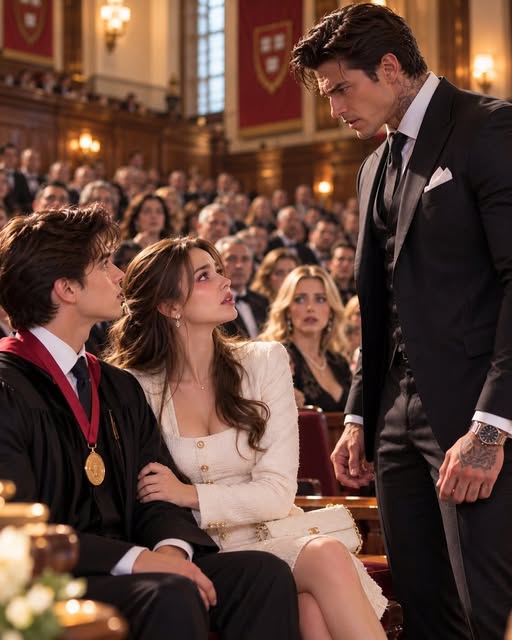
    And then, in the autumn, Harvard invited Noah back to the symposium — this time to speak, as the returning scholar, to the new incoming class.

    I sat in the front row this time. Vincent sat on one side of me, in a suit he'd had Noah approve by photograph beforehand, like a schoolboy. Ethan sat on my other side with his long legs folded under the seat in front, home from law school interviews, eating the program with his eyes, bursting with a pride he no longer had any reason to ration. The three of us took up the whole row's heart, and when the lights went down I felt Vincent's hand find mine in the dark, and keep it, the whole time, like a man holding on to the one true thing in a room full of applause.

    "This is my second year standing here," Noah said, from the podium, eighteen months older and somehow already a man. "Last year I told you that success is continuing when nobody is watching. I was wrong about one thing. Somebody was watching. Somebody was always watching — at a kitchen table, at a night job, at every ordinary unglamorous hour of my life. I just couldn't see the whole audience yet."

    He looked down at our row. He smiled the smile I had earned and the smile two other people had had to cross eighteen years and a courtroom of the heart to earn.

    "Let me introduce you to my family," he said. "All of them. It took us a while to get everyone into the same room — " the hall laughed, because by then everyone knew the story, it had been in all the papers — "but I'd like the record to show that we got here."

    The applause rose like weather. I sat in the middle of it with my husband's hand in mine and my sons on either side of me, and I thought about the sentence I had spoken into a microphone in this very hall, in what felt like another woman's life: *My husband died the day my son was born.*

    It wasn't true. It had never been true — it was just the only shape my grief had known how to wear in public. The truth, the whole truth, the truth in the light with paper, was this:

    My husband was lost the day my son was born. He was lost to pride, and to cowardice in installments, and to a woman who fed on the dark between us. He stayed lost for eighteen years, in a big house, with money arriving in his accounts and a son growing up three rooms away who could not save him, while across the country a woman he had failed raised his other son on marked-down bread and an unbreakable promise.

    And then a boy with his father's jaw walked onto a stage at Harvard, and asked for his mother to come up and stand in the light — and the light, as it turns out, is very hard to hide from, once somebody you love is standing in it.

    He found his way back the only way the lost ever do. One present, accounted-for, ordinary day at a time.

    He has not missed one since.

  • Chapter 6: Terms of Surrender

    Chapter 6: Terms of Surrender

    What nobody tells you about the truth, when it finally comes, is that it does not rebuild anything by itself. It only clears the ground. The rebuilding is slow, unglamorous, daily work — the kind measured in dinners attended and phone calls returned — and it belongs to the people, not the revelation.

    Sophia pleaded guilty in February. The plea agreement — engineered by lawyers, blessed by prosecutors who had eighteen years of paper to work with — put her in a federal facility for six years, with restitution set against every asset in her name. Marcus Webb took four. I did not attend the sentencing. Noah asked me, once, if I wanted to, and I told him the truth: she had occupied enough of my life rent-free; I wasn't buying a ticket to watch the end of her tenancy.

    Ethan went, though. He went every month, and in March he told me about the first visit, at my table, with his hands wrapped around a mug he never drank from, in the flat voice of a boy reading a weather report from a country that had flooded. The glass between them. His mother in facility beige, her hair done even there — "she would find a way, Mom would find a way in a shipwreck" — asking after his classes and his car and whether the house was being aired. And then leaning toward the glass, close, with her whole twenty years of motherhood behind her eyes: *I kept your world safe. Everything I did was a wall around you, Ethan. A mother builds walls. That's the job.* And Ethan said he had heard his own voice answer her like a stranger's: *Mom. I was the wall. You built me into it. There's a difference between protecting your kid and spending him.*

    "She cried," he told my kitchen. "First time in my life I ever saw her cry where it didn't work on me. And I sat there loving her — I did, I do, God help me — and not believing one word, both at once, in the same chair. And I thought: this is how it was for you. Loving somebody and finding out the floor is paper. That's a terrible way to understand a person, Claire. I wouldn't wish it on—" He stopped. He looked at Noah, down the table. "Well. You wished it on nobody. It just arrived. Anyway. Now I know how the chair feels."

    I reached across the table and held his hand — the hand of the boy whose existence had ended my marriage, the boy I had fled a city to keep my son from envying — and it was, I discovered, simply a boy's hand, cold from the drive, shaking slightly. I held it until it stopped.

    Ethan moved out of the big house the week after the gala. Not in anger — that was the thing that undid me, when he told me about it later. In quiet. He took an apartment near his university, and he visited his mother once a month in accordance with the rules of the facility, and he sat in my kitchen, some weekends, with his elbows on the table where Noah had grown up, learning the geography of the childhood he'd almost had a brother in.

    Because that is what my kitchen became, that winter: neutral ground. The boys were careful with each other at first, like men carrying something breakable between them. They compared what they knew the way you'd compare maps of the same country drawn by enemies. Ethan knew Vincent's rages and silences; Noah knew my budgets and my night shifts. Ethan had been given everything except the truth. Noah had been given the truth about everything except one man.

    "You know what the worst part is?" Ethan said once, to the table at large, while I was pretending not to listen from the stove. "She used to help me with my homework at this — at a table just like this. Every night. She was a good mother. That's the part nobody wants me to say. She was a good mother, and she did all of it, and both of those are true, and I have to live in a world where both of those are true."

    Noah, after a moment, said: "Yeah. Mine lied to me for eighteen years because she loved me past the edge of reason. Parents. They hand you the good and the damage in the same box." He pushed the plate of my cooking across to his brother. "Eat. You think better when you eat. That's a family trait, apparently. From her side."

    I had to leave the room. I stood in my own hallway and cried with my hand over my mouth like a girl.

    The first Sunday dinner at the big house nearly defeated all of us, and then didn't. Noah walked the rooms slowly, the way you walk a museum of a life you were scheduled to live — the library with its two ladders, the dining room that seated twenty, the garden where Ethan, at the window, pointed out the climbing frame their father had built the year Ethan turned six: two platforms, a rope bridge, and, weathered and oddly touching, a second platform frame beyond it, begun and never finished. "He told me it was for guests," Ethan said. "I asked him for ten years when he was going to finish it." He looked at Noah. "I think he was building it for a kid he couldn't name. I think it sat out there unfinished for fourteen years because finishing it meant admitting who it was for." Noah put his hand on the gray wood and said nothing at all, and Ethan, after a moment, said, "We could finish it. Not for— just. It shouldn't stay unfinished. Nothing should."

    In the study, a drawer stuck, and Vincent said "Leave it—" a half-second too late; Noah had already pulled it open, and there, wrapped in a cloth like something liturgical, was the wedding photograph of Vincent and me — twenty-six years old, my face turned away laughing — which six hundred gala guests and eighteen years of pride had coexisted with, hidden in a drawer in the dark. Vincent did not explain it. He looked at it over Noah's shoulder and said, with an effort at lightness that fooled no one, "Some things a man keeps badly. That is not the same as not keeping them." At dinner he served my son himself — actually served him, standing, with the dish, like a waiter in his own house — and asked him about his coursework and listened to the answers as if they were dispatches from a war he was desperate to understand, and I sat in the dining room of the house that had eaten my eighteen years, and watched it feed my son at last, and felt something in me that had been clenched since I was twenty-six years old begin, very slowly, to unclench.

    Vincent, meanwhile, was learning the discipline of being permitted. Those were my words to him, and I chose them on purpose, in a conversation we had in November, in this same kitchen, after he had driven down — alone, in his own car, like a mortal — to return a book Noah had left at the gala hotel.

    "You don't get to buy your way into his life," I told him. "Not with money, not with the name, not with eighteen years of guilt arriving all at once in a truck. Noah is not a debt you can settle, Vincent. He's a person you can know. Slowly. If he lets you."

    "I know." He turned his coffee cup in a slow circle. "Claire, I have run organizations of men who would kill on my word. I have negotiated with families who wanted me dead before dessert. I have never in my life been as frightened as I am of your son's good opinion."

    "Good," I said. "That's the first entirely appropriate thing I've ever heard you say about fatherhood."

    He almost smiled. Then he didn't. "I owe you more than an apology," he said. "I owe you an explanation that is not an excuse, and I've spent three months trying to find the difference. Here it is. I didn't choose Sophia over you in one moment. I chose her in a hundred small moments I refused to look at — my father's pressure, the family's horror of scandal, a son already on the way, and a wife I told myself was strong enough not to ask questions. I was a coward in installments, Claire. You were the only person in my life who never charged me interest, and I spent you anyway." He looked up. "I won't ask you to forgive me. I wanted it said in the room where it happened, by the man who did it. That's all."

    I had waited eighteen years to hear it, and I had imagined it, in my weakest moments, as a kind of victory. It wasn't. It was just sad, and honest, and late, and true — which is to say, it was the only kind of apology worth anything at all.

    "Be present," I told him. "That's the whole list. Show up when you say you will. Call when you say you will. Learn his life as it is, not as you would have built it. Do that for a year, Vincent, and we'll see what kind of man the years have made of you."

    He did it. That is the part I still, sometimes, cannot entirely believe: he did it. He came to Boston in the rain for a mathematics colloquium so far above my head that Noah had to translate it for me in whispers, and Vincent sat through two hours of it with the grim concentration of a man defusing ordnance, and afterward asked three questions that Noah later admitted, astonished, were good ones. He learned that Ethan took his coffee black and Noah took his tea with honey. He learned that the big house in Chicago was too quiet now, and he said so, out loud, at my table, in front of both boys, and then caught himself and laughed — Vincent Moretti, laughing at himself at my kitchen table, over my cooking, with his sons.

    In March, Noah called him "Dad" for the first time. It was not a moment anyone arranged. Ethan had burned garlic bread; Vincent, without thinking, had taken the tray with his bare hands like a man raised by wolves; and Noah, laughing — actually laughing, helpless with it — said, "Dad, seriously, oven mitts exist." The kitchen went quiet around the word. Noah heard it too. He didn't take it back. He looked at his father over the ruined bread, and shrugged, and said, "Well. You did burn your hands off for the family. It's not nothing."

    Vincent stood there holding the tray with his face doing something complicated and his ears bright red, and said, "I'll take it," in a voice like gravel. "I'll take it."

    In April, on the porch of the little house Noah and I had moved to by then — a house I had bought, I will note, with my own money, from selling the apartment and eighteen years of being underestimated — Vincent asked me a question he had no arrangement for.

    "When Noah's ready, and if you're willing," he said. "Not a settlement. Not a strategy. I'd like to court you. Properly. Like a man asking a woman he has no claim on, because I have none, and I know it. Dinners. Walks. Whatever a man is supposed to do when he doesn't own a single thing about the situation except his own hope."

    I looked at this man — silver-haired, scarred by his own history, holding a grocery bag he'd insisted on carrying in from my car — and I felt something I had not allowed myself to feel in his presence for nineteen years. Not safety. Not yet. But the beginning of its rumor.

    "Ask me again in the spring," I said.

    "It is spring, Claire."

    "Then you're learning patience early," I said, and went inside with the groceries, and smiled at the refrigerator like an idiot for a full minute where no one could see me.

  • Chapter 5: In the Light

    Chapter 5: In the Light

    Sophia Reynolds made her last move eleven days later, and she made it in the only arena she had ever truly understood: other people's opinion.

    An anonymous dossier arrived at Harvard's honors office on a Tuesday. It arrived, the same morning, at the education desk of a Chicago newspaper. It contained the forged First Mercantile receipts — the ones with my traced signature — arranged to tell a story: that Claire Bennett had been maintained for eighteen years as a paid mistress of the Moretti organization; that her son's sudden appearance was a financial operation; and that Noah's celebrated assessment distinction, at an institution where the Moretti family had just endowed a chair, smelled strongly of purchase.

    By Thursday, Harvard had placed Noah's distinction "under administrative review" — a phrase Noah read aloud in our kitchen in a voice so carefully neutral that I had to sit down. The university was not accusing him of anything. The university wanted the matter "clarified." The university, in other words, had hung a small, polite, devastating cloud over the purest thing my son had ever earned, and every news alert on my phone wanted to know what the mafia's secret son had to say about it.

    The week that followed had a texture I remember as wet wool. A tabloid reporter came to my door with flowers and a recorder in the same hand, smiling with all his teeth; I closed the door on both. A woman from a television station called four times, each time kinder and each time worse. Noah's faculty advisor — a decent, frightened man with a mortgage — counseled him in a low voice that the university protected its processes and that he should say nothing to anyone at all, which Noah did, perfectly, while his distinction sat in a drawer marked pending and his classmates read about him over breakfast. He fought the only way he had ever fought: with rigor. He filled notebooks. He attended every lecture and sat in the front. If the world intended to call his life's one clean achievement dirty, it would have to do it while watching him earn it again, daily, in public.

    It was Ethan who called that week — the brothers' second conversation, and the first one Ethan had initiated as anything other than a warning. I heard only Noah's side of it, from the doorway, and I have treasured it ever since. "For what it's worth," Ethan said down the line, "and it may not be worth much: nobody who was actually in that hall believes it." There was a pause. Noah said, "You were in that hall." A longer pause. "Yeah," Ethan said at last. "I'm starting to notice what I believe." Noah sat for a while after he hung up, looking at nothing, and then he said to me, almost surprised: "He sounds like he's doing arithmetic too. Like it's costing him something real." I said, "It is, baby. It is. That's how you can tell it's the truth arriving. It never comes free for anybody.

    Noah said nothing. He went to his classes. He ate the food I made and thanked me for it. At night I heard him at the table, working through problem sets with the same furious orderliness he had had at nine years old, as if rigor itself were a place he could live until the world became honest again.

    Vincent called me — the first time we had spoken since the hallway — and his voice was doing that dangerous quiet thing. "I can make this disappear in a day," he said. "The newspaper. The dossier. All of it."

    "No."

    "Claire—"

    "Vincent. Listen to me." I stood in my kitchen where my son had fought for his life with a pencil for eighteen years and I said the truest thing I knew. "If you bury this in the dark, she owns the dark. She will spend the rest of her life in it, whispering. My son's name was put in doubt in the light, and it will be cleared in the light, in front of everyone, with paper. All of it. Or not at all."

    There was a long silence. Then the man I had once been married to said, with something in his voice that I had not heard since I was twenty-six years old, "Tell me what you need."

    Nine days later, the Moretti Foundation held its annual gala in Chicago — six hundred guests, the mayor's office, two senators' wives, the board of the new institute, and, because Vincent had quietly ensured it, a press pool. Sophia attended on Ethan's arm, in midnight blue, in her accustomed place: the family's public face for twenty years, seated at the first table, beneath the lights, exactly where she most loved to be believed in.

    Noah almost didn't come. "I don't do stages for them," he said. But Ethan called him — the brothers had been circling each other by phone for a week by then, two boys comparing the shapes of their stolen childhoods — and Ethan said, "She's going to sit in the front row and be honored. If you're not there, the story is whatever she wore. Come." And my son, who had inherited his father's spine along with his jaw, put on the suit I had taken in with my own needle, and came.

    We drove to Chicago in my car, because I wanted my hands on a wheel and my son beside me rather than above the weather in one of Vincent's airplanes. Noah was silent for the first hour, watching the fields give way to suburbs, and then he said, "If this goes wrong, Mom, it goes wrong in front of six hundred people." I said, "Then it will go wrong honestly, in the light, with paper — which is still better than going right in the dark, by purchase. Your whole life is the proof of that sentence. We are not starting to lie at the finish line." He considered this with his father's gravity and his own mercy, and nodded, and slept the last forty minutes with his head against the window like a boy of nine, and I drove through three states of toll roads memorizing him.

    At the hotel, Vincent was waiting in the lobby. Alone — no driver, no lawyers, no architecture of power, just a man in a dark suit standing by the elevators with his hands clasped in front of him like an usher. Ethan stood beside him, and when we came through the doors, both of them rose at the same moment, the way men rise for someone they honor, and I watched my son stop walking entirely. It was such an ordinary thing. That was what undid him, I think: not a stage or a speech, just a father and a brother, standing up when he came into the room. Vincent took my coat. "Whatever happens tonight," he said, "no one in that room will ever be able to say they didn't see it." And Noah, hoarsely, said: "Okay. Let's go be seen, then.

    Vincent took the stage after the first course. He did not read from the teleprompter. What follows is from the transcript, which I have read so many times I no longer need the paper.

    "Twenty years ago I made an arrangement at this foundation that I have not spoken of publicly. Tonight I am going to correct the record, because a young man's name has been put in question, and the question rests on a lie that was told with my money and in my house."

    The room went still in the way of the Harvard auditorium — the way of sentences landing heavier than expected.

    He told it all. The monthly payments. The forged account. The shell trust. He named Marcus Webb. He named the Halden Trust. And then — because I had asked him for paper, in the light — Daniel Reyes walked to the second microphone, gray-faced and steady, and walked six hundred people through eighteen years of statements, while behind them, on the gala's own projection screen, the forensic examiner's report appeared: the signature cards, side by side. My real signature, with its little hook on the C. And the traced one, patient and false.

    "The court-appointed examiner's conclusion," Daniel said, "is that Mrs. Bennett — Mrs. Moretti — never signed for, received, or knew of these funds. The funds were diverted, in full, by the trustee of the Halden Trust, acting with the knowledge of his sister."

    Every face in the room turned, as faces do, toward the first table.

    Sophia rose. She was magnificent, I will grant her that even now; she rose like a queen being interrupted at dinner. "This is a performance," she said, clearly, for the microphones. "This is what this family does to women who inconvenience it. Ask Claire Bennett where she was for eighteen years—"

    "I was cleaning offices on Cermak Road," I said. I was not at a microphone. I didn't need one. Six hundred people were quiet enough to hear a woman who had waited eighteen years to answer that question. "I was paying a hospital in installments. I was marking down bread at eight in the evening so my son could eat fresh. That's where I was, Sophia. While you were spending his childhood."

    And then Ethan stood up.

    He was twenty years old, and he had his father's height, and his hand — I watched it, the whole room watched it — shook only slightly as he took his phone from his pocket and held it out toward the foundation's own technician, the way you hand someone evidence at a trial.

    "There's a photograph," Ethan said, into the silence, in a voice that carried further than he expected. "I took it in my mother's study. It's a First Mercantile statement. It shows the deposit — in Claire Bennett's name — and the withdrawal, four days later." He looked at his mother then, for a long time, and what he said next was not loud at all. "Mom. Tell me it's fake. I'll believe you if you can just tell me it's fake."

    Sophia Reynolds looked at her son — the son she had built her entire life around, the reason, she would say forever after, for everything — and she could not say it.

    The detectives were not theatrical about it. There were three of them, and they had been standing at the back since the second course, because Vincent — whatever else he was, and he was a great many things — had understood my condition precisely: not vengeance in a cellar, but the law, in the light, with paper. They arrested Sophia Reynolds at the first table of the Moretti Foundation gala, on charges of embezzlement, forgery, and wire fraud, in front of six hundred witnesses and a press pool. Marcus Webb was arrested the same night in Cicero, where investigators had questions about a storage fire.

    As they walked her past the tables, Sophia stopped. She looked at Ethan — not at Vincent, not at me, at Ethan — and she said, with her whole heart in it, because I believe in her way it was true: "I did it for you. Everything I did, I did for you."

    Ethan's face was wet. He didn't look away from her. "You did it to me," he said.

    Vincent came down from the stage then, and crossed the floor to where Noah stood at the edge of the lights in his mended suit, and he did the thing I had asked myself, in the dark, for eighteen years whether he would ever do. In front of the mayor's office and the senators' wives and the press pool, Vincent Moretti put out his hand to my son — and when Noah took it, Vincent turned, deliberately, to face the room, and said, "This is my son Noah. He was kept from me, and I will spend whatever years I have left being kept from nothing." He looked at Noah. "If he'll allow it."

    Noah said, so quietly that only the front rows and the microphones caught it: "We'll start with dinner. All of us. Even Ethan."

    Harvard reinstated his distinction within the week, with a letter of apology that Noah keeps in the drawer with the other papers that prove who he is.

  • Chapter 4: Brothers

    Chapter 4: Brothers

    I told Noah the truth at our kitchen table, the night after the symposium, in the same chairs where he had opened his Harvard letter. I told him all of it — the marriage, the fitted sheets, the second family I had discovered like a second skeleton in a house I'd thought I knew, the divorce, the pregnancy I had hidden, and why. Especially why. I made myself say the why out loud, all of it, including the part where my protection of him had also, somewhere along the years, become my protection of myself.

    He listened the way he does mathematics: completely, and without interrupting, his hands flat on the table.

    When I finished, the kitchen clock was ticking so loudly it seemed impolite. Noah looked at the table for a long time.

    "You let me think he didn't want me," he said at last. Not loud. Worse than loud. "Every Father's Day at school. Every time some kid asked. I had a whole story in my head — he knew about me and he just… didn't come. I built myself around that, Mom. I decided I didn't need a father because my father had decided he didn't need me."

    "I know." My voice was threadbare. "I told myself I was giving you a clean wound instead of a messy one. A father who was gone entirely instead of a father who chose another boy's school play over yours, every time, in person, where you could watch. I still believe that second childhood would have broken something in you. But I won't lie to you now, Noah — not even to be kind. Part of it was me. If you'd known, you might have gone looking for him. And I could not have survived handing you over to that house, to her, and watching you come home smaller."

    Noah stood up and went to the window. Our street was dark and ordinary; somebody's television flickered blue behind a curtain.

    "I need a while," he said. "Not to decide if I forgive you. To figure out what I even think." He turned around, and his eyes were wet, and he was still, somehow, gentle with me. "You should have trusted me with it at sixteen. At least at sixteen."

    "You're right," I said. "I know you're right. I was a coward about exactly one thing in my life, and it was the biggest thing. I'm sorry, Noah. Down to the ground, I'm sorry."

    It took eleven days for my son to come all the way back to me.

    For the first three days, Noah ran. My son, who had never run anywhere in his life except toward a library closing time, began going out at dawn in his oldest shoes, and coming back an hour later wrung out and silent, as if the truth were a distance he could wear down. And each evening he asked me exactly one question, precisely framed, like a man drawing lots he had numbered in advance. On the first night: "Did you ever almost tell me?" I said, "Every birthday. I rehearsed it every birthday, all the way through, standing at that counter — and then I baked the cake instead and told myself next year you would be older, and I would be braver." On the second night: "Does he know now? About the offices, and the hospital, and all of it?" I said, "He knows. He found out standing in a marble hall in front of me, and I watched it cost him something real, and I will not pretend I was sorry." On the third night he asked the question I had been dreading for eighteen years, quietly, to his plate: "Was there ever a version of your plan where I got to meet him?" And I answered with the whole, unvarnished truth: "In the version where you asked. You never asked, Noah. You were eight years old and you had already decided which questions would hurt me, and you stopped asking them. You were guarding me. That is the part your mother cannot forgive herself for — that my protection of you taught you to protect me back, in silence, at eight."

    He was quiet a long time after that. Then he got up, and washed both our plates, and said, "Okay. That's a real answer," and it was — I could feel it in the room — the first stitch. It took one courier, arriving on the fourth of those days, to show me what kind of man Vincent Moretti intended to be about it.

    The envelope contained no check. I want that recorded, because a check is what the world would have expected, and what I would have burned in the sink. It contained two things: the name and address of an independent genetics clinic in Boston, with a note that a sample kit was available there in Noah's name if — only if — he ever wanted documentary certainty, for his own records; and a letter, in Vincent's hand, addressed to Noah, which Noah let me read a week later, standing in this same kitchen, because by then we had agreed: no more secrets in this house, in any direction.

    The letter was four lines long.

    *Noah — I am not writing to ask you for anything. A man who missed eighteen years has no standing to ask. If you want proof of what you are, it exists and it is yours whenever you want it. What I am to you is yours to decide, and whatever you decide, I will abide by it. — V.M.*

    Noah read it three times. "For the record," he said finally. "Not for him. For me. I want the paper."

    The result came back in nine days, in a white envelope: 99.99 percent probability of paternity. Noah looked at it for a long moment, folded it once, and put it in the drawer with his birth certificate and his Harvard letter — the drawer of documents that proved who he was. Then he said, in a voice he tried to make offhand and didn't, "Okay. So that's true too."

    He had had one more day than that to absorb all of it when his brother came to Boston to threaten him.

    It was late afternoon, golden, the quad full of students, and Ethan Moretti stood in front of Noah's dormitory with his father's jaw and his mother's mission, and he said what such boys say when they've been handed a script by someone they love: that my son was a fraud, that I was a blackmailer with an eighteen-year con, that Noah would get nothing — not money, not the name, not the father — if Ethan had anything to say about it.

    Noah set down his groceries. He set down his books. Three separate witnesses used the same word for what he did next: nothing. He did nothing at all for a moment; he just looked at Ethan, at this furious stranger who shared his eyes, with an expression one girl described as "like he was sad for both of them."

    "My mother mopped the floors of an office building on Cermak Road for two years so I could have braces," Noah said quietly. "She paid my hospital bill in monthly pieces until I was eleven. If there's hush money, Ethan, I've never seen it, and neither has she. But that's not why you're here."

    "Don't tell me why I'm here."

    "You're here because you're scared." Noah's voice didn't rise at all. "So am I. I found out my father was a living man nine days ago. I found out I had a brother eight days ago. You've known about me for — what, a week? — and everything you know, your mother told you." He took one step closer, and his voice dropped. "Ask yourself why the woman who's been lying to my father for eighteen years" — Ethan flinched; Noah had not known, officially, about the money, but he had his father's gift for the shape of things — "why she needed you to come here and hate me before you'd ever heard my voice."

    Ethan's hands opened and closed. "You don't know anything about my mother."

    "Then show me I'm wrong." Noah picked up his groceries — discount bread, store-brand pasta, the makings of a meal for one in a dorm room — and held the door of his building with his shoulder. "I'm not going anywhere, Ethan. I've been not going anywhere for eighteen years. When you want to talk instead of warn, you know my name. It's in the papers. Your father paid for the institute that put it there.

    The door closed. The quad went on being golden and indifferent around him. A girl passing with her friend slowed, did the now-famous double-take at his face, and said, perfectly audibly, "Was that his brother?" before her friend shushed her into silence. Ethan sat down on the low wall by the path with his hands hanging between his knees, and out of twenty years of habit he called his mother. She answered on the second ring, warm and ordinary, asking if he'd eaten, whether Boston was cold — and Ethan heard, as if from the bottom of a well, his brother's voice: *before you'd ever heard my voice.* He hung up in the middle of her sentence and sat staring at his phone as though it had bitten him.

    He did not drive home. He drove to the river and sat until full dark, and he thought about a bag of groceries: store-brand pasta, discount bread, a single chicken breast in marked-down wrapping. The same brands, he realized with a slow, cold clarity, that his own family's housekeeper bought for the staff kitchen — food his mother had once wrinkled her nose at in a supermarket when he was fourteen. *Poor people perform poverty, darling,* she had said. *It photographs well. Remember that.* He sat by the river and wondered, for the first time in his life, what his mother actually knew about how poverty photographs, and why her knowledge of it had the polish of long practice — the practice, though he could not yet say it, of a woman who had spent eighteen years signing another woman's name."

    He went inside. Ethan stood on the path for a long time, in the golden light, being looked at by passing students who had all seen the famous photograph of the symposium by now and were doing, quietly, the same arithmetic the whole world was doing.

    Ethan drove back to Chicago that night without calling his mother.

    What he did, two nights later — and this, too, I know only because he told me himself, much later, sitting on my porch steps like a penitent — was go looking for a phone charger in his mother's study, because his had died and hers was the room with the drawer of cables. The drawer stuck. He pulled harder. Under the cables were bank statements, bound with a rubber band, in an envelope from First Mercantile Bank, addressed to a trust. And the top statement, which he read standing there with the drawer hanging open like a mouth, showed a deposit — five thousand dollars, from a Moretti family account — and, four days later, a withdrawal, and the name typed in the memo line, in harmless banking type, as if it were nothing at all:

    *For: C. Moretti — Bennett.*

    Ethan stood in his mother's study and understood that the deposit had been made in the name of a woman who had mopped floors on Cermak Road — and that his mother had been the one to take it out.

    He took a photograph of it with his phone. He put the drawer back exactly as he had found it. And he sat in his car in the driveway of the house he had grown up in for almost an hour, while the windows lit up one by one and his mother moved through the kitchen making dinner, before he finally unlocked his phone with shaking hands and scrolled to a number he had no earthly reason to have — the number of a brother he had threatened five days before.

    "Noah," he said, when the line picked up. "Don't hang up. I need to ask you something. About my mother."

  • Chapter 3: The Money That Never Arrived

    Chapter 3: The Money That Never Arrived

    Everything I am about to tell you about that week, I learned later — some of it from Vincent, some of it from a sworn deposition, and some of it from Daniel Reyes himself, who sat in my kitchen two years afterward with his hat in his hands and cried like a boy while he told me what my eighteen years had actually looked like from the inside of that house.

    Daniel had run the Moretti family's legitimate accounts for twenty years. When Vincent called him at midnight, hours after the symposium, Daniel assumed someone had died.

    "No one died," Vincent said. "Someone was born. Pull every payment I ever sent to Claire Bennett. All of it. I want the trail on my desk by morning — where it left, where it landed, whose hands it passed through. All of it, Daniel."

    It took eleven hours. The payments were real. Five thousand dollars a month, every month, for eighteen years — two hundred and sixteen payments, over a million dollars — sent on Vincent's standing instruction, beginning the month after our divorce. The instruction had been set up through the family's attorney at the time, a man named Marcus Webb.

    The money landed in an account at First Mercantile Bank in my name. An account I had never opened, at a bank I had never entered, in a city I had fled.

    "Signature card's a forgery," Daniel told me later. "Not even a good one. Your signature — I had your real one on file from the foundation papers — your real one has that little hook on the C. The card at First Mercantile didn't. It was traced by someone who'd seen your signature but didn't know your hand."

    From that account, the money never rested. Within days of each deposit, it moved — in careful, unglamorous increments — through two shell accounts and into a brokerage account held by a trust. The Halden Trust. The trustee, Daniel discovered, was Marcus Webb.

    Daniel had taken the trail to a forensic accountant named Ilse Brandt at two in the morning, a woman who had built her reputation unwinding the books of dead bankers, and she had spread eighteen years of First Mercantile records across a conference table like a hand of cards. The account had been opened with a power of attorney citing an authorizing document that did not exist — Brandt had written, in the margin of her report, a sentence Daniel would quote to me years later with undiminished wonder: *The fraud was not sophisticated. The fraud was confident. It relied entirely on no one ever looking.* The shell entities downstream of my name were incorporated in Delaware and named with a banality that amounted to camouflage, and the trust itself — Halden — carried, Daniel discovered with a sensation he described as the floor tilting, the maiden surname of Sophia Reynolds's grandmother.

    The withdrawals told their own biography. A renovation of the Kenilworth house. Landscaping. A car. And — the line Daniel had to read twice, sitting under the fluorescent lights at three in the morning — eleven years of tuition payments to St. Aurelia Academy. Ethan's school. Vincent's money, sent to keep me secure, had been routed through my forged name to pay for the upbringing of the son whose existence had ended my marriage, while my own son did his homework under a clanking radiator. Daniel sat in his car in the bank's parking garage afterward and was quietly, thoroughly sick, and then he drove to Vincent's house, because he had found one more thing in the original instruction file, in Vincent's own handwriting, on the memo line of the very first payment order, and he thought the man deserved to have it read back to him by a witness: *For Claire. Whatever she needs. No conditions and no reports to me. Her pride is not a billable item.*

    Marcus Webb was Sophia Reynolds's older brother.

    I want to sit with that for a moment, because Vincent had to. For eighteen years, while I was paying a hospital in two-year installments and marking down bread at eight in the evening, the woman who had destroyed my marriage was spending my son's security on the life she had stolen with both hands. She hadn't merely taken my husband. She had stood at the door of my exile holding out a bowl, collecting everything he tried to send after me, and eating it in front of a family that believed I was comfortable, provided for, and simply — proudly — gone.

    Vincent called her into his study at nine that evening. Daniel was there. Vincent did not raise his voice; Daniel says that was the worst of it, that he had never in twenty years been frightened of Vincent Moretti until Vincent went that quiet.

    "For eighteen years," Vincent said, "I have believed Claire was secure. I have believed it because I paid for it to be true. This morning she stood in front of me and told me she cleaned offices at night to keep our son fed. So I am going to ask you one question, Sophia, and I am going to know if you're lying. Where did the money go?"

    Sophia cried. Daniel was very clear on the sequence, because it mattered later: first she cried, then she denied knowing anything about any account, then — when Vincent slid the Halden Trust statement across the desk — she changed, the way weather changes, and stopped crying entirely.

    "All right," she said. "All right. You want the truth? She took it." She leaned forward. "Claire took every dollar, Vincent. She signed for it. She wanted it in a separate account, away from the divorce settlement, because she never wanted you to be able to prove she'd been provided for — she wanted to keep you guilty forever. That's who she is. That's who she always was. And now her son is a headline, and suddenly she's back, telling you she cleaned offices? She's setting you up. She wants the rest of it. She wants Ethan's share."

    "She asked me for nothing," Vincent said. "She walked away from me in a hallway. She told me goodbye."

    "Because she's better at this than you are!"

    Daniel said the silence after that went on so long he could hear the house settling. Then Vincent stood, and walked to the window, and looked out at the garden where Ethan had learned to ride a bicycle, in the house where nineteen years of dinners had been eaten, and said, without turning around:

    "The original signature cards. First Mercantile will produce them for a forensic examiner. If Claire's hand signed them, I'll know. If the hand was yours, or your brother's—" He turned. "Sophia. If the hand was yours, there is not a room on this earth you can lock between us.

    Sophia found her footing then — Daniel said it was like watching a fencer recover from a stumble — and she aimed at the one place she had always known was soft. "And Ethan?" she said. "When your examiners have finished their sums, Vincent, what precisely do you tell Ethan? That his mother is a thief? That the woman who left you is a saint and the woman who raised your son at your table for twenty years is a criminal in a nice dress? He will never forgive you. You will have destroyed your son to avenge your conscience."

    "I am not choosing between you," Vincent said. "That is the entire history of my failure — I kept treating my life as a choice between women because it excused me from arithmetic. I am counting now. It is the only thing I should have done eighteen years ago." He informed her, in the tones of a man discussing weather, that she would remain in the house while the forensic work proceeded; that she would attend dinner; that she would smile; and that the household staff had been instructed that any shredding, burning, or unusual telephoning would be reported to him directly. "You built this family's face, Sophia," he said. "Wear it a little longer."

    She understood him perfectly. It was a cage, and the bars were made of good china and routine, and there was not a door in it she could rattle without the whole city hearing."

    She left the study white-faced. And that night — this came out much later, from Marcus Webb's own phone records, entered into evidence — Sophia called her brother at 11:48 p.m. The call lasted four minutes. Marcus Webb told investigators that his sister said only one sentence that mattered, and she said it twice.

    "Burn it," she said. "All of it. Tonight."

    But Sophia Reynolds's most poisonous work that week was not the fire her brother lit in a storage facility in Cicero — a fire that, in the end, destroyed nothing but copies, because Daniel Reyes had already imaged every original for the auditors out of a habit of caution he could never afterward explain.

    Her most poisonous work was done at her own kitchen table, over two nights, with her son.

    Ethan was twenty years old. He had been raised in that house as the Moretti heir — loved, Vincent would be the first to say, completely and without reservation. What Ethan had not been raised with was the truth; he knew his father had been married before, briefly, to a woman who had left. His mother's version, refined over twenty years, was simple: Claire Bennett had married for money, tired of the life, and left. Ethan had grown up pitying his father a little for it, and despising, in an abstract way, a woman he had never met.

    His mother now gave him a new version to carry, gift-wrapped in her tears. Claire had taken hush money for eighteen years. Claire had kept a secret son in reserve like a card up a sleeve. And now that Noah was famous — Harvard, the highest distinction, the newspapers — Claire had played the card, and meant to take half of everything: half the legitimate businesses, half the estate, half of Ethan's future.

    "She'll take your father's love, too," Sophia told him. "That's the part she always wanted most. Watch. He'll forget what you are, once he has a son who doesn't remind him of me."

    Ethan believed his mother. Children do; that is the whole tragedy of them, that they believe their mothers.

    What she had shown him, across those two nights at the kitchen table, Ethan would describe to me long afterward, piece by piece, like a man disarming something. A photograph from the symposium coverage, cropped close: my hand in Noah's on the stage, presented not as a mother being honored but as a handler displaying a prize. A printout of the institute endowment beside the announcement of Noah's distinction, with a single line highlighted in yellow, as if proximity were proof. And always her hand, at intervals, resting on his cheek the way it had when he was seven and afraid of thunderheads over the lake — because a twenty-year-old man is only a seven-year-old with a longer reach, and his mother knew the exact geography of him.

    Ethan took the story the way he had taken everything from her all his life: whole, and without chewing. And yet — this is the detail I hold on to, the first hairline crack — driving back from the symposium a week earlier, Ethan had watched his father's face in the rearview mirror as the car pulled away from the hotel, and it had not been the face of a man hearing a con being prepared. It had been the face Ethan had seen exactly once before: at his grandfather's graveside. A face doing grief's arithmetic. He pushed the thought down, because sons learn to push down whatever accuses their mothers. He pushed it down and packed a bag for Boston.

    It stayed pushed down for precisely as long as it took my son to set a bag of groceries on the ground and look at him.

    On the ninth day after the symposium, Ethan Moretti drove to Boston with his jaw set and his heart broken in advance, to find the brother he had never known he had — and to warn him, and his gold-digging mother, to stay away from the Moretti family.

    He found Noah outside his dormitory, in the late-afternoon sun, carrying a stack of library books and a bag of groceries from the discount store on the corner.

    And he walked straight up to him, in front of a dozen students, and said: "You're Noah Bennett."

    Noah set down the groceries. He looked at this stranger with his own father's jaw and his own dark eyes, and something in his face — God help me, I wasn't there, but three students who were described it to the investigator, and then Noah described it to me — something in his face went very quiet and very sad, like a door closing gently.

    "You're Ethan," Noah said. "I wondered if you'd come."

  • Chapter 2: Eighteen Years of Silence

    Chapter 2: Eighteen Years of Silence

    The reception afterward was held in a hall with too much marble and not enough exits. Noah was immediately absorbed into a orbit of deans and donors — people who wanted to shake his hand, photograph him, recruit him for research programs that hadn't even begun. I stood at the edge of it with a glass of water I didn't drink, doing the arithmetic of escape: one conversation with his future advisor, one photograph, then the train, then home, then the blessed ordinary silence of our apartment.

    I felt him before I saw him. That was always the way with Vincent. The room changed temperature.

    "Claire."

    Eighteen years, and my name in his mouth still had the power to stop my heart mid-beat. I turned around slowly.

    Up close, the years were more honest. There were lines at the corners of his eyes that hadn't been there, and the silver at his temples had spread, and he held himself the way men hold themselves when an old injury has become a permanent resident. But the eyes were the same — dark, exact, and at that moment stripped of every defense I'd ever seen him wear.

    "Vincent." I kept my voice low and even. "You look well."

    "I look—" He stopped. A muscle moved in his jaw. His gaze kept pulling, against his will, across the room to where Noah stood laughing at something a provost had said. "Claire. The boy."

    "The boy is my son."

    "How old is he?"

    "You know how old he is." I said it quietly. "You've already done the counting. You did it in your seat, the way you do everything — completely, and in silence."

    Something moved across his face that I had never seen there before, not once in all our years: fear. "When did we— When were you—"

    "I was pregnant when I left Chicago." The words came out calm, and I was proud of them, because inside me a whole weather system was tearing itself apart. "I found out three weeks after the divorce was final. I decided — I decided — that he would grow up without a shadow over the table. Mine was not a hard decision, Vincent. You'd already chosen your family. I simply believed you."

    "You decided." His voice was very quiet. Around us, the reception hummed on, oblivious: crystal, laughter, a string quartet sawing away in the corner. "You decided that I would never know my own son existed. Eighteen years, Claire. Eighteen birthdays. You decided."

    "You had a son," I said. "You had Ethan. You had a house and a nanny and a plan. What exactly was Noah supposed to be in that house, Vincent? The other one? The spare? The boy who got what was left after Ethan was finished being chosen?" My voice finally cracked, and I hated it for cracking. "I watched you build that life for two years without ever telling me it existed. Don't stand in front of me now and talk about what was decided."

    His hand came up — not toward me, just up, halfway, like a man reaching for a railing that wasn't there. "If I had known—"

    "You didn't ask." I stepped back. "You never once asked where I'd gone, or how I was living, or if—"

    "I sent money." The words came out of him with sudden force. "Every month. For eighteen years. I sent money every single month, Claire — enough that you would never have to—" He stopped, because he was watching my face, and my face was telling him something he didn't understand.

    I stared at him. The quartet played on. Somewhere across the room Noah laughed.

    "What money?" I said.

    He went very still. "Claire. What do you mean, what money."

    "I mean I've never received a dollar from you in eighteen years." Each word landed between us like something dropped from a height. "I cleaned offices at night, Vincent. I took in other people's bookkeeping on weekends. When Noah was nine and needed his tonsils out, I paid the hospital in installments for two years. What money are you talking about?"

    His expression changed then — slowly, the way ice changes on a river. The grief went out of it and something older and colder and far more dangerous came in. I had seen that look exactly twice in my life, and both times, men had disappeared from Chicago within the month.

    "Someone," he said, very softly, "is going to explain that to me.

    I heard my own voice go strange and flat, the way it does when I am past anger and into inventory. "Then let me help you with the explanation, Vincent. Let me tell you what your money's absence looked like from inside my life. The winter Noah was six, the gas was shut off for nine days and we slept in our coats, and I told him it was an adventure, camping in the apartment. The week he turned seven there was an eviction notice taped to our door, and I paid the arrears by cleaning the landlord's own offices at night for a year — on my knees, Vincent, in the building of the man who had taped the notice up. When he was nine and needed his tonsils out, the hospital let me pay in installments, and I finished when he was eleven. Eleven. Every month I wrote that check next to the rent check, and every month I thought: this is simply what it costs to keep a promise. I never once thought there was a version of this where I wasn't alone in it. So you will forgive me if 'I sent money' is not a sentence I currently know how to hear."

    He had gone completely white. "I signed the instruction in Webb's office eight days after the divorce," he said, "because it was the only sentence about you I was still permitted to finish. Five thousand a month. The first of the month, every month. I asked Webb, every year, 'Is she provided for?' And every year he said: 'She never asks for more. Proud woman.' I believed him." His voice dropped to something like gravel. "I believed him because the alternative meant examining it, and examining it meant knowing. I was a coward about the paperwork of my own guilt, Claire. When you tell this story — and you will, and you should — put that in. I didn't fail to know. I failed to look. There's a difference, and the difference is worse."

    I could not answer him. There was nothing in my eighteen years that had prepared me for Vincent Moretti conducting his own prosecution."

    Noah appeared at my elbow then, glowing, breathless, a folder of programs under his arm — and stopped. He looked at Vincent. He looked at me. My son has never in his life been slow, and I watched him take in the whole scene in one sweep: my face, this stranger's face, the identical set of both their jaws.

    "Mom?" he said carefully. "Everything okay?"

    "Everything's fine, baby." I put my hand on his arm. "This is an old acquaintance from Chicago. Mr. Moretti, this is my son, Noah."

    A beat. Vincent Moretti, who had faced down federal prosecutors and rival families and the death of his own father without blinking, looked at my son and could not immediately find his voice.

    "Noah," he managed. He extended his hand — slowly, like a man defusing something. "Congratulations. Your speech. Your mother—" His voice failed him entirely for one second. "You spoke about your mother. It was — the whole room felt it."

    Noah shook his hand, polite, puzzled, watchful. "Thank you, sir."

    "We have a train," I said, and began, gently, to extract us.

    "Claire." Vincent's voice followed me, low and wrecked and utterly unguarded. "Please. Not like this. Not another eighteen years of—"

    "Goodbye, Vincent."

    I walked my son out of that hall with my head high and my hand locked around his arm, and I did not look back, because I knew exactly what I would see: a man standing very still in a room full of people, watching the door.

    On the train home, Noah was quiet for a long time, looking out at the darkening fields. Then he said, without turning around, "The man from Chicago. He looked at me like I was a ghost, Mom."

    "He's someone I knew a long time ago."

    "He has my face," Noah said, simply, the way he'd state the answer to an equation. "Did you think I wouldn't notice? Everybody in that room noticed. The lady sitting next to him went white as a sheet."

    I closed my eyes. Eighteen years of careful, loving, necessary silence, and it was ending on a train with the truth sitting right there between us, patient as mathematics.

    "Noah," I said. "When we get home, there's something I have to tell you. All of it. I should have told you a long time ago — I told myself I was waiting until you were old enough, and then I kept waiting, because telling you meant losing the version of us that worked. I'm sorry. No more waiting."

    He reached across and took my hand, and held it for the rest of the ride home.

    Half an hour into the ride, with the dark fields going past and his hand still in mine, Noah asked the question underneath all the other questions. "Was he—" he started, and corrected himself, because my son has always insisted on precision. "Is he a dangerous man, Mom? The man from Chicago. Tell me plainly, since we're doing plainly now."

    "He was the most dangerous man in Chicago," I said. "And he was the gentlest man in our kitchen. Both of those are load-bearing facts, Noah. If I give you only one of them, I'm lying with architecture." He thought about that for a mile of dark fields. "What was he like in the kitchen?" I heard myself laugh, quietly, in a train car, at the worst possible moment for laughing, because grief and absurdity have shared a house in me for eighteen years. "He couldn't fold a fitted sheet," I said. "A man who ran half of Chicago, defeated nightly by elastic corners. He used to stand in our kitchen at midnight and make me show him again, and I would be laughing too hard to demonstrate, and he'd say that was the point of the exercise." Noah looked out at the dark. "Huh," he said, softly, like a boy setting down a heavy fact he intended to pick up again later. "He folds laundry badly. Okay. That's a person. I can work with a person.

    I did not know — how could I have known — that at that same hour, in a house across Chicago, Vincent Moretti was standing in his study with eighteen years of bank records being pulled at his order, and that a man named Daniel Reyes, his accountant of twenty years, was about to go pale over a routing number.

    Vincent had been standing at that window for a long time before Daniel ever called. He had come home from the symposium, dismissed the driver, refused the dinner that had been kept warm for him, and stood in his study in the dark, looking at nothing, doing the arithmetic of cowardice. He remembered the day I left with a clarity he'd spent nineteen years refusing: my suitcase by the door, small as an apology. His father, still alive then, still a colossus, saying in the doorway, "Moretti men do not run after what has already decided." And beneath the suitcase, on the dresser, the detail that had undone him for a month afterward and that he had never told a living soul: I had done his laundry before I left. A stack of his shirts, folded perfectly, each one squared and smooth — because I did not know how to leave a thing unfinished, even him. He could not wear those shirts for a month. He had stood at that same study window and watched my sedan turn the corner at the end of the drive, and he had called it dignity, and he had gone on calling it dignity for eighteen years, at dinners, at mass, in the mirror.

    Tonight, at last, he called it by its name. Then he took out of the bottom drawer the only photograph he kept of us — his mother's framing, my face turned away laughing at something outside the edge of the picture — and he said to the empty room, in the voice of a man finally reading a verdict in full: "You had two sons, Vincent. Two. And you were absent for both of them in opposite directions."

    Then the study door opened, and Daniel Reyes came in with a laptop and the face of a man carrying a coffin.

    And that in another room of that house, Sophia Reynolds was sitting very still by a dark window, already understanding that everything she had built her life on had just walked onto a stage at Harvard and taken its bow.