FBI Agent Daniel Reyes arrived at the Moretti mansion at two in the morning, in the rain, with four agents behind him and a warrant in his pocket that he had been waiting three years to use.
Reyes was forty-two years old, with tired eyes and a suit that had seen better days, and he was the kind of federal agent who did not frighten easily, because he had spent his career looking at men like Dante Moretti and seeing not monsters, but men — men who had made choices, and who would have to live with them.
He had been building a case against Vincent Castellano for three years. Three years of wiretaps that went nowhere, of witnesses who forgot what they saw, of books that were cooked so cleanly no accountant could find the fire. He had the shape of the thing — the docks, the routes, the money moving through shell companies like water through a sieve — but he did not have the center of it. He did not have the voice.
Now, in the middle of the night, in a wrecked office in a mansion on a hill, Dante Moretti was offering him the voice. On tapes. With dates. With times. With a notebook full of proof.
"Show me," Reyes said.
Dante showed him. He laid the tapes out on the desk, in order, by date, the way a man lays out evidence he has already studied. He opened the notebook to the page about the Geneva account. He played the first tape on an old cassette player Paolo found in the library, and the room filled with a sound no one in it had expected to hear.
It was Dante's voice. Quiet, the way it always was. Speaking about the dock contracts. About the port authority. About the shipment from Genoa. And underneath it, faint but clear, the sound of another man's breathing — the man wearing the receiver, listening, writing down the times in his notebook.
"That is Marcus Hale's breathing," Reyes said. He had listened to a thousand hours of wiretaps in his career, and he knew the sound of a man listening to something he should not be hearing. "That is the sound of a man stealing a king's words."
Sophie sat in the leather chair, with Anna asleep in her lap, and she told Reyes everything. She told him about the bag in the bathroom cabinet. She told him about the receiver, and the tapes, and the notebook. She told him about Anna seeing the barber's thumb, and about Marcus asking about the cabinet, and about the way his eyes had moved over her hands and her apron and her cart.
Reyes listened without interrupting. He took notes in a small black book, the way Sophie had once taken notes in her head, and when she finished, he looked at her for a long moment, and he said, "Mrs. Miller, do you understand what you have done?"
Sophie shook her head. "I hid a box under a tile," she said. "That is all I did."
"No," Reyes said. "You did more than that. You found the center of a case I have been building for three years. Castellano has been listening to the Moretti family through Marcus Hale and Enzo Falcone for four months. These tapes prove it. This notebook proves it. Your daughter's testimony proves how the device got there. Mrs. Miller, you have just handed me Vincent Castellano's empire on a silver platter."
Sophie looked down at Anna, asleep in her lap, her small face peaceful in the lamplight. "I did it for her," she said. "I did it because a little girl saw something, and I could not let her be the only one who knew."
"Then you did it for the right reason," Reyes said. "And the right reason is the only reason that ever holds up in court."
While Reyes and his agents took statements, Dante went to Enzo's shop.
He did not take his men. He took only Paolo, because Paolo was the only man he trusted completely, and because some conversations should not have an audience. They drove through the rain to Fifth and Mercer, and Dante walked into the shop that smelled of bay rum and hot towels, and he found Enzo sitting in his chair, in the dark, with his hands in his lap, waiting.
Enzo did not look surprised. He looked like a man who had been waiting for this moment for months, and who was almost relieved that it had finally come.
"Boss," Enzo said. His hands were steady. They were always steady. But his voice was not steady. His voice shook, the way a man's voice shakes when he is afraid and he knows there is no point in hiding it anymore.
"Enzo," Dante said. He stood in the doorway of the shop, with the rain dripping off his coat, and he looked at the man who had cut his hair for fifteen years. "Tell me why."
Enzo looked at his hands. "My son," he said. "My son is in the army. He was in the army. Two years ago, he was in a place I cannot name, doing a thing I cannot speak about, and he was hurt. Badly hurt. And Castellano's men found him in the hospital, and they told me that if I did not help them, my son would not come home. And if I did help them, my son would come home, and my wife would keep her shop, and I would keep my hands."
He looked up at Dante, and his eyes were wet. "I am a barber, boss. I am not a soldier. I am not a brave man. I did what they told me to do, because I was afraid. I pressed the device behind your ear, and I carried your words to them, and every night I went home and I looked at my wife, and I could not tell her what I had done."
Dante listened. He listened the way he had listened for ten years — in silence, with his hands at his sides, his eyes on the man's face. And when Enzo finished, Dante was quiet for a long time.
Then he said, "Your son is home now, Enzo. He came home six months ago. I know, because I paid his medical bills. I paid them through the foundation, anonymously, because that is what my mother would have done. Did Castellano tell you that? Did he tell you that the man you were betraying was the man who was already taking care of your son?"
Enzo's face crumpled. He put his hands over his eyes, and his shoulders shook, and he wept — not the weeping of a man caught, but the weeping of a man who has just learned that he betrayed the only person who was helping him.
"I didn't know," Enzo whispered. "I swear to God, boss, I didn't know."
"I believe you," Dante said. "And that is why I am not going to kill you. I am going to do something else. I am going to give you a choice. You can tell Agent Reyes everything — every meeting, every message, every dollar Castellano paid you — and you can testify against him, and you can spend the rest of your life knowing that you helped put the man who threatened your son behind bars. Or you can run, and Castellano's men will find you, because men like Castellano do not leave loose ends."
Enzo looked up. His hands were shaking now. His steady hands, shaking for the first time in fifteen years. "I will testify," he said. "I will tell him everything. I swear it on my son's life."
"Good," Dante said. "Then come with me. Reyes is waiting."
At dawn, the FBI raided Castellano's house.
It was a gray morning, the rain finally stopping, the sky the color of wet stone. Reyes led the raid himself, with twenty agents and a warrant built on four months of tapes, a notebook full of times, a barber's confession, and a maid's black box. They found ledgers. They found phones. They found the money — millions of it, moving through shell companies with names like Bellini Holdings, names that matched the notebook, names that matched the tapes.
Castellano was arrested in his study, in his silk robe, with a cup of coffee in his hand. He did not resist. He looked at Reyes, and he looked at the agents, and he said, very quietly, "Who?"
Reyes smiled. It was a small smile, and a tired one. "A little girl," he said. "A seven-year-old girl who noticed a black dot behind a man's ear. That is who."
Castellano stared at him. And for the first time in his life, Vincent Castellano — the man who had listened to Dante Moretti for months, who had known everything, who had believed he could hear the king's every word — had nothing to say.
Back at the mansion, Dante sat in his study with the wreckage around him — the overturned chair, the shattered lamp, the papers on the floor — and he thought about what he had done.
He had chosen the law. Not revenge. Not the old way. Not the way his father would have done it, with a gun in the dark and a body in the river. He had chosen the tapes, and the notebook, and the FBI, and the courtroom. He had chosen to let the law take Marcus, and Enzo, and Castellano, because the law would keep them in prison longer than a bullet would keep them in the ground, and because his daughter would grow up in a world where her father was a man who chose the law over murder.
Marcus would get life. Enzo would get five years, suspended, for testifying. Castellano would get life, without parole, on the RICO charges that Reyes had been building for three years and that Dante's tapes had finally completed.
And Dante Moretti, the silent king, the man who had run his empire in silence for ten years, would do something his father had never done. He would legitimize the family businesses. He would close the accounts that could not be explained. He would pay the taxes, and file the papers, and turn the Moretti family into a family that did not need silence anymore.
Because silence had nearly killed him. And a whisper had saved him. And he was done being silent.
He stood up from his desk, and he walked to the library, where Sophie and Anna were waiting, and he opened the door, and he said, "It is over. Castellano is arrested. Marcus is arrested. Enzo is testifying. No one is going to hurt you. No one is ever going to hurt you again."
And Anna, who had been asleep on the couch, woke up, and rubbed her eyes, and looked at him, and said, "Did you talk loud, Mr. Moretti?"
Dante smiled. It was a small smile, and a rusty one, like a door opening for the first time in ten years. But it was a smile.
"Yes, Anna," he said. "I talked loud. And I am going to keep talking. From now on, I am going to talk all the time."
And Anna, who remembered everything and said what she saw, looked at him with her old eyes and said, "Good. I like it when you talk."
And Dante Moretti, the mafia king who had been silent for ten years, laughed. It was a short, startled sound, like a man surprised by his own voice. And Paolo, standing in the hallway, heard it, and smiled, and never mentioned it again.
Because some things are too precious to mention. Some things you simply keep, in the quiet drawer of your mind, labeled the day the king learned to speak again.
Reyes interviewed Anna the next morning, in the library, with Sophie beside her and a plate of cookies on the table between them.
He did it gently, the way good agents do it with children — no uniform, no notebook in his hand, no big words. He sat on the floor, cross-legged, at Anna's eye level, and he asked her about school, and about her favorite book, and about the gray coat with the patched sleeve, and only then, very carefully, about the man with the scissors.
"Anna," he said, "can you tell me what you saw? Just what you saw. Not what you think it means. Just what your eyes saw."
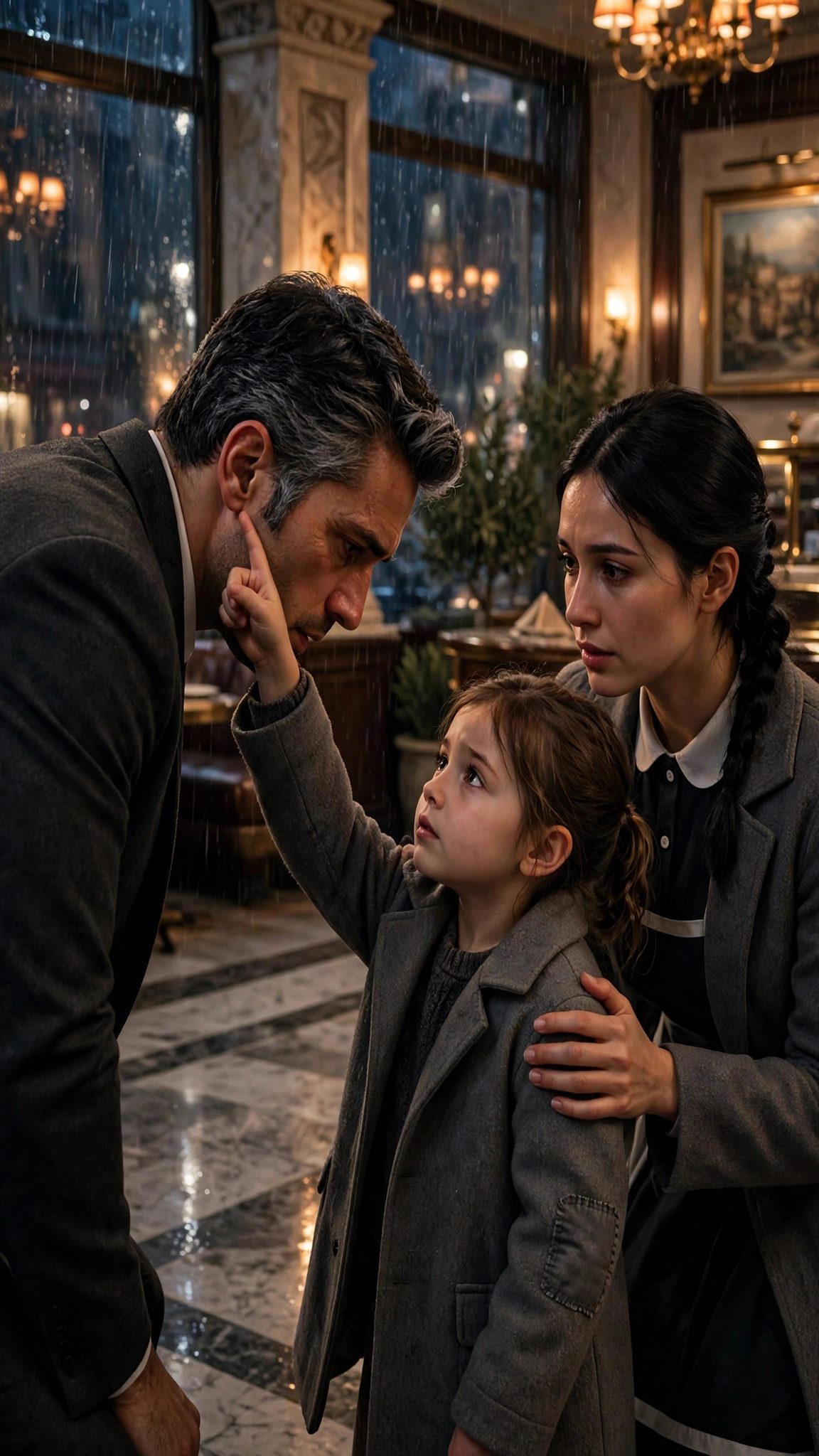
Anna thought for a moment, swinging her small boots above the floor. "I saw Mr. Enzo touch Mr. Moretti's neck," she said. "He pressed his thumb here." She touched the spot behind her own ear. "And there was a tiny black dot. Like a little beetle. And he looked around first, like this." She turned her head quickly, left, then right. "Like he didn't want anyone to see."
"Did you see him do it more than once?" Reyes asked.
Anna nodded. "Two times. The first time, I was carrying bread to the back table, and I saw him do it in the mirror. The second time, I was standing by the door, and I saw him do it when Mr. Moretti was looking at his phone. Both times he looked around first."
Reyes wrote that down — not in his notebook, but in his mind, the way he had written down a thousand testimonies in his career. A child's testimony, clear and specific, with details no adult would think to invent. The mirror. The phone. The glance, left and then right. That was the kind of testimony that held up in court, because it was too strange to be coached and too precise to be imagined.
"Thank you, Anna," Reyes said. "You did a very brave thing. You helped a lot of people today."
Anna looked at him with her old eyes. "Is Mr. Moretti going to be all right now?" she asked. "Is the black dot gone?"
"Yes," Reyes said. "The black dot is gone. And no one is going to listen to him anymore, unless he wants them to."
Anna nodded, satisfied, and took a cookie, and Reyes stood up, and he looked at Sophie, and he said, very quietly, "Mrs. Miller, I need to ask you something, and I need you to think about it before you answer. Will you testify? In court, in front of a judge, with Castellano's lawyers asking you questions? It will not be easy. They will ask about your life. They will ask about Anna. They will try to make you look small. But your testimony is the thread that ties the tapes to the man who planted the device. Without you, the case is weaker. With you, it is airtight."
Sophie looked at Anna, eating her cookie, swinging her boots, unafraid in a way Sophie had never been unafraid. And she thought about the seven years of invisibility, and the gray coat, and the forty-minute walks, and the black box under the bathroom tile, and the night she had sat on the bathroom floor with her back against the door, listening to her daughter breathe.
"I will testify," she said. "I have been invisible for eight years, Agent Reyes. I hid a baby. I hid a box. I hid the truth. I am done hiding. If Castellano's lawyers want to ask me questions, let them ask. I have answers. I have had answers for seven years."
Reyes nodded. He had heard a hundred witnesses say they would testify, and most of them meant it for a day, and then the fear came, and they forgot. But Sophie Miller did not look afraid. She looked like a woman who had finally found the thing she had been looking for — not safety, but a reason to stop being afraid.
"Good," Reyes said. "Then I will protect you. The FBI will protect you and Anna until the trial is over, and after that, too, if you need it. That is a promise. And Agent Reyes keeps his promises."
Later that morning, Dante found Sophie in the garden, standing by the fountain, watching Anna chase a butterfly between the rose bushes. The rain had stopped. The sun was coming out. The garden smelled of wet earth and roses, and for the first time in ten years, the mansion felt like a home instead of a fortress.
"Reyes told me you agreed to testify," Dante said.
Sophie nodded. "I did."
"Are you afraid?"
"Yes," Sophie said. "I am terrified. But I am done being invisible, Dante. I hid for seven years because I thought invisibility would keep Anna safe. I was wrong. Invisibility only kept her alone. Being seen — being heard — that is what saved you. And I think it is what will save us."
Dante looked at her. He looked at Anna in the garden, chasing the butterfly, laughing — a real laugh, a child's laugh, the kind of laugh that makes the whole world laugh with it. And he thought about his mother, who had laughed in the kitchen, and about Isabella, who had laughed on a wet road a long time ago, and about himself, who had not laughed in eight years, and who had laughed last night, in a wrecked office, because a seven-year-old girl had asked him if the sad had come out.
"You are right," he said. "Being seen is what saved me. You saw what no one else saw. Anna saw what no one else saw. And from now on, no one in this house will ever look through you again. I swear it. You are not furniture, Sophie. You never were. You are the mother of my daughter. You are the woman who saved my life. And you will be seen, every day, for the rest of your life, if I have anything to say about it."
Sophie looked at him, and she smiled — a small smile, and a tired one, but a real one. "Then I suppose," she said, "that we are both learning how to be seen."
And in the garden, Anna caught the butterfly — gently, in her cupped hands, the way you catch something precious — and she opened her hands, and she let it go, and she watched it fly up into the sun, and she laughed, and the whole mansion laughed with her.