Story Genres: Mafia Romance

  • Chapter 1: She Doesn’t Belong Here

    Chapter 1: She Doesn’t Belong Here

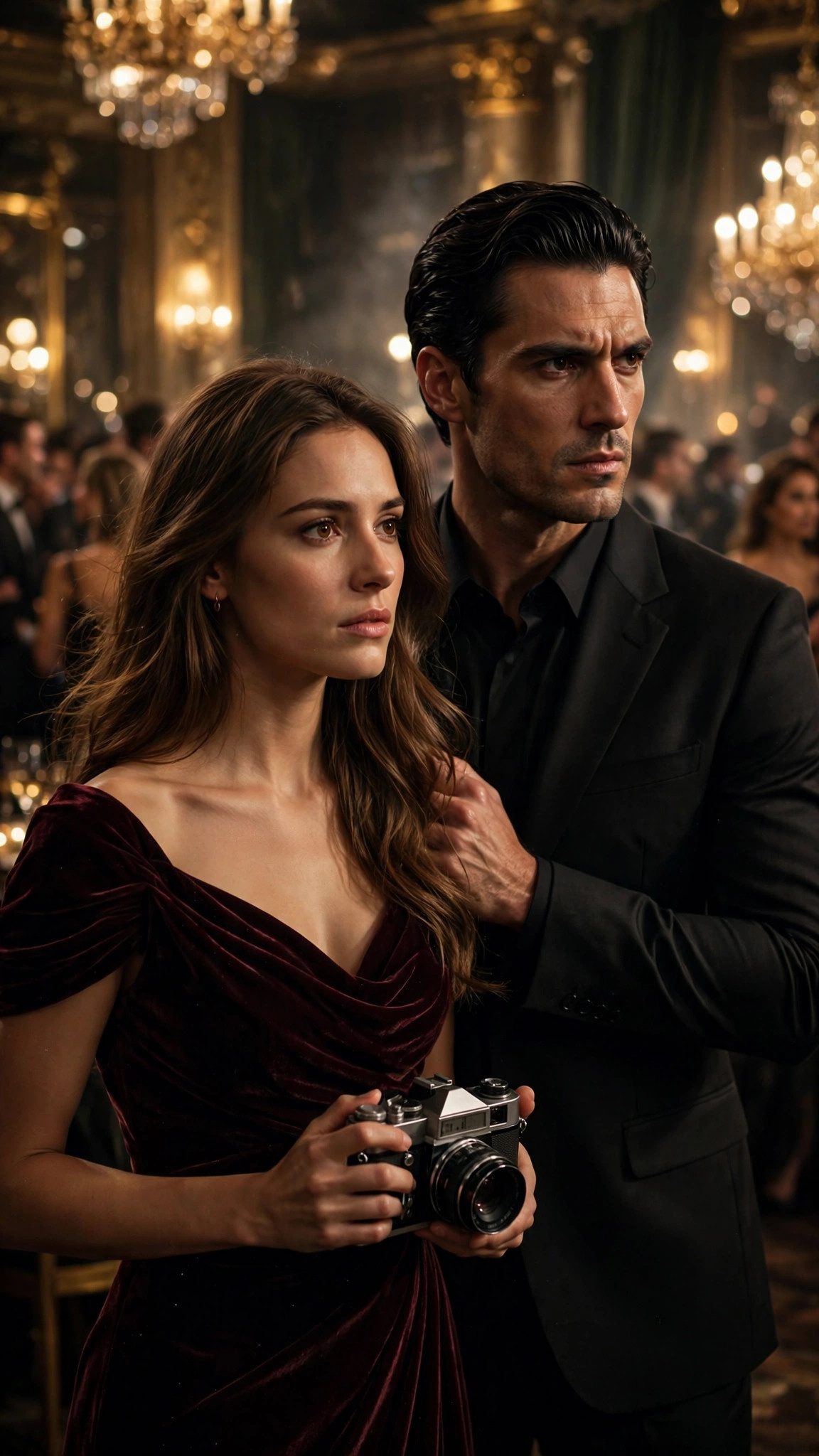
    The man who announced that someone like me did not belong in his nightclub had been talking for less than ten seconds when the most feared mafia boss in Chicago turned toward him and said, "Stand up."

    I was twenty-seven years old, three weeks out of Detroit, wearing the only good dress I owned, and holding a camera I could not afford to lose. I had walked into the Velvet Room on Rush Street because a friend of a friend had told me the light there at midnight was worth photographing, and because I was tired of being afraid of rooms I had not been invited into. The man blocking my path was broad, drunk, and certain of himself. He looked at my dress, at my camera, at the small scar on my left knee from a childhood bicycle accident, and he decided, in front of two hundred people, that I was nobody.

    "Someone like you doesn't belong here," he said, loud enough for the bartenders to hear. "This is a private club. Go take your little pictures somewhere else."

    Before I could defend myself, before I could even decide whether to answer him or simply turn around and walk out with whatever dignity I had left, a voice cut through the music. It was not loud. It did not need to be loud. It was the kind of voice that made an entire room stop moving, the way a city stops moving when the power goes out.

    "Stand up," King Moretti said.

    He had been sitting at the corner table with his back to the wall, the way men who have enemies sit, and I had noticed him the moment I walked in, the way you notice a fire in a dark room. He was thirty-nine years old, tall, dark-haired, and dressed in a black suit that fit him like it had been sewn onto him by someone who loved him or feared him. He stood up slowly, and the drunk man turned around, and the whole nightclub seemed to hold its breath.

    King Moretti crossed the floor without hurrying. He stopped two feet from the man who had insulted me, and he looked at him the way a man looks at a locked door he is deciding whether to open or break down.

    "She's with me," he said. "Touch her and you're done."

    The drunk man opened his mouth. Nothing came out. King Moretti did not raise his voice, did not touch him, did not do any of the things I had expected a man like him to do. He simply waited, and the silence did the work for him. The drunk man sat down. The music started again. And King Moretti turned to me, and for the first time in three weeks, I felt like the world had stopped trying to push me around.

    "Are you all right?" he asked.

    I thought that was the moment my life finally changed for the better. I had no idea that being seen with him would soon make me the target of people willing to kill for a photograph.

    My name is Harper Bennett. I am twenty-seven years old, and three weeks before that night in the Velvet Room, I packed two suitcases and left Detroit after the most humiliating birthday of my life.

    I had come home carrying a chocolate cake I had bought for myself. It was a small cake, the kind with too much frosting and a single candle, because I had told myself that thirty was still far away and twenty-seven deserved at least one candle. I had bought it on my lunch break from the little photography studio where I worked, and I had carried it home through the rain, holding it against my chest so the box would not get wet. I was already imagining the evening: Derek would come home from work, he would see the cake, he would laugh at me for buying my own birthday cake, and then he would kiss me and tell me he had a real surprise waiting. That was the evening I had planned in my head, and I had planned it so carefully that I could taste the frosting already.

    Instead, I found my boyfriend in bed with my roommate.

    I stood in the doorway of my own bedroom with a wet cake box in my hands, and I watched Derek Lawson, the man I had lived with for two years, the man I had once believed I would marry, scramble for his clothes while Tessa, my roommate of three years, my friend since college, pulled the sheet up to her chin and looked at me like I was the one who had done something wrong.

    He did not apologize. That is the part I remember most clearly, even now. He did not say he was sorry. He did not say it was a mistake. He looked at me standing there with my birthday cake, and he blamed me for our relationship falling apart.

    "You've been distant for months," he said, buttoning his shirt with shaking hands. "You care more about that camera than you care about us. Don't stand there like you're the victim, Harper. You pushed me away."

    I put the cake down on the dresser. I did not throw it. I did not scream. I think some part of me had known for a long time, and the knowing had simply been waiting for proof. I looked at the two of them, and I looked at the little apartment we had shared, with its crooked bookshelves and its dying plants and its photographs of me and Derek on the wall, photographs I had taken myself, and I understood something that should have been obvious years earlier. I had spent years trying to please someone who had never appreciated me. I had shrunk myself down, again and again, to fit inside a life that had no room for me.

    So I left.

    I did not leave that night. I left three days later, after I had found a sublet in Chicago, after I had packed two suitcases, after I had taken the photographs off the wall and put them in a drawer where I would never have to look at them again. I left the cake in the refrigerator. I never found out whether anyone ate it.

    Chicago was supposed to be a fresh start. I told myself that on the drive in, the way people tell themselves things they are not sure they believe. I brought my camera, because my camera was the only thing I had never doubted, and I rented a little apartment above a bakery on the North Side, and I began photographing city streets, cafés, and strangers whose stories nobody bothered to notice. I photographed an old man feeding pigeons in Millennium Park. I photographed a woman laughing into her phone on the train. I photographed the way the light came through the windows of a laundromat at seven in the morning. I was not making much money. I was not making any money at all, some weeks. But I was free, and I was looking at the world through a lens again, and that felt like breathing after a long time underwater.

    Then I met King Moretti.

    I did not know who he was at first. That is the truth, and I will not pretend otherwise. I knew he was wealthy. I knew he was dangerously handsome, in the way that a storm is beautiful when you are watching it from inside a house. I knew he was surrounded by men who watched every doorway before he entered a room. At first, I thought he was just another businessman with expensive tastes, the kind of man Chicago is full of, men in suits who own restaurants and buildings and other men's time.

    I met him properly the second time, at a restaurant on the river, where I had gone to photograph the dining room for a travel magazine that paid almost nothing. He was sitting alone at a table by the window, and when I raised my camera to take a picture of the room, he looked up, and our eyes met, and he smiled. It was a small smile, careful, like a man who does not smile often and is not sure he is doing it right.

    "You have a good eye," he said, when I came closer to apologize for pointing my camera in his direction. "Most people photograph what they want to see. You photograph what is actually there."

    I stayed for one drink. That was all. One drink in a crowded restaurant, one conversation about light and patience and the city at night, and that was all it took to become someone's obsession. Not his obsession. Someone else's. I did not know that yet. I thought I had simply met an interesting man who liked my photographs.

    I should have walked away. I know that now. But I did not walk away, because he did not feel dangerous to me. He felt calm. He felt like a man who had already decided what mattered to him, and who did not waste time pretending otherwise.

    Three days after the restaurant, I was photographing the street outside a hotel on Michigan Avenue when I saw a man I recognized from the newspapers. Marcus Blake. Fifty-two years old, silver hair, a suit that cost more than my rent for a year. A corrupt businessman, the kind whose name appeared in articles about city contracts and investigations that never seemed to go anywhere. I raised my camera without thinking, the way a photographer does, and I took his picture. He was standing in an alley behind the hotel, taking a thick envelope of cash from a restaurant employee, and he looked up, and he saw me.

    He recognized who I was and why I was there. I do not know how he knew my name. I do not know how he knew I had been seen with King Moretti. But his face changed, and fear flooded my body, and I ran. I ran back to my apartment with my camera clutched to my chest, telling myself no one would notice or care, telling myself a photograph of a man taking money was not worth anyone's life.

    But later that evening, I attended the annual Moretti family dinner in the same building, the same hotel, because King had invited me, and I had said yes, and I had not known what I was saying yes to. The place was filled with wealthy businessmen, beautiful women, and security guards who seemed to recognize everyone. The chandeliers threw gold light across white tablecloths. The air smelled like money and lilies and expensive wine. And that was when my camera captured the most dangerous image of my life.

    I saw Marcus Blake standing a few feet from King, pointing at my camera and telling him something was hidden inside it. I froze. The room went quiet around me, or maybe it only felt quiet, the way the world goes quiet before a car crash. Then King Moretti crossed the restaurant and stopped in front of me.

    He studied the screen of my camera, his expression unreadable. Then he called over one of his security men and said a single name.

    "Blake."

    Two men rushed toward us. The rest of the room watched as Marcus tried to attack me and snatch the camera, but King's security stopped him before he could touch me. Marcus's face was red, his hands were shaking, and he was shouting something about his reputation, about his lawyers, about what would happen to me if that photograph ever saw the light of day.

    Then everyone left in silence. Everyone except King, Marcus, and me.

    King turned toward Marcus and said, "Do you now understand why you should have stayed in jail?"

    Then he glanced at the last photo on the camera, the photo I had taken earlier that day of Marcus receiving cash from a restaurant employee. King's eyes narrowed. His voice dropped to something cold and quiet.

    "You're going to erase it, aren't you?" Marcus asked, and there was fear under the anger now.

    King took my camera from my hands, gently, like it was something breakable, and his expression darkened as he looked at the photograph again. Then he looked at me, and his voice was steady and certain, and I believed every word of it.

    "I'm going to pay for it," he said. "I promise you this: I won't let anyone hurt you or the people you love."

    Then he ordered details to be sent to his apartment, and he told his men to take the damage in full, and I understood, standing there in that silent dining room with my camera in his hands, that this was not just a favor. This was a declaration.

    King Moretti had gone to war with the man who had threatened my life.

    But this battle was not over. Two days later, someone left an envelope on my apartment door. It contained a black-and-white photograph. A photograph of King Moretti being dragged into an unmarked van.

    I enlarged the photograph, searching desperately for something that might reveal where he was being held. And my heart nearly stopped.

    Because I recognized that person. The man with his hands on King's shoulders, shoving him toward the open doors of the van, was Derek Lawson. My ex-boyfriend. The man who had destroyed my life in Detroit. He was here, in Chicago, working for Marcus Blake. And he had just helped kidnap the man who had stood between me and the world.

    My hands were shaking so hard I nearly dropped the photograph. I locked the apartment door, all three locks, and stood with my back against it, listening to the hallway for footsteps that were not there. For a moment, the old fear came back, the fear I had carried out of Detroit, the feeling that I was small and that the world was large and that men like Derek would always find a way to take what they wanted from me.

    Then I looked down at the camera on my kitchen table, the same camera that had started all of this, and something in me went quiet and hard. I had spent years trying to please someone who had never appreciated me. I had spent three weeks learning how to look at the world and see what was actually there. I was not going to hide in my apartment while the one man who had ever stood up for me was dragged into a van.

    I picked up my phone, and I called the only number King had ever given me, the number of his head of security, a man named Sal, and when he answered, I told him exactly what I had found. "I have a photograph," I said, and my voice did not shake at all. "And I know where to start looking."

  • Chapter 3: The Man Nobody Corrects

    Chapter 3: The Man Nobody Corrects

    The first time I noticed the black SUV, I told myself I was imagining things.

    It was a Tuesday, my day off, and I was walking home from the grocery store with two bags of food and a paperback novel I had bought on impulse, and there it was, parked across the street from my building, engine running, windows tinted so dark I couldn't see inside. I told myself it was nothing. People parked on my street all the time. The city was full of black SUVs.

    The second time, it was Thursday, and I was coming home from a twelve-hour shift at 7 a.m., so tired I could barely see straight, and there it was again, in a different spot, but the same car. Same dark windows. Same feeling at the back of my neck, like someone was watching me.

    The third time, I stopped pretending.

    I crossed the street and walked straight up to the driver's window and knocked on it, hard, with my knuckles. The window rolled down, and a man looked out at me. He was young, maybe thirty, with a shaved head and a scar through his eyebrow, and he did not look surprised to see me.

    "Can I help you?" I asked him.

    "Just waiting for someone," he said.

    "Who?"

    He smiled, and the smile did not reach his eyes. "A friend."

    "For three days? In front of my building?"

    "Nice neighborhood," he said. "Quiet."

    I took a photograph of his license plate with my phone, holding it up so he could see me do it. His smile faded.

    "Tell your friend," I said, "that I am a nurse, and I am very good at remembering faces. And the next time I see this car, I am calling the police."

    He rolled the window up. The SUV pulled away from the curb and disappeared around the corner, and I stood there on the sidewalk with my heart hammering and my grocery bags cutting into my hands, and I thought: this is Gabriel's world. This is what it costs to be near him.

    I called Gabriel that night. Not the driver. Not a note. I called him directly, on the number he had given me the night I stayed in his apartment, the number he had said to use "if anything ever feels wrong."

    "Something feels wrong," I told him. "There's a car. A black SUV. It's been outside my building for three days."

    There was a pause. Then his voice, very calm, very controlled, the way it had been in the trauma bay. "Are you safe right now?"

    "Yes. I'm inside. The door is locked."

    "Stay inside. I'm sending Enzo. He'll be there in ten minutes. Don't open the door for anyone else."

    "Gabriel—"

    "Hannah." His voice was low and steady. "Stay inside."

    Enzo arrived in eight minutes. He was older than the other men, maybe fifty-five, with grey at his temples and a calm, watchful face, and he knocked on my door and said, "Miss Mercer, Mr. Veseri sent me. May I come in?"

    I let him in. He checked every room of my little apartment — the bedroom, the bathroom, the fire escape window, the closet — with the calm efficiency of a man who had done this a hundred times. Then he sat down at my kitchen table and said, "Tell me about the car."

    I told him. The three days. The driver. The scar through his eyebrow. The license plate photograph on my phone.

    Enzo looked at the photograph for a long time. "This is Rinaldi's man," he said finally. "Dominic Rinaldi. He runs the shipping docks on the south side. He and Mr. Veseri have had a disagreement for some years."

    "A disagreement," I said. "He shot him."

    "Yes," Enzo said simply. "He did. And he will try again. Men like Rinaldi do not stop after one failure. They stop when they are stopped."

    "Why does he want Gabriel dead?"

    Enzo folded his hands on the table. "Mr. Veseri owns the import licenses Rinaldi needs. Without them, his business is worth nothing. With them, it is worth a fortune. Rinaldi offered to buy them. Mr. Veseri refused. Rinaldi offered again, with more money, and with threats. Mr. Veseri refused again. So Rinaldi hired a man with a gun."

    "And the police?"

    "The police have a photograph of a car and a man in a mask. Rinaldi has lawyers. It is not so simple." Enzo looked at me. "Mr. Veseri will protect you, Miss Mercer. That is why I am here. From tonight, there will be a man outside your building. Not Rinaldi's man. Ours."

    "I don't want a man outside my building," I said.

    "I understand. But Mr. Veseri does not ask about these things. He decides."

    There it was again. He decides. He never asks. It was the first time someone else had said it out loud, and hearing it from Enzo made it sound less like a quirk and more like a rule — a rule Gabriel Veseri lived by, the way other men live by their religion.

    "Why doesn't he ask?" I said. "Why does he never ask anyone anything?"

    Enzo was quiet for a long time. He looked out my kitchen window at the dark street below, and when he spoke, his voice was softer than I had expected.

    "Because of his brother," he said. "Marco. He was twenty-four years old. Gabriel asked him to deliver a package for him — a routine thing, an envelope, nothing dangerous, or so Gabriel thought. Marco was shot on the way home. He died in Gabriel's arms, on the sidewalk, in the rain."

    I put my hand over my mouth.

    "Gabriel has never asked anyone for anything since that night," Enzo said. "Not a favor. Not a question. Not a chance. He gives orders. He makes decisions. He acts. But he does not ask, because the last time he asked, his brother died. Do you understand?"

    I understood. I understood too well. It explained everything — the car in the rain, the coffee, the dinners, the way he decided what I ate and where I sat and when I went home. He was not being controlling. He was being careful. He had decided, somewhere deep inside himself, that asking was dangerous, and that the only safe way to love someone was to take care of them without ever asking them for anything in return.

    It also explained why he would never say what he felt. Why he would never tell me he loved me. Why he would never, ever ask me to be his.

    "Thank you for telling me," I said quietly.

    Enzo stood up. "Mr. Veseri would not want you to know that story. But I think you should know it. You are the first person in nineteen years who has asked him how he feels. That means something to him. More than he can say."

    After Enzo left, I sat alone in my kitchen for a long time, and I thought about Marco Veseri, twenty-four years old, dying in the rain because his brother asked him to deliver an envelope. And I thought about Gabriel, who had carried that guilt for fourteen years, and who had turned it into a rule: never ask. Never risk anyone again.

    And I thought about myself, and how I had spent six weeks falling in love with a man who would never ask me for anything, and I wondered what that meant for me. Could I love a man who would never ask? Could I build a life with a man who decided everything and asked nothing?

    I didn't know. But I knew one thing: I was not afraid of Dominic Rinaldi. I was afraid of something else — that Gabriel Veseri would spend the rest of his life protecting me from the world, and never once ask me if that was what I wanted.

    The next day, the hospital board called me in.

    Mr. Whitfield's office was on the top floor of the administration building, all dark wood and leather and quiet money, and he sat behind his desk in a grey suit and looked at me the way a man looks at a problem he wishes would solve itself.

    "Miss Mercer," he said. "Thank you for coming. I won't take much of your time. I simply wanted to discuss a matter of hospital policy."

    "Of course, Mr. Whitfield."

    "It has come to the board's attention," he said, folding his hands, "that you have developed a personal relationship with a patient. A former patient. A donor, in fact. Mr. Gabriel Veseri."

    I kept my face calm. "Mr. Veseri was my patient for three days, six weeks ago. I have not treated him since."

    "And yet," Whitfield said, "his car waits outside the hospital every morning. His men stand in our corridors. He sends you coffee. He sends you dinner. The other nurses have noticed, Miss Mercer. The donors have noticed. And I must ask you, as a matter of professional conduct, whether this relationship is appropriate for a nurse of this hospital."

    My hands were shaking under the desk, but my voice was steady. "Mr. Whitfield, I saved Mr. Veseri's life. After that, he sent a car, because it rained. He sent coffee, because I work twelve-hour shifts. If the board has a policy against gratitude, I would like to see it in writing."

    Whitfield's eyes narrowed. "Be careful, Miss Mercer. Mr. Veseri is a generous donor. The hospital values his support. But the board also values its reputation. A nurse who becomes involved with a powerful donor is a story the press would enjoy very much."

    "Are you threatening my job, Mr. Whitfield?"

    "I am advising you to be discreet," he said. "That is all."

    I left his office with my head high and my hands shaking, and I went back to the emergency department, and I worked the rest of my shift without stopping, because stopping would mean thinking, and thinking would mean admitting that Whitfield was right about one thing: the whole city was watching. The whole city knew. And the whole city was waiting to see what Gabriel Veseri's nurse would do.

    That night, I came home to find my apartment door unlocked.

    I knew I had locked it. I always locked it. I stood in the hallway for a full minute, my key in my hand, my heart hammering, and then I pushed the door open, slowly, and I looked inside.

    Nothing was broken. Nothing was stolen. The television was still there. My laptop was still on the table. My grandmother's nursing pin was still in its little box on the dresser — but the box was open, and the pin had been moved, laid out neatly on top of my pillow.

    And beside it, on the white pillowcase, was a single red rose.

    Not Gabriel's rose. Gabriel's roses came in paper cups, with thorns, and no note. This rose had been laid there carefully, deliberately, like a message.

    We know where you sleep.

    I called Gabriel. I called Enzo. I called the police. And then I sat on my kitchen floor with my back against the cabinets, and I cried for the first time since the night Gabriel Veseri was wheeled into my trauma bay — not because I was afraid of Dominic Rinaldi, but because I finally understood the price of being near a man like Gabriel.

    The price was this: your life was no longer your own. Your door could be opened. Your pillow could hold a stranger's rose. And the man you loved would send guards and cars and dinners, and he would decide everything, and he would never once ask you if you were all right.

    He would never ask. That was the rule. And I was beginning to understand that the rule was going to break us both.

    The next morning, I went to the police station.

    Detective Alvarez was a woman in her forties, with tired eyes and a kind voice, and she listened to everything I told her — the SUV, the driver with the scar, the license plate photograph, the unlocked door, the rose on my pillow — and she wrote it all down in a notebook, and she did not once make me feel foolish for being frightened.

    "Miss Mercer," she said, when I had finished, "I want you to understand something. Dominic Rinaldi is a dangerous man. We have been investigating him for three years. We know he ordered the shooting of Mr. Veseri. We know it the way you know a patient is sick before the tests come back — we can see all the signs, but we don't have the proof yet. And until we have the proof, he walks free."

    "So what do I do?" I asked.

    "You do what you're doing," she said. "You stay alert. You lock your door. You call us the moment anything feels wrong. And you let Mr. Veseri's men do their job. I know you don't like the guards, Miss Mercer. But right now, the guards are the reason Rinaldi's men haven't tried anything worse than a rose on a pillow."

    She walked me to the door. "One more thing," she said. "Mr. Veseri has been cooperating with us. Quietly. For two years. He's given us more information about Rinaldi's organization than any witness we've ever had. Whatever else he is, Miss Mercer, he's not a man who sits back and waits. He's trying to end this. The right way."

    I thanked her, and I went back to the hospital, and I worked my shift, and in the middle of the afternoon, a little girl was brought into the emergency department with a broken arm. She was seven years old, with curly hair and a missing front tooth, and she had fallen off the monkey bars at school. Her name was Emma, and she was brave in the way only seven-year-olds can be brave — which is to say, she was terrified, and she was trying very hard not to show it.

    "Will it hurt?" she asked me, while I was setting up the X-ray.

    "A little," I said honestly. "But I'll be right here the whole time. And I'll tell you everything I'm doing before I do it. Deal?"

    "Deal," she said. And then, while I was wrapping her arm, she said, "Are you the nurse who takes care of the scary man?"

    I paused. "What scary man?"

    "The man with the men in suits," Emma said. "My mommy saw them in the hallway. She said he's a bad man. Is he a bad man?"

    I thought about Gabriel — about the man who had almost smiled at me in the break room, and the man who couldn't sleep, and the man who had knelt in the dark of his apartment and said the silence was unbearable.

    "No," I said. "He's not a bad man, Emma. He's a man who got hurt, and who is trying very hard to be better. And do you know what? He's scared too. Just like you. Just like everyone."

    Emma considered this. "Even grown-ups get scared?"

    "Especially grown-ups," I said.

    She smiled then, her missing-tooth smile, and she said, "Then I'm not scared anymore. If grown-ups can be scared and still be brave, then I can be brave too."

    She drew me a picture before she left — a stick figure nurse with brown hair, holding the hand of a tall stick figure man with a rose on his neck. She gave it to me, and I taped it to the inside of my locker, next to my grandmother's photograph.

    That night, I thought about Emma, and about Detective Alvarez, and about the rose on my pillow, and I understood something I hadn't understood before. Gabriel Veseri was not the only one who was afraid. I was afraid too. And being afraid didn't make me weak. It made me careful. It made me brave in the way Emma was brave — terrified, and trying very hard not to show it, and doing the right thing anyway.

  • Chapter 2: Six Weeks of Almost

    Chapter 2: Six Weeks of Almost

    The black sedan was there the next morning, and the morning after that, and the morning after that.

    I told myself I would not get in. I told myself this on the bus, and I told myself this while I waited for the bus in the rain, and then one morning the rain was coming down sideways and my shoes were soaked through before I had even reached the corner, and the driver rolled down the window and said, "Miss Mercer, please. Mr. Veseri will worry."

    I got in.

    The car was warm. The seats were leather. There was a bottle of water in the cup holder and a small paper bag on the seat beside me, and inside the paper bag was a croissant, still warm, and a note in a strong, slanted hand: "You did not eat yesterday. — G."

    I ate the croissant. I drank the water. I told myself it was only a ride home, and that any decent person would offer a ride home to the nurse who had saved his life, and that it meant nothing.

    That was the first lie I told myself about Gabriel Veseri. It would not be the last.

    By the end of the first week, the car was simply there, every morning, and I had stopped pretending I was surprised. By the end of the second week, there was coffee on the nurses' station every morning I came on shift — black, one sugar, exactly the way I liked it — in a paper cup from the little café on the corner that I could never afford on a nurse's salary. Rosa raised her eyebrows the first time she saw it. By the third time, she just said, "Your admirer has good taste."

    "He's not my admirer," I said.

    "Then why does he know how you take your coffee?"

    I didn't have an answer for that. I still don't, really. He had noticed. That was the thing about Gabriel. He noticed everything. He noticed that I rubbed my left wrist when I was tired, because of an old sprain. He noticed that I skipped lunch on Tuesdays because the clinic ran late. He noticed that I liked the window seat in the break room, and that I read paperback novels with cracked spines, and that I hummed when I was concentrating, very quietly, under my breath.

    He noticed everything about me. And he never asked me a single question about any of it.

    Dinner started in the third week. I came off a twelve-hour shift at 7 p.m., so tired my eyes were burning, and there he was, standing by the nurses' station in a dark suit, holding a paper bag from the Italian place on Fifth Street.

    "You haven't eaten since this morning," he said.

    "How do you know that?"

    "I asked Rosa."

    "You asked Rosa about my eating habits."

    "I asked Rosa if you had eaten. She said no. So I brought dinner." He held out the bag. "Eat. Then I'll take you home."

    I should have said no. I knew I should have said no. A patient — a former patient — bringing dinner to the hospital was not appropriate. A man like Gabriel Veseri bringing dinner to the hospital was something else entirely, something that made the other nurses stare and the security guard stand up straighter.

    But I was hungry, and the food smelled wonderful, and I was so tired that my principles felt very far away. So I sat in the break room with him, and we ate pasta out of paper containers, and he told me about the restaurant — the owner was an old friend, the chef had worked in Naples, the sauce took six hours — and I told him about my shift, about the boy with the broken wrist and the old man who finally agreed his heart needed looking at, and for an hour it felt like the most ordinary thing in the world.

    "You're good at this," he said, when I was telling him about the old man. "Talking to people. Making them feel safe."

    "It's my job."

    "No," he said. "It's who you are."

    I looked at him then, really looked at him, and I saw something I hadn't seen in the trauma bay. In the trauma bay he had been a body on a gurney, a problem to solve. Sitting across from me in the break room, with a paper container of pasta in his hands and a bandage under his shirt, he was a man. A man with tired eyes and a scar on his jaw and a rose tattoo on his neck that I kept glancing at, wondering what it meant.

    "Why the rose?" I asked, before I could stop myself.

    His hand went to his neck, almost without thinking. "My mother," he said. "She grew roses. In a little garden behind our house, in the old neighborhood. She said a rose was the only honest thing in the world. It doesn't pretend to be anything else. It has thorns, and it tells you so."

    "She sounds like a wise woman."

    "She was." He was quiet for a moment. "She died when I was nineteen."

    "I'm sorry."

    "Don't be. She lived a good life." He set down his container. "What about you, Hannah Mercer? Who taught you to be the person who asks a dying man if he's still breathing?"

    "My grandmother," I said. "She was a nurse too. In a little clinic, a long way from here. She said the first thing you do with a frightened person is ask them how they feel. Not because you don't know, but because asking is how you tell them they matter."

    He was very still. "Nobody has ever asked me how I feel," he said. "Not since my mother died."

    And there it was, the thing I would think about for weeks afterward: a man who could make powerful people lower their voices just by entering a room, a man with armed guards and a black sedan and a fortune I could not even imagine, and nobody had asked him how he felt in nineteen years.

    I should have seen what was coming. I should have understood, even then, that Gabriel Veseri did not know how to ask for things, because he had spent his whole life taking them, or being given them, or deciding for himself. But I didn't. I only knew that sitting across from him felt easy, and that his eyes were dark and steady, and that when he walked me to the car that night, he opened the door for me himself, and his hand brushed mine, and neither of us moved away.

    That was the closest he ever came to asking me anything.

    The fourth week, he took me to dinner properly. Not the break room. A real restaurant, quiet, candlelit, the kind of place where the waiter knows your name and your table is always waiting. I wore the burgundy satin gown, the one I would later wear to the gala, because it was the only nice thing I owned. He looked at me when I came down the stairs of his building — he had sent the car, of course — and for a second his composure slipped, just a fraction, and I saw something raw and unguarded in his face.

    "You look beautiful," he said.

    "Thank you," I said. "You clean up well yourself."

    He almost smiled. Gabriel Veseri almost smiled, and it changed his whole face, and I thought, oh no. Oh no, this is dangerous. Because a man who almost smiles at you like that is a man you could fall in love with, and I had never been in love with anyone in my life.

    Dinner was wonderful. He asked the waiter about the wine. He ordered for both of us, without asking me what I wanted — I noticed that, and I filed it away, and I told myself it was only dinner, and that he knew the menu better than I did, and that it didn't matter.

    It did matter. I just didn't know it yet.

    After dinner, he walked me home. Not the car. He walked, in the cool night air, with his hands in his pockets and his shoulders relaxed in a way I had never seen before. We talked about nothing important — books, the rain, the new coffee place on the corner — and when we reached my building, he stopped, and he looked at me, and I thought, this is it. This is the moment. He is going to kiss me. He is going to ask me to dinner again. He is going to say something.

    He said, "Good night, Hannah."

    And he waited until I was inside, and the door was locked, and then he walked away into the dark, with two of his men following at a distance.

    I stood in my little apartment, in my burgundy gown, and I stared at the wall, and I thought: he walked me home. He opened the door. He noticed everything. And he never asked me a single thing.

    The fifth week, he asked me to come to his apartment. Not for dinner. For something else. He called me himself, which he had never done before — it was always the driver, or a note, or Rosa passing on a message — and his voice on the phone was different. Tired. Rough around the edges.

    "I can't sleep," he said. "Will you come?"

    I went. I told myself it was because he was my patient, and he was recovering from a gunshot wound, and if he couldn't sleep there might be something wrong. I told myself a lot of things that week.

    His apartment was on the top floor of a building downtown, all glass and dark wood and quiet. He was sitting by the window, in the dark, looking out at the city lights, with a glass of whiskey in his hand that he had not drunk.

    "I used to sleep four hours a night," he said, when I sat down across from him. "After I was shot, I can't sleep at all. Every time I close my eyes, I'm back in that room. The ceiling. The lights. Your voice."

    "My voice?"

    "You asked me if I was still breathing," he said. "In the ambulance. In the trauma bay. You kept asking me. And I kept thinking, if I stop answering, she'll know. She'll know I'm gone. So I kept answering."

    I didn't know what to say. So I did what my grandmother taught me. I asked him how he felt.

    "How much does it hurt?" I asked. "Right now. Honestly."

    He looked at me for a long moment. "It hurts," he said. "Not the wound. The silence. After nearly dying, the silence is unbearable. Everyone around me is quiet. My men don't talk to me. My lawyers talk at me. My doctor talks about me. You're the first person to actually ask me how much it hurts. You're the first person to actually listen. You're the first person to care."

    He set down the whiskey glass, untouched.

    "Stay," he said. "Just until I fall asleep. Please."

    So I stayed. I sat in the chair across from him, and I talked to him the way I talked to frightened patients at 3 a.m. — quietly, steadily, about nothing and everything — and after a while his eyes closed, and his breathing slowed, and he slept. I watched him sleep, this feared and powerful man, and he looked younger with his face relaxed, and more alone than anyone I had ever seen.

    I left before dawn, quietly, so I wouldn't wake him. On the table by the door, I left a note: "You slept four hours. You're healing. — H."

    The next morning, there was coffee on the nurses' station, and a single rose in a paper cup beside it. A real rose, deep red, with thorns.

    No note. He didn't need to write one. I understood.

    That was the fifth week. And by the sixth week, I had stopped pretending. I knew what I felt. I had never been in love with anyone in my life, and now I was in love with a man who had never once asked me to be his, who decided where the car waited and when security followed me home and what I ate for dinner, and who had never kissed me, and never asked me out, and never called what we were anything.

    Until the hospital donor reception.

    Until he called me his girlfriend in front of the whole city, and I finally said the words I had been holding back for six weeks.

    But before the gala, before that night, there was one more thing I didn't know. One more thing that would change everything.

    Someone had ordered Gabriel Veseri shot. And they had not finished the job.

    The morning after the night in his apartment, I arrived at the hospital to find the driver waiting by the sedan, and he did something he had never done before. He got out of the car and walked over to me, and he said, "Miss Mercer. A word, if you please."

    "Of course."

    "Mr. Veseri slept last night," the driver said. "Four hours. Without waking. His housekeeper told me this morning. He hasn't slept like that since before the shooting. I thought you should know."

    I didn't know what to say. I thanked him, and I went inside, and on the nurses' station, beside the coffee, there was a second rose. A deep red rose, with thorns, in a paper cup of water. And beside it, a note in the same strong, slanted hand: "You were right. It helps to be asked. — G."

    I kept that rose on the nurses' station all day. Rosa saw it, and she raised her eyebrows, and she said, "Two roses in one week, Hannah. Your admirer is getting serious."

    "He's not my admirer," I said, but my voice didn't sound convincing, even to me.

    "Then what is he?" Rosa asked.

    I looked at the rose, red against the white paper cup, and I thought about the man who had sat in the dark and told me the silence was unbearable. "I don't know," I said honestly. "I don't know what he is. But I know what he isn't. He isn't a stranger anymore."

    That afternoon, between patients, I found myself thinking about the night in his apartment — about the way he had looked out the window at the city lights, and the way his voice had gone rough when he talked about his mother, and the way he had said, "Stay, just until I fall asleep. Please." It was the closest he had ever come to asking me for anything. A single word — please — offered like a man offering his hand across a great distance, hoping someone would take it.

    I had taken it. I had stayed. And I would stay again, if he asked. I only wished he would ask more often, and for more than just one night of sleep.

  • Chapter 1: Stop Calling Me Your Girlfriend

    Chapter 1: Stop Calling Me Your Girlfriend

    "Stop calling me your girlfriend."

    I said it loudly enough to silence half the hospital reception, and for one dangerous second, everyone stared at me like I had just corrected the wrong man.

    The grand ballroom of the Whitfield Hotel glittered around us. Crystal chandeliers threw warm light across white tablecloths and tall glasses of champagne. The annual donor reception of St. Catherine's General Hospital was the kind of evening where the city's richest people came to be seen giving money to a good cause, and where the nurses who actually kept the hospital alive were invited mostly as decoration, in borrowed gowns, to smile and pour the wine. I had not wanted to come. My supervisor had insisted. "One evening, Hannah. Wear something nice. Shake a few hands. It keeps the board happy."

    I had worn the burgundy satin gown I had bought on sale three years ago for a cousin's wedding, and I had pinned my brown hair into a low loose bun, and I had told myself I could survive three hours of polite conversation.

    I had not planned on Gabriel Veseri.

    He had arrived twenty minutes after I did, and the room had changed the moment he walked in, the way a room always changes when a man like that enters it. Conversations lowered. Shoulders straightened. Powerful people who spent their days making other people nervous suddenly looked nervous themselves. He wore a black tailored suit over a black shirt, no tie, and his dark hair was slicked back from a face that looked like it had been carved out of something harder than flesh. There was a rose tattoo on the left side of his neck, just above his collar, and a thin white scar along his jaw that I knew better than anyone in that room, because I had been the one to clean the blood off it six weeks earlier.

    He crossed the ballroom toward me like the crowd was not even there, and he put his hand at the small of my back, the way he had done a dozen times in the past six weeks, and he smiled at the man in front of me — Mr. Whitfield, the chairman of the hospital board, sixty-two years old, grey hair, black tuxedo and bow tie — who had just asked me, with a polite smile, "How do you know Mr. Veseri?"

    Gabriel answered before I could.

    "My girlfriend."

    Again. The third time in six weeks he had introduced me to someone as his girlfriend, without ever asking me to be one.

    Something in me, something that had been winding tighter and tighter for six weeks, finally snapped.

    I stepped away from his hand at my back.

    "I'm not your girlfriend."

    His eyes settled on mine. Dark, steady, unreadable. "Hannah—"

    "No." My voice did not shake, and I was proud of that, because everything else in me was shaking. "You don't get to act like we had a conversation that never happened."

    The silence around us spread like a stain. I could feel every eye in the ballroom. Nobody corrected Gabriel Veseri publicly. I knew that. I had known it since the first night I met him, when armed men stood outside his hospital room and the charge nurse whispered his name like a prayer and a warning at the same time.

    I just didn't care anymore.

    "You decide where the car waits," I told him, and my voice was low now, and furious, and six weeks of swallowed words came pouring out of me. "You decide when security follows me home. You decide I need dinner. You decide I need coffee exactly the way I like it. You decide everything, Gabriel, and you never once asked me a single question."

    "You usually do need dinner," he said quietly. "You work twelve-hour shifts and forget to eat."

    "That's not the point." I took another step back from him. "The point is that you keep doing things that feel like questions without ever asking one."

    He reached for my hand. His fingers closed around my wrist, warm and sure, and he held it for one second, two, and I could feel my pulse hammering against his thumb.

    "Hannah," he said, and his voice was rougher than I had ever heard it. "You're my favorite nurse."

    It was the wrong thing to say. It was also, in some terrible way, the truest thing he had ever said to me.

    I pulled my hand free.

    And then, in front of the entire ballroom, in front of the hospital board and the donors and the mayor's wife, Gabriel Veseri did something no one in that room had ever seen him do.

    He said, "She's right."

    The silence deepened.

    "She isn't my girlfriend," he said, and his voice carried to the edges of the room. "I never asked her."

    I stared at him. My heart was beating so hard I was sure the whole ballroom could hear it.

    "I wanted the answer," he said, looking at me and only at me, "so I behaved like I had received it."

    Something in my chest cracked open. "I didn't tell you no," I whispered. "I said I wasn't your girlfriend. That's different."

    "Is it?" he asked.

    And I had no answer for him, because I did not know anymore. I did not know what we were. I only knew how we had started, six weeks earlier, on the worst night shift of my life, when they wheeled a dying man into my trauma bay and I put my hands on his chest and refused to let him go.

    Six weeks earlier, at 2:14 in the morning, I had been changing the dressing over a gunshot wound in Gabriel Veseri's chest while armed men stood outside his hospital room.

    No. That was later. Let me tell it properly, from the beginning, because the beginning is the only part that makes sense of the rest.

    It began with a phone call at 1:47 a.m., on a Tuesday in late September. I was on night shift in the emergency department at St. Catherine's General Hospital, and the rain was coming down hard outside, and the waiting room was full of the usual Tuesday-night collection: a boy with a broken wrist from a skateboard, an old man with chest pain who refused to believe it was his heart, a woman holding a screaming toddler with a fever. I had been a trauma nurse for six years, and I liked the night shift. The nights were honest. Nobody pretended at 2 a.m. People were scared or in pain or both, and my job was simple: keep them alive until morning.

    The charge nurse, Rosa, stuck her head around the curtain of bay four and said, "Hannah, trauma bay. Gunshot wound, chest. ETA four minutes. Police escort."

    I was already moving. I pulled on gloves, checked the crash cart, called for two units of O-negative blood and the chest tube tray. My hands knew the work before my mind caught up with it. That is the strange gift of trauma nursing: your hands remember what to do even when your heart is still catching up.

    The ambulance doors burst open and the paramedics came in fast, pushing the gurney, and the man on it was big, and pale, and bleeding through a pressure dressing on the left side of his chest, and he was conscious, which was worse in some ways, because conscious men with chest wounds try to sit up and talk and do all the things that kill them faster.

    "Thirty-eight-year-old male, single gunshot wound, left chest, entry wound fourth intercostal space," the paramedic said, breathless. "BP ninety over sixty and falling. Heart rate one-thirty. He's lost a lot of blood."

    I leaned over him. His eyes were open. Dark eyes, focused, furious at his own body for failing him. His dark hair was wet with rain and blood, plastered back from his forehead. There was a rose tattoo on the left side of his neck, and blood had run down over it in a thin red line.

    "Can you hear me?" I asked him.

    "Yes," he said. His voice was steady, which surprised me. Most men in his condition were screaming or begging or already gone somewhere far away. He sounded like a man giving orders in a boardroom.

    "My name is Hannah Mercer. I'm your nurse. I need you to stay very still. Don't try to talk. Just breathe with me."

    "I'm breathing," he said.

    "Good. Keep doing that."

    We cut his shirt away. The wound was ugly — a neat round hole, too neat, too deliberate, with blood welling up dark and fast. The chest tube went in. The blood went in. The monitor screamed and then settled, and then screamed again, and I worked with my hands in his blood and my eyes on the numbers, and somewhere in the back of my mind I registered the two men in dark suits who had come in with the ambulance and now stood by the trauma bay doors with their arms folded, watching everything, saying nothing.

    "Who are they?" I asked Rosa, quietly, while I changed a dressing.

    "His men," she whispered back. "Don't ask. Just do your job."

    His men. Of course he had men. Men like that always have men.

    "Blood pressure's coming up," I said. "Ninety-eight over sixty-five. Heart rate one-twenty."

    The surgeon arrived, and the decision was made: operating room, now. They took him away on the gurney, and I stood there with blood on my gloves and my scrubs, and I realized my hands were shaking for the first time in years.

    He lived. The bullet had missed his heart by less than an inch and nicked a vessel instead of tearing it. The surgeon said it was luck. I said it was a good chest tube and two units of blood and a man too stubborn to die. Either way, at 6 a.m., when my shift ended, Gabriel Veseri was alive in the intensive care unit, and I went home to my small apartment, and I showered for twenty minutes, and I slept for nine hours, and I dreamed about dark eyes and a rose tattoo and blood running down a neck.

    I did not expect to see him again. Trauma patients came and went. Some lived. Some didn't. The ones who lived usually forgot your face within a week.

    But three days later, when I came back on shift, Rosa pulled me aside and said, "Room 412 wants you. The gunshot. He asked for you by name."

    Room 412 was not an ordinary room. There were two men in dark suits sitting in chairs outside it, reading newspapers, and a third standing at the end of the corridor, and the nurses on the floor walked past them quickly, with their eyes down.

    Inside, Gabriel Veseri was sitting up in bed, a bandage across his chest, an IV in his arm, looking like a man who had been shot three days ago and was already furious about the inconvenience of it.

    "You're the nurse," he said. "Hannah Mercer."

    "That's me." I kept my voice professional. "How is the pain?"

    "Manageable." He watched me while I checked his dressing. "You asked me if I was still breathing."

    I paused. "I ask all my patients that."

    "No," he said. "You asked me if I was still breathing, and then you asked me how much it hurt, and then you listened to the answer. Nobody has asked me those questions in a very long time."

    I didn't know what to say to that, so I said the practical thing. "Your dressing needs changing. This will sting."

    He didn't flinch. Men like him don't flinch. But his eyes followed my hands while I worked, and when I finished, he said, "Thank you, Hannah Mercer."

    "You're welcome, Mr. Veseri."

    "Gabriel," he said.

    I nodded, and I left the room, and I told myself that was the end of it.

    It wasn't. It was only the beginning. Because the next night, when my shift ended at 7 a.m., there was a black sedan waiting outside the hospital doors, and the driver rolled down the window and said, "Mr. Veseri asked me to take you home, Miss Mercer. The rain is bad."

    I said no. I took the bus. But the night after that, the sedan was there again, and the rain was worse, and I was so tired I could barely stand, and I got in.

    That was how it started. Not with a question. Not with a kiss. Not with anything you could point to and name. Just a car in the rain, and coffee exactly the way I liked it appearing on the nurses' station the next morning, and dinner after my twelve-hour shifts, and one night in his apartment when neither of us slept because he admitted that silence had become unbearable after nearly dying.

    He never asked me out. He never called what we were anything. Until the hospital donor reception, when he called me his girlfriend in front of the whole city, and I finally said the words I had been holding back for six weeks.

    "Stop calling me your girlfriend."

    And he said, "She's right. She isn't my girlfriend. I never asked her."

    That was the night everything changed. But to understand what happened at that gala — and what happened after it, and why a man like Gabriel Veseri would stand in a ballroom full of powerful people and admit, in public, that he had been wrong — you have to understand the six weeks in between. You have to understand the coffee, and the car, and the night neither of us slept. And you have to understand the men who shot him, because they were not finished. Not with him. And not, as I would soon learn, with me.

    That morning, I drove home as the sun came up over the city, and the streets were empty, and the rain had finally stopped, and everything looked clean and new in a way it hadn't the night before. I parked outside my building and sat in the car for a long time, with the engine off, listening to the quiet.

    My apartment was small and cold. I turned on the shower and stood under the hot water until my skin was red and my hands stopped shaking. I put on clean clothes. I made tea. I sat at my kitchen table with the tea going cold in front of me, and I looked at the photograph on the wall — my grandmother in her nurse's uniform, standing outside the little clinic where she had worked for forty years, smiling at the camera like the whole world was a patient she was about to take care of.

    "What would you do?" I asked her. "If a man like that walked into your clinic? If a man with armed guards and a rose tattoo looked at you and said nobody had ever asked him how he felt?"

    She didn't answer, of course. Photographs never answer. But I thought I knew what she would have said. She would have said: you ask him again tomorrow. And the day after that. Because asking is not something you do once. Asking is something you do every day, until the person believes you mean it.

    I slept for three hours. When I woke up, my phone was ringing. It was Rosa.

    "He's awake," she said. "Room 412. He's asking for you. He asked for you by name, Hannah. Twice."

    I got dressed. I went back to the hospital, four hours after my shift had ended, because a nurse doesn't abandon a patient, and because something about those dark eyes wouldn't let me sleep. And because, if I was honest with myself, I wanted to see him again. I wanted to hear his voice. I wanted to know if he was still breathing.

  • Chapter 7: A House That Smells Like Home

    Chapter 7: A House That Smells Like Home

    Three months later, on a morning in early spring, Dominic Moretti stood in the garden of his estate and watched the sun come up over the rose beds.

    His blood was clean. Dr. Mercer had said so the week before, holding up the laboratory report like a man presenting a prize. No trace of digoxin. His pulse was steady. His headaches were gone. He slept seven hours a night now, and he woke without the heaviness that had dragged at his limbs for a month.

    The estate had changed too. Mrs. Delgado had retired to a small house in Florida, and Elena Rossi — Mrs. Rossi, the staff called her now, with a respect that had not been there before — ran the household with a quiet competence that surprised everyone, including Elena herself. The housekeeper's apartment on the second floor had a bedroom for Lily with a window that looked at the garden, and Lily had covered the windowsill with fallen petals arranged in careful rows.

    The Falcone family had not come back. Anthony Falcone was awaiting trial, and his organization had gone quiet, the way organizations go quiet when their leader is in a cell and their money is frozen. Dominic had not needed to threaten anyone. The city had watched what happened at the engagement party, and the city had understood.

    Vanessa Laurent had pleaded guilty. She would spend years in prison, and when she came out, the world she had tried to buy her way into would not want her back. Dominic had not gone to the sentencing. Raphael had gone, and he had come back and said only, "It's done, boss." That was enough.

    But the biggest change in the house was not the staff, or the garden, or the quiet that had settled over the shipping terminals. The biggest change was Dominic himself.

    He had spent twenty years building walls around his life: walls of money, walls of men with guns, walls of routine. He had told himself the walls were what kept him alive. A four-year-old girl with a stuffed rabbit had proved him wrong. What had kept him alive was not a wall. It was a child who had paid attention, and a woman who had raised her to be brave.

    He had thought about that every day for three months. He had thought about it while Elena served his breakfast — real breakfast now, prepared by Mrs. Alvarez under no guard at all, because there was no one left to guard against. He had thought about it while Lily did her lessons at the kitchen table, sounding out words with her finger, her rabbit propped up beside her like a classmate. He had thought about it while Elena laughed in the garden, a sound he had never heard before the poison, because Elena had not laughed in his house until she felt safe in it.

    This morning, he was going to do something about it.

    He found Elena in the kitchen, checking the list for the day. She was wearing a simple gray dress, her dark hair pulled back, a pencil behind her ear. She looked up when he came in, and she smiled — the quick, unguarded smile she had only recently learned to give him.

    "Mr. Moretti," she said. "Breakfast is almost ready."

    "Elena," he said, "I need to talk to you. Not as your employer. As a man."

    She set the pencil down. "All right."

    He took a breath. Dominic Moretti had negotiated with shipping magnates and rival families and men who carried guns into his office. He had never been as nervous as he was standing in his own kitchen, talking to his housekeeper.

    "Three months ago, your daughter saved my life," he said. "Twice. She did it because you raised her to pay attention, and to speak up, and to be brave. I have spent twenty years surrounded by people who were paid to protect me, and none of them did what Lily did. None of them did what you did — you stood in my sitting room, accused of a terrible thing, and you told the truth anyway."

    Elena's eyes filled with tears. "Mr. Moretti—"

    "Dominic," he said. "Please. Just for this conversation. Dominic."

    "Dominic," she whispered.

    "I am not asking you to marry me because I owe you something," he said. "I'm not asking because Lily saved me, or because you were wronged in my house. I'm asking because in three months, this house has felt more like a home than it ever did in twenty years, and the reason is you. You and Lily. The way you hum while you work. The way she leaves petals on the windowsill. The way this house smells like soup and clean sheets instead of money and fear."

    He reached into his pocket and took out a small box. It was not a large diamond. It was not the kind of ring Vanessa would have wanted. It was a simple gold band with a single small stone, the kind of ring a man gives a woman when he wants her to know he sees her — not her usefulness, not her gratitude, but her.

    "Elena Rossi," he said, "will you marry me? Not to save you. Not to save me. Because I love you, and because I want to spend the rest of my life in a house that smells like home."

    For a long moment, Elena did not speak. Then she began to cry — not the frightened tears of the sitting room, but the tears of a woman who had spent eleven months believing her life was over, and had just been told it was beginning.

    "Yes," she said. "Yes, Dominic. Yes."

    From the doorway, a small voice said, "Mama, why are you crying?"

    Lily stood in the doorway in her nightdress, clutching her rabbit, watching them with wide brown eyes.

    Elena knelt down and opened her arms. Lily ran into them, and Elena held her tight.

    "These are happy tears, baby," Elena said. "Mr. Moretti — Dominic — just asked me to marry him. And I said yes."

    Lily looked at Dominic. She considered him with the serious attention of a four-year-old judge.

    "Does this mean you're going to be my daddy?" she asked.

    Dominic crouched down until his eyes were level with hers. "If you'll have me," he said. "I would like that very much."

    Lily thought about it for a moment. Then she held out her rabbit.

    "You can hold him if you want," she said. "He's brave. And now you're part of our family, so you have to be brave too."

    "I will," Dominic promised. "I promise."

    The wedding was held in the garden, six weeks later, under the same white tent that had been ordered for a different wedding, for a different woman, in a different life. There were no four hundred guests. There were forty: the staff of the estate, Raphael and his wife, Dr. Mercer, Mrs. Alvarez with tears in her eyes, and a string quartet — the same quartet, who played the same songs, but this time the music sounded like it meant something.

    Lily was the flower girl. She wore a white dress with a sash the color of spring leaves, and she carried a basket of rose petals in one hand and her rabbit — dressed in a tiny white bow tie for the occasion — in the other. She scattered the petals with great concentration, and when she reached the end of the aisle, she turned around and scattered them all over again, just to be sure.

    Dominic stood at the altar in a charcoal-gray suit, the same color he had worn on the morning Lily stopped him from drinking his orange juice. When Elena walked toward him down the aisle of white petals, in a simple ivory dress with her dark hair loose around her shoulders, he thought she was the most beautiful woman he had ever seen. Not in the calculated way Vanessa had been beautiful. In the way a person is beautiful when they have survived something terrible and chosen to be happy anyway.

    The vows were simple. Dominic promised to protect her and Lily, to be honest with her, and to never again mistake silence for safety. Elena promised to love him, to trust him, and to remind him — gently, when he needed it — that the people in his house were his family, not his staff.

    When the ceremony ended, the guests cheered, and Lily threw the rest of her petals into the air like confetti, and Raphael caught her and swung her up onto his shoulders, and she laughed so hard that her rabbit nearly fell off.

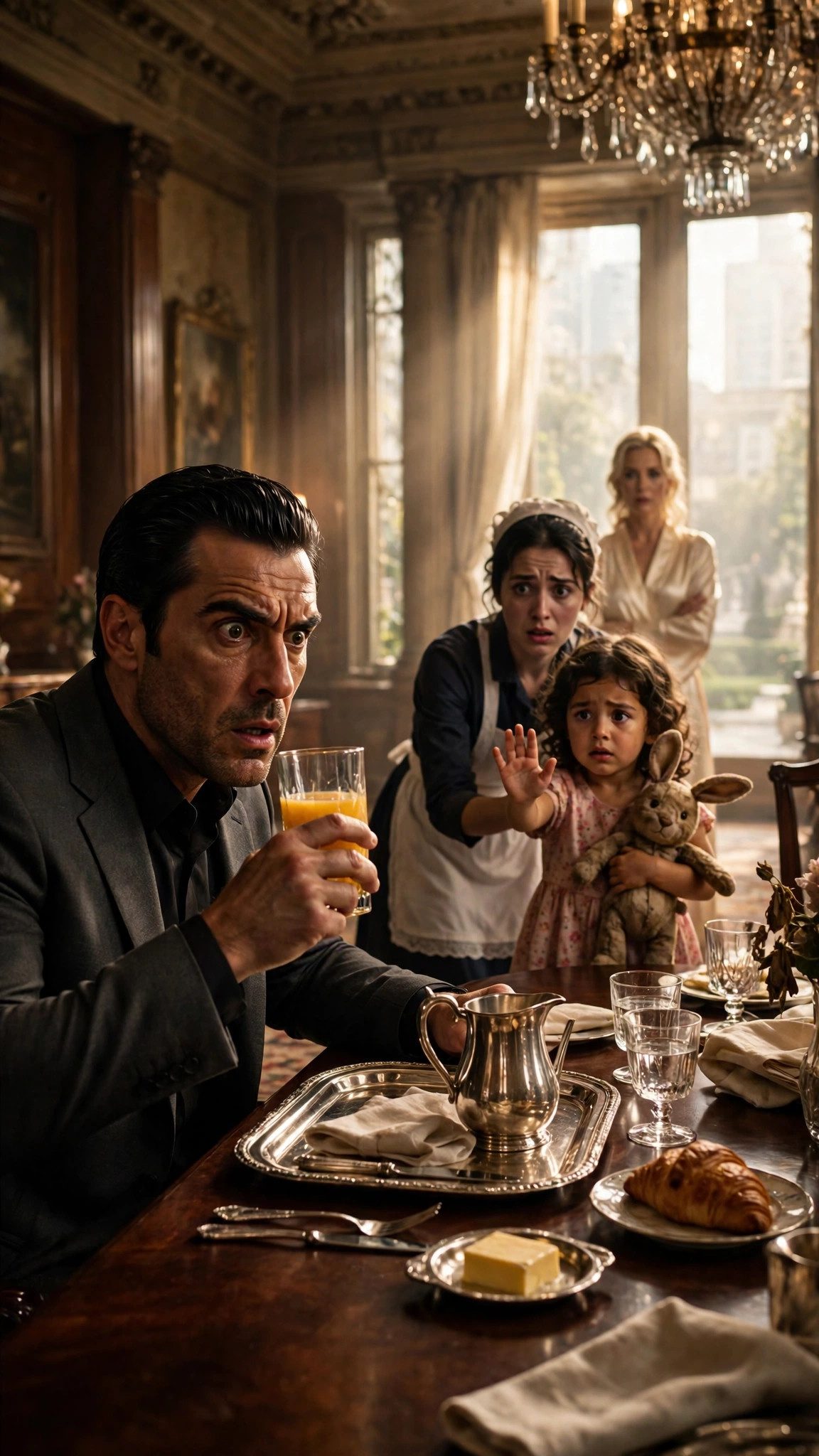
    At the wedding breakfast, served at a long table in the garden under the morning sun, a waiter brought Dominic a crystal glass of freshly squeezed orange juice.

    Dominic picked it up. He held it to the light, the way he had once held it in the dining room, and he smiled.

    Lily, sitting beside him in her white dress, leaned over and sniffed the glass with great ceremony.

    She looked up at him, her brown eyes bright, and announced to the whole table, "It smells fine."

    The table erupted in laughter. Dominic laughed too — a real laugh, deep and unguarded, the laugh of a man who had spent twenty years surviving and had finally learned how to live.

    He raised his glass. "To Lily," he said. "The little girl who saved the mafia boss from his own house."

    "To Lily!" the guests cried, and they drank, and the sun shone on the garden, and the house that had once been full of suspicion and fear was full, at last, of something else.

    It was full of home.

    And in the years that followed, whenever anyone asked Dominic Moretti how he had survived the poison, the betrayal, and the woman who had tried to kill him in his own house, he always gave the same answer.

    "A four-year-old girl told me my orange juice smelled terrible," he would say. "And I listened."

    And beside him, Elena would smile, and Lily — who was five, then six, then seven, and growing taller every year — would hold up her rabbit and say, "Daddy said I have a very good nose."

    She did. She always had.

    And the house that had once tried to kill its master became the safest place in Chicago — because in it lived a man who had learned to listen, a woman who had learned to trust, and a little girl who had never been afraid to speak the truth.

    At the wedding, after the vows and the cheers and the petals, the string quartet played a slow song, and Dominic took Elena's hand and led her to the small clear space in the garden where the guests had left room for dancing.

    He was not a good dancer. He had never been a good dancer. He had spent twenty years avoiding dance floors at parties, standing at the edge of the room with a glass in his hand, watching other people dance. But Elena put her hand on his shoulder, and she smiled up at him, and she said, "Just follow me," and he did.

    They danced slowly, under the white tent, while the sun went down and the lanterns came on one by one. The guests watched, and some of them cried, and Mrs. Alvarez cried the hardest of all, dabbing at her eyes with a handkerchief and telling anyone who would listen that she had known all along.

    Lily fell asleep halfway through the dance, curled up on Raphael's shoulder with her rabbit tucked under her chin, her white dress wrinkled and her basket of petals empty. Raphael held her carefully, the way a man holds something precious, and he did not move until the song ended.

    When the music stopped, Dominic kissed his wife — his wife, at last, truly his wife — and the garden erupted in applause, and the lanterns glowed, and the night smelled of roses and summer and new beginnings.

    One year later, on a bright morning in early summer, Dominic Moretti drove his stepdaughter to her first day of school.

    Lily was five now, taller by two inches, her brown hair in two neat braids that Elena had tied that morning with ribbons the color of spring leaves. She wore a new dress, new shoes, and a backpack that was far too big for her — and inside the backpack, zipped into the front pocket where no teacher could see it, was her rabbit.

    "Are you nervous?" Dominic asked as they pulled up to the school gates.

    Lily considered the question with great seriousness. "A little," she admitted. "What if nobody likes me?"

    "They'll like you," Dominic said. "You're the bravest person I know."

    She looked at him. "Braver than you?"

    "Braver than me," he said.

    Lily grinned, and she climbed out of the car, and she walked through the school gates without looking back — except once, at the very last moment, when she turned and waved, and Dominic waved back, and he stood there watching until she disappeared inside.

    He drove home through streets that were already filling with morning traffic, and he thought about the year that had passed. His annual checkup had been the week before, and Dr. Mercer had declared him healthier than he had been at forty. The shipping terminals were thriving. The Falcone organization was gone. The house was full of laughter, and soup, and the sound of a small girl's footsteps on the stairs.

    At home, Elena was waiting in the garden with two cups of coffee. She handed him one, and they sat together on the stone bench beneath the roses, and they did not speak for a while. They did not need to.

    "Do you ever think about it?" Elena asked finally. "That morning. The juice."

    "Every day," Dominic said. "And every day I'm grateful."

    "For what?"

    "For a little girl with a good nose," he said. "And for her mother, who raised her to use it."

    Elena smiled, and she leaned her head against his shoulder, and the sun shone on the garden, and the house stood quiet and safe around them.

    That Sunday, at breakfast, Lily came to the table in her nightdress, her rabbit under her arm, and she sniffed Dominic's orange juice with great ceremony, the way she had done at the wedding, and the way she did now every Sunday, because it had become a family joke.

    "It smells fine," she announced.

    "Are you sure?" Dominic asked, pretending to be worried. "Sniff it again. Very carefully."

    Lily sniffed it again, even more carefully, her nose wrinkled in concentration. "It smells fine," she declared. "It smells like oranges."

    "Then I'll drink it," Dominic said, and he did, and Elena laughed, and Lily laughed, and the morning went on the way mornings were supposed to go: ordinary, and safe, and full of light.

    THE END

  • Chapter 6: Clearing Her Name

    Chapter 6: Clearing Her Name

    The morning after the party, the estate was quiet in a way it had never been quiet before.

    The chandeliers were dark. The flowers from the engagement party wilted in their vases. The string quartet's sheet music still lay on the stands in the corner of the great hall, and no one had come to collect it. Four hundred guests had gone home with a story they would tell for years, and the house that had held them was left to deal with what came next.

    Dominic woke at seven, as he always did, and for the first time in a month, his head did not hurt.

    He sat on the edge of his bed and waited for the dizziness. It did not come. He stood up, and the room stayed still. He walked to the window and looked out at the garden, and his limbs felt like his own again.

    Dr. Mercer arrived at eight. He took Dominic's blood pressure, listened to his heart, and drew blood for another test.

    "Your pulse is steadier," Dr. Mercer said. "The poison leaves the body slowly, but it leaves. No more doses means no more damage. In a month, your blood should be clean. In two months, you should feel like yourself again."

    "And if I had kept drinking it?" Dominic asked.

    Dr. Mercer did not hesitate. "Another month, perhaps two, and your heart would have stopped. It would have looked natural. That was the plan."

    Dominic nodded. He had known it, but hearing it said aloud made it real in a different way.

    Downstairs, Raphael was dealing with the rest of it. Carla had been taken by the police the night before, and by morning she had told them everything: the false reference, the money Vanessa had paid her, the instruction to lie about Elena at the tray. The pharmacy in Cicero had surrendered its records. The Delaware company had been traced to Anthony Falcone, and Anthony Falcone had been arrested at dawn, trying to board a plane at O'Hare with two suitcases full of cash.

    Vanessa Laurent was in a cell downtown, charged with attempted murder. Her lawyers were already talking, but the evidence was not the kind that lawyers could talk away: laboratory reports, pharmacy records, a false prescription in a dead man's name, a witness who had confessed, and four hundred people who had watched her hand glow under an ultraviolet lamp.

    Dominic did not go to see her. He had nothing to say to her, and he knew she had nothing to say to him that would be true.

    Instead, he went to the staff wing.

    Elena opened the door before he knocked. She had been waiting. Her eyes were red, but she was dressed for work, her apron clean, her hair pulled back. Lily stood behind her, holding her rabbit, watching Dominic with the careful attention of a child who had learned that adults could be unpredictable.

    "Elena," Dominic said, "I owe you more than an apology. I owe you your name back."

    She shook her head. "You don't owe me anything, Mr. Moretti."

    "I do. The whole house believed you did it. The whole city will hear that you didn't, but that isn't enough. I want you to hear it from me, in person, with no one else in the room." He looked at her directly. "You did not poison me. You never poisoned anyone. A woman who kept her dead husband's medicine because she couldn't bear to throw it away is not a poisoner. She's a widow who loved her husband. I was wrong to doubt you, and I was wrong to let this house doubt you."

    Elena's eyes filled with tears. She pressed a hand to her mouth and nodded, unable to speak.

    "There's more," Dominic said. "Mrs. Delgado is retiring at the end of the month. I want you to take her place. Housekeeper of the estate. Your own rooms — not the staff wing, but the housekeeper's apartment on the second floor, with a bedroom for Lily and a window that looks at the garden. Double your pay. And a promise: no one in this house will ever speak to you the way they spoke to you this week, or they will answer to me."

    Elena stared at him. "Mr. Moretti, I don't know what to say."

    "Say yes," Dominic said. "Or say no. It's your choice. But I want you to know that the offer is real, and it doesn't come with conditions. You don't owe me anything for it. Your daughter already gave me more than I can repay."

    Lily tugged at her mother's apron. "Mama, does this mean we get to stay?"

    Elena looked down at her daughter, then back at Dominic. "Can I ask you something first?"

    "Anything."

    "Why did you believe me? In the end. When everyone else believed the worst."

    Dominic thought about it. He thought about the sitting room, and the little girl with the rabbit, and the question he had asked himself that night: who had tried to kill him, and who had saved him.

    "Because your daughter told me the truth twice," he said. "Once with her nose, and once with her words. And because a woman who cries when her child coughs doesn't poison a man's breakfast. I should have seen that sooner. I'm sorry I didn't."

    Elena wiped her eyes with the corner of her apron. "Then yes," she said quietly. "Yes, I'll stay."

    That afternoon, Dominic called a meeting of the entire household staff in the great hall — the same room where, the night before, four hundred guests had watched his fiancée led away by the police. The staff stood in a nervous row: the cooks, the gardeners, the drivers, the maids, Mrs. Delgado with her hands folded in front of her.

    Dominic stood before them and spoke plainly, the way his father had once spoken to men before a difficult job.

    "Four days ago, a child in this house saved my life," he said. "Three days ago, this house accused her mother of trying to take it. The accusation was false. Elena Rossi is innocent. The person who poisoned me was Vanessa Laurent, and she is in police custody. Anyone who repeats the old accusation — to anyone, inside this house or outside it — will leave this house the same day. Is that understood?"

    The staff nodded. Mrs. Delgado, who had worked for the Moretti family for thirty years and had seen everything, wiped her eyes with a handkerchief and nodded hardest of all.

    After the meeting, Mrs. Alvarez, the cook, came to Elena in the kitchen and hugged her so hard that Elena's feet nearly left the floor.

    "I never believed it," Mrs. Alvarez whispered. "Not for one minute. But I was afraid to say so. Forgive me."

    "There's nothing to forgive," Elena said.

    But there was something else, something Elena did not say to Mrs. Alvarez, or to Dominic, or to anyone — not yet.

    That evening, after Lily was asleep, Elena sat in her small room and looked at the suitcase in the corner. The bottles were gone now, taken by the police as evidence. The suitcase was empty except for a folded sweater of Marco's that she had kept, and a photograph of him holding Lily on the day she was born.

    She had come to the estate to survive. She had stayed because she had nowhere else to go. Now Dominic Moretti was offering her a home, a position, a future — and she did not know whether she could accept it.

    Because the truth was this: she had watched a man nearly die in his own house, at the hands of a woman he was going to marry. She had watched her daughter save him twice. And she had watched Dominic Moretti, the most feared man in Chicago, crouch down in a doorway and hold a stuffed rabbit as if it were made of glass.

    Elena Rossi had spent eleven months grieving a husband who had died too young. She had not expected to feel anything again except fear and tiredness. But sitting in her small room, looking at Marco's photograph, she felt something she had not felt in a long time.

    She felt safe.

    And that frightened her more than anything that had happened that week — because safe was the one thing she had stopped believing in, and now a man she barely knew was offering it to her, and she did not know whether she was brave enough to take it.

    Outside her window, the garden was dark. In the main house, a single light burned in Dominic's study. He was awake, as he always was, working late, carrying the weight of an empire on shoulders that were finally healing.

    Elena watched that light for a long time before she blew out her candle and went to sleep beside her daughter.

    On Mrs. Delgado's last day, she called Elena into her office and pressed a heavy ring of keys into her hands.

    "These are the keys to the house," Mrs. Delgado said. "Every room, every cupboard, every door. A housekeeper holds the keys, but she also holds something more. She holds the trust of everyone who lives here. If the staff trusts you, the house runs. If they don't, it falls apart."

    Elena looked at the keys in her hands. They were warm from Mrs. Delgado's grip.

    "I don't know if I can do this," Elena said.

    "You already did it," Mrs. Delgado said. "You did it the morning you stood in the sitting room and told the truth when the whole house wanted you to be guilty. That's what a housekeeper does. She tells the truth, even when it's hard."

    Mrs. Delgado hugged her then, a fierce, quick hug, and then she picked up her suitcase and walked out of the estate for the last time, toward a small house in Florida and a retirement she had earned thirty times over.

    The same week, Dominic called a meeting of his captains — the men who ran his terminals, his warehouses, his routes. They gathered in the study, eight men in dark suits, and they waited to hear what their boss would do about the Falcones.

    They expected a war. Dominic Moretti had always answered an attack with an attack. That was the rule of their world.

    Dominic surprised them.

    "No retaliation," he said. "Anthony Falcone is in a cell. His money is frozen. His organization is falling apart on its own. We don't need to burn anything down. We need to be better than that now."

    One of the captains, a man named Sal, frowned. "Boss, with respect — if we don't answer, they'll think we're weak."

    "They'll think what they want," Dominic said. "But I spent three weeks being poisoned in my own house because I was too busy looking for enemies outside it. I won't make that mistake again. From now on, we protect what's inside. The house. The people in it. That's the priority."

    The captains looked at each other. Then, one by one, they nodded.

    After the meeting, Raphael stayed behind. "Boss," he said, "that's not like you."

    "Maybe I'm not like me anymore," Dominic said. "Maybe that's a good thing."

    That night, Lily slept in her new bedroom for the first time. The room had a window that looked at the garden, and a small bed with a white blanket, and a shelf where Elena had placed the photograph of Marco, holding Lily on the day she was born.

    Lily arranged her fallen petals on the new windowsill in a careful row, just as she had done on the old one. Then she climbed into bed, tucked her rabbit under her chin, and looked up at her mother.

    "Mama," she whispered, "is this room really ours?"

    "Yes, baby," Elena said. "It's ours."

    "And nobody can take it away?"

    Elena kissed her forehead. "Nobody can take it away."

    Lily yawned, her eyes already closing. "Good," she murmured. "I like this room. It smells like flowers."

    Elena sat beside the bed until her daughter's breathing slowed, and then she went to the window and looked out at the garden. The roses were dark shapes in the moonlight. In the main house, a single light burned in Dominic's study.

    She thought about Marco, and about the life she had lost, and about the life she was building now in a house that had once accused her of murder. She thought about the man in the study, who had apologized to her, and offered her a future, and meant it.

    For the first time in eleven months, Elena Rossi did not feel like a widow surviving. She felt like a woman beginning.

    A week later, on a bright Tuesday morning, Dominic came down to breakfast and found something he had never seen in his dining room before: a family.

    Elena was at the stove — not serving, but cooking, because Mrs. Alvarez had given her the morning off and she had decided to make pancakes. Lily sat at the long mahogany table in her nightdress, her rabbit propped up in the chair beside her like a guest, a smear of flour on her cheek.

    "Good morning," Elena said, and she smiled at him — not the careful smile of an employee, but the easy smile of a woman in her own kitchen.

    "Good morning," Dominic said. He sat down at the table, and Lily immediately pushed a plate toward him.

    "Mama made pancakes," Lily announced. "I helped. I stirred."

    "You stirred very well," Elena said.

    Dominic cut into a pancake. He ate it slowly, tasting it properly, the way a man tastes food when he has not been afraid of it. It was the first breakfast in a month that he had eaten without wondering what was in it.

    "Is it good?" Lily asked, watching him with enormous brown eyes.

    "It's the best pancake I've ever had," Dominic said, and he meant it.

    Lily beamed. "Mama, he likes them!"

    Elena laughed — a real laugh, unguarded and warm — and Dominic realized, sitting at his own table in his own house, that he had not heard that sound in his home before. He had heard music, and conversation, and the clink of glasses. He had never heard laughter that sounded like it belonged there.

    He ate two pancakes. He drank his coffee. He drank his orange juice — poured from a carton Elena had bought herself at the market that morning, because the estate's oranges were still under Raphael's watch — and when Lily leaned over and sniffed his glass, the way she did every morning now, out of habit and out of love, she declared it smelled fine, and Dominic believed her.

    It was an ordinary morning. It was the most extraordinary morning of his life.

  • Chapter 5: The Second Glass

    Chapter 5: The Second Glass

    The trap was set before dawn.

    At five thirty in the morning, Raphael brought in a cook from outside the estate — a man he trusted, who had cooked for Dominic's father. The cook squeezed the oranges in the kitchen under Raphael's watch, and Dr. Bauer herself added a harmless fluorescent marker to the juice, a compound that would glow under ultraviolet light and could be traced to anything it touched: a hand, a sleeve, a glass, a lip.

    Elena carried the tray at seven o'clock, exactly as she always had. Her hands were steady. She did not look at the hallway camera Raphael had hidden behind a painting, and she did not look at the second man standing silently in the pantry.

    Dominic sat at the table and waited. The glass stood in front of him, bright and golden in the morning light. He did not touch it.

    At six forty, Vanessa came into the kitchen. Mrs. Alvarez watched her choose flowers for the table, just as she did every morning. Vanessa drifted past the counter where the tray waited. She paused. Her hand moved toward the glass — a small, graceful motion, the kind of motion a woman makes when she is adjusting a napkin or straightening a fork.

    She did not know that Raphael was watching from the pantry door, or that the camera behind the painting was recording, or that the juice in the glass would mark her skin with invisible light.

    But that morning, Vanessa did not touch the glass. She chose her flowers, she smiled at Mrs. Alvarez, and she walked out of the kitchen with empty hands.

    Dominic waited at the table until the juice was cold. Then he sent it to Dr. Bauer with a note: Test it anyway.

    By noon, the answer came back: clean. No poison. No marker disturbed. Vanessa had done nothing.

    Raphael found Dominic in the study, staring out at the garden.

    "She didn't take the bait," Raphael said.

    "Or she knew," Dominic said. "Or she's waiting for a better moment. A patient woman doesn't rush."

    "Boss, we can't guard a glass forever."

    "We don't have to." Dominic turned from the window. "The engagement party is tomorrow night. Four hundred guests. The whole city will be here. If she wants me weak, she wants me weak in public — a man who stumbles at his own party, a man who needs his fiancée to hold him up. That's the story she wants the city to tell."

    "You think she'll do it at the party?"

    "I think she'll do it when the most people are watching, because that's when it will look the least like murder."

    The engagement party was held on a Saturday night in the great hall of the estate, under chandeliers that had burned for three generations of Morettis. Four hundred guests filled the room: businessmen, politicians, old family friends, and rivals who smiled while they measured each other. A string quartet played in the corner. Waiters moved through the crowd with silver trays.

    Dominic wore a black suit and a smile he had practiced for twenty years. He shook hands. He accepted congratulations. He let Vanessa hold his arm and show him off to her friends. To anyone watching, he looked like a man in perfect health.

    Only Raphael knew the truth: that Dominic had eaten nothing all day, that a doctor stood in the next room with an antidote kit, and that every glass Dominic touched that night would be swapped, tested, and tracked.

    At nine o'clock, Vanessa led Dominic to the center of the hall for the toast. A waiter brought two crystal glasses of champagne on a silver tray. Vanessa took one and pressed the other into Dominic's hand.

    "To us," she said, raising her glass. "To our future."

    Four hundred people raised their glasses. Dominic raised his. He brought the champagne to his lips — and stopped.

    Across the room, in the doorway that led to the service hallway, a small figure stood watching him. Lily. She was not supposed to be there. Elena had been told to keep her in the staff wing. But Lily had slipped away — because children do — and she stood in the doorway in her nightdress, clutching her rabbit, staring at Dominic's glass.

    She wrinkled her nose.

    Dominic lowered the glass without drinking.

    The room went quiet. Four hundred guests watched the most feared man in Chicago lower his champagne glass and stare at a four-year-old girl in a doorway.

    Vanessa's smile froze. "Dominic? What are you doing?"

    Dominic set the glass down on the waiter's tray. "Raphael."

    Raphael stepped forward with an ultraviolet lamp in his hand. He switched it on and swept it slowly over the tray, over the two glasses, over Vanessa's hands.

    Vanessa's right hand glowed.

    The marker — the same harmless compound Dr. Bauer had put in the morning juice, which Vanessa had not touched — was not what glowed. What glowed was a different marker, one Raphael had placed on the champagne bottle that morning: a bottle only Vanessa had handled when she insisted on choosing the champagne herself, an hour before the party, in the cellar, alone.

    "No," Vanessa said. Her voice was very quiet. "No, that's not—"

    Dr. Bauer's voice came from the doorway of the next room, calm and precise. "The champagne in Mr. Moretti's glass contains digoxin. The same compound as the orange juice. The same compound as the medicine prescribed to a dead man named Marco Rossi."

    The room erupted. Guests gasped. Someone dropped a glass. The string quartet stopped playing mid-note.

    Vanessa's face changed. The beautiful, certain face that Dominic had admired for eighteen months cracked open, and underneath it was something he had never seen before: a woman who was cornered, and who knew it, and who had decided to stop pretending.

    "You were supposed to drink it," she said. Her voice was flat. "Three weeks of mornings, and you were supposed to be too weak to notice anything by now. That child ruined everything."

    "Why?" Dominic asked. His voice was steady. "Why, Vanessa?"

    "Because you were never going to marry me," she said. "Not really. You were going to marry a pretty face for your parties and keep your empire for yourself. I was going to be decoration. The Falcones offered me something better. A share. A real share. All I had to do was keep you sick, and let them take the terminals one by one, and when you died — of a heart condition, like your father, like that maid's husband — I would inherit everything, and they would have their routes."

    She laughed, a short, bitter sound. "And it would have worked. It was working. You were tired, you were dizzy, you were blaming it on stress. If that little girl hadn't opened her mouth—"

    "Don't," Dominic said. "Don't talk about her."

    Vanessa's eyes flicked to the doorway. Lily was still standing there, small and still, her rabbit held tight. Vanessa's gaze fixed on the child, and something in her face hardened.

    "She's the reason I'm standing here," Vanessa said. "A four-year-old with a nose."

    She took a step toward the doorway. Raphael moved faster. He was between Vanessa and the child before Vanessa had taken her second step, and two of his men were at her sides.

    "Vanessa Laurent," Raphael said, "you're coming with us."

    Dominic raised his hand, and the room fell silent. Four hundred guests — businessmen, politicians, old friends, rivals — all turned to look at him. He stood in the center of the great hall, a man who had just been handed a glass of poison at his own engagement party, and his voice, when he spoke, was steady and cold and carried to every corner of the room.

    "This woman," he said, "tried to kill me. In my own house. A little at a time, every morning, for three weeks. She used a dead man's medicine. She blamed a widow. And tonight, she tried to finish it in front of all of you."

    A murmur ran through the crowd like wind through wheat. Someone near the back said, "My God." Someone else said, "Vanessa?" A woman in a silver dress pressed a hand to her mouth.

    Vanessa tried to walk toward the door. She took three steps, her chin high, her dress sweeping the floor, as if she could simply leave the way she had come in. Raphael moved to block her path, and two of his men stepped up beside him.

    "You're not going anywhere," Raphael said quietly.

    "I want my lawyer," Vanessa said. Her voice was sharp now, the polish gone. "You can't hold me here. This is a party. These are my guests."

    "They're my guests," Dominic said. "This is my house. And you tried to kill me in it."

    A waiter near the service door cleared his throat. He was a young man, barely twenty, and his hands were shaking. "Mr. Moretti," he said, "I saw her. In the cellar, an hour before the party. She told me to leave the champagne alone, that she would choose it herself. I thought it was strange, but she's the fiancée. I didn't ask."

    "Thank you," Dominic said. "You did the right thing."

    Elena appeared in the doorway then, her face white, pushing through the crowd toward Lily. She reached her daughter and pulled her close, and Lily buried her face in her mother's apron. Elena looked at Dominic over the child's head, and her eyes asked the only question that mattered: Is it over?

    Dominic looked at her, and he nodded once. "It's over," he said. "Take her somewhere quiet. She's done enough for one night."

    But Lily lifted her head from her mother's apron and looked at Dominic, and she did not look frightened. She looked proud, in the small, fierce way that only a four-year-old can look proud.

    "I told you," she said. "It smelled bad."

    "I know," Dominic said. "You told me. And I listened."

    The police arrived twenty minutes later. Dominic had already given them Dr. Bauer's reports, Raphael's file, the pharmacy records, and Carla's confession — Carla had broken down in the kitchen the moment she heard the music stop, and told Raphael everything: the false reference, the money from Vanessa, the lie about Elena at the tray.

    Vanessa did not struggle. As the police led her out through the great hall, past four hundred guests who would tell this story for the rest of their lives, she turned back to Dominic.

    "You know what's funny?" she said. "You spent twenty years looking for your enemies outside this house. The whole time, the only person who ever tried to save you was a four-year-old girl you didn't even know."

    Then she was gone, and the great hall was silent, and Dominic Moretti stood alone in the center of the room with a glass of poisoned champagne on a silver tray beside him.

    He walked to the doorway. Lily was still there. Elena had come up behind her now, her face white, her arms around her daughter.

    Dominic crouched down until his eyes were level with Lily's.

    "You did it again," he said softly.

    Lily looked at the champagne glass, then at him. "It smelled bad," she whispered. "Like Daddy's medicine."

    "I know," Dominic said. "Thank you, Lily. You saved me twice."

    The little girl considered this for a moment, then held out her rabbit to him, as if offering him the highest honor she possessed.

    "You can hold him if you want," she said. "He's brave."

    Dominic took the worn stuffed rabbit in his large hands and held it carefully, the way a man holds something precious and breakable.

    "I know," he said. "So are you."

    Before the toast, in the small room off the great hall, Dominic stood alone with Raphael and Dr. Mercer, and they went over the plan one last time.

    "The doctor stays in this room," Raphael said. "If you feel anything — dizziness, tightness, anything at all — you sit down and you call out. Don't be proud. Don't wait."

    Dominic nodded. He adjusted his cuffs, the way he always did before walking into a room full of people, and he looked at himself in the mirror on the wall. He looked like a man in perfect health. He looked like a man who owned the room he was about to enter.

    "And the glasses?" he asked.

    "Swapped and tracked," Raphael said. "Every glass you touch tonight goes to Dr. Bauer afterward. The champagne bottle is marked. If she touches it, we'll know."

    "And Lily?"

    "Elena has her in the staff wing. She won't come out. I posted a man at the door."

    Dominic nodded again. Then he did something Raphael had never seen him do before a party: he sat down, just for a moment, and he put his head in his hands.

    "Boss?" Raphael said quietly.

    "Three weeks," Dominic said, his voice low. "Three weeks of mornings. She stood in my kitchen, and she smiled at me, and she planned my death. And I let her into my house. I was going to marry her, Raphael. I was going to give her my name."

    "You didn't know," Raphael said.

    "I should have known." Dominic lifted his head. "My father died at a breakfast table, and I never asked a single question about it. I spent twenty years looking for enemies with guns, and the person who nearly killed me used a spoon."

    Dr. Mercer put a hand on Dominic's shoulder. "Mr. Moretti. Whatever happens tonight, remember this: you are not the man who was poisoned. You are the man who caught it. There's a difference."

    Dominic stood up. He straightened his jacket. He looked at himself in the mirror one more time, and this time he saw what the doctor saw: not a victim, but a man who had survived.

    "Let's go," he said.

    He walked into the great hall, into the light and the music and the four hundred guests, and he smiled the smile he had practiced for twenty years. Vanessa took his arm. The quartet played. The waiters moved through the crowd with their silver trays.

    And Dominic Moretti waited for his fiancée to make her mistake.

  • Chapter 4: What the Fiancée Knew

    Chapter 4: What the Fiancée Knew

    Raphael Costa worked the way he always worked: quietly, patiently, and without telling anyone what he was doing.

    He started with the keys. The staff wing had one master key, kept in Mrs. Delgado's office. Three copies existed. One belonged to Mrs. Delgado. One belonged to the estate manager, a man named Ortiz who had worked for the Moretti family for thirty years. And one — Raphael learned this from Mrs. Delgado herself, after twenty minutes of careful conversation — had gone missing six weeks earlier.

    "Missing how?" Raphael asked.

    Mrs. Delgado's hands twisted in her apron. "I reported it to Mr. Ortiz. He said he would have a new one made and change the locks. Then the wedding preparations started, and everyone forgot."

    "Who had access to your office in those six weeks?"

    "Everyone, Mr. Costa. The office door doesn't lock either. Half the house passes through it."

    Raphael wrote it down. A missing key, an unlocked office, six weeks. Six weeks was exactly when Vanessa had begun spending whole days at the estate, choosing flowers, tasting cakes, planning a wedding that would make her the mistress of the house.

    Next, Raphael looked at Carla.

    Carla Benetti was twenty-four, dark-haired, soft-spoken, and had been hired as Vanessa's personal maid three weeks earlier — the same week Dominic's symptoms began. Her references were perfect. Too perfect, Raphael thought. The agency that sent her had placed her in three houses in two years, and each of those houses had written her a glowing letter. Raphael called the agency. The woman who answered sounded nervous, and then she sounded honest.

    "Miss Benetti came to us with a recommendation from a family in Lake Forest," she said. "We didn't check it as closely as we should have. We're a small agency. The recommendation looked real."

    "Was it real?"

    A pause. "The family in Lake Forest says they never employed her. They never heard of her."

    Raphael thanked her and hung up. A maid with a false history, hired three weeks ago, who now claimed to have seen Elena at a tray. A maid who worked for Vanessa and no one else.

    Then Raphael looked at Vanessa herself.

    Vanessa Laurent had told Dominic she was the daughter of a French businessman and an American mother, raised in Paris and New York, educated in Switzerland. She had money of her own, she said — not as much as Dominic, but enough that no one could call her a fortune hunter. She had met Dominic at a charity gala eighteen months earlier, and the courtship had been swift and public and romantic.

    Raphael checked the details the way he checked everything: by calling people and asking questions that sounded harmless.

    The school in Switzerland had a record of a Vanessa Laurent. She had attended for one year, not four, and she had left without graduating. The French businessman father existed, but he had died when Vanessa was nineteen, and he had left debts, not a fortune. The American mother had remarried twice and lived in a small apartment in Queens.

    And then there was the money. Vanessa's accounts — Raphael had a contact at her bank who owed him a favor — showed a pattern. For the past year, regular deposits had arrived from a company in Delaware with no clear business. The deposits stopped three months ago, around the time Vanessa began spending every day at the estate. In their place, a different pattern began: large cash withdrawals, and one payment, six weeks ago, to a pharmacy in Cicero. A pharmacy that had filled a prescription for digoxin under a false name.

    Raphael brought all of it to Dominic on the fourth evening, in the study, with the door locked.

    Dominic read the file twice. He did not speak for a long time. When he finally looked up, his face was gray — not with the poison, but with something worse.

    "Tell me about the pharmacy," he said.

    "The prescription was written for a man named Marco Rossi," Raphael said. "It was filled six weeks ago. Marco Rossi has been dead for eleven months."

    Dominic closed his eyes. "She used a dead man's name to buy the poison that she would use to frame his widow."

    "That's what it looks like."

    "And the deposits from Delaware?"

    "The company is owned by a holding firm. The holding firm is owned by Anthony Falcone."

    The Falcone family. Dominic's oldest rivals. The family that had wanted his shipping terminals for a year. The family that had burned his warehouse in Cicero and offered double pay to his drivers.

    "So it's not just Vanessa," Dominic said. "It's the Falcones. They found a woman with debts and a pretty face, and they pointed her at me."

    "Or she found them," Raphael said. "Either way, the plan is the same. Marry you. Keep you weak. A little more poison every morning, and in a year you're dead of a heart condition, and your beautiful widow inherits the terminals. Or you stay alive but too sick to fight, and the Falcones take the routes piece by piece while your wife signs whatever they put in front of her."

    Dominic stood up and walked to the window. Outside, Vanessa was in the garden with the wedding planner, pointing at the place where the tent would go. She looked happy. She looked like a woman planning the best day of her life.

    "She knew about the medicine," Dominic said quietly. "At breakfast, the morning Lily spoke. I remember now. Before Lily said anything, Vanessa looked at the glass and said — no. Let me think." He pressed his fingers to his temples. "She said, 'That maid really needs to control her child.' But before that, when she came in, she glanced at the glass. Just a glance. And she smiled. Not at me. At the glass."

    "Boss," Raphael said, "we need more than a glance."

    "I know." Dominic turned from the window. "That's why we're going to give her a second chance to do it."

    Raphael frowned. "A second chance?"

    "A trap," Dominic said. "Tomorrow morning, Elena will serve my breakfast again. The same tray, the same juice, the same routine. But this time, the juice will be watched from the moment it leaves the kitchen. And the glass will be a test — a glass with a marker in it that only the laboratory can see. If anyone touches that tray between the kitchen and the table, we'll know. And if Vanessa goes near it again, we'll know that too."

    "What if she doesn't take the bait?"

    "Then we watch her until she does." Dominic's voice was cold. "She has been patient for three weeks. Patient people don't stop. They get bolder."

    That night, Dominic went to the staff wing. He knocked on Elena's door, and when she opened it, he did something he had not done in twenty years: he apologized to a woman who worked for him.

    "Elena," he said, "I owe you an apology. You did nothing wrong. I know that now. And I need your help."

    She stared at him. "My help?"

    "Tomorrow morning, I need you to serve my breakfast exactly as you always have. The same tray. The same routine. Nothing different. Can you do that?"

    Her hands trembled, but her voice was steady. "Yes."

    "And Lily," Dominic said, looking past her to the small bed where the child was pretending to be asleep, her rabbit tucked under her chin. "Lily stays in this room tomorrow morning. No matter what she hears. Do you understand?"

    "I understand," Elena said.

    Dominic turned to leave. Then he stopped.

    "Elena. Your husband — Marco. Did he ever tell you why he kept his medicine in the suitcase, instead of the bathroom?"

    Elena's eyes filled with tears. "He said a man should keep his weaknesses where no one can see them. He was proud, Mr. Moretti. Even when he was dying, he was proud."

    Dominic nodded slowly. "Then someone used a proud man's medicine to try to kill me, and to blame his widow. I won't let that stand."

    He walked back through the narrow hallway, and for the first time in four days, his headache seemed a little less heavy. He had been wrong about Elena Rossi. He had been wrong about his own house. But he was not wrong anymore.

    Tomorrow, the person who had been poisoning him would get one more chance to do it.

    And this time, Dominic Moretti would be watching.

    The next day, Raphael drove to Cicero and walked into the small pharmacy on a quiet street where the sign in the window was faded and the bell over the door rang when he entered.

    The pharmacist was an old man with thick glasses and hands stained faintly yellow from years of handling pills. He looked at the photograph Raphael showed him — a photograph of Vanessa Laurent, taken at a charity gala, blonde hair and green eyes and a smile that had charmed a room full of strangers — and he nodded slowly.

    "Yes," he said. "She came in about six weeks ago. Sunglasses, even though it was cloudy. She paid cash. She gave a man's name. Rossi. Marco Rossi."

    "Did she say why she needed it?"

    "She said it was for her father. She said he had a heart condition and the prescription had run out. She was very polite. Very calm." The pharmacist adjusted his glasses. "I remember her because she asked me a question. She asked how much of it would be dangerous. She said her father was forgetful, and she was afraid he might take too much by accident."

    Raphael wrote it down. "What did you tell her?"

    "I told her the truth. That a small amount could make a strong man sick, and a large amount could stop his heart. She thanked me, and she left."

    On the drive back to the estate, Raphael thought about the woman in the sunglasses. She had planned it carefully. She had used a dead man's name. She had learned the dose. She had been patient for three weeks, and she would have been patient for three more.

    That evening, Dominic tested her himself.

    They ate dinner in the dining room, just the two of them, candlelight on the silver, the way they had eaten a hundred times before. Vanessa talked about the wedding: the flowers, the music, the guest list. Dominic listened, and he waited for the right moment.

    Then, halfway through the main course, he set his fork down and rubbed his chest, as if it ached.

    "The doctor thinks it might be my heart," he said casually. "Like my father."

    Vanessa did not flinch. She did not drop her fork. She did not even pause. She smiled, and she reached across the table and took his hand, and her voice was warm and smooth and perfectly calm.

    "Then you should rest more, darling," she said. "You're working too hard. That's all it is. A little rest, and you'll feel like yourself again."

    It was the perfect answer. Too perfect. A woman who loved a man would have been frightened to hear that his heart might be failing. A woman who had nothing to hide would have asked questions. Vanessa asked none. She simply smoothed it over, the way you smooth a wrinkle out of a tablecloth, and went back to talking about the flowers.

    Later, after she had gone to bed, Dominic sat in his study and looked at the wedding guest list she had left on his desk. He read the names slowly, one by one. He knew most of them. Businessmen. Politicians. Old friends.

    And then he saw the names he had not noticed before: three men from the Falcone family, listed under a different company name. A cousin of Anthony Falcone. A lawyer who worked for the Falcones. A shipping broker who had tried to buy Dominic's routes a year earlier.

    Vanessa had invited his enemies to his wedding.

    Dominic set the list down and poured himself a glass of water from a sealed bottle. He drank it slowly, standing at the window, looking out at the garden where the tent would go.

    She had been planning this for a long time. The wedding. The poison. The slow weakening. The inheritance. All of it, laid out like a map, and he had been walking along it without seeing it.

    But now he saw it. And tomorrow, he would set the trap.

    That same night, while Dominic sat in his study looking at the wedding guest list, Elena sat in her small room and thought about Marco.

    She had not spoken about him in weeks — not to anyone. Grief had taught her to keep him private, folded away like the sweater in her suitcase. But tonight, with the house quiet and Lily asleep, the memories came back the way they always did when she was tired: in small, sharp pieces.

    Marco had been a bus driver. He had driven the same route for nine years, and he had known the names of half his passengers. He had been strong, broad-shouldered, always laughing. And then, one winter, he had started getting tired. He had blamed the early mornings. Then his ankles swelled. Then he could not climb the stairs without stopping. The clinic had said his heart was failing, and they had given him small white tablets in a brown bottle, and they had told Elena to make sure he took one every morning with his orange juice.

    Elena had measured those tablets herself, every morning, for two years. She knew their smell — bitter, chemical, faintly sweet underneath, like almonds gone wrong. She knew the way the bottle rattled. She knew the way Marco's face changed after he took one: a small wince, quickly hidden, because he did not want her to worry.

    Lily had watched all of it. She had sat at the kitchen table with her rabbit and watched her mother shake a tablet into her father's palm, watched him swallow it with his juice, watched him wince. She had learned the smell the way children learn everything: without being taught, and without forgetting.

    When Marco died — quietly, in his sleep, eleven months ago — Elena had packed the bottles into a paper bag and put them at the bottom of her suitcase, because throwing them away would have felt like saying he had never existed. She had carried them to every room she had lived in since. She had never opened them. She had never counted them.

    Someone else had counted them. Someone else had opened one, and taken a month's worth, and used them to try to kill a man Elena barely knew.

    Elena pressed her face into her hands. Marco had died of a failing heart. His medicine had been meant to save him. Now someone had used that same medicine as a weapon, and the weapon had her dead husband's name on it.

    She looked at Lily, asleep in the small bed, her rabbit tucked under her chin. Her daughter had saved a man's life with nothing but her nose and her courage. Marco would have been proud of her. Elena knew that the way she knew the smell of the medicine: completely, and without needing to be told.

    She blew out the candle and lay down beside her daughter, and she slept — lightly, the way mothers sleep when they are afraid — with one hand on Lily's shoulder.

  • Chapter 3: The Accusation

    Chapter 3: The Accusation

    By the third morning, the estate had divided into two camps, and everyone in it knew which side they were on.

    The staff who had worked for Dominic for years said nothing at all. They cooked, they cleaned, they polished, and they kept their eyes on their work. The newer staff whispered in the kitchen when they thought no one could hear. The whispers all said the same thing: the new maid did it. The widow. The one with the dead husband and the medicine bottles. It made sense. It was the kind of sense that frightened people reach for when they want the danger to have a face.

    Elena Rossi did not leave the staff wing except to work, and when she worked, a man stood at the end of the hallway. She served breakfast with steady hands and eyes that did not lift from the tray. She did not speak to anyone except Mrs. Delgado, and Mrs. Delgado spoke to no one about her.

    Lily stayed close to her mother. She carried her rabbit everywhere now, even to the small bathroom at the end of the hall. At night she asked the same question, every night, in a whisper.

    "Mama, are we in trouble?"

    And every night Elena gave the same answer. "No, baby. We are safe. Mr. Moretti is a fair man."

    She said it because she needed to believe it. She was not sure she did.

    On the third morning, Vanessa Laurent came down to breakfast in a pale blue dress with her blonde hair swept up, and she did not pretend anymore that nothing was happening.

    "Dominic," she said, setting her coffee cup down with a small, precise click, "we need to talk about the maid."

    Dominic did not look up from his newspaper. He had not eaten a full breakfast in three days. Raphael had arranged for all his food to be prepared by a cook from outside the house, under guard, and Dominic trusted none of it anyway.

    "There's nothing to talk about," he said.

    "There's everything to talk about. The whole house is afraid. The staff are afraid. I'm afraid. That woman had poison in her room, Dominic. Poison. And she served you every morning."

    "The laboratory hasn't finished—"

    "The laboratory found digoxin in your juice. Raphael told me. Don't look surprised; he tells me things because I'm going to be your wife. And the same drug was in her room, in a bottle with her fingerprints on it, a month's worth missing. What more do you need?"

    Dominic folded his newspaper. "I need the truth."

    "The truth is standing right in front of you." Vanessa leaned forward. Her green eyes were bright, and her voice dropped to something almost tender. "Darling, I know you feel sorry for the child. I do too. But a child can love a mother who did a terrible thing. That's how children work. You can't let a four-year-old decide who tried to kill you."

    "I'm not letting a four-year-old decide anything."

    "Then decide it yourself." She reached across the table and took his hand. Her fingers were cool. "Call the police. Let them take her. If she's innocent, they'll find that out. But she cannot stay in this house, Dominic. Not while you're still sick. Not while I'm still afraid to drink my own coffee."

    Dominic looked at her hand on his. He thought about how many times she had held his hand like that — at dinners, at parties, in the car on the way home from the opera. He thought about how sure she always sounded. Vanessa was always sure. That had been one of the things he admired about her.

    Today, her certainty felt like pressure.

    "I'll handle it," he said.

    "When?"

    "Today."

    Vanessa smiled and kissed his cheek. "Good. I'll be in the garden. The wedding planner is coming at noon, and I need to be calm for her. You understand."

    After she left, Dominic sat alone at the long table. The room was quiet except for the ticking of the clock on the mantel. He thought about what Vanessa had said: If she's innocent, they'll find that out.

    He had spent twenty years in a world where the police were not an instrument of truth. They were an instrument of whoever paid them, or whoever scared them, or whoever got to them first. If he handed Elena Rossi to the police, with a bottle of digoxin and a kitchen log and a witness who claimed to have seen her at the tray, she would not come back. Not as a free woman. Not soon. Maybe not ever.

    And Lily would go where? To a relative Elena didn't have? To a state home? The child who had saved his life would lose her mother because she had smelled something wrong.

    Dominic stood up and walked to the staff wing. He had not been in that part of the house in years. The hallway was narrow, the carpet thin, the light dim. It smelled of soap and old wood. He knocked on Elena's door.

    She opened it slowly. Her eyes were red. Lily was sitting on the small bed with her rabbit, watching him.

    "Mr. Moretti," Elena said.

    "I need to ask you something," Dominic said. "And I need you to understand that what you say now matters more than anything you have ever said in your life."

    She nodded.

    "Did you poison my orange juice?"

    "No." Her voice was steady. "I did not. I would never. My daughter drinks from my glass. My daughter eats from my plate. If I were the kind of woman who poisons food, my own child would already be dead."

    "Then explain the bottle. Explain the missing tablets."

    "I can't." Tears filled her eyes, but her voice did not break. "I kept Marco's bottles in the bottom of my suitcase. I haven't opened that suitcase since I arrived. I don't know how a bottle got opened. I don't know how tablets went missing. But I know this: the morning Lily found a tablet on the floor, I was terrified. I thought Lily had swallowed one. I asked Mrs. Alvarez because I was afraid for my baby. That's the truth."

    Lily slid off the bed and walked to Dominic. She held up her rabbit.

    "Mister," she said, "Mama cries when I cough. She cries when I have a fever. She would never make you sick. She makes me soup when I'm sick."

    Dominic crouched down so his eyes were level with hers. "Lily. Do you remember the morning you told me about the juice?"

    She nodded.

    "Did you see your mama do anything to the juice?"

    She shook her head hard. "Mama poured it and put it on the tray. That's all. She didn't put anything in it. I was standing right there."

    "Was anyone else in the kitchen?"

    Lily thought about it, her small face serious. "The lady with the yellow hair was there. She was standing by the flowers. She told Mama to hurry."

    Vanessa. In the kitchen. Standing by the flowers — near the counter, near the tray — at six forty in the morning.

    Dominic stood up slowly. "Thank you, Lily."

    He left the room and walked back through the narrow hallway, his mind racing. A four-year-old's memory was not evidence. But it was a thread, and Dominic Moretti had built his life by pulling threads.

    In the main house, Raphael was waiting in the study with a folder.

    "Boss," Raphael said. "Carla — Vanessa's maid — came to me this morning. She says she saw Elena at the tray in the hallway yesterday morning, doing something with her hands. She says Elena looked startled."

    "Yesterday morning," Dominic said. "Not the morning of the juice. Yesterday."

    "That's what she said."

    "And where was Carla yesterday morning?"

    "She was bringing Vanessa's breakfast to her room."

    "So Carla was carrying a tray herself, in a different hallway, and she saw Elena in the main hallway?" Dominic shook his head. "That's not what she told you the first time. The first time, she said she saw Elena near the juice cart. Now it's a tray in the hallway. Her story is changing."

    Raphael frowned. "You think she's lying?"

    "I think someone is telling her what to say." Dominic opened the folder. Inside were photographs of Elena's room, the suitcase, the bottles. He studied the photograph of the open bottle. The cap sat beside it on the suitcase lining, and the lining around it was clean — no dust disturbed, no sign that the bottle had been opened recently. If someone had opened it weeks ago, there would be a ring in the dust. There was none.

    "Raphael," Dominic said, "I want you to find out three things, and I want you to do it quietly. First: who has a key to the staff wing? Second: where was Vanessa every morning for the past three weeks between six thirty and seven? Third: I want Carla's background. All of it. Who hired her, who recommended her, where she worked before."

    "Boss, if Vanessa—"

    "If Vanessa is innocent, none of this will hurt her." Dominic closed the folder. "And if she isn't, I want to know before I marry her."

    That night, Dominic's headache returned worse than ever, and for the first time, his chest felt tight when he climbed the stairs. He sat on the edge of his bed and pressed a hand to his chest until the tightness passed. Dr. Mercer had warned him: the poison was still in his system. It would take weeks to leave. Every dose had counted. Every morning had counted.

    He thought about Elena, sitting awake in her small room. He thought about Lily, asleep with her rabbit. He thought about Vanessa, sleeping in the east bedroom with her blonde hair spread across the pillow, dreaming her calm dreams.

    One of them had tried to kill him. One of them had saved him. And the little girl who had saved him was the daughter of the woman everyone wanted him to blame.

    Dominic Moretti had survived twenty years by trusting evidence over feeling. Tonight, he made a different decision.

    He would trust the child.

    The next afternoon, Raphael found Lily in the garden, sitting on the grass with her rabbit, arranging fallen petals into a careful row.

    He sat down on the grass a little distance away, so he would not frighten her, and he spoke the way he had once spoken to his own niece when she was small: gently, and without hurrying.

    "Lily," he said, "can I ask you something? About the mornings. When your mama carries the tray to the dining room."

    She nodded.

    "Do you remember who else is in the kitchen in the mornings?"

    Lily thought about it, her small face serious. "The lady with the yellow hair. She's always there. She smells like flowers and lemons."

    "Does she ever touch the tray?"

    "Sometimes she stands next to it. She looks at it. One time she dropped something shiny on the floor, and it rolled under the counter. Mama picked it up and gave it back to her. It was a little silver thing. Like a tiny spoon."

    Raphael kept his voice steady. "Did you see what it was?"

    Lily shook her head. "It was shiny. That's all."

    Raphael thanked her and let her go back to her petals. A tiny silver thing. A measuring spoon, perhaps. The kind a person uses to measure medicine.

    That evening, Mrs. Delgado came to Raphael in the hallway outside his office. The housekeeper's hands were twisted in her apron, and she kept glancing over her shoulder, as if she were afraid of being seen talking to him.

    "Mr. Costa," she said quietly, "I heard something. Two days ago, in the garden. Miss Vanessa was on the telephone. I didn't mean to listen. I was pruning the roses."

    "What did you hear?"

    "She said — she said, 'The plan is working. He's getting weaker every day.' And then she said, 'No, the child doesn't matter. Nobody listens to children.'"

    Mrs. Delgado's voice shook. "I didn't know what it meant. I thought she was talking about business. But after what happened with the juice — I thought you should know."

    Raphael thanked her and wrote it all down. The plan is working. He's getting weaker every day. Nobody listens to children.

    Vanessa had been wrong about that last part.

    Somebody had listened.

    That night, Dominic did not go to bed. He walked the halls of his own house the way a man walks through a place he no longer recognizes, and he looked at everything with new eyes.

    He looked at the garden doors, which had a lock that had not been changed in six years. He looked at the pantry, where the tray passed every morning, and where anyone standing in the shadows could have reached it. He looked at the staff wing, where the doors did not lock properly, and where a woman and her child slept behind a door that anyone could open.

    He had spent twenty years making his house into a fortress against the outside world. He had iron gates, and cameras, and men at every entrance. He had never once thought about the danger that was already inside.

    In the kitchen, Mrs. Alvarez had left a pot of soup on the stove for the night staff, and the smell of it filled the hallway. Dominic stood in the doorway for a moment, breathing it in. It was the smell of an ordinary house. A house where people cooked, and ate, and lived. He had not thought of his estate as an ordinary house in a very long time.

    He thought about his father again. His father had died at the breakfast table, and Dominic had always believed it was his heart. But his father had also lived in this house, and eaten at that table, and trusted the people who served him. Dominic had never asked whether his father's death was natural. He had never needed to ask.

    Now he was asking.

    He walked to the window at the end of the hallway and looked out at the garden. The roses were dark shapes in the moonlight. Somewhere in the staff wing, a child was asleep with a stuffed rabbit. Somewhere in the east bedroom, a woman was asleep with blonde hair spread across a pillow.

    One of them had tried to kill him. One of them had saved him.

    Dominic pressed his forehead against the cold glass of the window and made himself a promise. He would find out which was which. And when he did, the person who had done it would wish they had never set foot in his house.

    He stayed at the window until the sky began to lighten, and then he went to his study, and he waited for morning.