Story Genres: MAFIA BOSS

  • Chapter 2: THE SECRET BENEATH THE INSURANCE CLAIM

    Chapter 2: THE SECRET BENEATH THE INSURANCE CLAIM

    For several seconds, nobody moved.

    Marco stood beside Samantha, his attention fixed on Ethan.

    “What did you mean?” he asked.

    Ethan swallowed.

    “Your brother wasn't the only Bellini who was betrayed.”

    Marco's expression didn't change.

    “Explain.”

    “Not here.”

    “You're in no position to negotiate.”

    Ethan looked toward Samantha.

    “She knows about the archive. She has the original records. You need to understand that Victor isn't the only person involved.”

    Marco glanced at Gianni.

    “Take him upstairs.”

    Ethan immediately protested.

    “You can't keep me here!”

    Gianni approached with two security officers.

    “We're not asking you to stay.”

    “I'll call the police.”

    Marco adjusted his watch.

    “That's an excellent idea. Tell them exactly why you were trying to steal confidential evidence from an insurance investigator.”

    Ethan's mouth closed.

    The security officers escorted him toward the private elevator. Nobody struck him, threatened him, or needed to. His own knowledge of Marco Bellini's reputation was sufficient.

    Samantha watched until the elevator doors closed.

    Then she turned toward Marco.

    “Where are you taking me?”

    “Somewhere secure.”

    “I have a car.”

    “Your car is probably being watched.”

    “You don't know that.”

    “I know Ethan.”

    “You know him?”

    Marco looked at her.

    “I know enough.”

    She folded her arms.

    “I'm not going anywhere with a stranger just because he happens to drive an expensive car.”

    For the first time, Marco seemed genuinely interested in her response.

    “Fair enough.”

    He reached into his jacket and produced a business card.

    “Marco Bellini. My office is on the sixty-first floor. You can call your colleague, your supervisor, or the police. But you shouldn't walk out of this building alone.”

    Samantha examined the card.

    It contained a name, a telephone number, and a discreet company logo.

    Nothing else.

    “You're expecting me to trust you?”

    “No.”

    His answer surprised her.

    “I'm expecting you to think.”

    She looked toward the garage entrance.

    A black SUV was parked near the ramp. Two men stood beside it, watching the elevator.

    “Are those your people?”

    “Yes.”

    “Are they following me?”

    “They're watching the entrance.”

    “That's not reassuring.”

    “It wasn't meant to be.”

    She almost laughed despite herself.

    Marco opened the rear passenger door of the Bentley.

    “You can come upstairs, use a secure telephone, and decide what to do next. Or you can leave through the lobby with my security team following at a distance.”

    Samantha considered both possibilities.

    The second sounded exhausting.

    She entered the Bentley.

    Marco followed her.

    ***

    Halstead Tower's sixty-first floor was nothing like the ballroom downstairs.

    The elevator opened into a private reception area furnished with dark walnut panels, polished stone, and enormous windows overlooking Chicago.

    There were no photographs.

    No personal decorations.

    Everything appeared expensive, deliberate, and cold.

    Gianni was waiting beside the reception desk.

    “She's safe?” he asked.

    “She is.”

    Gianni looked at Samantha.

    “Miss Reed.”

    “You know my name too?”

    “Your name has been mentioned.”

    “By whom?”

    Gianni glanced at Marco.

    “Not by me.”

    Marco removed his jacket and handed it to an assistant.

    “Prepare the conference room. No one enters without permission.”

    “Understood.”

    Samantha followed Marco into a room with a long black table and floor-to-ceiling windows.

    A glass of water appeared in front of her.

    She didn't touch it.

    Marco sat opposite her.

    “Show me the archive.”

    “No.”

    He nodded.

    “Then tell me what you discovered.”

    “Why should I?”

    “Because Ethan is not the only person who wants that information.”

    “That's exactly why I don't want to show it to you.”

    Marco leaned back.

    “Do you know what happened at the Mercer warehouse?”

    “An electrical fire in 2022. Three people died. The insurance company paid out a claim of nearly nine million dollars.”

    “Four people died.”

    Samantha looked up.

    “Four?”

    “My brother Luca was inside.”

    The room became very quiet.

    Marco looked toward the city.

    “He was thirty-one. He had gone to the warehouse to meet a property manager. When the fire started, two employees were trapped inside. Luca helped them reach an exit.”

    “Was he killed in the fire?”

    “Yes.”

    His answer was immediate.

    She watched his face.

    “You expect me to accept that?”

    “No. I expect you to verify it.”

    He opened a folder.

    Inside were copies of bank transfers, claim summaries, and corporate registrations.

    “Four years ago, the insurance payout was divided among three companies. Two were legitimate businesses. The third was Meridian Recovery Holdings.”

    Samantha recognized the name.

    “Ethan's company.”

    “Not originally. It was created through several layers of ownership. Ethan became its administrator later.”

    “Why?”

    “Because someone needed a person who could access Northstar's internal systems.”

    She looked at the documents again.

    “Victor Hale.”

    Marco nodded.

    “Victor controlled the financial approvals. Ethan controlled the data.”

    “And what did you control?”

    “Other things.”

    His tone made it clear he wouldn't elaborate.

    Samantha pushed the folder away.

    “What's M-17?”

    “A project number.”

    “For what?”

    “Moving money through false claims, shell companies, and legitimate insurance payouts.”

    “How much?”

    “More than fifty million dollars.”

    Samantha stared at him.

    “Fifty million?”

    “Possibly more.”

    “And you think the tablet proves it?”

    “I think it contains the original ledger.”

    She shook her head.

    “The tablet has encrypted records, not a complete ledger.”

    “There's a second layer.”

    “How do you know?”

    “Because Luca sent a message to my brother's private account three days before he died.”

    Marco opened another file.

    It contained a printed message.

    *If anything happens to me, look beneath the first payment. The second ledger will tell you who really owns the money.*

    Samantha read it twice.

    “Why didn't you give this to the police?”

    “I did.”

    “And?”

    “The report disappeared.”

    “That's impossible.”

    Marco looked at her.

    “You work in insurance. Surely you understand that paperwork can disappear when enough people are paid to make it disappear.”

    She didn't have an answer.

    ***

    At 1:15 a.m., Samantha finally agreed to examine the tablet.

    Marco had insisted on using a secure computer without connecting it to any external network.

    She opened the M-17 directory.

    The first layer contained payment records.

    The second contained authorization histories.

    The third was locked.

    A password prompt appeared.

    “That's strange,” she murmured.

    “What?”

    “This isn't a normal company archive. The directory has been built around a hidden access structure.”

    “Can you open it?”

    “Maybe.”

    She examined the encryption metadata.

    A series of dates appeared.

    One corresponded to the day Ethan had been dismissed from Northstar.

    Another corresponded to the day the Mercer claim was approved.

    The final date was the day Luca died.

    Samantha entered her investigator credentials.

    The screen rejected them.

    She tried again.

    Nothing.

    “Whoever created this expected a different authorization key.”

    Marco leaned forward.

    “Can you identify it?”

    “Not yet.”

    She opened the metadata.

    A list of authorized personnel appeared.

    Victor Hale.

    Ethan Cole.

    A former Northstar director.

    And one unfamiliar name.

    S. REED — INVESTIGATIVE ACCESS.

    Samantha frowned.

    “That's impossible.”

    Marco studied the screen.

    “Your name?”

    “Yes.”

    “Were you assigned to this investigation four years ago?”

    “I was nineteen.”

    “Then someone used your credentials.”

    She opened the authorization history.

    The file showed an access attempt made six months earlier.

    It had originated from Ethan's company terminal.

    Samantha felt sick.

    “He used my credentials.”

    “Can you prove that?”

    “Not yet.”

    She looked at Marco.

    “Why would he need my identity?”

    “To make the records appear legitimate.”

    Her phone vibrated.

    Olivia.

    Samantha answered immediately.

    “Olivia?”

    “Where are you? I've called you twelve times.”

    “I'm safe.”

    “Where?”

    Samantha hesitated.

    “Halstead Tower.”

    “Are you alone?”

    “No.”

    A pause.

    “Is Ethan with you?”

    “No.”

    “Good. Listen carefully. Someone accessed your Northstar account after you left the ballroom. Your supervisor has been asking questions.”

    “Who accessed it?”

    “We don't know. But they downloaded a file using your authorization.”

    Samantha looked at the tablet.

    “What file?”

    Olivia lowered her voice.

    “An internal transfer authorization.”

    “Which one?”

    “The Mercer settlement.”

    Samantha felt the room tilt.

    “That's impossible.”

    “Sam, the system says you approved it.”

    “I never approved anything.”

    “Then someone has your signature.”

    Samantha looked toward Marco.

    He had been watching her carefully.

    “Olivia, don't open anything else. Don't download anything. Don't answer questions from Victor Hale.”

    “Why?”

    “Because I think someone is framing me.”

    The call ended.

    For a moment, Samantha couldn't speak.

    Marco moved the glass of water closer.

    “Now you understand why Ethan wanted the tablet.”

    “He's framing me.”

    “Yes.”

    “He wants the company to believe I stole the records.”

    “He wants you to become the official explanation for everything that happened.”

    Samantha stood.

    “I need to leave.”

    Marco remained seated.

    “Where?”

    “To find proof.”

    “Then we find it.”

    She turned toward him.

    “I'm not asking you to help.”

    “Good. I don't require permission to investigate something that concerns my family.”

    “That sounds convenient.”

    “It is.”

    She walked toward the door.

    Marco rose.

    “Samantha.”

    She stopped.

    “If you walk out now, you'll be alone against people who have already demonstrated that they can manipulate your professional identity.”

    “I've handled difficult investigations before.”

    “This isn't an ordinary investigation.”

    “I'm aware.”

    He stepped closer, leaving enough distance for her to move freely.

    “You stay with me.”

    Her eyes narrowed.

    “That's an order?”

    “No.”

    “Then don't phrase it like one.”

    Marco looked at her for a long moment.

    “Stay because you choose to. Not because I can make you.”

    Samantha glanced toward the tablet.

    Then toward the dark windows.

    Finally, she returned to her chair.

    “Until morning,” she said.

    Marco nodded.

    “Until morning.”

    The conference room settled into silence after Samantha returned to her chair. Beyond the glass, Chicago glittered beneath the dark sky, but the city seemed strangely distant from the sixty-first floor.

    Marco remained by the window, his hands resting in his trouser pockets.

    Samantha watched him for a moment. “You said Luca sent you a message three days before the fire. Was that the last time you heard from him?”

    “No.” Marco turned slightly. “I spoke to him the evening before.”

    “What did he say?”

    “He wanted to meet. He sounded tired, but not frightened. Luca rarely admitted when something worried him.”

    “Did he tell you about M-17?”

    “He said the numbers didn't match. He had found payments that appeared twice in different records, and a company that existed on paper but seemed to have no real business. He believed someone had changed the original agreements.”

    “Did you believe him?”

    “I believed he was concerned. I didn't understand how far the problem went.” Marco looked down at the city. “I told him to bring the documents to me the next morning.”

    “But he never came.”

    “No.”

    Samantha let the silence sit between them. “Why didn't you go looking for him that night?”

    “I did. I called him after our conversation. His phone went to voicemail. I thought he had gone back to the warehouse to check something, and I assumed he would call when he finished.” His jaw tightened. “By the time I learned about the fire, the official report was already being prepared.”

    “That's why you've spent four years searching?”

    “That's part of it.” He turned to face her. “I spent the first year trying to establish what happened at the warehouse. The second following the money. The third trying to find the records Luca said would identify the people behind the transfers. Every trail ended at a company that had been dissolved, an account that had been emptied, or a person who suddenly remembered nothing.”

    “And this year?”

    “This year I learned Northstar still had an archive that hadn't been completely erased.”

    Samantha glanced at the tablet. “You knew someone inside the company might find it.”

    “I knew someone had to. I didn't know it would be you.”

    “Did Luca ever tell you why he kept investigating after he realized the agreements had been changed?”

    Marco considered the question. “He said people had trusted those policies. Small businesses, families, workers. They believed the insurance would protect them if something went wrong. He couldn't accept that someone had turned that promise into a way to steal from them.”

    Samantha's expression softened. “That sounds like someone worth remembering.”

    “He was.” Marco paused. “He was also stubborn. He thought he could persuade people to do the right thing if he showed them enough proof.”

    “Sometimes proof isn't enough.”

    “I learned that too late.”

    She looked at him carefully. “You keep saying you were searching for the ledger. But I think you were searching for something else as well.”

    “What?”

    “An answer that would make his death feel less senseless.”

    Marco didn't reply immediately. His eyes stayed on the lights below.

    “Maybe,” he said at last. “I spent the first year trying to establish what happened at the warehouse. The second following the money. The third trying to find the records Luca said would identify the people behind the transfers. Every trail ended at a company that had been dissolved, an account that had been emptied, or a person who suddenly remembered nothing.”

    Samantha lowered her gaze to the cross pendant resting against her dress.

    “I know what it's like to have someone else's version of events placed in front of you and be told to accept it.”

    Marco looked back at her. “Is that what happened with Ethan?”

    “Not exactly. But he was very good at explaining what I supposedly meant, what I supposedly wanted, and why I supposedly needed him to decide things for me.” She met Marco's eyes. “I won't do that again.”

    “You shouldn't.”

    “And I won't become another person who carries your questions for you.”

    “I wouldn't ask that.”

    “You might not mean to. But if we're going to examine this together, I need the truth even when it's uncomfortable.”

    Marco nodded slowly. “Then ask me again whenever you think I'm holding something back.”

    “That's not quite the same as volunteering it.”

    “No,” he admitted. “It isn't.”

    For the first time that night, Samantha saw the uncertainty beneath his composure. He had spent years learning how to command a room, but he seemed less certain how to speak about the brother he had lost.

    She closed the tablet cover.

    “Get some rest, Marco.”

    “I could say the same to you.”

    “I doubt either of us will listen.”

    A faint, tired smile crossed his face. “You're probably right.”

    They returned to their separate thoughts, with the unanswered questions still between them, but no longer entirely unspoken.

    But neither of them would sleep.

    Because at 2:03 a.m., Gianni entered the room carrying a printed report.

    “Boss.”

    Marco looked up.

    “What is it?”

    Gianni placed the report on the table.

    “We found the second authorization.”

    Samantha read the name.

    It wasn't Ethan's.

    It wasn't Victor's.

    It was Marco Bellini's.

    And the document showed that he had personally authorized a payment to Meridian Recovery Holdings four years earlier.
  • Chapter 1: THE MAN WHO MADE HIM KNEEL

    Chapter 1: THE MAN WHO MADE HIM KNEEL

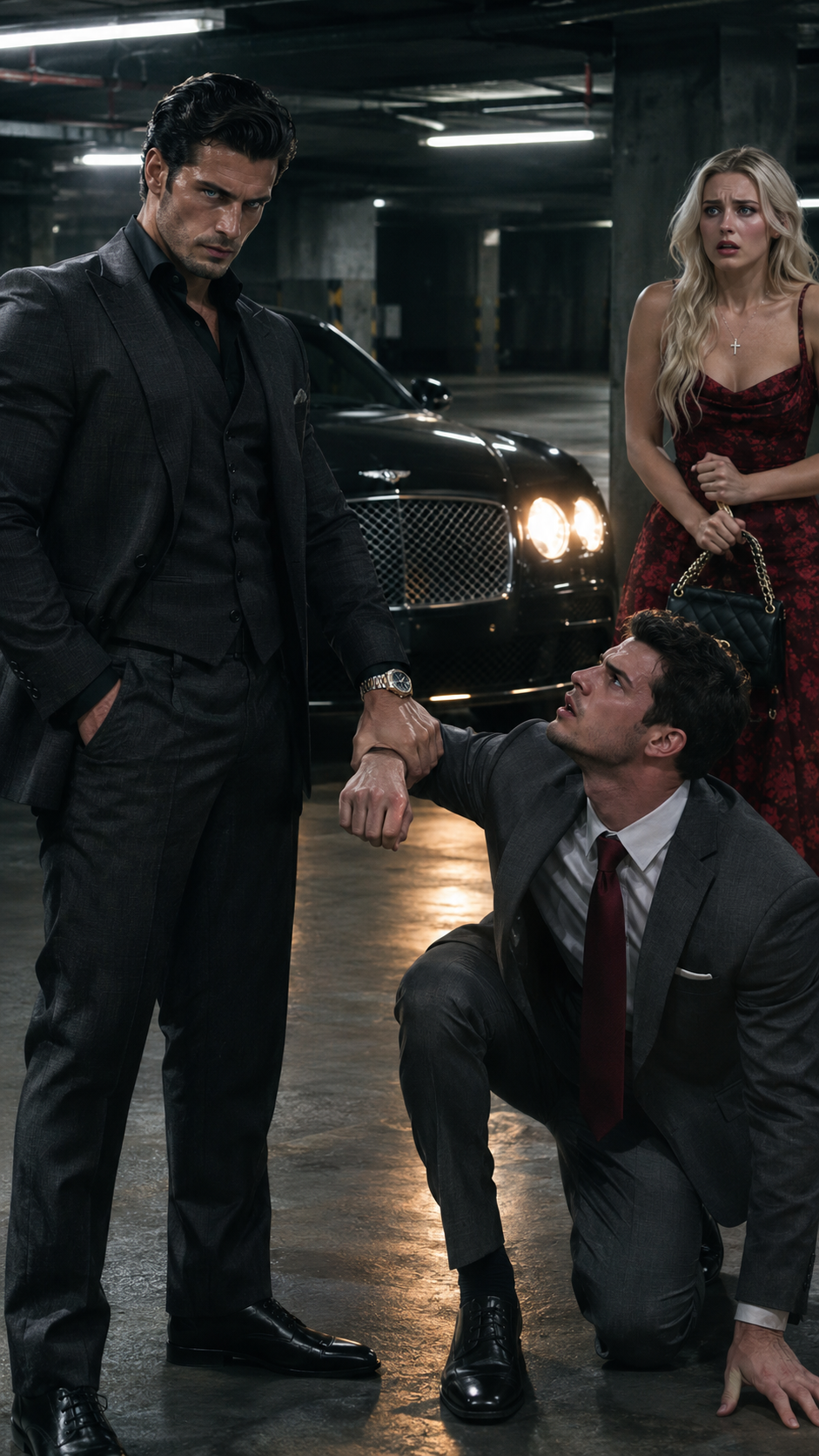
    “Take your hand off her.”

    The voice came from behind the black Bentley Mulsanne, quiet enough that it should have disappeared beneath the humming fluorescent lights.

    Instead, every person in the restricted P3 garage heard it.

    Ethan Cole turned, his fingers still wrapped around Samantha Reed's wrist.

    “What the hell?”

    A tall man stepped away from the driver's side of the Bentley. He wore a perfectly tailored charcoal-gray suit, a black shirt, and a silver watch that caught the warm glow of the headlights. His black hair was combed back neatly, and his blue eyes held absolutely no uncertainty.

    Marco Bellini.

    Even Ethan knew that name.

    Everybody in Chicago who had spent enough time around money, private security, or organized crime knew it.

    “Marco Bellini,” Ethan said, attempting a laugh. “This doesn't concern you.”

    Marco glanced at Samantha's wrist.

    Then he looked at Ethan.

    “You're mistaken.”

    Ethan's fingers tightened.

    “She's my ex-girlfriend. We're having a private conversation.”

    Marco approached without hurrying.

    “Does she look like she's enjoying it?”

    Samantha tried to pull away.

    “Ethan, let go.”

    “Stay out of this, Samantha.”

    Marco stopped directly in front of him.

    “I believe the lady answered you.”

    Ethan finally released Samantha's wrist, but his arrogance survived for approximately two seconds.

    He stepped toward Marco.

    “You have no idea who you're dealing with.”

    Marco caught Ethan's wrist before he could move any closer. His grip was controlled, firm, and unmistakably authoritative. Ethan's expression changed immediately.

    “Let go!”

    Marco didn't raise his voice.

    “You don't get to touch what doesn't belong to you.”

    Samantha stared at him.

    She had never seen a man turn a simple sentence into something that sounded like a final judgment.

    Marco looked toward Ethan.

    “Kneel down before you speak again.”

    “You can't be serious.”

    Marco's eyes remained cold.

    “Try me.”

    Ethan's resistance disappeared beneath the weight of Marco Bellini's reputation and the unyielding grip around his wrist. He lowered himself onto one knee.

    Two security officers had emerged from the private elevator. A businessman who had been crossing the garage stopped beside his vehicle, pretending to check his phone while watching the confrontation.

    Samantha stood frozen, one hand pressed against her handbag.

    Marco released Ethan's wrist only after he was certain Ethan would not reach for her again.

    Then Marco turned toward Samantha.

    His expression changed almost imperceptibly.

    “You need to stay.”

    “Excuse me?”

    “Your bag.”

    Samantha instinctively pulled it closer.

    “What about it?”

    Marco's gaze settled on the leather handbag.

    “What does Ethan want inside?”

    Ethan looked up sharply.

    “Don't listen to him, Samantha. Give me the tablet.”

    The words landed like a stone.

    Marco's expression hardened.

    “What tablet?”

    Samantha felt her stomach drop.

    She had spent the entire evening hoping nobody would discover what she had taken from the insurance company's restricted archive.

    And now two men were standing in front of her, both knowing that something valuable was inside her bag.

    One wanted to steal it.

    The other seemed to know exactly why it mattered.

    Marco extended his hand.

    “Tell me what you're carrying.”

    Samantha swallowed.

    “It's confidential company property.”

    “That's not an answer.”

    “It's none of your business.”

    For the first time, something resembling amusement crossed Marco's face.

    “Interesting.”

    He glanced at Ethan.

    “Your former boyfriend appears considerably more interested in your property than you are.”

    Ethan struggled to rise.

    “Marco, listen to me. That tablet contains stolen information. She's been involved in something she doesn't understand.”

    Marco didn't look away from Samantha.

    “Is that true?”

    “I don't know what he told you,” she answered, “but I haven't stolen anything.”

    Marco studied her for a long moment.

    Then he said the sentence that would change the course of her life.

    “You stay with me.”

    ***

    Three hours earlier, Samantha Reed had believed the most difficult part of her evening would be surviving a corporate charity gala.

    She had been wrong.

    At twenty-three, Samantha was one of the youngest investigators at Northstar Mutual Insurance. Her colleagues often described her as unusually persistent, occasionally stubborn, and incapable of leaving an unanswered question alone.

    She considered those qualities professional requirements.

    Her supervisor, however, called them career hazards.

    “Sam, please tell me you're not planning to investigate anything tonight.”

    Samantha looked up from the tablet in her hands.

    Her colleague, Olivia Parker, stood beside the hotel ballroom entrance holding two champagne glasses.

    “I am attending a charity gala.”

    “You're holding an encrypted company tablet.”

    “It's a work event.”

    “It's a party.”

    “Those things aren't mutually exclusive.”

    Olivia sighed.

    “Sometimes I wonder whether you know how to have fun.”

    Samantha smiled.

    “I know how to have fun.”

    “When was the last time?”

    “Last Saturday.”

    “You spent Saturday reading insurance regulations.”

    “They were interesting.”

    Olivia closed her eyes.

    “I'm going to find you a personality.”

    The gala was being held on the forty-second floor of Halstead Tower, one of Chicago's most exclusive buildings.

    Its ballroom overlooked the illuminated city skyline. Crystal chandeliers hung above polished marble floors, while waiters moved between tables carrying expensive champagne and elaborate appetizers.

    Executives, investors, politicians, and wealthy donors filled the room.

    Northstar Mutual was sponsoring the evening.

    Samantha had been invited because she was assisting with a special investigation involving several suspicious commercial insurance claims.

    She had also been instructed not to discuss the investigation.

    Naturally, that instruction had made her more curious.

    “Have you finished reviewing the Mercer claims?” Olivia asked.

    “Almost.”

    “And?”

    Samantha lowered her voice.

    “They don't make sense.”

    Olivia glanced toward the crowded ballroom.

    “Which part?”

    “Three warehouse fires. Three different companies. Three enormous payouts. All processed through the same financial intermediary.”

    “That's probably an accounting issue.”

    “Maybe.”

    Olivia recognized that tone.

    It was the tone Samantha used when she had already decided something was wrong.

    “Don't start,” Olivia warned.

    “I haven't started anything.”

    “You have that look.”

    “What look?”

    “The look that says someone is about to have a very unpleasant week.”

    Before Samantha could respond, a familiar voice interrupted them.

    “Still working too hard?”

    Her smile vanished.

    Ethan Cole stood a few feet away.

    He was twenty-eight, handsome in the polished way of men who knew exactly how much attention they received. His short dark hair was neatly styled, and his gray fitted suit complemented his muscular frame. A maroon tie rested perfectly against his white shirt.

    A silver Rolex flashed at his wrist.

    For one uncomfortable moment, Samantha remembered why she had once loved him.

    Then she remembered why she had left.

    “Hello, Ethan.”

    He smiled.

    “It's been a while.”

    “Not long enough.”

    Olivia looked between them.

    “I'm going to get another drink.”

    “Olivia—”

    But her colleague had already disappeared into the crowd.

    Ethan watched her leave.

    “Still making friends everywhere?”

    “What do you want?”

    “Can't I say hello?”

    “You could. You just did.”

    His smile tightened.

    “You look beautiful.”

    “Thank you.”

    “The red dress suits you.”

    Samantha glanced down at her sleeveless red evening dress, its subtle floral pattern catching the ballroom lights. Her small cross pendant rested against her collarbone. She had spent forty minutes getting ready and had hoped nobody would notice how uncomfortable she felt wearing something so formal.

    She certainly hadn't dressed for Ethan.

    “Are you working for Northstar again?” she asked.

    “Consulting.”

    “Since when?”

    “Recently.”

    She frowned.

    That was interesting.

    Ethan had left the company nearly six months earlier after a disagreement involving restricted claims data.

    He had never explained what happened.

    “Who hired you?”

    “People who appreciate experience.”

    “That's vague.”

    “Not every conversation has to be an investigation, Samantha.”

    She closed the tablet cover.

    “Then don't approach me during one.”

    His smile disappeared.

    For a moment, the man she remembered seemed to vanish. His expression became colder, more calculating.

    Then he stepped closer.

    “Be careful with the Mercer files.”

    Her fingers tightened around the tablet.

    “Why?”

    “Because you don't understand what you're looking at.”

    “Then explain it.”

    “I can't.”

    “Convenient.”

    “Samantha, I'm trying to help you.”

    “You had plenty of opportunities to help me when we were together.”

    His jaw tightened.

    She turned away.

    He caught himself before reaching for her.

    “Fine. Keep pretending you don't need anyone.”

    Samantha walked toward the ballroom's glass doors.

    She didn't see him watching her.

    She also didn't see the man standing on the opposite side of the room.

    Marco Bellini had arrived twenty minutes earlier.

    He wasn't attending the gala as a guest.

    His family's legitimate investment company had contributed to the building's redevelopment, and the invitation had been extended to him as a courtesy.

    Marco rarely accepted invitations.

    Tonight, however, he had received information that made his presence necessary.

    A man named Victor Hale, a senior financial officer at Northstar Mutual, had arranged a private meeting with someone connected to the Bellini organization.

    The meeting concerned an insurance payout involving a warehouse on the South Side.

    Marco had no interest in charity speeches.

    He had considerable interest in financial records.

    His attention shifted when he noticed Samantha.

    He recognized the name from an internal briefing.

    Samantha Reed.

    Northstar investigator.

    Twenty-three.

    Assigned to the Mercer warehouse claims.

    She was younger than he expected.

    He watched her speaking to Ethan Cole and immediately recognized the other man.

    Ethan had been appearing in several financial reports connected to Victor Hale.

    Marco said nothing.

    His security chief, Gianni Moretti, approached.

    “Your car is ready whenever you are.”

    “Not yet.”

    Gianni followed his gaze.

    “The investigator?”

    “Yes.”

    “You know her?”

    “No.”

    “Should I find out why Cole is speaking to her?”

    Marco looked at him.

    “I already know why.”

    Gianni waited.

    Marco adjusted the cuff of his charcoal-gray jacket.

    “Because she's carrying something he wants.”

    ***

    At 9:46 p.m., Samantha discovered that the tablet's encrypted archive contained a file that wasn't supposed to exist.

    She was alone in a quiet executive conference room overlooking the city.

    The gala continued outside.

    She had intended to check one claim reference before leaving.

    Instead, she found a hidden directory labeled M-17.

    The directory contained payment records, internal correspondence, and scanned documents dating back nearly four years.

    One name appeared repeatedly.

    Victor Hale.

    Another appeared in a series of payment instructions.

    Cole Consulting Group.

    Samantha opened the first document.

    It was a claim authorization for a warehouse fire that had occurred in 2022.

    The property had supposedly suffered accidental electrical damage.

    The insurance payout had been approved within forty-eight hours.

    Yet the attached inspection report contained a photograph taken three days before the fire.

    The building was already empty.

    Samantha opened another document.

    This one involved a warehouse leased by Bellini Logistics.

    The claim had been rejected.

    But a separate payment of $8.4 million had been transferred to a company with no employees, no visible operations, and an address belonging to a private mailbox service.

    Her pulse quickened.

    The company was called Meridian Recovery Holdings.

    She opened the corporate registration.

    The listed administrator was Ethan Cole.

    Samantha stared at the screen.

    “No.”

    She checked the date.

    The authorization had been signed six months before Ethan left Northstar.

    She opened the next document.

    A confidential email appeared.

    The sender was Victor Hale.

    The recipient was Ethan.

    The subject line read: REED — ACCESS AND EXPOSURE.

    Samantha felt cold.

    She opened it.

    The message contained only three sentences.

    *She has access to the old claim archive.*

    *Keep her focused on the Mercer investigation.*

    *If she finds the original transfer ledger, retrieve it before Bellini does.*

    Samantha read it twice.

    Then a third time.

    Bellini.

    She didn't know what that meant.

    But she knew that Ethan had been lying to her.

    A notification appeared on the tablet.

    <PRIVATE_PERSON> ACCESS DETECTED.

    She frowned.

    Someone had entered the archive remotely.

    The screen went black.

    Then a new message appeared.

    STOP INVESTIGATING.

    Samantha closed the tablet and slipped it into her handbag.

    She called Olivia.

    No answer.

    She tried her supervisor.

    No answer.

    Finally, she sent a message to the company's internal security department.

    Before she could finish typing, the conference-room door opened.

    Ethan stood there.

    “You shouldn't have opened that file.”

    Samantha rose.

    “What are you doing here?”

    “Give me the tablet.”

    “No.”

    “Sam.”

    “Don't call me that.”

    He stepped inside and closed the door.

    “Listen carefully. You have no idea what you've just accessed.”

    “Your company?”

    “Not mine.”

    “Your name is on the financial records.”

    “Those records are incomplete.”

    “Then explain them.”

    Ethan rubbed his forehead.

    “I can make this go away.”

    “By stealing the evidence?”

    “By protecting you.”

    She laughed once, without humor.

    “You're still using that excuse?”

    He approached.

    “Samantha, I know you. You get frightened, you become stubborn, and you make decisions that put you in danger.”

    “Get away from me.”

    His expression changed.

    “You don't understand how serious this is.”

    “I understand that I'm leaving.”

    She moved toward the door.

    Ethan stepped aside.

    For a moment, she thought he was allowing her to go.

    Then he spoke.

    “If you take that tablet downstairs, you won't make it home.”

    Samantha looked directly at him.

    “Is that a threat?”

    “No.”

    “Then what is it?”

    “A warning.”

    She opened the door.

    “Keep your warnings.”

    She walked away.

    ***

    At 10:52 p.m., Samantha reached the private elevator.

    She pressed the button for P3.

    The tablet felt heavier than it should have inside her handbag.

    She watched the floor numbers descend.

    Forty-two.

    Thirty.

    Twenty.

    The elevator stopped unexpectedly at level twenty-seven.

    The doors opened.

    No one entered.

    Samantha pressed the close button.

    A moment later, her phone vibrated.

    Unknown number.

    You have something that doesn't belong to you.

    She stared at the message.

    Another arrived.

    Midnight is approaching. Make the right decision.

    Her breathing became shallow.

    The elevator continued downward.

    When the doors opened onto P3, the garage appeared almost empty.

    She walked toward her reserved parking space.

    Then she heard footsteps behind her.

    “Samantha.”

    She stopped.

    Ethan emerged from between two concrete pillars.

    His expression was no longer charming.

    It was desperate.

    “Give me the tablet.”

    She backed away.

    “No.”

    He moved closer.

    “Please don't make this difficult.”

    “You followed me?”

    “I need what's on that device.”

    “Then contact Northstar.”

    “You know I can't.”

    “That's your problem.”

    He reached for her handbag.

    She pulled it away.

    “Don't touch me!”

    Ethan caught her wrist.

    The sudden pressure made her gasp.

    “Let go!”

    “Give me the tablet!”

    Samantha struggled, trying to pull her hand free.

    And then the black Bentley's headlights illuminated the garage.

    ***

    11:57 p.m.

    The rest happened exactly as the opening had promised.

    Marco Bellini stepped out of the Bentley.

    He seized Ethan's wrist, ordered him to kneel, and demanded to know what Samantha was carrying.

    Now, with Ethan kneeling on the concrete and Samantha standing beneath the cold fluorescent lights, Marco finally saw the tablet clearly.

    His expression changed.

    The logo on its protective case was familiar.

    Northstar Mutual.

    He looked at Samantha.

    “Where did you get the M-17 archive?”

    She went completely still.

    “How do you know that name?”

    Marco's eyes moved briefly toward Gianni.

    Then back to her.

    “Because I've spent four years trying to find it.”

    Samantha looked down at the tablet.

    “What is M-17?”

    Marco's voice became quieter.

    “The reason my brother died.”

    And before Samantha could ask another question, Ethan lifted his head and whispered something that made Marco's expression turn deadly.

    “Your brother wasn't the only Bellini who was betrayed.”

  • Chapter 7: A Seat at the Table

    Chapter 7: A Seat at the Table

    Winter turned, in the slow way of upstate winters, toward spring.

    The Moretti estate changed — not its stones, not its fountains, but its weather. Staff who had walked its corridors like mice began, cautiously, to walk like people. The black book was gone and nothing had replaced it but a rota drawn up by the senior nurse, a redoubtable woman named Mrs. Okafor, who ran Giovanni's care the way Bruno ran his kitchen: as a sacred trust, with soup. The physiotherapist came twice a week and stayed, and Giovanni's right hand, that winter, won back a quarter of an inch, and then another, and the doctors used words like remarkable that Dr. Anand translated, dryly, as food, attention, and a reason.

    Lorenzo came every day.

    Not for long, at first — he was unlearning two years, and guilt is a heavier tutor than love — but every day: in the morning before the city, with the newspaper, reading the racing results aloud in a voice that grew steadier by the week; in the evening, when he could, simply sitting where his father's eyes could find him. He learned the language. One blink. Two blinks. Eyes right, the window, the trees. He learned that the swallow was better in the morning and the patience worse in the rain, that the carrots were an abomination and the butter a sacrament, that his father, at eighty-one, in the ruins of his body, had lost none whatsoever of his opinions.

    And on the last Sunday of March, with the garden doors open to air that smelled of thawing earth, Giovanni Moretti did the thing that made Bruno drop a tray in the kitchen and Mrs. Okafor telephone Dr. Anand in a state of professional joy. His son was reading him the obituaries — they both liked the obituaries; it was a family trait — and Giovanni's hand, resting on the arm of the gold chair, lifted. Not tapped. Lifted — an inch, two inches, the whole wasted hand rising off the arm of the chair under its own power — and came to rest, trembling and sure, on top of his son's hand where it held the newspaper.

    Lorenzo did not move. He barely breathed.

    "Papà," he said at last, very quietly, and put his other hand over his father's to hold it there, the way you hold a bird. "I know. I know. I'm not going anywhere."

    The fingertip pressed, once. Again.

    I am here, it said. And Lorenzo, who finally understood the language, answered in it the only way he had ever needed to: he stayed.

    Christmas came first, and with it, the thing Giovanni had been denied the year before and the year before that: a tree he could see, a table he was seated at, a room that arranged itself around him instead of past him. The staff ate in the dining hall that year, all of them, at the long table, with Bruno carving — a restoration Tessa had proposed in a whisper and Lorenzo had approved with a single nod, as if embarrassed it needed proposing. Giovanni, enthroned at the head in a new cardigan with a sprig of holly that Nora had pinned, entirely without authorization, to his lapel, watched the candles and the faces with an expression Salvatore described later as "a king reviewing a parade he personally paid for." When the pudding came, Nora fed him his small, safe share of it at his own pace, with the whole room slowing itself, without being asked, to the tempo of the old man's swallow. It took twenty minutes. Nobody watched the clock. The clock, that year, watched them.

    In February there was a scare — a fever, a night of doctors and hushed corridors, Lorenzo standing at 3 a.m. in the east salon doorway in his coat over his pajamas, refusing the chair, refusing coffee, refusing, with a courtesy that terrified the night staff far more than shouting would have, to be anywhere else. Dr. Anand earned his fee that night, and by dawn the fever had broken, and Giovanni's eyes, opening on the winter light, found his son asleep in the visitor's chair with his head on the bed rail and one hand still, in sleep, holding the old man's wrist — as if, even dreaming, he was making sure the bell was answered.

    "Don't tell him," Mrs. Okafor instructed the staff, dryly, adjusting the blanket over the most feared man in New York where he slept like a boy caught napping in church. "It would embarrass him. Men like that, they ration it. Being known."

    Spring came in with the garden doors open. Anselmo, restored to favor and roses both, put a cutting from the chapel bush in a pot on Giovanni's window sill, where it rooted, against several laws of horticulture and probability, and lived. Nora's belly grew enormous and then, in May, she was moved — by order of a conspiracy consisting of Lorenzo, Mrs. Okafor, and Tessa, acting in flagrant disregard of her protests — off all duties entirely, and installed in the garden flat to rest, with a bell of her own by the sofa that was connected, that worked, that she rang exactly once, by accident, and was mortified about for a week.

    Giovanni asked after her every day, in the language: eyes left, eyes right. Window. Girl. Baby. Coming? And Lorenzo, who relayed the bulletins with the gravity of a foreign office, reported back that the answer, as of the first week of June, was: soon.

    Nora's daughter was born on a Tuesday in June, in the hospital Dr. Anand chose, with an obstetrician who had delivered half the grandchildren of the Eastern Seaboard and who pronounced her, professionally, perfect. Seven pounds one ounce. A head of dark hair. A cry, the nurses said, like a trumpet.

    They named her Danielle, for a roofer with kind hands who had fallen off a scaffold and never met her; and when the name was written down, Nora sat in the hospital bed with the baby against her shoulder and cried for a while, for Daniel and for the card from her mother under the clothes in a suitcase she no longer owned, and for the two hundred and eleven dollars that had once been the entire distance between her and the street.

    She had written to her mother in April. The letter had taken her a month to draft. I am safe, it said. I am valued. The baby is coming and we have a home, and his name will be in hers, and I think of you. Her mother had telephoned — an actual telephone call, the first in two years — and had cried, and had said the word grandmother to herself, experimentally, three times, like a woman trying on a coat she had not expected to be offered. She was coming in August. She was bringing, she said, a blanket she was knitting. It would not be finished. It would be brought anyway.

    On the Sunday after Nora came home — home, to the garden flat with its door onto the terrace and its view of Giovanni's trees — there was a lunch in the dining hall of the Moretti estate.

    It was not a grand affair. Bruno cooked, which meant it fed forty and served eight. Mrs. Okafor was there, and Salvatore Ricci, minus two fingers and plus a case of wine he had carried up the drive himself, refusing all help, at eighty-four, on principle. Tessa was there, promoted now to housekeeper — the youngest in the house's history, ruling a staff who adored her with a soft voice and a rota that accounted, first and above all, for rest. Ferro ate standing up, out of habit, by the door. And at the head of the great table, in the gold-framed chair that had been carried in like a throne and positioned by Lorenzo's own hands where the light fell and the whole room could be seen, sat Giovanni Moretti — in a new navy cardigan, with his nails done, his hair combed like a senator's, fed that morning at his own pace on buttered eggs and racing results, a king in the only court that had ever really mattered to him: a room where he was known.

    Nora took her seat beside him — hers, by established custom, the seat at his right hand, where her hand could rest on the arm of his chair — with Danielle asleep in the crook of her other arm, three weeks old and entirely unimpressed by the Mafia.

    Lorenzo rose, at the head's other side, with a glass in his hand, and the room quieted. He was not a man for speeches. He looked at his father. He looked at the girl in the burgundy — no; not burgundy anymore; she did not wear the uniform now, and never would again — he looked at Nora, in her blue dress, with her daughter asleep against her, and at his father watching them both with tears standing in his eyes that nobody in that room any longer mistook for anything but what they were.

    "To my father," Lorenzo said, "who built all of this out of nine dollars and a name." The glass rose. "And to the people who remind us what it was built for."

    They drank. And Giovanni's hand moved on the arm of the chair — the small, hard-won movement that everyone at that table had learned to read as fluently as print — and Nora, laughing, translated for the room, for the record, for the last page of a notebook she no longer needed to hide:

    "He says: eat," she said. "He says the food is getting cold, and in this house, from now on, nobody eats alone."

    The christening was held in the estate chapel in July, because Giovanni had asked for it — in the language, over three mornings of patient construction, eyes and fingertip and the letter board Mrs. Okafor had introduced in the spring, on which his hand, that had once signed away waterfronts, now spelled with agonizing slowness and complete intolerance of error: C H A P E L. M I N E. G O D F A T H E R. It had not been phrased as a request. Very little Giovanni Moretti had ever communicated, in any medium, in eighty-two years, had been phrased as a request.

    So the chapel was swept and flowered, the old font — dry since Lorenzo's own christening — was filled, and Nora carried her daughter down an aisle of perhaps twenty people to where Giovanni waited in the gold chair at the front, in his navy cardigan, with Salvatore Ricci on one side of him and Lorenzo on the other, both of them in suits, both of them crying without any attempt whatsoever at concealment, in a manner that would have ruined their reputations in three states if anyone present had been unwise enough to mention it.

    The priest was young and clearly terrified, and acquitted himself beautifully. When the moment came, it was Lorenzo who lifted Danielle — carefully, with the two-handed, whole-forearm technique of a man defusing something precious — and held her where his father could see her and be seen by her, close over the font, while the water ran and the baby objected, briefly and with spirit, to the entire proceeding.

    "Danielle Nora," the priest said, "I baptize you—"

    Giovanni's hand moved. It rose — the full, hard-won two inches that were now its kingdom — off the arm of the chair, and came to rest against the baby's blanket, and stayed there, while the water splashed softly and the child's godfather, who could not speak, pronounced over her the only blessing his body had left him, in the language his family had all learned by then to read:

    Once. Once. Once.

    I am here. I am here. I am here.

    "Yes," Nora whispered, steadying the blanket, steadying them all, with her hand over his. "We know, Don Giovanni. We're all here. That's the whole point of us, now. We're all here."

    Outside the tall windows, the trees Giovanni Moretti had planted the year his son was born were coming into leaf, green as money, green as spring. And at the table, course by course, at the old man's own slow pace, with his daughter-by-kindness at his right hand and his granddaughter-by-love asleep beside him and his son across from him where his eyes could rest — the ignored old man of the Moretti house was fed, bite by bite, like royalty.

    Like family.

    THE END

  • Chapter 6: The Reckoning

    Chapter 6: The Reckoning

    Mrs. Gable was dismissed in the study, at dusk, with the black book open on the desk between them — and the worst of it, for her, was that Lorenzo never raised his voice.

    He did not need to. He had Ferro's boxes, and the agency's records, and a physiotherapist who had driven over that evening white-faced with two years of turned-away visits logged in his own diary, and a cardiologist's written statement, and a spiral notebook in a maid's handwriting that was worth more than all of it. Piece by piece, in his quiet, methodical voice, Lorenzo Moretti laid out the architecture of the neglect: the invoices signed for services never rendered — the nurse's hours padded, the therapy billed and refused at the gate, the specialist food budget that had quietly become, on paper, a very comfortable second income skimmed month after month from a helpless man's care. The refusals recorded in black ink to justify it all. The rota punishments for any girl who lingered too long in a corridor. The wall of paper she had built between a father and a son, brick by typed brick, and tended like a garden.

    "Why?" Lorenzo asked at last. Not angrily. Almost gently. That was the moment, the staff who were listening outside the door agreed later, when Mrs. Gable finally became afraid — not of his fury, which she had prepared for, but of the discovery that there was something underneath the fury that she had not prepared for at all, something with no bottom to it. "He is an old man who cannot speak. He never harmed you. Why?"

    Mrs. Gable sat very straight in the chair, in her immaculate black suit, with her hands folded, and for a long moment she seemed genuinely to search for the answer, as if she too were curious.

    "Because it was easier," she said finally. "You have to understand, Mr. Moretti — a man like that, he takes so much time. The feeding, the turning, the— and the house had to run. Thirty-one staff. Your guests. Your standards. Something had to give, and it was going to be the thing that couldn't complain." She looked at the black book. "And the money — the money was simply there. He didn't need it. He didn't know. Nobody was ever going to—"

    "Nobody was ever going to look," Lorenzo said.

    "No," she agreed, with something almost like relief at being understood. "You weren't."

    The silence after that went on for a long time.

    "You will repay every cent," Lorenzo said at last. "Ferro has the figures. You will sign a statement, tonight, in full, for the police and for the agency — because I find I want this done in the light, Mrs. Gable, all of it, in the light, with lawyers. You will never work in service again; I will personally see to that, and I have a long reach and a longer memory. And you will do one more thing." He leaned forward. "You will be taken downstairs now, and you will stand in front of my father, and you will apologize to him. Not to me. To him. He will understand you. That's the thing you've never grasped. He understands everything. He's been in there the whole time, listening to you lie about him in the third person, in his own house."

    She did it. Of course she did it; there was never any question of refusal, with Ferro at the door like a weather system. In the day room, in front of the doctor and the staff Lorenzo had insisted should witness it, Mrs. Gable stood before the gold-framed chair and said, to Giovanni Moretti's face, that she was sorry.

    The old man's eyes moved from her to his son, and stayed there, and expressed — with a clarity that everyone in the room felt like a hand on the chest — absolutely nothing for her at all. He did not rage. He did not forgive. He dismissed her from the universe of things that mattered, with the last weapon left to him: indifference, total and final. And then his eyes moved on, past her, to the doorway, searching — and found Nora, standing small and exhausted in her uniform with the notebook's work done, and his fingertip tapped against the arm of the chair, once, twice, in a rhythm the whole room had learned by now to recognize as the closest thing he had to a voice.

    Again. Again. I am here.

    Late that night, when the house had finally gone quiet and the lawyers' cars had rolled away down the long drive, Lorenzo went alone to the day room.

    He had not been in it, truly in it, for two years — not as a son. He stood in the doorway and looked at it the way Salvatore must have looked: the chair angled at the wall, the painting of the harbor, the great broken television, the tray table scarred by a thousand set-down trays. The air smelled of nothing, which was its own indictment — a room a man lived his whole life in should smell of something.

    Giovanni was awake. Of course he was awake; the night nurse — one of his own, a real one, hired that day, vetted by Dr. Anand with the ferocity of a border guard — had settled him and gone to make tea, and the old man's eyes found his son in the doorway and held him with the same undiminished attention he had given the pregnant maid across the gallery, six weeks and a lifetime ago.

    Lorenzo crossed the room. He pulled the visitor's chair — the exhibit chair — around, so that it faced his father squarely, knee to knee, the way men sit when they have business that matters, and he sat down, and he took his father's hand onto his own knee where it could rest without effort.

    "I am going to say some things," he said quietly, "and I know you can't answer, Papà, and I've decided that's no excuse anymore, because you can hear. You've always been able to hear. That's the part I—" He stopped. His jaw worked. When he went on, his voice was not steady, and he let it be unsteady, in that room, perhaps for the first time in his adult life.

    "I stopped coming. Not because of the business. Because it hurt, and I was a coward about the hurting, and I paid other people to stand where I should have stood and I read their reports so I could call it love. She told me you were peaceful. She told me you slept. And all the while you were—" He looked at the disconnected bell, whose wire Ferro had found coiled neatly behind the skirting, tied with a ribbon of tape. "You were ringing a bell that went nowhere. For a year. In the dark."

    Giovanni's fingertip moved against his son's knee. Once. Twice.

    No. No.

    "No?" Lorenzo's brow furrowed, decoding. "No — what, Papà. No, I'm not— no, it isn't my fault? Is that what you're—" A short, wrecked laugh escaped him. "You've been starved and robbed and left in the dark for two years, and your first word to me, your first actual word, is comfort?" His forehead came down, carefully, until it rested against his father's hand. "You see. You see, this is exactly— you were always—" He could not finish. The empire's whole vocabulary failed him, and in the ruins of it the old man's fingertip began, slowly, against his hair now where he knelt with his head bowed, to tap its small, deliberate rhythm.

    Once. Once. Once.

    I am here. I am here. I am here.

    "I'm here too," Lorenzo said, into his father's hand, in the voice of a boy. "I'm here too, Papà. I swear it. I am here now."

    That night, Lorenzo moved his father's rooms. Not the day room — the day room was a place of exile, and Lorenzo had finally understood it. He had the east salon, the sunniest room in the house, the one with the garden doors and the view down the lawn to the trees his father had planted the year Lorenzo was born, emptied of its antiques and made into a bedroom and sitting room both, with the great chair by the window and the family photographs — the real ones, dug out of the attic by Bruno at midnight, weeping unashamedly into his apron — arranged where Giovanni could actually see them. He hired, personally, interviewing every candidate himself in the study with Dr. Anand beside him, two full-time nurses who would live in and answer to the doctor and to no one else. He abolished the black book. He had it burned, in the end, in the study fire — all except the pages the lawyers needed — while Ferro watched and said nothing.

    And he summoned Nora.

    She came to the study at nine the next morning, sleepless, terrified, still half-expecting the agency and the police and the long fall out of the only safety she had found. She stood where Tessa had stood, with her hands folded over her belly, and Lorenzo Moretti looked at her across the desk for a long moment before he spoke.

    "You kept a record," he said. "You knew it could destroy you. A girl in your position — forgive me, I know your position, I've read the notebook — a girl with nothing, and you kept it anyway. Why?"

    "He couldn't," Nora said. Her voice was very small. "Somebody had to be able to say it, sir. He couldn't say it. So I wrote it down. That's all. It's not bravery, sir. It's just— he had nobody else who could hold a pencil."

    Lorenzo was silent for a moment.

    "From today," he said, "you are not a maid in this house. You are my father's companion — his reader, his—" he searched for the word and found, to his own visible surprise, the right one — "his friend. At a companion's salary, with a companion's rooms — the garden flat, not the attic — and Dr. Anand will arrange your own doctor, for the baby, at my expense, and your hours will be the hours he is awake and no more, and when the baby comes there will be leave, paid, and a position waiting. This is not charity," he said, as she began, predictably, to protest. "I have read your notebook, Miss—"

    "Nora," she said faintly. "Just Nora."

    "I have read your notebook, Nora. It is the most professional document anyone in my organization has produced all year." Something that was almost, almost a smile moved in his face and was gone. "Sit down. Please. You've been on your feet since five, and my father would never forgive me."

    She sat. And then — because the world had turned upside down so many times in twenty-four hours that one more revolution hardly seemed worth resisting — Nora did the thing that she would dine out on, in a small way, for the rest of her life. She looked at the most feared man in New York, the man who had ended a woman's life's work the night before without raising his voice, and she said:

    "He likes the racing results, sir. From the newspaper. And anything with butter. And he hates the carrots. And in the morning his swallowing is better, so the big feed should be the morning one. And the window — he likes the window open a little, even in winter, because of the trees. Your trees. He planted them."

    Lorenzo Moretti wrote it down. All of it, in his own hand, on the study pad, like orders from a higher authority.

    "He hates the carrots," he repeated, gravely, writing. "Since when does he hate carrots? He grew them. In '74 he grew carrots and made my mother—" He stopped. His pen stopped. For a moment the thirty-two-year-old empire, the suits, the bodyguards, the whole black apparatus of fear that the name Moretti carried up and down the Eastern Seaboard, simply fell away, and there was only a son at a desk, discovering his father again out of a maid's notebook, one small human fact at a time.

    "Tell me the rest," he said. "All of it. Start from the beginning. I have—" He looked at the door, at the empire waiting beyond it, at the phone with its forty messages, and he did a thing he had not done in a decade: he reached over and turned the phone face-down on the desk.

    "I have time," he said.

  • Chapter 5: Evidence

    Chapter 5: Evidence

    "Then why is my father crying?"

    Mrs. Gable's mouth opened. No sound came out of it. For the first time in the memory of anyone in that room, the silver pencil had no page.

    Lorenzo did not wait for her answer. He had already understood there would not be one — that the answer was the room itself, the cold plates, the marks rising on the girl's wrist, his father's face. He crossed the dining hall in four strides and did a thing no one had ever seen him do, before or since: he went down on one knee beside the gold chair, in his thousand-dollar suit, on the marble, so that his face was lower than his father's, and he took the old man's wasted hand between both of his with a gentleness that had no business existing in hands like his.

    "Papà," he said. "Papà. I'm here."

    Giovanni's eyes flooded. His whole ruined body trembled with the effort of something, and his fingertip, trapped between his son's palms, pressed — weakly, unmistakably — and pressed again, and Lorenzo, with tears starting in his own eyes in front of thirty-one employees and a row of bodyguards, understood that he was being held. That after two years of starving an arm's length from his son's empire, this was his father's embrace, and this was all of it he had left to give.

    "Don't take your hand away," Lorenzo said to Nora, without looking up, in a voice that shook once and then steadied into something far more dangerous. "He's holding on to you. Keep holding his hand."

    "Yes, sir," Nora whispered.

    "And you." He rose, slowly, and turned to Mrs. Gable, and the temperature of the room seemed to drop out of it altogether. "You will not leave this house. You will sit in the servants' hall, with two of my men, until I am ready for you. If one item of paper, one record, one page of one book is destroyed or altered from this moment, I will consider it theft from my father, and I will respond accordingly." He looked at the bodyguard nearest the door. "Her office. Her book. Her desk. Everything, in boxes, to my study. Now."

    Gable found her voice at last, thin and high. "Mr. Moretti, this girl has been— she has been feeding him against medical instruction, I have the records, the agency will confirm—"

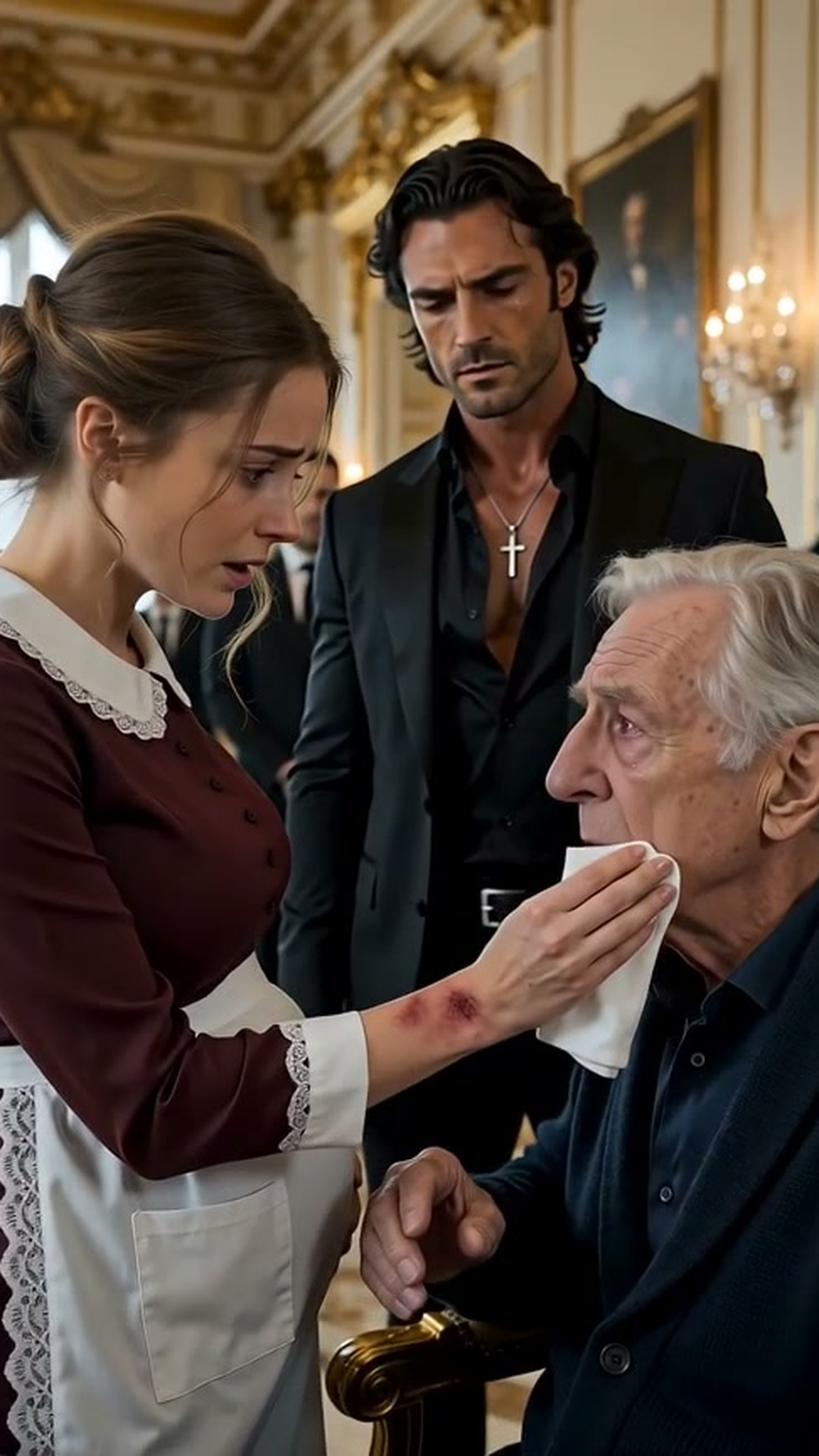
    "Yes," Lorenzo said. "I'm sure you have records." He looked, for the first time, directly and fully at Nora — at the burgundy uniform, the white apron stretched over her belly, the fading bruise of fingers on her wrist, the face of a girl who had been caught committing an act of mercy and expected to be destroyed for it — and something in his own face changed, with an almost audible finality, like a lock turning.

    "You," he said. "What's your name?"

    "Nora, sir."

    "You've been feeding him."

    It was not a question. She lifted her chin — she remembered later that her knees were knocking together under the apron, that she was more frightened in that moment than she had ever been in her life, and that it did not matter at all.

    "Yes, sir," she said. "He was hungry."

    "He was hungry," Lorenzo repeated, very softly, to the room, to the chandeliers, to the whole gleaming apparatus of care he had built and never once inspected. "In my house. My father was hungry in my house." He turned to the head of his security, a slab of a man named Ferro who had been with the family twenty years. "The doctor. His own cardiologist, not the agency — get him here. Today. And the agency nurses' company, their contract, every invoice, every signature. And find me the physiotherapist. The one we pay." His mouth twisted around the word. "Twice a week, Ferro. Find out where he's been going."

    "Sir."

    "And nobody—" his eyes swept the room, the maids, the guards, the frozen tableau of them all — "nobody is dismissed, nobody resigns, nobody leaves, until I have spoken to every person in this house. Anyone who tells me the truth about my father is safe from any consequence of it. Anyone who lies to me—" He did not finish. He didn't have to. He had his father's hand again, and was looking down at it, and what was left of the sentence stood in the room anyway, like furniture.

    The cardiologist arrived within two hours — the real one, Dr. Anand, who had treated Giovanni for a decade and whose face, as he examined the old man in the day room with the curtains drawn, aged visibly by the minute.

    "He's malnourished," Dr. Anand said, in the corridor, to Lorenzo, with a professional calm that sat on top of his anger like a lid on a pot. "Not catastrophically — someone, recently, has been getting food into him, and frankly, Mr. Moretti, it may be the only reason I'm not having a harder conversation with you. But his weight is well below where his chart says it should be. He has the beginning of a pressure sore at the sacrum, which means he is not being turned. And his medication—" He stopped.

    "Say it."

    "His cardiac medication adherence appears to have been— irregular. If doses have been missed at the rate his blister packs suggest, then we are fortunate, Mr. Moretti. We are not unfortunate only because we are fortunate. I want to be clear about that. There is a difference, and the difference is luck."

    And then the house began, at last, to talk.

    Lorenzo had said anyone who told the truth was safe, and for the first hour the staff did not believe him — they had been trained too well, and fear, once installed, does not uninstall at the first announcement. It was Bruno who broke it. Bruno, who had stuffed mushrooms and looked at the floor for two years, presented himself at the study door at a quarter past three with his chef's hat in his hands like a mourner, and stood, and said: "I cook for the old man myself, capu. Thirty years. The soft food, the good stock, I send it up with love, and I hear it comes back—" The big man's face worked. "The trays, they pass my kitchen coming back. Full. And I said to myself, Bruno, the old man is dying, he doesn't want— I lied to myself in my own kitchen, capu. Put it on me too. Put it on the list with her."

    After Bruno, they came like water through a cracked dam. Marta the laundress, with the collars of a hundred shirts for her testimony. Anselmo the gardener, who had been ordered to cut the chapel roses away from the day room window because their scent "agitated" the patient, and who said, with his ruined hands twisting in his cap, that a man asking for roses with his eyes is not agitated, he is begging. The night watchman, who had twice found Don Giovanni, on his rounds at 3 a.m., wide awake in the dark with tears running into his ears, because the evening nurse had gone at twenty minutes and the call bell — the call bell, Lorenzo learned, with a stillness that made Ferro step half a pace nearer the desk — the call bell in the day room had been disconnected for over a year. Disconnected, and the disconnection logged in the maintenance book in Gable's own handwriting as a repair completed.

    "She said he rings it for attention," the watchman said. "She said we're not to encourage it."

    Lorenzo wrote nothing down during any of it. He simply listened, with his face like a man being read his own sentence, and thanked each of them by name, and by the time the light outside the study windows had gone the color of old brass, the boxes from the housekeeper's office had been joined, on the long table, by something much worse than invoices: the full, corroborated, multiply-witnessed anatomy of a two-year abandonment, conducted for profit, inside a palace, under his own name.

    While the doctor spoke, Ferro's men were filling boxes in the housekeeper's office, and Tessa — white as her own aprons, summoned to the study at four o'clock along with the rest of the staff, one by one — had done the bravest thing of her life, braver, she would say later, than anything since: she had gone first to the linen press, before her interview, with her hands shaking too hard to hold the detergent manual steady, and had taken out a cheap spiral notebook in a schoolgirl's neat handwriting, and carried it into the study of the most dangerous man in New York, and laid it on his desk.

    Nora's notebook.

    "He's not refusing, sir," Tessa said, in a voice like a thread. "He never was. It's all in there. She wrote it all down. The lunches that came back full while the book said refused. The physio turned away at the gate. The nurse's hours. The pills in the cup, sir, she wrote the pills. If she'd been caught with it she'd have been—" Tessa's voice broke. "She's on nights now, sir, in the cellar, because of the weight he gained. Because he gained three pounds eating. Gable did that to her yesterday. She's six months gone, sir, and she's down in the cellar tonight on her feet till six, and if anything happens to her or the baby it'll be—"

    "Stop," Lorenzo said.

    The thread of Tessa's voice cut off. The study was silent except for the fire.

    Lorenzo sat with the notebook open before him, and he read — the dates, the times, the full trays carried out, the custard eaten slowly at 2:40, all of it, page after page of evidence kept by a pregnant girl in a detergent manual for a man she was forbidden to speak to — and when he reached the last page, and the sentence written there in a hand that had not trembled at all, he put his face in his hands.

    If I am dismissed I will take this book to Mr. Moretti himself, wherever he is.

    Before that, he had sat with the boxes.

    It was what he did with businesses that failed under him: he read the wreckage himself, all of it, in order, no summaries. The physiotherapist's diary, with its litany of turned-away visits — refused at gate, patient resting, refused at gate, patient agitated — in a neat, professional hand that grew, over two years, first puzzled, then careful, then resigned. The agency invoices with the nurse's hours rounded up like a grocer's thumb on a scale. The food budget ledgers, where the line items for his father's special diet marched in perfect order beside a second set of figures, smaller, in pencil, in the margins — the difference, month on month, between what a king's care cost on paper and what it cost in a teacup of stolen custard. And under the ledgers, at the bottom of the last box, Ferro's men had found the thing that Lorenzo Moretti would remember when all the rest of it had faded into case numbers: a birthday card. Cream-colored, expensive, unsigned by any hand but his own secretary's, bought the previous November for Giovanni's eighty-first and never delivered, never even taken upstairs. On the inside, in Gable's writing — she must have drafted the inscription for the family record, the performance of devotion — was the sentiment she had selected for a man she was starving: With gratitude for all you have given us.

    He held it for a long moment, that card, between his finger and thumb, like something lifted out of a river.

    Then he put it in his breast pocket, where it stayed through everything that followed, and it was thus — with his father's undelivered birthday in his pocket and a maid's notebook on his desk — that Lorenzo finally turned the last page of the record and read her final sentence.

    If I am dismissed I will take this book to Mr. Moretti himself, wherever he is.

    "Get her out of the cellar," he said, through his hands. "Now. Bring her to me. And Ferro—" He lifted his head, and his eyes were red and absolutely calm, the calm of a flooded river. "Cancel the cellar rota. All of it. And then go downstairs and inform Mrs. Gable that I am ready for her."

  • Chapter 4: The Son Who Paid for Everything

    Chapter 4: The Son Who Paid for Everything

    To understand what happened at the Moretti estate that winter, you have to understand Lorenzo — and to understand Lorenzo, you have to understand that he had been losing his father for two years, in installments, and paying a fortune for the privilege of not watching.

    He had been there for the first stroke. That was the thing nobody in the family — no cousin in Palermo, no capo at the table, no priest at the cathedral — would ever say to his face: the mighty Lorenzo Moretti, who had taken his father's sprawling, dangerous empire at twenty-six and made it richer and quieter and more legitimate with every passing year, had held his father's hand in the ambulance while Giovanni, felled mid-sentence at a family dinner, eighty years old and still terrifying, had tried to say his son's name and produced only a broken, drowning sound.

    He had been there for the second stroke too, eleven months later, which took the speech entirely.

    After that, Lorenzo did what he did with every unbearable thing. He organized it. He purchased it into submission. The gold-framed chair, custom-built in Milan. The specialists. The day room converted at ruinous expense — the harbor painting chosen because Giovanni had been born in a port town and had crossed an ocean in steerage with nine dollars, and had told that story at every dinner for sixty years until the dinners stopped. The round-the-clock staff. The best housekeeper in three states, poached from a senator at double wages: Mrs. Gable, with her references like references like royal warrants, her black book, her reputation for running great houses like clockwork.

    And then he had done the unforgivable thing, the cowardly thing, the thing he would spend the rest of his life paying for. He had let the clockwork run, and he had stopped going down the corridor.

    It hurt too much. That was the whole of it and there is no dressing it up. To sit beside that chair and watch the most powerful man he had ever known reduced to a pair of eyes and one disobedient fingertip; to talk and talk into the silence and get no answer; to feel his own helplessness in the presence of the one person he had never once been helpless in front of — it unmanned him, and Lorenzo Moretti had built his entire life out of never being unmanned. So he visited on Sundays, at first, for an hour, with gifts that grew more expensive as his conversation grew more strained: a cashmere blanket. A music system. Photographs of the family, framed, arranged on the day room wall by Gable in a fan.

    By the second year the Sunday visits had become monthly, and the reports — Gable's reports, delivered weekly, typed, immaculate — had become his father.

    Father rested comfortably. Father refused his lunch but took a little broth. Father is very peaceful these days, Mr. Moretti. He sleeps a great deal. The doctors say this is to be expected.

    The reports were beautiful. The reports were the reason Lorenzo could sit in his study forty yards and one whole universe from the day room, running an empire, and tell himself that the nine dollars in steerage had bought, at the end, peace.

    The last monthly visit had been in October, and it had lasted nineteen minutes.

    Lorenzo knew it had lasted nineteen minutes because he had checked his watch in the car afterward, the way a man checks the damage after a crash. He had brought his father a cashmere blanket in a box so handsome it could have held jewelry. He had sat in the visitor's chair — there was a visitor's chair in the day room, angled at Giovanni the way chairs are angled at exhibits — and he had talked. He had talked about the waterfront project, and the mayor, and the foundation's new wing at the hospital, filling the room with words the way you fill a grave with earth, steadily and without looking down. Giovanni's eyes had followed him the whole time. Once, the fingertip had tapped. Once. Again, again, tapping with a slow insistence that had, Lorenzo remembered afterward, in the car, raising its small terrible question at the back of his mind and been smothered by the schedule, the driver, the phone —

    Gable had stood at the door when he left, with her hands folded. "He's tired now," she had said gently. "You see how he tires. But he does so look forward to your visits, Mr. Moretti. He took a little broth at lunch."

    "He took a little broth," Lorenzo had repeated, with gratitude, to a woman charging him by the hour for the sentence.

    In the car he had sat for a while without telling the driver to go. He had thought: He is dying, and I am watching it happen in installments so that it doesn't hurt all at once. He had thought: That isn't watching. Watching would hurt all at once. And then his phone had rung — the waterfront, the mayor, the endless important weather of the empire — and the moment had gone back under the surface of his life like a stone into a river, and the river had closed over it.

    His mother had been dead nine years. Caterina Moretti, who had come over at nineteen with a cardboard suitcase and had run her husband's household and half his negotiations with a wooden spoon and perfect recall, had understood Lorenzo better than he understood himself, and on her deathbed — lucid, terrifyingly, to the end — she had taken his hand and said the thing that the family still quoted: "Your father looks like the storm, tesoro, but you are the sea. The sea holds everything. See that you hold him, at the end. Not the business. Him."

    He had promised. Of course he had promised. A man promises anything at a deathbed; it is the cheapest currency there is, and Lorenzo, who was honest in business to a fault, had been paying out that promise ever since in blankets, specialists, televisions the size of doors — everything except the only denomination his mother had specified.

    Him. Not the business. Him.

    It was an old man who cracked it. Of course it was. The empire was held together by old men — men who had come over with Giovanni or just after, who had buried wives and rivals and in two cases sons, and who owed their considerable fortunes to the fact that Giovanni Moretti had once, in 1968, divided a waterfront between four families with a pencil stub and a napkin and made the division hold for fifty years by the simple force of being believed.

    Salvatore Ricci, eighty-four, a consigliere of the old school, minus two fingers and plus a private income that would shame a bank, took to having his driver bring him to the estate on the first Sunday of the month. Ostensibly he came to pay respects to Lorenzo. Actually — everyone understood, and no one said — he came to sit with Giovanni, the way men of that generation sit with the wounded: without sentimentality and without leaving.

    On the first Sunday of November he sat for one hour in the day room. The television played to the wall. The old man's tray sat untouched — the relief maid that day had been Tessa, and Tessa had been ordered to the linen press midday and had left it, and no one had come back. Salvatore, who had once personally negotiated a ceasefire in a basement full of armed men, fed his old friend four spoonfuls of cold soup with his own ruined hand, and then drove home, and that evening he did something he had not done in forty years of friendship with the Moretti family.

    He telephoned Lorenzo, and he did not use the respectful formulas.

    "You are being lied to," Salvatore said.

    Lorenzo, in the study, with the weekly report open on the desk in front of him — Father took a little broth — went very still. "Salvatore."

    "Your father is a skeleton in a gold chair, boy. He is dirty. His nails — Giovanni Moretti's nails, that he used to have done every Friday of his life like a sacrament, they are broken. He watched me the whole hour like a dog watches a door. I fed him. Me. With these—" a sound down the line, the old man gathering himself, furious and grieving— "you listen to me, Lorenzo. I knew him when he had nothing. I knew him when he could end a man's whole life with a look, and I have sat today and spooned cold soup into him, and he cried. Your father. Cried, because a friend fed him."

    "That's not—" Lorenzo stood up. He did not remember standing. "Gable reports—"

    "Gable reports!" The contempt down the telephone line was incandescent. "You run forty businesses and you cannot run down one corridor and look? My driver will say nothing, I will say nothing, the whole world that loves your father will sit in that room and rot politely rather than shame you — I am too old. I am done being polite. Go and look at your father, Lorenzo. Not the report. The man."

    The line went dead.

    Lorenzo stood in the study for a long time. The fire made its small noises. On the desk, the typed report said, in Gable's faultless prose, that his father was peaceful, and sleeping a great deal, and had taken a little broth.

    He thought of nine dollars in steerage. He thought of a hand in an ambulance.

    He did not announce himself. That was the first intelligent thing he had done about his father's care in two years, and he knew even as he did it — as he told no one, canceled the car, let the house believe him in the city until Friday — that some part of him, some gutter instinct bred in the bone, already believed Salvatore, and had perhaps believed worse for months, in the small hours, in the place where the reports could not reach.

    He had telephoned the house that morning — one detail, one test, the kind he would have run on any business he suspected of cooking its books. He had asked, lightly, after his father. And Gable, perfect as ever, had given him the week's prose off the top of her head, smooth as a hand over silk.

    "He's very settled this week, Mr. Moretti. He took a spoon or two of broth at lunch — of course we offered the full tray — and he's resting now. The nurse has just gone. I shouldn't disturb him before four; you know how the afternoons tire him."

    A spoon or two of broth. Resting now. The nurse has just gone.

    Three sentences, and every one of them, Lorenzo would discover within the week, false in the way that mattered — the broth refused by a mouth that needed an hour and got ten minutes, the rest that was a disconnected bell and an empty room, the nurse whose hour had been twenty minutes and whose signature said sixty. But that morning he had only Salvatore's voice in his ear, and his mother's words underneath it like a stone in a riverbed — Not the business. Him — and his own hand, rising to terminate the call, had stopped once, hovering, while something cold and ancient in his spine performed an arithmetic it had been avoiding for two years.

    You know how the afternoons tire him.

    He did not know. That was the thing. He did not know anything about his father's afternoons. He had purchased knowledge, in bulk, from a woman with a pencil, and the goods had never once been inspected.

    He came up the drive on foot, in the early afternoon, through the winter trees, in a black coat, alone.

    And at half past one, with the lunch trays long cleared and the house drowsing in its routines, Lorenzo Moretti walked quietly into the great dining hall — where the family, in the fiction maintained for him, sometimes took his father for a change of scene — and stopped in the doorway, and saw what there was to see.

    A pregnant maid, holding a white cloth to his father's face.

    An old woman's fingers, locked around her wrist like a trap.

    And his father's eyes — his father's eyes, rising to him across the room, filling with tears, saying the thing they had been trying to say down forty yards of corridor for two years.

    Help me. You came. Help me.

  • Chapter 3: The Black Book

    Chapter 3: The Black Book

    The trouble was that kindness, practiced daily, becomes visible — and in the Moretti house, everything visible belonged to Mrs. Gable.

    It began with the laundress, a stout Ukrainian widow named Marta, who took Nora aside by the ironing tables with her hands still moving, out of lifelong habit, through a pile of the old man's shirts.

    "You feed him," Marta said. It was not a question. "The shirts. His collars — before, always the food down the front, from the girls rushing. Now, clean. Somebody feeds that man careful, like a baby bird, and it is not the nurse, because I see the nurse's car and it is one hour, no more." She pressed a shirt flat with enormous tenderness. "I say nothing. Marta says nothing for thirty years, that is how Marta is alive. But I tell you one thing, little mother." Her eyes went to Nora's belly. "Signora Gable counts everything. The butter. She will count the butter, one day."

    She counted it nine days later.

    It was not the butter, in the end. It was the weight. The agency nurse — a new one, a young man with a tablet and a bored expression — weighed Giovanni at his monthly check, frowned, weighed him again, and said, in the hearing of the day room door and therefore of the whole corridor: "Huh. He's gained three pounds."

    Three pounds. Three pounds of mashed potato and stolen custard and Bruno's soft rolls torn small, in a man whose chart had sloped downward for a year. It might as well have been a gunshot. By supper the whole staff knew, and by supper Mrs. Gable knew that the whole staff knew, and Nora stood at her place in the servants' hall line at six the next morning with her hands folded and her heart like a fist, and watched the gray head come down the row, pencil first.

    "Don Giovanni has gained weight," Mrs. Gable said pleasantly, to the room at large, when she reached the end of the line. "His digestion is delicate. Unauthorized feeding could kill him. Whoever has taken it upon themselves to interfere with his medical regime" — she let the silence do the work — "will not merely be dismissed. They will be reported to the agency for endangering a helpless man, and the agency will report them to the police." Her gaze moved along the faces, unhurried. "Am I understood?"

    "Yes, ma'am," the line murmured.

    Nora said it with the rest, looking at the floor, feeling the baby turn over slowly inside her like something surfacing.

    She stopped going for two days.

    On the third day, wheeling her cart past the day room at the dead hour with her eyes straight ahead — obeying, obeying, being good, being safe — she heard a sound from inside the room.

    It was not a word. He could not make words; that had been taken from him with nearly everything else. It was a breath, shaped. A thin, cracked exhalation, repeated — the sound a man makes when he has exactly one sound left to him and he is spending it.

    He had heard her cart. He knew the cart. He knew the squeak of its left wheel the way you know a voice.

    Nora stood in the corridor with her hands on the linen and her whole life balanced on the squeak of that wheel, and thought about the police, and the agency, and two hundred and eleven dollars, and a baby with no one in the world but her.

    Then she thought about the word refused, written in black ink, lying about a starving man.

    She pushed open the door.

    He was thinner already — three days, and something in his face had gone out like a lamp turned down. His eyes fastened on her and filled so fast it frightened her, and she was across the room before she knew she had moved, kneeling, her handkerchief already out, her own eyes streaming.

    "I'm here," she said. "I'm here, I'm here. I was afraid. I'm sorry. I was afraid and I left you, and it will never happen again, do you understand me? Never. Let her do her worst."

    His fingertip tapped against her wrist — once, twice, again, again — and she fed him, that day, with the door unlatched, in the open, like a soldier.

    That was the day she stopped stealing and started documenting in earnest.

    She did not know, yet, the half of what there was to document. She learned it in layers, the way you learn a house is on fire floor by floor.

    She learned that the specialists' reports — the famous specialists, the car with the driver — were filed by Gable and never once read aloud to the staff who might have acted on them; that the great television in the day room had a broken remote and had played the same channel, unwatched and unwatched-for, since spring; that the physiotherapist whose visits Lorenzo paid for twice a week had been turned away at the gate so many times by Gable's orders — the old man is resting, the old man is agitated, the old man refuses — that he had stopped coming altogether, and his invoices, Nora saw with her own eyes on the one occasion she dusted the housekeeper's office, were still being submitted.

    She learned that the evening nurse's hour was habitually cut to twenty minutes, and signed for sixty.

    She timed her own rounds against the kitchen clock after that, and wrote the times down too — who came up the back stairs and when, how long the day room door stood open, the rattle of the medicine trolley and how soon it rattled away again. Facts, she was learning, had a weight that feelings did not. Feelings could be called hysterical, could be called a pregnant girl's fancies. A column of times in a steady hand could only be called true.

    And she learned — last, and worst, on a Thursday, when a relief nurse she'd never seen, a tired woman in her fifties with a Birmingham accent, came out of Giovanni's room holding his medication tray and shaking her head — she learned about the pills.

    "Half the blister's still full from Tuesday," the nurse said to the corridor generally, annoyed, professional, unaware she was speaking to a girl who would remember every syllable on her deathbed. "His heart tablets. And the evening dose from yesterday, still in the cup. Whoever's been signing these off—" She looked at Nora and stopped, reading something in her face. "You just do the linen, love?"

    "Yes," Nora said. "I just do the linen."

    "Then you didn't hear it from me." The nurse lowered her voice. "Skipped heart medication, on a man with his history? That's not laziness. That's a countdown."

    That night, Nora did not sleep. She lay in the narrow bed under the eaves with her notebook on her knees and copied out everything she had, in order, with dates, in her neat hand: the feeds, the refusals-that-weren't, the physio at the gate, the signed-for hours, the pills. Page after page. Evidence, she understood now — that was the word for what she had been keeping all along, without daring to name it. Not kindness. Evidence.

    She wrote until the letters blurred. And then, on the last page, she wrote the thing she had not known she knew until her pencil formed it:

    He is being killed slowly by inches, in a house full of people, and everyone is paid to look away. If I am dismissed I will take this book to Mr. Moretti himself, wherever he is, and if they will not let me near him I will give it to the police and then to the newspapers, and let them make of me what they like.

    She had one more piece of evidence, though she did not yet know it was evidence, and it came to her by accident on the last day of the cellar rota's shadow — the day before the knock.

    She was polishing the silver in the pantry, a job given to girls Gable wished to keep where she could see them, when the agency's area manager came through on his quarterly inspection — a smooth man in a gray suit who was shown the house the way you show a buyer a horse, at the trot, from the good side. Nora heard them through the pantry door, Gable's voice smooth as poured cream.

    "Don Giovanni is a very challenging case, Mr. Pruitt. The family is devoted — oh, entirely devoted — but the gentleman refuses care. It is in all our records. We do everything. Everything. Some patients simply decline, you know. It is a sadness for everyone."

    "And the staff turnover?" the man asked, mildly. "Three this month, the agency said."

    "Girls today," said Gable, with a sigh that deserved an award. "They find the work melancholy. Watching a great man decline. The sensitive ones leave."

    The door closed on the rest. Nora stood in the pantry with a silver spoon in her hand and polish on her fingers, and she wrote that conversation down too, word for word, that night, because by then she wrote down everything, the way a drowning woman inventories the boat. We do everything. The sensitive ones leave. She underlined leave twice.

    Because that was the machinery of it, finally laid bare for her: not cruelty with a whip, which can be pointed at, but cruelty with a filing system. A great house, an absent son, a woman who had understood that if you controlled the records, you controlled reality — that a man who could not speak existed only as other people described him, and she had made herself his only description. Refused his lunch. Refused his medicine. The sensitive ones leave. It was all there in the black book and the gray man's clipboard, a whole human being edited down to a set of excuses for why no one needed to look at him.

    "Somebody looked," Nora wrote at the bottom of the page, and her hand shook with something that wasn't fear anymore. "That's the entry you didn't plan for, madam. Somebody looked, and somebody can hold a pencil, and it's all in here."

    She closed the notebook. Outside her little window, the estate lay dark and enormous and unaware, and somewhere below her an old man was lying in the dark too, in a room that locked from the outside by rota and routine, with his evening medicine in its cup where the nurse who never stayed the hour had left it, and his whole life narrowed to the sounds of a house deciding, night after night, that he could wait until morning.

    There was a knock at her door.

    Nora's whole body went cold. It was past midnight. Staff did not knock at other staff's doors at midnight; staff did not do anything at midnight except sleep and be invisible.

    She hid the notebook inside the detergent manual, slid the manual into the linen press in the corner — her hands did it before her mind had finished being afraid — and opened the door with her face arranged.

    Tessa stood there in her nightdress, barefoot, shaking.

    "She's done the rota for next week," Tessa whispered. "Nora. She's put you on nights. Cellar and laundry, nights, all week, starting tomorrow. A woman six months— in the cellar, on your feet, all night, with the damp—" Tessa's eyes were full. "It's because of the weight. She knows it's somebody and she thinks if she breaks the new girls one of us will tell. She'll break you first, because you're—" She stopped.

    "Because I'm the one with something to lose," Nora said quietly.

    "Run," Tessa whispered. "Tonight. I'll say I never saw you. The agency has other—"

    "No." Nora looked at the frightened girl, and then past her, down the dark corridor toward the stairs that led, eventually, to a room where an old man lay alone in the dark with his heart medicine sitting untouched in a cup, counting — she knew this now, she knew it in her bones — counting the hours by the sounds of a house that had forgotten him. "No, Tessa. I'm not running."

    "What will you do?"

    Nora put her hand, very gently, over the swell of her belly, where her child — Daniel's child, the last of him — slept in the dark, safe, for now.

    "I'm going to finish the book," she said.

  • Chapter 2: The Language of Small Things

    Chapter 2: The Language of Small Things

    By the end of her first week, Nora understood the house the way you understand weather: not by being told, but by being rained on.

    There were thirty-one people on the staff of the Moretti estate, and every one of them lived in terror of a woman with a silver pencil. Mrs. Gable controlled the rotas, the keys, the pantry accounts, the staff meals, and — nobody said this aloud, but everybody's behavior said it — Mrs. Gable controlled access to Don Giovanni, and through Don Giovanni, the one lever that mattered over the master of the house.

    Because Lorenzo Moretti was the master of the house. Nora learned that on the second day, from the cook, a vast Neapolitan named Bruno who had been with the family thirty years and spoke of the Morettis the way priests speak of weather in heaven — as a fact that governed everything and could not be appealed.

    "Il capo," Bruno said, stuffing mushrooms with the concentration of a bomb disposal expert, "is a good son. A good son! He pays for everything. The chair — that chair cost more than my mother's house. The doctors — specialists from the city, they come in a car with a driver. The room — have you seen the room? Like a hotel for a king. Paintings! A television the size of a door!" He waved a mushroom at her. "Ask anyone. Il capo spares nothing for his father."

    "Then why does nobody—" Nora stopped. Bruno's face had closed like the gallery door. He returned to his mushrooms.

    "It is arranged," he said to the mushrooms. "Signora Gable arranges. There is a routine. Old people, they like routine."

    The routine, as Nora pieced it together over the following days, was this.

    Don Giovanni was woken at seven by an agency nurse who came for one hour in the morning and one in the evening, whose name nobody knew because Gable rotated them deliberately so that none of them ever learned the house. He was washed, dressed, given his medication and a bowl of something pale, and wheeled into the small day room off the east corridor, where the television played to an empty chair's companion — a blank wall with a painting of a harbor on it.

    At midday, whichever maid was lowest in Gable's favor that week carried in a tray: soup gone cold on the journey, food cut for a man who could barely swallow and therefore needed time and patience and small bites — none of which the rota allowed. Ten minutes, Gable's rule. Ten minutes, and the tray came out, and whatever had not been eaten was recorded in the black book, in Gable's merciless hand, as refused.

    Refused. Nora saw the book once, left open on the servants' hall table in the hour when Gable took her rest, and the word ran down the pages of entries like a verdict. Refused lunch. Refused dinner. Refused his medicine, spat it out. The old man is difficult, the book said, in thirty different ways. The old man will not eat.

    But Nora had watched him, that first evening, sit with a smear of food drying at the corner of his mouth, facing a wall, and she understood then what she would spend the next six weeks proving to herself: Giovanni Moretti was starving in a palace, in full view of thirty-one people, because it was convenient for the one person who had made herself the wall between him and his son.

    She started with the crusts.

    Bruno, whatever his fears, could not abide waste, and the staff meal leavings went into a bin by the kitchen door. Nora began, carefully, to divert: a soft roll torn small. The heel of a custard. Mashed potato with butter, still warm, in a teacup, hidden under the cloths on her linen cart. She timed her east-wing duties so that her cart passed the day room at the dead hour after lunch, when Gable took her rest and the corridor cameras — there were cameras; of course there were cameras — were watched, if they were watched at all, by men paid to watch the gates and not the day room door.

    "Hello," she said, the first time, from the doorway, with her heart hammering so hard she was sure the baby could hear it. "I'm Nora. I do the linen. I'm not supposed to be here, so we won't tell anybody."

    Giovanni's eyes came to her — the only part of him, besides breath, that entirely obeyed him — and she watched the thing happen that no one in the house believed happened anymore: he attended. His gaze fixed on her face with a hunger that had nothing to do with the teacup.

    "I brought this from the kitchen. It isn't much. It's warm, though." She came in — God forgive her, she came in, she crossed the threshold of the forbidden room with her illegal teacup — and knelt by the great chair, which cost more than a house and could not do the one thing it was for, which was to bring him to the height of a person who might be spoken to rather than down at.

    "Small bites," she told him. "I'm in no hurry. Nobody knows I'm here, so I have all the time there is."

    It took forty minutes to finish the teacup. Forty minutes, for half a cup of mashed potato, because his swallow was slow and treacherous and she would not risk him choking for anything on earth. His eyes never left her face. When she lifted the last spoonful away and dabbed his mouth clean with her handkerchief — carefully, the way you would for someone whose dignity was a country you were visiting — a tear slid down and lost itself in the lines of his cheek, exactly as it would six weeks later in the dining hall, in front of everyone.

    "Oh," Nora said softly, stricken. "Oh, no. Was it too hot? Did I—"

    His fingers moved. On the arm of the chair, his right hand made its tiny, heroic journey — a quarter of an inch, the effort of it visible in the tendons of his neck — until his fingertips rested against the back of her hand where it lay on the chair arm.

    They stayed like that for a moment, the pregnant maid and the ruined king, in the forbidden room, in the stolen hour.

    "You're welcome," Nora whispered, and covered his hand briefly with hers, warm over cold. "I'll come tomorrow."

    She came the next day. And the next. And by the end of the second week she had built, out of nothing but patience and attention, the thing the specialists from the city with their car and driver had never bothered to build: a language.

    One blink: yes. Two blinks: no. Eyes left: pain, or the nurse, or too cold. Eyes right: the window, open it, let him see the trees. One tap of the fingertip, when he could manage it, against her palm: again. Two taps: enough.

    She learned that he hated the pureed carrots and loved anything with butter. That his swallowing was better in the morning and treacherous when he was tired. That he listened — rapt, starving for it in a way that broke her heart worse than the food — when she read aloud from the newspaper while she fed him, so she began to steal the newspaper too, out of the library recycling, and read him the racing results and the obituaries and, once, most of a very long article about a bridge being built in Ohio, which he attended to with the gravity of a man following the fate of nations.

    She told him things, in those hours, that she had told no living soul. About Daniel. About the fall, and the phone call, and the landlord's patience ending. About the two hundred and eleven dollars and the card from her mother that she kept under her clothes in the suitcase like an exhibit in a trial no one else was attending.

    "I know it's foolish," she said, "keeping a card. She wrote 'thinking of you' — the printed part says most of it. But when I have the baby, I want—" She stopped, and did her breathing, the way she had learned to do it when the grief came up her throat. "I want someone to know there's a baby. Even if it's just her. Even if she never comes. Isn't that silly? He's got no one at all in the world except me, and I've got—" She looked at the old man, and laughed a little, wetly, at the pair of them. "Well. I've got you, Don Giovanni. God help us both."

    His eyes were wet. His fingertip, resting against her palm, tapped once. Again. Again. Again — a slow, deliberate rhythm, until she understood it wasn't a word in their language at all. It was just his hand, saying the only thing it could, over and over: I am here. I am here. I am here.

    She never saw the black book again without thinking of the word refused. And she began, quietly and without any plan at all, to keep a record of her own — in a cheap spiral notebook hidden inside the cover of a detergent manual in the linen press, in her neat schoolgirl hand: dates, times, what he had eaten, how much, how long it took. The bowl at lunch: untouched, she wrote. Carried out at 12:10, still full. The book says refused. He ate the custard at 2:40 for me. All of it. Slowly. He was not refusing. He was waiting for someone to stay.

    There were other educations, too, in those weeks, and not all of them were about Giovanni.

    She learned that the staff of the Moretti house divided, like a country in a civil war, into those who had been there before Gable and those who had come after. The before-people — Bruno, Marta, old Ferro, the gardener Anselmo whose hands shook except among his roses — carried a quality Nora could only call mourning. They had served a house where Don Giovanni had walked the corridors like weather, where the staff ate at a long table with the family at Christmas and the old man carved, where a maid's daughter could be baptized in the estate chapel and Giovanni would stand godfather and cry openly and give the child a bond for her education. They spoke of those days in the past tense and then changed the subject, because the present tense had Mrs. Gable in it.

    The after-people — hired by Gable, vetted by Gable, owing their places to Gable — were frightened and incurious and kept their eyes on the floor. They were not bad people, most of them. They were people who had learned what the house rewarded, which was blindness, and what it punished, which was everything else.

    And she learned, by watching, what the house's blindness cost in small change. The flowers from the florist, billed weekly for Don Giovanni's room, that went instead to Gable's own sitting room. The good wine from the cellar book, signed out for the old man's table, that he never saw. The birthday — his eighty-first — that passed in November without a cake, a candle, a single card opened in his presence, because Gable had marked it in the book as a day he was "not to be disturbed," and the son in the study had sent, as instructed, an arrangement of white orchids the size of a sheepdog, which stood for a week in the front hall where guests could admire the family's devotion, and which Giovanni Moretti never saw at all.

    Nora stood in the day room on the morning after that birthday with a stolen rose from the garden in a jam jar — Anselmo had cut it for her, silent, from the bush by the chapel wall, and put it in her hand with his eyes on the gravel — and set it on the tray table where his eyes could find it.

    "Happy birthday," she whispered. "I know it's late. Late is my specialty. I'm late for everything except trouble."

    His eyes went to the rose, and stayed, and the look in them was not grief, exactly. It was something older and more surprised than grief, the look of a man who had stopped expecting to be remembered and had just been caught out in it. His fingertip tapped twice against the chair arm — no — and then, after a moment, once.

    No. Yes.

    She laughed, quiet, through her nose, delighted despite everything. "Both? No and yes? That's cheating, Don Giovanni. That's not how our language works." But she understood him, because by then she understood him the way you understand a song you have heard every day for weeks: he was telling her it was too much and not enough, that he did not want the fuss and that the fuss was the first human thing that had happened to him in a year, and both of those were true at once, the way most true things about old men are.

    She read him the racing results twice that day, because the first time she had rushed, and he deserved better than rushing.

    She did not yet know what the notebook would become. She only knew that somewhere in that house was a son who paid for everything except the one thing that mattered, and that one day — she felt it the way you feel weather coming — the two halves of that sentence were going to collide.

    She just didn't expect the collision to nearly kill her first.

  • Chapter 1: Then Why Is My Father Crying?

    Chapter 1: Then Why Is My Father Crying?

    The spoon hit the porcelain plate with a sound like a small bell, and Nora flinched.

    She had been leaning close to the old man, close enough to smell the faint lavender of the soap the night staff used on his skin, close enough to see the tear gather at the corner of his eye before it spilled. Her hand — trembling, because her hands always trembled a little now, in the sixth month, when she had been on her feet since five in the morning — held a white cloth to the corner of Giovanni Moretti's mouth, dabbing away a trace of the soft food he had managed to swallow.

    He was hungry. That was the shameful, simple truth of it. He was always hungry, and nobody in this glittering house seemed to know, or to care.

    The tear rolled down his lined cheek. Nora lifted the cloth toward it — and then fingers like iron closed around her wrist and wrenched her hand away.

    Mrs. Gable did not raise her voice. She never raised her voice. That was what made the whole staff walk softly around her, the way you walk around a sleeping dog that bites.

    "That is not your station," the head housekeeper said, very quietly, to Nora's wrist more than to Nora. "You are not paid to play nurse."

    The pull had been sharp. Nora recoiled half a step, the silver spoon slipping from the saucer's edge and ringing against the plate, and her free hand went instinctively, before thought, to the round curve of her belly — protecting the only thing in the world that was truly hers.

    Giovanni's eyes widened. On the arm of his great gold-framed chair, his fingers — thin as sticks, spotted, the nails carefully trimmed by no one — made a tiny, desperate, unsuccessful movement toward Nora's hand. As if he could catch her. As if he could stop this.

    He could not. Everyone in the room knew he could not. That was rather the point of everything.

    And then a shadow fell across Mrs. Gable's arm.

    Nora did not hear him approach. Nobody ever heard Lorenzo Moretti approach; for a man built like a doorway, he moved through his own house with a silence that made the bodyguards along the wall straighten without knowing why. He was simply there, suddenly, towering behind his father's chair in his black suit, the silver cross at his open collar, his gray eyes fixed on the older woman's hand where it still gripped the maid's wrist.

    "Let her go."

    Two words. He said them the way other men might set down a glass. But Mrs. Gable's fingers opened as if the wrist had burned her.

    Nora stumbled back the half-step she had lost, steadied herself against the arm of Giovanni's chair, and rubbed her wrist — where red marks were already rising on the pale skin — while her other hand stayed pressed to her belly. Her breathing was uneven. The other maids, frozen along the edges of the great dining hall with their trays and their linens, exchanged glances and said nothing at all.

    "Mr. Moretti," Gable began, straightening her black jacket with a quick, practiced tug, recovering the way a cat recovers from a fall, pretending it had intended the whole thing. "I was only correcting—"

    But Lorenzo was not looking at her anymore. He was looking at his father.

    Giovanni Moretti, eighty-one years old, a man who had once made judges tremble and governors return his calls, sat sunken in his ornate chair in his navy cardigan, and his eyes were full of tears. One escaped and tracked down his cheek. And Nora — six months pregnant, exhausted, frightened half out of her wits, with the marks of the housekeeper's fingers blooming on her wrist — did the thing no one else in that room full of well-paid, well-trained people had done in months.

    She turned back to him.

    She lifted the white cloth, gently, and wiped the tear from the old man's cheek.

    Giovanni's eyes rose to hers. His trembling fingers moved — a fraction, a breath, the smallest distance his ruined body allowed — and touched the edge of her hand, and she understood, the way she had learned to understand everything about him, and she adjusted her hand so that the contact cost him nothing, so that he could simply rest there, touching another human being who was not hurting him.

    "He was hungry," Nora said.

    Her voice trembled. She could not help that. But she did not look away from Lorenzo Moretti, and she did not let go of the old man's hand.

    Something moved across the boss's face — something that started as confusion and ended, terribly, as the beginning of comprehension. He looked at the untouched plates further down the table, the congealed luncheon laid out for a staff of dozens. He looked at the one small bowl of soft food at his father's place, the one Nora had carried in herself. He looked at his father's hollow cheeks.

    Then Mrs. Gable smiled her stiff smile and said, into the silence, the stupidest words of her life.

    "We treat him like a king."

    Another tear slid down Giovanni's face.

    Lorenzo Moretti took one slow step toward the head housekeeper. She took, involuntarily, one small step back. And in a voice so quiet that the chandeliers themselves seemed to lean in to hear it, he asked the question that would end one world and begin another.

    "Then why is my father crying?"

    SIX WEEKS EARLIER

    The agency driver let Nora out at the service gate of the Moretti estate in the rain, and she stood for a moment with her one suitcase in her hand, looking up through the iron bars at the house.

    It was not a house. Houses were where people lived. This was a small nation of cream stone and black glass set in forty acres of upstate New York woodland, with a fountain in the turning circle and a roofline like a cathedral. Chimneys. A flag. Somewhere beyond the trees, she would learn, there was a helipad.

    She was twenty-three years old, five months pregnant, and she had exactly two hundred and eleven dollars.

    The baby's father, Daniel, had been a roofer with kind hands and a laugh like a screen door slamming, and he had fallen nineteen feet off a scaffold in March and not gotten up. There had been no insurance worth the name, no wedding, no family of his that wanted a pregnant girlfriend at the table. Her own mother, three states away and deep in a new marriage, had sent a card. Nora kept it in the suitcase, under the folded clothes, because it was the only proof she had that she had ever belonged to anyone at all.

    So when the agency called about a live-in position — room, board, and a salary that made her dizzy, discretion required, uniform provided, immediate start — she had said yes before the woman finished the sentence.

    What the agency had not said, what nobody would say for another six weeks, was whose house it was.

    The housekeeper who admitted her at the service door was not Mrs. Gable but a pale girl named Tessa, maybe nineteen, who took Nora's suitcase with both hands and an expression of profound relief.

    "Oh, thank God," Tessa whispered. "We've had three quit this month. Gable eats the new ones."

    "What does that mean?"

    "It means—" Tessa looked over her shoulder at the empty corridor, and lowered her voice further. "It means do what you're told, don't ask about the old man, and don't get attached to anything. Especially not the old man."

    "Who's the old man?"

    Tessa's face did something complicated. "You'll see him. Everybody sees him. That's the worst of it. You see him every day."

    She led Nora up the back stairs — maids did not use the front stairs; maids, Tessa explained, did not use the front most things — to a small room under the eaves with a narrow bed and a window that overlooked the gardens. The uniform was laid out on the bed, folded to surgical precision: a dress the color of dark wine, a white apron, a lace-trimmed collar.

    "She'll inspect you at six," Tessa said. "Mrs. Gable. Stand straight, hands where she can see them, don't speak first. And—" she hesitated at the door, and some genuine kindness in her overrode the fear, briefly— "eat something before. From the kitchen, when the cook's not looking. You're eating for two, and Gable counts the staff meals like she's paying for them herself. Which, between us—" Tessa shrugged, a tiny, hopeless gesture. "In this house, she might as well be."

    Nora met Mrs. Gable at six, in the servants' hall, lined up with the rest of the day staff like a row of suspects.

    Mrs. Gable was in her late sixties and looked carved rather than born: gray hair swept back without a single escapee, sharp bones, a black suit that had never in its life wrinkled. She walked the line slowly, with a silver pencil and a small black book, and when she reached Nora she stopped, and her pale eyes traveled — pointedly, unhurriedly — to Nora's belly.

    "The agency," she said, "did not mention a condition."

    "It doesn't affect my work, ma'am."

    "We shall see what it affects." The pencil moved. "You will be assigned the east wing. Rooms, linen, dusting. You will not enter the master's study, the library, or the south terrace rooms. You will not speak to the family. If a member of the family speaks to you, you will answer in as few words as courtesy permits and inform me afterward of the exchange."

    "Yes, ma'am."

    "And you will have nothing—" the pale eyes lifted, and for the first time Nora felt the full arctic weight of the woman's attention— "nothing whatsoever to do with Don Giovanni. His care is arranged. It is not your concern, it is not your station, and curiosity about him will end your employment before your trial month does. Is that clear?"

    "Don Giovanni," Nora repeated carefully. "The—the gentleman's father?"

    Something closed in Mrs. Gable's face, like a door in a distant part of a house. "It," she said, "is clear or it is not."

    "It is clear, ma'am."

    "Good." The pencil scratched. "East wing. Six a.m. Tessa will show you the linen press."

    Nora saw him that same evening, at seven, when the whole house seemed to exhale and the lights came on floor by floor like a ship waking.

    She was carrying a stack of pressed sheets through the ground-floor gallery — she should not have been in the gallery at all, but the linen press had jammed its door and Tessa had begged her, quick, through the gallery, nobody's about — when the far doors opened and a man in a black suit wheeled an ornate, gold-framed chair out of the dining hall and parked it — there was no other word, parked it — beside a marble column, in the draft from the doors, facing the wall.

    In the chair sat an old man in a navy cardigan, his silver head tipped to one side, his hands still in his lap. A napkin had been tucked at his collar and not removed. There was a smear of something at the corner of his mouth.

    The bodyguard walked away, already looking at his phone.

    Nora stood with the sheets in her arms and watched the old man sit facing the wall for one minute, then two. A maid passed him with a tray of glasses and did not slow. The cook's boy crossed the hall with a crate and looked at the floor as he passed, deliberately, the way you look at the floor when something on a chair has made you ashamed.

    Giovanni Moretti's eyes moved. That was all that moved. They found Nora across the gallery — the only still thing in the hall, the only person looking at him as if he were a person — and held hers with an intensity that she would remember on her deathbed.

    She could not go to him. She had been in this house four hours, and already she understood the architecture of the rule: it was not written anywhere, and it was load-bearing.

    She did the only thing she dared. Very slightly, she inclined her head to him — the way you would to a gentleman you passed on a road, an acknowledgment, a courtesy — before she forced her feet to carry her and the sheets away through the gallery door.

    Behind her, she heard nothing at all from the chair. He could not call out. That was the thing about Don Giovanni, the thing Tessa had meant.

    He could not call out, and the whole house had learned to enjoy the quiet.