Story Genres: MAFIA BOSS

  • Chapter 6: The Traitor in the Family

    Chapter 6: The Traitor in the Family

    Marco found the man with the tattoo on his neck in a bar in Gary, Indiana, drinking away the money Dominic had paid him five years ago and telling anyone who would listen that he had once worked for the Moretti family. His name was Tommy Kessler, and he was not a brave man, and when Marco sat down across from him and put a photograph of Ruby on the table, Tommy Kessler started talking, and he did not stop for a very long time.

    He told us about the van. He told us about the money — fifty thousand dollars, cash, in a bag on the seat. He told us about the phone call, the voice that gave him the rules: new name, no contact, no police, no going back. He told us that Dominic had called him personally, twice, over the years, to make sure Elena was still hidden and still afraid. He told us that Dominic had paid for the apartment above the bakery — paid the landlord in cash, every month, for five years — because a woman who is afraid and poor is a woman who stays quiet.

    He told us something else, too. He told us that the fire had not been meant to kill Elena. It had been meant to kill all of us — me, Elena, both babies. Dominic had wanted the whole family gone, so that the Moretti business and the Carter business would fall to him as the last man standing. But the fire had gone wrong. I had gotten Sophie out. Elena had gotten Ruby out. And Dominic, standing in the ashes the next morning, had done the only thing he could do: he had built a lie big enough to hold the pieces apart.

    "He said it was business," Tommy said, staring at his hands. "He said the Morettis were weak. He said the old man would have wanted it this way. I didn't believe him, but the money was real, and I had a baby of my own coming, and I — I'm sorry. I'm sorry."

    I looked at this man — this small, frightened man who had held a gun on my wife and my baby daughter in the back of a van — and I felt nothing. Not anger. Not pity. Nothing at all. Because he was not the man who had done this to us. He was a tool. The man who had done this to us was sitting in an office downtown, in a perfect gray suit, counting money that belonged to my wife.

    "Thank you for telling the truth," I said. "It won't save you. But it will help my family. And that is worth something."

    Marco took him to the FBI field office in Chicago, where Agent Laura Simmons had been building a case against Dominic Rizzo for three years — wire fraud, embezzlement, arson, conspiracy — and had been waiting for one person brave enough to talk. Tommy Kessler talked for six hours. He gave them names, dates, account numbers, the van, the money, the phone calls. He gave them everything.

    The next morning, the FBI walked into the Carter Shipping offices and arrested Dominic Rizzo at his desk, in front of his whole staff. They found the records in his safe: five years of stolen contracts, forged signatures, money moved through shell companies, all of it in his own handwriting, because Dominic had always believed he was too clever to be caught, and clever men always keep records.

    He did not go quietly. He shouted. He threatened. He told the agents that Adrian Moretti would kill them all, that the family would come for them, that they did not understand who they were dealing with. And Agent Simmons looked at him and said, "Mr. Rizzo, the man who brought us this evidence is Adrian Moretti. He came to us. He asked us to help his family. You might want to think about that."

    While the law did its work, we did ours. Elena and I sat with the girls and told them the truth — not all of it, not the fire and the gun and the van, because five years old is too young for all of that — but the important part: that they were sisters, that they had been separated when they were babies by a bad man who was now going to jail, and that they would never be separated again.

    Sophie took it the way Sophie takes everything: with enormous seriousness and then immediate practical action. "We need a plan," she announced. "Ruby needs a room. Ruby needs a bed. Ruby needs a toothbrush. Ruby needs a bear, but she already has Biscuit, so that is done. Mama, does Ruby like pink?"

    Ruby, who had been quiet through the whole conversation, said, "I like red. Red is my favorite."

    "Then your room will be red," Sophie said, with the authority of a queen. "And mine is pink. And we will share the bathroom, and we will take turns, and you can have the first turn because you are new."

    Elena and I looked at each other over the girls' heads, and I saw my own amazement reflected in her face: that two five-year-old girls could take the strangest, saddest story in the world and turn it into a plan for bedrooms and toothbrushes, and that this — this ordinary, practical love — was what healing actually looked like.

    The DNA test came back on a Thursday. The doctor called me himself, and his voice was careful and kind, the way doctors are when they are delivering news that will change a family's life.

    "Mr. Moretti," he said, "the results are conclusive. Sophie and Ruby are identical twins. There is no doubt whatsoever."

    I thanked him and hung up the phone and sat in my study for a long time, looking out at the lake, thinking about how strange it was that a piece of paper could confirm what my heart had already known since the moment I saw that little girl on Michigan Avenue with my daughter's face. Science had caught up with love. It had only taken five years.

    That night, I went to the cemetery for the last time. I stood in front of the two stones — ELENA MORETTI and RUBY MORETTI — and I told them that they could rest now, that the names on the stones belonged to people who were alive and well and sleeping in warm beds ten miles away, and that I would have the stones removed, because no one should have to walk past a lie carved in granite. I laid two white lilies on the grass, the way Elena used to lay them in her shop window, and I walked away without looking back.

    On the drive home, my phone rang. It was Agent Simmons.

    "Mr. Moretti," she said, "Dominic Rizzo has agreed to plead guilty. He'll spend the rest of his life in prison. I thought you'd want to know."

    "Thank you, Agent Simmons," I said. "Thank you for helping my family."

    "Mr. Moretti," she said, "in my experience, most men in your position would have handled this themselves. You did it the right way. Your daughters are lucky."

    I thought about that for the rest of the drive. She was right, and she was wrong. I had wanted to handle it myself. There had been a moment, standing in my living room with Dominic Rizzo, when I had wanted to do the things I know how to do, the things my father taught me, the things that would have made the problem go away forever. But Elena had been standing beside me, and the girls had been laughing upstairs, and I had looked at Dominic and understood something I had never understood before: that the strongest thing a man can do is not destroy his enemy. The strongest thing a man can do is build something his enemy cannot destroy. A family. A home. A life that is bigger than revenge.

    I drove home to my wife and my daughters. And I never looked back.

    There were still things to finish. The law had Dominic, but the family had wounds that the law could not close, and Elena and I knew we would have to close them ourselves, one day at a time, the way you close any wound: carefully, and with clean hands.

    The first thing we did was go back to the cemetery, together this time, Elena and I and the two girls, holding hands in the gray morning light. The workmen had already removed the two stones, and the grass was bare where they had been, and Elena knelt down and put her palm flat against the earth, and she said, very quietly, "I'm sorry. I'm sorry I let him put your names here. I'm sorry I let him make the world believe you were gone."

    Ruby, who had been very quiet, said, "Mama, were we dead?"

    "No, baby," Elena said, pulling her close. "We were never dead. We were just… lost. And now we are found."

    Sophie, practical as always, said, "We should plant flowers here. White ones. So it is pretty, even though nobody is here."

    So we planted white lilies in the bare earth, the two girls digging with their hands, and Elena laughed through her tears and said it was the best funeral anyone had ever had for people who were not dead.

    The second thing we did was send the girls to school together. On the first morning, they stood at the end of the driveway in their matching dresses — pink and red — holding hands, with their backpacks that were too big for them, and the whole neighborhood seemed to stop and stare, because identical twins are a rare thing, and identical twins holding hands on the first day of school are rarer still. The teacher, a kind woman named Mrs. Alvarez, took one look at them and said, "Well. This is going to be an interesting year."

    Ruby was afraid that first day. She clutched her rabbit until her knuckles were white, and she whispered to Sophie, "What if they don't like me?"

    "They will like you," Sophie said, with total confidence. "Because you are me, and everybody likes me."

    It was not quite true, and it was not quite false, and it was exactly the kind of logic that gets two five-year-old girls through a hard day. By the afternoon, Ruby had made three friends, and one of them had asked if she could touch the blackbird necklace, and Ruby had said yes, very solemnly, and explained that blackbirds were brave, and brave was the most important thing a person could be.

    The third thing we did was the hardest: we waited for the sentencing. Dominic pleaded guilty, and the judge gave him life without parole — for the arson, for the fraud, for the conspiracy, for the five years he had stolen from four people. Elena and I went to the hearing, and we sat in the back, holding hands, and when the judge asked if we wanted to speak, I stood up, and I said the only thing I had come to say.

    "You took my wife," I said. "You took my daughter. You took five years. And you did it for money. I want you to know that the money is gone, and the family is not. My wife is alive. My daughters are alive. They are at home right now, doing their homework. And you will spend the rest of your life in a cell, thinking about that. That is all I have to say."

    Dominic did not look at me. He stared at the floor, and his hands were shaking, and for the first time in my life, I felt sorry for him — not because he deserved it, but because I finally understood what he had never understood: that the things he had stolen were the only things that mattered, and that no amount of money could ever buy them back.

    That night, Ruby fell asleep without clutching her rabbit. She put it on the pillow beside her, neatly, the way Sophie puts her bear, and she held Sophie's hand instead, and Elena and I stood in the doorway and watched them, and Elena whispered, "She feels safe now."

    "She is safe now," I said. "They both are. We all are."
  • Chapter 5: The Woman in the Beige Coat

    Chapter 5: The Woman in the Beige Coat

    Sophie was waiting on the front steps when we drove up the long driveway to the house in Lake Forest, and the moment she saw the car she came running down the steps in her bare feet, her ivory dress flying, her ribbon coming loose, shouting, "Daddy! Daddy, you're back!"

    And then she stopped. Because the car door opened, and a woman in a gray dress got out, and a little girl in a shabby blue coat got out behind her, holding a dirty rabbit, and Sophie stood on the gravel with her mouth open, staring at a girl with her own face, and the girl stared back, and for a moment nobody in the world moved at all.

    "Sophie," I said, kneeling down in the gravel in my suit, "I need you to listen to me, baby. Do you remember how you always ask me to tell you about Mama?"

    She nodded, her eyes wide.

    "This is Mama," I said. "She is alive. She has been alive all this time. And this—" I put my hand gently on Ruby's shoulder. "This is Ruby. She is your sister. Your twin sister."

    Sophie looked at Elena. She looked at Ruby. She looked at me. And then she did the bravest, most Sophie thing I have ever seen: she walked straight up to Ruby, took the dirty rabbit out of her arms, hugged it to her own chest, and said, "You can have my bear. He is brown and his name is Biscuit and he is not afraid of the dark. You need him more than I do."

    Ruby stared at her. Then her face crumpled, and she started to cry — not the loud, dramatic crying of a child who wants attention, but the quiet, shaking crying of a child who has been holding everything in for a very long time and has finally been given permission to let it out. Sophie put her arms around her, right there on the gravel, and Elena sank to her knees and gathered both girls into her arms, and I stood there in the driveway in my suit with tears running down my face, and I did not care who saw, because there was no one left in the world whose opinion mattered more than the three people in front of me.

    We went inside, and the house — which had been quiet and careful and cold for five years — filled up with noise. The girls ran from room to room, comparing everything: their hands, their feet, their hair, their freckles. They stood in front of the big mirror in the hallway and pressed their faces together and laughed at their own reflections. Elena walked through the rooms slowly, touching the furniture, opening the kitchen cupboards, standing in the doorway of the bedroom that had been ours, and I followed her, not saying anything, because there was nothing to say that would not sound too small.

    In the kitchen, she stopped in front of the window where she used to sing in the mornings. "I used to stand here," she said softly, "and the sun would come through that window, and I would sing, and you would come in and tell me I was off-key."

    "You were off-key," I said. "Terribly off-key. It was my favorite sound in the world."

    She laughed, and then she cried, and then she laughed again, and I held her, and for the first time in five years, the house felt like a home.

    That evening, after the girls were asleep — in the same bed, holding hands, Ruby's rabbit and Sophie's bear tucked in on either side — Elena and I sat in the study, and I told her everything Dominic had told me, and she told me everything the man in the van had told her, and we laid the two stories side by side, and they fit together like the two halves of a torn photograph.

    "He told me you were dead," she said. "He told me the fire killed you and that if I came back, they would kill Ruby. I believed him because he cried when he said it. He cried, Adrian. He held my hand and cried."

    "He cried with me too," I said. "He sat beside my hospital bed and held my hand and cried. He buried two coffins. He showed me photographs."

    "Why?" Elena asked. "Why would he do this to us?"

    I had been asking myself the same question since Michigan Avenue, and I thought I knew the answer. "Your father's shipping company," I said. "Carter Shipping. When your father died, you inherited it. And when you 'died,' it came to me, as your husband — and Dominic managed it for me, because I was grieving and I trusted him. He has been running Carter Shipping for five years, Elena. He has been taking the money, the contracts, the routes. And if you were alive, and if Ruby were alive, then the company was never his to run. And if I ever found out the truth, I would take it back and I would destroy him."

    "So the fire—"

    "The fire was his," I said. "The men in the van were his. He wanted you dead and the girls gone, and when the plan went wrong — when you escaped with Ruby and I survived with Sophie — he built a wall of lies between us so we would never find each other and put it together."

    Elena was quiet for a long moment. Then she said, "He will know we are back together. He will know the moment he sees us. What will he do?"

    I looked at her, and I felt something I had not felt in five years: not grief, not fear, but cold, clear purpose. "He will try to finish what he started," I said. "And we will be ready for him."

    I was right. He came the next morning.

    Dominic arrived at ten o'clock, in his perfect gray suit, with a bottle of wine and a smile, the way he had arrived a hundred times before. Marco let him in — I had told Marco to let him in, and to say nothing — and Dominic walked into the living room, and he saw Elena sitting on the sofa with a cup of tea, and he stopped dead in the doorway, and the bottle of wine slipped from his hand and shattered on the marble floor.

    "Elena," he said, and his voice was a whisper. "My God. Elena."

    "Hello, Dom," she said, very calmly, setting down her cup. "It's been a long time."

    He looked at me. He looked at the hallway, where the girls' laughter was drifting down the stairs. His face went through three expressions in as many seconds — shock, calculation, and then something colder and harder, the face of a man who has just realized the game is over and is deciding whether to flip the table.

    "Adrian," he said, "I can explain."

    "Can you?" I said. "Can you explain the fire? Can you explain the van? Can you explain five years, Dominic? Because I have been waiting five years to hear it."

    He took a step toward the door. Marco was already standing in it, very large and very quiet, with his arms folded. Dominic looked at Marco, and then at me, and then he laughed — a short, ugly laugh that I had never heard from him before.

    "You were always too soft, Adrian," he said. "Your father was soft too. The business needed a hard man. I was the hard man. Carter Shipping was dying under her father's hands, and I saved it. I built it. And you — you were too busy playing house with your little flower girl to see it."

    "I saw enough," I said. "I saw the men you hired. I saw the money you moved. Marco found them last night, Dominic. The man with the tattoo on his neck. He remembers you. He remembers the van. He remembers everything."

    That was a lie — Marco had found nothing yet. But Dominic did not know that, and his face told me everything I needed to know. The guilt was written across it in letters a child could read. He had done it. He had burned my house. He had stolen my wife and my daughter. He had stood beside my hospital bed and held my hand and wept like a father, and all the while he had been counting the money.

    "Get out of my house," I said, very quietly. "And do not come back. If I ever see you again, Dominic, I will not be as merciful as I am being right now."

    He went. But as he reached the door, he turned back, and his eyes were full of hate, and he said, "This isn't over, Adrian. You don't know what you've started."

    I watched him drive away down the long driveway, and I knew he was right about one thing: it was not over. Men like Dominic Rizzo do not lose gracefully. They lose loudly, and they take as much with them as they can carry. I called Marco into the study, and I told him to put men on the house, on the girls, on Elena, day and night, and I told him to find the man with the tattoo, and the money, and the records, and everything Dominic had touched in five years. Because the next move was his, and I intended to be ready for it.

    That night, after the girls were asleep, Elena came and stood in the doorway of the study, hugging herself, and I knew she was afraid — not of Dominic, not exactly, but of something bigger and harder to name. The fear of a woman who has spent five years believing the world is a dangerous place and has just been told that it is safe, and who does not know how to believe it yet.

    "What if he comes in the night?" she asked quietly. "What if he takes Ruby again?"

    "He won't," I said. "Marco is outside. There are men on every door. This house is a fortress tonight, Elena. I promise you."

    She came and sat beside me on the sofa, and for a while we did not say anything at all. Then she said, "I used to dream about this. About coming home. About you. And in the dream, it was always too late. I would get here and the house would be empty, or you would look at me and not know me. I stopped dreaming about it after a while, because it hurt too much to wake up."

    "I dreamed about you too," I said. "Every night for the first year. You would be standing in the kitchen, singing, and I would come in, and you would turn around, and then I would wake up. And the house would be quiet. And Sophie would be crying in the next room. And I would get up and hold her, and I would think: at least I still have her. At least I still have one of them."

    Elena took my hand. Her hand was thin and work-worn, the nails short, the skin rough from five years of cleaning other people's floors, and it was the most beautiful hand I had ever held. "We have them both now," she said. "Both of them. And we are never letting go again."

    Upstairs, in the room where the girls slept in the same bed, holding hands, I heard a small sound — not crying, not a nightmare, but a soft, sleepy humming. Ruby, humming in her sleep, the way Sophie hums when she is happy. And Elena heard it too, and she smiled through her tears, and she whispered, "She hums. She has always hummed in her sleep. I used to think it was the only music we could afford."

    Outside, in the dark at the end of the driveway, a car sat with its lights off. Marco saw it before I did — Marco sees everything — and he walked down to the gate with two of his men, and the car pulled away into the night, and Marco came back inside and said, "It was one of Dominic's. He is watching. He knows."

    "Good," I said. "Let him watch. Let him see what he tried to destroy, standing in the light, unafraid. Tomorrow, we end this."

  • Chapter 4: The Name Carter

    Chapter 4: The Name Carter

    That night, after Sophie was asleep, I sat in my study with the lights off and a glass of whiskey I did not drink, and I thought about the word Carter until it stopped sounding like a word at all.

    Carter. Elena Carter. She had told me once, laughing, that Carter was a boring name for a woman who sold flowers, and I had told her it was the most beautiful name I had ever heard, and she had thrown a rose at my head. I had kept that rose. It was pressed in a book somewhere in this house, brown and flat and older than my daughter. I had not opened that book in five years.

    There were four facts, and I laid them out on the desk in front of me like cards in a game I did not know how to play.

    One: a five-year-old girl with my daughter's face, my daughter's eyes, my daughter's freckle, was sitting on Michigan Avenue in a shabby coat, holding a dirty rabbit.

    Two: her name was Ruby Carter.

    Three: she wore my wife's necklace. The blackbird. The one I had given Elena on our wedding day, the one she never took off, the one she was wearing the night the house burned.

    Four: the woman who came for her — the woman in the beige coat with the dark-blonde hair — was Elena. I knew it the way you know your own heartbeat. I had seen her face in the sunlight for less than three seconds, and I would have sworn on my daughter's life that it was her.

    Four facts. Any one of them alone could be explained away. A lookalike child. A common name. A necklace that could have been sold, or stolen, or copied. A woman who merely resembled my dead wife. But four facts together were not a coincidence. Four facts together were a door, and I had spent five years standing in front of a wall that I had been told was a door, and now the real door was standing open in front of me, and I was afraid to walk through it.

    Because if Elena was alive, then everything Dominic had told me was a lie. And if Dominic had lied about that, he had lied about everything. And if he had lied about everything, then the fire was not an accident, and my wife had not died in it, and my daughter Ruby had not died in it, and the five years I had spent grieving were five years someone had stolen from me, the way you steal money or land or a life.

    I picked up the phone and called Marco. It was nearly midnight. Marco answered on the second ring, the way he always does, as if he never sleeps.

    "Boss," he said.

    "I need you to find someone," I said. "A woman. Early thirties. Dark-blonde hair. She was on Michigan Avenue this afternoon, near the flower stand, with a little girl. The girl's name is Ruby Carter. The woman may be going by Elena Carter."

    There was a silence on the other end of the line. Marco has worked for me for twelve years. He drove Elena to the hospital the day the twins were born. He carried Sophie out of the fire with me — no, that is not right. I carried Sophie out. Marco pulled me out after the beam came down. He was there. He saw what I saw. He believed what I believed.

    "Boss," he said slowly. "Elena… Mrs. Moretti…"

    "I know what I saw, Marco."

    Another silence. Then: "I'll start tonight."

    I sat in the dark for a long time after that. The house was quiet. Sophie was asleep upstairs with her rabbit — no, Sophie does not have a rabbit. Sophie has a bear, a brown bear with one ear chewed flat, and she sleeps with it every night. Ruby had a rabbit. A dirty beige rabbit with one ear flopping down. Two little girls, two different stuffed animals, the same face. I thought about that for a long time, about the small differences that proved they were two different children, and the impossible sameness that proved they were the same blood.

    Around three in the morning I went up to Sophie's room and stood in the doorway and watched her sleep. She was sprawled across the bed the way she always is, one arm thrown over her bear, her chestnut hair spread across the pillow, her mouth open just a little. The ivory ribbon was on her nightstand, neatly folded, because Sophie folds her ribbon every night before bed, the way Elena used to fold her apron. I stood there until my legs ached, and I thought about how I was going to tell my daughter that her mother was alive, and that she had a sister, and that the last five years of her life had been built on a lie told by a man we both loved like family.

    I did not have an answer. I went back downstairs and sat in the dark until the sun came up.

    Marco called at seven. "I found her," he said. "Or I found someone. A woman named Elena Carter, thirty-three years old, works cleaning jobs, lives in a one-room apartment above a bakery on the west side. She has a daughter named Ruby. Five years old. No father listed anywhere. No records before five years ago — no school, no job, no address. It is as if she appeared out of nowhere five years ago, boss. With a baby."

    "An address," I said.

    He gave it to me. I wrote it down on the back of an envelope with a shaking hand.

    "Boss," Marco said, "what do you want me to do?"

    "Nothing," I said. "Not yet. I need to see her first. Alone."

    "Boss, if this is a trap—"

    "It might be," I said. "But if it is Elena, and I send men instead of going myself, I will regret it for the rest of my life. Stay with Sophie. If I don't call by noon, come and find me."

    I drove myself, which I never do. I took the old car, not the SUV, because the SUV draws eyes and I did not want eyes. The address was in a part of the city I had not been to in years, a street of low brick buildings and tired storefronts, and the bakery on the corner smelled like fresh bread, and for one stupid second I thought: she lives above a bakery. Elena always said she wanted to live above a bakery. She said the smell of bread in the morning was the closest thing to heaven on earth.

    I parked across the street and sat in the car and watched the building. I watched a woman come out with a mop bucket. I watched an old man walk a small dog. I watched the sun climb higher and the street fill with people going about their ordinary lives, and I thought about how strange it was that the whole world could keep turning while my whole life was about to change.

    And then the door opened, and she came out.

    She was thinner than I remembered. Her hair was shorter, and there were lines around her eyes that had not been there five years ago. She wore a plain gray dress and an apron, and she carried a bag of cleaning supplies, and she walked like a woman who has learned to hurry without seeming to hurry. She stopped on the sidewalk and looked up at the sky, the way she used to do every morning, and for one moment she was exactly the woman I had married, and my chest hurt so badly I had to grip the steering wheel to stay upright.

    Then a little girl came out behind her — Ruby, in her dark-red dress and her shabby blue coat, holding her rabbit — and Elena took her hand, and they walked down the street together, and I followed them at a distance, the way I have followed men I meant to hurt, except this time my hands were shaking and my eyes were wet and I had never felt less dangerous in my life.

    They stopped at a bus stop. Ruby said something, and Elena laughed — I could see her laugh from across the street, her head thrown back a little, the way she always laughed — and Ruby laughed too, and the sound of it reached me faintly, a small bright bell of a sound, and I thought: my daughter. That is my daughter. I have two daughters. I have a wife. They are alive. They have been alive all this time, ten miles from my house, eating bread and soup and riding the bus, while I stood in front of two stones in a cemetery and talked to the ground.

    I got out of the car. I crossed the street. My legs felt like they belonged to someone else. Elena saw me coming, and her face went white, and she pulled Ruby behind her with one arm, the way a mother does, and her other hand went to the necklace at her throat, and she said, in a voice I had not heard in five years, "Adrian."

    And I said, "Elena. Don't run. Please. Just… don't run."

    She did not run. She stood there with Ruby behind her and looked at me as if I were a ghost, and in a way I was — I was the ghost she had been told was dead, standing on a street corner in the morning sun, wearing a suit that cost more than her month's rent.

    "You told me he was dead," she said. It took me a second to understand that she was not talking to me. She was talking to the memory of the man in the van. "They told me you were dead. They told me the house was gone and you were dead and if I ever came back they would kill Ruby."

    "Who told you that?" I asked, and my voice was very calm, the way it gets when I am about to do something I cannot take back.

    "A man in a van. The night of the fire. He had a gun. He said — he said you were dead, Adrian. He said if I ever went back to Chicago, they would kill the baby. So I never went back. I stayed away. I stayed away for five years, and I worked, and I raised her, and I told her that her father was dead because that was what I believed."

    "And I was told you were dead," I said. "Dominic told me. He told me you died in the nursery. He told me Ruby died with you. He buried two coffins, Elena. He showed me photographs. I stood in front of your stone every Sunday for five years."

    Her hand went to her mouth. "Dominic," she whispered. "Uncle Dom. He held the girls at their christening."

    "He held them," I said, "and then he burned our house down."

    Ruby peeked out from behind her mother, her gray eyes wide, her rabbit clutched to her chest. "Mama," she said, "is that the man from the sidewalk?"

    "Yes, baby," Elena said, and her voice shook. "This is… this is Sophie's daddy."

    Ruby studied me for a long moment with that grave, watchful look of hers. Then she said, "You have Sophie's eyes too."

    I crouched down, slowly, the way I had crouched on Michigan Avenue, and I looked at my daughter — my second daughter, my lost daughter, the child I had mourned for five years — and I said, "Ruby, my name is Adrian. I am your father. And I am so sorry it took me five years to find you."

    She did not run to me. She did not cry. She looked at her mother, and Elena nodded, just once, and Ruby stepped out from behind her and put her small hand in mine, and her hand was cold and thin and her fingers were dirty from the bus stop railing, and it was the most precious thing anyone had ever given me.

    "Mama says brave is the most important thing," Ruby said.

    "Your mama is right," I said. "And you are the bravest little girl I have ever met."

    Elena was crying by then, silently, the tears running down her face while she stood very still, as if she were afraid that moving would break the moment. I stood up and I looked at my wife — my wife, alive, standing on a street corner in a gray dress with an apron in her bag — and I said the only thing that mattered.

    "Come home, Elena. Both of you. Come home. And then we are going to find out who did this to us, and we are going to make it right."

    She looked at me for a long moment. And then she nodded. And we walked to the car together, the four of us — no, the three of us, because Sophie was at home with Marco, waiting for me to come back and tell her that her whole world was about to change — and as we drove across the city toward Lake Forest, Ruby pressed her face to the window and narrated everything she saw, the buses and the dogs and the man selling pretzels, exactly the way Sophie does, and Elena sat beside me with her hands folded in her lap, and neither of us said a word, because there are some moments too large for talking, and this was one of them.

  • Chapter 3: Five Years of Hiding

    Chapter 3: Five Years of Hiding

    Elena Moretti did not die in the fire. She woke up in the back of a van with a baby in her arms and a man she had never seen before holding a gun on her, and the first thing she said was, "Where is my husband? Where is my other baby?"

    The man — young, nervous, with a tattoo on his neck — said, "Your husband is dead. The house is gone. If you ever go back to Chicago, the other baby dies too."

    She did not believe him. She screamed until he put the gun to Ruby's blanket, and then she went silent, the way a mother goes silent when the only thing that matters in the world is the weight of her child in her arms. The van drove for hours. When it stopped, she was in a town she did not know, with a bag of cash on the seat beside her and a voice on the phone telling her the rules: new name, no contact, no police, no going back. She was Elena Carter now. Carter, her maiden name, the name she had been born with. She was to be a widow who had never been married, a mother of one child, a woman with no past.

    She kept the necklace. That was the one thing they did not take, or the one thing she refused to give up — she never knew which. It stayed around her neck through everything that came after, and when Ruby was old enough to notice it, Elena told her it was a blackbird, and blackbirds were brave, and brave was the most important thing a person could be.

    The first year was the hardest. She cleaned offices at night, mopped floors in a hospital, folded laundry in a laundromat where the owner paid her in cash and asked no questions. She lived in a one-room apartment above a bakery, and the smell of bread came up through the floorboards in the morning, and Ruby learned to walk in that little room, holding onto the edge of the bed. Elena sang to her while she worked — off-key, the way she had always sung — because a child should grow up with music, even if the music is bad.

    She thought about Adrian every day. She thought about him in the mornings when she made Ruby's breakfast. She thought about him at night when Ruby was asleep and the apartment was quiet and the city hummed outside the window. She thought about the way he held the twins, one in each arm, standing in the kitchen in his suit, looking terrified and delighted all at once. She thought about the way he fixed Sophie's braids with his big clumsy fingers. She thought about his laugh, which was rare and sudden and always surprised him as much as anyone else.

    And she told herself, every day, that he was dead. The man in the van had said so. The money had said so. The rules had said so. If Adrian were alive, he would have come for her. He would have torn the world apart to find her. He had not come. So he was dead. That was the story, and she built a house out of it and moved in, the same way Adrian had built his house out of Dominic's story, and neither of them knew the other was living in a house made of the same lie.

    Ruby grew. She was a quiet child, watchful, with her father's gray eyes and her mother's dark-blonde hair turned chestnut by the sun. She learned to read from the backs of cereal boxes. She learned to be polite to strangers and invisible to trouble. She had one toy — a beige stuffed rabbit Elena had bought at a thrift store for fifty cents, with one ear flopping down — and she carried it everywhere, the way some children carry a shield.

    When Ruby was four, she asked the question Elena had been dreading for four years.

    "Mama," she said, "where is my daddy?"

    Elena was washing dishes. She put the plate down very carefully, dried her hands on a towel, and sat down on the floor beside her daughter, because this was a conversation for eye level, not for standing up.

    "Your daddy died before you were born, sweetheart," she said. "He was a good man. He would have loved you so much."

    "Did he look like me?" Ruby asked.

    "Yes," Elena said, and her voice caught, because it was true and it hurt in a way she had not expected. "He had your eyes. And your freckle." She touched the tiny freckle beside Ruby's nose. "Right here."

    "Do I have a sister?" Ruby asked then, out of nowhere, the way children ask impossible questions as if they are asking about the weather.

    Elena went very still. "Why do you ask that, baby?"

    "I dream about her," Ruby said simply. "A girl with my face. She wears a white dress. She is happy."

    Elena held her daughter until Ruby fell asleep in her arms, and then she sat awake for a long time in the dark, staring at the ceiling, wondering if grief could be inherited, wondering if her daughter was dreaming of a sister who was alive somewhere, wondering if she was going mad.

    The fifth year was the worst of all, because the money ran out. The cleaning jobs dried up. The laundromat closed. Elena took a job scrubbing the floors of a restaurant downtown, and the pay was so small that some weeks there was only bread and soup, and Ruby never once complained, and that was somehow worse than if she had. Ruby was five years old and already too good at being brave, and Elena lay awake at night and thought: I am failing her. I am keeping her alive and I am failing her, and there is no way out of this that does not risk everything.

    She had seen Adrian's face twice in five years. Once, on a television in a shop window, a news report about a shipping company, and there he was — older, harder, his hair touched with gray at the temples — standing beside a black car. She had frozen in the middle of the sidewalk, her heart hammering, and the voice on the television said his name, Adrian Moretti, and called him a businessman, and she had turned and walked away so fast she nearly ran, because if he was alive, then the man in the van had lied, and if the man in the van had lied, then everything was a lie, and she did not know what to do with that.

    The second time was in a newspaper someone had left on a bus. A photograph. Adrian Moretti at a charity event, holding a little girl's hand. A little girl with chestnut hair and a white dress. Elena had stared at that photograph for a long time, her hands shaking, and she had thought: that is my daughter. That is Sophie. She is alive. She is beautiful. And he kept her, and he is raising her, and he never came for us.

    She folded the newspaper and put it in her coat pocket, and she carried it for weeks, taking it out at night to look at it, until the paper went soft at the creases.

    She made a decision then. She would not go to him. She would not risk Ruby. The men who had burned her house were still out there, whoever they were, and if they had lied about Adrian being dead, they would lie about anything, and the only safe thing was to stay small and stay hidden and keep her daughter alive. It was a mother's decision. It was the wrong decision, but it was made of love, and love is the reason for most of the wrong decisions in this world.

    On the last day of September, Elena took a cleaning job at a flower stand on Michigan Avenue. The owner needed someone to sweep the sidewalk and water the white blossoms in the planters, and Elena needed the money, and Ruby needed new shoes, and so she brought Ruby with her, because there was no one to leave her with, and she told her to stay close and not to wander.

    Ruby stayed close for an hour. And then she saw the flower planters, and the sun, and the crowds, and she was five years old, and she wandered — just a little, just to the edge of the next planter, where the white blossoms were thickest — and she sat down to rest her feet, because her shoes were too small and her feet hurt, and she held her rabbit against her chest.

    The week before, Ruby had asked Elena about the necklace. They were sitting on the floor of the little apartment, sharing a bowl of soup, and Ruby had taken the blackbird pendant between her fingers and held it up to the light.

    "Mama," she said, "why do I wear this? The other girls at the park don't have necklaces like this."

    Elena had looked at the pendant for a long moment, and she had thought about the wedding day, and the church, and the lilies, and the man who had put it around her neck and told her she was the only bird in Chicago that sang before the sun came up. And she had said, very carefully, "Because it belonged to someone who loved us very much. Someone brave. And when you wear it, you carry a little bit of that love with you, wherever you go."

    "Will I meet them one day?" Ruby asked. "The person who loved us?"

    Elena had not known what to say. She had held her daughter's hand and said, "I hope so, baby. I hope so more than anything in the world."

    Ruby had also started school that year — a free program at a community center, two mornings a week — and she had come home one day and told Elena that the teacher had asked all the children to draw their families, and she had drawn two stick figures, herself and Mama, and the teacher had said, "Where is your daddy, Ruby?" and Ruby had said, "My daddy died before I was born," the way Elena had taught her, and the teacher had patted her head and moved on. But Ruby had been quiet all evening after that, and when Elena asked her what was wrong, she said, "Mama, if my daddy died, why do I dream about him?"

    "What do you dream, baby?" Elena asked, her heart beating too fast.

    "I dream he is tall," Ruby said. "And he has gray eyes like mine. And he is looking for someone. He is walking down a long street, looking and looking, and he can't find who he's looking for."

    Elena had held her daughter that night until they both fell asleep, and she had dreamed, too — dreamed of Adrian walking down a long street, looking for someone — and she had woken up crying, and she had told herself it was only a dream, and that dreams were not real, and that the only real things were the rent and the soup and the bus fare and keeping her daughter alive.

    Elena kept a notebook. It was a cheap thing, bought at a dollar store, with a faded flower on the cover, and she kept it hidden in the back of the drawer where she kept Ruby's socks. Every Sunday night, after Ruby was asleep, she wrote a letter in it. She wrote to Adrian. She wrote about Ruby — her first tooth, her first word, the way she hummed in her sleep, the way she had asked about her father. She wrote about the apartment, and the bakery, and the bus, and the soup. She wrote about how much she missed him, and how angry she was at the men who had taken him from her, and how she was keeping their daughter safe, and how she would keep her safe for as long as it took. She never sent the letters. There was nowhere to send them. But writing them was the only way she knew to keep him alive in her own heart, and by the fifth year the notebook was nearly full, and she had started a second one, and she kept them both hidden, because they were the only proof in the world that the life she had lived before the fire had been real, and that she had not imagined it.

    But dreams, as it turned out, were real. And the long street was Michigan Avenue. And the man who had been looking for someone for five years was about to find her, sitting on the edge of a flower planter with a dirty rabbit in her arms, on a sunny afternoon in late September.

    And a little girl in an ivory dress, with her face, stopped on the sidewalk and pulled her father's hand and said, "Daddy, look."

  • Chapter 2: The Night the House Burned

    Chapter 2: The Night the House Burned

    I met Elena Carter on a Tuesday in April, in a flower shop on State Street, and I was there because my mother had died three weeks earlier and someone had told me that lilies were appropriate. I did not know anything about flowers. I knew about shipping routes and warehouse ledgers and which men in this city could be trusted with a loaded truck and which ones could not. I stood in that little shop in my dark suit, feeling like a wolf that had wandered into a garden, and this woman with shoulder-length dark-blonde hair looked up from a bucket of white blossoms and said, "You look like a man who has never bought flowers in his life."

    "I haven't," I said.

    "Then you need the lilies," she said, "but not too many, or it looks like you're trying to impress the dead, and the dead are never impressed."

    She sold me twelve lilies and a small bunch of something purple she refused to name, and when I tried to pay too much she pushed my hand away and said the lilies were on the house because I had honest eyes. I did not have honest eyes. I had the eyes of a man who had been running his family's business since he was twenty-two and had learned to keep his thoughts behind his teeth. But something about the way she said it made me want to be the man she thought she saw.

    I came back the next day for no reason at all. And the day after that. By the end of the week I had bought enough flowers to fill a warehouse, and Elena Carter was laughing at me over a bucket of roses, telling me I was the worst customer she had ever had and the only one she looked forward to.

    Elena was not like the women I knew. The women in my world were careful. They spoke softly, they dressed beautifully, they understood the rules — which tables to sit at, which names never to say aloud, which smiles meant danger. Elena did not know the rules and did not care to learn them. She sang while she worked, off-key and completely unbothered. She argued with her suppliers. She gave flowers to a homeless man every morning and told him the day would be better because he had something beautiful in his hands. She was twenty-eight years old, she owned a flower shop the size of a closet, and she was the bravest person I had ever met.

    I courted her the only way I knew how: honestly, and badly. I told her who I was on our third meeting. Not the cleaned-up version. The real one. I told her my family moved freight through the Port of Chicago, and that some of that freight was the kind the law did not like, and that my father had built the business with his hands and his reputation and that men in this city feared my name. I told her because I would not build a marriage on a lie, and I expected her to walk away. Instead she looked at me for a long moment, wiped her hands on her apron, and said, "Are you a good man, Adrian Moretti?"

    "I try to be," I said.

    "Then try harder," she said. "And don't ever lie to me. I can live with a lot of things. I cannot live with a lie."

    We married a year later, in a small church with white lilies everywhere, and I gave her a silver necklace with a tiny blackbird pendant with spread wings, because she sang in the kitchen every morning and I told her she was the only bird in Chicago that sang before the sun came up. She wore it every day after that. She wore it when she was pregnant. She wore it the day our daughters were born.

    The twins came in the spring, two tiny girls with chestnut hair and gray eyes, and the doctor laid them side by side in the hospital bassinet and said he had never seen two babies so alike. We named them Sophie and Ruby, after Elena's grandmother and my own. Sophie was born first, by four minutes, and she came out furious at the world, red-faced and wailing. Ruby came out quiet, blinking up at the lights with her tiny fists curled, as if she were already thinking something over. Elena laughed through her tears and said, "One of them is you and one of them is me, and God help us both."

    For five months, we were happy in a way I had not known happiness could exist. The house by the lake was full of sunlight and the smell of Elena's cooking and the sound of two babies crying in imperfect harmony. I would come home from the docks and Elena would put a baby in each of my arms, and I would stand there in the kitchen in my suit, a man other men feared, holding two tiny girls and feeling like the luckiest man alive.

    Dominic Rizzo was there for all of it. He was my father's oldest friend, my consigliere, the man who had taught me the business when my father died. He was fifty-two then, silver-haired, always in a perfect gray suit, always with a hand on my shoulder. He held the twins at their christening. He brought them silver rattles. He called himself Uncle Dom, and Elena trusted him, and I trusted him, and that is the part that still cuts me, even now, because trust is the only thing in my world that cannot be bought back once it is spent.

    The night of the fire, the twins had just turned one year old. Elena had made a small cake with a single candle, and the girls had smashed their hands into it, and we had laughed until our sides hurt. After the girls were asleep, Elena and I sat on the porch with two glasses of wine, and she told me she wanted to expand the flower shop, and I told her I would buy her the whole street if she wanted it, and she laughed and said one shop was enough. The lake was black and calm. The air smelled like rain that had not yet come.

    I woke to smoke. That is what I remember first — not the heat, not the sound, but the smell, thick and chemical, wrong in a way that told me even half asleep that this was not an accident. The hallway was full of black smoke. The nursery was at the end of it, and I could hear Sophie crying, and I went for her on my hands and knees with my shirt over my mouth, and the heat was like a wall. I found the crib. Sophie was there, screaming, her little face red. Ruby's crib was empty.

    I remember shouting Elena's name until my throat tore. I remember the stairs giving way under me. I remember a beam coming down and the world going white, and then nothing at all.

    I woke in the hospital two days later with burns on my back and my arm and a baby in the room next door — Sophie, alive, with a bandage on her tiny hand. Dominic was sitting beside my bed, his gray suit ruined, his face gray with grief, holding my hand like a father.

    "Adrian," he said, and his voice was broken. "I'm so sorry. The fire took the nursery. Elena… Elena didn't make it out. And the little one, Ruby… I'm sorry, son. I'm so sorry."

    I did not believe him. Not at first. I demanded to see them. He told me there was nothing to see, that the fire had been too hot, that the bodies were — he used that word, bodies — and I screamed at him until the nurses sedated me. When I woke again, he told me the funeral was already done, that he had buried them both in the family plot, that he had done what a father would do because I could not. He showed me photographs of two small white coffins. He wept with me. He held me while I wept.

    And I believed him. God forgive me, I believed him, because he was Dominic Rizzo, my father's best friend, the man who had held my daughters at their christening, and because grief is not a detective. Grief does not investigate. Grief takes the first story it is given and builds a house out of it and moves in.

    For five years, I lived in that house. I raised Sophie alone. I told her that her mother had gone to heaven, and I went to the family plot every Sunday and stood in front of two stones with two names on them — ELENA MORETTI, BELOVED WIFE AND MOTHER, and RUBY MORETTI, BELOVED DAUGHTER — and I talked to them as if they could hear me. I built my business back. I became harder, colder, more feared, because fear was easier to carry than grief. And every year, on the twins' birthday, I bought two small cakes and put one candle in each, and Sophie and I ate them in the kitchen, and I never once told her that she had a sister. What would have been the point? Her sister was dead. Her mother was dead. That was the truth, and the truth was a stone I had learned to carry.

    But it was not the truth. It was a story Dominic Rizzo had written for me, the way a man writes a contract — carefully, with every clause in his favor. And on a sunny afternoon on Michigan Avenue, five years later, a little girl in a shabby blue coat sat down on a flower planter with a dirty rabbit in her arms, and the whole story fell apart in front of my eyes.

    The first year after the fire was the hardest year of my life, and I have lived a hard life. I came home from the hospital with a baby who cried all night and burns on my back that made it hurt to hold her, and I held her anyway, because there was no one else to hold her. Marco moved into the guest room for three months and slept on the floor beside the crib so I could sleep for two hours at a time. The house was too big and too quiet, and every room in it had Elena in it — her coat on the hook by the door, her books on the nightstand, her handwriting on the shopping list on the refrigerator — and I could not bring myself to move any of it. For months, I expected to hear her singing in the kitchen every morning. For months, I woke up reaching for her side of the bed.

    Sophie's first birthday without her mother nearly broke me. I bought a small cake with one candle, the way Elena would have done, and I put Sophie in her high chair, and she looked at the cake, and then she looked at me, and she said her first real sentence — not "dada" or "mama" but "Where Mama?" — and I sat down on the kitchen floor with the cake in my hands and I cried for an hour while my daughter patted my head with her sticky hands, the way I had patted hers a hundred times.

    I learned to braid hair from a video on the internet, pausing it every ten seconds, my fingers fumbling with the small strands while Sophie sat patient and still, the way she still does. I learned to cook pasta and to fold tiny dresses and to sing lullabies off-key, the way Elena had sung, because Sophie asked me to sing the songs Mama used to sing, and I was the only one left who remembered any of them. I learned that a man can be feared by a whole city and still be helpless in front of a one-year-old with a fever, and that the second thing matters more than the first.

    By the second year, we had found our rhythm. Sophie and I against the world. I took her to the docks with me sometimes, and the men who worked for me — hard men, men with tattoos and prison records — would go soft around her, offering her candy and letting her sit in the big chair in my office. She called the office "the ship place," and she drew pictures of boats and taped them to my desk, and I kept every single one. Dominic came to dinner every Sunday, and he played the devoted uncle, and he asked about Sophie's school and her health, and he never once mentioned Elena or Ruby, and I never once noticed that he never mentioned them. Grief had made me blind to the one thing that mattered: that the man who had been closest to my family was the only man who never spoke of the two people I had lost.

    On Sophie's fifth birthday, the day before Michigan Avenue, I had stood in her doorway and watched her sleep, and I had thought: she is all I have left. She is the whole world. And I had believed it, completely, with all my heart. I had no idea that the world was about to get twice as big.

  • Chapter 1: The Girl with My Daughter’s Face

    Chapter 1: The Girl with My Daughter’s Face

    The little girl on the sidewalk had my daughter's face.

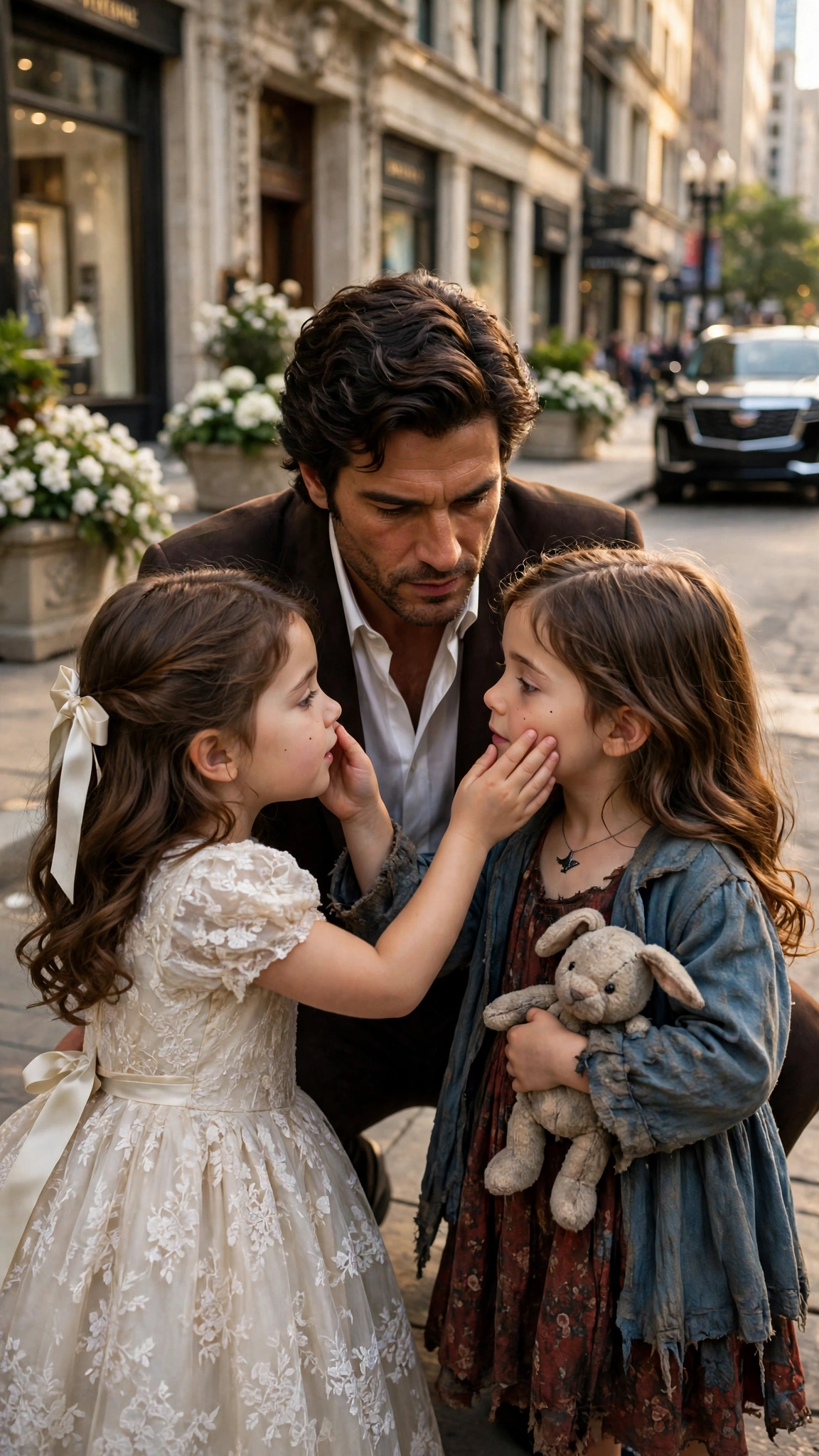
    It was a sunny afternoon on Michigan Avenue, the kind of afternoon Chicago gives you in late September when the light turns to honey and the whole city seems to be walking somewhere happy. Sophie's hand was in mine. She was skipping, the way she does when she is trying not to run, her ivory dress catching the sun, the big satin ribbon in her chestnut hair bouncing with every step. Marco was three paces behind us with the shopping bags. Everything was ordinary. Everything was safe. And then Sophie stopped dead in the middle of the sidewalk and pulled my hand so hard I thought she had seen a dog, or a balloon, or something wonderful.

    "Daddy," she said. "Daddy, look."

    Across from us, sitting on the low stone edge of a flower planter filled with white blossoms, was a little girl. She could not have been more than five years old. Her hair was chestnut-brown, the same chestnut-brown as Sophie's, but messier, tied up in a loose bun with a faded burgundy ribbon. Her dress was dark red and worn thin at the elbows. A shabby blue coat hung from her shoulders like a blanket that had given up. She was holding a small, dirty beige rabbit against her chest with both arms, the way a child holds the only thing in the world that belongs to her.

    And she had Sophie's face.

    Not a similar face. Not a family resemblance. The same face. The same soft gray eyes. The same rosy cheeks. The same tiny freckle beside her nose. I stared at her, and she stared at Sophie, and Sophie stared at her, and for one long second the whole of Michigan Avenue — the pedestrians, the traffic, the storefront windows, the sun itself — seemed to stop and hold its breath.

    Sophie whispered, "Daddy… why does she have my face?"

    I had no answer. I am a man who always has an answer. I have sat across tables from men who would kill me for a wrong word and I have never once been lost for one. But on that sidewalk, with my daughter's hand in mine and her mirror image sitting ten feet away clutching a dirty rabbit, I had nothing.

    I crouched down between the two of them. My knees complained — I am thirty-six and in good shape, but crouching in a tailored suit on a Chicago sidewalk is not a thing I do — and I looked at the strange little girl the way I have looked at a thousand faces across a thousand tables, looking for the lie in it. There was no lie in it. Her eyes were gray. Sophie's eyes are gray. Her freckle was in the exact same place, a tiny brown dot beside the left side of her nose, the one I kiss every night before bed.

    "Sweetheart," I said, and my voice came out quiet and controlled, the way it does when I am most dangerous. "What's your name?"

    She lowered her gaze. Her fingers tightened on the rabbit. "Ruby," she said, so softly I had to lean in. "Ruby Carter."

    Carter.

    The word went through me like a blade between the ribs. Carter was Elena's name. Elena Carter, before she was Elena Moretti. Before the fire. Before the night I lost her. I had not heard that name spoken aloud in five years, not by anyone, because there was no one left alive who knew it mattered. My jaw tightened. My hand stopped halfway toward her shoulder and hung there in the air, useless.

    "Carter?" I whispered.

    Sophie, braver than I have ever been, stepped forward and put her small hand gently against Ruby's cheek, the way she touches my face when she is trying to make me smile. Ruby went very still. She did not pull away. Their identical gray eyes met, and Sophie gave her a tentative, curious smile, and Ruby — this guarded, hungry, frightened little girl in her shabby coat — looked completely overwhelmed by the simple fact that someone was being kind to her.

    And then Ruby shifted the rabbit in her arms, and the sunlight caught something at her throat.

    A delicate silver necklace. A tiny blackbird pendant with spread wings.

    My fingers froze. My lips parted. The blood left my face so fast I felt dizzy, and for a moment the sidewalk tilted under my shoes. I knew that necklace. I had given it to Elena on our wedding day, a blackbird because she used to sing in the kitchen in the mornings, off-key and happy, and I told her she was the only bird in Chicago that sang before the sun came up. She wore it every day of our marriage. She was wearing it the night the house burned.

    "That necklace," I said, and my voice was a stranger's voice, shaken and raw.

    Behind me, over my shoulder, a woman's voice cut through the crowd, anxious and breathless. "Ruby! Come here, sweetheart!"

    A woman in a simple beige coat was pushing through the pedestrians near the flower stand, searching, her shoulder-length dark-blonde hair coming loose around her face. Ruby turned toward her voice and clutched the rabbit closer to her chest. I rose slowly to my feet, my legs unsteady beneath me, and the woman stepped into a narrow beam of sunlight and turned toward me.

    And my whole world stopped.

    Because I knew her. I knew the shape of her face and the color of her hair and the way she held her mouth when she was afraid. I had held her hand while she gave birth. I had buried her — or thought I had buried her — five years ago.

    She saw me, and her expression shifted from worry to panic, pure and instant, like a woman who has seen a ghost.

    "You…" I whispered, and my voice broke clean in half. "You're alive?"

    That was where it began. That was the moment my life split in two: everything before that afternoon on Michigan Avenue, and everything after.

    Three hours earlier, it had been an ordinary Tuesday.

    Sophie had woken me at six in the morning by climbing onto my chest and putting her face three inches from mine. "Daddy," she had announced, "today is a yellow day." Sophie divides days by colors. Yellow days are good days. Gray days are sad days. She had decided, at the age of five, that she could manage the weather of her own heart this way, and I had never once argued with her. Her hair was a wild tangle of chestnut curls, the side braids I had attempted the night before half undone, the ivory ribbon hanging by a thread. I fixed the braids while she ate her toast, my big fingers clumsy with the small strands, and she sat very still and patient with me, the way she always does, because she knows I am trying.

    "Tell me about Mama again," she said, as she does most mornings.

    And I told her the story I have told her for five years, the story I believed with all my heart: that her mama loved her more than anything in the world, that her mama was beautiful and brave and sang in the kitchen, and that her mama had gone to heaven before Sophie could remember her, and that she watches over us from there. Sophie listened with her chin in her hands, and then she asked the question she always asks.

    "Did Mama have a freckle like mine?"

    "Yes, baby," I said. "Right here." And I touched the tiny freckle beside her nose, the way I always do.

    What I did not tell her — what I have never told anyone, not even Marco, who has driven for me for twelve years — is that I have never believed the story myself. Not completely. They told me Elena died in the fire. They showed me a grave. But I was pulled out of that house unconscious, and when I woke up in the hospital, there was a baby in my arms — Sophie — and a hole in my life where my wife and my other daughter had been. They told me the second baby died too. They told me Elena's body was found in the nursery. I believed them because I had no reason not to, and because grief does not ask for proof. Grief only asks for somewhere to put its weight.

    But there was always a small, cold voice in the back of my mind that said: you never saw her. You never saw either of them.

    That morning, Sophie chose her ivory dress, the one with the puffed sleeves and the layered tulle skirt, and her cream-colored shoes, and she asked if we could go downtown to see the flower planters on Michigan Avenue, because her teacher had told her the white blossoms would be gone soon. I said yes, because I say yes to almost everything Sophie asks, and because the work could wait. The work always waits for Sophie. That is the first rule of my life, and the only one I have never broken.

    We drove downtown in the black SUV with Marco at the wheel, and Sophie pressed her face to the window and narrated the whole city to me — the buses, the dogs, the man selling pretzels, the lady with the purple coat — and I listened to every word, because her voice is the only music I have left.

    I did not know, as we walked down that sunny sidewalk with the shopping bags and the flower planters and the whole ordinary afternoon spread out in front of us, that I was walking toward the answer to the only question that has mattered to me for five years.

    I did not know that my wife was alive. I did not know that I had two daughters, not one. I did not know that the man I trusted most in the world had built my grief with his own hands and then stood beside my grave and my wife's grave and wept like a friend.

    On the drive home that evening, Sophie was quiet for the first time all day, which worried me more than any question she could have asked. She sat in the back seat with her bear, her forehead pressed to the window, watching Michigan Avenue slide past, and every few minutes she would glance at me in the rearview mirror, as if she were checking that I was still there, still the same father she had woken up with that morning.

    "Daddy," she said at last, very softly, "was that girl really… did she really have my face?"

    "Yes, baby," I said.

    "How?" she asked. "How can somebody have my face?"

    "I don't know yet," I told her, and it was the most honest thing I had said all day. "But I am going to find out. I promise you that."

    "Is she sad?" Sophie asked. "She looked sad, Daddy. Her dress was old. Her shoes were old. Why was she sitting all alone?"

    I did not have an answer for that either, and the not knowing sat in my chest like a stone. Marco, driving, caught my eye in the mirror, and I saw something in his face I had never seen there before: not just loyalty, not just obedience, but worry. Real worry. Marco had been with me the day the twins were born. He had carried flowers into Elena's hospital room. He knew what I knew, even before I said it out loud.

    "Boss," he said quietly, so Sophie would not hear, "if that was who I think it was—"

    "I know," I said. "I know, Marco."

    Sophie leaned forward between the seats and put her small hand on my shoulder. "Daddy, if she is sad, we should help her. Mama always said that when you see somebody sad, you help them. You told me Mama said that."

    I looked at my daughter's hand on my shoulder, and I thought about Elena, who had said exactly that, a hundred times, in our kitchen, with flour on her hands and a song on her lips. And I thought about the little girl on the sidewalk with the dirty rabbit, and the woman in the beige coat, and the blackbird necklace catching the sun. And I knew, with a certainty that settled over me like cold water, that whatever came next — whatever the truth was, and whoever had hidden it from me — I would not rest until I had it. Not for revenge. Not for the business. For Sophie. For the sad little girl on the sidewalk. For all of us.

    I know it all now. And this is the story of how I found out — from the beginning, the way it really happened, before the fire and before the lies, when Elena was still singing in my kitchen and I still believed that the worst thing in the world was losing a business deal.

    It begins five years before that afternoon. It begins with a wedding, and a blackbird, and a house by the lake.

  • Chapter 7: The Girl Who Stayed

    Chapter 7: The Girl Who Stayed

    The wedding was called off on a Friday, in the same week it was supposed to happen, and the house — the cold, quiet house that had forgotten how to be warm — began, very slowly, to remember.

    It did not happen all at once. Healing never happens all at once. It happens in small moments, in quiet rooms, in the spaces between words. It happens when a man sits on the floor of a nursery and draws with his daughter. It happens when a friend ties a silver tiara in a little girl's hair and the little girl smiles. It happens when the sun comes through the windows in the morning and the house does not feel empty anymore.

    Daniel cancelled the wedding himself. He called the venue. He called the florist. He called the guests, one by one, and he told them, in a voice that was calm and final, that the wedding would not be taking place. He did not explain. He did not need to explain. He was Daniel Moretti, and when Daniel Moretti said a thing was over, it was over.

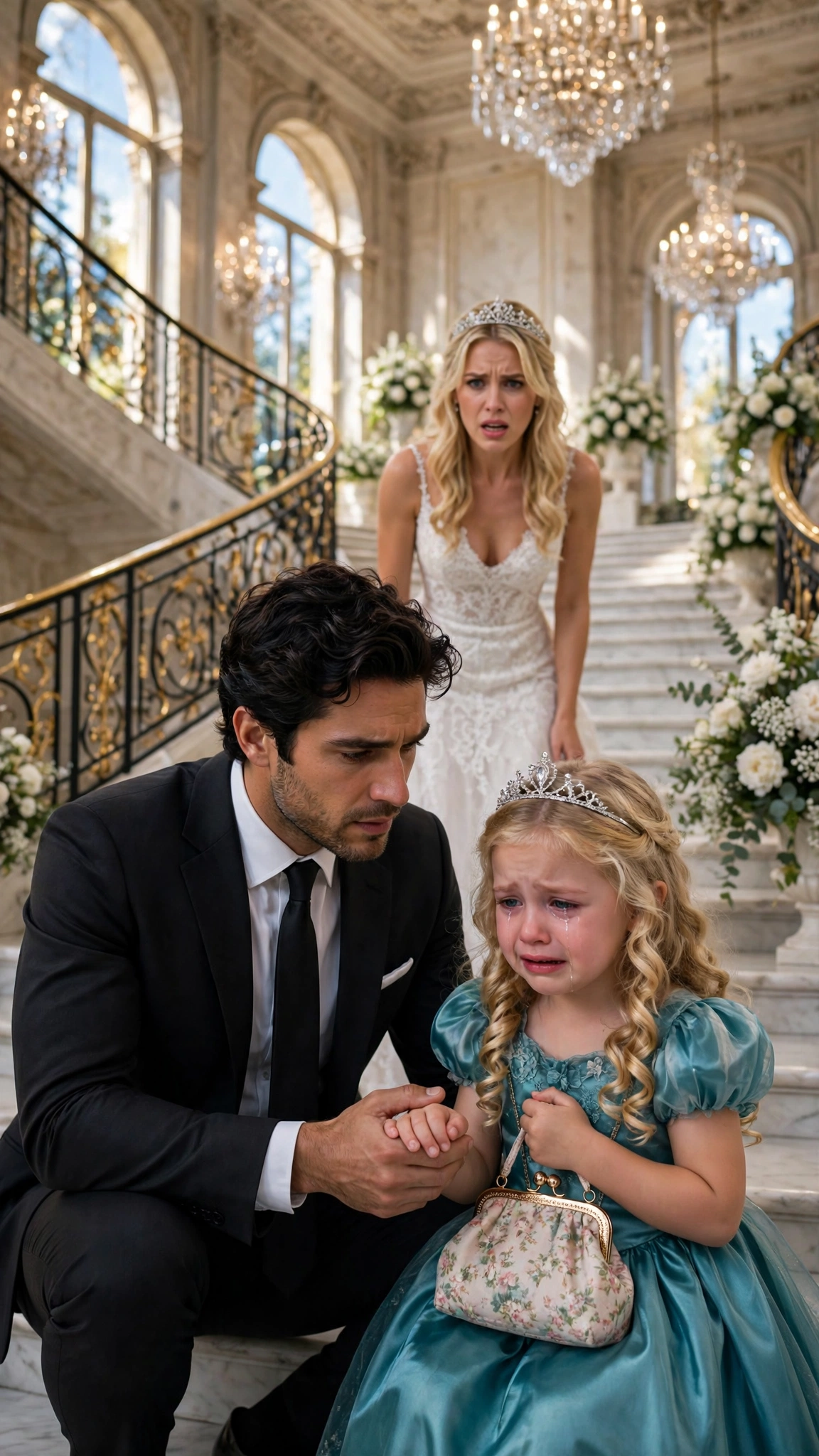
    The white roses were taken away. The chandeliers were dimmed. The grand staircase hall — the hall where Lily had stood at the foot of the stairs in her teal princess dress and said the bravest words of her life — was quiet again. But it was a different kind of quiet now. Not the held-breath quiet of a child listening for footsteps. The peaceful quiet of a house at rest.

    Lily asked about Victoria once. Just once.

    "Daddy," she said, one morning at breakfast, her spoon moving slowly through her oatmeal, "where did Miss Victoria go?"

    "She went away," Daniel said. "She won't be coming back."

    "Is she mad at me?"

    "No, sweetheart," Daniel said, and he reached across the table and took her small hand in his. "She is not mad at you. She made a mistake. And sometimes, when grown-ups make a mistake, they have to go away so that everyone can be safe."

    Lily thought about that. Then she said, "I am glad she went away."

    "I am glad too," Daniel said, and he meant it, and he was surprised by how much he meant it.

    That was the last time they spoke about Victoria. Lily did not ask again. She did not need to. She was five, and she had already learned the hardest lesson a child can learn — that sometimes the people who smile at you are not safe, and that the people who love you are the ones who stay. And she had learned the best lesson, too — that her father would choose her. That he had chosen her. That he would always choose her.

    The changes came slowly, and they came from Daniel himself.

    He started coming home earlier. He started eating dinner with Lily, sitting across from her at the table, asking her about her day, listening — really listening — when she told him about school, and about her friends, and about the butterflies in the garden. He started reading to her at night, sitting in the nursery, his deep voice low and unhurried, one hand resting on the small curve of her back, the way Isabella had. He was not good at it, at first. He stumbled over the words. He read too fast. But Lily did not mind. She leaned against him, and she listened, and she fell asleep with her head on his shoulder, and Daniel sat there long after she was asleep, looking at the ceiling, thinking about how much time he had wasted, and how much time he still had.

    He brought the rocking chair back. He found it in the storage room, where Victoria had had it taken, and he carried it up to the nursery himself, and he set it in the corner, in the exact spot where it had always been, and he sat in it, and he rocked, slowly, and he thought about Isabella, and about the way she had read to Lily in that chair, and he felt — not grief, not the sharp, terrible grief of the first year, but something softer. Something like gratitude. Gratitude that he had loved her. Gratitude that she had left him Lily. Gratitude that he had been given a second chance to be the father his daughter deserved.

    One evening, a month after the rehearsal, Daniel went to the nursery with the little floral handbag in his hands. Lily was already in bed, her eyes closed, her breathing slow and even, her silver tiara in its velvet box on the dresser. He sat on the edge of the bed, and he opened the handbag, and he took out the folded note — Isabella's note, the one he had read on the stairs, the one that said, "For my brave girl. When you miss me, hold this and know I am with you. Be brave, my little girl. Be brave, and hold on tight."

    "Lily," he whispered. "Sweetheart. Wake up. I have something for you."

    She opened her eyes. She blinked at him, sleepy and confused, and then she saw the note in his hands, and her eyes went wide.

    "Is that —" she whispered. "Is that Mommy's note?"

    "It is your mommy's note," Daniel said. "And I want to read it to you. Properly. The way she would have read it."

    He read it aloud, his deep voice low and unhurried, and Lily listened, her eyes wide, her small hand curled around the gold clasp of her mother's handbag, and when he was finished, she threw her arms around his neck, and she held him tight, and she whispered, "Thank you, Daddy. I love you, Daddy."

    "I love you too, sweetheart," Daniel said, and his voice was thick, and his eyes were wet, and he held her, and he did not let go, because he had learned — finally, truly learned — that this was what mattered. Not the business. Not the money. Not the fear. This. A little girl, in a nursery, wearing her mother's tiara in its velvet box beside her, safe in her father's arms.

    The house healed. It healed the way houses heal when the people in them decide to be kind to each other — slowly, and then all at once, and then it was simply the way things were.

    Lily grew louder. She laughed more. She drew pictures — her family, the tall man, the small girl, the woman with yellow wings, and now, beside them, a small house with a red door, and a garden full of flowers, and a sun in the corner, shining down on all of them — and she taped them to the nursery wall, where everyone could see them. She played in the garden, chasing butterflies in her teal dress, her silver tiara catching the sun, her mother's floral handbag bouncing on her arm, and she did not flinch when anyone came near her, because there was no one left in the house to flinch from.

    One Saturday morning, Daniel took her into the garden with a packet of sunflower seeds and a small silver trowel, and together they dug a row of holes along the fence, and Lily dropped a seed into each one, very carefully, her tongue caught between her teeth in concentration, and Daniel covered them with earth, and Lily watered them with a small green can, and she said, very seriously, "They will grow big, Daddy. As big as the house. And Mommy will see them from heaven."

    "She will," Daniel said. "And she will be proud."

    Lily wore her silver tiara that morning, bright in her blonde curls, and her mother's handbag sat on the garden bench beside them, the pink roses faded by the sun but still beautiful, and Daniel looked at his daughter — at her small fierce face, and her dirty hands, and her fearless laugh — and he thought: This is what I almost lost. This is what matters. Not the business. Not the money. Not the fear. This. A little girl, planting sunflowers, in a garden, in a house that was finally warm again.

    Daniel grew softer. He still ran his business. He still made decisions that other men were afraid to make. But he came home earlier, and he ate dinner with his daughter, and he read to her at night, and he sat in the rocking chair, and he rocked, and he thought about Isabella, and he was grateful. He was grateful for the life he had, and for the daughter he had almost lost, and for the second chance he had been given.

    Carlo stayed. He stayed in Daniel's life the way he had always stayed — at the edge of the table, at the end of the phone, in the doorway of the nursery with a smile and a story. He tied Lily's tiara on the mornings when Daniel was running late, and he taught her how to make hot chocolate, and he read to her on the nights when Daniel was away, and he never once asked for thanks, because he was Carlo, and that was what Carlo did.

    And Lily — Lily Moretti, five years old, with her blonde curls and her silver tiara and her blue eyes and her mother's floral handbag on her arm — grew up safe, and loved, and unafraid. She grew up knowing that her father had chosen her. She grew up knowing that her mother's wings were the biggest wings of all. She grew up knowing that she was, and always would be, her daddy's little girl.

    One afternoon, a year later, Lily stood in the staircase hall — the same hall, the same white marble stairs, the same black-and-gold railings, but the white roses were gone, replaced by a vase of sunflowers on the newel post, bright and yellow and cheerful — and she looked up at her father, and she smiled, and she said, "Daddy?"

    "Yes, sweetheart?"

    "Thank you for not letting her throw me out."

    Daniel crouched beside her. He was a tall man, a broad man, and he folded himself down to her height, and his hand rested on her shoulder, and his gray-brown eyes searched her face, and he said, very quietly, "I will never let anyone throw you out, Lily. Not ever. This is your home. You are my daughter. And that will never, ever change."

    Lily smiled. It was a real smile, the kind of smile that lights up a whole room, and she threw her arms around her father's neck, and he picked her up, and he held her, and the sun came through the tall arched windows in wide white bars across the marble stairs, and the house — the house that had been cold for so long — was warm.

    And it stayed warm. For a very long time. For always.

    On Lily's sixth birthday, a year after the rehearsal, the garden was full of sunflowers and balloons, and the house was full of laughter. There were children from her school, and Carlo, and a cake with six candles that Lily blew out in one breath, her eyes squeezed shut, wishing with all her might.

    "What did you wish for?" Daniel asked, kneeling beside her.

    Lily grinned, chocolate frosting on her cheek. "I can't tell you, Daddy. If I tell you, it won't come true."

    "Then I hope," Daniel said, "that it already has."

    She threw her arms around his neck, and he picked her up, and he spun her around, and she laughed — a loud, fearless, impossible laugh, the kind of laugh a little girl should have — and Carlo, watching from the terrace, wiped his eyes with his sleeve and smiled.

    Later, as the sun went down and the guests went home, Lily sat on her father's lap in the garden, her head against his chest, her mother's floral handbag in her lap, her silver tiara still neat in her curls.

    "Daddy?" she said sleepily.

    "Yes, sweetheart?"

    "I love our house."

    "I love our house too," Daniel said.

    "And I love you," Lily said. "And I love Carlo. And I love Mommy, even though she is in heaven. And I love the sunflowers."

    Daniel held her a little tighter. "I love all of those things too," he said. "Especially you."

    Lily yawned. Her eyes closed. And as she drifted off to sleep in her father's arms, under a sky full of early stars, Daniel Moretti — the most feared man in Chicago, the man who had lost everything and found it again in the arms of a five-year-old girl — looked up at the sky and thought of Isabella, and of all the women with wings who watched over his daughter, and he whispered, very quietly, "Thank you. She's safe. She's happy. I promise you — she will always be safe."

    THE END

  • Chapter 6: The Things She Tried to Take

    Chapter 6: The Things She Tried to Take

    Victoria did not leave quietly. Women like Victoria never leave quietly. They leave the way a storm leaves — loudly, and with damage, and with the certainty that if they cannot have the house, no one will be comfortable in it.

    The rehearsal ended in chaos. The wedding planner gathered her clipboard and her dignity and left without a word. The florist packed her white roses and slipped out through the service entrance. The caterers, who had been setting up in the kitchen, were told to go home. And Victoria — Victoria stood in the middle of the staircase hall, in her white lace gown, her train pooled behind her, and she looked at Daniel, and she looked at Lily, and she said, very quietly, "You will regret this."

    Then she turned, and she walked out of the hall, her heels clicking on the marble floor, her gown rustling, and she went upstairs to the bedroom she had been sharing with Daniel, and she began to pack.

    Daniel did not stop her. He stood in the hall with Lily pressed against his side, and he watched her go, and he felt — not triumph, not relief, but a deep, hollow sadness, because he had loved her, or thought he had loved her, and now he understood that what he had loved was a performance, and the performance was over.

    "Daddy?" Lily whispered. "Is she coming back?"

    "No, sweetheart," Daniel said. "She is not coming back."

    "Are you sad?"

    Daniel looked down at his daughter. Her blue eyes were wide. Her silver tiara had slipped sideways in her curls. Her small hand was still clutching his jacket.

    "Yes," he said, because he had decided, in that moment, that he would never lie to his daughter again. "I am sad. But I am also… relieved. And I am proud of you. You were very brave today."

    Lily thought about that. Then she said, "I was scared."

    "Being brave," Daniel said, "is being scared and doing it anyway."

    She nodded, and she pressed her cheek against his leg, and they stood there together in the bright staircase hall, surrounded by white roses and marble and the ruins of a wedding that would never happen, and for the first time in two years, Daniel felt something he had forgotten how to feel.

    He felt like a father.

    That night, after Lily was asleep — her tiara in its velvet box now, her mother's handbag on the pillow beside her, her stuffed rabbit in her arms — Daniel went to his study, and he called Carlo.

    "She's gone," Daniel said.

    "I heard," Carlo said. "Half of Chicago heard. What do you need?"

    "I need to know everything," Daniel said. "Everything about Victoria. Where she came from, who she talks to, what she wants. I need to know what she was planning."

    Carlo was quiet for a moment. Then he said, "I'll find out. Give me a day."

    It took less than a day. It took four hours.

    Carlo called back at midnight. "She didn't wait," he said. "She called Marco Rossi from the taxi, before she even reached the airport. She offered him the Thursday shipment — the route, the time, the men on it. She wants money and protection, and she's selling what she learned in your house to buy them."

    Daniel closed his eyes. "Did he bite?"

    "He's listening," Carlo said. "But he's careful. He knows you. He asked her for proof first — something only someone who lived in the house would know. She's meeting him tomorrow, at a restaurant in Queens. My men will be there, with cameras."

    "Good," Daniel said. "Move the shipment. Change the route, change the men, change the time. And change the safe code tonight. And Carlo — get me everything on her. The school letters, the household account, the photographs from Queens. I want a folder on my desk by morning."

    He hung up. He stayed where he was, in the dark study, the phone still warm in his hand, and he let the plan form. All his life he had solved problems with leverage and fear. Tonight, for the first time, he understood that this problem would not bend to either. Victoria was not a rival boss. The woman on the other end of that phone call had once slept beside him, and now she was selling his secrets to his enemies. He could not threaten her. He could not frighten her. He had to be smarter than that. So he would be smart. He would let her walk into the trap she had set for herself, and he would be waiting on the other side of it, with the truth in a folder, and his daughter safe upstairs.

    The next morning, Victoria came back.

    She came back in the morning, in a taxi, wearing a dark coat over her clothes, her hair pulled back, her face pale and furious. She walked into the house — the house that was no longer hers, the house she had never truly owned — and she went straight to the study, where Daniel was sitting at his desk.

    "I want my things," she said. "My clothes. My jewelry. The ring."

    "The ring," Daniel said, "was a gift. And gifts given under false pretenses can be taken back."

    "It is mine," Victoria said, and her voice was shaking with anger. "You gave it to me. You promised me —"

    "I promised to marry a woman who loved my daughter," Daniel said, very calmly. "That woman does not exist. The ring stays."

    Victoria's face went white. Then red. She stepped forward, and her voice rose, and she said the things that angry people say when they have lost everything — that he would regret this, that she would tell everyone what kind of man he was, that she would go to the Rossis, that she would tell them about the shipment, about the safe, about everything she knew.

    Daniel listened. He let her finish. And then he opened the desk drawer, and he took out a folder, and he set it on the desk between them.

    "These," he said, "are copies of your letters to the school in Switzerland. And these are the records of the money you took from the household account. And this —" he set down a small stack of photographs — "is you, meeting with a man from the Rossi family, at a restaurant in Queens, three weeks ago. Would you like to tell me what you discussed?"

    Victoria stared at the folder. Her mouth opened. No sound came out.

    "I know what you discussed," Daniel said. "You discussed my schedule. My men. My shipment. You discussed selling what you knew, in exchange for protection, and money, and a new life. You were going to betray me, Victoria. You were going to betray my family. And you were going to do it after you sent my daughter away."

    "I —" Victoria said. "I didn't —"

    "You did," Daniel said, and his voice was very quiet, and very final. "And now you are going to leave this house, and you are never going to come back, and you are never going to speak to my daughter, or to anyone in my family, ever again. And if you go to the Rossis, or to anyone else, with what you know —" He paused. He looked at her, and his gray-brown eyes were cold, and he said, "— then you will learn what it means to be afraid of me. Not as a fiancé. As Daniel Moretti."

    Victoria stood there, in the study, her coat wrapped tight around her, her hands shaking, and she understood — finally, truly understood — that she had underestimated him. She had thought he was a man who could be managed, a man who could be charmed, a man who would choose a beautiful woman over a quiet child. She had been wrong. She had been wrong about everything.

    She left. She took her clothes, and her jewelry — everything except the ring — and she left, and she did not come back, and she did not go to the Rossis, because she was afraid, and she had reason to be afraid, and Daniel Moretti, for the first time in his life, was glad that someone was afraid of him, because the person who was afraid was a person who had tried to hurt his daughter, and his daughter was safe.

    That evening, Daniel went to the nursery. Lily was sitting on the floor, drawing. She had a new picture — her family, the tall man, the small girl, the woman with yellow wings, and now, beside them, a small house with a red door, and a garden full of flowers, and a sun in the corner, shining down on all of them.

    "That's beautiful, sweetheart," Daniel said, sitting down beside her on the floor. He was a tall man, a broad man, and he folded himself down to her height, and it did not look strange anymore. It looked natural. It looked like where he belonged.

    "Thank you, Daddy," Lily said. "It's our family. See? Mommy has the biggest wings of all."

    Daniel looked at the drawing. He looked at the woman with yellow wings. He looked at his daughter, with her blonde curls and her silver tiara and her blue eyes, and he felt something in his chest — not break, but open, the way a door opens after being locked for two years — and he said, very quietly, "Your mommy would have loved this picture."

    Lily smiled. It was a real smile, the first real smile Daniel had seen on her face in a year, and it lit up the whole nursery, and Daniel thought: This is what I was missing. This is what I almost lost. This is what matters. Not the business. Not the money. Not the fear. This. A little girl, drawing her family, on the floor of a nursery, in a house that was finally — finally — starting to be warm again.

    In the days that followed, Daniel changed the locks on the house, and the codes on the safe, and the passwords on the household accounts. Carlo reported that Victoria had left the city — a flight to Miami, a new apartment, a new life, far away from the Morettis and the Rossis and everything she had tried to take. She did not contact the Rossis. She did not contact anyone. She was gone, and the house was quieter without her, and the quiet was a relief, like the silence after a storm has passed.

    Lily's nightmares faded. The first week, she still woke sometimes, crying out for her mother, and Carlo would come and sit on the edge of her bed until she fell asleep again. But by the second week, she slept through the night. By the third, she was laughing at breakfast, telling Daniel about the butterflies in the garden, asking if they could plant sunflowers.

    One Saturday, Daniel took her to the park. Just the two of them. No driver, no guards, no phone calls. They sat on a bench and ate ice cream, and Lily got chocolate on her chin, and Daniel laughed — a real laugh, the kind he had not laughed in years — and Lily looked at him, surprised and delighted, and said, "Daddy, you laughed!"

    "I did," Daniel said. "I forgot how good it feels."

    "You should do it more," Lily said wisely, licking her ice cream. "Laughing is good for your heart. Carlo says so."

    "Carlo is right," Daniel said. "Carlo is always right."

    That evening, Lily asked Carlo to teach her how to make hot chocolate. They stood together in the kitchen, the little girl on a stool, Carlo guiding her small hands, and Lily stirred the pot very carefully, her tongue caught between her teeth in concentration, and when it was done, she poured three mugs — one for Carlo, one for her daddy, and one for herself — and she carried them to the table, one at a time, very carefully, so as not to spill a drop. And Daniel watched from the doorway, and he thought: This is my family. This is all I need. This is everything.

  • Chapter 5: What’s Inside the Bag

    Chapter 5: What’s Inside the Bag

    The rehearsal was held on a Thursday morning, two days before the wedding, in the grand staircase hall of the Moretti mansion. The white marble stairs shone. The black-and-gold railings gleamed. The tall arched windows let in the bright daylight. The crystal chandeliers threw small rainbows across the ceiling. The white flower arrangements along the balustrade filled the hall with a sweet, clean scent. The wedding planner moved through the hall with her clipboard, adjusting a flower here, a chair there, her face a mask of professional calm.

    Victoria stood on the stairs, radiant in her white lace wedding gown, the thin straps showing her bare shoulders, the delicate lace catching the daylight. Her blonde hair was swept up, a small tiara glittering in it. Her diamond ring caught the light. She looked, Daniel thought, like a queen. She looked like a woman who had already won.

    Daniel stood near the foot of the stairs, handsome in his black suit, his white shirt, his black tie, his silver wristwatch glinting. He had not slept. He had spent the night in his study, thinking about Carlo's words, about the school in Switzerland, about the rocking chair and the locked door and the handbag on the pillow. He had come to the rehearsal with a plan — to watch, to listen, to wait for the right moment — but now that he was here, in the bright daylight, with the flowers and the chandeliers and the marble, the plan felt thin, and his hands felt empty, and he did not know what the right moment would look like.

    He did not have to wait long.

    Lily stood at the foot of the stairs, in her teal satin princess dress, her puffed sleeves and layered tulle skirt, her small cream shoes, her silver tiara bright in her blonde curls. She was holding her mother's floral handbag with both hands, clutching it to her chest, and tears were running down her cheeks, and her whole small body shook, and Daniel saw — truly saw, for the first time — how afraid she was. Not nervous. Not shy. Afraid. The way a small animal is afraid when it has been hurt and does not know if it will be hurt again.

    And then she spoke, and her voice was loud and broken, and it carried across the whole great hall, because everyone had stopped moving, and she said:

    "Daddy, don't let her throw me out!"

    The florist stopped. The wedding planner froze. Victoria, on the stairs, did not move. Her expression was carefully neutral. But Daniel was watching her now — really watching her, the way he watched a man across a negotiating table — and he saw it. The flicker. The smallest tightening around her eyes. The smallest press of her lips. The look of a woman who has been caught, and who is deciding, very quickly, what to do next.

    He crouched beside his daughter. He was a tall man, a broad man, and he folded himself down to her height, and his hand rested on her shoulder, and his face was tense with confusion — but underneath the confusion, there was something else. Something Carlo had put there at midnight, on the phone, with the words about Switzerland. Something that had been growing in him all night, in the dark of his study.

    He looked up at Victoria. "Victoria, what did you say to her?"

    Victoria's hands tightened on the railing. "She's making a scene, Daniel."

    He turned back to Lily. He took her small hand in his, and he held it, and his voice went soft, the way it only ever went soft for her. "Nobody is sending you away, sweetheart."

    Lily's fingers tightened around his. She pressed the floral handbag closer to her chest, as if it were the only solid thing in the world, and she looked up at him with her blue eyes wide and wet, and she whispered, "She said I have to go away, Daddy. To a school. Far away. She said when you marry her, I won't be your little girl anymore."

    Daniel's whole body went still. He had heard Carlo say the words at midnight, on the phone, and he had believed him. But hearing them from his daughter — hearing them in her small, broken voice, seeing them in her wide, frightened eyes — was something else entirely. It was the difference between knowing a thing and feeling it. And Daniel Moretti felt it now, in every part of him.

    And then he noticed the bag.

    He had seen it a hundred times — the little floral purse, always in Lily's hands, always clutched tight — but he had never really looked at it. He looked at it now. He looked at the way her small fingers were wrapped around the gold clasp, white-knuckled, desperate, the way a person holds on to something they are afraid of losing. And he looked at Victoria, standing on the stairs, her eyes fixed not on Lily's face but on the little floral bag in Lily's hands.

    "Why does she want your bag?" Daniel asked.

    Victoria came down two steps. Her voice was sharp. "Daniel, don't open it!"

    Daniel looked at her. He looked at the bag. He looked at his daughter, crying, clutching her mother's purse to her chest, and he said, very quietly, "Lily, show Daddy what's inside."

    "Please, don't—" Victoria said, and her voice broke, and she took a step toward them, her hand reaching out — but Daniel raised one hand, and she stopped, frozen on the stairs, her gown rustling in the silence.

    Lily's small fingers moved toward the gold clasp. They trembled. She opened the bag, and she reached inside, and she took out the things her mother had left her — one by one, carefully, the way a priest takes sacred things from an altar.

    First, the photograph. A small photograph, worn soft at the edges, of Isabella holding a baby in a white blanket — Lily, three days old, her tiny fist curled around her mother's finger, Isabella smiling down at her as if the whole world had just begun.

    Second, the note. A folded piece of paper, creased from a hundred readings, in Isabella's handwriting. Daniel took it with shaking hands, and he unfolded it, and he read it, and his eyes filled with tears, because the note said, in Isabella's neat, slanting hand:

    "For my brave girl. When you miss me, hold this and know I am with you. Be brave, my little girl. Be brave, and hold on tight. — Mommy."

    And third — third, the thing Victoria had been afraid of — the letter.

    It was from a boarding school in Switzerland. It was addressed to Victoria. It spoke of "the Moretti child" and "firm guidance" and "distance from certain influences." It spoke of a start date — September, two weeks after the wedding — and a fee, and a uniform, and a rule: no visits for the first six months.

    Daniel read it. He read it twice. His hands shook. He looked up at Victoria, standing on the stairs in her wedding gown, her train pooled behind her, her diamond ring catching the light, and his face went through a series of changes — confusion, disbelief, suspicion, and then something else. Something devastating. Recognition. The recognition of a man who has finally understood that the woman he was about to marry is not the woman he thought she was.

    "Victoria," Daniel said quietly. "What is this?"

    Victoria smiled. It was a practiced smile, a beautiful smile, the smile of a woman who has talked her way out of a hundred difficult rooms. "Daniel, darling. She is five years old. She took something that wasn't hers. She doesn't understand —"

    "She understands," Daniel said. "She understands perfectly. You wrote to a school. You paid a deposit. With my money. You were going to send my daughter away."

    "For her own good," Victoria said, and her voice was steady, and her composure was perfect, and Daniel thought: She is very good at this. She has done this before. "She is a child. She needs structure. She needs —"

    "She needs her father," Daniel said.

    He stood up slowly. He turned to Victoria. His face was calm, but his gray-brown eyes were cold, and his voice, when he spoke, was low and dangerous. "I know what you said to her, Victoria. In the nursery. 'You are not going to be your daddy's little girl anymore.' I know about the locked door. I know about the rocking chair. I know about the drawing in the wastebasket. I know about all of it."

    The hall went silent. The florist did not move. The wedding planner did not breathe. Carlo, standing by the staircase, closed his eyes.

    Daniel stared at Victoria. He stared at her for a long moment, and his face went through a series of changes — confusion, disbelief, suspicion, and then something else. Something devastating. Recognition.

    Victoria's composure — the composure she had held for a year, through a hundred dinners and a thousand smiles — cracked. Her eyes narrowed. Her face flushed. Her voice, when it came, was sharp and furious.

    "You can't mean that," she said, stepping forward, pointing toward the door, her gown rustling, her ring flashing. "Not after everything I've done for you. Not after —"

    She stopped. She stopped because Daniel had turned to look at her, and his face had gone cold, and his gaze was locked on hers, and there was something in his eyes that she had never seen before — not anger, not grief, but something far more dangerous. Clarity. The clarity of a man who has finally seen the truth, and who will never unsee it.

    Lily pressed her cheek against his leg. She whispered, barely above a whisper, her voice so soft that only Daniel could hear it:

    "Please… don't choose her."

    And Victoria began to speak again — "Daniel, you don't understand, I did this for us, I did this because —" — but her voice was cut off by a sudden silence. Not a silence from the hall. A silence from Daniel. He did not answer her. He did not look at her. He simply stood there, his daughter pressed against his side, his hand resting on her head, his eyes fixed on the far wall, and the morning light fell across the marble stairs, and held there, and held there, and then, very slowly, Daniel turned to Victoria, and he rose to his full height, pulling Lily protectively against his side, and his voice, when he spoke, was quiet, and firm, and absolutely final.

    "Then she stays," Daniel said. "And you leave."

    The words fell into the silence like stones into still water. Victoria stared at him. Her eyes were wide. Her mouth opened. No sound came out.

    Daniel looked at the gown, and the ring, and the beautiful, cold face. He looked at the flowers, and the chandeliers, and the bright daylight. He looked at the wedding planner, and the florist, and the hall full of people who were all watching him, waiting to see what the most feared man in Chicago would do.

    And then he looked down at Lily, pressed against his leg, her small hand clutching his jacket, her face turned up to his, her blue eyes wide and trusting and afraid, and he felt something in his chest break open — not break, but open, the way a door opens after being locked for two years — and he knew.

    He picked Lily up. He held her against his chest, her mother's floral handbag pressed between them, her silver tiara bright against his dark suit, and he walked toward the great doors of the hall, and he did not look back, and behind him, Victoria stood on the marble stairs in her white lace gown, her train pooled behind her, her diamond ring catching the light, and she understood — finally, truly understood — that she had lost. Not the wedding. Not the house. Not the money. She had lost something far more important. She had lost the man she had spent a year trying to own, because she had never understood the one thing about him that mattered: that Daniel Moretti was a man who would give up everything — his happiness, his future, his comfort — for the small girl pressed against his chest, with the silver tiara in her hair and the teal dress and the brave, frightened eyes.

    And Lily, her cheek against her father's shoulder, her small hand clutching his jacket, closed her eyes, and for the first time in a year, she felt safe.

    She did not know what would happen next. She did not know about the letter, or the school, or the fight that was coming. She only knew that her father had chosen her. That he had said the words. That she was staying.

    After Victoria left the hall, Daniel took Lily to the kitchen. Carlo was already there, the kettle on, three mugs on the counter, the hot chocolate made with too much cinnamon, the way Isabella had made it. He did not ask what had happened. He did not need to ask. He set a mug in front of Lily, and a mug in front of Daniel, and he sat down across from them, and for a long time, none of them spoke.

    "Daddy?" Lily said at last, her small hands wrapped around the warm mug. "Are you angry with me?"

    "No, sweetheart," Daniel said. "I am not angry with you. I am proud of you. You did something today that grown-ups are afraid to do. You told the truth."

    "Will Miss Victoria be mad at me?" Lily asked.

    "Miss Victoria is going away," Daniel said. "And she will not hurt you again. I promise you that."

    Lily nodded. She took a sip of her hot chocolate, and she left a small brown mustache on her upper lip, and Daniel reached across the table and wiped it away with his thumb, and Carlo smiled, and for a moment the kitchen felt like the warmest room in the house.

    Upstairs, they could hear Victoria moving around in the bedroom — drawers opening, a suitcase being dragged across the floor, the sharp sound of hangers. Daniel did not go up. He let her pack. He let her go. He sat in the kitchen with his daughter and his oldest friend, drinking hot chocolate, and he thought about how strange it was that the worst day of his year had also been the day he finally became the father his daughter needed.
    And that was enough. For now, that was enough.