Story Genres: MAFIA BOSS

  • Chapter 2: The Woman in the Photograph

    Chapter 2: The Woman in the Photograph

    Rosa had been twenty-three years old when she first came to work in the Moretti mansion, and she had been afraid of the house from the very first day.

    It was not the size of it that frightened her, though the house was enormous — three floors of dark wood and marble, with a ballroom that could hold two hundred people and a dining room with a table long enough to seat forty, and hallways that seemed to go on forever in the dark. It was not the men who came and went at all hours, with their dark suits and their quiet voices and their eyes that never quite looked at you. It was the silence. The house was always silent in the wrong places. The kitchen was loud, and the garden was loud, but the great rooms upstairs were silent in a way that felt like a held breath, as if the house itself were waiting for something bad to happen.

    She had been hired by Elena Moretti, and that was the only reason she had stayed.

    Elena Moretti was not like the other women Rosa had worked for in Chicago. She was the wife of Lorenzo Moretti, the most feared man in the city, and by every rule Rosa knew, she should have been cold and hard and untouchable. Instead she was warm. She had a way of looking at you as if you were a person, not a servant, and she asked after Rosa's mother, and she remembered Rosa's birthday, and on Rosa's first Christmas in the house she had given her a small silver cross necklace of her own — not an expensive one, not a family one, just a simple cross on a thin chain, from a shop on a street Rosa could never have afforded herself.

    "For luck," Elena had said, fastening it around Rosa's neck with her own hands. "Everyone in this house should have something that is only theirs."

    Rosa still wore it. She had worn it every day for twenty-two years, and she had never taken it off, not even once, not even on the day Elena died.

    Elena had been a pianist. That was the thing people forgot about her, or never knew in the first place, because the newspapers only ever wrote about her husband. But in the music room at the back of the house stood a grand piano, black and shining, and in the evenings, before Sophia was born, Elena would sit at it and play, and the whole house would go quiet in a different way — not the held-breath silence, but the kind of silence that comes when everyone is listening to something beautiful and does not want it to end. Her favorite song was "Silent Night." She played it every Christmas Eve, and Lorenzo, who could not carry a tune in a bucket, would stand in the doorway and listen with his arms crossed and his eyes closed, and for the length of that one song he did not look like the most feared man in Chicago at all. He looked like a man who had come home.

    Then Elena got sick.

    It was not sudden, and it was not quick, and that was the worst of it, Rosa always said. It was slow, the way a candle burns down, and for a long time they all pretended it was not happening, because pretending was easier than saying the words out loud. The doctors came and went. The medicine bottles lined up on the bedside table like little soldiers. Elena grew thinner, and paler, and quieter, and still she played the piano when she could, until the day she could not lift her hands to the keys anymore, and then she sat in the chair by the window and listened to the rain instead.

    Sophia was three years old when her mother died. She was too young to understand what dying meant, and for a long time afterward she would ask Rosa where Mummy had gone, and when Mummy was coming back, and Rosa, who had no good answer for a three-year-old, would hold her and say, "Mummy is in the music now, little one. Whenever you hear the piano, that is her, singing to you."

    Lorenzo did not cry at the funeral. Rosa had watched him stand beside the grave with his hands at his sides and his face like stone, and she had thought, that is a man who will never cry again, not for anyone, not for anything. And for two years, she had been right. He did not cry. He did not play the piano. He did not sing. He closed the music room door and he did not open it again, and he told the staff, in the voice he used for everything that was not to be questioned, that Christmas in this house was finished.

    "Christmas is just another day," he said, on the first December after Elena died, when Rosa had come to ask him about the tree. "No party. No carols. No fuss. The child will have her presents in the morning, like any other day, and that is the end of it."

    Rosa had not argued. She had learned, in twenty-two years, which of her employer's orders could be bent and which could not. But she had put a small tree in the study anyway, that first Christmas, because the study was the darkest room in the house and it needed the light, and Lorenzo had walked in and looked at it for a long moment and said nothing at all, and the tree had stayed. It stayed the second Christmas, too. And this year, the third Christmas, Rosa had put up the tree again, bigger this time, with the star on top and the presents underneath, and Lorenzo had walked past it every evening on his way to his armchair, and he had said nothing at all.

    Sophia did not remember her mother. That was the saddest thing of all, Rosa thought, and the thing she thought about most often when she watched the little girl in the morning, standing in front of the photograph in the silver frame, whispering, "Good morning, Mummy," to a woman she had never really known. Sophia remembered the stories Rosa told her — that her mother had been kind, and brave, and that she had played the piano like an angel — and she remembered the music box, and the tune that sounded like rain on a window. But she did not remember her mother's voice, or her smell, or the way her arms had felt around her, and sometimes, when she was very tired, she would ask Rosa, "What did Mummy sound like?" and Rosa would say, "Like the piano, little one. She sounded like the piano."

    It was into this house — this silent house, this house with a closed music room and a tree nobody was allowed to celebrate — that Macy had come in the autumn.

    Macy was nineteen years old, and she was the new kitchen maid, hired after the last one had left to get married, and she was the youngest person in the house by a long way, and the most frightened. She came from a poor family on the South Side, five children and a mother who took in washing, and the wages from the Moretti house were the difference, for her family, between eating and not eating, and Macy knew it, and it sat on her shoulders every single day like a weight she could not put down.

    She was kind, and she was willing, and she was clumsy in the way that only very nervous people are clumsy — she dropped things, and she knocked things over, and she apologized so often that Rosa had finally taken her aside and said, "Child, if you say sorry one more time today, I will put you out in the snow myself."

    Macy was terrified of Lorenzo. She had seen him only from a distance, a tall man in a black shirt with tattoos on his hands, and the men in the kitchen said he was the most feared man in Chicago, and Macy, who had grown up hearing stories about men like him, believed every word of it. She had been told, on her first day, never to go near the study wing, never to speak unless spoken to, and never, ever to disturb the boss when he was in his study, and she had taken those orders to heart the way she took everything to heart: completely, and with both hands.

    Rosa had taken a liking to Macy, in the way that older women take a liking to young girls who remind them of themselves. She taught her how to set a table and how to fold a napkin and how to carry a tray without spilling it, and she told her stories about the house in the old days, when Elena was alive and the music room was open and Christmas meant something, and Macy listened with her mouth open, because she had never been in a house like this one, and she had never known that a house could be both so grand and so sad at the same time.

    "And the little girl?" Macy had asked, one afternoon in the kitchen, while she was peeling potatoes and Sophia was sitting on the counter swinging her legs. "Does she remember her mother?"

    "No," Rosa had said, and her voice had gone soft. "She remembers the photograph. And the music box. That is all she has."

    Macy had looked at Sophia then — at the small blonde girl with the blue eyes and the serious face, who was teaching herself to peel a potato with a blunt knife and getting peel everywhere — and something in Macy's chest had tightened, the way it tightens when you see a child who has lost something she does not even know she has lost.

    That was the house Sophia lived in. A big house, a quiet house, a house with a closed music room and a tree nobody celebrated and a father who sat alone in his study every evening with a glass he did not drink from. And the saddest part of it, to Sophia, was not the silence. It was the way her father looked at her sometimes, when he thought she was not watching — the way he looked at her face as if he were searching it for someone else, as if he were trying to find her mother in the shape of her eyes and the curve of her smile, and finding her there, and losing her all over again.

    One evening, not long after Macy had come to the house, Sophia had asked Rosa the question she had been carrying around for weeks. "Why doesn't Daddy laugh anymore?" she had said, while Rosa was brushing her hair before bed. "Did I do something wrong?"

    Rosa had stopped brushing, and she had put down the brush, and she had taken Sophia's small face in both her hands, and she had said, very gently, "No, little one. You did nothing wrong. Your daddy laughs in his heart, where nobody can hear it, because his heart is still broken, and broken hearts take a long time to mend. But hearts do mend, Sophia. They mend the way bones mend — slowly, and quietly, and then one day you wake up and the hurt is not quite so sharp anymore."

    "How long does it take?" Sophia had asked.

    "As long as it takes," Rosa had said. "And sometimes it takes a little help."

    Sophia had thought about that for a long time afterward, lying awake in the dark, listening to the wind in the chimney. And she had decided, that night, that if her father's heart needed a little help to mend, then she was going to be the one to help it. And on the first morning of December, with the snow falling past her window and the little gold star from her mother's music box warm in the pocket of her dress, Sophia Moretti made up her mind about something.

    Her father was sad. Everyone in the house knew it, and nobody in the house could fix it, because nobody in the house was brave enough to try. But Sophia was five years old, and she did not know that some things cannot be fixed, and she had a star in her pocket and a plan in her head, and she had decided, with the absolute certainty that only a five-year-old can feel, that she was going to make her father a Christmas present that would make him smile the way he used to smile in the photograph, before everything went quiet.

    She did not know, then, that the present she was going to make would change everything. She only knew that Christmas was coming, and that her father deserved to be happy, and that she was the only person in the whole big house who was going to do something about it.
  • Chapter 1: The Girl in the Elf Costume

    Chapter 1: The Girl in the Elf Costume

    The snow had been falling on Chicago since noon, and by dusk it had covered the whole city in white.

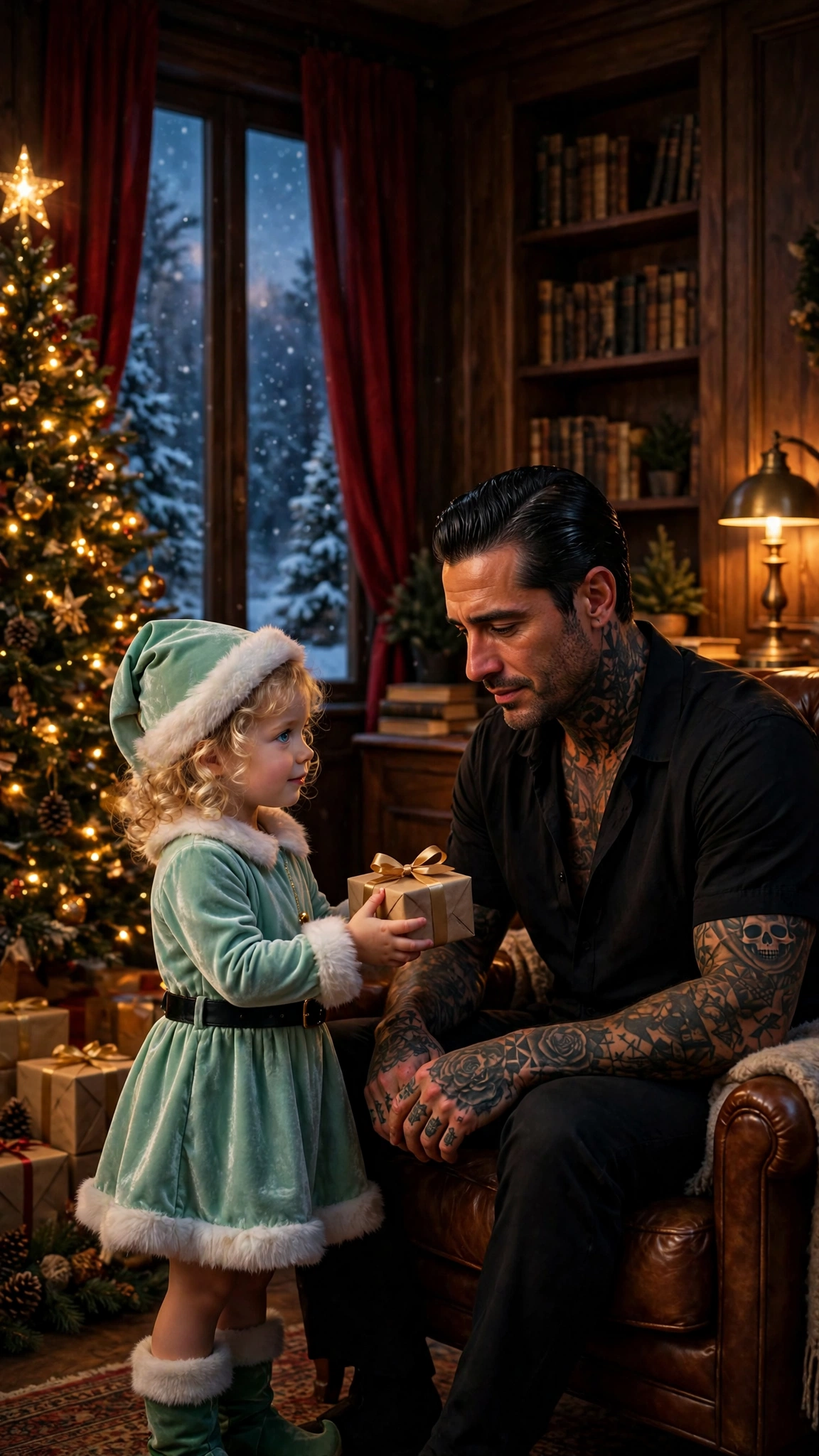
    Inside the study of the Moretti mansion, the snow made no sound at all. It fell past the tall windows in slow, fat flakes, and the pine trees in the garden stood black against the blue evening, and the red curtains hung still on either side of the glass, as if the room itself were holding its breath. The Christmas tree in the corner burned with small golden lights, and beneath it the presents lay in their paper and ribbon, untouched. On the shelves the books stood in their rows. On the desk the lamp burned low. And in the brown leather armchair by the fire sat Lorenzo Moretti, alone, with a glass of whiskey he had not touched, staring at nothing at all.

    He was forty-five years old, and he was the most feared man in Chicago, or so the newspapers said, though Lorenzo had never read a newspaper about himself and did not care what they said. He was tall and broad, with slicked-back dark hair and a jaw that looked as if it had been carved from stone, and gray-brown eyes that could go soft in a single second when they landed on his daughter — and hard in a single second when they landed on anyone else. Tonight those eyes were not hard. Tonight they were empty, the way they always were at Christmas, and the black open-collar shirt he wore showed the tattoos that covered his neck and his chest and his forearms and his hands, dark ink that moved a little every time he breathed, and the silver watch on his wrist caught the firelight every time he lifted the glass and did not drink from it.

    Two years. It had been two years since Elena had died, and two years since Christmas had meant anything at all in this house, and Lorenzo had given his orders that morning in the same voice he used for everything else: no party, no carols, no fuss. Christmas was just another day. The staff could have their supper in the kitchen if they wanted it. He would be in his study. He was not to be disturbed.

    And then the study door opened.

    It did not open loudly. It opened the way a door opens when the person on the other side of it is very small and very careful and very determined, a slow inch at a time, with one small hand flat against the wood. Lorenzo did not look up. He had told them not to disturb him, and he assumed it was Rosa with his supper, or one of his men with a message he did not want to hear.

    "Daddy," said a small voice.

    Lorenzo looked up.

    In the doorway stood his daughter, Sophia Moretti, five years old, and she was dressed as an elf.

    She wore a mint-green velvet dress with white fur trim at the collar and the hem, and a black belt with a gold buckle around her waist, and a matching green elf hat with white fur trim that sat crooked on her blonde curls, and green boots with white fur trim that came up to her knees. Her blue eyes were wide and serious. Her cheeks were pink from the cold of the hallway. And in both hands, held out in front of her like an offering, she carried a small box wrapped in brown paper and tied with a gold ribbon, the bow a little lopsided, the way a bow looks when a five-year-old has tied it herself and tied it three times before it looked right.

    Lorenzo stared at her. For a moment the most feared man in Chicago did not look feared at all. He looked surprised, and then he looked sadder than he had looked a moment before, as if the sight of his daughter in her Christmas costume had reminded him of everything he had been trying not to remember all day.

    "Sophia," he said. "What are you doing in here?"

    Sophia did not answer at once. She took one small step into the room, and then another, her green boots silent on the thick rug, and she stopped in front of his armchair and held the box out toward him with both hands.

    "Please don't be sad anymore," she said.

    Lorenzo looked down at her, and for a second he could not speak at all. He set his whiskey glass down on the small table beside the chair with great care, the way a man might set down something that could break, and he leaned forward, his tattooed hands resting on his knees.

    "Who let you in?" he asked, and his voice was quiet, but it was the voice of a man who is used to being obeyed, and the room seemed to get a little smaller around the sound of it.

    Sophia looked at the door behind her, and then back at her father, and she said, in the clear, matter-of-fact voice of a child who has decided to tell the truth and be done with it, "The stairs."

    "The stairs," Lorenzo repeated.

    Sophia nodded. "The back stairs. The ones that don't squeak."

    Lorenzo almost smiled. He did not know the back stairs did not squeak. He had never used the back stairs in his life. But his daughter, it seemed, knew his house better than he did, and she had used that knowledge to do the one thing he had forbidden anyone to do, which was to come into his study on Christmas Eve and disturb him while he sat alone with his sadness.

    He looked at the box in her hands.

    "What is that?" he asked.

    Sophia held it out a little further, and her blue eyes were earnest, and there was nothing in them but honesty and hope.

    "I made this just for you," she said.

    Lorenzo took the box from her. It was light in his hands, lighter than he had expected, and the gold ribbon was tied in a bow that leaned to one side, and the brown paper was creased at the corners where small fingers had folded it too many times. He turned it over once, slowly, and he looked at his daughter, and he saw that she was watching his face the way a child watches a candle, waiting to see if it will catch.

    Behind her, in the doorway, someone cleared their throat.

    Rosa stood there, the housekeeper, her dark hair pulled back in its neat bun, her black-and-white maid uniform crisp, her white apron bright against the dark wood of the hallway. She had one hand pressed flat against her chest, and her face was pale, and behind her, half-hidden in the shadows of the corridor, stood Macy, the young kitchen maid, nineteen years old and new to the house, her hands twisted together in front of her apron, her eyes wide with terror.

    Lorenzo looked from Rosa to Macy, and his face went still in the way it went still when he was deciding something, and Macy, who had been afraid of him since the first day she had come to work in this house, took one small step backward, as if the floor itself might open up beneath her.

    "Macy!" Lorenzo said.

    Macy flinched. She came forward one step, and then another, her knees shaking so hard that Rosa put a steadying hand on her shoulder, and she stopped in the doorway of the study with her head bowed, waiting for the words she was certain were coming, the words that would send her out of this house and back to the cold streets with no wages and no reference and no hope at all.

    Lorenzo looked at her for a long moment. Then he looked down at the small box in his hands, and at his daughter in her elf costume, and at the Christmas tree burning gold in the corner of the room, and something in his face changed — not much, and not all at once, but enough that Rosa, who had worked in this house for twenty-two years and had seen every face her employer owned, drew in a sharp breath and held it.

    "You're not fired," Lorenzo said.

    Macy stared at him. Rosa stared at him. Sophia, who did not understand what fired meant but understood perfectly well that something good had just happened, smiled for the first time since she had come into the room.

    Lorenzo held the box in his tattooed hands, and he did not open it yet, because some part of him — the part that had been a husband, once, and a man who had believed in Christmas, once — was afraid of what might be inside it, and some other part of him was afraid of what it would mean if there was nothing inside it at all.

    But that was later. That was the end of the evening, and the beginning of everything else, and before any of it could happen — before the box could be opened, and the truth about what his daughter had made for him could come out into the firelight — there had been a morning. There had been a little girl waking up in a big house on a cold December day, and a photograph on a bedside table, and a music box that had not been opened in two years.

    Three weeks earlier, on the first morning of December, Sophia Moretti woke to the sound of snow.

    It was not a loud sound. Snow never is. It was the sound of the world going quiet all at once, the way it does when the sky fills up with white and the whole city of Chicago seems to hold still underneath it. Sophia lay in her bed for a while with her eyes closed, listening to the quiet, and then she opened them and looked at the window, where the snow was falling past the glass in slow, fat flakes, and she smiled, because snow meant Christmas was coming, and Christmas meant the tree, and the tree meant the presents, and the presents meant the thing she had been planning for three whole days.

    She threw back her blankets and ran to the window in her bare feet, pressing her forehead against the cold glass. Below her, the garden of the Moretti mansion lay white and still, the bare branches of the old oak tree black against the sky, the stone paths vanished under a smooth white skin. And there, already at work in the cold with a shovel in his hands, was John Barone.

    John was sixty-eight years old, and he had been the gardener of the Moretti house for forty years, which was longer than Sophia had been alive, longer than her father had been the boss of anything, longer, Rosa said, than some of the trees in the garden had been standing. He was a small man with a weathered face and hands like tree roots, and he wore the same dark green coat every winter, and he always had a red scarf around his neck that his own wife had knitted for him before she died. Sophia loved John. Everyone in the house respected John, but Sophia loved him, because John was the only grown-up in the mansion who always had time to answer her questions, and who never told her to run along, and who never looked at her the way the men in her father's study looked at her — as if she were something fragile that might break if they spoke too loudly.

    Sophia pressed her palm flat against the window and waved, and John looked up, and he smiled, and he lifted his shovel in a wave of his own, and Sophia laughed, and the sound of her laughter was the first warm thing in the cold white morning.

    "Sophia!" Rosa called from the hallway. "Breakfast! And put on your slippers, child, the floors are freezing!"

    Sophia ran to her slippers and then to the door, but before she left her room she stopped, as she did every morning, in front of the small table beside her bed. On the table stood a photograph in a silver frame, and in the photograph a young woman with blonde hair and a bright, laughing face held a baby wrapped in a white blanket. The woman was beautiful in the way that mothers in photographs always are, and the baby was small and pink and asleep, and the woman was looking down at the baby as if the baby were the most wonderful thing she had ever seen.

    "Good morning, Mummy," Sophia whispered, the way she did every morning.

    Her mother, Elena Moretti, had died when Sophia was three years old, and Sophia did not remember her voice, and she did not remember her smell, and she did not remember the way her arms had felt around her. But she remembered the photograph, and she remembered the stories Rosa told her, and she remembered the music box.

    The music box sat beside the photograph, small and dark and made of polished wood, with a tiny brass key on its side. It had belonged to her mother. It played a tune that Sophia knew by heart, a slow, sweet melody that sounded like rain on a window, and when she was very small she had believed that the music was her mother's voice, singing to her from wherever mothers go when they cannot stay.

    That morning, for the first time in two years, Sophia opened the music box.

    She did not know why she did it. Later, when her father asked her — and he would ask her, many times, in many different ways — she would not be able to explain it. She only knew that the snow had made the morning feel different, and that Christmas was coming, and that she had been thinking about what to give her father for Christmas, and that her father's face, when he looked at the photograph of her mother, was always sad in a way that made Sophia's chest hurt.

    So she opened the music box, and the little tune began to play, and inside, beneath the tiny velvet lining, she found a folded piece of paper.

    It was a page of sheet music, old and soft at the edges, and across the top, in looping, careful handwriting, were the words "Silent Night." The page was covered in notes, and in the margins, in the same handwriting, were small pencil marks — a circle here, a star there, the marks of a woman who had played this song a hundred times and loved it more every time. And folded inside the sheet music, as if someone had hidden it there a very long time ago, was a small star cut from gold paper, old and creased, with one point bent a little where it had been pressed flat for years.

    Sophia stared at the star for a long time, the music box still playing its slow, sweet tune, the snow still falling past her window, and she felt something settle in her chest, something warm and certain and entirely her own.

    She did not know what the star was. She did not know why her mother had hidden it inside the sheet music, or why her father had never spoken of it, or why Rosa, when she came in with the breakfast tray and saw the star in Sophia's hands, went so pale that she nearly dropped the tray.

    But Sophia knew one thing, with the absolute certainty that only a five-year-old can feel: her mother had left her a map. And Christmas was coming. And her father — her big, sad, frightening, beloved father — deserved a Christmas present that would make him smile the way he used to smile in the photograph, before everything went quiet.

    She folded the sheet music carefully and put it back in the music box, and she put the little gold star in the pocket of her dress, and she ate her breakfast without complaining about the porridge. And when Rosa asked her what she was thinking about, Sophia smiled, and said, "Nothing," in the bright, innocent voice that Rosa had learned, over five years of raising this child, never entirely to trust.

    That afternoon, when the snow stopped and the sun came out pale and thin over Chicago, Sophia put on her coat and her boots and her red mittens, and she went down into the garden to find John Barone, and to ask him about a star made of gold paper, and a song called "Silent Night," and whether he knew anything about a present that could make a sad man smile again.

    John Barone listened to her with his shovel resting against the old oak tree, and his weathered face went very still, and for a long moment he said nothing at all. And then he looked up at the great dark house, at the windows of the study on the ground floor, and he said, very quietly, "Come with me, little one. And don't tell anyone. Not yet."

    That was how it began. Not with the gift, and not with the box, and not with the silence that fell over the study like snow. It began with a star in a music box, and a little girl who missed her mother, and an old gardener who had kept a secret for forty years and had finally, at long last, found someone brave enough to hear it.

  • Chapter 7: The Library at Night

    Chapter 7: The Library at Night

    Three weeks later, the house on the hill had changed in small ways that everyone noticed and no one could quite explain.

    The study door stayed open now, instead of closed. The telephone rang less at night. Lorenzo came home for dinner every evening, and on Sundays he took Millie and King down to the garden, where King taught Millie how to throw a ball properly, and Millie taught King how to play hide and seek behind the hedges, and Rosa watched them from the kitchen window and smiled.

    King's bed had moved. It was no longer by the fireplace in the library. It was in Millie's room now, by the foot of her bed, a great soft cushion that Lorenzo had bought himself, in the town, from a shop that sold things for dogs the size of small bears. Every night, King lay down on it, and every morning, he was still there, his great head on his paws, his eyes open, watching the door.

    The terrace doors had a new lock. The gap in the hedge had been repaired. The old service door at the back of the house had a new lock too. And every night, two of Enzo's men walked the terrace, quiet and watchful, the way good guards walk — not stomping, not shouting, just there, like the walls themselves.

    The Ferraro family had gone quiet again. Their men had not been seen in the town for weeks. The message had been delivered, and it had been understood: the Moretti house was guarded, and the girl was protected, and anyone who came near it again would find not a quiet house, but a house that was watching.

    But the biggest change was not in the locks, or the guards, or the garden. The biggest change was in the library.

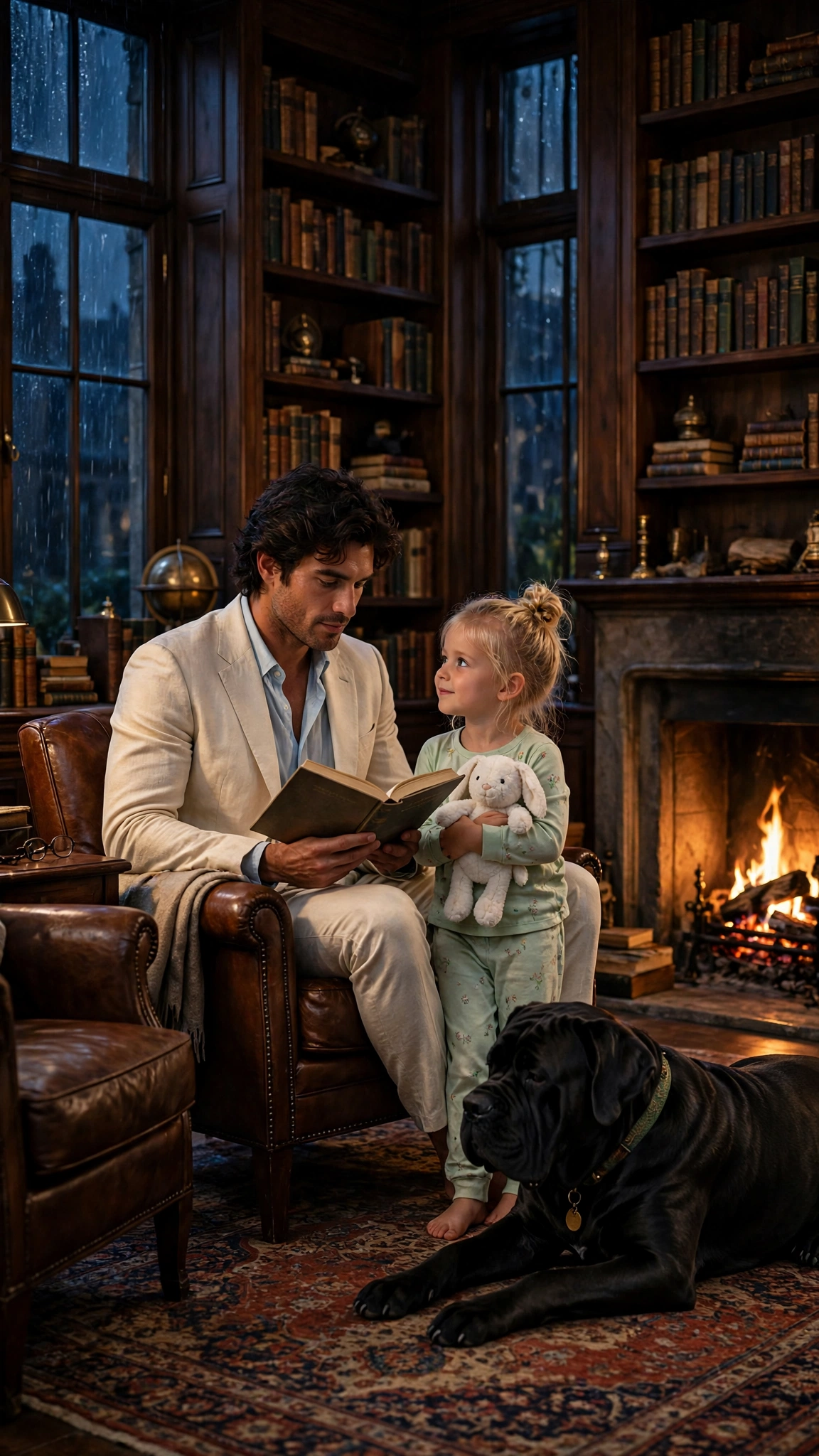
    Every evening, after supper, Lorenzo would go to the library with Millie on his lap and King at their feet, and he would read to her until she fell asleep. He read her fairy tales, and stories about dragons, and stories about brave little girls who outsmarted giants, and Millie would listen with her head against his chest, and King would listen with his chin on his paws, and the fire would burn low, and the rain would drum softly on the windows, and the house would go quiet around them, the way a house goes quiet when everyone in it is exactly where they are supposed to be.

    It was Rosa who had started it, in a way. One evening, about a week after the night of the knocking, Rosa had come to the library door with a tray of tea, and she had found Lorenzo sitting alone in his armchair, staring at the fire, and she had said, very gently, "Mr. Moretti, the little one is asking for you. She wants a story."

    Lorenzo had looked up, surprised, and Rosa had smiled, and she had said, "She has been asking every night, sir. She just never told you before, because she thought you were too busy."

    Lorenzo had gone upstairs, and he had found Millie sitting up in bed with her bunny in her arms, waiting, and he had sat down on the edge of the bed, and he had read her a story — the first story he had read aloud in years, his voice rusty and uncertain at first, and then smoother, and then warm — and Millie had fallen asleep halfway through, with her head on his arm, and Lorenzo had sat there for a long time after she was asleep, watching her breathe, and thinking about how much he had missed.

    From that night on, it became a ritual. Every evening, after supper, the library, the armchair, the book, the little girl, and the dog. And every night, when Millie fell asleep, Lorenzo would carry her upstairs to bed, and King would follow behind them like a shadow, and Rosa would come up later with a cup of warm milk, and the house would go quiet, and the rain would fall on the windows, and the family would sleep in peace.

    On a Friday evening, three weeks after the night of the knocking, Lorenzo was reading to Millie in the library when she interrupted him, in the middle of a sentence about a dragon, and said, "Papa?"

    "Yes, tesoro?" Lorenzo said, looking down at her.

    "Are you still afraid?" Millie asked. "Of the knocking man?"

    Lorenzo thought about this for a moment. He thought about the man on the terrace, thin and frightened in his coat that was too big for him. He thought about the Ferraro family, quiet again in the town. He thought about the new locks, and the guards on the terrace, and the dog lying at his feet. And he thought about the three years he had spent being afraid — afraid of losing his daughter, afraid of losing his wife's memory, afraid of being soft, afraid of being wrong — and about how the fear had never once kept anyone safe.

    "No, tesoro," he said, very quietly. "I am not afraid anymore. Because I understand something now that I did not understand before. I thought that being strong meant building walls, and never letting anyone in, and never admitting I was wrong. But you taught me something different, Millie. You taught me that being strong means telling the truth, and asking for help, and staying. That is what you did. You came downstairs in the dark, and you told me the truth, and you asked me for my dog, and because you did that, our house is safe. Do you understand?"

    Millie nodded slowly. "I think so, Papa. I think being brave means asking for help."

    "Yes," Lorenzo said. "That is exactly what it means. And you are the bravest person I know."

    Millie smiled, and she leaned her head against his chest, and Lorenzo went back to reading, and King sighed, a deep, contented sigh, and closed his eyes, and the fire burned low, and the rain drummed softly on the windows, and the library was warm, and quiet, and safe.

    Later that night, when Millie had fallen asleep and Lorenzo had carried her upstairs to bed, he stood in the doorway of her room for a long time, looking at the small, peaceful scene: his daughter asleep in her green pyjamas, the bunny under her chin, and the great black dog lying across the foot of the bed like a guardian, his eyes half open, watching over them both.

    He thought about Renata. He thought about the way she used to sit in the library, in the evenings, with her feet tucked under her, reading, while he worked. He thought about the way she had laughed at him when he tried to be stern. He thought about the last thing she had ever said to him, on the night she died: "Don't forget to be soft with her, Lorenzo. She is going to need you to be soft."

    He had not been soft. He had been hard, and fast, and certain, and he had been wrong. But now, at last, he was learning. He was learning to sit in a library with his daughter on his lap, and to read her stories, and to listen when she spoke, and to let a dog sleep in her room, and to let a housekeeper make him tea, and to let his walls come down, one by one, until the house was not a fortress anymore, but a home.

    He went downstairs, and Rosa was in the kitchen, making tea, and he sat down at the table with her, and they talked — really talked, for the first time in twenty years — about Renata, and about Millie, and about the bunny, and about the nights when Rosa had sat up with the child when she was sick, and about the mornings she had braided her hair, and about all the small, invisible things that make a childhood, and Lorenzo listened, the way he had learned to listen, and he understood, at last, how much he owed this quiet woman who had never once asked him for anything.

    "Thank you, Rosa," he said, when she had finished. "For staying. For everything. For twenty years. I should have said it years ago."

    Rosa looked at him, and her eyes glistened, and she nodded once, slowly, the way she had nodded a hundred times before — at the top of a staircase, at the edge of a garden, at the beginning of something brave.

    "You are welcome, Lorenzo," she said. "That is what family is for."

    And Lorenzo Moretti, who had not cried in three years, felt his own eyes sting, and he did not try to stop it, because for the first time in three years, he was not the most feared man in the city. He was just a father, sitting in his kitchen at midnight, drinking tea with a woman who had loved his daughter in silence for years, and learning, at thirty-six years old, how to be a family.

    The next morning, Millie woke up early, and the first thing she did was check that King was still there, lying across the foot of her bed, warm and breathing. The second thing she did was run to the window and look out at the garden, where the sun was coming up over the cypress trees, and where her papa was standing by the fountain with a cup of coffee, looking up at her window and smiling.

    She waved. He waved back. And Millie Moretti, who was five years old, and who had a dog, and a bunny, and a papa who was learning to listen, and a housekeeper who had loved her since she was a baby, and a mama who watched over her from a little white bunny, thought that the world was, after all, a very good place to be.

    She got dressed, and she put on her green dress — the one that matched her pyjamas, the one Rosa had bought her in the spring — and she tied her blonde hair up in a little top bun, the way she always did, and she went downstairs to start her day, with King beside her and the bunny in her arms, and the house on the hill glowed warm in the morning light, like a ship that had finally found its way home.

    In the weeks that followed, the house changed in small ways that everyone noticed and no one could quite explain. The study door stayed open. The telephone rang less. Lorenzo came home for dinner every evening. And every night, in the library, by the fire, with the rain on the windows, a father read to his daughter, and a great black dog lay at their feet, and a little white bunny sat on the arm of the chair, watching over them all.

    Some nights, when the rain came back, Millie would ask her papa to read the story of the dog who stayed, and Lorenzo would open the book and begin, and she would correct him if he skipped a single word, the way only a five-year-old can. King would lift his great head at the sound of her voice, and then settle again with a sigh, and Rosa would bring in a tray with two cups of tea and one small glass of warm milk, and she would sit in the chair by the fire for a while, mending a sock or shelling peas, until the house grew quiet and the only sound left was the rain and the turning of pages. Lorenzo learned the names of all the dogs in Millie's picture books, and he learned that a library is not a room for being alone, but a room for being together, and he learned that the walls he had built to keep the world out had also kept his own daughter out, and that taking them down, brick by brick, was the hardest and the best work he had ever done. And every night, before she fell asleep, Millie would whisper the same question into the dark, and her papa would answer it the same way, every time.

    That is how the story ends: not with a grand gesture, and not with a fortune, but with a little girl, and a dog, and a bunny, and a library at night, and a family that finally learned the bravest thing of all — how to stay.

    And if you ever pass the Moretti house on a rainy night, and you look up at the tall windows of the library, you will see them there: a man in a cream suit, reading aloud; a little girl in green pyjamas, asleep on his lap; and a great black dog, lying by the fire, with his eyes half open, watching over them both. And you will understand, the way Millie understood on the night she walked downstairs in the dark to ask her father for his dog, that the bravest thing in the world is not to fight, or to win, or to never be afraid.

    The bravest thing in the world is to ask for help — and to stay.

    THE END

  • Chapter 6: What the Knocking Meant

    Chapter 6: What the Knocking Meant

    The next morning, Millie woke up early, and the first thing she did was check that King was still there, lying across the foot of her bed, warm and breathing. The second thing she did was run to the window and look out at the garden, where the sun was coming up over the cypress trees, and where her papa was standing by the fountain with a cup of coffee, looking up at her window and smiling.

    She waved. He waved back. And Millie Moretti, who was five years old, and who had a dog, and a bunny, and a papa who was learning to listen, thought that the world was, after all, a very good place to be.

    That day, Lorenzo did something he had not done in three years: he stayed home.

    He did not go to his office. He did not take telephone calls. He did not meet with men in suits who spoke in low voices about territories and debts and harbors. Instead, he spent the day with his daughter, and he learned things about her that he had never known — that she liked her toast with honey, and that she was learning to read, and that she had a favorite spot in the garden, under the lemon trees, where she liked to sit with King and tell him stories.

    He learned that she was afraid of thunderstorms, but only a little, and only when they were very loud. He learned that she had a secret collection of smooth stones, which she kept in a box under her bed. He learned that she had taught King to sit, and to stay, and to shake hands, all by herself, with pieces of cheese from the kitchen. He learned that she had a laugh like a bell, and that she had not laughed like that in a month, and that he had not noticed.

    He learned, in short, that he had a daughter, and that he had been living in the same house as her for five years without ever really knowing her.

    At breakfast, Millie asked him questions. She asked them the way children ask questions when they have been saving them up for a long time — one after another, without waiting for the answers to settle.

    "Papa, why did the man knock?" she asked, swinging her legs under the table. "What did he want?"

    "He was paid to watch our house," Lorenzo said simply. "Some men do bad things for money. But he is gone now."

    "Will he come back?" Millie asked.

    "No," Lorenzo said. "Because now he knows we are watching. And because King is watching too."

    Millie thought about this, chewing her toast. "Does King know he did a good job?"

    Lorenzo looked at the great black dog, who was lying at Millie's feet with his chin on her shoe, and he smiled — a real smile, small and rueful, the first one Rosa had seen on his face in days.

    "I think he does, tesoro," Lorenzo said. "I think he has always known. He was just waiting for someone to tell him."

    Rosa, clearing the plates, stopped beside the table, and she said, very gently, "Your mama used to read in the library every night, you know. It was her favorite room in the whole house. She would sit in the big chair with a book, and she would read until the fire burned low, and sometimes she would fall asleep there, with the book open on her chest, and your papa would carry her upstairs to bed."

    Millie looked up at her, her eyes wide. "Did Mama read to me? When I was a baby?"

    "Every night," Rosa said. "She read to you before you could understand a single word, because she said that a baby who hears stories grows up brave. And she was right, sweetheart. Look at you."

    Millie was quiet for a moment. Then she said, very softly, "I don't remember her voice, Rosa. I try, but I can't remember it."

    Rosa put her hand gently on the little girl's shoulder. "You don't have to remember her voice, sweetheart. You carry her in other ways. In the way you hold your bunny. In the way you ask questions. In the way you are brave. That is your mama, living in you. She is not gone. She is just — quieter now."

    Millie nodded slowly, and she went back to her toast, and Lorenzo, watching them, felt something loosen in his chest that had been tight for three years.

    At midday, Enzo came to the study with his report. The gap in the hedge had been repaired. The terrace doors had been fitted with a new lock. The old service door at the back of the house had a new lock too. And the Ferraro family's men had not been seen in the town for days — not since the night on the terrace, not since the message had been delivered.

    "They have gone quiet again, sir," Enzo said. "I think they understand now. The house is guarded. The girl is protected. They will not come back."

    Lorenzo nodded slowly. "Good. But keep the men on the terrace for another month. I want this house watched until I am sure."

    "Yes, sir."

    When Enzo had gone, Lorenzo opened the drawer of his desk and took out a small photograph, creased and soft at the edges. It showed Renata, laughing, holding a baby Millie in her arms, standing in the garden by the fountain. Behind them, half out of frame, was the library windows, and in the reflection of the glass, just barely visible, was a young Lorenzo, watching them, smiling.

    He looked at it for a long time. Then he put it back in the drawer, closed it gently, and went to find his daughter.

    That afternoon, after lunch, Lorenzo took Millie into the library, and he sat her down in the leather armchair — his chair, the one no one else was ever allowed to sit in — and he knelt down beside her, so that their faces were level, and he told her the truth.

    Not all of it. Some truths are too heavy for small shoulders. He did not tell her about the Ferraro family, or about the harbor road, or about the men who had watched their house for a month, or about the things his world demanded of him. He told her the part she needed to hear, in words a five-year-old could carry.

    "Millie," he said, "do you remember the knocking?"

    Millie nodded, her small hands tightening around the bunny.

    "The knocking was a man," Lorenzo said. "A man who was paid to watch our house and to frighten us. He knocked on our doors to see if anyone was watching. But we were watching, tesoro. You were watching. King was watching. And last night, I caught him, and I sent him away, and he will not come back. Do you understand?"

    Millie nodded slowly. "Was he a bad man, Papa?"

    "Yes," Lorenzo said. "He was a bad man. But he is gone now. And the reason he is gone is because you were brave. You came downstairs in the dark and you told me the truth, and because you told me the truth, I was able to protect you. Do you understand what I am saying, tesoro? You protected this house. Not me. You."

    Millie looked at him for a long moment, and then, slowly, she smiled — a small, proud smile, the smile of a child who has just been told that she is brave, and who believes it, because her father has said it, and her father does not lie.

    "Good," she said. "I am glad I told you, Papa."

    "So am I," Lorenzo said. "And from now on, Millie, I want you to tell me everything. If you hear a sound, you tell me. If you are afraid, you tell me. If you have a question, you ask me. Do you promise?"

    "I promise, Papa," Millie said.

    "And I promise you something too," Lorenzo said. "I promise that from now on, I will listen. I have not been listening, tesoro. I have been busy, and I have been proud, and I have been afraid, and I have not listened to the people I love most in the world. That is going to change. Starting tonight."

    That evening, after supper, Lorenzo did something new: he went to the library early, and he brought Millie with him.

    He sat in his leather armchair, in his cream suit, and he put Millie on his lap, with the bunny in her arms and King lying at their feet, and he opened a book — not his book, but hers, a book of fairy tales with pictures of dragons and castles and brave little girls — and he read to her, slowly, in his deep voice, while the fire burned low and the rain drummed softly on the windows.

    Millie listened with her head against his chest, and King listened with his chin on his paws, and Rosa, passing the library door with a tray of tea, stopped and looked in, and saw the three of them — the mafia boss, the little girl, and the great black dog — sitting together in the firelight, and she felt her eyes sting, because she had worked in this house for twenty years, and she had never once seen anything like it.

    She set the tea down quietly, so as not to disturb them, and she went back to the kitchen, and she stood there for a moment with her hands on the counter, breathing slowly, thinking about her friend Renata, who had once told her, "If you love someone, you tell them the truth, even when it is hard. Especially when it is hard." Renata had been braver than anyone Rosa had ever known. And now, Rosa thought, her daughter was braver still.

    Upstairs, later that night, Lorenzo carried Millie to bed himself — something he had not done in months — and he laid her down gently, and he pulled the blankets up over her shoulders, and he sat on the edge of the bed for a while, watching her breathe, the way he had done every night since she was born.

    "Papa?" Millie murmured, half asleep. "Will King stay in my room? Forever?"

    "Forever," Lorenzo said. "I promise. From tonight, King's bed is in your room. That is an order. If anyone asks, the dog is on duty."

    "And will you read to me again tomorrow night?" Millie asked.

    "Every night," Lorenzo said. "I promise you that too."

    Millie smiled in her sleep, and her small hand tightened around the bunny, and Lorenzo bent down and kissed her forehead, and whispered, so softly that only the sleeping child and the dark room could hear him, "Goodnight, my little bird. Papa loves you. Mama loves you. And we will always, always stay."

    He stood up, and he went to the door, and he looked back one more time at the small, peaceful scene: his daughter asleep in her green pyjamas, the bunny under her chin, and the great black dog lying across the foot of the bed like a guardian, his eyes half open, watching over them both.

    Downstairs, Rosa was in the kitchen, making tea. King would come down later, when Millie was deeply asleep, to check on things, the way he always did. And outside, the rain drummed on the windows, and the house on the hill glowed warm in the dark, like a ship that had finally found its way home.

    Lorenzo Moretti, the most feared man in the city, went downstairs to have tea with his housekeeper, and to plan a new bed for a dog, and to learn, at thirty-six years old, how to be a father.

    He had spent three years believing that strength meant never bending, never yielding, never admitting he was wrong. Now he understood that his five-year-old daughter had been braver than he was, because she had walked downstairs in her pyjamas in the middle of the night and told the truth, and his dog had been wiser than he was, because he had stayed, and his housekeeper had been stronger than he was, because she had loved a child without ever asking to be loved back.

    He looked at the library, at the leather armchair where he had sat every night for three years, reading his book, alone, and he thought about how strange it was that the answer had been lying at his feet all along, with his chin on his paws, waiting to be asked.

    From that night on, the library was never empty again. Every evening, after supper, Lorenzo would go to the library with Millie on his lap and King at their feet, and he would read to her until she fell asleep, and then he would carry her upstairs to bed, and King would follow behind them like a shadow, and Rosa would come up later with a cup of warm milk, and the house would go quiet, and the rain would fall on the windows, and the family — the small, strange, brave family of a mafia boss, a little girl, a housekeeper, and a great black dog — would sleep in peace, knowing that someone was always watching over them.

    And the knocking never came again.

  • Chapter 5: The Man at the Door

    Chapter 5: The Man at the Door

    At two o'clock in the morning, the knocking came again.

    Knock. Knock. Knock.

    Lorenzo was ready.

    He had been sitting in his leather armchair since eleven o'clock, in his cream suit, with no book in his hands, listening to the house. He had heard the clock strike twelve, and one, and two. He had heard the rain stop. He had heard the silence settle over the house like a blanket. And when the knocking came — three knocks, slow and deliberate, against the tall glass terrace doors at the far end of the library — he was on his feet before the third knock had faded, moving silently across the Persian rug, his hand already on the latch.

    King was on his feet too. The great black dog had risen from the fireplace without a sound, his ears flat, his body low, and he moved to Lorenzo's side, and stood there, staring at the terrace doors, and a low, deep growl began in his chest.

    "Stay, King," Lorenzo said quietly. "Stay with me."

    He opened the terrace doors.

    The night air came in, cold and wet, smelling of rain and earth and night. The garden was dark. The cypress trees stood black against the sky. The fountain was a pale shape in the dark. And on the terrace, standing in the shadows by the stone step, was a man.

    He was not a large man. He was thin, and pale, and he wore a dark coat that was too big for him, and his hands were shaking. He had been reaching for the door when Lorenzo opened it, and now he stood frozen, his hand still raised, his eyes wide, like a rabbit caught in a torch beam.

    For a moment, no one moved. The man looked at Lorenzo. Lorenzo looked at the man. King looked at the man, and his growl grew deeper, and the man took one step back, and then another, and his foot slipped on the wet stone, and he fell to his knees on the terrace.

    "Don't," the man said, his voice shaking. "Please. Don't let the dog — please."

    Lorenzo looked down at him. He had faced down killers and judges and rivals without ever once flinching, and this — this thin, frightened man in a coat that was too big for him — was the thing that had been keeping his five-year-old daughter awake for a month. It was almost funny. It would have been funny, if it had not been so terrible.

    "Get up," Lorenzo said, very quietly.

    The man got up, slowly, his hands raised, his eyes on King.

    "Who sent you?" Lorenzo asked.

    The man swallowed. "I — I don't know what you mean, sir. I was just — I was walking —"

    "Do not lie to me," Lorenzo said, and his voice was very soft now, the way it always was when he was most dangerous. "You have been coming here for a month. You smoke three cigarettes on my terrace. You knock three times on my doors. You watch my house. Who sent you?"

    The man looked at the garden, and at the gates, and at the two of Enzo's men who had appeared silently on the terrace behind him, and he understood, suddenly and completely, that there was nowhere to run. He sagged, like a man who had been holding his breath for a month and had finally been allowed to let it out.

    "The Ferraros, sir," he said, very quietly. "A man named Ferraro. He paid me. Fifty euros a night, to come here, and to knock, and to see if anyone answered. He wanted to know if the house was guarded. If the dog slept inside or outside. If the girl was — if the girl was alone at night."

    Lorenzo was silent for a long moment. Then he said, "And what did you tell him?"

    The man looked down at his shoes. "I told him the house was quiet, sir. I told him no one ever answered. I told him the dog slept in the library, and the girl slept upstairs, alone. I told him — I told him it would be easy, sir. I told him the house was not watching."

    "How many nights?" Lorenzo asked.

    The man swallowed. "A month, sir. Maybe more. I lost count after the first two weeks. Every night, the same. I came through the hedge, I smoked three cigarettes, I knocked three times, and I left before half past two. That was the arrangement."

    "Who paid you?" Lorenzo asked.

    "I never met him, sir. A driver left an envelope under the bench by the harbor, every Friday. Fifty euros a night. The note in the envelope said the address, and the instructions: three cigarettes, three knocks, leave before half past two. That was all. I never saw Ferraro. I never saw anyone. I only ever saw the house."

    King stepped forward then, silently, and lowered his great head, and sniffed the man's coat, once, deeply, and the man went rigid, his eyes fixed on the huge black dog, his breath coming short and fast. Lorenzo laid one hand on King's broad head, and the dog stopped, but he did not step back. He stood there, staring at the man, and the man stared back at him, and Lorenzo understood, suddenly, that the man was not afraid of him. He was afraid of the dog. And the dog, who had never harmed anyone in his life, was the most frightening thing in the garden.

    "He is not going to hurt you," Lorenzo said quietly. "Not unless I tell him to. And I am not going to tell him to. You are not a killer. You are a hungry man who was paid to frighten a child. That is a small, mean thing to do for money — but it is not a thing worth killing a man over."

    The man stared at him. "You — you are letting me go, sir?"

    "I am letting you go with a message," Lorenzo said. "That is different. Enzo's men will walk you to the gate. They will watch you go. And if you ever come back to this house, for any reason, at any hour, you will not find me standing in the doorway asking questions. Do you understand?"

    "Yes, sir," the man whispered. "I understand, sir. Thank you, sir."

    Enzo's men searched the terrace while they waited, their torches low, looking for anything the man might have left behind. One of them found a dropped cigarette packet, crushed flat, in the wet grass by the wall. Another found a fresh footprint, deeper than the others, where the man had stood for a long time, watching the library windows. Enzo bagged the packet in a handkerchief, the way policemen do in films, and Lorenzo, watching him, thought about how strange it was that a man could spend a month standing in his garden, night after night, and leave behind nothing but cigarette ends and footprints — and a little girl who could not sleep.

    Lorenzo looked at him for a long time. And then, slowly, he smiled — not the smile he wore for photographs, but a small, cold smile, the smile of a man who has just understood something important.

    "You were wrong," Lorenzo said. "The house was watching. My daughter was watching. My dog was watching. You were the only one in this garden who was not watching, because if you had been watching, you would have seen that this house has never once been unguarded — not for a single night, not for a single hour. You saw a quiet house, and you thought it was an empty house. That was your mistake."

    The man nodded, miserably. "Yes, sir. I see that now, sir."

    "Then you will carry a message back to Ferraro," Lorenzo said. "You will tell him that the Moretti house is guarded. You will tell him that the girl is protected. You will tell him that if anyone comes here again — anyone at all, for any reason, at any hour — I will not be standing in the doorway asking questions. Do you understand?"

    "Yes, sir," the man said quickly. "I understand, sir. I will tell him. I swear it."

    "And you will tell him one more thing," Lorenzo said. "You will tell him that his scout knocked three times on my daughter's door, and that my daughter was afraid, and that she came downstairs in the middle of the night to ask me for my dog, and that I gave him to her. And you will tell him that a house where a five-year-old girl is braver than his whole family is not a house he should ever come near again."

    The man nodded, and Enzo's men took him by the arms, gently but firmly, and led him away across the terrace, toward the gates, and Lorenzo stood in the doorway, watching them go, and he felt a strange, quiet feeling in his chest — not anger, not triumph, but something else. Relief. And beneath the relief, something else: a deep, tired sadness, because he understood, suddenly and completely, that the man on his terrace had not been the enemy. The enemy had been his own blindness. The enemy had been three years of building walls and never looking at them. The enemy had been a father who sat in his library every night, reading his book, while his daughter lay awake upstairs, listening to a stranger knock on her house.

    King pressed his great head against Lorenzo's leg, and Lorenzo laid his hand on the dog's broad head, and they stood together in the doorway, looking out at the dark garden, and Lorenzo thought about his daughter, and about the dog, and about the man who had just been led away, and about the three years he had spent believing that strength meant never bending, never yielding, never admitting he was wrong.

    And then, from the stairs behind him, came a small, sleepy voice.

    "Papa?"

    Lorenzo turned.

    Millie stood on the bottom step of the staircase, in her green pyjamas, barefoot, with the white bunny in one arm and her eyes wide in the dark. She had heard the voices. She had heard the dog. She had come downstairs, the way she always did when she was afraid, to find her father.

    "Millie," Lorenzo said, and he went to her, and he knelt down, and he put his hands gently on her small shoulders. "What are you doing down here, tesoro? It is the middle of the night."

    "I heard voices, Papa," Millie said. "I heard King growling. Is everything all right?"

    Lorenzo looked at his daughter for a long moment. And then, slowly, he told her the truth — not all of it, because she was five years old, and some truths are too heavy for small shoulders — but enough of it. Enough for her to understand that she had been right, and that she had been brave, and that the knocking was over.

    "There was a man, Millie," he said quietly. "A bad man, who was paid to watch our house and to frighten us. He knocked on our doors to see if anyone was watching. But we were watching, tesoro. You were watching. King was watching. And now he is gone, and he will not come back. No one will knock on your door again. I promise you."

    Millie looked at him for a long moment, searching his face the way children search faces for the truth. And then, slowly, she nodded.

    "Good," she said. "Because I was tired of being afraid, Papa."

    Lorenzo felt something break open inside his chest — something he had kept locked away for three years, since the night of the rain and the red light and the telephone call. He pulled his daughter into his arms, and he held her tight, and he felt her small heart beating against his chest, fast and strong, and he thought about how small she was, and how brave she was, and how close he had come to losing the most important thing in the world, all because he had been too proud to listen.

    "I know, tesoro," he whispered. "I know. And I am sorry. Papa is sorry. From now on, I will listen. I promise you."

    King came and pressed his great head against Millie's side, and Millie put one small arm around the dog's neck, and the three of them stood together in the dark hallway — a mafia boss, a little girl, and a great black dog — and for the first time in three years, Lorenzo Moretti felt like he was exactly where he was supposed to be.

    "Come," he said, and he picked Millie up, and he carried her back upstairs, with King following behind them like a shadow, and he laid her down in her bed, and he pulled the blankets up over her shoulders, and he sat on the edge of the bed for a while, watching her breathe, the way he had done the night before, and the night before that, and every night since she was born.

    "Papa?" Millie murmured, half asleep. "Will King stay? Forever?"

    "Forever," Lorenzo said. "I promise."

    "And the knocking won't come back?"

    "It won't come back," Lorenzo said. "I promise you that too."

    Millie smiled in her sleep, and her small hand tightened around the bunny, and Lorenzo bent down and kissed her forehead, and whispered, so softly that only the sleeping child and the dark room could hear him, "Goodnight, my little bird. Papa loves you. Mama loves you. And we will always, always stay."

    He stood up, and he went to the door, and he looked back one more time at the small, peaceful scene: his daughter asleep in her green pyjamas, the bunny under her chin, and the great black dog lying across the foot of the bed like a guardian, his eyes half open, watching over them both.

    Downstairs, the library was dark, and the fire was low, and the rain had stopped, and the house on the hill stood quiet in the night, like a ship that had finally found its way home.

    And in the garden, beyond the gates, the Ferraro family's scout walked away into the dark, carrying a message he would never forget, and behind him, the Moretti house glowed warm in the night, guarded by a dog, and a little girl, and a father who had finally learned how to listen.

  • Chapter 4: The Dog Who Stayed

    Chapter 4: The Dog Who Stayed

    The next morning, the house woke up different.

    Millie could feel it before she was even properly awake — the way you can feel a change in the weather before you open your eyes. The house was the same house, with the same rain on the windows and the same smell of Rosa's bread from the kitchen, but something in it had shifted, the way a room shifts when someone finally opens a window that has been shut for years.

    King was still lying across her doorway. He lifted his great head when she stirred, and his tail moved once against the floor, and Millie, who had slept through the night for the first time in a month, sat up in bed and looked at him, and smiled — a real smile, small and sleepy, the first one Rosa had seen on her face in weeks.

    "Good morning, King," Millie whispered. "Did you hear it last night?"

    King's ears rose. He looked at the door, and then back at her, and Millie understood that he had heard it, and that he had stood guard, and that he would stand guard again tonight, and every night, because that was what he had been waiting for someone to ask him to do.

    She slipped out of bed and went to him on her bare feet, in her green pyjamas, with the bunny in one arm, and she put her small arms around his great neck, and she pressed her cheek against his broad head, and King sighed, a deep, contented sigh, and closed his eyes.

    Downstairs, Rosa was making breakfast, and when Millie came down with King beside her, Rosa took one look at the child's face and felt something loosen in her chest that had been tight for a month.

    "You slept," Rosa said, and it was not a question.

    Millie nodded, and she sat down at the kitchen table, and she ate her toast — all of it, for the first time in weeks — while King lay at her feet with his chin on her shoe, and Rosa watched them both, and thought about how strange it was that a dog could do in one night what a whole house full of grown people had failed to do in a month: make a frightened child feel safe.

    After breakfast, Rosa took Millie into the garden, because the rain had stopped and the sun was out, pale and watery, and the roses were wet and bright. King went with them, walking beside Millie with his great head level with her shoulder, and Rosa walked behind them, her hands folded in her apron, watching the little girl and the dog move through the garden together, the way they had always moved, except that now they moved differently — closer together, slower, as if they had made a promise to each other in the dark and were keeping it in the daylight.

    "Rosa," Millie said, as they walked past the fountain, "why does King stay with me? He is Papa's dog. Why does he follow me everywhere?"

    Rosa thought about this for a moment. She had known King since he was a puppy, and she had watched him grow from a small black bundle into the biggest dog in the city, and she had seen the way he looked at Millie, and she thought she understood it better than anyone.

    "Because he chose you, sweetheart," Rosa said gently. "Dogs choose their people, the way people choose their friends. Your papa bought King, and he fed him, and he trained him, but King chose you. He chose you the day he first saw you, when you were one year old and learning to walk, and you fell down in the garden, and he lay down beside you so you could pull yourself up on his back. Do you remember that?"

    Millie shook her head. "I was too small."

    "Yes," Rosa said. "But he remembers. Dogs remember everything. He remembers that you were small, and that you needed him, and he has been waiting ever since for someone to let him do his job."

    Millie looked at King, who was sniffing at a rosebush, his great black body moving slowly through the wet grass, and she thought about that — about a dog who had been waiting for four years to be asked to guard her door — and she felt a small, warm feeling in her chest, the way you feel when someone tells you a secret you have always suspected but never quite believed.

    "He looks lonely too," Millie said softly, echoing the words she had said to her father in the library. "That's why I asked for him, Rosa. Not just to protect me. Because he looks lonely too."

    Rosa stopped walking. She looked at the little girl, and at the great black dog, and her eyes glistened, because she understood, suddenly and completely, what Millie had understood all along: that the dog was not just a guard, and the girl was not just a child to be protected. They were two lonely creatures in a big, quiet house, and they had found each other, the way lonely creatures sometimes do, without anyone having to arrange it.

    "Yes, sweetheart," Rosa said quietly. "He does look lonely. And so did you. And now neither of you is alone anymore."

    They walked on through the garden, past the lemon trees and the hedges, and Millie held King's collar in one hand and the bunny in the other, and Rosa walked behind them, and the sun came out properly for the first time in days, and the house on the hill glowed warm in the light, like a ship that had finally found its way home.

    That afternoon, while Millie napped with King lying across her doorway, Lorenzo sat in his study with Enzo, and Enzo laid out what his men had found.

    "The footprints belong to one man," Enzo said. "He comes through the gap in the hedge, the one by the old gate. He walks to the terrace, he smokes three cigarettes, he knocks three times on the library doors, and he leaves. He has been doing it for weeks, sir. Maybe a month. The older footprints are under the terrace, where the rain hasn't washed them away. He is careful. He never comes before midnight. He never stays longer than twenty minutes. He never takes anything. He only watches, and knocks, and leaves."

    "Who sent him?" Lorenzo asked.

    Enzo was silent for a moment. "We don't know yet, sir. But I have an idea. Three years ago, after Mrs. Moretti died, the Ferraro family went quiet. They have been quiet for three years. But in the last month, their men have been seen in the town — asking questions, watching the house, learning the routines. The Ferraros have always wanted the harbor road, sir. They have always wanted what you have. And they have always been patient."

    Lorenzo nodded slowly. The Ferraro family. He had known them for twenty years. He had fought them, and made peace with them, and fought them again, and for three years, since Renata's death, there had been a kind of truce — not a peace, exactly, but a silence, the way two tired boxers lean on each other between rounds. And now, it seemed, the silence was over.

    "They are testing the house," Lorenzo said. "They want to know if I am still watching. If the dog sleeps inside or outside. If the girl is guarded. They are learning the house the way a burglar learns a house — slowly, patiently, one knock at a time."

    "Yes, sir," Enzo said. "That is what I think too."

    Lorenzo looked out the window at the garden, where his daughter was walking with her dog and her bunny, and he felt a coldness spread through his chest that had nothing to do with the rain. Someone had been watching his house. Someone had been standing outside his daughter's window, night after night, knocking on his doors, testing his walls. And the only ones who had been watching back were a five-year-old girl who could not sleep, and a dog who had never been asked to guard her door.

    "Then we will give them something to learn," Lorenzo said quietly. "From tonight, two men on the terrace, every night. I want the gap in the hedge fixed. I want the terrace doors fitted with a new lock. And I want the name of the man who knocks. Not the family. The man. I want to look him in the eye."

    "Yes, sir," Enzo said, and he went to carry out his orders.

    That evening, after supper, Lorenzo went to the library, and he did not bring a book. He sat in his leather armchair, in his cream suit, and he waited. King came with him, and lay down by the fireplace, and Lorenzo watched the fire burn, and listened to the rain begin again on the windows, and thought about his daughter upstairs, and about the dog, and about the man in the dark, and about the three years he had spent believing that strength meant never bending, never yielding, never admitting he was wrong.

    He thought about Renata, too. He thought about the way she used to sit in this very library, in the evenings, with her feet tucked under her, reading, while he worked. He thought about the way she had laughed at him when he tried to be stern with the staff. He thought about the last thing she had ever said to him, on the night she died — something ordinary, something about milk for the baby, something he had forgotten for three years and then suddenly remembered, word for word, sitting in his study on a Wednesday afternoon.

    "Don't forget to be soft with her, Lorenzo," Renata had said. "She is going to need you to be soft."

    He had not been soft. He had been hard, and fast, and certain, and he had been wrong.

    At nine o'clock, Rosa came to the library door with a cup of tea. She set it down on the small table beside Lorenzo's chair, and she stood there for a moment, and Lorenzo, who had never once asked Rosa for her opinion about anything, looked up at her and said, "Rosa. The bunny. Where did it come from?"

    Rosa looked at him for a long moment. She had known this man for twenty years. She had watched him grieve, and work, and build his walls. She had never once seen him ask about his daughter's toy.

    "Your wife bought it, sir," Rosa said quietly. "Before Millie was born. She bought it in a little shop in the town, and she kept it in a drawer, wrapped in tissue paper, with a card that said, 'For my little bird, when she is old enough.' I gave it to Millie on the first anniversary, sir. I thought — I thought she should have something of her mother's to hold, for the nights when she could not sleep."

    Lorenzo was silent for a long time. Then he said, very softly, "Thank you, Rosa. Thank you for keeping it safe. And thank you for staying. I have never said that to you, and I should have said it years ago."

    Rosa looked at him, and her eyes glistened, and she nodded once, slowly, the way she had nodded a hundred times before — at the top of a staircase, at the edge of a garden, at the beginning of something brave.

    "You are welcome, sir," she said, and she turned and went back to the kitchen, and Lorenzo sat alone in the library, listening to the rain, and thinking about his wife, and his daughter, and his dog, and about the fact that the people who had kept his family together for three years had never once been the men with guns at the gates.

    They had been a housekeeper, and a little girl, and a dog.

    At eleven o'clock, the clock on the mantelpiece struck the hour. The fire burned low. The rain drummed on the windows. And in the library, in the dark, Lorenzo Moretti sat in his cream suit and waited for the knocking to come.

    Upstairs, in her room, Millie lay in her bed with the bunny under her chin, listening to the rain, and to the soft breathing of the great black dog across her doorway, and she felt, for the first time in a month, something she had almost forgotten how to feel.

    Safe.

    And downstairs, in the library, her father sat in the dark, waiting, and thinking about the man who knocked three times every night, and about what he would say to him when they finally met.

  • Chapter 3: Three Knocks in the Dark

    Chapter 3: Three Knocks in the Dark

    The knocking came at two o'clock in the morning.

    Millie knew the time because the clock in the hallway struck twice, soft and far away, and because she was awake, as she always was now, lying in the dark with her bunny under her chin, listening. King lay across her doorway, his great head on his paws, his eyes open. The house was silent. The rain had stopped. The night was still in the way that only the small hours are still, when even the wind seems to be holding its breath.

    And then it came.

    Knock. Knock. Knock.

    Three knocks, slow and deliberate, like someone knocking on a door and waiting for an answer. Not loud. Not angry. Patient. The sound seemed to come from below her room, from the library, from the tall glass terrace doors that opened onto the garden. Millie sat up in bed, her heart hammering, and clutched the bunny to her chest.

    King was on his feet before she had even drawn breath. The great black dog rose silently, his ears flat, his body low, and he moved to the bedroom door without a sound, and he stood there, staring at it, and a low, deep growl began in his chest — a sound Millie had never heard him make before, a sound that seemed to come from the earth itself.

    "King," Millie whispered. "King, what is it?"

    King did not look at her. His eyes were fixed on the door. His growl grew deeper. The fur along his spine stood up in a dark ridge.

    Millie slid out of bed. Her bare feet touched the cold floor. She went to the door on tiptoe, in her green pyjamas, with the bunny in one arm, and she put her small hand on King's broad back, and she felt the growl vibrating through his body like a held note.

    "It's all right, King," she whispered, though she did not believe it. "Papa gave you to me. You're here. It's all right."

    King's growl stopped. He turned his great head and looked at her, and his intelligent dark eyes were full of something Millie had never seen in them before: not anger, not fear, but warning. As if he were saying: stay here. Do not open that door. Let me handle this.

    Millie stayed. She stood beside the great black dog in the dark, in her pyjamas, holding her bunny, and she listened. The knocking did not come again. The house was silent. After a long time — a very long time — King lay down again, slowly, across the doorway, but his ears stayed up, and his eyes stayed open, and Millie knew, the way children know things without being told, that he would not sleep again that night.

    She went back to bed. She lay down. She held the bunny tight. And she waited for the morning, the way she had waited every morning for a month, with her eyes open in the dark, listening for a sound that should not have existed.

    Downstairs, in the library, Lorenzo heard it too.

    He had been sitting in his leather armchair since eleven o'clock, in his cream suit, with no book in his hands, listening to the house. He had heard the clock strike twelve, and one, and two. He had heard the rain stop. He had heard the silence settle over the house like a blanket. And then, at two o'clock, he had heard it: three knocks, slow and deliberate, against the tall glass terrace doors at the far end of the library.

    Knock. Knock. Knock.

    He was on his feet before the third knock had faded. He crossed the library silently, his shoes making no sound on the Persian rug, and he went to the terrace doors, and he looked out through the glass, into the dark garden.

    Nothing. The garden was empty. The cypress trees stood black against the sky. The fountain was a pale shape in the dark. The gates were closed. There was no one there.

    But the latch on the terrace doors — the old brass latch, the one that had been loose for years, the one no one had ever thought to fix — was open. It hung at an angle, the way it always did, because it had never quite caught properly. And Lorenzo, who noticed everything, noticed something else: the doors themselves were open a crack. Just a crack. Wide enough for a hand to slip through. Wide enough for a sound to slip through.

    He stood there for a long moment, looking at the open doors, and at the dark garden beyond them, and he understood something he should have understood a month ago: the knocking had never been on Millie's door. It had been on these doors — the library doors, directly below her room. The sound had travelled up through the floorboards, through the old wood of the house, and into his daughter's room, where she had lain awake night after night, listening to a stranger knock on her father's house, three times, every night, like a man testing a lock.

    Lorenzo closed the doors. He fastened the latch as best he could. And then he went to the telephone in the hallway, and he called Enzo, and he said, very quietly, "Come to the library. Now. Bring two men. No lights in the garden. No noise."

    Enzo came in ten minutes, silent as a shadow, with two of his best men behind him. Lorenzo told them what he had heard, and Enzo's face went very still, and he sent his men out into the garden with torches, low to the ground, looking for footprints in the wet earth.

    They found them.

    In the soft ground beneath the terrace, where the rain had made the earth dark and yielding, there were footprints — a man's footprints, fresh, leading from the garden wall to the terrace doors, and back again. And beside the terrace, on the stone step, where the rain could not reach, there were three cigarette ends, laid out in a neat little row, as if someone had placed them there deliberately, as if someone had wanted them to be found.

    Enzo picked one up and held it to the light. "Three," he said quietly. "Three cigarettes. Three knocks. He was here a long time, sir. He was standing here, smoking, waiting. And then he knocked, three times, and he left."

    "Who is he?" Lorenzo asked.

    Enzo was silent for a moment. "I don't know, sir. But I know what he is. He is a scout. Someone sent him to learn the house. To learn when the lights go out. To learn whether anyone answers a knock at two in the morning. To learn whether the dog sleeps inside or outside. He has been coming for weeks, sir. The footprints are not all from tonight. There are older ones, under the terrace, where the rain hasn't washed them away."

    Lorenzo looked at the footprints, and at the cigarette ends, and at the dark garden, and he felt a coldness spread through his chest that had nothing to do with the night air. Someone had been watching his house. Someone had been standing outside his daughter's window, night after night, knocking on his doors, testing his walls. And he, Lorenzo Moretti, the most feared man in the city, had been sitting upstairs in his study, drinking his coffee, while a stranger smoked cigarettes on his terrace and counted the minutes until his house went dark.

    "How did he get in?" Lorenzo asked.

    Enzo pointed at the garden wall, where the ivy grew thick. "There is a gap in the hedge, sir, by the old gate. It has been there for years. The gardeners never fixed it. A man could slip through it in the dark, if he knew where it was. And he knows, sir. Someone told him."

    Lorenzo nodded slowly. "Then fix it. Tonight. And from tonight, two men on the terrace, every night, all night. And I want the name of the man who told him about that gap."

    "Yes, sir."

    Enzo went to carry out his orders, and Lorenzo stood alone in the library, looking at the terrace doors, and thinking about the three years since Renata had died, and about the promise he had made to himself in this very room: no one would ever hurt his daughter. No one would ever take her from him. He had built a wall around her so high and so strong that nothing could ever reach her again.

    And yet, a stranger had walked through his garden, night after night, and knocked on his doors, and his five-year-old daughter had heard it, and he had not.

    The wall had not failed. The wall had never been the problem. The problem was that he had built the wall and then stopped watching it, the way a man stops watching a door once he has locked it. He had trusted the lock, and the lock had been loose for years, and the only ones who had been watching were a little girl who could not sleep, and a dog who had never been asked to guard her door.

    Upstairs, Millie woke at dawn, as she always did, and found King still lying across her doorway, his eyes open, his ears up. She went to him on her bare feet, and she put her arms around his great neck, and she whispered, "Did you hear it, King? Did you hear it too?"

    King's tail moved once, slowly, against the floor. And Millie understood that he had heard it, and that he had stood guard all night, and that he would stand guard every night, because that was what he had been waiting for someone to ask him to do.

    Downstairs, Rosa was in the kitchen, making breakfast, and when Millie came down in her green pyjamas with the bunny in her arms, Rosa took one look at her face and knew that something had changed.

    "Did you sleep, sweetheart?" Rosa asked gently.

    Millie nodded. "King slept in my room," she said. "Papa gave him to me. And last night, I heard the knocking again, but I wasn't afraid, because King was there."

    Rosa set down the bread knife. She looked at the little girl, and at the great black dog who had followed her down the stairs and now lay at her feet, and she felt something loosen in her chest that had been tight for a month.

    "Good," Rosa said softly. "Good. That is how it should be."

    That day, Lorenzo did not go to his office. He stayed in the house, and he walked the grounds with Enzo, and he looked at every door, and every window, and every gap in the hedge, the way a man looks at a house he has lived in for years and never really seen. He found the gap in the hedge, and he had it repaired. He found the loose latch on the terrace doors, and he had it replaced. He found the old service door at the back of the house, the one no one used anymore, with a lock that had rusted open years ago, and he had it replaced too.

    And all the while, he thought about his daughter, and about the dog, and about the stranger in the dark, and about the three years he had spent believing that safety was a wall you built once and never looked at again.

    That night, when the clock struck eleven, Lorenzo went to the library, and he did not bring a book. He sat in his leather armchair, in his cream suit, and he waited. King came with him, and lay down by the fireplace, and Lorenzo watched the fire burn, and listened to the rain begin again on the windows, and thought about the man in the dark, and about what he would do when the man came back.

    Because the man would come back. Men like that always came back. They came back because they had been paid to, or because they were afraid not to, or because they believed that a house that did not answer a knock was a house that could be entered. And Lorenzo Moretti, who had spent three years learning how to be feared, was about to learn something else: how to be patient.

    At two o'clock in the morning, the knocking came again.

    Knock. Knock. Knock.

    And this time, Lorenzo was ready.

  • Chapter 2: The House on the Hill

    Chapter 2: The House on the Hill

    The Moretti house sat on a hill above the city like a ship above the sea, and from its terrace you could see everything Lorenzo Moretti owned: the gardens, the gates, the long drive lined with cypress trees, and beyond that, the rooftops of the town, and beyond that, the harbor, gray-blue in the morning light.

    Lorenzo had bought the house when Millie was born, because Renata had wanted a garden, and a room with windows on three sides for the baby, and a library with a fireplace where they could read together on winter nights. He had filled it with everything money could buy — marble floors, tall windows, a dining room that could seat thirty people — and yet, in the three years since Renata's death, the house had felt less like a home and more like a headquarters. Men came and went at all hours. Telephones rang in the night. Guards stood at the gates in all weather. And Lorenzo, who had once been a young man who laughed easily, had become a man who checked the locks twice and trusted almost no one.

    He did not like that about himself. He simply did not know how to be any other way.

    On the morning after the night in the library — the night Millie had come downstairs in her green pyjamas and asked him for his dog — Lorenzo stood at his study window with a cup of black coffee and watched the rain wash the garden. King was not at his feet. King was upstairs, in Millie's room, lying across the threshold of her door like a wall made of muscle and fur, exactly where Lorenzo had told him to lie. Lorenzo had gone up himself, after Millie had fallen asleep, and looked in on them: his daughter curled on her side with the white bunny under her chin, and the great black dog stretched across the doorway, his eyes open, watching the dark corridor. Lorenzo had stood there for a long time, and he had thought about how strange it was that a dog understood his daughter better than he did.

    King had come to the house four years ago, when Millie was one year old and Renata was still alive. Lorenzo had brought him home himself — a tiny black puppy, no bigger than a shoe, with oversized paws and a green collar that was far too big for him. He had bought him from a breeder in the hills, a man who raised Cane Corsos for guard work, and he had chosen the biggest pup in the litter, the one with the broadest head and the calmest eyes.

    "For protection," Lorenzo had told Renata, when she laughed at him for bringing home a puppy the size of a loaf of bread and calling it a guard dog. "When I am not here, someone has to watch over you."

    Renata had picked the puppy up and held him against her cheek, and the puppy had licked her chin, and she had said, "He is going to be enormous, Lorenzo. He is going to be the biggest dog in the whole city, and Millie is going to ride him like a horse."

    She had been right about the enormous part. King had grown into a dog so large that visitors stepped back when he rose to his feet. His head came up to Millie's waist. His shoulders were as broad as a man's. But he had never once frightened Millie. From the time she could walk, King had followed her everywhere — to the garden, to the kitchen, to the library — moving silently on his great paws, lying down whenever she stopped, watching her with those intelligent dark eyes, as if he had been given a single job in the world and had decided to do it perfectly.

    Lorenzo had not trained him to do that. No one had. King had simply decided, the way some dogs decide things, that the little girl was his.

    It was Rosa who had first noticed it. Rosa was the housekeeper, a warm, dignified woman in her late forties, with dark hair tied in a neat bun and a simple dark uniform with a white apron, who had worked in the Moretti house for twenty years. She had known Renata since they were girls together in the old neighborhood, two friends with dark hair and quick laughs, sharing a bedroom and a bicycle and every secret. When Renata married Lorenzo, Rosa had come to work in the big house because her friend had asked her to, and when Renata died, Rosa had stayed — not because Lorenzo had asked her to, and not because of the wages, which she could have earned anywhere — but because someone had to raise Millie, and there was no one else in the world Rosa trusted to do it.

    She had never told Lorenzo any of this. She had never asked for thanks. She had simply stayed, and cooked, and cleaned, and brushed Millie's hair, and sat with her on the nights when she cried for a mother she could barely remember. Rosa did not need thanks. Rosa needed only to be allowed to stay.

    That morning, while Lorenzo stood at his study window, Rosa was in the kitchen, kneading bread dough with strong, practiced hands, and thinking about the little girl upstairs, and about the dog lying across her doorway, and about the question she had been carrying for a month and had not yet dared to ask.

    She had noticed the change in Millie first. It had started small — the child eating less at breakfast, pushing her food around her plate, her eyes heavy in the morning, as if she had not slept. Then Rosa had noticed the dark circles under Millie's eyes, and the way she flinched at sudden sounds, and the way she had stopped going into the garden alone. A child who had once run everywhere now walked close to the walls, and stayed near the house, and looked over her shoulder at the gates.

    Rosa had asked her, gently, what was wrong. And Millie, who had been raised to be brave and to never make a fuss, had said, "Nothing, Rosa. I'm fine."

    Rosa had not believed her. Rosa had raised a child of her own, years ago, in another life, before she came to this house — a boy who had died young, of a fever, in a winter that Rosa never spoke about — and she knew the look of a frightened child the way other people knew the look of rain coming. She had watched Millie for a month, and she had waited for the child to tell her the truth, and last night, at last, Millie had told the truth to someone. Not to Rosa. To her father. And to a dog.

    Rosa wiped her hands on her apron and went to the foot of the stairs. She could hear nothing from above — no crying, no footsteps, only the soft patter of rain on the roof. She stood there for a moment, listening, and then she went back to the kitchen, because there was bread to bake and a house to run, and because the men in this house did not like questions from the staff, even when the questions were the right ones.

    Upstairs, in her room, Millie was awake.

    She had woken early, as she always did now, because she had learned not to sleep deeply. She lay in her bed with the bunny under her chin, listening to the rain, and to the soft breathing of the great black dog across her doorway, and she felt, for the first time in a month, something she had almost forgotten how to feel.

    Safe.

    It was a strange word. She had not thought about it before. She had always been safe — Papa's house was the safest place in the world, everyone said so, with its walls and its gates and its guards — but safety, she was beginning to understand, was not the same as feeling safe. Safety was a wall. Feeling safe was a dog lying across your door, and a father who had listened, and a bunny that had belonged to your mother.

    She looked at King, lying in the doorway with his great head on his paws, his green collar catching the pale morning light, and she thought about what she had said to her father last night: "He looks lonely too."

    She had not planned to say it. It had simply come out, the way true things sometimes do, without asking permission. And it was true. King was lonely. She had seen it for a long time — the way he lay alone in the library every night while Papa read his book, the way he watched the door, the way he followed her everywhere during the day as if she were the only person in the house who ever really looked at him. King was a guard dog, and guard dogs were supposed to be alone, but Millie knew better. King was not lonely because he was a guard dog. He was lonely because, like her, he spent his nights waiting for someone to need him.

    She slipped out of bed, very quietly, so as not to wake him, and she padded across the room on her bare feet, and she knelt down beside the great black dog, and she put her small hand on his broad head. King opened one eye, and looked at her, and his tail moved once, slowly, against the floor.

    "Good morning, King," Millie whispered. "Did you hear it last night? The knocking?"

    King's ears rose. He looked at the door, and then back at her, and Millie understood, in the wordless way children sometimes understand animals, that he had heard it. He had heard it every night, the way she had. And he had done nothing about it, because no one had told him to. Because no one had ever asked him to guard her door.

    "Thank you," Millie whispered, and she pressed her cheek against his great head, and King sighed, a deep, contented sigh, and closed his eyes again.

    Downstairs, Lorenzo finished his coffee and went to find Enzo.

    Enzo Bianchi had been Lorenzo's right hand for fifteen years. He was a big, quiet man in his fifties, with gray in his hair and a scar through one eyebrow, and he was the only man alive whom Lorenzo trusted completely. When Lorenzo gave an order, Enzo carried it out without questions, and that was exactly why, on that morning, Lorenzo did something he had never done before: he asked Enzo what he thought.

    "Enzo," Lorenzo said, "my daughter tells me someone knocks three times on her door every night. What do you think?"

    Enzo was silent for a moment. He looked at his boss, and he looked out the window at the rain, and he thought about the house he had guarded for fifteen years, and about the things he had seen, and the things he had not seen, and he chose his words carefully.

    "I think," Enzo said slowly, "that a five-year-old child does not invent a sound like that. And I think that if a dog growls at a door every night, there is something on the other side of it."

    Lorenzo nodded. "Then find out what it is. Quietly. I don't want men stomping through the house and frightening her more. Check the doors. Check the windows. Check the garden door at the back — the old one, by the terrace. I want to know if anything has been moved, or left behind, or opened."

    "Understood," Enzo said.

    "And Enzo," Lorenzo said, "one more thing. From tonight, King sleeps in Millie's room. That is an order. If anyone asks, the dog is on duty."

    Enzo's eyebrows rose, just slightly. In fifteen years, Lorenzo Moretti had never once given an order about a dog. "Understood, sir," he said, and he went to carry it out.

    That day passed slowly, the way rainy days do in a big house. Millie did her lessons at the kitchen table with Rosa, practicing her letters in a workbook, the bunny sitting on the chair beside her like a small, silent classmate. King lay at her feet, his great head on the tiles, his eyes half closed, and every so often he would lift his head and look at the door, and his ears would rise, and then he would settle again.

    In the afternoon, the rain stopped, and the sun came out for an hour, pale and watery, and Rosa let Millie go into the garden, with King beside her, to look at the roses. Millie walked the paths slowly, holding the bunny in one arm and King's collar in the other hand, and she thought about the night before, and about her father's face when she had told him the truth, and about the way he had said, "Take him," without hesitating, without asking her to explain, without telling her she was imagining things.

    Papa had believed her. That was the thing. Papa had believed her, and he had given her his dog, and that was the first time in a month that Millie had felt like the world made sense.

    She did not know, as she walked in the garden with her dog and her bunny, that below her window, in the library, the tall glass terrace doors stood open a crack, the way they always did, because the latch had been loose for years and no one had ever thought to fix it. She did not know that Enzo's men were already walking the grounds, looking for footprints in the wet earth. She did not know that her father was sitting in his study, staring at a photograph of her mother, and thinking about the night Renata had died, and about the three years he had spent building walls, and about the fact that the walls had never once kept his daughter from being afraid.

    She knew only that tonight, when the dark came, King would be lying across her doorway, and that was enough.

    That evening, after supper, Lorenzo did something he had not done in three years: he went to the library early, and he did not bring a book. He sat in his leather armchair, in his cream suit, and he waited. King came with him, and lay down by the fireplace, and Lorenzo watched the fire burn, and listened to the rain begin again on the windows, and thought about his daughter upstairs, and about the knocking, and about the man he had been for three years — a man who checked locks, and gave orders, and trusted no one, and called that love.

    At ten o'clock, Rosa came to the library door with a cup of tea. She set it down on the small table beside Lorenzo's chair, and she stood there for a moment, and Lorenzo, who had never once asked Rosa for her opinion about anything, looked up at her and said, "Rosa. Do you think she is really hearing something?"

    Rosa looked at him for a long moment. She had known this man for twenty years. She had watched him grieve, and work, and build his walls. She had never once seen him ask for help.

    "Yes, Mr. Moretti," she said quietly. "I think she is. Children hear what we have trained ourselves not to hear. And I think that dog has been hearing it longer than she has."

    Lorenzo nodded slowly. "Thank you, Rosa."

    Rosa turned to go, and then she stopped, and she said, very softly, "She is a brave little girl, sir. Braver than most grown men I have known. She came downstairs in the dark to ask you for help. That is not a small thing."

    "No," Lorenzo said. "It is not."

    When Rosa had gone, Lorenzo sat alone in the library, listening to the rain, and he thought about bravery — about the bravery of a five-year-old girl who walked downstairs in her pyjamas to ask for a dog, and about the bravery of a woman who had stayed in a house for twenty years without ever asking for thanks, and about the bravery of a dog who had lain across a doorway all night without being told to, because he had decided, on his own, that a little girl was his to protect.

    He had spent three years believing that strength meant never bending, never yielding, never admitting he was wrong. Now he understood that his five-year-old daughter had been braver than he was, because she had told the truth, and his dog had been wiser than he was, because he had stayed, and his housekeeper had been stronger than he was, because she had loved a child without ever asking to be loved back.

    At eleven o'clock, the clock on the mantelpiece struck the hour. The fire burned low. The rain drummed on the windows. And in the library, in the dark, Lorenzo Moretti sat in his cream suit and waited for the knocking to come.

  • Chapter 1: The Question in the Library

    Chapter 1: The Question in the Library

    The rain had been falling on the Moretti house since nightfall, and it showed no sign of stopping.

    It drummed softly against the tall windows of the library, ran in thin silver lines down the glass, and made the whole dark room feel smaller and warmer by contrast — a pocket of firelight in a cold, wet world. The fire burned low in the marble fireplace. The tall bookshelves stood in shadow, row upon row of old leather spines. The Persian rug glowed deep red under the lamplight. And in the middle of it all, in his leather armchair, Lorenzo Moretti sat reading, the way he did every night, because the library was the only room in the house where no one ever asked him for anything.

    He was thirty-six years old, and he was the most feared man in the city, and at eleven o'clock at night he was a man alone with a book, in a cream suit with a light-blue open shirt, his dark wavy hair falling over his forehead, his silver watch catching the firelight every time he turned a page. The tattoos at the edge of his throat showed above his collar. His jaw was hard. His gray-brown eyes were fixed on the page. He had not looked up in an hour.

    At his feet, on the rug, lay King.

    King was a huge black dog — a Cane Corso, broad as a small bear, with a great square head and intelligent dark eyes and a green leather collar with a small gold tag that caught the firelight when he moved. He had been Lorenzo's dog for four years. He had guarded the gates, and the garden, and the house, and he had never once failed at it. He lay now with his chin on his paws, half asleep, the way he always did in the library at night, because the library was the only room in the house where his master ever truly rested.

    The clock on the mantelpiece said eleven. The rain drummed on the windows. The fire popped softly. And then, very quietly, the library door opened.

    Lorenzo did not look up. "Rosa," he said, without turning a page. "It is late. Whatever it is, it can wait until morning."

    No one answered.

    Lorenzo looked up.

    In the doorway stood his five-year-old daughter.

    Millie Moretti was small for her age, and at eleven o'clock at night she looked smaller still. Her blonde hair was tied up in a little top bun that had come half undone. She was barefoot, her small feet pale against the dark wood of the floor, and she wore her light green pyjamas — the ones with the tiny pattern on them, the ones Rosa had bought her in the spring — and she was hugging something white to her chest with both arms.

    It was her bunny. A white stuffed bunny rabbit, soft and old, with one ear that flopped a little lower than the other. Her mother had given it to her. It was the only thing Millie owned that had belonged to her mother first, and she never slept without it, and she never, ever carried it downstairs in the middle of the night unless something was very wrong.

    King lifted his great head. His ears rose. He looked at the little girl, and then at his master, and then back at the little girl, and his tail moved once, slowly, against the rug.

    Millie took one step into the library. Then another. Her bare feet made no sound on the Persian rug. She stopped a few feet from her father's chair, and she looked at him, and Lorenzo saw that her eyes were wide, and that she was trying very hard not to cry.

    "Millie," he said, and he closed his book. "What is it, tesoro? Did you have a bad dream?"

    Millie shook her head. She hugged the bunny tighter.

    "No, Papa," she said. "Not a dream."

    Lorenzo set the book down on the arm of his chair. He leaned forward, his elbows on his knees, and he looked at his daughter the way he looked at problems — carefully, and without blinking.

    "Then what?" he asked. "Tell me."

    Millie looked down at the rug. She looked at King. She looked at the fire. And then she looked back at her father, and she asked the question she had come all the way downstairs in the dark to ask.

    "Papa," she said, soft and earnest. "Can I borrow your dog tonight?"

    Lorenzo stared at her.

    Of all the things his daughter could have asked him — for a glass of water, for a story, for her mother, for the moon — she had asked him for his dog. His dog, who was lying right there at his feet, who had never once in four years slept anywhere except by his master's side.

    "Millie," he said slowly. "King is right here. You can see him any time you like. Why do you need to borrow him tonight?"

    Millie's small hands tightened around the bunny. Her voice, when it came, was very small.

    "Because I'm afraid, Papa."

    Lorenzo felt something cold move in his chest. He had heard his daughter say many things in five years. He had never once heard her say she was afraid — not of the dark, not of thunder, not of the men with guns at the gates, not of anything. Millie Moretti was the bravest person he knew.

    "Why are you afraid?" he asked, and his voice was very quiet now. "What are you afraid of, tesoro?"

    Millie looked at the tall windows, where the rain ran down the glass in silver lines, and then she looked back at her father, and she said it in a whisper, as if she were afraid the house itself might hear her.

    "Someone knocks three times every night."

    The fire popped. The rain drummed on the windows. King's ears rose higher.

    Lorenzo did not move. "Knocks?" he said. "Knocks where?"

    "On my door, Papa," Millie said. "Three times. Knock, knock, knock. Every night. I hear it, and I wait, and nobody comes in, and then it stops, and then I can't sleep, because I keep waiting for it to come again."

    Lorenzo looked at his daughter for a long moment. And then he looked at King, who had risen to his feet now, silently, and was standing beside the little girl with his great head level with her shoulder, the way a soldier stands beside the person he has sworn to protect.

    "Take him," Lorenzo said.

    Millie blinked. "What?"

    "Take him." Lorenzo stood up, and he walked over to the great black dog, and he laid his hand on King's broad head. "Take King tonight. He will sleep in your room. He will sleep by your door. And if anyone knocks — anyone at all — he will hear it before you do, and he will not let them in. Do you understand?"

    Millie nodded, slowly. She looked at King, who looked back at her with his intelligent dark eyes, and then she looked at her father, and something in her small face changed — not quite a smile, but the beginning of one, the way the sky changes before the sun comes up.

    "He looks lonely too," she said softly, looking at the great black dog standing alone by the fire. "That's why I want him, Papa. Not just to protect me. Because he looks lonely too."

    Lorenzo looked at his dog. He looked at his daughter. And for the first time in a long while, Lorenzo Moretti understood something about his own house — something he had been too busy, and too proud, and too afraid to see.

    They were all lonely. The girl, and the dog, and the man in the chair. They had been lonely together, in the same house, for three years, and none of them had known how to say it.

    "Go on, then," he said, and his voice was rough. "Take him to bed, tesoro. And Millie — if you hear the knocking again, you tell King. And in the morning, you tell me. Do you promise?"

    "I promise, Papa," Millie said.

    She turned, and King turned with her, the great black dog moving silently across the Persian rug, and together — the small barefoot girl in her green pyjamas with her white bunny, and the huge black dog with the green collar — they walked out of the library and up the stairs, and Lorenzo stood alone in the firelight, listening to their footsteps fade, and to the rain on the windows, and to the silence of his house.

    Someone knocks three times every night.

    He had not known. His daughter had been afraid for weeks, maybe longer, and he had not known. He had been sitting in this room every night, reading his book, while three floors above him, a five-year-old girl lay awake in the dark, listening for a sound that should not have existed, holding a stuffed rabbit that had belonged to her dead mother, too frightened to sleep and too brave to cry.

    Lorenzo Moretti, who had faced down killers and judges and rivals without ever once flinching, stood in his library in the middle of the night and felt, for the first time in years, afraid.

    And then, slowly, he walked to the tall windows and looked out at the rain, and at the dark garden below, and at the gates, and he thought about the three years since Renata had died, and about the house he had built to keep his family safe, and about the walls he had raised so high that he could no longer see over them.

    Somewhere in the dark, beyond the gates, someone was watching his house. Someone had been watching it for weeks. And tonight, for the first time, his daughter had told him the truth about it — not because he had asked, but because she had walked downstairs in her pyjamas, in the middle of the night, and asked him for his dog.

    He would find out who was knocking. He would find out tonight. But first, he had to understand how it had started — and for that, he had to go back to the beginning.

    It had started, like most things in the Moretti house, with a death, and a silence, and a little girl who learned too young how to be brave alone.

    —

    Three years earlier, on a rainy night in November, Renata Costa Moretti had gone out to fetch medicine for her two-year-old daughter, who was burning with fever, and a truck had run a red light on the wet road near the harbor, and she had never come home.

    Lorenzo had been in his study when the telephone rang. He remembered the sound of it — a small, ordinary sound, the kind of sound that had no business changing a man's life. He remembered the policeman's voice. He remembered the rain on the windows. He remembered walking upstairs to his daughter's room and standing in the doorway, looking at the small sleeping child with the fever-flushed cheeks, and understanding, with a terrible clarity, that he was now the only person in the world standing between her and everything that could hurt her.

    He had not cried. Not then. He had gone downstairs, and he had poured himself a drink he did not touch, and he had sat in the library until morning, staring at the fire, and he had made himself a promise: no one would ever hurt his daughter. No one would ever take her from him. He would build a wall around her so high and so strong that nothing — not rivals, not strangers, not the world itself — could ever reach her again.

    He had kept that promise. He had doubled the men at the gates. He had put cameras on every wall. He had taught his guards to check every visitor, every delivery, every shadow. He had turned his house into a fortress, and his daughter into a secret kept inside it, and he had told himself that safety was the same thing as love.

    It was Rosa who knew better.

    Rosa was the housekeeper — a warm, dignified woman in her late forties, with dark hair tied in a neat bun, who had worked in the Moretti house for twenty years and had known Renata since they were girls together in the old neighborhood. Rosa had held Millie's hand through her first fever. Rosa had taught her to tie her shoes. Rosa had sat with her on the nights when she cried for a mother she could barely remember. Rosa did not need thanks. Rosa needed only to be allowed to stay.

    She had never once asked Lorenzo for anything. She had simply stayed, and cooked, and cleaned, and brushed Millie's hair, and been there — the way some people are there, quietly, for years, without ever making a fuss about it.

    It was Rosa who had given Millie the bunny, on the first anniversary of Renata's death. She had found it in a drawer, wrapped in tissue paper, with a small card in Renata's handwriting: "For my little bird, when she is old enough." Renata had bought it before Millie was born, for a baby she had not yet met, and Rosa had kept it for three years, waiting for the right day. And on that day, she had laid it in Millie's small hands, and Millie had held it to her chest, and she had not let go of it since.

    "Your mama picked this out for you," Rosa had said, very gently. "Before you were born. She wanted you to have something soft to hold, for the nights when she could not be there to hold you herself."

    Millie had not cried. She had simply nodded, and hugged the bunny, and whispered, "Thank you, Mama," to the empty room, and gone to sleep with it under her chin.

    From that night on, the bunny went everywhere Millie went. It sat beside her at breakfast. It rode in the car. It watched from the pillow while she did her lessons. And at night, when the house went dark and the rain came down on the windows, Millie held it tight, and it was the closest thing in the world to her mother's arms.

    Lorenzo did not know about the bunny's story. He had never asked where it came from. He had seen it a hundred times and thought nothing of it — a toy, like any other toy. He had not known that his dead wife had chosen it, or that Rosa had kept it for three years, or that it was the one thing in the house his daughter trusted completely.

    He did not know many things about his own house. That was the problem. Lorenzo Moretti knew everything about his enemies — their names, their territories, their weaknesses, their debts — and almost nothing about the small, quiet life going on upstairs in his own home.

    He did not know, for example, that Millie had stopped sleeping through the night.

    It had started about a month ago, in the middle of October, when the nights grew longer and the rain came more often. At first, it was nothing — a sound, half heard, on the edge of sleep. A tap against glass. A knock against wood. Millie would wake, and listen, and hear nothing, and tell herself it was the rain, or the wind, or the old house settling in the cold. She would hold her bunny tighter, and close her eyes, and go back to sleep.

    But the sound came again. And again. And each time, it was the same: three knocks, slow and deliberate, like someone knocking on a door and waiting for an answer. Knock. Knock. Knock. And then silence.

    Millie began to dread the dark. She began to lie awake, staring at the ceiling, counting the minutes, waiting for the sound. She stopped eating her breakfast properly. She stopped playing in the garden. Rosa noticed — Rosa noticed everything about Millie — and she asked her, gently, what was wrong, and Millie, who had been raised to be brave and to never make a fuss, said, "Nothing, Rosa. I'm fine."

    She was not fine. She was five years old, and she was afraid every night, and she did not know how to tell anyone, because the adults in her life were busy, and because the thing she was afraid of sounded impossible when she said it out loud.

    Someone knocks three times every night.

    It sounded like a story. It sounded like something a child would make up. Millie knew that. So she kept it to herself, and she held her bunny, and she waited, night after night, for the knocking to come, and for the knocking to stop, and for the morning to come and make it all seem like a dream.

    Until tonight. Tonight, she had finally done the bravest thing she had ever done: she had gotten out of bed, in her pyjamas, in the dark, and walked downstairs to the library, to ask her father for his dog.

    Because King was the only one in the house who was bigger than the fear.

    That was how it started. A little girl, a stuffed bunny, a black dog, and three knocks in the dark. And a father who had spent three years building walls, and who was about to learn that the walls had never been the problem — and that the answer had been lying at his feet all along, with his chin on his paws, waiting to be asked.