Story Genres: MAFIA BOSS

  • Chapter 6: The Answer

    Chapter 6: The Answer

    Vincent Castellano received the boss of the Falcone family in the Falcone family's own front hall, with six of his men spread behind him and the evening coming down blue through the tall windows, and if he was surprised to find Dante Falcone carrying a sleeping three-year-old in a lavender dress, he had been a don for forty years and it did not show anywhere but his eyes.

    The child — exhausted by glory, as children are — had fallen asleep on Dante's shoulder somewhere between the hallway and the doors, one fist curled in the open collar of his shirt, trust absolute. Dante had not put her down. Marco, arriving at his boss's left shoulder with the expression of a man updating several professional doctrines at once, did not suggest it.

    "Don Castellano." Dante's voice was perfectly even. "You came for an answer."

    "I came for several things." Vincent's gaze drifted, delicately, to the child. "An answer was the first of them. I confess the list is being revised." He folded his hands. "My sister was insulted in your house, Dante."

    "Your sister insulted a member of my staff in my house. I corrected the manners of my own table. If I had wanted to insult your family, Vincent—" a pause, courteous as a blade being set down, "—you would not be standing in my hall drinking in the view. You would be reading about it."

    The six men behind Vincent found the ceiling moldings fascinating. Vincent himself laughed, once, genuinely.

    "There's the man I came to do business with," he said. "The families said you'd gone soft as a widow's pillow. Eighteen months of walking in circles." He tilted his head. "And yet."

    "And yet," Dante agreed. "Here is my answer, and it is the only one on the table. There will be no marriage. Not to your sister — not to anyone — as a clause in a contract. My house is not a dowry and your sister is not a signature." He let that sit for exactly one heartbeat. "But the wall you spoke of at my table — the wall is a good idea. Castellano routes south, Falcone docks north, a joint company for the Meridian freight, your name beside mine on the paper, profits split by the routes, not by blood. An alliance built on money binds better than an alliance built on a wedding bed, Vincent. Money doesn't resent you at breakfast."

    "And the harbor," Dante said, before Vincent could answer. "Since we're clearing the table. In March, someone burned your trawler at the Castellano moorings, and your people have spent two months wondering if the order wore my face. It didn't. It wore the Orsini brothers' — who hoped you'd blame me, and come at my house, and bleed us both white for their benefit. My people pulled their lookout off your south pier last week. He is in my boathouse, alive, fed, and ready to tell you everything himself, with names. Consider him a signing gift." A beat. "I don't burn men's boats in the dark, Vincent. When I have a quarrel with a man, I have it at his table, with the wine poured. You know this. You have always known this. Someone has been spending a great deal of effort, lately, on making you forget it."

    Vincent's face, for the first time that evening, was entirely unguarded — a man watching two months of suspicion drain out of a room and a different, older shape of the world settle back into its place. "The Orsini," he said softly. "Of course. The jackals always wait for the lions to grieve." He studied Dante. "You kept the lookout alive."

    "A dead man can't correct a lie," Dante said.

    "You refuse my sister," Vincent said slowly, "and offer me a ledger."

    "I refuse to sell a woman a false husband," Dante said, "and offer you a true partner. Choose."

    It was Enzo who broke — Enzo, who had counted on refusal meaning war, war meaning a council, a council meaning a younger, hungrier Falcone raised up while the grief-mad boss was set aside like a broken tool. Enzo, who had been feeding the Castellano car messages all week — Sunday is too long — stepped forward with his handsome face arranged in outrage, and made the last mistake of his career in that house.

    "Cousin, think of what you're doing. He insults— this is exactly the madness the council feared, you're negotiating with a child in your arms, like a— like some—"

    "Some what, Enzo?" Dante asked, mildly.

    "Like a man who has forgotten what he is!"

    "On the contrary." Dante looked down, briefly, at the sleeping child on his shoulder, and the whole hall watched the most feared man on the coast adjust, with infinite care, the ribbon in a little girl's hair where it had slipped. "I have remembered. It took a while." He lifted his eyes to Vincent — and this time there was nothing mild in them at all. "Before you choose, Vincent, one more piece of business. The messages sent to your car this week, urging you to move before Sunday. Urging you that my house was weak and my answer would be an insult." He turned his head, the way a turret turns. "They were sent by my cousin. Who expected war to make him a boss. Did he also promise you the Meridian docks, Enzo? He did. I checked on Friday. The docks are not his to promise."

    The silence in that hall had a weight you could measure in tons.

    Vincent Castellano looked at Enzo for a long moment, the way a man looks at a bridge he has decided never to cross again. "I wondered," he said, "how the drafts reached us." He turned back to Dante, and extended his hand, and the whole coast, in that handshake, quietly re-drew its map. "The ledger, Dante. The joint company. And when my sister has recovered from the disappointment—" the ghost of a smile, "—I will tell her she was refused by the only man at that table with any manners. It may console her. It generally does."

    "One more piece of business, and it is mine to raise," Dante said. "My table's manners to your sister. I stood by my staff, and I would again — but the words I chose were chosen for an audience, and a lady should not pay for her brother's negotiations. Next Sunday, if she'll receive me, I'll call at your house. In person. Flowers in my own hand, and an apology for the sharpness — from me, not from a secretary." He paused. "The rule of my house stands, Vincent. But a man can keep his rules like a gentleman."

    Vincent Castellano looked at him the way men in their world look at a rare coin — turning it once to the light. "She'll receive you," he said. "She'll receive you in red, with forty relatives and a priest for ballast, and she will make you eat two helpings of everything while she decides whether your apology is sincere." The ghost of the smile again, warmer now. "It will be. That's the devil of it, Dante. It will be."

    He paused at the door, and looked once more at the child asleep on the Falcone boss's shoulder, and his face did something complicated and almost kind.

    "They say a man's house shows his heart," Vincent Castellano said. "Guard yours better, Dante. It's showing."

    Enzo's reckoning, when it came, came privately, in the study, with the door shut and Salvatore's portrait frowning from the wall. There was no shouting. There was Dante, and the crayon drawing laid flat on the desk between them like evidence at a trial, and a long quiet in which Enzo — to his own visible astonishment — began, for the first time in his thirty-four years, to actually cry.

    "I sat at that table when they brought her coffin in," he said, hoarsely. "I watched you stop living, and I told myself it was ambition, but it was— I was angry at you. For dying with her and leaving the rest of us to hold the walls. I wanted my cousin back. And then I wanted your chair, and I couldn't tell anymore where one ended—"

    "Neither could I," Dante said. "That's the family disease, Enzo. We don't grieve. We promote it."

    He slid the drawing across the desk then — not the one from the library, which lived in a drawer of this desk and was not for other eyes, but the second one, the one from the portrait's base: the lady, the tall man, the small girl, hand in hand in hand. Enzo stared at it the way a man stares at his own x-ray.

    "A three-year-old drew my family back together in crayon," Dante said, "in the correct order, with everyone smiling, and left it where my wife could see it. She has never met Isabella. She has never met the man I was. She drew us anyway — the way she insists we are, underneath. Do you understand what she is, Enzo? She's not my weakness. She's the first person in eighteen months who walked up to the worst room in this house and knocked on the door like it was nothing. Like it was just a door." His voice stayed level, which was worse than anger, and Enzo wept the harder for it. "You told the Castellanos I was finished. I was. You were simply wrong about what would finish me — and what would bring me back. A war would have done it. You nearly arranged one. Instead I got a child with a stone in her fist, and now I have to live up to her drawing. That's your doing too, in a way. If you'd waited one more week, I'd have signed Vincent's marriage contract out of sheer exhaustion, and we would all have rotted politely for forty years."

    "I wanted—" Enzo's voice broke down completely. "I wanted my cousin."

    "Then visit Baltimore's office hours," Dante said, "and write to him. He answers letters now. Apparently he does everything now. It's a whole new era of terror."

    He did not raise his voice. He did not reach for any of the dozen punishments the family's old law kept oiled for betrayal. He removed Enzo from the council seat — that was iron — and he sent him to run the family's legitimate freight office in Baltimore for two years, with a salary, a house, and Marco's second-best man to watch him learn how to be a person — and that was something the old law had no word for at all, and it frightened Enzo considerably more than the punishments would have.

    "Why?" Enzo asked at the door, wrecked. "You should destroy me. Anyone else would."

    "I know," Dante said. "Go to Baltimore, Enzo. Become someone else."

    And then, in the small hours, when the Castellano cars were long gone and the house had settled into the astonished quiet of a place that has survived its own history, Dante Falcone stood alone in the marble hallway. The portrait smiled its summer smile beside the closed door. Four o'clock was long past; the house slept. His hands hung loose at his sides — empty, unclasped, his own again.

    He looked at the sitting-room door for a long time.

    Then he went and knocked, very gently, on the door of the staff wing — where a light still burned, because a woman who had folded her resignation into her apron pocket that morning had been sitting up all night failing to write a better one.

    "Rosa," the boss of the Falcone family said, in the corridor, to his maid, in a voice with its hat in its hands.

    "Tomorrow morning. There's a room I haven't opened in eighteen months." He stopped, and started again, and the great machinery of his pride ground audibly into a lower gear. "I find I don't want to open it alone. Bring Sophia. And—" he looked at the floor, and then, with the effort of a man lifting something far heavier than a door, at her. "—and you. Walk with me."

  • Chapter 7: A Family, At Last

    Chapter 7: A Family, At Last

    The wedding was nothing like the first one.

    There was no grand hall, no crystal chandelier, no two hundred guests in white chairs. There was a garden behind the house in the Hudson Valley — the house that Dominic had given back to Evelyn, not as a settlement or a gift, but as a home, because it had always been the children's home, and he had no right to keep it from them. There were white chairs, but only thirty of them, set out on the grass beneath the old oak tree. There were flowers, but they were wildflowers, picked that morning by four small children with dirty hands and enormous pride. And there were red rose petals — because Layla had insisted on red rose petals, scattered down the grass like drops of blood on snow, the way they had been in the hall that day, only this time, they meant something different. This time, they meant joy.

    Evelyn stood in the doorway of the house, looking out at the garden, and she could hardly believe it was real. She wore a simple white dress — not a gown, not a costume, just a dress, soft and light, that moved when she moved. Her long auburn wavy hair fell over her shoulders. Her soft brown eyes were bright. She carried no envelope. She carried no handbag. She carried only a small bouquet of wildflowers, tied with a pink ribbon.

    "Mommy," Layla whispered, tugging at her dress, "are you ready?"

    Layla wore her pink floral dress again — the same dress she had worn to the wedding hall, only now it was a little shorter, because she had grown, and a little dirtier at the hem, because she had been picking flowers all morning. Her light-brown wavy hair fell loose around her shoulders. Her small pearl earrings caught the light. Her white sandals were dusty, and her white teddy bear was tucked under one arm. She looked, Evelyn thought, like the bravest person in the world.

    "I'm ready, baby," Evelyn said. "Are you?"

    Layla nodded. She took her mother's hand. Behind them, Noah and Mia and Leo lined up in their best clothes, each one holding a basket of red rose petals. They had practiced this for a week — walking slowly, scattering petals, smiling — and they were very serious about it, the way only four-year-olds can be serious about something important.

    The music started. It was not an organ. It was a violin, played by a woman from the village, sitting under the oak tree. And Evelyn walked out of the house and down the grassy aisle, with her daughter's hand in hers and her three other children scattering petals ahead of her, and the thirty guests stood up, and every one of them was smiling.

    At the end of the aisle, beneath the oak tree, Lucas waited. He wore a camel-colored suit and a white shirt, and his short black hair was shining in the sunlight, and his warm brown eyes were fixed on her, and he was crying — not hiding it, not ashamed of it, just standing there with tears running down his face, because he had waited five years for this moment, and he had written a hundred letters about it, and now it was happening.

    Beside him stood Dominic. He wore a dark navy suit, a crisp white shirt, a navy tie — the same suit he had worn on the day his wedding had fallen apart, only now it fit differently, because the man inside it was different. He was not the groom. He was not the father of the bride. He was the godfather of four small children, and the friend of the woman he had once loved, and the man who had come to give his blessing. When Evelyn reached the oak tree, Dominic stepped forward, and he took her hand, and he placed it in Lucas's hand, and he said, very quietly, so that only the three of them could hear, "Take care of her. Take care of all of them. And if you ever need anything — anything at all — you know where to find me."

    Lucas nodded. He could not speak. He held Evelyn's hand, and he looked at her, and the violin played, and the sun shone through the leaves of the oak tree, and the whole world seemed to hold its breath.

    The ceremony was short. There were no long speeches. There were no lawyers, no contracts, no prenuptial agreements. There was a woman from the village who had known Evelyn since she was a girl, and she said the words, and Evelyn and Lucas said "I do," and they kissed, and the four children cheered so loudly that the birds flew out of the oak tree in a startled cloud.

    And then the party began. There was food — simple food, bread and cheese and fruit and cake, made by the women of the village, laid out on long tables under the trees. There was music. There was dancing. And there were four small children, running wild through the garden, scattering red rose petals everywhere, laughing until they could not breathe.

    Ambrose sat in a chair beneath the oak tree, watching it all. He was thinner than he had been, and paler, and his hands shook when he lifted his glass — but his eyes were bright, and his face was peaceful. Evelyn came to sit beside him, and she took his hand, and she said, "Thank you, Ambrose. For the photograph. For the truth. For standing up when no one else would."

    The old man smiled. "I should have stood up four years ago," he said. "But I stood up when it mattered. And that is enough. That has to be enough."

    "It is enough," Evelyn said. "You gave me my life back."

    "No," Ambrose said. "You took it back yourself. I only held the door open."

    He looked out at the garden, at Lucas dancing with Layla on his feet, at Noah and Leo wrestling in the grass, at Mia sitting on Dominic's lap while he read her a story — the one about the princess and the tower, doing all the voices. And he thought about the watch in Layla's pocket, ticking quietly, measuring the time that was left. He did not know how much time he had. The doctors had been honest with him. But sitting there, in the sun, watching his family — his real family, the one he had almost lost — he understood something he had not understood in sixty-five years: that time was not the enemy. Time was the gift. And he had spent it, at last, on the right thing.

    Later, as the sun began to set and the garden turned gold, Evelyn found Dominic sitting alone on the steps of the house, watching the children play. She sat down beside him.

    "Are you all right?" she asked.

    He nodded. "I am," he said. "I really am. For the first time in a long time, I am." He looked at her. "I want you to know something, Evelyn. I don't regret loving you. I don't regret loving them. The only thing I regret is believing a lie instead of believing you. And I will spend the rest of my life making sure I never do that again — to anyone."

    "I know," she said. "I know you will."

    They sat in silence for a while, watching the sun go down, watching Lucas chase four laughing children across the grass, watching Ambrose doze in his chair beneath the oak tree with a smile on his face.

    "Will you come to Sunday dinner?" Evelyn asked. "Every Sunday. You and Ambrose. It's a standing invitation."

    Dominic smiled. "Every Sunday," he said. "For the rest of my life."

    As the last light faded from the garden, Layla came running up the steps, her white dress dusty, her ivory ribbon coming loose, her face flushed with happiness. She climbed into her mother's lap, and she held up the silver pocket watch.

    "Mommy," she said, "listen. It's still ticking."

    Evelyn held the watch to her ear. Tick, tick, tick. Steady and strong and alive.

    "Yes, baby," she said, holding her daughter close. "It's still ticking. And so are we."

    Above them, the first stars came out over the Hudson Valley. In the garden, the music played on. And in the house that had once been a place of shouting and rain and goodbyes, a family — a real family, broken and mended and whole again — sat down to dinner together, and stayed, and stayed, and stayed.

    The wedding had started in a hall full of strangers, with a woman walking down an aisle carrying a cream envelope.

    It had ended here, in a garden full of love, with four children scattering red rose petals, and a silver watch ticking in a little girl's hand, and a mother who had fought for five years to get her family back — and won.

    And they lived, all of them, happily ever after.

    A year later, the house in the Hudson Valley was full of noise again. The nursery that Dominic had built five years ago — the one the size of a ballroom — was a playroom now, with wooden blocks scattered across the floor and drawings taped to every wall. The four children started school in the autumn, walking down the lane in a neat line, Layla's teddy bear tucked under her arm, and Layla, who was five now and very serious about being the eldest, held the silver pocket watch in her hand every morning and checked the time, the way her grandfather had taught her.

    Lucas's library opened in the spring — a small, beautiful building on the Upper West Side, with tall windows and a reading room where children could sit on cushions and listen to stories. On the opening day, Evelyn stood beside him in the doorway, and she thought about the girl she had been at twenty-nine, poor and heartbroken and certain that the world had forgotten her. The world had not forgotten her. It had only been waiting for her to come back and claim what was hers.

    Dominic kept his promise. Every Sunday, without fail, he came to dinner — he and Ambrose, in the old car, up the lane to the house in the Hudson Valley, where four children ran out to meet them shouting, and Evelyn stood in the doorway with her hands on her hips, pretending to be cross and failing completely. He read to them after dinner, doing all the voices, the way he always had. He taught Noah to play chess. He taught Leo to swim in the river in the summer. He took Mia to the ballet, and he sat in the dark theater with tears in his eyes, because she danced like a small, fierce flame, and he was proud of her in a way he had never been proud of anything he had bought or built.

    He started a foundation, too — in the children's names, though he never told them that. It helped single mothers pay their rent and buy winter coats and hire lawyers when they needed them. The first woman it helped was a girl of twenty-three with a baby and no family, and when Dominic met her, he looked at her for a long time, and he said, "I once knew a woman like you. She was the bravest person I ever met." He did not say her name. He did not have to.

    And Gabriel? Gabriel went abroad, to a city where no one knew his name, and he lived quietly, and he never came back. Dominic did not press charges — not because Gabriel deserved mercy, but because Evelyn asked him not to. "He has lost everything already," she said. "His family. His name. His place. Let that be enough." Dominic agreed, though it cost him. And once a year, at Christmas, a card arrived from abroad, with no return address, and only three words written inside: "I am sorry." Evelyn read it, and folded it, and put it in the drawer with the photograph and the DNA report and Vanessa's letter. She did not answer it. But she did not throw it away, either. Forgiveness, she had learned, was not a single act. It was a practice. And some practices took a lifetime.

    Ambrose lived to see his grandchildren start school. He lived to see Layla read her first book aloud, stumbling over the long words, holding the silver watch in her lap for luck. He lived to see the library open, and the foundation begin, and the house in the Hudson Valley full of noise again. He grew weaker, slowly, the way old trees grow weaker — not all at once, but branch by branch, in the autumn of a long life. And when the time came, it came gently, on a Sunday evening after dinner, with his family around him and his son's hand in his. He was not afraid. He had made his peace. He had told the truth. He had given the watch to the bravest girl he knew. And he had watched time begin to tick again.

    They buried him on the hill above the house, beside his wife, under the oak tree where Evelyn and Lucas had been married. Layla put a red rose petal on the grave. And that night, she wound the silver pocket watch, and she held it to her ear, and she heard it — tick, tick, tick — steady and strong and alive.

    And in the house below, the lights burned warm in the windows, and the smell of bread rose from the kitchen, and four children slept in a row in the nursery, and their mother and father sat at the table with the man who had once been their enemy and was now their friend, and they talked about ordinary things — about school, and about the library, and about Sunday dinner, and about the future, which stretched out before them like a road in the morning light, long and bright and full of promise.

    The wedding had started in a hall full of strangers, with a woman walking down an aisle carrying a cream envelope.

    It had ended here — in a house full of love, with a family that had been broken and mended and made whole again, with a silver watch ticking in a little girl's hand, and with the simplest and truest words in the world, spoken every night before bed, in four small voices, one after another:

    "We are home. We are safe. We are loved."

  • Chapter 6: The Photograph and the Watch

    Chapter 6: The Photograph and the Watch

    Dominic came the next day, as he had promised. He came without his driver, without his suit, without the armor of wealth that had always surrounded him. He wore a plain shirt and dark trousers, and he carried a paper bag from a toy shop, and he stood on the landing outside Evelyn's apartment above the bakery, listening to the sound of four small voices arguing about who got to be the dragon, and he was afraid.

    He had faced boardrooms full of hostile men. He had faced bankruptcy and betrayal and the death of his first wife. He had never been as afraid as he was standing on that landing, about to knock on the door of a two-room apartment and ask four children he had once loved to love him again.

    He knocked. The door opened. Layla stood there in her pajamas, her light-brown wavy hair loose around her shoulders, her large fawn eyes fixed on him.

    "Hello, Layla," he said. His voice shook. "Do you remember me?"

    She studied him for a long moment. Then she said, very seriously, "You're the man from the wedding. The one who cried."

    Dominic swallowed. "Yes," he said. "That's me. I cried because I was sad. And because I was sorry."

    "Sorry for what?" she asked.

    "For going away," he said. "For not being here. For a lot of things."

    Layla considered this. Then she stepped aside and said, "You can come in. But you have to take off your shoes. Mommy says."

    He took off his shoes. He stepped into the apartment — the small kitchen, the mattress on the floor where four children slept in a row, the table where Evelyn had sat for a hundred nights, doing sums and writing letters — and he felt something crack open in his chest. This was where they had lived. This was where they had been happy without him. This was what his belief in a lie had cost them.

    Evelyn came out of the kitchen with a dish towel in her hands. She looked at him, and her face was calm, and her eyes were clear, and he understood that she had already forgiven him — not because he deserved it, but because she had decided, long ago, that anger was too heavy to carry.

    "Come in, Dominic," she said. "Sit down. The children want to show you their drawings."

    He sat on the floor. Four children climbed onto him — Layla on his lap, Noah at his elbow, Mia leaning against his shoulder, Leo standing on his knee — and they showed him their drawings, one after another, explaining each one in great and solemn detail. A dragon. A house. A dog. A family, drawn in crayon, with five stick figures holding hands.

    "Who is that?" Dominic asked, pointing to the tallest figure.

    "That's you," Layla said. "Mommy told us you used to read us stories. I don't remember. But Mia says she remembers a little. She says your voice was deep, like a bear."

    Dominic looked at Mia, who was hiding her face against his shoulder. "Is that true, Mia?" he asked gently. "Do you remember?"

    Mia peeked at him. "A little," she whispered. "You read the one about the princess and the tower. You did all the voices."

    He had. He remembered. He had read it a hundred times, sitting on the floor of the nursery in the Hudson Valley house, with four babies in his lap. He had done all the voices. He had been happy. And then he had thrown it all away, because a man he trusted had handed him a piece of paper, and he had believed the paper instead of his own heart.

    "I'll read it again," he said. "If you want me to. I'll read it as many times as you like."

    "Okay," Mia said, and she smiled — a small, shy smile, with dimples exactly like her father's.

    Lucas arrived an hour later, with groceries and a toolbox, because the tap was leaking again. He stopped in the doorway when he saw Dominic sitting on the floor with the children climbing all over him, and for a moment, the two men looked at each other — the billionaire who had raised Lucas's children, and the architect who had fathered them — and neither of them knew what to say.

    Then Dominic stood up, carefully, so as not to disturb the children, and he held out his hand. "Lucas," he said. "Thank you. For taking care of them. For taking care of her. When I couldn't."

    Lucas took his hand. "Thank you," he said, "for loving them. For loving them as if they were yours. Because for two years, they were. And that matters. That will always matter."

    They were not friends. They would never be friends — the history between them was too tangled for that. But they were two men who loved the same children, and the same woman, in different ways, and that was enough to stand on.

    That evening, after the children were asleep in a row on the mattress, Ambrose came to the apartment. He came with his cane and his slow, careful steps, and he carried a small wooden box. He sat at the kitchen table with Evelyn and Dominic and Lucas, and he opened the box, and inside it were letters. Dozens of them. A hundred, maybe more. All addressed to Evelyn Hart, all in Lucas's handwriting, all stamped and postmarked — and all unopened.

    "I found them," Ambrose said quietly. "In Gabriel's desk. After the wedding, I went to his office, and I opened the drawer he always kept locked. He kept everything, you see. He kept the letters. He kept the payment records. He kept it all, because a man like Gabriel believes that evidence is power. He never understood that evidence is also a confession."

    Evelyn picked up the first letter. Her hands shook. She opened it, and she read it, and the tears came — not the quiet tears of grief, but the deep, shaking sobs of a woman who has finally learned that she was never abandoned, that she was loved all along, that the silence she had carried for five years was not emptiness but theft.

    "My dearest Evelyn," the letter began. "I write to you every day, and every day I receive no answer, and I do not understand. But I will keep writing, because I love you, and because love does not stop simply because it is not answered. When I come home, we will be married. I promise you that. I promise you on my life."

    There were a hundred letters like that. A hundred promises. A hundred days of love, stolen and locked in a drawer.

    Lucas sat across the table, watching her read, and his own eyes were wet. "I never stopped writing," he said. "Not for one day. I wrote until I ran out of paper, and then I bought more paper, and I wrote again. I thought you had forgotten me. I thought you had chosen a better life. I never knew—" His voice broke. "I never knew they were mine. I never knew I had four children. If I had known, Evelyn — if I had known, I would have come home that night. I would have swum home."

    Evelyn reached across the table and took his hand. "I know," she said. "I know now."

    Dominic watched them, and he felt no jealousy — only a deep, quiet sorrow, and a strange kind of peace. He had loved Evelyn. He had loved the children. But the love between Evelyn and Lucas was older than his marriage, and deeper than his money, and it belonged to them. His part in the story was different. His part was to make amends. His part was to be the man who, having failed once, would not fail again.

    He turned to Ambrose. "Father," he said, "I have something to ask you. Will you help me? Will you help me make this right?"

    Ambrose looked at his son, and his piercing dark eyes were full of love. "I have been waiting for you to ask," he said.

    The next morning, Ambrose took his silver pocket watch to a watchmaker in the city — a small shop with a bell over the door, run by an old man with spectacles and steady hands. He laid the watch on the counter and said, "This watch stopped five years ago, at three-fourteen in the morning. The night my grandchildren were born. Can you make it tick again?"

    The watchmaker opened the back, peered inside, and nodded. "The mainspring is worn," he said. "But it can be repaired. It will take a week."

    "A week," Ambrose said. "Good. I have a week."

    He did not have a week. The doctors had told him so, quietly, in the way doctors tell old men things they already know. His heart was failing. He had months, perhaps. Not years. But a week — a week he had.

    He spent that week with his grandchildren. He sat on the floor of the apartment above the bakery, and he told them stories about their grandmother, about the house on the hill, about the watch that had belonged to his father and his father's father. He taught Layla to wind a watch. He taught Noah to tell time. He held Mia on his lap and read her the story about the princess and the tower, doing all the voices, the way Dominic had once done.

    And on the seventh day, the watchmaker called. The watch was ready. Ambrose went to collect it, and he held it to his ear, and he heard it — tick, tick, tick — the sound of time, moving forward again.

    That evening, he called the family together. Evelyn, Lucas, Dominic, and the four children, all in the small apartment above the bakery, eating bread and jam and laughing. And Ambrose took the watch from his pocket, and he held it out to Layla.

    "This watch," he said, "belonged to my father, and his father before him. It stopped the night you were born, Layla — all four of you — because it knew that time had changed. It knew that everything was different now. And I kept it, silent, for five years, because I was a coward, and I did not know how to make it tick again."

    He placed the watch in her small hands. "But now it ticks. And I want you to have it. Not because you are the eldest. But because you are the bravest. You walked down that aisle beside your mother, and you were not afraid. And I want you to remember — whenever you hear it tick — that time can be repaired. That what is broken can be mended. That a family, once lost, can be found again."

    Layla held the watch to her ear. Her large fawn eyes went wide. "It's ticking, Grandpa," she whispered. "It's alive."

    "Yes," Ambrose said, and he smiled — the first true smile Evelyn had seen on his face in five years. "It's alive. Just like us."

    Dominic watched his father hand the watch to the little girl, and he understood what his father was telling him: that the past could not be undone, but the future could still be built. That he could not be the children's father. But he could be their godfather. He could be their friend. He could be the man who showed up, every day, and stayed.

    That night, after the children were asleep, Dominic asked Evelyn to walk with him. They went down to the street, where the bakery was closing and the air smelled of bread, and they stood under the streetlight, and Dominic said the words he had been carrying for five years.

    "I'm sorry," he said. "For believing a lie. For not trusting you. For throwing you out in the rain. For every night you spent in this apartment, wondering if you would ever be safe again. I can't undo it. But I can spend the rest of my life making sure it never happens again. Not to you. Not to them. Not to anyone I love."

    Evelyn looked at him, and she saw the man she had married — kind, proud, flawed, human — and she forgave him. Not all at once. Forgiveness does not work that way. But she began. And beginning was enough.

    "Come to Sunday dinner," she said. "Every Sunday. Bring your father. We'll see where it goes from there."

    Dominic nodded. "Every Sunday," he agreed. "For the rest of my life, if you'll let me."

    And above them, in the small apartment, four children slept in a row on a mattress, and a silver pocket watch ticked quietly in a little girl's hand, measuring the time that was left — and the time that was still to come.

  • Chapter 5: Because You Look Lonely

    Chapter 5: Because You Look Lonely

    Sunday arrived like a held breath finally let go.

    The answer was due by dark. Enzo had called twice by noon. Uncle Salvatore had come in person in the morning, and had left after twenty minutes with his nephew, wearing the face of a man who has heard a decision he cannot move and does not entirely mourn. Vincent Castellano's reply, when it came, would come in person or in fire, and Marco doubled the gate detail with the air of a man laying out good silver.

    That morning, Rosa burned three drafts of a resignation letter in the kitchen stove, one after another, while Addie shelled peas at the table and watched her out of the corner of one all-seeing eye.

    "Dear Mr. Falcone, I regret—" Burned. "Dear Mr. Falcone, family circumstances—" Burned. "Dear Mr. Falcone—" Burned with the rest of the sentence still unwritten, because there was no version of the thing that did not sound, to Rosa's own ears, like leaving a man alone in a burning building because the rent was due elsewhere.

    "You're a fool, Rosa Bennett," Addie said at last, mildly, tipping peas into the bowl.

    "I know, ma'am."

    "A house does not ask a woman to burn three letters unless the woman has put down roots she's frightened of." Addie's hands never stopped. "I put the advertisement in the village paper myself, thirty years of habit. I interviewed nine women for your position. Nine sensible women with no children and no complications, any one of whom Giulia's agency would still send tomorrow." She shelled a pod with surgical precision. "I hired the widow with the baby and the debts. The old know things, child. We know them in our knees before the weather changes. Whatever you've decided about five o'clock—" the old woman's eyes came up, and they were not mild at all, "—decide it about the house, and the man, and the girl. Not about Enzo Falcone. No woman in my house makes her life smaller because a little man in a good suit leaned on her in a laundry corridor. I won't have it. It's untidy."

    Rosa's suitcase was under the bed. Her resignation — three drafts of it, each more cowardly than the last — was folded inside her apron pocket, and she had made up her mind with the calm of a woman stepping off a curb: at five o'clock, when the walk was done and the house was distracted by whatever was coming, she would ask Addie for her final wages, take Sophia, and go quietly out the service door she had come in by, two months and a lifetime ago. It was the sensible thing. It was the safe thing. Safe had kept them alive this long.

    She only had to survive one more afternoon, and keep Sophia in the staff wing until it was over.

    Sophia, however, had other plans, and a three-year-old's plans have the structural integrity of weather.

    The connecting door had a fault in it that Rosa did not know about: the latch, old and worn, did not always catch. Addie knew. Marco knew. By four o'clock on Sunday afternoon, one more person knew — a small person in a lavender dress, who had been listening to a sad man's footsteps for two months through wood and keyholes, who had drawn him smiling because somebody clearly had to, and who pushed the door at exactly the wrong moment, or the exactly right one, depending on which member of that household you asked for the rest of their lives.

    She went through it like light through a curtain.

    Her journey down the service corridor took four minutes, because she was three, and because a person has obligations. She stopped to pat the laundry basket. She stopped to inform the cat — an orange tyrant named Console who ruled the back stairs — of her intentions, in a whisper, with a finger to her lips, because Console was sworn to secrecy. She passed exactly one adult: Paolo, the youngest of the gate guards, rotated indoors that week and posted by the corridor junction with instructions to be furniture. Paolo saw a small girl in a lavender dress marching past him with her hands clasped behind her back and the expression of a tiny admiral, and Paolo — who had been trained for armed men, for breached gates, for everything except this — made the executive decision that he was, in fact, furniture, and studied the opposite wall with the fixed intensity of a man being paid by the hour to not have seen that.

    At the end of the corridor, the grand hallway opened out in marble and gold and afternoon light. And there, right on time, right on schedule, came the footsteps — slow, measured, enormous — and Sophia Bennett stepped out into the middle of the most feared daily ritual on the coast, took up her position precisely six small feet behind the grief of the Falcone family, folded her hands behind her back, puffed out her chest, and began, with all her heart, to walk.

    Rosa discovered the open door at three minutes past four. The staff wing corridor was empty. The nursery was empty. And from the main house — from the marble hallway, down the length of the grand corridor where the boss walked alone, every day, rain or shine or funeral — came nothing at all. No footsteps. No voices. A silence so complete that Rosa was running before she had decided to run, apron flying, heart in her throat, praying every prayer she knew in no particular order.

    She came through the doorway into the hallway and saw them.

    Dante Falcone stood in the middle of the black-and-white marble with his hands clasped behind his back, frozen mid-stride, staring down. And behind him — six small feet behind him, in perfect formation — stood Sophia. Hands folded behind her back. Chest puffed out under the lavender dress. Face arranged into the most ferocious scowl in the history of organized crime. She was taking the walk with him. She had, Rosa understood in one flooding instant, probably been rehearsing it in the nursery for weeks. The serious steps. The grave little nods at the portraits. She had taught herself the whole solemn ceremony of his grief, the way other children learn a dance, because in her whole three years of life she had arrived at one unshakable conclusion: nobody should have to do the sad thing by themselves.

    "Sophia," Rosa breathed, and then, with her heart slamming her ribs, "Sophia, sweetheart, come back!"

    Dante turned.

    He turned slowly — head first, then the great tattooed shoulders — and found his mourner. His prisoner of war. His mirror, three feet tall, in white shoes. For a moment his face was the face Rosa had feared in a hundred half-sleeps: the storm, the mountain, the loaded gun of Addie's warning. The guards at the far end of the hall had gone absolutely still.

    Dante looked at Sophia. Sophia looked at Dante. She did not drop the posture. She did not run. If anything, Rosa thought wildly, she stood a little straighter, the way you do when the teacher finally looks at you and you want, more than anything in the world, for your work to be right.

    "Why are you walking like me?" the boss of the Falcone family asked her, very quietly.

    Sophia tilted her head.

    "Because you look lonely."

    If a pin had dropped on that marble in that moment, it would have sounded like a gunshot. Rosa watched Dante Falcone's face — the face that had faced down five families, two funerals' worth of rivals and a winter of his own despair — watched it be dismantled, quietly and completely, by five words in a three-year-old's voice. His jaw loosened. His eyes flickered. And his hands — clasped behind his back for eighteen months of afternoons, locked like the doors of the sitting room — slowly came undone.

    Sophia stepped toward him and took hold of his finger.

    "So I walk with you," she said.

    "You…" Dante's voice did something it had no practice at; it roughened. "You have been practicing."

    Sophia considered the accusation with judicial care. "Every day," she admitted. "In the mirror. Mommy said don't. I did it quiet." A pause, and then the confession widened, as three-year-old confessions do, to take in the whole conspiracy. "I left you a stone. For the picture lady. So she wouldn't be lonely in the picture. Did you find it? It was a good stone. It was my best one."

    Somewhere at the far end of the hall, one of the guards — Paolo, the youngest, who had been furniture once and knew a co-conspirator when he saw one — made a sound that he converted, with great presence of mind, into a cough.

    "I found it," Dante said. He said it the way a man speaks in church. "I've kept it."

    "Good," said Sophia, with the deep satisfaction of a professional whose work has been properly valued. "Now you don't have to be the only one. Walking is better with two people. Mommy says nobody should do the sad things alone. Mommy does the sad things alone all the time, but she says that's different because she's a mommy." She reported this without malice, the way weather is reported. "I think that's silly. I think mommies get lonely too."

    Rosa, frozen in the doorway with her hands over her mouth, felt the words go through her like light through a window. Dante's eyes lifted — slowly, over the child's pigtails — and found Rosa's, and held them, and in his face was the dawning, devastating understanding of the whole arrangement: that the small general in the lavender dress had not wandered into his ritual by accident at all. She had assessed the entire house, located its two loneliest people with the unerring instinct of her kind, and deployed herself — daily, in secret, at personal risk of early bedtime — exactly where she was needed most. Like her mother. Exactly like her mother, who had done the same thing in a kitchen at midnight and called it nothing.

    He looked at the portrait then. Eighteen months he had looked at that portrait like a man looking at weather through glass. Now Rosa watched him look at it like a man saying goodbye at a train window — and she watched him go down, slowly, onto one knee on the cold marble, until his scarred face was level with a pair of blue eyes that had never once been afraid of him.

    Sophia touched his cheek, right beside the scar.

    "See? You can smile!"

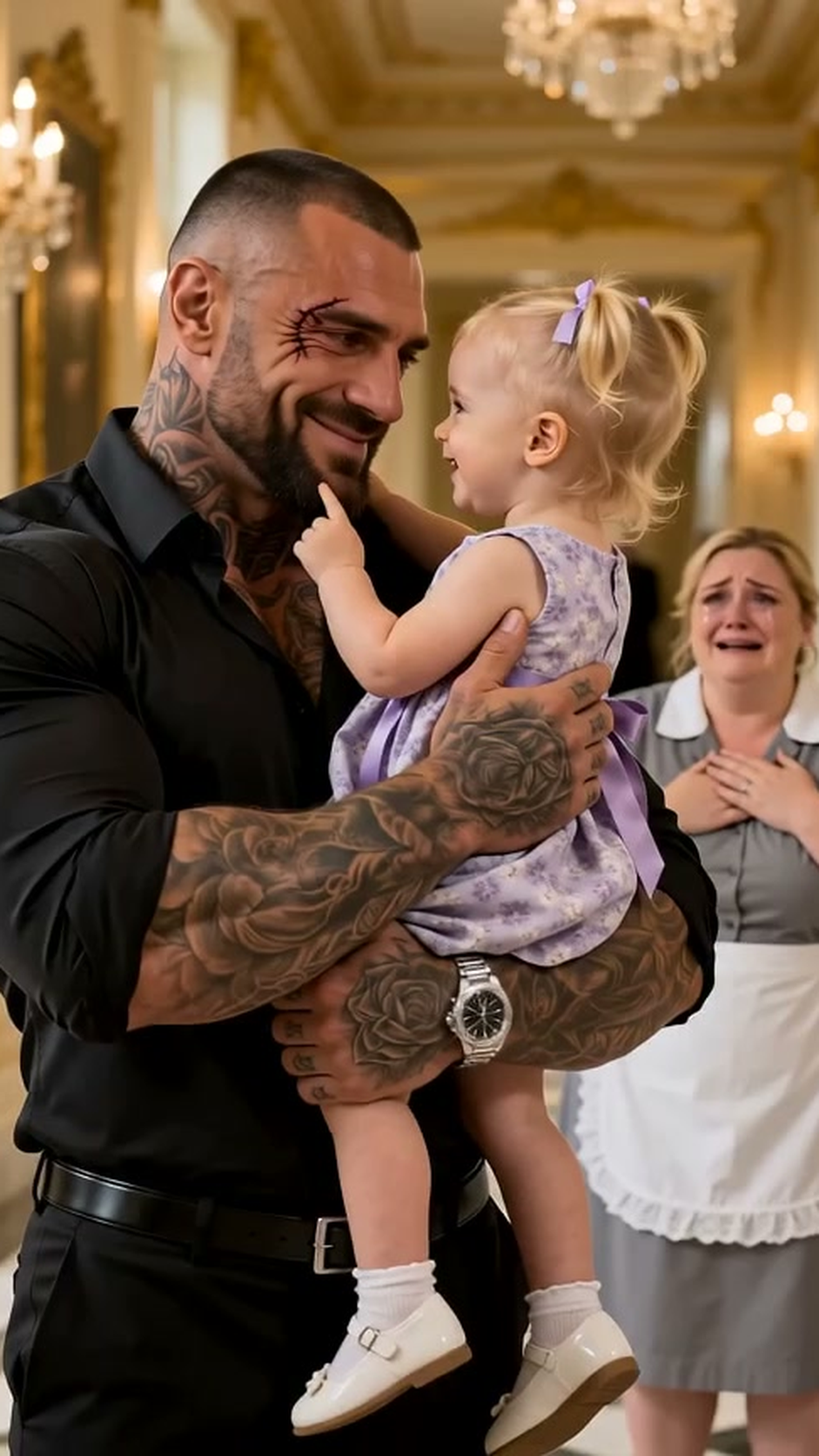
    The laugh, when it came, was worth every mile of the eighteen months before it. It startled the guards. It startled the chandeliers. It startled Dante Falcone most of all — a great, rude, wonderful laugh, Addie's words made flesh, rolling down the marble hallway like weather changing, while he gathered a giggling three-year-old into arms that could have stopped a door off its hinges and held her like she was made of spun glass and dynamite, both.

    Rosa was crying. She did not care anymore. Her hands were pressed to her heart and her daughter was laughing against the chest of the most dangerous man in three counties, and his eyes — when he found Rosa's, over Sophia's blonde head — were not a storm at all. They were a man's eyes. Wet, and warm, and asking her a question she had no name for.

    "Then don't let me walk alone," he said softly.

    And that was the moment — the exact moment, timed by a universe with a flair for cruelty — when the great doors at the end of the hallway opened, and Enzo Falcone walked in with two members of the family council at his back, and stopped dead at the sight of his cousin: the boss of the Falcone family, on his knees on the marble, laughing, with a maid's child in his arms and a hundred years of the family's iron dignity in pieces around him like confetti.

    "Dante," Enzo said at last, into a silence you could have built a church in. "Vincent Castellano's cars are at the gate. He's come for his answer." His eyes went to Sophia, and his smile arrived, thin and delighted and poisonous. "Shall I tell him you've been busy playing house?"

    Dante rose to his feet. He did not put the child down. He settled Sophia against his shoulder — where she immediately, with immense satisfaction, laid her head down like a small queen taking a throne — and he looked at his cousin the way a mountain looks at weather.

    "No," he said. "Tell him I'll give it myself."

    He carried Sophia down the hallway toward the doors, and the council, and the Castellanos, and every armed consequence of the last eighteen months — and behind him, shaking in her shoes, with her resignation letter burning a hole in her apron pocket, Rosa did the only thing left in the world to do.

    She followed her daughter.

  • Chapter 5: The Cousin’s Lies

    Chapter 5: The Cousin’s Lies

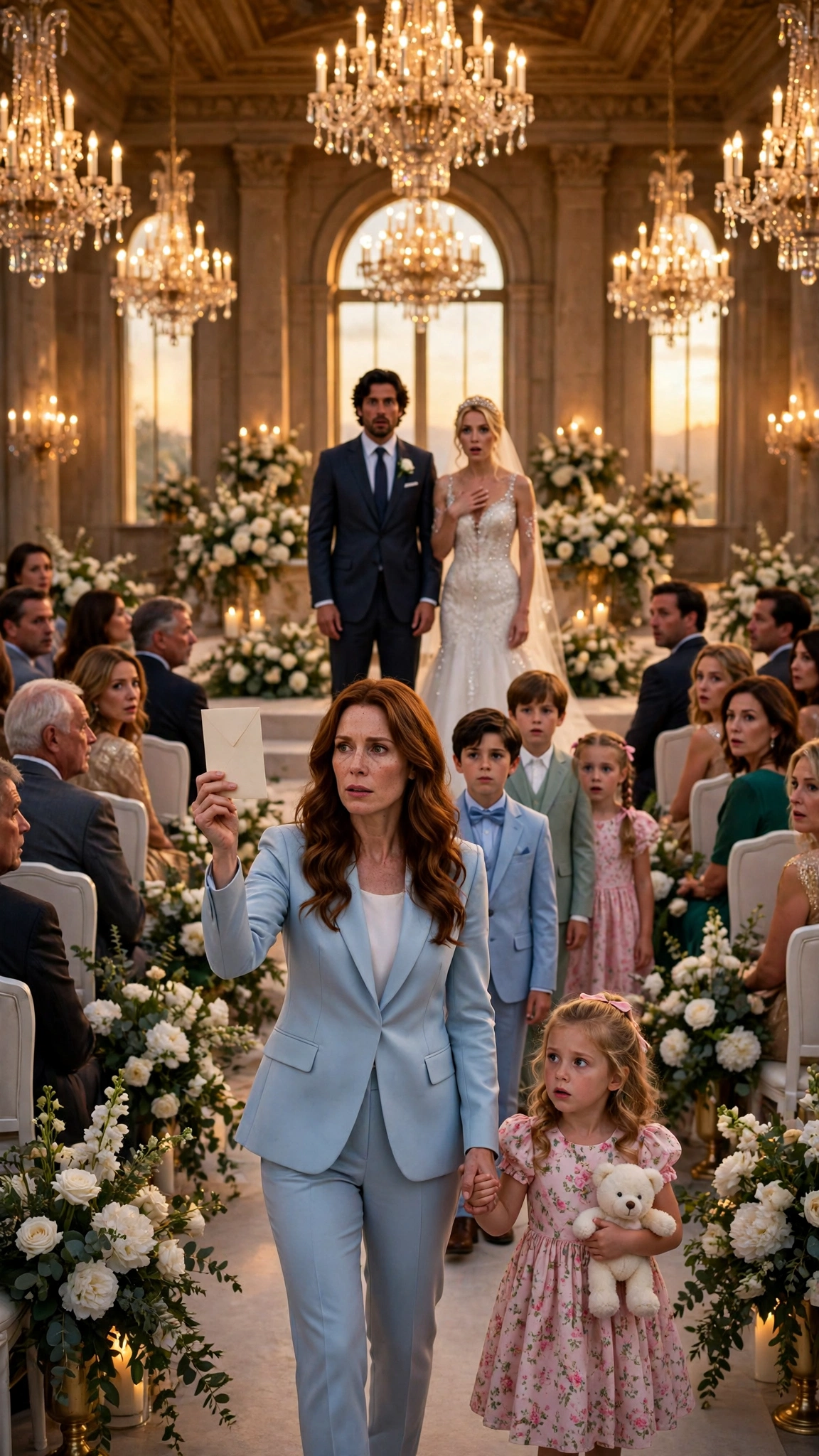
    The hall emptied slowly, the way a theater empties after a play that no one knows how to applaud. Guests filed out in murmuring clusters, glancing back over their shoulders at the woman in the light blue suit and the four small children and the old man holding a photograph. The florist began quietly removing the white roses. A waiter folded the chairs. By six o'clock, the grand hall was empty except for the people who could not leave, because the story was not finished.

    Dominic sat in the front row with his head in his hands. Evelyn sat three rows behind him, with the children around her, Layla asleep against her shoulder, Noah watching everything with his watchful eyes. Ambrose sat beside Dominic, his silver pocket watch in his hand, looking older than Evelyn had ever seen him. And Gabriel stood by the altar, alone, in his dark navy suit, his silver hair gleaming in the fading light, smiling — because Gabriel Castellano, even now, was smiling.

    "Well," Gabriel said, "that was quite a performance."

    Dominic looked up. His eyes were red. "Get out, Gabriel."

    "Dominic, listen to me." Gabriel walked toward him, his hands open, his voice smooth as oil. "That photograph proves nothing. An old man takes a picture of a woman and a young man in a hospital. It could be anyone. It could be any night. And this DNA test —" He gestured at the papers in Dominic's hand. "Who paid for it? Her. Who chose the laboratory? Her. Do you really believe a woman who lied to you for two years would not lie to you now?"

    Evelyn stood up. Layla stirred against her shoulder and woke, blinking. "Don't talk about my mother that way," Layla said, very clearly, in her small brave voice. She was four years old, and she had never spoken to a room full of adults before. But she had watched her mother walk down an aisle in front of two hundred people, and she had learned something about courage.

    Gabriel looked at the little girl, and for a fraction of a second, something flickered in his cold eyes. Then it was gone. "Children should be seen and not heard," he said.

    "Don't speak to my daughter," Evelyn said. Her voice was low and dangerous. "Don't ever speak to my children again."

    "Your children," Gabriel repeated, and he laughed — a short, ugly sound. "Your children, who are not your husband's. Your children, who you conceived with another man before you married into this family. You want me to be the villain, Evelyn. But you were the one who lied. You were the one who let Dominic believe those children were his. You were the one who took his money and his name and his love, and gave him nothing in return."

    Dominic stood up. He was a big man, tall and muscular, and when he stood, the room seemed to get smaller. "Gabriel," he said, "I want you to be very careful about what you say next."

    But Gabriel was not careful. Gabriel had spent his whole life being careful, and it had brought him to this moment — standing in an empty hall, watching everything he had built crumble — and he was done being careful.

    "You want the truth, cousin?" he said. "Here is the truth. Yes, I paid the laboratory. Yes, I had the report written. But the report was not a lie — it was a kindness. Dominic, you were married to a woman who had another man's children in her belly on your wedding day. She deceived you. She deceived all of us. I gave you the information you needed to free yourself. I gave you your life back. And this —" He pointed at Evelyn. "This is how she repays you. By coming to your wedding and making a spectacle of herself in front of the whole city."

    Ambrose rose slowly from his chair. He was an old man, and his heart was failing, and his hands shook — but his voice, when he spoke, was steady and terrible.

    "Gabriel," he said, "you paid a laboratory to write that the children were conceived during the marriage. That was a lie. You knew the dates. You knew she was pregnant before the wedding. You knew, because I told you — the night the babies were born, I told you, and you smiled and said you would take care of it. Do you remember?"

    Gabriel's face went white. "I don't know what you're talking about."

    "You do," Ambrose said. "And I have the proof. Not just the photograph. Not just the hospital record." He reached into his coat and pulled out a folded paper. "A bank record. A payment of fifty thousand dollars from your personal account to a laboratory in New Jersey, dated three weeks before you gave Dominic the report. The laboratory's owner has already spoken to my lawyer. He has confessed. He has signed a statement. It is all here."

    He held out the paper. Dominic took it with shaking hands. He read it. He read it again. And then he looked at his cousin — at the man he had trusted with his business, with his family, with his life — and he saw, at last, what Evelyn had seen all along: a man who would do anything to take what was not his.

    "Why?" Dominic asked. His voice was barely a whisper. "Why, Gabriel? I gave you everything. I made you my right hand. I trusted you with my company, with my family. Why?"

    Gabriel looked at him, and for a moment, the mask fell away entirely, and Dominic saw the truth that had been hiding behind it for thirty years: envy, pure and simple. The second son of a second branch, standing forever in the shadow of a cousin who had everything — the looks, the money, the name, the father who loved him best.

    "Because it should have been mine," Gabriel said quietly. "The company. The name. All of it. My father was the elder brother, Dominic. The company should have gone to him. It should have gone to me. But Ambrose chose you. He always chose you. And when you married her —" He looked at Evelyn. "When you married a girl with nothing, and you had four children, and the old man was ready to give them everything — I knew I had to stop it. If you had no heir, the company would come to me. If you married Vanessa, I would control the merger. It was all arranged. It was all so close."

    The silence that followed was worse than shouting. Dominic stood very still, looking at his cousin, and Evelyn saw the moment his grief turned into something harder and colder — not rage, but resolve. The resolve of a man who has finally seen clearly.

    "Get out," Dominic said. "Get out of this hall. Get out of my company. Get out of my family. If I ever see your face again, Gabriel, I will have you arrested for fraud. Do you understand me?"

    Gabriel looked at him for a long moment. Then he straightened his tie, smoothed his silver hair, and walked toward the doors. At the threshold, he stopped and turned back.

    "You'll regret this, Dominic," he said. "She'll leave you again. Women like her always do."

    "No," Dominic said. "She won't. Because I'm not going to give her a reason to."

    Gabriel left. The doors closed behind him with a sound like a book slamming shut.

    For a long moment, no one spoke. The hall was empty now except for the four of them and the children, and the fading light fell across the red rose petals in long golden bars.

    "She was used too," Dominic said at last, looking toward the doors where Vanessa had gone. "Gabriel used her the way he used all of us. Her father's company, her future — he spent them the way he spent everything that wasn't his."

    "She knew," Evelyn said quietly. "And knowing and doing nothing is its own kind of guilt. But she told the truth in the end, Dominic. When it mattered. When it cost her the most. That counts for something."

    Ambrose nodded slowly, his silver pocket watch in his hand. "It counts for a great deal," he said. "Most people, given the choice between a comfortable lie and a costly truth, choose the lie. Your Vanessa chose the truth. Remember that about her, son. Whatever else you remember about today, remember that."

    Dominic looked at his father, and then at Evelyn, and he nodded. "I will," he said.

    Then he turned to Evelyn, and to the four small children, and to his father, and he said the words he should have said four years ago.

    "Will you come home?" he asked. "All of you. Just for tonight. Just to talk. Please."

    Evelyn looked at him for a long time. She looked at the man who had thrown her out in the rain. She looked at the man who had believed a liar and broken her heart. And she looked at her children — at Layla, who was watching her with enormous eyes, waiting to see what her mother would do.

    "No," Evelyn said gently. "Not tonight. Tonight, we go home to Queens. But tomorrow — tomorrow, you can come to us. You can come to our apartment, and you can sit on our floor, and you can build towers out of wooden blocks with four children who barely remember you. And we will see. We will see what can be built from the truth."

    Dominic nodded. He understood. Forgiveness, like a house, had to be built one brick at a time.

    "Tomorrow," he agreed.

    And as they walked out of the hall together — Evelyn and her children, Ambrose leaning on his cane, Dominic following a few steps behind like a man who had lost everything and found it again — the last golden light of the afternoon fell through the tall windows and across the red rose petals, and for the first time in five years, Evelyn Hart felt something she had almost forgotten how to feel.

    Hope.

    That night, in the small apartment above the bakery, Evelyn sat on the mattress with her four children and told them a story — not the story about the princess and the tower, but a true story, about a mother who had walked into a great hall full of strangers and told the truth, and about a grandfather who had stood up and held a photograph in the air, and about how being brave did not mean not being afraid. It meant being afraid and doing it anyway. Layla listened with her eyes wide, and Noah nodded solemnly, and Mia fell asleep halfway through with her thumb in her mouth, and Leo asked, "Will the bad man come back?" And Evelyn said, "No, baby. The bad man is gone. And even if he came back, your mother would be here. And your father. And your grandfather. And Dominic. You have so many people now. You are safe."

    Across the city, in the great silent house in the Hudson Valley, Dominic sat in his study until midnight, making telephone calls. He called his lawyer and told him to freeze Gabriel's access to every company account, effective immediately. He called the head of security and told him that Gabriel Castellano was no longer permitted on any company property. He called the laboratory in New Jersey, and the owner — a frightened man with a family of his own — told him everything, and agreed to sign a statement, and to testify if it came to that. Dominic wrote it all down, carefully, in his own hand, the way his father had taught him: dates, amounts, names. Evidence. Not revenge — evidence. There was a difference, and he intended to honor it.

    The next morning, a letter arrived at Evelyn's gallery, delivered by hand. It was from Vanessa Laurent. It was short, and it was kind. "Dear Mrs. Hart," it read, "I wanted you to know that I have told my father everything. He has ended all business with Gabriel Castellano. I am leaving for Florence next week, to study art, which is what I always wanted to do before my father decided I should marry. I wish you and your children every happiness. You were the bravest woman I have ever seen. With admiration, Vanessa."

    Evelyn read the letter twice, and then she folded it and put it in the drawer with Ambrose's photograph and the DNA report — the drawer where she kept the things that mattered. Then she went back to work, and the day was ordinary, and the children were ordinary, and the bread smelled like bread at five in the morning, and for the first time in five years, ordinary felt like enough.

  • Chapter 4: Eighteen Months

    Chapter 4: Eighteen Months

    Here is what the house knew about Isabella Falcone, and said only in the kitchen, in pieces, the way people handle broken glass.

    She had been a pediatric nurse who became a hospital board director, which meant she had spent her life being the calmest person in rooms full of frightened people. She had met Dante at a fundraiser she was running and he was enduring, and she had looked at the most dangerous young man in the Falcone family — the tattoos, the reputation, the silence like a locked door — and said, in front of forty donors: "You have the face of a man who hasn't been fed. Sit down." He sat down. He had been sitting down, in one way or another, ever since.

    The night they met, he had been standing at the back of her fundraiser with a glass of wine he hadn't touched, radiating the particular menace of a man being auctioned at for charity, and Isabella — who had run the hospital's pediatric wing through two flu seasons and one flood — had crossed the room with a plate of food and no fear whatsoever. She told the story against herself for years afterward: "He looked like a bear at a wedding. All shoulders and grievance. So I fed him. It is my professional opinion that ninety percent of dangerous men are simply hungry and have been lied to about it by other men."

    He courted her with a formality that made the family's old guard weep into their grappa — flowers with the stems cut the way she liked, a driver dismissed for driving her too fast, church on Sundays because her mother would hear of nothing else. At the wedding, in a chapel in the village his grandfather had built, Enzo — nineteen then, and genuinely happy — had been the one to make the toast: "To Isabella, who looked at the scariest man in three counties and saw a seating problem." The coffee ritual began on their honeymoon and never missed a day of their marriage: four o'clock, the sitting room, her account of the hospital, his account of nothing at all — he had never once brought the business to that table, and she had never once asked him to leave it outside; it simply had never occurred to either of them that the door could be used any other way.

    She was the only living person who could make him laugh. She called him her bear. She insisted on the white flowers and the music and the sitting room full of books and afternoon coffee, and when the family business put blood on the floor of his world — and it did, twice in their marriage, despite everything — she never once flinched from him. She washed his hands in the kitchen sink herself, in silence, and then she made him eat something, and then she made him tell her, and he did. Every time. She was the one room in Dante Falcone's life with the door open.

    The headache started at lunch on a Thursday. She told Marco it was nothing. She told the board meeting it was nothing. At three o'clock she called her husband in Chicago, between his meetings, and the call lasted four minutes, and she laughed twice in it — Marco heard the second laugh through the doorway and remembered it, later, the way you remember the last time you saw the sun before an eclipse.

    Dante's last words to her, on that call, were: "Bella. The Meridian contracts. I'll call you tonight."

    He never got to call her that night. At four-forty, in the kitchen of the house she had filled with music, Isabella Falcone put one hand to the counter, said "Oh—" to no one, and was gone before she reached the floor. A blood vessel in her brain, a flaw written into her before she was born, a debt collected without warning. Thirty-four years old. The doctors would use the word instant. They would use the word painless. Dante, who arrived seven hours later through the worst storm of that winter, who had shouted at pilots and offered a fortune to any man who could fly faster, would spend eighteen months discovering that instant and painless were words for other people's comfort. He had not been there. He had been talking about docks.

    He buried her on a Monday. On the Tuesday, at four o'clock — the hour she had always come home, the hour they had always met at the sitting-room door for coffee while she told him about the hospital and he pretended the rest of the world didn't exist — Dante Falcone walked the length of the marble hallway to the sitting-room door.

    He stopped. He stood there for eleven minutes; Marco counted, and then never counted again. Then he walked back.

    He has done it every day since. Through flu, through a winter storm that took the power out for two days, through a summit of the five families in a snowbound hotel in the mountains — where he left the table at three-forty-five without a word of explanation, walked the hotel's marble lobby end to end at four o'clock, and returned to his seat among men who decided, privately and forever, that the Falcone boss was either insane or holy. The staff learned not to speak of it. The family learned not to joke about it. Enzo, alone, learned to use it.

    "Grief has made him useless," Enzo told the family council that spring, in a restaurant private room, with his uncle Salvatore's tired eyes on him from the head of the table. "A boss who walks in circles for a dead woman while Castellano counts our harbors. I love my cousin. That is exactly why I'm saying it. Sunday, he gives Vincent an answer. If the answer is no — or worse, if the answer is nothing — then this family needs to talk about what comes next. About who comes next."

    Salvatore had let the silence sit until it hurt, and then the old man had spoken with the terrible mildness of his generation of the family. "When my brother — your grandfather, Dante's grandfather — buried his wife in 1962, he did not speak for a year. Not a word. He ran three counties by pointing, and the pointing was obeyed, because the families understood a thing your generation has forgotten: a man's grief is not a vacancy in him. It is a room with the door shut, and the wise do not bang on it. The Castellanos are not at our gates because Dante mourns his wife, boy. They are at our gates because they have been told — by someone — that mourning is the same as weakness." The old eyes had moved, slowly, to Enzo's face, and stayed there. "When I find out who told them, I will be very interested in his reasons. Sunday, nephew. Let us see what Sunday shows us."

    In the house, in those same days, something small and strange had begun to happen, the way spring begins: not with flowers, but with one green decision underground.

    Dante started eating breakfast.

    Not in the dining room — in the kitchen, twice in one week, standing at the counter where the staff ate, with a plate Marco silently set in front of him, saying nothing, listening to the radio Addie played and the ordinary clatter of a working house, while the maids died quietly of shock in the pantry doorway. He asked the gardener about his wife's surgery, by name, and the gardener nearly dropped the shears, because the boss had not asked any of them anything in eighteen months, and the answer — she is well, Mr. Falcone, thank you — seemed to land on him like a gift he had forgotten people were allowed to give.

    And once, at four o'clock — Rosa heard about this from Marco, in the garden, in the low voice of a man reporting a change in the weather — his walk stopped, as always, at the sitting-room door. But this time, Marco said, the boss's hand had risen. Had hovered, an inch from the handle. For a long moment. And then had fallen back, and clasped itself behind his back, and the walk had resumed.

    And on the Thursday of that week, Sophia's treasures escalated. Rosa, dusting the grand hallway in the safe hours of the morning, found it at the base of Isabella's portrait, placed with the ceremonial precision of a votive offering: one smooth white stone, still faintly warm from a small fist, and beside it — weighted under the stone like a treaty — a fresh crayon drawing, this one of the portrait lady herself, dark scribble hair, enormous smile, holding the hand of a tall black stick man on one side and a small purple girl on the other. Everyone, in Sophia's theology, holding hands. Everyone, at last, in the same picture.

    Rosa's hands shook gathering them up. She should have taken both away. She knew she should have taken both away. Instead — God forgive her, she told Danny's photograph that night — she left the stone exactly where it was, and hid only the drawing in her apron, and did not examine her reasons too closely.

    The stone was gone by Friday. Not swept away — Marco had asked the morning staff, with terrible casualness, and no one had touched the hallway before four. Gone the way things vanish in that house: upward. Somewhere in the boss's black trousers, in a pocket over a fortune in dangerous knowledge, rode one smooth white stone, carried four o'clock after four o'clock, past the portrait and back, like a pilgrim's pebble. Rosa only ever learned this much later. At the time, all she knew was that the stone had been taken, and that whatever had taken it had not thrown it away.

    On Friday night, Enzo came to the house when he knew Dante was out. He found Rosa — he arranged to find her, the way a cat arranges to find a mouse — in the laundry corridor, with a basket of the boss's shirts against her hip.

    "A word, Mrs. Bennett." He smiled like a man who had practiced on mirrors. "You've settled in. The child too, I hear. Sweet thing. Addie speaks well of you." He let the kindness hang for exactly one beat, then took it apart, piece by piece. "Sunday, my cousin answers the Castellanos. If he answers the way a boss answers — the way this family needs — then there will be changes after. A new wife. A new household. New staff, chosen by the bride. People with… distractions… will be wished well and let go. If he answers like a widower—" Enzo shrugged, pleasantly, "—then there will be different changes, and the people who stood too close to his grief will be remembered as part of the problem. Either way, Mrs. Bennett, women in your position do well to have a bag packed and a sister somewhere. You understand me."

    Rosa understood him perfectly. She had heard that exact music before, in landlords' offices and hospital billing departments: the sound of a door being held politely open onto the street.

    "I understand you, Mr. Falcone," she said. "Will that be all?"

    "That's all." He was already turning away, bored. "Give my love to the little artist."

    That night, after Sophia was asleep, Rosa got down the small suitcase from the top of the wardrobe. She packed it the way she had packed it for the hospital twice, for evictions once, for Danny's funeral home viewing with a change of clothes for the baby: efficiently, without tears, in the dark. Two dresses. Sophia's good shoes. The photographs. The forty-dollar envelope money, in the lining, where it always lived.

    She set the suitcase under her bed, where small hands could not find it, and she sat on the floor beside her sleeping daughter's crib, and she did the arithmetic of her whole life once more, the way she did every time the ground moved: one woman, one child, one suitcase, no one coming.

    "Whatever happens, baby," she whispered, "Mommy walks with you. Okay? You will never walk alone."

    Sophia slept on, fists up beside her ears like a tiny boxer, undefeated.

    Two floors above them, in a study lit by one lamp, Dante Falcone sat alone at two in the morning with his sleeves rolled to the elbow and the tattoos like dark water on his forearms — and in front of him, smoothed flat under his hand for perhaps the hundredth time, was a crayon drawing of a very large smiling man, holding the hand of a very small smiling girl.

    He was trying, with the whole ruined machinery of his heart, to remember how the man in the drawing had ever been him.

  • Chapter 4: Four Children in the Aisle

    Chapter 4: Four Children in the Aisle

    The organ stopped.

    Evelyn had expected the music to stop. She had not expected the silence that followed — a silence so complete that she could hear her own breathing, and the small white sandals of her daughter on the marble, and the rustle of two hundred guests turning in their seats to stare at her. The hall was vast, with high ceilings and crystal chandeliers that threw prisms of light across the white chairs, and the warm golden light from the tall windows fell on the red rose petals scattered down the aisle, and for a moment, Evelyn could not move. She stood in the center of the hall with her hand wrapped around Layla's fingers, and she felt the weight of every eye in the room, and she thought: this is the hardest thing I will ever do.

    Dominic stood at the altar with the envelope in his hand, the DNA report open, his face white. He looked at the children. He looked at Evelyn. And then, slowly, he turned to the bride.

    "Vanessa," he said. "Vanessa, why are you afraid? What haven't you told me?"

    Vanessa Laurent looked at him, and her blue eyes were wide with something that was not surprise. It was fear — the fear of a woman who has been found out. Her bouquet shook in her hands. Another white rose fell to the marble.

    "Dominic," she whispered. "Please. Not here. Not like this."

    "What haven't you told me?" Dominic said. He took a step toward the altar, the envelope still in his hand. "Vanessa. Look at me. What haven't you told me?"

    She looked at him. And then she looked at Evelyn, standing in the aisle with her four children, and something in her face broke — not into tears, but into a terrible, exhausted honesty.

    "I knew," she said. Her voice was so quiet that the guests in the front row leaned forward to hear it. "I knew the report was forged. Gabriel told me — the week before the wedding, he told me, because he needed my father's signature on the merger papers, and he thought that if I knew what was at stake, I would keep quiet. He said you had been pregnant before the wedding, Evelyn. He said the dates were real and the report was a lie, and that if anyone found out, the merger would fall apart and my father's company would be ruined. And I said nothing. I stood here, in this dress, and I said nothing, because I was afraid of my father, and I was afraid of Gabriel, and I was afraid of losing everything. I'm sorry, Dominic. I'm sorry, Evelyn. I was a coward."

    The silence that followed was worse than shouting. Two hundred guests sat frozen, and the only sound in the hall was the soft tick of the great clock above the doors.

    Gabriel stepped forward. He had been standing near the altar, watching, his face a mask of charm — but now the mask was cracking. His eyes showed panic. He moved toward Dominic, his hand outstretched, as if to take the papers away.

    "Dominic," he said urgently, "don't listen to her. She's lying to save herself. She's trying to humiliate you, in front of everyone, on your wedding day. Those results are fake. She paid for them. She—"

    "Stop." Dominic's voice was quiet, but it cut through the hall like a knife. He looked at his cousin, and for the first time in his life, he saw the panic in Gabriel's eyes, and he understood what it meant. A man who has nothing to hide does not panic. "Gabriel," he said slowly, "you told her. You told her the report was forged. You knew the dates were real, and you told her to keep quiet. Was that true?"

    Gabriel's mouth opened. He looked at the guests. He looked at Vanessa. He looked at Evelyn, standing in the center aisle with her four children, holding his future in her small black handbag. "Dominic," he said, his voice sharp and desperate, "no more secrets. Not today. Please. We can talk about this in private—"

    "No," Dominic said. "No more secrets. Not today. Not ever again." He turned to the room. "My cousin gave me a report five years ago that destroyed my marriage. This woman" — he looked at Evelyn — "says the report was a lie. And now my bride tells me my cousin knew it was a lie. I want to know the truth. Right now. In front of everyone."

    And then, from the front row, a chair scraped back, and an old man stood up.

    Ambrose Castellano rose slowly, with the careful dignity of a man whose heart was failing and who had decided that he would not die a coward. He was sixty-five years old, white-haired, with deep wrinkles and piercing dark eyes, and he wore an elegant black suit with a subtle navy tie. In one hand he held his silver pocket watch. In the other, he held an old photograph.

    The hall went silent. Even the chandeliers seemed to hold their light.

    "Dominic," Ambrose said, and his voice carried to the back of the hall, "sit down. I have something to show you."

    Dominic sat. He did not know why. He only knew that his father had never spoken to him in that voice before.

    Ambrose walked to the center of the aisle, slowly, his shoes loud on the marble. He stopped beside Evelyn. He looked at her, and his eyes were full of sorrow and love. "Forgive me," he said softly. "I should have done this four years ago."

    Then he turned to the room, and he held up the photograph.

    It showed a young Evelyn in a hospital bed, pale and exhausted and radiant, holding two newborn babies wrapped in white blankets. Beside her stood a young man with short black hair and warm brown eyes — Lucas Papadopoulos — holding the other two babies in his arms, looking down at them with wonder. On the back of the photograph, in Ambrose's careful handwriting, was a date. The date the quadruplets were born. And the date, Ambrose explained, that proved everything.

    "This photograph was taken the night the children were born," Ambrose said. "I was there. I took it myself. This young man is Lucas Papadopoulos. He is the children's father. He flew home that night from Milan to see his children, and Evelyn sent him away because she was afraid. She was afraid of losing her marriage, and she was afraid of losing her children, and she was right to be afraid — because the man who should have protected her chose to believe a lie instead."

    He turned to Gabriel. "And the lie came from you, nephew. You forged the report. You paid the laboratory. I have the bank record. I have kept it for a year, waiting for the day I would have the courage to use it. That day is today."

    Gabriel's face went white. He took a step backward. His mouth moved, but no words came out. Around him, two hundred guests stared, and the silence was so deep that Evelyn could hear her own heartbeat.

    Dominic looked at the photograph. He looked at the young man in it — the man with the warm brown eyes, holding two babies — and then he looked at Layla, standing beside her mother in her pink floral dress, with her large fawn eyes and her dimples and her long light-brown wavy hair. He had always thought she looked like Evelyn. Now he saw it. She looked like Lucas. She had always looked like Lucas. He had simply never allowed himself to see it.

    His eyes filled with tears. His hands, still holding the DNA report, began to shake. And the devastating truth settled over him like a weight he would carry for the rest of his life: he had thrown away the woman he loved, and four children he had loved as his own, because he had believed a liar. The children were never his by blood. But they had been his in every way that mattered — and he had given them up for a piece of paper.

    He looked at Evelyn. "I'm sorry," he whispered. "God forgive me, Evelyn. I'm sorry."

    Evelyn looked back at him, and her face was calm, and her eyes were dry, because she had cried all her tears years ago, in a room above a bakery, and there were none left. "I know," she said. "I know you are."

    Behind them, Vanessa Laurent set down her bouquet, very gently, on the altar. She looked at Dominic, and at Evelyn, and at the four small children, and she did the bravest thing she had ever done in her life.

    She walked out of the hall — not in anger, not in tears, but with her head held high, because she had just watched a family break apart and come back together in front of her, and she understood that her place was not in it.

    The wedding was over. It had never really begun.

    Before Vanessa left, Dominic stopped her at the doors. The hall was nearly empty by then, the florist already gathering the white roses, the waiters folding the chairs. She stood with her bouquet forgotten on the altar behind her, her veil pushed back, her face pale but composed.

    "Vanessa," Dominic said, and his voice was gentle now — the gentleness of a man who has just learned how much damage silence can do. "Thank you. For telling the truth, even when it cost you everything. I know what it took."

    She looked at him, and for a moment her composure slipped, and she was simply a young woman of twenty-eight who had almost married a stranger for her father's sake. "I should have told you the day Gabriel told me," she said. "I will carry that for a long time."

    "Then carry it forward, not backward," Dominic said. "Go to Florence. Study art. Live the life you wanted before your father decided it for you. And if you ever need anything — a reference, a friend, a door opened — you have it. From me. From all of us."

    Vanessa's eyes filled. She nodded, and she turned to Evelyn. "You were the bravest woman I have ever seen," she said quietly. "I hope your children grow up knowing that."

    Evelyn took her hand and squeezed it once. "They will," she said. "And I hope you grow up knowing it too."

    Vanessa walked out into the golden evening light, and for the first time that day, she was smiling.

    Evelyn watched her go, and she thought about how easily it could have been her — how easily a frightened young woman could become a silent one, and how the silence could rot a whole family from the inside. She squeezed Layla's hand a little tighter, and she was glad — fiercely, suddenly glad — that she had chosen, at last, to speak.

    But the story — the real story — was only just starting.

    Outside, on the steps of the hall, the guests lingered in the golden evening light, and the talk was of nothing else. A woman from the fifth row told her husband that she had always known there was something wrong about Gabriel, that she had seen the way he watched Dominic, the way he smiled when other people were unhappy. A man who had done business with the Castellanos for twenty years shook his head and said that he had never trusted a forged paper in his life, and that Dominic should have known better. And an old friend of Ambrose's, a judge retired now, said quietly that he had seen many families break apart in his courtroom, and very few put themselves back together — but that the woman in the light blue suit had the look of someone who would.

    Evelyn gathered her children on the steps, counting them the way she always did — one, two, three, four — and she straightened Layla's dress, and wiped a smudge of dust from Leo's cheek, and she did not cry. She had cried enough. She took their small hands in hers, and she looked back at the hall one last time, at the tall windows and the white chairs and the arch of flowers that had been built for a wedding that would never happen, and she thought: I came here to tell the truth. I told it. Whatever happens next, I told it.

    Behind her, in the doorway, Dominic stood watching her go, and Ambrose laid a hand on his son's shoulder, and neither of them spoke. There was nothing left to say that evening. The truth had been spoken. Now it had to be lived.

  • Chapter 3: The Dinner

    Chapter 3: The Dinner

    The Castellanos came to dinner on a Thursday, and the house prepared for them the way coastal towns prepare for weather.

    Extra men appeared on the roof and at the gates, quiet as furniture. Marco walked the perimeter twice with his jacket open. Addie produced a menu of eleven courses and an expression of cheerful contempt for every one of them. And Rosa — because the agency girl who was supposed to serve had called in sick with a voice too frightened to be lying — Rosa was pressed into a black serving dress, given a tray, and instructed by Addie in the tone of a general dressing a soldier: "You are a ghost, Rosa. You pour, you clear, you vanish. Whatever they say, you are a ghost."

    Vincent Castellano was sixty, silver, and smiling, with the manicured ease of a man who has buried three rivals and sent flowers to all the funerals. His sister Carla was twenty-six, beautiful in the way of women who have never once been told no by anyone whose opinion survived the telling. She wore red. She looked around the Falcone dining room — at the candles, the silver, the ancestral portraits — with the bright, appraising eye of a woman measuring a room she fully expected to redecorate.

    Dante sat at the head of the table like a storm that had decided to sit down. Black shirt. Hands still. He had not spoken six sentences all evening.

    They arrived at dusk in three black cars that moved up the drive like a slow tide. Marco took their coats — and, by the old courtesy, their sidearms — in the front hall, with the ease of a man disarming weather. Carla entered the dining room the way she entered every room, a half-step ahead of her brother, trailing perfume and appraisal, and her eyes made one complete circuit of the Falcone table: the candles, the silver, the ancestors in oils along the wall — and stopped, for a fraction of a second, on the photograph of Isabella on the sideboard. Something in her face filed it away.

    Dante received them standing. There were handshakes like treaties. Wine was poured by Rosa's shaking predecessor-in-terror — no, by Rosa herself, ghosting along the table's long edge with the bottle wrapped in linen, close enough to hear every word and be seen by no one, which was the whole geometry of her profession.

    "The families have been friends too long to be strangers," Vincent was saying, turning his wine glass slowly. "The Meridian docks. The Castellano routes south. Separately, we are—" he smiled, "—targets. Together, we are a wall. My sister understands the life. She was raised in it, as you were. A marriage, Dante. A wall with a wedding at the top of it. The whole coast settles."

    Carla laughed prettily and looked at Dante the way a cat looks at a door it intends to go through.

    Dante said, "I will consider it."

    "You've been considering things for eighteen months," Carla said, sweet as poisoned honey. "My brother is patient. I am ornamental about it." Her eyes slid, deliberately, to the framed photograph that stood — as it always stood — on the sideboard: Isabella, laughing in a summer garden. "Though I must say, darling, when I marry into a house, I do expect to be the only wife in it. Even the decorative ones get moved to the attic eventually. It's simply tidier."

    The room temperature dropped ten degrees.

    Rosa, refilling water glasses at the sideboard with her back to the table, felt Addie's invisible hand close around her elbow like a warning: ghost. Be a ghost.

    It was Carla herself who made that impossible.

    Twice in the hour before, she had tested the room's edges the way a cat tests a shelf. First, the toast: "To the Falcone house," she'd said, raising her glass toward the sideboard photograph with a smile of catastrophic sweetness, "and to its… enduring arrangements." Dante had drunk without expression, but Vincent's eyes had flicked to his sister with a warning she declined to collect. Then, when the fish course came, she had leaned toward Dante with her chin in her hand and asked, brightly, in the tone of a woman discussing a restaurant's décor, whether he ever thought of taking the photograph down — "Only, darling, a man can't very well ask a woman to walk into a room that's already occupied. Even by a ghost. Especially by a ghost."

    "I don't ask women into that room, Miss Castellano," Dante had said, not looking up from his plate. "You're the first person to mention it as a vacancy."

    Vincent, smoothly, had moved the evening onto business — the way a good driver steers around a wreck — and Rosa, gliding with the sauce boat, had listened to the two dons fence across the candles with numbers for rapiers. The Meridian docks. Throughput figures from five years back, quoted from memory by Dante without a flicker, correct to the ton. The insurance on the Castellano southern routes, which Dante knew, and knew that Vincent knew he knew. A strike at the freight yards in '19 and which of them had settled it and what it had cost — Dante again, quietly, precisely, the way a surgeon recites a chart. It dawned on Rosa, somewhere between the veal and the sorbet, that the performance at that table was the exact opposite of the story Enzo had been telling the coast. The man at the head of the table was not a ghost and had never been one. He was an engine that had been idling at full power for eighteen months with the brake on — and the precision of him, the command of him, was somehow more frightening than any shouting would have been. Vincent had heard it too. She could see the old don recalculating behind his smile, the way a chess player re-reads a board he thought he'd finished reading.

    It was, Rosa would think later, Carla's true provocation — not cruelty but arithmetic. She had watched her prospective husband be measured at his own table and measured well, had felt the value of the evening rising for her brother and falling for her pride, and had reached, the way proud people do, for the cheapest available weapon: the servant, the spill, the scene. Pity about the arithmetic of her target. She had chosen the one person at that table Dante Falcone had already, silently, begun to count as his.

    Addie, passing behind Rosa's station with a sauce boat, had breathed, in the voice of a woman watching a lit fuse with professional interest: "Ghost, Rosa. Whatever happens next — ghost."

    What happened next was a glass, lifted without looking.

    She lifted her glass without looking, expecting service the way she expected oxygen, and Rosa — who had been a ghost, who was being a ghost, whose hands were steady and whose mind was entirely on vanishing — felt the tray's edge catch on nothing, on air, on fate, and the bottle swung two inches too far, and a ribbon of red wine jumped the rim of the glass and landed across Carla Castellano's red silk sleeve.

    Not a flood. A ribbon. A stripe the width of two fingers.

    Carla stood up so fast her chair screamed on the parquet.

    "Are you blind?" she said, in the voice of a woman addressing insects. "Are you actually blind, or just—" her eyes swept Rosa, and found the shape of her, and chose cruelty with the precision of long practice, "—slow? They let anything serve at this table now. Look at you. Shaking like a pudding. This dress costs more than you'll earn in your entire—"

    "Carla."

    One word. Dante had not raised his voice. He had not stood. He had barely, by any visible measure, moved at all. But the word arrived in the room like a hand closing around a throat, and Carla Castellano stopped in the middle of her sentence with her mouth open, and Vincent Castellano went very still, and every guard along the wall suddenly found the fascinating middle distance extremely interesting.

    "In my house," Dante said, quietly, "we do not speak to the staff that way."

    A pause.

    "In my house, if a glass is spilled, we say: another glass. Because the wine is mine, and the staff are mine, and the only thing at this table that is not mine—" his eyes lifted to Carla, dark and level and absolutely without heat, which was so much worse than heat, "—is you."

    Silence. Vincent's smile had gone somewhere to die quietly. Carla sat down with the mechanical care of a woman discovering the floor of the world had dropped away beneath her chair.

    "Dante," Vincent said at last, with the lightness of a man stepping out of a minefield. "Of course. Forgive my sister. Grief makes a house protective of its own. We understand. The offer stands — the wall, the wedding. But friendship has a season, my friend, and I am a farmer about such things." His eyes were warm and his voice was warm and the words were not warm at all. "Give me your answer by Sunday. After Sunday, I will have to assume the answer, and I will have to plan accordingly."

    He rose, and kissed the air beside Addie's cheek, and swept his sister out into the night in a perfume of red silk and humiliation.

    In the kitchen, afterward, Rosa leaned against the cold steel of the counter with the tray still in her hands and shook, in the whole-body way you can only shake when the danger has passed and your body finally gets the news. She had not cried. She would not cry. She had been humiliated in kitchens before, by smaller people than Carla Castellano, for smaller stakes than these.

    She set the tray down at last, very carefully, the way you set down something that might still explode. Around her the kitchen went on being a kitchen: Addie directing the wash-up in a voice like a metronome, the copper pans ticking as they cooled, somebody's radio murmuring behind the pantry door. Ordinary sounds. Rosa held on to them the way a swimmer holds a rope, and made her hands be still.

    She did not hear him come in. Nobody ever heard Dante Falcone come in.

    "Rosa."

    She spun. He stood in the kitchen doorway — the boss, in the kitchen, a place the entire staff would have sworn under oath he had not entered in eighteen months — filling it, watching her with those tired, terrible eyes.

    "Sir. I'm— the dress, I'll pay for— I don't know how, but I'll—"

    "Stop." He said it gently. That was the worst of it; gently. "Was any of it spilled on you?"

    "I— what? No. No, sir."

    "Good." He looked at her for another moment, and something moved in his face that she could not read, something like a man looking at a language he used to speak. "You didn't flinch," he said. "She was shouting, and you didn't flinch. You stood there and took it like a soldier."

    "She was right about one thing," Rosa said, before she could stop herself — exhaustion and shock picking the lock of her prudence. "I was shaking. Ghosts shouldn't shake, sir."

    And Dante Falcone — God help her, in his own kitchen, at midnight, with his family's future scheduled to expire on Sunday — almost smiled. Not the laugh that was coming weeks later in the hallway. A ghost of it. A rumor of it.

    "Then we're both out of practice," he said. "Go to bed, Rosa."

    She went. She lay awake until two, staring at the ceiling of the little room, listening to her daughter breathe, and she understood with creeping horror that the rules of the house had changed under her feet: the loaded gun of Addie's warning had turned, in a kitchen at midnight, and she had seen the man's face behind it.

    Four days remained until Sunday.

    What she could not know — what nobody in that house knew, except Enzo Falcone, driving home through the dark with one hand loose on the wheel — was that Carla Castellano had spent the ride home crying with rage, and Vincent had spent it in silence, and Enzo's phone was already lit with a message, sent from the Castellano car, that read:

    Sunday is too long. If he insults us again, we move first.

  • Chapter 3: The Truth in an Envelope

    Chapter 3: The Truth in an Envelope

    The laboratory was on the third floor of a plain brick building in Brooklyn, above a laundromat, with a sign so small that Evelyn walked past it twice before she found the door. Inside, it smelled of disinfectant and coffee. A woman with tired eyes and a kind face took the swabs from the four children — a quick, painless brush inside each small cheek — and from Lucas, who sat very still and held Layla's hand while the nurse worked.

    "How long?" Evelyn asked.

    "Two weeks," the nurse said. "Maybe three. And Mrs. Hart —" She paused. "Whoever you use, make sure it's a lab that will stand behind its results in court. There are labs in this city that will write anything for the right price."

    Evelyn thought of Gabriel's envelope, with its stamps and signatures and official-looking numbers. "I know," she said.

    She paid with money she had saved for six months — money that should have gone to new shoes for the children, to winter coats, to the dentist. Lucas tried to pay. She refused. This was hers to do. She had waited five years to buy the truth, and she would pay for it herself.

    The two weeks stretched into three. Evelyn went to work. She came home. She cooked and cleaned and read four children to sleep, and every morning she checked the mailbox, and every morning there was nothing. Lucas came every evening, and they sat at the kitchen table after the children were asleep, and they did not talk about the test, because talking about it made the waiting worse.

    On the twenty-third day, the envelope came. It was cream-colored, thick, sealed with wax. Evelyn sat at the kitchen table with Lucas across from her, and her hands shook so badly that he had to open it for her.

    She read it once. She read it twice. Then she put her face in her hands and cried — not with grief, but with relief so enormous that it felt like grief, because for five years she had carried a question she had been too afraid to ask, and now she had the answer, printed in black and white, signed by three doctors and a judge's clerk.

    The children were Lucas Papadopoulos's. The probability was 99.99 percent. And attached to the report, on a separate page, was a medical statement: based on the children's date of birth, conception had occurred in the first week of June — five years ago. Before her wedding. Before she had ever met Dominic Castellano.

    "You're free," Lucas said quietly. "Evelyn, you're free. This proves you never cheated on him. This proves the other report was a lie."

    She looked at him across the table, and for the first time in five years, she let herself feel the full weight of what had been done to her. Not just the lie. Not just the divorce. The years. The nights cleaning offices. The babies crying in a room above a bakery. The little girl who had asked her mother why everyone was looking at them — no, that had not happened yet. That was still to come. But the years that had already happened were enough. Someone had stolen five years of her life, and five years of her children's childhood, and she was going to get them back.

    "What do we do now?" Lucas asked.

    Evelyn folded the report carefully and put it back in its envelope. "We go to the wedding," she said.

    Lucas stared at her. "Evelyn —"

    "He's marrying her in three weeks," she said. "In the grand hall. Two hundred guests. His father will be there. His whole family will be there. Gabriel will be there." She said the name like a stone dropping into water. "If I send this to a lawyer, it will take a year. If I send it to the newspapers, they'll call it a scandal and forget it in a week. But if I walk into that hall, with the children, in front of everyone who watched him throw me out — then the truth will be heard. And Gabriel will have to answer for it in front of his own family."

    "It's dangerous," Lucas said. "Gabriel is not a man who likes to lose. If he knows you're coming—"

    "He doesn't know," Evelyn said. "And he won't. Ambrose is the only person I've told, and Ambrose is on our side."

    But Gabriel did know. Gabriel always knew.

    Gabriel Castellano had built his life on knowing things before other people knew them. He had a man in the laboratory — not the laboratory Evelyn had used, but the laboratory he had used five years ago, the one that had written the forged report. And when Evelyn's test was ordered, when a woman named Hart requested a paternity test for four children with the same birth date, the man in the laboratory made a phone call. He did not know who Evelyn Hart was. But Gabriel did. Gabriel had been waiting five years for her to fight back, and now she was.

    He did not panic. Gabriel never panicked. He sat in his office on the fortieth floor of the Castellano building, looking out over Manhattan, and he thought about what to do. He could have the test destroyed — but it was already done, and there would be copies. He could threaten Evelyn — but she had nothing left to lose, and a woman with nothing to lose is the most dangerous person in the world. He could threaten the children — but even Gabriel, for all his coldness, understood that some lines, once crossed, could never be uncrossed.

    So he chose a different weapon: doubt. He called Dominic.

    "Dominic," he said, in his smoothest voice, "I have some news. Your ex-wife has been asking questions. She's had some kind of test done. I think she's planning to make a scene at the wedding."

    Dominic was silent for a long time. When he spoke, his voice was flat. "What kind of test?"

    "A DNA test," Gabriel said. "She's going to claim the children are someone else's — some Greek she knew before you. She's going to try to humiliate you, Dominic. In front of two hundred people. In front of Vanessa's family." He paused, and let the silence do its work. "I can stop her. I can have the lawyers send her a letter. I can make sure she doesn't get within a mile of that hall."

    Dominic closed his eyes. He thought about the children — about Layla's small hand in his, about the way Noah had looked up at him. He thought about the night he had thrown them out, and the rain, and the sound of the babies crying. And he thought about the report in his desk drawer, the one Gabriel had given him, with its numbers and its stamps.

    "No," he said at last. "No lawyers. No letters. If she comes, she comes. I'll deal with it myself."

    Gabriel smiled, though Dominic could not see it. "You're a better man than she deserves, cousin," he said. And he hung up, and he called the man in the laboratory back, and he said, "Find out everything. Who ordered the test. Who paid for it. Who the father is."

    The answer came back the next day: Lucas Papadopoulos. The Greek architect. The boy from Queens.

    Gabriel sat back in his chair and laughed, very quietly, to himself. It was perfect. The children were the Greek's — which meant that Evelyn had been pregnant when she married Dominic, which meant that in a way, Gabriel's lie had only been half a lie. The dates were the problem. The dates were the only thing that could hurt him. And the dates were on a hospital record, and a photograph, held by an old man who was dying.

    He needed to deal with Ambrose.

    He drove to his uncle's house on the hill that evening, and he found the old man sitting by the window, looking out at the garden, with his silver pocket watch in his hand.

    "Uncle," Gabriel said, "we need to talk about the wedding."

    Ambrose did not turn around. "What about it?"

    "Evelyn is planning something," Gabriel said. "She has a test. She has a photograph — your photograph, I think. She's going to use it to make a scene, and she's going to hurt this family. I need you to give me the photograph, Uncle. For the good of the family."

    Ambrose turned then, slowly, and looked at his nephew with his piercing dark eyes. "The good of the family," he repeated. "You have spent your life talking about the good of the family, Gabriel. And all you have ever done is serve yourself."

    Gabriel's face did not change. But his hands, folded in his lap, tightened. "I forged nothing," he said. "I only showed Dominic a report. If the report was wrong, that is the laboratory's fault, not mine."

    "You paid the laboratory," Ambrose said. "I know you did. I have known for a year. I have a copy of the payment, Gabriel. A bank record. I have kept it, the way I kept the photograph. I keep everything, nephew. It is the habit of an old man who has seen too much."

    For the first time in his life, Gabriel Castellano was afraid. Not of the law — the law could be managed. But of the old man in the chair, who had nothing left to lose and who had finally decided to speak.

    "You wouldn't," Gabriel said.

    "I would," Ambrose said. "And I will. On the day of the wedding, if that girl walks into the hall, I will stand up, and I will show them the photograph. And then I will show them the bank record. And then, Gabriel, you will answer for what you did — not to me, but to your cousin, and to those four children, and to God."

    Gabriel left the house without another word. He drove back to the city in the dark, and he thought, and he thought, and what he thought was this: if Ambrose was going to speak, then the wedding had to be stopped — or the girl had to be stopped. And he had three weeks to decide which.

    He chose to do nothing. It was the cleverest thing he could do, and the cruelest. He would let her come. He would let her walk down the aisle. He would let her hold up her envelope. And then, in front of two hundred people, he would destroy her — not with threats, but with doubt. He would ask one question, very calmly, in front of everyone: if the children were conceived before the wedding, why had she waited five years to say so? Why had she let Dominic believe they were his? Why had she lied?

    It was a good question. It was the kind of question that could turn a room against a woman in seconds. And Gabriel was very good at asking questions.

    He did not know that Ambrose had already prepared the answer.

    Three weeks passed. The hall was decorated. The flowers arrived. The guests sent their replies. Vanessa tried on her dress, and cried a little, because she was twenty-eight years old and she was marrying a man who did not love her, and she knew it, and she did not know how to stop it.

    And in Queens, in a two-room apartment above a bakery, Evelyn dressed her children. She put Layla in her pink floral dress and fastened the small pearl earrings, and tucked the white teddy bear under her arm. She put Mia in a pink dress with a white collar, Noah in a light blue suit with a bow tie, and Leo — the smallest — in a sage-green suit. "Hold hands," she told them. "Whatever happens in there, hold hands."

    "Mommy," Layla said, "where are we going?"

    "We're going to a wedding," Evelyn said. "And when we get there, I need you to be very brave. Can you do that?"

    Layla nodded. She was four years old, and she did not understand what was happening. But she understood her mother's face. And her mother's face said: be brave.

    They took the train to Manhattan. They walked through the golden afternoon light to the grand hall. And at the doors, Evelyn stopped, and she looked down at her four children, and she said, "Whatever happens in there — whatever anyone says — you are loved. Do you understand? You are loved."

    "We understand, Mommy," Layla said. And she took her mother's hand.

    Evelyn pushed the doors open. The organ was playing. The guests were standing. The bride was at the altar. And every head in the room turned to look at the woman in the light blue suit, walking down the aisle with four small children behind her, holding a cream envelope in her hand.

    The wedding could start now.