Story Genres: MAFIA BOSS

  • Chapter 7: The Birthday Girl

    Chapter 7: The Birthday Girl

    One year later, on a bright afternoon in late spring, Sunrise Children's Home held a birthday party.

    It was Emma's sixth birthday. She wore a new dress — royal blue, like the first one, but this one had been chosen by Emma herself, with lace at the collar and a full skirt that spun when she twirled, which she did often, to everyone's delight. The blue bow was still there, pinned to the right side of her hair, a little faded now, but Emma had refused a new one. "This one is lucky," she had said. "This is the bow I wore the day Daddy came."

    The garden behind the home was full of people. Children from the home ran between the tables with balloons. Helen Marsh, in a soft yellow dress, directed the proceedings with the calm authority of a woman who had seen a hundred parties and loved every one of them. A small band played in the corner. There was a cake — three layers, white frosting, blue roses — and a pile of presents that Emma had not yet been allowed to open.

    Michael stood near the garden wall with a glass of lemonade he was not drinking, watching his daughter, and he thought about how much had changed in a year.

    Claire was healthy. Her heart was strong. She had gone back to work at the clinic, two days a week, because she loved it and because she refused to be anyone's kept woman — "I am your partner, Michael Rivers, not your project," she had told him, and he had laughed and agreed, because she was right. They had moved, all three of them, into a brownstone in Brooklyn with a garden of their own and a blue front door that Emma had chosen. It was not a penthouse. It was a home.

    Rivers Capital was doing better than ever. Michael had started a foundation — the Bennett Foundation, named for Claire and Emma — that paid for heart surgery for children whose families could not afford it. In its first year it had paid for forty-one operations. Michael kept a photograph of every child on his office wall. He visited the hospital every Tuesday, in comfortable shoes, the way Claire had taught him.

    And Emma — Emma was thriving. She had started school. She could read simple books on her own. She had a best friend named Lily, and a goldfish named Captain, and a collection of rocks she insisted were treasure. She called Michael "Daddy" a hundred times a day, and every single time, it still stopped his heart for half a beat.

    "Mr. Rivers?" Helen Marsh appeared beside him, smiling. "It's time."

    Michael nodded. He set down his lemonade. He walked to the centre of the garden, where the cake stood waiting, and he raised his hand for quiet. The band stopped playing. The children gathered around. Emma stood beside the cake with her hands clasped, her eyes shining.

    "Thank you all for coming," Michael said. His voice carried easily across the garden — he had given a hundred speeches in his life, but this was the first one that mattered. "A year ago, in front of this building, a little girl ran through a crowd of reporters and changed my life. I had everything a man could want — money, a company, a name. And I had nothing. Because I had walked away from the two people who mattered most. Emma found me. Claire forgave me. And this place — Sunrise — kept my daughter safe until I was ready to be her father."

    He paused, and he looked at Claire, standing at the edge of the crowd in a simple white dress, her light-brown hair loose around her shoulders, her eyes bright with tears.

    "Today is Emma's birthday," he said. "But I have something to say before the cake. Claire Bennett —" He turned to her, and the whole garden went silent. "Five years ago, I failed to ask you the most important question of my life. I'm asking it now, in front of our daughter and everyone we love. Will you marry me?"

    Claire put her hands over her mouth. The garden held its breath. Emma, who had been watching with wide eyes, tugged at Michael's sleeve and whispered, loudly enough for everyone to hear, "Say yes, Mama! Say yes!"

    Claire laughed, and she cried, and she walked across the garden to him, and she took his face in her hands, and she said, "Yes. Yes, Michael. A thousand times, yes."

    Michael slipped the ring onto her finger — a simple band, with a single small diamond, because Claire had always hated ostentation — and the garden erupted. The children cheered. The band started playing again. Helen Marsh wiped her eyes with a handkerchief. And Emma threw her arms around both of them at once, her blue dress swirling, her bow slightly crooked, her face radiant.

    "We're a family now," she announced to the garden at large. "A real family. Forever and ever."

    One month later, on a warm Saturday morning, they were married in the garden of Sunrise Children's Home.

    It was a small wedding. Claire wore a simple white dress — not a grand gown, but the kind of dress she had always loved, soft and plain and beautiful. Michael wore a dark suit, and for once he had not rolled up his sleeves. Emma was the flower girl, in a new blue dress with a basket of blue petals, and she took her job very seriously indeed, scattering petals in careful handfuls all the way down the garden path, and then running back to scatter them again.

    Helen Marsh gave a toast. She stood up with a glass of sparkling water — she never drank at work, she said — and she said, "A year ago, a little girl in a blue dress ran through a crowd and found her father. Today, that father married her mother, in the garden of the home that kept her safe. If that isn't a happy ending, I don't know what is." There was not a dry eye in the garden.

    Michael's vows were short. He looked at Claire, and he said, "I walked away from you once. I will never walk away again. Not from you. Not from Emma. Not from this family. I promise you that, in front of everyone we love, for the rest of my life." Claire's vows were shorter still. She took his hands and said, "You came. That's all I ever asked. You came."

    After the ceremony, Emma presented her wedding gift: a drawing, framed in blue, of the three of them in front of the house with the blue door — only this time, she explained with great seriousness, the house had a garden, and there was a dog, and the sun was bigger than before. "Because we're happier now," she said. "The sun has to be bigger when you're happier. That's the rule." Claire hugged her so tightly that Emma laughed and said, "Mama, you're squashing the artist," and the whole garden laughed with them.

    Mrs. Bennett, Claire's mother, took Michael aside during the reception and looked at him with the same sharp eyes she had fixed on him in her kitchen doorway all those years ago. "You show up, Mr. Rivers," she said. "That's what I asked you, all those years ago. Do you show up? And you do. You showed up when it mattered most. So —" She paused, and her stern face softened into a smile. "Welcome to the family, son." Michael, who had faced down boardrooms full of hostile men without flinching, found that his eyes were suddenly wet, and he said, "Thank you, ma'am. I won't let you down."

    The first dance was Emma's idea. "Daddy has to dance with me first," she announced, "and then with Mama, and then with both of us." So Michael danced with his daughter in the garden, spinning her carefully in her blue dress while the band played something slow and sweet, and then he danced with Claire, holding her close, and then — as Emma demanded — he danced with both of them at once, one on each arm, turning slowly in the sunlight while the children cheered and Helen Marsh wiped her eyes with her handkerchief for the third time that day.

    That autumn, the Bennett Foundation paid for its first surgery — a little boy named Daniel, seven years old, with a faulty valve very much like Claire's. Michael and Claire visited him in the hospital the day after his operation, and his mother — a young woman from the Bronx who worked two jobs — took Claire's hands and cried, and said, "Thank you. Thank you for giving my boy a chance." Claire held her, and said, "That's what it's for. That's what all of it is for." On the way home, Michael said, "Forty-one children this year. Forty-one, Claire." And Claire said, "Good. Next year, let's make it a hundred."

    In the summer, they took their first family holiday — a weekend at the beach, at a small rented cottage with a view of the sea. Emma had never seen the ocean before. She ran straight into the waves in her clothes, shrieking with delight, and Michael ran in after her, and Claire stood on the sand with her arms around herself, laughing, and then she kicked off her shoes and ran in too. They built a sandcastle with a blue flag on top, and Emma declared it the finest castle in the world, and a seagull stole their sandwiches, and nobody minded at all. That evening, as the sun went down, Michael took a photograph of Claire and Emma standing at the water's edge, holding hands, the light turning their hair to gold. He printed it when they got home, and he framed it, and he put it on the shelf in the living room, next to the old photograph from the beach — the one Claire had shown Emma every Sunday for five years. "Now we have two," Emma said, looking at them side by side. "The old Daddy and the new Daddy." Michael knelt down beside her and said, "They're the same Daddy, sweetheart. He's just finally home."

    In September, Emma started school. On her first morning, Michael walked her to the gate in her new uniform, holding her hand, and she was nervous — he could feel it in the tightness of her grip — but she did not cry. At the gate she turned and said, "You'll be here when I come out, won't you, Daddy?" And Michael said, "I'll be right here. I promise." He waited on the pavement for six hours, because he could not bring himself to leave, and when the bell rang and Emma came running out with her friend Lily, she threw herself into his arms and said, "Daddy! I made a friend! Her name is Lily and she likes my bow!" And Michael thought: this is what it is to be a father. Not the grand gestures. Not the money. Just this — standing at a school gate, waiting, and being there when she runs out.

    Later, after the cake had been cut and the presents opened and the sun had begun to go down behind the cream limestone walls, Michael found Emma sitting on the garden wall with her legs swinging, looking out at the street where, a year ago, she had run to him through the crowd.

    "What are you thinking about, sweetheart?" he asked, sitting beside her.

    "I'm thinking about the photograph," Emma said. "Mama used to show me your picture every Sunday, and I used to kiss it goodnight. And I used to think — what if he doesn't come? What if he never comes?"

    Michael put his arm around her. "And now?"

    "Now I don't have to kiss the picture anymore," Emma said, leaning her head against his shoulder. "Because you're here. You're really here, Daddy. And you're never going away again."

    "I'm never going away again," Michael promised. "I'm here, sweetheart. I'm here, and I'm staying. Forever and ever."

    Emma smiled, and she took his hand, and together they watched the sunlight fade over Sunrise Children's Home — the place where a little girl in a blue dress had run to her father, and where a family had finally, at long last, come home.

    The End.

    THE END
  • Chapter 6: Earning the Name Daddy

    Chapter 6: Earning the Name Daddy

    Claire came home from the hospital three weeks later, on a bright morning in early autumn, with a scar down the centre of her chest that she wore like a medal and a heart that beat strong and steady for the first time in years.

    Michael had spent those three weeks learning how to be a father.

    It was harder than any deal he had ever closed. Emma did not want his money. She did not care about his penthouse, or his cars, or the toys he bought her in a panic on the second day — a mountain of them, dolls and books and a bicycle she was too small for — which she had looked at politely and then ignored in favour of a cardboard box. What she wanted was his time, and his attention, and his presence. She wanted him to read to her. She wanted him to sit on the floor and play. She wanted him to be there when she woke up, and there when she went to sleep, and there in between.

    So he was there. He cancelled meetings. He worked from the small kitchen table in Claire's Queens apartment, with Emma's drawings spread around his laptop and her questions interrupting his calls. He learned to braid hair — badly, at first, and then, with practice, almost well. He learned that Emma liked her sandwiches cut into triangles, that she was afraid of thunderstorms, that she talked to her dolls when she thought no one was listening, and that she had a laugh that sounded exactly like her mother's.

    Slowly, day by day, she began to trust him.

    It did not happen all at once. There were moments when she would go quiet and watch him with her mother's watchful eyes, and he knew she was thinking: Will you leave again? There were nights when she woke up crying and called for her mother, and Michael would sit outside her bedroom door until she fell asleep again, because he did not want to frighten her by coming in uninvited. There was one afternoon when she asked him, very casually, while they were drawing together, "Daddy, did you leave because I was bad?"

    Michael put down his pencil. He turned to face her, and he took both her small hands in his, and he said, "No, sweetheart. Never. You were never bad. You were perfect. I left because I was afraid, and because I believed a lie, and because I was a coward. It was my fault. All of it was my fault. And I am so sorry."

    Emma considered this for a long time. Then she nodded, and she picked up her pencil, and she said, "Okay. But you have to stay now."

    "I will stay," Michael said. "Forever."

    Meanwhile, the world outside was not standing still.

    The afternoon at Sunrise Children's Home had been filmed by a dozen cameras, and the footage — a billionaire brought to his knees by a five-year-old girl in a blue dress — had gone everywhere. The newspapers called it the story of the year. The business press called it a scandal. The board of Rivers Capital called an emergency meeting and asked Michael, in very polite language, whether he intended to let a personal embarrassment destroy the company.

    Michael went to the meeting. He stood at the head of the long table, in front of men who had known him since he was a boy, and he told them the truth. All of it. The pregnancy. The abandonment. His father's lie. The five years. The little girl. The letter.

    "I did a terrible thing," he said. "I walked away from the woman I loved and the child I didn't know I had, because I was afraid and because I believed a lie. I am not proud of it. I will never be proud of it. But I am going to spend the rest of my life making it right. And if this company can't stand behind a man who is trying to do the right thing, then it doesn't deserve to stand at all."

    There was a long silence. Then the oldest board member — a man who had worked with Michael's father for forty years — cleared his throat and said, "Your father was a hard man, Michael. Harder than he needed to be. But he loved you, in his way. And I think —" He paused. "I think he would have been proud of you today."

    The board voted, unanimously, to stand behind him.

    The next day, Michael did something he had never done before: he called a press conference, and he told the public the truth.

    The room was full — reporters, cameras, microphones, the same press that had filmed him kneeling on the pavement at Sunrise. He stood at the podium in his black shirt, sleeves rolled up, tattoos visible, and he did not read from a statement. He spoke plainly, the way Claire had spoken at the gala seven years ago.

    "Five years ago, I abandoned the woman I loved when she told me she was pregnant," he said. "I believed a lie about her, and I was too proud and too afraid to find out the truth. Yesterday, my five-year-old daughter ran through a crowd and called me Daddy, and I learned that her mother had raised her alone, and loved her, and taught her to believe I would come. I am here to tell you that I am going to spend the rest of my life earning the right to be called that. Her name is Emma. Her mother is Claire Bennett. And I am proud to be their family."

    The room was silent for a moment. Then a reporter in the front row stood up and said, "Mr. Rivers, do you have anything to say to your daughter?" Michael looked straight into the camera and said, "Yes. Emma, sweetheart — Daddy's here. And Daddy's staying."

    The story ran everywhere. But this time, it ran as a story of a man trying to make things right, and the public — to Michael's lasting surprise — responded with something he had not expected: forgiveness. Letters arrived at his office. Donations to Sunrise tripled. A nurse from the cardiac ward told a reporter that Mr. Rivers had quietly paid the medical bills of every family on the ward, and the reporter printed it, and Michael was embarrassed, and Claire, when she heard, smiled and said, "That's the man I fell in love with."

    There was one more thing Michael had to do. He went to his father's old lawyer, a careful man named Mr. Hartley, who kept Richard Rivers' papers in a locked room, and he asked him a single question: "Did my father pay Claire Bennett?"

    Mr. Hartley opened a file and showed him the truth: a letter, in Richard's handwriting, instructing that a payment be prepared — and, clipped to it, a second note, also in Richard's hand, written a week later: "She refused. Close the matter. The girl has more pride than all of us."

    Michael read those words twice. Then he folded the letter and put it in his pocket, next to Claire's letter, and he understood, finally, that his father had known the truth too. Richard had known Claire refused the money. He had lied to his son anyway, on his deathbed, because he believed the company mattered more than the truth.

    Michael forgave him, in the end — not because the lie was forgivable, but because carrying the anger would have poisoned everything he was trying to build. He went to his father's grave on a quiet Sunday morning, and he stood there for a long time, and he said, "She refused the money, Dad. She was better than both of us. I hope you know that now."

    He never told the newspapers about the lie. He told them only the truth that mattered: that he had a daughter, that her name was Emma, that her mother was the bravest woman he had ever known, and that he intended to spend his life deserving them both.

    The newspapers, to everyone's surprise, loved it. The story of the billionaire and the little girl in the blue dress became, not a scandal, but a story of redemption. Donations to Sunrise Children's Home tripled. Michael quietly paid off the medical debts of every family on the cardiac ward. He did not tell anyone. Claire found out anyway — a nurse told her — and she smiled and said, "That's the man I fell in love with. I always knew he was in there."

    One afternoon, Michael brought Emma to his office for the first time. His assistant Sarah had cleared the big conference table and laid out paper and coloured pencils, and Emma — in a yellow dress this time, the blue one being saved for special occasions — set to work immediately, drawing the three of them in front of the house with the blue door, while Michael took his calls in a low voice so as not to disturb her. Between calls, she would hold up a drawing for his approval, and he would nod solemnly, as if he were approving a merger. At the end of the day, she taped her best drawing to the glass wall of his office, right where everyone could see it, and she said, "Now your office is nice, Daddy. Now it has a family in it." Michael looked at the drawing — three stick figures, a blue door, a yellow sun — and he thought that in all his years in that office, with all its deals and all its money, nothing on those walls had ever mattered as much as that one piece of paper.

    By the time Claire came home from the hospital, the three of them had settled into a rhythm. Mornings in the Queens apartment, sunlight through the kitchen window, Emma eating cereal and telling them both her dreams. Afternoons in the park. Evenings with books and baths and bedtime stories — Michael reading, Claire listening from the doorway with her hand over her heart, which was strong now, and steady, and hers.

    The move to the brownstone came in the spring. Michael had found it almost by accident — a narrow, three-storey house in Brooklyn with a garden at the back and a front door that needed painting. Emma had taken one look at the door and announced, "It should be blue. Like my dress." So they painted it blue together, all three of them, on a Saturday afternoon, with Emma in charge of the bottom half and Michael in charge of not getting paint on Claire, which he failed at, twice. When it was done, Emma stood back and said, with great satisfaction, "Now it's our house. The house with the blue door. Just like in my drawings."

    Claire went back to the clinic two days a week, and the first morning she left for work, Emma stood at the blue door and waved until the taxi turned the corner, and then she turned to Michael and said, "Now it's just us, Daddy. What shall we do?" What they did was make pancakes — badly — and then go to the park, and then come home and make more pancakes, slightly less badly. When Claire came home that evening, she found them both covered in flour, and she laughed until her new heart ached, and then she laughed some more.

    One evening, after Emma was asleep, Claire sat beside Michael on the small sofa and said, "You know what she asked me today? She asked me if you were going to live with us now. If we were a real family."

    Michael took her hand. "What did you tell her?"

    "I told her," Claire said, "that families aren't about living in the same house. They're about showing up. And you've shown up, Michael. Every day. That's what makes you her father. Not the birth certificate. Not the photograph. You. Showing up."

    Michael looked at her — at her warm brown eyes, at the scar hidden beneath her shirt, at the woman who had raised his daughter alone and never once stopped believing he would come — and he knew, with a certainty he had never felt about anything in his life, what he wanted to do next.

    But he did not say it yet. Some things, he had learned, were worth waiting for. Some things had to be asked properly, on the right day, in the right way.

    He waited for the right day. It was not far off.

  • Chapter 5: The Heart That Would Not Give Up

    Chapter 5: The Heart That Would Not Give Up

    Claire Bennett was alive. But only just.

    That was what Dr. Alan Weiss told Michael the next morning, in a small consultation room with a plastic model of a heart on the desk and a window that looked out over the hospital car park. Dr. Weiss was the best cardiac surgeon in the country — Michael's lawyer had found him in Boston, and he had flown in that same night — and he did not waste time on comfort.

    "Her mitral valve is failing," he said, turning the model in his hands. "It's been failing for years. The heart is compensating, but it's running out of room. Without surgery, I'd give her weeks. Perhaps a month. With surgery — a valve replacement, done by a good team, in the next few days — I'd give her an excellent chance. Eighty-five, ninety per cent. She's young. She's strong in every way except this one."

    Michael sat very still. "Then do it. Today. Now."

    "It's not that simple, Mr. Rivers. She has to consent. And she has to be strong enough for the anaesthetic. And —" Dr. Weiss paused. "She's refused surgery twice already. She's refused it because of the cost, and because of her daughter. She won't agree to anything that leaves Emma alone."

    "She won't be alone," Michael said. "I'll be with her. I'll be with both of them. Doctor, whatever it costs, whatever you need — it's done. Just tell me what she needs to hear to say yes."

    What she needed to hear, it turned out, was not about money. It was about Emma.

    Michael went back to room 412 and sat beside Claire's bed, and he took her hand, and he told her everything. He told her about the afternoon at Sunrise, about Emma running through the crowd in her blue dress, about the words "Daddy! I knew you'd come!" He told her about the letter, and the birth certificate, and what Helen had told him about his father. He told her he knew the truth now — all of it — and that he was sorry, and that sorry was not enough, and that he would spend the rest of his life making it enough.

    Claire listened with her eyes closed and tears running down her temples into her hair. When he finished, she was quiet for a long time.

    "I never hated you," she said at last, very softly. "I wanted to, sometimes. It would have been easier. But I couldn't. Because every time I looked at Emma, I saw you. And I couldn't hate the man who gave me her."

    "I don't deserve that," Michael said.

    "No," Claire agreed, and a faint smile touched her lips. "You don't. But you're here now. And that's what matters. That's what Emma needs. That's what I need."

    "Then let Dr. Weiss operate," Michael said. "Let him fix your heart. Emma needs her mother, Claire. She needs you for a hundred more years. And I —" His voice broke. "I need you too. I have needed you for five years, and I was too proud and too afraid to say it."

    Claire looked at him for a long moment. Then she nodded, once. "All right," she whispered. "All right. I'll do it. But Michael — if anything goes wrong —"

    "Nothing is going to go wrong."

    "If anything goes wrong," she said, stronger now, "you take care of her. You be her father. Not the man on the photograph. Her real father. Promise me."

    "I promise," Michael said. "I swear it on my life."

    The surgery was scheduled for the next morning. That evening, Michael brought Emma to the hospital.

    It was the first time the three of them had been in a room together. Emma, still in her blue princess dress — she had refused to take it off, telling Helen it was her lucky dress — climbed carefully onto the edge of Claire's bed, and Claire wrapped her arms around her daughter, and for a moment the beeping of the monitor seemed to slow and steady, as if Claire's heart knew exactly who was holding her.

    "Mama, Daddy came," Emma said, her eyes shining. "He really came, just like you said."

    "I know, baby," Claire whispered, kissing the top of her head. "I know."

    Emma looked at Michael, who was standing awkwardly by the bed with his hands in his pockets, afraid to touch anything, afraid to break anything. "Daddy, why are you standing over there? Come here."

    He came. He sat on the edge of the bed, on the other side of Emma, and the little girl took his hand and her mother's hand and put them together over her own, like a bridge.

    "There," she said, satisfied. "Now we're a family."

    Claire laughed, and then she coughed, and the monitor beeped faster, and a nurse came in and said gently that visiting hours were over. Michael lifted Emma down from the bed. Emma kissed her mother goodnight — a long kiss, on the cheek, the way she had kissed the photograph every Sunday — and whispered, "I'll be waiting, Mama. Daddy and me, we'll be waiting right here."

    In the corridor, Emma looked up at Michael. "Is Mama going to be all right?"

    Michael knelt down so that his eyes were level with hers. He had learned, in a single afternoon, that this was the way to talk to her — not from above, but from beside. "The doctors are going to fix Mama's heart tomorrow," he said. "It's a big operation, and Mama is very brave. And you and I are going to wait right here, together, until she wakes up. All right?"

    Emma thought about this. Then she nodded, and she took his hand, and she said, "All right, Daddy. But you have to promise not to go away."

    "I promise," Michael said. "I'm never going away again."

    That night, Michael did not sleep. He sat in the waiting room with Emma asleep in his lap, her blue dress rumpled, her bow finally slipping free, and he watched the clock, and he thought about the night five years ago when he had walked to the window and put his hands on the glass and said, "We're not ready." He thought about his father, and the lie, and the money that had never changed hands. He thought about a jar of saved dollars on a kitchen counter in Queens, and a photograph kissed goodnight, and a little girl who had waited for him every day of her life.

    But before the night settled, there were hours to fill, and Emma — even half asleep — had questions.

    "Daddy," she said, her voice small in the dark waiting room, "will Mama wake up after the doctors fix her?"

    "Yes, sweetheart," Michael said. "She'll wake up, and she'll be stronger than before. The doctors are going to give her a new part for her heart — like fixing a watch. And then she'll be able to run and play with you again."

    Emma was quiet for a moment, thinking about this. "Did you fix Mama's heart before, when you were her boyfriend?"

    Michael smiled, despite everything. "I tried to. But I'm not a doctor, sweetheart. Your mama is the brave one. She's the one who has to be brave tomorrow."

    "How did you meet Mama?" Emma asked. "Was it at a castle?"

    "It was at a party," Michael said, "a big party full of rich people. And your mama stood up in front of all of them and told them the truth, and she wasn't afraid of anyone. And I thought — I thought she was the bravest person I had ever seen. And the most beautiful."

    Emma nodded, satisfied. "That's a good story, Daddy."

    "Do you want to hear another one?" Michael asked. "About the time your mama and I walked across a big bridge in the middle of the night, and I bought hot chocolate, and I got whipped cream on my nose?"

    Emma giggled. "You got cream on your nose?"

    "I did. And your mama laughed at me for ten minutes."

    "Tell it again," Emma said, and so he did, and then he told her about the park, and the blanket, and the sun going down, and the time Claire had taught him to make pasta and he had washed the lettuce wrong, and Emma laughed, and then her eyes began to close, and her head grew heavy against his chest, and she fell asleep with her hand curled around his finger.

    Michael sat in the dark and watched her sleep, and he made a promise to himself, silently, the way you make promises that matter: that he would never again be the man who walked to the window. That he would be the man who stayed in the room.

    At six in the morning, the nurses came for Claire. Michael stood in the doorway of room 412 and watched them wheel her away, and she lifted one pale hand and waved at him, and mouthed two words: "Take care."

    "I will," he whispered.

    The surgery took four hours. Michael spent them in the waiting room with Emma, reading her picture books, playing clapping games, answering her questions with a patience he did not know he had. Every time a doctor walked past, his head snapped up. Every time the phone rang at the nurses' station, his heart stopped.

    And then, at twenty minutes past ten, Dr. Weiss came out of the operating theatre in his green scrubs, and he pulled his mask down, and he smiled.

    "It went perfectly," he said. "The new valve is in place. Her heart is strong. She's going to be fine, Mr. Rivers. She's going to be just fine."

    Michael closed his eyes. Emma, who had been watching his face, threw her arms around his neck and said, "See, Daddy? I told you Mama is brave."

    "She is," Michael said, holding her tight, his voice breaking. "She's the bravest person I know. And so are you, sweetheart. So are you."

    They let him see her that afternoon, in the recovery ward. Claire was pale and still, with tubes and wires everywhere, and a bandage down the centre of her chest, and Michael's first instinct was fear — until he saw the monitor beside her bed, beeping steadily, strongly, in a rhythm he had never heard from her heart before. It was the sound of a heart that worked. It was the most beautiful sound he had ever heard.

    Emma climbed carefully onto a chair beside the bed and took her mother's hand — gently, the way the nurse had shown her — and whispered, "Mama, it's me. The doctors fixed your heart. Daddy and me waited the whole time. We didn't go anywhere."

    Claire's eyelids fluttered. She did not wake, not properly, but her fingers closed, very slightly, around Emma's hand. The nurse smiled and said, "She can hear you, sweetheart. Keep talking to her."

    So Emma talked. She told her mother about the waiting room, and the picture books, and the clapping games, and the story about the hot chocolate and the whipped cream on Daddy's nose. She told her about the nice nurse who had given her apple juice. She told her about the clock on the wall, and how Daddy had watched it the whole time, and how he had not left, not even once.

    Michael stood on the other side of the bed and listened to his daughter talk to her mother, and he thought about the letter in his pocket, and about the promise he had made — I will take care of her, I will be her father — and he knew, with a quiet certainty, that he had already begun.

    Two days later, Claire opened her eyes properly for the first time. The first thing she saw was Emma, asleep in a chair beside her bed with a colouring book in her lap. The second thing she saw was Michael, asleep in the chair on the other side, his head tilted back, his jacket folded over Emma like a blanket. She lay there for a long time, just looking at them, and her new heart beat strong and steady in her chest, and she thought: this is what I waited for. This is what all of it was for.

  • Chapter 4: The Letter

    Chapter 4: The Letter

    The letter waited for him in Helen Marsh's office, in a cream-coloured envelope with his name written on the front in Claire's clear, careful handwriting.

    Michael sat in a chair that was too small for him, in a room full of children's drawings and small bright furniture, with Emma asleep on a little sofa beside him — exhausted by the afternoon, her blue bow slightly crooked, one small hand still curled around the edge of his jacket as if she were afraid he would disappear if she let go. He had not let go of her hand either.

    Helen set the envelope on the desk between them. "She wrote it three weeks ago," she said quietly. "She asked me to keep it safe, and to give it to you only if you came. She said if you didn't come, I should burn it."

    Michael stared at the envelope. His name, in Claire's handwriting. He had not seen her handwriting in five years, and it hit him harder than anything that had happened on the pavement outside — harder than the cameras, harder than Emma's cry, harder than the words "her name is Emma." He picked it up with both hands, the way you pick up something fragile.

    "There's something else," Helen said, and she opened a drawer and took out a folded document. "A birth certificate. Emma Bennett, born February 14th, five years ago, at Queens General Hospital. Father: Michael Rivers. Claire registered it herself, the day Emma was born. She never asked you for anything, Mr. Rivers. She never asked anyone for anything. But she made sure the truth was written down somewhere."

    Michael unfolded the birth certificate with shaking hands. There it was, in black and white, in an official registrar's type: Father — Michael Rivers. He read it twice. Then he put it down very carefully on the desk, and he opened the letter.

    My dearest Michael,

    If you are reading this, then Emma found you. I told her you would come, and I have never been so glad to be right.

    I want you to know three things before anything else. First: I never took your money. Your father came to see me the week after I told you I was pregnant. He offered me a great deal of money to disappear, and I refused it. He told me that if I didn't take it, he would make sure you never believed me anyway. I think he was right about that part. I don't write this to make you hate him. He's gone now, and I believe he thought he was protecting you. But you deserve to know the truth. I loved you. I never sold that.

    Second: Emma is yours. You will know it the moment you look at her, because she has your eyes, and your stubborn chin, and your habit of tilting your head when you're listening hard. She is the best thing I have ever done. She is brave and kind and funny, and she has waited for you every single day of her life. Please don't make her wait any longer.

    Third: I am in St. Vincent's Hospital, on the cardiac ward, room 412. My heart is failing, Michael. The doctors say I need a valve replacement, and soon. I have put it off for too long because I was afraid of the cost, and afraid of leaving Emma alone. I am not afraid anymore. I am only afraid of running out of time before you know the truth.

    Come and find me. Not for me — for her. She needs her father. And, if I'm honest, I need you too. I have needed you for five years.

    All my love, always,
    Claire

    Michael read the letter twice. The second time, tears fell onto the paper, and he wiped them away quickly, carefully, with the side of his hand, because he could not bear to smudge a single word of it.

    "Your father came to see me," he whispered. "He offered me money. I refused it."

    Helen nodded. "She told me the whole story, the day she brought Emma here. Your father told you she took the money. She never took a cent."

    Michael closed his eyes. He could see his father in the hospital bed, grey and thin, taking his hand and saying, "She took the money and she's gone." He had believed it because it was easier than believing the truth. He had believed it for five years. And all that time, Claire had been raising his daughter alone in Queens, saving money in a jar on her kitchen counter, showing Emma his photograph every Sunday morning.

    "Room 412," he said. "St. Vincent's."

    "Yes," Helen said. "But Mr. Rivers — she's very weak. The doctors say the surgery can't wait much longer. She needs the best surgeon in the country, and she needs him now."

    Michael sat back in the small chair, the letter in his hands, and Helen — seeing that he needed a moment, and seeing also that he needed the truth in full — told him the rest.

    "Claire brought Emma here three weeks ago," she said quietly. "She was so weak she could barely climb the front steps. But she held Emma's hand the whole way, and she smiled for her daughter until the taxi drove away. She calls the hospital every morning to ask about Emma, and she calls us every evening to ask if you've come. Emma asks about her mother every day, and every day I tell her that Mama is getting better, and that Daddy is coming. I didn't know if it was true, Mr. Rivers. I only knew it was what they both needed to hear."

    Michael looked down at Emma, asleep on the sofa with her hand curled around his jacket, and he thought about Claire in a hospital bed, calling every morning to ask about her daughter, and about Emma asking every day whether her daddy had come, and he felt something break open in his chest — not his heart, but the wall he had built around it five years ago, brick by careful brick, so that he would never have to feel anything like this again.

    "Tell me about Emma," he said hoarsely. "Tell me everything. What does she like? What does she eat? Is she — is she happy here?"

    Helen smiled, a little sadly. "She's brave, Mr. Rivers. Braver than any child I've ever known. She likes drawing — she draws your photograph, did you know that? She draws the three of you, every day, holding hands in front of a house with a blue door. She likes her sandwiches cut into triangles. She's afraid of thunderstorms, so we let her sleep with the hall light on. And every afternoon at four o'clock, she goes and stands by the front window, because that's when the cars come, and she watches for a black car. She's been watching for three weeks, Mr. Rivers. Today, she saw one."

    Michael closed his eyes. "And the blue dress?"

    "She picked it herself this morning," Helen said. "She told me it was her lucky dress. She said, 'Today is the day, Miss Helen. I can feel it.' She was right."

    Michael stood up. He folded the letter with great care and put it in the inside pocket of his jacket, over his heart. He picked up the birth certificate and folded it too. Then he looked down at Emma, asleep on the sofa with her hand curled around his jacket, and he gently, gently, freed his jacket from her grip and laid it over her like a blanket.

    "I'll be back," he whispered to her, even though she was asleep. "I promise, sweetheart. I'll be back."

    He turned to Helen. "Will you stay with her?"

    "Of course."

    "And will you tell her — when she wakes up — will you tell her I didn't leave? That I went to find her mother?"

    Helen's eyes filled with tears. "I'll tell her."

    Michael walked out of Sunrise Children's Home and into the late afternoon sunlight, and the reporters were still there, and the cameras were still flashing, and he ignored every single one of them. His driver opened the car door. Michael got in and said, "St. Vincent's Hospital. As fast as you legally can."

    On the way, he made three phone calls. The first was to his lawyer. "Find me the best cardiac surgeon in America. I don't care what it costs. I don't care where he is. Get him on a plane."

    The second was to his assistant. "Cancel everything. Everything. For the next month. If the board complains, tell them to complain to me in person."

    The third was to a number he had not called in five years. He stared at it for a long time before he pressed it, and when a woman answered — a nurse, on the cardiac ward — he said, "This is Michael Rivers. I'm coming to see Claire Bennett, room 412. Please tell her — please tell her I'm coming."

    He arrived at the hospital twenty minutes later. The drive through Manhattan had felt like the longest twenty minutes of his life. The traffic on Fifth Avenue was slow, and Michael had sat in the back seat with Claire's letter open on his lap, reading it again and again, while the city slid past the windows — the same streets he had driven a thousand times, now utterly transformed, because somewhere in this city his daughter had been living without him for five years, and somewhere in this city the woman he loved was lying in a hospital bed with a failing heart.

    On the way, he made three phone calls. The first was to his lawyer. "Find me the best cardiac surgeon in America. I don't care what it costs. I don't care where he is. Get him on a plane." The lawyer, who had worked for Michael for six years and had never heard him sound like that, said only, "Consider it done."

    The second was to his assistant. "Cancel everything. Everything. For the next month. If the board complains, tell them to complain to me in person." His assistant began to protest, and Michael said, "Sarah. Please. Just do it." And she did.

    The third call was to the hospital itself. A nurse answered on the cardiac ward — a tired, kind voice — and Michael said, "This is Michael Rivers. I'm coming to see Claire Bennett, room 412. Please tell her — please tell her I'm coming." There was a pause, and the nurse said, "Oh, thank God. She asks about you every morning, Mr. Rivers. Every single morning she asks, 'Has he come yet?'"

    Michael closed his eyes. "Tell her today is the day."

    He walked through the hospital lobby and into the lift, and his hands were shaking, and he kept thinking about the letter in his pocket, and about his father's lie, and about five years of Sundays when a little girl had kissed a photograph goodnight. The lift smelled of disinfectant. The corridors were quiet, lit with a pale, even light. A nurse at the station looked up as he passed, and something in his face must have told her everything, because she simply pointed down the corridor and said, "Last door on the right. She's awake."

    Room 412 was at the end of a quiet corridor. The door was half open. Through the gap he could see a narrow bed, and a window with the evening light coming through, and a woman lying in the bed with her eyes closed, her light-brown hair spread on the pillow, her face pale and thin — thinner than he remembered, so much thinner — and a monitor beside the bed beeping softly, steadily, like a small heart that refused to give up.

    He stood in the doorway for a long time. He did not want to wake her. He did not want to frighten her. He stood there and looked at the woman he had loved and abandoned, and he thought about everything he had lost, and everything he still might save, and he whispered her name.

    "Claire."

    Her eyes opened.

    For a moment she just looked at him, as if she were not sure he was real. Then her lips curved into the smallest, bravest smile he had ever seen — the same smile she had worn five years ago, in his penthouse, holding a small white stick in her hand.

    "You came," she whispered.

    "I'm here," Michael said, and he crossed the room in three strides and took her hand in both of his, and he lowered his forehead to her fingers, and he said the words he should have said five years ago. "I'm here, Claire. And I'm not leaving again. Not ever."

  • Chapter 3: Five Years of Waiting

    Chapter 3: Five Years of Waiting

    Emma Bennett was born on a cold February morning, in a small hospital room in Queens, while snow fell softly past the window and Claire held the nurse's hand hard enough to leave marks.

    She was five pounds, eleven ounces. She had a shock of fine light-brown hair and dark eyes that opened almost immediately, as if she were already looking for someone. The nurse laughed and said, "She's alert, this one. She's going to be trouble." Claire laughed too, through her tears, and held her daughter against her chest and thought, with a fierceness that surprised her, that no one would ever hurt this child. Not the world. Not poverty. Not the absence of a father who should have been standing right there beside the bed.

    The first year was the hardest. Claire went back to work at the clinic when Emma was ten weeks old, because the rent did not pause and neither did the bills. She worked night shifts and slept in snatches. Her mother, who lived two hours away in New Jersey, came to help when she could, and Claire's neighbour, an elderly woman named Rosa, watched Emma for a few dollars and a great deal of love. Emma grew the way healthy, loved children grow — quickly, and all at once. She rolled over. She sat up. She said "Mama" at nine months, and Claire cried in the kitchen with her hand over her mouth.

    When Emma was two, Claire started the photograph ritual.

    It was a simple thing. Every Sunday morning, after breakfast, Claire would take a framed photograph down from the shelf — a photograph of a tall man with thick dark-brown wavy hair and a strong jawline, standing on a beach in a black shirt, smiling at the camera with his arm around Claire — and she would set it on the table in front of Emma.

    "That's your daddy," she would say. "His name is Michael. He's very tall and very strong, and he has tattoos on his arms, and he loves you very much."

    "Where is Daddy?" Emma would ask.

    "He's far away right now," Claire would say, and she had practised this answer until it came out steady. "But he's going to come. He promised — well, he doesn't know he promised. But he's going to come, sweetheart. I know it in my heart."

    Emma accepted this the way children accept everything their mothers tell them: completely. She kissed the photograph goodnight. She drew pictures of the three of them — Mama, Daddy, Emma — holding hands in front of a big house with a blue door. She told her dolls that her daddy was a king who lived in a castle in the city, and that one day he would send a car for them.

    The second year brought nursery school, and with it, new questions. Emma came home one afternoon and announced that her friend Sophie had a daddy who picked her up every day, and why didn't her daddy pick her up? Claire knelt down and smoothed Emma's hair and said, "Your daddy is very busy, sweetheart. He has a big job in the city. But he's thinking about you, I promise." Emma considered this, and then she said, "When he comes, will he pick me up every day?" Claire said, "Every single day," and Emma seemed satisfied.

    That year, Claire worked double shifts whenever she could, and Rosa — the elderly neighbour — became a second grandmother, feeding Emma soup on Sundays and teaching her to say "thank you" in Italian. On Emma's third birthday, Claire made a cake herself, a little lopsided, with blue frosting, and Emma blew out the candles and wished — out loud, because she was three and did not know wishes were supposed to be secret — "I wish Daddy comes this year." Claire smiled and cut the cake, and later, after Emma was asleep, she sat at the kitchen table and cried quietly into a dish towel, and then she washed her face and went to bed, because there was work in the morning.

    Emma's questions grew more detailed as she grew older. "Does Daddy have tattoos like the man in the picture?" she asked one Sunday. "Yes," Claire said. "On his arms and his neck. They're very beautiful." "Is Daddy tall like a giant?" "Almost," Claire said. "He's six foot two. That's very tall." "Does Daddy like princess dresses?" Emma asked, twirling in her blue dress. "I think," Claire said, "that your daddy is going to love that dress more than anything in the world."

    And all the while, Claire saved money in the jar on the kitchen counter, and paid the rent, and worked her shifts, and never once let Emma see her afraid.

    Claire never told her the truth. She never said, "Your father walked away." She never said, "He chose his company over us." She told herself it was for Emma's sake, and it was — but it was also for her own. Because as long as Emma believed her daddy was coming, Claire could believe it too, just a little, in the quietest corner of her heart.

    When Emma was three, Claire began to get tired in a way that sleep did not fix.

    At first she told herself it was the night shifts. Then she told herself it was the winter. But by spring she was breathless climbing the stairs to her apartment, and her heart would race for no reason, and twice she woke in the night with her chest tight and her hands cold. She went to her doctor, who listened to her heart for a long time with a frown, and sent her to a cardiologist, who ran tests and looked at the results with a face Claire had seen too many times on the other side of a hospital bed — the face of a person about to deliver bad news.

    "You have a faulty heart valve," the cardiologist said gently. "It's been there a long time, probably since you were born, and it's been getting worse. You need surgery. A valve replacement. It's a serious operation, but it's a routine one, for the right surgeon. Without it —" He paused. "Without it, Claire, you have perhaps a year. Perhaps less."

    Claire sat in that office with her hands folded in her lap, and she thought about the rent, and the clinic, and Emma's shoes, which she had just outgrown again. She thought about the cost of the surgery — a number so large it did not seem real — and about the months of recovery, and about who would look after Emma while she was in the hospital.

    "I'll think about it," she said.

    She did not think about it. She went home and made dinner and helped Emma with a puzzle, and she put the cardiologist's card in a drawer, and she did not call him back. She told herself she would find a way. She told herself there was time.

    That night, after Emma was asleep, she called her mother in New Jersey. She had not cried on the phone to her mother since she was a teenager, but she cried then, quietly, so Emma would not hear. Her mother listened, and then she said, "Claire. Come home. Bring Emma. We'll look after you both." Claire wiped her eyes and said, "I can't, Mama. I can't ask you to carry this. And Emma has her school, her friends — I won't uproot her." Her mother was quiet for a moment, and then she said, "Then let someone help you there. Pride is a fine thing, my girl, but it doesn't pay a surgeon's bill, and it doesn't hold a little girl's hand when her mother is in an operating theatre." Claire promised she would think about it. She hung up, and she sat at the kitchen table for a long time, looking at the cardiologist's card in the drawer, and at Emma's drawings on the fridge, and at the jar of saved dollars on the counter.

    In the end, it was Rosa who decided her. The old woman came over the next morning with soup, as she always did, and she took one look at Claire's face and said, "You're worse. Don't lie to me, child. I can see it." Claire told her everything — the valve, the year, the cost. Rosa nodded slowly, and then she said, "My sister's granddaughter works at Sunrise Children's Home, in Manhattan. A beautiful place. Kind people. Go and talk to them, Claire. Just talk. That's all I'm asking."

    There was not time. The tiredness got worse. Her ankles swelled. She had to stop working night shifts, and then she had to stop working altogether for two weeks when she collapsed in the clinic hallway and woke up with Rosa holding her hand and Emma crying in the corner.

    It was Rosa who said what Claire could not say to herself.

    "You need help, child," the old woman said, sitting on the edge of Claire's bed with a cup of tea. "You need to let someone help you. That little girl needs her mother alive more than she needs her mother proud."

    Claire cried then — really cried, for the first time in years — and Rosa held her, and when the tears stopped, Claire did the hardest thing she had done since the night in the penthouse.

    She made a plan.

    She went to Sunrise Children's Home, a beautiful old building in Manhattan with cream limestone walls and tall glass doors, a place she had once toured with Michael for a charity event, back when they had been happy and the future had seemed simple. She met the director, a kind-eyed woman named Helen Marsh, and she told her everything — the pregnancy, the abandonment, the photograph, the failing heart, the little girl in the blue dress who believed her daddy was coming.

    Helen listened without interrupting. When Claire finished, she said, "You don't have to leave her here forever. We have a respite programme. She can stay with us while you get your treatment. And when you're better, you come back for her."

    "And if I'm not better?" Claire asked.

    Helen took her hand. "Then we'll make sure she's safe, and loved, until her father comes. Because he will come, Claire. Men like that always come, in the end. They just need someone to show them the door."

    Claire went home and packed Emma's small suitcase. She packed the blue princess dress — the one Emma loved most, with the lace and the puffed sleeves and the full tulle skirt — because she wanted her daughter to feel like a princess on the days when she felt most afraid. She packed the blue bow for her hair. She packed the photograph of Michael, wrapped carefully in a soft cloth.

    And she wrote a letter.

    She wrote it at the kitchen table, late at night, after Emma was asleep, and she cried while she wrote it, and she crossed things out and started again, and when it was finished she read it three times to make sure it said everything she needed it to say. She sealed it in an envelope and wrote on the front, in her clearest handwriting: For Michael Rivers — to be opened only by him.

    Then she wrote a second document — a short, plain statement, signed and witnessed, naming Michael Rivers as Emma's father and giving Helen Marsh temporary guardianship until he could be found.

    On Emma's last morning at home, Claire dressed her in the blue dress and pinned the blue bow in her hair, and she knelt down in front of her daughter and held her small hands.

    "You're going to stay at a beautiful place for a little while, sweetheart," she said. "A place with a garden and kind ladies, and lots of other children to play with. Mama has to go to the hospital so the doctors can fix my heart. And while I'm there, you're going to wait for Daddy. Because your daddy comes to that place every year, Emma. He comes to give money to the children. And this year, when he comes, he's going to see you."

    Emma's eyes went wide. "This year, Mama?"

    "This year," Claire said. "I promise."

    She took Emma to Sunrise Children's Home that afternoon. She handed Helen the sealed letter and the guardianship paper. She kissed Emma a hundred times. And then, before she could change her mind, she walked out through the tall glass doors and got into a taxi, and she did not look back, because if she had looked back she would never have been able to leave.

    Three weeks later, Claire lay in a hospital bed at St. Vincent's, her heart fluttering weakly in her chest like a bird against a window, and she asked the nurse the same question every morning.

    "Has he come yet?"

    And every morning the nurse said, "Not yet, Claire. But today might be the day."

    On the twenty-second morning, the nurse came in smiling.

    "Today's the day, Claire," she said. "It's the donation event. He's coming today."

    Claire closed her eyes. She put her hand over her heart. And she whispered, to no one and to everyone, "Go to him, Emma. Run to him, baby. Don't be afraid."

  • Chapter 2: The Night She Told Him

    Chapter 2: The Night She Told Him

    Michael Rivers had not believed in love at first sight until the night of the Hope Foundation gala, seven years before the afternoon at Sunrise Children's Home.

    He had been twenty-five, newly in charge of his father's company after Richard's first heart scare, and he had hated every gala he was obliged to attend. That night he had stood near the bar with a glass of water he was not drinking, watching rich people congratulate themselves for their generosity, when a young nurse in a simple navy dress had walked up to the podium and told three hundred donors, in a clear and steady voice, exactly what their money did and did not do.

    "It does not buy a child a mother," Claire Bennett had said. "It does not buy a night nurse for a ward of six. What it buys is time. And time, for a sick child, is everything."

    The room had gone quiet in a way Michael had never heard a room go quiet. Then it had applauded. And Michael had crossed the floor before he knew he was going to, and he had said, "I'd like to know more about the ward of six," and Claire had looked at him with warm brown eyes and said, "You can come and see it. Tuesday. Bring comfortable shoes."

    He had gone on Tuesday. He had worn comfortable shoes. He had spent four hours in a children's ward in Queens, holding a basin while a small boy was sick, reading a picture book to a girl with a bandage over one eye, and watching Claire move between the beds like a woman who had been born knowing exactly where she was needed. On the way out she had said, "You didn't flinch once. Most rich men flinch."

    "I didn't know I was a rich man until you said it," he had answered, and she had laughed — a real laugh, unguarded — and something in his chest had shifted, quietly, like a door opening.

    He came back the next Tuesday. And the Tuesday after that. The children began to know his name. A small boy named Tommy, who had a broken leg and an endless supply of questions, appointed himself Michael's official guide to the ward. "That's the medicine room, and that's where the good blankets are, and that's Nurse Claire, and she's the best one," Tommy told him, with great authority. Claire watched them from the nurses' station with an expression Michael could not quite read — amusement, and something softer underneath it. On the fourth Tuesday, as they walked out together into the late afternoon sun, she said, "You keep coming back. Why?" And Michael, who had rehearsed a dozen clever answers, said the true one instead: "Because this is the only place in my whole week where I feel like myself."

    For two years they were happy in the plain, unremarkable way that happy people are. Claire kept her small apartment in Queens and her job at the clinic. Michael kept his office on the fifty-second floor and his father's expectations. They met in the middle — Sunday mornings in Central Park, cheap dinners that Michael insisted on paying for and Claire insisted on splitting, long walks after her night shifts when the city was quiet and the streetlights were still on. He learned the names of her patients. She learned the names of his anxieties. He told her things he had never told anyone: that he was afraid of becoming his father; that he did not know whether he wanted the company or whether the company wanted him. She listened the way she listened to everything, completely, without reaching for her phone or for an answer.

    "You're not your father," she told him once, lying beside him on a blanket in the park with the sun going down behind the trees. "You're the man who spent four hours in a children's ward and came back the next Tuesday. That's who you are."

    He had believed her. For two years, he had believed her.

    Their courtship had been unhurried and ordinary in the best possible way. Their first real date was a walk across the Brooklyn Bridge at midnight, after one of Claire's late shifts, when the city was quiet and the river was black and shining below them. Michael had bought two cups of hot chocolate from a cart, and Claire had laughed at him for getting whipped cream on his nose, and somewhere in the middle of the bridge he had stopped walking and said, "I think I'm falling in love with you," and she had said, "I think I'm falling in love with you too," and they had stood there while the traffic hummed beneath their feet and the whole of Manhattan glittered around them.

    He met her mother that Christmas. Mrs. Bennett was a small, sharp-eyed woman from New Jersey who looked Michael up and down in her kitchen doorway and said, "You're the rich one, then." Michael had nodded, bracing himself. "I was a nurse for thirty years," she had said. "I've seen rich men and poor men, and I can tell you the money doesn't matter. What matters is whether you show up. Do you show up, Mr. Rivers?" Michael had said, "I try to, ma'am," and she had studied him for a long moment and then nodded once, as if he had passed a test she had not told him he was taking.

    Claire met his father exactly once. Richard Rivers had invited them to dinner at his apartment — a vast, cold place full of dark wood and old paintings — and he had spent the evening asking Claire polite, surgical questions about her job, her family, her education, as if he were interviewing a job applicant. Claire had answered every one of them with calm, unshakeable dignity. On the way home in the car, Michael had apologised, and Claire had said, "Don't. Your father is afraid, Michael. Men like him are always afraid — of losing control, of losing the company, of losing you. Fear makes people cruel. It doesn't make them right."

    In the second year, Michael told her he loved her properly — not on a bridge at midnight, but on an ordinary Tuesday evening, in her small kitchen, while she was making pasta and he was failing to help. "I love you, Claire Bennett," he had said, and she had put down the wooden spoon and turned to him with flour on her hands and said, "I love you too, Michael Rivers. Now wash the lettuce."

    Those were the two happiest years of his life. He did not know it then. Happiness, he would learn, is almost always something you only recognise in the rear-view mirror.

    Then his father began to die in earnest.

    Richard Rivers had been a hard man his whole life — a man who had built an empire out of nothing and trusted no one who had not earned it twice over. When the doctors told him the cancer had spread, he did not become gentle. He became urgent. He summoned Michael to his bedside and laid out the future the way he had always laid it out: as a set of terms.

    "The Ashford merger," he said, his voice thin but his eyes still sharp. "You marry Eleanor Ashford, the companies combine, the family is safe for a generation. That's the deal, Michael. That's what I built all of this for."

    "I love Claire," Michael said.

    His father closed his eyes. "Love is a luxury, son. I loved your mother, and look what it got her. A small house and a short life. You want to be a good man? Be a rich one. Be a powerful one. That's what protects people. Not feelings."

    Michael did not marry Eleanor Ashford. He told his father so, and they fought about it for weeks — the last real conversations they ever had. But the pressure did not stop. The board began to ask questions. The Ashfords began to make their displeasure known. The company's share price wobbled. And all the while Richard lay in his hospital bed, growing thinner and greyer, telling anyone who would listen that his son was throwing away everything he had built.

    It was in the middle of that storm that Claire missed her period.

    She did not tell Michael at first. She told herself she wanted to be sure. She took a test in the small bathroom of her Queens apartment on a Tuesday morning before her shift, and when the second line appeared she sat down on the edge of the bathtub and put her hands over her face and cried — not because she was unhappy, but because she was so happy it frightened her, and because she knew, even then, what the news would cost them.

    She waited three days. She took two more tests. She went to her own doctor, who confirmed it with a blood test and a smile. And then she went to Michael's penthouse on a rainy night, holding a small white stick in her hand, and she told him.

    She told him, and he said, "You can't be serious."

    She told him again, and he walked to the window and put his hands on the glass and talked about not being ready, and about the company, and about his father, and about money. And when his phone rang — his father's nurse, calling him to the hospital — he took the call like a lifeline and said, "We'll talk about this tomorrow."

    Claire stood in the doorway of the penthouse with her coat in her hands, and she looked at the man she loved, and she understood something she had not understood five minutes earlier: that love, on its own, was not always enough. That a man could love you and still walk away from you. That the words "I love you" and the words "I'm staying" were not the same words.

    "I love you," she said. "Whatever you decide tomorrow, I want you to know that."

    Then she went home to Queens, and she waited for tomorrow.

    Tomorrow came, and Michael did not call.

    The next day came, and he did not call either. On the third day, Claire put on her coat and went to his office. The receptionist, a young woman Claire had once chatted with at a company party, looked at her with genuine pity and said, "I'm sorry, Miss Bennett. Mr. Rivers is not available. He's asked not to be disturbed."

    Claire nodded. She did not cry in the lobby. She walked out into the sunshine and stood on the pavement for a long time, one hand resting lightly on her stomach, and she made a decision that would shape the next five years of her life.

    She would not beg. She would not chase a man who needed to be chased into loving his own child. She would raise this baby herself, and she would raise her well, and she would tell her daughter every good thing about her father — because a child deserves to believe her father is a good man, even when he has not yet proved it.

    She went back to the clinic the next morning and worked her shift. She told her supervisor she was pregnant. She began to save money in a jar on her kitchen counter, a dollar here, five dollars there, the way her own mother had taught her. She bought a small secondhand crib and set it up beside her bed. She read books about pregnancy and made lists of names.

    And at night, alone in her small apartment, she talked to the baby.

    "Your daddy is a good man," she whispered. "He's just lost right now. But he's going to find his way back. I promise you, little one. He's going to come."

    She did not know, then, that his father had already told him a lie that would keep him lost for five years. She did not know that Richard Rivers, dying in his hospital bed, had looked his son in the eye and said, "She took the money and she's gone."

    She only knew that she loved her baby, and that love would have to be enough.

    It was, for a while. It was enough for the morning sickness, and the swollen ankles, and the nights when she woke up alone and put her hand on her stomach to feel the baby kick. It was enough for the day in the delivery room when the nurse placed a tiny, red-faced, perfect girl in her arms and said, "It's a girl, Claire. She's beautiful."

    Claire looked down at her daughter — at the dark eyes that were Michael's eyes, at the fine light-brown hair — and she whispered the name she had chosen five years ago, in the dark, holding Michael's hand.

    "Emma," she said. "Your name is Emma."

  • Chapter 1: The Girl in the Blue Dress

    Chapter 1: The Girl in the Blue Dress

    The cameras were already flashing when Michael Rivers stepped out of the black town car.

    Afternoon sunlight poured down the front of Sunrise Children's Home, turning the cream limestone gold and throwing long shadows across the polished pavement. Golden stanchions with red velvet ropes marked the press area. Reporters called his name. Photographers lifted their cameras in a single rippling wave. It was the kind of entrance Michael had made a hundred times — chin up, shoulders back, a small practiced smile that said a generous man had arrived to do a generous thing. Three million dollars, this year. A new wing for the children. His assistant had written the speech. His publicist had approved the suit.

    He had walked perhaps twenty feet toward the tall glass doors when a small blue shape broke through the crowd.

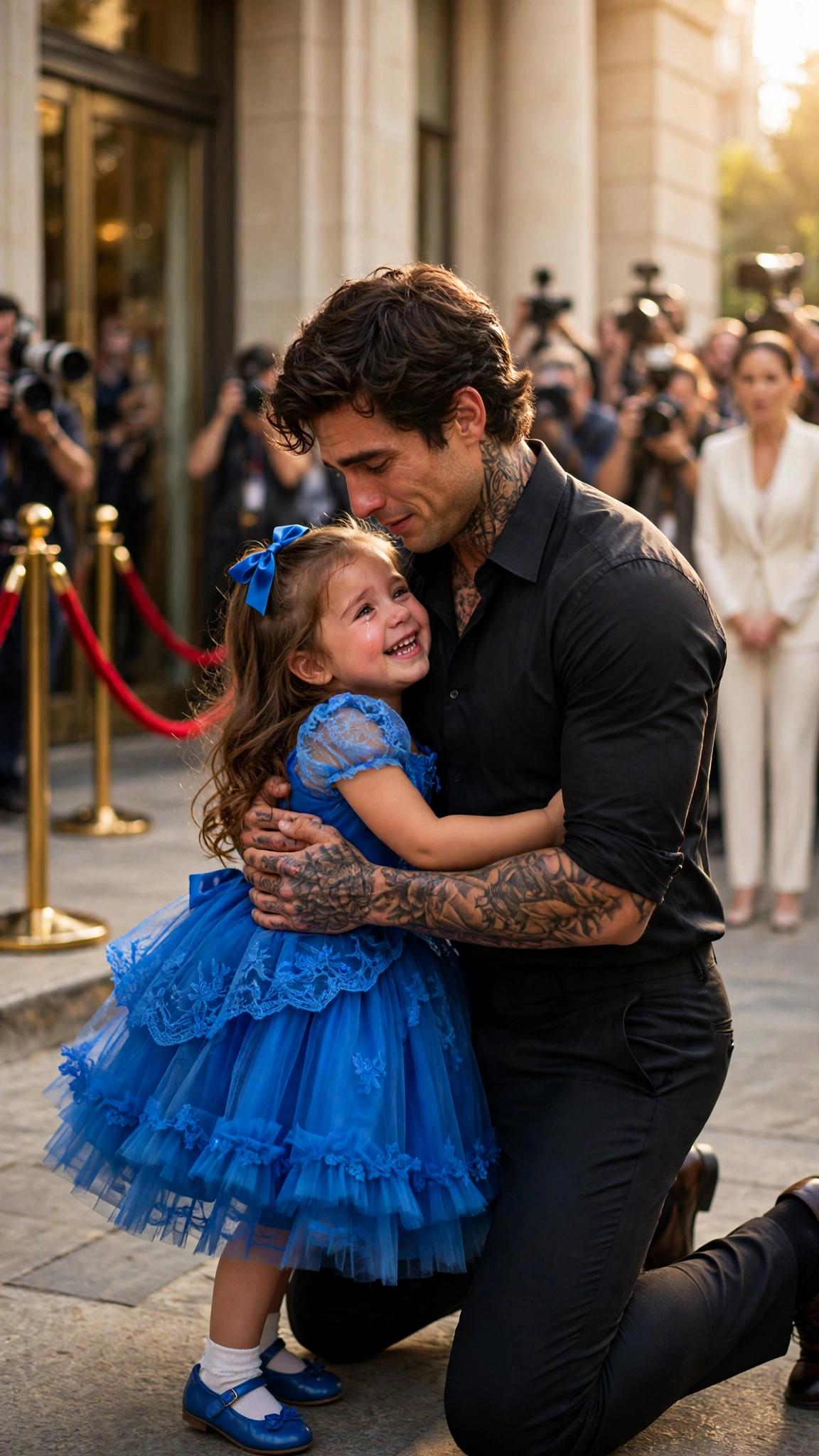
    A little girl in a vivid royal-blue princess dress, her long wavy light-brown hair flying behind her, a bright blue bow pinned to the right side of her hair, ran straight at him across the pavement. Her white ankle socks flashed beneath the full layered tulle skirt. Her blue Mary Jane shoes slapped the stone. Her arms were already open before she reached him.

    "Daddy!" she cried, her voice cutting through the noise of the press gathering like a bell. "Daddy! I knew you'd come!"

    Michael stopped walking.

    The cameras kept flashing. The reporters kept shouting questions. But the sound seemed to fall away from him, as if someone had turned the volume down on the whole world. The little girl threw herself against him and wrapped her tiny arms tightly around his waist, pressing her cheek against his black shirt. He could feel her shaking. He could feel her heart hammering through the thin fabric of her dress.

    He looked down at the top of her head, at the blue bow, at the lace on her puffed sleeves, and for a moment his mind simply refused to work. He was thirty-two years old. He owned buildings in four cities. He had negotiated with men who could ruin him with a signature. And he had never in his life been so completely, helplessly unprepared for anything.

    Slowly, carefully, as if she might break, he lowered himself onto one knee. His tattooed hands hovered uncertainly near her shoulders. The black-and-gray ink on his forearms stood out against her pale skin. He studied her face — the innocent round face, the soft rosy cheeks, the large brown eyes — and something cold moved through his chest, because those eyes were his own. He had seen them in the mirror every morning of his life.

    "Sweetheart," he said quietly, and his voice sounded like a stranger's. "Who are you?"

    The girl slowly raised her head. Her joyful expression began to fade, the way sunlight fades off a wall. Her lower lip trembled. Tears filled her eyes — not the tears of a child who had fallen down, but the tears of a child watching something precious break in front of her.

    "You don't remember me?" she whispered.

    A woman in an elegant ivory pantsuit hurried through the journalists and stopped beside the girl. She had shoulder-length chestnut-brown hair and worried eyes, and she carried a small black handbag clutched tight against her side. She looked at Michael, then at the little girl, and Michael saw the exact moment she understood what had happened. Her face went pale.

    "Mr. Rivers," she said, her voice nervous and hushed, pitched for him alone though every microphone in the press area was straining toward them. "Her name is Emma."

    Michael turned sharply toward her. The name hit him like a physical blow. Emma. He had not heard that name spoken aloud in five years — not since the night Claire had whispered it to him in the dark, her hand on her stomach, telling him what she wanted to call their daughter if it was a girl.

    "Claire Bennett?" he whispered, almost breathless.

    The woman's expression froze.

    He was still kneeling. He gently took Emma's small hands in his large tattooed ones, and he looked from her face to the anxious woman and back again, trying to hold on to the world as it tilted under him.

    "How did you know I was your daddy?" he asked softly, trembling.

    Emma looked directly into his eyes, completely sincere, the way only a five-year-old can be. "Mommy showed me your picture."

    Michael swallowed hard. Somewhere behind him a camera shutter clicked, and clicked again. He barely heard it. All he could think about was a photograph — Claire keeping his photograph, showing it to a little girl, telling her that her daddy would come. For five years.

    The woman in the ivory pantsuit stepped closer, her eyes glistening with restrained sadness. "Her mother left something for you," she said quietly.

    Michael's expression tightened. "Where is Claire?"

    The woman looked down at Emma instead of answering. An uncomfortable silence followed, and in that silence Michael understood that something terrible had happened. He looked toward her, fear replacing the disbelief in his eyes.

    "Please," he said, his voice breaking. "Tell me she's alive."

    The woman lowered her eyes without speaking. Emma innocently tightened her grip on his hands.

    And Michael Rivers, who had everything, understood in that moment that he had nothing at all.

    —

    Five years earlier, on a night when the rain came down over Manhattan in silver sheets, Claire Bennett had stood in the middle of his penthouse living room holding a small white stick in her hand, and she had said, "Michael, I'm pregnant."

    He remembered the exact way the city lights had looked through the windows behind her. He remembered the way her hands had shaken. He remembered that she had smiled when she said it — not a big smile, a small brave one, the smile of a woman offering a man the best thing she had.

    He remembered what he had said back. He had rehearsed a thousand better answers in the five years since, and none of them would ever be spoken, because the answer he had actually given was the one that had ended everything.

    He had said, "You can't be serious."

    Claire's smile had not fallen all at once. It had faded the way Emma's joy had faded that afternoon on the pavement — slowly, in pieces, as understanding arrived. "I am serious," she had said. "I took three tests. Michael, we're going to have a baby."

    He had walked to the window. He had put his hands flat on the glass. Behind him, the penthouse was silent except for the rain. He had been twenty-seven years old, and Rivers Capital had just closed the biggest deal of its life, and his father was dying in a hospital uptown, and the whole weight of the company and the family name was sitting on his shoulders like a stone. He had told himself, later, that he was afraid. That was true. He had also been selfish, and that was true too.

    "We're not ready," he had said, and even as the words left his mouth he had known they were a coward's words. "Claire, I'm not ready. The company — my father — everything is happening at once. We can't do this now."

    "There is no now," Claire had said quietly. "There's just what is. I'm pregnant, Michael. That's not something we schedule."

    He had turned around then, and he had seen her face, and he had seen that she was not angry. That was the worst part. She was not angry. She was just looking at him the way you look at someone you are saying goodbye to.

    "I need you to think about this," he had said. "Really think. I can take care of you. I'll pay for everything. Whatever you need. But a child — Claire, a child changes everything, and I can't —"

    "Don't," she had said.

    "Don't what?"

    "Don't offer me money for our baby." Her voice had stayed soft, but something in it had gone hard as glass. "I didn't come here to sell you something, Michael. I came here to tell the man I love that we're going to be parents."

    He had stood there, twenty-seven years old, with the rain running down the windows behind her, and he had done nothing. He had not crossed the room. He had not taken her in his arms. He had not said the words that would have saved them both.

    His phone had rung then. His father's nurse, from the hospital. His father was asking for him. And Michael had taken that ringing phone like a rope thrown to a drowning man, and he had said, "I have to go. We'll talk about this tomorrow."

    Claire had nodded. She had set the little white stick down on the coffee table, neatly, like a woman leaving a note. She had picked up her coat. And at the door she had stopped and looked back at him one last time.

    "I love you," she had said. "Whatever you decide tomorrow, I want you to know that. I love you."

    Then she had gone, and the door had closed behind her with a soft click that he would hear in his sleep for the next five years.

    He had gone to the hospital. His father, Richard Rivers, had been propped up on pillows, his face grey, his breathing thin. He had taken Michael's hand in his own papery one and said, "She's gone, son. The girl. She took the money and she's gone. It's for the best. You have a company to run and a name to protect."

    Michael had believed him. He had believed him because it was easier than believing the truth — that he had driven Claire away himself, that she had left with nothing but a coat and a pregnancy and her pride. He had believed him because his father was dying and dying men, he thought, told the truth.

    In the months that followed, he buried himself in work the way other men bury themselves in drink. He arrived at the office before dawn and left after midnight. He closed deals he barely remembered negotiating. He bought a building in Chicago and another in Miami, and he could not have told you a single thing about either of them. His assistant began leaving sandwiches on his desk because he forgot to eat. His friends stopped calling, because he never answered.

    Once, in the first winter after Claire left, he drove past her building in Queens. He told himself he was only passing through the neighbourhood. He slowed the car and looked up at her windows, and the lights were off, and there was a moving van parked outside the building next door, and he told himself that settled it — she was gone, she had taken the money, she had moved on. He drove away and he did not come back.

    Once, in the spring, he saw a little girl in a blue coat in Central Park, holding her mother's hand, and his heart stopped so hard he had to sit down on a bench. The girl was not Emma — Emma had not been born yet, or had just been born, somewhere, without him — but for a moment he had seen, with terrible clarity, everything he had thrown away.

    Once, late at night, he picked up his phone and found Claire's number, and he held his thumb over the call button for a full minute, and then he put the phone down. What would he have said? I'm sorry? Come back? He had not earned the right to either sentence. He told himself she had made her choice. He told himself the money his father had mentioned — money he had never seen change hands — had settled everything.

    It had settled nothing. It had only buried the truth under five years of noise and work and silence, where it waited, patiently, for a little girl in a blue dress to dig it up.

    He never went to her apartment. He never called. He told himself she had made her choice. He told himself the money his father had mentioned — money he had never seen change hands — had settled everything. He buried himself in work. He closed the biggest deals of his life. He became the billionaire the newspapers loved to photograph.

    And all the while, somewhere in Queens, Claire Bennett was raising his daughter alone, showing her a photograph of him, and telling her that her daddy would come one day.

    Five years later, on a bright afternoon in front of Sunrise Children's Home, a little girl in a blue princess dress ran through a crowd of reporters and proved her mother right.

    "Please," Michael whispered again to the woman in the ivory pantsuit, still kneeling on the pavement with Emma's small hands in his. "Tell me she's alive."

    The woman finally lifted her eyes to his. "My name is Helen Marsh," she said. "I'm the director here. Mr. Rivers — Claire left you a letter. It's been waiting for you for three weeks. And yes." She paused, and her voice shook. "Yes, she's alive. But you need to come quickly. You need to come now."

  • Chapter 7: Walking Together

    Chapter 7: Walking Together

    The sitting room had been a beautiful room once, and grief, whatever else it does, is an excellent preservative.

    Morning light came through the tall windows in dusty shafts and found everything exactly as Isabella Falcone had left it on a Thursday eighteen months ago: the books spine-out on the low shelves, the blue sofa, the coffee tray on the side table with two cups on it — two, because the staff who dusted nothing in that room had nonetheless never had the heart to take one away. A fine gray film lay over all of it, soft as ash. The air smelled of paper and lavender and time.

    Dante stood in the doorway with his hand still on the handle he had finally turned, and for a moment Rosa thought he would not be able to do it. His shoulders had gone rigid. His breath had gone somewhere high and tight. She stood behind him with Sophia in her arms — Sophia awake now, solemn, taking in the dusty golden room with the gravity of a small ambassador — and Rosa did the bravest thing she had ever done in that house, braver than serving the Castellanos, braver than any corridor at midnight.

    She stepped up beside him, close enough that her shoulder nearly touched his arm, and she said, very quietly:

    "We're right here, Mr. Falcone. Take your time."

    Sophia, who had no patience for adult weather, pointed imperiously at the sofa. "It's dusty," she announced. "It needs a clean. Mommy cleans. Then it's a room again."

    And Dante Falcone laughed — in the doorway of the room he had sealed like a tomb, dust in the light, a maid at his shoulder and her daughter conducting operations — laughed until he had to put one huge tattooed hand flat against the doorframe to hold himself up, while Rosa, helpless, laughed with him, and Sophia nodded with deep satisfaction, like a doctor whose diagnosis has been confirmed.

    "Then it's a room again," Dante repeated, wiping his eyes. "Out of the mouths of management." He straightened, and looked at the portrait they had carried in from the hallway — he had carried it himself, that morning, the first time it had moved in eighteen months, and set it not in its old place of mourning beside the door but here, in the sitting room, in the light, where Isabella's summer laugh belonged to a living room again. "She would have liked you," he told Rosa, simply. "Both of you. She had a policy about people who walk with sad men. She married one."

    Cleaning the sitting room took four days, and it was the worst-kept secret in three counties. Sophia supervised from the blue sofa, enthroned on cushions like a building inspector, pointing out dust with a wooden spoon and a merciless eye. The guards moved the heavy furniture with the reverent clumsiness of pallbearers at a christening. Giulia wept once, happily, into a dust sheet, and denied it. On the second day, Dante himself appeared in the doorway with his sleeves rolled and a stack of Isabella's books in his arms that he had carried down from the attic — books she had meant to shelve in that room "when there was time," in the way of all beloved, postponed things — and he set them on the low shelves one by one, in her order, which he remembered perfectly, while the whole staff found reasons to pass the open door very slowly.

    On the third day, at four o'clock, the walk came down the hallway as it always had — and turned, for the first time in eighteen months, into the sitting room. Dante stood in the cleaned and sunlit room with two cups of coffee on the tray by the sofa, because he had made them himself, badly, and set them out himself, carefully, and waited with the expression of a man defusing something of his own manufacture until Rosa arrived, breathless, wiping her hands on her apron, summoned by a message carried by three separate members of staff in case the first two fainted.

    "You take yours with sugar," he said, with enormous dignity, "which I have provided. Sit down, Rosa. The room is open. Apparently it seats two."

    She sat. The coffee was dreadful. It was the best coffee she had ever had in her life, and she told him so, and he said — looking out at the garden, at the light, at anything but her, with the ghost of the rumor of almost a smile — that she was a terrible liar and a credit to the house, and they drank every drop. The staff did it like people defusing something precious — Addie directing operations with a duster like a baton, Marco on a ladder with the chandelier crystals, the maids beating cushions on the terrace and gossiping in voices so full of joy you'd have thought there'd been a wedding. There had not been a wedding. But there had been, on the second day, a set of announcements that moved through the house's servant telegraph faster than light.

    Rosa Bennett was to be housekeeper — Addie's own chosen successor, with Addie retiring in the spring to the gatehouse cottage, at full pension, in scandalous comfort, telling everyone who would listen that she had planned it all along. The housekeeper's salary was three times a maid's. And folded inside the envelope with the appointment letter — Rosa found it that night, alone, and sat down hard on her bed — was a receipt, stamped and final, from a hospital billing department: an account, eleven days of intensive care, two years of forty-dollar Fridays, closed. PAID IN FULL. No note. There was no need of a note. There was only one hand in that house that paid debts without leaving fingerprints of kindness on them, and she had seen it adjust a ribbon in a child's hair.

    She tried to thank him. It went badly, in the best way.

    "You can't— Mr. Falcone, I can't accept— that's charity, and I—"

    "It's back pay," Dante said, not looking up from the freight ledgers, with the air of a man discussing weather. "The house underpaid its most valuable employee. Marco did the arithmetic." From the doorway, Marco — who had done no arithmetic — examined the ceiling with profound interest. "Take it up with accounting, Mrs. Bennett."

    "Dante—" It was the first time she had ever used his name. It stopped both of them. The ledger. The room. "Thank you," she said, at last, simply, because she understood suddenly that some debts are only insults if you refuse to let them be gifts. "For all of it. Thank you."

    He looked up then. "You walked into my kitchen at midnight and told me ghosts shouldn't shake," he said. "Nobody has told me the truth in eighteen months, Rosa. It appears I was starving for it. Sit down. The coffee in this house is terrible when I make it, but I'm told the company improves it."

    Sophia turned four in that room, at a party whose guest list would have terrified three police departments: two dons, one retired consigliere, an underboss on probation in Baltimore (present by video call, hugely offended to have been seated, screen-wise, next to the cake), forty-one members of staff, one orange cat, and Carla Castellano, who arrived in yellow, kissed Rosa on both cheeks like a sister, and presented the birthday girl with a hat of such magnificence that Addie had to sit down.

    Dante's gift was the smallest box on the table. Inside, on a ribbon of lavender silk, was a smooth white stone — polished now, and drilled, and shining like a pearl that had taken the long way round. Sophia held it up, open-mouthed, and looked at him with the dawning recognition of a fellow practitioner.

    "I found it at the door of this room," he told her, gravely, in front of everyone, "a long time ago. Somebody left it there for a lady who was lonely in a picture. I've carried it every day since, to remind the stone to be brave." He fastened the ribbon around her neck himself, his huge hands absurdly careful. "Now it can retire. The lady has company. The stone's work is done — but you keep it, piccola, in case there's ever another sad man. You're the expert now."

    Sophia closed her fist around the stone and nodded like a don accepting a territory. "I will check all the men," she promised. "Every day. At four o'clock."

    Spring came to the Falcone house the way it comes everywhere, which is to say all at once and entirely without permission. The sitting room filled with books being actually read, and the white flowers — still arriving every Monday, Isabella's standing order — began appearing in other rooms too, as if the house were slowly remembering it had more than one room in it. The joint company with the Castellanos produced its first joint profit and a dinner at which Carla, magnificent and completely recovered, informed Rosa that she had had the red dress burned and considered it the best money she'd ever spent, and then demanded to be introduced to "the small general in the lavender dress," to whom she presented, with great ceremony, a box of chocolates the size of a suitcase.

    The suitcase came down from the wardrobe one last time in March — because Rosa, unpacking the winter linens, found it still under the bed where she had packed it on the worst night, and stood holding it by the handle in the middle of her room with the strangest expression. It was Addie who solved the matter, commandeering the case without being asked, emptying it onto the bed with the briskness of a woman defusing an embarrassment, and sending it up to the attic with the Christmas ornaments. "A household keeps a suitcase for visits," the old woman declared, "not for exits. If you're ever fool enough to want one for an exit again, you may climb up and fetch it down yourself, past all the ornaments, and by the time you've done that you'll have had time to think — which is all a suitcase is for, in a well-run house: thinking time." Rosa laughed until she cried a little, and helped carry it up.

    Enzo wrote from Baltimore. The letters were stiff, then less stiff. One, in April, contained a crayon drawing of his own — a large stick man, a small stick girl, enormous smiles, executed in ballpoint pen with more enthusiasm than skill — and the words: Tell the artist the freight office is boring and the boss here is a tyrant about paperwork. It went up on the sitting-room wall, next to the original, which Dante had had framed. Marco claimed it was a security measure. Nobody believed him.

    And every afternoon at four o'clock, the house still held its breath — but the way you hold it before music now, not before weather.

    Dante comes through the tall doors at the far end of the marble hallway, slowly, hands clasped behind his back, the way he has always walked and always will; it is simply who he is, that walk, minus only the sorrow that used to ride on it like a second spine. Six feet behind him — sometimes six, sometimes three, sometimes riding piggyback with her white shoes kicking gently against a fortune in tailoring — comes Sophia Bennett, hands folded, chest puffed, face arranged into the sternest scowl a four-year-old has ever manufactured, taking her solemn enormous steps. And beside them, more often than not, walks Rosa with the afternoon coffee, laughing at something, saying something, answering something — because the walk has a conversation in it now, and music in the rooms it passes, and a stop at the sitting-room door that is no longer a stopping at all. Just a door. Open. With people in it.

    On the first warm day of May, Dante stopped at the far end of the hall, where the light fell gold through the tall windows, and turned, and held out one enormous tattooed hand behind him without looking — the way you reach for something you are perfectly certain is there.

    A small hand took it.

    "Are we walking, bear?" Sophia asked. She had gotten the name from Addie, who had gotten it from heaven knows where, and it had stuck to the most feared man on the coast like a burr.

    "We're walking, piccola."

    "Good." She arranged her face into the scowl, folded her free hand behind her back, and nodded once, with immense professional satisfaction. "You don't look lonely anymore. That's because of my good walking."

    "Is that so?"

    "Yes," said Sophia, "and Mommy's."

    Dante Falcone looked back at Rosa, coming up the hallway with the coffee and the smile she no longer bothered to hide from anyone, and his whole scarred, tattooed, resurrected face softened into the expression the guards had once crossed themselves at the sight of, and now merely pretended not to notice, because a house has its dignities.

    "Then don't let me walk alone," he said.

    "We won't," said Rosa.

    And they didn't.

    THE END