
Story Genres: MAFIA BOSS

  • Chapter 1: The Morning I Stopped

    Chapter 1: The Morning I Stopped

    The day after my husband asked for a divorce, my attorney called to tell me that Adrian Romano had rejected nothing.

    Not the divorce.

    Not my refusal to touch his fortune.

    Not even my decision to walk away from eight years of marriage without asking for one of his houses, his cars, or a single one of his accounts.

    There was only one thing that made Chicago's most feared mafia boss go completely silent on the telephone.

    My lawyer said, "Mrs. Romano is requesting sole custody of the baby."

    Adrian's answer came several seconds later.

    "What baby?"

    My name is Elena Romano.

    And by then, I should have known how invisible I had become to my own husband.

    The night before, I had been standing at our kitchen counter preparing Adrian's medication.

    Yellow pill with breakfast.

    White one after food.

    Never the stronger prescription on an empty stomach — it tore at his stomach lining and left him in the kind of pain he would never admit to in front of his men.

    Eight years of marriage had taught me hundreds of tiny details about Adrian Romano that the armed men surrounding him every day did not know.

    Everyone else knew what happened when Adrian was angry.

    I knew what happened when he skipped breakfast.

    Everyone else knew which men answered to him, which doors closed when he entered a room, which voices went quiet.

    I knew which foods triggered the pain in his side, where an old wound had never quite healed right. I knew which medication needed refilling before a trip, and I ordered it three days early, every time, so he never once had to ask. I knew his shirts went to the tailor on Tuesdays. I knew his mother took her tea with honey and expected a call on Sundays. I knew he hated the smell of lilies and pretended not to.

    I was closing Thursday's compartment of the pill organizer when Adrian spoke behind me.

    "Elena, I want a divorce."

    I did not turn around immediately.

    I already knew the name that would come next.

    "Because of Bianca?"

    Silence.

    That was enough.

    Bianca DeLuca had been appearing in my marriage for months before Adrian finally admitted she belonged there. Her perfume in his car — something sweet and expensive that clung to the leather. Lipstick on a glass in his study that was not my shade and never had been. Dinner going cold on the table while another "meeting" kept him away until two in the morning.

    I had stopped asking questions because I already knew the answers.

    Adrian stepped closer. I could feel him behind me, the way you feel weather changing.

    "Bianca needs me," he said.

    That made me turn.

    "What?"

    "When I'm with her, I feel needed."

    For a moment, I simply stared at my husband.

    Then I looked down at the medication organizer beneath my hands — seven small compartments, seven days, eight years of Thursdays.

    I had spent eight years making sure Adrian never had to think about the ordinary pieces of his own life. His prescriptions appeared before they ran out. His clothes were packed before trips, folded the way he liked, with the second pair of cufflinks he always forgot. His mother's birthday was never forgotten; the flowers arrived with a card in handwriting she believed was his. Food waited when he came home after midnight, warm under a cover, because a man who ran an empire on fear still came home hungry like anyone else.

    Maybe that was my mistake.

    I had made loving him look effortless.

    So effortless that Adrian eventually forgot someone was doing it.

    "All right," I said.

    He frowned. "What?"

    "I'll give you the divorce."

    That was not the reaction he expected. Adrian Romano was accustomed to people fighting for his approval — men who built their whole lives around a nod from him. Apparently, he had expected his wife to do the same.

    Then he said something that told me he understood even less than I had realized.

    "We don't have to become strangers," he said, almost gently. "We'll still be family."

    I almost smiled.

    There it was.

    Adrian wanted Bianca as his wife.

    But somewhere in his mind, Elena would remain available. Elena would remember the medicine. Elena would handle the things Bianca did not notice. Elena would continue loving him in all the convenient ways while asking for nothing in return.

    I pushed the pill organizer across the counter toward him.

    "No, Adrian."

    His eyes narrowed.

    "We won't."

    The next morning was the first morning in eight years that I did not take care of my husband.

    I made coffee.

    For myself.

    Breakfast.

    For myself.

    Then I sat down at the counter with both hands around my cup and watched the sun come up over a quiet kitchen.

    Adrian entered and stopped beside his usual place.

    There was nothing waiting for him.

    "Where's breakfast?"

    I took another sip of coffee. "You wanted a divorce."

    "What does that have to do with breakfast?"

    More than he understood.

    He stood there for a moment, a man who could clear a room with a look, entirely undone by an empty plate. Then he opened his briefcase, preparing to leave, and frowned.

    "Where's my medication?"

    "On the counter where I left it."

    His expression hardened. "You always pack it."

    "Not anymore."

    "Elena."

    I picked up my purse. "Ask Bianca."

    That silenced him.

    I walked past my husband and out of the house before he could decide whether to be angry.

    By afternoon, my attorney had everything.

    Dana Whitfield had been my lawyer for exactly one day, and she kept looking at me the way people look at a woman who has either lost her mind or finally found it.

    "You're certain about the terms?" she asked.

    "I'm certain."

    "No settlement. No property. No claim on the Romano accounts."

    "I wasn't interested in punishing Adrian," I said. "I don't want his money. I want a clean ending."

    She made a note. Then she stopped writing.

    "There is one thing I need to ask before I call him." She turned the papers around so I could see my own signature. "The custody clause. Elena — does he know?"

    I looked at the ultrasound photograph folded inside my purse, where it had lived for nine weeks. Sixteen weeks along. A profile like a comma. A heartbeat I had heard alone, in a dark room, with a stranger holding the wand and asking gently whether the father would be joining us.

    "No," I said. "He doesn't know."

    "Do you want to tell him yourself?"

    "I was going to." My hand rested, without my permission, low on my stomach. "I had a whole evening planned. Then he came home smelling of her perfume, and after that there was never a time that belonged to us anymore. There was only a time that belonged to her, and I was standing outside it, holding this."

    Dana was quiet for a moment. Then she picked up her phone.

    "Then he'll hear it from me," she said. "Are you ready?"

    I nodded.

    But before she dialed, I sat in that office with the ultrasound folded in my purse and thought about the morning I had learned, nine weeks earlier, in the blue dark before dawn.

    I had taken the test in the bathroom while Adrian slept on the other side of the wall — slept the way he always slept after the strong pill, deeply, one hand curled near his chest like a boy. I had sat on the cold tile in my nightdress with the stick in my hand and watched the second line bloom, and I had laughed once, out loud, alone, because joy does not ask whether the timing is convenient.

    I had planned the telling the way I planned everything in that house: carefully, and entirely around him. Not on a night when the pain was bad. Not during the port negotiations. On our anniversary, at our table, with his favorite meal and the good candles, I would put the envelope under his plate and watch the most guarded man in Chicago fail to guard his face.

    I did not know that Bianca had already been given the evenings I was saving.

    The lipstick I found in October. The perfume in November. In December, a reservation confirmation on his phone for a restaurant I had suggested for months and never been taken to. I was a pharmacist before I was a Romano — I was trained to notice dosages, patterns, the exact point at which a coincidence becomes a regimen. By January I was no longer a wife suspecting. I was a professional reading a chart.

    And still, every morning, I laid out the yellow pill and the white one. Still I ordered the refill three days early. Still I stood at that counter at midnight with a plate kept warm, because the habits of love do not die at the speed of knowledge. They die at the speed of Thursday compartments in a pill organizer, one small plastic square at a time.

    That was what I carried into Dana's office. Not rage. Arithmetic. Nine weeks of it.

    "Ready," I said.

    When my attorney called Adrian, she expected negotiations.

    Instead, she got confusion.

    "What is Elena asking for?" Adrian demanded.

    "Nothing from your personal fortune."

    Apparently, he made her repeat it.

    "No settlement?"

    "No."

    "Property?"

    "No."

    "Then why am I talking to you?"

    "There is one issue Mrs. Romano will not compromise on."

    A pause.

    "What issue?"

    "The baby."

    Silence.

    My attorney continued, professional as a metronome. "She intends to request sole custody and have the child's primary residence remain with her."

    Another pause.

    Longer this time.

    Then Adrian spoke.

    "What child?"

    Dana thought she had misheard him. "Your child, Mr. Romano."

    His voice changed. The same voice that could make an entire room of armed men stop talking. Only now there was something underneath it.

    Confusion.

    "What baby are you talking about?"

    My attorney looked down at the papers I had signed. Then at the information I had given her.

    And finally, she understood.

    The most powerful man in Chicago had not been pretending not to know.

    He genuinely didn't.

    So she asked him one final question.

    "Mr. Romano…"

    She hesitated.

    "Your wife never told you?"

    Dana told me later that the silence on the line lasted eleven seconds. She counted, the way lawyers count things that matter.

    Across the city, on the counter of the apartment I had borrowed from my best friend, my phone lit up in the dark.

    ADRIAN.

    Calling for the first time in months — not to ask where his medication was.

    To ask about the baby he never knew existed.

    I let it ring.

    I want to be honest about that, because I have spent this whole story being honest in the way I never was in my marriage. I let it ring, and I stood in Natalie's borrowed kitchen in the dark, and I felt something I am not proud of and will not apologize for: satisfaction. For eight years I had been the one who answered. The one who waited for the sound of the door. Let him listen to a phone ring out in an empty room. Let him learn the acoustics of being unanswered.

    When the screen went dark, my hand was shaking.

    Natalie found me there an hour later, still standing, and made me sit, and put soup in front of me that I did not remember her cooking.

    "He knows," I said.

    "I heard. The whole building heard my end of it. Elena—" She took my hand across the table, the way she had when we were nineteen and sharing a dormitory hotplate. "Are you frightened of him?"

    "No," I said. "That's the terrible part. I was never frightened of Adrian. I was frightened of becoming someone he couldn't see. And I solved it by becoming exactly that, one helpful day at a time."

    I thought about the night, four years into the marriage, when they had brought him home with his side opened by a knife in a parking structure — his own doctor forty minutes away, his men useless with panic — and I had pressed my folded coat into the wound and talked him through his own breathing, slow, pharmacist's calm, while someone boiled water I didn't need because films had taught them to. He had gripped my wrist with a hand slick with his own blood and said, "Don't leave the room." Not tenderness. Instinct. Even half-conscious, some animal part of Adrian Romano had known exactly where his survival lived.

    In the morning, with the doctor gone and the wound dressed, he had thanked Rocco.

    I had never held it against him. That was the saddest part, the part I finally saw in Natalie's kitchen with the soup going cold: I had never once, in eight years, held any of it against him. I had filed every invisibility under love and called the cabinet devotion.

    "I'm not going back to being furniture in that house," I said.

    "No," said Natalie. "You're not."

    My phone lit up one more time before I slept. Not a call. A message, from the man who had never in his life explained himself in writing to anyone:

    *I don't know the words yet. I'm going to learn them.*

    I read it three times. Then I put the phone face down, and I slept the way I had not slept in months — deeply, with my hand resting on the small, secret curve of my stomach, where my daughter kicked once, softly, like a knock on a door from the inside.
  • Chapter 7: Never Lose Your Balance

    Chapter 7: Never Lose Your Balance

    We were married in June, in the ballroom where it started, at a sensible hour, in front of a guest list that Eleanor had edited with a red pen and a complete absence of mercy.

    Gone were the senators-for-show and the families-by-obligation. Present were the captains who had stayed, the dock families Grant had stood by in the autumn, Marta from the kitchens as an honored guest in a hat like a wedding cake, Rachel as my maid of honor in deep-water blue, and Ethan and Noah as ring bearers — Ethan with a solemnity that suggested he believed the rings powered the building, Noah with the bandoneon's smallest cousin, a toy accordion, which he had been forbidden to play during the ceremony by a coalition of everyone.

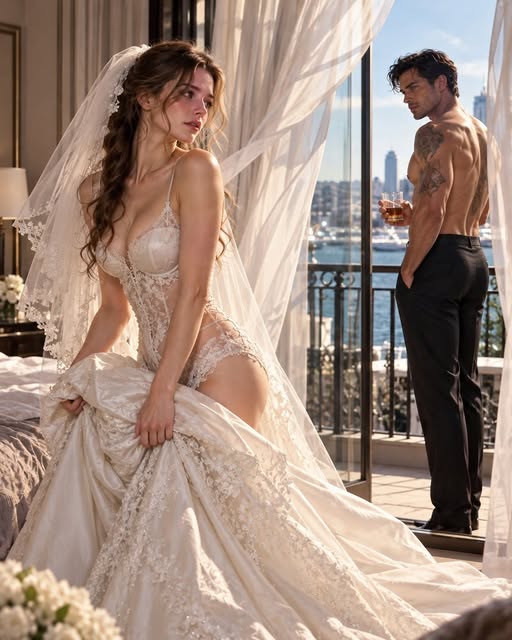
    That morning, Rachel dressed me in the guest suite with the lake view — the same room where I had once sat with a packed bag and a necklace's worth of trouble — while Noah, barred from the proceedings on grounds of accordion, reported on events from the doorway at intervals, like a small town crier. Ethan supervised the shoes. Ethan has always understood ceremony.

    Rachel's hands were steady on the fastenings, the way they'd been steady on everything since we were girls. "Dad's probably unbearable right now," she said to my reflection. "Wherever he is. Telling everyone. That's my Emily. She out-negotiated the mafia, she out-danced the mafia, and then she married the mafia for the catering."

    "For the floor," I corrected. "The floor is excellent."

    "The floor is excellent," she agreed, and then her eyes filled, traitorously, and she pressed her forehead briefly to my shoulder blade, among the buttons. "He'd have walked you, Em. In the white shirt. Sleeves rolled. He'd have cried the whole way and pretended it was the music."

    "I know," I said. "That's why Eleanor's doing it. Somebody has to represent the family's interest in embarrassing me in public."

    It was Eleanor who had solved the final detail, as she had solved so many. At breakfast that morning she had presented me with a small flat box, and inside it, pressed and folded, was a linen napkin — the napkin, the one she had put into my hand over a wine stain half a year and several lifetimes ago, only now it had been embroidered along one edge in silver thread, in a hand too old for such fine work and too stubborn to delegate it: 11:17 P.M. — and below it, a tiny stitched pair of dancing shoes.

    "For your bouquet," she said. "Something old. Something borrowed is the ring, something blue is Rachel's dress, and something stolen — " her eyes gleamed with the purest mischief I have ever seen on a woman of eighty-four " — is my grandson. I recommend you keep him. This family has a policy about returns."

    Eleanor walked me down the aisle.

    It had been her idea — announced, not proposed, at breakfast three weeks earlier, in the tone of a woman reading a verdict: "Your father cannot. Your sister should stand beside you, not deliver you. And I have owed Daniel Brooks an escort for sixty years, and I am eighty-four, and I do not intend to die with the account open." She took my arm in both her hands at the ballroom doors, in her silver silk, upright as a flagpole, and as the doors opened on two hundred people — the same room, the same chandeliers, an entirely different universe — she whispered, "Head up, Emily. Whatever happens," and we walked my father's floor together at a pace she set and nobody hurried.

    Grant waited at the far end in a suit with no sawdust on it, and the look on his face when the doors opened is not something I will describe in detail, because some things a woman keeps. I will say only that Marcus, standing beside him as best man, had to clear his throat twice, and that the most feared man in Chicago cried in front of his entire organization without a flicker of shame, and that if a single soul present thought less of him for it, they kept it to themselves forever, which in that world is the same as it not happening.

    We wrote our own vows. His are his. Mine were short, because I had said the long version at a microphone at the Drake Hotel in front of six hundred people, and everyone who needed them had already heard them.

    "I spent two years in this house learning to be invisible," I said. "You found me by accident, in a joke, at 11:17 on a Saturday night. I am not going to thank the joke. I am going to thank the music — and the woman who remembered it — and the man who, when it stopped being funny, stood still long enough to hear it." I took his hands. "Grant Whitmore. I will keep your balance. You keep mine. That's the whole contract. That's the whole marriage. Dance with me for the rest of our lives and don't you dare dance three seconds in the future."

    "Now," he said, for both of us, so quietly that the front rows leaned in. "Always now."

    There was, of course, a first dance.

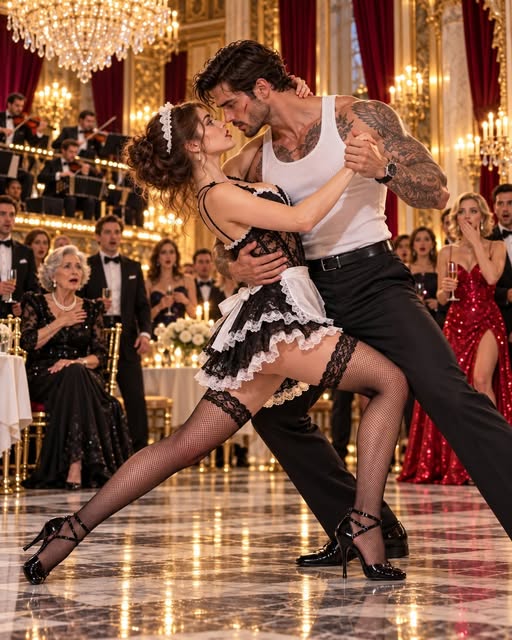
    The orchestra — the same orchestra; I had insisted, and the conductor had wept when the booking came, and sent a note saying it was the honor of his career — lifted the opening of my father's arrangement, the bandoneon breathing out across the ballroom where it all began. And this time there was no joke and no crowd holding its breath for a fall: just a husband and wife in the middle of a marble floor, dancing the tango the way Daniel Brooks taught Chicago to dance it, as a conversation — question, answer, trust, risk — while two hundred people who had once laughed at a housekeeper applauded a love story they had all, in one way or another, been extras in.

    Halfway through, Grant leaned close, in the pause. The pause where the trust lives. Perfectly still. Perfectly present.

    "I'll spend my whole life making sure you never lose your balance," he murmured.

    "I know," I said. "You're very well taught."

    Later, when the cake had been cut and the toasts survived — Marcus's was four sentences long and made Rachel cry; Rachel's was eleven minutes long and made everyone cry, including, at one point, both senators' replacements — the orchestra played a slower set, and my husband crossed the ballroom to his grandmother's chair with the air of a man about to do something he had been rehearsing in secret. Which, I learned afterward, he had. For six weeks. At dawn. With Marta's cousin, who had sworn an oath of silence on pain of Eleanor.

    "Nonna," he said, holding out his hand. "One dance. Half a song. The doctors said — "

    "The doctors," Eleanor announced, rising with the majestic slowness of a battleship leaving harbor, "have been wrong about me since 1979, and I see no reason to break their streak." She took his hand. "Half a song, Grant Thomas Whitmore. And if you dance three seconds in the future, I will tell this entire room about the winter you were nine and afraid of the lake ice."

    They danced — if dancing is the word for a stately, careful, devastating progress around six feet of marble, an eighty-four-year-old woman in silver silk in the arms of the grandson she had rescued twice: once from his enemies, and once, at considerably greater length, from himself. Halfway through, the orchestra — may they be blessed in this life and the next — let the arrangement open into the same figure, the same breathing pause, that my father's bandoneon had asked as a question in that very room, and Grant stood in the pause with his grandmother the way I had taught him: perfectly still, perfectly present, holding her balance like it was the only cargo he had ever carried that mattered.

    Over his shoulder, Eleanor found my eyes, and she smiled — the private smile, the Halsted Street smile, sixty years deep — and mouthed two words at me across the music.

    He learned.

    And I stood in my wedding dress in the middle of the Whitmore ballroom with tears ruining Marta's cousin's work on my face for the second time in a year, and I thought about debts and how they actually get paid: not in ledgers, not in deeds, not even in gold leaf on a wall. In this. In a man's hands, careful at last, around the people who taught him what hands were for.

    The Brooks Dance Studio reopened on Ashland Avenue on the first Saturday of September, exactly twenty-five years after the fire, in a building with a sprung floor, a wall of mirrors, and a ghost sign we did not restore and did not remove — we lit it. It stands there still, lit, every night, over the door: BROOKS DANCE STUDIO, in letters that waited a quarter of a century in the soot for somebody to come back and plug them in.

    Rachel runs the office and the books, with a salary, a title, and a ferocity about late payments that has made her locally feared in a way I find deeply satisfying. The Whitmore Foundation funds thirty scholarships a year for children from the dock neighborhoods and the service corridors of great houses — housekeepers' kids, porters' kids, the children of invisible people, who arrive on Saturday mornings with their shoes held together with hope, exactly as their teacher's teacher once arrived. The classes are free. The coffee is terrible. The floor is perfect.

    Eleanor teaches one class a month, seated, imperious, eighty-four years old, correcting posture with a silver-handled cane and a memory like a steel trap, and the children call her La Reina and are terrified of her and adore her in the proportions she has always demanded from life. On the studio wall hangs a photograph: a young man in a white shirt with rolled sleeves, laughing, mid-lesson, in a room above a bar on Halsted Street in 1964, with a girl in a wasp-waisted dress in his arms who is looking at him the way the whole world should be looked at at least once.

    Below it hangs a second photograph, newer: the same room's inheritors. My wedding. The dip. The chandeliers. It was taken by a photographer named Marta's cousin, at the exact moment the music stopped, and in it my husband is looking at me the way a man looks at a locked door in his own house that turned out, on the other side, to have been a garden all along.

    My father's bandoneon sits in a glass case by the studio door, retired, honored, its work done. Noah plays the toy accordion at it sometimes, in the belief, which I have not corrected, that it is listening.

    And on Saturday mornings, when the light comes through the tall windows the way it came through the old ones, and the bandoneon recording — my father's own, digitized from a reel Eleanor kept for sixty years in a hatbox, because some women keep everything — breathes out over a floor full of children learning that grace is something ordinary people are allowed to have, I teach the first lesson the way I was taught it, by a man in a white shirt who believed that strength and gentleness were the same thing wearing different clothes.

    Heel. Toe. Pause.

    "A good tango," I tell them, "isn't about controlling someone."

    Out in the hall, most Saturdays, my husband is standing in the doorway with coffee he made himself and an expression he no longer bothers to hide, learning the last and hardest lesson of all — that a man can simply watch happiness happen in a room he helped to build, and not own it, and not guard it, and not weigh it.

    "It's about making sure they never lose their balance."

    Heel. Toe. Pause.

    We never have. Not once. Not since 11:17 P.M., in a ballroom in Lake Forest, when a mafia boss made a joke in front of two hundred people — and a housekeeper, in a wine-stained uniform, with sore feet and a steady heart, decided to dance.

  • Chapter 6: Restitution

    Chapter 6: Restitution

    I had expected the war Conrad Hale promised. What arrived instead was slower, colder, and much more instructive: the true sound of an empire holding its breath.

    The harbor commission voted nine days after the gala. Grant lost the terminal — two votes, exactly the two Conrad had boasted about — and I watched him take the news in his study with the stillness he'd been practicing, one hand flat on the desk, while Marcus read out the count and the cost: the terminal project, eighteen months of work, a fortune in projections, gone because a Whitmore had finally declined to purchase his future with somebody else's daughter.

    "We knew the price," Grant said. "We paid the quoted price. That's new for this family. Write it in the ledger." He looked up at me, where I stood in the doorway with two coffees I had made myself, because some habits of mine were not choreography. "Your father lost his studio standing in a doorway telling Thomas Whitmore no for six years. I figure the family can survive losing a dock telling Conrad Hale no once."

    Two of his captains defected to the Hales within the month, with their crews and their routes. One came back within two, poorer and quieter, having discovered that Conrad's generosity had a meter on it. Grant took him back without a word of triumph, which taught me more about the man than the gala had. Men did die that autumn, in the Hale docks dispute — two, both stevedores, neither of them soldiers, both of them somebody's Ethan and Noah — and Grant paid for both funerals and both families' rents for a year, in person, in cash, without photographers, and came home gray-faced and stood in the ballroom at midnight not dancing, just standing, in the place where the music stops.

    "Teach me the accounts on this one," I said, and put my hand in the middle of his back, where the tension lived. "Not the money. The rest of it."

    "There's no ledger for the rest of it," he said. "That's the problem with the rest of it."

    "We'll start one," I said. "I'm good with books. Ask anyone. I learned columns from a man who kept a dance studio solvent on charm and arithmetic."

    But the autumn wasn't only losses. In the first week of October, in a Whitmore Reserve boardroom with lawyers on both sides and Eleanor presiding like a small silver supreme court, the Ashland Avenue deed was signed over to the Brooks Family Trust — to me and Rachel jointly — together with a check drawn on thirty years of distillery ground-rent that made Rachel sit down hard in the corridor afterward, holding the boys' school forms, saying "Em, this is the rent. This is the rent forever. This is — Em, this is Dad's floor. We own Dad's floor."

    Before the signing week was out, I asked for one more thing — not in the contracts, which is why I remember asking, and why I remember that it was granted without a single lawyer being consulted. I wanted to walk the distillery floor. The actual floor. Where the bottling line now stood in long humming rows over the ground where my father's studio had been.

    The plant manager was a man named Okafor who had worked for Whitmore Reserve for thirty-one years, which meant he had arrived as a young man three years after the fire, into a building whose history nobody discussed. He walked me down the line with the wary courtesy of a man escorting a unexploded story, past the washers and the fillers and the labeling drums, the air sweet with oak and alcohol and steam.

    "Here," he said at last, stopping where the oldest part of the plant met the new. "The surveyors' marks are still in the concrete, if you know where to look. The old building's foundation line." He pointed with his chin, not his hand, the way you point at something in a church. "The bottling line was laid along it in '96. Nobody told us why the floor plan bent there. Production floors don't bend, Miss Brooks. Somebody senior insisted." He glanced at me sidelong. "We used to get the story in pieces, us old ones. That there'd been a dance school. Music school. Something with children in it. On Sundays, before my time, they say the men on the first shifts could hear — " he stopped, embarrassed by his own sentence.

    "Hear what?" I said.

    "Nothing. Superstition." He folded his arms. "Pipes. The building settling. Men hear things on quiet shifts." But he said it the way people say things they have decided, privately and permanently, to believe the opposite of, and I understood that for thirty years, in the small hours, the men of Whitmore Reserve had worked their shifts inside the faint, pipe-borne rumor of my father's Saturday music, and had kept the rumor the way you keep anything fragile in a factory: carefully, and without ever once writing it down.

    "When the studio opens," I said, "the first Saturday class is for the children of anyone who's ever worked this floor. Free. Forever. Your grandchildren are on the list whether they like it or not, Mr. Okafor."

    He looked at the bent production line for a long moment. "I have four," he said. "Two of them dance already. Kitchen tiles, mostly." And then this thirty-one-year servant of the house of Whitmore did something no contract had required and no restitution schedule had itemized: he took off his hard hat, in the middle of his own plant, and held it against his chest like a man at a graveside or a christening — it is not always possible, I have learned, to tell those two apart, and on Ashland Avenue that autumn it mostly wasn't necessary.

    We walked the site the following Sunday, the four of us — Rachel, me, and two small boys who had been promised, with auntly solemnity, that this parking lot was actually a palace in disguise. It wasn't much to look at: cracked asphalt, a chain-link fence, the distillery's brick wall on one side with a faded ghost sign high up that nobody had ever painted over, because Eleanor, I learned, had forbidden it for thirty years with no explanation anyone dared demand.

    BROOKS, the ghost letters said. And below, smaller: DANCE STUDIO.

    Ethan, seven years old and literal to his bones, read it aloud and then looked at me with enormous seriousness. "Aunt Em. It still says Grandpa's name. It never forgot."

    "No," I said, crying into the October wind in a parking lot in front of my entire family. "It never did."

    The bandoneon came home in November.

    Eleanor summoned me to her sitting room with the air of a woman staging an ambush, and on the table beside her tea sat a case — old leather, brass corners, the initials D.B. worn almost smooth on the lid. "Thomas kept it," she said. "After the fire, the instruments that survived went to auction for the debts, and my son — who could have bought the building, the business, the man himself a lifeline, and chose the land instead — my son went quietly and bought his friend's bandoneon, and kept it in the music room safe for thirty years, and never played it, and never sold it, and never once had the courage to return it or the decency to throw it away. I have hated this object for three decades, Emily. It is the exact size and weight of a Whitmore apology." She pushed it an inch toward me. "It belongs to Daniel's daughter. It's yours. Play it badly at my funeral and think of us both."

    I opened the case. The instrument inside was beautiful and ruinous and perfect, bellows like a paper lung, smelling of cedar and old storage and, faintly — or I imagined it, and I no longer care whether I imagined it — Saturday mornings.

    I don't play. I never learned; dance was my language, and music was his. But Rachel's younger boy, Noah, five years old, solemn as a judge, reached out one finger and pressed a single button, and the old instrument drew a wheezing, golden, imperfect breath in Eleanor's sitting room, and the three of us — an eighty-three-year-old mafia matriarch, a housekeeper in a fiancée's dress, and a kindergartner — sat in the wreckage and glory of our families' whole tangled history and laughed until we cried, and then cried until we laughed.

    Vanessa came to the studio site in December, alone, in a car she drove herself, which for Vanessa Hale was practically a disguise.

    I was there with the architects — the reopening plans, the sprung floor, the mirrors, my father's Saturday light reconstructed by men with drawings — when her car pulled in, and she got out in a plain dark coat with no photographer, no friend, no audience, and stood looking up at the ghost sign for a long time.

    "I never loved him," she said, by way of hello. "I want that on some record somewhere. I never loved Grant. I loved — " she searched, and for the first time since I'd met her, Vanessa Hale looked like a person doing arithmetic she hated " — I loved that there was a list of things I was owed, and he was the biggest item on it, and nobody was ever going to hand my item to the help." She turned to me. "You were never the scandal, Emily. You were the evidence that the list was fiction. I couldn't afford you."

    "No," I said. "You couldn't. None of you could. That was never my price being high, Vanessa. It was your money being the wrong currency."

    She laughed — actually laughed, a short surprised sound, the first honest thing I'd ever heard from her. "My father is sending me to Milan. 'Seasoning,' he calls it. A year, maybe two, until Chicago forgets which of us lost." She looked at the sign again. "Conrad Hale does not lose daughters gracefully. I suppose you'll hear things. Some of them will even be true." She got back into her car, and then — window down, engine running, one last moment of the girl with expensive jewelry — "For what it isn't worth: Paige confessed to the archdiocese, the police, and a podcast. In that order. Even my scandals have understudies."

    She drove away. I have never seen her since, and I find, to my own surprise, that I hope Milan was kind to her. Cruelty was the only subject she was ever tutored in. It is possible to be glad to see the back of a person and still hope the world teaches them a gentler curriculum than the one they got.

    Grant proposed properly on the first Saturday of spring, in the middle of the unfinished studio.

    No ballroom. No cameras. Radiators ticking, sawdust on the new floor waiting for its final sanding, Rachel's boys' chalk drawings of dinosaurs still ghosting one wall because I had flatly refused to let the painters cover them until photographs were taken for the family archive. He had come, supposedly, to inspect the work — the Whitmore organization was funding the reconstruction as part of the restitution, though every contract in the building had my name and Rachel's on the first line, a detail he had insisted on with a ferocity that had startled his own lawyers.

    He stood in the middle of the floor where my father had stood ten thousand times, in the light coming through the new windows the way it used to come through the old ones, and he got down on one knee in the sawdust in a suit that cost more than my first car.

    "Grant — " I said, alarmed, delighted, terrified. "The suit — "

    "The suit can be cleaned. I checked. Extensively. In advance." He took my hand. "Emily Brooks. The first time I asked you to marry me, it was a joke, in front of two hundred people, and it was the cruelest thing I did that year, and I have done the arithmetic on that too. The second time, it was a negotiation, in daylight, with terms. This is the third time, and there is no audience, and no ledger, and no word being kept — " his voice, for the first time in all the months I'd known him, went slightly unsteady " — there is just a man who gets up at six in the morning now even when there is no lesson, because the house is better on the days you're in it. Marry me because Tuesdays are better. Marry me because my grandmother is eighty-four and has started referring to you as her favorite grandchild and I'm losing in the rankings. Marry me because I intend to spend the rest of my life making sure you never lose your balance — and because you're the only person alive who knows what that promise actually costs."

    I said yes in the sawdust, with the chalk dinosaurs as witnesses, and my father's name fading gently on the wall outside in the spring light, exactly where it had always been.

  • Chapter 5: The Night He Chose

    Chapter 5: The Night He Chose

    The Whitmore Foundation gala filled the Drake Hotel's ballroom with six hundred people, a silent auction, two senators, and enough orchids to funeral a small country. I wore a dress the color of deep water that Eleanor had chosen with the terrifying precision of a general choosing terrain, and a pair of tango shoes — real ones, broken in by Marta's cousin who danced — because Eleanor had informed the household that the future Mrs. Whitmore would not be opening the season in borrowed footwear.

    "You look," Grant said, when I came down the hotel stairs on his arm, "like the answer to a question I asked as a joke."

    "Careful," I said. "Your jokes have consequences. There's a ring and everything."

    There was, by then, a ring — a plain band of his grandmother's, given not as choreography but because, as Eleanor put it, a woman opening the Whitmore gala bare-fingered would start a war in the jewelry market. It fit as if it had been waiting. I tried not to think about that. I failed regularly.

    Conrad Hale found us twenty minutes before the speeches.

    He was a big, silver, smiling man, and he shook Grant's hand like he was testing its resale value, and he did not look at me at all — I had been promoted, in the Hale taxonomy, from furniture to threat, and threats were negotiated with, never greeted.

    "Grant. A word about spring." His smile stayed exactly in place. "The commission votes in nine days. My friends on it are — traditional men. They wonder about a Whitmore who breaks a twenty-year understanding over a dance. They wonder what his word is worth." The smile widened by a millimeter. "Vanessa is prepared to be generous. There's still a way for everyone to keep what matters."

    "Name it," Grant said pleasantly.

    "End this engagement business before the vote. Marry Vanessa in spring, as agreed when you were both nineteen and your fathers shook on it. The harbor is yours, the alliance holds, and — " this time he did glance at me, the way you'd glance at a stain you were offering to have cleaned " — arrangements will be made. Generous ones. The girl won't suffer."

    I felt Grant's arm go still under my hand. Not tense. Still — the way the whole ballroom had gone still, once, at seven in the morning, when a man was learning the difference.

    "Conrad," he said, "my father shook on a great many things. One of them was a piece of ground on Ashland Avenue that he took off a better man than either of us, and he never apologized for it, and it has been costing this family interest for thirty years." He smiled, and it was not a pleasant smile, and it was entirely honest. "I'm not adding your daughter to the ledger. Enjoy the gala."

    He walked us away from Conrad Hale standing in the middle of his own ultimatum, and my heart was beating so hard I was sure Grant could feel it through his sleeve.

    "You just chose a war," I whispered.

    "I chose the accounts," he said. "They've been wrong long enough." Then, quieter, as the orchestra began to tune: "Dance with me tonight like my father's music is playing, Emily. Whatever happens after the speeches."

    Before the speeches, there was the receiving line — an hour of handshakes and air-kisses in which I smiled at shipping magnates and judges and learned, in real time, the exact sound six hundred people make when they are recalculating what a housekeeper is for. Most were kind, in the polished way of people who have read which way the evening is blowing. A few were not. One foundation board member's wife held my hand a moment too long and said, "You must be enjoying all this attention, dear," in a tone that made attention sound like a disease of the lower orders, and I smiled at her with every tooth my father gave me and said, "I'm enjoying the shoes, mostly. Mine finally fit," and watched her decide, visibly, not to continue.

    In the service corridor, fetching a glass of water with my own two hands because old habits are load-bearing, I passed a girl of maybe nineteen in a server's uniform with a tray balanced on one palm and nerves coming off her like heat. She stopped dead when she saw me.

    "Miss Brooks?" she said. "Sorry — sorry, I just — my mum cleans offices downtown. Night shift, like you were. She watched the video maybe fifty times. She cried." The tray trembled; she steadied it with the automatic competence of our whole invisible tribe. "She said to say — if I ever saw you — she said to say thank you. For not running."

    "What's your mum's name?" I said.

    "Lucia. Lucia Ferrante."

    "Tell Lucia the dance was my father's, and the not-running was hers — all of ours. She taught me by existing." I touched the edge of her tray to steady it, server to server, the old language. "And keep your chin up tonight. Whatever happens."

    I went back to the ballroom and my fiancé and the six hundred witnesses with my hands steady and my heart full of other women's names, and I understood for the first time that the evening was not, whatever the Hales believed, about me at all. It was about every woman who had ever been handed a tray in a room full of people drinking — and which of the two kinds of story this one was going to be.

    The speeches happened. The foundation's director spoke. A senator spoke. And then — because she had been raised by Conrad Hale and had learned, as I had, exactly what her moment was worth — Vanessa took the microphone for the toast nobody had scheduled.

    She was magnificent. I have never denied it and I won't start now: red dress, steady voice, six hundred upturned faces, and a smile like the first crack in ice.

    "To the Whitmore Foundation," she said. "And to new traditions." Her eyes found me, front table, beside Grant. "We're all so fond of the little housekeeper's story. The tango. The promise. It's like a fairy tale." A pause, expertly weighted. "But fairy tales leave things out, don't they? Ask her, sometime, whose family's money built the floor she's been dancing on. Ask her what the Whitmores did to her own father — his little studio on Ashland, that burned, and how the great Thomas Whitmore bought the ashes for pennies and built his empire on the ground where her family lost everything." She lifted her glass, gently, like a scalpel. "She knows. She's known for weeks. And she's still here, in the dress, with the ring. So you tell me, all of you — what exactly is being danced for, in this arrangement? The promise? Or the price?"

    Six hundred people. Absolute silence. Cameras I could not see making their small hungry sounds.

    It was beautifully done. It was designed to leave me two doors: run weeping, and be the fraud who fled; or stay silent, and be the fraud who stayed. Conrad Hale had raised a strategist. What none of the Hales had ever understood — because none of them had ever had to work for anything, including love — is that a woman who has mopped ballrooms knows something about standing in the middle of one.

    I stood up.

    Grant half-rose beside me; I put my hand flat on his shoulder — partner's pressure, the language we'd spent three weeks building — and he sat back down, trusting me in public, in front of everyone, with his whole empire watching. I would learn later that Marcus, watching from the wall, considered that the moment he actually believed in us.

    I walked to the microphone on legs that were steadier than my voice, and my voice was steady enough.

    "She's telling the truth," I said. "Mostly."

    A murmur, like wind through a field.

    "My name is Emily Brooks. My father was Daniel Brooks, and yes — he lost his studio to a fire in 2000, and yes, this family bought the land for almost nothing and never apologized, and yes, I have known for weeks, and it nearly sent me home." I looked at Vanessa — not with hatred. With something worse. With clarity. "What she left out is that I stayed anyway, and I can tell you why. Because the man who made that joke in his ballroom — " I pointed, gently, at Grant " — has spent three weeks getting up at six in the morning to be taught how to stand still. Because when he found out what his father did, he didn't bury it or buy my silence. He gave me the file. The original. He said, the secrets in this family end with me." I turned to the room. "Vanessa Hale framed me for theft, in this man's house, eleven days ago, with her friend's hands in my locker and a camera she had switched off. She poured wine down my back at a party because cruelty is her native language. And this — tonight — is her third attempt to be rid of a housekeeper without getting her own hands dirty." I let the silence do the work, the way my father taught me. "I'm not for sale, and I'm not a scandal, and I'm not going anywhere. I am the daughter of the best man I ever knew, and he taught half this city to dance — including, sixty years ago, the grandmother of the man I'm going to marry."

    I set the microphone down in the explosion.

    Because it did explode — sound, movement, six hundred people recalculating at once, and Conrad Hale on his feet shouting something about slander, and Vanessa's brother Derek pushing through the tables toward the stage with his face the color of his sister's dress and his hands coming up — and then simply not arriving, because Marcus Doyle had been a wall all night and now he was a wall in motion, and two of Grant's men folded the Hale heir's public moment into a quiet, efficient escort toward the service doors, to the applause of exactly nobody.

    And Grant — Grant was standing. Grant was crossing the ballroom, through the noise, through the wreckage of twenty years of alliance, with his eyes on me and his hand coming up, held out, in front of six hundred witnesses and every camera in Chicago.

    "Emily Brooks," he said, and the room quieted for him the way rooms do. "I owe this room two announcements, and I'll make them with my word, since my word is apparently the evening's entertainment." Something in his face was almost — almost — a smile. "First: the Whitmore organization returns the Ashland Avenue property to the Brooks family, with the distillery's profits from that ground since 2000 paid into a trust for the reopening of the Brooks Dance Studio. It should have happened thirty years ago. It happens this week, in writing, with witnesses — my family is finished being rich in the wrong direction. Second — " his hand, still extended " — there is no engagement to Vanessa Hale. There never was a spring. There is a promise I made in my own ballroom, to a woman in a wine-stained uniform, in front of two hundred people and eleven million strangers, and I am keeping it. Not because I have to." He looked at me, and his voice dropped, and the room leaned in with him. "Because it is the first true thing I ever said by accident."

    I took his hand.

    "Then dance," I said, for the second time in my life, and this time my voice carried to the very back of the Drake Hotel ballroom, "and this time, Mr. Whitmore — don't dance three seconds in the future."

    The conductor — the same conductor, God bless him twice — lifted his baton. The bandoneon drew its long breath.

    And we danced the opening tango of the Whitmore gala in a silence so complete it felt like reverence: six hundred people, two senators, one furious family in full retreat, and the whole thing held on the frame of two people who had learned, at ruinous expense, how to listen to each other. Heel. Toe. Pause. The pause where my father used to say the trust lived — and Grant stood in it with me, perfectly still, perfectly present, a man who ran an empire standing motionless in front of it because the woman in his arms had taught him that this, too, was strength.

    In the dip, at the last bar, with my back over his arm and the chandeliers burning above us like a small, borrowed heaven, I looked past his shoulder and found Eleanor at the front table, in silver silk, with both hands pressed to her heart and tears running down her face — the same tears as the first night, and entirely different ones.

    Sixty years, she'd waited, to watch Daniel Brooks' choreography danced like that, by his daughter and her grandson, in the light.

    When the music ended, the room came up off its chairs. And Vanessa Hale, standing at the wreckage of her father's alliance with her glass still raised and forgotten, looked at me across the ruins with an expression I will remember all my life — not rage. Recognition. The look of a woman seeing, for the first time, the exact dimensions of the thing she had spent the evening trying to buy, frame, frighten, and shame off the floor.

    It had never been on the market. That was her whole education, arriving all at once.

  • Chapter 4: What the Whitmores Took

    Chapter 4: What the Whitmores Took

    The footage was grainy, black and white, and absolutely merciless.

    Eleven minutes, recovered from a backup server the "scheduled test" hadn't touched. Paige — Vanessa's laughing friend, the bridesmaid-in-waiting — entering the locker corridor at 10:41 with her handbag held against her body like a shield. Paige at my locker. Paige's hands, quick and practiced, in my apron pocket. Paige leaving at 10:49, lighter by one string of frozen lightning, glancing once at the dead camera with the calm of a woman who had been promised it would stay dead.

    Behind me in the little security room, I heard Grant make a sound I had never heard from him — not anger. Anger would have been simpler. It was the sound of a man discovering the true price of a thing he'd bought years ago without reading the receipt.

    "She'll say she acted alone," Marcus said. "She'll say she was jealous, or protecting Vanessa. You know she will."

    "I know," Grant said. "And Vanessa will cry, and Conrad will call it a misunderstanding between girls, and the harbor commission votes on the terminal in nineteen days." He turned to me. "Emily. If I destroy Vanessa Hale tonight, publicly, with this — her father doesn't lose. I do. He takes the terminal votes, he takes the port unions, and he does it all in the open with a grievance every family in Chicago will call legitimate. Men will die over dock contracts by Christmas. Your sister lives four blocks from the Hale warehouses."

    "You're telling me she wins," I said.

    "I'm telling you she survives this round." His jaw worked. "What you do with that is your choice. The door is there. I told you in the study — if you say it stops, it stops, and I'll say in front of witnesses that you were treated honorably." A muscle moved in his cheek. "But if you stay, Emily — stay knowing what this world costs. Not the diamonds. This."

    I thought about the photograph of my nephews that existed now in some Hale phone. I thought about Paige's hands in my apron pocket, and Vanessa's voice saying you had to steal from me too, and about being a thing that rich people weighed. And I thought — strangely, clearly — about my father, who had lost everything he'd built to men with money and had gone on teaching in a church hall for eleven years, standing straight, because he had decided a long time before that what the world did to you was weather, and what you did next was character.

    "I'm not running from a girl with cheap manners," I said. "My grandmother-figure would never forgive me."

    Grant blinked. Then, for the first time since the necklace, something loosened in his face that was almost a smile. "Your grandmother-figure?"

    "Eleanor. She's claimed me. It's done." I stood up. "But understand me, Grant. I stayed. I was not kept. There's a difference, and you're going to learn it."

    "I am learning it," he said quietly, "at some expense."

    What followed was not a romance. I want to be honest about that, the way this story has been honest about everything. What followed was a campaign. Vanessa kept her title in the newspapers — the engagement "unwound" only so far as a discreet silence — and I kept my rooms and my name slowly cleared in whispers Marcus planted like seeds: a misunderstanding, a staff error, the necklace recovered, no charges, no thief. Paige resigned from the bridal party and from Chicago, in that order. And the Whitmore Foundation charity gala — the event of the season, at the Drake Hotel, three weeks away — acquired a tradition-shaped problem.

    The Whitmore heir, by a custom older than the company, opened the gala by dancing a tango with his fiancée.

    For forty years it had been a harmless piece of theater: three lessons, a competent waltz-with-pretensions, applause. This year, the fiancée was a woman eleven million people had watched out-dance the boss in his own ballroom, and every gossip columnist in the Midwest had already written the headline in their heads.

    "You'll have to teach me," Grant said, in the ballroom, at seven in the morning, in shirtsleeves, looking like a man reporting for a sentence. "Properly. Your father's way. The club instructors taught me to perform. Nobody ever taught me to — " he searched for the word and clearly hated finding it " — listen."

    So we began. Heel. Toe. Pause.

    I will say this for Grant Whitmore: he did not know how to do anything halfway, including being bad at something. For two weeks we met at seven every morning, before the house woke, in the ballroom where he'd made his joke — and I watched the most feared man in Chicago submit, daily, furiously, to correction. Not to fighting the lead. To the pause. To standing perfectly still inside the music and letting the silence work. Club tango had taught him that stillness was weakness. My father's tango taught that stillness was where the trust lived.

    "You're thinking about the step after this one," I told him, for the tenth time, stopping the music. "You're dancing three seconds in the future. A partner isn't a plan, Grant. She's here. Now. If you lose her balance because you're busy conquering the next bar — "

    "I don't lose people," he said, too fast.

    The music had stopped. The ballroom was very quiet, gold with early light.

    "You lost me for one second in a hallway," I said. "With a necklace in my locker and two hundred years of your family's word on the line. I watched you weigh me." I kept my voice level, because it had taken me days to be able to. "That's why I'm still deciding about you. Not Vanessa. Not the Hales. That second."

    He didn't defend himself. That was new, and we both felt it. He stood in the middle of the floor his father built, in the ruin of his choreography, and he took it like a man paying a bill he'd been avoiding.

    "Then I'll spend the rest of the arrangement," he said, "unweighing."

    It was during the second week — after a lesson that had ended, for the first time, with both of us laughing, breathless, at a botched turn that was entirely his fault and that he admitted was entirely his fault — that Eleanor asked me to take tea in her sitting room and closed the door.

    She had a photograph album on her lap. Old pictures: the club on Halsted, the room above the bar, a young Eleanor in a dress with a wasp waist, laughing, mid-turn, in the arms of a young man with my father's smile.

    "I've been deciding when to tell you this," she said. "There isn't a kind time. So: the Brooks Dance Studio. On Ashland. You know how it ended."

    "Fire," I said. "I was six. An electrical fault, they said. Dad lost the building — he only leased it, the insurance was the owner's — and after that it was the church hall. He never really — " I stopped. Eight years of not saying it. "He never got it back. Any of it."

    Eleanor nodded slowly. "What you don't know is who bought the lot afterward, Emily. The land, the ashes, all of it. It was bought within the month, for almost nothing, through two companies with other names. It's where Thomas built the first Whitmore Reserve distillery. It stands there still." She turned a page with a hand that trembled slightly. "Thomas didn't set that fire — I'd stake my soul on it, and I've had eighty-three years to think about what my soul is worth. But he knew whose floor had burned. He knew Daniel Brooks had refused to sell to him for six years, politely, every single time, standing in that studio doorway with his sleeves rolled up. And when the fire did Thomas's negotiating for him, Thomas bought the ground out from under your father, and he never once — not once, in thirty years — told him he was sorry. It was the thing I most hated my son for. It is the thing I have never forgiven."

    The room was very still. The tea went cold between us.

    "Does Grant know?" I asked at last.

    "Grant knows the distillery. He doesn't know the dirt." Eleanor closed the album. "His father raised him on ledgers, not stories. But I'll tell you what I told myself the night you danced, Emily Brooks, when I watched my grandson's joke land on the daughter of the best man I ever knew: this family owes your family a debt that has nothing to do with a necklace or a promise. And debts in this family — " her eyes were wet and utterly fierce " — get paid."

    I took the bus to Ashland Avenue that afternoon. I told no one. Some things a woman has to stand in front of alone before she can stand in front of them with company.

    The distillery was bigger than I remembered and smaller than my grief. Four stories of brick, the Whitmore Reserve crest over the loading doors, trucks coming and going with the indifferent rhythm of a business that had never once lost sleep over the ground it stood on. I stood across the street with my hands in my coat pockets where a six-year-old's whole world used to be.

    There had been a stoop. There had been a window with gold letters — BROOKS DANCE STUDIO — that my father cleaned himself every Monday because he said a man's name on glass was a promise to everyone who walked under it. There had been a floor my mother had helped him lay, board by board, the summer before I was born, and a mirror wall, and a battered upright piano, and a smell — polish, cedar, coffee, other people's effort — that I had believed, the way children believe in weather, would simply always exist.

    What existed was a bottling plant with a fence around it and a security guard who watched me with the mild attention of a man deciding whether I was a problem. High on the brick side wall, above the reach of every repainting crew for thirty years, there were letters — ghost letters, soot-soft, that I could not quite read from across the street in the failing light. I crossed anyway. I stood in the shadow of that wall with my head tipped back until my neck ached, and the letters resolved, one by one, the way a face resolves in an old photograph.

    BROOKS.

    My father had paid a sign painter for those letters in 1983, in gold leaf, because he said a dance studio should look like it believed in itself. The fire had taken the glass, the floor, the piano, the business, and eventually — by slow inches, over eleven years of church halls and other people's borrowed rooms — the man. The gold leaf had outlasted all of it, baked into brick, forgotten by everyone except, apparently, the soot.

    I put my palm flat against the cold wall of the building that had eaten my father's life, and I did not forgive it, and I did not curse it. I just stood there, a thirty-two-year-old woman in a borrowed coat, and let it be true — all of it, at once, the way the pause in a tango lets everything be true at once.

    "Miss?" the guard said, not unkindly. "You can't be in the loading zone."

    "I know," I said. "I used to live here. Almost. Thank you."

    I rode the bus back to Lake Forest in the dark, and I did not go to the lesson the next morning. I sat by the lake until the cold drove me in, thinking about a church hall, and a man teaching tango to other people's children for eleven years with a smile that I now understood had cost him something every single day, and about the man in the ballroom at seven each morning, learning to stand still, who had been raised on the ground where my father's life burned down.

    At eight, Grant knocked on my door — not the furious three raps. Two. Careful.

    "My grandmother told you," he said. It wasn't a question.

    "She told me."

    "I had Marcus pull the property records at dawn." His face was gray. "It's true. All of it." He held out a folder — thin, old, smelling of storage. "This is everything this house has on the Ashland lot. Deeds, the shell companies, the fire report. There are no copies, Emily; that's the original file, and it's yours." He swallowed. "I can't give you back the years. I can't give you back your father. But the secrets in this family end with me. That's not a line. Come to the records room tomorrow and I'll open every drawer I own, and you can decide what I am with all of it in your hands — not the choreography."

    I took the folder. It weighed almost nothing. It weighed everything.

    "Lesson at seven," I said, because my voice would only hold together on ordinary words. "You're still dancing three seconds in the future."

    "Seven," he said. "I'll be here. Now."

  • Chapter 3: A Stolen Necklace

    Chapter 3: A Stolen Necklace

    The next morning I stood in front of my closet for twenty minutes, which was nineteen minutes longer than my entire wardrobe justified, because Eleanor Whitmore had told me to wear something that wasn't gray and everything I owned was a variation on the theme of a woman trying not to be seen.

    I chose the blue dress. It was eight years old, bought for a cousin's wedding, and it was the only thing I owned that my father had ever seen me in as a grown woman. He had told me I looked like my mother in it. I wore it like armor.

    The study at nine o'clock smelled of leather and espresso. Grant was there, and Marcus, and — unexpectedly — Eleanor, enthroned by the window with a cup of tea she never drank, present, I understood immediately, as a witness. In their world, important things were said in front of witnesses.

    Grant got up when I came in. Men in his world did not get up for housekeepers, and we both knew it, and the small courtesy landed between us like a coin on a table.

    "Miss Brooks." He gestured to a chair — not across the desk. Beside it. "Thank you for coming."

    What followed was the strangest negotiation of my life. Grant Whitmore did not apologize — I would learn that his apologies came in actions, never words — but he laid out the situation with a banker's precision. His word had been given publicly. The videos were at eleven million views. Two rival families had already made inquiries that Marcus described, with distaste, as "fishing." If he now announced it was a joke, every contract he'd ever signed by handshake would be worth the paper it wasn't written on. He intended to honor the offer.

    "Intend," I said. "You intend to marry me the way you intend to acquire a shipping company."

    "Yes," he said, without flinching. "At first. I won't insult either of us by pretending this is a love story today. But I keep my word, Miss Brooks, and I am told — " his eyes flicked, almost unwillingly, toward the window where the ballroom chandeliers caught the morning " — that your father taught my grandmother what a promise sounds like. So here are my terms. An engagement, announced properly. A period of — courtship, for the public. Your position in this house ends today; no fiancée of mine scrubs floors, and before you argue, understand that is not generosity, it is choreography, and your wages will be replaced with a settlement that clears your sister's debts and sets up a fund for the boys. You keep your own rooms, your own schedule, your own say. And when we marry — if we marry — it will be because both of us walk into it with our eyes open."

    "And Vanessa?" I said.

    Something in his face closed like a door. "Vanessa Hale's engagement was a business arrangement between my organization and her father's. It will be unwound like one." He folded his hands. "That's my word too."

    I thought about Rachel's landlord. I thought about the electric bill with teeth. I thought about my father's hands, and about Eleanor's face when she said his name, and about the expression on Grant's face in the last bar of the tango — a man hearing a voice through a locked door in his own house.

    "One condition," I said. "I am not a contract, and I am not choreography. If at any point I say this stops, it stops, and you shake my hand in front of witnesses and wish me well, and your word survives it — because I will tell anyone who asks that Grant Whitmore treated me honorably. Those are my terms."

    He looked at me for a long moment. Then he stood, and came around the desk, and held out his hand — the same hand, the same ballroom gesture, but daylight now, and sober, and no one laughing.

    "Done," he said.

    I shook it. His grip was careful this time, the way you hold something you've decided not to break.

    Eleanor set down her untouched tea. "Now," she said briskly, "someone feed this girl. She's marrying into this family on an empty stomach and a blue dress."

    I told Rachel in person the next afternoon, in her kitchen, while the boys built a fort out of couch cushions in the next room and demolished it, repeatedly, at volumes that suggested demolition was the entire point.

    She listened to all of it without interrupting — the study, the terms, the settlement, the fund for the boys, the word given and kept — with her hands wrapped around a mug she never drank from. When I finished, she said, "You shook his hand."

    "I shook his hand."

    "Emily. You shook the mafia's hand and dictated terms." A sound came out of her that was half laugh and half alarm. "Dad would be — God. Dad would be so proud he'd be unbearable. He'd tell the whole church hall." Then the laugh went out of her, the way it does, and she reached across the table and took my wrist, and her voice dropped under the boys' noise. "But listen to me. Really listen. A settlement and a fund — Em, that changes the boys' whole lives. And I am grateful, and I am also telling you: if this turns, if it gets strange or cold or frightening, you do not stay for our rent. We managed before. We were poor, we weren't dead. Promise me the money doesn't buy your exits."

    "It doesn't," I said. "That's literally in the terms. I checked. Twice. With a witness and everything."

    "Terms." She shook her head slowly, and then she smiled — the real one, the one from before the divorce and the bills and the years of both of us being so tired. "My sister. The housekeeper who negotiated with Chicago." She stood up and got the good biscuits, the ones she kept for company and emergencies, which is to say she classified my engagement to a mafia boss as both. "Eat. You look like a strong wind would take you. If you're going to marry an empire, you're not doing it on an empty stomach."

    From the next room, Ethan shouted that the fort had fallen and Noah was king now, and Rachel called back, without looking, "Long live the king, somebody find his other sock," and I sat in my sister's kitchen with biscuit crumbs on my one blue dress and thought: whatever else this strange arrangement turned out to be, it had begun, at least, with the truth told in the right order, to the people who mattered most.

    The week that followed was like living inside a snow globe someone kept shaking. A statement from Whitmore Reserve: Mr. Whitmore is delighted to announce his engagement to Miss Emily Brooks. The newspapers used the word housekeeper eleven thousand times. Strangers wrote to the estate. The staff didn't know whether to curtsy or gossip, and mostly chose both. I moved out of the servants' wing into a guest suite with a view of the lake, and cried in the enormous bathtub, and felt guilty for crying, and missed my tiny apartment with a ferocity that surprised me.

    Vanessa, meanwhile, was unwound like a business arrangement — except that Vanessa Hale had never in her life been unwound from anything, and her father, Conrad Hale, controlled the harbor commission votes Grant needed for his new shipping terminal, and a woman scorned with a port authority for a father is not a business arrangement.

    She is a weather system.

    She came to the estate on the eighth day, officially to collect the last of her things from the east rooms she had been redecorating as the future Mrs. Whitmore. She brought her mother, and her friend Paige — a bridesmaid-in-waiting with a laugh like breaking glass — and a photographer she described as "for the family archive," and the whole household staff was turned out in the hall because Mrs. Hale wished to inspect the silver that would no longer be hers.

    I stayed out of the way. I was in the library with Eleanor, being taught which fork my new life required, when Marta came to the door white-faced and said the words that rearranged the day:

    "Miss Emily. Miss Vanessa's necklace is missing. The diamond one. And Mr. Doyle is asking everyone to come downstairs."

    The necklace was famous even to the staff: a Hale family piece, diamonds like a string of frozen lightning, that Vanessa had worn to the anniversary ball and left — she announced, loudly, in the entrance hall, in front of her mother and the photographer and a dozen staff — in the east room safe. Only, it wasn't in the safe. And the east rooms were cleaned, she said, turning her head with terrible slowness until her eyes found me at the top of the stairs, by the housekeeping staff.

    "By her, mostly."

    What happened next happened the way drowning happens: fast, and in front of people, and with everyone watching your hands. Marcus, doing his job, asked — formally, miserably — for the household lockers to be opened. I walked down those stairs on legs made of water and said, "Of course," because innocence is supposed to say of course, and because a refusal would have been a confession in that hall.

    The necklace was in my locker.

    It was folded inside my spare apron, in the pocket, glittering up through the gray cloth like something alive. Someone gasped. The photographer's camera made its small, hungry sound. Vanessa made a noise that was almost a sob and almost a triumph and put her hand to her throat — to the place, I understood even then, where she was already imagining it back.

    "Oh, Emily," she said, in a voice pitched for the back row. "The dancing wasn't enough? You had to steal from me too?"

    I want to tell you that I was eloquent. I wasn't. My hands were shaking so hard I had to press them flat against my skirt. What I said was, "I didn't take it," and then again, to Marcus, to the room, to the stairs, "I didn't take it, I have never opened that safe, I don't even know the combination — "

    "The combination," Vanessa said gently, "is kept in the housekeeper's office. Isn't it. For emergencies."

    It is. It was. Taped inside the logbook, in case of fire. Every senior housekeeper knew it. I had never used it. There was no way to say that that didn't sound like the exact shape of a lie.

    And then Grant came in.

    He came through the front doors with his coat still on, straight from the city, and the hall rearranged itself around him the way iron filings rearrange around a magnet. He took it in — the open locker, the apron over Marcus's arm, Vanessa's tears, my face — in about two seconds, and I saw his jaw set, and I saw him do the math of his world: the Hales, the harbor votes, the videos, the promise, the port.

    "Marcus," he said. "The security footage. All of it. Now."

    "We're pulling it, boss. There's a gap — the locker corridor camera was down for eleven minutes this morning. Maintenance log says a scheduled test."

    "A scheduled test," Grant repeated, and something in his voice made Paige, at the back, go very still.

    But here is the moment I have carried with me since, the moment that mattered more than the necklace: Grant looked at me. Across that hall, with his fiancée of convenience accused and his fiancée of business weeping diamonds, he looked at me for one full second — and in that second I saw him hesitate.

    Not accuse. Not defend. Hesitate. Weigh. One second of a man deciding what I was worth against the cost of believing me.

    A second is a very long time, when you're the thing being weighed.

    "Miss Brooks will stay in her rooms," he said at last, "until this is resolved. No one speaks to the press. Mrs. Hale, Miss Hale — Marcus will see you out."

    They resolved nothing. I climbed the stairs with my gray apron over my arm, minus one pocket's glittering contents, past the staff who would not meet my eyes, and I sat on the bed in the beautiful guest suite with the lake view, and I did not cry. I called Rachel. I told her before the papers could.

    And that night at nine o'clock, Marta slipped into my room with tea I hadn't asked for and a whisper: men had been seen that afternoon near Ethan's school. Not touching. Not approaching. Photographing.

    The Hales were not weighing anything. The Hales had already decided what I was worth, and they were spending it.

    At ten, I began, quietly and methodically, to pack my bag — the blue dress, my father's old metronome, the folded linen napkin — because whatever Grant Whitmore decided I was worth, my sister's boys were worth more, and a woman can run from a rich man's house but children cannot run from a rich man's war.

    At ten-fifteen, there was a knock on my door.

    Not a servant's knock. Three raps, hard, impatient, furious.

    "Emily." Grant's voice, through the door, stripped of every trace of polish I had ever heard in it. "Open this door. The footage came back — all of it, including the eleven minutes they thought they'd erased. You need to see who put that necklace in your locker."

  • Chapter 2: The Name She Whispered

    Chapter 2: The Name She Whispered

    The applause started with one person — an old man near the windows, someone's grandfather, clapping slowly with tears in his own eyes — and then it took the whole room, the way fire takes a field. Two hundred people who had been laughing at me ninety seconds earlier were on their feet, and I was still folded over Grant Whitmore's arm in the middle of his ballroom, in a wine-stained uniform, with my heart trying to climb out of my throat.

    He lifted me upright slowly, like I was made of something he hadn't budgeted for, and he didn't let go of my hand.

    "Daniel Brooks," Eleanor said again. Her voice shook. She had crossed half the ballroom on her grandson's security chief's arm, and now she stood in front of me and took my other hand in both of hers, and her grip was astonishingly strong. "You're Daniel's girl. You're little Emily. You had a gap in your teeth and you used to hide behind the piano when the advanced class came in."

    I could not speak. I nodded, and the tears I'd held back through wine and mockery and two hundred laughing faces came all at once, standing in the middle of a marble floor in my work shoes.

    "How did you — " My voice broke. "Nobody here has ever — how did you know my father?"

    "Know him?" Eleanor's laugh was wet and astounded. "Child, Daniel Brooks taught me to dance. Sixty years ago, at your grandfather-in-law's first club — may he rest — there was a room above the bar on Halsted Street, and Thomas hired the best young tango teacher in Chicago to give lessons on Friday nights, and that teacher was twenty-three years old and so poor his shoes were held together with hope, and so gifted that women crossed the city in the snow for one hour in his class. I was one of them." She pressed my hand. "Every Friday for a year. Until my father arranged my marriage, and I danced with Daniel Brooks at my last lesson, and he told me the same thing he told every student. Do you remember it, Emily?"

    "A good tango isn't about controlling someone," I whispered. "It's about making sure they never lose their balance."

    Eleanor closed her eyes. "Sixty years," she said, "and I can still hear him."

    Around us, the room had reorganized itself into the shape of an emergency. Vanessa had arrived at her fiancé's elbow like a storm making landfall, smiling the smile she used for photographs, with her hand arranged on his sleeve like a claim check.

    "Well!" she said brightly, to the room, to the phones. "Wasn't that — something. Grant, darling, the joke's gone far enough, don't you think? People are actually filming."

    "People were filming when you poured wine down her back too," Eleanor said, without looking at her. "I do hope those videos come out as clearly."

    Vanessa's smile thinned to a blade. "Grant."

    And here is the thing you have to understand about Grant Whitmore's world, because I learned it that night and I have never forgotten it: in the world of ordinary people, a promise made as a joke is a joke. In Grant's world — the world of port contracts and whiskey routes and men who shook hands over millions in unmarked rooms — a man's word, spoken in public, in front of witnesses, was the only currency that never devalued. His own father had built an empire on it. He had said so himself, in his speech, not one hour earlier: the word of a Whitmore is a thing a man can build a grave or an empire on.

    Marcus Doyle, his security chief and oldest friend, materialized at his other elbow, phone in hand, face carefully blank. "Boss," he said quietly. "Three of the clips are already past four million views. The Albano family account reposted one. So did a councilman." He paused. "Everyone's quoting the promise."

    The room was very quiet now, under the applause that had died away — the quiet of two hundred people who have realized they are watching something real happen.

    Grant looked at Vanessa. He looked at his grandmother, who was still holding my hand like a woman who had found something in the street she had lost in another century. He looked at me.

    And I watched him understand, in real time, exactly what his joke had cost him — and I watched him decide, with the whole city watching, that Grant Whitmore would rather marry his housekeeper than be the man who broke his word in his own ballroom.

    "My grandmother," he said, in a voice pitched to carry, "has just reminded this room of something. Daniel Brooks taught half of Chicago to dance, including — apparently — everyone in my family with any grace at all." A ripple of laughter, warmer now. He turned to me, and something complicated moved behind his eyes. "I made an offer in this room tonight. I don't make offers I don't keep. Emily Brooks — "

    "Stop." The word came out of me before I'd decided to say it, and the whole ballroom heard that too. Grant stopped. Two hundred people held still. My heart was slamming. "Mr. Whitmore. I danced with you because your grandmother was watching my feet and I wasn't going to shame my father's music. I didn't dance for a proposal, and I am not going to stand here and be the punchline of the second half of the joke." I made myself breathe. "If your word means something, then it means something tomorrow, sober, in daylight, with no audience. If it doesn't, I'd rather know that too."

    The silence after that was the loudest thing I have ever heard.

    Eleanor laughed. That was the first sound — an eighty-three-year-old woman laughing with pure delight in the middle of her grandson's catastrophe. "Oh, Daniel," she said to the ceiling, "she is yours. Every inch."

    Grant stared at me for one long moment. Then — slowly, in front of everyone — the most feared man in Chicago inclined his head. Not a bow. Something rarer: acknowledgment.

    "Tomorrow," he said. "Nine o'clock. My study. Sober, in daylight, no audience." His mouth did something that wasn't quite a smile. "We'll discuss what my word means."

    Vanessa's face, beside him, was a beautiful, frozen mask, and only her eyes were alive, and what was in them when they found me was not embarrassment.

    It was a promise of her own.

    The rest of the night moved like weather. Someone from the staff — kind, frightened Marta from the kitchens — materialized with my apron and my coat and the news that the head housekeeper had given me the rest of the night off, in tones suggesting the ground had shifted under the whole household. Guests who had laughed at me an hour before now touched my arm as I passed and said things like wonderful and my dear and I had no idea, as if the idea had been mine to give them. I smiled until my face ached and said almost nothing, because my whole body was shaking in waves, and all I wanted was the service stairs and the cold air and my phone.

    I didn't go straight to the bus stop. I went down the back stairs to the kitchens, because my coat was in the staff room and because some animal part of me needed to be somewhere that smelled like onions and steam instead of orchids and money.

    The kitchen was in the bright, exhausted quiet that follows a great event. Marta was wrapping trays. Two of the young waiters were slumped over a phone at the pass, and when I came in they straightened up so fast one of them nearly dropped it — and then, instead of the averted eyes I'd had for two years, I got a grin, wide and helpless, and the phone turned toward me.

    "Miss Brooks. You have to see. It's you."

    It was me. Forty feet of marble, a gray uniform, a wine stain like a handprint between my shoulders — and Grant Whitmore's hand outstretched, and my own voice, thin and steady through a phone speaker: Are you sure you want to make that promise, Mr. Whitmore? The clip had been posted forty minutes. It had three million views. It had comments in languages I didn't read, and one in English, pinned at the top, that said: forget the dance, look at HIS face at the end, that man just realized he meant it.

    "Is it true?" the waiter said. "What he's saying online — that a Whitmore has to — "

    "I don't know what's true yet," I said, honestly. "Ask me tomorrow after nine o'clock."

    Marta put a plate in my hands — actual food, hot, the staff meal I was suddenly somehow above and below at the same time — and looked at me the way she'd looked at me for two years when she thought I wasn't watching: like a person. "Eat, Emily. Whatever they're deciding in there, it goes better fed." She lowered her voice. "And the head housekeeper has already told the agency girls to stop calling you 'the maid from the video.' She used your name. In two years I never heard her use any of our names." She shrugged, enormous meaning in it. "The ground is moving, querida. Stand somewhere soft."

    I ate standing up in the kitchen where I had worked a hundred anonymous nights, and it was the best meal of my life.

    I called Rachel from the bus stop at the end of the drive, standing under the bare trees in my coat, watching the windows of the great house burn gold behind me.

    She answered on the second ring, thick with sleep. "Em? It's midnight. Are the boys — I'm fine — what happened, are you fired?"

    "I'm not fired," I said, and heard my own voice wobble. "Rach. Something happened. I danced."

    "You — what?"

    "Dad's tango. The arrangement. They played it and I — " I started crying again, standing on the gravel in the cold, laughing and crying at the same time like a woman coming unstitched. "And the owner saw me, and he made a joke in front of everyone, he said if I could dance it he'd marry me, and Rachel, I danced it. I danced it like the studio. And his grandmother knew Dad. She knew him. She took lessons from him before I was born, before you were born, she said his name in front of two hundred people — "

    "Em." Rachel's voice had gone wide awake and very gentle. "Breathe. Slow down. Are you safe?"

    "I'm safe. I'm on the bus. I'll tell you everything tomorrow. I just — nobody has said Dad's name to me in eight years, Rach. Nobody outside us. And tonight a room full of strangers applauded his choreography and a woman who took lessons from him in 1964 held my hand and cried."

    There was a silence, and then my sister said the thing she always says, the thing that has held our whole family up since the funeral:

    "Well. It's about time the world remembered him."

    I rode the bus home through the dark with my forehead against the cold window. My feet ached. My back itched where the wine had dried. In my coat pocket, folded small, was Eleanor Whitmore's linen napkin — she had pressed it into my hand at the door and closed my fingers over it, the way you close a child's hand over a coin.

    "Come at nine," she had whispered. "And Emily — wear something that isn't gray."

    I stood in my little kitchen at one in the morning, still in my uniform, eating toast over the sink because sitting down felt too momentous, and I looked at my reflection in the dark window — a tired woman with wine on her collar and her father's choreography in her bones and an appointment with a mafia boss at nine o'clock sharp.

    "Well, Dad," I said to the empty room. "You always said the dance would take me somewhere."

    I set my alarm for six. Whatever tomorrow was going to be, I intended to meet it fed, washed, and standing straight — the way he taught me to meet everything.

  • Chapter 1: The Maid Who Danced

    Chapter 1: The Maid Who Danced

    At 11:17 P.M., Chicago's most feared mafia boss held out his hand to his housekeeper in front of two hundred wealthy guests and laughed.

    "If you can dance this tango with me, I'll marry you."

    But I'm getting ahead of myself. Humiliation like that takes all evening to build. Mine started three hours earlier, with a glass of Cabernet and a woman who had been waiting all night for an excuse.

    My name is Emily Brooks. I'm thirty-two years old, and for almost two years I have worked as a housekeeper at the Whitmore estate in Lake Forest, Illinois — twenty-two rooms, nine bathrooms, a ballroom with a floor of Italian marble, and a staff entrance I have used every single day so that people like me never have to be seen by people like them.

    Grant Whitmore was forty-one, handsome in the way a loaded gun is handsome, and the head of an organization that controlled whiskey distribution across three states, two shipping companies, a string of private clubs, and some of the most valuable property in Chicago. Powerful men lowered their voices when he entered a room. Politicians returned his calls. His fiancée, Vanessa Hale, feared absolutely nothing.

    Especially not hurting someone who couldn't fight back.

    That evening the mansion was hosting a celebration for the fortieth anniversary of Whitmore Reserve, the whiskey company Grant's late father, Thomas Whitmore, had founded out of a single lakefront club. The ballroom glittered beneath crystal chandeliers. Two hundred guests wore diamonds and designer suits and the relaxed smiles of people who have never once checked the price of anything.

    I wore a gray housekeeping uniform with my name stitched over the pocket in thread that had faded to the exact color of being ignored.

    Three hours before the dance, the orchestra was still tuning and the first guests were drifting in, and Vanessa — seated at the edge of the ballroom in a gown the color of fresh blood, surrounded by her laughing friends — deliberately knocked over a full glass of Cabernet.

    "Clean that up," she said, "before someone ruins their shoes."

    I knelt beside her chair with my cloth and my bucket. "Of course, Ms. Hale."

    Then, smiling straight into my eyes, she picked up her friend's glass and tipped the remaining wine slowly down the back of my uniform.

    It soaked through the collar. It ran cold between my shoulder blades. Her friends laughed the way people laugh when cruelty is wearing a beautiful dress and nobody is going to stop it.

    "Oh my God," Vanessa said sweetly. "I'm so clumsy tonight."

    I closed my eyes and counted the things I could not afford to say.

    I needed this job. Not wanted — needed. My younger sister Rachel was raising two boys, Ethan and Noah, seven and five, after a divorce so difficult it had taken her two years and everything she owned. Half of every paycheck I earned went to their rent and their groceries and the electric bill that never seemed to stop growing teeth. A housekeeper who argues with the boss's fiancée is a housekeeper updating her résumé by morning.

    So I stood up without arguing, wrung out my cloth, and went back to work with wine drying on my skin.

    Then a gentle voice called my name.

    "Emily. Come here, dear."

    Eleanor Whitmore, Grant's eighty-three-year-old grandmother, sat in her chair beside the tall windows, wrapped in silver silk, her white hair pinned up like a crown she had never asked for. The family moved around her carefully, the way you move around a loaded heirloom. She was the only one of them who had ever asked me a question about my own life.

    She handed me a clean linen napkin.

    "Get that wine off your neck. You'll catch a chill standing there wet."

    "Thank you, Mrs. Whitmore."

    Eleanor glanced toward Vanessa's table, and her mouth tightened into something almost like a smile.

    "That girl has expensive jewelry and cheap manners. One day she'll pay full price for both."

    I nearly laughed out loud in the middle of the ballroom. Eleanor patted my hand with fingers cool and papery and strong, and asked after Rachel, and after the boys, by name — she was the only member of that family who had ever remembered my nephews' names, or asked whether my sister was doing okay, or looked at me and seen a person instead of furniture that could polish silver.

    "Hold your head up tonight, Emily," she said, for no reason I understood yet. "Whatever happens."

    Later, Grant gave his speech.

    He stood beneath the portrait of his father with a glass in his hand and two hundred faces turned up toward him, and he talked about legacy, and loyalty, and the word of a Whitmore being a thing a man could build a grave or an empire on. People applauded in the right places. Vanessa glowed beside him like a woman already spending the inheritance.

    Then the speech ended, the waiters began clearing the dessert plates, and the orchestra began to play.

    And I heard something that made my heart stop and ache at the same time.

    A bandoneon.

    A tango.

    Not just any tango — the exact arrangement, note for note, breath for breath, that my father used to play every Saturday morning at the Brooks Dance Studio on Ashland Avenue, with the windows open and the sunlight coming through the dust and the smell of floor polish and coffee in the air.

    Suddenly I could see him again, as clearly as if the last eight years had folded away.

    Daniel Brooks. White shirt. Sleeves rolled to the elbow. A gentle smile that made every nervous student in Chicago believe, for one hour a week, that grace was something ordinary people were allowed to have.

    He would set the bandoneon aside, hold out his hands to me — I was six years old, missing a front tooth, drowning in a practice skirt — and he would say the thing he said ten thousand times, to me and to every student who ever walked through his door:

    "A good tango isn't about controlling someone, sweetheart. It's about making sure they never lose their balance."

    I have worked at the Whitmore estate for two years. I have served senators and swallowed insults and learned to be invisible in rooms full of mirrors. But my body remembered that music before my mind could stop it.

    Without thinking, I shifted my feet.

    Heel.

    Toe.

    Pause.

    Vanessa noticed.

    She had been watching me the way a cat watches a bird through glass, and now she sat up straight, delighted, and pointed with one long lacquered finger.

    "Look, everyone!" she called out, bright as a bell. "The maid thinks she's a dancer!"

    People turned. Two hundred faces. My cheeks burned so hot I thought my skin would split. Someone near the bar actually laughed. I set down my tray with hands that had started to tremble and tried to leave — there was a service door twelve feet away, twelve feet to invisibility —

    But Grant Whitmore stepped into my path, champagne glass in hand, amusement all over his face.

    "Wait." He looked me up and down, at the gray uniform, at the dark stain of his fiancée's wine still drying down my back. "What's your name again?"

    "Emily, sir."

    He grinned at the crowd — his crowd, his ballroom, his joke — and then, at 11:17 P.M., in front of two hundred wealthy guests and God and every phone in the room rising to record my humiliation, he held out his hand to his housekeeper.

    "Dance this tango with me, Emily," he said, "and I'll marry you."

    The ballroom erupted. Vanessa clung to his shoulder, laughing hardest of all, her diamonds shaking. Someone at the back shouted, "Go on, sweetheart! Here's your chance to become rich!" and the laughter doubled, and rolled, and found its rhythm, the way cruel laughter does.

    I stared at Grant's outstretched hand.

    He expected me to run away crying. Or to take his hand and stumble across that marble floor in my work shoes so everyone could laugh harder, and film it, and show it at brunch. I was the evening's entertainment, and the entertainment was supposed to know its place.

    But then I looked across the ballroom, toward the windows.

    Eleanor Whitmore wasn't laughing.

    She was staring at my feet — at the exact position of them, heel, toe, the pause still held in my body like a held breath. Her face had gone the color of old paper. Her eyes had filled with tears.

    And something in her expression reached across forty feet of marble and steadied me the way my father's hands used to, at the barre, when I was small and frightened and certain I was about to fall.

    Slowly, in front of everyone, I untied my stained apron. I folded it once, and placed it over the back of a chair like a woman setting down a weight she had decided, finally, not to carry.

    Then I looked directly into the eyes of the most feared mafia boss in Chicago.

    "Are you sure you want to make that promise, Mr. Whitmore?"

    His smile faltered.

    The laughter thinned at the edges, confused. Vanessa's hand slid off his shoulder. Grant looked at me — really looked, for the first time in two years — at the wine on my collar and the steadiness in my face, and something in his expression shifted from amusement to the first small shadow of a man who has said a thing in public that he may not be able to take back.

    "I'm a man of my word," he said, more quietly.

    "Then dance," I said, and I took his hand.

    His hand was warm. Scarred across the knuckles. The hand of a man who had built an empire out of whiskey and fear — and it tightened on mine, I swear this is true, the tiniest fraction, the way a man's hand tightens when he has just realized the floor under him is not where he left it.

    The conductor, God bless him, had been watching. He lifted his baton. The bandoneon drew its long breath.

    And we danced.

    Grant could dance the way rich men dance — club tango, taught by instructors who charge by the hour and flatter by the minute, all frame and confidence and command. For the first four bars he led the way he ran his empire: certain that the floor, and the music, and the woman, would arrange themselves around him.

    Then my father's music reached the turn — the place in the arrangement where the bandoneon drops away and the violin asks a question — and twenty-six years of Saturday mornings answered through my body before I had decided anything at all.

    I didn't fight his lead. Tango isn't war. I did what Daniel Brooks taught me to do: I listened with my whole body, and I answered. The cross. The ochos, clean as handwriting. The pause where a lesser dancer fills the silence with fuss, and a Brooks dancer stands perfectly still and lets the silence do the work. Grant's step checked — a half-beat of genuine surprise against my shoulder — and then, to his credit and my astonishment, the most feared man in Chicago did the thing powerful men almost never do.

    He started listening back.

    The dance changed. It stopped being a joke and became a conversation, the oldest one there is: question, answer, trust, risk. He sent me out into a turn that would have put a beginner on the floor, and I was exactly where he needed me to be when he reached. I let my weight go — all of it, the way you only can when you trust the hands — through the dip that ends the second chorus, and somewhere in the ballroom a woman gasped, and I heard, very faintly, the sound of two hundred phones being slowly, unconsciously lowered.

    Grant's face had changed completely. The amusement was gone. So was the cruelty. He was looking at me the way a man looks at a locked door in his own house that he has walked past for two years — and just heard a voice on the other side of it.

    "Who taught you to dance like that?" he said, low, as the music climbed.

    "You wouldn't know his name," I said.

    "Try me."

    The music reached its last bars. The ballroom had gone so quiet I could hear the chandeliers. Grant turned me once more — clean, slow, deliberate — and brought me down into the final dip, my back arched over his arm, my face turned up to his, the last note of the bandoneon hanging in the air like a held breath over two hundred people.

    And nobody laughed.

    Nobody even breathed.

    Then, from the far side of the ballroom, there was the scrape of a chair.

    Eleanor Whitmore had risen to her feet. Eighty-three years old, silver silk, one hand pressed flat against her heart, staring at me across the marble with tears running openly down her face — staring not at my face, but at my feet, at the line of the turn, at the shape of an answer my body had given in a language almost nobody alive still spoke.

    Because she had recognized the way I moved.

    And she had recognized the man who taught me.

    "Daniel Brooks…" she whispered.

    And the whole ballroom heard it.