Story Genres: MAFIA BOSS

  • Chapter 5: The Signature

    Chapter 5: The Signature

    The Calloway Hope Foundation's annual gala was the event Victoria Calloway had built her public soul upon. Four hundred guests. A ballroom at the Art Institute, washed in amber light. My father's portrait above the podium, ten feet tall, watching the city he loved eat dinner in his name.

    This year, nine days after Martin's phone call, my mother arrived at that gala believing she would give the keynote address.

    She did not know that at four o'clock that afternoon, in a closed session Martin had arranged through the foundation's charter — a charter that, thanks to the forged codicil's collapse, once again named me joint trustee — the surviving board members had reviewed the forensic report. She did not know that the New York auditors had laid out six years of Brightpath, Lakeshore, and Northlight invoices beside the Delaware filings. She did not know that a paralegal in Arizona had confirmed, in a sworn statement, that the notary on my father's "codicil" had been undergoing surgery in Scottsdale on the afternoon he supposedly witnessed Daniel Calloway's signature in Chicago.

    She knew none of it, because everyone in that room had finally understood what Eleanor Voss had understood for years: that telling Victoria Calloway anything early was a mistake you only survived once.

    The emergency session that afternoon lasted three hours, and I will carry some of it with me permanently.

    Eleven board members remained of the original fourteen. The auditors — a partner named Okafor, who had the driest voice I have ever heard and used it like a scalpel — walked them through six years of theft in forty minutes: the invoices, the schools that never received the books, the Delaware filings, the disbursement approvals signed by an office the codicil had invented. When she finished, the room was silent, and old Harlan Weiss, who had played golf with my father for thirty years, said, "I signed two of those annual certifications. I want it in the minutes that I signed them without reading, and that I am ashamed."

    Then came the codicil. Judge Reyes read the Arizona paralegal's sworn statement aloud himself, slowly, the way judges read things they want no one to have misunderstood. A board member I will not name — a woman who had chaired the gala committee at my mother's side for a decade — tried, once, to say the word "context." She said the family had a right to handle family matters with discretion. She said Victoria had built the foundation's public standing almost single-handedly.

    Judge Reyes removed his glasses.

    "Margaret," he said, "Daniel Calloway built its standing. His wife has spent six years spending it, in both currencies. And there were four letters, from a pregnant woman, in a drawer. I have read them. Have you?" She had not. Nobody at that table except Martin and I had. "Then I suggest," said the judge, "that discretion has had its turn."

    The vote to remove her was ten to one. The referral to the State's Attorney was unanimous. And the board's youngest member — a librarian from Pilsen, appointed under the charter's community seat, who had sat through the whole session with her hands folded and her eyes bright — asked the question that ended it:

    "Who found this first?"

    "My ex-wife," I said. "Six years ago. With a classroom calculator. She told the foundation director, in private, before she told anyone in the world. That's why there was a drawer."

    Ms. Okafor closed her folder. "Then the audit," she said, "is a footnote. The story is the drawer."

    I had asked Naomi to come.

    I want to be precise about this, because it mattered: I did not bring her as evidence, or as a weapon, or as the second act of a revenge play. I asked her because the foundation was her discovery. She had found the rot six years ago, alone, in a sunroom, and paid for it with her whole life. If the truth was going to be said out loud in that ballroom, she deserved to be standing in the room, in the light, when it was said.

    She came in a deep green dress she told me, in the car, she had bought secondhand and altered herself, because she would not arrive at my mother's gala wearing anything my money had touched. She looked like the best argument against everything the Calloway family believed about worth.

    "Preston," she said, at the ballroom doors, "whatever happens tonight — do not do it as revenge. Revenge is her language. Do it as accounting."

    "As accounting," I promised.

    My mother took the podium at nine o'clock, in silver, with diamonds at her throat, and the room rose for her the way rooms had risen for her for thirty years. She smiled up at my father's portrait. She began the speech she had given, in variations, for a decade — the speech about stewardship, about family, about how the Calloways hold what they are given in trust for the city.

    At the words "in trust," the chair of the board — Judge Alan Reyes, retired, a man my father had trusted with his cigars and his secrets — stood up from the head table.

    "Victoria," he said, not unkindly, into the hush. "I'm sorry. Before you continue, the board has a statement that must precede the keynote."

    I watched my mother's face. Seventy-one years of discipline held it perfectly still. Only her hand, resting on the podium, tightened until the knuckles showed white.

    "The board of the Calloway Hope Foundation," Judge Reyes said, "convened this afternoon in emergency session. We have received an independent forensic audit of the foundation's disbursements over six years, and a legal review of the 2016 codicil to Daniel Calloway's will. The audit identifies approximately four point seven million dollars diverted to entities controlled by the foundation director's private office. The codicil under which that office claimed sole authority has been determined, on sworn evidence, to be a forgery."

    Four hundred people forgot how to breathe in the same second. It is a sound I will hear on my deathbed.

    "Effective immediately," the judge continued, "Victoria Calloway is removed as director of this foundation. The audit and the codicil have been referred to the State's Attorney and the Attorney General's charities bureau. The board asks the room's indulgence, and its discretion, while the legal process proceeds. Preston Calloway, as joint trustee under the original will, will address the foundation's future."

    He sat down. The silence was total — and then, from the podium, into a microphone that someone should have cut and did not, my mother laughed.

    It was a small laugh. Almost elegant.

    "Well," she said. "My son. My son has had a difficult autumn. A… sentimental collapse." Her eyes found Naomi in the crowd the way a searchlight finds a ship. "He has fallen under the influence of a woman who was removed from this family six years ago for exactly this talent — fabrication. She forged letters claiming a pregnancy to trap—"

    "She didn't forge anything, Mother." I had not planned to speak from the floor, but I was already standing, and my voice carried the way the room's acoustics were designed to carry a voice. "I did. Or rather — I allowed it. I stood in the foyer of your house in Lake Forest and told my pregnant wife to disappear, because I had spent a year believing your voice instead of hers. The letters were real. I have them. The authorization suppressing them has your signature, and the notary was in surgery in Arizona, and the money is in Eleanor's Delaware company, and all of it — all of it — is with the State's Attorney tonight."

    I turned so that the room could see my face, and so that she could.

    "You want to know what she fabricated, Mother? She fabricated nothing. She counted it. A schoolteacher with a desk calculator counted four point seven million dollars that your office stole from school libraries, and she brought it to you first — to you — because she believed this family would want to know. And you buried her for it. You buried my sons' entire existence for it. Four years of two little boys, so that no one would ever ask you about invoices."

    "The foundation will repay every diverted dollar," I said, to the room now, because some things should be said into a microphone in front of witnesses so they can never be un-said. "From the family estate, with interest, and the repayments will be published in the annual report under the word theft, because that is the word. The literacy fund and the science grants will be doubled for the next five years out of the same estate. And the board has voted — today, on the record — that no officer of this foundation will ever again hold sole signature over its money. My father built this foundation to put books in children's hands. The woman who found the theft was a teacher. Whatever else tonight is, let it be the night this foundation started answering to both of them."

    My father's portrait looked down at all of us.

    Victoria Calloway stood at the podium of her life's great stage, removed, referred, and ruined, and gathered what was left of herself with the terrible grace that had made her. She stepped down. She walked the length of the head table like a head of state leaving a summit. And she stopped — because Eleanor Voss was standing in her path.

    Eleanor had risen from the staff table at the back. She was holding a small, battered ledger book against her chest with both hands, like a hymnal.

    "Eleanor," my mother said, softly, with immense warning. "Sit down."

    "I arranged the notarization," Eleanor said. Her voice was not loud, but the room was a held breath and it carried. "I moved the money. I kept the file logs. I did all of it on your instruction, Victoria, for twenty years, and this afternoon your lawyers telephoned me to explain that when the questions come, your position will be that I acted alone." She lifted the ledger an inch. "I have kept copies of everything. Every instruction. Every signature you were too careful to sign, I noted the date you gave the order. I have already given a copy to Mr. Hayes." She looked, for the first time, directly at Naomi. "Mrs. Calloway — Miss Vance. I logged your letters when they arrived. I told myself it was clerical. It was not clerical. I am sorry."

    My mother looked at her sister-in-law, her servant, her accomplice, her mirror of twenty years, and something in her face finally, visibly, went out — not guilt, not yet, perhaps never guilt, but the recognition that the room was empty of allies.

    She walked past Eleanor. She walked the length of the ballroom. At the doors she paused, and turned, and found Naomi one more time.

    "You should have taken the money," she said. "When it was offered, in the beginning. Everyone has a price. Yours was simply set by a fool."

    Naomi stood. She was shaking — I could see it from six tables away — and she stood anyway.

    "I did take the money, Mrs. Calloway," she said clearly. "I raised it. It's four years old, it's asleep at Mrs. Alvarez's, and it calls the sky 'the big roof' because nobody has taught it astronomy yet. It's not for sale. It never was."

    Victoria Calloway left her own gala through a side door, to avoid the cameras that were already gathering at the main entrance, and the band — who had not been told anything, and who understood rooms the way sailors understand weather — began, hesitantly, to play my father's favorite song.

    Naomi sat down hard in her chair, and put her face in her hands, and laughed and cried at the same time, while around us four hundred people decided, in whispers, what they had just witnessed.

    I knelt beside her chair in my tuxedo, on the ballroom floor.

    "It's accounting," I said. "You were right. It's done."

    "It isn't done," she said, through her hands. "It's started. There's a difference, Preston."

    She was right, of course. She was always right. That was the whole problem, and the whole gift, of Naomi Vance.

    In the car afterward, Gerald — who had been parked at a discreet distance all evening with the engine running, because some part of the old world still worked the way it had always worked — asked me a question no Calloway employee had asked me in twenty years.

    "Was it worth it, sir? The whole—" he gestured vaguely at the ballroom, the cameras, the empire, "—the whole bonfire?"

    I thought about my mother's empty chair at the head table. I thought about a ledger book held like a hymnal. I thought about a woman in a secondhand green dress who had fixed, with a desk calculator and four buried letters, the thing my entire family's money and lawyers and silence could not.

    "Ask me at Christmas," I said. "When I've met my sons."

    "You'll have met them by Christmas," Gerald said, with total certainty, pulling into the traffic. "She stood up in that room, sir. Women who stand up in rooms like that don't do it for men they're finished with."
  • Chapter 4: My Mother’s Counterattack

    Chapter 4: My Mother’s Counterattack

    The black sedan belonged to a process server.

    I reached Naomi's building at a dead run, in the rain, in my new jeans, with my heart in my throat — and found, taped inside the lobby door in a waterproof envelope, a letter from a law firm I knew well. Harrow, Bland and Cole. My mother's firm. The firm that had thrown the galas, sponsored the tables, defended the family for thirty years.

    Naomi came home twenty minutes later with a bag of groceries and two sleepy twins, and found me sitting on her building's front step like a man guarding a gate. Theo regarded me with the Calloway eyebrow. Eli, half-asleep against his mother's side, informed me solemnly that I was wet.

    The letter, when Naomi opened it at her kitchen table with the boys asleep in the next room, was everything my mother is: elegant, reasonable, and built like a trap.

    It expressed the Calloway family's "delight" at learning of the children. It proposed — proposed — a generous trust: two million dollars per boy, held until age twenty-five, plus a comfortable apartment, plus private school tuition, in exchange for a full and permanent confidentiality agreement, a release of all claims "of any nature," and Naomi's signed acknowledgment that the children's upbringing would be "guided by family consultation." In plain language: take the money, sign away your voice, and hand Victoria Calloway consultative rights over my sons' lives.

    There was a forty-five-day deadline. Generous, the letter called itself. Time to consider.

    Naomi read it twice. Then she set it down with extraordinary care, the way you set down something that might be carrying a disease.

    "She still thinks I'm a price," she said. "Five years, and she has learned nothing except inflation."

    "What do you want to do?" I asked.

    "I want to frame it," she said, "and hang it over the boys' beds when they're old enough, so they know exactly what their dignity was appraised at." Her hands were trembling, but her voice was iron. "And then I want to say no, Preston. In writing. By the deadline. Politely."

    I loved her so much in that moment that I had to look at the floor.

    Two days later, my mother summoned me to Lake Forest.

    She received me in the sunroom. Of course she did — the room where she had threatened Naomi six years ago, though I only understood the symmetry when I was standing in it. Tea had been laid out. Eleanor Voss sat in the corner with a leather folder, silent, gray, watchful — the woman whose Delaware holding company had eaten four point seven million dollars of schoolchildren's books.

    "Preston," my mother said. "You look tired. Sit down."

    "I'll stand."

    "As you wish." She poured tea neither of us would drink. "I understand you've been… investigating. Old files. Old letters. I imagine you have questions, and I imagine that woman has provided you with answers that flatter her."

    "Her answers came with documents," I said. "Yours, so far, have come with a process server and a two-million-dollar leash for my sons."

    Victoria's face did not change. "The trust is a kindness. Those boys are Calloways. They should be raised as—"

    "They are Vances," I said. "They were raised as loved. It's a higher standard than ours, apparently."

    Eleanor's pen made a small sound against her folder. My mother set her cup down with a precision that in anyone else would have been slamming it.

    "Listen to me very carefully," she said. "Because I am your mother, and I will have this conversation exactly once. Whatever irregularities may exist in the foundation's books — and I concede nothing — they are the untidiness of an office, nothing more. Eleanor is loyal but she is not a bookkeeper. If you drag this family into an audit, Preston, you will not be exposing a crime. You will be exposing your own wife's fabrication — because that is what it will become, in every record and every headline, before I am finished. A schoolteacher who cried fraud when she was divorced. A bitter woman who forged letters to—"

    "The authorization has your signature on it," I said.

    "Signatures can be contextualized."

    "The holding company has Eleanor's name on it."

    "Eleanor acts on her own initiative in many—"

    "Mother." I said it very quietly, and for the first time in the conversation, something flickered behind her eyes. "I have read Naomi's letter. All four of them. I have stood in a bakery and watched your grandsons share a croissant because their mother was eighty cents short — eighty cents, in a city where you spend that on the flowers for one lunch. Do not stand in this room and tell me about context."

    She rose then, and she was magnificent and terrible, seventy-one years old and straight as a blade.

    "Then hear the context," she said. "Your father built an empire and nearly gave it away to every sob story with a library card. I have spent thirty years protecting what he built from his own softness. The foundation was a vanity with a tax benefit, Preston. A rounding error in a real empire. And that girl — that girl found a discrepancy and came to me with her little invoices like a hall monitor, and she would have burned this family's name in the newspapers for the pleasure of being right. I removed her. I would remove her again. The boys were… regrettable. But empires are not run on regrets."

    "Regrettable," I repeated. "Your grandsons are 'regrettable.'"

    "I did not know about the pregnancy when I began." For one instant — one — her voice thinned. "When Eleanor brought me the first letter, I… the machine was already moving. Stopping it would have meant confessing. I chose the family."

    "You chose yourself," I said. "You always have. The family is just the name you give the mirror."

    I walked out of the sunroom, down the marble foyer — my foyer, the one where I had told my wife to disappear — and out of my mother's house, while Eleanor Voss, behind me, began to speak very quickly and quietly into a telephone.

    The audit began that week, though Victoria did everything in her considerable power to strangle it. Martin brought in a forensic accounting firm from New York — outsiders, immune to Chicago society. Two foundation board members resigned within days, citing health. A third called me personally to suggest that I was "unwell" and "grieving inappropriately," which is boardroom language for: your mother has been making calls.

    And in the middle of that cold war, Naomi kept her word.

    She had thought about it, as promised, and her answer came with conditions, read aloud to me in Frank's bakery like treaty terms: I would meet the boys as Mr. Calloway, an old friend of Mommy's. I would not buy them anything larger than a sandwich. I would not say the word father, or let anyone else say it, until she decided. I would come when invited and leave when asked, without argument, sulking, orCalloway theatrics — her phrase, and she meant it.

    "Agreed," I said. "All of it. Where?"

    "Saturday," she said. "The planetarium. Eli has been saving questions about Saturn's rings for someone whose ears he hasn't exhausted, and God knows mine are exhausted." She almost smiled. "Don't be late, Preston. They notice everything."

    I was forty minutes early. I stood in the planetarium lobby with a paper coffee, rehearsing the names of Saturn's moons under my breath like a man cramming for the only exam of his life.

    They came through the door at eleven — Theo first, scanning the room with the eyebrow, Eli behind him clutching the planet notebook, both of them in matching jackets Naomi had clearly bought a size too big so they'd last two winters. She introduced me with a composure I knew was costing her everything.

    "Boys, this is Mr. Calloway. He was Mommy's friend a long time ago, before you were born. He's going to look at the stars with us."

    Theo studied me for a long, unnerving moment. "You have a sad face," he announced.

    "Theo," Naomi said.

    "It's okay," I managed. "He's not wrong."

    "Eli has questions," Theo continued, "but I get a question first. That's the rule. Mommy said." He planted his feet. "Why are you sad?"

    "Because," I said, kneeling down so that we were level, and telling the purest truth I had ever told, "I missed a lot of important things. And I'm hoping I can be around for the next ones."

    He considered this with the gravity of a judge. Then he nodded once, and took my hand — my hand, with his small, warm, croissant-crumb fingers — and pulled me toward the first exhibit, because apparently I had passed.

    I spent three hours being interrogated about Saturn. Eli asked questions I could answer and questions no one can answer, and wrote my responses — my responses — in the battered notebook in wobbly letters, under a heading he told me was "STAR EXPERTS WE KNOW." Theo, discovering that I could name the moons in order, appointed me a rank: "Assistant Sky Boss," which he explained was probationary.

    When Naomi finally said it was time to go, Eli pressed the notebook into my hands. "You keep it till next time," he said, "so you can practice."

    "Next time?" I asked, carefully, not looking at Naomi.

    "There's always a next time at the planetarium," said Eli, like a philosopher. "That's the whole point of the sky."

    Three days before that Saturday, Eleanor Voss had telephoned Martin's office from a number that did not trace anywhere, and asked to meet — not me. Him. A lawyer. "Because lawyers keep records," she said, in the diner on Cermak where she arrived twenty minutes early and sat facing the door like a woman in a film she no longer believed she was the heroine of.

    Martin told me about it afterward, in detail, because it was the moment the war changed shape.

    Eleanor had not come to confess. She had come, at sixty-eight, to negotiate with the future. Victoria, it transpired, had begun preparing her own defense before there was even an accusation — and her defense, elegantly, was Eleanor. Draft statements existed. Talking points existed. In each of them, the foundation's "irregularities" were the unauthorized improvisations of a trusted secretary who had grown greedy and senile, and Victoria Calloway was a grieving widow betrayed by the help.

    "Twenty years," Eleanor told Martin, stirring coffee she never drank. "I forged nothing on my own initiative. I married no one, I buried a husband, I have no children. I made that woman my whole life because she told me loyalty was a kind of family. And she is going to feed me to the prosecutors like table scraps, and call it grief."

    "What do you want, Miss Voss?" Martin asked her.

    "I want it on a record somewhere that I was not the author of my own instructions." She was quiet a moment. "And I want you to tell the teacher something. Tell her I read every one of her letters. The one with the picture of the babies' heartbeats — I held that one a long time before I filed it. I have no defense for that. I only have the copies. Everything she said is true, and I can prove the half she couldn't."

    She would not yet say what the copies covered. She was, even in defection, a creature of sequence — first the insurance, then the betrayal, like courses. But she confirmed the thing that mattered most, and then she paid for her coffee in exact change and walked out into the rain.

    That night, Martin called. I was sitting in my empty office with the planet notebook open on my desk, and his voice had lost its lawyer's polish entirely.

    "Preston. The forensic team found the codicil."

    "My father's will?"

    "Your father's will left the foundation and the family voting trust in joint control — you and an independent trustee, when you turned thirty-five. The codicil that changed it — the one that gave your mother sole control in 2016, three weeks before Daniel died — the signature on it—" He stopped.

    "Tell me."

    "The signature is a forgery, Preston. A good one. But the notary who supposedly witnessed it was in a hospital in Arizona on the date it was signed. And guess whose office arranged the notarization."

    I looked at the photograph of my parents on my desk — young, laughing, at the lake house.

    "Eleanor Voss," I said.

    "Eleanor Voss," Martin confirmed. "Your mother never had legal control of the foundation at all. Every dollar that moved, moved under a forged document. And Preston — the foundation gala is in nine days. She's scheduled to give the keynote. In your father's name."

  • Chapter 3: Four Years of Silence

    Chapter 3: Four Years of Silence

    She made me wait eleven days.

    I deserved every one of them, and I want that understood before anything else in this chapter. Eleven days of going to my office and staring at the unsigned Gold Coast contract — I had formally withdrawn from the acquisition, to the fury of two banks and a small army of investors — while Martin's investigators quietly pulled the Whitmore and Gale archive apart page by page. Eleven days of reading my sons' birth certificates so many times I memorized the weight of the paper they weren't printed on.

    On the twelfth day, my phone lit up with a number I didn't know.

    "Frank's bakery," Naomi said. "Thursday. Seven o'clock. He closes at seven." A pause. "Come alone, Preston. If I see a lawyer, a driver, or a man in a suit with a folder, I will walk out, and I will not call again."

    "I'll be there," I said. "Alone."

    "And Preston." Her voice flattened. "This is a conversation. It is not a door opening."

    She hung up.

    I arrived at six forty, in jeans I had to buy because I did not own any, and stood in the light rain outside the bakery like a schoolboy. Frank was sweeping the step. He looked me over with the comprehensive mistrust of a man who has fed a struggling mother for four years and just identified the reason she struggled.

    "You're the husband," he said.

    "Ex-husband."

    "Mm." He leaned on his broom. "She cried in my storage room the day those boys were born early, because she couldn't afford the hospital taxi and wouldn't let me pay. You know what she said? She said, 'Everyone I trusted taught me the price of trusting.' So whatever you're here to do, son — do it gently."

    He unlocked the door for me at seven exactly.

    Naomi was already inside, at the small corner table, with two mugs of tea. The twins were not there — she had left them with a neighbor, Mrs. Alvarez, she told me, a woman who had been family to them in every way that mattered. Naomi's hands were wrapped around her mug like it was a rail on a ship.

    I sat down. For a full minute, neither of us spoke. The bakery smelled of cinnamon and cooling ovens.

    "You look well," I said, finally, because cowards reach for small talk.

    "I look tired, Preston. You look expensive. Let's not." She took a breath. "You said you read my letter. All of it?"

    "All of it. The firm's file had everything. Your letters — there were four, Naomi. Four. I never saw one of them."

    Her eyes flickered. "Four. I sent three through the firm."

    "The fourth was your letter to the house. The Lake Forest staff logs show it arriving. It was forwarded to my mother's office the same day." I made myself say it plainly, because she deserved plain. "She intercepted all of it. The authorization to Whitmore and Gale has her signature on it. I've seen it. My lawyer has it in a vault."

    Naomi looked down at her tea. Her shoulders rose once, sharply, and came back down under control, like a wave she refused to let break.

    "Five years," she said, "I have rehearsed what I would say if anyone ever believed me. And now I can't remember a word of it."

    "Tell it anyway. In whatever order it comes. I have nowhere to be. I will never again have anywhere more important to be."

    So she told me.

    She told me about the sunroom, and Victoria's calm, tidy threat. She told me about the weeks afterward, watching my mother dismantle her marriage like a woman methodically clearing a table — the comments at dinners, the "concerns" planted with my friends' wives, the story that Naomi was unhappy, that Naomi resented my success, that Naomi would leave eventually and take half of everything with her. She told me about the night in the foyer, and how she had stood on the marble with her hand pressed low against her stomach — she had learned she was pregnant that morning — trying to decide whether telling me in that moment would save her marriage or simply hand my mother the weapon earlier.

    "I chose wrong," she said quietly. "Or I chose right. I'll never know. If I'd told you that night, she would have had four more months to work on you. A pregnant schoolteacher, Preston. By the time the boys were born, she'd have had you convinced they weren't yours, or that I was trapping you. I told myself the paper trail would protect us. Lawyers keep records. I was so sure paper couldn't be argued with."

    "Paper can be buried," I said.

    "Paper can be buried," she agreed. "I know that now. I learned it in a hospital."

    The twins had come seven weeks early, in the middle of the night, in a cab she paid for with the last of her savings because the ambulance quote terrified her more than the pain did. Eli first, small and furious. Theo twenty minutes later, quiet, watching the world with one eyebrow already raised. She had named them alone. She had filled in the birth certificate forms alone, staring at the line that said FATHER while a nurse waited with professional patience, and had finally left it blank — not out of spite, she said, but because she had written to the father four times and the silence had answered her.

    And then she told me the part she had clearly decided, long ago, never to tell anyone — the part that made Frank go very quiet in the back of the bakery.

    When the twins were five months old, colicky and thin and still wearing the monitors from the neonatal unit, she had taken two buses and a train to Lake Forest with a baby strapped to her chest and another in a secondhand carrier, and she had stood at the gates of my mother's estate — the estate where I was, that week, hosting a fundraiser — and rung the bell. She had rehearsed it the whole way: not begging, not accusing. Just: Your son has two sons. Here they are. That is all I came to say.

    The housekeeper had come down the drive. An older woman, Greek, kind-eyed, whom Naomi had once helped carry groceries in from the rain. The woman had looked at the babies, and her face had done something Naomi said she would remember on her deathbed — delight first, real delight, and then, arriving like a shutter, fear.

    "Miss Naomi," she had whispered, through the bars. "You must go. Mrs. Calloway said if you ever come, I am to say no one is home, and call Miss Voss. Please. I have grandchildren in the visa program the foundation sponsors. Please go."

    So Naomi had gone. She had ridden two buses and a train home with the twins, and she had never tried again — not the house, not my office, not my phone. "Your mother didn't just bury my letters, Preston," she said. "She salted the earth. Every door I knocked on had already been spoken to. I stopped believing the doors were the problem. I started believing you were standing behind them, choosing not to open."

    After that came the years she described the way other people describe weather — as conditions survived, not events. The divorce settlement, which Victoria's lawyers had structured to be technically fair and practically useless: a modest sum, gone within a year to the hospital bills the insurance hadn't covered and the deposit on the apartment. Teaching full-time, and tutoring at night, and cleaning the school science labs on weekends for a stipend because the stipend came with the health plan the boys needed. Mrs. Alvarez, the retired nurse across the hall, who had taken one look at a twenty-nine-year-old woman alone with two premature infants and simply moved her life over to make room. Frank, who let her pay for the boys' milk in lesson plans for his granddaughter. The boys' first words — Eli said "star," Theo said "more." The winter the boiler failed and she taught them the constellations on the ceiling with a flashlight and glow paint, because if they were going to be cold, they were at least going to be cold under Orion.

    "I was not a tragedy, Preston," she said, almost fiercely. "Don't sit there arranging us into a tragedy. We were a family. We were poor, and we were a family, and some of it was wonderful. That's what makes it complicated. If it had all been misery, it would be simple, and you could just feel sorry for us and write a check. But Theo learned to read at four because I read to him every night whether the lights were paid or not. Eli knows the moons of Jupiter. We were not waiting to be rescued. We were living."

    "He was never given the chance to answer," I said. My voice broke in the middle of it. "Naomi, I swear to you, on my father's name — the silence was manufactured. I never—"

    "I know," she said, and I stopped breathing. "I know now. Martin Hayes's investigator came to my school, Preston. Very polite. Very discreet. He showed me the authorization. Your mother's signature." Her eyes filled, and she let them, and didn't wipe them, and it was the bravest thing I had ever seen. "Do you understand what it has been like? Four years believing the father of my children read my letters and chose silence. Four years of hating you at three in the morning while a baby screamed. And now a man in a gray suit tells me you never knew. I don't know where to put four years of hating you. It doesn't just — evaporate. You don't get to be innocent in my heart just because you were innocent in fact."

    "I know," I said. "I'm not asking you to move it. I'm asking you to let me stand here while it's still there."

    She was quiet for a long time. Frank, in the back, was stacking trays with great and deliberate noise, giving us the gift of not being overheard.

    "Why are you here, Preston? Exactly. Not the letter. You."

    "Because two little boys shared one croissant in front of me and called it enough," I said. "Because I have four years of birthdays to answer for, and 'my mother stole them' is an explanation, not an excuse — I chose to believe her about you long before she stole anything. Because I read your letter and the man you described — the one who would have wanted to know — I want to be him again. And because—" I stopped. The next part was the part that mattered, and it frightened me more than the boardroom ever had. "Because I never stopped loving the woman who taught me to make terrible pancakes and quizzed me on the periodic table for fun. I buried it. I did not kill it. That's not a demand, Naomi. You don't owe me anything for it. But you asked, so I'm not going to lie to you. I've lied by silence for five years. I'm done."

    She stood up so abruptly her chair scraped.

    "This is too much. This is— I have to go home. Mrs. Alvarez—"

    "Naomi."

    "What?"

    "The boys." I kept my voice as steady as I could. "I'm not asking tonight. I'm not asking for anything tonight. But someday — when you've decided, if you decide — I would like to meet them. Not as their father. Not until you say. As your old friend from a long time ago. I'll earn the rest, or I won't, but I had to ask out loud."

    She looked at me for a very long moment. Then she picked up her faded coat, and at the door she stopped.

    "Their birthday is in March," she said. "Eli wants a telescope he believes costs forty dollars. It costs four hundred. Theo wants to know why the sky is blue with an answer that takes longer than his bath. They are afraid of thunder and loyal to the death." She pulled the door open; the little bell rang. "I'll think about it, Preston. That's more than I ever planned to give you."

    I sat in the empty bakery until Frank told me, not unkindly, that a man can only nurse one tea for so long.

    When I stepped outside, my phone was already ringing. Martin. His voice had the tight, flattened quality it gets when the news is bad in a way that has lawyers in it.

    "Preston. The archive request. The trustee at Whitmore and Gale — an old man named Collier — he retired last year, but someone kept his notification settings." He exhaled. "An alert about the file access went out tonight to an email address at Voss Management."

    Eleanor Voss. My mother's sister-in-law. The name on the Delaware holding entity. The woman who had managed Victoria's private office for twenty years.

    "She knows we've opened the file," Martin said. "Which means by now, your mother knows too."

    Across the street, under a streetlamp, a black sedan I had not noticed pulled slowly away from the curb in front of Naomi's apartment building — and I started to run.

  • Chapter 2: The Letter She Wrote in Fear

    Chapter 2: The Letter She Wrote in Fear

    The first sentence of my ex-wife's stolen letter was this:

    "Preston, if you are reading this, then your mother has failed to bury it, and I am probably somewhere she cannot reach me."

    Martin read the whole letter aloud, slowly, while I stood at my office window with my forehead against the cold glass and did not move for eleven minutes.

    Naomi had written it in her third month of pregnancy, in the small hours of a night when she couldn't sleep. Her handwriting in the early pages was the handwriting I remembered — quick, slanted, generous. By the final page it had tightened into something smaller, as if the words themselves were trying not to be heard.

    She wrote that she was pregnant with twins. She wrote that she had already tried twice to reach me through ordinary channels — a letter to the house, which the Lake Forest staff later claimed never arrived, and a call to my office that my mother's personal assistant had taken and never passed on. She wrote that she had gone, in desperation, through the divorce firm, because she believed paper could not be argued with.

    And then she wrote the thing she had been terrified to tell me.

    Six months before I stood in that foyer and destroyed my marriage, Naomi had volunteered to help organize the Calloway Hope Foundation's annual literacy gala. The foundation was my father's creation — his pride — the charitable arm of Calloway Properties, funding libraries, school science programs, and teacher grants all over Chicago. Naomi, of course, had adored it. It was the one piece of my family's world she had ever loved without reservation.

    While preparing the gala, she had asked for three years of vendor invoices so she could build a display of the foundation's work. And Naomi — careful, methodical, a scientist to her bones — had noticed that the numbers didn't sing the same tune twice.

    A vendor called Brightpath Learning Supplies had been paid eleven times for book shipments to schools that, when she casually checked, had received two. A contractor named Lakeshore Educational Services had billed for renovating four school libraries. Two of those libraries existed. One had never requested a renovation. One had been closed since 2016.

    She followed the money the way she taught her students to follow a hypothesis: quietly, and all the way to the end.

    Both companies, and a third called Northlight Media Group, traced back through a thicket of paperwork to a single holding entity in Delaware.

    The holding entity's registered manager was a name Naomi recognized, because she had written it on Christmas cards.

    Eleanor Voss. My mother's sister-in-law. My father's brother's widow — and for twenty years, the private financial secretary to Victoria Calloway.

    Naomi had done the arithmetic on her classroom desk calculator, surrounded by beakers and a terrarium, and arrived at a number she checked eleven times because she did not want it to be true.

    In six years, an estimated four point seven million dollars of foundation money — money donated in my father's name, money given by people who believed they were putting books into children's hands — had been quietly siphoned into accounts controlled by my mother's inner office.

    And Naomi, pregnant, frightened, and still hoping she was wrong, had made the mistake of taking her discovery to the one person she thought could stop it with a single order.

    Not to me.

    To my mother.

    She had asked for a private meeting. She had laid out the invoices in the Lake Forest sunroom, the same room where Victoria drank tea and arranged flowers, and she had said — I could hear her voice in the letter, reasonable, almost apologetic — "I think someone in the foundation is stealing. I think it's being done in your name. I wanted you to know before Preston, because if it reaches him as an accusation against someone you trust, it will destroy—"

    My mother had let her finish. Then she had stood up, walked to the window, and said, quite calmly:

    "You will never mention this again. Not to Preston. Not to anyone. Or I will take everything from you, including him."

    Naomi had thought it was a bluff. She had thought — God help her, she had still believed the best of all of us — that Victoria's threat was the panic of a proud woman whose office had failed her.

    "She wasn't panicking, Preston," the letter said. "I know that now. She was scheduling. Three weeks after that day in the sunroom, she began telling you I was unhappy. She began telling you I was holding you back. Everything that happened to us afterward happened in the order she planned it. And when I found out I was pregnant, I understood what she would do with that knowledge. A grandchild she couldn't control, born to a woman who knew about the money? She would have taken them, Preston. Or she would have taken me apart until I gave them up. So I went through the lawyers, because lawyers keep records. And I begged them, in every letter, to put the paper directly into your hands."

    The final lines of the letter were the ones that undid me.

    "I am not asking you to choose me over her. I am asking you to look at the invoices yourself. If you look and decide I am lying, I will disappear, and you will never hear my name again. But if you look and see what I saw, then please — please — remember that the man I married would have wanted to know."

    Martin finished reading. The silence in my office had a texture, like deep water.

    "There are three other letters in the file," he said. "Do you want—"

    "All of them. Read me all of them."

    The first was the one she had sent to the house, in her second month, before she ever contacted the firm. It was short, and so careful it hurt. She wrote that she was pregnant. She wrote that she knew how it must look, given the divorce, and that she was not asking for anything — not money, not reconciliation, not even a reply addressed to her. She was asking only that I know, because a man should know he has children in the world, and because she did not want to be the person who had kept it from me. She signed it with her maiden name and her married one, both, as if she no longer knew which woman she was.

    The second letter came with an enclosure that Martin described in the flat voice of a man choosing his words like stepping stones. "There's a sonogram image," he said. "Dated. Two gestational sacs. The firm logged it as an attachment and filed it with the rest."

    Two heartbeats, beating in gray static, photocopied and archived and suppressed in a drawer, while I closed a deal on a parking structure in the West Loop.

    The third letter was written after the sunroom. You could feel the change in it — the politeness was gone, burned off. She named the vendors. She named the amounts she could prove. She wrote: "I am aware this letter will probably be read by the people it describes. I am sending it anyway, because a record is a record, and someday someone honest will open this file." She ended it with a sentence I have since had framed — not in my office; I couldn't bear it in my office. In my house. In the hall where my sons take off their shoes.

    "If I disappear, it will not be because I stopped trying to reach you. It will be because I was disappeared."

    "Preston?" he said at last.

    "Preston?" he said at last.

    "Send me everything," I said. "The letters. The authorization. The invoices she referenced. Everything, in a car, tonight."

    "It'll take a day to assemble properly—"

    "Tonight, Martin."

    I hung up and stood looking at the photograph of my parents until my vision blurred. My father, Daniel Calloway, had built the foundation in the year I was born. He had put his own name on it and said, in a speech I could still recite, that a family that takes from a city owes the city its hands back. He had been dead for nine years.

    For six of those years, his widow had been robbing his foundation blind.

    And the woman I had divorced — the woman I had called unambitious, in a foyer, while she was pregnant with my sons — had been the only person in my entire family who tried to protect his name.

    I did not sleep that night. I read everything Martin sent until the sky went gray, and then I showered, dressed, and did the hardest thing I have ever done.

    I did not go to Naomi's door with lawyers.

    Every instinct of the Calloway machine said: arrive with power. Arrive with documents, with offers, with a plan. Solve it the way Preston Calloway solves things — completely, and by Friday.

    But I had read her letter eleven times, and one line kept standing between me and that plan: "The man I married would have wanted to know." She hadn't written "the man I married would fix it." She had asked to be believed. Not rescued. Believed.

    So at seven the next morning, I did something no Calloway had done in forty years of doing business on the South Side.

    I took the train.

    I got off three stops early and walked, in the cold October rain, to the elementary school where Naomi Vance taught third-grade science — Martin had included her employment record in the file, and I hated that I knew it from a file. The school was a brick building with a mural of the solar system painted along its east wall, faded and cheerful. Eli's planets, I thought. He gets it from her.

    Parents were arriving with children. Backpacks, lunchboxes, small boots splashing. I stood under the awning across the street with wet shoulders and no idea what a man says to the wife he exiled, five years and two sons later, at a school gate at seven in the morning.

    Then the door opened, and she came out.

    She was carrying a crate of mason jars — some experiment, seedlings, pond water, I never learned — and laughing at something the crossing guard said. The twins were not with her; school hadn't started for them, or they were already inside. It was just Naomi, in her faded coat, with her hair coming loose, being for one unguarded moment the woman I had married.

    She saw me when she was halfway down the steps.

    The crate stayed in her hands. Her face did not change quickly — it changed completely, all at once, like a lake freezing. The laughter left. Something older and harder arrived in its place, and underneath it, unmistakable even from across the street, was fear.

    She was afraid of me. My wife was afraid of me, in the rain, holding a crate of jars.

    I raised both of my hands, slowly, the way you show a frightened animal you are empty of weapons. I had rehearsed forty opening sentences on the train. Every one of them died.

    What came out was the truth, and it was not enough, and it was all I had.

    "Naomi. I read your letter."

    The rain ticked against the awning. A drop ran off the crate's edge.

    "You were five years too late to read it," she said.

    "I know," I said. "I know I was too late. I'm not here to argue the arithmetic."

    "Then why are you here? At my school. In the rain. Without the—" she gestured at all of me, the suit, the watch, the whole forty-one-floor apparatus, "—entourage."

    "Because a letter can be read in a night, and I read yours eleven times. But an apology has to be delivered standing up, in person, in weather. And mine is going to take longer than one morning, Naomi. I'm not asking you to accept it today. I'm asking you to notice that it has begun."

    For one second — a single second — the frozen lake of her face thawed at the edges, and I saw underneath it the woman who had once quizzed me on the periodic table across a diner table at two in the morning and loved me, inexplicably, for getting boron wrong. Then the second passed, and the ice closed over, and she was a teacher with a crate of jars and a bell about to ring and a life that did not have a Preston-shaped space in it anymore.

    Then the bell rang, and she turned and carried her jars up the steps and into the school, and the door closed behind her — and I stood in the rain like a man at a grave, knowing I had exactly one thing left to say that mattered, and that I would have to earn the right to say it.

  • Chapter 1: The Bakery on the South Side

    Chapter 1: The Bakery on the South Side

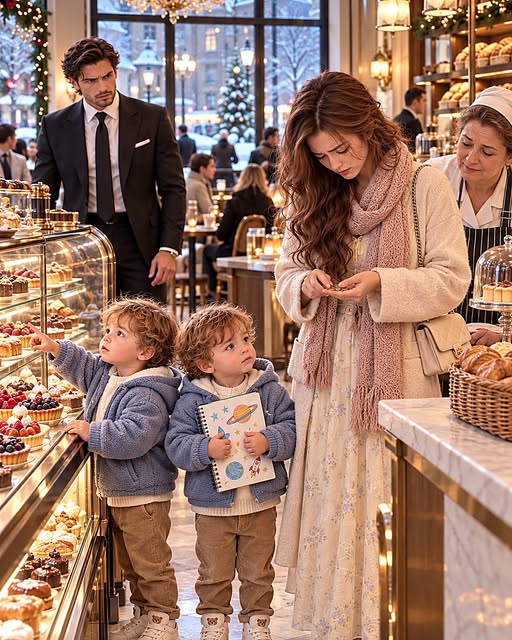
    I was ninety minutes away from signing a six-hundred-million-dollar real estate deal when I saw my ex-wife counting coins to feed two little boys who looked exactly like me.

    One of them — the smaller one, though only by a breath — tugged at her sleeve and whispered, "Mommy, just buy one sandwich. Eli and I can share."

    My name is Preston Calloway. I am thirty-eight years old. I own more buildings than I can count without an accountant, I wear a watch worth more than most families earn in a year, and that Tuesday morning I was supposed to be finalizing the purchase of three luxury towers on Chicago's Gold Coast. I had the pen. I had the money. I had, by every measure the world respects, everything.

    Then I walked into a small bakery on the South Side, and everything I had turned to ash in my mouth.

    I had stopped there on a whim. My driver, Gerald, had taken a wrong turn after my morning meeting, and the smell of fresh bread drifted through the open window while we waited at a light. I told him to pull over. I cannot explain it even now. I only know that something in me — some part I had buried under five years of boardrooms and acquisitions — needed to stand in a place that smelled like my childhood for sixty seconds.

    I was standing near the counter, half-reading an email on my phone, when a child's voice cut through the warmth and the quiet radio music.

    "Mom, please. I'm not that hungry."

    I looked up.

    The boy could not have been older than four. His brown hair fell across his forehead in a way that made my chest tighten for reasons I didn't yet understand, and his enormous dark eyes were locked on the chocolate croissants glowing behind the glass case like treasure in a museum.

    Beside him stood another boy.

    Same face. Same eyes. Same hair.

    Twins.

    The second boy was hugging a battered spiral notebook to his chest, its cover crowded with lopsided drawings of planets and stars.

    And between the two of them stood a woman I had not seen in five years.

    Naomi.

    My ex-wife.

    For a moment, I genuinely forgot how to breathe.

    The Naomi I remembered had worn bright dresses the color of marigolds and tangerines. She had laughed with her whole face, the kind of laugh that made strangers smile in elevators. She used to come home from the school where she taught science with chalk dust on her sleeves and stories about her students so ridiculous she could barely finish telling them before she started laughing again.

    The woman in front of me wore a faded coat with a patched elbow. Her sneakers were worn down to a gray thinness. Her hair was dragged back into a messy ponytail, and there were shadows under her eyes that no amount of sleep seemed likely to fix.

    She looked exhausted down to the bone.

    But it wasn't her exhaustion that nearly brought me to my knees in that bakery.

    It was her hands.

    She was counting coins onto the counter. Dimes. Quarters. Nickels. A thin, careful stack of small money, arranged with trembling fingers like it was something precious. Like it was everything she had, because it was.

    "Two chocolate croissants, please," she told the baker, in the same gentle, steady voice she had once used on frightened seventh-graders.

    The old man behind the counter — his name tag read FRANK — glanced down at the coins. His face did something kind and complicated.

    Naomi counted again. I watched her lips move. I watched her count a third time, slower, as if the numbers might change out of mercy.

    She was short. Eighty cents short, I would learn later. Eighty cents between my sons and their breakfast.

    "Mommy." The first twin tugged her sleeve again. "Just buy one sandwich. Eli and I can share. Really. We're not that hungry."

    "Theo, sweetheart." Naomi knelt down in front of him, right there on the bakery floor, and smoothed his hair with a tenderness that made my throat close. "You don't have to share. Mommy has enough for both of you. I promise."

    She didn't. I could see that she didn't. Frank could see it too.

    The old baker looked at his register, then performed the most transparent act of grace I have ever witnessed. He widened his eyes and slapped the counter lightly, like a man who has just discovered a miracle.

    "Well, would you look at that! Special promotion today. Two croissants for the price of one. Must be your lucky day, Miss Naomi."

    Naomi's head came up. "Frank. You've already helped us so much. I can't—"

    "And you can pay me back," Frank said, sliding two warm croissants into a paper bag, "by making sure these boys grow up loving science as much as their stubborn mother does. That's the deal. Non-negotiable."

    The twins giggled. Eli clutched his planet notebook tighter, grinning, and Theo did a small, hopping dance of joy on the worn tiles.

    Naomi smiled too. But as she stood and turned slightly away, I saw her press the back of her hand to her eyes, quickly, the way people do when they absolutely cannot afford to cry in public.

    Something inside my chest cracked so loudly I was surprised no one turned around.

    Five years earlier, I had stood in the marble foyer of our Lake Forest mansion — a house with eleven rooms we never used — and I had said to that woman: "If you can't learn your place at my side, you'd better disappear from my life."

    I remember her face when I said it. That is the cruelest part. I have always remembered her face.

    There was no anger in it. No hatred. Just heartbreak, pure and quiet, like watching something she loved sink slowly out of reach.

    "Do you really mean that?" she had asked me.

    And I — thirty-three years old, drunk on my mother's approval and my own rising empire — had said, "Yes."

    My mother, Victoria Calloway, had spent the better part of a year poisoning me against my own wife, one tasteful, reasonable sentence at a time. "She's a schoolteacher, Preston. You're building an empire. You need a wife who understands your world." She said it over lunches. She said it over charity budgets. She said it in the car after galas, while Naomi sat in the back seat in a borrowed dress, silent, chalk still ghosting her sleeves because she had come straight from a science fair she refused to miss.

    Eventually, I believed her. God forgive me, I believed her because it was easier than fighting her, and I dressed my cowardice up as ambition.

    Naomi had refused to quit teaching. She didn't care about investor dinners or private jets or which fork mattered at a gala. She wanted a classroom full of children, a small garden, and a husband who came home for dinner.

    I called that a lack of ambition.

    I have never been more wrong about anything in my life.

    In the bakery, Theo laughed at something Eli said — some private twin joke — and then he raised one eyebrow.

    Just one. The left one, cocked high in amused skepticism.

    My whole body went cold.

    I knew that expression. I had seen it in my own mirror for thirty-eight years. My father used to laugh and point at me across the breakfast table: "There's the Calloway eyebrow. Means you're about to cause trouble."

    And now this four-year-old boy, who shared a single croissant-bag breakfast with his brother because his mother was eighty cents short, was wearing my father's eyebrow on my face.

    I looked at Eli. Same dark eyes. Same brown hair falling the same way. Same unmistakable, impossible expression.

    My hands went completely numb.

    Naomi gathered the paper bag, thanked Frank with a gratitude so sincere it hurt to hear, and guided the boys toward the door with a hand resting lightly between their shoulder blades.

    I turned away. I turned my whole body away and stared at a rack of day-old muffins like they were the most fascinating objects in Illinois, because for the first time in my adult life, I was afraid to face another human being.

    That evening, I sat alone in my office on Michigan Avenue, forty-one floors above the city, staring at the skyline while it lit up window by window. The six-hundred-million-dollar Gold Coast contract sat unsigned on my desk. Gerald had asked twice whether I wanted the car. I had sent him home.

    I picked up the phone and called Martin Hayes, my attorney — a careful, decent man who had handled Calloway business for fifteen years.

    "Martin. I need you to investigate someone."

    A pause. "That's rarely a good opening, Preston. Who?"

    "Naomi Vance."

    The silence changed shape. "Your ex-wife?"

    "Yes."

    "You haven't said her name in five years."

    "I need to know if she has children." I could hear my own voice shaking and did not care. "I need to know tonight."

    Another silence, longer. "Why?"

    I swallowed. "Because I think I saw my sons today."

    Martin called back the next morning before eight.

    "Preston. Are you sitting down?"

    "Just tell me."

    "Naomi has two sons. Twins. Theo and Eli Vance. They're four years old."

    My heart was slamming so hard I had to press a hand flat against my desk to stay upright. "When were they born?"

    "Prematurely." A rustle of paper. "Seven months after your divorce was finalized."

    Seven months. I did the arithmetic like a man defusing something. Conception before the papers were signed. Before the foyer. Before my mother's year of whispers had finished its work, Naomi had been carrying my children while I told her to disappear.

    "Who's listed as the father?"

    Martin hesitated. "No father is recorded on either birth certificate."

    I closed my eyes.

    Four years. Four birthdays I hadn't known existed. First words spoken to an empty room. First steps across some worn apartment floor I had never seen. Four Christmas mornings. A woman I had promised to protect, raising my sons alone, counting dimes for croissants — while I bought buildings.

    "Martin," I whispered. "Why didn't she tell me?"

    "That's the second reason I'm calling." More paper, moving faster now. "I contacted the firm that handled your divorce — Whitmore and Gale, before they dissolved. Their archived file on your case has something strange in it."

    "What kind of strange?"

    "Naomi tried to contact you while she was pregnant, Preston. There is documentation. A formal correspondence, submitted through the firm, explaining the pregnancy and requesting direct communication with you."

    "That's impossible." I was on my feet. My chair rolled back and struck the wall. "I never received anything. Nothing. Not a letter, not a call—"

    "I know." Martin's voice was grim. "That's the point. The correspondence was logged as received, reviewed, and handled. Someone instructed the firm — in writing — not to forward it to you."

    My blood turned to winter. "Who?"

    "Preston, I think you need to see the authorization yourself."

    "WHO SIGNED IT, MARTIN?"

    His voice dropped to almost nothing.

    "Your mother."

    I stared at the phone in my hand.

    My mother. Victoria Calloway, who lived in a multimillion-dollar estate in Lake Forest, who wore diamonds to breakfast, who chaired three charity boards and had her photograph in the society pages twice a month. The woman who had told me, over and over, that Naomi had walked away from our marriage because she cared more about her career than about having children.

    The woman I had trusted more than my own wife.

    I dialed her number with a hand that would not steady.

    She answered on the second ring, bright as a bell. "Darling! How did the Gold Coast signing go? The Hoffmans are asking—"

    "Did you know Naomi was pregnant?"

    Silence.

    "Mother."

    "Preston, I don't think this is a conversation for—"

    "DID YOU KNOW?"

    Her voice hardened into something polished and cold. "I did what I had to do to protect our fortune."

    I could not speak. I stood in my silent office with the phone crushing my ear and no words at all.

    "You were building something extraordinary," she continued, reasonable as a surgeon. "That girl would have dragged you down. A schoolteacher, pregnant, clinging—"

    "That girl gave birth to my sons."

    "Lower your voice."

    "FOUR YEARS!" I roared it so loudly that my assistant opened the door, took one look at my face, and closed it again. "I have two sons I never knew existed, and you decided that for me!"

    "Everything I did was for this family."

    I ended the call before I said something that could never be unsaid.

    Then I called my assistant back in and said, "Cancel the acquisition."

    She stared. "Sir? The six-hundred-million-dollar Gold Coast agreement? The investors are flying in at—"

    "Cancel it."

    "But—"

    "I don't care."

    Then I called Martin again, and I told him I wanted every document. Every letter, every log entry, every signature. I wanted to know exactly what my mother had done, in what order, with whose help.

    His answer made my skin crawl.

    "Preston… there's one more thing."

    "What now?"

    "We recovered a sealed letter. Naomi wrote it during her pregnancy. It was in the firm's archive, in the suppressed file. It was never delivered to you."

    I pressed my hand against my forehead. "Read it to me."

    "Are you sure?"

    "Please."

    I heard the faint rip of an old envelope. Then Martin stopped.

    "Preston…"

    "What? What does it say?"

    His breathing had changed. When he finally spoke, his voice was barely a whisper.

    "This letter isn't only about the twins."

    My heart hammered. "Then what is it about?"

    "There's something Naomi discovered before the divorce. Something involving your mother. And according to this letter… she was terrified you would never believe her."

    I stared at the photograph on my desk — my parents, young and laughing, at the lake house the summer before my father died.

    "Martin. What did she discover?"

    He swallowed. "You need to hear the first sentence."

    And as he cleared his throat to read, I understood that losing my wife, and missing four years of my sons' lives, might not be the worst thing my mother had ever done.

  • Chapter 7: The Heir They Tried to Erase

    Chapter 7: The Heir They Tried to Erase

    My daughter was born on a Tuesday in May, at St. Brigid's Hospital, three floors below the room where her grandmother had fought her way back to life — because my mother was there for it. That is the first fact, and to me it is still the most miraculous one. The final procedure in November had succeeded beyond the surgical team's careful optimism; by spring, Margaret Hart was walking the hospital corridors under her own power, terrorizing the physical therapists, and on the morning of my labor she installed herself in the waiting room like a general taking a hill, informing the Varenna security detail, the nurses, and at one point a bishop who had come to visit another patient entirely, that her granddaughter was arriving and standards would be maintained.

    She was right about the granddaughter, as she was right about most things. Seven pounds, two ounces. A full head of dark hair. Luca's eyes — I saw them open for the first time on his face across the delivery room and watched a man who had stared down councils, gunmen, and his own uncle look at three kilograms of newborn and come completely, helplessly undone.

    "She's so small," he kept saying. "Evelyn. She's so small. How is she — look at her hands. Her hands are—"

    "Functional," the midwife said dryly, "like her mother's."

    We named her Isabella, for Luca's grandmother, whose ring I wore — and Rosa, for the nurse of thirty years before who had kept, in a shoebox in her closet, the duplicate records that Beatrice had quietly told us corroborated Calloway's ledger to the letter. Isabella Rosa Varenna. There were men in that hospital waiting room — board members, attorneys, the old guard of a hundred-year-old empire — who wept openly when Enzo came out and announced her name and weight, and I choose to believe it was not only because the succession of the Varenna family had just been secured in a pink blanket. It was because every person in that room had lived, in some way, inside Silvio's lie, and the small furious person in my arms was the living proof that it had failed.

    She was christened in October, in the small stone chapel on the estate where Varenna children had been christened for a hundred years, and if that building had ever held a more dangerous congregation I would like to hear about it: the entire council in their best black, my mother in the front pew in a hat like a battleship, and the new heir of the family asleep through the entire ceremony with the serene indifference of a person who has already won every war she will ever need to.

    It was afterward, over coffee and cake in the garden room, that Luca made the announcement about the godfather, and I watched old Mrs. Antoniou set down her cup with great care, the way you handle something that might be about to become interesting.

    "Security through knowledge," Luca said, when the room had finished reacting. "Adriano knows exactly what a Silvio looks like from the inside — the patience, the paper, the smile. If, God forbid, another one ever rises in this family, I want the man standing beside my daughter to be the one who can smell it at fifty paces." He looked at his cousin. "He also knows what it costs to stay silent. Don't you, Adriano."

    "Every day," Adriano said, and held his goddaughter — awkwardly, terrified, perfectly — while the photographer immortalized the moment Silvio's son pledged his life to the child whose existence his father had spent twelve years and a fortune trying to prevent.

    Beatrice, who had come as a guest and stayed as family, looked at the photograph over the photographer's shoulder and said, "Put that one in the archive. In a hundred years they'll think we staged it."

    "We did," said my mother. "That's what a family is. Staging the truth until it holds."

    A lie that had governed a family for twelve years had been defeated, in the end, by two pink lines on a plastic stick.

    Dr. Henry Calloway did not live to meet her, and I have made my peace with the complexity of grieving him. He recovered from the fire slowly and then declined, all at once, in February — but not before he had signed everything, sworn everything, and recorded six hours of testimony in a Portland hospital room with a federal stenographer at the foot of his bed. He died knowing the truth was out of his hands and into the world's, which his lawyer told us was the first peaceful expression anyone had seen on his face in years. Luca paid for his funeral and attended it, alone, standing at the back — not forgiveness, he told me, but acknowledgment: the man had lit the fuse and then, at the end, at terrible cost, had shown them where the bomb was. The family does not speak his name kindly. But it speaks it accurately, which in the Varenna family is its own form of respect.

    Silvio was convicted in the spring, on counts that took the clerk four minutes to read aloud. He will be a very old man before he sees Boston Harbor again, if he ever does. Adriano testified. I want that known. He sat in a federal courtroom and described his father's safe, his father's handwriting, his father's twelve-year project, in a steady voice, while Silvio looked at the table. When it was over, Adriano went back to work at the ports — where the crews, who had despised him in October as the heir of a fraud, had by spring begun to call him *the one who declined*, which in dock language is apparently a title of enormous respect. He is Isabella's godfather. Luca's decision, announced at the christening to a room that gasped exactly the way dining rooms are not supposed to, and defended with the immortal words: "The job of a godfather is to protect my daughter from men like his father. Who knows the breed better?"

    We married again in June, properly, in the garden of the Varenna house, with my mother walking me down an aisle of white roses on the arm of — at her insistence, and nobody argued — Enzo. Luca asked her permission first, formally, in her kitchen, like a suitor from another century; she made him sit through tea and an interrogation about his intentions that left two of his security men, listening in the hallway, visibly shaken. "You may marry my daughter," she concluded at last. "You already have, technically, but I gather we're doing it properly this time, and I approve of properly. Also—" and she leaned forward, this woman who had been dying when he first sent for me "—thank you. For my life. It's been useful. I intend to spend the rest of it being a grandmother, which I understand is a position of great power."

    "You have no idea," said the most feared man in Boston, with feeling.

    That morning, before the garden filled with guests, I found Luca in the study in his shirtsleeves, with the original folder open on the desk — Calloway's cream letterhead, the Boston General laboratory report, the referral note that had waited twelve years to be read. I thought he was going to burn it, the way he had burned our contract. Instead he took a sheet of the family's heavy writing paper and wrote, in his own hand, in the deliberate script he used for documents that mattered:

    *Read by Luca Varenna, aged thirty-five, in the year his daughter was born. The summary is a lie, bought and paid for. The laboratory report is the truth. Whoever holds this file: read every page, question every summary, and never let anyone — doctor, uncle, or king — tell you what you are. — L.V.*

    He folded the note inside the folder, closed it, and put it not in the locked drawer, where it had spent twelve years, but on the open shelf of the family archive, between his grandfather's war letters and his father's harbor ledgers, where any Varenna who ever went looking for the truth of things would find it in the ordinary light of day.

    "Not a secret anymore," he said. "A record. There is a difference. Secrets are how Silvios happen." He turned and looked at me standing in the doorway in my dressing gown, with the hairdresser due in an hour and his daughter asleep down the hall. "First entry in her education. She will read it when she is old enough to understand what it cost."

    "And until then?"

    "Until then," he said, "she grows up in a house where page two is always read aloud." He came around the desk and took my hands. "Come on. We have a wedding to attend. Apparently I asked properly this time, and the bride said yes, and my mother-in-law has opinions about the seating plan that have already defeated two generals."

    At the wedding dinner — twenty-four seats, forty candles, the harbor spread out below in the dusk exactly as it had been that first night — I sat beside my husband at the head of the table, in a dress the color of candlelight, with our daughter asleep in a bassinet between my chair and my mother's. Course followed course. Toasts were made. Old Mrs. Antoniou, who had watched Silvio draw a gun in that very room, raised her glass to Isabella Rosa and said, "To the heir they tried to erase," and the whole table drank, and I looked down the long candlelit expanse of Varenna men and women, allies and attorneys and judges, all of them raising their glasses to my daughter, and I thought about the night I had run from a dinner like this one with everyone's eyes on my back and a secret burning a hole through me.

    Luca's hand found mine on the table. Not for the cameras. There were no cameras. "What are you thinking?" he asked, low.

    "I was thinking about the first dinner," I said. "The seafood. The bathroom floor. I thought my life was ending."

    "No," he said. "It was beginning. It just had terrible manners about it." He looked down at the bassinet, at the small, sleeping, ruinously powerful face of Isabella Rosa Varenna, and then at me, and something in his expression — something quiet, and settled, and entirely unlike the carved-stone face he wore for councils — made my throat close.

    "Twelve years," he said, "I believed I was a dead end. A family that stopped at me." His thumb moved over my knuckles, over his grandmother's emeralds, over the plain gold band from the contract that I had refused, in the end, to take off — because it was ours too, because all of it was ours. "And the entire time, the future of this family was just… waiting. For a woman brave enough to sit on a bathroom floor, look at two pink lines, and decide to tell a frightening man the truth."

    "I was terrified," I said.

    "I know," said my husband. "You told me anyway. That's what brave means. The rest of them—" his eyes went briefly, without malice, down the table of powerful men "—have been telling me what I wanted to hear since I was twenty-three. You are the only person alive who has only ever told me the truth."

    Below us, Boston glittered, indifferent and beautiful, the way it had on the night everything began. Above the harbor, above the house, above twenty-four seats and forty candles, my daughter slept the sleep of a person for whom the world had been made safe at great expense and greater love — an heir with a father who had taken a bullet for her before she had a name, a mother who had run toward the truth with her hand over her heart, a grandmother who had refused to die before meeting her, and a family that had learned, at last and at cost, the most expensive lesson in the Varenna ledger:

    That a dynasty is not kept alive by signatures, protocols, and lies in locked drawers.

    It is kept alive by the truth, told out loud, in a room full of powerful men, by someone who loves you enough to say it.

    And by two pink lines.

    The end.

  • Chapter 6: What the Truth Cost

    Chapter 6: What the Truth Cost

    Luca survived, because Luca Varenna had not spent thirty-five years becoming who he was in order to be stopped by his uncle's marksmanship.

    The bullet had passed through the muscle of his left shoulder without touching bone or anything with a name I needed to fear. He was in surgery for ninety minutes and awake within three hours, furious about the sling by hour four, attempting to conduct business from the hospital bed by hour five, and formally discharged — against the melodramatic protests of a surgeon who had apparently expected gratitude instead of a schedule — on the third day.

    I was at St. Brigid's, of all places. The same hospital where my mother lay three floors above the trauma unit, in the same building where gray-sedan men had once waited for me in a parking garage. There is a poetry to hospitals that nobody asks for. I divided my days between two bedsides: upstairs, my mother, recovering by inches from the protocol and furious about the food; downstairs, my husband, recovering by leaps and furious about everything else. My mother took one look at me on the second day — one look, with those eyes that missed nothing on this earth — and said, "Evelyn Hart. Sit down and tell me everything, and start with why my son-in-law has been shot in my hospital."

    So I told her. All of it, sitting beside her bed with her thin hand in mine: the tests, the folder, Calloway, Silvio, the garage, the council, the gunshot. And at the part where another woman might have fainted or wept, my mother — who had faced her own death with more composure than most people face a tax audit — nodded slowly and said:

    "Well. I always said that boy looked at you like you were the only real thing in the room." She patted my hand. "The mafia part I could take or leave, but a man who steps in front of a bullet for my grandchild gets my vote in any election he's running in." A pause. Her eyes went very bright and very steady. "Grandchild," she repeated, testing the word. "I'm going to be a grandmother."

    "You are," I said, and we cried together then, quietly, in the sunlight of that hospital room, for all of it — for the years of envelopes I couldn't open, for the contract in the drawer, for the twelve stolen years, for the small fierce heartbeat nine weeks old that had blown a decade-old lie into pieces simply by existing.

    The day before Luca came home from the hospital, an obstetrician named Dr. Osei — vetted by Enzo, I was later told, down to her parking habits — performed my twelve-week scan in a private room at St. Brigid's with the door guarded and the blinds drawn, because even joy, in that season of our lives, required security clearance.

    Luca was brought down in a wheelchair he treated as a personal insult, his shoulder strapped, a nurse trailing behind him in defeat. He held my hand with his good one while the screen flickered — and there it was: a small, bright, impossible star in the gray. A heartbeat at a hundred and fifty-eight beats a minute, strong and steady and utterly indifferent to twelve years of paperwork that said it could not exist.

    "There," said Dr. Osei, with the satisfaction of a woman whose profession is facts. "That is your son or daughter, declining to be a clerical error."

    Luca Varenna, who had been shot six days earlier without making a sound in front of twenty-three witnesses, made a sound then that I had never heard from him — something between a laugh and the thing that comes after a laugh when a man's chest is too full for either. He stared at the screen the way he had once stared at page two of his own file, except that this time the document agreed with the life in front of him.

    "Again," he said hoarsely. "The sound. Play the sound again."

    Dr. Osei, who had clearly seen every species of father there is, smiled and turned the volume up, and the three of us sat in the darkened room and listened to the fastest, strongest small drum in the world: my child's heart, twelve weeks old, beating like it intended to be heard in every room of the Varenna house for the next hundred years.

    "That is the succession," Luca said at last, very quietly, to no one in particular. "Everyone keeps talking about documents. That. That is the whole thing. All the rest is paper."

    "Then we agree," I said, "that this one reads page two first. Always. About everything."

    "First lesson," he promised the screen. "Before walking. Before Latin."

    Silvio's ending was not dramatic, because Luca — recovered, methodical, and infinitely colder than rage — did not permit it to be.

    There was no basement, no harbor at midnight. My husband is a modern man. He handed the federal prosecutors a case so complete that their lead attorney reportedly asked if the Varenna family offered this service to the public: the ledger, the bank records, Calloway's notarized statement, the garage attacker — who had begun cooperating within a day of learning that his employer had left him in a sealed parking garage to take the fall alone — and the small matter of a retired doctor's house fire in Maine. Silvio was arrested at his home in Brookline at six in the morning, in his dressing gown, in front of the neighbors he had spent forty years impressing. The charges began with fraud and conspiracy and arson and went downhill from there, and included, before the month was out, one more that Adriano himself delivered the evidence for.

    Because the last truth was the oldest one, and it came from the son.

    Adriano came to the house a week after the arrest — not the safe house, our house, the Varenna house, to which we had returned the day Luca left the hospital, with the staff triple-checked and the portrait of Silvio already removed from the east corridor. Adriano looked ten years older than he had at the dinner. He stood in the study — the same study, the same desk — and he put a box on it, and he said:

    "In March I went into my father's study looking for the harbor contracts. I found a wall safe behind the survey maps. I'm his son; I knew the combination was my mother's birthday before I finished turning the dial." He pushed the box an inch toward Luca. "I told myself it was nothing. Old paper. I told myself that for eight months, and I went to your christenings and your dinners and I let you believe—" His voice broke. "Twelve years, Luca. I found out in March and I carried it for eight months because he is my father. If you want my life for that, it's yours. But read it first."

    In the box were records twenty years older than Calloway's ledger: payments, coded and careful, to a crew of dock men in the winter before the accident. The accident. The shooting and explosion at the Charlestown warehouse that had put a twenty-three-year-old Luca Varenna on Dr. Calloway's table and a target on his father's heart — because it was grief and overwork, everyone always said, that had killed the old man six months later.

    It had been ruled an attack by a rival family for thirty years of institutional memory. It had, in fact, been commissioned. A warehouse meant to frighten. A fire meant to warn. A shooting that — on the written orders of a younger brother who wanted a frightened, grateful, dependent heir installed above him as a figurehead, and a clear field for himself below — had gone further than intended. Silvio had not meant, the records suggested, for Luca to nearly die. He had only meant for him to be diminished. And when the boy on the table survived whole — when the injuries healed and the heir stood back up — Silvio had reached for a quieter weapon: a sentence in a medical file, to finish on paper what the explosion had failed to finish in fact, and leave Luca alive, respected, and sterile, a king with no line, ruling a kingdom already mortgaged to his uncle's son.

    Luca read it all twice, in silence, with his arm in its sling and his face completely still. Then he closed the box and looked at his cousin for a long time.

    "You brought this to me," he said at last. "No one would ever have found it. You could have burned it and been Silvio Varenna's wronged, innocent son for the rest of your life, and half this family would have followed you out of loyalty to the name."

    "I know," Adriano said.

    "Why didn't you?"

    Adriano looked, for a moment, exactly like the boy in the christening photographs. "Because in March I read that wall safe, and in June your wife walked into this family's dinner and got sick at the smell of fish, and I did the arithmetic my father taught me to do, and I understood what was coming. And I decided—" he swallowed "—I decided I would rather be the man who told than the man who inherited. Take my life or take my loyalty, Luca. But they're both in the room."

    What Luca did with his cousin is, I think, the single thing that best explains why, in the end, the Varenna family did not tear itself apart that autumn. He did not kill him. He did not exile him. He stood — slowly, with the sling, with my hand under his good elbow before I even realized I'd moved — and he put his good hand on the back of Adriano's neck and pulled his forehead down to his own, the way their grandfather had done with both of them when they were boys fighting in the garden, and he said: "Your loyalty. On one condition. You will spend the rest of your life being worth it. Start Monday. The ports need a man the crews trust, and apparently I need—" the ghost of the driest smile "—a successor who has actually declined the job once. It builds character."

    The council ratified it all before the end of the month: the protocol annulled, the fraud placed on the record of the family in permanent ink, the succession restored to Luca and his line. And on a gray bright morning in early November, in the study at the end of the east corridor, my husband opened the bottom drawer of his desk and took out a second folder — thin, new, eleven pages — and put it on the fire he had lit in the fireplace, and we watched our marriage contract burn together, page by page, until the signatures curled and blackened and were gone.

    Then he took a small box from his pocket — not the folder. A ring box. His grandmother's ring, emeralds the color of deep harbor water, which Silvio had kept in the family vault for thirty years as "safekeeping."

    "Evelyn Hart," he said, and went down on one knee — carefully, favoring the shoulder, with the sling, on the study floor where he had once knelt to tell me I was not a clause. "I bought your mother's life once, and called it a marriage, and it was the best and worst thing I ever did: best because it brought you into this house, worst because you deserved to be asked. So I am asking. No terms. No duration. No signatures. Marry me — again, properly, in front of everyone, because you choose it. Because—" and Luca Varenna, who had not stumbled over a word in my hearing in the whole of our acquaintance, stumbled "—because you are the only real thing in any room I have ever stood in, and I would like to say so in a church."

    "Yes," I said, before he had entirely finished, which in this family counts as interrupting, and which nobody present has ever held against me. "Yes. On one condition."

    "Name it."

    "Our child gets told the truth," I said. "All of it. When they're old enough. The contract, the lie, the folder, all of it. Nobody in this family ever again builds a life on a page they haven't read."

    "Agreed," said my husband, and slid his grandmother's ring onto my finger, above the plain band from the contract, where it has stayed ever since. "First clause of the new arrangement."

  • Chapter 5: The Night of the Vote

    Chapter 5: The Night of the Vote

    I wore black.

    Not mourning black — armor black, a dress that fell in one clean line from my shoulders to the floor, with long sleeves and a high back, and underneath the careful tailoring, invisible to every eye in that room, the smallest possible curve of my stomach, eleven weeks along and the most important fact in Massachusetts.

    "You understand," Luca said in the car, "that from the moment we walk in, there is no leaving the story halfway. He will fight. He has been fighting for twelve years; he will not stop because I show him paperwork."

    "I understand."

    "If anything goes wrong — anything at all — Enzo takes you out through the library. You do not argue with me. You do not look back. That is the one order I have ever given you, Evelyn, and I am giving it as your husband, not your—" he searched, and discarded the word *contract* with visible distaste "—not as anything else."

    "And if everything goes right?" I asked.

    His hand found mine in the dark of the car. "Then we eat dinner in our own house, and you sleep in our bed, and no one ever again suggests that my family ends with me."

    The dining room of the Varenna house had been set for twenty-four. I counted the candles out of nervousness: forty. The full council. Men — and three women, the widowed matriarchs of allied families, whom no one in that world was foolish enough to underestimate — taking their seats along a table that could have hosted a treaty signing. Portraits on the walls. Crystal. The harbor glittering through the tall windows, exactly as it had glittered the night I ran from that other dinner with my hand over my mouth.

    I took my seat at Luca's right, and my hand did not go to my stomach, and I was prouder of that than of anything I have ever done.

    Silvio Varenna presided from the foot of the table like a man at his own coronation. He was sixty-one, silver-haired, handsome in the carved way of old coins, and he ran the evening beautifully — course after course, toast after toast, the business of the family dispatched with oiled efficiency: harbor contracts, hotel revenues, a dispute with a Providence crew settled with a handshake. And all the while, at the edges of my vision, I could see him doing what he had done for twelve years. Arranging the room. When the plates were cleared and the brandy came, he rose, and the table quieted for him the way it quieted for Luca — almost the same way. Almost.

    "Brothers. Sisters. Friends of this house for fifty years." His voice was warm and sad. "You know why I have asked for formality tonight. Our family stands at a turning. Luca—" he inclined his head to my husband with genuine-looking respect "—Luca has carried this family since he was twenty-three years old, through fire and grief, and no man at this table doubts his strength. But strength is not succession. We are not a company; we are a bloodline. And bloodlines—" the sadness deepened, performed to perfection "—must be planned for honestly, however painful the honesty. The protocol before you merely confirms what Luca himself signed last year: that in the event of his death without issue, the succession passes to my son Adriano, who has served this family faithfully—"

    "Point of order," Luca said.

    He did not raise his voice. He rarely had to. Twenty-three heads turned.

    "Before this council ratifies a protocol built on the fact of my having no issue," Luca said, "the council should examine the fact." He nodded once, to Enzo, standing at the door. "Because the fact is false. It has been false for twelve years. And it was made false, deliberately, by a man sitting at this table."

    The silence that followed was total. Even the harbor seemed to stop glittering.

    Enzo moved down the table with a stack of bound folders — twenty-two of them — and set one before every voting member. I watched Silvio's face as the folder landed in front of him. He did not open it. That was the first thing. Everyone else opened theirs; the rustle of twenty-two people reading moved around the table like wind through wheat. Silvio alone sat with his hands flat on the cover of his copy, as if holding something down.

    "Page one," Luca said, "is a medical summary, written twelve years ago by Dr. Henry Calloway, stating that I am permanently incapable of fathering a child. Page two is the laboratory report from Boston General Hospital, dated the same week, which Dr. Calloway's summary claims to describe. You will notice that it describes nothing of the kind. Page three is a referral for follow-up testing that was never given to me. Page four is a payment ledger, kept in Dr. Calloway's own hand, recording eleven years of payments from a company called Harborline Medical Consulting — a company with one client and one signatory office. Page seven is a bank record from six years ago: a payment from Harborline, covered personally, in a hurry, from the personal account of Silvio Varenna."

    A sound went around the table — not a gasp; these were not people who gasped. It was the sound of chairs shifting, of glasses set down, of twenty-two powerful people recalculating.

    "And the final page," Luca said, "is a laboratory report from a clinic in Providence, dated this month." He stood. He came around the table and stopped behind my chair, and his hand came to rest on my shoulder — not formally, the way it had in ballrooms, for cameras. Possessively. Tenderly. In front of God and the Varenna council. "My wife is nine weeks pregnant. Independent testing confirms what the old laboratory report said all along. I was never infertile. I was *managed.* For twelve years, my uncle paid a doctor to convince me my line ended with me — so that the succession would flow, by my own signature, to his son."

    "You lie," Silvio said quietly.

    It was the first crack, and it came too fast, and everyone at the table heard it for what it was: not *this is outrageous*, not *let me see these documents*, but the flat, instant denial of a man who had rehearsed for this night for twelve years and discovered his rehearsal was worthless.

    It was old Mrs. Antoniou who spoke next, in the tone of a woman calling a church meeting to order.

    "Silvio." She did not rise; at eighty, in that room, she did not need to. "Open your folder. The rest of us have opened ours."

    "I will not dignify—"

    "Page four," said Whitlock, the banker, who had been reading with a pencil in his hand the way priests read scripture. "Harborline Medical Consulting. I know this structure. Dissolved holding entities, a single signatory office, payments in stages — it's a coffin with the name filed off, and whoever built it built it to bury something." He looked up, and his face had changed completely. "I sat on the finance board that approved your succession protocol, Silvio. I would like to know what, exactly, I approved."

    "You approved what Luca signed."

    "A signature on a purchased fact," said Mrs. Antoniou, "is not a signature. It is a receipt." She folded her hands over her folder like a judge over a gavel. "Let your nephew table his evidence. All of it. This council has ratified nothing yet, and by God it will hear everything there is to hear before it signs its name to your son."

    "I am prepared," Luca said, "to table the bank records, the forensic accounting, and Dr. Calloway's recorded and notarized statement, sworn before his death—" he let that land; Calloway had not died, was in fact recovering in Portland under guard, but Luca had never wasted a tactical ambiguity in his life, and Silvio's face, quite suddenly, went the color of old paper "—but first I want the council to hear one thing from me directly." His hand tightened on my shoulder. "I believed the lie. I signed the protocol believing it. Every decision I have made for twelve years was made inside a cage another man built. And I am not here tonight to ask this council for pity. I am here to withdraw my signature from a fraud, to annul a protocol obtained by that fraud, and to inform this family—" his voice did not rise, but it seemed to fill the room anyway "—that the Varenna line does not end with me. It never did. It was simply waiting for someone in this family honest enough—" his eyes went to Silvio "—and brave enough—" his hand moved, gently, unmistakably, to rest over the curve of my stomach, and the entire table saw it "—to carry it."

    I will remember what happened next for the rest of my life, in pieces, the way you remember a car accident or a wedding.

    Adriano stood up.

    Luca's cousin — thirty years old, Silvio's son, the man the protocol named, whom I had met perhaps six times and who had always been courteous to me in the distant way of men who have already filed you under *temporary*. He stood up at his father's side with his chair scraping, and I thought: *here it comes, the defense, the counterattack* — and Adriano said, in a voice that shook:

    "Father. Tell them it isn't true."

    "Adriano—"

    "Tell them. Because I have read page four while you were talking, and I know your handwriting on a wire form when I see it, because you taught me to write them." He was staring at the ledger like it was a body. "Tell them, or I will start telling them what I found in your study in March, when I went looking for the harbor contracts."

    Silvio rose then, slowly, and the room changed temperature. His hand went inside his jacket — and the evening, which had been a tribunal, became something else entirely in the space of one heartbeat. Enzo was moving. Luca was moving. Two of the allied men were on their feet, and old Mrs. Antoniou, eighty years old and the widow of the family's oldest ally, said "Silvio, you fool" with enormous contempt, and then there was a sound that I have heard exactly twice in my life and never want to hear again.

    A gunshot in a dining room is not like in films. It is bigger than the room. It deletes every other sound in the world and replaces them a half-second later with ringing.

    Luca had gotten between his uncle and me — that is the plain fact of it, and the plain fact is the whole of it. He had turned, and stepped, and put his body where my body was, in the half-second when Silvio's desperation became Silvio's final decision. The bullet that was meant to end the evidence took my husband in the shoulder instead. He staggered. His hand, which had been resting over our child, pressed hard against the wound in a reflex as old as war — and then, with blood already coming through his fingers, Luca Varenna grabbed the edge of the table and stayed standing through sheer, outrageous refusal to fall at his own table.

    Enzo took Silvio down. I will not describe that either, except to say that it was swift, and professional, and that Silvio was weeping by the time he reached the floor — a sixty-one-year-old man weeping for a twelve-year theft collapsing in a single minute, while his son stood over him and did not go to him.

    I was the one who got to Luca first. Twenty-three powerful people in that room, and it was the contract wife with the paper-thin medical training of a woman who had spent two years in hospitals who had the napkins pressed to his shoulder and his weight against her and her voice saying, steadily, in his ear: "Stay with me. That's the whole job now. Stay with me, and tomorrow you can be terrifying again. The baby is fine. I am fine. Stay with me, Luca."

    "Evelyn," he said, quite calmly, looking up at me from a very far place, "I believe the vote is going to go our way."

    Then, finally, he let himself fall — into my arms, with complete trust, like a man laying down a weapon.

  • Chapter 4: Twenty-Eight Days

    Chapter 4: Twenty-Eight Days

    The leak took nine days to find, and when Enzo found it, it was not a villain. It was a girl.

    Her name was Marta. She was twenty-two, a junior housekeeper at the Providence clinic — no. She was a filing clerk there, hired four months earlier, quiet and quick and unremarkable, exactly the kind of person hospital corridors are full of and no one ever sees. Her uncle — her mother's brother, a man named Paolo whom she owed money to, family money, the kind of debt that comes with Sunday dinners and guilt instead of interest — worked as a driver. For Silvio Varenna.

    She had not even understood what she had sold. A name on an intake form, *E. Hart*, attached to the most recognizably dangerous surname-by-marriage in Boston; a test ordered; results flagged in the system in a way that made a young clerk's eyebrows go up. Her uncle had asked, at a family cookout, the way you ask about the weather: *anything interesting at work these days, sweetheart?* And she had told him. Two days later, the gray sedan had been waiting in a hospital garage.

    Luca did not destroy her. I want that recorded too, because it mattered to me, and because it taught me something about the man I had married that no contract ever could. He had her brought to the safe house — gently, in the afternoon, with Enzo in the front seat explaining that she was not in danger — and he sat across from her in that little kitchen while she sobbed out the whole small, sordid, human story of it, and at the end he said: "Your uncle used you. That is his sin, not yours. But you will work for me now, Marta, until this is finished. You will go to work tomorrow, and you will behave exactly as you have behaved, and if your uncle asks you anything ever again, you will remember this room before you answer." He paid off her family debt himself, that evening, in full. Not as kindness, he told me later. As strategy. *A bought person can be rebought,* he said. *A freed one stays free.* But I had watched his face while the girl cried, and I knew strategy was not the whole of it.

    Meanwhile, in the quiet house with the garden wall, the war assembled itself piece by piece.

    The Harborline money trail came first. Luca's forensic accountant — a terrifyingly cheerful woman named Beatrice who had once worked for the Treasury Department and referred to offshore accounts the way chefs refer to cuts of meat — traced the dissolved company's payments across eleven years: Calloway's stages, yes, but more. A clinic lease quietly paid long after the clinic closed. Annual transfers to a "consultancy" in Delaware. And a single, stupid, human mistake: six years ago, one payment had been made not from Harborline at all, but from a personal account, in a hurry, by a man covering a gap — and the personal account belonged to Silvio Varenna. It was not a confession. It was a fingerprint. Beatrice laid the whole chain out on the safe-house table like a tarot reading: *this is the shape of a man who bought a lie and paid its rent for twelve years.*

    There was also the matter of Adriano.

    A week before the council meeting, duty required us at a preparatory dinner in the big house — a small one, twelve seats, the kind of working supper where the real business of the family gets done between courses. Silvio presided at the foot of the table, by long custom, and Adriano sat at his father's right with the harbor contracts open beside his plate and a face like a man reading his own obituary in a language he only half knew.

    He was courteous to me. He had always been courteous to me. But that night, when the talk turned — as Silvio smoothly turned it — to the succession protocol and the *stability of the family*, I watched Adriano's hand stop halfway to his glass, and stay stopped, for the length of three full sentences.

    "Evelyn," he said later, in the corridor, catching up with me under the portraits with the air of a man who has rehearsed a casual question for an hour. "You look well. Recovered, I mean. From the — the oyster. At the dinner."

    "Completely," I said. "Kind of you to ask."

    "My father asks after you," he said, and something moved in his face that he could not quite govern. "He worries. A house like this — a woman in your position — health is… everything in a house like this." He seemed to hear himself, and to hate the sound. "Give my regards to Luca."

    I reported the conversation word for word, in the car, the way Luca had taught me: *that is the arrangement now, all of it, always.* Luca listened with his eyes closed.

    "He knows something," he said at last. "Not everything. Something. A son who has just learned his inheritance has a crack in it sounds exactly like that." He opened his eyes. "Leave him. A wavering man is not an enemy yet, and Silvio must not learn that we have noticed his son wavering. Let him think his house is in order. Men with orderly houses sleep well the night before they burn."

    Then there was Calloway.

    He lived — the Portland doctors were blunt about how close it had been — and three days after the fire, a package arrived for Luca through channels I didn't ask about: a fireproof envelope, mailed from a Portland post office the morning of the fire, in the shaking hand of a man who had apparently spent his last free morning settling his accounts with God. Inside: a safe-deposit key, a bank address in New Hampshire, and a letter.

    Luca read the letter aloud to me, once, in the garden, and neither of us ever read it again.

    *"Luca — If you are reading this, then I have run out of time or courage, and likely both. I have kept copies of everything for twelve years, not out of conscience but out of fear: men like the one who paid me keep receipts, and I wanted one of my own. The box contains the original laboratory work, my appointment books, and the payment ledger with names, dates, and the Harborline accounts. I wrote what I wrote because I was afraid of being nothing. I had a practice, a name, a house — and I was still afraid, at fifty years old, of being nothing. You were a boy on my table and I let them buy the rest of your life for a number with five zeros. Whatever you do with this, do it knowing that one of the men who harmed you dies sorry. — H.C."*

    The box, when Luca's people retrieved it under a lawyer's eye, contained everything he promised. Original lab work. Appointment books. A payment ledger in a doctor's neat hand, twelve years of it, ending with a note in the margin of the final page in different ink: *Paid in full. God forgive me.*

    And my mother — because life insists on happening in all its rooms at once — my mother, in the middle of all of this, began to get better.

    Not dramatically. Recovery is not a movie. But the new protocol was doing what the doctors had hoped: her numbers climbed, her color came back, she began demanding real food and making jokes at the nurses' expense, which the head nurse told me was the most reliable vital sign she'd ever charted. The surgical team scheduled the final procedure — the big one, the one that could end it — for the week after the council meeting. Luca visited her twice that month, driving himself, sitting in the plastic chair, submitting to her cross-examination with a grace that would have astonished his board of directors. On the second visit, as I was helping her sit up, she caught his hand in both of hers — her hands were still thin as paper — and said, "You look like a man with a secret, Luca."

    "Mother," I said, horrified.

    "I am a man with several, Mrs. Hart," Luca said gravely. "Occupational hazard."

    "Mm." Her eyes, which missed nothing on this earth, moved from his face to mine and rested, briefly, significantly, on the way my coat hung. "Well. Whatever it is — tell it soon. Secrets are heavy. And you—" she patted his hand "—are carrying enough."

    On the drive back to the safe house, Luca was quiet for a long time. Then he said, "When this is over, I am going to ask your mother for permission to marry you."

    "You are married to me," I pointed out. "There's a contract in a drawer in Boston with both our names on it. Several lawyers were involved."

    "That," he said, "was a business transaction with a dying woman's daughter, conducted by a man who believed he had nothing to offer but money. I would like to do it properly this time." He kept his eyes on the road, which is how I knew he meant it more than anything he'd ever said looking at me. "A question, this time. Not a signature."

    Two days before the council meeting, my mother telephoned me from the hospital, in the middle of the afternoon, with the bright, careful voice she used for delivering news she had already decided not to be frightened by.

    "Your uncle-in-law came to see me," she said.

    I sat down on the safe-house stairs. "Silvio was there? At St. Brigid's?"

    "Such a charming man. He brought flowers — half the florist, I think — and he sat in that chair you're always complaining about, and he asked after my treatment, and my doctors, and you." A pause with edges. "He asked a great many questions about you, darling. About your health. About whether this wonderful new protocol of mine had me thinking about… the future. About grandchildren." Another pause. "I told him that at my age a woman thinks about grandchildren the way she thinks about the weather in heaven — with great interest and no information whatsoever. And then I rang for the nurse and asked her to help me with my nap, because I found I was suddenly very tired of visitors."

    "Mother—"

    "Evelyn. Listen to me." The bright voice was gone; this was the voice that had raised me, the one that did not bend. "I have been looked at by experts for two years — doctors, insurance men, bill collectors. I know the difference between a man visiting a sick woman and a man *measuring* one. That man was measuring my room, my nurses, and my daughter's life. Whatever you and that husband of yours are planning — plan it faster."

    Luca, told within the hour, did not rage. He did something worse: he went very quiet, and then he made three telephone calls. By nightfall my mother's floor at St. Brigid's had two of his men on it in orderlies' coats, her visitor list was sealed to family only, by name — a list that did not include Silvio Varenna — and the gray-sedan man's surviving accomplice, still at large, had a price on his capture that Enzo described to me only as "motivational."

    "He went to her room," Luca said that night, in the dark of the safe-house bedroom, and I understood that of all Silvio's crimes — the bought doctor, the burning house, the men in the garage — this was the one my husband would never, under any circumstances, forgive. "A dying woman, in a hospital bed, who has never done him anything but give the world *you*. He sat in my chair and he measured her."

    "She sent him away with a nap request," I said. "She wants that in the record."

    "Then the record will show," Luca said, "that Margaret Hart was the first person in this family to defeat Silvio Varenna, and she did it with a call button."

    The council meeting was set for the last Friday of the month, at the Varenna house: the full family council, twenty-two voting members — uncles, cousins, the heads of the allied families, the old guard who had known Luca's grandfather. Silvio had called it, in fact. That was his final error, though he didn't know it yet. He had spent two months whipping votes for a formal ratification of the succession protocol — Adriano named co-heir and designated successor, *for the stability of the family* — and he wanted it done grandly, publicly, irreversibly, in the house his brother built.

    Luca let him. Luca encouraged him. Luca attended preparatory dinners with a face of carved stone and let his uncle count his votes and smile his small, patient, twelve-year smile.

    "Why let him build the stage?" I asked, the night before, in the safe-house kitchen, while the evidence files lay stacked between us like masonry.

    "Because," Luca said, "when a man has lied for twelve years, you do not whisper the truth in a corridor. You let him gather everyone he has ever lied in front of — and then you tell it once, in front of all of them, so that it never has to be told again." He turned a page of the ledger. "Twenty-two voters, Evelyn. Tomorrow night, every one of them learns that the Varenna succession was nearly stolen with a fountain pen — and that my son—" he stopped, and the smallest, fiercest smile I had ever seen him wear crossed his face "—or daughter. Is already on the way to take the seat Silvio tried to sell."

    He closed the ledger.

    "Tomorrow," he said, "we go home."