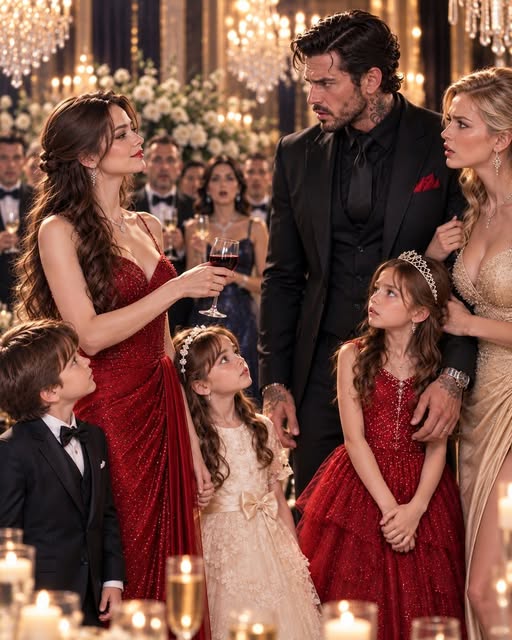
Story Genres: MAFIA BOSS

  • Chapter 5: But That Isn’t True, Is It?

    Chapter 5: But That Isn’t True, Is It?

    The twins were exactly where they were supposed to be, which where my children are concerned has always been something of a miracle: on the lounge sofa, shoes off, watching the monitor with plates of cake balanced on their knees.

    On the screen, Alexander was raising his glass to his daughter.

    "Mom?" Luna said. "Why does that man look like Leo when Leo does his serious face?"

    Out of the mouths of nine-year-olds. I stood in the doorway of that lounge with ten years balanced on my shoulders like a tray of glasses, and I made the decision I had actually driven to Chicago to make — not in the corridor, not at the contract signing, but here, now, with my children's faces turned up to me in the monitor's light.

    "Because he's your father," I said.

    The room went very still, in the way only children can make a room still. Leo set his plate down with great care, the way he does when he is being extra grown-up. Luna looked from the screen to me and back, doing mathematics no child should have to do, arriving at the answer with her father's own speed.

    "The question mark," Leo said quietly.

    "Yes, baby."

    "Is he a bad man?" Luna asked. "Is that why we don't live with him?"

    "He was a careless man with the truth," I said, "and I was a proud woman with it. You're going to stand with me while I fix my half. You don't have to say a word. Just hold my hands and be exactly who you are." Leo stood up and straightened the tie he had packed for the important dinner, and took my left hand. Luna took my right, and wiped cake off her chin with the back of her wrist like a prizefighter, and said, "Okay. Rule One."

    The ballroom doors were the tall kind, built for entrances. The ushers pulled them open for the toast's applause, expecting, I think, a cake, or a choir, or some late-arriving dignitary.

    They got us.

    I have planned four hundred events. I know exactly what a room sounds like when its attention turns: it is not silence, it is the opposite of silence, a wave going out from the doors to the stage, table by table, glass by glass, as three hundred people understood one thing after another. A woman. In black, plain as a staff member and upright as a queen. A child on either hand. Walking — not hurrying, not trembling — down the long center aisle toward the stage, between the gold chairs, in the exact room where she had once walked out the other way, alone, with her head high and nobody stopping her.

    Alexander Moretti saw me when I was halfway down the aisle.

    I watched the color go out of his face in stages, like a city losing power. The glass in his hand stopped halfway down from the toast. Beside the stage, in the front row, Sophia rose half out of her chair and sat again, hard, as if her knees had made an executive decision, and her famous smile came off her face like a mask dropped on a floor.

    "Claire?" Alexander said. My name, in a ballroom, through a microphone. Ten years and three hundred witnesses too late, and still it went through me like a struck bell. "Claire — what are you—"

    "Alexander Moretti." My voice surprised me. It was the voice I use for vendors and weather emergencies: carrying, calm, impossible to talk over. "I think you just made a mistake."

    He came down the stage steps slowly, leaving the microphone standing alone up there like an abandoned flag, and the room made a sound — three hundred people inhaling through their teeth — as he crossed the dance floor toward us. He stopped four feet away. He was looking at me the way a man looks at a road rising out of a flood. And then, not at me. Down. At the two children holding my hands, who were looking back at him with his mother's eyes and his own childhood face arranged in two new editions, and his voice — the voice that had silenced judges — cracked cleanly in half.

    "Who are they?"

    "Your son," I said. "Leo." I felt Leo's hand tighten on mine, and I squeezed back. "Your daughter. Luna. They are nine years old, Alexander. They were born the February after I left Chicago."

    Nine. I watched him do the arithmetic every person in that room was doing, watched it arrive: the banquet, the ring on the marble, the signature on the papers — and underneath all of it, the whole time, a pregnancy nobody had told him about. Something moved across his face that I had never seen there in three years of marriage, not even in the dark, not even in the beginning.

    Horror. Not at them. At himself.

    In the front row, a small girl in a champagne-colored dress had risen to her feet.

    Isabella. I knew her from the run sheet the way I knew every detail of that night — eight years old, Alexander's daughter, the heiress of the toast unfinished above us. A nanny was pulling gently at her sleeve, trying to sit her back down, but Isabella wasn't looking at the stage or at the crowd. She was looking at Leo with the frank, total stare of childhood, and then at her father, and her voice — a child's voice, pitched to carry the way children's voices do in formal rooms — went out across the silence like a bell.

    "Papa," Isabella said, "why does that boy look like you in Nonna's pictures?"

    Somebody in the crowd made a sound that was half laugh, half sob, and covered it too late. Alexander's head turned toward his daughter, and I saw the last of the arithmetic arrive in his face: not shame, not strategy — grief, plain and undisguised, for a whole second family standing in front of him that he had never been given the chance to fail on purpose.

    "You said you only have one child," I told him, and my voice finally shook, one thread of it, like a wire in wind. "You just told three hundred people that everything you built belongs to your only daughter." I looked at my twins, and then back at the man who had once told me, in a kitchen, that I would not survive without him. "But that isn't true, is it?"

    "No." The word came out of him like something pulled from deep water. "No, it isn't — Claire, I didn't know. I swear to you, I never knew—"

    "She's lying!"

    Sophia's voice cut across the dance floor like a thrown plate. She was on her feet now, cream suit blazing under the chandeliers, one hand outflung toward me, performing — and I use the word with respect for the craft of it — performing outraged innocence for three hundred witnesses and at least forty phones.

    "Look at her! A dismissed employee with a grudge and a rented pair of children! She planned this — she's the producer, she put herself in this room to ambush this family in front of the entire city! Alexander, she took your money ten years ago and vanished, and now that it's spent she's come back with two coached children and a story—"

    "The money," I said.

    I didn't raise my voice. I didn't have to. Something about the two quiet words stopped her mid-sentence the way a hand stops a metronome.

    "What money, Sophia?"

    For the first time since I had known her — across three years of doorways and one conference table — I watched Sophia Reynolds hesitate. It lasted less than a second. A woman less practiced than me would have missed it entirely. But I had once sat in a kitchen while she described my comfort to me in the tone of a weather report, and I had had ten years to learn her face the way sailors learn a coastline.

    "I — the settlement," she recovered, magnificently. "Everyone knows about the settlement. Five million dollars, and a house—"

    "Then everyone knows more than I do," I said. "Because I never saw one dollar of it."

    The whispering in the room changed key. Phones came up higher. I felt Leo step half a pace in front of me — my nine-year-old, running Rule One — and I put my hand on his shoulder and kept it there, gentle and absolute, because this was the moment I had crossed a decade carrying, and it was mine to carry, not his.

    And here is the truth about that moment, the part I have never said aloud: I was watching Alexander. Not the room, not Sophia — him. Because I had stood in this room once before with my face burning, watching a man's arm hang still at his side while a woman slid hers through it, and some deep, unhealed chamber of my heart was waiting — actually waiting, breath held, fists at my sides like a girl's — to see whether he would do it again. Choose the room. Choose the peace. Choose the version of events that let Alexander Moretti go on being Alexander Moretti, undisturbed.

    I saw the struggle happen on his face in real time. I saw his eyes go — once, quickly — to the tables of judges and senators and cameras. I saw the old machinery engage: the calculation, the cost, the scene.

    My heart went down like a stone in a lake.

    And then Francesca Moretti walked onto the dance floor.

    She came without hurry, the way she did everything, with Marta at her elbow and three hundred people parting for her like water for a small, elderly ship of war. She stopped in front of Leo. She looked at him for a long moment, and then — gently, with a hand that trembled only slightly — she turned his head, just a fraction, toward the chandelier light.

    "Look at him," she said, in a voice that reached the back wall without being raised. "All of you. Look, since you're all so fond of looking." Her fingers rested at my son's jaw with a tenderness that undid me where I stood. "I buried a husband with that crescent behind his ear. I raised a son with it. It has come down the Moretti line five generations, through men who were easier to kill than to fool." She took her hand away and lifted her chin at the whole glittering room. "The boy is a Moretti. So is his sister — she has my eyes and her father's temper, and she has been glaring at me for five minutes exactly the way Alexander glared at his tutors. Anyone who calls these children rented will answer to me."

    Silence. The total kind. The quartet had stopped at some point; I could hear the candles.

    Alexander moved then. He crossed the last four feet and stopped in front of me — close, too close for the room's comfort, exactly close enough for mine — and he looked down at Leo, and at Luna, and at me, and every piece of the old machinery was gone off his face, burned clean away, leaving the man I had married in a gray room with six witnesses and no flowers.

    "Clear the room," he said, without turning around. "Everyone out. Now." Chairs began to scrape; the Moretti security materialized like weather. To his head of security, still without looking away from my face: "Dr. Abramowitz. Tonight — I want the family's doctor and a testing lab, and I want my lawyer, and I want the 2016 settlement file, all of it, on my desk within the hour." A pause, in which something enormous and cold finished assembling itself behind his eyes. "And Daniel — Mrs. Moretti is to stay in the family lounge. With two of your men. She is not to make calls. She is not to leave."

    Across the dance floor, being guided gently and inexorably toward the lounge doors, Sophia Reynolds looked back at me once.

    For the first time in thirteen years, she was the one whose face had gone white in a ballroom.

    And I was not the one leaving.

  • Chapter 4: The Same Ballroom

    Chapter 4: The Same Ballroom

    The Astor Grand had kept the ballroom exactly as I remembered it, the way rich places keep everything: as if time were a rumor that happened to other people.

    Same marble staircase. Same chandeliers, throwing the same gold light. Same quartet corner by the windows, where a new set of musicians would play on Saturday night while three hundred people ate off the Moretti Foundation's china. I stood in the middle of that room on Friday morning in work boots, with a clipboard under my arm and a tape measure on my belt, and I waited to feel something large. What I felt was mostly professional: the dance floor wanted two more meters, the step-and-repeat was crooked, and somebody's assistant had ordered the wrong lilies.

    Ten years is a long time. A room can hold your worst memory and still, on a Friday morning with the work lights up, be mostly a room.

    The twins were installed in our suite upstairs with Dana, a stack of room-service menus, and instructions that had been negotiated like a treaty: homework first, hotel pool second, no exploring, no elevators alone, no exceptions, Rule One applies in hotels too. They had been magnificent on the drive down — this was the biggest job of Mom's career and they treated it like a moon landing. Leo had packed a tie. He informed me he might need it "for the important dinner," and I had not had the heart to tell him there would be no important dinner for us. We were staff. We were, in the old language of that house, people who entered through the service doors.

    I was checking sight lines from the stage when I heard, from the direction of the grand staircase, a small commotion of running feet and a child's laughter, cut off sharply — and then my daughter's voice, outraged and delighted at once: "Leo! You can't just—"

    I came down the stairs at a speed that was not dignified.

    They were at the bottom, in the corridor that led to the family lounge, and they were not alone. Leo stood at an angle in front of his sister, chin up, one hand slightly raised — nine years old and running an old, old program — because the woman who had stopped them, who had in fact caught Luna by the shoulders as she came around the corner at full tilt, was Francesca Moretti.

    She was older. Smaller, if that was possible, and somehow more formidable, the way mountains get more formidable the closer you stand. She was looking down at Luna — at my daughter's face, at those gray Moretti eyes looking back up at her, entirely unafraid — and then Leo said, "Please let go of my sister," in a voice so polite and so immovable that his great-grandmother's head turned toward him slowly, like a compass finding north.

    He turned his head as he spoke. The corridor light fell across the side of his face. And I watched Francesca Moretti see it: the small dark crescent behind his left ear, the mark her own husband had carried, and her father-in-law before him, and her son — her son, whose childhood photographs sat in silver frames all over her house with that same little moon behind his ear.

    Her hands came off Luna's shoulders as if the child had turned to flame. She did not step back. She did something stranger: she steadied herself, very slightly, against the wall, with the fingertips of one hand, the way I had once steadied myself in a penthouse kitchen.

    "Children," she said, and her voice was not steady either. "Whose children are you?"

    "Auntie, they're with me." It was Marta who answered — Marta, the housekeeper, grayer and slower, who had been brought out of retirement for this gala because no one else alive knew where the foundation's old silver was kept. She came down the corridor at her best speed, and her eyes found me on the stairs, and I watched twenty recognitions cross her face in two seconds. "They're Ms. Bennett's children, ma'am. The producer's. Come on, my loves, there's cake in the kitchen with your names on it."

    "Mom!" Luna spotted me and pointed up the stairs, delighted to have reinforcements. "We weren't exploring. The pool was closed for cleaning, that's different."

    "We'll discuss the treaty downstairs," I said. My voice came out almost normal. I came down the rest of the stairs and took my children's hands, and I nodded at Francesca Moretti with all the professional courtesy I owned. "Mrs. Moretti. The room will be ready for your inspection at four."

    She looked at me for a long time. The puzzle I had seen assembling itself in her face ten years ago — You have honest eyes, Miss Bennett — finished assembling itself now, in a corridor, with my son's birthmark still bright in the light.

    "Claire," she said quietly. Not Miss Bennett. "You've been gone a long time."

    "Yes, ma'am," I said. "Excuse us."

    I walked my children to the kitchen for their cake, and I did not look back, and my hands were shaking so hard that Luna, matter-of-factly, held mine tighter to help.

    At four o'clock I gave Francesca Moretti her inspection, as contracted.

    She walked the room slowly, touching nothing, missing less than nothing: the seating, the light levels, the height of the centerpieces — "A Moretti table should let people see each other's faces. Power that can't see faces is just noise" — and at the end she stood with me by the stage and looked out over three hundred gold chairs.

    "You built a company," she said. "From nothing, I gather."

    "From a cottage and a waiting list, ma'am."

    "And the children. A boy and a girl." She said it the way she had asked about my being a guest, laying down a card. "No husband, I am told."

    "No husband, Mrs. Moretti."

    "Mm." She was quiet a moment. "My son collects enemies the way other men collect wine, Miss Bennett, and he has outlived most of both. But in seventy-four years I have learned there is exactly one opponent a Moretti man has never once defeated." She turned those gray eyes on me, and they were not unkind. "The truth, arriving late. It always wins on points."

    She walked away up the marble staircase, one hand on the rail, leaving me standing at the edge of my own stage with a clipboard and a pulse I could hear.

    Sophia found me an hour later, in the service corridor, where I was arguing with the florist about the lilies.

    She had aged the way women with money and vigilance age: expensively, and not one visible day. The red dress from ten years ago had become a cream suit; the secretary had become the wife; the arm that had slipped through Alexander's in triumph was now weighted with his diamonds. She stopped three feet from me and looked me up and down — the clipboard, the tape measure, the work boots — and her whole face arranged itself into an expression I remembered from a ballroom.

    "Well," she said. "Claire Bennett. I heard a rumor the help had been promoted."

    "Hello, Sophia. The lilies for your table are the white ones. I remembered you prefer them."

    It wasn't a taunt — I did remember; it's my job to remember what everyone at the head table prefers. But I watched her decide to take it as a taunt, because war was the language she was fluent in, and she stepped closer and lowered her voice to the register of the service corridor, where the staff could pretend not to hear.

    "I don't know what you think you're doing, crawling back here after ten years—"

    "Working," I said. "The foundation's board hired my firm. Blind bid, committee scoring — your husband's chairwoman was very particular about clean process. The contract's signed, Sophia. Forty-eight hours before the gala, you can't replace the producer without explaining to that board, in writing, why their anniversary just lost its production team, its vendors, and its deposit. I'm very good at my job. It's unfortunate for both of us that I'm the best bid they got."

    She stared at me. I could see her running the arithmetic — scandal versus inconvenience, the woman she had buried versus the woman standing in front of her in work boots, unhurried and unhidden.

    "He doesn't know you're here," she said at last.

    "No," I said. "He doesn't know a great many things. That's never been my department." I picked up my clipboard. "Excuse me. I have your gala to produce."

    I walked away from her — down the same service corridor I had once entered my own marriage through — and I did not hurry, and my hand did shake that time, but only a little, and only where no one could see.

    Alexander arrived at five for the final walkthrough.

    I heard his voice before I saw him — that level, carrying baritone that a ballroom could be built around — and my body reacted the way it used to react to weather coming off the lake: all at once, and without asking me. I stepped behind the half-built floral wall at the stage's edge with my heart going like a fist on a door, close enough to hear him discuss sight lines and security and the order of speakers, close enough that when the walkthrough ended and the others drifted toward the bar he stayed a moment, alone, looking out over the empty room with its round tables and its gold chairs — and frowned, slightly, at nothing, the way a man frowns at a sound only he can hear.

    I have wondered since what he sensed. The florist swears nobody can smell white lilies from that distance. Francesca, who was watching him from the staircase — watching him, I realized later, the way you watch a fuse burn — said afterward that he looked like a man in a photograph of his own life, discovering someone had been cropped out of it.

    Then Saturday came, and the Astor Grand filled up with three hundred people and ten years' worth of Chicago power, and I stood in the control booth above the ballroom with a headset on and a run sheet in my hand, and I produced the Moretti Foundation's sixtieth anniversary gala the way I had produced a hundred other nights: perfectly, invisibly, from the dark.

    The quartet played. The awards were given. The senator's widow cried in the right places. And then Alexander Moretti took the stage for the anniversary address, in a black suit with his wife in cream in the front row and his daughter beside her in a dress the color of champagne, and the room rose for him the way rooms had risen for him all his life.

    "Sixty years ago my grandfather built this foundation on a single conviction," he said. "That everything a man builds is worthless unless it outlives him — in the hands of his family." He paused, and smiled down at the front row, and I knew the run sheet by heart, I had typed the cue myself, and I knew what came next, and still it went through me like a blade through paper.

    "Everything I have built," Alexander said, "will someday belong to my daughter. My only daughter, Isabella."

    In the control booth, the run sheet slid off my lap onto the floor.

    Down the corridor, in the family lounge, two nine-year-olds were watching their mother produce a gala on a monitor, eating cake that had their names on it. And in the booth, their mother stood up, took off her headset with hands that had finally, after ten years, gone completely steady, and set it down beside the lighting board.

    "Dana," I said quietly. "Take the booth."

    "Claire? We're mid-show—"

    "I know," I said. "There's something I have to do. And I have to do it in exactly this room."

  • Chapter 3: Ten Years of Becoming

    Chapter 3: Ten Years of Becoming

    The twins were born on the coldest night of February, in a county hospital in Wisconsin, while a storm took the power out twice and Maggie Doyle held my hand in the dark and did the breathing with me like we were back at one of her weddings and the bride was hyperventilating in a corridor.

    Leo came first — furious, red-faced, all lungs. Luna came four minutes later, calm as a duchess, and looked around the room as if she were reviewing it. The nurse turned Leo to clean him and went quiet, and then she smiled at me. "Look at that," she said. "Born with a little moon." Behind my son's left ear there was a birthmark, small and perfect: a dark crescent, curved like the edge of an eclipse. I didn't know then that it was an old Moretti mark, carried down the male line of that family for five generations. I only knew that it was his, and he was mine, and for the first time in almost a year I cried from something other than grief.

    I will not pretend the years that followed were a montage. They were a siege. There were nights in the cottage behind Maggie's inn when both babies cried in shifts like they had planned it, and I cried with them, silently, so as not to waste the noise. There were weddings I planned with a baby strapped to my chest under a blazer, timelines in one hand and a bottle warming in my suit pocket. There was the winter the inn's pipes burst and I paid the plumber with the last of the pawned-earrings money and ate staff meals for a month and told no one.

    But here is the thing nobody tells you about being left with nothing: nothing is a very clean place to build from. Nobody was arranging my life anymore. Every piece of it was mine, including the failures, and I had been a woman whose own wedding had six guests and no flowers — I knew exactly how much of a life is decoration, and how much is frame.

    The frame held. My weddings got written up. A bride's mother in Milwaukee recommended me to a hospital board; the hospital board recommended me to a bank; the bank's holiday gala won a regional award, and suddenly Bennett Events had a waiting list and a staff of four and an office with my name — my name, Bennett, the only one I'd ever earned — in brushed steel on the door. When the twins were five, I bought us a house with a yard and a mortgage that terrified me. When they were seven, I bought out Maggie's events book when she retired, and she cried and called me her best investment. When they were nine, Leo was serious and stubborn and kept a list of rules he'd written for the protection of the household, in which Rule One was "Nobody makes Mom cry," and Luna was fearless and funny and had inherited, God help me, her father's way of going very quiet and very still when she was deciding whether to forgive you.

    They asked about their father the way children do — in pieces, over years. I never lied to them, and I never poisoned the well, though some nights the poison was right there in my mouth, asking to be poured. I told them his name was Alexander. I told them he lived in Chicago, in a world with rules that hadn't had room for us. I told them being left was about grown-ups failing, not about two children being unlovable — that they were the most loved people on the planet, and that if he had known them, really known them, everything would have been different. I believed that last part on my good days. On my bad days I remembered a marble counter and a plain gold ring lying on it, and I believed nothing at all.

    What I never told them was his surname. Moretti was a word that opened doors and graves all over Chicago, and I would not have my children carrying it like a key they might be tempted to use — or like a target, the way their father once claimed a wife would be. On that much, at least, Alexander and I had always agreed: his world ate the people it loved in public.

    When they started kindergarten, the teacher, Mrs. Alvarez — who had taught half the town and buried two husbands and feared nothing on earth — called me in after the first week. On the classroom wall, among thirty crayon families, hung Leo's: a woman with yellow hair, two children holding her hands, and next to them a tall figure drawn entirely in outline, left uncolored, its face blank. "He says that's his dad," Mrs. Alvarez told me. "He says his dad is a question mark. I thought you should know he isn't sad about it, exactly. He's just — waiting to color it in."

    I drove home with the drawing in a folder on the passenger seat like it was made of glass. That night, after the twins were asleep, I sat at the kitchen table and did the arithmetic I had been refusing to do for six years: every year I protected them from his world, I was also the wall standing between them and the truth, and walls don't get to choose how long they stand. One day they would be old enough to go looking. One day the outline would get colored in whether I held the crayon or not. I put the drawing in the drawer of my desk, under the contracts, and I told myself the day was far away and the man was farther.

    I almost believed me.

    So Leo and Luna Bennett grew up in clean lake air, with a mother who worked too much and laughed a lot and checked their homework at midnight, in a town where nobody had ever heard of the Moretti family. And if, some evenings, I stood at the cottage window with the old habit of listening for an elevator that didn't exist — well. A woman is allowed her ghosts. Mine had never once come looking for me, and I had made my peace with being unlooked-for.

    I was wrong about that, in almost every particular. But I wouldn't learn it for ten years — and by the strangest road. Not through a detective, or a deathbed, or a chance encounter.

    Through a contract.

    In Chicago, in the penthouse I had left, Alexander Moretti did something in the first months after I vanished that he would rather have died than admit: he waited.

    He told himself I would come back when the money ran out — that was the story that fit, the story in which he was not the villain of a ballroom. When four months passed and then six, pride curdled into something he couldn't name, and he did the thing powerful men do instead of apologizing. He sent an investigator to find me, not to bring me home — that is what he told himself, and the investigator, and the walls — only to confirm I was alive and as comfortable as he'd paid for me to be.

    This is what the investigator brought him, delivered in a folder by Sophia's own hand, because by then Sophia had arranged to be the door through which everything reached him: a wire confirmation. Five million dollars, disbursed from the settlement account three days after the divorce was final, into an offshore account in my name. And beneath it, a letter, on plain paper, in handwriting that looked exactly like mine — because Sophia had three years of my notes and lists and place cards to practice from, and a signature she had watched me make across a conference table while my hand shook.

    The letter said I had taken the settlement and chosen to disappear. It said I had never loved the life and, reading between its neat lines, that I had never quite loved him. It wished him well. It was, Alexander told me years later, the cruelest document he had ever read, because it was written to be believed by exactly one man: the one who had let his wife be laughed out of a ballroom and had been waiting for a reason to make that her fault instead of his.

    He found his reason. He stopped looking. He told his mother the matter was closed — he used Sophia's own phrase, though he didn't know it — and when Francesca, who missed nothing and believed less, asked how a woman disappears with five million dollars and buys no house, hires no lawyer, leaves no footprint anywhere on earth, Alexander said the words that ended the subject for a decade: "Money spends quietly when a woman wants to be forgotten."

    Two years after I left, he married Sophia Reynolds, in the cathedral, in front of six hundred people, with his mother sitting in the front pew wearing black that everyone politely agreed was navy. It was a good merger. Sophia's father's shipping contracts doubled the family's legitimate tonnage; Sophia herself was flawless in public, a hostess of terrifying competence, and if the marriage was a well-run company rather than a love story, Alexander had convinced himself that companies were what survived. A daughter came a year later — Isabella, bright and imperious and adored — and Alexander was, in his distant, dutiful way, a decent father to her. He built her a childhood with no service elevators in it. He was proud of that. He did not examine why.

    Once, at a gala very much like the one where he'd lost me, he saw a woman across a ballroom with my walk, and his heart stopped so hard he had to set down his glass. It wasn't me. It was never me. He stood there among the gold light and the quartet music and felt the old, familiar shame rise up — and then, right on schedule, the saving anger: she took the money, she wrote the letter, she chose this. The shame went down under it like a stone in the lake.

    He never once asked himself who had handed him that folder. That was the genius of it. The best lies are not the ones we're told. They're the ones we're handed at the exact moment we're desperate to stop hurting.

    And so ten years turned, in Chicago as in Wisconsin, and the Moretti Foundation prepared to celebrate its sixtieth anniversary with the largest gala in its history — three hundred guests, two former governors, a sitting senator — and put the production contract out to a blind bid, because the board's new chair was a stickler for clean process.

    Forty-one firms bid. The committee scored the portfolios without names attached.

    My operations director, Dana, put the signed acceptance packet on my desk on a Tuesday morning in April, while Leo and Luna were doing long division at the conference table because the school had a pipe problem and my office had better snacks. "We got it," Dana said, grinning. "The big one. Chicago. It's going to put us on the national map, Claire."

    I turned the pages of the client packet — venue, headcount, security requirements, the usual language — and at the top of the second page, in sober foundation type, I found the words I had spent a decade not reading.

    THE MORETTI FOUNDATION — SIXTIETH ANNIVERSARY GALA.

    The room went very quiet around me. Somewhere far away, Dana was still talking about deposits. Leo looked up from his long division and said, "Mom? You look like you saw a ghost."

    "Chicago, right?" Luna said, swinging her legs. "Is Chicago far?"

    I looked at my children — my son with his serious eyes and the small dark moon behind his ear that I suddenly, sickeningly, could imagine on another man's childhood photographs; my daughter with her still, deciding stare that I had been pretending for nine years came from me — and then I looked down at the contract, and at the signature line waiting at the bottom of the last page, and I picked up my pen.

    "No, baby," I said. "Chicago isn't far at all."

    I signed.

  • Chapter 2: The Night It Ended

    Chapter 2: The Night It Ended

    "You embarrassed me."

    Those were the first words out of my husband's mouth. Not an apology. Not an explanation. An accusation, thrown at me like a glass across the kitchen of the home I wasn't allowed to exist in.

    I was still wearing the gown. I had been standing at the marble island with my untouched tea going cold, and Alexander came in with his bow tie loose and his fury perfectly pressed, and that was what he chose to say to the woman he had left standing in a circle of laughing strangers.

    "I embarrassed you," I repeated. I remember being very calm. It's the calm I hear in my voice now, ten years later, whenever I tell this part — the calm of a woman who has already left a room before her body catches up. "They called your wife a shameless woman trying to seduce you, Alexander. In front of two hundred people. And you let them."

    "They were joking."

    "Then what am I to you?"

    He stopped. The question landed between us like something dropped from a height.

    "What am I?" I said again. "Not out there. I know what I am out there — I'm nothing out there, you made sure of that tonight. I mean here. To you. Say it once, in this kitchen, where nobody important can hear. What am I to you?"

    He had no answer. Understand me: Alexander Moretti, who had an answer for judges and killers and the United States Senate, stood in his own kitchen and could not say the word wife to his wife's face. The silence went on so long that it became its own answer, and I nodded, slowly, the way you nod at a diagnosis you've suspected for years.

    "Then I'll give you mine," I said. "I want a divorce."

    He laughed. Actually laughed — one short, disbelieving bark of it, as if I'd announced I intended to fly.

    "You? Divorce me?" He came closer, and his voice dropped into the register he used on men who owed him money. "Claire. Without my money, my protection, my name — you won't survive. You don't know what the world does to women who walk out of houses like this one."

    I looked at the man I had once loved more than myself. More than my own name, apparently. More than my own dignity, for three years, at banquets and birthdays and in the back seats of cars with the partition up.

    "For three years, I had a husband and still lived alone," I said. "Being alone for real doesn't scare me anymore."

    I reached behind my neck and unclasped the chain. Three years that ring had lived against my heart, hidden. I laid it on the marble counter between us — a plain gold band, nothing like the stones Sophia wore on her fingers for decoration — and I walked out of the kitchen, past the man still standing there, and I slept that night in the guest room at the far end of the hall, in the bed reserved for people whose names were allowed to be known.

    I packed the next morning. That had been arranged too, efficiently, the way everything in Alexander's world was arranged: I was permitted one hour, and a member of his security staff would be present, and an inventory would be taken of the penthouse contents afterward, as though the wife of three years were a departing hotel guest suspected of stealing towels.

    Sophia supervised. She stood in the doorway of the dressing room with a tablet against her chest, watching me fold the clothes I had arrived with into the two suitcases I had arrived with. Nearly everything else — the gowns, the jewels, the coats he'd bought — stayed in the closets, because they had been purchased on his accounts, and everyone in that room understood the arithmetic even if no one said it aloud. Three years of marriage, and my whole life fit where it had started.

    "You can keep the blue dress," Sophia said, as I zipped the second case. "He always said blue wasn't your color anyway."

    Marta, the housekeeper, carried my bags to the service elevator herself, against protocol, and at the garage door she pressed my hands between both of hers. She was crying without any apology for it. "You were the lady of this house," she whispered fiercely, "whatever they write on their papers." Then the elevator doors closed on her face, and the service garage swallowed me one last time, exactly the way I had always entered.

    The divorce was as quiet as the wedding had been. His lawyer handled everything under seal; my lawyer was a tired, kind woman named Priya whom I found myself, because I refused to use anyone from his world. The papers took eleven days. On the eleventh day I sat in a conference room on the thirty-second floor of a building downtown and signed my name — my own name, Bennett, the one I had never legally stopped using because the marriage had been too secret to bother the paperwork with — and across the table, standing in for Alexander, was Sophia Reynolds.

    She slid the final page toward me with two manicured fingers. "He wants you to be comfortable," she said, in the tone of a woman reading out a weather report. "There's a settlement. The house in Evanston, and five million dollars, arranged this week. He asked me to take care of everything personally."

    "How generous of him," I said.

    "He's a generous man." Her smile was tiny and immaculate. "You just never understood the world he lives in, Claire. That's not a criticism. Not everyone is built for it."

    I signed. I want to be honest about that too: my hand shook, and she watched it shake, and she enjoyed it. I told myself the shaking was anger. Some of it was. But some of it was the plain terror of a woman who had just stepped off the edge of the only life she'd known, with nine thousand dollars in her own account and a skill for other people's parties.

    Alexander never called. Not that day, not that week. The man who had once driven across the city at 3 a.m. because I'd mentioned a headache could not find eleven seconds to say goodbye to his wife.

    And the settlement — the house, the five million, the comfort Sophia had described with such care?

    Nothing came.

    Nothing came the first week, which I had expected — these things take time, Priya said. Nothing came the second week. In the third week, the joint account I had used for household expenses was closed without notice; the card died in a grocery store checkout line, in front of a queue of strangers, and I stood there with my face burning exactly the way it had burned in that ballroom, and I understood that whatever had been arranged for me, it was not generosity.

    I called his office. I got Sophia.

    "Mr. Moretti considers the matter closed," she said, sweet as syrup. "All paperwork was completed on our end. If your lawyer has questions, she can write to us." She paused, and I could hear the smile. "I do hope you're settling in, Claire. Independence suits some women."

    I called Priya. Priya wrote letters. The letters were answered by Alexander's legal department with a single, bloodless page: records indicated the settlement had been disbursed in full, and the matter was concluded. Disbursed. I read that word in my tiny rented kitchen — I had taken a one-bedroom in Pilsen with peeling paint and a radiator that sang all night, paid for from my nine thousand dollars — and I laughed until it turned into something else.

    I could have fought. Priya told me so, gently, over coffee I couldn't afford. But a fight meant years, and money I didn't have, and standing in rooms across from Alexander's lawyers being called exactly what the banquet had called me. And underneath the practical reasons was a filthier one: I could not bear to beg that man for money in front of witnesses. He had told me I wouldn't survive without him. Every dollar I dragged out of him in court would feel like proof he'd been right.

    So I let it go. I got a job coordinating weddings at a hotel in the Loop where nobody knew my married name. I pawned the earrings he had given me on our first anniversary — emerald studs I had worn exactly four times, always in private — and I kept the pawn ticket in my wallet for a year like a ticket stub from a film I used to love. I told myself I was free. I told myself freedom simply looked like this: small, and cold, and very quiet.

    And then, six weeks after I signed the papers, I fainted in the hotel's pantry between a wedding cake and a tower of champagne coupes.

    The doctor at the clinic was young and matter-of-fact. She turned the ultrasound screen toward me and pointed with the tip of her pen. "There's one," she said. "And — there. There's the second. Twins, Mrs. Bennett. About nine weeks along. Congratulations."

    Nine weeks. I did the arithmetic on the examination table with a paper sheet clutched in both fists. Nine weeks took me back to before the banquet, to a quiet Sunday morning in a penthouse kitchen, to the last ordinary day of my marriage. I had been pregnant at the gala. I had been pregnant when he let a roomful of strangers laugh at me. I had been pregnant when I laid my ring on the marble and walked out, and I had been pregnant through every day of silence since.

    I sat in my car in the clinic parking lot for a long time with the engine off. My phone was in my hand. His number was still in it — I had never been able to delete it, the way you can't throw away a photograph even of a fire. I thought about the penthouse, and the money, and the army of doctors and lawyers and drivers that came with the name Moretti. I thought about my children growing up the way I had spent three years living: entering through the service garage. Being the family's open secret. Standing in a golden room at sixteen, at twenty, at thirty, while their father decided whether they were convenient to acknowledge.

    Sophia's voice came back to me, sweet as syrup: Mr. Moretti considers the matter closed.

    "Okay," I said out loud, to the empty car, to the two small heartbeats I had seen flickering on a gray screen. "The matter is closed."

    That night I called the only person in the world I trusted. Maggie Doyle had trained me when I was nineteen and terrified, a retired events doyenne who ran a lakeside inn in Wisconsin and had once told me I had the two things the business couldn't teach: taste, and a spine. She listened to all of it without interrupting — the marriage, the banquet, the ring, the twins. Then she said, "Pack a bag, honey. The inn's got a cottage empty and a wedding every Saturday till October. You come here, and we'll figure out the rest."

    I left Chicago on a night bus with two suitcases and a stomach that hadn't yet begun to show. I didn't write a note. He had lawyers and investigators and an empire of ears; if Alexander Moretti had wanted to find his wife, he would not have needed my help. The skyline shrank in the rear window until it was just a smudge of light on the flat black land, beautiful and indifferent, like something that had never belonged to me at all.

    "Just us now," I whispered, with one hand flat against my belly, as Wisconsin swallowed the road ahead. "I'll be enough. I swear to you both — I'll be enough."

  • Chapter 1: The Wife He Wouldn’t Name

    Chapter 1: The Wife He Wouldn’t Name

    For three years, I was married to the most powerful man in Chicago, and almost no one on earth knew it.

    My name is Claire Bennett. Before I was a secret, I was an event planner — a good one. I worked for a boutique firm that produced charity galas and foundation dinners for the kind of people who bid on silent auctions the way the rest of us buy groceries. That is how I met Alexander Moretti. His family's foundation hired my firm for its autumn gala, and for six weeks I rebuilt that event from a sleepy obligation into the night everyone in Chicago wanted an invitation to. Alexander noticed. Alexander noticed everything; it was the talent that had carried a shipping empire's heir into the head of a family whose real business nobody discussed at dinner.

    He courted me the way he did everything — quietly, completely, and with terrifying focus. Flowers with no card. A driver appearing in the rain. Conversations that lasted until the sky went gray, in which this guarded, dangerous man told me things I later understood he had never told anyone: that he was tired of being feared, that he wanted one room in his life where nobody wanted anything from him.

    I was twenty-four the day I married him in a courthouse ceremony so small that the only witnesses were his lawyer, his driver, and a clerk who never looked up from her screen. There were no flowers. There was no music. His own mother was not told. Alexander held my hands in that gray little room and promised me the secrecy was temporary — his world was in the middle of a war I didn't fully understand, a rival family was watching everyone he loved, and a public wife would be a target painted on my back.

    "Just trust me," he said. "When the time is right, everyone will know."

    I believed him. God help me, I believed him for three years.

    I lived in his penthouse, but I entered through the service garage. I planned other women's galas by day and cooked his dinners by night, eating half of them alone, because his evenings belonged to the family. I wore my wedding ring on a chain beneath my clothes, pressed against my heart like a secret too dangerous to say out loud. On the rare nights he came home before midnight, he would find that ring with his fingers in the dark and hold it like it meant something. And I would let myself believe that it did.

    There were tests along the way, and he failed every one. A cousin of his, visiting from Palermo, found me making coffee in the penthouse kitchen one morning and asked, pleasantly, who I was. Alexander, standing in the doorway, answered before I could: "A friend of the house." I smiled and poured the coffee. That night he apologized with a weekend in Paris booked under a false name, and I forgave him, because underneath everything I understood his fear.

    The second year, on his birthday, the family held a dinner for forty people in the penthouse I had decorated myself. I chose the flowers. I wrote the menu with the chef. I hung the lights on the terrace with my own hands. And when the guests arrived, I ate in the kitchen with the staff, because Sophia had drawn up the seating and there was, somehow, no chair for me. Alexander found me there at midnight, after everyone had gone, sitting among the cooling dishes. He looked stricken. He said my name like an apology. He said, "Next year." I nodded, because I loved him, and because a woman in love can turn "next year" into a life raft and float on it for a very long time. What I never understood — not until the end — was that a secret kept long enough stops being protection. It becomes a habit. And Alexander had grown very comfortable with a wife the world couldn't see.

    The banquet was the Moretti Foundation's spring gala, the biggest night of the family's year. Every powerful name in Chicago would be there: judges, aldermen, shipping magnates, old families with old money and older sins. Three days before it, a photograph began circulating among the city's gossip pages — a grainy shot of me climbing out of Alexander's car outside the Drake, his hand at the small of my back. It was nothing. It was everything.

    I had seen the photograph before he ever mentioned it. It arrived on my phone at dawn, sent by an old colleague with three question marks. Underneath it, strangers were already busy in the comments: Who is she? Nobody. Some girl. One man wrote that Moretti would never be caught dead with a nobody, and four hundred people liked it. I read that sentence twice in my own kitchen, wearing my husband's ring.

    Alexander's voice was flat when he called me into his study. "You'll arrive separately tonight. Wait ten minutes after me before you come in, and enter through the east doors. No photographs."

    I stared at him. "We're married, Alexander. What exactly are you afraid people will misunderstand?"

    "Claire, don't make this complicated." He didn't look up from the cufflinks he was fastening. "Sophia has the evening arranged down to the minute. Just follow the plan."

    Sophia. His secretary. Sophia Reynolds, who scheduled his days, managed his correspondence, stood at his right hand at every public event, and looked at me — on the rare occasions our paths crossed — the way you look at a stain on a carpet.

    Still, that night, dressing in the empty penthouse, I let myself hope. It was three years to the week since the courthouse. Three years of patience, of garages and back stairs and a ring against my skin. Surely, I told myself as I fastened the chain beneath the neckline of my dress, surely the time was finally right.

    I entered the ballroom alone, ten minutes behind him, through the east doors exactly as instructed.

    The room was a sea of black ties and diamonds. A string quartet played near the marble staircase. Waiters moved through the crowd with silver trays, and the chandeliers threw gold light over everything. Near the entrance, on an easel, stood the evening's seating chart, and before I could stop myself I searched it for my name. I wasn't on it — of course I wasn't on it. The head table read like a roll call of power: Alexander, his mother Francesca, two judges, a senator's widow. And at Alexander's right hand, in elegant calligraphy: S. Reynolds.

    Across the room, Alexander stood at the center of a circle of powerful men, laughing at something, a glass in his hand — and Sophia stood beside him in a red dress, close enough that her shoulder brushed his arm, in the exact place a wife should have been standing.

    I was moving along the edge of the room, looking for a quiet corner to disappear into, when a voice stopped me.

    "You planned our autumn gala, three years ago. The one with the white roses."

    Francesca Moretti stood in front of me — Alexander's mother, seventy-four years old, small and straight as a blade, with her son's gray eyes and none of his caution about using them. I had met her exactly twice, both times as hired help.

    "I never forget a face that does good work," she said. "And tonight you are — a guest?" She asked it the way other people lay down a card they intend to win with.

    "Something like that, Mrs. Moretti."

    She studied me for a moment longer than was comfortable, and something in her expression shifted — not softness, exactly. Recognition of a puzzle. "Enjoy your evening, Miss Bennett," she said, and moved on into the crowd.

    I took a glass of water from a tray and told myself to breathe.

    It took less than five minutes for Sophia to find me.

    She glided over with two women from a shipping family in tow, smiling the sweet, poisonous smile I had seen her practice in mirrors. As she passed, before the performance began, she murmured just for me: "You're embarrassing yourself, darling. You always do."

    Then, louder, for the audience she had brought with her: "Miss Bennett, I didn't realize you were invited." Her eyes traveled down my dress and back up. "Or did you come hoping Mr. Moretti would finally notice you?"

    Someone laughed. Then someone else did.

    A man I vaguely recognized — a banker, a friend of the family — leaned in with a grin. "Getting out of his car doesn't make you his woman, sweetheart."

    More laughter. Heads were turning now. Glasses paused halfway to mouths. The quartet played on, oblivious, and I stood in the middle of that golden room with my face burning, waiting for the one thing I had waited three years to hear.

    I looked at Alexander.

    He had heard. Of course he had heard — the whole room had heard. He was watching me across fifteen feet of marble floor, his expression carved from ice.

    One sentence. That was all I needed. One sentence and three years of hiding would have been worth it.

    She's my wife.

    He never said it.

    Instead he set down his glass, and in a voice cold enough to silence the laughter around us, he said, "Claire, there are important people here tonight. Don't cause a scene."

    Don't cause a scene.

    The woman beside Sophia actually gasped, then covered it with a smile. The banker turned away, satisfied, the matter settled: I was exactly what they said I was. Nobody. A delusion with a pretty dress.

    And then Sophia — slowly, deliberately, while I watched — slipped her arm through Alexander's.

    And Alexander let her.

    I want to be honest about that moment, because I have turned it over in my mind ten thousand times in ten years. The laughter didn't break me. The stranger's cruelty didn't break me. What broke me was his arm, hanging at his side, not moving. Accepting hers. In front of everyone.

    I set my untouched water glass down on a passing tray with a hand that did not shake. I was proud of that hand. I walked the length of that ballroom with my spine straight and my head high, past the tables of people already turning back to their dinners and their drinks and their small amusements, and nobody — not one person — tried to stop me.

    My car was still warm when I got home. I don't remember the drive. I remember standing in the dark penthouse with my coat still on, the chain at my throat suddenly unbearably heavy, listening to the silence of a home that had never once, in three years, been allowed to call me its mistress in public.

    I didn't cry. That surprised me. I made tea I didn't drink. I took off the dress and hung it carefully in the closet, the way you handle something that belongs to a life you're about to stop living. I opened the drawer where I kept the only photograph of us that existed — the two of us laughing in a vineyard in Napa, taken by a stranger who thought we were just a couple in love — and I turned it face-down. I sat on the edge of the bed I shared with a man the world believed was single, and I waited for him to come home and explain to me what I was to him.

    While I waited, I rehearsed one question, the only one that mattered, the one I had swallowed a hundred times at dinners and doorways and in the back seats of cars. Tonight I would ask it out loud. Tonight, whatever he answered — or didn't — I would finally believe him. I took the chain from beneath my dress and held the ring in my palm, warm from my skin, and I thought about a gray little room and a man holding my hands, promising me the whole world just as soon as the world was safe. The world was never going to be safe. That was the thing I had never let myself know.

    I didn't wait long.

    At half past midnight, headlights swept across the penthouse windows. A car door slammed in the garage below. The elevator rose. And when the front door of our home finally opened, Alexander Moretti came through it like a storm coming off the lake — furious, jaw clenched, eyes black with rage.

    At me.

  • Chapter 7: Coming Home

    Chapter 7: Coming Home

    Our daughter was born at dawn, in the little clinic above the pharmacy where this whole story had hidden its hinge, and she arrived furious and perfect and six pounds nine ounces, with her mother's mouth and a head of black hair and a cry that Ruth the midwife described, professionally, as "having no respect for the hour." Emily held her first. Then Emily looked at me standing at the foot of the bed with my hands hanging useless and my heart somewhere outside my body entirely, and said, "Well. Come and meet her, Ethan. She's been considering it for months. I think the review is in."

    Hope. We named her Hope Carter, which the town considered on-the-nose and Emily considered accurate, and her brother's name went on the same page of the same book, because in our family we say both names or we say nothing: Jonah, who we lost, and Hope, who we didn't. I held my daughter in the crook of one arm — I, who have held my nerve through things I will never describe — and I was terrified in a way no enemy ever managed, and she opened her eyes, and they were mine. Nadia had been right, and wrong. In the end there were two people in that room with my face, and both of them were allowed to me, and neither of them had to be.

    I will not pretend the road home was short. We stayed in Greyhook through the winter, in the cottage with the paper stars, and I ran what was left of my empire by telephone in the inn's back room like a man liquidating a former life — because I was. The casinos I sold down to a minority and a signature. The docks I put into a trust with men whose names meant something cleaner than mine attached, and rules written down, and a lawyer — an actual lawyer, Emily enjoyed that detail for weeks — to read them aloud to me monthly in case I forgot I no longer owned the weather. The war with the Blakes cooled into the kind of armed truce our world calls peace; Victor Blake sent, through three intermediaries, a christening gift of obscene value and no card, which Emily had me return with a photograph of the harbor and four words in her own hand: "She is not weather." He never wrote again. Empires understand each other, in the end, through exactly one language, and my wife, it turned out, was fluent.

    Madison married a shipping heir from Savannah in the spring, beautifully and publicly, and I wish her the specific mercy of being understood by whoever shares her house. That sentence took me a year to be able to write. It's true now.

    In April, Emily said the thing I had stopped rehearsing hearing. We were on the shore path, the three of us, Hope asleep against my chest in a carrier with her fist in her mouth, and Emily stopped at the turn of the point and said, "I want to go home for a while. Not forever — I reserve the cottage and the point and Tomaszek's rye bread in perpetuity. But I want her to know the house. I want to watch you be her father in the place where you weren't mine." She said it plainly, the way she had said everything since the day she became the author of this family, and I said the only two words that mattered, which were "Yes, Emily," in the tone a man uses for vows.

    The house had kept her shape the way a shore keeps a tide line. Mrs. Doyle came back — at double wages and with conditions, which I signed like a treaty, because they were just. Marcus took up his post again, though his post now included, by Hope's decree and his complete surrender, being a horse. And on the first night home I came up the stairs at some small hour with a warmed bottle, and I stopped in the doorway of the nursery we had built out of the room that used to hold my guns — the guns are gone, all but one, and that one sits in a case at the bottom of the garden wall beside a small stone with my son's name on it, where Emily put it, saying a thing can be a grave marker or a weapon and she had decided which — and in the doorway I stopped, because Emily was there ahead of me, in the rocking chair, with Hope asleep on her shoulder, and on Emily's left hand, catching the low light, was the ring.

    She had found it herself. I had kept it three years in a drawer of my desk, on no chain and under no stone, because I had understood that it was not mine to offer again — only mine to keep safe in case she ever asked where it was. She had asked that morning, while I was making her tea wrong, and I had told her — drawer, left side, under the deed to the Greyhook cottage, which is in her name — and she had nodded and gone quiet, and I had gone about my day being terrified in the new, domestic way, and now here it was on her hand, where it had been made to be, and she looked up at me in the doorway with our daughter asleep against her heart and she said:

    "Ask me properly this time, Ethan."

    Thirteen years after the first time, in a nursery doorway, with a bottle going cold in my hand, I went down on one knee — the same knees that had buckled beside our bed at 2:47 in the morning of the worst day of my life — and I asked my wife to marry me, properly, with nothing arranged and nothing assumed, like a man asking a question whose answer he has not purchased. And Emily Carter, who had left me in the night with fourteen pages and a sentence for a headstone, smiled the smile from the photograph — the one from before she taught herself not to — and said, "I already did, once. This time, keep up."

    Leaving Greyhook took a full day of goodbyes, which Emily conducted like a head of state and I conducted like a man being read out of a religion. Cap came down from the harbor wall with a parcel of smoked fish wrapped in paper and a handshake that lasted one beat longer than business. Tomaszek closed the bakery for an hour — closed it, in April, on a Saturday — and stood in his doorway with his arms folded and his whole Gdansk childhood in his face, and said to me, in front of Emily, "You were terrible at the counter. Come back in the summer and be terrible again. The grandmothers ask for you. I have told them you are a reformed pirate. It is good for business." Mrs. Abernathy charged me for an extra night I hadn't stayed, "for the roof," and then refused the money, "for the girl," and the whole transaction entered town legend before our car reached the harbor road. Emily kept the cottage — the deed in her name, the paper stars still turning above the crib we'd brought with us and would bring back, the tomatoes staked for a summer we intended to spend half in exile and half at home, a border between two countries that had finally signed their treaty. On the point, she stopped the car. We stood in the wind with Hope asleep in the back, and Emily looked at the water the way she had looked at it alone all those evenings, hand low, holding everything down. "I used to stand here and practice not missing you," she said. "I got very good at it. World's best. Standing here telling you that is the strangest part of my whole life." Then she got back in the car, and I drove us home at five miles under the limit the entire way, with my daughter asleep and my wife awake beside me reading road signs aloud for no reason, and it remains the finest journey of my life.

    Last autumn, the arithmetic got its final examination. A coalition of crews moved on the Bayonne docks during a dispute the trust was handling too slowly, and two men I had known for twenty years appeared at our gate on a Sunday — at the house, on a Sunday, which tells you the size of their emergency — asking me to take back the chair for ninety days. Just ninety days. Just until the water calmed. They stood in my hall making their case to the man I used to be, and Hope was asleep upstairs, and Emily was in the kitchen doorway with a dish towel over her shoulder, saying nothing, doing the arithmetic of her own. And I felt it — I won't lie in this record — I felt the old chair fit itself to me like a hand remembering a glove. Ninety days. The phone already warm. The whole machine idling at the curb of my life, washed and fueled, exactly where I'd left it.

    I looked at Emily. She did not shake her head. She had set her terms a year and a half before, on a porch, in another life — you get credit for Tuesdays — and she was not going to spend it now rescuing me from a decision. It was mine. That was the last test, and we both knew it was the last test, and it was administered in a hallway by men who thought they were offering me a crown.

    "Vince has the trust's authority," I said. "The rules are written. If the rules are too slow, the answer is better rules, not me." I walked them to the gate myself, because courtesy costs nothing and I had learned to pay in that currency. "I'm not the chair anymore, gentlemen. I'm a father with a sleeping daughter and a wife who numbers the days by what they hold. Come back when it's about either of them. It won't be. That's rather the point."

    When I came back into the kitchen, Emily was writing in the notebook. The notebook lives on our counter now — the school notebook's successor, bought by her, kept by both of us, in the open, where anyone in the house can read it, which is the entire design. We number the days differently now. That evening she had written, in her steady hand, the hand of the fourteen pages: "Day 212: He was offered the world back today, at the gate, for ninety days. He said no in the hallway so the baby wouldn't wake. Progress, of a kind." She turned it toward me without ceremony. "Your turn, Ethan. You always did need the last word. It's your one remaining vice. I've decided to keep it."

    So I wrote under it, in mine: "Day 212: She laughed at breakfast. The baby has two teeth and her father's temper about porridge. Jonah's stone has moss on it now, which Emily says is him settling in. I answered the phone on the first ring all day. It was only the baker. It counts. It all counts."

    So this is the end of it, and it is also 2:47 a.m. It is always, in our house, eventually 2:47 a.m. — the hour I used to come home smelling of other people's rooms, the hour she left, the hour her letter waited for me under her ring. Tonight it is the hour our daughter wakes, in the blue dark, with her one clear complaint, and I am already sitting up before the second cry, already reaching, already answering on the first ring of her, because my phone is never off now and neither am I, not to them, not ever again. Emily watches from her pillow, half asleep, entirely awake in the way of mothers, and as I lift Hope into the crook of my arm and the house settles around the three of us like water closing over a stone, my wife says, into the dark, the sentence I spent an empire and a war and eleven weeks in a town named after nothing to earn the hearing of:

    "There you are," she says. "You came home."

    I did. I do. I will keep doing it, at 2:47 and at every other hour, for as long as there is a home with her name on the deed and her hand in the dark finding mine. That is the whole of the law now.

    The rest is just the days, and we number them differently these days. We number them by what they hold, not by what they cost.

  • Chapter 6: Earning It

    Chapter 6: Earning It

    I stayed in Greyhook for eleven weeks, and it remains the only honest education I have ever had.

    I took the inn's back room by the month. I learned the tides. I learned that Tomaszek's bakery opened at five and that Emily liked the end pieces of the rye, a fact about my wife of thirteen years that I learned in exile, from a baker, at the age of forty-three, and wrote down in my notebook with the reverence of a man copying scripture. I drove her to the midwife on Tuesdays and waited in the car until the Tuesday she came out, looked at me deciding something, and said, "You can come in. She wants to hear the heartbeat with you in the room, apparently. She kicks less when you're talking. The midwife has theories."

    I heard my daughter's heart through a little speaker in a warm room, fast and stubborn as a drum in a parade, and I wept without ceremony in front of a midwife named Ruth who handed me a tissue and said, "They all do. The dangerous ones do it quietest."

    I did not ask to move into the cottage. On the twenty-third day, Emily's back seized while she was reaching for a high shelf, and she stood gripping the counter with her face white, and I made soup — badly, a man's soup, too much salt — and she ate it sitting in the doorway of the spare room because the chair hurt less, and when she'd finished she said, "The spare room is for the baby's things, but the baby's things are currently one crib and a great many opinions. Sleep there if you want. For her sake. That's what I'll tell myself." I slept in my wife's spare room for nine weeks, on a camp bed, ten feet and fourteen months away from her, and I have slept in penthouses on four continents and never once rested the way I rested there, listening to her move around her own kitchen in the mornings, alive, unghosted, choosing hourly not to send me away.

    We named the lost one. That was her doing, in the sixth week, on the shore path, at the turn of the point where the wind had first shown me the truth. She stopped and she said, "He needs his name said out loud by his father. Not in your notebook. Out loud, where the water can hear it." So I said it — Jonah, the name she had written in the margin of a nursery catalog eleven weeks into a pregnancy I never knew about — I said "Jonah Carter" to the Atlantic Ocean and the gulls and my wife, and I said what a man says, which was nothing organized, and she held my sleeve, not my hand, and that was the exact measure of where we were, and I was grateful for the sleeve as I have never been grateful for anything I owned.

    Then, in the ninth week, the Blakes came to Greyhook.

    Two men, in a car too clean for the town, asking at the diner after "the woman in the Halloran cottage" with the lazy confidence of men who have never been refused information by anyone they couldn't buy. Mrs. Abernathy telephoned the cottage before they'd finished their coffee — Greyhook had decided about Emily, and then, provisionally, about me — and I walked down Salt Lane and met them on the harbor road with Marcus, who had arrived in town three days earlier with two suitcases and the air of a man on holiday, and who had not, in fact, taken a single day off.

    What I did with those men is the part of this story I most need told correctly, because the old Ethan Carter had a liturgy for such moments and every man on the East Coast knew its verses. I did not hurt them. I showed them a recording — Madison's own voice, from the penthouse, saying her father's name beside the word asset — and I told them to carry one sentence home to Victor Blake, verbatim, the way you carry a live coal: "The child is not a bargaining chip, she is not an alliance, she is not weather inside my house to be reported. She is a citizen of a town you cannot find twice. Come again and I will not send you home with a sentence. I will send the sentence to every family at your table, with your daughter's voice attached."

    They left. Men like that are actuaries at heart; they had come to price a rumor and they left owning a liability. That night Emily stood in the cottage doorway watching the road a long time after it was empty, and she said, "You could have disappeared them. The harbor's deep. In the old days you'd have at least considered the harbor."

    "In the old days I considered a great many things that cost me you."

    "You let them go home to tell him."

    "I let them go home to work for me. Fear that travels is cheaper than fear that stays, and it doesn't wake the baby." I said it lightly, and she looked at me then the way she had looked at me across our own table a decade before, in the good years, when a thing I said had pleased her against her expectations — and she laughed, out loud, one startled note, the first time I had heard it since before the fourteen months began. I would have burned another alliance for that sound. I believe she knew it. I believe that was why she laughed where I could hear.

    In the eighth week, my lawyer came to Greyhook — a discreet man named Okafor who had papered over half my life and had never once asked me a personal question, which is why what happened at the inn's dining table rattled him so visibly. I was signing the Bayonne dock trusts into their new structure — the one with rules, and other men's names, and my signature demoted from a verdict to an opinion — and Emily was at the next table with her tea and her mending, not watching, the way you don't watch weather. Okafor slid the last page across and said, in the voice of a man checking a parachute, "You understand, Mr. Carter, that this is irrevocable. Once the trust is sealed, you cannot simply take the docks back on a bad night."

    "I understand," I said, and signed.

    "My father," Okafor said suddenly, surprising us both, "was in your line of work. Not your level. He never signed anything in his life that he couldn't unsign by morning. It's why we buried him with police at the gate." He gathered the pages with unusual gentleness. "I'll file them today."

    When he'd gone, Emily said, to her mending, "You didn't look sick signing that. I expected you to look sick."

    "I did look sick. For three months. In advance, in a kitchen in the city, over fourteen pages." I turned my cup in its saucer. "Signing's just the paperwork, Emily. You taught me that too. You said she just did the paperwork."

    "I did say that." The needle went in and out. "I was very quotable, that whole letter. Grief makes poets of us all. Don't let it go to your head that you were worth fourteen pages, Ethan. Most of them were grocery lists for a life without you." But she said it with the ghost of the old dry humor, the one from the good years, and I took it like communion.

    By the tenth week I had a shift at Tomaszek's bakery — unpaid, unadvertised, and understood by the entire town to be a penance with an apron. I could not bake. I could, it turned out, carry flour, mop, charm grandmothers, and stand at a counter at five in the morning being harmless in public, which in Greyhook was a sacrament in itself. Tomaszek watched me mislabel the rye three days running and said, "In Gdansk, my father had a saying: a man proves love by what he is willing to be bad at, in front of witnesses, for a long time." He corrected the labels. "You are proving very much love, Ethan. You are terrible at this."

    It was in that same week that she asked me the question I had been dreading since the porch, on the shore path, at the turn, with the wind worrying her shawl. "When she's old enough," Emily said, "what do we tell her about Jonah?"

    I had my answer ready, because I had rehearsed it the way I used to rehearse negotiations, and it was worthless in my mouth before it reached the air: something clean, something with edges, a version where the story had a shape a father could survive being the villain of. She listened to all of it with her head tilted, and when I had finished she said, "No. We tell her the truth in the order it happened, at the speed she can carry it. She had a brother. He died before he was born, the same night her father made the worst mistake of his life. Both of those are facts, Ethan, and she gets both of them or she gets neither of us." She took my sleeve against the wind. "Secrets are this family's original sin. You kept Madison in one pocket and me in the other and called it a life. I kept a living child behind a recording and called it protection. We're done. She grows up in a house where the worst thing in the world can be said at the table. That's the whole inheritance. The rest is just money, and she can earn her own."

    "She'll think less of me," I said.

    "She'll think accurately of you. It's a much better gift. I should know — I spent fourteen years thinking inaccurately of you, in both directions." And then, because she was Emily and mercy in her was always administered like medicine, precisely dosed: "She'll also know her father drove through a war and a winter to stand on this path and be told no by her mother for eleven weeks without once raising his voice. That's in the record too. I keep the whole record, Ethan. That's what the pages were. That's what the pages are for."

    I wrote it down that night with my hand shaking for a reason that had nothing to do with fear. The whole record. In the old house we had kept two sets of books, like any criminal enterprise. In the cottage, in the spare room, on a camp bed, I was learning to keep one.

    There was a storm in the tenth week that took the inn's roof from tired to theatrical, and at midnight, with the lane to Salt Lane running like a creek and my ceiling dripping into a saucepan in four-part harmony, Emily appeared in my doorway in her coat over her nightdress, holding a lantern, furious at the weather and at herself. "You'll catch your death and she'll ask where her father is and I'll have to say a roof. Get your coat. The cottage is dry and the spare room has walls, which is more than this place can currently say." I slept that night in her spare room listening to the storm spend itself on her roof, and at some hour near the old hour — 2:47, I checked, because I always check now; it is my rosary — I heard her moving in the kitchen, and I came out, and we drank tea in the dark while the rain walked on the roof, and she told me about the due date calculations, and the names she had tried and discarded for our daughter like dresses, and the one she kept returning to. "Hope is a lot to put on a person," she said. "It's either a blessing or a job description."

    "Give her the job," I said. "She's had it since the womb. She's the only one of us who never once stopped."

    Emily looked at me across the dark table for a long moment, and then she did something she had not done since the porch, since the kick: she reached across, deliberately, and covered my hand with hers, and left it there while the tea went cold. "There," she said, as if completing a repair. "That's practice too."

    In the eleventh week there was a night of false labor — hours of it, Ruth's hands calm, the little clinic's lights humming — and I held Emily's hand through the whole counterfeit storm while she crushed my fingers with a strength that explained our daughter entirely, and said through her teeth, "If this is practice, Ethan, she's dramatic. She gets that from you." And when it passed and the room went quiet, she did not let go of my hand. Not that night. Not, as it turned out, on any night after, though it took her until the last page of this story to say why.

  • Chapter 5: The Other Heartbeat

    Chapter 5: The Other Heartbeat

    I waited one more day, and I will tell you why, because it matters to me that it be understood: I waited because Emily had written "Don't look for me," and I had spent three months learning — at the cost of a war, a fortune, and every illusion I owned — that her sentences were not obstacles to my will. They were the whole of the law. On the second evening I walked down Salt Lane at dusk, past the marigolds, and I knocked on the cottage door with nothing in my hands. No flowers. No men. No empire. It was the first time in twenty years I had knocked on a door I couldn't have had taken off its hinges.

    She opened it wearing an apron over her dress, with flour on one wrist, and she looked at me for a long moment with an expression I had never seen on her in thirteen years of marriage — not fear, not fury. Assessment. The way you look at weather coming over water.

    "You found me," she said.

    "Simmons took a photograph. Three weeks before you left. I found the photograph, not you. You were never careless, Emily. He was."

    "Marcus would have kept the drive secret to his grave."

    "Marcus kept it until it was the only door left, and then he opened it because he loves you more than he fears me. He was right to. About both halves of that."

    She stood aside. It was not forgiveness. It was not even welcome. It was the courtesy of a woman who had decided, sometime before I knocked, exactly what she would do if this moment came — and I understood, stepping past her into the warm lamplight of that little house, that Emily Carter had rehearsed this too. That I was the only person in the story who had ever once improvised.

    The cottage was one room deep and full of her: books spine-out in a crate, a kettle, a narrow bed — and against the far wall, a crib. Secondhand, sanded and repainted a soft white, with a mobile of paper stars above it that turned slowly in the heat from the stove. I looked at that crib for a long time. I want it recorded that I did not reach for her, or fall, or speak. I looked at the crib my wife had rebuilt with her own hands in exile, for a child I had not known existed, and I did the hardest arithmetic of my life standing still.

    "Sit down, Ethan," she said. "You look like the porch is holding you up."

    She made tea. Her hands were steady — they had always been steadier than mine — and she set a cup in front of me and sat across the little table with her own, and her hand went, unconsciously or by long habit, to rest low against the swell of her, and she told me all of it. Not cruelly. That is the thing I cannot make people understand: there was no cruelty in her anywhere, and it was the cruelest hour of my life.

    "They were twins," she said. "A boy and a girl. I found out at nine weeks, alone, in Dr. Patel's office, because you were in Chicago closing the Meridian deal — do you remember the Meridian deal, Ethan? You sent me a photograph of the skyline. I sat in that office with the ultrasound wand still cold on my skin and two heartbeats on a screen, and I composed fourteen different ways to tell you, and every single one of them started with you putting your phone down. That week you put Madison's name in your calendar under a client's. I know because I did your laundry. I decided to wait until I could tell you in person, in our kitchen, on a night you were actually in it. I was still waiting, three weeks later, when the bleeding started."

    "The letter said—"

    "The letter told you what you had earned knowing that night. The boy—" Her voice went, for the first time, and she stopped, and breathed, and took it back like a professional. "The boy's heart stopped sometime before the hospital. They think it may have been failing for days. The girl's didn't. Dr. Patel turned the screen toward me at three in the morning and said, 'Mrs. Carter, I need you to look. One of them is still fighting. Do you see that flicker? That is your daughter, and she is still fighting.' And I lay there with one child dead inside me and one child alive inside me, and I understood that I had exactly one job left in the world, and it wasn't being your wife."

    "The Blakes," I said. "If they'd known — an heir, a pregnancy, in the middle of their alliance games—"

    "Now you see it." For the first time, something like the old Emily crossed her face — the woman who had washed blood off a nineteen-year-old's hands and made him a king's education out of common sense. "Madison's father collects leverage the way other men collect art. A Carter heir, Ethan, born to a wife you'd already discarded in every way but law? He'd have had us both in a frame by Christmas. And you—" she said it without heat, which is how I knew it was the truest thing she'd said — "you laughed. That night at the beach house, Simmons was driving you, and your voice carried, and it got back to me the way everything in our house got back to me, eventually, through the walls. 'Emily knows her place. She'll never leave.' I was eleven weeks past losing our son and seven months from delivering our daughter, standing in my own kitchen in the dark, and I thought: he is right about one thing. The Emily who knew her place will never leave. So I had to stop being her."

    The room was very quiet. The paper stars turned above the crib.

    "Why didn't you tell me she lived?" I said. "In the recording. You said — 'there's something else you never knew about our baby.' You let me bury two children for three months, Emily."

    "Yes," she said. "I did. I let you grieve the way I grieved — without anyone to call. It is the only cruel thing I have ever done to you on purpose, and I won't pretend it wasn't on purpose. You needed to choose us without knowing there was anything left to win. If you'd come looking for an heir, Ethan, you'd have found a cottage and a closed door. I had to know whether the man who came was coming for the baby or for me." Her eyes were wet and utterly unsparing. "So. Which man came?"

    I have answered questions at gunpoint with more certainty and less truth. I put both my hands flat on her table, where she could see them, the way you show a frightened animal you are unarmed.

    "The man who came," I said, "burned his peace and half his fortune before he knew there was a child to come for. Ask the Blakes. Ask anyone. I declared war on the second-richest table on the East Coast for a woman who'd left me a letter telling me not to look for her, because looking for her was the first order you'd ever given me that I intended to disobey — because it was the last one I ever will. Emily. I am not here for an heir. Empires I can replace. I have proof — I'm drowning in proof. I came for the woman who ironed a coat with another woman's receipt in the pocket. I'm here to spend however long it takes learning to be called back into your life, at whatever distance you set, on whatever terms. Hers—" my voice broke then, finally, in front of the crib — "hers too. If I'm permitted. When I'm permitted. If I'm ever permitted."

    "Wait," she said. "If you're going to stay for tea, you stay for all of it. That's the rule of this house. Nobody gets the edited version here. You taught me what the edited version costs."

    She went to the crate of books and took from between two of them a flat envelope, worn at the corners from being handled, and she put on the table in front of me a photograph — grainy, black and silver, the size of a playing card. An ultrasound image. I have negotiated with men while guns were being cleaned in the next room and my hands have never once betrayed me, but they betrayed me then, openly, and I had to lay the photograph flat and look at it through the trembling like weather.

    Two shapes. Two small curved moons in the dark of her, side by side, and beside each, in the technician's neat printing, a flicker marked and measured. I could see — even I could see, who knew nothing, who had been told nothing — that there were two of everything in that picture. Two countries. Two citizens.

    "That was nine weeks," Emily said. "Both hearts going like horses. I carried that picture in my coat for a year, Ethan. Through the hospital. Through the pharmacy — yes, I know about Simmons's photograph, Marcus told me what you'd found, and I'll tell you what you were looking at, since you never asked: the second box the pharmacist set down was vitamins. For her. I was smiling in that window because I'd just heard her heartbeat on a Tuesday morning in a town where nobody knew my name, and she was still there, still fighting, and for one minute the grief stepped back from the glass. That smile cost me everything I had left that day. I'm glad it's the one you found. It balances the bracelet."

    "I don't know how to hold both of them," I said. "The one I lost and the one I didn't. Every time I reach for the joy it feels like a betrayal of him, and every time I sit with him it feels like I'm failing her before she's even—" I stopped. It was the most honest sentence I had produced in forty-three years and it had no ending.

    "Yes," Emily said. "That's the job. That's the whole job, and nobody gets to be finished with it, and you don't get to hand your half to me. I carried your half for a year. My arms are tired, Ethan." She said it without self-pity, the way a person states the weather in a country they've survived. "So here are my terms, since you've come all this way to hear terms. No men of yours in this town — Marcus can stay, Marcus is family, the rest go home. No guns past the town line, not even yours, especially yours. Your telephone stays on and it stays answered, by you, on the first ring if it's me — I don't care if you're in a room with God. And you don't lie to me again, including the kind of lie where you decide what I can bear. Especially that kind. That kind is the whole fourteen months in one gesture."

    "I accept."

    "You accept too fast. Men like you accept terms the way they sign treaties — as a way of getting into the room." Her eyes held mine. "So I'll say it the way Dr. Patel said it to me. Look at the flicker, Ethan. That is your daughter, and she is still fighting. You don't get credit for intentions here. You get credit for Tuesdays."

    She looked at me for a very long time. Then she stood, slowly, the way she did everything now, with the weight of our daughter rearranging her balance, and she crossed the little room, and she took my hand off the table — my hand, that has done things I will not write down — and she placed it, flat and careful, low against her stomach, over the shawl, over thirteen years and fourteen months and two heartbeats, one lost and one—

    —one that kicked, hard, startled and strong, directly into my palm. Once. Twice. A whole furious Morse from the other side of the world.

    "That," Emily said, "is your daughter saying she'll consider it."

    And then she took her hand away, and put the kettle on again, and said the sentence I have tried to live up to every day since, the sentence that was not forgiveness and was not a door closing either, but the honest country in between where I would have to learn to live:

    "One kick doesn't forgive fourteen months, Ethan. But you can stay for tea."

  • Chapter 4: Following Her Ghost

    Chapter 4: Following Her Ghost

    The town was called Greyhook, which it had no business being, since it was the gentlest place I have ever been — a fishing town on the Maine coast with one inn, one diner, one pharmacy, and a harbor full of boats named after women. Emily had chosen it the way a deer chooses a thicket: water on one side, quiet on the other, and nobody in it who had ever heard the name Ethan Carter spoken in fear.

    I checked into the inn under my own name. It took the town approximately one hour to know everything about me that mattered, which in Greyhook meant three things: that I was rich, that I was looking for the woman in the Halloran cottage, and that I had not come with an army. Mrs. Abernathy at the inn — seventy-nine, eyes like a customs officer — poured my coffee the first morning and said, "We've got a way of doing things here. Whatever you're owed, you're not owed it in a way that frightens her. We clear on that, Mr. Carter?"

    "We're clear," I said, and meant it, and understood that I had just been given the laws of the only country that mattered.

    So I learned her life the way she had once learned mine: from the outside, patiently, by what it cost her to live it. The cottage at the end of Salt Lane, cedar-shingled, with a garden she had planted herself — tomatoes staked in rows, marigolds along the path, everything tended with the ferocious competence she used to bring to my survival. She worked three mornings a week at the bakery on Harbor Street, where the owner, a widower named Tomaszek who had come from Gdansk in 1982, paid her in cash and gossip and pretended not to know she was hiding. She walked the shore path every evening at six with a shawl over her shoulders, down to the point and back, always at the pace of a woman walking with someone invisible.

    She had cut her hair. That was the first thing that undid me, standing across the harbor with a fisherman's binoculars I had bought off a boy for two hundred dollars. Emily's hair had been her vanity — the one she admitted to — long and dark and heavy, and I had a hundred memories of it spread across pillows and my own chest. It was short now, above her shoulders, practical, a stranger's haircut. She looked thinner. She looked older and younger at once, the way people do when they stop performing for an audience. She looked, I wrote in the notebook I had started keeping like a penitent, like the woman she'd have been if she'd never met me.

    The notebook. I should explain the notebook, because it became the second diary in this story, and Emily would one day read it and weep in a way that finished something in both of us. I had started it on the train north — a plain school notebook, bought at a station kiosk by a man who owned nineteen casinos — and in it I wrote the things I learned about my wife, in the order I learned them, which was the order of a stranger's education and not a husband's knowledge. That she took her tea with honey and never sugar. That she was afraid of deep water — had been since childhood, a lake, a cousin's hands — and walked the shore path anyway, every evening, at the edge of the thing she feared, which I wrote down and then sat looking at for a long time. That she had wanted, at seventeen, to teach. That she hummed when she gardened, unconsciously, songs from a radio station that no longer existed. That she had kept, all along, a whole woman in reserve behind the one who managed my house and my wars, and that the reserve woman was the real one, and I had been married to the understudy of my own wife for thirteen years without once asking who was waiting in the wings.

    An old fisherman named Cap mended nets on the harbor wall in the mornings, and on the third day he watched me watching the point and said, without looking up from his twine, "You're the husband."

    It wasn't a question. Greyhook had held its referendum.

    "I'm the husband," I said.

    "I had one of those marriages," Cap said. "Forty-one years. She left me once, in seventy-nine, over a boat I bought instead of a roof. Went to her sister's in Portland for four months." His hands never stopped. "Everybody I knew said go get her. Drag her home. A man's got rights, they said. My father — a harder man than you, son, and I've seen your picture in a newspaper — my father said: you don't get her back. Getting's not a thing love does. You go and you be around, where she can see what you're made of now, and you let her do the arithmetic. She might not come back. The arithmetic might not save you. But it's the only sum there is."

    "Did she come back?"

    "She's the one makes my lunch." He nodded toward the harbor, where a woman in yellow boots was sorting crates with the authority of a harbor master. "Four months I mended nets on her sister's street like a stray dog with a trade. Worth it. I'd do the winter twice." He squinted at me, at the coat that cost more than his boat, at the whole traveling circus of my former life folded into one man on a harbor wall. "You'll want to fix it fast. Men like you fix things fast — that's the whole talent. This don't fix fast, son. This fixes at the speed of a woman deciding, and that clock doesn't have your name on it."

    I wrote that down too. Word for word, in the school notebook, while the gulls screamed over the fish guts: This fixes at the speed of a woman deciding.

    Once, on the second day, I went into the bakery. I had told myself it was for bread, which was a lie of the old kind, the small administrative kind that paves the road to the big ones. She was behind the counter with her sleeves pushed up, laughing at something Tomaszek had said — laughing with her whole face, head back, unguarded, a laugh I had not heard in my own house in over a year because my house was where it went to be careful. She looked up and the laugh stopped the way a song stops when a door closes. Not fear. Just: the territory of joy reclassifying itself in her face, the border guards coming back on duty. She weighed my bread with perfect courtesy, made my change with perfect courtesy, and said, "Thank you, sir," with a courtesy so complete it was a locked gate, and I understood that Emily Carter could exile a man in a room he was standing in. I ate the bread on the harbor wall and I wrote in the notebook: She laughs there. Whatever you do here, do not make the laughing stop. It is the whole crop. Tend everything else second.

    The marigolds along the cottage path were hers, by the way — not the town's, not the cottage's previous tenant's. Hers, from seed. I knew the variety because she had grown it for years along our own garden wall in the city, a gaudy orange strain she defended against our landscaper like a lawyer. She had carried seed out of our house in her exile, in a paper envelope, in the middle of the worst month of her life, between the passport and the china. A woman fleeing for her life and her child's, who stopped to take marigold seed. I sat with that fact for an entire evening. Men have built theologies on less. She had left me, and she had taken the garden. Both of those were the whole story, I think. Both of them were her, entirely.

    I did not approach her. That was the discipline, and it cost me more than the war with the Blakes, more than the casinos I was neglecting, more than any night of my criminal life. Every evening at six I stood at the far end of the shore path in the tree line and I watched my wife walk out of my reach and back into it, and I rehearsed a hundred speeches and burned them all, because every one of them began with what I wanted, and I had finally understood that this was the entire crime.

    On the fourth day, Mrs. Abernathy's niece — who cleaned at the clinic, and who charged me fifty dollars and a promise for the information, both of which I paid gladly — told me the thing that stopped my heart in the inn's little dining room, with the rain coming down the windows in grey ropes.

    "The lady in the Halloran cottage," she said. "She's under the midwife's care. Present tense, Mr. Carter. She has appointments. Standing ones. Tuesdays."

    I sat very still. "The midwife is for—"

    "For women who are expecting, yes, sir. That's the whole of a midwife." She looked at me with the pity of the very young. "You didn't know that either, did you."

    I went up to my room and I did the arithmetic on the inn's stationery, three times, with a hand I had to keep flattening against the paper. Eleven weeks, in the letter. Day 327. Then the weeks of preparation. Then the weeks of my search and my war and my slow education. If there had been — if the thing Dr. Patel said, about the hand that stayed flat on her stomach all night, holding something down that she didn't want the wind to take — if Madison's cruelty had been a compass after all — ask her why she cries like it's good news —

    Twins. The word arrived in my mind not as a word but as a door. Twins lose one of their number in the womb more often than the world admits; it has a name like a poem, vanishing twin, and the other goes on, small and sole and fighting, and the mother goes on carrying both the grief and the life in the same body, at the same time, in the same hand's span.

    Emily hadn't lost our baby. Emily had lost one of our babies — and she had carried the other out of my house and my war and my fourteen months of betrayal, alone, at 2:47 in the morning, to a town named after nothing, to keep it alive.

    I want to confess one thing about that fourth day, because a record is a record. At five in the morning, before the arithmetic, before the midwife's niece and her fifty dollars' worth of thunder — I packed. The war was curdling without me; Vince had called twice; a Blake crew had been seen photographing one of my casinos; and I stood in the inn's little room with my bag in my hand telling myself the respectable lie: that staying was selfish, that she had asked not to be looked for, that a man who loved her would honor the letter of her letter. I got as far as the car. I sat in it with the engine running and the heater blowing and Greyhook asleep around me, and I understood, with the clarity that only ever visits men at the bottom of their worst decisions, that I was doing it again. I was choosing the empire's emergency over Emily's emergency, at a better hour, in nicer language, with a speech about respect. Fourteen months of beach houses had begun exactly this way: with me in a car, early, telling myself a story in which leaving her was a form of duty.

    I turned the engine off. I carried the bag back upstairs. I wrote in the notebook: He almost left again on the fourth day. Remember that he almost left again on the fourth day. Let it stand next to the other facts. Let it not be edited.

    That evening at six I stood in the tree line with my notebook forgotten in my pocket and my heart making a noise I could hear. She came down the path at her unhurried pace, shawl over her shoulders, one hand — I saw it now, I saw what I had been looking at for four days without seeing — one hand held low and flat against her body beneath the shawl, holding something down that she didn't want the wind to take. At the turn of the point she stopped, as she always stopped, and looked out at the water. And the wind came off the harbor and took the shawl and pressed her dress to her body for one second, two seconds —

    — and my wife, my vanished wife, Emily Carter, who had lost a baby in a hospital while I laughed in another woman's house, stood in profile against the evening light seven months pregnant, and the whole world narrowed to the curve of her and the hand that had never once, in all those months, let go.