Story Genres: MAFIA BOSS

  • Chapter 7: First Steps

    Chapter 7: First Steps

    Eight months after the tribunal, the Caldwell Foundation opened its doors in a converted warehouse in Long Island City, with my name on the glass and my brother's old wheelchair in the lobby.

    The chair was Roman's idea, which surprised everyone who knew him and no one who knew the story. The Salvatores had returned it with the rest of the seized property during the settlement — dismantled, tagged, and emptied of its secret — and Dante's people had reassembled it out of something between respect and superstition. It stands now beside the reception desk with a small brass plaque that Leo wrote himself and the foundation's board approved unanimously:

    THIS CHAIR CARRIED A WITNESS. IT IS RETIRED. SO IS HE.

    The foundation's money is Carlo Marchetti's money — every seized dollar of it, the Coral Gables house, the "harbor dues," washed clean by lawyers instead of shells this time and pointed, permanently, at the thing Carlo spent three years trying to prevent: people getting well enough to talk. The Hayes Program funds rehabilitation for accident victims whose insurance has run out, which is a polite way of saying it funds people standing exactly where Leo stood, doing arithmetic in grocery aisles, choosing between medicine and dinner. In our first class there are forty-one of them. Dr. Amara Patel directs the medical board. Nadia audits us quarterly and terrifies our accountants, which is how I know the money is safe.

    I am not a secretary anymore. I want to be careful about what I am, because labels were the first weapon used against me in this story, and I have developed opinions about labels. I run the foundation. I sign things. I have an office with a door I mostly keep open, a salary I don't have to apologize for, and a standing Thursday lunch with Roman Caldwell that everyone in both organizations refers to as "Thursday" in the tone people use for weather events.

    In October, a woman named Rosa Delgado came into my office with a folder and a rehearsed speech. She was thirty-one. Her husband had been hurt on a construction site in March; his insurance had run out in July; their daughter was four. She had eaten, that week, exactly the way I used to eat, and she had the look I used to have — the bright, exhausted, over-prepared look of a woman who has done the arithmetic three times and is about to apologize for existing in a doorway.

    She got four sentences into the speech before I stopped her.

    "Rosa. Sit down." I came around the desk — my desk, with my name on the glass outside — and I sat in the visitor's chair next to hers, because some conversations should happen at the same height. "You don't have to sell me your husband's legs. That's not the application. The application is one page, and the answer is yes, and it was yes before you walked in, because a man named Carlo Marchetti paid for it in advance without ever knowing he was going to."

    She cried. I gave her the box of tissues I keep on the desk for exactly this, and did not tell her that Roman had bought the tissues in bulk, personally, after the first month, and had them delivered with a note that said only: STOCK THE DESK. EVEN I KNOW WHAT THE DESK IS FOR.

    Forty-one families in the first class. Forty-one front doors that no one will ever have to stand outside of in the rain, deciding. When people ask me what the foundation is for, I don't say rehabilitation. I say: it's a building full of people whose job is to stand between a family and the worst arithmetic of their lives. I know the job. I did it alone for three years, and I was very good at it, and nobody — nobody — should have to be that good at it alone.

    Leo walks with a cane now.

    I need to write that sentence plainly because it deserves plain writing: my brother walks with a cane now. Not far. Not fast. He describes his gait as "a hostage negotiation between me and gravity," and he is, objectively, the worst patient Dr. Patel has ever had and her favorite. He walks the length of the foundation's lobby every morning past his own retired chair, and the reception staff applaud, and he bows with his free hand over his heart like a matador, every single day, shamelessly. He is studying for his certification in adaptive vehicle modification — he intends to spend his life building machines for people whose bodies changed the rules — and in the evenings he is usually to be found at the Halden Institute, where a physical therapy resident named June Okafor has been losing to him at chess for four months with a dedication that fools absolutely no one.

    Priya wrote to him, in the spring, when a newspaper ran a photograph of the foundation opening — Leo standing, cane and all, between Roman and me. It was a kind letter. It was also, like the first one, a door closing; this time Leo closed it himself, gently, with thanks, and then went back to losing at chess on purpose.

    The week before the dinner, Dr. Patel discharged him.

    Not from treatment — Leo will do maintenance work for the rest of his life, and he does it the way he does chess and June's heart, which is to say daily and with strategy — but from the program. From the siege. There was a final session at the Halden Institute, in the gym where a man in scrubs had once taken the handles of his chair, and Leo walked the parallel bars down and back without touching them at all, hands hovering an inch above the steel like a man blessing it, while Marco counted and Dr. Patel stood at the end with her arms folded and her eyes absolutely dry and furious with pride.

    "Discharge summary," she said, signing the chart with a flourish. "Patient admitted unable to stand unaided. Patient discharged—" she looked up "—insufferable. Prognosis: he will walk his sister down an aisle within the year, and he will complain about the music."

    "Doctor," Leo said, "that's the nicest thing anyone's ever put in my file."

    "Get out of my gym, Mr. Hayes. You're taking up a slot some frightened person needs."

    He went. On his own feet, with his cane, past the desk where a receptionist had once given his schedule to a stranger — the new receptionist is Dante's other cousin — and out into a bright cold afternoon where his sister was waiting with the car, exactly where she had always been waiting, except that now she was waiting in the open, in the light, with nothing in her hands but keys.

    The dinner was in November, at Todt Hill, and I cooked.

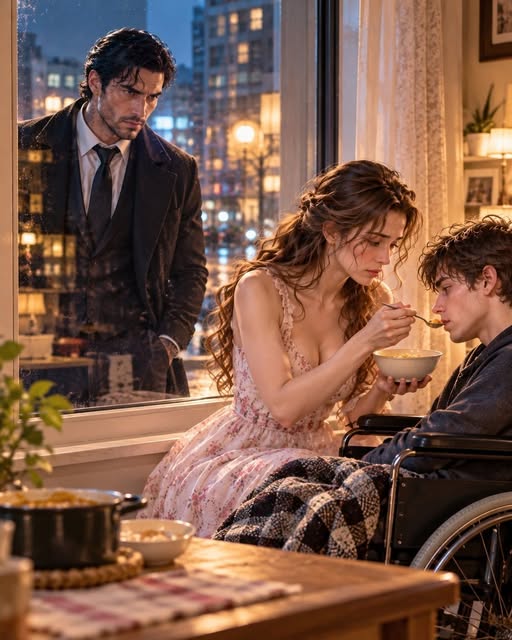
    Not the staff. Me. I had insisted with a stubbornness that made Dante check, twice, whether I was issuing a threat. But there were things I needed to do in that kitchen, at that stove, with my own hands, in the house where my family's siege had ended. I made tomato soup. A stockpot of it, the size of a baptismal font, with real cream and roasted tomatoes and basil from Roman's greenhouse, and bread I had bullied the chef into teaching me, and a table set for eleven: Roman at the head, Leo at his right hand in a chair with arms, June beside him, Dr. Patel, Nadia, Marco, Dante and his wife Sofia, the surgeon who had saved Roman and never asked a question, and two captains who had nodded, once, at a secretary's clearance.

    Roman served. Nobody objected, because nobody in that house had forgotten what serving meant in it now. He filled Leo's bowl. He filled the surgeon's bowl. And then he filled mine — the biggest bowl at the table, filled to the brim — and set it in front of me and said, for the room, because some apologies should have witnesses:

    "No one in this house divides soup."

    Leo lifted his spoon, and then he stopped, and looked at me across a table full of food and family and light, and asked the question that had once broken my heart in a two-room apartment in the Bronx:

    "Tess… aren't you hungry?"

    "Starving," I said. And I sat down, at the table, in the chair that was mine, and I ate my whole bowl. Both things. All of it. In front of everyone. It remains one of the bravest things I have ever done, and I have been shot at in a parking structure.

    Later, when the table had dissolved into chess and arguments and the peculiar music of a house at peace, Roman found me in the kitchen, where I was doing what I always do after a meal I cooked: standing at the window over the sink, looking out at the dark, thinking.

    He stood beside me a while without speaking. His side ached still, in cold weather; he would not admit it, and I had stopped asking and started simply keeping the good chairs near the fire for him, the way you maintain any long campaign of love — without announcements.

    "I followed you home once," he said at last. "With a gun, and a story about you written by a liar. It's the worst thing I've done that I did with my own hands."

    "Roman."

    "I would like to do it again," he said, "every day, for the rest of my life. Properly. With permission. At a civilized hour, through a front door, into a home that is ours, where a man paints—" he caught himself, and I watched the most feared man in New York revise a sentence in real time, like a mortal. "Where your brother beats me at chess and complains about my cooking. I am not a man who kneels, Tessa. My surgeons have forbidden it. So I will ask you standing, in a kitchen, holding a dish towel, and you may put that in your ledger exactly as it happened."

    I took the dish towel out of his hands. "Yes," I said. "On one condition, which is non-negotiable and goes in the record."

    "Name it."

    "You always eat what I serve you. All of it. In front of everyone."

    Something happened to his face then that no camera had ever caught and no enemy had ever seen, and it is mine, and I am keeping it.

    "Done," he said.

    The ring, when it came that weekend, was his mother's — a plain gold band, worn thin as paper at the back, that had survived a burning car and thirty years in a drawer of things Roman Caldwell could neither wear nor discard. He didn't present it on a cushion or a knee. He put it in the ledger — the foundation's founding ledger, first page, under the list of seized assets converted to grants — and let me find it doing the quarterly books, which is the most romantic gesture available to a man raised by accountants of violence and a woman who reads fine print for love.

    Under the ring, in his handwriting, which I had filed for three years and would know in the dark: ASSET, RECOVERED. VALUE: NOT FOR SALE.

    We set the wedding for spring, in the foundation's warehouse, so that the plaque could attend. Leo has opinions about the aisle. He has measured it. He walks it in practice now, some mornings, when he thinks the lobby is empty — nineteen steps to the dining table was rehearsal. The aisle is twenty-four.

    He intends to make every one of them.

    It was an ordinary Tuesday in November when Leo walked — cane, June's hand nowhere near him because he had forbidden it for the length of the room — from the library door to the dining table, nineteen steps, while eleven people held their breath like a single held note. At step nineteen he took his seat at Roman Caldwell's right hand, folded his cane with a flourish, and said, "Write it down, Tess. Put it in one of your ledgers."

    So I have. Here it is, in the good column, at the top, in ink:

    Leo Hayes walked to dinner.

    And the whole table — the don, the doctors, the accountants, the soldiers, the girl who once divided one can of soup into two bowls and lied about lunch — the whole table stood up and applauded, and nobody, not one person in that house, was hungry.
  • Chapter 6: The Truth About the Accident

    Chapter 6: The Truth About the Accident

    The Salvatore technicians opened Leo's phone on the same night Carlo tried to sell my brother in a parking structure.

    I know this because Vincent Salvatore told Roman so himself, in the telephone call that ended the war — a call Roman made sitting upright in a chair he had been forbidden to sit in, six days after taking a bullet for my family, with his shirt open at the side where the bandages were and his voice level enough to frighten the surgeon into leaving the room.

    "Your man has read the page, Vincent," Roman said. "So you know what I know. It names your payments to a precinct captain the newspapers call a hero. It names dates my accountant has already matched to your money — matched, Vincent, from our side, without your phone. The boy's photograph is a souvenir now. The page exists in three reconstructions, in two safes, and in the memory of a twenty-five-year-old who stood up this week in a room full of your guns." A pause. "Your war is over. You just haven't decided what it costs yet. Let me help you. The Hayes family is finished business — permanently, publicly, in the record of both houses. Carlo Marchetti is mine; he was always mine; his treason is an internal wound and I will not have it dressed by strangers. Eddie Voss you will surrender to me, because he owes a debt in my territory and I intend to collect it. In exchange, Pier 9's lease comes to you at Christmas, the page never surfaces, and neither of us ever again mistakes the other's patience for weakness."

    The silence on the line lasted eleven seconds. I counted. Counting is what I do.

    "Your father," Vincent Salvatore said at last, "would have sent heads in a truck."

    "My father," Roman said, "is why there's a page."

    They agreed. Men like that don't shake hands; they simply stop aiming. Dante, listening, closed his notebook on three years of war like a man shutting a door in a house he intends to keep living in.

    The night before the tribunal, I found Roman in the garage at Todt Hill, of all places, standing over a car I didn't recognize until he told me what it was: a 1979 sedan, kept running by Dante's mechanics for thirty years out of pure institutional stubbornness. The car his father had been shot in, in 1998, outside a social club in Bayonne. The car Carlo Marchetti had dragged him out of, burning, and driven to a hospital with his own hands blistering on the wheel.

    "Carlo drove this car with second-degree burns," Roman said, "and refused treatment until my father was in surgery. I was eighteen. I stood in a corridor and watched a man decide my family was worth his hands." He rested his own hand on the roof of the car, lightly, the way you touch a coffin. "Tomorrow I sit in judgment on him with a clean conscience and a full file, and both of those things are true, and they do not cancel each other. That's the part no one warns you about this chair, Tessa. The traitor isn't a stranger in a mask. He's the man in your earliest photograph of safety. Sentence him anyway — that's the job. But I've stopped pretending the job is clean."

    "Will it help," I asked, "that Leo and I are in the room? That he has to say it in front of the people he actually spent?"

    "No," Roman said. "It won't help. It's simply owed." He looked up. "You understand that distinction better than anyone I know. It's why you're in the room too."

    The tribunal met on Sunday, in the Todt Hill dining room, under the rules of a family that predates the country it operates in: the captains present, the evidence read into the record, the accused permitted to speak. Leo sat at the table in his chair — Roman's order, delivered through me with the subtlety of a parade: "He isn't a witness in a hallway. He's the injured party. He sits at the table."

    Nadia read the money first. Two years of "harbor dues." The cloned credentials. The $20,000 planted on me like a flag on a hill Carlo intended to die on. Then Leo spoke — slowly, carefully, the whole architecture of it: the garage, the packages, the split seal, the page, the photograph, the rain, the doorway of a hospital room where a man had stood and looked at his work. He didn't falter. When he finished, the room was quiet in a way that made the fire in the grate sound loud.

    Before the accused was brought in, Roman did something the captains would repeat to each other for years, because it had never been done for a secretary, or for anyone outside the blood and the oath.

    He stood — slowly, against his surgeon's orders and his own stitches — and read my clearance into the record himself.

    "Tessa Hayes," he said, "entered this family's service three years ago and has never once, in any particular, betrayed it. The charge of theft laid against her was manufactured by the man we try today, using her own diligence as the weapon — her credentials were cloned because they were beyond reproach, and they were beyond reproach because she is. Let the record show the debt is expunged, the suspicion is expunged, and the shame of it belongs where the money says it belongs." He looked around the table, captain by captain, making each of them hold it. "Any man who speaks of her as a suspect after today answers to me as if he'd spoken of my mother. That is the whole of the announcement."

    Eleven men nodded. Old men, hard men, men who had decided fates over that table since before I was born — and I sat in my borrowed chair with my hands folded and let myself be publicly, ceremonially, permanently un-accused, and I understood that this, more than the program or the house or the gun he'd stepped in front of, was Roman Caldwell's true apology: he had unmade the lie in the same room, at the same volume, as the lie had been made.

    Then Carlo spoke.

    He did not deny anything. That is the detail I will remember longest: he stood in the wreckage of twenty years of brotherhood and declined, at the end, to insult the room with lies.

    "Your father promised me this family would be mine to guard when he was gone," he said to Roman. "Not yours to inherit like a watch. Mine to guard. And then he died, and the guarding became… serving. I served a boy I'd diapered—" He stopped. Started again, and the honesty in it was obscene. "The money started as insurance. Then it became a salary. Then it became the only conversation in my life where I was the important one. Salvatore listened to me the way this family had stopped listening." His eyes moved to Leo. "The boy. The boy saw a page with my name rendered in a code any competent accountant could crack in a weekend — Nadia cracked it in two days from a dying boy's memory of it. The boy had to stop being a witness. I want the record to show I said broken. Not dead. A dead boy is a headline and an investigation. A broken boy—"

    "Is a warning," Roman said quietly. "You made an example of a twenty-two-year-old who carried packages for grocery money. You stood in his hospital doorway and taught him to be silent, and then you came home and ate at my table for three years."

    "Yes," Carlo said.

    "You framed his sister. You watched her divide soup through a window of intelligence you fed to our enemies, and you let me — you let me, Carlo — load a gun and follow her home in the rain."

    "That," Carlo said, "I did not arrange. That was yours, Roman. I merely supplied the story. You supplied the gun." He almost smiled. "We are both men who did what our natures told us. The difference is that mine lost."

    The judgment of the Caldwell family, delivered by its Don with a bullet hole still healing in his side, was this: Carlo Marchetti would not die. I had asked for that — alone with Roman, the night before, in the only conversation of that whole season where I asked for anything for myself. "Leo stood up this week," I'd said. "His whole life from here is walking toward things. I won't have the first stone of it laid on a grave. Whatever else he is, Carlo is the man who ate at your table. Let the law have him. Let him grow old somewhere with his name in a file, knowing."

    So: Carlo's name was struck from the family's record. His money — the Coral Gables house, the washed millions, every dollar of his insurance — was seized entire. And Nadia's file, the beautiful, airtight, translations-of-money file, went to a federal prosecutor with everything except the Caldwell family's own fingerprints, which is to say it went as the story of one corrupt underboss and one crime family's payments, told by an anonymous concerned party with excellent bookkeeping. Carlo Marchetti will spend the rest of his natural life in federal custody. Eddie Voss — delivered to Roman's door by Salvatore's people on Tuesday, in a car with a full tank, like a returned library book — got the same door into the same system: the hit-and-run file, reopened, with a witness. Leo's statement about Eddie took four hours and Leo insisted on giving it standing, braced between the parallel bars in the Todt Hill gym, because, he said, some paperwork you should do on your feet.

    Before they took Eddie away, Leo asked for one minute. Dante wheeled him — no. Leo wheeled himself into the foyer where Eddie stood between two men, and my brother looked up at the man who had come out of the rain and rearranged his life, and he was not shaking.

    "You took my legs to keep a secret," Leo said. "The secret's out. Everybody knows everything. So you didn't even get what you paid for." He turned his chair toward the gym, toward the bars, toward the whole rest of his life. "Watch the papers, Eddie. One day there's going to be a photograph of me walking my sister down an aisle. I want you to see it in whatever cell they give you. That's your sentence, as far as I'm concerned. The rest is the state's."

    That night, when the house was quiet, Roman gave me back the folder.

    The photographs of me. Of Leo. Our names, our address, three years of being watched by enemies and one night of being watched by him. He set it on the table between us in the library and said, "This should never have existed. I can't unmake the night I added to it. But I can give you the only ending it has."

    I fed it to the fire, page by page. The photographs curled and blackened — me, buying groceries; Leo, waiting by the window; the girl dividing soup, who felt, watching herself burn, like a stranger I had once been employed to be.

    "I'm not your secretary anymore," I said. It wasn't a question, and it wasn't a wound. It was bookkeeping.

    "No," Roman agreed. "You haven't been since the window. I was simply too much a coward to re-file the paperwork." He watched the last page catch. "Stay for dinner. Both of you. There's no soup."

    "Is that a promise or a threat?"

    "With my cooking," Roman Caldwell said, "it has been known to be both."

    Leo was already asleep in the guest room with the fire door open and a Caldwell man dozing in an armchair outside it — a guard he'd charmed, by morning, into promising to lose to him at chess. I stood a while in the doorway watching my brother breathe, this boy who had been a target, a witness, a package, a secret, and was now, at last, only a patient with a chart that said improving in a doctor's good handwriting.

    Fourteen seconds standing, the chart said. Improving.

    "Let him sleep," Roman said behind me, very quietly. "Tomorrow we start the rest of it."

    "The rest of what?"

    "Whatever you two decide your lives are," he said. "I'm told it's called the future. I've recently become an investor."

  • Chapter 5: The Trap at the Halden Institute

    Chapter 5: The Trap at the Halden Institute

    On Thursday at 2 P.M., my brother wheeled himself into the Halden Institute wearing his good shirt, and I watched him go on a bank of security monitors with my heart trying to exit my body through my throat.

    I had dressed my brother that morning with hands that wouldn't stay steady, and he had watched me fail at his collar for the third time and said, "Tess. Look at me. Fourteen seconds yesterday. I'm not a package anymore. Packages don't get a vote — I got a vote, and I voted. Now fix my collar and stop shaking, you're making the bait nervous."

    "You are the bait," I'd said. "I'm allowed to shake."

    "The bait's brother—" He stopped. Grinned instead, and it nearly undid me. "The bait's sister is the scariest person in this war. Roman Caldwell is a close second and he knows it. He told Dante so. Dante told Marco. Marco charged me an extra set of reps for morale."

    I'd laughed then — really laughed, standing in a borrowed bedroom of a mafia estate, dressing my brother to be kidnapped in. That's what courage looks like in our family. It isn't the absence of terror. It's terror, with jokes, on schedule.

    Roman had rebuilt the building without moving a single wall. The receptionist who had once given away Leo's schedule to a stranger was on a sudden paid vacation; the woman at the desk now was Dante's cousin, who could field-strip a pistol and file insurance claims with equal fluency. Two of the "patients" in the waiting room were Caldwell men with newspapers and earpieces. The parking structure had a full team. The therapy gym had Marco, the therapist — who was, it turned out, an actual licensed therapist, because Roman believed a cover should be load-bearing — plus one orderly who was not an orderly.

    "Every man, every gun, every second," Roman had promised me, and he had kept the promise like a contract written in his own hand. He stood beside me in the security office with his arms folded, watching the monitors, saying very little.

    "You're not going down there," I said. It wasn't a question. We had agreed: the Don does not walk into traps; that's what makes him the Don.

    "I'm not going down there," Roman agreed.

    Leo's session began. On the grainy screen, small as a memory, my brother transferred to the parallel bars and stood — twelve seconds, Marco had written in the chart that morning; fourteen by the time the session ended — and even through the fear I felt that fierce, unreasonable pride. Fourteen seconds. A year ago the doctors had used the phrase "realistic expectations" at me like a locked door.

    At 2:40, the transfer team arrived.

    They were good. I say that with hatred, but they were good: three men in the right scrubs with the right lanyards and a clipboard bearing a transfer order for Leo Hayes — discharge to a long-term facility in Westchester, signed, stamped, and utterly false. Carlo had spent twenty years learning exactly what Caldwell-and-Halden paperwork looked like, because Carlo had invented half of it.

    The trainee at the satellite desk — the one person in the building who was neither ours nor warned, because Roman had calculated that a perfect staff was itself a signal — accepted the order and buzzed them through to the therapy wing.

    Thirty seconds. That was the size of the mistake. Thirty seconds in which three men walked a corridor that Dante's people were watching from the wrong end, because the plan had said they would come through the parking structure, and Carlo — who had helped design our habits for twenty years — had sent them through the front door like visitors.

    On the monitor I watched a man in scrubs take the handles of my brother's chair in the doorway of the gym. I watched Marco step forward, frowning, with a chart in his hand like a shield. And I watched the man holding the chair lean down and say something to Leo, and my brother's face — small, gray, unmistakable — change.

    Later Leo told me the words. The man had said: "Eddie sends his regards. Be quiet and nobody bleeds."

    Eddie. Eddie Voss was in the building. Eddie Voss had his hands on my brother's chair.

    I was out of the security office before I'd decided to move. I heard Roman behind me say my name in a voice that could have stopped traffic, and it did stop me — for exactly the length of the stairwell. Then I was running again, because there are orders you obey and there are sounds your brother makes when he's frightened, and only one of those things was in the building with me.

    The parking structure. They'd reversed in ninety seconds — the front door had been the entrance, but the structure was always the exit, and Dante's team was already moving, suddenly, too late and not too late. I came out of the service stairwell into concrete and fluorescent light and the smell of hot engines, and the whole war was arranged in front of me like a photograph:

    Leo's chair, stopped halfway down the ramp. The man from the gym doorway holding it — and an arm across my brother's chest now, and something small and dark in his free hand that I understood before I believed it. Eddie Voss stood two paces off with his scarred face turned toward the ramp entrance, where Dante and four men were coming down with their hands visible and their weapons down, because the geometry was obscene: every line of fire in that structure passed through my brother.

    And Carlo Marchetti stood by the black SUV with the door open, one hand in his coat, watching it all with the mild, regretful expression of a man observing weather he'd arranged.

    "Carlo," Roman said.

    He had come down the ramp behind me — unhurried, alone, his coat open, his hands at his sides and visibly empty. The Don walking into the trap, after all. Dante made a sound I had never heard from him, half protest, half prayer.

    "Don Caldwell." Carlo inclined his head. "You've lost weight. Stress, I expect. The boy comes with us, he answers Mr. Salvatore's questions in a civilized place, and if his answers are complete, he comes home. That is the whole transaction. Nobody bleeds. I designed it that way." His eyes flicked to me — and warmed with something like genuine fondness, which was the worst thing in that whole structure. "Tessa. You should have taken the money story and run, my dear. It was a kindness. It was me being kind."

    "Take me instead," Roman said.

    The structure went quiet in a way that gunfire never achieves.

    "I know everything Salvatore wants to know. I am everything Salvatore wants to know. The boy is a secretary's brother with a three-year-old photograph. I am the Caldwell organization." He took one slow step forward, hands open. "Let the boy roll to his sister. Take me to Vincent. He'll trade a decade for me and you know it. Your page stays clean. That's a better transaction, Carlo. You designed this one badly."

    It almost worked. I swear to God, it almost worked. Eddie Voss's eyes went to Carlo — a hired man checking whether the deal had changed — and in that half-second of doubt, Leo did the thing no plan had contained and no one who hadn't watched him between the parallel bars that morning could have predicted.

    My brother stood up.

    Fourteen seconds of standing, bought with two years of agony, and he spent them all at once: he rose out of the chair, lurched sideways with his whole weight against the man holding him, and knocked them both off-balance — not down, not far, just enough. Just enough to break the geometry.

    Everything happened in the space of one breath. Dante's people moved. Eddie's gun swung — toward Leo first, then tracking, professional and fast, toward the largest decision in the room. Toward Roman.

    Roman was already moving. Not away. Never away. He stepped into the line the way a man steps into a doorway, and the shot took him high in the side, under the ribs, and turned him half around.

    I caught him. I don't know how I crossed the distance. I know his weight came into my arms, astonishing and wrong, and my hands were on the wound before I understood I'd moved, pressing down, and his blood was shockingly warm and his face was close to mine and entirely, infuriatingly calm.

    "Nobody touches the boy," Roman said, to no one, to everyone, to the concrete. "That was the whole of the order."

    "And nobody did," Dante said — from somewhere above the sounds of men being efficiently subdued. "Not a hair, Don. The boy stood up and saved himself. He gets it from his sister."

    Eddie Voss was on the ground with Dante's knee in his back, bleeding from somewhere, alive — Roman's standing order, delivered that morning and repeated in the stairwell, had been absolute: everyone breathes, everyone talks. Carlo was against the SUV with his hands raised and four weapons considering him, and his face had finally lost its smile.

    They dragged Eddie past us toward the second vehicle. He was laughing, which men do when pain and shock make them generous with the truth, and he looked at me — at my hands red on Roman's side, at Leo standing, standing, gripping his chair and shaking — and he called out, clear as a bell:

    "Ask your traitor, secretary. Ask him who ordered the rain that night. Salvatore wanted the boy quiet. But the crash—" a cough, wet and ugly "—the crash was Carlo's idea. Your brother saw his name first. Ask him!"

    The SUV door closed on him like a book.

    I looked up. Carlo Marchetti was looking back at me over the guns, and slowly — like a man who has been carrying something heavy for three years and has just been permitted to set it down — he smiled.

    —

    The Caldwell family kept a private surgical wing the way other families keep a good lawyer: quietly, expensively, and in constant readiness. The surgeon — a woman who didn't ask questions in either sense — told me at 6 P.M. that the bullet had missed everything Roman couldn't spare and torn a great deal that he could. He would live. He would hurt. He would be insubordinate about bed rest by the weekend.

    Leo slept in the family room with his head on my shoulder and his good shirt ruined, and Dante came and went with reports in his metronome voice. Both prisoners were alive. Both were secured. Eddie Voss had already begun, in the manner of drowning men, to trade the truth for air.

    "Carlo ordered it," I said. Not a question. I had been turning Eddie's words over for two hours and they fitted everywhere, in every lock: the man who blamed me within the hour, who knew about the program he'd never been told of, who'd stood by a window in Roman's office three years ago and learned — because Roman told his underboss everything — that his Don's new secretary had a brother in a hospital bed who couldn't identify the driver who'd visited him. Carlo hadn't been protecting the payments. Carlo had been protecting Carlo, one silenced witness at a time.

    "Yes," Dante said. "The Don will want a tribunal. The old way. Witnesses, the page, the whole architecture — he's been building it since Nadia found the keycard floor."

    "When Carlo talks," I said, "I want to be in the room."

    Dante looked at me for a moment, and something in his granite face moved, slightly, in the direction of respect. "The Don said you would ask that. He said it in the ambulance. His exact words were: 'She'll ask. Tell her yes before she has to.'" He paused. "He was losing blood at the time. He's been saying a number of things he's apparently been storing up."

    I looked down at Leo, asleep against my shoulder, breathing the deep, even breath of a boy who had stood up in a parking structure full of guns and saved himself.

    "Good," I said. "So have I."

  • Chapter 4: The Traitor in His Own House

    Chapter 4: The Traitor in His Own House

    The morning after the underpass, Roman declared war the way he did everything: quietly, and with paperwork.

    Nadia Whitfield was the Caldwell organization's forensic accountant — a former IRS investigator Roman had hired at a salary that made captains weep, a woman who believed, with religious sincerity, that money could not lie and people could not be trusted to translate it. She arrived at Todt Hill with two laptops and no small talk, and by noon she had dismantled my stolen $20,000 down to the screws.

    "Your credentials weren't guessed," she told me. "They were mirrored. Someone with building-level administrative access cloned your login token in March and has been warming it up ever since — small queries, no withdrawals, the digital equivalent of trying a key in a lock once a month to make sure it still turns. In September they stopped warming and started spending. Three transfers, coded as consultancy fees. The vendor is a shell registered in Delaware to a law office that does work for—" she turned the screen toward Roman "—Salto Ventures."

    "Theft was never the point," Roman said.

    "No," Nadia agreed. "Twenty thousand dollars is nothing to this organization. But a secretary caught stealing is a story. And a story, Don Caldwell, is a weapon. Someone wanted your most trusted pair of eyes either gone, terrified, or disgraced — ideally all three, in that order — right around the time Leo Hayes started getting well enough to talk."

    I sat with that. All autumn, while I skipped lunches and cried over bills, my ruin had been under construction like a building — permits, schedules, a man in a hard hat checking the progress. Carlo's sorrowful smile in Roman's office. Carlo, an hour early to an accusation he'd written himself.

    "There's more," Nadia said. "The clone was activated from inside this organization every single time. Keycard-authenticated terminal. I can't yet tie the card to a name — the rotations are muddy — but I can tie it to a floor." She paused. "The executive floor. There are eleven keycards that open that floor, Don Caldwell. Yours is one. Carlo Marchetti's is another."

    Roman was silent for a while. Then he did the thing I have since learned to recognize as the most frightening sound in his world: he became almost cheerful.

    "Wonderful," he said. "Then we won't investigate Carlo. We'll invite him to investigate himself."

    That night, Roman cooked.

    I want to be precise about this, because Leo tells this part to everyone and he embellishes, but the plain version is strange enough. The Don of the Caldwell family dismissed his own chef, stood in his own kitchen in shirtsleeves, and made pasta — badly at first, then less badly — while my brother offered commentary from his chair like a judge at a food competition he intended to fix.

    "You know," Leo said, "the last man who cooked for my sister was a line cook in Yonkers who put her name in a dessert special. He's in Ohio now. There's no connection. I just like saying it ominously."

    "Noted," Roman said. "Eat your bread."

    He served Leo first. Then — deliberately, and looking me directly in the eye while he did it — he served me a portion larger than his own. I understood the arithmetic he was performing. I had performed it myself, in reverse, a thousand times: love measured in ladles, the bigger bowl pushed across the table without discussion.

    "No one in this house divides soup, Tessa," he said. "Eat."

    I ate. I cried a little, into really excellent pasta, which Leo pretended not to see with the chivalry of a much older man.

    Later, on the terrace, Roman stood with his hands in his pockets looking at nothing and said, "Ask me the question you've been carrying since the office."

    "Why are you doing all of this?" I said. "The program. The house. The war. You could have paid me off and buried the whole thing. Men like you bury things."

    "Men like me," he said, "built our houses out of other people's loyalty and called it strength. Then I stood outside a window in the rain and watched real strength dividing a can of soup, and I understood I'd been sold a counterfeit my whole life." He turned. In the terrace light he looked less like a statue than he ever had. "I'm not doing this instead of an apology, Tessa. I'm doing it because my apology would be an insult if it came without repairs. You kept your brother alive in a burning building for three years and called it Tuesday. The least the Caldwell family can do is carry some water."

    The trap Roman built was made out of my brother's stolen phone — or rather, out of the idea of it. The Salvatores had the real one: a three-year-old handset with a dead battery and a cracked screen, currently defeating a Salvatore technician somewhere across the river, because men who solve problems with SUVs are rarely patient with electronics. Leo, questioned gently, remembered the phone's passcode and something better: he had taken not one photograph but three, and the third showed the facing page of the ledger — a list of codenames and payment dates.

    "Codenames I might know," Roman said. "Sit with Nadia. Tell her every syllable you remember. A letter is enough. A number is enough. We're going to rebuild that page out of your memory, Leo, and check your memory against my money. Where they agree — that's my traitor."

    It took two days. Leo sat with Nadia in the Todt Hill library like a witness at a trial of his own ghosts, and I watched my little brother — who apologized to furniture he bumped into — dictate dates and fragments in a voice that got steadier by the hour.

    On the second afternoon I took a break from watching and found the gym therapist, Marco, counting out loud in the converted ballroom. Leo was between the parallel bars, arms locked, face a study in furious concentration, and as I came through the door he let go of the left bar.

    One second. Two. His whole body trembled like a struck wire. Three. Four.

    "Don't help him," Marco murmured, without looking at me. "He's been asking for this all week. He said — his words — 'my sister carries everything. I want one thing she doesn't have to.'"

    Eight seconds. Ten. Leo grabbed the bar again and made a sound that was half laugh, half sob, and I stood in the doorway of a mafia don's ballroom and cried without making any sound at all, which is a skill you learn in apartments with thin walls and a brother who must not hear you.

    "Twelve tomorrow," Leo announced to the room at large, breathless and incandescent. "Write it down, Tess. Put it in one of your ledgers. This one's going in the good column." Rook. Fenwick. The number 44 recurring like a heartbeat. A payment marked "harbor dues" on the last Friday of every month for two years.

    On the second night, Nadia came out of the library carrying a single sheet, and her expression was the one accountants get in movies right before the building burns down.

    "'Harbor dues,'" she said. "'Last Friday of the month. Forty-four thousand a month for twenty-six months.' It isn't one payment, Don Caldwell. It's a salary. Salvatore has been paying someone inside this house a salary for over two years — and the disbursement account is the same one that received a very interesting deposit pattern: just over a million dollars, washed through consultancy shells." She set the sheet down. "I can't name him from the money alone. But I can tell you the money stops being anonymous in exactly one place: the recipient bought a house in Coral Gables eighteen months ago. Cash. Through a trust."

    "Whose son lives in Coral Gables?" Roman asked, in the tone of a man who already knew.

    Dante answered from the doorway. "Carlo's."

    The room was very quiet. Somewhere below us, Leo was doing his evening exercises with a therapist Roman had installed in the converted gym, and through the floor came the faint, rhythmic sound of the parallel bars taking his weight — eight seconds standing, the day before. Ten, that morning.

    Roman stood looking out the window at his own dark gardens for a long time. I understood what it cost him. Carlo Marchetti had carried Roman's father out of a burning car in 1998. Carlo had held a gun on a hospital corridor so Roman's mother could die in a guarded room. Whatever the money said, the man in the ledger had once been the architecture of Roman's life. Betrayal at that depth isn't an event. It's a renovation of the past: every memory has to be re-inspected for rot.

    "Do you want me to be wrong?" I asked him, when the others had gone.

    "I want," Roman said, "to be certain. There's a difference. Doubt is a luxury. Certainty is a duty." He turned from the window. "So we'll give Carlo a door, and watch whether he walks through it."

    The door was this: at Thursday's captains' meeting, with Carlo present, Roman announced — almost casually, a Don tidying his desk — that the Hayes boy's telephone had been recovered from a Salvatore warehouse by men loyal to the family, and that it would be brought to the Caldwell building Friday and opened in the vault in the presence of witnesses. The photograph, he said, would be read into the family's record. Everyone's names. Everyone's money. Friday.

    It was a lie with a blade in it. If Carlo was innocent, Friday was an inconvenience. If Carlo was what the money said he was, Friday was an execution date — and a guilty man, given four days' warning of his own exposure, will always, always try to trade his way out of it with whatever he can still reach.

    What Carlo could still reach was my brother.

    Dante intercepted the first tremor on Wednesday night: a coded listing on a car-service board the organization monitored, the kind of nothing-message that means everything to the people it's for. Pickup. Medical facility. Thursday, 2 P.M. "Special assistance required." The Halden Institute. Leo's therapy session — the standing Thursday appointment the receptionist had cheerfully given away to a stranger a week before.

    "They can't open the phone," Roman said, reading over Dante's shoulder. His voice had gone flat and terrible and almost pleased. "So Carlo is selling them the one key that opens everything. The boy himself. Leo, alive and talking, in exchange for Carlo's name staying off that page."

    He turned to me. I was already standing. I think I had been standing since the word "medical."

    "Thursday, then," Roman said. "We let them come. We let Carlo show us his whole hand." His eyes held mine. "And Tessa — I need you to trust me with the thing you trust least in this world. I need you to let Leo walk into that building on Thursday like nothing is wrong."

    My mouth opened on a refusal so total it felt physical. Roman waited. He didn't argue, didn't command. He waited the way he had waited in our doorway with groceries, the way he had waited by the fire — a man learning, at forty, that some doors only open from the inside.

    "Tell me the plan," I said at last. "All of it. Every man, every gun, every second. And Roman—" I made myself say it steady. "If one hair of him is harmed, I will spend the rest of my life making you sorry. And you know I keep my books balanced."

    "Yes," he said quietly. "That's why it's your brother I'm trusting with this. He gets it from you."

    That night I told Leo the plan myself, every man and every second, the way I had demanded it be told to me. He listened the way he'd listened to doctors for two years — completely, and saving his fear for later, in private, where it wouldn't cost anyone else anything.

    "Okay," my brother said. "Thursday. I'll wear the good shirt. If I'm going to be bait, I want to look like expensive bait."

    I laughed, and then I didn't, and he held out his hand and I took it, and neither of us said the thing we were both thinking: that in three years of siege, this was the first battle we were walking into on purpose, side by side, with an army at our backs.

  • Chapter 3: The Night They Came for Leo

    Chapter 3: The Night They Came for Leo

    Roman didn't ask my permission. By the time Dante's car turned into our street, the decision had already traveled through the Caldwell organization the way weather travels through a valley — completely, and in one direction.

    "We're moving you tonight," Dante said. "Both of you. The Don's house on Todt Hill. Bring what you can't replace."

    Our street was wrong before I could say why. The unmarked Caldwell car that had watched the building for a week was there — but angled differently, its driver slumped in a posture no professional chooses. Dante's hand was already moving. "Down," he said, pleasantly, like a man suggesting rain, and pushed my head below the window line as he reversed us out of the street at a speed that tore the night open.

    What I remember of the next four minutes comes in pieces, the way Leo says he remembers the accident: headlights where no headlights should be. A black SUV — the black SUV — coming out of the service road with its lights off and then, horribly, on. Dante's voice, level as a metronome, saying street names into his radio. The gun he drove with, held low against the wheel. My brother's name said by a stranger on an open channel: "They're not after the girl's car. They're vectoring on the second vehicle—" The second vehicle. The medical transport Roman's people had sent for Leo, because Leo couldn't ride in a sedan. It was three streets behind us.

    I think I screamed instructions that made no sense. I know I called Leo's phone and heard it ring into a void that rebuilt, in real time, every nightmare I'd ever scheduled for 3 A.M.

    Then Roman's voice came over Dante's radio, and I will hear it for the rest of my life, because it was the voice from the conference rooms and the contract signings, except stripped down to a single instrument: "Dante. The transport is mine. Nobody touches the boy. I don't care what it costs. Do you understand me — nobody."

    They tried at the underpass where the expressway service road narrows to one lane. The SUV swung across to pin the transport van against the concrete. What the men inside it had not accounted for — what Carlo, feeding them our route, could not have known, because Roman had changed it twelve minutes before we moved — was that the "transport van" carried Leo, one terrified paramedic, and four armed Caldwell men who had been waiting all evening for exactly this invitation.

    It was over in less than a minute. I know because Dante made me count my own pulse out loud while we drove, the whole way, so I wouldn't do something brave and fatal. Shots — not many, and none of them ours to fear, he said. Two Salvatore men down and living. One running, and not running far. And Leo: untouched. Leo, in the middle of it, had apparently told the gunman nearest him, with the majestic calm of the heavily medicated, "My sister is going to be so mad about this van."

    They brought him to the Todt Hill house in a different vehicle, and I met him in a marble foyer bigger than our entire apartment, and I held his face in both hands and shook apart so violently that Roman had to steady me with one hand at my back — unobtrusive, unclaimed, gone the moment I could stand.

    Dante appeared in the archway with his coat torn and a report he delivered like a weather summary. One of the two men taken at the underpass was awake and talking — not from courage. From arithmetic: he knew what Vincent Salvatore did to men who came home empty-handed, and he was purchasing a different ending.

    "He says Voss has been watching the clinic and the building for a month, on Salvatore's orders. Not to kill." Dante glanced at Leo. "To listen. Salvatore believes the boy saw something on his last delivery three years ago — something written down. He's been waiting for Leo to recover enough to be… questioned. The therapy program changed their timetable. A boy who might walk again is a boy who might walk into a police station."

    "Why now?" I asked. "Why not three years ago?"

    "Three years ago, the boy couldn't speak properly and the sister suspected nothing," Dante said, not unkindly. "Salvatore could afford patience. Then the sister got a protector, and the boy got doctors, and patience started to look like a luxury."

    Roman said nothing for a moment. Then: "Watch the house. Nobody in or out without my voice on the line." He looked down at Leo — at my brother, sitting pale and upright in his gleaming chair with his hands folded like a schoolboy outside the principal's office — and his voice changed in a way I had never heard it change for any captain or contract. "Leo. I think it's time. Don't you?"

    Leo looked at me. I nodded, though my heart was slamming. And my brother took a breath like a man stepping off a ledge he had been standing on for three years.

    It was in that house, an hour later, with Leo wrapped in a blanket in a room with a fire in it and his new chair gleaming beside him like a parked spacecraft, that my brother finally told the truth.

    "I was running packages," he said.

    Three years. Three years I had believed the story we told the police, the story I'd built my whole exhausted life on top of: a random car, a rainy night, a coward who fled. And underneath it, the whole time, this.

    Two weeks before the accident, Leo had been working weekends at a garage in Hunts Point, saving for tools. A man started coming around — smooth, scarred, generous with tips. Eddie Voss. He offered Leo cash, real cash, to drive sealed packages across the river a few nights a week. No questions. Leo was twenty-two, we were behind on rent, and our mother was eight months in the ground. He said yes.

    "I never opened one," Leo said. "I swear to God, Tess. Eleven runs, I never opened one. But the twelfth — the seal was already split when he handed it to me. It was raining. The box got wet in the trunk and the bottom gave out at a red light, and there was this… page. Like from a ledger. Names. Dates. Money next to the names. And some of the names—" He looked at Roman, standing silent by the fire. "Some of the names were your men, Mr. Caldwell. Men in your house. Money going the wrong way."

    "What did you do with the page?" Roman asked.

    "I put it back. I sealed the box with tape from the garage and I delivered it and I threw up in the parking lot after. But before I put it back—" Leo's voice broke. "I took a picture of it. With my phone. I don't even know why. Insurance. Proof I wasn't crazy. Two days later Eddie asked me to do a run at midnight, short notice, and I said no. I said I was done. And the next night—" He gestured at his own body, the blanket, the chair. "The next night the car came."

    Silence, except for the fire.

    "In the hospital," Leo whispered, "I woke up and I tried to tell Tess. She was right there. And then I saw him. In the doorway. Eddie. Just standing there looking at me through the glass, like he was checking his work. And I understood. If I talked, he'd finish it. And if she knew — if she ever acted like she knew — he'd start with her. So I forgot." He laughed, horribly. "I got real good at forgetting. Three years of physical therapy for my legs and I did all of it on a lie."

    I couldn't speak. I kept seeing the doorway of that hospital room, three years burned into me, and myself in a cafeteria downstairs buying tea I never drank, while a man stood over my brother and taught him silence.

    "I'm sorry," I said. It came out wrecked. "Roman — in your office, the photograph — I knew his face and I said nothing about the hospital, nothing about any of this, because—"

    "Because a man stood in your brother's doorway and taught a twenty-two-year-old that silence was the price of both your lives." Roman's hand rested on the mantel; I watched his knuckles, the effort of gentleness in a man not built for it. "You didn't lie to me for three years, Tessa. You held a siege for three years. Alone, on a secretary's salary, with a broken wheelchair. There are made men in my organization who couldn't have done it for three weeks." He turned to Leo. "And you. You carried it in the dark so your sister could sleep. Whatever else happens tonight, boy — that goes in the ledger too. On the other side."

    "The phone," Roman said, very quietly. "Leo. Where is the phone?"

    Leo's face changed. "I hid it before the accident. The night I took the picture. I knew if they ever searched me—" He swallowed. "It's taped inside the frame of my old wheelchair. The hollow tube under the seat. The chair's in our closet. It's been in our closet the whole time."

    The whole time. Three years of bills I'd paid on my knees, three years of soup and arithmetic — and the evidence that a crime family would kill for had been sitting in our closet behind the winter coats, inside the broken chair I pushed my brother around in, through rooms I cleaned while crying.

    Roman was already on his feet, already on the phone. "Dante. The Hayes apartment. The old wheelchair, in the closet — go now, go quietly, bring me the chair and anything inside its frame." A pause. His face altered in a way I had never seen — not anger. Recognition. The look of a man watching a predicted card turn face up on the table.

    "Dante," he said. "Say that again."

    He listened. Then he lowered the phone and looked at me, and I knew before he spoke that the night had one more room in it, and the room was on fire.

    "The apartment door is open," Roman said. "The closet is empty. They got there twenty minutes before we did."

    "How could they know?" My voice went up and I didn't care. "Leo told no one. I told no one. This room is the first time that phone has existed outside my brother's head—"

    "They didn't know," Roman said. "Understand me, Tessa. The moment we moved you, every watcher on that street knew the game had changed. They went in to strip the apartment for anything Leo might have hidden — papers, drives, anything. The wheelchair was the only thing in that home built to hide something in, so they took it." His jaw tightened. "They don't know they have it yet. They'll take that chair apart bolt by bolt by morning. And when they find a phone taped inside the frame—"

    He didn't finish. He didn't have to.

    Leo's photograph was gone. And whoever had it now knew — or would know by morning — exactly what it showed, and exactly whose names were on it.

    Leo had gone the color of old paper. "Tess," he whispered. "I did this. The picture — I took it to protect us and it's the thing that's going to—"

    "Stop." Roman's voice cut the room clean. He crouched — actually crouched, a king lowering himself to a wheelchair's height — until his eyes were level with my brother's. "Listen to me, Leo Hayes. For three years that photograph was a threat hanging over your family. Tonight it became something else: the one piece of paper on earth that Vincent Salvatore and I both need. And I—" something in his face that might, in another man, have been a smile — "I have never once lost a negotiation over a thing I need. Sleep. Both of you. Tomorrow, we go hunting in my own house."

    He stood, and looked at me over Leo's head, and for the first time since a gun had followed me home in the rain, I believed him completely.

    That was the moment everything became more dangerous. Because now I had something to lose on both sides of the war.

  • Chapter 2: The Man in the Photograph

    Chapter 2: The Man in the Photograph

    "His name is Eddie Voss," I said.

    The words came out of me like something pulled through a narrow space. In three years I had never said that name out loud to anyone — not to the police, who had closed the case as an unsolved hit-and-run; not to the insurance lawyers; not even to Leo, who had his own reasons for never saying it either.

    "He's the man who was driving the car that hit my brother."

    Roman didn't move. "You saw the driver?"

    "For maybe four seconds." I could still see it with a clarity that three years had done nothing to soften: the rain, the intersection, Leo laughing at something on his phone as he crossed with the light — and the black SUV that didn't slow down. It struck him and threw him eleven feet. The driver braked. For one suspended moment, the man behind the wheel looked directly at my brother lying in the road, and the streetlight caught his face: the scar through the left eyebrow, the flat, pale eyes. Then he drove away.

    "And at the hospital," I said. "Two days later. I came back from the cafeteria and he was standing outside Leo's room, looking through the glass in the door. He saw me see him. He walked away very fast, and he never came back. I told myself he was nobody. A ghoul. A stranger with a sick curiosity." My voice cracked. "I told myself a lot of things, Roman. I was very good at it. I was spending all my money on not dying of the truth."

    Roman was quiet for a long time. Then he took the photograph and laid it gently back in the folder, and I understood that his gentleness was the most dangerous thing about him. Angry men make noise. Roman made decisions.

    "Why," he asked, "would Eddie Voss be photographed with men who are watching you now?"

    "I don't know."

    "Why would anyone be watching you at all, Tessa? You are a secretary. You have no money, no territory, no—" He stopped. His eyes narrowed with the particular focus of a man re-reading a page. "Unless the watching isn't about you. Unless it's about what you might know. Or what Leo might know."

    I said nothing. It was the wrong nothing. Roman had interrogated men for a living since before I was born into this city's ordinary dangers, and he read my silence the way I read his ledgers — every missing figure announced itself.

    "There's something you're not telling me."

    "There's something I'm not telling anyone," I said. "And before you threaten me, understand: it isn't disloyalty. It's the only coin I have left to keep my brother alive with. If I'm wrong about you — if this apology ends — that secret is the only thing standing between Leo and the people in those photographs."

    He studied me. I held his stare and let my hands shake openly, because fear was the one thing in that room I didn't have to perform.

    At last he nodded — once, like a man accepting terms he intended to renegotiate later. "Then I'll earn it," he said. "In the meantime, you will accept protection. That is not a request."

    What Roman Caldwell called "protection" arrived within the hour, and it looked like this: a man named Dante Ricci — six feet of quiet in a gray coat, with the unnerving habit of appearing in doorways without having visibly crossed the room — was introduced to me as my "driver." A new wheelchair was delivered to our apartment that afternoon, a machine so advanced that Leo circled it twice before he'd sit in it, like it might be a trap set by kindness. Two unmarked cars took up residence on our street. And a locksmith changed our door lock while I was still deciding whether to be furious, and installed a second one I hadn't asked for and couldn't have afforded in a year of skipped lunches.

    I was furious. I want that on the record. But that night, for the first time in months, I slept without my phone in my hand and a chair wedged under the door handle.

    On the third day of protection, Roman came to the apartment himself.

    He stood in our doorway holding two bags of groceries like a man defusing an explosive — prepared, expensive groceries, the kind with paper handles — and for a moment the most powerful man I knew looked exactly what he was: out of his element and determined not to show it.

    "Dante's report said the boy's medication schedule changed," he said. "The pharmacy wouldn't release the new prescription to my man. I brought—" He stopped. Looked at the bags. "This is not the medication. This is food. I appear to have overcorrected."

    Leo, traitor, laughed from his new wheelchair — the first time I'd heard that sound in our apartment in a year. "Come in, Mr. Caldwell. She only bites on weekdays."

    Roman stepped into our two rooms like a king entering a country he had accidentally invaded, which, to be fair, he had. He saw everything. I watched him see it: the radiator with its towel-wrapped pipe, the cabinet door I had re-hung with a belt, the corkboard where I pinned bills in order of menace. He did not perform pity. He did something worse. He memorized us.

    "Leo," he said, "tell me about the accident."

    The room went very still. Leo's hands tightened on the wheels of his chair. "Car came out of the rain. That's all anybody knows."

    "That," Roman said gently, "is not all you know. But it is all you're saying, and I find I respect the shape of it." He set the bags on our counter. "When you're ready, son. Not before."

    After he left, Leo was quiet for a long time. Then he said: "He knew I was lying."

    "Everyone within a mile knows when you're lying, Leo."

    "Yeah." Leo turned the new chair in a slow, wondering circle. "But he's the first one who didn't push."

    Leo, meanwhile, was thriving in a way that felt indecent to watch, like laughing at a funeral. The rehabilitation program Roman had funded — the Halden Institute, all glass and light and therapists who treated Leo like an athlete instead of a tragedy — assessed him within the week. Dr. Amara Patel, a woman with a surgeon's calm and a coach's cruelty, told us Leo's injury had been undertreated for two years. "The spine is damaged," she said. "It is not finished. Neither is he. We start Monday."

    Leo held my hand in the car on the way home, hard, the way he had when he was nine and frightened of thunder. "Tess," he said, "people don't just give you things like this. What does he want?"

    "The truth, eventually," I said. "And he's going to get it. Just not yet."

    At the office, the missing $20,000 sat between Roman and me like a third person at every meeting. I rebuilt the authorization trail line by line. The transfers had been coded with my credentials — my login, my approval sequence, time-stamped on evenings when I was verifiably at the hospital with Leo. Someone had cloned my access. Someone patient. Someone close enough to watch my habits and patient enough to wait for a pattern worth stealing.

    I brought Roman the timeline on Thursday. He read it standing up, and when he finished, he said something I did not expect: "Carlo brought me your name within an hour of the discrepancy surfacing. In twenty years, I have never known Carlo to be an hour early to anything he wasn't steering."

    "You think Carlo—"

    "I think," Roman said, "that someone is building a story with you as the villain, and I almost shot the wrong character in it." He set the timeline down. "Say nothing. Work as if nothing has changed. If Carlo is innocent, I owe him an apology. If he isn't—" The sentence ended there, the way cliffs end.

    Carlo stopped by my desk that week carrying two coffees, which was how I knew I was in more danger, not less. Carlo's kindness was a measuring instrument. He set one cup down beside my keyboard and gave me the soft, sorrowful smile of a man reading a eulogy he had commissioned.

    "I owe you an apology, Tessa. The figures pointed where they pointed. I hope you understand — in my position, silence would have been a betrayal of the Don."

    "Of course, Carlo." I smiled back with everything I had. "You were doing your job. I was doing mine. The money will turn up where it actually went. These things always do."

    He studied me over the rim of his cup, and I watched him recalibrate: he'd expected a frightened girl, and I'd handed him a colleague. It was the first time I ever saw Carlo Marchetti look uncertain, and it lasted less than a second — then the smile rebuilt itself, perfect as paint.

    "How is your brother?" he asked. "I hear he's been… settled into a program. Such good fortune. The family takes care of its own, yes?"

    "The family," I agreed, "has been very generous."

    What I did not say: I had never told Carlo about the program. I had told no one at the Caldwell organization except Roman. Dante might have filed a report — but reports in our office moved through exactly one pair of hands before they reached the Don's desk, and they were not Carlo's.

    He knew about the program anyway. I carried that small, cold fact down the hall to Roman's office and laid it next to the timeline, where it sat ticking.

    Late that afternoon, Dante asked for ten minutes with Roman and me, and produced a single sheet of paper: the black SUV in the photograph had been caught twice by traffic cameras, and its plates — false, but lazily false — traced back through two rental fronts to a holding company called Salto Ventures.

    "Salto," Roman said. He didn't raise his voice. He almost lowered it. "Salvatore money."

    Everyone in the Caldwell organization knew the name the way sailors know weather. The Salvatores had lost the Hudson terminals to Roman's father in the nineties and had spent thirty years being gracious about it in public and patient about it in private. If Salvatore men were photographing my brother, then Leo and I had somehow wandered onto a chessboard where families like theirs kept score in decades.

    "The SUV visited her street four times this month," Dante said. "Always the evenings she works late."

    "They think she knows something," Roman said. "Or he does." He looked at me. "Tessa. Whatever the boy is carrying — the price of it just went up. Men like Vincent Salvatore do not take photographs for scrapbooks."

    "I can't give you what isn't safe to give," I said.

    "Then I'll make it safe," he answered, with the absolute calm of a man discussing weather he intended to personally control. "That's the whole of my plan. Make it safe, and then ask again."

    That evening, Dante drove me home in the rain. We were two blocks from the apartment when my phone rang. Leo. His voice came thin and fast, stripped of the slow care his injury had taught him.

    "Tess. Don't get mad. And don't — just listen. At the clinic today, a man came in. He wasn't a patient. He asked the receptionist about me. By name. He wanted to know my therapy schedule — which days, what time, who brings me." A breath. "Tess, she told him. She didn't know. She just told him. And then he left."

    Through the windshield, the wipers beat their steady, hopeless rhythm. Dante was already on his own phone, speaking in the low, flat Italian of men transmitting coordinates.

    "Leo," I said, very calmly, the way you speak to someone standing on a ledge, "lock the door. Both locks. Don't open it for anyone who isn't me or Dante. I'm coming."

    But underneath the calm, one thought was moving through me like cold water through a crack in ice: they weren't watching anymore.

    They were scheduling.

  • Chapter 1: The Night He Followed Me Home

    Chapter 1: The Night He Followed Me Home

    At 11:43 P.M., the most feared mafia boss in New York followed me home with a loaded gun, convinced I had stolen $20,000 from his private account.

    But that night didn't start with a gun. It started with a number that wouldn't sit still.

    My name is Tessa Hayes. I'm twenty-eight years old, and for three years I have been the personal secretary to Roman Caldwell — forty, tall, dark-haired, and so dangerously composed that boardrooms went quiet when he simply removed his cufflinks. Roman controlled shipping terminals along the Hudson, two casinos upstate, a skyline's worth of luxury properties, and an underground empire that made even dangerous men think twice before they crossed him.

    His employees feared him. His enemies hated him. And the people closest to him all knew the same one thing.

    Roman Caldwell did not forgive betrayal.

    I wasn't afraid of him. Not because I didn't understand his reputation — I typed it into contracts every week. I simply had more important things to worry about. Like keeping my younger brother alive.

    Leo was twenty-two when a car came out of the rain on the Cross Bronx Expressway and folded his life in half. The accident shattered his pelvis and damaged his spine. He survived — the doctors used the word "miracle" and then handed me a stack of bills that used the word "monthly." Now he used a wheelchair. His rehabilitation was expensive. His medication was expensive. His dignity, thank God, was free, and he guarded it like gold.

    Before the accident, Leo had been the kind of young man strangers remembered. Six feet of restless energy, hands that could fix anything with an engine, a laugh that arrived half a second before the joke did. He'd been saving to open his own garage. He'd had a girl named Priya who brought him terrible homemade lasagna and ate his cooking like it was a love language, which it was. After the accident, Priya came to the hospital every day for a month. Then every week. Then she sent a letter — a kind one, which somehow made it worse — and Leo told me to stop setting a plate for her. He never cried about Priya. He cried once about the stairs to our building, in the rain, when the elevator died and I had to half-carry him up three flights while a neighbor pretended not to watch. He apologized the whole way up. I have hated very few things in my life with real purity, but I hate that staircase with my whole heart.

    Our mother had died four years before the accident — a stroke, sudden as a door slamming — and our father had vanished so long before that that Leo used to ask if he'd been a rumor. So it was us. It had always been us. I was the one who signed the hospital forms. I was the one who learned what "spasticity" meant and how to pronounce it to insurance adjusters. I was the one who stood between my brother and every bill collector, every dismissive specialist, every pitying look. That was the job. Nobody had assigned it to me. It came with the last name.

    We shared a two-room apartment in a building that was quietly giving up. The radiator knocked like a prisoner. The kitchen cabinets hung crooked on their hinges. Some nights I stood in the grocery aisle doing arithmetic with my dignity in my hand, choosing between Leo's prescriptions and food that wasn't on clearance.

    So I worked. Long hours. Weekends. Every overtime shift Roman's executives were too important to take. At the Caldwell organization I managed schedules, confidential files, and financial records. I remembered every meeting, every deadline, every detail his executives overlooked. For three years, I never gave him one reason to doubt me.

    Until $20,000 disappeared from his private account.

    It happened on a Tuesday. I remember because Tuesdays were reconciliation days, and I had already flagged three vendor discrepancies before my coffee went cold. At 4:10 P.M., Roman's office door opened and Carlo Marchetti walked out — his underboss, silver-haired, soft-spoken, the kind of man who smiled with only the bottom half of his face. Carlo had never liked me. I had once corrected a figure in front of the captains, and men like Carlo never forget being corrected by a woman with a keyboard.

    An hour later, Roman's voice came through my intercom. "Tessa. Bring me the private account ledger."

    I brought it. I stood in front of his desk while he turned pages with terrible patience. Carlo stood by the window, watching me the way a cat watches a bird through glass.

    "Twenty thousand dollars," Roman said at last. "Moved in three transfers across nine days. Coded as consultancy fees to a vendor that does not exist."

    My stomach went cold. "Sir, I can pull the authorization trail—"

    "She's the only one with access to those records, boss." Carlo's voice was gentle, almost sad. "You know I've never wanted to say this. But she's been moving money around. Small amounts. Testing. And now this."

    "Are you certain?" Roman asked.

    Carlo nodded. "I am."

    And just like that, three years of flawless loyalty became a suspect's file. Roman didn't accuse me — not out loud. He simply closed the ledger and said, "Go home, Tessa. We'll discuss it tomorrow." His voice was so flat that I understood: the discussion had already happened. I was just the last to know.

    That evening I left the office exhausted, carrying my bag and my shame past a security desk that suddenly wouldn't meet my eyes. I didn't know Roman was behind me. I didn't know about the gun in his coat. I didn't know he intended to watch where the thief went to spend his money.

    He expected a beautiful apartment in a doorman building. Designer clothes. Luxury shopping bags. Proof.

    Instead, I parked my ten-year-old sedan outside a crumbling building in the Bronx where the hallway lights flickered like they were deciding whether to bother. The elevator hadn't worked properly in months. The lock on our door needed replacing, and I had been putting it off for six weeks because locks cost money and money was already spoken for.

    Roman watched from across the street as I let myself in. Then he crossed. Then he came up the stairs, quiet as weather, and stood outside my door with his hand inside his coat — preparing to confront a thief.

    Until he saw us through the window.

    Inside, I was kneeling beside Leo's wheelchair. One of its wheels had been damaged for weeks — it barely turned, and because I couldn't afford the repair, I had become the other wheel, easing him from room to room like furniture I loved.

    "How was your day, Leo?"

    He struggled to answer — speech therapy was another bill, another waiting list. I smiled like we had all the time in the world. "Take your time. I'm listening."

    That night, dinner was one can of tomato soup. I warmed it on the stove, divided it into two bowls, and gave Leo almost all of it.

    He looked at my portion. "Tess… aren't you hungry?"

    I smiled. "I had a big lunch."

    It was a lie. I had skipped lunch to save eleven dollars. And outside the window, Roman Caldwell — who had sat across a conference table from me at one o'clock, who knew I had eaten nothing but coffee during our afternoon meetings — stood in the darkness and did the arithmetic of my life.

    Then I opened the stack of overdue medical bills. Rehabilitation. Medication. Wheelchair repair. Hospital charges. I calculated the totals once. Twice. Three times. The numbers didn't change. I didn't have enough. I would never have enough. Finally, I lowered my head into my hands and cried — not loudly. Never loudly. Leo couldn't be allowed to hear what his survival was costing me.

    Outside, Roman's hand moved slowly away from his gun. Because the woman he had suspected of stealing $20,000 couldn't afford a proper dinner.

    The next morning, someone knocked on our door. Two medical professionals stood in our broken hallway like angels who'd lost their way. They explained that Leo had been approved for a fully funded rehabilitation program — therapy, specialists, new equipment. Everything.

    "There must be a mistake," I said. "I can't afford this."

    "You won't have to," the woman smiled. "An anonymous benefactor has covered it in full."

    I should have been purely happy. I was happy. I was also afraid. In my experience, nothing that expensive came without strings attached.

    Later that morning I arrived at work, and Roman was waiting in his office. He looked different. Quieter. Almost uncomfortable — an expression I had never seen on him in three years.

    "Tessa. Sit down."

    My stomach tightened. "Did I do something wrong?"

    He didn't answer immediately. Then he said the words that stopped my heart: "I thought you stole money from me."

    I froze. "What?"

    "Twenty thousand dollars disappeared from my account. Carlo said the evidence pointed to you." He held my stare like it cost him something. "I've protected your records, Roman. Your appointments. Everything. For three years." — "I know." — "Then why didn't you ask me?"

    Roman looked down. And then he admitted the thing that made my face burn.

    "Because I followed you home last night."

    Silence. I couldn't move. "You watched me?" He nodded. I thought about the apartment, the broken wheelchair, the cold radiator, the single can of soup, my tears over the bills — the one place in the world where I was allowed to stop pretending I was fine. "How much did you see?"

    "Enough to know I was wrong about you."

    Then I remembered the knock on the door. My eyes narrowed. "The medical program. That was you, wasn't it?" He didn't deny it. Tears rose in my throat, hot and furious. "Roman, you cannot buy your way out of violating my privacy."

    "I know."

    I stood up. My legs were shaking and I hated that he could see it. "Three years, Roman. I have eaten lunch at my desk for three years so you would never wait on a document. I have lied to your captains, your lawyers, and once to a federal investigator's receptionist to protect your calendar. And the first time money went missing, you didn't ask me a single question. You loaded a gun."

    Something moved in his face — not softness, exactly. Recoil. As if the sentence had landed somewhere he kept unguarded.

    "You are right," he said. "About all of it."

    "Then why did you do it?" I asked again, quieter. "The program. Why?"

    "Because at one o'clock this morning I stood outside a window in the Bronx with a gun in my coat, hunting a woman who divides a can of soup into two bowls and gives away the bigger half. I have done many things I am not proud of, Tessa. I was not going to add that night to the list and then do nothing about the rest of it." He paused. "The program is not payment. It is the beginning of an apology I apparently have to make in installments."

    "I don't want your installments, Roman. I want my privacy back — and you can't give me that."

    "No," he agreed. "I can't."

    His expression hardened — and for the first time that morning, I saw fear on the face of the most feared man in New York. "Because after I followed you, I discovered something worse than the missing money."

    He opened a drawer, removed a thick folder, and placed it on the desk between us. Inside were photographs. Of me. Leaving work. Buying groceries. Walking into my building. Then photographs of Leo — near our window, outside the rehabilitation clinic. Our full names were printed beneath them. Along with our address.

    "Someone has been watching you and your brother," Roman said. "One of my enemies has your personal information."

    My hands started shaking. "Who? Why would they care about me?"

    "That's what I'm trying to find out." He turned over the last photograph.

    And everything inside me went cold.

    A man stood beside a black SUV, his face caught clearly in the light. I knew him. I had seen him before — once, for less than a minute, on the worst night of my life — and I knew that if Roman Caldwell ever discovered how I recognized him, nothing about my life would ever be the same.

    "Tessa?" Roman's voice was suddenly sharp. He stepped closer. "You know him?"

    I swallowed. My mouth had gone completely dry.

    Because the man in the picture wasn't a stranger. And the secret connecting him to my brother was something I had been desperately trying to keep out of Roman Caldwell's dangerous world.

  • Chapter 7: My Wife

    Chapter 7: My Wife

    People imagine that the truth, once it arrives, fixes everything at once, the way it does in the last ten minutes of films. It doesn't. It fixes the facts. The rest is carpentry — slow, daily, unglamorous — and you do it with your sleeves rolled up or not at all.

    Alexander did the carpentry.

    He began with the record. At a full meeting of the family council, with the foundation's board in attendance, he stated the whole of it into the minutes: that I had been his wife, legally and in fact, for three years; that I had been wronged in his house and in his name; that the settlement ordered for me had been stolen by the woman who replaced me, with forged documents he had been too proud and too wounded to question. He did not make me attend. He sent me the minutes instead, with the relevant page marked by a strip of paper, like a schoolboy showing his work. The gossip pages got the story within the week — they always do — and for the first time in my life, my name appeared next to his in print as something other than a rumor. Nobody. Some girl. I read the correction the way I had once read the comments, twice, standing in my own kitchen. Then I folded the paper and used it to line a drawer, because I had things to do.

    The restitution money I accepted in full — pride is a luxury, and I had two children and a decade of compound interest in being wronged. The house in Evanston I sold. But the interest, ten years of it, I put to work: the Bennett Fund, administered by the very foundation whose gala had started everything, provides training grants and emergency childcare money to women in the events and hospitality trades who are starting over — after divorces, after disasters, after walking out of golden rooms with their heads high and nothing in their hands. Francesca insisted on chairing its board. "I have supervised enough beginnings badly," she said. "Let me supervise some well."

    Isabella was the part I had feared most and the part that, in the event, healed fastest. She arrived at her grandmother's house for the first family dinner with her chin up and her defenses in perfect order, a small cream-suited general of eight preparing to hate us on instructions. Luna dismantled her in twenty minutes — not with kindness, with awe: Isabella could fence, Isabella had a pony, Isabella knew which fork, and Luna, who fears nothing, fears incompetence most of all and recognized a master. By dessert they had formed a government. Leo, more slowly, appointed himself her counsel as well; when a boy at her school called her mother a word he had heard at home, it was Leo who explained to the headmistress, with citations, why the boy would be apologizing — and Isabella who told me afterward, shyly, at the door, that having a brother was "acceptable."

    There was one conversation we had to have before any of the rest of it could be real, and we had it on the penthouse terrace in September — I could go up there by then, through the front entrance of the building, in daylight, though I noticed my hand still reached for the service corridor out of a decade-old habit and had to be called back.

    "If there had been no children," I said, "would you ever have come looking for me? Honestly. We've started billing each other for honesty; I want the full price on this one."

    He was quiet for a long time. The old Alexander would have reached for a beautiful answer; I watched the new one decline to.

    "No," he said. "Not because I stopped — " He stopped himself, because we had rules now. "I believed the letter because believing it was cheaper than the alternative. The alternative was that I had destroyed the best thing in my life out of cowardice and then been robbed of even the chance to apologize for it. A man can carry being betrayed. I couldn't carry being the villain and the fool in the same story. So I paid the cheaper price for ten years." He looked out at the city he owned pieces of. "You deserved to be looked for by a man who'd done the arithmetic honestly. I'm doing the arithmetic now. It's the only apology I've got that isn't just weather."

    I sat with that for a while, with the wind coming off the lake the way it had the night he came home furious and started all of this. It wasn't a romantic answer. It was better than a romantic answer. It was true, all the way down, including the parts that indicted him — and I understood, standing there, that this was the actual difference between the man who let go of my hand in a ballroom and the man beside me: not that he had become perfect, but that he had stopped billing other people for his own worst moments.

    "Then keep doing it," I said. "Out loud. That's the whole arrangement."

    As for Alexander and me — we courted. There is no other word for the absurd, tender fact of it. The head of the Moretti family booked restaurant tables under his own name and arrived nervous. He learned my coffee order in my own kitchen and got it wrong twice. He lost at chess to his son every Saturday for four months, improved in secret with a tutor — Leo detected this within one game and prosecuted it at the dinner table like a fraud case, to the family's helpless delight — and somewhere between the chess and the coffee and the long, unflinching conversations in which neither of us was permitted to leave the room early, the thing that had died in a ballroom ten years earlier began, cautiously, to breathe again.

    Not the old thing. The old thing had been built in the dark, and it died the way dark things do. This was built in daylight, by two people with their eyes open and their histories on the table like evidence — which is slower, and less romantic, and the only kind of building I will ever trust again.

    In November, driving back from his mother's house with the twins asleep in the back seat, he said, without taking his eyes off the road: "I have been advised — by my mother, who charges nothing and is worth everything — that a man who wronged his wife in public has no business being forgiven in private. That the correction has to happen in the same room, at the same volume, or it isn't a correction. It's a rumor." He glanced at me then, and forty years of composure had a crack in it a mile wide. "Claire. Marry me. Again. Properly. In front of God and the quartet and every banker in Chicago."

    I looked at the back seat, where his son and daughter were asleep against each other like puppies, and at the road unspooling under the headlights, and I said the thing I had waited ten years to be able to say with a whole heart:

    "Yes. But Alexander — I'm walking in through the front doors."

    We were married on the first Saturday of December, in the morning, in a courthouse.

    The same courthouse. I chose it on purpose and he understood on sight: the gray little building where three children in suits had once been embarrassed by how little of a wedding we were having. This time the room could not hold us. Francesca sat in the front row in navy she insisted was black, holding a handkerchief she would have denied under oath. Marta cried openly from start to finish and at one point audibly instructed the clerk to speak up. Leo stood at his father's right hand in the tie he had packed for the important dinner, keeper of the rings, grave as a little judge. Luna scattered petals with the air of a girl defusing ordnance — thoroughly, and with total concentration. Isabella, in a dress the color of champagne, read a poem she had chosen herself and pretended not to cry, and her father pretended not to notice her pretending, and I have never seen two people look more alike.

    And when the clerk asked if there were any declarations the couple wished to make, Alexander Moretti — who had once been unable to say one word in a kitchen — took my hands in front of all of them and said, clearly, at a volume that reached the corridor: "This is my wife. Her name is Claire. It always was."

    That night was the Foundation's winter gala.

    The Astor Grand. The same ballroom. I have planned four hundred events and produced that one too — some habits an army couldn't break — but this time the seating chart on the easel by the east doors carried a name in elegant calligraphy at the head table, at the right hand of the host:

    C. MORETTI.

    I came in through the front doors, on my husband's arm, in a dress the color of deep water, and the plain gold band rode on my finger in the open where the chandelier light could find it — no chain, no hiding, no service garage. The quartet played. The banker's widow from the old days touched my arm and called me Mrs. Moretti with the satisfied air of a woman who had always known. And halfway through the evening, a young banker — the very man, gone a little gray now, who had once leaned into a circle of laughter to tell me that getting out of a car didn't make me anyone's woman — came up to us with his glass raised in genuine, oblivious goodwill and said to Alexander: "And who is this lovely lady? You must introduce us."

    I felt my husband's arm tense under my hand. I looked up at him — this is my favorite memory of that night, better even than the vows — and I watched him not hesitate. Not calculate. Not glance at the room. He looked at the man, and then he looked at me, to make sure I heard it the way I had once needed to hear it, and he said it warm and unhurried, at full ballroom volume, like a man saying the most obvious true thing in the world:

    "My wife."

    He turned to the head of the room then, because he had planned this too — I married a planner, it turns out; I was just never on his lists before — and with Isabella at his left and the twins at his right, my son straight as a candle and my daughter already halfway through an hors d'oeuvre, Alexander Moretti addressed the Moretti Foundation's winter gala on the subject of legacy.

    "Everything I have built," he said, "will someday belong to my children. My son, Leo. My daughters, Luna and Isabella." He found me in the crowd, over the gold chairs, across the marble floor where I had once walked out alone. "All three of them. There are no footnotes in this family anymore. There is no fine print. What is ours is spoken aloud, in this room, in front of everyone — or it isn't ours at all."

    Applause. Glasses. The quartet. Later he asked me to dance — in that room, on that floor, in front of all of Chicago — and I danced with my husband with my face up and my ring hand resting plain in his, and the chandeliers threw gold over us the way they had once thrown it over my worst evening, and it meant nothing now except light.

    Once, three years of my life had hung on one sentence a man wouldn't say.

    It took ten years, two children, a forged letter, a stolen fortune, and the truth arriving late — the way Francesca always promised it would — but in the end, Alexander Moretti said the sentence in front of everyone.

    And he never stopped saying it.

  • Chapter 6: The File

    Chapter 6: The File

    The DNA results took forty-eight hours, which was exactly forty-seven hours longer than anyone in that family actually needed.

    Francesca settled the matter in her own way on Sunday morning, appearing at our hotel suite with Marta, a pastry box, and a leather photograph album older than I was. She set the twins at the suite's dining table with hot chocolate and opened the album across their knees: Alexander at four, gap-toothed, with the crescent behind his ear. Alexander at nine — Leo's exact age, Leo's exact face, down to the serious set of the mouth. Alexander at fifteen, already practicing the stillness Luna had inherited like a title. Luna studied the pages with a scholar's frown. Leo touched the photograph of his nine-year-old father with one careful fingertip and said, to no one in particular, "He looks like he had rules too."

    "He did," Francesca said. "He wrote them himself. Moretti men." She closed the album and looked at me over the children's heads, and her voice gentled into something I had never heard from her. "The lab will confirm what this room already knows, Claire. But I did not come to wait for paper. I came to say that I suspected, once — the night of that banquet, I saw a girl with honest eyes standing in a golden room being fed to wolves, and I did nothing but remark on it to myself. I have had ten years to be ashamed of that remark. A grandmother does not intend to waste ten more."

    Alexander came that afternoon. Not with lawyers, not with security — alone, in a plain coat, to a hotel suite door, where he knocked and waited to be admitted to see his children like any ordinary divorced father in any ordinary city, and something about his willingness to simply knock nearly undid me more than the ballroom had.

    Leo received him the way a small head of state receives a delegation whose intentions are unverified. "Mom says you're our dad," he said. "The test isn't back yet, but she doesn't lie. So." He considered. "Rule One in our house is nobody makes Mom cry. She cried in the car on the way here yesterday. I counted that as the gala, not you, but I'm watching."

    "I already made her cry," Alexander said quietly. "Years before you were born, in ways I am only now learning the size of. I'm not here to ask anybody to forget that. I'm here to make sure the count stops." He looked at my son without flinching. "Watch all you need to, Leo. That's your job. You're good at it."

    Luna, who had been circling him like a small inspector of works, delivered her verdict to the room at large: "He brought a present but he's hiding it because he's not sure he's allowed. It's book-shaped. I can tell by the bag." It was — a first edition of the atlas his own father had given him, which he produced, suddenly and entirely mortal-looking, from the bookstore bag. "Your mother mentioned once — " he stopped. Corrected himself, with an effort I could see. "A long time ago, your mother told me she wanted her children to know every road out of every place they ever felt trapped. I kept it. I didn't know who I was keeping it for."

    We did not hug. Nobody cried, except me, once, in the bathroom, efficiently, with the tap running, like a professional. He stayed two hours. He learned that Leo plays chess and Luna plays the whole room; that Luna is allergic to strawberries and Leo is allergic to being interrupted; that his daughter intended to be a marine biologist and his son intended, currently, to be a judge, "because judges get the last word and everybody has to listen." At the door Alexander paused with his hand flat against the frame, the way a man steadies himself on a ship.

    "Whatever the paper says," he told me, very low, "I know. I knew on the dance floor. A man doesn't mistake his own face twice in one lifetime, Claire. He only gets to ignore it once."

    The paper, when it came on Tuesday, said what the room already knew, in the cold type of a laboratory: probability of paternity, for both children, 99.99 percent.

    By then, the other file was already open on his desk — the one he had demanded within the hour, in the ballroom, while three hundred guests were still filing out past the quartet stands.

    The settlement file.

    That same week, at Francesca's insistence, I went back to the penthouse to collect what was left of me there.

    I had expected it redecorated out of recognition. Instead it stopped my breath in the doorway: my kitchen, my shelves, the reading chair by the window with its lamp — kept, all of it, dusted and waiting, like a room in a museum of a country that no longer existed. Marta, following me in, misread my silence entirely. "He wouldn't let anyone change it, miss. After you left, it was like the north wing of a house after a death. Mrs. Moretti — the second Mrs. Moretti — she never lived here. He kept an apartment for them near the school. This place he just… kept."

    In the drawer where I had left it ten years earlier, face-down under a drift of old gala programs, I found the photograph from Napa: the two of us laughing in a vineyard, taken by a stranger who thought we were just a couple in love. The paper had yellowed at the edges. Someone — and there was only one someone it could have been — had taken it out over the years and put it back, over and over; the corners were soft from handling in a way one turning-down could never explain.

    I stood there a long time with my marriage in my hands. Then I put the photograph in my bag, face-up, and went back down in the service elevator for the last time — because I chose to, and because some doors you have to close yourself, from the inside, before anyone can ever ask you to walk through them again.

    I was not present for the audit. I heard it afterward in pieces — from Priya, who came out of retirement-from-my-life in one phone call and stayed for all of it; from Francesca, who told me the parts that were fit for a grandmother to repeat; and eventually, on a night weeks later, from Alexander himself, who left nothing out even when leaving things out would have made him look better.

    The five million dollars had left the settlement account three days after my divorce was final, exactly as the forged confirmation said. It simply had not gone to me. It had gone to an account belonging to Bennett Holdings LLC — a company with my maiden name in it and nothing else of mine: registered eleven days before the divorce by a corporate services firm, on instructions paid for by the office of Reynolds Maritime. Sophia's father's company. Administered, in its short and profitable life, by Sophia's younger brother.

    The house in Evanston — the house Alexander had chosen for me, with a garden, because I had once said in passing that I missed gardens — had been transferred within the month to a Reynolds family trust. It had been lived in, for several summers, by Sophia's parents.

    And the letter. The letter in my handwriting, wishing him well. The foundation's forensic accountant — a man who authenticates documents for federal courts — found the truth in an afternoon: the ink and the pressure patterns showed the body of the letter had been traced, letter by letter, from genuine samples of my writing. Lists. Notes. Place cards. Three years of a secretary's access to everything that had ever come across her desk from the boss's secret wife, harvested and stored against a rainy day. She had even kept the rain in mind: the paper was a stock the penthouse office had used for exactly one winter.

    There was one more page in the file, and it was the oldest. The photograph — me, climbing out of Alexander's car, his hand at my back, the photograph that had started the banquet, the photograph that had made me too dangerous to acknowledge. It had been sent to the gossip pages from an anonymous account, yes. But the original image file, recovered from the photographer's full take, had been purchased — bought outright and buried — by Alexander's own office two days after publication. The purchase order was signed with an authorization code belonging to the executive secretary. Sophia had leaked the photograph herself, and then sold the family its own embarrassment back, and then stood at Alexander's right hand at the banquet to watch it work. She had known about the marriage for over a year by then — she had found the courthouse certificate copy in his desk while reorganizing his files, the way she reorganized everything, thoroughly and without being asked. She had simply waited for a moment when the secret could be made to detonate at maximum range.

    She confessed to most of it, in the end, in the family lounge where she'd been kept the night of the gala — no, that's not right either; that night she had confessed to nothing but outrage. It took the file, four days later, laid out page by page in Alexander's study with Francesca in attendance like a hanging judge, for Sophia Reynolds Moretti to finally run out of corridor.

    "I was supposed to be you," she said to me — because she had demanded I be there, and I had gone, because I wanted to hear it from her and not from paper. "That's what no one will say. My father and his grandfather drafted it over cigars when I was nineteen: the Reynolds contracts, married into the Moretti line. Then he went and married a nobody in a courthouse like a — like a boy with a crush. And kept her. In a drawer. And I was the one who poured his coffee and ran his life and memorized how he takes a room apart, and he looked at me every day the way you look at furniture." Her voice did not break; she was too well made for that. It frayed. "You think I stole money, Claire? I stole my life back. The money was just the part I could count. He was never going to say your name in that room. I just made sure that when he didn't, it would finish you — because if it didn't finish you, it was going to finish me."

    She signed a full confession and restitution that week — the money with ten years of interest, the house's value, her Reynolds shares placed in trust for Isabella, who was, everyone agreed in a rare moment of unanimity, guilty of nothing at all. The marriage was dissolved on grounds I don't need to detail here; the law has words for what she did, and so does the Church, and so, in private, did Francesca. There would be no criminal referral. That was my condition, and Alexander honored it with visible difficulty: not for Sophia's sake — for Isabella's, who would grow up with a mother she could visit and a story she would one day be told whole, by people who loved her, in a room where no one laughed.

    On the last evening of that long week, Alexander came to the hotel once more. The twins were asleep in the suite's second bedroom, worn out from an afternoon in which their father had been soundly beaten at chess and had demanded, with great dignity, a rematch. He stood in the doorway with his coat over his arm, and from his pocket he took a small object and held it out to me on his open palm.

    A plain gold band.

    "You left it on the marble," he said. "Eleven days after you left it, I fired the cleaning company for nearly throwing it away in a sweep. It has been in my desk drawer for ten years." He turned his hand slightly; the band caught the light. "I'm not asking for anything with it. I have a list of things to earn and it is longer than my life was supposed to be. I just wanted you to know it was never thrown away. You were never thrown away. I was only too much of a coward to come and find out whether you believed that."

    I took the ring from his palm. I did not put it on. I closed my hand around it and felt its weight, which was nothing, and its weight, which was everything.

    "Then start finding out, Alexander," I said. "You can begin by losing to your son at chess again on Saturday. He expects it now. It's on the calendar."