Dominic Moretti came back the next morning, and that was the first surprise. Grown-ups in my life did not usually come back. They came once, with a smile that was too wide and a list of questions, and then they went away and someone else explained, kindly and carefully, that it had not worked out. Dominic came back before breakfast, in the same black suit, with Marco and Enzo walking a little behind him, and he carried nothing in his hands except a plain brown folder. He did not try to look cheerful. He looked tired, the way people look when they have stayed awake thinking about something important.
Mrs. Bell met him at the door. She had her arms folded, which was how she looked when she was being polite and also being a wall.
"Mr. Moretti," she said. "The children are eating. If you have come to talk, you will talk to me first."
"Of course," Dominic said. He did not argue, and he did not try to walk past her. That surprised me too. Men who were used to being obeyed did not usually wait in a hallway. He waited.
I was supposed to be eating my toast, but I wheeled myself to the doorway of the dining room, with Mr. Bear tucked against my side, and I listened. I was very good at listening. When you are six and you sit lower than everybody else, people forget you are there, and then they say the true things.
Mrs. Bell did not waste time. "Yesterday you made a little girl a promise with your eyes," she said. "Today I want to hear it with words. What do you want from Lily?"
Dominic opened the folder. Inside were the papers he had pulled from his pocket in the courtyard, and beside them a letter, folded once, with the edges soft from being held too many times. He did not hand them to Mrs. Bell right away. He looked at them as if they were heavier than paper should be.
"I want to be her guardian," he said. "I want to ask the court to let me take care of her, properly and legally, and to let her stay with me while that is decided. I am not asking to take her away today. I am asking to be allowed to try, in the open, with everyone watching."
Mrs. Bell's eyebrows went up. "You are a busy man, Mr. Moretti. People write whole newspapers about you, and not the kind kind. Why a little girl in a wheelchair? Why now?"
Dominic was quiet for a long moment. Then he said, "Because I had a daughter once."
The hallway went very still. Even the breakfast sounds from the dining room seemed to pause.
"She was small," he said. "She liked stories before bed, and she liked to be carried on my shoulders so she could see over a crowd. She is gone now. She has been gone for years. I do not tell you this so you will feel sorry for me. I tell you because when I lost her, I stopped being a father, and I never learned how to start again. I built a life out of work and walls and men who call me sir, and none of it ever asked me how I was. Then yesterday, in your courtyard, a little girl in a blue dress asked me if I would leave her too, and I understood that I had been leaving everyone, in a way, for a very long time."
Mrs. Bell did not soften all at once. She was not the kind of person who softened all at once. But her arms unfolded, just a little.
"Grief is not a qualification, Mr. Moretti," she said. "It is a reason to be careful."
"I know," he said. "That is why I brought papers instead of promises. A promise I say in a courtyard can fade. A paper has to be read by a judge. It has to be checked. If I am not fit, the paper will not save me. If I am fit, the paper means I cannot simply walk away when it gets hard."
He handed her the papers. Mrs. Bell read them slowly, her lips moving a little, the way she did when she was reading something important and did not want to miss a word. The letter he kept in his own hand.
"What is the letter?" I asked, because I could not stay quiet any longer. I wheeled forward a little, and Mr. Bear's blue ribbon slipped, and I fixed it without thinking.
Dominic knelt down again, right there in the hallway, so his eyes were level with mine. He did not put his jacket on the floor this time. The floor was clean, and I think he had learned that kneeling was not about the jacket. It was about not making me look up at him like he was a mountain.
"The letter is one I wrote to my daughter," he said. "After she was gone, I wrote down everything I wished I had said better. That I was proud of her. That I would have stayed, no matter what. That being her father was the best part of my life, even the hard parts. I kept it because I needed to remember who I wanted to be. When I met you, I realized the letter was not only for her anymore. It was for the next little girl I might get to take care of, if she would let me."
I thought about that. Grown-ups often told me stories that made them sound good. This story did not make Dominic sound good. It made him sound sad, and a little bit lost, and honest in a way that was uncomfortable. I liked uncomfortable honesty better than comfortable lies. Comfortable lies were what the third family had told me, right before they called me a burden.
"Did you write the letter in pen or pencil?" I asked.
Dominic blinked. "Pen," he said.
"Then you cannot erase it," I said. "That is good. Promises should be in pen."
A sound came out of him then that was almost a laugh. It was rusty, like a door that had not been opened in a long time, but it was real. Mrs. Bell looked at him, and then at me, and I could see her thinking. She was thinking about all the families who had come with perfect smiles, and about this man who had come with a folder and a sad letter and no perfect smile at all.
"You may stay for lunch," she said at last. "You may eat with Lily, here, where I can see you. You may not take her out alone yet. You may not make her any more promises until you have kept the small ones. Do you understand?"
"I understand," Dominic said. "Small promises first."
Lunch was vegetable soup and bread, and Dominic ate it as if it were a meal at a fine restaurant. He asked me questions, but not the questions grown-ups usually asked, like whether I was happy all the time, or whether I needed anything. He asked me what Mr. Bear liked to eat, and whether the oak tree in the courtyard had a name, and what I did when I was angry.
"Mr. Bear likes pretend soup," I said. "The oak tree is called Mr. Oak, because he is old and he listens. When I am angry, I go very quiet, and Mrs. Bell knows that is worse than shouting."
Dominic nodded seriously, as if he were taking notes in his head. "When I am angry, I go very quiet too," he said. "My men think it means I am planning something. Mostly it means I do not know what to say yet."
"Then we are the same," I said. "Except I am smaller, and I have better hair."
That made him laugh again, a real laugh this time, and Marco, who was standing by the door pretending not to listen, smiled into his hand. Enzo looked at the ceiling, as if the ceiling were very interesting, but his shoulders were shaking.
After lunch, Dominic asked if he could push my wheelchair to the courtyard, but Mrs. Bell said no, not yet, because I could wheel myself, and because I liked to do it myself. He walked beside me instead, slowing his long steps to match my wheels, and he did not try to hurry me. Under the oak tree, with the white flowers nodding in the breeze, he sat on the low stone wall and talked to me like I was a person, not a problem to be solved.
He told me about his house, in a careful way, without bragging. It had a garden, and a kitchen with a big table, and stairs that would be a problem, and he had already called someone to fix that. "A house should fit the person who lives in it," he said. "If it does not fit, you change the house, not the person."
That was the nicest thing anyone had ever said about my wheelchair without making it sound sad. Usually people said "poor thing" or "so brave" or they pretended the wheelchair was not there at all. Dominic saw it, and he saw me in it, and he talked about ramps as if they were as normal as doors. Because they are.
I decided to test him. Mrs. Bell had told me, once, that you can learn a lot about a person by asking a small, honest question and watching whether they tell a small, honest answer.
"Do you get scared?" I asked.
"Yes," Dominic said, without pausing. "I was scared yesterday, when you asked me if I would leave you. I was scared this morning, driving here, that you would not want to see me again."
"Do you like broccoli?" I asked.
"No," he said. "I eat it because it is good for me, and I complain about it in my head the whole time."
"Would you read me a story even if you were tired?"
"Yes," he said. "Especially if I were tired. Tired is when stories matter most."
"Would you stay if I was grumpy for a whole day?"
He thought about that one. "I would stay," he said. "I would give you space, and I would still be in the next room. Being grumpy does not make you unlovable, Lily. It makes you human. I have been grumpy for years, and people still bring me soup."
I laughed, and it surprised me, because I had not expected to laugh with a man who was supposed to be feared. Laughter felt like a small door opening. I had been careful with my laughter since the third family left, as if laughing too much would make someone think I was fine and did not need anything. With Dominic, laughter felt safe, because he had already seen me cry, in a way, and he had not run away.
Mrs. Bell watched us from the doorway, and her face was doing that complicated thing grown-up faces do when they are hopeful and worried at the same time. Later, when Dominic had gone to make a phone call, she sat beside me under the oak tree and brushed a curl out of my face.
"He is not what I expected," she admitted. "I expected a man who wanted to buy his way into feeling better. He seems to want to work his way into it, which is different. But Lily, listen to me. Wanting is not enough. The court will ask hard questions. His work will ask hard questions. People who do not like him will try to use you to hurt him. I have to protect you from that, even if it means saying no to a man who makes you laugh."
"I know," I said. "You always protect me. That is your job, and you are very good at it."
She hugged me, carefully, so she did not squash Mr. Bear. "And your job," she said, "is to tell the truth, even when it is not pretty. Can you do that?"
"I can," I said. "I am very good at truth. Sometimes too good, Mrs. Bell says."
She smiled, but her smile faded quickly, because just then a car pulled up outside that was not one of Dominic's black SUVs. It was a smaller, gray car, and out of it stepped a woman with a neat bag and a notebook, and a look on her face that said she had come to check.
Mrs. Bell stood up straight, and her voice went calm and professional, the way it did when she was getting ready for a test.
"Lily," she said quietly, "that is a social worker. She has come to look at our home, and to ask about Mr. Moretti. Be yourself. Tell the truth. And remember, no matter what she writes down, you are safe here with me tonight."
My stomach did a funny flip. A social worker meant papers and questions and decisions made by people who did not live in my room or know Mr. Bear's name. Dominic came back from his phone call, saw the woman, and went very still. He did not smile his big public smile. He looked at me, and I looked at him, and for a second I wondered if all the small promises we had made under the oak tree were about to be tested by someone with a notebook.
The social worker walked toward us, smiling politely, and Mrs. Bell stepped forward to meet her. Behind her, the white flowers kept nodding, as if nothing had changed at all, even though everything suddenly felt like it might.
TITLE: A Feared Mafia Boss Knelt Before My Wheelchair, But My Five-Word Question Broke His Heart
Story Genres: MAFIA BOSS
-

Chapter 3: A Promise in Writing
-
Chapter 2: The Man Who Knelt
The first car door opened, and a man stepped out, and the whole courtyard went quiet in a different way. It was not the quiet of children stopping a game. It was the quiet of grown-ups holding their breath.
He was tall, and he wore a black suit, and he had dark wavy hair and a little bit of stubble on his chin, like he had forgotten to shave because he had something more important to think about. His arms had tattoos that peeked out from under his sleeves, dark shapes that curled like vines. Two other men got out of the other cars, big men in dark suits, who stood a little bit behind him, like guards in a story. I learned later that their names were Marco and Enzo. At that moment, they were just two shadows with kind eyes, which is a strange thing to say about shadows, but it is true.
Mrs. Bell stepped forward, and the director of St. Clare's came out of the house, smoothing his tie, looking both important and nervous. The director is a practical man. He likes forms and schedules and rules, and he likes placements, because a placement means a child has found a home. He shook the tall man's hand, and he said, "Mr. Moretti, welcome to St. Clare's." The name landed in my ears like a bell. Moretti. Dominic Moretti.
I had heard that name before, in whispers. Grown-ups in town whispered it when they talked about New York, about business, about a man who was feared. I did not know what "feared" meant, exactly, except that it meant people stepped aside when he walked past, and they lowered their voices, and they did not argue with him. I looked at him, and I thought, "He does look like someone people would step aside for." He had a stern face, the kind of face that does not smile easily. But his eyes, when they found me under the oak tree, were not stern. They were sad, and soft, and a little bit lost, like a person who has walked into a room and forgotten why he came, except that he knows it matters.
He walked toward me, slowly, not like a man in a hurry, but like a man who did not want to scare a small girl in a wheelchair. The two guards stayed back by the cars. The director stayed back too. Mrs. Bell stayed close, but not too close, because she wanted me to be able to speak for myself. I sat up straight. I held Mr. Bear on my lap. I counted my pearl buttons, just in case. One, two, three, four, five, six, seven.
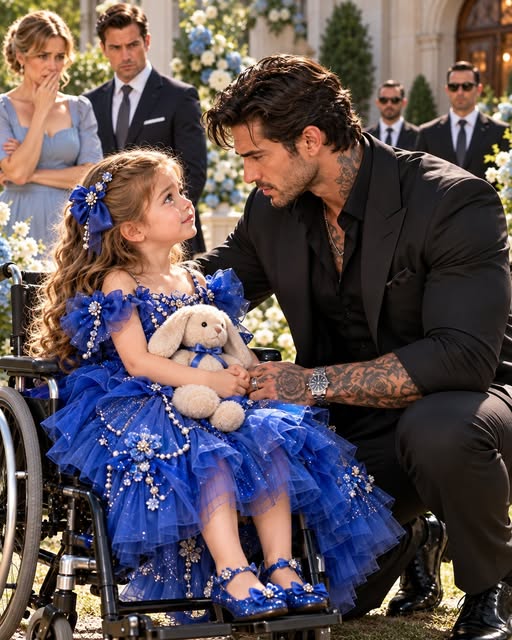
Then he did something I did not expect. He took off his black jacket, folded it carefully, and put it on the ground. He laid it flat on the grass, among the white flowers, like a blanket. And then he knelt on it. He knelt down, right there in the courtyard, so that his face was at the same height as mine. No grown-up had ever done that for me before, not like that. Grown-ups usually bent down a little, or crouched for a second and then stood up again because their knees hurt. This man knelt, and he stayed kneeling, and he looked me right in the eyes, as if I were not a child in a wheelchair to be talked down to, but a person to be talked with.
"Hello, Lily," he said. His voice was deep, and a little bit rough, like he did not use it for gentle things very often. "I am Dominic. May I sit with you for a little while?"
I nodded. I did not trust my voice yet. He did not rush me. He looked at my drawing, which was still on my lap, and he looked at Mr. Bear, and he smiled, just a tiny smile, at the blue ribbon.
"Why are you alone out here?" he asked. His voice was quiet. "Where are your friends?"
I thought about that question. I thought about Tommy and Rosa, who were watching from the porch, and about Mrs. Bell, who was watching from the steps, and about all the banners I had waved at, and all the families who had not come back. I thought about the word "burden," and the word "normal," and the way hope had started to feel like a bruise.
"Because nobody chose me," I said. It came out braver than I felt. "Three families came, and three families went away. The last one said I was a burden, and they wanted a normal child."
I watched his face change. The stern part went away. The sad part got bigger. His jaw tightened, and his eyes went shiny, but he did not look away. He did not pretend he had not heard me. He said, "I am sorry they said that to you, Lily. That was a cruel thing to say, and it was not true."
I believed him, a little. I wanted to believe him more. So I asked him the questions I had been carrying around in my pocket, like lucky coins, waiting for someone brave enough, or honest enough, to answer them.
"Are you dangerous?" I asked.
He did not laugh. He did not get angry. He thought for a moment, which I liked, because it meant he was taking my question seriously.
"Some people would say yes," he said, honestly. "I have done hard things in my life, Lily, and I have made choices I am not proud of. But I am not dangerous to you. I would never hurt a child. I would never hurt you."
I nodded. That was a good answer. It was not a perfect answer, because perfect answers are usually lies, but it was an honest answer, and honest answers are better.
"Do you have a daughter?" I asked.
His face went very still. The courtyard seemed to hold its breath again. Mrs. Bell put her hand over her mouth. The director, who had been standing very straight, went a little bit pale.
"I did," Dominic said, very quietly. "I had a little girl. She is gone now. She died a long time ago, when she was very small, and I have carried her in my heart ever since. I never stopped missing her."
He did not tell me how she died, and I did not ask, because some stories are too sad to tell in a courtyard, and because I could see in his eyes that the sadness was still fresh, even after all those years. I thought about a man with money and power and big black cars, who had everything except a family, and who was kneeling on his own jacket in the grass to talk to a girl nobody chose. I thought, "He understands what it feels like to lose someone. He understands what it feels like to be alone."
"Would you like one?" I asked. I meant a daughter. I meant me. I was not sure if he would understand, but I hoped he would.
He looked at me, and his eyes filled with tears, and he did not try to hide them. A big, feared man, crying in front of a six-year-old girl, in a courtyard full of people, and not caring who saw. "Yes," he said. "Yes, Lily. I would like that very much. More than anything."
My heart beat very fast. It beat like a drum in a parade. I held Mr. Bear tighter. I thought about all the times I had hoped, and all the times hope had hurt, and I thought about the daisy chain Mrs. Bell had made, and the lemonade, and the toast cut into triangles. I thought about a kitchen, and a lap, and a hand that held mine because they wanted to.
And then I asked him the question that mattered most. The question I had been afraid to ask anyone, because the answer could break my heart in a way that no other answer could. Five words. Small words. Heavy words.
"Would you leave me too?"
The words hung in the golden air. The white flowers did not move. The oak tree did not move. Dominic Moretti, the feared man from New York, went pale. His mouth opened, but no sound came out. He was speechless. He looked at me, and I could see that my five words had broken something open inside him, something he had kept locked for a long time. His hands trembled, just a little. The director gasped, a small, surprised sound, like he had not expected a six-year-old to say something so direct, and so true.
Dominic did not stand up. He did not walk away. He did not pretend he had not heard me. He reached, slowly, into the inside pocket of his coat, which was still on the ground under his knees, and he pulled out a folded paper. It was thick, and official-looking, with a seal, and writing that I could not read from where I sat. He held it in his hands, and he looked at it, and then he looked at me, and he took a deep breath, like a man getting ready to tell the truth.
"Lily," he said, "this is why I came today. I did not come to look at you like you were something to choose from a catalog. I came because I heard about a brave girl in a blue dress who had been sent back three times, and I could not stop thinking about her. I talked to Mrs. Bell, and to the director, and to a lawyer, before I ever came here. I had papers prepared. These are guardianship papers. They are a promise, in writing, that if you and Mrs. Bell and the court agree, I want to be your guardian. I want to take care of you, and to be your family, not just for a visit, but for real."
He unfolded the paper a little more, and I saw that there was a second paper inside it, thinner, with handwriting on it, not typed words. "This is a letter," he said, softly. "I wrote it to my daughter, a long time ago, when I lost her. I never sent it, because there was nowhere to send it. I kept it in my pocket, because it reminded me to be a better man. I brought it today because I wanted you to know that I am not coming to you empty-handed, or empty-hearted. I am coming with a promise, and with a heart that has already loved a little girl, and that has room to love another."
Mrs. Bell was crying now, quietly, into a handkerchief. Marco and Enzo, the big guards, were looking at the ground, and one of them wiped his eyes with the back of his hand, pretending he had something in it. The director cleared his throat, twice, and said, "Mr. Moretti, this is highly unusual, but it is also highly proper. The papers are in order. The court will still need to decide, of course. There will be visits, and questions, and time."
Dominic nodded. He did not argue. He did not say, "I am Dominic Moretti, and I get what I want." He said, "Of course. Take all the time you need. I am not here to take Lily away today. I am here to ask if I may stay, and get to know her, and let her get to know me."
He turned back to me, still kneeling, still at my eye level, and he said, "Lily, I will not leave you. I cannot promise that life will always be easy, because that would be a lie, and you deserve better than lies. But I can promise this: I will not walk away because you are in a wheelchair, or because you need help, or because you are too much, or too loud, or too brave. You are not a burden. You are Lily. And if you will let me, I would like to be your family."
I did not know what to say. My throat was tight, and my eyes were wet, and Mr. Bear's ribbon was wrinkled again in my hands. I looked at Mrs. Bell, and she nodded, just a tiny nod, like she was saying, "It is okay to hope, Lily. It is okay this time."
I looked back at Dominic, and I smiled, through my tears, because that is what you do when someone says the thing you have been waiting your whole life to hear, and you are too happy and too scared to say anything else.
Dominic smiled back, a real smile this time, not a tiny one, and he stood up, slowly, because his knees were stiff from kneeling, and he picked up his jacket, and he brushed the grass off it, and he did not put it back on right away. He looked at the director, and at Mrs. Bell, and he asked, in his deep, rough, gentle voice, "May I stay for dinner? Not to take her away. Just to stay, and to share a meal, and to learn how Lily likes her toast?"
Mrs. Bell laughed, through her tears, and she said, "Mr. Moretti, you may stay for dinner, and for as many dinners as Lily wants you to stay for."
And as the golden light faded over the courtyard, and the white flowers glowed, and the three black SUVs waited quietly by the gate, I sat in my wheelchair, in my blue dress, with Mr. Bear on my lap, and I thought, "Maybe this time, the story does not end with someone leaving. Maybe this time, it begins with someone staying."
TITLE: A Feared Mafia Boss Knelt Before My Wheelchair, But My Five-Word Question Broke His Heart -
Chapter 1: The Girl Nobody Chose
My name is Lily, and I am six years old. I live at St. Clare's Home for Children, which is a big white house with a courtyard, an old oak tree, and white flowers that Mrs. Bell plants every spring. I have long curly brown hair that tangles if I do not brush it, a large blue bow that Mrs. Bell ties for me every morning, and a dress that I love more than anything else in the world. It is royal blue and sparkles when I move, and it has pearl buttons down the front that I count when I am nervous. One, two, three, four, five, six, seven. I have blue shoes that match the dress. I have a wheelchair with wheels that squeak a little when I turn too fast. And I have Mr. Bear.
Mr. Bear is not a real bear. He is a cream-colored teddy bear with a blue ribbon around his neck, and he is soft in the places where I have hugged him the most. His left ear is a little bit bent because I fell asleep on him once during story time and Mrs. Bell had to rescue him from under my pillow. I take him everywhere. When people ask me why I carry a teddy bear, I say, "Because he is my best friend, and best friends do not get left in a bedroom." Mrs. Bell says that is a very good rule. She says it in the voice she uses when she is trying not to cry, which is a soft voice, like a blanket voice.
Mrs. Bell is the caretaker here. She is not my mother, and she would never pretend to be, but she is the person who knows that I like my toast cut into triangles, that I hate it when my socks slide down inside my shoes, and that I am scared of thunderstorms even though I pretend I am not. She braids my hair when it gets too wild, and she tells me stories about brave girls who were small and still did big things. She never tells me that being small means being unimportant. She never tells me that my wheelchair makes me less. She says, "Lily, your wheels are just how you get around. Your heart is how you get through." I have remembered that sentence since I was four. I keep it in my pocket like a lucky coin.
St. Clare's is a home, but it is also a waiting place. Children come here, and families come here, and sometimes a child leaves with a new family and we all stand on the porch and wave and clap. We make a banner out of paper and we write "Good luck!" in big letters, and Mrs. Bell bakes a cake that is too sweet and we all eat it anyway. I have waved at a lot of banners. I have clapped until my hands hurt. I have smiled so hard my cheeks ached. And then I have gone back to my room, put Mr. Bear on my lap, and whispered, "Maybe next time, it will be us."
I have been chosen three times. I need to tell you about that, because if I do not, you will not understand why the day the black cars came mattered so much. Being chosen sounds like a happy thing. It sounds like someone points at you and says, "You. We want you." But sometimes being chosen is only the first part of the story, and the second part is being sent back.
The first family was a couple with a big house and a dog named Biscuit. They came on a Saturday, and the woman wore a yellow dress and the man carried a camera. They asked me what my favorite color was, and I said blue, and the woman laughed and said, "Of course it is, sweetheart. You look like a little blueberry." I liked that. I liked being a blueberry. They took me to the park for an afternoon, and they pushed my wheelchair very carefully over the grass, and they bought me ice cream with sprinkles. I told them about Mr. Bear, and they listened, and the man said Mr. Bear could have his own seat in the car if I wanted. I went to sleep that night thinking about Biscuit and the yellow dress and the seat for Mr. Bear.
They did not come back. Mrs. Bell told me, very gently, that they had decided they were not ready for a child with extra needs. She did not use the word "extra" like it was a bad word. She said it like it was a fact, like saying someone needs glasses. But I heard the part she did not say. I heard, "They were not ready for you." I sat under the oak tree with Mr. Bear for a long time that day, and I counted the pearl buttons on my dress. One, two, three, four, five, six, seven. I did not cry in front of the other children. I cried later, into Mr. Bear's soft fur, where no one could hear except him.
The second family was a single mother with kind eyes and a little boy who was already hers. She wanted a sister for her son. She read to me, and she taught me how to make paper stars, and she said my laugh was her favorite sound in the whole house. For two weeks, I thought I might be going home with her. I practiced saying "good morning" in the way she said it, slow and warm. I imagined a bedroom with a window that looked out on a garden, and a place for Mr. Bear on the bed, and a brother who would teach me how to skip rocks, even if I could only watch from the shore.
Then the boy got sick, and the mother had to spend all her time at the hospital, and she wrote a letter to Mrs. Bell saying she could not take on another child right now, not because of me, but because life had become too hard all at once. Mrs. Bell read me the kind parts of the letter, and she said, "Lily, this one was not about you." I believed her, mostly. But a small voice in my head said, "If I were easier, maybe she could have managed." I told that voice to be quiet. I told Mr. Bear, "We are not a problem to be managed. We are a person." He did not answer, because he is a teddy bear, but his ribbon felt like a nod.
The third family is the one I do not like to remember, but I have to, because it is the reason I stopped believing that being pretty and polite and brave would be enough. They came in a shiny car, and the woman wore perfume that smelled like flowers that had been left in the sun too long. The man talked about his business and his house and his boat, and he talked about children like they were things you could order from a catalog. They took me to a restaurant with white tablecloths, and I was very careful not to spill anything, and I smiled, and I answered all their questions, and I held Mr. Bear on my lap where he could not be seen too much, because I thought maybe they would think a six-year-old with a teddy bear was too babyish.
On the way home, in the car, I heard the woman say it. She did not whisper. She said, "She is sweet, but she is a burden. We wanted a normal child." The word "burden" landed in my chest like a stone. The word "normal" landed right beside it. I did not know what to say. I looked down at my blue dress, at the pearl buttons, at my shoes, at my hands holding Mr. Bear so tight his ribbon wrinkled. I thought, "I am not a burden. I am Lily." But I did not say it out loud, because my throat had closed up, and because I was six, and because grown-ups who say things like that in cars do not usually listen to six-year-olds.
When we got back to St. Clare's, Mrs. Bell was waiting on the porch. She saw my face, and she did not ask what happened right away. She just knelt down, which is a hard thing to do in a skirt, and she put her hands on my wheelchair, and she said, "Lily, you are not a burden. Do you hear me? You are not a burden, and you are not less than normal. You are Lily, and that is a wonderful thing to be."
I nodded, because I wanted to believe her. I nodded so hard my blue bow bounced. But that night, I sat on my bed and I whispered to Mr. Bear, "What if she is right? What if nobody wants a girl who cannot walk to the park by herself, who needs help getting into a car, who has wheels instead of running feet?" Mr. Bear looked at me with his button eyes, and I imagined him saying, "Then they do not deserve you." I liked that answer. I kept it.
After that, I stopped running to the door every time a car pulled into the courtyard. I stopped practicing my smile in the mirror. I still wore my blue dress on visiting days, because it made me feel brave, but I did not wear it with the same hope. I wore it like armor. Sparkles can be armor, if you believe in them hard enough. Mrs. Bell noticed, of course. Mrs. Bell notices everything. She started sitting with me under the oak tree after lunch, and she brought lemonade, and she did not try to fix my feelings with a speech. She just sat there, and she let me talk, and sometimes she let me not talk, and she taught me how to make daisy chains out of the white flowers. "See, Lily," she said one afternoon, holding up a chain, "these flowers are small, and they are not roses, and they are still beautiful. Nobody calls a daisy a burden for not being a rose."
I liked the daisy chain. I wore it on my wrist for the rest of the day, until it wilted, and then I pressed one flower in a book, so I could remember.
My days at St. Clare's were not all sad. I want to be honest about that, because a sad story that is only sad is not true. I had friends. I had a boy named Tommy who could make a paper airplane fly all the way across the courtyard, and a girl named Rosa who taught me how to draw a cat that actually looked like a cat. I had school lessons in a room with big windows, and I was very good at reading, and I was even better at making up stories. My favorite stories were about girls who went on adventures in wheelchairs that could fly, or turn into boats, or climb mountains with special wheels. Mrs. Bell said I had an imagination that could fill a whole house. I liked that. Imagination is free, and it does not ask if you can walk.
I also had chores, which is a normal thing for a child, even if some people think a child in a wheelchair should not have chores. I helped fold napkins. I helped sort books. I helped Mrs. Bell water the white flowers, because the watering can was light and I could hold it with one hand and steer with the other, if I was careful. I was proud of the flowers. They were mine, in the way that things you take care of become yours, even if you do not own them.
But at night, when the house got quiet and the hallway lights went dim, I would lie in bed and listen to the other children breathing, and I would think about families. I would think about a kitchen where someone knew I liked my toast in triangles. I would think about a lap that was not a chair, but a person, and a hand that held mine not because I needed help, but because they wanted to. I would think about a father, because I had never had one, and I did not know what that word felt like in real life. I had seen fathers in books, and in movies, and in the park, pushing swings and catching children who jumped off the slide. I wondered what it would be like to have someone who was not paid to take care of me, who chose me on purpose, and stayed.
I was afraid to hope for that, after the third family. Hope had started to feel like a bruise. You press it, and it hurts, and you learn not to press it. But I could not stop hoping entirely, because hope is stubborn, like a weed in the courtyard that keeps growing back between the stones. Mrs. Bell said hope was a good stubbornness. She said, "Lily, do not let one unkind family steal the whole idea of family from you." I wrote that down in my notebook, in my best handwriting, with a blue star next to it.
The morning it happened, it was golden hour, which is the time when the light turns honey-colored and everything looks like it is in a photograph. I was in the courtyard, under the oak tree, in my blue dress, with Mr. Bear on my lap. I had not been waiting for anyone. I had been drawing, actually. I was drawing a picture of a girl in a wheelchair under a tree, with white flowers all around her, and a teddy bear wearing a blue ribbon. It was a picture of me, but braver. I was humming a song Mrs. Bell had taught me, a song about a little boat that sails home, and I was thinking about lemonade, and about whether Tommy's paper airplane would fly farther if we folded the wings differently.
Mrs. Bell came out of the house quickly, which was unusual, because Mrs. Bell does not hurry. She smoothed her apron, and she looked at the gate, and she said, "Lily, stay right here, sweetheart. Someone is coming to visit." She did not say who. She did not say a family was coming. She just said someone, and her voice was a little bit shaky, like she was excited and nervous at the same time.
I looked up. I put my pencil down. I held Mr. Bear a little tighter.
And then I heard them. Not one car, but three. Three black SUVs, big and shiny and quiet in the way expensive cars are quiet, pulling into the courtyard one after another, like a parade that did not know it was a parade. The other children stopped playing. Rosa stopped drawing. Tommy's paper airplane fell to the ground, forgotten. Even the birds seemed to pause.
I did not know who was in those cars. I did not know if it was another family, or a visitor, or someone important. I only knew that my heart was beating very fast, and that my blue dress suddenly felt like armor again, and that Mr. Bear's ribbon was wrinkled in my hands.
I sat up straight in my wheelchair, under the oak tree, among the white flowers, in the golden light, and I waited to see who would get out of the first car. I told myself, "Do not hope too much, Lily. Do not hope too much." But my heart did not listen. My heart was already hoping, stubborn as a weed, brave as a daisy, and ready for whatever came next.
TITLE: A Feared Mafia Boss Knelt Before My Wheelchair, But My Five-Word Question Broke His Heart -

Chapter 7: The Mafia Boss Who Finally Learned How to Smile
×
Eighteen months after the day Mia Ellis marched into Vincent Castalano's living room and insulted his face, something extraordinary happened on a quiet street in Brooklyn.The most feared man in New York stood outside a neighborhood bakery holding a small pink gift bag.
And he was nervous.
Not mildly uncomfortable.
Not professionally cautious.
Genuinely nervous.
He had faced hostile negotiations, criminal investigations, courtroom testimony, and the collapse of a business empire without allowing his hands to tremble.
But the prospect of seeing Grace Ellis again after months apart had him checking his reflection in a darkened shop window.
He adjusted his jacket.
Ran a hand through his hair.
Then frowned at himself.
Immediately, he heard a familiar little voice inside his memory.
Stop squishing your eyebrows.
Vincent closed his eyes.
Then laughed quietly.
Some lessons were impossible to forget.
Much had changed since Victor Bellini's conviction.
Victor received a lengthy prison sentence for his financial crimes, obstruction, witness intimidation, and criminal misconduct connected to the fatal Hudson Pier accident.
Peter Walsh and several others faced consequences for their roles in the cover-up and threats against witnesses.
The investigation also exposed serious failures throughout Castalano Holdings.
Independent auditors identified additional financial misconduct.
Several executives were dismissed.
The company entered a comprehensive restructuring agreement that included court-supervised reforms, restitution, and independent oversight.
The stolen funds were traced and recovered where possible, with additional compensation coming from company assets and responsible parties.
Families affected by unsafe working conditions finally received meaningful settlements.
And Vincent kept the promise he made after discovering Daniel Ellis's documents.
He opened the books.
All of them.
Even the ones that could hurt him.
The separate investigation into his family's older business operations forced him to confront decisions he had spent years justifying.
He cooperated with authorities.
Acknowledged his involvement in unlawful financial arrangements.
Paid substantial penalties and restitution.
Accepted court-imposed supervision and restrictions.
And surrendered control of the operations that had once made his name synonymous with fear.
It was not an easy transformation.
Some associates abandoned him.
Others accused him of betraying his father's legacy.
He lost money.
Influence.
Certain friendships.
And much of the intimidating world he had once believed defined him.
But Vincent never regretted the decision.
For the first time in his adult life, he could look in the mirror without pretending that fear was a form of respect.
The darkest parts of his old business life were gone.
What remained was a smaller collection of legitimate interests under independent management and something he had forgotten he possessed.
A choice about who he wanted to become.
Grace Ellis had changed too.
After leaving the Castalano mansion, she returned to Brooklyn with Mia.
She rented a brighter apartment only a few streets from their old neighborhood.
It had two bedrooms, large windows, and a small balcony where Mia insisted on growing flowers.
The first plants died because Mia watered them six times a day.
The second group survived under strict supervision.
Grace found work at a neighborhood worker advocacy center, helping families navigate workplace safety complaints, insurance paperwork, and compensation applications.
At first, she volunteered part-time.
Then the center offered her a permanent position.
She took training courses in workplace safety advocacy and learned how to help families preserve important records.
She became particularly good at sitting beside frightened people who didn't know what questions to ask.
When people cried, she didn't rush them.
When they were angry, she listened.
When they felt powerless, she reminded them that their voices mattered.
Over time, Grace helped establish the Daniel Ellis Safety Project, an independent community program that offered educational workshops, document assistance, and referrals to qualified legal and technical professionals.
It was named for her husband.
But it was built for everyone who had ever been told to remain silent.
Grace knew Daniel would have been proud.
And that knowledge helped her finally imagine a future not entirely defined by losing him.
Mia was now five.
Her curly light-brown hair had grown longer, though she still preferred to wear it in a messy bun tied with a pink ribbon.
She had traded some of her princess dresses for colorful overalls.
But she remained deeply committed to giving people unsolicited advice.
Especially about their faces.
Her preschool teacher, Mrs. Parker, once called Grace after Mia informed another child that his angry expression needed "a little vacation."
Grace apologized.
Mrs. Parker laughed.
"Actually, it worked. He stopped yelling."
Mia was learning to write her name.
She could count to fifty.
She loved butterflies, strawberries, and telling people about her daddy.
Grace had begun speaking more openly about Daniel.
She showed Mia photographs.
Told her stories.
Explained that her father had been an engineer who cared about keeping people safe.
And when Mia asked why he couldn't come home, Grace answered with gentle honesty appropriate for her age.
"Your daddy died because something dangerous happened at his job. He tried to help people, and he loved you very much."
Mia accepted that explanation in the way children sometimes do.
Not because she understood every part.
But because she believed her mother.
One evening, after studying Daniel's photograph, Mia asked a question that caught Grace by surprise.
"Can you have two people in your heart?"
Grace looked at her.
"What do you mean, sweetheart?"
"Like Daddy and Mr. Vincent?"
Grace's breath caught.
"Of course."
"Even if they're different?"
"Especially then."
Mia smiled.
"Good."
She returned to coloring.
Grace watched her for a long time afterward.
Because she had been asking herself a similar question for months.
Could she still love Daniel and allow herself to care for someone else?
Could she honor the life they had shared without refusing another chance at happiness?
And if she chose to move forward, would that mean leaving a part of Daniel behind?
Deep down, she knew the answer.
Love wasn't a room with only one chair.
There was space for memories.
Space for grief.
And sometimes, when life offered unexpected kindness, space for something new.
Vincent had remained in touch.
Not constantly.
Not intrusively.
He sent Mia birthday cards.
He occasionally called Grace to ask how the advocacy program was progressing.
And when he learned that Mia's preschool was collecting books for children whose families couldn't afford them, he donated several boxes anonymously through a neighborhood bookseller.
Grace discovered what he had done anyway.
She called him that evening.
"You know you didn't have to do that."
Vincent sounded amused.
"Do what?"
"Donate thirty-seven books."
"Thirty-six."
"Vincent."
"One was for Mia."
Grace smiled.
"She loved it."
"Good."
There was a pause.
Then Vincent asked, "How is she?"
"Still ordering people to smile."
"Some things never change."
Grace laughed.
"How are you?"
The question surprised him.
He was accustomed to people asking about his businesses.
His money.
His influence.
Not simply how he was feeling.
"I'm learning," he answered.
"Learning what?"
"How to have an ordinary day."
Grace smiled softly.
"And?"
"It's harder than running a criminal empire."
She laughed so unexpectedly that Vincent began laughing too.
For a few seconds, they sounded like two people who had known each other all their lives.
Then the silence between them changed.
It became warm.
Unhurried.
Full of possibilities neither had yet spoken aloud.
The invitation arrived on a bright Saturday morning.
Grace was preparing breakfast when someone knocked.
She opened the door to find a delivery driver holding an envelope.
Inside was a handwritten note.
Grace,
The neighborhood restaurant my parents once owned is reopening next Friday. It's nothing like the businesses I used to run. Just a small place with decent food, honest employees, and a kitchen that won't let me touch the pancakes.
I'd like you and Mia to come, if you're comfortable.
No cameras. No speeches. No expectations.
Just dinner.
Vincent.
Grace read it twice.
Then a third time.
Mia appeared beside her.
"What's that?"
"An invitation."
"To what?"
"Dinner."
Mia's eyes widened.
"With Mr. Vincent?"
Grace smiled.
"Yes."
Mia began bouncing.
"DOES HE STILL HAVE THE ANGRY FACE?"
Grace burst out laughing.
"I suppose we'll find out."
That was how Vincent Castalano ended up standing nervously outside a Brooklyn bakery, holding a pink gift bag and trying to remember what ordinary people did when they visited someone they cared about.
He had decided to walk Grace and Mia to the restaurant rather than send a car.
It seemed simpler.
More personal.
Less like the old Vincent Castalano.
The bakery door opened.
And there was Grace.
She wore a soft blue dress with a light cardigan.
Her brown hair fell loosely around her shoulders.
She wasn't wearing a housekeeping uniform.
She didn't look exhausted.
And when she saw him, her smile was warm and unafraid.
For a moment, Vincent forgot every word he had prepared.
"Hello, Grace."
"Hello, Vincent."
He looked at her.
"You look beautiful."
A faint blush rose into her cheeks.
"Thank you."
Then a tiny voice shouted from inside.
"MR. VINCENT ANGRY MAN!"
Vincent barely had time to brace himself before Mia launched into his arms.
He lifted her easily.
"Princess!"
She examined his face with dramatic seriousness.
Then frowned.
"You changed."
Vincent raised an eyebrow.
"Did I?"
"Uh-huh."
"How?"
She touched his cheeks.
"You have smile wrinkles."
Grace laughed.
Vincent looked offended.
"I'm thirty-nine, Mia."
She nodded wisely.
"That's very old."
He turned toward Grace.
"Does she say this to everyone?"
"Only people she likes."
Mia hugged his neck.
"You're my favorite old man."
Vincent closed his eyes.
Grace laughed so hard she had to lean against the doorway.
For once, he was perfectly happy to be the joke.
The restaurant was called Antonio's Table.
It occupied a renovated corner building with redbrick walls, large windows, wooden tables, and a small garden behind the kitchen.
A photograph of Vincent's parents hung near the entrance.
In the picture, Antonio Castalano stood beside his smiling wife in front of the original restaurant.
They were young.
Happy.
And far removed from the complicated life their son would eventually inherit.
Grace stopped to study it.
"Your mother was beautiful."
Vincent stood beside her.
"She was."
"Did she like the restaurant?"
"She loved it."
He smiled faintly.
"My father wanted to expand. Bigger buildings. More businesses. More money."
"And your mother?"
"She wanted a place where people could eat when they were hungry, even if they couldn't always pay."
Grace turned toward him.
"That sounds wonderful."
Vincent looked at the photograph.
"For years, I thought my father's ambition was the important part of our family story."
He paused.
"Now I think I misunderstood what made this place worth remembering."
Grace gently touched his arm.
Vincent looked down at her hand.
Then into her eyes.
Neither moved for a moment.
Finally, Mia tugged his sleeve.
"Can we eat now?"
Vincent laughed.
"Yes, Princess. We can eat."
Dinner was wonderfully ordinary.
Renzo joined them for the first course, bringing stories about the restaurant renovations and complaining that Vincent had personally rejected seventeen different chair designs.
Vincent denied it.
Renzo produced a photograph of the rejected chairs.
Mia declared that all of them were boring.
Mrs. Whitcomb, who had retired from the mansion and now occasionally helped teach baking classes at the neighborhood community center, arrived carrying homemade cookies.
Mia hugged her fiercely.
The staff introduced themselves without fear.
Nobody fell silent when Vincent entered the room.
Nobody avoided his eyes.
Nobody seemed afraid to disagree with him.
At one point, a young waiter accidentally spilled water on Vincent's sleeve.
The boy looked horrified.
"I'm so sorry, sir."
Vincent glanced at the wet fabric.
Then at the anxious waiter.
"It's just water."
The boy relaxed.
"I'll get a towel."
"Thank you."
Grace watched the exchange quietly.
She remembered the man she had first met.
The rigid posture.
The cold stare.
The expectation that every room would bend around his mood.
Now he looked almost embarrassed by the attention.
She realized that change had not diminished him.
It had made him easier to love.
After dinner, they walked into the little garden behind the restaurant.
The evening air was cool.
Lights glowed along the brick walls.
Mia chased a few soap bubbles left over from an afternoon children's event.
Grace sat beside Vincent on a wooden bench.
For several minutes, they watched her play.
Then Vincent spoke.
"I owe you another apology."
Grace looked at him.
"For what?"
"For the first day you came into my study."
She smiled faintly.
"You mean the day Mia nearly gave you a heart attack?"
He laughed.
"That one."
"What about it?"
"I remember how frightened you looked."
Grace lowered her gaze.
"I thought I was going to lose my job."
"I know."
He stared toward the garden.
"I thought I was being reasonable when I told you to sit down. But you were scared because you knew I had the power to take something away from you."
Grace remained silent.
Vincent continued.
"I spent years pretending that kind of power made me important."
He shook his head.
"Your daughter stood in front of me with absolutely no fear. And I couldn't understand it."
Grace smiled.
"She was three. She didn't know your reputation."
"Exactly."
Vincent looked at her.
"She saw a man making an ugly face. Nothing more."
Grace laughed softly.
"And she decided to fix it."
"She did."
He paused.
"But you did something even harder."
Grace looked surprised.
"What?"
"You told me the truth when you had every reason to be afraid of what it might cost."
She looked toward Mia.
"I was afraid."
"I know."
"Terrified, actually."
Vincent reached toward her hand, then stopped, leaving the choice to her.
Grace took it.
His fingers closed gently around hers.
For a long moment, neither spoke.
Then Grace whispered, "I missed you."
Vincent turned toward her.
The words seemed to catch him completely unprepared.
"You did?"
Grace nodded.
"More than I expected."
He looked down at their joined hands.
"I missed both of you."
She smiled.
"Even Mia's opinions about your face?"
"Especially those."
They laughed quietly.
Then Vincent became serious.
"Grace, I don't know what kind of future you're looking for. And I'm not going to pretend my past disappeared because I changed a few things."
She listened.
"I've made mistakes that have consequences. Some of them will follow me for years."
"I know."
"I can't give you the life you lost with Daniel."
Her eyes filled with tears.
"No one can."
Vincent nodded.
"But I can offer you honesty. And patience. And whatever good I can still do with the life I've got left."
Grace looked at him.
For a moment, she saw the intimidating man in the black suit.
Then she remembered him covered in pancake flour.
Wearing purple birthday glasses.
Reading a fox story beside a little girl.
Sitting through courtroom testimony without trying to protect himself from every uncomfortable truth.
And standing before her now without demanding an answer.
"I don't need you to replace Daniel," she said softly.
Vincent swallowed.
"I wouldn't want to."
"Daniel will always be part of my life. Part of Mia's life."
"He should be."
Grace smiled through her tears.
"But that doesn't mean there isn't room for someone else."
Vincent looked into her eyes.
"Are you certain?"
She nodded.
"I am."
He slowly lifted her hand and kissed her fingers.
Not possessively.
Not dramatically.
Just a quiet gesture filled with gratitude.
Then Grace leaned forward and kissed him.
It was gentle.
Careful.
The beginning of something they had both been afraid to hope for.
And when they separated, Vincent was smiling.
Not a guarded half-smile.
Not an expression he had forced.
A genuine, unmistakable smile.
"EEEEWWWW!"
They jumped apart.
Mia stood several feet away, staring at them in delighted horror.
Grace covered her face.
Vincent laughed.
"What?"
Mia pointed.
"You KISSED!"
Grace's cheeks turned crimson.
"Sweetheart—"
"ON THE MOUTH!"
Vincent laughed harder.
Mia folded her arms.
Then narrowed her eyebrows.
For one beautiful second, she recreated the exact intimidating expression that had started everything.
Vincent stared at her.
Grace looked between them.
And the three of them burst into laughter.
Mia ran toward Vincent.
He scooped her into his arms.
"What's the matter, Princess?"
She studied him.
"Are you gonna marry my mommy?"
Grace gasped.
"Mia!"
Vincent nearly dropped the gift bag.
He looked toward Grace.
Then back at the little girl.
"That's a very big question."
Mia nodded.
"I'm five now. I ask big questions."
Vincent laughed.
"Apparently."
She leaned closer.
"You better be nice."
His expression softened.
"I'll do my best."
Mia looked satisfied.
"Good."
Then she wrapped her little arms around his neck.
"Because Mommy needs lots of smiles."
Vincent held her close.
"Yes," he whispered.
"She does."
Love didn't solve everything overnight.
It never does.
Grace still had difficult days when she missed Daniel so deeply that ordinary moments could bring her to tears.
Vincent still carried the consequences of his past.
They disagreed sometimes.
They learned to listen.
They apologized when necessary.
And they made sure Mia understood that Daniel would always be her father.
Vincent never tried to erase that truth.
On Father's Day, he helped Mia choose flowers for Daniel's resting place.
He listened as Grace told stories about her husband.
He encouraged Mia to keep Daniel's photograph beside her bed.
And when the Daniel Ellis Safety Project held its annual remembrance ceremony, Vincent attended quietly, standing among the workers and families whose lives had been changed by the investigation.
He did not give a speech.
He did not ask to be thanked.
He simply stood beside Grace when she needed him.
Over time, their relationship grew into something steady.
Their lives were no longer built around threats or secrecy.
They took walks in the park.
Cooked dinner together.
Attended school performances.
And discovered the extraordinary pleasure of being an ordinary family.
One year after their first dinner at Antonio's Table, Vincent asked Grace to marry him.
Not in a ballroom.
Not beneath a chandelier.
Not surrounded by hundreds of important guests.
He asked in the little garden behind the restaurant.
Renzo helped hang string lights.
Mrs. Whitcomb baked a chocolate cake.
And Mia carried a small velvet ring box with the solemn dignity of a royal messenger.
Vincent knelt before Grace.
For a moment, emotion made it difficult for him to speak.
Then he said, "I used to think a man's legacy was the empire he left behind."
He glanced toward Mia.
"Now I know it's the way he makes people feel when he's standing beside them."
Grace's eyes filled with tears.
"I can't promise to be perfect," he continued. "But I promise to be honest. To listen. To keep learning. And to spend every day choosing the kind of life we both deserve."
He opened the ring box.
"Grace Ellis, would you marry me?"
She was crying and smiling at the same time.
"Yes," she whispered.
Vincent stared.
"Yes?"
She laughed.
"Yes, Vincent!"
He slipped the ring onto her finger.
Then stood and embraced her.
Mia began jumping in circles.
"SHE SAID YES! SHE SAID YES!"
Renzo applauded.
Mrs. Whitcomb wiped her eyes.
And Vincent Castalano, a man once feared by an entire city, stood beneath the garden lights holding the woman he loved while a little girl danced around his feet.
It was the happiest moment of his life.
Their wedding took place several months later.
Small.
Warm.
Filled with friends who knew them for who they had become rather than what they had once possessed.
Grace carried a tiny photograph of Daniel inside a locket attached to her bouquet.
Before the ceremony, she stood alone for a moment and held it close.
"Thank you," she whispered.
Not because Daniel had somehow led her to Vincent.
But because the love she had shared with him had taught her what genuine kindness, courage, and commitment looked like.
She would never stop loving the memories they had made.
And she no longer believed that moving forward meant leaving them behind.
Outside, Mia waited in a pastel purple flower-girl dress.
A pink ribbon decorated her curls.
She carried a small basket of white petals.
Vincent stood near the garden arch wearing a tailored black suit.
But this time, his face held no intimidating expression.
He looked nervous.
Happy.
And utterly in love.
Renzo leaned toward him.
"You know something?"
Vincent glanced at him.
"What?"
"I never thought I'd see this day."
Vincent smiled.
"Neither did I."
Renzo looked toward Mia.
"All because of one tiny girl with terrible manners."
Vincent laughed.
"Excellent manners."
"She called you an angry potato yesterday."
"An observant child."
They both laughed.
Then the music began.
Grace appeared at the end of the garden path.
Vincent looked at her.
And everything else seemed to fade away.
He saw the woman who had walked into his study terrified for her job.
The widow who had fought for the truth about her husband.
The mother who refused to let fear decide her daughter's future.
And the person who had helped him understand that strength without kindness was only another kind of weakness.
Grace walked slowly toward him.
Mia scattered flower petals enthusiastically, occasionally throwing handfuls in the wrong direction.
By the time she reached the arch, half the guests were laughing.
Mia turned toward Vincent.
She studied his face.
Then announced loudly enough for everyone to hear.
"LOOK, EVERYBODY!"
The garden fell silent.
Vincent raised an eyebrow.
Mia pointed at him.
"HE'S SMILING WITHOUT ME TELLING HIM!"
Laughter erupted.
Grace covered her mouth.
Renzo bent forward, laughing helplessly.
Even the officiant chuckled.
Vincent looked down at Mia.
Then crouched until they were eye to eye.
"Princess?"
"Yes?"
"Do you remember the first thing you ever said to me?"
Mia thought carefully.
Then lowered her eyebrows.
Crossed her tiny arms.
And said in her deepest possible voice:
"WHY IS YOUR FACE SO ANGRY?"
Everyone laughed again.
Vincent shook his head.
"I'll never forget it."
Mia smiled.
"Good."
Then she wrapped her arms around his neck.
"Because you don't need that face anymore."
Vincent closed his eyes.
He held her gently.
When he opened them again, tears were shining in his dark eyes.
"No, sweetheart," he whispered.
"I don't."
He stood and reached for Grace's hand.
The officiant began the ceremony.
And beneath the warm afternoon sunlight, surrounded by people who had witnessed their struggles, Vincent and Grace promised to build their future together.
Not on wealth.
Not on power.
Not on fear.
But on truth, forgiveness, patience, and love.
Years later, Vincent would still keep one particular piece of paper inside his study.
It wasn't a business contract.
It wasn't an expensive painting.
It wasn't a photograph of his old empire.
It was Mia's first drawing.
The one she had made when she was three.
A huge man in a black suit.
A tiny girl in purple.
Two serious faces.
And a smiling yellow sun.
He had placed it in a simple wooden frame.
Sometimes, when life became difficult, he would sit at his desk and look at it.
He remembered how small Mia had been.
How terrified Grace looked.
How the room fell silent when a child dared to imitate the expression that had frightened powerful men for years.
And he remembered the words that changed everything.
Then teach me how to smile.
Mia had done much more than that.
She had reminded him how to laugh.
Grace had shown him how to take responsibility.
Daniel's courage had taught him that doing the right thing mattered even when it came at a terrible personal cost.
Together, they had changed the direction of his life.
One evening, years after the wedding, Vincent sat on the sofa reading while Grace prepared dinner.
Mia, now older but still wonderfully outspoken, wandered into the room.
She looked at him.
Then frowned.
"Dad?"
Vincent lowered his book.
"Yes, sweetheart?"
"You're doing that face again."
He raised an eyebrow.
"What face?"
She crossed her arms.
Lowered her eyebrows.
Pursed her lips.
And recreated the expression she had made on the very first day they met.
Vincent burst out laughing.
Grace appeared in the doorway.
"What's happening?"
Mia pointed dramatically.
"He forgot how to smile again!"
Grace laughed.
Vincent stood and opened his arms.
"Then I suppose I need another lesson."
Mia ran toward him.
He lifted her into a hug.
Grace joined them.
And in the quiet warmth of their family home, Vincent Castalano understood something he wished he had learned long ago.
The most powerful thing he had ever done was not making people fear him.
It was becoming someone they could trust.
The greatest treasure he had ever possessed wasn't the empire he once controlled.
It was the family laughing in his arms.
And the little girl who had once dared to mock the most frightening man in New York had grown up knowing a very different man.
A man who listened.
A man who protected without controlling.
A man who admitted when he was wrong.
A man who smiled.
THE END.
Thank you for reading this story. May your life always have room for second chances, unexpected kindness, healing after heartbreak, and the kind of love that makes even the hardest days a little brighter. May you always find a reason to smile.
-
Chapter 6: The Day the Truth Finally Spoke Louder Than Fear
The morning Grace Ellis walked into the police station, she wore the only navy-blue dress she owned.
It had belonged to her sister.
The hem was slightly too long.
The sleeves were a little loose.
And the shoes she paired with it were the same black pumps she had worn to Daniel's funeral.
She had considered buying something new.
Then she remembered the eighty-three dollars she had in her account just days earlier.
Some things mattered more than looking impressive.
Mia stayed with Mrs. Whitcomb at the mansion.
Grace kissed her daughter goodbye before leaving.
"Where are you going, Mommy?"
"To talk to some people."
"Are they nice?"
"I hope so."
Mia studied her.
Then reached up and gently pulled the corners of Grace's mouth into a smile.
"Don't be scared."
Grace hugged her.
"I'll try."
Mia pointed toward the living room.
"Mr. Vincent said you're brave."
Grace looked up.
Vincent was standing near the doorway.
Their eyes met.
He didn't smile.
But his expression told her he meant it.
Denise Carter accompanied Grace to the interview.
Vincent waited outside.
Grace had insisted on speaking for herself.
She knew the rumors about their relationship had become a weapon.
Every public appearance together generated more speculation.
Every photograph gave Victor's lawyers another opportunity to suggest she had been manipulated.
So Grace entered the interview room with Denise and sat across from two detectives.
They asked about Daniel.
About her employment.
About the hidden notebook.
About the circumstances under which she discovered the altered documents.
Grace answered every question.
When they asked whether Vincent had instructed her to make accusations against Victor Bellini, she shook her head.
"No."
"Did he promise you money?"
"No."
"Did he offer you a promotion?"
"No."
"Why did you go to work for his family?"
Grace hesitated.
Then told the truth.
"Because I needed a job. And because I knew his company had been involved in my husband's death."
One detective glanced at the other.
"Did you intend to investigate Mr. Castalano?"
"I hoped I might find out what happened."
"Without telling him?"
"Yes."
"Why?"
Grace looked directly at the detective.
"Because every official explanation I'd received was wrong, and I didn't know who I could trust."
The room became silent.
Then the older detective asked, "And do you trust him now?"
Grace thought about Vincent reading Mia's storybook.
About his apology.
About his willingness to open the company's accounts to investigators.
About the night he ran through a dark garden to find them.
Finally, she said, "I trust that he's trying to do the right thing."
"That's not the same thing."
Grace nodded.
"No. It isn't."
The interview lasted three hours.
No charges were brought against Grace.
The documents she presented were copied, cataloged, and examined by forensic specialists.
The original inspection reports contained details that matched engineering records obtained independently from a supplier.
The dates in Daniel's notebook corresponded to actual bank transfers.
And the letter hidden inside Mia's nursery book was consistent with Daniel's handwriting and predated his death.
Victor's accusations began collapsing under the weight of evidence.
But public opinion was harder to change.
Reporters appeared outside the bakery beneath Grace's apartment.
Strangers posted cruel comments beneath photographs of her.
Some called her a liar.
Others accused her of trying to become Vincent Castalano's wealthy new wife.
A few questioned Daniel's integrity despite having never met him.
Grace stopped looking at the news.
She could endure attacks against herself.
But seeing Daniel's name dragged through headlines hurt in a way she couldn't explain.
And the photograph of Mia circulating online frightened her more than anything.
Vincent arranged for a lawyer to pursue the removal of the child's images wherever possible.
Grace insisted that no photograph of Mia be used to defend her publicly.
"She's three," she told Denise. "She doesn't belong in any of this."
Denise agreed.
The child would remain outside the publicity and legal arguments as much as possible.
The investigation continued for months.
Autumn arrived in New York.
The trees around the mansion turned orange and gold.
Mia celebrated her fourth birthday in the garden with a small chocolate cake, pink balloons, and exactly seven guests.
Vincent had offered to hire entertainers.
Mia rejected the idea.
She wanted cookies, bubbles, and a butterfly-shaped cake.
Most importantly, she wanted everyone to make happy faces.
Renzo wore a paper crown.
Mrs. Whitcomb supervised the candles.
And Vincent, after considerable negotiation, agreed to wear a pair of ridiculous purple party glasses.
Mia laughed so hard she nearly fell off her chair.
Grace took a photograph.
It became one of her favorites.
Not because Vincent looked important.
But because he didn't.
For the first time, he looked like a man enjoying an ordinary birthday party.
Someone who belonged in the moment rather than commanding it.
Behind those small moments of happiness, the investigation deepened.
Auditors discovered additional diverted funds.
Former employees came forward with records of ignored safety complaints.
A retired accountant testified that Victor's office had demanded changes to project ledgers.
Samuel Ortiz, the worker Daniel saved, agreed to describe the final minutes before the fatal accident.
And Peter Walsh, confronted with financial records and surveillance evidence, eventually cooperated with prosecutors.
His statements identified Victor as the person who ordered the threatening messages sent to Grace.
Walsh also described his role in concealing construction records and arranging the attempted break-in at the guest cottage.
The evidence grew stronger.
But it revealed something else that Vincent could no longer ignore.
Victor's wrongdoing had flourished inside an organization built to discourage questions.
Employees feared losing their jobs.
Managers worried about contradicting executives.
Accountants approved suspicious transfers because the orders carried powerful names.
And people who might have spoken up believed silence was safer.
Vincent had not personally ordered Daniel's death.
He had not approved the forged safety documents.
But the culture of fear he helped maintain had allowed others to commit terrible wrongs.
One evening, he admitted that to Renzo.
"I thought they respected me."
Renzo stood beside him in the study.
"Some did."
"And the others?"
"They were afraid."
Vincent looked at the photographs arranged on his desk.
A picture of his father.
A photograph of the original family restaurant.
And Mia's childish drawing.
For years, he had believed his father's methods were essential to maintaining control.
Now he saw their hidden cost.
"Fear makes people keep secrets," Vincent said.
Renzo nodded.
"And secrets can destroy people."
Vincent looked toward the door.
"Then we're going to build something different."
In January, the criminal case against Victor Bellini moved forward.
A grand jury returned indictments involving financial fraud, falsified records, obstruction, witness intimidation, and offenses connected to the fatal construction incident.
The precise responsibility for Daniel's death remained a question the criminal proceedings would have to resolve.
Victor denied wrongdoing.
His attorneys promised to expose what they described as a conspiracy against him.
But as the trial approached, the evidence was no longer something he could dismiss with a polished smile.
For Grace, the months leading up to the courtroom were exhausting.
She attended meetings with prosecutors.
Reviewed statements.
Prepared to testify.
And tried to keep life normal for Mia.
Vincent became a quiet presence during those weeks.
He never demanded gratitude.
He never told Grace how she should feel.
Sometimes he brought her coffee when she had been awake too long.
Sometimes he sat beside her without speaking.
And sometimes Mia insisted that all three of them watch cartoons in the family room.
Those were Vincent's favorite evenings.
He had never admitted it aloud.
But Grace suspected.
One rainy evening, Grace found him standing beside the fireplace.
He was holding Daniel's photograph.
She stopped.
"Where did you get that?"
"Mrs. Whitcomb brought over the framed copy you left in the cottage."
Grace looked at him.
"Why are you holding it?"
Vincent studied the photograph.
"Trying to understand something."
"What?"
"How a man who never met me managed to change my life."
Grace moved closer.
Vincent continued.
"Your husband tried to warn me. He trusted that if I understood what was happening, I'd stop it."
"He didn't know you."
"No."
"But he believed somebody with power ought to be responsible for how that power was used."
Vincent nodded slowly.
"I let him down."
Grace took the photograph.
She traced Daniel's face with her thumb.
"You did."
Vincent accepted the words.
"But you're not letting him down now," she added.
He looked at her.
Grace smiled sadly.
"I don't know what happens after this. I don't know whether I'll ever completely trust the world that took him away."
"You don't have to."
"But I can see what you're doing."
Vincent stood very still.
"And it matters."
He looked down.
For a moment, he seemed unable to speak.
Finally, he said, "Grace, there's something I need to tell you."
She waited.
"I've spent years thinking I had to become my father to protect what he built."
He glanced toward the windows.
"But when Mia laughs, I remember a time before all of that. Before I started believing that being feared was the same as being strong."
Grace felt her heart tighten.
Vincent continued.
"I'm not asking you to forgive what my name has done to your family."
"I know."
"And I'm not asking you to feel anything for me because I've helped you."
Grace looked into his eyes.
"Then what are you asking?"
He hesitated.
"Nothing."
She blinked.
Vincent gave a faint, sad smile.
"For once in my life, I want to do something right without expecting anything in return."
Grace reached for his hand.
Only briefly.
Only for a moment.
But the gesture meant more than either could say.
The trial began in the spring.
Grace entered the Manhattan courthouse carrying a small photograph of Daniel in her purse.
Vincent arrived separately with Renzo and his attorneys.
Reporters crowded the steps.
Cameras flashed.
Questions flew through the air.
"Mrs. Ellis, are you accusing Mr. Bellini of murder?"
"Mr. Castalano, did you know about the missing money?"
"Are you and the housekeeper romantically involved?"
Neither stopped to answer.
Inside, the courtroom was cool and quiet.
Victor Bellini sat beside his defense attorneys.
He looked older.
His expensive suit couldn't conceal the strain in his face.
When Grace entered, he watched her with an expression she could not read.
She looked away.
She had spent too much of her life being afraid of him.
Today, she would tell the truth.
Grace testified about Daniel's final phone call.
The hidden letters.
The fraudulent settlement papers.
The threatening messages.
And the documents she discovered inside Mia's nursery book.
Victor's defense attorney attempted to portray her as a woman who had manipulated Vincent Castalano for money.
"Mrs. Ellis," he asked, "isn't it true that you deliberately sought employment in Mr. Castalano's home?"
"Yes."
"And isn't it true that you hoped to obtain information damaging to his company?"
"Yes."
The attorney looked pleased.
"So you admit entering his household under false pretenses."
Grace took a breath.
"I applied for an advertised housekeeping job. I cleaned his house. I followed the household rules. And I hoped somebody might know why my husband died."
The attorney adjusted his glasses.
"You were angry at the company."
"Yes."
"Angry enough to lie?"
Grace looked directly at him.
"No."
"How can this court be certain?"
Grace paused.
Then answered softly.
"Because my husband wrote those warnings before I ever knew Vincent Castalano. The equipment records existed before my husband died. And the money disappeared long before I stepped inside that mansion."
The courtroom fell silent.
She continued.
"You can call me angry. You can call me desperate. You can question every decision I made after becoming a widow."
Her voice strengthened.
"But none of that changes what happened to Daniel."
The defense attorney had no immediate response.
Grace looked toward the jury.
"My husband was a good man who tried to keep other people alive. I want the truth about him to matter more than the money somebody made by ignoring him."
For the first time that morning, she felt the fear inside her begin to loosen.
Samuel Ortiz testified next.
He described Daniel shouting a warning.
The equipment moving despite the safety concerns.
And the moment Daniel pushed him away from the collapsing structure.
"I would not be here without him," Samuel said.
His voice shook.
"He saved my life."
Caleb Dunn then admitted accepting money in exchange for a false statement.
He described the pressure exerted by Victor's associates.
He acknowledged his own shame.
And he explained why he had finally decided to tell the truth.
"I watched a good man die," Caleb said. "Then I helped the people who covered it up. I can't change what I did, but I can stop lying."
Additional testimony and financial records established how the safety budget had been diverted.
The prosecution presented authenticated communications, contractor records, and evidence of the deliberate decision to continue dangerous operations.
Finally, Vincent Castalano took the witness stand.
The courtroom became intensely quiet.
The prosecutor asked about the electronic approval bearing Vincent's credentials.
"Did you authorize this payment?"
"No."
"How can you be certain?"
"I was traveling when it was issued. My flight records and secure-system logs establish that I did not access the company network."
"Who had access to your credentials?"
"A limited group of senior personnel."
"Did that include Victor Bellini?"
"Yes."
"Did you know Mr. Ellis had submitted safety warnings?"
"No."
"Do you believe you should have known?"
Vincent paused.
"Yes."
The prosecutor watched him.
"Why?"
"Because I owned the company. Because warning systems are meaningless if employees are too frightened to use them. And because I allowed people I trusted to operate without enough oversight."
The courtroom was silent.
Vincent continued.
"I didn't know Daniel Ellis personally. But I knew the company employing him. I knew the culture. I knew people were afraid to challenge senior management."
He looked toward Grace.
"And I did not ask enough questions."
The prosecutor nodded.
"Are you accepting responsibility for the defendant's actions?"
"I'm accepting responsibility for my own failures."
Victor's attorney attempted to exploit Vincent's criminal reputation during cross-examination.
He asked about his father's organization.
His business dealings.
His use of intimidation.
Vincent did not pretend that his past was spotless.
He admitted that some operations had been conducted through methods he was no longer willing to defend.
And when the attorney suggested that Vincent was blaming Victor to protect himself, Vincent answered calmly.
"I'm here under oath. My past doesn't change the financial records, the forged documents, or the warnings Daniel Ellis made."
Grace watched him.
For years, Vincent had built his life around appearing untouchable.
Now he was allowing the world to see his failures.
He looked less powerful than she had ever seen him.
And more courageous.
After weeks of testimony, the jury returned its verdict.
Victor Bellini was found guilty on multiple charges involving fraud, falsified records, obstruction, and witness intimidation.
He was also convicted of criminal conduct arising from the willful disregard of safety requirements that contributed to Daniel's fatal accident.
The precise sentence would be determined at a later hearing.
Grace sat motionless as the verdicts were read.
She had imagined this moment countless times.
She expected triumph.
Relief.
Perhaps even joy.
Instead, she felt a great hollow sadness.
Daniel was still gone.
Mia would still grow up without knowing his voice.
Nothing that happened in the courtroom could restore the life they had lost.
Then Samuel Ortiz approached her outside.
He was a tall man with kind eyes and a nervous smile.
"Mrs. Ellis?"
Grace turned.
"I wanted to thank you."
She shook her head.
"You don't have to."
"Yes," he said. "I do."
His eyes filled with tears.
"Your husband gave me another chance to go home to my family. I've got a little boy now. His name is Daniel."
Grace covered her mouth.
Samuel smiled through his tears.
"I wanted you to know."
Grace stepped forward and embraced him.
For the first time, she understood that Daniel's story had not ended only in tragedy.
Some part of him lived on in the people he had saved.
Outside the courthouse, Vincent waited near the steps.
Grace approached him.
For a while, they stood in silence.
Then she said, "We did it."
Vincent nodded.
"Daniel did most of it."
Grace smiled through tears.
"He would've liked that answer."
Vincent looked at her.
"What happens now?"
Grace glanced toward the city.
She had been thinking about that question for weeks.
"I want to go home."
"To Brooklyn?"
"Yes."
Vincent's expression changed.
She continued before he could speak.
"I need Mia to have an ordinary life again. School. Friends. A neighborhood where nobody watches us through security cameras."
Vincent lowered his gaze.
"I understand."
"I also want to find work that doesn't depend on your family."
He nodded.
"Of course."
Grace took a breath.
"And there's something else."
He looked at her.
"I don't want to spend the rest of my life being the widow who works for Vincent Castalano."
A flicker of pain crossed his face.
Then he said quietly, "You shouldn't have to."
Grace smiled sadly.
"You've done more for us than I ever expected. But I need to know I can stand on my own."
Vincent looked toward the courthouse.
Then back at her.
"Grace, you've been standing on your own since the day Daniel died. All I did was finally stop standing in the way."
Her eyes filled with tears.
She reached for his hand.
This time, she held it.
Neither spoke.
The traffic moved around them.
Reporters called from the far side of the courthouse plaza.
Somewhere in the city, people were beginning to hear the true story of Daniel Ellis.
And Vincent Castalano realized that loving someone might mean allowing them to choose a life that didn't include him.
He squeezed Grace's hand gently.
"Whatever you decide," he said, "Mia deserves to be happy."
Grace looked into his eyes.
"So do you, Vincent."
He smiled faintly.
Then stepped back.
But as Grace turned toward the waiting car, his attorney approached.
"Vincent, we need to talk."
Vincent looked at him.
"About what?"
"The separate investigation into your family's older business operations."
His attorney hesitated.
"The authorities are asking questions. Serious ones."
Vincent looked toward Grace, who was climbing into the car that would take her back to Mia.
He thought about everything she had told him.
That changing required more than regret.
That doing the right thing sometimes cost more than anyone wanted to pay.
Then he looked at his attorney.
"I'm ready to answer them."
For the first time, the most feared man in New York was prepared to face a future where his money and reputation might not protect him.
Because he had finally found something more important than being untouchable.
He wanted to become someone a little girl could be proud to know.
-
Chapter 5: The Price of Loyalty and the Truth Nobody Wanted Exposed
×
Caleb Dunn had spent nearly two years trying to forget the sound of collapsing steel.He couldn't.
He heard it when trucks passed his house.
When thunder rolled over the mountains.
When the wind rattled the windows of the little cabin where he lived alone.
Most of all, he heard it whenever he remembered Daniel Ellis.
Daniel had been the best engineer Caleb ever worked with.
Careful.
Intelligent.
Stubborn in the way honest people sometimes had to be.
He checked measurements twice.
He refused to approve questionable materials.
And he never allowed anyone to enter an unsafe work area simply because a wealthy executive wanted a project completed ahead of schedule.
Caleb had admired him.
But admiration was not the same as courage.
On the day Daniel died, Caleb saw something he should have reported immediately.
And for almost two years, his silence had haunted him.
Now a black sedan was driving slowly toward his cabin.
Behind the wheel sat an investigator from Denise Carter's team.
Beside her was Renzo Moretti.
Caleb watched from his porch, his hands trembling.
He knew why they had come.
He also knew that telling the truth might finally destroy what remained of his peaceful life.
At the Castalano mansion, Grace woke before sunrise.
For a moment, she didn't recognize the guest bedroom.
Then she saw Mia sleeping beneath a pale pink blanket, her stuffed rabbit tucked under one arm.
Memory returned.
The break-in.
The investigation.
The video of Daniel arguing with Victor Bellini.
The possibility that her husband's death had not merely been preventable, but had been the result of someone knowingly allowing a dangerous situation to continue.
Grace sat on the edge of the bed.
She pressed her fingers against her eyes.
For two years, she had imagined discovering the truth.
She thought it would bring relief.
Instead, each new answer revealed another cruelty.
Daniel had warned his supervisors.
They ignored him.
He documented the problem.
They altered his reports.
He tried to contact the company's owner.
Someone blocked his messages.
And now, according to a surviving witness, those responsible might have understood exactly how dangerous the equipment had become.
Grace looked toward her daughter.
What was she supposed to do with that truth?
Mia had asked about Daniel countless times.
Was Daddy tall?
Did Daddy like pancakes?
Could Daddy sing?
Did Daddy ever get angry?
Grace answered as honestly as she could.
But one question always broke her heart.
"Why didn't Daddy come home?"
She had told Mia that sometimes terrible accidents happened.
That her father loved her.
That he would have come home if he could.
Now she wondered whether that explanation had been too gentle.
Or perhaps it had been the only explanation a child should ever have to hear.
By nine o'clock, Vincent had arranged a meeting with Denise Carter, Grace, and an independent structural engineer.
Denise began without ceremony.
"We have enough evidence to establish serious misconduct. But we still need to distinguish deliberate concealment from criminal responsibility for the fatal incident."
Vincent leaned back.
"Explain."
"The forged documents are one issue. The diverted money is another. The equipment failure may be a third. We cannot assume they all prove the same offense until the evidence is properly analyzed."
Grace appreciated the precision.
She did not want another official report filled with convenient assumptions.
"What about Caleb Dunn?" she asked.
"He's agreed to speak with investigators today."
"Can I be there?"
Denise considered her request.
"I'd prefer you not question him directly. Your testimony may be needed later, and I don't want anyone claiming the witness was influenced."
Grace looked disappointed.
Denise softened her expression.
"But I'll arrange for you to receive an accurate account of what he says, subject to the investigation."
Vincent watched Grace carefully.
"You don't have to attend every meeting."
She turned toward him.
"I know."
"You haven't been sleeping."
"Neither have you."
He almost smiled.
"Fair point."
Grace folded her arms.
"I spent two years being told to move on. I'm not going to stop asking questions now because it's uncomfortable."
Vincent nodded.
"Then we keep asking."
For the first time, Grace noticed he had said we without making it sound like he was taking control of her grief.
It was a small distinction.
But it mattered.
Caleb Dunn's statement took nearly four hours.
He described the unsafe temporary supports.
The replacement equipment that never arrived.
The forged inventory records.
And the pressure Victor Bellini placed on supervisors to meet construction deadlines despite unresolved safety problems.
Then he described the morning Daniel died.
"Daniel told Bellini the lifting operation couldn't proceed," Caleb said.
"He showed him the reports."
"What did Bellini say?" Denise's investigator asked.
"That the project couldn't afford another delay."
"Did Mr. Ellis agree?"
"No. He refused."
Caleb wiped his palms against his trousers.
"Daniel said he'd stop the work himself if nobody else would."
"What happened next?"
"Bellini got angry. Walsh stepped between them. There was an argument."
Caleb stared at the floor.
"Then Bellini told the site manager to continue."
"Despite the warnings?"
"Yes."
"Did Mr. Ellis know?"
"He tried to stop them."
Caleb's voice broke.
"Daniel went toward the restricted area because two workers were still near the equipment. He was trying to get them out before the lifting started."
There was a long silence.
"He saved one of them," Caleb whispered. "Pushed him away from the danger."
The investigator waited.
Caleb covered his face.
"Then the support failed."
He began to cry.
"I heard it happen. I saw him fall. And I knew we'd been warned."
"Why didn't you report the argument?"
Caleb looked up.
"I tried. The site manager told me to keep my mouth shut. Later, somebody came to my apartment."
"Who?"
"Peter Walsh."
"What did he say?"
Caleb swallowed.
"He said accidents were tragic, but families suffered worse when people couldn't pay their bills. Then he offered me money to sign a statement."
"Did you accept it?"
Caleb nodded.
Shame filled his face.
"Yes."
"Why?"
"My wife was sick. We had no insurance. I was terrified."
He looked directly at the investigator.
"I've hated myself every day since."
When Denise relayed the essential facts to Grace, the young mother's first reaction was silence.
Then she asked a question nobody expected.
"Who was the worker Daniel saved?"
Denise checked her notes.
"His name is Samuel Ortiz."
"Is he alive?"
"Yes."
"Was he hurt?"
"Minor injuries. He left the company afterward."
Grace looked down.
She could picture Daniel moving toward the danger.
Not away from it.
That was exactly what he would have done.
He had once climbed onto a neighbor's roof during a storm because an elderly woman's cat was stranded there.
Grace had been furious when he came home soaked and shaking.
Daniel laughed and said, "Somebody had to help."
Now she understood that his final moments had been defined by the same instinct.
Somebody had to help.
Even when everybody else refused.
Tears filled her eyes.
Vincent sat beside her but did not touch her.
He waited.
Finally, Grace whispered, "I used to imagine him being scared."
Vincent looked at her.
"I used to think maybe he didn't know what was happening. Maybe he was alone."
She wiped her cheeks.
"But he wasn't running away, was he?"
Vincent shook his head.
"No."
"He was trying to save someone."
"Yes."
Grace closed her eyes.
For the first time since Daniel's funeral, she felt pride strong enough to exist beside the grief.
"My husband died being exactly who he was."
Vincent lowered his head.
"He sounds like a man worth honoring."
That evening, Vincent summoned Victor Bellini to the mansion.
Renzo advised against meeting him alone.
Vincent agreed to have Denise's independent investigators preserve the relevant records before the confrontation.
He also instructed his security team not to prevent Victor from leaving.
This was no longer going to be settled through private threats.
Victor arrived wearing an immaculate charcoal-gray suit.
He walked into the study as though nothing had changed.
"Vincent," he said warmly. "You look exhausted."
"Sit down."
Victor raised an eyebrow.
"Something serious?"
"Very."
He took the chair opposite Vincent.
On the desk lay copies of Daniel's reports.
Victor noticed them immediately.
His smile disappeared.
"Still digging through that unfortunate accident?"
Vincent folded his hands.
"Tell me why Daniel Ellis's signature was forged."
Victor sighed.
"Again? These things were reviewed."
"Tell me."
"Accounting errors. Administrative confusion."
Vincent placed a second document on the desk.
"Then explain the four million dollars diverted through shell subcontractors."
Victor's expression tightened.
"Business restructuring."
"From a safety equipment budget?"
"Funds move between projects all the time."
"Without records?"
"Vincent, you're making this personal."
Vincent leaned forward.
"A man died."
"People die on construction sites."
The words landed like a slap.
For a moment, Vincent simply stared at him.
Then he asked quietly, "Did you just hear yourself?"
Victor shifted in his chair.
"You're allowing sentiment to interfere with business."
"Sentiment?"
"That woman. Her daughter. They've gotten into your head."
Vincent's gaze sharpened.
"Be careful."
Victor laughed without humor.
"There he is. The Vincent I recognize."
He leaned back.
"You used to understand how the world worked."
"And how does it work, Victor?"
"People at the top make difficult decisions. People beneath them accept the consequences. That's how every empire survives."
Vincent stared at the man who had helped manage his family business for almost twenty years.
He remembered Christmas dinners.
Birthday celebrations.
Victor standing beside Antonio Castalano's hospital bed before the old man died.
For years, Vincent had considered him part of the family.
Now he could hardly recognize him.
"You knew the supports were unsafe," Vincent said.
Victor's expression changed.
Only slightly.
But enough.
Vincent continued.
"You knew Daniel Ellis had reported it. And you let the operation continue."
Victor said nothing.
"Then you helped make it look like Daniel caused his own death."
Victor's face hardened.
"You can't prove that."
Vincent let the silence settle.
Then he said, "You're right about one thing."
Victor looked up.
"What's that?"
"Evidence matters."
Vincent opened a drawer and removed a folder.
"That's why we're preserving all of it."
Victor stood abruptly.
"You really think you can turn this company over to outsiders?"
Vincent remained seated.
"I think I should have done it earlier."
"Your father would be ashamed."
Something flickered across Vincent's face.
Victor noticed and pressed harder.
"Antonio built everything you have. He trusted me. And now you're going to ruin decades of work because some housekeeper cries in your living room?"
Vincent rose.
Slowly.
His commanding presence filled the room.
Victor took an involuntary step backward.
But Vincent didn't shout.
He didn't threaten him.
He simply looked at the older man and said, "Don't speak about Grace that way again."
Victor's mouth twisted.
"Grace."
He gave a short, ugly laugh.
"So that's it."
Vincent's expression remained unreadable.
"You're finished managing my companies."
Victor stared at him.
"You can't do that."
"I just did."
"I know things about this family."
"So do I."
"I know what you've done."
Vincent's jaw tightened.
Victor leaned closer.
"You want the authorities looking through every part of your empire? Every old deal? Every account your father left you?"
Vincent looked at him for a long time.
Then answered.
"If that's what accountability requires, yes."
For the first time, Victor Bellini looked genuinely afraid.
Later, Renzo found Vincent standing on the balcony overlooking the gardens.
The mansion lights glowed behind him.
Somewhere downstairs, Mia was laughing with Mrs. Whitcomb.
Renzo approached.
"Victor left."
"I know."
"He looked furious."
"He usually does when he doesn't get his way."
Renzo stood beside him.
"What happens now?"
Vincent looked across the lawn.
"Denise continues the investigation. The authorities get the relevant records. We contact the workers who were harmed."
"And the rest of the family business?"
Vincent said nothing for several seconds.
Then he answered.
"We audit everything."
Renzo turned toward him.
"Everything?"
"Everything."
"You know what that could uncover."
"Yes."
"Your father wouldn't have approved."
Vincent smiled sadly.
"Victor already reminded me."
Renzo studied his oldest friend.
"I've known you since we were fourteen."
"Unfortunately."
"I remember when you got suspended for punching a kid who stole money from your mother."
Vincent glanced at him.
"He broke her grocery bag."
"He also stole twenty dollars."
"He was annoying."
Renzo laughed softly.
Then became serious.
"You used to care about people more than power."
Vincent looked away.
"Power seemed like the only way to keep people safe."
"And now?"
Vincent thought about Grace.
About Daniel.
About Mia's little drawing folded inside his jacket.
"Now I'm beginning to wonder how many people were hurt while I convinced myself I was protecting everyone."
Renzo placed a hand on his shoulder.
"Then maybe it's time to do something different."
The next morning, Grace found Vincent in the mansion kitchen.
He was attempting to make pancakes.
It was going badly.
Flour covered the counter.
A bowl sat crookedly near the stove.
And Vincent Castalano, a man who could negotiate multimillion-dollar contracts without looking at his notes, was staring at a ruined pancake as though it had personally betrayed him.
Grace stopped in the doorway.
"What happened?"
He looked up.
"The recipe lied."
She examined the pan.
"You turned the heat too high."
"Nobody warned me."
"It's a pancake, Vincent."
"An uncooperative one."
Grace laughed.
Genuinely.
He stared at her.
For a second, she worried she had offended him.
Then his mouth curved.
A real smile.
Small.
But unmistakable.
Mia appeared behind Grace.
She gasped.
"Mommy!"
Grace turned.
"What?"
Mia pointed dramatically.
"HE DID IT!"
Vincent looked confused.
"Did what?"
Mia ran toward him.
"You smiled!"
Renzo entered carrying a cup of coffee.
He took one look at the flour-covered counter and burst out laughing.
Vincent sighed.
"Apparently, all of you have forgotten who's in charge of this house."
Mia climbed onto a stool.
"No, silly."
Vincent raised an eyebrow.
"Then who's in charge?"
Mia pointed at the pancake.
"That."
Even Vincent laughed.
And for a brief moment, Grace allowed herself to imagine a different kind of future.
One in which laughter did not feel like betrayal.
One in which loving the memory of Daniel didn't mean she had to spend every remaining day alone.
The thought frightened her.
So she pushed it away.
But their fragile peace lasted less than an hour.
Renzo's phone began ringing.
Then Denise called.
Then two security guards arrived at the kitchen door.
Vincent knew something had happened before anyone spoke.
Renzo showed him a news alert.
A major New York outlet had received leaked documents accusing Vincent Castalano of fabricating allegations against his longtime business partner.
The article claimed that a disgruntled housekeeper and her employer were using a tragic construction accident to extort Victor Bellini.
It included photographs of Grace entering the mansion.
Photographs of Vincent visiting her Brooklyn apartment.
And, most disturbingly, a picture of Mia standing beside him in the living room.
The headline was brutal.
MAFIA BOSS'S SECRET HOUSEKEEPER SCANDAL: INSIDE THE PLOT TO DESTROY A RESPECTED EXECUTIVE
Grace stared at the screen.
Her face drained of color.
"They're calling me a liar."
Vincent took the phone.
The article suggested that Daniel Ellis had been dismissed from earlier engineering contracts for misconduct.
It implied that Grace had sought employment at the mansion to blackmail its owner.
And it questioned why Vincent was suddenly so interested in protecting her.
Every accusation was carefully phrased.
Every detail selected to humiliate her.
Victor wasn't simply defending himself.
He was trying to destroy Grace's credibility before the evidence could be publicly examined.
Mia tugged at her mother's apron.
"Mommy, why are you sad?"
Grace knelt beside her.
"Just grown-up things, sweetheart."
Mia looked toward Vincent.
"Mr. Vincent?"
He crouched.
"Yes?"
"Can you fix the grown-up things?"
Vincent stared into her trusting brown eyes.
And for once, he refused to make a promise he couldn't guarantee.
"I'm going to try, Princess."
Renzo's phone rang again.
He answered.
Listened.
Then slowly lowered it.
Vincent looked up.
"What?"
Renzo's expression was grim.
"The police want to question Grace about allegations that Daniel's documents were stolen and altered."
Grace stared at him.
"That's impossible."
Renzo swallowed.
"Victor's lawyers have filed a complaint."
Vincent stood.
Grace could see the old anger returning to his face.
The frightening authority.
The instinct to make people obey.
But then Mia reached for his hand.
"Eyebrows," she whispered.
Vincent closed his eyes.
He breathed in.
Then let the breath out slowly.
When he opened his eyes, he looked toward Denise Carter, who had just entered the kitchen.
"Tell me what we can prove," he said.
Denise nodded.
And as Grace held her daughter close, she understood that the battle for Daniel's name had entered its most dangerous stage.
Victor Bellini was no longer hiding.
He was fighting back.
And he was willing to turn a grieving widow and her little girl into public enemies to save himself.
-
Chapter 4: The Night the Mansion Went Dark
The scream came from the guest cottage.
Vincent Castalano knew it before Renzo said a word.
He was already moving toward the study door when the mansion's emergency lights failed to activate.
That was wrong.
Very wrong.
The estate possessed two independent backup generators, a security network with its own power supply, and enough emergency equipment to keep the property operational during a citywide blackout.
Yet everything had gone dark at once.
Vincent reached the hallway.
"Renzo!"
"I'm here."
"Get the guards to the cottage."
"Already moving."
Vincent pulled a small flashlight from the emergency drawer beside the staircase.
The beam cut across the marble floor.
The magnificent mansion, usually filled with warm light and quiet activity, had become a strange landscape of shadows.
A thunderstorm was building over New York.
Distant lightning illuminated the tall windows.
Rain had begun striking the glass.
Vincent pushed through the side entrance and ran toward the garden.
Behind him, Renzo shouted into a security radio.
No response.
Someone had interrupted the communications system too.
Vincent's thoughts narrowed to one terrible possibility.
Mia.
Inside the guest cottage, Grace Ellis stood between her daughter's bedroom and the front door.
The lights had gone out five minutes earlier.
At first, she assumed the storm was responsible.
Then she heard someone testing the front door handle.
Slowly.
Carefully.
As though trying to discover whether it was locked.
Grace had checked every lock before going to bed.
Now the front door rattled again.
Mia woke at the sound.
"Mommy?"
Grace turned toward her.
"Stay in bed, sweetheart."
"Why is it dark?"
"The lights went out."
"Did Mr. Vincent forget to pay the bill?"
Grace nearly laughed despite the terror climbing through her chest.
"No, baby."
Then came a sharp metallic sound from the rear entrance.
Someone was working at the lock.
Grace's blood went cold.
She grabbed her phone.
No service.
She tried again.
Nothing.
The rear door moved.
A narrow line of darkness appeared where the door should have met its frame.
That was when Grace screamed.
Not because she expected anyone to hear her.
But because instinct told her to make as much noise as possible.
Whoever was outside paused.
Grace hurried into Mia's room.
She scooped her daughter into her arms and carried her into the small bathroom.
The room had no exterior windows.
She locked the door.
Then positioned herself between Mia and the entrance.
"Mama?"
Mia's voice trembled.
Grace crouched beside her.
"Listen to me, sweetheart. We're going to play a quiet game."
Mia nodded uncertainly.
"Like hide-and-seek?"
"Exactly."
"Who's finding us?"
Grace swallowed.
"Mr. Vincent and Renzo."
Mia considered this.
"Okay."
She hugged her rabbit.
"Are they good at finding?"
Grace kissed her forehead.
"I hope so."
Outside, footsteps moved through the cottage.
Slow.
Deliberate.
Searching.
A cabinet opened.
Something fell to the floor.
Grace closed her eyes.
She could hear her own breathing.
She could hear Mia's tiny heartbeat where the child's body rested against her.
Then footsteps stopped outside the bathroom.
The door handle turned.
Mia looked up.
"Mommy?"
Grace pressed a finger to her lips.
The handle moved again.
Harder.
A voice spoke from the other side.
"Mrs. Ellis."
Grace froze.
The man sounded calm.
Almost polite.
"We don't want trouble. We just need the papers."
She held Mia closer.
"Go away!"
"You have something that doesn't belong to you."
Grace stared at the door.
The papers.
Daniel's evidence.
They had come for the documents.
She forced herself to speak clearly.
"Copies have already been made."
A pause.
Then the man answered.
"That was unfortunate."
The door shuddered under a heavy impact.
Mia whimpered.
Grace's heart nearly stopped.
Then a different voice thundered from the living room.
"Step away from that door!"
Vincent.
The footsteps moved.
Someone ran.
A loud crash came from the rear entrance.
Then Renzo shouted.
"East garden! He's heading toward the gate!"
Grace waited.
Her arms hurt from holding Mia so tightly.
A moment later, Vincent's voice came through the bathroom door.
"Grace?"
She couldn't answer immediately.
"Grace, it's Vincent. You're safe. You can open the door."
Mia lifted her head.
"Mr. Angry Man?"
There was a brief silence.
Then Vincent replied.
"Yes, Princess. It's me."
Mia looked at her mother.
"See? He's good at finding."
Grace began to cry.
Vincent had never felt so helpless.
He could order men out of rooms with a glance.
He could purchase buildings, move money, and negotiate contracts worth millions.
He had spent years convincing himself that influence was the same as control.
But none of that mattered when he opened the bathroom door and saw Grace crouched on the floor, trembling around her little girl.
He knelt beside them.
"Are either of you hurt?"
Grace shook her head.
Mia raised her stuffed rabbit.
"Bunny is okay too."
Vincent looked at the rabbit.
"Good."
His voice sounded rough.
Mia studied him.
Then reached toward his face.
"You're doing the eyebrows again."
Vincent closed his eyes briefly.
"Am I?"
"Uh-huh."
She gently touched the space between his eyebrows.
"Stop squishing."
He opened his eyes.
For one extraordinary second, a three-year-old child who had nearly been frightened out of her mind seemed more concerned about his expression than her own safety.
Vincent covered her tiny hand with his.
"I'll try."
Grace looked at him through tears.
"Someone came for Daniel's papers."
"I know."
"They knew we were here."
His expression hardened.
"Yes."
"How?"
Vincent had no answer he could honestly give.
Not yet.
Instead, he held out his hand.
"Come on. Let's get you both somewhere warm."
Grace hesitated.
Then allowed him to help her stand.
The cottage smelled of rain and broken wood.
The rear door had been forced.
Drawers stood open.
Several books lay scattered across the floor.
Whoever entered had searched quickly.
But Grace had left the original documents hidden beneath the lining of Mia's overnight bag.
The intruder found nothing.
Renzo returned twenty minutes later with his jacket soaked through.
Vincent met him near the fireplace.
"Well?"
"He got through the east service gate."
"Did you catch him?"
"No. We recovered a vehicle plate number. The car was waiting beyond the gate."
Vincent swore under his breath.
Grace sat on the sofa with Mia sleeping against her chest.
She could hear enough of the conversation to understand what had happened.
Someone had planned the attack.
Someone knew the power system.
Someone knew the guest cottage.
Someone knew the security patrol schedule.
And someone knew that Daniel's documents were inside.
Renzo lowered his voice.
"We found the generator disconnect. It was manually triggered."
Vincent's face went still.
"Inside access."
"Looks that way."
"The cameras?"
"Backup recording survived. I'm having it secured."
Grace watched the men carefully.
For the first time, she realized something.
Vincent Castalano wasn't merely angry.
He was frightened.
Not for himself.
For them.
The realization unsettled her more than she expected.
By dawn, the mansion was surrounded by police vehicles and private security contractors.
Grace had insisted that the attempted break-in be reported.
Vincent agreed without argument.
Two officers interviewed her in the family sitting room.
She described the voices.
The threats.
The stolen access.
And the documents Daniel had left behind.
She showed them the messages.
She did not exaggerate.
She did not pretend to know more than she did.
When they asked why she believed Daniel's death might be connected, she handed them copies of his inspection reports.
The older officer looked at the papers.
"Mrs. Ellis, these may be significant."
"They are significant," Grace replied.
Her voice was steady now.
"My husband died after warning people that something was wrong. Someone forged his signature. And last night, a stranger broke into the house where my daughter was sleeping because he wanted the proof."
The officer nodded.
"We'll make sure the appropriate investigators review this."
Grace looked him straight in the eye.
"Please do."
Vincent listened from across the room.
He had spent years avoiding unnecessary contact with investigators.
He knew how easily authorities could misunderstand parts of his business.
But as he watched Grace tell her story, he recognized a truth he could no longer escape.
Whatever happened next, he could not control it through intimidation.
He had to let the truth exist outside his authority.
Even if that truth eventually turned against him.
Later that morning, Vincent found Grace sitting alone in the glass conservatory.
Mia was upstairs with Mrs. Whitcomb, who had promised to help her bake cookies.
Sunlight filtered through the plants.
The storm had passed.
Water droplets still clung to the leaves.
Grace held a cup of tea she hadn't touched.
Vincent approached slowly.
"May I sit?"
She nodded.
He chose the chair opposite her.
For a while, neither spoke.
Then Grace asked, "What would you have done yesterday if somebody had threatened you?"
Vincent looked at her.
"Yesterday?"
"Before all this."
He considered the question.
"I probably would have handled it privately."
"What does that mean?"
He glanced toward the garden.
"It means I wouldn't have trusted anyone else to resolve it."
Grace lowered her gaze.
"And today?"
"Today I think you were right to call the police."
She looked surprised.
Vincent noticed.
"I'm not incapable of learning, Grace."
It was the first time he had used her first name.
Something about it made the conversation feel unexpectedly intimate.
Grace studied him.
"Do you know why Daniel kept filing those reports?"
"Because the equipment wasn't safe."
"That's part of it."
She looked toward the windows.
"He once told me that the hardest part of doing the right thing wasn't knowing what was right. It was accepting that somebody might punish you for it."
Vincent listened.
"He said people convince themselves they're being practical. They say they'll speak up tomorrow. They'll fix the problem later. They'll wait until they have more proof."
Her voice tightened.
"But Daniel didn't want anyone else hurt."
Vincent looked down at his hands.
"I wish I'd known him."
Grace smiled sadly.
"He would've argued with you."
"Most people don't."
"He would have."
"About what?"
"Everything."
Vincent gave a quiet breath of amusement.
Grace continued.
"He hated bullies. He hated shortcuts. And he absolutely hated anyone who thought money made them better than other people."
Vincent looked at her.
"Then he would have hated me."
Grace thought carefully.
"Maybe at first."
He raised an eyebrow.
"That's encouraging."
"He also believed people could change."
Vincent said nothing.
Grace leaned forward.
"But they have to want to change, Vincent. Not because they want people to like them. Not because they feel guilty for a day. They have to choose it when it costs them something."
The words struck him harder than she knew.
For years, Vincent had explained his decisions by pointing to his father's legacy.
To family expectations.
To the dangerous men around him.
To the necessity of maintaining control.
Now a woman who had lost almost everything was asking him to consider whether he had been hiding behind those explanations.
He met her eyes.
"What if changing costs me the empire?"
Grace's answer came quietly.
"Then maybe the empire was costing you more than you realized."
That afternoon, Renzo assembled a small team of independent investigators.
Vincent authorized full access to Castalano Holdings' construction records.
He also contacted Denise Carter, a respected former federal prosecutor who now handled corporate accountability investigations.
Denise had represented businesses accused of serious financial misconduct.
She was not impressed by Vincent's name.
That was precisely why he called her.
She arrived at the mansion wearing a navy suit and carrying a leather briefcase.
Her first words were blunt.
"If you want me to investigate, I won't be working to protect your reputation."
Vincent nodded.
"Good."
"I'll follow the evidence wherever it leads."
"That's what I'm asking."
"If it implicates you, I'll tell you."
"I expect nothing less."
Denise studied him.
"People don't usually invite me into their companies when they have something this ugly buried inside."
Vincent glanced toward the family room, where Mia's laughter could be heard.
"Someone should have invited you two years ago."
Denise followed his gaze.
Then looked back at him.
"I'll need unrestricted access to the records."
"You'll have it."
"And protection for employees who cooperate."
"Agreed."
"And no threats against witnesses."
Vincent's expression tightened.
He understood why she had said it.
"Agreed."
Denise opened her briefcase.
"Then let's get started."
For the next six hours, the investigation expanded.
The security company identified a credential issued through Victor Bellini's office that had been used to disable the backup systems.
The license plate recovered from the intruder's vehicle led to a rental contract paid for through one of the suspicious subcontractors.
And a financial analyst discovered that the shell accounts connected to Daniel's notes had continued receiving payments long after the fatal construction accident.
Millions of dollars had moved through the same network.
Some of it belonged to legitimate projects.
Some appeared to have been taken from an employee housing fund.
Another portion came from a charitable account intended to help families injured in workplace accidents.
Grace stared at that discovery in disbelief.
"They stole from injured families?"
Denise nodded.
"That's what the preliminary accounting suggests."
Vincent sat across the table.
His face was pale with anger.
"How much?"
"We're still tracing it."
"Give me an estimate."
Denise hesitated.
"Several million. Possibly more."
Renzo swore softly.
Grace looked toward Vincent.
She expected him to explode.
To slam the desk.
To shout for someone to find Victor.
Instead, he closed his eyes.
When he opened them again, his voice was controlled.
"Freeze every account connected to those projects where we legally can. Preserve the records. Inform the appropriate authorities."
Denise watched him carefully.
"You're certain?"
Vincent looked at her.
"If this company stole from people who were already suffering, then every dollar needs to be accounted for."
Grace felt something unfamiliar.
Hope.
Small and fragile.
But real.
Meanwhile, Mia had become the most unusual guest in the history of the Castalano mansion.
Mrs. Whitcomb discovered that the little girl enjoyed helping arrange napkins.
Unfortunately, Mia believed every napkin required a drawing.
By lunchtime, the formal dining table contained twelve napkins decorated with smiling faces.
The guards had begun checking their pockets before leaving their posts because Mia insisted on giving everyone stickers.
Renzo received a pink butterfly on his sleeve.
One guard wore a yellow star.
The other had a tiny purple crown attached to his watch.
Vincent returned from a meeting to discover that someone had left three colorful stickers on the polished oak desk.
He examined them.
A flower.
A rabbit.
And a large smiling sun.
Mrs. Whitcomb appeared in the doorway.
"Miss Mia thought your office needed improvement."
Vincent looked at the stickers.
"Did she?"
"Yes, sir."
He considered them.
Then placed the smiling sun on the edge of his computer monitor.
Mrs. Whitcomb stared.
Vincent looked up.
"Something wrong?"
"No, sir."
She turned away quickly.
But he caught the unmistakable smile on her face.
For the first time, he didn't mind.
That evening, Grace found Mia sitting beside Vincent in the library.
He was reading The Little Fox Who Forgot How to Smile.
His deep voice sounded strangely gentle as he followed the printed words.
Mia rested against his arm.
When the little fox finally smiled at the end of the story, Mia looked up.
"See?"
Vincent nodded.
"I see."
"He needed people to love him."
Vincent went very still.
Grace watched from the doorway.
Mia touched his wrist.
"Do people love you, Mr. Vincent?"
He didn't answer immediately.
Then he said, "I think some do."
Mia looked puzzled.
"Only some?"
He almost smiled.
"That's enough sometimes."
Mia shook her head with all the seriousness a three-year-old could manage.
"No. Everybody needs a lot."
Grace felt her chest tighten.
Vincent closed the book.
"You're a very wise little girl."
Mia beamed.
"Mommy says I'm three."
"I've heard."
"Almost four."
"Of course."
Grace smiled.
But then Renzo appeared in the doorway.
His expression erased the warmth from the room.
"Vincent," he said quietly. "You need to see this."
The security team had recovered footage from an old camera overlooking the Hudson Pier construction site.
The recording came from the day Daniel Ellis died.
For two years, the file had been listed as corrupted.
A technician working for Denise Carter had managed to recover several minutes.
Vincent entered the security room.
Grace followed him.
On the monitor, Daniel appeared in his yellow hard hat and reflective work vest.
He was walking beside a partially completed structure.
A man approached him.
Victor Bellini.
The two argued.
The recording had no sound.
Daniel held up a folder.
Victor reached for it.
Daniel pulled it away.
Then another man entered the frame.
Peter Walsh.
Grace gripped the back of a chair.
"That's Daniel."
Vincent nodded.
They watched the scene continue.
Victor pointed toward the construction equipment.
Daniel shook his head.
He appeared angry.
Walsh moved closer.
Then the camera angle changed as the automatic recording system switched to a second view.
For several seconds, the image disappeared behind moving equipment.
When the picture cleared, Daniel was walking rapidly toward a restricted work area.
Victor followed.
Walsh remained near the entrance.
The recording ended.
Grace stared at the black screen.
"That's it?"
Renzo shook his head.
"There's more."
He pressed play on a separate video file.
This one came from a camera near the emergency access gate.
Daniel was visible in the background.
And beside him stood another construction worker.
A man Grace had never seen before.
Renzo pointed to the screen.
"His name is Caleb Dunn."
"Who is he?" Grace asked.
"A former site supervisor."
Vincent leaned forward.
"Where is he now?"
Renzo hesitated.
"We found him living in upstate New York."
"Did you speak to him?"
"Yes."
"What did he say?"
Renzo looked toward Grace.
Then back at Vincent.
"He says Daniel Ellis's death was not an accident."
Grace's knees weakened.
Vincent moved quickly to steady her chair.
Renzo continued.
"Caleb says Daniel confronted Bellini about the missing safety equipment. And he says there was something else."
Vincent's voice dropped.
"What?"
Renzo swallowed.
"He says Daniel was about to give the evidence directly to you."
A long silence followed.
Then Renzo added the detail that changed everything.
"Caleb claims Bellini knew exactly where Daniel would be when the equipment failed."
Grace covered her mouth.
Vincent stared at the screen.
And somewhere inside the mansion, a little girl who had never truly known her father was laughing over a picture book, unaware that the truth about his final day was finally beginning to emerge.
-
Chapter 3: The Secret Hidden Inside a Little Girl’s Storybook
The first thing Grace Ellis heard after the threatening messages was the sound of a car stopping outside her building.
She moved toward the kitchen window.
A black SUV sat across the street beneath a flickering streetlamp.
Its windows were tinted.
Its engine remained running.
Grace stepped away from the glass.
Her heartbeat sounded painfully loud.
For almost two years, she had convinced herself that the people responsible for Daniel's death had forgotten about her.
Now she understood something terrible.
They hadn't forgotten.
They had simply been waiting to discover whether Daniel had left her anything worth finding.
She took the notebook from the kitchen table and slipped it beneath her shirt.
Then she hurried into Mia's bedroom.
Her daughter was sitting upright, clutching her stuffed rabbit.
"Mommy?"
"I'm here."
"Why are you whispering?"
Grace forced a smile.
"Because it's bedtime."
Mia studied her face.
Then lowered her eyebrows into the familiar expression she had practiced at the mansion.
"You're making Mr. Vincent's angry face."
Grace almost cried.
"No, sweetheart. I'm just thinking."
Mia held out her arms.
Grace embraced her.
For a few seconds, she buried her face in her daughter's warm curls and let herself remember what it felt like to have Daniel beside her.
He had always been the calm one.
When bills arrived, he made spreadsheets.
When the car broke down, he found a way to fix it.
When Grace worried about becoming a mother, he kissed her forehead and told her their child would have the strongest woman in Brooklyn looking after her.
She wondered what Daniel would say if he could see her now.
Then there was a quiet knock at the apartment door.
Three knocks.
A pause.
Two more.
"Grace? It's Renzo."
She didn't move.
"Mr. Moretti?"
"Yes. Vincent asked me to come back. I'm alone."
Grace glanced through the peephole.
Renzo stood in the hallway, both hands visible.
She opened the door just enough to look at him.
"How did you know?"
"I saw the SUV."
"Someone is watching us."
"I know."
Renzo's expression was more serious than she had ever seen it.
"May I come in?"
Grace hesitated.
Then opened the door.
Renzo entered carefully, as though stepping into the apartment of someone who had every reason not to trust him.
His gaze moved over the narrow hallway, the children's drawings on the refrigerator, the secondhand furniture, and the small family photographs arranged above the television.
One photograph showed Daniel holding baby Mia.
Renzo stopped.
"He looks happy," he said.
"He was."
Grace's voice cracked.
Renzo nodded.
"I'm sorry."
She looked toward the kitchen window.
"Who is outside?"
"We're identifying the vehicle."
"That's not what I asked."
Renzo turned toward her.
"No. It isn't."
He paused.
"I believe the same people who sent those messages have been watching your apartment."
Grace felt sick.
"How did they know about Daniel's toolbox?"
Renzo followed her gaze toward the kitchen.
The blue metal box remained on the table.
From the opposite side of the street, someone looking through the window could have seen her opening it.
Renzo moved to the window without touching the curtains.
Then he called someone.
"Check the vehicle across from the bakery. And I want the neighboring building's exterior cameras checked."
Grace stared at him.
"You're not answering my question."
"Because I don't know yet."
"Then tell me what you do know."
Renzo put his phone away.
"I know Peter Walsh photographed your daughter. I know he works directly for Victor Bellini. I know he turned off his phone after leaving the mansion. And I know that if somebody inside Castalano Holdings falsified safety documents, your husband may have been killed because he discovered it."
The words hung between them.
Grace tightened her arms around herself.
"You think Daniel was murdered?"
Renzo looked at her.
"I think his death deserves a real investigation."
That answer was enough.
For now.
Vincent arrived twenty minutes later.
He came without the usual collection of black cars and security guards.
A dark sedan stopped near the bakery.
He stepped out wearing the same black suit he had worn earlier, his burgundy pocket square still neatly folded.
But his face was different.
There was no irritation.
No impatience.
Only focused concern.
Grace opened the apartment door before he could knock.
"You shouldn't have come here," she whispered.
"Probably not."
"Someone is watching the building."
"I know."
"Then why would you risk being seen?"
Vincent looked past her toward Mia's bedroom.
"Because your daughter asked me to learn how to smile. It would be a poor first lesson if I ignored her when she needed help."
Grace stared at him.
He seemed almost embarrassed by what he had said.
But he didn't take it back.
Inside, Mia immediately recognized him.
"Mr. Vincent!"
She ran toward him wearing pink pajamas covered with tiny stars.
He crouched automatically.
"Princess."
Mia stopped in front of him.
"Why are you at my house?"
"Your mother needed a little help."
Mia looked over her shoulder at Grace.
Then back at Vincent.
"Did somebody break our sink?"
Vincent blinked.
"No."
"Our toilet?"
"No."
She frowned.
"Then what?"
For the first time that evening, Grace laughed.
Only once.
Only softly.
But Vincent heard it.
And for reasons he didn't understand, the sound pleased him.
"It's a grown-up problem," he told Mia.
She studied him suspiciously.
"That means it's boring."
"Usually."
Mia nodded.
Then pointed toward the kitchen.
"We have cookies."
Vincent looked at Grace.
"Do I need permission?"
Grace was so startled by the question that she almost smiled again.
"They're oatmeal."
Mia wrinkled her nose.
"Mommy made them healthy."
Vincent pretended to consider the problem.
"A serious offense."
Mia giggled.
And somehow, for a few seconds, the apartment felt less frightening.
While Renzo checked the street, Grace showed Vincent Daniel's notebook.
He read the handwritten names.
The dates.
The suspicious payments.
His expression grew increasingly cold.
"These numbers," he said, tapping the page. "They're subcontractor accounts."
"You recognize them?"
"Two of them."
"Are they important?"
"Very."
He looked up.
"Did Daniel leave anything else?"
Grace hesitated.
"The note mentioned a nursery book."
Mia immediately raised her hand.
"Daddy's book!"
Grace turned.
"What, sweetheart?"
"The bedtime one."
Mia ran into her bedroom.
A moment later, she returned carrying a large, well-worn picture book with a blue cloth cover.
The title read The Little Fox Who Forgot How to Smile.
Daniel had bought it before Mia was born.
Every evening during Grace's pregnancy, he had read the book aloud to her stomach, insisting that their daughter would recognize his voice.
After Mia's birth, he read it almost every night.
Following his death, Grace kept it on the highest shelf in the nursery because holding it sometimes hurt too much.
Mia had recently discovered it again.
The binding was loose.
The corners were worn.
But the illustrations were still bright.
Mia handed it to Vincent.
"This one's special."
He accepted it carefully.
"Why?"
"Daddy read it."
Vincent looked at Grace.
Her eyes were shining.
"He did," she whispered.
Mia pointed toward a picture of a small fox sitting beneath a tree.
"That's my favorite."
"Why?" Vincent asked.
"Because he's sad, but his mommy hugs him."
Vincent looked down at the illustration.
There was a pause.
Then he said, "That's a good reason."
Grace took the book from him.
She remembered Daniel repairing the torn back cover a few weeks before his death.
He had used heavy paper and glue.
At the time, she thought he was simply being careful with something he loved.
Now she examined the inside of the cover.
A thin strip of blue paper had begun peeling away.
Grace slid a fingernail beneath it.
Something rustled.
She stopped.
Vincent watched silently.
Carefully, Grace lifted the strip.
A narrow envelope had been concealed beneath the lining.
Her breath caught.
It was addressed in Daniel's handwriting.
For Grace. If I can't explain it myself.
She sank onto the sofa.
For several seconds, nobody moved.
Then Grace opened the envelope.
Inside were photocopies of six inspection reports, two payment authorizations, and a handwritten letter.
Grace recognized Daniel's writing immediately.
She read the letter aloud because her hands were shaking too badly to hold it steady.
"My beautiful Grace,
If you're reading this, something has gone terribly wrong.
I need you to know that I tried to fix it.
The equipment supports at Hudson Pier were not approved for the loads we were ordered to place on them. I filed warnings. Three times.
The original reports were removed from the system after Bellini's office became involved.
Someone then submitted a final clearance using a copy of my signature.
I refused to sign it.
I was told to stop asking questions.
I went to the police, but I couldn't prove enough.
I also tried to send copies directly to Vincent Castalano. The messages never received an answer.
The account numbers in my notebook show where money intended for the proper support equipment was transferred.
I don't know whether Mr. Castalano knows what's happening.
But someone is using his authority to make dangerous decisions.
If anything happens to me, please don't let them convince you I was careless.
Tell Mia her daddy loved her more than anything.
And please, Gracie, don't spend your whole life looking backward.
You deserve to be happy again."
Grace couldn't finish.
She pressed the letter against her chest and began to cry.
Not delicately.
Not quietly.
The kind of crying that comes when years of grief finally find a place to escape.
Mia looked frightened.
"Mommy?"
Grace pulled her close.
"It's okay, baby."
"Did Daddy write that?"
"Yes."
"Was he talking about me?"
Grace nodded through her tears.
"He said he loved you."
Mia looked at the letter.
Then she touched the page with one small finger.
"I love Daddy too."
Vincent turned toward the window.
His throat had tightened unexpectedly.
He was not a man who cried easily.
He had attended funerals without changing his expression.
He had endured injuries, betrayals, and the loss of people he loved without allowing others to witness his grief.
But standing in this tiny Brooklyn apartment, listening to a little girl tell a dead father she loved him, he felt something inside himself shift.
For the first time, Daniel Ellis was no longer merely a name in an old company file.
He was a husband.
A father.
A man who had tried to do the right thing.
And Vincent's organization had failed him.
When Grace finally composed herself, Vincent asked permission to examine the documents.
She handed him copies but kept Daniel's original letter.
Vincent read the safety warnings twice.
Then compared the payment records with the files Renzo had retrieved.
The numbers matched.
Nearly four million dollars had been diverted from the project budget through shell subcontractors.
Money intended for structural safety equipment had disappeared.
The documentation made it appear that the equipment had been purchased and installed.
The photographs in Daniel's original reports proved otherwise.
Vincent stared at the pages.
"Victor."
Grace watched him.
"You think he did this?"
"I think he controlled the accounts. I think he changed the reports. And I think someone forged the approval to prevent anyone from questioning the missing equipment."
"Did Daniel die because of it?"
Vincent looked at her.
"We need an independent engineer and investigators to establish exactly what happened."
Grace wanted a simpler answer.
She wanted someone to blame.
Someone to confront.
Someone who could be made to understand the pain she had carried for two years.
But she knew Vincent was right.
The truth mattered more than certainty built on anger.
Mia climbed onto the sofa between them.
She looked at the papers.
"Is Daddy in trouble?"
Grace kissed her cheek.
"No, sweetheart."
Mia frowned.
"Then why are you sad?"
Vincent answered before Grace could find the words.
"Because your daddy tried to keep people safe, Princess. And some grown-ups didn't listen."
Mia thought about that.
"That's bad."
"Yes," Vincent said.
"It is."
By midnight, Renzo had made arrangements for Grace and Mia to stay temporarily at a secure guest cottage on the mansion grounds.
Grace objected immediately.
"I don't want to hide."
"Neither do I," Vincent replied.
"Then why are we leaving?"
"Because I don't want anyone using your daughter to pressure you."
She folded her arms.
"I won't be controlled by you either."
Vincent studied her.
There was something familiar about her posture.
Something stubborn.
Something that reminded him of the little girl who had mocked him in his own living room.
"Fair," he said.
Grace blinked.
He continued.
"You're free to refuse. Your job remains yours either way. I can arrange private security at your apartment, or I can help you contact law enforcement tonight. We can do both."
She looked at him for a long moment.
"Why would you do all this?"
Vincent glanced at Mia, who was falling asleep against the sofa cushions.
"Because I should have asked questions two years ago."
Grace considered his answer.
Then nodded.
"All right. We'll stay at the cottage. Temporarily."
"Temporarily," Vincent agreed.
"And Mia stays with me."
"Of course."
"And I want copies of every document you find about Daniel."
"You'll have them."
"And I don't want anyone telling her that her father did something wrong."
Vincent's voice softened.
"Neither do I."
They reached the mansion shortly after one in the morning.
Mia slept through the entire drive.
Grace carried her daughter into a beautiful two-bedroom guest cottage surrounded by white roses and tall trees.
The cottage was more luxurious than any place she had ever lived.
A small fireplace stood in the living room.
Fresh linens covered the beds.
Someone had placed milk, fruit, sandwiches, and Mia's favorite crackers in the kitchen.
Grace stared at everything.
"Did you arrange all this?"
Vincent stood in the doorway.
"Mrs. Whitcomb."
Grace smiled faintly.
"Of course."
He was about to leave when Mia stirred in her mother's arms.
"Mr. Vincent?"
He turned.
"Yes, Princess?"
"Are you still grumpy?"
He considered the question.
"A little."
Mia reached toward him.
Grace hesitated, then allowed Vincent to take the child's hand.
"You should sleep," Mia informed him.
"Why?"
"Mommy says people get cranky when they're tired."
Vincent looked toward Grace.
"Does she?"
Grace's cheeks warmed.
"Frequently."
Mia nodded firmly.
"Good night, Mr. Vincent Angry Man."
He almost smiled.
"Good night, Princess."
An hour later, Vincent returned to his study.
Renzo was waiting with the copied documents.
Together, they examined the payment authorizations.
One document bore Victor Bellini's signature.
The other carried an electronic approval attributed to Vincent himself.
Vincent stared at it.
The authorization had been issued at 8:14 a.m. on the day Daniel filed his final warning.
According to the system, Vincent personally instructed the accounting department to release the payment.
But Vincent remembered that morning.
He had been aboard a private aircraft traveling from London to Rome.
And the plane's communications system had been disabled during part of the flight.
He looked at Renzo.
"I never approved this."
Renzo's face darkened.
"Then someone used your credentials."
Vincent nodded.
"Someone with access to my private accounts."
Renzo examined the authorization.
"There are only four people with that level of access."
Vincent glanced toward the door.
"Me. You. Victor."
"And the head of your private technology office," Renzo finished.
Vincent's jaw tightened.
He remembered Daniel's unanswered messages.
The forged safety clearance.
The money diverted through shell companies.
And Grace standing in his study, demanding to know whether her husband had died because of something Vincent's company had done.
Renzo looked at him.
"What do we do?"
Vincent picked up the little drawing Mia had given him.
The crooked eyebrows.
The ridiculous black suit.
The smiling yellow sun.
He stared at it for a long time.
Then answered.
"We stop protecting people just because they belong to this family."
Renzo nodded.
But before either man could speak again, the study lights flickered.
Once.
Twice.
Then every light in the mansion went out.
The security monitors turned black.
A distant alarm began sounding from the east wing.
Vincent reached for his phone.
No signal.
Renzo moved toward the door.
And somewhere beyond the windows, in the darkness separating the mansion from the guest cottage, a woman's terrified scream shattered the night.
-
Chapter 2: The Housekeeper’s Secret That Could Destroy an Empire
Grace Ellis had learned to survive by making herself smaller.
Smaller footsteps.
Smaller expectations.
Smaller dreams.
After Daniel's death, she stopped imagining vacations, family holidays, and the little garden he had promised to build outside their Brooklyn home.
Her world became a collection of immediate necessities.
Rent on the first.
Electricity by the fifteenth.
Groceries whenever there was enough money.
A warm coat for Mia before winter.
And above everything else, making certain her daughter never understood how frightened her mother sometimes felt.
But the photograph on Grace's phone changed everything.
Someone had watched Mia eat lunch.
Someone knew exactly where she was.
And someone wanted Grace to remember what had happened to Daniel.
She stood alone in the servants' hallway, reading the threatening messages until the words seemed to blur together.
Then she did what she had always done when fear threatened to overwhelm her.
She thought about her daughter.
Grace saved screenshots of the messages, forwarded them to an email account Daniel had helped her create, and slipped her phone back into her apron.
She refused to erase the evidence.
Daniel had once told her that frightened people made two dangerous mistakes.
They either believed every threat or destroyed the very things that might prove who was threatening them.
Grace intended to do neither.
She found Mia sleeping peacefully on the small sofa in the staff lounge.
Her little princess dress was wrinkled.
One pink shoe had fallen to the floor.
The stuffed rabbit rested beneath her cheek.
Grace knelt beside her.
For several seconds, she simply watched her daughter breathe.
Then Mia stirred.
"Mommy?"
"I'm here, sweetheart."
"Did Mr. Vincent stop being grumpy?"
Grace brushed a curl from her forehead.
"A little."
Mia smiled sleepily.
"Good. His face needed a rest."
Grace almost laughed.
Instead, her eyes filled with tears.
Because somewhere inside the mansion, someone wanted to use this innocent little girl as a weapon.
Vincent Castalano had been raised to believe that uncertainty was a weakness.
His father, Antonio Castalano, had built the family organization through a combination of business intelligence, intimidation, and an almost supernatural ability to recognize deception.
Antonio's favorite lesson had been simple.
"Never ask a question unless you're prepared to dislike the answer."
Vincent had heard those words so often that they became part of his thinking.
He had learned to investigate quietly.
To speak only when necessary.
To let silence reveal what people were desperate to hide.
But staring at Daniel Ellis's personnel file, he discovered something that silence could not explain.
The records contradicted one another.
Daniel had been a senior safety engineer contracted to inspect the Hudson Pier redevelopment project.
He had filed three reports warning about structural problems in a temporary support system.
Those reports were missing from the official archive.
A fourth document, bearing what appeared to be his signature, declared the equipment safe.
Two days later, Daniel died when part of that support system collapsed during an equipment transfer.
Castalano Holdings had settled the resulting claims through its insurance company.
The legal department classified the matter as closed.
Vincent had been in Europe negotiating a shipping agreement when the accident occurred.
He remembered Victor calling him.
"A terrible incident," Victor had said. "The insurance people are handling everything."
Vincent had accepted the explanation.
He had dozens of operations to manage, and Victor had worked beside his family for nearly twenty years.
Trust, Vincent realized now, had become negligence.
Renzo stood beside the desk, studying copies of the inspection reports.
"His signature looks different," he observed.
"It is different."
"You certain?"
Vincent opened another document.
"Look at the E."
Renzo leaned closer.
On Daniel's earlier reports, the first letter of his surname formed a narrow loop.
On the final safety approval, the letter was sharp and angular.
"Could be nothing," Renzo said.
"It could."
Vincent closed the file.
"But somebody seems determined to make sure we never find out."
At four o'clock, Mrs. Whitcomb approached Grace with an expression usually reserved for serious household emergencies.
"Mr. Castalano wants to see you."
Grace felt her stomach drop.
"Now?"
"Now."
"Should I bring Mia?"
Mrs. Whitcomb glanced toward the sleeping child.
"No. I'll sit with her."
Grace hesitated.
For all her sternness, Mrs. Whitcomb had become one of the few people in the mansion Grace genuinely trusted.
The older woman noticed her expression.
"What happened?"
"Nothing."
"Grace."
It was the way she said her name that almost broke Grace's composure.
She looked toward Mia.
Then whispered, "Please don't let anyone take her anywhere."
Mrs. Whitcomb's face changed.
"Has someone threatened you?"
Grace couldn't answer.
The older woman straightened.
"Go speak to Mr. Castalano. I'll be right here when you return."
Grace nodded.
As she walked toward the study, she wondered whether she was making the same mistake Daniel had made.
He had trusted that telling the truth would protect him.
And the truth had gotten him killed.
Vincent was standing beside the tall windows when she entered.
The afternoon sunlight illuminated the edges of his dark hair and the tattoos visible beneath his partially unbuttoned shirt.
Renzo stood by the desk.
Two guards waited outside.
Victor Bellini was nowhere in sight.
"Close the door, please," Vincent said.
Grace obeyed.
"Sit down."
She remained standing.
Vincent studied her.
"That's not an order, Mrs. Ellis."
"I'd rather stand."
"All right."
He gestured toward the chair anyway.
"If you change your mind."
Grace clasped her hands in front of her apron.
"Am I losing my job?"
"No."
The answer came so quickly that she almost didn't understand it.
Vincent noticed.
"Your daughter entered a room she wasn't supposed to enter. Nobody was hurt. She insulted my face, apparently with considerable accuracy, and then taught me something about myself. I don't see a reason to dismiss you."
Grace let out a shaky breath.
"Thank you."
"But there is something I need to ask."
Her relief evaporated.
Vincent picked up Daniel's photograph.
"Was this your husband?"
Grace stared at the picture.
It had been taken four years earlier, before Mia was born, before financial hardship, before everything went wrong.
Daniel was smiling with one arm around her shoulders.
Her pregnancy was just beginning to show.
She remembered how happy they had been that morning.
They had signed the papers for their first house.
She reached for the back of a nearby chair.
"Where did you get that?"
"It's in a company file."
Her gaze lifted sharply.
"Castalano Holdings."
Vincent nodded.
"Daniel worked on one of our projects."
"I know exactly where he worked."
The anger in her voice surprised them both.
Grace looked away.
"I'm sorry."
"Don't apologize for that."
She faced him again.
"Do you know how he died?"
"I know what the official report says."
"And do you believe it?"
Vincent was silent for a moment.
"No," he answered.
Grace felt the room tilt.
For almost two years, she had waited for someone with power to say those words.
She hadn't expected that person to be Vincent Castalano.
"Daniel told me the site wasn't safe," she whispered. "He found inspection reports that had been changed. He said somebody was hiding problems with the temporary supports."
Renzo stopped moving.
Vincent's expression hardened.
"Did he tell you who?"
"Not directly."
"Did he give you anything?"
Grace hesitated.
She had promised herself that she would never trust anyone connected to the company.
Especially not its owner.
"Why are you asking me these questions?" she demanded.
Vincent met her gaze.
"Because his records were altered, and because someone apparently wanted them altered badly enough to make sure nobody noticed."
"Someone?"
"That's what I'm trying to determine."
Grace laughed bitterly.
"My husband died working on your project. Your company said he made a mistake. Your lawyers sent me a settlement agreement and told me to stop asking questions."
Vincent's expression changed.
"Your lawyers," she repeated. "Your company. Your name."
"I understand."
"No, Mr. Castalano. I don't think you do."
The room became very quiet.
Renzo looked between them.
Grace had not planned to confront him.
But something inside her had finally broken.
"Daniel wasn't careless," she continued. "He was the kind of man who checked our smoke detectors every month. He wore a seat belt to move the car twenty feet. He worried about loose screws on Mia's crib."
Tears began spilling down her cheeks.
"And your company told the whole world he was responsible for his own death."
Vincent said nothing.
"He was a good man," Grace whispered.
"I believe you."
The words caught her off guard.
He didn't try to defend himself.
He didn't threaten her.
He didn't even remind her who owned the mansion.
Instead, he placed Daniel's photograph gently on the desk.
"I should have investigated that accident when it happened," he said. "I didn't. Whatever else we discover, I was responsible for making certain my company operated safely. I failed at that."
Grace stared at him.
She had imagined confronting the Castalano family hundreds of times.
In every imaginary conversation, they denied everything.
They called her greedy.
They told her to leave.
Nobody ever apologized.
"An apology won't bring him back," she said.
Vincent lowered his gaze.
"No," he answered. "It won't."
Grace finally sat down.
Her legs were trembling too badly to support her.
Renzo brought her a glass of water.
She accepted it with both hands.
Vincent remained across the room, giving her space.
"There's something else," she said.
Then she showed them her phone.
The messages.
The photograph.
The warning about Daniel.
By the time Vincent finished reading, the atmosphere in the room had changed completely.
Renzo's usual easygoing expression disappeared.
Vincent's face became frighteningly still.
"Who sent these?" he asked.
"I don't know."
"When?"
"Just after I heard you talking about Daniel."
Renzo looked up.
"You heard that conversation?"
Grace nodded.
"I was outside the study."
Vincent studied the photograph of Mia.
"Where was this taken?"
"The staff dining room."
"What time?"
"Around one."
Renzo examined the picture more closely.
"That camera angle is from the doorway."
Vincent handed him the phone.
"Check security access. Quietly. Don't tell Victor."
Grace's heart lurched.
"Victor?"
Vincent looked at her.
"What happened when he saw you earlier?"
"He recognized my name."
"Had you met him before?"
Grace thought carefully.
"Not that I remember."
"Did Daniel ever mention him?"
She shook her head.
Then stopped.
A memory surfaced.
Daniel sitting at their kitchen table late one evening, staring at an email on his laptop.
He had muttered something about a meeting being postponed.
"What meeting?" Grace had asked.
"The one with Bellini," he'd replied.
At the time, the name meant nothing.
Now it made her blood turn cold.
"Daniel mentioned someone named Bellini," she said slowly.
Vincent's jaw tightened.
"What did he say?"
"He was supposed to meet with him about the inspection reports."
Renzo looked toward Vincent.
Neither man spoke.
But Grace could see the terrible possibility forming between them.
An hour later, Vincent stood alone in the mansion's security room, watching footage from the employee corridor.
Renzo had narrowed the camera records to a twenty-minute period around the time Mia ate lunch.
The dining-room camera had malfunctioned.
The hallway camera remained active.
On the screen, a man in a dark suit entered the servants' corridor at 12:57 p.m.
He paused near the dining-room doorway.
Raised his phone.
Then stepped away.
Renzo enlarged the frame.
The man's features became clear.
"Peter Walsh," Renzo said.
"Victor's personal driver."
Vincent stared at the screen.
Walsh had worked for Bellini for seven years.
He was loyal, efficient, and almost invisible.
"Where is he now?"
"Left the property at three-thirty."
"Where did he go?"
"His phone's off."
Vincent leaned against the desk.
He wanted to believe there was a harmless explanation.
Perhaps Walsh had photographed the little girl for some ridiculous reason.
Perhaps the threats came from somewhere else.
But Vincent had survived too long by respecting coincidences to accept that many of them at once.
"Find him," he said.
Renzo nodded.
"Quietly?"
"Quietly."
That evening, Grace and Mia remained at the mansion longer than usual.
Vincent had offered to send two guards to accompany them home.
Grace refused.
She didn't want Mia frightened by an unnecessary escort.
She also didn't want her neighbors asking why men in expensive suits were standing outside her apartment.
Vincent listened without interrupting.
Then suggested a compromise.
Renzo would drive them personally.
No convoy.
No obvious security detail.
Grace reluctantly agreed.
Before they left, Mia insisted on saying goodbye to Vincent.
She found him in the living room studying a file.
"Mr. Vincent!"
He looked up.
Mia hurried across the marble floor.
Grace followed, carrying her daughter's backpack.
"What is it, Princess?" Vincent asked.
Mia held out a drawing.
It showed a very large man in a black suit with enormous eyebrows.
Beside him stood a tiny girl wearing purple.
Above them, a bright yellow sun smiled.
Vincent examined the picture.
"Is that me?"
Mia nodded.
"You're not angry in this one."
He studied the drawing again.
"My mouth is a straight line."
"That's your happy face."
Renzo made a suspicious noise behind them.
Vincent glanced up.
"Something to say?"
"Not a word."
Mia tugged Vincent's sleeve.
"I made your eyebrows smaller."
"I appreciate the effort."
"You're welcome."
Then she leaned forward and whispered loudly enough for everyone to hear.
"Mommy says you're very important."
Vincent raised an eyebrow.
"Does she?"
"Uh-huh."
"And what do you think?"
Mia considered the question.
"You're very big."
Renzo finally lost the battle and laughed.
Vincent looked down at the drawing.
Then, very carefully, he folded it and slipped it into the inside pocket of his jacket.
"Thank you, Mia."
Her face lit up.
"Keep it forever."
He held her gaze.
"I'll do my best."
On the drive home, Grace watched Manhattan's lights reflect across the car windows.
Mia fell asleep halfway through the trip, holding her stuffed rabbit against her chest.
Renzo drove in silence until they reached the Brooklyn Bridge.
Then he spoke.
"Your husband was a good engineer."
Grace turned.
"You knew him?"
"Not personally. But I remember reading his early reports. He caught problems other people missed."
Grace stared at the back of his head.
"Then why didn't anyone listen?"
Renzo's hands tightened on the steering wheel.
"That's what we're trying to find out."
"Do you trust Vincent?"
Renzo glanced at her in the mirror.
"With my life."
Grace looked back at her sleeping daughter.
"That isn't the same as trusting him with ours."
Renzo didn't answer immediately.
Then he said something she would remember for a long time.
"No, Mrs. Ellis. It isn't."
Grace's apartment sat above a small neighborhood bakery.
It was modest, with two bedrooms, a narrow kitchen, secondhand furniture, and colorful drawings taped to the refrigerator.
She carried Mia upstairs while Renzo waited near the building entrance.
Inside, the apartment smelled faintly of cinnamon from the bakery downstairs.
For one beautiful moment, Grace felt safe.
She changed Mia into pajamas.
Tucked her into bed.
Read her favorite story twice.
And kissed her forehead.
Then she returned to the kitchen.
On the highest shelf of a narrow closet stood a faded blue metal toolbox.
Daniel's toolbox.
She hadn't opened it in almost a year.
His initials were scratched into the lid.
Inside were old measuring tapes, work gloves, a broken flashlight, and the small notebook he used for site inspections.
The notebook contained ordinary measurements, material descriptions, and dates.
At least, that was what Grace had always believed.
But now she remembered something.
Daniel had called her the night before he died.
"Gracie, if anything happens, remember the blue box."
She had thought he meant their important documents.
The birth certificates.
Insurance information.
House papers.
What if he meant the toolbox?
Grace placed it on the kitchen table.
She examined the notebook again.
Several pages near the back were stuck together.
Carefully, she separated them.
A tiny folded sheet of paper fell onto the table.
Grace unfolded it.
There were three handwritten names.
Three dates.
And an unfamiliar series of account numbers.
At the bottom, Daniel had written one sentence.
The reports were changed after Bellini approved the payment. The originals are not in the company archive.
Grace stopped breathing.
Then she noticed something else.
A handwritten message on the reverse side.
If they claim I signed the clearance, compare it with the copy I left in the nursery book.
She turned toward Mia's bedroom.
The nursery book.
Daniel's favorite book to read to their daughter.
Grace had kept it all this time.
She was halfway down the hallway when her phone rang.
Unknown number.
She stared at it.
The ringing stopped.
Then a message appeared.
We know you opened Daniel's toolbox.
A second message followed.
Tomorrow, bring us what he left behind. Otherwise, Mia may not be so lucky next time.
Grace dropped the phone.
From the bedroom came Mia's sleepy voice.
"Mommy?"
Grace rushed to her.
"Yes, baby?"
"Is the angry man coming to help us?"
Grace knelt beside the bed.
She wanted to promise that everything would be all right.
But promises had become dangerous things.
So she kissed her daughter's forehead and whispered the only truth she could offer.
"I hope so, sweetheart."
Across the city, Vincent Castalano stood in his study holding Mia's drawing.
He had just received Renzo's report confirming that Peter Walsh's last known location was near Grace's apartment.
Vincent looked down at the little girl's crooked drawing.
Then picked up his phone.
"Renzo?"
"Yeah, boss?"
"Turn around."
"Why?"
Vincent's voice became dangerously quiet.
"Because someone is making a mistake I don't intend to let them finish."