Story Genres: Family Drama

  • Chapter 7: Her Own Name

    Chapter 7: Her Own Name

    The divorce became final on a bright morning in April, in a courtroom with high windows, and it took eleven minutes.

    The judge — who had read the file, and whose expression throughout suggested a woman reading a novel she intended to recommend to her book club — made one comment from the bench, addressed to no one in particular and therefore to history: "In twenty-six years, I have never seen a record this complete." Pierce, at Vanessa's left, allowed himself the smile of a man whose queen has not merely won the game but been awarded the board.

    Outside, on the courthouse steps, there were no reporters. She had arranged that too — one call, one favor owed by an editor whose daughter the foundation had put through medical school. Thirteen years of her life were sealed in the court record and the storage facility, and she intended for the world to know exactly the version she chose to publish: a quiet divorce, an amicable settlement, a chairwoman taking up her father's work. The truth was not gossip. The truth was hers, and she kept what was hers.

    At the bottom of the steps she stopped, and did the last piece of paperwork herself, in her head, the way she had done everything that mattered.

    Vanessa Hart.

    She had been Vanessa Calloway for twenty-one years — had been Mrs. Raymond Calloway for the last thirteen of them the way a lighthouse is a ship's: fixed, bright, and wrecked against in private. The name came off like a coat she had worn through a long winter she'd never agreed to. Underneath it was the name she'd been born with. Hart. Her father's name. The name on the ground.

    "Well," said Pierce, beside her, squinting into the spring light like a man emerging from a very long, very satisfying cellar. "What does Vanessa Hart do now?"

    "She has a list," Vanessa said, and they both laughed, because of course she did.

    * * *

    The list was not short, and it was not revenge-shaped. She had finished with revenge in the ICU, with her hand on a dying man's chest, commanding him to live; everything after that was construction, which is a slower and better use of a Hart.

    The Calloway tower kept its name — changing it would have been vanity, and besides, she told Ruth, the letters were brushed gold and very expensive — but the company went home to its origins in every way that mattered: Hart Development Group, by the end of the year, with a professional CEO hired from outside the family, a board rebuilt like a seawall, and an endowment carved permanently out of the profits for the foundation. The eight properties she walked through one by one in the spring, with a notebook, deciding their fates the way her father had decided their beginnings: the lake house she kept — she'd earned the dock, plank by plank, in a currency no one else could count; two of the waterfront houses became the endowment's income; the brownstone across the river, the first evidence in box one, she sold without ever entering it again, and put the proceeds into the foundation's newest project and its most personal.

    A residence and scholarship house for young mothers finishing their education. It opened in the fall with forty beds, a daycare on the ground floor, and a brass plaque by the door that named it for no one — she had forbidden her own name on it — but dedicated it, in letters small enough that you had to step close to read them, the way you step close to hear the important things:

    For the children who were almost mine. For the women who wait, and the ones who shouldn't have to.

    At the opening, a resident — twenty years old, a nursing student, with a daughter of eight months asleep against her shoulder in a wrap — stopped Vanessa on the stairs of the daycare and said, shyly, that she had read about the house in the paper and wanted to know whose idea it was, so she could tell her daughter someday whose door they had knocked on. Vanessa looked at the sleeping child, at the small, serious fist curled against her mother's collarbone, and felt none of the old arithmetic stir — no Christmas-table counting, no grief keeping its ledger. Only a plain, enormous gladness, the kind with no paperwork in it.

    "Tell her it was built by a woman who waited a long time to be useful," she said. "And tell her the door is the kind that stays built. That's the whole story a house needs."

    She went on up the stairs to cut a ribbon she had also tried to refuse, and the scissors were, she noted with private amusement, held for her by the mayor's wife — and not one person in the photograph was performing anything at all.

    Sabrina sent a photograph at Christmas, through the trustee, as the agreement permitted: Owen, thirteen now and shooting up like a weed in sunshine, holding a report card and a Little League trophy, grinning the driver's grin into the camera without a shadow on him. On the back, in Sabrina's hand, three words: He knows nothing — no. She had written, and Vanessa believed every word of it because it cost the writer so much: He is happy. Thank you.

    Vanessa wrote back, as she had written back to his first letter, because she had decided that the boy was not a file and would not be filed: Dear Owen. Yes, I am okay. Better than okay. Study hard, be kind to your mother, and when you're grown, if you ever want to know the whole of it, you may ask me and I will tell you the truth. It's the only thing I've ever been interested in giving people. She signed it, as she signed everything now: V. Hart.

    Raymond she visited twice.

    The first time was in June, at the rehabilitation residence — modest, clean, sunlit, the best his pension and her guarantees could reasonably arrange, which was to say considerably better than he deserved and exactly what she had promised. He was thinner. The arrogance had gone out of him like air from a tire, and what remained was an old man in a chair by a window, working a crossword in a hand that shook, who looked up at his ex-wife in her ivory suit and wept without preamble, the way the very old and the very young weep, at the simple sight of what they have lost.

    "I dream about the garden," he said. "The wedding. You laughed at something Charles said, bringing you down the aisle. I dream it in order. I never dream the hotel."

    "I know," Vanessa said. "I used to dream the hotel. I don't anymore."

    The second visit was at Christmas. She brought the tea — Margaret's blend; Margaret, who now telephoned her daughter-in-law every Sunday with the determination of a woman defusing her own history, had insisted on the tin being from her kitchen, a state visit in miniature. They drank it by his window while the snow came down on a city that had gone on, as cities do, entirely unaware that it contained the whole story. He asked about the company. He asked about the foundation house, and about the boy — he called him "the boy" still, and then corrected himself, with visible effort, to "Owen," and she understood that the correction was the most expensive sentence he owned.

    "He's well," she said. "He's provided for. None of it touches him, Raymond. That was the design."

    "You designed mercy into it," he said wonderingly. "Thirteen years of — and you designed mercy into it."

    "My father," Vanessa said, "built foundations before he built houses. It's the part of the structure nobody sees. It's the part that decides what survives the storm." She stood, and smoothed her blazer, and took his trembling hand one last time — the hand that had signed the end of everything, in a hospital room, with the whole city watching through the glass. "I forgive you, Raymond. I want that on the record between us, since records matter in this family. I forgive you. I just don't belong to you anymore. I never entirely did. That was your one great miscalculation — and you made it in the first year, when you read the marriage certificate and not the trust."

    She walked out into the snow with her head up, into the rest of her life, which was considerable.

    * * *

    The foundation gala came around again that autumn, as it had every year of the story, indifferent and glittering — twelve hundred guests, the quartet, the towers finding their beat across the water. She opened it herself this time, from the podium, in ivory, under no one's name but her own: the Hart Foundation, the residence house's first forty graduates, the endowment's new wing at St. Aurelia for children whose hearts needed mending. Owen's Little League team — sponsored still, funded still — had sent a card the size of a door, signed in forty hands.

    And when the dancing started, it was Margaret who crossed the floor to her — seventy-two, pearls restored, spine like a flagpole still — and said, in the carrying tone she had once used for proclamations of blood, pitching it this time for the whole front row of the city's memory: "Dance with an old woman, Vanessa. The whole room is watching, and for once in my life I should like them to see me standing next to the right person."

    They danced — awkwardly, briefly, to enormous applause that the two of them pretended was for the quartet — and if the society photographers ran the photograph the next morning, the caption under it said nothing about gold, or couples, or years. It said: The Chairwoman and Mrs. Calloway. It was, Vanessa thought, the first fully accurate caption of her adult life.

    In January, on the anniversary — not of the wedding; she had retired that date — of an October afternoon with a bag of pasta going cold, Vanessa Hart drove out to the storage facility for the last time.

    Thirteen boxes. She had Pierce's archivist bring them to the house on Alder Lane — her house; that had been in the trust too — and she spent one evening with them in front of the fire, the way you sit with an album of a war you survived. Photographs. Ledgers. Ruth's desert-dry paperclips. A boy growing up at twelve feet a year in surveillance stills, oblivious, innocent, getting taller. A woman in burgundy entering and leaving a brownstone, aging beautifully, never once looking over her shoulder for the wife — why would she? The wife had been trained not to exist too loudly.

    Near the bottom of box eleven she found the photograph Deke had taken on the worst day of all of them — the Rosewood, dusk, Raymond coming out of the private entrance with his head thrown back, laughing, his hand resting on the swell of a burgundy dress. She had looked at this photograph for thirteen years the way you look at a scar: to confirm the geography of the wound. She looked at it now for a long time, and what she found, underneath the geography, surprised her with its gentleness. He had been happy in it. That was the unforgivable thing and the human thing, all at once: for one photographed second, outside a hotel, holding a borrowed future, her husband had been purely, stupidly happy, and she had loved the man in that laugh before she had ever learned to survive him.

    She let it burn last, and she did not look away, and when it had gone she found that the hand holding the empty space where it had been was steady. Steady as stone. Steady as the hand that had come down, one October night in another life, on a stack of documents, and stopped the whole world moving.

    The legal copies remained with Pierce, sealed, permanent, hers. These — the originals, the working papers of the thirteen years — she fed to the fire one handful at a time, without hurry and without hatred, while the tea went cold in the cup beside her and the city performed its nightly forever beyond the glass.

    She kept exactly one thing out of the flames. It wasn't the DNA report, and it wasn't the trust certificate, though both had saved her. It was a lined piece of notebook paper, the letters still too big, still being learned:

    You were the only person at the hospital who wasn't yelling or crying. Are you okay?

    She put it in the drawer of her father's desk — her desk — where the important instruments lived. Then she stood for a while at the window, in the quiet house, in the warm light, a woman of fifty with her own name on the door and her own ground under her feet and her whole unwitnessed, unwasted life still in front of her like a morning.

    "Thirteen years," she said to the empty room, and smiled the smile that had once frightened a ballroom — except that now it was only, simply, happy. "And every one of them, in the end, was mine."

    THE END
  • Chapter 6: The Reckoning

    Chapter 6: The Reckoning

    Raymond lived. She had commanded it in the tone she used for caterers and kings, and his heart — that vain, overworked, treacherous organ — had obeyed her, which Pierce said was the most married thing he had ever heard.

    The reckoning proceeded on two tracks, the way reckonings do: at the speed of lawyers, and at the speed of women talking in kitchens.

    The lawyers were faster. The attempted transfer was withdrawn within the week, unwound in a blizzard of corrective filings, with Hale — who had developed a sudden, sincere passion for his client's wife's position — cooperating at a speed that suggested a man helping to bury something he had nearly been buried in. The thirteen-year archive changed the temperature of every room it entered. Adultery, documented to the hour. Asset diversion, documented to the dollar: the brownstone, the cars, the school fees, the "consulting" invoices Sabrina had signed and Ruth had paperclipped, the escape account two states away, which the divorce filing froze to the last cent before Raymond's new attorneys had finished reading about it. The cold-weather clause of the Hart Family Trust woke up, exactly as Charles Hart had designed it to, all its protections firing at once like lights coming on down a long corridor.

    The board of Calloway Properties — informed by Pierce, in a closed session, of the majority shareholder's identity and the chairman's attempted conveyance of trust assets — removed Raymond as chief executive by a vote of seven to two, with the tenderness of men voting a captain off a ship they intended to keep. The two dissenting votes were men whose resignations were accepted the following morning.

    Vanessa declined the chairmanship. She took, instead, the title her father had held and the one the staff had been using about her for years anyway: she walked into the Alder Lane headquarters in the second week as Acting Chair of the trust and Chair of the board, and Ruth Delgado, who had typed Charles Hart's first payroll and waited thirty years for the building to come back to a Hart, met her at the elevator with the ledgers under her arm and said, "Your father's chair is still in his office, Mrs. Calloway. We never let the company reupholster it."

    "Then sit with me while I decide what to do with it, Ruth. And it's Vanessa. It was always Vanessa."

    * * *

    Margaret came on a Sunday, without the pastor, without the pearls — the first time Vanessa had ever seen her mother-in-law's bare throat — and stood in the doorway of the Alder Lane house like a woman visiting the scene of her own crime.

    "I did it," Margaret said. No preamble. Seventy-one years of artillery, and she arrived unarmed. "Whatever you think of me, know that I know what I did. I found out about the girl in the second year. Raymond told me himself — crying, if you can picture it, at my kitchen table, like a boy confessing he'd broken a window. And I told him—" her voice, that fog-glass voice, cracked down the middle "—I told him to be discreet. I told him a discreet arrangement was better than a scandal, and that the boy should be provided for, and that you—" She stopped.

    "Say it," Vanessa said, not unkindly. She had learned, thirteen years deep, that the unbearable thing must always be said or it rots. "You told him I was a house with no heir in it."

    "I told him you couldn't give him what she could." Margaret's hands worked at each other like small animals. "I have been a widow since I was forty-nine. I raised that boy over a laundromat on tips and spite, and I swore his children would never smell detergent steam, and when you lost those babies — God forgive me, Vanessa, God forgive me, I have said it to the ceiling every night this week — I counted it as your failure instead of my son's grief. I chose the blood. And the blood—" She made a sound that in a younger woman would have been a sob. "The blood was a driver's, and my son sold his soul for a certificate with a blank space where the father's name goes. I have read that report nine times. Jonathan Pierce sent me a copy. He said you instructed it."

    "I instructed it," Vanessa said, "because you built your whole faith on a fact, and you deserved to learn the fact from paper, not from gossip. Sit down, Mother. I'll make tea."

    They drank it in the sunroom, these two women, in the wreckage of the family they had between them spent twenty-one years alternately building and besieging, and Margaret said the hardest sentence of her life in a voice that barely carried across the teacups.

    "If you had told me — that first year — I would have called you a liar and destroyed you in every drawing room in this city."

    "I know."

    "That is why you didn't." Margaret looked at her with the first clear gaze of their acquaintance. "That is why you waited thirteen years and let us all hang ourselves with rope we brought from home. You are the most frightening woman I have ever met, and my son—" the old eyes filled, and did not spill, a Calloway discipline at last put to honest use "—my son had you. He had you, and he spent you on a lie about his own blood. I will not forgive him for that while I live. I want you to know that someone in his family said it where you could hear it."

    Vanessa covered the working hands with her own, steady as ever.

    "Drink your tea, Mother. It's the blend you like. I keep it for you. I have always kept it for you."

    * * *

    Sabrina's choice, when Pierce laid it out for her in his office — with her own attorney present, a young woman who looked progressively more ill as the archive's table of contents was read aloud — took eleven minutes to make, which was ten minutes longer than Vanessa had predicted.

    Option one was a war: fraud referrals for the consulting invoices; a civil suit for thirteen years of diverted funds, down to the school fees and the SUV leases and the escape account's twin deposits; a public record, a public trial, and a paternity finding entered into evidence where any reporter, any parent at Owen's school, any search engine on earth could find it forever.

    Option two was a door. Sabrina signed a full confession and a lifetime nondisclosure agreement. She surrendered every asset purchased with Calloway money. She left the city. And in exchange — Vanessa's condition, inserted over Pierce's visible astonishment, nonnegotiable — a sum was settled into an irrevocable trust with an independent trustee, untouchable by Sabrina, untouchable by creditors, untouchable by Vanessa herself: Owen Cole's education, housing, and care, through college, with the boy's name alone on it.

    "He isn't my grandson," Margaret had said, when Vanessa told her. "He isn't anything to this family. He is the living receipt for my son's ruin, and you are endowing him."

    "He is twelve years old," Vanessa said. "He was the receipt, Mother. Now he's just a boy. I've had thirteen years to aim at exactly the right people. I don't intend to miss at the end."

    Sabrina signed. At the end, pen down, she looked up at Vanessa across Pierce's desk with a face washed clean of thirteen years of performance, and what was underneath it was not a monster. It was a twenty-three-year-old receptionist who had gotten pregnant by a driver and looked at the rich man who desired her and seen — correctly, God help them all — that he would pay any price to believe the child was his ticket out of death.

    "You knew," Sabrina said. "All this time. At the galas. You'd smile at me. You sent Owen a birthday present through the foundation every year. A book, every year, with a card." Her voice broke open. "Why didn't you hate me enough to stop it?"

    "Oh, Sabrina." Vanessa stood, and gathered her handbag, and paused at the door of the office where she had first said the sentence about ending things on her terms, thirteen years before. "Hating you was never the assignment. The assignment was the ending. And this is it — for you, a door instead of a war. Walk through it and be a mother. It's the only true thing you've got. I checked."

    At the threshold Sabrina said, very low, "What do I tell Owen? When he's older. He'll ask who paid for his school, his house — he'll ask about the hospital. What do I tell him?"

    Vanessa considered her — this woman who had lied to a dying man about the one thing he was dying of not having, and who was now, at the very end of her empire, asking how to tell the truth. It was the first honest question Sabrina had ever put to her. She honored it with an honest answer.

    "Tell him his mother made a terrible bargain, and that a woman he barely remembers refused to let him pay for it. Tell him the rest when he's twenty-five and can carry it. And Sabrina—" the ghost of the gala smile, and then, unexpectedly, something kinder underneath it "—when you tell it, tell it once, tell it whole, and never make him carry your half. That's the whole curriculum. The boy has had enough adults handing him their weight."

    She left her standing in the doorway of other people's offices, in the first minutes of the rest of her life.

    * * *

    Raymond signed the settlement in the hospital, in a private room a floor below the ICU, sitting up against the pillows with a tray across his knees like a schoolboy at a desk. The pens were ordinary ballpoints. Hale was gone from his retinue; the new attorneys were younger, quieter, and spoke to Vanessa first when they entered a room, which told its own story.

    He did not contest anything. The archive had seen to that, and something else had too — something Pierce, reporting by phone, described as "a man who has finally read the documents, Vanessa. All of them. Including the ones in his own marriage." The terms were these, and they were hers, and she had made one of the lawyers read them aloud twice to be certain they were merciful in the right places and merciless only in the right one: the divorce uncontested; the trust and the company and the eight properties and the ground itself, Hart ground, forever beyond his reach; his pension preserved intact, because she would not have it said she left a sick man penniless; Margaret's house and care guaranteed for life, because a promise to an old woman was a promise. And Raymond Calloway would retain his name, his watch, and his clothes, and the dignity of never being prosecuted for the attempted transfer — provided the signature on the final page was his, and final.

    He signed. The trembling was worse now; the doctors called it medication and the nurses called it grief, and Vanessa, watching the pen make its slow, wrecked way across the line, called it nothing at all.

    "There's a question you asked me," she said, when the attorneys had taken the folders and gone, and the room was only the two of them and the quiet machinery. "In the ICU. You asked if I ever loved you."

    Raymond's eyes were already full. "Vanessa—"

    "Every day," she said. "That's the part no one will understand, so I'll say it once, to you. I loved you every day of it. The eight years before, and the thirteen years during. Love was never the question, Raymond. It's why it took thirteen years. A woman who didn't love you would have left in the first October, with half the furniture and my father's name, and she'd have been right to. I stayed because I loved you, and I documented because I loved what my father built, and I waited because I loved—" she stopped, and corrected herself with the archivist's precision "—because I needed the ending to be true. Not loud. True."

    He wept then, openly, a dying empire's king in a hospital gown, and she sat with him until it passed, because she had held his hand in two small hospital rooms where their children had slipped away unfinished, and some things the body remembers past every verdict the heart delivers.

    On her way out, at the elevator, the young attorney caught up with her, carrying an envelope that had not come through legal channels. It was from Sabrina's lawyer, forwarded with a note: The enclosed is from the boy. His mother says he insisted. Do with it what you think best.

    Inside, on lined notebook paper, in the handwriting of a twelve-year-old — the letters still too big, still being learned — were four sentences.

    Dear Mrs. Calloway,
    Mom told me the truth, or most of it I think. I'm sorry she lied to you. You were the only person at the hospital who wasn't yelling or crying. Are you okay?
    From Owen

    Vanessa stood in the hospital corridor, between the amber light and the elevators, and read it three times, and then she put it in her handbag — in the envelope's place, where the sealed things lived — and went home to write back.

  • Chapter 5: You Don’t Know What You Gave Away

    Chapter 5: You Don’t Know What You Gave Away

    They arranged him like a king for it. That was the unbearable part — that even this, even his own dismantling, Raymond staged as a ceremony of state.

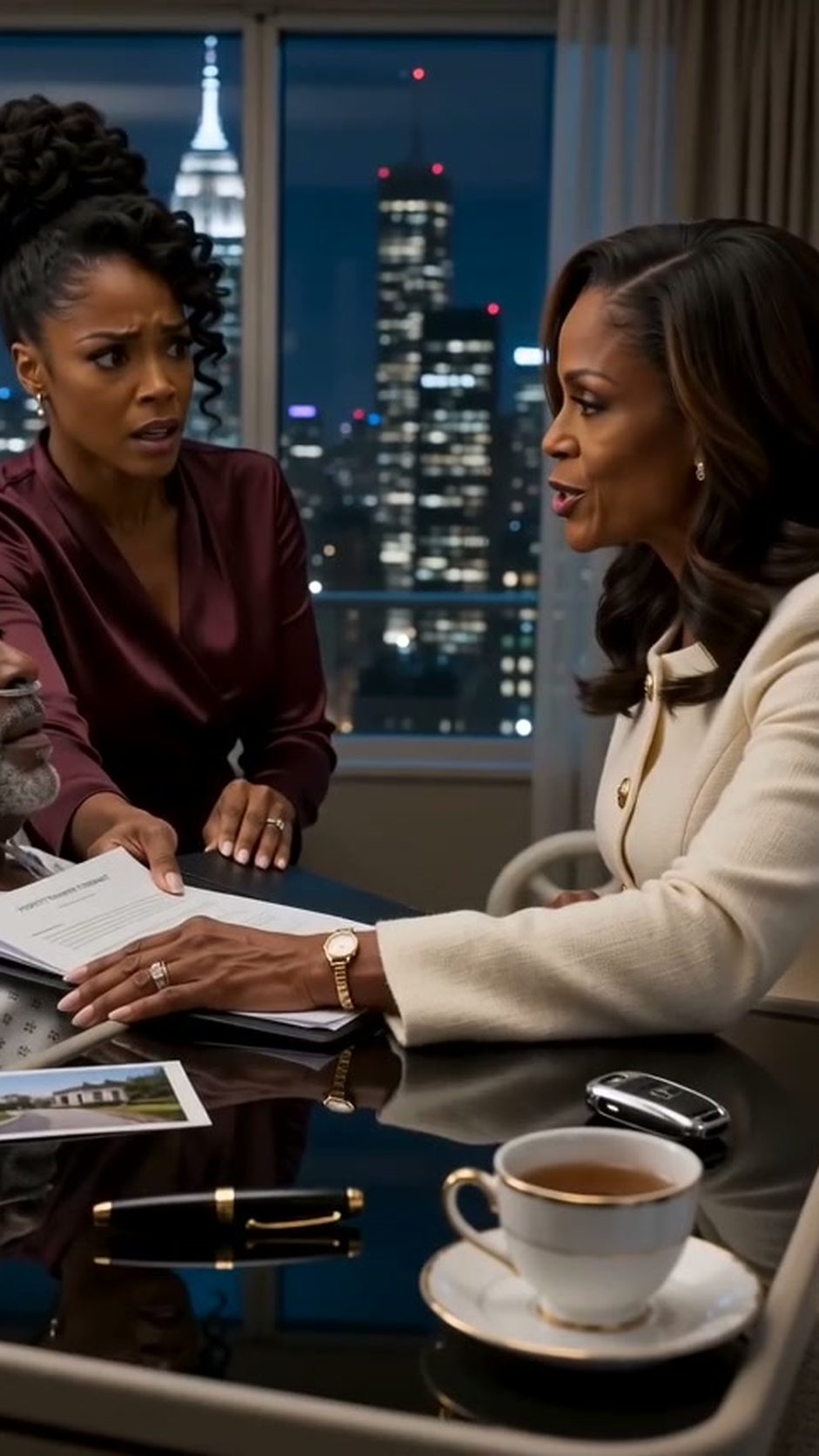
    The pillows were plumped. The bed raised. A nurse smoothed the white patterned gown and checked the nasal cannula and withdrew with the tact of a woman who has set the scene for a hundred such theaters and knows better than to applaud any of them. On the black table: the folders, ranked like soldiers. The property photographs, eight of them, glossy — the waterfront houses, the hillside houses, the lake house with the dock her father had built plank by plank. The miniature mansion, brought by Margaret from the study at home, set down with ceremony at the table's corner. Three key fobs in a row, bright as medals. The black-and-gold fountain pen, Raymond's pen, the one from the magazine photograph.

    Hale stood at the foot of the bed with the air of a man conducting an orchestra only he could hear. Margaret sat at her son's right hand, pearls luminous, spine like a flagpole. Sabrina stood at his left, in burgundy satin, one hand already resting — resting — on the back of his pillow, a claimant's hand, a hand practicing ownership of the very furniture of his death.

    And Vanessa sat down in the chair nearest the bed, set her handbag in her lap, and accepted a cup of tea from a nurse she thanked by name.

    She had read once that in the old days, executions were scheduled for dawn so the condemned could watch one last sunrise. She looked at the city going gold and blue beyond the glass, at the two towers squaring off across the river, and she thought: He built his whole life facing my father's tower. He never once turned around.

    "Well," Raymond said. His voice was gravel and ceremony. "Since we're all — family." The pause before the word was the size of a grave. "Let's finish this. Hale."

    The documents moved the way documents move at the end of empires: quietly, in order, with witnesses. Hale read the recitals in his facilitator's monotone. The trust for the boy. The eight properties, by their legal descriptions, each one a small geography of her father's life's work. The three vehicles, by their identification numbers — she remembered buying the first of them, remembered the salesman, remembered Raymond's hand at her waist that day, proprietary and warm.

    Raymond signed. Page by page, slower each time, the trembling fought and mastered and fought again — the smug satisfaction of a man performing his own legend: the provider, providing, to the very door of death. Sabrina watched the pen the way altar servers watch the flame. Margaret watched Sabrina with the fulfilled serenity of a woman whose prayers had been answered by the management.

    And then came the last document. The master agreement. The thick one.

    His trembling finger pressed onto the final page to hold his place. Sabrina's hand closed on the folder and pulled—

    —and Vanessa's hand came down, flat and gentle and absolute, and stopped thirteen years of momentum with no more effort than a woman setting down a cup.

    "Thirteen years, Raymond."

    You know this moment. You have already stood in this room, in this silence, and heard the monitor crack its single wrong note. What you have not seen — what the silence was holding, the way a held breath holds a scream — is what happened next.

    What happened next was that Vanessa Calloway opened the envelope.

    She did it without hurry. Hurry is for people who fear interruption, and she had arranged, with an attorney's precision and a wife's patience, to be uninterruptible. The seal broke with a small, clean sound. She drew out the contents — not the DNA report. Not yet. She was her father's daughter, and her father had taught her that you demolish a building from the foundation up, so that it falls inward, onto its own ground, and hurts no one standing outside the fence.

    "Before Hale files these," she said, pleasantly, to the room at large, "there is a title matter. It won't take a moment. Hale — you ran a title search, of course."

    Hale's smile performed a small, professional death. "The properties are Calloway Properties assets—"

    "The properties," Vanessa said, "are Hart Family Trust assets. They have been since my father's lifetime." She laid the first document on the black table like a card player laying down a card she has held so long it has warmed to her hand. "The Harborview houses. The Alder Lane house. The lake house. All eight. Here is the Trust Consolidation and Trustee Confirmation — certified, recorded, and, I am afraid, fatal to this evening's ceremony." A second document joined the first. "Signed by you, Raymond. Nine years ago. In Pierce's boardroom. The management of the properties remains with the company — nothing about your work changes, nothing about the tenants, the taxes, the staff. But the title—" she touched the page, almost tenderly "—the title belongs to the trust. And the trustee of the Hart Family Trust is the person sitting in this chair."

    The monitor had begun, very slightly, to hurry.

    "You can't give away these houses, darling," Vanessa said, and the darling was the most devastating syllable spoken in that room all night. "They were never yours to give. You just attempted — in front of your attorney, your mother, and two nurses I intend to be very kind to in my statement — to transfer eight properties you do not own to a trust controlled by your mistress. There are legal words for that. Hale knows them. I can see that Hale knows them."

    Hale had gone the color of his own stationery. "Raymond," he said quietly, "don't say anything. Not one word. I'm instructing you—"

    "The cars," Sabrina said. Her voice came out wrong, too high, a string tuned past its pitch. "The cars are his. Tell her the cars are—"

    "The cars are titled to Calloway Properties." Vanessa laid down the third document with the same dreadful gentleness. "And fifty-one percent of the voting shares of Calloway Properties are held by — I'm sorry, this must be tedious — the Hart Family Trust. The board serves at the pleasure of the majority shareholder. I had the registry certified this morning. I am the majority shareholder, Sabrina. I have been the majority shareholder since before you were old enough to sign the lease on your first apartment. The one the company paid for." She folded her hands. "Raymond owns a salary, a pension we will discuss, a watch I gave him for his fiftieth, and the clothes in his closet. That is the complete inventory of what Raymond Calloway can give away. He is welcome to all of it, with my blessing. It was never the money, you see. It was the ground. And the ground was never—"

    "He's Raymond's blood!"

    Margaret was on her feet — she had been building toward it since the first document, rising by inches of outrage — and the pearls swung, and the hand that had pressed the table that morning in another version of this day now pointed, trembling, at Vanessa like the finger of an Old Testament God. "Whatever papers you have dug up, whatever lawyers' tricks — the boy is his blood! His son! His heir! Everything he built should go to his blood, not to a barren woman with a filing cabinet!"

    The room went absolutely still. Even the monitor seemed to listen.

    Vanessa stood up.

    She had not planned to stand. She had planned the documents, the order, the tone; she had planned to be, throughout, the calmest person in the room, because her calm was the message. But there are words that have been aimed at a woman for twenty-one years, and barren had been Margaret's favorite arrow since the Christmas of the second lost baby, and Vanessa found herself on her feet with the envelope's remaining contents in her hand, and her voice, when it came, was so quiet that Sabrina actually leaned forward to hear the end of her own world.

    "His blood," Vanessa repeated. "Yes. Let's finish with the blood, Mother. Since you insist. Since you have always insisted."

    She drew out the second report and laid it down on top of the transfer agreement — on top of Raymond's signature, on top of the smug, trembling triumph of ten minutes ago — the way one lays a stone on a grave.

    "Laboratory of Maryland. Chain of custody available for your attorneys. Swab obtained from a bottle your grandson discarded at his Little League game two years ago, Margaret — the foundation sponsors his team; I thought you knew." Her eyes never left Raymond's face. "DNA paternity test. Tested man: Raymond Calloway. Child: Owen Cole."

    A sound came out of Sabrina that was not a word in any language.

    "Probability of paternity," Vanessa read, from memory, because she had read it a hundred times in nine years and it was carved on the inside of her, "zero point zero zero percent. Exclusion confirmed. Raymond — Owen is not your son. He never was your son. He is Marcus Webb's son. Your driver. You remember Marcus. You paid him a very generous severance twelve years ago, three months before the baby was born. Sabrina was already pregnant when you met her at the leasing office, darling. She simply—" she glanced, almost gently, at the woman in burgundy, who had taken one small, unsteady step backward and found no wall there "—she simply let you believe the version that made her a rich man's family instead of a driver's mistake. And you believed it. You believed it because it told you that you were not going to die uncontinued. She didn't sell you a son, Raymond. She sold you immortality. You're her best customer. You have been paying installments for thirteen years."

    The monitor was racing now, and Raymond's hand had come off the blanket and was gripping the bed rail, and his face — God help her, his face — his face was doing something she had never seen it do in twenty-one years, something she would not have wished, in the end, on any living man: it was understanding everything at once.

    Sabrina reached for the documents — a wild, drowning reach, both hands, to gather them, hide them, unhappen them — and Vanessa intercepted her wrist with one firm, restrained movement, woman to woman, skin to skin, no violence in it at all and no mercy either. "No," she said. "Those are mine. Everything on this table is mine. That was rather the point of the evening."

    Sabrina recoiled. The property photograph on the table's edge — the lake house, the dock, her father's planks — slid as her hip brushed the table and stopped, trembling, half over the edge, like the whole past thirteen years deciding whether to fall.

    "Vanessa." Raymond's voice. She would hear it in her sleep for months. Broken machinery of a voice, a king's voice in a collapsed mine. "Vanessa. Please. Please say—"

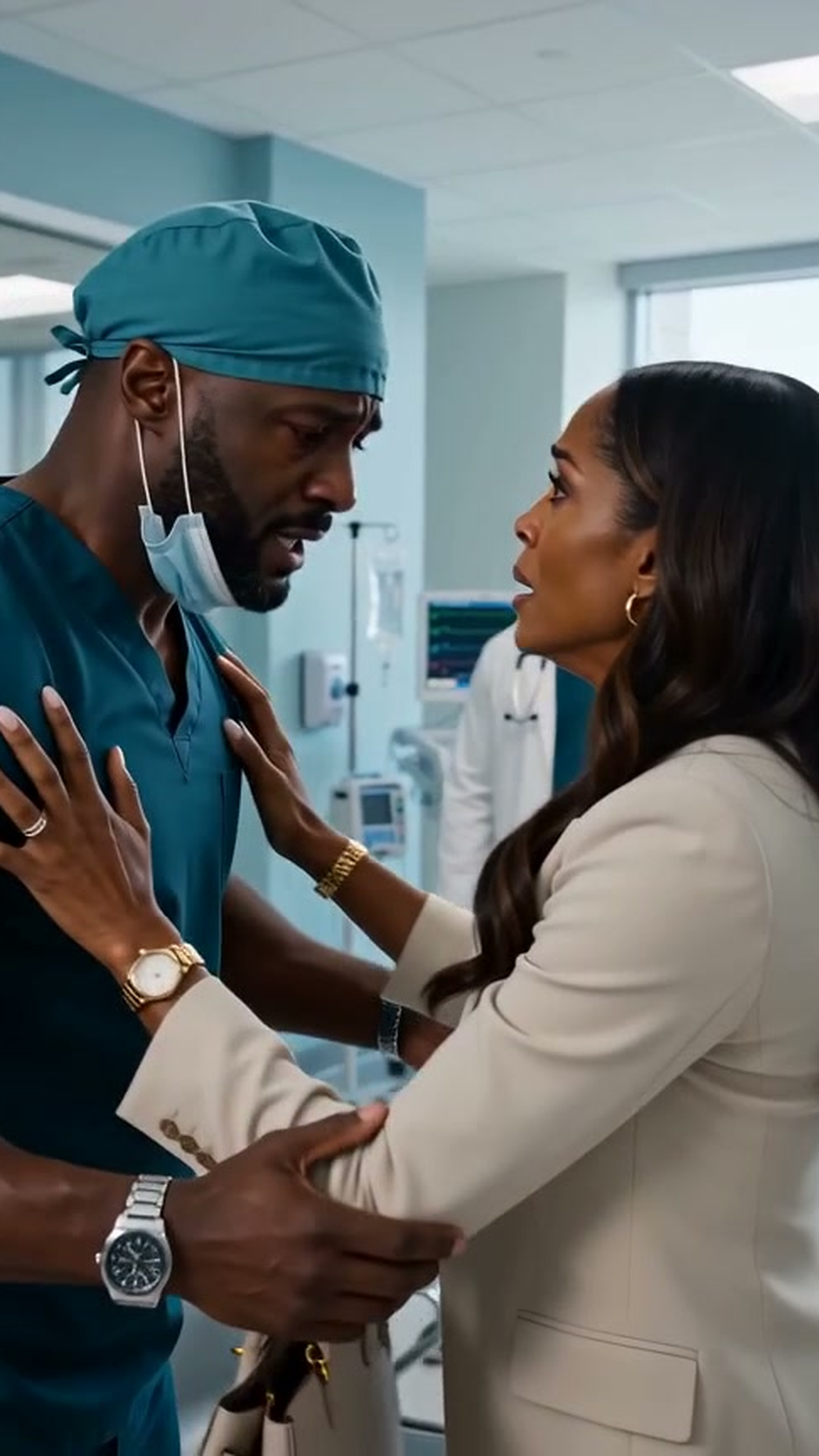
    "Don't." The doctor was already in the doorway; the nurse had moved, fast and silent, to the monitor. "Breathe, Raymond. Slowly. You're not dying tonight." Vanessa leaned over him — close, the way she had leaned in the morning, with her hand flat now on his sternum, feeling the frantic drum of him through the hospital gown, holding him in his body by main force of will. "Dying would be easy. You don't get easy. You get to live, and know. Breathe."

    Whether it was the command in her voice or the medication the nurse slid into the line, the numbers on the monitor began, grudgingly, to step down from the ledge. Raymond's eyes stayed on hers the entire time — wide, wet, stripped of every performance he had ever owned — and as the sedation took him down into the gray country, his hand found her wrist and held it with the last of his strength, and she heard him shape, more than say, the only honest sentence he had produced in thirteen years:

    "Did you ever—"

    The monitor beeped, steady and ordinary, like a heart deciding to continue.

    "—love me?"

    And then he was under, and the room was full of efficient strangers, and Vanessa stood in the corridor with the empty envelope in her hand, looking down at her own handwriting on the front of it — the label she had written in Pierce's office nine years before, in her neat, gala-program hand.

    FOR THE DAY HE REACHES FOR THE GROUND.

    She was still looking at it when Pierce came around the corner with a second folder under his arm and said, quietly, "Phase two, Vanessa. Whenever you're ready."

  • Chapter 4: The Vigil

    Chapter 4: The Vigil

    Raymond ignored the warning shot with the same magnificent carelessness he brought to all intelligence he disliked.

    He took the pills when a nurse or a wife was watching. He kept the whisky decanter in the sideboard of the study and the cigars in the humidor his board had given him for thirty years of service, and if his color was worse and his temper shorter and his famous laugh arrived half an octave thinner, the empire still said Calloway on the tower, and that, to Raymond, was the only vital sign that had ever mattered. He settled into his sixties like a king settling into a throne he believed had been built to his personal measurements.

    The kingdom, meanwhile, was quietly changing hands in the only way kingdoms actually do: in documents, in daylight, in rooms he never entered.

    Nine years after the Rosewood Hotel — during the great refinancing that every property company in America did that decade, when rates fell and every CFO alive was restructuring debt — Raymond signed, over the course of one long afternoon in the Pierce & Alden boardroom, roughly four hundred pages. He signed where the tabs told him to sign. He signed the loan consolidations, the tax elections, the insurance riders. And he signed the Hart Family Trust Consolidation and Trustee Confirmation, which moved the legal title of eight properties — the eight properties, the waterfront houses and hillside houses and the lake house her father had built with his own design and other men's hands — formally and finally under the trust's sole trusteeship.

    Hers.

    Pierce had explained it to him. Pierce was an honest man in the ways that mattered and he had explained it fully, in the meeting, in the minutes: "This merely formalizes the existing trust structure, Mr. Calloway. The properties have been trust assets since Mr. Hart's time. Management authority remains with you and the company, unchanged." All true. Every word true. And Raymond, who had never in his life met fine print he considered worth his eyes, had said, "Fine, fine — where's the lunch menu?" and turned the page.

    Vanessa, informed by phone that evening, had stood in her kitchen for a long time with her hand flat on the counter where the DNA report would one day rest.

    "The ground is mine," she said.

    "The ground was always yours," Pierce said. "Now it is also provable in a single document, by a tired judge, in one afternoon. Your father sends his regards, I believe, from wherever careful men go."

    She kept the confirmation certificate in an envelope in her handbag for the last four years of her marriage. Not always the same handbag. But always an envelope, close to her hand, the way other women carry photographs of their children.

    * * *

    The collapse, when it finally came, came on a Tuesday, in the boardroom, in the middle of Raymond's sentence — he was saying the words "strongest quarter in the company's history" when the sentence simply stopped, the way a song stops when the power fails, and the board of Calloway Properties watched their chairman look at them with sudden, naked confusion and slide sideways out of his chair like a man leaving a theater.

    This time it was not a warning shot. This time the doctors at St. Aurelia used words like massive and ejection fraction and window, and the window had numbers in it, and the numbers were not the kind you frame.

    The ICU suite on the fourteenth floor was the best money could rent: a corner room, a wall of glass, the city doing its nightly impersonation of forever. There was a sitting area with a sofa that converted for family. There was a small black table, polished to a mirror. There was a view of both towers — Harborview and the Calloway tower, facing each other across the river like the two halves of Vanessa's life.

    The family gathered the way water gathers, by gravity and old channels. Margaret arrived with her pearls and her pastor and her absolute refusal to pronounce the word dying. Sabrina arrived on the second day — not sneaking, not summoned, simply arriving, in burgundy, with the confidence of a woman who has been promised by a dying man that the future has her name on it, and if the nurses exchanged a glance, they were professionals, and they had seen this exact opera before in other expensive rooms.

    And Vanessa sat in the chair nearest the bed, in ivory, with her handbag in her lap, and held the vigil the way she had held everything else: completely.

    On the third night, at three in the morning, the nurses let her stay past the rules because she had learned all their names and because grief with good manners is the one currency every ICU honors. The suite was dark except for the monitor's green notation and the city, which does not sleep so much as change shifts. Raymond lay in the narrow bed with his mouth slightly open, breathing like a man carrying something heavy up a long flight of stairs, and Vanessa sat in the chair that had become hers and read him — out of old habit, out of the marriage's muscle memory — the business pages, in a low voice, the way she had once read him to sleep on trains.

    "You'd hate the new Harborview numbers," she murmured. "Ruth says the third quarter carried the year. You'd take the credit at the board lunch. I'd let you."

    His hand, on the blanket, found her sleeve with the blind accuracy of long marriage and held on, asleep, unaware, the way it had held her hand under Margaret's Christmas table in the years before the Rosewood. She looked at the hand — older, spotted, the nails still manicured by the woman who came to the house on Thursdays — and she did not pull away, and she did not soften either. She filed the moment where she filed everything: under evidence, under mercy, under the long heading of things that were both.

    "Thirteen years I have been preparing to ruin you," she told the sleeping man, conversationally, "and I want you to know I have never once enjoyed the arithmetic. That's the difference between us, Raymond. You enjoyed all of yours."

    He breathed on, carrying his weight up the stairs, and she turned the page.

    It was on the fourth day that Raymond, surfacing from the gray country of sedation into a lucidity so clear it frightened the doctor, asked for his attorney. Not Pierce — his own man, Hale, a silver-haired facilitator who had spent twenty years helping Raymond Calloway do exactly what Raymond Calloway wanted and invoicing by the hour for the privilege.

    The instructions, given in a voice like gravel settling, took eleven minutes. Hale emerged from the suite with the expression of a man carrying a lit candle through a powder magazine, and by the next morning the word had traveled the corridor in the way of all hospital news:

    The chairman was putting his affairs in order. Eight properties. Three luxury cars. A new irrevocable trust, for the benefit of Owen Cole, age twelve, with the boy's mother as trustee until he turned twenty-five — and the signing, at the dying man's insistence, would be tomorrow night, at his bedside, with the family present.

    "The family," Sabrina repeated happily, in the corridor, in Vanessa's hearing, touching up her lipstick in the black glass of a vending machine. "He wants everyone there. He wants it witnessed."

    Vanessa smiled at her, warmly, the way she had smiled for thirteen years. "Then we mustn't disappoint him."

    An hour before Hale arrived with the folders, Sabrina found her by the elevators — cornered her, really, though the cornering was done in the dialect of sisterhood, with a hand laid lightly on Vanessa's forearm and a voice kept low and warm with everything except warmth.

    "I've been wanting to say this properly," Sabrina said. "Woman to woman. I know this is hard for you. But Raymond has made his wishes clear, and fighting a dying man's wishes — dragging lawyers into his last days — it would look a certain way. For you. The city talks, Vanessa. You have a reputation for grace. I'd hate for his illness to cost you that."

    It was, in its way, a masterful little speech: the threat gift-wrapped as concern, the reputation held up like a hostage photograph. Thirteen years earlier it might have worked. Thirteen years earlier Vanessa had still believed that what the city said about her was a thing that could be taken from her, like a coat.

    "You're kind to worry," Vanessa said. "Let me relieve you of it. Tomorrow night, I intend to sit in that room and watch my husband sign whatever brings him peace. Every page. Every witness he wants. If the city talks, Sabrina, it will have material." She smiled — the gala smile, the lighthouse smile — and gently removed the hand from her forearm, the way one returns a borrowed object. "Wear the burgundy. It suits the occasion. Endings should be well dressed."

    She called Pierce from the chapel on the fourteenth floor, where the light came through amber glass and a plastic plant achieved a kind of immortality. She could hear the old man smiling in the silences.

    "The title certificates?" she asked.

    "Copied, certified, and bound. The trust confirmation. The voting share registry. The full archive — thirteen years, Vanessa, catalogued like a library. Ruth has the ledgers. Deke is on standby with the originals."

    "The other envelope?"

    "In my safe, as instructed, these nine years. It will be in your handbag by six o'clock, sealed, with the chain-of-custody documentation. Are you certain you want to let him sign? We can stop this tomorrow afternoon with one letter to Hale. A quiet ending is available to you. It has always been available to you."

    Through the amber glass, the light lay in bands across the empty pews. Vanessa thought about an October afternoon, a paper bag of pasta going cold on a desk, a man laughing with his hand on another woman's belly in the dusk outside a hotel. She thought about two small hospital rooms and the word unlikely ever. She thought about a boy in a blazer too formal for him, laughing at a quartet, innocent as weather. She thought about a hand coming down, gently, flat and final, on a stack of paper.

    "No," she said. "He has spent thirteen years explaining to himself that I don't know. Let him finish the sentence. Let him sign his name to the whole of it — the properties, the cars, all of it — in front of his mother and his mistress and God. A signature is the one thing a man can't take back, Jonathan. I want his."

    She heard Pierce exhale, slow and satisfied, the sound of a chess master whose queen has finally been invited to move.

    "Then tomorrow night," he said, "wear the ivory. And Vanessa — when it is over, whatever it looks like when it is over — the boy is twelve years old. Remember that you remembered that."

    "I have remembered it every day for thirteen years," she said. "It's why I'm still married."

    She went back up to the fourteenth floor and took her chair beside the bed, and when Raymond surfaced briefly in the dusk, gray-faced, frightened under the arrogance like a child under a blanket, she took his hand — the trembling, contract-signing hand — and held it until he slept, because she was, whatever else thirteen years had made of her, still the woman who had married him in a garden in June.

    "Tomorrow," she told him, though he could not hear her. "Tomorrow, Raymond, we finish it."

    The envelope arrived at six o'clock the next evening, as promised, carried up to the fourteenth floor not by a courier but by Pierce himself, in his overcoat, with his hat in his hand like a man attending a christening or a hanging. He had overseen the safe for nine years. He would oversee the delivery.

    He found her in the family lounge, where a nurse had shown her a mirror and left her alone with it, and he set the envelope on the low table between them without ceremony. It was heavier than it looked. Nine years of chain of custody will do that to paper.

    "Chain's intact," Pierce said. "Seals verified, witnessed, logged. Whatever else tomorrow night is, Vanessa, it is admissible." He studied her — the ivory blazer, the gold buttons, the hair arranged like a treaty — and something in his old lawyer's face softened into the expression he had worn at her wedding, standing in the back, watching Charles give her away. "Your father made me promise him one thing, the week before he died. He said: 'When she calls, Jonathan, don't talk her out of it. She's the only one of us who never flinches.' I've kept the letter of that promise for nine years. I intend to keep the spirit of it tonight."

    "Then sit where I can see you tomorrow, Jonathan. Hale will want a grown-up in the room."

    She picked up the envelope and put it in her handbag, where it settled against the other envelope — the trust certificate, her companion of four years — like two cards of the same suit finally lying side by side in the hand that had been dealt them.

    Upstairs, in the suite at the end of the corridor, a nurse was plumping pillows and laying out folders, and a man who had never read the fine print of anything was sleeping the last untroubled sleep of his life.

    "Tonight," Vanessa said.

  • Chapter 3: He’s Raymond’s Blood

    Chapter 3: He’s Raymond’s Blood

    The boy was ten years old the first time Vanessa saw him in person, and he had his mother's laugh.

    It was the Calloway Foundation's annual gala — her gala, really, though the programs said otherwise; she had built it from a charity luncheon into the night the city's money competed to be seen at. Twelve hundred guests. A string quartet. The Harborview towers lit like a promise across the water. Sabrina Cole was there in burgundy, on the arm of no one, introduced in the program as an interior design consultant to the foundation, which was a sentence so brazen that Vanessa had actually admired it in proof. A decade had taught her to respect craftsmanship, even in a lie.

    Owen stood beside his mother in a boy's blazer a fraction too formal for him, enduring a receiving line with the martyred patience of a ten-year-old at a fundraiser, and when the quartet stumbled into something with a beat, he grinned up at Sabrina — quick, unguarded, delighted — and Vanessa, thirty feet away with a glass of champagne she was not drinking, felt the old grief stand up in her chest and then, to her own astonishment, sit back down.

    He was a child. He had not chosen the burgundy dress or the blank line on his birth certificate or the brownstone across the river. Hating him would be like hating the rain for the flood. She had known that in principle for ten years. Knowing it with his laugh in her ears was different, and harder, and she did it anyway, the way she did everything: completely, and without letting it reach her face.

    Raymond claimed her for a dance an hour into the evening, in front of everyone — a husband's public devotion, performed with the confidence of a man who has never once been caught by an audience. The quartet had found something slow. He was sixty-one that year and still led like a man who intended the floor to know it.

    "You built all this," he said, turning her under the chandeliers, past the silent auction, past his mistress's table. "Say what they like about me, Vanessa — the foundation is yours. The city knows whose taste this is."

    "You give me too much credit," she said.

    "I give you exactly what you're owed." He smiled down at her with the old, real warmth in it — that was his gift and his curse, that the warmth had always been real, it had simply never been exclusive. "Dance with me at the boy's wedding someday. Promise."

    And there it was, arriving on schedule like weather: the casual someday, the assumption folded inside it — that there was a boy, that the boy was his, that the boy's future was a room in the house of the future they were all supposedly building together. Sabrina, at her table, watched her lover dance with his wife and did not look away, because she had read the same future and knew whose name was on the wedding.

    "I promise I'll be at the wedding," Vanessa said, which was true, and he laughed and spun her, and she let him, and the cameras of two society photographers caught the moment and ran it the next morning under a caption about the Calloways, nineteen years on — the golden couple, the caption said, and it was, in every way the word can bear, accurate.

    It was Margaret who ruined the night, in the end. Margaret usually did; she had a talent for it the way some women have perfect pitch.

    Vanessa found her mother-in-law holding court near the silent auction, pearls bright, voice pitched precisely at the frequency of indiscretion. "—of course, a foundation needs a future," Margaret was saying to a circle of women who had known her forty years. "A name needs blood to carry it. All this—" the pearl-heavy hand swept the ballroom, the towers beyond the glass, the empire "—will need someone to inherit it who is actually of the family. Whatever some people prefer to pretend."

    The circle noticed Vanessa a half-second before Margaret did. It was not enough time to arrange her face into anything but what it was: the face of a woman who had been caught knowing.

    She turned. She took in her daughter-in-law — the ivory suit, the stillness, the ten-year-old smile that had never once cracked in public — and for a moment something complicated moved behind the old woman's eyes. Not guilt. Margaret Calloway did not stock guilt. It was closer to the expression of a chess player who realizes the quiet opponent across the board has been playing a longer game than the one on the table.

    "Mother," Vanessa said pleasantly. "Your brooch is crooked. Let me—" She stepped close, close enough to smell the gardenia perfume Margaret had worn since the Johnson administration, and adjusted the gold floral brooch with two gentle fingers, and said, in the warm, carrying tone of a woman paying a compliment: "You should be careful what you say about blood in a room this size. Blood is exactly the kind of thing people test."

    She walked away before Margaret could decide whether she had been threatened.

    She had been. Vanessa had decided it in the car that night, driving home alone — Raymond had stayed behind, Raymond always stayed behind — with her hands at ten and two and her heart beating in the high, clear register that meant her mind had finished consulting her feelings and dismissed them. Eleven years she had documented the affair, the money, the properties, the school fees, the car, the brownstone. She had documented everything except the obvious.

    She had never checked whether the boy was actually Raymond's son.

    She had simply believed Sabrina. Everyone had. Sabrina, who had lied about her name at the leasing office, lied about her age, lied — Ruth's paperclips testified — on eleven expense reports. Vanessa had built a cathedral of evidence about the woman's dishonesty and had never once questioned the woman's largest claim, the load-bearing lie. It sat in the middle of the whole structure, untested, glowing.

    "Deke," she said into the phone the next morning. "I need one more thing."

    * * *

    It took six weeks, and it was almost embarrassingly easy, which somehow made it worse.

    Owen played Little League in the spring, shortstop, for a team the foundation sponsored — Vanessa read that line in Deke's report three times, the irony arriving in waves. Deke, who had grandsons and therefore both cover and competence, attended three games as a spectator. On the third Saturday, in the bottom of the sixth, a sweating, triumphant ten-year-old discarded a sports-drink bottle into the dugout trash and ran, shouting, back onto the field.

    The bottle went to a laboratory in Maryland that asked no questions beyond a signature and a fee. The results went to Pierce's office in a sealed envelope that sat on Vanessa's kitchen counter — her kitchen counter, in her house, three feet from the fruit bowl — for two full days before she opened it, because some part of her understood that whatever was inside would rearrange the furniture of the next thirteen years, if there were to be thirteen more.

    Probability of paternity: 0.00%.

    Exclusion confirmed. The tested man is not the biological father of the child.

    She read it standing up, in the morning light, with the coffee maker sighing behind her. Then she sat down — not dramatically; the chair was simply there, and her knees had filed a request. Zero. Not ambiguity. Not a lab error's gray country. Zero. Owen Cole, the heir, the blood, the whole roaring point of thirteen years of theft and tenderness and treason, was not Raymond Calloway's son.

    He was, Deke's supplementary report suggested with a detective's delicacy, almost certainly the son of Marcus Webb — Raymond's driver and personal fixer for six years, a handsome, laughing man who had resigned abruptly twelve years ago, three months before Owen's birth, with a severance package so generous that Ruth had flagged it at the time and Vanessa, drowning in fresher griefs, had filed it unread. Webb lived now in Florida. Webb had a record of minor fraud. Webb had, in the photographs, the same grin as a ten-year-old shortstop at the moment the quartet finds the beat.

    Sabrina had not merely deceived Raymond. Sabrina had deceived Raymond with a precision that Vanessa — who had devoted a decade to out-waiting the woman — had to stand in her kitchen and salute. She had found a rich man terrified of his own extinction, a man whose mother prayed nightly for an heir, and she had handed them a counterfeit prince and let their own hunger crown him. Every property demand, every school fee, every "the boy deserves" for thirteen years had been spoken over a signature that was, biologically speaking, a forgery.

    Vanessa laughed. Alone in the kitchen, holding the report, she laughed until it turned into something else and then back into laughter again, and then she dried her eyes, made a second cup of coffee, and called Pierce.

    "Seal it," she said. "The original report, the chain of custody, Deke's notes — seal it in an envelope and put it in the office safe, and make me a copy for box nine. Nobody knows. Not Ruth. Nobody."

    "Vanessa." Pierce's voice had the wonder of a man watching a continent move. "You are holding the single document that ends this entire war in an afternoon. One letter to Raymond. One copy to Margaret. You could burn their whole world down before lunch."

    "Yes," she said. "And the boy would burn with it. He's ten, Jonathan. And Raymond—" she stopped. Examined herself honestly, the way she had taught herself to do on the hard anniversaries, at the graveside, with the coffee cold. "Raymond would survive it. Men like Raymond survive everything; it's their one undeniable talent. He'd divorce her, marry someone else, and spend the settlement war trying to take my father's ground. No. This—" she touched the report "—is not a letter. It's a key. Keys are no use until you're standing at the right door."

    "And when will you be standing at it?"

    "When he reaches for the ground itself," Vanessa said. "When he tries to give away what was never his. He'll do it, too. A man who believes the boy is his blood will try to settle the kingdom on him. It's the last move left on his board."

    She didn't know — she would think about this later, in the ICU, with the envelope's edge against her fingertips — whether the voice that answered was hers or her father's.

    "And when he does," she said, "I'll be in the room."

    That night she drove across the river.

    She told herself it was the long way home, which was a lie of a quality she had spent eleven years learning to detect in others. The brownstone sat in its row of brownstones, curtains drawn, one upstairs window lit the warm gold of a lamp she had paid for in every sense except the signing. A child's window — she knew the layout from the deed, from Deke's sketches, the way you know a country you have been at war with for a decade: intimately, and only from the border. Behind that glass a ten-year-old boy who was not her husband's son was probably being read to, or arguing about bedtime, marinated in the ordinary mercies of a childhood that a fraud had purchased and a wife's silence had protected.

    Vanessa sat in the dark of her car and put both hands flat on the wheel to keep them from doing anything at all.

    "Not you," she said aloud, to the lit window. "Whatever else happens, little man — not you."

    She kept the envelope sealed for two more years, through everything that followed. But the decision about the boy was made that night, in the car, before the door she had predicted had even come into view: the key would turn, when it turned, in a lock built for exactly three people, and a child was not one of them.

    Three nights later, Raymond collapsed at his desk with his hand pressed to his chest and the Harborview contracts scattered under him like a hand of cards he'd dropped, and in the hushed, expensive corridor of St. Aurelia Private — a warning shot, the doctors said, not the war itself — Margaret Calloway took her daughter-in-law's wrist in a grip like a bird's claw and pulled her close, and whispered, with the tears of genuine terror standing in her seventy-year-old eyes:

    "If God takes him, at least his blood goes on. At least the boy—"

    "Yes, Mother," Vanessa said gently, and covered the claw with her own steady hand. "His blood. Rest now."

  • Chapter 2: The Wife Who Smiled

    Chapter 2: The Wife Who Smiled

    To understand what Vanessa did for thirteen years, you first have to understand what had been done to her in the eight years before them — gently, legally, and in front of applauding guests.

    She met Raymond Calloway when she was twenty-seven and he was thirty-eight, a project manager at Hart Development with sawdust on his cuffs and a laugh that made boardrooms lean toward him. Her father saw it instantly. Charles Hart had not survived forty years of construction wars by misreading men, and he told her, in the kitchen of the house on Alder Lane, with the blueprints of the Harborview towers spread between them like a map of the future: "That one loves the view from the top of the building, Vanessa. Make sure he remembers whose land it's built on."

    She married him anyway. She married him joyfully, in a garden, in June, with her father's hand shaking slightly in hers as he gave her away — the only time she ever saw it shake. At the reception, Margaret made the first toast, standing straight as a yardstick in beige silk, her glass raised toward the head table and the skyline beyond it. "To the Calloway line," she announced, to her son, to the room, to God. "May it be long, and loud, and carried far."

    The applause had not finished when Charles Hart rose — slowly, the way big structures do everything — and lifted his own glass, and looked not at his new son-in-law but at his daughter.

    "To the ground it stands on," he said.

    Three hundred guests laughed and drank, hearing a builder's sentiment, a pleasantry about foundations. Raymond laughed loudest of all and clapped his father-in-law on the shoulder with the fond, careless strength of a man who has just been handed a kingdom and has not yet looked under it. Only Pierce, at the lawyers' table, did not laugh, because Pierce had drafted the ground, and knew it was not a metaphor.

    She remembered that toast at intervals for the rest of her life — at ribbon-cuttings, at board dinners, in the Rosewood parking lot — the way you remember a knock at the door long before you understand who was standing outside it.

    And because Charles Hart loved his daughter more than he trusted any man alive, he did the thing Raymond never knew about and would have raged against if he had: he placed the beating heart of the empire — the land, the eight waterfront and hillside properties, the controlling fifty-one percent of the company's voting shares — into the Hart Family Trust, with Vanessa as its beneficiary and, one day, its trustee. Raymond would run the company. Raymond would have the title, the office, the magazine profiles, the name on the tower.

    Raymond would own almost nothing.

    "The boy has talent," Charles told Pierce, in the conversation Pierce would repeat to Vanessa thirteen years later, word for word. "Let him think the kingdom is his. Kings behave better when they believe the crown fits. But the ground stays Hart ground. If he ever forgets what a husband is, the ground is what my daughter stands on."

    Raymond's mother never forgave Vanessa for existing incorrectly. Margaret Calloway had raised her son in a two-room apartment over a laundromat and regarded his marriage the way generals regard treaties — as a pause between campaigns. She wanted a grandson. She announced this at dinners, at holidays, in the receiving line of their wedding's second hour. When, in the fourth year of the marriage, Vanessa lost a baby at eleven weeks and then a second at nine, and a kind-faced specialist finally used the words "unlikely ever," Margaret's grief expressed itself as arithmetic. "A wife who cannot give a son," she said at Christmas, not quite quietly enough, "is a house with no heir in it."

    Raymond held Vanessa's hand under the table. In those years, he still did. That is what made the arithmetic of the later years so obscene: he had not been a monster at the start. He had been a man who was slowly, pleasurably taught by success that the rules were furniture — things arranged for other people to walk around.

    Charles Hart died in the sixth year of the marriage. Raymond wept at the funeral with what appeared to be genuine sorrow, took the chairman's office within the quarter, and within two years had rebranded Hart Development as Calloway Properties in letters of brushed gold. The trust, Pierce noted in his files, said nothing. Trusts are patient that way.

    And then came the Rosewood Hotel, and the burgundy dress, and the hand on the belly.

    * * *

    Pierce's advice, delivered over the following weeks in the flat tone of a man discussing weather, became the architecture of Vanessa's second life.

    "One affair is a divorce," he said. "A pattern is a verdict. Your father's trust has a clause, Vanessa — he called it his 'cold-weather clause,' God rest him. If the managing spouse commits adultery and diverts trust-connected assets to sustain it, over a demonstrable period, the trust's protections don't merely hold. They accelerate. Every protection he built wakes up at once. But 'demonstrable' is the whole ballgame. Photographs can be explained. Receipts can be explained. Thirteen explanations, stacked in order, with dates — that is not an explanation problem anymore. That is a biography."

    "How long?" Vanessa asked.

    "As long as it takes to be undeniable." Pierce closed the folder. "Can you smile at him across a dinner table, knowing?"

    She thought of the hand on the belly. "Watch me."

    So she became two women in one body, and she was magnificent at it, and it cost her exactly what you would imagine.

    By day she was Mrs. Calloway: hostess of the Harborview galas, patron of the children's hospital, the wife in the ivory suit in the front row of every ribbon-cutting, applauding her husband's genius with her hands while her eyes memorized the guest lists. She learned the business the way spies learn languages — totally, and for use. She sat in on board meetings she was "only decoratively attending." She made a friend of Ruth Delgado, the chief accountant, a Hart Development lifer who had typed Charles Hart's first payroll and had never once, in thirty years, called Raymond anything but "Mr. Calloway" in a tone usually reserved for weather delays.

    By night she was the archivist of her own betrayal.

    The investigator's name was Deke Morris, ex-police, expensive and unshockable. His reports arrived monthly in plain envelopes that Pierce held at the office. The brownstone across the river: purchased through a Calloway subsidiary, "executive housing." The woman's name: Sabrina Cole, twenty-three, a former receptionist at a Calloway leasing office. The due date: calculated, confirmed, circled in Deke's neat hand. And then, one April morning, the report Vanessa had been waiting for and dreading in identical measure:

    Subject delivered a son at St. Aurelia Private, 2:14 a.m. Subject's companion present throughout. Name registered: Owen Cole. Father's name on certificate: blank.

    She read it at Pierce's desk. She read it twice. She thought about the two small, unfinished lives she had lost in quiet hospital rooms with Raymond holding her hand, and about Margaret's Christmas arithmetic, and about the word blank, and she felt the grief arrive — it always arrived — and she let it pass through her like weather through a house she no longer lived in.

    "File it," she said.

    "Vanessa—"

    "File it, Jonathan. Box one."

    The hardest evidence was never the money. The hardest evidence was the boy learning to walk.

    Deke's third-year file contained a photograph she had not requested and could not unknow: Owen at eighteen months, in a small park across the river, holding both of Sabrina's hands and stamping his feet in a puddle with the concentrated ecstasy of a small emperor. Sabrina was laughing down at him. The photograph was — and this was the obscenity of it, the thing no one in the whole apparatus of the lie had intended — lovely. A mother and a child in the rain light, entirely innocent of the uses to which their happiness was being put by everyone else in the story.

    Vanessa kept that one photograph out of the box for a week. She kept it in the drawer beneath the foundation accounts, next to the other ledger, and each evening before dinner she would look at it for exactly as long as it took to refuse two temptations at once: the temptation to hate a toddler, which she declined as beneath her father's daughter; and the temptation to pick up the telephone and end everything that night, which she declined as beneath her father's strategist.

    What she felt instead, she recorded in the ledger, because the ledger was where feelings were allowed to live:

    Year three. He walks. He has her laugh and someone's grin. I am the only person alive who knows the whole shape of his life, and I am the person it is being used against. Guard the boy from the reckoning. When it comes, aim carefully.

    At the end of the week she filed the photograph in box three, between the brownstone deed and the car insurance, and went downstairs to ask her husband about his day.

    Over the years the boxes multiplied — a fireproof row of them in a storage facility rented under her maiden name. Photographs. Bank trails. The deed to the brownstone. Sabrina's car — a luxury SUV, replaced every two years like a phone — bought by the company, insured by the company, fueled by the company. Owen's private school tuition, routed through a "foundation scholarship" that Ruth Delgado flagged with a paperclip and a note in handwriting so dry it was practically a desert: Third such scholarship. Only recipient. Ever.

    Vanessa paid for none of it with tears anymore. She paid for it with patience, which is more expensive.

    In the sixth year she met Sabrina Cole face to face for the first time, at a leasing office reception the company threw for its brokers — Sabrina restored by then to a "consultant's" contract, the way ivy returns to a wall. They were introduced beside the drinks table by a man who knew nothing, and Sabrina — twenty-nine, polished, glowing with the health of a woman whose bills are all paid by other people's architecture — took Vanessa's hand in both of hers and said, with enormous, practiced sincerity, "Mrs. Calloway. I just want you to know how much I admire you. Your marriage is what I tell my friends a marriage should be."

    "Is it?" Vanessa said, smiling. "How kind. Hold on to that standard, Sabrina. A woman should always know exactly what a marriage is worth — to the dollar, and to the year. It concentrates the mind so."

    Sabrina laughed, delighted, understanding nothing, and moved on toward the canapés, and Vanessa stood a moment with her glass untouched, savoring the private arithmetic of it: that she had just told her husband's mistress the entire truth, in public, in a complete sentence, and been thanked for the compliment.

    And once a year, on the anniversary of the afternoon at the Rosewood, she allowed herself one honest hour. She would drive to her father's grave with coffee gone cold in the holder, and she would tell the headstone everything — the boy's height now, the woman's new handbag, the exact current balance of the lie — and then she would ask the question she never asked any living soul.

    "How long, Daddy?"

    The headstone, being marble and Hart, offered the family answer: as long as it takes to be undeniable.

    In the fifth year, Ruth's paperclips brought her something new: a ledger of transfers into an account Vanessa had never seen, in a bank two states away, in amounts just under the reporting thresholds. Not Sabrina money. Not household money. Escape money — a man quietly building a second lifeboat and stocking it in the dark.

    Vanessa carried the ledger to Pierce herself. He read it standing up, the way men read casualty lists.

    "This is no longer an affair, Vanessa," he said at last. "This is a man preparing to leave you with the building and take the ground. If we move now — today — we can stop the bleeding. You would win. But it would be a war, and he would keep his name, his company seat, and half of everything the law can't trace to the trust. He would land on his feet, with her, and raise that boy in one of your father's houses."

    "And if I wait?"

    Pierce looked at the five boxes lined along his office wall, and then at the woman across from him, who had learned to smile at gala dinners twelve feet from her husband's mistress and had never once, not once, let her hand shake on the stem of her glass.

    "If you wait," he said, "he convicts himself. Count by count. Until there's nothing left to argue about." He paused. "But Vanessa — waiting is the hardest sentence I know how to hand a client."

    She stood, smoothed her blazer, and picked up her handbag.

    "Then it's a good thing," she said, "that I have so much practice."

  • Chapter 1: Thirteen Years, Raymond

    Chapter 1: Thirteen Years, Raymond

    The last document was the thickest one.

    Raymond Calloway's hand shook above it — the hand that had signed a thousand contracts, that had built an empire out of other people's money and his own magnificent confidence — and for a moment Vanessa thought it might fail him entirely. The transparent oxygen tube trembled against his cheek. The monitor beside the bed kept its patient green rhythm, indifferent, counting out the seconds of a life that had come down to a signature.

    His trembling finger pressed onto the final page of the PROPERTY TRANSFER AGREEMENT, holding his place the way a drowning man holds a rope, while the attorney's hand hovered, waiting to slide the folder away and make it law.

    Eight properties. Three luxury cars. Twenty-one years of marriage, converted into paper.

    Sabrina moved first. Of course she did. Thirteen years of practice had made her quick where other people's property was concerned. Her manicured hand closed on the edge of the folder and pulled it toward herself with a soft, greedy scrape of paper across the polished black table — impatient, the way a woman reaches for a crown she believes has already been measured for her head.

    Vanessa's hand came down on the documents.

    Not a slap. Not a snatch. A settling — palm flat, fingers spread, the quiet finality of a judge's gavel wrapped in silk. The folder stopped dead. The paper bent faintly between the two women's hands and then lay still, and the only sound in the luxury ICU suite was the monitor, and Raymond's breath, which had changed.

    Sabrina's smile vanished. She looked up, startled — actually startled, as though the furniture had spoken — and then toward Raymond, for reassurance, for rescue, for the version of this night she had rehearsed.

    But Raymond was no longer looking at her.

    His eyes were fixed on his wife with an attention she had not seen in them for a decade, and Vanessa held that gaze the way she had held everything else in this marriage: completely, and without blinking. She leaned closer to the bed, close enough that he would feel the words more than hear them, and her voice, when it came, was barely a whisper.

    "Thirteen years, Raymond."

    A single sharp beep cracked out of the monitor — one hard, wrong note in the rhythm — and Raymond froze. His confident, dying man's smile, the one he had worn through the entire ceremony of his own betrayal, began to come apart at the edges, the way ice comes apart in spring: silently, and then all at once.

    No one explained anything. That was the point. In that room full of paper and pearls and medical light, with the whole glittering city spread out below the windows, the four of them understood, in four different ways, that the night had just changed owners.

    Sabrina tried once more — she could not help herself; reaching was her religion. She tugged at the folder. Vanessa's palm did not move, and the paper flexed and held, and somewhere in the struggle a luxury car key fob skittered sideways across the tabletop and struck the black-and-gold fountain pen with a small, bright, metallic click that sounded, in that silence, like a lock turning.

    Margaret Calloway rose abruptly from her chair.

    The pearls at her throat shifted. One hand pressed hard onto the edge of the bedside table, and the miniature mansion — the little architectural model of the main house, brought to the hospital like a talisman, like proof — trembled from the impact and stayed upright. Her eyes went from her son to the woman in burgundy to the woman in ivory, and her voice, when it came, was cold enough to fog glass.

    "He's Raymond's blood."

    Vanessa turned to her mother-in-law slowly. No anger. Just a small, knowing expression — the look of a woman who has read the last page of a book everyone else is still pretending to be surprised by — and Margaret's certainty, thirteen years in the building, began to weaken around the eyes.

    "The boy deserves his father's name," Margaret said, but it came out thinner this time. "His father's house. Everything should go to the blood."

    "Say something."

    Raymond's voice, weak, scraped out of him — a command wearing the costume of a plea. His fingers had found the edge of the hospital blanket and were worrying it, tightening, the fabric wrinkling under a grip that had nothing else left to hold.

    Vanessa calmly set down her untouched cup of tea. Her hand was steady as stone. She leaned in again, closer than before, her expression almost affectionate, and watched his eyes follow her mouth.

    "I kept a secret, too."

    His fingers convulsed around the blanket. His breathing went shallow and fast. Somewhere under the bed rail his other hand was searching for purchase, for a version of the world in which his wife was the woman he had filed her as: patient, decorative, blind.

    "You don't know what you gave away," Vanessa whispered.

    And then — while Raymond stared at her with the first true fear she had ever put in him, while Sabrina's face drained of thirteen years of confidence in a single second, while Margaret stood motionless among the ruins of her certainty — Vanessa Calloway reached into her beige designer handbag and drew out, just far enough for the light to catch its edge, a sealed envelope.

    Raymond's desperate eyes locked onto her hand.

    The monitor beeped again, urgent and quickening.

    She began to open it—

    * * *

    Thirteen years earlier, Vanessa Calloway was still a woman who believed surprises were a form of love.

    She was thirty-seven years old, eight years married, and on that October afternoon she was carrying a paper bag from the little Italian place on Mercer Street — Raymond's favorite, the one with the hand-cut pasta — because his assistant had mentioned he would be working through lunch at the Callaway Properties office, closing the Harborview deal. She remembered the bag swinging against her leg. She remembered being happy. That is the part she would return to, later, in the worst hours: she had been happy, in the elevator, with the sun coming through the glass, an ordinary wife on an ordinary errand of love.

    Raymond's car was not at the office.

    His assistant — a new girl, nervous — said he had left at eleven for a "site visit." Vanessa smiled and left the pasta on his desk and drove, on an instinct she would spend thirteen years learning to trust, past the Harborview site. His car was not there either. It was parked, an hour later, in the side lot of the Rosewood Hotel, in the space nearest the private entrance, the way a man parks when he has parked there often enough to have a favorite space.

    She sat in her car for a long time. She was not a fool — she had been raised by Charles Hart, who built half the waterfront and trusted no one's smile — but she was a wife, and wives are trained to manufacture innocence the way the body manufactures breath. A meeting, she told herself. A client. The Rosewood had conference rooms. She would wait, and he would come out with investors, and she would drive home ashamed of her own heart.

    Raymond came out alone, at dusk, with his hand resting on the small of a young woman's back.

    The woman was beautiful — even then, through the windshield, through the first cracking of the world, Vanessa registered it honestly: early twenties, warm brown skin, dark curls piled high, laughing up at him with the unguarded joy of a woman who has never once been lied to by the man beside her. Burgundy dress. Heels. And beneath the burgundy silk, unmistakable even at forty feet, the gentle, rounded beginning of a pregnancy.

    His hand moved — Vanessa watched it move — from the small of the woman's back to the curve of her belly, and rested there. A husband's gesture. A father's.

    Vanessa did not scream. She did not drive home and pack, or drive to her mother's grave and weep, or any of the things the woman she had been that morning would have done. Something in her — her father's daughter, rising at last — went very quiet and very cold and began, with terrible clarity, to take notes. She noted the hotel. The hour. The dress. The way Raymond laughed, throwing his head back like a young man, like the man who had once carried her over the threshold of a house her father's money had bought.

    She started her car and followed them — not close, not reckless — to a brownstone across the river, where Raymond used his own key on the front door.

    Then Vanessa Hart Calloway drove to the offices of Pierce & Alden, where her father's attorney had kept the same corner room for thirty years, and she walked in without an appointment, sat down across from Jonathan Pierce, folded her hands in her lap, and said the sentence that would govern the next thirteen years of her life.

    "My husband has another woman. She's pregnant. I need to know everything — and then I need you to help me make sure that when this ends, it ends on my terms."

    Pierce studied her for a long moment. Then he opened a drawer, took out a yellow legal pad, and reached, with the deliberation of a man laying out instruments for surgery, for his pen.

    "Your father was a careful man, Vanessa," he said. "Raymond has signed a great many documents over the years. I am not entirely sure he has read all of them."

    "What does that mean?"

    "It means," Pierce said, "that if you are patient — truly patient — your husband may spend years building a gallows out of his own paperwork, and never hear the hammering."

    She drove home the way a sleepwalker drives, perfectly and without memory of the road, and she was standing in her own kitchen with her coat still on when the second thought arrived — the one beneath the grief, the one that would feed her for thirteen years.

    There had been a trust. She had always half-known it. Her father, signing papers at this very counter in the months before the wedding, saying, "A man can lose a company, sweetheart. He can lose a fortune, a name, a war. The one thing he cannot lose is the ground, if the ground was never his to carry." She had laughed and called him a feudal lord. He had smiled the smile that meant the papers were already filed.

    Raymond came home at nine, smelling of rain and office, and kissed her cheek with the ease of a man whose conscience had its own private entrance. "You left pasta on my desk," he said, delighted. "Marry me again. The Harborview papers are nearly there — three more signatures and your father's towers are the jewel of my empire." His empire. He took her hand across the island and turned it over, palm up, the way he had done since they were dating, and traced the line of her life with his thumb like a man reading a document he believed he had authored.

    "Long life," he announced. "Says so right here."

    "Whose?" Vanessa asked, and smiled, and watched the joke land as a joke.

    She served dinner. She asked about the deal, the bankers, the weather over the river. She was — this is the thing she would tell no one, the thing that shamed and steadied her in equal measure for thirteen years — good at it. Not frantic. Not brittle. She sat across from her husband with the knowledge sitting beside her like a third guest, and she poured his wine, and laughed in the right places, and when he went up to shower she sat alone in the dining room among the plates and understood, with a clarity that felt almost like peace, that she could do this for as long as it took. That the woman who had carried pasta across the city that morning was gone, and that the woman who had replaced her was not weaker for the exchange. She was simply finished being unarmed.

    Upstairs, she heard the shower run, and Raymond humming — he always hummed, old standards, off-key — and she opened the drawer of her desk and took out the notebook she had used for the foundation's accounts, and on a fresh page she wrote the first entry of the other ledger, in her neat, gala-program hand:

    October. Rosewood Hotel, side lot, private entrance. 6:40 p.m. Woman, burgundy dress, pregnant. His hand on her belly. Brownstone across the river — his own key.

    She looked at it for a long moment. Then she closed the notebook, put it back beneath the foundation accounts, and went upstairs to be a wife.

    Outside the window, the city lights burned steady now, row upon row, like witnesses who had taken their seats and intended to stay for the whole trial.

  • Chapter 7: A Seat at the Table

    Chapter 7: A Seat at the Table

    The fund had a name before it had a bank account.

    Marcus had named it in the second week — at 3 a.m., at the kitchen table, in the blue dark of the worst night, in a notebook Naomi had never seen — and then he had done what he always did with feelings too large for his hands: he turned it into work. The Jaylen Brooks Memorial Scholarship. One senior a year from Roosevelt High, bound for engineering, chosen by Denise. He had seeded it with the remainder of the residency account, the money he'd once earmarked, in some unexamined decade-old plan, for a boat. He had told the school counselor it was anonymous. He had told the bank it was private. He had built the whole thing like a room with no windows and then wondered, night after night, why it felt like one more place he was sitting alone in the dark.

    He told his wife all of it that evening, in their kitchen, with the daylight failing and two plates going cold, in the order it had happened, in full sentences, with nothing held back and no ending pre-attached. It took two hours. She asked questions. Some of them were hard. One of them — *If I hadn't come to the hospital, Marcus, when exactly were you going to decide I was strong enough?* — sat between them in the air for a long time before he answered it honestly: "I don't know. And that's the part I'm sorriest for. I kept moving the line because the line was where my shame lived." And later, quieter: "You were always strong enough. I was the one who wasn't."

    She cried some. He cried some. The plates were reheated and mostly ignored. And near midnight, in the exhausted peace that follows a house fire in a marriage — the terrible clarity about what burned and what, miraculously, was load-bearing — Naomi got up, took the notebook from the counter where he'd set it like evidence, opened it to the page with the fund's name in his surgeon's handwriting, and said:

    "Well. It needs a launch, a board, and a second signature. And Denise should choose the first recipient at a ceremony, not get asked in a parking lot. And Marcus—" she turned the notebook around and slid it back to him, and her mother's earrings caught the kitchen light, "—the next time something weighs what this weighed, you bring it to this table. Not the corridor. Not the car. This table. That's the deal. That's the whole deal, forever."

    "Forever," he said.

    "Then we're in business," said Naomi Bennett, and held out her hand, and her husband — laughing for the first time in six weeks, wet-eyed and undone and home — shook it like a partner.

    ★ ★ ★

    The first Jaylen Brooks Scholar was a girl named Tamika Reed, seventeen years old, who had built a prosthetic hand for her little brother out of a robotics kit and stubbornness, and who stood at a podium in the Roosevelt High gymnasium in September, in front of a banner with Jaylen's photograph on it, and said: "I never met Jaylen Brooks. But his mother told me he believed engineering was just love with blueprints. I intend to spend my life finding out if that's true."

    Denise sat in the front row between Naomi and Marcus, holding one hand of each, and did not let go of either for the entire ceremony, and when it was over she stood in the receiving line like family — because she was, now, in the strange algebra of grief and repair, family of the most durable kind: the chosen kind, the kind made out of Thursdays.

    Marcus operated again the week after the ruling. His first case back was a gallbladder, routine as rain, and he stood at the scrub sink afterward with the water running over his wrists and discovered, with a kind of astonished grief, that his hands were just his hands again — skilled, mortal, forgiven their one unpayable debt by everyone except the man attached to them, and he was working on that too, in a counselor's office on Tuesday afternoons, which Naomi knew about, because Naomi knew about everything now. That was the new architecture. It had no sealed rooms in it.

    The first Thursday of the new world, Naomi drove to the blue house with him.

    She had rehearsed this too, a little — the meeting with the woman whose initials had nearly ended her peace — and none of the rehearsal survived the porch. Denise Brooks opened the screen door before they reached the steps, took one look at the pair of them, and said, "Well. The famous wife. He talks about your cooking like it's a country he used to live in. Come in here and let me look at what all the fuss is about," and had her by the hand and into the kitchen before Naomi had decided what to do with her face.

    The house was small and immaculate and full of Jaylen — photographs ranked along the mantel like a honor guard, a telescope in the corner of the living room under a cloth, a pair of enormous sneakers by the door that no one had moved in six weeks and no one was going to move for some time yet. Naomi had braced for jealousy, guilt, the complex weather of two women who had loved the same man in different currencies. What she found instead was simpler and harder: a mother running an outpost of grief with military discipline and one pair of extra hands, Thursday afternoons, belonging to a surgeon.

    "Hold this level," Denise said, twenty minutes later, handing her the end of a tape measure on the north gutter with the briskness of a woman who had been waiting six weeks to have enough personnel. "He measures like a doctor. Twice, and then he stares at it like it's going to confess. You — you've got honest eyes. Hold it steady."

    They worked the gutter line together, the three of them, in the cooling light, and somewhere between the second bracket and the sweet tea, Denise said — casually, to the gutter, not to Naomi — "He told me about the hearing. Said you stood in the doorway like the cavalry. I told him, 'Doctor, a wife isn't the cavalry. A wife is the *country*. You don't keep the war from the country. The country decides.'" She drove a screw home with a grunt. "He's learning. Slow, but the material's good."

    That night, Marcus slept.

    Not the armored doze of the on-call room, not the driveway slump, not the television trance — slept, in his own bed, on his back like a man in a field, with one hand flung out across the middle of the mattress and his wife's hand resting in it, out of pure navigational habit, the way it had landed there for eleven years. Naomi woke at three, out of *her* six weeks of habit, ready for the cold sheets and the downstairs light. The sheets were warm. The breathing beside her was slow and even and entirely unguarded, and she lay there in the dark listening to it the way she'd listened in a hospital parking garage — counting — and then, for the first time since a Tuesday night in the rain season, she slept too, all the way to morning, and dreamed of nothing at all.

    In the morning there was coffee, and Marcus, still in yesterday's shirt, standing at the counter eating toast over the sink like a man in no hurry at all, and Naomi stood in the doorway watching him commit this small domestic crime and thought that six weeks ago he would have been at the hospital already, scrubbed and sealed and unreachable by nine. "You're staring," he said. "I'm counting," she said. "Counting what?" "Nothing," she said. "That's the miracle. Nothing at all."

    He came home by six on Thursdays. He came home by six on most days, which was its own headline in the Bennett household, and on the Fridays when he couldn't, Naomi drove to St. Aurelia with a brown paper bag — turkey on rye, crusts on, pie from Ellison Street — and walked it up to the fourth floor, where the nurses at the station smiled at her now with the uncomplicated warmth of people whose town has no more secrets in it, and Paula would call out, "There she is — Dr. Bennett, your wife's here, and she brought the good pie," and Marcus would come down the corridor drying his hands, already smiling, the mask under his chin and the tiredness in his face just the ordinary tiredness of a man who saves lives for a living and tells his wife the truth.

    In November, for their twelfth anniversary, he gave her a card. She recognized the handwriting before she recognized the words, because he had copied, in his careful surgeon's script, the note she had folded into a lunch bag on the worst Thursday of their lives — the original of which now lived, framed, on the desk of a hospital waiting corridor's most famous chair-side wall, where Paula had put it without asking anyone's permission and dared the institution to object:

    *You don't have to take care of everyone. Let me have a turn.*

    And underneath, in fresher ink, he had added his answer, eleven years and one resurrection in the making:

    *Deal. Your turn, my turn — but we carry it together or we don't carry it at all. — M.*

    Naomi put the card on their refrigerator, under a magnet shaped like a strawberry, where it remains — at eye level, in the brightest room of the house, in the light.

    At Christmas, David Carter came to dinner the way he had for nine years — with a bottle he couldn't afford and a joke he'd been saving since October — and before the coats were even off he produced an envelope and laid it beside Marcus's plate with the ceremony of a man surrendering a sword.

    "Fifty dollars," he announced. "Medical school. The bet was that you would be married and divorced by thirty-five because no woman could live with a man that incapable of asking for help. I am here to pay, and to testify, for the record, in front of witnesses—" he gestured at Naomi, at Denise, who had claimed the head of the table by natural law and was carving with terrifying competence, "—that the premise of the bet has been defeated. Not the marriage. The *incapacity*."

    "There's a difference?" Marcus said.

    "There's all the difference in the world," David said, "and it took eleven years and one lunch bag to prove it. Put it in the fund. Some kid from Roosevelt is going to build a bridge with my fifty dollars, and I intend to tell that story at every dinner party until I die."

    Later — dishes done, Denise driven home with leftovers and opinions, the tree lit in the window against the street — Marcus stood at the sink finishing the last pan, and Naomi came and leaned in the doorway the way she had on a morning six weeks and a lifetime ago, and watched him, and found that the watching had gone back to being what it used to be: not surveillance, not diagnosis, just the plain pleasure of looking at a person you have chosen, in a warm room, at the end of an ordinary day.

    "What?" he said, catching it.

    "Nothing," she said. "Everything. Come to bed early. You've got a boy in four tomorrow — Okafor's presenting your spleen case at rounds and she's terrified."

    "She'll be fine," he said. "She was two minutes from seeing it herself."

    "That's what two minutes is for," Naomi said, and he laughed, and turned off the tap, and followed his wife up the stairs like a man going toward the light instead of away from it.

    Some marriages are broken by a secret. Theirs was broken open by one — and what grew in the opening, tended daily, on porches and at kitchen tables and in gymnasiums full of other people's children, was stronger than the unbroken thing had ever been.

    He tells her everything now.

    It is, she will tell you — smiling the smile she once rehearsed in an elevator, back when it was only a smile and not yet a testimony — the entire secret of their happiness: there isn't one.

    THE END