Story Genres: Family Drama

  • Chapter 4: The Man Who Never Boarded

    Chapter 4: The Man Who Never Boarded

    Tuesday came up gray and drowning.

    The rain started before dawn, a warm Houston rain that turned the subdivision streets to black glass, and I was already awake to hear it arrive. I had slept perhaps ninety minutes. At five I stood in Lily's doorway watching her sleep with one arm flung over the stuffed fox and her mouth open, memorizing her the way you memorize an address you're about to give to a dispatcher you trust: precisely, and against the worst. Then I moved through the house completing the choreography of an ordinary morning, because ordinary was my camouflage and I intended to wear it perfectly. Lunchbox. Braids — I did Lily's hair in two braids with her still half-asleep at the kitchen table, her head tipping against my stomach between sections, and if my hands lingered it was because braiding your daughter's hair on the morning her father means to kill her concentrates the mind in ways I do not have words for. Phone charged. USB in my purse. Location sharing live — Dana's icon a small steady green eye on my screen. And at the door, one last ordinary thing: I locked up behind us and stood a moment with my palm flat against the front door of my house, and I made it a promise too. I'll be back for the truth of you, I told it. Whatever he turned you into, I'll be back to say what you were.

    Mark stood in our kitchen at six o'clock in his charcoal suit with his coffee going cold, watching the weather through the window over the sink like a general watching a front move in — pleased with it, I realized. Rain was good weather for Mark. Rain kept people indoors. Rain kept windows closed. Rain explained a closed-up house with the heat running high.

    "Roads'll be slick," he said. "Take your time coming home."

    "You too," I said. "Fly safe."

    Lily ate nothing. She sat at the table in her yellow floral dress — she'd picked it herself, her favorite, the one with the little white flowers — with her backpack on the floor between her feet like a sandbag, and she watched her father butter toast with the flat, exhausted attention of a hostage negotiator's kid. I had dressed that morning with a strange care, the pale-yellow dress with the puff sleeves, my pearl earrings, my hair braided up the way Mark liked it. I wanted to look like a woman dressing for a goodbye kiss at an airport. I wanted nothing about me to ring a single alarm in him.

    The goodbye at the front door deserves its own paragraph in the record, because it was the last time all three of us stood in that house as its family, and because of what he said to her.

    Mark had packed a suitcase — a real suitcase, which he loaded into the back of the SUV with a husband's practiced swing, a suitcase I would learn later was full of old work clothes and a Denver guidebook bought at the airport gift shop the week before, ballast for a story. On the porch he knelt to Lily's height in the rain-damp doorway, in his good suit, and took both her hands, and said, "Almost over, Lilypad." She went very still. He must have felt it — I watched him feel it — but whatever he felt, he filed it where he filed everything that didn't fit the schedule. "After this week, everything's different," he told her. "No more scary dreams. Daddy promises." He kissed the top of her head, between the braids I had made at dawn with my hands in her hair like a blessing, and stood, and caught me watching, and smiled the smile I had been eating across the dinner table from all week. "Don't look so worried, Laura. It's just Denver."

    Mrs. Abernathy was on her porch across the street in her rain jacket, deadheading her hanging baskets in the wet like a woman who feared no weather, and she called over, "Safe travels, Mark!" and waved, and he waved back, big and easy, the neighbor, the builder, the man. A witness. He had collected one without even trying, the way he'd collected the flight number and the guidebook — the scenery of an ordinary Tuesday, arranged by a man who believed the world only ever looks at the surface of a morning. He had no way to know that the same instinct was working against him from inside his own car. I told Mrs. Abernathy to have a good day. I put my daughter in the back seat, and her backpack between her feet like a sandbag, and I backed out of the driveway of the house whose furnace was already breathing poison into its attic, and I watched it shrink in the mirror — the porch, the door, my whole narrated life — and I thought: if I never see it standing again, so be it. Houses can be rebuilt. I had married a builder. I knew the difference between a structure and what makes it a home, even if he had forgotten.

    The drive to Intercontinental took fifty minutes in the rain. Mark talked the whole way — the Harper Group, the walk-through, the dinner he'd have with the project manager Thursday, the bonus structure, the deck he was going to build me off the back patio when the money came in. Deck. He said the word deck while the crowbar's receipt sat folded in a plastic sleeve in my purse, and I made the appropriate sounds, and my daughter sat in the back seat silent as a held breath.

    The freeway gave me one last gift, and it was Mark's own thoroughness. Halfway to the airport, performing the devoted husband at cruising speed, he walked me through his itinerary like a man building an alibi out loud: the United flight, out at 9:40, landing Denver at 11:20; the rental car counter; the Harper Group's project manager, a man named Calloway; the hotel by the airport where he'd text me from the room. I repeated the details back with a wife's bright interest — 9:40, Denver at 11:20, Calloway, got it — and I watched his shoulders settle at being believed, and I filed every word, because a man who invents a flight invents a flight number too, and an invented flight number is a thread with a loose end. Somewhere in a prosecutor's file there is now a page with those details in my handwriting, written that night in Dana's kitchen, and beside them the airline's own record that no Mark Bennett was booked, checked in, or manifested on any flight out of Houston that day — and that the 9:40 to Denver was, in fact, a flight to Chicago. He hadn't even bothered to make the lie internally true. He had never expected anyone to be alive to check it. That, the prosecutor told me later, was the detail the jury hated most. Not the gas. Not the money. The laziness of it. The arithmetic that assumed my daughter and I would be a smoke stain and a foundation report, and that arithmetic never lies awake.

    In the back seat, Lily watched the rain-streaked window and hummed, very softly, the song from her school concert, and stopped, and started, and stopped — and I understood she was keeping time with her own courage, winding it like a watch.

    At the terminal he got out into the rain and came around to my window, and I rolled it down, and he leaned in and kissed me on the cheek with his hand cupped warm around the back of my neck.

    "Go straight home," he said. "Put the heat on. Rest." Then, to the back seat, bright and easy: "Be good for Mommy, Lilypad. Daddy'll bring you a snow globe from Denver."

    The doors took him. The crowd took him. I sat at that curb with the wipers slapping and watched the glass until he was fully and completely gone, and only then did I turn around in my seat to my daughter.

    "Lily. We're going to wait here just a little while—"

    I never finished. That's when her hands came around my arm. That's when my eight-year-old, who had kept a grown man's murder secret for two days because she didn't want to make Mommy cry, pulled me toward her with all the strength in her body and whispered the words that beat every other sound in the world:

    "Mom, don't go home. Daddy said it's a gas leak."

    What happened next I have already told you — the promise, the parking garage, the eleven longest minutes of my life. But this is the part I haven't said: in the garage, with the rain drumming the concrete and the flight boards flickering beyond the doors, I made the second decision, the one that mattered more than the first.

    I could drive away. I could take Lily and drive to Dana's, to a police station, to Ruiz's office, and be safe, and let whatever was going to happen at that house happen in my absence — to an empty house, to a staged fire, to a man whose story would then be his word against a frightened woman's instincts.

    Or I could watch. I could follow. I could be the witness the truth was going to need.

    Lily's hand was still locked around my wrist like a cuff. "Are we going home?" she whispered.

    "No, baby."

    "Are we running away?"

    I looked at my daughter — at her braided hair coming loose, at her eyes too old for her face, at the daughter of a 911 dispatcher who had already, at eight years old, done the single hardest thing a person can do: she had broken a promise to protect the person who made her keep it.

    "No," I said. "We're doing our job. Somebody has to watch the door, Lily. Today that's us."

    While we waited I did one more piece of the job, sitting in the garage with the engine ticking cool. I took out my phone and I pulled up the departures board for Intercontinental, the public one, the one any wife might idly check to track her husband's flight. United. 9:40. I scrolled it twice with my thumb going slower each time. There was a 9:40 United flight on that board. It was going to Chicago. There was no 9:40 to Denver, no Denver departure within the hour, no flight in that whole gray morning that landed anywhere at 11:20 with Mark's invented itinerary folded inside it like a note in a lunchbox. I sat with the little glowing lie of it in my hand and felt the last alternate explanation — the affair, the gambling, the dozen smaller ruins a wife rehearses in the dark, every one of them survivable — close its door quietly and go away. What was left was the furnace. What was left was the thermostat. What was left was a man who had invented a flight the way he'd invented a gas leak: carelessly, completely, in the confidence that the inspector of his story would be dead by the second act.

    "What's that face, Mom?" Lily whispered from beside me. I'd forgotten she was watching my face the way she'd learned to watch all faces that year — for weather.

    "That's my working face, baby," I said, and put the phone away, and fixed my eyes on the terminal doors. "That's the face that means somebody's about to get caught."

    Lily considered this with enormous seriousness, and then, because she was eight and because terror and boredom share a border in a child's mind, she began quietly counting the airplanes that lifted off beyond the glass — one, a white one; two, a blue one — whispering the numbers like a rosary, her small hand still threaded through the crook of my arm. I let her count. I have thought since that we were both doing the same thing in that garage: assigning numbers to the minutes so the minutes would behave. Hers went up to eleven. Mine stopped at 08:04, when the doors opened on the eleventh minute and her father came out of them carrying nothing at all.

    At 08:04 the doors of Terminal C slid open, and my husband walked out into the rain without his bag, without his suitcase, without a single thing a man takes to Denver — and looked left, and looked right, and raised his hand for a taxi, like a man coming home early from a trip he had never intended to take.

  • Chapter 3: What Lily Heard

    Chapter 3: What Lily Heard

    Monday was the last normal day of my life, and I spent it gathering evidence against my husband like a woman packing for a disaster she couldn't name.

    It started at Lily's school, where her teacher, Ms. Okafor, kept me back at pickup with the careful face teachers make when the conversation isn't about reading levels. On Friday, she said, the class had drawn Our House for art, and twenty-two children had produced the usual suns and chimneys and heroic dogs — and Lily had produced this. She slid it out of a folder. I still have it; it will be in a court file forever, and in my memory longer. A house, drawn hard, the crayon worn down to the wood. No sun. The windows blacked in, all of them, with the kind of pressure that tears paper. And coming out of the roof — not smoke, Ms. Okafor said, pointing with the tip of her pen, because she'd asked — "I asked her, Mrs. Bennett. I said, 'Lily, is that smoke?' And she said, 'No. That's the leak. You can't see a leak. That's why I drew it black.'"

    "She's been quiet," Ms. Okafor said. "She asked me on Thursday whether teachers can keep secrets that are bad. I told her bad secrets are the kind we tell a safe grown-up. She said she was still deciding who was safe." She looked at me then, and neither of us said anything for a moment, because we both knew exactly what it meant that my daughter had not yet decided whether her own mother made the list. "Is everything all right at home, Laura?"

    "She's deciding right," I said, and my voice held, because there was nothing else for it to do. "If she tells you first — if she ever tells you first — you call me. Day or night. And after you call me, you call the number I'm about to give you." I wrote Dana's direct line on the back of the drawing, of all the places in the world, beneath the black windows of my own house. "She's surrounded," I said. "She just doesn't know it yet. Neither did I, until this week."

    I drove home with the drawing on the passenger seat and my daughter's verdict ringing in my ears: still deciding who was safe. By bedtime, she'd decided. But I have never forgotten that on Monday afternoon, the day before my husband tried to kill us, my eight-year-old was conducting her own investigation — interviewing teachers, testing promises, keeping her backpack packed — doing in second grade exactly what I was doing at thirty-two, and doing it with less help, and doing it first.

    While Mark was at the Bennett Builders office — the office with the second mortgage, the office whose books I now understood were a fireplace waiting for a match — I went through our house the way I'd been trained to clear a scene. I photographed the smoke detectors, all of them, and found what I had half expected and wholly dreaded: the one in the hallway outside Lily's room had its battery removed. The one outside our bedroom was blinking red — dead. The kitchen detector hung open, empty as a mouth.

    I photographed everything. I photographed the furnace closet too, and stood there a long time looking at the flexible gas line where it met the valve, at the fitting that had a bright, fresh scratch across its brass face — the kind of scratch a wrench leaves when it has recently been somewhere it shouldn't.

    Upstairs, in the garage-sale corner of the attic where Mark kept his tools, I lifted the red gasoline can that had hung on the same hook for four years.

    It was empty. It was empty, and it smelled of nothing, and a can that has carried gas for four years smells of gas even when it's dry — unless it has been emptied, rinsed, and hung back up to look innocent for exactly as long as it takes a wife to believe her eyes over her instincts.

    I put it back on its hook with hands that shook only a little. In the truck, under the back seat, I found the other half of the arithmetic: a feed-store receipt, folded once, dated the previous Saturday. One crowbar. One pair of heavy work gloves. Cash.

    He had bought the tools of our murder with cash on a Saturday, between Lily's soccer game and the grocery run, and he had folded the receipt and saved it — because men like Mark always keep the paperwork. The paperwork is the part they trust.

    That evening Mark came home early, which he never did anymore, and was — there is no other word, and I have searched for one — wonderful. He built a blanket fort in the living room with engineering that made Lily shriek. He let her paint his thumbnail with glitter polish and wore it to the dinner table like a medal. He read her two chapters of her book at bedtime, doing the voices, the bear's voice, the fox's voice, the voices I had fallen asleep to through a bedroom wall for eight years believing they were the sound of the safest house in Texas. I stood in her doorway in the dark hall with my arms folded and I watched my husband tuck the blanket under our daughter's chin with his big contractor's hands, gentle as nurses, and I thought: a jury will ask me how I didn't know. And the answer, which I gave them later, under oath, in exactly these words, is that the not-knowing was manufactured. It was built, by a builder, to code. He didn't hide the monster in the man. He hid the man inside the monster's schedule — let him out for blanket forts and bedtime chapters, on a timer, like a light left burning in an empty house to make the street believe someone kind was home.

    It was only later — the polish, the fort, the voices — that I understood Monday evening for what it was. He wasn't performing. He was saying goodbye. It was the last night of the family as far as he was concerned, and some chamber in him, some room even he may not have had a key to, had decided to spend it as the father in the story one final time before he became the man in the report. I don't offer that as mercy. I offer it because Lily deserves a true record, and the truth is that her father loved her in the only tense he had left — the past — and planned her death in the future tense anyway, and both of those things are in the file, and she will read the file someday, and I would rather she find her mother did not flinch from either page of it.

    But it was Lily who finished the picture, that night, at bedtime.

    She had been quiet all evening — the new quiet, the backpack quiet. When I tucked her in, she caught my wrist with both hands the way she would catch it again, less than twelve hours later, in the car at the airport.

    "Mom," she said. "Can I tell you a secret that's a bad secret?"

    Every dispatcher knows that question. Every mother dreads it. I got into the bed beside her, inside the circle of her night-light, and I said, "Baby, bad secrets are the kind we always tell. Always. That's the rule that beats every other rule."

    It came out of her in pieces, the way it does with children — Sunday night, she'd woken up thirsty; the hallway was dark; Daddy was in the kitchen with the phone against his ear and his voice doing the soft thing it did when he talked to Grandma Evelyn. He'd said the words gas leak. He'd said Tuesday. He'd said, "She won't feel a thing, Mom. The furnace does it while they sleep." And then he'd turned and seen Lily standing in the hallway in her nightgown, and he had gone down on one knee in the dark kitchen and held her shoulders and made it a game: a secret game. The house had a little leak, a nothing leak, and Daddy was going to fix it after his trip, and if Lily told Mommy, Mommy would cry and cry, and did Lily want to make Mommy cry?

    "And I said no," Lily whispered, and her face crumpled. "I said no, Mom. I promised. Am I in trouble? Did I do the bad thing?"

    "No." I pulled her into me so hard she squeaked, and I kept my voice steady for her the way I'd kept it steady for a thousand strangers. "No, baby. You did the bravest thing. You did the exact right thing. The promise was the bad thing, Lily. Not you. Never you."

    She cried herself out against my shoulder, and I sat in the dark of her room with the battery-dead smoke detector blinking nothing in the hallway, and I was not afraid anymore. I want that understood. The fear burned off somewhere in that room, and what was left was the cold, clean thing that replaces it — the thing that had once let me talk a man off a rooftop and a woman out of a burning trailer in the same shift.

    I knew what the house was now. I knew what Tuesday was.

    At two in the morning, Mark's side of the bed emptied. I lay still and listened to the house receive him: the soft stair, the garage door's low complaint, and then — faint, metallic, patient — the sound of a wrench on brass, finishing its work.

    He was down there eleven minutes. I counted them the way I'd counted silences on bad calls, by heartbeats. Then the stairs again, the mattress settling, his breathing arranging itself into sleep with a speed that told me it was a performance for my benefit and that he didn't care whether I believed it. I lay awake the rest of the night inside my own plan, and at four — when the house went fully quiet, that deep pre-dawn quiet — I got up and did the last of my preparing in the dark, by touch, like a woman rehearsing a fire drill in a house she expected to burn.

    Into the bottom of Lily's backpack, beneath the spare clothes and the stuffed fox, I put a flat folder: copies of everything, the policy, the photograph of the glovebox phone, Ruiz's card, Dana's numbers. Into my purse went a USB with the same files and my passport and four hundred dollars. I checked the SUV's fuel — full, I'd seen to it at the H-E-B pump Monday afternoon while telling myself I was only being sensible about the airport run. I put my phone on the charger and set its location sharing to Dana, permanently, and typed a message into my drafts where a draft would sit unnoticed: If anything happens to me Tuesday, it was not an accident. Mark Bennett. Policy 7714. Ask Evelyn. Ask the furnace.

    It seemed dramatic, in the dark, in my nightgown. It seemed like the kind of thing a woman does in a film. I have since learned that it seemed that way because we call women dramatic for doing, in advance, the paperwork that later gets entered into evidence as foresight. Let it be dramatic. Let it be excessive. Every dispatcher I ever trained learned the same sentence from me in their first week, and that night at 4 a.m., standing barefoot in my own rigged kitchen, I finally used it on myself:

    Nobody ever died of being too prepared on paper.

    I didn't confront him. God forgive me, I lay there and let him, because the part of me that had answered calls for seven years knew the difference between stopping a crime and surviving one, and there was an eight-year-old girl asleep down the hall trusting me with her life. If I woke him to the fact that I knew, Tuesday would simply become Monday, and I would be a woman alone in a rigged house with no one watching.

    So I lay in the dark and I memorized the plan I would follow in the morning, the way I'd once memorized the scripts taped to my console.

    Drive him to the airport. Smile. Kiss him goodbye.

    And then — don't go home. Whatever happens, whatever he says, whatever he texts —

    Don't go home. Follow him. And be ready to run.

  • Chapter 2: The Policy

    Chapter 2: The Policy

    I didn't sleep after the glovebox.

    I lay beside my husband in the dark and listened to him breathe and did the arithmetic of my marriage the way I'd once done the arithmetic of a call: what's the timeline, who knows what, what's the worst version of this that is still possible.

    By Thursday morning I had decided on the worst version, because the worst version was the only one that explained the phone.

    I called the insurance company from the parking lot of Lily's school, with the engine running and the rain from last night's storm still beading on the windshield. I used the policy number from the letter. I said I was Laura Bennett, that the mail had come to my house, and that I wanted to confirm the coverage on a policy I couldn't remember signing.

    The agent was cheerful. The agent was helpful. The agent destroyed my life in under four minutes, in the tone of a woman reading out a grocery list.

    Yes, Mrs. Bennett, a term policy, issued six weeks ago. Insured: Laura Marie Bennett. Face value: two million dollars. Beneficiary: Mark A. Bennett, one hundred percent. And yes, the homeowners' policy on the Katy address had been amended the same week — structure and contents coverage nearly doubled. And yes, there was a rider — she paused to check — a rider covering accidental death, which paid double.

    "Did I—" I had to stop and start again. "Did I sign for any of this?"

    "Your signature is on file, ma'am."

    "And the premiums? Who's been paying the premiums?"

    There was a soft clatter of keys, the mundane soundtrack of my own dismantling. "Bank draft, ma'am. Monthly. The account on file ends in 4417."

    Mark's business account. The Bennett Builders account — the one with the failing loans, the one I'd been told not to worry about, the one that had been quietly bleeding money for two years while my husband paid, out of it, six hundred dollars a month to keep my death insured and current. I asked her for the dates again, slowly, and wrote them on the back of a school parking pass with a hand that had gone very steady, the way hands do when the mind steps back and lets the training drive. Six weeks. The policy was six weeks old. The rider was six weeks old. The doubled house was six weeks old. Six weeks ago Mark had come home from a meeting with his accountant — I remembered the meeting, I'd made him a plate and kept it warm — and kissed the top of my head at the kitchen island and said, "We're going to be fine, Laura. I'm putting some things in place." Things. He had put things in place. I was one of the things.

    "Ma'am?" the agent said, gently, into my silence. "Is there anything else I can help you with today?"

    "Yes," I said. "If anything ever happens to me — if a claim is ever filed on this policy — I want it noted on the record, right now, that the insured called on this date and stated she did not knowingly sign for it, and that she is afraid." I heard how it sounded. I said it anyway. "Can you note that?"

    A pause, longer this time, and when she came back her voice had lost the grocery-list music entirely. "I've noted it, Mrs. Bennett," she said. "There's a reference number for the note. Do you have a pen?"

    I already had the pen. I had the pen out before I'd finished saying the words, because some part of me had known since the envelope that Tuesday was never going to be the only thing I had to survive — there would also be the version of the story where I didn't, and in that version this reference number, read aloud in my own recorded voice, was the only sentence of it I would get to write myself.

    I have never signed anything. My signature is on file the way my marriage was on file: as a thing that existed on paper, in a drawer, in a life that turned out to have a second set of books.

    I sat in that parking lot for a long time. Then I did what seven years of dispatch trains into a person: I started a log. I photographed the letter. I photographed the glovebox phone, dead now, its screen black — I'd let it die on purpose, because a charged phone is a phone that can ring, and I needed Mark exactly as relaxed as he'd been on Wednesday night, turning me around the kitchen by my waist.

    Thursday afternoon I drove to the Harris County dispatch center for the first time in two years, with a box of kolaches and a story about missing everybody, and I sat beside Dana Whitfield — my old training partner, my maid of honor, the godmother of my child — while she worked a console, and during a lull I said, very quietly, "If I ever call you from the road and I sound strange, I need you to treat it like a call. Not like a friend. Like a call."

    Dana didn't ask a single question. That's the thing about dispatchers. She just said, "Copy," the way she'd said it ten thousand times, and reached over and squeezed my wrist once, hard.

    Thursday night I cooked Mark's favorite dinner in the kitchen of the doubled house — pot roast, the three-hour kind, the kind that fills the rooms with a smell like safety — and I watched my husband eat it with appetite and tell me about sprinkler systems and soil compaction, and I did the thing that still, in my worst 3 a.m. audits, I cannot quite forgive or quite regret: I studied him for the man I'd married, the way you press on a bruise to find out how deep it goes. He was in there. That was the unbearable part. He passed Lily the rolls the way he always had, two fingers under the basket. He asked about her spelling test. He laughed once, genuinely, at something on the news. And all the while some schedule was ticking in him like a second pulse, and twice — twice — I caught his eyes moving past me to the hallway, to the thermostat on the wall beside the kitchen door, with the brief, assessing glance of a man checking a gauge. A thermostat. He kept checking the thermostat the way other men check a door they've locked, and I ate my pot roast and smiled and noted it in the log I kept in my head, in the column I had started, by then, to think of as evidence for a trial I prayed nightly would never have a date.

    Friday morning, before the attorney, I did the banking. I want it in this record that I did the banking — that whatever else that week was, it was also a woman at a credit-union counter on her lunch break, opening a safe-deposit box in her own name with cash from three years of skimmed grocery money I will not apologize for. Into the box went the original insurance letter, the photographs printed at the drugstore kiosk like vacation pictures, and a sealed envelope with a one-page account in my handwriting: dates, times, the policy number, the reference number from my recorded call, the location of the second phone. On the outside of the envelope I wrote: FOR DANA WHITFIELD OR ATTY. RUIZ — OPEN IF I CAN'T. The young man who walked me to the vault asked if everything was all right, and I said, "It will be," with total sincerity, because I had just made the first thing that week that Mark Bennett could not amend, forge, double, or burn.

    On Friday I went one step further, because fear that only sits in your chest is useless. I took my lunch hour and sat in the office of a family attorney named Ruiz two blocks from the courthouse, and I paid her cash retainer out of the grocery money, and I told her everything: the letter, the policy, the second phone, the message. Tuesday. After that, we're free.

    Ruiz was quiet for a moment. Then she said, "Laura, I want you to hear me. If he's planning something financial — fraud — a paper trail protects you. If he's planning something else—" She stopped. We both looked at the word neither of us wanted to say, hanging in the air of her small office. "You don't go back into a situation your gut has already left. Do you understand me? Your daughter is eight. You follow your gut."

    "I know," I said. "I'm not leaving him yet. If I run now, he knows I know, and I lose the only advantage I have."

    "Which is?"

    "He thinks I'm still the woman who threw that letter away."

    It was true, and it wasn't noble. It was terror wearing the mask of strategy. Every night that week I cooked dinner in the kitchen of a house that a stranger had valued at double, for a man who had valued me at two million, and I smiled, and I asked about the Harper Group, and I watched my husband's face for the lie to slip — and it never did, not once, and that was the most frightening thing of all. The man was good. The man had been practicing.

    He had been practicing for a long time.

    Saturday, Mark took Lily to soccer, and I had ninety minutes and a house that no longer felt like mine, and I spent them in his home office.

    I was looking for the policy's paperwork and found the loan instead — the 2023 Bennett Builders development loan, the one that had gone bad in Conroe, filed in a folder Mark had labeled, in his square hand, TAXES. Evelyn's signature was on the guarantor page. I know Evelyn's handwriting the way you know a face: eleven years of birthday cards, of recipe cards in a box on her counter, of tall slanted letters with a flourish on the capital E that she learned in a Texas schoolroom in 1973. The signature on the loan had her name. It did not have her hand. The letters were cramped, the E sealed shut like a fist, and on the line beneath — the witness line — sat Mark's own initials, small and hurried, as if even he had wanted to get off that page quickly.

    I photographed it from three angles. I put the folder back at the exact slant I'd found it. And I stood in my husband's office doorway understanding that the arithmetic had a second column: whatever Mark was planning, his mother was standing in it up to her knees — as his victim or his partner, I couldn't yet tell, and I have never been more frightened by the limits of my own training, because dispatchers are taught that the caller is usually one thing. Life, I was learning, lets a person be both.

    Sunday we went to Evelyn's for dinner, the way we had every Sunday of my marriage, and that was the day Lily changed.

    She wouldn't go into Evelyn's kitchen. Lily, who had been stealing Evelyn's dinner rolls off the cooling rack since she was four, stood in the hallway of her grandmother's house with her backpack clutched to her chest — she'd insisted on bringing it, insisted on the stuffed fox too — and when Evelyn called her in to help with the biscuits, my daughter shook her head so hard her braids rattled.

    "Evelyn," I said lightly, "she's been clingy all week. Phase, probably."

    "Children sense things," Evelyn said. She was looking not at Lily but at Mark, and her face had something on it I had never seen directed at her son: not pride, not indulgence. Assessment. The way you look at a dog you're no longer sure of. "Don't they, Mark."

    "She's fine, Mom." Mark's smile didn't move his eyes. "She's been having nightmares. About the house, of all things. Says the house is going to be loud." He laughed, and looked at me, and held the look one beat too long. "Kids."

    That night, in our driveway, with Lily asleep in the back seat and the porch light burning over the door of our doubled, insured house, Mark leaned across the console and tucked a strand of hair behind my ear with a tenderness that made my skin crawl.

    "Tuesday morning," he said, "after you drop me at the airport, just go straight home and rest, okay? You've been running yourself ragged. I'll text you when I land. Put the heat on — it's supposed to turn cold. Just go home, and rest."

    He held my gaze. He smiled. And I understood that he had just given me my instructions for the day he intended to kill me — and that he expected me to follow them, all the way home, all the way to the thermostat, like a good wife turning up the heat against the cold.

  • Chapter 1: Don’t Go Home

    Chapter 1: Don’t Go Home

    The rain was still hammering the windshield when Lily's fingers closed around my arm.

    We were parked at the departures curb of George Bush Intercontinental, Terminal C, and through the streaming glass I could see my husband walking away from us — Mark, in his charcoal suit and pale-blue shirt, his black leather bag in one hand, moving toward the automatic doors like a man with a plane to catch. Denver. Three days. A site walk for the new Bennett Builders contract, the one that was supposed to save us.

    "Mom."

    Lily's grip tightened. Both of her small hands were wrapped around my forearm, her fingers digging into the pale-yellow silk of my sleeve, and she was pulling — actually pulling me toward her, away from the window, with a strength I didn't know an eight-year-old had.

    "Lily, baby, what—"

    "Mom, don't go home." Her voice came out in a whisper so fast and ragged it barely sounded like her. "Don't go home. Daddy said it's a gas leak."

    The world narrowed to the sound of her breathing — quick, uneven, terrified.

    Eight years of motherhood had taught me her fears. Thunder. The dark hallway. The neighbor's dog. This was none of those. And before motherhood there had been seven years of something else: seven years answering 911 calls for Harris County, seven years of listening to strangers' worst moments through a headset, learning to hear the difference between a child who was scared of a shadow and a child who was scared of something real.

    This was real.

    "Sweetheart." I turned in my seat and gathered her hands into mine. Her whole body was trembling inside her yellow floral dress. "What did Daddy say? Tell me exactly."

    "There's a gas leak at home. He said—" Her eyes kept flicking to the terminal doors, to her father's back disappearing into the crowd. "He said don't tell you. He said you'd be scared. But Mom—" Her lower lip shook. "I don't want to go home. Please don't make me go home."

    "Okay," I said, and my dispatcher's voice came back to me like it had never left — calm, low, certain. "Okay, Lily. We're not going home. I promise you. We're not going home."

    I held her until her breathing slowed a fraction, and then I did the thing I will be grateful for every day for the rest of my life: instead of merging into the airport traffic toward Katy, toward home, I circled once around the departures loop and pulled into the short-term parking garage where I could see the terminal doors.

    Understand what it cost me to do that. I had a plan for Tuesday — a careful, frightened woman's plan, built over six days: follow him, yes, but from a distance; gather proof; be a witness, not a casualty. The plan had not included my daughter's hands around my arm. The plan had not included the words gas leak arriving in a whisper from the back of my own car, turning every suspicion I'd been treating like a theory into a fact with my child's name on it. There is a moment on a bad 911 call — every dispatcher knows it — when the call stops being information and becomes weather: it is happening, it is happening now, and the only question left is what your voice is going to do about it. I had that moment at the departures curb of Terminal C, with the rain coming down and my husband's back getting smaller in the glass, and what my voice did was simple. It promised my daughter we were not going home, and it did not break that promise.

    "Are we waiting for Daddy?" Lily whispered.

    "We're watching," I said. "Just watching. Like a game."

    It took eleven minutes.

    The automatic doors slid open and Mark walked out of Terminal C — without his bag. Without his suitcase. He stood under the overhang in the rain-light and looked left, then right, then left again, the way you look when you're checking whether anyone is watching you. His jaw was tight. He raised one hand, and a taxi rolled up out of the wet gray, and my husband — who was supposed to be boarding a flight to Denver — opened the door and got in.

    "He never boarded," I heard myself say.

    My hand was clamped around the steering wheel so hard my knuckles had gone white.

    The taxi pulled away, and I followed it.

    I don't remember deciding to. I remember Lily's small voice from the back — no, beside me, I'd moved her up front, I remember the rain and the wipers and the red smear of the taxi's taillights through the wet windshield, and I remember my own voice in my head, very quiet, counting facts the way I used to log calls. Subject left terminal at 08:04. Subject did not board. Subject is heading west. Subject is heading home.

    Halfway down the freeway my phone buzzed in the cup holder. It nearly slipped out of my trembling hand when I picked it up.

    A text. From Mark.

    Did you get home? Turn on the heat.

    I read it three times. The phone slid in my grip and I caught it against the wheel. Beside me Lily made a small sound, and I put my arm across her the way you do when you brake too fast, and I understood — all at once, in my bones, the way you understand a caller's silence on a 911 line — that my husband had just asked me to light the match.

    The taxi turned into our subdivision in Katy at 08:41. I parked two houses down, behind the Abernathys' oak, engine off, rain drumming the roof.

    And then Mark came around the side of our house, and the breath went out of my body.

    The suit was gone. He was wearing his old dark work jacket, dark trousers, heavy work gloves. In his right hand was a red gasoline can, its weight dragging his arm down with every step. In his left hand was a crowbar.

    "Oh my God," I whispered. "Mark…"

    Lily made a sound I will hear in my sleep for years and pressed herself down against the seat, and I pulled her lower, gently, below the line of the window. "Eyes on me, baby. Eyes on Mommy. You're safe. You're safe."

    My hands were shaking so badly I misdialed twice. Not 911. Not yet — some cold, trained part of me wanted one more fact, wanted to know how deep the water was before I screamed. I called Evelyn.

    My mother-in-law answered on the first ring.

    "Mark?" she said.

    My blood stopped. Not hello. Not Laura? She had been expecting her son's call — at 08:43 on the morning he was supposed to be over Oklahoma.

    "It's Laura," I said.

    A silence. Then Evelyn's voice came back low and controlled and stripped of every pleasantry she'd ever performed for me in eleven years of Sunday dinners: "Take Lily. Don't complicate things."

    The line went dead.

    I sat in the rain-noise with the phone against my ear and felt the last of my old life come apart. Evelyn knew. Evelyn had always, somehow, known.

    A crack split the wet air — wood and metal, loud enough that Lily flinched against me. Through the windshield I saw our back patio washed in the white glare of the motion-activated security light, and Mark frozen in it, caught, one arm raised — and then he swung the crowbar into our back door a second time and the whole door shuddered in its frame.

    My phone was already at my ear. Nine-one-one. And this time my hands were steady, because this was the one thing in the world I knew how to do.

    "911, what's your emergency?"

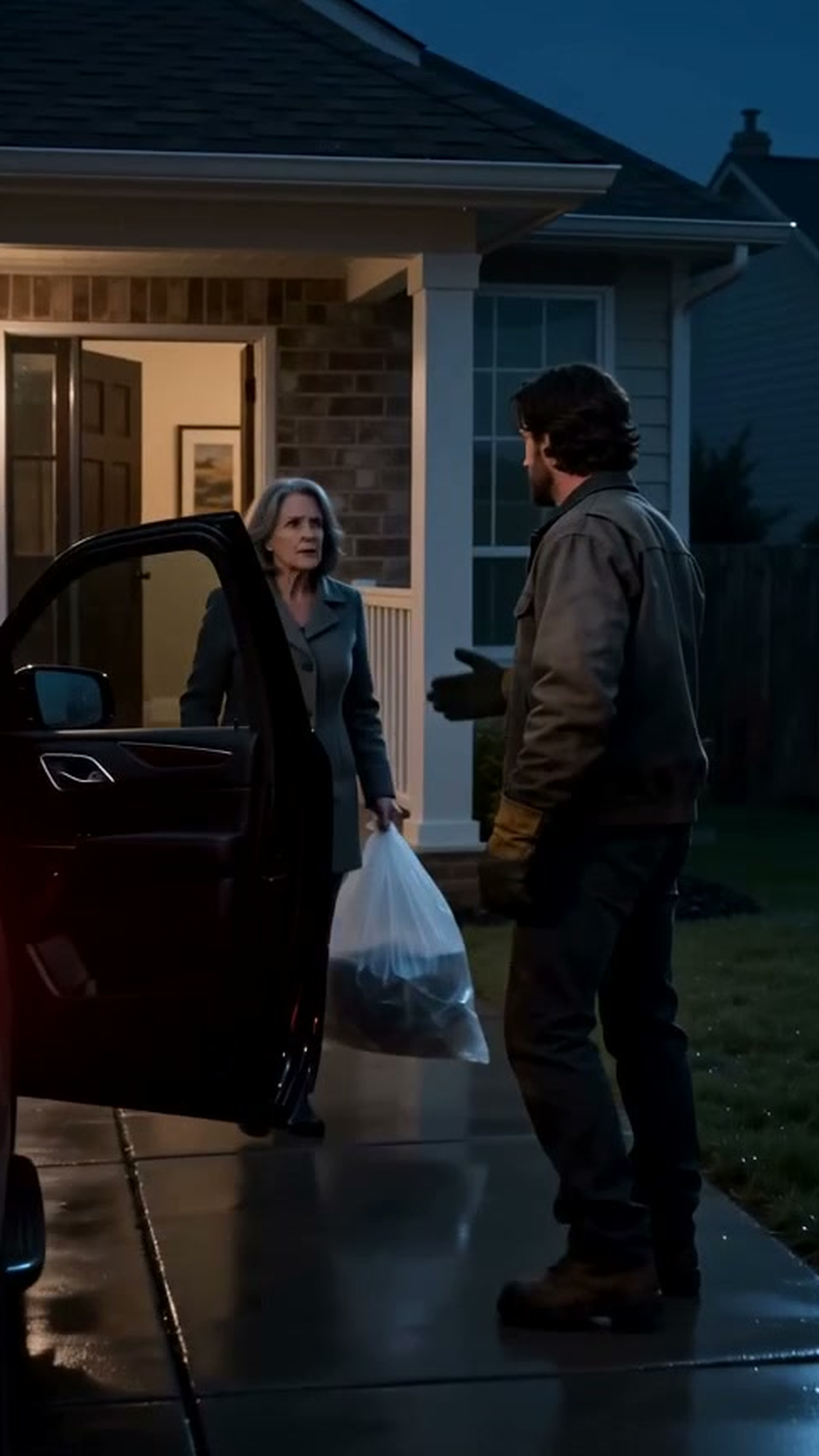
    And from the end of the street, headlights swept across the wet pavement — a car pulling up in front of my house, a car I knew — and Evelyn stepped out of it into the rain carrying a heavy plastic bag that swung against her leg with a weight that bent her wrist, and Mark, my husband, the man with the crowbar, turned toward his mother and raised his gloved hand in greeting, like she'd arrived right on time.

    "Lily," I whispered, "close your eyes."

    —

    SIX DAYS EARLIER

    The letter from the insurance company came on a Wednesday, mixed in with the coupons and the water bill.

    I almost threw it away. It was addressed to Mark Bennett, and it said, in the bland blue language of insurers, that it was confirming "recent changes to your policy." I stood at the kitchen counter with Lily's lunchbox half-packed and read it twice, and something in the phrasing snagged at me — the dispatcher instinct again, the wrong note in a familiar song. We had one life insurance policy, taken out when Lily was born, modest and mutual and chosen together at our own kitchen table. I had never heard of this company.

    I put the letter back in the envelope. I put the envelope back in Mark's pile. I finished Lily's lunchbox — apple slices, the sandwich with the crusts cut off — and I said nothing that morning, because that night was the night Mark came home smiling for the first time in months.

    It hadn't always been a house with secrets under the floor. When I met Mark Bennett I was twenty-three and answering phones at the county, and he was the contractor who'd come to rewire the dispatch center's break room and stayed an extra hour rewiring nothing, just to keep making me laugh through the worst shift of my month. He built our house with his own crew. He carried Lily through every room of it the day we brought her home, narrating: kitchen, where Mommy burns toast; hallway, where you're going to lose your first tooth; your room, Lilypad, where nothing bad is ever allowed to happen. For years I believed the narration. Then the developments started failing — a subdivision in Conroe that ate two years and came up mud, a partner who vanished with a draw account, loans stacked on loans like shingles on a bad roof — and Mark started doing what drowning men do: he stopped telling the truth in smaller and smaller rooms of the house, until the only room left where he told it was the garage, late, to a phone that wasn't his.

    I'd felt it coming the way you feel weather in a scar. The new silences. The laptop that closed when I entered. The way he'd begun, that spring, to ask after my shifts, my routes, my habits — what time did I usually get home, did I still take the tollway, did Lily's school still let out at three. I'd answered all of it like a wife. I answered all of it like the audience he'd rehearsed on for eleven years.

    Which is why the letter mattered the way it did. Not because it proved anything by itself — an envelope proves nothing; I'd logged enough calls to know paper lies as fluently as people — but because it arrived in the same week my husband started smiling again, in the same month my daughter started flinching at bedtime, and everything in my training said the same thing about coincidences: there is no such thing, there is only the pattern you haven't finished reading yet.

    "Denver," he said, turning me around the kitchen by my waist like we were twenty-five again. "Tuesday. The Harper Group wants a walk-through before they sign. Laura — if this lands, we're out of the hole. All of it. The loans, the suppliers, everything."

    I laughed, and I was happy, and the happiness is the part I have had to forgive myself for. Because six weeks before that letter, something had already begun moving under the floor of my life, quiet as gas through a wall — and my daughter, who had been awake on Sunday night when she should have been asleep, had already heard its first whisper.

    But on that Wednesday, I only knew about the letter. And that night, after Mark fell asleep with one arm flung over his eyes, I got up, went down to his truck in the garage, and opened the glovebox — looking for nothing, telling myself nothing, the way you check a smoke alarm battery in the dark for no reason you can name.

    There was a second phone in there. Cheap. Prepaid. The kind dispatchers learn to recognize in the first thirty seconds of the worst calls of people's lives.

    It lit up in my hand.

    One message. No name saved. Just six words:

    Tuesday. After that, we're free. — M

  • Chapter 7: Her Place

    Chapter 7: Her Place

    The doctor who came through the double doors at two in the morning found a woman in a torn blue gown with dried champagne on the hem, sitting very straight in a plastic chair with her father's folded tuxedo jacket over her knees like a sleeping child, and he did her the courtesy of not making her wait through a preamble.

    "He's alive," he said. "He's angry, which we're treating as an excellent sign. It was an arrhythmia on top of exhaustion — his heart, frankly, has been running a conglomerate for forty years and it filed a complaint. He has a pacemaker now, and a cardiologist with no sense of humor, and instructions he is already negotiating." He paused. "He's asking for you. He asked if the stock moved. I told him I'd send in the person who moves it."

    Samuel was propped against three pillows with a monitor's green line jogging beside him, and he looked, Claire thought, exactly like a man reviewing a quarter he hadn't approved of.

    "Well," he said. "That was more ceremony than I ordered."

    "You collapsed at a podium, Papa. In front of the press. If you wanted less ceremony you should have fainted in private."

    "Notes for next time." His hand found hers on the blanket — dry, papery, steady. "You spoke."

    "I spoke."

    "You were magnificent." He closed his eyes, and for a moment the chairman was entirely gone and there was only her father, tired and seventy-one and lit, faintly, by something that looked like peace. "Your mother would have burned that room down with a look. You rebuilt it with a speech. It's a better trick. I'm still learning it." A pause. "I am retiring, Claire. Chairman Emeritus, effective when the board meets. The folder had that page too. I find I want my remaining years to contain more daughters and fewer podiums."

    The board met within the week, as promised, and did everything in the open, as she had promised on their behalf. The minutes were published to all staff: the revocation of Adrian Cross, the termination of Vanessa Reed, the disclosure of the Vale Family Trust's majority holding and its trustee, the strengthening of the conduct clause that the press — which had the story in forty countries by then — had taken to calling the Claire Clause. An ethics channel was established with teeth. The chief executive search was announced with its criteria printed in full, and when, three months later, the board appointed Daniel Whitfield — the decent man, the runner-up, the one who had stood up in a ballroom and asked to hear from the wife — it published its reasoning in the same document, all four pages, including the dissent.

    At that first board meeting, Harmon Cole arrived early and magnificent, and spent eleven minutes pledging the board's — and especially his own — unwavering confidence in the new chairwoman, whose wisdom, he said, had been the company's secret ballast all along. Several directors studied the table. Cole had the hide of a cathedral door, and Claire let him finish, because she had decided that the new era would be conducted at conversational volume or not at all.

    "Thank you, Harmon," she said. "Then you'll be glad of some daylight. The audit committee will be reviewing all related-party transactions of the last five years — including the logistics consortium proposal." She smiled at him with absolutely no malice in it, which was somehow worse than malice. "Not as an accusation. As a schedule. Everything in this company is going to have a schedule from now on."

    In the spring, Harmon Cole resigned from the board of Valeon Technologies, citing health reasons and a desire to spend time with family he had not previously been known to have. Claire sent him a note thanking him for his service, and a bottle of something good, because that is what her father would have done, and because she intended the new regime to be recognizable from the old one in exactly one respect: it would never, ever need to raise its voice.

    Claire Vale took the chair.

    Not the corner office — she was explicit about that, in the all-hands meeting where she stood in front of five thousand employees in a plain dark suit and told them the truth in the order she wished someone had once told it to her. "I am not your chief executive. I am your chairman, and the distinction matters, because my family's job was never to run this company day to day. It was to make sure the people who run it deserve to. For two years I did that job from the dark, and I am not proud of the dark, whatever it protected." She had looked out at the sea of faces, a startling number of which she now knew had been in the ballroom. "So here are the new rules, starting with me. In this company, nobody's authority is a secret. Nobody's. If your power can't survive daylight, you don't get to keep it."

    The vice president who had stood up too late in the ballroom came to her office in the second week — the one whose wife had pulled him down by the sleeve — and stood in her doorway twisting his hands like a schoolboy, and said he had not slept properly since that night, and that he was sorry. Claire rose and shook his hand and told him the truth: that she kept the list of the evening's debts in two columns, and his name was not in the long one. "You stood up," she said. "Late is not never. Sit down next time somebody falls, Mr. Okafor — no. Stand faster." He wept a little, in her office, and she pretended to check her phone until he was finished, because mercy is also a form of governance.

    Adrian signed the divorce in a lawyer's office in November, without contest, in a gray suit that did not fit his new life yet. He did not ask for the house. He did not ask for anything; the lawyers on both sides agreed it was the most dignified document he had ever put his name to. The photograph of the fall — the stringer's shot, Claire on the marble with her husband's raised arm above her, the one that had gone around the world — won its award, and Claire bought the first print at the photographer's exhibition and hung it in her office, facing her desk, where only she could see it from her chair. People assumed it was vanity. It was a survey marker. She liked to begin her mornings at the exact coordinates of the floor.

    Vanessa sold her story once, to a magazine that put her on a cover under a headline that was not the one she had imagined, and the country's attention — which she had courted so patiently, at such cost — looked at her for one news cycle with the flat curiosity it gives to weather, and moved on. She left Chicago. She was last reliably reported to be working, under her own name, in another industry, in a city where nobody knew the dress.

    The letter from Adrian came in the spring, handwritten, four pages, no lawyer's fingerprints anywhere on it. He was working — actually working, shifts and metrics and a supervisor younger than his ambitions — at a logistics firm in Ohio, the industry he had once nearly cost her company ninety million dollars to enter. I am not writing to be forgiven, he wrote. I am writing because you are the only person who ever knew the boy in Austin, and I needed him witnessed by somebody before he finishes disappearing. I told him his name would be on a building. It turns out the building had a name on it the whole time, and it wasn't mine, and the name was kinder to me than I ever was to it. I am sorry, Claire. Not for the evening. For the years I made the evening inevitable. There is a difference, and it took me this long to learn it, and I learned it on a floor in Ohio at four in the morning, which I suppose is where such things are learned.

    Claire read it twice at her kitchen table — her kitchen table, in the house she had kept, where she now drank her morning coffee in the sun like a person with nothing whatsoever to hide — and then she took one sheet of her own stationery and wrote, in handwriting that stayed level:

    I forgive the boy in Austin. Be well, Adrian. Build something true.

    She mailed it before she could improve it, and then she sat for a while with the peculiar quiet of a door closing at the correct speed, neither slammed nor left ajar.

    There were other, smaller resurrections that year, and she collected them the way she had once collected exhibits. The junior analyst who had laughed least in the ballroom turned out to have been the one who'd called the ambulance the fastest; Claire learned it from the incident report and promoted the file, not the woman — the woman earned her own promotion by October. The foundation director who had laughed at she reads the annual report at me resigned from the foundation board and was replaced by Margaret Whitfield, who arrived at her first meeting with a plumb line in a velvet pouch, as a joke, and hung it in the foundation office, not as a joke. And in June, a letter arrived at Claire's office from a women's shelter in Atlanta, enclosing a photograph of a new wing: it seemed an anonymous donor had endowed it that winter, off a trustee's instruction, in the name of Eleanor Bennett. The director wrote that the women had voted to call the common room Claire's Room, after the donor's daughter, whose story they had all seen on the news. Claire read that letter three times. Some names, it turned out, could be carried into the light in more than one direction.

    Then she got up and went to work, because there was a quarterly review at ten and the trust, these days, held its meetings with the windows open.

    And a year to the month after the evening that ended her hiding, Valeon Technologies held its annual gala in the ballroom of the Grand Meridian Hotel — same chandeliers, same cream-and-gray marble, same gold-and-white roses, because Claire had insisted, over the event team's horror, that they were not going to let one night own the room forever.

    She wore blue. Of course she wore blue — powder blue, off the shoulder, new-made, with her mother's diamonds at her ears and both shoes intact. Samuel attended against three doctors' advice and one cardiologist's outright pleading, magnificent in black with the white pocket square, the warning still taped in his own handwriting to his mirror at home — Do not dance — and at the evening's height, when the new chief executive had given a short and honest speech and the orchestra had found the slow songs, the Chairman Emeritus rose from the head table with the deliberation of a man spending something precious, and crossed the floor that had seen everything, and held out his hand to his daughter.

    "Papa," Claire said, in front of everyone, smiling so hard it hurt. "Your cardiologist—"

    "My cardiologist," said Samuel Vale, "works for me." And then, as the orchestra played and five hundred people watched the most feared man in American business dance one slow, careful dance with the chairwoman of his company — badly, happily, entirely on the beat that mattered — he said, close to her ear, the thing he had waited a year and a pacemaker to say:

    "You found your place, daughter."

    Claire looked out over the room from inside the circle of it — at Whitfield applauding, at Reyes with his folder nowhere in sight, at the long tables full of people who now knew exactly who she was and had decided, in the open and on the record, that it was a fine thing to know — and she rested her cheek, for one unguarded second, against her father's shoulder.

    "I was never lost, Papa," she said. "I was just waiting for the room to catch up."

    THE END

  • Chapter 6: Who Really Controls Valeon

    Chapter 6: Who Really Controls Valeon

    For a count of five, nobody in the Grand Meridian ballroom moved at all.

    Then the sound began — not applause, not speech, but the roar a room makes when five hundred people all start asking the person next to them if they heard what they just heard. It rolled across the tables and broke against the stage, and above it, thin and clear, came the mechanical chatter of the press cameras, firing without pause now, because every photographer in the pen understood at the same moment that they were no longer covering a coronation. They were covering a deposition.

    Samuel let the noise spend itself. He did not raise a hand. He waited with the patience of a man who had out-waited markets, and when the room had quieted enough to hear its own shame, he nodded once to Daniel Reyes.

    Reyes stepped to the podium with the folder's contents in a neat stack, and the general counsel of Valeon Technologies read, in the flat carrying voice of a man reading weather that will kill crops:

    "Resolution of the Board of Directors, Valeon Technologies, adopted this evening under Article Nine of the executive service agreement — the conduct clause. Whereas the appointee, Adrian Cross, has this night, in the presence of the board, the company's employees, and the press, committed a public act of violence against a shareholder of this company; and whereas such act constitutes gross moral disgrace within the meaning of the clause — the appointment of Adrian Cross as Chief Executive Officer is revoked, for cause, effective immediately. Severance: none. The board thanks the witnesses for their attention."

    He set the page down. In the silence afterward you could hear the chandeliers think.

    Adrian found his voice first, and it was the wrong one — the living-room voice, the standing-over-chairs voice, pitched now for five hundred people.

    "This is a setup." He turned on Samuel, on the room, on the cameras, gathering speed the way drowning men gather water. "This is — he planned this. The old man planned this. She—" his arm swung toward Claire "—she has been spying on me, this is a coup dressed up as a—"

    "Adrian." Samuel's voice was not loud. It had never needed to be. "You are describing the evening on which you kissed your secretary in front of your wife, seized your wife by the arm, and threw her to the floor of a ballroom in front of five hundred witnesses and the press. If that evening was arranged by anyone in this room, it was arranged by you. Sit down."

    "I built this company!" Adrian shouted, and the shout cracked at the top of it. "Eight years! The Meridian save — the board called it visionary — the logistics turnaround was mine, the growth was mine, nobody handed me anything—"

    "The Meridian analysis reached this company through outside counsel at the instruction of the trustee," Samuel said, "after the trustee read your acquisition packet at her kitchen table and found a ninety-million-dollar liability your analysts had missed. The logistics division exists tonight because the trustee's vote stopped Harmon Cole from selling it to his own fund at a discount. And your appointment—" for the first time, the old man's voice carried something that was almost pity "—your appointment passed this board by one vote, Mr. Cross. The trust's vote. Cast at my daughter's written instruction. She believed the crown should be yours. She signed for it herself. Against my advice."

    Adrian turned, then, to Claire — slowly, as the whole room turned with him — and the performance went out of him all at once. What was left was the boy from Austin, drowning in a navy tuxedo.

    "Claire," he said. "Claire. Tell them." He came down the stage steps toward her with his hands open, pleading, reaching for her the way he had reached a hundred times in kitchens and doorways and the safe dark of their marriage. "Tell them this isn't — you know me. You know what I— whatever I did tonight, I was drunk on the moment, I wasn't— we can fix this. We can fix anything. Tell them."

    Claire stepped back.

    It was a small step — one step, the mirror of the step that had begun the evening — and in the wreckage of his face she watched him understand that he had seen that step before: it was the exact distance at which she had always lived from him, behind the surname and the silence, in the part of her he had never once asked to see.

    "You told me to know my place," she said. Her voice did not shake, and it was not loud, and every person in the first ten rows heard it anyway, the way you always hear the truest thing in a room. "In front of everyone you've ever wanted to impress. So I learned it, Adrian. My place is at the head of the company my father built, that I have protected for two years from a chair you never knew existed." Her eyes went, briefly, to the marble at his feet, where a waiter was already kneeling with a cloth, gathering the last of the broken glass. "Yours was beside me. You threw it on the floor."

    "Claire, please—"

    "The divorce petition is in the folder too," she said, gently, because gentleness was the one weapon he had never learned to parry. "Daniel will walk you through it. I kept the house out of it. I kept your name clean where the law lets me. That is the last protection you will ever get from me, and you got it for the boy in Austin. Not for you."

    Something in him broke upward then, into rage, because rage was the only floor he had left to stand on. "Eight years," he said. "Eight years you lied to my face. Every dinner. Every night. You sat in my house and let me believe—" His voice rose. "Whatever I am, I never pretended to be somebody else!"

    "No," Claire said. "You didn't. That's the tragedy, Adrian — neither did I. Not once, in eight years, did you ask me a single question about my life that I answered falsely. You never asked." She let that land in the quiet. "I hid one thing, and I hid it to protect you. You hid eleven nights, a bracelet, and a toast — and you hid them to betray me. Do not stand in this room and call those the same thing."

    Two security officers had appeared at Adrian's elbows — not thugs, just men in dark suits with the terrible politeness of their profession — and he looked at them, and at the aisle, and at the five hundred faces that had stood for him an hour ago and were sitting now in the wreckage of him, and some last instinct for dignity got him moving under his own power. He walked the length of the ballroom with a man at each side and his head up, past the tables where they had laughed, past the roses, past the doors. He did not look back at the stage. History would note that he almost made it look like leaving was his idea.

    Two more dark suits were already speaking, quietly, to Vanessa Reed.

    She had gone the color of candle wax some time around the word daughter, and she had been retreating in increments ever since: the hand off Adrian's shoulder, the half-step back, the smile reassembled and aimed at no one. Now Reyes, without looking up from the folder, said, in the tone of a man reading a footnote:

    "Ms. Reed's employment is also terminated this evening, for cause. The company has in its possession the expense records of eleven hotel bookings, and a photograph, sent by Ms. Reed to Mrs. Cross last night from her personal phone, which the company's counsel describes as — I quote — 'a declaration of war.' Ms. Reed appears to have an instinct for documentation. So, Ms. Reed, does this family."

    Vanessa looked at Claire then — truly looked, perhaps for the first time, past the taxonomy, past the furniture — and whatever she saw there made her pick up her own skirts and go quietly, between the two dark suits, down the long aisle of the ballroom and out through the tall doors, in her red dress, in front of everyone, alone.

    It was, Claire reflected, the walk she had planned for someone else.

    Then, from the board's table, Whitfield stood — the decent man, the runner-up, the one person in the room with every excuse to enjoy the evening — and said, with the simplicity of a man settling a debt, "Mrs. Cross. Claire. I think the room would like to hear from you."

    Five hundred faces turned. Claire looked at her father, and Samuel — who had not planned this, who had built the entire evening like a siege engine and had not included this in the design — inclined his head, once, with an expression she had never seen on him in public and would remember on her deathbed: he looked proud, and he looked, for the first time in her life, like a man handing something over.

    She went up the three steps in one broken shoe and one whole one, and she did not fix her hair, and she stood at the transparent podium with a bruise darkening on her elbow where everyone could see it, and she said:

    "I won't keep you. Most of you have known me for years as Adrian's wife, and some of you were kind enough tonight to demonstrate what that was worth." A sound went through the room that was not laughter. "My name is Claire Vale. Samuel Vale is my father. For two years I have held this company's majority in trust, in silence, and I am finished with silence — mine first of all. You were owed a chief executive worthy of the work you do. You will get one, chosen in the open, and the choosing will be explained to you in the open. That is the whole of my platform, and it starts on Monday. Thank you for your work. Go home to your families. Hold them carefully."

    She stepped back. The applause began in the back, where the junior staff stood — the ones who had laughed least — and came forward table by table the way the laughter had, only slower, and more carefully, as if the room were relearning a skill.

    Samuel watched it reach the stage. Then he took the podium again, to close the evening the way chairmen close evenings, and Claire, standing at his shoulder, was watching the applause find its rhythm when she saw his hand on the acrylic.

    What happened next happened the way Samuel had always said ruin and rescue happen: on an ordinary breath, in the middle of everything already happening. He had taken the podium again — to say the last thing, the formal thing, the words that would close the evening and open the future: the board would meet within the week; the company was sound; the trust endured. He had gotten as far as "Valeon," and Claire, watching him from beside the stage with the attention of a daughter who had spent two years reading cardiologists' reports over his shoulder, saw his right hand close on the edge of the podium and hold — knuckles whitening — the way a man holds a rope.

    "Papa?" she said, too quietly for the microphones, and was already moving.

    He turned toward her voice. The famous control was still there, fighting, and underneath it something gray and tidal was crossing his face like weather crossing water. The folder slid. Pages fanned across the podium and spilled, soundlessly, down the acrylic.

    "Ah," said Samuel Vale, with mild surprise, to his daughter, as his knees went. "There it is."

    Claire caught his arm and could not hold his weight and went down with him — controlled, cushioning, the second time that night she had gone to her knees on that marble, and this time fifty people were moving at once, and this time every hand in the room reached the right way.

    "Call an ambulance," she said, clearly, over the surge of noise, with her father's head against her shoulder and her mother's diamonds swinging against his cheek. "Tell them it's his heart. Tell them—" her voice did the thing it had not done all evening, and broke, once, on the only word that had ever truly been her place "—tell them his daughter is with him."

  • Chapter 5: Take the Stage

    Chapter 5: Take the Stage

    Vanessa Reed reached the stage with her champagne glass still in her hand, and she climbed the three steps in her red sequined dress like a woman ascending a throne she had already measured for curtains.

    Adrian turned toward her with the unguarded face of a man greeting weather he had ordered.

    She set her glass down on the edge of the stage. She took his face in both hands. And in front of five hundred employees, two dozen board members, a pen of press photographers, and his wife of eight years, she kissed him — slowly, thoroughly, with her fingers in his hair — and held the kiss for four full seconds while the applause of the room died in confusion around them and the photographers, after one frozen instant, began firing like a lightning storm.

    Adrian's hand settled at her waist. He kissed her back. Whatever else was said about that night — and libraries would eventually be said about that night — no one ever argued about that.

    Claire stood three feet from the stage with her champagne glass trembling in her hand, and inside her a voice she had not used in years, her mother's voice or her own, said: There it is. There's the answer. The evening has decided.

    "Adrian?"

    It was a small sound. It was the last small sound she ever made for him.

    Vanessa drew back slowly and turned, and gave Claire the smile she had practiced in the hotel mirror — the smile of a fact, arriving.

    Adrian looked at his wife. And whatever he saw in her face — grief, disbelief, the widow's stare of a marriage dying standing up — it enraged him past all strategy, because it was happening in his light, on his stage, in the four minutes of his life he had been rehearsing since he was a hungry boy in a kitchen that smelled of other people's cleaning chemicals. He came down off the stage with his jaw set like a man removing an obstacle from a photograph.

    His fingers closed around her upper arm hard enough to bruise through satin.

    "KNOW YOUR PLACE!"

    He shoved her with everything his shoulder had.

    She went backward. Her heel caught, twisted, snapped — the crack of it went through the ballroom like a branch breaking in a winter wood — and Claire Cross fell on the marble floor of the Grand Meridian Hotel, hip and hand and elbow, her champagne glass shattering beside her in a spray of crystal and gold, her blue gown spreading around her in heavy folds, her mother's diamonds scattering the chandelier light as her head came up.

    Photographers fired. Somewhere a woman gasped out loud.

    And then the room did the thing Claire would remember, on certain nights, for the rest of her life: it laughed. Vanessa first — bright, ringing, unrestrained, her hand possessive on Adrian's shoulder as he towered over the woman on the floor — and then the contagion of it, table by table, the nervous laughter of people who had already done the arithmetic of the new reign and chosen their side of it.

    It will look like an ordinary day, her father had said. That's the trap.

    Claire lay on the cold marble with her elbow screaming and her broken heel beside her like a small dead thing, and she looked up at her husband — really looked, the way you look at a building you are about to condemn — and what she saw, with eight years of double vision suddenly resolved into one image, was not a stranger. That was the horror of it, and the mercy. It was the same man. It was the boy in the Austin bar saying one day my name will be on the building, and the groom crying at the garden roses, and the voice in her living room saying you'd be nothing without my name, and the hand — the same hand that had once lifted her and spun her in a small kitchen — still raised from the shove, not yet lowered, like a flag he had planted.

    The marriage did not end when he touched her. It ended in the second after, when she searched his face for the flinch — the horror, the apology assembling itself, the husband arriving late to his own crime — and found, instead, satisfaction. He was looking down at her the way the room was looking down at her. He had finally gotten her into the position the whole room agreed she occupied.

    And felt something inside her finish. Not break. Finish. Like a signature completing a document.

    She got up.

    She did it without help, because there was no help; she did it slowly, the way injured people do, one hand braced on the edge of the stage, her weight canted off the ruined shoe, her breath coming in the controlled rhythm of a woman who has decided that the room will not get her tears as a souvenir. The laughter thinned out as she rose. Something about the slowness of it — the dignity of it, though she would never have used the word — sobered the tables at the front first, and then the quiet spread backward the way the laughter had, until she was standing in a silence much larger than the one she had fallen in.

    She took her phone from her evening clutch.

    Her fingers trembled slightly. She let them. She typed the three words she and one other person in the world had agreed upon a lifetime ago, in a kitchen at three in the morning, for a night she had prayed would never come and had prepared for like a general:

    Take the stage.

    Send.

    On the stage, Vanessa watched the wife take out her phone, and her smile found its second wind. She leaned toward Adrian and said, in a voice pitched to carry exactly as far as she wanted it to carry, "She's calling a car. Or security. God, this is embarrassing for her."

    Adrian said nothing. He was watching Claire's face, and something in it — something he had never once seen there in eight years of marriage, and did not have the vocabulary for — had begun, very slightly, to frighten him. It was the look of a woman reading a verdict she had written herself.

    "Dad," Claire said, under her breath, to no one the microphones could hear. "It's time."

    The tall side doors of the ballroom swung open on their heavy hinges, and the room turned.

    Samuel Vale came through those doors the way weather comes through a valley: undramatically, and changing everything. Seventy-one years old, silver hair, white beard trimmed like a statesman's, black tuxedo, white pocket square — and beside him Daniel Reyes with a legal folder in both hands like a hymnal, and behind them two members of the board of Valeon Technologies wearing the expressions of men who have been told exactly one sentence in the corridor and are still deciding whether they believe it.

    Conversations stopped in mid-word. The orchestra's conductor lowered his baton.

    Around the room, the evening's cast rearranged itself in silence, the way iron filings rearrange around a new magnet. Whitfield — the man Adrian had beaten for the crown, the man who had suspected the arithmetic all along — rose slowly to his feet without seeming to decide to, and his wife rose with him, her hand pressed flat to her heart, looking not at the chairman but at Claire. Harmon Cole set down his glass with great care and began, visibly, to recalculate eight years of certainties. At the fourth table, the vice president who had half-risen to help a fallen woman and let his wife pull him back down stood up now, fully, too late and knowing it, and did not sit again.

    And one of the press photographers — a stringer, twenty-six years old, who would win an award for what he did next — lowered his camera for a moment of human doubt, and then raised it again, and kept shooting.

    Vanessa's smile weakened first. She would tell an interviewer, months later, that it was the doors that did it — not the old man, the doors, and the way the room's posture changed, five hundred spines straightening at once, like a field turning toward a new sun. Adrian stepped forward quickly, smoothing his tuxedo, assembling the boyish gratitude of the newly crowned, and extended his hand.

    "Chairman Vale—"

    Samuel walked past the hand without breaking stride.

    He crossed the marble. He passed, on his way, the shattered glass and the spreading champagne and the broken silver heel, and those who were close enough saw his jaw tighten at the sight of them — the only entry his face made in the ledger all night. He mounted the stage. He took the folder from Reyes and set it down on the transparent podium, and the sound of it — thick paper and board on acrylic — cracked through the silence to the back wall.

    He adjusted the microphone. He looked at Adrian Cross for a long, cold moment, standing below the stage where he had thrown his wife.

    "Let's discuss," Samuel said, "who really controls Valeon."

    He opened the folder.

    —

    What the five hundred people in that ballroom did not know — what the cameras flashing from the press pen did not know, what Adrian Cross, standing in the ruins of his own evening with his hand still half-extended, most catastrophically did not know — was that the evening had a second act. The folder was not a prop. There were four living people in the world who knew what was inside it, and one of them was on the floor's side of the stage, in a torn blue gown, favoring one foot, perfectly calm.

    Samuel lifted the first page.

    "Before this company has a chief executive," he said, "it has owners. Fifty-one percent of Valeon Technologies is held by the Vale Family Trust. It has been held there since the day this company went public, so that no market, no board, and no man—" his eyes moved, briefly, to Adrian "—could ever take it apart."

    A murmur went through the room and died under his gaze.

    "For thirty years I was that trust's sole trustee. Two years ago, for reasons of health which are my own, I transferred the trusteeship — in full, irrevocably, and in accordance with the trust's terms." He turned a page with terrible calm. "The trustee of the Vale Family Trust — the controlling shareholder of this company, the person whose proxy vote, cast six weeks ago, is the reason any of us are standing in this room tonight — is not me."

    He set the page down.

    "The trustee," said Samuel Vale, "is my daughter."

    He turned then — the chairman of Valeon Technologies turned on his own stage, in front of his board, his company, and the press of two wire services — and he looked down at the woman in the powder-blue gown standing beside the stage with her chin level and her elbow already darkening with a bruise.

    "Claire," he said.

    Five hundred people turned in their chairs.

    Adrian turned last of all — slowly, the way a man turns toward a sound he has been dreading in a house he thought was empty. His face had come apart. The king was gone out of it; the boy was gone out of it; there was only the arithmetic arriving, eight years of it, all at once, in public, with the cameras still firing.

    "Claire?" he said.

    It was a small sound. It was, syllable for syllable, the sound she had made to him from three feet away, an eternity ago, when a woman in red had taken his face in her hands: the voice of a person still hoping there is an explanation that does not end everything.

    There wasn't. She met his eyes across the marble, across the broken glass and the spreading champagne and the ruin of his coronation, and she said nothing at all — and her silence, arriving at last after eight years of it, was the loudest thing that had ever happened in that room.

  • Chapter 4: The Night of the Crown

    Chapter 4: The Night of the Crown

    On the morning of the ceremony, Claire Cross woke before her alarm in a house that felt like a hotel she was about to check out of, and she lay for a while listening to her husband breathe beside her, and tried to remember the sound of it in the first year — when it had been the safest sound in the world.

    She had two speeches in her life that day. One of them existed in a sealed folder in Daniel Reyes's office safe: a board resolution, a trust deed, a divorce petition. The other existed only in her head, unwritten, and she had composed it a hundred times in the shower and at red lights: the speech she would never give into a microphone, but into her husband's ear, on the drive home from his coronation. I have something to tell you. My name is Vale. I have loved you in the open and protected you in the dark, and I am done with the dark. Forgive me for the hiding. Let me show you the whole of your wife.

    She had decided that morning, dressing, which speech she believed in. She no longer believed in either. She believed in the evening. The evening would decide.

    Adrian came down to breakfast already wearing the armor: cufflinks, the good watch, the cologne he wore for earnings calls. He was buoyant, electric, a man hours from an altar.

    "Big night," he said. "Try to enjoy yourself, Claire. And—" he adjusted his tie in the hallway mirror, watching himself say it "—let me do the talking out there. These are sharks. You'd get eaten alive."

    "Of course," she said, and poured his coffee, and he drank it without noticing it was the last one she would ever pour him as his wife in that kitchen — one way or the other.

    At two o'clock she went to her father's penthouse, because some part of the day required witnessing. A valet was laying out Samuel's evening clothes: black tuxedo, white shirt, the bow tie he had owned for thirty years. Samuel sat by the window in a dressing gown with a blanket over his knees and a cardiologist's warning taped, in his own handwriting, to the mirror: Do not dance. He looked up and read her face like a balance sheet.

    "You've decided not to decide," he said.

    "I've decided to watch," Claire said. "It's his night. Whatever he does with it is the answer."

    Samuel nodded slowly, and then he did something he had not done since she was a girl: he held out his hand, palm up, and waited for her to cross the room and take it. His grip was dry and papery and still, unmistakably, the grip that had built a tower.

    "Your mother," he said, "wore a blue dress the night I took my company public. Powder blue. I have thought about that dress at every podium for thirty years." He nodded toward a small lacquered box on the dresser. "Her earrings. Diamonds. She told me to give them to you when you stopped hiding." A pause, and the famous control frayed at the edges, just for her. "I am giving them to you now, daughter, because I believe — I believe tonight you stop."

    Claire put the earrings on in his mirror, and her mother's face looked back at her out of her own, and she did not cry, because she had exactly one cry budgeted for the day and she was saving it in case the evening turned out to deserve one.

    Across the city, in a hotel suite she had charged to an executive account, Vanessa Reed was also preparing — and her preparations, unlike Claire's, were a war plan executed in silk.

    The red dress was already famous inside the company gossip economy before she ever wore it: sequined, cut high on the thigh, the kind of dress that makes a decision about the evening all by itself. She intended to be photographed in it. She intended to be remembered in it. For eight months she had been the most patient woman in Chicago — the secret, the second set of room service, the bracelet instead of the ring — and patience, Vanessa had concluded somewhere around the seventh month, was a tax paid by women who did not intend to stay secret.

    Tonight the tax came due.

    She had thought it through with the cold clarity that had made her the best executive assistant Adrian Cross had ever had. A promotion ceremony: five hundred witnesses, press photographers, the board. A kiss — not a peck, a claim — delivered at the exact summit of his triumph, in front of the wife. The wife would do what wives of her kind always did: freeze, weep, withdraw, and begin the slow, silent, settlements-in-private death of the marriage. And Vanessa would be standing in the crater of it — unforgettable, undeniable, the woman the new CEO had chosen in front of God and the shareholders. Men did not come back from a public claim like that. They ratified it. That was the beauty of it. By kissing him in front of everyone, she would not be the scandal. She would be the fact.

    She practiced her smile in the mirror — the one for after, when she would turn and find the wife's face in the crowd.

    She had no idea what the wife's face was going to do. It never occurred to Vanessa Reed, not once in eight months, to wonder what Claire Cross was. The woman kept house. The woman poured coffee. In Vanessa's taxonomy of the world, which was ruthless and mostly accurate, such women were furniture that talked.

    She had even done due diligence, in her way: the working dinner at the Cross house in February, where she had complimented the kitchen while quietly inventorying the marriage — and had come away certain. The wife cooked. The wife poured. The wife asked no questions and seemed to want nothing, which in Vanessa's experience meant she was exactly what she appeared to be: a decorative obligation from Adrian's starter years, kept on out of guilt and inertia, waiting for a strong enough event to dislodge her.

    Vanessa intended, with great precision, to be that event.

    In the green room behind the stage, Adrian stood before a mirror rehearsing the last thirty seconds of his speech to an audience of one coat rack and his own reflected hunger, and his phone lit in his hand.

    Watch me tonight, Vanessa had written. After tonight, no more hiding.

    He smiled at the screen the way he smiled at markets he was about to move. He had his own plan for the evening's aftermath, and it was tidier than hers: a coronation first, then a quarter of consolidation, then — quietly, generously, with lawyers instructed to be kind about money — the end of a marriage that had become, in his private accounting, a starter home he had outgrown. Claire would land softly. Claire always landed softly; she had no weight, she made no noise, she asked for nothing. He would give her the house. He would give her more than the house. He was not a monster, and he intended the paperwork to prove it.

    "You built all of this yourself," he told the mirror, quietly, in the voice he used for the first slide of every deck, "and nobody — nobody — gets to take it."

    He believed that completely. It was the last completely true thing he believed about his life for some time.

    The ballroom of the Grand Meridian filled by seven: five hundred employees in evening dress, the board in black, the press penned politely by the doors with their cameras, crystal chandeliers lit over cream-and-gray marble and gold-and-white roses. Harmon Cole worked the room with a statesman's ease, already positioning for whatever weather the new administration brought. Whitfield, the man Adrian had beaten for the crown, stood with his wife and applauded the decorations with the good grace of a man who had lost to the trust's vote and suspected — correctly, though he would never prove it — that there was more to the arithmetic than arithmetic.

    Claire arrived on her husband's arm and was absorbed, within minutes, into the specific gravity of being the CEO's wife at a company function: a constellation of people who approached her in order to stand near Adrian. She was congratulated on his achievement by eleven people. She was asked, by a marketing director with champagne on his breath, whether she was "thrilled to finally be able to relax now" — as though her husband's promotion were her retirement. A board member's wife took her hands and told her she was a saint, a support, a treasure behind the throne, and Claire received all of it with her beautiful calibrated smile and understood that to this entire gleaming room she was a piece of the evening's furniture: polished, expensive, and entirely without a vote.

    Margaret Whitfield was the exception. The defeated candidate's wife — sixty years old, silver-streaked, with the eyes of a woman who had survived forty years of these rooms — found Claire by the roses and said, without preamble, "You have your mother's look. I knew Eleanor Bennett at school, before any of this." She touched the diamond at Claire's ear. "She had a spine like a plumb line, your mother. Everyone forgets the women who hold the building up. Remember that I remembered."

    Then she was gone into the crowd before Claire could answer, and Claire stood among the roses with her heart slamming, wondering how many people in the world were walking around with pieces of her true name in their pockets — and whether Adrian, had he been paying attention to anything outside the light that bent toward him, might ever have found one.

    At seven-thirty Samuel Vale took the transparent podium, and the room went to the particular silence that only ever assembled for him.

    He spoke for four minutes. He spoke about building things that outlast the builder. He spoke about the weight of a company's name and the men and women who carry it when no one is watching. He did not read a word of it. And he did not — not once, though five hundred people would later swear they examined their memories of it — he did not look at the front row, where a woman in a powder-blue gown sat with her hands folded and her mother's diamonds at her ears, applauding her husband's employer.

    Then the board's spokesman read the appointment, the way it had been voted six weeks before in a closed room: Adrian Cross, Chief Executive Officer of Valeon Technologies.

    The ovation stood up out of the floor.

    Adrian mounted the stage the way he had mounted everything in his life — like it had been built for the purpose — and he gave the speech of his career: vision, hunger, the future, the people who matter. It was a genuinely magnificent speech. History should record that. And near the end, arriving at the obligatory paragraph of thanks, he smiled down at the front row and performed the sentence that five hundred people would repeat to investigators, journalists, and each other for months afterward:

    "And to my wife, Claire — for keeping the home fires burning while the rest of us build the future. Every empire needs someone to mind the house."

    The laughter came warm and general, the laughter of a room that liked its new king and found his wife's smallness part of the décor. Adrian let it run a beat too long. He let it run, Claire understood, because he liked the sound of it standing between them: the builders up here, the house down there.

    She smiled. She had the best smile in the room that night — witnesses agreed on that too, later, without ever understanding why. She smiled and applauded and kept her hands at exactly the tempo of the room, and inside her chest the last speech she had ever planned to give her husband quietly burned to ash, unspoken, down to the last word.

    The applause thinned. The orchestra found its strings. Waiters began to move with trays of champagne, and Adrian stood on the stage in his navy tuxedo in the summit light, exactly where he had dreamed of standing when he was a hungry young man in Austin telling a girl named Bennett that one day his name would be on the building.

    At the fourth table, a woman in a red sequined dress rose to her feet.

    Vanessa Reed smoothed the sequins over her hips, lifted her champagne glass, and began — unhurried, deliberate, smiling directly at Claire as she passed the front row — to walk toward the stage.

  • Chapter 3: The Last Chance

    Chapter 3: The Last Chance

    Claire confirmed the affair the way she confirmed everything: without drama, and beyond argument.

    She did not hire an investigator. She did not need one. She was a trustee of a trust that owned fifty-one percent of a public company, and among the river of paper that flowed through the proxy office were the summaries of executive expenses submitted for governance review — anonymized, aggregated, and utterly damning. Room service for two, charged to an executive account at the Meridian Grand, on eleven separate nights across five months. A second set of everything. A jeweler's receipt, in December, for a bracelet Claire had never received, in a month when her own Christmas gift had been a scarf.

    Vanessa Reed wore a new diamond bracelet to the holiday party. Claire had shaken her hand and felt the stones.

    At that same party, Vanessa had given the toast. That should be recorded too, because Claire recorded it, standing by the ice sculpture where a younger version of herself had first taken the measure of this woman and gotten it wrong. Vanessa had raised her glass to Adrian — to his brilliance, his hunger, his future — with the ease of a wife, in front of two hundred colleagues, while the actual wife stood ten feet away holding a plate of food she never ate. Several people glanced at Claire then, quickly, the first flicker of the arithmetic that would one day run through a ballroom. And Adrian had basked. He had not corrected a syllable of it. He had lifted his own glass to his secretary's toast and drunk like a man being anointed.

    Claire went home that night and put the evening in the ledger with everything else, in handwriting that stayed level. Eleven nights. A bracelet. A toast. She was not a woman gathering doubts anymore. She was a woman gathering exhibits.

    But paper was paper, and Claire Bennett's daughter did not execute a marriage on the evidence of receipts. So on a Thursday in March, when Adrian texted her — working dinner, don't wait up — in the flat new language of their life, Claire put on a dark coat, drove to the Meridian Grand, and sat in a corner of the hotel bar with a book she did not read.

    They came in at nine-forty, through the revolving door, out of the rain. Vanessa was laughing with her head tipped back and her hand resting on Adrian's chest like a name tag. He was not wearing his wedding ring. Claire knew he wasn't wearing it before she looked — some part of her had apparently known for months, the way you know weather in a bad knee — and she looked anyway, because she had come to see the truth with her own eyes and she was not going to leave with half of it.

    Vanessa rose on her toes and kissed him, there in the lobby, unhurried, in full view of the concierge and the mirrors and God. Adrian's hand settled at her waist. It was not a new gesture. It had the ease of long practice — the same ease she had seen, or refused to see, a hundred times.

    Claire sat very still and let the whole thing pass through her like a blade through water, and when they had gone up in the elevator she paid for a drink she hadn't touched and drove home with both hands steady on the wheel.

    She confronted him that night. Not screaming — Claire had never screamed in her life, and she was not going to begin by giving him the satisfaction. She waited until he came in at midnight, and she was sitting in the living room with the lights on and the jeweler's receipt printed out and laid on the coffee table like a place setting.

    "Eleven nights," she said. "At the Meridian. The bracelet was a nice touch, Adrian. She wears it well."

    He stopped in the doorway. She watched the calculation cross his face — denial assembling itself, discarding itself — and then something worse than denial arrived: relief. The relief of a man who has been carrying a lie and can finally set it down and pick up a weapon instead.

    "All right," he said. "All right. You want the truth? She's everything you're not. She's hungry. She understands what it takes. She doesn't sit in this house all day spending money I earn and calling it a life."

    "I have stood behind every—"

    "You have stood," he said, "in the way." He came into the room and stood over her chair, and for the first time in eight years she saw that he enjoyed standing over her. "Look at you, Claire. No career. No ambition. No name of your own. You'd be nothing — nothing — without my name on you. I built all of this. The house. The life. You."

    The words rose in her throat then, all of them, the whole shining arsenal: My name is Vale. My father's name is on the building you dream about. Your job exists because I made one phone call. Your crown — because by then the whole industry knew the CEO succession was coming — your crown will exist, if it exists, because I allow it.

    She swallowed them. Not out of fear. Out of a sudden, cold understanding that telling him now would be a warning, and warnings were gifts, and she had finished giving Adrian Cross gifts.

    "You're right," she said quietly. "Everything I have, you built."

    He nodded, satisfied, and went up to bed in the room she paid for, and slept the sleep of a man who has won an argument.

    Claire sat in the dark until three. Then she got in her car and drove to the one address in the city she almost never visited, and used a key she almost never used, and her father opened the door of his penthouse in a robe at three-twenty in the morning, took one look at her face, and put the kettle on without a single question.

    She told him everything. The key card. The receipts. The lobby. The bracelet. You'd be nothing without my name.

    Samuel listened the way he had listened in his office eight years before: completely. When she finished, he was quiet for a while, and she noticed — with the part of her that was always taking inventory — the pill organizer on his counter, seven days of a heart being managed like a small company.

    "Two roads," he said at last. "The first: I end it this week. Quietly. The board learns who you are in a closed session, his career ends in a conference room, the lawyers eat the marriage, and in a year it's a rumor. Clean. Merciful, even." He turned the mug in his hands. "The second road is the ceremony."

    "The ceremony is in six weeks."

    "I know when the ceremony is, Claire. On the second road, he receives the crown in front of everyone he has ever wanted to impress — and then, in front of the same people, the truth. Not a rumor. A record. A man who is destroyed in private can spend the rest of his life claiming he was robbed. A man who is destroyed in public, by facts, with five hundred witnesses —" her father's mouth set in a line she recognized from hostile takeovers "— stays destroyed."

    "And if he passes?" she asked. "If the promotion humbles him. If he stands up there and he's the man I married—"

    "Then it's his last chance, and you'll know he took it." Samuel reached across the counter and covered her hand with his. "But understand me, daughter. I am not offering you the ceremony as a test he'll pass. I'm offering it because you're still hoping, and hope has to be spent somewhere before it rots. Spend it there. In the light. Where everyone can see what he does with it."

    "There's something else you should know before you choose the road," Samuel said, and reached for a folder of his own — old, cloth-bound, the kind of thing empires kept before they had servers. "The conduct clause. Every officer's contract at Valeon carries one. I wrote it myself in 1994, after a president of this company beat a man in a restaurant and the board discovered it had no clean way to remove him. Any officer who commits a public act of violence or gross moral disgrace can be removed for cause, immediately, by board resolution — no severance, no golden parachute, no appeal to anyone's mercy." He slid it across the counter toward her, and for a moment his hand rested on it the way a priest's rests on a Bible. "I have been building the weapon that protects this family since before you were married, daughter. I pray nightly that it stays in its sheath. But if your husband ever raises a hand where the world can see it — the clause is already loaded. All it will need is a witness. Five hundred of them, say."

    Claire thought of the Arithmetic of ballrooms, though she didn't have the words for it yet. "And the trust's vote on the succession?"

    "Is yours," Samuel said. "It has been yours for two years. Vote him up or vote him down, Claire. But vote knowing that a crown given by this family can be taken by this family."

    She chose the second road. And in the weeks that followed, in the proxy office and in Daniel Reyes's quiet suite, the machinery of the second road was assembled piece by piece: the sealed revocation resolution, drafted and countersigned, contingent on the conduct clause; the trust documents establishing her trusteeship; the genealogy, if anyone could call it that, of Claire Bennett — birth records, her mother's name, her father's — prepared by lawyers into a chain no journalist and no court could pull apart; and underneath everything, the divorce petition, which Reyes's firm drew up at her instruction and which she signed at his desk without her hand shaking, because by then her hand had stopped shaking about Adrian entirely.

    Six weeks later, the board of Valeon Technologies voted on its next chief executive.

    The old CEO's retirement had been announced in the spring, and the succession fight had consumed the company's upper floors ever since — Adrian and one rival, a decent man named Whitfield, and a board split down the middle like a fault line. The count going into the closed session was four votes to four, with the company's general counsel, Daniel Reyes, keeping the sealed envelope that everyone in the building called, with varying degrees of reverence and resentment, the trust's vote.

    The trust's vote was the majority of the company wearing a mask. It had never been cast for a chief executive before. The room understood it was about to be.

    Claire signed the instruction alone, at the proxy office, on a Tuesday, in the same handwriting no one at Valeon had ever seen. FOR the appointment of Adrian Cross. She looked at her own signature for a long moment before she blotted it.

    It was, she knew, the most dangerous thing she had ever given him: the summit itself. If he summited like a king, she would stand beside him at the podium and tell him the truth that night and let the marriage be reborn in the open. If he summited like the man in her living room — the man who stood over chairs — then he would do it with the whole company watching, and the whole company would watch what came next. Either way, the hiding was over. That was the point. That had been the point since three in the morning in her father's kitchen.

    "You're certain?" Reyes asked, sealing the envelope. He was one of four living people who knew her face and her power belonged to the same woman, and he asked it the way a man asks before he arms something.

    "Prepare the other folder too," Claire said. "The revocation. The conduct clause. And my divorce petition. Seal them. Date them for the night of the ceremony." She stood and smoothed her coat. "I hope to God we burn them unread, Daniel."

    The night before the gala, Claire laid her gown across the guest bed — powder-blue satin, off the shoulder, silver at the waist, chosen weeks ago with a care she now barely remembered the reasons for. Adrian was already asleep, or performing sleep; they had become a household of performances.

    Her phone lit on the nightstand. Unknown number.

    The photograph filled the screen: Adrian asleep in a white hotel bed, hair damp, mouth soft, and beside him Vanessa Reed awake and smiling straight into the camera she was clearly holding herself — smiling like a woman mailing a declaration of war.

    The text beneath it read: Tomorrow everyone sees who he really goes home to. Wear something sturdy, sweetheart.

    Claire looked at the photograph for a long time. Then she saved it — to the folder, to the record, to the five hundred witnesses it was about to have — and set the phone face down, and finished laying out the blue gown and the silver heels and the diamond earrings her father had given her mother in another life.

    She slept eight hours. It was the best sleep she had had in a year.