Christmas morning arrived in Boston with a pale, clean light and a silence that felt almost held in place by the snow. Maeve Donnelly woke in the small harbour-side apartment to the sound of Callum Vale moving quietly in the kitchen, and for a moment she did not know where she was. Then the ache in her left wrist reminded her, and the blanket around her shoulders, and the memory of being woken every two hours through the night by a gentle voice asking her name and where she was, and whether her headache had worsened. She had answered correctly each time, or so Callum had told her, and she had fallen back asleep each time feeling safer than she had any right to feel in a stranger's apartment on Christmas morning.
"Maeve?" Callum said from the doorway, holding a mug of tea he had made too strong and then, she suspected, worried he had made too strong. "How is your head? Honestly."
"Better than last night," she said, sitting up slowly. The room tilted only slightly, then settled. "The headache is dull, not sharp. My wrist aches, but the splint is holding. I am not dizzy, as long as I do not stand up too fast."
He studied her face with the same careful attention he had given the nurse's instructions. "And if that changes, you tell me at once, and we stop. That was the agreement."
"That was the agreement," she confirmed. She took the tea with her good hand and wrapped her fingers around the warmth of the mug. Outside the window, the harbour was white at the edges, boats rimmed with snow, gulls crying thinly over the water. It was Christmas Day, and in any other year she would have been at the mansion by now, polishing silverware and changing the water in the dining room flowers, preparing breakfast for guests who would arrive in coats smelling of cold air and perfume. This year, there would be no breakfast preparation, no flowers, no guests she was expected to serve without being seen. This year, she was going back to the mansion for a different reason entirely, and she was going as something other than a housemaid.
Callum had already laid out a plan, and he explained it to her while she drank her tea, in the plain, unhurried way of a man who had spent the night thinking instead of sleeping. They would drive to the mansion, but not to the front entrance, where a visitor would be noticed and logged. They would use the service entrance at the rear, the one the delivery drivers and the morning cleaning staff used, the one Maeve knew better than anyone because she had let herself in through it hundreds of times before the household woke. The house would be quiet, because Callum had sent the guests home on Christmas Eve and had told the remaining staff they were not expected until later on Christmas Day. Marcus Wynn, Callum said, would not be on duty until the afternoon, or so the roster claimed, but they could not rely on that. They would go in quickly, go directly to Gabriel's room at the end of the west hallway, retrieve the envelope, and leave the same way they had come. No one would be told they had been there at all.
"And if someone is there?" Maeve asked.
"Then we leave," Callum said at once. "We do not argue. We do not explain. Your safety comes before the envelope, even though I said last night that the envelope comes before the mole. I meant that we must act before the mole does, not that we must act recklessly. If the hallway is not clear, we turn around and find another way."
Maeve nodded. She appreciated that he had said it without hesitation, and without making her feel as though caution were cowardice. She dressed carefully, favouring her splinted wrist, and Callum helped her with her coat, taking care not to pull at the torn shoulder. The tear was still there, a reminder of the night before, but in the daylight it looked less frightening and more ordinary, like any coat that had caught on a nail. She smoothed it down with her good hand and decided, with a small, private firmness, that she would mend it herself when this was over, rather than asking anyone to replace it. It was her coat. She would decide what happened to it.
The drive to Beacon Hill was short, and Callum drove the same unremarkable sedan, by a route that avoided the main streets where Christmas morning traffic would already be gathering. Maeve watched the city pass — shop windows dark, churches filling, a family carrying a box of presents across a snowy pavement — and felt a strange ache that was not quite sadness and not quite envy. She had no family waiting for her on Christmas Day, except Mrs. Kelleher in the North End, who would be worrying about her medicine and about why Maeve had not returned. Maeve made a mental note to call Mrs. Kelleher as soon as they were safely away from the mansion, to tell her she was all right, without explaining more than was necessary. Mrs. Kelleher was old and alone, and she did not need to carry Maeve's fear on top of her own.
When they reached the mansion, Callum parked two streets away, in a place where the car would not be recognised as his, and they walked the last distance on foot. The snow crunched under their shoes. The mansion, when it came into view, looked almost peaceful in the morning light, its windows dark, its front steps swept clean. Maeve had always thought it beautiful from the outside, in the way that grand houses are beautiful when you do not have to clean them. Today it looked different to her, not because the house had changed, but because she knew something about it that she had not known the day before: that inside it, behind a stuck drawer in a room no one used anymore, her employer's dead brother had left a message that someone was willing to hurt a housemaid to find.
They entered by the service entrance, just as planned. The door was unlocked, as Maeve had known it would be, because the morning delivery of milk and bread had already been made and the latch had not yet been reset. The service corridor smelled of cleaning fluid and cold air. Their footsteps sounded loud to Maeve in the quiet house, and she found herself walking on the balls of her feet without quite deciding to do so, the way she had walked as a child when she did not want to wake her parents. Callum followed her, silent, letting her lead. That, too, felt significant. In his own house, the feared businessman was following his housemaid, because she knew the way and he did not, not in this quiet, early-morning sense.
They climbed the back stairs and turned into the west hallway. The carpet was thick and muffled their steps. Portraits of Vale ancestors looked down at them from the walls, men and women in dark clothes with serious faces, and Maeve wondered, not for the first time, what those ancestors would have thought of a Christmas morning like this one. Gabriel's room was at the very end, its door closed, its brass handle polished by Maeve's own hand the previous week. She paused before it, her good hand on the handle, and took a breath.
"Are you all right?" Callum whispered.
"Yes," she said. "I just need a moment. I have cleaned this room for three years without ever thinking it would become the most important room in the house. It feels strange to enter it now as if it were a place I might be caught in, when I have always had every right to be here."
"You do have every right," Callum said. "It is my brother's room, and you are here at my request, with me beside you. No one can take that away from you."
Maeve nodded and opened the door.
Gabriel's room looked exactly as she had left it. The bed was made, the curtains were drawn back to let in the pale morning light, the books on the shelves stood in their familiar order. The writing desk stood against the wall beneath the window, old and dark, with its drawers in a neat row and a small vase of dried flowers on top that Maeve herself had placed there last Thursday. For a moment, the ordinariness of the room made the whole night seem unreal. Then Maeve walked to the desk, and the reality returned, sharp and clear.
"This is it," she said, pointing with her good hand to the bottom drawer. "The bottom drawer. It sticks. If you pull it straight, like this —" she demonstrated the motion without actually pulling, her hand hovering in the air — "it catches on the left side, about halfway out, and it will not move further. Most people would assume it is locked, or that something is blocking it from behind. But it is not locked. The runner on the left is worn, and the drawer sags slightly when it is pulled. You have to lift it, just a little, on the left side, ease it out slowly, and then press down gently before you pull it the rest of the way. I discovered it by accident when I was cleaning underneath last Thursday. The drawer would not close properly, and when I lifted it to see why, I saw the paper behind it."
Callum listened without interrupting, and Maeve was grateful for that, because explaining a small, physical trick requires patience from the listener, and impatience would have made her hands shake. She knelt carefully beside the desk, favouring her wrist, and Callum knelt beside her, not taking over, not reaching past her, simply waiting for her to show him.
"Like this," she said, and she placed her good hand under the left side of the drawer, lifted it by a fraction, and eased it outward. The drawer moved, stiffly at first, then more freely, exactly as she had described. She pressed down gently, as she had said, and pulled it the rest of the way. The drawer slid open, revealing its ordinary contents: old pens, a letter opener, a bundle of blank writing paper tied with string.
"And now," Maeve said, "you have to look behind it, not inside it. The envelope was not in the drawer. It was behind the drawer, in the space between the back of the drawer and the back of the desk. When the drawer sticks, that space opens up just enough for something thin to slip down behind it. That is why no one found it. Everyone looks inside drawers. No one looks behind them."
She reached carefully into the space behind the drawer with her good hand, feeling for the shape she remembered. For a terrifying second, she felt nothing, and her heart sank. Had someone already been here? Had the mole already taken it? Then her fingers brushed paper, stiff and sealed, tucked against the back panel of the desk. She drew it out slowly, and held it up in the morning light.
It was a sealed envelope, cream-coloured, slightly yellowed at the edges, with two initials written on the front in faded ink: C.V.
Callum stared at it as if he had forgotten how to breathe. "That is Gabriel's handwriting," he said quietly. "I would know it anywhere. He always wrote his letters with a fountain pen, and he always pressed too hard on the first letter."
Maeve handed the envelope to him with her good hand, and he took it with both hands, as carefully as if it were made of glass. For a moment, neither of them moved. Then Callum looked at her, and Maeve saw in his face a mixture of grief and gratitude so plain that she had to look away, not from discomfort, but from respect, because some emotions are too private to be watched too closely.
"Open it," she said softly. "Not here, perhaps, but somewhere safe. Or here, if you want. It is yours. It was addressed to you."
Callum shook his head slowly. "Not yet. Not until we are away from this house. If someone comes down this hallway while I am reading my brother's last letter, I will not be able to think clearly about what to do next, and I need to think clearly. We take it with us, and we read it where no one can interrupt us."
Maeve agreed at once. She closed the drawer carefully, reversing the trick — pressing down, easing it back, letting it settle into place so that no one would know it had been opened. She checked that the desk looked exactly as it had when they entered, that the vase of dried flowers had not been moved, that no trace of their visit remained. Only when she was satisfied did she nod to Callum, and they left Gabriel's room together, closing the door softly behind them.
They retraced their steps down the west hallway, down the back stairs, and out through the service entrance, without meeting anyone. The snow outside was brighter now, the sun higher, and the city sounds of Christmas morning had grown louder. Maeve felt a rush of relief so strong that her knees almost weakened, but she kept walking, because Callum was walking beside her, and because the envelope was safe in the inside pocket of his coat, where no one could see it or snatch it away.
They did not go back to the harbour-side apartment at once. Callum drove instead to a quiet café near the water, the kind of place that opened early on Christmas Day for fishermen and night-shift workers, where no one would look twice at a man and a woman sitting in a corner with tea. He chose a table at the back, away from the window, and only when they were seated, with the door in view and the envelope on the table between them, did he break the seal.
Inside the envelope were three things, and Maeve watched as Callum laid them out one by one, with the same care he had shown in the mansion. First, a letter, written in Gabriel's familiar hand, on several sheets of paper folded together. Second, a torn page, its edges ragged, covered in columns of figures and names, with a heading at the top that read, in Gabriel's handwriting, Harbour Ledger — Private Copy. Third, a small brass key, no larger than Maeve's thumb, with no label and no marking, bright despite its age, as if it had been kept wrapped and protected for years.
Callum's hands trembled slightly as he unfolded the letter. "Will you read it aloud?" he asked, looking up at Maeve. "I think I need to hear it in another voice, or I will not take it in properly. My eyes keep skipping ahead, and I am afraid I will miss something important."
Maeve hesitated. "It is your brother's letter to you, Mr. Vale. It is private."
"It is private," Callum agreed, "and I am asking you to share it with me, because you are the person who found it, and because I trust you to read it honestly, without softening the parts that are difficult. Please."
Maeve nodded, and took the letter with her good hand, holding it so that Callum could follow along if he wished. She cleared her throat, and began to read aloud, in a steady voice that surprised her with its calmness.
"My dear Callum," the letter began, "if you are reading this, then something has happened to me, or something has happened that made you look for what I left behind. Either way, I am sorry to write to you like this, in secret, instead of saying these things to your face. I tried, more than once, and each time I was told I was mistaken, or that I did not understand the business, or that I should leave the harbour accounts to men who knew better. So I am writing it down, because writing cannot be interrupted, and cannot be talked over, and cannot be made to doubt itself in the way I was made to doubt myself."
Maeve paused, glancing at Callum, who was listening with his eyes fixed on the table, his jaw set. She continued.
"The harbour ledger has been falsified. I do not write that lightly, and I do not write it without proof. The official ledger, the one shown to auditors and to the harbour authority, does not match the private copy I kept. Shipments have been recorded under false names. Payments have been entered twice, or not at all. Money that should have gone to the families of dockworkers has gone elsewhere, and I do not know where, because the trail stops at names I do not recognise, names that appear only in the falsified version. I kept a page from the private ledger — the torn page you will find with this letter — because I knew that if I kept the whole book, it would be found and destroyed. A single page, hidden where only someone who cleans this room would think to look, was safer than a book on a shelf."
Callum closed his eyes briefly. Maeve read on.
"I am afraid for the Pier Nine records. Pier Nine is where the falsified shipments were stored, and where the original records were kept. If anyone discovers that I have kept a copy, they will try to destroy the originals at Pier Nine as well, to leave no trace. I do not know who is behind the falsification. I suspect someone inside our own organisation, someone who has access to the harbour accounts and to the warehouse records, and who benefits from the confusion. I do not want to accuse a man without proof, and so I will not name a name I cannot prove. But I ask you, Callum, to look closely at the people closest to the accounts, and to the people who told you, after I am gone, that you should stop asking questions about the fire. Ask yourself who benefited from your silence. That question frightened me, and I believe it will frighten you too, but it is the right question, and it is the one I could not ask aloud while I was alive."
Maeve's voice faltered on the last sentence, and she had to pause to steady herself. Callum reached across the table and touched her good hand briefly, not to hurry her, but to tell her to take her time. She nodded, and finished the letter.
"I leave you this key because it opens a locked box at Pier Nine, in the small office above the warehouse floor, where I kept my own notes and the second copy of the private ledger page. If the warehouse still stands, the box may still be there. If it does not, then this letter and the torn page are all I can give you, and they will have to be enough. Do not seek revenge for me, Callum. I know you, and I know your temper, and I know how easy it would be for you to settle this privately, in the way our family has always settled things. I am asking you not to. Take this to someone outside the organisation, someone who cannot be bought or threatened by the people inside it. Let the truth be heard in a place where it cannot be buried again. I would rather be remembered for telling the truth than for starting another war. Your brother, Gabriel."
Silence fell over the table. Outside the café window, snow drifted past in slow, white flakes. Inside, the smell of tea and toast filled the air, ordinary and comforting, in sharp contrast to the words Maeve had just read. Callum sat very still, staring at the torn ledger page, at the columns of figures that proved his brother had been right all along, and that the fire at Pier Nine five years ago had not been a simple accident, or at least had not been allowed to remain a simple accident in the minds of the people who benefited from it.
At last, Callum spoke, and his voice was low and rough. "He knew. All along, he knew, and he tried to tell me, and I let other people talk me out of listening. I told myself I was protecting the family by moving on. I was protecting the people who falsified the ledger."
"You did not know," Maeve said firmly, because she would not let him rewrite the past into a guilt he had not earned. "You were grieving, Mr. Vale. You had just lost your brother. People you trusted told you to stop asking questions, and you believed them because you had no reason not to. That is not the same as choosing to protect a lie. What matters is what you do now that you know the truth."
Callum looked at her, and Maeve saw the decision forming in his face, not as a sudden flash of anger, but as a slow, deliberate settling, like a man choosing a path and accepting its cost. "Gabriel asked me not to seek private revenge," he said. "And I will honour that. I will not send men to settle this. I will not threaten anyone, or arrange for anyone to disappear, or handle this in the way people expect Callum Vale to handle things. I will go through my attorney, and through the police, with this letter and this page and this key. I will give them the evidence, and let them investigate, even if that investigation leads inside my own organisation, even if it leads to Marcus, even if it leads to people I have trusted for years. That is what Gabriel wanted, and that is what I promise you, here, on Christmas morning."
Maeve felt a weight lift from her chest that she had not realised she was carrying. She had feared, without quite admitting it to herself, that finding the envelope would unleash something violent, that Callum's grief would turn into retribution and that she would have helped start something she could not stop. Instead, he had chosen the harder path, the lawful path, the path his brother had asked for. That choice, she thought, was a kind of courage she had not expected from the most feared man in Boston, and it made her respect him in a way that fear never could.
But Maeve was not finished. She had listened to the letter, and she had heard something else in it, something practical that Gabriel had understood even better than Callum had in that moment. A single envelope, kept in a single place, could be taken or destroyed just as easily as the ledger at Pier Nine could be. She leaned forward, her good hand flat on the table, her voice steady.
"Then we must also make a copy," she said. "Not later. Today. Before we give anything to your attorney or to the police, we must keep a copy outside the mansion, somewhere safe, somewhere no one in your organisation knows about. A photograph of the letter, a photograph of the torn page, a written copy in my own hand if necessary. If the original is lost, or stolen, or challenged, the copy will remain. Gabriel hid a single page because he thought a single page was safer than a book. He was right, but he was also alone. We are not alone. We have each other, and we have this café, and we have the harbour apartment, and we have the chance to make sure that what he wrote cannot be buried a second time."
Callum stared at her, and then, slowly, he smiled — not a broad smile, but a small, genuine one, the first Maeve had ever seen on his face. "You are right," he said. "Again. I would have taken the envelope straight to my attorney and assumed that was enough. You are thinking further ahead than I am, and that is exactly why I needed you this morning, not just for the drawer, but for everything that came after it."
He took out his phone, and together, carefully, they photographed each page of the letter and both sides of the torn ledger page, in clear, bright light, checking each image to make sure the handwriting was legible. Maeve wrote a short note in her own hand, on a page from the café's notepad, recording the date, the place where the envelope had been found, and the fact that she had retrieved it from behind the bottom drawer of the writing desk in Gabriel's room, with Callum present. She signed it, and Callum signed it too, as a witness. Then Callum sealed the originals back into the envelope, placed the envelope in his coat, and placed the phone with the photographs in a separate pocket, so that the original and the copy would never travel in the same place again.
As they left the café and walked back toward the car, snow falling softly around them, Maeve thought about Christmas morning, and about how different it was from the Christmas morning she had expected. She had expected to be polishing silverware. Instead, she had opened a drawer that no one else could open, read a dead man's letter aloud to his brother, and helped decide how the truth would be protected. She was still a housemaid, still injured, still wearing a coat with a tear at the shoulder. But she was also, unmistakably, a woman who had acted, who had insisted, who had chosen, and who would not be made small again by the people who had tried to frighten her into silence.
Callum opened the car door for her, and before she got in, he said quietly, "Thank you, Maeve. For the drawer. For the letter. For not letting me do this alone, or do it wrong."
Maeve nodded, and got into the car with her good hand holding the notepad note, and her splinted wrist held carefully against her side. Christmas morning had given them an envelope, a torn page, and a small brass key. What they did with those things next would determine whether Gabriel's warning had been heard in time, or whether the harbour ledger would be falsified once more, in silence, by people who believed no one would ever look behind a stuck drawer. Maeve intended to make sure it was heard. And for the first time since Christmas Eve, she believed it would be.
Story Genres: Family Drama
-

Chapter 3: The Envelope Behind the Drawer
-
Chapter 2: A Safe Room on Christmas Eve
The car Callum Vale drove away from St. Brendan's Hospital was not the car anyone at the mansion would have expected. It was a dark, unremarkable sedan with no driver, no second vehicle behind it, and no crest on the door. Maeve Donnelly noticed that at once, because she had spent three years watching expensive cars arrive at the Beacon Hill mansion in formation, as if importance had to travel in pairs. Tonight there was only Callum, his hands steady on the wheel, and the low sound of Christmas music leaking from a shop doorway they passed too quickly to name.
"Where are we going, sir?" she asked, and then winced at herself, because the question sounded like a challenge when she had only meant it as a practical matter. Her left wrist throbbed inside its splint. The hospital had given her a sling, but she had refused to wear it in the corridor, not wanting to look more helpless than she already felt. Now, sitting in the passenger seat with her coat folded carefully over her lap to hide the tear at the shoulder, she wished she had accepted it.
"Somewhere no one on my staff knows about," Callum said. He did not look at her while he spoke. His eyes stayed on the wet road, on the reflections of coloured lights sliding across the windscreen. "Not the mansion. Not a hotel where a name has to be written down. A small apartment I keep near the harbour. I have never taken staff there. I have never held a meeting there. As far as my organisation is concerned, it does not exist."
Maeve turned that over in her mind. A man like Callum Vale, she thought, must have secrets the way other men had hobbies. And yet the fact that he was telling her about this one, on Christmas Eve, while she sat beside him with a bruised face and a splinted wrist, felt less like a display of power than like a confession. He was trusting her with something he had trusted to no one else, and he was doing it because the alternative — taking her back to a house where someone had already learned too much, too quickly — was worse.
"Mr. Vale," she said quietly, "you do not have to explain yourself to me."
"I think I do," he answered. "You were hurt because of my family. You deserve to know why I am making the choices I am making tonight, even if you do not agree with all of them."
She did not answer at once. The streets grew narrower as they left the hospital district behind. Snow had begun again, thin and slanting, and it settled on the bonnet in a fine white dust that the wipers cleared in slow, patient arcs. Maeve watched the harbour appear between buildings, a dark stretch of water broken by the lights of moored boats. She had always loved Boston at night in winter, when the cold made everything look sharper and more honest, but tonight the beauty felt edged with something else. Every parked car made her shoulders tighten. Every figure on a pavement made her glance twice, then scold herself for glancing at all.
Callum seemed to notice without staring at her. "We are not being followed," he said. "I checked twice before we left the hospital car park, and once more at the second junction. If someone was behind us, they are very good, and I do not believe they are, because the people who hurt you were not careful. They were hurried. Hurried people make mistakes."
Maeve nodded, though she was not sure whether she believed him or simply wanted to believe him. "I am sorry," she said, and then stopped herself, because he had asked her in the hospital to stop apologising, and she had heard the weariness underneath his firmness. She tried again. "I mean — thank you. For coming. For not leaving me to take a cab home alone."
"You are welcome," he said, and the simple courtesy sounded almost unfamiliar in his voice, as if he had not said it often enough in recent years to make it smooth. "We are almost there."
The apartment building was older than Maeve had expected, brick, with a plain black door and no doorman. Callum parked in a small underground garage, took a lift that smelled faintly of salt and old paint, and unlocked a door on the third floor with a key from a separate ring he kept apart from his mansion keys. Inside, the apartment was small and startlingly ordinary. A sitting room with a worn sofa, a kitchen barely large enough for two people to stand in without bumping elbows, a bedroom with a single narrow bed and a second, smaller room that had clearly been used as a study. There were books on the shelves, not arranged for display but read, their spines cracked. There was a kettle, a chipped mug, a blanket folded over the arm of the sofa. Nothing about the place announced wealth. Everything about it announced privacy.
"This is yours?" Maeve asked, before she could stop herself.
"Since before Gabriel died," Callum said. "He used to tease me about it. He said a man who owned half the waterfront should not live like a student in a room above a chandlery. I told him that was exactly why I kept it."
He said Gabriel's name without flinching, and Maeve noticed that, too. In the mansion, Gabriel's name was rarely spoken aloud. His room at the end of the west hallway was cleaned and kept, but the staff spoke of it in lowered voices, if at all, as if grief were something that could be disturbed by being named. Here, in this small harbour-side room, Gabriel sounded like a brother again, not a subject to be avoided.
Callum set her coat on a chair and went at once to the kitchen. "The nurse said you need to be checked through the night," he said, in the practical tone of a man giving himself a task so that he would not have to think about anything larger. "Every two hours. I will wake you, ask you your name and where you are, and check that your pupils look normal. If you vomit, or if the headache worsens sharply, or if you cannot be woken properly, we go straight back to St. Brendan's. No argument."
Maeve almost smiled. "You listened to the nurse more carefully than I did."
"I listened because I was afraid I would miss something important," he admitted. "Sit down, Maeve. Please. You have been standing in a hospital for hours, and you have a concussion. The sofa is more comfortable than it looks."
She sat, carefully, cradling her splinted wrist against her stomach. Callum brought her water, a packet of the pain relief the hospital had prescribed, and the blanket from the sofa arm. He did not hover, which she appreciated. He moved with the quiet competence of someone who had once looked after another person and had not forgotten how, even if the habit had been buried under years of meetings and hard decisions. When he had settled her, he took the armchair opposite and looked at his phone for the first time since they had left the hospital.
The screen lit his face. Maeve watched his expression change, not dramatically, but in the small tightening around his mouth that she had learned to read over three years of watching him listen to bad news without reacting to it in front of others.
"Marcus again?" she asked.
Callum nodded slowly. "He wants to know where you are. He says the household is worried, and that he can send a car and a nurse to wherever we are, if I will only tell him the address."
Maeve felt cold, and it had nothing to do with the snow outside. "But you did not tell him we left the hospital together. You did not tell anyone."
"No," Callum said. "I told no one. The nurse at reception knew you had a visitor, because I gave your name at the desk. The officer knew I was there. But no one in my household was told. I left the mansion this evening without speaking to Marcus at all. I drove myself. I did not call ahead."
"Then how did he know to message you at the hospital?" Maeve asked, and then answered her own question in a quieter voice. "He knew before we even left. He knew while we were still in room six."
"Yes," Callum said. He set the phone face down on the small table between them, as if putting distance between himself and the message would make the meaning of it clearer. "There are only a few ways that can happen. Someone at the hospital called him, which is possible but unlikely so quickly, and without a reason. Someone followed us, which I do not believe. Or someone in my organisation was already watching for news of you, and passed it to Marcus the moment you were admitted, or even before that."
Maeve thought about the afternoon, about leaving the mansion shortly after four o'clock with medicine for Mrs. Kelleher in the North End. She had told Marcus where she was going because he had asked, in what had seemed at the time like ordinary concern, why she was not heading straight home. She had not thought twice about it. Why would she? Marcus Wynn had worked for the Vale family for nearly a decade. He knew the routines of the house better than most of the staff. He was the man Callum trusted with security, with gates and schedules and the names of visitors.
"Mr. Vale," she said slowly, "are you saying Mr. Wynn is the person who sent those men?"
"I am saying I do not know yet," Callum answered, and Maeve respected him for not rushing to a conclusion, even though the suspicion was plain in his face. "Marcus may have been told by someone else. He may be asking because he is genuinely concerned and someone else told him. But I cannot ignore the pattern. He knew you had left for Mrs. Kelleher's. He knew about the hospital without being told. Now he is asking where you are, twice, with increasing urgency. A man who is simply worried does not need an address at midnight on Christmas Eve when he has already been told, by me, that you are safe. A man who needs to pass that address to someone else does."
The words settled between them like snow on a windowsill, quiet and accumulating. Maeve pulled the blanket closer around her shoulders with her good hand. She was not a woman who frightened easily — three years in the Vale mansion had taught her to keep her composure when powerful men raised their voices in the next room — but this was different. This was not a raised voice behind a closed door. This was the realisation that the danger might not be outside the house at all, but inside it, wearing a familiar face and knowing the household routines as well as she did herself.
"I am not a burden," she said suddenly, and her voice was firmer than she had expected it to be. "I know I said that in the hospital, and I know you told me not to apologise, but I need you to hear me properly this time. I am not asking you to protect me because I cannot look after myself. I am telling you that I will not be hidden away like a problem to be managed while other people decide what happens to me. If someone in your organisation is leaking information, then I am part of this now, whether I want to be or not, because they already made me part of it when they stopped me on the street."
Callum looked at her for a long moment. Maeve held his gaze, even though her head ached and her wrist throbbed and part of her wanted very much to lie down and let someone else carry the weight of the night for a few hours. She would rest, because the nurse had told her to rest, and because Callum would insist on waking her every two hours anyway. But resting was not the same as disappearing, and she wanted him to understand the difference.
"You are right," he said at last. "And I am sorry I made you feel as though you had to argue for that. You are not a burden, Maeve. You are the only person who has told me the truth tonight without trying to manage what I hear. The officer wanted a neat statement. Marcus wants an address. You told me about an envelope you could have kept to yourself, and you told me even though you were frightened. That is not a burden. That is the reason I have any chance at all of understanding what happened to Gabriel."
Maeve felt tears come to her eyes, and she blinked them away, embarrassed. She did not want him to think she was crying from the pain, though some of it was pain. Mostly it was relief, sharp and unexpected, at being believed without having to prove herself first.
"Can I tell you something else?" she asked. "About tonight. Not the whole thing. Just the part I remember most clearly."
Callum nodded. "Only if you want to. You do not have to relive it for me."
"I want to," she said, "because I think it matters, and because I do not want to carry it alone in my head all night. I do not remember their faces well. It was dark, and wet, and everything happened too fast for faces. But I remember their voices. One of them was impatient. He kept asking the same question, as if he thought I was deliberately withholding an answer I already had. 'Did you find it?' he said. 'Did you find it in his room?' And the other one was quieter. He was the one who said 'the red book.' He said it like a name he had been told to use, not like something he understood. Like someone had given him a phrase and told him not to forget it."
She stopped, breathing carefully. Callum did not interrupt. He did not ask her to go further, or to describe anything she had not offered. He simply listened, and that listening made it possible for her to continue without feeling as though she were performing her own fear for someone else's benefit.
"That is why I think they were not the people who wanted the book," Maeve said. "They were people who had been sent. And if they were sent, then someone told them where to find me, and someone told them what to ask. That someone knew I worked in Gabriel's room. That someone knew I cleaned the writing desk. That is not a stranger guessing. That is someone who knows the house."
Callum's jaw tightened. "Yes," he said softly. "That is exactly what frightens me. Whoever sent them knew your routine. They knew you would be out late for Mrs. Kelleher, or they were told in time to be waiting. They knew to ask about Gabriel's room. And now someone in my organisation knows you were in hospital before I told them. I have spent five years telling myself that Gabriel's death was an accident because the people around me told me to stop asking questions. Tonight I understand that I may have been told to stop asking by the very people who benefited from my silence."
He stood and walked to the window. Outside, the harbour lights trembled on black water. Snow fell steadily now, softening the edges of the boats and the warehouses. It was Christmas Eve, and somewhere across Boston, families were gathered around trees and tables, unaware that in a small apartment above a chandlery, a businessman feared by half the city was standing with his back to the room, trying not to let his hands shake.
"I have protected this organisation for years," he said, more to himself than to her. "I told myself I was protecting jobs, and families, and the people who depended on the Vale name for their livelihood. But if there is a leak inside it — if someone close to me has been selling information, or covering up what happened at Pier Nine — then protecting the organisation and protecting the truth are no longer the same thing. I have to choose. And tonight, I choose the truth, even if it costs me people I trusted."
Maeve watched him, and for the first time that night she saw not the feared businessman, but a man grieving his brother all over again, five years late, because the grief had never been allowed to finish its work. She wanted to say something kind, but kindness that sounded like pity would have been wrong. So she said something practical instead, because practical things were what she knew how to offer.
"Then we need the envelope," she said. "Before anyone else gets to it. If the mole knows I found something behind that drawer, or even suspects I did, they will not wait until after Christmas. They will go to Gabriel's room first, and they will take whatever is there, or destroy it. We cannot let that happen."
Callum turned back from the window. "I agree. First thing in the morning, I will go to the mansion and retrieve it myself."
"No," Maeve said, and she sat up straighter despite the pain in her wrist. "Not by yourself. You need me."
He frowned. "Maeve, you have a concussion. You should not be going back to the mansion tomorrow morning. I can find a stuck drawer on my own."
"You cannot," she said, with a certainty that surprised even her. "Not that drawer. Not the way it sticks. It is not simply stiff, Mr. Vale. It catches on one side if you pull it straight, and if you force it, you will jam it completely, or you will push whatever is behind it further back where no one can reach it. I know because I have cleaned that desk for three years, and I know the exact angle — lift slightly on the left, ease it out, then press down gently before you pull again. I am the only person who knows that trick, because I am the person who discovered it by accident last Thursday when I was changing the flowers. If you go alone and force that drawer, you could lose the envelope entirely. I must be the one to show you."
Callum opened his mouth, and then closed it again. Maeve could see the argument forming in his mind — that she was injured, that she needed rest, that he could not risk her — and she could also see it faltering against the simple fact she had just stated. He was a man accustomed to solving problems by sending other people to solve them, or by using force where patience would have worked better. This problem would not yield to either method. It would yield only to knowledge, and the knowledge belonged to her.
"You are asking me to take an injured woman back into a house where there may be a traitor," he said slowly.
"I am telling you that without me, you may come back empty-handed," Maeve replied. "And I am telling you that I would rather go with you, carefully, in daylight, with a plan, than sit here alone wondering whether someone else has already taken what Gabriel left for you. I am not being reckless, Mr. Vale. I am being useful. Let me be useful."
For a long moment, neither of them spoke. The clock on the wall ticked. The snow thickened outside. Somewhere in the building, a pipe knocked softly, and then fell silent.
At last, Callum nodded. "All right," he said. "Tomorrow morning, Christmas morning, we go together. By the service entrance, quietly, before the household is fully awake. You show me the drawer. I do everything else. And if at any point you feel dizzy, or your wrist worsens, or you tell me to stop, we stop immediately. That is my condition."
"Agreed," Maeve said, and she felt a steadiness return to her that had been missing since the hospital. She was not merely being kept safe. She was part of the plan, and the plan depended on her.
Callum glanced at his phone again. Another message from Marcus had arrived while they were talking, shorter this time, and more pointed. Maeve could not read it from where she sat, but she saw Callum's expression harden as he read it, and then deliberately set the phone aside without replying.
"I will not answer him tonight," he said. "Let him wonder. Tomorrow, before the mole does, we retrieve the envelope. That is my resolution, and I will keep it."
Maeve nodded, and as Callum dimmed the lights and prepared to keep watch through the night, waking her gently every two hours to ask her name and where she was, she understood that Christmas Eve had not ended the way either of them had expected. It had ended with a promise, made in a small harbour-side apartment no one else knew about, between a feared man and the housemaid he had once barely noticed — a promise that whatever Gabriel had left behind, they would find it together, before anyone else could take it away. -
Chapter 1: The Phone Call That Changed Christmas Eve
At 11:40 on Christmas Eve, Maeve Donnelly made a phone call that would change two lives forever.
She didn't call to ask for help.
She didn't call to tell someone she had been attacked.
And she certainly didn't call expecting the most feared man in Boston to come looking for her.
She called because she was worried about Christmas breakfast.
“Mr. Vale, I'm very sorry to bother you.”
Her voice trembled as she held a borrowed hospital phone against her ear.
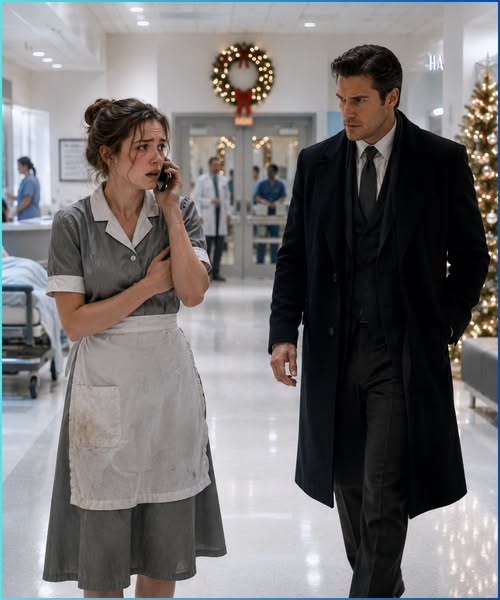
Across the emergency room at St. Brendan's Hospital, a plastic Christmas tree blinked beside a vending machine. Nurses hurried between crowded treatment bays. Somewhere behind a blue curtain, a child was crying.
Maeve sat on the edge of an examination bed, trying not to move her injured left wrist.
A white splint extended from her palm nearly to her elbow. Her cheek was swollen, purple bruising spread beneath one eye, and her winter coat had been torn at the shoulder.
Every breath made her ribs ache.
Still, when the deep voice on the other end of the phone answered, she apologized.
“I'm afraid I may be late tomorrow morning.”
Silence.
“The silverware still needs polishing, and I haven't changed the water in the dining room flowers. I wrote everything down for the morning staff, but—”
“Where are you?”
Maeve stopped speaking.
In three years of working at the Vale mansion, she had never heard Callum Vale interrupt someone quite like that.
Not angrily.
Not impatiently.
Something about his voice sounded different.
“St. Brendan's Hospital, sir.”
Another silence.
“It's nothing serious,” she continued quickly. “Just my wrist. The doctor says I should probably rest, but I can still—”
The line disconnected.
Maeve stared at the phone.
For several seconds, she didn't move.
Then she slowly returned the receiver to the nurse who had lent it to her.
“Everything okay?” the woman asked.
Maeve managed a weak smile.
“I think I've just lost my job.”
The nurse looked at her bruised face.
“Honey, if your boss fires you because you're in the emergency room on Christmas Eve, you need a different boss.”
Maeve almost laughed.
Almost.
Because her employer wasn't an ordinary businessman.
Callum Vale owned shipping companies, waterfront warehouses, construction firms, and more property around Boston Harbor than most people could imagine.
His name appeared in newspapers beside phrases such as private investor, controversial businessman, and alleged organized-crime figure.
But on the streets, people used a simpler description.
The most dangerous man in Boston.
Maeve had worked inside his Beacon Hill mansion for three years.
She had seen powerful men arrive in expensive cars and leave looking frightened. She had witnessed meetings that ended with shattered glasses and men refusing to look one another in the eye.
Yet Callum Vale had never raised his voice at her.
He rarely spoke to her at all.
To him, she was simply Miss Donnelly.
The quiet housemaid who arrived early, worked hard, and disappeared into the background.
At least, that was what Maeve believed.
Twenty minutes after her phone call, the automatic doors of St. Brendan's emergency room opened.
And the atmosphere changed.
A tall man entered wearing a black wool overcoat over a charcoal suit.
His dark hair was slightly disheveled, as though he had left home without bothering to check his reflection.
He had no driver.
No bodyguards.
No men walking ahead to clear his path.
He was completely alone.
Callum Vale crossed the waiting room without looking at anyone.
People recognized him anyway.
A man standing near the vending machines lowered his newspaper.
Two nurses exchanged uneasy glances.
Even the security guard near the entrance straightened unconsciously.
Callum approached the reception desk.
“Maeve Donnelly.”
The nurse behind the counter looked exhausted.
“Are you family?”
“No.”
“Then you'll have to wait until visiting arrangements can be—”
“She's my employee. She called me.”
His voice remained perfectly calm.
The nurse finally looked up.
Recognition crossed her face.
For a moment, neither of them spoke.
Then she checked the patient information displayed on her computer.
“Room six. An officer is taking her statement. You'll need permission before entering.”
Callum nodded once.
He took back the identification card she had requested and walked toward the treatment area.
He did not threaten her.
He did not demand special treatment.
Somehow, that made him more intimidating.
At room six, he stopped.
A curtain separated the treatment area from the corridor.
Behind it, a young police officer was speaking.
“So they took your purse?”
“No,” Maeve answered.
“Your wallet?”
“No.”
“Your phone?”
“No.”
“Jewelry?”
“My mother's ring was still on my hand.”
The officer sounded confused.
“But they emptied your purse onto the road?”
“Yes.”
“And you couldn't identify either man?”
Maeve hesitated.
“No, officer.”
Callum stood perfectly still.
There was something in the hesitation.
He had spent most of his adult life listening to people lie.
He knew the difference between a dishonest answer and a frightened one.
Maeve sounded frightened.
“Did they say anything?” the officer asked.
A long silence followed.
“Miss Donnelly?”
“They asked me a question.”
“What question?”
Maeve's breathing became uneven.
“Something about a room.”
Callum's eyes narrowed.
The officer leaned closer.
“What room?”
Before Maeve could answer, Callum stepped around the curtain.
“Miss Donnelly.”
Her head snapped toward him.
For a moment, she looked so startled that the color seemed to drain from her already pale face.
“Mr. Vale?”
She instinctively tried to stand.
Pain shot through her wrist.
She gasped and caught herself against the edge of the bed.
Callum moved forward immediately.
“Don't.”
One word.
Firm, but not harsh.
Maeve froze.
He looked at her splint.
Then at the swelling beneath her eye.
Then at the torn shoulder of her coat.
His expression did not change dramatically.
There was no shouting.
No violent outburst.
But something behind his eyes became terribly still.
“Who did this to you?”
Maeve lowered her gaze.
“I don't know, sir.”
The police officer stood.
“Are you a relative?”
“Her employer.”
The officer studied him.
Recognition was immediate.
“Mr. Vale.”
Callum barely acknowledged him.
“Has she been examined?”
“Yes. The doctor suspects a sprain and a mild concussion. We're waiting on the final assessment.”
“And the men who attacked her?”
“We're investigating.”
Callum turned back to Maeve.
“Look at me.”
She slowly raised her eyes.
“Did they ask about my house?”
Her lips parted.
The officer glanced between them.
Callum noticed.
Maeve did too.
And suddenly she looked more frightened than she had when he first entered the room.
“I didn't want to cause trouble,” she whispered.
“You're sitting in a hospital with a broken splint wrapping your arm and bruises on your face.”
“It's not broken. They said the X-ray looked clear.”
“Maeve.”
It was the first time he had ever called her by her first name.
She blinked.
He lowered his voice.
“You are not in trouble.”
Something in her expression changed.
Not relief.
Disbelief.
As though those words were so unfamiliar that she didn't know what to do with them.
The officer cleared his throat.
“Mr. Vale, I need to finish taking her statement.”
“Then finish it.”
Callum stepped aside.
But he didn't leave.
The officer consulted his notebook again.
“Miss Donnelly, you said they mentioned a room.”
Maeve swallowed.
“Yes.”
“Which room?”
She glanced at Callum.
He remained silent.
“The room at the end of the west hallway.”
For the first time, Callum's composure fractured.
Only slightly.
A muscle moved near his jaw.
The officer continued.
“What did they say about it?”
Maeve closed her eyes.
She could still remember the sound of footsteps behind her.
The wet pavement.
The cold wind coming off the harbor.
One man grabbing her coat.
The other pushing her against a brick wall.
She remembered their questions more clearly than their faces.
“Did you find it?” one had demanded.
“Find what?” she had cried.
“The red book. The one in Gabriel Vale's room.”
Maeve's eyes filled with tears.
“They kept asking if I'd seen a red book.”
Callum stopped breathing for a moment.
Gabriel Vale.
His younger brother.
Dead for five years.
The officer looked up.
“Who is Gabriel Vale?”
Callum answered without taking his eyes off Maeve.
“My brother.”
“Can we speak with him?”
“That's going to be difficult.”
“Why?”
“He's dead.”
Silence settled over room six.
The officer looked down at his notes.
Maeve stared at her hands.
Callum's mind moved backward through five years of memories he had spent an enormous amount of energy trying to bury.
Gabriel laughing in the library.
Gabriel arguing with him over the family businesses.
Gabriel demanding to know why certain harbor records had disappeared.
And the phone call that had arrived one rainy November night.
There had been a fire at Pier Nine.
By the time Callum reached the warehouse, the building was burning beyond rescue.
Gabriel never came home.
Official investigators had ruled the fire accidental.
Callum had never entirely believed them.
But grief, guilt, and pressure from people he trusted had eventually persuaded him to stop asking questions.
Now someone had attacked his housemaid on Christmas Eve.
And they had been looking for something inside Gabriel's old room.
“Officer,” Callum said, “I want this investigated properly.”
The young man stiffened.
“We take every assault seriously.”
“Good.”
Callum took a folded business card from his pocket.
“My attorney can provide a complete list of household employees and anyone who has had access to that part of the property.”
The officer accepted the card.
“Please don't interfere with the investigation.”
“I have no intention of making your job harder.”
The officer seemed surprised by the answer.
After taking several more details, he stepped outside to speak with a colleague.
Maeve remained motionless.
Callum pulled a chair beside her bed.
He sat.
She looked astonished.
“You don't have to stay, sir.”
“I know.”
“It's Christmas Eve.”
“I noticed.”
“You probably have guests waiting.”
“I sent everyone home.”
Maeve looked down again.
“I'm sorry.”
“Stop apologizing.”
She flinched.
Callum noticed immediately.
His expression softened.
“Please,” he added.
The word seemed almost foreign in his mouth.
For a moment, the only sounds were distant hospital footsteps and a Christmas song playing softly from the reception area.
Then he asked the question that had troubled him since her call.
“Why were you outside so late?”
Maeve twisted the edge of her blanket with her uninjured hand.
“I was taking medicine to Mrs. Kelleher. She lives near the North End. Her grandson usually picks up her prescriptions, but he couldn't come because of the snow.”
“And you went instead?”
“She lives alone.”
Callum looked at the splint.
“Did you leave the mansion when I told everyone to go?”
“Yes, sir. I left shortly after four.”
“Did anyone see you go?”
“I think Mr. Wynn did.”
Marcus Wynn.
Callum's head of security.
A man who had worked for the Vale family for nearly a decade.
“Did you tell him where you were going?”
Maeve nodded.
“He asked why I wasn't heading straight home. I told him about Mrs. Kelleher.”
Callum filed that detail away.
Then Maeve quietly said something unexpected.
“I need to tell you another thing.”
He leaned forward.
“What?”
“Last Thursday, I was changing the flowers in your brother's room.”
Callum didn't speak.
“The bottom drawer of the old writing desk was stuck. I noticed some loose paper behind it when I was cleaning underneath.”
“What kind of paper?”
“An envelope.”
His eyes sharpened.
“Did you open it?”
“No. It was sealed.”
“Where is it?”
“I put it back where I found it. I thought it belonged to the family.”
“Was there anything written on it?”
Maeve nodded slowly.
“Your initials.”
“C.V.?”
“Yes.”
Callum felt an unfamiliar sensation creep through his chest.
Fear.
Not for himself.
For the possibility that Gabriel had left something behind.
Something someone else desperately wanted.
“Why didn't you tell me?”
“I intended to. But you had visitors on Thursday, and then the Christmas preparations began.”
Her voice broke.
“I didn't think it was urgent.”
Callum looked at her bruised face.
“Someone did.”
A nurse entered carrying discharge information and interrupted the conversation.
Maeve's injuries had been treated. The doctor wanted her monitored because of her head injury, but the preliminary assessment showed no fracture.
The nurse reviewed symptoms that would require immediate medical attention and explained that Maeve should not spend the night alone.
Callum listened carefully.
When the nurse left, Maeve reached for her torn coat.
“I can take a cab home.”
“No.”
She looked up.
“Sir?”
“You're not going home alone tonight.”
“Mr. Vale, I really don't want to be a burden.”
Callum stood.
“Maeve, two men attacked you because they believed you knew something about my brother.”
She went pale.
“Whoever sent them may try again.”
He paused.
Then spoke more gently.
“I'm not ordering you. I'm asking you to let me get you somewhere safe.”
Maeve stared at him.
For three years, she had believed Callum Vale barely knew she existed.
Now he was standing in a hospital on Christmas Eve, asking for her trust.
She looked at her injured wrist.
Then at the Christmas lights beyond the curtain.
Finally, she nodded.
“All right.”
Callum picked up her damaged coat.
Before they left, his phone vibrated.
A message appeared from Marcus Wynn.
Sir, I heard Miss Donnelly had an accident. Should I send a vehicle?
Callum stared at the screen.
He had not told Marcus about the hospital.
He had not contacted anyone in his household.
And Maeve had called his private number directly.
Callum slowly slipped the phone back into his pocket.
He helped Maeve toward the corridor, careful not to touch her injured arm.
But as they reached the emergency-room doors, he understood something terrible.
Someone inside his own organization already knew where she was.
And whoever that person was, they were watching much more closely than he had imagined.
Christmas Eve had just become a very dangerous night. -

Chapter 7: The Big Stage
The dressing room smelled faintly of roses and warm light, and for a long time Mara simply sat in front of the mirror and looked at herself without quite believing the reflection. The woman looking back at her wore a deep blue dress that caught the light every time she moved, her hair falling in soft waves around her shoulders. The tattoos on her face, the ones so many people had stared at and whispered about over the years, were still there, untouched by makeup. No one had asked her to cover them or to be smaller, quieter, or different. That, more than the dress or the lights, told her that tonight was real.
Outside, the theater hummed like a living thing: thousands of voices settling into seats, the rustle of programs, the swell of music from the orchestra as it tuned. For twenty years she had imagined this sound in empty bars after closing time, in kitchens where she washed dishes to pay rent, and in audition rooms where a panel looked at her for ten seconds and then looked away. She had imagined it so often that she had almost stopped believing it could belong to her. Tonight it did.
A soft knock came at the door, and then it opened just enough for her mother to step inside.
Anna stood in the doorway in a simple dark green dress, her hair pinned back, her hands folded in front of her. She was not in a wheelchair. She had walked down the corridor herself, slowly and carefully, holding the rail at first and then letting go, because she had wanted to come to her daughter on her own two feet. Mara rose so fast that her chair scraped against the floor, and for a moment neither of them said anything at all.
"You look beautiful," Anna said, and her voice trembled only a little.
Mara laughed, and the laugh turned halfway into a sob before she could stop it. "So do you, Mom. You look… you look strong."
Anna crossed the room and took Mara's hands in hers. Her hands were thinner than they had been before the illness, but they were warm, and her grip was steady. "I am here," she said. "That is all that matters tonight. I am going to watch my daughter sing on the big stage she always dreamed of."
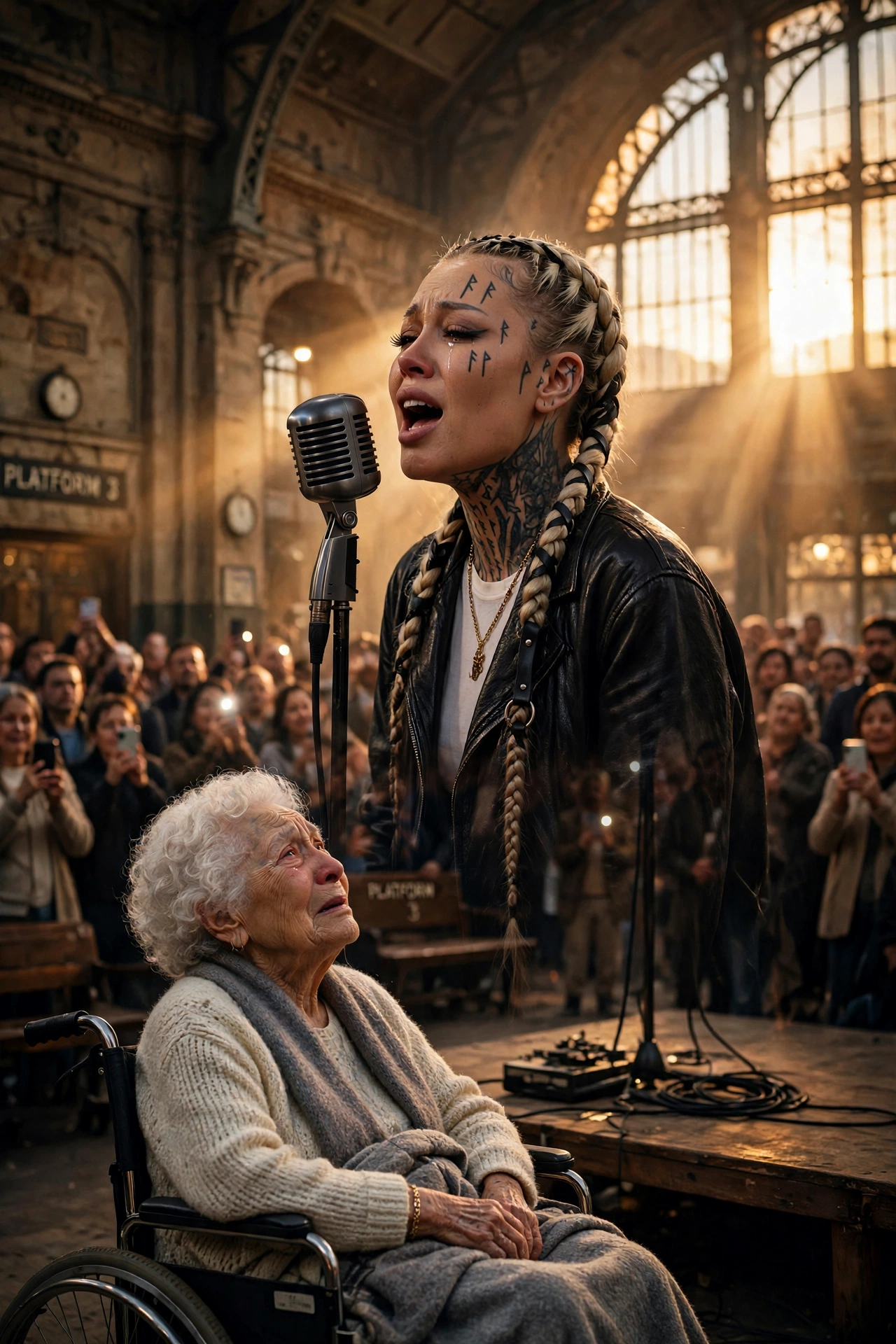
Mara pressed her forehead gently against her mother's, just as she had done that night at the old train station, and closed her eyes. She remembered that night with a clarity that still made her chest ache: the cold air, the worn wooden platform, and her mother in the front row in a wheelchair, crying quietly while Mara sang the song she had written at eighteen. She remembered stepping down, kneeling before the wheelchair, and holding her mother's hands. She had not known that someone was filming. She had only been singing for her mother.
That video had changed everything. It had traveled across the country overnight, and by morning a producer had called. The contract that followed had felt like a dream, but it had been real, and the money from it had been real too. It had paid for the surgery, the long weeks of treatment, and the quiet room where Anna had learned, step by step, to stand again. Mara had sat beside that hospital bed night after night, holding the same hands she was holding now, whispering the same promise: we will get through this, and one day you will walk into my concert on your own feet.
Now that day had come.
A stage manager knocked and said softly, "Five minutes, Mara."
Anna squeezed her hands once more. "Go," she said. "They are waiting for you."
"I will look for you," Mara said. "I will find you in the crowd."
"I will be right there," Anna answered, smiling through tears that she did not try to hide. "I have always been right there."
Mara walked with the stage manager down a narrow corridor toward the wings, and with every step the sound of the audience grew louder. Someone whispered, "Good luck," and she whispered, "Thank you," back, because she had learned, after all those years of being dismissed, never to take kindness lightly. Then she stood in the wings, in the dark just beyond the curtain, and waited for her cue.
The lights went down, and the audience fell into a hush so complete that Mara could hear her own breathing. The orchestra began to play, low and slow, and the curtain rose like a slow breath being let out. Light poured across the stage, warm and golden, and for a heartbeat Mara could see nothing but brightness. Then her eyes adjusted, and she saw them: row after row of faces, thousands of people, filling the theater from the orchestra seats to the highest balcony. Some were already wiping their eyes, and she had not sung a single note yet.
She walked to the center of the stage, and the applause rose around her like a wave, loud and long and full of warmth, carrying her forward until she stood at the microphone. She took a breath, closed her eyes for just a second, and thought of all the rooms where she had sung before: the bars where only three people listened, the street corners where rain soaked her shoes, the audition rooms where she was told she did not fit. She thought of every no, every laugh, and every night she had come home exhausted to find a bowl of hot soup waiting for her on the kitchen table, left there silently by a mother who never once told her to give up.
She opened her eyes and looked out at the audience, and then she found her mother.
Anna stood in a reserved place just below the stage, close enough that Mara could see her face clearly. She was standing, not sitting, her shoulders straight, her hands clasped together in front of her chest. Her eyes were bright with tears, and her smile was wide and trembling and proud, the smile of a mother watching the dream she had quietly believed in for twenty years finally come true. Mara felt her own tears rise, but she did not look away. She held her mother's gaze, and she nodded, just once, as if to say: this is for you.
The orchestra softened, and Mara began to sing.
She sang the song she had written for her mother at eighteen, the same song she had sung at the old train station, but tonight it sounded different. It sounded fuller, carried by the orchestra and by the great open space of the theater, and yet at its heart it was still the same simple song: a song about a girl who wanted to sing, and a mother who never stopped believing, even when no one else did. Her voice was steady at first, then it swelled, filling every corner of the hall, and when she reached the chorus, the audience leaned forward as one, as if they were holding their breath with her.
She sang about the nights she had come home tired, and the soup waiting on the table, and the old flyers her mother had kept in a drawer from every small show Mara had ever played. As she sang, she saw Anna press a hand to her heart, tears running freely down her mother's cheeks, and she knew that every word was landing exactly where it belonged.
Halfway through the song, the audience began to sway gently, and here and there, people began to sing along softly to the chorus they had learned from the video that had gone viral. It was like a hum beneath her voice, a thousand strangers joining a song that had once belonged only to a mother and a daughter. Mara's voice caught for a moment, and she laughed softly into the microphone, and the audience laughed with her, warmly, and then she sang on, stronger than before.
When she reached the final verse, her voice dropped to something quiet and tender. She sang the last lines directly to her mother, her eyes never leaving Anna's face, and when the final note faded, she held it for a heartbeat longer than the music.
For a second there was silence. Then the theater erupted.
The applause was thunderous, a roar that seemed to shake the floor beneath her feet. People rose to their feet in waves until every person in the theater was standing. Flowers flew onto the stage, roses and lilies landing softly at her feet. Mara stood in the center of it all, her hands pressed to her mouth, tears streaming down her face, overwhelmed by a sound she had waited twenty years to hear.
She bowed, and bowed again, and when she straightened, she looked down at her mother once more. Anna was clapping with all her strength, laughing and crying at the same time, her face shining with pride. Mara stepped to the edge of the stage, knelt down just as she had at the train station, and reached out her hand. Anna took it, and for a moment, in front of thousands of people, they were simply mother and daughter again, hands held tight, exactly as they had always been.
"Mom," Mara said into the microphone, her voice shaking but clear, "this stage is mine tonight, but this song has always been yours. You never told me to stop dreaming. You never told me I was too much, or too different, or too late. You just kept the soup warm, and you kept believing, and you kept loving me through every failure. So this is for you, and it always will be."
The audience cheered again, louder than before, and Anna nodded, unable to speak, her smile breaking through her tears. Mara blew her a kiss, and Anna caught it with both hands and pressed it to her heart.
The rest of the concert passed like a dream made of light and music. Mara sang other songs, songs of hope and home and starting again, and the audience stayed with her for every one. She sang with a freedom she had never felt before, because she no longer sang to prove herself to anyone. She sang because she loved it, and because the person who had loved her voice first was standing below the stage, alive and well, listening with proud eyes.
When the final song ended and the lights came up, the applause went on and on, and Mara took one last bow, her dress catching the light, her heart so full it felt as if it might spill over. She waved to every corner of the theater, and then she walked offstage into the wings, where her mother was waiting for her.
Anna was there, her arms open, and Mara ran to her and held her close. They stood like that for a long time, neither of them speaking, while the sound of applause still rolled faintly through the walls behind them. Anna stroked Mara's hair the way she had when Mara was a little girl, and Mara rested her head on her mother's shoulder and breathed in the familiar, comforting scent of home.
"You did it," Anna whispered at last. "My girl, you did it."
"We did it," Mara whispered back. "I could never have done it without you."
Later, after the flowers had been gathered and the stage lights dimmed, mother and daughter walked out of the theater together, arm in arm, into a night filled with soft air and city lights. Fans waited outside, calling Mara's name, and she stopped to sign and thank them, with Anna standing proudly beside her. A young girl in the crowd looked up at her with wide eyes and said, "I want to sing too," and Mara knelt down and said, "Then never stop. Someone believes in you, even on the nights you cannot see it."
As they walked home together beneath the streetlights, Anna's steps were slow but steady, and Mara matched her pace without hurry, because there was nowhere else she needed to be. The future stretched ahead of them, bright and open: more concerts, more songs, and more quiet evenings together, sharing soup at the kitchen table like they always had. Anna's treatment had worked, her strength was returning a little more each week, and the doctors had smiled when they told her she could live her life fully again. There would be checkups and care, but there would also be laughter, travel, and front-row seats at every concert Mara ever gave.
That night, when they reached home, Anna put a pot of soup on the stove, just as she had done for so many years, and Mara sat at the kitchen table and watched her mother move about the kitchen, alive and smiling and free. Mara thought of the girl she had once been, singing alone in her bedroom, dreaming of a stage she feared she would never reach. That girl would not believe tonight if she saw it: the big stage, the bright lights, the full audience, and her mother standing below it all, no wheelchair, proud tears in her eyes.
But Mara believed it now, because she had lived it, and because the woman standing in her kitchen was proof that love, held quietly and faithfully for twenty years, could carry a person all the way home. She had found her stage, she had found her voice, and she had never lost the one person who had believed in her from the very beginning. That, more than any applause, was the happy ending she had always dreamed of. -
Chapter 6: The Price of a Life
The money arrived the way Mara had always imagined money would arrive in other people's lives: quietly, and all at once, in numbers that did not look real on a screen.
She sat at the kitchen table in the apartment above the laundromat, the contract spread out beside her laptop, and read the figure three times. It was the advance from the producer, the first payment for the big stage, for the recordings, for the tour that still felt like a story about someone else. Her hands were shaking. Not from excitement. From the sudden, terrifying realization that for the first time in twenty years, the thing standing between her mother and treatment was gone.
Anna was asleep in the next room, in the hospital bed they had rented months ago, the one with the crank handle and the thin mattress that Mara had covered with three blankets to make it softer. The apartment smelled faintly of soup and medicine. Outside, a bus hissed past on the wet street. Mara put her hand over her mouth and cried without making a sound, because she did not want to wake her mother, and because she had spent so many years learning how to cry quietly in rooms where no one was listening.
In the morning, she told Anna first, before she told anyone else. She sat on the edge of the bed and took her mother's hand, the hand that had always been warm and steady and was now thinner than Mara remembered, the skin papery over the bones.
"Mama," she said, "we can do it. The surgery. The treatment. All of it. We can pay."
Anna looked at her for a long time. Her eyes filled, but she did not ask how much it would cost, or whether Mara was sure, or whether the money was really theirs to spend. She only squeezed Mara's fingers and whispered, "My girl."
That was all. That was everything.
The hospital was not the small county clinic where they had first heard the diagnosis, the place with the flickering fluorescent lights and the doctor who had spoken gently and then handed them a pamphlet about payment plans. This was the hospital the specialist had named in the same breath as the word "if." If they could get her in. If they could afford the surgery. If they could keep her there for the months of treatment that followed.
Now they could.
Mara signed the papers with a pen that kept slipping in her damp palm. She read every line twice, the way Anna had taught her to read anything important, slowly, out loud in her head. Surgery. Anesthesia. A team of specialists. Weeks in the hospital after, then months of medicine and therapy. She did not flinch at the numbers anymore. She had spent too many nights doing the arithmetic of what they could not afford. Now the arithmetic was different. Now the numbers meant something else: a chance.
The night before the surgery, Mara did not go to rehearsal. The producer's assistant called twice, polite and then less polite, and Mara let both calls go to voicemail. She sat beside Anna's hospital bed in the quiet room on the fourth floor, where the city lights came in through the blinds in thin gold stripes, and she sang very softly, the way she used to sing when she was a girl and Anna would sit on the edge of her bed listening.
It was not a performance. Her voice was low and a little rough from the day. She sang the song she had written at eighteen, the one from the train station, the one the whole world now knew, but she sang it slower, like a lullaby, and when she reached the chorus Anna's eyes closed and her breathing eased, and Mara kept singing until her mother's hand relaxed in hers.
"Mama," Mara whispered, when the song was done, "tomorrow is going to be hard. But I will be right here when you wake up. I promise."
Anna opened her eyes. "I know," she said. "You always are."
The surgery took seven hours. Mara counted every one of them in the waiting room, in a chair that was too hard and too low, with a paper cup of coffee gone cold in her hands. She counted the minutes on the clock above the nurses' station and the tiles on the floor, and tried not to read anything into the faces of the people hurrying past in scrubs.
At noon, a nurse came out and said the surgery was going well, and Mara nodded and thanked her and then sat back down and cried into her hands for exactly thirty seconds, because she had promised herself she would not fall apart in the waiting room, and then she wiped her face and waited some more.
At three o'clock, the surgeon came out. He was a tall man with tired eyes and a calm voice, and he pulled a chair close and sat down so that he was looking at Mara at eye level, not down at her, and he said the words she had been holding her breath for all day.
"The surgery was successful. We removed the tumor. The margins are clear."
Mara did not understand all the medical words that followed. She understood enough. The thing that had been growing inside her mother, the thing that had made Anna tired and thin and afraid in a way she never said out loud, was gone. Taken out. The disease had not won that round.
"And now?" Mara asked.
"Now she rests," the surgeon said. "Then the medicine. Then time. It will be slow. But today went as well as it could have gone."
Mara went into the recovery room and stood beside Anna's bed, the monitors beeping softly, and thought of all the nights Anna had sat up waiting for her to come home from the bars, all the nights Anna had left soup on the stove and pretended she had not been worried, all the years of silent support Mara had only fully understood when the train-station video went around the world.
"Mama," she whispered, "you did it. You're still here."
Anna did not wake up until evening. When she did, her eyes fluttered open, unfocused at first, and then found Mara's face, and the smallest smile moved across her lips.
"Hey," Mara said, and her voice broke on the word. "Hey, Mama. I'm here."
Anna's fingers moved, weak, against the blanket. Mara took her hand and held it, gently, the way you hold something precious and breakable, and Anna squeezed back, so faintly that Mara almost missed it, and Mara laughed through her tears, because that faint squeeze was the most important thing that had happened all day.
The days after the surgery were measured not in hours but in small victories. The first time Anna sat up in bed without help, her face going white with the effort and then pink again with pride. The first time she kept down a full bowl of broth. The first time she asked for her own clothes instead of the hospital gown, because she was tired of feeling like a patient and wanted, for an hour, to feel like herself.
Mara was there for all of it, between rehearsals. In one world, she stood on a stage in a rehearsal hall downtown, under bright lights, learning where to stand and when to breathe. In the other, she sat beside a hospital bed, holding a cup of water with a straw to her mother's lips. She sang so that she could pay for this room, for these nurses, for this medicine. And she came back to this room so that she would remember why she was singing at all.
The medicine was hard. Mara had not expected that part to be so hard, after the surgery had gone well. But Anna fought it the way she had fought everything in her life: without complaint, with a stubbornness that made the nurses smile. There were days when Anna was too sick to sit up and could only lie still with a cool cloth on her forehead while Mara read to her in a low voice. There were nights when Mara slept in the chair beside the bed, waking every hour to check that her mother was still breathing easily.
And then, slowly, there were better days. The doctors began to use a word Mara had been afraid to hope for. Receding. The scans showed it, visit after visit, the shadows shrinking. The surgeon showed Mara the latest scan and pointed to the places where the darkness had been, and where it was no longer.
"She is responding beautifully," he said. "Better than we dared to expect."
Mara cried in the corridor, not caring who saw. A nurse passing by squeezed her shoulder and kept walking.
Recovery is not a single moment. It is a staircase, and every step counts.
The first step was sitting up on the edge of the bed, legs dangling, with a nurse on one side and Mara on the other, Anna gripping both their hands until her knuckles went white, her breath coming short and fast, and then the grin that broke across her face when she stayed upright for a full minute.
"Look at me," Anna said, breathless and laughing. "Look at me, Mara. I'm sitting."
"I see you, Mama," Mara said. "I see you."
The next step was standing. That took a week of trying. The physical therapist was a woman named Rosa with strong hands and an encouraging voice, and she taught Anna to plant her feet, to hold the walker, to trust her legs again after months in a wheelchair and weeks in a bed. The first time Anna stood, she swayed, and Mara was there, an arm around her waist, steadying her, and Anna leaned into her daughter and whispered, "Don't let go."
"I won't," Mara said. "I've got you. I've always got you."
They stood there for a long time in the afternoon light, and Mara thought about how many times Anna had been the one holding her up, and how strange and how right it felt to be the one doing the holding now.
After standing came walking. Three steps to the door, then back. Five steps to the window. Ten steps down the corridor, with Rosa walking backward in front of her, calling out encouragement, and Mara beside her, ready to catch her, and Anna laughing at the whole slow wonderful business of learning to walk again.
"Slow down, Mama," Mara teased one afternoon, when Anna insisted on one more length of the corridor. "You're showing off."
"I've got a concert to get to," Anna said, and winked, and Mara's heart nearly stopped, because Anna had said it lightly, as a joke, but Mara knew it was not only a joke. It was a promise Anna was making to herself, and Mara would hold her to it.
The weeks turned into months. The hospital room gave way to a small apartment near the rehearsal hall, where Anna could recover in a place that smelled like home instead of disinfectant. Mara cooked the soups now, the way Anna had cooked them for her, and left them on the stove for Anna to find, and Anna pretended not to notice.
Anna's hair grew back soft and short. Color came back to her cheeks. She began to walk without the walker, first around the apartment, holding on to furniture, then down the hallway, then, one bright morning, all the way to the corner shop and back, with Mara beside her, not holding her, just walking, like two people out for an ordinary morning, which was the most extraordinary thing in the world.
"I did it," Anna said at the front door, a little out of breath, a little triumphant. "I walked to the shop, Mara. By myself."
"You did," Mara said, and hugged her mother so hard that Anna laughed and told her to stop, she was squashing her, and Mara laughed too, and they stood there in the doorway, mother and daughter, both of them crying and laughing at the same time.
The day the doctor said Anna was strong enough to attend a concert, Mara was in the middle of a rehearsal, standing on a taped mark on the stage floor, when her phone lit up. She stepped off the mark, ignoring the producer's frown, and read the message twice.
She called Anna from the wings, her heart hammering. "Mama? Did you hear? The doctor said yes."
"I heard," Anna said, and her voice was full of tears and laughter at once. "He said I'm strong enough. He said I can come."
Mara closed her eyes. She pictured the stage, the lights, the thousands of faces she had not yet sung for. And she pictured one face below them, in the front, where it belonged. Not in a wheelchair. Standing. Smiling. Proud.
"Then you will come," Mara said. "You will be there, Mama. I want you there more than anything."
That night, Mara went home and found Anna standing at the window, looking out at the city lights, her back straight. She did not turn around. She just said, very quietly, "I never doubted you, Mara. Not once. Not in twenty years. I just waited for the world to catch up."
Mara stood beside her at the window and took her mother's hand, and they stood there together, both of them whole, both of them still here, and the future looked less like something to survive and more like something to step into, together, on two steady pairs of feet. -
Chapter 5: Overnight
Mara woke to a sound she did not recognize at first. It was her phone, buzzing against the nightstand, again and again, like something small and frantic trying to get out of a box. She reached for it with her eyes still closed, expecting the usual: a bar owner cancelling a shift, a bill reminder, a message from one of the few friends who still checked on her. Instead the screen was full of numbers she could not make sense of before coffee, notifications stacked on top of notifications, names she had never seen, and a video thumbnail showing her own face in the lamplight of the old train station.
For a long moment she simply stared at it. The night before came back to her in pieces, warm and unreal: the cold air in the station, the smell of rain and old iron, her mother in the front row in her wheelchair, wrapped in the blue coat Mara had bought on sale three winters ago. Mara had sung the song she wrote when she was eighteen, the one she had never dared to sing for anyone except her mother. She remembered stepping down from the low platform at the end, kneeling in front of the wheelchair, taking her mother's hands, and pressing her forehead to her mother's forehead while the last note faded. She remembered Anna crying, quietly, the way she always cried when she was proud, as if she were trying not to make a sound and failing.
Someone had filmed it. Someone had posted it. And while Mara slept, the world had found it.
She sat up slowly, her heart beating too hard, and opened the first notification. The video had been watched more than a million times. She blinked, scrolled, and the number changed while she watched, climbing as if it were alive. Comments poured in faster than she could read them: people saying they had cried on a train, in a kitchen, in a car parked outside a hospital. People tagging their mothers, and writing that they had just picked up the phone after years of silence.
Mara put the phone face down on the blanket and pressed both hands over her face. After twenty years, this was the feeling she had stopped allowing herself to imagine. Not the applause, exactly. The being heard. She had auditioned in rooms where judges looked at their phones while she sang. She had been told she was too old, too rough, too tattooed, too much of a night person to be trusted on a respectable stage. She had sung in bars where men talked over her and women laughed at the ink on her cheekbone, a small blackbird she had gotten at nineteen because she wanted something beautiful that could not be taken away. She had learned to smile through it, to pack up her guitar, to walk home in the dark and tell herself that tomorrow was another night, another room, another chance to be ignored a little more politely.
Now her phone would not stop buzzing, and she did not know whether to laugh or cry, so she did a little of both, sitting on the edge of her narrow bed in her mother's small apartment, in the gray morning light.
"Mara?" Anna's voice came from the kitchen, thin but steady. "Are you awake, love?"
Mara wiped her face with her sleeve, pulled on a sweater, and went to find her. Anna was at the table by the window, a bowl of soup steaming in front of her, although it was barely morning. She always made soup when Mara came home late, and she always left it covered on the stove, as if pretending she had not stayed up waiting. This morning she had made it early, and she was watching Mara with eyes that already knew something had changed.
"You saw it," Mara said.
Anna nodded, and her smile trembled. "A neighbor showed me on her phone. She knocked on the door an hour ago, very excited. She said, 'Anna, your daughter is on everyone's phone.' I did not understand at first. Then I watched it. I watched you sing my song."
"It was always your song," Mara said, and her voice broke. She sat down across from her mother and took her hands, careful of the thinness of them, careful of the illness that had been quietly taking pieces of her mother away for months. "I wrote it for you when I was eighteen. I just never knew how to give it to you properly."
"You gave it to me last night," Anna said. "In front of everyone. That was proper enough."
They ate the soup in silence for a while, the way they always did when words felt too big. Mara's phone buzzed on the table between them, and Anna glanced at it, then back at Mara, with a look that was almost mischievous.
"Answer it, love. It might be important."
It was not important. It was a local radio host asking for an interview. Then a music blogger. Then a television producer from a morning show, asking if Mara could come in and sing the song live. Then a woman from a charity who wanted Mara to sing at a fundraiser for families facing illness. Mara answered each call with the same stunned politeness, the same sentence repeated until it started to sound like someone else's voice: "Thank you. I don't quite believe this yet. Yes, my mother is the reason I sang it."
By noon, the numbers had passed five million views. A newspaper ran a short piece online with a photograph taken from the station, Mara kneeling before the wheelchair, both lit by a single hanging lamp. The headline called her "the voice from the station." A famous singer Mara had admired since she was a girl shared the video with three words: "This is real." Mara read that one three times and had to sit down.
That evening, when the light went amber over the rooftops and the phone finally quieted for a few minutes, a call came from a number Mara did not recognize, with a city code she associated with big offices and bigger stages. She almost let it go to voicemail. Something, perhaps the steadiness in her mother's eyes from across the room, made her answer.
"Is this Mara?" a woman's voice asked, warm and professional, unhurried. "My name is Elena Vasquez. I produce live concerts. I saw the video from the station last night, and I have watched it more times than I will admit. I would like to talk to you about singing on a big stage. A real one. With a real audience, a real band, and a real contract."
Mara's first instinct was to laugh, because after twenty years of closed doors, an open one felt like a trick. Her second instinct was to look at her mother. Anna was watching her, and in her face there was no surprise at all, only a quiet certainty, as if she had been waiting twenty years for someone else to finally hear what she had always heard in her daughter's voice.
"I'm listening," Mara said, and her hand was shaking so badly she had to hold the phone with both hands.
Elena did not rush her. She talked about a concert hall in the city, a stage Mara had walked past a hundred times and never dared to enter except as a cleaner, years ago, when she took any work she could find between bar shifts. She talked about an evening dedicated to songs about family, about a full band, about proper sound and lighting, about an audience of thousands. She talked about money, plainly and without embarrassment: a fee for the performance, a recording agreement, and the possibility of more concerts after that, if Mara wanted them. She did not promise fame. She promised work, respect, and a stage that would not talk over her.
"I need to think," Mara said, although her heart was already racing ahead of her. "And I need to read anything before I sign it. I've learned that much."
"Of course," Elena said, and Mara liked her instantly for not arguing. "I will send you the contract tonight. Take your time. Have someone you trust look at it with you. And Mara, one more thing. We saw the whole video, not just the singing. We saw you kneel down for your mother. That is the kind of artist we want to work with."
After the call, Mara sat very still. Anna wheeled herself closer and put a hand on her daughter's arm.
"Well?" she asked.
"She wants me to sing on a big stage," Mara said, and the words sounded impossible even as she said them. "A real contract. Real money."
Anna's eyes filled, but she smiled. "Then you will sing, love. And you will sing beautifully, the way you always have."
"But what about you?" Mara said, and this was the part she could not get past, the part that had been sitting underneath every happy thought all day. "The treatment, Mama. The doctors said it costs so much. I have been saving coins in a jar, and it is not enough, not even close. If I do this, the first thing I want, the only thing I want, is to pay for your treatment. Not a dress. Not a car. Your treatment."
Anna shook her head gently. "Mara, do not put that weight on a song. Sing because you love to sing."
"I am putting it on the song because the song is mine," Mara said, fiercely, the way she had not spoken to her mother in years. "You have watched my videos every night. You have kept every flyer, even the ones from bars that closed. You have left soup for me when I came home exhausted and too proud to say I was hungry. You never once told me to stop dreaming, even when everyone else did. Let me do this one thing for you. Let the money go to the doctors, so you can get better."
Anna did not argue further. She simply took Mara's hand and held it, and they stayed like that until the soup went cold and the evening light went out of the window.
The contract arrived that night by email, long and formal. She printed it at a copy shop the next morning and sat at the kitchen table with a pen, reading every page slowly, twice. She checked the fee, the number of performances, the rights to her song, and the recording terms. A legal aid lawyer a friend recommended explained the difficult paragraphs in plain language and told her, honestly, that the contract was fair and the producer reputable. He advised only that the payment schedule be clear, so she would not wait months for money she needed now. Elena agreed without hesitation to a clear schedule and an advance payment. That was the moment Mara allowed herself to believe it: a powerful producer saying yes to a small, reasonable request from a woman who had spent twenty years being told no.
She signed the contract at the kitchen table, with her mother beside her, on a rainy afternoon two days after the station video. Her hand shook on the signature line, and she had to steady it with her other hand, but the letters came out clear: Mara. Anna watched every stroke, and when it was done, she clapped once, softly, as if she were in the front row of a concert hall already.
Then the preparations began, all at once. Elena sent a schedule, a rehearsal plan, and a list of musicians who wanted to play with her. A vocal coach called and talked about breathing, about saving her voice for the big room, about singing the station song the same way she had sung it in the cold air, without polishing the feeling out of it. A stylist asked, gently, whether Mara wanted to cover the tattoos on her face for the stage, and Mara said no, without apology, because the blackbird on her cheekbone had sung with her through every rejection, and it was going to sing on the big stage too.
Mara practiced in the apartment, in the mornings, while Anna listened from the next room, the way she had listened to Mara's videos every night for years. Only now she did not have to watch a screen. She could hear the real voice through the wall, growing stronger, surer, ready. In the evenings, Mara sat with her mother and talked about practical things: the hospital, the doctors, the treatment plan they would finally be able to afford, the future that had seemed closed a week ago and now stood open like a door. She did not yet know how the treatment would go, and she did not pretend to. She knew only that the contract was signed, the stage was waiting, and for the first time in twenty years, her dream and her mother's life were moving in the same direction.
That night, before bed, Mara opened her phone one last time. The video had passed ten million views. She looked at the thumbnail, at herself kneeling before the wheelchair, at her mother's face lit by lamplight, and she whispered, "Thank you," to no one in particular, to everyone, to the stranger who had filmed it, to the mother who had believed in her before anyone else did. Then she put the phone down, and went to sleep, and dreamed, for the first time in years, not of audition rooms and closed doors, but of a big stage, bright and waiting, with her mother standing below it, smiling through tears. -
Chapter 4: The Song at the Station
The old train station had not been a station for a long time, not really. The trains still passed through on the far tracks, late and loud, but the grand hall in the middle belonged now to other things: a farmers' market on Saturdays, a wedding now and then, and on nights like this, a small stage put together from borrowed planks and black curtains, lit by strings of warm bulbs that swayed whenever a door opened. Mara had sung in worse places. She had sung in bars where the beer taps hissed louder than the applause, in rooms where people talked straight through her choruses, in a diner where the owner paid her in pie. But she had never sung here, under this high vaulted roof, where every note seemed to rise and then come back to her, changed, as if the building itself were listening.
She arrived early, carrying her guitar case in one hand and a small bag in the other. The air inside smelled of old iron and rain. Outside, October had turned cold, and the wind pushed dead leaves along the platform. Inside, the bulbs glowed amber against the dark steel ribs of the ceiling, and the polished concrete floor reflected them in long, trembling lines. Someone had set out rows of folding chairs, more than Mara had expected. A few people were already there, unwinding scarves, holding paper cups of coffee, talking in low voices.
She set her case down behind the curtain and took out the guitar. It was the same guitar she had owned since she was seventeen, its wood worn smooth where her forearm rested, a thin crack near the neck that she had learned to play around. She tuned it slowly, letting each string settle. Her hands were steady, which surprised her. All day her hands had shaken. All day she had told herself she would not do this song. She had told herself it was too private, too old, too unfinished. She had written it at eighteen, in a bedroom with posters peeling off the walls, on a night when her mother had come home late from a double shift and fallen asleep at the kitchen table with her coat still on. Mara had watched her sleep and written the words in a notebook, not because she thought anyone would ever hear them, but because she did not know what else to do with the feeling in her chest.
Twenty years had passed since then. Twenty years of auditions in rooms with fluorescent lights and tired judges who looked at her tattoos before they listened to her voice. Twenty years of being told she was too much, too loud, too rough around the edges, or simply not what they were looking for. Twenty years of singing at night in bars while people she had gone to school with built steadier lives, and of hearing, in the spaces between songs, the quiet judgment that followed her home. What she had not learned was how to stop wanting it: the big stage, the lights, the moment when a room full of strangers went quiet because of something she had made.
Her mother had never once told her to stop. Anna had never criticized the late nights, the bars, the tattoos that curled like dark vines along Mara's jaw and down her neck. Anna had never said the words other people said so easily, that singing was not a real life, that Mara should have chosen something safer. Instead, Anna had done quieter things. She kept the old flyers from Mara's earliest shows, folded carefully into a drawer. She watched Mara's performance videos every night on her phone, the volume low, long after Mara had gone to bed. When Mara came home exhausted, her throat raw and her feet aching, there was always hot soup waiting on the stove, covered with a lid, still warm. Mara ate it standing up in the kitchen, half asleep, and rarely thought to ask why her mother was still awake. She did not know, not fully, how proud Anna was. She knew her mother loved her. She did not know that Anna carried that pride like a lamp, every day, even on the days when the world gave Mara nothing back.
Now Anna was sick. The word the doctors used was malignant, and it sat in Mara's mind like a stone. Treatment existed, but it cost more money than Mara had ever held in her hands at one time. Still, the gap between what she had and what her mother needed felt like a distance she could not cross. That was why tonight mattered, though no one in the room knew it. Tonight was not an audition. There was no judge, no contract waiting in the wings. There was only a small stage, a crowd, and a song Mara had carried for twenty years without ever singing it for the person it was written for.
Anna arrived just before the show began. Mara saw her from behind the curtain, and her breath caught. Her mother was in a wheelchair, pushed gently by a nurse from the care center, a blanket folded over her knees. Anna looked smaller than Mara remembered, her hair thinner, her face pale under the warm lights, but her eyes were bright and alert, moving across the hall as if she were memorizing it. She wore a soft blue scarf that Mara had given her years ago, and she held a small tissue in one hand, already crumpled. The nurse settled the wheelchair in the front row, right in the center, where Anna could see the stage without anything in the way. Anna looked up, found Mara behind the curtain, and smiled. It was a small smile, tired and full of something Mara could not name, and it undid her more completely than any rejection ever had.
The lights dimmed, or as close to dimmed as the string bulbs allowed. Mara stepped onto the stage, and the wooden planks creaked under her boots. She looked out at the crowd and saw what she had not expected to see: not just the regulars, not just a handful of friends, but a real audience, phones raised, faces turned toward the stage. The vaulted roof arched above them all, and the bulbs swayed almost imperceptibly, casting moving light across faces. Mara's heart beat so hard she was sure the microphone would pick it up.
She did not introduce the song the way she usually introduced songs, with a joke or a story to loosen the room. She simply sat on the stool, settled the guitar against her body, and looked at her mother in the front row. Anna was watching her, hands folded in her lap, the blanket neat over her knees, tears already shining in her eyes though Mara had not sung a single note. Then she remembered the kitchen, the sleeping woman in the coat, the notebook open on the table, and she let her fingers find the first chords.
The song began quietly, almost like a confession. It was about a girl who watched her mother work until her hands shook, who learned to be brave by watching someone else be tired and keep going anyway. It was about coming home late and finding the light still on, about soup on the stove and a voice that never once said give up. Mara had written it in the plain language of an eighteen-year-old, and she had been almost embarrassed by its plainness for years. Tonight, under the high roof, the plain words sounded different. They sounded true. Her voice, rough from years of smoky rooms, carried the melody gently at first, then stronger, as if the song itself were remembering why it had been written.
Halfway through the first verse, her voice broke. It was not a performance break, not a trick she had practiced. It was the real thing, a crack that ran through a word and left her breathless for a second. She felt heat rise in her face, and for an instant the old fear returned, the fear of being laughed at, of being judged for showing too much feeling. But no one laughed. The room stayed still. A woman in the second row pressed her hand to her mouth. A young man lowered his phone, then raised it again, his eyes wet. In the front row, Anna was crying openly now, the tissue pressed to her cheek, her shoulders shaking quietly under the blue scarf. She did not look away. She looked at Mara as if Mara were the only person in the hall, as if she had been waiting twenty years to hear this song and had known, somehow, that it was hers.
Mara kept singing. The chorus came, and her voice steadied, growing fuller, filling the vaulted space. The words were about gratitude, about a debt that could never be repaid with money or fame, only with love returned in kind. She sang about the nights her mother stayed awake, about the flyers kept in a drawer, about the small, stubborn faith of a woman who believed in her daughter when no one else did. The guitar rang clear beneath her voice, and somewhere far off a train passed and faded.
By the final verse, Mara was crying too, though she kept her voice on the melody, kept her fingers moving. The last lines were the simplest in the song, and the hardest to sing: a promise to stay, to sing, to come home, no matter what the world said. She sang them looking straight at Anna, and Anna nodded through her tears, her lips moving silently, as if she were answering. When the last chord faded, Mara did not move. Her hands rested on the guitar. The hall held its breath. The silence that followed was not empty. It was full, thick with feeling, the kind of silence that comes after something true has been said aloud. Mara could hear her own breathing, and the faint hum of the bulbs, and somewhere in the back, a small, choked sob.
Then she did something she had not planned. She set the guitar down carefully on the stool, stepped to the edge of the stage, and climbed down. The crowd parted slightly, surprised, but no one spoke. She walked the short distance to the front row, her boots quiet on the concrete, and knelt before the wheelchair. The floor was cold through her jeans. She took Anna's hands in hers, both of them, and held them the way she had held them as a child, when her mother's hands had seemed large enough to hold the whole world. Anna's hands were thinner now, the skin soft and cool, the fingers trembling, but her grip was steady. Mara pressed her forehead to her mother's forehead, gently, and closed her eyes.
For a long moment, neither of them said anything. Mara could feel Anna's breath, warm and uneven, against her face. She could feel the tears on both their cheeks. She could feel, through the press of their foreheads, a closeness she had not felt since she was small, before auditions and bars and tattoos and all the years of trying to prove herself to strangers. She thought of the soup on the stove and the light left on, and let the fear fall away for this one moment.
The crowd fell silent first, and then, slowly, it broke into applause. It started with one person, then a few, then the whole hall, a wave of sound that rose toward the vaulted roof and rolled back down again. People stood. Phones were raised higher, screens glowing in the dim light. Mara heard the applause as if from far away, and then, gradually, as if from close by. She did not lift her head right away. Anna whispered something so quiet only Mara could hear it, and Mara whispered back.
When Mara finally lifted her head, Anna was smiling through her tears, her eyes shining with a pride so clear and so complete that Mara felt it land in her chest like light. For the first time, she understood: her mother had always been proud of her, not for a stage or fame, but for who she already was. The applause went on, warm and unhurried, and people in the crowd were wiping their eyes, holding each other, holding their phones steady. Someone near the front, a young woman Mara did not know, had been filming the whole time, her phone held up through the song, through the kneeling, through the forehead pressed to forehead. Now she kept filming, her hand trembling slightly, as Mara helped straighten the blanket over Anna's knees and stayed kneeling beside the wheelchair, still holding one of her mother's hands.
She did not know that the video was already being shared, passed from one phone to another in the rows behind her, or that by morning it would travel far beyond this old station. She knew only this: she had sung the song, her mother had heard it, and for one night, under the vaulted roof, that was enough. The young woman in the crowd lowered her phone for a moment, looked at the screen, and pressed a button, sending the moment out into the night. -
Chapter 3: The Diagnosis
Mara came home at three in the morning, and the apartment was too quiet.
Usually, even at that hour, there was some sign Anna had waited up: a lamp burning low, a pot on the stove, a folded blanket on the sofa. Tonight the kitchen was dark. Mara stood in the doorway with her guitar case in one hand and her coat still damp from the rain, and told herself she was imagining things. Anna was seventy-one. She went to bed early sometimes.
But Mara had learned, over twenty years of coming home late from bars and small stages, to read the silence of this apartment. She set her guitar case down and walked to Anna's bedroom door. It was open a few inches. In the faint hallway light, she could see her mother lying on her side, facing the wall, one hand curled near her face. Her breathing was shallow and uneven, as if sleep itself had become work.
"Mom?" Mara whispered.
Anna did not answer at first. Then her eyes opened, slow and heavy, and she tried to smile. It was a thin smile, the kind she used when she did not want Mara to worry.
"You are home late," Anna said, her voice hoarse. "Did it go well?"
Mara knelt beside the bed. Up close, she could see what the dim light had hidden: Anna's face was pale in a way that had nothing to do with the hour, and there was sweat on her forehead despite the cool room. Her hands, when Mara took one, felt too light, the bones too close to the skin.
"Mom, you are burning up," Mara said. "How long have you felt like this?"
Anna looked toward the small window where rain tapped the glass. "A few days," she said, as if it were nothing. "It is just a cold. I did not want to bother you. You had the show at The Lantern."
The show at The Lantern had not gone well. Mara had sung to a room of twenty people, half of them talking over her, and the manager had paid her less than promised because the crowd had been thin. She had not told Anna that part. She never told Anna the worst parts. But standing there, holding her mother's feverish hand, she understood suddenly that Anna had been keeping her own worst parts hidden too, in the same careful, loving way.
"You should have called me," Mara said.
"I did not want to worry you," Anna repeated, and she squeezed Mara's hand. "You worry enough for both of us."
Mara did not sleep that night. She sat beside Anna's bed, a damp cloth in her hand, changing it every half hour, listening to her mother drift in and out of restless sleep. Around five, Anna began to cough, a deep cough that shook her whole frame and left her gasping. When Mara helped her sit up to drink water, Anna winced and pressed a hand to her side.
"It hurts here," Anna admitted, very quietly. "It has hurt for a while. I thought it would pass."
By morning, Mara had made up her mind. She called the clinic as soon as it opened, explaining the fever, the cough, the pain, and the weight Anna had lost that Mara had not allowed herself to see until now. The nurse told her to bring Anna in that morning. Mara helped her mother dress, slowly, button by button, because Anna's hands trembled too much to manage the small buttons herself. Anna apologized for the trouble three times on the way to the taxi, and each time Mara said, "Stop apologizing, Mom," a little more fiercely than she meant to.
The clinic smelled of disinfectant and old coffee. They waited two hours in plastic chairs, Anna leaning against Mara's shoulder. When a doctor finally called Anna's name, Mara stood up so fast the chair scraped against the floor. She followed them into the examination room and stood in the corner, arms crossed tight, while the doctor asked questions and Anna answered calmly: yes, the pain had been there for weeks, maybe months; yes, she had lost her appetite; no, she had not wanted to make a fuss.
They sent Anna for blood tests and a scan. The waiting stretched into the afternoon. Mara walked the corridor again and again, thinking about all the nights she had come home to hot soup waiting on the stove, and all the flyers from her failed auditions that Anna had kept in a drawer, smoothed flat and treasured as if they were certificates. Mara had spent twenty years chasing a stage that never wanted her, and she had never once asked her mother what she needed, what hurt, what she was afraid of.
When the doctor returned, his face told Mara the news before his words did. He was a kind man, middle-aged, with tired eyes, and he did not rush. He spoke to Anna first, and then to Mara, and he used plain words, which Mara was grateful for, even as each word landed like a blow.
There was a tumor, he said. Malignant. It had grown in silence, which was why Anna had felt only vague pain and tiredness for so long. He used the word cancer only once, gently, and then went back to the medical terms, as if softening it might make it easier to carry home. He explained what the scans showed, what the blood tests suggested, and what the next steps would be: a specialist, a fuller set of tests, and then treatment. Treatment was possible, he said, and he said it firmly, looking at both of them in turn. This was not a hopeless case. The disease had been caught in time for treatment to work, if they moved quickly.
Mara clung to that sentence while the doctor went on, because she needed something solid to hold.
Then he talked about the cost.
He laid it out in numbers that grew larger with every line: the specialist consultations, the surgery that would likely be needed, the rounds of treatment after surgery, the medication, the hospital stay, the follow-up scans. He wrote the estimate on a piece of paper and slid it across the desk. Mara stared at the total and felt the room tilt slightly, as if the floor had shifted under her chair.
She did the math in her head before she could stop herself. Twenty years of singing in bars. Twenty years of auditions that ended with a polite no, of managers who promised to call and never did, of nights when she was paid in tips instead of money. She had a savings account with less than two months' rent in it. She had a guitar that was worth something, and a car that barely ran, and a drawer full of flyers. She did not have this number. She did not have a tenth of this number.
"Is there a cheaper way?" she heard herself ask. Her voice sounded far away. "A program, or a payment plan?"
The doctor nodded, not unkindly. There were programs, he said, and the hospital had a financial office that could explain them. Some costs could be spread out. Some charities helped in cases like this. But he was honest with her: the treatment could not wait for a perfect solution. The sooner Anna started, the better her chances. Waiting months to gather money would cost them the very thing the money was meant to buy.
Anna, sitting beside Mara, had said almost nothing through all of this. When the doctor finished, she reached over and covered Mara's hand with her own. Her hand was cool now, the fever broken for the moment, and her grip was steady.
"Do not be afraid," Anna said softly. "We will manage. We always have."
Mara looked at her mother and felt guilt so sharp it made her eyes sting. Anna was the one who was sick. Anna was the one who had just been told she had a malignant disease. And Anna was the one doing the comforting.
That night, after Anna had fallen into an exhausted sleep, Mara sat at the kitchen table with the doctor's estimate in front of her and a blank piece of paper beside it. She made lists and crossed things out. She called the bar where she sang on Fridays and asked the owner if there was any extra work. He said business was slow; he could give her one more night a week and that was all. She called an old friend who now worked at a music school and asked if they needed a teacher. They did not. She searched online for charities and patient funds until her eyes burned and filled out two application forms.
By two in the morning, the paper in front of her was full of numbers that did not add up. The total she could realistically gather in the next few weeks, even if she sang every night and sold everything anyone would buy, was a fraction of what the hospital needed to begin. Mara put her head down on the table and cried, quietly, so she would not wake Anna — for her mother, for the years she had wasted, and for a world where belief and love were not currency, where twenty years of a mother's silent pride could not be traded for a single round of treatment.
She must have fallen asleep at the table, because she woke to the smell of soup.
Anna was standing at the stove in her nightdress and robe, moving slowly, one hand braced on the counter, stirring a pot with the other. She had gotten up despite the fever and the pain, despite everything the doctor had said that day, to make soup for her daughter. When she saw Mara watching her, she smiled, a little embarrassed.
"You did not eat yesterday," Anna said. "Sit down. It is almost ready."
Mara went to her and took the spoon gently from her hand. "Mom, you should be in bed."
"I will go back to bed," Anna said. "After you eat. A singer cannot sing on an empty stomach, and a daughter cannot fight on one either."
Mara sat down. Anna ladled the soup into a bowl and set it in front of her, then sat across the table and watched Mara eat, as she had a thousand times before. Anna looked frail, and her face was still too pale, but her eyes were clear and calm. There was no panic in them, no blame — only the same quiet, steady love Mara had lived inside her whole life without ever fully naming it.
"Tell me honestly," Mara said, after a while. "Are you scared?"
Anna considered the question slowly and without fuss. "A little," she said. "But I have been scared before, and I am still here. And I have you. That is more than many people have."
"You deserve better than this," Mara said. "You deserve a daughter who can pay for your treatment without having to beg."
Anna reached across the table and took Mara's hand. Her fingers were thin, but her grip was firm. "Listen to me," she said. "I have never once been ashamed of you. Not when you came home with no money. Not when people laughed at your tattoos, or said a woman your age should stop dreaming. I watched your videos every night, Mara. Every single night. Do you know why? Because when you sing, you are the person you were meant to be. That is worth more to me than any amount of money."
Mara could not speak. She had never guessed that her mother stayed up, alone, watching her daughter sing on a small phone screen, keeping every flyer, believing without ever saying the words aloud. The knowledge broke something open in her chest — grief, and gratitude, and a fierce, protective love.
Later that day, Mara walked to the hospital's financial office. There were forms, and waiting lists, and partial assistance that might cover a small part of the cost, but not the surgery, and not soon enough. On her way home she thought about giving up the dream, about finding any steady job, about selling the guitar. But a steady job would take months to pay what the hospital needed, and selling the guitar would buy a week, not a cure. Every practical road led to the same wall: not enough, not in time.
And yet, something in her hardened into resolve. She would not accept that wall as the end of the story. If the money would not come from singing in bars, it would have to come from somewhere else, from some chance she had not yet found. She did not know what that chance was, or where to look, or what she could offer that the world had not already refused for twenty years. But she knew one thing: she would find a way to pay for her mother's treatment, whatever it took, because Anna had spent a lifetime carrying her, quietly, without ever asking for thanks.
When Mara got home, Anna was asleep in her chair by the window, a blanket over her knees, her face peaceful in the gray afternoon light. Mara watched her for a moment, then went to the kitchen and began to wash the soup pot, her hands steady now. She had no solution, no plan, no miracle waiting around the corner. What she had was a mother who still believed in her, a bill she could not yet pay, and a determination that felt, for the first time in twenty years, larger than her fear. It would have to be enough to start with. -
Chapter 2: Twenty Years of No
The first no came when Mara was nineteen, in a room with fluorescent lights that made everyone look tired before they had even begun. She had worn her best dress, a dark blue one Anna had ironed the night before, and she had sung the first verse of the song she wrote at eighteen, the one about a kitchen window and a mother who stayed up too late. The man behind the table did not look up from his phone until she finished. Then he said, "Thanks, love. We'll be in touch," in the flat voice people use when they have already decided. Mara walked out into the afternoon sun and stood on the sidewalk for a long time, holding her folder against her chest, waiting for the disappointment to turn into something she could name. It did not. It only settled, quiet and heavy, like a coat she would wear for years.
She told Anna that night that it had gone fine, that they would call. Anna nodded and put a bowl of soup on the table, steam rising in the small kitchen, and asked if Mara wanted bread with it. Mara said yes, though she was not hungry. She ate because Anna had made it, and because the warmth gave her hands something to do besides shaking. Later, after Anna went to bed, Mara sat at the table and listened to the refrigerator hum. She thought about quitting. She thought about it clearly, the way you think about a door you could walk through and never come back. Then she thought about the song still sitting in her throat, unfinished, and she knew she would go to the next audition anyway. Not because she was brave. Because she did not know how to stop singing any more than she knew how to stop breathing.
The second year brought more auditions, and the nos began to take different shapes. Sometimes they were polite. Sometimes they were careless. Once, a woman with a clipboard glanced at the small inked stars near Mara's hairline and the thin vine that curved along her jaw, and said, "Sweetheart, the camera will never love that face. Have you thought about covering it up?" Mara smiled, because she had learned already that arguing in an audition room only made the no arrive faster. On the bus home she stared at her reflection in the dark window and touched the tattoos with her fingertips. She had gotten the first one at eighteen, a tiny star for every year she had believed she would be heard. She did not regret them. But that night she stood in front of the bathroom mirror for a long time, wondering what it would cost to become someone else, and whether the price would be the only part of herself that had never lied to her.
By the third year, the auditions were no longer the whole story. The bars came next, because rent did not wait for a dream to become reasonable. Mara sang in places with sticky floors and neon signs that buzzed all night, places where the audience talked over the first song and only quieted, sometimes, by the third. She sang old songs people knew and her own songs people did not, and she learned the strange mathematics of a tip jar: a good night meant she could pay the electricity bill and buy groceries; a bad night meant instant noodles and a careful count of the coins in her coat pocket. The owners paid her in cash at the end of the night, counting bills with wet fingers, and sometimes they paid less than they had promised, saying the crowd had been thin. Mara never argued. She took the money, thanked them, and walked home through streets that smelled of rain and fried food, her voice hoarse, her shoes hurting, her heart still stubbornly beating in time to the last song.
People were cruel in ways that had nothing to do with music. A regular at one bar told her she was wasting her life, singing for drunks at midnight when decent women were home asleep. A girl she had known in school posted a photo of Mara onstage, hair damp, makeup smudged, and wrote beneath it that some people never grew up. Strangers in comment sections called her a bar girl, as if the place where she sang decided the worth of the song. Mara read those words at two in the morning, when tiredness made everything sharper, and she felt them land exactly where they were meant to land. She told herself she did not care. She told herself that so many times that the lie wore thin, and underneath it was a simpler truth: she cared, and she sang anyway, because the alternative was silence, and silence felt like a kind of dying.
Anna never said any of that. Anna never criticized Mara, never asked when she would get a real job, never suggested that the tattoos be removed or the nights be traded for days. Instead, Anna did small things that Mara only half noticed at the time. When Mara came home exhausted, her throat raw and her feet aching, there was soup on the stove, kept warm under a lid, with a note in Anna's careful handwriting: "Eat first. Sleep after." When Mara played a bar three towns away and came home at dawn, Anna was already awake, making tea, pretending she had not waited up. When Mara left flyers on the kitchen counter, printed cheaply on thin paper with her name misspelled once, Anna smoothed them flat and put them in a drawer. Mara thought Anna threw them away. Anna did not. She kept them in a shoebox in her bedroom, stacked in order, the corners soft from handling, each one a small proof that her daughter had stood up and sung.
In the fifth year, Mara almost quit for real. She had been rejected by a talent show in front of cameras, the judges smiling while they told her she was "not marketable," a word that sounded clean and meant ugly in the particular way the industry preferred. She had sung three notes before one of them raised a hand. Three notes. On the train home, Mara cried without making a sound, because crying loudly felt like giving them something else to judge. She came home and told Anna she was done. Anna listened without interrupting, which was her way. She made soup. She sat across the table while Mara ate, and then she said, very quietly, "You sang when you were small and nobody was listening, too. You sang to the radio in the kitchen. I used to stand in the doorway and listen." Mara stared at her. She did not remember that, or she remembered it only as a feeling, warm and far away. Anna did not make a speech. She did not say Mara would be famous. She only washed the bowls and said, "Rest, Mara. Tomorrow is tomorrow." Mara stayed. She did not know, then, that she would stay for fifteen more years because of a sentence like that, repeated in different forms, on different tired nights.
The years folded into each other after that. Mara turned twenty-five, then twenty-eight, then thirty, and the auditions kept coming, like seasons. She learned to arrive early, to warm up in stairwells and parking lots, to smile at receptionists who would forget her name before lunch. She learned the names of the songs that made a room go quiet and the songs that made a room order another drink. She sang at weddings where nobody listened, at a diner where the owner paid her in sandwiches, at an open mic where only four people stayed until the end, and one of them cried during her last song and pressed a crumpled five-dollar bill into her hand and said, "Thank you. I needed that." Mara kept that bill for a month, folded in her wallet, not because she needed five dollars, though she did, but because it was proof that a song could reach someone even when the room was almost empty.
Rent worried her constantly, in the background, like a low note that never resolved. Some months she paid it on time and felt rich for a day. Other months she called the landlord and asked for three more days, her voice steady, her stomach tight, and then she sang two extra gigs that week to make up the difference, her throat burning by Sunday night. She moved apartments three times, each one smaller, each one farther from the center of town, until she lived in a one-room place above a laundry, where the machines hummed until midnight and the smell of detergent drifted up through the floor. She hung her dresses on a rail by the window and her guitar in the corner, and she told herself it was enough. It was not enough, but it was hers, and on nights when she came home and found soup waiting on her own small stove, because Anna had come earlier with a pot and left it without a fuss, she understood that enough had more than one meaning.
Anna's support stayed silent, but it was not invisible if you knew where to look. Every night, after Mara left for a gig, Anna watched videos of her daughter singing. Mara sent them sometimes, short clips recorded on phones by friends, shaky and dark, the sound half drowned by bar noise. Anna watched them on her old tablet at the kitchen table, the volume low so the neighbors would not complain, and she watched them twice, three times, leaning close. She never left a comment. She never told Mara, "I watched your video four times tonight." She only said, the next day, "You sounded strong last night," and Mara would frown and ask how Anna knew, and Anna would smile and say, "A mother knows." Mara laughed at that, the way daughters laugh at something they think is only a saying. She did not know about the tablet, or the shoebox of flyers, or the way Anna saved every newspaper clipping that mentioned Mara's name, even the unkind ones, folded carefully, as if keeping them meant keeping Mara safe from them.
There were letters, too, though Mara only half understood them at the time. Anna was not a woman of long speeches, but once or twice a year she left a short note on Mara's pillow or tucked it into her coat pocket. "I am proud of you," one said, in plain words, without explanation. Another said, "Sing the song you wrote at eighteen sometime. I still remember it." Mara read those notes quickly, embarrassed by tenderness, and tucked them into a drawer without answering. She thought Anna meant she was proud in the general way mothers are proud, the way they are proud when a child eats her vegetables or passes a test. She did not hear, underneath the plain words, the deeper pride: that Anna had watched her daughter be rejected, mocked, underpaid, and exhausted, and had watched her get up the next day and sing again, and thought that was the bravest thing she had ever seen. Mara would understand that later. In those middle years, she only felt the notes like a hand briefly on her shoulder, and then she went back to work.
By thirty-five, Mara was tired in a way that sleep did not fix. Her voice was still strong, but it carried a roughness now, earned in smoky rooms and cold walks home. Her face had lines around her eyes, and the tattoos, once shocking to strangers, were simply part of her, like the scar on her knee from childhood. Younger singers arrived at auditions with brighter clothes and managers and social media followings, and Mara felt old beside them, though she was not old. She felt, sometimes, like a story people had already finished reading. On her thirty-seventh birthday, she sang in a bar where only six people came, and the owner apologized and paid her half, and she walked home in the rain and stood outside Anna's house for a moment, looking at the lit kitchen window. Anna opened the door before Mara knocked, as if she had been waiting, and said, "Come in. Soup is hot." Mara sat at that table, the same table where she had eaten soup at nineteen after her first no, and she cried, finally, not quietly this time, but with her face in her hands, because twenty years of no had accumulated in her chest like stones. Anna did not ask what was wrong. She put her hand over Mara's hand and left it there, warm and steady, until Mara's breathing slowed. Then Anna said, "You are still here. That matters." Mara nodded, though she did not yet believe it. She went home that night and wrote a new verse to the old song, about a woman who kept singing even when the room was empty, and she sang it the next night to six people, and then to sixty, and then, years later, to more people than she could count. But that was still ahead of her. In the middle years, what mattered was simpler: she kept singing, Anna kept waiting with soup, and the song, stubborn as both of them, refused to die.