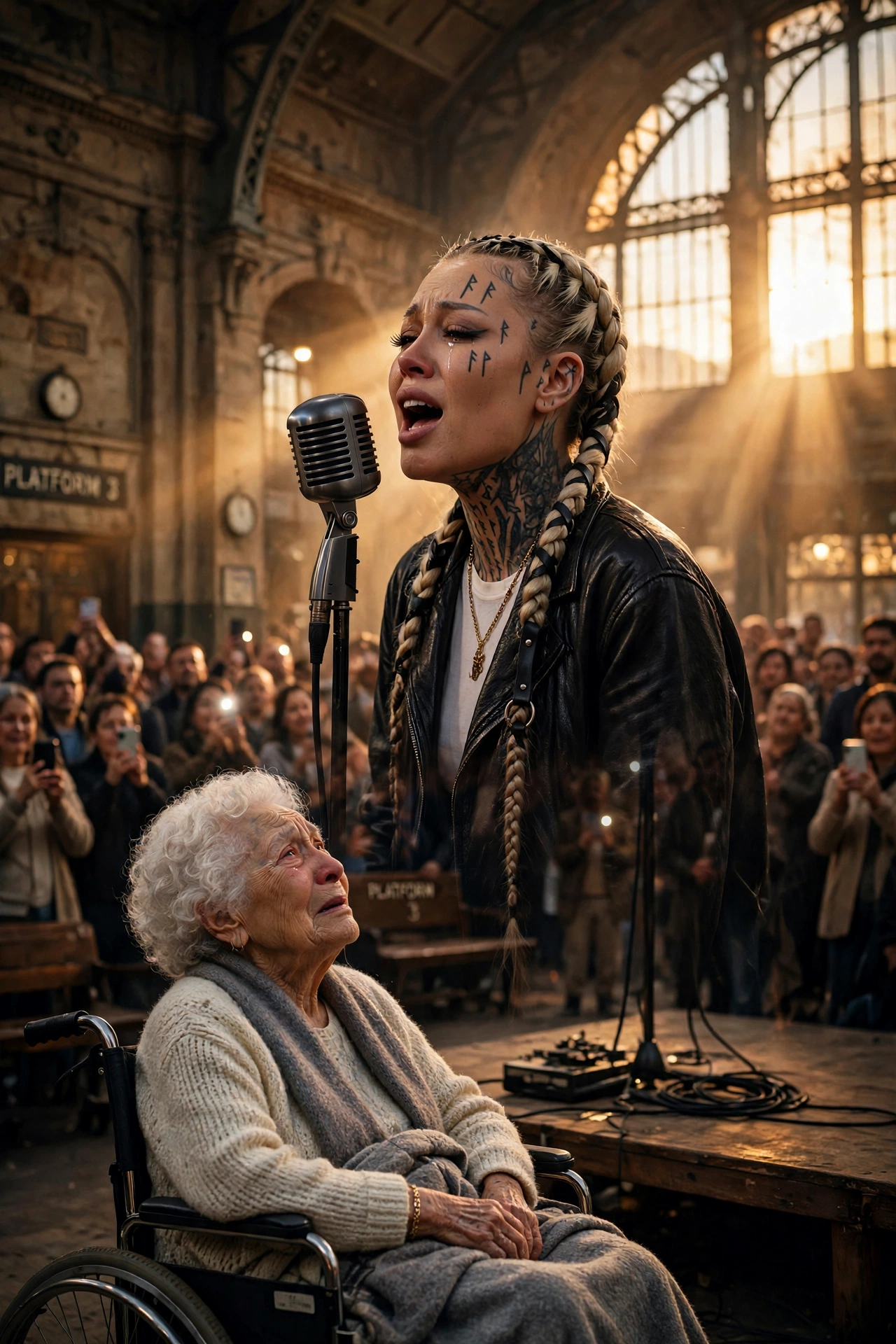
The bus out of town left at six in the morning, before the bakery opened and before the streetlights clicked off. Mara was eighteen, and she carried everything she thought she needed in two hands: an old guitar case with a broken latch, and a duffel bag that held three shirts, a pair of jeans, a toothbrush, and a notebook full of songs written in pencil so hard the words had dented the pages. Her mother, Anna, stood on the porch in her housecoat with her arms folded tight across her chest, as if she were holding herself together. She did not cry. She did not beg Mara to stay. She only said, "Eat before you go," and went back inside for the soup she had made the night before.
Mara ate standing up in the kitchen, because sitting down felt too much like staying. The soup was warm and plain, chicken and carrots and noodles softened by a long simmer. Anna watched her from the doorway, one hand on the frame, saying nothing. Mara wanted her mother to say something big, something she could carry with her like a promise. Instead Anna handed her a small cloth bag with two apples and a sandwich wrapped in wax paper, and she tucked a folded twenty-dollar bill into Mara's jacket pocket when Mara was not looking. Mara found it later on the bus, and she pressed her forehead against the cold window and tried not to cry.
She had not left because she hated home. She had left because home was too small for the sound inside her. Ever since she was a little girl, Mara had sung while doing everything else: while washing dishes, while walking to school, while waiting for the bus in the rain. Her voice was not pretty in the polished way teachers liked. It was rough at the edges, low for a girl, with a crack in it when she reached for the high notes that made people stop and listen. She had taught herself guitar on the old instrument her father had left behind, learning chords from a library book and then making up her own. By sixteen she was writing songs about the town, about the river, about wanting more than the two streets and the grocery store. By eighteen she knew, with the absolute certainty only eighteen can give, that she was meant to sing on a big stage, under real lights, for people who had come on purpose to hear her.
The city was louder than she had imagined, and more beautiful in the evening when the signs came on. She rented a room above a laundromat with a girl named June who worked nights at a diner and slept with earplugs in during the day. The room had a mattress on the floor, a hot plate, and a window that looked out onto a brick wall, but it was hers, and the first night she sat on the mattress with her guitar and sang until her throat hurt, just because no one was there to tell her to keep it down.
Her first audition was for a talent show in a community hall with folding chairs and a stage made of plywood. She arrived an hour early and signed her name on a clipboard in handwriting that shook. There were twenty other singers before her, most of them smoother, girls with clear voices who sang songs everyone already knew. When her turn came, the lights were too bright. She sang one of her own songs, about a girl who leaves home on a morning bus, and halfway through she forgot to be nervous, because the song was true and her hands knew the chords without her thinking about them. When she finished, one judge clapped politely and another wrote something down without looking up. "Thank you," the woman in the middle said, in the kind voice people use when they have already decided. "We'll be in touch."
The second audition was worse, because she had hope left to lose. It was for a small record label in an office above a shoe store, and the man behind the desk did not even let her finish the first verse. He held up a hand and looked at her face the way people look at a stain they are trying to place. "The voice is interesting," he said. "But the look… the look is a problem. Radio, television, the big rooms — they want clean. They want a girl people can put on a poster without explaining." He meant the tattoos. Mara had three of them, small and dark, inked along her cheekbone and jaw when she was seventeen. One was a tiny star, one was a musical note that had blurred slightly at the edge, and one was a thin line of script she could not quite read anymore without a mirror. She had gotten them because she wanted her outside to match the way she felt inside: marked, certain, different. She had not thought, at seventeen, that they would become the reason a man behind a desk would stop listening before the chorus.
She walked out of that office with her guitar case heavy in her hand and sat on the curb outside the shoe store until her legs stopped shaking. That night she sang louder in her little room above the laundromat, as if volume alone could argue with the man behind the desk.
The third audition was for a singing contest on a local television station. She made it past the first round, and for one bright afternoon she believed everything was about to change. Then a producer took her aside and told her, gently, that the show loved her story but worried about her image. Could she cover the tattoos with makeup? Could she sing other people's songs instead of her own? Could she smile more, dress softer, be a little less herself? Mara said she would think about it, and she went home and scrubbed at her cheek with soap until the skin was red, and then she stopped, because the tattoos did not come off, and neither, she decided, would she. She did not go back for the second round. June, coming home from the diner with a bag of leftover pie, found her sitting on the mattress with the guitar in her lap and said, "Good. They didn't deserve you anyway."
Money ran out the way money always does when you are eighteen and stubborn: quietly at first, and then all at once. The rent was due, the hot plate only made noodles, and the twenty-dollar bill from her mother was long gone. June found her a job singing at a bar called The Copper Door, three nights a week, from ten until one in the morning, for cash and tips. The Copper Door was not a big stage. It was a low room with sticky floors, neon signs that buzzed, and a crowd that talked through the slow songs and only quieted down for the loud ones. The owner, a tired man named Ray, told her on the first night to sing songs people knew, and when she sang her own songs instead, he shrugged and let her stay, because the few people who did listen stayed for another drink.
Singing at night in bars gave people something else to criticize. Back home, word traveled the way it always does in small towns. Mara heard about it in her mother's short phone calls, in the pauses between Anna's questions about whether she was eating and sleeping. People said Mara had thrown her life away. People said a girl who sang in bars at night and had ink on her face was not the kind of girl who came home respectable. One old classmate wrote to her online that she looked cheap now, and Mara read the message three times and then deleted it, but the words stayed in her head longer than she wanted them to. She started wearing her hair forward to cover the star on her cheekbone, then got angry at herself and wore it back again.
What Mara did not know, because Anna never said it out loud, was that her mother was keeping everything. Anna kept the flyer from the community hall talent show, the one Mara had mailed home with a note that said only, "I tried." She kept the crumpled set list from The Copper Door that June had sent in a letter, and she kept a photograph of Mara singing with her eyes closed and her guitar held close, printed from a phone screen and slightly blurry. Anna put them in a shoebox in her bedroom closet, and when the house was quiet at night, she took the box down and looked through it, touching each paper carefully. She did not understand all of Mara's songs, and she did not love the bars or the late hours, but she understood the look on her daughter's face when she sang, because she had seen it since Mara was small, singing to the dishes in the sink. Anna never wrote any of this in a letter. She did not know how to say "I am proud of you" in a way that would not sound like she was giving permission for a life she worried about. So instead she sent soup.
The soup came in jars now, packed carefully in boxes with newspaper around them, along with socks and tea and once, a new set of guitar strings. Mara would come home from The Copper Door at two in the morning, exhausted, her voice hoarse and her feet aching, and she would find the box waiting by the door of her little room. She would heat the soup on the hot plate and eat it standing up, the same way she had eaten it on the morning she left, and for a few minutes the city felt less far away. She called her mother the next day, usually, and said, "Thanks for the soup, Mom," and Anna said, "Did you eat enough?" and Mara said, "Yes, Mom," and neither of them said the bigger things that sat between them on the phone line like a held breath.
There were good nights too, and Mara held onto them the way other people hold onto money. There was the night a truck driver at The Copper Door cried quietly into his beer during her song about leaving home, and afterward he put twenty dollars in the tip jar and said, "That one was for my daughter." There was the night she tried a new song, one she had written about her mother without quite admitting it, about a woman who never raises her voice but keeps the light on anyway, and her own throat closed up halfway through, and she had to stop and start again, and nobody minded. She recorded that one on her phone, shaky and imperfect, and sent it home without a message, just the audio file. She did not know that Anna listened to it every night after that, sitting in the kitchen, phone pressed close. Mara only knew that her mother texted back, "Beautiful. Eat well," and that, somehow, that was enough to keep going.
By the end of her first year in the city, Mara had a list of rejections she could recite like a set list: the talent show, the record label, the television contest, two more bars that had let her go because she would not sing only covers, a wedding singer agency that said her look would frighten the grandmothers. She had a voice that was getting stronger from singing three nights a week, a guitar with new strings and a latch that still did not close properly, and a notebook filling up with songs faster than she could learn to play them all. She had very little money, a room above a laundromat, and a mother who never once told her to come home and give up.
On the night of her nineteenth birthday, which nobody in the city remembered except June, who bought a small cake from the diner, Mara stood on the tiny fire escape outside her room with her guitar and sang to the brick wall and the laundry steam and the traffic below. She sang the song about the morning bus, and the song about the woman who keeps the light on, and a new one she had just finished about a stage so big you could not see the back row. Her voice rose into the evening air and came back to her off the bricks, and she thought about the man behind the desk and the producer and the classmate's message, and she thought about her mother's soup and the twenty-dollar bill and the shoebox she did not know existed. She was not famous. She was not defeated either. She was eighteen turning nineteen, with ink on her face and a guitar in her hands and a dream that had survived its first year of being told no. She went back inside, put the guitar in its case, and wrote at the top of a fresh notebook page, in pencil pressed hard enough to dent the paper: "I will sing on a big stage. I will not change my face to get there." Then she underlined it twice, blew out the single candle on June's cake, and went to sleep with the window open, listening to the city hum, still determined, still herself.
Story Genres: Family Drama
-

Chapter 1: The Girl With the Tattooed Face
-

Chapter 7: The Hours I Did Not Miss
The first sound I learned to hear through sleep was not a gunshot, or a phone, or a man at my door with bad news. It was smaller than all of those things, and it undid me more completely than any of them ever had.
Lily did not cry the way babies cried in films, loud and certain, as if the world owed them an answer at once. Even months after she came home, even after she had learned how to fill out her cheeks and kick hard enough to work a blanket loose with her feet, her cry still began as a thin, questioning sound in the dark — a breath catching, a small complaint against hunger, a test to see if anyone was listening.
I was always listening.
That night she woke at three-twelve.
I noticed the time because I could not help noticing it, the way a man who has stepped on a grave will always know where the grass is thinner. Three-twelve had once been the minute my daughter entered the world without me. It had been printed on a photograph. It had been spoken to me by a lawyer. It had been held up to me by my wife in a video I watched until the words were burned behind my eyes. Three-twelve was the exact shape of my failure, sharp enough to cut me every time the clock found it again.
But that night, when the small sound came from the crib beside our bed, Grace stirred only lightly, and I put my hand on her shoulder before she could rise.
"I've got her," I whispered.
Grace opened her eyes. In the dim light from the hall, left on not because either of us feared the dark but because we had both learned to love being able to see Lily without fumbling, my wife looked at me for one sleepy second. There was trust in that look. Not the blind trust she had given me for twelve years and I had squandered in Chicago. This trust was newer and scarcer and had been rebuilt the way bone heals, slowly and with pain when the weather changed. It was worth more for having been broken.
"Don't let her convince you she needs a second bottle," Grace murmured. "She's dramatic. She gets that from you."
"She gets everything worth having from you," I said. "The drama is the only thing I contributed besides the nose."
Grace smiled then, a real smile, creased with sleep, and let her head sink back into the pillow. "Good answer, Romano."
I rose in the dark of our own home, in a silence that held no guards outside the door changing shifts, no adviser waiting with a report, no phone lit with the kind of summons that had once ruled my life, and I lifted my daughter from her crib.
The crib had followed us.
I had wanted, in the early weeks after Grace let me back into the small quiet house where she had taken Lily after discharge — a house with a garden wall and neighbors who did not know my name, or pretended not to, which amounted to the same mercy — I had wanted to buy everything new. It had been instinct. Money had been my answer to every wound for so long that I reached for it the way other men reach for prayer. A new crib, I told Grace. A bigger room. A nurse around the clock. Specialists on retainer in three states. Whatever Lily needed before she knew how to need it.
Grace had listened to all of it from the kitchen table, with Lily asleep against her chest in a sling and dark circles under her eyes that no amount of my money could soften, and then she had said, very gently, "She doesn't need new, Vincent. She needs you to stop trying to purchase a different past."
So we kept the crib.
It was the same white crib that had stood empty in the penthouse nursery on the night I came home from Chicago. The same crib I had found filled with red and pink roses, with gifts no child would ever open, with a teddy bear wearing a ribbon and a note that told me my daughter had been born thirty-one hours before I bothered to arrive. I had fallen to my knees beside that crib with a gun hanging forgotten in my hand, and I had believed, correctly, that I might have already lost everything that mattered.
Now the roses were gone. There was no ribbon arranged for effect, no ring box, no display. There was a fitted sheet printed with small yellow stars, one corner perpetually worked loose by Lily's busy feet. There was a knitted blanket Marco's mother had sent from Sicily, after learning, to her open astonishment, that her son's employer now answered to a seven-pound dictator. There was a soft rabbit with one ear more loved than the other. And there was Lily herself, warm and indignant and alive, her dark hair — my hair, Grace insisted, though the stubbornness under it was entirely hers — standing up in a soft crest from sleep, her fists waving as if she were conducting an orchestra only she could hear.
Life had filled the crib the way absence once had: completely, and without asking my permission.
"All right," I told her, as I settled her into the crook of my arm. "I'm here. I'm right here. Let's not make a formal complaint to the management."
She rooted against my shirt with the single-mindedness of a creature who had survived being born too early, who had fought for breath inside a box of light and wires while I was choosing, minute by cowardly minute, to be elsewhere. She had no knowledge of that. I prayed regularly, by then — clumsily, the way a man prays who has spent forty-three years believing God was either dead or taking meetings with better men — that she would never have to carry the knowledge of it the way Grace and I did. She would know the story one day. We had agreed on that, Grace and I, in one of the long talks that had rebuilt us sentence by sentence. Lily would know that her father had failed at the beginning, because a family built on a polished lie would rot from the inside the way my father's house had. But she would know it the way you know an old scar on someone you love: as history, not as the temperature of the room.
Downstairs, I warmed her bottle the way Dr. Sarah Kim had taught us and the way Grace, supervising my first dozen attempts with the solemnity of a bomb-disposal expert, had finally approved. Not too hot. Tested on the inside of the wrist. I had hands that had done terrible, precise things, hands with ink worked into the skin and a history I would spend the rest of my life answering for, and they shook the first time I held that bottle to my daughter's mouth in the sealed NICU while Grace watched to see whether I would look away from the wires, from the monitor, from the evidence of how fragile Lily's start had been.
I had not looked away. That had been the beginning. Not the end of anything, not forgiveness — Grace had been brutally clear that seeing my daughter through glass was a door opening one inch, not a homecoming — but the beginning.
By the night of the vow renewal, Lily had been home for eleven weeks, and she took the bottle in the rocking chair by the kitchen window with the expertise of a small queen accepting tribute. The house was quiet around us. The garden beyond the glass was dark except for the string of low lights Grace had insisted on herself, because she said a house should look like people lived in it on purpose. My jacket from the evening hung over the back of a chair, the first jacket I had worn in months that had nothing heavier than a folded speech in its pocket — a speech I had never actually read aloud, because when the moment came, standing in our garden in front of eleven people, I had found that everything I needed to say was shorter than the version I had rehearsed.
We had kept the renewal small, because small was the size of the life we were actually building, and Grace refused to let the day become theater.
"You spent twenty years making rooms afraid of you," she had told me, pinning a white rose — one, only one — to my lapel with fingers that no longer trembled when she touched me. "Our marriage doesn't need a room. It needs a Tuesday."
We held it at home, in the garden, in the late afternoon, when the light went the color of honey and Lily was awake and dressed in a white dress with pink stitching that Grace's mother would have wept over, had she lived to see it. Marco was there, in a suit he wore like a man attending both a wedding and a negotiation, and he stood at my side without being asked, the way he had stood at my side through every ugly month of the divorce proceedings that never quite became a divorce. Evelyn Hart was there too, which would have astonished the man I had been a year earlier. The lawyer who had dropped me to my knees with one sentence — "She didn't hide your daughter to punish you, Mr. Romano. She hid her because the only thing you have never done is ask permission" — had become, through months of undertakings honored to the letter and custody terms I obeyed even when obedience cost me sleep, something close to a friend of the family. She brought Lily a silver spoon, and she brought Grace a bottle of wine, and she brought me a single sheet of paper in a plain envelope, which she handed over with no ceremony at all while the others were eating cake.
I opened it after everyone had gone inside. It was a copy, stamped and filed, of Grace's motion withdrawing the divorce petition, and beneath it the court's dismissal of the emergency custody order, replaced by the ordinary, unremarkable joint arrangement of a married couple nobody needed to supervise. Ordinary. I stood in the garden holding that paper while the light failed, and I wept like a man who had been given back a country he had burned.
"For the record," Evelyn said from the doorway, not unkindly, "I advised her that she was under no obligation to do that."
"I know," I said.
"She did it anyway." Evelyn studied me with the eyes that had once measured me for a coffin of legal paper. "Don't make her regret being braver than my advice, Vincent."
"Never again," I said, and she nodded, because by then everyone in my life had learned the difference between the promises I made with my mouth and the ones I made with my calendar, my phone left in another room, my chair beside a hospital crib at three in the morning. I had stopped asking to be believed. I had started keeping ledgers of a different kind. Nights present: all of them. Feeds missed: none. I did not show anyone those ledgers. They were not evidence. They were the shape of a soul being rebuilt to a new plan.
Marco had stayed late, after the renewal, as I knew he would. We sat on the garden steps with our sleeves rolled up — mine over the tattoos that no longer felt like armor, just like the record of a country I had emigrated from — and he told me the last of the Romano interests had been folded into the legitimate holding company, the final signature witnessed that morning. Six hundred lives, I had once controlled. It had taken me the better part of a year, and lawyers, and threats faced down with paperwork instead of the old grammar, and two terrifying months when the Salvatore family tested whether my restraint was weakness before learning it was the one thing I would defend with everything I had left, but it was done, or done enough that my daughter would grow up able to say her father's name in any room in New York without lowering her voice.
"You know what you are now?" Marco asked, watching Grace through the window as she moved around the kitchen with Lily on her shoulder, patting a rhythm older than empires onto our daughter's back.
"A man making a bottle at an hour God intended for sleep?"
"A civilian," Marco said, with wonder and mild horror in equal measure. "Twenty years, Vincent. I never thought I'd live to see it."
"You nearly didn't," I said, and he laughed, and the sound of it in my own garden, over the cooling stones, with my wife's silhouette in the lit window, was so ordinary and so impossible that I had to look down at my hands for a moment to steady myself.
That was the truest thing about the happiness that had come to us. It was not grand. Grace had warned me it would not be, back in the long season of letters I wrote every day and she did not answer, and then answered once, and then answered in person on a bench outside the NICU with conditions written on her face like law. Happiness, she told me, would not arrive as an apology spectacular enough to match the crime. It would arrive, if it arrived at all, as an accumulation of unremarkable mercies. A husband who answered the phone on the first ring, and then a husband whose phone was silenced because there was nowhere else he intended to be. A man who learned the names of the nurses. A man who could be told "not today" about holding his own child and could say "I understand" and mean it and come back tomorrow and ask again, permission renewed each time like a vow with a daily date on it.
I thought of Vanessa sometimes, the way you think of a road you nearly died on: without longing, and without flinching. She had loved the life and not the man, and in the end she had told the truth about that more honestly than I had told the truth about anything, right up until she tried to sell the photograph she had arranged to be taken at 3:12 a.m. and learned that a man who will not raise a hand to protect his pride may still be immovable as a wall when you threaten his child's hospital. I never loved her. That was the sentence Grace had spoken into a phone camera that undid me — that I had abandoned my daughter for a woman I never even wanted to keep — and it was the sentence I finally said aloud myself, in therapy, in confession, to Grace, and at last to Vanessa's empty apartment doorway, because some truths have to be spoken in every room they poisoned. I did not love her. I loved being a man who could not be reached, could not be begged, could not be summoned home by a frightened wife because summoning implied an authority over me I had spent a lifetime refusing to grant anyone. Lily, at 1.9 kilograms, breathing through a machine, had exercised that authority without knowing my name.
In the kitchen that night, with the bottle warm and Lily heavy and content in my arm, I carried her back upstairs as slowly as a man carrying communion. Grace was asleep again, one hand open on the pillow where my head had been, her wedding ring — she had begun wearing it again two months earlier, without announcement, on an ordinary morning over coffee, and I had gone into the pantry and stood among the flour and tinned tomatoes and cried where the onions could take the blame — her ring catching the hall light. The white rose from my lapel was in a glass of water on her nightstand. Beside it, in a frame she had chosen, was not the photograph from that night in Chicago. I had offered once, in a fit of penitent zeal, to keep it somewhere as a reminder, and Grace had looked at me as if I had suggested keeping a loaded weapon in the nursery.
"We don't need the reminder, Vincent," she said. "We have the calendar. We live in the reminder and we are building the answer to it. Put it in the fire."
So we had burned it, together, in this garden, on the night Lily came home, and Marco had stood witness and said nothing at all, which from Marco was a liturgy.
What stood in the frame instead was a picture from that afternoon: Grace in a pale dress, laughing at something Evelyn had said, and me holding Lily up against my chest in the garden light, my face turned down toward my daughter's with an expression I did not recognize as my own until I saw it captured — unguarded, unfeared, and entirely at peace. Under the photograph, in Grace's handwriting, were no words at all. We had both had enough of notes carrying the weight of our lives.
I settled Lily back into her crib, the same crib, now filled with breath and warmth and one stern little fist escaping the blanket to rest against her cheek. She sighed the deep, milk-drunk sigh of a child who has never once, in the whole of her remembered life, cried out in the dark and found the dark empty. I stood over her the way I had once stood over that crib in a marble hall in another life — head bowed, hands useless with feeling — but the gun was gone from my hand and the roses were gone from her bed and the man at the rail was not arriving, at last and too late, to read the news of his own family.
I was not arriving. There is a difference, and the difference is everything Grace ever asked of me, and it took my daughter being hidden behind a court order, and a lawyer's sentence, and a hundred unanswered letters, and a night spent sitting outside a surgery I could not buy my way into, praying with my forehead against a wall, for me to learn it. Love is not the rescue. Love is not the grand return, the empire laid at someone's feet, the knees on the marble floor. Love is being already in the room when the small sound comes in the night, so ordinary that no one thinks to photograph it, no one writes it down, no one will ever tell the story, because there is no story in a father simply being where he said he would be.
Grace's hand found mine in the dark as I slid back into bed, her fingers warm and certain, closing over the ink and the knuckles and all the history, and she did not wake fully and she did not need to. "She settle?" she murmured.
"She settled," I said. "Go back to sleep, sweetheart. We're all here."
And we were. Your daughter was born thirty-one hours ago, the note in the empty crib had said, in the loneliest sentence ever written to me — but that night there was no note, and no empty crib, and no hours left to count between my daughter and me, because this time I was simply there.
-
Chapter 6: The Terms of Coming Closer
Recovery, I learned, does not look like the thing they show you in films. No one ran down a corridor. No music rose. After Lily’s surgery, recovery looked like a number on a monitor deciding, hour by hour, to stay where it belonged. It looked like a nurse’s small nod through glass. It looked like Dr. Sarah Kim, on the second morning after the operation, allowing herself the first unguarded expression I had ever seen from her — not a smile, exactly, but the easing of a woman who had carried a very small heart through a very narrow place and had come out the other side with it still beating in rhythm.
“She is doing what we hoped,” she told Grace, while I stood in the doorway of the waiting room with my hands folded so tightly my tattoos disappeared into my knuckles. I was not part of the consultation unless Grace made me part of it. That had been the rule before the surgery. It remained the rule after it, and I was — strangely, fiercely — glad of it. A rule kept after a crisis is worth more than a rule kept when keeping it is easy. It meant the day I stayed had not purchased anything. Grace did not owe me access for having behaved, for once, as a father should. “Her oxygen requirement is coming down. The incision is clean. She tolerated her feeds this morning, which matters more than it sounds. A baby who has been through what she has and still wants to eat is telling us something.”
“What is she telling us?” Grace asked. Her voice was hoarse. She had slept, I think, for perhaps three hours in two days, in the chair beside Lily’s incubator, with one hand resting on the blanket the nurses had learned to arrange for her.
Dr. Kim’s mouth softened. “That she intends to stay.”
Grace closed her eyes. I watched a tear go down the side of her face without her seeming to notice it was there, and I looked away, not out of politeness, but because some griefs and some reliefs are so private that even witnessing them feels like a taking.
In the days that followed, I was allowed — allowed is the only honest word, and I had come to respect its weight — a short visit each afternoon. Twenty minutes. Washed hands to the elbow, like a surgeon and like a penitent. No cologne, no jacket that had been anywhere but a clean room, no phone. I stood or sat where Grace indicated. I learned Lily’s monitors the way other men learn stock prices. I learned that the soft, sighing sound she made when she was deeply asleep was different from the sound that meant she was dreaming her way toward waking and hunger. I learned that she hated having her feet touched and would go red-faced and furious about it in a way that made every nurse in the unit laugh with a tenderness they tried to hide from me, as though laughing at my daughter’s temper in my presence were a familiarity I had not yet earned. They were right. I had not. I laughed anyway, once, quietly, and then apologized to no one in particular for the sound, because joy in that room still felt like a language I was relearning in public.
Grace watched all of it. She did not thaw — I had stopped using weather words for my wife somewhere around the hundredth unanswered letter, because Grace was not ice and I was not entitled to sun. She observed. There is a difference. She observed whether I arrived when I said I would arrive. I did. She observed whether I left when the twenty minutes ended, even on the afternoon Lily gripped — reflexively, the nurses explained, not on purpose, and I pretended the explanation did not diminish it at all — my little finger with her whole minute hand and would not be persuaded to release it. I left. It cost me something I did not show her, because showing her the cost would have been a way of billing her for it. She observed whether the Salvatore business truly stayed finished: whether newspapers stayed silent, whether strange cars stayed absent, whether the legal machinery Marco had set in motion in a security office continued to grind on without me vanishing into it at midnight. It did. The elder’s written withdrawal came through counsel. The two men from the diner were charged. Evelyn, in one of her dry, devastating update calls, used the phrase “no further incidents” in the tone of a woman reading a weather report, and I understood that, in Grace’s world as it now was, no further incidents was a kind of love language I had never previously spoken.
And Lily grew.
Not quickly. Premature babies do not grow quickly; they grow defiantly, in grams that adults learn to celebrate like victories in a war no one else can see. Ten grams. Twenty. A feed taken entirely by mouth, the feeding tube idle for an hour, then two, then a whole morning. The oxygen cannula reduced, reduced again, and then — on a Tuesday I will remember when I have forgotten my own name — removed for a trial period while Grace held her against her chest inside her blouse, skin to skin, both of them wrapped in a hospital blanket, and I sat in my chair three feet away and witnessed my daughter breathe the room’s ordinary air as though she had always intended to.
“She is breathing for herself,” Grace whispered, not to me, not really. To the blanket. To the baby. To the God she had prayed to in rooms I was not in. Then, after a moment, she included me in it, and the inclusion was so plain and so unadorned that it hit harder than any embrace could have: “Vincent. Look. She is breathing for herself.”
“I see her,” I said. My voice failed partway through it. “I see her, Grace.”
Four days after that, Dr. Kim used a new word at the nurses’ station, a word I heard only because Grace repeated it afterward in the corridor, holding Lily’s chart against her chest like a shield she no longer entirely needed.
Discharge.
Not that week. Not on a wish. There was a list — of course there was a list; my daughter’s life had been lists since 3:12 in the morning, lists of grams and milliliters and percentages, and this last list was the best of them. She had to maintain her temperature outside the incubator. She had to take every feed by mouth for forty-eight hours. She had to pass a car-seat test, sitting in Grace’s small, safety-checked seat for ninety minutes while her oxygen held, a test I privately thought more rigorous than any I had ever imposed on a man seeking to enter my organization. Grace had to be trained — though she needed almost none of it by then, having lived at that bedside for weeks — in infant CPR, in the monitor that would go home with them for the first months, in the signs that meant call now, not in the morning.
“And where is home?” Dr. Kim asked, in the practical tone of a woman completing a form.
Grace did not look at me. “My house,” she said. “In Riverdale. My sister helped me get it ready. The nursery there is — it is small. It is quiet. That is what she needs.”
My house. Not the penthouse. Not our home, because she no longer called anything ours in that tone, and because the house in Riverdale was one I had never owned, never paid for, and — until that moment, hearing of it in a hospital corridor — never even seen. She had bought it, Evelyn later confirmed when I asked whether I was permitted to know even that much, with money from her own family, in her maiden name, while Lily was still in the incubator and while I was still writing letters into silence. She had built an exit and a beginning at the same time, with a newborn in intensive care and a husband in disgrace. Standing in that corridor, I felt no anger about it, and that absence was itself a measure of how far the ground had moved under me. The man who returned from Chicago would have called the house a betrayal. The man I was trying, daily and imperfectly, to become understood it as the sanest thing Grace had ever done: our daughter would come home to a place where no guard had ever stood, no enemy had ever been discussed at a dining table, and no photograph existed of its door at 3:12 in the morning.
Discharge day was a Thursday, clear and cold, with a wind coming off the river that the nurses complained about while they fussed, more than protocol strictly required, over Lily’s layers.
I was not invited to the hospital that morning. I want to write that sentence plainly, without softening it, because I promised myself when I began keeping honest account of these months that I would not decorate the parts that shamed me into prettier shapes. Grace did not invite me to watch Lily leave the NICU. She did not forbid it either — Evelyn conveyed, in her precise way, that Grace would be leaving by the side entrance at eleven with her sister, that the court papers permitted me to know the date, and that Grace “did not wish the departure to become an occasion.” So I did not go. I sat in my small apartment two blocks away, with my coat on and then off and then on again, while two blocks away my daughter was carried out of a hospital in the arms of her mother into the ordinary daylight for the first time in her life, and I was not there to see the sun touch her face.
I told myself it was right. Mostly, it was right. A man does not get to attend every milestone of a child he nearly missed entirely, and demand, retroactively, a full set of memories. Some absences are consequences, not injustices. But at eleven, and at eleven-fifteen, and at twenty past, the old grief came and sat across the table from me like a creditor who knows he will eventually be paid, and I let it sit, and I did not call Evelyn, and I did not drive to Riverdale, and I did not send Marco to “confirm they arrived safely,” which would have been surveillance wearing the face of concern. At noon my phone rang. I answered it so fast I nearly dropped it.
It was Grace.
In all those weeks she had never once telephoned me directly. Updates had come through Evelyn, through Dr. Kim, through a nurse’s printed sheet. Her voice on my phone, in my rented kitchen, without a lawyer’s introduction, was so unexpected that for a moment I could not answer like a normal man.
“Vincent?” she said.
“I am here,” I managed. “I am here. Is she — is everything —”
“She is asleep,” Grace said. “We are home. She slept the whole drive, which the nurses said she might and I did not believe. She is in her crib. The monitor is on. The house is —” She paused, and I heard, behind her voice, the thing she was describing before she found the word for it. Quiet. Not hospital quiet, not corridor quiet. The quiet of a small house in the middle of an ordinary day, with a kettle somewhere and a sister moving in another room. “It is very quiet here.”
“I am glad,” I said. “I am so glad you are home. Both of you.”
A silence. I could hear her deciding something. I had learned that sound too, in the waiting room, in the corridor, across three empty chairs. Grace deciding something was never impulsive. It was a woman walking around a thought on every side, checking its doors, before she opened one of them to me by exactly the width she intended and no more.
“Saturday,” she said. “Two o’clock. You may come here. For one hour. My sister will be in the house, and the door between the rooms will be open. If Lily is awake, and if she is settled, and if I think she is ready —” She stopped. When she spoke again, her voice had changed, and I understood that what she was offering cost her more than the hospital glass, more than the hand an inch from mine, more than any of the supervised mercies of the last months. “Vincent, if all of that is true on Saturday, I will let you hold her.”
I sat down. I do not remember choosing to sit. The chair was simply there, and I was in it, with the phone pressed to my ear and my other hand open and empty on the table — the hand that had held a gun the night I found her note, the hand I had laid against warm glass, the hand that had never, not once in my daughter’s entire life, held my daughter.
“Grace,” I said. “Are you sure?”
“No,” she said honestly. “I am not sure. I am sure of the conditions, and I am sure I will change my mind if anything on Saturday feels wrong, and you will accept that without arguing if it happens. That is how I can do this without being sure. Do you understand me?”
“Yes.”
“Then say what you will do if you arrive and I tell you not today.”
“I will thank you for letting me come,” I said, “and I will leave, and I will not ask when.”
Another silence, shorter. “Two o’clock,” she said. “Do not bring anything. She does not need things, Vincent. She has everything she needs here.”
She hung up before I could answer, which was fair.
I did not sleep Friday night. I shaved twice. I stood in front of the small wardrobe in that apartment and confronted the absurd, humbling fact that I did not know what a man wears to hold his daughter for the first time, months after her birth, in the house of the wife he had betrayed. Not a suit — a suit was the uniform of everything I was trying to leave. Not the white shirt of the penthouse photograph of my own shame, sleeves rolled over tattoos. I chose a plain dark sweater and trousers, clean and unremarkable, and I took the tattoos as they were, because Lily would grow up knowing what her father’s arms looked like, and I was done arranging myself into false pictures for any audience at all.
I arrived at two o’clock exactly — not early, because early would have been pressure; not late, because late was a language I would never speak to Grace again. The house in Riverdale was small and brick, on a tree-lined street where a man across the road was washing a car and a child I did not know rode a bicycle in a red helmet, and the ordinariness of it nearly undid me before I reached the door. No gates. No cameras I could see. A pot of something green and stubborn on the step. Grace’s sister — older, with Grace’s eyes and none of Grace’s obligation to be gentle with me — opened the door, looked me over once with an assessment I fully deserved, and said, “Wash your hands. Kitchen. Soap is by the tap. She is in the front room.”
The front room was full of low afternoon light. A couch, a rug, a bookshelf with Grace’s books — I recognized a spine or two from another life, and the recognition hurt in a clean, appropriate way — and near the window, in a crib far smaller and plainer than the great beribboned thing in the penthouse, with no roses in it, no gifts, no ring box, no note, my daughter lay awake.
She was bigger. That was the first stupid, overwhelming thought. She was bigger than the baby behind the glass — still tiny by any measure of the world’s babies, still fine-boned and solemn, but rounder in the cheek, longer in the body, her dark hair a soft cap, her eyes open and considering the ceiling with the grave attention of a person reviewing an important document. She wore a white sleeper with small yellow flowers. A thin, fading line under her left arm — the scar of the surgery I had waited through in a plastic chair — was hidden by the fabric, and I was glad, foolishly, that it was hidden, as though she were already putting that day behind her with more grace than any of the adults who had made it.
Grace stood by the crib. She wore a cardigan with the sleeves pushed up. She looked tired and entirely present, a combination I had come to understand as her natural state since Lily’s birth, and she studied me the way she had studied every condition on her list.
“You washed your hands,” she said.
“Your sister supervised.”
A ghost — not a smile, a ghost of the woman who had once found me funny. “Sit in the armchair. The big one. No — sit back in it, properly, so your arm is supported. She does not like being held by someone who is hovering.” She lifted Lily with a competence that made my chest ache — one hand under the head, one beneath the body, the monitor lead managed without thought — and came and stood in front of my chair, our daughter between us, awake and calm. “Support her head. The whole time, Vincent. Her neck is stronger than it was, but you do not test it. Cradle her along your arm, like this. And if she cries, you do not panic and you do not hand her back in a rush. You speak to her. She knows voices.”
“Grace,” I said, “if you have changed your —”
“I have not changed my mind. I am frightened. There is a difference.” She bent, and placed Lily in my arms.
I have held, in my life, things men write songs and indictments about. I have held a dying friend on a pavement. I have held weapons, and money in bricks, and the hands of men swearing oaths to me in candlelit rooms. Nothing — I say this as a man who knows precisely what he was, which is the only kind of man whose testimony on the subject should count — nothing prepares you for the weight of a child who weighs almost nothing at all. She settled along my forearm, her head in the crook of my elbow, her body no longer than the length of my tattoos, and she looked up at me with eyes that had her mother’s shape and a darkness that the nurses, with a tact I now suspect was deliberate, had always told Grace was mine.
“Hello,” I said to my daughter, for the first time with her in my arms and no glass, no wall, no lawyer, no distance in the world between my voice and her face. “Hello, Lily. I am —” The word stuck. Father felt like a title I was still on probation for. “I am Vincent. I am your father. I am late. I am so late, and I am sorry, and I am here now.”
She did not cry. She regarded me. Then, with a small, serious sigh that moved her whole body against my arm, she turned her face a fraction toward the warmth of my chest and, in the manner of a person concluding a long and difficult review, closed her eyes.
“She does that when she feels safe,” Grace said quietly, from where she stood. She had not sat down. “Do not make it mean more than it does. Babies sleep in the arms of people they have just met. But —” She stopped, and corrected herself, in that new habit of hers of refusing to give me either more or less than the truth. “But she is not a baby who settles with everyone. The health visitor could not settle her on Thursday. So it means something. I do not know what yet.”
“Neither do I,” I said. “We will let her decide.”
I held her for twenty-three minutes. Grace timed nothing aloud, but I knew, because I counted her breaths the way I had counted the surgery — not anxiously, this time, but greedily, storing them. Lily slept. Once, her hand found the edge of my sweater and held it, and I understood that I would have cut the sweater off my body and left it with her rather than disturb that grip, and that the nurses’ reflex explanation could go to hell: as far as her father was concerned, she was holding on. When she began, at last, to stir toward hunger — rooting, small-voiced, increasingly insistent — Grace came and took her from me with the same seamless competence, and my arms, relieved of almost no weight at all, felt as empty as they had the night I stood in a marble hall holding a pink garment over a crib full of roses. Except that this time, the emptiness was not an ending. She was three feet away. She was home. She had been in my arms, and the world had not ended; it had, very quietly, restarted.
Grace settled in the chair opposite with Lily at her breast, a cloth over her shoulder, as unselfconscious as any mother in any kitchen in New York, and over our daughter’s head, she said, without preamble, “You may ask me the thing you have been not asking since the hospital. I can see it on you, Vincent. You have a talent for carrying a question like a stone in your coat.”
I looked at Lily, because looking at Grace required more courage, and I was spending mine carefully. “On the video,” I said. “The one you sent me the night I came home. You said — if I had loved Vanessa, perhaps you could understand it. But if I did not, then I abandoned our daughter for a woman I never even wanted to keep. I have never answered that. You did not ask it as a question, and I had no right to answer anything in those days except through lawyers. But it is the truest thing anyone has ever said about me, and I will not let it stand in the record of this family unanswered in front of her.” I made myself meet Grace’s eyes. “I never loved Vanessa.”
Grace went very still. Lily, oblivious, fed on.
“I need you to hear the whole of it, because the easy version is another lie. I did not love her, and I did not stay in Chicago out of some great passion that swept away a good man. There was no great passion and there was no good man. I liked being admired without being known. Grace — you knew me. You knew what my hands had done. You knew the fear under all of it, and you loved a real person, and I was a coward about being a real person. Vanessa knew a performance, and the performance was easy, and ease was the whole of it. When she held my wrist at that party —” My voice shook; I let it. “She was not overpowering me. No one has overpowered me since I was a boy. She offered me one more hour of being nobody’s disappointment, and I took it while my wife was calling me from the beginning of labor. I took it at 11:42 when I knew. I do not say that to be punished for it. I say it because Lily will one day be old enough to be told, in some form, why her father was not in the room when she was born, and the form will not be that he was bewitched. He was weak, and he was selfish, and he chose ease over the two people he had begged God for. I never loved her, Grace. That does not make it better. In your mouth, that night, it made it worse, and you were right. It is worse. A man can be forgiven a madness. What I did was not madness. It was arithmetic. I counted my comfort worth more than your pain, in the exact minutes you were giving birth to our daughter after eight years and two lost babies and three rounds of doctors telling us maybe never. I have sat in a therapist’s office and said that sentence until I could say it without looking at the wall. I am saying it here without looking at the wall.”
Grace’s eyes were wet. She did not wipe them, because her hands were full of our daughter. “Why are you telling me today?”
“Because you let me hold her,” I said. “And a man who has just held his child for the first time does not leave the room with the central lie of her parents’ story still standing in it. And because if there is ever to be anything — I do not say us, Grace. I do not presume us. If there is ever to be anything at all that is not hatred, it cannot be built while you are still wondering whether you lost your husband to a love affair. You did not lose me to love. There was no love to lose me to. You lost me to my own rot, and I am the one who has to dig it out, whether you are watching or not.”
She was quiet for a long time. Lily finished feeding and lay against her, milk-drunk and boneless, and Grace lifted her to her shoulder and rubbed her back in slow circles with the ease of long practice, and the small, undignified burp that followed made, absurdly, both of us breathe out something that was almost — not quite, but almost — a laugh, there in the front room of a small brick house, like any family. Like a family that had not been broken on a hotel photograph and remade, partially, conditionally, in hospitals and lawyers’ offices.
Then Grace, still patting our sleeping daughter’s back, set the terms of any future I might ever have, and she did it in the clear, level voice of the protection order, of the undertaking, of every boundary she had drawn since the night she left a note in a crib and saved both herself and Lily by going.
“Listen to me carefully, because I will only build this once,” she said. “The divorce is not withdrawn. I want you to understand that first, so that nothing today is a misunderstanding. My lawyer keeps her file. Lily’s name is Lily Grace Sullivan, and it stays that way until a court, or I, decide otherwise — not you. You will visit when you are invited, here, or where I say, for as long as I say, and you will leave when you are asked, as you did today —” She glanced at the clock; my hour was nearly gone; neither of us remarked on the fact that she had let it run over while I held Lily and while I confessed. “You will continue your therapy, and Marco may confirm it to Evelyn, because your word alone is not yet a currency I accept. The business —” her mouth tightened — “the business will become what you and Marco have told the lawyers it is becoming, entirely, in the open, with no second set of anything, or there will be no visits to protect, because I will not raise this child in the waiting room of your old life. There will be no men of yours near this house, no gifts I have not agreed to, no money arriving in envelopes, no photographs of her leaving this street, ever, by anyone who has ever taken an order from you. And you will not touch me, Vincent — not my hand in a corridor, not my shoulder when I cry — unless I reach first. Do you understand that all of this is not a negotiation?”
“Yes,” I said.
“It is not a list you complete to earn me back like a prize at the end of it. I may complete none of it in return. I may decide, a year from now, with every condition met, that I still do not want to be your wife, and that decision will be honored exactly like the others. What these terms buy — if they buy anything — is Lily knowing her father as a safe man who comes when he is invited and leaves when he is asked and never, ever frightens her mother. That is the whole of what is on offer. Is it enough for you to accept without reaching for more?”
I thought of the penthouse, and the crib full of roses, and 600 lives I had once counted as proof that I was a man who could take what he wanted and hold it. I thought of my daughter asleep on her mother’s shoulder, three feet from me, behind a border of conditions that were not cruelty but architecture — the structure Grace had built so that a thing could stand where a ruin had been.
“It is more than I deserve,” I said, “and I accept it exactly as it is. All of it. Without reaching.”
“Then stand up slowly,” Grace said, “because she is asleep and this room finally knows how to be quiet — and come here, and look at her once more before you go. Not touch. Look. I want her face in your mind accurately, Vincent, for the days between visits. You spent too long with a photograph as the only picture of the worst night of our lives. Carry a better one out of this house.”
I stood, and looked, and carried it — the small face, slack with sleep, the hand still curled as though it remembered a sweater, the whole of her safe in a quiet house that owed me nothing. At the door, Grace’s sister took my coat from the hook without a word. Outside, the man across the street had finished washing his car. The child in the red helmet had gone in for her supper. I walked to my car alone, under no one’s guard for the first time in my adult life, and I did not look back at the window, because looking back can be a way of asking, and I had promised — in a front room, over a sleeping child — not to ask for more than I had been given.
It was enough. It was, God help me, more than enough to build a life on: an hour, a daughter in my arms, a confession finally spoken into the room where it belonged, and a set of terms I intended, for the rest of my life, to keep.
-
Chapter 5: The Man Who Stayed
The call came at 5:47 in the morning, and for once in my life, I answered on the first ring.
I had been sleeping — if you could call it sleeping — on the narrow couch in the small apartment Marco had found for me two blocks from the hospital. Not the penthouse. I had not slept in the penthouse since the night I came home to an empty nursery and a pink ribbon in a crib full of roses. That place belonged to the man I had been in Chicago. This apartment had a kettle Grace would have laughed at, a secondhand table, and a phone that I kept face-up on my chest all night in case the hospital, or Evelyn Hart, or — God forgive me for still hoping — Grace herself, ever needed me.
Dr. Sarah Kim did not waste time on softening anything. She never had.
“Mr. Romano, Lily had a difficult night. Her oxygen needs have gone up again, and the echocardiogram this morning shows what we were afraid of. The ductus — the vessel that should have closed after birth — is still wide open. It is flooding her lungs and making her heart work too hard. We have tried the medication course twice. It has not closed.”
I was already standing, already pulling on a shirt with one hand. “What are you saying?”
“I am saying we cannot wait any longer. She needs surgery today. A ligation. We will go in through a small incision under her left arm and close the vessel with a tiny clip. It is a procedure we do in this unit, and she is stronger than she was three weeks ago, but she is still a baby who was born at one point nine kilograms, Mr. Romano. There are risks. Bleeding. Infection. Injury to the nerve that helps her breathe and cry. I need her mother’s consent, and Grace has given it. I thought you should know before we take her down. Grace said you should know.”
Grace said you should know.
Four words. In the months of letters I had written and she had not answered, of supervised updates passed through lawyers and a pane of glass I had not been allowed to touch until she nodded, those four words were not forgiveness. I knew better than to call them that. They were information. They were a mother deciding that a father, even a father like me, should not learn about his daughter’s surgery after it was already over.
“Thank you,” I said. My voice sounded scraped raw. “What time?”
“We are aiming for two o’clock, if her labs stay stable. She will be in the operating room for perhaps two hours, maybe longer. You may wait where you waited last time. You may not come past the doors. That has not changed.”
“I understand.”
“And Mr. Romano — she will need quiet afterward. No disturbances on this floor today. None.”
She could not have known, when she said it, how much I would have to do to keep that promise.
I was at the hospital by six-thirty with no driver, no guard, and no gun. That last part had become a rule I did not break anymore, not since I signed Evelyn Hart’s undertaking in an office where my name had meant nothing at all. No force. No searching. No surveillance. I had given up the search before Grace ever gave me the address, and when she finally allowed me to know where Lily was being cared for — through Evelyn, on paper, with conditions printed in black and white — I treated that address like something holy. I told no one except Marco. I wrote it nowhere. I never sent a man to watch the building, not even to protect it, because protection I imposed without permission was only control wearing a kinder coat, and Grace had named that difference more clearly than any judge: she had hidden our daughter not to punish me, but because the only thing I had never done was ask permission.
The NICU waiting area was a small, too-bright room that smelled of antiseptic and old coffee. Grace was already there.
She looked thinner than she had at the glass three weeks before. Her hair was pulled back simply. There were shadows under her eyes that no sleep in snatches on a hospital chair could have prevented. She held a paper cup with both hands, though she was not drinking from it, and when I came in, her shoulders went tight in a way that still, after twelve years of marriage, I could read like a language I had once been fluent in and had forfeited the right to speak.
I stopped well inside the door. I did not cross the room.
“Dr. Kim called me,” I said. “Thank you for letting her.”
“She is your daughter too.” Grace’s voice was quiet, exhausted, and completely without warmth, but it was not cruel. That was almost harder. Cruelty I would have deserved and known how to carry. This careful fairness undid me. “If something happens today and you were not told, that would be wrong. I am not trying to be wrong. I am only trying to keep her safe.”
“I know.”
“Do you?” She looked down at the cup. “Sit wherever you like, Vincent. Just — please do not try to make today about us.”
“Today is about Lily,” I said. “Only Lily.”
I sat in the chair farthest from hers, the one by the wall where I had sat during the breathing crisis, with three empty seats between us like a border we had both agreed not to cross.
For an hour, we did not speak. Nurses came and went through the double doors. A monitor somewhere beyond them beeped, steadied, beeped again. Grace prayed once, silently, her lips moving over words I could not hear, her mother’s rosary I had not seen in years wrapped around her fingers. I wanted to tell her that I had started, clumsily and in private, to pray again myself — not the bargaining prayers of a man who thinks God can be treated like a creditor, but the small, ashamed prayers of a man asking only to be allowed to stay in the room where his daughter was fighting. I did not tell her. My new rule, learned too late and at too high a price, was that Grace did not owe me a hearing for every change I claimed to be making. If my change was real, it would still be real without applause.
At eight-fifteen, Marco Leone came through the waiting room door, and I knew from his face, before he said a word, that the other world — the one I had spent forty-three years building and the last months trying, piece by piece, to walk out of — had followed me to my daughter’s hospital.
Marco had been loyal to me for twenty years. He had stood beside me at funerals I had caused and funerals I had grieved. He was the man who, on the night I came home from Chicago, had asked the question that stopped me colder than any threat: Boss, if she refuses to return, will you force her? He had held me to my answer — no — on the days when holding me to it could not have been easy, and he had never once treated that no as weakness.
He glanced at Grace and lowered his voice. “Vincent. I need you. Outside. Now.”
Grace heard it anyway. Her head came up.
I stood, but I did not move toward the door. “Is it something that can be said here?”
Marco hesitated. In twenty years I had seen him hesitate perhaps three times.
“No,” he said. “But it cannot wait.”
I looked at Grace. “I will be just outside. I am not leaving the floor.”
She did not nod. She did not tell me not to go. She only tightened her hands around the cup until her knuckles whitened, and I understood that she was already bracing to be left again — not dramatically, not with shouting. Just quietly, in a hospital corridor, the way she had been left at 10:17 on the night she first called, and at 11:42 when she was already in labor, and at 3:12 in the morning when our daughter was born while a photographer photographed me leaving a hotel with another woman.
In the corridor, Marco closed the waiting room door with care and put a sealed envelope and his phone into my hands.
“The Salvatores have Lily’s photograph,” he said.
The corridor seemed to tilt.
“Not a photograph of Lily,” he said quickly. “Calm yourself and listen, because we have very little time to be stupid. The 3:12 photograph. You and Vanessa, outside the hotel in Chicago. They have an original file, Vincent, not the copy that was sent to Grace. And this morning, about forty minutes ago, two of their people tried to get onto this floor.”
“What?”
“They did not get past the elevators. One had a courier’s uniform and a delivery that did not exist. The other was dressed as an orderly. Hospital security turned the first away. The second ran when they asked for his badge a second time. Our contact in security — a man we pay legally, through the foundation account, for the anonymous donation work, nothing more — recognized the tattoo on the orderly’s wrist. Salvatore. He called me because my name is on the donor paperwork as the contact, and because I told him after Lily’s crisis that if anyone ever asked about this floor, he was to call me and call the police, in that order, and tell neither caller anything about any baby.”
My hands had begun to shake. Not with fear. With something older and far more dangerous. The rage I knew. The rage I had lived on. It rose in me clean and familiar as a hand finding a grip it had held ten thousand times, and with it came the whole vocabulary of my old life, fluent and immediate: names, addresses, which Salvatore cousin ran which crew, which warehouse would hurt them most to lose, how quickly I could have men in this hospital, in their homes, in the streets around their social club, how a message was sent so that it was understood the first time.
“What do they want?” I asked, and my voice was not my new voice at all.
Marco showed me his phone. A single message, from a number I recognized as belonging to a Salvatore intermediary I had not spoken to in six years.
Tell Romano the East Harlem territory and the Hunts Point contracts transfer to us by 3 p.m. today, signed, or his wife learns how unsafe a hospital can be. A baby that small needs so much care. It would be a shame if the power, or the staff, or the mother, had an accident. 3 p.m. No police. He knows what happens to people who bring police.
Three o’clock.
One hour into Lily’s surgery.
I read it twice. The second time, the letters seemed to arrange themselves into the only sentence my old self knew how to answer.
“Where are they?” I said.
“Vincent —”
“Where are they, Marco?”
“Two cars have been seen circling. One is parked in the garage, level three, black Escalade, plates we are running. The men who tried the floor are gone. But that is not all I came to tell you, and you need to hear the rest before you decide who you are today.”
He opened the sealed envelope. Inside were printed pages: bank records, screenshots, a chain of messages Marco’s investigator — a licensed man, hired through my lawyers for the divorce proceedings after Vanessa had threatened to sell her story, and I had refused, even then, to have her followed by anyone but a lawyer’s investigator — had assembled legally and handed to Evelyn’s firm that morning.
Vanessa Cole had tipped off the photographer herself.
Not directly. She was too careful for direct. Through a friend from her modeling years, a woman who ran a gossip page’s tip inbox, Vanessa had arranged for a photographer to be outside that Chicago hotel from midnight onward. She had sent the friend the hotel name, the time she expected us to leave the party, and a message that Marco read aloud in the corridor while the fluorescent lights hummed and my daughter lay beyond two sets of doors learning how to breathe.
Make sure you get him leaving with me. Not arriving. Leaving. Send the best one to his wife first — she needs to finally get it — and keep the originals. If he chooses me in public, the wife is finished. If he doesn’t, somebody will pay for pictures of Vincent Romano looking like exactly what he is.
The last message was timestamped 3:04 a.m. Eight minutes before Lily was born.
And below it, worse, a second chain, dated two days after I ended the affair. The same friend, asking Vanessa whether a man who had contacted her — a man whose number belonged, Marco’s investigator believed, to someone in the Salvatore orbit — should get the original file, with its metadata, its time stamp, its proof. Vanessa’s reply was one line.
He didn’t choose me. Why should I protect him?
She had not loved me. I had known that, in the way a man knows weather is coming and still stands in the field pretending he is surprised by rain. She had loved the life: the necklace that cost four hundred and fifty thousand dollars, the car, the table everyone looked at, the dangerous thrill of being held by a man other men feared. But knowing it and seeing it, printed, timed at eight minutes before my daughter’s first breath — that a woman I had chosen over my wife and child had sold the moment itself, first to Grace to wound her, then to my enemies to wound me — something in my chest went very quiet and very cold.
“How many men can we have here in twenty minutes?” I asked.
“Vincent.”
“How many in the garage? How many at the Salvatore club? If we move on the cousin first —”
“Stop.” Marco did not raise his voice. He never had to. “Look at me. Look where you are standing.”
“I know where I am standing!” The words came out too loud. A nurse at the far end of the corridor looked up, and I forced my volume down with an effort that hurt. “They threatened my daughter on the day of her surgery, Marco. They sent men onto her floor disguised as staff. And Vanessa — Vanessa arranged the whole ruin of my family for a photograph, and then handed my enemies —”
“Yes,” he said. “All of that is true. And Lily goes into surgery at two. The Salvatore deadline is at three. That is not a coincidence, and you know it. They do not only want Harlem and Hunts Point. They want you to do exactly what you are doing now. They want you to leave this corridor, fill this hospital with your men, start a war from a children’s floor, break your undertaking, break the protection order, terrify Grace, and give a judge every reason in the world to decide you will never be allowed near that baby again. And if you do not do it for them —” he held up the phone — “they want you gone from here when Grace is alone, so that even if their men never touch Lily, Grace spends her daughter’s surgery knowing you chose revenge over both of them. Again.”
Again.
He let the word sit.
“Vanessa held your wrist at 10:17 and you stayed at a party,” Marco said, not cruelly, but with the pitiless accuracy of a man who had decided his loyalty meant telling me the truth when no one else would. “She stood in a doorway at 11:42 and you stayed again. Today she is not even in the room, and she and the Salvatores together are holding a door open for you. Walk through it, and you will have chosen her a third time. And them. Over Lily. On the day they cut open Lily’s chest.”
I stared at the waiting room door. Behind it, Grace sat with a cold paper cup and a rosary, believing — because I had taught her to believe it at the cost of almost everything she had — that when the moment became hard enough, I would leave.
“What would you have me do?” I said at last. “Nothing? Sit in a plastic chair while men circle my daughter’s hospital?”
“No,” Marco said. “I would have you let me do what we have spent four months building the machinery to do — lawfully. And I would have you do the one thing only you can do, which is stay.”
He laid it out with the speed of a man who had already begun before he came upstairs, and as he talked, I could hear, under the rage, something else: the plan was good. It was better than mine. Mine ended in blood and headlines and a custody hearing I would lose before I entered the room. His ended, if it worked, with the Salvatores in handcuffs of their own making.
Hospital security already had the elevator footage and the fake orderly’s abandoned badge. Marco had called Evelyn Hart before he called me; Evelyn had called the judge who signed the protection order, at home, on an emergency number reserved for exactly this, and the judge had not been pleased to learn that men were impersonating hospital staff on a sealed floor. The NYPD had been notified — not by me, which mattered, but by the hospital’s own security director, reporting attempted unauthorized access to a neonatal unit, which was a crime that had nothing to do with my name and everything to do with a building full of other people’s babies. Two detectives were already on their way. Marco’s licensed security firm — the legitimate company we had begun shifting the Romano protection work into, with contracts and uniforms and a paper trail — could provide uniformed, unarmed liaison officers at the hospital’s public entrances at the hospital’s request, which its director was about to make in writing. And the message itself, the threat, with its number and its intermediary, was already in the hands of a federal prosecutor Marco’s lawyer knew from the legitimate-business filings, because threatening the infant daughter of a cooperating — no, I was not cooperating, I was not an informant, and Marco was careful about that line — because threatening any child to extort a business transfer was extortion, and the Salvatores had been careless enough to write it down.
“They chose a hospital,” Marco said. “A sealed floor. In writing. With cameras everywhere. They were counting on you making it a street matter before anyone could make it a legal one. If you sit down in that waiting room and do not move, Vincent, they have nothing. No war. No photograph of Romano men flooding a children’s hospital. Just their own men, their own fake badges, their own message, and a judge and two detectives and a federal office who have all seen the file before three o’clock ever arrives.”
“And if a man gets past all of that while I am sitting down?”
“Then the police and security who are actually permitted to stop him will stop him, and you will be where Grace and Lily need you — which is not in a parking garage doing a thing that would follow Lily in court papers for the rest of her childhood.” He stepped closer. “You asked me once, in the penthouse, what you should do, and I asked you if you would force Grace to return. Do you remember what you finally said?”
“I said no.”
“You said no when it cost you your pride. Say it now when it costs you your revenge. It is the same word.”
The double doors at the end of the corridor opened, and Dr. Kim came out with a clipboard and a nurse, heading for the waiting room. For Grace. The surgical team was early. They were going to take Lily down within the hour, not at two. My whole body understood, before my mind did, that the next minutes were the hinge of the day: the Salvatores’ cars were in the garage now. Marco’s phone was in my hand. Twenty men waited on the other end of one call from me, men who would have been at this hospital before Lily reached the operating room, and whose arrival would be the real emergency of the day.
Grace opened the waiting room door. She had heard Dr. Kim’s step. Her eyes went from the doctor to Marco to me, standing in a corridor with a phone in my hand and an envelope of ruin in the other, and I watched her face do a terrible, quiet thing. She did not look surprised. She looked like a woman seeing a thing she had seen before.
“Vincent,” she said, very softly. “What is happening?”
Dr. Kim, professional to her core, said, “Grace, we are ready to prepare Lily. You can come and hold her hand while we —”
“One moment, Doctor.” Grace did not look away from me. “What is happening?”
I could have lied. There were a hundred lies ready, some of them even kind: nothing, a business call, Marco was just leaving. I could have protected her from knowing men had tried to reach this floor on her daughter’s surgery day, and in my old life I would have called that protection and been proud of it.
I handed Marco back his phone.
“Tell them no police from me, because the hospital has already called them,” I said to him. “Tell Evelyn everything goes through her and the judge. The security company answers to the hospital director, in writing, unarmed, at the public doors only. No Romano man comes to this floor. No one goes to the garage to handle anything. No one goes anywhere near a Salvatore address today, tomorrow, or any day, on my order. If a man of mine lifts a hand today, he answers to me for disobeying a direct order to stand down. Do you understand me?”
“Vincent, the garage car —”
“Photograph the plates. Give them to the detectives. That is all. That is the whole of it.” I turned the envelope over in my hands — Vanessa’s messages, times, prices, the unsparing print of my own choices — and handed that to him too. “Give this to Evelyn and to the prosecutor. All of it. Even the parts that shame me. Especially those.”
Marco searched my face for a second, the way a man checks a knot he is about to trust his weight to. Then he nodded once, put the phone away, and walked down the corridor toward the elevators — not toward the garage with violence in his coat, but toward a security office with paperwork in his hand.
I faced Grace. Dr. Kim, with a tact I will be grateful for until I die, stepped a few paces away and studied her clipboard as though it were the most absorbing document in New York.
“There is a threat,” I told Grace. “From the Salvatore family. They have the photograph from Chicago — the original of it, which Vanessa arranged to be taken and later allowed to reach them — and two of their men tried to get onto this floor this morning, disguised. They were turned away. They sent a message demanding business from me by three o’clock, using you and Lily as pressure. I have just told Marco that everything will be handled by the hospital, the judge, Evelyn, and the police, and that I am not leaving. That is all of it. I will not lie to you about a day like today.”
She stared at me. Her mouth parted slightly. For a long moment she said nothing, and I bore it, because a man does not get to tell the truth only when it is comfortable to hear.
“You are not leaving,” she said at last. It was not quite a question.
“No.”
“Your men —”
“Have been ordered to stand down. By me. Just now.”
“The people who threatened our daughter are downstairs, and you are —” Her voice broke on the word. “You are staying here?”
“Lily goes into surgery within the hour,” I said. “I missed her birth because a woman held my wrist at a party and I let her. No one — not Vanessa from wherever she is watching this burn, not the Salvatores, not my own rage, which God knows is the loudest voice in that corridor right now — is taking me out of this building while our daughter is operated on. If I leave this floor, Grace, it will be because you tell me to leave it. Not them. Never them.”
She covered her mouth with one hand. Her eyes filled, but she did not turn away, and she did not ask Dr. Kim to make me go. Instead, after a moment, she lowered her hand and said, in the voice of a woman making a decision she would examine later, at night, alone: “Then come and see her before they take her down. You may — you may stand where I can see you. And Vincent —”
“Yes?”
“If your phone rings in there, do not answer it.”
“I have given my phone to Marco,” I said. “It is already gone.”
We went in together — not together as husband and wife, for we were not that, not anymore, whatever the law still said. Together as the two people in the world who had made a small girl with a heart that needed help and lungs that had fought for every hour of her life. Lily lay in her incubator in a cap too small for any doll I had ever seen in a shop window, wires and lines arranged around her with a care that humbled me every time I saw it. She was awake. Her eyes, dark and unfocused and entirely uninterested in the empires men built and burned outside her walls, moved slowly toward the sound of her mother’s voice.
Grace leaned close to the glass and sang something under her breath, one verse only, her finger resting where Lily’s hand, in sleep, had found the edge of the blanket. I stood where Grace could see me, with my hands at my sides, and I did not touch the glass until, without looking up, she said, “You can put your hand here. She is about to go down. She should — she should know we are both here.”
I laid my palm against the warm surface, an inch from her finger, not touching it, and I stayed exactly there while the surgical team came, while they checked and re-checked, while they wheeled my daughter — my whole world reduced to a clear box and a brave, beeping line on a monitor — toward doors I was not permitted to pass.
The surgery lasted two hours and forty-one minutes. I know because I counted them the way a man counts who has been forbidden every other useful thing: by the clock above the waiting room door, by cups of water I did not drink, by prayers I did not finish because each one turned, halfway through, into Lily’s name said over and over like a rope. Grace sat across from me. Twice, Marco came to the door — not in, never in, he understood the room better than I did — and gave me, in a murmur meant also for Grace, the news of the world I had refused to go and rule.
At 1:20, the two detectives took statements from hospital security and left with copies of the footage. At 1:55, the black Escalade left the garage too quickly and was stopped two blocks away for the expired plates Marco’s photograph had flagged; the men inside were arrested on outstanding warrants and an unregistered weapon in the vehicle, a stupid, ordinary crime that would hold them while the larger file was built. At 2:30 — half an hour before the Salvatores’ deadline — officers executing the judge’s emergency order arrested the fake orderly and the courier at a diner on Second Avenue, identified from the elevator footage, with a second set of hospital lanyards in a bag under their table. And at 2:48, Marco received a call, through lawyers, from a Salvatore elder I had known since I was twenty: the family disavowed the message, the men had acted — the fiction was transparent and everyone involved knew it — without authority, there would be no approach to any hospital, any wife, any child, and to prove it they were withdrawing, formally and in writing through counsel, from the East Harlem question altogether.
“They are retreating because they are exposed, boss,” Marco said, and the old word slipped out of him before he could stop it. “Not because they are beaten in the street. Because there is a file, and a judge, and cameras, and because you did not give them the war photograph they needed to call it a war. Evelyn says the prosecutor used the word ‘textbook’ about the message. Their own words did it.”
Grace had heard all of it. She had not asked him to stop. When Marco left the last time — to go, at Evelyn’s direction, and sign yet more paper, paper being the weapon of the entire day — Grace looked at me across those three empty chairs, and her expression was one I had never seen on her in twelve years of marriage. Not love. I did not insult it by naming it love. Astonishment, perhaps. The astonishment of a woman revising, by one hard degree, a conclusion she had believed was final.
“You could have gone,” she said quietly.
“Yes.”
“And killed them. Or had it done.”
“Yes,” I said. “I wanted to. I want to still. Do not mistake sitting in this chair for being a different species of man, Grace. I am sitting in it because the man who leaves this chair loses his daughter twice.”
At 3:36, Dr. Kim came through the doors with her surgical cap in her hands and an expression that, even before she spoke, made Grace stand so fast her chair scraped the floor.
“The ligation is complete,” she said. “The vessel is closed. Her oxygen is already better than it was this morning, and her heart is not working nearly as hard. She did beautifully. She is in recovery, she is stable, and in about an hour, if she continues like this, you can both —” she glanced at Grace, taking her instruction, as everyone now did, from the mother — “Grace can come in. And we will see.”
Grace sat down again, all at once, as though her legs had simply completed their duty for the day, and she wept — openly, with her face in her hands, the rosary wound so tight around her fingers it left marks. I did not go to her. I wanted to with an ache that reached back through twelve years of holding this woman while she grieved babies we had lost and nights she had feared I would not come home. But she had not invited me to hold her, and I had learned — on a day when learning it had saved, perhaps, everything — that staying is not the same as seizing. Staying is a chair kept. A phone surrendered. A hand laid on glass an inch from hers, and no closer, until she says.
So I stayed in my chair, three seats away, and I wept too, without covering my face, while my daughter breathed on the other side of the wall with a closed vessel and an easier heart — alive, on the day men had threatened her, because for the first time in my life I had protected her by refusing to leave her.
-
Chapter 4: The Work of Staying
Change, I learned, is not an event. Men in my world love events — a sit-down, a verdict, a funeral, a signature — because events can be attended in a good suit and then left behind. Change was nothing like that. Change was a Tuesday. Change was a hundred Tuesdays, each one unphotographed, each one asking the same question the day before had asked, in a voice too quiet to argue with: and what will you do today, Vincent, now that no one is watching and nothing you do will be rewarded on any schedule you can control?
I began with the only appointment I had kept in months, and I kept it the way other men keep confessions.
Dr. Helen Price had an office on the Upper East Side with no name on the door that mattered and a waiting room deliberately too ordinary to remember. Marco had found her through channels he refused to describe — she had treated, I gathered, other men whose professions could not be written on intake forms, and she had survived the knowledge. She was sixty-one, gray-haired, unimpressed in a way that felt like standing in cold, clean water. On my first visit, three days after I saw Lily through the glass, she let me sit in silence for eleven minutes by the clock on her wall. I know it was eleven because I counted, the way I count exits.
"You are waiting for me to ask about your childhood," she said at last.
"Isn't that the procedure?"
"Eventually. First I want to know why you're here, in one sentence, and I want the sentence to contain no one else's name."
I tried. I produced a sentence about Grace, and she shook her head. I produced a sentence about Lily, and she shook her head again. My third attempt came out of me like something pulled from a wound: "I am here because I chose a woman I did not love over my daughter being born, and I do not know what kind of man does that, and I have to find out, because if I don't, I will do the next version of it."
Dr. Price nodded once, as if I had finally given her the correct time. "That," she said, "we can work with."
I went twice a week. I will not dress it up: in the beginning I went the way I had attended every obligation in my life, as a performance of attendance, waiting for the credit. Dr. Price declined, session after session, to give me credit. She was interested in the wrist. I came back to the wrist for a month. Vanessa's hand on my wrist at 10:17 p.m., my phone ringing with my wife's name, and the small, silken question — do you really want to answer that? — and my hand, my own hand, turning the phone face down on the table like a man concluding a piece of business. I had rehearsed a hundred versions in which I was seduced, distracted, drunk, pressured. Dr. Price took each version apart with the patience of a woman unpicking stitching.
"You weren't overwhelmed," she said. "You were relieved. Answering meant becoming a husband and a father in real time, with no control over the outcome. Not answering meant remaining the man at the party, where everything obeyed you. You did not choose Vanessa. You chose the room where you were God."
I walked out of that session and stood on Park Avenue in the rain for a long time, because she was right, and being right about me was a thing no one in my employ had dared in decades.
The letters went out every day.
That was not a metaphor, and it was not romantic, and Grace would have been the first to say so. Every morning, before anything else, I sat at the desk in my study — the desk where I had signed orders that ruined men — and I wrote one letter by hand, because Evelyn had mentioned, months of protocol ago, that typed pages from my office would go straight into a shredder, while handwriting at least proved a man had sat still. I wrote to Grace, and some days, on a second sheet, to Lily, care of Grace, for a future I had no right to assume. I wrote about what Dr. Kim's updates said, filtered twice through Evelyn, and what they did not say. I wrote about the nursery, which I had ordered left exactly as it was, roses removed, crib empty, door open. I wrote about Chicago without decorating it. That letter took four days and nine drafts, and the final version was two pages long and contained the sentence: there is no version of that night in which you failed me; there is only the version in which I failed, in sequence, at 10:17, at 11:42, and at 3:12, and then again the next night, which was the worst one, because by then I knew. I wrote about my father, which I had never done for anyone. I wrote about the two miscarriages, and how I had held Grace in a hospital corridor in 2019 and promised her the next child would know a different father than the boy I had been — I wrote that I had broken that promise before Lily was an hour old, and that knowing it did not entitle me to her forgiveness, only to my own work.
Evelyn received the letters. Evelyn, presumably, delivered them. What Grace did with them, I was not told, and after the first month I stopped asking. That, too, was part of the work, Dr. Price said: to write without an audience's reaction, to give without a receipt. It was, I told her, the first honest business I had ever conducted. She said, "Then conduct more of it."
So I did, and the next piece of it was the money.
I will be plain about my money: much of it had been made in ways that would not survive daylight, and all of it, clean and unclean, had one property in common — it had my name attached to its power. Romano money arrived like weather. It announced itself. That winter I learned to move it the other way. Through a blind charitable trust that Evelyn vetted line by line — I insisted she vet it, which I think was the first thing I ever did that genuinely surprised her — I funded the neonatal unit that was keeping my daughter alive. Not Lily's care; Grace had refused that absolutely, and she was right, because paying for Lily would have been a purchase dressed as love. The trust funded the unit itself: two additional incubators of the newest generation, a dedicated respiratory team for the night hours when crises come, a fund that covered costs for families in that corridor who fell asleep against the glass because the alternative was a billing office. My name appeared nowhere. The plaque by the nurses' station, when it went up in the spring, read only: GIVEN IN HONOR OF THE CHILDREN WHO ARRIVE EARLY, AND THE MOTHERS WHO WAIT. Nurse Okafor, who knew exactly where it came from — nothing in that unit escaped her — said nothing to me about it ever, except once, on a later visit, when she paused beside me at the hand-washing sink and said, "The new machines are quieter. The babies sleep deeper. That's all I'm saying, Mr. Romano," and walked on.
I did not tell Grace. I want to be precise about that, because it would be easy, later, to remember it as a courtship, and it was not. A gift announced is an invoice. I told Evelyn, because the trust required a lawful channel and because secrets between my wife and me had done enough damage for one lifetime; Evelyn told me, with something approaching respect, that whether Grace ever learned of it would be Grace's discovery, not my announcement. Months later I found out she had learned of it within a fortnight — nurses talk to the mothers who live beside them — and had said only, "Then he is learning the difference between giving and buying," and had gone back to holding Lily's hand through the porthole. When Evelyn finally repeated that sentence to me, in the summer, I had to sit down in my own kitchen, because it was the first sentence of Grace's about me in half a year that was not a verdict. It was an assessment. A man can live on an assessment, if he is honest about how starved he is.
And then there was the empire, which is the word everyone else used. Marco and I began, that winter, to dismantle the thing I had built and rebuild it as something that could sign its name in daylight.
I will not pretend this was noble from the first hour. It was terrifying, and it was slow, and twice it nearly went wrong in ways that do not belong in these pages except to say that men do not surrender profitable darkness because their boss has found his conscience, and that Marco Leone earned his twenty years of loyalty in that season more than in all the years of danger before it. We sold the clubs first — all of them, including the one in Chicago, which I disposed of without setting foot in that city, through lawyers, at a price slightly below market because speed mattered more than pride and because I could not have walked past that hotel again and remained the man I was trying to become. The import businesses were audited — really audited, by a firm that did not know my name until the engagement letter — and the parts of them that could not survive an auditor's questions were closed, wound down, their people paid severances I doubled out of my own accounts, because a man does not push his sins downhill onto the men who carried them for him. What remained — the real estate, the legitimate shipping contracts, the construction holdings that had always been half-clean — we consolidated under a holding company with independent directors whose job, I explained to their bewildered faces, was to be able to say no to me.
"You're building a cage for yourself," Marco said one night, over the spreadsheets, at two in the morning, in the study where the letter to Grace lay unfinished under a paperweight.
"I am building a house my daughter can visit," I said. "There's a difference. A cage is to keep something in. I want a place she can walk into with her shoes on and read the name on the door."
He was quiet for a while. Then he said, "Twenty years I've watched you make men afraid. I didn't know you knew how to make anything else." He initialled the page in front of him. "For what it's worth, boss — it's better work."
We did not speak of Grace's case in those sessions, Marco and I, except once, when the first custody review came and went and the court continued everything exactly as Grace had set it — the certificate unchanged, the protection order renewed, my visitation existing solely at her invitation. My lawyers, new ones, daylight ones, asked me if I wanted to contest. I said no so quickly that the senior partner blinked. "Mr. Romano, with your resources, a court might—"
"My resources are why she hid her," I said. "File the response. We accept. We thank the court for its time, and we accept."
Word of that reached Grace too, eventually. In that season, everything true reached her eventually. That was how I finally understood the system she had built: she had not cut me off from information about Lily; she had cut me off from control, and then she had simply watched — through Evelyn, through the court, through nurses and lawyers and the quiet reports of a world that talks — to see what a man does when control is taken away and only conduct remains. She was not waiting to be persuaded. She was waiting to see.
The letters changed before she answered them.
In the early weeks they had been long — confessions, inventories, apologies arranged like legal briefs, as if grief with enough exhibits might win. Dr. Price read none of them, but she asked me one question that altered all the rest: "Are you writing to be forgiven, or to be known? They are different letters." After that they got shorter, and stranger, and truer. I wrote about ordinary things. I wrote that the penthouse plants were dying because Grace had always been the one who knew their names. I wrote that I had learned to cook one thing badly and eaten it standing up. I wrote that I had passed a shop window with a yellow dress in it in a size Lily would not reach for two years and had stood there like a fool, and had not bought it, because buying things for a future I had not been given was the old man's trick. I wrote that I missed Grace's laugh in the specific room of the kitchen at seven in the morning. I wrote, once, only this: Lily's monitor numbers were good today. I sat in the study and cried at a percentage sign. I thought you should know that percentages can do that now.
In March, Evelyn called me on a matter of paperwork, and at the end of the call — after the signatures, after the dates — she said, in the tone of a woman placing something breakable on a high shelf, "You may stop sending two copies of the letters, Mr. Romano."
"I only send one," I said.
"I know," Evelyn said. "I am telling you that the archive copy I have been keeping is no longer necessary. Mrs. Sullivan has begun keeping them herself. In a box. In order." A pause, while she let the architecture of that sentence settle over me. "She read the Chicago letter twice, I am told. I am not told anything else, and neither, sir, are you."
I thanked her with a steadiness I did not feel and sat in my study for a long time after the call ended, with my hands flat on the desk, in the posture of a man at a glass wall, waiting.
Grace was reading the letters.
She had not answered one. She had not lifted a single condition, changed a single name, invited me to a single additional hour that was not earned some other way first. Nothing was forgiven. But somewhere across the city, in a quiet room I had never seen, my wife had opened a box instead of a shredder, and had begun, in order, from the first page, to read the truth as fast as I could learn to tell it.
Dr. Price asked me, that week, how it felt. I told her the truth, which by then had become almost a habit.
"It feels," I said, "like a hand on the other side of glass. Not touching mine. Just there. Just — there, on its own terms, where I can see it."
"And can you live with that?" she asked. "If that is all there is, for as long as it takes?"
I thought of a green line jumping on a monitor. I thought of a hand smaller than my thumbprint, closing in its sleep. I thought of Grace at 3:12 in the morning, in every year to come, and whether I would be a man who had once failed that hour or a man who had spent his life answering for it, hour by ordinary hour.
"Yes," I said. "I can live with that. That is what living with it means."
-
Chapter 3: Through the Glass
The call did not come from the hospital. It could not. I had signed a paper promising that no one who worked for me would look for the hospital, and Evelyn Hart had made certain the promise had teeth. If I broke it, I would lose even the thin, supervised thread by which I learned whether my daughter was alive.
So the call came from Evelyn, at 2:47 in the morning, on the fourth night after I signed the undertaking, and her voice was different from the voice she had used in her office. In her office she had been precise and almost gentle, the way a surgeon is gentle before he tells you the part you will not survive hearing twice. That night she was hurried, and frightened in the controlled way of a woman who does not allow herself to be frightened on behalf of a client.
"Mr. Romano," she said. "You need to sit down."
I was already standing in the kitchen of the penthouse, barefoot on cold marble, a glass of water I did not remember pouring in my hand. I had not slept properly since I came home to the empty nursery. Sleep, when it came, arrived in pieces — twenty minutes on the couch with my shoes still on, an hour in the chair beside the crib I could not bring myself to move — and every time I woke, I woke reaching for a phone that held twenty-nine missed calls I would never be able to answer in time.
"I am sitting," I lied.
"Lily has had a crisis," Evelyn said. "Her breathing deteriorated shortly after midnight. Dr. Kim's team had to intervene. I do not have permission to give you clinical details beyond what Grace authorized, and she authorized very little, because she authorized it while they were working on the baby. She said I could tell you that Lily is alive. She said I could tell you that the next few hours matter."
The glass left my hand. I did not drop it so much as forget I was holding it, and it broke in the sink with a sound so small and ordinary that I hated it. A child could be dying somewhere I was not allowed to know, and in my kitchen a glass could still break as if the world had not changed its rules.
"What procedure?" I asked.
"Mr. Romano—"
"Evelyn. Please."
She was silent for a moment. In that silence I could hear, very faintly, another phone ringing somewhere near her, and a voice that was not hers. She was not at home. She was at a hospital corridor at nearly three in the morning because my wife trusted her more than she trusted the man she had married, and she was right to.
"One of Lily's lungs partially collapsed," Evelyn said at last. "Air leaked outside the lung — the doctor called it a pneumothorax. They had to relieve the pressure immediately, and they have placed a small drain in her chest. She is back on full ventilator support. That is all I know, and it is more than I was told to say."
I put my hand flat against the refrigerator door to keep myself upright. I have been shot at. I have stood in a basement in Red Hook while a man I had known since I was nineteen bled out on a plastic sheet because we could not risk a hospital, and I gave the order that ended it quick. I have heard my mother scream my father's name through a closed coffin. I know what my face does in emergencies; other men have taken their courage from it for twenty years. That night in my kitchen there was no one to see, and my face did nothing at all. I simply stood there, holding on to an appliance, while my knees remembered before my mind did what it meant that a drain had been put into a chest that weighed less than a bag of sugar.
"Where is Grace?" I asked.
"With her. She has not left. Mr. Romano — Vincent — listen to me carefully, because I will only say this once and I will deny I said it if you use it against her. She has been in a chair beside that incubator for thirty-one hours at a time, being fed through kindness by nurses. She gave birth seven weeks early, she had surgery, she should be in a bed herself, and no one can move her. When Lily crashed tonight, she was alone. Not alone in the room — alone in the way that matters. There was no husband. There was no family. There was a lawyer on the telephone at three in the morning because a lawyer is what she has instead of trusting you."
"I know," I said.
"I do not think you do yet," Evelyn said, not unkindly. "But you are learning. Stay by your phone. Do not call anyone. Do not send anyone. If that changes, I will call you."
She hung up.
I did what she told me. That is the sentence I keep returning to, because for forty-three years I had never once simply done what I was told when it hurt. I stayed by my phone. I did not call Marco, though my thumb hovered over his name a dozen times. I did not call the men whose whole usefulness in my life had been that locked doors opened for them and sealed records did not stay sealed. I sat on the floor of the nursery — because it was the only room in that apartment that belonged to Lily, and if I was going to be useless, I was going to be useless in her room — with my back against the crib that still held roses going brown at the edges, and I waited.
At some point before dawn, I understood that waiting was the punishment Grace had actually chosen for me, whether she knew it or not. Not exile. Not the courts. Waiting, without power, without information, without even the right to pace a corridor outside the room where my daughter fought for air — that was the exact shape of what I had done to her. She had waited in labor for a husband who was choosing a hotel corridor in Chicago. She had waited beside an incubator for a man who stayed another night. Now I waited on a nursery floor, and every minute taught me something I could have learned in no other school.
Marco came at six, because Marco always came, whether I called or not. He let himself in with the key he had carried for twenty years, found me in the nursery, and did not say a word about the fact that the most feared man in New York was sitting among stuffed animals with his head in his hands. He set a cup of coffee on the floor beside me, the way you set food near an animal you do not want to startle, and he sat down on the other side of the crib.
"Evelyn called you," I said.
"She called to tell me to keep you in this apartment," Marco said. "Her exact words were, 'If he tries to find that hospital, I will know it was you who failed to stop him.' She is a formidable woman."
"She said Lily's lung collapsed."
Marco nodded slowly. "I know."
"Did she tell you more?"
"She told me the baby survived the procedure. She told me Dr. Kim is the best in the city at exactly this. She told me Grace has not eaten." He turned the cup in his hands. "She also told me that if I repeated any of that as comfort you were entitled to, she would stop calling me too. So consider it stolen, boss. Grace doesn't owe you comfort."
He had never spoken to me that way in twenty years — not in disagreement, God knows we had disagreed, but in judgment. I waited for the anger to arrive. It did not. There was a hollow place where it should have been, and in the hollow place was something worse and cleaner: agreement.
"You're right," I said. "She doesn't."
Marco looked at me then, really looked, and something in his face changed. I think that was the first moment he believed I might actually keep the promise I had signed. Not because I had said the right words — men like me always know the right words; words are the cheapest currency we own — but because I had spent a night on a floor doing nothing, when doing something violent and effective was the only religion I had ever practiced.
"Eat something," he said gruffly, and pushed the coffee closer. "If she calls, you go as a father. Not as a wreck."
She called at 11:19 that morning.
Not Evelyn. Grace.
Her number appeared on my screen for the first time since the night she went into labor, and my hands shook so badly I nearly fumbled the phone onto the roses. I answered on the first ring and then could not speak, because her breathing was on the line — I could hear it, ragged and exhausted, the breathing of a woman who had been sewn back together and had refused every bed offered to her since — and for a second the miracle of simply hearing her breathe undid me completely.
"Vincent." Her voice was hoarse, worn down to something thin and bright, like wire. "Evelyn will send you an address. You will come alone. You will not bring Marco, you will not bring a driver, you will not bring a phone that anyone can track you with except the one in your hand. There will be a nurse with us the whole time. You will see Lily through the glass. You will not come into the unit. Do you understand me?"
"Yes."
"If you argue with anyone, if you raise your voice, if you try to touch her—"
"Grace. I understand."
A pause. I heard her swallow, and when she spoke again the wire trembled. "She nearly died in the night, Vincent. I sat there and I watched them put a needle into my daughter's chest, and I held her foot — her whole foot is smaller than your thumb — and I thought, he has never seen her. If she goes, he will go his whole life and he will never have seen her face except on a video I sent to hurt him. And I could not decide which of those things I was punishing. Her, or you, or me." She drew a breath that broke in the middle. "I am not doing this because I forgive you. I do not. I am doing this because she is half your blood and I will not be the reason her father never saw her alive. One visit. Through the glass. Come now, before I remember all the reasons not to."
She hung up before I could answer, which was mercy, because the only words I had were thank you, repeated past meaning, and she did not owe me the labor of hearing them.
The address Evelyn sent was not a hospital I would have chosen, which was of course the point. It was a private neonatal unit attached to a teaching hospital on the far side of the city, behind two sets of doors that did not carry its name in any directory my men would ever search. I drove myself. I had not driven myself anywhere in eleven years, and I sat at red lights gripping a steering wheel like a man defusing something, terrified of arriving and terrified of the call that might come at any red light and tell me I was driving to a viewing instead of a visit.
At the unit entrance, a security nurse named Okafor checked my name against a sealed list, took my second phone I had forgotten in my jacket — I was not searched like a criminal; I was processed like a risk, which was worse and more accurate — and walked me down a corridor that smelled of warm plastic and disinfectant and something faintly, impossibly sweet, like heated milk.
"Mr. Romano," she said, without looking at me, "inside this unit, you are not anybody. The mothers here do not know your name and they would not care. You will wash your hands when I tell you. You will speak quietly. If a monitor alarms, you will step back and let us work. If you cannot do those things, tell me now and save us both the scene."
"I can do those things," I said.
"We'll see," she said, and opened the door.
Grace was standing at the far end of the room, in front of a wall of glass.
I have tried, since, to prepare myself for the memory of her that day, and I have never managed it. She was in a hospital gown under an open cardigan, a blanket over her shoulders that a nurse must have put there, because Grace would never have thought of it herself. Her hair was pulled back without care. There was a chair behind her with her coat folded on it and a paper cup gone cold, and an IV line taped to the back of her hand that she kept forgetting, so that every time she moved it pulled, and she would look down at it with brief, exhausted surprise, as if her own body were a message she had not yet read. She had lost weight she did not have to lose. She looked like a woman who had been holding a position in a war for four days without relief.
She also looked, when she turned and saw me, entirely calm — and I understood that the calm was the most expensive thing she owned, and she was spending it all on not flinching at the sight of her husband.
"You came alone," she said.
"Yes."
"Marco?"
"At home. Angry at me for the first time in twenty years, on your behalf."
Something moved in her face that was not quite a smile and not quite grief. "He always was the best of your men," she said. "Come here. Slowly. She startles at shadows through the glass — Dr. Kim says they can see light and dark. I don't know if it's true. I talk to her anyway."
I walked down that room the way I imagine men walk the last corridor. Past incubators, each one a small lit world, each one holding a child whose entire history was tubes and numbers and a mother's hand through a porthole. Past a father asleep in a chair with his forehead against the glass, his wedding ring clicking softly every time he shifted. Past a nurse who glanced at me once, registered nothing, and returned to her chart — Nurse Okafor was right. Here, I was not anybody. My name, which had closed rooms and opened vaults and ended arguments across five boroughs, bought exactly nothing in that room. It was the first honest place I had stood in in years.
Then Grace stepped aside, and I saw my daughter.
Nothing in my life had prepared me, because everything in my life had been built to keep me unprepared for exactly this: a thing I could not protect, purchase, command, or avenge. Lily lay in the incubator on her back, turned slightly toward the light, and she was — I need to say this plainly, because every sentimental word I reach for lies about it a little — she was impossibly, frighteningly small, and she was unmistakably a person. One point nine kilograms at birth and less now, after the crisis. A cap of dark hair, damp at the edges. Her skin had the translucent, reddened look of the very early-born, and beneath it, at her temple, a vein pulsed like something written in blue ink. Tubes: a ventilator tube taped at her mouth, lines at her chest, the new drain — a fine white line entering her side, which I made myself look at until I could look at it without turning away, because she could not turn away from it. A monitor card was taped above her. Monitors do not care about mafia bosses either. Numbers rose and fell. A green line jumped with her heart, which was beating — her heart was beating at a speed that made my own feel like something slow and drowned.
"Her hands," Grace said quietly, beside me. "Look at her hands."
Lily's nearer hand lay open on the blanket, fingers curled halfway, each nail a perfect, minute shell. Her fingers moved — not a reflex I could dismiss; I have told myself since that I may be inventing the intention, and I do not care — they moved, and closed, and opened again, as if she were practicing for a world she fully intended to stay in.
"She grips," Grace said. "The nurses put a finger in the porthole and she grips it. She knows. Everyone says that's reflex too." Her voice went soft and fierce. "She knows."
I raised my hand.
I did not decide to raise it. Forty-three years of reaching for what I wanted — across tables, across rooms, across the bodies of better men — had put my hand halfway to the glass before I remembered where I was and who had permitted me to be in the room. My palm was an inch from the surface. Through it, my daughter's open hand lay a foot away and an entire lifetime.
I stopped.
I stood there, breathing like a man coming up from deep water, with my hand raised and trembling and not touching, and I waited. I do not know how long. Seconds. It felt like the longest negotiation of my life, and there was no one to negotiate with — there was only Grace, and the condition she had laid down without ever speaking it aloud: this time, Vincent, you do not take. You ask. You wait to be given.
Grace looked at my raised hand. She looked at my face. I do not know what she saw there — I hope it was the truth, which was that I would have stood there until the bones in my arm gave out before I laid one finger on that glass uninvited. She gave a single nod. Small. Barely more than a breath.
"Now," she said. "You can now."
I put my palm flat against the glass, spread wide, and Lily's whole hand could have fit inside the print of my thumb. The glass was warm. I had expected cold — everything in that place looked cold, clinical, sealed — but the glass was warm from the incubator's heat, warm like skin, and my daughter shifted in her sleep on the other side of it, and her tiny hand closed, slowly, all the way.
I went to my knees. I did not decide that either. The man who controlled six hundred lives, the man whose name powerful men were afraid to say in their own houses, went down on the floor of a neonatal unit in front of his wife and a nurse and a sleeping stranger, with his palm on warm glass, and he wept without making a sound, because Nurse Okafor had told him to be quiet, and for once in his life, being quiet for his daughter was a thing he could do.
Grace did not touch me. I want that recorded too. She did not forgive me with a hand on my shoulder for the photograph. But she stayed. She stood beside me while I knelt, and she did not leave me alone in it, and at one point — once — she put her own palm flat on the glass, a few inches from mine, so that for a moment there were two hands on the outside of that small lit world, and our daughter slept between them, breathing with a machine's help and her own stubbornness, alive.
"Dr. Kim says the drain can come out in two days if the lung holds," Grace said at last, to the glass, not to me. "She says babies like Lily forget crises that would kill you or me. She says the danger isn't over. It won't be over for weeks. But she said this morning—" Her voice finally cracked. "She said, 'Your daughter is a fighter, Mrs. Sullivan.' She calls me Sullivan. I never correct her. In here I'm not Mrs. Romano. In here I'm just her mother."
"I know," I said. "Evelyn told me the name on the certificate."
"Does it hurt you?" she asked, and looked down at me, and there was no cruelty in it — she was genuinely asking, the way you ask about weather in another country. "That her name is Sullivan. That you're blank."
"Yes," I said. "It hurts exactly as much as it should. Don't change it for me. If I ever stop being blank on that paper, Grace, it'll be because you picked up the pen."
She held my gaze a moment longer than politeness required. Then Nurse Okafor touched her elbow, gently, and said the visit was over, that Lily needed the room dimmed, that Mrs. Sullivan needed to sit down before she fell down. Grace nodded. I took my hand from the glass last. The print of it stayed a second — a ghost of heat — and then it was gone too.
At the door, I stopped. "I'll write," I said. "I've been writing. Evelyn has them. I know you don't read them. That's all right. I'll keep writing anyway, because—" I searched for a reason that was not a claim on her. "Because it's the only thing I've ever done for Lily that she might someday know about. Even if she never does."
Grace said nothing. But as the door closed between us, I saw her turn back to the incubator, and put her hand — the one with the IV tape, the one that kept forgetting itself — flat against the glass exactly where mine had been.
-
Chapter 2: The Signature
I did not sleep the night Evelyn Hart told me what my wife had done.
I sat in the nursery until the candles in the hall had burned themselves out and the roses in the crib had begun, very faintly, to smell of their own dying. Staff came and went at the edges of my vision like figures in a house of mourning, which I suppose is what it was. We had prepared that penthouse for a homecoming and it had become, instead, a place where a child was conspicuously, legally, deliberately not.
Marco stayed. At some point past three in the morning — I remember noting the hour, and hating myself for noting it, because 3:12 had become a wound I would check for the rest of my life — he set a glass of water on the nursery floor beside me and said nothing at all. Twenty years of loyalty had taught him that there are vigils where counsel is an intrusion.
"Evelyn Hart's office," I said at last. "At nine. Tell her I'll be there. Tell her—" I stopped. Every addition I could imagine was a manipulation dressed as devotion. Tell her I'm sorry. Tell her I'll do anything. Tell her about the crib, the roses, my knees. Grace had heard my words for twelve years, and my words, weighed at 10:17 p.m. against a mistress's hand on my wrist, had come up weightless. "Just tell her I'll be there at nine."
"You'll be there at nine," Marco repeated, and went to make the call.
I arrived at Evelyn Hart's office in Midtown at 8:47 with two men in the car downstairs and Marco beside me in the elevator, and I would like to record, for accuracy, that I went up in that elevator the way I imagine condemned men take stairs: composing my face for an audience I no longer controlled.
Evelyn Hart received us in a conference room of pale wood and floor-to-ceiling glass, the city laid out below her windows like something she might use as an exhibit. She was in her fifties, silver at the temples, with reading glasses on a chain and the unhurried manner of a surgeon. A single file lay on the table in front of the chair opposite hers. She did not offer coffee. She did not stand when I entered, and it took me a moment — a shaming moment, in which I felt outrage stir out of pure habit — to understand that her not standing was the first honest dealing I had received in days. Everyone stood for Vincent Romano. Evelyn Hart's client had nearly died giving birth while I posed for a photographer, and her attorney did not stand.
"Mr. Romano," she said. "Sit down."
I sat.
She opened the file. "This is the undertaking. I will explain it once, plainly, and then you may take as long as you require to read it, and your own counsel may review it. I advise you to have your own counsel review it. Nothing in this room needs your haste, and I would rather this document survive your regret than benefit from your shock."
"Read me the substance," I said.
"You undertake to the court," she said, "and to Mrs. Romano, as follows. One: you will make no attempt to discover the location of Lily Grace Sullivan or of Mrs. Romano, directly or through employees, associates, private investigators, or intermediaries of any kind. Two: you will conduct no surveillance of either of them, electronic, physical, or financial. Three: you will apply no pressure, and permit none to be applied on your behalf, through family, clergy, mutual acquaintances, or any third party, intended to induce Mrs. Romano to return, to withdraw her filings, or to grant you access. Four: all communication concerning your daughter will pass through my office. Five: you will not attend, approach, or seek admission to any medical facility for the purpose of locating your daughter."
She folded her hands.
"In exchange, and conditional upon your compliance, Mrs. Romano will cause you to receive, through me, regular updates on Lily's medical condition. And if — if — Mrs. Romano at any point chooses to invite you to see your daughter, that invitation will be conveyed to you. She has given me no indication of when, or whether, that will occur. I am not empowered to negotiate it. I am instructed to tell you, Mr. Romano, that begging me is a waste of the breath you will want for other things."
"And if I don't sign?" I asked. It was not defiance. It was a man taking inventory of his own exits, the way I had been trained by thirty years of rooms to take inventory of exits. I needed to hear the doors close out loud.
"Then nothing changes except the record," Evelyn Hart said. "The custody filings proceed. The protection order stands. You remain free to spend your considerable resources attempting to do what this document asks you to promise not to do, and my office will document each attempt, and a judge will read that documentation at every subsequent hearing concerning your fitness as a parent, for as many years as you choose to keep writing it." She tilted her head slightly. "Mrs. Romano's position — and I find it, professionally, unassailable — is that the first evidence of whether you can be trusted near a medically fragile child is whether you can be trusted to leave her alone when leaving her alone is what her mother and her doctors require."
Marco, beside me, did not breathe audibly. He knew what I knew: she was right, and she had phrased my whole life as the opposing argument. Every instinct I owned — find, reach, seize, secure — was standing up inside me like men rising from a table. And Grace, from a hospital bed I was forbidden to find, had foreseen every one of those instincts and built her daughter's safety directly out of restraining them.
"Before I sign," I said, "one question. Through you, then. Not pressure. One question." I waited until Evelyn Hart inclined her head the fraction that meant continue. "Is she — is Grace — recovering? Not the baby. Grace. The delivery was early. There was surgery; Marco said there was—" My voice failed me in a Midtown conference room, in front of a woman who had not stood up for me, and I found I did not have the equipment to finish the sentence with dignity, so I finished it without dignity. "Is my wife all right?"
Something in Evelyn Hart's expression altered. Not softened — she was not a woman who softened on the clock — but a ledger somewhere behind her eyes recorded the question and marked it, perhaps, as the first entry in a new column.
"Mrs. Romano is recovering," she said. "She is weak, and she is grieving, and she is, in my observation, the most resolute client I have represented in thirty-one years of practice. She has been discharged to a location I will not describe, with nursing support, near enough to her daughter to be present for her care. She holds a photograph of Lily when she cannot be in the room with her." A pause. "She asked me yesterday whether you would sign. I told her I did not know. It is the only question she has asked about you."
I picked up the pen.
I have signed documents that moved millions, documents that ended companies, documents — God forgive me — that ended other things, and my hand never shook for any of them. It shook for this one: three pages that gave me nothing, promised me nothing, and stripped me of every tool I had ever used to protect what I loved, in exchange for the bare possibility that protecting what I loved might one day mean something other than holding it in my fist.
I signed all three copies. Vincent Romano, in full, the signature that had closed a thousand rooms, now consenting to be closed out of the only room that mattered.
Evelyn Hart gathered the pages, aligned them once against the table with a small, definitive tap, and slid one copy into an envelope for me as if handling something already historical.
"Then we begin," she said. "Your first update will come through my office this afternoon. I suggest, Mr. Romano, that you spend the interval becoming a man whose signature continues to mean what it meant in this room. My client will be watching for exactly one thing: not what you feel. What you do."
I ended the affair that afternoon.
Not by telephone. I owed even Vanessa Cole the honesty of a face, and I owed Grace a termination with no ambiguity left in it anywhere for anyone to later exploit — no open door, no maybe, no Chicago-shaped ambiguity in the record. Marco drove me. The red sports car was parked outside her building under a cover, the way you cover something you are pretending is precious while you decide what it is worth.
She opened the door already performing hurt, in a robe, at two in the afternoon, with the necklace — my necklace, four hundred and fifty thousand dollars of my guilt — at her throat as if it were evidence in her favor.
"Vincent." Her eyes went past me to Marco and calculated, correctly, that this was not a reconciliation. "You didn't call. After everything in Chicago, you get on a plane and you don't even—"
"It's over, Vanessa."
She laughed, one note of it. "Because she had the baby? Darling, babies were always the plan — hers. Ours was—"
"There is no ours," I said. "There never was. I want you to hear that from me and not invent a kinder version later. I did not love you. I used the fact of you to avoid going home to my own life, and you used the fact of me to build yours, and one of those arrangements has now cost my daughter the first hours of her life and her father his name on her birth certificate. It ends today. Not after a conversation. Not after Chicago cools down. Today."
The performance left her face by degrees, and underneath it was the woman I had actually been involved with for eleven months, whom I had never once bothered to look at directly: intelligent, furious, and already doing arithmetic.
"The car," she said. "The necklace. The apartment in—"
"Keep the car. Keep the necklace." I watched her register the insult inside the generosity, which was fair, because there was one. "They were never gifts, Vanessa. They were fees. We're both clearer about that now than we were at the jeweler's."
She stepped closer, close enough that I could smell the perfume I had paid for, and lowered her voice into the register that had once been able to stop me in doorways.
"You don't get to do this to me," she said. "Eleven months, Vincent. I know things. I know where I've been with you, and who saw us, and when. I know things about your life that certain people — journalists, for instance. Or other families, for instance — would pay very well to hear at exactly the moment your wife is telling a court you're unfit." Her hand rose, not quite touching my chest. "That photograph got out somehow, didn't it? Imagine what else could get out. Imagine what I could say about the great Vincent Romano, begging me to lock a door against his own—"
Marco moved. Not far. Just enough that the light in the doorway changed.
"Stop," I said to him, without looking away from her. Then, to Vanessa: "Listen to me carefully, because I'm going to say this the new way, and the new way is the only way I have left. I am not going to threaten you. I'm not going to send anyone to frighten you, or buy you off beyond what's already in your hands, or touch any part of your life. Threatening people is how I arrived at an empty crib." Her eyebrows rose; of all the responses she had rehearsed for, mercy disguised as principle was not among them. "But understand the shape of your position. Whatever you sell, you sell once, and everyone who buys it will know precisely what you are and price you accordingly, forever. And I will answer anything you say with documents. Signed ones. Dated ones. In court, where your eleven months will be read aloud by people in robes who will not find them romantic." I let that settle. "You held my wrist in Chicago and told me to let my wife's call ring. Say that part too, when you sell it. Say it exactly."
She stared at me for a long moment, and I saw the threat die unfinished in her — not because she feared me, but because she could suddenly see, with the clarity of a woman who priced everything, that the man in front of her had stopped being a negotiable asset. You cannot blackmail a man who has already confessed the worst of it himself and signed the confession in a lawyer's office.
"This isn't finished," she said, because she needed the last line.
"It is," I said. "That's the tragedy you're going to have to live with, Vanessa. It was finished at 3:12 in the morning, and neither of us was looking at the clock."
I walked out. In the car I sat with my hands open on my knees — a posture Marco had never seen me take — and I said, "If she talks, she talks. Nobody moves on her. Nobody calls her. That instruction stands even if it costs me. Write it down somewhere, Marco, so that on a bad night I have to argue with my own handwriting."
"It stands," Marco said.
That afternoon, at 4:20, Evelyn Hart's office sent the first court-supervised update on my daughter.
Marco brought the envelope into my study himself, dismissed the two men outside the door with a look, and set it in front of me without a word. It was a single page, typed, on Hart's letterhead. There was no photograph. There was no hospital name, no room number, no physician's surname I could chase — I learned later her neonatologist was a Dr. Sarah Kim, but in that first update she was only "the attending neonatologist," faceless by design. Just facts, typed in a row like beads:
Lily Grace Sullivan. Day three of life. Weight: 1.86 kilograms, down from a birth weight of 1.9, within the expected range. Breathing: supported, on CPAP, with episodes of apnea being monitored. Feeding: via tube, tolerating small volumes. Temperature: stable in the incubator. A line, near the end, that I read so many times the words stopped behaving like language: "The attending physician describes her condition as serious but stable, and her progress over the past twenty-four hours as encouraging for an infant of her gestational age."
Serious but stable. Encouraging.
I sat at my desk, in a penthouse that employed a chef and two drivers and a man whose only job was to keep fresh flowers in rooms no one was using, and I wept over a typed page that did not contain my name — because it was the first true thing anyone had given me about my daughter, and Grace had arranged for me to have it. On her terms. Through her attorney. Because I had signed. The machinery of her mercy was as precise as the machinery of her leaving, and both were teaching me the same lesson: everything I would ever receive from now on would come through a door I did not control, at an hour I did not choose, in an amount I did not set — or it would not come at all.
I read the update eleven times. Then I did the only thing left in the building that was mine to do.
I found paper. Not penthouse stationery, nothing embossed — a plain pad from a drawer, and a pen. And I wrote my wife a letter.
"Grace," I wrote. "I signed. I want that to be the first sentence you ever read from the man I am trying to become, because it is the first promise I have kept to you in longer than I can bear to count. I signed without conditions and I will live inside what I signed…"
I wrote for an hour. I wrote about the crib and did not ask her to forgive it. I wrote about 10:17 and did not permit myself a single explanation, because explanations are just excuses wearing better tailoring. I wrote Lily's weight — 1.86 kilograms — and said that I had memorized it, and that a typed page through a lawyer's office had taught me more about fatherhood than forty-three years of being feared: that a father could be a man who receives news like weather and builds his day around a number he cannot influence. I did not ask where she was. Evelyn Hart had been clear, and the letter itself was an examination I could not afford to fail: not pressure, not a performance, just a man reporting, honestly, to the mother of his child.
I sealed it and gave it to Marco to deliver to Evelyn Hart's office, as the undertaking required — all communication through her office.
"She may not read it," Marco said, gently, at the door.
"I know."
"She may never read any of them."
"Them?" I said.
Marco looked at me with the flat affection of twenty years. "You're going to write more than one, Vincent."
He was right, of course. I wrote the second letter the next day, and the third the day after that. I wrote to Grace about the updates as they came — each one typed, each one short, each one opened at my desk with hands I had to consciously steady. Day four: Lily's weight holding; the CPAP continuing; a blood test described as reassuring. Day five: she had tolerated a slightly larger feed, and I caught myself standing in the kitchen at midnight telling a silent room, out loud, "She ate," like a madman, like a father. I wrote about ending it with Vanessa, in facts only, without triumph. I wrote about the red car going past me on an avenue, some stranger's, and how I had understood standing on that curb that I could not have described, even then, what Vanessa's laugh sounded like — but that I could describe the sound of Grace reading in bed, turning pages, twelve years of it, down to the small pause she took at the top of each one.
No answer came.
Not to the first letter, and not to the fifth, and not to the ninth. No acknowledgment arrived through Hart's office beyond the updates themselves, which came on their schedule and stopped at their facts. Each envelope I sent out went into the same silence Grace had once lived inside — the silence of a person calling someone who has decided, for reasons that feel excellent in the moment, not to pick up. I understood, writing the eleventh letter at 3 a.m. with the skyline cold and blue beyond the glass, that I was finally standing where my wife had stood for six months of knowing, and eleven months of hoping, and one night of calling.
She had waited, and waited, and then she had stopped waiting and acted.
I was only at the waiting. I did not know if there would ever be anything after it — an invitation, a courtroom, a door. Evelyn Hart's voice stayed with me, the last thing she had said in that conference room, more accurate than any threat ever made against me:
Not what you feel, Mr. Romano. What you do.
So I signed, and I stayed signed. I ended the affair and let its ashes lie where anyone could see them. I wrote letters into a silence I had authored, and on the fifth day I set the typed update beside the plain pad on my desk — serious but stable, encouraging, 1.86 kilograms of my whole remaining world — and I wrote the first line of the next letter, to a wife who might never read a word of it, in a hand that had finally stopped shaking.
"Grace. Day six. I am still here, and I am asking nothing. I wanted you to have one letter in the pile that asks for nothing at all…"
-
Chapter 1: The Man Who Wasn’t There
My name is Vincent Romano, and at forty-three, I had built an empire that made powerful men afraid to speak my name aloud.
They whispered it in back rooms in Brooklyn and in boardrooms in Manhattan. They whispered it when a debt came due, when a shipment disappeared, when a rival needed to understand, quickly and without confusion, whose city this was. Six hundred lives moved because I told them to move. Six hundred men ate, worked, kept silent, and, when I required it, bled, because a Romano order was not a request. I had decided who prospered and who vanished. I had sat at the heads of tables where judges and councilmen lowered their eyes. I had walked out of shootings with other men's blood on my cuffs and my own pulse perfectly steady.
Nothing in that life had ever frightened me.
And nothing I had ever done — not the violence, not the bargains made in the dark, not the funerals I had caused and the funerals I had survived — was as unforgivable as what I did to my wife.
Grace Sullivan had become Grace Romano twelve years before, in a small church in Queens with rain on the windows and my mother crying in the front pew. She was twenty-six then, a schoolteacher's daughter with a laugh that embarrassed her in quiet rooms, and she married me knowing exactly what I was. That was the thing no one understood about Grace. She was not naive. She had stood beside me through shootings. She had washed my shirts when there was blood at the collar and never once asked whose it was. She had sat through funerals with her hand locked in mine while men who had tried to kill me were lowered into the ground, and men who had died for me were lowered beside them. She had lived through nights — so many nights — when she did not know whether I would come home alive, and she had learned to sleep, or pretend to sleep, on the left side of our bed so that the right side would be ready for me if I did.
She asked for very little in return. Loyalty, I suppose. Presence, when it mattered. I gave her neither when it mattered most.
For eight years we tried to have a child.
People who know my name imagine that money solves everything, and in my world it usually does. Money buys doctors. It does not buy miracles. Three fertility treatments. Two miscarriages. I held Grace in a hospital bathroom in 2019 while she cried so quietly that the nurse outside the door never heard her. I stood in a white corridor in 2021 and watched a doctor shake his head, and I understood that there were rooms in this world where my name opened nothing.
Then, last year, against the arithmetic of grief, she conceived.
A daughter. Lily. We learned the name the way other couples learn it, slowly, testing it in the air of the nursery at night. Lily Romano. Grace painted one wall the softest green. She folded clothes so small they seemed like a joke the world was playing on my hands. She laid a pink ribbon on the rail of the crib and left it there for luck.
When her blood pressure rose in the seventh month and the doctor warned that Grace might deliver prematurely — that the baby could come weeks early, fragile, fighting — I took my wife's face in my hands in that bright office and I made a promise.
"I won't leave your side," I said. "Whatever happens, whenever she comes, I will be there."
Grace believed me. God forgive me, she had twelve years of reasons to believe me, because in every crisis except the ones that concerned my own appetites, I had always come home.
Three days later, Vanessa Cole called about her thirtieth birthday.
Eleven months. That is how long the affair had lasted. Eleven months of hotel suites and lies arranged with the same precision I used to arrange everything else. Grace had quietly known for almost six of those months. I learned that later. At the time I told myself she suspected nothing, because she never confronted me, never raised her voice, never left a suitcase by the door. Perhaps she still believed — this is the part I cannot outrun — that whatever I did in the dark, I would be there when she needed me most. Perhaps she was saving her one confrontation for a day she hoped would never come.
Vanessa wanted Chicago. Vanessa wanted a celebration worthy of the life she believed I would eventually give her in the open. And I, who could stare down armed men without blinking, did not have the courage to tell a mistress no.
"Please," Grace whispered, as I packed. She stood in the doorway of our bedroom in a loose dress, one hand resting, as it always rested then, on the curve of her belly. Her ankles were swollen. She looked tired in the way she had looked tired for weeks, a tiredness that had nothing to do with sleep. "Answer if I call."
"I promise, sweetheart."
That promise lasted until Vanessa's birthday party.
I spent sixty-four hours in Chicago. I bought Vanessa a diamond necklace for four hundred and fifty thousand dollars, a white stone on a platinum chain that the jeweler presented on black velvet while she cried prettily into a tissue she did not need. I bought her a sports car for three hundred and thirty-five thousand dollars, red as a warning, delivered to the hotel with a bow she tore off for the cameras her friends were holding. I threw her a birthday party for twenty-three guests in a private room above Lake Michigan, with string musicians and champagne I did not drink and a cake taller than the lie I was living. Twenty-three people sang to her. Twenty-three people watched me put that necklace around her throat and believed they were watching a love story.
At 10:17 p.m. on the second night, my phone lit up on the table beside my glass.
Grace.
Vanessa's hand closed around my wrist before I could lift it. Her nails were perfect. Her voice was low and sweet and entirely deliberate.
"Do you really want to answer that?" she asked. "Tonight?"
I looked at the screen until it went dark.
I told myself Grace was probably only uncomfortable. I told myself a premature warning was only a warning, that women called their husbands in late pregnancy for a hundred small reasons, that if it were serious someone else would call. A man who wants an excuse can build one out of anything. I built mine out of my wife's patience, because she had forgiven my silences before.
At 11:42 p.m., Marco Leone called.
Marco had been my adviser — my consigliere, in the old word nobody used in front of civilians — for twenty years. He did not panic. He did not call twice for the same thing. When I answered, his voice was stripped of everything except fact.
"Vincent. It's Grace. She's in premature labor. They're taking her in now. The baby is coming tonight, weeks early. You need to be on a plane."
I was already standing. I reached for my jacket where it hung over the back of a chair, and I remember the room going very quiet in the way rooms do when the most powerful man in them suddenly looks afraid.
Vanessa stepped between me and the door.
She did not shout. She never needed to shout. She stood in the doorway in a silver dress I had paid for, with four hundred and fifty thousand dollars glittering at her throat, and she said, clear as a contract:
"If you go back to your wife tonight, don't come back to me."
There are moments a man's whole life quietly pivots on, and he knows it, even as he chooses wrongly. I knew it. I want that on whatever record God keeps. I was not confused. I was not drunk. Marco's words were still ringing in my ears — premature labor, tonight, weeks early — and Grace's name was still warm on the dark screen of my phone, and I looked at Vanessa, and I weighed my wife and my unborn daughter against a threat from a woman I did not love.
I stayed.
I hung my jacket back over the chair. I sat down. Somewhere behind my eyes Marco was still saying my name when the line went dead, because I ended the call, too. The musicians started playing again because someone, perhaps Vanessa, signaled them to. The party recovered itself the way water closes over a stone. And in New York, my wife labored alone.
At 3:12 a.m., my daughter was born.
Seven weeks early. One point nine kilograms. Less than the weight of the gun I carried most days of my adult life. She could not breathe properly on her own. While doctors fought to keep her small chest moving, while they threaded her into the bright machinery of intensive care, Grace lay in the aftermath of surgery and anesthesia and fear and asked, over and over, where I was.
At that exact minute — 3:12 a.m. — a photographer outside a luxury hotel in Chicago captured me leaving with Vanessa on my arm.
I did not know about the photograph until later. I did not know about Lily until later still, and that sequence is my shame to carry in the correct order: first I chose not to know, and then knowledge had to hunt me down.
By morning, Grace had received the photograph.
She did not call me screaming. She did not call me at all, ever again, in the way she once had. From a hospital bed, hours after giving birth to a daughter who could not breathe unassisted, my wife called her attorney.
Meanwhile the hospital called me. Marco called me. Word reached Chicago in fragments I kept refusing to assemble — Lily in intensive care, Lily in an incubator, Grace asking for me, Grace no longer asking for me. Vanessa cried, then begged, then arranged her face into the injured softness that had worked on me for eleven months, and asked me to stay a few more hours. Just until she fell asleep. Just until the car was photographed properly. Just until I had proved that choosing her once meant choosing her always.
Those hours became another night.
Men have confessed smaller sins to priests and wept. I stayed another night in Chicago while my daughter fought for breath in New York. I will not dress it in any other language. I stayed.
When I finally returned to New York, I had missed twenty-nine calls.
Thirteen from Grace.
Nine from the hospital.
Seven from my own men.
I have had men count money, ammunition, and bodies for me with less precision than I counted those calls in the car from the airport, scrolling with a hand that would not stay steady. Thirteen. Nine. Seven. The arithmetic of abandonment, itemized by the people who had needed me in descending order of innocence.
I went home expecting — what? Anger, I think. A scene. Grace in bed, furious and alive, with a bassinet somewhere in the penthouse and a nurse I would overpay and an ending in which my lateness was a crime but not yet a verdict. Even then, even counting those calls, some arrogant chamber of my heart believed my home would be where I had left it, because my home had always waited for me.
The penthouse was silent.
Not empty — worse than empty. Prepared. The hall blazed with warm light. Red roses climbed the curved staircase where Grace had told the florists to wind them for the baby's homecoming. Gifts stood stacked in silver and black paper. There were teddy bears with pink ribbons, candles burned down to their beautiful ends, a skyline of cold blue glass beyond the windows and my whole empire's idea of celebration arranged in a grand room for a child who was not there.
I found the nursery door open.
The crib stood in the foreground of that terrible, perfect room, white and ornate, draped in pink ribbons — and filled with roses. Red and pink roses heaped where my daughter should have been sleeping. Gifts. A teddy bear propped like a mourner. An open ring box, black velvet, gleaming foolishly among the flowers, a relic of some plan I had made for Grace's push present and forgotten to cancel.
And inside the crib, on the roses, lay a single pink ribbon beside a white note card.
I picked up the tiny pink garment draped over the crib's rail first. I do not know why. It was softer than anything my hands were built for. In my other hand, without my having made a decision to take it out, hung my gun — lowered, forgotten, as useless in that room as I was. Men were standing silent on the stairs behind me, my own guards, and not one of them would meet my eyes.
I lifted the card.
Grace's handwriting. Steady, which somehow hurt more than shaking would have.
"Your daughter was born 31 hours ago."
Thirty-one hours. I read it three times, and each time the number got worse. Thirty-one hours in which Lily had existed in the world without my having seen her face. Thirty-one hours in which Grace had counted, precisely, the length of my absence, and written it down for me like an entry in a ledger. My wife had always understood that in my world, numbers are confessions.
I was still standing over that crib when the video arrived on my phone.
Grace's face filled the screen, pale and stripped of sleep, filmed close by someone holding the phone for her — a nurse, perhaps, or Marco's wife, I never asked. Her voice, when it came, was a whisper, as if she were afraid of waking the child she then turned the camera to show me.
"Vincent, this is your daughter."
Lily. Inside an incubator, behind clear walls, impossibly small among tubes and lights, her chest laboring in quick, shallow movements that no child should have to work that hard to make. My daughter. The first sight of my daughter was on a phone screen, in a video my wife had to send me like evidence.
"While she was fighting to breathe," Grace whispered, "you were with another woman."
Her voice cracked. She did not hide the crack. She let me hear what twelve years of loyalty sounded like when it finally broke.
"I knew about the affair. But I believed that when our baby needed you, you'd choose us."
Then she showed me the photograph. Someone had sent it to her and she had saved it, and now she held me inside its frame the way a prosecutor holds a jury. A timestamp burned at its corner.
3:12 a.m.
The exact minute Lily was born. I was smiling in that photograph. I want to be honest here too, because honesty is the only coin I have left that Grace might one day accept: in the photograph, leaving that hotel with Vanessa, I was almost smiling.
"You didn't lose your phone, Vincent. You made a choice."
I could not speak. There are men I have silenced with a look. My own wife silenced me with the truth, delivered in a whisper from a hospital bed.
"And the worst part?" she continued. "If you loved Vanessa, perhaps I could understand. But if you didn't, you abandoned your daughter for a woman you never even wanted to keep."
The video ended.
The screen went dark, and in the black glass I saw my own face, bowed over an empty crib, and understood for the first time that all my money and all my power could not buy back a single minute of 3:12 a.m. Some moments, once missed, are not postponed. They are lost, and they stay lost, and a man carries the losing of them for the rest of his life like shrapnel near the heart.
I did what I had always done. I reached for force, because force was the only language I spoke fluently.
"Find her," I said to the room. "Find Grace. Find my daughter. Every man we have. Hospitals, airports, her sister's place in Connecticut — turn the city over."
My men moved. Of course they moved. Six hundred lives move when I speak.
Marco did not move.
Marco Leone stood by the crib with his hands folded, looking at the roses, at the ribbon, at the small pink garment still crushed in my fist, and he asked me one question, quietly, in the voice of a man who had earned the right to ask it over twenty years.
"Boss," he said. "If she refuses to return, will you force her?"
I opened my mouth — to say yes, I think. God help me, I think the yes was already formed, the yes of every year of my life, the yes that had built everything I owned. Kidnapping charges, custody, pressure, money: I had a hundred instruments and every one of them was a kind of force.
Before I could answer, my phone rang.
Not Marco's phone. Mine. As if the universe had been waiting for Marco's question to hang in the air before it replied.
An unknown number. I answered with my name like a weapon.
"Mr. Romano." A woman's voice. Composed, precise, middle-aged, wholly unafraid — and something in that absence of fear told me, before she said another word, that she was not one of the people my name worked on. "My name is Evelyn Hart. I am Grace Romano's attorney."
I looked at Marco. Marco had gone very still.
"Your wife," Evelyn Hart said, "has made a decision about your daughter. And before you see Lily again, there is something you need to understand."
"Where is she?" I said. "Where is my daughter?"
"That," she said, "is precisely what you need to understand."
And then Evelyn Hart told me what Grace had done, in the calm, enumerated cadence of a woman reading from documents she had already filed, and I felt my knees — knees that had never once buckled under me, not under bullets, not under grief — begin to give out beneath me as I stood beside my daughter's empty crib.
"First," she said, "your daughter's birth has been registered under your wife's maiden name. Her legal name is Lily Grace Sullivan. The space for the father's name has been left blank."
Blank. As if I had never existed. As if the blank were not an omission but a description.
"Second, Mrs. Romano has filed for divorce, and for emergency sole custody, in New York family court. The petition was granted an emergency hearing because of the circumstances of the birth — circumstances, Mr. Romano, that include a dated photograph of you in Chicago at the minute of your daughter's delivery."
"She can't—" I began.
"Third," Evelyn Hart continued, in the same level tone, as if I had not spoken, "Lily's neonatal care has been transferred to a sealed facility. Her location is undisclosed and protected by a court order. Mrs. Romano is named her sole medical decision-maker. No information about your daughter's whereabouts or condition will be released to you, your employees, your attorneys, or any hospital you may attempt to approach, except through my office and only as the court permits. Your money cannot find her, Mr. Romano. Your men cannot find her. The order was drafted, I assure you, with your capabilities specifically in mind."
The room tilted. The guards on the staircase were statues. Marco had taken one step toward me — not to obey me, I understood, but to catch me if I fell.
"And fourth," she said. "There is one condition, and it is not negotiable, and Mrs. Romano has asked me to read it to you in her own words. 'Vincent may meet Lily only if and when I invite him. There will be no force. No searching. No surveillance. No pressure through third parties. If he wants to be a father to her, his first act as one will be to accept that she is not his to take.'"
"Evelyn — Ms. Hart —" I heard myself say. My voice did not sound like mine. "What does she want from me? Name it. Anything."
"She wants you to sign a legal undertaking accepting exactly those terms," Evelyn Hart said. "That is your first step. Not a payment. Not a gesture. Not an apology delivered through flowers to a hospital you are not permitted to know the name of. A signature, Mr. Romano, underneath a promise to do the one thing you have never done in this entire matter."
She paused, and in the pause I heard, faintly through the phone, nothing at all — no hospital noise, no clue, nothing she had not chosen for me to hear.
"She didn't hide your daughter to punish you, Mr. Romano," Evelyn Hart said. "She hid her because the only thing you have never done is ask permission."
I went down.
Not all the way — Marco caught my arm, and the crib caught the rest of me, my hand closing on its rail among the ribbons and the roses, the gun in my other hand hanging forgotten toward the marble floor. But my knees bent under the full weight of it at last, under Grace's blank space on a birth certificate and a court seal over my daughter's breathing, and for the first time in forty-three years, the most feared man in New York understood that there existed a door in this world that he could not break down, buy, or frighten open.
He could only knock. And wait to be invited in.
"Tell her," I said, and my voice broke on it in front of my own men, and I did not care. "Tell Grace I'll sign."