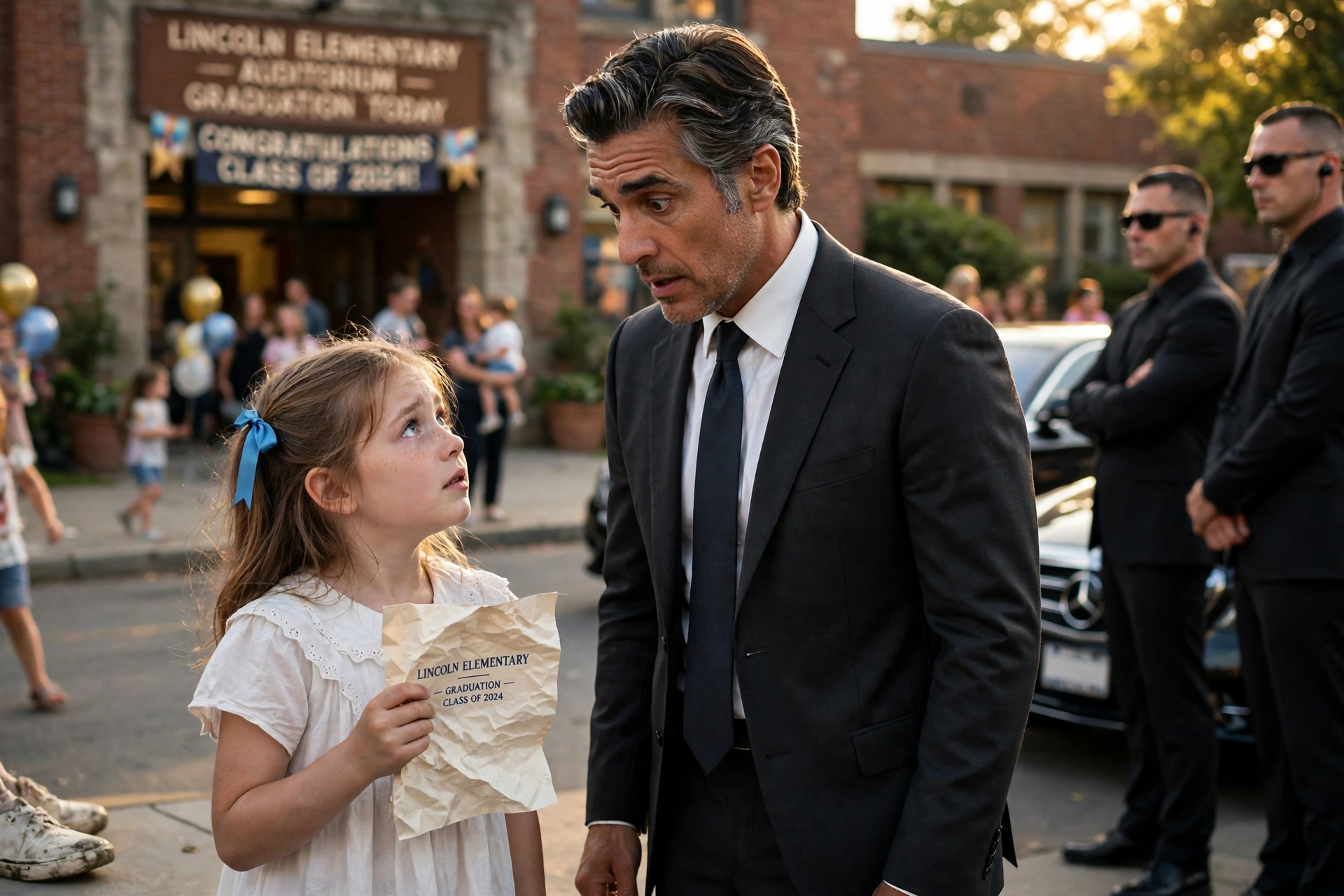
The autumn concert arrived on a evening when the air smelled of rain and woodsmoke, and the auditorium at Lincoln Elementary was warm with lights and with the particular excitement that only school concerts create: children in clean shirts, parents with cameras, teachers with clipboards, and a stage that seemed, to the children waiting in the wings, both very small and impossibly large.
Sophie was nervous in a way she had not been at her graduation ceremony. At graduation, she had been nervous about an empty chair. At the concert, she was nervous about singing, about remembering words, about standing in front of people and being heard when her voice shook. Mrs. Alvarez had chosen her for a short solo, not because Sophie was the loudest singer, but because Sophie sang with a clarity that made people listen, even when she was quiet.
June was in the front row, with Aunt May beside her, and Luca was in the third row, on the left, because Sophie had saved him a chair again, and because some traditions, once they begin honestly, are worth keeping. This time, Luca did not arrive in a black Mercedes with bodyguards. He arrived on foot, in a dark suit that was a little less formal than before, carrying a small bouquet of daisies, because Sophie had once liked daisies and because Luca had learned that consistency can be a kind of love, even when it is expressed in flowers.
Before the concert began, Anton Reyes made one last attempt to turn the evening into something else. He did not come inside. He sent a reporter, a young man with a notebook and a camera, who approached Aunt May in the lobby and asked if Sophie would be willing to say a few words about Harbor Point, about her father, about Mr. Moretti, for a story about "the little girl who changed a shipping empire." Aunt May, who had dealt with reporters before and who had no patience for them when they approached children, said no, firmly and politely, and then she found Luca and told him what had happened, not to alarm him, but so he would know.
Luca found the reporter in the lobby, and he did not threaten him, and he did not try to buy him off, which was, for Luca, a measure of how much he had changed. He said, simply and clearly, "This is a school concert, not a press conference. Sophie is seven. She is here to sing. Her family has already told their story, in their own words, in a public record, and they do not owe anyone a performance of their grief tonight. If you want to write about Harbor Point, write about the learning center, and about the jobs that were saved, and about a grandmother who kept a deed for seven years because she loved her family. Do not write about a child singing."
The reporter, who had expected either a threat or a bribe, looked surprised, and then he nodded, and he put his notebook away, and he stayed for the concert as an audience member, not as a hunter. Luca did not know if the reporter would keep his word, but he knew he had done the right thing by saying it out loud, in front of Aunt May, where it could not be denied later.
Inside, the concert began. Second graders sang two songs, just as Sophie had once predicted second graders would, and the audience applauded, and laughed, and wiped their eyes, as audiences at school concerts always do. Then Mrs. Alvarez introduced Sophie, and Sophie walked to the front of the stage, her white dress clean, her blue ribbon bright, her scuffed shoes replaced by newer ones that June had bought for the occasion, though Sophie had insisted on keeping the old ones at home, because, she said, they had been with her when Luca had first clapped for her, and she did not want to throw away something that had been part of a good day.
Sophie looked out at the audience, and for a moment her courage wavered. She saw June, smiling encouragement. She saw Aunt May, nodding. She saw Luca, in the third row on the left, holding daisies, clapping already, softly, as if to say, "I am here, and I am not going anywhere." And then she began to sing.
Her voice was small at first, and then it grew, not loud, but clear, and the song she sang was about a house by the water, and about people who come home after a long time away, and about chairs that are saved for people who are loved. It was not a famous song. Mrs. Alvarez had chosen it because its words were simple and its melody was kind, and because Sophie sang it as if she believed every word, which, in a way, she did.
Halfway through the song, June reached for Aunt May's hand, and Aunt May reached for June's, and Luca, in his chair, felt tears come to his eyes, not because the song was sad, but because it was true. He thought of Daniel Bell, who had never heard his daughter sing, and of Laura Bell, who had died last winter, and of Victor Moretti, who had missed his own son's ceremony, and of all the chairs in all the auditoriums that had been left empty by pride, or by fear, or by business, or by death. And he thought of Sophie, who had saved a chair and had, by that small, brave act, changed the shape of all their lives.
When Sophie finished, the applause was not polite. It was loud, and long, and full, and Sophie beamed, and she looked directly at Luca, and at June, and at Aunt May, and she knew, in the way children know important things without needing them explained, that she was not alone in that room.
After the concert, in the lobby, with families milling around and with teachers trying to keep order, June asked Luca to come to the blue house for tea, one more time, with Aunt May present, as always. Luca agreed, and they walked through the cool evening air, Sophie skipping a little ahead, then coming back to walk beside June, then skipping ahead again, as children do when they are happy and tired at the same time.
At the blue house, June went to her bedroom and returned with something she had not shown Luca before: a letter, sealed, addressed in Daniel's handwriting to "My daughter, when she is old enough to understand." June had kept this letter even longer than the deed, because it was not a legal document. It was a father's letter to a child he would never meet, written in the weeks before he died, when he already suspected that his work at Harbor Point might be dangerous, and when he wanted his daughter to know, above all, that he had loved her, and that he had believed the world could be made fairer by careful people who asked honest questions.
June handed the letter to Sophie, not to Luca, because it belonged to Sophie, and Sophie held it carefully, as if it were made of glass, and then she handed it to June and asked June to read it aloud, because some letters are too important to read alone the first time.
June read, her voice steady, though her hands shook a little. Daniel wrote that he did not know what the future would hold, that he hoped Sophie would grow up in a house full of books and songs, that he hoped she would have people who showed up for her, not just people who promised to show up, and that if she ever met someone powerful who had done something wrong, she should judge that person not by what his father had done, but by what he did when he learned the truth.
When June finished, there was silence in the kitchen, a silence that was not awkward, but full, like a room after a song has ended and before anyone wants to break the feeling by speaking.
Sophie looked at Luca, and she said, "Mr. Luca, my daddy said to judge you by what you do when you learn the truth. You gave back the land, and you helped Nana, and you came to hear me sing. I think my daddy would say you did the right thing."
Luca, who had faced down rival shippers and port authorities and his own board, found that he could not speak for a moment, because a seven-year-old's judgment, offered simply and without flattery, was heavier and more precious than any business victory he had ever won.
June then did something Luca had not expected. She took a small key from her pocket, a key to the tin box, and she placed it on the table, not as a gift to Luca, but as a symbol. "Mr. Moretti," she said, "this box no longer needs to be kept closed. The deed is in a public record now. The letter belongs to Sophie. The box itself can hold something else now, perhaps photographs, perhaps daisies, perhaps whatever Sophie wants to keep safe. You are not Sophie's father, and you will never replace Daniel or Laura, and we would not ask you to. But you are, if you want to be, a friend of this family, who is welcome at our table, with Aunt May present, for as long as you continue to show up honestly. That is not a small thing, Mr. Moretti. That is a family, chosen, not just born."
Luca nodded, and he accepted the invitation the way one accepts something sacred: quietly, and with gratitude, and without trying to make it larger than it was.
In the months that followed, the story did not end with a grand gesture, but with a series of small, faithful ones. Luca continued to visit, supervised and welcome. June's health stabilized, with good days and tired days, but with more good days than tired ones. Aunt May continued to run the blue house with order and love. Sophie continued to go to school, to sing, to read, to ask careful questions, and to save chairs, not just for Luca, but for anyone who needed a place to sit and to be seen.
The Harbor Point learning center grew, slowly, into a place where children from dockworker families could read and learn, and where a plaque, small and respectful, remembered Daniel Bell, not as a victim, but as a careful man who had believed paper could protect people, and who had been right, in the end, because paper, kept in a tin box by a grandmother who loved her family, had finally done what Daniel had hoped it would do: it had told the truth, and the truth, once told honestly, had made room for a new kind of family to form.
On the first anniversary of the school ceremony, Sophie, June, Aunt May, and Luca returned to Lincoln Elementary, not for a ceremony, but for a quiet visit, to thank Mrs. Alvarez and to leave a bouquet of daisies on the stage. Sophie stood in the third row, on the left, and pointed to the chair where Luca had once sat, and she said, "That was the chair I saved, Nana. And look, it is still here, and we are still here, and that is a good story, isn't it?"
June put her arm around Sophie, and Aunt May smiled, and Luca, standing a little behind them, with daisies in his hands, said, "Yes, Sophie. That is a very good story. And the best part is, it is not finished yet. It is just beginning, with people who show up, and who tell the truth, and who save chairs for each other, even when it is hard."
Sophie laughed, and June laughed, and the afternoon light came through the auditorium windows, warm and golden, and for a moment, in that ordinary school, with its banners and its small chairs, it felt as if all the empty chairs in all their lives had finally been filled, not by pretending, but by choosing, day after day, to come back, to listen, to make amends, and to clap loudly for a child who had asked, once, for forty-five minutes, and had received, in return, a lifetime of people who would not leave her sitting alone.
Years later, Sophie would still remember that autumn concert, not because she sang perfectly, but because she sang honestly, and because the people who loved her were sitting where she could see them, clapping loudly, just as she had asked. She would remember that a chair, once saved for a stranger, can become a place where a family gathers, and that the bravest thing a child can do is not to pretend that everything is fine, but to ask, clearly and kindly, for someone to show up, and then to give that person a chance to prove that showing up can change everything.
Story Genres: Family Drama
-

Chapter 7: A Chair Saved, A Family Chosen
-
Chapter 6: After the Collapse
June came home from the hospital on a Tuesday, and the blue house, which had felt empty without her, felt full again in a way that had nothing to do with noise. Aunt May had cleaned every room, had stocked the kitchen, had placed fresh flowers on the table, and had made a bed on the ground floor so June would not have to climb stairs while she recovered. Sophie had made a card, with a drawing of the blue house and a sun that was far too large and far too yellow, and she had written, in careful letters, "Welcome home, Nana. I saved you a chair, too."
June cried when she saw it, and then she laughed, and then she cried again, because recovery, she discovered, is not a straight line. It is a series of small, ordinary moments that feel extraordinary because you were afraid you might not have them again.
Luca did not visit every day. He visited when Aunt May said it was helpful, and he stayed away when Aunt May said June needed rest, and he learned, slowly, how to be present without being intrusive, which was a skill his previous life had never required of him. When he did visit, he brought groceries, not gifts, and he sat in the kitchen, with Aunt May present, and he listened to June talk about the learning center, about Daniel, about the garden, about the ordinary business of a house that had survived a great deal.
At Moretti Logistics, the fallout from Harbor Point was real, but it was not the catastrophe Dominic had feared, nor the triumph Anton had predicted. The board, after a long and difficult meeting, voted to accept the trust agreement, largely because Elena's lease-back plan preserved jobs and revenue, and largely because the alternative, a public lawsuit over a forged deed, would have been far more expensive in both money and reputation. Some shareholders grumbled. Some clients asked hard questions. A few contracts were lost, and a few new clients, drawn by the story of a company that had corrected its own past, came forward to ask about working with a shipper that took safety and honesty seriously.
Dominic, who had expected to lose his position, found himself in a different position instead: head of compliance and safety, a role that had not existed before, with authority to stop a shipment if it was overloaded, even if stopping it cost money. He took the role seriously, and he took it personally, because he had been part of the quiet for too long, and he wanted, in the second half of his career, to be part of something louder and cleaner.
Anton Reyes did not disappear. He filed a challenge with the port authority, arguing that the trust agreement was invalid, and he lost, because Elena's documents were thorough and because the Bell family's claim was documented in a way that Anton's lawyers could not easily dismiss. Anton did not apologize, and Luca did not expect him to. Anton simply moved on to another waterfront dispute, as men like Anton do, leaving Harbor Point to the people who actually worked there and to the family who had finally been heard.
Sophie, meanwhile, was dealing with a quieter kind of recovery. She had been frightened at the hospital, and frightened children do not always say they are frightened. They become quieter, or louder, or clingier, or more independent than they should be. Sophie became, for a while, very careful about June's health. She would check, several times a day, whether June was tired, whether June needed water, whether June's heart was all right, in the way children check things they do not fully understand but desperately want to control.
June noticed, and she handled it the way she handled most things: gently, and directly. She sat Sophie down, with Aunt May nearby, and she said, "Sweetheart, my heart is my job to take care of, with the doctor's help. Your job is to be seven, to go to school, to sing, to read, to play, and to tell me when you are scared, so I can help you carry the scared feeling instead of you carrying it alone."
Sophie nodded, and then she asked the question June had been waiting for, the question that had been underneath all the others since the tin box had been opened.
"Nana, if Mr. Luca gives back the land, does that mean my daddy is not dead anymore?"
June held her close, and Aunt May put a hand on Sophie's shoulder, and June said, very carefully, "No, sweetheart. Giving back land does not bring people back. Your daddy died, and that is a sad and true thing, and no deed or ceremony can change it. What giving back the land does is different. It means that the story about your daddy is now told honestly. It means that people will know he was a careful man who asked good questions. And it means that you will grow up knowing that your family was not forgotten, even when powerful people wanted to forget."
Sophie was quiet for a long time after that, and then she said, "I think my daddy would like that. I think he would like that people know he was careful."
"He would," June said. "He would like that very much."
In the weeks that followed, the learning center began to take shape, not as a grand building, but as a renovated room at Harbor Point, with bookshelves, with a reading corner, with a plaque that did not mention Moretti Logistics in large letters, but mentioned Daniel Bell in small, respectful ones. Luca funded it through the trust, not through his company, because he wanted the center to belong to the community, not to his reputation. Mrs. Alvarez helped choose books. Aunt May helped organize a small library of children's stories about asking questions and about showing up for other people.
Luca also changed how Moretti Logistics operated, in ways that were less dramatic than the Harbor Point ceremony but more lasting. He ended the practice of using family pressure in negotiations, a practice Dominic had once described as "speaking with his brother" and which Luca now understood for what it was: intimidation, dressed up as business. He instituted a rule that any employee could stop a shipment for safety reasons without fear of punishment, and he made sure the rule was not just a poster on a wall, but a practice that was actually used, and actually protected, when a young dockworker stopped an overloaded pallet in the first month and was thanked, publicly, instead of being quietly reassigned.
Some of Luca's old associates did not like the new Luca. They called him soft. They said he had lost his edge. Luca, who had once cared deeply about being feared, found that he cared less and less about that particular reputation, and more and more about a different one: the reputation of a man who could be trusted to keep a promise to a child, and to a grandmother, and to himself.
One evening, as autumn began to turn the leaves outside the blue house, Sophie asked Luca, during a supervised visit with Aunt May making tea in the next room, whether he would come to her next school event. It was not a graduation this time. It was a small autumn concert, where second graders would sing two songs, and where parents would sit in small chairs and applaud as if applause were the most important thing in the world.
Luca looked at June, who nodded, and at Aunt May, who nodded, and then he looked at Sophie, and he said, "Yes, Sophie. I will come, if your nana and Aunt May say it is all right, and if you save me a chair. But this time, I will not be pretending to be your dad. I will be there as myself, as a friend of your family, who is proud of you and who wants to hear you sing."
Sophie thought about that, and then she smiled, a smile that was not astonished this time, but settled, as if she had finally understood something important about how families can be made, not just born.
"Okay," she said. "But you still have to clap loud. That part does not change."
Luca laughed, a real laugh that surprised him with its ease, and June laughed too, and Aunt May, who rarely laughed out loud, smiled into her tea.
The learning center opened quietly, without reporters, on a Saturday morning when the light at Harbor Point was soft and golden. June cut a ribbon with hands that were still a little shaky, and Sophie read aloud from a book about a girl who asks a difficult question and does not stop asking until she gets an honest answer. The audience was small: dockworkers on their day off, teachers, Aunt May, Mrs. Alvarez, Dominic, Elena, and Luca, sitting in the back row, clapping as loudly as he had clapped at the school ceremony, because some habits, once learned properly, are worth keeping.
After the opening, an older woman who had worked at Harbor Point for thirty years approached June and told her that Daniel had once helped her carry a heavy box when no one else had offered, and that she had never forgotten it. June thanked her, and her eyes filled, because Daniel's story was no longer just a letter in a tin box. It was becoming a story other people told, in their own words, about a careful young man who had mattered to more people than his family had known.
Luca also visited his father's grave for the first time in years, not to forgive Victor Moretti in a single afternoon, and not to condemn him in a single afternoon, but to tell the truth out loud in a place where no one could argue with him. He stood among quiet stones and said, "You taught me to be strong, Father, but you did not teach me to be honest about where that strength came from. I am learning that now, from a grandmother and a little girl, and I wish you had learned it sooner, for all our sakes." He left no flowers, because flowers felt too easy, but he left with a clearer sense of who he was not going to be, and that, he discovered, can be a kind of peace.
Sophie, meanwhile, practiced her two songs for the autumn concert with a seriousness that made Mrs. Alvarez smile. She practiced in the garden, in the kitchen, and, once, in the car on the way to a doctor's appointment with June, until Aunt May said, laughing, that she would know those songs in her sleep. Sophie did not mind. She liked the feeling of being prepared, of knowing her part, of standing up in front of people and being heard. She had learned, without anyone teaching her directly, that applause is not just noise. It is a way of saying, "We see you, and we are glad you are here," and she wanted to earn that applause by singing well, not by asking anyone to pretend.
June's doctor, at her next check-up, said her heart was stable, that rest and medication and low stress were helping, and that she should continue to avoid large public ceremonies for a while, which June accepted with a wry smile, because she had already attended one very large public ceremony and had no desire to repeat the experience. She told the doctor, with a straight face, that she planned to spend the autumn in her garden and in her kitchen, and that if anyone tried to make her attend another warehouse ceremony, she would send Aunt May in her place, which made the doctor laugh and made Aunt May pretend to be offended, in the fond way families pretend when they are actually relieved.
That night, Luca drove home through streets lit with early evening light, and he thought about how far he had come from the afternoon when a little girl had stopped him outside an auditorium and asked him for forty-five minutes. He had given her forty-five minutes, and she had given him, in return, something he had not known he was missing: a reason to be a better man, not for applause, but because applause, when it is honest, is a kind of promise, and promises, when they are kept, change the people who make them.
He did not know yet what the autumn concert would bring, or whether June's health would hold, or whether Harbor Point would remain peaceful. He only knew that the story was not finished, and that the next chapter, whatever it held, would be faced with people he had chosen to stand beside, rather than alone at a long table, trying to be feared enough that no one would ever leave him sitting in an empty chair again. -
Chapter 5: The Deed Returned
Luca had never liked public ceremonies. He liked rooms with doors that closed, tables where decisions could be made without an audience, and outcomes that could be announced after they were already settled. The ceremony he was planning now was the opposite of all that, and he knew it, and he was planning it anyway, because June Bell had taught him, without ever saying it in those words, that some truths need witnesses.
The plan, as Elena Marchetti had helped him shape it, was simple in its outline and difficult in its details. Luca would return the disputed Harbor Point parcel to the Bell family trust, which June and Aunt May would administer for Sophie's future, and Moretti Logistics would then lease the warehouse back from the trust on honest, public terms, with safety standards enforced by an independent inspector and with a portion of the lease revenue funding a scholarship and a community learning center in Daniel Bell's name. The jobs would remain. The warehouse would remain. What would change was who owned the land underneath it, and who got to say, truthfully, that the past had been faced rather than filed away.
Dominic Vale read the plan and went pale. "Luca, if you announce this at Harbor Point, Anton will be there. He will bring lawyers. He will bring reporters. He will try to turn your confession into his victory. And the board will not thank you. The board will ask why you did not settle this quietly, the way your father would have."
"My father settled things quietly," Luca said, "and look where quiet got us. It got us a tin box, and a dead clerk, and a little girl who had to ask a stranger to sit in her family chair. I am tired of quiet."
Dominic was silent for a long time, and Luca could see the war inside him: loyalty to the company he had helped build, loyalty to the man he had helped build it with, and a growing, uncomfortable loyalty to the truth that Luca was now insisting on. In the end, Dominic did something Luca had not expected. He put his own name on the plan as a witness, not as an approver, but as a man who had been there and who would not pretend otherwise.
"I will not lie for this anymore," Dominic said quietly. "I knew enough, Luca. I knew the transfer was disputed, and I told myself that was your father's business, not mine. It was mine, too. I was part of the quiet. If you are going to stand up in public, I will stand with you, even if it costs me my position. I would rather lose a position than lose the ability to look at myself."
Luca shook Dominic's hand, and for the first time in years, the handshake felt like something other than business. It felt like the beginning of a different kind of partnership, one based not on fear or profit, but on a shared decision to do the next right thing, even when the next right thing was expensive.
June agreed to attend the Harbor Point ceremony, but only on conditions that made Luca smile despite his nervousness. Sophie would be present, but only with Aunt May and Mrs. Alvarez nearby, and only for the part of the ceremony that was about Daniel and about the learning center, not for the legal announcements. June would speak, briefly, if she felt well enough, and if she did not feel well enough, Aunt May would read her words for her. No reporters would be allowed to photograph Sophie without June's permission, and no one would ask Sophie to perform grief for a camera.
Anton Reyes, of course, came anyway. He arrived with lawyers and with a smile that did not reach his eyes, and he took a seat near the front, as if he owned the room. He had spent the week telling anyone who would listen that Moretti Logistics was collapsing, that Luca had lost control, that Harbor Point would soon be his. He had not expected Luca to walk in with June Bell on one side and Elena Marchetti on the other, holding a deed that was about to change hands in public, with terms that left Anton no room to claim victory.
The ceremony began in the warehouse itself, in a space that had been cleared and cleaned, with chairs arranged in rows and with sunlight coming through high windows onto the concrete floor where Daniel Bell had once worked. Luca stood at a simple podium, without notes, because he wanted to say this in his own words, not in a lawyer's words.
He began with Sophie's ceremony, not with the deed. He told the small crowd about a little girl in a white dress who had asked a stranger to sit in a family chair for forty-five minutes, and about an empty chair he had once stared at when he was seventeen, and about how those two chairs had taught him that showing up is not a small thing. He told them about June, who had kept a tin box for seven years, not to destroy anyone, but because she could not throw away her son-in-law's belief that paper could protect people.
Then he said the words that made the room go still.
"Moretti Logistics benefited from a transfer at Harbor Point that was not honest. My father was responsible for that transfer. I did not forge it, but I inherited the company that did, and for too long I accepted the benefits without asking the questions Daniel Bell asked. Today, I am returning this parcel to the Bell family trust, and I am asking the port authority to record that return publicly, so that no one can quietly undo it later."
There was a gasp, and then a murmur, and then Anton stood up, his smile gone.
"This is a stunt," Anton said loudly. "You cannot simply give away company assets to buy a good headline, Luca. The board has not approved this. The shareholders will sue."
"The board has been informed," Elena said calmly, stepping forward with documents. "And the trust agreement includes a lease-back that preserves every job at this warehouse, with independent safety inspections that will be published quarterly. This is not a giveaway. It is a correction, with a business plan attached."
Anton's lawyers began to argue, and reporters began to write, and the room, which had been orderly a moment before, became loud and crowded and tense. Luca tried to keep his eyes on June, who was sitting in the front row with Aunt May and Sophie nearby, listening with her hands folded in her lap, her face calm in a way that took tremendous effort.
And then June stood up to speak, and the room quieted, because there is a kind of authority that does not need a podium or a title, only a life lived honestly for a very long time.
She began to thank Luca, not for the deed, but for listening, and she began to say Daniel's name, and then she stopped. Her hand went to her chest. Her face went pale. Aunt May was on her feet in an instant, and Sophie, who had been told to stay with Mrs. Alvarez, cried out, "Nana!" in a voice that cut through every argument in the room.
June collapsed into her chair, then slid forward, and Luca was there before he had time to think, not as a shipping boss, but as a man who had once watched a child save a chair and who now watched a grandmother fall. Paramedics who had been stationed nearby, because Elena had insisted on them given June's heart condition, moved quickly and professionally. Aunt May held Sophie, Mrs. Alvarez held Sophie's other hand, and Luca stepped back, because this was not his moment to take charge. This was a moment for medical people, and for family, and for a little girl who was suddenly afraid she was about to lose the only parent she had left.
In the ambulance bay, with sirens soft in the distance and with Sophie crying quietly against Aunt May's shoulder, Luca knelt down, at a respectful distance, and said to Sophie, "Your nana is strong, Sophie. The doctors are helping her. Aunt May is here, and Mrs. Alvarez is here, and I am here, but I will not pretend to be your family. I will be here as a friend who is going to make sure your nana gets the best care, and who is going to stay until we know she is safe."
Sophie nodded through tears, and Aunt May, who had every reason to blame Luca for the stress of the day, looked at him and said, "Thank you for not making this about you, Mr. Moretti. That matters more than you know."
At the hospital, the hours stretched long and thin. Dominic stayed, even though he had a board meeting to attend. Elena stayed, making calls to ensure June's care was not interrupted by legal questions. Anton, to his credit or to his calculation, left Harbor Point without further argument, because even Anton understood that arguing over a lease while a grandmother was in a hospital would make him look cruel in a way no headline could fix.
When the doctor finally came out and said June was stable, that her heart had been strained but not stopped, that she needed rest and monitoring and no more public ceremonies for a while, Sophie burst into tears of relief so strong that Aunt May had to hold her up. Luca, standing a few steps away, felt his own knees weaken, not from business, but from gratitude, because he had been afraid, in that warehouse, that his attempt to make things right had instead taken away the one person Sophie could not afford to lose.
June, when she woke, asked first for Sophie, then for Aunt May, and then, surprisingly, for Luca. When Luca entered her hospital room, with Aunt May present and a nurse nearby, June took his hand with a grip that was weaker than before but still steady in its intention.
"Mr. Moretti," June whispered, "you did not cause my heart to do this. My heart has been tired for a long time. You gave it a reason to work hard today, but you also gave it a reason to hope. Do not carry this as guilt. Carry it as a reminder that truth has a cost, and that cost is worth paying, even when it frightens us."
Luca nodded, unable to speak for a moment, and June smiled, a small, tired, real smile.
"And Mr. Moretti," she added, "when I am well enough, I would like to see that learning center. Daniel would have liked a place where children learn to read and to ask careful questions. He was a careful man. He would have liked that very much."
Outside the hospital, as evening fell over the waterfront, Luca stood with Dominic and Elena and looked at the lights of Harbor Point in the distance. The deed had been returned. Anton had been denied his easy victory. The jobs were preserved, at least for now. And a grandmother was alive, resting, with her granddaughter asleep against Aunt May's shoulder in a waiting room chair.
It was not a clean victory. It was not a simple happy ending. It was a climax that had cost everyone something: Luca his easy control, Dominic his comfortable loyalty, June her strength for the day, Sophie her sense that grown-up problems stay far away from children. But it was also a climax that had changed the shape of the story, because for the first time, the truth about Harbor Point was not in a tin box. It was in a public record, in a trust agreement, and in the memory of everyone who had been in that warehouse when a shipping boss had said, out loud, that his company had benefited from something dishonest, and that he was going to make it right.
Luca did not feel triumphant. He felt tired, and humbled, and strangely hopeful, the way a man feels after he has finally done a difficult thing he has been avoiding for years, and has discovered that doing it did not destroy him, even though it had changed him completely.
In the weeks that followed that hospital night, Luca visited June only when Aunt May said it was helpful, and he brought no business papers to the blue house, only groceries and quiet conversation. He learned to wait in the kitchen while June rested, to listen to Sophie practice her songs from the next room, and to understand that making amends is not a single ceremony, however public, but a long series of small, faithful choices that prove, day after day, that a promise was not just words spoken in a warehouse. -
Chapter 4: The Files
The days after the tin box were the longest Luca had known since he was seventeen and waiting for a father who did not come. He read files in the morning, met lawyers in the afternoon, and lay awake at night thinking about signatures that did not match and about a young clerk named Daniel Bell who had believed paper could protect people.
Dominic Vale did not like what he was seeing. Dominic had built his career on protecting Moretti Logistics, and protection, in Dominic's mind, meant containment. It meant finding the leak, sealing it, and moving on before the market noticed. He came to Luca's office with a plan that was, by Dominic's standards, generous: a private settlement for June Bell, generous enough to secure Sophie's education and June's medical care, in exchange for the deed, the letter, and a signed agreement never to speak of Harbor Point again.
"That is not justice, Dominic," Luca said. "That is a purchase."
"It is survival," Dominic said, and for the first time in their long partnership, his voice had an edge. "Luca, Anton Reyes is not bluffing. If this deed becomes public, the port authority will review every lease we hold at Harbor Point. Our lenders will ask questions. Our clients will ask questions. You could lose the waterfront, not because you forged anything, but because you inherited a company that did."
"Then perhaps I should lose the part that was never honestly mine," Luca said.
Dominic stared at him. "You are talking like a man who has never had to meet a payroll. There are hundreds of people who depend on those jobs, Luca. Dockworkers, drivers, office staff. Are you going to sacrifice them for a deed from the nineties?"
Luca thought about that, because it was a fair question, and because Dominic was not wrong about the jobs. He thought about the men and women who loaded ships in the rain, who had families and mortgages and school ceremonies of their own. He did not want to hurt them to help one family. But he also did not want to help one family by hurting the truth, because he had seen, in June's kitchen, what a buried truth did over seven years: it did not disappear. It waited in a tin box.
"I am not going to close the warehouse," Luca said. "I am going to find a way to make it right without destroying the people who work there. There has to be a way to return what was taken and keep the jobs. If there is not, I will find one anyway."
Dominic left the office without arguing further, but Luca could feel the distance growing between them, like a tide pulling back from a shore. Dominic had been loyal to Luca for decades, but his loyalty had always been to the company first, and Luca was beginning to understand that those two loyalties were no longer the same.
Luca hired an independent lawyer, a woman named Elena Marchetti, who had no ties to Moretti Logistics and no patience for corporate euphemisms. Elena read the deed, the letter, and the accident reports, and she told Luca, plainly, what he already suspected: the transfer signature was almost certainly forged, the accident investigation had been conducted by a firm hired by the company itself, and the settlement with Laura Bell had been designed to close questions, not to answer them.
"What Daniel found," Elena said, "was not just a forged deed. It was a pattern. The warehouse was overloaded to meet a deadline your father had promised a client. Shelves were stacked beyond their rated capacity. Daniel noted it in his notebook, and he noted that he had raised it with a supervisor, and that the supervisor had told him to keep the freight moving. The shelf that collapsed was not an act of God, Luca. It was an act of hurry."
Luca felt sick. Hurry. He knew hurry. He had built a career on hurry, on deadlines, on making the freight move. He had told himself hurry was business. Now hurry had a name, and a face in a photograph, and a daughter who wore a blue ribbon to school.
"Was it murder?" Luca asked, because he needed to hear the answer in plain language.
"No," Elena said carefully. "Not on the evidence I have seen. It was negligence, and then it was a cover-up. The company did not plan for Daniel to die. It planned for no one to ask why he died. That distinction matters in court, Luca, but I am not sure it matters as much to a grandmother."
Luca nodded. He understood. To June, the distinction between murder and negligence would feel thin, because both had left her daughter a widow and her granddaughter fatherless.
While Luca was learning these things, Sophie was learning something else at school. A boy in her class, whose father worked for Anton Reyes, had heard his parents talking about Harbor Point and about a lawsuit, and he had repeated, in the cruel shorthand of children, that Sophie's new friend was a bad man who had stolen her family's land. Sophie had come home crying, not because she believed it fully, but because she did not know how to answer it.
June held her and said, "People will say many things about Mr. Luca now, Sophie, and some of them will be true and some will not. Your job is not to defend him or to condemn him. Your job is to be a child, to do your homework, to sing your songs, and to let the grown-ups sort out what they did wrong."
"But what if he is bad?" Sophie whispered.
"Then we will know," June said, "by what he does next, not by what other people say about what his father did before."
Aunt May, who had been listening from the doorway, added, "And if he does the right thing, Sophie, that does not mean we have to pretend the past did not happen. It means we can be grateful for the present without forgetting the past. Both can be true."
That evening, Luca did something he had never done before: he went to Sophie's school, not to the auditorium, but to the small office where Mrs. Alvarez kept her records, and he asked, with June's permission and Aunt May present, if he could make a donation to the school's music program, anonymously, in Daniel Bell's name. Mrs. Alvarez, who had seen many wealthy men try to buy goodwill, looked at him skeptically, until Luca said, "Not in my name. In his. He worked at the docks, and his daughter sings in your second grade. That is all the connection I want to claim."
Mrs. Alvarez accepted, on the condition that the donation be public only as a gift to the music program, with no plaque, no announcement, and no photograph. Luca agreed at once, and for the first time in days, he felt something like relief, not because he had solved anything, but because he had done one small thing that was not about his empire.
Elena also explained, in plain language that Luca appreciated, what his choices actually were. He could fight the deed in court, and he would probably lose, slowly and publicly, while Anton watched. He could settle privately with June, and he would probably succeed, but Sophie would grow up knowing that her family's story had been bought and filed away. Or he could return the parcel voluntarily, with a plan to keep the warehouse operating under a new, honest lease, and accept the financial loss and the public scrutiny that would follow. None of the choices were painless, Elena said, and none of them would make Daniel Bell alive again. The question was not which choice was painless. The question was which choice Luca could live with when he looked at himself in the mirror in ten years, and when Sophie, grown up, asked him what he had done when he learned the truth.
Luca spent the next day at Harbor Point itself, walking the docks without an entourage, talking to workers who had been there for decades. An older dockworker named Frank, who had known Daniel by sight, told Luca that Daniel had been a quiet young man who always double-checked the loads and who had once stopped a forklift driver from stacking a pallet too high, even though it had delayed a shipment. "He was not a troublemaker," Frank said. "He was a careful man in a place that rewarded speed over care. That is a dangerous combination, if you think about it." Luca thought about it for a long time after Frank had gone back to work, and he thought about how many times he himself had rewarded speed over care, and how many careful people he had overlooked because they did not shout.
June, meanwhile, had a difficult week of her own. Her heart doctor adjusted her medication and told her, firmly, to avoid stress, which made June smile in a tired way, because stress was not something she could simply decline, like a second helping of dessert. Aunt May took over more of the housework, and Sophie, sensing that her grandmother was tired, began doing small, thoughtful things without being asked: bringing June a glass of water, reading aloud from her school book in the evenings, leaving a daisy, now pressed flat, on June's bedside table. June kept that pressed daisy, because it reminded her of the afternoon when a feared shipping boss had sat in a school chair and clapped for her granddaughter, and because it reminded her that kindness and justice do not always arrive in the same package, but sometimes they arrive on the same day.
Later that week, Anton Reyes made his move. He did not threaten Luca directly. He threatened the port authority, in the form of a letter, suggesting that Moretti Logistics' title to Harbor Point was clouded and that a review would be in the public interest. He also, through intermediaries, suggested to a local newspaper that there was a human story behind the lease dispute, a story involving a widowed grandmother and a little girl. Luca knew what Anton was doing: he was turning June's pain into leverage, and he was counting on Luca to panic and sell the lease on Anton's terms to make the story go away.
Luca called June that night, and he told her what Anton was doing, because June deserved to hear it from him before she heard it from anyone else.
"Mr. Moretti," June said, after a long silence, "I have kept this box for seven years because I did not want Sophie to become a story in a newspaper. If Anton uses her, I will not forgive him, and I will not forgive you if you let him."
"I will not let him," Luca said. "I will not sell the lease to Anton to bury this. I would rather lose Harbor Point honestly than keep it by making a deal with a man who wants to use your granddaughter as a headline."
June was quiet, and then she said, very softly, "Then you are already different from your father, Mr. Moretti. Your father would have made the deal."
Luca hung up and sat in his office, looking at the files spread across his desk, at the deed and the letter and the accident reports Elena had summarized. He thought about Dominic, who wanted to buy silence, and Anton, who wanted to buy the lease, and June, who wanted neither, only the truth and a safe life for Sophie.
He realized that the investigation was no longer just about the past. It was about who would control the future of Harbor Point, and whether that future would be decided by men in boardrooms or by a grandmother in a blue house who had kept a tin box because she loved her family too much to throw it away.
And he realized, too, that he had not yet told Sophie the whole story, because Sophie was seven, and seven-year-olds should not have to carry deeds and accident reports. But he had promised her he would not look away, and a promise to a child, Luca was learning, is not a small thing. It is the largest thing, because children remember promises the way adults remember contracts, and they remember broken ones even longer.
That night, as Luca locked his office, he paused by the window and looked out at the waterfront lights, thinking about how many of those lights belonged to warehouses he had once seen only as assets. Now he saw them differently, as places where careful people worked, where families depended on honest safety rules, and where a single overloaded shelf could change a child's life forever. He did not feel proud of that new way of seeing, exactly, but he felt awake, and awake felt like a beginning, even if it also felt like a responsibility he could no longer set down. -
Chapter 3: The Tin Box
Luca arrived at the little blue house on a Saturday afternoon, and he arrived alone. No bodyguards stood on the porch. No black Mercedes idled at the curb. He had walked from the corner, carrying nothing but a notebook and a willingness to listen that felt, to him, both unfamiliar and necessary. Aunt May opened the door, looked him up and down, and let him in without ceremony.
"June is in the kitchen," Aunt May said. "Sophie is at the library with Mrs. Alvarez for a reading group. She will be home in an hour. That gives us an hour to talk like adults, Mr. Moretti, without a child in the room to soften what needs to be said."
Luca nodded. He had expected a confrontation. He had not expected to be grateful for it.
June was sitting at the kitchen table, and the tin box was on the table in front of her. It was not a dramatic object. It was dented at one corner, its paint worn, its latch loose. It looked like something that had held biscuits once, long ago, and had then been given a more serious job. June's hands rested on either side of it, steady, but Luca could see the effort steadiness cost her.
"Sit down," June said.
Luca sat. Aunt May poured tea and then sat too, not as a guest, but as a witness. That was important, Luca understood. June did not want this conversation to be private in a way that could later be denied. She wanted someone else in the room who would remember what was said.
"Before I open this," June said, "I want you to know why I kept it. I kept it because my daughter, Laura, asked me to keep it, and because my son-in-law, Daniel, believed it mattered. I did not keep it to hurt you, Mr. Moretti. I kept it because throwing it away would have felt like throwing away Daniel himself."
Luca nodded, and June opened the box.
Inside were three things. A deed, copied in faded ink, showing a parcel of waterfront land at Harbor Point in the name of Thomas Bell, June's late husband, and his brother. A letter, written in a young man's careful handwriting, dated a few weeks before Daniel Bell died. And a photograph of Daniel in a dockworker's jacket, standing in front of a warehouse, smiling as if he believed the future would be fair to him.
June laid the deed on the table first. "This land," she said, "was Bell land. My husband's family had worked the docks there for two generations. They did not own much, Mr. Moretti, but they owned that parcel, and they owned it honestly."
She laid the letter beside it. "Daniel worked as a clerk at Harbor Point. He was not a powerful man. He was a careful man. He noticed when numbers did not match, when a transfer was filed twice, when a signature looked too smooth to be real. He wrote this letter to Laura, my daughter, because he was afraid to write it to anyone else. He said the warehouse had been built on land that had been transferred with a forged signature, and that the man who benefited most was Victor Moretti, your father."
The room went very quiet. Luca could hear the clock on the wall, and the kettle cooling, and his own breathing, which suddenly seemed too loud.
"Daniel died before Sophie was born," June continued, her voice steady, but her eyes bright with a grief that had never fully left. "He died in an accident at that warehouse. A shelf collapsed. A load shifted. The company called it unavoidable. They paid a settlement, and they asked Laura to sign a paper saying she would not ask further questions. Laura was pregnant, and grieving, and afraid, and she signed. She died last winter, Mr. Moretti, of an illness that had nothing to do with Harbor Point, but she died still believing that Daniel's death had not been fully explained, and that the land that should have helped raise Sophie had been taken from her family by a signature that was not theirs."
Luca looked at the deed, at the letter, at the photograph of a young man who would never meet his daughter. He felt the floor shift under him, not dramatically, but completely, the way a building shifts when its foundation has been undermined for years and no one has noticed until the walls begin to crack.
"My father," Luca said slowly, "told me Harbor Point was settled. He told me the disputes were old and that settlement meant the past stayed settled. He never told me about a forged transfer. He never told me about Daniel Bell."
"Men like your father do not tell their sons those stories," June said, not unkindly. "They tell them about empires. They leave the rest in boxes."
Aunt May leaned forward. "June is not asking you to go to prison for your father's sins, Mr. Moretti. She is asking you to decide what kind of man you are now that you know. Because if you bury this again, you will not be your father. You will be worse. You will be a man who knew and chose to look away, after sitting in a child's chair and clapping for her as if you were family."
Luca stood up, too abruptly, and then sat down again, because standing felt like leaving and he did not want to leave. He thought of his father at seventeen, promising to come and sending a driver instead. He thought of himself at forty-six, promising to be on time for a freight agreement and cancelling it to sit in a school auditorium. He thought of Dominic, waiting with files, warning him that some doors do not close again.
"Did Daniel's death have anything to do with what he found?" Luca asked, and his voice was hoarse.
June looked at him for a long time. "I do not know," she said honestly. "I have never been able to prove that it did. I only know that he found something dangerous, and that he died soon after, and that the company that benefited from the forgery was also the company that investigated its own accident. That is not proof, Mr. Moretti. But it is enough to make a grandmother keep a tin box for seven years."
That honesty, Luca realized, was what made June dangerous to his empire, and also what made her trustworthy. She was not claiming more than she could prove. She was not threatening him with a story she had invented. She was offering him a story she had carried, quietly, because she had not known what else to do with it.
Before Luca could answer, the front door opened, and Sophie came home early from the reading group, her backpack bouncing, her blue ribbon slightly askew. She stopped in the doorway when she saw the papers on the table, and the photograph, and the serious faces of the adults.
"What's Harbor Point?" Sophie asked, and her voice was small but clear. "Is that where my daddy worked?"
June stood up at once, and Aunt May moved to Sophie's side, and Luca felt his heart contract, because this was the moment he had feared without knowing it: the moment when a child's simple question met an adult's complicated truth, and no one in the room could answer it without changing something forever.
"Yes, sweetheart," June said gently, kneeling so she was at Sophie's height. "Your daddy worked at Harbor Point. He was a good man, and he loved you before you were born, and he would have been very proud of you at your ceremony."
Sophie looked at the photograph, then at Luca, then back at June. "Did Mr. Luca's company hurt my daddy?" she asked, and the directness of the question was almost unbearable.
Luca did not look away. He did not try to soften it with a story. He said, "Sophie, I did not know your daddy, and I did not know about this land until today. But my family's company was involved in something that hurt your family, and I am going to find out the truth, even if the truth hurts my company. That is a promise, and I will not make it lightly, because I know what it feels like when a grown-up promises to come and does not."
Sophie studied him, the way children study adults when they are deciding whether to believe them. Then she nodded, slowly, and went to June, and June held her, and Aunt May poured more tea that no one drank.
Before he left the blue house, Luca stood on the porch for a moment, looking at the garden June had tended with such care. The garden was not large, but it was orderly in the way that comes from years of attention: roses along the fence, herbs by the kitchen door, a small bench where someone could sit and think. Luca thought about his own apartment, which had a view but no garden, and about his office, which had a conference table but no bench for thinking. He thought about how much of his life had been built for display and how little of it had been built for sitting quietly with a difficult truth.
On the drive back, he did not turn on the radio. He let the road noise fill the car, and he let himself remember his father more honestly than he usually allowed. Victor Moretti had not been a monster in Luca's memory. He had been a distant, demanding, impressive man who had taught Luca to shake hands firmly, to read a contract twice, and to never let a rival see him hesitate. He had also been a man who had missed ceremonies, who had sent drivers in his place, who had treated promises as flexible when business required it. Luca had spent his adult life copying the first half of his father and telling himself he had rejected the second half. Now he was not so sure. He had cancelled a meeting to sit in a child's chair, yes, but he had also spent years allowing intimidation to settle disagreements, and he had called that business. The line between his father and himself was thinner than he wanted to admit, and June's tin box had made that line visible for the first time.
When he reached his office, Dominic was waiting, and Dominic could tell from Luca's face that the meeting in the blue house had not gone the way Dominic had hoped. "You look like a man who has just been handed a problem he cannot buy his way out of," Dominic said. Luca nodded, because that was exactly right, and because Dominic, for all his loyalty to the company, still knew Luca better than almost anyone else alive.
That night, Luca went back to his office and opened the old Harbor Point files Dominic had brought him. He read until his eyes burned. He found transfer documents with signatures that did not quite match, and accident reports that were too brief, and settlement papers that were too eager to close questions. He found his father's name, again and again, in the confident handwriting of a man who believed that the waterfront belonged to whoever could hold it.
And then his phone rang, and it was not Dominic. It was Anton Reyes, the rival shipper who wanted the Harbor Point lease, and Anton's voice was smooth and delighted, as if he had been waiting for this call for a very long time.
"I hear you've been visiting a little blue house, Luca," Anton said. "I hear there's a grandmother with a box. Be careful. Boxes like that have a way of opening in courtrooms, and courtrooms have a way of ending empires. Unless, of course, you would like to discuss the lease on my terms, and we can make sure that box stays closed, together."
Luca understood, in that moment, that the secret June had kept for seven years was no longer just a family secret. It was a weapon, and Anton wanted to hold it, and Dominic would want to bury it, and June wanted, above all, for it not to hurt Sophie.
Luca ended the call without agreeing to anything. He sat in his dark office, surrounded by files that told a story he had not wanted to read, and he thought of Sophie's question, and June's tin box, and the empty chair he had filled and the other empty chairs he had not yet understood.
The climax of that day was not a shouting match or a threat. It was quieter and more dangerous than that. It was a man who had built his life on being feared realizing that fear would not protect him now, and that the only way forward was through a truth he could not control, for a child who had asked him for forty-five minutes and had ended up asking him for something much larger: to be the kind of man who does not look away. -
Chapter 2: Tea Gone Cold
Luca did not sleep well that night. He lay in a bedroom that was too quiet and too large, listening to the city beyond his windows, and thinking about tea gone cold in a little blue house. He had sat in boardrooms where men tried to intimidate him with silence, and he had sat in courtrooms where lawyers tried to bury him in paper, and he had never felt as exposed as he had felt when June Bell placed his business card on her table and looked at him as if she were seeing two men at once: the man who had clapped for her granddaughter, and the man whose company name belonged to a place she could not say without her voice changing.
In the morning, his apartment looked the same. The coffee was the same. The suit he chose was the same dark charcoal. But the day did not feel the same, because for the first time in years, Luca was not sure what kind of man he was going to be when he walked into his office.
Dominic Vale was already there, calm and early, as always. Dominic had been with Luca since the early waterfront years, when Moretti Logistics was still a handful of trucks and a rented warehouse and a reputation that had to be earned one delivery at a time. He knew Luca's moods the way a sailor knows weather, and he knew, before Luca said a word, that something had shifted.
"The freight agreement," Dominic said, setting a folder on the desk. "Anton Reyes is pushing for the Harbor Point route. He wants the lease renewed on his terms, and he wants it this week. If we hesitate, he will go to the port authority and argue that we are not using the warehouse efficiently."
Luca opened the folder and did not really see it. Harbor Point. The name had been ordinary to him for so long that he had forgotten it could be a place where real people had lived and worked and died. To him, it was square footage, loading docks, insurance, and a line in a quarterly report. To June Bell, it was something else, and Luca needed to know what, before Anton Reyes or anyone else used it against him.
"Tell me about Harbor Point," Luca said. "Not the lease. The history."
Dominic frowned. "History is expensive, Luca. The warehouse was built in the nineties, after your father consolidated the waterfront properties. There were disputes, as there always are with old land. Your father settled them. That is what settlement means. It means the past stays settled."
"Settled for whom?" Luca asked.
Dominic did not answer at once, and that pause told Luca more than a denial would have. Dominic was not a man who paused unless he was choosing his words with unusual care.
"For us," Dominic said finally. "For the company. For everyone who depends on those jobs."
Luca closed the folder. He thought of Sophie in her white dress, holding a crumpled program, and of June pouring tea with steady hands. He thought of the way June had said "the company that owned the Harbor Point warehouse" as if ownership were not a legal fact but a moral one.
"I want the old files," Luca said. "Not the summary. The originals. Deeds, transfers, accident reports, everything from before I took over."
"Luca," Dominic said, and his voice was quieter now, the voice he used when he was trying to protect Luca from himself. "Some doors, once you open them, do not close again. And Anton is waiting for a door exactly like that."
"I know," Luca said. "Get the files anyway."
While Luca was asking for files, Sophie was back at school, and the world there was both smaller and larger than the world of freight agreements. Her teacher, Mrs. Alvarez, had praised her reading aloud that morning, and Sophie had glowed in a way that made her classmates look twice. At lunch, the girl who had once teased her about having no one coming to the ceremony asked, shyly, who the tall man in the dark suit had been. Sophie, who had learned early that truth needed careful handling, said simply, "He came because I saved him a chair." It was true, and it was enough, and it left the rest of the story where it belonged: at home, with her grandmother.
After school, Aunt May met her at the gate, because June had a follow-up with her heart doctor and Aunt May did not like Sophie walking home alone when June was tired. Aunt May was not a woman who wasted words. She worked at the library, she kept the blue house in order, and she had a way of asking a question that made it clear she already knew most of the answer.
"Your nana was quiet last night," Aunt May said as they walked. "Quieter than usual. And you were quiet too, after Mr. Moretti left."
Sophie kicked a small stone along the pavement. "Nana knows his company," she said. "She said the name like it was a bad word, but she also thanked him for coming. I don't understand that."
"Sometimes grown-ups can be grateful and angry at the same time," Aunt May said. "It does not mean they are lying about either feeling. It means the story is bigger than one afternoon."
"Is Mr. Luca a bad man?" Sophie asked, and Aunt May stopped walking, because this was the kind of question that deserved a full stop and a straight look.
"I don't know yet," Aunt May said honestly. "He came back when he could have stayed away. That matters. But coming back once does not erase a history, Sophie. It only gives a person a chance to show you who they are going to be next."
At the blue house, June was sitting by the window with a cup of tea she was not drinking. Her heart appointment had gone as well as such appointments go, which is to say the doctor had used careful words and had asked her to rest and to avoid stress, and June had nodded as if stress were something she could schedule around. When Sophie came in, June's face softened at once, the way it always did, and she pulled Sophie close for a moment that was longer than usual.
Later, after Sophie was doing homework at the kitchen table, June went to her bedroom and opened a drawer she did not open often. Inside, beneath folded scarves and old photographs, was a tin box. It was not locked. It did not need to be. June had kept it for years, not because she wanted to use it, but because she could not bear to throw it away. Inside were papers that smelled faintly of dust and time: a deed, copied and recopied, a letter in a young man's handwriting, and a photograph of a man in a dockworker's jacket standing in front of a warehouse that no longer looked the way it had in the picture.
June sat with the box on her lap for a long time. She thought of her son-in-law, Daniel Bell, Sophie's father, who had died before Sophie was born. Daniel had been a careful man, a man who kept records and asked questions and believed that paper could protect people when power would not. He had worked at Harbor Point, and he had found something in the warehouse files that had frightened him, and he had written it down, and then he had died in an accident at the warehouse that the company had called unavoidable.
June had never believed that word. Unavoidable. It was a word companies used when they did not want to say anything else.
She had also never used the papers. She had told herself she was protecting Sophie, that a seven-year-old did not need a war with a shipping empire, that a grandmother's job was to keep a house warm and a child safe, not to chase justice through courts she could not afford. But now the shipping empire had walked into her granddaughter's school ceremony and sat in a chair Sophie had saved, and June did not know whether that was coincidence or whether it was the beginning of something she had been dreading for years.
That evening, Luca called the blue house. He did not call to charm June or to argue. He called to ask, plainly, if he could come back for tea, with Aunt May present, and talk about Harbor Point. June was silent for a long time on the other end of the line, and Luca could hear Sophie in the background, practicing a song for school, her voice small and clear.
"Mr. Moretti," June said at last, "I need you to understand something. My granddaughter liked you today. She liked you because you came back. Do not make her regret that. If you come here, you come to listen. You do not come to manage me, or to buy my silence, or to make this story smaller than it is."
"I understand," Luca said. "I will listen."
When he hung up, Dominic was standing in his office doorway, holding the first box of old Harbor Point files. The box was dusty. The labels were faded. Dominic set it down as if it were heavier than paper.
"Are you sure?" Dominic asked.
Luca looked at the box, and then at the photograph on his desk, a photograph he rarely looked at: himself at seventeen, in a jacket that did not fit, standing alone after a ceremony.
"No," Luca said. "But I am going to open it anyway."
That night, Sophie dreamed of chairs. In her dream, there were many chairs in a long row, and most of them were empty, and she went from chair to chair, placing a daisy on each one, until she came to the last chair and found her grandmother sitting there, holding a tin box, and smiling at her as if to say that some chairs are not empty at all, they are just waiting for the right person to understand why they matter.
She woke up before dawn, went to June's room, and climbed carefully onto the edge of the bed, the way children do when they need to be close but do not want to wake someone fully. June opened one eye, smiled, and put an arm around her.
"Nana," Sophie whispered, "is Harbor Point a bad place?"
June held her a little tighter. "Harbor Point is a place where good people worked, and where some powerful people made choices they should not have made," she said. "And sometimes, Sophie, a place can be both. That is why grown-ups have to be careful with what they do next."
Sophie nodded, as if that made sense, and fell back asleep against her grandmother's shoulder, her blue ribbon loosened, her breathing slow and even. June stayed awake, watching the first light come through the curtains, thinking about deeds and letters and a young man who had believed paper could protect people, and about a shipping boss who had clapped for her granddaughter as if applause could be a kind of promise.
She did not know yet what Luca Moretti would do when he learned the whole story. She only knew that she could not keep the tin box closed forever, not now that he had sat in Sophie's chair and had looked at her granddaughter the way Daniel had once looked at the world: as if it were worth showing up for, even when showing up was hard.
In the morning, June made tea the way she always did, slowly and without hurry, and she placed the tin box back in its drawer for one more day. She was not ready to open it in front of Luca, and she was not ready to pretend it did not exist. She needed time to decide what kind of truth would help Sophie and what kind of truth would only frighten her. Outside, the garden was bright with early light, and the blue house looked, to anyone passing by, like an ordinary house where an ordinary grandmother was making breakfast for an ordinary little girl. June knew better. She knew that ordinary houses can hold extraordinary papers, and that ordinary afternoons can change the shape of an empire, if the person who holds those papers decides, at last, to speak.
Luca, for his part, learned that night that a promise made to a child is not a small promise at all. He wrote it down in his notebook, in plain words, so he would not forget it when the next freight agreement tried to make him forget: listen first, check the papers, do not use a family as leverage, and come back when you say you will. It was not a business plan, but it was, he realized, a better plan than any he had written in a boardroom, because it gave him a way to measure his days that had nothing to do with profit and everything to do with whether he had shown up honestly for the people who trusted him. -
Chapter 1: The Empty Chair
Luca Moretti had made powerful men wait in silence, had ended negotiations with a single look, and had built an empire on the New Jersey waterfront by never letting anyone see him hesitate, but he had never been stopped by a seven-year-old girl in a white dress with a blue ribbon in her hair, holding a crumpled program in hands that would not stop trembling, and asking him for the one thing no amount of money could buy: forty-five minutes in an empty chair, third row on the left, just until they called her name, because her mother was gone, her father had died before she was born, and she had already told her class that her dad would be there, and when he said no and walked away, he did not yet know that the chair he had refused would follow him all the way across town, that it would remind him of the boy he had been at seventeen staring at his own father's empty chair, or that sitting down at last would lead him to a little blue house where a grandmother was waiting with a cup of tea, a business card, and a secret about Harbor Point that could destroy everything he had built.
The afternoon light outside Lincoln Elementary smelled of cut grass and warm brick. Banners flapped above the auditorium doors, blue and gold, and parents hurried past with bouquets wrapped in cellophane and phones already raised to record something they did not want to forget. Luca Moretti did not hurry. He had learned, over twenty-nine years of building an empire, that hurrying made other people hurry, and that was usually useful. Today it was not. Today he was late for a meeting across town, and the late afternoon was doing what late afternoons in New Jersey often did: it was making him remember things he had paid a great deal of money to forget.
He was forty-six, and his suit had been tailored in a room where no one raised their voice. His shoes were polished. His watch was quiet and expensive. Behind him, two bodyguards waited beside a black Mercedes, the way they always waited, patient and unobtrusive, as if they were part of the car itself. Three men were waiting for him across town to discuss a multimillion-dollar freight agreement, and Dominic Vale, his most trusted executive, had already texted twice. Luca could feel the day narrowing to its usual shape: a room, a table, a decision, a consequence for someone who had refused him.
Then a small voice stopped him.
"Excuse me, sir. Could you be my dad just until they call my name?"
Luca stopped walking.
The little girl standing outside the auditorium could not have been more than seven. She wore a white dress that had been washed many times and ironed with care, scuffed white shoes, and a blue ribbon in her light brown hair. A crumpled graduation program trembled between her fingers. She did not look like a child who was used to asking strangers for things. She looked like a child who had rehearsed this sentence until it stopped sounding like begging and started sounding like a plan.
Behind her, the auditorium doors opened and closed, letting out bursts of music and applause. Other families moved around them, laughing, calling names, finding seats. The girl did not move. She looked straight into his eyes, and Luca, who had faced down port commissioners and rival shippers and men who smiled while they lied, found that he could not look away first.
"My name is Sophie Bell," she explained, as if introductions would make the rest of it ordinary. "You don't have to do anything special. Just sit in the family chair. When they call my name, you can clap."
Luca glanced toward the auditorium. He was aware, suddenly, of how large his hands looked, how loud his shoes sounded on the pavement, how completely out of place a man like him was in a place built for small chairs and smaller voices.
"Where's your family, Sophie?"
"My nana has a heart doctor appointment. Aunt May went with her."
"And your parents?"
Her fingers tightened around the program, creasing it further. For a moment her brave face wavered, and Luca saw the effort it cost her to keep smiling.
"My mommy died last winter. My daddy died before I was born."
She tried to smile again, and this time it was thinner, braver, and therefore harder to watch.
"Everybody else has someone coming. I told a girl in my class that my dad would be there."
Luca said nothing. He was not good at silence. Silence, in his world, was a tool. You let it sit until the other person filled it and gave you something you could use. This silence was different. It was not a tool. It was a weight.
"You only have to pretend for forty-five minutes," Sophie whispered. "Maybe fifty, because the second graders sing two songs."
One of his bodyguards checked his watch, discreetly, the way he had been trained to do. "Boss, we're late."
Across town, three men were waiting. Luca could picture the room already: the long table, the water glasses, the contract with its careful language about routes and rates and penalties. He could picture Dominic at the head of it, calm, explaining that Moretti Logistics did not lose freight agreements. He could picture himself walking in, late, and making lateness look like power.
"I have an important meeting," Luca finally said.
Sophie's smile disappeared. It did not fade. It simply left, as if someone had switched off a light in a small room.
"Oh. That's okay."
She folded her program carefully, along a crease that was already worn soft. "Thank you for listening."
Then she turned toward the auditorium.
But before disappearing inside, she looked back.
"If you change your mind, there's an empty chair in the third row. On the left."
She swallowed. Her voice was very steady for a seven-year-old, and that steadiness broke something in Luca that he had not known was still breakable.
"I saved it."
Luca watched her leave. The doors closed behind her, and the music became muffled, and the afternoon went on being bright and ordinary for everyone else. Something about those words brought back a memory he had not allowed himself to revisit in nearly thirty years.
He was seventeen again, sitting at his own school ceremony, staring at an empty chair.
His father had promised to come. Victor Moretti had said it the way he said everything important: briefly, as if the promise itself were a favor. Luca had worn a jacket that did not quite fit and had kept looking at the door. The ceremony had gone on. Names had been called. Other boys had stood to applause that belonged to whole families. When Luca's name was called, the applause had been polite and thin, and a driver in a dark suit had arrived afterward with a car and an envelope and an apology that was not really an apology.
Luca had spent his adult life making sure nobody could ever make him feel that powerless again. He had built an empire on the waterfront so that no door would ever close on him, no table would ever be too long, no promise would ever be something he had to wait for. He had learned to be feared, because fear was reliable in a way that love had not been.
Now a child had asked him for less than an hour.
And he had turned her down.
His phone rang. The sound was sharp in the warm air. Dominic Vale, his most trusted executive, wanted to discuss a contractor who had refused their terms.
"We spoke with his brother," Dominic said, his voice smooth and practical. "He's reconsidering."
Luca knew what that meant. He had known for years. For years, he had allowed intimidation to settle disagreements. He had told himself it was business, that the waterfront was a hard place, that softness was a luxury he could not afford. He had told himself that the men he dealt with understood the rules.
But suddenly, Sophie's disappointed face would not leave his mind. He saw it superimposed over the contract, over the table, over the whole careful empire he had built to protect a seventeen-year-old boy who was still sitting in an auditorium somewhere, staring at an empty chair.
"Leave the man's family alone," Luca ordered.
Dominic went silent. In all their years together, Luca had never heard Dominic quite that silent.
"Luca, that's not how we operate."
"Then we're changing how we operate."
He ended the call. The bodyguards looked at him, waiting for the next instruction, trained not to show surprise. Luca looked at the auditorium doors, at the banners, at the families still streaming in with flowers and cameras.
Then he turned to his bodyguard. "Cancel my meeting."
"Boss?"
"I'm going back."
Minutes later, Luca stood outside the auditorium again, and this time he did not feel powerful. He felt conspicuous, and nervous, and strangely awake. A teacher stopped him at the door, kind but firm, the way teachers are when they are protecting children.
"Sir, are you family?"
"No," he admitted. "But Sophie Bell asked me to come."
The teacher did not wave him through. She did what a good teacher does: she checked. She contacted Sophie's grandmother, June, who cautiously approved one supervised visit for the ceremony. Luca signed in, wrote his name in careful block letters, and bought six daisies from the school fundraiser, because six seemed right and because he did not know what else a man was supposed to bring to a child's ceremony when he had arrived with nothing but a car and a past.
He entered quietly. Third row. Left side. One empty chair.
He sat down.
The chair was small. His suit felt too dark for the room, his shoulders too broad. Around him, parents whispered and shifted and held programs. Onstage, second graders fidgeted in their white shirts and dresses. Luca held the daisies in his lap and tried to be still, tried to be the kind of man a child could point to without feeling embarrassed.
When Sophie spotted him, her eyes widened.
Then came a smile he would remember for the rest of his life. It was not polite. It was not brave. It was astonished and complete, the smile of a child who had saved a chair and had not really believed anyone would sit in it.
And when the principal called "Sophie Elizabeth Bell," Luca stood and applauded.
He applauded loudly, without caring who looked at him. He applauded until his hands stung. Sophie walked across the stage with her chin up, her blue ribbon bright under the lights, and for a moment Luca understood, in a way he had never understood before, what it meant to be proud of someone you had only just met. It had nothing to do with ownership. It had nothing to do with power. It had everything to do with showing up.
Afterward, Sophie ran toward him, her program still clutched in one hand, her dress swirling around her scuffed shoes.
"You really came back!"
"I did."
She looked at the flowers. "Are those for me?"
"Yes."
She smiled, and then, unexpectedly, she asked whether he would visit her grandmother's little blue house.
June invited him for tea, with Aunt May present. Luca said yes before he had time to make it complicated, and he followed Sophie's directions through streets that grew quieter and greener, to a small blue house with a porch and a garden that had been tended by hands that knew what they were doing. Inside, the house smelled of tea and lemon and old wood. Aunt May, a practical woman with kind eyes and a firm handshake, set out cups and watched him the way people watch a stranger who has suddenly become important to someone they love.
June was older, her grey hair pinned back, her hands steady despite the heart appointment Sophie had mentioned. She poured tea with care. She asked polite questions. She listened to Luca's answers the way people listen when they are trying to decide whether to trust a story or to wait for the part that does not fit.
Then Luca handed June his business card, because that was what men like him did, and because he wanted her to know his real name and not just the name Sophie had given him in her head.
June read the name twice.
"Moretti Logistics?"
"Yes, ma'am."
"The company that owned the Harbor Point warehouse?"
Luca felt the warmth leave the room.
"Yes."
June slowly placed his card on the table, as if it were suddenly heavier than paper. Then she looked directly into his eyes, and in that look Luca saw something he had not expected: not anger, not yet, but recognition, and grief, and a knowledge that went far deeper than a business card.
The tea went cold between them. Sophie, holding her daisies, looked from her grandmother to Luca and back again, sensing, as children do, that the grown-ups in the room had just stepped into a story that was much older and much darker than a school ceremony.
Aunt May set her cup down without drinking. The small sound seemed loud in the quiet house. Outside, a bird called from the garden, and a car passed slowly on the street, and none of it softened the change that had come over the room. Sophie moved a little closer to her grandmother, not because she was afraid of Luca, but because children know when the adults they trust need them near. She held the daisies against her white dress, and the white petals looked suddenly fragile against the blue walls of the house.
Luca did not reach for his card. He did not try to explain, because he did not yet know what needed explaining. He only knew that a name he had carried with pride for decades had just landed in this small kitchen like a stone in still water, and that the ripples were going to reach places he had not thought about in years. He thought of his father, of the waterfront, of the warehouse at Harbor Point that had always been a line on a balance sheet to him and was clearly something else entirely to June Bell.
And Luca understood, with a clarity that frightened him, that the empty chair he had filled that afternoon was not the only empty chair in this family's life. There were others. And one of them had his company's name on it. -

Chapter 7: The Woman He Finally Saw
A year later, on a clear morning in early autumn, Harborlight Commons opened its first phase.
Claire had imagined this day many times, usually at night, usually when she was too tired to sleep, and in her imagination it had always been either too perfect or too fragile: a ribbon, a speech, a crowd that applauded on cue. The real day was messier, and better. There were folding chairs that did not quite line up. There was a microphone that fed back once, sharply, and made everyone laugh. There were children running through the courtyard before anyone had officially declared it open, because children do not wait for ceremonies to use a place that was made for them. There was a banner, hand-painted by residents, that read WELCOME HOME, HARBORLIGHT, in letters that were not quite straight and were therefore perfect.
Claire stood near the entrance, in a simple dress and flat shoes suitable for walking a construction site that was still, in places, a construction site, and she watched the place she had drawn become a place people actually used. The solar canopies cast patterned shade over the pedestrian paths. The rain gardens, planted the previous spring, had survived their first summer and were beginning to show the stubborn green of plants that had been chosen for this soil, not for a photograph. The childcare center, on the ground floor, had its doors open, and through them Claire could hear the particular, joyful noise of small children settling into a room that smelled faintly of paint and new wood. The clinic next door was quieter, but no less busy: an elderly man was being helped through its entrance by a nurse who knew his name, and Claire thought, with a sudden tightening in her throat, about a husband who had died years ago because there had been no clinic close enough, and about a wife who had asked for one, and been heard.
Elena Alvarez cut the ribbon. She did it with large scissors, with both hands, and with a seriousness that made the crowd go quiet, and then she laughed, and the crowd laughed with her, and the ribbon fell in two clean pieces. She turned to Claire, took her hand, and said, in a voice that carried just far enough for the people nearby to hear, "You listened. That is why this stands."
Claire did not make a long speech. She had made her long speech at the gala, and this day did not belong to her in the same way. It belonged to the residents, to the parents, to the small business owners, to the people who would live here long after the cameras left. She thanked them, briefly, by name where she could, and then she stepped back, deliberately, so that Marcus Johnson could talk about childcare hours, and Rosa Delgado could talk about the bakery that would open the following week, and the residents' association could talk about the land trust that would keep these homes affordable, not for a season, but by agreement, for years.
Tessa stood beside her, holding a cup of coffee that had gone cold, and whispered, "Do you remember when you thought this was just pretty buildings?"
"I remember when someone else thought that," Claire said. "I never did."
Tessa smiled. "Good. Because look at it."
Claire looked. She looked at the courtyard, at the fountain that was not yet running but would be by the end of the month, at the young mother pushing a stroller toward the childcare center, at the elderly couple sitting on a bench that had been placed, at Elena Alvarez's request, where the afternoon sun would fall on it. It was the drawing from her sketchbook, not exactly, because real buildings are never exactly like drawings, but recognizably, undeniably, the same place. The entrance, above which the name HARBORLIGHT COMMONS was engraved in stone, was no longer a hope. It was an address.
Later, after the speeches, after the children had been coaxed out of the rain gardens, after Rosa had handed out samples of bread from a temporary table and Marcus had given Claire a tour of the childcare center as if she had not designed every room in it, Claire walked the courtyard alone. She stopped at the fountain, touched the stone, and thought about the woman she had been a year and a half earlier, standing outside a private dining room at the Beaumont Hotel, holding a portfolio that contained three years of her life's work, listening to her husband laugh with another woman and describe her as someone who would adjust.
She did not feel anger anymore, which surprised her. She felt something quieter and more complete: distance. The kind of distance that comes not from forgetting, but from having built a life that no longer depends on the person who hurt you. She had not adjusted to Evan's life. She had built her own, and it was standing, in stone and soil and sunlight, around her.
That evening, at her own apartment — small, bright, with a kitchen large enough for one person to cook properly and a window that looked onto a street she liked — Claire found a letter in her mailbox. It was from Evan. She recognized his handwriting immediately, and for a moment she considered putting it aside, unopened, until the morning. Then she opened it, because she had promised herself, in the document she had closed months earlier, that she would no longer pretend not to see things, even when seeing them was uncomfortable.
The letter was short, and it was not a plea. Evan wrote that he had read about Harborlight's opening in the newspaper, that he had seen a photograph of Claire standing beside Mrs. Alvarez, and that he had finally understood something he should have understood years ago: that he had married a woman who was building something important, and had spent their marriage trying to make her smaller so that his own ambitions would look larger by comparison. He wrote that Mercer Development Group had been restructured, smaller now, without Vanessa, without the townhouse, without the illusion of being close to a deal that would save everything. He wrote that he was sorry, not in the way of a man asking to be forgiven on a schedule, but in the way of a man stating a fact he could no longer avoid. He did not ask Claire to come back. He did not ask for her help. He ended the letter with a single sentence: "I see you now. I am sorry it took losing you to learn how."
Claire read the letter twice. She sat with it for a long time, looking out at the street, at the evening light, at the ordinary life she had built for herself. She felt no urge to reply immediately, and no urge to throw the letter away. She folded it, placed it in a drawer with other papers from a life she had closed, and thought about what forgiveness actually meant. It did not mean forgetting. It did not mean returning. It meant, for her, that Evan's apology no longer had the power to rearrange her day. She could hear it, acknowledge it, and then go back to her own work, her own friends, her own courtyard full of children who did not know her story and did not need to.
She was not, she realized, the wife he had forgotten to see anymore. She was not defined by his seeing or his not seeing. She was Claire Mercer, architect, a woman who had listened to a neighborhood for six months before she drew a single line, who had defended her work with documents instead of scenes, who had lost a marriage and kept her name, her profession, and her project. The title of her story, if anyone ever wrote it, would not be about Evan at all. It would be about Harborlight, and about the people who lived there, and about a woman who learned, late and completely, to design her life around what was true, rather than around what was expected of her.
A few weeks after the opening, Claire wrote Evan a short reply. She did not write it in anger, and she did not write it to reopen a conversation. She thanked him for the letter, she said she wished him well in restructuring his company, and she said that she had found a life she could stand behind, and that she hoped, in time, he would find one too. She did not ask for anything. She did not offer anything. She posted the letter, and then she went for a walk, and the act of posting it felt less like an ending than like putting a book back on a shelf where it belonged.
That same week, Tessa took her to dinner, not to celebrate anything in particular, but because, as Tessa put it, "we have spent a year talking about buildings and divorces, and I would like to talk about something useless for one evening." They talked about books, about a contractor Tessa was convinced had never read a drawing in his life, about a holiday neither of them had time to take. Claire laughed more that evening than she had in months, and she realized, on the walk home, that joy had not left her life with Evan. It had simply been waiting for her to make room for it again, in smaller, quieter forms: a good meal, a friend who knew when to joke and when to stop, a project that was real.
She also returned to the Harborlight site in the following days, not as a guest, but as the architect who would answer for phase two. The clinic's first patients were already being seen, and a nurse told Claire, with the frankness of a person who deals in facts, that an elderly woman had cried when she realized she could walk to her appointment instead of taking two buses. Claire did not tell the nurse that she knew exactly who that woman might have been, or what her husband's story had been. She simply thanked her, and made a note to check the clinic's entrance in winter, when rain and ice would test whether the design was as thoughtful as it looked in autumn.
The next morning, Claire went back to Harborlight, not for a ceremony, but for work. Phase two was already underway, and there were decisions to make about materials, about phasing, about the small, unglamorous details that determined whether a building would still be useful in twenty years. Tessa met her there, with fresh coffee and a list of questions from the contractor. Elena Alvarez was there too, sitting on her bench in the afternoon sun, watching children play in a courtyard that had, for so long, existed only on paper.
Claire sat beside her for a moment, before the meeting began.
"How does it feel?" Mrs. Alvarez asked. "To see it real?"
Claire looked around: at the solar canopies, at the rain gardens, at the clinic door opening for an elderly resident, at the childcare center where a young mother was dropping off her daughter with the hurried, loving efficiency of a parent who trusted the place she was leaving her child.
"It feels," Claire said, slowly, "like I finally built the life I was sketching all along. Not around someone else's ambitions. Around the people who actually needed it. Around my own."
Mrs. Alvarez patted her hand. "Then you did it right," she said. "That is what a foundation is for."
Claire stood, picked up her portfolio — a new one, worn already at the edges from being carried between sites and meetings, but hers, entirely hers — and walked toward the phase two site, where Tessa was waiting, where the work was waiting, where the future, which she had once drawn around her husband, was now waiting to be drawn around herself, and around the community she had served, and around the simple, enduring truth she had learned outside a hotel dining room, in a kitchen with a ring beside a coffee cup, and in a ballroom beneath the chandeliers:
A woman does not need to be seen by the man who forgot her in order to be seen. She needs to be seen by herself, by her work, and by the people whose lives her work actually touches. And once she is, no one — not a husband, not a rival, not a room full of investors — can unsee her again.
Harborlight Commons stood in the morning light, solid and useful and beautiful without unnecessary extravagance, exactly as Claire had designed it. Children walked beneath the trees. An elderly couple sat beside the fountain. A young mother pushed a stroller toward the childcare center. Above the entrance, the name was engraved in stone.
Claire Mercer walked through it, not as a wife waiting to be noticed, but as the architect who had built it, and as a woman who had finally, completely, come home to herself. -
Chapter 6: After the Chandeliers
The morning after the gala, Claire woke up in Tessa's spare room to a quiet she had not expected. No phone calls from reporters. No dramatic messages from Evan. Just sunlight on a brick wall, the smell of coffee from the kitchen, and a text from Tessa that said only: "You were magnificent. Also, I have hidden the award in my closet so you do not have to look at it before coffee."
Claire laughed, and then she sat on the edge of the bed and thought about what came next, because awards, she knew, were not endings. They were beginnings with better lighting. Harborlight still did not exist as buildings. It existed as drawings, as a model, as a citation read aloud in a ballroom, and as a set of promises made to people who had waited long enough for promises to become plans.
The first practical consequence arrived not from Evan, but from Nathan Brooks, Mercer Development Group's finance manager, who called Priya — not Claire, which Claire appreciated — to say that Mercer was correcting its investor materials. The Harborlight slide was removed. The teaser was withdrawn. The firm's letter, it turned out, had done its work quietly, without a public fight, exactly as Eleanor had predicted. Nathan also said, in the careful language of a man who did not want to be seen as taking sides in a divorce, that Mercer Development Group's own pipeline was thinner than its presentations suggested, and that the Whitmore Capital conversation, which had never been a commitment, was now effectively over.
Claire did not celebrate that news. She had not wanted Evan's company to fail. She had wanted it to stop using her work. Those were different things, and she tried to keep them separate in her mind, even as the consequences began to arrive for Evan in a sequence that felt, to her, both inevitable and sad.
Investors, it turned out, were good at reading rooms. The investor who had turned to Claire at the gala called Bennett & Rowe the following week, not to invest in Mercer, but to ask about Harborlight's financing structure. Other investors, who had been waiting to see whether Whitmore Capital would validate Mercer, quietly decided to wait longer, which in the language of development meant they decided not to proceed. Evan's company had been built on momentum, on the appearance of being close to a major deal, and once that appearance faded, the underlying numbers became visible: loans taken against future projects, a business line of credit tied to the townhouse, and personal guarantees Evan had signed when he believed the next deal would always arrive in time to cover the last one.
Vanessa left first, although Claire only learned that later, and only because Tessa heard it from a colleague. Vanessa had not left in anger, exactly. She had left in the way people leave a project that is no longer advancing their career: politely, professionally, with a message about new opportunities and a forwarding address that was not a forwarding address at all. Evan, who had described Vanessa as indispensable, discovered that indispensability, like momentum, was a story people told while things were going well.
He called Claire three weeks after the gala. Not to negotiate, not at first. He asked if they could talk, properly, without lawyers, without decks, without an audience. Claire agreed, because she had decided that she would not end a six-year marriage without one honest conversation, even if that conversation confirmed what she already knew.
They met in a quiet café, not in the townhouse, not in a restaurant where either of them might be seen and turned into a story. Evan looked thinner. He looked, Claire thought, like a man who had finally stopped performing confidence and was discovering what was underneath it. He apologized, and this time the apology did not come with minimising language. He said he had dismissed her work because it was easier than admitting he did not understand it. He said he had hidden Vanessa because he had convinced himself Claire would not notice, and then because he had convinced himself she would adjust. He said he had used Harborlight in his materials because, in a moment he was now ashamed of, he had thought her success could become his success if he simply presented it that way.
"I am sorry," he said. "Not just for Vanessa. For all of it. For the years I introduced you as my wife and left out the rest."
Claire believed him, or at least she believed that he believed what he was saying in that moment. She also knew that an apology, however sincere, was not a plan. She asked him what he wanted, and he told her, honestly, that he wanted her help. He wanted her to speak to investors, to lend Harborlight's credibility to Mercer, to help him restructure the company before the loans came due. He said they could be partners, really partners this time, and that the award proved they were stronger together.
It was the most tempting offer he had ever made her, because it used the language she had wanted to hear for six years: partner, together, really. Claire sat with it for a long time, stirring a coffee she did not drink, and then she said no, gently and completely.
"Evan, I cannot rescue Mercer with Harborlight," she said. "Harborlight is not mine to lend. It belongs to the firm, to the community, to the people who will live there. If I use it to save your company, I will have done exactly what you did: I will have turned it into an asset for someone else's story. I will help you understand the documents, through Priya, so that the separation is fair. I will not merge my work back into your business to make the numbers look better."
Evan nodded, slowly, as if he had expected that answer and had needed to hear it anyway. He did not argue. He did not threaten. He asked about the townhouse, about the refinance, about what would happen to the house she had renovated. Priya had prepared Claire for this conversation, and Claire was able to answer in plain terms: they would sell, or one of them would buy the other out at a fair valuation, and the proceeds would first satisfy the loan. There would be no windfall, and no catastrophe, just arithmetic, which was, in its own way, a relief. A marriage that had been built on stories was ending with numbers, and numbers, unlike stories, could be checked.
The divorce, when it came, was not dramatic. Priya handled it with the same precision she had brought to the first meeting. There were no public statements, no competing interviews, no social media performances. Claire kept her salary, her authorship, and her future earnings. Evan kept Mercer Development Group, and the debts he had personally signed, and the responsibility for restructuring it without her work to lean on. They divided the household things with a list, not a fight. Claire took her sketchbooks, her portfolio, and the small dish by the kitchen sink where her ring had sat. She left the ring itself in a drawer, not as a symbol, but as an object she no longer needed to carry.
In the same months, Harborlight's financing closed, independently and unglamorously, through a combination that Claire had described in the foundation meeting and that Adrian Cole had helped to structure without favoritism: foundation investment, city housing funds, and the community land trust, each with its own review, each with its own conditions. No single check saved the project. No single person could claim to have made it happen. That, Claire thought, was exactly as it should be. A project designed to last could not depend on one man's approval.
Construction began in the spring. Claire visited the site in a hard hat, standing where the courtyard would be, looking at a hole in the ground that was, for now, more mud than promise. Marcus Johnson was there, talking about childcare hours. Rosa Delgado was there, measuring the space where her bakery would go, asking practical questions about ovens and delivery doors. Elena Alvarez was there too, in a coat too warm for the weather, holding Claire's arm as they walked the perimeter.
"My husband would have liked this," Mrs. Alvarez said, looking at the stakes and strings that marked where the clinic would stand. "Not the buildings, necessarily. He would have liked that someone finally asked what we needed, instead of telling us what we should want."
Claire thought about the Beaumont Hotel, about the portfolio in her hands, about the man who had laughed with another woman and said his wife would adjust. She thought about how far she had come from that hallway, not by becoming someone else, but by becoming, methodically and sometimes painfully, the person she had always been when she was alone with her drawings.
The move itself, when it came, was as undramatic as the divorce, and Claire was grateful for that too. She found a small apartment with a kitchen large enough for one person to cook properly, a window that looked onto a street she liked, and a landlord who did not ask about her marriage. Tessa helped her unpack, which mostly meant Tessa telling her where to put things while Claire put them somewhere else, and then both of them laughing about it. Eleanor sent a plant, with a note that said only: "For the new place. Do not overwater it, and do not overwork yourself. Both are habits of yours."
In the same period, Eleanor offered Claire the lead role on the firm's next civic project, a library renovation in a neighborhood not unlike Harborlight, and Claire said yes, but not immediately. She said she wanted to finish Harborlight's first phase properly, to see the clinic and the childcare center through to opening, before she took on another community's trust. Eleanor, who had expected a faster answer, nodded with approval. "Good," she said. "A person who says yes to everything has not yet learned what a promise costs."
Claire also began, slowly, to build a social life that was not organized around Evan's calendar. She had dinner with Tessa once a week, without an agenda. She joined a small group of architects who met monthly to talk about affordable housing, not to network, but to solve problems. She called her parents more often, and she let them visit the Harborlight site, where her father, a practical man who had never quite understood architecture, stood in the courtyard and said, "Well, Claire, this looks like it will actually be useful," which was, from him, the highest praise available.
None of this erased the marriage. Claire still had days when she thought about the early years, about pancakes on Sundays, about takeout on the living room floor, about a young man who had once kissed her forehead and said she would design something everyone in America recognized. She allowed herself those memories, without letting them rewrite the later years. Love, she was learning, could have been real at the beginning and still not be enough at the end, and acknowledging both facts at once was not a contradiction. It was honesty.
That evening, she went back to Tessa's apartment — she had, by then, found a small apartment of her own, but the move was still a week away — and she opened her document one last time. She read the first entry, about the hotel, and the later entries, about the refinance, the teaser, the foundation meeting, the gala. Then she wrote a final entry, and closed the file.
I did not get my marriage back. I got my name back, and my work back, and a project that will outlast both. That is not the ending I imagined when I married Evan in a small church outside Richmond. It is the ending I can live with, and build on.
She saved the document, put the laptop away, and sat by the window with her sketchbook. Outside, the city was doing what cities do: moving, indifferent, busy. Inside, Claire drew the Harborlight entrance again, but this time she did not draw it as a hope, or as a record. She drew it as a building under construction, with scaffolding, and workers, and a sign that said what it would be, in plain letters, for anyone who walked past.
It was not a perfect ending. It was a true one. And for the first time in a long time, Claire did not feel like a wife waiting to be seen. She felt like an architect, watching something she had designed begin, finally, to stand up on its own foundations.
TITLE: The Wife He Forgot to See