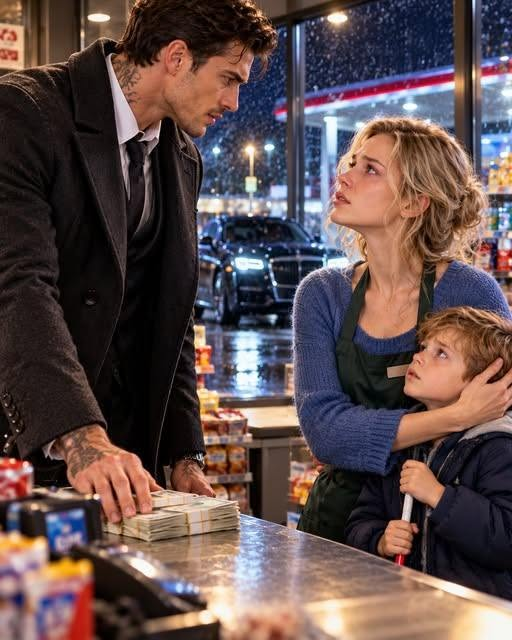
Story Genres: Family Drama

  • Chapter 5: The Receipt

    Chapter 5: The Receipt

    That night, the storm came down off the hills the way I had always known it would. Not as weather. As a reckoning.

    I had closed the station at eight. I had counted the register twice, because my hands needed something to do, and I had checked the lock on the drawer behind the counter three times, the way I had checked it every night for seven years — a little prayer made of brass and habit. Noah was asleep in the back office on the cot I kept there for storm nights, his white cane folded on the chair beside him, his breathing slow and even over the sound of the rain starting to needle the roof.

    I knew Ethan would come. Blake's words had been ticking in my head all afternoon like a second pulse. Ask her about the hospital, Ethan. Ask her whose name is on the paper.

    He came at nine, out of the rain, in a coat already dark with it. He didn't knock. The bell over the door made its small, cheerful sound, and it sounded obscene.

    "Blake found me today," he said.

    I kept my hands flat on the counter. "Then you wasted a trip."

    "He said something I can't get out of my head." Ethan came closer, and the wet cold came with him, off his coat, off his skin. "He said, 'Ask her about the hospital. Ask her whose name is on the paper.'" His eyes never left mine. "So I'm asking, Claire. What hospital? What paper?"

    Seven years of locks. Seven years of swallowing. I stood there with my heart slamming against my ribs and I did the thing I had trained myself to do — nothing. I said nothing, and my silence said everything, and I watched him read it.

    "Claire." His voice dropped. "I'm done being lied to in pieces. Whatever it is — give it to me whole, or I swear to God I'll tear this place apart looking for it."

    He took one more step toward the counter.

    And the lights went out.

    Not flickered. Not the storm worrying the lines the way it did out here, a brown sag and a recovery. Gone — all of it at once, the fluorescents, the cooler hum, the little red eye of the register — cut clean, the way a thing is cut on purpose. The whole store held its breath in the dark.

    "Ethan," I said.

    "I hear it," he said quietly. "Stay where you are."

    Then, from the back of the store, past the stockroom door: the sound of glass giving way. Not a bottle knocked off a shelf. A pane. Deliberate. Followed by a silence so careful it had hands.

    Noah was back there.

    I don't remember moving. I remember the counter edge hitting my hip as I came around it, and Ethan's hand catching my arm in the dark, hard, and his voice low in my ear: "Office door is closer from my side. We go together. Stay behind me."

    The smell reached us before the men did — kerosene, sharp and sweet, poured over cardboard and stockroom shelving. One of them had a flashlight, and its beam swung crazed patterns across the aisles as they worked. They hadn't come to rob the place. Men who rob a gas station go for the register and the safe. These men had come with a can and a purpose, and the purpose was a message, and I knew whose handwriting it was written in before either of them spoke.

    Vince Caruso had been sending messages with fire and broken bones since before I was old enough to understand what a message was.

    "Mommy?"

    Noah's voice, small and sleep-frightened, from the office doorway. He had woken to the dark — his whole world was always dark, but this dark was wrong, full of noise and strangers and that smell — and he had come feeling his way along the wall for me, the way I'd taught him, one hand trailing the shelves.

    "Noah, freeze," I said, and I made my voice the calmest thing in that store. "Freeze right there, baby. Mommy's coming."

    The flashlight beam found him first.

    What happened next happened very fast and has stayed very slow in my memory, the way the worst seconds do. One of the men came down the aisle toward the noise — toward my son — crowbar swinging loose at his side, not even hurried, just clearing a path through stock, sending a rack of motor oil crashing down. Ethan went past me like the dark itself had decided to move. He didn't go for the man. He went for Noah. He scooped my six-year-old up and turned his own back to the falling shelf in one motion, and I heard the impact — bottles, metal, glass — hit Ethan instead of my son, heard the breath go out of him, and he did not let go and he did not go down.

    I got the office door open. "Here — Ethan, here—"

    He backed in with Noah locked against his chest, set him into my arms in the doorway, and said, "Out the side. Don't stop for anything. Not even for me."

    "The window in the office—" I was already moving, Noah's arms around my neck, his face buried, his whole small body shaking. "It sticks. Ethan, the frame sticks—"

    "Then I'll buy you time to unstick it."

    Behind us the kerosene smell thickened — and then, miraculously, thinned, because the rain was coming through the broken stockroom window in sheets and the stockroom floor was already awash, and whatever fire they'd dreamed of was drowning in its own weather. I heard Ethan's voice, very calm, the calm I'd heard strangers go quiet for: "You're doing this for a dying man. Think about that." And a scuffle — a body into shelving, a grunt, the crowbar clattering — and then headlights. Headlights raking the windows, one car and then another, doors, voices — Lucas's voice, above the rain, using words like orders.

    The two men went out the back the way they'd come in, through the rain and the mud behind the pumps, and they did not stop to finish anything.

    I got the office window up on the second try. I passed Noah out into the wet and climbed after him, and by the time I carried him around the front of the store, Lucas was there, taking him from my arms with a gentleness I would not have believed his hands knew, settling him in the back seat of the sedan with a blanket off the rear shelf.

    "Mommy?" Noah's hands searched the air.

    "I'm right here." I held his face. "You're safe. That was just the storm being loud, and it's over now."

    "Was that the thunder man?" he whispered. "The one with the rain voice?"

    I looked up. Ethan stood in the wrecked front of my store, in the light of the one emergency lamp, rain blowing sideways through the propped door, his ruined coat hanging off him, blood or kerosene or rain — I couldn't tell — dark down one sleeve. He was looking at us. He had heard.

    "Yes, baby," I said. "That was him. He kept the storm off you."

    Inside the store, the damage had the shape of a tantrum that had been interrupted. Smashed cooler door. Oil and glass across the floor. The kerosene can on its side in a spreading rainbow sheen that the rain kept diluting. And behind the counter — where one of them had gone hunting for the register money with the crowbar — the little locked drawer I had checked three times that evening hung open and crooked on its runners, its lock splintered out of the wood.

    Seven years I had kept that drawer between Ethan Hale and the truth.

    Now it stood open, and there was nothing between them at all.

    He saw it. Of course he saw it. He stood in the wreckage with the rain dripping off him and his eyes went from the broken drawer to my face, and I understood that this was the moment — not chosen by me, not timed by me, ripped open by strangers' hands — and that every instinct I had left was screaming at me to run to it, to slam it, to beg.

    I didn't move.

    "Open it," I said.

    His jaw worked. "Claire—"

    "You came here tonight to ask me whose name is on the paper." My voice was shaking and I let it shake. "Open the drawer, Ethan."

    He crossed the store slowly, glass crunching under his shoes. From the drawer he took the envelope — soft at the corners, gone gray at the folds from my own hands — and he drew out the receipt with a care that undid me. Hospital letterhead. A small-town hospital three hours from anywhere he'd ever looked for me. He read it the way a man reads his own sentence. I watched his eyes find the date first, and stop, and do the thing I'd watched him do in my nightmares for six years: the math.

    His eyes found the other line.

    FATHER: ETHAN HALE.

    The store was very quiet. Rain on the roof. Water dripping off his coat onto the broken glass.

    "He's six," Ethan said at last, to the paper. "Six years and nine months ago." His voice cracked on something that wasn't quite a word. "He was already— Claire, he was already on his way. When you stood in the rain and told me you wanted money. When you got in that car. He was already—"

    "Yes," I said. "I found out three weeks before your leg."

    And then, because there was nothing left to protect except him, I told him everything. All of it, standing in the wreck of the store he'd bought to punish me, while my son slept in his man's car outside.

    "Your leg wasn't an accident, Ethan. It wasn't bad luck on a wet road. That was Vince Caruso's men, with a tire iron, in the dark behind the garage — a warning, for the debt. You were eighteen and you thought the world had just been cruel to you in an ordinary way, and I let you think it, because four days later Vince Caruso came to me himself. Not a phone call. Himself, in a car outside the school, with a man in the front seat who never turned around. I was pregnant and I was eighteen and he told me exactly how it worked. You were a message he was still writing. If I vanished — if I made you hate me so completely that you would never come looking, never ask questions, never go digging near his name — then the message was finished, and you'd live. If I told you the truth, if I ran to you, he'd finish what the tire iron started. He said, 'He's got one good leg left, sweetheart. Spend it wisely.'"

    Ethan had gone utterly still.

    "Blake wasn't anything," I said. "There was no rich boy, Ethan. There was never a rich boy. Blake was a kid with a car who got told to drive and not ask questions, and I sat in the back seat of that car and I rehearsed. All the way out of town I rehearsed the words, because Caruso said they had to be cruel enough that you'd believe them forever — and I knew you, and I knew the only thing that would keep you from following me was if I made you ashamed you'd ever loved me. 'I want money. I want a life you can't give me.' I said them in that car a hundred times with my hands over my mouth so Blake wouldn't hear me crying in between."

    His face. I have no words big enough for his face.

    "I had Noah in that hospital on the receipt because it was far enough that nobody knew my name. I was nineteen and alone and it took eleven hours and when they put him on my chest he turned his face toward my voice like he already knew it. And when the nurse asked me the father's name for the certificate — Ethan, I could have said anything. I could have said nothing; women did, nobody would have stopped me. But it was the only piece of you I was allowed to keep. So I said your name, and I made them write it down, so that somewhere in the world there would be one true thing about us that I hadn't had to kill."

    The silence after that had a weight I could feel in my teeth.

    "Noah's eyes," Ethan said suddenly, hoarsely. "Was that— Caruso too? Is that why he—"

    "No." I shook my head, hard. "No. The doctors said it was just — it happens, Ethan. It doesn't need a villain. He was born that way and he is not broken, he is the best thing that ever—" I stopped. "He hums when he eats toast. He knows my footsteps on gravel. He is not a tragedy. He's your son."

    Ethan looked down at the receipt in his hands like it had become too heavy to hold, and when he spoke, the rage that had lived in him for seven years came up out of his chest turned entirely outward, pointed like a weapon finding its true target at last.

    "Caruso," he said. "Dying or not — I want him where I can reach him."

    "Ethan, no." I caught his arm — actually caught it, my hand around his forearm, feeling the tremor running through him like current. "Listen to me. Listen. Two men came here tonight, for a man who's supposed to be dying in a bed somewhere. Dying men don't send messages, Ethan. Whatever is left of him, it still has hands, and those hands just reached into my son's home. If you go at him now — blind, shaking, with this—" I nodded at the receipt — "burning a hole through you, you will walk into whatever is waiting with your guard down, and I did not spend seven years in hell to lose you in a week. Noah just got a father. Let him keep one."

    For a long moment he just stood there, breathing, my hand on his arm, the receipt in his other hand. Then, very carefully — as if it were made of something that could shatter — he laid the receipt down on the counter between us.

    "He's six," he said quietly. "He's mine."

    "Ethan—"

    "You should have let me die, Claire." Quieter than any shout he had ever aimed at me. Quieter than the rain. "It would have hurt less than this."

    He walked out of my wrecked store into the storm, past his men, past the car where his son slept under a blanket, and the rain took him in a dozen steps.

    I stood behind the counter with the receipt between my hands and did not call after him. I had lost Ethan Hale once for lying to him. I had no idea, standing there, whether I had just lost him again for finally telling him the truth.
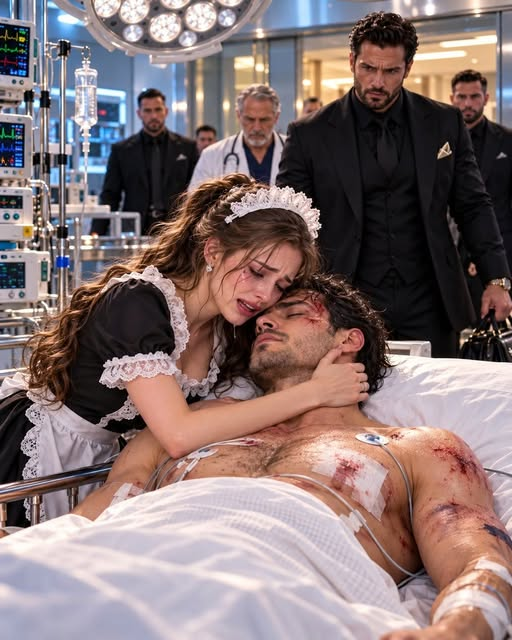
  • Chapter 4: The Man Blake Became

    Chapter 4: The Man Blake Became

    Three days after Ethan Hale bought Miller's Fuel & Grocery, the locks changed.

    I came in for my shift on Thursday morning and found a locksmith's van in the lot and a man I didn't know standing at the pumps with his arms folded, watching the road like the road owed him money. By noon there were cameras over the register and over the door. By Friday, a delivery truck I had never seen before was unloading stock we had never been able to afford, and Mrs. Abernathy from the diner across the street came in just to whisper, "Claire, honey, who *is* this man?" and I said, "The new owner," like those three words didn't taste like ash.

    Ethan didn't come back in person. That was almost worse. He was everywhere without being anywhere — in the new alarm code they'd given me, in the envelope of cash wages that replaced my checks, in the way the man at the pumps straightened up when a black car passed on Route 11, even when it wasn't his. I told myself the cameras were for the store. I told myself the guard was for the inventory. I was very good, by then, at telling myself things.

    Noah asked about the tall man exactly once.

    "Did the thunder man buy your store, Mommy?"

    "He bought the building, sweetheart. Not the people in it."

    He considered this with the seriousness he gave everything. "Good," he said finally. "Because you're mine."

    I held onto that sentence for two days like a handrail.

    Blake Caruso walked in on Sunday, just after one o'clock, in full daylight, with the bell over the door announcing him like any other customer.

    I knew him before I saw him. That's the strange thing. I knew him by the pause — the way the door didn't swing shut right away, the way a person stands in a doorway deciding whether they have the right to come in. My hand was already reaching for the register to call up the screen I didn't need. Then I looked up, and my whole body went back seven years in one sick lurch.

    He was thinner. That was the first thing. The Blake I remembered had been soft with money — good shoes, good haircut, that loose rich-boy grin that said the world had never once told him no. This man had cheekbones. This man had shadows under his eyes that no amount of sleep had fixed, and a tiredness that went deeper than one bad night. His coat was plain and old. His hands, when he took them out of his pockets, were a working man's hands, nicked and dry.

    Seven years ago he had driven me out of town in his father's car with my whole life in a duffel bag at my feet, and he hadn't said one word for the first hundred miles. I had hated him for that silence once. Standing there in the refrigerated hum of Miller's, looking at what time had done to him, I understood for the first time that the silence might not have been cruelty.

    It might have been the sound of a eighteen-year-old boy understanding what his father was.

    "Hi, Claire," he said.

    "You can't be here," I said. It came out before anything else could — before hello, before how did you find me. Seven years of practice. "Blake. You can't be here."

    "I know." He didn't come any closer to the counter. "I wouldn't have come if it wasn't — Claire, I wouldn't have come at all. Can I have five minutes? Please. I drove four hours."

    The store was empty. Through the glass, the man at the pumps was looking at his phone. Noah was at Mrs. Abernathy's for the afternoon, eating grilled cheese and listening to her television too loud, safe in the one place in this town where nobody new ever went.

    "Five minutes," I said. "Talk."

    He told me his father was dying.

    Vince Caruso — the name I had not said out loud in seven years, the name that lived in my locked drawer and in the back of my throat — was in a hospital bed in a house outside Scranton with a liver that had finally presented the bill for sixty years of being Vince Caruso. Dying, Blake said, but slowly, and mean about it, and lucid. Lucid was the dangerous part. Because a man in a bed with nothing left to protect except his own legend starts listening to everything, and word travels up to a bed like that the way water finds a crack.

    "A man he still has in Chicago brought him a name," Blake said. "Ethan Hale is buying up property in Pennsylvania. Ethan Hale has been asking questions about seven years ago. About a girl. About a night." He looked at me, and there was no triumph in it, only dread. "My father built his whole life on one rule, Claire — nobody ever learns what he did. Nobody can ever prove it. He broke a poor kid's leg and threatened to finish the job, and then he made the kid's girl disappear, and Ethan Hale never even knew his name. That's the story my father tells himself about his own power. And now Ethan is out there pulling threads."

    "He doesn't know anything," I said. "Blake, I've made sure of it. He thinks I left him for you. He thinks Noah is—" I stopped.

    "I know what he thinks." Blake's voice went rough. "I've known what he thinks for seven years. I read about him, Claire. Every few months I'd search his name and there'd be more of it — the warehouses, the indictments that never stuck, the men who disappeared. I built that. We built that. My father aimed him like a gun and my job was to drive the car and smile." He shook his head. "I got out. I want you to know that, even if it doesn't matter. I haven't taken a dollar of his money in five years. I fix commercial refrigeration in Ohio. That's my life now. It's small and it's clean and it's mine. And I'm standing here risking all of it because when my father's people move, they won't send a letter. They'll send the kind of men who don't leave witnesses to feel guilty about."

    "Then I'll tell him it was nothing," I said. "If anyone asks—"

    "Nobody will *ask*, Claire. That's not how it works. He's dying and he's scared, and a scared man's first instinct is to clean house. You are the house. You and the boy." He leaned forward then, just a fraction, and I saw the boy he'd been flicker in his face. "So I'm begging you. Run. Today. Take Noah and go somewhere with no cameras and no new owner, and let me figure out how to keep you ahead of it. Or — " He stopped.

    "Or what?"

    "Or tell Ethan everything. All of it. The leg. The choice my father gave you. Whose son Noah is." He said it quietly, like a man setting down something heavy he'd carried up a long flight of stairs. "He's the only person on earth dangerous enough that my father might hesitate. You know that. It's why you hid the truth *from* him — because the truth turns him into a war."

    "Don't," I said.

    "Claire—"

    "No. You don't get to come in here and say that like it's a plan." My voice was shaking and I let it. "Listen to me. Noah has a life here. He has a school that knows his name and a teacher who braille-labels his cubby. He has a route to the park he can walk by counting the cracks in the sidewalk, Blake, he *counts* them, he knows this town by heart in the dark, which is the only way he will ever know any town. You want me to take that from him and put him in a motel room in a state he's never heard, with a mother who jumps at headlights? No. I ran once. I was eighteen and I ran, and it cost everything it cost, and I will not do it to him."

    "And telling Ethan?"

    "If Ethan learns the truth, he goes after your father." I could see it as clearly as if it had already happened — I had been seeing it, in pieces, for seven years, every time I let myself. "Your father has men. Ethan has more. Men die, Blake. Men with mothers. And at the end of it, what does Noah have? A father in the ground, or a father in prison, or a father who looks at him and sees the thing that was stolen. There is no version of the truth where my son keeps his father. Either way, he loses him. Either way." I was crying by then, quietly, the way you learn to cry at a register, without moving your face much. "He's already lost him for six years. I did that. I chose it, every single day, because the other choices were worse. Don't stand in my store and tell me the math has changed just because your father is dying."

    Blake was silent for a long time. The cooler case hummed. A truck went past on the wet road.

    "The math hasn't changed," he said at last. "That's the hell of it. I drove four hours knowing you'd say exactly this, and you're right, and he's still dying with your name in his mouth." He put his hands flat on the counter, gently, the way you approach something that might bolt. "I'm not leaving town tonight. I got a room at the motel by the interstate. If anything happens — anything, Claire, a car you don't recognize, a question from a stranger — you call me. I'm in the book under my own name now. I've been in every book under my own name for five years, waiting for one of you to need me to not be a coward."

    He bought a coffee he didn't drink, so the man at the pumps would see a customer, and he sat in his old car in the lot for a while before he went in to Mrs. Abernathy's side of the street — no. He just sat. I watched his windshield fog. I told myself he would leave by dark.

    He was still parked there at seven, when the rain started up again, and I was counting the register down with the door locked when headlights swept the lot and stopped my heart the way they had learned to.

    Ethan didn't knock. He had a key now; of course he had a key, it was his store. He came in out of the rain with water in his dark hair and his coat over one arm, and he was already looking at me when the bell finished ringing, already wearing that expression he wore when he'd rehearsed a thing and intended to say it — and then he saw Blake, who had come back in out of the rain an hour before to use the restroom and stayed, God help us both, because neither of us had known how to end it.

    Blake stood up from the stool by the coffee machine.

    And I watched seven years of control come off Ethan Hale's face like a mask in a fire.

    He crossed the store in four strides. He took Blake by the wrist and the collar — not a punch, never a punch, something worse, something *measured* — and put him back against the cooler doors hard enough that the bottles rattled in their racks, and held him there with one tattooed hand twisted in his shirt, close enough to speak quietly.

    "You," Ethan said. Not loud. That's what I'll remember — how not loud it was. "You walk into *my* station. You sit in *my* store. You put your eyes on *my*—" He stopped. The word died in his mouth like he'd bitten down on it. His jaw worked. Whatever he'd almost said, he swallowed it back into the place where he kept everything he'd never let himself want. "Get out. Get out of this town. If I see your face again—"

    "Ethan," I said. My voice didn't feel like mine. "Let him go. Please. He's not— he never—"

    He didn't look at me. "Stay out of this, Claire."

    But Blake wasn't struggling. That was the terrible thing. Blake stood in Ethan's grip with his hands open at his sides, not fighting, not even flinching, looking past the hand at his collar at me — and then at Ethan, with an expression I had never seen on any living face: a man at the very end of a long debt, setting down the last of it.

    "I'm not doing this anymore," Blake said. Very quietly. To me first, like an apology. Then to Ethan, like a sentence. "Seven years I've carried it. I won't carry it into his grave, and I won't carry it into yours."

    "Blake," I said. "Don't. Please don't."

    "Ask her about the hospital, Ethan," Blake said. "Ask her whose name is on the paper."

    Then he pulled his collar free — gently, the way you'd free a snagged sleeve, nothing Ethan couldn't have stopped — and he walked out into the rain without his coffee, and the bell over the door rang, and Ethan didn't go after him.

    Ethan turned around.

    He looked at me the way he'd looked at me the night he put five hundred dollars on my counter — except this time there was no contempt in it, no performance at all, only a question so big it had changed the shape of his face.

    And behind me, in the locked drawer under the register, under seven years of dust and denial, sat a folded hospital receipt with his name on it.

  • Chapter 3: What the Drawer Kept

    Chapter 3: What the Drawer Kept

    The notice was still taped to the register when I came in for the late shift.

    I had read it a dozen times the night before, and I read it again while the coffee machine hissed and the fluorescents buzzed their thin, tired song over the aisles. Four words in a hand I would have known anywhere. I had watched that hand learn to write steady again after the accident that broke his leg. I had watched it shake over hospital forms and heal into something strong and sure. *The night-shift cashier stays. — E.H.*

    It should have frightened me more than it did. What frightened me was how much it didn't. Some treacherous part of me — the part that was still eighteen and stupid with love — had stood in front of that register and felt something dangerously close to relief. He hadn't fired me. He hadn't bought the station just to watch me lose it. He had written my job into his purchase the way a man marks something he intends to keep within reach.

    Relief is a dangerous thing to feel about Ethan Hale. I knew that better than anyone alive. So I folded the feeling up small and put it away where I kept everything I couldn't afford, and I went about closing the store.

    Noah was asleep in the back room, curled on the cot behind the stock shelves with his shoes lined up neatly beneath it and his white cane folded on the blanket beside him, its red tip catching the light every time I passed the doorway. He slept the way he did everything — carefully, one hand fisted in the blanket, his whole body listening even in dreams. Rain had started again around ten, needling the windows, turning the forecourt lights into smeared halos over the pumps. The lot was empty. The highway beyond it was empty too, just wet blacktop and the far-off sigh of trucks that weren't stopping.

    I counted the till twice. I wiped down a counter that was already clean. I told myself I was doing my job, and I did not admit that I was waiting.

    I was reaching for the deadbolt when the lock turned.

    Not the bell. The lock. A key, sliding home smooth as you please, and then the door swung open and the rain walked in with him.

    Of course he had a key. Owners have keys.

    Ethan stood in the doorway in his black overcoat, rain beaded on his shoulders, his dark hair damp at the ends. He didn't stamp the cold off his boots. He didn't look around like a customer deciding whether the place was worth entering. He looked at me the way a man looks at something that has recently become his property and hasn't yet decided what it's for.

    "You work for me now, Claire."

    He said it the way other men say *good evening*. Mild. Almost bored. He let the door fall shut behind him and turned the sign in the window to CLOSED with two fingers, and the little plastic click of it sounded louder than the rain.

    "I signed the papers this afternoon," he said. "Miller cried on the phone. Told me this place was his whole life. I paid him enough that it doesn't have to be." He walked slowly down the first aisle, trailing one tattooed hand along the shelves like an inspector, like a king touring a province he'd annexed out of spite. "The accountants were puzzled. It's a poor investment, this station. Thin margins. Bad roof. A pump that leaks vapor in July." He stopped at the end of the aisle and looked at me over the cigarette rack. "So I told them it was about the land. Trucks stop here. The parcel has value."

    "And is it?" I asked. "About the land?"

    "No," he said. "That's what I told the accountants."

    He came around the counter. My counter. The one he had thrown five hundred dollars across two nights ago, money I'd pushed back at him with hands that shook. He stood too close, the way he had then, and I made myself not step back, and hated that he could see me making myself.

    But he wasn't looking at me. Not then. His eyes had gone past me, slow and thorough, the way they must have moved across rooms full of men deciding whether to lie to him — and I watched those eyes find my life, piece by piece, in the place I'd least wanted them to find it.

    The drawing. Taped to the side of the register at the height of his hip, curling at the corners, where I'd put it so it would be the last thing I saw on the worst nights: thick wax crayon pressed down hard enough to shine, a house with a square door, a sun with nine rays that Noah had counted out one by one with the tip of his finger, and two figures standing under it — a tall one and a small one, holding hands by a single straight crayon line. Beside it, hooked over the register's edge, his spare sweater. Child-sized. Still smelling faintly of the dryer at the laundromat.

    And beyond me, the back room door stood open two inches, lamplight falling through the gap across the stock shelves, and in that narrow slice of light Ethan could see what anyone could see: the cot with the folded blanket. The little blue cup on the crate I used for a table. The pair of small shoes lined up under the cot, toes pointing out, waiting.

    "Lucas didn't tell me about the drawing," Ethan said at last, very quietly. "Or the cot."

    "Sitters cost money," I said. "He sleeps. I work. It's warm back there."

    "Everything in this place is an answer, Claire," he said. "You just keep hoping I won't ask the questions in the right order."

    "You didn't have to buy a gas station to hate me, Ethan," I said. "That's a lot of money for a grudge."

    "I've spent more on less." His voice stayed soft, and that was worse than shouting. Ethan at eighteen had shouted. Ethan at eighteen had thrown his crutch across the trailer and wept and begged. This man had learned what the world charged for volume, and he no longer paid it. "Besides. I don't hate you. Hatred would require me to still not understand you. I intend to understand you. That's what the money's for."

    "Ethan—"

    "Lucas found Blake."

    He said it without any change of tone at all, which is how I knew it was a blade and he'd been carrying it all evening, waiting for the exact place to put it.

    "You remember Blake," he went on. "The rich boy. The one with the car and the future. The one you climbed in beside while I stood in the rain on a broken leg and watched you go." He leaned against the counter, arms folded, unhurried. "Lucas is very good at finding people. Blake sells insurance in Ohio. He has a wife, a mortgage, a daughter who plays softball. And do you know what Lucas couldn't find, Claire? You. In any of it."

    My fingers found the edge of the counter and held on.

    "Blake told my man he drove you home that night because you asked him to, and that you cried the whole way, and that he never saw you again. No calls. No letters. No weekends, no photographs, no neighbor in seven years who remembers a rich boy coming around." His eyes never left my face. "You told me you chose him. You told me you'd picked the life I could never give you. But you never had him at all. Not for one single day after you used him to leave me."

    "People's lives aren't always—" I started.

    "Then Lucas looked for the life instead," Ethan said gently. "The beautiful house. The expensive life. The man who could give you things. He found a bus ticket, Claire. He found a room over a laundromat and two jobs and a woman who cleaned motel rooms with a baby on her hip. He found a hospital bill you paid off in installments over four years." He paused, and I flinched, and I saw him see it. "There. That. You never flinched when I talked about Blake. You're flinching about a hospital bill."

    "Stop," I whispered.

    "He found a little boy in a back room," Ethan said, quieter now, and every word laid down like a card on a table. "And a mother who has never, in six years, told anyone his birthday. No parties. No pictures with a cake. His pediatrician has a date, of course — doctors insist on dates — but you paid that office in cash too, at first, didn't you? Until you couldn't anymore." His jaw moved. "Children have birthdays, Claire. People celebrate them. Unless the date itself is a secret. Unless the date says something all by itself, to anyone who knows how to count backward."

    The store was very quiet. The rain had thinned to almost nothing, the way it does right before it decides whether to come back.

    I could feel the drawer.

    It was under the counter, at my right knee, where it had been for seven years — a plain steel drawer with a little brass lock that the old key ring opened, the drawer nobody else at Miller's had ever had a reason to look inside. Miller thought I kept the good pens there. The girls who'd worked summers thought I kept my tips there. What I kept there was an old hospital receipt, gone soft at the folds from being opened and refolded more times than I would ever admit, and underneath it a photograph folded in quarters that I had carried through two apartments and one eviction and could not, could not, throw away.

    My hand moved. I didn't decide it. My hand moved the way a hand moves toward a stove burner it already knows is hot — drawn, stupid, honest — down at my side, toward the drawer, toward the one thin piece of paper in the world with Ethan Hale's name printed on it in the space where a father's name goes.

    One turn of a key. One piece of paper. Seven years of his hatred, dissolved by a line of type. I could watch the understanding cross his face. I could finally, finally stop being the villain of the story I'd written to save him.

    And then I thought of Vince Caruso — the name I had not said aloud in seven years, the name I had once heard spoken in a parked car with the rain coming down exactly like this — and my hand stopped, because Vince Caruso's world had ears in places I couldn't see, and some part of it was always, always listening.

    The sound came then. Small. Wrong.

    Not the bell. Not the register. A *tap*. Rhythmic, light, patient — a cane's tip on wet concrete.

    *Outside.*

    "Noah—" I was already moving, but the counter was between me and the door, the whole length of the store was between me and the door, my shoes were squeaking on the clean tile. Through the front glass I saw him: my son, in his pajamas, one hand trailing the ice machine the way he trailed walls, his cane sweeping ahead of him in the dark — out past the pumps, toward the noise. The side door. The side door hadn't latched properly since February; I'd wedged it a hundred times and told myself I'd tell Miller, and Miller was gone, and I had not told anyone, and Noah had woken in a strange-smelling dark and followed the sound of voices and the little bell toward his mother, and now he was walking, careful and trusting, straight across the forecourt.

    Straight toward the delivery truck idling at the far pump — the night delivery, early tonight, its driver just climbing back up into the cab, its engine dropping into gear with a growl I felt in my teeth.

    "Noah! NOAH, STOP—"

    Ethan was already gone from the counter.

    He moved the way he must have moved in the other world he'd built, the one men lowered their voices about — no hesitation, no wasted motion, just a decision his whole body had already made. He was out the door before I'd cleared the counter. I saw the truck begin to roll. I saw my son lift his face toward the sound of it, curious, unafraid, one small step from the path of it — and I saw Ethan's hand close around Noah's hand and pull him back, hard, up and into his body as the truck's horn tore the night open and the wheels ground past close enough to spray rain across both of them.

    And then Ethan lifted him.

    Not the way a stranger lifts a child — awkward, at arm's length, by the armpits. He swung Noah up and settled him against his chest in one motion, one arm under him, the boy's legs straddling his hip by pure instinct, and Noah — who did not let strangers hold him, who went stiff as a board in the arms of nurses — put his small hands around Ethan's neck and held on, and pressed his face into the black wool of that coat like he'd been lifted that way a thousand times.

    Ethan's tattooed hand spread wide across my son's back. Holding him steady. Holding him like the most natural thing in the world.

    And then my son's hands — free now, no longer clinging — began to do the thing they always did with anything new in his world. They went exploring. Small, careful fingers traveled down from Ethan's neck to the hand that held him, and they read that hand the way Noah read everything: slowly, thoroughly, storing it away. Over the knuckles. Along the black lines of the ink, which his fingertips seemed to catch on, curious at the places where the skin ran faintly raised. Across the callus at the base of the thumb. Around to the wrist, where his whole small hand couldn't close, and the pulse was.

    Ethan watched his own hand being learned by heart, and I swear before God I saw the most feared man in Chicago forget how to breathe.

    "He reads with those," I said, and my voice wasn't steady. "That's how he knows things. He'll remember your hand now. He never forgets a hand."

    Ethan didn't answer. His thumb moved once, absently, against Noah's back, the way you'd soothe a child in a church pew while the sermon went on without you.

    Nobody said anything for a moment. The truck's taillights shrank down the highway. The rain came back, softly, deciding.

    I reached them with my hands shaking so hard I had to press them flat against my thighs to still them. "Give him to me," I said, and my voice came out scraped raw. "Ethan. Give him to me."

    He looked down at the boy on his hip. Noah's trembling had already begun to slow — I could see it in his shoulders, the way I had seen it a thousand times, except I had never seen it happen against anyone else's heartbeat.

    "He's all right," Ethan said, strangely quiet. "He's not hurt."

    "I know he's not hurt. Give him—"

    And then Noah, calming himself the way I had taught him — *when you're frightened, sweetheart, hum so I can find you, hum so your heart remembers it's safe* — began to hum.

    Softly. Tunefully. The melody rising and falling in the rain-damp air between the pumps, as familiar to me as my own pulse.

    Chopin. The Nocturne in E-flat.

    The piece I had played at sixteen on the upright in the school hall with my hair falling out of its braid. The piece I had played through the open window of his trailer on summer nights so he could fall asleep to it when the pain in his leg kept him up. The piece I had played for exactly one person in my entire life — whispered it across a piano once, a hundred years ago, and told him, laughing, drunk on being loved: *This one's only yours. I'll never play it for anyone else.*

    I had not played it since the night I left him. Not once. Not for seven years. I had taught my blind son to hum it in the dark instead — my one stolen piece of Ethan, passed mouth to ear like contraband, the only inheritance I had ever let myself give Noah from his father.

    Ethan went absolutely still.

    "Where did he learn that?"

    I took Noah from him then — he let me, his arms loosening with a reluctance I pretended not to feel — and I held my son too tight and buried my face in his damp hair and said, too fast, "Daycare. There's a woman at his daycare, she plays piano, the children all hum things. Or the radio. There's a station that plays classical at night, I leave it on for him, he picks up everything, you know how children are, they absorb—"

    "Claire."

    "—or the church on Sundays, Mrs. Abernathy plays before the service, it could have been any—"

    "Claire." He said it the way he must say men's names in rooms where the windows don't open. "You taught me that song. On a piano with two dead keys, in a trailer that smelled of rain. You told me it was mine." His voice dropped until the rain nearly had it. "You told me you'd never play it for anyone else as long as you lived."

    "I didn't," I said. "I haven't. I never played it for him. I hummed it. It's different—" I heard what I'd admitted a half-second after I admitted it, and the silence that followed had weight, like the pause before a roof gives.

    "Is he mine, Claire?"

    He didn't raise his voice. That was the terrible thing. He asked it the way a man asks for the time, standing in the wet forecourt with his coat ruined by rain, his tattooed hand still open at his side, shaped like the child it had just been holding.

    And God help me, I wanted to say it. The truth was *right there*, risen all the way up my throat, bright and enormous — *yes, he's yours, he's been yours every day of his life, he's the reason I did all of it, look at him, look at his hands, look at the way he holds his head when he's listening, he's yours he's yours he's yours.*

    But I could hear Vince Caruso's voice too, seven years gone and clear as a bell: what happens to Ethan Hale if he comes home. What happens, now that Ethan was not a poor boy with a broken leg but a king with an empire — what happened to a six-year-old boy, a blind six-year-old boy, the moment he had a name that men in that world could use. A son was a lever. A son was a door into Ethan Hale that no lock could close. And Ethan, standing in front of me with his heart cracking audibly in his chest, would not hide him. He would declare him. He would go to war for him, and men would die, and one of the people who died might be small, and might be holding a white cane with a red tip.

    Somewhere out there, even now, that world was still listening. I had built my whole life on believing it. I couldn't stop believing it in the one moment it might cost me everything — because the one moment was exactly when it would be listening hardest.

    So I looked Ethan Hale in the eyes — the man I had loved since I was a girl, the father of the child trembling in my arms — and I lied to his face.

    "He's not yours."

    Something in his expression closed. Quietly, like a door in a house where everyone has gone to bed. He nodded once, slowly, as if I had confirmed something he had written down long ago and only needed to hear read back to him. He set Noah's cane — I hadn't even seen him pick it up off the wet concrete — gently against the ice machine where my son's hand would find it.

    Then he walked to the door of the store. *My* store. His store. He opened it, and the little bell over it rang, cheerful and stupid, and he stopped on the threshold with his hand on the frame and did not turn around.

    "Then why," Ethan said, very quietly, "does he hum the song you swore you'd only ever play for me?"

    The door swung shut behind him. The bell settled. Through the glass I watched the black coat cross the wet lot and fold into a black car and become nothing at all — and I stood in the empty light of the store with my son in my arms and my back against the counter, the locked drawer an arm's length from my knee, keeping everything it had ever kept.

  • Chapter 2: The Boy Who Counted Steps

    Chapter 2: The Boy Who Counted Steps

    I did not sleep that night.

    I lay on the pull-out couch in the back room with Noah curled against my side, his small hand fisted in the hem of my sweater, and I listened to the rain work its way across the roof of Miller's Fuel & Grocery until the rain stopped and the silence it left behind was worse. Every time I closed my eyes I saw Ethan's face in the doorway of my store — not the face of the boy I had loved, but the face of the man who had stood over my counter with five hundred dollars and seven years of hatred arranged neatly in his eyes.

    At five forty the alarm on my phone buzzed against the counter where I had left it charging, and I got up the way I got up every morning, because Noah still needed breakfast and the store still opened at six and the world did not pause for ghosts.

    My hands shook while I made his oatmeal. That was the thing I noticed. My hands, which had once been steady enough to play Chopin in a recital hall in front of three hundred people, shook so badly I spilled brown sugar across the counter and had to sweep it up with the side of my palm.

    "Mommy's making the floor crunchy," Noah said from the doorway, and I turned around.

    He stood there in his dinosaur pajamas with his hair flattened on one side, one hand trailing along the doorframe out of habit even though he knew that room the way I knew the keys of a piano. My son did not need his eyes in the back room. He had built the whole place out of sound and touch and counting, the way he built everything.

    "From my bed to the door is nine steps," he informed me, in the serious voice he used for facts he had personally verified. "From the door to the couch is four. From the couch to where you are is six, but if the stool is out it's six and a hop."

    "And how many steps to the counter?" I asked, because it was his favorite question and because my voice needed something ordinary to hold on to.

    "Eleven from the back door. Twelve if I go around the freezer because the freezer hums and I like it." He tilted his head. "You're sad this morning. Your voice is low."

    Children who cannot see learn to hear everything. Noah could tell the difference between my tired voice and my frightened voice and my pretending voice, and at six years old he already knew better than to believe the pretending one. I crouched down and he found my face with both hands, the way he had done since he was two years old, his palms warm against my cheeks, reading me.

    "I'm just tired, baby."

    "You didn't sleep. The couch creaked all night. You only creak the couch when you're scared." He said it without accusation, the way he reported the weather. "Was it the thunder?"

    "No, sweetheart. It wasn't the thunder."

    He considered this with his whole face. Then he patted my cheek twice, which in Noah's language meant the matter was settled for now, and said, "Oatmeal's getting cold. I can smell it."

    The store had a smell in the morning before the doors opened — floor cleaner and old coffee and the faint sweetness of the doughnuts that came in a plastic tray from a bakery two towns over. Noah knew the store by its sounds the way other children knew places by their colors. He knew the bell over the front door, which gave a double chime, one note going up and one coming down. He knew the freezer's hum and the ice machine's clatter and the exact creak of the third floorboard from the register, which he avoided the way you or I would step around a puddle. He knew that rain on the awning sounded like fingers drumming and that rain on the dumpster out back sounded like coins, and that the big trucks on Route 11 made the windows buzz in their frames starting low and climbing, like a note being tuned.

    I set him up in his corner behind the counter with his Braille picture book and his cup of milk with the straw he could find by the ridged band he had insisted I wrap around it, and I unlocked the front doors at six with my heart slamming against my ribs — because some part of me, some traitorous terrified part, expected Ethan Hale to be standing in the parking lot in the gray morning light.

    He wasn't. There was only Mrs. Delgado buying lottery tickets and a state trooper drinking coffee by the pumps, and the ordinary world going on as if a mafia boss had not walked into my life the night before and set fire to seven years of careful hiding.

    By nine o'clock I had convinced myself of two things. First, that he was gone for good, that seeing me like this — cheap sweater, scarred counter, a child he believed belonged to another man — had satisfied whatever he came for. Second, that I was a fool for believing the first thing, because I had known Ethan Hale since I was eleven years old and Ethan Hale had never once in his life let go of anything.

    The piano lived in the back room because Mr. Miller's wife had played it and Mr. Miller could not bring himself to sell it after she died, and could not stand to look at it either, so it sat under a quilted cover between the mop sink and the shelves of motor oil, slowly going out of tune in the damp. Noah found it by accident when he was four — eleven steps from the door, four past the couch, both hands out — and came to me vibrating like a struck string. *Mommy. There's a piano in the wall.*

    That morning, after the breakfast rush, I took the cover off. I don't know why. My hands needed it, maybe. Or I needed to remember that before I was a cashier with a locked drawer and a lie for a life, I had been a girl whose hands were famous in three counties.

    Noah climbed onto the bench beside me by memory and put his fingers where I put mine.

    "Soft hands," I said. "Don't push. The keys come to you."

    I taught him the first three notes of the Nocturne — the piece I had only ever played for one person, on a borrowed piano in a music room after school, while a poor boy with a broken leg healed in a cast on the bench beside me and told me that when he heard me play he could forget his leg hurt. I had not played it in seven years. My fingers found it anyway. Grief lives in the hands longer than it lives anywhere else.

    Noah pressed the keys with enormous concentration, tongue caught between his teeth, and when he got the three notes in the right order he gasped like he had caught a fish. "Again," he demanded. "Again, again." And I hummed under my breath while he played it, wrong rhythm, wrong everything, perfect — and for eleven minutes I was not afraid.

    Then the bell over the front door chimed its two notes, up and down, and my whole body went cold, and it was only a courier with a clipboard and a manila envelope and no reason at all to know he had just handed me the end of the world.

    The letter inside was on paper so thick it felt like cloth. A law firm in Chicago — I read the city name and had to sit down on the stool behind the register — writing to inform the staff of Miller's Fuel & Grocery that the business had been sold, effective immediately, to a holding company called H&G Acquisitions. All current employees would retain their positions and pay rates *for the present time*. Nothing about the new owner. Nothing about why a Chicago holding company would want a failing gas station in Pennsylvania. Just that sentence, *for the present time*, sitting in the middle of the page like a crack in ice.

    Mr. Miller came in at noon with his good coat on and a shine on his face I had never seen in four years of working for him.

    "You heard, then," he said.

    "You sold the store." My voice came out flat. "You didn't say a word, Mr. Miller. Not one word, in four years I never missed a shift—"

    "Claire." He held up both hands, and he was smiling, actually smiling, the way a man smiles at a winning ticket. "They offered me more than this place has been worth in twenty years. More than my boy would've paid, God rest him. Cash. I asked them why — I'll be honest with you, girl, I asked them three times why — and the fellow on the phone just said the company is expanding into the region." He shrugged, helpless and delighted. "What was I supposed to do? I'm seventy-four. My knees—"

    He talked for ten more minutes. About his knees, and Florida, and his sister in Sarasota. He never once said the name of the man on the phone, and I never asked, because I already knew whose hand was on the other end of that pen. I knew the shape of it. I had spent seven years building a life small enough and quiet enough that Ethan Hale would never find it, and he had found it anyway, and instead of burning it down he had simply *bought* it. The floor. The shelves. The counter. The eleven steps from the back door. All of it, purchased, the way rich men purchase everything that has ever refused them.

    That night I counted my money in the back room after Noah fell asleep, the way I counted it every Thursday. Rent on the room and board arrangement with Mr. Miller — which was part of the store now, which meant my home had been sold out from under me too, and wasn't that a detail the thick paper hadn't mentioned. The envelope for the eye specialist in Pittsburgh, who could tell me nothing new but whom I paid anyway because hope is a bill that comes due every month. The envelope for Noah's new cane, because he was growing and the red tip on the old one had worn smooth. Forty-one dollars in the envelope marked *just in case*, which had been forty-one dollars for five months.

    I thought about running. I want to be honest about that. I stood in that little room with forty-one dollars in my hand and I planned it — the bus station in Scranton, a city where nobody knew my name, a new store, a new counter, a new set of steps for Noah to count. And then I looked at my son asleep with his hand curled around the worn red tip of his cane, and I understood that Ethan Hale owned shipping companies and warehouses and nightclubs, and that men like him did not lose women in bus stations. If I ran, he would know I was running. And if he knew I was running, he would start asking himself what I was running from — and that question, that one question, was the door I had kept locked for seven years with both hands.

    So I stayed. I opened the store every morning. I stocked milk and scanned cigarettes and taught my son three notes of Chopin at a time. And three nights after the letter came, I saw the sedan for the first time — black, clean in a way nothing on Route 11 stayed clean, parked across the street by the darkened feed store with its lights off and its windows up. It was there when I locked up at ten. It was there the next night, and the next. It never came closer. It never left before I did. I began to understand that it was not a threat. It was a metronome. It was Ethan Hale keeping time while he decided what to do with me.

    On the fifth night, Noah asked about the thunder man.

    "Why hasn't he come back?" he said, swinging his legs off the edge of the counter while I counted the register down. "The man from the storm. His voice was in my dream."

    My hands stopped on the money. "You remember his voice?"

    "It was low," Noah said, with the authority of a boy who built people out of voices the way other boys built them out of faces. "It went down at the ends of the words, like the freezer hum but a person. It wasn't a mean voice, Mommy. It was a sad voice that was pretending to be mean." He tilted his head toward me, and his unseeing eyes aimed at my face with terrible accuracy. "I liked the sound of it. When is he coming back?"

    "I don't know, baby," I said, and my voice did the thing he could always hear. "I don't think he is."

    Noah was quiet for a moment. Then he said, "You creaked the couch again last night," and slid down off the counter and counted his eleven steps to the back room to get ready for bed, trailing his fingers along the counter's edge, unhurried, at home in the dark in a way I would never be.

    I finished the closing the way I always finished it. Wipe down the counter. Empty the drip tray. Count the register twice. And that was when I saw the second envelope — plain white, no markings, tucked half under the register where the courier's stack of delivery slips lived, where I must have missed it in the morning's pile. It had my name on the front. Not *Claire*. *Night-shift cashier.* Typed.

    Inside was a single staff notice, the kind the new management had been sending all week about schedules and suppliers, and clipped to it was a yellow routing slip covered in handwriting. I recognized the handwriting before I read a single word. I would have recognized it on a wall in another country. Ethan had terrible handwriting — tall, slanted, impatient, the letters leaning forward like they were in a hurry to be finished. He had signed my birthday cards with it. He had written my name in it on the inside cover of a library book in the summer we were seventeen.

    Most of the slip was instructions to someone in an office — *forward, confirm, file* — initialed in other hands. But one line had been circled, twice, in black ink, hard enough to score the paper. It was the last line on the slip, written in that tall leaning hand above two initials I had once traced with my fingertip on a boy's wrist in the dark.

    *The night-shift cashier stays. — E.H.*

  • Chapter 1: The $500 on the Counter

    Chapter 1: The $500 on the Counter

    The cold came into Miller's Fuel & Grocery every time the door opened, and that evening it opened like the door was tired of fighting it.

    It was the kind of February cold Pennsylvania keeps in reserve for people who have nowhere better to be. It slid under the door seal and pooled around my ankles. It lived in the concrete floor and crept up through the soles of my shoes until my feet ached in that deep, bone-humming way that no amount of shifting my weight could fix. The heater behind the counter rattled and blew out air that smelled faintly of dust and old pennies, and the fluorescent tubes overhead hummed a note I had stopped hearing sometime in my third year behind that register.

    F sharp. Even dying, even here, my ear named it. Some training never leaves you.

    My hands were chapped raw at the knuckles. The skin between my thumb and forefinger had split again, and I could feel the sting every time I keyed the register or dragged a pack of cigarettes across the scanner. These hands had once been insured by a music school's hopes, if not by any actual policy. These hands had played Chopin in a hall with velvet seats when I was sixteen, and a judge with kind eyes had told my mother that her daughter's touch was "a conversation with the divine." Now they knew the exact drag-weight of a gallon of milk. They knew which lottery tickets the truckers liked and how to palm the scanner gun so the barcode caught on the first pass.

    I was restocking the cigarette wall when the headlights came through the front windows.

    They didn't sweep past the way through-traffic did on Route 322. They slowed. They turned. A black sedan — long, low, polished to a mirror shine despite the road salt — eased into the lot and stopped at pump six, and the whole shabby forecourt suddenly looked like a photograph of itself: the leaning ice freezer, the hand-lettered sign for firewood, the propane cage, all of it lit up and found wanting in that clean white light.

    Nobody local drove a car like that. Nobody local's car cost more than the building it was parked in front of.

    My heart knew before my eyes did. That's the truth of it, and I've had seven years to practice lying about everything else, so I'll give you that one for free. My heart slammed once, hard, against my ribs, and then it tried to climb up into my throat.

    The driver's door didn't open. The rear door did.

    He unfolded himself from the back seat the way tall men do, one hand on the frame, and stood for a moment in the freezing rain that had just begun to spit down, looking at the store the way a man looks at a house he used to live in and has come back to watch burn.

    Ethan Hale.

    His hair was dark and tousled, longer on top, the kind of careless that cost money now. Rain silvered it at the temples of his forehead. He wore a black wool overcoat over a white shirt and a black tie, and when he pushed the door open and the bell over it gave its cheap, cheerful jingle, I saw the tattoos first — dark ink climbing out of his collar up the side of his neck, more of it across the backs of his hands, his fingers. At eighteen his hands had been clean and scarred only by work. Now they were marked like a document.

    Seven years. He had built himself into a rumor men lowered their voices for, and I had watched the edges of that rumor reach even this nowhere town — a name in a news crawl, a photograph I pretended not to look at. Chicago. Shipping. Warehouses. Clubs. The other words people used when they thought no one was listening.

    He stopped three feet inside the door and let it swing shut behind him, and the cold that had followed him in stayed, standing between us like a third person.

    He looked at me for a long time. I made myself look back. I have had a great deal of practice at not flinching; I have a son, and the world does not care whether you flinch.

    "Pump six?" I said.

    My voice came out steady, and I was so grateful for that small treason of my body that I could have wept.

    Something moved in his face — not surprise. Amusement, maybe, of the bitterest vintage. The corner of his mouth pulled.

    "Seven years, Claire."

    He said my name the way you'd set down something heavy you'd carried too long.

    I tightened my grip on the scanner until the split in my skin sang. "If you're buying something, buy it. The coffee's from this morning. I wouldn't."

    He didn't answer that. He walked — slowly, the way a man walks through a museum of his own worst memories — down the short aisle past the beef jerky and the motor oil, trailing two fingers along a shelf of canned soup. He took in the water stain on the ceiling tiles shaped like Florida. The flickering tube over the dairy case. The rack of marked-down Valentine's candy, eleven months proud.

    "So," he said at last, conversationally, "this is the life you wanted."

    I said nothing. There was no answer to that that wasn't a door I had nailed shut with my own hands.

    He turned. The coat swung with him, heavy, beautiful. A coat like that cost more than I made in a month. More than two months, some months.

    "Where's Blake?"

    My chest tightened so fast it was almost a sound.

    "Who?"

    "The rich boy you left me for." His eyes didn't leave mine. "Don't tell me the romance didn't last, Claire. You were so sure about him. You were so sure about all of it."

    "Ethan. We were eighteen."

    "You told me loving me was a mistake." He said it quietly, and somehow the quiet was worse than if he had shouted. Shouting I could have weathered. "You said that to my face. Standing in the rain. Do you remember what else you said?"

    "I remember."

    "You said I could never afford the life you deserved."

    "I remember that too."

    I remembered all of it with a precision I would have paid money to lose. I remembered his leg in a cast propped on the trailer steps — broken in a fall from a warehouse ladder three weeks before, the job already gone, the medical bill already on the counter like a fourth person in that tin box of a home. I remembered the rain coming through the collar of his only good shirt. I remembered climbing into Blake's car because the passenger door was already open and because if I had stood there one second longer I would have said the true thing instead of the necessary thing, and the true thing would have gotten him killed.

    I had said the cruel words the way you set a bone. Fast. Deliberately. Praying the scream meant it was working.

    "Well." Ethan spread his hands a little, the inked backs of them catching the fluorescent light, and the gesture took in the whole of him: the coat, the car, the empire folded inside his silhouette like a held breath. "Look at me now."

    He reached into his coat.

    I will not pretend I didn't think of a gun. Everyone in three counties knew what Ethan Hale had become, and I knew better than anyone alive what he was capable of surviving — which is its own kind of warning. But his hand came out holding money.

    Five bills. He laid them on the counter between us one at a time, unhurried, the way a man lays down cards he knows will win. Five hundred-dollar bills, crisp as church clothes, fanned on the scarred laminate beside the register, beside the little dish of pennies for the next customer, beside the photograph of Mr. Miller's grandkids taped to the till.

    "Buy yourself a decent coat," he said.

    I stared at the money. Somewhere behind me the dairy case clicked and hummed. Outside, the rain needled the windows.

    His gaze dropped, briefly, to the thin blue sweater I wore under my green apron — a sweater that had been washed into softness and out of warmth about two winters ago — and I understood that he had chosen the amount the way he'd chosen everything else about this visit: precisely, and to wound.

    I put my palm flat on the bills and slid them back across the counter toward him.

    "I don't want it."

    His smile had no warmth in it at all. "Come on, Claire. You always loved money."

    Those words hurt. I want to be honest about that, because honesty is the only luxury I have left. They hurt the way a diagnosis hurts — not because they were false in the way the world could see, but because I had built them, brick by brick, to be believed. I had made sure he believed them. You do not get to build a lie that strong and then complain when it stands up and walks around.

    "You came a long way to say that," I said.

    "I came a long way to say one thing." He leaned in, both hands flat on the counter now, close enough that I could smell the rain on his coat and something darker under it — cedar, maybe, or the inside of an expensive car. The tattoos on his neck moved when he swallowed. "Tell me you regret leaving me."

    For a moment — God help me, for one unguarded moment — I wasn't in the store at all. I was seventeen, barefoot on the hot tin roof of his mother's trailer with a stolen birthday candle stuck in a hamburger because we'd decided, the two of us, that birthdays were too important to wait for cake money. I was eighteen with his hand wrapped around mine under the bleachers, his thumb tracing the tendons of my wrist like he was already memorizing me for a future he was certain of. He had been certain. That was the thing about Ethan. He had loved me with the terrifying total confidence of a boy who has never once been given a reason to believe the world would let him keep anything, and decided to keep me anyway.

    I had loved him more than anything. More than the piano. More than my own life, in the end, which is exactly the arithmetic that had been presented to me, and exactly the price I had paid.

    "No," I whispered. "I don't regret leaving."

    His face hardened — all at once, like water going to ice — and I watched the boy I'd known finish disappearing behind the man who'd come to collect a debt.

    And that was when a small voice came from the doorway of the back room.

    "Mommy?"

    Every muscle in my body froze.

    I knew that voice the way I knew my own pulse. I knew the careful sound that came with it — the soft tap, pause, tap of a white cane against the floorboards of the little back room where Noah did his puzzles at the card table and napped on the cot under my spare coat when my shift ran long. Tap. Pause. Tap. He was navigating by memory and echo, the way he navigated everything: bravely, and entirely without doubt that I would be where I said I'd be.

    "Mommy, is that thunder?"

    Noah stood in the doorway in his navy jacket, six years old and small for it, his pale brown hair falling over his forehead. His eyes were open — beautiful eyes, the gray-blue of deep water — and they looked at the world the way a locked house looks at a street. His white cane, with its worn red tip, rested angled against his leg, and his free hand was raised a little, fingers spread, the way he reached for weather he couldn't see.

    "I don't like the noise," he said, uncertain, and tilted his head. He had heard the rain thicken against the windows. He had heard, maybe, a stranger's voice where no stranger's voice was ever supposed to be.

    I was around the counter before I knew I'd moved.

    "No, sweetheart. Not thunder. Just trucks on the wet road." I crouched down and took his reaching hands and put them on my face, the way we'd done since he was two — his palms warm against my cheeks, his thumbs finding the corners of my smile so he could read it. "You're safe. Mommy's right here."

    He pressed his forehead to mine, and I kissed his hair, and for three seconds the store and the man and the money and the seven years all fell away, because my son smelled like the apple juice on his breath and the wool of his hat, and there has never been a force on this earth that could stand between me and that smell.

    Then I remembered we were not alone, and I looked up.

    Ethan had not moved. But the man standing at my counter was not the man who had leaned across it a moment before. The ice was gone. In its place was something raw and entirely unguarded — shock, yes, but under the shock a kind of recognition moving like a hand groping in the dark for a light switch it is suddenly terrified to find.

    His eyes went from Noah to me. From me to Noah. Cataloguing. The pale brown hair. The small chin. The age of him — doing the arithmetic that I had watched a hundred strangers do and brush past, but Ethan did not brush past it, because Ethan was counting backward from a rain-soaked night seven years ago, and I could see the number he was arriving at written all over his face.

    "Is he Blake's?" he asked.

    The words came out hoarse. Not an accusation. A man asking whether the floor he was standing on was real.

    I stood up and put myself between them — not dramatically, just a mother stepping to the side her body always steps to — and rested my hand on the top of Noah's head.

    "Leave, Ethan."

    "Claire—"

    "Please." I heard my voice crack on it and hated that he heard it too. "Please. Just go."

    His jaw worked. His eyes dropped to my son again, and Noah — who could read a room better than most sighted men I've known, who navigated the world by tension and warmth and the tiny weather of other people's breathing — turned his face up toward the stranger's silence with an expression of pure, open curiosity.

    "Mommy," he said, "who's talking?"

    I swallowed. My hand tightened, just a little, in his hair.

    "No one, sweetheart," I said. "No one's talking."

    Ethan flinched.

    I have seen men on the news flinch less at gunfire. It went through him visibly, that small sentence — *no one* — and I understood too late that I had handed him the cruelest possible echo of the thing I had done to him at eighteen: I had erased him. Again. In front of his—

    In front of Noah.

    "Congratulations, Claire."

    His voice was level and dead and absolutely controlled, and it was worse than anything he'd said since he walked in, worse than the five hundred dollars, worse than *you always loved money*. He picked up the bills from the counter one at a time and put them back inside his coat, and he did it without looking at them, the way you handle something that has embarrassed you.

    "Looks like you got everything you wanted."

    He walked out. The bell over the door jingled its stupid, cheerful jingle. I gathered Noah up — too big to carry, really, at six, all knees and elbows, but he let me, because he could feel me shaking — and I stood in the window of Miller's Fuel & Grocery and watched Ethan Hale cross the wet lot through the freezing rain, watched the driver hold the door, watched him fold himself into the back of that black car without once looking back.

    I held my son until the sedan's taillights had thinned to two red threads on Route 322, and then gone.

    "Mommy," Noah said into my shoulder, patient as scripture, "your heart is being loud."

    "I know, baby," I said. "I'm sorry. It's just the thunder."

    Inside the car, Ethan sat in the dark and watched the little store shrink in the rain-streaked glass, its neon sign buzzing pink and white against the wet night — MILLER'S FUEL & GROCERY, the L in FUEL flickering the way it had flickered for years. His coat was wet at the shoulders. His hands, flat on his knees, were not entirely steady.

    Lucas Grant glanced up from the tablet on the seat beside him. Lucas had been with him since the beginning — since before the beginning, since two broke kids with one working car between them — and he was the only man alive who could ask Ethan Hale a question like the one he asked next.

    "Boss. Was that her?"

    Ethan nodded once.

    "She has a son."

    "With the rich guy?"

    Ethan stared out at the rain, at the small lit windows falling away behind them.

    "I don't care."

    Lucas, who knew better than to believe him, said nothing at all.

    The car turned onto the highway entrance. Ethan watched the dark fields of Pennsylvania unspool past the glass, and when he finally spoke, his voice had the quiet in it that his men had learned to fear more than his temper — the quiet of a decision already made and already paid for.

    "Find out who owns that gas station."

    Lucas frowned. "Why?"

    "I want to buy it."

    "And then, Boss?"

    Ethan's eyes stayed fixed on the road unwinding behind them, on everything he couldn't see anymore.

    "Then I want to know what happened to the girl who destroyed my life."

    He never found the answer that night. It was closer than the rain on his window. It was sitting where it had sat for seven years, in the locked drawer behind the counter of Miller's Fuel & Grocery, under the spare register tape and a tangle of rubber bands, in an envelope gone soft at the corners.

    An old hospital receipt.

    A name written on it that was not the name Ethan Hale expected — a name that, if he ever read it, would burn the whole story of Claire Whitmore down to the ground and show him the one thing buried in the ashes:

    That I had not left him because I stopped loving him.

    I had left him because loving him was the only weapon anyone had ever found that could be used to kill him — and I had taken the blow myself, in his place, and let him hate me for seven years rather than watch him die for the truth.

  • Chapter 7: Not in That Uniform

    Chapter 7: Not in That Uniform

    The council met at seven in the long room, with the curtains open for once to the Chicago night and every chair at the great table filled: captains, lieutenants, the observers from the allied families with their careful faces, the bookkeeper with his ledgers, Marco at the door like a verdict waiting its turn to be read. Two chairs stood empty at the head of the table. One was Gabriel's.

    The other, to its right, was mine.

    I will not pretend I walked to it steadily. A maid of that house, in her one plain dark dress, crossing a floor she had polished on her knees in other years, past men who had watched her fall in broken crystal and laughed — I crossed it with my eyes on the far wall and my hands empty and open at my sides, the way Marco had coached me: "Nothing carried, girl. People who belong somewhere don't carry trays into it." And Gabriel, entering behind me on no one's arm — slowly, pale, in a black suit over hidden dressings, walking the length of that room with the entire council rising in a scrape of chairs like a wave standing up — Gabriel took his chair, and waited until I had taken mine, and only then sat down himself.

    The sound that went around the table at that was not a sound I have a word for. It was furniture settling into a new arrangement of the world.

    "You buried me efficiently," Gabriel said, conversational, into the silence. "The flowers were correct. The coffin was light — I have had that explained to me." A breath of something that was not laughter moved among the older men. "I've returned to correct the minutes. Marco."

    What followed took two hours, and I have never, before or since, watched truth do the work that guns usually do in that house. Marco laid it out in order, like courses. The warehouse route, sold. The purchase logs from Gary, read aloud. The toxin, explained by the bookkeeper's speakerphone chemist in a voice shaking with distance and relief. The body bag. The crematorium booked under a shell name before midnight for a body not yet twelve hours 'dead.' The death certificate, projected — for this house had screens, when it wanted them — signed at 11:42 over a heart beating once a minute, by a doctor whose gambling debts had been purchased, receipt by receipt, by the heir apparent.

    Then Vane stood, in the witness place, without his licence, and confirmed every word of it, including his own disgrace, and answered three questions from the observers with a steadiness that cost him visibly and bought him, I think, the right to sleep again someday. Then the pantry guard — washed, terrified, magnificent — said his piece about a lift and a captain's test and a maid's laundry, and sat down to find a captain's hand resting briefly, approvingly, on his shoulder.

    Then they brought in Carmine.

    He had been cleaned up; the family code allows a man his dignity at his judgment, which is more than Carmine had allowed a 'corpse' on a table. He stood between two guards in the place where I had imagined him, in the pantry doorway of my mind, a thousand times — and to his credit, or his ruin, he did not lie. Perhaps Marco's recordings had taken lying off the menu. Perhaps two nights in a cellar below a house that was slipping back to its king had done the arithmetic for him.

    "I did it," he said, to the table, to the screens, to Gabriel. "The route. The chemist. The doctor —" his lip curled — "who found his conscience in a doorway; congratulations, Elias. I did it because this empire was rotting under sentiment. Because docks were left unclaimed out of — alliances. Old kindnesses. Because a maid could trip in this house and stop a meeting for an apology." His eyes found me then, for the first time, in my chair, in my dress, and something in his face finally understood the evening he was actually in. "Because of her. It started, for me, watching you rise from your chair for her. A king who stands for staff will kneel for anyone. I told myself I was saving the Falcone name from its own softness."

    "And the crematorium?" Gabriel asked mildly.

    "A dead man who wakes is a problem," Carmine said. "A dead man who never wakes is a succession." He shrugged, in chains, with the last of his polish. "I chose succession."

    The council's justice, when Gabriel pronounced it, was neither the grave Carmine had booked for him nor the mercy no one at that table would have believed. It was the old code, and it was exact. Carmine Falcone — for the name was stripped first, in the hearing of the observers, and you could watch the man diminish at losing it the way other men diminish at bleeding — Carmine, formerly of this house, was exiled from Chicago and from every Falcone enterprise on pain of the code's full price, his accounts seized to repay the dock funds he had skimmed and to endow, at Gabriel's direction and Marco's bark of unwilling laughter, the staff pension fund he had once voted against. He would leave at dawn in an unmarked car, alive, which Gabriel noted for the record was more examination than Carmine had been willing to grant him. Vane's fate was split in two like the man: his confession and his doorway entered in full, his licence surrendered to the state authorities with the house's own evidence of the debts — a civilian ruin, not a family one — and his life and freedom left to him, in exile from practice in any Falcone territory, "because," Gabriel said, "a coward who finally chooses right should have somewhere to be a better man. Let him go and be one at a distance."

    When it was done, and the guards had led Carmine from the room — past my chair, where he stopped, because Gabriel raised one finger, and the whole table watched an underboss of Chicago look at a woman he had called mouse and say, stiffly, completely, in a voice that this time had nowhere left to hide: "I apologise to you, Matilda Higgins. For the tray. For the table. For all of it." And I said, "I hear you," which was not forgiveness and did not need to be — Gabriel rose from his chair for the second time in his life on my account.

    "I have one more correction to the minutes," he said. He did not raise his voice; the room was built to carry a Falcone speaking quietly. "On the night I was declared dead, every man and woman in this house made a choice. Most chose the succession. One chose the corpse." His hand rested, briefly, openly, on the back of my chair — not possession; placement. A flag planted in full view of the map. "Matilda Higgins kept me warm for two hours with her own body and fetched my captain with my enemies at the door, and when Carmine came for me in the attic, she put herself between a gun and this chair and did not move. She is not staff in this house any longer. She is not a guest in it. She is —" he looked down at me then, and the king of Chicago, in council, in front of witnesses, asked, "— if she accepts, my partner. In the house. In the business's clean rooms, where her accounts run faster than our bookkeeper's" — a ripple; the bookkeeper, unoffended, inclined his head to me like a colleague — "and in every decision that carries the name she saved. On her terms. Which she will now state, so the minutes are complete."

    My terms, when they came out of me, were in a voice I recognised from a cold room at four in the morning, telling a dead man he would not be burned on my watch. I would live in the house as its lady or not at all — no attic rooms and no back stairs for me ever again. I would be paid, openly, a salary for the household administration I had in fact been running from below stairs, and Rosa and the staff would have the pension fund and the Sundays that were always promised and never rostered. Kindness, I said to that table of dangerous men, would be house policy, in writing — not because I was soft, but because I had seen, from the floor, in the broken glass, exactly what a house becomes when cruelty is how its strong men prove themselves, and it becomes a place that buries its king for profit by midnight.

    "Kindness isn't weakness," I said. "This house has empirical evidence."

    Gabriel smiled then — the real one, the one from an afternoon of broken crystal and a first-aid box. "Accepted," he said, "before the council, and recorded." And he sat, and the council, captain by captain, observer by observer, rose a second time — not for the king this time, or not only for him — and I understood that taking back a house, done right, looks less like a conquest than like furniture being carried, piece by piece, back into the light.

    That was three months ago. The house runs differently now, in ways small and enormous. Carmine's dawn car was the last unmarked car that gate has ever logged. Vane sent one letter, from another state, enclosing a donation receipt — his first month's wages from a clinic job, sweeping floors, he wrote, until a board decides what he may be again; Gabriel read it and filed it under complete. Gabriel himself walks the study four times now before coffee, and the coffee is black, at six, and Rosa brings it without terror because the man who drinks it has been known to ask after her mother's knee.

    As for me — I kept the maid's dress. It hangs in my wardrobe, in the suite that was prepared for me off the garden corridor, pressed and clean, next to dresses I am still learning to feel natural in. I keep it for the same reason Gabriel keeps, framed now in his study, a single shard of cut crystal in a walnut box, which Marco mounted without being asked. To remember the floor. To remember the table. A house should remember what it costs to be worthy of the people who save it.

    He found me on the terrace last night, where the city glittered in its winter order, his docks, his streets, his second life, all of it running below us like a river that had nearly closed over his head. He is still not a man who scatters words. He stood beside me, warm through his coat now, with a pulse any machine would print without argument, and he put his hand over mine on the cold railing and left it there.

    "You never did thank me properly," he said at last, sly, quoting a girl talking to a corpse in a freezing room. "For the afternoon of the broken glasses."

    "I'm thanking you now, Gabriel," I said. "Properly. Every morning at six. Black, no sugar. For as long as you'll have it."

    "Then I had better," said the most feared man in Chicago, who had died at 11:42 and been loved back to life by a maid with warm hands and a stubborn heart, "live a very long time."

    And his heart, under my palm when I turned into his arms, was beating — steady, unhurried, alive — as if it had never once thought of stopping.

    I still count things, in the new life. It is an incurable training. I count the chairs at the long table when the council sits — and the empty one we keep, by Gabriel's order, for whoever in this house has not yet been heard. I count Rosa's Sundays, which are now real Sundays, rostered in ink. I count the seconds when I lay my head, on ordinary nights now and by invitation, against a chest that warms the cheek laid on it — one, two, three, a rhythm too quick and healthy any longer to be a vigil. Sometimes, in the small hours, the counting wakes me, and for half a breath the room is cold and steel and the clock will not move. Then his hand finds mine in the dark, the way it did under a sheet with two men's footsteps at the door, and tightens — slowly, deliberately, a signature no one will ever forge for him again. "Still here," he murmurs, half asleep, a king reporting for duty to the only sentry he trusts. "Count again in the morning." And I do. I count a house that says my name first and properly. I count a pension fund, a pressed grey dress in a walnut-dark wardrobe, a shard of crystal in a box. I count the luck of a heartbeat that waited, under poison and ice and a bought man's signature, for the one person foolish enough to climb onto a freezing table and stay. His heart was still beating. So, it turned out, was mine — louder, braver, and entirely my own.

  • Chapter 6: What the Dead Man Heard

    Chapter 6: What the Dead Man Heard

    The day before the council, Gabriel did something no one in the house — least of all me — had prepared for. He asked me what I wanted.

    Not what I needed for his recovery. Not what Marco required for the plan. He sat in the recovering-man's chair Marco's men had carried up at dawn, in the one clean shirt that fit over his dressings, with two days of beard going silver at the edges, in a real room downstairs this time — his own study, reclaimed in silence during the night by loyal hands: chair emptied of Carmine, desk restored, the great map of the docks unrolled under glass as if no usurper had ever warmed himself at it — and he said, "You've never once said. Everyone in this house has told me for two days what should happen next. Marco has a plan. Vane has a confession. The council will have opinions." He turned a pencil slowly on the desk, history-book fashion. "Matilda. What do you want to happen?"

    I want to be honest about my first instinct, which was to answer like a maid. Whatever you decide, sir. I'll finish my duties. It lived in my mouth like a trained bird. Years of service build a cage so comfortable you decorate it.

    "I want," I said at last, very carefully, "to not be a secret again. I hid in your house to save you and I would do it again before breakfast, but I won't live hidden in it. If I stay — if there is a place for me that isn't behind a door — it has to have my name on it. Not 'the maid.' Not 'the girl from the attic.' Matilda."

    "Go on," he said quietly.

    "I want Rosa and the pantry boy protected, because kindness in this house nearly got them interrogated. I want Vane judged for what he did and credited for what he did in the doorway, both, in full, because half a truth is how men like Carmine buy houses. I want —" I laughed a little, because it sounded absurd in a study built for empire, "— I want the coffee at six to go on being black, and nobody shot over it. I want a house where kindness isn't —" I stopped.

    "Isn't weakness," he finished. "I said that to a guard about a dog, and you kept it all this time."

    "You keep the things that keep you," I said.

    He was silent a long moment, and then he nodded, once, like a man signing something in full knowledge of the cost. "Then hear my plan, and amend it," he said — amend it; Gabriel Falcone, offering amendment rights, which Marco, hovering in the doorway with the council summonses, received with the expression of a man watching weather change — "and we will go downstairs tomorrow and take back a house, not a throne. There is a difference. I learned it on a steel table."

    The plan, in its bones, was Marco's: the full council summoned for seven, the allied families' observers, every captain who had attended the funeral Mass and every lieutenant who had measured the furniture. Carmine produced from the cellar. Vane produced with his confession, written and recorded. The chemist from Gary, bought out of his terror by Marco with money and a bus ticket for his sister's family, available by phone with the toxin purchase logs. The pantry guard's testimony about the lift. The recovery would not be announced — announcements can be denied. Gabriel would simply attend his own council, which in that world is the only press release that has ever mattered.

    In its soul, though, the plan was Gabriel's, and it surprised everyone. No bloodletting at the table. No theatrical revenge in front of the observers. Justice, he said, inside the family code — the old code, the one from before money got big enough to make men forget it: let the accused hear the evidence entire, let him answer, let the council witness, and let the punishment fit the crime in a way the whole city could understand without a single new grave to explain. "Carmine wanted to burn a man for a business," Gabriel said. "We will not burn a business to punish a man. Fear built half my house. I have had two days in an attic to count what the other half was built of."

    What the other half was built of came and went through the study all that day, in ones and twos, like penitents. Captains who had hedged at midnight knelt — actually knelt, these scarred, suited men — and were raised up without ceremony and given tasks instead of absolution. The bookkeeper brought forty years of accounts and two ledgers Carmine had kept off the books, dock money skimmed to buy a route, a doctor, a chemist. Mrs. Alvarez arrived with a tray she insisted on carrying herself, took one look at Gabriel upright in his chair, crossed herself, set the tray down, and said, "You are too thin and it is my kitchen's fault for believing you dead," and fed him like an errand boy while he bore it with the obedience of a man who knows which battles are already lost.

    And late that afternoon, Vane came, escorted, without his bag. He did not beg. He laid his medical licence on the desk, and the drawer receipts copied in a clerk's fair hand, and said, "Everything. For the record. Whatever the council decides about me, let it be decided on the whole of it. It is the first clean thing I have signed in six years."

    "You signed my death at 11:42," Gabriel said.

    "Yes, sir."

    "You unlocked it in a doorway at 4:52."

    "Yes, sir."

    Gabriel considered him the way he had considered menus, maps, men, all his life — for what they were worth at the weight they claimed. "The council will hear both," he said. "So will I." Vane bowed his head and went out a poorer and better man than he had come in.

    That evening, Marco found me in the linen room — my old kingdom, second shelf, good linen — folding a dress that was not a uniform. A plain dark dress, mine from before the mansion, a little out of fashion, a little too carefully kept, which Mrs. Alvarez had had pressed without being asked and laid across my bed like a conspiracy.

    "He said not the uniform," Marco said from the doorway, and cleared his throat with a gruffness that fooled neither of us. "Council's at seven tomorrow. The lady of — the — you'll sit where he puts you, girl. Head up. You've earned the chair, whatever chair it is. And if any captain breathes wrong in your direction —" the old soldier smiled his winter smile — "they will discover that I, too, learned things in an attic."

    I slept that night in my own bed under the eaves, in a house holding its breath, with a dress on a hanger and a king downstairs learning to walk the length of his study without a hand on the furniture. He managed it, Rosa reported at midnight, flushed with her spying, twice, and then a third time because the first two, he said, did not count.

    Downstairs, in the wine cellar, Carmine was heard at intervals demanding lawyers, demanding the council early, demanding, once, to know whether the maid would be there. Marco, who told me this himself, had answered him through the cellar door with the only summary of my life that has ever satisfied me completely.

    "The lady will be present," Marco had said. "You'll apologise to her again. This time, Carmine, you will mean it — or you'll learn."

    Preparations for the council consumed the next day like a second, slower battle — one fought in ledgers and telephone calls instead of stairwells, and I discovered, to my own astonishment, that I had a general's talent for the logistics of a household at war. Summonses went out under Marco's seal to men whose replies came back in code so old the bookkeeper had to translate. The observers from the allied families confirmed with the wary politeness of people who sense a funeral may need to be refunded. In the kitchens, Mrs. Alvarez planned a council supper with the grim joy of a woman catering a resurrection, and struck two dishes from the menu on principle because Carmine had praised them in the old life, which the staff received as the most final death notice of all.

    Gabriel spent the day in the particular labour of appearing effortless. Vane — escorted, grey, meticulous — re-dressed the reopened wound and prescribed for the performance in a surgeon's flat terms: seated by seven, no standing beyond the entrance, no gestures with the left arm, a carafe of water where a careless observer might read it as whisky. "You are not well, sir," he said. "You are, at best, convincingly upholstered. The council must believe in a recovery your body has not yet signed for."

    "Then my body will learn," Gabriel said, "what my signature is worth. It has had a recent education in forged ones."

    "He means that as a joke," I told Vane, who looked genuinely uncertain. "It's how he files fear. You get used to it. File yours the same way tonight — everything, in full, and let the record carry it. You chose in the doorway, Elias. Spend the evening proving the doorway was the man and the desk was the debt."

    In the late afternoon I was brought, by a solemn Rosa carrying it like a reliquary, the dress. And with the dress came the last ambush of the old house: my own reflection, in the long mirror of a guest room I had cleaned a hundred times and never once used, showing me a woman in plain dark cloth with a resurrected king's council waiting downstairs and absolutely no uniform to hide inside. The maid in the mirror had known where to stand in every room in this mansion. The woman had to invent her standing as she went, in front of witnesses, at a table of men who dealt in exactly the currency of invented standing. I put my hair up with hands that only shook once. I thought of a steel table, and a heartbeat fifty seconds wide, and a voice saying don't let them take me. I thought: I have faced the locked door already. A dining room is only a door that opens inward.

    "Courage, Matilda Higgins," I told the mirror, in the tone I used for linen counts and other non-negotiable arithmetic. "You are not going downstairs to be forgiven for surviving. You are going downstairs to be recorded."

    Before the doors opened, Marco made one final circuit of the house the way he had made it on the night of the disappearance — except that this time he walked openly, in full uniform of the captaincy, with the master key ring on his belt chiming softly at every step like a small, deliberate bell. Doors that had been Carmine's for three days opened to that sound and, more importantly, stayed open. In the servants' hall, the staff stood as he passed — not because he had ordered it; he had forbidden it, in fact, three times, with increasing volume — but because a household that has kept a resurrection secret in its aprons and dumbwaiters develops its own protocol, and standing for the captain who carried the king was theirs. Rosa cried, on schedule, for the last time in the service of a deception, and then laughed until Mrs. Alvarez threatened her with the good sherry she had been saving for exactly this diagnosis of the evening.

    In the chapel, someone — no one has ever admitted who, though the bookkeeper's wife has a suspiciously steady hand — had replaced the funeral flowers with white lilies and a single card in a clerk's fair hand: 'The 11:42 Mass will not be required. The deceased sends his regards and requests the candles be used for dinner instead.' It was quoted in the allied families' houses for a month. Gabriel, when it was reported to him with suitable gravity, said it was the finest piece of Falcone diplomacy in a decade and promoted the anonymous author in absentia, which in that house meant a sealed envelope of money left in the chapel for whoever's conscience cared to claim it.

    And in the cellar, Carmine was given, by Gabriel's express order relayed through two intermediaries so that no one could say he had begged the king directly, a hot meal, a clean shirt, and the council's evidence list an hour before the doors opened — the full list, every page. 'A man should meet his judgment fed, dressed, and informed,' the order ran. 'It is more than a bag and a furnace, which is rather the point of the evening.' Marco read it twice, shook his head slowly, and said what I believe the whole house was thinking: "God help Chicago. The king came back from the dead with manners. There's no defence against it."

  • Chapter 5: The Second Killing

    Chapter 5: The Second Killing

    Carmine did not wait for tomorrow. Carmine, I would learn, never waited for anything he could steal tonight.

    It began with the linen store. Rosa — sweet, terrified Rosa, who had burst into the laundry with the news of the ambush — was caught that evening carrying a tray she had no reason to carry, toward a corridor she had no reason to enter, because Carmine's people had started following supplies the way trackers follow a blood trail. Broth no one ordered. Bandages missing from inventory that a bought doctor was no longer signing for. Extra blankets vanishing upward. We had hidden a man; but a household is a machine for noticing consumption, and I, of all people, should have known that a maid's love leaves a paper trail of soup and gauze.

    Marco got her out of the questioning room with a story about a sick groom in the stables and a captain's temper, but the damage had its own momentum. At eleven that night, the attic stair door — the door that did not officially exist — tried its handle.

    I was awake. I had taken to sleeping like an animal in a burrow, in snatches, with one ear turned to the house. Gabriel was awake too. In the darkness his hand found the gun under the blanket with a steadiness that told me his recovery and his rage had been keeping the same hours.

    "Lights," he breathed. "No. Leave them." Footsteps on the stair — two men, practised quiet. A pause. Then a voice I knew in my bones, soft through the old wood.

    "Whatever's breeding rats up here," Carmine said, "smells of soup."

    Marco was two floors away checking the gates, exactly as Carmine, who had set the watch rosters, had arranged for him to be.

    The lock — an ancient thing — began, very slowly, to turn. Not with a key. With tools. I had perhaps ninety seconds. I did what maids do: I tidied the crisis. Gabriel flat, blanket to his chin, gun beneath it against his thigh with his hand hidden. The bowl, the book, the bottles into the linen press. Myself into the uniform of the story we had prepared and never rehearsed — a maid, discovered where she should not be, with a dead man's stolen keepsakes, weeping over a hiding place of pilfered blankets. It would not save him for long. It might save him for minutes, and minutes were the only currency I had ever successfully spent in that house.

    "Matilda," Gabriel said, an order and a protest together.

    "You told me in this room you're Gabriel," I whispered. "Gabriel, hush. Dead men don't argue."

    The door opened.

    Carmine came in with a silenced pistol hanging almost negligently by his hip and one of the gate men behind him, and he looked around the dusty little nursery — at the narrow bed, the mound of blankets, me on my knees beside it with my apron over my face like a girl caught praying to a saint she had invented — and he smiled the smile that had once stood over broken crystal.

    "Mouse," he said tenderly. "Of course. Of course it's the mouse, nesting." He stepped closer. "Where is he?"

    "Dead," I said, through my hands. "He's dead, he's dead, everyone says so, I just — I couldn't bear the coffin being empty at the Mass, I took blankets, I know I shouldn't —"

    "Matilda." The pistol rose a fraction. Not at me. At the bed. At the shape that the blankets could not quite argue into emptiness. "You are a terrible liar. It's almost respectable. Move away from him."

    I did not move. I want that written somewhere true: not that I was brave, because my whole body was a struck bell of fear, but that I did not move.

    And Gabriel — who had three healing holes in him, who had learned to sit upright only yesterday, who had been instructed by doctor, captain and maid to be still or die properly this time — sat up in the bed like the dead at Judgment, with the gun in his hand and his eyes absolutely clear, and said, "Lower your weapon in my house, Carmine."

    The gate man went white and did, instantly, out of a loyalty older than his orders. Carmine's gun did not lower. Carmine's face performed, in two seconds, the entire collapse of a stolen empire: shock, calculation, and then the terrible, liberating arrival at having nothing left to lose.

    "You couldn't stay dead," he said.

    "You couldn't wait to check," Gabriel said. "The toxin, Carmine. The route to the warehouse. The signature on the certificate. Sit down. My captain will want —"

    Carmine fired.

    Not at Gabriel — at the lamp, at the light itself, a tactician to the last, plunging the attic into moonlight and chaos as he went backward through the doorway hauling the gate man as a shield. Gabriel's shot took the doorframe where Carmine's head had been. Then Marco was on the stairs — the roar of him, arriving at the run with his own men hard behind — and there was shouting, and the crash of a body against banisters, and a second shot somewhere below that I will hear on quiet nights for the rest of my life.

    When the lights came back, Carmine was on the landing on his knees, disarmed, bleeding from a scalp cut, held by two guards who a month ago would have died at his word and now would not meet his eyes. The gate man sat against the wall saying "I saw laundry, I saw laundry," like a prayer, which was when I recognised him — the young guard from the pantry, who had shown mercy twice and chosen, at the last, whose house it was.

    Marco looked at Gabriel swaying on the edge of the bed with blood blooming through one re-opened dressing, and at me with my hands pressed to it, and his face was terrible and satisfied at once. "Doctor," he roared down the stairs. "Our doctor. Now."

    Which was how Dr. Elias Vane arrived, at a run, to save for the second time the man he had signed away — only this time with an audience, and this time, while he worked, he talked. Marco had a phone recording in his breast pocket; the bookkeeper had a speaker line open downstairs, though I learned that later. What I know is that Vane, stitching by lamplight in an attic, said all of it: the debts, the drawer of receipts, the toxin and the chemist in Gary, the certificate signed at 11:42 over a heart beating forty seconds apart, the body bag and the crematorium booked under a shell name before midnight — before, Marco made him repeat it twice, before anyone could claim the disappearance was the crime and not the cremation.

    "You were going to burn him awake," Gabriel said, through his teeth, while the needle went in and out.

    "I chose in the doorway," Vane said wretchedly. "Too late and I chose. Let the record show I chose."

    "It will," Marco said, above him, like a clerk of hell. "Word for word."

    By three in the morning Gabriel was stitched, sedated against his furious objections with the smallest dose Vane dared, and sleeping a true sleep — warm, breathing, with a pulse under my fingers so steady it felt like a handrail on a stair I had been falling down for days.

    Carmine spent the night in the wine cellar, in chains older than the house's electricity, guarded by men taking turns to spit on the floor near his shoes. He had attempted his coup in an attic and lost it in an attic. What remained was not a battle. What remained was judgment — and in that house, judgment was not a thing that happened in private.

    Gabriel woke once before dawn, found me in the chair with Marco's blanket over my shoulders and both my hands wrapped around a cup I had forgotten to drink from, and said, with the slurred precision of a man spending his last strength on the sentence that mattered: "Council. Tomorrow night. Full table. And, Matilda — not in that uniform."

    Then he slept again, and I sat in the grey light understanding that the most dangerous part might not be over. Winning a war in a house like that was one thing. What the king intended to say about the maid, in front of everyone, was another.

    Marco took the recording and the notebook and Vane's shaking, complete confession and built the rest of that night like a man building a gallows he intends to exhibit rather than use. There was no sleep in it for anyone except Gabriel, and even his was rationed by pain. By dawn the cellar held a prisoner, the study held a strategy, and the attic — emptied at last of its king, its blankets stripped by my own hands in a grief I could not have explained to anyone who had not hidden a life in that room — held only dust and a narrow bed cooling in the shape of a miracle.

    I insisted on one thing before I let Marco move me downstairs to a real room and a real bath, and I insisted on it with a stubbornness that surprised us both. The notebook. Vane's words, my handwriting, the times written the way I had written them at his dictation — 11:42, 4:15, the car at five, the drawer of receipts — were to be copied twice before sunrise, one copy for the bookkeeper's vault and one for a lawyer in Milwaukee whom Marco trusted with the particular trust men of his generation reserve for someone who once buried their brother decently. "If anything happens to any of us before the council," I said, "the night doesn't die with us. That's how they nearly won, Marco. One signature, no copies, no second examination. Never again. Not in this house."

    He looked at me for a long moment and then he did a thing I had never seen him do to any living soul. He saluted me — not mockingly; an old soldier's salute, exact and brief, in an attic, to a maid in a borrowed shawl. "The boss picked the right floor to fall on," he said, "the day he stood up for you over that tray. The house just took two years to find it out."

    Downstairs, in the hours while Gabriel slept his true sleep and gathered whatever kings gather in dreams, I walked through the medical wing one more time. The steel table stood empty and wiped and innocent in the dim room, and someone — Rosa, probably, on orders nobody remembered giving — had left the wall clock's battery to die at last, so that it showed, forever until serviced, a time just before midnight. I stood where I had stood at two in the morning and tried to feel what that girl had felt, arriving with nothing but a foolish, stubborn love to lay down beside a dead man. I could not reach her anymore. She had climbed onto a table in the cold and the woman who climbed down from it had fetched captains, faced guns, dictated confessions and set terms to a resurrection. I said goodbye to her there, quietly, among the machines. I owed her everything, and I was not going back to being her.

    The interrogation of the gate man — my pantry guard, whose name I finally learned was Tommaso, twenty-three years old and a father at twenty-two — deserves its sentences here, because Marco conducted it in my presence deliberately, as a lesson and a credential. No raised voices. A chair, a glass of water, the captain's terrible courtesy. Tommaso told it straight: the lift, the laundry that was not laundry, the two nights of keeping a secret that grew teeth. He had been offered money by Carmine's sergeant that evening to report anything unusual from the night of the death, and he had reported, with a straight face, an empty corridor and a frightened maid. "Why?" Marco asked him, genuinely, the way a priest asks, not a policeman.

    Tommaso looked at me. "Because she thanked me," he said simply. "In the pantry doorway. Like I was a person who'd done a kindness, not a guard who'd bent a rule. Nobody thanks the gate, Captain. You go through it or you're stopped by it. She —" he coloured, furious at his own eloquence — "she made the gate a man. I wasn't selling that for Carmine's envelope. Whatever was on that table."

    When he had gone, escorted to a safe room with his wife telephoned to a cousin's and a captain's word over his household like a shield, Gabriel was silent a long time in his pillows. "Make a list," he said finally. "Everyone. The ones who were kind when kindness had no purchaser. Rosa. Tommaso. The barber and his tablecloth." A breath that was almost, despite the stitches, a laugh. "A king can rebuild a council in a season, Matilda. A staff who thank and are thanked — that is the house itself. Carmine measured furniture for two days and never once thought to count the people. Write that in your notebook too. It is the whole difference between us, in one sentence, and I want it remembered correctly."

  • Chapter 4: The King in the Attic

    Chapter 4: The King in the Attic

    For two days, the most powerful man in Chicago hid in a sealed nursery above his own kitchen while, below him, Carmine buried him in everything except fact.

    There was a funeral Mass said in the private chapel with an empty, closed coffin — Carmine insisted on closed, citing the wounds, and no one who valued their pension argued. There were flowers enough to bankrupt a florist, black cars at the gate, and a statement to the newspapers about a tragedy under investigation. There were also meetings, and through Marco's network of old loyalists — drivers, doormen, a bookkeeper with forty years of service and a memory like a vault — we heard about all of them. Carmine promised the dock crews continuity. Carmine promised the clubs protection. Carmine sat, Marco's man reported, in Gabriel's own chair on the second night, only to try its weight, the way a thief tries on a coat in an empty house.

    And in the attic, its true owner learned to sit up without the room tilting, and to swallow broth, and to bear my hands changing his dressings without flinching at anything except the indignity.

    "I have been shot before," Gabriel informed me on the first morning, hoarse, while I unwound gauze that had stuck in the night. "I have never been nursed by someone who apologises to the bandage."

    "You apologise to a thing," I said, "when the man won't admit it hurts."

    A silence. Then, reluctant as a confession: "It hurts."

    "I know," I said. "Hold the blanket. There."

    That was how it went between us in the hidden room — small honesties, traded like coins neither of us was used to spending. He told me, in pieces, across hours when the pain kept him awake, about the warehouse. A routine inspection, a route only four men knew, gunmen waiting in the dark between the container stacks as if they had been given the timetable as a gift. "Three bullets," he said, "and I remember thinking, very clearly, how well organised it was. I remember being almost impressed." His mouth twisted. "Routes are not lost, Matilda. Routes are sold."

    "By Carmine?" I asked.

    "By someone who knew Carmine would pay," he said. "It amounts to the same signature."

    Vane came at night, by the attic stair, with supplies and the posture of a man visiting his own trial. He checked the wounds, the strengthening pulse — thirty seconds between beats by the first dawn, then twelve, then a rhythm a machine could finally be bothered to print — and he answered, at last, every question Marco put to him, while I wrote it down in a housekeeping notebook because Marco said paper remembered what frightened men forgot. The toxin: a compound used in certain island fishing poisons, refined, coated on the bullets by a chemist in Gary who thought he was selling to collectors. It did not kill the heart; it persuaded it to rest. In a cold room, under a sheet, written off by the one doctor whose signature no one questioned, a man could be processed out of the world with all his paperwork in order.

    "Why did you sign?" Gabriel asked him once, from the bed, very quietly. He did not raise his voice. He didn't need to; the question crossed the low room like a blade laid flat on a table.

    Vane stood with his bag in both hands like a schoolboy. "Because six years ago I lost money I did not have to men who collect in ways your organisation would find unprofessional, sir, and Carmine paid them, and put the receipts in a drawer. Every certificate since has had his hand under mine." He swallowed. "And because I believed the poison would do it without me. I was wrong twice. He was never dying. He was only unguarded."

    "Third time you were wrong," Gabriel said, "was in the recovery doorway. You chose." His eyes closed, dismissing and, in a strange way, sentencing later. "Go. Marco will tell you when your account is called."

    I should tell the truth about those two days, which is that they were not only fear and nursing. Fear, in a small warm room, has a way of sharing space with other things. I learned that Gabriel read — actually read, paper books, history mostly, with a pencil; that the fearsome library downstairs was not furniture. He learned that I had been top of my class in a school nobody had heard of, that I could do accounts in my head faster than the bookkeeper, that I sent half my wages to a cousin raising two children in Ohio and kept almost nothing, and that I had chosen the steel table at two in the morning not out of any plan but because leaving had been unthinkable.

    "You could have been killed beside me," he said on the second evening. His voice was stronger. His colour was coming back in a way that made the bruises look worse and the man look better. "If Carmine had found a maid in that bed —"

    "I know," I said.

    "Why risk it?"

    I considered lying — duty, gratitude, the broken glasses. All of them were true and none of them were the whole of it. "Because you were the only man in this house who ever said my job was not my worth," I said at last. "And because you were cold. And because —" I stopped, embarrassed, over a broth bowl, in an attic, with a resurrected criminal whose enemies were planning a reception for an empty coffin downstairs. "Because it was you. That's all. Don't make me build it into something grander at this hour, Mr. Falcone."

    "Gabriel," he said.

    "What?"

    "In this room," he said, with the ghost of his old command, "the man you saved is Gabriel. Mr. Falcone is downstairs being buried by idiots." He held my look a moment longer than the joke required. "You have slept nine hours in two days, Matilda. Take the chair. That's an order, if you need it to be one."

    I took the chair. I slept with my head on the edge of his bed like a child at a hospital vigil, and when I woke his blanket had been drawn, clumsily, one-handed, over my shoulders.

    But tenderness, in that house, was a currency under siege. By the second night, Carmine's search had changed character. At first he hunted a stolen corpse — an insult, a trophy taken by rivals, a grotesque bargaining chip. By the second night, Marco reported, standing in the attic doorway with dust on his shoes and worry in the lines of his face, Carmine had begun to hunt something else. Vane had not been seen by Carmine's people since the night of the disappearance. The pantry guard had been questioned and had held — so far — to laundry. And a chemist in Gary had been visited by men asking whether the toxin really, truly, always killed.

    "He's doing arithmetic," Marco said. "Sooner or later it adds up to a heartbeat."

    Gabriel, sitting upright against the pillows I had beaten into submission, with a book closed on his knee and a gun Marco had brought him lying under the blanket like an obscenity in a sickroom, looked at the two of us with an expression that belonged downstairs, on a throne, in the world of men who sold routes.

    "Then we must stop being a secret," he said, "before we become a rumour he can afford to hunt. Tomorrow, Marco. We set the table for our return."

    "You're not strong enough to —" I began.

    "I am not strong enough to be carried twice," Gabriel said. "That concentrates a man's planning wonderfully. Sleep, both of you. Tomorrow we find out how many of my people were mourning, and how many were only measuring the furniture."

    Below us, in the chapel, the candles for the dead man burned down to nothing, tended by no one.

    That second day taught me the geography of a conspiracy from above, the way you learn a city by hiding in its church tower. From the attic's one small window, its glass filmed with the dust of sealed years, I watched the empire change hands in the courtyard below. Men I had served at table arrived in dark cars and were received by Carmine with both hands, the heir's grip, the grip that says the future has been decided and only the signatures remain. Two captains from the south docks left early and did not kiss his ring — Marco, receiving the report by the dumbwaiter line that evening, marked their names with the small, satisfied nod of a man counting returning birds. Loyalty, it turns out, is not always loud. Sometimes it is a car leaving a funeral early because the coffin felt too light.

    Gabriel followed all of it with a commander's appetite and a patient's ration of strength, and the rationing infuriated him in a way the bullets never had. "Report," he would say, the moment my step sounded on the attic stair, and I — who had once been corrected for speaking in the dining room at all — became his intelligence service, his ministry of broth, his entire foreign office in an apron. I reported flower deliveries and funeral seating. I reported which guard had been doubled and which driver had gone home pale. I reported, because maids hear what is said over the washing-up of great occasions, that the younger staff were already calling the house 'Carmine's place' and then catching themselves, frightened, the way you catch a glass at the edge of a table — which told us both how far the poison of the second kind, the kind that works on households, had spread in forty-eight hours.

    "And you?" he asked once, when I had finished the evening's treasons and weather. "What are they calling you, in this new place of Carmine's?"

    "The girl who hasn't been seen," I said. "Mrs. Alvarez told the kitchen I'm prostrate with grief in my room and not to be disturbed, which is the kindest conspiracy I have ever been part of. Rosa cries on schedule outside my door. There's a tray. Nobody checks that it's Marco who eats from it."

    Something crossed his face then — amusement, and under it an anger so protective it changed the temperature of the little room. "When this is over," he said, "this house will learn the names of everyone who kept it. I swear that to you, Matilda. Beginning with yours, which it will learn to say first and properly."

    "You swear a lot of things for a man with three holes in him," I said, because if I let the moment stand unironed it would crease me permanently. "Drink your broth, Gabriel. Empires after soup. Marco's orders, and in this room Marco outranks us both."

    He drank the broth. The king of Chicago, in exile in his own nursery, obeyed his maid about soup — and below us, all unknowing, his usurper began following a trail of exactly such small mercies toward the one door in the house that did not officially exist.

    On the afternoon of that second day, he asked me to shave him, and the request rearranged something in the architecture of my courage. A razor is an intimacy armies do not teach. I had held his hand, his weight, his life, in that order, but to stand over him with a blade at his throat while his eyes stayed open and trusting on my face — that was a country neither of us had visited. The hot towel. The soap worked to lather with a brush older than me, found in the nursery's bathroom cabinet like an artefact of some gentler tenant. His hand did not rise to guide mine; he would not insult the moment with supervision. "You've a steadier hand than my barber," he said at last, when the towel had done its finishing work and the attic smelled of cedar and soap instead of sickness. "He'll be devastated."

    "Your barber," I said, "was at your funeral yesterday, crying into a handkerchief the size of a tablecloth, so I shouldn't tease him if I were you. Everyone in this house did their grieving in their own trade, Gabriel. He cried. Rosa cooks. Marco plans invasions. I —" I rinsed the razor, considering. "I keep arriving with broth. It's not nothing to be a woman whose love language is soup at a siege."

    "Remind me," he said, very quietly, in the voice of a man storing a sentence the way other men store ammunition, "when the siege is over, to have that written over the kitchen door."

    I was still smiling about it an hour later, folding dressings at the window, when the light in the courtyard changed and the first of Carmine's supply-hunters started asking questions at the kitchen door below. Joy, in a hidden room, is not a distraction from vigilance. It is what vigilance is for. I think that was the hour I stopped bracing for his death and started, truly and terrifyingly, planning for his life — which is a far more demanding piece of housekeeping, as any woman who has ever loved a difficult man out of a hospital bed could have told the usurper measuring the furniture downstairs.