Story Genres: MAFIA BOSS

  • Chapter 2: The House of Rules

    Chapter 2: The House of Rules

    People imagine that a mafia mansion runs on fear. Rosa learned in her first month that it mostly ran on schedule.

    Breakfast for the security rotation at five-thirty. The boss's coffee — black, no sugar, one cup, never refilled — at six, left outside the study door on a tray, collected empty at six-twenty. The florist on Mondays, because Isabella Falcone had liked white flowers in the hallway, and in eighteen months nobody had dared to cancel the order, so the dead woman's flowers still arrived every week and the dead woman's husband walked past them every day at four.

    Sundays were the staff's day of a different kind of weather. The family ate early and formally and went out or disappeared; the kitchen table in the staff wing filled up with everyone at once — Giulia with her Palermo stories, Tommaso with tomatoes from the garden regardless of season, Paolo the young guard trying to look older than he was, Marco at the head of the table carving whatever Addie had decreed, with Sophia enthroned on two cushions between them like visiting royalty, accepting tribute in the form of bread crusts, secrets, and the foam off Marco's cappuccino, which he prepared for her in a doll's cup with the ceremony of a sommelier.

    It was at that table that Rosa understood what Addie had built in the staff wing over thirty years: a small warm country, held together by rota and gossip and an absolute, unspoken border policy — nothing of the big house's cold was allowed past the kitchen door. What the staff wing knew of the main house's grief, it knew the way you know about weather in another county: respectfully, and from a distance, and with the windows shut. It was Marco who broke the border policy first, that Sunday, setting down his knife and saying, to no one in particular, in the tone of a man reporting a hairline crack in a dam: "He asked about the drains yesterday. The boss. Stood in the garden door and asked Tommaso were the drains ready for winter. First unprompted sentence to a living soul in—" he counted, unwillingly, "—I don't know how long."

    "In eighteen months," Addie said, "he has asked after exactly one thing in this house, and it was whether the rain would get in." She looked around the table with her crow's eyes, and then at Sophia, who was feeding Console the cat a bread crust off her own plate with an air of diplomatic summitry. "Something is changing," Addie said. "I can smell it. Like rain coming the wrong way up a valley."

    Rosa ironed shirts that cost more than her car. She polished silver that an army of silent men in black suits ate from without ever once looking at her. She learned that Marco DeLuca, the head of security, had a daughter in college in Boston and a scar through his left hand that he would not discuss, and that he checked the staff wing's locks himself every night — not because anyone had ordered it, she understood eventually, but because there was a child in it.

    She learned the under-maid, Giulia, who was twenty and homesick for Palermo and hid biscotti in her apron for Sophia. She learned that old Tommaso, the gardener, talked to his roses in Sicilian and his tomatoes in English because, he said, they were different audiences. She learned that every Friday, when she walked to the post office in the village with her envelope, the clerk — a woman named Pru with reading glasses on a chain — would stamp it without a word and slide a peppermint across the counter for Sophia, and that this small, weekly, unremarkable kindness from a stranger could hold a woman together like stitching.

    Once, and only once, she was sent to dust the permitted half of the boss's study — the half without the desk. There was a photograph on the bookshelf there, silver-framed, facing the room: a younger Dante, sun-browned, in a white shirt with the sleeves rolled, laughing with his whole body on the deck of some boat, and a dark-haired woman under his arm laughing harder, her hand flat on his chest as if to hold the laugh in. Rosa stood with the duster forgotten in her hand for a full minute. Then she dusted the frame with terrible care, set it back at its exact angle, and backed out of the room like a person leaving a chapel.

    And she learned about grief — not hers. Hers she already knew.

    Hers had come two years ago on a Tuesday, in the form of a police officer at the door of the walk-up apartment, holding his hat in both hands. Danny Bennett had been the funniest man in any room he stood in, a roofer with forearms like rope and a laugh that started in his belly. A harness strap, worn thin. A four-story fall. A hospital that had done everything money could buy and several things it couldn't, for eleven days, on a billing account that Rosa was still paying off at forty dollars a week, in an envelope, every Friday, before she bought anything else. Grief, for Rosa, had a payment plan.

    What she saw in the Falcone house was grief with no plan at all. Grief as architecture. Grief as the furniture of every room.

    "He wasn't always like this," Addie told her one night, the two of them folding napkins in the quiet kitchen while Sophia chased a wooden spoon around the tiles. "When Isabella was alive, there was music in this house. Actual music. He laughed—" She stopped, and pressed a napkin flat with more force than napkins require. "You should have heard him laugh, Rosa. It was a great, rude, wonderful laugh. The kind that starts arguments in restaurants. She'd say something outrageous across a dinner table just to set it off."

    "What happened to her?" Rosa asked, very carefully. "If I can ask."

    "An aneurysm. In her sleep's next-door neighbor — quick as a light going out. She was thirty-four. She'd had a headache at lunch and told him not to fuss." Addie's hands slowed. "He was in Chicago. Closing the Meridian business. He flew home through a storm with the plane shaking like a tin can, and she was already gone, and the last thing he'd said to her on the phone was about a contract." She looked toward the dark windows. "He has walked that hallway at four o'clock every day since the funeral. Four o'clock is when she used to come home from the hospital board. He used to meet her at the sitting-room door with coffee. Now he walks to the door, and he stops, and he walks back. Eighteen months, Rosa. The floor is wearing a path."

    Danny had married her at the courthouse in a suit borrowed from his brother, and carried her over the threshold of a walk-up with a broken elevator, and fixed the elevator, eventually, out of pure spite, because he said a man should be able to carry his wife but shouldn't have to. He had learned every verse of every song Sophia's generation of cartoons produced and sung them in the shower without shame. He had been, Rosa told the photograph, the easiest man in the world to keep alive in a house: you fed him, you laughed at him, you were warm. She had managed two of three on the day the harness failed, and the not-managing of the third — she had been at the grocery store, choosing between two brands of pasta, at the precise hour — was the stone she carried in her own chest, and probably always would.

    Rosa thought about the forty-dollar envelopes, every Friday, no matter what. She thought that grief was grief, and that a rich man's and a poor woman's weighed exactly the same in the hands, whatever the difference in the packaging. She did not say this to anyone. She said it to Danny's photograph, some nights, in the dark of the little room, with Sophia asleep in the attic crib beside her.

    "Mommy, who is the pretty lady in the picture?"

    Sophia had found the portrait the way she found everything — by orbiting the house at toddler height, below the sightlines of adults, through the one door Rosa had left open for ninety seconds while carrying linens. Rosa's heart stopped. The portrait hung in the main hallway beside the sitting-room door, and her three-year-old stood before it on tiptoe, one hand raised almost to the gilt frame.

    "That's Mrs. Falcone, baby. She lived here a long time ago. Come away now."

    "She's smiling." Sophia considered this with enormous care. "The sad man doesn't smile. Maybe—" and here her face lit with the logic of a small, kind scientist, "—maybe that's why he's sad. His smiling lady is in the picture and can't come out."

    Rosa carried her away quickly, before four o'clock could find them there.

    But she could not carry away everything Sophia left behind. The child had entered a phase of treasures: a smooth stone, a button, a feather, and — once — one of her drawings, produced with great labor in fat crayon: a very large black stick man, a very small purple stick girl, holding stick hands, both of them with enormous round smiles. Rosa found it missing from the little stack on the nursery table one morning and felt her stomach drop through the floorboards. She searched the staff wing twice. It was simply gone, the way small papers go in houses with drafts and corridors, and she told herself that a crayon drawing of a smiling stick man could not possibly matter to anyone.

    She was wrong about whose hands it reached.

    Enzo Falcone arrived that Friday in a car the color of money and a mood the color of a coming storm. He was thirty-four, Dante's cousin, with their grandfather's cheekbones and none of Dante's stillness — a man who moved through rooms like a man auditioning for them. He kissed Addie's cheek, complimented the house, shot a look at Rosa — the new maid, the plus-size one with the child somewhere in the walls — with the mild contempt of a man cataloguing furniture.

    He dined with Dante in the small dining room, behind a door that did not quite close, and Rosa, laying the breakfast tray in the corridor at dawn the next morning, heard the tail of the argument through the study door instead.

    "—the Castellanos are not asking, Dante, they are offering, and men who refuse offers like that start getting their harbors burned—"

    "Let them bring matches."

    "You've been a ghost for eighteen months. The families notice. I notice. Vincent Castellano is offering you his sister and an alliance, and you're offering the world a man who walks in circles past a photograph—"

    There was a silence then, of a quality Rosa had never heard before, a silence with a temperature.

    "Enzo." Dante's voice, soft as snowfall. "Choose the next sentence of your life very carefully."

    The argument ended. Enzo left within the hour, his car spitting gravel. And Rosa might have thought no more about it — she had laundry, and a little girl, and forty-dollar envelopes, and a whole practiced expertise in not hearing things — if Marco had not stopped her that evening by the kitchen door, held something out to her, and said, with an unreadable face:

    "Found this in the library, signora. On the boss's desk. I believe it belongs to your daughter."

    It was the drawing. The enormous black stick man. The tiny purple girl. The enormous round smiles.

    Underneath, in Addie's careful handwriting — because someone had asked her whose it was, and Addie never lied to the house — three words:

    "Sophia. Age three."

    Rosa stared at it, and at Marco, and understood nothing except the sudden cold in her hands.

    "Why was it on his desk?" she whispered. "Is he— are we—"

    "Signora." Marco's scarred hand closed, gently, over hers and the paper both. "If you were finished in this house, I would not be giving you a drawing. I would be giving you your suitcase."

    He walked away down the corridor. And Rosa stood in the kitchen doorway holding a crayon masterpiece and a question she could not afford to ask:

    What exactly had Dante Falcone done, alone in his study, when he looked at a drawing of himself — smiling?
  • Chapter 2: The Years Between

    Chapter 2: The Years Between

    The night Dominic Castellano threw his wife out of his house, it was raining.

    Evelyn remembered the rain more clearly than she remembered his words. It drummed on the roof of the Hudson Valley house and ran down the tall windows in silver streams, and the four babies — two years old then, small and warm and bewildered — cried in their cribs because the shouting had woken them.

    Dominic had come home from his office with Gabriel's envelope in his hand and his face like stone. He had laid the papers on the dining table — a DNA report, stamped and signed, with numbers and charts that Evelyn did not understand — and he had said, very quietly, "Tell me these children are mine."

    She had looked at the papers. She had looked at him. And for one terrible moment, she had thought about telling him everything: about the rooftop, about the last night with Lucas, about the month she had waited too long to speak. But the report said more than that the children were not his blood. It said the children had been conceived during their marriage. It said she had betrayed him in his own house, in his own bed, while he was building a life for her. And she knew, with a certainty that turned her stomach to ice, that if she said the dates were wrong, he would not believe her. The paper looked so official. The numbers looked so certain.

    "I was pregnant when we married," she whispered. "I didn't know until after. I was afraid to tell you."

    Dominic stared at her. His gray eyes, which had once looked at her with such tenderness, went flat and cold. "You lied to me," he said. "For two years, you lied to me. You let me love children who were never mine. You let me hold them and read to them and call myself their father, and all the time you knew."

    "I never cheated on you," she said. "I swear on the lives of my children, Dominic, I never cheated on you. The dates in that report are wrong."

    "Then whose are they?" he asked.

    And she could not answer. Because the answer was Lucas, and Lucas was gone, and saying his name would only make it worse. It would sound like a confession. It would sound like she had loved another man all along — and in a way, she had. Not the way Dominic meant. But the truth was tangled, and she was tired, and the babies were crying, and Gabriel was standing in the doorway watching it all with his cold, satisfied eyes.

    "Pack your things," Dominic said. "You and the children will leave tonight."

    She left with four small suitcases, four babies, and the clothes on her back. The prenuptial agreement she had signed without reading — Gabriel had drawn it up — gave her almost nothing. Dominic's lawyers were efficient. Within a week, the divorce was filed. Within a month, it was final. Evelyn Hart was a single mother of quadruplets with no job, no home, and no family, living in a two-room apartment in Queens above a bakery that smelled of bread at five in the morning.

    She survived the way mothers survive: by not stopping. She worked nights cleaning offices while the babies slept in a row on a mattress on the floor. She worked days at the gallery that had once fired her — the owner, an old woman with a soft heart, took her back out of pity and then out of respect, because Evelyn worked harder than anyone. She learned to cook for five on almost nothing. She learned to cut four small heads of hair with kitchen scissors. She learned to read four children to sleep with four different voices, because each of them wanted their own story.

    Layla was the leader, even at two. She had her father's large fawn eyes and her mother's stubborn chin, and she organized her siblings the way a small general organizes an army. Noah was watchful and quiet, always the first to notice when his mother was tired. Mia clung to Layla's hand and to her mother's skirts, and cried when anyone raised their voice. Leo was the smallest and the bravest, the one who climbed everything and fell off everything and got up laughing.

    They were poor. But they were together. And Evelyn told herself, every night, that together was enough.

    Lucas came back to New York a year after the divorce, and he came back by accident. His firm had won a project in Manhattan — a library, a small beautiful building on the Upper West Side — and he walked into a coffee shop on a Tuesday morning and saw a woman with long auburn wavy hair and four small children, and his heart stopped.

    He followed them. He was not proud of it, but he followed them, all the way to the gallery, and he stood across the street for an hour, watching her through the window, until she looked up and saw him. She came outside. They stood on the sidewalk with the traffic rushing past, and neither of them knew what to say.

    "You have four children," he said at last.

    "Yes," she said.

    "Are they—" He stopped. He could not finish the question.

    "They're mine," she said. And then, because she was tired of lying, because she had lied to one man and lost everything and she would not lie to another, she added, "They're yours, Lucas. They were always yours. I'm sorry."

    He did not speak for a long time. He looked at the four small faces pressed against the gallery window, watching him with enormous eyes, and he thought about the letters he had written — a hundred letters, every day for six months — and the silence that had answered him. He thought about the night he had held two of them in a hospital room, and the woman he loved telling him to go away.

    "I wrote to you," he said. "Every day. Did you get my letters?"

    "I never got a single one," she said.

    And that was the moment the story began to change. Because Lucas was an architect, and architects notice structures, and the structure of what had happened to them did not make sense. A man writes a hundred letters and none arrive. A woman marries a billionaire three months after her lover leaves. A DNA report appears, perfectly timed, in the hands of a cousin who has always wanted the family fortune. Lucas did not know who had done it. But he knew that someone had.

    He did not ask Evelyn to take him back. He asked her to let him help. He fixed the leaking tap in her apartment. He brought groceries. He sat on the floor and built towers out of wooden blocks with four small children who climbed all over him and called him "Mr. Lucas" and fell asleep on his chest. He was gentle and patient and kind, and slowly, very slowly, Evelyn began to trust him again. Not with her heart — not yet — but with her children. And for a mother, that is the same thing.

    While Evelyn was learning to survive, Dominic Castellano was learning to be empty.

    The house in the Hudson Valley was too big without the sound of small feet on the stairs. He came home from the office to silence. He ate dinner alone. He slept alone. He told himself he had done the right thing — that a man who had been betrayed had no choice — but at night, when the house was dark, he remembered Layla's small hand in his, and the way Noah had looked up at him when he came home, and the sound of four small voices shouting "Daddy!" from the top of the stairs. And he drank, and he worked, and he pretended that the ache in his chest was only anger.

    Gabriel was always there. Gabriel, with his smooth voice and his silver hair and his cold eyes, telling Dominic that he had done the right thing, that Evelyn had used him, that a man like Dominic deserved a wife who would not lie to him. Gabriel, who arranged the dinners and the introductions and the slow, careful campaign to marry Dominic to Vanessa Laurent, the daughter of a shipping magnate whose fortune, joined to the Castellano empire, would make the family untouchable. Gabriel, who would manage the merger. Gabriel, who would control the money. Gabriel, who smiled and said, "Trust me, cousin. I only want what's best for you."

    Ambrose watched all of it from his house on the hill, and he said nothing. He was an old man, and he was tired, and he had kept one secret too many. His heart was failing — the doctors had told him so, quietly, in the way doctors tell old men things they already know — and he thought about the photograph in his desk drawer every day. He thought about the night the babies were born, and the young man holding two of them, and the watch in his pocket that had stopped at three-fourteen in the morning and never ticked again.

    He had kept the secret to protect Evelyn. Now he understood that his silence had protected only Gabriel.

    One afternoon, in the second year after the divorce, Ambrose drove himself to Queens. He found the gallery. He stood outside for a long time, watching his grandchildren through the window — four small children, drawing pictures at a table in the back — and then he went inside and asked for Evelyn.

    She came out of the back room with paint on her hands, and when she saw him, she went very still.

    "Mr. Castellano," she said.

    "Evelyn," he said. "I owe you an apology. And I owe you something else." He took an envelope from his coat and held it out to her. "I had the dates checked. Quietly. By a doctor I trust. Your children were conceived before your wedding, Evelyn. I knew it the night they were born. I did the math then, and I said nothing, because I was a coward. I'm sorry."

    She took the envelope with shaking hands. Inside was a letter from a doctor, and a copy of a hospital record, and a photograph — the photograph he had taken that night, of her in the hospital bed, holding two of the babies, with Lucas standing beside her holding the other two.

    "I kept this," Ambrose said, "because I thought it would protect you. I was wrong. It protected the man who lied about you. If you ever decide to fight back, Evelyn — if you ever decide to walk into a room and tell the truth — I will be standing behind you. And so will this."

    She looked at the photograph for a long time. Then she looked at the old man, at his white hair and his deep wrinkles and his piercing dark eyes, and she saw that he was crying.

    "Thank you," she whispered.

    She did not fight back — not then. She was not ready. The children were three years old. She had a job and a home and a man who was slowly, carefully earning her trust again. She put the envelope in a drawer and went back to her life. But she kept it. She kept it the way a woman keeps a weapon she hopes never to use.

    It took one more year — and one more piece of news — to make her use it.

    The news came in the form of a wedding invitation, printed on thick cream paper with gold lettering, delivered to the gallery by a courier who did not know what he was carrying. Dominic Castellano and Vanessa Laurent requested the honour of your presence at their marriage. Evelyn read it twice, and then she sat down very slowly, because her legs had stopped working.

    He was getting married. The man who had thrown her out was marrying a girl young enough to be his daughter, in a grand hall full of flowers, while her children ate bread and jam in a two-room apartment above a bakery. And Gabriel — Gabriel would be there, smiling, managing everything, one step closer to the fortune he had always wanted.

    That night, Evelyn opened the drawer. She took out Ambrose's envelope. She took out the photograph. And she called Lucas, and she called a lawyer, and she called a laboratory, and she began to plan.

    She would need a real DNA test — one that no one could forge, one done in the open, with witnesses. She would need the hospital records. She would need Ambrose. And she would need the courage to walk into a wedding hall full of two hundred people who believed she was a liar, and stand in the center aisle with her four children, and speak the truth.

    It took her six months to get everything she needed. Six months of quiet phone calls and careful paperwork and long nights sitting at her kitchen table, while the children slept in a row on the mattress and Lucas sat across from her, holding her hand.

    And when it was ready — when the envelope was sealed and the photograph was in her bag and the children were dressed and Layla had her teddy bear — she looked at herself in the mirror, put on her light blue suit, and said to the woman in the glass, "It's time."

  • Chapter 1: Your Wedding Gift

    Chapter 1: Your Wedding Gift

    The doors of the grand wedding hall swung open, and every head turned.

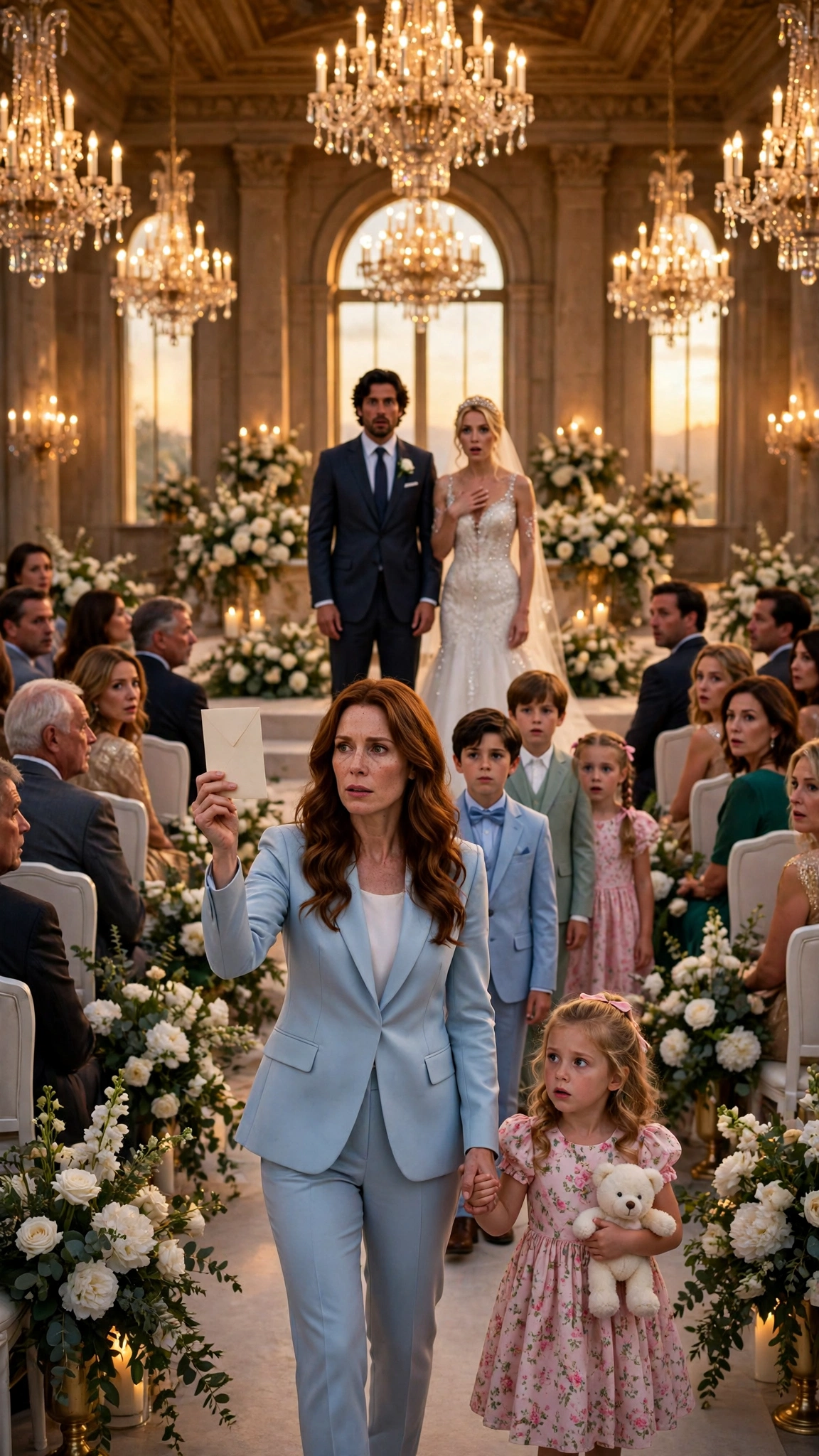
    Evelyn Hart stood in the doorway with her hand wrapped around her daughter's small fingers, and for one long second the whole glittering room seemed to hold its breath. Golden light poured through the tall windows and fell across the white chairs, the crystal chandeliers, the banks of white roses. At the far end, beneath an arch of white flowers, Dominic Castellano waited at the altar in a dark navy suit with a navy tie and a white rose in his buttonhole — and the color drained from his face the moment he saw her.

    She had not been invited. Everyone in the room knew it.

    Evelyn walked forward. Her light blue tailored suit was immaculate, her white silk blouse crisp, her cream satin scarf knotted at her throat. Her long auburn wavy hair fell over her shoulders, and her face was calm — so calm that it frightened her more than tears would have. Her small black handbag hung from her arm. Behind her, in a neat line, walked four small children with near-identical faces: Noah in a light blue suit with a bow tie, Leo in a sage-green suit, Mia in a pink dress with a white collar, and Layla — the eldest by three minutes — in a pink floral dress, clutching a small white teddy bear to her chest.

    Layla walked beside her mother, her light-brown wavy hair loose around her shoulders, her large fawn eyes wide. She looked up at her mother and whispered, "Mommy, I'm scared."

    Evelyn squeezed her daughter's hand. "Hold my hand, baby," she whispered back. "Just hold my hand. Whatever happens, hold my hand."

    She kept walking, all the way down the aisle, until she stood in the center of the hall with two hundred guests staring at her in stunned silence, and Dominic frozen at the altar, and the bride — young, beautiful, bewildered in her white gown — standing beside him with her bouquet shaking in her hands.

    Dominic took a step toward her. His voice, when it came, was rough with disbelief. "Evelyn, what are you doing here? Who are these children?"

    Evelyn lifted her chin. She reached into her handbag and took out the cream envelope, and she held it up for the whole room to see. "Your wedding gift," she said.

    Dominic stared at the envelope. He came down from the altar, slowly, like a man walking toward his own execution, and he took it from her hand. His fingers shook as he opened it. The paper inside was thick and official, stamped and signed. He read the first page. He read the second. The color drained from his face. His knees buckled, and he caught himself on the back of a chair.

    "They're mine?" he whispered. He looked at the children — at Layla's large fawn eyes, at Noah's watchful face, at Mia clinging to her sister's hand, at Leo standing small and brave — and he looked at Evelyn, and for the first time in five years, he saw her. Really saw her.

    Then his gaze moved past her, to the altar. To the bride. To Vanessa.

    "Vanessa," he said, and his voice had changed — it was quiet now, and terrible in its quietness. "Vanessa, why are you afraid? What haven't you told me?"

    The bride's bouquet trembled in her hands. A white rose slipped from it and fell, soundlessly, onto the marble. Her face had gone white beneath her veil. And in that moment, Evelyn understood that the story she had come to tell was not the only story in the room — and that the woman at the altar was hiding one of her own.

    It had taken her five years to learn how to walk into a room like this without breaking. It had taken her five years to understand that the story everyone believed about her was a lie — and that the only way to kill a lie was to walk into the room where it had been born and speak the truth out loud, in front of everyone.

    But the story did not begin in a wedding hall. It began on a summer night, six years earlier, on a rooftop in Queens, with a boy she had loved since she was seventeen and a sky full of stars that neither of them knew would be the last they would share for a very long time.
    —

    Evelyn had met Lucas Papadopoulos when she was seventeen and he was eighteen, in the kitchen of a neighbor's house during a birthday party that neither of them had wanted to attend. He was tall and lean even then, with short black hair and warm brown eyes, and he had spent the entire evening hiding by the refrigerator, eating cake straight from the box with a fork. She had laughed at him, and he had offered her the fork, and that was the beginning of everything.

    They grew up together in the way that only people who have known each other since childhood can. Lucas went to architecture school. Evelyn went to work for a small gallery in Manhattan, selling paintings she could never afford. They were poor and happy and certain — the way young people are certain — that the world would make room for them.

    In the spring of the year Evelyn turned twenty-nine, Lucas won the commission of his life: a museum in Milan, a project that would put his name on the map. The firm wanted him there for six months. He would come home for Christmas, he said. He would write every day. They celebrated on the rooftop of his building with cheap champagne and a sky full of stars, and he held her hand and told her that when he came back, they would get married.

    "I'll write to you every day," he said.

    "Every day," she agreed.

    He left on a Tuesday morning in June. She stood at the airport until his plane was a speck in the sky, and then she went home and waited for the first letter.

    It never came.

    She wrote to him — ten letters, then twenty, then thirty. She called his office in Milan and was told, politely, that Mr. Papadopoulos was very busy, that he was traveling, that he would call back. He never called back. By September, she understood what she was supposed to understand: he had left her. He had gone to Milan and found a new life, and she was a girl he had outgrown.

    What she did not know — what she would not learn for five years — was that Lucas had written to her every single day. His letters had been taken from the mail room of her building by a man paid in cash by Gabriel Castellano, and locked in a drawer in Gabriel's office, where they gathered dust like evidence in a crime that no one had yet named.

    Gabriel Castellano had known Evelyn since she was a girl. He was Dominic Castellano's cousin, the second son of a second branch of the family, a man with slicked-back silver hair and cold calculating eyes who had spent his whole life standing one step behind Dominic and hating it. He had watched Dominic build an empire. He had watched Dominic's first wife die young. And he had decided, long before Evelyn ever met Dominic, that the Castellano fortune would one day be his — if only Dominic could be kept childless, distracted, and alone.

    When Lucas left for Milan, Gabriel saw his chance. A heartbroken girl, alone in the city, with no family and no money, was easy to steer. All it took was a few quiet words in the right ears: a gallery owner who suddenly had no work for her, a landlord who suddenly needed the apartment, a friend who mentioned, casually, that a very rich man named Dominic Castellano was looking for someone to run his charitable foundation.

    Dominic was thirty-two then, a widower of three years, tall and muscular, with thick dark wavy hair and piercing gray eyes that made strong men look away. He was the kind of man who filled a room without trying. When he met Evelyn at a charity gala — she was serving drinks, because the gallery had let her go and she needed the work — he asked her to dance, and she said yes because she was tired and sad and he was kind.

    He courted her the way a man like Dominic courts a woman: with flowers every morning, with dinners in quiet restaurants, with long conversations in which he listened more than he spoke. He told her about his late wife. He told her about his father, Ambrose, a stern old man with white hair and piercing dark eyes who ran the family like a general. He told her he had always wanted children and had never had them.

    Evelyn did not love him — not then, not the way she had loved Lucas. But she liked him. She respected him. And she was tired of being alone in a city that had taken everything from her. When he proposed, three months after they met, on a terrace overlooking Central Park with a ring the size of a small moon, she said yes. She told herself that love could grow. She told herself that Lucas was gone and Dominic was here, and that was enough.

    She did not know she was pregnant.

    She had not known on the night Lucas left — the last night they spent together on that rooftop, the night he held her and promised to come back. She did not know until a month after her wedding to Dominic, when the nausea started and the doctor smiled and said, "Congratulations, Mrs. Castellano. You're going to be a mother."

    Evelyn sat in the doctor's office with her hands folded in her lap and did the math, and the math told her the truth: the baby had been conceived before her wedding. Before she had ever met Dominic. The baby was Lucas's.

    She went home that night and stood in the doorway of the bedroom she shared with her new husband, and she looked at Dominic — kind, powerful, proud Dominic, who had told her he had always wanted children — and she could not say the words. She was afraid. She was afraid he would leave her. She was afraid he would hate the child. She was afraid of being alone again, of losing the roof over her head and the ring on her finger and the only security she had ever known. So she said nothing. She smiled. She told him the baby was his, and she let him believe it, and she told herself that the lie would not matter, because love was love, and Dominic would love the baby no matter what.

    It was the worst mistake of her life. Not because Dominic would not have understood — he might have, and she would never know — but because a lie, once told, belongs to everyone who hears it. And there was one man in the Castellano family who was listening very carefully.

    The pregnancy was not easy. By the fourth month, the doctors were using a word Evelyn had never expected to hear: quadruplets. Four babies. Four heartbeats on the monitor, flickering like small stars. Dominic wept when he heard it. He bought a house in the Hudson Valley with a nursery the size of a ballroom. He hired nurses and nannies. He talked to Evelyn's belly every night, his big hand resting gently on the curve of it, telling his children about the world they would inherit.

    Ambrose came to the hospital the night the babies were born. He was sixty then, already white-haired, already stern, but when the nurse placed the first tiny bundle in his arms, something in his face cracked open. He held the baby — Layla, the firstborn, with her father's dark wavy hair already curling at the edges — and he looked at Evelyn, and he looked at the date on the chart, and he did the math. He was an old man who had lived a long life, and he understood numbers. He said nothing. He took out his silver pocket watch — the watch his own father had given him, the watch he wound every morning — and he looked at the time. Three-fourteen in the morning. Then he took a photograph: Evelyn in the hospital bed, pale and exhausted and radiant, holding two of the babies, while beside her stood a young man with short black hair and warm brown eyes, holding the other two.

    Lucas had come back. He had heard — from a friend of a friend, through the thin grapevine of people who still remembered them — that Evelyn had given birth to four babies in a hospital upstate. He had flown home that night, walked into the hospital, and found the woman he loved holding his children in her arms.

    Evelyn looked at him, and her whole body went cold. "They're Dominic's," she whispered. "Go away, Lucas. Please. They're Dominic's, and you have to go."

    He went. He believed her, because he loved her and because she was crying, and because he thought she had chosen a better life. He flew back to Milan the next morning, and he did not come home again for four years.

    Ambrose kept the photograph. He put it in his desk, under a stack of papers, and he wound his watch every morning and never told a soul what he knew. His watch stopped that night — the mechanism, worn thin after fifty years, gave out at three-fourteen in the morning, the hour of the children's birth — and he never had it repaired. He kept it in his pocket, silent and still, like the secret it measured.

    Evelyn went home to the house in the Hudson Valley with four babies and a husband who loved them all fiercely, and for a little while — for a year, almost two — she was happy. Dominic was a good father. He came home early to bathe the babies. He read them stories in his deep voice. He taught Layla to say his name, and she said it with her whole heart: "Daddy."

    And then Gabriel came to Dominic's office one rainy afternoon with a manila envelope in his hand, and the lie that Evelyn had told in fear became the weapon that destroyed her life.

  • Chapter 1: The Walk

    Chapter 1: The Walk

    At four o'clock every afternoon, the whole house held its breath.

    The maids stopped polishing. The guards along the marble hallway straightened a fraction taller against the cream-colored walls. Even the crystal chandeliers seemed to hush, because at four o'clock, Dante Falcone took his walk.

    He came through the tall doors at the far end of the corridor the way winter comes through a crack in a window — silently, and all at once. Forty years old, six foot four, shoulders like a doorframe, his black shirt open at the throat over tattoos that climbed his neck and disappeared beneath the fabric. His hair was shaved close, his beard short and dark, and a scar cut through one eyebrow like a sentence somebody had tried to erase. His hands were clasped behind his back. His head was lowered. He walked slowly past the white flowers and the gold molding, past the portrait of his dead wife that hung beside the closed sitting-room door, and he did not look at any of it. He had not truly looked at anything in eighteen months.

    Halfway down the hall he always slowed — the staff knew the place the way sailors know a reef — beside the portrait of his wife, hung in gilt beside the closed sitting-room door. Isabella Falcone laughed out of the frame in a summer dress, dark hair loose, caught mid-laugh in some garden of the world before. Dante never stopped. He never turned his head. But his stride shortened by half a beat as he passed her, every day, eighteen months of days, the way a man's step shortens passing a grave in a churchyard he is trying not to enter.

    Rosa watched him pass that day from the linen-room door, where she had been sent for the evening's table linen, with a stack of pressed napkins in her arms and her daughter — her daughter who was supposed to be napping in the staff wing, behind a door Rosa had personally pulled shut twenty minutes before — nowhere in her line of sight at all.

    That afternoon, six small feet behind him, somebody else took the walk too.

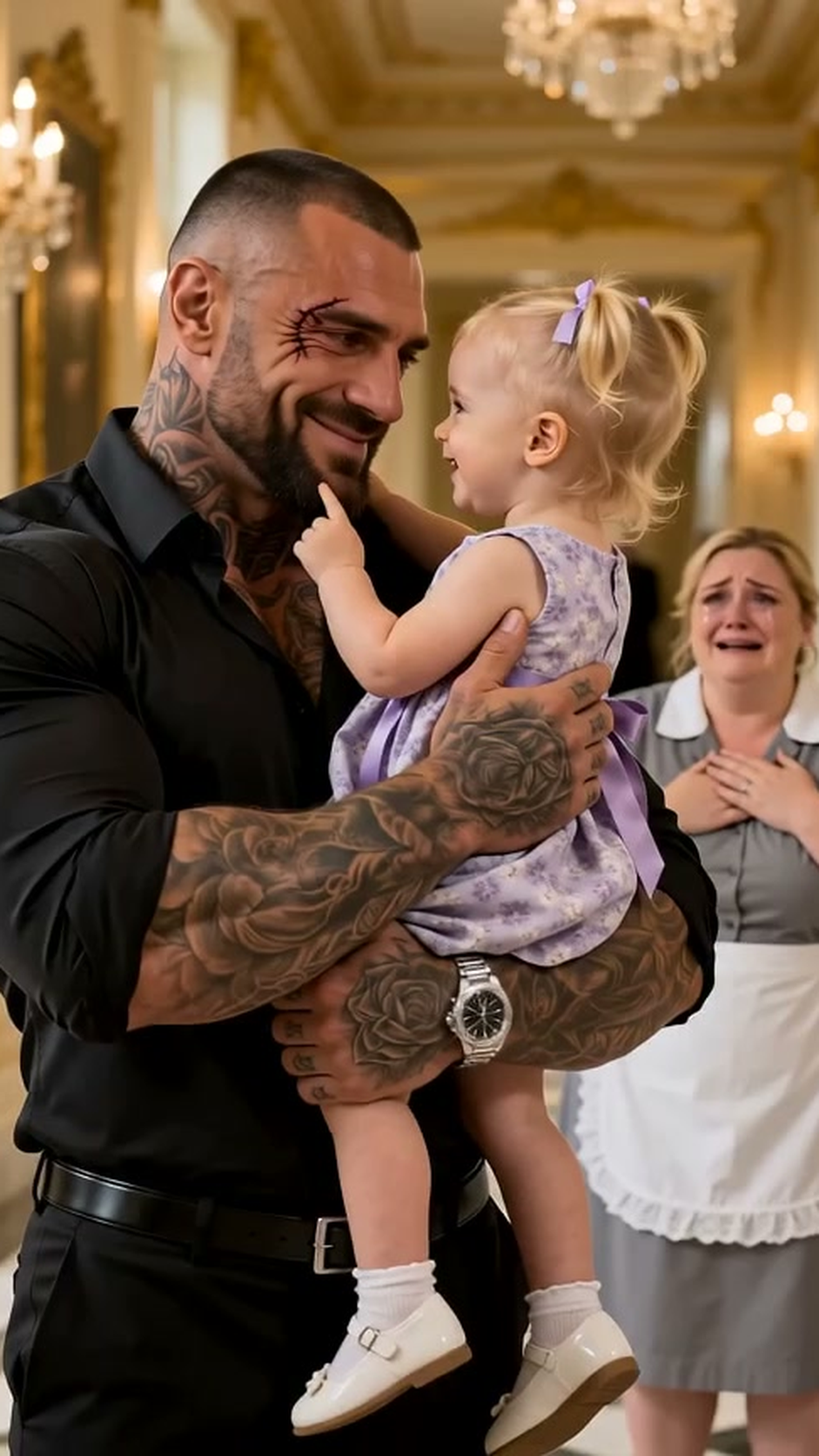
    Sophia Bennett was three years old. She had folded her tiny hands behind her back, exactly like his. She had puffed out her chest under her lavender floral dress, exactly like his. She took long, solemn, exaggerated steps in her little white shoes, her blonde pigtails bouncing with every stride, her round face arranged into the sternest expression a three-year-old has ever manufactured — a perfect, ridiculous, heartbreaking miniature of the most feared man in three counties.

    Rosa saw her from the doorway of the linen room, and the blood left her face.

    She was twenty-nine, soft and round in her gray maid's dress and white apron, her dark blonde hair coming loose from its bun, and she had exactly one rule burned into her soul since the day she was hired: Sophia must never, ever be anywhere near the boss.

    "Sophia," she whispered, and then, breathless with terror, louder: "Sophia, sweetheart, come back!"

    Dante stopped walking.

    Sophia froze behind him — instantly, completely, in perfect imitation. Hands still folded. Chest still puffed. Face still stern.

    For one long second, the most dangerous man in the Falcone family stood motionless in the golden afternoon light. Then he turned his head. Then he turned his body, slowly, the way a mountain decides to face you, and his dark eyes — deep-set, exhausted, and terrifying — found the tiny girl standing in his own posture behind him.

    Rosa took one step forward, one hand reaching out, her heart hammering so hard she was sure the guards could hear it. This was it. This was the end of the job, the room in the staff wing, the paycheck that kept the debt collectors three phone calls behind instead of at the door.

    Dante looked down at Sophia. Sophia looked up at Dante. Neither of them blinked.

    "Why are you walking like me?" he asked. His voice was deep and controlled and very quiet, the voice that had ended arguments, negotiations, and once — the whole house whispered — a war.

    Sophia tilted her head. She considered the enormous tattooed man the way she considered clouds and puddles and other enormous mysteries. And then, with the devastating sincerity that only a three-year-old can carry, she answered:

    "Because you look lonely."

    The hallway forgot how to breathe.

    Something crossed Dante Falcone's face — something so small that a man watching through the security cameras would have missed it. His jaw loosened. His eyes flickered, once, the way a candle does in a room where a door has just opened. And behind his back, slowly, his hands unclasped for the first time in eighteen months of afternoons.

    Sophia took a tiny step toward him and reached up, and her small hand found his — found one finger of a hand that could have crushed walnuts and had signed orders that emptied rooms — and she held on to it like it was the most natural thing in the world.

    "So I walk with you," she said quietly.

    Dante looked past her, then, to the portrait beside the closed sitting-room door. Isabella. Eighteen months in a gilt frame. His eyes went glassy. And the boss of the Falcone family, who had not knelt for any living soul since he was an altar boy, lowered himself slowly down onto one knee on the black-and-white marble, in front of a three-year-old girl in a lavender dress.

    Sophia reached out and touched his cheek with one small finger, right beside the scar, gentle as a moth landing.

    "See?" she whispered, delighted. "You can smile!"

    And Dante Falcone laughed.

    It was quiet, and rusty, and genuine — a sound that had not existed inside those walls for eighteen months. The guards at the far end of the hallway glanced at each other like men who had just watched the statue in the square get down off its pedestal. Dante gathered Sophia carefully up into his tattooed arms, and she settled against his chest and patted his chin and giggled, and Rosa — Rosa pressed both hands over her heart in the doorway and cried without a sound, because the terror and the relief arrived in her body at exactly the same moment.

    Dante looked down at the little girl in his arms. His voice, when it came, was barely a whisper.

    "Then don't let me walk alone."

    —

    TWO MONTHS EARLIER

    The Falcone mansion stood behind iron gates at the end of a maple-lined drive, and Rosa Bennett arrived at the service entrance on a rain-gray Tuesday with a suitcase in one hand, a diaper bag over her shoulder, and Sophia asleep against her neck.

    She had rehearsed the whole way on the bus. I am a hard worker. I don't complain. I don't ask questions. She did not rehearse the part where she had nowhere else to go, because nobody hires that part.

    Mrs. Adelina Conti — Addie — opened the door herself. Sixty-eight years old, silver hair braided like a crown, a woman who had run that house for thirty years and could assess a person the way other people check the weather.

    "You're the widow," Addie said. It was not a question.

    "Yes, ma'am."

    "Danny Bennett. The roofing accident." Addie's eyes softened one degree. "My niece cleans at St. Mary's. I know your story. Come in out of the rain, both of you."

    The staff wing was warm and plain and smelled of bread. There was a small room with a bed, a crib Addie had found in the attic and refused to explain, and a window that looked out on the kitchen garden. Rosa stood in the middle of it with her suitcase and wept for exactly one minute, quietly, into her hands, while Sophia slept on — because a door that locked, and a wage every Friday, and heat that came out of a radiator without a landlord's permission were more mercy than the last two years had taught her to expect.

    Then Addie sat her down at the kitchen table with tea and gave her the rules, and there were only three that mattered.

    "One. The sitting room on the ground floor stays closed. Nobody opens that door. Not for dusting, not for air, not for God Almighty. Two. Anything you see in this house, you have not seen. Anything you hear, you have not heard."

    "And three?"

    Addie looked at Sophia, asleep in the attic crib with her fists up beside her ears like a tiny boxer.

    "Three. At four o'clock, the boss walks the main hallway. He walks it alone, every day, rain or shine or funeral. That child—" Addie's voice gentled, against its will, "—that child is sunshine, Rosa Bennett. And this house has been a tomb for eighteen months. Keep her in the staff wing at four o'clock. Keep her away from Mr. Falcone entirely. A man carrying that much grief is like a man carrying a loaded gun. You cannot know which way it points."

    On her very first afternoon, Addie had kept her in the kitchen through the four o'clock hour on purpose, the way you keep a new dog inside during thunder, and Rosa had listened to the great house go quiet in layers — voices dropping, doors easing shut, the clink of the guards' radios silenced — and then the footsteps. Slow. Unhurried. Heavy as weather. Passing the kitchen corridor. Pausing, somewhere far off, in a way she could feel in her teeth. Passing on.

    "There," Addie had said, into the hush, not looking up from her rolling pin. "Now you've heard it. That's the sound this house makes instead of a heartbeat."

    And Sophia, awake in her crib in the little room off the kitchen, had not cried or startled. She had lain there with her eyes wide open, listening with her whole face, the way infants listen to rain on a roof — as if the sound were the most natural thing in the world, and only waiting for her to be old enough to join it.

    Rosa kept the rule. She kept it for fifty-nine days.

    She learned the house: which step on the service stairs complained, how Marco, the head of security, took his coffee and that he always saved Sophia the foam from his cappuccino in a tiny cup, how the maids lowered their voices when the boss's door opened, how the whole enormous building orbited a closed sitting-room door and a portrait of a woman with kind eyes and dark hair, laughing in a garden somewhere, in a summer that had ended eighteen months ago and never come back.

    And she learned the walk. At four o'clock, wherever she was, she heard it — the slow, measured tread in the marble hall, passing, pausing (she knew it paused; she had counted), passing on.

    Sophia learned it too. That was the thing Rosa did not understand until it was already too late. One rainy afternoon in the third week, Rosa came up from the laundry early and stopped in the nursery doorway with the basket on her hip, and watched her daughter — who believed herself unobserved — conduct a ceremony of devastating seriousness in front of the wardrobe mirror. Hands folded behind her back. Chin down. Chest out. Slow, enormous steps across the nursery rug, heel to toe, heel to toe, with a pause at the wardrobe — the exact pause, Rosa counted it, the exact number of breaths — before the solemn return journey. Then, catching sight of her mother in the mirror, the child had not startled or denied a thing. She had simply nodded, once, with terrible professional gravity, the way craftsmen greet one another across a workshop.

    "I'm practicing," she said. "For when he needs it."

    Rosa had set the basket down and sat on the nursery floor and held her daughter's face in both hands and said, "Baby, listen to me. We do not practice for Mr. Falcone. Mr. Falcone is not—" and had found, to her own horror, that she could not finish the sentence honestly. Not safe? Not kind? Not lonely? She had finished it with "—not expecting visitors," which was a lie of such transparency that Sophia had simply patted her mother's cheek, the way you pat a person who is doing her best, and gone back to her practicing. Children learn a house the way water learns a floor — they find every level, every slope, every crack. By the second week, Sophia had begun to drift, at nap time, toward the connecting door. By the third week, Rosa found her standing rapt at the keyhole side of the door that led toward the main hall, listening.

    "Sophia. What are you doing, baby?"

    Sophia turned around, and her blue eyes were full of a seriousness that did not belong to her age at all.

    "Listening to the sad man," she said. "He walks all alone, Mommy. Every day. Nobody walks with him."

    Rosa picked her up and carried her back to the staff wing, and her hands were not quite steady, because she had understood, suddenly and completely, the way you understand weather coming: it was not a question of whether her daughter would find her way into that hallway.

    It was a question of which afternoon.

  • Chapter 7: A Small Birthday

    Chapter 7: A Small Birthday

    One week later, on a clear October evening, Lorenzo Moretti had a second birthday dinner.

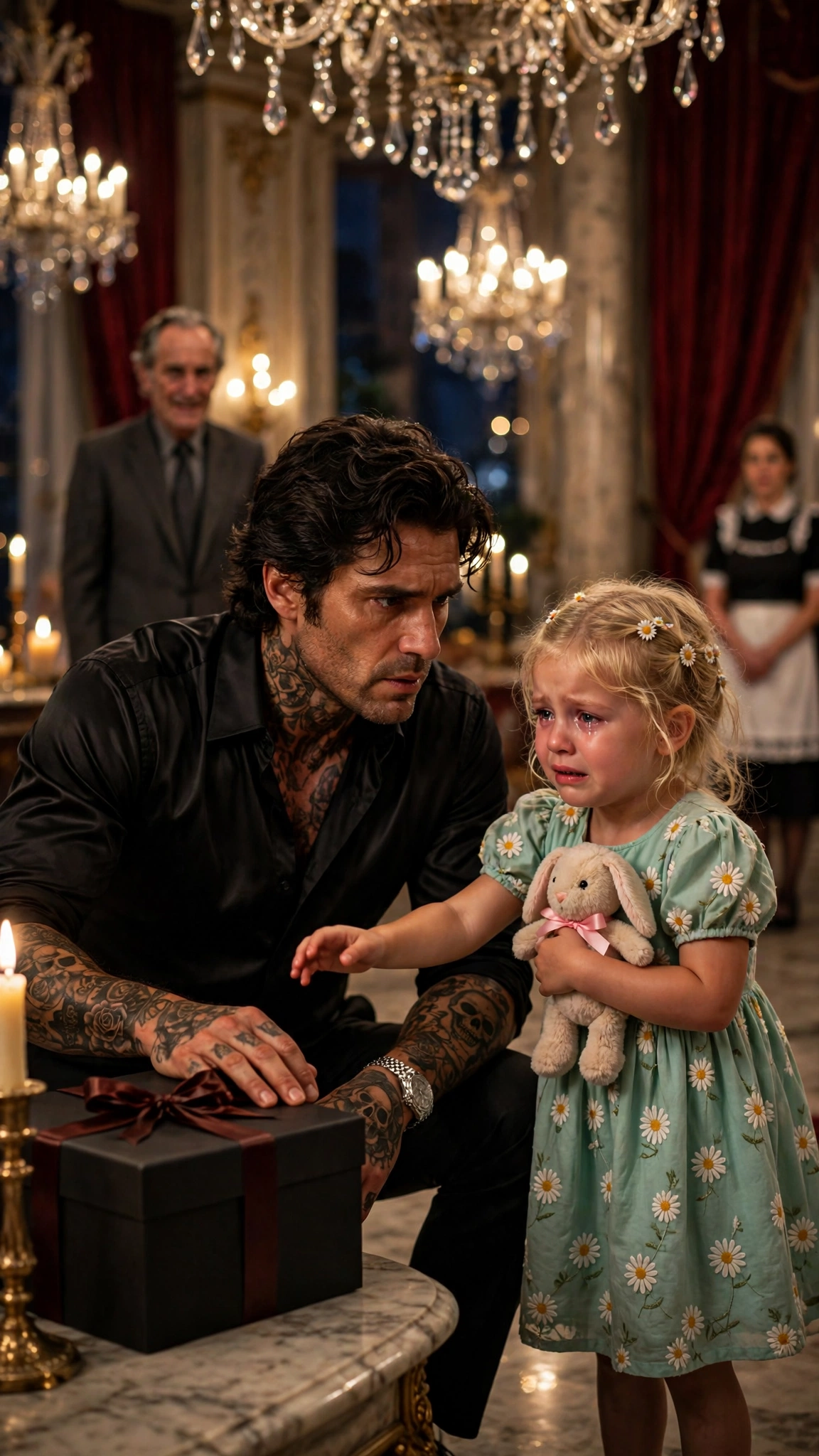
    It was nothing like the first one. There were no hundred guests in evening dress. There was no roast lamb, no cigar smoke, no crystal chandeliers blazing over the marble tables. There was no black gift box with a dark red ribbon sitting in the center of the table like a heart.

    There were three people, and a small table by the window, and a pot of Rosa's soup, and a cake that Rosa had baked herself — a small cake, with five candles on it, because Mia had insisted that five was a better number than thirty-six, and Lorenzo had agreed, because his daughter was right about most things.

    Mia sat in her chair, swinging her legs, wearing her mint-green daisy dress with the lace at the collar, the daisy clip in her hair, her small white shoes barely reaching the floor. Rosa sat across from her, in her dark uniform with her white apron, her silver cross catching the light of the candles, her hair in its neat bun, smiling the way she smiled when she was truly happy, which was not often, but which was worth waiting for.

    And Lorenzo sat at the head of the small table, in his shirtsleeves, his watch on his wrist, his hair still damp from the shower, looking at the two people he loved most in the world, and feeling something he had not felt in a very long time.

    He felt at peace.

    The house on the hill was quiet that evening. The rain had stopped. The trees outside the window were gold and red, and the water beyond the lawn was calm, and the stone wall stood solid around the garden, and the windows glowed warm against the dark sky. It was the kind of evening that made you believe, for a little while, that the world was a safe place, and that the people you loved would always be there, and that nothing bad could ever touch them.

    Lorenzo knew better. He had spent seventeen years learning that the world was not safe, and that the people you loved could be taken from you in a single night, and that a house was only as safe as the people inside it. He knew that Vincent De Luca was still out there, somewhere, licking his wounds and waiting for another chance. He knew that the business would always have enemies, and that the docks would always need protecting, and that there would always be another trap, another voice in a box, another long night.

    But tonight, none of that mattered. Tonight, there was soup, and cake, and candles, and his daughter, and Rosa, and the small warm light of the dining room, and that was enough.

    "Daddy," Mia said, and she was holding something behind her back, something flat and white, and she was trying very hard not to giggle. "I have a present for you. A real one this time."

    Lorenzo raised his eyebrows. "A real one?"

    "A real one," Mia said solemnly. "Not a box with a ribbon. Not a secret. A real present. I made it myself."

    She brought it out from behind her back and held it up with both hands, proud as a queen. It was a drawing. The same drawing she had been working on since Tuesday — the picture of the three of them, himself and Mia and Rosa, standing in front of the house, all of them smiling, the sun yellow and enormous in the corner. But she had added to it. Now there were four people in the picture. Herself, and her father, and Rosa — and a fourth figure, standing a little apart, with graying hair and a charcoal suit, smiling, waving.

    "Who is that?" Lorenzo asked, very quietly.

    "That's Uncle Marcus," Mia said. "I put him in the picture because I miss him. Rosa says he went away on a long trip. I hope he comes back someday."

    Lorenzo looked at the drawing for a long moment. He looked at the four figures, standing in front of the house, all of them smiling, the sun yellow and enormous in the corner. He thought about Marcus, on a plane to somewhere warm, with his son beside him, starting over, far away from the city, far away from the life that had nearly destroyed him. He thought about the promise he had made — exile, not death — and about the money he had given him, and about the letter he had written, the one he had not shown to anyone, telling Marcus that he was forgiven, in the only way Lorenzo knew how to forgive: by letting him go, and by letting him live.

    "He will come back someday, Mia," Lorenzo said, and it was not quite a promise, and it was not quite a lie. "Someday, when the time is right, he will come back. And when he does, we will have a party, and you can show him this picture."

    Mia beamed. She folded the drawing carefully, and she handed it to him, and he took it with both hands, the way you take something precious, and he looked at it for a moment longer, and then he set it down on the table beside his plate, where he could see it.

    "Thank you, Mia," he said. "It is the best present I have ever received."

    "It is the best drawing I have ever drawn," Mia said, with great satisfaction. "Rosa says so."

    "Rosa is right," Lorenzo said. "Rosa is always right."

    Rosa snorted. It was the sound she had perfected over twenty years. "I am right about most things," she said. "And I am right about this: it is time for cake."

    She cut the cake, and she gave the biggest piece to Mia, and the second biggest piece to Lorenzo, and she took the smallest piece for herself, the way she always did, and they ate it in the warm light of the dining room, and Mia told them about her day — about the rabbit in the garden, and the book Rosa had read to her, and the cloud that had looked like a dragon — and Lorenzo listened to every word, the way a father listens when he has finally learned to be present, and Rosa watched them both, and she thought about Elena, who had told her husband to take care of their girl, and she thought that Elena would have been proud of him tonight.

    After dinner, Lorenzo carried Mia upstairs to bed. He tucked her in, and he put Mr. Buttons under her arm, and he sat on the edge of the bed, and he told her a story — not a true story, but a good one, about a brave little girl who saved a castle from a dragon, because she was the only one who saw the dragon coming, and because she was brave enough to say so.

    Mia listened with her eyes half closed, and when the story was over, she said, in a sleepy voice, "Daddy?"

    "Yes, sweetheart?"

    "Are we safe now?"

    Lorenzo looked at her — at her blonde hair spread on the pillow, at her wide blue eyes, at the daisy clip that had come loose and was lying on the blanket beside her — and he thought about everything that had happened in the last week: the box, and the recorder, and the warehouse, and the boy who had come home, and the man who had gone away. He thought about the trap, and about the choice he had made, and about the fact that his five-year-old daughter had saved his life, and that he would never forget it, not for as long as he lived.

    "Yes, Mia," he said, and he kissed her forehead, and he meant it. "We are safe now. I promise."

    "Good," Mia said, and she closed her eyes, and she was asleep within moments, her breathing slow and even, Mr. Buttons tucked tight under her arm.

    Lorenzo sat there for a while, watching her sleep. Then he went downstairs, and he found Rosa in the kitchen, washing the dishes, humming an old song under her breath.

    "Rosa," he said.

    She looked up. "Mr. Moretti?"

    "Thank you," he said. "For believing her. For believing Mia. If you hadn't — if you had told her she was imagining things, if you had told her to be quiet — I don't know what would have happened. I think — I think I might not be standing here."

    Rosa put down the dish she was holding. She dried her hands on her apron. Her silver cross caught the light.

    "She is her mother's daughter," Rosa said quietly. "Elena saw straight through people. Mia does too. I just listened. That is all I did. I listened."

    "I know," Lorenzo said. "And I will never forget it."

    They stood in the kitchen for a moment, in the warm light, in the quiet house, and then Rosa went back to the dishes, and Lorenzo went to the study, and he took the drawing Mia had given him, and he put it in the top drawer of his desk, next to the small black recorder he had kept — the recorder that had started everything, and that had ended everything, all at once.

    He kept them both. The drawing, and the recorder. The best present he had ever received, and the worst. He kept them side by side, in the dark, in the drawer, as a reminder: that the world could be cruel, and that it could be kind, and that the difference between the two was often a single person, in a single moment, choosing to listen.

    Outside, the moon rose over the water. The house on the hill stood quiet and warm against the dark sky. And inside, a five-year-old girl slept safely in her bed, dreaming of dragons and castles and a father who had finally learned to come home.

    The birthday was over. The danger was past. And the family — the small, stubborn, unbreakable family of three, plus one who had gone away and might someday come back — was together, and safe, and happy, at last.

    The next morning, Mia woke up early, before the sun was fully up, and she went to the window in her room and looked out at the garden, where the rain had washed everything clean, and the trees were gold and red, and the grass was wet and shining. She stood there for a while, in her nightdress, holding Mr. Buttons, and she thought about the last week — about the box, and the ribbon, and the party, and her godfather, and her father — and she felt the small cold feeling in her chest, the one she had carried for two days before the party, finally, completely, go away.

    She went downstairs, and Rosa was in the kitchen, and her father was at the table, reading the newspaper, and the house smelled of coffee and toast, and it was an ordinary morning, and that was the most wonderful thing in the world.

    "Daddy," she said, climbing onto his lap. "Can we have another party? A small one. Just us. And Rosa. And maybe Mr. Buttons."

    Lorenzo laughed, and he kissed the top of her head, and he said, "We can have a party every week, if you want. We can have a party every day."

    "Every day is too many," Mia said seriously. "Every week is just right."

    "Every week it is," Lorenzo said.

    And so it was. Every Sunday after that, the three of them had dinner together at the small table by the window — just Lorenzo, and Mia, and Rosa — and they talked, and they laughed, and Mia told them about her week, and Lorenzo told her about his, and Rosa told them both that they were ridiculous, and that she loved them anyway.

    It was not a grand life. It was not the life of a mafia boss, with a hundred guests at the marble tables and chandeliers blazing overhead. It was a small life, a quiet life, a life of soup and cake and candles and a little girl in a mint-green dress, swinging her legs under the table.

    But it was a happy life. And Lorenzo, who had spent seventeen years building a fortress on a hill, finally understood what his grandmother had tried to teach him when he was a boy: a house is not made safe by stone walls, or by locked doors, or by men with guns. A house is made safe by the people inside it — by a little girl who is brave enough to tell the truth, and by a housekeeper who is wise enough to listen, and by a father who is strong enough to choose mercy over vengeance, even when vengeance would have been easier.

    A month later, a letter arrived at the house. It had no return address. It was postmarked from Florida. Inside was a single photograph: Marcus and Marco, standing on a beach, smiling, the sun behind them, the ocean blue and endless. On the back, in Marcus's handwriting, were the words: "Thank you. We are safe. We are happy. Tell Mia I love her, and that I will always be her Uncle Marcus."

    Lorenzo showed the photograph to Mia, and she held it carefully, with both hands, and she said, "He looks happy, Daddy."

    "He is happy," Lorenzo said. "And so are we."

    She put the photograph on the table beside her drawing — the drawing of the four of them, standing in front of the house, all of them smiling, the sun yellow and enormous in the corner — and she looked at them both for a long moment, and then she went back to her toast, and her father went back to his newspaper, and Rosa went back to the dishes, humming an old song under her breath.

    The house on the hill stood quiet and warm against the morning sky. The rain had stopped. The sun was shining. And inside, a family that had nearly been broken was whole again — not because they were strong, or rich, or feared, but because a five-year-old girl had stood up at her father's birthday table, and put her small hand on his wrist, and told him the truth.

    And her father had listened.

  • Chapter 6: Turning the Trap

    Chapter 6: Turning the Trap

    The meeting was set for the following night, at the old warehouse on the waterfront, the neutral ground where the families had met for fifty years when they needed to talk without killing each other.

    Lorenzo did not go alone. He never went alone. But he went quiet — only four men, his best, his most trusted, the ones who had been with him the longest and who knew, without being told, that something important was happening. He did not tell them the whole story. He told them only what they needed to know: that Marcus had made a mistake, that the mistake was being fixed, and that tonight they were going to bring a boy home.

    Marcus went with him. He had not wanted to go. He had argued, in the study, in a low voice, that De Luca would kill him the moment he walked through the door, that it was a trap, that Lorenzo was walking into the same trap De Luca had built for him at the birthday table. Lorenzo had listened, and then he had said, "That's the point, Marcus. It is a trap. And we are going to walk into it — because we know it is a trap, and he doesn't know that we know."

    That was the whole plan. It was simple. It was dangerous. And it was the only plan they had.

    The warehouse was cold and dark and smelled of salt water and old wood. The rain had started again, drumming on the metal roof, and the lights were low, and the shadows were long. Vincent De Luca was already there when they arrived, sitting at a table in the center of the room, flanked by six of his own men, his heavy shoulders hunched, his scarred knuckles flat on the table, his cold eyes fixed on the door.

    He was a big man, De Luca, bigger than Lorenzo, with a face that had been broken more than once and put back together badly. He had wanted the Moretti docks for a decade, and he had wanted the Moretti name erased for just as long, and he had spent ten years being patient, waiting for the right moment, building his trap piece by piece. He thought tonight was that moment. He thought he had already won.

    "Lorenzo," he said, as Lorenzo walked in. "You came. I wasn't sure you would."

    "I came," Lorenzo said. He did not sit down. He stood at the end of the table, tall and calm in his dark suit, his watch catching the dim light, his gray-brown eyes steady. "Where is the boy?"

    De Luca smiled. It was a slow, satisfied smile, the smile of a man who has just bought something expensive. "The boy is safe. The boy is comfortable. The boy will stay safe and comfortable — as long as we can come to an understanding."

    "What kind of understanding?"

    "The kind where you give me the docks," De Luca said. "The Moretti docks. All of them. The contracts, the warehouses, the men. You sign them over to me, tonight, and your friend's son goes home. You refuse, and — " He shrugged. "Well. You know what happens if you refuse."

    Lorenzo looked at him for a long moment. Then he did something De Luca did not expect. He laughed.

    It was a short, quiet laugh, the kind of laugh a man makes when he has just heard something so stupid he cannot help himself. De Luca's smile faltered.

    "What's funny?" De Luca said.

    "You are," Lorenzo said. "You think you've won. You think your trap worked. You think I played that recording at the table, in front of my guests, and I heard your voice, and I threw my best friend out of my house, and now here I am, crawling to you, ready to give you everything. Is that what you think?"

    De Luca's eyes narrowed. "That's what happened."

    "No," Lorenzo said. "That's what you wanted to happen. What actually happened is this: my five-year-old daughter warned me not to open the gift. My housekeeper believed her. I sent my men home. I played the recording alone, with Marcus sitting across from me, and I heard your little message — 'Play this in front of your guests, and your most trusted man dies tonight. Destroy it, and the boy dies instead.' — and I understood exactly what you were trying to do. You weren't trying to kill me with a box, Vincent. You were trying to make me kill my own best friend. You were trying to make me do your work for you."

    He took the small black recorder out of his jacket pocket. He held it up, and he pressed play. De Luca's voice filled the warehouse — flat, amused, unmistakable. "Play this in front of your guests, and your most trusted man dies tonight. Destroy it, and the boy dies instead." Lorenzo let the words hang in the cold air for a moment. Then he pressed stop.

    "And here's the thing you didn't think about," Lorenzo said. "Your voice is on this little machine, Vincent. You, admitting it. You took a nineteen-year-old boy hostage and used him to blackmail his father. And do you know what happens in our world when a man takes a child hostage?"

    De Luca's face had gone very still. His men had stopped moving. The rain drummed on the roof.

    "Every family in this city hears about it," Lorenzo said, and his voice was calm, and it was cold, and it filled the warehouse the way it always filled a room. "Every family. The Castellanos. The Romanos. The Bellinis. All of them. And they all understand one thing: a man who takes a child hostage is a man who cannot be trusted. A man who cannot be trusted is a man who cannot do business. And a man who cannot do business is a man who is finished."

    He set the recorder down on the table, between them, so that De Luca had to look at it.

    "So here's my offer, Vincent," Lorenzo said. "You give me Marco back. Tonight. Right now. Unharmed. And you leave the docks alone. You leave my family alone. You leave my daughter alone. And in return, I don't play this recording for every family in New York. I don't tell them what you did. I let you walk out of here with your reputation intact, and we forget this ever happened."

    De Luca stared at the recorder. He stared at Lorenzo. His jaw worked. His scarred knuckles tightened on the table.

    "And if I refuse?" he said.

    "Then I walk out of here," Lorenzo said, "and by tomorrow morning, every family in the city will have heard this recording, and they will all know what you did. And you will have no friends left, Vincent. Not one. And a man with no friends in this city does not last long."

    There was a long silence. The rain fell on the roof. The men on both sides stood very still, their hands near their jackets, waiting to see what would happen.

    Then De Luca laughed. It was a short, bitter laugh, the laugh of a man who has just realized he has been outplayed and hates it.

    "You're a clever bastard, Lorenzo," he said. "You always were. Your father was the same way."

    "My father taught me to never trust a man who smiles too quickly," Lorenzo said. "You smiled too quickly, Vincent. That was your mistake."

    De Luca stood up. He nodded to one of his men, a tall, thin man with a scar over his eye, and the man left the room without a word. A few minutes later, he came back, and behind him, blinking in the dim light, was a boy.

    Marco Bellini was nineteen years old, tall and thin, with dark hair and his father's sharp features, and he looked like a boy who had not slept properly in three weeks. He was pale. His clothes were wrinkled. His hands were shaking. But he was alive. He was whole. He was unharmed.

    Marcus made a sound — a small, broken sound, like a man who has been holding his breath for three weeks and has finally been allowed to breathe — and he stepped forward, and Marco saw him, and the boy's face crumpled, and he ran to his father, and Marcus caught him in his arms, and held him tight, and did not let go.

    "Marco," Marcus whispered. "Marco, I'm here. I'm here. You're safe. You're safe now."

    Lorenzo watched them, and he felt something in his chest loosen — a knot he had not known was there, loosening, letting go. He looked at De Luca, and he nodded, once, the way men nod when a deal is done.

    "Good," he said. "Now get out of my city, Vincent. And don't come back."

    De Luca looked at him for a long moment. Then he turned, and he walked out of the warehouse with his men behind him, into the rain, into the dark, and he did not look back.

    Lorenzo stood in the warehouse with the rain drumming on the roof, and he watched Marcus hold his son, and he thought about the recorder on the table, and about the box with the dark red ribbon, and about the trap that had been built so carefully and had failed so completely — because a five-year-old girl, playing hide-and-seek behind a curtain, had seen through it.

    He picked up the recorder and put it in his pocket. He would keep it. Not as a weapon — he had promised De Luca he would not use it, and Lorenzo Moretti kept his promises — but as a reminder. A reminder that the most dangerous thing in the world was not a bomb, or a gun, or a rival family. The most dangerous thing in the world was a man who thought he could use a child to hurt a family.

    He turned to Marcus. "It's done," he said. "Your son is home. Now we go home too."

    They drove back through the rain, in silence, the city sliding past the windows, dark and wet and beautiful. Marcus sat in the back seat with his arm around Marco, who had fallen asleep against his father's shoulder, exhausted, safe at last. Lorenzo sat in the front, looking out at the water, thinking about the house on the hill, and about Rosa, and about Mia, who was asleep in her bed with Mr. Buttons tucked under her arm, dreaming whatever five-year-old girls dream about.

    He thought about what he had promised Marcus. Exile. Not death. Exile.

    He would keep that promise too. In the morning, he would give Marcus money — enough to start over, enough to live on — and he would put him and Marco on a plane to somewhere far away, somewhere warm, somewhere no one knew their names. And Marcus would go, because he had agreed, and because it was the right punishment, and because it was also a mercy: a chance to be a father to his son, without the weight of what he had done hanging over him.

    It was not forgiveness. Lorenzo did not forgive — not easily, not completely, not ever. But it was something close to it. It was the understanding that a man who had been given an impossible choice, and who had chosen his son, was not a monster. He was a father. And Lorenzo, who was also a father, understood that in a way no one else in the city ever would.

    The car turned up the hill, toward the house, toward the warm windows, toward home. And Lorenzo Moretti — thirty-six years old, a mafia boss, a widower, a father — sat in the dark and felt, for the first time in three weeks, that the world was right again.

    In the morning, Lorenzo drove Marcus and Marco to the airport himself. He did not send a driver. He did not send a man. He drove the car, and Marcus sat in the back with his son, and they did not talk much, because there was not much left to say.

    At the terminal, Lorenzo gave Marcus a thick packet, full of cash, and a letter with the name of a man in Florida who owed Lorenzo a favor and who would give Marcus work, and a house, and a fresh start. Marcus took it with both hands, and he looked at Lorenzo, and he said, "I don't know how to thank you."

    "Don't thank me," Lorenzo said. "Take care of your son. That's all I ask. Take care of Marco, and don't ever come back. Not because I hate you, Marcus. Because I love you. And because the only way this works — the only way any of us survives this — is if you disappear, and you stay disappeared, and you build a new life where no one knows your name."

    Marcus nodded. He hugged Lorenzo then, hard, the way men hug when they know they will never see each other again, and Marco shook Lorenzo's hand, and said, "Thank you, Uncle Lorenzo," and Lorenzo said, "Take care of your father, Marco. He's a good man. He made a terrible choice, but he made it for you, and that counts for something."

    Then they walked through the doors, and they were gone, and Lorenzo stood in the airport for a long moment, watching the planes take off, thinking about twenty-five years of friendship, and about the price of loyalty, and about the fact that the hardest thing he had ever done was not killing a man. It was letting one live.

    He drove home through the morning traffic, and when he got to the house on the hill, Rosa was in the kitchen, and Mia was at the table, eating her toast in triangles, and the sun was coming through the windows, and for a moment, everything felt almost normal. Almost.

    Rosa looked up when he came in. She saw his face. She put down the knife.

    "Is it done?" she asked.

    "It's done," Lorenzo said. "Marco is home. Marcus is gone. De Luca is finished. The house is safe."

    Rosa nodded. She did not ask for details. She had known Lorenzo for twenty years, and she knew that some things were better left unsaid. She poured him a cup of coffee, and she set it in front of him, and she said, "Your daughter asked about Uncle Marcus this morning. She wanted to know where he went."

    "What did you tell her?"

    "I told her he went away on a long trip," Rosa said. "And that he loves her very much. And that he will always love her, no matter how far away he goes."

    Lorenzo nodded. "That's the truth," he said. "All of it."

    "Yes," Rosa said. "It is."

  • Chapter 5: The Godfather’s Choice

    Chapter 5: The Godfather’s Choice

    The night after the party was the longest night of Lorenzo Moretti's life.

    He did not sleep. He sat in his study with the door locked, the small black recorder on the desk in front of him, the lamp turned low, and he went over everything Marcus had told him, piece by piece, the way a man goes over a map before a battle.

    It was worse than he had thought. It was always worse than you thought.

    Marco had been taken three weeks earlier, on a Friday night, from the back room of the De Luca casino on the waterfront. He had gone there with two friends, boys he had known since school, and they had played cards, and they had drunk too much, and Marco — who was nineteen and thought he was invincible, the way nineteen-year-old boys do — had taken money from the table. Not much. A few thousand dollars. But in the De Luca casino, it did not matter how much. It mattered that he had taken it. De Luca's men had taken him into the back room, and they had shown him what happened to thieves, and then they had called his father.

    Marcus had gone to the garage alone, at midnight, three nights before the party. He had met Vincent De Luca in person. De Luca had shown him a photograph of Marco — alive, but frightened, sitting in a chair in a room with no windows — and he had given Marcus the little black recorder, and the instructions, and the choice.

    "Deliver the box, and your son comes home," De Luca had said. "Refuse, and he doesn't. Warn Lorenzo, and he doesn't. It's very simple, Marcus. You're a simple man. You can understand simple things."

    Marcus had understood. He had taken the recorder. He had put it in the box. He had hidden the box in the study, behind the books, where no one would find it until the morning. He had told the gate guard to expect a delivery. He had done everything De Luca had asked him to do, and he had hated himself for every second of it, and he had not slept in three weeks, and he had not told anyone, because De Luca had told him that if he told anyone — anyone at all — Marco would die.

    And then Mia had seen him. A five-year-old girl, playing hide-and-seek behind a curtain, had seen the thing that no one else in the world had seen, and she had told Rosa, and Rosa had believed her, and Mia had stood up at her father's birthday table and saved his life.

    Lorenzo sat in his study and thought about that, and he thought about what De Luca had really wanted.

    De Luca had not wanted to kill Lorenzo with a bomb. A bomb was crude. A bomb was for amateurs. De Luca had wanted something much worse. He had wanted Lorenzo to kill his own best friend.

    That was the trap. That was the real weapon. If Lorenzo had played the recording at the table, in front of a hundred guests, they would have heard De Luca's voice, and they would have known Marcus had betrayed him, and in that world — in Lorenzo's world — a betrayal like that could only end one way. His men would have expected him to kill Marcus on the spot, in front of his daughter, on his birthday. And if he had refused — if he had shown mercy, if he had hesitated — they would have thought him weak, and the family would have begun to crack, and De Luca would have been waiting, patient as ever, to push the crack wider.

    And if Lorenzo had destroyed it — if Marcus had warned him, if the two of them had tried to handle it quietly — then Marco would have died, and De Luca would have known the trap had failed, and he would have come for Lorenzo another way. The recording had said so, in De Luca's own voice: destroy it, and the boy dies instead.

    Either way, someone died. Either way, De Luca won.

    Lorenzo had refused both choices. He had closed the box. He had retied the ribbon. He had sent his men home. And now he sat in his study at three in the morning, with a small black recorder on his desk and a war to plan, and he knew that the next move was his.

    He called Marcus into the study at dawn.

    Marcus came in looking like a man who had not slept in three weeks, which was exactly what he was. His suit was wrinkled. His hair was uncombed. His eyes were red. He sat down in the chair across from Lorenzo's desk, and he waited, the way a man waits for a sentence to be passed.

    "Here's what I need to know," Lorenzo said. He did not raise his voice. He did not need to. "Where is Marco being held?"

    "I don't know," Marcus said. "They never told me. They showed me a photograph. A room with no windows. A chair. That's all I know."

    "How do they contact you?"

    "By phone. A number that changes every time. They call. I answer. They tell me what to do."

    "How would De Luca know?" Lorenzo asked. "If you had warned me — how would he have known?"

    "He always knows," Marcus said. "He has men everywhere. He told me that if I warned you, if I told anyone, Marco would die before morning. I believed him. I still believe him."

    Lorenzo nodded. He believed him. Marcus was telling the truth — Lorenzo could tell, the way he could always tell with this man, because he had known him for twenty-five years, and because a man who is lying does not look like that. A man who is lying does not sit in a chair at dawn with his hands shaking and his eyes red and say, "I don't know," when he could make something up.

    "Marcus," Lorenzo said. "I want you to listen to me, and I want you to hear me. You betrayed me. You betrayed this family. You put my daughter in danger. In our world, there is only one punishment for that, and you know what it is."

    Marcus closed his eyes. "I know."

    "But," Lorenzo said, and his voice hardened, "I am not going to do it. Not tonight. Not ever. Not in front of my daughter, and not behind her back either."

    Marcus's eyes opened. He stared at Lorenzo as if he had spoken in a language he did not understand.

    "Why?" he whispered.

    "Because you are my oldest friend," Lorenzo said. "Because you held my daughter at her christening. Because for twenty-five years you stood at my right hand and you never once asked for anything for yourself. And because the man who did this to you — Vincent De Luca — is the man who deserves to pay for it, not you. De Luca took your son. He used your son to turn you into a weapon. That is not your crime, Marcus. That is his."

    Marcus was crying now, openly, without shame, the way a man cries when he has been holding it in for three weeks and someone finally says the thing he needed to hear. "Lorenzo," he said. "I don't deserve this."

    "No," Lorenzo said. "You don't. You deserve to be punished. And you will be. But not like this. Not by me. Not tonight."

    He leaned forward, across the desk, and his gray-brown eyes were sharp and cold and absolutely clear.

    "Here is your punishment, Marcus. You are going to help me get your son back. You are going to do everything I tell you to do, exactly when I tell you to do it, without question. And when this is over — when Marco is home, and De Luca is finished — you are going to leave. You are going to leave New York, and you are going to leave this family, and you are going to start over somewhere far away, where no one knows your name. I will give you money. I will give you enough to live on. But you will never come back. That is your punishment. Exile. Not death. Exile."

    Marcus stared at him. "You would do that? For me? After what I did?"

    "I would do it for Mia," Lorenzo said. "Because my daughter loves you, Marcus. She calls you Uncle Marcus. And I will not have her grow up knowing that her father killed her godfather on her father's birthday. I will not do that to her. I will not do that to you. And I will not do that to the twenty-five years we had before De Luca got his hands on you."

    There was a long silence. Outside, the rain had stopped, and the sun was coming up over the water, pale and gray, and the house on the hill was waking up — Rosa in the kitchen, Mia still asleep upstairs, the men arriving at the gate for the morning meeting.

    "Now," Lorenzo said, and he stood up, and he was the boss again, tall and broad in his shirtsleeves, his watch catching the morning light. "Tell me everything De Luca said. Every word. Every detail. And then we are going to turn his trap around on him."

    Marcus told him. He told him about the garage, and the photograph of Marco, and the phone calls, and the instructions, and the choice De Luca had given him. He told him about the fear, and the sleepless nights, and the way he had stood in the study with the recorder in his hand and said, "God forgive me," to an empty room.

    And when he had finished, Lorenzo nodded, and he said, "Good. Now here's what we're going to do."

    It was a simple plan. It was the kind of plan Lorenzo was good at — the kind that used the enemy's own weight against him. De Luca had built a trap that depended on Lorenzo doing what he was expected to do: playing the recording at the table, in front of his guests, and killing his best friend. Lorenzo was not going to do that. Instead, he was going to give De Luca exactly what De Luca wanted — the appearance of a betrayal, the appearance of a family tearing itself apart — and he was going to use that appearance to walk straight into De Luca's house and take Marco back.

    "You are going to call De Luca," Lorenzo said. "You are going to tell him that the plan worked — that I played the recording at the table, that I heard his voice, that I threw you out of the house in front of my guests. You are going to tell him that I am furious, that the family is in chaos, that I am vulnerable. And you are going to ask him for a meeting. You are going to tell him that you want to make a deal — that you will give him the Moretti docks, if he gives you Marco back."

    Marcus stared at him. "He won't believe it."

    "He will believe it," Lorenzo said, "because it is what he wants to believe. Men like De Luca always believe the story they wanted to hear. And while he is busy believing it, we are going to find out where Marco is being held, and we are going to bring him home."

    "And if it doesn't work?" Marcus asked. "If he sees through it?"

    "Then we will deal with that when it happens," Lorenzo said. "But it will work. Because De Luca made one mistake. He thought the weapon was the box. He thought the trap was the recorder. He forgot the most important thing in this whole story."

    "What did he forget?"

    Lorenzo looked at him, and for the first time since the party, he smiled — not the easy, practiced smile, but the real one, the dangerous one, the smile of a man who has just seen the whole board and knows exactly how the game ends.

    "He forgot my daughter," Lorenzo said. "A five-year-old girl saw through his plan. A five-year-old girl, playing hide-and-seek behind a curtain, understood what his best men could not. If a child can see through him, Marcus — what chance does he have against me?"

    Upstairs, Mia was waking up. She stretched in her bed, and she reached for Mr. Buttons, and she thought about the night before — about the box, and the ribbon, and her father's hand on her wrist — and she felt the small cold feeling in her chest begin, very slowly, to go away.

    Downstairs, her father was going to war. And for the first time in three weeks, Marcus Bellini — the man who had betrayed his best friend to save his son — felt something he had not felt in a very long time.

    He felt hope.

  • Chapter 4: The Voice in the Box

    Chapter 4: The Voice in the Box

    Lorenzo Moretti did not open the gift. Not then. Not in front of a hundred guests with his daughter's hand on his wrist and the whole room holding its breath.

    He did something else. He did the thing that had kept him alive for fifteen years at the top of a business that killed most men before thirty. He stopped. He looked. And he waited.

    The guests went home. Rosa took Mia upstairs, and the little girl went without a sound, her eyes wide, Mr. Buttons clutched tight to her chest, her small white shoes silent on the stairs. She looked back once, over Rosa's shoulder, at her father. He looked back at her. He nodded, just once. It was enough.

    Within ten minutes the ballroom was empty except for two men: Lorenzo Moretti and Marcus Bellini, who had not moved from his place by the red curtains. And between them, on the marble table, the black box, its lid closed again, its dark red ribbon untied and lying loose across the black paper.

    Marcus stood with his hands flat on the table, his charcoal suit immaculate, his graying hair slicked back, his face a careful mask. But Lorenzo could see the truth now, the way he had seen it in flashes all day — the tired lines around the eyes, the hands that trembled when they thought no one was looking, the smile that never reached the eyes. Marcus looked like a man who had been waiting for this moment for a very long time, and who was terrified of it now that it had arrived.

    "Marcus," Lorenzo said. He did not raise his voice. He did not need to. "You knew about this, didn't you?"

    Marcus's smile froze. He opened his mouth. He closed it. He looked at the box, sitting untouched in the center of the table, the dark red ribbon still untied, and he looked at the stairs where Mia had gone, and he looked at Lorenzo, and something in his face broke — not all at once, but the way a dam breaks, a small crack first, and then everything behind it.

    "Lorenzo," he said. His voice was hoarse. "I can explain."

    "Then explain," Lorenzo said. "But first — the box."

    He reached for the lid. This time, no small hand stopped him. This time, the room was quiet, and the candles were burning low, and the rain was falling outside, and Lorenzo Moretti lifted the lid of the box.

    Inside, nestled in white tissue paper, there was a small matte-black voice recorder, no bigger than a matchbox, with a single red light blinking on its side.

    Lorenzo stared at it. He had expected something terrible. He had expected the worst thing he could imagine. And what he found was a little black machine — a small, ordinary, silent machine, the kind of thing that could hold a voice, or a threat, or a secret.

    He picked it up. It was light. Too light to be dangerous. And yet his hands were steady, and his breathing had slowed, the way it always slowed when he was about to do something that could not be undone.

    He pressed play.

    A voice came out of the little machine — flat, amused, unmistakable, a voice Lorenzo had heard a hundred times across a table, a voice that belonged to Vincent De Luca.

    "Happy birthday, Lorenzo," the voice said. "The man standing beside you sold you for his son. He put this little machine in the box, and he made sure you would open it in front of everyone you love. Play this where your guests can hear it, and your most trusted man dies tonight — your own men will do it for you, and they'll do it in front of your little girl. Destroy it, and the boy dies instead. Your choice, boss. The same choice I gave him."

    The voice stopped. The red light went out. The ballroom was silent except for the rain on the windows and the slow, ragged breathing of the man across the table.

    Lorenzo put the recorder down on the marble table, very carefully, as if it might explode, and he looked at Marcus.

    "Three weeks," he said. His voice was low. It was dangerous. "You've been carrying this for three weeks. Tell me why."

    Marcus did not answer. He sat with his hands flat on the table, and he stared at the recorder, and his face was gray, and his breathing was shallow, and for a moment Lorenzo thought he might faint. Then Marcus spoke, and his voice was the voice Mia had heard in the study two days earlier — low and fast and afraid, the voice of a man trying not to cry.

    "They have Marco," he said.

    Lorenzo went still. "What?"

    "They have my son." Marcus's hands were shaking now, openly, and he did not try to hide it. "Three weeks ago. Marco was at the De Luca casino — he went there with friends, he was stupid, he was nineteen and stupid — and he took money. Not much. Not enough to matter. But they caught him. And De Luca's men took him. They have had him for three weeks, Lorenzo. Three weeks. And they told me — they told me that if I wanted him back alive, I had to do one thing. One thing."

    "The box," Lorenzo said.

    "The box." Marcus nodded. "They gave me the recorder. They told me to put it in the gift, and to make sure you opened it at the table, in front of your guests. They said — they said that if you played it in front of everyone, your guests would hear De Luca's voice, and they would know I had betrayed you, and they would kill me on the spot. And if I warned you, if I told you first, they would kill Marco. And if you destroyed it — " He stopped. He swallowed. "They said the boy dies instead."

    He could not finish. He put his face in his hands.

    Lorenzo stood very still. He looked at the recorder. He looked at the box. He looked at the man who had been his best friend for twenty-five years, who had held his daughter at her christening, who had cried, and he felt something inside him crack — not anger, not yet, but something colder and deeper: the feeling of a man who has just understood that the world he thought he lived in was not the world he actually lived in.

    "Marcus," he said, and his voice was so quiet it was almost a whisper. "You were supposed to protect this family."

    "I know," Marcus said, and his voice broke. "God forgive me. I know. But he is my son, Lorenzo. He is my only son. What was I supposed to do?"

    Lorenzo did not answer. He did not know the answer. He stood in the ballroom with the candles burning low and the rain falling outside, holding a little black machine that proved his oldest friend had betrayed him, and he thought about Mia upstairs, and about Rosa, and about Elena, who had told him to take care of their girl, and he thought about the trap that had been laid for him so carefully — a trap in which whatever he did, someone he loved would die.

    And then he did the thing that no one in that room, and no one in the city, would have expected him to do.

    He put the recorder back in the box. He closed the lid. He retied the ribbon.

    "Here's what is going to happen," he said, and his voice was calm, and it was cold, and it was the voice of a man who had just made a decision that could not be unmade. "You are going to tell me everything. Every word they said. Every place you met. Every name. And then you are going to help me turn this trap around on the men who built it. Because they made one mistake, Marcus. They thought the weapon was the box. It was never the box. The weapon was what the box would make me do. And I am not going to do it."

    Marcus looked up at him, his face wet, his eyes red. "What are you going to do?"

    "I am going to get your son back," Lorenzo said. "And then I am going to make Vincent De Luca regret the day he ever heard the name Moretti."

    Outside, the rain fell on the roof of the house on the hill. Upstairs, a five-year-old girl lay awake in her bed, holding Mr. Buttons tight, listening to the silence below, wondering if her father was safe.

    And downstairs, in the ballroom, with the candles burning down to stubs, Lorenzo Moretti began to plan.

    He sat down slowly, in the chair at the head of the table, and he looked at the box for a long time without touching it. The dark red ribbon was still tied. The bow was still perfect. It looked like any birthday gift in the world, and it was the most dangerous thing he had ever held in his hands.

    He thought about all the gifts he had received in his life. As a boy, his grandmother had given him a pocketknife, and taught him to whittle, and told him that a knife was a tool before it was a weapon, and that the difference was in the hand that held it. As a young man, his father had given him a watch — not this one, an older one, a simple one — and told him that a man who was late was a man who did not respect other people's time. Elena had given him books, and sweaters, and once, for his thirtieth birthday, a photograph of the two of them on their wedding day, in a silver frame, which still sat on his desk in the study. And Mia — Mia gave him drawings, every year, drawn in crayon, of the family, of the house, of the sun yellow and enormous in the corner. Those were the only gifts that had ever mattered.

    This box was different. This box had been given to him by a man who wanted him dead. It had been delivered by a stranger, carried by his oldest friend, and placed in the center of his own table, in his own house, in front of his own daughter. It was not a gift. It was a message. And the message was: nowhere is safe. Not your house. Not your table. Not your birthday. Not the people you love.

    Lorenzo had received messages like that before. He had received them in the form of burned warehouses, and stolen shipments, and men who did not come home. He had always answered them the same way: quickly, and without mercy, and in a way that made sure the message was never sent twice. That was the world he lived in. That was the price of the name Moretti.

    But tonight was different. Tonight, his five-year-old daughter had stood up in front of a hundred guests and told him the truth, and the truth had not been that someone wanted to kill him. The truth had been that someone he loved was afraid. And that changed everything. Because you could answer a threat with violence, and Lorenzo had done that a hundred times, but you could not answer fear with violence. Fear had to be answered with something else. With patience. With listening. With the willingness to sit in a quiet room at midnight, with a little black recorder on the table, and ask the question that no one in his world ever asked: why?

    Why would Marcus do this? Why would a man who had stood at his right hand for twenty-five years, who had held his daughter at her christening, who had cried in a church full of candles, why would that man put a recorder in a box and hide it behind the books? Lorenzo knew the answer before he asked the question. He knew it the way he had known, at ten o'clock that morning, that something was wrong. A man does not betray his best friend for money. He does it for love. He does it for his son. He does it because someone has put a gun to the thing he loves most, and told him to choose.

    And that was the trap. Not the recorder. Not the box. The choice. De Luca had given Marcus a choice no man should ever have to make, and he had counted on Lorenzo giving him the same choice in return: your friend, or your family. Kill him, or let him destroy you.

    Lorenzo was not going to make that choice. He was going to make a different one. He was going to refuse the trap, and he was going to find a third way, the way his grandmother had taught him when he was a boy with a pocketknife: a knife is a tool before it is a weapon, and the difference is in the hand that holds it. The recorder was a tool. The voice inside it was a tool. And Lorenzo Moretti was going to use them — not to kill his best friend, but to save his best friend's son, and to make the man who had built the trap regret ever building it.

    He stood up. He went to the window, and he looked out at the rain, and at the dark lawn, and at the stone wall, and at the road beyond it, where a black car with no plates had driven away that morning. He was not afraid. He had not been afraid in a very long time. But he was careful, and he was patient, and he was angry in the cold, clear way that had always made him dangerous.

    Then he went to his study, and he locked the door, and he began to plan.

  • Chapter 3: What Mia Saw

    Chapter 3: What Mia Saw

    Two days before the party, Mia Moretti was playing hide-and-seek, and she was very good at it.

    The game had started after lunch, when Rosa was in the kitchen and her father was out at the docks, and the house was quiet in the way it only got quiet on rainy afternoons. Mia had counted to fifty with her face pressed against the wall of the nursery — she had counted fast, the way she always did, skipping the numbers she did not like — and then she had gone looking for Rosa. She had looked in the kitchen, and in the pantry, and behind the curtains in the library. She had not found her. So she had gone to the study, her father's study, because the study had the best hiding places in the whole house, and she was certain Rosa was hiding there, waiting to jump out and scare her.

    The study was dark and warm and smelled of her father's cologne and old books. The heavy curtains were drawn against the rain, and the desk lamp was off, and the big leather chair sat empty behind the desk. Mia stood in the doorway for a moment, listening. The house was silent. The rain tapped softly against the windows.

    She decided to hide first and wait. It was a brilliant plan. Rosa would come looking for her, and she would not find her, and then Mia would jump out from behind the curtain and win the game forever.

    She slipped behind the heavy velvet curtain beside the bookshelf, pulling it closed around her, and she crouched down small, hugging her knees, holding Mr. Buttons tight against her chest, trying not to giggle. The curtain smelled of dust and her father's cologne. Through the small gap where the curtain did not quite meet the wall, she could see the study: the desk, the chair, the door.

    She waited. She counted to twenty in her head. She was very patient. She was the best hider in the whole world.

    Then the study door opened, and her godfather walked in.

    Marcus Bellini did not see her. He closed the door behind him, quietly, and he stood for a moment with his back to the room, his hand on the door, as if he were listening to make sure no one had followed him. Then he took his phone out of his pocket, and he dialed a number, and he waited, and when someone answered, his voice changed.

    Mia had never heard her godfather's voice sound like that. It was low and fast and afraid. It was the voice of a man who was trying not to be heard, and trying not to cry, at the same time.

    "I can't do this," he said. "Please. You have my son. I will do what you ask, but you have to promise me — you have to promise me Marco comes home."

    There was a pause. Mia held her breath. Mr. Buttons' ear was pressed against her cheek.

    "I understand," Marcus said. "The box comes in the morning. I will make sure he opens it at the table. In front of everyone. Yes. Yes, I understand what happens if I don't."

    Another pause. Longer this time. Marcus put his free hand over his eyes. His shoulders shook once, like a man trying not to sob.

    "Just don't hurt him," he whispered. "He's nineteen. He doesn't know anything. Please. I'll do it. I'll do it."

    He ended the call. He stood in the middle of the study for a long time, staring at the phone in his hand as if it had bitten him. Then he went to the desk, and he opened the top drawer, and he took out a small matte-black voice recorder — a little thing, no bigger than a matchbox, with a single red light on its side — and he looked at it the way a man looks at something that might explode. He pressed a button on it. The red light blinked. He spoke into it, very quietly, in a voice that was not his own, a voice that was flat and slow, as if he were reading words someone else had written for him.

    "Happy birthday, Lorenzo," he said, and then he stopped, and he pressed the button again, and the light went out.

    Then he walked to the bookshelf, and he reached behind the books on the second shelf, and he took down a gift box that Mia had never seen before — a large black box, tied with a dark red ribbon — and he lifted the lid, and he slid the little black recorder inside it, under the tissue paper, and he closed the lid, and he put the box back behind the books.

    Then he stood there, with his hands on the box, and he said, very quietly, to no one, "God forgive me."

    And then he left, closing the door softly behind him, and Mia sat behind the curtain for a long time, hugging Mr. Buttons, trying to understand what she had seen.

    She did not understand the words. She was five. She did not know who "Marco" was, though she knew her godfather had a son with that name, a big boy who used to play with her in the garden. She did not know what "the box" was, though she had seen it, black paper and dark red ribbon, hidden behind the books. She did not know what "I will make sure he opens it at the table" meant.

    But she understood the fear in his voice. She had never heard her godfather afraid before. Marcus was the man who swung her up into the air and brought her candy and told her she was the smartest girl in the world. He was not supposed to be afraid. Grown-ups were not supposed to sound like that — like a child trying not to cry in the dark.

    And she understood one more thing, the way children understand things without words: whatever was in that box, it was not a present. A present does not make a grown man whisper, "God forgive me."

    She stayed behind the curtain until her legs went numb. Then she crept out, very quietly, and she went to find Rosa, because Rosa was the person you went to when something was wrong, and something was very wrong.

    She found Rosa in the kitchen, peeling potatoes, humming an old song under her breath. Rosa looked up and smiled, and then she saw Mia's face, and she put the knife down.

    "Mia?" she said. "What is it, sweetheart?"

    Mia climbed onto the chair beside her and leaned close, the way she did when she had a secret, and she whispered, "Rosa, Uncle Marcus was in Daddy's study, and he was talking on the phone, and he sounded scared, and he put a little black box in a big box with a red ribbon, and he hid the big box behind the books."

    Rosa went very still. Her hands stopped moving. The kitchen was quiet except for the rain on the windows.

    "What did he say, Mia?" Rosa asked, very gently. "Tell me exactly what he said."

    Mia told her. She told her about the phone call, and about Marco, and about the box coming in the morning, and about her godfather opening it at the table. She told her about the little black recorder, and about the words "Happy birthday, Lorenzo," and about the words "God forgive me." She told it the way a child tells a story — in pieces, out of order, going back to add the parts she had forgotten — and Rosa listened to every word, her face growing more serious with each one, her hand resting on Mia's shoulder, steady and warm.

    When Mia had finished, Rosa was quiet for a long moment. Then she said, "You did the right thing, telling me. You are a very brave girl, Mia."

    "Is Uncle Marcus in trouble?" Mia asked.

    "I don't know," Rosa said, and it was the truth. "But I am going to find out. And I want you to promise me something. If you see that box again — the black one with the red ribbon — you stay away from it, and you come and find me. Do you understand?"

    Mia nodded. "I promise."

    "Good girl." Rosa kissed the top of her head. "Now, go and play. And Mia — don't tell your father yet. Not until I know more. All right?"

    "All right," Mia said. But she did not go and play. She went to the window and looked out at the rain, and she thought about her godfather's voice, and she felt the small cold feeling in her chest that she did not have a name for yet, the feeling that something bad was coming, and that nobody else knew.

    Rosa did not go and play either. She stood in the kitchen for a long time after Mia had gone, staring at nothing, her hands flat on the counter. Then she went to the study.

    The box was not there. She looked behind the books on the second shelf, where Mia had said it was, and the shelf was empty. The gift box was gone.

    Rosa checked the library. She checked the ballroom. She checked the hall closet. The box was nowhere in the house. Which meant that Marcus had moved it — or that it had never been meant to stay in the study at all. Which meant that whatever was happening, it was already in motion, and she was already behind it.

    She thought about calling Lorenzo. He was at the docks. She could have called him. But what would she have said? That a five-year-old had overheard a phone call she did not understand, and seen a box that was no longer there? Lorenzo would have listened — he always listened to Rosa — but he would have wanted proof, and she had none. And Marcus was his oldest friend, Mia's godfather, the man he trusted with his life. Rosa knew what that trust was worth, and she knew what it would cost to break it on a child's word alone.

    So she waited. She watched. And she told herself that she would keep Mia close, and that she would watch Marcus, and that if the box came back, she would know what to do.

    The box came back the next morning, at noon, in a black car with no plates, delivered to the gate by a man no one had seen before.

    Rosa was in the kitchen when the guard brought it in. She took one look at it — the black box, the dark red ribbon, the bow so perfect it looked tied by a machine — and her blood went cold. It was the same box. She was sure of it. The same box Mia had seen her godfather hide behind the books.

    She went to find Mia. Mia was upstairs, in her room, drawing a picture of the family for her father's birthday. Rosa sat down beside her on the bed.

    "Mia," she said quietly. "Do you remember the box you saw in the study? The black one with the red ribbon?"

    Mia nodded, her eyes wide.

    "It came to the house today," Rosa said. "A man brought it to the gate. Your godfather said to put it in the ballroom, on the marble table, in the center, where everyone can see it."

    Mia put her crayon down. "Is it bad, Rosa?"

    "I don't know, sweetheart," Rosa said. "But I want you to remember your promise. Stay away from it. And if your father is about to open it — if you think something is wrong — you tell him. You tell him right away. Do you understand? You are the only one who saw. You are the only one who knows."

    Mia nodded again. She picked up her crayon. She went back to her drawing — the three of them, herself and her father and Rosa, standing in front of the house, all of them smiling, the sun yellow and enormous in the corner. But her hand was shaking, just a little, and the sun came out crooked.

    That evening, the guests began to arrive. One by one, in evening dress, shaking the rain off their coats, laughing too loudly, filling the ballroom with noise and music and the clink of champagne glasses. The tables were set with white linen and the good crystal, and the candles were lit, and the chandeliers threw golden light over everything, and in the center of the main table sat the box, black paper and dark red ribbon, waiting.

    Marcus arrived last. He came in through the kitchen door, the way he always did, and he kissed Rosa on the cheek, and he swung Mia up into the air, and she shrieked with delight, and for a moment everything was exactly as it had always been. But Mia, who was five years old and could always tell, felt his hands shaking as he held her, and she saw the tired lines around his eyes, and she saw the way he looked at the box on the table — quickly, and then away, as if it might burn him.

    She was not afraid of the box. She was afraid for him. Because whatever her godfather had done, he had done it with that frightened voice, the voice of a man who was trying not to cry. And Mia, who loved him, understood something that the grown-ups in the room did not: her godfather was not the danger. Her godfather was in danger too.

    The party went on. The guests drank. The roast was served. Lorenzo laughed, and told stories, and raised his glass, and for a while it was a birthday like any other, warm and loud and golden. Mia sat in her chair, swinging her legs, eating her cake in small careful bites, watching the box out of the corner of her eye. Rosa stood near the red curtains with a serving tray, watching Mia, watching Marcus, watching the box, her silver cross catching the light every time she moved.

    And then Lorenzo stood up, and the room went quiet, and he reached for the ribbon.

    Mia did not think. She did not plan it. She simply did what Rosa had told her to do, what her own small heart had been telling her to do for two days.

    She stood up. She stepped forward. She put her small hand on her father's wrist.

    "Don't open it!" she cried. "He put something inside!"