Story Genres: Mafia Romance

  • Chapter 4: Without Saying Goodbye

    Chapter 4: Without Saying Goodbye

    Hazel packed her suitcase in the dark, because she did not want to turn on the light, because the light would have made it real.

    She had been packing and unpacking that suitcase in her mind for six weeks, ever since the doctor had told her, and now that the moment was finally here, her hands moved on their own, the way they always did, folding and smoothing and placing, as if she were packing for someone else, as if the woman leaving this house were a stranger.

    Two dresses. A sweater. The photograph of her mother. The prayer card. The white cloth with the gold earring inside it, wrapped tight, hidden at the bottom, because she could not leave that behind, and she could not take it with her either, and in the end she took it, because it was the only proof she had, and because some part of her still believed, after five years, that the truth deserved to live, even if she did not.

    She wrote the note last. She sat at the little desk and wrote it three times, and tore up the first two, because the first one said too much, and the second one said too little, and the third one said only what was necessary: the pantry, the silver, Sebastian's sweater, the roses on Thursday. She did not write "I love you." She did not write "I am dying." She did not write "Forgive me." She wrote "Thank you for five years," and it was the truest sentence she had ever written, and the saddest.

    She put the note on the desk, weighted down by the prayer card, and she picked up her suitcase, and she went to the door, and she stopped.

    Before she left the second floor, she went to Sebastian's room. She had not planned to. She had told herself that it would be easier not to see him, that it would be cleaner, that a goodbye would only make it harder. But her feet carried her there anyway, the way they always had, on the nights when he had been afraid of thunderstorms, and she stood in the doorway, and she looked at him sleeping in his narrow bed, his dark hair sticking up on one side, his arms wrapped around the stuffed bear she had sewn for him when he was five, and her heart broke in a way she had not expected it to break.

    She had taught this boy to read. She had bandaged his scraped knees. She had sat beside his bed on a hundred nights and told him stories until he fell asleep. She had been the closest thing to a mother he had known since Angela died, and she had loved him the way you love a child who is not yours but feels like yours, and now she was leaving him, and he would wake up in the morning, and she would not be there, and he would not understand why.

    She went to his bedside, very quietly, and she folded his blue sweater, the one she had washed that afternoon, and she placed it on the chair beside his bed, and she smoothed his hair back from his forehead, and she whispered, so softly that only the sleeping boy could hear it, "Be good, Sebastian. Be brave. And remember that I loved you, even if you never knew how much."

    Then she kissed the top of his head, and she went out into the hall, and she closed his door very gently, and she stood there for a moment with her hand on the doorknob, and she thought about how strange it was that the hardest part of leaving was not leaving Gabriel. The hardest part of leaving was leaving an eight-year-old boy who had never done anything but love her.

    The house was quiet. It was past eleven, and the men had gone home, and the kitchen was dark, and the only sound was the ticking of the old clock in the hall and the rain against the windows.

    She went down the old wooden stairs, and the wood creaked under her feet with every step, the way it always had, and halfway down she stopped, because the creaking reminded her of the night Angela had died, and for a moment she was twenty-four years old again, standing in the hall with a tray of clean glasses, looking up at the top of the stairs, watching a woman fall.

    She shook the memory away. She went down the rest of the stairs. She crossed the front hall. She opened the front door, and the rain came in on the wind, cold and sharp, and she stepped out into it, and she did not look back.

    She did not look back because she knew that if she looked back, she would not be able to leave. She would see the warm light in the windows, and the roses in the garden, and the house where she had lived for five years, and she would remember the man in the study who said "Your food is good" every morning, and she would turn around, and she would go back inside, and she would stay, and she would watch him marry Andrea Bellini, and she would die in that house, quietly, while the wedding invitations went out on Monday.

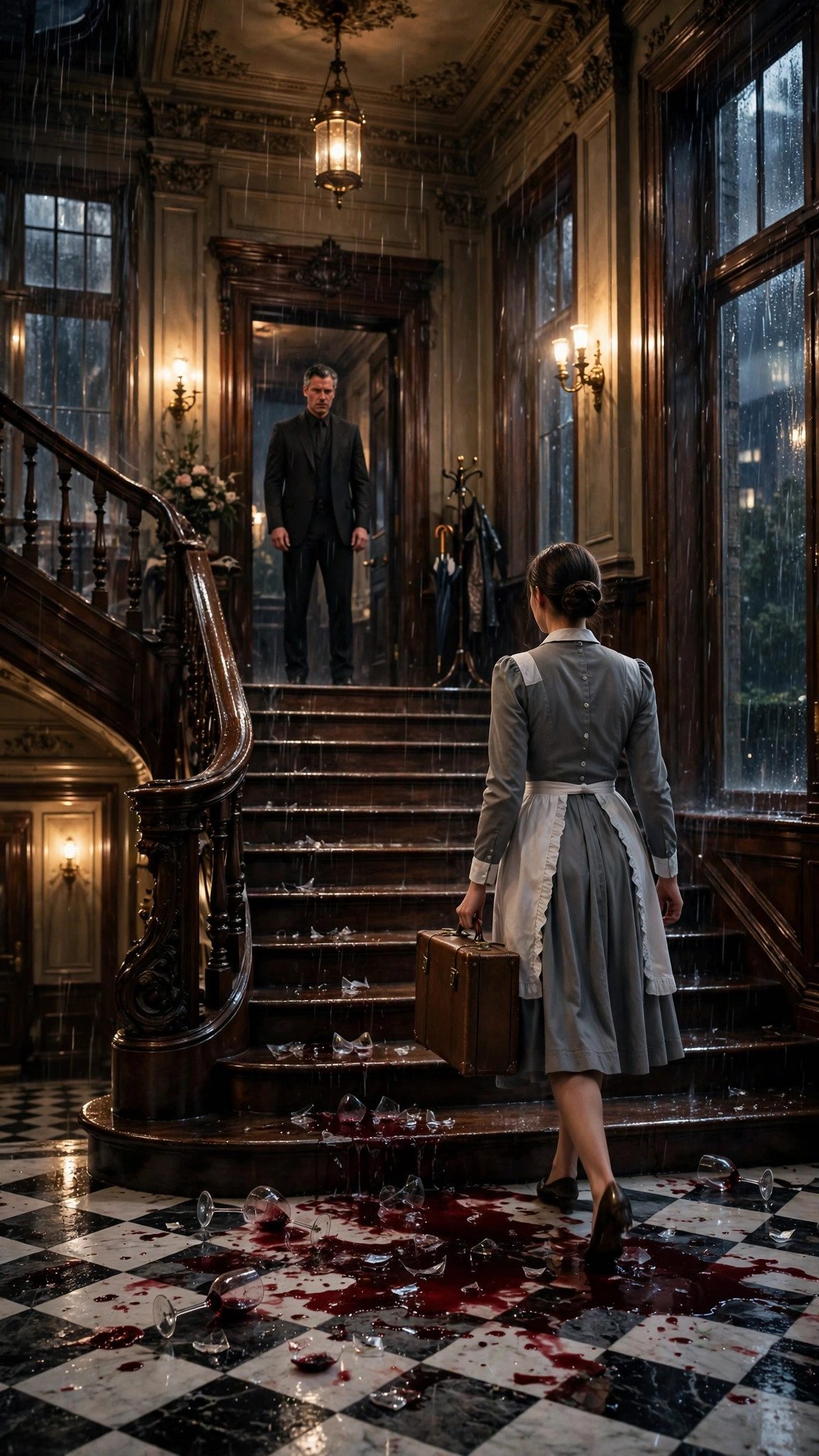
    So she walked down the driveway in the rain, carrying her suitcase, and she did not look back, not once, not even when she heard the heavy old bell by the front door ring behind her, and not even when she heard a glass fall and shatter on the marble floor, and not even when she heard Gabriel's voice, far away, calling her name.

    She walked for an hour in the rain, all the way to the south side, to the little house her mother had left her, the house with the creaking wooden stairs and the small garden and the peeling paint. On the way, she passed the small church on Halsted Street, the one her mother had taken her to every Sunday when she was a girl, and she stopped under its awning for a moment, out of the rain, and she looked up at the dark windows, and she remembered her mother's voice, teaching her the rules of the house she would one day serve in.

    "Be useful, Hazel," her mother had said, kneeling beside her in the pew, smoothing her hair. "Be invisible. The people in that house are not like us. They do not see us. And that is a blessing, because a woman they do not see is a woman they cannot hurt. Do your work. Keep your head down. And never, ever let them see your heart."

    Hazel had obeyed her mother for twenty-nine years. She had been useful. She had been invisible. She had never let them see her heart. And now she was standing in the rain outside a dark church, dying, and she understood, at last, that her mother had been wrong about one thing. A woman they do not see is a woman they cannot love, either. And Hazel had wanted, more than anything in the world, to be seen, just once, by the man in the study who said "Your food is good" every morning.

    She let herself in with the key she had kept on a string around her neck for five years. She set her suitcase down in the hall. She went to the kitchen and made herself a cup of tea with shaking hands, and she sat at the kitchen table, and she waited for the relief to come.

    It did not come. What came instead was the pain, sharp and sudden, in her side, the pain the doctor had warned her about, and she doubled over at the table, and the teacup fell and shattered on the floor, and she thought, with a strange calm, that she was going to die right there, in her mother's kitchen, alone, the way she had always been alone, and that perhaps that was fitting.

    But she did not die. She got herself to the phone. She called the clinic. She said her name, and she said the pain, and the nurse on the phone told her to stay where she was, and to unlock the front door, and that an ambulance was coming, and Hazel did what she was told, because that was what she did, and then she lay down on the kitchen floor, and she looked up at the ceiling, and she thought about the rose garden.

    She thought about the day she had met Gabriel, kneeling in the dirt with her sleeves rolled up, a thorn in her finger, and the way he had taken her hand, and the way he had said, "Be careful. The roses here have thorns."

    She thought about the five years of warm food and quiet mornings, and about Sebastian learning to read at the kitchen table, and about the way Gabriel's voice went soft when he said "Your food is good," and she thought that if she had to choose one memory to take with her, it would be that one: the man in the study, eating his dinner alone, saying the only sentence he knew how to say, and meaning something else entirely.

    The ambulance came. The paramedics were kind. They asked her name, and they asked her if she had family, and she said, "No. There is no one," and the younger one, a woman with tired eyes, said, "There is always someone, ma'am. We will find them." They put her on a stretcher, and they carried her out into the rain, and she watched the little house disappear behind her, and she thought that she would never see it again either, and she was right, in a way, and wrong, in a way, because she would see it again, but not as the woman who had left it. She would see it again as a woman who had been found.

    At the hospital, they put her in a bed on the fourth floor, and they put a needle in her arm, and they ran the tests, and a nurse with a clipboard asked her the same questions the paramedics had asked, and Hazel gave the same answers, and the nurse wrote them down without comment, and then she went away, and Hazel lay in the bed and listened to the machines beeping, and she thought about the doctor at the clinic, and about what he had said.

    He had told her about the treatment. An immunotherapy, and then a surgery, at Northwestern, with a surgeon who had done the operation a hundred times. It would take months. It would cost more money than Hazel had ever seen in her life. The clinic had given her a pamphlet, and she had read it three times, and she had folded it up and put it in her coat pocket, and she had not looked at it since, because reading it meant believing it, and believing it meant hoping, and hoping was the most dangerous thing of all.

    "Do not think about the money yet," the doctor had said. "First, tell your family."

    She had no family. She had a drawer with a prayer card and a photograph and a gold earring. She had a little house on the south side. She had five years of memories in a house that was not hers. And she had a number on an emergency card, written three years ago in a moment of weakness, the number of a man who had once held her bleeding hand in a rose garden.

    The doctor came in, a different doctor, an older woman with kind eyes, and she sat down beside the bed, and she said, "Hazel, your cancer has spread throughout your body. We are going to do everything we can. But I need you to understand that you are very sick, and that you need people around you now. Is there someone I can call?"

    Hazel looked at the ceiling. She thought about the number on her emergency card, the number she had written three years ago in a moment of weakness, and she thought about the man who would answer that number, and she thought about what it would mean if he came, and what it would mean if he did not.

    "Yes," she whispered. "There is someone. The card is in my coat pocket. Please call him. Please tell him to come now."

    The nurse took the card. She went to the phone in the hallway. She dialed the number. And Hazel lay in the hospital bed and listened to the machines beeping, and she thought about the rose garden, and she waited.

    She did not have to wait long.

    She heard the footsteps in the hallway before she heard the door open, heavy footsteps, running footsteps, and then the door burst open, and Gabriel Rossi stood there, soaking wet from the rain, and his eyes found her across the room, and his face changed, and Hazel understood, all at once, that he had not come because a nurse had called him.

    He had come because he had been running toward her since the moment she had left, and the phone call had only told him where to run to.

    "Gabriel," she whispered, and her voice broke, and she reached out her hand, and he came to the side of her bed, and he took her hand, and he held it, and for the first time in five years, Hazel Marino did not feel alone.

    "I am sorry," she said. "I did not want you to know. I did not want to be a burden. I am sick, Gabriel. The doctors say the cancer has spread. I left because I could not watch you marry another woman, and because I did not want you to watch me die."

    "Listen to me," he said, and his voice was shaking. "I am not marrying Andrea Bellini. I am not marrying anyone. Do you understand me, Hazel? I have spent five years not seeing you, and I will not spend one more day that way."

    And then, before he could say anything else, the door of the hospital room opened again, and a shadow appeared in the doorway, and Hazel looked up, and she saw the man with the sharp eyes like a blade, holding a gun, reeking of alcohol, and she knew, in a single second, who had sent him, and why, and what he had come to do.

    "Gabriel," she whispered, and her hand tightened on his. "Do not move. He is here to kill me. And if you move, he will kill you too."
  • Chapter 3: The Woman He Was Supposed to Marry

    Chapter 3: The Woman He Was Supposed to Marry

    Andrea Bellini arrived at the Rossi house on a Tuesday morning in a black car with a driver, and she came through the front door the way a woman comes through a door she already considers her own, with her chin up and her shoulders back and her blonde hair shining in the October light.

    She was thirty years old, and she was beautiful in the expensive way, the way that comes from good schools and good doctors and a family that had owned the north warehouses for three generations. She wore a cream coat that cost more than Hazel earned in a year, and she carried a leather handbag that clicked when she set it down, and she smiled at Gabriel with a smile that had been practiced in front of a mirror.

    "Gabriel," she said, and she kissed him on both cheeks, the way people in her world did, and Gabriel stood very still and let her, because that was what the engagement required.

    Hazel watched from the doorway of the dining room, holding a tray of coffee, and she felt something cold settle in her stomach, something she had been feeling for weeks, ever since the engagement had been announced, and she understood, all at once, that this was real. This was not a contract on a table. This was a woman, in his house, in his arms, and in six weeks she would be his wife, and Hazel would be the maid who served them breakfast.

    "Your coffee, Miss Bellini," Hazel said, very quietly, and she set the cup down on the table, and Andrea looked at her the way you look at a chair, briefly, without really seeing her, and said, "Thank you," without looking up.

    That was the moment Hazel understood that she had to leave. Not because Andrea was cruel — Andrea was not cruel, she was only indifferent, the way rich people are indifferent to the people who serve them — but because Hazel could not bear to stand in that dining room for the next forty years and watch Gabriel Rossi love another woman. She could not bear to serve their breakfast and make their beds and raise their children, knowing that she had loved him first, and silently, and for nothing.

    She went back to the kitchen, and she stood at the sink with her hands in the dishwater, and she thought about the clinic, and about the doctor's voice, and about the word he had used, the word that had been sitting in her chest like a stone for six weeks.

    Cancer.

    The doctor had been kind. He had been young, and tired, and he had held her hand while he told her, and he had said that there were treatments, and that they could try, and that medicine had come a long way, but he had also said, very gently, that the cancer had already spread throughout her body, and that she should not wait, and that she should tell her family, and that she should make her arrangements.

    She had no family. She had no arrangements to make. She had a drawer with a prayer card and a photograph and a gold earring wrapped in white cloth, and she had a little house on the south side that her mother had left her, and she had five years of memories in a house that was not hers.

    She decided, standing at the sink with her hands in the dishwater, that she would leave that night. She would pack her suitcase. She would leave a note. She would go to her mother's little house, and she would call the doctor, and she would do whatever the doctor said, and if the treatments worked, then they worked, and if they did not, then she would die in her own house, quietly, without being a burden to anyone.

    It was the right decision. She knew it was the right decision. And it broke her heart anyway.

    She remembered the clinic as clearly as if it had happened that morning. She had sat in a small white room with a poster of a beach on the wall, and the doctor had come in with a folder, and he had sat down across from her, and he had not rushed, and that was how she had known it was bad, because doctors only take their time when the news is the kind that changes everything.

    "Hazel," he had said, "the cancer has spread. It is in your lymph nodes, and we have found it in your liver. I will not lie to you. This is serious. But I want you to understand something. Medicine has changed. There is a new treatment, an immunotherapy, and there is a surgeon at Northwestern who has done this operation a hundred times. It will not be easy. It will be expensive. It will take months. But there is a real chance, Hazel. Not a small chance. A real one."

    "How much does it cost?" she had asked, because that was the first thing she thought of, because she was a maid, and maids think about money first, because money is the thing that decides everything else.

    "Do not think about the money yet," the doctor had said. "First, tell your family. Tell the people who love you. You should not face this alone."

    She had nodded. She had thanked him. She had walked out of the clinic into the October sunshine, and she had stood on the sidewalk for a long time, watching the traffic go by, and she had thought about who the people who loved her were, and she had realized, with a sadness so deep it felt like falling, that the only person in the world who loved her was a man she could never tell.

    She had gone back to the house that day, and she had made Gabriel's dinner, and she had kept his food warm, and she had not said a word, because that was what she did. She kept things. She kept the house. She kept the secret about Angela. She kept her love. And now she would keep her cancer, too, until the day she left, and then she would keep it alone, in her mother's little house, where no one would have to watch her die.

    What she did not know was that Andrea Bellini had already noticed her.

    Andrea had noticed her on the second day of the engagement, when she had come to the house for lunch and Gabriel had been late, and Hazel had brought the coffee, and Gabriel had come in, and his eyes had gone to Hazel first, before they had gone to Andrea, and Andrea had seen it, and she had filed it away, the way women in her world file away the things they do not yet understand.

    Later that same week, Andrea had asked Vittorio, very casually, over lunch in the garden room, "Who is the maid? The quiet one. The one with the dark hair."

    "Hazel," Vittorio had said, and he had waved his hand as if she were not worth discussing. "Her mother worked here before her. She is nobody. She keeps the house. She has been here five years. She is invisible."

    "She is not invisible," Andrea had said, and her voice had been very calm. "He looks at her. I have seen it. A man does not look at a maid the way he looks at her."

    Vittorio had laughed, a short, sharp laugh, and he had said, "Gabriel does not look at maids, my dear. Gabriel looks at his future wife. You are worrying about nothing."

    But Andrea had not been worrying about nothing, and she had known it, and she had watched Hazel for the rest of the lunch, the way Hazel moved through the room without making a sound, the way she set the plates down without rattling them, the way she kept her eyes down, and Andrea had thought, with the cold clarity of a woman who has been raised to read rooms, that this quiet maid was the most dangerous woman in Chicago, because she was the only woman Gabriel Rossi had ever looked at the way a man looks at a woman he loves.

    Andrea had said nothing about it. She had smiled. She had eaten her lunch. And she had decided, in that moment, that if Gabriel Rossi was going to marry her, he was going to marry her with his eyes open, and if his eyes were on someone else, then she needed to know.

    She did not know yet what she would do with that knowledge. She only knew that it was there, and that it mattered, and that the wedding in six weeks was not as certain as the invitations said it was.

    Upstairs, in the study, Gabriel was learning how little the right decision mattered.

    Andrea had brought the wedding planner with her, a thin woman named Mrs. Alden with a leather notebook and a voice like a metronome, and the two of them had spread the plans across Gabriel's desk, and they talked about flowers and music and seating charts, and Gabriel sat behind his desk and listened, and felt as if he were watching his own life happen to someone else.

    "The ceremony will be in the cathedral," Mrs. Alden said, "and the reception in the ballroom at the Drake. Four hundred guests. The Bellini family has already confirmed the north warehouse alliance. The invitations go out on Monday."

    "Four hundred guests," Gabriel repeated, and he thought about the rose garden, and about the quiet house, and about the way Hazel's hands had shaken that morning when she had set down his coffee.

    "Is something wrong, darling?" Andrea asked, and she put her hand on his arm, and her hand was soft and manicured, and it felt like nothing at all.

    "No," Gabriel said. "Nothing is wrong."

    But something was wrong, and he knew it, and he had known it for weeks, and he did not have a name for it. The name for it was standing in his kitchen with her hands in the dishwater, and he did not know it yet, because he had spent five years training himself not to know it.

    Vittorio came in the afternoon, as he always did, and he looked at the wedding plans, and he smiled his thin smile, and he said, "The family is pleased, Gabriel. This marriage will make us stronger than we have ever been. The Bellinis bring the north warehouses, and we bring the docks, and together no one in Chicago will be able to touch us."

    "And Sebastian?" Gabriel asked. "What does Sebastian get from this marriage?"

    "A mother," Vittorio said, as if it were obvious. "The boy needs a mother. Andrea will be good to him. She has a kind heart."

    Gabriel thought about Sebastian, who was eight years old, and who had been raised by Hazel as much as by anyone, and who had asked him once, very seriously, whether Hazel was going to be his mother one day, and Gabriel had not known what to say, and he had said, "Hazel is Hazel, and she loves you very much," and the boy had nodded, as if that were answer enough.

    He thought about asking Vittorio what he thought of Hazel. He did not. He had never asked anyone what they thought of Hazel. Hazel was not a subject for conversation in this house. Hazel was the air. Hazel was the floor. Hazel was the thing you only noticed when it was gone.

    That evening, after Andrea had gone home and the wedding planner had gone home and Vittorio had gone home, Gabriel sat alone in his study, and Hazel brought him his dinner on a tray, the way she always did, and she set it down on his desk, and she did not look at him, and he did not look at her, and the silence between them was five years old and as solid as a wall.

    "Your food is good," he said, the way he always did.

    "Thank you, Mr. Rossi," she said, the way she always did.

    And then she went to the door, and she stopped, and she turned, and she looked at him, and Gabriel saw something in her eyes that he had never seen before. It was not sadness. It was not anger. It was goodbye.

    He did not recognize it. He had never seen goodbye in her eyes before. He saw it, and he did not understand it, and he said, "Is something wrong, Hazel?"

    "No, Mr. Rossi," she said. "Everything is fine."

    And she went down the old wooden stairs, and the heavy old bell by the front door rang, and the glass of wine fell, and she walked out into the rain, and Gabriel Rossi, who had spent five years not seeing the woman who loved him, finally saw her, and it was too late.

    Or so he thought.

    In the hospital, six weeks after the doctor had told her, Hazel lay in her bed and listened to the machines, and she thought about the wedding planner's leather notebook, and about Andrea Bellini's cream coat, and about the four hundred guests, and she thought about how she had almost made it. She had almost left quietly. She had almost disappeared without anyone knowing. She had written the note. She had packed the suitcase. She had walked out into the rain.

    And then the nurse had called the number on her emergency card, and Gabriel had come running through the rain, and now he was standing in the doorway of her hospital room, soaking wet, and he was looking at her the way he had looked at her in the rose garden five years ago, and she did not know what to do.

    "Mr. Rossi," she whispered. "You should not be here."

    "Do not call me that," he said, and his voice broke. "Not now. Not here. My name is Gabriel. You have known my name for five years, Hazel. Say it."

    She looked at him, and her eyes filled with tears, and she said, very softly, "Gabriel."

    And the sound of her own voice saying his name, for the first time in five years, broke something open inside her chest, something she had kept locked away for so long that she had forgotten it was there.

    "I am sorry," she whispered. "I did not want you to know. I did not want to be a burden. I am sick, Gabriel. The doctors say the cancer has spread. I left because I could not watch you marry another woman, and because I did not want you to watch me die."

    Gabriel came to the side of her bed, and he took her hand, and his hand was warm and rough, and he held it the way he had held it in the rose garden five years ago, gently, as if it might break.

    "Listen to me," he said. "I am not marrying Andrea Bellini. I am not marrying anyone. Do you understand me, Hazel? I have spent five years not seeing you, and I will not spend one more day that way. You are not a burden. You are the only person in my life who has ever loved me without wanting anything from me, and I will not let you die alone in a hospital bed. Do you hear me? I will not let you."

    And outside the hospital room, in the hallway, a nurse was walking past with a tray, and a doctor was speaking in a low voice on the phone, and the rain was still falling on the city, and none of them knew that in that small room, a mafia boss who had never begged any person for anything in his life was about to beg for the first time.

    But before he could speak, the door of the hospital room opened again, and a shadow appeared in the doorway, a man with sharp eyes like a blade, holding a gun, reeking of alcohol, and he pointed the gun at Hazel's bed, and he said, "I was given an order to kill her. And nobody is going to stop me."

  • Chapter 2: Five Years of Warm Food

    Chapter 2: Five Years of Warm Food

    Hazel Marino had been twenty-four years old the first time she walked into the Rossi house, and she had been afraid of almost everything in it: the high ceilings, the marble floors, the portraits of dead men on the walls, and most of all the man who owned it all, who had looked at her across the front hall with eyes the color of a winter sea and said, "You are Rosa's daughter. Your mother spoke of you. The house is yours to keep. Do your work well and no one will trouble you."

    Her mother, Rosa Marino, had been a maid in the Rossi house for twenty years. She had ironed the shirts of three generations of Rossi men, she had polished the silver until it shone like water, and she had died quietly in her sleep one winter night, two months before Hazel came to take her place. The agency had sent three other girls first. Gabriel had sent all three of them away. They had been too loud, or too curious, or too eager to be noticed. Hazel was none of those things. Hazel had learned from her mother that the safest way to survive in a house like this was to be useful and invisible at the same time.

    She was good at it. She was so good at it that within a year, the house ran on her silence the way a clock runs on its gears. She knew that Gabriel took his coffee black and his eggs soft. She knew that Sebastian liked his toast cut into triangles and his milk warm. She knew which floorboard creaked on the second floor and which window stuck in the rain. She knew that the roses in the garden needed water on Thursdays, and that the old bell by the front door rang a half-second late, and that the housekeeper's keys hung on the third hook by the kitchen door.

    What no one knew was that she also knew how Angela Rossi had died.

    Angela had been Gabriel's wife, and she had been beautiful in the way that summer light is beautiful, all warmth and laughter, and she had been the only person in the house who had ever spoken to Hazel as if she were a person and not a piece of furniture. She had asked Hazel about her mother. She had taught her to make the lemon cake that Gabriel loved. She had held Sebastian on her hip and danced with him in the kitchen while Hazel washed the dishes, and she had laughed, and the whole house had laughed with her.

    Hazel had loved her. Everyone in the house had loved her. And then, on a Tuesday night in November, five years ago, Angela had died on the old wooden stairs.

    The police had called it an accident. She had been coming down the stairs in the dark, they said, and she had slipped, and she had fallen, and she had broken her neck. There had been a funeral. There had been flowers. Gabriel had stood at the grave in the rain and said nothing at all, and he had not smiled since, not once, not in five years.

    But Hazel had been there that night. She had been in the hall below the stairs, carrying a tray of clean glasses, and she had heard the voices above her, and she had looked up, and she had seen it.

    She had seen Angela at the top of the stairs, holding a folder of papers against her chest, her face white with anger and fear. And she had seen Vittorio Rossi standing behind her, his hand on the small of her back, his mouth close to her ear, saying something Hazel could not hear. And then she had seen Angela turn, and pull away from him, and say, very clearly, "I will tell Gabriel. I will tell him tonight. You have been stealing from the docks for years, Vittorio, and I have the proof, and I will not let you destroy this family."

    And then Vittorio had pushed her.

    It was not a shove. It was not a blow. It was one smooth, deliberate movement, the heel of his hand between her shoulder blades, and Angela had gone down the stairs the way a doll goes down the stairs when a child drops it, tumbling, weightless, terrible, and she had landed at the bottom in a silence so complete that Hazel could hear her own heart beating.

    Hazel had stood frozen in the hall with the tray in her hands, and Vittorio had come down the stairs slowly, and he had looked at Angela's body, and then he had looked at Hazel, and his eyes had been calm and cold and entirely without surprise, as if he had expected her to be there.

    "You saw nothing," he had said, very quietly, and he had taken one step toward her, and then another, until he was close enough that she could smell the whiskey on his breath. "Do you understand me, girl? You saw nothing. Your mother worked in this house for twenty years, and she understood the rules. If you speak one word of what you think you saw, I will make sure that you are the next accident in this house. And your mother is dead, and you have no one, and no one will ever believe a maid."

    Then he had picked up Angela's folder of papers, and he had walked away, and Hazel had stood in the hall alone with the body of the only woman who had ever been kind to her, and she had not screamed, and she had not run, and she had not told anyone. She had set the tray down. She had knelt beside Angela and closed her eyes. And she had gone to the kitchen and washed the glasses, because that was what she did, and because she did not know what else to do.

    She had kept the secret for five years.

    She had kept it because she was afraid, and she was not ashamed of being afraid, because fear had kept her alive. But she had also kept it because of something else, something she had not admitted to herself until much later: she had kept it because of Gabriel.

    Gabriel had been twenty-six when his father was murdered, and thirty-three when his wife died, and Hazel had watched him turn to stone, year by year, and she had watched him raise his son alone, and run the family alone, and carry the grief alone, and she had thought, every day, that if she told him the truth, it would destroy him. His own uncle had killed his wife. His own blood. The man who sat at his table and advised him and smiled at his son. If Gabriel learned that, he would kill Vittorio with his own hands, and then the family would tear itself apart, and the police would come, and Sebastian would lose his father the way he had lost his mother.

    So she had said nothing. She had made his coffee. She had kept his food warm. She had taught his son to read. She had watered the roses on Thursdays. And she had loved him, quietly, from a distance, the way you love a fire through a window, knowing you can never touch it without burning.

    She had not planned to love him. Love had come the way the rain comes in Chicago, slowly at first and then all at once, in the small things: the way he said "Your food is good" every morning, as if it were the only sentence he knew how to say to her, and the way his voice went soft when he said it, as if he were trying to say something else entirely. The way he had once, without a word, left a new coat on the hook by the kitchen door when the winter turned cold, and pretended he had not noticed her shivering. The way he had sat with Sebastian on the nights when the boy was afraid of thunderstorms, and read to him in a low voice until he fell asleep, and the way Hazel had stood in the doorway and watched, and thought that a man who could be that gentle with his son could not be the monster the city said he was.

    She had told herself a hundred times that it was foolish. He was a mafia boss. She was a maid. He was going to marry a woman from a prominent family, a woman who matched his status, a woman the family had chosen for him. Hazel was nobody. Hazel was the woman who kept his food warm.

    But love does not listen to reason. Love sits in the kitchen at midnight and watches a man eat his dinner alone, and thinks about how lonely he must be, and wishes, just once, that he would look up and see her.

    The first time she had met him, really met him, had been in the rose garden. It was her third day in the house, and she had been sent out to cut roses for the dining room table, and she had been kneeling in the dirt with her sleeves rolled up, and she had looked up and seen him standing at the end of the path, watching her.

    "You are Rosa's daughter," he had said.

    "Yes, Mr. Rossi," she had said, and she had stood up too quickly, and a thorn had caught her finger, and a bead of blood had welled up, and he had taken her hand before she could pull away, and he had looked at the cut, and he had said, "Be careful. The roses here have thorns."

    And then he had let go of her hand, and he had walked away, and Hazel had stood in the rose garden with a bleeding finger and a racing heart, and she had thought that she would remember that moment for the rest of her life.

    She had remembered it for five years.

    And she had kept something else for five years, too, something she had never told anyone about, something hidden in the bottom of her drawer under her mother's prayer card, wrapped in a piece of white cloth.

    It was a gold earring. A small gold earring shaped like a rose, one of a pair Angela had worn the night she died. Hazel had found it on the top step of the old wooden staircase the morning after, when she had gone up early to clean before anyone else woke, and she had picked it up with shaking hands and understood, at once, exactly what it meant. Angela had lost it in the struggle at the top of the stairs. It was proof that she had not slipped. It was proof that someone had been up there with her, holding her, pushing her.

    Hazel had wrapped it in the cloth and hidden it, and she had never shown it to anyone, because showing it would mean accusing Vittorio Rossi, the underboss of the family, the man who had threatened her life, and because she had no one to show it to who would believe a maid over a Rossi.

    But she had kept it, all the same. She had kept it because her mother had taught her that the truth does not die just because you bury it, and because some part of her, the part that had loved Angela, had refused to let the only proof of what had happened disappear.

    Vittorio had watched her, in the months after Angela's death. She had felt his eyes on her in the hallways, at the dinner table, in the garden, and she had understood that he was waiting for her to make a mistake, waiting for her to tell someone, waiting for an excuse. Once, when she had been carrying a tray past his study, he had stopped her and said, very softly, "You are a good girl, Hazel. Your mother was a good woman. Good girls do not make trouble for themselves. Remember that."

    She had nodded. She had gone back to the kitchen. And she had kept the earring hidden, and she had kept her mouth shut, and she had waited, year after year, for a day when the truth would matter more than her fear.

    That day had never come. And now she was dying, and the earring was still in her drawer, and the truth was still buried, and she thought, lying in the hospital bed, that perhaps it would stay buried forever, and that perhaps that was the saddest thing of all.

    The doctors had told her six weeks ago. She had gone to the clinic because she had been tired, so tired, and because there had been a pain in her side that would not go away, and the doctor had run the tests, and then he had run them again, and then he had sat her down and told her that the cancer had already spread, and that there were treatments, and that they could try, but that she should prepare herself, and that she should tell her family.

    She had no family. Her mother was dead. She had no brothers or sisters. The only people in the world who knew her name were the people in the Rossi house, and she could not tell them, because telling them would mean explaining why she was leaving, and explaining why she was leaving would mean explaining everything, and she could not explain everything, because everything included the secret she had kept for five years, and the love she had kept for five years, and the truth that she was dying.

    So she had decided to leave quietly. She would go to the little house her mother had left her on the south side, the house with the creaking wooden stairs and the small garden, and she would die there quietly, the way she had lived quietly, without asking anyone for anything.

    She had not counted on the phone call. She had not counted on Gabriel finding out. She had not counted on the nurse calling the number on her emergency card, the number she had written down three years ago, in a moment of weakness, when the clinic had asked her who to call if anything happened to her, and she had written Gabriel Rossi's number, because there was no one else in the world to write.

    She lay in the hospital bed and listened to the machines beeping, and she thought about the rose garden, and about the man who had once held her bleeding hand, and she thought about how she had spent five years loving him from a distance, and how she was going to die without ever having told him.

    And then the door of her hospital room burst open, and Gabriel Rossi stood there, soaking wet from the rain, his suit ruined, his hair plastered to his forehead, and his eyes were wild, and his voice was shaking, and he said her name like a prayer.

    "Hazel."

  • Chapter 7: The Key

    Chapter 7: The Key

    We were married in the garden of the yellow house on a Saturday in May, under the fig tree, with the string lights Rosa had hung and the sunflowers Lily had planted standing tall along the fence, their faces turned toward the light.

    It was a small wedding. Rosa was there, of course, in a blue dress, crying before the ceremony had even started. Antonio and his wife and their boys were there. Al was there, in a suit he had bought for the occasion, sitting in the front row with Marco beside him, both of them looking impossibly proud. Mrs. Deluca was there, holding a handkerchief. Detective Cole was there, in a grey suit, with Agent Reyes beside him, and they both looked slightly uncomfortable and entirely happy to be there. Frank Deluca was there, Dominic's consigliere, the man who had helped bring down Castellano, and he shook my hand afterward and said, "Thank you for giving him a reason to choose the light."

    Lily was the flower girl, and she wore her sunflower costume, because she had insisted, and no one had the heart to tell her no, and she walked down the garden path scattering petals with great seriousness, and then she stopped halfway, and she looked at Dominic, and she said, very loudly, so that everyone could hear, "You have to be nice to my mommy forever. That is the rule."

    "I promise," Dominic said, and his voice was rough, and his eyes were shining. "Forever. That is the rule."

    I walked down the garden path on Al's arm, because Al had insisted, because he had said, "I gave you your first job, Emma, and I will give you away, too," and my dress was white and simple, and my hair was down, and I was wearing Daniel's ring on my right hand, because I had moved it there the week before, and I was wearing the silver key on a chain around my neck, because the key was no longer just a key. It was a promise.

    Dominic was waiting for me under the fig tree, in a dark suit, with his hands clasped in front of him, and he looked at me the way Daniel used to look at me, like I was the only thing in the world that mattered, and when I reached him, he took my hands, and he said, very quietly, so that only I could hear, "Three weeks ago, you pulled me out of a burning car. Today, you are giving me a life. I will spend every day of the rest of my life trying to be worthy of it."

    When it was time for the rings, Dominic took a plain gold band from his pocket, and he slid it onto my finger beside Daniel's ring, which I had moved to my right hand that morning, and he said, so quietly that only I could hear, "This one is for the life we are going to build together. The other one is for the life that made you who you are. I will never ask you to choose between them." And I looked down at my hands, at the two rings shining side by side in the sunlight, and I thought about how a heart can hold more than one love, and how that is not a betrayal, but a miracle.

    The ceremony was short. The vows were simple. I promised to love him, and to trust him, and to build a life with him. He promised to protect us, and to be honest with us, and to spend his life trying to repay a debt that could never be repaid. And when the minister said, "You may kiss the bride," he kissed me, gently, under the fig tree, with the sunflowers standing tall along the fence, and Lily cheered, and Rosa cried, and Al blew his nose loudly into a handkerchief, and the whole garden smelled like summer.

    Afterward, we danced in the garden, and Lily danced with Dominic, standing on his shoes, and Rosa danced with Al, and Marco danced with Mrs. Deluca, and the string lights came on as the evening fell, and the whole world felt golden and warm and right.

    Two weeks later, Lily performed in the school play. But before the play, there was the morning after the wedding, and I want to remember that morning for the rest of my life, because it was the first morning of the rest of my life.

    I woke up in the bedroom of the yellow house, with the morning light coming through the window, and Dominic was already awake, lying beside me, watching me with a soft look on his face, like he could not quite believe I was real.

    "Good morning, Mrs. Salvatore," he said.

    "Good morning, Mr. Salvatore," I said, and we both laughed, because it still sounded strange and wonderful, like a word from a language we were only just learning to speak.

    Downstairs, Lily was already up, sitting at the kitchen table in her pajamas, eating cereal, and when Dominic came down, she looked at him, and she looked at me, and she said, very carefully, like she was trying out a word she had never said before, "Daddy? Can I call you Daddy?"

    The kitchen went very quiet. Dominic stood in the doorway, and his face did something I had never seen it do before: it crumpled, just for a second, like a man who had been holding himself together for a very long time and had finally been given permission to let go. Then he crossed the kitchen in three steps, and he knelt down beside her chair, and he took her small hands in his, and he said, "Lily, I would like that more than anything in the whole world. More than anything."

    She threw her arms around his neck, and he held her, and I stood at the stove with the coffee pot in my hand, and I cried, and I did not try to stop, because these were the good kind of tears, the kind that come when something broken finally heals.

    That week, Dominic did something else I will never forget. He took Lily to the cemetery, to the place where Daniel was buried, and he stood with her in front of the stone, and he told her that her first daddy had been a brave man, a firefighter, a hero, and that he would never try to replace him, and that he would always make sure she remembered him. And Lily put a sunflower on the stone, one of the sunflowers from our garden, and she said, "Daddy Daniel, this is Daddy Dominic. He is nice. He eats burned pancakes." And Dominic stood there with tears running down his face, and he did not wipe them away, because he did not want Lily to think that men do not cry.

    A few days later, I went back to Rosie's Diner, not to work, but to visit, and Al was behind the counter, and Marco was in the kitchen, and Eddie Kowalski was in his booth, and Old Mr. Peterson was doing his crossword, and they all stood up when I walked in, and Al came around the counter, and he hugged me, and he said, "Look at you, Emma. Look at you. You are glowing. I have not seen you glow like that since the day you married Daniel."

    "I am happy, Al," I said. "For the first time in six years, I am really, truly happy."

    "Then I am happy too," he said. "And the diner will always be here, and there will always be a cup of coffee waiting for you, and a booth with your name on it, even if you never work another shift in your life."

    I sat in my old booth for a while, drinking coffee, watching the morning crowd come and go, and I thought about how this place had saved me once, when I was a pregnant widow with nothing, and how a man had saved me again, in a different way, and how life has a way of giving you back everything you thought you had lost, if you are brave enough to keep going.

    She was a sunflower, of course, the tallest and brightest sunflower on the stage, and she stood in the front row, and she sang her one line with all her heart, and when it was over, the audience stood up and clapped, and Dominic and I stood up too, and we clapped until our hands hurt, and Lily took her bow, and she looked out at us, and she smiled, and in that moment, I understood something I had not understood before.

    A debt is not a burden. A debt is a gift. Dominic had told me, that first night in the diner, that he owed me a debt he could never repay. And he was right: he could never repay it, because a life is not a thing that can be repaid. But he had spent every day since trying, and in trying, he had given me something I thought I had lost forever: a family. A home. A kitchen full of people. A little girl in a sunflower costume. A man who looked at me like I was the sun coming up.

    The day of the play, Dominic spent the whole afternoon in the garden with Lily, building her a little wooden stage out of scrap lumber, so she could practice her bow, and she practiced it twenty times, and each time she got more dramatic, and by the twentieth time she was flourishing her arms like a queen, and Dominic applauded like she was performing at Carnegie Hall, and she glowed.

    After the rehearsal, Dominic taught Lily to ride her bicycle without training wheels, in the street in front of the yellow house, and she fell twice, and she scraped her knee, and she got back up, because sunflowers are brave, and on the third try she rode all the way to the corner and back, wobbling and laughing, and Dominic ran beside her the whole way, with his hand hovering just behind her seat, ready to catch her if she fell, and when she stopped, breathless and triumphant, she looked up at him and said, "Daddy, did you see? Did you see how fast I went?"

    "I saw," he said, and he picked her up and spun her around, and she shrieked with laughter, and I stood on the porch of the yellow house with my hand over my mouth, because I had never seen a man love a child the way Dominic loved Lily, with his whole heart and without holding anything back, and I knew that Daniel, wherever he was, would have been glad that his little girl had found a father who ran beside her bicycle and cheered for her sunflower costume and ate burned pancakes like they were the finest meal in the world.

    That night, after the play, after Lily was asleep in her bed with her stuffed rabbit and her sunflower costume hanging in the closet, Dominic and I sat in the garden of the yellow house, under the fig tree, with the string lights over our heads, and the sunflowers standing tall along the fence, and he took my hand, and he said, "Do you remember what I said to you, that first night in the diner? That I owed you a debt I could never repay?"

    "I remember," I said.

    "I was wrong," he said. "Not about the debt. About the repaying. I thought a debt was something you paid off and then it was gone. But I have learned something these last few months. A debt like ours is not something you pay off. It is something you carry, together, for the rest of your life. And the carrying is the gift. Every morning I wake up next to you, every evening I come home to this house, every time Lily calls me Daddy, I am repaying it. And every time you smile at me, you are repaying it too. We will never be finished. And that is the most beautiful thing I have ever known."

    I leaned my head against his shoulder, and I touched the silver key where it hung around my neck, warm against my skin, and I thought about the night on the highway, the rain, the fire, the man unconscious in the car, and how I had pulled him out without thinking, because that is what you do when someone needs you, and how that one moment, that one choice, had led to all of this: a yellow house, a garden, a little girl in a sunflower costume, a man who had chosen the light.

    "Do you like Sunday?" he asked, softly, the way he had asked me that first night in the diner.

    "I like Sunday," I said. "I like every day, as long as I spend it with you."

    One year later, on Lily's eighth birthday, the sunflowers bloomed again along the fence, taller than Lily herself, their faces turned toward the light, and we had a party in the garden, with cake and balloons and all the people we loved: Rosa, Antonio and his boys, Al and Marco, Mrs. Deluca, Detective Cole and Agent Reyes, who had become, improbably, family friends. Dominic's restaurants were thriving, all of them legal, all of them clean, and he had hired three of his old men as managers, and they wore suits and carried clipboards instead of guns, and they complained about health inspections the way other men complained about the weather. Lily blew out eight candles and wished, very loudly, for a puppy, and Dominic looked at me, and I looked at him, and we both laughed, because we knew that by Christmas there would be a puppy, and that the puppy would sleep in Lily's bed, and that none of us would have it any other way.

    And above us, the stars came out, one by one, over the garden of the yellow house, and the sunflowers slept with their faces turned toward the morning, and the key hung warm against my heart, and the debt, the beautiful impossible debt, was paid, and was still being paid, and would be paid forever, one ordinary, extraordinary day at a time.

    The End.

    THE END

  • Chapter 1: The Night She Left

    Chapter 1: The Night She Left

    The wine glass was still falling when Gabriel Rossi understood that his house had stopped breathing.

    It hit the marble floor of the front hall and shattered, red wine spreading across the white stone like a wound, and the sound of it went up the old wooden staircase and came back down again, and somewhere in that echo Gabriel heard five years of quiet evenings collapse into a single second.

    "Hazel!"

    His voice filled the hall. It was the voice that had made dock foremen go pale and rival bosses sign papers they did not want to sign, and it bounced off the high ceiling and died against the closed doors.

    No one answered.

    Gabriel stood in the doorway with rain running off his shoulders and stared at the empty place where she always stood. Every night for five years, when he came home from the docks, Hazel had been there at the foot of the stairs with a tray, or in the doorway of the dining room with his plate already covered, or just at the edge of his sight, quiet as dust in sunlight. She had never once been late. She had never once been absent. She had never once raised her voice, asked for anything, or looked at him the way other people looked at him, with fear or hunger or calculation.

    Tonight the tray was on the hall table, untouched. The plate under its silver cover was still warm. And on the second step of the old wooden staircase, where she must have paused, there was a single dark hairpin, and beside it, a smear of red wine where her shoe had slipped.

    She had left without saying goodbye.

    Gabriel Rossi was thirty-eight years old, and he had been the head of the Rossi family since the night his father was murdered on the docks when Gabriel was twenty-six. He ran the Chicago docks the way his father had run them and his grandfather before him, with a handshake that meant something and a memory that forgave nothing. Men who knew him said his name the way you said the name of a coming storm, quietly, and then you checked the sky. He had a build like an oncoming storm, broad shoulders under a tailored black suit, dark hair going grey at the temples, and eyes the color of a winter sea just before it breaks.

    He had never once, in twelve years of running this family, been afraid of anything.

    He was afraid now.

    He took the stairs two at a time, calling her name, and threw open the door of her small room at the back of the second floor. The room was neat the way she always kept it, the narrow bed made with hospital corners, the grey uniform hanging on its hook, the white apron folded on the chair. The drawer of the little desk stood open. Inside it there was nothing but a worn prayer card and a photograph of a woman with Hazel's eyes, her mother, who had been a maid in this house before her.

    Her coat was gone. Her shoes were gone. The cheap suitcase she had arrived with five years ago was gone.

    On the desk, weighted down by the prayer card, there was a folded piece of paper. Gabriel's hands, which had never shaken while holding a gun, shook as he opened it.

    It was not a letter. It was a list, written in her neat, small handwriting, the handwriting of a woman who had learned early that taking up too much space was dangerous.

    "Mr. Rossi," it began, and he had to stop reading for a moment, because in five years she had never once called him by his first name, and she had never once called him anything but that, either, and now the formality of it cut him worse than any insult could have.

    "Mr. Rossi. The pantry is stocked for the week. The silver is polished. Sebastian's blue sweater is in the wash and his lunchbox is on the second shelf. The roses in the garden need water on Thursday. Thank you for five years. Please do not look for me. Hazel."

    That was all. No explanation. No farewell. No reason.

    Gabriel read it three times, and each time it made less sense, and then he did the thing he had not done in twelve years. He sat down on the narrow bed of his maid, in his wet suit, and put his face in his hands.

    It was a Thursday in late October, and the rain had been falling since noon, and the city outside the tall windows of the Rossi house was grey and cold. But Gabriel was not thinking about the rain. He was thinking about the morning, twelve hours earlier, when everything had still been in its place.

    The morning had begun the way every morning had begun for five years. He had come down the old wooden stairs at seven, and the smell of coffee had been waiting for him, and Hazel had been in the dining room setting his plate, and she had not looked up when he entered, because she never looked up first. That was her way. She kept her distance from everyone. She moved through the house like a shadow that had learned to be useful, quiet, precise, invisible when you wanted her invisible and there the moment you needed her.

    "Good morning, Mr. Rossi," she had said, the way she always said it, soft and even, and she had set his coffee down on his right, exactly where he liked it, and the eggs exactly the way he liked them, and she had not asked him anything, because she never asked him anything.

    He had said, "Your food is good," the way he always said it, hiding the warmth of his voice behind the flat words, because a man in his position did not say the things he actually thought, and what he actually thought every morning was that this was the only ten minutes of his day that belonged to him.

    She had nodded, the way she always nodded, and gone back to the kitchen.

    And then his uncle Vittorio had arrived with the lawyers, and the morning had turned into business, and Gabriel had forgotten, the way he always forgot, that the quiet woman in the kitchen was the reason the house felt like a home and not a fortress.

    Vittorio Rossi was sixty-two years old, his father's younger brother, the underboss of the family, a man with silver hair and a smile that never reached his eyes. He had brought the contracts for the Bellini wedding, and he had spread them across the dining room table while Hazel cleared Gabriel's plate, and he had talked about alliances and shipping routes and the future of the family as if it were a ledger to be balanced.

    "Andrea Bellini is a good match," Vittorio had said, tapping the contract with one manicured finger. "Her family owns the north warehouses. The wedding is in six weeks. The invitations go out on Monday. It is time, Gabriel. You have been a widower for five years. The family needs an heir. Sebastian needs a mother."

    Gabriel had looked at the contracts and felt nothing. He had felt nothing about the wedding for weeks, ever since the engagement had been announced, and he had told himself that feeling nothing was the same as being at peace.

    "It is done," he had said. "Send the invitations."

    Vittorio had smiled, and Hazel had carried the plates into the kitchen, and Gabriel had noticed, the way you notice a cloud passing over the sun, that her hands were shaking.

    He had not asked her why. He never asked her why. That was the arrangement between them, unspoken and five years old: she did not ask him about his life, and he did not ask her about hers. She served his food, kept his house, looked after his son, and in return he paid her well, protected her, and never once asked her what she was thinking when she stood at the window in the evening and looked out at the rose garden.

    That night, after dinner, he had gone to his study to work, and she had brought him a glass of wine, the way she always did, and she had set it down on his desk without a word, and he had said, "Your food is good," the way he always did, and she had nodded, the way she always did, and then she had done something she had never done before.

    She had stopped at the door. She had turned. She had looked at him for a long moment, really looked at him, with those beautiful, cold, quiet eyes, and for one second Gabriel had the feeling that she was memorizing his face, the way you memorize a face you do not expect to see again.

    "Is something wrong, Hazel?" he had asked.

    "No, Mr. Rossi," she had said. "Everything is fine."

    And then she had gone down the old wooden stairs, and the heavy old bell by the front door had rung, and the glass of wine he had given her — no, the glass she had carried for him, the glass she had set down and then picked up again, because her hands were shaking — had fallen from her tray and shattered on the marble floor.

    He had found her at the foot of the stairs, standing very still, looking down at the broken glass, and she had said, very quietly, "I did not want to see a woman whom I loved with all my heart be with another man."

    No. That was wrong. She had not said it out loud. Gabriel realized, standing in her empty room with her note in his hand, that she had not said it out loud at all. She had only thought it, and he had only imagined it, and the truth was worse than the imagining, because the truth was that she had said nothing at all. She had looked at the broken glass. She had looked at him. And then she had turned, and walked down the wooden stairs, and gone out into the rain without looking back.

    And he had let her go. He had stood there in the hall, the most feared man in Chicago, and he had watched his shy maid walk out of his house, and he had not called her back, because he had not known what to call her back with. He had not known what she was to him. He had not known, until the moment she was gone, that the quiet woman who kept his food warm and his house clean and his son safe was the only person in his life who had ever loved him without wanting anything from him.

    Now the house was empty, and the rain was falling, and the roses in the garden needed water on Thursday, and Sebastian was asleep upstairs, and Gabriel Rossi, who had never begged any person for anything in his life, was sitting on his maid's narrow bed holding a list of instructions, and he did not know where she had gone, or why, or whether he would ever see her again.

    He stood up. He folded the note and put it in his pocket. He went down the old wooden stairs, and the wood creaked under his feet with every step, the way it always had, the way it had creaked on the night five years ago when his wife Angela had fallen down these same stairs and died.

    And as he reached the front hall, his phone rang.

    He almost did not answer it. He was already reaching for his coat, already planning to drive through every street in Chicago until he found her. But something about the ring — the hour, the insistence of it — made him stop.

    "Rossi," he said.

    The voice on the other end was a nurse's voice, tired and careful, the voice of a woman who had delivered bad news so many times that she had learned to deliver it gently, which only made it worse.

    "Mr. Rossi," she said. "I am calling about Hazel. About Hazel Marino. Her cancer has spread throughout her body. You need to come to the hospital now."

    Gabriel stood in the hall with the phone against his ear and the shattered wine glass at his feet, and the whole world rearranged itself in a single second.

    Cancer. That was why she had left. That was why her hands had been shaking. That was why she had looked at him the way she had looked at him, memorizing his face. She had not left because she was angry, or because she wanted more, or because she was tired of serving him. She had left because she was dying, and she had decided to die quietly, the way she had lived quietly, without asking anyone for anything.

    And he understood, all at once, that he had been wrong about everything. She had not been his maid. She had been the woman who had loved him for five years without ever saying so. And he had been planning to marry another woman in six weeks, and he had never once told Hazel what she was to him, and now she was in a hospital bed, and her cancer had spread throughout her body, and the nurse was telling him to come now, and he did not know if now would be soon enough.

    He did not remember putting the phone down. On his way to the front door he passed the foot of the stairs and stopped, because above him, on the second floor, a small light had come on, and a small voice called down through the dark.

    "Dad?"

    Sebastian stood at the top of the old wooden stairs in his pajamas, rubbing his eyes, his dark hair sticking up on one side the way it always did when he woke suddenly. He was eight years old, and he had his mother's smile and his father's stubborn chin, and Hazel had been the one who had taught him to read, and the one who had bandaged his scraped knees, and the one who had sat beside his bed on the nights when he was afraid of thunderstorms.

    "Is Hazel gone?" the boy asked, and his voice was very small. "I heard the glass break. I heard you call her name."

    Gabriel went up the stairs and knelt in front of his son, and the wet of his suit soaked through to the boy's pajamas when Sebastian leaned against him, and Gabriel held him the way he had not held him since the boy was small enough to carry.

    "She is sick, Sebastian," he said, and his voice was rough. "Very sick. I am going to her now. I am going to bring her home."

    "Promise?" Sebastian whispered.

    "I promise," Gabriel said, and it was the first promise he had made in years that he meant with his whole heart. "Go back to bed. Rosa will sit with you. I will call you the moment I know anything."

    The boy nodded and went back to his room, and Gabriel stood in the dark hall for one more second, listening to the creak of the old wooden stairs under his own feet, and thinking about the night five years ago when those same stairs had taken his wife, and thinking that he would not let them take Hazel too.

    He did not remember taking his coat. He remembered the rain on his face as he ran to his car, and he remembered the sound of his own voice, shouting at his driver to move, and he remembered thinking, with a clarity that cut through everything else, that if he lost her now, without ever having told her, he would never forgive himself, not in this life and not in any other.

    His heart's happiness had come a little late. But it was finally there, beating hard against his ribs, telling him to run.

    And Gabriel Rossi ran.

  • Chapter 6: What a Life Is Worth

    Chapter 6: What a Life Is Worth

    The FBI moved at dawn.

    I know this because Dominic called me at 5:30 in the morning, and his voice was the voice of a man who had not slept all night, and he said, "It is done. Reyes has him. Castellano was arrested at his house an hour ago. Benedetti's testimony, Krol's testimony, your statement, the phone records Frank found. It is over, Emma. It is really over."

    I sat on the edge of the bed in the yellow house with the phone pressed to my ear, and Lily was asleep in the next room, and the sun was just coming up over the rooftops, and I felt something inside me let go, something I had been holding tight for weeks without even knowing it.

    "Are you all right?" I asked.

    "I am…" He paused, and I could hear him searching for the word. "I am free. For the first time in twenty-one years, I am free. Castellano is in a cell. Benedetti is in a cell. The war is over. And I do not know what to do with myself now that it is over."

    "Come here," I said. "Come and have breakfast with us. Lily is making pancakes. She will burn the first batch, and it will be terrible, and you will eat it anyway, because that is what family does."

    He laughed, and it was the first time I had ever heard him laugh, a real laugh, rough and surprised, like a man who had forgotten he knew how to do it.

    "Family," he said. "You said family."

    "I did," I said. "Come and have breakfast, Dominic."

    He came. He sat at the kitchen table in the yellow house, and Lily served him a burned pancake with great ceremony, and he ate every bite, and he told her it was the best pancake he had ever had in his life, and she beamed at him, and Rosa came over with fresh bread, and Antonio came over with his boys, and the kitchen was full of people and noise and warmth, and I stood at the stove with a spatula in my hand, and I thought about how this was the thing I had wanted for six years without knowing how to ask for it: a kitchen full of people who loved each other, and a little girl laughing, and a man at the table who looked at me like I was the sun coming up.

    After breakfast, Dominic asked me to walk with him in the garden, where Lily's sunflower seeds were just beginning to push green shoots out of the dirt.

    "I have been thinking about what you said," he told me. "About the law. About what Daniel would have wanted. I spent twenty-one years running a family that did things in the dark, and I told myself it was the only way, because that was the world I inherited. But you showed me a different world, Emma. A world where a woman pulls a stranger out of a burning car because it is the right thing to do. A world where a little girl plants sunflowers and believes they will grow. I want to live in that world. So I am going to do something no Salvatore has ever done. I am going to take the family legitimate. All of it. The restaurants, the construction companies, the import business, all of it, clean and legal and taxed. Reyes is going to help me. It will take years. Some of my men will leave. Some of them will hate me for it. But I am going to do it, because a man who owes his life to a woman like you does not repay that debt with money. He repays it by becoming the kind of man she would be proud to know."

    I looked at him, and I thought about Daniel, and I thought about the ring on my finger, and I thought about the silver key around my neck, and I thought about how life had a way of surprising you when you least expected it.

    "Dominic," I said, "there is something I need to tell you. For six years, I have worn this ring, and I have told myself that I would never love anyone again, because loving someone means losing them, and I have already lost one person I loved. But these last few weeks, watching you with Lily, watching you choose the law over revenge, watching you sit at my kitchen table and eat a burned pancake like it was the finest meal in the world… I have started to think that maybe Daniel would not want me to be alone forever. Maybe he would want me to be happy. Maybe he would want Lily to have a father again."

    Dominic reached out, slowly, and he took my hand, and his hand was warm and steady, and he said, "I am not Daniel. I will never be Daniel. But I will love you and Lily with everything I have, for as long as I live, if you will let me. And I will spend every day of my life trying to be worthy of the woman who pulled me out of the fire."

    I looked down at our hands, his dark and scarred, mine small and worn from years of dishwater, and I thought about the debt he said he could never repay, and I understood, finally, what it meant. A life cannot be repaid with money, or with a house, or with a key. A life can only be repaid with a life. He had given me his life, in the only way that mattered: he had chosen to live it beside me.

    The next morning, Dominic called a meeting of his capos, and he told me about it afterward, sitting at the kitchen table of the yellow house with a cup of coffee going cold in front of him, and his voice was quiet, the way it got when he was talking about something that mattered more than anything.

    "I told them the truth," he said. "I told them that Castellano is finished, and that the war is over, and that from now on, the Salvatore family does things in the light. No more shadows. No more envelopes of cash. No more looking over our shoulders. The restaurants, the construction companies, the import business, all of it clean and legal and taxed. Some of them argued. Old Man Ricci said I was throwing away twenty years of work. I told him that twenty years of work in the dark had nearly gotten me killed, and that a woman I barely knew had to pull me out of a burning car to show me that there was another way to live. And then Frank stood up, and Frank said, 'The boss is right. And anyone who disagrees can leave right now, with my blessing and a handshake.' And no one left. Not one man left the room. They all stayed. And Ricci, old Ricci, he came up to me afterward, and he put his hand on my shoulder, and he said, 'Your father would be proud of you, Dominic. He always wanted this. He just never knew how to do it.'"

    He looked down at his hands, and he smiled, a small, tired, real smile.

    "My father," he said. "I have been carrying his ghost for twenty-one years, Emma. And today, for the first time, I felt like I put him down."

    A week later, the news came that Vincent Castellano had been sentenced to life in prison without the possibility of parole. The judge had called him a man who had tried to murder his way to the top and had failed, and the courtroom had been full, and Agent Reyes had been there, and Detective Cole had been there, and Frank Deluca had been there, and I had watched it on the television in the yellow house with Lily asleep on my lap, and I had felt something inside me finally, finally let go.

    The next day, Rosa came to the yellow house with a pot of soup and a small velvet box, and she sat me down at the kitchen table, and she opened the box, and inside was a thin gold bracelet, worn smooth with age.

    "It was my mother's," Rosa said. "And before that, her mother's. I want you to have it, Emma. Not as a gift. As a welcome. You are family now, and in this family, the women wear their history on their wrists, so that they never forget where they come from."

    She slipped the bracelet onto my wrist, and it fit perfectly, as if it had been waiting for me all along, and I looked at it, and I looked at her, and I thought about Daniel's ring on my finger and the silver key around my neck, and how a woman can carry so many histories at once, and how each one makes her stronger, not weaker.

    "Thank you, Rosa," I said, and my voice broke a little. "For the bracelet. For dinner. For raising a son who came back to you."

    She patted my hand, and her eyes were bright. "He came back because of you, Emma. Never forget that. You pulled him out of the fire, and then you pulled him out of the dark. That is twice you have saved my son's life."

    That afternoon, Detective Cole came by with papers for me to sign, my formal statement, and I signed it, and he told me that Castellano would be charged with attempted murder and conspiracy, and that the prosecutors believed he would spend the rest of his life in prison. He also told me that Benedetti had been sentenced to eight years, and that he had written me a letter, which I did not have to read, and which Cole left on the table anyway, in case I ever wanted to.

    I did not read it that day. I put it in a drawer, and I went back to the garden, where Lily was showing Rosa her sunflower shoots, and the sun was warm, and the world felt, for the first time in a very long time, like a kind place.

    In the evening, Dominic took me to see the house properly, the way it was meant to be seen: not as a gift, not as a debt, but as a home. He showed me the kitchen, where Rosa had already stocked the shelves, and the living room, where Antonio's boys had left a toy truck under the couch, and the bedroom upstairs, where the morning light came through the window in a way that made the whole room glow gold.

    "This is yours," he said. "Not because you saved my life. Because you are the kind of woman who deserves a home with a garden, and a kitchen full of people, and a little girl who plants sunflowers. The papers are in your name. They have been in your name since the day I gave you the key. All you have to do is say yes."

    I stood in the bedroom of the yellow house, with the evening light coming through the window, and I thought about my little apartment on the highway, with its broken radiator and its rent going up to three thousand dollars, and I thought about Lily, and I thought about Daniel, and I thought about the man standing beside me, who had spent twenty-one years at war and was now asking me, very quietly, if I would let him build something good.

    "Yes," I said. "Yes, Dominic. I will take the house. And I will take you, too, if you are offering."

    He took my face in his hands, gently, like I was something precious, and he kissed me, very softly, in the bedroom of the yellow house, with the evening light coming through the window, and the silver key warm against my heart, and I thought about how six years ago I had buried a man I loved, and how I had believed my life was over, and how wrong I had been, because life, it turns out, is not over until you decide it is over, and I had just decided it was beginning again.

    The next day, I went back to Rosie's Diner for the first time since the night in the alley, and the bell over the door rang, and every head turned, and Eddie Kowalski stood up from his booth, and Old Mr. Peterson put down his crossword, and Marco came out of the kitchen wiping his hands on his apron, and they all looked at me like I was a ghost.

    "I am not a ghost," I said, laughing, even though my eyes were stinging. "I am just a waitress who is moving to a yellow house on Maple Street."

    Al was there too, sitting at the counter in his coat, even though he was still sick, because he had insisted on coming in to see me, and he took my hands in his, and his hands were shaking, and he said, "Emma, my girl, I gave you a job when no one else would, and you gave this diner eight years of your life, and I want you to know that I am proud of you. I am proud of the woman you have become. And if this man makes you happy, then he has my blessing, and if he ever makes you unhappy, he will have me to answer to, mafia boss or not."

    I hugged him, and I hugged Marco, and I hugged Eddie Kowalski, who smelled like diesel and coffee, and I hugged Old Mr. Peterson, who told me the answer to seven-down was "sunflower," and I laughed, because of course it was.

    Before I left, I took Detective Cole's card out of the drawer under the counter, where I had put it weeks earlier, and I looked at it for a long moment, and then I put it in my pocket, because some things are worth keeping, even when the danger is over, as a reminder of how close you came to losing everything, and how lucky you were not to.

    That evening, Dominic took Lily to the school to try on her sunflower costume one last time before the play, and her teacher, Miss Alvarez, fussed over the petals and told Lily she was going to be the most beautiful sunflower in the history of school plays, and Lily glowed, and Dominic stood in the back of the classroom with his hands in his pockets, watching her, and I watched him watching her, and I thought about how a man who had spent twenty-one years at war could look at a little girl in a sunflower costume like she was the most important thing in the world, and I knew, with a certainty that settled deep in my bones, that Lily was going to be safe, and loved, and that Daniel would have been glad.

  • Chapter 5: The Night They Came for Her

    Chapter 5: The Night They Came for Her

    It happened on a Wednesday night, a week after Sunday dinner, and it happened the way bad things always happen: quietly, and on an ordinary night, when I had let myself believe that everything was going to be fine.

    The diner closed at ten. Al was still sick, and Marco had gone home at nine with his back hurting, and I was alone, wiping down the counter and counting the till and thinking about Lily, who was asleep at Mrs. Deluca's because I had asked her to keep Lily late so I could close up. The neon sign buzzed in the window. The street outside was empty. The rain had started again, a thin cold rain that made the sidewalk shine.

    I locked the front door and turned off the pie case light, and I picked up my bag, and I walked out the back door into the alley where my car was parked, and that was when I heard the footsteps behind me.

    "Miss Hart."

    I turned around, and there were two men standing in the alley, and they were not Dominic's men. Dominic's men stood like soldiers. These men stood like wolves. One of them was tall and thin with a scar across his chin. The other was broad and heavy, with a shaved head and a gold chain around his neck.

    "Don't scream," the thin one said, and he smiled, and the smile did not reach his eyes. "We just want to talk. About the night on the highway. About the man you pulled out of the car. About what he said to you in the ambulance."

    My heart was hammering so hard I could feel it in my throat. My car was ten feet away. The diner door was locked behind me. The street was at the end of the alley, and it was empty, and there was no one to hear me if I screamed.

    "I don't know anything," I said, and my voice came out steadier than I felt. "I pulled a man out of a car. That is all. I don't know who he is. I don't know anything about him."

    "Funny," the heavy one said, taking a step closer. "Because we hear different. We hear he came to your diner. We hear he gave you something. A key, maybe. We hear you had dinner at his mother's house on Sunday. That sounds like a woman who knows quite a lot."

    The thin one reached into his jacket, and I saw the shape of what he was reaching for, and my whole body went cold, and I thought about Lily, asleep at Mrs. Deluca's, and I thought about Daniel, and I thought about how I was going to die in an alley behind a diner for pulling a stranger out of a burning car, and then the alley exploded with light.

    Headlights. Two cars, coming from both ends of the alley at once, and doors slamming, and men shouting, and Dominic's voice, louder than all of it, saying, "Get away from her. Now."

    Dominic was there, out of nowhere, between me and the two men, and his face was like stone, and his men were behind him, and the two strangers froze, and the thin one's hand stopped halfway inside his jacket, and for one long terrible second, nobody moved.

    "You made a mistake," Dominic said, very quietly. "You came for a woman who saved my life. In my world, that is the same as coming for me."

    The heavy one laughed, but it was a nervous laugh. "Castellano sends his regards, Salvatore. He wants the woman. He wants to know what she heard."

    "She heard nothing," Dominic said. "She knows nothing. And if you ever come near her again, or near her daughter, or near this diner, I will burn your whole family to the ground, and I will do it personally, and I will not lose a minute of sleep over it. Do you understand me?"

    The thin one looked at Dominic, and he looked at the men behind Dominic, and he did the math, and he took his hand slowly out of his jacket, empty, and he held both hands up.

    "We were just talking," he said.

    "You were just leaving," Dominic said.

    They left. They walked out of the alley with their hands where everyone could see them, and they got into a car at the end of the street, and they drove away, and Dominic stood there in the rain, watching them go, and his hands were shaking, just a little, and I realized that he had been frightened too.

    Then he turned to me, and his face changed, and he said, "Are you hurt? Did they touch you?"

    "No," I said. "No, I'm fine. I'm fine." But my legs gave out, and I sat down hard on the wet pavement of the alley, and I started to cry, and I could not stop, and Dominic knelt down in the rain beside me, in his expensive suit, and he put his arms around me, and he held me while I cried, and he did not say anything at all, which was exactly right.

    "We need to talk," he said finally. "But not here. Not tonight. Tonight, you and Lily are coming with me. To the yellow house. It is safe there. My men will be outside all night. No one will touch you there. I promise you that, Emma. I swear it on my mother's life."

    The yellow house on Maple Street was small and warm and beautiful, with a garden in the back and a radiator that worked in every room, and Lily woke up when we carried her in, and she looked around with wide eyes, and she said, "Mommy, is this the castle?"

    "Not a castle, baby," I said. "A house. Our house, maybe. For a little while."

    Mrs. Deluca had packed a bag for us, bless her, and Dominic's men had brought it, and Lily fell asleep again in a strange bed with her stuffed rabbit, and I sat in the kitchen of the yellow house with a cup of tea that Rosa had sent over in a thermos, and Dominic sat across from me, and he told me the rest of the truth.

    "The man who drove the truck was Eddie Krol," he said. "Castellano's man. The police have him now. He talked. He said Castellano paid him fifty thousand dollars to run me off the road and make it look like an accident. But Krol also said something else. He said someone gave him my route. Someone who knew exactly when I would be on that highway and exactly which road I would take. Someone inside my family."

    "Your traitor," I said.

    "Yes. And tonight, one of the men in the alley said something that told me who it is. He said Castellano sends his regards, and he said it the way a man says something he has been told to say by someone who knows my house. Frank Deluca has been watching my underboss, Carlo Benedetti, for two weeks. Benedetti has been making phone calls at three in the morning. He has a new car. He has a new watch. A man who makes what Benedetti makes does not buy a new car with his salary. Frank is going to bring him in tomorrow, and Benedetti is going to tell us everything, or he is going to spend the rest of his life in a cell."

    He looked down at his hands, and for a moment he looked older than forty, and very tired.

    "Twenty-one years," he said. "For twenty-one years, Carlo Benedetti has sat at my table and eaten my food and called me his brother. And all that time, he was selling me to Castellano. I do not know how to forgive that. I do not know if I am supposed to."

    "You don't have to forgive him," I said. "You just have to stop him. That is enough."

    He looked up at me, and something in his face softened. "You are a remarkable woman, Emma Hart. Do you know that? Most people in my world would have told me to kill him. You told me to stop him. There is a difference, and it is the difference between the world I live in and the world you live in, and I think I would like to live in your world for a while."

    I reached into my pocket, and I took out the silver key, and I held it in my hand, and I looked at it for a long time. It was small and silver and it shone in the kitchen light, and it was the key to this house, to this warm safe house with the garden in the back, and I thought about the alley, and the two men, and the way Dominic had stood between me and them without a second thought.

    "Dominic," I said, "I accept. Not the house. I accept your protection, and I accept that I need help, and I accept that I cannot do this alone. The house… the house I will think about."

    He nodded slowly. "That is enough. That is more than enough."

    That night, after he had gone, after his men had taken up their positions outside, after Lily was asleep in her new bed, I stood in the kitchen of the yellow house, and I slipped the silver chain over my head, and the key hung down over my heart, and it felt warm, and it felt right, and for the first time since Daniel had died, I did not feel alone in the world.

    In the morning, I did something I should have done weeks earlier. I called Detective Cole. But first, I called Al.

    "Al," I said, when he picked up, his voice still thin and wheezing, "I am safe. Lily is safe. We are staying in a house on Maple Street for a little while, until things settle down. Dominic's men are outside. No one can get to us here."

    There was a long pause. "Emma, my girl," Al said at last, "I have known you for eight years, and in eight years I have never once heard you sound afraid, not even the day you came to me pregnant and widowed and asked me for a job. You sound afraid now."

    "I am afraid," I said honestly. "But I am also safe. And Lily is safe. And that is what matters."

    "Then you stay where you are," Al said firmly. "The diner will wait. Marco and I will manage. You take care of that little girl, and you let that man take care of you, because God knows you have spent six years taking care of everyone else."

    I hung up the phone, and I stood in the kitchen of the yellow house, and I thought about how lucky I was to have people like Al in my life, people who had loved me when I had nothing, and I promised myself that no matter what happened next, I would never forget it.

    He came to the yellow house within the hour, and he sat at the kitchen table, and he listened while I told him everything: the alley, the two men, the things they had said about Castellano. He wrote it all down in his small neat handwriting, and then he told me something that made my blood run cold and then, strangely, made me feel safer than I had felt in weeks.

    "Miss Hart," he said, "I am not just a detective. I work with the FBI. Agent Daniel Reyes has been building a case against Vincent Castellano for three years, and your statement, and the truck driver's statement, and what Dominic Salvatore's people have found, may be the pieces that finally put him away for life. But I need you to understand something: Castellano is not going to stop. Men like him never stop. The only way this ends is if he is in a cell. And the only way he ends up in a cell is if the people who know the truth are brave enough to tell it."

    "Are you asking me to testify?" I asked.

    "I am asking you to tell the truth," he said. "That is all anyone is ever asking. The rest is up to the law."

    After he left, Rosa came over with a bag of groceries and a small packet of sunflower seeds, and she took Lily out into the garden, and together they planted the seeds in a neat row along the fence, and Lily patted the dirt down with her hands, and Rosa told her that sunflowers always face the light, even on cloudy days, and Lily nodded like this was the most important thing anyone had ever told her.

    Dominic called in the afternoon. "Frank brought Benedetti in this morning," he said, and his voice was flat and tired. "He confessed. All of it. Castellano has been paying him for two years. Two hundred thousand dollars. He gave them my route that night. He gave them the diner. He gave them you. He is with the FBI now, and he is going to testify, and he is going to spend eight years in prison, and I am going to let the law have him, because that is what you would want me to do."

    "It is what I want," I said. "It is what Daniel would have wanted. He was a firefighter, Dominic. He ran into burning buildings to save strangers. He believed that the law was what stood between us and the dark. I believe it too."

    There was a long silence on the other end of the line. "Then the law will have him," Dominic said. "And Castellano too. Reyes is moving tonight. By tomorrow morning, it will be over."

    I stood in the garden that evening, watching Lily water her sunflower seeds with a little plastic watering can, and I thought about how strange life was: three weeks ago I had been a waitress in a diner with a broken oven and a rent notice I could not pay, and now I was standing in the garden of a yellow house, wearing a silver key around my neck, waiting for the FBI to arrest a mafia boss, and the only thing I was sure of was that the little girl with the watering can was the bravest person I knew, and that I would do anything, anything at all, to keep her safe.

  • Chapter 4: Sunday

    Chapter 4: Sunday

    On Sunday morning, I stood in front of my closet for twenty minutes, holding up every dress I owned, and every dress I owned was wrong.

    Lily, meanwhile, had no such problem. She chose her sunflower costume, because she had decided that a sunflower was the correct thing to wear to a dinner at a stranger's house, and no argument I made could convince her otherwise.

    "Mommy, sunflowers are brave," she informed me, twirling in front of the mirror. "And I need to be brave, because I have never had dinner with a mafia boss before."

    "You have never had dinner with anyone before, except Mrs. Deluca," I said.

    "Exactly," she said. "So I need to be brave."

    I finally settled on a navy dress I had bought three years ago for a wedding I had not wanted to go to, and I put on Daniel's ring, and I put the silver key in my pocket, because I did not know what else to do with it, and at four o'clock a black car pulled up in front of our building, and a man in a dark suit opened the door for us, and Lily climbed in like she had been riding in black cars her whole life.

    "Are we going to a castle, Mommy?" she whispered.

    "No, baby. A house. Just a house."

    But it was not just a house. Dominic's mother lived in a brownstone in Brooklyn, with a red door and window boxes full of geraniums, and inside it smelled like garlic and tomatoes and fresh bread, and the walls were covered with photographs, and the whole place felt like someone's home in a way my apartment had not felt like a home in a very long time.

    Rosa Salvatore was seventy years old, with silver hair pulled back in a bun and hands that had spent a lifetime kneading dough, and she took one look at me and pulled me into a hug so fierce it nearly knocked the breath out of me.

    "So you are the girl," she said, holding my face in her hands. "The girl who pulled my son out of the fire. Let me look at you. Yes. I can see it. You have a good face. A brave face. Come in, come in, dinner is almost ready, and Dominic has been pacing the floor for an hour like a boy waiting for his first date."

    "Mama," Dominic said from the doorway, and his voice had a note in it I had never heard before, something almost like embarrassment. He was standing there in a dark sweater instead of a suit, and without the suit he looked younger, and almost human, and I had to remind myself that this was the same man who had walked into my diner with three SUVs and a small army.

    Lily, who had no fear of anything, walked straight up to him and said, "Are you the man from the burning car?"

    "I am," he said, crouching down so his eyes were level with hers. "And you must be Lily, the sunflower."

    "How do you know I am a sunflower?" she asked.

    "Because your mother told me," he said, "and because I can see it. You are the brightest sunflower I have ever seen."

    She beamed at him, and then she took his hand, and she led him into the living room like she owned the place, and Rosa looked at me, and Rosa smiled, and I felt something in my chest loosen, just a little.

    Dinner was loud and warm and wonderful. Rosa had made pasta with meatballs, and there was bread, and salad, and a cake that Lily declared was the best cake in the whole world, and Dominic's younger brother, Antonio, was there with his wife and their two boys, and they all talked over each other, and they all asked me questions, and nobody asked me about the crash, and nobody asked me about the debt, and for two hours I forgot that I was sitting at the table of a mafia boss, and I was just a woman having dinner with a family.

    On the drive to Rosa's house, Dominic was quiet, and I was quiet, and Lily chattered in the back seat about sunflowers and school plays and whether the mafia boss's mother would have cake, and the city slid past outside the windows, all lit windows and dark streets, and I watched Dominic's hands on the wheel, steady and sure, and I thought about how strange it was to be sitting in a black car with a man I had pulled out of a burning car, on my way to have dinner with his mother.

    "You don't have to be nervous," Dominic said, glancing at me. "My mother is going to love you. She has been talking about you for three weeks. She says any woman who runs toward a burning car is a woman after her own heart."

    "My mother used to say the same thing about your father," he went on, after a moment. "That he ran toward the fire while everyone else ran away. He was a firefighter, wasn't he? Daniel. Rosa told me. She looked it up. She looks everything up. She is going to ask you about him, and she is going to cry, and then she is going to feed you until you cannot move. That is how she loves people. With food and with tears."

    I smiled, even though my throat was tight. "That sounds like a good way to love people."

    "It is the only way she knows," he said. "And it is the only way I know, too, even though I spent twenty-one years forgetting it."

    After dinner, while Rosa and Antonio's wife were clearing the plates and Lily was playing with the boys in the living room, Rosa caught my arm as I was carrying a stack of plates toward the kitchen, and she pulled me aside, into the little pantry off the kitchen, where the shelves were full of jars of tomatoes and olive oil and flour, and she looked at me with eyes that had seen a great deal of life.

    "Let me tell you something about my son," she said, in a low voice, so that no one else could hear. "Dominic was a sweet boy. A gentle boy. He used to bring home stray dogs and hide them in the garage. He used to cry when he saw a bird with a broken wing. And then his father was killed, right in front of me, outside a restaurant, and my sweet boy went away, and a hard man came back in his place, and for twenty-one years I have watched that hard man carry the whole world on his shoulders, and I have prayed every single night that God would send him someone who could remind him how to be sweet again."

    She took my hands in hers, and her hands were warm and rough from a lifetime of work, and she said, "I do not know you, Emma. But I know this: my son has not laughed in years. Not a real laugh. And when he talks about you, he laughs. He told me about the diner, and about your daughter, and about the way you looked at him when he walked in, like he was a man and not a monster. Do you know how long it has been since anyone looked at my son like he was a man? Twenty-one years. So I am asking you, as a mother, not as the mother of a mafia boss, but as a mother: be patient with him. He does not know how to be loved. He is going to make mistakes. He is going to try to buy you things, because buying things is the only way he knows how to say thank you. And he is going to try to protect you by keeping you at a distance, because that is what he has always done with the people he loves. Do not let him. Stay close. Make him stay close. That is how you save a man like my son. Not by pulling him out of a car. By staying."

    I stood there in Rosa Salvatore's pantry, surrounded by jars of tomatoes, with tears running down my face, and I thought about Daniel, and about Lily, and about the silver key in my pocket, and I thought about how a mother's love could reach across twenty-one years of war and still be waiting, patient and fierce, for her son to come home.

    "I will stay," I said, and I meant it, even though I did not yet know what it would cost me.

    Rosa hugged me then, hard, the way she had hugged me at the door, and she whispered, "Good. Then you are family now. And in this family, we take care of our own."

    Dominic asked me to walk with him in the garden. It was a small garden, behind the brownstone, with a fig tree and a bench and string lights, and the evening was cool, and the city sounded very far away.

    "I want to tell you the truth about that night," he said, and his voice was quiet. "Not the newspaper version. The real version."

    "Okay," I said.

    "The truck that hit me was not an accident. The driver was a man named Eddie Krol. He works for Vincent Castellano, the head of the Castellano family. Castellano has wanted my territory for twenty years, and he has been waiting for a moment when I was alone and unprotected. That night, I was coming home from a meeting, and I was alone, and someone told Castellano exactly which road I would take and exactly what time I would be on it. Someone inside my own organization."

    "A traitor," I said.

    "Yes. A traitor. I do not know who yet. My consigliere, Frank Deluca, is looking. But I know this: the man who tried to kill me is still out there, and the man who helped him is still inside my house. And now they know about you."

    A cold feeling spread through my chest. "What does that mean?"

    "It means you are in danger because of me," he said. "And I will not pretend otherwise. Castellano's men have been asking questions in your neighborhood. They want to know who pulled me from the car. They want to know what you saw and what you heard. That is why my men are watching your apartment. That is why I gave you the key. The house on Maple Street is not just a gift, Emma. It is a safe place. It has a gate, and cameras, and my men can watch it properly. Your apartment on the highway has a lock I could open with a credit card."

    I wrapped my arms around myself, even though the evening was not cold. "I don't want to be afraid in my own life."

    "I know," he said. "And I am sorry. I am sorry that saving my life put your life in danger. That is the last thing I wanted. But I will not lie to you about it. I would rather you be afraid and alive than brave and dead."

    We stood there in the garden for a long time, listening to the sounds of the house behind us, Lily's laughter, Rosa's voice, the clink of dishes. And then Dominic said, very quietly, "My father died when I was nineteen. He was shot outside a restaurant, in front of my mother. I took over the family the next day, and I have been at war ever since. For twenty-one years, I have not had a single day that was only mine. Not one. And then a woman I had never met pulled me out of a burning car, and for the first time in twenty-one years, I woke up in a hospital bed and I was not thinking about the war. I was thinking about her voice."

    He looked at me, and his dark eyes were not frightening in the garden light. They were tired. They were lonely. They were the eyes of a man who had been carrying something far too heavy for far too long.

    "That is why I came to your diner, Emma. Not just to repay a debt. Because you are the first person in twenty-one years who looked at me and saw a man, not a boss. And I did not want to lose that."

    I did not know what to say. I stood there in Rosa Salvatore's garden with the string lights over my head and a silver key in my pocket, and I thought about my little apartment and my rent and my daughter in her sunflower costume, and I thought about a man who had spent twenty-one years at war, and I thought about the fact that he was looking at me the way Daniel used to look at me, like I was the only thing in the room that mattered.

    Before we left, Dominic showed me the fig tree in the corner of the garden, and he told me that his father had planted it the year Dominic was born, and that every summer of his childhood, he had climbed it and eaten the figs straight off the branches, and that after his father died, he had not been able to look at it for years, because it reminded him of everything he had lost. "My mother kept it alive," he said, running his hand along the bark. "She watered it and pruned it, even when I told her to cut it down. She said that a tree your father planted is not just a tree. She was right. She is always right." I looked at the fig tree, old and gnarled and still bearing fruit after all these years, and I thought about roots, and about how the things our parents plant for us keep growing long after they are gone, and about how Lily was my fig tree, the thing Daniel and I had planted together, still growing.

    On the drive home that night, Lily fell asleep in the back seat with her head against the window, and Dominic drove slowly, and the city slid past outside, all lit windows and dark streets, and I watched the mirrors, because I had started watching the mirrors without even realizing it.

    Behind us, three cars back, a dark sedan followed us all the way home.

    Dominic saw it too. I could tell by the way his hands tightened on the wheel, and the way his eyes flicked to the mirror, and the way he did not say anything about it, because he did not want to frighten me.

    But I was already frightened. And I was already in his world, whether I wanted to be or not.