Story Genres: Mafia Romance

  • Chapter 7: The Necklace

    Chapter 7: The Necklace

    Three months later, on a warm evening in June, Dante Moretti invited Sophie Miller to join him on the terrace under the lights.

    The terrace was at the back of the mansion, overlooking the garden, and it was strung with small golden lights that glowed like fireflies in the dusk. The roses were in bloom. The fountain was running. The air smelled of jasmine and rain that had fallen earlier in the day, and the sky was the color of a bruise healing — purple fading into gold, the last light of the day holding on.

    Anna was already on the terrace, in a white dress Sophie had made for her, with a ribbon in her hair, chasing the fireflies between the potted plants. She was laughing. She laughed all the time now, the way children are supposed to laugh, and the sound of it filled the garden and rose up to the terrace like music.

    Dante stood at the edge of the terrace, in a dark suit, with his hands in his pockets, watching his daughter chase the fireflies. He had changed in three months. Not all at once — change does not come all at once, not for a man who has been silent for ten years — but slowly, the way spring comes, a little more light every day.

    He talked now. Not all the time, and not loudly, but he talked. He talked to his men in the morning, in a voice they could hear without leaning in. He talked to Paolo on the drive, about the weather, and the docks, and the foundation he had started for the families of men who had died in the family's wars. He talked to Sophie in the evenings, on the terrace, about small things — about the roses, and the fountain, and the way the light came through the kitchen window in the morning.

    And he talked to Anna. He talked to her every day, about everything and nothing, about school, and books, and fireflies, and why the sky changed color at dusk. He had missed seven years of her life, and he was trying to make up for it one conversation at a time, and Anna — who remembered everything and said what she saw — told him, very seriously, that he was doing a good job, but that he still needed practice, because sometimes he went quiet in the middle of a sentence, and she had to remind him to keep going.

    "You are doing better, Daddy," she had said to him that morning, over breakfast, and Dante had stopped with his coffee halfway to his mouth, because she had called him Daddy, and it was the first time she had said it to his face, and it had sounded like the most natural thing in the world.

    "Daddy," she said again now, running up the terrace steps, out of breath, her white dress glowing in the lights. "Daddy, I caught a firefly, but I let it go, because Mama says you should not keep things that are meant to fly."

    "Your mother is right," Dante said. He knelt down, the way he always knelt down now when he spoke to her, so that his eyes were level with hers. "And do you know what else your mother is right about?"

    "What?" Anna asked.

    "That you saved me," Dante said. "Twice."

    Anna tilted her head. "Twice? I only whispered once."

    "You whispered once," Dante said. "And that saved my life. But you did something else, Anna. Something bigger. You gave me a reason to talk again. You gave me a reason to be alive again. You gave me a daughter. And that saved me a second time."

    Anna thought about this, the way she thought about everything — seriously, with her old eyes. Then she nodded, as if this were a perfectly reasonable thing to say. "Good," she said. "I am glad I saved you twice. Does that mean I get two presents?"

    Dante laughed. It was a real laugh now, not the short startled sound from the office, but a full laugh, the kind that comes from deep in the chest, the kind that makes the whole house laugh with it. Sophie, standing in the doorway of the terrace, heard it, and she smiled, because she had waited eight years to hear that laugh, and it had been worth every day.

    "Yes," Dante said. "It means you get two presents. But the first present is not a toy. The first present is something much older than you, and much more important."

    He reached into his pocket. He took out a small velvet box, old and worn at the corners, the box that had sat in his desk drawer for ten years. He opened it, and inside, shining in the terrace lights, was his mother's gold necklace, with its small locket, the necklace Rosa Moretti had worn every day of her life.

    Anna stared at it. Her eyes went wide. "It is beautiful," she whispered.

    "It belonged to my mother," Dante said. "Her name was Rosa. She wore it every day. She used to say that a necklace is not jewelry. A necklace is a promise. You give it to the person you would protect with your life."

    He lifted the necklace out of the box. He stood up, and he placed it gently around Anna's neck, and he fastened the clasp, and the gold caught the light, and Anna stood very still, the way you stand when something precious has just been placed on you and you are afraid to move in case it breaks.

    "There," Dante said. His voice was quiet, but it was not the quiet of silence. It was the quiet of a man saying something he means with his whole heart. "Now you are wearing my mother's promise. And my promise is this: I will protect you with my life, Anna. For the rest of my life. No one will ever hurt you. No one will ever listen to you without your permission. No one will ever make you invisible again."

    Anna reached up and touched the locket with one small finger. "What is inside it?" she asked.

    Dante smiled. "Open it," he said.

    Anna opened the locket. Inside, on one side, was a tiny photograph of Rosa Moretti, young and laughing, with her hand pressed against a rainy window. On the other side, there was nothing — an empty space, waiting.

    "That side is for you," Dante said. "For your photograph. So that my mother and my daughter can be together, in the same locket, forever."

    Anna looked at the photograph of her grandmother — the grandmother she had never met, who had loved the rain, who had laughed in the kitchen — and then she looked up at Dante, and her old eyes were shining, and she said, "Thank you, Daddy. I will keep it safe. I promise."

    "I know you will," Dante said. "You keep everything safe, Anna. That is your gift."

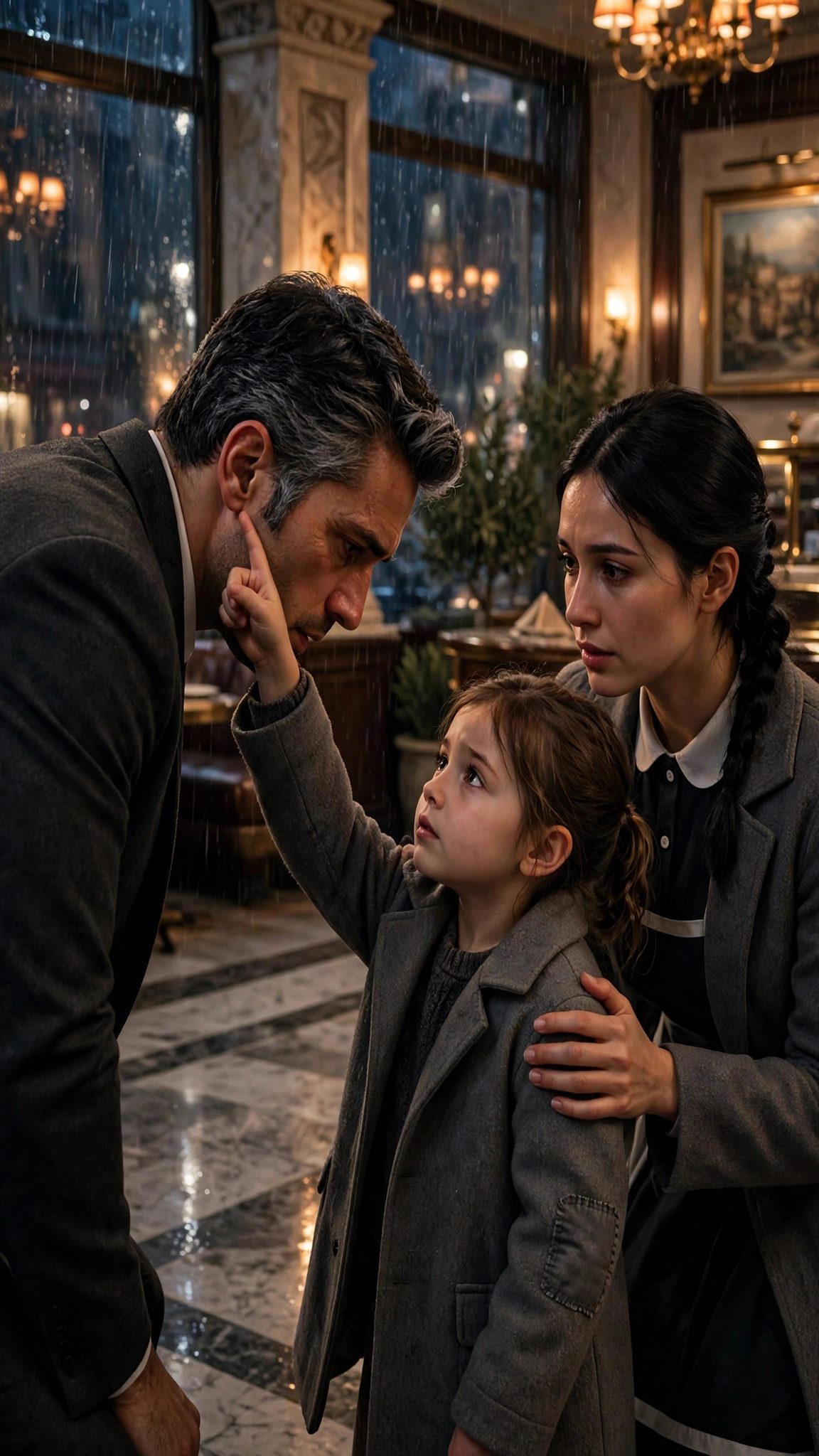
    And then he turned to Sophie, who was standing in the doorway with tears on her face, and he held out his hand, and Sophie took it, and he led her to the center of the terrace, under the lights, with the roses below and the fireflies around them, and he knelt down in front of her — the most feared man in the state, on his knees in front of a maid in a gray coat, for the second time in his life — and he took a small box out of his other pocket, and he opened it, and inside was a ring. A simple gold ring, with a single small diamond, the kind of ring a man gives to a woman he wants to spend the rest of his life with.

    "Sophie Miller," Dante said, and his voice was steady, and clear, and it carried across the terrace and down into the garden, because Dante Moretti did not whisper anymore. "Eight years ago, you sat with me in a kitchen at midnight, and you listened to me, and you did not judge me, and you gave me the first kind thing I had been given since my wife died. Then you left, and you kept our daughter safe, and you kept her hidden, and you did it because you loved her more than you loved your own safety. And three months ago, you walked into a rainy lobby, and you let your daughter whisper, and you saved my life. You saved me twice, too, Sophie. Once in the kitchen, and once in the lobby. And I am asking you now, in front of our daughter, under these lights, with my mother's necklace on her neck — will you marry me? Will you let me spend the rest of my life making up for the seven years I missed? Will you let me be the man you believed I could be, that night in the kitchen, when you sat across from me and listened?"

    Sophie looked at him. She looked at Anna, in her white dress, with the gold necklace shining on her neck. She looked at the terrace, and the lights, and the roses, and the fireflies. And she thought about the two-room flat above the laundry, and the forty-minute walks, and the gray coat with the patched sleeve, and the black box under the bathroom tile, and the seven years of invisibility.

    And she said, "Yes."

    It was one word. But it was the loudest word Sophie Miller had ever spoken. And Anna cheered, and the fireflies rose up around them like sparks, and Dante Moretti stood up, and he put the ring on Sophie's finger, and he kissed her, there on the terrace, under the lights, with his daughter watching, and the whole mansion — the portraits, the copper pots, the clock in the hallway — seemed to breathe again, for the first time in ten years.

    They were married a month later, in the garden, under the oak tree, with Anna as the flower girl, scattering rose petals down the aisle, wearing her mother's necklace and her white dress. Paolo gave Sophie away, because Sophie had no family left, and Paolo had been family to the Morettis for forty years, and he cried through the whole ceremony, and he did not apologize for it. Agent Reyes came, with his wife, and he danced with Anna, and he told Dante that Castellano had been sentenced to life, and Marcus to life, and Enzo to five years suspended, and that the case was closed, and that the Moretti family was free.

    And Dante Moretti, who had run his empire in silence for ten years, stood in his garden, with his wife on his arm and his daughter at his side, and he looked out at the people he loved, and he spoke — not in a whisper, but in a voice everyone could hear.

    "I spent ten years believing that silence was strength," he said. "I believed that if I said nothing, no one could hurt me. I was wrong. Silence nearly killed me. What saved me was a whisper — a little girl's whisper, in a rainy lobby, telling me the truth I could not see. So I have learned something, and I will teach it to my daughter, and I will live it for the rest of my life: the strongest thing a man can do is not to stay silent. It is to listen. To the smallest voice in the room. To the voice everyone else has been ignoring. Because sometimes, the smallest voice is the one telling the truth."

    And Anna, who remembered everything and said what she saw, tugged on his sleeve, and said, "Daddy, you are talking a lot. That is good. Keep talking."

    And Dante laughed, and Sophie laughed, and the whole garden laughed with them, and the sun went down, and the lights came on, and the fireflies rose up, and the Moretti mansion — the house that had been silent for ten years — was full of voices again.

    The whisper behind the mafia king's neck had broken the silence. And the silence, once broken, never came back.

    One year later, on a rainy evening in October — exactly one year after the night Anna whispered in the lobby of Valentino's — Dante Moretti stood in the kitchen of the mansion, in his shirtsleeves, with an apron around his waist, making dinner.

    It was a small thing. An ordinary thing. But in the Moretti mansion, it was a revolution. The silent king, in an apron, chopping garlic, with the copper pots hanging above him and the smell of basil in the air, and his daughter sitting on the counter beside him, swinging her legs, telling him about her day at school.

    "And then Mrs. Alvarez asked us what we want to be when we grow up," Anna said, "and I said I want to be someone who notices things. And she said, 'Anna, that is not a job.' And I said, 'Yes it is. It is the most important job. Because if no one notices things, then bad things happen and no one knows.' And Mrs. Alvarez was quiet for a moment, and then she said, 'Anna, you are right. That is the most important job.'"

    Dante smiled, and he kept chopping, and he said, "Your teacher is a wise woman, Anna. And you are right. Noticing things is the most important job in the world. It is the job that saved my life."

    Sophie came into the kitchen then, in her gray coat — the same gray coat, though the patched sleeve had been mended again, more carefully this time, with gold thread, because Sophie had decided that the patch was not something to hide anymore, but something to be proud of, a mark of everything she had survived — and she kissed Dante on the cheek, and she set the table, and she called Anna down from the counter, and the three of them sat down to dinner together, in the kitchen where it had all started eight years ago.

    After dinner, Dante took Anna up to her room — the room that had once been a guest room, and was now painted yellow, with bookshelves full of books and a window that looked out over the garden — and he tucked her into bed, and he sat on the edge of the mattress, the way fathers do, and Anna looked up at him with her old eyes, and she said, "Daddy, tell me the story."

    "Which story?" Dante asked, though he knew.

    "The story of the whisper," Anna said. "Tell me the story of the night I whispered."

    So Dante told it. He told it the way he had told it a hundred times now, because Anna asked for it every night, and he never grew tired of telling it. He told her about the rain in the lobby, and the keys on the floor, and the little girl in the gray coat, and the six words that broke ten years of silence. He told her about the black box under the tile, and the tapes, and the notebook, and the barber with the steady hands, and the man who had listened for months and never been heard. He told her about the night in the office, and the library door, and the FBI, and the dawn raid, and the courtroom, and the necklace on the terrace under the lights.

    And when he finished, Anna was quiet for a moment, and then she said, "Daddy, do you think Mama was scared, that night in the lobby? When she let me whisper?"

    "Yes," Dante said. "I think she was terrified. I think she was the bravest person in the world that night, because she was terrified and she did it anyway."

    Anna thought about this. "I think bravery is doing the thing even when you are scared," she said. "Mrs. Alvarez says that too. She says bravery is not the absence of fear. Bravery is fear that has said its prayers."

    Dante laughed. "Your teacher is a very wise woman," he said. "And you are a very wise girl. Now go to sleep, Anna. Tomorrow is a school day, and you have noticing to do."

    Anna closed her eyes. Dante kissed her forehead. He stood up, and he turned off the light, and he stood in the doorway for a moment, looking at his daughter asleep in the yellow room, with her mother's necklace on the bedside table and her father's ring on her mother's finger downstairs, and he thought about the boy he had been at eleven years old, eating dinner at table C, listening to his father say, "Never trust a stranger. Never let your guard down, son. Never show weakness."

    His father had been wrong. Not about everything — about much, his father had been right. But about this, he had been wrong. Trust was not weakness. Trust was the bravest thing a man could do. Letting your guard down was not weakness. It was how you let the light in. And showing weakness — showing the world that you could be hurt, that you could be afraid, that you needed help — that was not weakness at all. That was strength. The only strength that mattered.

    Downstairs, Sophie was waiting for him in the kitchen, with two glasses of whiskey on the table, and the rain on the windows, and the copper pots shining in the lamplight. She smiled when he came in, and she pushed one glass toward him, and he sat down across from her, in the same chair he had sat in eight years ago, on the night they had talked until dawn.

    "To whispers," Sophie said, raising her glass.

    "To whispers," Dante said, raising his. "And to the little girl who whispered them. And to the woman who let her."

    They drank. The rain fell. The house was quiet — but it was a different quiet now. Not the quiet of silence. The quiet of peace. The quiet of a house full of people who loved each other, and who were not afraid to say so.

    And outside, in the garden, the fireflies rose up in the dark, one by one, like small golden lights, like whispers, like promises kept.
    The End.
    THE END
  • Chapter 6: What the Tapes Said

    Chapter 6: What the Tapes Said

    FBI Agent Daniel Reyes arrived at the Moretti mansion at two in the morning, in the rain, with four agents behind him and a warrant in his pocket that he had been waiting three years to use.

    Reyes was forty-two years old, with tired eyes and a suit that had seen better days, and he was the kind of federal agent who did not frighten easily, because he had spent his career looking at men like Dante Moretti and seeing not monsters, but men — men who had made choices, and who would have to live with them.

    He had been building a case against Vincent Castellano for three years. Three years of wiretaps that went nowhere, of witnesses who forgot what they saw, of books that were cooked so cleanly no accountant could find the fire. He had the shape of the thing — the docks, the routes, the money moving through shell companies like water through a sieve — but he did not have the center of it. He did not have the voice.

    Now, in the middle of the night, in a wrecked office in a mansion on a hill, Dante Moretti was offering him the voice. On tapes. With dates. With times. With a notebook full of proof.

    "Show me," Reyes said.

    Dante showed him. He laid the tapes out on the desk, in order, by date, the way a man lays out evidence he has already studied. He opened the notebook to the page about the Geneva account. He played the first tape on an old cassette player Paolo found in the library, and the room filled with a sound no one in it had expected to hear.

    It was Dante's voice. Quiet, the way it always was. Speaking about the dock contracts. About the port authority. About the shipment from Genoa. And underneath it, faint but clear, the sound of another man's breathing — the man wearing the receiver, listening, writing down the times in his notebook.

    "That is Marcus Hale's breathing," Reyes said. He had listened to a thousand hours of wiretaps in his career, and he knew the sound of a man listening to something he should not be hearing. "That is the sound of a man stealing a king's words."

    Sophie sat in the leather chair, with Anna asleep in her lap, and she told Reyes everything. She told him about the bag in the bathroom cabinet. She told him about the receiver, and the tapes, and the notebook. She told him about Anna seeing the barber's thumb, and about Marcus asking about the cabinet, and about the way his eyes had moved over her hands and her apron and her cart.

    Reyes listened without interrupting. He took notes in a small black book, the way Sophie had once taken notes in her head, and when she finished, he looked at her for a long moment, and he said, "Mrs. Miller, do you understand what you have done?"

    Sophie shook her head. "I hid a box under a tile," she said. "That is all I did."

    "No," Reyes said. "You did more than that. You found the center of a case I have been building for three years. Castellano has been listening to the Moretti family through Marcus Hale and Enzo Falcone for four months. These tapes prove it. This notebook proves it. Your daughter's testimony proves how the device got there. Mrs. Miller, you have just handed me Vincent Castellano's empire on a silver platter."

    Sophie looked down at Anna, asleep in her lap, her small face peaceful in the lamplight. "I did it for her," she said. "I did it because a little girl saw something, and I could not let her be the only one who knew."

    "Then you did it for the right reason," Reyes said. "And the right reason is the only reason that ever holds up in court."

    While Reyes and his agents took statements, Dante went to Enzo's shop.

    He did not take his men. He took only Paolo, because Paolo was the only man he trusted completely, and because some conversations should not have an audience. They drove through the rain to Fifth and Mercer, and Dante walked into the shop that smelled of bay rum and hot towels, and he found Enzo sitting in his chair, in the dark, with his hands in his lap, waiting.

    Enzo did not look surprised. He looked like a man who had been waiting for this moment for months, and who was almost relieved that it had finally come.

    "Boss," Enzo said. His hands were steady. They were always steady. But his voice was not steady. His voice shook, the way a man's voice shakes when he is afraid and he knows there is no point in hiding it anymore.

    "Enzo," Dante said. He stood in the doorway of the shop, with the rain dripping off his coat, and he looked at the man who had cut his hair for fifteen years. "Tell me why."

    Enzo looked at his hands. "My son," he said. "My son is in the army. He was in the army. Two years ago, he was in a place I cannot name, doing a thing I cannot speak about, and he was hurt. Badly hurt. And Castellano's men found him in the hospital, and they told me that if I did not help them, my son would not come home. And if I did help them, my son would come home, and my wife would keep her shop, and I would keep my hands."

    He looked up at Dante, and his eyes were wet. "I am a barber, boss. I am not a soldier. I am not a brave man. I did what they told me to do, because I was afraid. I pressed the device behind your ear, and I carried your words to them, and every night I went home and I looked at my wife, and I could not tell her what I had done."

    Dante listened. He listened the way he had listened for ten years — in silence, with his hands at his sides, his eyes on the man's face. And when Enzo finished, Dante was quiet for a long time.

    Then he said, "Your son is home now, Enzo. He came home six months ago. I know, because I paid his medical bills. I paid them through the foundation, anonymously, because that is what my mother would have done. Did Castellano tell you that? Did he tell you that the man you were betraying was the man who was already taking care of your son?"

    Enzo's face crumpled. He put his hands over his eyes, and his shoulders shook, and he wept — not the weeping of a man caught, but the weeping of a man who has just learned that he betrayed the only person who was helping him.

    "I didn't know," Enzo whispered. "I swear to God, boss, I didn't know."

    "I believe you," Dante said. "And that is why I am not going to kill you. I am going to do something else. I am going to give you a choice. You can tell Agent Reyes everything — every meeting, every message, every dollar Castellano paid you — and you can testify against him, and you can spend the rest of your life knowing that you helped put the man who threatened your son behind bars. Or you can run, and Castellano's men will find you, because men like Castellano do not leave loose ends."

    Enzo looked up. His hands were shaking now. His steady hands, shaking for the first time in fifteen years. "I will testify," he said. "I will tell him everything. I swear it on my son's life."

    "Good," Dante said. "Then come with me. Reyes is waiting."

    At dawn, the FBI raided Castellano's house.

    It was a gray morning, the rain finally stopping, the sky the color of wet stone. Reyes led the raid himself, with twenty agents and a warrant built on four months of tapes, a notebook full of times, a barber's confession, and a maid's black box. They found ledgers. They found phones. They found the money — millions of it, moving through shell companies with names like Bellini Holdings, names that matched the notebook, names that matched the tapes.

    Castellano was arrested in his study, in his silk robe, with a cup of coffee in his hand. He did not resist. He looked at Reyes, and he looked at the agents, and he said, very quietly, "Who?"

    Reyes smiled. It was a small smile, and a tired one. "A little girl," he said. "A seven-year-old girl who noticed a black dot behind a man's ear. That is who."

    Castellano stared at him. And for the first time in his life, Vincent Castellano — the man who had listened to Dante Moretti for months, who had known everything, who had believed he could hear the king's every word — had nothing to say.

    Back at the mansion, Dante sat in his study with the wreckage around him — the overturned chair, the shattered lamp, the papers on the floor — and he thought about what he had done.

    He had chosen the law. Not revenge. Not the old way. Not the way his father would have done it, with a gun in the dark and a body in the river. He had chosen the tapes, and the notebook, and the FBI, and the courtroom. He had chosen to let the law take Marcus, and Enzo, and Castellano, because the law would keep them in prison longer than a bullet would keep them in the ground, and because his daughter would grow up in a world where her father was a man who chose the law over murder.

    Marcus would get life. Enzo would get five years, suspended, for testifying. Castellano would get life, without parole, on the RICO charges that Reyes had been building for three years and that Dante's tapes had finally completed.

    And Dante Moretti, the silent king, the man who had run his empire in silence for ten years, would do something his father had never done. He would legitimize the family businesses. He would close the accounts that could not be explained. He would pay the taxes, and file the papers, and turn the Moretti family into a family that did not need silence anymore.

    Because silence had nearly killed him. And a whisper had saved him. And he was done being silent.

    He stood up from his desk, and he walked to the library, where Sophie and Anna were waiting, and he opened the door, and he said, "It is over. Castellano is arrested. Marcus is arrested. Enzo is testifying. No one is going to hurt you. No one is ever going to hurt you again."

    And Anna, who had been asleep on the couch, woke up, and rubbed her eyes, and looked at him, and said, "Did you talk loud, Mr. Moretti?"

    Dante smiled. It was a small smile, and a rusty one, like a door opening for the first time in ten years. But it was a smile.

    "Yes, Anna," he said. "I talked loud. And I am going to keep talking. From now on, I am going to talk all the time."

    And Anna, who remembered everything and said what she saw, looked at him with her old eyes and said, "Good. I like it when you talk."

    And Dante Moretti, the mafia king who had been silent for ten years, laughed. It was a short, startled sound, like a man surprised by his own voice. And Paolo, standing in the hallway, heard it, and smiled, and never mentioned it again.

    Because some things are too precious to mention. Some things you simply keep, in the quiet drawer of your mind, labeled the day the king learned to speak again.

    Reyes interviewed Anna the next morning, in the library, with Sophie beside her and a plate of cookies on the table between them.

    He did it gently, the way good agents do it with children — no uniform, no notebook in his hand, no big words. He sat on the floor, cross-legged, at Anna's eye level, and he asked her about school, and about her favorite book, and about the gray coat with the patched sleeve, and only then, very carefully, about the man with the scissors.

    "Anna," he said, "can you tell me what you saw? Just what you saw. Not what you think it means. Just what your eyes saw."

    Anna thought for a moment, swinging her small boots above the floor. "I saw Mr. Enzo touch Mr. Moretti's neck," she said. "He pressed his thumb here." She touched the spot behind her own ear. "And there was a tiny black dot. Like a little beetle. And he looked around first, like this." She turned her head quickly, left, then right. "Like he didn't want anyone to see."

    "Did you see him do it more than once?" Reyes asked.

    Anna nodded. "Two times. The first time, I was carrying bread to the back table, and I saw him do it in the mirror. The second time, I was standing by the door, and I saw him do it when Mr. Moretti was looking at his phone. Both times he looked around first."

    Reyes wrote that down — not in his notebook, but in his mind, the way he had written down a thousand testimonies in his career. A child's testimony, clear and specific, with details no adult would think to invent. The mirror. The phone. The glance, left and then right. That was the kind of testimony that held up in court, because it was too strange to be coached and too precise to be imagined.

    "Thank you, Anna," Reyes said. "You did a very brave thing. You helped a lot of people today."

    Anna looked at him with her old eyes. "Is Mr. Moretti going to be all right now?" she asked. "Is the black dot gone?"

    "Yes," Reyes said. "The black dot is gone. And no one is going to listen to him anymore, unless he wants them to."

    Anna nodded, satisfied, and took a cookie, and Reyes stood up, and he looked at Sophie, and he said, very quietly, "Mrs. Miller, I need to ask you something, and I need you to think about it before you answer. Will you testify? In court, in front of a judge, with Castellano's lawyers asking you questions? It will not be easy. They will ask about your life. They will ask about Anna. They will try to make you look small. But your testimony is the thread that ties the tapes to the man who planted the device. Without you, the case is weaker. With you, it is airtight."

    Sophie looked at Anna, eating her cookie, swinging her boots, unafraid in a way Sophie had never been unafraid. And she thought about the seven years of invisibility, and the gray coat, and the forty-minute walks, and the black box under the bathroom tile, and the night she had sat on the bathroom floor with her back against the door, listening to her daughter breathe.

    "I will testify," she said. "I have been invisible for eight years, Agent Reyes. I hid a baby. I hid a box. I hid the truth. I am done hiding. If Castellano's lawyers want to ask me questions, let them ask. I have answers. I have had answers for seven years."

    Reyes nodded. He had heard a hundred witnesses say they would testify, and most of them meant it for a day, and then the fear came, and they forgot. But Sophie Miller did not look afraid. She looked like a woman who had finally found the thing she had been looking for — not safety, but a reason to stop being afraid.

    "Good," Reyes said. "Then I will protect you. The FBI will protect you and Anna until the trial is over, and after that, too, if you need it. That is a promise. And Agent Reyes keeps his promises."

    Later that morning, Dante found Sophie in the garden, standing by the fountain, watching Anna chase a butterfly between the rose bushes. The rain had stopped. The sun was coming out. The garden smelled of wet earth and roses, and for the first time in ten years, the mansion felt like a home instead of a fortress.

    "Reyes told me you agreed to testify," Dante said.

    Sophie nodded. "I did."

    "Are you afraid?"

    "Yes," Sophie said. "I am terrified. But I am done being invisible, Dante. I hid for seven years because I thought invisibility would keep Anna safe. I was wrong. Invisibility only kept her alone. Being seen — being heard — that is what saved you. And I think it is what will save us."

    Dante looked at her. He looked at Anna in the garden, chasing the butterfly, laughing — a real laugh, a child's laugh, the kind of laugh that makes the whole world laugh with it. And he thought about his mother, who had laughed in the kitchen, and about Isabella, who had laughed on a wet road a long time ago, and about himself, who had not laughed in eight years, and who had laughed last night, in a wrecked office, because a seven-year-old girl had asked him if the sad had come out.

    "You are right," he said. "Being seen is what saved me. You saw what no one else saw. Anna saw what no one else saw. And from now on, no one in this house will ever look through you again. I swear it. You are not furniture, Sophie. You never were. You are the mother of my daughter. You are the woman who saved my life. And you will be seen, every day, for the rest of your life, if I have anything to say about it."

    Sophie looked at him, and she smiled — a small smile, and a tired one, but a real one. "Then I suppose," she said, "that we are both learning how to be seen."

    And in the garden, Anna caught the butterfly — gently, in her cupped hands, the way you catch something precious — and she opened her hands, and she let it go, and she watched it fly up into the sun, and she laughed, and the whole mansion laughed with her.

  • Chapter 3: The Debt

    Chapter 3: The Debt

    "My name is Dominic Salvatore," he said. "And I am here because I owe you a debt I can never repay."

    The diner was so quiet I could hear the neon sign buzzing in the window. Old Mr. Peterson had his crossword frozen halfway to his mouth. Eddie Kowalski had stopped chewing. Marco stood in the kitchen doorway with a dish towel in his hands, and his face was white, and I understood, in that moment, that every person in Rosie's Diner knew exactly who Dominic Salvatore was, and I was the only one who did not.

    I had heard the name, of course. Everyone in the city had heard the name. Dominic Salvatore was the man the newspapers called the most powerful crime boss in New York, the man the prosecutors had spent years trying to put behind bars, the man whose name made strong men lower their voices. I had read about him the way you read about a hurricane in another state: with a distant sort of interest, and the comfortable certainty that it would never touch your life.

    And now he was standing in my diner, three feet away from me, saying that he owed me a debt.

    "I don't understand," I said. My voice sounded very far away. "I just… I pulled you out of a car. Anyone would have done the same."

    "No," he said. "Anyone would not have done the same. Most people drove past. I know. My people checked. Seventeen cars passed that stretch of highway in the ten minutes before you stopped, Miss Hart. Seventeen. You were the only one who stopped."

    He took one step closer, and I could see his face properly now in the fluorescent light of the diner, and it was not the face I had seen on the highway. That face had been bloody and unconscious. This face was alive, and it was handsome in a hard, carved way, with dark eyes that did not blink often enough, and a scar that ran through his left eyebrow, and a mouth that looked like it had forgotten how to smile a long time ago.

    "Three weeks ago, someone tried to kill me," he said, and his voice was low, and he did not seem to care that the whole diner could hear him. "A truck ran me off the road on purpose. The driver was paid to make sure I did not walk away from that crash. If you had not stopped, if you had driven past like the other seventeen, I would have burned to death in that car, and no one would have known it was murder. You saved my life, Emma Hart. In my world, that is a debt. And a debt like that can never truly be repaid. But I intend to spend the rest of my life trying."

    I stared at him. My hands were gripping the edge of the counter so hard my knuckles had gone white.

    "I don't want anything," I said. "I didn't do it for a reward. I did it because you were hurt and I was there. That is all."

    "I know," he said. "That is why it matters. If you had done it for money, I could pay you and we would be finished. But you did it for nothing, and so I owe you everything."

    One of his men bent down and whispered something in his ear, too low for me to hear, and Dominic nodded once, and then he looked back at me, and his eyes went to my left hand, to the plain gold band on my finger, and something changed in his face.

    "Your husband," he said quietly. "Daniel Hart. A firefighter. He died six years ago in a warehouse fire on the West Side. You were twenty-three years old, and your daughter was one."

    The blood left my face. "How do you know that?"

    "Your daughter is Lily," he went on, as if I had not spoken. "She is seven years old. She is in the second grade at St. Mary's. She is going to be a sunflower in the school play next month, and she needs a costume."

    "Stop it," I said. My voice was shaking now. "Stop it. How do you know all of this? Have you been watching me? Have you been following my daughter?"

    "I have been making sure you are safe," he said. "There is a difference. The people who tried to kill me know that a woman pulled me from that car. They do not know your name yet, but they will find out, and when they do, they will come for you, because in their world, a witness is a problem. My men have been watching your apartment and your diner since I woke up in the hospital. Not to frighten you. To protect you."

    He reached into his jacket, slowly, the way a man does when he does not want to frighten anyone, and he pulled out a small silver key. It was on a fine silver chain, and it caught the light of the diner, and it was the most beautiful thing I had ever seen, and I did not understand what it was.

    "I was hoping you would wear it again," he said, and he held it out to me.

    I did not take it. "What is it? What is this key for?"

    "It is the key to a house," he said. "A small yellow house on Maple Street, three blocks from your daughter's school. It has a garden in the back and a radiator that works in every room, and it is yours, Emma. Not rented. Yours. The papers are already signed. All you have to do is take the key."

    The diner was still silent. Old Mr. Peterson had put his crossword down. Eddie Kowalski was staring at me like I had grown a second head. I could feel every eye in the room, and I could feel the key shining in Dominic's hand, and I could feel my heart hammering against my ribs so hard it hurt.

    "I can't take a house from you," I said. "I can't take anything from you. I don't know you. You are a stranger, and you are… you are a criminal. Everyone knows who you are. The newspapers, the prosecutors. I am a waitress. I have a daughter. I cannot be involved in your world."

    "I am not asking you to be involved in my world," he said. "I am asking you to let me keep you safe in yours. The house is not a payment. A life cannot be bought. The house is a beginning. A place where your daughter can have a garden. A place where your rent does not go up to three thousand dollars in January."

    My breath caught. "How do you know about the rent?"

    "Your landlord is raising your rent to three thousand dollars," he said. "I know, because I asked. I ask about everything that touches you, Emma. That is what a man does when he owes a debt like mine."

    He set the key down on the counter between us, gently, like it was something fragile, and he stepped back.

    "Do you like Sunday?" he asked.

    "What?"

    "Sunday," he said. "Do you like Sunday? My mother makes dinner every Sunday at her house, and she has been asking me to bring a guest for three weeks, ever since I told her about the woman who pulled me from the fire. Come on Sunday. Bring Lily. No promises. No obligations. Just dinner. And if you decide you never want to see me again after that, I will respect it, and the house will still be yours, and my men will still watch over you, because that is what I owe you, whether you want it or not."

    I looked down at the key on the counter. It was small and silver and it shone under the fluorescent lights, and it was the key to a house with a garden, and my daughter needed a costume for a school play, and my rent was going up to three thousand dollars, and a detective had told me not to accept anything from anyone, and the whole diner was watching me, and Dominic Salvatore was standing three feet away from me, waiting.

    I looked at the key, and I looked at Dominic, and I thought about everything I knew and everything I did not know. I knew that he was a criminal, and that the newspapers had called him dangerous, and that a detective had warned me not to accept anything from anyone. I also knew that he had been bleeding and unconscious in a burning car, and that I had dragged him out with my own hands, and that he had come to my diner not with threats, but with gratitude, and that he had looked at my wedding ring and known my husband's name, and that he had asked me about Sunday dinner the way a shy boy might ask a girl to a dance. I thought about Lily, and about the rent, and about the sunflower costume hanging in her closet, and I thought about how tired I was of doing everything alone, and how frightening it was to admit that, even to myself.

    "I need to think," I said.

    "Think," he said. "Take all the time you need. The key will be here when you are ready." He turned to go, and then he stopped at the door, and he looked back at me, and for the first time since he had walked in, something almost like a smile crossed his face. "Your daughter needs a costume for a school play," he said. "A sunflower. I hope she is the brightest one on the stage."

    And then he was gone, and his men were gone, and the SUVs pulled away from the curb one by one, and the diner was just a diner again, with its cracked vinyl and its buzzing neon sign, and I stood behind the counter staring at a small silver key, and my hands were shaking, and I did not know whether I was terrified or angry or something else entirely, something I did not have a name for yet.

    Marco came out of the kitchen and stood beside me, and he looked at the key, and then he looked at me, and he shook his head slowly.

    "Emma," he said, "in forty years in this city, I have never seen Dominic Salvatore walk into a place and leave something behind. Men like him take things. They do not give them."

    "Maybe he is different," I said, but my voice did not sound convinced, even to me.

    "Maybe," Marco said. "Or maybe you are different, and he knows it. Be careful, Emma. A man like that does not come into a woman's life by accident. And a house is never just a house."

    Al called that night from his sickbed, his voice thin over the phone, because Eddie Kowalski had already called him, and Eddie Kowalski had told him everything.

    "Emma, my girl," Al said, "are you all right? Did he hurt you? Did anyone hurt you?"

    "No, Al," I said. "He was polite. He was… he was a gentleman, if you can believe that. He left me a key and invited me to Sunday dinner."

    There was a long silence on the other end of the line. "A key to what?"

    "A house," I said. "On Maple Street. He says it is mine."

    "Emma," Al said, and his voice was very serious now, the way it had been the day he hired me, when he had looked at a pregnant widow with no references and said, you start Monday. "Listen to me. I have lived in this city for seventy-one years, and I have seen what men like Dominic Salvatore can do, and I have seen what they can destroy. But I have also seen this: a man who owes his life to someone will move heaven and earth for her. If he says the house is yours, it is yours. The question is not whether you can trust him. The question is whether you can trust yourself to walk away if you need to."

    I did not sleep that night. I lay in bed staring at the ceiling, with the silver key on the nightstand beside me, catching the light from the streetlamp outside, and I thought about everything: the burning car, the rain, the detective's card in the drawer, the rent going up to three thousand dollars, Lily's sunflower costume hanging in her closet, Daniel's ring on my finger.

    In the morning, Lily found the key on the nightstand and held it up with both hands, and her eyes went wide.

    "Mommy, is this a fairy-tale key?" she asked. "Does it open a castle?"

    "It opens a house," I said. "A yellow house with a garden. A man gave it to me because I helped him once."

    "Is he a prince?" she asked.

    "No, baby," I said. "He is not a prince. He is a man who owes me something, and he wants to pay it back."

    She considered this, and then she slipped the chain over her head, and the key hung down over her pajamas, and she spun around in a circle, and she said, "I like it. It feels like magic."

    I took the key back gently, and I put it in my pocket, and I made her breakfast, and I walked her to school, and all the way there I thought about Sunday dinner, and about a small yellow house on Maple Street, and about a man with dark eyes who had looked at my wedding ring and known my husband's name, and I thought about what Al had said: the question is whether you can trust yourself to walk away if you need to.

    I did not know the answer yet. But I knew one thing: I was going to Sunday dinner. Not for the house. Not for the key. I was going because a man had looked me in the eye and told me the truth about what he owed me, and in my life, almost no one had ever done that.

  • Chapter 2: Rosie’s Diner

    Chapter 2: Rosie’s Diner

    My alarm went off at 4:45 every morning, and every morning I hated it for exactly three seconds before I remembered Lily and got up.

    The apartment was small and cold in the dark, and I moved through it the way I had moved through it for six years, by memory and by habit: coffee on, lunchbox out, bread in the toaster, Lily's clothes laid out on the chair the night before. Lily's room was the warmest room in the apartment because the radiator in there actually worked, and she slept curled around her stuffed rabbit with her hair spread across the pillow like spilled ink, and every morning I stood in her doorway for one extra second just to look at her, because she was the whole reason for everything.

    "Mommy, five more minutes," she would mumble without opening her eyes.

    "No, baby. School. Up."

    She was seven years old, all elbows and questions, with my dark hair and her father's grey eyes. Her father had been Daniel Hart, a firefighter with the kind of laugh that filled a whole room, and he had died six years ago in a warehouse fire on the West Side, and Lily had been one year old, and she did not remember him at all. She knew him from the photographs on the mantel and from the stories I told her, and sometimes she asked me questions about him that I could not answer, and I had learned to say, "Your daddy loved you very much," because it was true and because it was the only answer that ever helped.

    I still wore my wedding ring. It was a plain gold band, worn thin on one side from six years of dishwater and diner coffee and living. People sometimes looked at it and then at me, and I could see them doing the math, and I never explained. The ring was not a promise anymore. It was a memory. It was the last thing Daniel had ever given me, and I was not ready to let it go.

    By six in the morning, Lily was dressed and fed and out the door with Mrs. Deluca, who walked her to school every day for twenty dollars a week that I could barely afford and Mrs. Deluca pretended not to need. By six-thirty I was at Rosie's Diner, tying my apron, clocking in, breathing in the smell of coffee and bacon grease and floor cleaner that had been the smell of my life for eight years.

    Rosie's Diner was not a beautiful place. The vinyl on the booths was cracked and patched with tape. The neon sign in the window buzzed and flickered, and one letter had been dead for two years. The pie case had a chip in the glass. But it was warm, and it was honest, and the people who came there were the kind of people who said good morning and meant it, and Al, the owner, was the kind of man who had given me the job when I was a pregnant widow with no references and no money, and I owed him more than I could ever pay.

    Al was seventy-one years old, with hands like tree roots and a heart that the doctor had been warning him about for a decade. That October he had caught a cold that turned into bronchitis, and he had gone home sick, and the diner had fallen to me and to Marco, the cook, who was sixty-four and moved like a man carrying an invisible piano on his back.

    The oven broke on a Wednesday, right in the middle of the lunch rush. One minute it was fine, and the next minute there was a pop and a smell like burning wire, and Marco opened the door and swore in Italian, and I stood there with three orders of meatloaf on my pad and no oven to cook them in.

    "We will manage," Al said on the phone, his voice thin and wheezing. "Sandwiches. Soup. Pie. People come for the company as much as the food."

    So we managed. I served pie while the regulars complained about the oven and then stayed for an extra cup of coffee anyway, because that is what regulars do. Eddie Kowalski, the trucker, told me the same story about the blizzard of '09 he told me every week. Old Mr. Peterson did the crossword and asked me for the answer to seven-down, which was always the same answer I gave him last week. The morning crowd came and went like the tide, and I poured coffee and cleared plates and smiled until my face hurt, and at the end of every shift I counted my tips in the back room and did the math in my head, and the math never quite worked.

    One morning, I found a drawing on the kitchen table that Lily had made the night before, in crayon, on the back of a grocery bag. It showed our little apartment, and me in my waitress uniform, and her in her sunflower costume, and a tall dark man standing beside us, holding my hand. Underneath, in her careful second-grade handwriting, she had written: "My family." I stood there looking at it for a long time, because Lily had never drawn a man in our family before. Our family had always been just the two of us, me and her, and Mrs. Deluca downstairs, and the photographs of Daniel on the mantel. I folded the drawing up carefully and put it in the drawer with the bills, on top of the credit card statement, because I did not know what else to do with it, and because something about it made my chest ache in a way I did not understand yet.

    The rent notice came on a Monday. My landlord, Mr. Hendricks, was a thin man with thin lips who owned half the block and smiled like a man who enjoyed bad news. He slipped the envelope under my door, and I found it when I got home that night, and I read it twice standing in the hallway with my coat still on.

    Starting in January, the rent on my apartment would go up to three thousand dollars a month. Three thousand dollars. I made twenty-two hundred in a good month, and that was with double shifts and tips, and Lily's school needed fifty dollars for the field trip, and the electric bill was due, and my car needed new brakes, and the numbers did not add up no matter how many times I added them.

    I folded the note up and put it in the drawer with the other bills, on top of the credit card statement and the dentist's reminder, and I stood in my kitchen for a long time, looking at the drawer, thinking about the fact that I was a woman who had dragged a dying man out of a burning car and I could not figure out how to pay three thousand dollars a month for a two-bedroom apartment with a radiator that only worked in one room.

    Lily's school play was the one bright thing in those three weeks. She was going to be a sunflower. Not the star, the way she had first announced, but a sunflower, which she informed me was even better, because sunflowers were tall and brave and they always faced the light. She needed a costume, and costumes cost money, and I did not have money, so I went to the thrift store on my day off and bought a yellow curtain for three dollars and a green tablecloth for two, and I stayed up late for three nights with a needle and thread, sewing petals out of the curtain while Lily slept, pricking my fingers and swearing under my breath and then apologizing to the empty room.

    "Mommy, are you making my costume?" she asked me on the third night, standing in the doorway in her pajamas, rubbing her eyes.

    "I am making the most beautiful sunflower costume anyone has ever seen," I told her.

    "Will it have a face?" she asked.

    "It will have your face," I said. "That is the most beautiful part."

    She beamed at me, and she went back to bed, and I sat there with the needle in my hand and the yellow curtain in my lap, and I thought about how much I loved her, and how tired I was, and how I would sew a thousand costumes if that was what it took.

    The detective came on the Friday of the second week. He was a tall man in a grey suit, with a tired face and a notebook, and he sat at the counter and ordered coffee and then showed me his badge and asked if he could ask me some questions about the accident on the highway.

    "Of course," I said.

    He asked me what I had seen. I told him: the sedan, the fire, the man unconscious, the truck that had fled the scene. He wrote it all down in his notebook in small neat handwriting, and then he asked me if anyone had contacted me since that night. Anyone at all. A phone call. A visitor. Anything strange.

    "No," I said. "Why would anyone contact me?"

    He looked at me for a long moment, and then he said, "The driver of that car is a man with a great many enemies, Miss Hart. Powerful enemies. The crash may not have been an accident. If anyone approaches you, about the crash or about him, I want you to call me." He slid a card across the counter. Detective Ryan Cole. "Do not talk to strangers about that night. Do not accept anything from anyone. And do not go anywhere with anyone you do not know."

    I took the card because it seemed rude not to, and I put it in my apron pocket, and I forgot about it almost immediately, because detectives and warnings and powerful enemies belonged to a world that had nothing to do with me. I was a waitress. I served pie. I sewed sunflower costumes out of thrift-store curtains. Men with powerful enemies did not come into my life, except for one night on a rainy highway, and that night was over.

    On Sunday, Mrs. Deluca invited us upstairs for dinner, the way she did every Sunday, and Lily sat at her kitchen table eating spaghetti with meatballs while Mrs. Deluca told her stories about the old country, and I sat by the window with a glass of wine I had not paid for and let myself breathe for the first time all week.

    "Mommy," Lily said, with sauce on her chin, "tell me the story about how Daddy asked you to marry him."

    I had told her the story a hundred times, and she asked for it every Sunday, and I told it again, because some stories are worth telling a hundred times.

    "Your daddy took me to the lake," I said, "on a cold night in November, and he had a ring in his pocket, and he was so nervous he dropped it in the grass, and we spent twenty minutes on our hands and knees looking for it with a flashlight, and when we finally found it, he held it up and said, 'Emma Hart, will you marry me, even though I just lost your ring in the grass like an idiot?' And I said yes."

    Lily giggled. "Did he cry?"

    "He cried a little," I said. "And then he pretended he had something in his eye."

    Mrs. Deluca reached across the table and patted my hand, and her eyes were kind, and she did not say anything, and she did not need to. She had known Daniel. She had been at our wedding. She had held Lily the day she was born. She was the closest thing to a mother I had left in the world, and on Sundays, in her warm kitchen with the smell of garlic and tomatoes in the air, I could almost pretend that the world was a gentle place.

    After dinner, Lily fell asleep on Mrs. Deluca's couch with sauce still on her chin, and I carried her downstairs and put her in her bed, and I sat at the kitchen table with the yellow curtain and the needle and thread, and I sewed the last petal onto the sunflower costume, and I held it up in the lamplight, and it was not perfect, but it was beautiful, because I had made it with my own hands for a little girl who believed she was the brightest sunflower in the whole world.

    I found Detective Cole's card the next morning when I was changing my apron. It was folded in the pocket, soft from being carried around for days, and I stood in the back room of the diner holding it, thinking about what he had said. Powerful enemies. The crash may not have been an accident. Do not accept anything from anyone.

    I almost threw it away. Then I thought about Lily, and I thought about the truck that had fled the scene, and I put the card in the drawer under the counter instead, next to the spare pens and the sugar packets, where I would know where to find it if I ever needed it. That night, after Lily was asleep, I stood in the hallway of our little apartment and checked the lock on the front door twice, and then a third time, and I told myself I was being foolish, and I checked it a fourth time anyway, because a detective had told me that the crash might not have been an accident, and mothers do not take chances with their daughters, not even chances they do not believe in.

    I did not know, standing there in the back room of Rosie's Diner with a detective's card in my hand, that I would need it sooner than I thought. I did not know that the man from the burning car had spent three weeks in a hospital bed, asking for me, and that his people had spent three weeks finding out everything there was to know about me: my name, my daughter's name, my rent, my dead husband, my little apartment on the highway. I did not know that he was coming.

    That was what I believed, right up until Thursday evening at 6:47, when three black SUVs surrounded Rosie's Diner, and the man from the burning car walked through the door, and said my name like a man who had been waiting three weeks to say it.

  • Chapter 5: The Baby Was Never Mine

    Chapter 5: The Baby Was Never Mine

    The conversation that started in the hallway ended in Dante's home office.

    It was past midnight. The mansion was quiet, the way it always was, but tonight the quiet felt different — thinner, like ice on a pond in early spring, the kind of quiet that might crack under your feet at any moment. Sophie sat in the leather chair across from Dante's desk, with her gray coat folded over her knees and her hands clasped so tightly her knuckles were white. Anna slept in the next room, on the couch in the library, with Paolo sitting in the armchair beside her, reading a newspaper he was not really reading, watching the door the way only an old soldier watches a door.

    Dante sat behind his desk. The black box was open in front of him. The receiver. The tapes. The notebook. All of it, laid out in the lamplight like evidence at a trial.

    "Tell me the rest," he said. His voice was quiet, but it was not the quiet of silence. It was the quiet of a man holding something very heavy very carefully, so as not to drop it.

    Sophie looked at her hands. "There is nothing else," she said. "I told you about the bag. I told you about the tapes. I told you about Marcus and the cabinet. That is everything."

    "No," Dante said. "That is not everything. There is something else. You started to say it in the car, before the phone rang. You said, 'Anna is —' and then you stopped. Finish it, Sophie. Please."

    Sophie closed her eyes. She had carried this secret for seven years. She had carried it through the pregnancy, through the birth, through the two-room flat above the laundry, through the forty-minute walks to the bistro, through every night she had sat by the window and watched the rain. She had carried it so long it had become part of her, like a bone, like a scar. She did not know how to set it down.

    "The baby was never mine," she said. Her voice was barely a whisper, but in the quiet office it filled the room. "It's his. It's his. I know who he is, and I know what he will think about it, and I have been afraid to tell you for seven years."

    Dante went very still. "Whose?" he asked.

    Sophie opened her eyes. She looked at him across the desk — at the gray at his temples, at the charcoal suit, at the cold gray eyes that had once laughed in a kitchen at midnight — and she said the words she had practiced a thousand times and never once spoken aloud.

    "Yours, Dante. Anna is your daughter."

    The silence in the office changed. It stopped being quiet and became something else — a held breath, a stopped heart, a room full of air that no one was breathing.

    "Eight years ago," Sophie said, and the words came faster now, the way water comes when a dam breaks. "After Isabella died. The night in the kitchen. You remember it. I know you remember it, because I have seen it in your face every time you look at me and cannot remember where you have seen me before. We talked until dawn. You laughed once. And then morning came, and you became the silent king again, and I became furniture again."

    She stopped. She took a breath. "Three weeks later, I learned I was pregnant. And I thought about telling you, Dante. God help me, I thought about it every day. But your father had taught you never to show weakness, and a child with a maid would be weakness, and weakness in your world is a weapon other men use to cut your throat. Castellano would have learned of her in a week. She would have grown up with a target on her back before she could walk. So I left. I left in the middle of the night, and I never told you, and I raised her alone, and I told myself that was love. That keeping her away from you was the only way to keep her safe."

    Dante did not speak. He sat behind his desk with his hands flat on the wood, and his face did not change, and Sophie could not read him, because no one could read Dante Moretti. That was the rule. That was what made him terrifying.

    But his hands changed. His hands, flat on the desk, curled slowly into fists. And then, very slowly, they opened again, and they trembled. Just slightly. Just enough for Sophie to see.

    "She is seven," Sophie said. "She was born on a cold morning in March, in a charity hospital, and the midwife held my hand and told me I was brave. I named her Anna, after my mother. She remembers everything she sees. That is her gift. And she saw the barber's thumb, Dante. She saw it because she was looking, and no one else was looking, and that is the only reason you are alive to hear this."

    Dante stood up. He walked to the window, and he looked out at the rain coming down over the gardens, and he stood there for a long time with his back to her, and Sophie sat in the leather chair with her heart hammering, waiting to find out what kind of man he was.

    She had been waiting seven years to find out. And now she would know.

    "I have a daughter," Dante said. His voice was so quiet she almost did not hear it. "I have a daughter, and I did not know. I have a daughter, and she saved my life, and I did not know her name until tonight."

    He turned around. And his face had changed. The silence was gone. In its place was something raw and open and unguarded, the face of a man who had just been given the world and lost it in the same breath.

    "Why didn't you come to me sooner?" he asked. "I would have taken care of you. I would have taken care of both of you. I would have —"

    "You would have what?" Sophie said, and her voice broke, because she had waited seven years for this question, and she had an answer for it. "You would have put her in this house, behind these walls, with these men around her? The same men who planted a device behind your ear? The same men who have been listening to you for months? Dante, the men in your house are the danger. I kept her away from them. I kept her away from all of it. And I would do it again."

    Dante looked at her. He looked at her for a long time, and then he did something she had never seen him do. He came around the desk. He knelt down in front of her chair — the most feared man in the state, on his knees in front of a maid in a gray coat — and he took her hands in his.

    "Thank you," he said. "Thank you for keeping her safe. Thank you for bringing her to me. And I swear to you, Sophie, on my mother's name, on everything I have — no one will ever hurt her again. Not Castellano. Not Marcus. Not anyone. I will burn this city to the ground before I let anyone touch my daughter."

    And then the door opened.

    Marcus Hale stood in the doorway, with two men behind him, and his hand was inside his jacket, and his eyes were flat and dark, and he did not look surprised. He looked like a man who had been listening outside a door for a long time, and who had heard everything he needed to hear.

    "Boss," Marcus said. "We need to talk."

    Dante stood up slowly. He stepped in front of Sophie's chair, putting his body between her and the door, the way a man puts his body between his family and a gun.

    "Talk," Dante said.

    Marcus looked at the black box on the desk. He looked at the tapes. He looked at the notebook. And his face did not change either, because Marcus Hale had spent nine years learning the same silence Dante had learned.

    "You found the box," Marcus said. "I wondered when you would. Enzo said the maid was asking questions. I told him not to worry. I told him maids don't ask questions that matter."

    "Enzo told you," Dante said. "And you told Castellano. For four months. For money? Or for something else?"

    Marcus smiled. It was a small smile, and a cold one. "For the future, boss. Castellano offered me the future. You offered me the past. Your father is dead. Your wife is dead. Your empire is dying, and you are sitting in the dark, whispering to yourself, while the world moves on. I chose the man who is moving."

    Dante did not move. He did not raise his voice. He simply looked at Marcus, and his voice, when it came, was so quiet that the two men behind Marcus leaned in to hear it.

    "Get out of my house," Dante said.

    Marcus laughed. "Your house, boss? This house belongs to whoever is strong enough to hold it. And you — you are not strong anymore. You are a man who kneels in front of maids. You are a man with a daughter he did not know about. You are a man with a listening device behind his ear, and you did not even know it was there. You are weak, boss. And weak men lose."

    He stepped forward. The two men behind him stepped forward too. And Sophie, in the leather chair, felt her heart stop, because she understood what was happening. Marcus had come to take the box. And he had come to take her, and Anna, because they were witnesses, and witnesses did not live long in Marcus Hale's world.

    But Dante Moretti did not step back. He stood in front of Sophie's chair, and he looked at Marcus, and he said, very quietly, "Sophie. Take Anna and go to the library. Lock the door. Do not open it for anyone but Paolo."

    Sophie stood. Her legs shook. She walked to the door of the library, and she did not look back, because she was afraid that if she looked back, she would see something she could not unsee.

    Behind her, she heard Dante's voice, low and cold and final, the voice of the silent king, the voice that had ruled this state for ten years.

    "Marcus," he said. "You have been listening to me for months. So you should know exactly what I am about to do."

    And then the library door closed, and Sophie locked it, and she held Anna in her arms, and she listened to the sounds from the office — the shouting, the crash of furniture, the sound of a man who had been silent for ten years finally, finally speaking — and she understood that the war for the Moretti empire had begun, and that it would be fought over a black box, and a maid, and a little girl who had whispered in the rain.

    In the library, Sophie held Anna against her chest, and Anna held her mother's hand, and they listened.

    They heard the shouting first — Marcus's voice, raised, the gravel in the bucket turning to broken glass. Then the crash of furniture, the desk chair going over, the lamp shattering against the wall. Then a sound Sophie had never heard before, and hoped never to hear again: the sound of Dante Moretti speaking. Not whispering. Speaking. Loud, and cold, and furious, his voice filling the house the way it must have filled it before his wife died, before the silence came.

    "Four months, Marcus! Four months you have been selling my words! My men! My family!"

    Then a thud. Then another. Then silence — a different silence than before, a silence that came after violence, heavy and ringing.

    Anna looked up at her mother with wide eyes. "Mama," she whispered. "Is Mr. Moretti all right?"

    Sophie did not know. She held her daughter tighter, and she pressed her ear to the library door, and she listened for footsteps, for voices, for any sound that would tell her who was still standing on the other side.

    After a long time, there was a knock. Soft. Three knocks, the way Paolo always knocked.

    "Sophie," Paolo's voice said, low and steady. "It is Paolo. You can open the door."

    Sophie unlocked the door with shaking hands. Paolo stood in the hallway, his white hair ruffled, his jacket torn at the shoulder, a bruise darkening on his cheek. Behind him, the office door stood open, and Sophie could see the wreckage inside — the overturned chair, the shattered lamp, the papers scattered across the floor like fallen leaves.

    "Where is he?" Sophie asked.

    "In the office," Paolo said. "He is all right. Marcus is not."

    Sophie walked into the office with Anna's hand in hers. Marcus Hale lay on the floor beside the desk, his hands tied behind his back with his own belt, his face bloody, his eyes open and furious. The two men who had come with him sat against the wall, guarded by two of Dante's loyal men — men Sophie recognized from the bistro, men who had always been polite to her, men who had never once looked through her the way the others did.

    Dante stood by the window, with his back to the room, looking out at the rain. His jacket was torn. His knuckles were bloody. But he was standing, and he was breathing, and when he turned around and saw Sophie and Anna in the doorway, his face changed — the fury draining out of it, replaced by something softer, something she had seen only once before, in a kitchen at midnight, eight years ago.

    "Anna," he said, and his voice was gentle now, the way a father's voice is gentle when he is speaking to a child he has just met and already loves more than his own life. "Are you all right?"

    Anna nodded. She looked at Marcus on the floor, and at the blood on Dante's hands, and at her mother, and then she walked across the office — small boots on the marble, steady as a soldier — and she stood in front of Dante Moretti, and she looked up at him, and she said, "You talked loud, Mr. Moretti. I heard you all the way in the library. Mama says talking makes the sad come out. Did the sad come out?"

    Dante looked down at her. He looked at her for a long moment, and then he did something no one in that room had ever seen him do. He knelt down, in his torn jacket, with his bloody knuckles, in front of a seven-year-old girl in a gray coat, and he said, "Yes, Anna. The sad came out. And do you know what I found underneath it?"

    "What?" Anna asked.

    "Anger," Dante said. "And underneath the anger, I found something else. I found you."

    Anna thought about this. Then she reached up, very carefully, and she touched the spot behind his ear, where the tiny black dot had been. Dante had torn it off in the office, in the first minute of the fight, and the skin was red and raw.

    "Does it hurt?" she asked.

    "A little," Dante said. "But it will heal. Things heal, Anna. That is the secret no one tells you. Things heal, if you let them."

    Sophie watched them — the most feared man in the state, on his knees in front of her daughter, in a wrecked office, in the rain — and she felt something break open in her chest, something she had kept locked for seven years, something she had thought was dead.

    It was not dead. It was hope. And hope, Sophie was learning, is the most dangerous thing in the world, because once you let it in, you can never be invisible again.

    Dante stood up. He looked at Marcus on the floor, and his face hardened again, the king returning, the silence returning — but it was a different silence now. Not the silence of a man who has nothing to say. The silence of a man who is deciding what to do next.

    "Paolo," Dante said. "Call Agent Reyes. Tell him we have a gift for him. Three men, and a black box full of tapes, and a notebook full of times. Tell him Castellano's name is in every page of it. And tell him to come now, before Castellano learns that his line has gone dead."

    Paolo nodded and left the room, and Dante turned to Sophie, and he said, "I need you to do one more thing for me. I need you to tell Reyes everything you told me. About the bag. About the tapes. About Anna seeing the barber. All of it. Can you do that?"

    Sophie looked at him. She looked at Anna. She looked at Marcus on the floor, and the wrecked office, and the rain on the window. And she said, "Yes. I can do that. I have been invisible for eight years, Mr. Moretti. I think it is time I was seen."

    Dante nodded. "Good," he said. "Because from tonight on, no one in this house will ever look through you again. I swear it. You are the mother of my daughter. You are under my protection. And anyone who touches you will answer to me."

    And Sophie Miller, who had spent seven years hiding a black box and a baby and a truth, finally understood what it meant to be safe. It did not mean being invisible. It meant being seen — by the right man, at the right time, for the right reason.

    And the right man was standing in front of her, with bloody knuckles and a torn jacket, looking at her daughter like she was the only light in the world.

  • Chapter 1: The Man in the Burning Car

    Chapter 1: The Man in the Burning Car

    Three black SUVs surrounded Rosie's Diner at 6:47 on a Thursday evening, and I knew, the way you know when a storm is about to break the sky open, that my life was about to change forever.

    I was wiping down the counter with a rag that had seen better days, and the bell over the door had not rung in twenty minutes, and the pie case was half empty, and the coffee was going bitter in the pot because Al had gone home sick and I was covering his shift on top of my own. The street outside the window was the same street it always was: cracked sidewalk, the laundromat with its buzzing sign, Mrs. Kowalski's bodega with the crates of oranges out front. Then the first SUV pulled up to the curb, black as a hearse, windows so dark they looked painted on. Then the second. Then the third, boxing the diner in from both ends like the street had been closed for a parade nobody told me about.

    My hand stopped moving on the counter.

    The doors of the SUVs opened in unison, and men in dark suits stepped out, and they did not look at the diner the way customers look at a diner. They looked at it the way soldiers look at a building they have been told to secure. One of them stood by the door. One of them walked to the corner and looked up and down the street. One of them opened the back door of the middle SUV, and the man who stepped out was the man I had dragged from a burning car three weeks earlier.

    I knew him the moment I saw him, even though the last time I had seen him he had been unconscious and bleeding and half dead on the shoulder of the highway with his shirt soaked through and his face black with smoke. He was tall, and broad through the shoulders, and his dark hair was combed back from a face that looked like it had been carved out of something hard and then left out in bad weather. He wore a charcoal suit that probably cost more than I made in six months, and he moved the way men move when the whole world is used to getting out of their way.

    Dominic Salvatore. I did not know his name yet. But I knew his eyes. Dark, piercing, the kind of eyes that look at you once and seem to see straight through you and into the ground beneath your feet.

    He walked toward the diner door, and his men fell in behind him, and the bell over the door rang, and every head in the place turned, and the whole diner went quiet the way a room goes quiet when a gun has just gone off somewhere far away and everyone is waiting to find out where the bullet landed.

    He stopped three feet inside the door. His eyes found me behind the counter. And he said, in a voice like gravel rolling downhill, "Emma Hart."

    It was not a question. He knew my name. I had never told him my name.

    That was Thursday. But the story started three weeks earlier, on a Tuesday night in October, on the highway outside the city, in the rain.

    I had been at Rosie's since dawn that Tuesday because Al was sick and my shift had started again before it had properly ended. Al had called that morning, his voice thin and apologetic through the phone, and asked if I could cover, and I had said yes because that is what I always said, because the rent did not care whether I was tired and Lily did not care whether I was tired and the electric bill did not care whether I was tired. I had worked the breakfast rush and the lunch rush and the long slow afternoon when the only customers were the truckers and the old men who nursed one cup of coffee for two hours and talked about baseball like it was still 1978.

    By nine o'clock that night my feet were screaming inside my shoes and my apron was stained with ketchup and coffee and something I did not want to identify, and all I wanted was to get home to the little apartment on the highway, where Lily was asleep in her bed with her stuffed rabbit, and Mrs. Deluca from downstairs was watching her for me, and the whole world was small and quiet and mine.

    The rain started just as I pulled out of the diner parking lot. Not a drizzle. A real October rain, the kind that comes down sideways and turns the highway into a black mirror and makes the headlights of every car smear across your windshield like wet paint. I turned the wipers up to high and slowed down to fifty and told myself, twenty minutes, just twenty minutes, and then home.

    I was seven minutes from the exit when I saw the lights.

    At first I thought it was a jackknifed truck. There were headlights pointed the wrong way, and brake lights, and something burning orange against the black rain. Then I got closer, and I saw that it was not a truck at all. It was a black sedan, a big expensive one, and it had gone off the road and down the shallow embankment and hit the guardrail post hard enough to fold the front end in like a crushed tin can, and the engine was on fire.

    I have thought about what happened next a thousand times since, and I still do not have a good explanation for it, except that there are some moments in your life when your body decides before your brain does. I pulled over. I put on my hazard lights. I got out of my car in the rain, in my waitress uniform, with my apron still on, and I ran down the embankment toward a burning car without thinking about it at all.

    The heat hit me from ten feet away. The smoke was thick and black and it smelled like gasoline and melted plastic. The driver's door was jammed. I could see a man inside, slumped over the steering wheel, not moving. Blood was running down the side of his face from a cut on his temple, and his suit was dark with it, and his hands were still on the wheel like he had been holding on when the world ended.

    "Boss? Sir?" I called softly, because my voice did not seem to want to work properly. "Are you okay?"

    He did not answer.

    "Hey, buddy, are you okay?" I said, louder, and I yanked at the door handle with both hands, and the door screamed on its hinges and came open two inches and stuck.

    The fire was in the engine, but it was spreading, licking along the hood toward the windshield, and the smoke was getting thicker, and I knew, in the part of my brain that still worked, that I had maybe a minute before the whole thing went up. I put my foot against the door frame and pulled with everything I had, and the door gave way all at once, and I nearly fell backward down the embankment.

    I reached in and grabbed him under the arms. He was heavy. He was so much heavier than he looked, all muscle and dead weight, and his head lolled back, and his eyes were closed. I dragged him out of the car and down onto the wet grass, away from the heat, and I laid him on his back and pressed my ear to his chest, and I heard his heart beating, slow and uneven, but beating.

    "Stay with me," I told him. "Stay with me, okay? You are not dying on the side of the highway tonight. Not on my shift."

    I called 911 with hands that were shaking so hard I could barely hold the phone. I told the dispatcher where we were, and I told her there was a man unconscious and bleeding and a car on fire, and she told me to stay on the line, and I did, and I kept talking to him the whole time, because someone had once told me that people in comas can hear you, and I did not know if he was in a coma but I was not taking any chances.

    "My name is Emma," I told him. "I work at Rosie's Diner. I am going to stay right here with you until the ambulance comes. You are going to be fine. You hear me? You are going to be fine."

    The rain was coming down on both of us, washing the blood off his face in thin pink streams, and his eyes were still closed, and then, just as the sirens started to wail in the distance, his eyes opened.

    His eyes locked onto mine, dark, piercing, and it appeared as if a single glance could burn a hole through me and into the ground. His lips moved. His voice came out rough, like a man who had been shouting for a very long time.

    "Oh, thank God," he said. "It's you."

    I stared at him. "What?"

    "It fits perfectly," he said, and his eyes were already closing again. "I mean… I know who you are."

    And then the paramedics were there, and the firefighters were there, and the whole embankment was full of flashing lights and shouting men, and they loaded him onto a stretcher, and one of them asked me if I knew him, and I said no, I had just pulled him out of the car, and they asked me for my name, and I gave it, and then they were gone, and the car was a black skeleton steaming in the rain, and I stood there in my wet uniform with my apron soaked through, and I realized my hands were covered in his blood.

    I stood there for a long time after the ambulance left, in the rain, with the burned-out car steaming in front of me, and I thought about how close I had come to driving past, how easy it would have been to keep going, to tell myself that someone else would stop, that it was not my problem. Seventeen cars had passed before me. Seventeen people had looked at a burning car and kept driving. I did not feel proud of myself for stopping. I felt shaken, and cold, and grateful in a way I could not explain, grateful that my hands had known what to do even when my brain had not, grateful that the man was alive, grateful that I had been there at all. The smell of smoke was in my hair and on my clothes, and it stayed there for days, no matter how many times I washed, as if the night had marked me somehow, as if it had chosen me for something I did not yet understand.

    I drove home in a daze. Mrs. Deluca was asleep on my couch. Lily was asleep in her bed with her stuffed rabbit tucked under her chin.

    The next morning, Lily found my uniform in the laundry basket and held it up with both hands, staring at the dark stains on the front.

    "Mommy, what is this?" she asked. "Did you hurt yourself?"

    "No, baby," I said, kneeling down so my eyes were level with hers. "I helped a man who was hurt. He is going to be okay because I stopped."

    She considered this with the grave seriousness only a seven-year-old can manage. "Were you brave?"

    "I was scared," I told her honestly. "But I did it anyway. That is what brave means."

    She nodded, satisfied, and went back to her cereal, and I stood in the kitchen with my coffee going cold in my hands, thinking about how simple the world looked from her side of the table. Brave meant doing it anyway. I wished it were that simple for me.

    Mrs. Deluca came downstairs an hour later with the morning paper tucked under her arm, and she spread it open on the counter while Lily brushed her teeth. There it was, on page three, a short article with a photograph of a burned-out car on the highway: a black sedan had been run off the road late Tuesday night, the driver had been pulled from the wreck by a passing motorist before the car caught fire, and he was in critical condition at St. Vincent's Hospital. The police were looking for a truck that had fled the scene.

    "A truck hit him and drove away," Mrs. Deluca said, shaking her head. "Animals. And you were the one who stopped, Emma. You were the only one."

    "I was just there," I said.

    "No," she said, and her voice was firm in the way only a woman who has buried a husband and raised four children alone can be firm. "You were the one who stopped. That is never just anything."

    I washed my hands until the water ran clear, and I changed out of my uniform, and I sat at the kitchen table for a long time, staring at nothing, thinking about the man's eyes and the strange things he had said.

    It fits perfectly. I know who you are.

    I did not know what he meant. I decided it did not matter. He was alive. That was enough. I had done a good thing, and good things were rare enough in my life that I decided to take this one and hold onto it and not ask too many questions.

    I went back to work the next day. I served pie. I poured coffee. I helped Lily glue silver stars onto a piece of cardboard for her school play, because she was going to be a star, she informed me, the brightest star in the sky, and she needed a costume, and costumes cost money, and money was the thing I never had enough of.

    Three weeks passed. The rain stopped. October turned toward November. My landlord slipped a note under my door saying the rent was going up to three thousand dollars starting in January, and I read it twice, and I did the math in my head, and the math did not work, and I folded the note up and put it in the drawer with the other bills and tried not to think about it.

    And then, on a Thursday evening at 6:47, three black SUVs surrounded Rosie's Diner, and the man from the burning car walked through the door, and he knew my name, and he said it like a man who had been waiting three weeks to say it.

    "Emma Hart," he said again, and he took one step closer, and his men stayed by the door, and the whole diner held its breath. "My name is Dominic Salvatore. And I am here because I owe you a debt I can never repay."

  • Chapter 4: The Man Who Listened

    Chapter 4: The Man Who Listened

    After the lobby, after the couch, after the little girl's finger pointing at the back of his neck, Dante Moretti did the thing he had been trained to do since he was eleven years old.

    He did nothing. Outwardly.

    He thanked Sophie Miller. He told her to keep Anna close and to come to work as usual, and to tell no one what had happened — not the other maids, not the cooks, not anyone. He walked her to the door of the bistro himself, which he had never done for anyone, and he watched her walk out into the rain with her daughter's hand in hers, and then he went back inside, and he sat at his table, and he ordered dinner, and he ate it slowly, the way a man eats when he is thinking about something else entirely.

    Inside, his mind was on fire.

    A listening device. Behind his ear. For months.

    He thought about everything he had said in the last four months. The dock contracts. The Geneva account. The meeting with the port authority on Thursday. The names of men he trusted, spoken aloud in rooms he believed were safe. He thought about the deals that had fallen through for no reason, the shipments that had been intercepted, the men who had known things they should not have known. He had blamed bad luck. He had blamed the weather, the market, the times. He had never blamed a tiny black dot behind his ear.

    Now he knew. And knowing changed everything, because knowing meant the enemy was not out there, beyond the walls. The enemy was in here, inside the house, standing behind his chair, holding the clippers.

    Enzo. His barber of fifteen years.

    Dante had known Enzo Falcone since he was twenty-three years old. Enzo had cut his father's hair before he cut Dante's. He had a shop on the corner of Fifth and Mercer that smelled of bay rum and hot towels, and he had a wife named Carla who made biscotti, and a son in the army, and hands so steady they never shook, not even when he was shaving a king's throat with a straight razor.

    A man with hands that steady does not plant a listening device by accident. A man with hands that steady does it on purpose, for money, or for fear, or for someone who has something on him.

    Dante did not confront Enzo. That was the first rule of hunting a traitor: you do not tell the traitor you know. You watch him. You feed him. You let him carry your words to his master, and you choose the words very carefully.

    The next morning, Dante called Marcus Hale into his study.

    Marcus came in the way he always came in — heavy boots, broad shoulders, scar through his eyebrow, eyes flat and dark. He stood in front of the desk with his hands behind his back, the way a soldier stands, and he waited.

    "Sit down, Marcus," Dante said.

    Marcus sat. He did not ask why. Marcus never asked why. That was one of the things Dante had always liked about him.

    "I want to talk about Thursday," Dante said. His voice was quiet, the way it always was, but today the quiet had a purpose. Today, the quiet was a net, and he was casting it carefully. "The port authority meeting. I want to change the time. Move it to Friday, ten in the morning. And I want to move the shipment — the one from Genoa — to Pier Nine instead of Pier Four. Tell no one except the men who need to know."

    Marcus nodded. "Pier Nine. Friday, ten. I'll handle it."

    "Good," Dante said. "And Marcus — the Geneva account. I want the numbers moved. Not the money, just the numbers. Tell the bank to hold the transfer until I say so. And tell no one."

    Marcus nodded again. "I'll handle it."

    Dante watched him go. He watched the heavy boots cross the office floor, and the broad shoulders pass through the doorway, and the door close softly behind him. And then he sat alone in his study, and he waited.

    He waited for the trap to spring. Because if Marcus was the traitor, then by Friday morning, Castellano would know about Pier Nine and Friday at ten and the Geneva account. And if Castellano knew, then Dante would know who had told him.

    But waiting is the hardest part of hunting. Waiting means sitting still while the men you suspect walk around your house, eat your food, guard your door. Waiting means smiling at a man you believe is betraying you, and letting him pour your coffee, and saying thank you.

    Dante was good at waiting. He had waited ten years in silence. He could wait three more days.

    On the second day, he went to Enzo's shop.

    He did not announce himself. He simply walked in, the way he had walked in a hundred times before, and he sat in the chair, and he let Enzo drape the cloth over his shoulders and pick up the clippers.

    "Morning, boss," Enzo said. His hands were steady. They were always steady. "Just a trim today?"

    "Just a trim," Dante said.

    Enzo worked in silence for a while, the way he always did, the clippers buzzing softly at the back of Dante's neck. And Dante sat very still, and he felt the cold metal against his skin, and he thought about the thumb, three months ago, pressing something small and warm against the spot behind his ear.

    "Enzo," Dante said, very quietly. "How is Carla?"

    Enzo's hands stopped. Just for a second. Just a fraction of a second. But Dante felt it, the way a man feels a missed heartbeat.

    "Carla is fine, boss," Enzo said. His voice was steady too. But his hands had stopped, and hands that never stopped had stopped. "She made biscotti yesterday. I brought you some. In the bag, by the door."

    "Thank you," Dante said. "And your son? Still in the army?"

    "Yes, boss. Still in the army. He writes every week."

    Dante nodded. He did not say anything else. He let Enzo finish the trim, and he paid him, and he took the biscotti, and he walked out of the shop into the October afternoon, and he thought about what he had felt.

    Fear. Enzo's hands had stopped because Enzo was afraid. And a man who is afraid is a man who has something to hide.

    But fear is not proof. Fear is only fear. Dante needed proof, and proof was under a bathroom tile in a two-room flat above a laundry, in a black box that a maid in a gray coat had hidden with a kitchen knife.

    That evening, Dante sent for Sophie Miller.

    She came to the mansion at nine o'clock, with Anna asleep in the car outside — Paolo watching over her, because Dante had asked Paolo to, and Paolo was the only man alive who had ever heard Dante laugh, and Dante trusted him the way you trust a man who has kept your secrets for forty years.

    Sophie stood in his study in her gray coat, with her hands folded in front of her, and she looked small in the big room, the way a bird looks small in a cathedral. But her eyes were steady. And when Dante asked her to tell him everything, she did.

    She told him about the bag in the bathroom cabinet. She told him about the receiver, and the tapes, and the notebook. She told him about Marcus asking about the cabinet, and the way his eyes had moved over her hands and her apron and her cart. She told him about Anna seeing the barber's thumb, and about the four months of dates on the tapes, and about the line in the notebook that said "Only three men present."

    Dante listened without interrupting. He listened the way he had listened for ten years — in silence, with his hands flat on his desk, his eyes on her face. And when she finished, he was quiet for a long time.

    Then he said, "Show me the box."

    They drove to her flat in the rain, Paolo at the wheel, Anna asleep in the back seat with her head on Sophie's lap. Sophie pried up the loose tile with the kitchen knife, her hands shaking now, because this was the moment — the moment when she handed the most feared man in the state the proof that his own men had betrayed him, and found out whether he would thank her or kill her for it.

    Dante took the black box in his hands. He opened it. He looked at the receiver, and the tapes, and the notebook. He read the dates. He read the times. He read the line about the Geneva account, and the line about the three men present, and his face did not change. Not once. He had spent ten years learning not to let his face change.

    But his hands changed. His hands, flat on the box, curled slowly into fists.

    "Thank you," he said. His voice was so quiet Sophie had to lean in to hear it. "You have done me a service I can never repay. And you have put yourself and your daughter in danger to do it. I will not forget that."

    Sophie looked at him, and she saw something in his eyes she had not seen in eight years. Not the silent king. Not the feared man. The man from the kitchen, at midnight, with two glasses of whiskey and an empty chair across from him.

    "Mr. Moretti," she said, and her voice shook, because this was the other secret, the one she had carried longer than the box, heavier than the tapes, heavier than anything. "There is something else. Something I have not told you. Something I have carried for seven years."

    Dante looked at her. He waited. He was good at waiting.

    "Anna," Sophie said. "Anna is —"

    And then the phone rang.

    It was Marcus, calling from the mansion, his voice gravel in a bucket, calm as always.

    "Boss," he said. "We have a problem. Castellano's men just hit Pier Four. They knew about the shipment. They knew the time. They knew everything."

    Pier Four. The old pier. The pier Dante had told Marcus he was changing to Pier Nine.

    Dante closed his eyes. Just for a second. Just long enough to feel the net close around the truth.

    Marcus had told Castellano about Pier Four — the lie Dante had fed him, the old plan, the one Dante had pretended to change. And Castellano had moved on it. Which meant Marcus was the traitor. And it meant Castellano's men were already moving. And it meant the trap had worked.

    But it also meant something else. It meant that the men who had been listening to Dante Moretti for months now knew that someone had found them. And they would come for the people who found them.

    Dante opened his eyes. He looked at Sophie. He looked at Anna, asleep in the back seat with her head on her mother's lap. And he understood, in one cold flash, that the war had already started, and that the first battle would be fought over a maid in a gray coat and her seven-year-old daughter.

    "Stay with me," he said to Sophie. "Both of you. Tonight. I will keep you safe. I swear it on my mother's name."

    And Sophie Miller, who had been invisible for eight years, looked at the most feared man in the state, and she believed him.

    Before he called Marcus into the study, Dante had set a second trap — a smaller one, for the barber.

    He had gone to Enzo's shop the day before the Marcus meeting, and he had sat in the chair, and while Enzo worked, Dante had spoken — casually, the way a man speaks when he thinks no one is listening — about a shipment of cash coming into the city on Wednesday, hidden in a bread truck, through the old bakery on Mercer Street.

    It was a lie. There was no bread truck. There was no cash. There was only a Wednesday, and a bakery, and a story told to a man with steady hands and a thumb that pressed too hard behind an ear.

    On Wednesday morning, Dante's men watched the bakery on Mercer Street. And at nine o'clock, two of Castellano's men arrived, in a black car with no plates, and they parked across the street, and they waited, and they watched the door of a bakery where no bread truck was ever going to come.

    Dante watched them from the car across the street, with Paolo beside him, and he felt something cold settle in his chest.

    Enzo had carried the lie. Enzo had carried it the same day Dante told it. Which meant Enzo was not just the man who had planted the device. Enzo was an active line, still open, still carrying Dante's words to Castellano in real time.

    "Boss," Paolo said, very quietly, from the driver's seat. He was sixty-one years old, with white hair and hands that had held a steering wheel for forty years, and he was the only man alive who had ever heard Dante laugh. "Boss, I have known Enzo for twenty years. I have eaten his wife's biscotti. I do not understand this."

    "I don't either," Dante said. "But understanding comes later. First, we stop the bleeding."

    Paolo was quiet for a moment. Then he said, "Your father used to say that a man is only as safe as the people who stand behind him. He said it the day he hired me. He said, 'Paolo, I don't need a driver who is fast. I need a driver who is loyal. Fast I can buy. Loyal I cannot.'"

    Dante looked at his driver. "And what do you think, Paolo? Am I safe?"

    Paolo looked back at him, and his old eyes were steady. "You are safe with me, boss. You have always been safe with me. But you asked the wrong question. The question is not whether you are safe. The question is whether you are alone. And I think, boss, that you have been alone for a very long time."

    Dante did not answer. He looked out at the bakery, and the black car, and the two men waiting for a bread truck that would never come, and he thought about his father's rule. Never trust a stranger. Never let your guard down. Never show weakness.

    His father had been wrong about one thing. The danger had not come from a stranger. It had come from the men he trusted most. From the barber who had cut his hair for fifteen years. From the head of security who had carried his father's coffin.

    Trust was not the problem. Trust was the weapon. And the men he trusted had been holding it against his throat for months, while he sat in silence, believing the silence was armor.

    That night, Dante sat alone in his study, and he did something he had not done in ten years. He opened the drawer of his desk, and he took out the velvet box, and he opened it, and he looked at his mother's gold necklace with its small locket, shining in the lamplight.

    Rosa Moretti had worn that necklace every day of her life. She had laughed in the kitchen, and the whole house had laughed with her. She had pressed her hand against the window when it rained, watching the drops run down like tears. She had told Dante, when he was small, that a necklace was not jewelry. A necklace was a promise. You gave it to the person you would protect with your life.

    Dante had not given it to anyone. Not to Isabella — she had her own necklace, her own promise, and it was buried with her. Not to anyone else. It had sat in the drawer for ten years, waiting.

    He closed the box. He put it back in the drawer. He sat in the dark study, and he listened to the clock ticking in the hallway, and he thought about a maid in a gray coat, and a little girl with old eyes, and a black box under a bathroom tile.

    They had seen what his own men had done. They had risked everything to tell him. And they had done it for nothing — for no money, for no protection, for no promise. They had done it because it was right.

    Dante Moretti had spent ten years believing that silence was strength. But silence had nearly killed him. And the people who had saved him were the two people his empire had never once bothered to see.

    He would remember that. He would remember it when the time came to choose between the law and revenge. He would remember it when the time came to decide what kind of man he was going to be.

    Because the whisper behind his neck had taught him something his father never had: that the strongest thing a man can do is not to stay silent. It is to listen — to the smallest voice in the room, the one everyone else has been ignoring.

  • Chapter 3: The Black Box Under the Tiles

    Chapter 3: The Black Box Under the Tiles

    The mansion had not changed in eight years. That was the first thing Sophie thought every time she walked through its side door on her cleaning days, her cart rattling over the marble, her gray coat hung on the same hook in the same narrow staff room. The same portraits stared down from the walls. The same copper pots hung in the kitchen. The same clock ticked in the hallway, loud in the silence, marking hours that belonged to a dead woman and a silent man.

    Sophie cleaned the mansion twice a week. It was a quiet arrangement, made through the bistro, and no one asked why a bistro maid also cleaned the big house on the hill. The staff had turned over in eight years — new faces, younger faces, faces that did not know her — and that suited Sophie. She was furniture that moved. She dusted the portraits. She changed the sheets in rooms no one slept in. She polished the silver that no one used. And she kept her eyes down, and her mouth shut, and her daughter's name out of every conversation.

    But she saw things. She had always seen things. It was her gift, and her curse, and the mansion was full of things to see if you knew how to look.

    She saw that Dante Moretti's study was swept every morning by Marcus Hale himself, and that Marcus locked the door behind him when he did it, and that no maid was allowed inside until Marcus had finished. She saw that the barber, Enzo Falcone, came to the mansion once a month with his leather bag, and that he always asked for the bathroom before he left, and that he always stayed a little too long in it. She saw that the phone in the hallway — the old black phone that no one used anymore — had dust on its receiver, except for a clean circle where a hand had gripped it recently, and often.

    She saw these things, and she filed them away, the way she had filed away everything in the mansion for eight years, in the quiet drawer of her mind labeled not my business.

    Until the Tuesday she opened the bathroom cabinet and found the bag.

    It was a Tuesday in October, rain against the windows, the house empty except for the staff. Dante was at the docks. Marcus was with him. Enzo had come that morning for the monthly haircut, and he had gone, and Sophie was cleaning the bathroom the way she always did — wiping the mirror, folding the towels, checking the cabinet for fresh soap.

    The bag was behind the towels. Black leather, scuffed at the corners, the kind of bag a man carries for years without thinking about it. She would not have touched it, except that it was in the wrong place. Bags did not live in bathroom cabinets. Bags lived in hallways, on hooks, in cars. A bag in a bathroom cabinet was a bag someone had hidden in a hurry.

    She opened it.

    Inside, wrapped in a gray cloth, was a small black receiver, no bigger than a matchbox, with a slow green light blinking on its face. Beside it, a stack of tapes — the old kind, cassette tapes, each one labeled in a careful hand with a date. And a notebook, bound in black leather, filled with times. Meeting times. Call times. Times that matched, to the minute, the times Dante Moretti sat in his study and spoke in his quiet voice to men who leaned in to hear him.

    Sophie stood in the bathroom with the bag in her hands, and the blood drained out of her face, and the room tilted around her.

    She understood. She understood all at once, the way you understand a thing you have been circling for weeks without knowing it. The clean circle on the old phone. The barber's long visits to the bathroom. Marcus locking the study door. The haircut, three months ago, when Enzo had pressed his thumb against the back of Dante's neck and said, "Hold still, boss, you have a spot here."

    Someone had been listening to Dante Moretti for months. Someone had planted a device on his body, and someone was recording everything he said, and someone was carrying those recordings to someone else. And the someone doing it was inside his own house, walking his own halls, standing behind his own chair.

    She thought about putting the bag back. She thought about closing the cabinet and finishing the towels and going home and never thinking about it again. It was not her business. She was furniture that moved. Furniture does not open bags. Furniture does not get involved in the wars of kings.

    But then she thought about Anna. Anna, who was seven years old and remembered everything she saw. Anna, who had been at the bistro that morning, carrying a tray of bread to the back table, and who had looked up at exactly the wrong moment and seen the barber's thumb press against the back of a king's neck.

    Anna had seen it. Anna had said so, in the rain, on the walk home, with the flat certainty of a child who has never been wrong about what she saw.

    And if Anna had seen it, then Anna was in danger. Because the men who planted listening devices on kings did not leave witnesses. Not even seven-year-old witnesses. Not even witnesses who did not understand what they had seen.

    Sophie closed the bag. She wrapped it in the towels from her cart, the way she had once wrapped Anna in a blanket on the morning she was born, and she carried it out of the mansion under a stack of clean linen, her heart hammering so hard she was certain the guard at the gate could hear it. The guard did not look at her. Guards never look at maids. That was the thing about being invisible: no one ever checked what you were carrying.

    That night, while Anna slept, Sophie pried up the loose tile in their bathroom with a kitchen knife. The tile had been loose since they moved in, rocking slightly underfoot, and she had meant to fix it a hundred times and never had. Now she was glad. She set the black box in the hollow beneath the tile — the receiver, the tapes, the notebook, all of it — and she pressed the tile back down, and she sat on the bathroom floor with her back against the door, and she listened to her daughter breathing in the next room, and she tried to think.

    The tapes were labeled with dates going back four months. Four months of Dante Moretti's words, carried out of his house on small black ribbons. What had he said in four months? Orders. Names. Routes. The dock contracts. The meeting with the port authority. Things that could get men killed, things that could lose an empire, things that Castellano — because it had to be Castellano, who else would want to hear everything Dante said? — would pay a fortune to know.

    And the notebook. The notebook was worse than the tapes, because the notebook had times in it, and times meant someone had been sitting somewhere, listening live, writing down what the king said as he said it. Someone close. Someone trusted. Someone who stood outside the study door while Dante spoke inside it.

    Marcus. It had to be Marcus. Marcus, who swept the study every morning. Marcus, who locked the door behind him. Marcus, who asked about Thursday, and the contracts, and the bistro.

    Sophie pressed her hands against her face and tried to breathe. She had spent seven years being invisible, and now she was holding the proof that the most feared man in the state was being betrayed by his own men, and she had no idea what to do with it.

    She could go to the police. But the police in this city belonged to someone — either to Dante, or to Castellano, or to men whose names she did not know — and a maid with a black box under her bathroom tile would not survive telling the wrong policeman the right story.

    She could go to Dante. But Dante was a silent king who did not speak to maids, and the men around him were the very men betraying him, and how would she get past them? How would a woman in a gray coat with a patched sleeve get an audience with Dante Moretti, and live to tell about it?

    She could do nothing. She could leave the box under the tile and hope the men never learned that Anna had seen the barber's thumb. She could keep being invisible, and keep Anna invisible, and pray that invisibility was enough.

    But invisibility had never been enough. It had only ever been a delay.

    The next morning, Anna came into the kitchen while Sophie was making oatmeal, and she climbed onto the chair beside her, and she said, "Mama, why does Mr. Moretti never talk?"

    Sophie looked at her daughter — small, serious, with her father's gray eyes, though Sophie had never told her that — and she said, "Because he is sad, sweetheart. He lost someone he loved, a long time ago, and he never learned how to talk about it."

    "Is that why he is quiet?" Anna asked.

    "Yes," Sophie said. "That is why he is quiet."

    Anna thought about this, stirring her oatmeal in slow circles. "I think he should talk," she said. "I think if he talked, the sad would come out, and then he wouldn't have to carry it anymore."

    Sophie stared at her daughter. Seven years old, and she had said the truest thing anyone had said about Dante Moretti in a decade.

    "Maybe," Sophie said. "Maybe you should tell him that someday."

    Anna nodded, as if this were a perfectly reasonable plan. "I will," she said. "I will tell him there is something behind his neck, and I will tell him he should talk."

    Sophie felt her heart stop. "Anna," she said, very carefully, "did you tell anyone else about what you saw? About the barber? About the black dot?"

    Anna shook her head. "Only you, Mama. I only told you. Because you told me that when you see something strange, you tell Mama first."

    "Good," Sophie said, and she pulled her daughter close, and she held her tighter than she had ever held her, because she understood now what she had to do. "Good girl. You did the right thing. And Mama is going to do the right thing too."

    That evening, Sophie went to the bistro early. She put on her uniform and her apron, and she worked her shift, clearing plates and wiping tables, and she watched the door. At six o'clock, Dante Moretti walked in, the way he always did on Thursdays, with his men around him and his silence around him like armor. And Sophie watched him sit at his table, and she watched the rain begin to fall outside the windows, and she watched him drop his keys.

    She did not plan it. She did not decide it. She simply stood up from the table she was wiping, and she took Anna's hand, and she walked toward the door, toward the man with the keys on the floor and the tiny black dot behind his ear.

    And Anna, who remembered everything and said what she saw, looked up at the most feared man in the state and whispered the six words that broke ten years of silence.

    "There's something behind your neck."

    And Sophie Miller, who had been invisible for eight years, finally let herself be seen.

    The notebook haunted her more than the tapes. The tapes were proof, but the notebook was a confession written in someone else's hand, and Sophie could not stop thinking about it in the days after she hid the box.

    She had read only a few pages, standing in the bathroom with the door locked and her hands shaking, but the pages she read were enough. The handwriting was small and careful, the handwriting of a man who was used to being precise. Dates. Times. Short notes, in a kind of shorthand she had to sound out slowly.

    "Thursday, 2 p.m. Docks. Port authority. Thursday meeting confirmed."

    "Friday, 9 a.m. Phone call. Castellano's name mentioned. D. angry."

    "Tuesday, 11 p.m. Study. D. spoke of the Geneva account. Only three men present."

    Only three men present. Sophie had read that line three times, and each time it had felt colder. The Geneva account was the family's money, the money no one spoke about, the money that had been in the family for generations. If Castellano knew about the Geneva account, then Castellano knew everything. And if only three men had been present when Dante spoke of it, then the traitor was one of three men, and one of them was Marcus Hale.

    She had closed the notebook then, and put it back in the bag, and hidden the bag under the tile, and she had told herself she would not open it again. But that night, lying awake in the dark while Anna slept, she found herself turning the pages over in her mind, the way you turn over a stone in your hand, looking for the sharp edge.

    Who were the three men? Marcus, certainly. Marcus was always there. The second was probably Enzo — no, Enzo was the barber, he was not in the study at eleven at night. The second might have been Paolo, the driver, but Paolo was sixty-one and had served Dante's mother, and Sophie could not believe Paolo would betray the family that had fed him for forty years. The third might have been the lawyer, Charles DeLuca, who came on Tuesdays with his briefcase and his quiet voice.

    She did not know. And not knowing was worse than knowing, because not knowing meant she could not warn Dante about a specific man. She could only warn him that someone was listening, and hope he was clever enough to find out who.

    Two days after she hid the box, Marcus came to the mansion while she was cleaning the second floor.

    She heard his boots on the stairs before she saw him — heavy, unhurried, the walk of a man who owned every room he entered. She was dusting the portraits in the hallway, and she froze with the cloth in her hand, and she watched him come up the stairs and stop at the top and look at her.

    "Morning, Sophie," he said. His voice was gravel in a bucket, and his eyes were flat and dark, and he looked at her the way a man looks at a piece of furniture he is deciding whether to move.

    "Morning, Mr. Hale," she said. She kept her eyes down. She kept dusting. She did not let her hands shake, though it took everything she had.

    "You clean the bathroom on this floor?" he asked.

    "Yes, sir. Tuesdays and Fridays."

    "And the cabinet? You clean inside the cabinet?"

    Sophie's heart stopped. The cabinet. The bag had been in the cabinet. Had he seen her take it? Had he come back for it and found it gone?

    "I wipe the shelves, sir," she said, and her voice sounded steady, which surprised her, because nothing else about her was steady. "And I check the soap."

    He looked at her for a long moment. A very long moment. Long enough for her to see the scar through his eyebrow, and the way his hand rested near his jacket, and the way his eyes moved — not over her face, but over her hands, her apron, her cart, looking for something.

    "Good," he said at last. "Keep it clean. The boss likes things clean."

    And he walked past her, down the hallway, into Dante's study, and closed the door behind him.

    Sophie stood in the hallway with the dust cloth in her hand, and she did not move for a full minute. Then she finished the portraits, and she finished the hallway, and she went down the stairs with her cart, and she walked out of the mansion into the October afternoon, and she did not look back.

    But she knew, as she walked to the bus with her gray coat pulled tight around her, that Marcus Hale had been looking for the bag. And that meant Marcus Hale knew it was gone. And that meant the men who had been listening to Dante Moretti now knew that someone had found them.

    She had to tell Dante. Not next week. Not when it was safe. Now. Before Marcus found the box under her bathroom tile. Before the men who listened decided that a maid and her daughter were a problem to be solved.

    That was the day she decided. That was the day invisibility stopped being safety, and started being a slow way to die.

    She would go to the bistro on Thursday evening. She would take Anna with her, because she would not leave Anna alone, not now, not ever again. And she would wait for the moment — for the rain, for the keys, for the small, ordinary accident that would put her in the path of the most feared man in the state.

    She did not know the moment would come in the lobby, with keys skittering across the marble. She only knew that it would come, and that when it did, she would have to be brave enough to be seen.

    And Anna, who remembered everything and said what she saw, would have to be brave enough to whisper.

  • Chapter 2: The Maid in the Gray Coat

    Chapter 2: The Maid in the Gray Coat

    Sophie Miller had been invisible for eight years, and she had chosen it that way.

    She woke every morning at five, in a two-room flat above a laundry on the east side of the city, where the pipes knocked all night and the heat came and went as it pleased. She made oatmeal for Anna, braided her daughter's hair, checked the patch on the sleeve of her gray coat — the coat she had owned since she was twenty, mended so many times the mends had mends — and walked the forty minutes to Valentino's Italian Bistro, because the bus cost money and money was for Anna's shoes and Anna's books and the doctor when Anna coughed in the winter.

    At the bistro she put on her black uniform and her white apron, and she became nobody. That was the job. A maid in a fine restaurant is furniture that moves. She cleared plates. She wiped tables. She carried trays that weighed more than her daughter. She smiled at men who did not see her and women who looked through her, and she went home with aching feet and tips folded small in her pocket, and she told herself that this was enough. That invisibility was safety. That if no one saw her, no one could hurt her.

    But invisibility has a price. The price is that when you finally need to be seen — when you are carrying a secret that could save a man's life — you have no practice in being heard.

    Sophie had not always been invisible. Eight years ago, she had been twenty-one years old, and she had worked in the Moretti mansion, and she had laughed in the kitchen.

    She remembered that kitchen the way other people remember a childhood home. The big stove. The copper pots hanging in a row. The smell of garlic and basil and fresh bread. Rosa Moretti had been dead for two years by then, but the kitchen still felt like hers — warm, and full of light, and the kind of place where a girl could laugh without being afraid of who heard it.

    Sophie had come to the mansion because her own mother had died, and her father had drunk himself into an early grave, and the mansion paid better than anywhere else in the city, and a girl with no family takes the work she can get. She was hired to clean the rooms on the second floor, to change the sheets, to dust the portraits of dead Morettis who stared down from the walls with painted eyes.

    And then Isabella Moretti died.

    It was a wet road outside the city, and a car that lost its grip, and a phone call at three in the morning that woke the whole house. Sophie remembered standing in the hallway in her nightdress, watching Dante Moretti come down the stairs in his suit, already dressed, already silent, walking out into the rain like a man going to meet something he had known was coming for a long time. He did not cry. He did not shout. He did not break anything. He simply went quiet, and the quiet spread through the mansion like water through a cracked wall, filling every room.

    For three weeks after the funeral, Dante did not speak to anyone except in single words. Yes. No. Leave it. He ate alone in his study. He slept — if he slept — in the room he had shared with his wife, with the door locked and the lights off. The staff whispered about him in the kitchen, the way staff always whisper about the family they serve, and the whisper was always the same: the boss is broken, and broken men are dangerous, because they have nothing left to lose.

    Sophie did not whisper. She watched. She had a gift for watching — for seeing what other people missed. She saw that Dante took his coffee black and left it untouched on his desk. She saw that he stood at his wife's portrait for a long time each evening, with his hand flat against the frame, as if he could feel her through the wood. She saw that he flinched when the phone rang, the way a man flinches when he expects bad news.

    And one night, six weeks after the funeral, she found him in the kitchen.

    It was past midnight. She had come down for a glass of water, barefoot on the cold tile, and there he was — the most feared man in the state, sitting at the kitchen table in his shirtsleeves, with a bottle of whiskey and two glasses, staring at the empty chair across from him.

    "Sit down," he said, without looking up. "Please. I don't want to drink alone tonight."

    She should have said no. She should have gone back upstairs. She was a maid. He was the boss. There were rules about such things, rules written not in any book but in the air of the house itself, rules as old as the mansion.

    But she sat down. Because his voice was not the voice of a boss. It was the voice of a man who had just buried his wife and did not know how to be alive anymore. And because she was twenty-one years old, and kind, and lonely, and she knew what grief looked like, because she had worn it herself.

    They talked until dawn. Not about the family. Not about business. About small things. About his mother, who had loved the rain. About her mother, who had sung while she cooked. About the copper pots on the wall, and the smell of basil, and the way the light came through the kitchen window in the morning. He laughed once — a short, startled sound, like a man surprised by his own voice — and Paolo, the driver, heard it from the hallway and never mentioned it again.

    And then morning came, and the sun came up, and the rules came back, and Dante Moretti stood up from the kitchen table, put on his jacket, and became the silent king again. He did not look at her. He did not thank her. He walked out of the kitchen, and Sophie understood that the night had been a crack in a wall, and the wall had closed again.

    Three weeks later, she learned she was pregnant.

    She sat on the edge of her narrow bed in the staff quarters and held the test in her shaking hands, and she thought about the rule his father had taught him. Never show weakness. A child would be weakness. A child with a maid would be a scandal, and a scandal would be leverage, and leverage in Dante Moretti's world was a weapon other men would use to cut his throat.

    She thought about leaving. She thought about staying. She thought about telling him, and then she thought about what would happen if she told him — about the men who would learn of it, about Castellano, about the rivals who circled the family like wolves, about a baby who would grow up with a target on its back before it could walk.

    So she left. She packed one bag in the middle of the night, left a note on the kitchen table that said only "Thank you for the work. I am sorry to go so suddenly," and she walked out of the mansion and out of Dante Moretti's life, carrying the one secret she would keep for seven years.

    Anna was born on a cold morning in March, in a charity hospital, with a midwife who held Sophie's hand and told her she was brave. Sophie named her Anna, after her own mother, and she looked down at the tiny red face and made a promise: no one would ever use this child. No one would ever know whose child she was. She would be invisible, and her daughter would be safe, and that was worth any price.

    She found work at Valentino's because it was Dante's restaurant and she knew the kitchens, and because the pay was steady, and because — though she would never admit it, even to herself — it let her see him sometimes. From a distance. Across a crowded dining room. The silent king, eating alone at his table, with his men around him and his silence around him like armor. She watched him, and she wondered if he ever thought about that night in the kitchen, and she told herself it did not matter, because Anna was hers, and Anna was safe, and that was enough.

    It was enough for seven years. Until the day Anna came home from the bistro with her and said, "Mama, the man with the scissors touched Mr. Moretti's neck, and I saw a tiny black dot, and I think someone is listening to him."

    Sophie had not believed her at first. Anna was seven. Seven-year-olds imagine things. But Anna did not imagine things. Anna remembered everything she saw. That was her gift, and her curse — she remembered the color of a stranger's coat, the shape of a scar, the exact words a man had said three weeks ago. She remembered the barber's thumb pressing against Dante's skin. She remembered the way the barber had looked around first, quick, like a man checking whether anyone was watching.

    And Sophie, who had spent seven years being invisible, had looked at the bag the barber left in the bathroom — the bag with the receiver inside it, and the tapes, and the careful notes in a hand she did not recognize — and she had understood.

    Someone had been listening to Dante Moretti for months. Someone inside his own house. And the only people who knew were a maid in a gray coat and her seven-year-old daughter, two people the empire had never once bothered to see.

    She hid the black box under the bathroom tiles that night, while Anna slept. She pried up the loose tile with a kitchen knife, set the box in the hollow beneath it, and pressed the tile back down, and she sat on the bathroom floor with her back against the door and her heart hammering, and she thought about the man she had once sat with in a kitchen at midnight, and she thought about the daughter sleeping in the next room, and she thought about what kind of man Dante Moretti was now.

    She did not know. She had not known for seven years. She only knew that tonight, in a rainy lobby, she would find out.

    Because Anna had whispered. And a whisper, Sophie was about to learn, can break ten years of silence.

    Anna had always remembered everything. Sophie learned that when Anna was three years old and recited, word for word, a conversation between two women on a bus that Sophie herself had forgotten by the next stop. At four, Anna could tell you what color shirt the postman had worn on Tuesday, and what the woman at the bakery had said about her husband, and which of the neighbors' dogs had barked first and which had barked second. At five, her teacher called Sophie in and said, gently, that Anna was very bright, but that she frightened the other children sometimes, because she remembered things they had said when they thought no one was listening, and she repeated them at exactly the wrong moment.

    Sophie understood. She had the same gift, dulled by years of forcing herself not to use it. In the mansion, she had learned to see without seeming to see, to hear without seeming to hear. It was how a maid survived. But Anna had never learned to hide it. Anna saw everything, and she said what she saw, and the world did not know what to do with a child like that.

    On the evening Anna first mentioned the barber, they were walking home from the bistro in the rain, sharing Sophie's gray coat between them, Anna's small hand in hers.

    "Mama," Anna said, "the man with the scissors touched Mr. Moretti's neck today."

    Sophie did not stop walking. "The barber, sweetheart. Mr. Enzo. He cuts Mr. Moretti's hair."

    "He put something there," Anna said. "Behind his ear. A tiny black dot. Like a little beetle. He pressed it with his thumb, and he looked around first, like this." Anna turned her head quickly, left, then right, mimicking the glance. "Like he didn't want anyone to see."

    Sophie's steps slowed. "Are you sure, Anna?"

    "I saw it," Anna said, with the flat certainty of a child who has never been wrong about what she saw. "He did it when Mr. Moretti was looking at his phone. And then Mr. Moretti didn't notice. He never notices the back of his neck. Nobody does."

    Sophie stopped in the middle of the wet pavement, rain running down her face, and looked at her daughter. Anna looked back at her, small and wet and absolutely sure, and Sophie felt the floor of her life tilt under her feet.

    Because she had seen the bag. Two days earlier, in the mansion bathroom — she still cleaned the mansion twice a week, a quiet arrangement through the bistro, the same halls she had walked eight years ago — she had found a leather bag tucked behind the towels in the cabinet, a bag that did not belong to any of the staff. Inside it, wrapped in a cloth, was a small black receiver, blinking a slow green light. And beside it, a stack of tapes, labeled in a careful hand with dates. And a notebook, with times written in it — times that matched Dante Moretti's meetings, his phone calls, his whispered orders.

    She had stood there with the bag in her hands, her heart hammering so hard she thought the whole house could hear it, and she had understood in one cold flash what it meant. Someone was listening to Dante Moretti. Someone had been listening for months. Someone inside his own house, someone he trusted, was carrying his words to his enemies.

    And she had done the only thing she could think of. She had taken the bag, hidden it in her cleaning cart, carried it out of the mansion under a stack of towels, and that night, while Anna slept, she had pried up the loose tile in their bathroom and hidden the black box beneath it.

    She had not told anyone. She had not known who to tell. The man being listened to was the most feared man in the state, and the people listening to him were inside his own house, and a maid in a gray coat who came forward with a story like that might not live to finish telling it.

    But now her daughter had seen the barber's thumb. And her daughter had whispered in a rainy lobby. And there was no more hiding.

    That night, after Anna fell asleep, Sophie sat at the kitchen table with the loose tile in her mind and the black box under her bathroom floor, and she thought about the night in the mansion kitchen eight years ago, and the man who had laughed once and then gone silent for a decade, and she thought about the promise she had made to herself the morning Anna was born.

    No one would ever use this child.

    But Anna had already been used — not by Sophie's choice, but by the simple fact of having eyes that saw what adults missed. And now the only way to keep her safe was the thing Sophie had feared for seven years: to be seen. To speak. To walk up to the most dangerous man in the state and tell him the truth.

    She did not sleep that night. She sat by the window and watched the rain, and she practiced the words in her head, over and over, the way you practice a speech you are afraid to give.

    "Mr. Moretti. There's something behind your neck. Someone has been listening to you for months. I can prove it."

    And underneath those words, the other words. The ones she had carried for seven years, heavier than the black box, heavier than the tapes, heavier than anything.

    "Anna is your daughter."

    She did not know if she would ever say them. She only knew that the whisper had already started, and whispers, once spoken, do not stop.

  • Chapter 1: The Whisper in the Rain

    Chapter 1: The Whisper in the Rain

    It was raining in the lobby of Valentino's Italian Bistro, and I had just dropped my keys.

    That is how it started. Not with a gun. Not with a threat. Not with one of the hundred ways a man like me is supposed to die. It started with rain on marble, with my keys skittering across the floor, and with the sound of a little girl's boots.

    I had spent ten years as the man people whispered about when they thought I could not hear them. I ran this state the same way I ran my mansion. I ran it in silence. That was the rule. My father had taught it to me when I was eleven years old, eating dinner at table C in the big dining room while he watched me the way a man watches a dog he is deciding whether to keep.

    "Never trust a stranger," he had said, cold as the wine in his glass. "Never let your guard down, son. Never show weakness."

    I never forgot those words. I built my whole life on them. I built an empire on them. And then a seven-year-old girl whispered six words into the quiet I had built, and everything I believed shattered like the rain on the marble.

    "There's something behind your neck."

    She was barely high enough to reach my belt, let alone my neck. She stood beside the door in a gray coat with a patched sleeve, clutching her mother's apron like it was the only solid thing in the world. Her mother pulled her closer, the way a bird pulls a chick under its wing, flinching when the mother's hand tightened on hers. The little girl walked as if she were trying not to be seen by anyone, and yet she had seen the one thing no one else in my life had seen.

    I bent down to pick up my keys. That was when she said it, so quietly I almost thought I had imagined it.

    "There's something behind your neck."

    I froze with my hand halfway to the floor. Behind my neck. The one place I could not see without turning. The one place I never thought about, because who thinks about the back of their own neck?

    "Please," her mother said. Her voice was low and tired and afraid, the voice of a woman who had already decided that whatever happened next, she would take the blame for it. "Please, Mr. Moretti. She doesn't mean anything by it. She's just a child."

    I looked at the woman then. Really looked at her. Dark hair in a low braid, a gray coat that had been mended at the sleeve with careful, even stitches, hands red from work. She wore the black uniform of my bistro underneath the coat, and the apron the little girl was holding belonged to her. She was one of my maids. I had passed her a hundred times in the halls of Valentino's and never once seen her face.

    But I had seen her before. Somewhere older than this lobby. Somewhere I had buried so deep I had forgotten I buried it.

    "Let her sit with me," I said. My voice sounded strange in my own ears, rough from disuse, the way a door sounds when it has not been opened in years. "On the couch. Both of you. Please."

    The woman hesitated. I could see her weighing it — the risk of sitting down with the most feared man in the state against the risk of refusing him. She chose sitting. She guided the little girl to the couch, and the girl climbed up beside me with her small boots dangling above the floor, and she looked at me with eyes that were far too old for seven years old.

    "What is your name?" I asked her.

    "Sophie Miller," the woman said, before the girl could answer. "That's my daughter, Anna."

    "Anna," I said. "Hello, Anna."

    She did not say hello back. She pointed. Her small finger went straight to the spot behind my ear, unerring, the way a compass needle finds north.

    "There," she said. "A tiny black dot. Behind your ear. Daddy, why is there a tiny black dot behind your ear?"

    She said "Daddy" to no one. To the air. To the habit of a question she must have asked a hundred times to a man who was not there. And then she looked at her mother, and her mother looked at me, and in her mother's eyes I saw something I had not seen in years.

    Fear. Not fear of me. Fear for me.

    "There's a listening device behind his ear," Sophie Miller said. Her voice was barely a whisper, but it hit me harder than any shout ever had. "Anna found it."

    I went very still. I felt the blood leave my face. A listening device. Behind my ear. Someone had been listening to me for months, and I had not known. I had run my empire in silence, and all the while someone had been pressed against the silence, drinking it in.

    "How long have you known?" I asked.

    Sophie looked down at her hands. "I found the receiver weeks ago," she said. "In a bag that did not belong in the bathroom. I hid it. I hid the tapes too. I didn't know what kind of man you were. Until tonight."

    Until tonight. She had been watching me, this maid in the gray coat, deciding what kind of man I was, the way my father had once watched me across a dinner table. And tonight, in a rainy lobby, with my keys on the floor and her daughter beside me, she had decided.

    I should tell you how I got here. How a man becomes the kind of man people whisper about. How a boy who was tested at eleven years old becomes a king who cannot hear the whisper behind his own neck.

    My name is Dante Moretti. I am thirty-eight years old, and I am the head of the Moretti family. My father, Salvatore Moretti, built this empire with his hands and his silence, and when he died ten years ago, I inherited both. The silence most of all.

    My mother, Rosa Moretti, died when I was nineteen. She wore a gold necklace with a small locket, and when she died, my father put it in a velvet box in his desk drawer and never spoke of it again. I took it when he died. It has sat in my own desk drawer for ten years, waiting for a reason to come out.

    My wife, Isabella, died eight years ago. A car crash on a wet road outside the city, the kind of crash the police call an accident and the family calls a message. I never found out which it was. I stopped asking. I stopped speaking, mostly. I gave orders in a voice so quiet my men had to lean in to hear them, and I discovered that a man who whispers is more terrifying than a man who shouts, because a man who shouts is a man you can predict, and a man who says nothing is a man who might do anything.

    That was the rule. Silence. And it worked. For ten years, it worked. My rivals feared me. My men obeyed me. My enemies could not read me, because there was nothing to read. I was a locked door in a house with no windows.

    But a locked door has a weakness my father never taught me about. A locked door cannot hear the man picking the lock from the other side.

    Three months ago, I went to my barber. Enzo Falcone has cut my hair for fifteen years, since I was twenty-three and still learning how to be feared. He is fifty-four years old, with steady hands and a shop that smells of bay rum and hot towels, and he has always been the one hour in my month when I could sit still and let someone stand behind me. Behind me. Where I could not see.

    I remember that haircut. I remember the cold touch of the clippers at the back of my neck, and Enzo saying, "Hold still, boss, you have a spot here," and his thumb pressing something small and warm against the skin behind my ear. I thought nothing of it. Why would I? A man does not think about the back of his own neck.

    That was three months ago. Three months of meetings. Three months of phone calls. Three months of whispered orders in rooms I believed were safe, while a tiny black dot behind my ear carried every word to someone else.

    Anna Miller found it in thirty seconds. A seven-year-old girl with small boots and old eyes, standing in a rainy lobby, saw what my security, my men, my money, and my silence had all missed.

    I sat on that couch with her small hand in mine, and I felt something I had not felt in ten years. Not fear. Something worse than fear. Something like waking up.

    "Anna," I said, very quietly, "can you tell me exactly what you saw?"

    She nodded. "The man with the scissors," she said. "He touched your neck. I saw him. He thought I wasn't looking, but I was looking."

    The man with the scissors. Enzo. My barber of fifteen years.

    Sophie Miller's hand tightened on her daughter's shoulder. "She's seen what he did," she said. "She remembers everything she sees. That is her gift. And her curse."

    I looked at Sophie then, really looked at her, and I understood two things at once. The first was that this woman had been carrying a secret for weeks, maybe longer, a secret heavy enough to break her back, and she had carried it alone because she did not know whether I was the kind of man who would thank her or kill her for it. The second was that I knew her face. I had known it eight years ago, in the Moretti mansion, when she was twenty-one years old and wore a maid's uniform and laughed in the kitchen when she thought no one could hear her.

    I had been the first to hear her daughter's voice. But I had heard Sophie's voice first, eight years ago, in a house full of grief, on a night I had tried very hard to forget.

    "Stay here," I said. "I'll be right back."

    I stood up and walked to the door of the bistro, and I looked out at the rain coming down on the street, and I thought about my father's rule. Never trust a stranger. Never let your guard down. Never show weakness.

    A little girl had just shown me my weakness. It was the size of a black dot, and it sat behind my ear, and it had been listening to me for months.

    When I came back to the couch, Anna looked up at me with those old eyes, and she said, "Please, Dad, get me the first one," not knowing she was asking me for something she had already given me before I ever knew her name.

    She had given me the truth. And the truth was this: someone had been listening to me for months. And the only person who had tried to warn me was a maid in a gray coat and her seven-year-old daughter, two people my empire had never once bothered to see.

    That evening, I invited Sophie to join me on the terrace under the lights. I reached into my pocket, and I placed my mother's necklace on her daughter's neck. Not Sophie's neck. Anna's. Because Anna was the one who had saved me.

    "You saved me," I said. "Twice."

    But that is the end of the story. This is the beginning. And the beginning starts eight years earlier, in a mansion full of grief, with a young maid who laughed in the kitchen, and a man who had just buried his wife and did not know how to be alive anymore.

    I did not know it then. But the whisper behind my neck had started long before the device was ever planted. It started the night I stopped listening to my own heart.

    That morning, before the rain and the keys and the little girl, I had sat in my office above the docks and listened to my head of security tell me that everything was fine.

    Marcus Hale is forty-five years old, broad as a door, with a scar through his left eyebrow from a knife fight in his twenties and a voice like gravel in a bucket. He has run my security for nine years. He checks the rooms. He sweeps for devices. He stands outside my door while I make my calls, and he tells me every morning that the house is clean.

    "The house is clean, boss," he had said that morning, the way he says it every morning. "Swept the office twice. Nothing."

    I had believed him. Why would I not believe him? Marcus had been with my father before he was with me. He had carried my father's coffin. He had stood at my wife's funeral with his head bowed and his hands folded, and I had trusted him the way you trust a man who has stood beside you at the worst moments of your life.

    But trust is a strange thing. It grows in the dark, like a plant in a cellar, and you do not notice how pale and twisted it has become until you bring it into the light.

    That morning, Marcus had lingered a moment too long by my desk. He had asked about the dock contracts, about the meeting with the port authority on Thursday, about whether I would be at Valentino's that evening. Small questions. Ordinary questions. The kind of questions a head of security is supposed to ask.

    I answered them all. I told him about Thursday. I told him about the contracts. I told him I would be at the bistro at six, because I always ate at the bistro on Thursdays, and because routine is the armor of a man who has nothing else to hide behind.

    I remember the way he nodded. Slow. Careful. Like a man memorizing something.

    Then he left, and I sat alone in my office, and I looked out at the rain beginning to fall over the docks, and I thought about how quiet the room was. How quiet everything was. I had built my life out of quiet, and I was proud of it. Silence was my father's gift to me, and I had polished it until it shone.

    What I did not know, sitting in that quiet room, was that the quiet had been stolen from me months ago. That every word I had spoken in that office had traveled through a tiny black dot behind my ear, down a wire I could not see, into the hands of a man who wanted everything I had.

    My driver, Paolo, drove me to the bistro that evening. Paolo is sixty-one, with white hair and hands that have held a steering wheel for forty years, and he is the only man alive who has ever heard me laugh. He heard it once, eight years ago, in the kitchen of the mansion, on a night I have tried to forget. He never mentioned it again.

    "Rain tonight, boss," Paolo said, as he opened the car door for me. "Bad night for walking."

    "I don't mind the rain," I told him.

    He looked at me then, the way old men look at you when they know something you don't. "You never did," he said. "Your mother loved the rain too."

    My mother. Rosa Moretti. She used to stand at the kitchen window when it rained and press her hand against the glass, watching the drops run down like tears. She wore her gold necklace every day of her life, and when she laughed, the whole house laughed with her. After she died, the house stopped laughing. After Isabella died, the house stopped speaking. After my father died, the house stopped breathing, and I was the only thing left inside it, walking its halls in silence.

    I walked into Valentino's that evening with rain on my shoulders and my keys in my hand, and I dropped them. A small thing. An ordinary thing. A man drops his keys a hundred times in his life and thinks nothing of it.

    But this time, when I bent down, a little girl was standing beside the door. And she was looking at the back of my neck. And she whispered six words that broke ten years of silence.

    "There's something behind your neck."

    I did not know it yet. But the rain, the keys, the little girl, the gray coat, the patched sleeve — all of it was the beginning of the end of the silence. And the beginning of everything else.