Story Genres: Mafia Romance

  • Chapter 2: The Girl Who Heard Everything

    Chapter 2: The Girl Who Heard Everything

    I was seven years old the first time I realized I could hear things other people could not.

    It was a Tuesday afternoon in a church basement in Milwaukee, and my father was tuning an old upright piano that had not been played properly in years. I sat on a wooden folding chair with my legs dangling, watching his hands move across the keys, listening to the notes wobble and settle as he turned his wrench.

    "Listen, Elena," Dad said, pressing a single key. The note came out flat and sour, like a lemon left too long in the sun. "What do you hear?"

    "It sounds sad," I said.

    He laughed — the warm, surprised laugh he always had when I said something he had not expected. "Sad is right. Now listen again." He turned the tuning pin a fraction of an inch and pressed the same key. The note came out clean and true, and it seemed to fill the whole basement with light. "What about now?"

    "It sounds like morning," I said.

    Dad went very still. He looked at me the way people look at a door they have just discovered in a wall they thought they knew. "Say that again," he said quietly.

    "It sounds like morning," I repeated, confused. "Like when the sun comes through the kitchen window and you make coffee."

    He set down his wrench and picked me up and sat me on the piano bench beside him, and he played a simple melody — a nursery song, nothing fancy — and asked me to play it back. I did. Every note, in order, without a single mistake. Then he played a harder one, a piece from a hymnal, and I played that back too. Then he played two notes at once and asked me which one was higher, and I told him, and then he played three, and I told him all three, in order, like reading names off a list.

    My father, Daniel Carter, had spent his life tuning pianos in churches, schools, theaters, and private homes throughout the Midwest. He was not a rich man. He was not a famous man. But he knew sound the way other men know the weather, and that afternoon in the church basement, he realized that his daughter could hear the world differently than other people did.

    "Elena," he said, holding my small hands in his big, calloused ones, "you have a gift. Do you understand what that means?"

    I shook my head. I was seven. Gifts, as far as I knew, came in boxes with ribbons.

    "A gift isn't a crown," Dad told me, and he would repeat those words to me a hundred times over the years, until they were carved into me like initials into a tree. "It's a responsibility. It means you have something the world needs, and it is your job to take care of it."

    By nine, I was playing pieces my father struggled to remember. By twelve, he finally realized what he could do — or rather, what he could not do. We could not afford a conservatory. We could not afford a teacher who charged by the hour and wore a suit to lessons. So Dad taught me everything he knew, and everything else, I learned through rehearsal doors, church balconies, borrowed recordings, broken uprights, and abandoned practice rooms.

    I learned to play by listening. I would sit in the balcony of a concert hall while my father tuned the piano below, and I would memorize the music the orchestra played, note by note, until I could go home and reproduce it on the battered upright in our living room. I would stand outside the door of a university practice room, listening to a student struggle through Chopin, and I would hear every mistake she made and know exactly how to fix it, even though I had never seen the sheet music.

    Dad called it my "second hearing." He said most people hear music the way they see a painting — all at once, as a single picture. I heard it the way a watchmaker sees a watch: every gear, every spring, every tiny moving part, all at once and separately, and I knew when one of them was even a fraction out of place.

    He tested me constantly, not to show me off, but because he genuinely wanted to know where the edges of the gift were. One evening, when I was ten, he brought home a recording of a violin concerto he had never heard before, and he played it for me once — once — on the record player in the living room, while I sat on the floor with my eyes closed. Then he lifted the needle, turned to me, and said, "Play the second theme on the piano."

    I did. I had never seen the music. I had never heard the piece before that evening. But the melody was in my head, complete and clear, like a photograph I had taken without knowing it, and my fingers found it on the keys without any help from me. Dad sat down beside me on the bench, and he did not say anything for a long time. Then he put his arm around my shoulders and said, "Elena, you are going to have to be careful with this. People will want to use it. People will want to own it. Don't let them. It belongs to the music, not to anyone who hears it."

    When I was thirteen, the school held a spring recital, and my teacher — Mrs. Alvarez, a kind woman with gray hair who had taught piano to half the children in Milwaukee — asked me to play. I chose the Chopin nocturne in E-flat major, the one Dad loved best, the one that sounds like remembering someone you loved. I practiced it for weeks, in the evenings, after my homework, while Dad tuned pianos in the next room and hummed along under his breath.

    On the night of the recital, the school auditorium was half full — parents, mostly, and a few bored teenagers dragged there by their mothers. I walked onto the stage in a dress Mom had sewn for me before she died, a blue dress with white flowers that was already too small in the sleeves, and I sat down at the school's battered grand piano, and I played. When I finished, the auditorium was silent for a moment, and then Mrs. Alvarez stood up in the front row, and she was crying, and she said, loud enough for everyone to hear, "That child plays like an old soul." Dad was standing at the back of the auditorium, near the door, with his tuning case in his hand, and he was crying too, and he mouthed two words at me across the room: "Thank you." I never asked him what he was thanking me for. I think he was thanking me for the gift, and for taking care of it, and for proving that his faith in it had not been misplaced.

    He never let me become proud of it. "Pride is what happens when you forget that the gift was given to you," he would say, wiping rosin dust off his hands. "You didn't earn your ears, Elena. You were loaned them. Play like someone who is grateful for the loan."

    Our life was small and ordinary and entirely ours. Dad tuned pianos by day and played in a jazz trio at a restaurant on Friday nights, and I went to public school and did my homework at the kitchen table and practiced on our old upright until the neighbors knocked on the wall. Mom had died when I was four — a car accident on an icy road, sudden and senseless — and it was just the two of us, Dad and me, and the piano in the living room that was older than I was and out of tune in exactly the same three places every winter.

    When I was sixteen, Dad got sick.

    It started with a cough that would not go away, and then with tiredness that sleep did not fix, and then with a doctor's appointment that turned into a specialist's appointment that turned into a word none of us wanted to hear. I will not write the word here in the way the doctors wrote it on the forms, because in my memory it is not a word. It is a door closing. It is the sound of a piano lid coming down for the last time.

    The last year of his life was measured in hospital visits and medicine bottles and bills that arrived in envelopes I learned to open with steady hands. Dad kept working as long as he could, because that was who he was — a man who tuned other people's pianos even when his own hands shook — but eventually he could not climb the stairs to the church balcony, and then he could not lift his tuning case, and then he could not get out of bed at all.

    I played for him every night in that last year. I would sit at the old upright in the living room, and he would lie on the couch with his eyes closed, and I would play the pieces he loved — the hymns, the jazz standards, the Chopin nocturnes that made him smile even when the medicine made him sick. Music was the only thing that still worked when everything else was failing. It was the only language we had left that did not have the word "dying" in it.

    The night he died, I was holding his hand, and he squeezed my fingers once, weakly, and whispered, "Play it again tomorrow, Elena. The one with the morning in it."

    He meant the Rachmaninoff. The Second Concerto. The piece that begins with eight quiet chords like waves gathering far out at sea. It had always been his favorite, and mine too, though I had never told him that it was also the hardest piece I had ever learned — the one I had taught myself note by note from a borrowed recording when I was seventeen, sitting in the dark with headphones on, rewinding the same passage twenty times until my fingers knew it better than my mind did.

    I did not play it the next day. I did not play anything the next day, or the day after that, or the month after that. I packed away the sheet music. I closed the piano lid. I sold the old upright to a young couple who needed one for their daughter, and I watched it go out the front door on a dolly, and I felt nothing at all, which frightened me more than grief would have.

    Music carried too many memories. Every note was a room my father had stood in. Every melody was a hand on my shoulder. I had spent my whole life learning to hear everything, and suddenly I could not bear to hear anything at all.

    So I stopped. I got a job that had nothing to do with music. I answered an advertisement for housekeeping staff at Hawthorne Estate, a grand old mansion on the north side of Chicago that hosted charity galas and weddings and fundraisers for people whose names appeared in the newspapers. The salary was decent. The medical benefits had helped during the final year of my father's life — the estate's insurance plan had covered the last round of his prescriptions, and I have never forgotten that kindness, even though it came from a human resources form and not from a person.

    The staff housing saved me when the hospital bills nearly emptied everything I had. A small room on the third floor, with a window that looked out over the gardens and a radiator that clanked at night. It was not much. It was enough. It was mine.

    For three years, I worked at Hawthorne Estate, and I was good at my job. I learned to fold napkins into swans. I learned which guests wanted to be noticed and which ones wanted to be left alone. I learned to carry a tray of champagne through a crowded ballroom without spilling a drop, and to smile politely at people who looked straight through me, and to be invisible while standing in the middle of a room.

    Nora Briggs became my friend in my second week, when she found me crying in the linen closet on the anniversary of my father's death and sat down beside me on a stack of folded tablecloths and said, "I don't know what happened, but I brought cookies, and I am excellent at sitting quietly." She was. She still is. She is the only person at Hawthorne who knows I used to play the piano, and she only knows because she once caught me humming a Chopin nocturne while I polished silverware, and she asked me what it was, and I told her before I could stop myself.

    "You should play again," Nora said that day, wiping a fork with a cloth. "Whatever it is you're running from, it's not going to stop chasing you just because you stopped running toward it."

    "I don't run from it," I said. "I just don't play anymore. Those are different things."

    Nora gave me a look — the particular look she gives people who are lying to themselves — and went back to her forks. "Sure," she said. "Different things."

    I believed her. I also did not believe her. Both things were true at the same time, the way two notes can be true at the same time even when they clash.

    That was my life for three years. Quiet. Orderly. Safe. I served champagne to people whose names I knew from magazines. I watered flowers by the east staircase. I went to bed at ten and woke at five and never once sat down at a piano.

    Until the night the Steinway arrived, polished until the chandelier shimmered across its black surface like stars, and Dominic Vale stood up in the middle of his own ballroom and made a promise he never expected anyone to collect.

    "A gift isn't a crown," my father used to say. "It's a responsibility."

    I had spent two years pretending I had returned the gift. But a gift like mine does not go back into the box just because you close the lid. It waits. It waits in the dark, patient as a piano in an empty ballroom, until the night someone says the wrong thing — or the right thing — and the lid comes open again.

    Caroline Whitmore said, "Why don't you try, Elena?"

    And the lid came open.
  • Chapter 6: What the Law Could Do

    Chapter 6: What the Law Could Do

    Daniel Reyes arrived in Chicago the next morning with four agents, two warrants, and a face that said he had not slept on the flight.

    "You did well," he said to Preston, when they were alone in the study with the door locked. "You did not confront him. You kept the boy and the girl safe. That is more self-control than most men in your position would have shown. Now let us do this properly. No guns. No blood in your house. Your son has seen enough blood for one lifetime."

    Preston handed him the blue notebook. Reyes read it carefully, page by page, his expression growing grimmer with every line, and when he finished, he closed it gently, as if it were something sacred, and said, "This is enough. The ledger entries, the dates, the amounts — Serena did our work for us. With the nurse's testimony and the Foundation's bank records, we have Marcus on fraud, conspiracy, and murder. And we have Castellano on the receiving end. I want you to understand something, Preston. This is going to be public. There will be cameras. There will be reporters. Your family name is going to be in every newspaper in America. Are you prepared for that?"

    "My wife is dead," Preston said. "My son did not speak for two years. I am prepared for anything that brings the men who did that to justice. Do what you need to do."

    Reyes nodded. "Then here is how it will happen. In one hour, Marcus will be asked to come to your study for a family meeting. When he walks in, my agents will be waiting. We will arrest him here, quietly, before he has time to make a phone call. At the same time, another team will arrest Vincent Castellano at his office downtown. Vivian will be questioned, not arrested, unless the evidence says otherwise. And Eddie Marcone — the guard who came to Emma's room — has already agreed to testify. He told my people this morning that Marcus paid him five thousand dollars to bring Emma to the old boathouse, and that he was told to make it look like she had run away. He is cooperating. He has a daughter, Preston. He did not want to do it. He is sorry."

    Preston thought about Eddie Marcone, a man he had trusted to guard his house, and about the cloth in his hand, and about what would have happened to Emma if Preston had not been awake in the hallway. He thought about forgiving him, and he found that he could, because Eddie had been afraid, and fear makes men do terrible things, and Preston knew more about fear than most men alive.

    "Tell him I forgive him," Preston said. "And tell him to tell the truth. All of it. That is the only way this ends."

    At eleven o'clock, Marcus Hale walked into Preston's study, smiling, carrying a folder of Foundation papers, and talking about the spring fundraiser as if it were the most important thing in the world. He stopped smiling when he saw Daniel Reyes standing by the fireplace, and the two agents by the door, and Preston standing behind his desk with Serena's blue notebook open in front of him.

    "Marcus," Preston said, and his voice was steady, though his hands were shaking beneath the desk. "I found Serena's notebook. I read every word. I know about Bellini Holdings. I know about Castellano. I know about the nurse you sent away from her station. I know about the man in the dark coat, because my son saw him, and my son has finally found his voice. And his voice says you killed his mother."

    Marcus did not deny it. He did not run. He stood very still for a long moment, and then he laughed, a short, bitter sound, and said, "She was going to ruin everything. The Foundation, the family, all of it. She found the accounts, and she would not let it go, and I told her, Preston, I told her to forget what she had seen, and she looked at me with those clear eyes of hers and said, 'The truth is worth more than my life.' She was right, in the end. It was worth more than her life. It was worth mine, too."

    "You killed her for money," Preston said.

    "I killed her for the family," Marcus said, and for a moment he sounded almost sincere, almost like the uncle who had taught Preston to ride a bicycle and to throw a punch and to never show weakness. "Castellano had me, Preston. He had photographs. He had recordings. He owned me, and the only way to keep him from owning all of us was to keep the money flowing. Serena would have exposed it all. The FBI, the press, the whole empire, gone. I did what I had to do."

    "You did what was easiest," Preston said. "There is a difference. And you will have the rest of your life in prison to learn it."

    Reyes stepped forward then, and read Marcus his rights, and the agents took him by the arms, and Marcus looked back at Preston from the doorway, and said, "Your father would have understood. Your father knew what this life costs."

    "My father is dead," Preston said. "And so is my wife. And my son did not speak for two years because of what you did. Do not speak to me about my father."

    After they took Marcus away, Preston sat alone in his study for a long time, with the blue notebook open on the desk, and he thought about Serena, and about the promise she had made to a girl in a narrow bed at St. Agnes, and about the way promises echo through the years, finding their way home in the strangest ways.

    That afternoon, the news broke. Vincent Castellano was arrested at his office downtown, in front of his lawyers and his secretaries, and Vivian Castellano was questioned for six hours and released, and by evening every television station in Chicago was running the story: the Hale Foundation scandal, the murdered wife, the silent boy who finally spoke, and the maid who sang his mother's song.

    Preston did not watch the news. He went to the nursery, where Oliver was building a tower of wooden blocks with Emma, and he sat down on the floor beside them, and he picked up a block, and he helped them build, and for the first time in two years, the house felt like a home.

    That night, after Oliver was asleep, Preston asked Emma to walk with him in the garden. The rain had stopped, and the air was cold and clean, and the stars were out, and the garden smelled of wet earth and roses that had not yet bloomed.

    "Emma," he said, "two weeks ago, I stood in a ballroom in front of four hundred people and offered marriage to any woman who could make my son speak. You did what I asked. You made him speak. And by every law of honor I was raised with, I owe you that marriage. But I will not hold you to a bargain made in desperation, and I will not marry a woman who does not want to marry me. So I am not asking you to honor my offer. I am asking you something else. I am asking you if, in time, you could love a man who has done terrible things, and who is trying, every day, to be better than he was. I am asking you if you could love my son as your own. And I am asking you if you will let me try to love you the way you deserve to be loved — slowly, and honestly, and without any bargains at all."

    Emma was quiet for a long time, looking up at the stars, and Preston waited, because he had learned, in the last two weeks, that the most important things in life cannot be rushed.

    "I did not come here for a marriage," she said at last. "I came here because my mother told me to come, and because a little boy needed a song. I did not expect to find a home. I did not expect to find a family. And I did not expect to find a man who would sit on the floor of a nursery and build towers out of wooden blocks."

    She turned to him then, and her eyes were shining, and she said, "I will not marry you because of a bargain, Preston Hale. But I will marry you because Oliver calls me Emma, and because he smiles when I sing, and because you sat in a hallway all night with a gun on your knee to keep me safe, and because my mother was right. This house was kind once. And I think, with you, it could be kind again. So yes. In time. Yes."

    Preston took her hand, and they stood in the garden under the stars, and for the first time since Serena died, Preston Hale did not feel like a man standing alone in the dark. He felt like a man who had finally found his way home.

    The next morning, the family council met in the study. Eleven men, the oldest and most trusted in the Hale organization, sat in a circle and listened while Preston told them everything — the skimming, the murder, the arrests, and his intention to marry Emma Carter, a maid from the South Side with no family and no fortune. He expected a fight. He expected anger. He expected at least one of them to stand up and walk out.

    Instead, the oldest among them, a man named Don Enrico who had known Preston's father, stood up slowly and said, "Your wife was a good woman, Preston. She built a charity for grieving children, and she died for the truth. This girl, this Emma Carter, brought your son's voice back with your wife's own song. If that is not a sign from God, then I do not know what a sign looks like. The council votes in favor. Eleven to nothing."

    Preston looked around the circle, at eleven hard men with tears in their eyes, and he understood, finally, what Serena had always tried to tell him. That a family is not built on fear. It is built on the people who stay, and the people who sing, and the people who tell the truth even when it costs them everything.

    The trial lasted three weeks, and every day of it was in the newspapers.

    Nurse Maria Alvarez took the stand on the fourth day, and she told the court everything: the man in the dark coat, the false errand, the forty minutes she was gone, the alarm sounding when she returned, the phone call that drove her to Arizona. She wept while she testified, and the jury wept with her, and when she stepped down, she looked at Preston in the gallery, and he nodded to her, a small, solemn nod, the nod of one person who has lost something to another who understands.

    Eddie Marcone testified the next day, and he told the court about the five thousand dollars, and the cloth, and the boathouse, and the way Preston Hale had stood in a doorway at two in the morning and told him to step away from Emma Carter. He apologized to Emma in open court, and she forgave him, because she had seen fear in his eyes that night, and she knew what fear could make a man do.

    Marcus Hale did not testify. He sat at the defense table in a gray suit, his heavy gold ring gone, his hands folded, and he listened to his nephew's wife's notebook being read aloud, page by page, and he did not flinch, not once, until the day the verdict came back. Guilty, on every count. Life in prison, without the possibility of parole. Vincent Castellano, tried separately, received the same.

    The morning after the verdict, Preston took Oliver and Emma to the cemetery, to the quiet hill where Serena was buried beneath a white marble stone. Oliver carried a single white rose, and he laid it gently on the stone, and he said, in his clear new voice, "Mommy, the bad men are gone now. Daddy found the truth. And Emma sings your song."

    Preston stood beside the stone for a long time, with his hand resting on the cold marble, and he told Serena everything: about the notebook, and the trial, and the boy who had found his voice, and the maid who had brought the song back into their house. "You were right," he whispered. "The truth was worth more than your life. And I will spend the rest of mine making sure it was not in vain."

    Emma's first day at the Foundation office came the following week. The office was on the second floor of a brick building downtown, with windows that looked out over the river, and a desk that had once been Serena's, and a wall full of files — children, hundreds of them, each one carrying a grief too heavy for small shoulders. Emma sat at Serena's desk, and she opened the first file, and she read about a little boy who had not spoken since his father died, and she picked up the phone, and she began to work.

    On the day of the sentencing, the courtroom was full. Reporters filled the back rows, and the Hale family filled the front, and Preston sat between Emma and Oliver, holding his son's hand, while the judge read the sentence in a voice that did not waver. Marcus Hale stood when the judge addressed him, and for a moment, just a moment, he looked at Preston, and Preston saw something in his uncle's face that he had never seen before. Not anger. Not defiance. Shame. The shame of a man who has finally understood what he has done, and who knows that understanding has come too late.

    After the sentencing, Preston walked out of the courthouse into a wall of cameras and microphones, and he stopped on the steps, and he said the only thing he had prepared to say. "My wife was murdered," he said, "and my son did not speak for two years because of it. Today, justice was done. I want to thank the FBI, and I want to thank Nurse Maria Alvarez, and I want to thank my son, who found his voice, and the woman who helped him find it. From this day forward, the Hale Foundation belongs to the children it was built to serve. That is all."

    He did not answer any questions. He took Emma's hand, and Oliver's hand, and he walked down the courthouse steps, and the cameras followed him, and for the first time in his life, Preston Hale did not care what anyone thought of him.

  • Chapter 5: The Night They Came for Her

    Chapter 5: The Night They Came for Her

    Daniel Reyes called back in thirty-six hours, not forty-eight, and his voice on the phone was the voice of a man who had found something he did not want to find.

    "Preston," he said, "I need you to listen to me very carefully, and I need you to do exactly what I say. Do not confront anyone. Do not ask questions in your house. Do not let your uncle know you called me. Can you do that?"

    "I can do that," Preston said, though his hand was tight around the phone.

    "Good," Reyes said. "Here is what I found. Nurse Maria Alvarez did not move to Florida. She moved to a small town in Arizona, and she changed her name, and she has not spoken to anyone from St. Catherine's in over a year. I found her yesterday. She was terrified, Preston. She cried for twenty minutes before she would talk to me. And when she finally talked, she told me this. On the night your wife died, at approximately two in the morning, a man in a dark coat came to the nurses' station and told her that Mr. Hale — you — had asked for her to check on a patient on another floor. She went. When she came back, forty minutes later, the alarm was sounding. She told me she has lived with it every day since. She told me she knew something was wrong, but she was afraid, and she had a daughter, and she did not know who the man was, only that he had known your name, and her name, and exactly which floor to send her to."

    Preston closed his eyes. "Did she describe him?"

    "Tall. Gray hair at the temples. A scar on his left hand, she said, like a burn. And a ring. A heavy gold ring with a dark stone. She remembered the ring because it caught the light when he pointed down the hallway."

    Preston felt the floor tilt beneath him. Gray hair at the temples. A burn scar on the left hand. A heavy gold ring with a dark stone. He had seen that ring a thousand times. He had seen it across poker tables, and at family dinners, and at his own wedding, raised in a toast. It belonged to Marcus Hale, his uncle, his consigliere, the man who had sat in his nursery reading to his son.

    "There is more," Reyes said. "The Hale Foundation. I pulled the financials. For three years, money has been moving out of the Foundation's accounts into a shell company called Bellini Holdings, and from there into accounts controlled by Vincent Castellano. Small amounts, carefully spread out, never enough to trigger an audit. Your wife was on the Foundation's board, Preston. She would have seen the accounts. She was a careful woman. She would have noticed."

    "Serena found the skimming," Preston said, and it was not a question.

    "I believe she did," Reyes said. "And I believe she was going to expose it. Her assistant at the Foundation told me Serena asked for a full audit the week before she went into the hospital for the last time. She never got it. But she kept a notebook. Her assistant says Serena carried it everywhere in those last weeks, a small leather notebook, and that she told her, 'If anything happens to me, the truth is in the blue book.'"

    "A blue book," Preston repeated.

    "Her assistant does not know where it is now. But she says Serena kept it in her dressing room, in the drawer with her scarves. Preston — if that notebook still exists, it is evidence. And if your uncle knows it exists, he will be looking for it. Do not search for it yourself. Do not let anyone in your house know you are looking. I am coming to Chicago tomorrow, and I am bringing a team. Until then, keep your son close, and keep that maid close, because if Marcus Hale killed your wife to protect a skimming operation, then the maid and the boy are the two people in the world who can destroy him. And he knows it."

    Preston put the phone down and stood in his study for a long time, staring at nothing, and then he did the hardest thing he had ever done in his life. He did nothing. He went downstairs and ate dinner with his son and Emma, and he smiled, and he asked Oliver about his blocks, and he listened while Emma hummed the lighthouse song, and he acted as if his world had not just turned upside down. And all the while, he was thinking about a blue leather notebook in a drawer full of scarves, and about a man with a burn scar on his left hand, and about the fact that the man who had killed his wife had been sitting in his nursery, reading to his son, less than twenty-four hours ago.

    That night, Emma could not sleep. She lay in her small room above the kitchen, listening to the house settle, and thinking about Oliver's words, and about the way Preston had looked at dinner — calm on the surface, and underneath it, something she had never seen in him before. Not anger. Something colder and more focused. The look of a man who has finally found the thing he has been hunting.

    At two in the morning, she heard a sound outside her door. A floorboard, creaking. Then another. She sat up in bed, her heart hammering, and reached for the small lamp on her nightstand, and then the door opened, and a man stepped into her room, and the moonlight from the window caught the edge of his face, and she saw that it was not a stranger. It was Eddie Marcone, one of the estate's guards, a man she had served coffee to a hundred times, a man who had always been polite to her. And he was holding a cloth in his hand, and he was looking at her the way a man looks at a job he does not want to do but has been paid to do.

    "Do not scream," he said quietly. "I do not want to hurt you. But you need to come with me. Mr. Marcus wants to talk to you."

    Emma did not scream. She stood up slowly, her legs shaking, and she said, "Let me put on my shoes."

    "You do not need shoes," Eddie said, and he took a step toward her, and that was when the door behind him flew open, and Preston Hale filled the doorway, and his face was like stone.

    "Step away from her," Preston said, and his voice was so quiet that Eddie froze where he stood.

    "Mr. Hale," Eddie said, "I was only—"

    "I know what you were only doing," Preston said. "And I know who sent you. Tell Marcus that if he wants to talk to Emma Carter, he can talk to me first. And tell him that I am done being patient."

    Eddie backed out of the room with his hands raised, and Preston closed the door, and turned to Emma, and for a moment the stone face cracked, and she saw the fear underneath it — not fear for himself, but fear for her, and for Oliver, and for everything he had left to lose.

    "Pack a bag," he said. "You and Oliver are moving into the main house tonight. Into the rooms beside mine. No one will touch you there. I swear it on Serena's name."

    Emma packed her bag with shaking hands, and Preston carried Oliver, still asleep, down the dark hallway to the rooms beside his own, and he posted two of his most trusted men outside the door, and he sat in a chair in the hallway until morning, awake and watching, a gun on his knee, because the man who had killed his wife was sleeping three floors below him, in a house Preston had built, and Preston Hale had finally understood that the danger had never been outside his walls. It had been inside them all along.

    The next morning, while Marcus was at breakfast, Preston went to Serena's dressing room. He opened the drawer with her scarves, the silk ones she had loved, blue and green and gold, and he lifted them out one by one, gently, as if they might break, and at the very bottom of the drawer, beneath a folded green scarf, he found it. A small leather notebook, blue, worn at the edges, with Serena's neat handwriting on the first page.

    "For whoever finds this," it said. "If you are reading this, then something happened to me, and I need you to know the truth. The Hale Foundation is being robbed. Money is moving into a company called Bellini Holdings. I have traced it for three months. The man doing it is Marcus Hale, and the man receiving it is Vincent Castellano. I told Marcus I knew. I told him I was going to tell Preston. He told me I was mistaken. He told me to forget what I had seen. I will not forget. I am writing this down so that no one can make me forget. And if I die before I can tell Preston myself, then let this book tell him. Let it tell him that I loved him, and that I loved our son, and that the truth is worth more than my life."

    Preston sat on the floor of his dead wife's dressing room with the blue notebook in his hands, and he wept for the first time since her funeral. Not the silent, controlled grief he had carried for two years, but real weeping, the kind that shakes a man's whole body, because Serena had known. She had known who was robbing the Foundation, and she had known who would kill her for it, and she had written it all down, and she had hidden it in a drawer full of scarves, waiting for someone to find it.

    And now he had found it. And Marcus Hale, downstairs at breakfast, eating eggs and reading the newspaper as if nothing in the world were wrong, had no idea that his nephew was sitting three floors above him, holding the evidence that would end his life as he knew it.

    Preston wiped his eyes, and he put the notebook inside his jacket, close to his heart, and he went downstairs to call Daniel Reyes, and to tell him that the blue book was real, and that it was in his hands, and that it was time.

    Serena's notebook was small, but it held three months of truth.

    Preston read it twice that night, sitting in his study with the door locked, and every page made his hands shake a little more. The entries were dated, precise, written in Serena's neat hand, the hand of a woman who had been an accountant before she became a wife, and who believed that numbers did not lie.

    "March 3," one entry read. "Forty thousand dollars moved from the Foundation's children's fund to Bellini Holdings. No invoice. No explanation. I asked Marcus about it. He told me it was a consulting fee. There is no consultant."

    "March 17," another read. "Sixty-two thousand dollars. Same company. Same signature. Marcus signed the transfer himself."

    "April 2," a third read. "I told Marcus I knew. I told him I was going to tell Preston. He told me I was mistaken. He told me to forget what I had seen. He put his hand on my shoulder when he said it, and his hand was shaking. I have never seen Marcus afraid before. I am afraid now, too. But I will not forget. I am writing this down so that no one can make me forget."

    The last entry was dated the day before Serena went into the hospital for the final time. "If anything happens to me," it read, "the truth is in this book. Preston, my love, I am sorry I did not tell you sooner. I wanted to protect you from what your own family had become. Forgive me."

    Preston closed the notebook and sat in the dark study for a long time, and he thought about his wife, sitting at her desk in the last weeks of her life, writing down the truth in a small blue book while the man who would kill her ate breakfast downstairs. He thought about her courage, and about his own blindness, and he made a promise to her, there in the dark, that her death would not go unanswered.

    At dawn, Daniel Reyes's team arrived in unmarked cars, parking along the road outside the estate like ordinary visitors. Emma watched them from the nursery window, holding Oliver's hand, and she felt afraid, and she felt something else, too — relief, because the waiting was almost over, and the men who had killed Serena were about to learn that the truth, written in a small blue book, had finally found its way home.

    In the hours before dawn, while Preston sat in the hallway with a gun on his knee, Emma lay awake in the room beside Oliver's, listening to the house breathe. She thought about the man who had come to her door with a cloth in his hand, and about the way Preston had filled the doorway behind him, and about the promise he had made on Serena's name. She thought about her mother, and about the narrow bed at St. Agnes, and about the promise two girls had made to each other thirty years ago, and she understood, for the first time, what her mother had meant when she said, "You will know what to do." She had known. She had walked out of the service entrance and sung a song, and the song had opened a door that two years of silence had kept shut. And now, behind that door, there was a truth that someone was willing to kill for, and Emma Carter, a maid in cheap shoes with no family and no fortune, was standing in the middle of it, holding a little boy's hand.

  • Chapter 1: The Tenth Note

    Chapter 1: The Tenth Note

    The laughter inside Hawthorne Estate died before my fingers reached the tenth note.

    It did not fade the way laughter usually fades, trailing off into coughs and murmurs. It stopped, all at once, as if someone had cut a wire. Four hundred of the richest people in Chicago went silent in the middle of a marble ballroom, and the only sound left in the world was the piano.

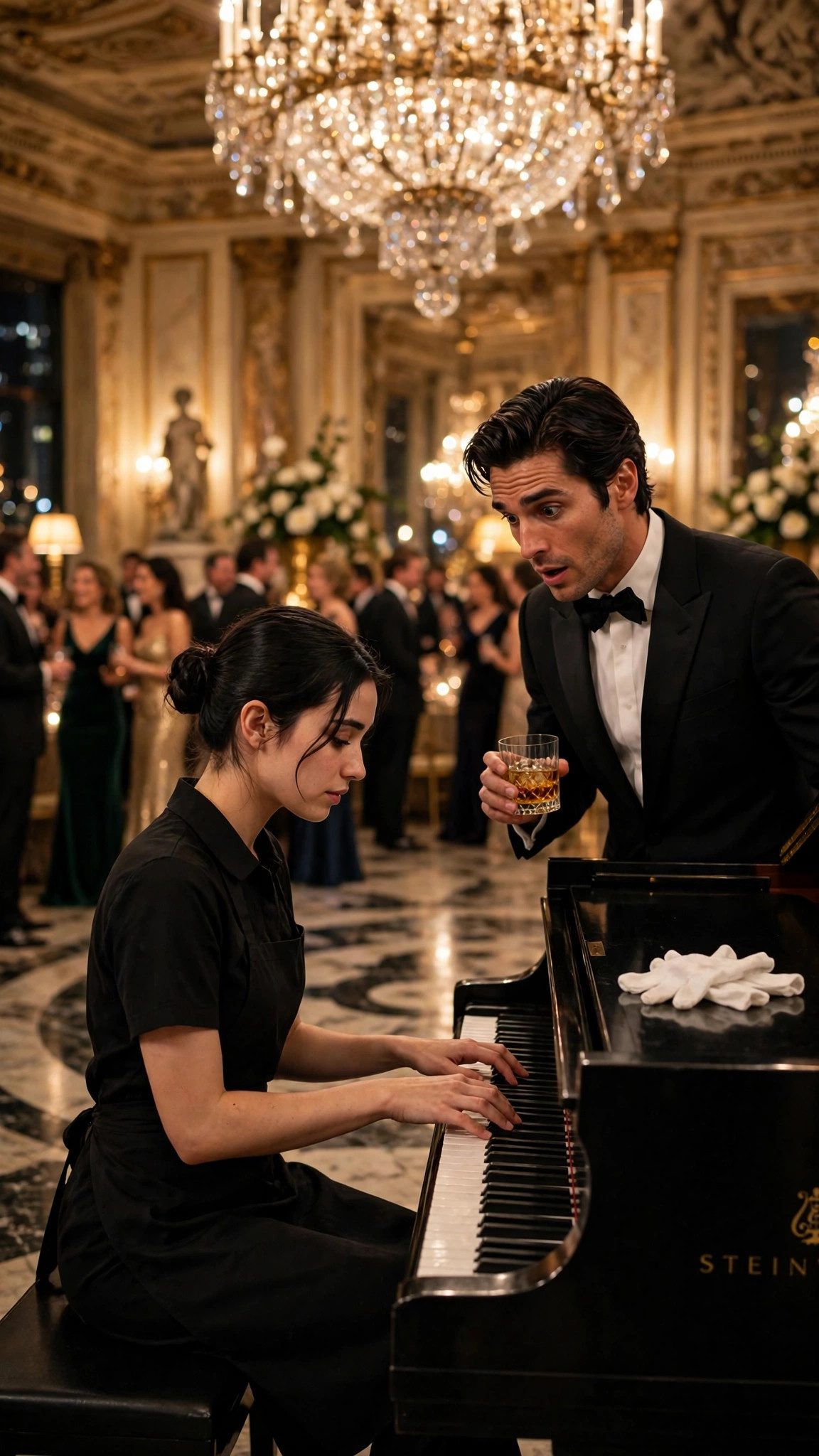
    I was sitting at a nine-foot black Steinway grand piano beneath an enormous crystal chandelier, wearing a plain black housekeeping uniform with my white gloves folded neatly beside my tray, and I was playing Rachmaninoff's Second Piano Concerto from memory. I had not touched a piano in almost two years. My hands remembered anyway.

    Five minutes earlier, Dominic Vale — the most feared man in Chicago — had stood near the center of the ballroom with a whiskey glass in one hand and amusement glinting in his dark eyes, and he had laughed and declared, "Any woman who can play that concerto perfectly, I'll marry," never imagining that the quiet maid carrying champagne behind him would be the one to sit down at the piano.

    But I am getting ahead of myself. The night did not begin at the piano. It began at six in the morning, the way every gala night at Hawthorne Estate begins: with me already tired.

    I had been working since six that morning, and by the time the black cars started rolling through the iron gates at seven in the evening, my feet ached inside my sensible shoes and my hair had begun to escape from its neat low bun in small dark wisps that no amount of pins would hold.

    "Table twelve needs new glasses," my supervisor called across the service corridor, not looking up from her clipboard.

    "I'm going," I said.

    "The flowers by the east staircase need water."

    "I'll handle it."

    My friend Nora Briggs appeared beside me carrying a stack of folded napkins, her round face flushed from the heat of the kitchen. "You know what I admire about rich people?" she asked.

    "What?"

    "They suffer bravely." She nodded solemnly toward the ballroom, where a woman in a diamond necklace was already complaining that her champagne was not cold enough. "Look at her. All that money, and still she suffers."

    I nearly laughed. "Please don't get fired tonight."

    "Me?" Nora pressed a hand to her chest in mock innocence. "I am the soul of discretion. I only think these things. I never say them out loud. Mostly."

    For three years, Hawthorne Estate had been my workplace. The salary was decent, the medical benefits had helped during the final year of my father's life, and the staff housing had saved me when hospital bills nearly emptied everything I had. I was never ashamed of honest work. Other people, however, sometimes seemed determined to make me feel that I should be.

    The evening had begun like every charity gala at Hawthorne Estate — black cars rolling through iron gates, couture gowns brushing marble floors, diamonds flashing beneath chandeliers, and wealthy guests discussing acquisitions and elections while pretending the fundraiser was the reason they had come. The ballroom smelled of white lilies and expensive perfume and polished wood. Waiters in black moved between the tables like shadows. Somewhere in the kitchen, a chef was shouting in French.

    I carried my tray through the crowd, refilling glasses, clearing empty plates, smiling politely at people who looked straight through me. It was a skill I had learned in my first month at Hawthorne: how to be invisible while standing in the middle of a room. Rich people are very good at not seeing the people who serve them. I had come to find it restful. Nobody expected anything from a woman they did not see.

    Then Caroline Whitmore approached while I arranged champagne glasses on a side table.

    Beautiful, polished, and born into one of Chicago's oldest real-estate families, she had spent the previous year appearing beside Dominic Vale often enough for society magazines to predict an engagement. Her blonde hair was swept into a perfect chignon. Her gown was the color of champagne, and it probably cost more than I earned in a year. She stopped beside my table, and her gaze traveled slowly over my uniform, from my plain black collar to my sensible shoes, the way a person might look at a stain on a tablecloth.

    "Is that really what they make you wear?" she asked, in a voice just loud enough for her two friends to hear.

    "Yes, ma'am," I said.

    She gave her friends a knowing smile. "They could at least choose something more elegant."

    I met her eyes calmly. "It's comfortable."

    Her smile tightened, because humiliation only works when the other person agrees to be embarrassed. She turned away, her friends trailing after her in a rustle of silk, and I went back to the champagne glasses.

    After she walked away, Nora whispered, "I would've spilled champagne on her."

    "That's why they don't give you the expensive bottles," I said, and we laughed, but my attention drifted toward the piano.

    The Steinway had arrived that afternoon, polished until the chandelier shimmered across its black surface like stars. It stood at the far end of the ballroom, its lid raised, waiting. My chest tightened. I had not touched a piano in almost two years. Music carried too many memories, and I had packed those memories away the way you pack away a dead person's clothes — carefully, and with the lid shut tight.

    But my eyes kept going back to it. The keys gleamed, white and black, patient as always. Pianos never judge you for staying away. They only wait.

    I tried to keep serving drinks. I carried a tray of champagne toward table twelve, and that was when Dominic Vale stood up from his chair near the center of the ballroom and raised his whiskey glass, and the room quieted the way rooms always quieted for him.

    At thirty-six, his name alone could silence businessmen, politicians, and men whose careers depended on never disappointing the Vale family. He was tall, with a sharp, handsome face and dark hair swept back from his forehead, and he wore a black tuxedo with a bow tie that sat perfectly straight, as if it were afraid to be crooked around him. He smiled — the slow, amused smile of a man who owned the room and knew it.

    "Friends," he said, and his deep voice carried easily across the marble floor. "Before we get to the boring part of the evening — the part where I ask you for money — I have a proposition."

    A ripple of laughter moved through the guests.

    "That piano," Dominic said, nodding toward the Steinway, "cost more than most of your cars. And it is sitting there, silent, which offends me. So here is my offer." He looked around the room, his eyes bright with mischief. "If any woman here can play that concerto from beginning to end without a single mistake, I'll marry her."

    The ballroom exploded with laughter. Women in diamonds giggled behind their hands. Men slapped each other's shoulders. Someone shouted, "Careful, Dominic, they'll all line up!" Someone else shouted, "Does it have to be the whole thing?"

    "No shortcuts," Dominic said, grinning. "Beginning to end. Not one mistake. That is the price of my hand in marriage, ladies. A bargain, I assure you."

    No one expected anyone to accept. The evening's entertainment had begun, and the wealthy guests began daring one another toward the piano, laughing, pointing, nudging their wives and daughters forward while everyone pretended they were joking and nobody was actually going to do it.

    I tried to keep serving drinks. I turned back toward the bar with my tray, focusing on the glasses, on the ice, on anything except the piano.

    Then Caroline noticed me staring. She had been watching me the way a cat watches a bird that has not yet realized the door is closed, and she smiled — the slow, deliberate smile of a woman who has found a new way to be cruel in public.

    "Why don't you try, Elena?" she said, her voice carrying sweetly across the sudden hush.

    The laughter started before I even moved.

    It rolled through the ballroom in waves. A woman near the front laughed so hard she had to hold her necklace. A man in a gray suit pointed at me and said something to his wife that made her cover her mouth. Four hundred people were laughing at the idea of the maid sitting at the piano, and I stood there with my tray in my hands, feeling every eye in the room turn toward me like a spotlight swinging across a stage.

    I should have shaken my head. I should have smiled politely and said, "No, thank you, ma'am," and gone back to my champagne glasses, and the night would have gone on exactly as it was supposed to go on, with me invisible and safe.

    But something in me — something I had buried two years ago beside my father's grave — stirred and sat up and refused to lie back down.

    Slowly, I removed my white gloves. I placed them beside my tray on the side table, one on top of the other, neat as always. Then I walked toward the Steinway.

    The laughter followed me, thinning as I crossed the marble floor. My shoes made almost no sound. The guests parted for me the way water parts for a stone, and I could feel their eyes on my back, on my plain black uniform, on my hair pulled into its neat low bun. I heard a woman whisper, "Is she actually going to—" and a man answer, "Let her. It will be funny."

    Dominic's amused expression followed me all the way to the bench. He stood a few feet from the piano, whiskey glass in one hand, watching me with the indulgent smile of a man watching a child attempt something far beyond her. He did not stop me. He was curious, I think. Or perhaps he simply could not imagine that the maid carrying his champagne knew what a piano was.

    Then I sat down.

    The bench was cool beneath me. The keys were smooth and familiar under my fingertips, and for one dizzying second I was seven years old again, sitting on my father's lap in a church basement while he tuned an old upright, my small legs dangling, my hands reaching for the keys he had just made sing.

    My fingers touched the keys. And before I played the tenth note, Dominic Vale's smile disappeared.

    The opening of Rachmaninoff's Second Piano Concerto is not loud. It begins with eight quiet chords, like waves gathering far out at sea, each one a little stronger than the last, until the orchestra — or in this case, the memory of the orchestra in my head — rises to meet it. I played those chords the way my father taught me: slowly, honestly, with the weight of the whole arm behind each one, not just the fingers. The notes filled the ballroom and climbed toward the chandelier, and the room went still.

    I did not look up. I did not need to. I could feel the silence gathering around me like a held breath. Somewhere behind me, a glass stopped clinking. Somewhere to my left, a woman whispered, "Oh, my God," and someone shushed her.

    The melody came then — the great, aching theme that every pianist knows and very few can truly play — and my hands moved across the keys the way they had moved a thousand times in practice rooms and church balconies and backstage corridors, the way they had moved when I was twelve and my father stood behind me with his hands on my shoulders and said, "There. That is the sound, Elena. That is what it is supposed to sound like."

    I played on. The tenth note passed, and the eleventh, and the twelfth, and the ballroom did not breathe.

    My hands were not thinking anymore. They were remembering — the way they had remembered in the church balcony when I was twelve, listening to the orchestra below and storing every note in a place behind my ribs. I could feel my father's hands on my shoulders, the way he used to stand behind me while I practiced, his fingers tapping lightly against my collarbone whenever I rushed a passage. "Slow down, Elena," he would say. "The music is not running away from you. It will wait. It always waits for the person who respects it."

    I respected it now. I let each chord breathe before I reached for the next one. I let the melody unfold the way a flower unfolds in the morning, slowly, without being forced. The piano responded the way a good piano always responds to a player who listens — it sang. The Steinway had been silent all evening, polished and waiting, and now it was awake, and its voice filled every corner of the ballroom, climbing the marble walls and ringing in the crystal chandelier above my head.

    Somewhere behind me, I heard a chair scrape softly against the floor, and then nothing. Somewhere to my right, a man cleared his throat and then stopped, as if he had caught himself in the middle of a thought and decided it was not worth finishing. The air in the ballroom had changed. It was no longer the air of a party. It was the air of a concert hall, thick with attention, and I could feel four hundred strangers leaning toward me without moving, the way people lean toward a fire on a cold night. Dominic Vale stood inches from the piano with his whiskey glass forgotten in his hand, and his smile was gone, and in its place was something I had never seen on his face before.

    Shock.

    And beneath the shock, something else. Something that looked almost like fear.

    I played on, and the music rose, and somewhere in the back of my mind, past the notes and the memory of my father's hands, a small, clear voice said: He made a promise. In front of four hundred people, he made a promise. And he has no idea what he has just done.

  • Chapter 4: What the Boy Saw

    Chapter 4: What the Boy Saw

    Oliver's words came back the way spring comes back after a hard winter — slowly, and then all at once.

    In the days after the gala, he spoke in single words, carefully chosen, as if each one cost him something. "Emma." "Blocks." "Hungry." "Cold." Then two words together. "More juice." "Stay here." "Sing again." Then, on the fourth morning, a whole sentence, spoken to Emma while she was braiding his hair before breakfast, in a voice so small she had to lean close to hear it.

    "The man in the dark coat hurt Mommy."

    Emma went very still. Her hands stopped in his hair. "What did you say, Oliver?"

    He looked up at her with those wide dark eyes, and his small face was serious in a way no six-year-old's face should ever be serious. "The man in the dark coat," he said again, slowly, as if he were reading the words off a wall inside his head. "He came when the rain was loud. He touched Mommy's tube. Mommy cried. Then Mommy went quiet. Then I screamed. Then I could not talk anymore."

    Emma's heart was beating so hard she was certain he could hear it. She kept her voice steady, the way her mother had taught her to speak to frightened things.

    "Oliver," she said gently, "did the man in the dark coat hurt your mommy on purpose?"

    Oliver nodded, once, and then he climbed into her lap and buried his face against her shoulder, and he did not speak again for the rest of the morning.

    Emma did not tell Preston right away. She sat with the words all afternoon, turning them over in her mind, trying to decide whether a six-year-old boy who had not spoken in two years could be trusted to remember what he had seen on the worst night of his life. But she knew, in the way she had known the song, that he was telling the truth. Children do not invent men in dark coats. They do not invent tubes being touched. And the fear in Oliver's eyes when he said it was not the fear of a bad dream. It was the fear of a memory.

    That evening, after Oliver was asleep, she went to Preston's study and knocked, and when he told her to enter, she stood in the doorway with her hands folded and told him exactly what Oliver had said, word for word, without adding anything and without leaving anything out.

    Preston listened without moving. His face did not change. His hands, resting on the desk, did not clench. Only his eyes changed, going very dark and very still, the way the sky goes dark before a storm.

    "Say it again," he said quietly. "Every word."

    She said it again.

    "When did he tell you this?" Preston asked.

    "This morning. While I was braiding his hair."

    "And you are certain he said 'touched Mommy's tube'? Not 'held Mommy's hand'? Not 'gave Mommy medicine'?"

    "I am certain," Emma said. "He said 'touched Mommy's tube.' And he said she cried. And then she went quiet."

    Preston stood up slowly and walked to the window, and stood there for a long time with his back to her, looking out at the dark gardens, and Emma waited, because she had learned that when Preston Hale went quiet, it was better to wait than to speak.

    "Serena died of heart failure," he said at last, his voice flat. "That is what the death certificate says. That is what the doctors told me. Her heart stopped in the night, and the machines sounded the alarm, and by the time the nurses reached her, she was gone. I was holding her hand. Oliver was standing beside the bed. That is what I remember. That is what I have believed for two years."

    "Oliver remembers something else," Emma said.

    "Oliver remembers a man in a dark coat," Preston said. "A man I did not see. A man no nurse reported. A man who may not exist."

    "Or a man who was supposed to be invisible," Emma said, and immediately wished she had not spoken, because Preston turned around, and his eyes were on her face, and she could see him weighing her words the way he weighed everything, looking for the threat inside them.

    "Do you know what you are saying?" he asked.

    "I know what Oliver said," Emma answered. "That is all I know."

    Preston nodded slowly. "Then we will find out what Oliver saw. Quietly. No one in this house is to know. Not Marcus. Not the staff. Not Vivian Castellano, and especially not her father. Do you understand?"

    "I understand."

    "Good," Preston said. "Because if someone killed my wife, and my son has been carrying that knowledge inside him for two years, unable to speak it, then the man who did it has been walking free while my boy suffered in silence. And I intend to find him. Whatever it takes."

    The next morning, Preston drove alone to St. Catherine's Hospital, where Serena had died, and asked to see the records from that night. The administrator, a nervous man with a thin mustache, brought him a file and a cup of coffee he did not drink, and Preston sat in a small windowless office and read every page, twice.

    The records were clean. Too clean, he thought, though he could not have said why. Serena's vital signs, recorded every fifteen minutes through the night. Her medication schedule, signed and initialed. The IV drip, a standard saline and pain medication mix, checked at midnight and again at two in the morning. The alarm at 2:47 a.m., when her heart stopped. The resuscitation attempt, forty-one minutes, unsuccessful. The time of death, 3:28 a.m.

    But there was a gap. Between 2:00 a.m. and 2:47 a.m., no one had recorded anything at all. No nurse's note. No vital signs. No check of the IV. Forty-seven minutes of nothing, in a hospital where everything was supposed to be recorded.

    "Who was on duty that night?" Preston asked the administrator.

    The administrator flipped through the file, his fingers damp. "Nurse Alvarez," he said. "Maria Alvarez. She worked the night shift on the oncology floor for six years. She left the hospital about a year ago. Moved to Florida, I believe."

    "And who else was in the room?" Preston asked. "Visitors? Family? Anyone?"

    "Only you and the boy, Mr. Hale. That is what the visitor log says."

    Preston thanked the administrator and drove home through the rain, and all the way home he thought about the gap. Forty-seven minutes. Long enough for a man in a dark coat to walk into a hospital room, touch an IV line, and walk out again. Long enough for a little boy to see it happen and scream, and then never speak again.

    That afternoon, he called a man he had not called in years. Daniel Reyes, an FBI agent he had known since they were both young men on opposite sides of a line that had blurred a long time ago. Reyes had investigated the Hale family twice and found nothing he could prove, and Preston had respected him for it, the way you respect an honest enemy.

    "I need a favor," Preston said, when Reyes answered. "And I need it quiet."

    "Preston Hale needs a favor from the FBI," Reyes said. "This should be interesting."

    "My wife died two years ago," Preston said. "I believed it was her illness. My son has just started speaking again, after two years of silence, and the first thing he told me is that a man in a dark coat touched his mother's IV line the night she died. I need to know if someone killed her. And if they did, I need to know who."

    There was a long silence on the other end of the line. Then Reyes said, "Give me forty-eight hours. And Preston — do not do anything stupid. If someone in your house killed your wife, the worst thing you can do is let them know you are looking."

    "I understand," Preston said.

    But he did not entirely understand, because that evening, when he went to check on Oliver, he found Marcus Hale sitting in the nursery, reading to the boy from a picture book, and Oliver was sitting stiffly in his chair, his hands folded in his lap, his eyes fixed on the page, and the moment Marcus saw Preston in the doorway, he closed the book and smiled.

    "He is doing so well," Marcus said. "Speaking more every day. It is a miracle, Preston. Truly."

    "Yes," Preston said. "It is."

    He watched his uncle leave the nursery, and he watched the way Oliver relaxed the moment the door closed behind him, his small shoulders dropping, his breath coming out in a long sigh, and Preston thought about the photograph of two girls in gray dresses, and about the gray car on the road outside his estate, and about the way Marcus had looked when Emma told her story — not surprised, but afraid.

    And he thought about something else, too. Something he had not allowed himself to think about for two years. Serena had been getting better in the last month before she died. The doctors had said so. Her numbers were improving. She had talked about coming home for Christmas. She had asked Preston to bring Oliver to the hospital so she could read him a story. And then, on a rainy night in November, her heart had simply stopped, and no one had recorded anything at all for forty-seven minutes.

    Preston Hale had built his life on noticing the things other men missed. And now, for the first time in two years, he was paying attention to his own house. And what he saw there frightened him more than anything Vincent Castellano had ever done.

    Reyes called again the next evening, with more.

    "Alvarez told me something else," he said. "After she left the hospital, a man called her home. He knew her daughter's name. He knew the school her daughter attended. He told her that if she ever spoke about that night, her daughter would pay for it. She packed a bag that same night and drove to Arizona, and she has been looking over her shoulder ever since. She is willing to testify now, Preston, because her daughter is grown and safe, and because she says she has carried this for two years and she cannot carry it any longer. But I want you to understand what kind of men we are dealing with. These are not men who make mistakes. These are men who plan."

    Preston thanked him and put the phone down, and then he called Frank Doyle into his study, and asked him a question he had never asked before.

    "Frank," he said, "has my uncle been leaving the estate at night?"

    Doyle hesitated, and Preston saw the hesitation, and his stomach went cold.

    "Twice a week, Mr. Hale," Doyle said quietly. "For the last three years. He leaves after midnight, through the boathouse gate, and he comes back before dawn. I reported it to you twice, in writing, in my monthly reports. I assumed you had read them."

    Preston had not read them. He had signed them without reading them, the way he signed a hundred papers a week, trusting the men around him to tell him what mattered. He thought about that for a long time after Doyle left — about how a man can be blind in his own house, about how trust, given to the wrong person, becomes a weapon.

    The next afternoon, Emma sat with Oliver at the nursery table while he drew. He was working on a lighthouse, as always, but this time there was something new in the picture: a tall figure standing beside the lighthouse, wearing a dark coat, with a small yellow circle on one finger.

    "Who is that, Oliver?" Emma asked, keeping her voice light.

    Oliver did not look up from his crayons. "The man," he said. "The man in the dark coat. He had a shiny ring. Like Uncle Marcus's ring."

    Emma's hand went still on the table. She looked at the drawing, at the small yellow circle, and she thought about the heavy gold ring Marcus always wore, the one with the dark stone, and she felt a chill run down her spine that had nothing to do with the weather.

    "Did the man say anything to you, Oliver?" she asked softly.

    Oliver shook his head. "He did not see me. I was behind the curtain. Mommy saw him. Mommy tried to push the button, the red button, but he held her hand down. Then Mommy cried. Then the machines went quiet."

    Emma gathered him into her lap and held him while he drew, and she did not cry, though she wanted to, because she knew that every word he spoke was a piece of evidence, and that the man with the shiny ring had no idea his victim's six-year-old son had been watching from behind a curtain all along.

    The following morning, Preston drove to the hospital a second time, and this time he asked to see the visitor log from the night Serena died. The administrator brought it reluctantly, a thick leather book with pages full of names and times, and Preston ran his finger down the entries for that November night, looking for anything out of place. Most of the names were nurses and doctors. A few were family members. And then, at 1:52 a.m., there was an entry in a different handwriting, hurried and slanted, that read simply: "M. Hale. Family." No first name. No badge number. No checkout time.

    Preston stared at the entry for a long time. His uncle had been at the hospital that night. Marcus had never told him. In two years, through all the grief and all the questions, Marcus had never once mentioned that he had visited Serena on the night she died. And the visitor log said he had arrived at 1:52 a.m., eight minutes before the gap in the records began.

    He closed the log gently, and thanked the administrator, and drove home through the rain, and all the way home he thought about his uncle's handwriting, hurried and slanted, and about the eight minutes between 1:52 and 2:00, and about how a man can hide in plain sight for two years, in his own nephew's house, wearing a ring with a dark stone.

  • Chapter 3: The Song No One Else Knew

    Chapter 3: The Song No One Else Knew

    The morning after the gala, the Lake Forest estate woke up to a storm that had nothing to do with the weather.

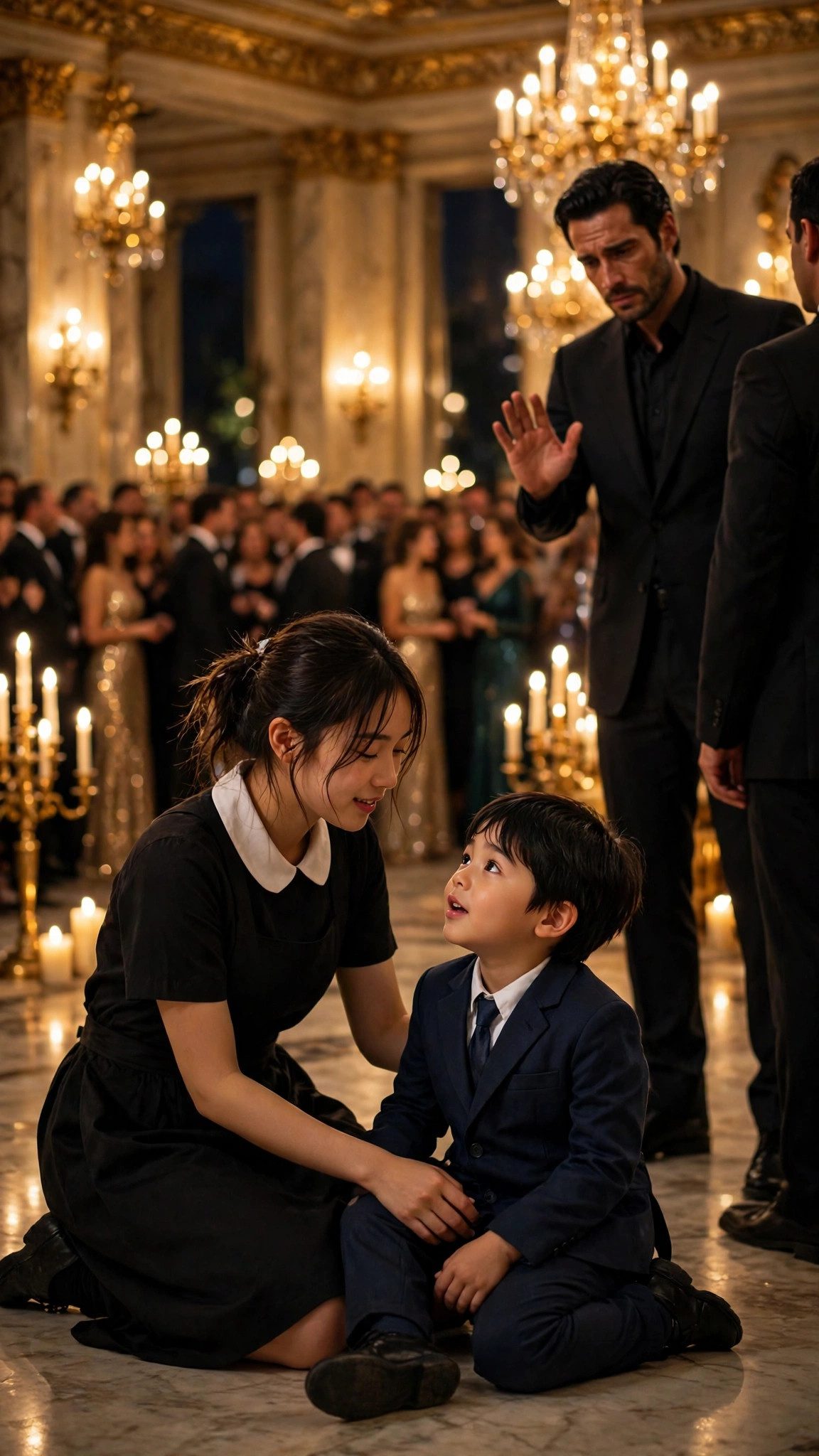
    By seven o'clock, three newspapers had already called. By eight, the story was on the local television news, and by nine, a gossip website had posted a photograph of Emma kneeling beside Oliver beneath the chandeliers, with a headline that read: "MAFIA BOSS OFFERS MARRIAGE TO MAID WHO MADE HIS SILENT SON SPEAK." Mrs. Delaney found Emma in the kitchen before the staff meeting, her face pale, and pressed a cup of tea into her hands with fingers that trembled.

    "Mr. Hale wants to see you in his study at ten," she said. "And child — whatever you do, do not lie to him. He will know. He always knows."

    Emma spent the hours until ten o'clock cleaning the music room, because her hands needed something to do. She dusted the closed piano, and she thought about the night before, and about the way Oliver had leaned against her shoulder while the orchestra played, humming the lighthouse song under his breath, and about the way Preston Hale had looked at her when she told him the song came from her mother. He had not believed her. She could see it in his face. He believed in threats and bribes and leverage, and a maid who knew his dead wife's song did not fit into any of those categories. A thing that did not fit was a thing he could not control, and Preston Hale was a man who controlled everything.

    At ten o'clock, she knocked on the study door, and his voice told her to enter, and she stepped into a room lined with books and smelling of leather and cigar smoke, and found Preston Hale standing by the window with his back to her, and Marcus Hale sitting in a leather chair by the fireplace, watching her the way a cat watches a bird that has flown into the wrong room.

    "Close the door," Preston said, without turning around.

    Emma closed it.

    "My uncle tells me," Preston said, still facing the window, "that you are a plant. That Vincent Castellano sent you here to get close to my son. That the song is a trick, something his people learned from one of my own staff, and that you were coached to sing it at exactly the right moment, in front of exactly the right audience."

    Emma's hands went cold. "That is not true."

    "My uncle also tells me," Preston went on, "that you have been seen talking to a man in a gray car on the road outside the estate. Twice. And that the man matches the description of one of Castellano's drivers."

    "I have never spoken to anyone in a gray car," Emma said, and her voice shook, but she did not look away. "I do not know anyone named Castellano. I came here because my mother told me to come. Because she said this house was kind once, and because I had nowhere else to go."

    Preston turned around then, and his eyes were dark and tired, and Emma saw for the first time that the most feared man in Chicago looked like a man who had not slept properly in two years.

    "Your mother," he said. "Tell me about your mother."

    So Emma told him. She told him about Grace Carter, and the apartment on the South Side, and the sewing machine, and the song. She told him about St. Agnes Home for Girls, and the narrow bed, and the girl named Serena who had promised never to forget her friend. She told him about the Christmas cards with no return address, and the money folded inside them, and the words her mother had spoken on her deathbed. She told him everything, because Mrs. Delaney had told her not to lie, and because she had nothing else to offer a man who owned everything except the one thing he wanted.

    When she finished, the study was silent for a long time. Marcus shifted in his chair, and the leather creaked, and Preston walked to his desk and opened a drawer, and took out a small silver frame, and held it out to Emma. Inside it was a photograph of two girls in matching gray dresses, standing in front of a brick building, their arms around each other's shoulders, laughing at something outside the frame. One of them was Serena. The other, Emma knew without being told, was her mother.

    "Serena kept this in her dressing room," Preston said quietly. "I found it after she died. I asked her about it once, years ago, and she only said, 'She was my sister before I had a sister.' I never understood what she meant. I thought it was a figure of speech."

    "It was not," Emma said. "They were foster sisters. They promised each other they would never forget."

    Preston looked at the photograph for a long moment, and then he looked at Emma, and something in his face changed, the way a door changes when a key finally turns.

    "My son spoke to you," he said. "He has not spoken to anyone in two years, and he spoke to you. I do not care what my uncle thinks. I do not care what Castellano thinks. I made an offer in front of four hundred witnesses, and I am a man who keeps his word. But I will not force a marriage on a woman who does not want it. So I am asking you, Emma Carter, and I am asking you plainly. Will you stay in this house? Will you help my son? And will you consider, in time, what I offered last night?"

    Before Emma could answer, there was a knock at the study door, and a guard opened it without waiting, his face tight with urgency.

    "Mr. Hale," he said. "Miss Vivian Castellano is here. She says she has an appointment. She says her father sent her."

    Preston's jaw tightened. "Show her to the drawing room. I will be there in five minutes."

    When the guard had gone, Marcus rose from his chair and walked to Preston's side, his voice dropping to a murmur that Emma was not meant to hear, though she heard every word.

    "Vincent is moving fast," Marcus said. "Vivian will claim she can help the boy. She will offer tutors, doctors, anything. Do not let her near Oliver. And Preston — do not let the maid near him alone, either. Not until we know who she really is."

    "She is the woman who made my son speak," Preston said. "That is who she is. That is all I need to know."

    Marcus's mouth tightened, and for a moment something crossed his face that Emma could not read — not anger, exactly, but something colder. Fear. The look of a man who has just realized that a door he thought was locked has been standing open all along.

    "I am only trying to protect this family," Marcus said.

    "Then protect it," Preston said. "Starting with my son."

    In the drawing room, Vivian Castellano waited beneath a portrait of Preston's grandfather, her blonde hair arranged in a perfect wave, her diamonds catching the morning light. She was beautiful in the way expensive things are beautiful, and she smiled when Preston entered as if they were old friends, and she did not look at Emma at all, which was its own kind of message.

    "Preston," she said, "I was so moved last night. Truly. Your boy speaking again — it was the most beautiful thing I have ever seen. And I came because I want to help. My father has connections to a children's hospital in Geneva. The finest specialists in Europe. If you will let me, I can have Oliver seen within the week."

    "My son has already been seen by the finest specialists in Europe," Preston said. "He spoke to a maid."

    "Yes," Vivian said, and her smile did not waver, though something behind it went very still. "The maid. I have been asking about her. No one seems to know very much. A girl from the South Side, no family, no references before this house. It is strange, is it not? A girl like that, knowing a song like that. One wonders who taught it to her. One wonders what they wanted in return."

    "She told me who taught it to her," Preston said. "Her mother. Her mother's friend was my wife."

    "How convenient," Vivian said softly. "A dead mother. A dead wife. A story no one alive can confirm."

    Emma felt the words like a slap, and she opened her mouth to answer, but Preston spoke first, and his voice was very quiet, the way it got when he was most dangerous.

    "My wife is dead," he said. "My son was silent for two years. Last night he spoke. You will not stand in my house and call the woman who gave him his voice a liar. You will leave now, and you will tell your father that if he wants to discuss the Hale family, he can discuss it with me, in person, the way men do."

    Vivian's smile finally broke, and for a moment Emma saw what was underneath it — not kindness, not concern, but calculation, and something else, something hungry.

    "My father only wants what is best for this family," Vivian said, rising from her chair. "We have been allies for a long time, Preston. It would be a shame to throw that away over a maid."

    "Then it is a shame," Preston said, and he opened the drawing room door himself, and Vivian walked out with her head high, and Emma watched her go, and felt, for the first time since she had come to this house, truly afraid.

    That afternoon, Oliver spoke his second word.

    Emma was sitting with him in the nursery, helping him build a tower of wooden blocks, when he looked up at her and said, very clearly, "Emma."

    She froze, a block halfway to the top of the tower, and Oliver smiled at her, a real smile, the first she had ever seen on his face, and he said it again, as if he were trying the sound out, rolling it around in his mouth like a sweet.

    "Emma."

    She did not cry. She wanted to, but she did not, because she knew that if she cried he might close again, and so she only smiled back at him and said, "Yes, Oliver. I am Emma. And you are Oliver. And you are talking."

    He nodded, solemn as a judge, and went back to his blocks, and Emma sat beside him with her heart pounding, and thought about the narrow bed at St. Agnes, and about two girls who had promised never to forget each other, and about how a promise made by children could reach across thirty years and two deaths and open the mouth of a silent little boy.

    Upstairs, in his study, Preston Hale stood at the window and watched the gray car that had been parked on the road outside his estate all morning finally pull away, and he thought about the man his uncle had described, and about the photograph of two girls in gray dresses, and about the way Marcus had looked when Emma told her story — not surprised, but afraid. And Preston Hale, who had built his life on noticing the things other men missed, began, for the first time in two years, to pay attention to his own house.

    The morning after Vivian's visit, Preston called his head of security, a broad, quiet man named Frank Doyle, into his study, and asked him about the gray car.

    "Rented," Doyle said, consulting a small notebook. "Cash. False name. Returned to the agency yesterday afternoon, wiped clean. Whoever drove it knew what he was doing."

    "And the man Emma was supposed to have spoken to?" Preston asked.

    "There is no record of her speaking to anyone, Mr. Hale. The gate cameras show her leaving the estate twice in eleven months, both times to buy shoes at the village shop. She spoke to no one. My men watched the road for a week after your uncle raised it. Nothing."

    Preston nodded slowly. "Keep watching the road. And keep watching the house. I want to know who comes and goes, and when, and I want to know it before they do it, not after."

    Doyle left, and Preston sat alone in his study, thinking about the way his uncle had described the gray car with such confidence, such precise detail, as if he had rehearsed it. A man who invents a gray car is a man who needs you to look at the road outside your house, instead of looking inside it.

    At breakfast that morning, Oliver spoke his first full sentence.

    Emma was pouring orange juice when he looked up from his plate of pancakes and said, very clearly, "Emma, can I have more pancakes, please?"

    The kitchen went silent. Mrs. Delaney dropped a spoon. A young maid by the stove put her hand over her mouth. Emma stood frozen with the juice jug in her hand, and Preston, who had been reading the newspaper at the head of the table, lowered it slowly, and stared at his son as if he had just performed a miracle in front of him.

    "Of course you can," Emma said, and her voice was steady, though her hands were shaking as she put two more pancakes on his plate. "Of course you can have more pancakes, Oliver."

    Oliver smiled at her, syrup on his chin, and went back to eating, as if he had not just done the most extraordinary thing in the world. And Preston Hale, the most feared man in Chicago, sat at his breakfast table with tears running down his face, and did not bother to wipe them away, because for the first time in two years, his son had asked for something, and the world had answered.

    That same week, Preston's uncle Marcus came to the study with a folder of Foundation papers and a proposal he had clearly rehearsed. A new donor, he said. A man from New York, very wealthy, very discreet, who wanted to give a large sum to the Foundation in exchange for a seat on the board. Preston listened to the proposal without interrupting, and when Marcus had finished, he said, very quietly, "No."

    Marcus blinked. "Preston, this man is offering two million dollars."

    "Then he can offer it to someone else," Preston said. "The Foundation does not need new friends. It needs honest ones."

    Marcus left the study with his folder under his arm, and Preston watched him go, and thought about the way his uncle had described the donor — wealthy, discreet, no name given — and about the way Marcus had not mentioned the donor's name even once. A man who will not name his friend is a man who is afraid of the name.

  • Chapter 2: The Maid in the Black Uniform

    Chapter 2: The Maid in the Black Uniform

    Emma Carter had learned the lighthouse song before she learned to read.

    She was four years old the first time her mother sang it to her, in a kitchen so small the two of them could barely turn around without bumping elbows. The apartment was on the third floor of a brick building on the South Side, where the radiators clanked all winter and the windows rattled whenever a truck went past, and the song was the one beautiful thing in it. Her mother, Grace, would lift her onto the counter while the soup simmered, and sing in a low, sweet voice about a little sailor and a lighthouse that kept its light burning through every storm, and Emma would fall asleep with her cheek against her mother's shoulder, safe in a way she would spend the rest of her life trying to find again.

    "Sleep, my little sailor," her mother sang, "the lighthouse keeps the light. Sleep, my little sailor, and I will keep you through the night."

    Grace Carter had learned the song at St. Agnes Home for Girls, where she grew up after her own parents died. The woman who ran the home, Mrs. Delaney, sang it to every frightened little girl who arrived with a suitcase and no one left in the world. It was not a famous song. It was not on the radio. It belonged to that one drafty old house and the girls who had slept under its roof, and Grace carried it with her the way other people carried photographs.

    At St. Agnes, Grace had shared a narrow bed with another girl, a thin, serious child with dark hair and a laugh that could fill a whole room. Her name was Serena. Serena Whitfield, who had lost her parents in a car accident and who talked, even at twelve years old, about the family she would build one day, the children she would have, the charity she would start for children who carried grief the way she carried it, quietly and everywhere.

    The two girls made a promise in that narrow bed, the way children do, with their pinkies linked and their voices hushed so Mrs. Delaney would not hear. Whoever got out first, whoever built a good life first, would come back for the other. They would never forget each other. They would never forget the song.

    Serena got out first. She was adopted at fourteen by a kind couple from Lake Forest, and she went to college, and she married a young man named Preston Hale, and she built the life she had dreamed about in that narrow bed. Grace got out at sixteen, into a job as a seamstress, and then into a marriage that did not last, and then into a small apartment on the South Side with a daughter named Emma and a sewing machine that never stopped.

    But the promise held. Serena never forgot Grace. Every Christmas, a card arrived with no return address, and inside it there was always money, folded carefully, and a short note in Serena's neat handwriting. "For Emma's shoes." "For Emma's school books." "For the winter coat." Grace never told Emma where the money came from. She only said, "We have a friend. A good friend. And one day, if you ever need help, you go to the big house in Lake Forest, and you tell them Grace Carter sent you."

    Emma was twenty-five when her mother died. It was fast and unfair, the way some illnesses are — a cough that would not go away, a doctor's face going still, a word Emma had never wanted to hear. Grace spent her last month in a hospital bed by a window, and Emma sat beside her every day, holding her hand, and Grace sang the lighthouse song to her daughter one final time, her voice so thin it was barely more than breath.

    "Go to the big house," Grace whispered, when she could still speak. "The Hales. Serena is gone now, I know that. I read it in the paper. But her husband is a good man underneath the fear. He has a little boy who does not speak. You will know what to do. You always knew the song better than I did."

    Emma did not understand what her mother meant. Not then. She only knew that after the funeral, after the small apartment was emptied and the sewing machine was sold and the bills were paid, she had nowhere to go and no one left in the world except a name and an address. So she put on her plainest black dress, the one she wore to the funeral, and she took a bus to Lake Forest, and she walked up the long driveway to the biggest house she had ever seen, and she asked the housekeeper for work.

    The housekeeper was a woman named Mrs. Delaney — no relation to the Mrs. Delaney of St. Agnes, though Emma thought about the coincidence for a long time afterward, the way the world sometimes folds back on itself. This Mrs. Delaney looked Emma up and down, at her cheap shoes and her plain dress and her hands, which were red from scrubbing, and said, "We need a girl for the upstairs rooms. The pay is fair. The rules are simple. You do not speak to Mr. Hale unless he speaks to you. You do not enter the boy's rooms. You do not ask questions about the family."

    "I understand," Emma said.

    She understood the rules. What she did not understand, not for a long time, was that the house itself was grieving. The Lake Forest estate was beautiful in the way only very expensive things can be beautiful — marble floors, gold chandeliers, gardens that stretched farther than Emma could see — and it was also the saddest place she had ever worked. The curtains were always half-drawn. The grand piano in the music room sat closed and silent, its keys covered. The nursery at the top of the stairs had a small bed that was always made and never slept in, because Oliver slept in a narrow cot in his father's dressing room, close enough to hear Preston breathing at night.

    Emma cleaned the upstairs rooms six days a week. She dusted the portrait of Serena Hale in the hallway, a woman with dark hair and a laugh in her eyes, and she thought about her mother's friend, the girl from the narrow bed at St. Agnes, and she wondered whether Serena had ever sung the lighthouse song in this house, to her own little boy, before she died. She did not know that Serena had. She did not know that the song had lived in these rooms for years, sung every night at bedtime, until the night the singing stopped.

    She saw Oliver for the first time on her third day. She was carrying fresh linens down the second-floor hallway when a small door opened and a boy in a navy suit stepped out, his hands folded in front of him, his eyes wide and watchful. He looked at her the way a deer looks at a road, frozen and listening, and Emma stopped where she was and did not move, because something in his face told her that sudden movements were dangerous.

    "Hello," she said softly. "I am Emma. I clean the upstairs rooms."

    He did not answer. He only looked at her, and then he looked past her, down the hallway, and then he went back into his room and closed the door without a sound.

    Mrs. Delaney found her standing there a moment later. "That is Master Oliver," she said, her voice low. "He does not speak. He has not spoken in two years, since his mother died. Do not try to make him speak. The doctors say it will only make it worse. You leave him alone, and you do your work, and that is all."

    Emma nodded. But she could not leave him alone, not entirely. She began to notice things. The way Oliver left his door open a crack when she was cleaning the hallway, just wide enough to hear her footsteps. The way he stood at the top of the stairs when she hummed under her breath while she worked — she had always hummed while she worked, old songs her mother taught her, and she did not realize she was doing it until she caught him listening. The way he left things for her: a smooth stone on the windowsill, a drawing of a lighthouse in blue crayon, a small wooden boat on the shelf in the nursery.

    She never touched him. She never tried to make him speak. She only hummed, and she cleaned, and she left a biscuit on the nursery windowsill on the days when he seemed sadder than usual, and she thought about her mother, and about Serena, and about the promise made in a narrow bed at St. Agnes, and she wondered if this was what her mother had meant. You will know what to do.

    She had been working at the estate for eleven months when the invitation to the Winter Gala went out. Mrs. Delaney told the staff they would all be needed that night, serving champagne and clearing plates for four hundred guests, and Emma was assigned to the service entrance, carrying trays and staying out of sight, the way maids are supposed to.

    She did not plan to step forward. She did not plan to do anything at all except her work. But then she heard Preston Hale tap his champagne glass, and she heard him offer marriage to any woman who could make his son speak, and she heard the desperation in his voice, the voice of a man who had tried everything and had nothing left, and she thought about her mother singing in a small kitchen on the South Side, and about Serena singing in this house to a little boy who had gone silent, and she thought about the promise, and before she knew what she was doing, her feet were moving, and she was walking out from behind the waitstaff, toward a six-year-old boy in a navy suit, with a song in her throat that she had carried since she was four years old.

    She did not do it for the money. She did not do it for the marriage. She did it because the song had been waiting eleven months to be sung in that house, and because a little boy who had not spoken in two years deserved to hear his mother's voice again, even if it came through a stranger's mouth.

    That was the truth. And the truth, Emma would learn, was the most dangerous thing she could have brought into Preston Hale's house. Because in that house, the song was not the only secret. And the people who had been keeping the other secrets had been keeping them for a very long time.

    One afternoon in her second month at the estate, Emma found the sheet music.

    She was dusting the music room, wiping the closed lid of the grand piano, when she noticed that the piano bench had a hinged seat, and inside it, beneath a stack of old programs from charity concerts, there was a folder of handwritten sheet music. The top page was titled, in a neat, looping hand, "The Lighthouse Song." Beneath the title, in smaller writing, it said, "For Oliver, when he is afraid. Love, Mama."

    Emma sat down on the piano bench and stared at the page for a long time, her hands shaking. The melody was written out in careful notes, and the lyrics were exactly the ones her mother had sung to her in the small kitchen on the South Side. Word for word. Note for note. The song had lived in this house. Serena had sung it here, in this very room, to her own little boy, before she died. And Emma's mother had sung the same song, hundreds of miles away, to her own little girl, because two girls in a narrow bed at St. Agnes had promised never to forget it.

    She put the folder back exactly where she had found it, and she never told anyone about it. It felt too sacred to share, too private to explain. But from that day on, whenever she cleaned the music room, she would open the piano bench for a moment, just to look at the folder, and to remind herself that the song was not a coincidence. It was a thread, running from St. Agnes to the South Side to Lake Forest, tying two families together across thirty years.

    Winter came early that year. Snow fell over the Lake Forest estate in thick, silent drifts, and the gardens turned white, and the lake beyond the trees turned gray and still. Oliver began leaving drawings on the nursery windowsill every Friday, always the same subject: a lighthouse, drawn in blue crayon, with yellow light spilling from its top. Sometimes the lighthouse stood on a cliff. Sometimes it stood in the middle of the sea. Sometimes there was a small boat beside it, and sometimes there was a small boy standing at its door. Emma kept every drawing, tucking them carefully into a drawer in her room, and she never asked him why he drew them. She only made sure the windowsill was clean every Friday morning, so that he would always have a place to leave them.

    In the weeks that followed, Emma learned the rhythms of the house the way a musician learns a song. She learned that Mrs. Delaney took her tea at exactly six in the morning, and that the cook, a broad woman named Rosa, hummed opera while she kneaded bread. She learned which floorboards creaked on the second floor, and which windows stuck in the rain, and which of the upstairs rooms caught the morning light first. She learned that Preston Hale left the house at seven every morning and returned at seven every evening, and that he always stopped in the nursery doorway on his way upstairs, just to look at his son sleeping, before going to his own room alone.

    She also learned that the house had rules no one had written down. The grand piano was never to be opened. The nursery door was never to be closed all the way. The portrait of Serena in the hallway was to be dusted every day, without fail, and the fresh flowers beneath it were to be changed every Monday. Emma followed the rules without question, because rules were the price of a roof and a wage, and because she had learned, in the small apartment on the South Side, that a job was a gift you did not waste.

    But she broke one rule, once, and only once. On a rainy Thursday afternoon, when the house was empty and the staff were downstairs, she opened the grand piano and pressed a single key. The note rang out through the silent music room, clear and true, and she stood there with her hand on the keys, thinking about Serena, and about the song, and about the little boy upstairs who had not spoken in two years. Then she closed the lid gently, and she went back to her work, and she never opened the piano again.

  • Chapter 1: The Offer Beneath the Chandeliers

    Chapter 1: The Offer Beneath the Chandeliers

    By the time I stood beneath the chandeliers and offered marriage to any woman who could make my silent son speak, half the ballroom thought Chicago's most feared mafia boss had finally lost his mind. The other half stopped breathing when the maid stepped forward, bent beside my six-year-old boy, and whispered the first line of a song I had not heard since my wife died.

    My name is Preston Hale, and for years men had feared the sound of my voice. I had built an empire through private clubs, warehouses, political favors, and deals nobody discussed in daylight. In Chicago, some called me a businessman, some called me a criminal, but nobody called me helpless. Until my son stopped speaking.

    Oliver was six years old and had not said a single word in two years. Not since the hospital. Not since he stood beside his mother Serena's bed while rain streaked the windows and machines breathed their cold mechanical rhythm around her. He screamed once when she died, a sound so raw a nurse began crying, and then something inside him simply closed. Doctors gave it names. Traumatic mutism. Severe grief response. Childhood withdrawal. I gave them money. Specialists from Boston, New York, Los Angeles, and Chicago came through my house carrying polished credentials and careful optimism. I sent Oliver to clinics, equine programs, private therapists, even an exclusive treatment center overseas. Nothing changed. Money had always moved obstacles for me. It could buy loyalty. Silence. Protection. Sometimes justice. But it could not buy one word from my son.

    That night, four hundred people filled the ballroom of my Lake Forest estate for the annual Hale Foundation Winter Gala. Serena had created the charity before she got sick because she believed children carrying invisible grief deserved help whether their families had money or not. I had promised her I would keep it alive. So there I stood beneath gold chandeliers surrounded by men in tuxedos, women covered in diamonds, politicians, attorneys, businessmen, and people who smiled at me because they were terrified not to. Across the room, Oliver sat alone in a navy suit. His hands rested quietly in his lap. Guests kept looking toward him, then quickly away. I hated their pity. Mostly because I shared it.

    I tapped my champagne glass with a spoon. The ballroom fell silent immediately.

    "Thank you for coming," I said. "Serena believed healing should never belong only to the rich." At my wife's name, something tightened inside my chest. "She believed children deserved patience. Grace. Time." My eyes found Oliver. He did not move. "For two years, my son has not spoken." Nobody whispered now. "I have hired every specialist money could reach. I have flown him across countries. I have been told to wait, to push, to stop pushing, to trust, to accept." A bitter laugh almost escaped me. I set down my glass. Then I said something I had not planned to say.

    "Enough."

    Several people shifted uneasily. "If anyone in this room can make my son speak tonight, I will give them anything they ask." A nervous laugh came from somewhere near the back. I looked directly toward it. The laughter died. Then desperation outran whatever pride I had left. "Anything," I repeated. "Money. Property. Protection." My voice lowered. "And if the person is an unmarried woman…" The entire room seemed to lean toward me. "I'll marry her."

    Gasps rippled through the ballroom. My consigliere stared at me as if I had just started a war. Then someone near the service entrance moved. A young maid stepped out from behind a line of waitstaff. She wore a plain black uniform, cheap shoes, and no jewelry. I recognized her vaguely. Emma Carter. She cleaned the upstairs rooms. One of my guards reached for her arm.

    "Let her through," I said.

    Emma walked toward Oliver. No fear. No performance. She knelt beside him, but she did not touch him. Then she began to hum. My blood turned cold. I knew that melody. Serena used to sing it to Oliver every night before bed. No one outside our family knew that song. Emma leaned closer and whispered the first lyric. Oliver's head snapped toward her. His lips trembled. And then, after two years of absolute silence, my son opened his mouth.

    "Mommy?"

    The word cracked through the ballroom like a gunshot, and for one stunned second nobody moved at all. Four hundred people stood frozen beneath the chandeliers, champagne glasses half-raised, diamonds catching the light, and every eye in the room fixed on a six-year-old boy in a navy suit who had just spoken for the first time in two years.

    I do not remember crossing the floor. I remember the carpet under my shoes, the way the gold light blurred at the edges of my vision, and the sound of my own breathing, too loud in my ears. I remember dropping to my knees beside Oliver's chair and taking his small hands in mine, and how warm they were, and how his fingers curled around mine the way they had when he was three and afraid of thunderstorms.

    "Oliver," I said, and my voice broke on his name. "Say it again. Please. Say it again."

    He looked at me with those wide dark eyes, the same eyes Serena had, and then he looked back at Emma, and his lips moved again, uncertain, like a door opening after two years shut.

    "Mommy," he whispered, and this time the word was not a question. It was a name he had been carrying inside him all along, waiting for the right voice to call it out of him.

    Someone behind me began to cry. Then someone else. A woman near the orchestra let out a sound that was half laugh and half sob, and then the whole ballroom seemed to exhale at once, a great rushing sigh of four hundred people who had just witnessed something none of them could explain.

    But I was not looking at the ballroom. I was looking at Emma Carter, kneeling on the carpet in her cheap shoes and her plain black uniform, her hands folded in her lap, her face calm in a way that made no sense at all. She had just done what every specialist in America could not do. She had done it with a song. And the song was my dead wife's song, a song no one outside our family was supposed to know.

    "How do you know that song?" I asked her. My voice came out rougher than I meant it to. "Who taught it to you?"

    She met my eyes without flinching. "My mother did," she said quietly. "And her mother before her. It is an old song, Mr. Hale. Older than this house. Older than any of us."

    "That is not an answer," I said.

    "It is the only answer I have," she said. "Tonight, at least."

    Oliver tugged at my sleeve. I looked down at him, and he was pointing at Emma, and then at himself, and then at the empty chair beside him, and I understood what he was asking even though he had not said another word. He wanted her to stay beside him. He wanted the woman who knew his mother's song to sit where his mother used to sit.

    "Stay," I said to Emma, and I was not sure whether I was giving an order or begging. "Stay beside him. For the rest of the night."

    She nodded once and rose from her knees to take the chair beside Oliver, and the orchestra, uncertain what to do, began to play something soft and low, and the gala went on around us in a daze of gold light and whispered conversations, because nobody in that room could talk about anything else.

    My consigliere, Marcus Hale, my own uncle, materialized at my elbow with his face the color of old paper. "Preston," he murmured, "we need to talk. Now. In private."

    "Not now," I said, without taking my eyes off my son.

    "You made an offer in front of four hundred witnesses," Marcus said, his voice dropping lower. "A public offer. Marriage. To a maid. Do you understand what you have done?"

    "I understand that my son spoke," I said. "That is all I understand right now. And that is all that matters."

    Across the ballroom, I saw Vivian Castellano watching us from beneath the largest chandelier, her diamond earrings catching the light, her smile fixed in place like something painted on. Her father, Vincent Castellano, stood beside her with his hands clasped behind his back, studying Emma the way a man studies a locked door. I knew that look. I had worn it myself a thousand times. It was the look of a man already calculating what a thing was worth and how to take it.

    I should have paid more attention to that look. I should have understood, in that golden moment, that my son's first word had not only opened a door. It had opened a war. But in that moment, all I could see was Oliver, leaning toward Emma as she hummed the next line of the song, his small shoulders loosening for the first time in two years, his mouth forming the shape of a word he had forgotten how to hold.

    "Mommy," he said again, softly, and Emma smiled at him, and for the first time since Serena died, my house did not feel like a tomb.

    Two years earlier, on the night my wife died, it had been raining the same way it rained the night of the gala. Rain streaked the hospital windows in long silver lines, and the machines around Serena's bed breathed their cold mechanical rhythm, and Oliver stood beside me in his small navy pajamas, holding my hand so tightly his fingernails left marks on my skin.

    Serena had been sick for eleven months. The doctors had used every word they had — aggressive, advanced, unresponsive — and none of them had changed anything. She had fought the way she fought everything, with a stubborn grace that made the nurses love her, and by the end she was so thin the hospital gown hung off her shoulders like a curtain, and still she smiled when Oliver climbed onto the bed beside her and laid his head on her chest.

    "Sing to him," she whispered to me that last night, her voice so faint I had to bend close to hear it. "When I am gone. Sing to him. The lighthouse song. He will need it."

    "I will," I promised, and I meant it, and I broke that promise within a week, because every time I tried to sing it my throat closed and I could not get past the first line without seeing her face, and so the song died with her, and Oliver went silent with it.

    That night, after the machines went quiet and the nurses came in with their soft shoes and their practiced faces, Oliver screamed. It was one scream, raw and endless, a sound that tore out of a six-year-old boy like something being ripped from his body, and a nurse in the corner began to cry, and then the scream stopped, and Oliver never made another sound again.

    Not when we buried his mother in the rain. Not when his grandmother held him and wept. Not when I carried him home to a house full of flowers and casseroles and people speaking in whispers. He simply closed. His mouth became a door that would not open. His eyes stayed wide and watchful, taking everything in, giving nothing back.

    I hired the first specialist three weeks after the funeral. Dr. Whitfield from Boston, who had written books about childhood trauma and who spoke to Oliver for an hour in a voice like warm milk and then told me, with great confidence, that the boy needed "time and a safe environment." I gave him time. I gave him the safest environment money could build. Nothing changed.

    Then came the clinic in New York, where a woman with kind eyes and a wall full of diplomas tried play therapy, art therapy, music therapy, and told me Oliver was "processing." Then the equine program in Colorado, where my silent son rode a gentle brown horse through pine trees for six weeks and came home just as silent. Then the private therapist in Los Angeles who charged nine hundred dollars an hour and suggested that perhaps I was the problem, that my grief was "creating a feedback loop," and I nearly threw him out of my own house before Marcus talked me down.

    The exclusive treatment center overseas was the last one. Switzerland. A white building on a lake, doctors who spoke four languages and charged like they spoke five. Oliver stayed there for two months. He learned to swim. He learned to paint watercolors of the lake. He did not say a single word. When I flew over to bring him home, he ran to me at the airport and threw his arms around my neck, and I held him so tightly I thought my ribs would crack, and he said nothing at all.

    That was when I understood that money had failed me. Money had always moved obstacles for me. It could buy loyalty. Silence. Protection. Sometimes justice. But it could not buy one word from my son. And so I stood in my ballroom on the night of the Winter Gala, surrounded by four hundred of the richest people in Chicago, and I did the only thing I had left. I offered them everything I had.

    I did not expect anyone to answer. I certainly did not expect a maid in cheap shoes to walk out of the service entrance and hum my dead wife's song into my son's ear. And I did not expect, when I looked across the ballroom and saw Vincent Castellano studying that maid like a locked door, that I was about to learn the song was not the only secret in my house.

    But that night, as the orchestra played and the guests whispered and my son leaned against Emma Carter's shoulder humming a melody he had not heard in two years, I allowed myself one thing I had not allowed myself since Serena died. I allowed myself to hope.

    Later that night, after the guests had gone and the chandeliers had been dimmed, Preston carried Oliver up the grand staircase to bed. The boy was heavy in his arms, heavier than he had been a year ago, and his breathing was slow and even, and once, in his sleep, his lips moved and he whispered, "Mommy," and Preston stopped on the stairs and held him tighter, afraid to move, afraid to wake him, afraid that the word would vanish like smoke if he disturbed it.

    He laid Oliver in his small bed and sat beside him until the boy's breathing deepened, and then he went to the nursery doorway and stood there for a long time, looking at his son in the dark. Two years of silence. Two years of specialists and clinics and money thrown at a wall that would not move. And then a maid in cheap shoes had walked out of the service entrance and hummed a song, and the wall had cracked.

    Downstairs, in the library, he could hear low voices. Marcus and Vincent Castellano, talking behind a half-closed door, their words too soft to make out. Preston stood at the top of the stairs and listened, and he caught one fragment, Marcus saying, "The boy spoke," and Castellano answering, "Then we have a problem." Preston did not go downstairs. He did not confront them. He only stood in the dark hallway, with his son sleeping behind him, and filed the fragment away in his mind, the way he filed everything, until he understood what it meant.

    That night, for the first time in two years, Preston Hale slept without dreaming of the hospital.

  • Chapter 7: Elena

    Chapter 7: Elena

    The first thing I did, when Marcus Bellamy was in prison and my father was cooperating and the danger was finally over, was cut my hair again.

    Not the way I had cut it that night at 12:43 a.m., in a panic, with shaking hands, in front of the mirror in my father's house. This time I went to a real salon, on Michigan Avenue, and I sat in a real chair, and a woman with kind eyes asked me what I wanted, and I said, "Something that looks like me."

    She cut it short — shorter than it had been before, a clean, sharp cut that framed my face and made my dark eyes look bigger — and when she was done, I looked in the mirror, and I saw a woman I recognized. Not Elena Russo, the obedient daughter. Not Eli Ross, the quiet young mechanic. Someone new. Someone who had survived both of them.

    I went back to the shop that afternoon, and Tony Mercer took one look at me, and he laughed — a real laugh, the first time I had ever heard him laugh — and he said, "Well, I'll be damned. You look like you, Elena."

    "I feel like me," I said, and it was true.

    Dante was in his office when I got back, and I knocked on the door, and he said, "Come in," and I walked in, and he looked up from his desk, and he stared at me for a long moment, and then he stood up, slowly, and he walked around the desk, and he stopped in front of me, and he looked at my hair, and my face, and my hands — clean, for once, no grease under my nails — and he said, very quietly, "There you are."

    "Here I am," I said.

    "Do you know what I have been thinking about, Elena?" he asked. "I have been thinking about my father, and the Mustang, and the two rules that mattered. A man is only as good as his word. You never lie to the people who trust you with their lives. And I have been thinking about the fact that I spent sixteen years carrying the weight of a promise I broke, and I told myself that was the price of the life I chose. But you —" He paused. "You spent seven months living a lie to stay alive, and the moment you did not have to lie anymore, you told the truth. You told Agent Reyes everything. You gave your father a choice. You did not run. You did not hide. You stood in my shop and you faced Marcus Bellamy, and you did not flinch. That is not the behavior of a liar, Elena. That is the behavior of a woman who is braver than anyone I have ever known."

    I did not know what to say. My throat had closed up, and my eyes were stinging, and I stood there in his office, and I waited.

    "I want to ask you something," he said. "And I want you to answer honestly, because I will only ask it once."

    "Yes," I said.

    "I am going to legitimize my businesses," he said. "All of them. The shop. The restoration work. Everything. I have been thinking about it for a long time, and what happened with Marcus — what you did, standing up to him, choosing the law instead of revenge — it showed me that there is another way to live. My father built an empire on his word. I want to build something on mine. But I cannot do it alone. I need someone I trust. Someone who understands engines, and people, and what it means to start over. Someone who is not afraid to tell me the truth."

    He took a breath.

    "Elena Russo, will you run Moretti Motorworks with me? Not as my mechanic. As my partner."

    I stared at him. "Your partner?"

    "The shop is yours as much as it is mine," he said. "You saved it. You saved the Mustang. You saved the Ferrari. You saved me from making a mistake I would have regretted for the rest of my life, when I almost threw you out for lying to me. I want you beside me, Elena. Not behind me. Beside me."

    I thought about the night I cut my hair, and the laundry-room window, and the $684, and the bus to the West Side. I thought about the room above the laundromat, and the thin mattress, and the water stain on the ceiling. I thought about Michael, and his tool roll, and the wrench with my initials scratched into the handle. I thought about the seven months I had spent as Eli Ross, invisible and afraid, and the moment Dante Moretti had finally looked at me and said my name.

    "Yes," I said. "Yes, I will."

    He smiled then — a real smile, slow and warm, and it changed his whole face, and I realized, in that moment, that I had never actually seen Dante Moretti smile before. Not once, in seven months. And now he was smiling at me, and the most dangerous man in Chicago looked, for one shining moment, like a man who had finally found something he had been looking for for a very long time.

    We did it together. We legitimized the businesses, one by one, with lawyers and accountants and more paperwork than I had ever seen in my life. We kept the shop. We expanded it. We hired more mechanics, and we paid them well, and we told them the truth about what we did and what we didn't do. We opened a restoration school in the back of the shop, for young people who wanted to learn how to fix engines the way Michael had taught me — by listening, by being patient, by understanding that a machine will always tell you what's wrong if you know how to hear it.

    I named the school after Michael. The Michael Russo School of Restoration. On the first day, I stood in front of twelve students, and I held up his tool roll, and I said, "My brother taught me that engines don't lie. People lie. But engines always tell the truth. If you learn to listen, you will never be lost."

    One of the students was a girl, sixteen years old, with grease already on her hands and a look in her eyes I recognized — the look of someone who had been told she did not belong somewhere, and was determined to belong there anyway. I gave her Michael's wrench, the one with my initials on it, and I said, "This is yours now. Take care of it. And take care of yourself."

    She looked at me like I had just handed her the world, and in a way, I suppose I had.

    My father wrote to me from prison, once a month, long letters in his careful handwriting, about the books he was reading and the men he was meeting and the things he was learning about himself. I wrote back. I told him about the shop, and the school, and the students. I told him about Dante. He wrote back and said, "Your mother would be proud of you, Elena. I am proud of you, too. I know I have no right to say that. But I am."

    I believed him. I chose to believe him. Because forgiveness is not about the person you forgive. It is about the person you become when you let go.

    And Dante — Dante changed, too. Not all at once, and not completely, because men like Dante Moretti do not change all at once. But slowly, day by day, the man who had built his empire on silence and fear began to build something else. He began to laugh, sometimes, when the students did something clever. He began to come down to the floor in the afternoon, not to watch, but to work — to get his hands dirty, to fix something with his own hands, the way his father had taught him. He began to talk about the future, not as a thing to be defended, but as a thing to be built.

    The school's first class had twelve students, and I remember every one of them. There was the sixteen-year-old girl with grease already on her hands, who reminded me of myself at her age — stubborn, and angry, and determined to prove she belonged. There was a boy of nineteen who had dropped out of college and did not know what to do with his hands, until he held a wrench for the first time and something in his face changed. There was a woman of forty who had raised three children alone and had always wanted to fix her own car, and nobody had ever taught her how.

    I taught them the way Michael had taught me — not from a book, but from the engine itself. "Listen," I told them, on the first day, tapping the side of my head the way he used to. "The engine tells you what's wrong. You just have to learn how to hear it." And they listened. They leaned over the hoods with their eyes closed, the way I had once leaned over them, and they heard it — the hesitation, the gasp, the tiny wrongness hidden beneath the sound — and their faces lit up, one by one, like lamps being switched on in a dark house.

    Tony helped me run the school, in his own way. He came in on Saturdays, even though he did not have to, and he taught the students about safety, and about honesty, and about the three rules: show up on time, do the work right, and don't ask questions about the cars that come in after dark — except now, he added, "And if anyone ever threatens you, or frightens you, or tries to make you smaller than you are, you come to me, or to Elena, or to Mr. Moretti, and we will deal with it. Because nobody in this shop stands alone. Not anymore."

    The girl — her name was Sofia, and she was sixteen, and she had her mother's dark eyes and her father's stubborn chin — became my best student. She could hear a misfire from across the room. She could find a cracked vacuum line in eleven minutes, the same as I had, all those months ago, on the Mustang. On the last day of her first term, I gave her Michael's wrench, and she held it like it was made of gold, and she said, "I'll take care of it, Miss Elena. I promise." And I believed her, because I had seen that look before — in my own mirror, at 12:43 a.m., on the night I cut my hair.

    Dante watched all of this from the doorway of the school, most days, with his arms crossed and a look on his face I had never seen before he met me — something soft, and proud, and a little bit amazed, like a man who had spent his whole life building walls and had just discovered, to his surprise, that he liked what was on the other side of them.

    It was Tony, I found out much later, who had helped Dante plan the evening on the roof. Tony who had carried the table up the stairs. Tony who had lit the candles. Tony who had told Dante, in his blunt, refrigerator-built way, "If you love her, tell her. Don't wait. Men like us, we wait too long, and then it's too late, and then we spend the rest of our lives wishing we hadn't."

    Dante had listened. And that was how I found myself, one evening, a year after Marcus Bellamy was arrested, standing beside a vintage Porsche at the end of the day, with Dante Moretti beside me, not saying anything for a long time, because he was gathering his courage, the way I had once gathered mine, in front of a mirror, with scissors in my hand.

    One evening, a year after Marcus Bellamy was arrested, Dante came to my bay at the end of the day, and he stood beside me while I finished working on a vintage Porsche, and he did not say anything for a long time. Then he said, "Elena. Come with me."

    He took me up to the roof of the shop, where someone — Tony, I found out later, with the help of every mechanic in the building — had set up a small table with two chairs, and candles, and a view of the Chicago skyline turning gold in the evening light.

    "I have been thinking about my father's two rules," Dante said, as we sat down. "A man is only as good as his word. You never lie to the people who trust you with their lives. And I have been thinking about the fact that I have spent my whole life keeping my word to everyone except myself. I promised myself I would never love anyone, because love makes you vulnerable, and vulnerable people get hurt. But then you walked into my shop, Elena, and you fixed my father's Mustang, and you looked me in the eye, and you told me the truth, and I realized that I had been wrong about everything."

    He reached across the table, and he took my hand, and his hand was warm, and steady, and it did not shake.

    "Elena Russo," he said. "I love you. I have loved you since the day you stood in my garage, covered in grease, and told me to start the engine again. I loved you when you were Eli Ross, and I love you now that you are Elena, and I will love you for the rest of my life, whatever your name is, whatever you become. Will you marry me?"

    I looked at him — this man, this dangerous, complicated, honorable man, who had looked at me when no one else would, who had said my name like it was something to be proud of — and I thought about the girl who had cut her hair at 12:43 a.m., and the woman who had crawled through a laundry-room window with $684 and a tool roll, and the mechanic who had fixed a Mustang with a hairline fracture in a vacuum line, and I realized that every single one of them had been leading me here, to this roof, to this table, to this man, to this moment.

    "Yes," I said. "Yes, Dante. I will marry you."

    We were married six months later, in the garden behind the shop, under a fig tree that Tony had planted the year the shop opened. It was a small wedding — Tony, and Ray, and Eddie, and the students from the school, and Agent Reyes, who came in a suit and cried during the vows and pretended he hadn't. My father could not come, because he was still in prison, but he sent a letter, and I read it the morning of the wedding, and it said, "Your mother would have loved this day. I love you, Elena. Be happy. You have earned it."

    I wore a simple white dress, and I carried a bouquet of white roses, and in my pocket, I carried Michael's wrench, the one with my initials on it, because I wanted him there, in some small way, on the day I finally stopped running.

    Dante wore a charcoal suit, and he looked at me the way he had looked at me in the garage, seven months after I cut my hair — like he had finally seen me — and this time, I did not look away.

    After the ceremony, we danced in the garden, under the string lights, while the students played music too loudly and Tony grilled food and the whole shop celebrated, and Dante held me close, and he whispered in my ear, "You know what my father used to say about the Mustang? He said a car will tell you the truth about the man who owns it. Well, Elena — you told me the truth about myself. And I have never been more grateful for anything in my life."

    I smiled, and I leaned my head against his chest, and I listened to his heartbeat, steady and strong, and I thought about engines, and how they tell you what's wrong if you know how to listen, and how sometimes, if you listen carefully enough, they tell you what's right, too.

    Seven months after I cut off my hair, bound my chest, and vanished before my forced wedding, Chicago's most feared crime boss finally looked straight at me.

    And he never looked away again.

    The End.
    THE END