Story Genres: Mafia Romance

  • Chapter 3: Six Days Without Sunlight

    Chapter 3: Six Days Without Sunlight

    The night they took me, the rain had stopped, and the air over Baltimore smelled like wet pavement and wood smoke, and I was thinking about nothing at all except getting home to Caleb before dark, the way I had promised.

    It was a Thursday. Roman had guests again — men in dark suits who arrived in black cars and left the same way, and Evelyn had been at the table in a red dress, laughing too loudly at something one of them said, and I had served the dinner and cleared the plates and gone down to the kitchen to finish the last of the washing up. By the time I left the estate, it was almost seven, and the sky was the color of bruised plums, and my bus was late, and I decided to walk the last six blocks to save time, the way I did when I was in a hurry.

    I never saw the van. I remember the sound of a door sliding open, and a hand over my mouth, and a smell like cleaning fluid, and then nothing at all until I woke up on a concrete floor with a rope around my wrists and a headache like someone had split my skull with an axe.

    The warehouse was freezing. That was the first thing I understood, before I even opened my eyes properly: the cold, coming up through the concrete into my bones, and the dark, so complete that I couldn't tell whether my eyes were open or closed. There was a single hanging bulb somewhere above me, swaying slightly, and it threw a yellow circle of light on the floor that ended a few feet from where I lay. Beyond the circle, there was nothing. Just dark, and the smell of oil and dust and old rain, and somewhere far away, the sound of water dripping.

    I tried to sit up. The rope around my wrists was tight enough to cut, and my ankles were tied too, and my mouth was so dry that my tongue felt like a piece of leather. I tried to call out, and what came out was a croak, and I stopped, because calling out felt like the wrong thing to do, like it would bring someone, and I wasn't sure I wanted someone to come.

    I lay there for a long time. I don't know how long. Time in the dark is not time at all. It is just cold and thirst and the sound of your own breathing. I thought about Caleb. I thought about him sitting by the neighbor's window with his tin box in his lap, waiting for me, and I thought about Mrs. Alvarez, our neighbor, who watched him when I was late, and I thought about the note I had left beside his breakfast bowl that morning — Eat everything. Pack your lunch. I love you more than all the stars. — and I thought about the shoebox under his bed, and I thought about how he would read that note again and again, and how he would not understand, and I thought about the promise I had made him that morning.

    I will be home tonight. Before dark.

    I had broken it. And the worst part was that he would think I had broken it on purpose.

    On what I later understood was the second day, the door opened, and light came in, and a man I had never seen before walked in with a bottle of water and a piece of bread. He was big and quiet and he had a scar through one eyebrow, and he set the water and the bread down just outside the circle of light, and he looked at me for a long moment, and there was something in his eyes that I recognized, because I had seen it in the eyes of Roman Calder's men a hundred times. It was the look of a man who is doing a job he does not like and has decided not to think about it.

    "Drink," he said. "Slowly."

    I drank. The water was warm and tasted like plastic, and it was the best thing I had ever tasted in my life. He watched me drink, and then he picked up the empty bottle and the bread I had not touched, and he left, and the door closed, and the dark came back.

    That was the pattern. Twice a day, the door opened. Water. Sometimes bread. Sometimes nothing. The man with the scar never spoke more than a few words. He never untied my hands. He never looked at me for long. He was a man doing a job, and the job was keeping me alive until someone decided what to do with me.

    I tried to keep track of the days by the light under the door. There was a thin line of grey light that came and went, and I told myself that when it was there, it was day, and when it was gone, it was night. But the line was faint, and sometimes I slept and missed it, and sometimes I was awake and it was gone, and by the third day I had lost count completely, and I stopped trying, because counting only made it worse.

    What kept me alive was not the water. It was Caleb. I thought about him constantly, in a kind of loop, the way you pray without meaning to. I thought about his laugh, and the way he frowned when he was concentrating on his homework, and the way he checked the locks twice every night, and the dented tin box with the baseball stickers, and the stuffed dog with one eye, and the note in the shoebox, and I told myself, over and over, that I would get out of this warehouse, and I would go home, and I would sit beside his bed and I would tell him the truth, which was that I had never left him, not for one second, not in my heart.

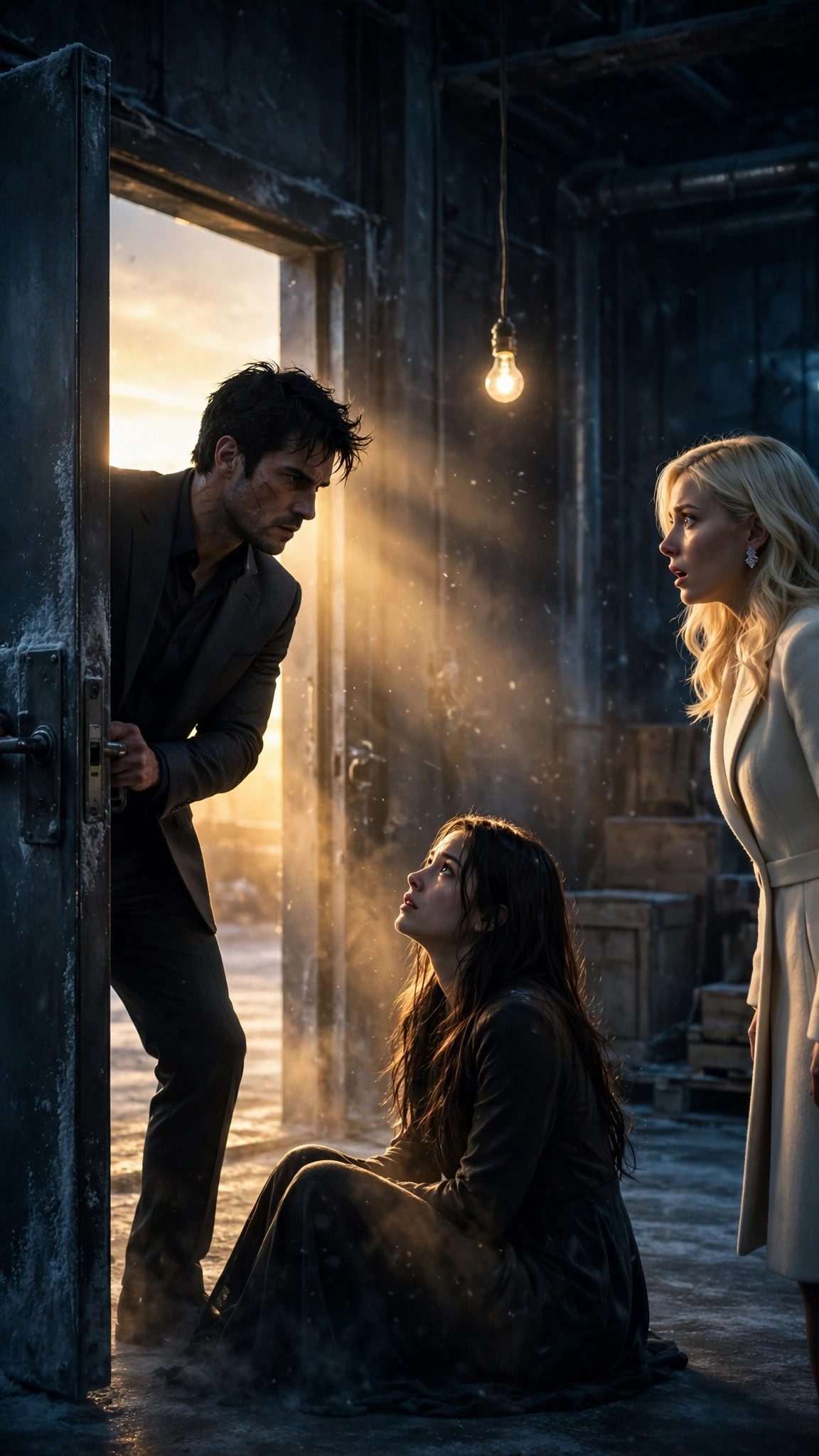
    On the fourth day, or what I thought was the fourth day, the door opened and Evelyn Sterling walked in.

    She was wearing a cream coat and dark trousers and low heels, and her hair was perfect, and her diamond earrings caught the light of the single bulb, and she looked around the warehouse the way a woman looks at a room she has just had cleaned. She did not wrinkle her nose. She did not hurry. She walked across the concrete floor and crouched beside me, elegant even in that, her knees together, her coat arranged around her, and she smiled.

    "Hello, Maya," she said. "You look terrible."

    I tried to speak. My voice came out as a rasp. "Why?"

    "Why?" She tilted her head, considering the question the way a teacher considers a question from a child who should know better. "Because you don't understand your place. Because you thought a cup of tea and a blanket made you special. Because you thought that a man like Roman Calder could be reached by kindness, and you forgot that men like Roman Calder are reached by power, and money, and family. You are a cook, Maya. You are not a rival. You are not even a person, to people like us. You are a function. And functions can be replaced."

    "I never wanted him," I whispered. "I never —"

    "I know." She smiled again, and this time the smile was almost kind, which was worse. "That's what makes you dangerous. You didn't want him. You didn't scheme. You just… were kind. And he noticed. Do you know how long it took me to get him to look at me the way he looked at you that morning in the library? Two years, Maya. Two years of dinners and galas and charity balls and careful, patient work. And you undid it with chamomile tea."

    She stood up, brushing invisible dust from her coat. "Here's what's going to happen. Tomorrow, my people will make sure that everyone believes you left. That you took your little brother's savings and ran off with some man, or to some other city, or wherever girls like you run to when they get tired of being poor. And Caleb — poor little Caleb — will wait by the window for a while, and then he will stop waiting, and he will grow up knowing that his sister abandoned him. And Roman will forget you in a week, because men like Roman forget functions. And I will marry him in June, in the cathedral, in a dress that costs more than your apartment building, and I will be Mrs. Roman Calder, and you will be a story no one tells."

    She turned to go, and then she stopped, and she looked back at me over her shoulder.

    "Any last wish?" she asked. "Before you leave?"

    She thought no one else could hear my answer. She thought the warehouse was empty except for us and the man with the scar, and she thought the steel door was thick enough to keep secrets.

    She was wrong about the door. She was wrong about the warehouse. She was wrong about everything.

    Because on the other side of that steel door, standing in the dark with one hand pressed flat against the cold metal, was Roman Calder. And he had heard every word.

    He had been searching for me for six days. I didn't know that then. I didn't know that on the first night I didn't come home, Caleb had sat by Mrs. Alvarez's window until midnight with his tin box in his lap, and Mrs. Alvarez had called the police, and the police had done nothing, because a twenty-six-year-old woman who doesn't come home is not a missing person, she is a woman who left. I didn't know that on the second day, Caleb had gone to school and told his teacher that his sister was gone, and his teacher had called Mrs. Alvarez, and Mrs. Alvarez had gone to the estate, and the housekeeper had told her that Maya had simply not shown up for work, and no one there had thought to ask why.

    I didn't know that on the third day, Roman Calder had come downstairs for his breakfast and found no tray waiting, and no coffee, and no cook, and he had stood in the kitchen for a long time looking at the empty stove, and something in his chest had gone cold in a way it had not gone cold since he was ten years old.

    I didn't know any of that. All I knew, lying on that freezing warehouse floor, was that Evelyn Sterling was asking me for my last wish, and the only wish I had in the world was my little brother.

    "Tell Caleb…" My voice broke before I could finish.

    Evelyn leaned closer, her diamond earrings flashing beneath the single hanging bulb. "Go on, sweetheart."

    "Tell him I didn't leave him."

    For the first time, her smile became genuine. "By tomorrow, everyone will believe you did."

    Neither of us saw the shadow beneath the warehouse door. Neither heard Roman Calder place one hand against the cold steel as something inside him shattered.

    And then the door exploded inward, and the light came flooding in, and the six days of darkness ended all at once.

    Later, when I could think clearly again, I remembered the parts of those six days that I had not told anyone, not even Agent Reyes, because they were mine, and they were the reason I survived.

    I remembered my mother. She died of pneumonia when I was seventeen and Caleb was nine months old, in the same two-room apartment on Fayette Street, in the winter when the heat broke and the landlord took three days to fix it. She was thirty-four years old. She had worked as a seamstress, and her hands were always rough, and she sang while she worked, old songs from the radio, and she told me, on the last night, when her breathing was shallow and her eyes were bright with fever, "Take care of your brother, Maya. He is the best thing I ever made. And never let anyone make you feel small, because you are not small. You are the whole sky to that boy."

    I had kept that promise for nine years. I kept it in the warehouse, too, by refusing to die, by drinking the water slowly, by breathing in and out, by thinking about Caleb's laugh instead of the cold.

    I remembered, too, the man with the scar through his eyebrow. His name, I learned later, was Eddie Marcone, and he had a daughter in Ohio, and he brought me water twice a day because someone paid him to keep me alive, and on the fifth day, he did something he was not paid to do. He knelt down beside me, and he loosened the rope around my wrists just enough that the blood could move, and he whispered, "I'm sorry, miss. I have a daughter your age. I don't like this job. But they have my girl's college money, and I can't say no." And then he tightened the rope again, not as tight as before, and he left the bread closer to my hand than usual, and I understood that even in a warehouse full of darkness, there were still people trying to be kind in the small ways they could.

    I remembered counting. I counted the drips of water from the ceiling. I counted the coins in Caleb's tin box, in my head, over and over, trying to remember the exact number. Forty-seven dollars and thirty-five cents. I counted the notes in the shoebox under his bed. I counted the stars I had promised him I loved him more than. I counted my own heartbeats, when the fear got bad, one-two, one-two, the way my mother used to count my breathing when I was small and sick, and I told myself that as long as I could count, I was alive, and as long as I was alive, I was coming home.

    And I remembered the moment I understood why Evelyn had done it. It was not the morning in the library. It was not the blanket or the tea. It was the fact that I had seen Roman Calder as a person, and she had only ever seen him as a prize. And a woman who sees a man as a prize will always be afraid of the woman who sees him as a man.
  • Chapter 2: Five Years in His Kitchen

    Chapter 2: Five Years in His Kitchen

    I got the job at the Calder estate because the old cook, Mrs. Okafor, broke her hip on the back stairs and told Roman's housekeeper that the girl from the catering company was the only one who knew how to make his soup without onions and without asking stupid questions. I was twenty-one years old. I had a baby brother at home who was four and a half and a dead mother and a landlord who knocked on the first of every month like clockwork. I did not know who Roman Calder was. I knew the pay was three times what the catering company paid, and the hours were steady, and steady was the only thing I had ever wanted.

    The first week, I learned the rules of the house. There were not many, but they were absolute. Do not speak unless spoken to. Do not enter the library when the door is closed. Do not ask about the scar. Do not ask about his father. Do not ask about his mother. Do not leave anything with onions in it on his tray. And never, ever, under any circumstances, go into the east wing after dark.

    I learned the rules the way I learned everything in that house: by watching. The staff had a whole language of glances and small head shakes, and I learned it fast, because getting fired from the Calder estate meant going back to catering weddings for people who treated you like furniture that could talk back, and I had a little brother who needed new shoes every three months because his feet would not stop growing.

    For the first year, I worked in the big kitchen downstairs with the rest of the staff. I chopped and stirred and washed and carried, and I went home every night with my hands smelling of garlic and my feet aching and my heart full, because the pay meant Caleb had a winter coat that fit and a bed that was his own and not a laundry basket. When Mrs. Okafor retired, the housekeeper, Mrs. Delaney, called me into her office and told me the job of private cook was mine if I wanted it.

    "It means you cook for Mr. Calder alone," she said. "His meals, his coffee, his late-night requests. It means more money. It also means you will be closer to him than anyone in this house, and you will learn things about him that you must never repeat. Can you do that?"

    "Yes, ma'am," I said.

    She studied me for a long moment. "Mrs. Okafor said you have a steady hand and a quiet mouth. Those are the two things that matter here. The rest you can learn."

    So I learned. I learned that Roman Calder took his coffee black, two cups, no sugar, and that he drank the first cup standing at the kitchen window, looking out at the grounds, and the second cup in the library, reading reports I was never allowed to see. I learned that he ate dinner at nine o'clock sharp when he ate at all, and that he preferred simple food — roast chicken, grilled fish, soup without onions, bread he tore with his hands instead of cutting. I learned that he tipped the delivery men generously and never remembered their names. I learned that he paid the staff's medical bills without being asked and without ever mentioning it again, and that Mrs. Delaney cried the first time she told me, because her husband's heart surgery had been paid for by a man who had never once asked her how she was doing.

    I learned that he had nightmares. Not every night, but often enough that the staff knew the signs. On the mornings after, he would come downstairs already dressed, already composed, already Roman Calder again, but his eyes would be red, and his hand would go to the scar on his jaw, and he would drink his coffee standing at the window for a very long time.

    I never asked about the nightmares. I never asked about the scar. I never asked about his father, though the whole city knew the outline of the story: the old man, Vincent Calder, had built the shipping empire and the other empire, the one nobody named, and had died in a federal prison hospital when Roman was twenty-four. And his mother — nobody talked about his mother at all, which told me everything I needed to know about what had happened to her.

    What I did not learn, in five years, was anything about me. Roman Calder knew I made his coffee. He knew I made his soup. He knew I was quiet and I was on time and I never asked questions. He did not know I had a little brother. He did not know I lived in a two-room apartment on Fayette Street with a taped window and a humming refrigerator. He did not know my last name. I was fairly certain he did not know my first name either. I was "the cook," and the cook was a function, like the coffee machine or the front gate, and functions do not have little brothers who save coins in dented tin boxes.

    I told myself that was fine. I told myself that was better than fine, that it was safe. A man like Roman Calder noticing you was not a good thing. It was the kind of thing that got people hurt. I had seen what happened to people who got too close to him, who mistook his silence for softness or his money for kindness. I had seen the way his men looked at the world, like it was a problem to be solved with a locked door and a quiet conversation. I kept my head down. I made his soup. I went home to Caleb.

    Then Evelyn Sterling arrived, and the whole house changed.

    She came the first time on a Sunday afternoon in a white car with a driver, and the staff stood a little straighter for the rest of the day. She was beautiful in the way that expensive things are beautiful — blonde hair that fell like poured honey, skin like cream, a smile that had been practiced in mirrors since she was a girl. Her father, Charles Sterling, owned half the commercial real estate in downtown Baltimore and all of the politicians who mattered. The engagement between the Sterling family and the Calder family was, as Mrs. Delaney put it in a whisper, "an arrangement, dear, and everyone knows it, and no one says it."

    Evelyn moved through the estate like she already owned it. She rearranged the flowers. She sent back the wine. She told the housekeeper that the curtains in the east drawing room were "tired" and had them replaced within a week. She called Roman "darling" in a voice that sounded like it had been trained to sound warm. And she looked at the staff the way a woman looks at furniture she intends to replace.

    She looked at me, in particular, with a kind of careful attention that made my skin prickle. The first time she saw me carry a tray into the library, she stopped me in the hallway and asked my name.

    "Maya, Miss Sterling."

    "Maya," she repeated, tasting it. "How long have you worked here?"

    "Five years, miss."

    "Five years." Her eyes moved over me, over my plain black dress and my apron and my hair pulled back in a knot, and I felt like a horse being inspected before a race. "And Mr. Calder likes your cooking?"

    "I hope so, miss."

    She smiled. "I'm sure he does." She said it the way women say things when they mean the opposite, and then she walked away, and I stood in the hallway holding the tray until my arms ached.

    After that, she watched me. Not openly. Evelyn Sterling was far too elegant for open watching. But I felt it, the way you feel a draft from a window you can't see. When I brought Roman his coffee, she was suddenly in the room, asking him about the charity gala, her hand on his arm. When I served dinner, she was at the table, asking me where I had learned to make the sauce, her voice sweet and her eyes cold. When I came down the hall with clean linens, she was standing at the top of the stairs, looking down at me, and she did not move out of the way until I had pressed myself flat against the wall.

    Mrs. Delaney noticed. One afternoon, when Evelyn had gone out to lunch with her mother, Mrs. Delaney found me in the pantry and put a hand on my shoulder.

    "Be careful with that one, Maya," she said quietly. "She is not like the others."

    "What others?"

    "The women who came before her. There were others, over the years. Actresses. Models. A senator's daughter. They all wanted the same thing, and they all left the same way, when they understood that Mr. Calder's heart is a locked room and he lost the key a long time ago." She glanced toward the door. "But this one is different. This one has her father's money behind her, and her father's ambition, and she does not intend to leave. And a woman who does not intend to leave is a woman who removes obstacles."

    "I'm not an obstacle," I said. "I'm the cook."

    Mrs. Delaney looked at me for a long moment, and in her eyes I saw something I had never seen there before. Pity.

    "That's what worries me, dear," she said. "You're the only person in this house he lets near him when he's weak. And she has noticed."

    I wanted to laugh it off. I wanted to tell her she was being dramatic, that Evelyn Sterling was a beautiful rich woman with a diamond ring and a wedding to plan, and I was a cook who went home to a two-room apartment every night, and there was nothing in the world that could make us rivals. But that night, when I got home, Caleb was sitting by the window with his tin box in his lap, waiting for me, and he said, "You were late again," and I said, "Mr. Calder had guests," and he frowned and said, "I don't like him," and I heard myself answer, "You've never met him," and I heard his small, flat voice say, "You work too much because of him. Does he ever say thank you?"

    And I thought about the morning in the library, and the chamomile tea, and the blanket, and the sound Roman Calder had made — not quite a laugh, something rusty and unused — and I thought about the way Evelyn had looked at that blanket, and I understood, for the first time, that I had done something dangerous without meaning to.

    I had been kind to a man who had forgotten what kindness felt like. And the woman who intended to marry him had seen it happen.

    The next morning, I went to work early, before sunrise, and I made the coffee, and I made the breakfast, and I carried the tray to the library, and the door was open, and Roman Calder was standing at the window staring toward the harbor in the rain, and his hand was on the scar along his jaw.

    "Good morning, Mr. Calder," I said.

    He did not turn around. "The tea," he said. "Last week. The chamomile."

    "Yes, sir."

    "My mother used to make it." His voice was flat, like a man reading a report. "When I was small. Before." He stopped. "Don't do it again."

    "Yes, sir," I said, and I set the tray down and left, and I did not understand, then, that he was not angry with me. He was frightened. He was frightened because for one moment, in a chair in his library, with a blanket around his shoulders and a cup of his mother's tea beside him, he had felt safe. And a man like Roman Calder does not feel safe. A man like Roman Calder cannot afford to feel safe, because the last time he felt safe, he was ten years old, and his mother was standing in front of him, and someone was shouting, "Get down," and she didn't get down fast enough.

    I learned that last part later. I learned it in the worst way possible, in a warehouse with a rope around my wrists and a woman with diamond earrings crouching beside me, asking me if I had any last wish.

    But that morning, all I knew was that the rain was falling on the harbor, and Roman Calder was standing at the window, and his fiancée was watching me from the doorway, and her smile never reached her eyes.

    The engagement was announced the following week, at a dinner party in the great hall, and I served it. I carried in the roast, and the fish, and the champagne, and I watched Evelyn stand beside Roman in a white dress, holding up her glass, while her father made a toast about two great families becoming one. Roman stood very still through the whole speech, his face unreadable, his hand resting on the back of Evelyn's chair, and when the toast was over, he lifted his glass and drank, and he did not smile. I watched Evelyn watch him not smile, and I saw something flicker across her face, quick as a shadow crossing a window. It was not disappointment. It was calculation, the look of a woman revising a plan.

    Later that night, when the guests had gone and the hall was empty, I found her alone in the library, standing at the window where Roman always stood, staring toward the harbor in the dark. She did not hear me come in with the tray. She was holding her phone to her ear, and her voice was low and sharp, nothing like the polished sweetness she used at the table.

    "She is nothing, Father," she said. "A cook. I will handle it. The wedding is in June, and nothing is going to interfere with it. Nothing."

    She turned then, and saw me, and her face changed in an instant, back to the perfect smile, back to the elegant fiancée, and she said, "Maya, dear, would you bring me a glass of water?" as if she had not just been talking about me at all. I brought her the water. I did not sleep well that night, and I did not know why.

  • Chapter 3: The Woods

    Chapter 3: The Woods

    It happened on a Tuesday. Hannah remembered the day because Tuesdays were the day the gardener came, and the day Rosa went to the market, and the day the house was quietest, with Adrian in Manhattan and Livy in her wing and the guards changing shifts at noon. It was a Tuesday in the middle of October, and the leaves were red and gold, and the air smelled like rain that had not fallen yet, and Leo had been restless all morning, running from room to room with his wooden train, asking Hannah when his father was coming home.

    "Soon," Hannah told him. "Your father will be home for dinner. Now, do you want to read the fox book, or do you want to help me in the garden?"

    "The garden," Leo said. "The fox can wait."

    They went into the garden, and Hannah let Leo run ahead of her on the path, the way she always did, because the garden was walled and safe, and there were guards at the gate, and nothing bad had ever happened in the garden. Leo ran to the oak tree at the far end, the big old tree where his mother used to read to him, and he climbed onto the low branch, and he called out to her, "Hannah! Look! I am a bird!"

    She laughed. She was carrying his small gray blanket, folded over her arm, and his oak box was in her pocket, because Leo had asked her to hold it while he climbed. She was ten steps behind him. Ten steps. She counted them later, over and over, in the dark, in the days that followed. Ten steps. That was the distance between safety and everything that came after.

    A black car pulled up to the side gate. Hannah saw it, and she thought it was one of Adrian's men, because black cars came and went all day, and she did not worry. The back door opened, and Tony Falco got out, and he smiled at her, and he said, "Hannah. Good. I was looking for the boy. His father wants him. Come here, Leo. Uncle Tony has a game for you."

    Leo slid down from the branch and ran to him. He trusted Tony. Everyone trusted Tony. Tony had been in the house since before Leo was born. Tony had held him when he was a baby. Tony had given him his first wooden train. Leo ran to him with his arms out, and Tony picked him up, and he said, "We are going to play a game in the woods, Leo. A secret game. Just you and me. Like soldiers."

    Hannah's stomach went cold. She did not know why. She only knew that something was wrong — the way Tony was smiling, the way his eyes did not smile with his mouth, the way he was already turning toward the car with Leo in his arms, fast, too fast, like a man who did not want to be seen.

    "Tony," she said. "Where are you taking him? Mr. Rossi did not say anything about a game."

    Tony turned, and his smile did not change, and he said, "His father called me, girl. From Manhattan. He said to take the boy to the woods, to teach him to be a man. You are a maid, Hannah. You do not question the boss's orders. Go back to your dusting." And then he put Leo in the car, and he got in, and the car pulled away, and Hannah stood in the garden with the gray blanket over her arm and Leo's oak box in her pocket, and she watched the car disappear down the driveway, and she knew, with a certainty that made her hands shake, that Adrian had not called Tony. Adrian never called Tony about Leo. Adrian called Rosa. Adrian called her. And Tony had lied to her face, with a smile, in the garden, in the daylight.

    She ran into the house. She found Rosa in the kitchen, and she told her, fast, breathless, "Tony took Leo. He said Mr. Rossi called him, but Mr. Rossi never calls Tony about Leo, he calls you, he calls me. Something is wrong, Rosa. Something is very wrong."

    Rosa put down her knife. Her face went white. "Where?" she said.

    "The woods," Hannah said. "He said the woods. The game in the woods."

    Rosa did not hesitate. She did not call Adrian first. She called the head guard, and she told him to take two men and follow Tony's car, and she told Hannah to stay with her, and then she went to the telephone in the hall and called Adrian in Manhattan, and when he answered, she said, in a voice Hannah had never heard from her before, a voice like a knife, "Your son is gone. Tony took him. Come home. Now."

    Adrian came home in forty minutes. He drove like a man who had already decided who he was going to kill. He walked into the hall, and his face was white, and he said, "Where is he?"

    Rosa told him. Hannah told him. She told him about the garden, and the car, and the lie, and the woods. Adrian listened without moving, and then he said, "Find him. Find them both. Now." And the house exploded into motion — men running, cars starting, phones ringing, guards spreading out into the woods behind the estate with flashlights, calling Leo's name.

    They found him an hour later. An hour. Sixty minutes, in the dark, in the woods, in October, when the air turns cold at dusk. A guard found him tied to a tree, with a rope around his waist, not tight enough to hurt him, but tight enough that he could not get away. He was sitting at the base of the tree with his back against the trunk, and his face was wet with tears, and his gray blanket was gone, and his shoes were muddy, and when the guard untied him, Leo did not cry. He did not speak. He just held out his arms, and the guard picked him up, and Leo whispered, "I did not tell. I did not tell."

    Tony was gone. He had left Leo there and driven away. He had left a four-year-old boy tied to a tree in the dark for an hour, to see if he would talk.

    Adrian carried Leo into the house himself. He did not let anyone else touch him. He carried him up the stairs, and he laid him on his own bed, in his own room, and he sat beside him, and he said, very quietly, "Leo. What did he ask you? What did Uncle Tony ask you?"

    Leo looked at his father, and his eyes were huge, and he said, "He asked me what Hannah heard. He asked me what Hannah heard on the phone. I told him I did not know. I told him Hannah only reads books. And then he asked me about Mama. He asked me what Mama used to say to me at night. And I told him." Leo's voice broke. "I told him Mama said she asks God to feed me night wishes and morning songs. And then he laughed. And he tied me to the tree. And he said, 'Stay here, little soldier. Let's see if you talk to the dark.'"

    Adrian did not move. He did not speak. He sat beside his son's bed for a long time, and Hannah stood in the doorway, and she watched him, and she saw something she had never seen in Adrian Rossi's face before. She saw fear. Not fear of a rival. Not fear of the police. Fear of himself. Fear of what he was going to do to the man who had done this to his son.

    And then Livy came into the room. She had been in her wing when it happened, and Rosa had told her, and she came in with her iron-gray hair and her voice like a door closing, and she looked at Leo, and she looked at Hannah, and she said, "This is your fault."

    Hannah froze. "Mrs. Rossi—"

    "You let him take the boy," Livy said. "You stood in the garden and you watched a man put my grandson in a car, and you did nothing. You are a maid. Your job was to watch him. You failed."

    "I tried—" Hannah said. "I told Rosa—"

    "You tried," Livy said, and her voice was ice. "A mother would not have tried. A mother would have thrown herself in front of the car. But you are not his mother. You are a girl from Ohio who reads books. And now my grandson has been tied to a tree in the dark because you were too weak to stop it."

    Adrian looked up. He looked at his mother. He looked at Hannah. And Hannah saw it happen — she saw the doubt move into his eyes, the way water moves into a crack in stone. He had trusted her. He had watched his son laugh for her. He had seen her hold his boy. But his mother was his mother, and Tony had been his man for twenty years, and Hannah was a girl from nowhere, and in that moment, with his son shaking in his bed, Adrian Rossi did the thing that would haunt him for the rest of his life. He believed the wrong person.

    "Go to your room, Hannah," he said, very quietly. "Do not come out until I call for you."

    Hannah went to her room. She sat on her narrow bed. She held Leo's oak box in her hands — she had forgotten to give it back to him, it was still in her pocket — and she opened it, and she looked at the Rossi family crest inside, a small silver eagle with its wings spread, and she thought about her mother, in the hospital in Ohio, who had taught her that a woman's hands were for holding children and healing the sick. And she thought about Leo, tied to a tree in the dark, telling a bad man about his mother's lullaby, because it was the only brave thing a four-year-old boy knew how to do. And she made another promise, silently, in the dark, with no one to hear it: she would not leave this house until she knew who had done this, and why, and she would not let them do it again.

    Downstairs, Adrian sat in his office with Tony Falco. Tony had come back. He had driven back to the estate as if nothing had happened, and he had walked into Adrian's office, and he had said, "Boss. I am sorry. I took the boy to the woods to teach him to be a man, like you asked. He got scared. He ran. I could not find him in the dark. I am sorry."

    Adrian looked at him for a long time. And Tony, who had known Adrian for twenty years, who had stood beside his father, who had eaten at his table a hundred times, looked back at him, and smiled, and said, "You know me, boss. You know I would never hurt the boy."

    And Adrian, who had spent his whole life reading men's faces, looked into Tony Falco's face, and saw nothing. No guilt. No fear. Nothing. Just a man who had done something terrible and was waiting to see if he would get away with it.

    "I know you, Tony," Adrian said, very quietly. "That is the problem. I know you. And I am going to find out what you did. And when I do, God help you. Because I will not."

    Tony left. Adrian sat in his office until dawn, with a glass of whiskey he did not drink, and a gun on his desk he did not touch, and he thought about his son, tied to a tree in the dark, and about a maid from Ohio who had tried to warn him, and about his mother, who had told him to blame her. And for the first time in his life, Adrian Rossi did not know who to trust.

    Hannah did not stay in her room. She could not. While Adrian sat in his office, she went down to the kitchen, and she found Rosa there, standing at the sink with her hands in the dishwater, staring out the window at the dark woods. "Rosa," Hannah said. "I am going to look for him. I know the woods. I walked them with him last week, when he wanted to find acorns. I know where the big tree is. I know where the stream is. Let me go."

    Rosa turned around. Her face was white, but her voice was steady. "You will not go alone," she said. "Take a flashlight. Take the gray blanket — the spare one, from the linen closet. And take this." She pressed something into Hannah's hand. It was a small silver whistle, old and tarnished. "It was my husband's, when he worked on the docks. Three blasts means you found him. Three blasts, and we will come running."

    Hannah took the flashlight and the blanket and the whistle, and she went into the woods with two guards, and she called Leo's name until her voice was raw. "Leo! Leo! It is Hannah! I am here! Leo!" She walked for an hour in the dark, tripping over roots, tearing her dress on branches, calling and calling, and every time she heard a sound, her heart leapt, and every time it was only the wind, her heart broke a little more. She thought about the small boy tied to a tree, in the dark, in October, and she thought about her mother, who had once told her that the worst thing in the world is not being hurt. The worst thing is being alone and afraid and thinking no one is coming for you. And she called his name again, louder, "LEO! I am coming! Do not be afraid! I am coming!"

    She was still in the woods, still calling, when the guard's radio crackled, and a voice said, "We found him. By the big oak. He is alive. Bring the blanket." Hannah ran. She ran through the dark with the flashlight bouncing in her hand, and when she reached the clearing, she saw Leo sitting at the base of the tree, with a guard kneeling beside him, untying the rope, and she fell to her knees in the mud, and she wrapped the spare blanket around him, and she held him against her chest, and she said, over and over, "I am here. I am here. You are safe. I am here." And Leo, who had not cried since the guard found him, buried his face in her shoulder and cried, and Hannah cried with him, and the two guards stood back, and pretended not to see, because even hard men know when to look away.

    The next morning, Adrian ate breakfast alone in the dining room, and Hannah served him, the way she always did, and he did not look at her, and he did not speak to her, and the silence between them was worse than shouting. Livy sat at the other end of the table, and she watched Hannah with cold eyes, and she said, "The boy is lucky to be alive. Next time, perhaps his nurse will watch him more carefully." Hannah did not answer. She set the plate down, and she went back to the kitchen, and she stood at the sink, and she thought about the woods, and the whistle, and the way Leo had cried into her shoulder, and she thought: I did everything I could. I ran into the dark. I called his name. I held him. And it is still not enough. It will never be enough, for people who have already decided what I am.

    He did not know that the worst night was still ahead of him. He did not know that Tony had already decided what to do next. He did not know that the men who had come to his house in the dark were already planning to come back, and that this time, they would not come for the boy in the woods. They would come for the girl in the nursery. And they would come for the old woman in the kitchen who knew too much. And they would leave Hannah Collins holding his son in her arms, with blood on her dress, and a gun pointed at her face, and no one left alive who could tell him the truth — except the boy himself, and a dying woman on the floor, and the small oak box in Hannah's pocket, still holding the crest of a family that was about to learn what it had almost destroyed.

  • Chapter 2: The Woman Nobody Trusted

    Chapter 2: The Woman Nobody Trusted

    Hannah Collins had never meant to come to New York. She had meant to stay in Ohio, in the small town where her mother had been a nurse for thirty years, in the small house with the blue shutters where she had grown up. She had meant to be a teacher. She had a degree in early childhood education, and a student loan she could not pay, and a mother who had taught her that a woman's hands were for holding children and for healing the sick, and that there was no work in the world more important than that.

    Her mother died when Hannah was twenty-two. Not suddenly. Slowly. The way good people die when the world has used them up a little at a time. Her mother had spent thirty years on her feet in a county hospital, lifting patients twice her size, working double shifts, coming home with her shoes soaked through and her back aching, and one day her heart simply stopped, in the middle of a shift, in the middle of helping someone else. The hospital sent flowers. The town sent casseroles. Hannah buried her mother beside her father, and she sat in the small house with the blue shutters, and she understood, for the first time in her life, what it meant to be entirely alone in the world.

    She sold the house. She paid the debts. She had three hundred dollars left, and a suitcase, and a paperback book with a broken spine — her mother's copy of a book of poems, the one her mother used to read to her when she was small. She took a bus to New York because New York was the only place she had ever heard of where a girl with nothing could become someone, and she spent two weeks sleeping in a shelter and eating one meal a day, and she applied for every job she could find, and the only one that called her back was an agency that placed maids in big houses.

    The agency sent her to the Rossi estate on a Tuesday morning in October. She remembered the date because the leaves were turning, and the driveway was long, and the house was bigger than any house she had ever seen, and when she walked through the front door, an old woman with hands like old leather looked her up and down and said, "You are too thin. We will feed you. Can you read?"

    "Yes, ma'am," Hannah said.

    "Good," the old woman said. "The boy needs someone who can read. The last four could not read properly. One of them read like a robot. The boy hated it." She held out a hand. "I am Rosa. I run this house. You will do what I say, and you will not touch anything in Mr. Rossi's office, and you will not ask questions about the men who come and go at night. Do you understand?"

    "Yes, ma'am," Hannah said.

    "And one more thing," Rosa said, and her eyes narrowed. "The boy is the only thing in this house that matters. If you hurt him, I will know. If you are kind to him, I will know that too. Do you understand?"

    "Yes, ma'am," Hannah said. And she meant it.

    They gave her a small room on the third floor, next to the nursery, with a narrow bed and a window that looked out over the garden. They gave her a gray dress and a white apron. They gave her a list of duties: clean the bathrooms, carry the trays, dust the library, help in the kitchen, and sit with the boy in the nursery in the afternoons. The boy. Leo. Four years old. His mother dead. His father a man whose name made grown men lower their eyes.

    The first time Hannah saw Leo, he was sitting in the corner of the nursery with a small gray blanket wrapped around his shoulders and a wooden train in his lap, and he did not look up when she came in. She had seen children like him before, in her student teaching, children who had lost someone and had gone quiet inside themselves, like a house with all the lights turned off. She knew better than to rush at him. She knew that a grieving child is like a wild animal — if you chase him, he runs, and if you sit still long enough, he comes to you.

    So she sat on the floor, a few feet away from him, and she opened her mother's book of poems, and she started reading out loud. Not to him. Just reading, in a quiet, steady voice. She read about foxes and rivers and the moon coming up over a field. She read for an hour. Leo did not move. He did not speak. But he did not leave, either. And that, Hannah knew, was a beginning.

    On the third day, he sat beside her. On the fifth day, he pointed at a picture of a fox and said, "Fox." Rosa, standing in the doorway, put a hand over her mouth, and her eyes filled with tears, and she turned away quickly, because Rosa Benedetti did not cry in front of anyone, not even in front of a girl from Ohio.

    Within a month, Leo was laughing. Hannah invented a game for him, a silly game where the wooden train was a dragon and the gray blanket was its cave, and Leo would shriek with laughter when the dragon roared, and the sound of it filled the nursery, and sometimes it filled the hallway, and once it filled the whole downstairs, and Hannah heard a sound she had never heard before in that house — the sound of a man stopping in the middle of a hallway, in the middle of a conversation about money and freight and men who owed him things, and going quiet, because his son was laughing.

    She learned his routines. She learned that he liked his toast cut into triangles, not squares. She learned that he was afraid of thunder, and that when it rained at night, he would climb into her bed — not his father's bed, hers — and curl up small against her side with his blanket, and she would read to him until he fell asleep. She learned that he carried a small oak box everywhere, a box his father had given him, a box that held the Rossi family crest, and that he would not let anyone else touch it, not even her, not even Rosa. She learned the words of his mother's lullaby, the one about night wishes and morning songs, because Leo would hum it sometimes, very quietly, when he thought no one was listening, and Hannah learned the tune so she could hum it back to him, and when she did, he would close his eyes and smile, and for a moment, he looked like a child who had not lost anything at all.

    She was happy. She was happier than she had been since her mother died. The work was hard — her hands were raw from cleaning, her back ached from carrying trays up three flights of stairs, and she was on her feet from six in the morning until ten at night — but at the end of every day, there was a small boy with dark curls who would run to her when she came into the nursery, and throw his arms around her waist, and say, "Hannah! Read the fox one!" And that was enough. That was more than enough.

    But there were shadows in the house, and Hannah was not blind. She had grown up in a hospital, watching her mother come home with blood on her shoes, and she knew what blood looked like, and she knew what men looked like when they were lying about where the blood came from.

    The first shadow was Livy Rossi. Adrian's mother lived in a wing of the house, in rooms full of dark furniture and old photographs, and she watched Hannah the way a woman watches a thief in her kitchen. She never raised her voice. She never said a cruel word. She simply looked at Hannah, every time they passed in the hallway, with eyes that said: I know what you are. You are a girl from nowhere, and you are here for something, and I will find out what it is. Once, when Leo ran to Hannah in the garden and threw his arms around her, Livy said, very quietly, to no one in particular, "He calls her name more than he ever called his mother's." Hannah heard it. She pretended she had not.

    The second shadow was Tony Falco. Tony was a big man with a voice like gravel and a laugh that filled a room, and he was kind to Hannah, in the way that big men are kind when they want you to think they are harmless. He brought her coffee from the kitchen. He asked her about Ohio. He told her stories about Adrian when Adrian was a boy. But his eyes never left her. Not in a way that frightened her — not at first. Just in a way that made her feel watched. Like she was a room he was memorizing.

    The third shadow was the house itself. Men came and went at night. They came in black cars, and they went into Adrian's office, and they stayed for an hour, and they left without saying goodnight. Sometimes they were angry. Sometimes they were afraid. Hannah learned to keep her head down and her ears open, the way her mother had taught her in the hospital: you do not ask questions about other people's blood. You clean it up, and you keep working.

    But one evening, everything changed. It was a Thursday in late September, and Adrian had come home late from a meeting in Queens, and Hannah was lying in the nursery, reading Leo his favorite book, when Adrian came in to say goodnight to his son. He was wearing a dark suit, and his hair was wet from the rain, and when he bent down to kiss Leo's forehead, Hannah saw it: blood on his sleeve. Not much. A smear, dark red, on the white cuff of his shirt. He saw her looking at it, and he straightened up, and he said, "It is nothing. Go back to your book."

    But it was not nothing. Hannah knew blood. And later that night, when she was carrying a tray past the pool house, she heard Tony's voice through the open window. He was on the phone, and he was saying words she did not understand — "the pool plan," "Tuesday," "the docks," "make sure the boy is asleep" — and then he saw her, and he stopped talking, and he smiled at her, and he said, "Hannah. You are up late. Go to bed, girl. The night is no place for a maid."

    She went to bed. But she did not sleep. She lay awake in her narrow bed, listening to the rain, and she thought about the blood on Adrian's sleeve, and the words "pool plan," and the way Tony had looked at her — not like a man looking at a maid, but like a man looking at a problem. And she thought about Leo, asleep in the next room with his gray blanket and his oak box, and she made a promise to herself, the way her mother had made promises in the hospital, quietly and without telling anyone: whatever was happening in this house, she would not let it touch that boy.

    She kept that promise. She kept it for three weeks, while the shadows in the house grew longer, and Livy's eyes grew colder, and Tony's smile grew thinner. She kept it when she found Leo's shoes muddy one morning and he would not tell her where he had been. She kept it when she heard Tony on the phone again, in the library this time, saying, "He talked. The boy talked. We have to know what he said." She kept it when she realized, with a cold feeling in her stomach, that the men who came at night had started looking at her the way Livy looked at her — like she was something that did not belong in the house, and needed to be removed.

    She did not know, then, what Tony had done. She did not know about the woods. She did not know about the tree. She did not know that the most dangerous man in her life was not the boss with the gun, but the smiling capo who brought her coffee and asked her about Ohio. She knew only one thing: that a small boy trusted her, and that trust was the only thing she had ever been given in her life that she had not earned with her hands, and she would die before she let anyone take it from him.

    On her first Sunday in the house, Rosa took her aside after church and taught her the nursery routine the way a sergeant teaches a new recruit. "The boy wakes at seven," Rosa said, counting on her fingers. "Toast cut into triangles, never squares — squares make him cry, and I do not know why, and I stopped asking years ago. Milk warm, not hot. The gray blanket goes everywhere he goes, and if you lose it, you will hear about it for a week. The oak box stays in his pocket. You do not touch it. You do not ask about it. It was his grandfather's, and his father's, and one day it will be his. And the lullaby — you will learn it. He hums it when he is scared. Do not ask him where he learned it. He learned it from his mother, and that is all you need to know."

    Hannah learned it all. She learned that Leo liked to be read to in the big chair by the window, with the light coming over his shoulder. She learned that he hated the dark hallway outside the nursery, and that she had to leave the small lamp on all night, every night, without fail. She learned that he would sometimes wake up crying, calling for his mother, and that the only thing that calmed him was her voice, reading the fox book, over and over, until his breathing slowed and his small hands unclenched from her dress.

    One night, after Leo had fallen asleep in her lap, Hannah sat in the nursery with a pen and a piece of paper, and she wrote a letter to her mother. She knew her mother was dead. She knew the letter would never be read. She wrote it anyway, because it was the only way she knew how to talk to the person she missed most. "Dear Mama," she wrote. "I have a job. I have a room of my own. There is a little boy here, and he is four years old, and his mother is gone, and he does not talk much, but today he said a word to me. He said 'fox.' And I thought of you, because you used to read to me about foxes, too. I think you would like him, Mama. I think you would like this house, even though it is too big and too quiet. I am going to take care of him, Mama. I promise. I am going to take care of him the way you took care of me." She folded the letter, and she put it in the drawer of her nightstand, beside her mother's book of poems, and she never sent it, and she never threw it away.

    She did not know how soon she would have to prove it.

  • Chapter 1: Any Last Wish

    Chapter 1: Any Last Wish

    The rope had already cut into my wrists when the mafia boss's elegant fiancée crouched beside me on the freezing warehouse floor and asked, "Any last wish before you leave?"

    She thought no one else could hear my answer. She was wrong. Roman Calder was standing behind the steel door, listening as I begged her to tell my nine-year-old brother that I had never abandoned him.

    Six days without sunlight had erased any sense of time. My lips were swollen, my body was weak from dehydration, and the only thing keeping me conscious was the thought of Caleb waiting beside our neighbor's window with his dented tin box in his lap.

    "Tell Caleb…" My voice broke before I could finish.

    Evelyn Sterling leaned closer, her diamond earrings flashing beneath the single hanging bulb. "Go on, sweetheart."

    "Tell him I didn't leave him."

    For the first time, her smile became genuine. "By tomorrow, everyone will believe you did."

    Neither of us saw the shadow beneath the warehouse door. Neither heard Roman Calder place one hand against the cold steel as something inside him shattered.

    Six days earlier, Roman barely knew I existed. Or at least, that was what he told himself.

    Every morning of my life began before sunrise in the small Baltimore apartment I shared with Caleb. The pipes rattled, cold air slipped through the taped kitchen window, and the refrigerator hummed so loudly that we sometimes joked it was our third roommate. At 4:35, I folded the blanket from the pullout couch and prepared Caleb's breakfast. Whenever I left before he woke, I placed a note beside his bowl reminding him to eat, pack his lunch, and remember that I loved him more than all the stars. He saved every note in a shoebox beneath his bed.

    That morning, I found him hiding something beneath his pillow. After a brief struggle, he revealed a dented metal box covered in faded baseball stickers, and coins rattled inside when he hugged it to his chest.

    "How long have you been saving?" I asked.

    "That's classified."

    He pointed toward a stuffed dog missing one eye and claimed it was his security guard. I laughed, kissed his forehead, and promised I would be home that night.

    "You were late Tuesday," he reminded me. "Mr. Calder had guests."

    Caleb frowned. "I don't like him."

    "You've never met him."

    "You work too much because of him. Does he ever say thank you?"

    The question stayed with me all the way to Roman's estate outside Towson. I had worked there for five years, first in the kitchen and later as Roman's private cook. I knew he drank black coffee, hated onions, stared toward the harbor when it rained, and rubbed the scar along his jaw whenever anyone mentioned his father. Roman knew almost nothing about me.

    That morning, I found him asleep in the library with one hand gripping the leather chair. Sweat covered his forehead as he whispered, "Mom, get down," sounding less like Baltimore's most feared man and more like a frightened child. I prepared chamomile tea, placed it beside him, and covered his shoulders with a blanket.

    "Who did that?" he asked suddenly. His eyes were open.

    "You looked cold, Mr. Calder."

    "I don't drink chamomile."

    "It helps with sleep."

    "I wasn't sleeping."

    My eyes dropped to his clenched hand. "No, sir."

    A sound almost like laughter escaped him. "You disagree?"

    Before I could answer, Evelyn appeared in the doorway and stared at the blanket around his shoulders. Her smile never reached her eyes.

    And six days later, inside that warehouse, I finally understood why.

    I am Maya Hart. I am twenty-six years old, and I have raised my little brother since our mother died of pneumonia when I was seventeen and he was nine months old. People who meet me for the first time see a cook. They see the woman who makes Roman Calder's breakfast and keeps his kitchen running and disappears before the guests arrive. They do not see the girl who learned to stretch a bag of rice across a week, or the sister who did her homework at a kitchen table with a baby asleep in a laundry basket beside her, or the woman who has never once missed a morning with Caleb, not in nine years.

    The apartment on Fayette Street was not much. Two rooms, a kitchen the size of a closet, a bathroom with a shower that ran either scalding or freezing and never anything in between. The taped window in the kitchen had been taped for three winters. The refrigerator hummed. The pipes rattled. But it was ours, and the rent was paid on time every month because I worked for the richest, most dangerous man in Baltimore, and he paid his staff on time even if he never learned their names.

    Caleb was nine years old and all elbows and questions. He had our mother's dark hair and our father's stubborn chin, and he had decided, at the age of seven, that he was the man of the house, which meant he checked the locks twice every night and insisted on carrying the groceries even when the bags were heavier than he was. He was afraid of thunderstorms and pretended he wasn't. He was terrible at math and wonderful at drawing. He kept every note I ever left him in a shoebox beneath his bed, and sometimes, when he thought I wasn't looking, he took the notes out and read them again, one by one, like they were letters from someone far away.

    The morning I am telling you about began like all the others. The alarm went off at 4:30. I folded the blanket from the pullout couch, because the couch was my bed and Caleb got the only real bedroom, and I went into the kitchen to make his breakfast. Oatmeal with brown sugar, because it was cheap and it stuck to his ribs until lunch. A sliced banana on top, because the corner store sold the brown ones for half price and Caleb pretended not to notice. A glass of milk. And the note, folded small, tucked beside the bowl: Eat everything. Pack your lunch. I love you more than all the stars. — Maya.

    I was halfway through writing it when I heard the bedsprings squeak, and Caleb appeared in the doorway in his pajamas, his hair standing up in every direction, his arms wrapped around something he was trying very hard to hide.

    "You're up early," I said.

    "I'm not hiding anything," he said, which was the first sign that he was absolutely hiding something.

    "Caleb."

    He sighed the deep, put-upon sigh of a nine-year-old martyr and produced a dented metal box covered in faded baseball stickers. When he hugged it to his chest, coins rattled inside.

    "What is that?" I asked.

    "That's classified."

    "Caleb Hart, how long have you been saving?"

    He lifted his chin. "A while."

    "For what?"

    "That's classified too."

    He pointed toward the stuffed dog on his bed, the one missing an eye, the one he had carried everywhere since he was three. "Barnaby is my security guard. He guards the box when I'm at school."

    I laughed, and the sound of it surprised me, because mornings in that apartment were usually quiet and careful and counted in minutes, and laughter felt like something we couldn't afford. I kissed his forehead. "I will be home tonight," I promised. "Before dark."

    "You were late Tuesday," he reminded me. "Mr. Calder had guests."

    "I know. I'm sorry."

    He frowned, and the frown made him look so much older than nine that my chest ached. "I don't like him."

    "You've never met him."

    "You work too much because of him." He said it the way he said everything that mattered, flatly, like a fact he had already decided. "Does he ever say thank you?"

    I didn't have an answer. I kissed his forehead again, and I left the apartment with his question following me down the stairs, out into the cold Baltimore morning, and all the way to the estate outside Towson.

    Roman Calder's estate sat behind high iron gates at the end of a long private drive, a stone house that looked like it had been built to survive a siege. Inside, the floors were marble and the ceilings were high and the silence was the kind of silence that cost money. I had worked there for five years, first in the big kitchen with the other staff, and later, when the old cook retired, as Roman's private cook. I planned his meals. I cooked them. I served them. I cleaned up after them. And in five years, Roman Calder had spoken perhaps fifty words to me in total.

    I knew him the way a cook knows a man: by what he ate and what he left behind. He drank black coffee, two cups, no sugar. He hated onions and could taste a single sliver of them in a whole pot of soup. He ate little at breakfast and less at lunch, and he ate dinner standing at the kitchen counter more often than he sat at the table. When it rained, he stood at the library windows and stared toward the harbor for a long time, and no one disturbed him. When anyone mentioned his father, his hand went to the scar along his jaw, a thin white line that ran from his ear to his chin, and he rubbed it the way other men rub a wedding ring.

    That morning, the house was quieter than usual. The dinner party from Tuesday night had left the place smelling faintly of cigar smoke and expensive perfume, and the staff moved through the halls like people trying not to wake something. I went into the kitchen, put the coffee on, and started on breakfast. Poached eggs. Toast, dry. Grapefruit, because the doctor had told him to eat it and he obeyed his doctor the way he obeyed no one else.

    I carried the tray to the library, because that was where he took his breakfast when he had worked late, and I found him asleep in the leather chair.

    He was not supposed to be there. Roman Calder did not sleep in chairs. Roman Calder did not sleep at all, as far as anyone could tell. But there he was, slumped in the chair with one hand gripping the armrest so hard his knuckles were white, sweat covering his forehead, his whole body tense like a man braced for an impact that had already happened.

    "Mom," he whispered. "Mom, get down."

    It was the voice of a frightened child. It did not belong to Baltimore's most feared man. It belonged to a boy, and it stopped me where I stood, because in that moment I understood that whatever Roman Calder was, he had once been a boy who watched something terrible happen to his mother, and he had never stopped watching it.

    I set the tray down quietly. I went back to the kitchen and made chamomile tea, the way my mother used to make it when I couldn't sleep, and I carried it back and placed it beside him. Then I took the light wool blanket from the back of the sofa and covered his shoulders with it, the way I covered Caleb on cold nights.

    "Who did that?" he asked suddenly.

    His eyes were open. Dark eyes, fully awake now, fixed on me with an intensity that made my hands go still.

    "You looked cold, Mr. Calder."

    "I don't drink chamomile."

    "It helps with sleep."

    "I wasn't sleeping."

    My eyes dropped to his clenched hand, still gripping the armrest. "No, sir."

    A sound escaped him then. Not quite a laugh. Something rusty and unused, like a door opening in a house that had been locked for years. "You disagree?"

    Before I could answer, a voice came from the doorway, cool and polished and sharp as cut glass.

    "Roman, darling. You're awake."

    Evelyn Sterling stood in the library doorway in a cream silk dress that probably cost more than three months of my rent. Her blonde hair was perfect. Her diamond earrings caught the morning light. Her smile was perfect too, and it never reached her eyes. She looked at the blanket around Roman's shoulders the way a woman looks at another woman's handwriting on her husband's shirt.

    "Miss Sterling," I said, and I picked up the empty tray and got out of the way, because that was my job. I was the cook. I was furniture that made tea.

    But as I walked back down the hall to the kitchen, I felt her eyes on my back, and I thought about Caleb's question from that morning, the one I hadn't been able to answer.

    Does he ever say thank you?

    I didn't know yet that the woman in the doorway had already decided my answer. I didn't know yet that the blanket and the tea had signed something, in her mind, that could only be settled one way. I didn't know yet that within six days, I would be lying on a freezing warehouse floor with a rope cutting into my wrists, begging her to tell my little brother that I had never abandoned him.

    I only knew that the house was quiet, and the rain had started outside, and Roman Calder was standing at the library window staring toward the harbor, and his hand had gone to the scar along his jaw.

    That evening, the bus home was crowded, and I stood the whole way, holding the rail, watching the rain run down the windows in silver threads. I thought about the blanket, and the tea, and the way Roman had looked at me when he asked who had covered him, as if no one had ever done such a thing for him before. I thought about Caleb's question that morning, the one I still had not answered, and I thought about the note waiting in the shoebox under his bed, and about the tin box with its faded baseball stickers, and I told myself that none of it mattered. I was the cook. He was the boss. The blanket was nothing. The tea was nothing. And if Evelyn Sterling's eyes had followed me down the hallway that morning, it was only because rich women notice everything, the way cats notice mice, without meaning anything by it at all.

    I was wrong about that, too. But I did not know it yet, and the bus carried me home through the rain, and Caleb was waiting by the window, and I was home before dark, and for one more evening, the world was ordinary, and safe, and mine.

  • Chapter 1: The Gun in My Hand

    Chapter 1: The Gun in My Hand

    By the time my gun was pointed at the trembling young maid holding my dying son against her bare chest, my boy had already done the one thing twenty years of earning men's loyalty had never done for me. He had told me the truth with his eyes, and he had done it without saying a single word.

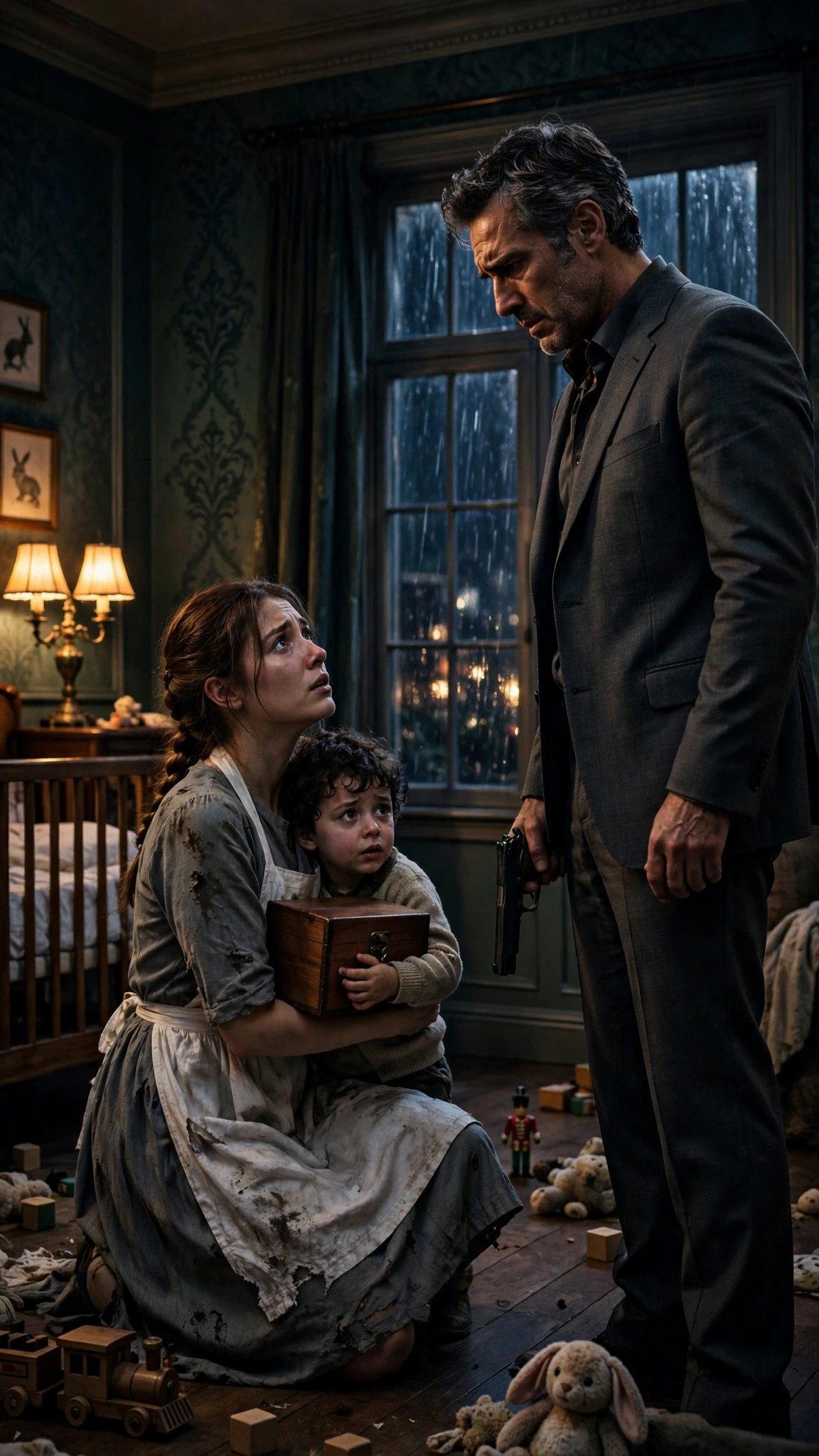
    Hannah Collins did not run. She did not beg. She sat on the floor of my son's bedroom with her back against the wall, her dress torn and dark with blood, and she held Leo against her chest with both arms wrapped around him like she was the only wall left standing between him and the world. Leo's face was pale as paper. His lips were pale. His eyes were half open, and they were fixed on me, and in them I saw something I had not seen in my son's face in two years, not since the night his mother died. I saw fear. Not fear of the men who had come into our house. Fear of me.

    "Don't," Leo whispered. His voice shook. "Don't hurt Hannah."

    My finger was on the trigger. My hand did not shake. My hand never shook. That was the problem. My hand had not shaken when I was ten years old and my father put his first gun in it. My hand had not shaken when I was twenty-two and I took over the Rossi family after they carried my father out of a restaurant in a body bag. My hand had not shaken at my wife's funeral, when I stood beside a small white coffin and a smaller boy who did not understand why his mother was not coming home. My hand never shook. And now it was steady while I pointed a gun at the only woman my son had trusted since his mother died, and the only reason it did not fire was that a four-year-old boy whispered two words through pale lips and stopped the most feared man in New York with nothing but his eyes.

    I lowered the gun.

    That was the moment everything changed. Not the moment the gun went down. The moment I understood that I had almost killed the one person in my house who had been protecting my son, while the man who had actually tried to destroy him was still walking free under my own roof, eating at my own table, calling me boss.

    But I am getting ahead of myself. To understand how a man like me came to point a gun at a twenty-four-year-old maid in his own son's bedroom, you have to understand what Leo Rossi was to me, and what Hannah Collins was to him, and what my mother had been whispering in my ear for a year, and what Tony Falco had been doing in the dark while I was busy being feared.

    My name is Adrian Rossi. I am thirty-eight years old. I am the head of the Rossi family, and if you live in New York and you move money, or freight, or anything that needs to cross the river after dark, you know my name, and you know it the way you know the name of a storm that is coming. I did not choose this life. It chose me the way it chooses every Rossi son: my father was a boss, his father was a boss, and the oak box in my office holds our family crest, and it has held it for three generations, and one day it will hold it for my son, if my son lives long enough to inherit it.

    I was ten years old when the shadows first followed me home. My father took me to a meeting in a warehouse in Red Hook, and I watched men twice my size lower their eyes when he walked into the room, and I understood, the way a child understands things without words, that power was not about shouting. Power was about the silence that fell when you entered a room. I learned to be silent. I learned to be still. I learned that a man who says nothing is a man nobody can predict, and a man nobody can predict is a man everybody fears.

    They did not kill me. The shadows never did. I stood tall, and I ran operations alongside the Rossi crest for years, and I told myself that I was a lone wolf, that I did not need anyone, that I could devour the wreckage of my own life and keep walking. I was wrong about all of it. I just did not know it yet.

    I met Isabella when I was twenty-six. She was not part of this world. She was a schoolteacher with brown eyes and a laugh that sounded like a window opening in a house that had been locked for years. She knew what I was. I never lied to her about it. She married me anyway, and for eight years, she was the one clean thing in my life. She made our house a home. She made me a better man than I had any right to be. And then, two years ago, on a rainy Tuesday night in November, a truck ran a red light on the West Side Highway, and Isabella died in an ambulance with a paramedic holding her hand, and I was fifteen minutes away in a meeting that did not matter, and I have spent two years trying to forgive myself for being fifteen minutes late to the last moment of my wife's life.

    Leo was two years old when his mother died. He was barely older than three when he sang his favorite song with her for the last time — a little lullaby she made up for him, about night wishes and morning songs, about asking God to keep the people you love safe while you sleep. After she died, he stopped singing. He stopped talking, mostly. He would sit in the nursery with his small gray blanket and his wooden train, and he would look at the door every time it opened, the way a child looks when he is waiting for someone who is never going to come.

    I hired nannies. I hired the best nannies money could buy. They lasted a week. Two weeks. Leo would not speak to them. He would not eat for them. He would sit in the corner with his blanket and wait for them to leave, and they always left, because there is no amount of money that makes a woman stay in a house where a small boy looks at her like she is a stranger in his dead mother's chair.

    And then, a year ago, Rosa brought me a girl from an agency in Ohio. Rosa Benedetti had been our housekeeper for forty years. She had raised me after my own mother decided that running a family was more important than raising a son. Rosa was sixty-one years old, with hands like old leather and eyes that missed nothing, and she stood in my office and said, "This one is different. Give her a week."

    Her name was Hannah Collins. She was twenty-four years old. She had brown hair she wore in a braid down her back, and green eyes, and a plain gray dress and a white apron, and she carried nothing but a small suitcase and a paperback book with a broken spine. Her mother had been a nurse in a small town in Ohio. Her father had died when she was sixteen. She had come to New York with nothing and no one, and she needed the work, and I needed someone who could sit in a room with my son without making him flinch.

    The first day, she went into the nursery, and she did not try to pick Leo up. She did not try to make him talk. She sat on the floor, a few feet away from him, and she opened her book, and she started reading out loud. Not to him. Just reading, in a quiet, steady voice, like she was reading to herself. Leo watched her for an hour. The next day, he moved a little closer. On the third day, he sat beside her, and she turned the book so he could see the pictures, and he pointed at a drawing of a fox, and he said, "Fox." It was the first word he had said to anyone who was not family in six months.

    Within a month, he was laughing. Hannah made him laugh by playing a game with him — a silly game where she would pretend the wooden train was a dragon and the blanket was its cave, and Leo would shriek with laughter, the kind of laughter that sounds like it is coming from a child who has forgotten, for one minute, that his mother is dead. She read to him every night. She carried his small gray blanket when he forgot it. She cleaned my bathroom. She carried trays. She did the work of a maid, and the work of a mother, and she never once asked me for anything more than her wages and a room of her own.

    I should have seen what was happening. I should have seen that my son had given his heart to a stranger, and that a stranger with my son's heart was the most dangerous thing in my house — not because she was dangerous, but because anyone who wanted to hurt me would know exactly where to aim.

    My mother saw it first. Livy Rossi is sixty-four years old, and she has run the Rossi family from behind the curtain for forty years, since my father's death. She is a small woman with iron-gray hair and a voice like a door closing, and she has never trusted anyone who was not born into this life. From the first week, she watched Hannah the way a hawk watches a field. "A girl like that does not stay for the wages," she told me, more than once. "A girl like that stays for the house. For the name. For the boy. Mark my words, Adrian. She will take something from us. They always do."

    I told her she was wrong. I told her Hannah was harmless. I told her to leave the girl alone. But my mother's words are like water on stone — they do not break you all at once, they wear you down, a little at a time, until one day you find yourself looking at an innocent girl and wondering if your mother was right.

    And then there was Tony. Tony Falco had been my capo for twenty years. He was forty-five years old, built like a wall, with a voice like gravel and a laugh that filled a room. He had stood beside my father. He had stood beside me. I trusted him with my life, and with my son's life, and with the keys to my house. Tony was the man who told me, a year ago, when I asked him about Hannah, "She's harmless, boss. Just a girl from Ohio. Don't worry about her." I believed him. I had no reason not to.

    But there were things I did not see. Small things. The blood on my sleeve one evening, after a meeting in Queens, when Hannah was lying in the nursery reading Leo his favorite book, and she looked up, and she saw the blood, and she said, in that quiet, steady voice of hers, "Maybe Tony has a game to play with you about a pool plan."

    I laughed it off. I told her it was nothing. I told her Tony was just Tony. But later, in my office, I thought about it, and I could not make it fit. What pool plan? What game? Why would Hannah Collins, a maid from Ohio, know the words "pool plan"? She had heard something. She had heard Tony talking on the phone in the pool house, and she had remembered it, the way she remembered everything about my son — carefully, quietly, and without telling anyone.

    If I had asked her, that night, if she wanted to stay with me — if I had asked her what she had heard, and what she knew — she would have answered me immediately. She would have told me everything. But I did not ask. I was too busy being a boss. I was too busy being feared. I was too busy being the lone wolf who did not need anyone.

    That was my first mistake. It was not my last.

    On the night everything broke open, I was in Manhattan, in a meeting that ran three hours too long, and my phone was on silent, and when I finally looked at it, there were eleven missed calls from Rosa. Eleven. Rosa never called me. Not once in forty years. I drove home through the rain with my heart hammering against my ribs, and when I turned into the long driveway, I saw that the gatehouse was dark. The gatehouse was never dark. There were always two men there, every hour of every day, for twenty years. That night, there was no one. The gate stood open. The light was out.

    I ran. I ran from the car to the front door, and the front door was open, and the hall was silent, and I took the stairs three at a time, and I could hear my own breathing, and I could hear nothing else, and I thought, for one terrible moment, that I was already too late.

    I found them in Leo's bedroom. Hannah, on the floor, holding my son against her chest. Leo, pale and barely breathing. And on the floor beside the bed, half in shadow, a woman in a blood-stained dress, lying with her body broken, yet silently she breathed, and when she saw me, she lifted one hand, and she said, in a voice so quiet I had to kneel to hear it, "She did it for you."

    It was Rosa. My Rosa. The woman who had raised me. She had tried to stop them, and they had broken her for it, and she was dying on my son's bedroom floor, and the last thing she did with her life was tell me the truth about the girl I had been about to shoot.

    My finger tightened on the trigger. And then my son whispered, "Don't hurt Hannah." And I lowered the gun. And I finally, finally started to see.

  • Chapter 7: The Sound of Home

    Chapter 7: The Sound of Home

    It was a Tuesday in June, exactly eight months after the rainy Thursday, when Dante Marino asked me to marry him.

    He did it the way he did everything: quietly, carefully, and without asking anyone's permission first. He waited until the end of the workday, until Gloria had gone home and Tommy had gone home and the office was empty except for the two of us and the rain that had started again outside the windows, because of course it was raining. It always seemed to rain when something important happened in that office.

    He came to my desk with a small velvet box in his hand, and he did not kneel, because Dante Marino did not kneel for anyone, but he stood very still in front of me, and he said, "Emily Davis. I have spent nine years being silent, and eight months learning how to laugh again, and I have learned one thing in all of that time. I do not want to be silent anymore. And I do not want to laugh alone."

    He opened the box. Inside was a ring, simple and gold, with a single small diamond, the kind of ring a schoolteacher would have worn, the kind of ring Clara would have worn, and I understood, in that moment, that he had chosen it carefully, because he was not asking me to replace anyone. He was asking me to stand beside him, as myself, as Emily Davis, the secretary who had made a joke about a rug.

    "I am not asking you to be Clara," he said. "I am asking you to be Emily. I am asking you to keep making me laugh. I am asking you to keep telling me the truth, even when the truth is about a rug. I am asking you to marry me, and to let me spend the rest of my life trying to be worthy of the woman who walked into an execution with paperwork in her hand."

    I stared at the ring. I stared at him. And then I did the most honest thing I had ever done in my life.

    "Yes," I said. "But on one condition."

    "Anything," he said.

    "You have to promise me something," I said. "Promise me that you will never stop laughing. Not when things get hard. Not when the family complains. Not when the world tries to make you silent again. Promise me."

    "I promise," he said.

    "And promise me that Daniel will always have a home, and a garden, and a red truck on his shelf."

    "I promise," he said again.

    "And promise me," I said, "that we will never, ever buy another Persian rug."

    He laughed then. Really laughed, loud and free and unbroken, the way a man laughs when he has finally, finally come home, and the sound of it filled the office like sunlight, and Gloria, who had forgotten her umbrella and come back for it, stood in the doorway with her hand over her mouth, and Tommy, who had come back for his phone charger, stood behind her, and Enzo, who had never left the building, stood in the hallway, and they all heard it, and they all smiled, because the sound of Dante Marino laughing was the sound of a house unlocking its doors after nine years.

    We were married three months later, in September, in the garden behind Daniel's house.

    It was a small wedding. Gloria was there, in a dress she had bought specially for the occasion, crying before the ceremony even started. Tommy was there, in a suit that did not quite fit, holding the rings like they were made of glass. Sal and Maria came up from Milwaukee, and Maria brought biscotti, and Sal cried during the vows and pretended it was allergies. Enzo stood at the back with his arms folded, looking like a man guarding something precious, which, in a way, he was. Agent Reyes came, in his tired suit, and told me afterward that it was the first wedding he had ever attended where no one was arrested, which he considered a personal victory.

    Daniel was my something blue. He wore a blue tie, and he sat in the front row in his wheelchair, and when the minister asked if anyone objected, Daniel shouted, "No! Hurry up!" and everyone laughed, including Dante, especially Dante.

    Dante wore a charcoal suit, because of course he did. But he had left off his tie, because I had asked him to, and he looked younger without it, and happier, and when he took my hands and said his vows, his voice was steady and clear, and he did not look away once.

    "I, Dante, take you, Emily," he said, "to be my wife. To laugh with you. To be silent with you, when silence is what we need. To protect your brother as my own. To build a family that does not need fear to survive. And to never, ever shoot anyone on a freshly cleaned rug."

    Everyone laughed. I laughed. Daniel laughed so hard Grace had to steady his wheelchair. And Dante, standing in a garden in September with the sun on his face and my hands in his, laughed too, and it was the best sound I had ever heard.

    At the reception, under a white tent strung with lights, Gloria stood up to make a toast. She had written it on an index card, and her hands were shaking, and she read it twice before she got through it without crying.

    "I have worked in the Marino building for eleven years," she said, "and for nine of those years, I watched a good man disappear into silence. I watched him eat the same lunch every day. I watched him sign papers and take phone calls and look out the window like the world had ended. And then one rainy Thursday, a secretary walked into his office with a folder and told him not to bleed on the rug, and everything changed. So here is to Emily Davis Marino, who taught this family that laughter is not a weakness, and that mercy is not a luxury, and that a rug is just a rug, no matter who picked it out."

    Everyone raised their glasses. Sal stood up next, with Maria's hand on his arm, and he said, "Mr. Marino spared my life when he had every right to take it. Miss Davis, I mean, Mrs. Marino, found the truth when no one else looked for it. My son is alive because of them. My family is whole because of them. I have been in this family for forty years, and I have never been prouder to be a part of it than I am today."

    And then Daniel stood up, or rather, he wheeled himself to the front of the tent, and he took the microphone, and he said, "I'm Daniel. I'm Emily's brother. I want to say something. A year ago, my sister came home and told me her boss laughed at a joke about a rug. Today, that boss is my brother-in-law. And he promised me a red truck, and he brought it, and he listens when I talk about the standing frame, and he is the best brother-in-law in the whole world. Also, he is very tall. Thank you."

    The whole tent erupted. Dante wiped his eyes with a napkin and pretended it was the pollen. I took his hand under the table and held it, and I thought about how strange and wonderful it was that a family could be built out of a secretary, a bodyguard, a receptionist, an old captain, and a young man in a wheelchair who loved red trucks.

    After the ceremony, we danced in the garden. The music was a small string quartet that Gloria had hired, and the song was one Clara used to love, and I knew that because Dante had told me, and he had asked them to play it, and when it started, he held me a little tighter, and he whispered, "She would have liked this. She would have liked you."

    "I know," I whispered back. "She's here. I can feel it."

    And she was. Not in a frightening way. In the way that love stays, long after the person is gone, in the garden they planted, in the rug they chose, in the laugh they left behind for someone else to find.

    That night, after the guests had gone home and Daniel was asleep in his room with the red truck on his shelf, Dante and I sat on the porch of the small house, and we listened to the crickets, and we drank sparkling water, because old habits die hard, and he told me about the family, about the legitimate businesses, about the foundation he was starting in Clara's name, a foundation that would pay for the care of people like Daniel, people whose families could not afford eight thousand dollars a month.

    "We're going to call it the Clara Marino Foundation," he said. "And you're going to run it. Because you're the only person I trust to spend money wisely, and because you know what it costs to care for someone you love."

    "All right," I said. "But only if we hire Gloria. She deserves a promotion."

    "Done," he said.

    We sat there for a long time, in the dark, in the quiet, and I thought about the rainy Thursday, and the rug, and the gun, and the ten seconds that had changed everything. I thought about the secretary I had been, tired and invisible, balancing spreadsheets in a building full of dangerous men. And I thought about the woman I had become, sitting on a porch in September with the man I loved, listening to the crickets, with my brother asleep in the house behind us and a future in front of us that I had never dared to imagine.

    "Do you remember," I said, "the first thing I ever said to you in that office?"

    "You said, 'Mr. Marino, I need your signature,'" he said.

    "And do you remember the second thing?"

    "You said, 'Please shoot him at the warehouse.'"

    I laughed. "I was very professional."

    "You were," he said. "You still are. You're just professional and married to the boss now, which Gloria tells me is a conflict of interest."

    "Gloria can file a complaint," I said. "I'll put it in the spreadsheet."

    He laughed again, and I laughed with him, and the sound of it rose up into the September night like something bright and alive, and I understood, finally and completely, what home sounds like.

    Home sounds like laughter. Home sounds like crickets, and like a brother asleep in the next room, and like a man who spent nine years in silence learning, at last, how to make a joyful noise.

    Home sounds like Dante Marino, laughing in a garden, with his wife beside him and his family safe around him, and the rain, for once, nowhere in sight.

    In the first weeks of our marriage, the office had to adjust. Gloria started calling me "Mrs. Marino" and then correcting herself, and then giving up entirely and calling me "Emily, Mrs. Marino, whatever you are now," which made Dante laugh every single time. Tommy started saluting me in the hallway, which I told him to stop doing, which only made him do it more. Enzo started walking three steps behind me instead of two, which he said was "respect for the lady of the house," and which I said was "ridiculous," and which he ignored completely.

    One morning, Dante came to my desk with two cups of coffee, one black and one with milk, and he set mine down in front of me and said, "I made this myself. In the break room. Gloria supervised, because she said I would burn the building down otherwise."

    I took a sip. It was terrible. It was the worst coffee I had ever tasted, worse than the break room sludge, worse than the burnt toast coffee from my first day.

    "It's wonderful," I said.

    He looked at me. "You're lying."

    "I'm your wife," I said. "Lying about your coffee is in the job description."

    He laughed, and he kissed my forehead, right there in front of the whole office, and Gloria dropped a stapler, and Tommy pretended to be very interested in the ceiling, and I thought: this is my life now. Terrible coffee, and a man who laughs, and a family that salutes me in hallways. It was not the life I had planned. It was better.

    One year later, on a rainy Thursday in October, I walked into Dante's office with paperwork in my hand, exactly the way I had done it the first time. The Persian rug was still there, on the floor between the desk and the window, cleaned every Tuesday, and Sal's replacement, a young captain named Joey Costa who had no idea what the rug meant, was standing in front of the desk looking nervous.

    Dante looked up from his papers. "Miss Davis," he said, because he still called me Miss Davis in the office, even though the whole building knew we were married, "what is it?"

    "The Clara Marino Foundation helped its first family today," I said, setting the folder on his desk. "A woman in Cicero. Her son has cerebral palsy. She was going to lose their house to pay for his care. We paid the mortgage. She's keeping the house."

    Dante was quiet for a moment. Then he stood up, and he walked around the desk, and he took my hands, and he said, "Clara would have liked that. She would have liked all of this."

    "She would have liked you," I said. "The you that laughs."

    He laughed then, right there in the office, with Marco Bellini staring at us like we had both lost our minds, and I thought about the rainy Thursday a year ago, and the gun, and the ten seconds, and the rug, and I understood that some stories do not end. They just keep going, one laugh at a time, one Tuesday at a time, one family at a time.

    And somewhere, in a small house with a garden, my brother was watching a red truck go by on the highway, and the sun was coming through his window, and the world, for once, was exactly as it should be.

    The End.
    THE END

  • Chapter 6: What Mercy Costs

    Chapter 6: What Mercy Costs

    The trial of Vincent Castellano took four months, and in those four months, my life changed in ways I had never expected.

    The first change was the simplest one: Dante started laughing. Not often, and not loudly, but sometimes, in the middle of an ordinary afternoon, I would say something dry about a spreadsheet or a delivery man or the break room coffee, and his shoulders would shake once, and his mouth would twitch, and a sound would escape him that was almost a laugh, like a man clearing his throat after nine years of silence. Gloria kept a tally on a sticky note on her monitor. By Christmas, the tally said fourteen.

    The second change was harder: the family did not know what to make of a boss who laughed.

    Tommy told me about it one morning, in a whisper, while Dante was on the phone. "Some of the captains are nervous," he said. "They say a laughing boss is a soft boss. They say Castellano's men are already saying Dante has gone weak."

    "Has he?" I asked.

    Tommy thought about it. "He paid Marco's debt. He spared Sal. He called the FBI. In the old days, Castellano would have been dead by now, and Sal with him, and nobody would have asked questions." He paused. "But you know what? The old days got Clara killed. Maybe soft is better than dead."

    The third change was the trial itself. Agent Reyes called me twice a week. I testified about the transfers, about the forged signatures, about the twelve minutes it took to find three million dollars. Sal testified about his son's debt and the threats. Dominic Voss testified about everything: the shell companies, the gambling operation, the bomb. And Aldo Ferrante, the man who had planted the bomb nine years ago, testified that Castellano had paid him fifty thousand dollars and told him to make it look like an accident.

    I sat in the courtroom on the day Voss testified, in the back row, where no one would notice me, and I listened to a man describe, in a flat and tired voice, how he had helped plan the murder of a twenty-nine-year-old schoolteacher he had never met. Dante sat in the front row, perfectly still, his hands folded, and he did not look at Voss once. He looked at the judge. He looked at his own hands. And when Voss finished, Dante stood up and walked out of the courtroom, and I followed him, because someone had to, and we stood in the hallway together while he stared out the window at the Chicago skyline.

    "Did it help?" I asked. "Hearing it?"

    "No," he said. "It didn't bring her back. Nothing brings her back." He was quiet for a moment. "But it helped to hear someone say it out loud. For nine years, it was only in my head. Now it's in a courtroom, on the record, and everyone knows. That's something."

    "That's a lot," I said.

    He nodded. "Agent Reyes says Castellano will get life. No parole. The gambling operation is gone. The shell companies are frozen. His men are turning on each other like rats in a sinking ship."

    "And Sal?" I asked.

    "Sal is in Milwaukee," Dante said. "He runs the warehouse. He calls me every Sunday. He tells me about the tomato plants. Maria sends me biscotti every month, and I eat them at my desk, and I pretend not to enjoy them."

    I smiled. "You're a terrible liar, Mr. Marino."

    "I know," he said. "It's a recent development."

    The fourth change was the one I had not expected at all. One evening in February, Dante called me into his office and closed the door, and he set a folder on his desk, the way I had set a folder on his desk a hundred times before.

    "This is for Daniel," he said.

    I opened the folder. Inside was a trust document, drawn up by the best lawyer in Chicago, establishing a fund in Daniel's name. It would pay for his care for the rest of his life, in full, no matter what happened to me, no matter what happened to Dante, no matter what happened to the family. There was a house, too, a small house with a garden not far from the facility, where Daniel could live with a full-time nurse when he was ready, and where I could visit him on Sundays without signing in at a front desk.

    I stared at the document for a long time. My hands were shaking.

    "I can't accept this," I said.

    "Yes, you can," Dante said. "And you will. Because it's not a gift, Emily. It's a debt. You gave me back something I thought I had lost forever. You gave me back my laugh. You gave me back my mercy. You gave me back the part of me that died with Clara. A trust fund is the least I can do."

    "It's too much," I whispered.

    "It's not enough," he said. "It will never be enough. But it's a start."

    I signed the papers. My hand shook so badly the signature looked nothing like my own, and Dante pretended not to notice, and when I finished, he stood up and walked around the desk, and he did something he had never done before. He hugged me.

    It was not a romantic hug. It was the hug of a man who had carried nine years of grief alone and had finally found someone strong enough to help him carry it. I hugged him back, and I cried into his charcoal suit, and he did not move, and he did not tell me to stop, and when I finally pulled away, he handed me a tissue from the box on his desk, because he had learned where I kept them.

    "Thank you," I said.

    "No," he said. "Thank you."

    The following Sunday, Dante asked me to go somewhere with him. He did not say where. Enzo drove, and we went north, out of the city, to a small cemetery on a hill where the grass was green even in February and the wind smelled like snow.

    Clara Marino's grave was simple. A grey stone with her name and two dates, and a small vase with white roses that someone, Dante, had clearly been replacing every week for nine years. He stood in front of it for a long time, his hands in his pockets, and I stood a few steps behind him, because some moments do not belong to anyone but the person living them.

    "I used to come here every Sunday," he said finally. "For nine years. I would stand here and I would tell her about the week. About the business. About the men who betrayed me and the men who stayed. I never told her about you. I didn't know how."

    He turned to look at me. "I think she would have liked you, Emily. She was funny, like you. She left notes in my coat pockets. She once told a man with a gun to wipe his feet before he came into our house, because she had just mopped the floor. She was fearless in the exact way you are fearless, which is to say she was too tired and too stubborn to be afraid."

    "Thank you," I said quietly. "That might be the nicest thing anyone has ever said to me."

    "I want you to know," Dante said, looking back at the stone, "that I loved her. I will always love her. What I feel now, what I'm beginning to feel, it doesn't replace her. It doesn't erase her. But she would not want me to be silent forever. She used to say that silence was just grief that hadn't found its voice yet."

    He knelt down then, and he touched the stone, just once, with his fingertips, and he said, very quietly, "I laughed, Clara. For the first time in nine years, I laughed. A secretary made a joke about your rug, and I laughed, and I think you would have liked that. I think you would have liked her."

    We stood there for a while longer, in the cold and the quiet, and then we walked back to the car together, and I understood that I had just witnessed something sacred: a man saying goodbye to nine years of silence, not by forgetting the woman he loved, but by finally allowing himself to live again.

    That spring, Dante began to change the family. He sold the gambling operations. He closed the shell companies. He turned the warehouses into legitimate logistics businesses, and the restaurants into restaurants, and the shipping companies into shipping companies, and he told his captains, in a meeting I was not invited to but heard about from Tommy in great detail, that the Marino family was going legitimate, and that anyone who did not like it was free to leave, and that anyone who stayed would be paid well and would never be asked to do anything that would put them in a courtroom.

    Half of them left. The other half stayed. Tommy stayed. Enzo stayed. Sal called from Milwaukee and said he was proud. And Gloria, who had worked in that building for eleven years, told me she had never seen anything like it.

    "He's building something new," she said. "A family that doesn't need silence to survive."

    In April, the jury found Vincent Castellano guilty on all counts: murder, conspiracy, racketeering, fraud. The judge sentenced him to life in prison without parole. Aldo Ferrante got thirty years. Dominic Voss got eight, in exchange for his testimony, and Agent Reyes told me he would be out in five with good behavior, and that he had asked for a job in the prison library, which seemed fitting for a man who had spent his life keeping other people's secrets.

    On the day of the sentencing, Dante and I stood on the steps of the courthouse, and the reporters shouted questions, and the cameras flashed, and Dante did not answer any of them. He just stood there in his charcoal suit, looking up at the sky, and when the shouting died down, he turned to me and said, "It's over, Emily. Really over this time."

    I believed him. I believed him because his shoulders were straighter than they had been in eleven months, and because he was smiling, not laughing, just smiling, a small and certain thing, like a man who had finally put down a weight he had carried for nine years.

    That night, we had dinner at a small Italian restaurant on the North Side, just the two of us, and he ordered pasta, which was the first time I had ever seen him eat anything other than grilled chicken, and he laughed twice, once at something I said about the waiter, and once at nothing at all, just because the evening was warm and the food was good and the world, for once, felt kind.

    And I sat across from him, in a little restaurant with candles on the tables and the smell of garlic in the air, and I thought about the rainy Thursday, and the rug, and the gun, and the ten seconds that had changed everything, and I understood, finally, what mercy costs.

    The following Sunday, Daniel moved into the small house.

    It was not a grand house. It had three rooms, a garden with a fence, and a ramp at the front door that the builders had installed without being asked, because Dante had told them, in his quiet way, that the man who lived there deserved to come and go as he pleased. There was a full-time nurse named Grace, a kind woman with grey hair who had worked at the facility for ten years and who knew Daniel's routines better than I did. There was a room with a window that faced the morning sun, and a shelf for Daniel's model trucks, and a red truck already sitting on the shelf, waiting for him, because Dante had remembered.

    I brought Daniel over in the morning, and he wheeled himself through the front door, and he looked around at the garden and the ramp and the shelf, and he said, "Em. This is mine?"

    "It's yours," I said. "For as long as you want it."

    He cried then, quietly, the way he always cried when he was happy, and I cried too, and Grace pretended to be very busy in the kitchen, and Dante stood in the doorway with his hands in his pockets, watching us, and I saw his mouth twitch, just once, like a muscle remembering an old habit.

    We spent the whole day there. Daniel picked the room with the morning sun. He put the red truck on the shelf himself. He told Grace about the harmonica player, and she laughed, and he told Dante about the standing frame, and Dante listened like it was the most important thing in the world. And when the sun went down, I drove home, and I sat in my car for a long time before going inside, because I wanted to remember exactly how the day had felt: warm, and safe, and full of light.

    The next Sunday, Dante came to the house for lunch. He brought the model truck himself, a red one, in a box with a bow on it that looked like Gloria had tied it, and Daniel opened it at the table and held it up like it was made of gold. Grace made roast chicken and potatoes, and Dante ate two helpings, and when I raised an eyebrow at him, he said, "Don't tell Gloria. She thinks I only eat grilled chicken." Daniel laughed so hard he nearly knocked over his glass, and Dante laughed too, and for a moment, sitting at that small table in that small house with the garden outside and the sun coming through the window, I thought: this is what a family looks like. Not perfect. Not unbroken. But warm, and safe, and full of light.

    It costs everything you thought you knew about yourself. It costs your silence. It costs your certainty. It costs the armor you built around your heart to survive. And in return, it gives you back the one thing you thought you had lost forever.

    It gives you back your life.

  • Chapter 5: The Price of a Laugh

    Chapter 5: The Price of a Laugh

    It happened on a Tuesday, because of course it did. Tuesdays were the day the rugs were cleaned, and Tuesdays, I was learning, were the day Castellano liked to remind people that he existed.

    I was at my desk at nine in the morning when my phone rang. It was Mrs. Okafor from the facility, and her voice was shaking so hard I could barely understand her.

    "Miss Davis. Two men came to the front desk this morning. They said they were from an insurance company, and they wanted to see your brother's file. I told them no. I told them what you said, that no one sees Daniel's file without your permission. They left, but one of them, he looked at me, Miss Davis, and he said, 'Tell the secretary her brother has a nice room. It would be a shame if something happened to the building.'"

    My hands went cold. "Did you call the police, Mrs. Okafor?"

    "I called you first. And then I called Mr. Ricci. He is on his way."

    Enzo was already moving before I finished the call. He had heard enough from my side of the conversation, and he was on the phone to Dante before I had even put my own phone down.

    Dante came out of his office like a storm breaking. His face was white. His hands were steady. That was the frightening part: his hands were completely steady.

    "Tell me exactly what they said," he said.

    I told him. Word for word. He listened, and then he picked up his phone and made three calls, and I watched the man who had chosen mercy over murder three weeks ago become someone else entirely, someone older and colder, someone who had survived nine years of silence by being the most dangerous man in any room he entered.

    "Enzo will take you to the facility," he said. "You will stay with your brother until I call you. Do not argue."

    "I don't need—"

    "Emily." He said my name the way he had said it at the elevator, low and certain, and this time there was no smile in it. "They threatened your brother because of me. Because I laughed. Because I let them see that I care about you. That is my fault, and I will fix it. But right now, you will go to your brother, and you will stay with him, and you will let me do what I have to do."

    I went. Enzo drove, fast and silent, through the morning traffic, and I sat in the back seat with my hands folded in my lap, and I thought about Daniel, and about the garden, and about the red truck, and about the fact that a man I had never met had stood in the lobby of my brother's home and threatened to burn it down because I had made a joke about a rug.

    When we arrived, Mrs. Okafor met us at the door. She was still shaking. The front desk had a new crack in the glass, a thin white line running from one corner to the other, and she told me one of the men had leaned on it while he was talking to her, just leaned on it, and the glass had cracked under the weight of his hand.

    Daniel was in his room, by the window, with his blanket over his legs. When he saw me, his face lit up, and then he saw my face, and his smile faded.

    "Em? What's wrong?"

    "Nothing," I said, sitting beside him. "I just wanted to see you on a Tuesday."

    "You're lying," he said. "You only lie when you're scared. Are you scared, Em?"

    I looked at my brother, twenty-four years old, in a wheelchair by a window, and I decided to tell him the truth, because he deserved the truth, and because I was tired of carrying fear alone.

    "Yes," I said. "I'm scared. Some bad men threatened this place today because of my job. But Dante is fixing it. And Enzo is here. And nothing is going to happen to you. I promise."

    Daniel was quiet for a moment. Then he said, "Is Dante the laughing gangster?"

    "Yes."

    "Then he'll fix it," Daniel said, with the same absolute confidence he had always had. "Laughing people don't let bad things happen. That's a rule."

    I stayed with him until noon. We played cards. We watched a game show. The nurses brought lunch, and Daniel ate two sandwiches and told me about a new resident who played the harmonica badly, and for an hour, the world felt almost normal.

    Then my phone rang. It was Dante.

    Actually, before the phone rang, something else happened, and I want to remember it exactly, because it was the moment I understood what kind of man Dante Marino really was.

    Mrs. Okafor came to Daniel's room with the facility director, a tall woman named Dr. Patel, who had run the facility for fifteen years and did not frighten easily. But that morning, her hands were shaking too.

    "Miss Davis," Dr. Patel said, "I want you to know that we have already called our security company. We are replacing the front glass today. We are adding a second guard at the front desk, and a camera at every entrance. And I have spoken to Mr. Marino's office. He has offered to pay for all of it, and for a private security detail for the building, for as long as it is needed."

    "That's very generous," I said.

    "It's not generosity," Dr. Patel said. "It's responsibility. Mr. Marino told me on the phone that your brother was threatened because of him, and that a man who cannot protect the people he cares about does not deserve to be called a man at all. Those were his exact words, Miss Davis. I wrote them down."

    She paused. "In fifteen years, no one has ever offered to pay for our security. Not the families of the residents. Not the city. No one. Your employer is a remarkable man, Miss Davis, whatever else he may be."

    I thought about that as I sat beside Daniel, watching him eat his second sandwich, and I realized that Dr. Patel was right. Dante Marino was a remarkable man. He was also a dangerous man, and a grieving man, and a man who had done terrible things in his life. But he was the kind of man who paid for a stranger's security cameras because a threat had been made in his name, and that mattered. That mattered more than anything else I had learned about him.

    Daniel, meanwhile, was entirely unbothered by the morning's excitement. He had spent the whole time telling Mrs. Okafor about the harmonica player, and when I asked him if he was frightened, he said, "A little. But Enzo is here, and Enzo is very big, and the man at the desk said he would call the police if the bad men came back. And you came, Em. You always come."

    "Always," I said, and I meant it.

    Then my phone rang. It was Dante.

    "Come back to the office," he said. "Bring Enzo. It's done."

    "What's done?"

    "Come back," he said. "I'll explain."

    The drive back was silent. Enzo kept checking the mirrors. When we reached the office, Dante was waiting in the conference room with Agent Reyes and a man I had never seen before, a thin man in a grey suit with a briefcase and the nervous air of someone who has made a terrible mistake and knows it.

    "Miss Davis," Dante said. "This is Dominic Voss. Castellano's lieutenant. The man who has been watching this building for three weeks. The man who sent two men to your brother's facility this morning."

    Voss did not look at me. He looked at the table.

    "Mr. Voss has agreed to cooperate with the FBI," Reyes said. "In exchange for protection, he has given us everything. The shell companies. The gambling operation. The names of every man Castellano owns in this city. And the name of the man who planted the bomb that killed Clara Marino nine years ago."

    The room went very quiet. Dante stood at the head of the table, his hands flat on the wood, and I saw his knuckles go white.

    "Say it," Dante said to Voss.

    Voss swallowed. "Castellano ordered it. Nine years ago. He wanted your shipping routes, and he wanted you dead, and when you were late, he…" Voss stopped. He could not finish the sentence.

    "He killed my wife instead," Dante said, in a voice so quiet it was barely a sound.

    "Yes," Voss whispered.

    I watched Dante Marino stand there, a man who had carried nine years of silence and grief and rage in his chest, and I watched him do the hardest thing I had ever seen anyone do. He did not reach for a gun. He did not raise his voice. He looked at Reyes and said, "Arrest him. All of them. Tonight. I want Castellano in handcuffs before sunrise, and I want it done legally, so that no lawyer in Chicago can ever undo it."

    Reyes nodded. "We're already moving. The warrants are signed."

    Dante turned to me. "Emily. Are you all right?"

    I thought about Daniel, by the window, with his blanket and his game shows. I thought about Mrs. Okafor, shaking at the front desk. I thought about Maria Genovese's biscotti, and about Sal in his garden pulling weeds, and about the rug that had been cleaned on Tuesday.

    "No," I said honestly. "But I will be."

    He nodded. "Then stay. Stay until it's over. Enzo will take you home when it's done."

    That night, the FBI raided six locations across Chicago. I know because Reyes called Dante every hour, and Dante let me stay in the office and listen, and I sat at my desk with a cup of cold coffee and watched the city lights through the windows and thought about the fact that nine years of silence was finally ending, not with a gunshot, but with a spreadsheet, a forged signature, and a secretary who had made a joke about a rug.

    At three in the morning, Reyes called with the news: Vincent Castellano had been arrested at his home in Lake Forest, in his pajamas, without a struggle. The gambling operation was seized. The shell companies were frozen. Dominic Voss was in protective custody. And the man who had planted the bomb nine years ago, a hired killer named Aldo Ferrante, had been arrested at O'Hare trying to board a flight to Naples.

    Dante put the phone down. He looked at me across the desk, and his eyes were wet, and I realized, with a shock, that Dante Marino was crying. Not sobbing. Just tears, silent and steady, running down his face like rain on a window.

    "Nine years," he said. "Nine years, and it's over."

    I did not know what to do. So I did what I had always done. I got up, I walked around the desk, and I handed him a tissue from the box I kept in my drawer for days when the spreadsheets didn't balance.

    "Here, Mr. Marino," I said. "The good ones. I hide them from Gloria."

    He took the tissue. He laughed once, wet and broken, and then he said, "Thank you, Emily. For everything."

    And I stood there in the quiet office at three in the morning, with the city asleep outside the windows, and I understood that the price of a laugh was not danger, or fear, or a cracked pane of glass at my brother's facility. The price of a laugh was this: once you let the light back in, you have to live in it. And living in it, after nine years of darkness, was the bravest thing Dante Marino had ever done.

    The next morning, Dante asked me to take him to the facility.

    He had never been there. He wore a charcoal suit, because he wore a charcoal suit everywhere, and he looked profoundly out of place in a lobby full of wheelchairs and potted plants and a receptionist who had never met a Mafia boss before.

    Daniel was in the garden when we arrived. The morning sun was warm, and the nurses had put a blanket over his legs, and he was watching a red truck go by on the highway, the way he always did.

    "Daniel," I said, "this is Mr. Marino. My boss."

    Daniel looked up at Dante, tall and silent in his charcoal suit, and he grinned. "You're the laughing gangster."

    Dante stared at him. Then, slowly, he crouched down beside the wheelchair, so that he was at Daniel's eye level, and he said, "I suppose I am. Your sister tells me you like trucks."

    "I like red ones," Daniel said. "They're the fastest."

    "They are," Dante agreed gravely. "I used to like red ones too, when I was your age."

    They talked for twenty minutes. About trucks. About the garden. About the harmonica player who played badly. Dante asked Daniel about the standing frame, and about his physiotherapy, and about what he wanted for his birthday, and Daniel said he wanted a model truck, a red one, and Dante said he would see what he could do, and I stood there watching the most feared man in Chicago crouch in a garden talking about trucks with my brother, and I felt something in my chest crack open, the way a door opens in a house that has been locked for a long time.

    When we left, Daniel waved from the garden, and Dante waved back, and in the car, Dante was quiet for a long time before he said, "He's a good boy, your brother."

    "He is," I said.

    "I'm glad I got to meet him," Dante said. "I've known about him for weeks, and I didn't even know his favorite color."

    "What's his favorite color?" I asked.

    "Red," Dante said. "Like the trucks."

    I laughed. He laughed too, just once, short and surprised, and Enzo, driving the car, smiled at the road ahead, and for a moment, everything felt possible.

    I just hoped I was brave enough to do it beside him.