Story Genres: Mafia Romance

  • Chapter 6: Unsigned

    Chapter 6: Unsigned

    I woke in the hospital to the smell of coffee and the sound of Isabel's voice, low and steady, talking to someone on the phone. Rosa, I thought. Or Dr. Okafor. She was telling someone I was fine, that the shoulder was a graze, that the baby was fine, that she was fine. She said it the way she said everything now — calmly, precisely, like a woman who had decided that panic was a luxury she could not afford. When she saw I was awake, she put the phone down and came to sit beside the bed, and she looked at me for a long moment, and I saw in her eyes the same question she had asked me on the night of the fight, the question I had answered with silence.

    "If I had already given you a child," she had asked, "would you still speak to me this way?"

    I answered it now. "No," I said. "I would never speak to you that way again. I was wrong, Isabel. Not about the treatments, not about the wanting — wanting a child was never the sin. The sin was making you feel like you were the failure. The sin was letting my father's voice live in my head rent-free until it sounded like my own. I am sorry. I know those words are small, and I know they are late, and I know they do not undo six months. But they are true, and I needed you to hear them from me, in this room, with no one else listening."

    She was quiet for a long time. Then she said, "Tell me about your mother."

    So I told her. I told her about Elena Moretti, who died when I was nineteen, and about the man my father had been before she died — a hard man, but a whole man, a man who laughed and took me fishing and danced with my mother in the kitchen. I told her what Marcus had told me, that my father had spent twenty-three years trying to keep my mother alive by making sure there was always another Moretti, and that his obsession with an heir was not greed but grief, dressed up as duty. I told her I understood it now, and that understanding it did not excuse it, and that I would never let it happen to our child. Our child would never be a bloodline. Our child would be a person, with a name we chose together, and a life we built together, and no council would ever vote on his future.

    "His?" Isabel said, and there was the smallest smile at the corner of her mouth. "You think it's a boy?"

    "I hope it's a boy," I said. "And if it's a girl, I will love her exactly the same, and I will tell my father to go to hell if he says otherwise."

    She laughed then, really laughed, for the first time since I had found her, and the sound of it in that hospital room was the best thing I had heard in six months. "You can't tell your father to go to hell, Alexander. He's your father."

    "Watch me," I said.

    She told me about the clinic then. She told me about Dr. Okafor, and the heartbeat like a candle in wind, and the little oak, and the crib she had assembled with Rosa holding the instructions upside down. She told me about the six months of appointments alone, and the blankets in quiet colors, and the nights she read poetry aloud to her belly in the blue room. She told me about Vittorio's visit, and the photograph under the door, and the fear she had carried alone because she refused to let our baby become leverage. And as she talked, I held her hand, and I felt the baby kick, and I understood that she had not just survived me. She had survived all of it — my pride, my father's threats, Ferraro's men, six months of carrying a child alone — and she had done it without asking anyone for help, because asking for help had never been something she trusted men to give her.

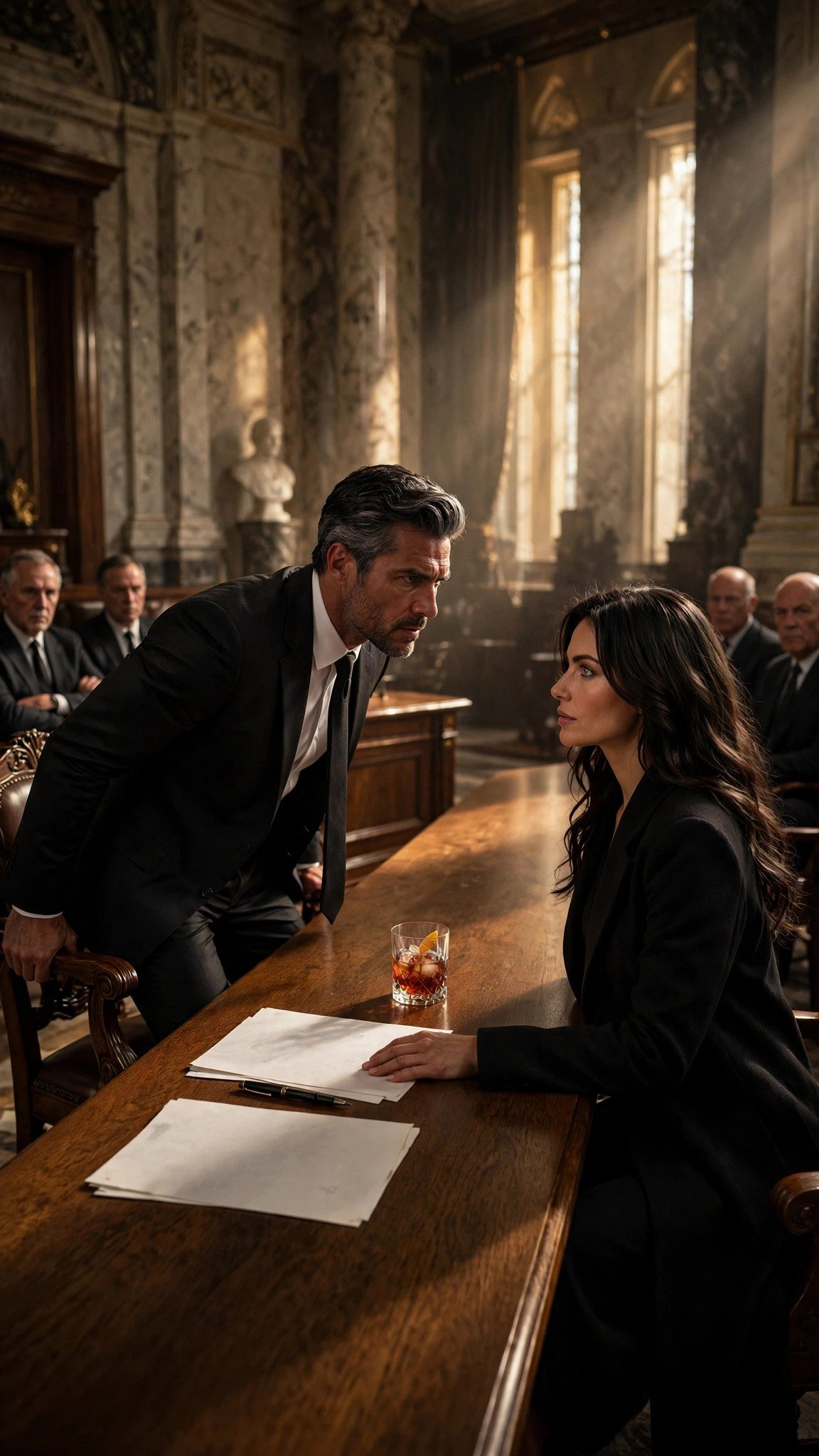
    Marcus arrived at noon with the divorce papers in his briefcase. He set them on the bedside table, and he looked at me, and he looked at Isabel, and he waited.

    I picked up the papers. I looked at them — the settlement, the surrender of claims, the future claims, the inheritance, all the careful legal language that would have erased her from my life forever — and I tore them in half. Then I tore them in quarters. Then I handed the pieces to Marcus, and I said, "Burn them. There will be no divorce. There will be no settlement. There will be no signature."

    Marcus smiled, the first real smile I had seen on his face in months. "I was hoping you'd say that," he said, and he gathered the pieces, and he left the room, and Isabel and I were alone.

    "I have conditions," she said.

    "Name them."

    "No council interference in our child's life. No family votes on his future. Vittorio steps back, or I do not come home. The child is ours, not the family's. And we raise him in the penthouse, but we spend summers in Savannah, with Rosa, where he will learn that there is a world beyond marble floors and oak tables."

    "Agreed," I said. "All of it. Anything else?"

    "Yes," she said. "You learn to cook the shrimp pasta. Properly this time. No burning it."

    "Agreed," I said, and she laughed, and I laughed, and the baby kicked, as if he approved of the terms.

    The ultrasound was the next day. Dr. Okafor dimmed the room, and the screen filled with the small curled figure, and the heartbeat filled the room, fast and steady, and Dr. Okafor smiled and said, "Would you like to know?"

    Isabel looked at me. I looked at her. We nodded together.

    "It's a boy," Dr. Okafor said.

    I cried. I did not mean to. I am a man who has ordered killings before breakfast and never shed a tear, and I cried in a dim clinic room in Savannah with my wife's hand in mine, because the child on that screen was a boy, and he was mine, and he was hers, and he was not a bloodline or a succession or proof of anything. He was a son. And his name, we decided together, right there in that room, would be Leo — after the lion, and after the brave one, and after the little oak that bends in storms instead of breaking. Leo Moretti. The heir I never expected, and the son I had wanted all along, for all the wrong reasons, until finally, at last, for the right one.

    Vittorio called that evening. I took the phone into the hallway, and I told him the terms, and I told him about Leo, and I told him that if he wanted to meet his grandson, he would come to Savannah, and he would apologize to Isabel, and he would do it on his knees if she asked him to. There was a long silence on the other end of the line. Then my father said, very quietly, "Tell her I will come. Tell her I am sorry. Tell her…" He stopped. He started again. "Tell her I was wrong. And tell her I would like to meet my grandson."

    I went back into the room and told Isabel. She was quiet for a long moment, and then she said, "He can come. But he brings flowers, not lawyers. And he calls me Isabel, not Mrs. Moretti."

    "Agreed," I said.

    We left Savannah three days later, driving north together in the car, with Rosa waving from the porch and the crooked crib strapped to the roof, and Isabel asleep in the passenger seat with her hand on her belly, and Leo kicking softly beneath her palm, and the highway unwinding ahead of us like a road we had never driven before. I had spent ten years believing I knew where I was going. For the first time, I did not know, and I did not mind, because for the first time, I was not going alone.

    —

    Vittorio came the day before we left, exactly as he had promised. He drove himself down from the airport in a rented car, and he walked up to the townhouse with a bouquet of white roses in his hands, and he knocked, and Rosa opened the door, and she looked at him, and she looked at the flowers, and she said, "You'd better mean it." And he said, "I do."

    Isabel met him on the porch. She did not invite him in, not at first. She stood in the doorway with her hand on the frame, the way she had stood the last time he came, and he stood on the steps below her, an old man with white hair and flowers in his hands, and for a moment neither of them spoke. Then Vittorio said, "Isabel. I was wrong. I came here to claim a grandson, and I forgot to ask about his mother. I forgot to ask about you. My wife died twenty-three years ago, and I have spent every day since trying to keep her alive by making sure there was always another Moretti. It did not work. It only hurt the people I loved. I am sorry. I know that word is small, and I know it is late. But it is true."

    Isabel looked at him for a long time. Then she said, "You can come in, Vittorio. But you bring flowers, not lawyers. And you call me Isabel, not Mrs. Moretti. And when Leo is born, you will hold him as a grandfather, not as a don. Those are my terms."

    "Agreed," he said, and his voice cracked on the word, just slightly, and Rosa, watching from the doorway, wiped her eyes with her dish towel and pretended she had something in her eye.

    He stayed for dinner. Rosa cooked, and Vittorio ate two helpings, and he told stories about my mother that I had never heard — how she danced in the kitchen, how she laughed at his suits, how she had once told him that the family would survive or not survive, but that love was not a business, and that he should remember it. Isabel listened, and I listened, and for one evening, in a little townhouse in Savannah, the Moretti family was not an empire. It was just people, sitting around a table, eating too much, remembering a woman who had been gone for twenty-three years. When Vittorio left, he hugged Isabel — awkwardly, carefully, like a man who had forgotten how — and he said, "Thank you for my grandson. And thank you for my son. You brought him back to me."

    The drive north took two days. We stopped the first night at a roadside motel with a kitchenette, and Isabel, who was hungry at midnight in the way only pregnant women are hungry, asked me to make the shrimp pasta. I stood in that tiny kitchen in my shirtsleeves, with the shrimp and the garlic and the pan, and I burned it. Not badly — just enough that the edges caught, just enough that the smell filled the little room. Isabel sat on the bed, watching me, and she laughed until she cried, and she said, "Some things never change." And I said, "Give me one more try." And I made it again, and the second time it was right, and we ate it sitting cross-legged on the motel bed with the television off and the window open, and it was the best meal I had eaten in ten years, because it was the first meal I had cooked for my wife since the night everything broke, and this time, I got it right.

    Back in Manhattan, Isabel painted the nursery pale yellow, the same color she had painted the walls of our first apartment in Chelsea, the color she said reminded her of Savannah mornings. I stood in the doorway with a roller in my hand, useless, watching her work, and she handed me the roller and said, "You can do the bottom half. Even you can't ruin the bottom half." I painted the bottom half. It was crooked. She looked at it, and she laughed, and she said, "Well. It's crooked, but it's ours." And I thought about the crib in Savannah, and Rosa's words, and the way our life kept coming back to the same sentence, crooked and ours, and I thought that was as good a motto as any family had ever had.

    Marcus came to see me in the office the week we returned. He set a folder on my desk — not a settlement, not a divorce, but a proposal from the council, a vote on the shipping routes, the kind of thing that had once consumed my days. I looked at it, and I looked at Marcus, and I said, "From now on, the council votes on business. It does not vote on my family. My wife and my son are not items on an agenda. If anyone disagrees, they can bring it to me, in person, and I will explain it to them."

    Marcus smiled. "I was hoping you'd say that," he said, and he picked up the folder, and he left, and I sat in my office with the bourbon bottle unopened and the note from Isabel still in the top drawer of my desk, and I took it out and read it one more time — "I love you. That is why I cannot stay and be measured" — and then I folded it carefully and put it back, because it was no longer a goodbye. It was a reminder. It was the sentence that had saved us, because she had loved me enough to leave, and I had loved her enough, finally, to learn how to stay.
  • Chapter 5: The Night They Came for Her

    Chapter 5: The Night They Came for Her

    They came on a Thursday, at dusk, when the light in Savannah turns the color of old gold and the squares fill with the smell of rain that has not yet fallen. Isabel was walking home from the bookshop with her canvas bag over her shoulder, taking the long way through the square the way she always did, her hand resting lightly on her belly, when a black car pulled up beside her and the rear door opened.

    I was across the street, in the doorway of a closed café, watching the way my father had taught me to watch — every face, every car, every man standing too long in one place. I saw the car before she did. I saw the door open before she turned. I saw the man step out, and I knew his type the way you know a storm by the color of the sky: young, nervous, trying to look casual and failing, his jacket too heavy for the weather, his eyes moving too fast. Ferraro's men. They had come, exactly as I knew they would, and for one terrible second I was too far away, and the distance between us was a canyon, and I ran.

    "Isabel!" I shouted, and she turned, and the man reached for her arm, and I hit him from the side with everything I had — not a fight, not a brawl, but a block, my shoulder driving into his chest, my body between him and my wife, the way a door stands between a house and a storm. He went down hard on the pavement, and the second man came out of the car, and Tony was there, and Sal was there, and for a few seconds the square was nothing but shouting and scuffling and the sound of Isabel's canvas bag hitting the ground, books spilling across the stones.

    Then the second man pulled a gun.

    Time did something strange in that moment. I have been shot at before. I have heard guns go off in rooms where I was supposed to die. But I had never heard one with my pregnant wife standing three feet behind me, and the sound of it was different — it was not a bang, it was a tearing, a rip in the world, and then a heat across my left shoulder like someone had pressed a hot iron against my skin, and I looked down and saw blood spreading across my shirt, and I thought, with a clarity that surprised me, that I had finally done one thing right. I had stood between them and her, and the bullet had found me instead.

    Isabel screamed. It was not a scream of panic. It was a scream of fury, the sound of a woman who had survived me and would survive this too, and then she was beside me with her scarf pressed hard against my shoulder, her hands steady, her voice steady, giving orders the way she used to give orders in the gallery when a painting was about to fall.

    "Stay with me," she said. "Look at me, Alexander. Not at the blood. At me."

    I looked at her. Her green eyes were wide and furious and afraid, and her hair had come loose, and her hand was pressed against my shoulder, and underneath her other hand, against her belly, I felt it — a kick, hard and sudden, as if the baby had felt the danger and was answering it. The heir moved under her palm, and I put my own hand over hers, over the curve of her belly, and I felt it again, a small fist or a small foot, pushing back against the world, and I laughed, because I was bleeding on a Savannah sidewalk and my unborn child was kicking, and I had never felt so alive in my life.

    Tony had the first man pinned against the car. Sal had the second man's gun. Somewhere down the street, a siren was coming closer, and the second man — the one with the gun, the one who had shot me — looked at the siren, looked at us, and ran. Sal let him run. There would be time for him later. There is always time for men like that, and they always come back, and when they do, you are ready.

    The ambulance came. The paramedics cut my shirt away and told me the bullet had grazed the shoulder, missing everything important by the width of a prayer. Isabel rode with me, holding my hand, her scarf still pressed to the wound, her face pale but composed. In the ambulance, with the siren wailing over our heads, she looked at me, and she said the words I had been waiting six months to hear.

    "You came," she said.

    "I came," I said. "I have been here for days. Watching. I did not know how to come closer."

    She was quiet for a long moment, and the ambulance turned a corner, and the city slid past the windows, and then she said, very softly, "You stood between us. You bled for us. That counts, Alexander. That counts for more than you know."

    At the hospital, they stitched my shoulder and told me to rest. Isabel sat in the chair beside my bed all night, her hand in mine, her head resting against the mattress, and every so often I would feel her shift in her sleep, and her hand would move to her belly, and I would feel the baby kick against my palm, and I would lie there in the dark, listening to the hospital sounds, and I would think about the council chamber, and the divorce papers, and the curve beneath her coat, and I would think about how close I had come to losing all of it — not to a rival, not to an enemy, but to my own pride. I had nearly signed away my wife and my child with a pen, in a room full of men, because my father had taught me that a bloodline mattered more than a person. And now I was lying in a hospital bed in Savannah with a stitched shoulder and my wife's hand in mine, and I understood, finally, what my father had never understood: a bloodline is not a name on a paper. A bloodline is a hand in yours in the dark. A bloodline is a woman who stays beside your hospital bed. A bloodline is a child who kicks when his father is hurt.

    The man Sal had caught gave up Ferraro's name before sunrise. By morning, Marcus had the recording, and the police had the car, and Carlo Ferraro had a problem he could not shoot his way out of. That would come later. That night, none of it mattered. What mattered was Isabel's hand in mine, and the baby kicking, and the fact that for the first time in six months, I was not watching my wife from across a street. I was beside her. And I was not going to leave.

    —

    The night before the attack, I had sat in the dark hotel room with Tony and Sal, going over the rotation for the hundredth time. Tony would watch the bookshop in the morning. Sal would watch the townhouse in the afternoon. I would watch the square in the evening, because the square was where she walked home, and the walk home was the vulnerable hour, the hour when the light went gold and the streets emptied and a woman alone was a target. We had been doing it for four days, and nothing had happened, and Tony had said, "Maybe Ferraro is bluffing. Maybe the photograph was the whole play." And I had said, "Ferraro does not bluff. Ferraro waits until you stop watching, and then he moves." Sal had nodded, and Tony had gone to his post, and I had sat by the window with my gun on the table and watched the street until two in the morning, and then I had slept in my clothes, with my shoes on, the way my father had taught me to sleep when a shipment was coming in.

    In the morning, before she left for the bookshop, I called Marcus. "If anything happens today," I said, "you know what to do."

    "Nothing will happen today," Marcus said, "because you are there. But if it does, I know what to do."

    I hung up and I watched her come out of the townhouse with her canvas bag, and I watched her walk to work, and I told myself that today would be like the other days — quiet, ordinary, safe — and I was wrong, and I have never been so grateful to be wrong, because if I had been right, if nothing had happened, I would still be sitting across a street from my wife's life, watching it through a window. The attack was the worst thing that had ever happened to us, and it was also the thing that ended the distance between us. That is the terrible arithmetic of my life: the bullet that grazed my shoulder was the thing that finally brought my wife back to me.

    At the police station, after the hospital, Isabel gave her statement with the same calm she brought to everything. She described the car, the men, the gun, the sequence of events, in precise detail, and the detective — a tired man named Kowalski with ink on his cuffs — wrote it all down and told her she had been very brave. She said, "I wasn't brave. I was angry. There's a difference." And Kowalski smiled, the first time he had smiled all night, and said, "Ma'am, in my experience, anger is just bravery that hasn't had time to put on a suit."

    Rosa arrived at the hospital at midnight, furious and terrified in equal measure, carrying a bag of food and a blanket and a look that could have stopped traffic. She took one look at my stitched shoulder and said, "You. You're the husband." It was not a question. I said, "I am." She looked at me for a long moment, and then she looked at Isabel, and then she said, "You bled for her. That's a start. Don't make me regret letting you stay." Then she sat down in the corner with her knitting and did not leave until morning, and I understood, finally, where Isabel had learned to be calm in a crisis. It ran in the family. It ran in the blood, in the way that mattered — not the Moretti blood, but the Marchetti blood, the blood of women who held a family together with steady hands and strong coffee and the refusal to panic.

    Dr. Okafor came to the hospital before dawn to check the baby. She listened with the Doppler, and the heartbeat filled the little room, fast and steady, and she smiled and said, "He's a fighter. Just like his mother." Isabel cried then, quietly, for the first time since the attack, and I held her hand, and Dr. Okafor pretended to study her chart while she gave us a moment. The baby was fine. The baby had kicked through the whole thing, furious and alive, and I thought about the little oak, bending in storms instead of breaking, and I thought about how this child had already survived more before being born than most men survive in a lifetime.

    The man Sal had caught was named Eddie Costa, twenty-six years old, with a record of small crimes and a mother in Queens who thought he worked in construction. Marcus's people talked to him in the morning, in a room with no windows, and by noon he had told them everything: Ferraro had paid a hundred thousand dollars for Isabel, alive and unharmed, to be brought to a warehouse on the docks and held until Alexander Moretti agreed to hand over the shipping routes. A hundred thousand dollars. That was the price Ferraro had put on my wife and my unborn child. I thought about that number for a long time. I thought about what it said about Ferraro, and what it said about the world I lived in, and what it said about the life I was going to have to leave behind if I wanted my son to grow up in a house where his mother was not a line item on a rival's balance sheet. I did not decide anything that morning. But I began to understand that the empire and the family could not both survive in the same shape, and that sooner or later, I would have to choose. And I already knew which one I would choose.

    Isabel told me later that she had felt it coming. Not the attack itself — she had not seen the car, had not known the men — but a feeling, low in her stomach, like the weather changing. She had noticed the same black car pass the bookshop twice that afternoon, slowly, the way cars pass when the driver is looking for an address. She had told herself she was being foolish, that Savannah was full of black cars, that six months of looking over her shoulder had made her see threats in ordinary things. But on the walk home, through the square, she quickened her pace without knowing why, and she gripped her canvas bag a little tighter, and she thought about calling Rosa, and then she thought about how Rosa would worry, and she decided to wait until she was home. She was fifty feet from the corner when the car pulled up beside her. Fifty feet. She told me she counted them afterward, lying in the hospital chair beside my bed, going over every step, wondering which one she could have taken differently. I told her none of them. I told her the only step that mattered was the one where she screamed, and fought, and stayed alive, and that she had taken it perfectly.

  • Chapter 4: The Man Who Watched from Afar

    Chapter 4: The Man Who Watched from Afar

    Marcus told me on a Thursday, in my office, with the door closed and the blinds drawn, in the voice he uses when the news is bad enough to require a drink first.

    "Your father found her," he said. "Savannah. A townhouse. He's been there. Delgado filed the report three days ago."

    I stared at him. "And you are telling me this now?"

    "I am telling you now because Delgado's report had a second page, and I only got the second page this morning." Marcus set his glass down. "Alexander. She is pregnant. Six months, by Delgado's estimate. The child is yours."

    The room tilted. I remember the exact shape of the moment: the bourbon glass on my desk, the late light coming through the blinds in bars, Marcus's face, very still, watching me the way you watch a man who has just been told his house is on fire. Six months. She had been pregnant when she left. She had been pregnant on the night of the fight. She had been pregnant when she asked me the question I could not answer. The child I had destroyed our marriage trying to secure had been growing inside her all along, and I had spent six months searching for a woman who was carrying my son or my daughter in a townhouse in Savannah while I sat in Manhattan feeling sorry for myself.

    "Where exactly?" I asked.

    Marcus gave me the address. He gave me Delgado's photographs. I looked at them for a long time — Isabel on a quiet street with groceries, Isabel in a square under the oaks, Isabel with her hand pressed to the small of her back — and I felt something crack open in my chest that had been sealed shut for six months.

    "Does my father know?" I asked.

    "He knows. He went there himself. He offered her the family. She refused him."

    "Of course she refused him," I said, and I almost laughed. "She refused me. Why would she accept him?"

    Marcus leaned forward. "There is more. Delgado says another crew has been asking questions in Savannah. Not ours. Not your father's. Men asking about a pregnant woman from New York. Alexander — I think Ferraro knows."

    Carlo Ferraro. The name landed like a stone in still water. Ferraro had been circling my territory for two years, probing, testing, waiting for a weakness. A pregnant wife, alone in Savannah, was not a weakness. It was a wound, and Ferraro had a nose for wounds.

    I flew to Savannah that night. I did not tell my father. I did not tell the council. I took two men I trusted — Tony, my driver, and Sal, who had been with me since I was twenty — and I rented a room in a small hotel across the street from a bookshop called The Paper Lantern, and I waited.

    I saw her the next morning. She came out of the townhouse with a canvas bag over her shoulder, her hair loose, her dress loose too, but not loose enough. I saw the curve beneath it, and I had to grip the windowsill to stay upright, because there it was, the thing I had wanted for so long that I had stopped believing in it, walking down a Savannah street in the morning sun with a canvas bag full of books. She looked well. She looked rested. She looked, impossibly, like a woman who had found a way to be happy without me, and the sight of it hurt more than any betrayal ever had, because betrayal I understood. Her happiness without me was a language I did not speak.

    I followed her that day, at a distance, the way Delgado had followed her, the way a man follows something precious he is afraid to touch. She went to the bookshop. She shelved novels. She recommended poetry to a tourist. She ate lunch on a bench in a square, under the oaks, with her hand resting on her belly. She bought peaches from a market stall and laughed at something the vendor said. And all day, I watched from doorways and corners, a ghost in my own wife's life, and I did not approach her, because I did not know what I would say. I am sorry is four syllables. It is not enough. It will never be enough. But it was all I had, and I could not bring myself to spend it on a sidewalk where she might look at me and say the words I deserved to hear: too late.

    On the third day, I went to see my father. I flew back to New York, walked into his house in Brooklyn without calling first, and found him in his study with a glass of wine and a newspaper, as if nothing had happened.

    "You went to Savannah," I said.

    "I went to see my grandchild's mother," he said, not looking up. "Someone had to. You were too busy feeling sorry for yourself."

    "She is not your grandchild's mother. She is my wife. And the child is not the family's property. The child is hers, and mine, and that is where it ends."

    He set the newspaper down then, slowly, and looked at me, and I saw in his face the same expression I had seen a hundred times — the don weighing a disobedient son. "You would throw away the bloodline for a woman who left you?"

    "I threw away the woman for the bloodline," I said. "I will not make the same mistake twice. Stay away from her, Father. Stay away from Savannah. If anything happens to her, if one hair on her head is harmed because of this family, I will hold you responsible, and you know what that means."

    We looked at each other for a long moment, father and son, two men who had loved each other once and had spent years learning how not to. Then he picked up his newspaper again, and he said, very quietly, "Ferraro knows, Alexander. His men were asking in Savannah before Delgado ever got there. Whatever you are going to do, do it quickly."

    I flew back to Savannah that night. I rented the room across from the bookshop again. I watched her come out of the townhouse in the morning, and I watched her walk to work, and I watched the street the way I used to watch the docks when a shipment was coming in — every face, every car, every man standing too long in one place. On the fourth evening, a photograph was slipped under Isabel's door. I know, because Rosa called the police, and the police called no one, and Marcus's man in the Savannah department told Marcus, and Marcus told me. The photograph showed Isabel's townhouse, taken from across the street, in the morning light. On the back, in block capitals, someone had written: PRETTY HOUSE. BE A SHAME IF SOMETHING HAPPENED TO THE MOTHER.

    I did not sleep that night. I sat in the dark hotel room with the lights off and my gun on the table beside me, watching the street below, and I made myself a promise. I had failed Isabel as a husband. I had failed her as a partner. I had failed her on the night of the fight, and in the months after, and in every way a man can fail a woman he loves. But I would not fail her as a protector. Not now. Not while there was still breath in my body and a child growing inside her who had never asked to be born into any of this.

    I would stay in Savannah. I would watch from afar. And when they came for her — because they would come, Ferraro's men always came — I would be standing between them and my family. For the first time in ten years, I knew exactly what I was supposed to do, and it had nothing to do with the bloodline, and everything to do with the woman across the street who had survived me.

    —

    My first night in Savannah, I sat in the dark hotel room with the lights off and my gun on the table beside me, and I thought about my father teaching me to watch a street. I was fourteen years old, and he had taken me to a corner in Brooklyn at two in the morning, and he had said, "Watch. Don't look. Watch. Looking is what tourists do. Watching is what men do." He taught me to count the cars, to note the faces, to feel the rhythm of a street the way you feel the rhythm of a song. He taught me that a man standing too long in one place is either lost or dangerous, and that the difference matters less than you think. I sat in that dark hotel room and I watched the street below the way he had taught me, and I thought about how everything he had ever taught me had been about protecting what was mine, and how I had spent ten years using those lessons to protect everything except the one person who mattered.

    Marcus called me at midnight. "Talk to me," he said.

    "She's here. She's safe. For now."

    "And you?"

    "I am sitting in a hotel room across the street from a bookshop, watching my wife live a life without me. I am fine, Marcus. I am exactly where I deserve to be."

    He was quiet for a moment. "Alexander. There is something you should know. About your father."

    "What about him?"

    "After your mother died — after Elena Moretti passed, when you were nineteen — your father changed. You remember how he was before. He laughed. He took you fishing. He was a hard man, but he was a whole man. After she died, he became a man with a single idea, and the idea was the bloodline. I think he believed that if the name survived, some part of her survived too. I think he has spent twenty-three years trying to keep your mother alive by making sure there is always another Moretti. That is not an excuse. It is an explanation. And I thought you should have it before you go to war with him."

    I sat with that for a long time after Marcus hung up. My mother. I had not thought about her in years, not really — she was a photograph on a mantel, a voice I could barely remember, a woman who had died of an illness no doctor could name when I was nineteen and too young to understand what losing her would do to my father. Vittorio had never remarried. He had never even looked at another woman. He had poured everything he had into the family, into the name, into me, and when I failed to produce a son, he had heard it as a second death — the death of the bloodline, the death of the last thing that connected him to her. I hated what he had done to my marriage. But for the first time, I understood why he had done it, and understanding did not forgive him, but it changed the shape of my anger. I was no longer angry at a tyrant. I was angry at a grieving old man who had mistaken a grandson for a resurrection.

    The next morning, I nearly approached her. She was at the market, buying peaches from a vendor with a white beard and a straw hat, and she laughed at something he said, and the sound of it stopped me in my tracks on the other side of the square. I had not heard her laugh in six months. I had forgotten what it sounded like, and hearing it again was like hearing a song I had loved and lost. I stood there, fifty feet away, with my hands in my pockets, and I watched her choose each peach carefully, turning it over, pressing it gently, the way she used to choose paintings — with patience, with attention, with love. And I thought about walking across that square and saying her name, and I thought about what she would do if I did. She would go still. She would look at me. And then she would do whatever she had decided to do in the months she had spent building a life without me, and I was afraid — more afraid than I had ever been in my life — that what she had decided was that I was finished.

    I did not cross the square. I waited until she left, and then I went to the same vendor and bought peaches I did not want, and the vendor looked at me and said, "Your wife has good taste. She comes every Thursday. Always the same stall." I paid him and I walked away with a bag of peaches, and I sat on a bench under the oaks and ate one, and it was the best thing I had tasted in six months, because it was the closest I had come to her.

    When I confronted my father in Brooklyn, I carried that peach vendor's words with me. I carried Marcus's story about my mother. I carried six months of empty rooms and unanswered phones. And when Vittorio looked at me across his study and asked if I would throw away the bloodline for a woman who left me, I did not answer with anger. I answered with the truth.

    "My mother died when I was nineteen," I said. "You spent twenty-three years trying to bring her back by building an heir. It did not work, Father. She is gone. And Isabel is not gone. She is in Savannah, carrying my child, and she is alive, and she is the only family I have left that is still breathing. I will not lose her the way you lost Mother. I will not stand in a room full of men and watch the woman I love walk away because I was too proud to say I was wrong. Stay away from her. That is not a request. That is the last thing I will ever ask you for."

    He looked at me for a long time, and I saw something in his face I had never seen before — not anger, not calculation, but a crack, thin as a hairline in old porcelain, and behind it, for one second, grief. Then he picked up his newspaper, and he told me Ferraro knew, and I flew back to Savannah, and I sat in the dark hotel room with the lights off, and I watched the street, and I waited for them to come.

  • Chapter 3: Savannah

    Chapter 3: Savannah

    She told me about Savannah later, in pieces, in the hospital, in the dark hours when there was nothing left to do but tell the truth. I am writing down what she told me, because those six months belong to her, and I was not there, and the only way I can carry them is in her words.

    She drove south in the rain, the same rain that had been falling on the penthouse windows when she left, and she did not stop until the highway signs began to say Savannah. She rented a townhouse on a quiet street under her maiden name, Isabel Marchetti, and she paid six months in advance with money she had saved in an account I never knew about — money from her gallery salary, set aside a little at a time over ten years, her own private independence. She told me she had started the account in our second year of marriage, not because she planned to leave, but because her mother had once told her that every woman should have a door of her own, even inside a happy house. I did not know whether to be proud of her or ashamed of myself. I was both.

    Her mother's sister, Rosa, lived twenty minutes away in a house full of cats and cookbooks, and Isabel went to see her on the third day. Rosa took one look at her niece's face and did not ask a single question. She made coffee, she put a plate of biscuits on the table, and she said, "Your room is the blue one. It always was." Isabel cried then, for the first time since she left Manhattan, and Rosa held her and said nothing at all, which was exactly right.

    The nausea started in the second week. Isabel told herself it was grief, or the drive, or the biscuits. By the third week, she was dizzy standing up, exhausted by noon, sick every morning at the same hour, and Rosa drove her to a private clinic on the edge of town without a word of discussion. Dr. Amara Okafor reviewed her medical history twice before she said anything. She looked at the fertility treatments, the charts, the years of negative tests, and then she looked at Isabel, and she said, "I want you to hear me carefully. You are pregnant. About five weeks. And given everything in this file, I would call that nothing short of remarkable."

    Isabel sat very still. She told me later that she did not cry, and did not laugh, and did not feel joy, not at first. What she felt was a strange, vertiginous clarity, as if the whole world had tilted and settled into a new shape. The child I had destroyed our marriage trying to secure had already been growing inside her when I said the words that drove her away. She had been pregnant on the night of the fight. She had been pregnant when she asked me if I would still speak to her that way if she had already given me a child. She had been pregnant, and neither of us had known, and I had answered her question with silence.

    She made her decision in that clinic, sitting on the paper-covered examination table with her coat folded in her lap. She would tell no one in my family. Not Marcus. Not Vittorio. Least of all me. The baby would not become leverage, or succession, or proof of my bloodline. The baby would be hers, and hers alone, until she decided otherwise. She asked Dr. Okafor to keep the records under her maiden name. She paid cash. She walked out of the clinic into the Savannah sun and bought a small white blanket from a shop on the corner, and she held it against her chest all the way home, and that night she slept with it folded beside her pillow like a promise.

    For six months, she built a life. She took a part-time job at a bookshop called The Paper Lantern, shelving novels and recommending poetry to tourists, and the owner, an old woman named Mrs. Delacroix, never asked why a Manhattan gallery curator was shelving paperbacks in Savannah. She attended her appointments alone, carrying her own folder the way she had once carried the fertility folder, except this time the folder was full of good news. She bought blankets in quiet colors — cream, sage, soft gray — and a crib she assembled herself with Rosa holding the instructions and arguing about every screw. She walked in the squares in the evenings, under the oaks, with her hand resting lightly on the place where her child was growing, and she learned the shape of a life that did not need my name to be complete.

    She was careful. She used cash. She never called anyone from our old life. She thought she was invisible. She was wrong.

    My father had never stopped looking. Vittorio Moretti does not lose things; he misplaces them temporarily and then retrieves them. He hired a private investigator named Ray Delgado, a retired detective with a quiet voice and patient methods, and Delgado did what my men could not do, because my men looked for Isabel Moretti, the wife of a don, and Delgado looked for a woman who had once been a girl from Savannah. He found Rosa first. He watched the house for three days. On the fourth day, he followed Rosa to a townhouse on a quiet street, and he watched a woman with long dark wavy hair carry groceries up the steps, and he watched her pause halfway up with one hand pressed to the small of her back, the way pregnant women do, and he wrote it all down in a report, and he sent the report to my father.

    Vittorio flew to Savannah the following week. He did not tell me. He did not tell Marcus. He walked up to Isabel's door in the middle of a Tuesday afternoon and knocked, and when she opened it, he stood there in his dark suit with his white hair combed back, and he looked at her the way he had looked at her at a hundred Sunday dinners, as if she were a problem he had already decided how to solve.

    "Hello, Isabel," he said.

    She did not invite him in. She stood in the doorway with her hand on the frame, and Rosa appeared behind her in the hallway, wiping her hands on a dish towel, and Vittorio's eyes went from Isabel's face to the curve beneath her loose dress, and something in his expression changed. I know that expression. I have seen it on his face my whole life. It is the expression of a man who has just found something he thought he had lost.

    "So it is true," he said. "You are carrying my grandson."

    "My child," Isabel said. Her voice was steady. She told me she had practiced that steadiness for weeks, saying it to the mirror, saying it to the oak trees in the squares, saying it until it felt like armor. "My child. Not yours. Not Alexander's. Mine."

    Vittorio smiled, the smile that does not reach his eyes. "A Moretti child belongs to the family, Isabel. That is not a threat. It is a fact, like the weather. You can come home now. We will take care of everything. The doctors, the house, the money. All you have to do is come home."

    "I am home," she said.

    He looked at her for a long moment, and then he looked past her, into the little townhouse with its books and its blankets and its life that had no room in it for him, and he said, very quietly, "The family does not lose its blood, Isabel. Remember that."

    Then he left. Rosa locked the door behind him and bolted it, and she stood beside Isabel in the hallway, and the two women did not speak for a long time. That night, Isabel lay in the blue room with her hand on her belly, and she felt it for the first time — not a kick, not yet, but a flutter, light as a moth against a window — and she whispered into the dark, "I will keep you safe. Whatever it takes. I will keep you safe."

    —

    The first ultrasound came in the fourth month, on a Tuesday morning when the light in Savannah was the color of honey. Dr. Okafor dimmed the room and moved the wand, and then the screen filled with a shape Isabel had seen a hundred times in other women's photographs and never once in her own life — a small, curled figure, impossibly real, with a heartbeat flickering like a candle in wind. The sound filled the room, fast and steady, and Isabel put her hand over her mouth, because she had not expected the sound. She had expected a picture. She had not expected a drum.

    "There," Dr. Okafor said softly. "That is your baby. That is a strong heart."

    Isabel lay there in the dim room with the gel cold on her skin and the heartbeat filling her ears, and she thought about all the months of charts and temperatures and negative tests, all the mornings she had woken up and drawn a line through another hope, and she thought about the night of the fight, when she had asked Alexander a question and he had answered with silence. She had been pregnant then. The heartbeat on this screen had already been beating, small and stubborn, while she stood barefoot by the fire and he told her she could not give him a son. The baby had heard it all. The baby had stayed anyway.

    She did not know the sex yet, and she did not want to know. In her head, she had begun to call the baby her little oak, after the trees in the squares, because oaks in Savannah grow slowly and live for centuries, and they bend in storms instead of breaking. It was a private name, a secret between her and the fluttering heartbeat, and she carried it with her everywhere she went, the way she used to carry her mother's locket.

    Rosa knew, of course. Rosa knew everything, the way aunts do. One evening in the kitchen, while Isabel was washing dishes and Rosa was drying them, Rosa said, very casually, "Your mother left your father once, you know. Before you were born. Packed a bag, took the bus to Savannah, stayed three weeks. He came after her. He stood on this very porch and told her he would change. She let him come home, and he did change, for a while. Then he didn't. But she never regretted leaving, not once. She said those three weeks were the first time she had ever belonged entirely to herself."

    Isabel stopped washing. "Why didn't you ever tell me that?"

    "Because you never needed to know it before," Rosa said, and she took the plate from Isabel's hands and dried it, and she did not say anything else, and she did not need to. Isabel understood. Leaving was not a failure. Leaving was something the women in her family did when the men they loved forgot how to love them back. It was not an ending. It was a door.

    At the bookshop, Mrs. Delacroix began to save the poetry for her. "For you, dear," the old woman would say, sliding a slim volume across the counter. "This one is about a woman who walks away from a king." Isabel would smile and take the book home and read it in the blue room with her hand on her belly, and some nights she would read a line aloud to the little oak, her voice low and steady, and she would think about Alexander in Manhattan, in the penthouse full of paintings she had chosen, and she would wonder if he ever stood in the doorway of the empty bedroom and understood what he had done. She did not hope for it. Hope was a luxury she could not afford. But sometimes, in the quiet hours, she wondered anyway, and then she would press her hand a little more firmly against her belly and remind herself that wondering was not the same as waiting. She was not waiting. She was building. There was a difference, and the difference was everything.

    By the sixth month, the little oak was kicking in earnest, and Isabel had learned to read the kicks the way she used to read paintings — a flurry meant excitement, a slow roll meant contentment, a sharp jab meant the baby objected to something, usually Rosa's cooking. She bought a crib and assembled it herself, with Rosa holding the instructions upside down and arguing about every screw, and when it was finished, they stood back and looked at it, and Rosa said, "Well. It's crooked, but it's ours." And Isabel laughed until she cried, and Rosa held her, and the crib stood in the corner of the blue room, crooked and waiting, like a promise that had not yet learned how to stand up straight.

    At her six-month appointment, Dr. Okafor measured and listened and smiled, and then she said the words Isabel had been quietly waiting to hear. "Everything looks perfect. Strong heartbeat, good growth, right on schedule. Your due date is the middle of December." Isabel did the arithmetic in her head before she could stop herself, counting backward through the weeks, and the numbers landed exactly where she had feared and hoped they would land. The baby had been conceived in the last good week before the fight — the week of their anniversary, when Alexander had given her the painting and she had given him the watch, and they had been happy in the ordinary way, the way that does not make a good story but makes a good life. She sat in the car afterward with her hands on the steering wheel and her forehead pressed against it, and she thought about that week, and about the man who had given her a painting and then, a few weeks later, told her she could not give him a son. The baby had been there through all of it. The baby had been listening. And the baby had stayed.

  • Chapter 7: On My Own Terms

    Chapter 7: On My Own Terms

    The divorce was finalized on a Tuesday in July, in a lawyer's office downtown with the sun coming through the blinds in clean white lines, and there was no shouting, and no tears, and no reporters, because Victoria had insisted on that, and Dante had agreed, and the two of them signed the papers like the business partners they had always been, and shook hands, and walked out into the daylight as two free people.

    Victoria took Carter Freight back, free and clear, with enough money to rebuild it on her own terms, and she did rebuild it, and within a year it was turning a profit for the first time in a decade, because Victoria Carter had always been good at business, and now she was finally doing it for herself. She sold the house on Astor Street and bought a smaller place in Lincoln Park, with a garden and a studio, and she started painting again, something she had not done since she was a girl, and in the spring she opened a little gallery in Milan, because she had always loved Italy, and she had decided that it was time to love something for herself.

    She came to dinner every Sunday after that, at Sofia's, at the corner table by the window, and she brought Leo a present every time, a book, a toy, a drawing she had made herself, and Leo called her Auntie Vicky, and she called him her favorite person in the world, and the two of them would sit together after dinner and draw pictures on the paper tablecloth, and I would watch them, and I would think about how close we had come to losing each other, and how glad I was that we had not.

    Castellano was dealt with the way Dante deals with things when he wants them to stay dealt with: quietly, and permanently, and without a single shot being fired in anger. The three men from the hotel gave the police everything, and the police gave the FBI Adrian Voss's phone, and the FBI gave Castellano a very bad morning, and by the end of the summer Vincent Castellano was in federal custody, charged with conspiracy and kidnapping and a dozen other things, and his organization, which had been built on fear, fell apart the way organizations built on fear always do, quickly, and completely, and without anyone left to mourn it.

    Adrian Voss was found at a motel outside Gary, Indiana, trying to buy a bus ticket to Mexico with cash, and he was brought back to Chicago, and he was given a choice, and he chose to tell the truth, and the truth was enough. Dante did not have him killed. He had him exiled, which in Dante's world is worse than death, because a man without a family is a man without a name, and Adrian Voss left Chicago on a Greyhound bus with a suitcase and a one-way ticket, and no one in the organization has spoken his name since.

    Paolo, the man in Geneva, was found alive, in a hospital outside Lausanne, with a broken arm and a concussion and no memory of the three days he had been missing, and Dante flew to Switzerland himself to bring him home, and Paolo's family was given a house, and a pension, and a place in the organization that no one would ever take from them, because loyalty, in Dante's world, is the only currency that matters.

    And Leo. My Leo, my almost-three-year-old son with my smile and his father's eyes, became the center of a world he did not understand and did not need to understand, because all he knew was that suddenly there were more people who loved him than he could count, and that his father was a big man with a scar through his eyebrow who let him ride on his shoulders and who read him stories in a low voice, and who took him to the park every Sunday, and who taught him to throw a baseball, badly, and to catch it, worse, and who loved him with a fierceness that made me catch my breath every time I saw it.

    Dante claimed him publicly, at a family dinner at Sofia's, with the whole organization present, and he stood up, and he held Leo in his arms, and he said, "This is my son. His name is Leo Carter Moretti. He is three years old, and he is the best thing I have ever done, and anyone who has a problem with that can take it up with me."

    No one had a problem with that. Or if they did, they kept it to themselves, because there are some announcements you do not argue with, and a father claiming his son in front of his whole family is one of them.

    Sofia cried. Rosa, the housekeeper, cried. Marco cried, which surprised everyone, including Marco. Victoria stood up and raised her glass, and she said, "To Leo. To the boy who brought us all home." And everyone drank, and Leo, who did not understand a word of it, raised his little glass of milk and said, "To me!" and everyone laughed, and it was the happiest night of my life.

    The proposal came in September, on Leo's third birthday, at the lake, at dawn, in the same place where we had scattered my father's ashes. Dante had planned it the way he plans everything, quietly, and completely, and without telling anyone, and he had brought Leo with him, and Sofia had made a cake, and Victoria had brought balloons, and Marta had flown in from Geneva, because Dante had sent a car for her, and she had cried when she saw Leo run to her across the sand.

    Dante knelt down in the sand, in his black suit, with the sun coming up over the water behind him, and he held out a ring, a simple gold band with a single small diamond, nothing flashy, nothing that shouted, just a ring, and he said, "Elena Carter. I loved you behind closed doors for eight years, and I lost you for three, and I have spent every day since you came home trying to earn my way back into your life. I will not ask you to be a secret anymore. I will not ask you to wait anymore. I am asking you to marry me, in the daylight, in front of our son, and our family, and God, and everyone. Will you?"

    Leo, who had been told to be quiet and who had been quiet for almost thirty seconds, which was a record for him, tugged on Dante's sleeve and said, "Mama, say yes. Say yes, Mama. Please say yes."

    I looked at Dante, kneeling in the sand with the ring in his hand, and I looked at Leo, standing beside him with his father's grey eyes and my smile, and I looked at Victoria, and Marta, and Sofia, and Marco, standing in a circle around us on the beach, and I thought about the girl I had been at twenty-two, with a camera around her neck and no idea what kind of man could ruin a life just by looking at it, and I thought about the woman I was now, thirty years old, a mother, a photographer, a sister, a daughter, and I thought about my father's letter, and the promise I had made in that little Swiss clinic, and I understood that some promises are made to be broken, and some doors are made to be opened, and some men are worth waiting for, even when the waiting almost kills you.

    "Yes," I said. "But on my terms."

    Dante smiled, the slow smile that had always been the most dangerous thing about him, and he said, "Name them."

    "One," I said. "No more secrets. Not from me, not from Leo, not from anyone. If I am your wife, I am your wife in the daylight, in front of the world, with my name on the door and my camera in my hand."

    "Done," he said.

    "Two," I said. "Leo's last name is Carter Moretti. Both. He is my son and your son, and his name will say so."

    "Done," he said.

    "Three," I said. "Victoria is family. She is at our table every Sunday, and she is Leo's auntie, and she is my sister, and nothing changes that. Not the divorce. Not the past. Nothing."

    "Done," he said, and he looked at Victoria, and Victoria nodded, and she was crying, and smiling, at the same time.

    "Four," I said. "I keep my work. I am a photographer, Dante. I am not a wife who sits at home and waits. I go out, and I take pictures, and I come home, and you listen to me tell you about them, the way you used to."

    "Done," he said. "And I will keep a spare toothbrush for you in my bathroom, and a pair of your shoes by my door, and I will make your coffee black with one sugar, scalding hot, in a plain white mug, every morning for the rest of my life."

    "Five," I said, and I took Leo's hand, and Dante's hand, and I held them both, "we tell Leo the truth. All of it. When he is old enough. Where he came from. Who his father is. What his father did, and what his father gave up to be his father. No secrets. Not ever. Not from him."

    "Done," Dante said, and he slipped the ring onto my finger, and it fit perfectly, because he had measured it from the ring I used to wear on my right hand, the one he had given me years ago, in the penthouse, on a night when the snow was coming down outside, and I had kept it all this time, in a little box in Geneva, because some things you do not throw away, even when you think you have let them go.

    Leo cheered, and threw his arms around both of us, and Sofia opened the champagne, and Marta danced on the sand in her good shoes, and Victoria took a photograph of the three of us, Dante and Leo and me, with the sun coming up behind us over the lake, and she showed it to me later, and I looked at it, and I thought: this is what a family looks like. Not perfect. Not simple. But real. And mine.

    We were married in October, in the same church where Dante had married my sister three years before, and this time I did not stand in the dressing room. I walked down the aisle in the daylight, in a dress the color of ivory, with Leo walking beside me carrying the rings on a little pillow, and Victoria standing beside me as my maid of honor, and Dante waiting at the altar with tears in his eyes, and Sofia playing the organ, badly and beautifully, and when the priest asked me if I took this man, I said yes, and I meant it, and the doors of the church were open, and the sun was coming in, and for the first time in eight years, I was not a secret.

    The first photograph I ever took of my family, my real family, was on a Sunday in November, in the garden behind the house on Astor Street, with the leaves turning gold and the light coming low through the trees. I set up my camera on the tripod, the way I had done a thousand times for other people's families, and I put Dante and Leo on the bench under the oak tree, and I told them to look at the camera, and Leo made a silly face, and Dante laughed, and I took the photograph, and when I looked at it on the screen, I saw a father and a son, laughing, with the autumn light on their faces, and I thought: this is the photograph I have been waiting my whole life to take.

    I printed it large, and I hung it in the hallway, where everyone who comes into the house can see it, and underneath it I put a small brass plaque that says: The Moretti Family. And every time I walk past it, I stop, just for a second, and I look at it, and I remember the girl I was at twenty-two, with a camera around her neck, photographing other people's happiness, and I think about how far I have come, and how glad I am that I never stopped taking photographs, even when there was nothing left to photograph but the dark.

    We live in the house on Astor Street now, the house Victoria sold us for a dollar, because she said a house should belong to a family, and we are a family. Leo has his own room, with his lion and his red truck and his books, and a window that looks out over the garden, and every night Dante reads him a story, and every morning I make the coffee, black with one sugar, scalding hot, in plain white mugs, and we sit at the kitchen table, the three of us, and we talk about our day before it has even begun.

    My father rests at Graceland Cemetery now, beside my mother, under a stone that says Thomas Carter, Beloved Father, and I visit him every Sunday after dinner at Sofia's, with Leo holding my hand, and I tell him about our week, and about Leo's new words, and about Victoria's gallery in Milan, and about Dante, and I tell him that he was right, that love is not a crime, even when it is inconvenient, and that an empire can be rebuilt, but a family cannot, and that we are home now, all of us, together.

    And sometimes, late at night, when Leo is asleep and the house is quiet, Dante stands at the window looking down at the city, the way he used to, and I come up behind him, and I put my hands over his, over the knife scar that pulls when the cold comes in off the lake, and I say, "Come to bed, Dante," and he turns around, and he looks at me, and he says, "Elena," low and soft, like a secret, except it is not a secret anymore. It never will be again.

    The End.
    THE END

  • Chapter 6: The Man in the Hallway

    Chapter 6: The Man in the Hallway

    The attempt came on the third night, at the hotel, and it came the way these things always come: quietly, and from inside.

    I had put Leo to bed at eight, in the little room off the suite, with his lion tucked under his arm and his red truck on the nightstand, and I had sat with him until his breathing went slow and even, and then I had gone into the sitting room, where Dante was waiting with two cups of coffee, black with one sugar, scalding hot, in plain white mugs, because he remembered, after three years, exactly how I took it, and I remembered, after three years, exactly how he took his.

    Victoria had gone home to the house on Astor Street, the house she had shared with Dante for three years, to pack her things, because she had decided that she would not spend one more night under the same roof as a marriage that was already over. Dante had posted two of his men in the hallway, big quiet men named Tony and Sal, and Marco was downstairs with the car, and I had felt safe, for the first time since the text message at Sofia's, because Dante Moretti's men were outside my door, and Dante himself was sitting across from me with coffee, and Leo was asleep in the next room.

    I was wrong to feel safe. Safety, in Dante's world, is always temporary.

    At half past eleven, there was a knock on the door. Three sharp raps. I froze, because for one terrible second I thought it was Victoria, back again, and then I remembered that Victoria knocked three times, and so did the man in the hallway, and my blood went cold.

    Dante was on his feet before the second knock, his hand inside his jacket, and he put a finger to his lips, and he moved to the door without a sound, and I understood, in that moment, why men were afraid of him, because the man standing in my hotel room was not the man who had cried at Sofia's. This was the boss. This was the man who had built an empire from a pushcart and a butcher's shop, and who had buried his father, and his driver, and a hundred other men, and who would bury a hundred more before he let anyone touch his son.

    "Who is it?" he said, very quietly.

    "Room service," said a voice in the hallway. "Compliments of the hotel."

    "We didn't order room service," Dante said.

    A pause. Then the door handle turned, slowly, and Dante stepped back, and the door opened, and a man came through it with a gun in his hand, and behind him another man, and behind him a third, and I screamed, and Leo woke up crying in the next room, and everything happened at once.

    Dante moved faster than I had ever seen a man move. He caught the first man's wrist and twisted, and the gun went off, and the shot went into the ceiling, and plaster rained down on the carpet, and the second man lunged for the bedroom door, and I threw myself in front of it, because Leo was in there, my baby was in there, and I would die before I let them reach him.

    "Get back!" Dante shouted, and he threw the first man into the wall, and Tony and Sal came through the door from the hallway, and there was shouting, and the sound of fists, and the crash of the coffee table going over, and one of the men grabbed my arm, hard, and I bit his hand, I actually bit his hand, and he let go with a yell, and Dante hit him, once, in the face, and the man went down and did not get up.

    It was over in less than a minute. Three men on the floor. Tony with a bloody nose. Sal holding the gun. Dante standing in the middle of the room with his jacket torn and his knuckles bleeding, breathing hard, looking down at the men the way a wolf looks at traps.

    "Who sent you?" he said.

    The first man, the one with the gun, spat blood onto the carpet and said nothing.

    "Who sent you?" Dante said again, quieter, and there was something in his voice that made the hair on my arms stand up, because it was the voice of a man who had stopped asking.

    "Castellano," the man said finally. "Vincent Castellano. He wants the boy."

    Dante nodded, slowly, as if he had expected it, and he looked at me, and I saw the fury in his eyes, and underneath the fury, the fear, because Castellano had sent men into a hotel in the middle of Chicago to take his three-year-old son, and that meant Castellano was no longer afraid of him, and that meant war.

    "Take them downstairs," Dante said to Tony and Sal. "Find out everything. Who told them the room number. Who told them the boy was here. I want names."

    They dragged the men out, and the room went quiet, and I stood in the doorway of the bedroom with my arms around Leo, who was crying into my neck, and Dante came to us, and he put his arms around both of us, and he held us, and his hands were shaking, and I understood that the most feared Mafia boss in Chicago was shaking, not from anger, but from the knowledge of how close he had come to losing us.

    "I'm sorry," he whispered into my hair. "I'm so sorry. I should have had more men. I should have moved you to the house. I should have—"

    "Stop," I said. "We're alive. Leo is alive. That's what matters."

    He pulled back and looked at me, and his grey eyes were wet, and he said, "Elena, I need to tell you something. About your father."

    "My father?" I said. "What about my father?"

    Dante reached into his jacket and took out an envelope, old and creased, with my father's handwriting on the front, and he held it out to me, and my hands shook when I took it, because my father had been dead for six years, and I had not seen his handwriting in six years, and here it was, in Dante Moretti's hands, in a hotel room in Chicago, at midnight, with my son crying in my arms.

    "Your father wrote this to me," Dante said, "two weeks before he died. He knew about us, Elena. He had known for a year. He had seen us together, at a banquet, and he had watched the way I looked at you, and he had watched the way you looked at me, and he wrote to me to tell me that he knew, and that he forgave me, and that he forgave you, and that the only thing he asked was that I take care of you when he was gone."

    I opened the envelope with shaking hands, and I read my father's letter, and the words swam in front of my eyes.

    My dear Dante, it began. I am not a young man, and I do not have much time left, and there are things I must say while I still can. I know about you and Elena. I have known for a long time. A father knows these things. I want you to know that I do not blame you, and I do not blame her. Love is not a crime, even when it is inconvenient. I only ask one thing of you. When I am gone, take care of my daughter. Not with money. With honesty. Tell her the truth, even when the truth is hard. She is stronger than you think. And Dante, if you ever have a child with her, love that child the way I loved my daughters, with everything you have, and do not let your empire come before your family, because an empire can be rebuilt, but a family cannot.

    I read it twice, and then I folded it carefully and put it back in the envelope, and I looked at Dante, and I said, "He knew. All this time, he knew."

    "He knew," Dante said. "And he never told you, because he wanted you to find your own way. But he told me to take care of you, and I failed, Elena. I failed for eight years, and I failed for three more, and I will not fail again."

    He told me then that Castellano would be dealt with. Not that night. But soon. And when it was done, it would be done properly, and it would be the last time anyone ever threatened his family.

    I looked at him, standing in the wreckage of my hotel room with blood on his knuckles and my father's letter in my hand, and I thought about the man I had met at twenty-two, the man who had crossed a room for me at the Drake Hotel, and I understood that he had never stopped being that man. He had just been buried under the empire, under the marriage, under the promises, and now, finally, he was digging himself out.

    "What about my father's ashes?" I asked. "I came here to move them. I came here for five days. I didn't come here for a war."

    "You came here for your father," Dante said, "and your father is still waiting. So tomorrow, at dawn, we will take him to the lake, you and me and Leo, and we will do what you came here to do. And after that, whatever happens, we will face it together. Not behind closed doors. In the daylight. As a family."

    In the morning, Tony called from downstairs, and Dante took the call in the hallway, and when he came back his face was grim, and he said, "They found Adrian's car. In the parking garage. A second phone, and on it, messages to a Castellano number, and photographs of Leo, and the hotel name, and the room number. Fifty thousand dollars, transferred the day before we arrived. He sold us, Elena. His closest advisor. The man who sat at his right hand. For fifty thousand dollars, and the promise of a place in Castellano's organization."

    "Where is he now?" I asked.

    "Gone," Dante said. "He ran in the night. But he won't get far. Tony has men at the airport, and at the train station, and at every road out of the city. He'll be found. And Castellano will be dealt with. Not today. But soon."

    Leo woke up then, and he came into the sitting room rubbing his eyes, and he looked at the broken coffee table, and the plaster on the carpet, and Dante's torn jacket, and he said, "Mama, what happened?"

    "Nothing, sweetheart," I said. "Some men came to the wrong room, and Papa's friends sent them away."

    Leo looked at Dante, and he said, "Are you my papa?"

    Dante knelt down, so that his face was level with Leo's, and he said, "Yes. I am your papa. And I am sorry it took me so long to come and find you."

    Leo thought about this for a moment, the way he thought about everything, with his grey eyes watchful, and then he said, "Do you have a big house?"

    Dante laughed, a real laugh, deep and surprised, and he said, "Yes. A very big house. With a garden. And a dog. Do you like dogs?"

    "I like lions," Leo said. "But dogs are okay too."

    "Then we'll get a dog," Dante said. "And a lion, if we can find one."

    At dawn the next morning, we drove to the lake, Dante and Leo and I, with my father's ashes in the small wooden box on my lap, and the sun was coming up over the water, turning it gold, and Leo was asleep in his car seat, and Dante drove with one hand on the wheel and the other holding mine, and for the first time in eight years, I did not feel like a secret.

    We stood on the shore at Montrose Beach, where my father had taken Victoria and me when we were girls, to fly kites and eat ice cream, and I opened the box, and I scattered his ashes on the wind, and they caught the light as they fell, and Leo woke up and watched them, and said, "Mama, where is Grandpa going?"

    "He's going home, sweetheart," I said. "He's going where the water meets the sky."

    Leo looked up at Dante, and he said, "Can Grandpa see us, Papa?"

    Dante knelt down in the sand, so that his face was level with Leo's, and he said, "Yes, Leo. I think he can. I think he can see all of us. And I think he is very proud of your mama."

    "Why?" Leo asked.

    "Because your mama is the bravest person I know," Dante said. "She crossed an ocean to keep you safe. And she came home to bring her father home. And that takes more courage than anything I have ever done."

    Leo thought about this for a moment, and then he picked up a smooth stone from the sand, and he threw it into the lake, and it skipped twice before it sank, and he laughed, and Dante laughed, and I laughed, and for a moment the three of us stood on the shore at Montrose Beach with the sun coming up over the water, and it felt like the beginning of something, not the end.

    Dante put his arm around me, and Leo took his hand, small fingers curling around one big one, and we stood there together, the three of us, watching the sun come up over Lake Michigan, and I thought about my father's letter, and I thought about the promise I had made in that little Swiss clinic, and I understood that some promises are meant to be broken, because the people who asked for them would have wanted you to break them, if they had known what was coming.

    "Thank you," I whispered, to my father, to the lake, to the morning. "Thank you for knowing. Thank you for forgiving us. We are home now."

  • Chapter 2: Ten Years of Silence

    Chapter 2: Ten Years of Silence

    The first time Vittorio Moretti asked me about a grandson, Isabel and I had been married for eleven months, and we were sitting at his table in Brooklyn with the good plates out and the candles lit, and he said it the way other men ask about the weather.

    "A man builds an empire for his sons," my father said, carving the roast. "Without a son, an empire is just a pile of money waiting to be divided by strangers."

    Isabel smiled, the way she did when she was deciding whether a man was rude or merely old. "Then it's fortunate Alexander married a woman and not a broodmare, Vittorio."

    My father laughed, because he liked spirit in small doses. "Spirit is good. Spirit and a son would be better."

    I laughed too. We all laughed. It was a joke then. It stayed a joke for another year, and then it stopped being a joke, and none of us could say exactly when the change had happened, only that one Sunday the question was no longer a toast and had become an audit.

    Isabel never blamed me for my father's obsession. That was the worst of it. She blamed him, and she blamed the family, and she blamed the whole rotting architecture of men who measured their lives in sons, but she never once looked at me and said this was my fault. She should have. It would have been easier if she had. Instead she carried it the way she carried everything, quietly and alone, and I let her, because I had been raised to believe that a man's problems were solved by other men in rooms like the one I was sitting in now, and a woman's pain was a private matter that would resolve itself if you gave it enough time and enough money.

    We tried. God, we tried. There were clinics on the Upper East Side with waiting rooms like hotel lobbies, and specialists with calm voices and framed diplomas who told us to relax, as if relaxation were a thing you could schedule between a sit-down with the Genovese people and a shipment coming through the docks. Isabel kept charts. She kept temperatures. She kept a small notebook by the bed with dates and times written in her neat hand, and every month she would turn a page and draw a small line through another hope, and I would watch her do it from the doorway and say nothing, because I did not know what to say to a woman who was grieving a child who had never existed.

    The treatments came next. Injections in the morning, her hands steady even when mine would have shaken. Hormones that made her cry at commercials and then apologize for crying. A folder that grew thicker every month, full of printouts and consent forms and numbers that meant nothing to me and everything to her. I went to the appointments when I could. More often I sent the car and told myself the business could not wait, and the business, which had waited for no man in fifty years, became my excuse for everything.

    My father retired the year we started the treatments. He handed me the family in a ceremony that was mostly theater — a dinner, a toast, a ring moved from his finger to mine — and then he stayed. Retired dons do not leave. They sit in the back of rooms and offer opinions. They call capos on private lines. They ask questions that are not questions. Vittorio asked about the treatments the way other men ask about the stock market, and when the months kept passing, his questions turned into statements, and his statements turned into a single sentence he repeated until it lived in my head rent-free: a Moretti without an heir is a Moretti already finished.

    I began to hear it in my own voice. I began to say it to myself in the car, in the shower, in the dark at three in the morning while Isabel slept beside me with her hand curled near her face. I began to believe it. That was my failure, and I know that now, but knowing it now does not change what I said on the night the rain came down over Manhattan and Isabel stood barefoot by the fire with the folder in her hands.

    She had asked me to keep trying. She had used the word "us." She had said, "We can keep trying, Alexander, if we do it together." And I had answered her with my father's sentence, dressed up in my own voice, and I had watched her face go pale, and I had watched her ask me the question I could not answer — if I had already given you a child, would you still speak to me this way? — and I had said nothing, because the honest answer was that I did not know, and the dishonest answer would have been another wound, and so I chose silence, which was the worst wound of all.

    She left before sunrise. She took one bag and her mother's necklace and the coat she is wearing now, and she left a note on the kitchen counter in her neat hand. It said, "I love you. That is why I cannot stay and be measured." I read it eleven times. I still have it. It is in the top drawer of my desk, under the gun I have not fired in four years, and some nights I take it out and read it again, trying to find the sentence where she stopped loving me. It is not there. It was never there. That is what I could not understand for six months: she left because she loved me, and she loved me too much to let me keep turning her into a failure.

    The morning after she left, Marcus found me in my office with the bourbon bottle open and the note in my hand.

    "Let her go," he said. "Give her a week. She'll call."

    She did not call. A week became a month. A month became three. My men checked the galleries, the hotels, the friends she had kept from before me. Her phone went dead. Her bank accounts went quiet. The credit cards I had given her were never used again. It was as if Isabel Marchetti had stepped out of my life and into a life that had no room in it for Alexander Moretti, and the precision of it — the clean, total absence — drove me slowly mad, because I had spent my life believing that every person could be found, every door could be opened, every problem had a price. Isabel had no price. She had simply decided, and her decision was a wall I could not climb.

    Vittorio came to see me in the third month. He sat in my office and looked at the empty chair where Isabel used to sit when she brought me lunch on Fridays, and he said, "A wife who leaves is a wife who was never truly yours. Sign the papers. Take back the name. Find a woman who understands what this family requires."

    I told him to get out of my office. It was the first time I had ever spoken to my father that way, and he looked at me for a long moment, and then he left without another word, and I knew he would not forget it. Vittorio Moretti forgets nothing. He keeps his grievances the way other men keep photographs, carefully, in order, waiting for the right moment to take them out and look at them.

    By the sixth month, I had stopped sleeping. I signed the divorce papers in my head a hundred times and could not sign them on paper. Marcus drew them up anyway, because that is what a consigliere does: he prepares for the war his boss cannot admit he is losing. The settlement was generous in the way that only guilty men are generous. She would surrender every claim, and in return she would receive enough money to live quietly for the rest of her life, far from my name. It was a clean ending. It was the kind of ending my father approved of. It was the kind of ending that would have let me tell myself I had done the honorable thing.

    And then, on a Tuesday morning in October, Marcus called me and said three words I had stopped expecting to hear.

    "She's coming in."

    "Coming where?" I asked.

    "Here," he said. "To the chamber. She called my office herself. She wants to sign. She wants it finished."

    I should have asked why. I should have asked what had changed. I should have heard something in Marcus's voice, some hesitation, some warning. But all I heard was relief, and relief is a deafening thing. I told him to convene the council. I told him to bring the papers. I put on my best suit and I walked into that chamber like a man walking to his own execution, and I sat down across from an empty chair, and I waited.

    Then the doors opened, and Isabel walked in wearing a long black coat, and she did not take it off, and she sat down across from me with a calm I had never seen in her before, and I understood, too late, that the woman across the table was not the woman I had married. The woman I had married had loved me. The woman across the table had survived me. There is a difference, and the difference is everything.

    Marcus read the final clause aloud. Isabel moved her hand onto the table. Her coat shifted. And I saw the curve that had not been there before, and my pulse stopped, and every cruel word I had ever thrown at her came back to me at once, and I understood, in a single terrible second, what she had been carrying all this time — not just a child, but the truth that I had destroyed our marriage trying to secure the very thing that had already been growing inside her.

    "Take off the coat," I said, and my voice did not sound like my own.

    —

    In the fourth month, Marcus brought me a report that was three pages long and said nothing. No credit card activity. No phone activity. No airline tickets, no hotel registrations, no gallery openings, no forwarding address. It was as if she had been erased by a professional, and for one wild afternoon I wondered if she had hired someone — one of my own kind, a man who knew how to make a person disappear — and the thought made me laugh out loud in my empty office, because Isabel Marchetti, who cried at commercials and argued about paintings, had out-disappeared every man I had ever paid to disappear someone.

    "She planned it," Marcus said, watching me read the empty report. "She planned it for weeks, maybe months. The bag was packed before the fight, Alexander. The note was written before the fight. She was already leaving. The fight was just the door she walked out of."

    I did not want to believe him. I wanted to believe the fight had driven her away, because a fight can be apologized for. A plan cannot. A plan means she sat in our kitchen in the quiet hours and thought about her life without me, and decided it was better. A plan means she had already grieved us before I ever opened my mouth that night, and I had simply given her the excuse she was waiting for.

    I drove past her gallery one night in the fifth month. It was closed, the windows dark, a small sign in the door saying the curator was on leave. Her replacement was a young woman with short hair who did not know my name, and when I asked after Isabel, she said, "She left suddenly. A family matter, I think. She sent a lovely letter." I stood on that sidewalk for a long time, looking at the dark windows, remembering the opening night when the crowd had spilled out onto this same sidewalk with their cheap wine, and I thought about how much of my wife's life I had never really seen, because I had been too busy standing in the corner in my expensive suit, believing that being present was the same as being there.

    There was one night, near the end of the fifth month, when I almost called her mother's sister in Savannah. Her aunt Rosa, a woman I had met twice, who made a shrimp pasta better than mine and who had looked at me at the wedding with the open skepticism of a woman who had buried a sister and raised a niece and did not trust easily. I had her number in my phone. I sat with it on the screen for twenty minutes, my thumb over the call button, and I did not press it. I told myself it was pride. It was not pride. It was fear — fear that Rosa would answer and tell me Isabel was fine, and happy, and better off without me, and that she would say it in the tone of a woman delivering a verdict. I could survive a rival telling me I was finished. I could not survive her aunt telling me I had never been enough.

    So I did what men in my position always do when they cannot face the truth: I turned it into paperwork. I told Marcus to draw up the divorce. I told him to make it generous, because generosity is the last refuge of a man who has nothing else to offer. I told him to make it clean, because clean endings are the only kind my father respects. And I told myself, every night for a month, that when she signed it, I would finally be able to sleep.

    I did not sleep. I signed the papers in my head a hundred times, and each time, in my head, she was the one holding the pen, and I was the one watching, and I could not make myself look away.

  • Chapter 1: The Woman in the Black Coat

    Chapter 1: The Woman in the Black Coat

    Nothing in my criminal empire had ever frightened me the way my wife did when she walked into that council chamber carrying divorce papers and a secret beneath her black coat.

    The chamber doors opened slowly, and every conversation around the oak table died. Capos, attorneys, and men who had ordered killings before breakfast sat straighter as Isabel crossed the marble floor without hesitation. She wore a long black coat, her face calm in a way I found more unsettling than tears. Ten years of marriage stood between us, rotting beneath the silence.

    "Isabel," I said.

    "Alexander." No affection. No anger. Just our names spoken like the final lines on a gravestone.

    Marcus, my consigliere, placed the settlement folder between us. Once we signed, Isabel would surrender every claim to my companies, properties, protection, and family inheritance. She sat opposite me without removing her coat.

    "You came prepared," I said.

    "I always do."

    I studied her over my glass of bourbon. Reading people had kept me alive for years, yet I could not understand the strange steadiness in her eyes.

    "You wanted out," I told her. "Here it is."

    "No," she replied softly. "You wanted me gone. I simply stopped standing in your way."

    The room became painfully still. I looked at the woman across the table and tried to find the girl I had married, and for a moment I could not. What I found instead was a stranger wearing my wife's face, and the stranger was not afraid of me at all. That frightened me more than any rival family ever had, because rivals wanted my money or my territory or my life, and all of those things I knew how to defend. Isabel wanted nothing from me. She had come to sign herself out of my world and walk away clean, and there was no weapon in my arsenal that could stop a woman who wanted nothing.

    Marcus cleared his throat and opened the folder. His voice was careful, the voice of a man reading a will at a funeral.

    "Upon execution, Mrs. Moretti permanently surrenders all legal, financial, and future claims to the Moretti family, including protection and inheritance."

    Future claims. Inheritance. The words struck something deep inside me, something I did not yet have a name for. Isabel moved one hand onto the table, and the fabric of her coat shifted across her body. My eyes dropped for one brief second.

    Then I saw it. A curve that had not been there before.

    My pulse stopped. Every prayer I had once whispered in darkness, every cruel word I had thrown at her, and every dream I had buried suddenly came together in one impossible truth.

    "Take off the coat," I ordered.

    Marcus stared at me. "Alexander—"

    Isabel's expression remained perfectly calm. "Excuse me?"

    My hand tightened around the unsigned divorce papers as I slowly rose from my chair. "I said take off the coat."

    Eleven years earlier, I had met her at a charity gala in Manhattan, and I had not believed in love at first sight until she turned around with a glass of champagne in her hand and laughed at something the man beside her had said. She was twenty-four years old, a curator at a small gallery in Chelsea, and she wore a green dress that matched her eyes. I was thirty-one, already running my father's business in all but name, already a man other men lowered their voices for. I had walked across that ballroom with the confidence of a man who had never been refused anything, and I had asked her to dance, and she had looked at me for a long moment and said, "I don't dance with men who look at me like I'm a property listing."

    I laughed. Nobody had spoken to me that way in years. I asked her name, and she told me it was Isabel Marchetti, and when I asked what she did, she told me she spent her days convincing rich people to buy paintings they did not understand, which was, she said, probably not so different from what I did. I should have walked away. Instead I asked her to dinner, and she said yes, and then she spent the entire evening arguing with me about art and power and whether a man could be good if his hands were not clean. I had never met anyone like her. I married her fourteen months later, in a small church in Savannah, because her mother had been from Savannah and Isabel had wanted the wedding where her mother's people were buried. My father, Vittorio, had wanted a cathedral in Manhattan with five hundred guests and every capo in the city in attendance. I chose the small church. It was the first time I had ever chosen Isabel over my father, and for a while I believed it would not be the last.

    Our first apartment was above a bakery in Chelsea, two rooms and a kitchen so small that Isabel could touch both walls if she stretched her arms out. She loved it. She painted the walls herself, a pale yellow she said reminded her of Savannah mornings, and she hung her mother's watercolors in the hallway, and on Sunday mornings she made coffee so strong it could strip paint and read the newspaper aloud to me in different voices, doing impressions of politicians she despised. I would sit at the table in my shirtsleeves and watch her, and I would think that this was what other men meant when they talked about peace, and that I had somehow stolen it for myself.

    She wore her mother's necklace every day then, a thin gold chain with a small oval locket that held a photograph of her mother as a young woman in Savannah, standing under an oak tree with her hair loose around her shoulders. Isabel told me her mother had given it to her on her eighteenth birthday, with the words, "Wear it when you need to remember who you are." After her mother died, Isabel never took it off. Not in the shower. Not at night. It was the one thing she owned that had nothing to do with me, and I understood, even then, that it mattered to her in a way my gifts never would.

    The gallery gave her a show of her own in our second year of marriage. She curated it herself — young painters, unknown names, canvases full of color and anger and hope — and on the opening night the little room in Chelsea was so crowded that people spilled out onto the sidewalk with glasses of cheap wine. I stood in the corner in a suit that cost more than every painting on the walls combined, and I watched her move through the crowd, touching elbows, remembering names, making a nervous young artist laugh until he forgot to be afraid. A collector offered to buy three pieces on the spot. Isabel sold him one, and told him the other two were not for sale at any price, because the artist needed to know his work had a home that was not a vault. The collector laughed and bought the one, and Isabel came to find me afterward with champagne on her breath and paint on her cuff, and she said, "Did you see that? Did you see what we did tonight?" And I said, "You did it. I just stood in the corner." And she said, "You were here. That counts." It counted. God, it counted. I did not know then how much I would miss being counted.

    We were happy. I want that written down plainly, because everything that came after makes it easy to believe we were not. We were happy in the ordinary way, the way that does not make a good story but makes a good life. She taught me to cook one dish — a shrimp pasta her mother had made in Savannah — and I burned it three times before I got it right, and she ate every failed attempt without complaint and told me each one was better than the last, which was a lie, and I knew it was a lie, and I loved her for it. On our third anniversary, I gave her a painting, a small seascape by an artist she admired, and she cried, and she hung it in our bedroom where the morning light would hit it first. On our fifth, she gave me a watch, and I have worn it every day since, even now, even in this chamber, even while I sit across from her and try to find the words that will undo what I have done.

    The first years were good. They were better than good. Isabel turned our penthouse into a home, filling it with paintings and books and the smell of coffee in the mornings. She kept her gallery job, and in the evenings she would come home and tell me about difficult clients and impossible artists, and I would tell her nothing about my days, and she would pretend not to notice the shape of what I did not say. She knew what I was. She had known from the beginning. She had married me anyway, and for a long time I believed that was enough, that love could be a wall between my world and hers.

    Then my father began to talk about an heir.

    Vittorio Moretti had built the family from nothing, and he believed with the certainty of a religious man that a family without a son was a family already dying. He said it at Sunday dinners. He said it at christenings of other men's children. He said it to Isabel directly, with a smile that did not reach his eyes, asking when we would give him a grandson to carry the name. At first Isabel laughed it off. Then she stopped laughing. Then she began to try.

    We tried for two years. Doctors, clinics, charts, temperatures, appointments that I attended in a suit with my phone buzzing in my pocket, specialists who used words like "unexplained" and "patience" while my father's voice got louder in my head. Every month that passed without news, I felt the bloodline narrowing, and I began to hear my father's words in my own voice. A man in my position can survive enemies and betrayal, I told myself, but he cannot survive being the end of his bloodline. I said it to Isabel once, in anger, and I watched her face change, and I told myself she would forgive me because she always forgave me.

    The night everything broke, rain hammered the windows of our Manhattan penthouse while Isabel stood barefoot near the fireplace, clutching a folder of fertility treatments. She had asked me to keep trying, but my father's obsession had already poisoned everything between us.

    "A man in my position can survive enemies and betrayal," I said. "But he cannot survive being the end of his bloodline."

    Isabel stared at me as though I had struck her. "So I'm only the woman who failed to give you a son?"

    Pride answered before love could stop it. "You're the woman who cannot give me one."

    She went completely pale. "If I had already given you a child," she asked, "would you still speak to me this way?"

    I said nothing. There was nothing to say that would not make it worse, and so I said the worst thing of all, which was nothing. She looked at me for a long moment, and I saw something close behind her eyes, and then she turned and walked out of the room. By sunrise, she was gone.

    For months, Isabel disappeared from every place my name could easily reach. She rented a quiet townhouse in Savannah under her maiden name, refused my money, ignored every call, and rebuilt her life with a precision that slowly drove me mad. My men could not find her. My father's men could not find her. Marcus told me to let her go, and I told Marcus to keep looking, and the penthouse grew emptier every week, and the paintings she had chosen began to look like evidence in a room where a crime had been committed.

    What I did not know was that shortly after leaving, she had walked into a private clinic because of nausea, dizziness, and exhaustion. A doctor reviewed her medical history twice before delivering the impossible news. She was pregnant. The child I had destroyed our marriage trying to secure had already been growing inside her.

    Isabel told no one in my family. She refused to let our baby become leverage, succession, or proof of my bloodline. For six months, she attended appointments alone, bought blankets in quiet colors, and built a life far beyond my reach.

    And now she sat across from me while Marcus read the final clause aloud, and her coat shifted, and I saw the curve, and my whole world tilted on its axis.

    "Alexander," Marcus said again, more sharply. "Sit down."

    I did not sit down. I looked at Isabel, and she looked back at me, and in her green eyes I saw six months of mornings I had not been part of, six months of appointments I had not driven her to, six months of a life growing inside her that I had nearly thrown away with my own hands.

    "Is that what I think it is?" I asked, and my voice did not sound like my own.

    Isabel's hand rested flat against the table, steady as stone. "That depends," she said, "on what you think it is."

    Around the table, the men had gone very still. These were men who had survived indictments and ambushes and betrayals, men who could smell a shift in power the way animals smell a storm, and every one of them was watching me now, waiting to see what the head of the Moretti family would do when the ground moved under his feet. I could feel their eyes on my face. I could feel Marcus holding his breath beside me. And I could feel, underneath it all, the one thing I had not felt in six months — not anger, not pride, not the cold arithmetic of the family business, but something raw and unguarded and almost like hope, rising in my chest before I could stop it.

  • Chapter 5: The Sister

    Chapter 5: The Sister

    Victoria came to the hotel the next morning at nine o'clock, and I knew it was her before I opened the door, because she has always knocked the same way, three sharp raps, like a woman who expects the world to answer promptly.

    She stood in the hallway in a grey suit with her hair in its smooth knot, and she looked at me, and then she looked past me at Leo, who was sitting on the bed eating toast with jam on his chin, and her face did something I had never seen it do before. It broke. Not dramatically, not the way faces break in movies, but quietly, the way ice breaks on a lake in spring, a thin crack running through something that has been frozen for a very long time.

    "Hello, Elena," she said.

    "Hello, Victoria," I said.

    We stood there for a moment, two sisters who had not spoken in three years, in a hotel hallway in Chicago, with a little boy eating toast between us, and then Victoria stepped forward and put her arms around me, and I put my arms around her, and we held each other the way we had held each other when we were girls, when our father was still alive and our mother still made soup on Sundays, and neither of us said anything for a long time, because there are some apologies that can only be made with your arms.

    "He told you," Victoria said finally, stepping back and wiping her eyes with the back of her hand, a gesture so un-Victoria-like that I almost laughed. "Dante told you everything."

    "He told me you knew," I said. "He told me you told him to come to the airport."

    "I did," she said. "I told him to go. I have been telling him to go for a year."

    She came into the room and sat down on the edge of the bed, and Leo looked up at her with jam on his chin and said, "Are you my auntie?"

    Victoria's breath caught. "Yes," she said. "Yes, I am your auntie. I'm Victoria. And you must be Leo."

    "I am Leo," he said, very seriously. "I am almost three. I have a lion. His name is Leo too."

    "That's a very good name for a lion," Victoria said, and her voice shook, just slightly.

    I sat down across from her, and for a while we just looked at each other, and I saw my sister properly for the first time in years, not the perfect Mrs. Moretti from the newspapers, but the woman underneath, tired around the eyes, thinner than I remembered, with a small scar on her wrist I had never noticed before, from a kitchen accident when she was sixteen, I suddenly remembered, when she had been trying to make our mother's soup and had cut herself on the lid.

    "You knew about me and Dante," I said. It was not a question.

    "Yes," Victoria said. "I knew before I married him. I knew the whole time."

    "How?"

    "Because I'm your sister," she said simply. "Because I watched you for eight years, coming home late with your camera bag and a look on your face that I had never seen before, and I knew. And because Dante came to me, before the wedding, and he told me himself. He sat in my office, in the chair across from my desk, and he said, 'Victoria, I need to tell you something before you agree to this marriage, because it would not be fair otherwise.' And he told me about you. All of it. Eight years. And he told me that he loved you, and that he would marry me anyway, because the family needed the docks and Carter Freight needed the money, and he asked me if I could live with that."

    "What did you say?" I asked.

    "I said yes," Victoria said. "And I have spent three years wondering if I said yes for the right reasons."

    She told me the truth then, the whole of it, in that hotel room with Leo eating toast between us, and it was a different story from the one I had told myself for three years.

    Carter Freight had been dying. Our father had been the one who held the clients with his handshake, and without him the contracts had drifted away, and by the time Dante proposed the alliance, the company was three months from bankruptcy. Victoria had been working sixteen hours a day, and it had not been enough, and she had been lying awake at night wondering how she was going to tell the forty-seven families who depended on Carter Freight that there would be no more paychecks.

    The marriage was a rescue, not a romance. Dante would put money into Carter Freight, and the Moretti family would get the Carter docks, and the company would survive, and the families would keep their jobs. It was business, and Victoria was good at business, and she had agreed to it the way she agreed to everything: calmly, and completely, and without letting anyone see what it cost her.

    "What did it cost you?" I asked.

    "Everything I didn't know I wanted," she said. "I thought I wanted to be Mrs. Moretti. I thought I wanted the house, and the name, and the place at the table. And for a while, I did. But a marriage that is only business is a very lonely place to live, Elena. Dante was kind to me. He was respectful. He was never cruel. But he was never mine. His heart was somewhere else, and I knew where, and every time he looked at me, I could see him looking past me, and after a while I stopped wanting him to look at me at all."

    "Then why did you stay?" I asked.

    "Because of the company," she said. "Because of the forty-seven families. Because I had made a promise, and I am a woman who keeps her promises. And because, if I am honest, I was afraid. Afraid that if I left, I would have nothing. No husband. No company. No family. Just a woman in a grey suit with a smooth knot in her hair and no one to go home to."

    She looked at Leo then, and her eyes filled with tears again.

    "And then Dante came to me a year ago, with a photograph of a little boy in a park in Geneva, and he told me he had a son, and he told me the son was yours, and do you know what I felt, Elena? Not anger. Not jealousy. Relief. Because for the first time in three years, something in that house was real. A child. A little boy with Dante's eyes and your smile. And I understood, in that moment, that I had been protecting the wrong thing. I had been protecting a marriage that was never a marriage, and I had been letting my sister raise her son alone in a foreign country, and I had been calling that loyalty, when it was really just fear."

    She had done something then that I did not know about, something she had never told Dante. She had gone to her lawyer, and she had signed the divorce papers, and she had made an agreement with Dante: she would take Carter Freight back, free and clear, with enough money to rebuild it on her own terms, and he would take nothing from her, and they would tell the world that the marriage had run its course, and no one would ever know that it had never truly begun.

    And then she had done something else. She had found out about the man in Geneva, Paolo, and she had begun paying for Leo's security herself, quietly, through a trust she had set up in her own name, because she had decided that if Dante was too much of a coward to go to Geneva, then she would at least make sure the boy was safe.

    "Paolo," I said. "Dante said Paolo stopped reporting three weeks ago. Dante thinks he's dead."

    Victoria went very still. "Paolo is not dead," she said. "Or at least, he wasn't dead two weeks ago. He called me, Elena. He called me from a pay phone in Geneva, and he said someone had been asking questions about the boy, someone who was not Dante's man, and he said he was going to move you and Leo to a safe house, and then the line went dead, and I have not heard from him since."

    "Who was asking questions?" I asked.

    "I don't know," Victoria said. "But Dante is right about one thing. There is a man inside his organization who has been selling information. And I think I know who it is."

    "Who?"

    "Adrian Voss," she said. "Dante's consigliere. His closest advisor. The man who sits at his right hand at every meeting. I have watched him for a year, Elena. I have watched him take calls in the hallway, and I have watched him leave meetings early, and I have watched the way he looks at Dante when Dante isn't looking, like a man waiting for his turn. And three weeks ago, I saw him in the parking garage with a man I recognized from the newspapers, a Castellano man, and they were not shaking hands like strangers."

    Vincent Castellano. The head of the rival family. The man who had wanted the Moretti docks for twenty years.

    "Castellano wants the docks," Victoria said. "And now he knows about Leo, and a son is a weakness, and Castellano collects weaknesses. If he can take Leo, he can take Dante. And if he can take Dante, he can take everything."

    I looked at my sister, this woman I had resented for three years, this woman I had blamed for taking the only man I had ever loved, and I understood, finally, that she had never taken anything from me. She had given everything she had, her name, her freedom, her life, to save our father's company, and she had done it knowing that the man she was marrying loved her little sister, and she had done it anyway, because that is what older sisters do.

    "I'm sorry," I said. "I'm sorry I blamed you. I'm sorry I left. I'm sorry I didn't tell you about Leo."

    "Don't be sorry," Victoria said, and she reached across the bed and took my hand, and her hand was warm and steady, the way it had always been when we were girls. "You did what you had to do. And I did what I had to do. And now we are here, and our son, our nephew, is eating toast with jam on his chin, and there is a man out there who wants to hurt him, and we are going to stop him. Together. The way sisters should have done it from the beginning."

    Victoria reached into her bag then, and took out a small photograph album, old and worn, the one our mother had kept on the shelf in the living room, and she opened it on the bed between us, and we looked at the photographs together, the two of us and Leo leaning over to see, and for a while the hotel room felt like the house we had grown up in.

    There was our father, young and strong, standing in front of the first Carter Freight truck, with his arm around our mother, both of them laughing. There was Victoria at sixteen, in her school uniform, holding a trophy for debate. There was me at ten, with a camera almost as big as my head, taking a photograph of a pigeon in the park. There was our mother in the kitchen, flour on her hands, making soup on a Sunday, with the light coming through the window the way it used to.

    "Do you remember the day Dad died?" Victoria asked quietly.

    "I remember the phone call," I said. "I was at a banquet, photographing a wedding, and my phone rang, and it was you, and you said, 'Elena, come home. Dad is gone.'"

    "I was with him," Victoria said. "I was in his office, and he was at his desk, and he looked up at me, and he said, 'Victoria, take care of your sister. She is stronger than she looks, but she feels everything twice as hard as other people, and the world will try to use that against her. Take care of her.' And then he was gone. And I have spent six years trying to take care of you, Elena, and I have done it badly, and I am sorry."

    "You took care of me the only way you knew how," I said. "You married a man you didn't love to save our father's company. You gave up your life for forty-seven families. You don't owe me an apology, Victoria. I owe you one."

    She closed the album, and she looked at me, and her eyes were clear and steady, the way they had always been when she had made up her mind about something.

    "Then let's stop owing each other apologies," she said, "and start over. As sisters. As family. For Leo."

    Leo looked up from his toast, jam on his nose now, and said, "Auntie Victoria, do you want some toast?"

    Victoria laughed, and it was the first real laugh I had heard from her in years, and she said, "Yes, Leo. I would love some toast."

    Victoria took the toast, and she ate it, sitting on the edge of the hotel bed in her grey suit, with jam on her fingers, and I thought about how strange and wonderful it was to see my perfect sister eating toast on a hotel bed like an ordinary person. She told us then about the gallery, the little one she had been dreaming about in Milan, in a narrow street near the Duomo, with white walls and a window that caught the afternoon light, and how she had already found the space, and already signed the papers, and how she was going to fill it with paintings by women who had been told, the way she had been told, that their lives belonged to other people.

    "I am going to paint again," she said. "I have not painted since I was a girl, but I am going to paint again, and I am going to show my work in my own gallery, and no one is going to tell me what to hang on my own walls. Not a husband. Not a board. Not anyone."

    "Good," I said. "It's about time."

    And in that moment, in a hotel room in Chicago, with my sister and my son, I felt something I had not felt in three years. I felt like I was home.