Story Genres: Mafia Romance

  • Chapter 2: Fourteen Months of Silence

    Chapter 2: Fourteen Months of Silence

    The hospital smelled like bleach and cold air, and for the first three weeks after the explosion, that smell was the whole world.

    I slept in a chair beside Matteo's bed. I did not go home. I did not change my clothes for the first four days, until Rosa came to the hospital with a bag and stood in the doorway with her arms crossed and told me, in the voice she had used on me since I was a boy stealing cookies from her kitchen, that if I did not shower and eat something, she would drag me out of that chair herself. Rosa had been my mother's housekeeper before she was mine. She was sixty-four years old and five feet tall, and she was the only person in the world who was not afraid of me.

    Matteo was in a coma for six days. The doctors said the blast had thrown him against the inside of the car door, and the impact had damaged his spinal cord at the eighth thoracic vertebra. T8. I learned that number the way a man learns a prison sentence: by repeating it until it stops sounding like a word and starts sounding like a fact. T8. T8. Below T8, nothing. His legs would never move again. His body would never feel the grass under his feet, or the cold of a swimming pool, or the weight of his own weight. He would live the rest of his life in a wheelchair, and he was eight years old.

    On the sixth day, he opened his eyes.

    I was sitting in the chair, holding his hand, and his eyelids fluttered, and then his eyes were open, dark and unfocused, staring at the ceiling. A nurse came running. A doctor came running. Machines beeped. And I leaned over the bed and said his name, and his eyes moved toward my voice, and for one shining second I thought everything was going to be all right.

    "Matteo," I said. "It's Dad. I'm here. You're all right."

    He looked at me. His mouth moved. No sound came out.

    "Can you hear me?" I asked. "Blink if you can hear me."

    He blinked.

    "Do you know who I am?" I asked.

    He blinked again.

    "Can you say my name?" I asked. "Can you say 'Dad'?"

    His mouth moved again. His lips shaped the word. I could see it, the way his tongue pressed against his teeth, the way his jaw worked. But no sound came out, and after a moment his mouth closed, and he turned his face toward the window, and he did not look at me again for the rest of the day.

    The doctors told me not to worry. Trauma, they said. Shock. His body had been through something terrible, and his mind was protecting itself. The words would come back. Give it time.

    I gave it time. I gave it weeks. I gave it months. The words never came back.

    Elena's funeral was on a gray Tuesday, eleven days after the explosion. It rained the whole time, a thin, cold rain that got into your collar and stayed there. I stood under a black umbrella at the cemetery in Lake Forest, holding Matteo's hand — his wheelchair had not arrived yet, so he was in a hospital transport chair, wrapped in blankets — and I listened to the priest say words about eternal rest and God's mercy, and I thought about how Elena would have hated this. She would have hated the gray, and the rain, and the formality of it all. Elena had been a woman who laughed too loud at dinner parties and danced barefoot in the kitchen and put too much garlic in everything she cooked. She would have wanted music. She would have wanted flowers, bright ones, not the white lilies that covered her coffin like snow.

    Half the city came to that funeral. Men I did business with, men I had fought with, men who owed me money and men I owed money to, all standing in the rain in their black suits, all of them careful not to look at me for too long. In my world, a man's wife is not supposed to die in a car bomb. A man's wife is supposed to be safe, untouchable, protected by the weight of his name. Elena's death was not just a loss. It was a message. Someone had reached past all my guards, past all my money, past all my power, and put a bomb under my wife's car, and everyone standing in that cemetery knew it.

    I did not cry at the funeral. I did not cry at the hospital. I did not cry when the police told me they had no leads, or when the detectives told me the bomb had been professionally made, or when Gabe told me that three of my men had been asking questions all over the city and had found nothing. I did not cry at all, for months, until one night, about four months after the explosion, I was sitting alone in my study, and I picked up Elena's photograph from the desk — the one of her laughing on a beach in Amalfi, her hair blowing across her face — and something inside me broke open, and I cried for an hour, silently, with my face in my hands, like a child.

    Matteo did not cry either. Not at the funeral. Not in the hospital. Not ever. The silence had taken everything from him, even his tears, for a long time. The first time I saw him cry was six months after the explosion, and it was because Anna, the physical therapist, had told him his mother would be proud of him. He cried silently, the tears running down his face while his mouth stayed closed, and I understood then that the silence was not emptiness. It was a room full of sound, locked from the inside.

    Dr. Marcus Hale was the third specialist I hired. The first two had been polite and useless, full of theories and timelines and percentages. Dr. Hale was different. He was sixty years old, with white hair and a voice like gravel, and the first thing he said to me was, "Stop asking him to talk."

    "I beg your pardon?" I said.

    "Stop asking him to talk," he repeated. "Every time you ask, you remind him that he can't. You turn his silence into a failure. He already knows he can't talk. He lives inside that failure every minute of every day. What he needs from you is not a question. What he needs is a place where the silence is safe."

    "How do I do that?" I asked.

    "You sit with him," Dr. Hale said. "You read to him. You tell him about your day. You let him know that you are not waiting for him to perform. And you wait."

    "How long?" I asked.

    "As long as it takes," he said. "It took my own son three years."

    I stared at him. "Your son?"

    "He was nine when his mother died," Dr. Hale said. "A car accident. Not a bomb. But the silence was the same. Three years, Mr. Rossi. And then one morning he walked into the kitchen and asked me what was for breakfast, as if he had never stopped talking at all."

    "Did you do anything special?" I asked. "Was there a treatment? A moment?"

    Dr. Hale shook his head. "There was a girl," he said. "A neighbor's daughter, about his age. She came to the house every day after school, and she sat with him, and she talked to him about her dolls and her homework, and she never once asked him to answer. She just… kept him company. I think that was it. He needed someone who was not waiting for him to be fixed. Someone who liked him the way he was."

    I thought about that conversation for a long time afterwards. I thought about it when I sat with Matteo in the evenings, reading him stories about knights and dragons, telling him about my day at the office in a voice that tried very hard to sound normal. I thought about it when I watched him at his physical therapy, working his arms on the parallel bars, his face set in a concentration so fierce it broke my heart. I thought about it when Rosa brought him his dinner and he ate it in silence, staring out the window at the garden.

    The house changed after Elena died. It got quieter, not just because Matteo did not speak, but because the whole building seemed to be holding its breath. Rosa kept the kitchen running, and Gabe kept the gates manned, and the men came and went with their reports, but the life had gone out of the place. Elena had been the life. She had filled the rooms with music and flowers and the smell of her cooking. Without her, the house was just walls and furniture.

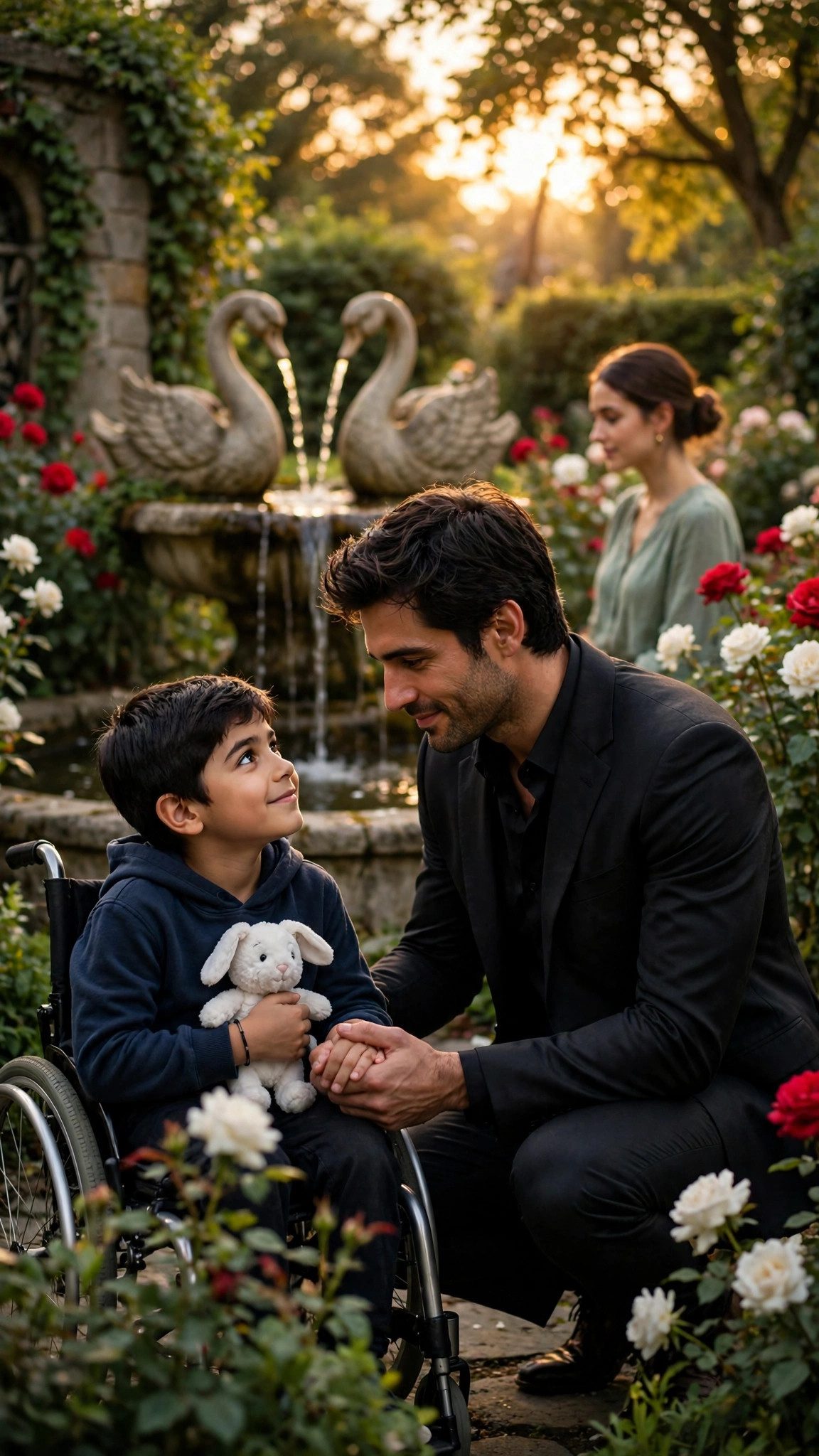
    I kept the fountain running. I told Gabe to make sure of it, no matter what. The fountain was in the garden behind the house, a stone basin with two carved swans, and Elena had found it at an estate sale in Lake Forest five years earlier and had fallen in love with it at first sight. It leaked. The pump was always breaking. She had spent a fortune having it repaired, and she had planted roses all around it, red and white, and in the summer she used to sit beside it in the afternoons with a book, and Matteo would chase butterflies around the rose bushes, laughing, his little legs carrying him in circles until he fell down dizzy and she would scoop him up and spin him around.

    After she died, I could not bear to look at the garden. But I could not bear to let the fountain stop, either. As long as the water was moving, it felt as if some part of her was still there, still keeping time. So every morning, Gabe checked the pump, and every evening, the water kept falling over the stone swans, and I told myself that was enough. It was not enough. But it was something.

    The memorial was eleven months after the explosion. The city held a small ceremony at the site — a plaque, a few speeches, a moment of silence. I did not want to go. I had avoided the place where it happened, taking different routes through the city, the way you avoid a street where you were once mugged. But Rosa told me I should go, and Dr. Hale told me Matteo should go, and so on a cold morning in September, Gabe drove us there, and we stood in a small crowd of people I mostly did not know, listening to a priest I did not know say words I did not hear.

    That was where I met Lucia Moretti.

    She was standing a little apart from the crowd, a young woman in a dark coat, holding a single white rose. She was twenty-six, with brown hair pulled back in a low knot and a face that was pale and tired, the face of someone who has not slept well in a long time. She was looking at the plaque, and her lips were moving, as if she were saying something to someone who was not there.

    After the ceremony, I found myself walking toward her. I did not plan it. I do not know what I intended to say. But she looked up, and her eyes were brown and clear, and she said, "You must be Matteo's father."

    "I am," I said. "Vincent Rossi."

    "I know," she said. "My parents were in the car behind yours. The escort car. They were killed in the blast, too. My father was driving. My mother was beside him."

    I stared at her. I had known, in the abstract, that other people had died that day. The police report had mentioned it: two people in the following vehicle, killed instantly. But I had never thought about them as people. I had never thought about the fact that they had a daughter, standing here in a dark coat with a white rose, just as alone as I was.

    "I'm sorry," I said. It was the first time I had said those words to anyone about that day, and they felt thin and useless in my mouth.

    "So am I," she said. She looked down at Matteo, who was sitting in his wheelchair beside me, his white rabbit in his lap, staring at the plaque with an expression I could not read. "He doesn't speak," she said. It was not a question.

    "No," I said. "Not since the explosion."

    She nodded, as if that made sense to her. Then she knelt down in front of Matteo's chair, right there on the cold sidewalk, her coat pooling around her knees, and she looked him in the eyes, and she said, "Hello, Matteo. My name is Lucia. My mama and papa died in the same bad thing that hurt you. I don't talk about it much, either."

    Matteo looked at her. His eyes moved, just a little, and for a second I thought I saw something flicker in them. Not hope. Not yet. But attention. The way a locked door rattles, just once, when someone knocks on it from the other side.

    "Do you like rabbits?" Lucia asked him. She pointed at the white rabbit in his lap. "I had one like that when I was little. His name was Snowball. He went everywhere with me."

    Matteo's fingers tightened on the rabbit. He did not answer. He never answered. But he did not look away from her, and that was more than he gave most people.

    Lucia stood up. She handed me the white rose. "For your wife," she said. "I bring one every year. I thought you might like to have it."

    I took the rose. I did not know what to say. I thanked her, and she nodded, and she walked away down the sidewalk, and I stood there holding a white rose in a city that had taken everything from both of us, and I watched her go, and I thought about what Dr. Hale had said about his son and the neighbor's girl.

    Someone who was not waiting for him to be fixed. Someone who liked him the way he was.

    Three weeks later, on the recommendation of a doctor I trusted — Dr. Alan Pierce, who had treated Matteo in the hospital and who had known Elena's family for years — I hired Clara Hayes.

    Dr. Pierce told me she was the best pediatric home caregiver he had ever worked with. He told me she was patient, and warm, and experienced with trauma cases. He told me Matteo would be lucky to have her. He gave me two references, both families in Winnetka, both of whom spoke about her the way people speak about a saint.

    She came to the house for an interview on a Tuesday afternoon. She was thirty-two, with dark hair that fell to her shoulders and a soft voice and a smile that reached her eyes. She wore a gray dress and a red scarf, and when she sat down across from me in the study, she folded her hands in her lap and told me about her work, and about her belief that every child had a voice, even the ones who could not speak, and about her mother, who had worked in cartography, drawing maps, and her father, who had run his own business laying cables, and how she had grown up believing that the world was held together by invisible lines, and that her job was to help children find their way along them.

    It was a strange thing to say. I remember thinking it was strange, even then. But she said it with such sincerity, such warmth, that I thought it was simply the way she was — a woman who thought in metaphors, who saw the world in soft shapes. And she looked so much like Elena — the same dark hair, the same way of tilting her head when she listened, the same softness in her voice — that some part of me, the part that had been grieving for eleven months, simply surrendered.

    I hired her on the spot.

    Rosa said she seemed like a good girl. Gabe said nothing, which for Gabe meant he was watching. Dr. Hale, when I told him, said only, "Watch your son. He will tell you the truth, even if he cannot speak it."

    I did not understand what he meant. Not then.

    Three months later, I would understand it perfectly. I would understand it at eleven forty-seven at night, sitting in my study with earbuds in my ears, listening to my son cry through a hidden microphone, and hearing the voice of the woman I had trusted say, "Get your hands off me. I didn't do anything."

    But that night was still in the future. On the day I hired Clara Hayes, all I knew was that my house had been silent for eleven months, and a kind woman with dark hair and a soft voice had walked through my front door, and I had wanted, more than anything in the world, to believe that she was the answer.

    I was wrong. And my son paid the price for my mistake.

  • Chapter 1: What the Microphone Heard

    Chapter 1: What the Microphone Heard

    The first thing I heard through the hidden microphone was my son crying.

    It was eleven forty-seven at night, and I was sitting in my study with the lights off, a glass of whiskey sweating untouched on the desk beside me, and a pair of cheap earbuds in my ears. The microphone was no bigger than a button. Gabe had sewn it into the seam of the curtain in Matteo's room three days earlier, while the boy was at physical therapy and the house was empty. I had told myself it was a precaution. I had told myself I was being paranoid. I had told myself a dozen things that night, and every one of them was a lie I had needed to believe so I could sleep.

    My son had not spoken in fourteen months. Not one word. Not since the explosion that killed his mother and left him with a spinal cord injury at T8 and a silence so complete that the doctors had started using words like permanent and acceptance, as if a father could accept that his eight-year-old boy had simply folded himself up inside his own head and locked the door.

    He was crying now. Through the earbuds, the sound was small and thin, like something leaking through a crack in a wall. It was not the loud crying of a child who has skinned his knee. It was the crying of a child who has learned that crying loudly only makes things worse, so he cries quietly, into his pillow, where no one can hear him and no one can punish him for it.

    And then I heard her voice.

    "Get your hands off me," Clara Hayes said. "I didn't do anything."

    Her voice was low and cold, nothing like the warm, honeyed voice she used when I was in the room. I had hired her three months ago to take care of my son, and in all that time I had never once heard her speak to him in that tone. But I had seen the way Matteo flinched when she reached for him. I had seen the way his small hands tightened on the wheels of his chair whenever she came into the room. I had seen it, and I had told myself I was imagining it, because Clara looked so much like Elena — the same dark hair, the same soft way of moving through a room — that some stupid, grieving part of me had wanted to believe she was a gift. A second chance. A woman who could bring warmth back into a house that had gone cold the day my wife died.

    I was already on my feet before I knew I had stood up. The earbuds tore out of my ears and hit the desk. The whiskey glass went over and rolled off the edge and shattered on the floor, and I did not stop to look at it. I took the stairs two at a time, and by the time I reached the second floor my heart was hammering so hard I could feel it in my throat.

    Matteo's door was closed. I put my hand on the knob and stopped. Through the wood, I could hear her voice again, sharper now, and underneath it the thin, leaking sound of my son crying into his pillow.

    "Stop it," she was saying. "Stop it right now, or I swear to God—"

    I opened the door.

    The room was dark except for the small lamp on the nightstand, the one shaped like a rocket ship that Elena had bought him for his sixth birthday. Matteo was curled on his side in his bed, his face buried in the pillow, his thin shoulders shaking. His wheelchair stood folded against the wall. On the bedside table, his white plush rabbit — the one his mother had given him when he was three, the one he had not let go of since the hospital — lay face-down on the floor, as if it had been knocked there.

    Clara was standing over the bed with one hand raised. Her other hand was tangled in my son's hair.

    I have killed men for less than what I saw in that room. I have ordered things done that I do not talk about, not even to myself, in the dark. But in that moment, standing in the doorway of my eight-year-old son's bedroom, I did not think about any of that. I thought about the fact that for three months I had let this woman into my house. I had let her into the room where my son slept. I had smiled at her in the mornings and thanked her for her patience, while behind my back she was pulling my silent boy's hair and telling him to stop crying.

    "Get your hand off my son," I said.

    My voice did not sound like my own. It sounded like something coming up out of the ground.

    Clara spun around. Her face went white. Her hand came out of Matteo's hair so fast it was as if the hair had burned her.

    "Vincent," she said. "I was just—he was having a nightmare, and I was trying to—"

    "Don't." I crossed the room in three strides and put myself between her and the bed. "Don't say another word."

    "You're misunderstanding," she said, and her voice had already changed, already gone soft and reasonable, the voice she used for me. "He woke up crying, and I was calming him down. He grabbed my wrist. Look." She held up her wrist, as if there would be a mark. There was no mark. "I didn't do anything."

    Behind me, Matteo made a sound. It was not a word. It was a small, broken gasp, the sound a child makes when he has been holding his breath for a very long time and finally lets it out. I turned around and looked at him, and his eyes were open, wide and dark and wet, fixed on my face. He was not looking at Clara. He was looking at me, and in his eyes I saw something I had not seen in fourteen months.

    Hope.

    I turned back to Clara. "You are finished here," I said. "You will go downstairs, you will pack whatever you brought into this house, and you will leave. If you ever come near my son again, I will not be this calm."

    "I need this job," she said. Her voice cracked, and for a second she almost sounded like a real person, like someone who was afraid. "Vincent, please. I have nowhere else to go."

    "Then go nowhere," I said. "But go."

    She looked at me for a long moment, and something moved behind her eyes — not fear, exactly. Something colder. Calculation. Then she nodded once, picked up her cardigan from the chair, and walked out of the room without looking at my son again.

    I waited until I heard her footsteps on the stairs. Then I sat down on the edge of Matteo's bed, and I picked up the white rabbit from the floor, and I put it in his arms. He curled around it the way he always did, the way he had done in the hospital when the doctors told me he would never walk again and I had stood in the hallway with my forehead against the wall, trying to remember how to breathe.

    "It's all right," I said. "She's gone. She can't hurt you anymore."

    He looked at me, and his lips moved. For one wild, impossible second I thought he was going to speak. But no sound came out. His mouth closed again, and he turned his face into the pillow, and the crying started again, quieter now, the leaking kind.

    I sat with him until he fell asleep. I sat with him long after that, too, with my hand resting lightly on his back, feeling the rise and fall of his breathing, listening to the silence of the house. Downstairs, the front door opened and closed. Clara Hayes was gone.

    I should have felt relief. Instead, I felt something else, something I had not felt in a long time: a cold, clear fury, and underneath it, a question that would not let go.

    Why was my son afraid of her?

    It was not a normal fear. Children are afraid of strangers, of the dark, of loud noises. Matteo had been afraid of Clara in a way that was specific and personal, the way a small animal is afraid of the one creature in the house that has hurt it before. He flinched when she touched him. He went rigid when she came near his chair. And three months ago, when she first walked into this house, he had looked at her with something that was almost recognition — not the recognition of a friend, but the recognition of a danger he had seen before and could not name.

    I had hired her because she reminded me of Elena. I had told myself that was a good reason. A grieving widower, a silent boy, a kind woman with dark hair and a soft voice — it had felt like the universe offering me a small mercy. But now, sitting in the dark in my son's room, I wondered if the resemblance had been the point. I wondered if someone had chosen her for me, the way you choose a key for a lock.

    I thought about the explosion.

    Fourteen months ago, on a Tuesday in October, my wife Elena got into the back of my armored SUV with our son, and I got into the front seat with Gabe driving, and we drove out of the gates of this house toward a charity gala downtown. It was supposed to be an ordinary evening. Elena was wearing a dark green dress, and Matteo was wearing a small suit with a bow tie that he hated, and he kept tugging at it, and Elena kept laughing and fixing it for him, and I remember thinking that this was what my life was: a beautiful wife, a funny little boy, a house full of light.

    We never made it to the gala.

    The bomb was under the SUV. It went off at a red light on the edge of the Loop, and the world turned into noise and fire and glass. I remember the sound most of all, because it did not sound like an explosion in a movie. It sounded like the whole world tearing in half. I remember Gabe dragging me out of the front seat. I remember the smoke, and the screaming, and the way the street looked afterwards, black and wet, like the city itself was bleeding.

    Elena never woke up. She died in the ambulance, before we reached the hospital, and the paramedic who told me had tears in his eyes, and I remember thinking how strange it was that a stranger would cry for my wife when I could not cry at all. My body had simply refused. It was as if all the grief had been locked behind a door inside me, and the door would not open.

    Matteo survived. That was the word the doctors used — survived — as if it were a victory, as if surviving were the same thing as living. The blast had broken his back at the eighth thoracic vertebra. T8. He would never walk again. And something else had broken, too, something the doctors could not see on any scan. He stopped speaking. Not that day, not all at once, but gradually, over the weeks in the hospital, the words simply stopped coming. First he stopped answering questions. Then he stopped asking for things. Then one morning I asked him if he wanted his rabbit, and he looked at me, and his mouth moved, and nothing came out, and after that, nothing ever did.

    The doctors called it psychogenic mutism. Trauma. The mind protecting itself by shutting down the one thing that might let the pain out. Dr. Marcus Hale, the child trauma specialist, told me that some children come back from it and some do not, and that there was no way to know which kind Matteo was. He said the best thing I could do was give him safety, and routine, and time.

    "What if he never talks again?" I asked him, in his office, on a day when the rain was coming down so hard it sounded like static against the windows.

    "Then you love him in silence," Dr. Hale said. "And you wait."

    I waited. For fourteen months, I waited. I rebuilt our lives piece by piece, the way you rebuild a house after a fire — you do not ask whether it will ever be the same, because you already know it will not. You just lay one brick at a time and hope the walls hold.

    I hired nurses. I hired therapists. I hired a physical therapist named Anna who came three times a week and worked Matteo's legs through their exercises, and who talked to him the whole time as if he could answer, telling him about her garden and her grandchildren, and once, when she thought I was not listening, she told him that his mother would be proud of how brave he was. Matteo had cried that day, silently, the tears running down his face while his mouth stayed closed, and Anna had held his hand and said, "That's all right, sweetheart. Tears count, too."

    I kept the fountain running. That was Elena's fountain, in the garden behind the house — a stone fountain with two carved swans that she had found at an estate sale in Lake Forest and insisted on having, even though it leaked and the pump was always breaking. After she died, I told Gabe to keep it running, no matter what. I did not know why it mattered so much to me. It just did. As long as the water was moving, some part of her was still here.

    And three months ago, on the recommendation of a doctor I trusted, I hired Clara Hayes.

    She had excellent references. She had worked for two families in Winnetka, both of whom spoke highly of her patience and her warmth. She was thirty-two, dark-haired, soft-voiced, with a smile that reached her eyes. In her interview, she told me she had always wanted to work with children who needed extra care, and that she believed every child had a voice, even the ones who could not speak. I hired her on the spot. I told myself it was because she was qualified. The truth was simpler and uglier: she reminded me of Elena, and I was lonely, and my son was silent, and I wanted to believe that a kind woman could fix what was broken.

    For the first few weeks, everything seemed fine. Clara was gentle. She read to Matteo. She pushed his wheelchair through the garden. She learned the names of his medicines and the schedule of his therapy. Rosa, my housekeeper of twenty years, said she seemed like a good girl. Gabe said nothing, which for Gabe meant he was watching.

    But then the small things started. Matteo stopped eating his breakfast when Clara served it. He started refusing to go to the garden when she was the one pushing his chair. Once, when she reached out to adjust his blanket, he jerked away from her so hard that his chair nearly tipped. I asked him what was wrong, and he looked at me with those big dark eyes, and his mouth moved, and nothing came out.

    I asked Clara about it. She smiled her soft smile and said that Matteo was shy, that he was still adjusting, that children with trauma sometimes fixated on a caregiver and blamed them for things that were not their fault. She said it so reasonably, so kindly, that I believed her. Or I wanted to believe her. I am a man who has built an empire on knowing when people are lying to me, and I let this woman lie to my face in my own house, because she reminded me of my dead wife.

    That was my failure. Not the explosion. Not the silence. That. I had brought a stranger into my son's room and told myself it was love, when it was only grief wearing a kinder face.

    Now, sitting on the edge of his bed in the dark, I made myself a promise. I would find out who Clara Hayes really was. I would find out why my son was afraid of her. And I would find out who had put a bomb under my wife's car fourteen months ago, because I was beginning to understand that those two questions might have the same answer.

    Matteo's breathing had gone slow and even. He was asleep. The white rabbit was tucked under his chin. In the lamplight, his face looked younger than eight — small and pale, with Elena's dark eyelashes and the faint scar on his left temple where a piece of glass had cut him in the blast. I leaned down and kissed the top of his head, the way I used to do when he was small and I came home late from work, and I whispered the words I had whispered to him every night since the hospital, the words I would keep whispering until the day he could answer me.

    "I'm here, Matteo. I'm not going anywhere. And I swear to you, on your mother's name, I will find out who did this to us."

    He did not answer. He never answered. But as I stood up to leave, his small hand came out from under the blanket and closed around one of my fingers, and he held on, tight, the way he used to hold on when he was three years old and afraid of the dark.

    I stayed where I was, holding his hand, until the first gray light of morning came through the curtains. And when the sun finally rose over the garden, over the fountain that never stopped running, I went downstairs to my study, and I called Gabe, and I told him to find out everything there was to know about Clara Hayes.

    "Everything," I said. "Where she was born. Who her family is. Who she worked for before us. Who recommended her. I want it all by tonight."

    "Yes, boss," Gabe said. He did not ask why. Gabe never asked why.

    I hung up the phone and stood at the window of my study, looking out at the garden where my wife used to read in the afternoons, where my son used to chase butterflies before he knew what a wheelchair was, and I thought about the words Dr. Hale had said to me in his office on that rainy day.

    "Then you love him in silence. And you wait."

    I had waited for fourteen months. I was done waiting.

    It was time to start listening instead.

  • Chapter 7: The Last Thing She Left Him

    Chapter 7: The Last Thing She Left Him

    Mia Rose Moretti was born on a cold morning in February, in a hospital room full of light, with her father holding my hand and her grandmother standing beside the bed, crying happy tears for the first time in years.

    She was small and perfect, with dark hair and green eyes and a cry so strong the nurses laughed and said she was going to be a force to be reckoned with, and when Alexander held her for the first time, he looked down at her tiny face, and he started to cry, and he did not try to hide it, and he did not apologize for it, and he whispered, "Hello, Mia. I'm your father. I'm sorry it took me so long to learn how to be one."

    My mother held her next, and she rocked her gently, and she sang her a lullaby she had sung to me when I was a baby, a song about a little girl who was going to grow up strong and brave, and Mia closed her eyes and fell asleep in her grandmother's arms, safe and warm and loved.

    We named her Mia Rose, Mia because it was a name I had always loved, Rose because it was my mother's name, because my mother had raised me alone and deserved to have her name carried forward, because the woman who had saved me a hundred times over deserved to be remembered in the name of her granddaughter.

    Alexander was a different father than I had expected him to be. He changed diapers at three in the morning without being asked. He walked the floor with Mia when she cried, singing to her in a low, off-key voice that made her laugh. He read her stories from a book of fairy tales my mother had given us, and he did the voices, all of them, even the silly ones, and he did not care who heard him.

    He was a different husband, too. He came home for dinner every night. He called me during the day, just to hear my voice, just to ask how Mia was doing, just to tell me he loved me. He treated my mother like a queen, bringing her flowers on Sundays, sitting with her in the garden, asking her for recipes, learning to cook the dishes she had made for me since I was a little girl.

    And one evening, six months after Mia was born, he came home with a small white box in his hands, and he put it on the kitchen table, and he looked at me, and he said, "Claire, I have something for you."

    I opened the box. Inside was a pair of baby shoes, white with soft soles, exactly like the ones I had bought all those months ago, the ones I had wrapped in tissue paper and put in a little box and planned to give him at dinner, the ones that had sat on my mother's kitchen table through the worst night of my life.

    "I found them," he said. "They were still on your mother's counter, where you left them. I kept them. I kept them in my desk, and I looked at them every day, and I thought about the moment I missed, the moment I should have had, the moment I threw away because I was too blind to see what was right in front of me. I can't give you that moment back. But I can give you this one."

    He knelt in front of me, right there in our kitchen, with Mia sleeping in her bassinet beside us and my mother smiling from the doorway, and he took my hand, and he said, "Claire Bennett Moretti, will you marry me again? Not because you have to. Not because we already are. But because I want to stand in front of everyone we love and promise you, properly this time, that I will never choose anyone over you again. I will never let anyone insult your mother again. I will never throw away what you have built again. I will spend the rest of my life proving that the man you married is the man I am going to be."

    I said yes. I said yes with my whole heart, and I meant it with my whole heart, and when he slipped a new ring onto my finger, a simple gold band with a small diamond, I believed I was the luckiest woman in Chicago, not because my husband was powerful, but because my husband had learned how to be good.

    We renewed our vows in the garden behind my mother's new house, on a warm evening in June, with Mia in a white dress in her grandmother's arms and the sun going down over the trees and the smell of rosemary in the air. It was small and beautiful, just the three of us and a few close friends, and Alexander stood in front of everyone and made his promises, and this time, when he said them, I believed every word.

    After the ceremony, we had a family dinner at my mother's house. She spent all day cooking, making the dishes she had made for me since I was a little girl, the roast chicken and the potatoes and the green beans, and this time, when she brought out the dish with the cilantro, Alexander tasted it, and he smiled, and he said, "Rose, this is the best thing I have ever eaten. You are the finest cook in Chicago, and I am going to tell everyone I know."

    My mother laughed, and she cried, and she hugged him, and she said, "You are a good man, Alexander. I always knew you were a good man. You just had to remember it."

    We ate together, the four of us, my mother and Alexander and Mia and me, sitting around my mother's table like a family, like the family I had dreamed about when I was a little girl and my father had left, like the family I had wanted to build when I married Alexander, like the family I had almost lost on the night Sophia Reynolds shoved me into that table.

    After dinner, Alexander went to his desk, and he opened the drawer, and he took out the small recorder, the one I had left on my mother's table with a note attached to it, the one that had held my voice in the dark kitchen, the one that had been the last thing I left him.

    He held it in his hands for a long moment, and then he put it back in the drawer, and he closed the drawer gently, and he said, "I'm keeping it. Not because I want to remember the worst night of my life, but because I never want to forget what it cost me to learn how to listen. That recorder is the last thing you left me, Claire, and it is the reason I found my way back to you. I am going to keep it for the rest of my life, so that I never forget."

    I took his hand. I looked at my mother, holding Mia in her arms, singing her a lullaby about a little girl who was going to grow up strong and brave. I looked at my husband, the man who had paid my tuition and bought my textbooks and fixed my mother's roof, the man who had failed me and found his way back, the man who had learned that strength is not about control, but about knowing when you have been wrong and having the courage to say so.

    And I thought about the girl I had been at ten years old, standing at the kitchen window with my mother, watching my father's car pull away, learning that a woman who depends on no one can survive anything.

    My mother had been right. We had survived. Not because someone came to save us, but because we saved ourselves, one day at a time, one breath at a time, and because sometimes, when you least expect it, the person who hurt you comes back and proves that he has learned how to be better.

    The last thing I left him was a recorder with my voice on it. The first thing he gave me back was himself, whole and honest and true.

    And that, in the end, was enough.

    The first months with Mia were the hardest and the happiest of my life. She cried at night, and she cried in the morning, and she cried for reasons no one could understand, and Alexander walked the floor with her at three in the morning, singing to her in his low, off-key voice, and she would stop crying and look up at him with her big green eyes, and he would look down at her, and he would say, "See? She likes my singing. She has excellent taste, just like her mother."

    He learned to cook. Not well, at first. He burned the rice. He put too much salt in the soup. He set off the smoke alarm twice in one week, and my mother laughed so hard she had to sit down, and she said, "Alexander, for a man who runs Chicago, you are remarkably bad at making toast."

    But he kept trying. He asked my mother for her recipes, and he wrote them down in a little notebook, and he practiced on Sunday afternoons, and slowly, week by week, he got better. The rice stopped burning. The soup tasted like soup. And one evening, he made my mother's roast chicken all by himself, and he served it to us with a look of such pride on his face that I thought my heart would burst, and my mother tasted it, and she said, "Not bad, Alexander. Not bad at all. Your grandmother would have been proud."

    He read to Mia every night before bed, from a book of fairy tales my mother had given us, and he did all the voices, the wolf and the princess and the dragon and the brave little girl who saved the kingdom, and Mia would kick her legs and laugh, and I would stand in the doorway and watch them, and I would think, this is what I dreamed about when I was a little girl. This is the family I wanted. This is the life I was trying to build when I planned that dinner at my mother's house.

    The vow renewal took weeks to plan. We kept it small, just the people who mattered most, my mother and a few close friends and Alexander's mother, who had come to love Mia with a fierceness that surprised everyone, including herself. We had it in the garden behind my mother's new house, on a warm evening in June, with white flowers and wooden chairs and a string quartet that played softly enough to hear the birds.

    I wore a simple white dress, not a wedding dress, just a dress that made me feel beautiful, and Mia wore a tiny white dress of her own, and my mother held her in her arms, and Alexander stood at the end of the garden path, waiting for me, and when I walked toward him, he cried, and he did not try to hide it.

    The minister was an old friend of my mother's, a kind man with white hair and a gentle voice, and he asked Alexander if he took me to be his wife, and Alexander said, "I do," and then he added, in his own words, words no one had written for him, "Claire, I promise you that I will never choose anyone over you again. I promise you that I will protect our daughter with my life. I promise you that I will honor your mother, and I will honor this family, and I will spend every day for the rest of my life proving that I am worthy of the trust you have given me back."

    Then he turned to my mother, and he said, "Rose, I promise you that I will never again throw away what you have made with your own hands. Your cooking, your home, your daughter, your granddaughter, all of it is sacred to me, and I will treat it that way for as long as I live."

    My mother cried. I cried. Mia, in her grandmother's arms, looked up at the sky and laughed, as if she understood everything, as if she knew that her family had finally come together the way it was always meant to.

    After the ceremony, we had a family dinner, and my mother spent all day cooking, and Alexander helped her in the kitchen, chopping vegetables and stirring pots, and when she brought out the dish with the cilantro, he tasted it first, and he said, "Rose, this is the best thing I have ever eaten," and my mother laughed, and she said, "You are learning, Alexander. You are finally learning."

    We ate together, and we talked, and we laughed, and Mia fell asleep in her grandmother's arms, and the sun went down over the garden, and the string lights came on, and I looked around the table at the people I loved most in the world, and I thought, this is it. This is the family I dreamed about. This is the life I fought for.

    As for Sophia Reynolds, I heard about her only once more, months later, from a friend who had seen her at a restaurant downtown. She was alone, sitting at a table by herself, wearing a plain black dress, no jewelry, no champagne, no audience. Her husband had filed for divorce. Her friends had stopped calling. The life she had built on other people's money and other people's attention had fallen apart, and she was left with nothing except the knowledge that she had thrown away the only man who had ever truly loved her, for a life that had never been hers to begin with.

    I did not feel sorry for her. I did not feel angry, either. I felt nothing at all, which was the strangest thing, because for five years, Sophia Reynolds had been the shadow over everything in my life, and now she was gone, and the sun had come out, and I realized that she had never really mattered. What mattered was the man beside me, and the baby in my mother's arms, and the family we had built together, one day at a time, one kept promise at a time.

    That night, after the dinner, after Mia was asleep, after my mother had gone to bed, Alexander and I sat on the porch of my mother's house, watching the stars come out over the garden, and he took my hand, and he said, "Claire, do you remember the night you left the recorder on your mother's table?"

    "I remember," I said.

    "I keep it in my desk," he said. "I listen to it sometimes, not because I want to hurt myself, but because I never want to forget. I never want to forget what it cost me to learn how to listen. That recorder is the last thing you left me, and it is the reason I found my way back to you. I am going to keep it for the rest of my life."

    I leaned my head against his shoulder, and I looked up at the stars, and I thought about the girl I had been at ten years old, and the woman I had become at thirty, and the mother I was now, and I said, "Then keep it, Alexander. Keep it, and remember. And every time you hear my voice on that recording, remember that I came back. Remember that I chose you, even after everything, because you chose me back."

    The End.
    THE END

  • Chapter 6: What He Did Next

    Chapter 6: What He Did Next

    Alexander Moretti had built his entire life on control. He controlled his family. He controlled his business. He controlled the streets of Chicago and the men who worked for him and the deals that were made in rooms no one else was allowed to enter. He believed that if he was strong enough, if he was careful enough, if he held on tightly enough, nothing could ever slip through his fingers.

    The recorder taught him he was wrong.

    He listened to my voice in my mother's dark kitchen, and he heard everything he had refused to hear for five years. He heard the pain in my voice when I talked about the baby. He heard the love in my voice when I talked about the man he used to be. He heard the finality in my voice when I said goodbye, and he understood, for the first time, that the woman he loved most in the world was gone, and that he was the reason why.

    His men told me later that he sat at that table for a long time after the recording ended. He did not speak. He did not move. He sat with his head in his hands, staring at the recorder, at the note with my handwriting on it, at the plates still sitting on the table from the dinner that had ended in disaster, and he thought about the shove, and my hands over my stomach, and my mother screaming, and the way he had looked at Sophia first.

    And then he stood up, and he walked out of the house, and he went to find Sophia Reynolds.

    He found her at her husband's house in the suburbs, sitting in a living room full of expensive furniture, drinking wine and telling her friends on the phone about the terrible dinner she had endured at my mother's house, about how ungrateful I had been, about how Alexander had finally seen what kind of woman I really was.

    He walked in without knocking. He stood in the doorway, and he looked at her, and she smiled at him, the way she always smiled at him, like he was hers, like he had come to rescue her, like nothing had changed.

    "Alexander," she said, "I'm so glad you're here. I was just telling everyone about that awful dinner. Your wife is completely out of control. You really need to do something about her."

    He did not smile back. He walked across the room, and he took the phone out of her hand, and he put it down on the table, and he said, in a voice so quiet it was more frightening than shouting, "Sophia, I need you to listen to me very carefully, because I am only going to say this once."

    She laughed, a nervous laugh, the kind of laugh a person makes when they realize something is wrong but they do not yet know how wrong it is. "Alexander, what are you talking about?"

    "Claire was pregnant," he said. "She was eight weeks pregnant with my child. She planned that dinner to tell me. She invited me to her mother's house to share the happiest news of our lives. And you shoved her into a table. You put my baby's life at risk. And I looked at you first. I asked you if you were okay. I walked out with you while my wife was bleeding on the floor."

    Sophia went very pale. "I didn't know she was pregnant," she whispered. "Alexander, I swear, I didn't know."

    "That doesn't matter," he said. "You shoved a woman who had done nothing to you. You insulted her mother in her own house. You spent five years trying to destroy my marriage, and I let you, because I was too weak to say no to you, because I was too afraid of losing the girl I used to love to see the woman you had become."

    He told her it was over. He told her she was never to call him again, never to come to his office again, never to speak to his wife or his mother-in-law again. He told her that if she ever came near my family again, he would make sure her husband knew exactly how she had spent the last five years, chasing a married man, lying about it, using him to feel important.

    And then he did something Sophia never expected. He went to her husband.

    Marcus Reynolds was a developer, a man with money and connections and a reputation to protect, and when Alexander walked into his office and told him the truth about his wife, about the daily phone calls, about the visits to the office, about the way Sophia had pursued a married man for five years, Marcus listened in silence, and then he thanked Alexander for telling him, and he said, "I always wondered why she was so unhappy. Now I know. She was chasing a life that was never hers."

    Marcus cut Sophia off financially. He took away her credit cards. He took away her car. He told her she could stay in the house, but she would live on an allowance, and she would answer to him, and she would never embarrass him again. Sophia, who had refused to marry a poor man because she needed more than that, found herself with less than she had ever had, and for the first time in her life, no one was coming to save her.

    But Alexander did not stop there. He went to the Moretti family gathering, the one I had refused to attend, and he stood in front of his entire family, his mother, his uncles, his cousins, the men who worked for him, and he told them the truth.

    "My wife is pregnant," he said. "She is carrying my first child. And I failed her. I chose another woman over her, in her own mother's house, and I will regret it for the rest of my life. From this day forward, anyone who disrespects Claire Moretti disrespects me. Anyone who speaks to her mother with anything less than honor answers to me. And if any of you ever see Sophia Reynolds again, you will tell her she is not welcome in this family, in this house, or in my life."

    His mother cried. His uncles nodded. The men who worked for him looked at each other, and then they looked at Alexander, and they saw a man they had never seen before, a man who had finally learned that strength is not about control, but about knowing when you have been wrong and having the courage to say so.

    Then Alexander went looking for me.

    He searched for three weeks. He sent his men to every hotel in Chicago, to every friend I had ever had, to every place I might have gone. He called my mother's friends. He called my old college roommate. He called the hospital and asked if anyone had seen me. And when none of that worked, he did something he had never done before: he stopped giving orders, and he started thinking.

    Where would Claire go? he asked himself. Where would a woman go when she needed to heal, when she needed to be safe, when she needed to be somewhere no one would think to look?

    He remembered my mother's sister, a woman named Anne, who had died years ago and left a small cottage on Lake Geneva, a place my mother had mentioned once, years earlier, in passing, a place where we had spent one summer when I was a little girl, a place with a garden and a dock and a view of the water.

    He drove there himself, alone, without his men, without his car, without anything except a bag with clothes in it and a heart full of regret. He parked on the dirt road outside the cottage, and he walked up the path, and he saw my mother sitting on the porch with a cup of tea in her hands, and she looked up at him, and her face went very still.

    "Rose," he said, and his voice broke on her name, because he had not called her Rose in years, because he had forgotten that she was not just his mother-in-law, but a woman who had raised the woman he loved, a woman who had trusted him once and had every reason never to trust him again. "Rose, please. I need to see Claire."

    My mother looked at him for a long moment. She looked at his face, at the lines around his eyes, at the way his hands were shaking, at the way he stood on her porch like a man who had finally learned what it meant to be afraid of losing something, and she said, "She is inside, resting. The doctor says she must stay in bed. If you upset her, I will throw you out myself, and I do not care who you are in Chicago."

    He nodded. He promised. He walked into the cottage, and he found me lying in a small bedroom with white curtains and a view of the lake, and I looked up at him, and for a moment, neither of us said anything.

    He knelt beside my bed. Alexander Moretti, the most feared man in Chicago, knelt beside my bed like a man praying, and he took my hand, very gently, like he was afraid I would break, and he said, "Claire, I listened to your recording. I listened to it twice. And I have come to tell you that you were right about everything."

    He told me about Sophia. He told me he had cut her off, told her husband the truth, told his family that anyone who disrespected me would answer to him. He told me he had spent three weeks looking for me, and that he would spend the rest of his life looking for me if he had to, because he had finally understood what he had lost.

    "I don't expect you to forgive me," he said. "I don't deserve your forgiveness. But I am asking you to let me try. Let me come to every doctor's appointment. Let me take care of your mother. Let me prove to you, day by day, that the man you married is still in here somewhere, and that he is going to spend the rest of his life earning back the trust he threw away."

    I looked at him, and I thought about the man who had paid my tuition, and the man who had thrown my mother's cooking into the trash, and I realized that both of those men were the same man, and that the question was not whether he could change, but whether he would.

    "I don't know," I said, honestly. "I don't know if I can trust you again. I don't know if I can go back to the life we had. But I know that this baby deserves a father who shows up, and I know that you are here now, and that has to count for something."

    He stayed. He stayed at the cottage for the next three months, sleeping on the couch, cooking breakfast in the morning, driving me to every doctor's appointment, sitting in the waiting room with my mother, holding my hand when the doctors told us the baby was growing strong, that the danger had passed, that we were going to be all right.

    He moved my mother into a better house, not a big house, not a mansion, just a comfortable house with a garden and a kitchen she loved, and he told her, "Rose, you raised the woman I love. From now on, you will never have to worry about money again, and you will never have to apologize for your cooking in your own home."

    He stood up to his own family when his mother said a boss does not chase a wife, when his uncles said he was weak for kneeling beside a hospital bed, when his men whispered that he had lost his edge. He told them, "A man who cannot protect his wife and his child is not a man at all, and I will not be that man anymore."

    Slowly, day by day, I began to believe him. Not all at once. Not easily. But slowly, the way trust comes back, in small moments, in kept promises, in the way he held my hand at the doctor's office, in the way he learned to cook my mother's recipes, in the way he sat with me on the porch at Lake Geneva and watched the sun go down over the water and said nothing, just sat with me, like he had sat with me in the library all those years ago, like a man who had finally learned that sometimes the bravest thing you can do is simply be there.

    His mother came to see him the week after the gathering. She arrived at his office without an appointment, wearing a black dress and a face like stone, and she sat in the chair across from his desk, and she said, "Alexander, what have you done?"

    "I did the right thing," he told her.

    "You humiliated yourself in front of the entire family," she said. "A boss does not chase a wife. A boss does not kneel beside a hospital bed. A boss does not admit he was wrong in front of his own men. Do you understand what you have done to this family?"

    He looked at her, and he thought about my mother, sitting on the porch at Lake Geneva with a cup of tea in her hands, holding herself together with sheer will, and he said, "Mother, with all due respect, I have spent my whole life doing what this family expected of me. I married a woman I loved, and then I let another woman destroy my marriage, because I was too afraid to choose. I am not going to be afraid anymore. Claire is my wife. She is carrying my child. And if this family cannot respect that, then this family does not deserve my loyalty."

    His mother stared at him for a long moment. Then, slowly, her face softened, and she said, "Your father would have said the same thing, if he had lived long enough to learn it. He never did. He died believing that a man proves his strength by never bending. You are stronger than he was, Alexander, because you learned to bend before you broke."

    His consigliere, an old man named Frank, who had worked for the family for forty years, came to him the next day, and he said, "Boss, the men are talking. They say you have gone soft. They say a woman has made you weak."

    Alexander stood up from his desk, and he walked to the window, and he looked out at the city, at the streets he controlled, at the buildings with his family's name on them, and he said, "Frank, let me tell you something. I have spent my whole life being feared. Men are afraid of me because I can hurt them. But do you know what I learned in the last three weeks? Being feared is easy. Being loved is hard. Being trusted is harder. And a man who is feared but not loved has nothing. I would rather be loved by my wife and my child than feared by every man in Chicago."

    Frank nodded slowly, and he said, "Then you are finally the man your father wanted you to be. He just never knew how to say it."

  • Chapter 5: The Recorder

    Chapter 5: The Recorder

    The hospital room was white and quiet, and the only sound was the steady beeping of the monitor beside my bed, a small, regular rhythm that meant my baby's heart was still beating, that the tiny life inside me was still holding on, that there was still something left to fight for.

    I lay in that bed for two days, staring at the ceiling, while the doctors came and went with their charts and their careful voices, telling me the baby had survived the impact but that I had suffered a partial placental abruption, telling me I needed strict bed rest, telling me I needed to stay calm, telling me that stress could make everything worse.

    Stay calm. As if calm were something I could choose, as if I could simply decide not to feel the pain in my stomach and the pain in my heart, as if I could lie in a hospital bed and pretend my husband had not walked out of my mother's house with another woman while I was bleeding.

    My mother never left my side. She slept in the chair beside my bed, her coat folded over her like a blanket, and she held my hand when the pain came, and she talked to me in the soft, steady voice she had used when I was a little girl and afraid of the dark.

    "You are going to be all right, Claire," she said. "The baby is going to be all right. We have survived worse than this. We survived your father leaving. We survived being poor. We survived every hard thing this world threw at us, and we are going to survive this too."

    "How?" I whispered. "How do I survive a husband who chose another woman over his wife and his baby?"

    "You survive it the same way we survived everything else," she said. "One day at a time. One breath at a time. And you remember that you are not alone. You have me. You have this baby. And that is enough."

    But it did not feel like enough. It felt like nothing. It felt like the whole world had gone quiet and empty, and I was lying in a white room with a monitor beeping beside me, and the man I loved most in the world had not even called to ask if I was alive.

    Two days later, he called. Not to ask whether I was alive. Not to ask why I had been doubled over in pain. He only said, "There's an important Moretti family gathering. Be there on time, and don't embarrass me."

    I said nothing. I let the silence sit between us on the phone line, and I thought about the little white box with the baby shoes, still sitting on my mother's kitchen table, and I thought about the dinner I had planned, and the surprise I had wanted to give him, and the baby he did not know existed, and I realized something with a clarity that was almost peaceful.

    He did not deserve to know. Not like this. Not from a hospital bed, not from a phone call, not from a woman he had humiliated in front of his first love. If he was ever going to understand what he had done, he was going to have to understand it on his own, without me handing him the answer.

    I ended the call. I put the phone down on the bedside table, and I looked at my mother, and I said, "Mom, I need you to take me home. Not to Alexander's apartment. To your house. I need to pack a bag, and I need to leave, and I need you to come with me."

    She did not argue. She did not ask questions. She simply nodded, and she helped me sit up, and she helped me into my clothes, and she signed the discharge papers against the doctor's advice, promising we would go straight to another hospital if anything went wrong, and she drove me home in the dark, with one hand on the wheel and one hand holding mine.

    We went to her house first. The lights were off. The table was still set from the dinner that had ended in disaster, the plates still sitting where we had left them, my mother's good tablecloth still stained with the food Alexander had thrown away. The little white box with the baby shoes was still sitting on the counter where I had left it, waiting for a moment that would never come.

    I picked it up. I held it in my hands for a long moment, and then I put it in my bag, because the baby shoes belonged to me and to my baby, not to Alexander, not to Sophia, not to anyone who had not earned the right to see them.

    Then I took out a small recorder, the kind I used to use when I was in college to record lectures, and I sat down at my mother's table, and I pressed the record button, and I spoke to my husband for what I believed would be the last time.

    "Alexander," I said, and my voice was steady, even though my hands were shaking. "By the time you hear this, I will be gone. I am not going to tell you where I am going, and I am not going to ask you to find me. I am going to tell you the truth, because you deserve to hear it, even if you do not deserve to hear it from me."

    I told him about the pregnancy. I told him I had found out four days before the dinner, and that I had planned the dinner to surprise him, and that my mother had spent all day cooking, and that I had imagined his face when I told him we were going to be parents. I told him about the baby shoes, and the little white box, and the moment I had dreamed about for four days.

    "I was eight weeks pregnant, Alexander," I said. "I was carrying our first child. And when Sophia shoved me into that table, I thought I was going to lose the baby. I thought I was going to lose everything. And you looked at her first. You asked her if she was okay. You walked out with her while your wife was bleeding on the floor."

    I told him about the hospital. I told him about the doctors, and the monitor, and the words they had used, and the fear I had felt lying in that white room, wondering if my baby's heart would keep beating.

    "The baby survived," I said. "The doctors say she might be all right, if I rest, if I stay calm, if I take care of myself. But I cannot take care of myself in a house where my husband chooses another woman over me. I cannot raise a child in a home where her father throws her grandmother's cooking into the trash. I cannot stay with a man who knows the deepest wound in my heart and uses it against me in front of the woman who has spent five years trying to destroy our marriage."

    I paused. I took a breath. I looked at the recorder in my hands, at the small red light blinking in the dark kitchen, and I said the words I had been carrying inside me since I was ten years old.

    "You saved my future once, Alexander. You paid my tuition. You bought my textbooks. You fixed my mother's roof. You gave me a life I could never have built on my own, and I will always be grateful for that. But gratitude is not the same as love, and a man can be good to you in a hundred ways and still fail you in the one way that matters most. You failed me. You failed our baby. And I cannot stay and wait for you to fail us again."

    I told him I loved him. I told him I would always love the man he had been in college, the man who had carried my textbooks and brought me coffee at midnight and looked at my mother like she was someone worth respecting. But I told him that man was gone, and the man who had replaced him was someone I did not know, and someone I could not trust with my child.

    "Goodbye, Alexander," I said. "This recorder is the last thing I am leaving you. I hope you listen to it. I hope you hear me. And I hope that one day, you understand what you lost."

    I stopped the recording. I put the recorder on the table, in the center of the good tablecloth, where he would not be able to miss it. I attached a note to it, written in my careful handwriting, in the script my mother had taught me when I was a little girl.

    For Alexander Moretti.

    Then I packed a bag, and my mother packed a bag, and we left the house in the dark, and we drove to a small cottage on Lake Geneva that had belonged to my mother's late sister, a place where no one would think to look for us, a place where I could rest and heal and decide what came next.

    When I didn't appear at the family gathering, Alexander sent his men to my mother's house. They found it empty. The lights were off. The table was still set. Then they discovered I had been hospitalized because of pregnancy complications.

    "Pregnancy?" Alexander demanded, and his man hesitated before he answered, the way men hesitate before they tell a powerful man something he does not want to hear.

    "Mrs. Moretti is pregnant, boss."

    That was when everything came back to him. The shove. My hands over my stomach. My mother screaming. The dinner I had arranged. He finally understood why I had invited him there. I had been trying to tell him we were having our first child.

    His men searched the empty house again. This time, they found the small recorder on the table. A note was attached.

    For Alexander Moretti.

    When he pressed play, my voice filled the room. And for the first time in five years, the man who believed he could control everything realized he might never hear me speak to him in person again.

    He listened to the whole recording twice. His men told me later that he sat at my mother's table for a long time after it ended, with his head in his hands, not speaking, not moving, like a man who had just been told that the world he thought he lived in had never existed at all.

    And then he stood up, and he walked out of the house, and he went to find Sophia Reynolds, and what he did next changed everything.

    We drove north in the dark, my mother at the wheel, the highway empty except for the occasional truck, the headlights cutting through the night like two small lanterns. I lay in the back seat with a blanket over me, my hand on my stomach, feeling the baby move, or imagining that I felt her move, and I thought about the life I was leaving behind, and the life I was driving toward, and I did not know which one scared me more.

    My mother talked as she drove, the way she always talked when she was afraid, telling me stories about her sister Anne, about the summers we had spent at the cottage when I was a little girl, about the garden Anne had planted, about the dock where we had sat with our feet in the water, watching the sun go down over the lake.

    "Anne always said that cottage was the safest place in the world," my mother said. "She said that when the world got too loud, you went to the lake, and you sat on the porch, and you listened to the water, and you remembered who you were. I think she was right. I think that is exactly what we need right now."

    We arrived just before dawn. The cottage was small and white, with blue shutters and a porch that faced the water, and a garden that had gone wild since Anne died, roses growing over the fence, lavender spilling onto the path. My mother unlocked the door, and we went inside, and the air smelled of dust and old wood and lake water, and I stood in the doorway, and I felt something in my chest loosen for the first time in days.

    "This is where we are going to heal," my mother said, and she said it like a promise, like a vow, like a woman who had decided that nothing else mattered except keeping her daughter and her grandchild safe.

    She made up the small bedroom at the back of the cottage, the one with the white curtains and the view of the lake, and she helped me into bed, and she tucked the blankets around me the way she had tucked them around me when I was a little girl, and she sat beside me until I fell asleep, holding my hand, humming the lullaby she had sung to me when I was a baby.

    I slept for twelve hours. When I woke up, the sun was coming through the white curtains, and the lake was glittering outside the window, and my mother was in the kitchen making soup, and for a moment, just a moment, I felt peaceful.

    The hospital called that afternoon to check on me. A nurse named Grace, the same nurse who had sat beside my bed, asked how I was feeling, and I told her the truth, that I was scared, that I was angry, that I did not know what came next.

    "Rest," she said. "That is your only job right now. Rest, and eat, and let your mother take care of you. The baby is strong. You are strong. And whatever comes next, you will handle it, because that is what you do, Claire. You handle it."

    I did rest. I lay in that small bedroom with the white curtains, and I watched the lake, and I felt the baby move, a real flutter this time, unmistakable, like a tiny fish swimming in my stomach, and I put my hand over the place where she was, and I whispered, "I'm here, little one. I'm here. Your grandmother is here. We are going to be all right."

    My mother cooked for me, and she read to me, and she sat on the porch with me in the evenings, and she told me stories about her own mother, about the women in our family who had survived hard things, about the strength that ran in our blood like a river, quiet and deep and impossible to stop.

    "Your grandmother survived the war," she told me one night, as we sat watching the sun go down over the lake. "She survived losing her husband young. She survived raising three children on her own. And she always said the same thing: a woman who knows her own worth can survive anything, because no one can take away what she knows about herself. Remember that, Claire. Remember who you are."

    I remembered. I remembered the girl who had worked two jobs to stay in college. I remembered the woman who had married a man she loved and built a life with him. I remembered the mother who was carrying a baby she would protect with everything she had. And I knew, lying in that small bedroom with the white curtains, that whatever came next, I was going to be all right. Not because someone came to save me, but because I was going to save myself.

  • Chapter 4: Two Pink Lines

    Chapter 4: Two Pink Lines

    I found out I was pregnant on a Thursday morning, four days before the dinner, standing in the bathroom of our apartment with a little white stick in my hand and my heart beating so hard I thought it would wake the whole building.

    Two pink lines. I stared at them for a long time, turning the stick over in my hands like it might change its mind, like it might be a mistake, like the universe had made an error and would correct it if I waited long enough. But the lines stayed. Two pink lines, clear and certain, and I put my hand over my mouth and laughed, and then I cried, and then I laughed again, because I was going to be a mother, and Alexander was going to be a father, and everything was about to change.

    I sat down on the edge of the bathtub and thought about what to do. I could have told him right then. I could have walked into the kitchen where he was drinking his coffee and reading the newspaper, and I could have put the little white stick on the table in front of him, and I could have watched his face change. But I wanted it to be special. I wanted it to be a moment we would remember for the rest of our lives, not a rushed announcement on a Thursday morning before work.

    I wanted to tell him the way a moment like that deserves to be told, with a table full of food and my mother's cooking and both of us sitting down together like a family. I wanted my mother there, because she had waited so long for a grandchild, because she had raised me alone and deserved to see the family grow, because she had earned the right to be in the room when her daughter told her husband they were going to be parents.

    So I planned a dinner. A family dinner at my mother's house, on a Sunday evening, with all of my mother's best dishes, and I told Alexander it was just a dinner, just a chance for us to spend time with my mother, and he agreed without asking questions, because he trusted me, because he had no reason not to.

    I did not tell him that Sophia had called me that morning, before I even took the test, to ask if Alexander was home, to ask if he was free for lunch, to ask if he had mentioned her, like a woman checking on a man who belonged to her. I did not tell him, because I was too happy to fight about Sophia, because I thought the news of a baby would change everything, because I believed that once Alexander knew he was going to be a father, he would finally see Sophia for what she was and choose us.

    I spent the next four days in a kind of joyful secrecy, carrying the news inside me like a small, warm light. I went to the doctor on Friday morning, alone, because I wanted to be sure before I told anyone, and the doctor confirmed it, eight weeks pregnant, healthy, strong, everything as it should be. She gave me vitamins and a pamphlet and a smile, and she said, "Congratulations, Mrs. Moretti. You're going to be a wonderful mother."

    I went shopping on Saturday. I bought a small pair of baby shoes, white with soft soles, and I wrapped them in tissue paper and put them in a little box, and I planned to give the box to Alexander at dinner, after the main course, when my mother brought out dessert, and watch his face when he opened it and understood.

    I called my mother on Saturday night and told her I was planning a special dinner. I did not tell her I was pregnant. I wanted to surprise her too, to see her face when she realized she was going to be a grandmother, to watch her cry the happy tears she had earned after so many hard years.

    "Come early," she said. "I'll cook all day. I'll make everything you loved when you were little. I'll make the roast chicken and the potatoes and the green beans, and I'll make your father's favorite cake, the one with the lemon frosting, even though he doesn't deserve it."

    "Mom," I said, laughing, "Dad doesn't get cake."

    "He doesn't," she agreed, "but you do, and the baby does, and that's what matters."

    She didn't know. She didn't know about the baby, but she said it anyway, like mothers do, like she could feel it in her bones, like she already knew that something wonderful was coming.

    Sunday morning, my mother started cooking. She spent nearly all day in the kitchen, moving between the stove and the counter with the easy grace of a woman who had cooked for her family for forty years, chopping and stirring and tasting, filling the house with smells that made me feel like a little girl again. The rosemary. The garlic. The lemon. The smell of home.

    I helped her set the table. We used her good tablecloth, the white one with the embroidered edges that she only brought out for special occasions, and her good plates, the ones with the blue flowers that had belonged to her own mother, and I put candles in the center of the table, and I thought, this is it, this is the night everything changes.

    Alexander arrived at seven o'clock. I heard his car pull up outside, and my heart jumped, and I smoothed my dress and checked my hair, and I walked to the door with a smile on my face, ready to welcome my husband into the evening I had planned so carefully.

    And then I saw Sophia behind him.

    She was wearing a cream-colored dress and carrying a bottle of wine like she had been invited, like she belonged there, like my mother's house was a place she had every right to walk into, and she smiled at me with that practiced smile of hers, and she said, "Claire, darling, I hope you don't mind. Alexander told me about the dinner, and I simply couldn't resist. Family dinners are so important, don't you think?"

    Alexander did not look at me. He looked at Sophia, and he smiled, and he said, "I hope you don't mind, Claire. Sophia was feeling lonely, and I thought it would be nice for her to join us."

    I minded. I minded more than I had ever minded anything in my life. But I did not say so, because my mother was standing behind me with a smile on her face, and I did not want to ruin the evening before it had even begun, and I told myself that it did not matter, that Sophia could sit at the table and eat my mother's cooking and it would not change anything, that Alexander would still open the little box with the baby shoes, and he would still understand, and everything would still be all right.

    I was wrong. But I did not know it yet, and so I smiled, and I welcomed them both, and I sat down at my mother's table, and I waited for the moment I had been dreaming about for four days.

    We ate the first course in silence. My mother served the soup, and Sophia tasted it, and she said, "How interesting. So rustic." My mother smiled and said nothing. I said nothing. Alexander said nothing.

    Then my mother brought out the main dish, the chicken she had spent hours preparing, the dish with the cilantro, and Sophia saw the green flecks in the sauce, and she complained.

    "Oh," she said, wrinkling her nose, "there's cilantro in this. I can't eat cilantro. It tastes like soap to me. Can't you make something else?"

    My mother apologized. She apologized for her own cooking, in her own house, to a woman who had not been invited, and she began picking the cilantro out piece by piece with her fingers, standing over the dish like a servant, like a woman who had spent her whole life pleasing people who did not deserve it.

    Sophia smirked. "I suppose when you've spent your life depending on other people, you learn how to please them."

    I snapped. I had been holding it in for three years, holding in every insult, every smirk, every moment when Alexander had chosen her over me, and in that moment, watching my mother pick cilantro out of her own cooking with her bare hands, something inside me finally broke loose.

    "Don't speak to my mother like that," I said, and my voice was steady and cold in a way it had never been before.

    Alexander frowned at me. "Claire, don't start."

    Then he picked up the dish my mother had spent hours preparing and dumped it into the trash, right in front of all of us, like it was garbage, like my mother's whole day of work meant nothing, like the woman who had raised me alone deserved to watch her food thrown away in her own kitchen.

    Something inside me broke. Not loudly. Not all at once. Quietly, the way a glass breaks when you drop it on a carpet.

    When Sophia insulted my mother again, I pointed toward the door. "Get out."

    Alexander's expression turned cold. "Apologize to Sophia."

    "No."

    His eyes narrowed. Then he said the one thing he knew would hurt me most, the one thing he knew would cut deeper than anything else he could have said, the wound I had trusted him with when I was eighteen years old and believed he would never use it against me.

    "Don't push me into doing what your father did and abandoning you and your mother."

    I went completely still. He knew that wound. I had trusted him with it. And he had just pressed his thumb into it in front of the woman who had spent five years trying to destroy my marriage.

    Then Sophia stepped toward me. The argument escalated. Her face was flushed, her voice was high, and she reached out, and she shoved me, hard, with both hands, and I stumbled backward, and my lower stomach slammed into the edge of the table.

    Pain exploded through me. I folded over, both hands gripping my abdomen, and the room went white around the edges, and the only sound I could make was my mother's name.

    "Mom," I whispered. "Mom, the baby."

    My mother rushed toward me, shouting, crying, catching me as I slid toward the floor. "Your wife is hurt!" she screamed at Alexander. "Alexander, your wife is hurt!"

    But Alexander looked at Sophia first. "Are you okay?"

    Sophia began crying. "I didn't mean to push her that hard!"

    Alexander moved protectively in front of her, like she was the one who had been hurt, like I was the danger in the room. Then he looked at me, and his face was cold, and his voice was colder.

    "Claire, stop making this worse."

    He walked out with Sophia. The front door closed behind them with a sound so ordinary it seemed impossible that my whole life had just ended inside it.

    My mother took me to the hospital alone. She drove with one hand and held mine with the other, and she told me to breathe, and she told me to stay with her, and the doctors said the impact had caused serious pregnancy complications, and the baby might not survive, and I lay in that hospital bed staring at the ceiling and thinking about the little white box with the baby shoes in it, still sitting on my mother's kitchen table, waiting for a moment that would never come.

    The morning sickness started the next day, a wave of nausea that rolled over me every time I smelled coffee, and I stood in the kitchen with my hand over my mouth, laughing at myself, because I had never been so happy to feel so terrible. Every wave of sickness was proof that the baby was real, that the two pink lines had not been a dream, that I was going to be a mother.

    I went to the doctor on Friday morning, alone, because I wanted to be sure before I told anyone, and I sat in the waiting room with a magazine I did not read, watching the other women around me, some of them round and glowing, some of them nervous and new, all of them carrying the same secret I was carrying, all of them waiting to hear that everything was all right.

    The doctor was a woman named Dr. Patel, with warm hands and a calm voice, and she did the examination, and she smiled, and she said, "Congratulations, Mrs. Moretti. You are eight weeks pregnant, and everything looks perfect. The baby is healthy. You are healthy. You have a wonderful journey ahead of you."

    She gave me vitamins and a pamphlet about what to eat and what to avoid, and she told me to rest, to drink water, to take care of myself, and she said, "You are going to be a wonderful mother. I can always tell, in the first visit, which women are going to be wonderful mothers. It is in the way they ask questions. You asked all the right ones."

    I walked out of that office with the pamphlet in my bag and the vitamins in my purse and a feeling in my chest so big I thought it might lift me off the ground. I was going to be a mother. Alexander was going to be a father. My mother was going to be a grandmother. Our family was going to grow, and everything was going to be different, and everything was going to be better.

    On Saturday afternoon, I went to a small shop downtown, a baby shop with a window full of tiny clothes and soft blankets, and I walked through the aisles slowly, touching everything, imagining the baby in my arms, imagining Alexander holding her, imagining my mother rocking her to sleep. I bought a small pair of baby shoes, white with soft soles, the tiniest shoes I had ever seen, and I held them in my hands, and I thought, these are real. This is really happening.

    I wrapped them in tissue paper and put them in a little white box, and I tied a ribbon around it, and I put the box in my bag, and I carried it home like it was made of glass, like it was the most precious thing I owned. Because it was. It was the future, wrapped in tissue paper, waiting for the right moment to be opened.

    That night, I lay awake in bed beside Alexander, listening to him breathe, watching the shadows move across the ceiling, and I thought about how I was going to tell him. I thought about his face when he opened the little white box. I thought about the way he would laugh, the way he would pick me up, the way he would spin me around in my mother's kitchen and tell me he loved me. I fell asleep dreaming about it, and I woke up smiling, and I believed, truly believed, that Sunday dinner was going to be the best night of our lives.

  • Chapter 3: Sophia Reynolds

    Chapter 3: Sophia Reynolds

    Sophia Reynolds came back into our lives on a Tuesday in March, three years into our marriage, and I knew the moment I saw her that she was going to be trouble.

    She arrived at Alexander's office without an appointment, wearing a red coat and a smile that had been practiced in front of a mirror, and she told his secretary she was an old friend, and she waited in the lobby until Alexander came out to see her, and when he did, I watched the color drain from his face from across the room, because I had come to bring him lunch and I was standing in the doorway with a paper bag in my hands and no idea that the woman in the red coat was about to change everything.

    "Alexander," she said, and her voice was soft and warm and full of history, the way a voice sounds when it belongs to someone you used to love. "It's been so long."

    He stood there for a moment, frozen, and then he smiled, and it was a smile I had never seen on his face before, a smile that belonged to a younger man, a man I had never met, a man who had loved this woman before he ever loved me.

    "Sophia," he said. "What are you doing here?"

    She laughed, and the sound of it filled the office like perfume, sweet and expensive and impossible to ignore. "I heard you were the most powerful man in Chicago now," she said. "I had to come and see it for myself."

    That was how it started. Not with a fight. Not with a warning. With a laugh and a red coat and a woman who had refused to marry a poor man and had changed her mind the moment she learned that the poor man had become one of the richest men in Chicago.

    I learned her story in pieces, the way you learn about a person who does not want you to know the whole truth. Sophia Reynolds had been Alexander's childhood sweetheart. They had grown up on the same street, gone to the same school, promised each other they would get married one day when they were old enough to understand what that meant. And then Alexander's father had died, and the family had fallen on hard times, and Sophia had looked at the life Alexander could offer her and decided it was not enough.

    She had refused to marry a poor man. She had said it to his face, the way people say cruel things when they are young and think honesty is the same as kindness. "I can't live like this, Alexander," she had told him. "I need more than this. I need a life."

    She had married someone else, a developer named Marcus Reynolds, a man with money and connections and a house in the suburbs, and she had become his wife, and she had lived the life she wanted, and for years she had been content.

    But then Alexander had become powerful. Then Alexander had become rich. Then Alexander had become the most feared man in Chicago, and Sophia had looked at her own life and seen that it was not enough after all, and she had come back.

    She started calling him every day. She called his office in the morning, his cell phone in the afternoon, his home number in the evening, and when I answered, she would ask for him in a voice that was always just a little too sweet, just a little too familiar, like we were old friends and I should be happy to hear from her.

    "Is Alexander there?" she would ask. "Tell him Sophia called. Tell him I was thinking about him."

    She started visiting his office. She would appear in the lobby with coffee and pastries, wearing dresses that cost more than my mother made in a month, and she would sit in his office for hours, talking about old times, laughing about things that had happened before I ever met him, making him remember a version of himself that had belonged to her.

    She started demanding his attention in ways that were small enough to deny and big enough to hurt. She wanted him to come to her husband's charity galas. She wanted him to take her calls during dinner. She wanted him to remember her birthday, to send her flowers, to tell her she looked beautiful, to treat her like she was still the most important woman in his life.

    And every time she insulted me or my mother, he dismissed it as a joke.

    "She's just teasing," he would say, when Sophia told me at a dinner party that my dress looked like something a secretary would wear.

    "She doesn't mean anything by it," he would say, when Sophia told my mother that her cooking was "charming, in a very old-fashioned way."

    "You're overreacting," he would say, when I told him that Sophia had called me three times in one day to ask about his schedule, his meetings, his plans, like she was his wife and I was the stranger.

    I was not overreacting. I knew exactly what Sophia was doing, because I had seen women like her before, women who had learned that the way to get what you want is to make the other woman feel small. She did it with a smile. She did it with a laugh. She did it with compliments that were really insults, with questions that were really accusations, with kindness that was really cruelty wearing a pretty dress.

    At our wedding, Sophia had mocked my mother for being abandoned by her husband. I had not invited her to the wedding. Alexander had. He had told me it was the right thing to do, that she was an old friend, that it would be rude not to invite her, and I had agreed because I loved him and I trusted him and I did not want to start our marriage with a fight.

    She arrived late, wearing a white dress to my wedding, and she sat in the front row like she belonged there, and during the reception she found my mother standing alone near the cake table, and she said, in a voice loud enough for the people around them to hear, "It must be so hard for you, raising a daughter on your own. I suppose when a man leaves you, you learn to make do with very little."

    My mother went very still. I saw it from across the room, the way her hands tightened on her purse, the way her smile stayed on her face even though her eyes had gone dark, and I started toward her, but Alexander got there first.

    He did not defend my mother. He defended Sophia.

    "Sophia is just teasing," he said, and he put his arm around her shoulders like she was a sister, like she was family, like my mother was the one who had caused the problem by being too sensitive.

    My mother said nothing. She smiled. She told me later that she had learned a long time ago that some battles are not worth fighting in public, that a woman's dignity is not something you defend by making a scene. But I saw the way she held herself for the rest of the evening, straight and careful, like a woman holding herself together with sheer will, and I knew that something had been broken that night that could never be fixed.

    Sophia made my mother sit away from the family at the wedding dinner. She rearranged the place cards when no one was looking, moving my mother's name to a table near the kitchen, far from Alexander's family, far from me, and when I found out and tried to fix it, Alexander told me not to make a fuss.

    "It's just seating, Claire," he said. "It doesn't matter where anyone sits."

    It mattered to my mother. It mattered to me. It mattered because it was the first time I understood that my husband would choose Sophia's comfort over my mother's dignity, and that he would do it with a smile, and that he would call it nothing.

    Years later, when I discovered I was pregnant, I thought about that wedding night. I thought about my mother sitting alone at a table near the kitchen, holding herself together, and I thought about the dinner I was planning at her house, and I told myself that this time would be different. This time, Alexander would see. This time, he would choose us.

    I was wrong. But I did not know it yet, and so I planned the dinner, and my mother cooked all day, and I waited for my husband to come home and learn that he was going to be a father.

    Sophia came with him. Of course she did. She had been calling him all week, telling him she missed him, telling him she needed to see him, telling him that she had heard about a wonderful restaurant and would he take her there, and when he told her about the dinner at my mother's house, she had invited herself along, and he had not said no, because he never said no to Sophia Reynolds.

    She walked into my mother's house like she owned it, wearing a cream-colored dress and a smile that did not reach her eyes, and she looked around the small living room with its old furniture and its photographs on the walls, and she said, "How cozy. So very… homey."

    My mother smiled and welcomed her. My mother always welcomed people, even people who did not deserve it, because that was who she was, a woman who believed that kindness was a choice you made even when the other person had not earned it.

    We sat down to dinner. My mother had spent nearly all day cooking, making the dishes she had made for me since I was a little girl, the food that tasted like home, the food that had gotten us through the hardest years of our lives. And then Sophia saw cilantro in one dish, and she complained, and my mother apologized, and she began picking it out piece by piece with her fingers, like a servant, like a woman who had spent her whole life pleasing people who did not deserve it.

    Sophia smirked. "I suppose when you've spent your life depending on other people, you learn how to please them."

    I snapped. "Don't speak to my mother like that."

    Alexander frowned at me. "Claire, don't start."

    Then he picked up the dish my mother had spent hours preparing and dumped it into the trash.

    Something inside me broke. Not loudly. Not all at once. Quietly, the way a glass breaks when you drop it on a carpet, a sound you almost miss, a crack you do not see until you look closely and realize the whole thing is ruined.

    When Sophia insulted my mother again, I pointed toward the door. "Get out."

    Alexander's expression turned cold. "Apologize to Sophia."

    "No."

    His eyes narrowed. Then he said the one thing he knew would hurt me most, the one thing he knew would cut deeper than anything else he could have said, the wound I had trusted him with when I was eighteen years old and believed he would never use it against me.

    "Don't push me into doing what your father did and abandoning you and your mother."

    I went completely still. He knew that wound. I had trusted him with it. And he had just pressed his thumb into it in front of the woman who had spent five years trying to destroy my marriage.

    Then Sophia stepped toward me. The argument escalated. And suddenly, she shoved me.

    My lower stomach slammed into the edge of the table. Pain exploded through me. I folded over, both hands gripping my abdomen.

    "Mom," I whispered. "Mom, the baby."

    And Alexander looked at Sophia first, and asked her if she was okay, and walked out with her, and my mother took me to the hospital alone.

    That was the night I stopped believing that the man who had saved my future would ever save me again.

    The worst of it happened at a charity gala, six months after Sophia came back, in a ballroom full of the richest people in Chicago. Alexander had insisted I come with him. He had bought me a dress, a dark green gown that cost more than my mother made in two months, and he had told me I looked beautiful, and for a moment, walking into that ballroom on his arm, I believed him.

    Sophia was already there, wearing a silver dress that caught every light in the room, standing near the bar with a glass of champagne in her hand, holding court with a group of men who hung on her every word. When she saw us, she smiled, and she walked toward us, and she kissed Alexander on the cheek, right in front of me, like she had every right to do it.

    "Claire, darling," she said, looking at my dress with a slow, deliberate glance. "That color is so brave on you. Most women wouldn't dare wear green with your complexion, but you carry it off. Almost."

    The women around us laughed, a small, polite laugh, the kind of laugh people make when they are not sure if something was a joke or an insult, and they have decided it is safer to laugh. I felt my face go hot. Alexander said nothing. He sipped his drink. He looked at Sophia, and he smiled, and he said, "Sophia always did have an eye for fashion."

    Later that night, one of Alexander's oldest business associates, a man named Vincent Castellano, found me standing alone near the dessert table, and he said, very quietly, "Mrs. Moretti, forgive me for speaking out of turn, but your husband needs to hear something, and he will not hear it from me. That woman is poison. She has been poison since she was seventeen years old. She left him when he had nothing, and she came back when he had everything, and a woman like that does not come back for love. She comes back for power. Tell your husband before it is too late."

    I told Alexander that night, in the car on the way home. I told him what Vincent had said, and I told him what Sophia had done, and I told him that I was tired of being humiliated in public by a woman who had no right to be in our lives.

    "She's just teasing," he said, staring out the window at the lights of the city going by. "You are overreacting, Claire. Sophia is an old friend. She doesn't mean anything by it."

    I looked at him, and I realized, for the first time, that he was not defending her because he believed her. He was defending her because he was afraid. Afraid of what it would mean to admit that the girl he had loved when he was young had become a woman who would destroy his marriage without a second thought. Afraid of what it would mean to choose me, fully and completely, and let her go.

    That fear would cost us everything.

  • Chapter 2: The Man Who Paid My Tuition

    Chapter 2: The Man Who Paid My Tuition

    I met Alexander Moretti on a Tuesday in September, in an economics lecture hall that smelled of old wood and chalk dust, and I did not know for three weeks that the quiet young man two rows behind me was the son of one of the most powerful families in Chicago.

    I knew only that he had kind eyes and a habit of arriving early and sitting in the same seat, and that he carried himself like a man who was used to being watched and had learned to be comfortable with it. He wore dark sweaters and good shoes, and he never raised his hand in class, and when the professor asked a question no one could answer, he would answer it in a low, certain voice, and then go back to his notes as if he had said nothing at all.

    I was eighteen years old, working two part-time jobs, and considering dropping out. That is the part of the story people always forget when they hear it later, the part that matters most. I was not a girl who had everything. I was a girl who had almost nothing, and I was holding on to college with both hands because my mother had told me every night of my life that it was the one thing no man could take away from me.

    My scholarship covered tuition, but it did not cover books, and it did not cover the bus pass, and it did not cover the winter coat I needed when the Chicago wind came off the lake and cut straight through the thin jacket I had brought from home. I worked mornings at a bakery on the corner of our street, kneading dough before dawn with flour in my hair, and I worked evenings at the library, shelving books until closing time, and in between I went to class and tried to stay awake and tried to believe that all of this effort was going to add up to something.

    Alexander noticed. I do not know how he noticed, or when, but he did. One afternoon I was sitting in the library with a stack of economics textbooks I could not afford to buy, copying pages by hand into a notebook because the library would not let me take them home, and he sat down across from me and pushed a cup of coffee toward me without a word.

    "You look like you need this more than I do," he said.

    I told him I was fine. I had been telling people I was fine since I was ten years old, and I had gotten very good at it. But he looked at me the way my mother looked at me when she knew I was lying, and he said, "Claire, you have been copying that same page for twenty minutes. Your hand is shaking. Drink the coffee."

    I drank the coffee. It was the best thing I had tasted all week, hot and sweet and strong, and I did not know then that it was the first of a thousand small kindnesses that would slowly, quietly, change the entire direction of my life.

    He started showing up at the library at midnight with coffee when I was studying for finals. He carried my textbooks when my arms were full. He walked me to the bus stop on the nights when the wind was too cold and the streets were too dark, and he never once made me feel like he was doing me a favor. He made it feel like the most natural thing in the world, like two people who had found each other and decided, without saying it out loud, to look after each other.

    "Let me help you," he said one night, when I told him my scholarship was in danger because I had missed a payment deadline for a fee I had not known existed.

    "I don't need help," I told him, and I meant it, because needing help felt like weakness, and weakness felt like the one thing I could not afford.

    "Everyone needs help sometimes," he said. "Even you. Especially you. You have carried everything alone since you were ten years old. Let someone carry something for you for once."

    I cried that night, in the library, with my face in my hands, and he did not try to fix it or talk me out of it. He just sat beside me and waited, and when I was done, he handed me a clean handkerchief, and he said, "Tell me what you need."

    What I needed was money for tuition. My scholarship had fallen through in my junior year because of a paperwork error, a missed form, a deadline that had passed while I was working double shifts at the bakery, and the university was telling me I owed more money than my mother made in three months. I was going to have to drop out. I had already started looking at full-time jobs, already started telling myself that maybe college was not for girls like me, maybe my mother had been wrong, maybe some doors were never meant to open.

    Alexander paid my tuition. He did not make a speech about it. He did not ask for anything in return. He simply walked into the bursar's office with me and paid the balance, and when I tried to argue, when I tried to tell him I could not accept that kind of money from anyone, he said, "Claire, this is not charity. This is an investment. You are going to do something important with your life, and I want to be the man who made sure you got the chance."

    He bought my textbooks. He bought me a winter coat, a good one, dark blue wool with a hood, and when I tried to give it back he said, "You are going to freeze to death in that jacket, and I am not going to watch it happen."

    He fixed my mother's leaking roof. He came to our house on a Saturday with a toolbox and a ladder, and he climbed up onto the roof in the rain, and my mother stood in the yard with her hands on her hips and watched him work, and when he came down, soaked and muddy, she made him sit at our kitchen table and eat soup, and she looked at him across that table the way she had not looked at any man since my father left.

    "He is a good man," she told me that night, after he had gone. "I can see it in the way he looks at you. He does not look at you like you are something to own. He looks at you like you are something to protect."

    I believed her. I believed him. I believed that the man who had saved my future was going to be the man who shared it with me.

    We dated for three years. He took me to quiet restaurants where the waiters knew his name, and he took me to the lakefront on summer evenings where we sat on the seawall and watched the sun go down over the water, and he told me about his family in pieces, slowly, the way a man tells a woman things he is afraid will scare her away. His father had died when he was young. His mother lived in a big house in the suburbs and worried about him constantly. The family business was complicated, he said, and he did not want to talk about it, and I did not press him, because I was too happy to ask the questions that might have changed everything.

    He proposed to me on a cold night in December, in our apartment, with no audience and no grand gesture, just the two of us and a ring in a small velvet box and his hands shaking in a way I had never seen before.

    "Claire Bennett," he said, "will you marry me?"

    I said yes before he had finished the sentence. I said yes with my whole heart, and I meant it with my whole heart, and when he slipped the ring onto my finger, I believed I was the luckiest woman in Chicago.

    Our wedding was small and beautiful. My mother cried through the whole ceremony. Alexander cried too, once, when I walked down the aisle in a dress my mother had helped me choose, and I thought, this is it, this is the beginning of everything I ever wanted. A husband who loves me. A mother who is proud of me. A future that belongs to us.

    I did not know then that Sophia Reynolds was already on her way back into our lives.

    I did not know that the man who had paid my tuition and bought my textbooks and fixed my mother's roof was carrying a first love in his heart like a wound that had never healed, and that the woman who had left him when he was poor was about to come back now that he was rich, and that he would not know how to say no to her.

    I did not know that the kindest thing Alexander ever did for me would become the thing that made it hardest for me to leave him, because how do you walk away from a man who saved your future? How do you tell yourself that gratitude is not the same as love, and that a man can be good to you in a hundred ways and still fail you in the one way that matters most?

    I learned the answer to that question at my mother's table, on the night my husband let another woman shove me into it.

    But before that night, there were five years of marriage, and in those five years, there was a woman named Sophia Reynolds, and she was the slow poison in everything we built together.

    This is her part of the story.

    He started coming to Sunday dinner at my mother's house. Not every Sunday, at first, but often enough that my mother began setting an extra place at the table without asking, often enough that I began to look forward to the sound of his car pulling up outside, often enough that the small house I had grown up in began to feel like a home again, instead of a place where two women had learned to survive on their own.

    My mother would cook all afternoon, and Alexander would sit at the kitchen table and watch her work, and he would ask her questions about the recipes, about where she had learned to cook, about the dishes she had made for me when I was little. He listened the way people listen when they genuinely care, not the way people listen when they are waiting for their turn to talk, and my mother noticed, because my mother had spent her whole life watching men, and she knew the difference.

    "He asks about the food," she told me one night, after he had gone, "not because he is hungry, but because he wants to know who we are. A man who asks about your mother's cooking is a man who is trying to understand where you came from. Remember that."

    He came to my graduation. I walked across the stage in a black gown with a cap that kept slipping off my head, and I looked out into the audience, and I saw my mother in the front row, crying, and I saw Alexander beside her, standing up and clapping louder than anyone else in the room, and I thought, this is it, this is the moment my mother dreamed about when she told me every night that I was going to college, that I was going to build a life no man could take away from me.

    After the ceremony, he took us both to dinner at a quiet restaurant downtown, and he ordered champagne, and he raised his glass, and he said, "To Claire Bennett, who worked two jobs and never gave up, and to Rose Bennett, who raised a daughter strong enough to do the impossible."

    My mother cried into her napkin. I cried too. Alexander reached across the table and took my hand, and he said, "I am so proud of you. I have never been proud of anyone the way I am proud of you."

    We got engaged on a cold night in December, in our apartment, with snow falling outside the window and the whole city gone quiet. He had cooked dinner himself, which was a small miracle, because Alexander Moretti could run a family business and negotiate with dangerous men, but he could barely boil water without setting off the smoke alarm. He had made pasta, and it was slightly burned, and the salad was mostly lettuce, and the candles he had lit kept going out, but he had tried, and that mattered more than anything.

    After dinner, he took my hands, and he knelt down on one knee, right there on the rug in our living room, and he opened a small velvet box, and inside was a ring, simple and beautiful, a gold band with a single diamond that caught the light from the window.

    "Claire Bennett," he said, and his voice was shaking, "will you marry me?"

    I said yes. I said yes before he had finished the sentence, and I threw my arms around him, and we both laughed, and we both cried, and the pasta got cold, and the candles went out, and none of it mattered, because I was going to marry the man who had saved my future.

    Our wedding was small and beautiful. We had it in a garden in the spring, with white flowers and wooden chairs and a string quartet that played too softly for anyone to hear. My mother walked me down the aisle, because my father was not there, because my father had chosen not to be there, and my mother held my arm the whole way, steady and proud, and she whispered in my ear, "You look beautiful, baby. Your father should have been here to see this, but I am here, and that is enough."

    Alexander cried when he saw me. He tried not to, but he did, once, when I reached the end of the aisle and he took my hands, and the minister asked if he took me to be his wife, and he said, "I do," in a voice so certain it sounded like a vow and a promise and a prayer all at once.

    We danced our first dance to a song my mother had chosen, an old song about two people finding each other after a long journey, and Alexander held me close, and he whispered in my ear, "I am going to spend the rest of my life making sure you never have to carry anything alone again."

    I believed him. I believed him with my whole heart, and I danced with him under the string lights in that garden, and I thought, this is the beginning of everything I ever wanted. A husband who loves me. A mother who is proud of me. A future that belongs to us.

    I did not know then that Sophia Reynolds was already on her way back into our lives. But on that night, in that garden, with my husband's arms around me and my mother's smile watching us from across the dance floor, I was happy, truly and completely happy, and that happiness was real, even if it did not last.

  • Chapter 1: The Night at My Mother’s Table

    Chapter 1: The Night at My Mother’s Table

    The night my husband let his childhood sweetheart shove me into a table, I was pregnant with our first child.

    I did not know it yet, standing there in my mother's small kitchen with my hands wrapped around my stomach and pain exploding through me like something had torn loose inside my body. I knew only that the edge of the table had caught me low and hard, that my knees had gone weak, and that the man I had married five years earlier was looking at another woman first.

    "Are you okay?" Alexander asked her.

    Not me. Her.

    Sophia Reynolds was crying, her blonde hair falling across her face in the careful way it always did when she wanted to look helpless, and my husband had stepped in front of her like a shield, like she was the one who had been hurt, like I was the danger in the room.

    "I didn't mean to push her that hard," Sophia sobbed, and the words came out practiced, almost pretty, the way everything about Sophia came out practiced and pretty.

    I folded over the table, both hands gripping my abdomen, and the only sound I could make was my mother's name.

    "Mom," I whispered. "Mom, the baby."

    My mother rushed toward me. Rose Bennett was fifty-eight years old and had spent nearly the whole day cooking for a dinner that was supposed to change everything, and now she was catching her daughter as she slid toward the floor, shouting at the most feared man in Chicago in a kitchen that smelled of rosemary and burned cilantro.

    "Your wife is hurt!" she screamed at him. "Alexander, your wife is hurt!"

    He looked at me then. Really looked at me, for the first time all evening, and I saw something move behind his eyes, something uncertain, something that might have been the beginning of understanding. But Sophia tugged at his sleeve and whispered something I could not hear, and whatever it was, it was enough. He turned away from me. He walked out of my mother's house with Sophia Reynolds, and the front door closed behind them with a sound so ordinary it seemed impossible that my whole life had just ended inside it.

    My mother took me to the hospital alone.

    That is the sentence I have carried with me ever since, the one I repeat to myself on the nights when I cannot sleep. My mother took me to the hospital alone. Not my husband. Not the man who had once paid my college tuition and bought my textbooks and told my mother she would never have to worry about money again. My mother, in her good coat with the frayed cuffs, driving with one hand and holding mine with the other, telling me to breathe, telling me to stay with her, telling me that everything was going to be all right even though neither of us believed it.

    The doctors said the impact had caused serious pregnancy complications. They used words I did not understand at first, words like abruption and monitoring and bed rest, and then they used words I understood perfectly. The baby might not survive. I might lose the baby. I had to stay still. I had to stay calm. I had to stay in the hospital while they watched the small heartbeat on the monitor and waited to see whether it would keep going.

    I was eight weeks pregnant. I had found out four days earlier, standing in the bathroom of our apartment with a little white stick in my hand and my heart beating so hard I thought it would wake the whole building. I had not told Alexander yet. I had wanted to tell him properly, the way a moment like that deserves to be told, with a table full of food and my mother's cooking and both of us sitting down together like a family. I had planned a dinner at my mother's house so I could surprise him. I had imagined his face. I had imagined him laughing, picking me up, spinning me around in that kitchen, telling me he loved me, telling me we were going to be parents.

    Instead, his first love had come to dinner with us, and my husband had thrown my mother's cooking into the trash, and a woman who had never carried a child in her life had shoved me into a table and put our baby's life at risk, and my husband had asked her if she was okay.

    Two days later, Alexander called. Not to ask whether I was alive. Not to ask why I had been doubled over in pain. He only said, "There's an important Moretti family gathering. Be there on time, and don't embarrass me."

    I said nothing. I let the silence sit between us on the phone line, and then I ended the call, and I lay in that hospital bed staring at the ceiling and thinking about the five years I had spent loving a man who had just shown me exactly who he was.

    When I didn't appear at the gathering, Alexander sent his men to my mother's house. They found it empty. The lights were off. The table was still set from the dinner that had ended in disaster, the plates still sitting where we had left them, my mother's good tablecloth still stained with the food Alexander had thrown away. Then they discovered I had been hospitalized because of pregnancy complications.

    "Pregnancy?" Alexander demanded, and his man hesitated before he answered, the way men hesitate before they tell a powerful man something he does not want to hear.

    "Mrs. Moretti is pregnant, boss."

    That was when everything came back to him. The shove. My hands over my stomach. My mother screaming. The dinner I had arranged. He finally understood why I had invited him there. I had been trying to tell him we were having our first child.

    His men searched the empty house again. This time, they found a small recorder on the table. A note was attached to it, written in my handwriting, in the careful script I had learned from my mother when I was a little girl and she was teaching me that words mattered, that you should never write something down unless you mean it.

    For Alexander Moretti.

    When he pressed play, my voice filled the room. And for the first time in five years, the man who believed he could control everything realized he might never hear me speak to him in person again.

    But that is the end of the story, and a story should never begin at its end. Let me go back to the beginning, to the girl I was before I ever met Alexander Moretti, to the day my father walked out of our lives and my mother taught me the first and most important lesson of my life: that a woman who depends on no one can survive anything.

    My name is Claire Bennett Moretti, and I was ten years old when my father abandoned my mother and me.

    I remember the morning with a clarity that has never faded, the way some memories stay sharp while others blur. It was a Tuesday in October. The leaves in Chicago had turned the color of rust and gold, and my mother was standing at the kitchen window with a cup of coffee gone cold in her hands, watching my father's car pull away from the curb. He did not look back. He did not wave. He did not even slow down at the stop sign at the end of our street. He just drove, and the sound of his engine faded, and then there was only the sound of the wind in the trees and my mother breathing very carefully beside me, like a woman who had decided she would not cry in front of her child.

    "Where is Daddy going?" I asked her.

    She put her coffee down. She knelt in front of me and took my face in both her hands, and her hands were warm and smelled faintly of dish soap, and she looked into my eyes the way she always did when she was about to tell me something true.

    "Your father has made a choice, Claire," she said. "And his choice is not us. That is going to hurt for a long time. But I want you to remember something. We are going to be all right. Not because someone comes to save us, but because we are going to save ourselves."

    She was right. We saved ourselves, slowly, the way people do when they have no other choice. My mother took a second job cleaning offices at night. I learned to cook dinner at eleven and do laundry at twelve and fix a leaking faucet at thirteen by watching videos on the library computer. We were poor in the way that makes you count every dollar and feel every winter, but we were never broken. My mother made sure of that. She made sure I did my homework. She made sure I believed I was going somewhere. She told me every single night, without fail, "You are going to college, Claire Bennett. You are going to build a life no man can take away from you."

    I believed her. I worked for it. I got the grades. I got the scholarship forms. I got into a good university in Chicago, and I walked onto that campus at eighteen years old with a suitcase full of clothes my mother had mended and a heart full of plans, and I told myself that the girl whose father had abandoned her was going to become a woman no one could abandon.

    That was when I met Alexander Moretti.

    He was not yet the most feared man in Chicago. He was twenty-four years old, a senior, tall and dark and quiet, with hair that fell across his forehead and eyes that seemed to notice everything and say nothing. He sat two rows behind me in an economics lecture, and I did not know his name for three weeks, and I did not know who his family was for three months, and by the time I knew both, it was already too late, because I had already fallen in love with the way he carried my textbooks when my arms were full and the way he showed up at the library at midnight with coffee when I was studying for finals and the way he looked at my mother the first time he met her, like she was someone worth respecting.

    He paid my tuition when my scholarship fell through in my junior year. He did not make a speech about it. He did not ask for anything in return. He simply walked into the bursar's office with me and paid the balance, and when I tried to argue, he said, "Claire, let someone carry something for you for once. You have carried everything alone since you were ten years old."

    He bought my textbooks. He fixed my mother's leaking roof. He sat at our kitchen table on Sunday afternoons and ate my mother's cooking like it was the best food he had ever tasted, and my mother, who had trusted no man since my father left, looked at him across that table and saw something in him that made her believe he was different.

    I believed it too. I believed he loved me. I believed the man who had saved my future would never become the man who could stand in my mother's kitchen and throw her cooking into the trash while another woman shoved his pregnant wife into a table.

    I was wrong about many things in those five years. But I was not wrong about this: the night my husband let Sophia Reynolds shove me into a table, I was pregnant with our first child, and something inside me broke that could never be put back together the way it was before.

    What came after that night is the rest of this story. It is a story about a recorder left on a table, and a man who finally learned to listen, and a woman who learned that the bravest thing she ever did was not surviving what her father did to her, but walking away from what her husband did.

    And it begins, as all the important things in my life have begun, at my mother's table.

    The nurse who came to check on me that second night was a woman named Grace, with kind eyes and gray hair pulled back in a braid, and she sat beside my bed for a while after she had finished her rounds, just talking to me the way one woman talks to another when there is nothing left to do but wait.

    "My daughter lost a baby once," she told me, very quietly, so my mother would not wake up in the chair beside me. "Not the same way as you. An illness, a fever that would not break. She carried that grief for years, and I thought it would break her. But you know what she told me, years later? She said the worst part was not the loss. The worst part was that the man she loved looked away when she needed him most. She said she could have survived anything except that."

    I looked at her, and I thought about Alexander walking out of my mother's house with Sophia, and I said, "He looked at her first. He asked her if she was okay. I was bleeding, and he asked her if she was okay."

    Grace nodded, and she took my hand, and her hand was warm and dry and steady. "Then you already know what you need to know," she said. "A man can love you and still fail you. The question is never whether he loves you. The question is whether he will choose you when it costs him something. Remember that, when you decide what to do next."

    The doctor came in the morning with the ultrasound machine, and he showed me the small, flickering heartbeat on the screen, a tiny light pulsing in the dark, and he said, "There. Do you see that? Your baby is fighting. Your baby is strong, just like her mother."

    Her mother. He said her, and I did not correct him, because in that moment I knew, the way mothers know things before anyone tells them, that the baby inside me was a girl, a daughter, a little girl who would grow up strong and brave, a little girl who would never have to watch her father walk away, because I was going to make sure of it.

    I put my hand on my stomach, and I felt the smallest flutter, so faint I thought I might have imagined it, and I whispered, "Hold on, little one. Hold on. Your grandmother and I are going to take care of you. We are going to keep you safe. I promise."

    My mother woke up then, and she saw me crying, and she came to the bed, and she held me, and she said, "We are going to be all right, Claire. Not because someone comes to save us, but because we are going to save ourselves."

    She was right. She had always been right. And as I lay in that hospital bed, listening to my baby's heartbeat on the monitor, I began to understand what saving ourselves was going to mean this time. It was going to mean leaving. It was going to mean walking away from the man I loved, from the life I had built, from everything I thought I wanted. And it was going to mean finding a way to tell him the truth, even if he never heard it from my own lips.

    That was when I thought of the recorder.