Story Genres: Family Drama

  • Chapter 7: Careful, Darling

    Chapter 7: Careful, Darling

    The pool filled on a Thursday, and by the weekend the terrace belonged to the living again.

    Daniel had the railing rebuilt higher, in steel, by a firm that did not know his name or his story — some things he wanted done by strangers. On the first evening, he walked the terrace alone at dusk and ran one hand along the new rail the way he once had with a cane, out of an irony he permitted himself exactly once. The water below was full and darkening and ordinary. That was the miracle he had stopped expecting: ordinary water, in an ordinary evening, in a house that was finally telling him the truth.

    The law finished its work the way the law does — slowly, then all at once, then in headlines.

    Clara pleaded in October: fraud, forgery, conspiracy. Nine years, her counsel announced to the cameras, in exchange for her testimony against the men who had escalated her betrayal into attempted murder — a distinction the judge accepted and Daniel, reading the coverage over breakfast, found he could accept too. She had wanted him gone. Other men had wanted him dead. The law, for once, had measured the difference precisely, and he discovered that precision was enough; he did not need to hate her at full strength anymore, and the letting go of it felt like setting down something he had been carrying in a hand he needed for other things.

    Ethan Cole left the state under the terms of his cooperation, golden no longer, into a small life in a city where nobody knew his name at dinner. Peter Voss pleaded in November and wept in court, and Rachel sent Daniel the transcript with one line highlighted, in which Voss said he was sorry to Miss Reed — the only sentence in two hundred pages, Daniel thought, that had cost its speaker anything real.

    And Julian Cross was indicted in December, on a gray morning when his own board was voting to remove him before the agents had finished their coffee. The resort died with his signature authority. The headland — the last undeveloped mile of coast in the county, the prize the whole bloody chess game had been played for — stayed exactly what it had been for three generations of Blackwoods: too stubborn to sell.

    Daniel made certain of it in the spring.

    He signed the estate into a coastal conservancy trust, in his grandfather's name, in Rachel's office, on a morning so bright it came through the blinds in bars. The land could never be sold now — not by a wife, not by a forged signature, not by Daniel himself in some future weakness. The house would stand as it stood, the pool behind it, the foundation in the east wing, and the family in the west, and no pen guided by any hand would ever move it again.

    He read every line aloud before he signed. All forty-one pages. Rachel bore it with the expression of a woman witnessing a sacrament she had helped design. And when he reached the witness line, he looked up at Anna, who had come as the estate's manager and his, and held out the pen.

    "You cleaned this house for eleven months," he said. "You know where everything in it is buried. Witness it."

    She signed her name under his, in the firm hand of a woman who had signed statements, contracts, and one famous retainer, and the Blackwood estate passed out of the reach of thieves forever, in a room full of sunlight, with nobody pretending anything.

    In May, Daniel made a mistake of exactly the kind he had sworn off, and Anna caught him at it within the week, because she read the foundation's filings the way she read everything: completely, and with a fingertip on the line.

    "You've endowed a scholarship," she said, at breakfast, with the document beside her plate. "For paramedics retraining after wrongful dismissal. Through the foundation. Anonymously, except it isn't anonymous, because the fund's paperwork crosses my desk — I am, you may recall, the estate manager."

    "The Reed Fund has a certain ring to it," Daniel said.

    "The Reed Fund has a certain debt to it. I told you: no strings. A scholarship with my name on it is a string the size of a mooring rope, Daniel. Every paramedic in the county will know whose—" she stopped, because he was smiling into his coffee with the expression of a man who has been caught on purpose, and understood, a beat late, that he had been. "You wanted me to find it."

    "I wanted you to argue," he admitted. "You only ever say the truest things when you're arguing. It's your native language. I was lonely for it." He set the cup down. "The fund stands, because there are women sitting in laundries right now who were framed by smaller people, and you are the proof it can end differently. But the name comes off. It'll be the Terrace Fund. For the place where a woman with a bucket's worth of courage—" he stopped, and corrected himself, because she was watching "—where a paramedic refused to let go of a man's arm."

    "The Terrace Fund," Anna said, after a moment. "Anonymous. And the first award goes to one of the nurses from my hospital — the ones who filed. Not me. Never me."

    "Never you," Daniel agreed. "You I intend to compensate in entirely unprofessional ways, outside working hours, in strict accordance with your contract."

    "Clause nine," Anna said. "I drafted that too."

    "I know," he said. "I read every line. Aloud."

    Her license came home in April.

    The board's letter was three paragraphs long, and it used the word reinstated, and the word apology did not appear in it, which Anna said was fine — she had never needed paper to know what she was. She took the ambulance shifts two days a week, Tuesdays and Fridays, and came home the first evening in her old uniform with her hair coming down and stood in the kitchen doorway while Mrs. Dalton — who had believed the worst for exactly one day and spent the rest of the year making amends in soup — burst into tears into a handkerchief the size of a flag.

    "I'm not crying," Mrs. Dalton announced, crying. "It's the onions."

    "There aren't any onions," Shaw said, from the doorway, in the tone of a man reading weather, and then he cleared his throat and held out his hand to Anna like a soldier. "Welcome back, Miss Reed."

    "Thank you, Gregory." She shook it solemnly. "The house still standing?"

    "Nobody's fallen in the pool all year," Shaw said. "We're very proud."

    The cane stood in a glass case by the study door. Daniel had had it mounted — the white shaft, the sunglasses retired beside it, and the cut rubber tip exactly as it was, three-quarters severed, the blade's patience preserved under glass like an insect in amber. The plaque beneath it, in his own hand, read: FOR THE DAY I STOPPED PRETENDING. Visitors assumed it was a memorial to his blindness. Staff knew better. Anna passed it every morning on her way to the east wing, and some mornings she saluted it, which Daniel pretended, with his fully recovered sight, not to see.

    In late May, Daniel drove the coast road again.

    He had not driven since the accident — fourteen months of passengers and drivers and, for eight of them, the dark. The car was new; the old one was evidence, then scrap, then a line in a court file. Anna sat beside him without being asked, in the passenger seat, with her hands folded in her lap and her eyes on the road in the professional way of a woman who has arrived at a thousand scenes other drivers didn't.

    The descent above the marina came down out of the hills in three long curves. Daniel took them slowly, both hands where they belonged, feeling the brake pedal answer him — firm, honest, immediate — the way it should have answered on a night of rain fourteen months before. Halfway down, his hands began, very slightly, to shake. He did not hide it. That was new, too.

    "You can pull over," Anna said quietly. "There's no grade for this."

    "I know. That's why I'm finishing it." He drove them down out of the curves and onto the flat coast road, with the water on their left going silver in the afternoon, and let out a breath he had been holding, in one form or another, since a hospital corridor. "For a long time I thought the worst thing they took was my sight. It wasn't. Sight came back by itself, like weather. The worst thing they took was this — the ordinary machinery of a life. Driving to the coast. Reading a menu. Signing my name without wondering whose it would become." He glanced at her, briefly, the way drivers may. "I'm taking the machinery back. All of it. Piece by piece."

    "You drive better than half the men I've scraped off this road," Anna said, which from her was a sonnet, and he laughed all the rest of the way home.

    He asked her on the terrace, in June, at the hour when the pool takes the whole sky.

    He had planned it the way he planned everything that mattered — badly, repeatedly, and with Rachel's unsolicited advice rejected in full. There was no speech that survived contact with the evening. There was only the water, and the new steel railing, and Anna coming out of the glass doors with two glasses of the lemonade she made too strong on purpose, and Daniel Blackwood — who had spied on his own marriage for eight months because it was easier than asking a single honest question — deciding, for the second time in his life, to simply say the true thing with his voice.

    "The first ring I ever gave a woman had a stone hidden in it," he said. "A test, built in. So I'd always know. I've been thinking about what that says about the man who designed it — that even his love came with a tripwire. I'm done with tripwires, Anna." He took the box from his pocket. The ring inside was new, and the sapphire was not hidden beneath the diamond this time. It sat beside it, in the open, where anyone could see it, exactly as blue as the water. "Nothing underneath. Nothing held back. Everything I mean, I'll say in the open, and when I can't, you'll know it isn't worth hearing. Marry me. Not for the house — the house can't even be sold anymore, I checked with my lawyer. Marry the difficult man. The hours are terrible and the cook is deplorable and the employer has a documented history of lying about major medical conditions."

    Anna looked at the ring for a long moment. Then she looked at him, and the whole year's weather was in her face — the terrace, the cell, the ballroom, the garden, the pen.

    "You rehearsed that," she said.

    "Fourteen times. In the study. Shaw timed me."

    "Then Shaw can be best man." She held out her hand — the left one, the ring hand, steady as the morning she had hauled him back from eight feet of water. "Yes, Daniel. On my terms, which are in the contract, which you signed."

    The wedding was small, because everything true in that house had learned to be small: the garden, twenty chairs, the quartet from the gala — who sent, with their contract, a note saying they had always wanted to play the second half of that evening. Rachel stood with Anna, in navy, and cried once, efficiently, during the vows, and denied it for the rest of her life. Shaw walked Anna down the garden path in his one good suit, with the bearing of a man escorting royalty through a minefield, and gave her away with a firmness that suggested he would be checking references on the groom for years to come.

    And afterward, in the blue hour, the bride and groom walked the terrace together — past the steel railing, past the place where a white cane had once struck the marble and slid toward the deep end, past the water that had once been emptied of everything and filled again.

    Anna took his hand at the pool's edge, where the light trembled on the surface exactly as it had on the worst morning of his life, and turned it into the best one.

    "Careful, darling," she said.

    And this time, she was holding his hand.
  • Chapter 6: What Rachel Knew

    Chapter 6: What Rachel Knew

    He asked her at nine the next morning, in the study, with the doors closed and Shaw outside them and the drained pool shining through the glass like an accusation neither of them had made.

    "Guardianship papers," Daniel said. "Drafted last spring. Before my accident. Clara says they were your idea."

    Rachel Bennett sat very still. For fourteen years she had been the calmest person in every room Daniel had ever shared with her, including rooms with judges in them, and he watched her be calm now the way you watch a surgeon be careful: as a decision, renewed second by second.

    "Last April," she said, "your wife came to my office alone. She told me you had become erratic. Grandiose. That you were signing developments without reading them — you, who read the drainage clauses. She said she was frightened for you, and she asked me, as your attorney, what could be done to protect you from yourself." She folded her hands. "I told her that what she was describing had a name, and the name was a conflict of interest, and that my firm would not touch it. I told her that if she brought such a petition against my client, she would meet me across a courtroom. And then I wrote her a letter — by hand, so there would be no system copy for anyone to alter — declining, and warning her. I have kept it in my own safe for a year."

    "Clara said the papers were drafted."

    "They were." Rachel opened the black folder she had brought, and turned it toward him. "The audit found them last night. A full guardianship package — petition, medical affidavit template, the works — created in my firm's system eleven days after I refused her. Created under Peter Voss's credentials, from my templates, with an internal routing memo forged in my name." Her mouth was a thin, furious line. "She went home from my office, Daniel, and she went to her dinners, and she found my associate, and she had him build the weapon I wouldn't. The package sat in the system for a year like a loaded gun in a drawer — so that when she finally filed, it would look considered. Inevitable. Not what it was."

    "Did you know?" he asked. "When she filed this week. Did any part of you know that thing was in your house?"

    "No." She met his eyes without flinching, and fourteen years stood behind the word. "But it was in my house. I hired Voss. I promoted him. He sat behind my chair in your dining room while your life was on the table, and I brought him there." She closed the folder. "I am prepared to resign as your counsel. There is a credible appearance of conflict — the press is already building it — and my duty is to your case, not to my pride. I'll hand the files to whoever you choose, and I'll testify to all of it."

    Daniel was quiet for a moment.

    "You refused her when I could still see," he said. "Do you remember that spring? I was sighted, I was rich, I was in your office every month — and my wife came to you asking you to help her cage me, and you said no and put it in writing and kept the letter for a year in case I ever needed it." He shook his head slowly. "Every other professional in this story had a price, Rachel. The doctor had one. The associate had one. You had a letter. Stay. If the press wants to build something, they'll have to build it around the fact that you're the only person Clara Blackwood ever failed to buy."

    Something moved in Rachel's face then that she did not permit to become an expression. She opened the folder again, to the second section, and became his lawyer once more — the fastest recovery he had ever seen her perform.

    "Then here is the rest of your war," she said. "The district attorney files Monday. Clara: fraud, forgery, conspiracy — the pool makes it conspiracy to commit grievous harm, and Ethan's signed cooperation makes it airtight; her counsel is already asking about a plea. Cross: the escrow chain is federal, the agents executed a warrant at Cross Development this morning, and his board suspended him before lunch. His resort is dead, Daniel. The headland stays yours; more than yours, it stays unsellable in his lifetime." She turned a page. "And Miss Reed. The device charge is withdrawn, formally, with a written apology from the precinct that her counsel — me — negotiated word by word. The state board has agreed to reopen the review of her paramedic license. It appears the hospital administrator who pinned that medication error on her has been quietly doing the same trick for years, and your case has given three other nurses the courage to file. She's going to get her license back, Daniel. I wanted you to hear the order of battle from me."

    That afternoon, the district attorney held a press conference on the courthouse steps, and Daniel attended at Rachel's instruction and against every instinct he owned — standing in the sun in a plain suit while a prosecutor he'd never met laid the whole architecture of the fraud out for the cameras in the flat, devastating language of indictments.

    There was one line Rachel had fought for, and she had not told him which line it was until he heard it.

    "Finally," the prosecutor said, "the charge against Miss Anna Reed, arising from a device planted in her place of work on the night of the Blackwood Foundation gala, is withdrawn in full. The investigation has established that Miss Reed was the target of a deliberate attempt to discredit a witness. The precinct has apologized to her in writing. This office adds its own."

    Forty cameras swung, looking for her. She wasn't there. She was at the house, on a ladder in the library, re-shelving the law reports Voss's people had disturbed during their searches — because, as she had told Rachel that morning, her name being cleared on television was a fine thing, but the books were still in the wrong order, and only one of those problems was hers to fix.

    "Thank you," he said, and meant more by it than the words could hold.

    "Don't thank me yet," Rachel said. "There's still the matter of what you pay people." And she slid a final document across the desk — a contract, drafted overnight: Anna Reed, retained by the Blackwood estate as estate manager, at a salary that made Daniel raise an eyebrow, with quarters in the main house's east wing, a car, and a clause Rachel read aloud with relish: "The employee's duties expressly exclude personal attendance upon the employer outside working hours, which are to be eight to six, with Sundays the employee's own."

    "She negotiated this?" Daniel asked.

    "She redrafted it," Rachel said. "In my office. With a pencil. She is wasted in domestic service, Daniel, and I told her so, and she told me she intends to be wasted exactly as long as it takes her license to come home — and not one day longer."

    He signed it where Rachel's tabs told him to sign.

    That night, the examiner called Shaw, and Shaw came up to the study with a laptop and the expression of a man carrying something heavier than the machine.

    The nine missing minutes had not been missing after all. The terrace camera fed a backup drive in the gate house — a drive Clara, for all her diligence, had never known existed, because Daniel had ordered it installed the month after his accident and told no one but Shaw. The main feed had been cut from the panel. The backup had simply gone on recording, in the dark, like its owner.

    They watched it in silence. At 5:51, a gray car — registered to a Cross Development subsidiary — stopped at the service gate, and Clara herself, in daylight's first gray, let it through. At 6:02, the hooded figure crossed the yard with the bucket. At 6:07, the terrace door opened to a master keycard. And at 6:09, on the pool house camera, the figure turned — one unguarded second, reaching for the railing's release — and the hood slipped, and the face was Clara's, and on her left hand, carrying the bucket, the ring threw back its small, hard, faithless spark of light.

    "She did it herself," Shaw said. "The tiles, the railing. The cane was the fixer — we found his payment in the Cross accounts, and the knife work matches his record. But the terrace was hers personally, sir. She wanted to be sure."

    Daniel watched his wife cross his garden at dawn with a bucket of water, preparing the ground of his death with a housewife's thoroughness, and he waited to feel something enormous — rage, grief, vindication — and what he felt, to his own astonishment, was a kind of quiet. The last question had been the worst one. Now it was answered. There was nothing left in the dark at all.

    "Give it to Rachel," he said. "All of it. And Gregory—" he closed the laptop gently, the way you close the eyes of the dead "—thank you for installing that drive."

    "Sir," Shaw said, "I didn't install it. You ordered it. I just never told the house."

    "Then we're even," Daniel said. "Neither did I."

    Anna came to the study that evening to return the advance copy, and stood inside the door with the contract in her hand and the drained pool going gold behind her.

    "The salary is too high," she said.

    "It's the market rate for keeping a difficult man alive."

    "The hours are too kind."

    "You drafted them."

    "I drafted them when I thought you'd argue." She came further into the room, step by step, the way she had once approached a table of powerful people — except that somewhere in the last week the lesson had worn off her, and now she simply walked into rooms. "Rachel says the board will likely restore my license by autumn. When it does, I'll want two days a week on the ambulances. It's in the contract because I put it there, but I'm telling you with my voice as well, because contracts aren't how people say true things."

    "Two days a week," Daniel agreed. "And Sundays your own. And eight to six."

    "And after six?"

    He considered her, across the desk where his life had been dismantled and rebuilt in a fortnight. "After six, Miss Reed, you are a free woman in a house with an excellent library and a deplorable cook, and if the master of the house wishes to see you, he will have to learn to knock."

    "Then learn carefully," Anna said, and signed her copy with the pen he held out to her, "because I intend to be extremely hard to employ and impossible to dismiss."

    Rachel's last call of the day came while the ink was still wet. Dr. Fenn, she reported, had recanted in writing that morning — apparently a medical board investigator reading the trial coverage aloud in his waiting room had concentrated his mind wonderfully — and his license was suspended by evening. And the fixer, the man whose knife work had nearly severed a blind man's cane at its tip, had been arrested two states away with Clara's dawn visit to the service gate now in the prosecutor's hands. "Her lawyer hasn't seen the footage yet," Rachel said. "He will on Monday. I give her plea a week to arrive."

    She left him the pen. He stood a while in the quiet study, with the two signatures drying on the contract and the whole house settling around him like a held breath released at last, and then he picked up the house phone and called down to Shaw.

    "Gregory. Fill the pool."

  • Chapter 5: Friday

    Chapter 5: Friday

    Ethan Cole chose the meeting place himself: the observation deck of the Blackwood Tower, forty stories above the city Daniel's grandfather had started buying one bankrupt parcel at a time.

    He arrived at eight with his golden composure freshly pressed, and he smiled at the empty deck, the two glasses, the bottle Daniel had left pointedly unopened.

    "No recorders," he reminded.

    "Gregory," Daniel said, without looking up from the skyline, "tell Mr. Cole about the recorders."

    Shaw stepped out of the service doorway with Rachel beside him, and Rachel set her phone on the parapet between the two men, screen up, the recording light burning its small red eye. "This conversation is being documented by counsel," she said, "and Mr. Cole is free to leave at any time and take his offer with him. Those were never his terms to set. He confused himself with someone whose terms matter."

    Ethan looked at the phone for a long moment. Then he laughed — genuinely, it seemed, the laugh of a man watching his own price fall in real time. "You know what, Daniel? She's worth ten of Clara. I never understood why you married the wrong—" He stopped. He poured his own water. He began again, in the tone of a man reading a statement he has rehearsed in an elevator. "Julian Cross approached Clara last autumn. Not me — Clara. He knew about the marriage. Everyone in this city knows about your marriage; it was the favorite story at every dinner none of you invited me to. The rich blind king, the beautiful queen, the castle on the headland Cross has been trying to buy since before your accident. He offered her a door out: sell the estate through a shell, be a rich widow in all but paperwork, thirty percent of a very large number. She brought me in to run the property side. I built Cole Meridian. I recruited Voss — forgive me, Clara recruited Voss, through her little dinners for Rachel's staff. She's better at this than I am, Daniel. I hope you appreciate that, now that it's aimed at you."

    "The signature," Rachel said.

    "Voss's clone approved the transfer. The signature image came off your own executed contracts — the firm had a hundred samples. The plan after completion was the guardianship. With the house gone and the money offshore, Clara petitions, Dr. Fenn testifies, you're declared incompetent in your own interest—" He shrugged. "A private facility. Good doctors. Heavy quiet. Men like you sign things in places like that, Daniel. Men like you sign anything, eventually, to make the quiet stop."

    Daniel had been very still. "And the pool?"

    For the first time, Ethan Cole's composure cost him something visible. "The pool was Cross's impatience. Friday kept not arriving. His people decided you needed to be… resolved… before the hearing gave you a platform. Clara ordered a scare. I want that on your recording, Rachel — she ordered a scare, an accident, a broken shoulder, a reason for Fenn to say the house was unsafe for you." He looked at Daniel. "The cut cane and the deep end were not her design. They weren't mine either. Cross doesn't tell his instruments everything. It's why we live so long, and why we hang separately when it ends."

    "You'll say all of this in a statement," Rachel said. "Tomorrow. With prosecutors."

    "I'll say all of it," Ethan agreed, "the day my immunity is signed, and not a syllable before. Until then—" he rose, straightened his cuffs, and looked out over the city he had tried to steal one promise at a time "—consider tonight a preview. A trailer, Daniel. I understand you like those."

    He walked out between Shaw and the service door like a man leaving a theater, and the red light on Rachel's phone burned on, and Daniel stood at the parapet of his own tower until the recording had enough of the wind.

    "Will it hold?" he asked.

    "The injunction hearing is at ten," Rachel said. "With what we already have — the cane, the footage, the keycard log, Voss's statement, the examiner's report — the injunction holds, Daniel. The sale is dead. What Ethan adds tomorrow is not a shield. It's a sword. For Clara. For Cross." She picked up the phone and ended the recording. "Get some sleep. Tomorrow I have to save your house in front of a judge while your wife tells the court you're insane. I intend to enjoy it, and enjoyment requires rest."

    At dawn he found Anna already awake, standing at the drained pool with a mug of tea going cold in her hands, watching the light come up over the headland.

    "You don't have to be in the courtroom," he said. "Your statement is sworn. Rachel says that's enough."

    "Statements don't get cross-examined about hair buns and lockers." Anna handed him the mug, because his hands were doing the thing they did when he thought no one was watching. "She'll call me the scheming maid again, in front of everyone. I'd rather be in the room when she says it. People who say things about me tend to do it more carefully when I'm looking at them."

    "You've been looking at people carefully for both of us for a year," Daniel said. "Let me return the service today."

    She straightened his tie — an old gesture, from the blind months, when a man's hands could not be trusted with silk — and then, realizing what she had done, and that he could see her realize it, she left her hands where they were for one second longer than duty required.

    "Win," she said. "Then we'll talk about whose service is whose."

    The courtroom was full by nine.

    Clara arrived in cream, with her attorney and Dr. Fenn — a soft, silver, sorrowful man who carried his bought opinion like a hymn book. Her petition was heard alongside the injunction, because the judge, a woman of sixty with no visible interest in anyone's feelings, had decided that the two matters were one animal and she intended to see it whole.

    Dr. Fenn testified first. Daniel's injury. The known phenomena. Patients who believed, with shining sincerity, that lost function had returned. The danger of humoring the delusion; the tragedies on record. He was gentle, he was credentialed, he was — in the strictest sense of the word — plausible, and Daniel watched members of the press gallery nod along, and felt the story of the gala begin to tilt under him like a floor.

    Then Rachel stood up, and called his physicians.

    All three of them. The specialists Clara had invoked on the terrace — "the doctors said the damage was permanent" — filed into the witness box one after another, and said, under oath, with charts: that Daniel Blackwood's retinal recovery had been documented since February. That it had been gradual, measured, and entirely real. That his cognition had been assessed repeatedly and had never, at any point, been impaired. That the only deception in the medical record was the patient's own: he had asked his doctors to keep his recovery confidential, as was his legal right, because — the eldest of them said, looking directly at Clara — "he told me he was afraid. He would not say of whom."

    Clara's attorney argued desperation. The judge read the examiner's report on the cloned device. She read Voss's statement. She read the keycard log, and the security timeline, and she looked for a long time at a photograph of a white cane's rubber tip, cut neatly three-quarters through, entered as Exhibit One.

    "The injunction is granted," she said at last. "The transfer is frozen in its entirety, and the escrow is impounded pending criminal investigation. As to the guardianship petition—" and here she looked at Clara over her glasses with an expression that Daniel would treasure for the rest of his life "—the court finds that the petitioner has rather a great deal of explaining to do, and very little standing to do it. Petition denied. We are adjourned."

    Outside, on the courthouse steps, in a tide of cameras, Clara did not stop. That was the thing nobody who knew her had ever credited: Clara Blackwood, cornered, indicted by evidence in front of the whole county, did not stop. She walked down the steps with her cream suit immaculate and her face set like a queen's, and she was smiling — smiling — when the prosecutor's investigators met Daniel at the bottom and told him, in front of everyone, that Peter Voss had been arrested at his home that morning and Ethan Cole had presented himself at the district attorney's office at noon, with counsel, asking to cooperate.

    By evening, it was on every screen in the city: the blind husband who could see, the wife, the lover, the headland, the pool.

    Clara came back to the house at six, under the court-approved window the judge had granted her — one hour, escorted, to collect her personal belongings. Shaw walked the perimeter. Two officers waited at the gate. Her attorney waited in the car. And Clara, who had never once in her marriage asked permission for anything, asked to see the terrace.

    "One minute," Daniel said. "Shaw stays."

    The pool was still drained. It would be drained until Daniel ordered otherwise; the blue basin in the evening light looked like a held note. Clara stood where she had stood on Tuesday morning, by the glass door, and looked down at the empty deep end, and for the first time since he had known her, Daniel saw his wife's face without an audience in it.

    "I never wanted you dead," she said.

    "No," Daniel said. "You wanted me gone. Dead was just the version your partners preferred."

    "I wanted—" Her voice broke, genuinely broke, and she hated it; he watched her hate it. "You have no idea what it was like. At the beginning you loved me. Then you built and built and the house got bigger and I got… ornamental. And after the accident I was a nurse. A nurse with a diamond. Thirty percent, Daniel. He offered me thirty percent and a life where I was a person again. Ethan was—" She laughed once. "Ethan was a door I could see."

    "The ring," Daniel said. "You sold the ring I had made with a sapphire hidden in it so I would always know the real one. You sold it for what — a year of your allowance? You wore a copy into our bed."

    "I sold it because it was the only thing in this house that was mine to sell!" The queen came back up fighting, all at once, magnificent and doomed. "And I would do half of it again — the sale, the petition, Fenn, all of it — do you hear me? I would do it again rather than die a nurse in a castle. The pool was not mine. The pool I never—"

    "The pool," Shaw said from the doorway, in the tone of a man closing a book, "is why the officers at the gate have a warrant, Mrs. Blackwood. Conspiracy doesn't ask who held the blade. It asks who paid for the knife."

    She looked at Daniel then — past the officers who had come onto the terrace, past her attorney calling her name from the drive — and what she said, she said clearly, into the record of two body cameras and the memory of everyone present, like a woman spending her last coin on the only revenge left to her.

    "You think it began with me? The guardianship papers were drawn up last spring, Daniel. Before your accident. Before the brakes. Ask Rachel who drafted them. Ask your precious lawyer whose idea it was — to have you declared incompetent while you could still see."

    They took her down the drive in the last of the light, and the cameras at the gate went off like a string of small, white explosions.

    Daniel stood on the terrace with the empty pool below him and the evening coming down, and Anna came and stood beside him — not close, not far, in the exact place where she had stood on Tuesday with her arms locked around his life.

    "Is it true?" she asked. "About the papers. About Rachel."

    "I don't know," Daniel said honestly. "I know Clara would burn the world on her way out of it, and she just threw the match at the one person who saved this house." He looked at the drained blue basin, at the place where the water would go. "Tomorrow I ask Rachel. And tomorrow—" a long breath, the first unguarded one in days "—tomorrow, we fill the pool."

  • Chapter 4: The Associate

    Chapter 4: The Associate

    Anna Reed spent six hours in a holding cell, and when Rachel walked her out of the station at three in the morning, she was composed in the way of people who have decided that composure is a form of armor and intend to wear it until it is pried off them.

    Daniel was waiting by the car. He had not slept. He had, in fact, spent the night in Rachel's office drinking coffee that tasted of cardboard and reading the examiner's preliminary report on the device until the words stopped arranging themselves into sense. What the report said, in its careful technical language, was simple enough: the device from Anna's locker was a perfect functional clone of Rachel's secure authenticator, manufactured from a registered second unit — and registered second units did not walk out of a law firm by themselves. Somebody with a name and a signature had signed for it.

    "You didn't have to come," Anna said, stopping a careful distance from him, in the rain-wet street outside the station. "It photographs badly, I imagine. The blind— the Mr. Blackwood, collecting his maid from jail at three a.m."

    "I've been photographed badly by better people than these," Daniel said. "Get in the car, Anna."

    "I haven't decided if I'm getting in the car." She folded her arms. Her hair had come down. She looked, he thought, exactly as she had on the terrace: like the only honest object in a room full of reproductions. "In there, a detective asked me whether you were paying me for anything besides cleaning. He asked it kindly. That's the new story, isn't it? Not that I'm a thief. That I'm the kind of woman who—" She stopped. "If I get in that car, I'm her forever. The maid from the gala. In every headline."

    "If you don't get in the car," Daniel said, "you're a woman alone outside a police station at three in the morning, in a city where someone has already photographed you once. Headlines I can survive, Anna. I've had practice. Get in the car and let me be useful to you for once. It's a short list of people who've been useful to me this year, and you're most of it."

    She got in the car.

    Rachel's audit landed at nine that morning, and it landed like a body.

    Peter Voss had signed out the firm's second authentication unit on the eleventh of February — three days after Daniel's sight began to return, eleven days before the forged authorization was executed — under a work order for a "client systems audit" that did not exist. He had returned it nine days later. In between, someone had used it to build a twin.

    His office phone had called Ethan Cole's office eleven times. And a consulting firm registered to his brother-in-law had received, in March, a payment of forty thousand dollars from an account in the Cole Meridian chain — for services the firm could not describe, at an address that was a mailbox.

    And on the night of the gala, Peter Voss had been in the house. Not as a guest. As Rachel's working staff — the firm ran a compliance desk for the auction, in the small office off the study corridor. From eight to nine that night, the compliance desk was Peter Voss's post. At 8:40, somebody used the study extension to call in the tip that destroyed Anna's name.

    The study extension was twenty feet from the compliance desk.

    "His own lawyer is with him now," Rachel said, in Daniel's study, with the audit in a black folder and two sleepless nights in her face. "He wants to talk before the arrest warrant finishes printing. Shaw is bringing him up through the service entrance in twenty minutes. I advise you — as your counsel — not to be in the room."

    "I'll be in the room," Daniel said.

    "Daniel."

    "Fourteen years you've told me what judges need," he said. "Today I need something. Let me have it."

    Voss came in without the suit jacket, in shirtsleeves, with his lawyer murmuring beside him and his wedding ring turning and turning around his finger. He did not sit until Rachel told him to, and then he sat like a man in a chair that had been placed over a trapdoor.

    "The device," he said. "Yes. I signed it out. I built the clone for Ethan — he told me it was for a demonstration, a proof of concept for a client security pitch, and I wanted to believe him because he was paying me forty thousand dollars to believe him." A laugh with nothing in it. "By the time the authorization went through on the transfer, I knew. I knew and I did nothing, because doing something meant saying the first part out loud."

    "The locker," Daniel said. "The gala."

    Voss's ring stopped turning. "Ethan called me that afternoon. He said the maid was the problem — that she'd seen the folder, that she'd written a statement, that if her statement stood, the injunction stood and Friday died. He said Clara wanted her discredited before the hearing. I had the second clone — the one from the locker was a third build, Ethan had it made from mine. I carried it in during setup, in a catering crate. At eight-forty I called the precinct tip line from the study phone." He looked, finally, at Daniel. "I thought she'd be questioned and released. I thought a maid would just… go away. People like her go away. That's what I told myself."

    "People like her," Daniel said quietly, "pull men out of swimming pools."

    "I'm sorry," Voss said. "I know it isn't—"

    "Who is behind Cole Meridian?" Rachel cut in, before the apology could become a performance. "The buyer, Peter. The two million in escrow. Whose money is it?"

    And Voss, who had confessed to everything else with the exhausted relief of a man setting down a weight, hesitated for the first time.

    "Ethan is a front," he said. "He always was. The money is Cross Development's. Julian Cross has wanted the Blackwood estate for six years, Mr. Blackwood — the house sits on the last undeveloped headland in the county, and his resort plans die without it. He couldn't buy it from you. So he decided to buy it from your wife." He swallowed. "Clara was promised thirty percent of the spread and a clean divorce. Ethan was promised the development contract. I was promised a partnership." The ring turned once more, slowly. "Everybody was promised. That's how he does it. Julian Cross never touches anything. He just makes promises at people until they touch it for him."

    The room was quiet. Outside, beyond the study windows, the gardeners were at work in the morning sun, in the ordinary world.

    "The accident," Daniel said. "Fourteen months ago. My car, on the coast road, in the rain. Was that Cross too?"

    Voss shook his head slowly. "I don't know anything about a car," he said, and Daniel, who had spent eight months learning to hear the exact pitch of a lie, believed him. "I swear to you. I came in February. Whatever happened to you before that — that was already done."

    After Voss was taken down the service stairs to the waiting car and the warrant that had finished printing, Daniel stood alone in the study for a long time. Then he went and found Anna in the kitchen garden, where she had gone because kitchens and gardens were the two places in that house where nobody performed anything.

    "You asked me once," he said, "why I kept pretending. By the pool. I gave you half an answer." He sat down across from her at the weathered table, in the herb smell and the sun, and he told her the rest.

    Fourteen months ago. The coast road, rain coming in sheets off the water, the headlights of his own car swinging through it. He had been driving himself — he had always driven himself, it was the last vanity of a man who employed drivers. The brake pedal went to the floor on the descent above the marina, soft as a sponge, and the world became the sound of guardrail and the smell of hot metal, and then nothing at all for six days.

    He woke in the hospital to a dark that had hands. Retinal damage, the specialists said. Perhaps permanent. Probably permanent. Clara wept at his bedside with a sincerity that filled the room — and on the fourth day, half-dozing, he heard her in the corridor outside his door, laughing softly at something, and heard a man's voice answer her, a voice that knew her laugh well enough to aim for it.

    "I couldn't see him," Daniel said. "I never saw him. But I heard my wife laugh in a hospital corridor while I lay blind four rooms away, and I understood that whatever had happened to my brakes, my marriage had happened first." He turned his hands over on the table, looking at them. "The police called the crash an accident — a line failure, wear and tear. I let them. And in February, when the light came back — first gray, then shapes, then, one morning, the blue of the sky through my own window like a message — I sat in the dark I'd learned to live in and I made a decision. Whoever cut my brakes believed I was finished. Whoever was selling my house believed I couldn't see the pen. I decided to let them all keep believing it, until they were careless enough to show me their hands."

    "That's a long time to live in the dark on purpose," Anna said.

    "It got longer when I realized Clara's hands weren't the only ones." He met her eyes. "I am sorry, Anna. I watched you clean my study for months. I watched you talk to the portrait of my grandfather when you thought the room was empty — you told him the roses needed cutting back. I watched you, and I let you go on believing I was helpless, because my war needed the whole house deceived. You saved a man who had been lying to you every day since February. I've been trying to find the shape of an apology that isn't an insult, and I don't think there is one. There's just the truth, late."

    Anna was quiet for a while. A bee worked the lavender at the end of the table with total professional indifference.

    "You know what I did, the first month?" she said at last. "I described rooms to you. Out loud, while I cleaned — where I'd put things, what the light was doing. Nobody asked me to. You never once said thank you." She smiled, briefly and without cruelty. "Now I know you were memorizing me being kind so you'd have one true thing in the house. That's not an apology either, Daniel. But it's a start we can both stand on." She stood up and brushed the garden off her skirt. "Voss. The arrest. Tell me what happens now."

    "Now," Daniel said, "Friday happens. The hearing. And after Friday—"

    His phone rang in his pocket. A number with no name. He almost didn't answer it, and then something — the timing, the audacity of it — made him put it on speaker on the garden table between them.

    "Mr. Blackwood." The voice was smooth, amused, golden even through a phone speaker. "Ethan Cole. I understand congratulations are in order. Your eyes, your lawyer, your witness — quite a week you're having." A pause, precisely weighted. "I'd like to meet. Tonight. Just you and me, no counsel, no recorders — a conversation between men who both know what Clara is. I'll give you the buyer, the money trail, the promises — everything your injunction needs to become a prosecution. In exchange, I walk, with a number we agree on. Forty-eight hours from now my usefulness expires and so does my generosity."

    "Why would you sell her?" Daniel asked. "You kissed her in my corridor in March."

    "Because, Daniel—" and the amusement went out of the voice like a light being switched off in a house "—Clara was only ever promised a cut. Ask her who really ordered the pool. Ask her what was supposed to happen after you were declared incompetent, in a private facility, on medication, signing whatever was put in front of you. She thinks she hired an accident. She never asked what she actually bought."

    The line went dead.

    Anna looked at the phone, and then at him. "You're not seriously going to meet him."

    "Oh," Daniel said, "I'm going to meet him." He stood up, and the garden sun was warm, and Friday was coming like weather. "But not alone, and not unrecorded, and not as the man he thinks I am. Whatever Ethan Cole is selling tonight — I intend to be the only bidder."

  • Chapter 3: The Gala

    Chapter 3: The Gala

    The associates came to the house that afternoon, one at a time, the way suspects do in novels — though both of them arrived looking like what they were: tired young lawyers in good suits, blinking in the sun of a scandal far above their salaries.

    The first was Laura Kim, twenty-nine, meticulous, frightened in the controlled way of a woman who keeps lists. Yes, she had opened the intake log on Tuesday. Yes, she had seen the Lake House entry. No, she had told no one; the entry had struck her as odd, she admitted, because she administered the Blackwood files and had never heard of a Lake House trust, but odd instructions from wealthy clients were the firm's daily bread. She had flagged it, in fact. There was a note. Rachel read the note over her shoulder and her jaw tightened — the flag existed, time-stamped, exactly as claimed.

    The second was Peter Voss.

    Voss was thirty-four, handsome in the forgettable way that opens doors, with a wedding ring he turned around his finger while he talked. He had been Rachel's senior associate for three years. He had carried her leather case into the dining room on the morning of the pool; he had stood behind her chair while the transfer papers lay fanned across the table like a losing hand of cards.

    Yes, he had opened the log. No, he had told no one. His answers arrived half a beat too fast, the way answers do when they have been rehearsed in a car.

    "You administered the Cole Meridian escrow correspondence in March," Rachel said. It was not a question, and Daniel, watching from the window with his hands clasped behind him, saw Voss understand that the shape of the room had changed. "The buyer's counsel sent the escrow instructions to our office. You logged them."

    "That's routine work, Rachel."

    "It is. Who is Ethan Cole to you, Peter?"

    "A name on a file."

    "Then you won't mind telling me why your office phone called his office phone eleven times in the two weeks before my client's signature was forged onto a transfer he never saw."

    The silence in the study acquired a texture. Voss's ring stopped turning. He smiled then — a thin, professional smile, the last one in the box.

    "I want a lawyer," he said.

    "You are a lawyer," Rachel said. "Get a better one." She stood up. "You're suspended as of this minute. Your access is revoked. If you speak to Ethan Cole, to Clara Blackwood, or to any member of the press before my investigators reach you, I will personally see to it that the only law you ever practice again is from the inside of a cell with your name on the door."

    But suspension was not proof, and proof was what Friday required. The audit would take days. Voss walked out of the house with his career in ruins and his secrets intact, and Daniel stood at the window watching him cross the drive, and understood with cold clarity that the other side would not wait politely for the audit. They had a completion date. They had momentum. And that night — that night was the gala.

    The Blackwood Foundation gala was the largest night of the house's year: two hundred guests, a string quartet, a silent auction, and a ballroom that had been built by Daniel's grandfather for exactly the purpose of making other rich people feel small. For eight months the planning had proceeded around Daniel's blindness like water around a stone. Clara had chaired the committee. Clara's name was on the invitations, in gold.

    Daniel had decided, over Rachel's flat objection and Shaw's grunt of approval, that he would attend. Sighted. In the open. Let them all see him see.

    "She'll be there," Rachel had warned. "With her own counsel. In front of every camera in the county."

    "Good," Daniel said. "Let her perform for witnesses. It's the one thing she's never practiced."

    Anna was not on the guest list. She was something more dangerous to the other side than a guest: she was a retained witness with a signed statement, and Rachel had insisted she attend in that capacity — present, observable, and impossible to quietly disappear from the story. The firm provided a dress from a stylist's rail, navy and severe and beautiful, and Anna looked at herself in the staff-wing mirror for a long time before she came down the stairs, feeling, as she later told him, like a weapon somebody else had loaded.

    "You look—" Daniel began, at the foot of the stairs.

    "Like evidence," Anna said. "Don't make it anything else tonight."

    "Tonight," he agreed. "Tomorrow I'll lie about it properly."

    The ballroom did what ballrooms do. The quartet played. The auction prices climbed. And at nine o'clock, Daniel Blackwood walked the length of the room unassisted, reading the lot numbers off the catalogue in his hand, and shook the mayor's hand while looking him in the eye, and the sound that went through two hundred guests was the sound of a story changing direction at speed.

    Clara arrived at nine-twenty, in silver, on the arm of her attorney.

    She played the first act beautifully. She embraced two board members' wives. She laughed in the right places. She let her eyes fill, once, at exactly the moment a photographer from the county paper raised his camera. And then, as the quartet rested between sets and the room's noise thinned to a murmur, she crossed the ballroom floor with her attorney at her shoulder and a thin, furious smile, and pitched her voice to carry precisely as far as betrayal requires.

    "Darling. How wonderful that you're feeling so much better." She took his hand in both of hers, the way she had a thousand times for cameras, and her grip was a small, cold warning. "The doctors will be so relieved. They were terribly worried when you began insisting you'd recovered. Dr. Fenn has explained to me how common it is, after injuries like yours. The mind gives the patient what he begs for." She turned her shining face to the circle that had formed, as circles do, around money and disaster. "My husband has filed court papers based on these… episodes. I've had no choice, for his own protection, but to petition for an emergency guardianship. Someone has to keep him safe from the people exploiting his condition."

    She did not look at Anna when she said it. She didn't have to. The circle looked for her.

    Daniel set his glass down on a waiter's tray with great care.

    "My wife," he said, pleasantly, at carrying volume, "is concerned for my health. She has been concerned for some time. She was concerned in the west corridor in March, with Ethan Cole. She was concerned eleven days ago, when my signature appeared on the sale of this house — a sale I never made, to a company Mr. Cole controls, for a completion scheduled this Friday." His voice never rose. It did something worse: it clarified. "She was so concerned this morning, in fact, that someone removed the railing from my pool, wet the tiles, and cut the tip of my cane. If my maid had been one second slower, the guardianship question would be moot. I would simply be dead, and my signature would be worth a great deal more."

    Two hundred people forgot how to breathe in unison.

    Clara's smile held for exactly two seconds after it should have died. "You see?" she said to the circle, gently, terribly. "You see what he's become? Paranoid. Grandiose. He accuses his own wife of murder at a charity gala. Dr. Fenn warned me it would get worse before—"

    "What did you do with the sapphire, Clara?"

    She stopped.

    "The ring I gave you had a blue sapphire set beneath the diamond. I had it made that way so I would always know the real one. The ring on your hand tonight is a copy." He let the pause do its work. "When a woman sells her wedding ring and wears a copy to deceive her blind husband, the word for her condition is not concern."

    Her attorney touched her elbow. She shook him off with a violence that cracked the performance wide open, and for one naked instant the whole ballroom saw what Anna had seen from the doorway of a pool terrace: the fury, the calculation, the contempt — and underneath it, rising like water in a hull, the fear.

    And it was at that moment, with two hundred witnesses holding their glasses like punctuation, that Gregory Shaw came through the ballroom doors with two police detectives behind him and his face carved out of stone.

    The detectives did not come for Clara.

    They crossed the floor — past the quartet, past the auction tables, past the mayor — and stopped in front of Anna Reed, and the taller one said, in the flat voice of a man reading weather, "Miss Reed, we need you to come with us." Behind them, a hotel of silence: two hundred people, a string quartet with its bows frozen, and Clara Blackwood beginning — too late — to hide her smile.

    "A security review of the staff wing was conducted an hour ago," the detective said. "Acting on information received. A cloned financial authentication device — the kind used to authorize high-value transfers — was found in your locker, Miss Reed. Wrapped in your spare uniform."

    Anna did not move. She looked at Daniel across six feet of ballroom floor, and what he saw in her face was not fear. It was the terrible steadiness of a woman who had lost everything once before to exactly this kind of lie, recognizing its smell.

    "I never touched any device," she said, clearly, for the witnesses. "I don't know what that is. I cleaned that locker myself on Monday and it was empty."

    "Miss Reed—"

    "The woman you're taking," Daniel said, and his voice went through the ballroom like a blade through silk, "is the only person in this room who hasn't lied to me tonight."

    "Sir, you'll have to let us do our jobs."

    He let them. That was the worst of it, and he would remember it on worse nights than this one: he let them, because Rachel's hand was on his sleeve with an attorney's iron in it, because two hundred witnesses had just heard his wife call him insane, and because a screaming scene would hand Clara the guardianship by morning. He stood in his own ballroom, sighted and rich and utterly powerless, and watched them walk Anna Reed out between the silent-auction tables with her chin up and the navy dress moving like dark water.

    The quartet did not resume. The gala ended the way ships sink, in a rush and a murmur and a great many small, cowardly courtesies. Rachel got him into the study with Shaw and shut the door on the wreckage.

    "First thing in the morning," Rachel said, already dialing, "I file for her release and I put the device into evidence with our own examiner before their lab has finished its coffee. A clone planted in a locker is not a case, Daniel, it's a confession — theirs. Whoever put it there touched it, carried it, and chose her locker because her locker was the one place in this house that a maid's word could never defend." She stopped dialing and looked at him. "She was framed because her statement matters. Do you understand? They didn't attack your money tonight. They attacked your witness. That means the statement she wrote at your dining table is the thing they're most afraid of in the world."

    "The tip," Shaw said, before Daniel could speak. "I asked the detective where it came from. Anonymous call, logged at eight-forty." He looked up, and his gray face was grayer. "Sir — it came in on the house's own internal line. The study extension. This extension." He nodded at the phone on Daniel's desk, three feet away, where all evening, through every toast and every dance, it had sat in the dark among the ledgers.

    "Someone stood in this room tonight," Shaw said, "picked up your phone, and framed her. While the ballroom was full."

    Daniel looked at the phone for a long time.

    "Then the traitor," he said at last, "danced with us tonight."

  • Chapter 2: The Leak Test

    Chapter 2: The Leak Test

    By noon, the house had new locks.

    Shaw changed every code on the property, reissued every keycard except the masters, and posted a man at the terrace door with instructions written in the blunt language of a person who did not intend to be misunderstood. The pool was drained an hour later — Daniel ordered it himself, standing at the edge of the empty blue basin with his hands in his pockets, looking down at the place where he had almost died the way a general looks at a map of a battle he intends to refight.

    "You're enjoying this," Anna said from behind him. She had changed out of her uniform into a plain dark dress — off duty, technically, though nobody in that house was off duty anymore. "The war footing. The orders."

    "I'm enjoying knowing where the walls are," Daniel said. "For eight months, the walls were wherever people told me they were." He turned around. "Walk with me. I want to show you what nine minutes looks like."

    In the security room, under greenish light, Shaw ran the terrace footage again: the stutter, the gap, the shining tiles. Then the gate log. Then the staff entrance camera, which had not been touched, because whoever cut the footage had been arrogant about the small doors.

    At 5:51 that morning, a figure in a staff coat had crossed the service yard carrying a bucket.

    Hood up. Gloves on. Face turned from the camera with the ease of long practice.

    "Staff coat," Shaw said. "Could be anyone's. They're in every laundry bin in the house."

    "Play it again," Daniel said, and at the moment the figure passed the lamp by the pool house, he said, "Stop."

    The frame froze. The figure's left hand held the bucket handle. On the third finger, caught in the lamplight, a ring threw back a small hard spark of light.

    "Enhance it," Shaw said to the tech, and the tech shook his head — the resolution was what it was. A ring. Nothing more. A shape any married person in the house might wear, on a hand that could have belonged to half the people Daniel employed, loved, or paid.

    But Daniel had stood on a terrace that morning and looked at his wife's left hand, and he knew — the way you know a voice in the dark — exactly whose ring threw light like that. The copy. The one with no sapphire underneath, because copies are only ever finished on the surface.

    He said nothing. Not yet. A thing you know and a thing you can prove are different countries, and he had lived in the wrong one for eight months.

    That afternoon, Rachel returned with a witness retainer.

    "It makes her presence official," she said, setting the papers on the study desk while Anna stood very straight on the other side of it. "Miss Reed is retained as a consulting witness by my office for the duration of the injunction proceedings. She is paid by the firm. She answers to the firm. Anyone who suggests she is here for any other reason will hear from me, and I am extremely unpleasant when I am official."

    Anna read the document twice before she signed it. Daniel watched her read — the small frown, the fingertip tracking the lines. Paramedics and lawyers, he thought. Professions built out of reading things correctly the first time.

    "There's one more thing I want to try," he said, when the signing was done and Shaw had gone to bully the gate company. "A test. I am going to tell you something false, Rachel — something only you will hear, on this line, in this room. If it travels, we'll know the road it took."

    Rachel's pen stopped moving. "What false thing?"

    "That I have moved the signing for the Lake House trust to Thursday. My office, four o'clock, witnesses present." He shrugged. "There is no Lake House trust. There never has been. If Ethan Cole's side ever mentions a Thursday signing, we'll know the leak is inside your walls."

    "You understand what you're accusing me of," Rachel said.

    "I'm accusing your house, not you. Houses leak through doors nobody watches." He held her gaze. "You told me you'd hand me the leak yourself if it was in your office. I'm giving you the chance to prove it's not."

    She looked at him for a long moment, and then — surprisingly — she smiled, with something like respect and something like grief in it in equal parts. "Do you know, in fourteen years you are the first client who ever set a trap for his own lawyer and told her about it." She stood and gathered her case. "Thursday. Lake House. Four o'clock. It will never leave my office, Daniel, because I am going to write it in exactly one place — the intake log my associates use. If your false Thursday ever walks out of that log, I will know whose hands it walked on."

    She left. The house settled into its new, armed quiet.

    Anna found him that evening on the terrace, where the empty pool held the last of the light like a held breath.

    "Mrs. Dalton warned me today," she said. "Clara's been calling the staff. She says I've bewitched you. She says when this is over, I'll be lucky to clean toilets in a motel." She folded her arms against the evening chill coming off the empty basin. "Half the staff believe her. The other half believe you threw her down the stairs in March, which at least has the advantage of being impossible for a blind man."

    "Do you want to leave?" Daniel asked. "Say the word and I'll put you somewhere safe, with a year's pay and a lawyer of your own, until this is finished."

    "Is that what you do with people who save your life? Ship them somewhere safe?"

    "It's what I do with people I'm trying not to get killed," he said. "Anna. Whoever cut that footage knew this house. Whoever sent that photograph was watching this terrace. You interfered with a murder on a Tuesday morning before coffee. They noticed."

    She was quiet a moment. Then she took her phone from her pocket and held it out to him, and on the screen was a photograph of herself — taken that evening, through the bars of the staff gate, her face lit by the security lamp, her bag on her shoulder, mid-step, unaware.

    The message under it was shorter than the first one.

    MAIDS SHOULD KNOW THEIR PLACE.

    Daniel read it twice. Something cold and very old moved through him — older than his marriage, older than the accident: the thing that had made him dangerous in business long before anyone had tried to make him dead.

    "When did this arrive?"

    "Twenty minutes ago. While I was deciding whether to be frightened." She took the phone back and put it away, and her hand, he noticed, did not shake at all. "I lost my job as a paramedic because a doctor gave a patient the wrong dose and the hospital needed the error to belong to someone smaller. I signed nothing. I said nothing false. I still lost everything I had trained six years for, Mr. Blackwood — Daniel. I cleaned your house for eleven months because an agency was the only door that opened. I am not going to be frightened out of the first true thing I've been part of since."

    "Then stay," he said. "But you stay as my witness, in the light, where they have to look at what they're doing."

    "Agreed," Anna said. "On one condition. No more tests I don't know about. If I'm bait, I get told."

    He thought about the false Thursday, already traveling or not traveling through Rachel Bennett's office like a dye through water.

    "Agreed," he said, and told her everything.

    It took an hour, there on the terrace above the empty pool: the accident that was not an accident, the nine February days when the light came back, the months of listening to his own house lie to him in the dark. Anna asked three questions in the whole hour, each one exact, each one the question a paramedic asks at a scene: when, how bad, and who else knows.

    Across the city, in the private dining room of a restaurant where the waiters were paid to have no memory, Clara Blackwood sat across from Ethan Cole and did not touch her wine.

    "He can see," she said. "Do you understand what I'm telling you? Every day of the last eight months. Every appointment. Every signature he let me guide his hand through. He sat there behind those glasses and he watched me."

    Ethan Cole was forty-one, golden in the way that photographs well at charity events, and he had the particular calm of a man who has never once been the poorest person in a room. He reached across the table and took her hand — the left one, the ring hand — and turned it so the stone caught the light.

    "Then we adjust," he said. "A man who lies about blindness for eight months is a gift, Clara. Think about it. Who does a judge believe? The wife who stood by him — or the schemer who faked a disability while spying on his own household? We'll file for guardianship. His own deception proves he's unstable. And an unstable man's injunction is tissue paper. Friday stands."

    "And the maid?"

    "What about her?"

    "She saw the terrace. She's written a statement. Rachel has her on a retainer now — she's not staff anymore, she's a witness." Clara withdrew her hand. "Your friend inside Rachel's office. He said she'd be easy to remove."

    "He says she still is." Ethan smiled, and refilled her glass whether she wanted it or not. "A witness with something to hide is just a defendant who hasn't been introduced yet. Leave Anna Reed to us."

    Clara looked down at the ring — at the bright, faithless copy she had worn for five months, ever since a jeweler on Fifth Avenue had handed her a check for the original and she had told herself Daniel would never know, because Daniel would never see again. The sapphire under the stone had been his one romantic gesture in a marriage of contracts: so I'd always know the real one. She had laughed, at the time, at how sentimental it was.

    "He knew about us," she said quietly. "The west corridor. March. He said the date like he'd written it in a diary."

    "Then he knows nothing that matters," Ethan said, "because knowing isn't proving, darling. You taught me that." He raised his glass to her across the white cloth, and after a moment she raised hers, and the crystal chimed like something small and expensive breaking. "Friday," he said. "And then we never have to whisper in this city again."

    Thursday came and went. No signing happened, because no signing existed. The injunction hearing was set. Clara gave an interview to a friendly columnist about the terrible loneliness of loving a man who had "come back from the accident changed," and three of Daniel's oldest friends called to ask, carefully, whether he was quite well.

    And on Friday morning, Rachel called him before eight, and her voice had lost its courtroom polish entirely.

    "Daniel. Ethan Cole's attorney just filed an emergency opposition to the injunction. Page four. They're arguing the transfer was part of a broader restructuring you personally approved — and they cite, as evidence of your involvement, a series of transactions culminating in the Lake House trust signing." She stopped. "Scheduled for Thursday. Four o'clock. Your office."

    The room went very quiet around him. On the desk: the empty keycard slot's twin, the spare reader, blinking its small green eye.

    "The words are exact," Rachel said. "Word for word the way I logged them. My intake log is on a closed system, Daniel. Three people can open that file. Me — and my two associates."

    Outside the study window, the drained pool glittered in the morning sun, blue and pitiless and empty.

    "Then bring me your two associates," Daniel said. "Both of them. Today."

  • Chapter 1: The Morning He Opened His Eyes

    Chapter 1: The Morning He Opened His Eyes

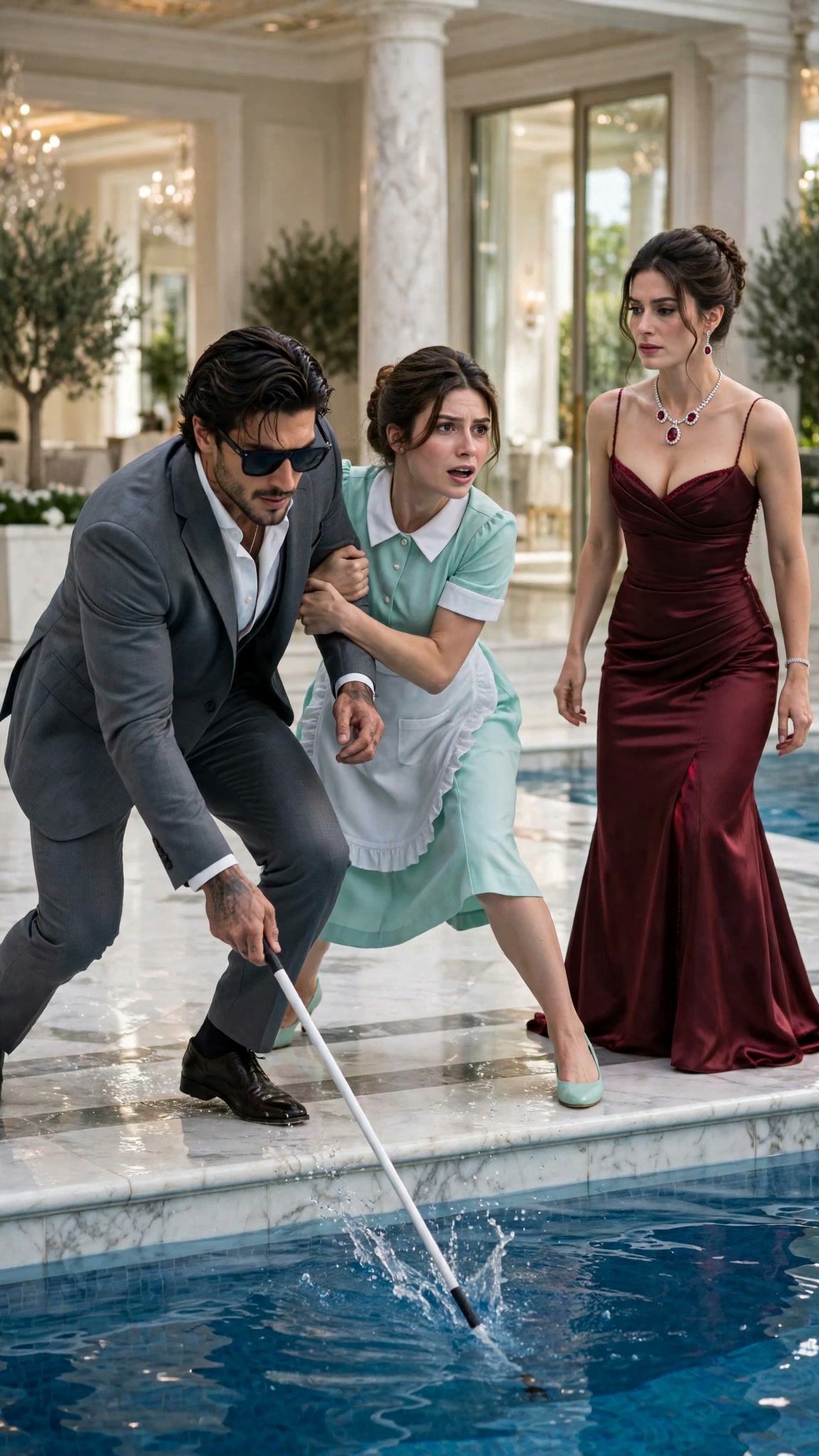
    The white cane hit the marble and slid toward the deep end of the pool.

    Daniel Blackwood's heel slipped on the wet tiles — eight feet above the water, with the safety railing mysteriously gone.

    A hand caught his forearm and dragged him back.

    "Stop moving," the maid ordered.

    From the doorway, his wife laughed. "He's blind, Anna. Not made of glass."

    Daniel said nothing. He reached up, removed his dark glasses, and looked — truly looked — at the diamond on Clara's left hand.

    "That's not the wedding ring I gave you."

    Her smile vanished. "What did you say?"

    "The ring I bought had a blue sapphire hidden beneath the diamond."

    "Daniel, you're confused."

    "No," he said quietly. "For the first time in eight months, I can see everything."

    Anna stared at him. "You can see? Since when?"

    "Since long enough to watch my wife sell my house behind my back — and kiss the man who cut the tip of my cane this morning."

    For a moment, nobody on the terrace moved.

    The pool pump hummed. Somewhere below the terrace, a gardener's radio played a song none of them would ever remember. Clara stood with one hand pressed flat against the glass door, as though the house itself might hold her up, and Daniel watched the blood leave her face in slow degrees — watched it the way he had watched everything in that house for eight months: silently, and from behind a lie.

    "You're lying," Clara said at last. "The doctors said the damage was permanent. You had three specialists—"

    "I had three specialists who told me the truth in February," Daniel said. "My sight came back over nine days. Slowly. Light first. Then shapes. Then your face, the morning you stood in our bedroom doorway and practiced looking sad."

    "Practiced?" Her voice cracked upward. "I grieved for you!"

    "You grieved beautifully," he said. "You were less careful in the west corridor."

    Anna shifted beside him, and he felt the exact instant she decided she had heard too much. Her hand slipped from his sleeve. "Mr. Blackwood, I should go back to the kitchen."

    "You should stay exactly where you are," Clara snapped. "You're the one who put these ideas in his head. Filling his ears while you— while you walk him around like a child. This is what this is. The maid has been poisoning him against me."

    "Anna saved my life twenty minutes ago," Daniel said. "That buys her the right to stand anywhere in this house she pleases."

    "It buys her a reference and a month's wages." Clara turned on him with the bright, shaking fury of a woman who had already chosen her weapon. "She's dismissed. Today. I'll have Mrs. Dalton pack her things myself."

    "No."

    "Daniel—"

    "No," he said again, and there was something in the word that ended it — the voice his board of directors knew, the one that had built Blackwood Estates out of a single bankrupt development and a line of credit nobody else would sign. "Nobody is dismissed today. Nobody leaves this house with anything that belongs to it. And you—" he took his phone from his pocket, and Clara's eyes went to it the way they would have gone to a gun, "—you are going to stand there while I make a phone call."

    He dialed without looking down. Eight months of blindness had taught his fingers what his eyes now only confirmed.

    Rachel Bennett answered on the second ring. "Daniel? It's not nine yet, is everything—"

    "Rachel. Freeze every document awaiting my signature. Every account, every authorization, every power anyone claims to hold in my name. As of this minute, nothing moves."

    A beat of silence, startled and professional. "Has something happened?"

    "My wife is here," Daniel said, looking at Clara. "And so is Anna. Put me on your secure line and listen carefully. Someone is trying to sell my house without my authorization."

    He heard the small intake of breath. He heard a pen pick up its work on the other end of the world. "Do you have proof?"

    "I have a wife wearing a copy of her wedding ring, a sale I never signed, and a terrace that was arranged to kill me this morning. Get me proof of the rest. How fast can you be here?"

    "Forty minutes. Daniel — don't sign anything. Don't even touch a pen."

    "I haven't knowingly signed anything in eight months," he said. "That's the problem. End the call, Rachel."

    He ended it himself, and the terrace was quiet again, and Clara had used the silence to rebuild her face into something wounded and magnificent. She had always been magnificent. It was the first thing he had loved about her and the last thing he would ever trust.

    "So this is the performance now," she said. "The blind husband rises. And the maid is your witness." Her mouth curved. "Do you know what everyone will say, Daniel? They'll say the accident broke something in your head. They'll say a lonely, damaged man fell for the help. I almost pity you."

    "Save it for Ethan," Daniel said. "He's better at believing you."

    Her face changed then — only slightly, only around the eyes — and he understood that until that moment she had still believed she might talk her way back inside the lie. Now she knew the shape of what was coming. She turned for the door with her shoulders rigid and her chin high, and she might have made it, too, if Gregory Shaw had not come through the terrace entrance at that precise moment with two of his security officers behind him.

    Shaw had run Daniel's security for six years. He was a broad, gray, unhurried man who had once taken a bottle meant for a client in Marseilles and never mentioned it again. He stopped three paces inside the terrace and took in the scene the way he took in everything: all at once, and in order. The missing railing. The wet tiles. The cane in the drainage grate. His employer standing upright and bare-eyed in the sun.

    "Sir," Shaw said carefully. "Your glasses."

    "Are retired, Gregory. Like my patience." Daniel pointed once, precisely, at the deep end of the pool. "Someone wet those tiles, removed that railing, and cut the tip of my cane this morning. I want every camera on this property preserved before a single frame can be overwritten. I want the terrace sealed. And I want a record of every door that opened before seven o'clock."

    Shaw's eyes moved to Clara and stayed there a moment too long to be accidental. "Yes, sir. Consider it done."

    "You see?" Clara said to the officers, to the sky, to anyone who would carry her version out of that garden first. "Now he's imprisoning me. In my own home. With guards."

    "Nobody is imprisoning you," Daniel said. "You're free to leave whenever you like. The company laptops stay. The house phones stay. The car with my name on the title stays."

    She left with her heels striking the marble like gunshots, and the sound of them faded down the long hall toward the front of the house, and Daniel stood listening to it with his sighted eyes and thought, with a clarity that almost frightened him, that it was the first honest sound his wife had made in eight months.

    Anna crouched by the drainage grate and worked the cane free. She held it balanced across both palms like something injured and brought it to him, and he turned the rubber tip toward the light. The cut was clean and shallow and patient — someone had taken a blade to it the way you would weaken a rope: not through, never through, just enough that it would fold at the worst possible moment under a blind man's weight.

    "Was it like this before?" Anna asked.

    "No."

    "Then somebody wanted you to lose your balance exactly there." She looked at the deep end of the pool, at the blue, still water. "Eight feet. With a bad shoulder from the accident. You wouldn't have climbed out, Mr. Blackwood. Not quickly. Maybe not at all."

    "You pulled me back anyway."

    "I was a paramedic for six years," she said, as if that explained it, and perhaps to her it did. "Falling people are the one thing I'm trained for." A strand of hair had escaped her bun and she pushed it back with her wrist, leaving her hands clean and empty between them. "Why would I let you fall?"

    "In this house, people generally have reasons for helping me."

    "Then maybe you should spend less time in this house," Anna said, and for the first time that morning — with his marriage burning down around him and an attempt on his life still drying on the tiles — Daniel Blackwood smiled.

    Rachel arrived in thirty-eight minutes, in a dark car that Shaw waved through the gate, with a leather case in one hand and two associates trailing her like a small, well-dressed weather system. She took the dining room the way she took every room: completely. The transfer papers went across the long table in a fan. A red pen appeared. The associates opened laptops.

    "Here is what we know," Rachel said, and tapped the first page with the pen. "An electronic authorization bearing your signature was executed eleven days ago, transferring the estate to a holding company — Cole Meridian Holdings. The buyer's deposit, two million dollars, is already in escrow. Completion is scheduled for Friday."

    "Cancel it," Daniel said.

    "I've already filed for an emergency injunction. But understand me, Daniel — the court will not stop a two-million-dollar completion on a rich man's say-so. They will need evidence of fraud. Hard evidence."

    "Then we'll give them evidence." He turned the top document toward himself and read his own name in a hand that was almost, almost his. "How was it authorized? I thought your system needed a code from that device of yours. The one only you carry."

    Rachel's fingers tightened around the folder she was holding. It was a small movement. From anyone else he would not have seen it at all; from Rachel Bennett, who had faced down federal judges without blinking, it was a confession of something — fear, or fury, or both. She set her secure device on the table between them like a piece on a board. "The transaction was approved with a one-time code generated by this device. Or by something that answers exactly like it. Someone has cloned my credentials."

    "Who else had access?"

    "My office," she said. "And you." She let the words sit there, because they were both professionals and there was no point pretending the sentence did not cut in both directions. "I have already ordered a full audit. If the leak is in my house, Daniel, I will find it and I will hand it to you myself."

    Anna, who had been standing by the door with her statement half-written on the pad Shaw had given her, spoke without looking up. "Mrs. Blackwood had papers with that seal."

    Rachel turned sharply. "What seal?"

    "The embossed one. On those transfer pages." Anna came two steps into the room, no further, the way staff learned to approach a table of powerful people — and then, visibly, decided not to care about the lesson. She set her fingertip beside the crest on the top document, not quite touching it. "There's a scratch across it. A little one, like a nail caught it. I cleaned Mr. Blackwood's study after dinner two nights ago, and Mrs. Blackwood came in for a folder. Blue folder. She told me not to touch anything on the desk. The papers inside had this same crest — and this same scratch."

    The dining room went very quiet.

    "Are you certain?" Rachel asked.

    "I remember scratches," Anna said. "Paramedics do. It's how you know which story is true." She straightened up. "She carried that folder out under her arm, and she was smiling. I thought it was strange at the time, because she'd been crying at dinner about the medical bills."

    Daniel looked at her for a long moment. "Write down everything you remember. All of it, while it's fresh — the folder, the dinner, the times. Shaw will witness it."

    "Yes, Mr. Blackwood."

    "Daniel," he said. "You pulled me out of eight feet of water. You've earned the name."

    She nodded once and bent over the pad, and the pen moved steadily, and Rachel watched her with the expression of a woman recalculating the entire board. Then Rachel's secure device chimed.

    It was a small, pleasant, two-note sound. Every head in the room came up. Rachel picked the device up slowly, and Daniel watched the color go out of her face as she read the screen, and he knew — before she turned it toward him, before he saw the fresh six-digit code glowing there beside the words AUTHORIZATION APPROVED — that the trap he had spent eight months building had just closed on the wrong side of the door.

    "That code," Rachel said, very quietly, "was generated ninety seconds ago. Not by me." She looked up at him. "Daniel. Only you and I are supposed to know how to generate it."

    His phone lit in his hand. A message, from a number with no name. A photograph — taken that morning, from the garden side of the terrace: Anna's arms locked around him, hauling him back from the edge, both of them caught in the act of his survival.

    Underneath were six words.

    SHE WAS NOT SUPPOSED TO INTERFERE.

    Daniel turned the screen face-down on the table before Anna could see it. His heart was going like a fist on a door. "Gregory," he said. "The cameras. Now."

    They watched the footage in his study with the curtains drawn: the terrace at dawn, gray-gold and empty. At 6:04 the picture stuttered. At 6:13 it resumed — the tiles already shining wet, the railing already gone, as neat as a stage set between acts. Nine minutes of his own house, cut out like a tongue.

    "The corridor camera was disabled from the panel, sir," Shaw said. "Whoever did it knew the system. And the terrace door—" he turned the laptop, and the access log glowed up at them in green rows "—opened at 6:07 with a master keycard."

    "There are three master cards," Daniel said. "Mine. My wife's. And yours, Gregory."

    "Yes, sir."

    "Mine never leaves the safe in this room."

    He crossed to the safe himself — the heavy old safe behind the painting of his grandfather's harbor — and worked the combination with fingers that had learned it in the dark. Rachel and Shaw stood behind him. Anna stood in the doorway with her written statement against her chest like a shield.

    The door swung open.

    Papers. Cash. His mother's pearls in their flat blue box. And the narrow black slot where a master keycard had slept undisturbed for six years —

    empty.

    "The card that opened that door," Daniel said, into the silence, "was mine."

  • Chapter 7: What Love Owes

    Chapter 7: What Love Owes

    The months between the hospital and the birth were the strangest and, in the end, the happiest of my marriage — a long, careful spring in which two people who had been fluent in each other discovered they had been fluent in a dialect, and set about learning the language. I went back to work part-time, not on a ward but at Lena's clinic, running a program for new wheelchair users that Lena had been threatening to found for years and now founded at gunpoint of opportunity: *Arms, Transfers, and Other Lies Your Body Tells You,* Thursdays, tea provided. Adrian funded it through channels so clean the clinic's accountant wept with joy, and never once put his name on it, and came on the first Thursday to hold coats.

    We learned the architecture of a baby from a chair the way I'd once learned the architecture of everything else: by engineering and by laughing. The crib with the side that dropped to lap height. The changing table built to roll under. Adrian — who had opinions about Italian tailoring and none about upholstery — spent an entire Saturday being defeated by a Swedish instruction manual and emerged with the nursery assembled and a new respect for my profession. At twenty-eight weeks the doctors found my blood pressure wandering and put me on a week of the strict rest I had once prescribed to other women and now received with the grace of a cat being bathed; Adrian moved his office into the bedroom doorway — *the doorway, Gia, note the symbolism, my therapist did* — and ran a criminal empire from a card table while timing my medications and losing at chess.

    And in the mornings, before the house woke, he would come and sit with his coffee and put one hand, careful as a held breath, on the mountain of my belly, and Aria — who was Aria in secret by then, a name we'd chosen and told no one, so that one thing in our loud, watched, weaponized life could belong to just the three of us — would oblige him with a kick like a knock on a door.

    "From her mother," Adrian would say, delighted. "She also wants the doors open."

    Our daughter arrived on an October morning with the lake wind rattling the hospital windows, five weeks of careful monitoring behind us and one entire crime organization — though no one said so in as many words — standing silent guard over a maternity ward like the world's most intimidating honor guard. Marcus wept in the corridor and denied it for years. Rosa wept in the open, holding a casserole, having apparently decided that grief and joy both required feeding.

    Aria Vale: seven pounds, one ounce, a full head of black hair and her father's exact expression of deep suspicion toward the proceedings. When they laid her on my chest I understood, in one annihilating second, every decision my body had ever made without consulting me — the pavement, the envelope, the van, the garage. All of it had been leading here. All of it was arithmetic I would do a thousand times over and call it the bargain of my life.

    Adrian held her last, because he had insisted on watching me first, and the nurses pretended not to watch the most feared man in Chicago receive four kilograms of person with the terrified reverence of a man being handed a live grenade made of glass.

    "She's so— " He stopped. Started again, and produced, for the record, the least Vale sentence ever recorded: "She's so *small*. Who authorized this. She's too small."

    "She'll grow," I said. "They do that. It's the whole design."

    "Then I'll grow with her." He looked up at me over our daughter's head, and his face had the expression from the recording, the one he'd worn talking to an empty door. "Whatever it takes. Whatever she asks. Whatever I have to—"

    "I know," I said. "I got the speech. I have it on a USB drive."

    He laughed — startled, real — and Aria opened her eyes at the sound and regarded us both with the unimpressed stare of a person who has already decided to run this family, and in that moment I swear the whole ward exhaled.

    The first night in the hospital as a family of three had the hushed, ridiculous holiness of a chapel in a power cut. The nurses taught Adrian the swaddle with the patience of women instructing a very large, very motivated intern, and he learned it the way he learned everything — completely, at once, and with a muttered threat at the blanket that escaped him twice. At 2 a.m. I woke to find him standing at the plastic bassinet in the dark, one finger offered to a fist the size of a plum, wearing the expression of a man who had been handed the codes to something he intended to die defending. "She has your hands," he whispered, not turning around, some husband-sense having told him I was awake. "Look at them. Those are nurse's hands. She's going to fix things." "She has your timing," I said. "She arrived exactly when she was ready and not one minute for anybody else." He nodded, grave as a treaty signing. "Then God help Chicago. She's a Vale twice over."

    We went home in November to a house that had been quietly rebuilt by Rosa, Marcus, and one very chastened organization: ramps polished, the nursery in the sunniest room on the ground floor — *my* floor, the floor that was mine on paper now, in a house that was mine on paper now, in a marriage that was mine in every way that had ever actually mattered. The garden I'd planted at knee height had been joined by a second bed, higher, that Adrian had built himself, badly, with his own hands and a carpenter discreetly correcting at dawn, so that Aria would grow up gardening at her mother's height and her father's in the same row.

    The first weeks at home rewrote us again, gently, in the small print. Adrian took to fatherhood the way he took to everything he decided mattered — totally, and with research. There were spreadsheets. There was a feeding log with the gravity of a shipping manifest, which Rosa annotated in the margins with increasingly mutinous comments until he surrendered the entire system to the women of the house and contented himself with the 3 a.m. shift, which he guarded like a border. I would wake to the sound of him in the nursery doorway, enormous in the low light, swaying in the exact rhythm the midwife had taught him, singing — if the word can survive what he did to it — the soul records from the turntable, all the words wrong, all the devotion correct, to a daughter who regarded him with the calm of a tiny empress being rowed across a lake.

    He learned to carry her one-handed so the other could steady my transfers without making a ceremony of either. He learned which cry meant hunger and which meant the specific outrage of a wet sock. When I cried one dawn for no reason the doctors could bill — hormones, gratitude, the whole unpayable year — he did not fix it or fear it. He made tea, badly, and sat on the nursery floor with his back against my chair, and let Aria sleep on his chest and me cry against his hair, and said nothing at all, which was the correct sentence, finished, in my presence, at last.

    The counselor's name was Dr. Ivers, and she had the unimpressed calm of a woman who has talked down hostage situations. Adrian attended twice a month exactly as agreed. He reported, early on, that it was worse than being shot. By spring he was caught — by Marcus, who tells me everything now, the traitor — recommending it to a rival at a sit-down, in the tone of a man recommending a tailor. *It clarifies the org chart,* he said.

    Celeste Rowan sent one letter, in June, from her father's house in Lake Forest, where she lived now in the specific exile of a woman who used to be someone. It was four pages of weather, foundation news, and the word *sorry* arranged seventeen different ways around the edges of everything except the center. I read it once, in the garden, with Aria asleep against my shoulder, and then I put it in the soil bin where we kept things that were finished.

    Some paper is just compost. The garden took it and gave back tomatoes.

    In August, on the first hot evening of the year, Adrian asked my permission for a small arson. The framed note — *Your debt is paid,* in its plain black sleeve, filed in his desk drawer on top of the ultrasound report since the night he put it there — he carried it out to the garden fire pit where the family was roasting corn, and he set it on the stone rim in front of everyone, and he said, "This document has governed my house for eleven months. It's served its purpose. I've read it every day I needed to, and some days I didn't. I'd like its author's permission to retire it." Beside it he laid what would replace it in the drawer: the first ultrasound strip, the one from the cream envelope, and a photograph Marcus had taken without being asked at the hospital — me asleep in the ward chair with Aria in the crook of my arm and Adrian's hand spread over both of us like a roof. "New orders," Adrian said. "Better ones." I looked at the four words that had ended my marriage and begun, in the end, its true version, and I felt nothing but gratitude for the woman who'd written them — she'd been wrong about the facts and right about everything that mattered, and she'd walked out of a palace on principle with one suitcase, and I was proud of her in a way I had never once, in the whole hard year, thought to be. "Burn it," I said. "She'd want the garden to have it." We watched the paper take the light together, the whole loud family, and Rosa crossed herself, and Marcus said, "Orders received," to the fire, and Aria, balanced on her father's hip, reached for the sparks with both hands the way she reached for everything: like it was already hers.

    On the evening of Aria's first birthday, with the house full of soul records and the lake wind doing its October work and exactly the right people — Lena, Marcus, Rosa, Walter the rideshare driver, who got a standing invitation to every Vale event for the rest of his natural life and arrived each time like a man visiting royalty — Adrian stood in the middle of the noise and held up his keys. The silver keychain caught the light. *DADDY*, worn soft at the edges now from a year of pockets.

    "I have an announcement," he said, and the room quieted the way rooms did for him. "A year ago I stood in this house and read a note that said my debt was paid. I've spent the year learning what my wife tried to teach me with four words." He looked at me across the heads of our family, and his voice — the register that had emptied rooms — gentled into the one that existed only in our house. "There is no debt. There never was. There's just a woman who keeps choosing me, out loud, on purpose, with the doors open — and a man who intends to be worth choosing until the choosing is just habit."

    He came through the crowd and crouched beside my chair so that we were, for once, exactly level, and Aria reached between us and grabbed the keychain with her whole fist, and the room made the sound rooms make.

    "So," I said quietly, for him under the noise, "you owe me nothing."

    "No," Adrian said, and smiled the smile from the garden photograph, the one from before everything, the one that had been real the entire time. "I owe you a lifetime. There's a difference. You taught me."

    "Then pay up," I said. "Daily. Out loud. On purpose."

    And he did. He's paying still.

    It's the only debt either of us ever acknowledged — and the only one, in the whole history of the Vale family, that grew richer the more it was paid.

  • Chapter 6: Terms of Surrender

    Chapter 6: Terms of Surrender

    We talked for six days in that hospital room, in the visiting-hours rhythm of people who have finally understood that the conversation is the destination. Adrian, who had ended negotiations by standing up, sat in a bed in a paper gown and answered everything I asked — including the questions I'd been carrying since long before Celeste Rowan ever leaned against his desk.

    Why had she been in the house so much? The foundation. The alliance. His father's treaty with Edmund Rowan, forty years old, that put Rowan hands on Vale money as a seal of trust — a chain Adrian had worn so long he'd stopped hearing it rattle. Why hadn't he thrown her out of the office months ago, the third time she made the debt remark at a dinner table, in front of guests, in front of *me*? His face, answering that one, did the thing it did at the hospital doors — opened, and let me watch him be a man instead of a monument.

    "Because she said it where it would do the most damage, and destroying her publicly would have split the alliance before the audit was ready — and because some rotten, practical part of me thought your faith was a fixed asset. Something I didn't have to guard, because it had already survived a car." He looked at his hands. "I guarded the money better than the marriage, Gia. I have no defense that isn't that sentence."

    "That's the first fully honest thing a husband has ever said in this family, I suspect."

    "I intend to make it a habit so common it bores you."

    Celeste's fate was decided in that room too, and I will record it here because it was the moment I understood the difference between the man the world feared and the man I'd married. Marcus laid out options with a professional's neutrality — the Rowan alliance dissolved, the foundation seized and audited, Celeste's recordings and her cousin's little archive recovered and destroyed. There were, he noted in the tone of a man discussing weather, *other* options.

    "No," I said, before Adrian could answer. "She doesn't disappear into a river, and she doesn't disappear into a basement. She goes home to her father in disgrace, with the audit findings in a sealed envelope and the whole city watching her carry it. She loses the thing she actually wanted — position. A lifetime of being nobody at the edge of rooms she used to command. That's the punishment that fits the woman." I looked at Adrian. "And the Kades?"

    "The Kades," Adrian said, "have already been informed that their heir spent an afternoon in a parking garage pointing a weapon at a pregnant woman in a wheelchair, and that Chicago has rules even ours don't break. Their own council is handling it with an enthusiasm I almost pity. There are older laws than the state's, Gia. Fortunately for everyone, they mostly involve shame and money."

    "You planned all this from a hospital bed."

    "I planned the parts where you were safe. The rest is just an organization doing what it does when its center is threatened." He shifted, winced, and annoyed a monitor. "You are the center. That's not a line. That's the org chart. I'll have Marcus print it."

    The hug got its own afternoon, because I refused to carry it past the third day like a stone in my shoe. I made him describe it — not defend it, describe it, second by second, the way I'd made patients describe the moment of an injury, because the moment is where the damage lives. He did it without flinching, which was the only way it could have been done. The treaty arithmetic, arriving in his head exactly as Celeste had intended it to arrive too late. Her hands at his neck. The door. The shadow under the door that he had not, in that half-second, known was mine — he'd thought it was a servant, a guard, anyone whose witness didn't matter, and that confession was the ugliest and the most necessary: "I rationed my loyalty, Gia. In that second I spent it on the alliance and the audience, because I'd filed you under *safe.* Under *settled.* A man's wife should never be filed under anything. She should be the room everything else is filed in." I sat with that for a long time. Then I told him about the hallway from my side — the raised hand, the envelope, the smile already forming for a door that was about to open on people I loved — and we sat in the wreckage of those two half-seconds together, his and mine, and for the first time since the driveway it felt less like an ending and more like a site survey: *here is exactly what broke. Here is what a rebuild would have to hold.*

    "A rebuild holds it," Adrian said, "or there isn't one. I'm not interested in a house that stands because nobody leaned on it. Lean, Gia. That's the specification."

    The terms, when we wrote them — actually wrote them, on hospital letterhead, because Adrian said a Vale agreement should exist on paper — were not romantic. They were better than romantic. They were structural.

    One: no closed doors. Not for foundation business, not for family business, not for anyone, ever, whose presence in his life could be shaped into a weapon against mine. If a conversation needed privacy, it happened outside the house, and I would know its subject before it happened.

    Two: sentences finished in my presence. If his world required him to say brutal things to brutal people, I would hear them from him first, with the context attached, in our own kitchen, before the world got its version.

    Three: the house changed its paperwork. The mansion, the garden, the medical fund, and a trust in the baby's name went into my name and the child's, executed that week by lawyers who looked ill throughout. "For six years you lived in a fortress other people told you was a favor," Adrian said, signing. "Now you own the fortress. If I ever make you want to leave again, you'll leave *from property*, in your own car, like a queen changing residences. And I will stand at the gate and watch you go and then I will spend the rest of my life earning a visit."

    Four: we would do the work. A counselor — a real one, outside the life, bound by actual confidentiality laws — twice a month. "The most feared man in Chicago," I said, "is going to sit on a couch and talk about his feelings."

    "The most feared man in Chicago," Adrian said gravely, "is going to sit wherever his wife puts him, and the couch should be afraid."

    Five — and this was mine, the one I wrote in my own hand at the bottom: *There is no ledger. Nothing in this marriage is owed. Everything in it is chosen, daily, or it is nothing.*

    He read that one three times. Then he signed under it so hard the pen tore the paper slightly, which the lawyers also looked ill about.

    On the fourth day, Edmund Rowan called.

    I know because I was there when the call came — not behind a door, not adjacent to a door, but in the chair beside the bed with the phone on speaker on the blanket between us, which was where Adrian put it without being asked, in the new and still-astonishing grammar of our marriage. The old man begged beautifully. Forty years of alliance. A daughter who had acted from love, however twisted. A family name dragged through an audit. He did not, to his credit, threaten. He simply mourned, in the wheedling cadence of a man watching an era close, and asked for the mercy his house had earned in four decades of loyalty.

    Adrian listened to all of it with his hand resting an inch from mine on the blanket — not holding, just *near*, the way we'd agreed everything would be until I moved first — and when the old man finished, my husband said, "Your house had my loyalty for forty years, Edmund. Your daughter spent it trying to steal my wife's life out from under her and then sold her to men with guns. The audit findings go to you in a sealed envelope, as agreed, and your daughter keeps her freedom and her health, which is more mercy than she budgeted for mine. The alliance is over. When you see her, tell her the garden is doing well. She always liked the garden."

    He ended the call and sat with it, and I watched the cost move across his face like weather over the lake — forty years, gone in a sentence, this one finished in front of me — and I moved my hand the remaining inch and covered his, and that was the moment, if I'm honest, more than the garage, more than the tape: a man choosing the truth at retail price, in daylight, with me watching.

    On the sixth night I woke at two and found him asleep in the visitor's chair, which was built for a person half his width, with his stitched side guarded even in sleep by one curled arm and his other hand hanging open toward the bed like a man reaching for a dock in dark water. I took the spare blanket off my own legs — carefully, silently, a nurse's skills — and spread it over the most feared man in Chicago, and sat watching him breathe, and understood that the rehabilitation ahead of us was simply this, in both directions, for years: blankets, applied at 2 a.m., without a ledger.

    On the seventh day they let him go home, and I went with him — not because a bullet had argued me out of my position, but because the position had never been *the house*. The position had been the truth, and my terms, and a man who was willing to rebuild the architecture of his life around both. On the drive, with my chair locked in the adapted vehicle beside him and his stitches complaining at every pothole, Rosa called to say the house was ready, and to ask, with enormous casualness, whether she should put the soul records back on the turntable.

    That night I learned about 10:18.

    It was Rosa who told me, of course, setting the bedroom to rights with the air of a woman delivering classified intelligence. Every night I'd been gone — every single night — at 10:18, the time he'd found the note, Adrian had come up to that room, put on whatever record had been next in my stack, and sat in my reading chair until it finished. The men on the gate had a name for it. *The boss's church,* they called it, unaware he could hear them.

    "I forbid you to find that romantic," I told him that night, in our bed, with his arm arranged with enormous care around me and his stitches protesting the geography. "It's the behavior of a haunted house."

    "It is the behavior of a house that knew exactly what it had lost, at exactly the time it lost it." He turned his head on the pillow. "Play your music, Gia. The house has been holding its breath."

    I reached over — carefully, around the bandage, around everything we'd survived — and took from my suitcase, still unpacked at the foot of the bed, a small box that had traveled to Pilsen and back in the side pocket where I'd hidden it from myself.

    Silver. Heavy in the palm. One word stamped into the metal by a patient man on Michigan Avenue a lifetime ago.

    I had bought it for the morning everything broke, to hang his keys on and change his name. I put it in his hand now and watched Adrian Vale — who did not weep at funerals, who had not wept at the pavement — close his fingers around the word *DADDY* and come completely, quietly apart.

    "Seven weeks late," I said, when he could hear me. "The engraver doesn't do refunds. You'll just have to be worth the delay."

    "Every day," he said, into my hair. "On purpose. Out loud. With the doors open."