
Story Genres: Family Drama

  • Chapter 2: Room 412

    Chapter 2: Room 412

    She woke to the smell of coffee and the conviction that she had not slept at all.

    For one disoriented second Mara stared at the white ceiling — too high, too quiet, the light wrong — and then the whole impossible night came down on her at once: the rain, the card, the rug, the man in the doorway. She sat up so fast the room tilted, clutching the gray blanket, and found him exactly where the hook of her memory had left him: Adrian Vale, standing near the windows with a cup of coffee in his hand and the early sun making a silhouette of him, watching her wake as if she were weather he had decided to wait out.

    Only this time the scene did not stop where it had stopped before. This time, the morning went on.

    "Sit down, Mara Bennett," he said again, in the same terrible, level quiet. "And tell me everything."

    "How do you know my name?" Her voice came out scraped raw. "I didn't — at the desk I only gave—"

    "Your handbag," Adrian said. "Your license. Thomas checked it while you slept, and before you climb onto that chair and start shouting about privacy, understand that a stranger sleeping in my bedroom is a security incident, not a guest." He set the coffee down on the low table between them — pushed it, deliberately, to her side of the table. "It's yours. Drink it. You look like you're going to faint, and I don't employ people to catch you."

    The cup was black coffee, no sugar. It was the best thing she had ever tasted. Her hands shook around it hard enough to slosh, and he saw, and said nothing about it, which frightened her more than anything he had said so far. Men who noticed things and said nothing were men who filed them.

    "Blake Rourke," Adrian said. "Start there."

    So she told him. Not everything — she would understand later how much she had left out, and why — but the shape of it: the foundation, the ledgers, the printout on the desk, the pleasant voice, the thumb pressed into her pulse. The rain. The three trains. Agent Whitfield's card, and Grand Central, and Monday.

    Adrian listened without moving. Thomas Hale stood by the elevator doors with a tablet in his hand and listened the way granite listens.

    "You took something from him," Adrian said. It was not a question.

    Her hand tightened around the cup.

    "If I say yes," she said, "what happens to me?"

    "That depends on what it is and where it is. If I say you're lying about the card—" he nodded toward the elevator, where the red indicator still burned above the doors like a held breath, "—the answer would be simpler for both of us. But Eddie, the clerk, encoded a penthouse card at 11:47 last night during a system failure, and handed it to the next guest in line. The system logged it. You were simply the woman the storm handed my keys to."

    "Then let me go," she said. "Downstairs. Right now. I'll check out, I'll disappear, he'll never—"

    "Three men," Adrian said, "came into my hotel at three o'clock this morning and asked my night manager about a young woman, brown hair, a guest, possibly checked in late. They were polite. They were also carrying, under their jackets, in my hotel. When they didn't get what they wanted, one of them showed the manager a photograph of you taken at the foundation gala. Do you understand what I'm telling you? They did not come hunting a room number. They came hunting you, by name, by face."

    The coffee went cold in her hands.

    "And Eddie?" she whispered. "The clerk. You said he hasn't been seen."

    "Eddie's car is in the staff garage with the door open and the engine cold. His phone is in his locker. Men don't abandon both before dawn, Mara. Not careful men."

    She set the cup down very carefully, like a person defusing something.

    "Thomas," Adrian said, without raising his voice, "room 412."

    "Already done, sir." Thomas turned the tablet around. On its screen, frozen in the fish-eye grain of the corridor camera, was the door of room 412 — her room, the room her money had paid for — standing open six inches on the darkness. "Housekeeping found it at six. The room's been turned. Mattress cut. Lampshades off. Whoever did it was looking for something small, and they didn't find it, and they weren't gentle about not finding it."

    Looking for something small.

    The little black drive, asleep in the lining of her handbag, not three feet from where she sat.

    Mara made herself breathe. In, out. She did not look at the bag. She had survived eight months beside Blake Rourke by being a woman whose face gave away nothing, and she poured all of that survival into keeping her eyes on Adrian Vale's face now.

    He was watching her the way a man watches a hand of cards.

    What he did next, he did without comment, which she would later learn was his way with everything that mattered: he set the whole machinery of the hotel moving around her as quietly as furniture being rearranged in another room. A housekeeper — sixty, unhurried, with eyes that had clearly been instructed to see nothing — brought her dried clothes up on a hanger and laid a hotel robe beside them. There was a shower in the cream marble bathroom with water hot enough to stand under until her teeth stopped clicking, and she stood under it a long time, watching the rain go off her in gray spirals, waiting to feel like a person who had escaped something. She did not feel it. She felt like a person who had been moved to a better-lit cell.

    When she came out, wrapped and wary, there was breakfast on the low table — eggs, toast, fruit, a second pot of coffee — and Adrian Vale was reading a newspaper by the windows like a man in an advertisement, and Thomas was nowhere she could see, which meant, she was learning, nothing at all.

    "Eat," Adrian said, not looking up. "Then I'll show you why you can't leave, since you clearly intend to spend the morning planning to."

    "I have a mother," Mara said. "She's in a hospital in Columbus. If I don't call her by ten, she'll — she's having a procedure Tuesday. She'll think something happened."

    "Something did happen." He folded the paper. "If you call her from this hotel, on any phone connected to your name, Blake will know which building you're in before you've finished saying hello. He has the resources for that. More importantly, he has the habit. Do you want him in your mother's hospital, Mara? Because that is the first door he will kick when yours doesn't open."

    Her face did something she couldn't stop. He saw it. He let a silence pass that felt almost like an apology.

    "Thomas has people," he said at last. "A nurse on her floor will tell her a friend visited — that you're safe, that work sent you abroad suddenly, that you'll call Tuesday after the procedure. It will be a lie with a kind face, and she'll believe it because she'll want to. It's the best I can do for her. It's more than Blake would do."

    "Who are you?" she asked. "Really. Men who own hotels don't talk like intelligence officers."

    "I own fourteen hotels." He stood, and she had to stop herself from stepping back; two days in his gravity and her body was learning distances the way sailors learn weather. "Before that, I built a company that moved important people through dangerous places, and I got very rich and somewhat less innocent learning exactly how men like Blake Rourke think. This hotel —" he gestured, once, at the windows, the skyline, the rain beginning to give up its hold on the glass, "— is where I put the money when I decided to stop. He knows that. It's why he sent his men in quietly, and why they'll stay quiet until he gives a different order. Nobody starts a war in Adrian Vale's lobby over an assistant. Not even Blake. Which is why you are, at this precise moment, in the safest room in New York — and why walking out of it would be the single stupidest act of your life."

    "And the men who cut up my mattress?" she said. "The ones downstairs. If I'm so safe, why haven't you thrown them out?"

    "Because men I throw out get replaced by men I don't know," Adrian said. "Right now there are three faces Thomas has photographed, named, and followed home. Blake's organization is a tree, Miss Bennett. I'd rather watch the branches I can see." He rose and buttoned his jacket, and the interview — for that was what it had been, breakfast notwithstanding — was plainly over. "You'll stay in the penthouse today. Thomas will show you which doors are yours. If you need anything, you ask him, not room service, not the desk, not God. Especially not God. He's not cleared for this floor."

    He left her, after that, with the run of the penthouse and a guard she could not see, and Mara did what any prisoner does with a beautiful cage: she walked its perimeter. The library smelled of cedar and old paper. The kitchen was a cathedral of steel in which no one had ever, she suspected, made toast. At the service door she stopped, and put her palm flat against it, and from the other side — politely, instantly, like a concierge of the apocalypse — a voice said, "That one's ours, miss. Yours is the big doors, when Mr. Vale says." She took her hand away as if the wood had bitten her.

    In the library, on a shelf among atlases, stood a photograph in a plain black frame: two young men in body armor, sun-blasted, grinning the exhausted grin of soldiers on the last day of something, an armored vehicle behind them and a third man's arm slung across both their shoulders — the third man cropped out of the picture by the frame's edge, all but that arm and the side of a laughing face. She knew the two who remained. One was Adrian, twenty years off him like a coat he'd shed. The other had Adrian's jaw and a softer mouth, and eyes that were laughing straight out of the photograph at whoever had taken it.

    "Daniel," Adrian said from the doorway, and she did not startle; some part of her had known he would come and find her exactly here, in front of exactly this. "My brother. That's outside Fallujah, the year it ended."

    "You keep him in the library," she said.

    "I keep him where I read," Adrian said. "It's the room I think in." He crossed to the shelf and stood looking at the photograph with her, and for a moment they were simply two people in front of a picture of the dead, and the penthouse was quiet, and the rain had finally stopped, and somewhere far below them the lobby glittered and Blake Rourke's three men drank coffee they hadn't ordered and waited for a girl with brown hair to make a mistake.

    "Thomas," Adrian said, without raising his voice. "Show her the photograph from the lobby now. She should see his face before she hears his name on a register."

    "There's one more thing," Thomas said. He swiped. A new image: the Aurelian's lobby at dawn, marble and gold light, a tall man in a dark overcoat signing the register with his head bowed to the pen. "This came in twenty minutes ago, sir. Checked in at six-fifteen, suite 3901, cash, one night. Paid in advance."

    "Name?" Adrian asked, though something in his stillness said he already knew.

    Thomas zoomed. The register filled the screen, the signature bold and flourished and perfectly legible.

    BLAKE ROURKE.

    Mara's cup slipped from her fingers. Coffee crawled across the pale oak like a map of somewhere burning, and none of the three of them moved to stop it.

    "He didn't send his men for me," she heard herself say. "He came himself."

    "Yes," Adrian said, and stood, and the whole temperature of the room seemed to narrow around him. "He did."
  • Chapter 1: The Stranger on the Rug

    Chapter 1: The Stranger on the Rug

    Rain crawled down the floor-to-ceiling windows of the penthouse in slow silver threads, and the whole of Manhattan glittered and drowned beyond the glass.

    Adrian Vale stood in his own bedroom doorway at half past two in the morning and looked at the pair of soaked black ankle boots by the rug — boots he had never seen before, in a home no one entered without his permission — and then at the shape curled beneath his gray knitted blanket on the expensive bedroom rug.

    A woman. Asleep on his floor, when the enormous bed beside her stood empty and untouched, its white sheets smooth as fresh snow.

    She was young. Too young, and too thin, and sleeping the deep, graceless sleep of the hunted — one hand flung out from under the blanket, her messy chestnut hair spread across the rug, her face turned toward the windows as if even in sleep she was listening for a door.

    Thomas Hale waited one step behind him in the doorway, silent, a hand resting near the inside of his jacket.

    "Who is she?" Adrian asked, very quietly.

    He crossed the room without a sound. Up close he could see the rise and fall of her breathing, the dark circles beneath her closed eyes, the oversized charcoal T-shirt she wore — his shirt, taken from his own dresser. And then he saw her wrist, where it rested outside the blanket, pale and delicate in the lamplight.

    A bruise. Faint and purple, blooming around her wrist in the unmistakable shape of a man's fingers.

    Adrian Vale had not felt his jaw tighten like that in eleven years.

    "What happened to her?" he whispered.

    His eyes moved to the handbag on the floor beside her, and to the black key card half-slipped from its pocket. P12. His own penthouse card. One of only four in existence, and he was holding the second one in his breast pocket.

    She had not broken in. She had been let in — by a card, by a mistake, by someone at his own front desk.

    He said nothing more that night. He left Thomas outside the door and slept in the armchair in the library with his gun in the drawer beside him, and in the morning, when the rain had given up and the city stood washed and gold in the early sun, he was standing near the bedroom doorway when she woke.

    She sat up all at once, clutching the blanket to her chest, her hazel eyes enormous. She looked at the windows. The bed. The rug beneath her. Then at him — six foot three of tailored black suit and silence, watching her from across the room.

    "This isn't room 412…" she whispered.

    "No," Adrian said. "It isn't."

    She was on her feet before he finished the sentence, dragging the blanket around herself like a shield, backing toward the private elevator. Her bare feet made no sound on the oak floor. Her whole body was shaking, and still she tried to keep her voice steady, tried to be polite, as if politeness had ever saved anyone.

    "Please… I didn't mean to come here. I swear. The card — the desk gave me the card, it opened the elevator, I didn't know—"

    "The card was a mistake," Adrian said. "Yours wasn't. You changed out of wet clothes. You took a shirt. You slept." He kept his distance. He did not raise his voice. "And now you want to run downstairs in a blanket, with that wrist, and no shoes."

    "It was an accident, I can fix it, I just need to—"

    She reached for the elevator control panel. Her fingers brushed the brass plate.

    The small indicator above the doors burned red. A soft electronic lock engaged somewhere inside the wall, final as a coffin lid.

    She froze. Turned her head slowly.

    Adrian stood between her and the rest of the penthouse. Between her and everything. His face was not angry. That was the worst of it — it was worse than anger. It was grave, and certain, and almost gentle.

    "Don't go downstairs," he said.

    "Why?" Her voice cracked. "Why are you keeping me here? Who are you?"

    "Because there are three men in my lobby who have been asking about a girl with brown hair since three o'clock this morning. Because the night clerk who gave you that card has not been seen since his shift ended. And because the man who put those marks on your wrist is sitting in a black car across the street, waiting for you to walk out of my hotel."

    Her lips parted. No sound came.

    "Blake Rourke will kill you if you leave," Adrian said, quietly, like a man reading the weather. "So you are going to sit down, Mara Bennett. And you are going to tell me everything."

    * * *

    Twelve hours earlier, Mara Bennett had still believed she could survive Blake Rourke by being useful.

    She had been his personal assistant for eight months — hired out of a temp agency to manage the calendar of Rourke Capital's charitable foundation, a job that paid her rent in Queens and her mother's hospital bills in Ohio and asked, in the beginning, for nothing but discretion. She was good at discretion. She was good at numbers, too, which was the problem, because four months in, the numbers had stopped adding up.

    A children's hospital in Newark funded twice and built never. A scholarship endowment that flowed in through the foundation and out, within the hour, to a marina in the Caymans. Donations from men whose names appeared in indictments. Mara had said nothing. She had smiled, and filed, and gone home each night a little quieter than the night before, and she had begun — carefully, on paper first, then on a small black drive no bigger than her thumbnail — to keep copies.

    Not because she was brave. Because she was an accountant's daughter, and she knew that one day someone would ask where the money went, and she did not intend to be the only name in the room when they did.

    That Friday, at twenty minutes to six, Blake Rourke had called her into his office above Fifth Avenue and closed the door himself, which he never did.

    He was forty-six and beautiful the way a knife is beautiful, and he set a single sheet of paper on the desk between them: a printout of her own screen, time-stamped, showing a file she had opened for eleven seconds three days before. A file she had no reason to open.

    "Explain it to me," Blake said pleasantly. "Slowly. I want to enjoy it."

    She lied. She was astonished at how well she lied — the words came out smooth and quick, a system lag, a mislabeled folder, she must have clicked it opening the gala seating chart. She kept her hands flat on her knees so they would not shake.

    He listened the way he listened to everyone, with his whole face, smiling slightly, and when she finished he stood and came around the desk and took her wrist in one hand — gently, almost tenderly — and squeezed.

    Not hard. Never hard. Blake never left evidence in the moment, only afterward, in the darkening bloom under the skin.

    "Do you know what I love about you, Mara?" he said. "You're careful. Careful people survive in my world. Careless people…" His thumb pressed once, precisely, into the pulse. "…have accidents on wet roads. Driving home to Ohio. In the rain."

    He released her. He told her to go home and rest and think about Monday, when they would discuss her future. He was still smiling when she backed out of the office.

    She did not go home. She stood in the service corridor with her back against the wall and shook for a full minute, and then she went to her desk, collected her handbag with the little black drive sleeping in its lining, and walked out into the rain with her head high, because careful people did not run.

    She ran on the inside. She took three trains in the wrong directions. She bought a cheap umbrella and abandoned it. She stood in a coffee shop window on Lexington and watched the street for twenty minutes and wrote a note on her phone and deleted it unsent, because the one person she had planned to give the drive to — a federal agent named Whitfield, who had slipped her a card at a foundation luncheon two months ago and said when you're ready — that agent was expecting her at Grand Central on Monday, and Monday was suddenly a hundred years away.

    The Aurelian Hotel was the only idea she had. It was famous for two things: its prices, and its absolute, religious discretion. Movie stars disappeared into the Aurelian. Divorces were negotiated there; scandals were buried there; the staff were trained like spies. No man, not even Blake Rourke, could bully his way past the Aurelian's front desk — the hotel belonged to Adrian Vale, and Adrian Vale, everyone in New York whispered, was a man even Blake Rourke was careful around.

    She paid cash. She gave her first name and her mother's maiden name. The lobby was all pale oak and low golden light, and the young clerk on duty — his badge said EDDIE, and he had the exhausted glaze of a man on hour eleven of a storm shift with the reservation system flickering in and out — took her money, encoded a card with shaking hands, and slid it across the marble in a paper sleeve.

    "Room 412, miss. Fourth floor. Elevators to your right."

    The private elevator was the one whose doors stood open. She did not know it was private. She did not know anything, except that the card in the slot turned the light green and the car rose and rose, past four, past twenty, past forty, and her stomach dropped and her heart hammered and when the doors opened onto a silent, lamplit penthouse smelling of cedar and rain, she understood that something had gone wrong — and understood, in the same breath, that she was too tired and too frightened to go back down and explain it to anyone.

    Her clothes were soaked through. Her boots squelched. There was a bathroom of cream marble and a closet the size of her kitchen, full of men's shirts that cost more than her car, and she stood dripping on the threshold of someone else's life and whispered, "Just until morning. Just until you figure it out."

    She changed in the dark, into the softest thing she found, a charcoal T-shirt that fell to her thighs. She laid her wet blouse and skirt over the tub. She did not touch the great white bed — it was too clean, too much another man's, too much like lying down in evidence — and instead she pulled a thick gray blanket from its foot and curled up on the rug by the windows, where she could see the rain and the city and, if anyone came, the door.

    Before the rain, before the trains, there had been one other thing — the thing she had done in the eleven minutes between Blake's office and the service corridor, while her legs still worked and her mind ran ahead of her terror like a dog off a leash.

    She had gone to the ladies' room on the forty-first floor, locked herself in a stall, and taken three photographs with her phone: the printout Blake had shown her, which she had palmed off his desk as she backed out — eleven seconds, a mislabeled folder, a seating chart, yes, she had heard her own voice saying it — and her own wrist, in the mirror's fluorescent glare, with the marks still white where his fingers had been, before they bloomed. Then she had deleted the photographs from the phone itself and let the cloud keep them, under a password that was her mother's birthday reversed, because careful people kept their evidence where their bodies weren't.

    And at Grand Central, two months before — a foundation luncheon, a ladies' room again; her life seemed to be decided in them — a woman in a gray suit had washed her hands at the next sink and said, without looking up, "You initial the filings, don't you, Miss Bennett? MM. When you're ready to stop being the most expendable person in that building, call me," and slid a plain white card along the wet marble. DANA WHITFIELD. A phone number. Nothing else. Mara had memorized it in the cab home and burned the card in her kitchen sink, and had thought about it every night since, the way you think about a parachute in a plane that hasn't caught fire yet.

    The plane had caught fire on Friday, at twenty minutes to six.

    She was asleep in four minutes. The sleep of the hunted, deep and graceless.

    And fifty-eight floors below her, at 2:40 in the morning, the private elevator in the Aurelian's service hall lit its brass arrow and began, silently, to rise.

  • Chapter 7: Standing in Front of Him

    Chapter 7: Standing in Front of Him

    "Now," said Salvatore Kane, in her ransacked studio, at midnight, with all the patience of a man who has never once been refused a room, "give me Eddie's card, and this ends like a family matter."

    Lily Carr sat at her own worktable with her camera between them like a centerpiece, and she did the bravest thing she had ever done with her hands, which was fold them, still and visible, in her lap.

    "No," she said. "First you explain it to me. All of it. I'm the one who carried it up fourteen floors past your men, Mr. Kane. I'm the one your story is about now—planted girl, Castellano plant, whatever version wins. If I'm going to be the story, I get to hear it from the author." She kept her eyes on his face and her voice in the level register of every interview she'd ever coaxed out of a reluctant subject. "Why? That's the only question I actually have. You had everything. His trust. His father's name. Why?"

    What she knew—and what Sal, in his vanity, had never once in sixty-eight years learned—was that nobody can resist a lens and a question at the same time. A lens alone makes men careful. A question alone makes them clever. But the two together make them authors, and authors cannot help themselves: they correct the record.

    "You want to know why," Sal said at last, almost gently. "Because the family was dying of caution, child. Because my nephew—my brother's son, God keep him—has the instincts of a bank. Routes surrendered because the margin displeased him. Wars declined because the arithmetic was untidy. In my father's time the Kanes took. In my brother's time we held. In Damian's time we file reports." His hand—the watch hand—turned over on the table, palm up, a man showing you an old scar. "I sold him nothing that mattered. Schedules. A warehouse the feds were welcome to. And in exchange the Castellanos were going to let this family eat for another generation, under management that understood the times. I wasn't betraying the family, Lily. I was saving it from its heir."

    "And Eddie Rusk?" she asked softly.

    "Eddie Rusk was a clerk who forgot his place." The warmth went out of the room like a candle pinched. "He watched the watch—his own pathetic little joke, he said it to my face once, laughing, and I laughed with him and went home and arranged it. He was supposed to bring his suspicions to me, as family does. Instead he made his little film for the king. So the king's man got what clerks get."

    "And the toast?" she said. "At the Table. In front of forty men. Your own nephew. Say it plainly, Mr. Kane. For the record."

    Marco made a small sound. Sal silenced him with two fingers, without looking, the way you quiet a dog.

    "You want it plainly." Sal leaned back in her broken chair and looked at her with something almost like respect. "Plainly, then. I arranged him a statesman's death. He would have stood. He would have toasted his house. He would have sat down among his peers with his dignity entirely intact, and been gone before the fish course, and half the men in that room would have wept at the funeral of a lion and voted—gratefully—for the steady hand that poured. It was a mercy, as these things go. I have seen the other kind. I chose him the kind one." He folded his hands. "And you—some waitress of a photographer, some nobody the agency sent—picked his death up off a carpet and carried it to him in your fingers, and now I am to be a villain in a story told by a girl in a torn-up room." His voice stayed soft, and that was the worst of it, the genuine grief in it. "Give me the card, Lily. Let an old man at least arrange the ending of his own—"

    Marco's phone rang.

    It rang in his jacket, shrill and ordinary, and Marco—who had faced down Rocco Bell's entire profession without blinking—went white to the lips as he fumbled it out and read the screen. In the same second, Sal's own phone began to buzz against the tabletop where he'd laid it, face down, at the start of the interview. And buzz again. And again.

    In Lily's ear, small as a thought, Nadia's voice said: "They have it. All five families. Emilio's man just stood up in the Meridian library and walked out to make this call. It's over, Lily. Come home."

    Sal was looking at the phones. He was looking at Marco, whose face was a confession all by itself. And then, slowly, the old man's gaze traveled—as Lily had known, in her bones, in her father's religion, that it would—from the phones, to her, and down, at last, to the camera sitting dark and patient between them on the scarred table.

    "The whole time," he said. It wasn't a question.

    "From the moment you sat down," Lily said. "The toast. Eddie. The warehouse. 'A statesman's death.' Five families just heard you say it, Mr. Kane—in your own voice, in a room you walked into of your own free will, explaining yourself to the planted girl." She stood up, slowly, because her knees had opinions, and she put the original card on the table between them and slid it toward him with one finger—the little black wafer, the whole burning center of it—and watched him stare at it like a man watching his own coffin being carried past. "Take it. It's a copy of nothing. Nadia made three copies before you ever left the hotel—you knew that, you watched her hands. The card was never the evidence. You were. You just needed a room quiet enough to confess in."

    The studio door came open.

    It did not come open the way doors open in raids. It opened the way it had opened at the start of all of this—inward, unhurried, on a man too big for the frame of it—except that this time the man in the doorway was pale as paper under one arm strapped to his chest, with Rocco Bell behind him and Dani behind Rocco and a tide of quiet professionals behind them, and Damian Kane looked past his uncle, past Marco, past the ruin of the room, and found Lily, and his whole face changed in a way that forty years of control could not stop and did not try to.

    Marco's hand went into his jacket. He got it perhaps an inch toward the light before he understood what he was looking at—understood the phones, the door, the arithmetic of a finished war—and then, to Lily's astonishment, it was Sal who stopped him. Sal, who raised two fingers, the way he had by the sideboard, the way he had an hour ago in this room, and quieted his last soldier like a dog.

    "Enough," Salvatore Kane said. "It's finished, Marco. Put your face back on. We'll be photographed leaving, and the Kanes—" something crossed his face that in another man would have been a smile and in him was a scar closing, "—the Kanes leave a room like gentlemen."

    He rose. He straightened the cuffs of his overcoat, one fold, exact. At the door he stopped, and looked back at Lily one final time, and there was no hatred in it, which somehow was the saddest part of the entire war.

    "Your father," he said. "The journalist. The one who ran toward things." Her blood stopped. "I read the papers in those days, child. I knew the byline. The apple—" he shook his head, once, almost admiring, "—the apple fell straight down."

    Then he went out into the stairwell with his head high, between Rocco's men, and the building exhaled around them all.

    The council sat at noon, twelve hours early, because five families had spent the night watching an old man confess in a photographer's studio and none of them saw any reason to wait for breakfast. Lily wasn't in the room. She would spend the rest of her life being fine with that. But Nadia was, with the files, and Emilio Castellano was, with the little blue book his own pharmacist kept, and Isabella was—sitting at her uncle's right hand in black this time, not red, while the Castellano house formally disowned its captain Vito, who was discovered, by dawn, to have taken a sudden and permanent interest in the olive harvest in Calabria.

    The sentences, when they came down, were old-fashioned: names struck from the family rolls, offices emptied, fortunes disgorged into the common fund. Salvatore Kane was given a house above the sea in Sicily, a garden, a guard who was called a companion, and the rest of his natural life to contemplate the difference. Marco Delgado got a colder coast and a longer silence. The shooter from the Table—the mezzanine man, whose name turned out to be the least interesting thing about him—lived, and talked, and took his deal, and the story of the planted girl died in every library and bar where it had been born, killed not by denial but by evidence, which is the only way stories like that ever truly die.

    And on the following Thursday, in a gallery in Chelsea with her name on the door in letters she kept having to re-read, Lily Carr opened her first solo exhibition.

    She had called it One Second.

    There were portraits of the city in it—doormen and senators, brides and bartenders, all the strangers she'd ever stopped for—and at the center of the main wall, printed six feet high, hung the skyline frame: the whole glittering miracle of Manhattan through the lounge glass, and at its edge, faint as a ghost in a double exposure, the reflection of a man with a phone raised, watching her. Most of the reviews called it a meditation on surveillance. Lily let them. She knew what it was. It was the second before her life changed, and she had taken it herself, by reflex, looking the wrong way—which was, when you thought about it, how every important photograph in history had ever been taken.

    Jess came, unharmed and furious about the fuss, and ate eleven canapés and interrogated the foundation's director about the catering budget. Isabella Castellano came in jeans, with her hair up and no one presenting her, and stood in front of the skyline frame for a long time, and then commissioned a portrait—"Not the dress," she said. "The eyes. Like you do." Priya from the Meridian came, and wept discreetly into a napkin about the overtime.

    And Damian Kane came at nine, when the room was thinning, in a dark suit with both sleeves occupied and the last of the bruising gone yellow at his throat, and he did a slow circuit of the walls like a man reading a book in a language he was teaching himself, and stopped, finally, beside her, in front of the big frame.

    "The foundation's board approved your contract this morning," he said. "Photographer-in-residence. Two years. Your rate, your terms, your name on the work. Nadia has the papers. She made me promise to tell you the hazard clause was her idea."

    "Tell Nadia the hazard clause is why I'm signing."

    "I'll tell her you negotiated." He produced, from his inside pocket, a small envelope, and held it out with the air of a man returning something borrowed. "And this is yours. It was never evidence. Not this part."

    Inside the envelope was a memory card. She knew it before she touched it—Eddie's card, the original, the little black wafer that had crossed a corridor and a war. That night, in her studio, with Jess asleep in the spare room Damian's people had guarded for a week and the new lock—the Kane-grade lock, installed without asking, which she had decided, after exactly one day of pretending to mind, not to mind—Lily slid it into her reader with hands that shook only a little.

    One file. Not eleven. One.

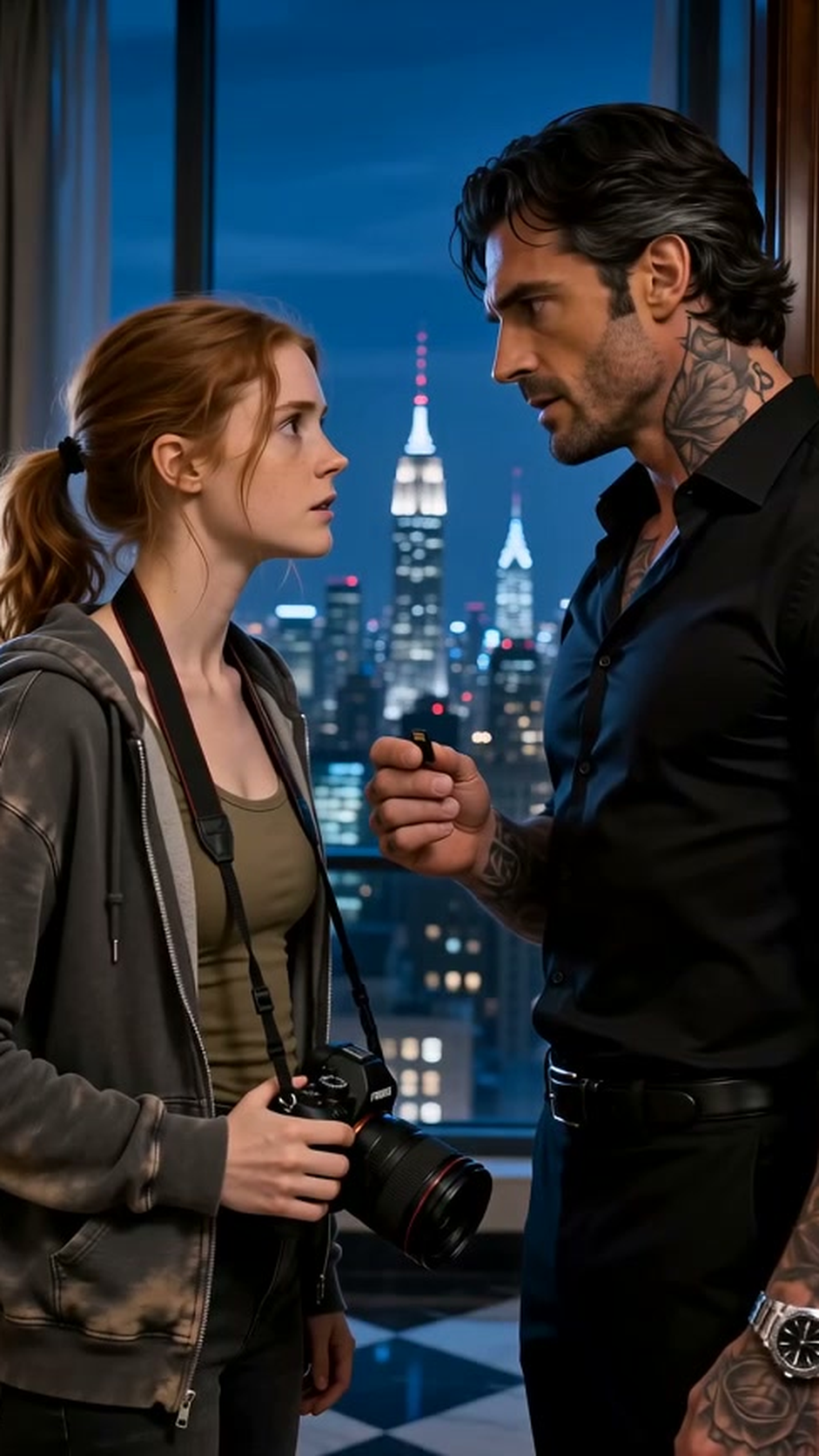
    It was a still frame from the Meridian's own corridor system, camera six, time-stamped 23:02—the hotel's record of the moment before its own six-minute amnesia: a penthouse door standing open, a big tattooed man filling it with an expression caught halfway between fury and fate, and in front of him a girl in a charcoal hoodie with a camera on her hip, holding up something small and black between two fingers, like a white flag. Like an offering. Like the first page of something.

    "He kept it," she said that Saturday, in the suite—she had come up to sign the papers, and stayed for coffee, and neither of them had remarked on the staying. "Nadia. She saved one frame that wasn't evidence."

    "She saved the frame that was the point." Damian stood at the wall of glass with the city doing its miracle below, in daylight now, in a world that had gone back to pretending it was ordinary. "Do you know what everyone told me to expect, that whole day? The foundation, my uncle, the Castellanos—one word, from all of them. I was to expect someone beautiful and glamorous at my door at eleven o'clock. It was practically in the contract." He turned, and the late light caught the side of his face that the video had left in shadow, and there was nothing guarded in it at all. "And the door opened, and there you were. Hoodie. Camera. My entire death held up between two fingers and a spine like a flagpole. I have been a careful man all my life, Lily. I've stopped arguing with the evidence. The evidence says the woman I was waiting for was the one standing in front of me the whole time."

    Her eyes were doing something she refused to dignify with a name. She raised the camera out of pure self-defense.

    "Find the second after," she said, a little thickly. "That's what my father always said. Don't take the picture everyone else is taking."

    "And what is the second after, Miss Carr?"

    She looked at him through the lens—the most powerful man she knew, standing in the wreckage of his old life with his heart, for once, exactly where his face could see it—and Lily Carr pressed the shutter on Damian Kane, laughing, for the first time in the whole long story, out loud.

    "This," she said. "This is the second after."

    ***

    Somewhere across the river, in a green-doored apartment in Brooklyn, a non-renewal letter still hung on a refrigerator for exactly one more day, until a photographer with a new contract, a new lock, and a story she'd never be able to tell came home and took it down, and put a photograph in its place: a doorway, a city, a girl with a flag in her fingers, and a man just beginning—just barely, just audibly—to laugh.

    THE END

  • Chapter 6: The Woman He Expected

    Chapter 6: The Woman He Expected

    Damian Kane had been shot at nine-forty on Saturday night, and by nine on Sunday morning the story of it had been told three times in three separate rooms of the Meridian Grand, and in the third telling the photographer had been working for the Castellanos all along.

    Lily learned this from Dani, who reported the whisper campaign the way other people reported weather moving in. The captains' seconds were doing it politely, over coffee, in the library where they'd spent the night: the girl nobody knew. The girl who screamed a half-second early—almost as if she'd known. The girl whose face was, coincidentally, already in the phones of Sal Kane's people before she'd ever knocked on the penthouse door. It was a beautiful story. It explained everything except the poison, and the poison, as one of the seconds put it, was a lab strip in Rocco Bell's pocket, and Rocco Bell's word was Kane's word, and Kane's word was, at present, the thing under discussion.

    The Table's council would reconvene in forty-eight hours to hear a formal accounting. That was the ruling Emilio Castellano had delivered at dawn, standing in the wreckage of the dining room in his overcoat, and the other families had accepted it because there was nothing else to accept. In forty-eight hours the Kanes would present evidence of treason at the Table—or the Table would accept Sal's version by default, and start carving.

    Sal himself was gone. Marco was gone. They had gone out through the kitchens in the evacuation smoke like men who had rehearsed it, because they had.

    "Your Mr. Kane is awake," Dani said, "and asking for you, and the doctor is using words about it that I am not paid enough to repeat."

    The clinic occupied the Meridian's eleventh floor, behind a door marked PRIVATE WELLNESS. Damian was sitting up in the bed because he had refused, comprehensively, to lie down in it, with his left arm strapped to his chest and an IV in his right and a color to his face like newspaper. He looked at Lily in the doorway and some of the grey went out of his expression.

    "You're angry," he observed.

    "You hired me as a shield made of visibility, and it worked so well that now I'm the story." She came in and stood where she didn't have to look up at him quite so far. "Isabella Castellano's people have put it out that I'm her uncle's plant. Your own captains are asking what a second shooter costs these days. I did that on purpose, apparently. The screaming."

    "You saved my life on purpose. The rest is embroidery."

    "Tell that to the library."

    "I intend to." He shifted, and hid the wince badly. "In forty-eight hours, in front of the council, with Nadia's files and Eddie's footage and the lab strip and a live shooter in Rocco's keeping who is, at this moment, explaining his career choices to professionals. It will be enough." His eyes held hers, and the steadiness in them was doing heavy work over exhaustion. "It has to be enough. Because if it isn't, I don't get to keep you safe by keeping you close. I keep you safe by putting you on a plane with a new name and no forwarding address, and you never take another photograph as Lily Carr. So. It will be enough."

    She was still holding that sentence like a hot coal when the request came down at noon: Miss Isabella Castellano wished to sit for a portrait. Foundation business. The photographer from the gala. Her suite, one hour, staff chaperone present.

    The chaperone turned out to be Isabella's own woman, sixty and silent. Dani waited outside the door. And Isabella Castellano, in a cream sweater with her bronze hair down and no diamonds anywhere, looked at Lily across the wreckage of both their weekends and said, without preamble: "Set up your camera, Miss Carr. Then turn it off. I want it to look like a sitting for exactly as long as it takes to look like one, and then I want to talk to the only honest person I've met in this hotel."

    Lily set up the camera. She turned it off.

    "I was supposed to marry him," Isabella said. "I want you to hear the terms from me, since you seem to be the one paying for them. My uncle gets the Kane ports without a war. Your Mr. Kane gets a beautiful wife with a famous name and a family discount on peace. And I get—" the smile that followed was small and tired and the first true thing Lily had seen on her face, "—delivered. Like the painting at the auction. You photographed that, didn't you. Eight-fifteen. I saw your lens move. My whole life, photographers aim at the dress. You're the first one who aimed at my eyes."

    "I'm sorry," Lily said, and meant it in several directions.

    "Don't be. Be accurate. It's your gift, so use it on this: my uncle did not order that shooting, and he did not order that wine. Emilio Castellano is a monster of the old school, which means he has rules, and the first of them is that you do not spill blood at a Table you were invited to—it makes the inviter a liar, and he would rather lose a port than be a liar in front of four families." She reached into her sweater's pocket and put a phone on the table between them, screen up. "The Castellano half of your war is my cousin Vito. A captain. Forty-one, patient, and fifth in line for a seat he wants first. He and Marco Delgado have been partners for a year. Vito buys what Sal sells. Vito's pharmacist—our pharmacist—keeps a little blue book of everything that leaves his shelf without a prescription, because even in our world, Miss Carr, somebody always keeps the receipts."

    On the phone's screen: a photograph, grainy, taken through a gap in a donor wall at the gala. Marco Delgado, receiving a small steel case from a heavy, smiling man in a Castellano pin. Timestamped Friday—no. Lily looked again. Timestamped that night. Nine-oh-three. Two minutes before Eddie Rusk died filming another handoff on the fourteenth floor. Two handoffs, one night, a matched pair.

    "My driver took it on my instruction," Isabella said. "I've had my own people watching Vito since the spring, because I knew whose bed I was being made to buy my family's peace in, and I wanted to know what kind of men held the receipt." She turned the phone face down with great care. "Take the photograph to your Mr. Kane. Tell him the Castellano seat at his council will not protect Vito. Tell him my uncle wants his house cleaned as much as Kane wants his. And tell him—" she stood, and smoothed the cream sweater, and became, visibly, the painting again— "that the woman he was expected to marry sends her regards, and releases him from the burden of disappointing her."

    Lily got back to 1411 to find that the day had not finished with her. Nadia was waiting with the suite's tablet and an expression Lily had learned to dread.

    "Salvatore Kane just sent an email," Nadia said, "to your studio address. The one on your website. He's not even pretending someone else wrote it."

    The message was four lines long, and it was in the voice of every beloved uncle who ever lived, which made it worse than any threat Lily had yet survived:

    LILY. MIDNIGHT, YOUR STUDIO, JUST FAMILY. BRING EDDIE'S CARD — THE ORIGINAL — AND WE RETIRE THE STORY ABOUT THE PLANTED GIRL FOREVER. COME WITH KANE'S MEN, AND THE STORY BECOMES YOUR OBITUARY. AND YOUR ROOMMATE'S. YOU HAVE MY WORD AS A KANE: ONE OF THOSE TWO THINGS HAPPENS AT MIDNIGHT. CHOOSE WHICH.

    The clinic was four floors down and a world away, and Damian read it with a face like a closing door, and said, "No," with the totality of a man who has made a career of the word.

    "He has Jess's name, Damian."

    "He has a bluff's name. Jess is in Queens with two of my men inside her sister's building and one in the street. He cannot touch her."

    "He can touch the story. Forty-eight hours from now your council hears 'the evidence,' and the evidence is a dead man's encrypted card and a lab strip and my photographs—and the star witness, the photographer, either stands up in front of five families and swears to every frame, or she doesn't." She made herself breathe. "If I don't go tonight, he reads it to the room as fear. As guilt. The girl ran because the girl was planted. And if I do go, with your men, he never shows, and the story runs anyway. There's exactly one version where Salvatore Kane walks into a room and talks like he owns the truth. It's the version where he thinks he's already won it."

    "And you think you can make him talk."

    "I think I'm a photographer," Lily said. "People perform for a lens, Damian. Even when they know it's there. Especially then. He won't be able to help himself. He'll want the record—the real record, his record—to show he was never a traitor, just a better Kane. Give me Nadia. Give me one camera and a live line. Let me do the only thing I'm actually for."

    The argument lasted twenty minutes and ranged across most of the English language. It ended, as she had somehow known it would, not with his permission but with his surrender to arithmetic—Damian Kane, who could count a room's exits through a wall, counting hers and finding the same sum she had.

    But first, because there are things a man says only when he's lost enough blood to be honest, he caught her hand as she turned to go, and held it, and said: "I sat in that suite all evening braced for a woman in a red dress. Rehearsed smiles. Treaty in a gown. I had my whole face arranged for her." His thumb moved once, absently, across her knuckles, and his eyes were dark and unguarded in a way that undid her worse than any of the rest of it. "And my door opened on a girl in a hoodie with my whole death held between two fingers, who'd run past armed men because the arithmetic of the exits didn't work. I have made my peace with a great many things in this life, Lily Carr. I will not make my peace with losing you to my uncle's vanity. So you will wear the wire, and you will wear the earpiece, and the second—" his grip tightened, "—the second it goes wrong, you say my name, and I will come through that door myself, sling and all, and God help the room."

    Her studio was in a converted warehouse in Bushwick, up three flights that smelled of other people's dinners. Rocco's people had been through it at dusk—found the mess the intruders had left, found the door's splintered frame, swept it twice for anything that listened or burned—and at eleven-forty they withdrew to a stairwell, a rooftop, and an unmarked car with the engine off, and Lily went up the stairs alone in her charcoal hoodie with Eddie's original card in her pocket and her father's whole ghost walking beside her, and she sat down at her own scarred worktable, in her own ransacked life, and set her camera on the table in front of her like a place setting.

    Tally light dark. Lens cap off. Nadia's voice in her ear, small as a thought: "Line's open. I'm holding the feed closed until you give me the word. Rocco's forty seconds away. Damian—" a pause she could hear the shape of, "—Damian is in the car downstairs. He was not invited to be in the car downstairs. Nobody is saying anything about it."

    At midnight the studio door—which no longer latched properly, because of the splinters—swung slowly inward, and Salvatore Kane came home to his own legend, in a dark overcoat, with Marco Delgado behind him carrying the cold in with them.

    Sal looked around the wreckage of her life with the sad, proprietary air of a man inspecting damage he's paid for. "You keep a disorderly house, Lily."

    "You should see what your friends did to it," she said. "Sit down, Mr. Kane. You said family. Families sit."

    He sat. And she pressed, with the side of her thumb, the small control Nadia had mapped for her, and the tally light stayed dark, and the feed opened like an eye.

  • Chapter 5: Blood at the Table

    Chapter 5: Blood at the Table

    By eight the next morning, Damian Kane had made three decisions, and Lily learned about all of them the way the rest of the organization did—by watching them happen.

    The first: the Table would sit that night as scheduled. Rocco argued, in the flat tone of a man logging a formal objection. Nadia argued with a spreadsheet. Damian listened to both, from the desk chair where a hotel doctor he'd never met had just finished re-bandaging the graze along his ribs he'd collected from a door frame in the night movement—he hadn't mentioned it to Lily, and she only knew because of the gauze in the trash—and said, "If the Table doesn't sit, the story becomes why it didn't sit. Sal writes that story. If it sits, we write the ending. It sits."

    The second decision walked out of the suite at nine in a series of whispers: word, passed mouth to mouth through channels everyone knew Salvatore Kane monitored, that the famous lost card had been recovered—and that it was blank. A hotel staffer's card. Music on it, and a child's birthday. The girl who'd brought it upstairs had been sent home with a warning and a story she'd never tell because there was no story to tell.

    "You're telling your uncle the gun isn't loaded," Lily said, from the doorway of 1411, where Dani had finally let her stand unescorted for whole minutes at a time.

    "I'm telling my uncle a story he'll want to believe," Damian said. "Men believe the version that lets them keep their plans. His plan needs me careless and him invisible. A blank card gives him both. If the card were full, I'd be careful—and he couldn't allow a careful me to sit at that Table with a full glass in front of him."

    "And if he doesn't believe you?"

    "Then he'll arrange a second way to kill me at my own dinner, in front of forty witnesses, and he'll have to improvise it in nine hours." Damian's eyes were not kind and not cruel; they were simply honest, which she was learning was his only setting. "Improvisation is where men like Sal make their mistakes, Miss Carr. I would very much like him to make one where I can see it."

    The third decision she learned about at noon, when Rocco arrived in 1411 with a garment bag and the expression of a man delivering a verdict.

    "The boss wants it known that the Table's first sitting in nine years is being documented," Rocco said. "Foundation's idea, history, blah. A photographer. Staff, invisible, professional." He hung the bag on the door. "He wants the girl everyone can see. Says a girl the whole room has watched all night is a girl nobody can say appeared out of nowhere—and nobody can quietly disappear, either. He says—" Rocco's face did something complicated. "He says he'll hire the best eyes in the building. They're yours. His words."

    In the garment bag there was a black suit, staff black, beautifully plain, cut for her like it had been measured off her bones. Lily stood looking at it for a long moment, thinking about nine hundred dollars, and a non-renewal letter, and a dead man named Eddie Rusk who had watched the watch.

    "Tell Mr. Kane," she said, "that my rate for attempted murders is higher."

    "He said you'd say something like that," Rocco said. "He said to tell you hazard pay's already in the envelope, and you're still cheaper than a war."

    The penthouse dining room seated forty, and by eight that night it held the kind of silence money makes when it's nervous. Five families. Captains in dark suits with their grandfathers' rings and their own fresh sins, seconds standing along the walls like punctuation. Emilio Castellano sat at the far curve of the table, silver and still as a figurehead, with his niece placed at his right in red—Isabella, composed as a photograph of herself, her eyes moving once, briefly, to the girl with the camera, and away.

    Lily worked the room the way she worked every room: unobtrusively, perpetually, from the edges. She shot hands. It was her religion and her editor father had preached it: faces lie on schedule, hands tell the truth for free. She shot Emilio's hands, folded like a man at a funeral he hadn't chosen. She shot captains' hands drumming, pouring, stilling. She shot Marco Delgado—at the table, in his place, eleven years of loyalty worn like a tailored suit—when his hands came up empty from below the table's edge for the fourth time in twenty minutes, and her shutter took it, and took it, and took it.

    And she shot Salvatore Kane performing the office of consigliere like a priest at a beloved altar: unhurried, gracious, blessing the room with small talk in three languages, the crested watch riding his wrist as he accepted the host decanter from the sommelier's gloved hands and inspected the seal with a connoisseur's tenderness.

    What Lily could not see—what only Damian, Rocco, and Nadia knew—was that the decanter had taken a detour on its way to Sal's hands. The sommelier was Kane's. The sample strip was in Rocco's breast pocket, where a slim phone vibrated once, at the fish course, with Nadia's verdict in four words:

    STRIP POSITIVE. CARDIAC GLYCOSIDE.

    Enough medicine to stop a strong heart between the toast and the dessert, in front of forty witnesses to how natural it looked. Sal had not believed the blank card at all. He had simply proceeded exactly as Damian predicted a man proceeds when the gun might be loaded and might not: he had brought the poison anyway, because the poison was deniable and the night was not repeatable.

    At nine-twenty, during the fish course, Marco Delgado detached himself from the table and crossed to the service alcove where Lily was changing batteries with her back to the wall—a photographer's habit, and tonight it felt like a survival trait.

    "You're the second shooter," he said. It was not quite a question. He was handsome up close in the way of men who have never once been refused anything they truly wanted, and his eyes moved over her face with an attention she recognized: the mezzanine look. The list. "From the gala. Downstairs." He smiled. "Busy weekend for you. Downstairs Friday—well. Upstairs now. The boss must like your work."

    "The foundation likes my work," Lily said. "Mr. Delgado, isn't it? I'm staff. I'm not supposed to talk to the principals."

    "And yet." He leaned one shoulder against the alcove's marble, comfortable as a cat in a doorway, and lowered his voice to the pitch of confidence. "Let me give you a piece of advice you didn't ask for, from a man who's been at that table eleven years. Cameras remember things people would pay a great deal to forget. If I were a girl with rent problems—" his smile widened a fraction, and Lily understood, with a clarity that went through her like cold water, that the apartment, the door, the photograph in the dark were all his hand writing on her wall— "I'd think very carefully tonight about which moments I chose to keep."

    "Are you threatening me, Mr. Delgado?"

    "I'm mentoring you." He straightened, adjusted a cuff that didn't need it. "Photograph the toast, sweetheart. It's historic. Just—the rest of the evening? Maybe some frames don't come out. It happens. Even to professionals."

    He walked back to the table with the unhurried saunter of a man who owned the floor under his shoes. Lily stood in the alcove with her heart doing its drum solo and her hands—traitorous, miraculous hands—perfectly steady on the camera, and she did the thing he had just spent a minute ensuring she would never dare to do.

    She raised the camera and photographed him going: Marco Delgado, mid-stride, mid-threat, turning his head at the last half-second as if some animal part of him had felt the lens—and the shutter caught him looking straight down it with the smile wiped clean off, wearing his true face, at nine-twenty-one, timestamped, geotagged, forever.

    She lowered the camera slowly.

    "Every frame, Marco," she said, to no one, to the alcove, to Eddie Rusk, wherever he was. "I keep every frame."

    Damian rose for the toast at nine-forty.

    He did it unhurriedly, a big man unfolding, the tattoo at his throat catching the chandelier light as he took the glass his uncle's hand had poured and held it without drinking, and forty men went quiet in the particular way of men who have waited nine years to watch a rite.

    "Before I drink," Damian said, "a change. Small. Mine to make." He looked down the table, unhurried, a host surveying his house. "Nine years this Table hasn't sat. In those nine years this family buried my father, and one man stood between me and every hard thing in it. My consigliere. My uncle. My father's brother." He raised the glass—not to his mouth. Toward Sal. "The rite says the head drinks first, to prove his house is clean. Tonight the house honors the hand that pours. Uncle. Drink with me. From this decanter, from my glass. Prove the office."

    The silence went total. Somewhere a fork remembered gravity and clicked against porcelain.

    Salvatore Kane smiled the smile of a man who has been beloved at ten thousand tables. "The rite is the rite, nephew," he said gently. "I won't have your captains say old Sal rewrote the liturgy to flatter himself."

    "They'll say," Damian said, pleasantly, "what I tell them to say. Drink."

    It was then—while every eye in the room hung on the two Kane men and the undrunk glass—that Lily, at the room's edge with the camera at her face, saw the waiter's hands.

    She had shot the service staff all night without thinking; they were furniture with trays. This one was the wrong furniture. The tray rode high in his left hand, tilted two degrees off level—nobody carries a full tray tilted—and his right hand was under the linen, and the linen had a shape under it that wasn't a towel, and his face was the mezzanine face, the phone face, the watching-the-exits face, and he was not watching the exits anymore. He was watching Damian's back.

    "GUN—" Lily screamed it with everything four years of startling bridesmaids had put in her diaphragm. "LEFT—HE'S—"

    The room detonated. The tray went up, the linen came away, and the shot—when it came—was not loud the way movies promised; it was a door slamming in a small room, flat and final. Damian was already moving, because her voice had reached him a half-second before the trigger did, and a half-second is the whole distance between a heart and a shoulder. The round took him high on the left side and spun him against the table, and the glass—his glass, his uncle's wine—went over in a red arc across the white cloth like something in a painting.

    Rocco was faster than the echo. His shot put the waiter down behind the service door with a shattered arm and the gun kicked away into the fallen linen, alive, screaming, caught. Dani had Lily on the floor behind an overturned chair with a knee on the small of her back and a hand on her head, and Lily—face pressed to carpet that cost more than her car—could see under the table, through a forest of fallen chairs and running feet, the whole history of the night turning over: Emilio Castellano standing with both hands raised and visible, roaring at his own men to stand DOWN; Isabella on her feet with her hand pressed to her mouth; Marco Delgado going backward through the service door in the first three seconds and not stopping; and Salvatore Kane, alone at the wreck of the rite, looking not at his bleeding nephew but at the overturned decanter, at the dark wine soaking into the cloth and dripping, patiently, onto the marble.

    Damian got up.

    That was the thing she'd tell Jess later, and the thing she'd never find a frame for: Damian Kane, with his shirt blackening at the shoulder and forty armed men deciding in real time whether to start a war, got up from his own blood like a man rising from a chair that had merely disappointed him, and walked—walked, steady as a tide—down the length of his table, and put his uninjured hand around the back of his uncle's neck in a grip that looked, God help them all, almost like an embrace, and spoke into Sal's ear at a volume the room had to imagine.

    Whatever he said, Sal went the color of old paper.

    Then Damian's knees remembered the blood loss all at once, and Rocco and two others caught him before the marble did, and the penthouse erupted into the managed chaos of men who do this for a living: doors sealed, shooter bagged and breathing, doctor summoned from the floor below, the Table's captains herded into the library under the eyes of Kane men with their jackets open.

    In the service car going down—Damian on a stretcher fashioned from a dining chair and stubbornness, an IV already in, his blood soaking through a folded napkin under Lily's pressed hands because Dani had pointed at her and said you, pressure, don't stop—he found her wrist with his good hand and held it with surprising precision.

    "The story," he said. His voice was hoarse and his eyes wouldn't quite focus, but the mind behind them was still doing arithmetic. "Listen. By morning there'll be a story, and it won't be poison or a rite or your camera. It'll be that Damian Kane hired a girl nobody knows to scream gun at his own dinner and took a hero's wound to purge his uncle. They'll say you were planted, Miss Carr. Some of them will be saying it already, in the library, over my whiskey." His grip tightened once, deliberately. "Half the Table will believe it by breakfast. I need you to know that before they say it to your face."

    The doors opened on the clinic floor. The stretcher moved. His hand was taken from her wrist by professionals.

    Lily stood in the corridor with his blood drying on her hands and repeated it to herself, because somebody in this building had to keep the record straight, and apparently—apparently—it was her.

    Half the Table will believe it by breakfast.

  • Chapter 4: What the Camera Saw

    Chapter 4: What the Camera Saw

    The freight elevator arrived on fourteen with its doors open and nobody in it.

    Rocco had four men in the service corridor by then—men who had materialized out of the hotel's woodwork with the silence of furniture being rearranged—and they covered the empty car for a long ten seconds before anyone spoke. There was nothing in it but a smear of kitchen grease on the floor and the ghost of heat from the kitchens below.

    "A probe," Rocco said at last, without lowering anything. "Somebody sent it up to watch us watch it arrive. Now they know how fast we move and from which doors." He looked at Damian. "They're not hunting blind anymore, boss. The kitchens talked. They know the card's up here. They know we have it."

    "Then the play changes," Damian said. "Sal wanted a night to work in. He doesn't get the night." He turned to Lily, who had been moved—gently, immovably—into the doorway of the adjoining suite, 1411, with a broad, silent woman named Dani stationed at her elbow like a second shadow. "Miss Carr. New rules. You don't touch a window, a phone, or a door that Dani hasn't touched first. Your name isn't in this building. As of tonight, it isn't anywhere."

    "My camera bag is in the staff room on twelve," Lily said. "My name is on the agency call sheet. My roommate thinks I'm coming home." Her voice was very steady, and it made it worse. "Mr. Kane, I have a life. It's small and it's mostly overdue bills, but it has my name all over it."

    "I know," he said. "That's why they're going to reach for it. It's what I would do."

    He said it without cruelty—as a professional courtesy, one expert briefing another—and Lily understood that the worst part of Damian Kane was not the tattoos or the men with guns. It was that he told the truth in the tone other people used for weather.

    They put her in 1411 with Dani, a change of clothes that appeared from nowhere in her size (she chose not to examine that), and a room service tray she couldn't eat from. At one in the morning she gave up on the bed and knocked on the connecting door with two knuckles, and Rocco opened it on the suite side with the air of a man who had been expecting exactly that knock for an hour.

    "I want my camera files," she said. "All of tonight. Nadia has the reader. If my photographs are evidence in whatever this is, I want to be the one who finds it. It's—" She searched for a word that wasn't dramatic and settled for the true one. "It's the only useful thing I am in this building."

    Damian, at the desk with his sleeves rolled to the elbow and a map of the hotel's service floors under his hands, looked up and studied her for a moment with those unreadably calm eyes. "Bring her files," he said to Nadia. "Everything she shot. She reads them at this table, where I can see the screen."

    "You trust me with your evidence now?"

    "No," Damian said. "I trust your eyes. Nadia says the fragment is one second because Eddie set it that way—as a key, not a clip. Trust isn't the currency tonight, Miss Carr. Usefulness is. Sit down."

    She sat. Nadia dropped forty minutes of Lily's professional life onto the screen in a grid—cocktail hour, donor wall, speeches, the senator asleep on his feet—and Lily went through them the way she had gone through ten thousand grids before: fast, then slow, then frame by frame through the ones her instincts flagged without asking her permission.

    Eight-fifteen. The wide shot. Salvatore Kane at the bar, turning, the crested watch riding his wrist like a small moon, his hand rising toward the door.

    Eight-sixteen. The woman in red entering, the room bending toward her.

    Eight-seventeen. Lily zoomed, and felt her own face go still. Because there it was—the presentation shot, Sal's hand at Isabella Castellano's elbow, and this close, this sharp, medium-format sharp, you could read the watch face like a coin: a crest, a motto in miniature, the kind of bespoke engraving a man commissions once in his life and wears into his grave.

    "Timestamped," Nadia said behind her. "Geotagged to the ballroom. That watch was presenting Miss Castellano at eight-fifteen on the same night it took delivery of a black case at nine-oh-five. Chain of custody, courtesy of the wedding photographer."

    "I'm not a wedding photographer," Lily said, out of habit, and Damian, without looking up from the hotel map, said, "You are tonight," in a tone that ended the subject.

    "Explain the rest of it to me," she said. "If I'm evidence, I want to know what I'm evidence of. Tomorrow. The table. The toast. Eddie died filming your uncle say the word toast like it was a loaded gun. Why?"

    Nadia glanced at Damian—a question. Damian considered Lily for a moment, then folded the hotel map shut with care, like a man deciding that a door, once opened, might as well be opened all the way.

    "Tomorrow night the captains of five families sit in this hotel for the first time in nine years," he said. "It's called the Table, and nobody photographs it, nobody records it, and men have died for suggesting either. At the end of the meal there's a rite older than anyone in it. The head of the host family drinks first, from the host decanter, poured by his consigliere's hand. It means: my house is clean, my hand is steady, what I serve you is safe. Forty men watch the head of the Kane family drink, and if he drinks and stands, the treaty holds for a generation."

    "And if he doesn't stand," Lily said.

    "Then the family has a new head before dessert. The consigliere pours. The consigliere has poured for this family since before I was born. It's a sacred office, which is a way of saying it's the one glass in the building nobody thinks to test." He turned the whiskey he'd never touched in a slow circle on the desk. "My uncle has been selling my routes to the Castellanos for a year—skimming the profits, feeding them my schedules, loosening every bolt on my house one quarter-turn at a time. Tomorrow, in front of five families, I was going to drink from his hand and not stand up. And Marco—Marco would grieve beautifully, and vote, in his sorrow, for the only man who could hold the family together in a crisis. The man who'd just poured."

    "An accident," Lily whispered. "A heart attack. In front of forty witnesses to how natural it looked."

    "In front of forty witnesses to how natural it looked," Damian agreed. "And the bride was the insurance. If I'd married Isabella Castellano this winter, the Castellanos gain a widow's claim instead of a war if anything went wrong with the wine. Either way Emilio takes my ports. Either way my uncle dies rich, in his own bed, beloved." He looked at her then—not at the photographs, not at the map—at her, steadily, as if she were a sentence he'd been avoiding reading. "Eddie Rusk figured it out with a camera and a card, because Eddie watched the watch. He died getting it to me. And then a photographer from Brooklyn picked it up off a carpet and carried it past two armed men to the one door in this hotel where it could do its work. So when you ask what you're evidence of, Miss Carr—" he nodded at the screen, at the timestamped moon of Sal's watch, "—you're evidence that it happened in the light. Men like my uncle can survive anything except being seen clearly. It's why they fear your trade more than mine."

    Lily looked down at her hands, which had stopped shaking somewhere in the last hour without consulting her. "Then let's make sure they see everything," she said, and turned back to the grid.

    Nine-oh-two. Ballroom level, wide shot over the speeches crowd. There—at the edge, by the service door, half-turned away—Marco Delgado in conversation with a lean young man in waiter's whites who was not carrying a tray. The young man had his phone in his hand like it was part of his hand.

    Lily's finger froze on the trackpad. "That's him. The mezzanine. The one who watched the exits. He's Marco's."

    "Keep going," Damian said quietly.

    And then she found the one she had taken through glass.

    The skyline frames. The city doing its miracle through the lounge doors, white and gold, and she almost skipped past them—they were the reason, legally, that she existed on the fourteenth floor at all—when the third frame stopped her cold. Because there, at the edge, reflected faintly in the glass with the whole glittering city shining through him like a ghost in a double exposure, stood a man in the doorway of the service stairs. Phone raised. Pointed at her.

    He hadn't been searching for the card when she arrived on fourteen. He'd been waiting on the floor. And the first thing he'd done, when a girl with a camera stepped out of the elevator, was take her picture.

    "I know when that was," Lily said. Her voice sounded far away to her own ears. "Nine-forty-one. That's the time stamp. He photographed me at nine-forty-one. Two hours before I knocked on your door, Mr. Kane. Before I found anything. Before I was anybody." She turned in the chair and looked up at Damian, and made herself ask it plainly. "So when you said 'not while you're with me'—you knew that already, didn't you? You knew my face was in their phones."

    The suite was very quiet. Dani, at the door, was looking at the ceiling with professional intensity. Nadia's hands had stopped moving.

    "I knew it was possible," Damian said. "I didn't know it was certain." He came around the desk then—slowly, the way he did everything—and he did something she would think about for a long time afterward: he crouched, so that for once she wasn't looking up at him, so that they were eye to eye like equals in a foxhole. "Listen to me. A face in a phone is a problem I can solve. I've solved worse before breakfast. But you needed to find that frame yourself, because if I'd told you, you'd have wondered what else I was keeping from you, and tonight I can't afford you wondering." His eyes were brown and tired and absolutely steady. "I keep one thing back from the people I protect, Miss Carr. Nothing. That's the arrangement. In exchange, you show me every frame. Even the ones that scare you. Especially those."

    "And if a frame scares me enough that I want to run?"

    "Then Dani runs with you," he said, "and she is extremely good at running."

    It should not have made her laugh. It did—one startled, traitorous breath of it—and Damian Kane's mouth did something at the corner that on another man would have been a smile, and the moment stretched, warm and human and entirely out of place, until Rocco cleared his throat from the doorway with the delicacy of a man stepping on a rake in the dark.

    "Call for Miss Carr," he said. "On the house line. It's her roommate."

    Jess's voice, when it came, was tinny and half-asleep and the most beautiful sound in the world. "Lil? Please tell me you're still at the rich people zoo, because some guy just called the landline—an actual landline, who even are we—asking for 'the Meridian photographer.' Said he was from the agency. Said there's a problem with your invoice. At two in the morning, Lily."

    Lily's eyes went to Damian. He was already shaking his head, once, slow: the agency would never. Not at 2 a.m. Not on a landline.

    "Jess." Lily kept her voice in the shape of normal with an effort that hurt. "Listen to me very carefully. Don't go home after your shift. Go to your sister's in Queens. Take the car service the hospital uses, not the train. I'll explain everything tomorrow, I swear on Dad's Leica. Just—please. For me. No questions until tomorrow."

    There was a silence with hospital noise in it. "You're scaring me."

    "I know. Do it anyway."

    "I'm going," Jess said, and then, because she was Jess: "If you get murdered by rich people I'm keeping the camera." The line clicked off.

    Damian was already speaking, low, to Rocco—building address, sister's address in Queens, two men, now, the ones who don't exist. Nadia's keys were flying. And Lily sat at the desk of a mafia boss's war room with her useless hands folded, understanding that she had just spent the last of her ordinary life like the last coin in a slot machine, when her own phone—the personal one, on silent, in her bag by the door where Dani had quarantined it—lit up through the fabric with a message preview.

    Dani brought it to her on an outstretched palm, like a tray.

    The message was a photograph. Lily knew the peeling green paint before her brain let her know the rest: her own front door, in Brooklyn, standing open six inches onto the dark of her own hallway, with the light on inside a home she had locked at five o'clock and no living soul had a key to but Jess, who was in Queens-bound traffic by now, please God.

    Below the photograph, three lines:

    NICE PICTURES, PHOTOGRAPHER.

    YOU HAVE SOMETHING THAT ISN'T YOURS.

    BRING IT HOME.

  • Chapter 3: Room 1407

    Chapter 3: Room 1407

    The door opened on a girl in a faded charcoal hoodie with a camera on her hip and the whole of his missing evidence held up between two fingers like a white flag, and Damian Kane's first thought—God forgive him, his first thought, in the middle of a war—was that she was terrified and had come anyway.

    His second thought was arithmetic. It was eleven-oh-two. Isabella Castellano was expected. Whoever this was, she was not her, and Rocco was already turning sideways in the doorway, one hand drifting, and the girl's eyes tracked the movement with a professional's calm and did not flinch.

    "I found this outside room 1407," she said. "Down the hall. On the carpet."

    Damian looked at the card. He knew that card. Not the object—the shape of the catastrophe. Eddie Rusk had carried his life on cards like that; Eddie Rusk, who had something the boss needed to see with his own eyes; Eddie Rusk, whose phone had died on this floor at nine-oh-seven.

    His jaw locked down on a surge of something he did not allow himself in front of witnesses. "Did you look at what's on it?"

    "Just one second." The girl swallowed, and her chin stayed level, and she gave it to him straight, the way frightened people do when they've decided that lying is a luxury for the safe. "I saw two men in a hallway."

    Every instinct Damian had honed across fourteen years of this life stood up at once. Because a hallway was specific. A hallway was this hallway. And because behind her, through the open door, the corridor lay in its low golden light, and at the far end near the elevator alcove a man in a dark suit had gone very still in the way of a man who has just recognized a face—

    "Don't turn around."

    It came out of him barely above a whisper, and the girl obeyed it the way soldiers obey things—all at once, without asking. Damian moved, putting the wall of himself between her and the corridor, and opened his hand toward the interior of the suite, toward warmth and depth and doors that locked.

    "Come inside. Now."

    She looked at the corridor she wasn't allowed to turn toward. She looked at him. She made the decision of an intelligent woman with no good options, and she chose the devil who was looking her in the eye.

    She stepped in. Rocco brought the door shut behind her with the care of a man defusing something, and the locks engaged, and Lily Carr exhaled for the first time in what felt like an hour.

    "Am I in danger?"

    Damian took the card from her fingers. His closed around it—around the whole burning center of his year of leaks—and he looked at her, really looked, and the answer cost him more honesty than he'd planned to spend on a stranger.

    "Not while you're with me."

    It was only later—much later, when the night had finished going wrong in every way it could invent—that either of them would understand that the timeline of the disaster had turned on that exact second. Because at the moment Damian closed his hand on the card, Salvatore Kane stepped out of the suite's inner room with a coffee cup in his hand and a smile already arranged, and said, "Damian, your guest is—" and saw the girl, and saw the card, and stopped.

    It was small. It was nothing. It was a heartbeat's hitch in a practiced man, gone before a normal person would have registered it. But Lily Carr was not a normal person; she was a person who read faces through a long lens for a living, and she had spent the evening photographing that man's crested watch presenting a woman in red.

    Her eyes went from Sal's face to his wrist. The watch caught the lamplight.

    And Damian, watching her watch his uncle, felt the temperature of the room change.

    "Uncle Sal," he said pleasantly, into the silence, "this is Miss Carr. She's a photographer. She works for the foundation."

    "Then she's wandered a long way upstairs," Sal said, and smiled at her with all of his teeth. "The party's below, sweetheart."

    "The party sent me up," Lily said. "Skyline shots. Fourteenth-floor lounge. Director's request." She didn't look away from him. "I got lost."

    Sal laughed, warmly, the beloved uncle, and set his cup down, and Damian noted that he set it down with his left hand—so that his right, his watch hand, stayed free and low and out of her sightline. Damian noted it the way he noted everything: without his face changing at all.

    "Rocco," he said, "call Nadia. Tell her to bring the reader up the back way and tell no one. And put two men on the service stairs who don't exist."

    Then he did the hardest thing he had done all year. He smiled at his uncle—the last man alive who had known his father, the man who had taught him to tie a tie and read a man's tells at a poker table and bury a friend without weeping where it could be used—and he said, "Sit down, Sal. Whatever Eddie Rusk died—" he corrected himself with surgical smoothness, "—whatever Eddie Rusk has been hiding from us, family hears it first in this house. That's always been the rule."

    Nadia Wolfe arrived in eleven minutes through the service door with a laptop bag and no expression at all. She was thirty-one, ex-military signals, and the only person in the organization Damian trusted with anything that plugged in. She took the card with two fingers, like a woman accepting a live round, and seated herself at the desk without a word to anyone, and the room went quiet except for the soft tick of keys and the city breathing against the glass.

    Lily stood where she'd been left, by the windows, with her camera strap twisted in both hands, watching a stranger dismantle her life's worst decision on a laptop screen.

    "Ten files locked, one open," Nadia said. "The open one's a fragment. The locks aren't consumer-grade." She glanced up. "This is Eddie's handwriting, boss. His encryption, his naming. He pulled this off a camera in a hurry."

    "A camera where?"

    "Give me a minute." Keys. Silence. Then Nadia sat back, very slightly, and Damian had known her six years and had never seen her sit back from a screen like that, as if it were warm. "Corridor camera. This corridor. Camera six—the one that covers fourteen-oh-seven. Boss, the six-minute hole in the hotel feed? Somebody cut it out of the hotel system. But Eddie had set the corridor cams to mirror to his own cards. Redundancy. He told me once it was because he didn't trust—" She stopped.

    "Finish it," Damian said.

    "He said he didn't trust anyone in this building but you."

    "Mr. Kane."

    It was the girl. Her voice was low and it shook once, at the start, and then it steadied the way it had in the doorway—as if she'd decided something. Damian turned.

    "They're still in the building," she said. "The men the card belongs to. Before I found it—before I picked it up—two of them came out of the service stairs and searched the carpet outside 1407 on their knees. I was behind the lounge doors. They didn't see me. One of them said—" She made herself say it exactly; he could watch her choose accuracy over comfort, the photographer's religion. "He said, 'If Kane finds that card before midnight, we're all dead men.' Then a call came and they left in a hurry. I tried to leave too. The young one was downstairs by then, watching the exits from the mezzanine. Watching faces. He's seen the gala staff list—he was reading the room like a list. I came back up because there wasn't anywhere else."

    The room reassessed her in silence. Not a wandering girl, then. A witness who had navigated.

    "Describe them," Rocco said, already with the tablet up.

    "Young one: late twenties, lean, cologne, phone in his hand like it's part of his hand. Older one: built like a door, shaved head, carries his weight under his jacket—left side. He got down on one knee outside 1407 and his jacket pulled. He's armed. Both of them used the service stairs like they knew the codes." She hesitated. "They said the dinner's been called forward. That Sal wanted everyone in the suite tonight."

    Damian did not look at his uncle. He found, in fact, that he was looking at the girl's hands—empty now, twisting her camera strap into rope—and that something unfamiliar was moving through the wreckage of his calculations: gratitude, hot and unwelcome, for a stranger in a hoodie who had run toward the armed men because the arithmetic of the exits didn't work.

    "Rocco," he said. "The girl's name goes nowhere. She's a ghost. She was never on this floor." He turned his head, finally, toward the sideboard, and let his gaze rest on his uncle with all the warmth of family. "You hear that, Sal? Nobody was on this floor. Whatever Eddie was running from, it died with his phone. We're blind, and whoever's hunting that card can stop hunting."

    Sal's smile softened into something almost sad, almost proud. "Smart boy," he said. "Your father would—"

    "Don't," Damian said, gently, and the gentleness did what shouting couldn't: it stopped the sentence in Sal's throat like a hand. "Not tonight."

    Then, because the play required it, he turned the full warmth of the performance on his uncle. "Sal. I need your face downstairs. The Castellano table is sitting in my ballroom being told their princess was stood up, and if Emilio hears it from anyone but family, tomorrow's dinner becomes a war council. Go down. Drink his wine. Tell him my regards are personal and my delay is an insult I'll pay for." He put a hand on the old man's shoulder, and felt, through the wool, how thin the muscle had gone with age. "Hold them for me. Nobody else can."

    Sal looked at the girl. He looked at Nadia's dark laptop screen. He looked for one second too long at the memory card resting beside it, small and black and ordinary as a communion wafer, and Damian—watching the look—understood that his uncle had just done the same arithmetic Lily had done on the carpet: the card was here, the lock was Eddie's, and whatever was inside it was now on the other side of a door Sal was being politely, lovingly, irrevocably shown.

    "Of course," Sal said. "Family." He smiled at Lily as he passed her, avuncular, almost kind. "Get some rest, sweetheart. You've had an exciting evening."

    The door closed behind him. Rocco put his ear to it, counted five, and said, "Clear. And Bruno's on his tail, all the way down."

    "Then we do this now," Damian said, "and we do it fast. Nadia."

    The files opened one by one under her hands, grey padlocks blooming into frames, and the suite went very quiet, and Lily watched Damian Kane watch his own hallway betray him.

    Nine-oh-two. The corridor, empty, brass and marble. Nine-oh-three: Eddie Rusk, heavyset, grey at the temples, a working man in a dark jacket, stepping out of the service door with a small camera in his hand and the expression of a man who has just confirmed the worst thing he knows. Nine-oh-four: Eddie looking up, directly into camera six. Eddie saying—no audio, but his mouth was clear, and Nadia read it aloud in a voice gone flat: "'Boss. Watch the watch.'"

    Nine-oh-five: two men entering the frame from the stairwell. The younger one, heavyset, dark-haired, in a beautiful suit, carrying a flat black case. Marco Delgado. Damian's underboss. His right hand for eleven years. The man who had stood godfather to Damian's niece and poured the wine at his father's funeral table.

    And the older man who came to meet him, silver-haired, unhurried, with the Kane crest on his watch and Salvatore Kane's face—

    —turning, exactly as the first fragment Lily had seen, to take the flat black case from Marco's hands with all the tenderness of a priest receiving an offering.

    Nobody in the room breathed.

    On the screen, the two men spoke—nine-oh-six now—and there was no audio, but there was Sal's mouth, in merciless profile, forming words Nadia read one by one with her eyes narrowed. "'Tomorrow… the table… he drinks… to family…'" Her voice faltered once. "'…and then the family… has a new head.'"

    The clip ran out at nine-oh-seven, mid-gesture, where Eddie's phone had died.

    Where Eddie had died, in all likelihood, somewhere in the six minutes the building had agreed not to see.

    Damian stood motionless in front of the screen with the whiskey he still hadn't touched, and in the reflection of the black glass his own face looked back at him like a stranger's. Fourteen years of building. Eleven years of Marco at his right hand. A lifetime—an entire lifetime—of Uncle Sal: of birthday money in crisp envelopes and a hand on his shoulder at the grave and you are your father's son, boy, I will keep you standing.

    Betrayal, when it finally introduces itself, does not knock. It has the keys. It has always had the keys.

    He was aware, distantly, that he should roar, or break something, or reach for the gun in the desk. Instead he heard his own voice come out quiet and entirely steady, and it was the voice that had made grown men cross streets to avoid him.

    "Nadia. Copy it. Three places, one of them outside my organization."

    "Done before you said it."

    "Rocco. The men in the corridor—"

    "Already being followed, boss. Lost one at the service door, kept the other. He's in the kitchens now, changing out of the suit."

    Damian nodded. Then he turned, at last, to the girl in the hoodie by the windows, who had brought him the end of his world in her bare hand and stood in the wreckage of it with her camera strap twisted white-knuckled and her chin still—stubbornly, magnificently—level.

    "Miss Carr," he said. "You saw the fragment. Just one second. Two men in a hallway."

    "Yes."

    "Did you see their faces?"

    "The fragment only," she said. "One second. The watch, the case, hands. I never saw a face in it—not one I'd swear to." She held his gaze. "But I photographed that watch downstairs at eight-fifteen, on the wrist of the man presenting the woman in red, and if you put my photograph next to that one second of video, Mr. Kane, you won't need me to swear to anything."

    "She's right," Nadia said quietly. "The fragment's all he knows about. It shows a watch and a handoff. It does not show his face, and it does not show his mouth planning a funeral at tomorrow's toast. As far as Sal knows, the locked files are still locked."

    "As far as Sal knows," Damian repeated. He looked at the black screen, at the frozen frame of his father's brother receiving his death like an offering. "He'll go downstairs now and be charming, and somewhere between the ballroom and the kitchens he'll decide whether to run, or to finish this tonight instead of tomorrow."

    Rocco's phone buzzed against his palm. He read it, and his whole body changed key.

    "Boss. Bruno. Sal didn't go to the ballroom." A beat. "He went down the service stairs. Toward the kitchens. Toward our friend who's changing out of his suit."

    And in the service corridor beyond the wall, very faintly, a bell chimed—as the freight elevator began, unrequested, to climb toward the fourteenth floor.

  • Chapter 2: One Second of Truth

    Chapter 2: One Second of Truth

    Lily did the thing her father had taught her to do in the bad neighborhoods of other people's wars: she became furniture.

    She stepped backward—slowly, heel first, the way she'd learned to move around sleeping babies at weddings—into the shallow alcove of the lounge doors, pressed her spine against the cold glass, and held her camera against her stomach with both hands so nothing on it could swing, click, or catch the light. She did not breathe in any way that counted.

    The stairwell door swung open and two men came out onto the fourteenth floor.

    Neither of them was dressed like staff. One was thick through the shoulders with a shaved head and the careful walk of a man carrying something heavy under his jacket. The other was younger, leaner, with a phone already at his ear and fury coming off him in a smell of cologne and sweat. They did not look at the lounge. They looked at the floor.

    "It was here," the younger one said. "He came down this hall. I watched him come down this hall."

    "Then it's here." The big one got down on one knee with a grunt and swept a huge hand across the carpet outside room 1407, palm flat, the way a man searches a beach for a ring. "Check the seams. Check under the door."

    Lily's heart was a fist against her ribs. On the carpet, not three feet from the big man's knee, the little black card sat catching the light. She could see it. If he turned his hand six inches—

    His phone rang. Both of them flinched like men in a world where a ringing phone was rarely good news. The younger one answered, listened, and his face changed.

    "The car's downstairs. Castellano's people just called the summit forward—dinner's tomorrow, but Sal wants everyone in the suite tonight." He looked at the carpet, at the big man's hands, at the doors. "We go. Now. If it's here, it's here. We'll come back with a magnet and a story."

    "You want to tell Marco we lost it?"

    "I want to tell Marco we lost it a hell of a lot more than I want to tell him we were standing here when Kane's door opened."

    The big man stood. They went—not to the elevators, but back through the stairwell door, quick and quiet, and the door sighed shut behind them, and the fourteenth floor was lemon polish and silence again, and Lily Carr was alone in it, shaking so hard her teeth hurt.

    She counted to fifty the way her father had taught her. Find the second after. Then she walked to the carpet outside room 1407 on legs made of water, and picked up the memory card.

    It weighed nothing. That was the obscene part. It weighed less than a coin, less than a breath, and two grown men—men with guns in their jackets, she would have bet her rent money on it—had been on their knees for it.

    Her first honest thought was: Give it to Priya. Her second, which arrived like ice water: Priya works for the hotel, and the hotel works for whoever can buy three floors of it, and the men searching for this card knew the floor, the doors, and the name Kane like employees.

    Her third thought was her father's, and it was the one that ruined her life in the most interesting way available: Look at it. You're the only neutral pair of eyes it's ever going to get. Look, and then decide.

    She had the adapter in her kit—March, a wedding videographer with the wrong card format, she'd never used it since. Her hands shook too badly for the first attempt. On the second, the card slid home, and her camera's screen woke up in her palms.

    There were eleven files. Ten of them showed grey padlocks. One—the first, the smallest—did not.

    She pressed play.

    One second. That was all it gave her, and for the rest of her life she would be able to describe it the way you describe the frame your whole career hangs on. A hallway—this hallway, she knew it instantly, the black marble, the brass, the door of 1407 standing open at the edge of the frame. Two men. The nearer one, dark-haired, in a suit too good for a hallway at night, was passing something small and flat into the other man's hand, and the other man—older, silver-haired, seen only from behind and the side—wore a watch with a heavy crest on its face, and as his hand closed over the object, the watch caught the corridor light and threw it back at the lens—

    The clip ended. The padlock icons swam back.

    Lily stood in the corridor with the camera in both hands and understood, with a clarity that emptied her stomach, that the silver-haired man's watch was the same watch she had photographed at eight-fifteen that evening, on the wrist of the gentleman presenting the woman in red to the Castellano Foundation gala like a painting at auction.

    She knew whose floor this was. She knew the card documented something that men with guns were willing to crawl for—and that the man in the footage receiving God-knows-what in Damian Kane's own corridor was, as of two hours ago, downstairs drinking Kane's champagne.

    She should have gone to the police. She knew that then and she'd know it forever. But she also knew what a second shooter with a non-renewal letter could prove to a police precinct at midnight: nothing, in words nobody would write down, about a one-second clip that would be "lost in evidence" by Tuesday.

    The man the card could kill was forty feet away, behind the last door on the floor.

    She tried the other door first. Of course she did. She was a photographer from Brooklyn with nine hundred dollars of unfinished work in her camera bag, not a heroine, and every cell in her body was voting for the elevator, the lobby, the street, the train home to Jess and the cat and the non-renewal letter—all the ordinary disasters that had seemed so enormous at breakfast.

    She pressed the call button with the side of her thumb. The guest lift chimed, opened onto emptiness, and she got in and rode it down with her heart slamming, watching the numbers fall. Twelve. Nine. Six. The mezzanine. The doors opened on the ballroom level—

    —and the lean young man from the fourteenth floor was standing at the far end of the mezzanine rail with his phone to his ear, looking down over the gala, looking for something in the crowd. Looking, she understood in one frozen instant, for whoever had been on the fourteenth floor. He wasn't watching the party. He was watching the exits. His eyes moved across the room with the slow patience of a man reading a list, and the list was every face in the building, and hers was on it the moment she stepped out of this elevator in a charcoal hoodie with a camera on her hip.

    The doors stood open. The brass light above them burned. Three seconds. Two.

    Lily put her hand flat on the button panel and pressed fourteen, and then, because her hand was already moving and her father's whole life was in her head, she pressed twelve and nine and six as well, and when the doors sighed shut she exhaled a sound that was almost a laugh and almost not.

    Let the man do arithmetic. Let him watch four floors.

    She got out at fourteen in a corridor that was—mercy—empty, and stood with her back against the cold black marble while her heartbeat slowed from a sprint to a march, and she looked at the little black card in her palm, and faced the truth she had been avoiding since the carpet outside room 1407: there was exactly one door in this hotel behind which the card was evidence instead of a death sentence, and it wasn't the front door, and it never had been.

    Lily took the card out of her camera with fingers that had finally stopped shaking—fear does that, burns itself off and leaves the strange calm after—and she walked down the corridor, past the lounge with its painted skyline, to the penthouse door.

    ***

    The knock, when it came, found Damian Kane doing the thing he had done for six nights running: standing at a wall of glass fourteen floors above Fifth Avenue with a glass of whiskey he wasn't drinking, reading the city like a threat assessment.

    Behind him the suite was lit low and warm. Rocco Bell, his head of security, sat at the desk by the door with a tablet and the posture of a man who had personally vetted the air. Salvatore Kane—Uncle Sal, consigliere, the last living man who had known Damian's father—stood at the sideboard with his sleeves turned back exactly one fold, pouring coffee he would also not drink, a heavy crested watch riding his wrist.

    "Eddie Rusk checked in at nine-oh-four," Rocco said. "Said he had something you needed to see with your own eyes. Said it couldn't go through channels." He turned the tablet around. "He hasn't checked in since. His phone died at nine-oh-seven. On this floor."

    "On this floor," Damian said. "In a building with four hundred cameras."

    "Fourteen's cameras have a six-minute hole in them. Nine-oh-two to nine-oh-eight." Rocco's mouth was a flat line. "Professional hole. Not a glitch. Somebody with our own codes."

    Sal made a sound in his throat, gentle, reasonable, poisonous. "A hole in the cameras and a missing man—Damian, this is what I've been saying. The Castellanos are probing. They want you rattled before tomorrow's table. You're giving them what they want."

    "What I want," Damian said, "is Eddie Rusk."

    What he did not say—what he had not said to any living person—was that he could feel the shape of it now, the way you can feel a storm by the ache in an old break. A year of small leaks. Routes that went cold a day early. A warehouse in Red Hook that the feds had found gift-wrapped, with only the family's fingerprints wiped off it. Somewhere inside his own house there was a door standing open, and everything he had built since he was twenty-six years old—since the winter they buried his father with his hands folded over a ruined chest—was draining out through it, one secret at a time.

    And onto that stage, at eleven o'clock, his uncle had arranged for him to receive a bride.

    Isabella Castellano. Twenty-six, beautiful the way magazine covers are beautiful, and offered to him across a foundation gala like the signature on a treaty. Marry the girl, merge the bloodlines, end forty years of low-grade war. It was, as Sal kept saying, the elegant solution. It was also a leash with diamonds on it, and a pair of Castellano eyes in his bedroom for the rest of his life, and Damian—who had survived this long by trusting exactly four people, two of whom were dead—had agreed only to receive her. Tonight. A drink. A first look. His uncle's word against his instincts.

    The knock came at eleven-oh-two.

    Rocco was on his feet with his hand inside his jacket before the sound finished. Sal set the coffee down very carefully.

    Damian looked at the clock. Isabella Castellano was early, or his uncle had scripted her to be. He felt the old exhaustion move through him—the particular tiredness of a man whose entire life had been arranged by other people's strategy—and he set down the whiskey and straightened his cuffs like a man going to his own sentencing.

    "Boss?" Rocco said, at the door, peering through the security glass. His voice changed. "It's not— Boss. There's a girl at the door. Hoodie. Camera." A pause. "She's holding up something small and black between two fingers, like a white flag."

    Sal went absolutely still.

    And Damian Kane, who was expecting a woman in a red dress with a practiced smile and a treaty hidden in it, said the words that ended his old life:

    "Open the door."

  • Chapter 1: The Woman at His Door

    Chapter 1: The Woman at His Door

    The door of the penthouse suite opened, and the man who filled it was not a man you said no to.

    Lily Carr had spent four years photographing weddings, bar mitzvahs, product launches, and one extremely awkward mayoral fundraiser, and she had developed a photographer's instinct for power the way other people developed an instinct for weather. She could feel it coming off this man in waves. He was tall enough that she had to tip her chin up, broad enough that the doorway seemed to narrow around him, dressed in a black button-down with the top buttons undone over a chest and neck inked with black-and-gray tattoos that climbed like smoke out of his collar. His dark hair was swept back, his jaw was shadowed with stubble, and his brown eyes went from irritated to something much colder in the space of one breath.

    They dropped to her hand.

    Between her thumb and forefinger, held out toward him like an offering she already regretted, was a tiny black memory card.

    "I found this outside room 1407," Lily said. Her voice came out calmer than she felt, which was the only gift nerves had ever given her. "Down the hall. On the carpet."

    He did not take it. He did not even reach for it. He just looked at the card the way a man looks at a wire he suspects is attached to something.

    "Did you look at what's on it?" His voice was low and controlled, and somehow that was worse than shouting would have been.

    "Just one second." She swallowed. "I saw two men in a hallway."

    Behind her, in the dim corridor, the suited man who had been shadowing her since the elevator shifted his weight. She heard the soft tick of his shoe on marble. Down at the far end of the hall, near the elevator alcove, a second figure in a dark suit stood half in shadow, and as her eyes flicked toward the movement she saw his head begin to turn—

    "Don't turn around."

    The words were barely above a whisper, and they nailed her feet to the floor.

    The man in the doorway moved then—not fast, never fast, he was a man who had never once needed to hurry—and shifted his body until he stood between her and the corridor, between her and whatever was behind her. He extended one hand, palm open, gesturing not at the card but past himself, into the warm golden light of the suite.

    "Come inside," he said. "Now."

    Lily's fingers tightened on her camera strap. Every sensible instinct she owned told her that walking into a stranger's hotel suite at eleven o'clock at night was the first line of a story that ended badly. But she had seen the one second of footage. She had seen the two men. And she understood, standing there with her heart hammering against her ribs, that whatever danger existed in this hotel was not waiting for her inside the room.

    It was already behind her.

    She stepped inside.

    The door closed with a soft, expensive click. The man took the memory card from her fingers at last, closing his own around it, and for the first time his expression—guarded, carved, unreadable—shifted into something almost human as he looked at her. Not at the card. At her.

    "Am I in danger?" Lily asked.

    His eyes went to the closed door, then came back to hers, and he weighed the answer like it cost him something.

    "Not while you're with me," Damian Kane said.

    ***

    Twelve hours earlier, Lily Carr had been standing barefoot in her Brooklyn kitchen, eating cereal directly out of the box, reading a letter that said she had thirty days to vacate her apartment.

    It wasn't an eviction, technically. The landlord's lawyer had used gentler words—non-renewal, restructuring, exciting new direction for the building—which all translated to the same thing: the rent was going up forty percent, and a twenty-eight-year-old freelance photographer whose biggest client paid net-sixty was not part of the exciting new direction.

    Her roommate Jess, a night-shift nurse with the survival instincts of a cockroach and the optimism of a golden retriever, read the letter over her shoulder and said, "We'll figure it out. We always figure it out."

    "We have four hundred dollars between us."

    "We'll figure it out dramatically, then."

    Lily's camera sat on the counter between them like a third roommate: a Fujifilm medium-format she had bought used, repaired twice, and loved with the embarrassing completeness other women reserved for men. It was the last thing she owned that was worth anything. Her father had been a photojournalist—the kind who ran toward things—and he'd put a camera in her hands before he'd put her on a bicycle. He'd been dead six years. The camera was hers, not his, but every time she raised it she could hear him: Don't take the picture everyone else is taking, Lil. Find the second before. Find the second after.

    Her phone buzzed. An agency she'd done two jobs for in September: MERIDIAN GRAND HOTEL — CASTELLANO FOUNDATION CHARITY GALA — SECOND SHOOTER CANCELLED, NEED REPLACEMENT TONIGHT, BLACK TIE VENUE, STAFF ATTIRE, $900 FLAT, PAYABLE ON DELIVERY.

    Nine hundred dollars was half the rent increase's first month. Nine hundred dollars was breathing room.

    She typed back YES before she'd finished reading.

    Jess called it at two o'clock, on her break, with hospital noise behind her. "Please tell me the fancy hotel people are paying you in money and not exposure."

    "Nine hundred. On delivery."

    "Then go be brilliant. And Lily—" Jess's voice went uncharacteristically serious. "Eat something first. You get noble when you're hungry, and noble is expensive."

    Lily promised, hung up, and ate half a sandwich standing over the sink, which she decided counted. Then she laid out her gear the way her father had taught her, in order, like laying out instruments for surgery: camera, two lenses, batteries, a fistful of memory cards in a hard case, the little adapter she'd bought for a job in March and never used again. She cleaned the big lens with the corner of her shirt. She checked the charge on everything twice.

    She did not let herself think about the letter on the fridge. She did not let herself think about the fact that the agency had called her because she was cheap, fast, and—this was the part that stung—available on a Saturday with six hours' notice, forever, because her life contained nothing that ever outranked work. She thought about nine hundred dollars and the skyline after dark and the small, stubborn pleasure of being good at something in a world that kept sending her letters.

    On the train into Manhattan, an old man across from her was doing a crossword in pen, and Lily framed him without raising the camera—chin, hands, the light coming through the grime of the window—and thought, not for the first time, that the city was one long hallway of strangers carrying evidence of their lives, and almost nobody ever stopped to look at any of it.

    She stopped. It was the whole job. It had always been the whole job.

    She never imagined it would be the thing that nearly got her killed.

    The Meridian Grand rose over Fifth Avenue like it had been poured rather than built, all limestone and gold light and flags snapping in the November wind. Lily arrived at six with her camera bag, her one good blazer over a charcoal hoodie she hadn't had time to change out of, her chestnut hair pulled into a ponytail that had given up around hour two of the subway ride. The events manager, a woman named Priya with a headset and the haunted eyes of a general, looked her up and down and decided the hoodie was acceptable because it was, technically, dark.

    "Ballroom level and the mezzanine," Priya said, walking fast. "Cocktail hour, donor wall, speeches at nine, silent auction. And—" she stopped, pressed two fingers to her headset, listened, and her expression did something complicated. "New request. The foundation director wants skyline shots from the fourteenth-floor lounge for the auction display. Before the keynote. Can you—"

    "Fourteenth floor," Lily said. "Sure."

    "Service elevator to twelve, then the guest lift. The top two floors are a private booking—residents only—but the lounge is cleared for the foundation until eleven."

    Lily shot the cocktail hour. She shot oil men and opera patrons and women in gowns that cost more than her car, all of them laughing at the precise volume wealth required. She shot the donor wall. She shot a senator asleep standing up.

    At eight-fifteen the room changed temperature, the way rooms do when someone important enters them, and Lily turned with the camera already rising. The woman in the doorway wore red the way other people wore armor—floor-length, fearless, poured on—and she was beautiful with the kind of completeness that takes a team: hair like poured bronze, diamonds at her throat, a smile assembled for cameras. Men twice her age straightened. Waiters rerouted. An older gentleman with silver hair and a signet-heavy hand rose from the bar to take her arm and present her, actually present her, to the room, the way you present a painting at auction.

    Lily took the shots because it was her job. Frame one: the woman's entrance. Frame two: the silver-haired man's hand at her elbow, guiding. Frame three: the woman's smile, which, zoomed through the long lens, did not reach her eyes at all.

    Whoever she was, she was the evening's centerpiece—the foundation director had used the word alliance at the podium, twice, with a meaningful look at the Castellano table. Lily, who understood nothing about the families and everything about faces, photographed the red dress and the empty eyes and thought: That's not a guest of honor. That's a gift being delivered.

    She was still thinking about it at nine-forty, with the speeches droning through the ballroom doors, she slipped away to the service corridor, rode the freight elevator to twelve with a cart of oysters, and crossed to the guest lift.

    The fourteenth floor was a different country. The carpet was deeper. The light was lower and warmer. The noise of a thousand rich people spending money fell away behind the closing doors like a tide going out, and Lily stood alone in a corridor of black marble panels and brass, breathing in lemon polish and quiet.

    She had heard about the top floors downstairs, the way you hear about weather in another country. One of the bartenders, refilling her water glass during cocktail hour, had nodded at the ceiling and said, "Whole fourteenth's bought out. Three days. Nobody goes up but staff, and half the staff won't." Priya, passing with a tray of place cards, had added the name without being asked, in the tone of a woman identifying a gas leak: "Mr. Kane's people. If one of them asks you for anything, smile and do it and don't write it down."

    Lily had smiled and not written it down. She had also—photographer, professional stranger—filed the name away. Kane. She had no idea what it belonged to. A fund. A family. A small country, judging by the bartender's face.

    The lounge was at the far end, past the residences. She could see its glass doors glowing.

    She raised the camera anyway, once, halfway down that silent hall, because through the lounge glass the city was doing its nightly miracle—ten thousand lit windows, the Empire State dressed in white and gold—and her father's voice said find the second before, and her finger found the shutter out of pure reflex. She took three frames of the skyline through the glass doors. In the third frame, at the edge, out of focus, the corridor behind her was reflected faintly in the glass, and in the reflection there was something she would not notice until much later, looking at the file on a bigger screen, with a man's life depending on whether her eyes were as good as he believed they were.

    She lowered the camera.

    She never got there.

    Halfway down the corridor, outside the door of room 1407, something on the carpet caught the light and threw it back at her—a tiny, bright, wrong glint, like an eye opening.

    Lily stopped. She crouched. Her photographer's eye had already framed it before her brain caught up: a small black memory card, lying face-down on the deep blue carpet, exactly where a man in a hurry might have fumbled it out of a pocket or a palm.

    And from the service stairwell door, twenty feet behind her, she heard a man's voice—low, urgent, furious—say:

    "—because if Kane finds that card before midnight, we're all dead men."

    The stairwell door clicked open.