Story Genres: Family Drama

  • Chapter 7: Her Own Name

    Chapter 7: Her Own Name

    Spring came to the city the way it always does, without asking the winter's permission.

    The legal process took the season, and it took it thoroughly. Vivian Ashford, denied bail as a flight risk with two passports and a Cayman account, awaited trial in a facility whose name Tessa forced herself to learn and then to stop picturing. The federal indictment ran to forty-one counts. Anton Reber was arrested in a motel in Ohio with a bag packed, and his cooperation — purchased with the desperation of a man who had seen the umbrella video and understood which way the weather was moving — filled in the last corners of the map: the intimidated accountant, the run-off road, the dozen small silences Vivian had bought across the years. Dwayne Pell, the accountant who had never spoken again, spoke. He came out of his long hiding with his young family beside him, and testified, and afterward was seen weeping in the courthouse corridor like a man set down after carrying something for a very long time.

    Emma took a plea. Obstruction and conspiracy, three years, with the footage played once more — not in court this time, but in the small room where she signed, her lawyer having advised her that a jury's reaction to that smile was a risk no strategy could survive. Tessa did not attend. She sent her sister nothing — no letter, no message, no forgiveness and no curse — only, through Bridget, a single line, delivered the day before Emma reported to begin her sentence: You had a phone in your hand. You could have called for help. That's all I ever needed you to know. Whether it reached whatever Emma had instead of a conscience, Tessa never learned. Some doors you knock on once, and then you build your house elsewhere.

    Richard Ashford testified for the prosecution, completely and without counsel's protection, and received two years for what he had known and buried. He wrote to Tessa once from custody — a short letter, plain as his coat. I don't ask your forgiveness, it said. I ask that you not become her to survive her. It was the best thing he had ever given her, and she kept it.

    And Tessa — Tessa did the thing no one, least of all the city's columnists who now called her "the Ashford whistleblower," expected. When the board of the foundation, cleansed and desperate for legitimacy, offered her the chairmanship — her name, her story, her credibility, exactly the currency her mother would have spent — she took it. Not the hotels. She let the hotels go to the administrators and the auctioneers of reputation. She took the foundation, and she rebuilt it the way she had once reconciled its books: line by line, in daylight. Every disbursement published. Every vendor real, named, visited. The hospital wing in Cleveland got its stolen $212,400 back, with the rest of the $6.4 million recovered in restitution, and when the wing was finally finished, the name over the door was not her grandmother's and it was not hers. It read, in simple letters, THE MARCUS BELL FAMILY WING — because Marcus Bell, night custodian, eleven years of rounds, had knelt in the slush and held a stranger's head out of the meltwater and said stay with me, and the foundation's first new grant had gone to his daughter's nursing school tuition, and Marcus, standing at the dedication in a suit he had bought for the occasion, cried without embarrassment and told the cameras, "I just did my rounds. Anybody would've." Everybody present knew it wasn't true, and loved him for saying it.

    Tessa's hands stopped trembling in April. Her ribs healed. The concussion's weather — the headaches, the light-sensitivity, the word that sometimes hid from her — lifted slowly and then, one morning, was simply gone, and she woke in her own apartment (small, rented, hers, with a lock her mother had no key to) and realized she had slept the whole night without dreaming of ice.

    In April, before the wing was finished, she went back to the alley.

    She told no one. She took a cab on a bright cold morning — spring in the city is only winter with better lighting, and the alley behind the strip mall still held its breath of shadow — and she stood at its mouth in her own coat, with her own shoes firm on the pavement, and looked at the place where she had nearly ended. It was smaller than it had been in her memory, and meaner, and ordinary: dumpsters, a loading dock, the pharmacy's blank rear wall, a drift of old snow surviving in the lee like something that refused to hear the news. A pharmacist's assistant came out with a bag of trash, glanced at her without recognition, and went back in. The world had kept its own counsel. It had not been a stage. That, she found, was the strangest mercy: it had never been a stage. It had only been an alley, and a woman, and a decision other people made — and decisions, unlike stages, can be answered.

    She stood there until the cold began to come through her coat in earnest, deliberately, feeling it and naming it: cold, only cold, a fact of weather and not a sentence. Then she walked out of the alley under her own power, in the daylight, and got into the cab, and gave the driver the foundation's address.

    The dedication, when it came, was held in Cleveland on a morning rinsed clean by rain. They did not cut a ribbon — Tessa had banned ribbons, along with fog — they simply opened the doors, and the first children came in with their parents, into a wing full of light and primary colors and a plaque that gave the money's history in plain print for anyone to read: what was taken, what was recovered, what it built. Marcus Bell stood by the door in his new suit receiving handshakes like a head of state. The cellist from Dayton — seventeen no longer, twenty now, at conservatory on a restored scholarship with two years of restitution folded into it — played in the atrium, and if the music was not perfect, it was hers, and it filled the bright room to the ceiling. Tessa, watching from the side with her hands folded and her name nowhere on the walls, thought that this was what an empire was actually for, and that her mother, who had built a cathedral out of other people's gifts and locked herself inside it, had never once stood in a room like this and felt what she was feeling — which was not pride, and not vindication, but the quiet of a ledger that balances.

    On the first warm evening of May, Bridget came for dinner with a bottle of wine and a banker's box. Tessa stared at the box. "Tell me that's not evidence."

    "It's your copy," Bridget said. "Everything's filed, mirrored, and beyond anyone's reach now. The state keeps the original. But this one is yours." She set it on the table between the plates, worn cardboard, dented corner. "You should decide what you want to do with it. It's your story. It always was. That's what they never understood — it was never the files. It was that you'd decided to stop being silent. The drive was just the loudest way to say it."

    They ate. They drank the wine. Bridget — Bridget Colton, who had carried the end of an empire into a hospital room in a cardboard box — laughed at something, and Tessa laughed too, and the sound surprised her with its ordinariness, its warmth. Outside the window, the city glowed in the mild spring dark, and somewhere across town a hotel she used to belong to lit its lanterns for strangers, and it did not hurt. It was just a building. It had always only been a building; the empire had lived in people being afraid, and people were not afraid anymore.

    Her first board meeting, she called for the ledgers.

    Not the summary. Not the dashboard the old regime had polished for directors the way the hotel polished silver — to be looked at, never used. The ledgers, all of them, going back ten years, printed and bound and set in front of every seat at the long table like a row of indictments, which, she supposed, they were. The room was full of the cleansed and the new and the very, very careful: two federal monitors, a forensic accountant with ink on her cuff, directors who had been appointed by a court and intended to be able to say so. Tessa sat in her mother's chair — she had considered not sitting in it, and decided that symbolism was a luxury of people whose mothers hadn't tried to have them committed — and opened the first volume, and turned, with her healed hands, to the page where the hospital wing began.

    "Rule one," she said. "Every dollar in this foundation has a name, an address, and a visitor. If a vendor can't be stood in front of, it doesn't get paid. If a transfer can't be explained to the person whose money it was — at a kitchen table, in plain words — it doesn't happen. My mother built an empire out of fog. Fog is how she stole. So there will be no fog. Not the charitable kind, not the corporate kind, not the family kind." She looked up the table at the careful faces. "Some of you knew. Some of you suspected. Some of you are going to spend the next year explaining to investigators which one you were, and I can't help you with that. But I can tell you what this place is from today. It's the thing it was pretending to be. That's the whole job. It's the hardest job in the world, apparently, so we'd better start."

    Afterward, the forensic accountant — a woman named Rita Okafor, who had no reverence in her whatsoever, a quality Tessa had begun collecting in people the way her mother collected pearls — lingered by the door. "You know the numbers will be smaller," she said. "Honest money always is. The gala won't raise thirty-eight million on the truth."

    "No," Tessa agreed. "It'll raise what it raises. And a hospital wing that exists is worth more than a gala that glitters." She smiled, a little tiredly. "My mother would rather have had the gala."

    "I know," Rita said. "I audited her." A beat. "For what it's worth, Director — of everyone who had access to those archives in ten years, you're the only one who ever pulled a thread."

    That night Tessa did her rounds of the new foundation the way Marcus did his rounds of the strip mall — office by office, floor by floor of the small, unglamorous headquarters they had moved into, because the flagship tower had been sold and she had not mourned it. She checked the locks. She checked the postings board, where the quarter's disbursements were pinned in plain print for any staffer to read: names, amounts, addresses. She stood a while in the doorway of the scholarship office, where a wall of photographs was going up — not donors, recipients. A nurse in Cleveland. A boy with a cello. A girl in a lab coat holding a microscope like a trophy. This was the empire now: small, solvent, and true. It would never hang in a lobby. It would never need to.

    Later, alone, Tessa took the drive from its sleeve and held it in her palm. Small. Weightless. Everything. She thought of a hand sliding over ice. She thought of a phone raised, and a smile, and a man turning toward the warm door. She thought of a flashlight beam stopping in an alley — a stranger's kindness, arriving like grace, unearned and absolute.

    She put the drive in the back of a drawer, under the lease and the passport and the ordinary papers of an ordinary life, and she closed the drawer on the winter.

    "Everything," she said to the quiet room, and smiled — not the small smile from the edge of the portrait. Her own.

    THE END
  • Chapter 6: The Hearing

    Chapter 6: The Hearing

    The competency hearing was held in a wood-paneled courtroom on the fourth floor of the county courthouse, and the Ashford family arrived to it the way they arrived everywhere: early, immaculate, and united.

    Vivian sat at the petitioner's table in a black suit with her pearls, her face arranged into the exhausted sorrow of a mother asking the state to save her child from herself. Emma, in demure navy — someone had dressed her down for court, Tessa noted, and it almost worked — kept her eyes lowered and her phone nowhere in sight. Richard sat behind them in the gallery's first row, a man attending his own haunting. Their legal team occupied two tables: three partners from the city's oldest firm, men who had closed deals and buried stories for the Ashfords for decades, led by a silver-haired litigator named Prescott Hale, who had the manner of a man who had never lost an argument he couldn't buy.

    The family's case was a cathedral of concern. Their physician testified — smoothly, sadly — to Tessa's "escalating instability," her paranoia, her "fixations" on imaginary financial wrongdoing. A foundation executive described finding her weeping in her office. Emma, called as a witness, cried on cue, real tears, beautifully lit by the courtroom's high windows: "She attacked my mother in the street. She was screaming. We tried to help her, we tried to get her into the car to take her somewhere safe, and she ran. We searched all night. I have the video, I was filming because I was scared, I didn't know what else to do—"

    It was, Tessa thought, sitting beside Bridget at the respondent's table with her bandaged hands folded, a genuinely magnificent performance. In another life her sister could have had a career that wasn't built on other people's pain. Prescott Hale rose for his closing flourish, voice pitched to the judge's conscience: "Your Honor, this is a sick young woman being exploited by an attorney who stands to gain—"

    "Your Honor." Bridget Colton stood. She did not raise her voice. She had the particular calm of a person holding four aces and no further need of theatre. "The petitioners have presented a video. We'd like to present the rest of it."

    The courtroom screen lit.

    Bridget played Emma's video first — the family's exhibit, the thirty seconds the city's charity circle had whispered over: Tessa wild on the pavement, reaching, incoherent, a madwoman in a silver dress. She let it run to its end. She let the silence sit.

    "That video," Bridget said, "was recorded by the witness, Emma Ashford, on her phone. It is a clip. It begins twenty seconds after the events it purports to describe, and it ends before the alley. The full record of that night was preserved by the Ashford Sterling Hotel's own security system, and provided to law enforcement by my client's evidence — evidence the petitioners dumped her in a freezing alley to suppress. Your Honor, with the court's permission — the unedited camera."

    What the courtroom watched then, in silence so complete that the radiator's ticking sounded like a clock in an empty house, was the whole of it: the side door, the ice, the umbrella striking the stone beside a reaching hand, the grip, the fall, the father's turned back, the SUV, the dragging feet. And Emma — smiling, stepping backward, keeping her sister in frame like a director.

    When it ended, Vivian Ashford's face had the stillness of a portrait whose subject has died.

    "The state," said Detective Cole Voss, called next, in the flat voice of a man reading weather, "has opened a criminal investigation into the petitioners, encompassing conspiracy, assault, unlawful imprisonment, attempted involuntary commitment by fraud, and financial crimes against the Ashford Foundation totaling at minimum six point four million dollars, currently under review by the attorney general and the Federal Bureau of Investigation. The psychiatric evaluation request submitted by the petitioners is, in the state's assessment, an overt act in that conspiracy, intended to render the victim incompetent to testify." He looked at the judge. "The state opposes this petition in the strongest terms. The only danger Miss Ashford presents, Your Honor, is to the people who filed it."

    Before the video, though, Bridget had done something quieter, and in its way crueler: she had cross-examined Emma.

    It was the family's own strategy that put Emma on the stand — their narrative needed the frightened sister, the witness with the phone — and Bridget rose to meet her with a gentleness that the courtroom, at first, mistook for weakness. She established the phone. She established the filming. She established, with Emma's eager agreement, that Emma had recorded because she was frightened of what her sister might do.

    "Miss Ashford, in your statement to police, you said your sister, quote, 'attacked your mother in the street and ran screaming into the night.' Do I have that right?"

    "Yes," Emma said, and dabbed her eyes. "It was terrifying."

    "And you filmed because you were frightened."

    "Yes."

    "Miss Ashford, how long have you had the video on your phone set to record in slow motion?"

    The courtroom's silence changed quality. Emma blinked. "I— what?"

    "The metadata, Miss Ashford. Your phone records its settings. At 11:47 p.m., four minutes before the events outside the hotel, you opened your camera application and selected slow-motion capture. You adjusted the exposure. You'd practiced the framing — there's a deleted test clip, same angle, timestamped 11:49." Bridget's voice never rose; it descended, almost to kindness. "People who are frightened press record, Miss Ashford. They don't art-direct. When did you decide to film your sister's breakdown — before or after your mother told you there would be one?"

    Emma looked at her mother's table. Vivian did not look back. It was a small thing — a quarter-second of a daughter searching a mother's face for rescue and finding a stranger doing arithmetic — but it was the moment the cathedral fell, before any video played, because everyone in the room had children or had been one, and everyone understood what they had just seen: the second daughter learning, in public, the lesson the first daughter had learned on the ice. That in that family, love was not a fact. It was a budget. And the budget could be cut.

    Emma did not answer the question. Her counsel objected; the judge sustained; it did not matter in the slightest. Bridget said, "No further questions," and sat down, and the foundation executive in the third row was seen, by three reporters, to quietly leave the courtroom and place a phone call, and the empire — which had survived markets, scandals, and one fire — did not survive the afternoon.

    The judge denied the petition in eleven minutes. She denied it with prejudice, in language that made Prescott Hale study his hands, and she referred the family's physician for perjury review before anyone had finished standing up.

    On the courthouse steps, in the raw wind, a reporter put a microphone in front of Tessa — she walked slowly, on Bridget's arm, her ribs taped, her face still carrying the faint yellow geography of old bruises — and asked the question the whole city was asking: What do you want to happen to your mother?

    It was the sound bite the evening news was starving for, and Tessa knew it, and knew as well that her answer would be played at the trial, and clipped, and captioned, and fed into the machine that had already begun turning her into a character again — the avenging daughter now, in place of the mad one. She thought about the portrait. She thought about the woman in purple on the ice, and the same woman in grey being led to a car, and the distance between those two images, which her whole life had traveled.

    "I want the foundation's money back," she said. "I want Dwayne Pell to sleep in his own house without checking the street. I want the students who got letters to get their scholarships. After that—" she shook her head, once, and the wind took her hair — "my mother is the state's problem now. She stopped being mine on the ice. That's the truest thing I know how to say."

    Inside the car, with the door shut on the noise, Bridget exhaled for what sounded like the first time in three days. "That," she said, "is going to lead every broadcast in the state."

    "I didn't say it for them."

    "No," Bridget agreed, starting the engine. "That's why it works." She pulled into traffic, past the courthouse, past the first raw headlines scrolling on a news van's monitor. "You know there's a year of this ahead. Grand juries. Motions. Your sister's lawyers, your father's. The board. The money, getting it back one frozen account at a time. It will be slow and it will be ugly and there will be days you wish you'd let the petition go through and taken the quiet room and the sedation."

    "I know," Tessa said. She watched the city go by, grey and bright. "Let them take the year. I have the rest of my life to be believed in." And she settled back against the seat, carefully, around the ribs, and closed her eyes — not sleeping, just resting inside the first hour in thirty years in which no one, anywhere, was editing her.

    What happened outside the courtroom happened fast, because the press had been in the gallery and the video had been in open court. Vivian Ashford was arrested that evening at the house on Regent Street — not dramatically, not in purple, in a grey coat, saying nothing, with the dignity of a woman who has decided that silence is the last luxury she owns. The foundation's board, convening in emergency session, voted unanimously to suspend her, freeze the accounts, and cooperate fully; the empire, that great careful machine, did what machines do and turned, without sentiment, to protect itself. Emma was charged with obstruction, conspiracy, and evidence tampering — her smile, replayed on every channel in the city, had made her the face of it, and there was a grim symmetry in that which Tessa took no pleasure in. None. That was the worst of it, later: how little pleasure there was in any of it.

    And Richard.

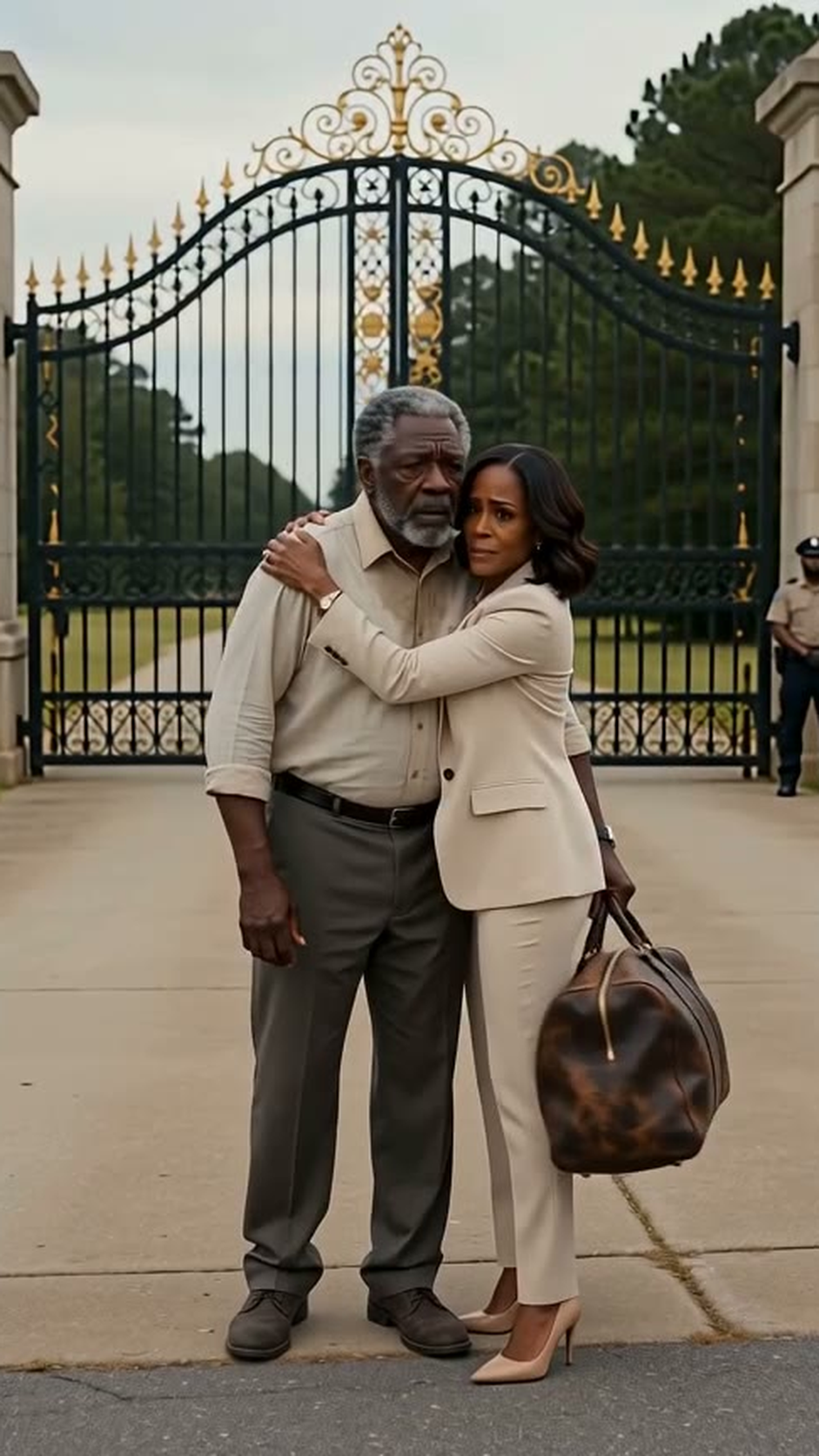
    Her father came to Tessa's hospital room — she had been kept one more night for observation, the doctors watching the tremor in her hands — on the evening after the hearing, and he stood in the doorway in his charcoal coat with his hat in his hands, looking twenty years older than the man in the golden doorway, and he said the words he had not said on the pavement.

    "I saw you," he said. "On the ice. I saw you reach for your sister. I saw your mother—" His voice broke, unbeautifully, a sound she had never heard him make. "And I turned around and went inside where it was warm. I have told the detectives everything, Tessa. All of it. The accounts too — what I knew of them, God forgive me, what I chose to suspect and not know. I will testify. It won't undo— I know it won't undo—"

    "No," Tessa said gently. "It won't."

    He nodded, accepting it like a sentence, which it was. "Your mother told me that night that you were ill," he said. "I wanted to believe her. Believing her was warm. You were lying on the ice, and believing her was warm." He put the hat down, slowly, as if it weighed a great deal, and left it there, and went out of the room and out of the family's story, into whatever remained of his.

    Tessa lay in the white room that night with the window open a crack to the cold, clean air, and listened to the city, and thought about empires: how they are built, how they rot, how a woman can raise one like a cathedral and a child like a stranger in the same lifetime. The drive was in evidence now, its contents multiplying through agencies and servers, unkillable. Her mother had spent forty years building something that could not be questioned.

    Tessa had ended it with one word, whispered from a hospital bed.

    But an ending, she was beginning to understand, is just a beginning wearing black. The question — the last question, the one waiting on the other side of all this ruin — was what she intended to build on the ground her mother had salted.

  • Chapter 5: Everything

    Chapter 5: Everything

    "Your family says you attacked them."

    Detective Voss said it the way he'd said it in the doorway of her life three days into the investigation — flatly, setting the report on the bedside table like a card dealt face-up. The heading caught the light: EMERGENCY PSYCHIATRIC EVALUATION REQUEST. He was watching her, Tessa understood, for the flinch. For the breakdown. For the madness her family had described in such loving detail.

    She didn't give it to him. Her breathing quickened — the monitor betrayed that much — but she shook her head slowly, and when she spoke, her voice, though hoarse, was steady.

    "I didn't attack anyone, Detective. I was attacked. There's a difference, and it's the whole of this."

    The door opened.

    Bridget Colton entered carrying the banker's box, and set it on the table, and opened it with the deliberate care of a woman defusing something. From inside she took a sealed evidence sleeve, and from the sleeve — with gloved fingers, holding it to the cold hospital light — a small USB drive.

    "I found it," she said, softly, to Tessa. And then, to Voss: "Detective, before you go any further with that report, you're going to want to see this. All of it. It's why they left her in an alley to freeze. It's why that evaluation request exists. They weren't trying to help her. They were trying to make sure that when she talked, nobody would ever believe her."

    Bridget plugged the drive into the laptop. The screen lit. Rows of folders appeared: FINANCIAL RECORDS. HIDDEN ACCOUNTS. VIDEO EVIDENCE. CONFIDENTIAL TRANSFERS.

    Voss leaned closer. His eyes widened.

    "Tessa…" he said. "What is this?"

    "Everything," she whispered.

    They started with the financial records, because Bridget was a lawyer and knew that paper convicts where emotion only persuades. For forty minutes, in that white room, with the monitor beeping and the snow melting off the windowsill outside, the architecture of Vivian Ashford's second, secret empire assembled itself on the screen: the shell companies, the ghost vendors, the Cayman accounts, the transfers bleeding the foundation white — $6.4 million over three years, not the $1.9 million Tessa had first found, the rot went deeper than she had known. Voss stopped taking notes at some point. He just watched, and his face did the thing Bridget had predicted in her office weeks ago: skepticism, then attention, then alarm.

    "This is enough for the state police and the AG," he said quietly. "This is enough for the FBI, if the wires crossed state lines, and they did." He looked at Tessa. "Miss Ashford— Tessa. Why didn't you come to us?"

    "Because until ten minutes ago," Tessa said, "I was the crazy daughter who attacked her mother. You had their statement, their doctor, their video. I had this — and me. And my family has spent three days making sure 'me' was worth nothing."

    "Walk me through one," Voss said. "Not the biggest. A normal one. I want to understand how an empire steals in business hours."

    So Tessa — propped on pillows, a woman with two broken ribs explaining embezzlement to a homicide detective in the key of a lullaby — walked him through the Corvus Trust endowment transfer, step by step: the scholarship fund's quarterly surplus, identified by the foundation's own analyst; the "program services agreement" generated by outside counsel; the approval chain that rose, always, one floor above her own desk, into the office where her mother's signature lived; the staircase of intermediaries; the arrival, forty days later, of the same money in an account whose statements were addressed to a post office box and a set of initials. V.A. Vivian Ashford had initialed her thefts the way she initialed Christmas cards, with a flourish, out of habit, because in forty years no one had ever once asked her to stop.

    "And the scholarship money," Voss said. "It was earmarked. For actual—"

    "For actual students." Tessa's voice stayed level with an effort that cost her. "Eleven that cycle. We know their names; the foundation sent them letters — acceptance letters, Detective, signed by my mother, congratulating them — and then the money wasn't there, and the letters were withdrawn on administrative grounds. One of them, a cellist from Dayton, wrote back asking what she'd done wrong." She stopped. The monitor ticked. "My office answered her. Not me — I never saw the letter; my mother ran interference on all of it — but the foundation told that girl there'd been an error in her file. She'd done nothing wrong. She was seventeen. Her file was fine. The money was in the Caymans."

    Voss was writing now, fast, the professional shorthand of a man whose anger has found its paperwork. "Miss Ashford, in my experience, people who do this — the letters, the withdrawals, the signatures — they rely on the victims staying scattered. Eleven kids who think they each made a mistake. An accountant who thinks he's alone. A daughter who thinks she's crazy." He looked up. "The drive works because you did the one thing the whole system was designed to prevent. You compared notes with yourself. You made it one story."

    "It always was one story," Tessa said. "She just made sure everyone only got to read their own page."

    Then Bridget opened VIDEO EVIDENCE, and the room changed temperature.

    The first file was the loading dock, fourteen months old: Vivian in purple, Dwayne Pell trembling, the still stranger nodding. Voss went very quiet. "I know that man," he said at last, of the stranger. "His name is Anton Reber. We've been trying to connect him to three intimidation cases for two years. Three. People who were going to talk." He looked at Tessa with something new in his face — not pity. Respect, and a cop's anger on her behalf. "Your mother is standing in my three cases."

    The second video was the one that ended it.

    It was the hotel's own porte-cochère camera, the night of the gala — footage Tessa had copied from the security archive without knowing, in her panicked thoroughness, exactly what treasure she had. The camera watched from above the lanterns, impartial, in high definition: the side door opening. The family emerging. Tessa stumbling on the ice. Her mother's umbrella coming down beside her hand with a crack the camera's microphone caught like a gunshot. The grip on the forearm. The fall to one knee. The father in the golden doorway, turning away. The SUV. The hands under her arms. Her feet dragging two thin lines through the snow.

    And Emma, in red, walking backward, phone raised, smiling, filming all of it.

    Voss watched it twice. The second time, nobody spoke. The monitor beeped. Somewhere down the corridor a cart rattled.

    "That," he said finally, very quietly, "is not a family dispute. That's conspiracy, assault, unlawful imprisonment, attempted—" He stopped himself, a professional remembering a victim was in the room. He closed the laptop with great care, the way you handle something that is now evidence in a case that will be on the news. "Miss Colton. Miss Ashford. As of this moment, I'm suspending the complaint investigation and opening a criminal investigation into the Ashford family. I'm calling my captain, the state police, and the attorney general's financial crimes unit. That evaluation request—" he picked up the folder from the bedside table, and there was something almost satisfying in the way he slid it into his own case file, evidence now, theirs turned against them — "will be entered as an overt act in furtherance of the conspiracy. They tried to have you declared insane to bury this. Instead, they documented their own motive."

    Bridget's hand found Tessa's then, and held it, and Tessa discovered she was shaking — not from cold this time, though her body seemed to have forgotten the difference. Thirty years of being the quiet one, the difficult one, the one at the edge of the portrait. It was ending. Not with her mother's permission. Not with her family's forgiveness. With a folder opening on a laptop in a hospital room, with a detective's eyes widening, with one word.

    Everything.

    The third video was twelve seconds long, and it was the one that would later run on every screen in America.

    It came from a camera Tessa hadn't known existed — a service camera over the alley-side door of the hotel's loading bay, archived in the same system she'd copied in her frightened thoroughness, grabbing directories whole because she had not known which of them mattered. It mattered. The angle was high and grainy and utterly without mercy: the black SUV nosing into the alley behind the strip mall at 12:51 a.m. The rear door. Two figures — the family's driver, and a man Tessa recognized as the head of hotel security — lifting a third figure out of the back seat. The gown gave her away even in grain and darkness: silver, catching what light there was, unmistakable, a woman in an evening dress being set down on freezing asphalt like a delivery. The men did not arrange her. They did not cover her. One of them — the security chief, a man named Garrity who had worked for her mother for nineteen years — bent and took her phone from the clutch still looped at her wrist, and pocketed it. Then the doors. Then the taillights, red on the wet black ground, dwindling.

    Twelve seconds. Voss played it three times without a word. On the third viewing, Tessa made herself watch her own body being set down in the cold, and found that the woman in the silver dress seemed to belong to someone else — a character in a story she was being told — and that this was, perhaps, the injury under all the injuries: that her family had converted her into a character in a story they were telling, a cautionary tale for donors, the mad daughter, the tragic daughter. The video gave her back. It said: here is what a person looks like when other people have decided she is cargo.

    "Miss Colton," Voss said at last, and his voice was not steady, and he did not seem to mind that it wasn't, "I want you to know that I will be recommending charges on the basis of this footage alone, and I will be putting in writing that I was handed the family's complaint first. I want it on the record that they came to us. They walked into a police station and filed a false report against a woman they left to freeze, while she was still in intensive care. I've been a detective nineteen years. I've seen families do terrible things in passion. This—" he gestured at the screen, at the folders, at the whole cold architecture of it — "this was done in administration. In business hours. With forms."

    "Yes," Tessa said quietly. "That's my family. Everything is filed."

    He laughed once, without humor, and stood, and began making the calls — captain first, then the state police liaison, then a number he dialed from memory that made Bridget raise an eyebrow: the attorney general's financial crimes unit, direct line. While he talked, Bridget moved to the window and stood looking out at the afternoon going grey over the hospital parking lot, and Tessa watched her attorney's reflection in the glass and saw that Bridget was smiling — not triumphantly, but with the private satisfaction of a woman who had been called alarmist for weeks, by colleagues, by a managing partner, by the careful voices that protect institutions, and who had kept a banker's box in a vault anyway, on the word of a friend everyone else had filed under fragile.

    "You believed me," Tessa said. "From the first night. Before there was proof. Why?"

    Bridget didn't turn around. "Because I knew you at nineteen," she said. "Before they finished editing you. You were the only person at that school who read the fine print on everything, including the friendship." A pause. "And because unstable people don't build dead man's switches, Tessa. They just die. You built one. That's not madness. That's the sanest thing I've ever seen anybody do."

    But Vivian Ashford had not ruled an empire for forty years by surrendering at the first reverse. By nightfall, her lawyers had filed an emergency petition of their own: the competency hearing would proceed — accelerated, in fact, at the family's insistence — on the grounds that Tessa, clearly manipulated by an unscrupulous attorney and a rogue detective, was being exploited in her fragile state. The family demanded the hearing be held in two days. They demanded their daughter back.

    Bridget read the filing, and smiled for the first time since the gala — a thin, bright, dangerous smile.

    "Let them," she said. "They've just subpoenaed themselves into a room where we get to play the video."

  • Chapter 4: The Family’s Version

    Chapter 4: The Family’s Version

    Marcus Bell had worked nights at the strip mall for eleven years, and in eleven years he had learned that the alley behind the pharmacy kept two kinds of secrets: the raccoons, and the things people threw away that they shouldn't have. He came around the corner at 1:40 in the morning with his flashlight and his thermos, thinking about the furnace that was acting up in Unit 6, and his light caught silver.

    At first he thought it was trash. A dress form from the bridal shop, maybe, dumped. Then the shape moved — barely, the smallest lift of a head — and Marcus understood, all at once and horribly, that he was looking at a woman.

    He ran. He would remember the running later, in the statement he gave, and in the years after, whenever the night turned cold. She was soaked through, her gown black with meltwater, snow gathered in her hair like ash. Her skin, when he got his hand under her head to lift it out of the slush, was colder than skin should ever be and still be alive. Her lips were blue. When he spoke to her she tried to answer, and what came out was not words but a sound he would hear in his sleep.

    He got his coat under her, called 911 with shaking hands, and stayed kneeling in the slush holding her head out of the meltwater until the ambulance came, telling her, over and over, the only thing he knew how to tell her: "Stay with me. Stay with me now."

    She stayed. Barely. The paramedics used words like severe hypothermia and concussion and exposure, and later, in the hospital, a word Tessa would hear repeated until it lost meaning: lucky. She was lucky Marcus made his rounds early that night. She was lucky the alley sat in the lee of the building, out of the worst wind. Twenty more minutes, one doctor said, and there would have been nothing to write a statement about.

    The Ashford family arrived at the hospital within the hour, and they arrived the way they did everything: as a single organism, immaculate and united, grief arranged on their faces like flowers on a table. Vivian Ashford demanded the hospital's director by name. She wept — beautifully, in the waiting room, in view of the nurses — about her troubled daughter. Her difficult daughter. Her daughter's drinking, her daughter's breakdown, the terrible scene at the gala where Tessa, confused and violent, had attacked her own mother and had to be restrained, had run out into the night raving, had vanished — they had searched, of course, they had searched everywhere—

    It was a masterpiece. Tessa, drifting in and out of a morphine haze with a concussion and two broken ribs and fingers that would not stop trembling for a week, watched pieces of it through the doorway of her room like a television left on in another house. She heard her mother's voice in the corridor, low and breaking. She heard a social worker say the word evaluation. She saw, on the second day, the printed form on a clipboard at the foot of her bed: EMERGENCY PSYCHIATRIC EVALUATION REQUEST, and under Reason for Referral, in black type that someone had taken care over: Family reports patient became violent and delusional at a public event. Patient fled into sub-freezing temperatures. Patient is a danger to herself and others.

    Danger to herself and others. Tessa read it three times. Her mother had not merely dumped her in an alley to freeze. That had been improvisation — or temper. This, the paperwork, was the strategy, executed with the same thoroughness Vivian brought to a hostile takeover. If Tessa Ashford was certified unstable — if her mind was officially, medically doubted — then everything she might ever say about accounts and transfers and loading docks became the raving of a sick woman. The empire could survive a daughter's accusations. It could not survive her credibility. So her credibility had to die, and her mother intended to kill it in a courtroom with doctors as witnesses.

    And Emma's video — Emma's beautiful, steady, smiling video — was already circulating among the family's circle in edited form: thirty seconds of Tessa on the ground outside the hotel, wild-haired, reaching, pleading, incoherent. No umbrella strike. No grip on the arm. No alley. Just a madwoman on the pavement, and a family's sorrow.

    The psychiatrist came on the second morning. He was young, kind-eyed, apologetic — a consultant named Dr. Fenn, retained by the family, carrying a tablet and the manner of a man who believes he is doing mercy. He sat beside her bed and asked, in the soft voice of his profession, whether she had been sleeping. Whether she had felt that people were conspiring against her. Whether she had experienced thoughts that her mother was stealing — he said it gently, stealing, and watched her over the tablet — or that she was being followed, watched, plotted against by her own family.

    Tessa understood, with a chill that had nothing to do with her fever breaking, that the questions were a net. Every true answer was a symptom. If she said her mother was stealing, that was paranoia. If she said her family had left her in an alley, that was delusion — the family had already told the hospital she had run, raving, into the night. If she wept, it was lability. If she stayed calm, it was flatness. The family's version had been constructed the way her mother constructed everything: so that there was no move available to the person inside it. Denial was the disease confirming itself.

    "Dr. Fenn," she said at last, carefully, because her ribs made every word a negotiation, "I need you to write something down. Word for word."

    He nodded, stylus ready, kind.

    "Write: the patient states that her family has retained you, that this evaluation was requested by the petitioners within thirty-six hours of the patient surviving hypothermia, and that the patient requests an independent evaluation by a physician with no financial relationship to the Ashford family or its foundation." She held his gaze. "Write that the patient is calm. Write that the patient has a master's degree and eleven years of compliance experience, and that she asked for your license number, which you gave her, and that she repeated it back to you correctly. Twice."

    He wrote. He was, she could see, a decent man discovering the dimensions of the room he was standing in. Decent men were the one component her mother's machine had never learned to manufacture — it could only rent them, and rentals had consciences.

    "Miss Ashford," he said, after a moment, not unkindly, "if everything you believe turned out to be documented — really documented — none of this would matter."

    "I know," Tessa said. "That's why I'm not arguing with you, Doctor. I'm waiting."

    "Waiting for what?"

    She looked toward the door, and the corridor beyond it, where her mother's flowers stood in a vase too large for the tray table — white lilies, funereal, magnificent, chosen by an assistant from a standing order: the family performing devotion at the bedside of the daughter it had thrown away.

    "For someone who works for me," she said, "to walk through that door."

    On the third day, a detective came.

    Cole Voss was not what Tessa expected. She had expected the family's man — Vivian's reach extended into precincts the way it extended into everything. But Voss sat down beside her bed with a folder and tired eyes and asked his questions in an order that told her he already suspected the answers were lies; he asked about the night three times, three ways, watching her face. He was investigating the family's complaint — Tessa was, officially, the suspect in her own abandonment: they claimed she had assaulted her mother and fled. His report folder carried their statement, their private physician's affidavit, Emma's edited video, and the evaluation request.

    "Your family says you attacked them," he told her on that third day, when Bridget Colton walked in with the banker's box and changed Tessa's face, and his own, forever.

    But this chapter is not his. This chapter belongs to the hours before — to Tessa lying awake in the white room while the morphine faded and the family's version closed around her like water over a stone. To the nurse who believed the clipboard more than the patient and spoke to her in the bright, careful voice people use for the fragile. To the hospital social worker scheduling the evaluation. To the television murmuring in the corner about the Ashford Foundation's record-breaking gala, $38 million raised, what a family, what a legacy. To Tessa's father, who came once, alone, on the second night — she pretended to be asleep; she will wonder for the rest of her life whether he knew — and stood at the foot of her bed for a full minute in silence, and left a small white lily on the tray table, and went away without a word.

    There was one nurse — a night nurse named Grace Oyelaran, fiftyish, unhurried, with the air of a woman who has read ten thousand charts and learned to read the room instead — who treated Tessa like a person whose account was pending rather than a story already filed. On the second night, finding her awake at 3 a.m. staring at the evaluation request she'd memorized by then, Grace did something small that Tessa would remember at the dedication, and at other times, for years. She pulled the visitor's chair close, sat down uninvited, and said, "I've been nursing twenty-six years, Miss Ashford. I've seen families fight over bedsides, and I've seen them fight over wills, and I've seen exactly four people in all that time who were brought in by people smiling the way your people smile in that corridor." She adjusted the blanket with professional tenderness. "The chart says what it says. I'm just telling you the ward has its own opinion."

    Grace brought her a phone charger. Grace brought her, in a paper cup, tea that wasn't on the menu. Grace charted, with scrupulous neutrality, every visitor, every request, every time the family's private physician attempted to see the patient unaccompanied — and was refused, on the record, by the patient, who was competent to refuse, as Grace noted, in handwriting like iron: patient alert, oriented, refusing visitation, requests independent counsel. It would matter later, in the hearing, more than rhetoric: a contemporaneous record by a woman with no stake, documenting a mind in working order building its own defense from a hospital bed. Her mother had understood systems all her life. What she had forgotten — what empires always forget — is that systems are made of people, and people, at 3 a.m., with tea, sometimes defect.

    So Tessa waited, but waiting, in her hands, was not passive. She dictated a statement to Grace's colleague on the day shift, slowly, through the ribs, and had it notarized by the hospital's own notary. She requested her complete medical records under her own name, in writing. She wrote down, in a school exercise book Bridget would later enter into evidence, everything she remembered of the night in order — the suite, the words, the elevator, the ice, the umbrella's sound — while memory was still bruised and fresh. She slept in shifts. She dreamed once of the lobby portrait, the whole family in oils, except that in the dream her own painted face had been scraped away down to the canvas, and she had woken not screaming but furious, with the dream's meaning clear as print: they were already revising the portrait. Let them. She had the negatives.

    She did not cry. She had done her crying on the pavement, and in the alley, and there was something beyond crying now, something cold and clear settling into her like winter water finding its level.

    She was waiting. That was her whole strategy, and it had been Bridget's design from the day of the dead woman's switch: if they move against you, let them. Let them lie on paper. Let them lie on camera. Let them build the whole beautiful false edifice — because the truth, when it comes, will not have to argue with them.

    It will only have to open a folder.

    On the third day, at eleven in the morning, Detective Voss knocked on her door with his folder. At eleven-oh-four, the elevator at the end of the corridor chimed, and Bridget Colton stepped out carrying a worn banker's box, walking toward Tessa's room like a woman carrying the end of the world in a cardboard container.

    Tessa watched the door handle turn, and she arranged her face — out of pain, out of fear, out of thirty years of being the quiet one — into something her family had never seen on it.

  • Chapter 3: The Winter Gala

    Chapter 3: The Winter Gala

    On the night of the gala, the Ashford Sterling Hotel wore its wealth the way Vivian Ashford wore her pearls: completely, and as a warning.

    Snow fell through the light of the porte-cochère as the cars arrived — black, gleaming, disgorging senators and surgeons, heiresses and hospital board chairs, everyone who mattered in the city's long winter of charity. Inside, the ballroom blazed. A forty-foot tree rose at its center dressed in white and gold. The foundation's numbers for the year were printed in the program in triumphant type: $38 million raised. Homes. Wings. Scholarships. Vivian Ashford stood at the ballroom door receiving her city, and the city, as always, received her — kissing the air beside her powdered cheek, murmuring her name like a password.

    Tessa did her duty in the lobby in the silver gown. She greeted. She smiled. She asked after grandchildren and hip replacements and the market. And all the while, beneath the performance, her mind ticked like a second heart: Four days since the phone call. Four days of her mother being sweet — terrifyingly sweet, sending flowers to her office, asking after her sleep — the way a spider is sweet to the fly it has decided not to eat yet. Tessa had not slept properly since the mirror. She had spoken to Bridget twice, in whispers, from a phone Bridget had given her. The box stayed in the vault. The protocol held. Tessa had only to survive the gala, smile through the gala, and on Monday, with the quarter's filings complete, Bridget would file everything with the attorney general, quietly, cleanly, from a position of safety.

    Only survive the gala. It sounded, in the golden lobby, almost possible.

    At nine o'clock, Emma found her.

    Her younger sister materialized out of the crowd in her red gown like a drop of blood on snow, a glass of champagne in one hand and her phone in the other, and her smile had that particular shine it got when she knew something Tessa didn't. Emma had been beautiful since she was six years old and cruel since she was nine, and the family had always treated both facts as weather: unavoidable, and faintly their mother's pride.

    "Mother wants you," Emma said.

    "I'm greeting guests."

    "Mother wants you upstairs. The family suite." Emma's eyes glittered. "She says it's time for your talk." She tilted her head, studying her sister with open, leisurely enjoyment. "You look pale. Are you nervous? You should be nervous."

    Tessa set down her untouched glass. Her hands, she was pleased to note, were steady. Inside her chest, everything was not steady at all. "Where's Dad?"

    "Dad does what Mother says." Emma shrugged one bare shoulder. "Like the rest of us. Unlike you, apparently." She leaned close, and her perfume was expensive and her voice was honey. "Whatever you've been doing, Tessa — she knows. She's known for days. I'd start thinking about what you're going to say."

    Her father arrived at nine-fifteen, to a small ripple of welcome, and for a while Tessa let herself watch him work the room — he had been good at rooms once, before the empire's center of gravity settled permanently into his wife — shaking hands, remembering names, laughing in the right places with a warmth that reached his eyes only about half the time. When he reached Tessa, he kissed her cheek and said, "You look lovely, darling. Your mother's taste, as always," and she heard, or imagined she heard, the apology buried in it: the dress was not her choice; they both knew; they would both pretend. She wanted to seize the moment — the quartet, the crowd, a hundred witnesses — and say it here, say all of it, pour the ledger out on the marble like a smashed glass. It was the fantasy that had carried her through four sleepless days. But she had Bridget's discipline in her ear, and she understood, looking at her father's arranged face, that truth announced at a party is just a scene, and scenes were her mother's native country. Her mother would survive a scene. She would feed on it. The filing would not be a scene. The filing would be arithmetic.

    At nine-thirty, Vivian took the small stage at the ballroom's heart and gave the speech she gave every year, and the room hushed the way rooms hush for weather. She spoke of her grandmother, who had scrubbed floors in a hotel not unlike this one. She spoke of stewardship, of the sacred trust of other people's generosity, of the hospital wing rising in Cleveland — the wing whose money sat in the Caymans, in an account initialed with her own name — and donors wept, actually wept, at the sacredness of it, and Tessa stood at the edge of the light with her hands folded and thought: she believes it. That was the final horror and the final clarity. Her mother was not a hypocrite in her own mind. She was a queen distributing alms, and if some of the coins stuck to the royal fingers, that was not theft; that was the toll of the crown. You could not shame a woman like that. You could only out-document her.

    The applause was still rolling when Emma found her, and delivered the summons, and the evening narrowed to its point.

    The family suite occupied the top floor, a private apartment of rooms above the hotel her family owned, all cream and gold and views of the falling snow. Vivian was waiting in the sitting room with the door open, seated, composed, her purple gown arranged around her like a throne's drapery. Richard stood at the window with a drink he wasn't drinking, looking out at the weather. He did not turn when Tessa entered.

    "Close the door, darling," her mother said.

    Tessa closed it. The sound it made was soft and absolute, the sound of the gala receding to another planet.

    "Sit."

    "I'll stand, thank you."

    Vivian's smile thinned by a degree. "You've been in my archive," she said, without preamble, the way one might mention the time. "Three nights. Security footage. Financial archives. The foundation's restricted ledgers." She folded her hands. "Did you think I wouldn't notice? Did you think anything in this building happens that I don't notice? Tessa. I built this building."

    "I noticed some irregularities," Tessa said, and her voice came out level, which surprised her. "In the foundation's disbursements. Meridian Facilitation Group. Harlow and Venn. Mama, $1.9 million went out of the hospital wing fund to companies that don't exist. I was doing my job. The job you gave me."

    "The job I gave you," Vivian said softly, "was to smile at donors and sign where you were told to sign."

    The room went very quiet. From the window, Richard said nothing. The snow went down past the glass in silence.

    "Who else knows?" her mother asked. "Who have you told? What have you taken?"

    "Nothing," Tessa lied. "I took nothing. I only looked."

    "No." Vivian rose — slowly, the way royalty rises, the fur of her wrap settling around her shoulders — and crossed the carpet until she stood close enough that Tessa could smell her perfume, the same perfume of every childhood Christmas and every punishment. "You never were a good liar. I told you that on the phone." Her voice dropped to something almost intimate. "Whatever you copied, wherever you've put it, you will bring it to me. And then you will sign a statement for our lawyers — a full account of your confusion, your drinking, your… instability these past months. The doctors are very sympathetic, Tessa. The family will take care of you. A rest. Treatment. Somewhere quiet, where you can recover from all these paranoid ideas."

    It arrived then, with the force of a door slamming in her mind: this was the plan. Not argument. Not even anger. Erasure, with paperwork. A daughter declared unwell, a story swallowed by a diagnosis, a signature turned into a confession. Bridget's voice came back to her across four days: She doesn't argue with a threat. She destroys its credibility so completely that no one will ever listen to it again.

    "No," Tessa said.

    The word surprised all three of them.

    "No," she said again, stronger. "I won't sign anything. And you know what I found, Mama, so let's not pretend. I found the accounts. I found the transfers. I found Dwayne Pell on the loading dock cameras, and I found the man you were talking to, and I know what happened to him the week after." Her voice was shaking now, but it was hers. "You stole from sick children and called it charity. Whatever happens to me — you did that. Not me. You."

    Her mother's face did not change. That was the worst of it. Rage would have been human. Instead there was only a slow, cold recalculation, the look of an accountant closing a book.

    "Emma," Vivian said, still watching Tessa, "call downstairs. Tell them Miss Ashford is unwell. She's been drinking. She's confused and upset and we're taking her out for air before she makes a scene in front of the donors."

    "I'm not—" Tessa started.

    "Richard." Her mother's voice cut like a wire. "Your coat."

    And her father — Richard Ashford, who had carried her on his shoulders, who had taught her to skate on the pond behind the house holding both her hands — set down his untouched drink, and took his charcoal overcoat from the chair, and held the door for his wife, and did not look at his daughter at all.

    "You're frightening her, Vivian."

    It was the first thing Richard Ashford had said in ten minutes, and he said it to the window, to the snow, to anyone but the two women. But it was something. It was a crack, and Tessa — who had been raised on his cracks, who had survived her childhood on the hope encoded in them — felt her whole heart lurch toward it the way it had when she was nine and he would almost, almost intervene.

    "Am I?" her mother said pleasantly. "Tessa. Am I frightening you?"

    Her father turned then. Just his head. His eyes found Tessa's across the cream-colored room, and in them she saw the entire architecture of her childhood: the love, which was real; the terror, which was also real; and the transaction he had been making between them for forty years, love spent by the spoonful, terror paid by the pound. Say it, she begged him silently. Say one true thing in this room and I will carry it with me through whatever happens next. Say it and I will know I was somebody's daughter.

    "She's overwrought," Richard said to his wife, quietly, like a man filing a report. "She's been working too hard. Perhaps a rest, as you say. Somewhere quiet."

    "There," Vivian said, with terrible gentleness. "You see? Even your father can see it."

    It was, Tessa understood later, the moment the thing actually happened — not the umbrella, not the ice, not the alley. Those were weather. The moment itself was small and silent and took place in a warm room: the last door in her father's face closing, from the inside, by his own hand. She felt something in her finish — not break, finish, the way a song finishes, with a sense of an ending that had been composed long before. She stopped being afraid in that room. The fear had been made of hope, and the hope was spent, and what remained was very clear and very cold and entirely her own.

    "You should know," she said to her mother, and her voice had stopped shaking, and she saw Vivian register it — the first small recalculation of the evening, a flicker, quickly mastered. "You should know what kind of daughter you actually raised. I didn't look at the archive because I was confused. I looked because a transfer didn't reconcile, and I kept looking because I have your mind, Mama. You made sure of it. You taught me to read a ledger the way other mothers teach their daughters to read music." She let out a breath that was almost a laugh. "Whatever happens tonight — you built the woman who's going to end you. I just wanted you to know that. Professionally."

    For the first time in Tessa's memory, Vivian Ashford had nothing arranged on her face. For one second the portrait hung crooked, and underneath it was a stranger: older, startled, and — Tessa saw it, and would treasure the seeing on the pavement and in the alley and for the rest of her life — afraid.

    Then the mask came down like a shutter. "Emma," her mother said. "Call downstairs."

    They took her down in the service elevator, because the family suite had its own, because the Ashfords had planned for every kind of discretion. Emma walked beside her with her phone already in her hand, and Tessa understood with a clarity that felt like falling that the phone was not for calling anyone. In the lobby's golden roar, nobody noticed the family group moving toward the side entrance — the mother regal, the father silent, the younger daughter filming, the elder daughter very pale, walking between them like something being escorted out of its own life.

    The side door opened. The winter night rushed in, blue and bitter.

    Outside, the pavement was wet black ice under a skin of new snow, and the lanterns burned above the porte-cochère, and Tessa's shoes — silver evening shoes, chosen to photograph beautifully — found no purchase at all.

  • Chapter 2: What I Found

    Chapter 2: What I Found

    It started with $212,400.

    Tessa found it on a Tuesday, in the grey hour after lunch, doing the kind of work nobody at Ashford Sterling considered real: reconciling the Ashford Foundation's fall disbursements against vendor invoices. Scholarships. A children's hospital wing in Cleveland. A food-security program whose director sent the foundation a handwritten thank-you card every Christmas. Tessa liked the reconciliation work. Numbers, unlike people, did not perform for her. A number was either where it should be or it was not.

    The transfer was where it should not be. $212,400 out of the hospital wing fund, routed to a vendor called Meridian Facilitation Group — a vendor Tessa had never heard of, in eleven years of the foundation's books. The invoice attached was beautiful: professional, itemized, plausible. Too plausible. It described "consulting services" in language so smooth it said nothing at all.

    She told herself there would be an explanation. She requested the underlying contract.

    There wasn't one.

    What there was, when she dug one layer down with her compliance access — access her mother had granted her years ago, never imagining she would use it — was a pattern. Meridian Facilitation Group had received eleven payments in two years, always just under the threshold that would trigger an external audit, always approved at the executive level, always described in fog. Total: $1.9 million. And Meridian was not the only ghost. Behind it, like figures in a darkened corridor, stood others: Harlow & Venn Consulting. The Corvus Trust. An account in the Caymans labeled with nothing but her mother's initials and a number.

    Tessa sat in her office with the door closed and the screen glowing and felt the floor of her life tilt very slightly, the way it must feel in the first second of an earthquake, when the mind still insists the world is solid.

    She was not naive. She had grown up inside an empire, and she knew empires have cellars. But this was the foundation. This was the hospital wing with her grandmother's name over the door. This was scholarship money, food money, the money that made donors weep at the gala and write the checks her mother deposited with such ceremony. Her mother's public virtue, skimmed like cream.

    That week, she barely slept. She dug — carefully, quietly, in the hours when the office was empty — and the deeper she went, the worse it became. The transfers were not the worst of it. The worst of it was in the family's own security archive, which her compliance role could touch and which no one had ever thought to lock against her, because no one had ever thought of Tessa as a person who would look.

    Video evidence. She found the first file by accident, hunting an insurance record: archived footage from the loading dock cameras, dated fourteen months earlier. Her mother, in purple, unmistakable, standing in the dock's sodium light beside a man Tessa recognized — Dwayne Pell, the foundation's former accountant, a nervous man with a young family, who had resigned abruptly that spring "for personal reasons." In the footage, Vivian Ashford spoke to a second man, a stranger with a stillness about him that Tessa's body understood before her mind did. The stranger nodded. The next week, Dwayne Pell's car had been run off a wet road on his way home. He survived. He never came back to work. He never spoke to anyone, ever again, about why he left.

    Tessa watched the footage three times in the dark of her office, and then she sat with her hands pressed flat on her desk to stop them shaking, and she made the decision that would nearly get her killed.

    She copied everything.

    Not onto the company network — she was her mother's daughter in this much, at least: she understood evidence. She bought a plain USB drive with cash. Night after night, in small pieces, she assembled the whole rotten architecture: the financial records, the hidden accounts, the confidential transfers, the video files. Two years of it. The full shape of the thing her mother had built underneath the thing her mother showed the world.

    And then, because Tessa Ashford had been raised in a house where love was leverage, she did the smartest thing she had ever done.

    She didn't keep it.

    She took it to Bridget.

    Bridget Colton had been her roommate for one year at Yale — one year, before Tessa's mother decided the friendship was "unfocused" and moved her daughter home to a nearer, more controllable life. But one year had been enough. Bridget had become a litigator with a reputation for taking cases other lawyers called unwinnable and for a quality rarer than brilliance: she could not be bought and could not be frightened. Bridget read the summary Tessa had written, looked at a fraction of the files, and then closed her laptop and sat silent for a long time.

    "Do you understand what this is?" she said at last.

    "It's fraud," Tessa said. "It's— my mother is stealing from her own foundation. And the accountant— Bridget, I think she had him hurt."

    "It's bigger than fraud." Bridget's voice was very quiet. "This is RICO territory if the feds connect it. This is prison, Tessa. For her. Possibly for anyone who signed—" She stopped. Looked at the signature lines Tessa had used for years on routine filings, her name in her mother's service, and said nothing at all, which said everything.

    That was the fear that had lived under Tessa's ribs ever since: not just what her mother had done, but what her mother had used her to do. Director of Compliance. A harmless title. A signature. How many of those fog-language invoices had crossed Tessa's own desk bearing her own name? She had signed some of them. She knew she had. Meridian. Harlow & Venn. She had approved the routine, trusting the surface, the way she had been trained from birth to trust the surface.

    "I didn't know," she whispered.

    "I believe you," Bridget said. "We need them to believe you. That's what the drive is for. But Tessa—" She reached across the desk and did something no one in Tessa's family had ever done: she took her hand and held it like it mattered. "If she finds out you have this — if she even suspects — I need you to understand what a woman like your mother does to a threat. She doesn't argue with it. She removes it. Or she destroys its credibility so completely that no one will ever listen to it again."

    "She's my mother," Tessa said.

    "Yes," Bridget said. "That's what makes it dangerous."

    In the days after the copying, she developed the habits of a person living in a house that is listening. She stopped speaking freely on her own phone. She learned to feel, in the small of her back, the difference between a colleague's ordinary glance and the new, second glance that security's report would soon give a name to. She kept a paper notebook — paper, because Bridget had taught her that servers confess and paper merely burns — of dates and small facts: who had asked what, which door had been open, the head of security's unusual presence outside the archive floor at midnight on a Thursday. She hid the notebook in the lining of a winter coat in her closet, and then, in a spasm of her mother's own paranoia inherited like eye color, moved it twice more before leaving it where it was: a woman preparing, without admitting it, the archive of her own destruction.

    She also did something she was not proud of and could not undo: she tested her father. At Sunday dinner — the weekly ritual, the portrait come to life around the long table — she let fall, as if idly, a question about the foundation's auditors, and watched him. Watched him receive it the way he received all dangerous weather in that house: by becoming very interested in his plate. Emma had laughed about a boy. Her mother had discussed the gala seating as if it were a battle map. And Richard Ashford, who had signed — Tessa knew now — at least four of the bridging documents with his own hand, had said, "Pass the salt," in the voice of a man asking to be excused from history. She had passed it. She remembered the weight of the little silver cellar in her fingers — absurdly heavy, a family heirloom — and the thought had come to her, unbidden and complete: he will pass me, too. Exactly like this. Smiling slightly. Without looking up.

    They put the drive in a sealed evidence sleeve, and the sleeve in a banker's box, and the box in the vault of Bridget's firm, under a protocol both of them signed: the evidence moved only when Bridget judged the moment right, or if Tessa was harmed, silenced, or smeared — in which case it went, automatically, to three news organizations and the state attorney general.

    It was a dead woman's switch, and Tessa walked out into the autumn evening feeling, for the first time in years, something she barely recognized.

    Safety.

    She was wrong, of course. She had underestimated the thing she had grown up inside. Because Vivian Ashford had not built an empire by being less observant than her daughter, and four days before the Winter Gala, the company's head of security — a man whose salary Vivian paid and whose loyalty Vivian owned — put a quiet report on her desk: an access log, showing that the Director of Compliance had opened the security archive, at night, three times.

    The third night of digging, she found the Corvus Trust, and that was the night she stopped telling herself it might be sloppiness.

    Sloppiness does not incorporate in three jurisdictions. Sloppiness does not retain, at considerable expense, a registered agent whose other clients were two sanctioned oligarchs and a televangelist under indictment. The Corvus Trust received the scholarship money through a staircase of intermediaries so elegant it was almost beautiful — Tessa, who had her mother's gift for structure even if she'd been given none of her power, could see the design of it the way you see the design of a cathedral: all that ingenuity, all that craft, pointed at a single purpose. Money went up the staircase as charity and came down the other side as hers. Untouched by tax. Untroubled by questions. The hospital wing shortfall had been papered over with a loan the foundation paid interest on to a bank the family partly owned — the empire charging itself rent on its own theft. She sat back from the screen at 2 a.m. with her tea gone cold and thought, with a clarity that felt like grief: my mother did not fall into this. She built this, the way she built everything — patiently, brilliantly, over years, one signature at a time, using the hands of people who trusted her. Using mine.

    That thought — using mine — was the one that followed her home through the empty streets, and it was why, on the fourth night, she did something reckless and human: she drove to the neighborhood where Dwayne Pell used to live.

    She told herself it was verification. It was conscience. The little house in Maplewood had a new car in the drive and curtains that did not move, and she sat across the street with the engine running for warmth and watched a man — thinner than the man in the footage, walking with the careful gait of the injured — take a bag of groceries from the trunk while a woman watched from the doorway with the particular vigilance of people who have learned what the world does. Tessa did not get out of the car. What would she have said? I'm sorry my mother had you run off the road for finding what I found. I know how it ends now; I'm deciding whether to be braver than you. He had a family. He had chosen his family, the way her father had chosen comfort, the way everyone in her mother's weather system chose something other than the truth. She drove home through the quiet city understanding that the difference between Dwayne Pell and herself was not courage. It was that she had nowhere left to retreat to. The empire was her home address. There was no house in Maplewood for the daughter — only the portrait, or the pavement, or whatever lay beyond both.

    That evening, Tessa's phone rang while she was dressing for a foundation dinner. Her mother's voice came through warm as candlelight.

    "Darling," Vivian said. "I've been thinking. After the gala, you and I should talk. Really talk. About your future." A pause, silk over steel. "I feel you've been… drifting into things that don't concern you."

    Tessa stood in front of her mirror with the phone at her ear and her heart slamming, looking at a woman in a silver dress who suddenly understood that the gala was not a party.

    It was a trap being set with flowers and string music.

    "Mama," she said carefully, "I don't know what you mean."

    "No," her mother said, almost kindly. "You never were a good liar, Tessa. That's your sister's gift. We'll talk after the gala. Wear the silver dress. It photographs beautifully."

    The line went dead. Outside Tessa's window, the first snow of the season had begun to fall, soft as ash.

  • Chapter 1: Everything

    Chapter 1: Everything

    The first thing Tessa felt was the cold.

    Not the ordinary cold of a winter night in the city, but a deep, stealing cold that had already climbed through the soaked silk of her gown and settled into her bones. She lay on the icy pavement outside the Ashford Sterling Hotel, her silver-white dress spread around her like spilled moonlight, darkened now with meltwater and scattered snow. Her curls clung wet to her face. Her breath came in small, broken pulls that hurt all the way down.

    Somewhere above her, heels clicked on wet stone. A door sighed shut. The golden lanterns of the hotel entrance burned warm and far away, and the whole grand facade — the columns, the stone, the wreaths of winter greenery — looked down at her the way the rich look down at a beggar: without seeing her at all.

    Her hand moved. She did not decide to move it. It crept across the ice on its own, fingers numb and trembling, reaching toward the one figure standing close enough to matter.

    "Emma…" Her voice came out as a thread. "Emma… please help me."

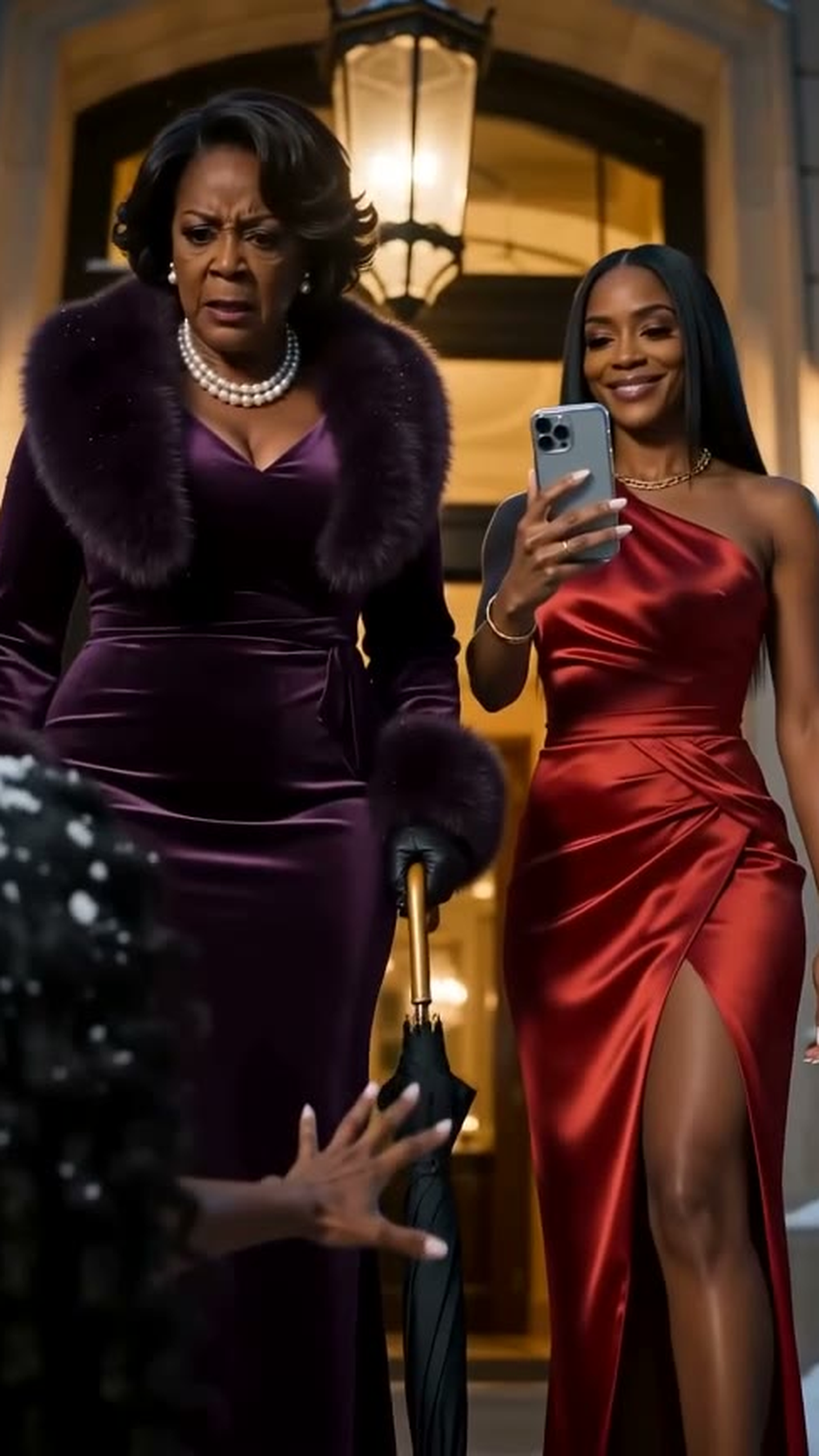
    Emma Ashford stood three feet away in a gown the color of fresh blood, her phone raised and steady, its small light burning. She was smiling — not wildly, not madly, but with the soft, pleased expression of a girl watching something she had waited a long time to see. She did not lower the phone. She lifted it a fraction higher, to get a better angle.

    "Keep begging," Emma said.

    Tessa's fingers curled against the ice, and something inside her chest simply gave way — not her ribs, though those ached, but the last small room where a sister was supposed to live. She let her forehead sink toward the pavement. A snowflake landed on her lashes and did not melt.

    Then a shadow fell across her, and with it came the voice she had feared and obeyed for thirty years.

    "Get up." Her mother stood over her in purple velvet and fur, pearls at her throat, a silver brooch catching the lantern light, and in her gloved hand the family's black umbrella with its gold fittings — the umbrella Vivian Ashford carried the way other women carried a signature. "Get up, Tessa. You are embarrassing this family in the street."

    Tessa tried. God, she tried. She got one palm flat on the ice and pushed, and her arm shook so violently she thought it would fold. "I can't—" she whispered. "Mama, I can't feel my—"

    The umbrella came down.

    It did not strike her. It struck the pavement a breath from her reaching hand with a sharp metallic crack that rang off the stone columns, and her whole body recoiled as if it had — fingers snapping back, shoulder jerking, breath tearing out of her in a sob. Snow and grit stung her cheek.

    "I said get up."

    Her mother caught her by the forearm and hauled. The grip was shocking in its strength, nails through velvet gloves, and it pulled Tessa halfway up before her wet shoes found nothing on the ice — she went down again, hard, onto one knee, catching herself with her palm, a bright stripe of pain racing up her wrist. Her mother's hand let go as if it had touched something unclean.

    Through the blur of tears and snow, Tessa turned her face toward the golden doorway, where a tall figure in a charcoal overcoat stood motionless in the light.

    "Dad…" It was barely a sound. "Dad."

    Richard Ashford looked at his daughter on the ground. For one second — one — his face changed, and Tessa saw the man who had once carried her on his shoulders through this very lobby, his hand steadying her small ankle. His mouth tightened. His eyes dropped.

    He turned away and walked back into the warmth of his hotel.

    What happened after that came to her in pieces, the way drowning people remember the shore. Hands under her arms, rough and impatient. Her bare feet dragging across the snowy ground, leaving two thin lines. The rear door of the black SUV opening. Her own voice, small and far away: "Don't leave me…" Emma's pause. Emma's smile. The door closing with a heavy, finished sound.

    And then the alley.

    They did not even drive far. A service alley behind a closed strip mall, where the wind found every seam of her wet gown and the asphalt was a black mirror of ice. The SUV's taillights shrank to two red points, then nothing. Tessa curled around herself on the freezing ground and shook until the shaking stopped, which frightened the night custodian who found her more than the shaking would have.

    His name was Marcus. His flashlight beam stopped on her like a held breath.

    What she remembered last, before the dark took her, was the beam dropping as he ran, and his voice — a stranger's voice, the kindest she had heard in weeks — saying, "Ma'am? Ma'am, stay with me. Stay with me now."

    She woke to white.

    Not snow. A ceiling. A hospital's cold white light, a monitor's soft green pulse, a pain that lived everywhere and nowhere she could point to. Her throat was raw. Her head throbbed in time with the monitor. And standing beside her bed, in a dark jacket over a collared shirt, holding a thin report folder, was a man with the tired, careful face of someone who delivers bad news professionally.

    "Miss Ashford. I'm Detective Cole Voss." He set the folder on the bedside table, and she saw the heading on the top sheet, stark in black type: EMERGENCY PSYCHIATRIC EVALUATION REQUEST. "Your family says you attacked them."

    The words did not land at first. They floated, meaningless, above the beeping monitor. Then they landed all at once, and her breath went quick and shallow, and the green line leapt.

    "They—" Her voice broke. She shook her head slowly, and even that small movement sent pain lancing behind her eyes. "No. No, I didn't— I would never—"

    The door opened.

    Bridget Colton came in carrying a worn banker's box, and the sight of her — navy suit, dark waves, that composed, sharply observant face, the face of the only person in Tessa's life who had never once looked away — made something in Tessa's chest unclench so suddenly she nearly wept. Bridget set the box on the table with the precision of a woman setting down a loaded thing. She opened it. And she took out a small sealed evidence sleeve, and in her gloved fingers, catching the cold light, a single USB drive.

    Tessa's expression changed. The fear did not vanish, but it stepped aside, and underneath it stood something her family had never once seen on her face: quiet, controlled, absolute determination.

    "I found it," Bridget said softly.

    Detective Voss looked from the drive to Tessa and back, and she watched professional skepticism turn, degree by degree, into alarm. Bridget plugged the drive into the laptop on the tray table. The screen lit. Rows of folders bloomed across it, neat as a ledger of sins: FINANCIAL RECORDS. HIDDEN ACCOUNTS. VIDEO EVIDENCE. CONFIDENTIAL TRANSFERS.

    Voss leaned closer. His eyes widened.

    "Tessa…" he said. "What is this?"

    She looked at him from the hospital bed, bruised and bandaged and done being afraid, and she whispered the word she had carried like a coal in her chest for ten long days.

    "Everything."

    * * *

    TEN DAYS EARLIER

    The night of the Winter Gala began, as all Ashford tragedies began, with everything looking perfect.

    Tessa stood in the marble lobby of the Ashford Sterling beneath a chandelier the size of a small car, wearing the silver-white gown her mother had chosen — chosen, not offered, laid across her bed that morning like a dress uniform — and smiled at arriving donors until her face ached. Outside the tall windows, snow was falling over the city in thick, silent curtains. Inside, it was all gold light and string quartets and the perfume of white lilies, and every guest who took her hand said some version of the same thing: Your mother has built something remarkable. You must be so proud.

    It was an empire, everyone agreed. Forty years of Ashford Sterling: eleven luxury hotels, a foundation whose name was on hospital wings and scholarship funds, a family whose portrait hung in the flagship lobby — Vivian in purple at the center, Richard's hand on her shoulder, Emma laughing, and Tessa at the edge of the frame, smiling the smallest smile, in the position she had occupied all her life: inside the picture, but never in its middle.

    She was thirty years old, the eldest daughter of the Ashford family, and she had a title at the company — Director of Compliance — that her mother had invented the way one invents a harmless pet. A ribbon-cutting job. A signature on routine filings. Vivian Ashford did not believe in letting anyone real near the real machinery of her empire, not even blood. Especially not blood.

    But ten days before the gala, the machinery had made a mistake. A routine reconciliation — a sleepy Tuesday task Tessa had done a hundred times — had turned up a wire transfer that did not belong to anything. And Tessa, who had been raised to smooth surfaces and never to pull threads, had done the one thing her upbringing had forbidden.

    She pulled.

    On the night of the gala, standing in that golden lobby with snow falling beyond the glass, Tessa Ashford was smiling at donors with a secret folded inside her like a second spine: she knew what her mother had done. She knew about the accounts. She knew about the transfers. She knew why the foundation's money bled out in the night like a cut artery.

    And in less than four hours, her mother was going to find out that she knew.

    There were details she would assemble later, from statements and reports, the way you assemble a photograph from negatives. The desk clerk who saw the family come down in the service elevator and thought nothing of it, because the Ashfords were the building. The doorman who held the side door against the wind and afterward could not forgive himself for the ordinariness of his own courtesy. The valet who heard a sound like a branch snapping — the umbrella on stone — and looked up, and looked away, because looking away was the first skill the hotel taught. The city itself, indifferent, gorgeous, plowing its snow into grey ridges along the avenues while a woman lay down to die in an alley behind a pharmacy, in a gown that cost more than the ambulance that came for her.

    Tessa knew none of this in the lobby that night. In the lobby that night she knew only the small, bright, manageable things: that the mayor's wife preferred to be greeted by her first name; that the hospital board chair, Dr. Osei, had a laugh like a struck bell and a checkbook like a sacrament; that the ice in the champagne buckets was carved into swans because her mother believed God was in the details and intended to outdo Him. She knew that her father was expected at nine and had not yet appeared, and that his absence at the door was a message she had learned to read in childhood: Richard Ashford arrived late to everything that might require him to take a position.

    Mostly, standing in the gold light with her practiced smile, she knew this: that she was the only person in the building carrying a loaded secret, and that secrets, like guns, change the posture of everyone around them whether or not they're ever fired. She caught herself watching her mother's hands — the famous hands, ringed and manicured, that had signed forty years of other people's destinies — accepting a glass, touching a donor's sleeve, blessing the evening. In ten days those hands had signed three more transfers. Tessa knew because she had checked, the night before the gala, one last time, unable to help herself, the way you press a bruise. The Corvus Trust. $340,000. Approved in her mother's own looping script, out of the scholarship endowment, while downstairs the staff were polishing the silver for the celebration of the foundation's generosity.

    She had stood in the dark office with that number on the screen and done the arithmetic of her mother's soul, and the arithmetic had failed her, because there was no sum in which a woman steals from scholarships and remains a mother. There were only two columns: what Vivian Ashford was in the portrait, and what she was in the ledger. Tessa had spent thirty years living in the portrait. She had ten days' experience of the ledger, and it had already nearly cost her everything she had — which, she understood now, smiling at the mayor's wife, was the point of the exercise her mother was about to run. Not punishment. Demonstration. A lesson, delivered in front of the whole family, in what happened to Ashfords who read the ledger.

    The string quartet began to play. Emma swept past in red, already radiant, already cruel with boredom. "Try to look less like staff, Tessa," she murmured, and glided on.

    Tessa smoothed her gown, lifted her chin, and went to greet the next guests, while the snow came down and down, erasing the street, preparing the ice.

  • Chapter 7: A Seat at the Table

    Chapter 7: A Seat at the Table

    The tissue held their mother's veil.

    Giselle had carried it out of the cedar chest in the attic, where it had slept for a decade in the dark with the good christening gown and the family's whole vanished softness, and she stood on the porch at midnight and unfolded it with hands that shook, and held it up, and said to the doorway where her father now stood behind Melanie in his borrowed robe:

    "I was going to wear a new one. Julian's mother picked it out. It's beautiful and it cost more than my first car and it isn't—" She swallowed. "It isn't hers. I want hers, Dad. And I want—" The sentence broke and she built it again from the pieces. "I asked Julian to walk me down the aisle because I was too much of a coward to have nobody. He said he'd only do it if I was too much of a coward to ask you. So I'm asking. Walk me down the aisle, Dad. Please. In front of absolutely everybody."

    Gerald Crawford had held himself together through a prison gate, a bus station, and his own trial by family. He did not hold himself together through that.

    "You didn't have to bring a bribe, baby," he said into her hair, holding his daughter on the front porch at midnight like the last nine years had been an illness the family was finally sweating out. "I'd have walked you through fire in these slippers."

    —

    On the morning of the wedding, Kenneth came to the guest room to tie his father's tie.

    He did it without announcing himself — knocked once, came in with the charcoal tie in his hand and the air of a man reporting for a duty he'd volunteered for and rehearsed — and stood behind his father at the mirror and worked the knot with the clumsy care of someone whose hands were built for contracts. Gerald watched him in the glass. Neither of them spoke for most of it.

    "I practiced what I'd say to you for five years," Kenneth said at last, to the knot. "In the car. In the shower. Whole speeches. Every one of them prosecuting." He tightened, adjusted, frowned at his own work. "I don't seem to have the other speech, Dad. I keep opening my mouth and there's just — arrears."

    "Then we'll write it as we go, son," Gerald said. "We've got the material." And he caught Kenneth's wrist as it passed, briefly, the way you steady a man on a ladder, and let go before it could become a moment either of them had to survive.

    Upstairs, Melanie was doing the bride's hair when she took the little cedar wren out of its tissue — four years in a dresser drawer, smelling faintly of scarves — and set it on Giselle's vanity among the brushes and the good jewelry.

    "From your father," she said. "He carved it the year you turned thirty-four, in the prison workshop, out of a nail and four months of evenings. He said to give it to you when it could land soft." Giselle picked it up with two fingers, the way you handle something alive. "I think it's landed," Melanie said. "Don't you?"

    Giselle carried it down the aisle inside her bouquet, hidden in the stems, where only she could feel its weight — a thumb-sized bird, flying at last exactly where it was always going.

    The wedding of Giselle Margaret Crawford and Julian Harlan Pierce took place on Saturday, November thirtieth, in the garden of the Pierce estate, under a sky the color of a held breath that mercifully never broke.

    Three hundred guests. Two families' worth of Jackson society, the whole gleaming machinery of reputation that had so terrified the bride — and at the top of the aisle, on the arm of a radiant woman in her dead mother's veil, walked a sixty-eight-year-old man in a charcoal suit Melanie had bought with him that Friday, slowly, because his knees were not what they had been, and not one person in three hundred rose to their feet for the bride.

    They rose for both of them. It started with Harlan Pierce, of all men — the judge stood first, deliberately, like a ruling — and then the garden came up around them in a wave, and Gerald, who had expected to endure the walk like a dose of medicine, walked it instead through a wall of applause that Julian would later call the loudest sound he had ever heard outdoors.

    Aaron sat in the second row, in a suit of Kenneth's that almost fit, between his brother and Melanie, and did not hide. If anyone asked, he was the youngest Crawford boy, back from up north. The whole truth had an appointment on Monday morning, and everybody in the family knew it, and it had lost most of its power to frighten them — because a secret told by its owner, on his own feet, in daylight, is just a story. It was the hiding that had always been the wound.

    Kenneth made the toast.

    He stood with his glass in his hand and looked at three hundred faces, and then, deliberately, at one. "My father built the company I run out of a pickup truck and a handshake," he said. "He taught me that a man's name is the only property he really owns. I spent five years believing he'd thrown his away." His voice held. It held because Melanie was looking at him, and because some things you simply finish. "He hadn't thrown it away. He'd spent it. There's a difference, and it took me far too long to learn to read it. To my father — who came home." He raised the glass. "Dad. Welcome home."

    "Welcome home," said three hundred people, and the old man at the head table covered his face with one hand and laughed and cried at the same time, and did not apologize for either.

    —

    Aaron surrendered himself on Monday morning, with counsel, as arranged.

    What the law did with him took eleven months, and it would make its own story — the confession, the restitution ledger that the prosecutor called, in open court, "the most complete act of contrition this office has ever been handed," the plea, the sentence that was not prison: five years of probation, two thousand hours of community service, and a judge — not Harlan, who had recused himself with a wave like a man swatting a fly — saying that the court could not give Gerald Crawford back his five years, but it could decline to waste five more of his son's on top of them.

    The court's other work was quicker, because paper, unlike families, does not need to forgive before it can move. In October, on the strength of Aaron's confession and the documentary record, a judge of the circuit court vacated the conviction of Gerald Crawford in full, and the Jackson paper that had printed DISGRACE under his photograph in another decade printed CORRECTION under it now, in type nearly as large.

    Nearly. Gerald cut it out anyway. He kept it in the leather bag, which Melanie had tried three times to retire and had finally understood was not luggage anymore.

    He converted the shed himself.

    It took him the whole following spring, weekends, with Aaron doing the heavy lifting under supervision and Kenneth appearing with lumber and opinions — the joke, which Gerald made exactly once and then retired, was that the roof was the best in the county and the landlord was lenient. It became a workshop: his father's tools, Margaret's garden bench restored along one wall, a kettle, a radio, a window cut where no window had been. People who came to the house that year learned that if you wanted Gerald Crawford, you went around the garden to the little building with light in its window and the smell of cedar coming out of it, and you knocked, and he was always — always — in the middle of making something for somebody.

    In November, a year to the week from the release, Kenneth drove his father down to the Crawford Properties office park on a pretext so thin it embarrassed them both, and walked him past the front of the building, where the sign had been down for refinishing all month.

    The letters had gone back up that morning, brass on black granite, in the same typeface Gerald had chosen in 1987: CRAWFORD PROPERTIES — and beneath, smaller, restored to the place it had occupied until the year of the disgrace, when a board Kenneth chaired had voted it off in an afternoon: FOUNDED BY GERALD CRAWFORD.

    Gerald read it twice. He reached out and ran his thumb along the word FOUNDED the way a man checks a scar he has decided to keep.

    "You put me back on the building, son."

    "I took you off it," Kenneth said. "On the record. In the minutes. I un-took you the same way. It seemed important that it be the same way."

    By the following June he had a commission he would let no one else touch: a crib, white oak, for Giselle's first child, due in September — the announcement of which, made at Easter with Giselle standing behind her father's chair with her hands on his shoulders, had reduced Gerald Crawford, in front of witnesses, to a man holding on to the back of a chair and saying Well now, well now, like a struck bell. He built it in the workshop on Thursdays, because Thursdays were the day everything in his life had turned, and on Thursdays Aaron worked beside him under the terms of a community-service schedule and a father's entirely unofficial supervision, learning to plane a rail true.

    "She'll stand up in that," Gerald said, running his palm along the finished rail, testing it for splinters the way he'd tested every promise he'd ever made — by hand, in person, himself. "They all stand up in it. That's the whole job of the thing. You build it strong enough to be pulled on, and then you let them pull."

    At Christmas, the family sat down to dinner in the room where it had all been decided, around the table where a letter had once slid under a slammed palm. Gerald sat at the head of it — nobody discussed it; the chair was simply his, the way a lighthouse is simply the lighthouse's — and carved, and argued about football, and told the oak-tree story twice. At dessert, Melanie stood — unplanned, glass in hand, a little unsteady in the way of a woman who has been carrying a sentence around for over a year waiting for a room worthy of it — and said: "To the ones who come back." She looked at Aaron. "And to the ones who go and get them." She looked at her father-in-law. "And to Margaret Crawford, who never missed a Saturday, and who I believe has been supervising this entire operation."

    "To Margaret," said the whole table, and drank, and Aaron — who had been quiet most of the meal in the way of a man still learning the acoustics of belonging — said, to his plate, with great care: "The pantry's putting a bench in the hall garden in the spring. June's idea. It's got her name on it." He looked up, wrecked and smiling. "St. Mark's. If anybody wants to come and be bored at the dedication. It's mostly sandwiches."

    "We'll bring the sandwiches," Giselle said instantly, and then everybody was talking at once about dates and potato salad, and it was, Melanie thought, the most ordinary and miraculous sound in the world: a family planning something.

    On the wall, Margaret's portrait had company now: a photograph from the wedding, three hundred blurred faces and one clear one in the middle of the aisle, an old man walking his daughter home through a standing crowd.

    Melanie, carrying in the last of the dishes, paused in the doorway where she had once stood with a dish towel in her hands and a rising fury, and looked at the whole noisy length of them — Kenneth laughing with his head back, Giselle glowing, Aaron reaching past his father for the rolls with the ease of a man who belongs to the room — and Gerald looked up and caught her eye over all of it.

    He lifted his glass an inch, just for her. The first one who came. The only one who'd never had to be forgiven for staying away.

    "Errands all done?" he asked.

    "All done, Dad," Melanie said, and took her seat at the table.

    THE END