
Story Genres: Family Drama

  • Chapter 2: The Invisible Hand

    Chapter 2: The Invisible Hand

    For the first three years at Valeon, Adrian Cross was everything Claire had told a human-resources department he might be.

    He arrived before the traders and left after the cleaners. He learned the company's product lines the way generals learn terrain. When his division's flagship launch failed in its first quarter — failed publicly, in the trade press, with his name attached — he did not hide. He stood in front of the division and took the blame in a speech so blunt that people repeated it in the elevators, and then he worked ninety-hour weeks for five months and relaunched it into the company's fastest-growing product line.

    He was promoted to vice president at thirty-three. It was earned. Claire needed everyone to understand that, later, when the story got told wrong: the door was opened a crack by her, once, but everything after the door was him.

    What was not entirely him was the Meridian deal.

    In Adrian's fourth year, Valeon moved to acquire a logistics software firm called Meridian Systems, and Adrian — by then the executive sponsor of the deal — championed it with the full force of his considerable will. The numbers sang. The board was charmed. The deal was eleven days from signing when Claire, reading a trade journal at her kitchen table on a Sunday morning because her husband had brought work home and spread it across the counter like a map of a country he was invading, saw the flaw.

    It was in Meridian's European contracts: a change-of-control clause, buried in a pension obligation, that would transfer an unfunded liability of nearly ninety million dollars to whoever acquired them. Adrian's analysts had modeled the contracts in summary. The summaries were wrong. The summaries were wrong in a way that would have detonated inside Valeon two quarters after the celebration, taking Adrian's career with it — and, not incidentally, a measurable piece of her father's company.

    Claire sat with that knowledge for one full day. She could not hand it to Adrian. A wife who catches a ninety-million-dollar clause that a team of analysts missed is a wife with questions attached, and the questions led, by a short and shining road, straight to Samuel Vale.

    So she did it the way she had learned to do everything in her marriage: invisibly. She wrote the analysis herself, on a clean laptop, in flat professional prose, and she sent it through a cut-out — an old consulting contact, who owed her a favor and asked none — into the desk of Valeon's chief risk officer as an unsolicited outside review. The risk officer read it, went white, and carried it to Adrian as the product of his own team's escalation process.

    Adrian killed the Meridian deal forty-eight hours before signing. The board called it the finest piece of judgment by a young executive in a decade. The business press used the word visionary.

    He came home that night incandescent with triumph, and over dinner he explained to his wife — patiently, the way you explain weather to a child — how he had learned to smell a bad deal. Claire listened, and poured his wine, and loved him, and hated herself with a purity that frightened her.

    "You're a natural at this," she said.

    "Some of us have to be," he said, not unkindly, and went back to his phone.

    It was around then that the shape of her life began its slow change. She started keeping count of the small corrections: Adrian adjusting her opinions at dinner parties, Adrian saying my house, my career, my company when he drank; Adrian referring to her consulting work — the work she had invented as a costume — as "Claire's little projects," in front of people, with a smile that made it a joke she was required to laugh at.

    She laughed. She was becoming an expert in laughing at the exact weight things actually cost.

    Then Samuel got sick.

    It was not dramatic, because Samuel did nothing dramatically except build empires. It was a cardiologist's frown, a stress test stopped early, a word — cardiomyopathy — delivered in a quiet office. He called Claire himself, from the hospital parking lot, sitting in his car like a man deciding whether to go back inside.

    "I have some years," he said. "Not as many as the plan assumed. We are going to settle the question of the trust now, while my hand is steady enough to sign."

    The Vale Family Trust held fifty-one percent of Valeon Technologies. It had held it since the day Samuel took the company public and decided that no market, no board, and no ambitious son-in-law would ever be able to take his life's work apart. For thirty years Samuel had been its sole trustee. The trust's beneficiary structure was a sealed architecture of lawyers and proxies; the company ran, the board voted, and almost no one living knew whose hand was actually on the wheel, because Samuel had arranged for the wheel to turn quietly through attorneys who voted as the trustee directed and asked nothing.

    Now the trustee was Claire.

    She signed the papers in the same fifty-second-floor office where she had once announced her engagement, and her father's hand did not shake, and hers did. The attorneys explained the machinery in level voices: her instructions would travel through the proxy office; no vote would ever carry her name; no one at Valeon — no director, no officer, no husband — would know that the majority of the company had just passed into the hands of a strategy consultant from Atlanta with a dead mother's surname.

    "There is one more thing," Samuel said, when the lawyers had gone. "The day will come when you have to choose whether to use it. Everyone with power says they'll know the day when it comes." He looked at her for a long moment. "You won't know, Claire. It will look like an ordinary day. That's the trap."

    She used it for the first time four months later, and it looked exactly like an ordinary day.

    A director named Harmon Cole — silver-tongued, twenty years on the board, and quietly up to his elbows in a private equity fund — brought forward a proposal dressed as modern governance: spin off Valeon's logistics division, the same division Adrian had rebuilt, sell it to a consortium in which Cole's fund happened to hold a commanding stake, and return the proceeds to shareholders as a special dividend that would make every man in the room briefly rich and the company permanently smaller. The independent analysis called it unlocking value. Claire read the full packet in one night, the way her father had taught her, back to front, footnotes first, and found the clause where the consortium's purchase price reset downward if the division missed two quarterly targets — targets the consortium's own consultants would help set.

    It was Meridian, wearing a better suit. It was theft at the speed of paperwork.

    She did not call her father. She did not call anyone. She signed one instruction sheet in the proxy office's unmarked suite downtown, in handwriting no one at Valeon had ever seen, and the trust's fifty-one percent voted no — not loudly, not dramatically, just no, in the flat procedural voice of a shareholder resolution dying 51 to 49 in a closed session. Cole smiled through the whole meeting and never knew what had hit him. Adrian came home that week furious about "the trust's lawyers" blocking a deal half the floor had wanted. "Somewhere there's a room full of attorneys nobody elected, strangling this company in its sleep," he said, carving the chicken with unnecessary force. "If I ever get my hands on whoever actually runs that trust—"

    "You'd what?" Claire asked mildly.

    "I'd tell them empires aren't built by people who hide." He pointed the knife at his own chest. "They're built by people who stand up."

    Claire served dinner and agreed that it was a shame, and the machinery of her hidden life ran on, silent as a heart.

    Six months later, Adrian was made senior vice president, and he needed a new executive assistant, and the shortlist came down to three names, and Adrian chose the brilliant one — twenty-nine years old, unshakeably composed, with a résumé assembled like a weapon and long black hair she wore in cascading waves to board dinners where assistants did not usually get invited.

    Her name was Vanessa Reed.

    Claire met her at the holiday party that December, in a green dress by the ice sculpture, and Vanessa shook her hand with exactly the right pressure and said, "You must be so proud of him," in a voice like warm water, and Claire — who had read balance sheets for sport since she was nineteen, who could smell a buried clause in a hundred pages — looked at this woman and saw only what she was meant to see.

    In February, Adrian brought Vanessa home for a working dinner — a board presentation due at dawn, files spread across the dining table of the house Claire had chosen and decorated and paid for out of an account Adrian never asked about. Claire cooked. Vanessa complimented the house, the food, the view, with the tireless precision of a woman conducting a survey, and once, while Adrian was in his study hunting for a charger, she looked around the kitchen and said, lightly, "It's a beautiful life he's built."

    He's built. Claire smiled and refilled her glass and filed the sentence where she filed everything: in the ledger she did not know she was keeping.

    She thought about that failure of vision a lot, later. It was the last innocent mistake she ever made.

    The cracks, when they came, came quietly. At the spring foundation gala, in front of a director whose name Claire had known since she was twelve, Adrian introduced her as "my wife — she keeps the home front running," and when Claire made one mild remark about the foundation's endowment strategy — the mild, correct remark of a woman who had personally approved that strategy through a proxy office three weeks earlier — he laughed and patted her hand and said, "Claire reads the annual report at me. It's sweet." The director laughed with him. Claire laughed too, on time and in tune, and something in her chest recorded the sound of her own laugh the way you record weather.

    Adrian began traveling with Vanessa and came home smelling of hotels. He missed their seventh anniversary for an investor dinner and sent flowers with a card his assistant had clearly written, because it called her Claire in handwriting that sloped the wrong way. He started leaving his phone face down. He started, when she asked about his day, answering with the flat contempt of a man explaining himself to furniture.

    One night he came home at one in the morning smelling of rain and someone else's evening, and Claire was awake in the kitchen because she had stopped pretending to be asleep weeks earlier, and she asked the only question she had left in her: "Are we all right?"

    Adrian loosened his tie. He looked at her the way he looked at junior analysts who cried in reviews — with a kind of bored diagnostic interest.

    "Don't be dramatic, Claire," he said. "Drama is a luxury for people without options. You have everything. Try enjoying it."

    He went upstairs. She stood in the kitchen and understood, with a clarity so complete it felt like cold water, that her husband had begun to think of her as furniture that talked — and that he had no idea, none at all, how many options the furniture had.

    And then, on a Tuesday in October, Claire did the laundry of her own marriage, standing in the white tile of their bathroom with his dinner jacket over her arm, and found the hotel key card still in the breast pocket.

    The Meridian Grand. The same hotel, it would turn out, where five hundred people would one day watch him be crowned.

    She held the key card for a long time. Then she put it back in the pocket, hung the jacket in his closet in the dark, and went downstairs and finished making the dinner she had started, because she did not yet know what she was going to do, and Claire Cross had never once in her life acted before she knew.

    What she knew, standing at the stove with her hand flat against the cool counter, was only this: a key card is not an accident. A key card is a habit.
  • Chapter 1: Know Your Place

    Chapter 1: Know Your Place

    The kiss lasted four seconds, and Claire Cross counted every one of them.

    Five hundred employees filled the ballroom of the Grand Meridian Hotel, and every one of them had come to watch her husband become the most powerful man at Valeon Technologies. Crystal chandeliers burned above the cream-and-gray marble. Gold-and-white roses stood in arrangements taller than the waiters.

    It had been a flawless evening, staged like a coronation. Samuel Vale himself had opened the ceremony from the transparent podium, silver-haired and severe, and had spoken for exactly four minutes about the future of the company he founded — never once looking at the woman in the powder-blue gown in the front row, because looking at her was not part of the arrangement they had kept for eight years. Then the board's spokesman had read the appointment, and Adrian Cross had taken the stage to a standing ovation and given a speech about vision, and hunger, and the people who matter — and his eyes, moving across the front row, had passed over his wife the way a lighthouse passes over a rock.

    Claire had applauded anyway. Her hands had ached from it. She had told herself the speech was nerves, that the night was his, that everything unsaid between them could still be said later, in private, where marriages are supposed to be repaired.

    Adrian stood on the raised stage in his navy tuxedo, minutes past the announcement, and the applause had not yet finished dying when his secretary crossed the last few steps between them, took his face in both hands, and kissed him.

    Vanessa Reed did not kiss him like a woman making a mistake. She kissed him like a woman planting a flag.

    Adrian did not push her away. His hand settled at her waist, and for one of those four seconds, he kissed her back.

    Claire stood three feet from the stage with a glass of champagne in her hand. She felt the glass tremble before she understood that the trembling was hers. Her eyes widened. Her lips parted around a breath that would not finish.

    "Adrian?"

    It came out small. Restrained. The voice of a woman still hoping there was an explanation that did not end her marriage.

    Vanessa released him slowly and turned toward Claire with a smile that had been rehearsed in mirrors.

    Adrian looked at his wife the way a man looks at a stain on his evening.

    Claire took one step toward the stage. One step. Later, she would think about that step more than anything else — how small it was, and how much it cost.

    Adrian came down off the stage fast. His fingers closed around her upper arm, hard enough that she felt the edge of her own dress seam bite into her skin, and his voice cut through the ballroom loud enough for the first ten rows to hear every word.

    "KNOW YOUR PLACE!"

    He shoved her backward.

    Claire reached for balance that was not there. Her silver heel caught on the polished marble, twisted, and snapped with a crack that sounded, in the sudden silence, almost like a shot. Her body went down the way real bodies go down — not graceful, not slow — hip first, then her hand slapping flat against the stone, then her elbow striking the floor and taking the rest of the impact in a white bolt of pain.

    The champagne glass left her fingers. It shattered. Shards skated across the marble and champagne bloomed in a gold spill beside her, soaking the hem of her powder-blue gown where it spread around her in heavy satin folds.

    Five hundred people, and the loudest sound in the room was her breathing.

    Then Vanessa laughed.

    It started with her — a bright, satisfied sound from the stage — and then, horribly, it spread: nervous laughter from a table of junior managers, a few muffled snorts from men who had been drinking Adrian's health all night. Other guests looked at their plates. At the fourth table an older man, a vice president who had known Claire at company picnics for six years, half rose from his chair — and his wife pulled him back down by the sleeve, and he let her.

    That was the moment Claire understood what the laughter actually was. It was not cruelty. It was arithmetic. Five hundred people had just recalculated who mattered in that room, and she had come out worthless in under four seconds.

    Her broken heel lay beside her on the marble like a small dead thing, snapped clean at the stem. Nobody came to help her up.

    Claire lay there for one second longer than she had to. Her elbow throbbed in time with her pulse. Her fingers trembled against the cold stone. Above her, her husband towered in his navy tuxedo, and his secretary stood behind him with her hand resting possessively on his shoulder, still smiling.

    Something in Claire's face changed, and it was not defeat.

    It was recognition.

    She got up the way an injured woman gets up: carefully, one hand braced against the edge of the stage, weight kept off the ruined shoe, breath controlled through her nose. She did not look at the crowd. She reached into her evening clutch, took out her phone, and with fingers that shook only slightly, she typed three words.

    Take the stage.

    She pressed send.

    "Dad," she whispered, so quietly that only the marble heard her. "It's time."

    The tall side doors of the ballroom swung open.

    Samuel Vale walked into the room with the company's general counsel at his left shoulder and two members of the board at his right, and the laughter died the way a candle dies — all at once, and completely. He was seventy-one years old, silver-haired, upright as a flagpole, wearing a black tuxedo with a white pocket square, and his face was the face of a man who had built an empire and just watched someone throw his daughter on its floor.

    Adrian straightened his jacket. He stepped forward with his hand extended and a smile nailed onto his face.

    "Chairman Vale…"

    Samuel Vale walked past the offered hand as if it were furniture.

    He went to the transparent podium. He took a thick legal folder from the general counsel and set it down on the acrylic with a crack of sound that echoed off the chandeliers. Five hundred employees did not breathe. Adrian stood motionless. Vanessa's hand slid off his shoulder.

    Samuel adjusted the microphone. He looked directly at the man who had just been crowned.

    "Let's discuss," he said, cold and unhurried, "who really controls Valeon."

    He opened the folder.

    —

    To understand what happened in that ballroom, you have to go back eight years — to a woman named Claire Bennett, who did not exist.

    Claire was nine years old when her parents' marriage ended, and she went to Atlanta with her mother, who had a simple rule about her ex-husband's empire: we will not live inside it. She raised her daughter under her own name, Bennett, on a schoolteacher's salary, in a house with a garden and a mortgage. Samuel Vale paid what the court ordered and more, and he called every Sunday, and Claire grew up loving two people in two separate worlds and learning to keep the border sealed.

    By the time her mother died, Claire was twenty-four and certain of one thing: every person who had ever learned her father's name had changed how they looked at her. Boyfriends became investors. Friends became applicants. So she kept the name Bennett, became a strategy consultant nobody famous had ever heard of, and built a life that belonged to her.

    Then, at a technology summit in Austin, a product manager from a mid-sized firm nobody had heard of either stood up in a hostile Q&A and defended a failing product with such honesty and fire that the room went quiet. His name was Adrian Cross. He was thirty years old, broad-shouldered, hungry in the visible way of men who have been poor and intend never to be poor again. Claire asked him one question from the third row. He answered it looking straight at her.

    They talked for three hours in the hotel bar. He told her about a childhood of eviction notices and a mother who cleaned offices at night — offices, he said, in buildings owned by companies like Valeon. "One day," he said, "I'm going to be the man whose name is on the building. Not because somebody gave it to me. Because I took it."

    Claire fell in love with him that night, and she fell in love with the one thing she could give him that she had never given anyone: a version of herself with nothing attached. No empire. No inheritance. Just Claire Bennett, who made coffee too strong and laughed at his worst jokes and believed he would climb.

    She never told an outright lie. That was her sin and her excuse. She simply didn't correct the story he built: father dead, mother gone, no family money, nothing. Every month the lie got heavier and the moment to lift it got further away. When he proposed — on a rooftop in Atlanta, with a ring he had saved eight months to buy — she cried like a woman with nothing to hide, and that night she sat on the bathroom floor with her phone in her hand for an hour, her father's number lit on the screen, and did not call.

    A week before the wedding she flew to New York and stood in her father's office on the fifty-second floor of the Valeon tower, above a skyline he had spent forty years buying pieces of, and told him she was getting married and that the groom did not know.

    Samuel Vale listened the way he listened to earnings reports: completely, and without interrupting.

    "Does he know your name?" he asked at last.

    "He knows my name," Claire said. "He doesn't know yours."

    "And when he finds out — and he will find out, Claire, men always find out the thing their wives hide — what will he believe? That you loved him?" Her father came around the desk and took her hands, and his voice went soft in the way it only ever did for her. "Or that the daughter of Samuel Vale ran an eight-year audit on him?"

    "He loves me."

    "Then tell him tonight and let him love all of you." A pause. "Or don't, and understand what you're choosing. A man can forgive a secret, daughter. What he cannot forgive is being made a fool. Every day you wait, the fool gets bigger."

    She kissed his cheek and promised to think about it, and on the plane home she thought about it for two hours, and by the time the wheels touched Atlanta she had decided — again — that the right day was coming. It was always coming. It just never arrived.

    Samuel's wedding gift arrived by courier: a letter, in handwriting she had known since childhood. Marry for love, daughter. But remember — a secret kept too long stops protecting you. It starts protecting the lie.

    They married small, in Atlanta, eleven months after Austin — sixty guests, her mother's garden roses on the tables, Adrian's mother weeping happily into a borrowed handkerchief. He cried when Claire walked in. Nobody who saw his face that day would have believed what he would one day do to her on a ballroom floor, least of all Claire.

    The first year was the happiest of her life, and she said so often, and meant it. Adrian was happy, and then he was restless, because men like Adrian are furnaces that burn whatever is nearest. He applied to Valeon Technologies because it was the summit of his industry — he did not apply because of her; that was the unbearable part. He applied entirely on his own, and his résumé, one of four thousand, went into a screening system designed to discard it.

    Claire made one phone call. Not to Samuel. To a woman she knew in human resources, from the life she did not talk about. She asked for exactly one thing: that résumé number 3,112 be read by a human being instead of a machine. "That's all," she said. "If he's not good enough, throw it away."

    He was good enough. He was better than good enough. He won the interview, and the second interview, and the job, on the strength of the mind she had watched take apart a hostile room in Austin.

    He came home that night with a bottle of cheap champagne and picked her up and spun her in their small kitchen, and his face shone with the purest joy she had ever given anyone.

    "I did it, Claire," he said. "Me. Nobody handed me anything."

    She kissed him so he would not see her eyes.

    "I know," she said.

  • Chapter 7: The Door Left Open

    Chapter 7: The Door Left Open

    He stayed for supper. He stayed, in the end, for everything — but he stayed the way you cross a river on stones: one at a time, testing each one, in the order Emily set.

    He took the room over the hardware store in town, the one with the loud radiator, and Daniel Whitmore, who owned a penthouse and a house in Connecticut and a chalet he had visited twice, learned the sound of a small town waking up. He came at ten, as ordered. He came at ten the next day, and the next. He did not bring gifts. He brought, instead, the only currency the farmhouse honored: he showed up, and he worked. He fixed the porch rail that had been loose since Hannah's day. He split firewood badly and then less badly under Eli's merciless supervision. He sat through June's interrogations — she had a list; she had literally written a list, in purple ink, in a notebook labeled *QUESTIONS*, and he answered every one of them standing, sitting, kneeling in the dirt of the garden, without once saying *because I said so* or *you're too young*, because she was his daughter and she had inherited his eyes and her mother's honesty and she deserved the arithmetic done in front of her.

    "Why did you believe them and not Mama?" was question one. It was also, Emily told him later, the only one that mattered.

    "Because believing them was easier," Daniel said. "Your mama asked me to be brave, and I wasn't. I think about it every day. I'm not asking you to forgive it. I'm asking you to watch me be brave now, until it adds up."

    June considered this with her whole face. "Okay," she said, and turned the page of the notebook. "Question two. Can you swim?"

    It added up the way the years in Kentucky did everything: by accrual. By September, Eli — who had claimed him first and fastest, the way the youngest hearts do — was riding on his shoulders at the county fair and calling him Dan, because five-year-olds cannot be bothered with anybody's whole history. By October, June had moved her interrogation notebook to the kitchen table and was asking him questions about *his* childhood, which was the same as forgiving him, in her dialect. And Emily — Emily watched him the way she had watched the weather all her life on that farm, for signs, for seasons turning, and what she saw, month over month, was a man becoming the one she had married in a ballroom's aftermath: the one who held the chair. The one who told the truth with his whole schedule. The one who, when June fell off the porch step in November and scraped her knee and howled, was on his knees in the dirt before Emily could move — not because he was faster, but because some part of him had been kneeling toward that child for nine years.

    He sold the Connecticut house. He restructured Whitmore Capital so that it could be run by people who did not have a family in Kentucky, and if the financial press thought Daniel Whitmore had gone mad, Daniel Whitmore — who read the coverage at Emily's kitchen table, with a mug that said *WORLD'S OKAYEST BOSS*, a gift from Eli, in his hand — found he could not locate a single feeling about it.

    It was not a straight line. In October there was a school concert, and June — who had extracted from Daniel a promise, notarized in purple ink, that he would sit where she could see him — came out with her class to sing, and found his seat empty, and sang the whole concert at the empty seat with her jaw set. He had been on the highway for three hours by then. A Whitmore Capital emergency, an actual one, fraud in a subsidiary, the kind with prosecutors in it, had eaten his afternoon whole, and by the time he got free and drove the eleven hours he arrived at midnight to a dark farmhouse and a notebook page taped to the porch door. *Question 43,* it said. *Where were you.*

    He did not knock. He sat on the porch steps until the sky went gray, in the cold, in his suit, and when the door opened at six he was still there, frost on his shoulders, holding the notebook page in both hands.

    "I was wrong," he said to his daughter, who stood in the doorway in her nightgown with her arms crossed like a small judge. "Not about the reason. About the order. I put the company first for four hours because it was shouting loudest, and you can't hear a concert from a boardroom, and nobody can. I'm not asking you to cross it out. I'm asking you to write underneath it that I sat on the porch all night, and that it won't happen again because nothing is ever going to be first again. If the whole company burns down, June. I'll watch it from your concerts."

    June studied him for a long time, the way her mother studied weather. "Your ears are red," she said at last. "Come in before you freeze and Mama has to add it to *her* list." And that — being forgiven by his daughter in the doorway at dawn, badly, partially, in the currency of children — undid him more completely than the porch had, because it taught him the thing the whole year was teaching him: that love, this kind, the real kind, was not a verdict you won once. It was a practice. You did it at ten o'clock, daily, forever, and some days you failed, and the next day you sat on the porch in the frost until the door opened.

    Thanksgiving, they did at the farmhouse, because Eli had lobbied for it and Eli, at five, had the political instincts of a senator. Daniel carved under Emily's instruction and her grandmother's ghost's supervision. June said grace, which she had written herself, and which included — Emily's eyes filled and she had to look at the ceiling — a line for "the ones who got lost coming home, and got found."

    On the first Sunday of December, Emily found the two letters in the kitchen drawer where she had put them — the anonymous one, and hers, returned to her at last — and she stood holding one in each hand for a long time.

    "He wrote one line," she said, that evening, on the porch. The children were asleep. The bouquet from June — his first bouquet, eleven hours and a lifetime old — had long since dried on the piano, because Emily had not been able to throw it away, and they both knew she had kept it, and neither of them had said so until now. "Nine words. *If you still remember Emily, come here.* Your mother wrote a whole confession and signed it with nine words and no name."

    "She was a coward about signatures," Daniel said.

    "She sent you, though." Emily turned the anonymous letter over once. "At the end. Whatever else — she sent you. I keep arriving at that and I don't know what to do with it."

    "You don't have to do anything with it," Daniel said. "That's allowed too."

    In February, on a night of thunder that shook the farmhouse on its foundations, Eli appeared at Emily's bedroom door at two in the morning in the exact manner of his great-grandmother's ghost — silent, wide-eyed, resolute — and Emily, who knew the protocol of storms the way she knew everything about her children, was reaching for the phone before her son had finished climbing into her bed. Daniel answered on the first ring. He had been answering on the first ring since October.

    "It's not an emergency," Emily said.

    "You're calling at two in a storm," Daniel said. "Talk to me."

    "Eli would like to know if the offer stands. The one about his room at the hardware store being too far if there's thunder. He would like it noted that this is a *general* question and not about tonight specifically."

    There was a pause, and she could hear him smiling in the dark eleven minutes away, and then — because he had become, by then, fluent in the constitution of the farmhouse — he said, "Tell the general questioner that his father—" he stopped. Corrected himself, carefully, the way he did everything now. "Tell him Dan is coming with cocoa. Ten minutes."

    He came in nine, soaked to the shoulder, with a thermos, and he sat on Eli's bedroom floor with his back against the wall and talked about thunder being sky-furniture being moved until the boy slept, and Emily stood in the doorway with her arms folded and watched the man she had married and un-married and was, inch by inch, re-learning, hold her son's whole fear in his hands like it was the only portfolio that had ever mattered. When she went to the door to lock up after midnight had become morning, she stopped, and went to the kitchen drawer, and took out the spare key to the farmhouse — the one Hannah had kept, on a ring with a tin star — and put it in his coat pocket without a word, in the dark, while he was buttoning it.

    "For thunder," she said.

    "For thunder," he agreed, and closed his hand over the pocket like a man carrying a heart transplant in a cooler.

    The spring came early that year. In April, on a Saturday, Daniel Whitmore stood on the porch of a leaning farmhouse in Kentucky holding no flowers at all — because Emily had told him, laughing, in March, that a man who has to bring his own flowers to her door has misunderstood the entire arrangement — and he asked her to marry him for the second time, in front of an audience of two children and one extremely uninterested chicken, with his grandmother's ring, which he had carried out of the wreck of his old life for no reason he could name.

    "Mama," said June, with her arms crossed, in the doorway, in her father's eyes. "He practiced that in the barn. Eli heard him. It took *eleven* tries."

    "It took nine years," Daniel said. "Eleven tries is nothing." He looked up at Emily from one knee in the porch dust, where he had sat down once before in despair and where he knelt now in something else entirely. "I am not asking you to go back. There's no back; I burned the road. I'm asking you to go forward — all of us — and let me spend the rest of my life being the man who shows up at ten. Emily Carter. Will you—"

    "Yes," she said, and then, because she was Emily, and because her face had never in her life been able to hold two weathers at once, she said it again with tears standing in her eyes and laughter breaking straight through them. "Yes. Get up off my porch, Daniel Whitmore, you're getting dust on—" He got up. The children hit them both at a run, the way children do, like weather, like grace, and the four of them stood tangled together in the doorway while the ring went on crooked and got straightened by three extra sets of hands.

    They were married in June, in the yard, by the judge from the county seat, with flowers arranged by the bride — she refused, on principle, to let anyone else do them — and June walked her mother down a path of mowed grass carrying a bouquet of red roses and white lilies, because June had decreed it, in purple ink, as a matter of historical record. Eli carried the rings on a cushion and only dropped them once, in the grass, where they were found in eleven seconds, which the family agreed was a record of its own.

    And on the following Sunday, and on every Sunday after, the door of the farmhouse stood open to the morning — open the way it had not stood in nine years, open on purpose, open as a policy of the house — with children's shoes by the porch rail and a man's watch on the kitchen counter and a woman's laughter coming from somewhere inside, and if you had stood on that porch in the sunlight you would have seen, framed and hung in the hallway where everyone who entered had to pass it, a single folded sheet of paper under glass.

    Nine words.

    *If you still remember Emily, come here.*

    Underneath it, in Emily's plain hand, on a card she had lettered herself, were the four words she had decided were the end of the story, and the beginning:

    *He came. He stayed.*

    THE END

  • Chapter 6: The Letter She Kept

    Chapter 6: The Letter She Kept

    Vivian Whitmore died the way she had lived: precisely, and on a schedule she attempted to control. She held on through the night Daniel drove back from Kentucky — drove like the road was on fire, arrived at the hospital in Hartford at three in the morning with his white shirt still carrying a smear of porch dust — and she waited, the nurses said, with her eyes open, watching the door.

    She had things to say and she had arranged, with the last of her strength, to say them to an audience of one.

    "Alone," she told the nurse, in a voice like paper tearing. "Send the priest away. I am not confessing to God. I am confessing to my son."

    So Daniel sat beside the bed of the woman who had built him like a company, and he took her hand because hers was reaching, blindly, the way hands do at the end, and Vivian Whitmore looked at her only child and did the thing she had burned a dozen letters rather than do.

    "I sent you to her," she said. "The letter. No signature — I was always a coward about signatures. Daniel. Listen to me, because I have arranged to only have to say this once."

    And she told him all of it.

    She told him the photograph was real and the moment was not — that Emily had been laughing at a stranger's joke at a benefit of four hundred people, and that the hand at her back had belonged to a man paid, through two intermediaries, to be standing in that garden. She told him the hotel receipt was a forgery, the email thread a construction, the money in the foundation account moved by Garrett Cole's own instructions through a clerk who believed he was correcting an error. She told him she had commissioned all of it, and Garrett had executed it, because Garrett wanted the Ashford merger and the port contracts it carried, and because she — his mother — had wanted a daughter-in-law who was an asset, and had looked at a girl from Kentucky arranging flowers and had chosen, instead, to arrange *her*.

    "Nine years," Daniel said. His voice sounded to him like it was coming from the bottom of a well. "And the — she wrote to me. Emily. She wrote to me once. I never got—"

    "The February after," Vivian whispered. "She was pregnant." Her eyes, filmed and ancient, filled with something that might have been the first honest thing to cross her face in forty years. "It came to the penthouse. I was — managing your affairs. You were so *low*, Daniel, you were not sleeping, Garrett said if she got her hooks in with a child it would all begin again. I told myself it was mercy. I have had nine years to learn the word for it and the word is *theft*. I stole — " her breath caught, and the monitor marked it, " — I stole your daughter out of your life before she was born, and I stole her father out of hers. It is the only thing I ever built that I am ashamed of. It is a very large thing."

    Daniel could not speak. In his mind he was standing at a mailbox on a dirt road in the sun, red flag up, with all his life in an envelope.

    "She said to burn it, if I didn't want to know her," he said at last. "In the letter. Emily said that. *If you do not, burn this.* And you—"

    "I couldn't burn it." Vivian's fingers tightened on his with a ghost of her old grip. "That is my damnation, Daniel, do you understand? I burned all of mine. Hers is in the lacquer box. In the library. Under the Whartons. Read it and then hate me *accurately*."

    He read it at dawn, alone in his mother's library, sitting in the chair Garrett had sat in nine years before — he did not know that, and it would not have mattered; the chair was only the last of the furniture his mother had arranged. The letter was eight lines long. It had been opened carefully, along the crease, and refolded along it a hundred times, a thousand — his mother's guilt, worn into the paper like a handrail. *I am pregnant. The baby is yours; there has never been anyone else, and the fact that I must write that sentence is the saddest thing I own… If you want to know your child, you know where I am.*

    He knew where she was. He had always known where she was. That was the furnace at the center of it — a part of him had known the whole time, the way you know a room in your house is on fire even with the door closed, and he had let his mother and his friend and his own pride keep the door shut for nine years while his daughter learned to walk, and talk, and ask the door why it was closed.

    Before he left Connecticut, Daniel walked out into his mother's garden at dawn, into the garden where the photograph had been taken — four hundred guests, a summer benefit, a stranger paid to stand too close and rest a hand where a hand should never have been hired to rest. The garden was empty now, and wet, and perfectly kept by people who would keep it perfectly for a house with no one in it. He stood where the stranger had stood. He looked up at the windows of the library, where, nine years ago, a woman had stood like a magistrate and watched her work come in. He tried to summon hatred for his mother, clean and simple, the way other sons summoned it at gravesides, and what came instead was worse: an understanding of the machinery of her, the widow at twenty-nine with an empire in her lap and a terror of softness so total that she had amputated her son's happiness the way a surgeon amputates, believing to the end that the cutting was care.

    "I won't do it your way," Daniel said to the empty garden, to the wet grass, to the woman in the ground three miles away. "Not the company. Not the family. Not the door. My door stays open, Mother. That's the whole of my revenge."

    Garrett Cole was arrested on a Thursday, at the Whitmore Capital offices, in front of the glass wall of the boardroom, on charges built from a foundation audit trail that a dying woman had preserved — God forgive her, she had kept records of her own crime the way she kept records of everything, as insurance — and delivered to Daniel in a sealed packet the morning after the funeral. He did not resist. He looked at Daniel across the boardroom table with an expression Daniel had never seen on his face, the expression of a man discovering the price of something, and said, "You were going to throw away the Ashford deal. Forty years of positioning. For a *florist*." And Daniel said, "Her name is Emily," and turned around and walked out of the building he had given his life to, into the noise of the city, and stood on the sidewalk breathing like a man who has been underwater.

    The funeral was small and perfect and cold, the way Vivian would have ordered it, and Daniel stood in the receiving line of his own mother's burial and shook the hands of people who had profited from his marriage's destruction without ever knowing they had, and said *thank you for coming* forty-one times, and meant it exactly never.

    What he did in the week that followed, he did with the methodical fury of a man dismantling his own house to reach a fire in the walls. He hired investigators who did not know Garrett. He put the foundation under a forensic audit going back ten years, and the audit found, besides the framed forty thousand, two more transfers, smaller, later — Garrett taxing the lie, annually, like rent. He sat with the district attorney's people in a room with no windows and laid out his mother's sealed packet, and his own investigator's photographs from nine years ago, and the new ones, and said, "I am not asking for privacy. I am asking you to be thorough and loud, in that order." He went before his own board and told them the truth in twelve sentences, which is eleven more than the scandal strictly required and exactly as many as Emily, at a kitchen table in Kentucky, had once demanded of him: *you answer my questions now.* He was answering everyone's now. It was the first honest week of his professional life, and it cost him a merger, a chairman's confidence, and Garrett Cole — and he recorded the whole transaction, in a ledger only he kept, as the best trade he had ever made.

    On the fourth night he called the farmhouse, because he had promised June — no, because he had promised *Emily*: *you come back tomorrow at ten, and the day after that* — and he had broken the letter of it to save the spirit of it, and a broken promise, even a bent one, had to be reported to headquarters.

    Emily answered on the second ring. "Is she—" she said.

    "She's gone. It was — she waited for me. Emily, she confessed. All of it. The photograph, Garrett, the money. And the letter." He had rehearsed nothing; the words came up out of him like water out of a broken main. "Your letter. She intercepted it. She *kept* it. I have it. I'm bringing it to you."

    The line was quiet long enough that he checked the phone. Then Emily said, in a voice very carefully level, "She kept it," and he heard what it cost her not to ask the next question, and he answered it anyway, because that was the new law of his life: "She read it until the folds wore thin. Whatever else she was, Emily — she carried it. Every year of it. I think it's what was killing her before the illness ever got started."

    Another silence. Then, distantly, a small voice, and Emily muffled the phone, and came back. "June wants to know if you're coming back. She says to tell you there's a list."

    "Tell June—" Daniel said, and had to stop, in a hotel room in Hartford, alone with the two letters and his dead mother's handwriting. "Tell June I'm driving down tomorrow. Tell her to put it in the book. Tell her — I keep my appointments now."

    "Eleven hours," Emily said, and something in her voice had changed, some fraction of a degree, like a season turning in another county. "Drive carefully, Daniel."

    He did not fly back to Kentucky. He drove. Eleven hours, the way he had come the first time, because some journeys should cost what they cost. He had his mother's sealed packet in a box and Emily's nine-year-old letter in his breast pocket, in a plain envelope, and nothing else — no flowers this time. This time his hands were empty, and it felt like honesty.

    Emily opened the door before he could knock. She had been watching the road; he knew it the way you know weather. June stood at her side — not behind her, this time, but beside her, with her arms crossed and her father's eyes doing arithmetic. Eli hung off the door handle like a gargoyle.

    "I read your letter," Daniel said.

    Emily went very still.

    "Nine years late," he said. "She kept it. She kept it in a box and she read it until the folds wore thin, and she told me everything on the last night of her life, and I am standing here to tell you that every word you ever said to me was true, and that I knew your face — Emily, I *knew* — and I chose the paper because the paper didn't ask me to be brave. There is no apology big enough and I am not going to insult you by pretending there is. I just need you to know that the letter arrived. Late, and wrong, and through the hands of the woman who stole it — but it arrived. I read it. I know."

    Behind Emily, the farmhouse was warm and lit and smelled of supper. June un-crossed her arms, slowly, one degree at a time.

    "Mama," she said, in the tone of a judge delivering a preliminary ruling, "is he staying for supper? He looks like he didn't eat."

  • Chapter 5: The Face He Never Expected

    Chapter 5: The Face He Never Expected

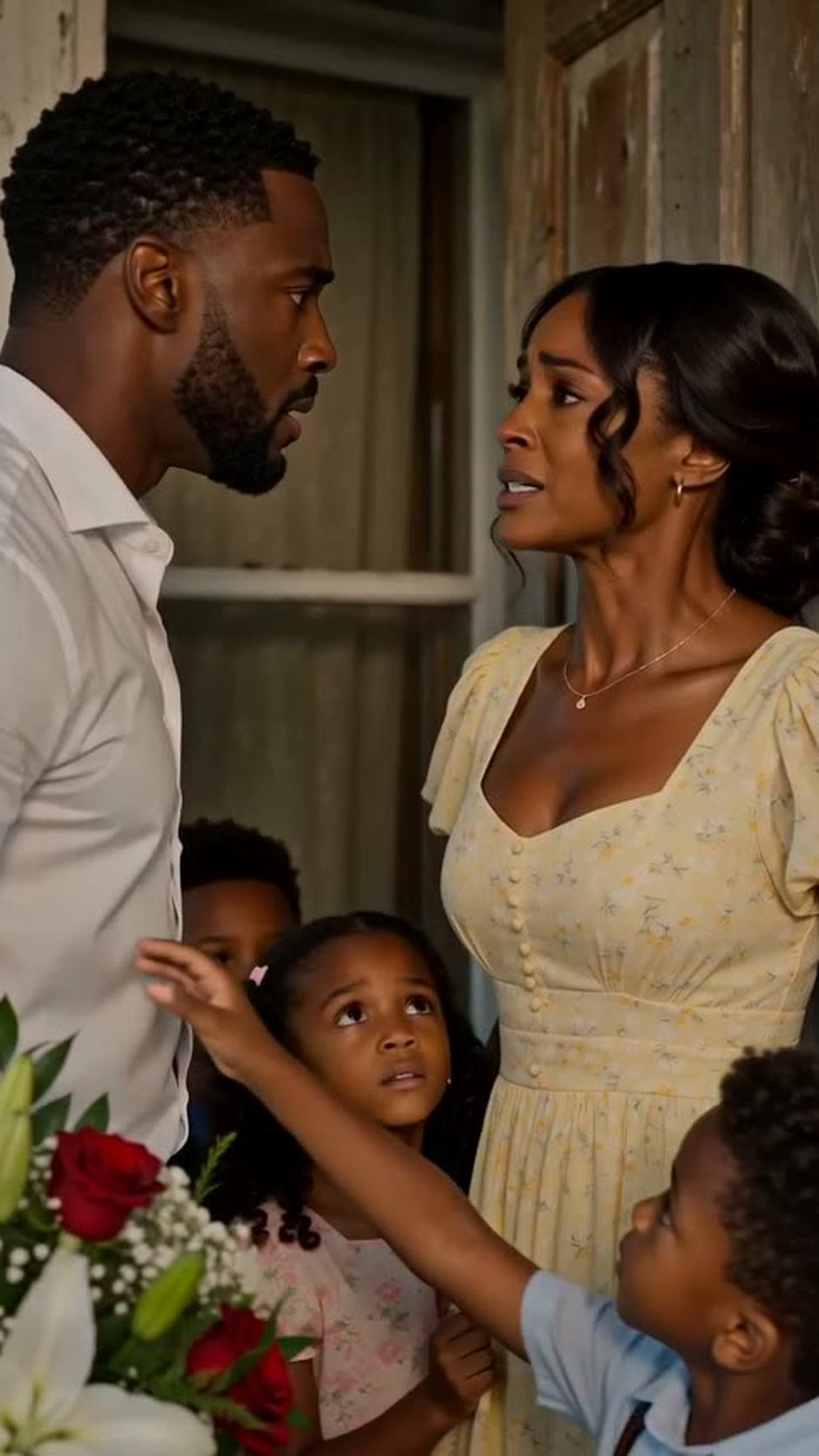
    Afterward, Daniel would understand that the moment on the porch had been two moments: the one he had imagined for eleven hours in the car, and the one that was given to him. In the one he imagined, he spoke first. In the one he was given, his wife opened a door and a little girl with his own eyes ran to hide behind her mother's skirt, and everything he was — the fortune, the name, the whole armored architecture of Daniel Whitmore — was reduced in one second to a man holding flowers he no longer knew what to do with.

    This is what happened in the doorway, the second time, with the shock worn down to the bone of it:

    He asked who they were, in a voice he didn't know he had. The letter fell, and neither of them would ever forget that it fell — that Emily looked down at nine words on a folded sheet and went white, that she asked *where did you get that* in the voice of a woman watching a grave open. The boy stepped out and looked up at him, searching his face like a map. The memory of his own voice came back off the walls of nine years — *Leave* — and Daniel did the only thing left in him to do. He stepped back. Half a pace. Then another inch. He yielded the doorway like a man surrendering a country.

    "I should have come sooner," he said.

    Emily's eyes shone and did not spill. The girl's hand was fisted in her dress. "What haven't you told me?" he asked her, trembling, and he watched her arrive — visibly, the way a wave arrives — at the edge of the thing she had carried alone for nine years.

    "Daniel…" she said.

    And the boy, Eli, who did not know he was standing at the hinge of two families' history, reached out his small hand and touched a red rose petal with one finger, gently, the way you touch something asleep.

    Emily's hand shook on the doorframe. She looked down at her son's hand on the rose, and up at Daniel, and she made the decision that Hannah would have made, and her grandmother would have made, and that she had been making in installments since a bathroom floor in the dark: she told the truth.

    "There's something you never knew about—" she began, and stopped, and began again, and this time she finished it.

    "Her name is June. She's eight years old. She was born the February after—" Emily's voice held, barely. "Daniel. She's yours."

    The porch, the yard, the whole green Kentucky afternoon went silent in a way Daniel would hear for the rest of his life.

    He looked at the girl. June looked back at him — unwinking, assessing, with his own dark eyes, in her mother's face, from behind her mother's skirt — and Daniel Whitmore felt his knees do something they had never done in a boardroom, in a crash, in a courtroom. He sat down. Not gracefully. On the top step of the porch, with the bouquet spilling sideways against his knee and the letter under his shoe, a billionaire sat down in the dirt-road dust in his white shirt because his legs had declined, unanimously, to continue.

    "Eight," he said. His voice was a stranger's. "She's eight. She's — June. Her name is June. I have a daughter named June and she's eight years old."

    "Yes," Emily said.

    "I have a daughter. And I said — I told you to — " He pressed the heels of both hands into his eyes. His shoulders shook once, hard, without sound. "I missed — Emily. I missed *everything*. Her first — all of it. I missed all of it on purpose. I did it. Nobody did it to me. I stood behind a desk and I *did* it."

    "Yes," Emily said again, and it was not cruelty. It was the plainest mercy she had: she was not going to lie to him, even to comfort him. She had never once lied to him. That had been, in the end, the entire evidence — the face that couldn't — and he had looked directly at it and chosen paper.

    "June," Daniel said, from the step, hoarsely. "June what? What's your whole name? I need to — I should know your whole name."

    The girl regarded him with the severity of a small headmistress. "June Rose Whitmore."

    "Whitmore," he repeated.

    "Mama kept your name for me." June said it the way she said everything, like reading from a record. "She said a name is a promise somebody made. She said promises stay promises even when the person is being—" she checked with her mother, briefly, for the approved wording, "—a *disappointment*."

    Daniel made a sound that was not a laugh and was not not a laugh. "Your mama," he said, "is the most honest person in the world. Nobody has ever survived being known by her. I didn't. It took me nine years dying of it to come back and try again." He turned his wet face up to the girl, his daughter, and did not tidy himself at all. "I'm going to earn the name back, June Rose. You can put that in the book."

    It was June who moved first. Children are braver than nations. She detached her hand from her mother's dress, took one step down out of the doorway, and stood in front of the stranger sitting wrecked on her porch steps, and studied him with her father's eyes.

    "You brought flowers," she informed him.

    Daniel lowered his hands. His face was wet. He did not wipe it. "Yes."

    "We have flowers," June said. "Mama does weddings. But nobody brings them *to* her. Eli, look, he brought them *to* her." And Eli, emboldened, came down the steps and took possession of the bouquet's ribbon with the gravity of a customs official, and Daniel — laughing, wrecked, astonished — began, carefully, to breathe again.

    Emily watched it from the doorway with her hand at her throat. She did not come down the steps. Nine years do not come down steps in an afternoon, and Daniel, to his credit — to the first credit he had earned in a decade — saw it, and did not ask her to.

    The afternoon that followed was the strangest of Daniel's life, and he had once spent a weekend negotiating with the government of a small nation.

    He did not go inside. He understood, without being told, that the threshold was not yet his to cross, so he sat on the porch steps where his legs had put him, and the children — released by their mother's failure to forbid it — conducted their inspection. Eli climbed into his lap with the total lack of ceremony of a cat, examined his watch, his shirt buttons, and the stubble on his jaw, and announced his findings to the yard: "He's a real one." June stood at a judicial distance with her arms crossed and asked him the questions of a border official. What was his full name. Where did he live. Why was his car that color. Did he know how to swim, ride a horse, fix a fence, or catch a fish — the four competencies of a man, in her taxonomy, and he failed two and a half of them, which she recorded in a small purple notebook produced from the pocket of her pink dress.

    "You're keeping notes," Daniel said faintly.

    "Deciding during is how mistakes happen," June informed him, and wrote something else down.

    Emily called them to wash for supper at six, and her voice from the doorway did what it had always done to him. He washed his hands at the pump in the yard because the children washed at the pump and he was, he understood, applying for membership. Eli showed him how the handle stuck. June showed him where the towel lived. Neither of them looked at their mother for permission to be kind to him, and Emily, watching from the doorway with a dish towel over her shoulder, said nothing at all — but she set four places at the table, and Daniel, carrying the water jug in, saw the fourth plate land at the place where no one had sat in nine years, and had to stand still in the kitchen for a moment with his back to the room.

    The children talked through supper the way children do, a river around stones: school, a frog, a boy named Caleb who had eaten a crayon on a dare. Underneath it, in the silences, nine years sat down at the table with them. Daniel learned that June's birthday was in February, that she read three grades up, that her teacher was Miss Pruitt, and that she intended to be a judge or a florist and had not yet decided which was more powerful. He learned that Eli feared thunder and loved being read to and had decided, at some point in the afternoon, that Daniel was his. He learned these things the way a man dying of thirst learns the names of rivers.

    What he asked, at dusk, sitting at her kitchen table because Eli had decreed that a man who brings flowers stays for supper and June had seconded it, was only this: "Tell me what to do. Not what I want. What to *do*."

    And Emily, who had rehearsed nine years of speeches for this man and discarded them all, discovered that the true one was short.

    "You leave tonight," she said. "You get a room in town. You come back tomorrow at ten, and you come back the day after that, and you let them learn you at their speed, not yours. You don't buy them anything. You don't promise them anything you can't keep. And Daniel — " her voice dropped, and the whole kitchen went still, " — you answer my questions now, the way I once begged you to answer yours. Starting with that letter." She laid the anonymous sheet flat on the table between them. "I didn't send this. I never wrote to you but once, and you never answered, and I've made my peace with believing you chose that. So who sent this? Who knew where I was — and who decided, after nine years, that it was time you did?"

    "But first," Daniel said, "Eli. Please. I need to stop doing arithmetic in the dark. Is he—" He stopped. Even now, with every card he owned face-down on the table, the question felt like a trespass.

    "Eli is Hannah's son," Emily said.

    Daniel stared at her.

    "My sister was killed four years ago, on Route 62, in the rain. Eli was fourteen months old. His father was a soldier who sent one letter." Her voice did not shake; this grief was older, and had been given its room in the house. "There was nobody else, Daniel. So he's mine. The court says so, and June says so, and he says so, and I say so loudest of all. He is not a secret and he is not a complication. He's my son. If that's arithmetic you ever have to do again, do it with those numbers."

    "Hannah," Daniel said. "Hannah is — God. Emily. I didn't — nobody told me. Garrett used to—" He stopped, because the enormity of what else nobody had told him was arriving, carriage by carriage, like a train. "I sent flowers to the foundation dinner that year. For a *dinner*. I didn't know your sister was dead. I didn't know because I arranged not to know anything about you, because knowing was the one thing—" He put his hand flat on the table, an old negotiator's gesture, grounding himself. "I am sorry about Hannah. She was the best laugh in any room she ever stood in. And for what it's worth to you — he's a fine boy. He's — you raised a boy who walks toward strangers to check if they're real. That's not nothing. That's the whole of something."

    "He walked toward *you*," Emily said quietly. "On the porch. Children know things, Daniel. It doesn't mean I have to know them yet."

    Daniel looked at the letter for a long moment. And in the stillness, understanding arrived the way it had arrived in the library nine years before — as a cold, clarifying dread — because there were only two people alive who knew where Emily Whitmore had gone, and one of them was sitting at this table, and the other one was his mother.

    His phone rang in his pocket. He almost didn't answer it. The number was the house in Connecticut, the housekeeper's line, and Mrs. Abernathy was crying before she got his name out.

    "Mr. Whitmore — it's your mother. The ambulance is here. They say — sir, they say you should come now."

  • Chapter 4: Nine Years of Quiet

    Chapter 4: Nine Years of Quiet

    The years in Kentucky did not pass the way years pass in Manhattan. They did not accelerate. They accrued, the way a house accrues — repair by repair, season by season, until one day you look up and realize that the place you meant to hide in has become the place you live.

    June was born in February, in the county hospital, during an ice storm, with Hannah holding one of Emily's hands and a midwife holding the other and the power flickering like the whole world was deciding whether to stay lit. She came out furious and dark-eyed and complete, and Emily, wrecked and laughing and crying in the same breath, looked into her daughter's face and saw — immediately, undeniably, with a pang she would feel a thousand times — Daniel's eyes. Not similar to his eyes. His. The same dark, intent, unblinking stare, already fixed on the world as if the world owed her an explanation.

    "You get that from your father," Emily whispered to her, in the hospital quiet. "God help us both, you get the stubborn from me."

    There was no answer to the letter. Emily allowed herself one winter of checking the mailbox with her heart in her throat, and then, with the discipline of a woman caulking a boat, she stopped. She taught herself the farm. She took work arranging flowers for weddings and funerals at a shop in town — her hands remembered beauty even when her life had none to spare — and she raised her daughter in a house that leaned a little and smelled of rain and cornbread, and if June asked, as she began to at four, at five, at six, why she had no father, Emily answered with the plain truth cut to a child's measure: "Your father made a mistake before you were born, and he doesn't know about you. If that ever changes, I'll tell you the same day."

    Eli came to her the way sorrow comes: in the night, by telephone, four years after June.

    Hannah — bright, stubborn Hannah, a nurse by then, engaged to a kind man, the whole future finally arranged — was killed on Route 62 on a wet October night by a driver who crossed the center line and walked away from the wreck without a scratch. Her son was fourteen months old. There was a father, briefly, in a uniform, overseas, who sent one letter and then no more. There was no one else. There was only Emily, standing in a hospital corridor at three in the morning, taking a sleeping toddler out of a social worker's arms — her sister's son, with Hannah's mouth and Hannah's temper already installed — and saying, "Mine. He's mine. Where do I sign?"

    She signed. June, at five, solemnly inspected the baby and declared him acceptable. The farmhouse, which had arranged itself around two, arranged itself around three, and then around four heartbeats under its leaning roof. Emily added a line to June's answer, for Eli, when he was old enough to ask why his mama was in photographs instead of at the table: "Your mama loved you so much that when she had to go, she made sure you landed with me." He accepted this the way children accept weather. He grew up calling Emily Mama, and the law and the county and the shape of his whole life agreed with him, and if there was a difference between the children it existed only on paper, in a courthouse drawer, where differences go to be forgotten.

    The flower work became a small business in the fourth year — Emily's arrangements, loose and garden-gathered in a way the county had never seen, started appearing at weddings two towns over, and then at the governor's niece's wedding, which June, aged six, attended in a supervisory capacity and judged "acceptable, except the cake was in the wrong place." Emily hired help. She bought the truck outright, in cash, and cried in it afterward, in the dealership parking lot, from the simple astonishment of owning anything outright that could not be taken back by a lawyer. She named the business *Rose's*, for her grandmother, and if anyone from her old life had ever driven past the little shop on Main Street with the hand-painted sign, they would not have recognized the woman in the window as anyone's discarded wife. They would have seen a woman the town consulted about weddings and funerals, whose daughter read three grades up and whose son had never once, in his whole life, been left anywhere he was not wanted.

    June asked about her father the way she asked about everything: on schedule, with preparation. She was seven. She had a notebook — she would keep the habit all her life; the notebook had a purple cover — and the question arrived at the supper table between the beans and the bread, delivered in the tone of a journalist who has done her research.

    "I know he's alive," June said. "Miss Pruitt says everybody's father is somewhere. I know he made a mistake and doesn't know about me. What I want to know is—" she consulted the notebook, "—whether the mistake was about money or about *believing*. Because those are different."

    Emily set down her fork. Eli, aged four, watched both of them with his fork suspended, sensing weather.

    "Believing," Emily said. "Some people told him lies about me, and he believed the lies instead of me. That's the whole of it, June. It isn't a small thing. It's the biggest thing there is. But that's the size of it, and when you're older I'll show you every piece of paper there is, and you can judge it yourself."

    "Okay," June said, and wrote something in the notebook, and then, in the same tone: "If he ever finds out about me, he might come. What are we going to do if he comes?"

    "I don't know, baby."

    "You should decide before," June said. "Deciding during is how mistakes happen." She closed the notebook. "More bread, please."

    Out of the mouths of babes, Emily thought, and looked at her daughter — her father's eyes, her mother's plainness, her grandmother's entire spine — and felt the old grief move in her chest, not smaller after seven years, just more familiar, like a room she'd learned to cross in the dark.

    So the years accrued. June grew long-legged and fierce and funny, with Daniel's eyes and her mother's terrible honesty. Eli grew round-faced and watchful, a boy who studied every stranger the way other children study weather vanes — for signs of which way the world was about to blow. The porch got its rail repaired. The barn stayed red. Nobody came.

    And in Manhattan, in a penthouse that appeared twice in architectural magazines, Daniel Whitmore became the man the newspapers said he was. He doubled the fortune. He won the port contracts. He sat at the head of tables in three time zones and felt, at each of them, the particular loneliness of a man being served dinner in a house with no one in it. He did not remarry. He told interviewers he was married to the work, and the line always got a laugh, and he would drive home afterward through the lit city and stand in his own doorway and be unable, for a moment, to remember why he had come home at all.

    He thought of Emily every day. He had built a shrine of the thought and he visited it like a punishment he administered to himself: her face across the library desk, aligning a photograph with the edge. *Ask me whether I love you.* He had not asked. The not-asking had calcified into the architecture of his life. There were years he nearly hired Sloane again, to find her — just to know she was alive, just to know — and each time he stopped, because finding her would mean looking at what he had done, and Daniel Whitmore, who feared nothing in a market, feared that the way other men fear deep water.

    On his thirty-fourth birthday, Garrett threw him a party on the Whitmore Capital terrace — ice sculptures, a jazz quartet, two hundred people who owed him money or feared him — and seated beside Daniel, with the care of a man placing a centerpiece, a woman named Charlotte Ashford, who was clever and kind and entirely blameless, and who laughed, at one point in the evening, at something a senator said, and Daniel heard it and stood up in the middle of his own birthday dinner and left the terrace, the party, and the building, and drove for an hour without deciding to.

    He ended, the way he always ended, at the office. On the top floor, in the dark, he opened the bottom drawer of his desk, where he kept — he had never once admitted to himself that he kept it, let alone why — the original envelope. The photograph. He took it out and he stood at the window and he looked at his wife laughing up at a stranger in a garden, and he looked for the guilt in her face the way he had looked a thousand times.

    What he saw, at thirty-four, in the dark, was her left hand. It was at her side, half-turned, and the light caught her wedding ring. In nine years of studying the photograph he had never once looked at her hands.

    He put the photograph back in the drawer. He closed the drawer. He went home to the penthouse and slept, and in the morning he called Garrett and said he didn't think Charlotte Ashford would be hearing from him, and Garrett — after a pause one beat too long — said, "Your mother will be disappointed," and Daniel said, "My mother has been disappointed since 1987. It's her native country," and hung up, and thought no more about the pause at all.

    His mother grew old, and then she grew ill, in the brisk, unsentimental way she did everything. The diagnosis came in the spring. Vivian received it in her doctor's office with a nod, declined the scenic route, and went home to the house in Connecticut, where she had lived alone with her staff and her correctness for forty years, and she began — methodically, in the evenings, in a hand that had started, slightly, to shake — to write letters.

    Most of them she burned in the fireplace, one by one, watching.

    One of them she did not burn.

    The envelope that arrived at Daniel's penthouse on a Tuesday in June bore no return address and no stamp of any firm. Inside was a single folded sheet, and on it, in handwriting he did not know — younger than his mother's, steadier, the hand of a nurse or a secretary sworn to silence — were nine words and an address in rural Kentucky:

    *If you still remember Emily, come here.*

    Daniel read it standing in his foyer with his coat still on. He read it four times. He called his office and heard his own voice, from very far away, cancel a week. He told no one where he was going — not the board, not Garrett, especially not Garrett, though he could not have said why the name rose in his mind like a warning bell. He bought the flowers himself, at dawn, from a florist who asked if they were for a wedding, and Daniel, holding red roses and white lilies against his chest like something he was carrying out of a fire, said, "No. They're an apology," and the woman, wisely, asked nothing more.

    He drove eleven hours. He practiced speeches in three states and abandoned all of them in the fourth. By the time the car turned up the dirt road — past the red barn, past the leaning fence, past the mailbox with its red flag standing down and quiet — he had reduced nine years of regret to the only honest sentence he owned, and it was not a sentence at all. It was a question he had no right to ask and could not survive not asking.

    He parked beside an old pickup. He climbed the porch steps with the bouquet in both arms, the anonymous letter folded against it in his fist, his heart going like a fist on a door.

    He raised his hand to knock.

    The door swung open before his knuckles touched the wood.

  • Chapter 3: Leave

    Chapter 3: Leave

    They did it in the library, because the library had doors that closed.

    Daniel would remember that detail for nine years — that he had chosen a room with doors that closed, like a man executing a contract. He laid the evidence on the desk in a row, the way Sloane had laid it out for him: the photographs, the receipt, the audit summary, the email thread. He watched Emily come in still smiling, watched the smile falter as she took in the tableau — his mother standing at the window like a magistrate, Garrett seated in the leather chair with his ankle crossed over his knee, Daniel behind the desk. Behind the desk. He had put a desk between himself and his wife.

    "What is this?" Emily said.

    "You tell me." Daniel's voice was not his own. It was his mother's voice, drawn from some cold inheritance in his blood. "Anthony Reyes. Tell me about Anthony Reyes."

    "A volunteer. He consulted on the port-city literacy—" She stopped. She was looking at the photographs now, picking one up with the tips of her fingers, the way you pick up something dropped in the street. "Daniel. This is the summer benefit. He asked me about the silent auction. There were four hundred people—"

    "And the hotel?"

    "The what?" She looked at the receipt. "I've never — Daniel, I have never been to the Regency Grand in my life. Where did this—" She turned, and her eyes went to Garrett, and something in her face changed — the beginning of an understanding she would not complete for years. "Garrett. Where did you get this?"

    "Don't," Vivian said from the window, without turning around. "Do not perform innocence at us, Emily. The money, at least, you cannot photograph your way out of. Forty thousand dollars, out of an account with your code on it."

    "Then the code was used," Emily said. "I didn't — Vivian, I have never taken a dollar. I send my own salary to my sister; ask Hannah, ask anyone, look at my accounts, look at everything—"

    "We have looked at everything." Daniel stood. He heard his voice climb and could not stop it. "Four months of meetings. In secret. A hotel room in your name. Money moving out of the foundation in the exact same weeks. Was I not enough of a story for you? Was the penthouse not— did you marry me for the — " He stopped, because she had gone very still.

    Emily set the photograph down with great care, precisely aligned with the edge of the desk.

    "Ask me," she said quietly, "whether I love you. Ask me that one. Not this — " her hand moved over the row of paper, not touching it, "— not any of this. You have stood in a hundred rooms with me, Daniel. You held the chair. You know my face. You know I cannot lie; you've said it yourself, you said it was the first thing—" Her voice cracked. "So ask me. Ask me if there is anything — anything — between me and any other man on this earth, and then watch my face and decide."

    The silence in the library was total.

    Daniel looked at his wife across nine feet of desk and evidence. He looked at her face — the face that could not hide weather — and for one instant he saw it plain: terror, and grief, and not one shadow of guilt. One instant. Garrett cleared his throat, very softly, in the leather chair, the way a man reminds a room of the agenda. Vivian said, "Every adulteress in history has asked to be judged by her face, Daniel. That is what the evidence is for."

    And Daniel Whitmore, who would go on to make a thousand correct decisions about money, made the one incorrect decision about the only thing that had ever mattered, and he made it in a single word.

    He did not say it loudly. That was the refinement of the cruelty he would have to live with: he said it the way you dismiss a tradesman, the way his mother dismissed staff, without heat, without even looking at her anymore, looking instead at the row of paper as if it were a wife he preferred.

    "Leave."

    Emily stood in the library for perhaps ten seconds after the word landed. Later she would tell Hannah that the strange thing was how quiet everything got — that she could hear the clock. She took off her wedding ring. She did not throw it. She placed it on the desk, beside the photograph of herself laughing with a stranger, and she aligned it, too, with the edge, as if neatness were the last courtesy left to her.

    "One day," she said, in a voice she had to build out of nothing, "you will know what you did today. I won't be there to see it. I want you to know that I won't be there to see it."

    A security man she had never seen before walked her through the penthouse to collect her coat. He was young, and he would not meet her eyes, and in the kitchen — passing through, because the hall route took them past the kitchen — Emily stopped.

    On the refrigerator, held by a magnet shaped like a strawberry June's mother had once thought was funny, was the photograph of the leaning farmhouse under the Kentucky sky.

    Emily took it down.

    "That stays," Vivian said from the doorway. She had followed them, soundless, the way weather follows a coast. "Everything in this house stays."

    "It is a photograph of my grandmother's house," Emily said. "It has never been in this house. It has only been visiting." She put it in the pocket of her coat, and her hand, in the pocket, held on to it, the way you hold a rail in the dark. "Like me."

    Something crossed Vivian's face — the chess player's expression, revising — and for one second Emily thought the woman might say the thing that would change everything, might call it back. The second passed. The face closed like a well-kept house.

    "Go, then," Vivian said, and turned away first, so that she would not have to watch it, which Emily, years later, would recognize as the only mercy her mother-in-law had ever shown her.

    Security had her suitcase ready in the hall — Vivian's efficiency — with her clothes folded by someone else's hands. She was not permitted to take the car. She was not permitted to take anything purchased after the wedding, which was everything. A cab was called, not by her. Daniel did not come out of the library. Through the door she heard nothing at all, and that nothing would ring in her ears for years.

    Hannah met her at the airport in Louisville with the old pickup and a face wet with fury, and drove her south through the dark, one hand on the wheel and one hand gripping Emily's, up the long dirt road to their grandmother's farmhouse, where the porch light had been left burning for her — Hannah had called ahead to a neighbor — as if the house itself had been told: *she is coming home, and she will not be coming out again for a long time.*

    Emily did not cry that night. She cried three weeks later, in the farmhouse bathroom, at five in the morning, standing at the cracked mirror with a plastic stick in her hand, watching a second line bloom on it like a verdict being reversed.

    She was pregnant.

    She sat down on the cold bathroom floor in her grandmother's house, in the dark, with her back against the tub, and she held the test in both hands and laughed once — one single, cracked, astonished laugh — and then she did the arithmetic that women have done since the beginning of the world. Nine months from now there would be a child. Daniel Whitmore's child. The child of a man who had looked at her face and chosen paper.

    The weeks between the bathroom floor and the letter were the darkest of Emily's life, darker even than the library, because the library had at least been quick.

    The farmhouse had not been lived in since her grandmother's death. There was dust on everything like a second, grayer set of furniture. The well pump had opinions. Mice had taken the pantry in a coup. Emily cleaned the house the way she did everything, completely and in order, room by room, with the radio on for company and her sister's casseroles appearing on the porch with the regularity of tides. She did not tell Hannah about the baby for almost a month. She told the house first. She told the porch rail and the well pump and the leaning fence. *There's going to be a child,* she said, out loud, shelling peas at the kitchen table where her grandmother had shelled peas, *and the child is going to be told the truth about everything, so the truth had better be livable.*

    What she could not decide was whether the truth included a father in Manhattan who had chosen paper over her face.

    Hannah, when she finally heard, in the garden, among the tomato starts, sat down hard on an upturned bucket and said a word their grandmother would have washed out of her mouth with well water. Then she said, "Tell him. Not because he deserves it — *because June-or-whatever deserves it*, and because you're going to have to live with whichever woman you are about this for the rest of your life. You're the one who says the truest things are the ones nobody claps for. So say it true, Em. Once. And then let him be whoever he's going to be about it, and we'll know."

    "And if he never answers?"

    "Then he's answered," Hannah said, "and we'll raise this baby so loved it makes the whole state jealous, and he'll have missed it, and that will be *his* furniture to dust for the rest of *his* life." She reached over and took Emily's hand, in the dirt, among the tomatoes. "But you have to give him the chance to miss it honestly. Otherwise you'll spend sixty years telling yourself he never knew, and you'll never know if you were protecting him or protecting yourself from finding out."

    Emily thought about the library. She thought about the ring, aligned with the edge of the desk. She thought about the eleven good months and the one word at the end of them, and about a face in a hospital not yet born, a face that might have his eyes.

    By sunrise she had decided. Not for money. Not for revenge. She would tell him because the child was his, and because whatever he had become in that library, the man who had held her chair deserved the chance — one chance — to know.

    She wrote the letter at the kitchen table, in her plain hand, without a single flourish. *Daniel — I am writing once, and only once. I am pregnant. The baby is yours; there has never been anyone else, and the fact that I must write that sentence is the saddest thing I own. I am not asking you for anything. I am telling you because you are the father and because I will not begin my child's life with a lie between us. If you want to know your child, you know where I am. If you do not — burn this, and I will never trouble you again. Emily.*

    She put it in an envelope. She wrote the penthouse address from memory. She walked it down the dirt road to the mailbox with the red flag, and raised the flag, and stood with her hand on the warm metal for a moment, believing — believing completely — that she had done the last brave thing this story would ever ask of her.

    What Emily Whitmore did not know, standing in the Kentucky sun with her hand on the mailbox, was that the letter was as good as burned already.

    It would be nine years before she learned why he never came.

  • Chapter 2: The Evidence

    Chapter 2: The Evidence

    The photograph showed Emily in the garden of the Whitmore house in Connecticut, in the blue dress she had worn to the foundation's summer benefit, standing close — too close — to a man Daniel did not know.

    The man was laughing. Emily's head was tilted toward him. His hand rested at the small of her back with the ease of long ownership, and her face was turned up to his with an expression Daniel had believed belonged to him alone.

    There was no note. There was only, paper-clipped behind the photograph, a hotel receipt from the Regency Grand, dated three weeks earlier, for a room booked under the name E. Whitmore.

    Daniel stood at his window for a long time.

    He was a man who trusted evidence. It was the religion of his family and the engine of his fortune: do not feel, verify. So he did the thing that would damn him. He did not go home and ask his wife. He verified.

    It is important to understand that he almost asked. That night Emily was in their kitchen in one of his shirts, barefoot, stirring soup and singing badly along with the radio, and when she turned and saw him in the doorway her face did the thing it had done the first time he ever saw her — it lit, entirely, without calculation — and his hand went, actually went, to the inside pocket of his jacket where the envelope was.

    Then Garrett called, as if on cue, as if he had a window into the penthouse itself. "You look like a man who's seen the numbers," Garrett said. "Whatever it is, Daniel — don't confront it emotionally. You know what this family stands to lose. Get the facts."

    The facts accumulated the way snow accumulates: silently, and then all at once, and then the roof is in danger.

    The foundation's auditors found a discrepancy — forty thousand dollars, moved in small tranches out of a discretionary account that bore Emily's authorization code. Emily, when the foundation's director mentioned it to her in passing, laughed and said there must be a coding error, and her face — Daniel studied it later, in memory, a hundred times — her face had shown nothing but mild annoyance. But Daniel no longer trusted her face. He had begun, instead, to trust paper, and the paper was being supplied to him by an invisible hand, in envelopes, at intervals so precise they might have been scheduled.

    He tried, once, to ask her. It was the foundation's winter benefit, two weeks after the first envelope. Emily had spent the evening doing what she did — she had found the scholarship children in their rented suits and fed them first, before the donors; she had remembered every name; she had laughed, at one point, so hard at something the caterer said that she had to hold on to a doorframe, and Daniel, watching from across the ballroom with the photograph burning in his memory like a coal in a pocket, had thought: *There. That. A woman does not laugh like that and live a lie.* He drove her home determined to lay the envelope on the kitchen counter and watch her face and be done with the whole nightmare by midnight.

    In the car she talked about the children. In the elevator she leaned her whole weight against his shoulder, the way she did when her feet hurt, and said, "If we ever have a daughter, I want her to learn to hang a banner straight. It's a life skill."

    "Emily," he said.

    "Mm?"

    The elevator doors opened onto their floor. He looked at his wife — coat over her arm, hair coming down, pencil still in it from the seating charts — and the question he had built all evening stood in his throat and would not come out, because he understood, suddenly and completely, what the question would do if he was wrong. There is no un-asking a thing like that. A man who asks his wife whether she has betrayed him has already moved out of the marriage, whatever she answers; he would be living in the asking for the rest of his life.

    "Nothing," he said. "You have a pencil in your hair."

    She pulled it out, looked at it, laughed, and went to run a bath, and Daniel stood in his own hallway and hated himself with a precision he usually reserved for competitors. He told himself he was protecting her from a suspicion that evidence would either confirm or dissolve. He told himself a week. Two. He told himself that love, real love, was patient enough to verify.

    What he was actually doing — though the sentence would not assemble itself in him for nine years — was shopping for a version of the truth that would not require him to be brave. Paper could be brave for him. Paper did not have to watch her face.

    So the paper kept coming.

    A second photograph: Emily at a café in the West Village, leaning across a table toward the same man, both of them serious now, conspiring. A printed email thread, obtained by his investigator from God knew where, in which "E.C." discussed "the transfer" and "when he's in Chicago." A witness — a driver the investigator produced — who had seen Mrs. Whitmore at the Regency Grand on the date in question and was willing to say so, for a fee Daniel paid without blinking.

    He read the email thread at two in the morning, in the penthouse office, with the city ticking below him like a held breath. *The transfer clears Friday. When he's in Chicago, we'll finalize.* He had been in Chicago. That much was true, and the truth of it did the lying's work, the way a single real coin can pass a purse of counterfeits. He remembered the Chicago trip. He remembered the closing dinner, the hotel bar, the long empty evenings of it. And he remembered — this rose in him uninvited, an exhibit for the other side — calling home on the second night and Emily answering on the first ring, breathless, standing in a flooded laundry room because a pipe had burst, laughing at the water around her ankles, saying, *Daniel, the house is drowning and I am the captain and I refuse to abandon ship, come home and bail.*

    He had laughed. On the phone, in Chicago, on the very trip the emails named as the window of her betrayal, he had stood in a hotel room laughing while his wife bailed out a laundry room and told him about the plumber, and the neighbor's boy, and the exact sound the water made.

    Daniel sat with that memory for a full minute, in the office dark, with the printed thread in his hands.

    Then he put the memory aside — gently, the way you set down something fragile you have decided not to look at — and read the thread again, and let the paper be the truth, because the paper did not laugh, and did not bail water, and did not require anything of him at all.

    That was the night Daniel Whitmore chose his evidence over his wife. The library, when it came, was only the paperwork.

    The investigator's name was Sloane. He was expensive and discreet and he sat in Daniel's office in the last week of March with a folder and the air of a man delivering a weather report.

    "I'm not going to soften it," Sloane said. "The man is Anthony Reyes. Freelance consultant. He's done work for two firms that compete with Whitmore Capital for port contracts. The meetings go back at least four months. The money moved out of the foundation account in the same window. I can't prove what she sold him. I can prove she met him, repeatedly, in secret, and that money followed."

    "And the hotel?"

    Sloane slid the receipt copy across the desk. "Room 614. One night. Booked in her name."

    Daniel picked it up. His hand was perfectly steady. He noted the steadiness with pride, the way his mother would have.

    Daniel drove home the long way, down the river, with the folder on the passenger seat like a second person in the car. Twice he picked up the phone. The first time he called Garrett, because Garrett was the load-bearing wall of his adult life — Garrett, who had roomed with him at school, who had talked him through his father's funeral at nineteen, who held a power of attorney and a key to the penthouse and the standing of a brother. "Sloane reported," Daniel said. "It's bad, Garrett. It's — he has a *receipt*."

    There was a pause on the line, one beat long, and then Garrett's voice came back warm and concerned and steady as a hand on a shoulder. "I'm sorry," he said. "God, Daniel, I'm sorry. Listen to me. Whatever you decide, you decide it clean. Not at midnight. Not in the kitchen. You lay it out in daylight, with witnesses, so she can't rewrite it afterward. I've seen these things. The rewriting is how they win."

    "Witnesses," Daniel repeated. "My mother."

    "Your mother has suspected something for months. She told me at Christmas she thought Emily was — she didn't want to poison you. She said a son has to arrive at it himself." A pause. "You've arrived, Daniel. Don't un-arrive."

    The second call he almost made was to Emily. Her name was at the top of his phone. Below it, by the tyranny of the device, was a photograph she had sent him at six that evening, while Sloane was still arranging his papers: the dining table at home covered with the annual report, a bowl of soup going cold beside it, and her message beneath, the whole of it: *Saved you the good chair. Come home before I promote myself to your seat and seize the company.*

    He stared at that message at a red light on the West Side Highway until the car behind him honked, and something in him — some last, loyal animal part of him — understood that a woman does not send that message on her way to a lover. And then he thought of the receipt, room 614, her name in print, and of Sloane's level voice, and of his mother at Christmas *suspecting*, and the light changed, and Daniel Whitmore drove on home through the city with the evidence riding beside him like a passenger who had already decided the destination.

    He understood later — it was one of the thousand things he understood later, all of them too late to be anything but tuition — that this was the exact moment the thing was decided. Not in the library. In the car. The library was only where the paperwork was signed.

    That night he came home at nine, and Emily was at the dining table with the foundation's annual report spread around her and a pencil in her hair, and she looked up and smiled and said, "You're late, I saved you the good chair," and Daniel stood in the doorway of his own dining room with the investigator's folder in his briefcase and understood, with a clarity so cold it felt like peace, that he could not live one more day inside a question.

    He would ask her tomorrow. He would lay it all on the table tomorrow, and she would explain, the way she had explained the banner, the chair, the soup — plainly, with her whole face — and the paper would turn out to be a trick of light.

    That was what he told himself, at midnight, watching her sleep.

    He did not know — how could he have known — that the tomorrow he was planning had already been planned by someone else. That the photograph had been taken at a benefit with four hundred guests, at the moment a stranger asked Emily the time. That the hand at her back had touched her for one second and been removed by Emily herself, out of frame. That the hotel receipt had been manufactured by a man who had once stood beside Daniel at an altar and sworn to stand beside him all his life.

    That night, while Daniel watched his wife sleep and practiced his questions, Garrett Cole sat in a black car outside the Whitmore house with Daniel's mother, and Vivian Whitmore looked up at the lit windows of her son's home and said, with terrible calm:

    "Tomorrow, then. Before she has time to prepare a story."

  • Chapter 1: The Door

    Chapter 1: The Door

    The door swung open before his hand could knock.

    Daniel Whitmore stood on the weathered porch of a farmhouse he had driven eleven hours to find, a bouquet too large for the doorway crushed against his chest — red roses, white lilies, baby's breath, wrapped in brown paper and tied with a deep red ribbon — and for one suspended second, everything he had rehearsed in the car was still possible.

    Then Emily stepped into the doorway, and the nine years stood between them like a wall of glass.

    She was thinner. Her dark curls were gathered up, loose strands framing her face, and the pale-yellow floral dress she wore was the kind of dress the woman he had married would never have been photographed in — modest, faded, mended at one sleeve with stitches so small you had to love the dress to bother.

    Her eyes widened. Her hand found the doorframe and held it.

    "Emily," he breathed.

    A little girl in a pink dress came running from the dim hallway behind her and seized the skirt of Emily's dress with both hands. A small boy in a blue shirt and brown suspenders pressed in at her other side, clutching her fingers, staring.

    Daniel looked down.

    The bouquet shifted in his hands. The brown paper crinkled, sharp in the quiet. He looked at the girl's face — at the eyes, dark and wide and unmistakably, impossibly familiar — and then at the boy, and something in his chest simply stopped.

    "Emily…" His voice came out thinner than a whisper. "Who are they?"

    Emily moved before he finished the sentence. One arm swept the girl behind her; her other hand pulled the boy close against her hip. Her whole body angled across the doorway like a shield.

    A gust came down off the Kentucky hills and worried the edge of the porch. The folded letter Daniel had been gripping against the bouquet — the anonymous letter that had arrived at his penthouse four days ago with no return address and nine words in a stranger's handwriting — slipped from his trembling fingers.

    It fluttered. It landed face-up on the porch boards between them.

    *If you still remember Emily, come here.*

    Emily looked down at it, and the color left her face so fast that Daniel felt it in his own stomach. She knew that letter. Whatever it was, whoever had written it, she knew.

    "Where did you get that?" she asked quietly.

    It was the first thing she had said to him in nine years.

    Daniel bent, instinctively, to pick it up, and saw her stiffen — saw the girl begin to bend too, reaching toward the paper with a child's open curiosity, and saw Emily catch her daughter's hand in midair and hold it, gently, absolutely.

    The boy stepped forward instead. Five years old, maybe. He stepped out from behind Emily's skirt and stood in the full sunlight of the doorway and looked up into Daniel's face with an unblinking, searching stare, the way a child looks at a photograph he is trying to place.

    Daniel straightened slowly. In his head, unbidden and merciless, another voice spoke — his own voice, nine years younger, cold as a closing door.

    *Leave.*

    Shame moved through him like a change in the weather. He swallowed. The bouquet brushed the rough doorframe and a single red petal loosened and fell, turning once in the sunlight, landing on the boards beside the letter.

    "I should have come sooner," he said, barely audible.

    Emily's eyes filled — and hardened in the same instant, the tears held back by something stronger than grief. The little girl looked from her mother's face to Daniel's. The boy, deciding something, took his sister's hand in his.

    Daniel's grip on the flowers loosened. His shoulders, which had carried an empire for a decade, dropped an inch and stayed there.

    "What haven't you told me?" he asked, trembling.

    Emily looked at him for a long time. The wind moved through the wildflowers by the porch. Somewhere down the hill a screen door banged, and neither of them turned.

    "Daniel…" she whispered, and her voice broke on his name.

    The little boy reached out, small hand open, toward the red roses.

    Emily's hand shook against the doorframe. She drew breath — the first words of the rest of Daniel Whitmore's life.

    "There's something you never knew about—"

    * * *

    Nine years earlier, Daniel Whitmore had believed he was the luckiest man in Manhattan, and he had believed it in the specific, arrogant way of a man who has never once been refused anything that mattered.

    He met Emily Carter at his own foundation's spring gala, in a ballroom so white and gold it hurt, where she was not a guest. She was twenty-four years old, a program coordinator three rungs below the people drinking champagne, and she was standing on a chair in her work shoes at six in the evening, re-hanging a crooked banner with her own hands because, as she informed the events manager without getting down, "the children in that photograph deserve to be straight, even if nobody here notices."

    Daniel, twenty-six and already spoken of as the future of Whitmore Capital, noticed.

    He held the chair. She looked down at him with the particular exasperation of a woman being helped by a man who has never been tired, and said, "If you're going to stand there, at least tell me if it's level."

    "It's level," he said. "You're not."

    "I beg your pardon?"

    "You're standing on a chair in heels, Miss—"

    "Carter. And these are not heels, they're—" The chair leg skidded two inches on the polished floor. Emily Carter came down off that chair with considerably less dignity than she had climbed up with, and Daniel caught her, one hand at her elbow, the other at her waist, and held her a half-second longer than physics required.

    She looked up at him — startled, flushed, furious — and Daniel Whitmore, who had been bored by every beautiful room he had ever stood in, understood all at once that he was in trouble.

    He courted her the way he did everything: completely. Not with the penthouse or the cars — Emily, who itemized donated school supplies down to the pencil, was immune to all of it — but with attention. He learned that she grew up in Kentucky, in her grandmother Rose's farmhouse, in a house that leaned a little and smelled of rain and cornbread. He learned that her parents were gone, that her younger sister Hannah was in nursing school, that Emily sent money home every month before she spent a cent on herself. He learned that she laughed with her whole face and that she could not lie — that deception moved across her features like weather across water, visible from a mile away.

    He proposed in October, on the roof of the Whitmore building, with his grandmother's ring and no audience at all, because Emily had once told him that the truest things people said were the ones nobody clapped for.

    She said yes with tears standing in her eyes, and Daniel's mother said nothing at all — which was, though he did not yet know it, the most dangerous sound in the world.

    Vivian Whitmore had built an empire out of a widow's inheritance and an iron refusal to grieve in public. She had plans for her only son that had been drawn up like acquisition documents, and those plans ended, as such plans do, in a merger: Daniel was to marry into the Ashford family, whose shipping fortune would dovetail with Whitmore Capital like two halves of a hinge. Emily Carter of Kentucky, with her mended dresses and her sister in nursing school, appeared nowhere in those documents.

    "You are confusing gratitude with love," Vivian told him, the one time she deigned to discuss it. "She held your chair, Daniel."

    "I held hers," he said.

    It became the story they told at dinner parties, in the good months. And there were good months — eleven of them, so good that Daniel would spend nine years trying to forget them in exact detail and failing in exact detail. Emily moved into his world like light into a shuttered room. She made the foundation's board sit through presentations from the children their money fed. She made Daniel laugh in boardrooms. She kept, on their refrigerator, a photograph of a leaning farmhouse under a Kentucky sky, and when she was homesick she touched it the way other people touch a rosary.

    They were married in December, in a small chapel Emily chose because the light came through the windows sideways, and Daniel — who had been offered, by his mother, a cathedral, a hotel ballroom, and a private island, in that order — stood in the front of that little chapel with his hands shaking too hard to manage his cufflinks and understood that he had never once, in twenty-six years of being given everything, actually wanted anything before. Vivian attended. She wore gray. She kissed her son's cheek and, over his shoulder, looked at Emily in her simple dress — a dress with no designer in it anywhere, only a bride — with an expression the photographer, to his credit, did not capture.

    "I give it a year," Vivian said to the Ashfords' table, before the year was out, though Daniel did not hear about it until much later, when there was no longer anything it could break that was not already broken.

    The first Whitmore family dinner at the Connecticut house, Emily arrived carrying a pie she had made in the penthouse kitchen, because her grandmother had raised her to never enter a house with empty hands. Vivian received the pie the way customs receives a suspicious parcel. Over dinner, she conducted what Daniel, even then, recognized as an examination: the foundation's staffing, the literacy program's numbers, Emily's opinions on endowment strategy — and Emily, who could smell condescension the way other people smell smoke, answered every question plainly and then, into a silence, asked Vivian about the rose garden visible through the dining room windows, in the dark, in December.

    "It's dormant," Vivian said.

    "Everything's dormant in December," Emily said. "That's not the same as dead. My grandmother used to say a garden in winter is just a garden keeping its own counsel."

    Something moved across Vivian Whitmore's face then that her son had never seen there. It was not warmth. It was closer to the expression of a chess player who has just revised an assessment. She had come to that dinner believing Emily Carter was a climber or a fool. She left it understanding that Emily was neither, and there are people in the world for whom that is the most frightening discovery of all, because climbers can be bought and fools can be managed, and Emily Whitmore could be neither.

    Daniel knew none of this. Daniel knew that his wife fell asleep on the drive home with her head against the window and her shoes off, and that he carried her into the penthouse without waking her, and that she woke on the couch at midnight, disoriented, and said, "Did I pass?"

    "Pass what?"

    "Your mother." She yawned. "She has a whole grading system, Daniel. I could feel it. Like weather."

    "She's not the weather," he said. "She's just—" and stopped, because he had been about to say *she's just my mother*, as if that explained her, as if mothers were exempt from being weather.

    "You get your stubborn from her," Emily said comfortably, and fell back asleep, and he sat awake beside her for a while in the dark of the penthouse, listening to the city, believing — with the whole, untested confidence of a man whose life has never once refused him — that love and stubbornness between them would be enough to outlast any climate at all.

    It very nearly was. That is the part nobody believes afterward, and it is the only part that matters: the marriage was not a delusion. She steadied him. He astonished her, constantly, with a tenderness he showed no one else on earth. She kept the refrigerator photograph of the leaning farmhouse and he learned to make her grandmother's cornbread badly and then less badly, and when she cried — once, in the spring, over a child in one of her programs who had been moved to a foster home three counties away — he held a chair for her in their own kitchen and said, "Tell me if it's level," and she laughed through the tears exactly as she had the day they met.

    Then, in the twelfth month of their marriage, a man named Garrett Cole — Daniel's oldest friend, his partner, the best man at his wedding — began, very gently, to ask questions.

    And one gray March morning, an unmarked envelope was delivered to Daniel's office by a courier who signed nothing, and Daniel Whitmore opened it standing at his window, with the whole of Manhattan glittering below him, believing for exactly four more seconds that he was the luckiest man alive.

    Inside the envelope was a photograph.

    And in the photograph, his wife was not alone.