Story Genres: Family Drama

  • Chapter 4: The Man in the Photographs

    Chapter 4: The Man in the Photographs

    Daniel arrived at the hospital forty minutes later in a tuxedo and an overcoat someone had thrown at him, carrying two coffees and the expression of a man who has left a string quartet playing to an empty head table and has no regrets about it at all.

    He stopped in the doorway of the family room. Grace was asleep — actually asleep, the sleep of the utterly spent — curled in the vinyl chair with her stole over her like a blanket, and the triplets were asleep on the room's little sofa in a pile of blue and navy and pink, and Ryan was sitting on the floor. On the floor, in a four-thousand-dollar suit, with his back against the wall and his ruined shoes stretched out in front of him, guarding them all like a dog that has decided.

    "Brother," Daniel said softly. He held out a coffee. "Tell me everything, and then tell me what to do."

    Ryan told him everything. It took four minutes; grief and fury are efficient editors. When he got to the lobby, the list at the security desk, and Amelia's gentle voice saying he'd moved on, Daniel's face changed in a way Ryan had seen only twice before, both times across a negotiating table from men who were about to lose their companies.

    "The photographs," Daniel said. "The ones your mother got. You still have the original envelope?"

    "In a drawer in London. I never—" Ryan stopped. He looked at his hands. "I never looked at them a second time. I couldn't."

    "Then you never noticed the man's watch." Daniel set down his coffee. "Or his face in the last frame, probably turned three-quarters. Ryan, I've met Grace's brother. James. He came to the Christmas party the year you got married and drank my scotch and cried laughing about the Bears. If the man in those photographs is tall with a scar through his eyebrow — it's James, man. It's her brother, in town for one day, saying goodbye at a café."

    The family room was quiet except for the soft machinery of four sleeping people breathing.

    "Get me the truth," Ryan said. "All of it. The photographer, whoever paid him, the lobby log, everything. I don't care what it costs. I don't care whose name is on it." He looked at the sofa, at Nick's small face slack with sleep, the port's dressing visible at the collar of his little suit jacket like a medal no child should wear. "Actually, I care about exactly one thing first. Tomorrow morning, before anything else. I want the transplant team to type me. Blood, HLA, whatever they need. If there's a chance I'm the match — I need to know before Nick does anything but get better."

    Daniel looked at him for a long moment. "And your mother?"

    "My mother," Ryan said, "has had three years of my obedience. She can survive a few days of my questions."

    He said it bravely. It would be the thing he remembered, later, when the questions started being answered — that he had thought his voice sounded steady.

    – – –

    The truth, when it came, took seventy-two hours, and Daniel laid it on the hospital cafeteria table on the fourth morning in a folder, the way you lay down a weapon.

    The photographer was a man named Victor Pye, a freelancer for the gossip sites, and he had been paid — through two shell invoices and one very careless personal check — out of an account belonging to Brooks Hospitality's events budget, authorized by A. Brooks. He had followed Grace for three days on instruction, and he had been told exactly what the client wanted to see. The client had reviewed eleven rolls of a sister hugging her brother, eating lunch with her brother, laughing with her forehead pressed to her brother's forehead the way the Ellis family had greeted since childhood — and had chosen the six frames that lied best, and had cropped the seventh, in which James Ellis's wife and her pregnant belly were standing two feet away holding the coffee.

    The lobby log was worse. Grace had come to Mercer Tower three times, not once; Amelia had lied to her face the day she remembered, but there had been two visits before it, logged and annotated in a security supervisor's hand: Per E. Mercer — do not admit. And in the divorce file, thick as a phone book in the firm's archive, Daniel's investigator had found the thing that made Ryan leave the cafeteria and stand in the hospital's service stairwell with his forehead against the painted concrete for a long time: a letter, on the penthouse's own stationery, in Grace's hand, that Ryan had never seen.

    Ryan — I am writing this because your assistant says you will not take my calls and I am out of ways to be proud. I am pregnant. Whatever you believe about me, the baby is yours, and I will have any test, sign any paper, endure any humiliation your family designs, if you will only be part of this child's life. I do not want your money. I want our baby to know your voice. Please. Please call me. — G.

    It had been received by the firm's mail room, date-stamped, and routed, per the covering slip, to the attention of the family office. The family office had filed it. No one had shown it to Ryan. The covering slip bore an instruction in his mother's assistant's handwriting — and behind that, initialed in the corner in a hand Ryan recognized with a drop in his stomach like a falling elevator, was a note from Eleanor Mercer's own pen: Handle quietly. He is not to be troubled with this now.

    Handle quietly. Three heartbeats, handled quietly, in a drawer, for three years.

    Ryan read the letter eleven times in the stairwell. He read it standing, sitting on the cold steps, and finally aloud, in a whisper, the whole of it, because Grace had written it to be heard by him and no living person ever had. Then he took out his phone and did three things, in the order of a man defusing something.

    First, he called the family office and revoked, personally and on a recorded line, every standing instruction containing Grace's name, and ordered the security lists at every Mercer property audited and burned in his presence.

    Second, he called the firm's managing partner — at home, at dinner, without apology — and informed him that the contents of a certain divorce file had been concealed from a client by that client's own family office, that he expected a full accounting on his desk within a week, and that if the word leak crossed the partner's mind at any point he should replace it with the word subpoena.

    Third, he sat on the steps a while longer with the letter against his heart under his coat, like a man keeping a bird warm, and he practiced the words he had never yet managed to say to Grace in the right order. Not excuses — he had forsworn those in the stairwell's concrete silence, having understood at last that an explanation is a thing you offer a judge, and Grace was not his judge. Grace was the plaintiff, the witness, the courthouse, and the city it stood in. What he owed her was not a defense. It was a surrender, unconditional and correctly addressed, and evidence — the only currency she had ever actually accepted — that the man doing the surrendering intended to be findable, every day, for the rest of the natural record.

    He did not confront her. There was a part of Ryan that had been waiting his whole life for the confrontation, and it stood aside, astonished, while the rest of him did the arithmetic of a little boy's white cell counts and understood that there was no room in him, that week, for anything but Nick. The reckoning with his mother would keep. Reckonings are patient. Little boys on countdowns are not.

    What he did instead was learn to be in a hospital room.

    He learned that Noelle interviewed strangers — doctors, nurses, the man who mopped the corridor — with the grave focus of a tiny journalist, and kept the results in a notebook in crayon. He learned that Holly would not eat if she was frightened, and that she was frightened by raised voices, beeping that changed pitch, and the word hospital said in the wrong tone, and that she could be unfrightened, reliably, by being read to in a funny voice about a bear. He learned that Nick considered himself the family's senior officer, that he had appointed himself guardian of his sisters' snacks, and that from his bed, tethered to his button and his beeping constellation, he issued instructions for the household with the calm of a general who has never doubted he will be obeyed.

    "You're the rain man," Nick informed him on the second day, studying him over a cup of ice chips. "From the bus. Mommy cried in the elevator."

    "Nick," Grace said, stricken, from the doorway with the laundry bag.

    "It's okay," Ryan said, and found that it was said to both of them. He sat down in the chair that had become, by some ward consensus, his. "Your mommy has had a lot of weather, buddy. Grown-ups cry about weather sometimes. It doesn't mean the house falls down."

    Nick considered this with his head tilted, exactly Ryan's tilt, the one from the silver frame on his grandmother's piano. "Are you staying for the weather?"

    Ryan looked at Grace. Grace looked at the laundry bag as though it might rescue her. "I'm staying," Ryan said. "For all of it."

    The next morning he was interviewed by Noelle.

    She arrived at his chair with her crayon notebook open to a fresh page, climbed onto the arm of it without asking, and regarded him with the calm of a census-taker. "Questions," she announced. "One: are you a doctor."

    "No."

    "Two: are you lost."

    "No."

    "Three." She wrote something down before asking, which Daniel would have recognized as a technique. "Are you ours?"

    Ryan looked at the page. She had already written, in enormous green capitals, YES, and was waiting for him to catch up to the paperwork. "Noelle," he said carefully, "that's a question for your mommy and me to—"

    "You came in the rain," she said, writing. "You stayed for the weather. Nick says you're the bucket man. I'm putting YES." She closed the notebook with the air of a judge who has heard enough. "You may hold Holly's bear while she naps. It's an honor. Don't lose it."

    He held the bear. It was missing an ear and smelled faintly of graham crackers, and he sat in the corridor of a children's hospital holding it with both hands while his daughter-by-two-minutes slept against his shoulder in a pink dress, and the CEO of the Mercer Group, whom the business press had once called the Ice Merchant of Michigan Avenue, wept silently into the top of her curls and did not care who saw, and no one who saw said anything at all, because the ward had its own code about weather.

    From the doorway, with the laundry bag on her shoulder, Grace watched her ex-husband cry into their daughter's hair while holding a one-eared bear with both hands, and she stood there long enough that the nurse had to walk around her twice. Later she would tell herself she had been deciding whether to interrupt. It was a lie, and she knew it, and she let herself keep it; she was allowed one. She had been deciding nothing. She had been memorizing it, against her will and her instructions, in the part of her memory she had sealed in November three years before and sworn, in a marble lobby, never to open again.

    That was the day the transplant team called them both into the consult room with the soft chairs and the tissues placed precisely within reach, and Dr. Patel, who directed the haploidentical unit, folded her hands and told them that Ryan's typing had come back, and that he was, as expected, a haploidentical match — a parent's match, workable, real — and that the team wanted to move fast, because Nick's latest counts had come back that morning, and they were not the numbers anyone had hoped for.

    "How fast?" Grace said.

    Dr. Patel glanced at the chart, and then, to her credit, at Grace's face instead. "We've admitted him," she said gently. "As of an hour ago. He spiked a fever in clinic. I'm sorry — I know that's not how you wanted to hear it. But the honest answer to your question is: now. Everything is now."

  • Chapter 3: Something You Don’t Know

    Chapter 3: Something You Don’t Know

    The door had closed, but Grace was still looking at him through the glass.

    Ryan watched her make the decision — watched it cross her face the way weather crosses a lake — and then she spoke to the nurse, briefly, and the nurse nodded and took the girls' hands and led them, gently, no farther than the family alcove by the elevators, where they could be seen and could see. And Grace came back through the doors alone, into the cold vestibule where Ryan stood dripping on the mat with his coat ruined and his heart slamming, and the doors sighed shut behind her, and it was just the two of them, three years later, in a box of glass and rainlight.

    "Ryan… there's something you don't know," she said. "There's something you don't—" Her voice broke on it cleanly, like a stick. She pressed her fingers hard against her mouth. When she took them away, she had rebuilt herself, the way he had seen her do at charity podiums and once, memorably, at his father's funeral. "Nick is sick."

    "Nick." The name landed softly and rearranged everything. "The boy."

    "The boy." Her eyes went to the alcove, where the boy — Nick — was watching them through the glass with Ryan's own gray-blue stare, one small hand flat against the window. "He has aplastic anemia. His bone marrow doesn't make enough blood. He's had transfusions for almost two years, and this year they stopped being a plan and started being a countdown." The words came out practiced; she had clearly said them to social workers and insurance boards until they could be carried without spilling. "He needs a stem cell transplant. There's no match in the registry — we've searched for eleven months, all over the world. His sisters aren't matches. I'm only half. The team here does parent transplants. Haploidentical. It's his best chance, and this hospital is the best place in the country for it, and that is why—" She stopped. Swallowed. "That is why I came back to a city I swore I'd never set foot in again. Not for you. Never for you. For him."

    Ryan stood very still. Rainwater ran off his coat onto the mat in a darkening pool.

    "The girls," he said. "Tell me the girls are—"

    "The girls are healthy." Grace said it quickly, the mercy first, the way she'd clearly learned to deliver all news. "Noelle and Holly are healthy. Bruises that come from furniture, like other children. It's only Nick. It's only ever been Nick." A ghost of something that was not quite a smile moved across her face. "Noelle is the oldest by two minutes and has never once let the other two forget it. Holly is the youngest and runs the entire family from behind my skirt. Nick is the middle and the first — he came out first of the boys of himself, he says. He says it constantly. He's had to be — he's had to be brave in ways that have made him—" She stopped, because her voice had gone somewhere she could not follow it.

    "Tell me," Ryan said. "Anything. Their favorite— I don't know their favorite anything, Grace. I know their ages because a three-year-old girl's shoe slipped on my street. Tell me one true thing that isn't medical."

    Grace looked at him, and for a moment the fury in her face softened into something more desolate than fury: pity, and the memory of love, which is pity's most painful form. "Nick keeps a notebook of grievances against the hospital food and reads them to the nurses. Noelle interviews people; she has a crayon notebook and she will ask you questions and write down answers you didn't give, she writes the answers she expected. Holly is afraid of the word goodbye said after dark, so in our house we say see you at breakfast. Even to the goldfish we had. Especially to the goldfish."

    Ryan made a sound that he would have been ashamed of in a boardroom.

    "He has your eyes," Grace said, almost gently. "Did you think I wouldn't notice you noticing? He has your eyes and your hands — watch him with a puzzle. And your grandmother's temper, according to—" She stopped herself, hard, the way you stop a car at a line you have drawn for exactly this. "According to no one. I don't know your grandmother. Forget I said that."

    "You knew her for three years," Ryan said. "You sat with her every Sunday of the last year of her life. You held the book when her eyes went. Forgetting is my family's disease, Grace. It isn't yours."

    "I learned it," she said, "from the best."

    She turned then, a quarter-turn, toward the alcove where the children sat in their row behind the glass, three small faces turned toward their mother the way flowers track a lamp, and Ryan saw her do the thing he would see her do a hundred times in the weeks to come: count them. One, two, three. A hand at her own heart, light as a moth. One, two, three. The whole of her religion, in arithmetic.

    "This way, Mr. Mercer," said a voice — a nurse had come through the doors with a clipboard, brisk, kind, oblivious — "the family room on three is empty, you can both—" She stopped, looking between them, reading the weather. "I'll give you a moment."

    "How long have you known?" Ryan said when they were alone again. "That he was sick. How long have you carried this by yourself?"

    "Since he was eighteen months old." Grace's chin lifted, and for the first time that night he saw not fear but the thing underneath it, the thing that had always been underneath everything with Grace: a ferocious, exhausted dignity. "Don't look at me like that. Don't stand in a hospital you could buy and look at me like I'm the one who kept secrets. I came to you, Ryan. When I found out I was pregnant, I came to Mercer Tower and I sat in your lobby for two hours, and Amelia Brooks came down in your private elevator and told me you didn't want to know. Whatever it was, she said. You'd moved on."

    The vestibule was very quiet. Somewhere beyond the doors a child laughed, once, in a corridor painted with stars.

    "She said that." Ryan heard his own voice from a distance. "Amelia said that to you."

    "Word for word. I've had three years to memorize it." Grace wrapped her arms around herself — the fur stole, the diamonds at her throat, and the posture of a woman holding herself together with both hands. "And your mother had my name on a list at security. There's a list, Ryan. At the desk. For people who are not to come up. My name was on it before the ink was dry on the divorce."

    "Grace." He reached for her — slowly, the way he had on the street — and this time she did not draw back, but she did something worse: she stood perfectly still and let his hand stop in the air an inch from her sleeve, and looked at it, and said, with great courtesy, "Don't."

    His hand fell.

    "They're mine," he said. It was not a question and it was entirely a question.

    Grace looked through the glass at three children in their Christmas clothes, sitting in a row in the alcove now, the girls leaning together like tired birds, the boy upright between them with his palm still on the window.

    "Look at them," she said.

    He looked. He had been looking all night; it was taking the skin off him, looking. Noelle's calm judicial stare. Holly's curls, his mother's curls, on a three-year-old in a pink dress. Nick's face — Nick's face was a photograph Ryan's grandmother kept in a silver frame of Ryan at four, down to the cleft of concentration between the eyebrows.

    "I don't need a test," Ryan said hoarsely. "I don't — I believe you. I've believed you since the bus shelter. I just need—" His voice failed. "I need you to say what you need. Money, doctors, lawyers, the whole hospital — say it, and it's done. Say it, Grace."

    "What I need," she said, "is a donor for my son. What I need is for you to be very careful about wanting to be a hero in this story, because heroes leave. They leave through lawyers. They leave through their mothers. They leave through penthouse elevators with other women's hands on the desk." Her eyes were dry and burning. "Finish your evening, Ryan. Amelia is waiting. Everyone is waiting — she texted you eleven times in the car; I saw your phone. Go and propose to the woman you chose, and let me take my children upstairs, and we will all pretend this rain never happened."

    She turned toward the doors.

    "Grace."

    She stopped. She did not turn around.

    "There isn't going to be a proposal," Ryan said.

    He took out his phone, there in the vestibule, with the rain drumming the glass and his whole former life standing three feet away with her back to him, and he typed with his thumbs: Amelia. I'm sorry. There will be no proposal tonight. Something has happened that changes everything. Do not wait for me. He watched the message deliver. Then he opened a second thread — Daniel, his best man, his COO, the only person in that dining room who had ever told him the truth straight — and typed: Kill the dinner. Send everyone home. Tell my mother I'll call her. It's Grace. It's always been Grace. I need you here instead: Children's Medical Center, family room, third floor. Bring nothing but your discretion.

    "Ryan, what are you doing—" Grace had turned. She was staring at the phone in his hand, at his face, with the first unguarded expression he had seen on her all night: not fear. Alarm. "You can't just— your mother will— Eleanor will—"

    "My mother," Ryan said, "is about to have the worst phone call of her life, and for once it isn't going to be delivered by her lawyers." He dialed. The phone rang twice against his ear, over the sound of the rain, and Eleanor Mercer answered in the voice she used for boardrooms and bishops.

    "Ryan. The Brooks family is seated. The quartet is— where are you?"

    "Mother." Ryan looked at Grace, and Grace looked back at him, and the three children looked at both of them through the glass with their hands pressed white against the window. "I need you to answer one question, and I need you to hear how carefully I'm asking it. Three years ago, after the divorce — did Grace ever try to reach me?"

    The silence that came down the line was not empty. It was furnished. It had weight and texture and a full upholstered history, and it lasted four seconds, and five, and in those five seconds Ryan Mercer, thirty-eight years old, CEO of the Mercer Group, heir to nine hotels, felt the floor of his life tilt on an axis he had not known was there.

    "Mother," he said, very quietly. "Answer me."

    And upstairs at the Mercer Grand, in a dining room full of flowers, Amelia Brooks set down her champagne glass with a hand that had begun, slightly, to shake — because Eleanor Mercer had gone the color of candle wax, and the string quartet had stopped, and somewhere out in the rain her future was coming apart at the seams.

    Amelia had planned this evening for the better part of a decade. She had planned it the way she had planned everything since she was seventeen years old and had watched, from a summer-house window, a scholarship girl in a borrowed dress make Ryan Mercer laugh so hard he had to sit down on the grass — had watched him look at Grace Ellis the way he had never once, before or since, looked at anything in the world Amelia could offer. She had spent ten years and one ruined marriage arranging to be the woman in the white dress in that dining room. And now the groom was at a children's hospital, and Eleanor was staring at her phone as if it had personally betrayed her, and Daniel — Daniel, who had left an hour ago with two coffees and an overcoat — was not answering his messages.

    "Amelia, darling," her mother said brightly, into the widening silence, "shall we have them serve the first course while we wait?"

    Amelia smiled the smile that had served her so well in marble lobbies. "Of course," she said. "I'm sure it's nothing. Ryan would never—"

    She did not finish the sentence. She was remembering, with perfect clarity, a sentence of her own, delivered three years earlier in a private elevator's glow: Whatever it is, he doesn't want to know. She had wondered, on exactly four nights in three years, whether Grace Ellis had been carrying something in that lobby besides a suitcase face and a ruined name. Four nights. She had done the arithmetic on none of them.

    "Serve the first course," Amelia said. "He'll be here."

  • Chapter 2: Three Heartbeats

    Chapter 2: Three Heartbeats

    There are exactly four photographs of the triplets' first year, and Grace took all four of them on a phone with a cracked screen, in a one-bedroom apartment in Indianapolis where the radiator clanked like a man clearing his throat all winter.

    Nicholas arrived first, furious and loud, with a head of dark curls and eyes that opened gray-blue and stayed that way. Noelle came two minutes later, calm as a judge, and studied the ceiling lights with an expression of mild professional interest. Holly came last and smallest, and did not cry at all until Grace held her against her heart — and then, having confirmed the address, settled.

    Three. Grace lay in the hospital bed with a baby on each arm and one on her chest, and laughed until she cried, and cried until the nurse pretended to be very busy with a chart so as not to embarrass either of them.

    She named them with her mouth close to their ears, one by one, like posting letters. Nicholas, for the saint who leaves gifts in the dark for children who have nothing. Noelle and Holly, because they had been conceived in one winter and born into another, and Grace was determined that Christmas would belong to them and not to her grief.

    For eighteen months, it worked. Not easily — nothing about three babies and one pair of hands is easy — but it worked. Mrs. Alvarez from downstairs, a widow with eleven grandchildren and strong opinions, adopted them all without paperwork. Grace cleaned offices at night with the triplets asleep in a row of car seats by the supply closet, translated documents at dawn, sewed bows onto other children's Christmas dresses at a kitchen table while her own slept. She was tired in a way that lived in her bones. She was also, in the small hours, feeding three laughing babies mashed banana off one spoon in rotation, happier than she had ever been in a penthouse.

    The bruises were the first thing.

    Toddlers bruise; three toddlers in a one-bedroom apartment bruise like a basket of dropped fruit, and Grace, who had been raised by a nurse, catalogued Nick's without panic — until the morning she found them blooming along his ribs where no furniture had touched him, purple-black and clustered, and Nick, her loud one, her furious first-born, lay in her arms too tired to finish his bottle, with a fever that had no weather behind it.

    The local hospital kept him four days. On the fifth, a hematologist with kind eyes and a terrible poker face sat Grace down in a family room with a box of tissues placed precisely within reach, and used the words aplastic anemia, and bone marrow, and failure, in an order that rearranged the furniture of Grace's life.

    Nick's marrow was emptying. His body had stopped reliably making the blood he needed. The treatment that worked — the one that cured — was a stem cell transplant. The search for a matched donor would begin immediately.

    "What about me?" Grace said. "I'm his mother. Take mine. Take whatever—"

    "A parent is a half match, Mrs. Ellis. We can work with that if we must — it's done, and it saves lives — but a full match is better. The registry has millions of donors. We'll search. And his sisters will be typed too. Full siblings are the best odds of all."

    The registry searched. For eleven months, the registry searched, through millions of strangers who had swabbed their cheeks in shopping malls and college gyms, and found no one. Noelle and Holly were typed with a lollipop afterward each, and were not matches — close, the doctors said, with the special cruelty of the word, but not close enough. Grace typed herself and was filed where half-matches live, in the drawer marked if we must.

    If we must began to fill the apartment like a fourth child.

    Grace kept a notebook — a spiral one, from the dollar store, with a unicorn on the cover that Noelle had chosen with great seriousness — and in it she kept the arithmetic of her son's body. Bruises, mapped like weather on a drawn outline of a little boy: left shin, Tuesday, playground-shaped, fine. Ribs, Thursday, no cause, not fine. Temperatures at 2 a.m. and 4 a.m. What he ate. What he couldn't finish. The exact shade of his tiredness, recorded in a private shorthand of her own devising: T1 meant tired like other children; T2 meant tired like a phone at ten percent; T3 meant carry him, and check the notebook, and call the clinic in the morning, and do not sleep too deeply tonight.

    She became fluent in a language no mother should have to speak. She could say aplastic the way other women said the names of wines. She knew the platelet counts that meant the playground and the counts that meant the couch, the fevers that meant a phone call and the one that would mean the emergency room at a run. She hung the clinic's magnet on the refrigerator at the height of her own eyes, where it lived between a drawing of a bus and Noelle's first written word, which was BUS, because Nick had dictated the household's priorities.

    And threaded through the medical arithmetic, ordinary life insisted on itself, gloriously. There were the three of them in a bathtub like a regatta. There was Holly's phase of hiding inside the laundry hamper and leaping out at Mrs. Alvarez, who screamed with professional enthusiasm every single time, as a courtesy. There was the evening the power went out on the whole block and Grace lit candles and told them the story of a queen with three knights, and Nick — T2 that day, couch-bound, furious at the injustice — demanded the queen be given a sword, and then, after consideration, a second sword, "for the other hand, Mommy, she has two hands."

    "She does," Grace said. "She uses them both."

    "Like you," Nick said, and fell asleep against her arm before she could answer.

    She worked. She worked the way water works on stone. A foundation in Indianapolis took pity — no, she corrected herself whenever she thought it, took notice — of the woman who had once run the Mercer Foundation's galas, and gave her contract work she could do from the kitchen table: donor letters, seating plans, the invisible engineering of other people's generosity. At night, when all three were asleep, she sat at that table in the cone of a cheap lamp with the notebook beside the laptop — bruises on one page, ballrooms on the other — and she did not think about Chicago. She was very careful about the not-thinking. It was load-bearing. The one time she failed — the night Nick, feverish at 3 a.m., whimpered in his sleep for a person he had never met, "Daddy fix it," parroting some phrase from a cartoon, some other child's ordinary magic words — she sat on the bathroom floor with her back against the tub until her legs went numb, and then she got up, and checked his temperature, and wrote it in the notebook in handwriting that shook only a little.

    Chicago's doctors could give Nick his best chance. That was the whole equation. Grace Ellis had survived being called a fortune hunter by a family of hoteliers; she could survive being unknown in the city that had misnamed her. She packed the notebook, the outfits, the bear book with the spine taped twice, and three small suitcases, and she took her children home to the best hospital in America — which stood, with an almost personal insolence, directly across the street from the Mercer Grand.

    Platelet transfusions when the bruises came in constellations. A port in her son's small chest, which he called his button and showed to the mailman. Nights Grace spent learning the exact sound of his breathing through a baby monitor, the way she had once learned it for joy and now learned it for war. Twice, infections put him in isolation, behind glass, and Grace read The Night Before Christmas through a telephone handset to a little boy in a paper gown who pressed his palm to the window side of the glass and slept with it there.

    The transplant team in Indianapolis was honest with her, in the end. For a case like Nick's — a toddler, a rare profile, a family with no full match — the best program in the country for children was in Chicago. At the Children's Medical Center. Where the haploidentical unit — the unit that transplants from a parent — was doing work that read like rumor.

    Grace stood in her kitchen a long time with the referral letter in her hand.

    Chicago was a door she had sworn never to knock on again. Chicago had marble benches and private elevators and Amelia Brooks's gentle smile. Chicago had Eleanor Mercer, who had called her a fortune hunter in a room full of lawyers. Chicago had Ryan.

    But Chicago had the doctors who could save her son, and so Grace did what she had done every day since the ultrasound technician's careful smile: she chose the children over her pride, and she went home to the city that had thrown her away.

    She told herself she would be invisible. Chicago was enormous; the Mercers moved in a Chicago of glass towers and charity boards, and she would live in the Chicago of bus routes and hospital family housing and night shifts. The hospital's family-support office found her work she could do with a monitor in her pocket — coordinating volunteers, and then, because the foundation director had once seen her run a gala in another life, helping plan the Snowflake Gala, the Medical Center's Christmas fundraiser, where patient families were honored and the children lit the great tree in the lobby.

    She bought the triplets their outfits at a resale shop and sewed the bows herself. Nick's navy suit. Noelle's blue dress. Holly's pink one, with the fur trim. They would stand in golden light for one evening, all three of them, like children in a story where nobody is sick.

    And if her hands shook when she thought that across the street from the Medical Center stood the Mercer Grand — where she had once danced at her own wedding reception, in another woman's lifetime — she told herself that fate was not so theatrical. Fate did not arrange encounters at bus shelters in the rain.

    Fate, that December, was extremely theatrical.

    – – –

    Three miles and one entire world away, Ryan Mercer stood in the master suite of his family's flagship hotel on the evening of December twenty-first, and looked at the man in the mirror, and the man in the mirror looked like a groom in the way a photograph of a fire looks warm.

    "You look," said his best friend Daniel from the doorway, with the delicacy of a man removing a splinter, "like you're about to sign a merger."

    "It is a merger," Ryan said.

    "That's my point, brother."

    It was, on paper, a perfect match. Amelia Brooks, whose family's hotel group fit the Mercer Group like a key cut for the lock. Amelia, who had been orbiting his life since prep school, who had been — everyone agreed — so supportive during the divorce. Amelia, who had never once, in three years, made his chest hurt the way a song could, or a smell of rain on wool, or the back of a stranger's head in an airport with dark curly hair.

    His mother approved. The board approved. The ring had been approved by a committee of jewelers. The only person who had never been consulted was Ryan, and Ryan had made a career of that, too, since the Tuesday an envelope of photographs emptied his marriage like a drawer tipped out a window.

    He had never looked at them again. He kept that from everyone, including himself: he had never once, in three years, been able to make himself look at the photographs a second time. The first look had been enough to burn. What he did not know — what he would give the flagship hotel to have known — was that the burning was the tell. A man who has truly been betrayed feels cold. Ryan had felt, every day since, like a house the fire had never actually left.

    Downstairs, the private dining room was filling with two families and a string quartet. Amelia was upstairs in the bridal suite his mother maintained for occasions, though the wedding was months away, because Eleanor Mercer believed in dressing for the ending you wanted.

    "Ten minutes," Daniel said. "Anything you want to do first? Pray? Flee?"

    "Get some air," Ryan said. "One minute. Then I'll come up and do it properly."

    He took the ring box from the dresser — three carats, flawless, approved by committee — and went down the service stairs and out under the awning, into the rain, the way a man walks to the rail of a ship.

    He opened the box and looked at the diamond catching the Christmas lights, and he was reaching, with something that felt almost like grief, for the words he would say on one knee upstairs —

    — when a small voice, high and clear, cut through the sound of the rain across the wet pavement, from the decorated bus shelter on the avenue.

    "Mommy… who's that man?"

    Ryan raised his eyes.

  • Chapter 1: The Man in the Rain

    Chapter 1: The Man in the Rain

    The ring weighed almost nothing, and Ryan Mercer could not stop his hand from shaking.

    He stood under the awning of the Mercer Grand with the rain coming down in silver sheets beyond the marble steps, less than an hour from the moment he was supposed to walk into a candlelit private dining room, kneel in front of two dozen witnesses, and ask Amelia Brooks to become his wife. Everyone was already upstairs. His mother. Her parents. The photographers his mother had hired, because in the Mercer family even love was a press release.

    Ryan opened the black velvet box.

    The diamond caught the golden Christmas light strung along the hotel's facade and threw it back in a cold, brilliant flash. Three carats. Flawless. The most beautiful object he had ever bought for a reason he could not name.

    "Mommy… who's that man?"

    The voice was small, high, and so clear that the rain seemed to step aside for it.

    Ryan raised his eyes.

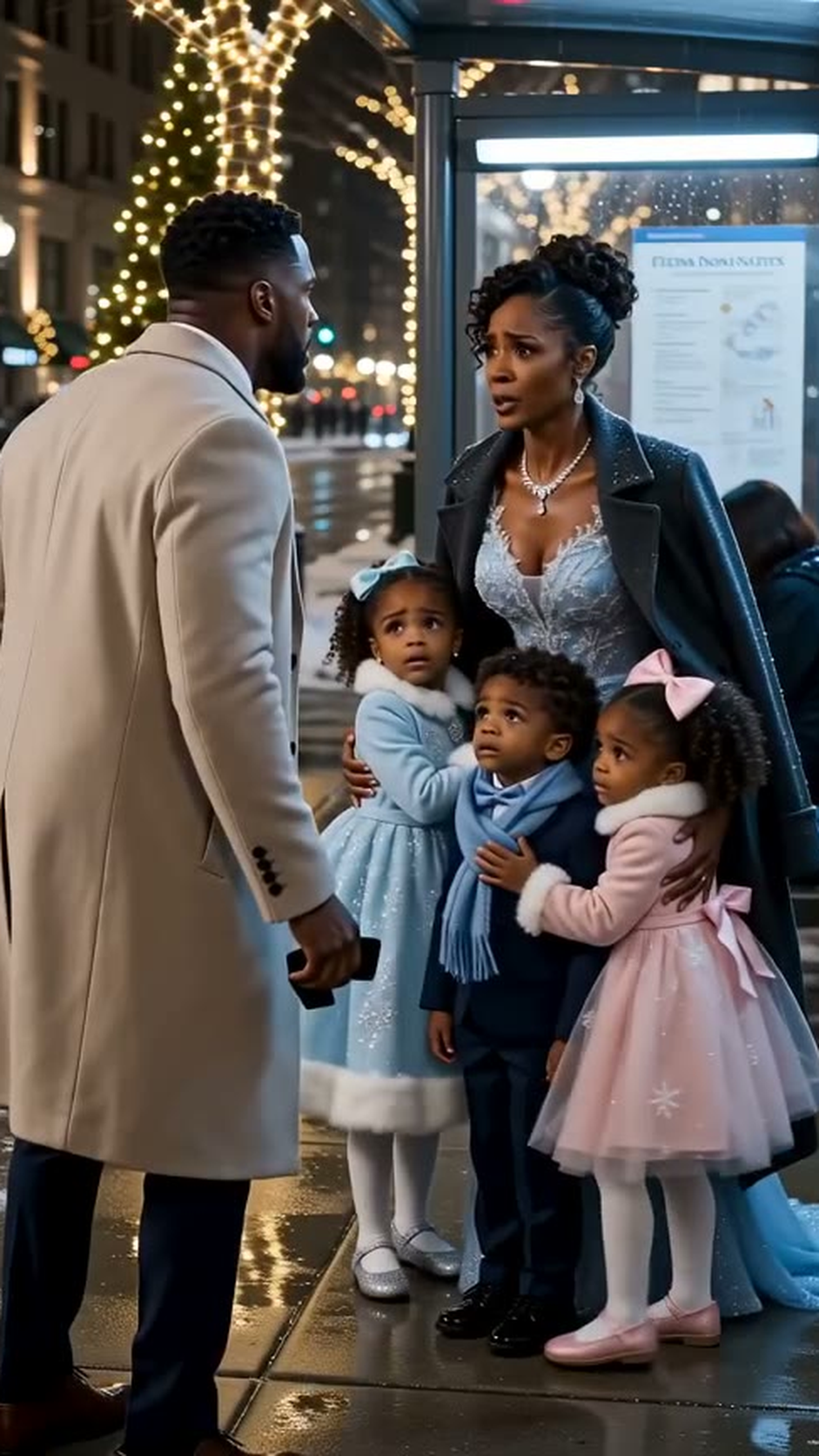
    Across the wet pavement, beneath the decorated bus shelter, stood a woman in a rain-darkened coat thrown over an icy-blue evening gown, one hand gripping the white fur stole at her throat. Grace. His Grace — no. Not his. Not for three years. His ex-wife, with her dark curly hair pinned up the way she used to wear it to galas, diamonds at her throat, and an expression that changed the instant she saw him looking.

    Because she was not alone.

    Three children stood pressed against her, the way small animals press against their mother when thunder gets too close. A girl in a pale-blue dress with white fur trim and a blue bow, clear-eyed and watchful. A girl in pink, half hidden behind Grace's skirt, her small fingers knotted in the fabric. And a boy in a navy suit with a blue scarf, standing a fraction in front of his sisters like a tiny sentry — a boy who tilted his head, studying Ryan, and in that tilt Ryan saw his own gesture so exactly that the breath stopped in his chest.

    The boy had his eyes. Gray-blue. Unmistakable.

    "Grace…?" Ryan barely heard his own voice.

    Every trace of color drained from her face. She moved — not toward him, never toward him — pulling the children in against her body with both arms, turning half-sideways so that her own shoulder stood between Ryan and them, and taking one involuntary step back into the rain.

    He stepped forward without deciding to. "Grace—"

    She flinched. Grace, who had once fallen asleep with her head on his chest through a thunderstorm that knocked out half of Chicago, flinched from him. He stopped as if he had walked into glass.

    His eyes moved over the three small faces. Doing math he did not want to do. "How old are they?"

    Grace swallowed. Her fingers tightened around the children's hands until the boy winced, and she loosened her grip at once, stroking his knuckles in apology.

    "Three," she whispered.

    Three. The word went through Ryan like the cold off the lake. Three years since the divorce. Three years since signatures on paper in a lawyer's office he had not even attended. Three years of a bed too big and a house too quiet and a mother saying, at intervals, that he had been lucky to escape.

    "Are they—" He had to stop and find air. "Are they mine?"

    Grace's breathing stopped with his. She looked at the wet pavement, at the children's wet shoes, at the ring box trembling in his hand — anywhere but at his eyes. One of the girls gripped her dress harder. The boy moved closer against her leg, watching Ryan the way you watch weather coming.

    Ryan reached toward her hand, slowly, the way you reach toward something injured.

    She drew it back. Not in anger. In fear so old it had become reflex.

    Headlights swept the street. A bus came down Michigan Avenue and braked hard beside the shelter, water exploding up from its tires, air brakes sighing, and the sudden noise made all three children jump against Grace. She gathered them toward the opening doors with the swift, practiced efficiency of a woman who had done a thousand departures alone.

    "Grace, wait!" Ryan came forward two steps into the rain. "Please—"

    She turned at the bus steps. Her eyes were wet, and it was not only the rain.

    "I've already lost too much," she said.

    She lifted the children aboard one by one. The boy went last. At the top of the steps he turned and looked back, and for one annihilating second Ryan was not standing on a Chicago street in the rain — he was four years old in his grandmother's hallway, staring out of an old photograph at himself.

    The doors closed. The bus pulled away into the gold and silver blur of the avenue, carrying his whole life with it.

    Ryan stood in the rain until his coat was soaked through. Then he got into his car.

    He did not drive upstairs to the dining room where Amelia Brooks waited in white. He drove after a city bus.

    His phone lit up against the passenger seat, again and again. Amelia: Where are you? Everyone's waiting. He glanced once at the diamond ring still open in its box beside him, then back at the bus's red taillights smearing through the rain on his windshield, and he tightened both hands around the wheel.

    Twenty minutes later, the bus sighed to a stop beneath an illuminated sign, and Ryan's world, which had already cracked, split cleanly in two.

    CHILDREN'S MEDICAL CENTER.

    Grace came down the steps with the children, steadying the little girl in pink when her shoe slipped on the wet pavement, and hurried all three through the glowing glass doors like a woman who had made this journey in the dark many times. Ryan pulled in across the street with his hand gone slack on the wheel. The velvet box slipped from his fingers and struck the passenger seat with a soft, heavy sound he would hear in his sleep for the rest of his life.

    He crossed the street at a run.

    Through the glass entrance he watched Grace lead the children past the information desk, past the elevators, toward a corridor marked with small painted stars — a specialized pediatric treatment wing. She moved with terrible familiarity. One child held her hand tightly. Another looked toward the treatment doors the way other children look toward the deep end of a swimming pool.

    Grace paused at the doors. She turned. Through the glass, through the rain still streaming off Ryan's coat, she saw him standing there.

    Her eyes widened in pure panic.

    "Which one…?" Ryan whispered. He did not know he had spoken aloud. "Grace. Which one?"

    She drew the children against her as the automatic door began to close between them. A nurse appeared beyond the doorway, speaking Grace's first name like an old friend, and Grace looked at the nurse, and then back at Ryan, and her lips parted at last — three years of silence balanced on a single breath.

    "Ryan… there's something you don't—"

    The door closed.

    – – –

    Three years and four months earlier, Grace Mercer had still believed that love was a place you could not be evicted from.

    The end, when it came, did not knock. It arrived as an envelope, hand-delivered to the penthouse on a Tuesday, containing six photographs of Grace in a café on Wabash Avenue, laughing, her face close to a tall man's face, his hand cradling the back of her head. The man was her brother. James Ellis had flown in from Seattle for exactly one day to tell her, face to face and holding both her hands across the table, that his wife was pregnant. Grace had laughed with her forehead against her brother's forehead, the way they had since childhood, and someone across the street with a long lens and a short conscience had turned a sister's joy into an adulteress's evidence.

    She never got to explain. That was the genius of it, she would think later, in the years when thinking was all the company she had. By the time the envelope reached her, it had already reached Ryan's mother. And Eleanor Mercer had been waiting three years of marriage for proof of what she had believed from the first day: that a scholarship girl from the South Side who coordinated charity events for a living had married her son for the name on the buildings.

    Ryan was in London. Ryan was in meetings. Ryan's assistant said Mr. Mercer had asked not to be disturbed. Ryan's assistant said — on the fourth day, in a voice like a closing door — that Mr. Mercer had seen the photographs, that he was "processing them with counsel," and that Mrs. Mercer should direct all communication through the family's attorneys.

    Grace stood in the marble kitchen of the home she had made — his home, the lawyers would shortly clarify — and understood that she had not lost an argument. She had lost the right to be heard.

    The divorce took eleven days. She signed the papers alone at a conference table downtown, in an empty chair beside the one reserved for a husband who did not come, and a lawyer she had never met slid a settlement check across the polished wood with the embarrassed air of a man paying a tradesperson. She left it on the table. She walked out of the building with her maiden name, one suitcase, and a winter coat, into the first snow of November.

    The doorman of the Mercer Grand — the other Mercer Grand, the residential tower two blocks from the law firm, where she and Ryan had lived — held the door for her that evening without recognizing her in her plain coat, and she had ridden the service elevator up one last time, with the super's permission and a thirty-minute limit that had been conveyed to her like a restraining order, to collect what was hers. Thirty minutes for three years. She took her mother's china, wrapped in her own sweaters. She took her books, her sewing machine, the ridiculous ceramic frog Ryan had won her at a county fair in the first summer and hidden, ever afterward, in a new absurd place in the apartment every few months like a private postal service of affection. She found it that last evening in the fruit bowl, wearing a paper crown. She stood in the kitchen holding a ceramic frog in a paper crown, in a home emptied of her name, and she laughed — and the laugh terrified her, because it had an edge on it like a breaking branch.

    She left the frog. That was the thing she would confess to no one, in all the years of telling herself she had taken everything that mattered: she set the frog back in the fruit bowl, exactly where he would find it, crown and all, because some traitor clerk in her heart was still filing things under us.

    On the train to Indianapolis she sat with her suitcase between her knees and her hands folded over a flat, secret stomach, and she composed, and tore up, and composed again, the letter she would eventually write on the penthouse stationery she had taken — accidentally, she would tell herself — from the desk drawer. Ryan — I am writing this because your assistant says you will not take my calls… She had the words by heart before the train crossed the state line. It would be another two weeks before she had the courage of them, and by then she would be standing in a marble lobby, learning what Amelia Brooks's smile meant.

    Seven days later, standing in the bathroom of her cousin's spare room in Indianapolis, Grace stared at a plastic stick and watched two pink lines darken — while a second test, and then a third, laid out on the sink like a firing squad, told her the same impossible thing.

    She went back to Chicago once. Once. She stood in the lobby of Mercer Tower, pregnant and shaking, and asked to see her husband — her ex-husband, she corrected herself to the security guard, whose face changed when he found her name on a list he did not show her. She waited two hours on a marble bench. And then Amelia Brooks came down in the private elevator, in a cream suit, with her hand resting lightly on the guard's desk, and smiled at Grace the way you smile at weather you have personally arranged.

    "Ryan asked me to tell you," Amelia said gently, "that whatever it is, he doesn't want to know. He's moved on, Grace. Let him."

    Grace looked at the elevator doors closing on the life she had built, set both hands over a stomach that had not yet begun to show, and made the vow that would carry her through everything that came after.

    Never again. Not to them. Not for anything.

    She walked out into the snow.

    Four months later, in a small clinic across town from a life she no longer had, an ultrasound technician went quiet over the monitor, then smiled the careful smile of a woman delivering miraculous and terrifying news in the same breath.

    "Grace," she said. "There are three heartbeats."

  • Chapter 7: Morning, This Time Safe

    Chapter 7: Morning, This Time Safe

    Adrian Vale did not count.

    "Ten seconds was always your tell, Blake," he said, standing in the spill of street light with his blood making a small, patient argument on the concrete. "You offer people a clock when you're afraid of the silence. The last time you did it was in a briefing tent in Fallujah, nineteen minutes before a convoy drove into a valley you'd already sold."

    Something moved behind Blake's eyes — the smallest weather. "Poetry," he said. "From a man bleeding in my garage."

    "You noticed the inch you're standing on yet?" Adrian's voice never rose. "The bay door sensors, Blake. I spec'd them. Anything crosses the beam while the door's in motion and it stops dead — safety law. Your men are all behind the door's line but you. You brought her to the one spot in this room where the door—" he smiled faintly, and it was not a kind smile, "—where the door does what I tell it."

    The corrugated door, still rising, stopped.

    Every head in the garage turned toward it for one half-second — every head except Mara's, because Mara Bennett had spent eight months learning exactly how long Blake Rourke's attention lasted when he was contradicted, and she spent that half-second the way Thomas Hale had prayed she would: she dropped. All her weight, all at once, dead and downward, out of the gentle arm, out of the line of fire, the way a dropped thing cannot be held.

    The gun went off where her head had been.

    What happened next happened the way rain arrives — everywhere, all at once, and impossible to say which drop was first. The bay door reversed with a shriek of tortured machinery, slamming downward and cutting the garage off from the street — and from Blake's two drivers — at the exact moment the side door, the staff door, the one door in the townhouse whose lock Adrian had personally installed eleven years ago and whose code he had never once changed because Blake, careful Blake, had never imagined its installer would return, blew open on Thomas Hale and six federal agents in raid jackets with Dana Whitfield's voice riding over all of it like a bell: "FBI! Hands! Everybody show me your hands!"

    Blake fired once more, wildly, at the shape of Adrian in the light — and Adrian, who had spent the entire conversation walking, one unhurried step at a time, toward the only position in that room from which a man could interpose his body between a gun and a girl on the floor, arrived. The second bullet took him high in the chest of his ruined shoulder, spun him half around, and put him down on the concrete beside Mara — between her and everything, one final time — with an expression of mild annoyance, as if a waiter had spilled something.

    He was still conscious. She got that into her memory first, before the shouting and the boots and the zip-ties and Blake Rourke's voice finally, finally rising — the first uncontrolled sound she had ever heard him make, a raw obscenity at the ceiling of his own soundproofed room as Whitfield's people took him to the ground in the oil stains. He was still conscious, and his hand had found her wrist. Not the bruised one. The other one. Carefully.

    "Don't—" she said, wild-eyed, both her hands pressed over his, over the blood, doing arithmetic no one can do, "don't you dare, don't you dare make me the girl who got you—"

    "Signature," Adrian said, with enormous difficulty and something that in a less ruined man would have been humor. "He wanted… your signature. Give it… to Whitfield. Not to him."

    "I will," she said. "I will. Stay."

    "Rug was warmer," he said, and closed his eyes, and — under her hands, unmistakably, undeniably — went on breathing.

    * * *

    The affidavit Blake Rourke had prepared was entered into evidence unsigned, which federal prosecutors later called, in sworn testimony, the single most eloquent document in the case.

    The drive survived the burning of the dress because Blake's man, taking it apart stitch by stitch upstairs, had set the little black drive aside on a silver tray like a cufflink — some instincts of service run deeper than loyalty — and Thomas Hale recovered it from that tray with the townhouse's own tongs, and bagged it, and logged it, in front of six witnesses and two body cameras. Mara authenticated it three days later in a hospital corridor outside Adrian's room, sitting in a wheelchair she did not need because Whitfield insisted, in a robe, with her mother's voice on speakerphone from Columbus saying over and over, baby, baby, you're alive on the television, why are you on the television—

    The indictments, when they came, were the size of a phone book. Three judges. A congressman. A police foundation. A children's hospital in Newark that broke ground, finally, the following spring, with its real money, and Mara stood in the mud in a hard hat too big for her and cried without shame in front of the cameras.

    She testified in June, in a courtroom with flags in the corners and Blake Rourke at a defense table forty feet away, smaller than she remembered — the fluorescent light did that to everyone, Whitfield had warned her; it was doing it to him at last, and it was glorious. He did not look at her. His lawyers objected eleven times during her first hour, and eleven times the judge — a woman who had attended a gala at the Aurelian once, in another life, though Mara was never told — said overruled in the tone of a woman closing windows against weather. Mara described the ledgers. She described the filings, and her initials on them, and the night she started copying. She described an office at twenty minutes to six on a Friday, and a hand on her wrist, gentle as a doctor's, and a voice explaining about wet roads and Ohio — and at the defense table, for the first time in the whole long record of the trial, Blake Rourke's composure moved: not guilt, not remorse, simply the visible annoyance of a man discovering that a corridor he built in the dark had a witness standing in it with the lights on.

    Adrian sat in the third row of the gallery every day, healing shoulder and all, with his hands folded and his fury worn smooth as a stone in a pocket. He had told the prosecutors he would not testify to the ambush — eleven years cold, no proof that would survive cross — and then he had testified to the garage instead: to a man with a gun at a woman's temple, offering choices in a soundproofed room of his own design. It was enough. It was, the prosecutor told Mara in the corridor, the moment the jury stopped being twelve citizens and became twelve people who wanted Blake Rourke to die in prison.

    Before the trial, in the spring, when the worst of it was paperwork and the Marshals had begun to relax into men who drank coffee in her kitchen and complained about parking, she took the train to Columbus with a bodyguard she had finally talked down to a discreet distance of one carriage. Her mother — thinner, tireder, alive in a way that made the whole year realign itself around the fact — held her wrist in both hands on the hospital steps and turned it over in the sunlight, hunting for marks that were no longer there, and said: "You look like a woman whose life started. Whatever it was, baby. It started."

    On the train back she slept — actually slept, the whole rattling way, with her cheek against the cold window and the bodyguard pretending not to watch her do it — and woke only when the conductor called Penn Station, and lay a moment in the blue dusk of the carriage doing the inventory Thomas had taught her: doors, hands, pulse. Hers. Slow and ordinary and hers. She had forgotten, for whole minutes at a time on her mother's porch, to do it at all.

    Blake Rourke did not get a wet road. He got something he would have considered far worse: time, in fluorescent light, in a place where his money was a rumor and his voice persuaded no one, and the careful, patient machinery of the federal courts doing to his empire, line by line, ledger by ledger, what Mara had once done alone at night with a thumbnail of black plastic.

    She signed something that first night after all — but it was hers.

    In the surgical waiting room at Lenox Hill, at four in the morning, with Adrian's blood dried under her fingernails and a borrowed Aurelian blanket around her shoulders that she could not stop clutching at like the gray one from the rug, Dana Whitfield set a statement on the scarred table between them. Not Blake's. Hers. Six pages, typed from her own recorded words in the ambulance bay, naming the ledgers, the drive, the foundation, the wrist — especially the wrist; Whitfield had photographed it herself, with a scale card, like evidence, which was what it was. "Read it word for word," the agent said, and smiled her tired, gray-suited smile. "Take all the time in the world."

    Mara read it word for word. Then she picked up the pen, and where Blake Rourke's document had waited for her to recant, she wrote her name instead to authenticate — and understood, as the ink dried, that a signature was only ever a weapon; it had simply never before been loaded in her hand.

    "One more thing," Whitfield said, as the surgeons' doors swung at last and a doctor came out pulling down his mask with the particular slowness of good news. "The clerk. Eddie. Your storm-shift boy from the front desk." Mara's heart stopped, and restarted on the next words: "Alive. They had him in a motel room off the Van Wyck — they'd pulled the encode log within the hour, and they wanted to know where the card took you, and he spent two days honestly unable to tell them, which is the only reason he's breathing. He'll testify to all of it. He asked if the lady in 412 was all right, by the way. We told him there never was a lady in 412."

    Adrian Vale took eleven weeks to mend, and was insufferable for nine of them, and on a morning in early June — rain long past, the city gold and ordinary and washed clean — Mara woke in the Aurelian penthouse in the great white bed she had once been too frightened to touch, in a charcoal T-shirt she now owned by right of conquest, and found him standing near the windows with two cups of coffee, watching her wake as if she were weather he had every intention of keeping.

    "You're staring," she said.

    "I'm inventorying," Adrian said. "It's a hotelier's vice."

    She sat up. The blanket was nowhere near her hands. Her wrist, in the sunlight, was entirely her own again — pale, unmarked, forgotten by the skin. On the rug beside the bed, absurdly, someone — Thomas, she suspected, Thomas with his housekeeper's stitches and his granite heart — had left her old black ankle boots, cleaned and polished and standing together like two small patient dogs.

    "There's something I never asked you," she said. "That first morning. You could have thrown me out. Eddie, the police, a quiet word and I vanish from your hotel and your life. Every sensible instinct you own said to. Why didn't you?"

    Adrian considered the question with the gravity he gave to all questions, which was one of the things she loved about him — had come, carefully and then not carefully at all, to love about him.

    "Because you slept on the rug," he said at last. "Fifty-eight floors of the most expensive shelter in New York, and you were too honest to take the bed. I'd been looking for an honest witness for eleven years, Mara. You were asleep in front of me the whole time."

    He crossed the room and set her coffee on the bedside table, and she caught his wrist — gently, never hard, the way they did everything now — and held it, thumb resting, deliberately, on the pulse.

    "Is this the right room this time?" she asked.

    "This," Adrian Vale said, "is the only room. Don't ever leave."

    THE END

  • Chapter 6: The Exchange

    Chapter 6: The Exchange

    Mara woke up in a room with no windows, in a chair that cost more than her car, with her hands free.

    That was the worst part. Blake Rourke had never needed restraints with her; he had run her entire life that way, her whole life had been the restraint — the salary, the signature, her mother's bills arriving like tides. The room was an office below street level in a townhouse on East 67th Street, leather and walnut and a wet bar built into the wall, and it was soundproofed with the care of men who had once done government work in rooms exactly like it. He told her the address himself, pleasantly, when she opened her eyes. Men who intended you to leave a place alive did not tell you where it was.

    "Mara." He was sitting across the desk with his sleeves folded back, precise as a surgeon, her borrowed evening bag — empty, searched, discarded — on the blotter beside a document in a blue legal jacket and a fountain pen. "You look like a drowned cat. Rude of them, back there. I did specify gentle."

    "The drive," she said. Her mouth tasted of pennies and chemicals. "They didn't find it."

    "No," Blake agreed. "Your hotelier sewed it into your dress, how gallant, and my people are at this moment taking that dress apart stitch by stitch in the room upstairs. So that's merely a matter of time. What is not in the dress, and what only you can give me, is this." He turned the legal jacket around and slid it across the desk. "Your statement. Given freely, signed before witnesses of standing — mine, but standing is standing — that you fabricated the copies in a fit of romantic obsession with your employer, that you resigned in disgrace, that you recant entirely. Signed, dated, and then a nice long video of you reading it aloud, looking healthy and calm and very, very sorry. And in exchange—" he folded his hands, and his voice went soft with what, in another man, might have been mercy, "—in exchange your mother gets a private room and the best oncologist in Columbus for as long as she needs one, anonymously funded, forever. And you get a little apartment in Lisbon, and a name that isn't yours, and a grave nobody digs."

    "And if I don't sign?"

    "Then we start the long way," Blake said, "and the long way still ends in your signature, Mara. It just ends with you begging to be allowed to give it." He said it without pleasure, the way a man discusses weather he has personally scheduled.

    "You think I enjoy the arithmetic of you," Blake said, and sighed, and for a moment — horribly — she could see the employer she had almost liked, the man who asked after her mother, who had once, at the office Christmas party, stood between her and a drunk donor with one courteous hand and said the lady is leaving. "Eight months I invested in you. The apartment deposit I quietly covered. The schedule arranged around your mother's appointments — did you think that was the agency's kindness? That was me. I was building you a life with my name on every wall of it, so that when the day came, you'd understand there was no version of you that didn't pass through me. And instead—" he gestured, mildly, at the affidavit, the room, the whole subterranean architecture of her capture, "—you steal from me, and you run, and you hide in the bed of the one man in this city vain enough to think he can shelter you. Do you know what Adrian Vale is, under the hotels? He's a monument to a dead boy. He'll spend you, Mara. He spends everyone. It's his one talent. When his war is fed, you'll be a paragraph in it."

    She had read the same paragraph of the affidavit four times. Her eyes would not keep the words; they kept sliding to the signature line, black and patient, and to the pen in his pocket, and to the door she could not see behind her.

    "And my mother?" she heard herself ask. "In your version. The Lisbon version. Does she ever know?"

    "She knows her daughter works abroad and sends money and can't come home at Christmas because of the project. She dies believing she was loved by a successful woman." He said it gently. It was the cruelest thing in the room — crueller than the long way, crueller than any threat — because it was, she understood with a chill that went to her spine, almost certainly true, and he had plainly practiced the mercy of it. "Sign, little bird. You were always going to. The only question you've ever really had is how much it costs you to arrive."

    She picked up the blue jacket with both hands, slowly, like something that might be hot. "Then I want to read it properly," she said. "Word for word. If my name is going on it, I want—" her voice shook, and she let it shake, because the shaking was real and because Blake trusted real things, "—I want to know what I'm saying. Every word. It'll take a while."

    "Take all the time in the world," Blake said, and settled back, and smiled, and did not notice that she had just spent his most precious asset — because men who believe they own time never hear it leaving. "You're careful. I told you Friday — careful people survive. Be careful now. Read it. Take your time. There's water."

    On her second pass through the affidavit she began, very slightly, to cheat. A word at a time was too slow even for Blake's patience, so she invented difficulties: the legal phrasing confused her; her head still swam from the cloth; could it be read aloud to her? No — Blake was too careful to voice his own forgery. She asked instead for light, for the desk lamp angled, for her bag — "my pills, I'm supposed to—" — and Blake, watching her assemble her little scaffold of delays with the mild interest of a man watching weather form over a city he owns, said: "Your bag is empty, Mara. Your dress is being unpicked. Your pills are in a tray upstairs. Everything you were is already in this building's custody. There is only the paper left that isn't." And yet he let the lamp be angled. He let the water come. Men who believe a conclusion is inevitable will always fund its approach, and so the minutes accumulated like coins in a fountain, and somewhere in the accumulating she understood the strangest thing: she was no longer only stalling for rescue. She was stalling because arriving at the signature line meant arriving at the place where the woman she had been for eight months would have signed — and she needed those minutes to make quite sure that woman was dead.

    She read it. She took her time — all the time there was; Adrian had not taught her much in two days, but Thomas, stitching a drive into her dress with a housekeeper's needle, had said one thing: the only weapon a taken person has is delay, because delay is the sound of people coming. She read the affidavit twice. She asked for the water. She asked, in a trembling voice that was only half acting, whether she could see her mother once more before Lisbon. She asked how the oncologist would be paid, and made him explain, and asked about the apartment, and the name, and whether the video would hurt her mother if she ever saw it.

    And above them, faint through the soundproofing like a heartbeat through a wall, the townhouse began to change its sounds — a door, somewhere; a voice, cut off; the particular hush of staff being sent away.

    Blake heard it too. His head came up. The pen stopped its small rotation between his fingers.

    The phone on the desk lit. He looked at the screen and his face did something Mara had never seen it do in eight months: it lost its arrangements. "What do you mean, gone?" he said. "He was under guard at his own—" A pause. "The shoulder was superficial? Then where—"

    He stood up. For the first time since she had known him, Blake Rourke moved quickly, and it was like watching a statue decide to be a man: terrifying. "Upstairs is finished?" he said into the phone. "Then burn the dress. Burn it — I don't care what they find in the ashes." He set the phone down with exaggerated care, and smiled at her with all the warmth of a man stepping over something, and said: "Your hotelier is a romantic, Mara. Wounded, outnumbered, legally radioactive — and coming anyway. Eleven years and he still thinks with his heart. It's why he lost the war."

    "He's coming here?" Her voice went small with a hope so painful she tried to hide it and failed.

    "He's coming here," Blake said, "because I am going to let him, and because you are going to sign that paper in front of him, so that when it's over he understands it was your choice. Everything you've survived, little bird — the ledgers, the rain, his rug — was a corridor to this desk. Stand up."

    Eleven blocks away, a black Aurelian town car was doing fifty through wet streets with its lights off, and Thomas Hale was saying, for the third time, "The hospital, sir," in the tone of a man filing a protest for the record.

    "The townhouse," Adrian said. His shoulder had been packed and dressed by the hotel's own doctor in the manager's office, against every protocol the man owned; the dressing was already going dark at the edges, and Adrian's face had the waxen, distant look of a body spending money it did not have. "East 67th. He won't take her anywhere he doesn't control absolutely, and he only controls three rooms in this city absolutely. Two are watched by Whitfield's people as of an hour ago. The third I built for him."

    "And if he isn't there?"

    "Then he's at the lake house, and we're two hours behind, and she is lost, and I'll know it standing in that garage instead of wondering it in a corridor. Drive."

    Thomas drove. At a red light he said, without looking away from the road, "The room has one flaw, sir. You told me once. I never asked what it was."

    "The bay door," Adrian said. "And the staff door's lock code, which Blake never changed, because Blake believes the past is a country that can't invade him." His eyes were on the rain and the passing streets, and his voice, when it came, was quieter than the engine. "He took her out of my hotel, Thomas. Out of my hands. In front of my guests. If your protest is noted, old friend — and it is, and it's the last one the record can hold — then just get me to that street."

    The garage was under the townhouse, lit like an operating theater, smelling of cold concrete and money: three black cars, a workbench, a loading bay with a corrugated door. Blake's men brought her down between them, gently, Blake behind with the affidavit in a folder under his arm and the fountain pen in his breast pocket like a medal. The middle car stood with its rear door open and its engine running.

    The corrugated door began to rise before anyone touched it.

    It rose on the figure of a man standing alone in the wet street light of East 67th Street with his ruined shoulder bound in a field dressing already bleeding through, his suit coat gone, his white shirt brilliant with it, his hands empty and open at his sides — no weapon, no men, nothing but eleven years arriving all at once in a single body.

    Adrian Vale walked into the garage as if he owned it, which, in every way that mattered, he once had.

    "I built this room, Blake," he said conversationally, bleeding on the concrete. "Second firm we ever signed. Soundproofing, the bay door, the sight lines. I know every inch of it." His eyes found Mara's, and held, and she would remember that look on her worst nights for the rest of her life: steady, unhurried, utterly unafraid. "Including the inch you're standing on."

    Blake's arm came around her from behind — gently, never hard, the way he did everything — and the gun that appeared at her temple was almost an afterthought, a punctuation mark.

    "Choose, old friend," Blake Rourke said, peacefully, over her head. "Her signature on my paper, and she lives — or your war, and her funeral. You have ten seconds. You always did count well. Start."

  • Chapter 5: The Fire Alarm

    Chapter 5: The Fire Alarm

    The Aurelian's anniversary gala was, by design, the safest room in New York.

    Four hundred guests in black tie. Two senators. The entire federal bench of the Southern District, laughing with champagne in their hands. Sixteen cameras, three of them live. Dana Whitfield at table four in a gown the color of gunmetal, an earpiece disguised as an earring, and — nobody at the Rourke Foundation table knew — a federal evidence bag already riding in the beaded clutch of the woman beside her.

    The dress had come at six o'clock, on a rail, with a woman from the hotel's alterations room who fitted it to her in the penthouse bathroom with pins in her mouth and no curiosity in her face whatsoever. Midnight blue. Long enough to hide the fact that her legs would not stop trembling for the first half hour she wore it.

    "The trick," Thomas said, stitching the drive into the bodice seam with small, furious, perfect stitches, "is that there is no trick. You are the owner's guest. You have been the owner's guest all weekend, if anyone asks — a friend of the family, in from Chicago, grieving a divorce, allergic to photographers. He collects strays, the owner. Everybody in that room knows it. It's the best cover story in New York because it's half true."

    "And if he speaks to me?" Her voice sounded like someone else's. "Blake. If he just — walks up, in front of everyone—"

    "Then he's a man greeting a pretty stranger at a party, and you're a woman who has never seen him before in her life, and you say so, pleasantly, and you look for me. I will be —" a minute adjustment of an earpiece, invisible under the fall of his hair, "— twelve feet away, pretending to supervise the wine. Miss Bennett." The needle stilled. Thomas Hale looked up at her, and the granite face did something it had plainly not practiced. "I have put three owners' wives, two ambassadors, and a cardinal through rooms worse than this one. You have one job. Walk thirty yards. Everything else in that ballroom tonight is my job, and his."

    Downstairs, the ballroom received her like a held breath let out slowly. The Aurelian's anniversary gala was fifty years of money made visible: a ceiling drowned in crystal, a string quartet sawing bravely at the edge of four hundred conversations, the air itself gilded. From her alcove behind the service curtain — Thomas's position for her, close to Whitfield's table, out of the traffic lanes — Mara watched the room assemble its power the way her father used to assemble a ledger, line by blazing line. The senators arrived. The judges arrived. A congressman whose name she knew from Blake's books arrived laughing, with his hand in the small of his wife's back, and she felt the drive against her heart like a second, colder heartbeat, and thought: you washed a children's hospital, and tonight a woman you've never met is going to stand up in front of God and the Southern District and give me to the FBI, and there is nothing in this world you can do about it.

    Behind the curtain the air was warmer and smelled of beeswax and other people's perfume, and the quartet's music arrived thinned to a shimmer. Mara counted, the way Thomas had taught her in the car: doors, cameras, distances. Exit behind the bar. Exit past the kitchens. Four yards of open floor between her alcove and the first table, then thirty of marble with every eye in New York laid over it like a net. Her mouth was dry. She pressed the drive flat against her ribs through the bodice and made her shoulders remember how a guest stands — loose, bored, belonging — and waited.

    Then the Rourke table filled, at the far side of the floor, with a view of the stage.

    He was in black tie, of course. He was beautiful, of course. He laughed at something his neighbor said and touched the man's sleeve in gratitude, and even across sixty feet of candlelight she could feel the old weather of him, the climate she had lived in for eight months — and her hands, under the curtain's edge, had begun their treasonous shaking again when a waiter materialized at her elbow with a single glass of champagne on a silver tray.

    She had not ordered champagne.

    "The gentleman at table ten, miss," the waiter said, with the perfect, trained blankness of Aurelian staff, "sends it with his compliments, and asks if you are enjoying your evening in New York." Under the glass, folded once, was a card.

    She knew the handwriting before she opened it. She had filed that handwriting for eight months; she had watched it sign the deaths of hospitals.

    TO OLD SIGNATURES, it said. — B.

    The glass did not fall. She would be proud of that later, in the hospital, in the years of telling it: the glass did not fall, and she did not run, and she did not scream. She set the champagne down, very carefully, on the tray of the frozen waiter, and she looked up across the ballroom and found Blake Rourke's eyes already on her — unhurried, amused, intimate as a hand at a wrist — and he raised his own glass to her, an inch, a benediction, and drank.

    Adrian saw it. She knew the exact moment he saw it, because the whole trajectory of the room changed: mid-ballroom, mid-stride toward table four, the owner of the Aurelian turned — smoothly, socially, a host greeting a guest — and began instead to cross toward her alcove, with Dana Whitfield rising unhurriedly from table four in the same motion, gown like gunmetal, clutch in hand, the two of them converging on Mara with the beautiful, lethal casualness of people who have rehearsed being casual with their lives.

    It was going to work anyway. That was the last clear thought she had. He has shown his hand too early, he has panicked, it's going to work anyway—

    He never got there.

    The fire alarm did not scream. In a hotel like the Aurelian it never screamed; it spoke, in a calm recorded voice, from everywhere at once. Attention, please. A situation has been detected on the service floor. Please proceed in an orderly fashion to the nearest exit. Attention, please—

    And four hundred of the most powerful people in New York rose from their chairs at exactly the moment when every eye in the room — every senator, every judge, every camera — turned from the stage to the doors.

    Blake Rourke had not bought a table to be seen. He had bought it to be counted. Ten men, in a room where no one could move against him while the room was watching — and in the one minute of engineered confusion when the room stopped watching, his men were simply waiters, simply valets, simply staff, flowing with the crowd and against it at once.

    "Service corridor, now," Thomas said in her ear, and his hand closed on her elbow — not the bruised wrist, she noticed even then; Thomas had remembered — and the curtain swallowed them into the fluorescent underworld of the hotel: steam, linen, stacked silver, the roar of the kitchen emptying. Doors banged. Somewhere a woman was crying theatrically. The recorded voice went on being calm above them like the voice of a god who did not care.

    The corridor ran the wrong way almost at once. Ahead of them, a linen cart lay overturned across the passage in a drift of white napkins — an accident, exactly the kind of accident four hundred evacuating guests make, except that the two stewards standing over it were not helping anyone up, and their eyes came to Mara and stayed there, and Thomas's hand shifted on her elbow from guidance to propulsion without his stride changing at all.

    "Keep walking," he said, in the voice of a man discussing the wine list. "Eyes on my shoulder. Whatever happens, eyes on my shoulder."

    What happened was quiet. The first steward reached for her arm as they passed the cart and found, instead of the arm, Thomas Hale — there was a soft, dense sound, like a book dropped on carpet, and the steward was sitting down among the napkins with a wondering expression and one hand pressed to his own throat, and the second steward had stepped back with both palms raised in the universal grammar of men recalculating, and Thomas was already moving her past them, unhurried, inexorable, the way weather moves a boat.

    "Twelve feet," he murmured. "I told the owner twelve feet. He'll want a word about the wine service."

    The secure stairwell door was at the corridor's end, green-lit, stenciled with a running man. Thomas put his hand flat to its bar — and stopped. Through the steel, faint and unmistakable, came the rattle of a chain. The door had been locked from the other side. Chained. From inside the stairwell itself, by someone who had done it before the alarm ever sounded.

    Thomas looked at the chained door for exactly one second, and Mara watched a whole architecture of plans fall and rebuild itself behind his eyes. "Back," he said. "Kitchen line. There's a freight lift behind the pastry section that doesn't exist on any plan the gala office prints. Move, Miss Bennett — now we run."

    They were forty feet from the kitchen doors when the lights went out.

    Not the whole hotel — Blake was too good for the whole hotel. Just the corridor. Just enough dark, for just long enough, and in that dark Thomas's hand was knocked away from her elbow by something that moved like a trained thing, and hands — two sets, professional, impersonal — caught Mara under the arms and bore her backward through a swinging door before she had finished drawing the breath to scream.

    The door she had been dragged through was the kitchen service door.

    The one on Blake's floor plan. The one annotated in a beautiful hand.

    Stage two.

    She fought — she was done being inventory; she fought with her nails and her whole weight and the borrowed heels — and got exactly one scream out, one, before a hand clamped down over her mouth, gentle and absolute, the way Blake did everything: never hard in the moment. She heard Thomas shout her name somewhere behind a wall of dark. She heard the distinctive, horrid, intimate sound of a service elevator arriving.

    And then the corridor lights came back up — and Adrian Vale came through the kitchen doors with two of his own men at a dead run, eleven years of patience burned off him like fog off a road, and arrived four seconds too late at a set of closing brass doors, and saw her — saw her face over a stranger's shoulder, her eyes locked on his, the bodice seam already tearing under her fingers where she was fighting to reach the drive and throw it, throw it anywhere, to him—

    The man holding her shifted. Something in his other hand rose toward her throat — not a knife. A cloth. White, folded, sweet-smelling even through terror.

    The last thing Mara Bennett saw before the chemical dark took her was Adrian Vale's hand striking the closing doors hard enough to dent the brass — and the red wound blooming, sudden and appalling, across the white of his shirt where the edge of a shattered kitchen glass, kicked up in the struggle, had opened his shoulder to the bone as he'd lunged — and his voice, the first time she had ever heard it raised, tearing the corridor in half:

    "MARAA—"

    Through the narrowing gap she saw the rest of it in pieces, the way the drowning see the shore: Thomas coming through the smoke of the kitchen with blood on his cuff and something in his hand she did not let herself identify, already too late and not slowing down; a woman screaming steadily in the ballroom doorway; Whitfield — she would learn this later, and hold it like a coal — standing on a gala chair in her gunmetal gown with her phone at her ear and her other hand raised, pointing, directing federal attention toward the corridor like a conductor who had been waiting all evening for exactly this movement of the music; and Adrian's face, last of all, white with pain and something older than pain, his mouth forming her name again soundlessly as the doors met.

    The doors closed on it like a mouth.

  • Chapter 4: What Mara Carried

    Chapter 4: What Mara Carried

    They found the tracker inside her handbag at midnight, in the seam beside the drive.

    It had been there — Thomas peeled back the lining with a razor, working under a lamp in the penthouse kitchen while Mara watched her own bag come apart like a patient on a table — since the foundation's donor dinner in September, by Thomas's estimate. A wafer of a thing, flat as a coin, patient as a tick. It was how her phone had been reached through a dead battery: not the phone at all, but a spoofed relay, a stage trick, Blake buying her terror wholesale. The message had been sent to teach her that walls were fiction.

    It had taught Adrian something else. It had taught him she had been followed to Grand Central on her practice runs for two months, which meant the Monday meeting was already a grave, and Agent Whitfield had likely been watched as carefully as a church.

    "You were never his assistant," Thomas said, almost gently, closing the lining. "You were his inventory."

    Mara sat on the kitchen stool in the charcoal T-shirt, her wrist bare and violet-black in the lamplight, and did the thing she had sworn she would not do in this man's house. She told them the rest of it. All of it. The drive. The ledgers. The children's hospital in Newark that existed as a ribbon-cutting photograph and a hole in the ground. The scholarship money arriving like weather and vanishing like it. The names — oh, God, the names, she said, and her voice stayed so steady it shamed her: three judges, a congressman, a police foundation, all washing their money clean through dying children's names, and every transaction logged in Blake Rourke's beautiful, airless books, and copies of eight months of it riding in a thumbnail of black plastic that she had stolen line by line, night by night, from the office she was about to flee, months before she had understood she was fleeing.

    "Why?" Adrian asked. He had not sat down in an hour. He stood with his back to the rain-streaked windows, and in the strange inversion of the penthouse's quiet she understood that this was his version of agitation: absolute stillness, absolute attention. "You had no way out. You had a mother in hospital in Ohio and a salary keeping her alive. Why steal it?"

    "Because one day someone was going to open those books," she said, "and my initials are on the filings. MM. Every page. He didn't keep me because I was useful, Mr. Vale. He kept me because I was the signature. When it fell — and it was always going to fall — I was going to be the one who went to prison for it, and he was going to send flowers to my mother."

    He did not answer that at once. Instead he did something stranger than any interrogation: he fed her. A trolley came up in the service lift — Thomas's doing, silent as weather — with soup and bread and poached fish and a bottle of mineral water sweating in a silver bucket, and Adrian Vale, billionaire, ex-soldier, the most feared landlord in Manhattan, laid two places at the penthouse's dining table with his own hands and held her chair. Her wrist, when she reached for the water, shook hard enough to ring the glass against the bottle, and without a word he took a linen napkin, folded ice into it from the bucket, and set it beside her plate. She pressed it to the bruise and hated how grateful she was, and ate because he had told her to and because it was the first food in two days that did not taste of fear.

    "You asked what I hadn't told you," he said, when the soup was gone. "So. The accountant's name was Sorensen. He'd kept Blake's offshore books for nine years — the real ones, not your foundation's; even Blake compartmentalizes. In the spring of the year before last, Sorensen's conscience or his terror got the better of him, and he came to me through Whitfield with a proposal: his ledgers for immunity and a new face. Three days before he was due to give his deposition, his boat went out of Sag Harbor in flat calm and came back without him. The coroner said misadventure. His widow got a settlement from an anonymous donor within the month — generous, immediate, and conditional on her never asking a single question, ever, in writing." He turned his wine glass a quarter-turn on the tablecloth, precisely, the only tell she had yet found in him. "Blake doesn't leave evidence, Mara. He leaves widows, and paperwork, and people like you — signatures. Daniel—" He stopped.

    "Your brother," she said quietly.

    "Daniel was twenty-six and believed the firm was a shield we held up in front of other people's children. He was on the lead vehicle in that valley because I put him there, because Blake swore the route was clean, because in those days I still thought Blake Rourke's word was a country you could stand on." The glass stilled. "At the funeral, Blake carried the coffin with me. Shoulder to shoulder. He wept. I have had eleven years to decide whether the weeping was real, and I have concluded it was — that's the thing nobody warns you about men like him. The grief is real. The love is real. It changes nothing. He'd do it again tomorrow and weep again, and mean both."

    The ice had melted through the linen onto her wrist, cold and clean. "Why are you telling me this?"

    "Because tomorrow night I am going to ask you to walk across a ballroom full of his friends carrying the one thing that can bury him, and you should know exactly whose war you're walking into." His eyes came up to hers, blue-gray and unguarded for once, and tired in a way that made him look suddenly like a man and not a monument. "It isn't only yours. It may not even mostly be yours. If you want to hate me for that, hate me accurately."

    She thought about her own road here: the temp agency, the first month when Blake had been charming — God, he had been charming; he had learned her coffee order and her mother's name and asked about the hospital with exactly the right weight of concern, and she understood now that he had been doing to her what a locksmith does to a lock in the weeks before a burglary: learning it, fondly, by touch. "I don't hate you," she said, and was surprised to find it was true. "I started at the foundation because the money was good and my mother was dying in installments, and I stayed eight months because leaving felt like accusing myself. You stayed eleven years for a brother. At least yours is a better reason."

    Something crossed his face then that she could not name and did not try to. He reached across the table — slowly, telegraphing it, giving her every chance to move — and turned her wrist, gently, to look at the fading map of another man's fingers in the lamplight, and his jaw did the thing it had done the first night, over the rug.

    "He put his hand on my witness," Adrian Vale said, almost to himself. "In my city. Personal, then. Good. I prefer it personal."

    She used his name for the first time that night — Adrian — because somewhere between the soup and the ice he had claimed it for her: not Mr. Vale, not in this house, not after tonight.

    After dinner, he filled in the architecture around the grief — the case he had been building like a man laying a fuse for eleven years: shell companies of Blake's traced through four countries, a map of laundries and law firms, two full federal investigations that had died quietly of leaks, because Blake's money reached into the bureaus themselves, into the very offices Mara had planned to walk her drive into on Monday morning.

    "The ledgers alone aren't enough," he said. "They're copies. His lawyers would call them fabrications from a disgruntled girl, and half the men in them own the courts they'd be read in. But your drive isn't just copies, is it? Whitfield told me, the day she gave you her card—"

    Mara stared. "You know Agent Whitfield?"

    "Dana Whitfield has been my contact for six years," Adrian said. "I built half her case against your employer. What neither of us ever had was someone inside the books — someone whose initials are on the filings, willing to authenticate them in open court. A witness." His eyes did not leave hers. "That's the thing you carried out of that office, Mara. Not the drive. You. The drive dies without you standing next to it saying yes, I took this, yes, it's real. Which is why he will not simply kill you. Not until he's frightened you into recanting, on paper, in front of witnesses of his choosing — and then, yes. On a wet road. Driving home to Ohio."

    The rain had started again. She could hear it finding the windows, patient as the tracker, patient as Blake.

    "There's a way to end it in one move," Adrian said. "The gala. Tomorrow night, this hotel fills with four hundred people, two senators, half the federal bench of the Southern District, and every camera in New York society media. Whitfield attends as my guest — she has every year. You will walk the drive to her across my ballroom, in front of all of them, and authenticate the transfer on the gala livestream microphone if we have to. Blake cannot touch you in that room. No one on earth can touch you in that room and survive it politically. It's a fortress made of witnesses."

    "And tonight?"

    "Tonight you sleep in the bed," Adrian said, immovable as furniture, "with the door locked from inside, and Thomas outside it, and me across the hall. The rug was fine for a fugitive. You're not one anymore. You're a state witness who happens to be my guest." Something moved in his face that she had not seen there before, and she understood, with a small shock, that it might be the beginning of respect. "Wash your face. Eat something. Tomorrow we kill him with paperwork, Mara Bennett. It's the only way men like him actually die."

    They rehearsed it twice before midnight, walking the ballroom floor plan on the penthouse dining table with chess pieces for people: the silver king for Whitfield, a black knight for Blake's table, Mara's own piece a white pawn that Adrian moved with two fingers and terrible gentleness from alcove to table four. Thirty yards. A quartet playing. Sixteen cameras. If anything felt wrong — anything, a face, a waiter, a smell — she was to say the word saffron to any member of staff and go to ground in the ladies' retiring room, whose door Thomas's people would be inside of, and let the evening end without her.

    "And afterward?" she asked, when the pieces stood still at last. "After I've said yes, it's real into a microphone in front of half of Manhattan. What happens to a witness, Adrian? The truth. You've been accurate with me so far. Stay accurate."

    "You get protection," he said. "A new city if you want one. A Marshal with a kind face and a gun. Your mother moved somewhere with better doctors and no forwarding address for anyone but you. It will be lonely, and it will be frightening, and it will end — that's what no one tells you, Mara. It ends. Cases close. Men like Blake die in fluorescent light with their empires sold for parts, and one day a Marshal shakes your hand and you walk out of the far side of it with your own name back in your mouth." The white pawn stood between his fingers. "You get your life back. That's the entire point of the exercise. It was always the entire point."

    "Promise me the ending," she said, surprising them both. "Not the middle. I know the middle is yours to lose. Promise me the ending exists."

    "It exists," Adrian Vale said. "I'll be standing in it. That's the most honest collateral I own."

    She almost believed him. She lay down that night in the great white bed like a child in a cathedral and slept, incredibly, with her hand curled open on the pillow and no blanket clutched to her chest at all — and downstairs, at the Aurelian's gala office, an events coordinator named Priya was updating the final printed guest list with a name that had just purchased a table for ten, at the highest tier, with a note requesting seating where he could see the stage.

    BLAKE ROURKE + 9.

    And in the attaché case beside his suite door in 3901, among other careful things, lay a printed floor plan of the Aurelian ballroom — service corridors marked in red, exits circled, and one door, the kitchen service door, annotated in a beautiful hand with two words:

    STAGE TWO.

  • Chapter 3: The Man Downstairs

    Chapter 3: The Man Downstairs

    "You should know," Adrian said, in the private elevator going down, "that Blake and I have history."

    They were descending to his office on the fortieth floor — not the lobby, never the lobby; Thomas had been clear that the lobby was a stage and Blake was already standing on it. Mara had been given her own clothes back, dried and pressed by a housekeeper who asked no questions, and a pair of hotel shoes, and a warning: stay in the office annex, stay away from the glass, and if anyone she did not know spoke her name, she was to walk — not run — to the nearest staff door and keep walking.

    The elevator hummed. Adrian stood with his hands loose at his sides, watching the floor numbers fall.

    "Eleven years ago," he said, "Blake Rourke and I owned a security firm together. Convoy protection, close protection, the kind of work where trust is not a metaphor. His men, my men. We were…" He searched for the word with visible distaste for all the available ones. "Brothers. That's the word people used."

    "What happened?"

    "An ambush outside Fallujah that should not have been possible, on a route only four people knew." The numbers fell. "Two of the four were me and Blake. Fourteen men died. My brother Daniel was fifteen."

    The elevator doors opened onto a corridor of smoked glass and silence, and Adrian walked out of it as if he had been discussing the weather, and Mara understood that he had told her the most expensive thing he owned — the truth about himself — in forty floors, flatly, because there was no time to do it any other way.

    Blake Rourke arrived at the fortieth floor at eleven o'clock exactly, announced by phone, preceded by flowers.

    The flowers were for the hotel — a towering arrangement of white lilies for the lobby, with a card congratulating the Aurelian on its anniversary gala. The man himself came up in the public elevator with one aide and empty hands and a smile that had closed deals and countries, and Adrian received him in the glass office with coffee neither of them drank, while Mara, in the annex behind one-way glass, sat in the dark with Thomas and watched the man who had marked her wrist drink in the smell of a room like a wolf tasting wind.

    From the security office, four floors of cameras bloomed across the wall in grids. Thomas had her on the smallest screen — the annex — and Blake on the largest. She could hear every word through the feed.

    "Adrian." Blake embraced the air near him, hands spread, a performance of warmth for an audience of one. "God, it's good to see you. I keep meaning to come and then the years — you look exactly the same. It's obscene."

    "Blake." Adrian did not rise. "You look expensive."

    Blake laughed and sat, uninvited, and crossed one long leg over the other and began, in the tone of a man doing an old friend a favor, to talk about the gala. About a table. About acquiring — his word, acquiring — a minority interest in the Aurelian group, a merger of their "complementary worlds." He talked for six minutes. It was beautifully done. Under the beauty of it ran a wire of something else, and Mara, who had taken his dictation for eight months, could hear what Adrian perhaps could not: every sentence was a hand patting the pockets of the room.

    "Staff treating you well?" Blake asked, turning a coffee spoon in his fingers. "You've always kept a tight house. Loyal people." The spoon stilled. "I envy that. I've had a disappointment in that line myself. A girl. My assistant — sweet kid, troubled, I tried to help her. She left us rather suddenly on Friday, and I'm afraid she may have taken something that matters to the foundation. Confidential donor material. If she were found — unwell, somewhere — I'd blame myself. You understand. These girls attach themselves to men like us."

    In the annex, Mara's nails went into her palms hard enough to hurt.

    "What does she look like?" Adrian asked, in the tone of a man making conversation at a funeral.

    Blake described her. Precisely. Hair, eyes, height, the small scar on her left knee from childhood that Mara had never told a living soul at Rourke Capital — and in the annex, in the dark, the bottom dropped out of Mara's stomach, because that detail was not in any file. That detail was from being watched. For longer than she had known. Through windows, perhaps. Through the walls of her own life.

    "Brown hair," Blake finished gently. "You'd overlook her in a crowd. That's rather the tragedy of her." He set the spoon down aligned with the saucer, perfect, and stood, and straightened his cuffs. "If she crosses your threshold, Adrian — and girls like her run to bright, expensive places, it's instinct — I'd consider it a personal favor if you called me before the police. She's not well. She could hurt herself. I'd like to get her help."

    "You always did lead with concern," Adrian said. "It's your best suit. Better than the tailoring."

    Blake's smile thinned by a degree no camera would catch. "And you always did lead with that silence. Men used to pay us to find out what it meant." He stood a moment with one hand resting lightly on the back of the chair, a guest reluctant to end a pleasant visit. "Do you know what I find sad, Adrian? We built something real, once. Best close-protection firm on two continents. And you threw it into the sea over one bad night, one valley, one — forgive me — one brother. As if war were a courtroom where somebody must be guilty."

    "Somebody was guilty," Adrian said.

    "Somebody is always guilty in your world. It must be exhausting, keeping the ledger." Blake let that rest in the air a moment, gently, the way other men set down weapons. "I kept the firm alive without you. Grew it. Rourke Capital moves more money in a quarter than we ever dreamed of with guns in our hands. And I never stopped making room at the table for you. That's the difference between us. I forgive."

    "You don't forgive, Blake. You acquire. People, firms, alibis." For the first time, Adrian leaned forward — an inch, no more, but in the annex Mara felt the whole room lean with him. "And now an assistant. What did she actually take, that you came down here yourself, on a Saturday, to ask an old friend a personal favor? Donor material. You said. A girl with a suitcase of donor material is a police matter. A girl with something else is a Blake Rourke matter, at eleven in the morning, with flowers."

    The cameras, Mara thought, must have caught it — some flicker — but on the big screen Blake only laughed, softly, like a man who has been paid a compliment in a language only he speaks. "She took my trust," he said. "Everything else is paperwork."

    While the two men circled each other in glass and daylight, fifty-eight floors of hotel went on breathing around them — and on the annex wall, in the corner of Mara's eye, a small screen she had not been watching changed its picture. Thomas touched her shoulder once, a warning and a steadying in a single gesture, and put a finger to his lips.

    Penthouse floor. The corridor outside the room where she had slept.

    A man in a housekeeper's uniform was standing at the penthouse door with a linen cart and the patient, wrong stillness of someone listening. He was not knocking. He was holding a small dark object against the lock — a reader, Thomas murmured, barely a breath, it clones cards the way a tongue learns a word — and on the screen, from the far end of the corridor, two of Thomas's own people came around the corner at the unhurried pace of men who have never once, in their lives, needed to hurry, and the listener turned, and smiled the bright smile of staff caught in an error, and began to explain himself to a wall of silence.

    It took eleven seconds. It made less noise than the coffee cooling.

    "He'll be in the basement now," Thomas said quietly, "telling a very polite man from my team that he lost his way looking for the service lift. He'll be believed, and released, and followed." His eyes were on Blake's screen again. "That's the third one this morning, Miss Bennett. They're sweeping the hotel floor by floor, disguised as the help, while he drinks coffee with the owner. Whatever you took from that man — he is not behaving like a man missing paperwork."

    In the glass office, the visit was ending. Blake touched his cuffs once, satisfied — a man who had said everything he came to say, and heard everything he came to hear.

    "I'll keep it in mind," Adrian said.

    "Do." Blake smiled. "Old times."

    He was at the door when he stopped. On the glass desk, beside Adrian's hand, he set down a small black rectangle with the delicacy of a chess player completing a combination.

    A key card. Black. Unmarked except for two characters in silver.

    P12.

    "Found this in the corridor on my way up," Blake said, pleasantly, into the silence. "Thought you'd want it back. Your security is slipping, old friend. Anyone could wander in."

    He walked out. The doors sighed shut behind him.

    Adrian stood looking down at the little black card for a long moment. Then he picked it up between two fingers, turned it over, and held it to the light, and something in his face closed like a door in winter.

    "Thomas," he said. "Inventory."

    "Four cards, sir, as always. Yours in your pocket. Mine in the safe. One with the duty engineer. One in the desk encoder tray, deactivated, logged out to no one since March." Thomas's voice came through the annex speaker flat as a ruler. "The card on your desk makes five, sir. And it isn't one of ours. The etching's wrong — serial font's a hair too heavy. Somebody manufactured a twin."

    "You understand what that means," Adrian said.

    "Yes, sir. He can make penthouse cards. Which means he has our encoder profile, which means he has someone inside the security vendor — or inside us."

    "Find out which. Quietly. Anyone you have to lie to, lie to." Adrian set the fake card down with great precision, exactly parallel to the edge of the desk, like a man laying a fuse he intended to enjoy. "And Thomas — when he comes for her, it will be soon, and it will be somewhere he can make a crowd into a weapon. Somewhere public. Somewhere of mine, ideally, so that it ruins me as a garnish. Have the gala floor walked again. Every corridor. Every service door. Personally."

    In the annex, no one spoke. On the camera wall, screen by screen, Blake Rourke crossed the fortieth floor to the public elevator — and then, instead of descending, he did something that made Thomas lean forward and enlarge the feed with two fingers: he turned, at the elevator bank, and looked directly up into the corridor camera. Straight into it. Straight, it seemed, through glass and wire and dark, into the annex where Mara sat.

    He smiled at her.

    Not at the camera. Cameras were instruments, and men like Blake did not smile at instruments. He smiled the way a man smiles at a window he knows has someone standing behind it in the dark — at exactly her height, at exactly her angle, patient and certain and almost fond, the smile of a landlord who has found the door of a room he owns standing open. Beside her, Thomas did not move, and that frightened her most of all: Thomas, not moving, was Thomas deciding whether the next ten seconds were going to be loud.

    And on the desk in the silent glass office, Mara's phone — her own phone, dead since Friday, battery pulled, left in Thomas's care in a signal-blocking pouch that no signal in the world should have reached — lit up through the fabric with a single line of text.

    I CAN HEAR YOU BREATHING, LITTLE BIRD. — B