Story Genres: Family Drama

  • Chapter 6: What a Father Is For

    Chapter 6: What a Father Is For

    Aaron Crawford missed his bus.

    He stood in the depot doorway a long time with his ticket in his hand and the northbound breathing its diesel out into the cold, and then he walked back inside, past his brother, past Melanie, and picked up his father's leather bag off the floor.

    "You've carried enough of my weight," he said. "I'll carry the bag."

    The four of them drove home in two cars through a darkening state — Gerald in Kenneth's passenger seat, because neither of his sons would discuss any other arrangement; Aaron in the back of Melanie's, with the bag at his feet and his envelope of ticket money refolded around a future he hadn't planned past 3:40 in the afternoon. Nobody spoke much. There was a point, an hour in, where Kenneth's car pulled alongside at a light and Melanie watched father and eldest son ride in perfect silence, two profiles staring forward, matching jaws, and thought: well. It's a start. A terrible, necessary start.

    The lights of the Crawford house were all on.

    Harlan Pierce stood in the Crawfords' front hall in a cashmere coat with his hands folded, a man so completely composed he seemed to lower the temperature of rooms, and Julian beside him looked like a man who had been arguing in a car for forty miles — hair wrecked, eyes red, jaw set at an angle that suggested the argument was not finished and he intended to win it. Giselle sat on the stairs in a silk robe with her engagement ring turning and turning on her finger. She looked up when the door opened. She looked at her father first.

    Then she looked at the man standing behind him, and the ring stopped turning.

    "Hi, Gigi," Aaron said quietly. "You look—" His voice failed him entirely. "You look like Mom."

    What happened in the Crawford dining room that night took three hours and one pot of coffee and could not have been shortened by a single minute.

    Aaron did it standing, at first, at the end of the table where the letter had lain — the table where his father had been voted into a shed — and he told it the way he'd told it at the depot window, except this time he told all of it: Rusk, the stamp, the transfers, the kitchen table five years ago, the promises, the running. He had brought his own evidence against himself in a oilcloth folder out of his duffel: five years of money-order receipts, a lawyer's accounting of every victim repaid with interest, dates, names, amounts — the paper trail of a man serving a sentence nobody had imposed. He set it in front of Harlan Pierce like an exhibit, because old habits of judgment recognize judges.

    "One question," Harlan said, before Aaron had finished. He had the stillness of a man who had asked questions for a living in rooms where the answers cost people decades. "The debt. The man Rusk. If you're confessing to Tuesday's crime, young man, I want to know whether there's a Friday still out there waiting to be collected — because a wedding is not the place to discover it."

    Aaron didn't look away. "Paid in full by the second winter, Judge. Every cent, out of wages, before I sent the victims a dollar — he had to be finished first or nobody was ever safe. He died in a car wreck outside Memphis two years ago." A flicker of something that, in a different man, might have been satisfaction. "The devil collected that one himself. There's nothing outstanding on me anywhere except the law, sir. The law can have its turn with my compliments."

    "And why now?" Harlan asked. "Five years of silence held. You could have run that bus out of the state tonight and been a rumor by Christmas."

    Aaron looked down the table at his father, sitting quiet with his hands folded, a man being discussed in his own dining room like weather — and his answer came out plain as a nail going in. "Because he's done paying. Whatever it costs from Monday morning on is mine, and I've taken long enough to send the invoice to the right address."

    Kenneth said almost nothing for the first hour. He sat with both forearms on the table and his father's portrait-facing profile and listened to his entire adult life being re-explained to him. Once, when Aaron described the night at the kitchen table — Gerald refusing, Gerald deciding — Kenneth made a sound and got up and went to the window, and stood there with his back to the room and his shoulders going, and Melanie watched Giselle reach out, automatically, and take their father's hand where it lay on the table beside her, and hold it like a woman overboard holding a rope, and not appear to notice she had done it.

    At some point in the second hour, Giselle got up without a word and left the room, and Kenneth half-rose to follow her, and Gerald — without looking up — said "Let her," in the tone of a man who knows the geography of his own children. She was gone eleven minutes. She came back carrying the portrait from the wall above the sideboard, the big gilt-framed Margaret, laughing, mid-sentence, twenty years young — and she set it on the empty chair at the table's far end, propped like a guest, like a witness, like the fourth vote the family had been missing all evening.

    "She should be in the room for this," Giselle said to no one in particular, savagely, wiping her face with the back of her wrist. "She was in the room for all of it the first time. Carry on."

    It was Kenneth, finally, in the third hour, who turned in his chair and spoke to his father directly for the first time since the bus station — not loud, not composed, a man setting down a box he's carried so long his arms have forgotten the shape of empty.

    "At Mom's funeral," he said, "the director asked if the family wanted a moment alone with her before they closed it. I said the family was all there. I said it standing twenty feet from a telephone with your number on the approved list, Dad. I have thought about that sentence every day since you—" He stopped. Worked. "I am not asking you to absolve it. I don't think it absolves. I just need it in the record of this family that I said it where you could hear it."

    Gerald reached across the corner of the table and put his hand over his eldest son's, and held it there — the same hand that had slammed that table three weeks before, gone still at last under his father's.

    "You told people what I gave you to tell them, son," Gerald said. "A man doesn't get to hand his children a loaded story and then bill them for carrying it. That's on the giver. Put it down, Kenneth."

    Gerald tried twice to take the floor and soften his son's account of him. The second time, Aaron turned on him with a gentleness more devastating than any shout:

    "Dad. You don't get to confess for me twice. Sit down."

    Gerald sat down.

    It was Harlan, at the end, who spoke the way other men breathe. He had listened without a single interruption, turning the oilcloth pages one at a time.

    "Young man," he said to Aaron, "on Monday morning you will surrender yourself, with counsel, and you will tell the district attorney what you have told this room. I will make some telephone calls — not to fix anything. To make sure the right people are in the room when you say it. The money's repaid; that matters. The five years are spent; that will matter more, though God forgive the arithmetic. What the law does with you after that is the law's business." He closed the folder. "It is not mine. I want that understood."

    "Yes, sir," Aaron said.

    "Then I'll tell you what IS my business." The old judge rose, and for the first time that night his composure cracked open along a seam of pure, banked rage — not at anyone in the room, but at something older and colder. "I have known of your father by reputation for thirty years, Crawford Properties, a man whose word closed deals money couldn't. When I heard the news five years ago I believed it, like everyone. When my son told me he wanted to marry into this family, I checked what remained to be checked, and I decided I could hold my nose about the unfortunate chapter." His voice dropped. "This afternoon a photograph reached me through a reporter I have known since he was a stringer with acne, and I sat in my car outside this house composing the speech that would end this engagement, because I do not attach my family's name to disgrace."

    He looked at Gerald. He looked at the oilcloth folder.

    "There is no disgrace in this room. There's a crime, and it has an owner, and he's standing up and owning it — five years late and at ruinous cost, but I have sentenced men who did less with better lawyers." He turned to Julian. "Son?"

    Julian Pierce crossed the room, took Giselle's other hand — she was still holding her father's with the first — and said, "I already told him in the car. I'm not marrying a woman who has to hide her father to be acceptable to me. I'd never respect either of us again." And Giselle made a sound that was not dignified at all, and put her face down into the tangle of hands on the table, and wept like a child of six.

    Before the old judge left, he did one more thing, and he did it standing, hat in hand, in the Crawfords' doorway, with the air of a man paying a call he should have paid years ago.

    "Gerald. When the confession is filed, there'll be a petition to vacate your conviction. It should have a good lawyer's name on it and it should not take five years to move. My old firm will carry the costs of that filing, if you'll permit it. Call it a wedding present to the family."

    Gerald considered him for a moment with the level gaze of a man who has been given charity in institutions and knows the taste of it. "Call it a loan, Judge," he said. "Crawfords pay their debts. It just occasionally takes us a while to get the address right."

    Harlan Pierce laughed — a real laugh, startled out of him — and put out his hand, and the two old men shook on it like a fence line being agreed.

    Later — much later — after the Pierces had gone home and the house had settled into the bruised quiet of a place where the bleeding had stopped, Melanie found Gerald in the doorway of the guest room. Not the shed. Melanie had put clean sheets on the guest room bed at some point in the proceedings without asking anyone's permission, and the house had simply accepted it as fact.

    He was sitting on the edge of the bed holding the folded chapel program, turning it over and over.

    "You should have told me there'd be a test," he said, and she realized he was joking, or building a road toward joking, which was more.

    "There's one tomorrow," she said. "Wedding rehearsal. Family's expected." She let the words sit. "All of it."

    He nodded slowly. "Then I'll need a suit."

    The knock came at midnight, soft as moths. Melanie, not quite asleep on the couch where she'd gone to let Kenneth have the bedroom to think in, opened the front door to find Giselle on the porch in her robe and slippers, bare-faced, holding something folded in tissue with both hands like an offering.

    "I have something to ask him," Giselle said. "And Melanie — I have no right at all to ask it."
  • Chapter 5: Before Three O’Clock

    Chapter 5: Before Three O’Clock

    The county bus depot in Ellery was a concrete box with a tin roof and a bench for every decade of its life, and at three-oh-nine in the afternoon it held exactly six people: a woman asleep upright with her purse in her lap, two teenagers welded to their phones, a driver eating a sandwich in the doorway of the idling northbound, and a man standing at the ticket window counting out ones and fives from a worn envelope with the concentration of a person defusing his own life.

    The clerk at the window was a woman of seventy with reading glasses on a beaded chain, and she asked the question clerks in bus depots have asked since there have been buses: "One way or round trip, hon?"

    The man at the window did not answer at once. Melanie, not yet through the door, watched his hand — the one holding the envelope — rise half an inch and stop, and she understood that in Aaron Crawford's entire five years of planning, with the money counted and the letter sent and the finish line drawn in red, he had never once rehearsed saying the words one way out loud to another human being.

    "One way," he said at last, quietly. "There's not going to be a— one way."

    She turned away from the window with her glasses in her hand and wiped her eyes with the brisk annoyance of a woman who has seen a great many leavings. "Three-forty northbound, bay two. Don't you go wandering off now."

    Twice while they watched — Gerald had come in behind Melanie and stopped just inside the door, bag in hand, letting her eyes adjust before his did — he took something out of the inside pocket of the jacket and looked at it and put it away again, quick, like a man touching a hot stove to make sure it's still there. The third time, Melanie was close enough to see: a photograph, old, its corners gone soft as cloth — a lake, a boat, a family with its arms around itself, twenty years of sun ago. He had carried his whole family in the pocket over his heart through five years of being nobody, and he was about to get on a bus and carry them out of the state forever, because even Aaron Crawford's exile was a thing he intended to do thoroughly.

    He was thinner than his father's memory of him, and older in the shoulders, and his hair was cut short and practical, and there was a scar through one eyebrow now that Gerald did not know the story of. He wore a mechanic's jacket with the name patch torn off — Cole, by the ghost of the stitching — and he was buying a one-way ticket north with money counted like it had names.

    "Aaron."

    Gerald said it the way you set down something breakable.

    The envelope stilled. The man's whole back went rigid inside the jacket. For a moment — Melanie would remember it later as the longest moment of her life — her brother-in-law stood absolutely motionless at that window, and she understood he was deciding, one final time, whether to turn around or to become nobody forever.

    He turned around.

    Five years fell off him in a second and left a thirty-five-year-old man standing there looking sixteen and lost, and his eyes went to his father and filled so fast it was indecent, and his mouth worked, and the first word out of it was not a greeting.

    "You weren't supposed to—" He stopped. Swallowed. "Pastor June said— they said you got out at ten. I waited until the hall closed. I stood there until she locked the door, I swear to God, Dad, I waited—"

    "I'm here." Gerald took a step, and the leather bag swung against his leg, and he set it down on the depot floor with immense care, like a man clearing his hands for the only work left to him. "Son. I'm here. Traffic. A feed truck. I'm here."

    "Don't." Aaron backed toward the window, both palms up, envelope crushed in one fist. "Don't come any closer. I wrote it all down for Ellis — I told June — you were never supposed to have to see me. That was the DEAL, Dad. I stay gone, you come home, everybody—" His voice cracked down the middle. "I'm the punishment, remember? That's the arrangement. I disappear, and the family gets to be a family."

    "The family voted to put me in a shed, Aaron."

    It stopped him like a wall. Gerald's voice was quiet and terrible and kind.

    "There's no family standing where you left it, son. There's a wedding on Saturday with my name left off it, and a son who can't say 'father' without tasting something sour, and a daughter who'd rather hide me in the yard than explain me to her new people. We did your arrangement. Five years of it." He took another step. "You paid back every dollar. You know how I know? Because a chaplain told a pastor told a broken old man in a chapel, like a secret too heavy for any one honest person to hold. You kept every promise. Now I'm going to keep mine, and mine was that I'd meet you in the middle when it was done."

    "It's DONE?" Aaron laughed, one wild note. "It's never done! I let you go to prison in my place! I let Mom die thinking—" He choked. "I let her die while you were in a cell for a crime with my name on it, and I fixed Buicks, Dad. I fixed Buicks and sent money orders and told myself it was the same thing as courage."

    The bus driver folded his sandwich wrapper with excruciating neutrality. The northbound sighed on its brakes. Over the depot speakers, a woman's recorded voice announced the 3:40 for Memphis, boarding in twenty minutes, in the tone of weather arriving whether or not anyone was ready.

    Aaron looked at the bus. Gerald looked at Aaron. And Gerald Crawford, who had not raised his voice in five years of cells and counts and men shouting, raised it now — not in anger, in command, the voice that had once run a company and a household and three children's whole world:

    "Aaron Crawford. I did not buy your life at the price of mine so you could spend it standing in bus stations. Look at me."

    Aaron looked at him. He was crying without any attempt to stop it now, this stranger with his brother's face and his father's eyes, and he said the thing he had been driving toward for five years like a man finally reaching a shore:

    "It was me. The money, the accounts — it was me, the whole time. It was never him. It was me."

    Gerald covered the last of the distance between them the way a man crosses a river — committed, all at once, no testing the depth. He took his youngest son by the shoulders, and Aaron made a sound like the ground had shifted, and then he was down — not fallen, folded — forehead against his father's shoulder, both fists clenched in the back of the faded beige shirt, shaking apart in a concrete bus depot at twenty-nine minutes past three in the afternoon, and Gerald held him up with arms that had waited five years and expected, frankly, to die waiting.

    "I got you," Gerald said into his hair, over and over, like a man mending something by saying it. "I got you. I got you, son. You're not cargo. You're not a debt. You're my boy. I got you."

    "I let you—" Aaron said. "Dad, I let you—"

    "I know what you let me do," Gerald said. "I was there. I remember whose idea it was. Now stand up. Stand up, Aaron. Men in this family have done enough kneeling in strange places."

    Aaron stood up. He wiped his face with the heel of his hand, furious at it and grateful in the same gesture, and he picked up the leather bag before his father could reach for it, and that was the configuration in which Melanie would remember them forever: the old man empty-handed at last, the lost son carrying the weight, both of them out of breath and entirely ruined and somehow, for the first time in five years, upright.

    Melanie heard the depot door open behind her. She heard it in the specific way you hear weather change.

    She turned.

    Kenneth stood in the doorway with his keys in his hand and his good blue shirt dark with sweat down the back — she'd find out later about the prison clerk, the emergency-contact call, the little blue dot of her shared location crawling across a map toward a town he had no business knowing — and he had a face on him that Melanie, in eleven years, had never seen: the face of a man watching the floor of his life come up through the soles of his shoes.

    He looked at the stranger at the ticket window. He looked at his father, standing beside a leather bag in a bus station with his hand half-raised. His voice, when it came, was a boy's voice, small and scraped raw:

    "It was you?"

    "Where?" Kenneth said. "Where have you BEEN, Aaron? Five years. Five years — Mom died. Mom died and you—"

    "I know," Aaron said. "February. Second Tuesday. I was there, Ken. I stood in the trees at the back of the cemetery till the cars left, and then I went and talked to her till the groundskeeper made me leave. Every year. I'm not asking you to—" He stopped, and set the bag down again with great care, and faced his brother with his hands open at his sides, empty, a man done running in every way that mattered. "Say what you need to say. I drove three hours to stand here and hear it. Say it all."

    Kenneth laughed once — a terrible, cracked sound with no humor anywhere in it. "You're fixing Buicks. He's got a bag with his whole life in it and you're standing there with five years of money orders and a haircut, and I'm supposed to—" His voice gave out. He pressed the heels of both hands into his eyes like a man trying to hold something in his skull by force.

    Aaron flinched. Kenneth took one step into the depot, and another, and the words started coming out of him like things being torn:

    "All this time. All this time — we buried him, Aaron. We buried him standing up. Mom's portrait, the papers, Giselle's whole life, I have told people my father was a thief for five years, I told my wife—" He swung on Gerald, and the grief turned a corner into fury so bright it lit the room. "And YOU. You let us. You sat in that place and you LET US— what kind of man lets his own children—"

    "Kenneth." Melanie moved. She got her body between her husband and the bag on the floor without deciding to, the way she'd gotten her body between Gerald and an empty road. "Kenneth. Look at me. Look at me."

    He looked at her. His phone was buzzing in his fist — had been buzzing, she realized, for some time — and he raised it slowly, the way you raise something radioactive, and turned the screen toward her.

    GISSELLE, the phone said. Twelve missed calls.

    And beneath her name, in the preview of the message, was a photograph — a tall black gate, a woman in a cream suit running with her arms out, an old man turning toward her with a leather bag swinging — and a single line of text from his sister that Melanie read three times before it would hold still:

    Harlan Pierce has seen it. Julian's father is at the house. Get home. NOW.

    Kenneth's phone rang again in his fist — not buzzing now, ringing, Giselle's name and face filling the screen, and something in the quality of that sound in the bus depot air, on top of everything else, finally exceeded what strategy could hold. Melanie took the phone out of her husband's hand, put it on speaker, and set it on top of the leather bag, and her sister-in-law's voice came out of it shredded beyond recognition by terror:

    "—told them it's not true, I told Harlan it's a lookalike, a coincidence, I LIED to my own— Melanie, where ARE you, there's a photographer at the end of the street and Julian is shouting at his father in the driveway and I can't— I can't keep them all—"

    "Giselle." Gerald's voice. Calm as lake water, from three feet away, and the voice on the phone stopped as if a hand had closed over it. "Giselle, baby. It's your father. Listen to me. You are not to lie for me one more time — not one more time, do you hear me? Whatever it costs. We are done purchasing this family's comfort with counterfeit, all of us, starting now."

    From the phone, very small: "Dad?"

    "We're coming home," Gerald said. "All of us. It's a longer ride than you were planning on. Put the coffee on."

    He ended the call himself, with one careful thumb, like a man closing a book he intends to finish later.

    "All of us," Kenneth repeated, to the room, like he was checking the words for weight. He looked at his brother — the first time he'd looked at him as something other than an apparition since walking in. "You heard the man. Get your bag, Aaron."

    "It's his bag," Aaron said.

    "Then carry your father's bag," Kenneth said, "and get in the car," and turned for the door before the moment could get away from any of them.

  • Chapter 4: The Truth He Carried Alone

    Chapter 4: The Truth He Carried Alone

    "He started with cards," Gerald said, to the windshield, twenty minutes into the detour, "and I want you to hear the whole shape of it before you judge any of us. Including me."

    Melanie drove and let him.

    Aaron Crawford at twenty-nine had been the family's joy and its weather system — brilliant with numbers, hopeless with limits, the boy who'd talk a room into laughing and then disappear out of it owing somebody money. Gerald put him in the Crawford Properties office the year he turned twenty-seven, bookkeeper, a salary, a desk with his name on it, a father's belief that structure could save a son from himself.

    The gambling started small and did what it always does. By the spring of the fifth year ago, Aaron owed eighty thousand dollars to a man named Doyle Rusk, who was not a bank and did not send statements. And Aaron, with the keys to the kingdom in his pocket and terror in his chest, began moving money out of client escrow accounts — small transfers, documented, each one wearing Gerald's authorization stamp, because the stamp lived in the office and Aaron was the office. Three hundred and forty thousand dollars across one winter, every dollar of it fed into the hole of Doyle Rusk, and by the time the money was gone the debt was barely smaller, because that is the mathematics of men like Rusk.

    "I found it on a Sunday," Gerald said. "I went in to check a closing file — I always checked closing files on Sundays, your mother said it was my religion — and there it was. My boy's handwriting. My stamp. Numbers that walked off the page when you looked at them too long."

    He drove home and sat in his truck in his own driveway for an hour, watching the lights of his house. Then he went in and got Aaron out of his bed and put him at the kitchen table, and Aaron — thirty years old, shaking so hard the chair rattled — told him all of it, and begged him to call the police, and begged him not to, in the same breath, the way a drowning man grabs at both the rope and the water.

    "The full shape of it came out of Aaron the way things come out of a man who has rehearsed honesty in front of mirrors: cards first, then the horses, then Rusk. Rusk's collector had started visiting the office after hours. Rusk had photographs — Aaron at the tables, Aaron signing markers. And in the last week, Rusk had stopped threatening Aaron, which Aaron understood too late was the most frightening thing a man like that can do.

    "He said he'd start with the house," Aaron had told him, at that kitchen table, in a whisper that kept breaking. "He said, 'Old people fall, son. Houses catch fire with nobody home but a wife.' Dad — he meant Mom. He stood in our parking lot and he meant Mom."

    "So I want it understood," Gerald told Melanie now, over the sound of the highway, "that my boy did not steal for pleasure. He stole the way a man pays a ransom. It doesn't acquit him. It never acquitted him in his own eyes, which is why he's spent five years paying strangers back in the dark. But when my children tell the story of their brother the thief, they leave out the man with the photographs, and they leave out the parking lot, because I made sure there was nothing left in the official story for them to find."

    "He said, 'I'll tell them, Dad, I'll go in myself, I swear it.' And I looked at him—" Gerald's voice did something it had not done in Melanie's hearing, ever; it roughened and nearly went. "I looked at my boy and I did the arithmetic a father does. Thirty years old. A felony fraud record. He'd have gone in soft and come out ruined, if he came out. And I was sixty-three, with my life built and my name made, and a wife who could hold the family up without me." He turned his head and looked at her with the unbearable calm of a man reciting weather. "So I told him no. I told him the sin was going to have an owner, and the owner was going to be me."

    What Gerald did next, he did at the kitchen table, through one whole night, with a legal pad and the company's books open like a body on a slab.

    He reconstructed everything. Every transfer, every stamp, every lie — setting them in a row the way a man sets out tools for a job he already knows he's going to do. At three in the morning Margaret came down in her robe and stood in the kitchen doorway with two mugs of coffee, and she looked at the books, and at his face, and she did not ask him whose it was. She set his coffee down at his elbow and put one hand flat between his shoulder blades.

    "How bad?" she said.

    "All of it bad," he said. "Every page."

    "Gerald." A wife of thirty-six years does not need the sentence finished. "Whose handwriting is that on the second ledger? Because it isn't yours. Yours leans left. That leans—" She stopped. The kitchen ticked. Somewhere in the house a grown son slept the sleep of the hunted, and both of them could feel him up there like a change in the air pressure.

    "Don't," Gerald said quietly. "Don't make me say it out loud tonight, Margaret. If I say it tonight I'll lose my nerve, and the boy needs my nerve more than he needs my honesty."

    She was silent a long time. Then she pulled out the chair beside him — her chair, the one nobody else in forty years had ever sat in at that table — and sat down, and picked up the second ledger, and began, in her schoolteacher's hand, to help him copy the numbers that would send him to prison.

    "We'll carry him together," she said. "You in there. Me out here. And that is the last word on it, Gerald Crawford, so don't waste breath."

    The bank's auditors found the transfers eleven days later. In the interval, Gerald Crawford — methodical as ever — reconstructed the accounts, documented the scheme as a one-man operation, and signed a statement in his own hand: he had directed the transfers, he had kept the money, his son the bookkeeper had processed paperwork without knowledge or suspicion. He made Aaron stand in that same kitchen and promise three things: run; never contact anyone while Gerald was inside, because eyes would be watching the family for years; and build a life so clean it would shame the devil.

    "Your mother-in-law knew," Gerald said. "Margaret knew from the first night. It's the only thing in that whole year I never carried alone. She said—" He stopped. Started again. "She said, 'Then we'll carry him together, Gerald. You carry him in there, and I'll carry him out here, and we'll meet in the middle when it's done.' She died eighteen months in, Melanie. I have carried him alone ever since, and I am so tired."

    Outside the car window, Mississippi went by in its late-November colors, and Melanie's hands were not steady on the wheel, and the only sound for a mile was the road.

    "Does Kenneth know?" she managed at last. "Giselle?"

    "No. They know their father is a thief and their brother is a coward, and they've built good clean lives on top of both those lies, and I let them, because the truth would have cost Aaron his one chance." He folded his hands in his lap like a man in church. "Aaron kept the promises. Every one. Pastor down at St. Mark's told Ellis — the boy's been working two jobs in Ellery for five years and sending money orders to a lawyer in Jackson, quiet as rain. He's paid back every cent he took, with interest. Every victim made whole. Nobody knows. He did it out of a loading dock and a rented room and never put his name to a single dollar of it." A ghost of something that was almost pride crossed the old man's face. "He just never believed I'd come. That's the one promise on his side of it. He set today as his finish line — if his father walked past him one more time, he'd get on the bus and be nobody forever."

    "And if he won't stay?" Melanie asked. "If we get there and he looks at you and gets on the bus anyway, Dad. What then?"

    "Then I buy a ticket too," Gerald said, without a flicker of hesitation, "and I ride with him as far as he'll let me ride, and I get off where he gets off, and I start again the next morning in whatever town that is. A father can be refused, Melanie. I've been refused by experts — I have a son who turned it into a profession and a daughter building a wedding out of it. Refused isn't the same as released." He looked at his hands. "I stopped being able to not show up for that boy somewhere around the second year. It isn't virtue. It's more like a limp. You just go."

    She drove faster after that. Not recklessly — the way you drive when the road and the reason finally agree with each other.

    "There's one more piece of him you ought to know before you meet him," Gerald said, as if he were telling her about weather coming. "In that letter — the one Ellis kept — he wrote about your mother-in-law. He's been driving to Jackson every year on her birthday. At night. Three hours each way in the dark, to stand at a grave in an empty cemetery and talk to his mother, and then drive back to a rented room and fix trucks in the morning." The old man shook his head slowly, wonderingly. "Kenneth put flowers on that grave twice a year with a florist's card. Aaron stood in the mud in February with his hat in his hands. I don't say it to weigh my children against each other, Melanie. God's done the weighing. I say it so you'll know what kind of lost he was. He wasn't out there being free. He was serving the same sentence I was. His just didn't have a gate to walk out of."

    The Jackson exit went past on their right — their exit, home's exit, the one with the house and the wedding flowers and the shed in the garden — and neither of them looked at it.

    —

    They lost twenty-five minutes to a jackknifed feed truck outside Ellery, sitting in a line of cars with the engine idling and the dashboard clock performing its slow execution — 2:15, 2:30, 2:41 — while Gerald's hand went to his pocket, and away, and to his pocket again.

    "Tell me about the shed," he said suddenly, at 2:33, in the tone of a man picking up a hot pan carefully, "so I can stop wondering how you knew."

    Melanie's mouth opened. Closed.

    "You touched the letter at that table, baby-girl," he said gently. "And nobody in that room but you has touched me gently since. Don't trouble yourself. A shed has a roof. I've slept under less, lately, and been glad of the roof." He looked out at the unmoving road. "I only ever wanted to see my children. The rest is furniture."

    The traffic broke at 2:44 like a fever. Melanie drove the last four miles the way she'd run across the prison concrete — as if the distance had personally offended her — and brought the car slewing into the gravel lot of St. Mark's at 2:51, past the food pantry sign, past the sandwich board already being taken in.

    Pastor June Calloway was locking the community hall door with a ring of keys the size of a tambourine. She took in the old man climbing stiffly out of the passenger side with his leather bag, and Melanie knew — knew from the woman's face — within one second.

    "He left ten minutes ago," June said. "I'm so sorry. He waited until the very last minute, Mr. Crawford — he stood right where you're standing. He said if a man came carrying a leather bag, I was to tell him he was sorry, and it wasn't his father's fault, and not to look for the bus." Her keys stilled. "The county depot, honey. The northbound leaves at three-forty."

    Melanie was already back in the car.

  • Chapter 3: Someone Has To

    Chapter 3: Someone Has To

    The alarm went off at three-thirty in the morning of Thursday, November twenty-seventh, and Melanie was out of the bed before the second chime, moving in the dark with the care of a woman defusing something.

    She had packed the night before — not a suitcase, which would have been a statement, but a tote bag, a thermos, a phone charger, and a cashmere blanket folded into the back seat for a man who would be cold in a way that had nothing to do with weather. She dressed in the cream pantsuit she wore to things that mattered. She made coffee she didn't drink. At four-fifteen she carried her keys through the silent house toward the garage, past the dining room, past the portrait, past the table where a family had voted to put its father in a shed.

    Kenneth was standing by her car.

    She stopped so fast the keys rang against each other in her hand. He was fully dressed — the dark-blue business shirt, tailored trousers, a man who had clearly not slept so much as waited — and he stood in the narrow space between her open car door and the garage wall, and when she came toward him he set one hand flat against the top of the door and kept it there.

    "Don't go."

    "Move, Kenneth."

    "I'm asking you." His voice was low and it was working hard to stay that way. "I'm asking you as your husband. Let the state handle it. Let him take the bus, let him go to a motel, let this family get through one wedding — one — and then I'll sit down with you and we'll talk about what comes next."

    "The bus drops him at a gas station, Kenneth. With a paper sack. He's sixty-eight years old."

    "And who's fault is—" He stopped himself, and the stopping cost him visibly. "Melanie. Please. Harlan Pierce's people have been nothing but decent about— if there's a photograph, if there's one photograph of my wife collecting a felon at a prison gate in the Jackson papers—"

    "Then there will be a photograph," she said, "of a woman keeping a promise your mother made."

    He didn't move. His hand stayed on the door. His shoulders were up around his ears and hers were trembling, and they stood there in the gray garage light looking at the wreckage of eleven years of never quite saying any of this out loud.

    "Kenneth." She reached out and put her hand, very gently, over the hand that was holding her door. "Someone has to."

    Something in his face gave way — not agreement, never that, but the knowledge of a man who has lost an argument he couldn't afford to win. He took his hand off the door. He stepped back. Melanie got in, and pulled the door toward herself, and it shut with a solid, final sound that seemed to take all the air out of the garage.

    She backed out into the dark. In the mirror she saw him standing in the rectangle of light, smaller and smaller, and then the street turned and he was gone, and it was just her and the highway and five hundred and thirty-eight kilometers of everything they had not said.

    She stopped once, an hour out, at an all-night station in the middle of nowhere, and bought gasoline and two bottles of water with hands that had finally stopped shaking, and stood in the fluorescent glare looking at her own reflection in the shop window — a woman in a cream suit at five in the morning, committing the most extreme act of her marriage — and said out loud, to no one, the thing that had decided her at the dining table three weeks before:

    "He sat at our table for thirty years. He doesn't sleep in the shed."

    Then she got back in the car and drove north into the getting-light.

    The highway unspooled in the dark ahead of her, white line and black fields, and somewhere past the river bridge the sky began its slow change from black to the color of wet slate. She drove with the window cracked an inch, the cold air keeping her honest, and rehearsed nothing at all — for once in her careful life, Melanie Crawford had no script, only a promise and a full tank of gasoline and a man waiting behind a gate.

    —

    She drove the way she had driven to the prison sixty times: steady, both hands placed, radio off. The calls started at six. KENNETH lit the console screen while she was crossing the delta flats, again at seven, again at eight, and she watched each one burn itself out unanswered, and hated herself with a clean, uncomplicated hatred, and did not call back. Whatever waited at the end of this road could not be carried by both of them over a phone line. She would bring it home in the car with her or she would not bring it home at all.

    The penitentiary appeared the way it always did — first the water tower, then the wire, then the walls the color of old bone, then the gate, tall and black and absurdly beautiful, a rich man's gate doing a poor job's work, and she parked in the visitors' lot and sat for one whole minute with her hands still on the wheel.

    She had imagined this moment on sixty drives home. She had never once imagined having to lie to him in it.

    There was a form, of course. There is always a form; the state does not release a human being the way you release a held breath. In a beige office that smelled of toner, a clerk with kind eyes and a wedding ring pushed a clipboard across a counter — acknowledgment of custody, the printed words said, as if Gerald were a package being signed for — and asked, without looking up, "Relation?"

    Melanie wrote it in her best handwriting. Daughter-in-law. Then, after a second's thought, she added the sentence that had been building in her for three weeks, in the space marked notes, where no one would ever read it and where it mattered most: Only family coming.

    She was still holding the clipboard when the buzzer went, and the guard by the inner door jerked his chin at her in the universal gesture of it's time.

    They brought him out at ten minutes past ten.

    She saw the gate begin to move and she was out of the car before she knew she was moving. He came through it alone — the bag, the shirt, the shoes she knew too well — and he stopped on the concrete and looked up and down that empty road with an expression she had five years to memorize and had never seen from this side: the look of a man checking, one last time, whether anybody at all had come to claim him.

    Her heels hit the concrete. "Dad! WAIT—"

    She caught his arm. The bag swung. He turned — and Melanie watched five years of composure crack straight down the middle of the face she loved best in his whole family.

    "Melanie?" he said. Then, hoarse, not loud, the question he'd plainly been holding the way you hold a coal: "Where are my children?"

    Here it was. She had rehearsed this too, on sixty drives, a dozen soft constructions — Giselle's stuck at the venue, Kenneth's in a closing, traffic, timing, anything — and standing there with her hand on his arm and his eyes wet and searching her face, she found she could not build a single one of them. What came out was the truth cut down to the size of mercy:

    "They couldn't come, Dad. The wedding's in ten days and — everyone's upside down. I came. I came for all of us."

    It wasn't a lie, exactly. It was a bridge made of one plank, and she watched him decide to walk across it because the alternative was the ditch. His shoulders came down. He let out a breath she'd been holding alongside him.

    "Course," he said. "Course. Giselle's wedding." And he nodded at the empty road as if it had explained itself, and let her take the bag — he let her take the bag, which nobody who knew Gerald Crawford would have believed — and fold him into the car like something precious and breakable that she was in charge of now.

    —

    In the first hour he asked questions with the starved delicacy of a man at a well. Was the company sound? — it was; Kenneth had a gift for it, whatever else. Was Julian Pierce decent to Giselle when nobody was watching? — he was; Melanie had checked the way you check the weather of a beloved country. Did the house still get the good light in the kitchen in the mornings? It did. Did anybody — he stopped, and she watched him choose the smaller question, the survivable one — did anybody still cook in it on Sundays?

    "Not like she did," Melanie said. "I try at Christmas. Kenneth says the greens are right. Giselle won't eat collards from anybody else's pot, so mostly we just let the day be a day."

    "Margaret's greens took two days," he said, "and a ham hock she'd argue with the butcher about for twenty minutes." The ghost of the smile again, there and gone. "Woman could argue a stone into soup." He was quiet a while. "She die still believing I'd come home and fix this family like a fence?"

    Melanie kept her eyes on the road, because the answer deserved her full honesty and she could not give it to his face at seventy miles an hour. "She died believing in you, Dad. The rest of it she left to us."

    He nodded slowly, and turned to the window, and did not ask about the children again. The questions stopped; the miles didn't; and that, she understood later, was when he began making the decision about the pocket — turning it over and over the way he'd turn a key he wasn't sure he was allowed to use.

    The note came two and a half hours later, at twelve forty-five, with the delta long behind them and the dashboard clock ticking its small red numbers toward an afternoon she thought she understood.

    She'd known about the shirt pocket for a while by then. A man riding quietly will touch the things he's carrying, and Gerald had touched his pocket a dozen times since the gate — a flat, checking pat, over the heart. When he finally drew the paper out and said Don't take me home yet, she pulled onto the shoulder the way the urgency in his voice instructed her body to, and she took the folded program with both hands while the engine ticked and a logging truck went past close enough to rock the car.

    An address in Ellery she half-recognized — St. Mark's, the church with the food pantry, she'd driven past it a hundred times on this very road.

    And beneath it, in her father-in-law's own shaking capitals:

    AARON CRAWFORD.

    "Aaron…?" The name came out of her barely audible, in a voice she didn't know she had. Her fingers tightened on the paper until it trembled against the wheel. "Dad. Dad, what is this. Aaron is—" She couldn't finish. Five years the whole world had agreed on the end of Aaron's story and the ending had a rest stop and an abandoned car in it.

    Gerald stared straight ahead through the windshield. His jaw worked. When he spoke, it was with the care of a man setting down something made of glass he'd carried across an ocean.

    "He's alive, Melanie. He's been alive all this time, three hours from that place, working under another name, waiting to see if his father would come for him before he disappears for good." The old man's eyes found hers, and they were not pleading — they were begging, which is a different thing entirely, and she had never seen it on him. "The hall closes at three. There's a bus after. If I miss him, baby-girl, I lose him for the rest of my life. And there are things about that year — things about my case — that you don't know, because I made sure nobody knew."

    The dashboard clock said 12:47.

    "Drive," Gerald Crawford said quietly. "Please. I'll tell you the rest on the way."

  • Chapter 2: The Only One Who Visited

    Chapter 2: The Only One Who Visited

    The first Saturday of every month, for five years, Melanie Crawford told her husband she was driving down to see her sister.

    Denise lived in Memphis and was happy to be lied about; sisters understand certain things without being told. Melanie would pack a small bag, kiss Kenneth in the driveway, and drive north instead of west, and by ten o'clock she was sitting in a visitation room that smelled of bleach and old coffee, across a scarred table from her father-in-law, watching him try to pretend he hadn't been watching the door for an hour.

    She was the only one who ever came. She knew it because the guards knew her by name, and because Gerald — who never asked her for anything, not money, not favors, not news she wasn't allowed to carry — asked her, one visit in the second year, how long she intended to keep doing this.

    "Until the gate opens," she'd said, surprised at herself. "Family comes. That's the whole rule. Everything else is decoration."

    He had looked down at his hands for a long time after that. "Your husband know you're here?"

    "My husband knows everything he wants to know."

    It was the closest thing to a confession either of them ever made in that room.

    What the visits were, mostly, was her talking and him hoarding it. She told him about the company — Kenneth running it now, running it well, nobody could say otherwise. About Giselle's gallery job, her apartments, her string of almost-engagements. About the garden going to weeds because the man he'd hired had retired. She learned to leave silences where other names belonged. She never mentioned Aaron first. Neither did he. The youngest Crawford existed in that room the way a missing tooth exists in a mouth — everything organized around the gap, nothing touching it.

    And once a year, on the first Saturday of November, she brought a photograph of the changing leaves in his own yard, because Gerald had asked, once, very quietly, whether the oak by the shed still turned red.

    She never told him the shed was where his children planned to put him. Some truths she was saving, the way you save a man the last staircase when he's already climbing.

    —

    On the visit nearest Giselle's thirty-fourth birthday, he had a present — not for Melanie. The prison workshop let a man with good behavior carve, and Gerald had spent four months of evenings making a bird: a wren, no bigger than a thumb, out of a piece of cedar, every feather worried in with a filed-down nail. He pushed it across the visitation table with two fingers, embarrassed as a schoolboy.

    "It's for her," he said. "Don't tell her what it is, or who — just put it somewhere she'll find it when it can land soft. You'll know when."

    "Gerald, she's your daughter. You could—"

    "I could be the bird man of Halston, is what I could be." But his eyes stayed on the little cedar wren with an expression that made Melanie's throat close. "A man who's sent nothing but disgrace for four birthdays doesn't get to send cedar birds like a normal grandfather, Melanie. You keep it. When it can land soft. You'll know."

    She kept it. It rode home in her coat pocket and lived thereafter in the back of her dresser drawer, under the good scarves, in the dark — a small, patient bomb of love with her father-in-law's fingerprints carved into every feather, waiting on a family that could not yet afford to receive it.

    —

    What the world believed about Gerald Crawford was simple, and simple is what made it fatal.

    Five years ago, Crawford Properties was a good mid-sized firm — residential developments, honest margins, Gerald's name on every sign. The fraud, when the bank's auditors found it, was plain as print: three hundred and forty thousand dollars taken out of client escrow accounts in a series of transfers, each one documented, each one bearing the authorization of the man who owned the signature stamp.

    Gerald Crawford confessed within the week.

    He confessed to investigators, to his lawyer, to the judge. He said the debts were his, the transfers were his, the idea was his, and that no one else in his company — no one — had known. His attorney begged him to let the case breathe. Gerald would not. He pleaded guilty to fraud, took five years, and walked into the state penitentiary at Halston with his head up and his affairs in a shoebox, and the Jackson papers ran his photograph under the word DISGRACE, and his children learned to answer questions about their father in the tone of people discussing a death.

    The same week Gerald went in, his youngest son left.

    Aaron Crawford was thirty years old, the firm's bookkeeper, a gentle, funny, disaster-prone boy who had been the light of his father's eye and the worry of his father's life. He left no note that anyone admitted to finding. He left his car at a rest stop on the interstate with the keys in it. He left his phone in the car. In five years there had been no call, no card, no rumor that held water — only the family's settled story, hardened into fact by repetition: Aaron had run from the shame of his father's crime. The coward's exit. Kenneth said it at Christmas. Giselle said it to her therapist. It was the one thing about their father they could all agree on — that he'd ruined them twice, once with the crime and once with the son it drove away.

    Melanie, who had loved Aaron like a little brother and had written him forty-one letters to an address that did not exist, kept her own counsel. It was a thing she'd noticed in the visitation room, across five years of Saturdays: Gerald flinched at the word guilty. Not at prison. Not at shame. At guilty — a small, involuntary movement around the eyes, like a man stepping around a stone in a road he's walked a thousand times.

    She noticed. She filed it. She said nothing, because noticing is not knowing, and she'd promised herself she would never make that old man carry her suspicions on top of everything else.

    —

    Margaret died eighteen months into the sentence.

    It was a stroke, quick as a snapped thread, on a Wednesday, in the garden she'd kept for thirty years. Kenneth arranged a funeral so immaculate it could have been photographed for a magazine — and did not tell his father until the following Monday.

    "We didn't want to upset him," Kenneth said, when Melanie stood in their kitchen at midnight shaking with a fury she'd never shown him before or since. "He can't come. What was he supposed to do with it?"

    "Grieve!" she said. "He was supposed to grieve his wife of forty years like a human being, Kenneth. She visited him every week. Every week. She took two buses with her hip the way it was."

    Kenneth had walked out of the room. Melanie had driven to the post office on her lunch hour the next day and written the letter herself — four pages, everything, the hymns they'd sung, the white roses, the oak turning early that year — and mailed it to a man in a cell, so that at least the news would reach him wrapped in love instead of reported to him like weather.

    Gerald never mentioned that letter in any visit. But at the end of the next one, when the guard called time, he stood, and he put his flat palm for one second against the glass between them, and Melanie put hers against it from the other side, and they stayed that way until the guard cleared his throat.

    —

    There was one other day Melanie drove to Halston that she never counted among the visits, because it had happened before the visits began, in a courtroom in Jackson with the air conditioning set to morgue.

    She had gone alone. Kenneth had refused — had said the word cameras like a man saying vermin — and Giselle had claimed a migraine with the frantic invention of the truly terrified, and so the Crawford family was represented at Gerald's sentencing by his daughter-in-law, sitting in the third row with her hands folded so tight her knuckles shone. She watched him stand and say the words guilty in a voice so level it could have been reading a grocery list. She watched the judge do the arithmetic of another man's crime out loud. And she watched Gerald, on his way out between two deputies, look back over the whole courtroom once — not searching, exactly. Inventorying. Finding one face.

    He had nodded to her. Once. The way you nod to the only witness at a graveside.

    People asked her later, sometimes, why she kept going back to that prison when his own blood wouldn't. Melanie never found a short answer. The true one was that she had seen that nod. You do not get to be the one face a man finds in a courtroom and then stay home on Saturdays. It doesn't work that way. It never works that way.

    —

    Two weeks before the release, on a gray Sunday after chapel, Chaplain Ellis Brooks asked Gerald to stay behind.

    Ellis had been the prison's chaplain for nineteen years and had the careful voice of a man who has carried a great many messages he did not write. He waited until the room emptied. Then he took an envelope from inside his Bible — not prison mail, nothing stamped or logged — and he put it on the table between them and kept his hand on it a moment.

    "I got a call through the food pantry network at St. Mark's, down in Ellery," Ellis said. "From their pastor. A man there has been asking after your release date for two years, Gerald. Every few months. Polite. Patient. Working on the loading dock and the pantry line under the name of Cole." He paused. "This came for you by way of her. I'll ask you to read it here and leave the paper with me."

    Gerald's hands had stopped being steady sometime in the second year, and they were not steady now. He unfolded a sheet of lined notebook paper.

    The handwriting stopped his breath.

    He had taught that hand to write at the kitchen table, letter by letter, a boy with his tongue caught between his teeth in concentration. The letters leaned the same way still.

    The message was short. Gerald read it three times, and the chapel chairs, the windows, the whole gray room receded to a great distance, and there was only the page.

    His youngest son was alive. His youngest son had been alive, three hours from this building, for five years. And on the morning of the twenty-seventh, Aaron would be at the community hall behind St. Mark's in Ellery — where he volunteered, where people knew him as a quiet man who fixed things and never talked about himself — and he would wait there until three o'clock in the afternoon.

    After three, there was a bus. After the bus, there was nothing. No forwarding address. No second chance. The letter did not plead and did not explain. It ended with a line Gerald read until the words blurred: If he doesn't come, I'll know what it means, and I won't ask again.

    "Chaplain," Gerald said at last, and his voice was not his own. "I need a pen. And something to write on."

    Ellis gave him a pen and the back of a chapel program. Gerald copied the address out in his own shaking hand, letter by letter, the way he'd taught a boy to write. Then, after a moment, at the bottom of the page, he wrote the name — because he was sixty-eight years old and afraid of his own memory, and because some things must be set down in ink to be believed.

    AARON CRAWFORD.

    He folded the program into a square small enough to fit a shirt pocket. He carried it out of the chapel against his heart, the way he'd carried the secret itself for five years — alone, and without once setting it down.

  • Chapter 1: Where Are My Children?

    Chapter 1: Where Are My Children?

    The gate was taller than Gerald Crawford remembered any gate needing to be.

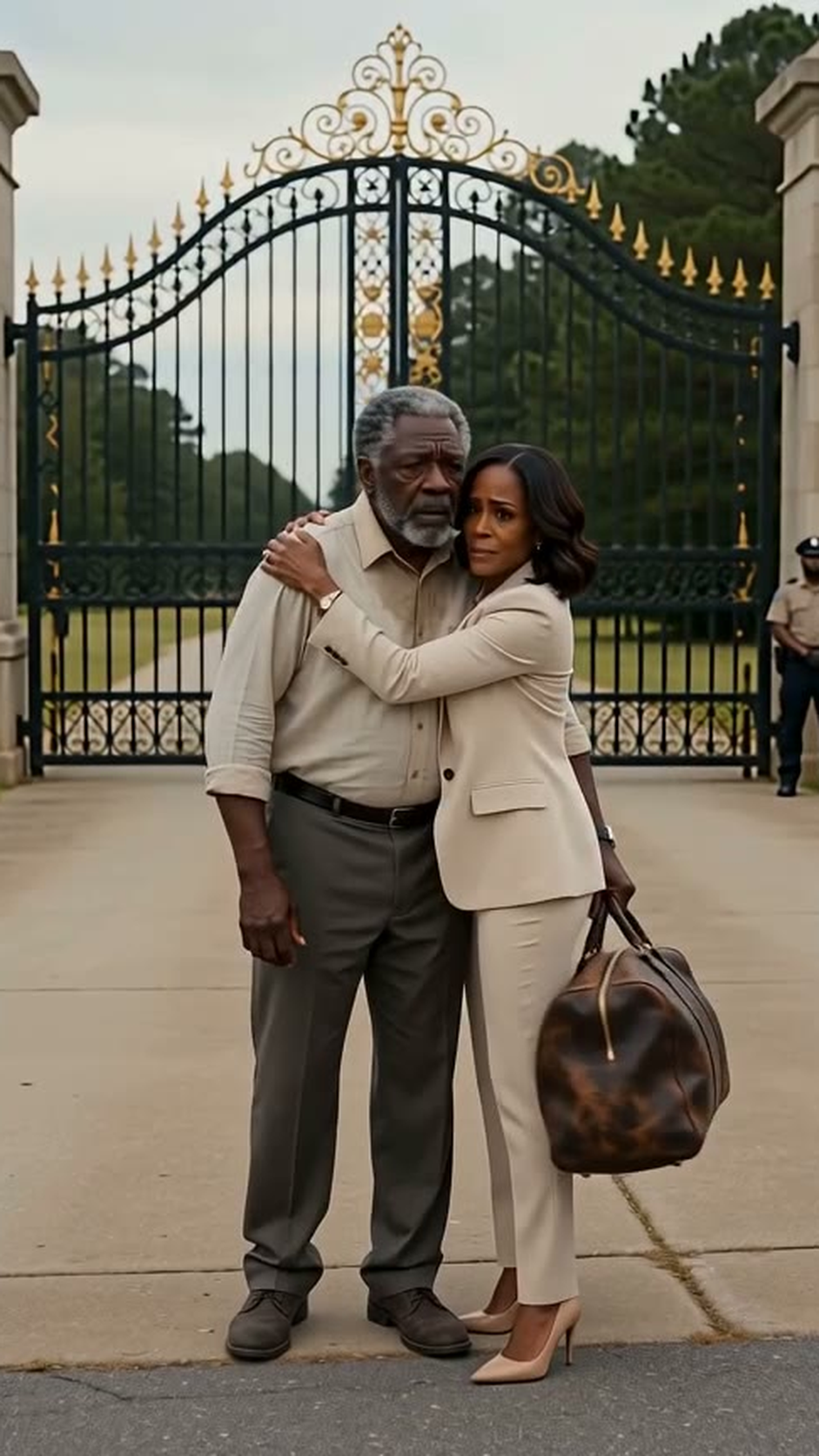
    It swung shut behind him with a long, oiled groan — black iron, gold finials, pretty enough for a governor's mansion — and the sound of it traveled through the concrete under his shoes and up into the bones of his ankles. Two uniformed officers stayed on the other side of it. Neither of them wished him luck. A black SUV sat parked beyond the fence with its engine running, and Gerald understood, without anyone telling him, that the SUV was not for him.

    Five years. He had counted them in ceiling cracks, in meals, in the gray arithmetic of a calendar he was not allowed to keep. Five years, and it ended like this: a worn dark-brown leather bag in his hand, a faded beige shirt on his back, and an empty road.

    He walked.

    His shoes — the same shoes he had surrendered the day he went in, returned to him that morning in a paper sack, stiff and smelling of storage — scraped against the concrete. He kept glancing toward the curve of the road, the way a dog watches a door. Kenneth would come around that bend. Or Giselle. Kenneth drove too fast; he'd be the first one there, honking, impatient, sorry in the clumsy way of sons. Giselle would have brought flowers, maybe, and cried in a way that made her angry at herself.

    The road stayed empty.

    A wind moved through the pines. Somewhere behind him a radio crackled on an officer's belt. Gerald lowered his eyes to the seam of the sidewalk and made himself a promise he had practiced for months: whatever their faces looked like when they came — angry, ashamed, cold — he would not make it harder for them. He was the one who had shamed this family. A man does his penance quietly.

    The release officer had given him three things at the window that morning: a check for one hundred and twelve dollars — gate money, the state called it, five years translated into a number a man could hold — a printed bus schedule, and his own belongings in a paper sack. The bus would have had him in Jackson by nightfall. He had planned it all out in his cell with great care, the way you plan a thing you dread: ride the bus, walk the last nine miles, knock on the door of his own house after dark like a salesman. He had rehearsed being refused. He had rehearsed it so many nights that refusal had worn a groove in him, and he had made his peace with walking the nine miles back in the dark, and whatever came after that.

    What he had not rehearsed — what he had not permitted himself, in five years, to rehearse even once, because hope is the one contraband a man smuggles against his own good sense — was the sound of somebody running.

    He was almost to the road when he heard the footsteps.

    Fast. Uneven. Heels on concrete, running — actually running.

    "Dad! Wait!"

    The voice broke on the second word. Gerald stopped so suddenly that the heavy leather bag swung forward on its handle and thumped against his shin before settling. A hand closed around his forearm — not gripping, catching — and he turned.

    Melanie.

    His son's wife stood in front of him in a cream-colored pantsuit that the wind was worrying at, her dark wavy hair coming loose, her chest heaving, her eyes already full. Thirty-nine years old and she had run — in heels, on concrete, the whole length of the administration drive — the way a person runs toward a fire.

    For a moment Gerald Crawford could not speak. Five years of rehearsing this moment, and every word he had prepared stood up and walked out of him.

    His lips trembled. He made them work.

    "Where are my children?"

    He watched it happen — watched the question land on her like weather. Her face, which had been all relief a second before, changed into something she was trying very hard to hide from him. Her hand tightened on his arm. Her mouth opened, and nothing came out of it that she was willing to let him hear.

    That silence told him everything the road already had.

    He did not ask again. A father learns things. He glanced once more toward the empty bend in the road, and then he let his daughter-in-law pull him into an embrace, and he stood rigid inside it the way a man stands in a doorway he has not been invited through — until, slowly, one arm came up, and he held on to the only member of his family who had come.

    An hour out, she made him stop at a gas station with a diner attached and sat him down in a booth and ordered him food he had not asked for, and watched him eat a sandwich with the stunned, careful attention of a man relearning a language. A family piled out of a minivan at the pumps — father, mother, three kids arguing over a bag of chips — and Gerald watched them through the window with his coffee cooling in his hand, not bitter, just looking, the way you look at weather in a country you used to live in.

    "That oak by the shed," he said at last. "Does it still turn?"

    "It turned red in October," Melanie said. "First thing in the yard. I took a picture. I always meant—" She stopped.

    "You brought me pictures," he said gently. "Sixty of them. I had them in a row on my wall till the paint gave out." His hand drifted, without his seeming to notice, to the breast pocket of his shirt, and rested there a moment, flat, the way a man checks that a letter is still where he left it. "Some things a person carries out himself, though."

    She didn't ask. She was learning, minute by minute, the shape of what he wasn't saying, and she drove on into the afternoon with it riding between them like a third passenger.

    Hours later, in the passenger seat of her car, with five hundred kilometers of Mississippi unspooling under the wheels and the afternoon light coming in flat and gold through the side window, Gerald Crawford reached into his shirt pocket.

    His hand hesitated there, over his heart.

    He drew out a folded piece of paper — soft as cloth, worn at the creases, folded and refolded so many times it had forgotten how to be flat — and he held it out across the console without looking at her.

    "Don't take me home yet," he said.

    Melanie glanced down. "Dad —"

    "There's an address." His voice went low and urgent, the voice of a man spending something he had saved a long time. "Before three. Don't tell Kenneth."

    She took one hand off the wheel long enough to signal, pulled the car onto the shoulder, and let it roll to a stop. Gravel ticked against the undercarriage. Then she took the note in both hands and unfolded it.

    An address, handwritten, in dark ink, in a hand she did not know.

    And beneath it, at the bottom of the page, a name.

    Her fingers tightened on the paper until it shook.

    "Aaron…?"

    Gerald stared straight ahead through the windshield, at nothing, his jaw tightening like a man bracing for a blow he had been expecting for five years.

    —

    Three weeks earlier, the letter came to the house in Jackson on a Tuesday, and it very nearly went into the trash unopened.

    It lay on the polished dining table where the mail always landed — state seal, thin paper, the kind of envelope that had only ever brought this family grief — and Kenneth Crawford picked it up with two fingers, the way a man picks up something dead.

    "Release notification," he said. "November twenty-seventh."

    Across the table, his sister went still with her coffee halfway to her mouth.

    Giselle Crawford was forty-one, elegant down to the bones, engaged for six months to Julian Pierce and terrified in a way she would rather have died than admitted. She set the cup down with great care.

    "Ten days before my wedding," she said. "Ten days. Do you understand what Harlan Pierce will do if a single reporter—" She stopped. Started again, colder. "He can't be here. He can't be anywhere near this house until after the wedding. If he needs somewhere—" She pointed, one manicured finger aimed past the window, past the garden, toward the gray shape at the far end of the property. "He can sleep in the shed."

    The word landed in the room and stayed there.

    Melanie, who had been standing in the doorway with a dish towel in her hands, felt something rise up in her chest so fast she had to put a hand on the door frame. "Giselle. That is your father."

    "That is a convicted felon the State of Mississippi is kind enough to be done with," Giselle said. "I have waited my entire life to be looked at the way people look at the Pierces. I am not spending my wedding weekend explaining him."

    Melanie crossed the room and reached for the letter.

    Kenneth's open palm came down on the table — hard, flat, final. The letter jumped and slid across the polished wood, and Melanie recoiled half a step before she caught herself and held his gaze across the table.

    "Don't," Kenneth said. "Don't start."

    "Someone has to go and get him, Kenneth."

    "No one has to do anything." Her husband's voice was the voice he used on difficult clients, reasonable as a locked door. "He's a grown man. There's a bus. There is a whole system for this. The state releases him, the state points him at a bus stop, and if he has the sense God gave him, he stays quiet until December, and then—" He glanced at his sister. "Then we discuss it. As a family. When there's no wedding to protect."

    "And no merger," Melanie said quietly.

    Kenneth's jaw tightened. She had aimed well and they both knew it. Crawford Properties, the company Gerald had built out of a pickup truck and a reputation for paying his debts, was eleven days from signing a development merger with Pierce Holdings — a marriage of companies riding in the same carriage as the marriage of their children. Harlan Pierce, retired judge, a man who had built a fortune and a name out of never once being embarrassed in public, had been gracious about the Crawfords' "unfortunate chapter." That was the phrase. The unfortunate chapter was scheduled to walk out of a prison gate on November twenty-seventh.

    Above the sideboard, in a gilt frame, Margaret Crawford looked down at all of them from twenty years ago — laughing, mid-sentence, alive — and Melanie found she could not stand in the same room with the portrait and the word shed.

    She picked the letter up off the table. Nobody stopped her this time. She smoothed it flat with the heel of her hand, the way you smooth a child's drawing you intend to keep.

    "Your mother visited him every week until the week she died," she said, to no one, to both of them. "Every week. She took two buses."

    "Don't you dare use her," Giselle whispered.

    "I'm not using her. I'm remembering her. There's a difference, and this family used to know it."

    "Your mother would have wanted—" Kenneth began, and got no further.

    "My mother," said Giselle, with the bright, shaking smile of a woman stepping on a rake in public, "would have wanted not to be discussed in connection with a penitentiary at her own table. She spent two years taking buses to visit him and it killed her, Kenneth, it literally—" She broke off, because Melanie had come around the table, and for a second it seemed possible the evening would become something with hands in it.

    Instead Melanie only began, quietly, to clear the plates. It was the most frightening thing she could have done, and both of Gerald's children understood it: she was clearing the table of their childhood home like a woman who had stopped asking permission to be its conscience. Giselle gathered her coat with enormous dignity and let herself be walked out by her brother, and at the door she turned and fired the last shot over her shoulder, in a voice that cracked on the final word and ruined the aim entirely: "If he comes here before my wedding, there won't be one. Julian won't be given the choice. His father will make it for him."

    The door closed. The house settled. On the wall, Margaret Crawford went on laughing at something twenty years gone, and Melanie stood in the wreckage of the evening and smoothed the release letter flat on the table with the heel of her hand, and folded it — once, twice — the size of a secret, and put it in her own purse.

    That night, long after Kenneth had gone to bed believing the matter settled, Melanie sat up in the dark kitchen with the letter and her phone. She did the arithmetic nobody else in the house was willing to do: five hundred and thirty-eight kilometers. Six hours, if the highway was kind. She looked up the release procedures, the gate, the time. She read the words "no transportation provided" four times.

    Then Melanie Crawford — who had never once, in eleven years of marriage, set out to deceive her husband — opened the calendar on her phone and marked Thursday, November twenty-seventh, with the word ERRANDS.

    She set an alarm for three-thirty in the morning.

    She had no idea that the man she was driving to collect was carrying a folded piece of paper in his shirt pocket, or that the name written at the bottom of it was going to tear the lid off everything her family had buried.

  • Chapter 7: Both Directions

    Chapter 7: Both Directions

    She asked him the next morning. That, Ryan would tell Daniel years later, was how he knew the war was really over: Grace Ellis, who had once walked out of a penthouse and a marriage rather than ask a question whose answer could wound her, stood in the family room with two paper cups of coffee and asked him straight.

    "Why are you still carrying the ring?"

    He looked up from the whiteboard photograph he'd been studying — Nick's counts, day +12, the first number with an upward arrow drawn by Noelle in green crayon — and he understood instantly, because he had been carrying the answer for weeks, waiting for exactly this much courage from both of them.

    "Come with me," he said.

    He took her down in the elevator, out of the unit, to the hospital's winter garden — the glass atrium where the great Snowflake tree stood waiting for the gala that had already happened in another timeline, its lights dimmed for the morning. His coat was over his arm. He took the velvet box out of the pocket himself, and held it out to her on his open palm, and said: "Open it."

    Grace opened it.

    The box was empty. The little cushion where three carats of committee-approved future had sat was bare, with the faint square ghost of the ring pressed into the velvet.

    "I returned it," Ryan said. "The morning after the bus shelter. Daniel drove me to the jeweler at nine o'clock, before the typing results, before I knew if you'd ever speak to me again, before any of it. It was never Amelia's, in the end — I never gave it to her. It was just the most expensive apology I ever owed myself for trying to live a life with the volume turned off." He looked at the empty box, and his mouth did something complicated. "I kept the box. I don't fully know why. I think because you saw it. It's the last thing from the old life that was present at the beginning of the new one. I carried it the way you carry a photograph of a house that burned down — not because you want the house. Because you want to remember you got out."

    Grace closed the box gently. She held it a moment, this small black square that had cut her in a dark room at 4 a.m., and felt it turn, in her hand, into something else: not a threat. A relic. A thing from before, with the power gone out of it.

    "You are," she said, "the most exhausting man I have ever—" and then she laughed, really laughed, standing in the winter garden in yesterday's clothes, and Ryan laughed too, and a nurse pushing a cart past the glass smiled without knowing why.

    "There's more," Ryan said. "Wait here. One minute. Don't — Grace. Stay with the tree. Please."

    He came back in four, slightly out of breath, with three children.

    Nick traveled in his wheelchair like a small admiral, masked, blanketed, with the line's pole dressed in tinsel by persons anonymous. Noelle walked on one side with her notebook, in her capacity as press. Holly walked on the other side holding absolutely tightly to a fistful of Ryan's coat, in her capacity as Holly. A nurse brought up the rear, grinning, in her capacity as an accomplice of long standing.

    "What's happening?" Grace said, very quietly, because her heart had started doing something ungovernable. "Ryan, what— Nick, sweetheart, you should be—"

    "Counts are up for the third day," the nurse said, with enormous satisfaction. "Doctor Patel signed off on twenty minutes. She said to tell you: the new marrow is his father's, and it is moving in like it owns the place. Her words."

    Ryan went down on one knee, there in the winter garden, in front of the great unlit tree, with a wheelchair, two daughters, a nurse, and the whole miraculous unlikelihood of his life arranged around him — and from his pocket he took not the black velvet box but a small worn leather case, older than both of them, soft as a glove.

    "This was my grandmother's," he said. "She wore it for sixty-one years, through everything the century had. My grandfather put it in a drawer when she died and told me, when I was fourteen, that it was for the woman I'd choose with my whole heart and not a committee in sight." He opened the case. The ring inside was simple and warm and bright, a single stone in old gold, nothing like the cold comet in the velvet box. "I chose her once already, Grace, and I failed the choosing when it got expensive. I have now been tested — literally, they typed me for it — and I am a match. Let me spend the rest of my life proving the typing right."

    He looked up at her with his gray-blue eyes, in which she could see, as clearly as she'd seen it in the rain, every year they'd lost and every year they hadn't.

    "Grace Ellis. Will you marry me — again — for the first time, properly?"

    "Mommy," said Nick, with the air of a chairman calling a vote, "that's the rain man asking."

    "I know, baby," Grace said, through tears and laughter both, "I can see him," and she held out her hand — the hand she had drawn back from him at the bus shelter, the hand that had signed the papers alone, the hand that had held three children against her body in the rain — and she let him slide his grandmother's ring onto it, and it fit the way the last three years had never once let anything fit, and she said yes into his hair as he rose and gathered all of them — her, and the wheelchair admiral, and the press, and the girl holding his coat — into one unbroken, tinselled, medically improbable embrace.

    – – –

    They walked out of the Children's Medical Center on the twenty-third of December, into air so cold and bright it rang.

    Discharge had taken all morning — papers, instructions, a pharmacy bag the size of a carry-on, Dr. Patel's final examination delivered with her hands folded and her eyes suspiciously bright, and a send-off the nurses had clearly been planning for days: a corridor lined with staff, the painted stars under a fresh fall of paper snow, and Nick, in his navy suit with the blue scarf, processing down the middle of it in his wheelchair like visiting royalty while Noelle read out the discharge summary as a press release and Holly distributed star cookies with the gravity of communion.

    At the entrance, the automatic doors sighed open — the same doors, the same glass — and Nick said, "Stop."

    Ryan stopped pushing. "Buddy?"

    "I want to walk out," Nick said. "On my feets. Like a person."

    Grace looked at Ryan. Ryan looked at Grace. It was four steps to the doors, and then the world. She nodded once — the count done, one two three, all present, all hers — and Ryan lifted his son down and set him on his feet, and took one hand, and Grace took the other, and the girls took the hems, and Nicholas Mercer, aged three, with his father's blood newly at work in his bones and his father's eyes lifted to the December light, walked out of the hospital under his own power, slowly, in his Christmas suit, while behind the glass the whole transplant unit stood up at their stations like a congregation.

    "It isn't far," Grace said, in the car, with Nick asleep between his sisters before they reached the avenue, his head on Ryan's coat folded as a pillow. "The family housing. We can stay there until—"

    "No," Ryan said. "There's a house. It's been empty three years and it has a kitchen with terrible light and a fruit bowl that needs supervision. It's yours. It was always yours. The paperwork is in the glove box, next to about forty of your daughter's interview transcripts." He kept his eyes on the road, because some things could only be said at thirty miles an hour. "Come home, Grace. Not as a guest. Not as a patient family's mother. I had the ceramic frog brought over from the penthouse this morning. It is, at this moment, wearing a paper crown in the fruit bowl, where it has apparently been waiting for orders."

    Grace looked out the window at the city going gold in the early dark, and she laughed, and then she cried, and then she did the thing she had not done since she was twenty-nine years old and the world was new: she reached across the console, in full daylight, unhurried, unafraid, and took her husband's hand, and held it the rest of the way home.

    They were married again in April, in the hospital chapel with the wooden boat, because Nick demanded the boat be invited. He carried the rings down the aisle in a black velvet box, at a pace so slow and ceremonial that the small congregation aged noticeably, and delivered them to his father with the words, "No dropping this time. That's the report."

    One year later, the Mercer Grand put its lights up in the second week of December, and the bus shelter across Michigan Avenue wore its garland, and the rain — remembering itself — came down silver over the wet gold pavement.

    The triplets were four, and Nicholas Mercer had a head of curls like a storm cloud, a scar he showed to other children with the pride of a pirate, and blood in his veins that a team of doctors described, in their reports, as fully engrafted, fully his father's, fully his own. He had been back to the Children's Medical Center eleven times in the year, and every time as a visitor grows less afraid, and the last time he had brought the ward a drawing of a bus, labeled in crayon, with every passenger smiling.

    Noelle's investigations had expanded into print. Holly had read the bear book to an entire kindergarten.

    Eleanor Mercer came to dinner on Sundays. She came slowly, and on their terms, exactly as agreed — and it is a matter of family record that the first time Nick, at full health and full volume, raced down the hallway of the penthouse and launched himself at her with the words "Grandma, you're here for the weather!" she caught him, and held him, and over his head her eyes met Grace's, and neither of them looked away.

    On the twenty-first of December, the anniversary no one called an anniversary, Ryan took his family out under the awning of the Mercer Grand while the snow rehearsed and the rain performed, and he opened his hand. In it was a small black velvet box, which he had had remade — same box, new heart — and inside it, on the little cushion, sat nothing but a folded slip of paper, in a three-year-old's favorite green crayon, that he had commissioned through proper channels.

    "Daddy," Nick read, importantly, because reading was new and therefore ceremonial, "who's that man?"

    "That's me, buddy," Ryan said, lifting his son up against the cold, where the boy's arms went around his neck with three years of practice compressed into one. "That's the man who almost missed everything."

    Grace leaned her head against his shoulder, in the icy blue she had once worn like armor and now wore like a celebration, and the girls pressed in on either side like bookends, and the five of them stood a while in the golden light, watching the buses come and go across the avenue — carrying other people's urgencies, other people's almosts, away into the rain — while theirs, at last, stood still, and stayed.

    On the mantle, in the house with the terrible kitchen light, there stood a framed set of four photographs — not four anymore. In the year since the discharge, the wall beside it had filled the way walls fill when a family stops rationing its own record: Nick on a bicycle, scar and all, mid-shout. Noelle interviewing the mailman, notebook raised. Holly asleep in a laundry hamper, as was apparently hereditary. Grace and Ryan in a hospital chapel, laughing, with a wooden boat sailing forever overhead. And at the end of the row, newest and smallest, a drawing in green crayon of five stick figures holding hands in the rain, every one of them smiling, labeled underneath in the careful capitals of a boy who had been given, at last, all the time in the world to learn his letters:

    MY FAMILY. NO DROPPING.

    THE END

  • Chapter 6: The Letter

    Chapter 6: The Letter

    It was a reaction to the infusion — a known one, a feared one, a survivable one, the team said later, in the careful language of people who have ridden out the same storm in other children's rooms. A fever that spiked like a struck match. Blood pressure wandering where it shouldn't. Forty minutes in which Grace stood at the foot of the bed with her hands folded so tightly her knuckles shone, reciting — under her breath, in the rhythm of a rosary — Nick's full name, his sisters' names, his blood type, his weight in kilograms, as if the facts were a rope and she could hold him in the world by listing them.

    Ryan stood at the head of the bed and did the only job he had been assigned and the only one that mattered. He held the bucket. He held it through the worst of it, and he talked, steadily, in the flattest calm he had ever manufactured, about buckets and bears and beet-red Jell-O and the report from the cafeteria, until, at 9:26, the fever broke like a wave going back out, and Nick's numbers remembered themselves, one by one, and the room exhaled in a single shared breath that Dr. Patel permitted herself to make audible.

    "That," she said, "was the storm we watch for. He came through it beautifully. He's a fighter."

    "He gets that," Ryan said, "from his mother."

    Grace's legs gave out then — quietly, tidily, an hour after they were needed — and Ryan caught her the way he should have been catching her for three years, and sat her in his chair, and put the blanket from her cot around her shoulders, and she let him. She let him. She sat there shaking with her face in her hands, and when he crouched beside the chair she looked at him with eyes like the end of a long war and said, "He called you Daddy's blood. Noelle said it and he didn't correct her. He never lets things pass that aren't true."

    "I know."

    "He knows, Ryan. He's known since the bus. Children know the shape of things before they know the words." Her hand found his — unerringly, in the dark of the ward at night, the way it had ten thousand times in another life — and stayed there. "I'm so tired of being afraid of you. It's the heaviest thing I carry, and I carry some heavy things."

    "Put it down, then," he said. "Grace. Put it down here. I'll watch it for a while."

    – – –

    Eleanor Mercer came back to the hospital on the ninth day, alone, without counsel, without the folder, in a gray suit Ryan did not recognize, and asked the nurse at the desk — asked, not instructed — whether Mrs. Ellis might have a moment when the children were resting.

    They sat in the hospital chapel, where the light came through amber glass and a wooden boat hung from the ceiling for reasons no one could fully explain. Grace sat with her hands folded and her spine straight, a woman attending her own trial. Eleanor looked at the boat for a long time.

    "I saw the letter," Eleanor said at last. "Daniel showed me a copy. I did not write the instruction, Grace. I want you to know that, though I doubt it acquits me." Her voice did something Ryan had never heard it do in a boardroom. It slowed, and roughened. "My assistant routed it to the family office under a standing instruction of mine — that you were not to trouble Ryan during the settlement. Amelia encouraged that instruction. I signed the routing without reading the letter itself. When I initialled the slip, I believed I was sparing my son a scene." She turned her head, and her eyes were wet, and Eleanor Mercer did not weep in public, so she did it in a chapel instead. "I was sparing myself the risk of being wrong about you. And I have been wrong about you — the photographs, the café, all of it. Victor Pye confessed it to Daniel's investigator for considerably less money than Amelia paid him. The man in the photographs is your brother. I have known for four days. I have been deciding what kind of woman is going to say this to you, and the honest answer is: a worse one than you deserved to meet, and a better one than I was."

    Grace was silent a long time. The chapel light moved an inch across the floor.

    "Nick asked if you were here for the weather," she said finally. "Children forgive on credit, Eleanor. They lend you the person they hope you'll be. I am not going to spend his credit for him — that's his to give. But I won't poison the well, either. When he's well. When he's well, if you want to know your grandchildren, you may come and be known. Slowly. On their terms and mine."

    "On your terms," Eleanor said, "and theirs." She rose, and stopped, and spoke to the wooden boat as much as to Grace. "I have already told the board that the Brooks merger is dead — and that if they wish to remove my son, they may begin by removing me. It appears I am capable of learning. It appears it only cost everything." She walked out into the corridor where the floor was painted for toy cars, and was seen, by one nurse who told no one, to touch each painted star on the wall as she passed, like a woman counting her way out of a dark house.

    Amelia Brooks left Chicago in the second week of January. There was no scene. There never is, with the Amelias of this world; there is only a calendar quietly emptied, a family's events budget audited by its own board with an enthusiasm that bordered on the personal, and a woman at a window seat watching the lake go dark, discovering that a future assembled out of other people's erasures has a way of erasing its architect first. The Mercer Group's stock, which had dipped four points on the scandal of a CEO with secret triplets, recovered six on the news that he had told his board to take the company and leave his family alone — the market, like Noelle, approving of a clear report.

    Eleanor came a second time on the twelfth day — announced, permitted, and at the children's hour, bearing nothing but a paper bag of star-shaped cookies she had, it emerged under Noelle's cross-examination, baked herself for the first time since 1987. She was not admitted to Nick's room; isolation was isolation, and Eleanor Mercer, to her visible astonishment, accepted a nurse's refusal with the words, "Of course. Rules are rules," and sat down on the corridor side of the glass like any other grandmother in any other hospital, which is to say like a woman sitting for a portrait of her own demotion, and bore it.

    Holly, after a long study, approached the glass with the bear book. She held it up, page by page, so that her grandmother could read the words through the window — the book reversed, the text backwards to Eleanor, who squinted, and then, haltingly, began to read aloud anyway, reconstructing the story from the pictures with mounting invention.

    "—and then the bear said, 'I shall have the entire cake, for I am the Duke of—'"

    "That's not the bear's voice," Holly said severely, through the intercom, in her capacity as the family's minister of standards. "The bear is kind. Do it kind."

    There was a pause in which Eleanor Mercer — who had faced down two governors, a cardinals' dinner, and the 2008 crash without adjusting her tone by so much as a semitone — visibly regrouped. "I do beg your pardon," she said. "Let me try again. The bear said—" and she produced, from somewhere beneath the boardrooms, a soft, low, honeyed rumble that made Nick sit up in his bed and point with both hands.

    "THAT'S the bear," Holly pronounced. "Grandma can stay."

    Eleanor read the whole book through glass, in the bear's voice, with her gloved hand flat against the window the entire time, mirroring the small flat hand on the other side. Grace, watching from the nurses' station with Nick's chart against her chest like a shield she was forgetting to hold, said nothing, and filed it where she filed things now: not under forgiven — under weather changing.

    The night of day +10, the two of them sat in the family kitchen at 2 a.m. with the vending-machine soup that had become, by ward law, a food group, and Grace asked the question that had been standing behind all her other questions since the bus shelter.

    "When he's well," she said. "When this is — when we're out. What happens then, Ryan. In your head. Describe it. Because in my head there is a schedule of appointments and a one-bedroom with a better lock, and I am aware that is not a plan, that's a trench."

    "In my head," Ryan said, "there's a house with a yard my lawyers don't know about yet because I haven't bought it. There's a swing. There's a dog under review by committee — Noelle chairs it. There's you finishing —" He stopped. Reorganized. "There's whatever you want, Grace. That's the whole plan. I spent three years executing other people's vision of my life with total professional competence. I am retired from that. I have exactly one item of business left, and it's a boy upstairs learning to make blood, and everything else is going to be built out of what the four of you tell me you need, at the speed you tell me."

    "And your mother. The company. The — the everything, Ryan. You can't just step out of an empire like a coat."

    "Watch me," he said. "I already did. In a corridor. You were there."

    She looked down at her soup. When she spoke again her voice had the wonder of a woman reading her own results. "In Indianapolis I used to rehearse hating you. It was a — a discipline. Like scales on a piano. Every night, the scales. And then you'd walk through a hospital in a ruined suit and sit on the floor all night with your back against the wall, and the scales—" She shook her head. "I can't find the key anymore, Ryan. The song won't start. I've tried this week. All I can find is a man holding a bucket at 3 a.m. telling my son that buckets are a dad job."

    "Buckets," Ryan said gravely, "are the foundation of the republic." And Grace laughed into her hands in the family kitchen at 2 a.m., the vending machine humming approval, while down the corridor their son slept with his father's cells traveling through him like citizens coming home to a city that had waited for them in the dark.

    And in the transplant unit, day by day, the whiteboard by Nick's door accumulated its small arithmetic of hope. Day +7: counts at zero, as expected, as feared. Day +9: a number where there had been a blank. Day +11: Grace found Ryan asleep in the chair at 4 a.m. with the bear book open on his chest and his hand still resting, even in sleep, on the rail of the bed.

    She stood looking at the two of them — her son, breathing deep and even in the blue dark, and the man she had married and lost and found at a bus shelter — and something she had carried for three years shifted its weight at last. She reached, gently, to take the book before it fell, and to settle Ryan's coat more warmly around him where it had slipped from his shoulders.

    Something small and hard was in the coat's pocket. Her fingers found it by shape before her mind named it: square, velvet-soft, hinged.

    The ring box.

    Grace stood in the dark of her son's hospital room with the black velvet box in her palm — the box from the bus shelter, the box from the dining room upstairs in the Mercer Grand, the box built for Amelia Brooks's hand — and felt the floor of the new world tilt exactly the way it had tilted on a Tuesday, three years before, when an envelope came by hand to a penthouse.

    She put the box back in his pocket, precisely where it had been. She took her hand off the rail of the bed. And she went out into the corridor, where the painted stars led away in both directions, and she did not know, for the first time in weeks, which way to walk.

  • Chapter 5: Take the Company

    Chapter 5: Take the Company

    A transplant is a war fought by appointment.

    Ryan learned the schedule the way he had once learned acquisition timetables, and he was better at this, because this one mattered. Five days of injections to drive his stem cells out of his marrow and into his blood, where they could be harvested — five days of an ache settling into his bones like weather, which he welcomed with a gratitude that confused the nurses. In the room down the corridor, Nick began conditioning: the careful, terrible chemistry that would empty out his failing marrow to make room for his father's. His sisters visited in masks. Noelle read him the results of her investigations ("The lady in the cafeteria says the Jell-O is red because of beets, Nick. BEETS."). Holly sat with her forehead against the glass of the isolation window and read the bear book to the window itself, so that the sound would go through.

    Grace moved through the ward the way she had moved through three years: tirelessly, invisibly, knowing every nurse's name and every machine's voice. She had a cot. She had a system. What she did not have was any idea how to share the weight, and Ryan watched her refuse rest with the helpless fury of a man watching someone carry a piano up stairs alone, insisting the piano was light.

    "Sleep," he said, on the third night. "Four hours. I'll sit with him. If anything changes I'll wake you before the monitor finishes beeping — I'll wake you before he does."

    "And if he asks for me?"

    "Then I'll tell him his mother is sleeping because his father is here." He held her gaze. "Let me be here, Grace. Not instead of you. Here. Next to you. It's a bigger chair than you're used to sitting in, but there's room."

    She slept four hours in the family room with her stole balled under her head, and Ryan sat in the blue dark of Nick's room and listened to his son breathe, and at 3 a.m. Nick opened his eyes and said, with the practicality of a foreman, "You can hold the bucket if I throw up. That's a dad job. Mommy said dads do buckets."

    "Your mommy is right about buckets," Ryan said, and his voice did not break, and it cost him more than the injections. "I am honored to be on bucket duty."

    On the night of the third day, when the ward had gone to its blue hush and Nick slept with the bear book tent over his face, Grace found Ryan on the family kitchen's little balcony, standing in the cold in his shirtsleeves with a paper cup gone cold in his hand. The injections had put a deep, grinding ache into his bones — the nurses had warned him, marrow waking up is not quiet — and he was standing the way men stand in the cold when movement hurts less than stillness.

    "You should be resting," she said. "You're the medicine tomorrow. Medicine rests."

    "Is that an order from the senior officer's mother?"

    "It is a report," she said, "from his press secretary. Noelle has filed it twice." She came and stood beside him at the rail. Below them Chicago ran its rivers of light through the wet streets; across the avenue the Mercer Grand wore its Christmas gold like a ship at anchor. They stood looking at the building where they had been married, neither of them saying so. "I have four photographs of their first year," Grace said suddenly. "Total. On a cracked phone. I used to apologize to them in my head for that — other children get albums. Then Nick got sick and I understood the albums aren't the record." She turned her hands over in the cold light, looking at them as if they belonged to an employee. "These are the record. Everything's in these. Every night feed, every transfusion, every time I carried all three up two flights because the elevator was out. When I'm old I'll show them my hands."

    Ryan set down the cup. Very carefully — as a man handles something in a museum, or a bird — he took one of her hands and held it between both of his, which were warm from the ache in his bones, and he looked at the small scar on her thumb from a sewing needle and the permanent ink ghosts of lists written on her skin in a hundred night kitchens.

    "When I was in London," he said, "the week of the photographs — I want you to hear this once, and then I'll never make you carry it again — I came home early. I flew back on the red-eye to confront you, or to forgive you, I genuinely don't know which, I was twenty-four hours without sleep and out of my mind. My mother met me at the airport. She said you'd confessed. She said the lawyers were handling it and that seeing me would only — her phrase — muddies the outcome. And I got back on a plane, Grace. I got back on a plane and I went to Singapore and I let attorneys evict my wife, and I have told myself for three years that I was the one who was betrayed." His hands tightened around hers, not hard, the way a drowning man holds a rope he doesn't believe will hold. "The photographs are still in a drawer in London. I never looked at them twice because some part of me knew. I want you to know that some part of me knew, and it changes nothing, and it's the worst of it. The part that knew just — waited. For a bus shelter. In the rain."

    Grace did not take her hand back. The city moved below them, and a bus sighed somewhere, and she let the silence do what silence does when it is finally allowed in the room.

    "She has your hands too," Grace said at last, quietly. "Holly. She holds things with both hands, exactly like that, like everything might be taken." She turned her hand over in his, deliberately, and laced her fingers through, once, briefly, the way you test ice. "Tomorrow you're the medicine. Go to bed, Ryan Mercer. That's a report and an order."

    It was on the fourth day — the day before Ryan's harvest — that Amelia Brooks came to the hospital.

    She did not come to the ward. She did not need to. Her opening move arrived as a push alert on the phone of every journalist in Chicago: MERCER HEIR'S SECRET TRIPLETS — PROPOSAL COLLAPSES AS EX-WIFE SURFACES WITH THREE CHILDREN. There were photographs of the bus shelter. There were photographs — Victor Pye's work, Ryan understood with cold clarity, some habits being hereditary in a crisis — of Grace shepherding the children through the hospital doors. By noon, two news vans were parked across Michigan Avenue in the exact spot where Ryan had sat in his car in the rain and watched his life change.

    By two o'clock, the Mercer Group's stock had dipped four points, the board had convened itself, and Eleanor Mercer arrived at the Children's Medical Center in a black car with the family's senior counsel in the seat beside her and a leather folder in her hand.

    Ryan met her in the corridor outside the transplant unit, where the floor was painted with a road for toy cars and the walls were the color of deep water. His mother looked at the paintings, at the small masked children being wheeled past like royalty, at her son standing between her and a set of double doors — and something in her face, for the first time in his life, looked uncertain.

    "You will listen to me carefully," she said. "The board is prepared to weather this if it is handled. A statement. A settlement — a generous one — administered quietly, at a distance. The children want for nothing, ever; I am not a monster, Ryan. But you will not be photographed playing father in a hospital corridor. You will not destroy thirty years of this family's standing for a woman who—"

    "For the mother of my children," Ryan said.

    "You don't know that—"

    "I know it." His voice stayed level. The corridor was very quiet; a nurse had paused, mid-step, and decided to be elsewhere. "I've known it since a bus shelter. But since you deal in evidence, Mother: the letter will interest you. Grace's letter. The one from three years ago, telling me she was pregnant. It was in the firm's file. Someone instructed the family office to handle it quietly. Someone initialed it." He watched the color move in her face like tide going out. "Was it handled quietly enough for you? Three grandchildren, in a one-bedroom in Indianapolis, with a port in the boy's chest. Handled beautifully. Not a ripple on the stock."

    "Ryan." Counsel touched the leather folder. "There's a concern regarding custody fitness — a single mother, limited means, a seriously ill child. If this becomes contested, the family could — the children could be placed — it would be for their own protection—"

    "Say that sentence again in this corridor," Ryan said, turning to him, and the man took one step back from something in Ryan's face that no boardroom had ever produced, "and I will have you removed from this hospital by security, and from my family's employ by morning, and I will enjoy both."

    "Ryan!" Eleanor's voice cracked on his name. "I am trying to save you. The company, the merger — if you walk away from the Brooks alliance now, over her, the board will remove you. You will lose everything your grandfather built."

    Then the double doors sighed open down the corridor, and a small procession came through: an orderly, a nurse, and a bed on quiet wheels, and in the bed, absurdly small against the white, with his sisters' crayon drawing taped to the bedrail like a flag — Nick, on his way down to begin the final preparation, with Grace walking beside him holding the rail, not looking at any of them.

    Nick looked at the gathering with his grave gray-blue eyes. He looked at the leather folder. He looked at Eleanor Mercer, in her black coat, with her face like a church door.

    "Grandma?" he said, without any certainty, because children are told about grandmothers. "Are you here for the weather too?"

    Eleanor Mercer made a sound that she would deny for the rest of her life.

    Ryan stepped forward and took his mother's hands — both of them, folder and all — and held them the way you hold something that is about to be dropped.

    "Mother. Listen to me once, and then decide what you're going to be. Tomorrow they are going to harvest my stem cells and put them into that little boy, and if it works he will live, and if it doesn't he won't, and there is no version of my life after tomorrow in which I am not his father. Take the company. Take the merger, take the board's confidence, take the name off the buildings. I am not negotiating." He set the folder gently back against her chest, like returning a gift. "I'm taking my family."

    He turned and walked with the bed, one hand on the rail beside Grace's, and behind them in the corridor painted for toy cars, Eleanor Mercer stood holding her leather folder with both arms, exactly the way a woman holds a child she has just realized she dropped.

    The harvest was at seven the next morning. The infusion was at noon — a bag of cells, unremarkable as soup, traveling down a line into Nick's chest while Grace held one of his hands and Ryan held the other and Noelle, on a stool, read the occasion the results of her most important investigation to date: "The doctor says Daddy's blood is moving in. That's the report."

    For six hours it was almost peaceful.

    At 8:40 that evening, every monitor in Nick's room changed its mind at once, and the alarms began, and the corridor filled with running feet.