Story Genres: MAFIA BOSS

  • Chapter 6: Fifteen

    Chapter 6: Fifteen

    Kate did not go to him.

    It was the second refusal of her life, and it was harder than the first, because the first had been made in a locked corridor with no witnesses and nothing left to lose, and this one she made in a burning garden in front of three hundred people, with everything to lose and a broken arm throbbing in time with the fireworks. Her feet, trained by eleven weeks of service and three days of terror, wanted to obey. Obedience was her whole profession. Obedience was the deposit, the surgery, her mother's heart.

    She set her tray down on the terrace balustrade with exaggerated care, the way a bomb technician sets down a device, and she walked — not toward the garden doors, not toward the folly, not toward the man crooking his finger like a hook — but backward, into the ballroom, into the light, into the crowd, threading herself between dancing couples and champagne and laughter until there were a hundred witnesses between her body and Preston Caldwell's smile.

    His smile went away then. She saw it go, across the room, in the flash of the second firework — and she understood that she had just done the most dangerous thing available to her: she had refused him in public, where he could not pretend it was a negotiation, and a man like Preston Caldwell could survive anything except being seen to be refused by a maid.

    "Miss Bennett."

    The quiet man was back at her elbow, white-faced, with his hand actually out — not touching, hovering — as if she were something that had nearly fallen off a shelf. "My apologies. There was a—" He stopped. Reassessed her face. "You did well," he said, with deep disapproval of the entire situation. "That was extremely dangerous and you did it exactly right. Come with me. Now. Mr. Blackwell wants you where the walls are stone."

    She went with him through the service corridor — the other corridor, the west one, lit and populated, nothing like Thursday — and all the way she could feel the night moving around her like water around a stone in a river, and she had no way of knowing that she had just lit the last fuse of the evening. Because Preston Caldwell, watching the maid vanish into the protection of his partner's house, had done his arithmetic to its final line, and the answer it gave him was the answer such men always reach when the alternative is ruin:

    The girl was the only witness who mattered. The girl, therefore, was the only problem left.

    * * *

    The count, afterward, became a kind of legend in the house — the way the staff tell it still, in the kitchens, on slow mornings, with the presses hissing and somebody's cousin listening with her mouth open. Matteo Blackwell kept it on a folded list in his breast pocket, and he crossed the names out one at a time, in pencil, as the night gave them up.

    One: Gerald Vance, head of security, twenty years, who had sold eleven minutes of static for twenty thousand dollars and a promise. Taken before the announcement, in the room beneath the kitchens, weeping with relief by the end, because being taken by Matteo was survivable and he knew the alternatives by reputation.

    Two, three, four: the steward, the freight clerk, and the receiving-door porter — Preston's little loyalties, bought over months of envelope diplomacy and hints about a new arrangement. They were found, respectively, at their stations, in the freight office, and halfway across the south lawn with a bag, and they were all of them astonished to learn how completely the house knew their names.

    Five: the driver, who had waited in a car outside a locked corridor on Thursday and heard a glass break through a wall and driven on anyway.

    Six and seven: two deck officers of Caldwell Shipping, flown in for the gala, whose real cargo — the cargo that never appeared on any manifest — had moved on Preston's orders and Damon's water for six years. The audit found them before the police ever could have, which was, in the end, a kind of mercy they had not earned.

    Eight: the lawyer with the kind face who had drawn up, in advance and in secret, a certain maid's letter of resignation and a settlement with a silence clause, dated for the Monday after the gala. He had the documents in his briefcase at the hotel. He had never met Kate. He had charged Preston four hundred dollars an hour to erase her.

    Nine, ten, eleven, twelve: the crew of the garden — the two men who had held the east corridor doors on Thursday and called it a cigarette break, the folly's "electrician," who had disconnected a lamp that had worked for a decade, and the quiet professional from out of state whose presence at a shipping gala no one could quite explain, and whose luggage contained, among other things, a syringe.

    Thirteen: Preston's own nephew and aide, who carried the leather folder, and the envelopes, and had chosen the corridor on Thursday out of a directory of the house's blind spots, helpfully provided by name number one.

    Fourteen: the banker. The respectable, white-haired, church-going banker who had agreed to freeze a certain organization's accounts the morning after the merger — Preston's coup, prepared in silk — and to unfreeze them only for the new arrangement. He took Matteo's midnight visit in his dressing gown, in his own hallway, and discovered that he had opinions about loyalty he had never suspected.

    In the housekeeper's parlor, Kate sat with her back to the warm wall and listened to the night dismantle a man. There is no sound for it, exactly — that was the Blackwell way — only the sounds of absence arriving one at a time: a car starting in the mews and not returning; the service bell that rang and rang for a steward who no longer existed; footsteps in the passage, two pairs, unhurried; a long quiet; then two pairs again, lighter by one man's dignity. Rosa sat against the door with her rosary moving through her fingers at the speed of a woman saying it for other people's souls, and at one point, around one in the morning, she said, without looking up: "Stop counting, Kate. I can hear you counting."

    "I'm not—"

    "You are. It's in your breathing. Whatever the number is when it stops — it isn't yours. You hear me? You carried a tray for eleven weeks and a man used a corridor wrong. The count belongs to the corridor, and to him, and to the house that let its cameras sleep. Not to you."

    And fifteen —

    But the fifteenth name is not a name on a list, and it did not wait politely to be crossed out. At two in the morning, with the fireworks long finished and the ballroom emptying into cars and laughter and the last of the champagne, with Kate locked — at her own insistence, with Rosa on a chair against the door like a small, furious dragon — in the housekeeper's parlor off the kitchens, the fifteenth name came looking for her.

    Preston Caldwell had not run. Running was for men who believed the world outside the house belonged to them. Instead he had done the last thing a cornered prince can do: he had gone to take the throne room. He walked into Damon Blackwell's study at two in the morning with the leather folder in his hand and the merger contract inside it, signed — he had signed it himself, alone, both lines, in the car — and he laid it on the desk between them like a shield.

    "It's done," he said. "Whatever tantrum tonight was, Damon, it's paper now. We're partners. The ships, the water, the bank, the senator — it's all in motion, and you cannot unpick it without unpicking yourself." He was still handsome. He was still calm. Only his eyes had aged. "Your brother has been collecting my people all night like a bailiff. Call him off. We'll discuss your — episode — like gentlemen, and I'll overlook the insult to the announcement, and the girl—" his mouth shaped the word like a flavor he disliked — "the girl will be compensated. Generously. A clinic for the arm. A pension for the mother. She'll sign the lawyer's letter, and this house will never hear her name again."

    Damon Blackwell sat behind his desk in his shirtsleeves, with his tattoos bared to the elbow and a glass of water untouched at his hand, and listened the way a cliff listens to the sea.

    "You broke her arm on a Thursday," he said at last. "In my house. In a corridor you paid my own man to blind. Then you sat at my table and ate my food and put your hand on the evening's roster, and you ordered her to a garden building in the dark, the way a man orders wine." He rose, slowly, and Preston — to his credit, or his shame — did not step back. "You keep saying the word 'partner,' Preston. I have been turning it over all evening, and I have concluded that you mispronounce it. The word you want is 'tenant.' You have been a tenant in my empire for six years, and tonight your lease came up."

    "The contract—"

    "Your ships are impounded in four ports as of midnight — my audit, my harbors, my paperwork; the harbormasters send their regards. Your accounts are frozen; your banker had a change of heart in his hallway. Your crew is in my basement explaining your manifests to my brother, who is taking notes for the harbor police in the morning — anonymously, of course; we are all legitimate men here." Damon came around the desk. "You have no money, no hulls, no crew, no partner, and no name that any door on this coast will open to after sunrise. What you have, Preston, is one asset left. You have the six hours between now and dawn, and a car I am lending you, and my word — which, unlike yours, has never once been broken in twenty years — that no one will follow it as long as it keeps driving."

    "And if I stay?" Preston whispered. "If I go to the police? The press? I know where the bodies—"

    "You know where some of them were," Damon said gently, "and a ruined, exiled, document-forging attempted rapist's word against the house of Blackwell is a currency I am willing to let you try to spend. Stay, and you spend it from a cell, on charges written by your own lawyer's briefcase. Drive, and you are a ghost with a head start." He leaned close, and his voice went down to the register Kate had heard in the sitting room, the register of schedules, not threats. "But understand the terms of your haunting. If you ever say her name again — if you ever come within a hundred miles of her, or her mother, or anyone she loves — the count my brother finished tonight will turn out to have been missing its last name after all. Go."

    The car left the estate at twenty minutes to three, with one bag, no driver, and the whole of the staff — awake, all of them, somehow, in doorways and at windows along the drive — watching it go in a silence so complete that the gravel sounded like applause played backward.

    At sunrise, Matteo knocked once on his brother's study door and laid a folded list on the desk. Fifteen names. Fifteen pencil lines through them, neat as stitches.

    "It is done," Matteo said. "Every name before sunrise."

    Damon looked at the list for a long moment. Then he opened the desk drawer, and put it away with the photograph he kept there, and said: "Now I go and tell the girl."

    But the girl — exhausted, unbroken, with her arm aching in its new brace and Rosa snoring in the chair against the housekeeper's door — had slept two hours, woken before dawn to the sound of the estate holding its breath, and made a decision all her own.

    By the time Damon Blackwell reached the staff wing, Kate Bennett was standing in her narrow room in her traveling clothes, with her borrowed suitcase packed on the bed.

    And the look on her face stopped the most dangerous man in the city in his own doorway like a hand on his chest.
  • Chapter 5: Every Name Before Sunrise

    Chapter 5: Every Name Before Sunrise

    "Don't move."

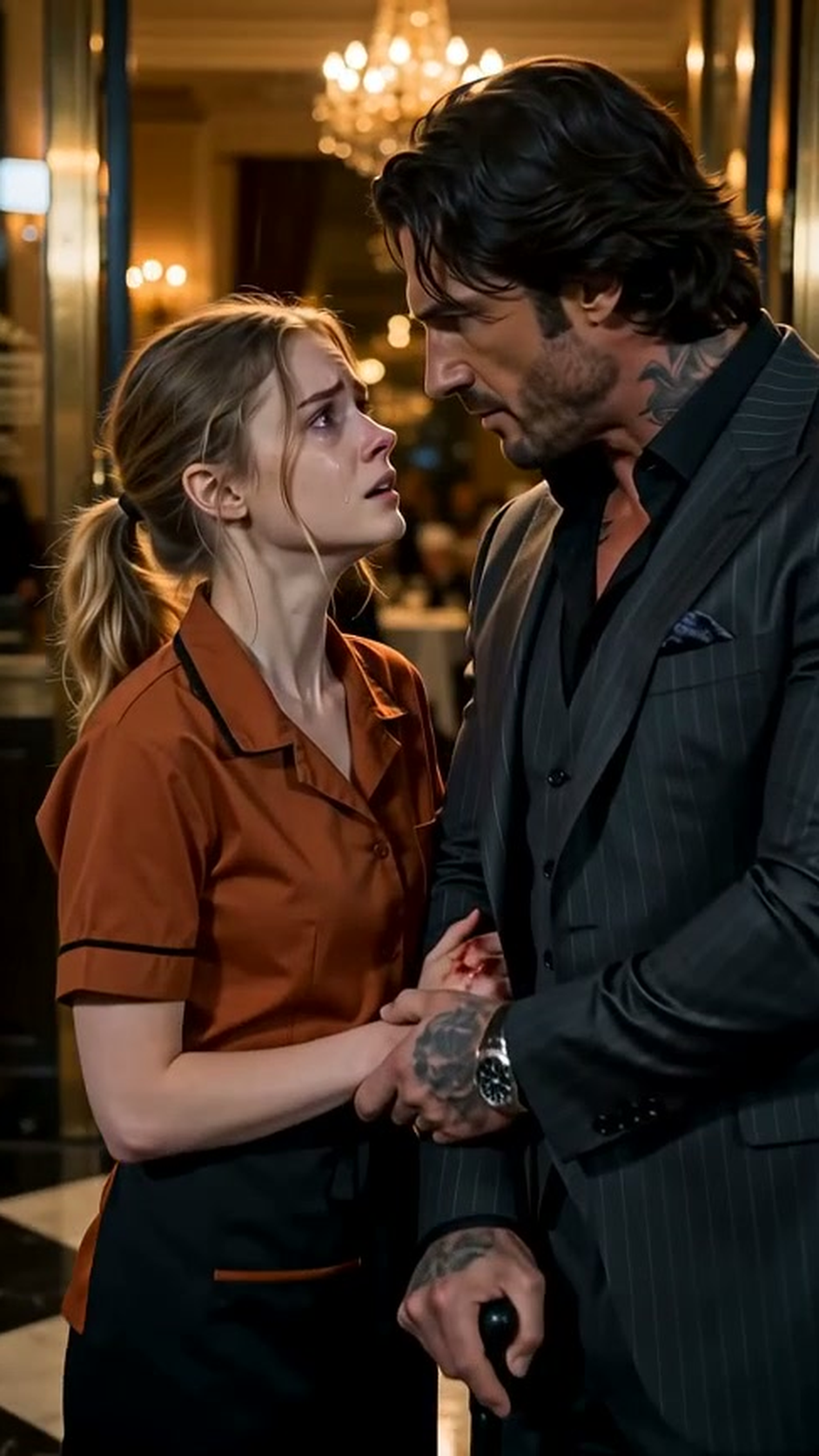
    Kate stopped breathing. The tray stayed miraculously level in her good hand, and her broken arm — traitor, fool, the whole architecture of her silence — slipped in its hiding place behind her apron as she turned, too fast, toward the voice.

    Damon Blackwell rose out of the chair by the fireplace the way deep water rises: without splash, without haste, and with the absolute certainty of drowning whatever it reaches. He was not supposed to be in the sitting room. The sitting room was for principals, for contracts, for the hour before the announcement; the boss was supposed to be in the ballroom being admired. Instead he was here, in the dark, in the one room she had run to — because of course he was. Of course that was how the evening ended. She had spent three days hiding from Preston Caldwell, and it was the other one who had been waiting in the dark all along.

    "Kate." He came toward her. "What are you hiding?"

    "Nothing, sir. I — the tray, I was just—"

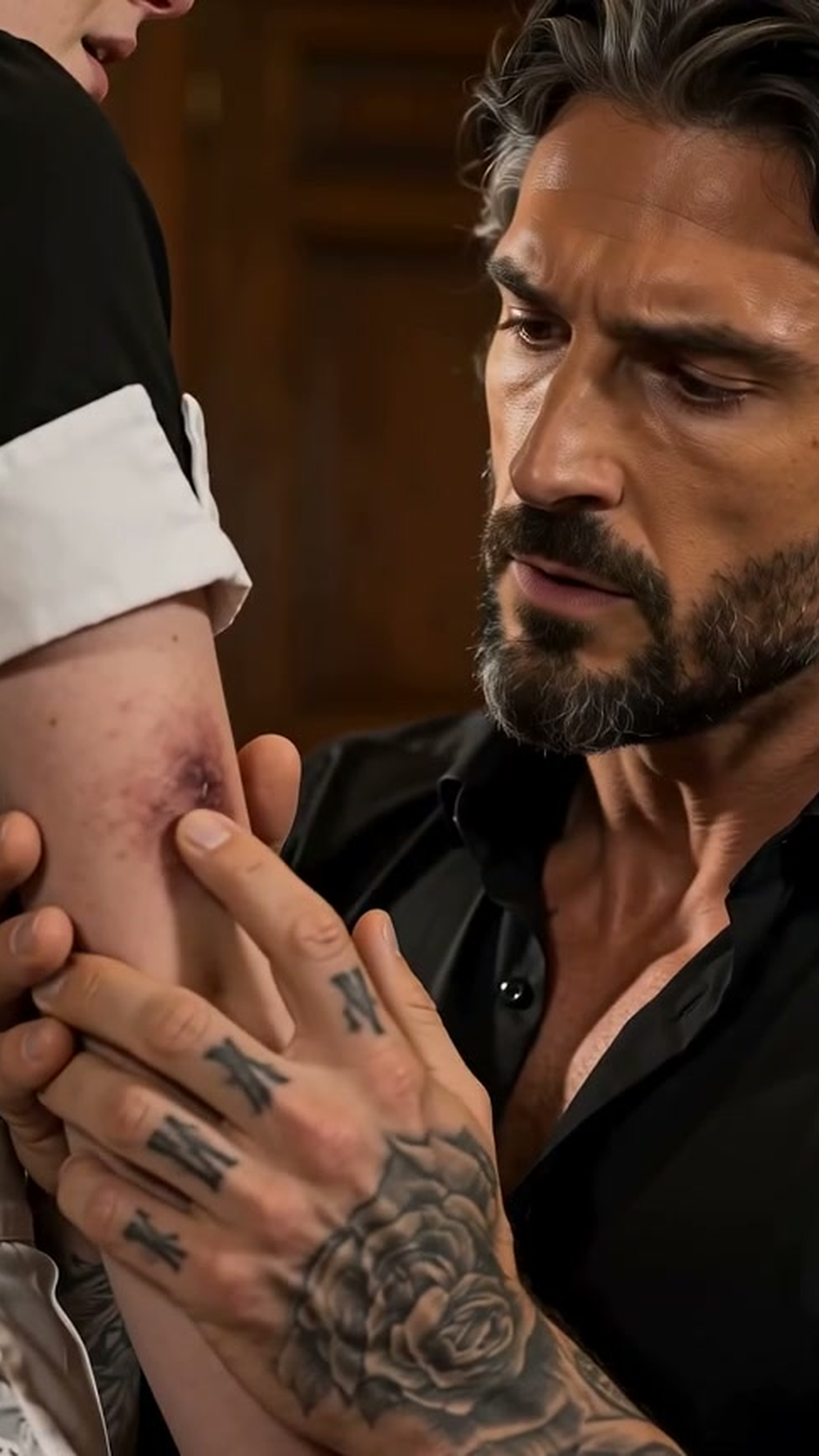
    She stepped back, and her right arm swung, useless, behind the white lace, and his tattooed hand came up and stopped it — gently, terribly gently, the way you stop a thing you already suspect is broken and are afraid of finishing.

    Three days collapsed into one held breath. She watched it happen in his face in sequence, like lights going on in a house: the resistance of the sleeve, the swelling under his fingers, the heat of it. The stillness. He rolled her cuff back with his thumb, over her small, hopeless sound of protest, and the lamplight found the bruises — wrist to elbow, plum and storm-black and old green, and above them the four fingers and the thumb, printed on her upper arm like a signature.

    The music went on beyond the doors. Three hundred people. A senator. An empire, waiting to be announced.

    "Who broke your arm?"

    There are questions that are doors, and Kate stood in front of this one with her whole life on the other side of it — her mother's heart, the deposit due in eight days, the folly in the dark garden, the man in the ballroom with her name in his mouth like a sweet. She had sworn silence the way you swear on a grave. She had practiced the lie until it had calluses.

    "Please," she whispered. "Please… I can't lose this job."

    What she did not know — what she could not have known, standing there in her terror — was that she was not begging a stranger. She was begging the one man in the city who had spent the entire evening quietly setting fire to his own coronation on the strength of eleven minutes of static and a flinch. Damon Blackwell looked at her arm, and at her face, and at the closed doors where his partner waited with a contract and a smile, and a decision that had been assembling itself in him for two days closed like the bolt of a rifle.

    He drew the chair close. He knelt. The king of the city's underworld went down on one knee on his own carpet and made himself smaller than his maid, and if the walls of that house could have spoken they would have gasped, because in twenty years those walls had seen everything except that.

    "Look at me, Kate."

    She looked.

    "You're not losing your job." Each word set down like a stone in a road being built across a river. "Not tonight. Not for this. Not ever, while I own the roof over it. Do you understand me?"

    She nodded, weeping now, silently, the way she did everything.

    "Then give me the only thing I am asking for." Feather-light, his thumb beside the worst of the bruising. "A name."

    Her eyes went to the ballroom doors. She could not help it. Three days of terror had trained them like dogs.

    "Kate."

    "Preston Caldwell."

    She said it barely louder than breath, and the room changed temperature, and the most dangerous man in the city received the name of the second most dangerous man in it the way a priest receives a confession — without a flicker, without a sound, with the whole of his reaction poured into the one place she could feel it: his hands, which gentled. On her broken arm. As if the rage, arriving, had gone everywhere in him except there.

    From the housekeeper's kit in the sideboard he took the black orthopedic brace, and he fitted it to her forearm strap by strap with the concentration of a jeweler. Tattooed fingers. Knuckles that had ended arguments in three counties. Each strap checked twice, eased, checked again, so that nothing pressed where it should not.

    "He'll never touch you again," he said, not looking up. "That is not a threat, Kate. Threats are for men who negotiate. It is a schedule."

    Then he rose. He took out his phone. He looked toward the ballroom doors — toward the gold light, the music, the partner, the empire — and what was in his face then was not fury. Fury is hot and brief and stupid. What was in his face was administration.

    "Matteo," Damon said. "I want every name before sunrise."

    He was gone through the doors before she could find a word, any word, and Kate sat on the edge of the antique sofa in the lamplit quiet with her arm cradled in new black strapping and her uniform damp with tears, listening to the music change — because it did change, in the way a whole ballroom changes when one man walks into it differently. She did not understand, then, that she had just watched a coronation become an execution in the space of one phone call. She understood only that everything was broken open now, and that the arithmetic would never work again, and that she had never in her life been so frightened —

    — or so strangely, shamefully safe.

    The door opened. Kate flinched so hard the brace knocked the sofa's wooden frame — but it was Rosa who slipped inside, closed the door with her hip, took in the scene in one comprehensive glance — the girl on the sofa edge, the medical kit open on the sideboard, the black brace new and correct on the ruined arm — and sat down, heavily, on the arm of the sofa like a woman whose own knees had filed a complaint.

    "He knows," Rosa said. It was not a question.

    "He knows a name," Kate whispered. "Rosa — he fitted this himself. On his knees. He said — he said it's a schedule."

    Rosa looked at the brace for a long time. Then she reached out, with the care of long practice, and tidied the strap's end where it had been left a fraction too loose, and her hands — those laundry-roughened, nine-years-in-this-house hands — were not entirely steady.

    "Nine years I have worked for that man," she said. "I have seen him fire a chef for a sauce. I have seen him buy a shipping line because its owner insulted Matteo at cards. I have never — not once, not for anyone — seen him frightened of hurting something." She looked up, and her eyes were wet and furious and wondering all at once. "Whatever you think you have done tonight, hermana, hear me: you did not start this fire. You were the fire's address. There's a difference, and someday, when you're done being terrified, you'll know it."

    "He's going to destroy Preston," Kate said. "At his own gala. Because of a maid. Rosa, the merger—"

    "The merger," Rosa said witheringly, "is a boat arrangement. Boats can be rearranged. I have buried three brothers and I know what a man looks like when something is finished in him — and whatever was between the boss and Mr. Caldwell finished on Thursday, in a corridor, before you ever said a word. You only told him where it happened." She stood, smoothing her apron, every inch the senior servant again. "Now. The quiet men are looking for you to stand somewhere safe, and I am looking for you to eat something before you faint onto a senator. Come. The night is not finished with any of us."

    * * *

    What happened in the ballroom over the next hour, the newspapers would later describe as "an unexpected postponement." The guests described it, in whispers, for years.

    Damon Blackwell mounted the small stage at eleven beneath a chandelier the size of a carriage, with Preston Caldwell at his right hand — smiling, tanned, immaculate — and the merger contracts waiting in their leather folder on the lectern like a bride at an altar. The orchestra fell silent. Three hundred glasses stilled. A senator's wife raised her phone.

    "My friends," Damon said, into the golden hush, "you came tonight to watch two houses become one." He let the pause live exactly as long as it needed. "You will have to forgive the house of Blackwell. We keep our promises in order — and tonight I find there is an older promise outstanding." His eyes moved, once, unhurriedly, across the room, and found his partner's face the way a sniper finds weather. "The announcement is postponed. The audit is not complete."

    A sound went through the ballroom like wind through a wheat field.

    Preston Caldwell's smile did not fall. That was his quality, and Kate — watching from the service door with a cloth twisted in her good hand, because she had been unable to obey the quiet man's instruction to stay away once she heard the music stop — watched the smile stay and the eyes change, and understood that she was seeing a man do arithmetic of his own, very fast, with her name in every column.

    He laughed — lightly, generously, the laugh of a partner indulging a perfectionist — and raised his glass. "To audits," he said, and the room, grateful, laughed with him, and the orchestra hurried back in like water over a stone.

    But in the hour that followed, the second clock ticked loud enough for Kate to hear it with her naked ears.

    A steward Preston had cultivated for months was relieved of his tray by two quiet men and walked, smiling fixedly, toward the kitchens, and did not come back. The freight clerk vanished from the receiving door between one delivery and the next. Down in the mews, Preston's driver — who had driven him to this house on Thursday at three — was invited, with great courtesy, to step out of his own car. None of it was loud. None of it was visible from the ballroom, where the dancing had begun and the postponement was already being re-told as a power move, a mystery, a very Blackwell sort of theater. It was only that, if you stood where Kate stood, you could feel the house quietly closing its hand.

    Matteo passed her once, at speed, with a phone at his ear and a folded list in his breast pocket that had not been there an hour before. "Eleven," he said, to the phone, not to her. "Keep counting."

    At midnight the first firework went up over the garden — a white chrysanthemum that lit the terrace, the ballroom glass, and three hundred upturned faces — and in that white light Kate saw Preston Caldwell at the garden doors, not watching the sky at all.

    Watching her.

    He lifted one finger, very slightly, off the stem of his glass. Come here. The oldest gesture in the world. And around her the ballroom applauded the fireworks, and the quiet man assigned to her elbow was suddenly not there — drawn off by a spilling guest, a commotion at the stairs, some small arranged chaos — and the service corridor stood open behind her like a throat.

    Kate looked at the man in the garden doors. She looked at the darkness at her back, where the linen, the tray, and the ruin of her life had all begun.

    And Preston Caldwell smiled at her across the burning garden — the smile of a man who has already decided that if he is going down tonight, he is taking the evidence with him —

    —and crooked his finger once more.

  • Chapter 4: What the Camera Saw

    Chapter 4: What the Camera Saw

    The thing about the Blackwell estate that no guest ever understood was that it ran on two clocks. The first was the visible one — dinners at eight, cars at midnight, the boss's coffee at six — and the staff lived by it down to the minute. The second clock had no hands at all. It was the clock of Matteo Blackwell's attention, and when it started ticking, doors in the house began to close in pairs.

    By ten o'clock, it was ticking.

    Kate felt it before she understood it. The east wing, where she stood her station with her tray and her hidden splint, had acquired a quality of held breath. Men she had never seen on the staff — security, but not the regular gala security, quieter men with earpieces and funeral suits — had appeared at the garden doors and the service stairs in pairs, unobtrusive as furniture. The duty roster had changed for the third time that evening, and this time it had changed in the other direction: Rosa found her in the pantry at half past nine with hands that shook for an entirely new reason.

    "They took Gerald," Rosa whispered.

    "Took him where?"

    "Mr. Matteo. Just now. Gerald Vance, head of security, twenty years in this house — Mr. Matteo walked him out of the security office with a hand on his elbow like a brother, and two of the quiet men behind, and Gerald's face—" Rosa crossed herself, a habit she performed perhaps twice a year. "Hermana, Gerald's face was the face of a man being shown a photograph of his own grave. What is happening? What did you do?"

    "What did I do?"

    "Kate." Rosa seized her good wrist, gentle but absolute. "Men like Gerald do not fall out of the sky. Houses like this one do not move for a sprained wrist and a roster. Whatever is moving tonight — it started Thursday, in a corridor, with you. I am not asking you to tell me. I am telling you to be careful, because when the sea moves in this house, it is never only the fish it meant to catch."

    Kate stood among the stacked champagne coupes with her heart in her throat, and understood that she had been wrong about one thing for three days. She had believed her silence was a wall she had built around her mother, her job, her whole narrow life. She had never once considered that her silence might be a room — and that other people were already standing inside it, moving furniture.

    The truth, which she would not learn until much later, was this: Damon Blackwell had not slept since Friday lunch.

    He had noticed the flinch. He had noticed the left-handed water glass, and the step backward that came a half-second too late to be grace, and he had filed these things in the place where he filed everything that did not yet add up — and then, on Thursday's security sweep, a routine audit of the week's footage had crossed Matteo's desk, and the east corridor had given up its secret: eleven minutes of gray static where a locked door, a guest, and a serving girl should have been.

    Static does not happen on the Blackwell system. Static is installed. And installing it requires the master key to the security office, which existed in exactly two hands.

    There was a second thread, and Matteo pulled it while the orchestra was still tuning. The gala roster — the housekeeper's master staffing sheet, the one that assigned three dozen servants to their stations with military tenderness — had been amended twice in the system that week, and neither amendment bore Mrs. Whitmore's initials. On Wednesday, a junior supervisor's login had moved the girl Bennett from the ballroom rotation, where she had worked every function for eleven weeks, to the east wing. On Thursday evening — an hour after the corridor camera went blind — the same login had added her name, in what looked like a favor, to the fireworks rotation in the garden. Matteo stood in the security office at half past nine with the printout in his hand and read those two amendments the way other men read confessions, and understood that someone had been arranging the evening like a dinner table: the course placed here, the wine placed there, the girl placed where the garden was dark and the doors were far apart.

    "Who has your login, Gerald?" he asked the empty office, conversationally. "Because it wasn't you, was it? You're too lazy to be this careful. You just sold the key and opened the door like a good dog." He folded the printout into his breast pocket — the pocket where, later, the list would live. "All right. Let's go and ask the dog."

    Damon had done the arithmetic the way he did everything: completely, and in silence. Preston Caldwell in the corridor. Preston Caldwell's sudden afternoon visit, "business that could not wait," on the one day the cameras died. Preston Caldwell, at dinner three weeks ago, closing his hand around a maid's wrist while the boss poured wine at the other end of the table and thought about tonnage.

    And then — the sitting room. Two hours ago. His partner at his ease in the boss's private room, a maid with a candlestick in her fist like a weapon she was arguing herself out of, and the two feet of air between them charged like the pause before a verdict. Damon had walked in on the middle of something, and every instinct he owned — the instincts that had kept him alive and enthroned through twenty years of men exactly like Preston Caldwell — had told him the same thing at once:

    It had already happened. He was not preventing anything. He was excavating.

    What he did not have was the shape of it. He did not know what "it" was — theft, blackmail, a liaison, a threat — and the not-knowing sat in him like a splinter of ice, because Damon Blackwell's entire empire rested on one foundation: in his house, nothing happened that he did not know. The static on that camera was not an insult. It was a declaration of war written in his own hallway.

    So while the orchestra played and the champagne ran and three hundred people admired the legitimate face of his empire, the second clock ticked, and the quiet men moved in pairs, and Gerald Vance — who had taken Preston Caldwell's money for eleven minutes of static and had believed, in the manner of small men everywhere, that he was too senior to be seen — sat in a windowless room beneath the kitchens and learned otherwise.

    Matteo was almost gentle with him. That was the family gift.

    "Eleven minutes," Matteo said, in the tone of a man reading a wine list. "Thursday. The east corridor. You fed the loop yourself, Gerald — I want to congratulate you on the craftsmanship before I ruin your life over the content. Who paid?"

    Matteo did not shout. The family had a division of labor older than either brother's marriage prospects: Damon was the weather — vast, impersonal, impossible to argue with — and Matteo was the climate, the thing that got into your house through the walls. He made tea in the windowless room. He asked after Gerald's daughter by her first name and her university, and her specialty, which was cardiology, and he pronounced it a beautiful profession, a profession that fixed hearts, and he set the tea down and said how much he admired a father who had paid for such an education out of a security man's wages, and how carefully such a father would want to protect the story his daughter believed about where the money came from.

    Gerald Vance had a pension, a boat, and a daughter in medical school. He lasted four minutes.

    What he gave up, in the end, was nearly everything: the envelope — cash, twenty thousand, untraceable, the way Preston liked his sins — the instruction, the second instruction nobody had expected, about the gala roster, about a name moved quietly to the east wing and the fireworks rotation by a hand with security-office access. And one more thing, small and detonating, offered up by a drowning man grabbing at any rope: he was not the only one. Preston had been building little loyalties all over the house for months — a driver here, a steward there, a clerk in the freight office. "He said the boss was getting soft," Gerald whispered, to the concrete, to the ceiling, to anyone. "He said after the merger, there'd be a new arrangement. He said we should be standing on the right side of the door when it changed."

    In the room above, the ballroom doors stood open on gold light and music.

    Kate, at her station, felt the evening tilt under her like a deck. At ten-fifteen a quiet man materialized at her elbow — not touching her, simply present, with the solidity of a wall that has decided to be there — and said, in a voice meant only for her: "Miss Bennett. You don't go anywhere tonight except where I can see you. Mr. Blackwell's compliments."

    She very nearly dropped the tray.

    "Is that — am I in trouble?"

    "Miss," the man said, with something in his face that in another profession might have been kindness, "you are the opposite of in trouble. You just don't know it yet."

    Kate's station overlooked the ballroom through the east arch, and from it, that night, she watched the empire perform itself: the women in their architectural dresses, the men conducting whole industries with a raised eyebrow, the senator holding court beside a marble fireplace with a ring of donors orbiting like moons. It was beautiful the way a glacier is beautiful, and as indifferent, and she had once — a lifetime ago, in the laundry, in week two — been almost proud to serve it. Now she stood in its gold light with a splint under her cuff and a monster's handprint fading on her arm, and the thought came to her, unbidden and complete, like a sentence she had been writing all week without knowing: this is what the money was always for. Not the yachts. Not the mergers. The money was for making a world in which a man could break a girl in a corridor the way you break a seal on a bottle — casually, between courses — and have the corridor apologize for the noise.

    She poured for a duchess, or something very like one, and the lady said "Thank you, dear," without looking up, and Kate nearly wept at the ordinary kindness of it.

    She worked the arch the way she had been taught in her first week: tray high, eyes lowered, a ghost with good posture. A string quartet sawed at something bright near the terrace doors. Somewhere behind her a cork sighed out of a bottle, and the smell of the lilies on the side tables, funereal and overripe, kept catching at the back of her throat, so that every breath she took in that golden room tasted faintly of a church.

    Across the ballroom, Preston Caldwell raised a glass to the senator and laughed at something, and did not look toward the east wing at all — and that, more than anything, was what frightened her. Because she had served him for eleven weeks, and she knew his tells now the way you know weather in an injured joint:

    Preston Caldwell only stopped watching something when he had finished deciding what to do about it.

    And at eleven o'clock, when the announcement hour approached and the hall began to glow with anticipation, Kate slipped away from her station on the oldest excuse in service — a guest's spilled wine, a cloth, the sitting room's supply of linen kept behind the antique sofa — with the quiet man's eyes on the ballroom doors and not, for eleven fatal seconds, on her.

    She never heard the sitting room door close behind her.

    She only heard the tray tremble — one crystal glass chiming against another as her elbow struck the back of the antique sofa — and then, from the shadows by the fireplace, where the leather chair sighed under a weight she had not known was there, a voice spoke. Low. Unhurried. Changed from any tone she had ever heard from it, the way a blade is changed by being drawn.

    "Don't move."

  • Chapter 3: The Guest of Honor

    Chapter 3: The Guest of Honor

    Preston Caldwell arrived at the Blackwell estate at four o'clock on the afternoon of the gala, in a car the color of money, with a contract in a leather folder and a smile for the staff who opened his door.

    The staff felt his arrival the way sailors feel weather. Extra silver came up from the vault. The good candles — the ones that were never lit for mere millionaires — came out of their tissue. Mrs. Whitmore, who feared God and very little else, used his name at full volume in the kitchen, which she did for no living person except the boss: "Mr. Caldwell's car in twenty minutes. Mr. Caldwell takes the blue room. Mr. Caldwell's whisky is the eighteen-year, and the girl who pours it does not speak unless spoken to." Kate, soaping glasses at the deep sink with one hand and a forearm full of splint and secrets, listened to the house rehearse its reverence, and thought about how cathedrals must have felt, dressing for a bishop who came to burn them.

    He was not merely a guest. This was what Rosa had tried to tell her, in the laundry, in the way of a woman laying out weather: the gala was not a party, it was a coronation. Tonight, before three hundred witnesses, Damon Blackwell and Preston Caldwell would announce the merger of their shipping interests into a single Atlantic empire — Blackwell muscle and Caldwell hulls, the legitimate face of the organization washed clean in champagne. There would be photographers. There would be a senator. Preston Caldwell was not attending the gala.

    Preston Caldwell was half of its purpose.

    Kate learned all of this the way she learned most things in that house — with her hands in hot water, from Rosa, in pieces — and understood at once what it meant for her. The man who had broken her arm in a locked corridor was about to become, publicly and permanently, the second most powerful man in her world. After tonight, there would not even be the theoretical possibility of appeal. You cannot accuse the king's brother of anything. You can only survive him, quietly, at whatever price he sets, for as long as he finds you interesting.

    At five o'clock, Mrs. Whitmore conducted the final inspection of the gala staff in the great kitchen, walking the line of girls in their formal uniforms the way a general walks a parade — cuffs, collars, hands, nails, hair. She stopped in front of Kate for exactly one second too long.

    "Your right cuff is crooked, Bennett."

    "Yes, Mrs. Whitmore. Sorry, Mrs. Whitmore." Kate's heart was slamming against the splint so hard she was certain the whole line could hear it. The formal cuff was the splint's camouflage; straightening it one-handed, under inspection, in front of twenty witnesses, was beyond her.

    "Well? Hands are for using, girl."

    Rosa, two places down, in a voice of magnificent boredom, said: "She burned it on the press this morning, Mrs. Whitmore. Right hand. I dressed it myself. She can pour and carry, but buttons—" she shrugged, "you know burns."

    Mrs. Whitmore's gaze moved between them with the slow sweep of a lighthouse. Twenty years in great houses had taught Agnes Whitmore many languages, and the one she was hearing now was fluent: staff covering staff, the oldest sacrament of the below-stairs world. What she chose to do with it would decide the evening.

    "Then she pours and carries," she said at last, "and keeps the hand out of the photographs." She moved on. "Bennett — the sitting room wants candlesticks before six. Mind you're not seen doing it."

    It was mercy, dressed as an order, and it sent Kate up the back stairs toward the sitting room with the silver candlesticks in a linen-lined box against her hip, minutes before Preston Caldwell came looking for the room himself.

    "Then I survive him," Kate said, to the sink, to herself, to the arithmetic. "One night. The folly, whatever he—" She stopped. Breathed. "One night, and then the deposit is paid, and then—"

    "And then there will be another night," Rosa said flatly. "Hermana. There is always another night with men like that. That is the whole of their religion."

    But the roster was the roster, and the deposit was due in eight days, and by five o'clock Kate was in her formal uniform with the long cuffs and the lace apron starched to a blade's edge, carrying candlesticks into the private sitting room off the ballroom — the room reserved for the boss and his principals, away from the music. It was the loveliest room in the house and the one she liked least: dark polished panels, gold that gleamed like honey in the lamplight, paintings of other men's ancestors scowling down at furniture too expensive to sit on. She set the candlesticks on the marble table — left hand, then the second, placed with the care of a girl defusing something — and stood a moment in the quiet, breathing in beeswax and old wood and the faint leather breath of the chair by the fireplace, and allowed herself one traitorous thought: that she would like, just once, to be a person who entered rooms like this through the front, in a dress, with both arms whole and nothing in her past that had to be hidden under a cuff. Then she heard the latch — when the door opened behind her and the temperature of the air changed.

    "You see," said Preston Caldwell, "the house agrees with me. It keeps putting you in rooms with me."

    He had the leather folder under one arm. He was already dressed for the evening, and he looked — this was the obscene part, the part she would never be able to explain to anyone who hadn't lived it — magnificent. Silver-blond hair swept back, dinner jacket cut like an apology for every sin underneath it. Evil, in Kate's experience of it before this house, had been shabby: shouting men, cheap flats, doors with locks that didn't hold. She had not been prepared for evil with a tailor.

    "The candlesticks, Mr. Caldwell," she said. "I was just—"

    "Your arm." He nodded at her right side with the interest of a man inspecting his own workmanship. She had kept it pressed to her body, the splint hidden under the formal cuff, the apron over all. "Still favoring it. You haven't had it set, have you? Of course you haven't. Good girl. I knew you were a sensible one under all the theater."

    "Please," Kate said, "I have to finish the room. They'll come looking—"

    "No one comes looking for a maid, Kate. That's the whole beauty of you." He set the folder down on the marble table with terrible gentleness. "Tonight, after the announcement, there are fireworks over the garden. Everyone watches fireworks. It's practically liturgy. When they begin, you will slip away from your station — I've already seen to your roster, don't look so surprised, you read it yourself this morning — and you will come to the garden folly, where it is dark, and private, and very far from the house. And there, you will apologize for the scene in the corridor. On your knees, if your arm permits. I haven't decided yet whether it will."

    The candlesticks were silver and heavy. In her good hand, one of them weighed, suddenly, like a possibility.

    "You feel that urge," he observed, delighted. "I can see it. Go on, then. Strike the boss's partner with his own candlestick, in his own sitting room, two hours before the announcement. Let us all enjoy the consequences together — you, me, and your mother, when the hospital asks where this month's money has gone." He stepped closer, into the range where she could smell the clean citrus of his cologne over something warmer and worse, and his voice dropped to the register of a man discussing shipping schedules. "Or be sensible. Gardens. Fireworks. A short unpleasantness, and then you keep everything — the job, the money, the little heart ticking away at St. Aurelia's. I've kept my side of our bargain, haven't I? No one knows. No scene. I even let you keep the arm."

    The door to the sitting room stood open. Beyond it, the ballroom glittered empty and enormous, filling with the first music of the evening as the orchestra tuned. Somewhere in the house, three hundred invitations' worth of people were beginning to arrive at the gates.

    "Say it," he said. "Yes, Mr. Caldwell. I enjoy hearing it. It settles things."

    Kate's mouth opened. The words were there — she had rehearsed survival for three days; she knew exactly what survival sounded like. And behind her eyes, unbidden, the arithmetic failed for the first time: she saw not the deposit, not the hospital, but her own face in the laundry mirror at dawn, practicing how to hold a teapot with a broken arm without weeping, and something in her — the last unbroken thing, smaller than a candlestick flame — simply declined.

    "No," she said.

    His hand came up.

    It never landed. Because at that precise moment, from the ballroom doorway, a voice spoke — not loudly, which in that house was never necessary.

    "Preston."

    Damon Blackwell stood in the open door with a cufflink half-done and his brother at his shoulder, and his dark eyes moved through the room the way weather moves through a field — taking in the folder on the marble table, the candlestick in the maid's fist, the two feet of charged air between his partner and his staff, and the way Kate, without knowing she had done it, had stepped backward until the antique sofa stopped her.

    "Am I interrupting a negotiation?" Damon asked.

    "Hardly." Preston's smile reassembled itself like a weapon being safetied. "Your girl was arranging candles. I was admiring the room. You've outdone yourself tonight, Damon. The old house looks almost legitimate." He picked up the folder. "Shall we? The contracts won't sign themselves, and I believe we have an empire to announce."

    "We shall." Damon did not move from the door. He watched Preston pass him with the courtesy of a priest watching a coffin pass, and then his eyes came back to Kate, and stayed.

    "Kate." Just that. Her name, in the tone a man uses for a chess piece he has suddenly realized is not where he left it.

    "Sir," she managed. "The candles are— I'll finish. Right away."

    "Leave them."

    "Sir—"

    "Leave the candles, Kate. Go down to the kitchens. Stay where there are people." A pause, calibrated to the width of a hair. "That is an instruction."

    She went. She walked past him close enough to feel the heat of him, with her broken arm pinned against her apron and her heart slamming against the splint's hard edge, and she did not stop until she was in the kitchen among the steam and the shouting and Rosa, who took one look at her face and put her on cold desserts, in the middle of the room, under the lights, with eleven other people — as ordered, though Rosa never knew she'd been given the order by two masters at once.

    She never learned what was said in the sitting room after she left. But forty minutes later, as the first guests were being announced in the hall and the orchestra struck its opening chord, Matteo Blackwell appeared in the kitchen doorway with his sharp smile entirely absent, and crooked one finger at the duty roster, and asked — of the room in general, in the tone of a man asking about the weather — who had drawn the security rotation for the gala.

    And by nine o'clock, standing at her station in the east wing with a tray of champagne she was forbidden, by Rosa's stricken whisper, from having been assigned at all — the roster had been changed back, and then changed again, by hands nobody could identify — Kate understood that something in the house had begun to move. Something vast and quiet, like a ship changing course in the dark.

    At half past nine, the fireworks roster was called, and her name was on it, and the garden lay below the terrace black and gold and breathing with music, and somewhere out in that darkness stood the folly.

    And in the private sitting room, behind a closed door, Damon Blackwell was looking at a security log on his brother's phone — at the east corridor, Thursday, 3:04 p.m., where the footage dissolved into gray static at exactly the moment a locked door's shadow crossed the frame — and saying, very quietly, to no one in particular:

    "Someone in my own house held the door for him."

  • Chapter 2: Three Days of Silence

    Chapter 2: Three Days of Silence

    "Well," said Preston Caldwell, turning the key in the corridor door with the deliberation of a man locking his own office. "Isn't this convenient."

    The east service corridor was the artery nobody used — a narrow, windowless throat between the laundry and the linen stores, lit by two bare bulbs and floored in concrete that had been poured before Kate was born. The linens were heavy in her arms. Her right side faced the wall of folded shelves. Her left, the door he had just locked.

    "Mr. Caldwell." Her agency training stood up in her throat like a soldier. "This corridor is staff only, sir. If you're looking for Mr. Blackwell's study, I can—"

    "You can stop pretending, for a start." He came toward her unhurriedly, the way he did everything, with a glass of the boss's whisky in his hand though it was barely three in the afternoon. "Eleven weeks I've been coming to this house, Kate. Did you really think I hadn't noticed you noticing me?"

    "I don't know what you mean, sir."

    "I mean the little performance at dinner. The trembling hands. The eyes." He set the whisky down on her stack of linens, balanced it there, amused at his own daring. "Girls from agencies always have a price, even the ones who play at being frightened. Especially those. So — what's yours? Name it. I like buying things that pretend they aren't for sale."

    The corridor seemed to shrink to the width of his smile. Kate held the linens like a shield and understood, with the clean cold clarity that terror sometimes gives, that this was not a misunderstanding. This was a man who had chosen the locked corridor, the hour, and the girl — chosen all of it the way he chose investments: after study, with confidence, expecting return.

    "There isn't one," she said. "Please unlock the door, Mr. Caldwell."

    She made the mistake then — the only one. She turned sideways to set the linens down, because her arms were aching and she needed her hands free, and some deep, decent, catastrophically stupid part of her still believed that a clear no, politely given, was a language rich men spoke.

    His hand shot out and caught her right upper arm — four fingers and a thumb, a grip like a machine closing — and swung her around to face him, and her shoulder slammed the shelf edge and the whisky glass fell and broke somewhere below them like a small, bright warning nobody heard.

    "Careful," he said pleasantly, as she cried out. "You'll ruin the linen."

    "Let go of my arm—"

    "I don't think you understand your situation." His voice stayed at the temperature of a business lunch. "Damon Blackwell is my partner. My ships move half of what his organization earns. You are a maid he could replace before your bed cooled. So when I tell you that on gala night you will be assigned to the east wing, and that after the fireworks you will come to the garden folly and be kind to me — you will not look at me like that. You will say: yes, Mr. Caldwell. Thank you, Mr. Caldwell."

    "No," Kate said, and pulled.

    It was not a dramatic thing, what happened next. There was no blow, no fall, no cinematic crash. He simply kept hold of her arm, all his considerable strength in that one grip, and turned her — wrenched her — toward the door she had begged him to unlock, the way a man turns a stuck key, and something deep in her forearm gave way with a sound she felt rather than heard, a green-stick crack that ran up into her elbow and detonated white light behind her eyes.

    She did not scream. Even then. Even as the pain dropped her to her knees on the concrete with her ruined arm cradled against her stomach and her teeth locked on the knuckle of her good hand — she did not scream, because somewhere beneath the pain the arithmetic was still running: noise means staff, staff means questions, questions mean the hospital deposit, the specialist, her mother's heart beating in a bed at St. Aurelia's on a timer Kate was paying to extend.

    Preston Caldwell looked down at her for a moment, and straightened his cuff, and sighed like a man whose afternoon had been mildly inconvenienced.

    "You see?" he said. "That didn't need to happen."

    He was not even breathing hard. That was the detail she would return to, in the nights that followed, the way a tongue returns to a broken tooth: the ordinariness of him. No rage, no lust cracking his voice, no madness to explain it by — a man mildly annoyed that a door had stuck and needed forcing. She understood, flat on the concrete with her arm singing its new broken song, that she had never been a person to him at any point in the transaction. She had been an amenity of the house, like the cellar or the view, and the house's amenities did not get to choose their hours. He stepped over the broken glass. "Get that seen to quietly, if you're seeing to it at all. Girls who make scenes about accidents don't keep jobs in houses like this one. And Kate—" The key turned. The door opened on a flood of ordinary daylight and ordinary house sounds, a vacuum cleaner somewhere, a radio, the world — "gala night. The garden folly. After the fireworks. Wear the arm in a sling if you like. I think I might prefer it."

    The door closed. The lock did not turn this time. He did not need it to. He had locked something else.

    She stayed on the concrete for as long as she dared, breathing through her nose in short, careful sips, and then she did the things she had always done when the world broke her: she got up, she gathered the scattered linens with one hand and her teeth, she swept the broken glass into a dustpan balanced on her knee, and she went to find Rosa.

    Rosa Delgado had worked at Blackwell for nine years, which in that house was a geological age. She found Kate in the laundry at dusk, feeding sheets into the press one-handed with her right arm held against her body like a dead thing, and she took one look and shut the laundry door and said, "Show me."

    "It was an accident. The linen shelf—"

    "Katherine Bennett, I have watched you carry a full silver tray up two flights of stairs without a sound. Show me."

    So Kate showed her. In the steam and bleach-smell of the laundry, with the presses hissing like tired dragons, she unbuttoned her cuff and rolled the sleeve up past bruises already blooming the color of plums, past a forearm swelling tight and glossy as fruit skin, and Rosa — who had served breakfast to men the police had files on, who had once, famously, ironed a shirt while a federal agent waited in the hall — crossed herself and went the color of the sheets.

    "That's a hand," she said. "Hermana, that's a whole hand on your arm. And that's broken. I can see it's broken, the shape is wrong. Who—"

    "You can't tell anyone."

    "Kate—"

    "You can't." The tears came then, finally, in the one place she allowed them, standing between the steam presses with her uniform half open. "Rosa, listen to me. My mother's surgery deposit is due in eleven days. Eleven. If there's a scandal, if I accuse a guest — his partner, Rosa, his business partner — do you think they keep me? Do you think any agency in this city ever places me again? I'll be the girl who cried about Preston Caldwell. He told me that. Word for word. He has it all planned, including what I am after."

    Rosa held her — carefully, around the shoulders, the way you hold a bird with a broken wing — and said nothing for a long time, and the presses hissed, and somewhere upstairs a door closed like a full stop.

    "We'll bind it," she said at last, with the grim practicality of a woman who has buried three brothers and out-stubborned every man who caused it. "Properly. My cousin is a nurse; she'll tell me how by phone and ask nothing. You'll wear the long cuffs. You'll take the light duties; I'll swap the heavy ones to me and Marta and say your wrist is sprained from the shelf. It happens. Shelves are dangerous." Her mouth twisted. "And God will keep the account, Kate. God always keeps the account."

    For three days, the account stayed open.

    On the second night, the pain woke her at three with its hand around her throat, and she lay in the dark doing the breathing Rosa's cousin had prescribed — in for four, hold for four, out for six, as if agony were a waltz that could be counted — and thought, with a clarity that felt like falling: I cannot call anyone. There was no one to call. That was the whole architecture of the trap, and Preston Caldwell had not built it; he had merely read it, the way a surveyor reads land. A girl with a dying mother, a contract, a reference, and no savings is a girl who can be broken in a corridor at three in the afternoon and will sweep up the glass herself, and every man like Preston in every great house in the world knows the floor plan by heart.

    On Sunday morning — the last ordinary morning — she called her mother from the service stairs with the phone pressed to her ear and her voice arranged into its Sunday shape. "The deposit, Mama. Don't argue with the nurses about the deposit. It's nearly there. It's nearly all there." And her mother said, "You sound tired, Katherine," and Kate, holding a broken arm against her stomach in a stairwell that smelled of bleach, said, "I'm never tired, Mama. I'm twenty-six. Tired is for other people," and made her laugh, and got off the phone, and stood with her forehead against the cool concrete wall for one whole minute, spending the only weeping she allowed herself that day, silently, standing up, like a professional.

    Kate worked those three days the way a soldier holds a trench. She learned to polish silver left-handed, to fold sheets with her forearm pinned useless at her side and her good hand doing the work of two, to smile at Mrs. Whitmore's inspection with sweat standing on her lip from the simple labor of lifting a teapot. The makeshift binding Rosa's cousin prescribed by phone — a splint made from a cut-down kitchen board, wrapped tight, hidden under the long formal cuff — turned her right arm into a stranger that lived at the end of her sleeve and throbbed in time with her heart.

    At night she lay in her narrow room in the staff wing and did mathematics in the dark. Eleven days to the deposit. Four hours of sleep against sixteen of pain. The garden folly. The fireworks. Preston Caldwell's smile, straightening his cuff.

    She thought about running. She thought about it the way you think about the window in a burning building — constantly, and as a last resort, because everything she was jumped with her: the deposit, the weekly cash that was keeping the hospital patient, the reference no agency would write for a girl who fled a house like Blackwell mid-contract. Running saved Kate Bennett and killed her mother by installments. She stayed.

    And on the second day, the house began, quietly, to notice things — because Kate had forgotten the first law of the Blackwell estate, which was that it had eyes, and most of them belonged to one man.

    She noticed him noticing at Friday lunch service. She was setting down a water glass — left hand, careful, slow — when she felt the peculiar pressure of a gaze the way you feel weather change, and looked up to find Damon Blackwell watching her across a table of eight oblivious guests. Not at her face. At her hands. At the way she favored the right. At the small, aborted flinch when a guest's chair scraped and she stepped back too fast.

    His eyes narrowed a fraction. Kate set the glass down without a tremor — it cost her something she would feel all afternoon — and removed herself from the room with perfect, invisible grace.

    She did not sleep that night either. Not from pain. From the sudden, certain knowledge that the most dangerous man in the city had begun, however faintly, to look in her direction — and that in three days' time, at his own gala, with his partner's champagne in three hundred glasses, the two most terrifying men in her life would be in the same ballroom.

    On the third morning, Mrs. Whitmore pinned the gala staffing sheet to the kitchen board, and the girls crowded around it, and Kate read down the columns with her heart hammering in her injured arm, and found her own name, in the housekeeper's neat hand, beside two words that turned the floor to water.

    East wing. Garden service. Fireworks rotation.

    Just as he had promised her. Arranged — through whom, she never learned — with the calm administrative confidence of a man who had never once been refused anything that mattered.

    Kate stood in the bright kitchen with the roster in her good hand, and understood that by tomorrow night, one way or another, the hiding was going to end.

  • Chapter 1: The Night of the Gala

    Chapter 1: The Night of the Gala

    The music reached the sitting room the way perfume reaches a corridor — softened, expensive, and impossible to escape. Beyond the closed doors, three hundred guests were drinking champagne beneath the chandeliers of the Blackwell ballroom, and every one of them believed this house was the safest place in the city.

    Kate Bennett was hiding behind the antique sofa with a serving tray in her good hand and her broken arm tucked behind her apron, and she was trying very hard not to cry on the silver.

    She had almost made it. Two more minutes and the tray would have been delivered, the door would have closed behind her, and she would have been back in the service corridor where nobody looked at the staff long enough to see anything at all. But the tray was heavy, her left hand was not trained for it, and when the crystal glasses chimed against each other she shifted her weight — and her right elbow struck the back of the sofa with a soft, sickening knock.

    The sound she made was not a scream. It was worse. It was the small, animal whimper of a person who has used up all her screams somewhere private.

    "Don't move."

    The voice came from the shadows by the fireplace, and Kate's blood turned to winter.

    Damon Blackwell rose from the leather chair where he had been sitting in the dark like something the room itself had grown. Thirty-four years old, six feet four of tailored black and ink, with gray threading his temples and tattoos swallowing both forearms to the elbow. The most dangerous man in the city. Her employer. The one person in this house she had sworn, three days ago, would never, ever see.

    "Kate." He crossed the room without hurrying, and that was the terrible thing about him — he never hurried, because the world had learned to wait for him. "What are you hiding?"

    "Nothing, sir. I — the tray, I was just—"

    She stepped back. Her right arm swung, useless, behind the white lace of her apron, and his tattooed hand came up — not fast, not cruel, simply certain — and stopped it.

    Stopped her.

    For one suspended second, neither of them breathed. His fingers had closed around her forearm through the sleeve of her uniform with the gentleness of a man handling blown glass, and Kate watched his face change as he felt what was underneath: the swelling. The heat. The wrongness of the angle beneath the skin.

    Very slowly, without letting go, he rolled her sleeve back with his thumb.

    The bruises went from her wrist to her elbow like a handprint made of storm clouds — violet, black, and yellowing green at the edges, three days old and still furious. And above her elbow, where the sleeve ended, four perfect finger-shaped marks and one thumb, pressed into her upper arm by someone who had wanted her to remember the shape of his hand.

    The ballroom music played on. Somewhere beyond the doors, somebody laughed.

    Damon Blackwell looked at her arm for a long time. When he finally lifted his eyes to her face, his expression had gone completely, frighteningly still — the stillness of deep water a moment before something enormous moves beneath it.

    "Who broke your arm?"

    His voice was low. Alarmingly calm. The calm of a man choosing where the lightning will strike.

    Kate's whole body shook. "Please," she whispered. Tears she had held back for three days stood in her eyes and made the room swim. "Please… I can't lose this job."

    He did not raise his voice. He did not let go of her arm. With his free hand he drew the antique sofa's chair closer with two fingers, guided her down onto its edge as if she were made of porcelain, and knelt — actually knelt, the king of the city's underworld on one knee on his own carpet — so that his eyes were level with hers.

    "Look at me, Kate."

    She looked. She had no choice; nobody had ever had a choice about anything once Damon Blackwell decided it. But what she found in his face was not the contempt she had rehearsed for in the mirror. It was something steadier. Something that, if she had not known whose face it was, she might have called kindness.

    "You're not losing your job," he said. "Not tonight. Not for this. Not ever, while I own the roof over it. Do you understand me?"

    A tear escaped and ran down her cheek. She nodded because her voice was gone.

    "Then give me the only thing I am asking for." His thumb rested, feather-light, beside the worst of the bruising. "A name."

    Her eyes flicked — she could not stop them — toward the closed ballroom doors. Toward the music, and the laughter, and the three hundred guests. Toward the man who was, at that very moment, standing among them with a glass of Damon's champagne in his hand.

    "Kate."

    She swallowed. The word came out of her barely louder than breath, and it cost her everything she had.

    "Preston Caldwell."

    The room changed temperature.

    Nothing moved. Damon Blackwell did not blink, did not curse, did not so much as tighten his grip — if anything, his hold on her shattered arm grew gentler, as if his hands had made a decision his face refused to announce. But Kate, who had learned in three days of terror exactly what male stillness could mean, felt the hair rise on the back of her neck.

    From the medical kit the housekeeper kept in the sitting room — because in this house, even tenderness was organized — he took the black orthopedic brace, and he fitted it around her forearm strap by strap, with the concentration of a jeweler setting a stone. His tattooed fingers, which half the city feared more than weapons, adjusted each strap twice, checking that nothing pressed where it should not.

    "He'll never touch you again," he said quietly, not looking up. "That is not a threat, Kate. Threats are for men who negotiate. It is a schedule."

    Then he rose, took out his phone, and turned toward the ballroom doors — toward the music, the gold light, and the man who did not yet know the evening had ended for him.

    "Matteo," Damon said. "I want every name before sunrise."

    * * *

    Three months earlier, Kate Bennett had stood at the service gate of the Blackwell estate with a borrowed suitcase, a uniform two sizes too honest about her weight, and exactly forty-one dollars to her name.

    The agency woman had walked her through the rules twice. The Blackwell house paid triple the going rate for live-in staff, and it paid in cash, weekly, no questions — and in exchange, the house demanded three things. Loyalty. Silence. And the understanding that you would see things in that house that you would take to your grave, because the alternative to taking them to your grave was considerably less metaphorical.

    Kate had signed everything they put in front of her. She would have signed in blood. Because triple wages, in cash, weekly, spelled the only sentence that mattered in her life: her mother Eleanor's heart surgery — the deposit, the specialist, the aftercare — was no longer a fantasy. One year at Blackwell. One year of scrubbing the marble of a man rumored to have buried rivals in three states, and her mother would live.

    It was, she had decided, the best bargain she would ever make.

    She first saw Damon Blackwell on her fourth day, from the top of a ladder, where she was dusting a chandelier with a cloth and a prayer. He came through the great hall below with six men around him and a phone at his ear, and the whole house — she would learn this was simply physics — rearranged itself around his passing. Maids flattened to walls. The butler appeared with a coat. A man Kate would come to know as Matteo, the boss's younger brother, all sharp smiles and sharper eyes, fell into step and said something that made the others laugh and Damon not laugh, which was somehow more frightening.

    From the ladder, Kate looked down at the top of his head — the gray at his temples, the ink at his cuffs — and thought, with perfect clarity: Stay invisible. That is the whole job. Rich girls get noticed in houses like this. Girls like you get buried.

    She was very good at invisible. For eleven weeks, she was a ghost with a feather duster. She learned the house: which floorboards sang, which doors stayed locked, which corridor the men used after midnight and the staff never used at all. She learned that the boss took his coffee black at six, that he read actual paper books in the library no one else was allowed to dust, that once — once — she had come around a corner with a laundry basket and found him standing at the tall window with a photograph in his hand and an expression on his face like a man at a graveside, and she had backed away so silently that she was down the whole corridor before she remembered to breathe.

    She sent every spare dollar to St. Aurelia's Hospital. She called her mother on Sundays and lied beautifully about how well she was eating. "The food here, Mama, you wouldn't believe it. Cooks throw away better than restaurants serve." And her mother, thin-voiced from the ward with the machine breathing beside her, would laugh and say, "Then eat, Katherine. A girl cannot dust on air," and Kate would promise, and go down to the staff kitchen and make tea she drank standing up, because sitting down in the middle of a shift felt like theft from the woman in the bed.

    The house tested her the way deep water tests a swimmer — constantly, and without malice, and without pause. There were the midnight deliveries that no one explained and she did not ask about. There was the east wing door that stayed locked and the two men who were always, somehow, awake. There was the night she carried a tray of coffee into the library at 2 a.m. and found the boss alone with his sleeves rolled and his tattoos out and a map — an actual map, ports and coastlines — weighted down with a pistol at one corner and a teacup at the other, and he had looked up at her entrance not with anger but with the flat assessment of a man deciding whether she was a person or a piece of weather, and had said, "Leave it by the door, Kate," — her name, known, filed, from a roster he had no business memorizing — "and get some sleep. You look like the house is eating you."

    She had set the tray down and gone, and had not been able to decide, all the way back down the corridor, whether she had been threatened or mothered. She was, in the bleak arithmetic of her life, winning.

    And then, three weeks before the gala, the house hosted a dinner for twelve — bankers, shipping men, a judge — and Kate, because two senior girls were down with flu and fate has a sense of humor, was pulled from the laundry to serve.

    The dining room that night was all candlelight and crystal and men who spoke about money the way other men spoke about weather. Kate moved among them like a shadow with a wine bottle, pouring, clearing, vanishing. She was so focused on the choreography of invisibility that she did not notice the man in the third seat watching her.

    Preston Caldwell. Forty-six, silver-blond, with a yachtsman's tan and a smile that had clearly been purchased from the same place as his watch. Caldwell Shipping. Old money, new appetites. She knew his name because the housekeeper, Mrs. Whitmore, had recited the guest list with the special reverence reserved for men who could buy the house and everyone in it.

    She noticed him at dessert, when she leaned to pour his coffee and found his hand already waiting — not for the cup. For her wrist. His fingers closed around it, warm and proprietary, and he looked up at her with the unhurried confidence of a man who has never once been told no by anyone whose no mattered.

    "What's your name, sweetheart?"

    "Let go of me, please, sir." She said it quietly. She said it correctly, the way the agency trained: please, sir, no scene, never a scene in front of the guests.

    He smiled wider, and let go — slowly, one finger at a time, like a man setting down something he fully intended to pick up again later.

    Kate finished the service with her hands shaking so hard she had to carry the cups two at a time.

    She told herself it was nothing. Rich men at dinners, hands, smiles — the world was full of it, and she had a mother's surgery riding on her silence. She told herself he would forget her by morning.

    She served breakfast the next day, and the day after, and the day after that, and the house rolled on toward the gala, and for almost three weeks nothing happened at all.

    It was on the Thursday before the gala — three days before Damon Blackwell would kneel on his own carpet and ask his question — that Preston Caldwell came back to the estate, alone, in the middle of the afternoon, on business that could not wait.

    And Kate, carrying a stack of pressed linens through the east service corridor, heard the door at the far end open.

    And close.

    And lock.

  • Chapter 7: Let Me Save Yours

    Chapter 7: Let Me Save Yours

    He knocked.

    That was the thing she'd tell Leo, years later, when the story had become the family's founding myth and got told at Thanksgiving in its full and improving glory: the most dangerous man in New York, who could have had her door removed from its hinges by professionals in eleven seconds, stood in a fourth-floor hallway in Astoria with his cane in one hand and a bunch of bodega roses in the other, sweating through his shirt from four flights of stairs, and knocked, because she had told him once — in a fight, in a kitchen, over cold tea — that a person knocks.

    Naen opened the door before the second knock had finished happening.

    "You climbed," she said.

    "I climbed."

    "Your leg—"

    "My leg—" Roman shifted his weight onto the cane, and the roses, slightly crushed from being a shield the whole way up, bobbed between them, "—has one job today. So does the rest of me. May I come in, Naen?"

    She stood aside. Leo, who had been building a tower of blocks specifically engineered to fall on a villain, assessed the situation at the speed of five and arrived, as usual, at the heart of it before either adult: "GIANT. You gots flowers. Flowers is for marrying. Are you marrying my mom?"

    "Leo!"

    "I'm asking her," Roman said, with great dignity, lowering himself — slowly, carefully, and in the end entirely successfully — onto one knee on the floor of the apartment, which put him approximately at eye level with a five-year-old and a four-foot tower. "That's the question I carried up the stairs. But a man asks the mother first, and he asks properly, and if the answer is not today, then the answer is: he waits, and he keeps the medicine cabinet full, and he learns to make the soup. So." The gray eyes found hers over Leo's head, and everything he had ever hidden — the pain in the doorway, the arithmetic of his whole cold world — was simply not hidden, and it nearly took her knees out from under her. "Naen Walker. You held my life together with your hands when I was nobody to you. Let me spend mine holding yours. Marry me."

    "Roman." Her voice was wrecked. "You don't have to— this isn't a debt, you can't marry a debt—"

    "It stopped being a debt in a pharmacy on Ditmars Boulevard," he said, "somewhere between the inhalers and the thermometer. Everything after that was just me being too injured to say it in the right order." He reached out, palm up, the tattooed hand that had gripped her wrist in an alley and a hallway, offered now instead of holding on. "Say yes, and I spend my life making sure you never count nickels again. Say not yet, and I spend it exactly the same way, just from the kitchen chair, making tea wrong. There is no version of this where I leave. I keep what is mine — and you, Naen, are the only thing I've ever wanted to keep."

    "YES," said Leo, at top volume, and knocked the tower onto the villain with both hands. "The answer is YES. I decided. Mommy, say the yes part."

    And Naen Walker — who had run through the rain for this boy, who had held a stranger's life closed with her hands for eleven minutes with her whole future bleeding out by the minute, who had never once, in four years of doing everything alone, let anyone at all carry anything for her — Naen went down on her knees on the floor of her own kitchen, into the wreckage of the blocks and the crushed roses, and took the offered hand in both of hers, and said the yes part.

    The ring had belonged to his grandmother, who had run the docks' books through two wars and, by family legend, one actual gunfight, and who had told her grandson on her deathbed that it was to go to a woman who could hold pressure on a wound without flinching, because such women were the only kind worth the name Castellano. Leo examined it on his mother's finger with a jeweler's squint. "It's not a dinosaur," he said at last, with the air of a man delivering a verdict he expects to be unpopular. "But it's shiny. You can keep it."

    "Your approval," Roman said gravely, from the floor, where he was somehow still kneeling, "was the whole negotiation."

    "Now the dog," Leo said. "For the yard. Knights have dogs."

    "We'll discuss the dog with the queen."

    "I'm the queen now," said Naen, from somewhere inside a laugh that kept wanting to be a sob instead, "and the queen says the dog is a yes, and somebody has to help her up off this floor, because her knees have been through a war today, and so have his."

    Roman got them both up, cane and all, one arm around each of them — and if he held on a moment longer than balance required, and if his face, buried briefly in her hair, was not entirely composed, then Leo, aged five and a connoisseur of giants, was kind enough to pretend to be very interested in the blocks.

    There was a wedding in the spring, in the garden of a house on Long Island that Roman bought outright because Leo, consulted on the matter, said a family should have a yard for a dog and a tree for a fort. The Castellano family filled one side of it and behaved, per Marco's personal guarantee, like a chamber of commerce. Mrs. Delgado cried through the entire ceremony and told everyone within earshot that she had always known, which was not true, and that the soup had done it, which was. Leo carried the rings on a cushion with the gravity of a head of state, and announced to the assembled guests — mafia princes, dock lawyers, one (1) pediatrician — that the giant now had a stick AND a wife, and got a laugh that Roman, at the altar, had to turn into a cough.

    The house on Long Island had a kitchen with actual windows, and on the first Sunday in it, Mrs. Delgado — installed in the guest room "for the weekend," a weekend that everyone understood was permanent in every way that mattered — stood over Roman Castellano with a wooden spoon and the expression of a woman defusing ordnance, teaching him the soup. The soup was Leo's soup, the one that stretched one chicken into a week, the one Naen had made on the worst nights of the worst year, and the boss of the Castellanos was learning it the way he learned everything, totally, in silence, with his sleeves rolled over the tattoos and his whole attention bent to the pot like a treaty negotiation. "More salt," said Mrs. Delgado. "You are afraid of the salt. A man who is afraid of salt is afraid of life. Again."

    "Yes, ma'am," said Roman Castellano, and added salt.

    Leo, at the counter with his feet swinging, was whittling nothing with a butter knife under the supervision of Marco, who had come for Sunday dinner with a bottle of wine and stayed to be taught, by a five-year-old, the complete rules of dinosaurs. Through the window the yard went down to a fence and a tree that had been promised, and a dog — the dog was a rescue mutt named Pickles, enormous, deranged with joy, currently asleep on Roman's discarded jacket — snored in the sun. Naen stood in the doorway with a dish towel in her hands and watched her whole life being ridiculous and safe at the same time, a combination she had no practice with, and Roman looked up from the soup and caught her at it.

    "What," he said.

    "Nothing," she said. "Everything. The soup needs—"

    "It needs salt. It's been established. By command." He tasted, considered, and — with the gravity of a man signing a dock over — nodded. "Tell me the truth. Is it the soup?"

    "It's the soup," she lied, and he knew, and she knew he knew, and the kitchen was full of steam and garlic and a snoring dog and it was, she understood, the exact photograph of the thing she had whispered to a thermometer at four in the morning in another life: a family, fed, in a warm room, with medicine in the cabinet and tomorrow not a threat. She had held the pressure on the whole world for four years. The world, it turned out, had only been waiting for a second pair of hands.

    And Laura — Laura got its new manager, and its new manager got, within a month, a reputation that moved through the New York restaurant world the way weather moves: the place where the staff got two days off in a row, where the single parents worked the lunch shift if they needed to and the dinner shift if they wanted to, where the schedule had a line in it, printed in the office in Naen Walker's own hand, that read simply: Personal problems are not a scheduling choice. Family is the schedule. Plan accordingly.

    The proof of it came on a rainy Friday in October, because it was always going to come on a rainy Friday. A new waiter — Danny, twenty-four, hired off the street in the spring with a résumé printed at the library and a three-month-old daughter in a carrier, in a configuration Naen had found familiar enough to make her eyes sting at the interview — came through the staff entrance at 5:19 with his uniform half-soaked and his face already braced for the firing, the baby having spiked a fever at the sitter's, the crosstown bus having done what crosstown buses do. The whole floor saw it. The whole floor, who remembered a different manager and a different doorway, went quiet in the same way, all at once, the way a field goes quiet.

    Naen looked at her watch. She looked at his hands, which were shaking. She thought about how some moments in a life are not moments but doors, and how you can spend years finding out which side of them you stand on.

    "Danny," she said. "Section twelve. The Ashworths are asking for you by name." They weren't; they would be. "And tomorrow you're on lunch — the baby's clinic is mornings, I remember. Jenna—" Jenna materialized, because Jenna always materialized now, lieutenant of the new regime, "—cover his first seating, and somebody put the kettle on in the break room, he looks half-drowned. Nineteen minutes." She said it to the room, pleasantly, at exactly the volume David used to use, and in every other respect its perfect opposite: "At Laura, we hold the pressure for each other. That's the whole job. The rest is just carrying plates."

    The waiters loved her with a ferocity that bordered on religion. The forty tables never found out her name. That was fine. She knew it.

    On the first anniversary of the Friday it rained, because of course it rained, Roman found her at closing time standing in the golden doorway of the restaurant, under the awning, watching it come down on the marble steps — the doorway where her life had ended and begun in the same five minutes. His cane tapped behind her — he still had it, though the leg had healed enough that the doctors had begun, carefully, to use the word cane-optional, a word he ignored, because some things a man keeps as a reminder — and his arm came around her shoulders with the weight of a fortress wall, exactly as it had the first time.

    "You're fired," he said softly, into her hair. "Get out. That's how it started. I've thought about it for a year. Worst manager I ever employed, and the best thing that ever happened to this restaurant."

    "It started in the alley," Naen said, leaning her whole weight into him without a second's hesitation, a thing she had once not known how to do. "It started with you bleeding on my clean apron."

    "It started," Roman said, "with a girl who didn't run." He covered her hand with his, warm and steady, in the doorway, in the rain-gold light. "You saved my life, Naen."

    "I know," she said, and turned her face up to him, and smiled the smile that Leo had and Thomas had loved and she had thought was gone from the world forever. "And then you saved mine right back. We're even, Castellano. Forever. That's the deal."

    "Forever," he agreed, and kissed her in the doorway of Laura, in the rain, while the city went home around them. "That's the deal."

    THE END

  • Chapter 6: Debts Paid in Blood

    Chapter 6: Debts Paid in Blood

    He lived.

    Naen was in the corridor of St. Vincent's for the second time in thirty hours — this time as the family, this time on the other side of the swinging doors — when the surgeon came out at 3 a.m. and told Marco, because Marco was who there was, that the bullet had gone through the soft tissue under the ribs and out again without meeting anything irreplaceable on the way, that the leg wound had torn open and been closed again, that the patient had lost a quantity of blood that would have killed a smaller man and inconvenienced this one, and that he was, and the surgeon said this with visible professional resentment, asking for the girl.

    "The girl has a name," Naen said, standing up on legs that had stopped working properly sometime around midnight. "And a son with a sitter. Take me to him."

    He was gray and enormous and diminished in the hospital bed, hooked to a bag of someone else's blood, and his eyes opened when she came in like he'd been lying there doing nothing but listening for her shoes. "Leo," he said. It was the first word out of him, before hello, before anything.

    "Mrs. Delgado has him. He's asleep. He thinks you fell down, because you're clumsy, because you have a stick." She sat in the chair and took the hand without the IV in it and held it in both of hers, and she was furious, she discovered — furious in a way that sat on top of the relief like foam on a wave. "You took a bullet in my kitchen, Roman. In my kitchen. Leo was six feet away behind a bathroom door. Do you understand that I can't— that this—" The fury broke, all at once, into the thing underneath it. "You could have run. You're hurt, you were already hurt, there were two of them and you couldn't even stand properly. You could have— any sane man would have—"

    "Sane men," Roman said, with enormous care, through dry lips, "were not in the alley at noon. I believe we established whose debt this is." His fingers tightened on hers, weakly, recovering strength like a tide. "Naen. Look at me. They came into your home. For you. Because of me. A man doesn't apologize for that with words. He finishes it. It's being finished."

    She went home at dawn, because Leo needed his own bed and his own dinosaur pajamas and a morning that pretended to be normal, and she stood a long time in the doorway of her building with her son asleep on her shoulder, looking at her front door.

    It was new. That was the obscene thing. Somewhere in the night, while she held a chair at St. Vincent's, men she would never meet had come to the fourth floor of a walk-up in Astoria and practiced their trade in reverse: the shattered lock replaced with one that belonged on a bank, the frame rebuilt, the door itself new, heavy, painted. Inside: her kitchen set upright. The broken chair replaced with one that matched so closely she had to count to be sure. The floor scrubbed to the boards. The blood — all of it, hers by proxy, his by fact — gone, as though the night had been edited. Only two things had been left exactly as they were, untouched with a precision that felt like reverence: Leo's tower of blocks beside the couch, still standing, and the drawing wall, every fruit magnet in its place.

    Mrs. Delgado came up at eight with soup and the expression of a woman who has buried three husbands and is not frightened of anything on Earth anymore. "The police were here," she announced. "Very polite. They said a home invasion, two men, both in custody at the hospital, and the lady should not worry. Then men with a van were here. Also very polite. Nobody would tell me anything, so I fed everybody." She set the soup down and took Leo off Naen's shoulder with the ease of forty years of other people's children. "Now. You will tell me who the giant with the stick is, mija, and do not lie to a woman who can smell lies through a door."

    So Naen told her. All of it, in the scrubbed kitchen, in whispers, while Leo ate soup and swung his feet. And Mrs. Delgado listened the way mountains listen, and at the end she said only: "Your Thomas — God rest him — when he asked your mother for you, he came with flowers and a ring and his hands shaking so bad he dropped the ring in the soup. A man who bleeds in your kitchen and sends carpenters in the night—" she shrugged the shrug of three marriages, "—is not shaking. He is certain. Certain is rarer than flowers, mija. What will you do with a certain man?"

    "I don't know," Naen said honestly. "Nothing about my life is — he's a Castellano, Mrs. D. Do you understand what that means? There are families you marry into and families you—"

    "There are families," said Mrs. Delgado, "and there is the man who covered my boy's feet with a blanket like they were made of glass. I watched through the peephole. Judge the blanket, mija. The last name will take care of itself."

    It was, in fact, finished within thirty-six hours — not the way the movies say, not with fire, but with the cold and total efficiency of a family that had run docks for sixty years deciding that a line had been crossed in a way that could not be allowed to stand in the marketplace of fear. Naen never learned all of it, and some part of her was grateful. She learned what Marco, sitting in her kitchen two nights later with a bandage of his own across one knuckle and a casserole from Mrs. Delgado disappearing in front of him like it had insulted him, judged she should know:

    That the Sorins had lost the docks. Not in a battle — in a meeting, in a warehouse office, with lawyers present and coffee going cold, where the eldest Sorin discovered that every ally he'd bought had been unbought, every debt he'd held had been purchased out from under him in a single weekend, and that the price of the girl in Astoria was everything his family had built in America. He signed. Men like that always, in the end, sign; it is the secret at the center of their world, that violence is only ever the advertising, and the product is arithmetic.

    That the two men from her kitchen would live, and would live elsewhere, permanently, in places where the name Castellano was a story you told to frighten junior employees.

    And that David Kesler — David, who had made the call from Bayonne with his boxes at his feet, who had sold a widow's address and a sleeping child's room for the price of watching — David had been found. Not by Roman's people. By his own. Because the Sorin family, dismantled and furious and looking for somewhere to put the blame that arithmetic demanded, had no more use for the man who'd sold them a target that cost them a continent — and what arrived at Laura four days later, in a plain envelope, with no return address, was David Kesler's letter of resignation from the restaurant industry, written in a hand that shook, resigning from everything, effective immediately, forever, from an undisclosed location, with a postscript that only said: Tell her I didn't know what they'd do. Tell her I'm sorry.

    Naen read it twice in the empty restaurant, in the hour before opening, standing in the doorway where he'd fired her.

    "He's sorry," she said at last.

    "He's alive," Marco said, without sympathy. "Sorrows vary. The boss thought you should have the letter. He said—" Marco's face did its complicated thing again. "He said a debt isn't paid until the person wronged has decided it's paid. So. It's on your desk, Mrs. Walker."

    Mrs. Walker. She looked up from the letter. "Marco. Why did you just call me that?"

    "Because—" and he stood, and straightened his jacket, and became furniture again, "—of what's in your other envelope."

    The other envelope — cream, thick, her name in a hand she recognized: the hand of a man who wrote like he did everything, in straight lines, sparing nothing — contained two things. The first was a deed of trust: Laura, the restaurant, its gold and marble and forty tables, placed in irrevocable trust with one beneficiary named in full: Leo Walker, age five, the income to his mother until his majority, the management to his mother effective immediately. Manager, Laura had needed a manager. It turned out Roman Castellano had fired exactly one manager in nine years of ownership, and had decided, from a hospital bed, that the replacement for David Kesler would be the only person in the building who had ever once put the welfare of another human being ahead of the schedule.

    The second thing in the envelope was a single sheet of paper with a single sentence on it, in that same straight-line hand:

    I will be discharged Friday. I intend to come to Astoria, and to ask you a question, in your kitchen, like a man and not a boss. Think about your answer. I can wait. I'm good at holding on — I learned it from you.

    She did not answer the letter in writing. She went to Laura instead, on the Thursday, in her street clothes, with her hair down — the first time she had ever entered the building as a guest — and stood in the office that had been David Kesler's and read the schedule board the way you read the instrument panel of a plane you've been handed in midair.

    It was worse than she'd feared and simpler than she'd feared, both at once. David had run the floor on fear and favoritism: the good sections to the girls who laughed at his jokes, the doubles to the ones who owed him, the mothers — always, pointedly, the mothers — to the shifts that ended after the last train, the sections by the kitchen door where the tips went to die. Four mothers. She counted them off the board like beads. Priya, whose daughter had asthma worse than Leo's. Marta, raising twins on a busser's wage because her hours kept getting cut for "attitude." Old Carla in the pantry, sixty-one, supporting a husband with Parkinson's on a salary David had frozen for three years as a joke only he was telling.

    Naen sat down at the manager's desk — her desk, the trust papers said, in Leo's name, with her hand on the pen — and rewrote the entire board. It took four hours. She did not ask anyone's permission, because for the first time in her life the permission was hers to give. Lunch shifts for the mothers who needed them. Doubles by request and request only, paid at the rate she'd once calculated in the dry storage room and never dared say aloud. A line, in the memo field, that she stared at a long time before she wrote it, because she could hear exactly how it would have sounded in David's voice reading it back to humiliate her — and wrote it anyway, because the voice in her head was getting quieter by the day:

    Personal problems are not a scheduling choice. Family is the schedule. Plan accordingly.

    Jenna found her there at dusk, stood in the doorway of the office with her coat on, and said, "Tomas says you gave Priya the lunch section. Priya cried in the walk-in. The good cry." A pause. "We always knew, you know. All of us. If any one of us was ever going to be standing on the other side of that desk — it was the one who stayed in the alley." She shrugged, embarrassed, radiant. "He's getting out tomorrow. The giant. Marco told the kitchen. In case—" she grinned, "—the manager wanted to plan the schedule around it."

    And on Friday, in the rain again — because their whole story had been written in rain, from an alley to a doorway to this — Naen heard, from the kitchen where she was making tea with hands that shook for an entirely new set of reasons, the sound she had been listening for all week without admitting it: tap. Tap. Tap. A cane, climbing four flights of stairs that a man with his wounds had no business climbing, coming up, one step at a time, refusing every elevator in the world, toward her door.

  • Chapter 5: The Night They Came for Her

    Chapter 5: The Night They Came for Her

    The thing Naen would remember, afterward, was not the men. It was the tea going cold.

    Two cups on the counter, steam long gone, because Roman had stayed. He'd stayed past the medicine and the doctor, past every sane hour, sitting in her kitchen chair that was too small for him like a king on a child's throne, arguing — gently, immovably — that she would not be going back to an empty building and an unguarded door, and she had argued back, standing at her own sink, that she was not a package to be managed. It was the first real fight of whatever they were, and it was almost — almost — ordinary. Two people, a kitchen, a sleeping child, a disagreement about safety that was secretly about trust, and about the terrifying arithmetic of letting another person matter.

    "I had a life before today, Roman. A hard one, but mine. You don't get to—"

    Leo stirred on the couch, and the fight — if it had ever really been a fight — stopped dead, the way all fights in that apartment stopped dead, outranked. "S'cold," he mumbled, half in and half out of sleep, and Roman, without missing a beat, without asking anyone's permission, took the blanket from the arm of the couch and covered the boy to the chin with a care that his hands had clearly never practiced and his whole soul had clearly rehearsed. "I'm hot now," Leo informed the ceiling, eyes already closing. "Giant. Tell the stick story."

    "The stick story," Roman repeated, at a loss for the first time since she'd met him.

    "He invented it in the pharmacy. You have an owie and a stick, therefore you're a knight. Knights have stick stories. Those are the rules." Naen folded her arms. "Tell him, Sir Roman."

    And the boss of the Castellano family, sitting in a kitchen chair built for smaller humans in a one-and-a-half-room apartment in Astoria, gravely told a feverish five-year-old a story about a knight whose sword was a stick, who had been wounded defending a bridge and had been saved by a lady with magic hands who could stop any bleeding in the world just by holding on and saying breathe with me — and whose whole job, after that, forever, was making sure nobody ever, ever made the lady hold anything alone again. "And the knight," Roman finished, "kept the bridge. And the lady kept the knight. And the boy kept them both, and was extremely bossy, and they all lived—"

    "—the end," Leo sighed, asleep in the middle of his own review, one hand still fisted around two of his mother's fingers where she'd sat down beside him without deciding to.

    Roman looked at the small hand on hers, and then at her, and the look on his face was not the face in the doorway at Laura, nor the face in the alley. It was younger than both, and it frightened her more than either, because it was the look of a man discovering, at thirty-eight, that the thing he'd organized his entire life to be able to afford was not a thing money had ever been able to buy, and it was asleep on a couch in Astoria with its fist around two fingers.

    The apartment did its small evening sounds around them. Rain worrying the fire escape. The refrigerator's hum. Somewhere below, Mrs. Delgado's television murmuring through the floorboards, the whole building breathing in its sleep, none of it knowing. Naen looked at the cane hooked over the back of the kitchen chair, where he had left it like any man's umbrella, and at his shoes set neat by her door, and thought — with the calm, treacherous clarity that visits women at the worst possible moments — that her apartment had already made room for him in a dozen places she had never once decided on.

    "I had a life before today, Roman," she whispered, so as not to wake him. "A hard one, but mine. You don't get to—"

    The lights went out.

    Not the apartment's lights. The building's. The whole stairwell, the hallway bulb she'd complained about for a month, the blue TV glow from 3A — all of it, at once, cut like a throat. And in the black, Leo made a small sound in his sleep, and Naen heard, with the hunter's hearing that poverty and motherhood had grown in her, the sound that didn't belong:

    A key. In her lock. Turning slowly. A key that was not hers, in a lock she had paid to have changed when Thomas died, because Mrs. Delgado said a widow alone should.

    The dark rearranged itself. Roman was already standing — she never heard the chair. His cane was not a cane anymore; it was in his hand like a club, and his other hand found her in the blackness with terrifying accuracy and moved her — placed her — behind the kitchen counter, low, the way you'd place something precious out of a fall zone.

    "Leo," she breathed.

    "Get him. Stay down. Whatever you hear — stay down." A pause. His hand, for one second, pressed flat between her shoulder blades, warm through her blouse. "Naen. I keep what is mine."

    She crawled. She crawled across her own floor in the dark, past the couch, and got her arms around her son and his blanket and dragged them both, silently, into the bathroom — the one room with a lock that worked — and sat with her back against the tub and her boy clutched to her chest, his fever-warm face against her neck, and listened to her whole life happen on the other side of a hollow door.

    The front door opened. Softly. Professionally.

    What followed took less than two minutes and she would spend years assembling it: the entry, unhurried — the sound of men who expected an empty apartment and a sleeping woman. A voice, low, surprised, in an accent: "Lights are—" and then the world changed key. The particular, ugly music of a large man with a wounded leg refusing, absolutely, to be moved. Furniture going over. Her kitchen chair — the king's throne — shattering against something. A sound like a sack of wet cement hitting the floor, which she understood, with a clarity she hated, was a body. A second body. Glass. The cane, cracking like a bat — once, twice, a third time with a different note to it, the note of something giving. Someone screaming once, short, and then making the wet noises of a man who has stopped screaming.

    In the bathroom Naen had her hand clamped over Leo's ear and her mouth against the other one, whispering nothing, pure rhythm, the shush-shush-shush of every mother since the world began, and her mind — traitor, accountant — was doing sums in the dark: two of them, Marco had said the alley took two, two in the alley and now the apartment, and Roman already bled dry once today, and the gun. Where was the gun. Every professional carried the gun. She had watched the paramedics work, she had watched crime shows in break rooms for four years, she knew the last sound of every story like this one was the gun, and she pressed her son's head into her neck and willed it, begged it, ordered it in the silent language she'd used on a wound at noon: don't. Don't you fire. Hold. Hold— And then — the sound that stopped her heart in her chest like a hand — a gunshot, flat and enormous in the small rooms, and Leo jerked awake in her arms wailing, and she thought: this is it, this is the sound of the world ending, this is what it costs to be seen by men like this—

    And a voice. Roman's voice. Not loud. Threaded with something she had never heard in it, something that scared her more than the gunshot. Pain, held down under iron.

    "Marco. Now. And an ambulance. She's—" A breath. "They're fine. The boy's fine. Get here."

    Silence, then. Real silence, apartment silence, the rain coming back into it through the walls like the city resuming. And through the bathroom door, Naen heard her front door's broken lock click once, uselessly, and heard the cane — tap. Tap. Tap — crossing her floor, slowly, unevenly, toward the bathroom, and she was up off the floor with Leo still in her arms, she had the door wrenched open before the third tap—

    —and Roman Castellano was standing in her hallway in the emergency-light gloom from the stairwell door, with her kitchen in wreckage behind him and two men on the floor in positions that bodies don't choose, and his charcoal suit was black on one side, black and wet and spreading, from a hole under his ribs that hadn't been there at dinner.

    He looked at her. He looked at Leo, wide-eyed and silent now, staring over her shoulder. And Roman smiled — actually smiled, gray-faced and swaying — and said, "See, Leo? I told you. Owies," — and his leg, the good one, folded, and the leg with the bandage folded under it, and the most dangerous man in New York went down on the floor of a fourth-floor walk-up in Astoria like a cathedral going over.

    She caught his head. That was all she could catch. She got her hands under his head before it hit the floorboards, and then she was down on her knees with Leo pressed between them screaming and Roman's blood coming through her fingers for the second time in one day — the second time, the SAME blood, the same hands — and she was shouting, at Leo, at the stairwell, at God:

    "Call 911! Somebody call 911! Mrs. Delgado — CALL —"

    "Naen." His hand came up. It took a long time. It closed around her wrist, weakly now, so weakly — the same grip that had held on in the alley, an echo with the strength burned out of it. His eyes opened, barely, and found hers, and held, and she watched him make himself speak through the gray creeping over his face, word by word, like a man spending his last money carefully:

    "Boy… safe?"

    "Safe," she sobbed. "He's safe, Roman, he's right here, he's safe—"

    "Then… it worked." His eyes slipped closed. The hand around her wrist went slack. "Worth… the leg."

    "Don't you dare," Naen Walker said, and got both her hands onto the wound under his ribs and bore down with everything she had, the way she'd done at noon, the way you do when the person under your hands is not allowed to die. "Don't you DARE. In — out — in — you listen to me, Roman Castellano, you owe me a debt, remember? Debts get paid. Breathe with me. BREATHE WITH ME—"

    Leo, who had stopped screaming the way children do — all at once, hiccuping, watching — crawled out of her lap on some errand of his own and came back dragging his dinosaur by the tail, the big one, the good one, the one that slept on his pillow. With enormous care he laid it on Roman's chest, out of the way of her hands, out of the way of the blood, in the exact spot a five-year-old's whole medical science said a guardian belonged. "For the owie," he told the unconscious man, very seriously. "He watches. You can borrow him till you're better. But he's mine, so you have to get better, that's the rule."

    "That's the rule," Naen whispered, with her hands full of his life, feeling the pulse under her palms go on, and on, and on, refusing every invitation to stop. "You hear that, Roman? Rules are rules. In — out — in —"

    The stairwell door banged. Marco's voice, and others, and Mrs. Delgado's voice riding over all of them like a cavalry bugle — "Fourth floor, here, HERE, the lady is here, move, señor, I will move you myself—" and then the hallway was full of people, and hands she trusted were taking over the pressure in the practiced relay of people who do this for a living, and someone was lifting Leo, and someone was saying an ambulance, ninety seconds out, and Naen sat back on her heels in the wreckage of her kitchen with her hands dripping and her son's dinosaur standing guard on a mafia boss's chest, and she laughed — one cracked, impossible laugh, right there in front of everyone — because the world was ending and beginning at the same time and there was no other sound available.

    And somewhere far below, rising through the rain toward the fourth floor, came the first wail of the sirens.