Story Genres: Mafia Romance

  • Chapter 7: The Mother They Said Was Gone

    Chapter 7: The Mother They Said Was Gone

    The Mercer house was quiet when we arrived, just before dawn. The guards at the gate nodded at Adrian and did not ask who I was. The long driveway was lined with old oak trees, their branches bare against a gray sky. The house itself — a great stone mansion on the lakefront, with windows that glowed warm even at four in the morning — looked like a place where children should have been laughing. It had been silent for six years.

    Margaret Mercer was waiting in the front hall. She was still in her silver gown, though someone had draped a shawl over her shoulders. Her face was pale. Her hands were shaking. When she saw me, she put one hand over her mouth, and tears filled her eyes.

    "Clara," she whispered. "Oh, my dear. Oh, my dear girl. You're alive. You're really alive."

    "I'm alive, Margaret," I said.

    She came to me then — this proud, cold woman who had sat beside her husband at my wedding like a statue carved from marble — and she put her arms around me, and she held me the way a mother holds a daughter who has come home from war.

    "I'm sorry," she said into my hair. "I'm sorry I believed him. I'm sorry I never looked for you. I'm sorry I told those babies their mother was gone. I thought — I thought you were dead. Adrian told me you were dead, and I believed him, because why would a son lie to his mother about something like that?"

    "Because he was trying to protect us all," I said. "I know that now."

    "They're upstairs," Margaret said, stepping back, wiping her eyes with the corner of her shawl. "Leo and Lily. They're asleep. They were so frightened, Clara. But they're safe. They're safe now." She took my hand. "Come. Come and see them. They've been waiting for you for six years, even though they didn't know it."

    I followed her up the grand staircase, my heart hammering, Adrian silent behind me. The hallway was lined with photographs — Adrian as a boy, Margaret as a young woman, Salvatore Mercer in his prime — and at the end of the hall, there was a door painted pale blue, with two small wooden nameplates nailed to it at a child's height.

    LEO. LILY.

    Margaret pushed the door open, very gently.

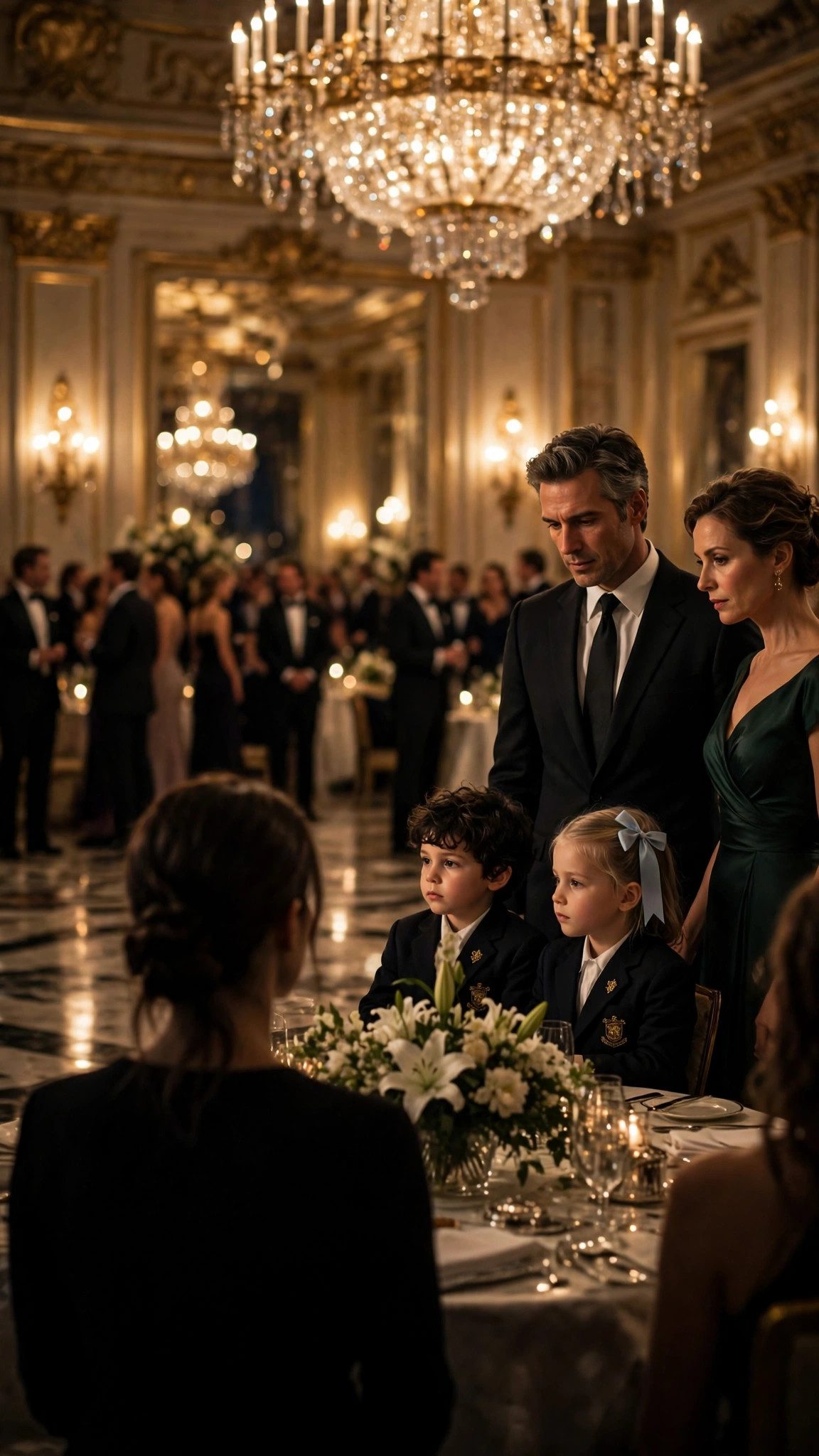
    The room was large and warm, with two small beds against opposite walls, and a nightlight glowing in the corner shaped like a star. Leo was asleep in the left bed, curled on his side, one arm thrown over his eyes, his dark curls wild on the pillow. Lily was asleep in the right bed, on her back, her hands folded on her chest like a little queen, her pale blue ribbon still tied in her hair.

    I stood in the doorway and I looked at them, and I felt something inside me — something that had been broken for six years, something I had thought could never be fixed — begin, slowly, to mend.

    "Can I — " My voice caught. "Can I sit with them? Just for a little while?"

    "Of course," Margaret said. She kissed my cheek, and she left, closing the door softly behind her. Adrian stayed. He stood in the corner of the room, in the shadows, watching me the way he had watched me in the trauma room all those years ago — like I was the only living thing in the world.

    I sat down on the floor between the two beds. I did not touch them. I did not want to wake them. I just sat there, in the dark, listening to them breathe, and I let six years of grief wash over me and out of me, like a tide going out.

    "Leo," I whispered. "Lily. Mommy's here. Mommy came home."

    Leo stirred in his sleep. He turned toward my voice, still half-dreaming, and he murmured something I could not make out. Lily sighed in her sleep, a small, contented sound, and her hand — her tiny hand, no longer tiny, a six-year-old's hand now — slipped off her chest and fell toward the edge of the bed, toward me.

    I took it. Very gently. I held my daughter's hand in mine, and I sat there on the floor of her bedroom, and I cried — quietly, so I would not wake her — for everything I had lost, and everything I had found again.

    Adrian came and sat beside me on the floor. He did not speak. He just sat there, in the dark, next to me, and after a while, his hand found mine, and we sat like that — the three of us, plus one sleeping boy and one sleeping girl — until the sun came up over the lake and painted the room gold.

    The days that followed were not easy. I will not pretend they were. A mother does not walk back into her children's lives after six years and simply pick up where she left off. Leo was angry. He did not understand why I had left, and he did not trust that I would stay, and he tested me — hiding my shoes, refusing to eat the food I made, asking me questions designed to hurt.

    "Where were you when I lost my first tooth?" he demanded, on the third day. "Where were you when Lily fell off the swing and broke her arm? Where were you when we needed you?"

    "I was in Milwaukee," I said. I did not lie to him. I had lied enough, to myself and to everyone else, for six years. "I was working nights at a hospital. I was thinking about you every single day. And I was wrong to leave. I was wrong, Leo. I thought I was keeping you safe, and instead I left you alone, and I am so sorry."

    He stared at me for a long moment, his dark eyes — Adrian's eyes, my eyes — searching my face for a lie. Then he threw his arms around my neck and held on so tight I could barely breathe, and he whispered, "Don't go away again. Promise. Promise you won't go away again."

    "I promise," I said. "I'm never going away again. I'm your mommy, Leo. I'm home now."

    Lily was quieter. She watched me for days, the way she had watched me in the ballroom — serious, watchful, old beyond her years. She followed me from room to room, silent as a shadow, studying me. On the fifth day, she climbed into my lap while I was reading in the library, and she put her head on my shoulder, and she said, very softly, "You smell like the hospital."

    "What does the hospital smell like?" I asked.

    "Like soap," she said. "And clean sheets. Aunt Evelyn smells like perfume. You smell like soap."

    "Is that all right?" I asked.

    She thought about it. Then she nodded, and she put her thumb in her mouth — a habit Margaret told me she had never quite broken — and she fell asleep in my lap, and I sat there for two hours, afraid to move, afraid to breathe, holding my daughter while she slept.

    Evelyn came to see me a week after the gala. She brought a box — a small wooden box, old, with a brass clasp — and she set it on the table between us, and she opened it. Inside were photographs. Dozens of them. Leo's first day of school. Lily's ballet recital. Christmas mornings. Birthday parties. Six years of my children's lives, documented in photographs, kept in a box by a woman who was not their mother but had loved them like one.

    "I kept these for you," Evelyn said. "I always knew you'd come back. A mother always comes back. I kept them so you wouldn't have to miss everything. You missed enough."

    I looked through the photographs, one by one, and I cried, and Evelyn sat with me, and she did not try to fix it, and she did not try to make it better. She just sat there, because she understood that some things cannot be fixed. They can only be carried, together.

    "I signed the annulment papers," she said, when I had finished looking. "The marriage is over. Adrian is free. And so am I." She smiled — a real smile, this time, one that reached her eyes. "I'm going to travel, I think. I've always wanted to see the world. But I'll come back for birthdays. And holidays. If that's all right."

    "It's more than all right," I said. "You're family, Evelyn. You'll always be family. Leo and Lily love you. I love you — for loving them when I couldn't be here."

    She hugged me then, and we held each other for a long moment, two women who had loved the same man in very different ways, and who had both, in the end, chosen the same thing: the children.

    Agent Reyes kept his word. Vincent Castellano was arrested three weeks after the gala, on charges that filled a file as thick as a phone book — racketeering, conspiracy, attempted murder, extortion, and the murder of Adrian's older brother, Michael, six years before the wedding that had not been a wedding. Danny Cole testified. Enzo Falcone testified. Carlo Benedetti testified — eight years, in exchange for everything he knew. Castellano was sentenced to life in prison, without the possibility of parole. He died there, two years later, of a heart attack, alone in a cell, with no one to mourn him.

    Adrian did what he had been promising himself he would do for years: he chose the law. He handed Agent Reyes every ledger, every record, every name. He closed the gambling rooms. He sold the clubs. He turned the freight company legitimate — real trucks, real cargo, real drivers, real paychecks. He kept the name Mercer, because a name is not a crime, but he made it mean something different: a foundation that built children's hospitals, a scholarship fund for the children of dockworkers, a promise that no child in Chicago would ever be used as leverage again.

    And one year after the night the lights went out in the Drake Hotel ballroom, on a warm afternoon in June, Adrian Mercer married me again.

    It was nothing like the first wedding. There were no white lilies. There were no armed men. There were no two hundred guests in black tie sitting in silence like mourners. There were twelve people, in a garden behind the Mercer house, under an old oak tree: Margaret, and Evelyn, and Marcus Hale, and Agent Reyes, and Mrs. Kowalski from Milwaukee — who had taken a bus all the way to Chicago because, as she put it, "I always knew that girl was running toward something, not away from it" — and Leo and Lily, in their best clothes, holding the rings.

    Leo gave the rings. Lily scattered rose petals. Adrian wore a gray suit, and I wore a simple white dress I had bought with my own money, and when the minister asked if I took this man to be my husband, I did not hesitate. I did not think about duty, or family, or forever. I thought about a trauma room at two in the morning, and a man who had looked at me like I was the only living thing in the world, and a night in a hospital nursery when I had whispered two names into the dark like a prayer.

    "I do," I said. And this time, I meant it. This time, it was true.

    Adrian kissed me under the oak tree, and Leo cheered, and Lily threw rose petals into the air, and Margaret cried, and Evelyn cried, and even Marcus Hale — Marcus Hale, who had never been frightened of anything — wiped his eyes with the back of his hand and pretended he had something in them.

    That night, after the children were asleep, Adrian and I sat on the terrace of the house that was finally, truly, our home, and we looked out at the city lights, and he took my hand, and he said, "I spent six years racing to reach them before my enemies did. I never thought I'd have to race to reach you, too."

    "You didn't have to race," I said. "I was already coming home. I just didn't know it yet."

    One year later, on a Tuesday in October — the twins' seventh birthday — I woke up in a house full of sunlight and noise. Leo was arguing with Lily about the rules of a board game. Margaret was in the kitchen, burning the toast. Evelyn was on the phone from Rome, singing "Happy Birthday" so loudly that the whole house could hear her. And Adrian was standing in the doorway of our bedroom, holding two cups of coffee, looking at me the way he had looked at me in that cathedral for one second, six years ago — like I was the only living thing in the world.

    Only this time, the second did not pass. This time, it lasted.

    I work days now, at a children's clinic on the West Side — no more night shifts, no more covering for everyone else. I come home at five. I help with homework. I read bedtime stories. I kiss two small foreheads every night and whisper, "Mommy loves you. Mommy is here. Mommy is never going away again."

    And every night, before I turn out the light, Leo says the same thing, in the same serious voice, like a vow he is renewing: "You're our mommy. You're not gone anymore."

    And every night, I say the same thing back: "I'm your mommy. I'm not gone anymore. I'm home."

    The mother they said was gone came home. And she stayed. And that, in the end, is the whole story. It was not the story they told at the gala. It was ours, and it was true, and it belonged to us forever.
    The End.
    THE END
  • Chapter 6: What the Law Could Do

    Chapter 6: What the Law Could Do

    The police station smelled of coffee and floor wax, and I sat in a small interview room with a paper cup in my hands, wearing a blanket someone had draped over my shoulders, and I waited.

    It was three in the morning. The gala had ended hours ago, in chaos and sirens and flashing lights. Leo and Lily were at the Mercer house, under guard, with their grandmother. Adrian was in the room next door, giving his statement. Evelyn Carter was somewhere in the building, giving hers. And I was here, in this small room with its buzzing fluorescent light, trying to explain to a federal agent how a dead woman had come back to life in the middle of a charity ball.

    The door opened, and FBI Agent Daniel Reyes walked in.

    He was forty years old, tall, dark-haired, with the calm, tired eyes of a man who has seen everything and is no longer surprised by any of it. He set a file on the table between us, and he sat down, and he folded his hands, and he looked at me the way a doctor looks at a patient — carefully, and without judgment.

    "Mrs. Mercer," he said.

    "Clara Whitfield," I said. "I haven't been Mrs. Mercer for six years."

    "Clara, then," he said. "I've been building a case against Vincent Castellano for two years. Tonight, you and your husband handed me the rest of it on a silver platter. Danny Cole and Enzo Falcone are in custody. They'll talk. Men like that always talk, once they understand how much time they're facing." He opened the file. Inside were photographs, bank statements, phone records. "But there's a piece I need from you. Eddie Marcone died in your emergency department in Milwaukee, two weeks ago. He told you something before he died. I need to know what it was."

    I told him. I told him everything Eddie had said — the gala, the lights, the video, the school route, and the name that had made my blood run cold: Carlo Benedetti.

    Agent Reyes nodded slowly, like a man fitting the last piece into a puzzle he has been working on for a very long time.

    "Carlo Benedetti," he said. "Adrian's underboss. His father's oldest friend. He's been selling Mercer routes to Castellano for three years. The gala security plan. The twins' school schedule. The safe house addresses. All of it." He closed the file. "We picked him up an hour ago, at his house in Winnetka. He was packing a bag. He had two hundred thousand dollars in cash in the trunk of his car and a plane ticket to Naples in his pocket. He'll testify. Men like Carlo always testify, once they understand that Castellano will kill them faster than the law will."

    "And Castellano?" I asked.

    "Castellano is finished," Reyes said. "Danny Cole's testimony, Enzo Falcone's testimony, Carlo Benedetti's testimony, the bank records, the phone records — it's enough. He'll die in prison. I can promise you that." He leaned forward slightly. "But I need you to understand something, Clara. Your husband has spent six years building a wall between his family and Castellano's men. Tonight, that wall held — because you were there. Because you came back. Adrian Mercer has been trying to protect those children alone for six years, and tonight he finally stopped being alone."

    I did not know what to say to that. So I said nothing. I drank my coffee. It was cold.

    The door opened again, and a woman came in. Evelyn Carter. Her dark green gown was torn at the shoulder, and there was a bruise forming on her cheek, and her hair had come loose from its pins. She looked exhausted. She looked afraid. And she looked, more than anything else, relieved.

    "Agent Reyes," she said. "May I speak with Clara? Alone?"

    Reyes stood. He nodded at me. "Take your time," he said. And he left, closing the door softly behind him.

    Evelyn sat down across from me. For a long moment, neither of us spoke. Then she reached across the table, and she took my hand, and her hand was shaking.

    "I'm sorry," she said. "I'm sorry for everything. I'm sorry for the wedding. I'm sorry for the six years. I'm sorry for standing next to your husband in that ballroom tonight while your children looked at me and thought I was their mother."

    "You're not their mother," I said. My voice was flat. "You never were."

    "No," Evelyn said. "I never was. And I never pretended to be — not to them. Leo and Lily know I'm not their mother. They know their mother is gone. That's what Adrian told them. That's what we all told them." She squeezed my hand. "Clara, I need you to listen to me, because there are things you don't know, and Adrian will never tell you himself, because that is the kind of man he is. He will carry a secret to his grave before he admits he was trying to protect someone."

    "Then tell me," I said.

    Evelyn took a deep breath.

    "Adrian never loved me," she said. "Not the way you think. We grew up together. Our families were close. When I was nineteen, I was engaged to his older brother, Michael. Michael died in a car accident six months before the wedding — a car accident Castellano arranged, though we didn't know that then. Adrian and I grieved together. That was all it ever was. Grief. Friendship. Two people who had lost the same person."

    "Then why did he tell me he still loved you?" I asked. "Why did he hand me divorce papers and say your name like it was a weapon?"

    "Because he needed you to leave," Evelyn said. "Because the night you went into labor, Danny Cole tried to kill you, and Adrian understood, finally, what Castellano was willing to do. Castellano didn't want the docks, Clara. Not only the docks. He wanted the Mercer heir. He wanted a child he could raise, or a child he could ransom, or a child he could kill to break Adrian's heart. And as long as you were Adrian's wife, you were the easiest way to get to them. A wife is a weakness. A wife is leverage. Adrian knew that. So he did the cruelest thing he could think of. He lied to you. He told you he loved me. He handed you divorce papers and money and a train ticket, and he made you hate him, because a woman who hates her husband leaves and never looks back, and a woman who leaves is a woman Castellano cannot find."

    "And the marriage?" I asked. "Your marriage to him?"

    "A paper marriage," Evelyn said. "Two years after you left. Castellano was asking questions — where was the wife, where was the mother, why were the twins being raised by guards and grandmothers. Adrian needed the world to believe he had moved on. He needed Castellano to believe the children's mother was gone for good, and that there was a new Mrs. Mercer, and that the family was settled and stable and not worth chasing. I agreed because I loved those children, Clara. I have loved them since the day they were born. I held Lily in the nursery the night you left. I sang to her. I have been there for every birthday, every fever, every nightmare. I was never their mother. But I was the only mother they had, and I did the best I could."

    Tears were running down her face now. She did not wipe them away.

    "Did you know I was alive?" I asked. "Did Adrian know?"

    "He knew," Evelyn said. "He always knew. He had a man in Milwaukee — a private investigator, a quiet man named Frank DeLuca — who sent him a report every month. Where you lived. Where you worked. Whether you were safe. Whether you were happy." She laughed, a small, broken laugh. "You were never happy, Clara. The reports always said the same thing: she works nights, she covers for everyone else, she never takes a holiday, she never smiles. And Adrian would read them, and he would sit in his study for hours, and he would not speak to anyone, and I would stand outside the door and listen to him not crying, because Adrian Mercer does not cry."

    "Why didn't he come for me?" I whispered. "Why didn't he tell me the truth?"

    "Because the truth would have brought you back," Evelyn said. "And back was the one place you weren't safe. Not while Castellano was free. Not while Carlo Benedetti was selling his secrets. Adrian was waiting. He was building a case. He was working with Agent Reyes for two years, feeding him evidence, waiting for the night Castellano would finally reach too far and expose himself. Tonight was that night. Castellano reached for the twins in a room full of witnesses, and now he's finished. And now — " She stopped. She took my other hand, too, so that she was holding both of mine across the table. "And now you can come home, Clara. If you want to. The danger is over. The lie is over. I'm releasing him. The paper marriage is already being annulled. I signed the papers this morning, before the gala. I knew tonight was the night. I knew you would come. A mother always comes."

    I sat there, holding Evelyn Carter's hands across a police station table, and I cried for the first time in six years. Not the quiet, controlled tears I had cried in Milwaukee, alone in my room above the laundromat. Great, shaking sobs that came from somewhere deep in my chest, from a place I had sealed shut the night I signed those papers.

    Evelyn held my hands, and she did not let go, and she cried with me.

    When I finally stopped, she stood up, and she went to the door, and she paused with her hand on the handle.

    "One more thing," she said. "Margaret — Adrian's mother — she never knew you were alive either. Adrian told her you were dead. He told her the twins had no mother. She believed him, because she had no reason not to. When she saw you tonight, she thought she was seeing a ghost. She'll want to talk to you. Be gentle with her. She's an old woman who has spent six years grieving for a daughter-in-law she thought was dead, and grandchildren she thought had no mother."

    Then she was gone, and I was alone in the small room with its buzzing light, and my coffee was cold, and my hands had stopped shaking for the first time in six years.

    The door opened again. Adrian stood in the doorway.

    He looked terrible. His shirt was torn. There was blood on his collar — his own, or Danny Cole's, I did not know. There was a cut above his eyebrow. His hair was wild. And his eyes — his eyes were the same eyes I had seen in the trauma room all those years ago, locked on mine, furious and alive and afraid.

    "Clara," he said.

    "Adrian," I said.

    We stood there, looking at each other across a police station interview room, six years and a thousand lies between us, and neither of us knew what to say.

    So he said the only thing that mattered.

    "I'm sorry," he said. "I lied to you. I lied about Evelyn. I lied about the divorce. I lied about everything. I did it to keep you alive, and I did it to keep them alive, and I would do it again, because it worked — you're alive, and they're alive — but I'm sorry. I'm sorry I made you believe you were a mistake. You were never a mistake, Clara. You were the best thing that ever happened to me. You were the only good thing in my life, and I threw you away to save you, and I have regretted it every single day for six years."

    I stood up. I walked across the room. I stood in front of him, and I looked up into his face, and I saw the man I had married in a cathedral full of white flowers and armed men, and the man who had held my hand in a trauma room, and the man who had thrown himself over my body on a ballroom floor while a gunman stood over us.

    "Take me to my children," I said.

    He nodded. He took my hand. His hand was shaking. Mine was shaking too.

    "Take me home, Adrian," I said. "Take me to Leo and Lily."

    And he did.

    We drove through the dark city in silence, and for the first time in six years, the silence between us did not feel like a wall. It felt like a room we were both standing in, quietly, not knowing what to say, but no longer needing to fill it with lies.

    Halfway there, at a red light on Halsted, Adrian spoke — quietly, without looking at me, his eyes on the road ahead.

    "There was a man," he said. "In Milwaukee. Frank DeLuca. A private investigator. A quiet man. He sent me a report every month, for six years. Where you lived. Where you worked. Whether you were safe. I read every one of them, Clara. Every single one."

    "What did they say?" I asked.

    "They said you worked nights," he said. "They said you covered for everyone else. They said you never took a holiday. They said you never smiled." He stopped at the light, and his hands tightened on the wheel. "The last report came two weeks ago. It said you had quit your job. It said you had packed a bag. It said you had driven south, toward Chicago. And I knew — I knew you were coming home, and I knew Castellano would try for the twins at the gala, and I knew that for the first time in six years, I would not be racing alone."

    "Why didn't you ever write to me?" I asked. "Why didn't you ever tell me the truth, even once, in six years?"

    "Because the truth would have brought you back," he said. "And back was the one place you weren't safe. Not while Castellano was free. Not while Carlo was selling my secrets. I was waiting, Clara. I was building a case with Reyes. I was waiting for the night Castellano would reach too far. Tonight was that night. And you — " He glanced at me then, just for a second, and his eyes were wet. "You were the piece Castellano never planned for. Because he thought you were dead. Because I told the whole world you were dead. And tonight, the dead woman walked into his trap and broke it."

    I looked out the window at the city going past — at the streetlights, at the closed shops, at the lake, black and endless beyond the towers — and I thought about six years of night shifts, and a notebook full of memories, and a train ride to Milwaukee with four thousand seven hundred dollars and a broken heart.

    "I'm not dead, Adrian," I said. "I'm here. And I'm not going anywhere. Not ever again."

    "I know," he said. "I know."

    The light turned green. He drove on. And ahead of us, over the rooftops, the sky was beginning to lighten — the first pale gray of dawn, coming up over the lake, over the city, over the house where my children were sleeping, safe, waiting for their mother to come home.

  • Chapter 5: The Crowded Room

    Chapter 5: The Crowded Room

    The Drake Hotel ballroom was exactly as I remembered it from the wedding that had not been a wedding: white lilies, crystal chandeliers, two hundred people in black tie, and a silence underneath the music that had nothing to do with celebration and everything to do with power.

    I slipped in through the service entrance, the way I had planned — past the kitchen, past the waiters in their white jackets, past a security guard who was looking at his phone and not at the woman in the cheap black dress with her hair pulled back and her hands folded. I found a place at the back of the room, near the bar, where the shadows were thickest, and I stood there, and I waited, and I watched.

    The string quartet was playing. A man in a tuxedo was giving a speech about the Mercer Foundation and its work with children's hospitals. People nodded. People sipped champagne. People smiled the particular smiles of people who have given a great deal of money and expect to be thanked for it in public.

    And then I saw them.

    Leo and Lily were sitting in the front row, side by side, in their school blazers with the gold Mercer crest pinned above their hearts. Leo's hair was dark and curly, and he kept running his hand through it the way Adrian did when he was thinking. Lily sat very straight, her hands folded in her lap, her ribbon — pale blue — tied in a neat bow at the back of her head. She looked like me. Not the me standing in the back row in a cheap dress. The me from before — the girl who had once believed the world was a kind place.

    My heart stopped. And then it started again, too fast, hammering against my ribs like it was trying to break out of my chest and run to them.

    Six years. Six years of night shifts. Six years of birthdays with candles I blew out alone. Six years of a notebook full of memories I was terrified of losing. And here they were. Alive. Breathing. Real. Close enough that I could have crossed the room in twenty steps and touched them.

    I took one step forward. And then another. And then I heard a voice behind me, sharp and cold and familiar, and I froze.

    "There she is," Margaret Mercer said. "The ghost finally came home."

    I turned. Margaret was standing two feet behind me, in a silver gown, holding a champagne glass that shook in her hand. Her face was white. Her eyes were fixed on mine with an expression I could not read — shock, and grief, and something that might have been anger, or might have been hope.

    "Mother," Adrian said.

    He was standing three feet from her, and I had not even seen him come up beside us. He was taller than I remembered. His suit was black. His hair was black, going gray at the temples. His face was the same face I had married — beautiful, cold, and closed to me like a door I had never been given the key to.

    He did not look at me. He looked at his mother, and his voice was very quiet, and very tired.

    "Mother," he said. "I told you they had no mother."

    Something in my chest cracked open. Six years of night shifts. Six years of covering for everyone else. Six years of telling myself that it was better to let my babies live a life without me so they would not be hurt. And here was the man who had thrown me away, telling his mother — telling the whole glittering room — that my children had no mother.

    "You can tell stories to strangers, Mr. Mercer," I said. My voice sounded calm. I was proud of how calm it sounded. "But I'm not a stranger."

    Adrian turned his head then. Slowly. The way a man turns when he hears a voice from a room he thought was empty.

    His eyes found mine. And for one terrible, endless second, I saw it — the flicker. The recognition. The shock. The thing he had buried under six years of ice, surfacing all at once, raw and unguarded, before he killed it.

    "Clara," he said.

    It was not a question. It was not a greeting. It was my name, said the way a man says the name of someone he has already mourned.

    Margaret Mercer's champagne glass slipped from her hand and shattered on the marble floor. The string quartet faltered. Two hundred heads turned. And in the front row, a little boy with dark curls turned around in his seat, and a little girl with a ribbon in her hair turned with him, and two pairs of dark eyes — his eyes, my eyes, the same eyes — found me standing in the back row.

    I walked over to Adrian. I did not plan it. My feet simply moved, carrying me across the ballroom floor while two hundred people whispered behind me. I walked past the tables. I walked past the lilies. I walked past the waiters frozen in place with their trays. And all the while, my children — my son and my daughter — had already moved away from me, walking toward the door where their father was standing next to a woman I had expected to see.

    Evelyn Carter. Standing next to Adrian in a dark green gown, beautiful and composed, her hand resting lightly on his arm the way a wife's hand rests. The woman he had chosen over me. The woman he still loved. The woman whose name had been the last thing he said to me before I signed the papers and walked out of the hospital with empty arms.

    She was looking at me, too. And her face — I will never forget her face in that moment. It was not triumphant. It was not guilty. It was afraid. She looked afraid, the way a woman looks when the thing she has been dreading for six years has finally arrived, and she does not know whether it will save her or destroy her.

    A man stopped me before I could reach my children.

    He moved out of the crowd like a wall sliding into place — tall, broad, gray at the temples, a hand raised, palm out. Marcus Hale. Adrian's head of security. I had seen him a hundred times in the old days, standing behind Adrian's shoulder, saying nothing.

    "Not here," Marcus said quietly. "Not tonight. Please."

    I tried to turn around, but he moved faster than I did. His hand closed around my upper arm — not hard, not cruel, just firm, the way you hold someone who is about to walk into traffic.

    "Let go of me," I said.

    "Clara," Adrian said again. And this time his voice broke, just slightly, on the second syllable. "Don't."

    "Don't what?" I asked. "Don't look at my children? Don't speak to my children? Don't exist? I've been doing all three for six years, Adrian. I'm done."

    The little boy — Leo, my Leo, six years old and brave in a way that broke my heart — took a step toward me. His sister's hand was in his. They moved together, the way twins do, like two halves of a single thought.

    And then the lights went out.

    Not all of them. Just the chandeliers. The ballroom plunged into a darkness so sudden and complete that for a moment, nobody moved, nobody breathed. Someone screamed. Glass shattered somewhere to my left. Marcus Hale's hand tightened on my arm, and then it was gone, and a voice I did not recognize shouted, "Now! Take them now!"

    In the dark, I heard my daughter cry out. "Leo!"

    And I heard Adrian Mercer roar my son's name like a man watching his whole world burn.

    "LEO!"

    I ran toward the sound. I did not think. I did not plan. I ran, in the dark, in my cheap black dress, toward the small voice calling for her brother, toward the man who had thrown me away six years ago and was now shouting for his son like his heart was being torn out of his chest.

    The emergency lights came on — dim, red, casting everything in the color of blood. And in that red light, I saw them.

    Two men in waiters' uniforms, moving fast toward the front row. One of them — young, dark-haired, a scar through his left eyebrow — had his hand around Leo's arm. Danny Cole. The same man who had pointed a gun at our car on the night my babies were born. The other man — older, heavier, with a face like a slab of concrete — had Lily by the wrist. Enzo Falcone. Castellano's lieutenant. I knew his name because Eddie Marcone had whispered it to me on his deathbed, and because every nurse in Chicago knew the name of the man who collected debts for Vincent Castellano.

    "No!" I screamed. I do not know if I screamed it out loud or only in my head. "No, not my babies, not my babies!"

    Adrian was already moving. He crossed the ballroom floor in four strides, and he hit Danny Cole like a train hitting a wall — shoulder first, driving the younger man backward, away from Leo, into a table that went over with a crash of glass and silver. Danny went down. Adrian went down with him. They rolled. A fist connected with a jaw. A knee connected with ribs. It was not a fight. It was a father killing the man who had touched his son.

    But Enzo Falcone still had Lily. He was dragging her toward the service door, and she was fighting him — kicking, biting, screaming — and she was six years old, and he was twice her size, and he was winning.

    I ran at him. I did not think about the fact that he was bigger than me, or stronger than me, or that he almost certainly had a gun. I thought about Lily's tiny fist curled around my finger in the nursery, eleven minutes after she was born, holding on tight. I thought about six years of birthdays with candles I blew out alone. I thought about the notebook by my bed, full of memories I had been terrified of losing.

    I hit him with everything I had. My hands, my elbows, my knees. I clawed at his face. I bit his wrist. He shouted and tried to throw me off, but I held on, because I was a mother, and mothers do not let go.

    "Clara!" Adrian shouted. He was on his feet again, blood on his shirt, his face a mask of fury. "Clara, get back!"

    "No!" I shouted. "She's my daughter!"

    Enzo Falcone raised his free hand, and I saw the gun — black, small, ugly — and I saw his finger tighten on the trigger, and I closed my eyes, and I waited for the sound.

    It did not come.

    Instead, I felt a weight crash into me from the side, knocking me to the floor, and a body covering mine — heavy, warm, smelling of sweat and cologne and blood — and a voice in my ear, low and furious and terrified, saying, "Stay down. Stay down, Clara. Don't move."

    Adrian. Adrian Mercer had thrown himself over me. Adrian Mercer, the most feared mafia boss in Chicago, was lying on a ballroom floor with his body shielding mine, while a gunman stood over us with a weapon pointed at his back.

    "Move, Mercer," Enzo said. His voice was shaking. "Move, or I shoot you both."

    "No," Adrian said. His voice was very calm. Too calm. The calm of a man who has already decided what he is willing to die for. "You shoot me, Castellano gets nothing. You shoot her, Castellano gets nothing. The children are already gone, Enzo. Look around. My men have them. Your men are on the floor. It's over."

    Enzo looked around. And I looked around, too, from beneath Adrian's weight, and I saw that he was right. Marcus Hale had Leo in his arms, holding him tight against his chest. Margaret Mercer had Lily, wrapped in her silver shawl, rocking her gently, whispering to her. Evelyn Carter was standing between them and the door, her arms spread wide, her face white but her spine straight, like a wall. And all around the room, Adrian's men — men I had not even noticed, in suits and waiters' uniforms — were standing over Castellano's men, who were face-down on the marble floor with their hands behind their heads.

    The police arrived four minutes later. FBI Agent Daniel Reyes walked in through the front doors with twenty agents behind him, and he looked at the scene — the overturned tables, the shattered glass, the men on the floor, the twins safe in their grandmother's arms — and he said, very quietly, "Somebody want to tell me what happened here?"

    Adrian got off me then. He stood up. He held out a hand to help me up. His hand was shaking. I had never seen Adrian Mercer's hand shake before.

    "They came for my children," he said. His voice was steady, but his hand was shaking, and I understood, in that moment, something I should have understood six years ago: this man was not a monster. He was a father. A father who had spent six years terrified that the men who wanted his empire would take the only two people in the world he could not replace.

    And I understood something else, too — something that broke my heart all over again, in a completely different way than it had broken six years ago.

    The most feared mafia boss in Chicago was never fighting to get his children back.

    He was racing to reach them before his enemies did.

    And tonight, for the first time in six years, he had not been racing alone.

  • Chapter 4: Six Years of Night Shifts

    Chapter 4: Six Years of Night Shifts

    Milwaukee was gray. That was the first thing I noticed about it, stepping off the train with my bag and my four thousand seven hundred dollars and my nursing license: the whole city was gray. Gray sky, gray lake, gray buildings, gray faces on the gray streets. It suited me. I was gray inside, too — hollowed out, scraped clean, a woman with no husband, no children, no home, and a name that nobody in that city had ever heard before.

    I found a room above a laundromat on the east side. It had a bed, a hot plate, a window that looked out onto a brick wall, and a radiator that clanged all night like someone knocking to be let in. It cost three hundred dollars a month. I paid three months in advance, in cash, and the landlady — a wide, tired woman named Mrs. Kowalski — looked at the money and then at my face and said, "You running from something, honey?"

    "Yes," I said. "Myself."

    She nodded like that was the most sensible thing she had ever heard. "Aren't we all."

    I got a job at the county hospital, on the night shift, in the emergency department. The work was hard and relentless and exactly what I needed. On nights, there was no time to think. There were car wrecks and overdoses and heart attacks and gunshot wounds, and I moved from bed to bed with my hands steady and my voice calm, and I did not think about Leo, and I did not think about Lily, and I did not think about Adrian Mercer standing at the foot of my hospital bed with a folder in his hand.

    I thought about them all the time. Of course I did. But on nights, I could pretend, for twelve hours at a stretch, that I was only a nurse, and not a mother who had left her babies behind.

    That was what I did for money. That was why I had worked nights, covering up for everyone else — taking the shifts nobody wanted, covering for nurses who called in sick, covering for the young ones who could not handle the bad nights, covering for everyone who had somewhere better to be. I was the nurse who never said no. I was the nurse who never asked for a holiday. I was the nurse who worked Christmas and New Year's and her own birthday, because what else was I going to do? Go home to an empty room above a laundromat and listen to the radiator clang?

    The other nurses liked me. They called me reliable. They called me a saint. They did not know that reliability was just another word for having nothing left to lose.

    Once a year, on the twins' birthday — a Tuesday in October, the day Leo had come screaming into the world and Lily had followed eleven minutes later, quiet and watchful — I would buy a small cake from the bakery on the corner, and I would take it back to my room, and I would light six candles, and then seven, and then eight, and I would sit in the dark and watch the flames and whisper, "Happy birthday, Leo. Happy birthday, Lily. Mommy loves you. Mommy is sorry. Mommy is so sorry."

    And then I would blow out the candles and go to work, because the night shift started at seven, and somebody had to cover it.

    In my third year in Milwaukee, I stopped crying on their birthday. I told myself that was progress. It was not progress. It was just that I had run out of tears, the way a well runs out of water in a drought — not all at once, but slowly, and then one day you lower the bucket and there is nothing there at all.

    In my fourth year, I stopped buying the cake.

    In my fifth year, I stopped lighting the candles.

    In my sixth year, I almost stopped remembering their faces. That frightened me more than anything else that had ever happened to me — more than the black SUV, more than the divorce papers, more than the night I signed my name and walked out of the hospital with empty arms. I could remember Leo's dark curls. I could remember Lily's tiny fist around my finger. But their faces — their real faces, the way they had looked in the nursery that one night — were fading, like a photograph left out in the sun.

    I started keeping a notebook by my bed. Every night before my shift, I would write down everything I could still remember: Leo's cry, loud and furious. Lily's silence, watchful and old. The weight of them in my arms. The smell of them — milk and clean skin and newness. I wrote it all down, because I was terrified that if I did not write it down, I would lose it, and if I lost it, I would have nothing left at all.

    And then, on a Thursday night in September, in my sixth year in Milwaukee, a man was brought into my emergency department with a bullet in his stomach, and he changed everything.

    His name was Eddie Marcone. He was fifty-two years old, broad-shouldered, gray-haired, with a tattoo of a rose on the back of his right hand and a wedding ring he kept turning around his finger while he talked. He had been a soldier for the Mercer family for thirty years — a driver, a guard, a man who stood outside doors and kept the people inside them safe.

    He was dying. We all knew it. The surgeon knew it. The charge nurse knew it. I knew it the moment I saw the color of his skin and the way his breathing had gone shallow and fast. But he was awake, and he was lucid, and he kept asking for someone named Clara.

    "Not my Clara," he said, when I leaned over him. His voice was a wet rasp. "The other one. Mercer's Clara. The nurse. The one who left."

    I went very still. My hands, which had been steady for six years, began to shake.

    "I'm Clara," I said. "Clara Whitfield."

    He looked at me for a long moment, and his eyes — gray, clouded with pain — widened.

    "You're her," he whispered. "You're the mother. Jesus. You're the mother, and you're here, in Milwaukee, working nights." He laughed then, a terrible, bubbling laugh that brought blood to his lips. "He told us you were dead. Mercer told us all you were dead. He said the twins had no mother. He said it so many times I started to believe it."

    "He told everyone that?" I asked. My voice sounded very far away.

    "He told his own mother that," Eddie said. "He told the whole family. No mother. The twins have no mother. And we all believed him, because why would a man lie about something like that?" He coughed, and blood flecked his chin, and I wiped it away with a piece of gauze, my hands moving on their own, the nurse in me working while the woman in me fell apart. "Listen to me. Listen. Castellano is coming for the twins. Not the docks. Not the routes. The twins. He tried six years ago, the night they were born — Danny Cole, in the SUV, you remember? He tried, and Mercer stopped him, and Castellano has been waiting six years for another chance. The Foundation gala. Next Saturday. The Drake Hotel. Castellano's men will be in the room. They'll take the twins during the speeches, when the lights go down for the video. Mercer knows. He's been moving them from safe house to safe house for a month. But he can't be everywhere, and his own man — his own underboss — sold him out. Carlo Benedetti. Carlo sold the gala plan. Carlo sold the school route. Carlo sold everything."

    "Why are you telling me this?" I whispered.

    "Because you're their mother," Eddie said. His eyes were closing. His breathing was slowing. "And because Mercer isn't fighting to get them back. He's racing to reach them before Castellano does. And he's going to lose, Clara. He's going to lose, because he's one man, and Castellano has an army, and the only person Castellano never planned for is you. Because Castellano thinks you're dead, too."

    He died three minutes later. I held his hand while he went. I did not know him. He did not know me. But in those three minutes, he had given me back everything I thought I had lost: my children were in danger, my husband had lied to protect me, and the only person who could reach the twins in time was the woman everyone believed was gone.

    I finished my shift. I went home to my room above the laundromat. I packed a bag — two changes of clothes, my nursing license, the notebook full of memories, and the last of my savings, six hundred dollars in cash. I wrote a note to Mrs. Kowalski and left it on the table with the key. I got in my car — an old Honda with a dented fender and a hundred and eighty thousand miles on it — and I drove south, toward Chicago, toward the city I had sworn I would never see again.

    I drove through the night, and I did not stop, and by the time the sun came up over the lake, I was back in the city where I had been a wife and a mother for exactly one night, and I was nobody again — just a woman in a cheap coat, with a bag and a notebook and a name nobody in Chicago had spoken in six years.

    I got a job at a free clinic on the West Side, on the night shift, because the night shift was the only thing I knew how to do. During the day, I slept. In the late afternoon, before my shift, I would drive past the twins' school — a gray stone building with a wrought-iron fence and a gold crest above the door — and I would park across the street, and I would watch.

    I watched them for two weeks. I watched Leo kick a soccer ball across the playground and argue with his friends about the rules. I watched Lily sit under a tree with a book, her ribbon coming loose in the wind, her face serious and old beyond her years. I watched them climb into a black car with tinted windows every afternoon at three-fifteen, flanked by two men in suits, and I watched the car pull away, and I watched the street go quiet again.

    They were beautiful. They were alive. They were healthy. And they were walking around with a target on their backs, and their father was the only thing standing between them and the men who wanted to use them to break him.

    On the Friday before the gala, I did something I had not done in six years: I bought a dress. It was black, simple, on sale at a department store on State Street — not a gala dress, not really, but the best I could afford on a clinic nurse's wages. I stood in the fitting room and looked at myself in the mirror, and I did not recognize the woman looking back at me. She was twenty-nine years old. She had dark circles under her eyes and gray in her hair she had not noticed before. She looked tired, and poor, and afraid.

    But her eyes were not dead anymore. Her eyes were alive. Her eyes were the eyes of a mother who had found her reason to live again.

    Tomorrow, I told the woman in the mirror, you will walk into a room full of people who believe you are dead. You will look at your children for the first time in six years. And you will not walk away. Not this time. Not ever again.

    I was done covering up. I was done hiding. I was done being the ghost in my own children's lives.

    That morning — the morning of the gala — I did not sleep. I lay in my bed in the small room I had rented on the West Side, staring at the ceiling, listening to the traffic on the street below, and I went over Eddie Marcone's words again and again, the way you go over a patient's chart before a difficult procedure, looking for the thing you might have missed.

    "The Foundation gala. Next Saturday. The Drake Hotel. Castellano's men will be in the room. They'll take the twins during the speeches, when the lights go down for the video."

    The lights go down for the video. That was the detail that frightened me most. Not the guns. Not the men. The darkness. A room full of two hundred people, plunged into darkness for a video presentation, and in that darkness, two small children in school blazers, being carried away by men they did not know. It was a good plan. It was a patient plan. It was the kind of plan a man makes when he has been waiting six years.

    I went to the clinic that morning anyway, because I did not know what else to do with my hands. There was an old woman there — Mrs. Deluca, eighty-four, with a bad knee and a sharp tongue — who had been coming to the clinic for years, and who knew me only as the quiet night nurse who never talked about herself.

    "You look like a woman going to a funeral," Mrs. Deluca said, watching me take her blood pressure. "Or a wedding. With you, I can never tell which."

    "Neither," I said. "I'm going to see my children tonight. For the first time in six years."

    Mrs. Deluca was quiet for a moment. Then she patted my hand with her papery one, and she said, "Then listen to an old woman, Clara. When you see them, don't apologize first. Children don't need apologies. They need you to be there. Just be there. Stand where they can see you. Let them come to you. That's all."

    I thought about that all afternoon, while I got ready. I put on the black dress. I pulled my hair back. I looked at myself in the cracked mirror above the sink, and I practiced what I would say. Not a speech. Not an explanation. Just the truth, in the simplest words I knew: I'm your mommy. I never stopped loving you. I came home.

    I took the notebook with me — the spiral notebook full of memories, six years of Leo's cry and Lily's silence and the weight of them in my arms. I put it in my bag, next to my nursing license, because it was the only proof I had that I had ever been a mother, and if tonight went wrong, if Castellano's men reached them first, if Adrian's men stopped me at the door, I wanted to have it with me. I wanted to have something of them, even if I could not have them.

    Before I left, I stood at the window and looked out at Chicago — at the gray lake, at the towers downtown, at the city that had taken everything from me and was about to give it back, or take the rest. And I said, out loud, to no one, to the room, to the city, to God, to whoever might be listening: "I'm coming, Leo. I'm coming, Lily. Mommy's coming home."

    Tomorrow, I would walk into the Drake Hotel, and I would find my babies, and I would bring them home — or I would die trying.

  • Chapter 3: The Night I Left

    Chapter 3: The Night I Left

    I found out I was pregnant on a Thursday in February, in the small bathroom of the penthouse, holding a white plastic stick with two pink lines on it, while snow fell past the window in slow, silent spirals.

    I sat on the cold tile floor for a long time. I did not cry. I did not smile. I just sat there, holding the stick, listening to the quiet of a home that had never felt like mine, and thinking about the fact that there was now a life inside me — a life that was half Adrian Mercer, half me — and that nothing about my marriage, my future, or my safety would ever be simple again.

    I told Adrian that night at dinner. He had come home early, for once — eight o'clock instead of midnight — and we were eating in the dining room in the particular silence that had become our marriage: the clink of forks, the hum of the refrigerator, the city glowing beyond the windows.

    "I'm pregnant," I said.

    He stopped eating. His fork hung in the air for a moment, and then he set it down very carefully, the way a man sets down something fragile, or something explosive.

    "Are you certain?" he asked.

    "Yes."

    "How far along?"

    "Eight weeks."

    He nodded. He picked up his wine glass. He drank. He set it down. And then he did something I had never seen him do in two years of marriage: he smiled. Not the cold, practiced smile he wore for cameras and councils. A real smile. Small, and startled, and almost frightened, like a man who has just been handed something precious and has no idea what to do with it.

    "Eight weeks," he said again. "Clara. That's — that's good. That's good news."

    For one evening, the penthouse felt less like a contract and more like a home. He asked me questions — had I seen a doctor, was I eating enough, did I need anything — and I answered them, and we talked, really talked, for the first time since our wedding night, and I thought, stupidly and hopefully: maybe this changes everything. Maybe a baby changes everything. Maybe he will look at me the way he looked at me in that cathedral for one second, and this time it will last.

    It did not last. Of course it did not last.

    The next morning, I woke to an empty bed and a note on the kitchen counter in Adrian's handwriting: "Gone to the docks. Back late. Take care of yourself."

    He was gone for three days. When he came back, his shoulder was bandaged — the old wound, reopened — and there was a cut above his eyebrow, and he would not tell me what had happened. He would not tell me anything. He never told me anything.

    That was the pattern of my pregnancy. Adrian would vanish for days, and come back wounded, or exhausted, or silent, and I would patch him up the way I had patched him up in that trauma room years ago, and he would thank me with his eyes and say nothing with his mouth, and the distance between us would grow a little wider every time.

    In my seventh month, I finally asked him the question I had been afraid to ask for two years.

    "Adrian," I said. We were sitting on the terrace, and the city was spread out below us, and the air smelled of rain. "Who is trying to kill you?"

    He was quiet for a long time. So long that I thought he was not going to answer.

    "Vincent Castellano," he said at last. "He wants the freight routes. He wants the docks. He has wanted them since before I was born. My father held him off. Now it's my turn."

    "And Evelyn?" I asked. My voice was steady. I was proud of how steady it was. "Where does Evelyn fit into this?"

    His face closed. The door shut. The wall came down.

    "Evelyn is not your concern," he said.

    "She's the woman you love," I said. "She's been your concern for years. I just want to know — when this baby comes, when our child comes, will you love it the way you love her? Or will it be like me? Something your father arranged?"

    He stood up. He walked to the edge of the terrace. He stood there with his back to me, his hands gripping the railing, and for a moment I thought he was going to tell me the truth. I thought he was going to turn around and say something real, something human, something that would make the last two years make sense.

    Instead he said, "Get some rest, Clara. You need your strength."

    I went into labor on a Tuesday in October, three weeks early, in the middle of the night, while rain hammered the windows of the penthouse and thunder rolled across the lake like something enormous waking up.

    Adrian was not home. Of course he was not home. He was at the docks, or at a meeting, or somewhere men like Adrian Mercer go in the middle of the night when other people are sleeping. Marcus Hale drove me to St. Margaret's. He drove fast, and he did not speak, and his knuckles were white on the steering wheel, and I remember thinking, through the pain, that Marcus Hale was frightened. Marcus Hale, who had never been frightened of anything, was frightened.

    "Marcus," I said, between contractions. "What's happening?"

    "Nothing," he said. "Just get the babies here safe. That's all that matters tonight."

    But something was happening. I could feel it in the car, in the way Marcus kept checking the mirrors, in the way he took three turns he did not need to take, in the way his hand never left the gun under his jacket.

    At the intersection of Halsted and 18th, a black SUV came out of nowhere — no headlights, no warning — and slammed into the side of our car hard enough to throw me against the door. The world spun. Glass shattered. Marcus swore and fought the wheel, and the SUV came again, and this time I saw the man in the passenger seat. I saw his face. Young, dark-haired, a scar through his left eyebrow. He was holding something in his hands, something black and long, and he was pointing it at our car.

    "Danny Cole," Marcus said through gritted teeth. "Castellano's boy. Hold on."

    Marcus drove the way men drive when they are trying not to die. He ran two red lights. He took an alley I did not know existed. He got us to the hospital doors with the SUV still behind us, and then the hospital security guards came running, and the SUV vanished into the rain like it had never been there at all.

    I gave birth six hours later. Leo came first, dark-haired and furious, screaming at the world like he already knew it was a dangerous place. Lily came eleven minutes later, smaller, quieter, her tiny fist curled around my finger.

    I held them both that night. I counted their fingers. I memorized the weight of them. I whispered their names into the dark, over and over, like a prayer: Leo. Lily. Leo. Lily. Mine. Mine.

    In the morning, Adrian walked into the hospital room with a folder in his hand.

    He looked terrible. There were dark circles under his eyes. His shirt was wrinkled. There was a bruise on his jaw I had not seen before. He did not look at the babies. He did not look at me. He stood at the foot of the bed, holding the folder the way a man holds a shield, and he said the words that ended my life as I knew it.

    "Sign these," he said. "I still love Evelyn Carter. I always have. You were a mistake I am correcting."

    I stared at him. I waited for him to laugh, or to take it back, or to look at the babies sleeping in their bassinets beside my bed and remember that he had smiled when I told him I was pregnant. He did none of those things. He stood there, cold and still, and he held out the folder, and his hand did not shake.

    "Adrian," I said. My voice sounded like it was coming from very far away. "I almost died last night. Someone tried to kill me. Someone tried to kill our babies before they were even born. And you're standing here with divorce papers?"

    "It's done, Clara," he said. "The marriage is over. You'll be taken care of. The money is in the folder. Four thousand seven hundred dollars in cash, and a train ticket to Milwaukee, and a letter of reference for the county hospital there. Take it. Go. Don't come back."

    "Why?" I asked. "Why are you doing this?"

    "Because I still love Evelyn Carter," he said. "I always have. You were a mistake I am correcting."

    He said it the same way twice. Word for word. Like a line he had rehearsed.

    I signed. I do not remember deciding to sign. I remember the pen. I remember the way the paper sounded when he turned the page. I remember the nurse with the kind eyes standing in the doorway — the same nurse who had held my hand while I pushed — and the way she looked at me, and the way I understood, in that moment, that no one in that room was going to save me.

    I left the hospital the next day with a bag that held two changes of clothes and four thousand seven hundred dollars in cash and a nursing license with my maiden name on it. I left my babies in a nursery full of machines that beeped and hummed, under the care of women who were paid to love them for a few hours at a time.

    I told myself it was better this way. I told myself that a mother who stayed would only bring the danger with her — that the black SUV would come back, that Danny Cole would come back, that Castellano would keep coming until he got what he wanted, and what he wanted was the Mercer family, and the Mercer family included my babies. I told myself that Adrian could protect them in ways I never could. He had the guards, the money, the walls, the name. I had a nursing license and four thousand seven hundred dollars and a broken heart.

    I told myself that they would be safer without me, richer without me, happier without me. I told myself that they would grow up believing their mother was gone, and that a clean grief was better than a living mother who could not protect them.

    I told myself that for six years. I told myself that on the train to Milwaukee, watching the city disappear behind me. I told myself that in the small apartment above a laundromat, where I cried into my pillow every night for a year. I told myself that on every night shift at the county hospital, while I covered for nurses who had families to go home to, while I held the hands of dying strangers and told them they were not alone, while I learned to live with the particular silence of a woman who has given away the only two people she has ever loved.

    I never once asked myself the question that would have changed everything: if Adrian Mercer truly loved Evelyn Carter, if I had truly been nothing but a mistake he was correcting, then why had his hand shaken when he held out the folder?

    I did not ask it. Not then. Not for six years.

    I was very good at believing the worst about the man I had married. It was easier than believing the alternative — that he had thrown me away to save my life, and that I had let him.

    The train to Milwaukee took four hours, and I spent all four of them staring out the window at the flat gray fields going past, holding my bag on my lap like it might be taken from me. A woman across the aisle had a baby in a carrier, and the baby cried for most of the trip, and every time it cried, my arms ached — a deep, physical ache, low in my chest, where the milk was already drying up because there was no one to feed. I had not known that grief could live in the body like that. I had not known that your breasts could mourn.

    When I got to Milwaukee, I did not know where to go. I stood on the platform with my bag and my four thousand seven hundred dollars, and I watched the other passengers scatter toward taxis and husbands and lives that made sense, and I thought about turning around and getting back on the train and going home. But there was no home anymore. There was a penthouse in Chicago with a nursery full of machines, and a husband who had handed me divorce papers, and two babies who would never know my name.

    I found the room above the laundromat by following a sign in a shop window. Mrs. Kowalski took one look at me — at my pale face, my empty arms, my bag that held everything I owned — and she did not ask me a single question. She just gave me the key and said, "Rent's due on the first. No visitors after ten. The radiator clangs, but you'll get used to it."

    That first week, I wrote a letter to my babies. I wrote it on a piece of notebook paper, sitting on the edge of the bed in that gray little room, with the radiator clanging and the smell of detergent coming up through the floorboards. I wrote: "Dear Leo and Lily. Mommy loves you. Mommy is sorry. Mommy had to go away so you would be safe. One day, when you are older, I will explain. One day, you will understand." I wrote three pages. And then I folded the letter up, and I put it in the drawer of the nightstand, and I never sent it, because there was nowhere to send it. The Mercer house did not accept letters from ghosts.

    I got the hospital job on my second day in Milwaukee. The hiring manager — a tired woman named Doris with reading glasses on a chain — looked at my license, looked at my references from St. Margaret's, and said, "Night shift only. That's all we have. Can you start tonight?"

    "Yes," I said.

    That first night shift, I treated a baby. A little girl, six months old, with a fever that would not come down. Her mother sat beside the bed, holding her hand, crying quietly. I sponged the baby's forehead. I checked her temperature every fifteen minutes. I told the mother, "She's going to be all right. She's strong. You can see it in her face." And the mother looked at me with such gratitude — such raw, desperate gratitude — that I had to turn away, because I was not a mother comforting another mother. I was a woman who had left her own babies in a nursery in Chicago, and I had no right to anyone's gratitude.

    But I kept coming back, night after night, because the work was the only thing that made the ache bearable. On nights, I was useful. On nights, my hands knew what to do, even when my heart did not. On nights, I could be the woman who stayed — even if the only people I stayed for were strangers.

    I started the notebook that first month. A cheap spiral notebook from the drugstore. Every night before my shift, I wrote down everything I could remember about Leo and Lily: the weight of them, the smell of them, the sound of Leo's cry and the silence of Lily's watchfulness. I wrote it all down because I was terrified that if I did not write it down, I would lose it, and if I lost it, I would have nothing left at all. The notebook became the most precious thing I owned. More precious than the money. More precious than the license. It was the only proof I had that I had ever been a mother at all.

  • Chapter 2: A Wedding Like a State Funeral

    Chapter 2: A Wedding Like a State Funeral

    I met Adrian Mercer on a Tuesday night in March, in a trauma room that smelled of blood and bleach, and I saved his life with my hands and a prayer I did not believe in.

    I was twenty-two years old, a night-shift nurse at St. Margaret's Hospital on the South Side, three months out of nursing school, and still young enough to think that the night shift was romantic — the quiet halls, the humming machines, the feeling that the whole sleeping city belonged to the handful of us who stayed awake to watch over it.

    It was 2:14 in the morning when they brought him in. Four men in black suits carried him through the emergency doors on a backboard, and the charge nurse took one look at the blood and said, "Trauma One, now," and I ran.

    He had been shot twice. Once in the shoulder, once in the side, just below the ribs. The blood was everywhere — on his white shirt, on the backboard, on my hands before I even realized I was touching him. His eyes were open. That was the thing I remembered most clearly afterward. Most people who come in like that have their eyes closed, or rolled back, or fixed on nothing. His eyes were open, and they were locked on mine, and they were furious.

    "Don't you dare let me die in this room," he said to me. His voice was low and steady, which frightened me more than the blood did, because a man who can speak that clearly with two bullets in him is a man who is used to giving orders and having them obeyed. "Do you understand me? I don't die tonight."

    "Then stop bleeding on my floor," I said. I don't know where the words came from. I was twenty-two and terrified and my hands were shaking, but my mouth had always been braver than the rest of me. "And hold still. You're making it worse."

    Something flickered in his eyes then. Not warmth. Not gratitude. Something closer to surprise — as if no one had spoken to him that way in a very long time.

    I worked on him for four hours. I held pressure on the wound in his side while the surgeon worked. I counted his breaths. I watched the monitor. I talked to him the whole time, because that was what the older nurses had taught me — you talk to them, you keep them here, you don't let them drift. I told him about my shift. I told him about the vending machine on the third floor that ate quarters. I told him about my father, who ran a small diner on Halsted Street and made the best meatloaf in Chicago and had taught me that a person is only as good as their word.

    He listened. He didn't say much. But his eyes stayed on my face, and when the surgeon finally stepped back and said, "He's stable," Adrian Mercer reached out with his good hand and caught my wrist.

    "What is your name?" he asked.

    "Clara Whitfield," I said.

    "Clara Whitfield," he repeated, like he was memorizing it. "You kept me alive tonight. I don't forget a debt."

    Three days later, his father came to the hospital.

    Salvatore Mercer was seventy years old, white-haired, soft-spoken, and terrifying in the particular way that only very old, very powerful men can be terrifying — not because they raise their voices, but because they never have to. He came to my floor with two men in suits, and he asked to speak with me alone, and the charge nurse looked at me with wide eyes and mouthed, "Be careful."

    "My son tells me you saved his life," Salvatore said. He had a cup of coffee in his hand, from the machine in the waiting room, and he held it the way a man holds something he has no intention of drinking. "He also tells me you saw the men who brought him in. You saw their faces. You heard what they said."

    I had. I had seen four men in black suits, and I had heard one of them say the name Castellano, and I had heard another one say, "The docks. Thursday." I had not understood what any of it meant. I understood now, standing in front of this old man with his waiting-room coffee, that I had seen something I was not supposed to see.

    "I don't know anything," I said. "I just did my job."

    "Of course," Salvatore said. "And that is why I am here. A girl who does her job and keeps her mouth shut is a rare thing, Miss Whitfield. My family values rare things." He set the coffee down on the nurses' station, untouched. "My son needs a wife. A respectable wife. A wife with clean hands and a clean name, who understands discretion. You will marry Adrian. The wedding will be in six weeks. Your father will be taken care of. You will be taken care of. And you will never speak of what you saw in that trauma room, to anyone, for the rest of your life."

    It was not a proposal. It was not a request. It was a sentence, delivered in the same soft voice he might have used to order lunch.

    "I don't want to marry him," I said. My voice sounded very small. "I don't even know him."

    "You know him well enough," Salvatore said. "You held his life in your hands for four hours. That is more than most wives ever know of their husbands." He smiled then, a thin, practiced smile. "Besides, Miss Whitfield. Refusing the Mercer family is not a thing people do twice."

    I went home that night and I told my father. My father was fifty-eight years old, and he had run his diner for thirty years, and he had never owed anyone anything until the winter his wife — my mother — got sick, and the medical bills piled up, and a man from a lending company with a kind face and a hard handshake had offered him a loan with terms he did not understand until it was too late.

    "How much?" I asked my father.

    "Forty thousand," he said. His voice was hollow. "Clara, I didn't know. I thought I could pay it back."

    The loan had been sold. And sold again. And the last man holding it was a man named Castellano, who had told my father, very politely, that the debt could be settled in one of two ways: with money my father did not have, or with a daughter.

    I understood then. I understood that my meeting Adrian Mercer in that trauma room had not been an accident of fate. I understood that the old man with the waiting-room coffee had not come to thank me. He had come to collect.

    I married Adrian Mercer six weeks later, in a cathedral full of white flowers and armed men, in a ceremony that resembled a state funeral more than a wedding.

    There was no music I recognized. The organ played something slow and stately, and the guests — two hundred of them, in black, in diamonds, in suits that cost more than my father's diner made in a year — sat in silence, like mourners. My father cried through the whole ceremony. He sat in the front pew with his hands folded, and his shoulders shook, and I knew he was crying because he had sold his daughter to save his diner, and because he loved me, and because there was nothing else he could do.

    Adrian's father did not cry. He sat beside Margaret Mercer — Adrian's mother, silver-haired even then, her face carved from the same cold marble as the cathedral walls — and he watched the ceremony the way a man watches a business transaction conclude.

    Adrian himself stood at the altar in a black suit, and he looked at me as I walked down the aisle, and for one single second — one heartbeat — he looked at me like I was the only living thing in that cold cathedral. Like I was a person, and not a debt, and not a solution to a problem.

    Then the second passed, and his face closed, and he was Adrian Mercer again: beautiful, cold, and unreachable.

    The priest spoke about duty. About family. About forever. I said the words I was supposed to say. Adrian said the words he was supposed to say. A ring — heavy, gold, set with a single diamond the size of a tear — was pushed onto my finger. It felt like it was strangling me.

    Afterward, at the reception, I met Evelyn Carter.

    She was standing by the champagne table, in a dark green gown, beautiful in the way that women who have always been beautiful are beautiful — effortlessly, carelessly, like it costs them nothing. She was thirty years old, and she had known Adrian since childhood, and when she looked at me, her eyes were not unkind. They were worse than unkind. They were pitying.

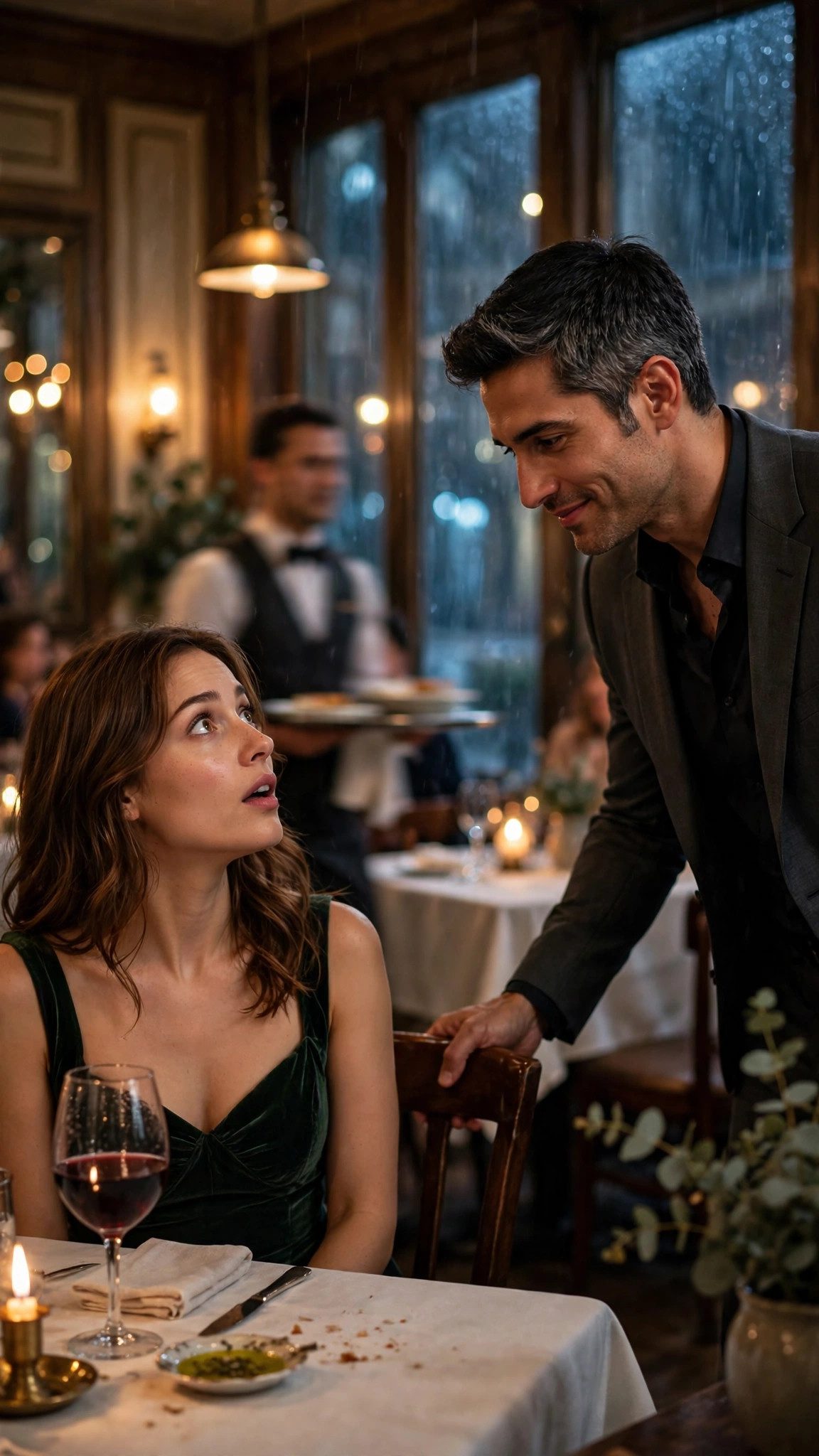
    "So you're the nurse," she said. She held a glass of champagne she was not drinking. "He told me about you. He said you were brave."

    "Did he?" I said. "He never told me about you."

    "Of course not," Evelyn said. She smiled, and the smile did not reach her eyes. "Adrian doesn't talk about the things that matter. He never has." She looked across the room, to where Adrian was standing with his father, his back to us, his shoulders rigid under his black suit. "We were supposed to be married, you know. Years ago. Before his father decided the family needed a different kind of wife. A clean one." Her eyes came back to mine. "I hope you're happy, Clara. I truly do. But you should know — a man like Adrian doesn't stop loving someone just because his father tells him to."

    I did not answer her. I did not know what to say. I stood there in my wedding dress, in a room full of strangers, holding a glass of champagne I had no intention of drinking, and I understood, with a clarity that felt like falling: I had married a man who loved another woman. I had married into a family that had bought me to settle a debt. And I had done it wearing a dress that cost more than my father's house.

    That night, in the penthouse at the top of the Mercer building, Adrian came into the bedroom where I was standing by the window in my wedding dress, looking out at the city lights.

    "Clara," he said.

    I turned. He was loosening his tie with one slow pull, the way a man does when he is finished with a long day. He did not look at the dress. He did not look at the flowers dying in their vase on the dresser. He looked at me the way he had looked at me in the trauma room — like I was a problem he had already decided how to solve.

    "This marriage," he said, "is an arrangement. You know that. I know that. My father knows that. You will live here. You will be safe here. You will want for nothing. But do not mistake this for something it is not."

    "I know what it is," I said. My voice sounded steady, which surprised me, because nothing else about me was steady. "It's a debt. I'm the payment."

    Something moved in his face then. Something I could not read. It was gone before I could name it.

    "Get some sleep," he said. And he left the room, and he did not come back that night, or the night after, or the night after that.

    I lived in that penthouse for two years. I learned the shape of Adrian Mercer's life the way you learn the shape of a house you do not own — from the outside, through windows, never quite inside. He left before dawn and came home after midnight. He took his meals in his study. He spoke to me at breakfast, briefly, politely, about nothing: the weather, the staff, the charity gala his mother was planning. He never asked me about my work at the hospital — I had kept my nursing job, three nights a week, because it was the only part of my life that was still mine. He never asked me about my father. He never asked me what I wanted.

    And I never asked him about Evelyn Carter. I saw her name in the paper, at charity events, at the opera, always photographed at a careful distance from Adrian, always beautiful, always composed. I saw the way his face changed when her name came up in conversation — a tightening, a closing, a door shutting. I told myself I did not care. I told myself that a marriage that meant nothing could not hurt me.

    I was wrong about that too. It hurt every single day, in small, quiet ways that added up to something enormous: the empty chair across from me at breakfast. The wedding ring that felt like a shackle. The knowledge that the man I had married — the man whose life I had held in my hands for four hours in a trauma room — loved a woman who was not me, and always would.

    I told myself I never truly loved him. I told myself that a hundred times, in a hundred different ways, because if I had never loved him, then none of it mattered. If I had never loved him, then the cold penthouse and the empty chair and the ring that strangled me were just the terms of a contract, and contracts end, and people walk away, and nobody gets hurt.

    I was very good at lying to myself. I had six years of practice ahead of me, and I did not even know it yet. That was the last night I believed the lie that a contract could ever protect a heart.

  • Chapter 7: The Last Name

    Chapter 7: The Last Name

    I moved into Rosa's house in September. The room at the back had a window that looked out on the garden, just as Anthony had said, and Rosa had filled it with flowers from her own garden, and a quilt she had made with her own hands, and a little lamp that cast a warm, golden light. "This is your room now, Emma," she said, hugging me so hard I could barely breathe. "You are my daughter now. Do you understand? Not my son's girl. My daughter."

    Sunday dinners became the best part of my week. Rosa cooked enough food for twelve people, even when there were only four of us at the table.

    My first week in the house, I learned Rosa's routines. She woke at six and made coffee strong enough to strip paint. She went to morning mass on Sundays and came home with gossip from the whole parish. She kept a garden that produced more tomatoes than any four people could eat, and she gave them away to the neighbors in paper bags. She taught me to make her sauce, standing beside me at the stove with her hand over mine on the wooden spoon, saying, "Slow, Emma. Slow. The sauce cannot be hurried. Love cannot be hurried." Anthony came home every night, and some nights he was late, and I waited up, and when he walked through the door, tired and gray with the day, I would take his coat, and he would kiss my forehead, and he would say, "I'm home," and I would say, "Welcome home," and it was the simplest, happiest thing in the world. Anthony carved the roast. I set the table. And afterwards, we sat in the garden with coffee, and Rosa told me stories about Anthony as a boy, about the time he tried to fix the lawnmower and nearly set the shed on fire, about the time he came home from school with a black eye and refused to say who had given it to him, about the time he told her, when he was sixteen, that he was going to take over the family business and make it something she could be proud of.

    "He has always been a good boy, Emma," Rosa said one Sunday, patting my hand. "A good boy in a hard world. And you are the best thing that has ever happened to him. Do not let him forget that."

    I did not let him forget it. I told him every day, in a hundred small ways. In the coffee I made for him in the morning. In the way I straightened his tie before he left for work. In the way I waited up for him at night, even when he came home late, even when the freight yard kept him until midnight. I told him with my life, the way he had told me with his.

    The proposal came on a cold evening in October, in the garden behind Meadowbrook, under the same twinkling lights where a gunman had once tried to kill us.

    The week before, Rosa had taken me aside in her kitchen, flour on her hands from the bread she was kneading, and she had said, "Emma, my son is going to ask you something soon. And I want you to know that whatever you answer, you will always be my daughter. Do you understand? Always." I had hugged her, flour and all, and I had said, "I understand, Mama Rosa." And she had laughed, and she had said, "Mama Rosa. I like that. I like that very much." I went home that night and I could not sleep, because I knew what was coming, and I knew what my answer would be, and I lay awake listening to Anthony breathing beside me, thinking about how a year ago I had been a woman eating lunch alone in a break room, and now I was a woman with a family, with a mother who called me daughter, with a man who was about to ask me to be his wife. Anthony had asked Louise to close the garden for the evening. He had asked the choir director to play the piano. He had asked Rosa to make sure I wore the green dress, the one from the gala, the one I had been wearing the night he held me under those lights and whispered that I was safe.

    I walked into the garden, and there he was, standing under the old oak tree, in a dark suit, holding his hands together the way he had held them in the ballroom, and he was smiling, and I knew, before he said a word, what was about to happen.

    "Emma Hart," he said, and his voice was steady, but I could see his hands shaking, just a little, and that made me love him more, because Anthony Russo did not shake, not ever, not for anyone. "I never told you my last name on the night we met because I was afraid it would be the last thing you ever heard from me. I was afraid that the name would end everything before it began. And now I am asking you to take that name, and to carry it with me, and to let me spend the rest of my life making it the first thing you hear every morning."

    He knelt down. He took a small box from his pocket. Inside it was a ring, simple and gold, with a single diamond that caught the twinkling lights and threw them back in a hundred directions.

    "Emma Hart," he said, "will you marry me? Will you be my wife? Will you let me come home to you every night for the rest of my life?"

    I said yes. I said it before he had even finished the question. I said yes, and I pulled him up, and I kissed him, and the choir director played the piano, and the twinkling lights shone down on us, and I thought about how far we had come from a Friday night in March, from a café in Canandaigua, from a question asked in a low voice across a table with blue-checked tablecloths.

    Give me one reason why I shouldn't kill you.

    And my answer, all those years ago, had been the truth. And the truth had saved my life. And the truth had brought me here, to this garden, to this man, to this moment.

    We were married in the spring, in the garden behind Meadowbrook, under the same twinkling lights, with the old oak tree above us and the fountain singing behind us.

    For our honeymoon, Anthony took me to a little lake house on Seneca Lake, in the Finger Lakes, with a dock and a rowboat and no one around for miles. We spent a week there with no phones, no meetings, no freight yards, no FBI agents, just the two of us, cooking together, walking along the water, reading in the sun. One evening, we sat on the dock with our feet in the water, and Anthony told me about his father, about the truck, about the day old Salvatore had handed him the keys and said, "It is yours now, son. Do not lose it." And I told him about my mother, and about Daniel, and about the years I had spent waiting for a life that felt like mine. And he took my hand, and he said, "It is yours now, Emma. All of it. Do not lose it." And I laughed, and I said, "I won't. I promise. It was a small wedding. Louise gave me away. Priya was my maid of honor. Rosa cried through the entire ceremony and then danced with me at the reception until her feet hurt. My mother cried too, and then she hugged Anthony, and she whispered something in his ear that made him laugh, and later he told me what she had said.

    "She said, 'Take care of my girl, Anthony. She is the best thing I ever made.' And I told her, 'I will, Mrs. Hart. I promise you. I will take care of her for the rest of my life.'"

    The reception was in the garden, with long tables and white cloths and candles, and the residents' choir sang, and Mrs. Alvarez danced in her wheelchair, and Mr. Kowalski cried because the music reminded him of his wife, and I danced with Anthony under the twinkling lights, and he held me close, and he whispered in my ear, "You're safe now."

    Louise gave the toast. She stood up with her glass of champagne, and she looked out at the garden, and she said, "I have known Emma Hart for three years, and in three years, I have never once seen her quit on anyone. Not on a patient. Not on a family. Not on a program the whole board wanted to kill. And now she has married a man who does not quit either. So here is to the two of them. May they never quit on each other." The whole garden cheered. Priya cried. Rosa cried. My mother cried. And Anthony stood up, and he took my hand, and he said, "To Emma. The woman who told me the truth when she was afraid. The woman who taught me that a name is a promise." And then he kissed me, and the choir sang, and the twinkling lights shone down, and I thought that this was the happiest day of my life, and that nothing would ever top it.

    "I'm safe now," I whispered back. "And so are you."

    One year later, I stood in the garden of the new memory-care wing, watching the sun come up over Rochester, and I thought about everything that had happened. The program was thriving. The staff was full. The families were happy. Louise came in three days a week, with her clipboard and her iron spine, and she still told me what to do, and I still listened, because some things never change.

    Anthony's businesses were clean now. The freight company was audited and legitimate. The construction company built schools and hospitals. The security company trained young people from the neighborhoods nobody else would hire, and gave them jobs and discipline and a future. Four hundred families depended on him, and he had not let a single one of them down.

    And me. I was Emma Russo now. Emma Hart Russo. Director of the Meadowbrook memory-care program. Wife of Anthony Russo. Daughter of Rosa Russo. And I was happy. I was so happy that sometimes, in the morning, when I woke up beside him and watched him sleep, I had to pinch myself to make sure it was real.

    On the first anniversary of the night we met, Anthony took me back to The Copper Lantern, to the same table, on a Friday night in March.

    That first year of marriage passed like a dream. We settled into Rosa's house, into Sunday dinners, into the rhythm of a life shared. I ran the memory-care program, and it thrived, and the garden bloomed, and the fountain sang. Anthony's businesses grew cleaner every month, and the men who worked for him walked a little taller, because they knew their boss was a man who kept his word. Louise came in three days a week, and she still told me what to do, and I still listened. And every night, Anthony came home, and I took his coat, and he kissed my forehead, and he said, "I'm home," and I said, "Welcome home," and it was the simplest, happiest thing in the world. And on quiet evenings, when the house was still and the garden was dark, I would sit by the window and think about the girl I had been, sitting alone at a table for two, waiting for a man who never showed up, and I would think about how grateful I was that he never showed up. Because if he had, I would never have met the man across the room. I would never have met Ryan. I would never have met Anthony Russo. And I would never have known what it felt like to be safe, and loved, and home. The rain was coming down on the windows, just like it had that first night. The waiter brought us wine. And Anthony looked across the table at me, and he smiled, and he said, "It looks like we're both being stood up."

    I laughed. I laughed until tears ran down my face. "No one's standing us up tonight," I said. "Not ever again."

    He reached across the table and took my hand, and he held it, and he looked into my eyes, and he said the words he had said to me a hundred times, the words that had become the promise of our life together.

    "You're safe now, Emma."

    And I looked at him, and I smiled, and I said the words back to him, the words that were just as true, the words that were my promise to him.

    "You're safe now, Anthony. You're safe now."

    We sat there for two hours, just like the first time, talking and laughing, and the rain came down on the windows, and the city went on outside, and I thought about the girl I had been a year ago, sitting alone at a table for two, waiting for a man who never showed up, and I thought about the woman I had become, sitting across from the man who had shown up instead, the man who had never told me his last name, the man who had given me his name and his heart and his whole life.

    He never told me his last name. Not on the first night. Not until I already loved him. And that, I understood now, was the greatest gift he could have given me. Because I fell in love with the man, not the name. And the name, when it finally came, was just the beginning of everything that followed.

    My name is Emma Russo. And I am safe now. And I am loved. And I am home.

    The End.
    THE END

  • Chapter 6: What the Law Could Do

    Chapter 6: What the Law Could Do

    The morning after the gala, the whole city knew what had happened. It was on the news before I woke up. "FBI arrests reputed crime boss Vincent Castellano in Buffalo." "Russo underboss charged in shooting at Meadowbrook fundraiser." "Gunman in custody after attempt on Anthony Russo's life."

    I sat at my kitchen table with a cup of tea I did not drink, reading the headlines on my phone, and I thought about how strange it was that my life had become a news story. A week ago, I had been a care coordinator at a senior facility, fighting budget cuts and eating lunch alone in the break room. Now I was the woman in the photograph, the woman whose hand the mafia boss had held in front of the whole city, the woman a gunman had tried to kill in a garden full of twinkling lights.

    Louise called me at eight. "Are you all right?" she asked.

    "I'm all right," I said. "Are you?"

    "I am furious," she said. "I am furious that a man brought a gun into my garden. I am furious that Marco Benedetti sold us out for fifty thousand dollars. And I am furious that I did not see it coming. But I am not afraid, Emma. And neither are you. Do you hear me? We are not afraid."

    "I hear you," I said.

    "Good," she said. "Now come to work. Mrs. Alvarez is asking for you. She says she had a dream about you last night, and she wants to tell you about it."

    I went to work. I sat with Mrs. Alvarez while she told me about her dream, which involved a garden and a man in a dark suit and a little girl in a green dress, and I held her hand, and I thought about how life goes on, even after the worst night of your life, and how the people who need you do not stop needing you just because your world has turned upside down.

    Agent Daniel Reyes came to the facility that afternoon. He was a quiet man, in his forties, with tired eyes and a suit that had seen better days, and he sat in Louise's office with a tape recorder and a notebook, and he asked me to tell him everything. So I told him. I told him about the café in Canandaigua. I told him about the note under my door. I told him about the gala, and the shots, and the way Anthony had pulled me down behind the stone wall. I told him everything, and when I was done, he turned off the tape recorder, and he looked at me, and he said, "Miss Hart, you are a very brave woman."

    "I'm not brave," I said. "I was terrified."

    "That is what brave means," he said.

    Over the next few weeks, the case came together the way Agent Reyes said it would.

    I watched the trial on the news every night, sitting on Rosa's couch with a cup of tea going cold in my hands. The reporters talked about wire transfers and phone records and a freight company that had been used to move guns. They talked about Marco Benedetti, the underboss who had sold his own family for fifty thousand dollars, and they talked about Danny Cole, the twenty-year-old boy who had been promised a new life and given a gun instead. And they talked about Vincent Castellano, the man from Buffalo who had wanted Rochester, and who had ordered a hit in a garden full of old people, and who was going to spend the rest of his life in a federal prison. One night, a letter came in the mail. It was from Danny Cole's mother. She wrote that her son had been a good boy once, and that she was sorry, and that she prayed for me every night. I wrote her back. I told her I prayed for him too. I told her that twenty years old was too young to be finished, and that I hoped prison would give him time to become someone else. She wrote back once more, just a card, with three words on it: Thank you, Emma. Marco Benedetti, facing twenty years in prison, agreed to testify. He told the FBI everything: the freight routes he had sold, the money he had taken, the men he had introduced to Castellano, the gala security plan he had handed over for fifty thousand dollars. He got eight years, and I did not feel sorry for him, not even a little, because he had sold out the people who trusted him, and he had put a gun in a garden full of old people and children.

    The gunman, a young man named Danny Cole, twenty years old, testified too. He told the FBI that Castellano had hired him, that he had been promised fifty thousand dollars and a new life in another city, and that he had not known Emma Hart would be there, and that he was sorry. He got fifteen years, and I thought about him sometimes, about how young he was, and how someone had taken a scared twenty-year-old boy and turned him into a weapon, and I hoped that prison would give him time to become someone else.

    And Vincent Castellano, the man who had wanted Rochester for himself, the man who had wanted me dead two years ago for overhearing a shipment time, the man who had ordered the hit in the garden, was arrested in Buffalo, tried in federal court, and sentenced to life in prison, with no possibility of parole. Agent Reyes called me the day the verdict came in. "It's over, Miss Hart," he said. "He will never hurt anyone again."

    Anthony did what he had told me he would do. He closed the gambling parlors. He converted them into licensed security contracts and a training center for the young men and women he hired from the neighborhoods nobody else would touch. He opened his freight books to the FBI and to the state, and he let them audit every truck, every route, every dollar. He kept the construction company, and he kept the security company, and he let go of everything else, and he did it all in public, with lawyers and accountants and press releases, so that no one could ever say he had done it in the dark.

    "I am not a saint, Emma," he told me one evening, standing in the freight yard at dawn, watching the trucks roll out. "I have done things in my life that I am not proud of. I have made choices that I would not make again. But I am trying to be a better man than the one my father raised me to be. And you are the reason I am trying."

    The memory-care wing opened in June. It was everything Anthony had promised and more.

    The opening ceremony was on a Saturday, warm and bright, with the garden in full bloom and the fountain singing. The mayor came. The county health commissioner came. The families came, dozens of them, and they walked through the new rooms with tears in their eyes, touching the windows, sitting in the soft chairs, looking out at the garden. Mrs. Alvarez cut the ribbon with a pair of oversized scissors, and everyone cheered, and then the choir sang, and Mr. Kowalski sang harmony, and I stood beside Anthony under the old oak tree, and I watched it all, and I thought about the memo in my drawer, and the layoffs, and the three months Louise and I had spent fighting for this, and I thought about how none of it would have happened without a man who had once asked me why he should not kill me, and who had answered his own question by spending two years keeping me safe. New rooms with windows that looked out on the garden. A dining hall with a piano. A library with big-print books and soft chairs. And the garden itself, the garden he had built, with stone paths wide enough for wheelchairs and benches in the shade of the old oak tree, and a fountain that sang all day long. The families came, and they cried, and they thanked him, and he stood there in his dark suit, shaking hands and accepting their thanks the way a man accepts something he does not feel he deserves.

    Louise retired that summer. Not all at once. She went to part-time, and then to consultant, and then to "director emeritus," which was her way of saying she was still in charge without having to come to meetings. And she named me as her successor.

    My first day as director, I stood in front of the staff in the break room, twenty-three nurses and aides and kitchen workers, all looking at me, and my hands were shaking, and I thought about Louise, and what she would say, and then I heard her voice in my head, clear as if she were standing right beside me. "Breathe, Emma. It is only a job. And you have been doing it for years." So I breathed. And I told them the truth. I told them the program was saved, and the wing was open, and the garden was built, and none of it would have happened without them, without the nights they had stayed late, without the weekends they had given up, without the love they poured into people who could not always remember their names. And then Mrs. Alvarez, who was sitting in the front row in her wheelchair, raised her hand, and she said, "Emma, you are a good girl. You have always been a good girl." And the whole room laughed, and I cried, and then I got to work. Me. Emma Hart. Director of the Meadowbrook memory-care program. I was twenty-seven years old, and I was in charge of the program I had spent three months fighting to save, and I stood in front of the staff on my first day and I cried, and then I laughed, and then I got to work.

    The staff gave me a gift that first week, a little potted plant for my new office, with a card signed by all twenty-three of them. It said, "To Emma. Thank you for fighting for us. We will fight for you." I put the plant on my windowsill, where it could see the garden, and I watered it every morning, and it grew, the way the program grew, the way the garden grew, steady and green and alive. And every time I looked at it, I thought about Louise, and about Anthony, and about all the people who had believed in me before I believed in myself.

    My birthday came and went, and then it came again, a year after the show. Anthony remembered it properly this time. He did not turn it into a ballroom full of people. He cooked dinner for me in his kitchen, just the two of us, and he gave me a small box wrapped in brown paper, and inside it was the photograph, the one he had taken of our joined hands in the ballroom, printed and framed in silver, and underneath it, in his own handwriting, the words: "The day I stopped being afraid of my own name. — A."

    And then he gave me something else. A key. A small brass key, on a chain, warm from his pocket.

    "What is this?" I asked.

    "It is the key to my house," he said. "Not the mansion. My house. The one I grew up in. My mother still lives there, and she has a room at the back, with a window that looks out on the garden, and she has been asking me for a year when you are going to move in. So I am asking you, Emma. Will you move in? Will you let me come home to you every night, instead of coming home to an empty house?"

    I looked at the key. I looked at the photograph. I looked at him, and I thought about the café, and the restaurant, and the ballroom, and the garden, and all the ways he had kept me safe without ever asking for anything in return.

    "Yes," I said. "Yes, Anthony. I will move in."

    He took my hand, and he kissed it, and he said, "Then there is one more thing I need to tell you. One more thing about my last name."

    I waited.

    "My father," he said, "was Salvatore Russo. He built the freight company from one truck. He was a hard man, Emma. He was not a kind man. He taught me that a name is a weapon, and you use it or you lose it. And for most of my life, I believed him. But you taught me something else. You taught me that a name is a promise. And I want to spend the rest of my life keeping the promise I made to you in that ballroom. You're safe now. That is my name, Emma. That is what Anthony Russo means, from now on. You're safe now."

    I cried. I did not try not to. I cried, and he held me, and the kitchen smelled like garlic and tomatoes, and the sun was going down over Rochester, and I thought about how far I had come from a Friday night in March, sitting alone at a table for two, waiting for a man who never showed up.

    That night, I called Louise, and I told her everything, and she laughed, a real laugh, the kind that filled a room, and she said, "Emma, I told you. I told you that man was not a monster. And now you are going to live in his mother's house, and his mother is going to feed you until you burst, and you are going to be happy. Do you hear me? You are going to be happy."

    "I hear you, Louise," I said.

    "Good," she said. "Now go to sleep. You have a program to run in the morning."