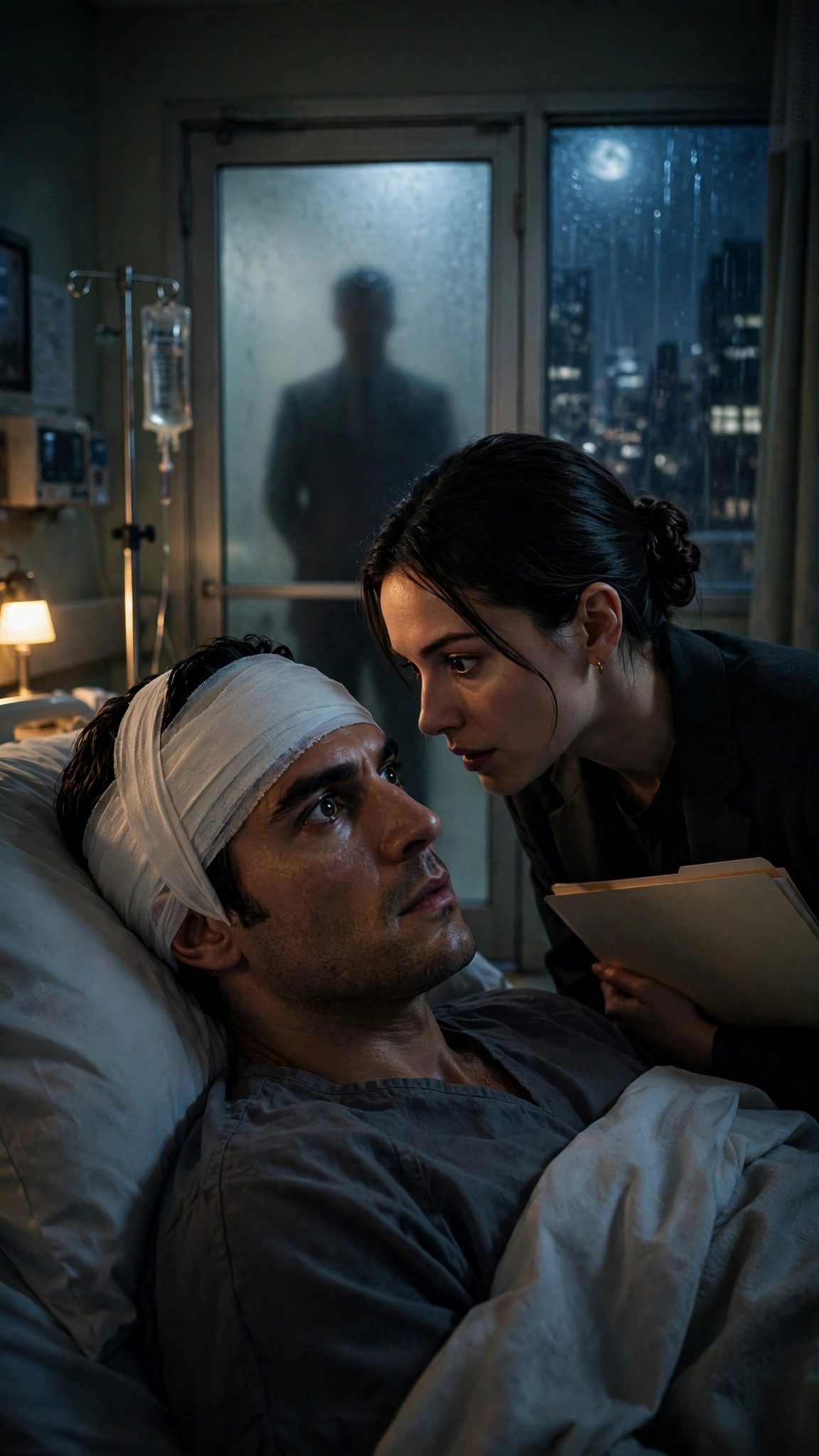
Story Genres: Mafia Romance

  • Chapter 7: The Man Who Stopped Pretending

    Chapter 7: The Man Who Stopped Pretending

    The next morning, I walked into my office for the first time since the shooting, and I did not pretend.

    I walked in through the front door, in a dark suit, with the bandage still on my head but my back straight and my eyes clear, and Emily was beside me, and Marco was behind me, and Frankie and Leo were behind him, and every captain in the family was already there, waiting, because word had traveled through the city the way word always travels in my world: fast, and in whispers, and with half the story missing.

    They stood when I came in. All of them. Twenty men in dark suits, standing in my office, looking at me the way men look at a ghost, because the last time most of them had seen me, I had been on a stretcher with a bullet in my head, and now here I was, walking, and talking, and very much alive.

    "Gentlemen," I said, and my voice was my own voice, and it filled the room the way it used to fill the room, before the shooting, before the hospital, before the pretending. "Sit down. I have something to tell you, and I am only going to say it once."

    They sat. The room went quiet. Even the traffic outside seemed to go quiet, as if the city itself were listening.

    "Three weeks ago," I said, "I was shot in a private room at Santoro's restaurant. A bullet grazed my temple and fractured my skull. I woke up in a hospital, and I remembered everything. Every detail. The room. The lights. The gunfire. The five people who knew where I would be. I remembered it all."

    I let that settle. I watched their faces. I watched the captains look at each other, and I watched the younger men look at the floor, and I watched the older men look at me, the way men look at a boss who has just told them something they did not expect.

    "But I told the world I remembered nothing," I said. "I told the doctors. I told the nurses. I told Marco. I told all of you. I pretended to have lost my memory, because I knew that one of the five people I trusted had sold me to a gunman, and I knew that if the traitor believed I remembered nothing, he would feel safe, and if he felt safe, he would make a mistake."

    I paused, and I looked around the room, at the twenty faces, at the men who had worked for my father and for me, at the men who had stood beside me through wars and funerals and nights when one wrong decision could have wiped us all out.

    "Yesterday, on Pier Nine, Sal DeLuca walked into a trap, and the FBI arrested him, and Vincent Castellano was arrested at the same time, in his house in Brooklyn. Sal sold the meeting. Castellano paid for it. The proof is in the hands of the law, and Sal has agreed to testify. Castellano will spend the rest of his life in prison. Sal will spend eight years there, and when he comes out, he will be an old man, and he will have to live with what he did."

    The room was silent. No one moved. No one spoke. I could hear the clock on the wall, ticking, the way it had ticked for nine years, through every meeting, through every decision, through every night I had sat in this office and wondered whether I was doing the right thing.

    "I am telling you this," I said, "because I owe you the truth. I pretended to be weak so that I could find the man who tried to kill me, and I found him, and I did it without firing a shot. I did it with the law. I did it because I am done with the old way. I am done with blood for blood. I am done with funerals. The docks are going legitimate, as I planned. The businesses are going legitimate, all of them, every one. The family is going to be a family that does business in the daylight, and pays its taxes, and does not need to hide its meetings in private rooms at the back of restaurants."

    I looked at Marco, and he nodded, and I looked at Frankie, and he nodded, and I looked at Leo, and he nodded, and I looked at Emily, who was standing beside my desk with the folder under her arm, and she nodded, too, and I felt the weight of nine years lift off my shoulders, all at once, the way a weight lifts when you finally set it down and walk away from it.

    "There is one more thing," I said, and I turned to Emily, and I took the folder from her hands, gently, and I set it down on the desk, and I took her hand, and I held it, in front of all twenty men, in front of the whole family, and I did not care who saw it, because I was done pretending about that, too.

    "For three years," I said, "Emily Carter has managed my life. She has scheduled my meetings. She has kept my secrets. She has carried information in her head that would have destroyed this family if it had ever fallen into the wrong hands, and she has never once let it slip. She knew I was pretending, from the first minute, because she knows me better than anyone in this room. She found the proof against Sal. She found the phone records. She found the photographs. She found the man on Pier Nine. Without her, I would be dead. Without her, Sal would still be free. Without her, Castellano would still be trying to kill me. She saved my life, and she saved this family, and she did it quietly, the way she does everything, without asking for anything in return."

    I looked at her, and her eyes were shining, and her hand was warm in mine, and it did not tremble, and I said the thing I had been waiting to say since the morning she told me she loved me, in the white room with the morning light coming through the window.

    "Emily Carter," I said, "will you marry me? Not as my secretary. Not as the woman who knows everything. As my wife. As the woman I love. As the woman who is going to stand beside me while I make this family into something my father would have been proud of, and something your mother would have been proud of, too."

    The room was silent. Twenty men in dark suits, holding their breath. And Emily, standing beside my desk, with tears in her eyes and a smile on her face, the third smile I had seen from her in three years, said the one word I had been waiting to hear.

    "Yes."

    The room erupted. Not with shouting. Not with applause. With something quieter, and better: the sound of twenty men standing up, and coming forward, one by one, to shake my hand, and to shake Emily's hand, and to say, in their own ways, the same thing — congratulations, boss, congratulations, Mrs. Moretti, we are glad you are alive, we are glad you are home.

    Marco was the first. He took my hand, and he held it, and he said, "Boss. I never doubted you. Not for one second. Even when you looked at me like a stranger, I never doubted you. Because I know you. And I know that a man who pretends to forget is a man who remembers everything."

    Frankie was next, and Leo, and then the captains, one by one, and by the time they had all come forward, the sun was coming through the windows of my office, gold and warm, and the city outside was waking up, and I was standing in the middle of it, alive, with the woman I loved beside me, and the men I trusted behind me, and the law on my side, and the future in front of me, clean and open, the way a road looks when you have finally cleared it of everything that was blocking it.

    That evening, I took Emily to dinner. A real dinner, the way she had asked for, in a small restaurant in the Village, with candles on the tables and a violin playing in the corner, and no bodyguards at the door, and no folder on the table, and no pretending. Just a man and a woman, sitting across from each other, talking about the future, about the wedding, about the businesses, about her mother, about my father, about the life we were going to build together, in the daylight, without secrets, without lies, without bullets.

    "I have one question," she said, over dessert, with a smile that was the fourth smile I had seen from her in three years, and the best one yet. "When did you know? That you loved me?"

    I thought about it. I thought about the three years she had worked for me, and the way she filed, and the way she remembered my mother's name, and the way she had looked at Marco in the hospital room, and the way she had whispered in my ear, and the way she had sat in the chair by my bed, watching the door, while the man who had tried to kill me was on his way to the police.

    "I think," I said, "I knew the first day. When you told me that a man who cannot find his own papers cannot find his own enemies. I thought, that is the smartest thing anyone has said to me in years. And I have been listening to you ever since. I just did not know I was listening with my heart until you told me you loved me, and my heart answered before my head could stop it."

    She laughed, and the violin played, and the candles burned low, and outside the window, Manhattan glittered, cold and beautiful and indifferent, the way it always had, and the way it always would.

    But inside the restaurant, at a small table with candles on it, a man who had pretended to forget sat across from a woman who knew everything, and neither of them was pretending anymore.

    Six months later, we were married in a small church in the Village, with Marco as my best man and Frankie driving us to the reception in the same black car he had driven me in for five years, and Leo cooking the dinner himself, because he would not let anyone else cook for his friend's wedding. Emily wore a simple white dress, with a small blue ribbon sewn into the hem — her mother's ribbon, from her own wedding day, thirty years before — and her mother sat in the front row, healthy now, and smiling, and my mother would have been proud, I think, of the woman I had chosen, because Emily was the kind of woman my mother had always said I should find: a woman who tells the truth, even when the truth is hard, and who stays, even when staying is hard. The whole family was there, every captain, every driver, every man who had stood by me, and when the priest asked if anyone objected, the only sound in the church was the rain on the windows, soft and steady, like applause from a long way off.

    Sal DeLuca testified in court, as Agent Reyes had promised he would. He told the jury everything: the money, the phone calls, the meeting at Santoro's, the hospital, the boy with the pillow. He wept on the stand, and the jury wept with him, and the judge sentenced him to eight years, and he thanked the court, and he asked me, through his lawyer, to tell his son that he was sorry, and I did. I went to see his son myself, in Brooklyn, and I told him his father had made a terrible mistake, and that he had paid for it, and that the family would take care of him while his father was gone, because that is what a family does, even for the son of a man who betrayed it.

    Vincent Castellano was sentenced to life in prison, without the possibility of parole. The jury took less than a day to decide. The evidence was overwhelming: the phone records, the payments, the testimony of Sal, and of Tommy Falco, and of Danny Cole, the boy from the hospital, who told the court about the five thousand dollars and the man in the black coat, and whose mother now has her medicine, paid for by a fund Emily set up in her name, because Emily believes, the way I have come to believe, that mercy is not weakness, and that a man who tells the truth deserves a second chance.

    The docks went legitimate, as I had planned. The businesses went legitimate, all of them, every one. The family became a family that does business in the daylight, and pays its taxes, and does not need to hide its meetings in private rooms at the back of restaurants. Marco runs the legitimate shipping company now, and Frankie runs the transportation division, and Leo's restaurant has a second location, in Brooklyn, and Emily runs the foundation we started together, which helps the families of men who were hurt in the old wars, and the children of men who are in prison, and anyone else who needs a hand, because she believes, and I believe with her, that a family that only takes is a family that will one day have nothing left to take.

    And that, I thought, was the best ending of all. Not a war. Not a funeral. Not revenge. Just the truth, told at last, and a life, begun at last, in the daylight, with the woman I loved beside me, and the memory of everything I had survived behind me, and the future, clean and open, in front of us both.

    The boss who had pretended to forget had finally remembered who he was.

    And he was never going to pretend again.

    The End.
    THE END
  • Chapter 3: The Man Behind the Silence

    Chapter 3: The Man Behind the Silence

    Adrian Vescari had learned to be silent when he was nine years old, the day his father took him to the docks for the first time and showed him how the family business really worked.

    "Listen," his father had said, standing on the wet concrete while the cranes moved containers overhead and the men shouted to each other in the rain. "Everyone in this world is talking. The men who talk the most are the ones with the least to say. The dangerous men are the quiet ones. They listen. They watch. And when they finally speak, everyone else stops talking. Do you understand?"

    "I understand, Father."

    "Good. Now watch that man over there." His father had pointed to a foreman arguing with a truck driver, his face red, his arms waving. "He is loud because he is afraid. Fear makes men loud. Never be loud, Adrian. If you are ever afraid, be silent. Silence makes other men afraid of you."

    Adrian had remembered that lesson for twenty-six years. He had built his whole life on it. He had become the quietest man in every room he entered, and the most feared. He had learned to let other men fill the silence with their own voices, and to listen to what they revealed when they thought no one was paying attention.

    It was how he had survived. It was how he had built Vescari Holdings from a family of dock operators into an empire of warehouses, shipping routes, and distribution contracts that moved goods across half the country. And it was how he had buried, for two years, the one thing in his life that silence could not protect.

    Her name was Tessa Morgan. And he had loved her since the first morning she walked into his office.

    He had not meant to. He had hired her the way he hired everyone — quickly, coldly, with three questions and no sentiment. He had needed a secretary. The last one had quit after three weeks, frightened by the hours and the silence and the photograph on the shelf. Tessa Morgan had not been frightened. She had looked at him with steady brown eyes and told him she needed the job, and that she would keep his secrets, and something in her voice — something plain and unafraid — had made him say yes before he had time to think about it.

    He had regretted it within a week. Not because she was bad at the job. She was the best secretary he had ever had. She was early, exact, and invisible, the way a good secretary should be. She learned his schedule in three days. She learned his coffee in one. She never asked questions. She never gossiped. She never made a mistake that mattered.

    He regretted it because she was kind.

    Kindness was the one thing Adrian Vescari could not afford. Kindness was a door, and doors could be opened, and what came through them could be taken away. He had learned that lesson on the fourteenth of March, two years ago, when the car bomb meant for him had killed Sofia Marchetti instead.

    Sofia had been twenty-nine years old. She had laughed easily. She had loved music, and dogs, and the smell of rain on hot pavement. She had been the only person in Adrian's life who had ever made him forget, for an hour at a time, that he was the head of a family that other men feared. She had been sitting in his car because he had asked her to wait for him outside a restaurant while he finished a meeting. She had been waiting for eleven minutes. The bomb had gone off at 6:42 in the evening. Adrian had been forty feet away, inside the restaurant, arguing about a warehouse lease. He had heard the sound. He had run outside. He had seen the fire. And he had known, before anyone told him, that the only woman he had ever loved was gone, and that she had died because she had been sitting where he was supposed to sit.

    The police had never found who planted the bomb. The FBI had investigated for six months and found nothing. But Adrian had known. He had known from the first night, when he sat alone in his apartment and went through the list of his enemies, one by one, and stopped at a single name.

    Vincent Calder.

    Vincent had wanted the northern distribution routes for three years. Adrian had refused to sell them. Vincent had made threats — quiet ones, polite ones, the kind of threats that sound like business advice if you are not listening carefully. "A man who holds too much territory makes too many enemies, Adrian." "Accidents happen to men who don't know when to share." Adrian had ignored him. And then Sofia had died, and Vincent had sent flowers to the funeral, white lilies, with a card that said only: "My deepest condolences."

    Adrian had kept that card. He had kept it in a drawer in his desk, under a stack of contracts, and he had looked at it every time he needed to remind himself why he could never let anyone close to him again. Because the men who wanted to hurt Adrian Vescari had learned something on the fourteenth of March: they did not need to touch him. They only needed to touch the people he loved.

    So he had made himself a vow. He would never love anyone again. He would never let a woman into his life. He would never give his enemies a second target. He would be silent, and cold, and alone, and he would keep the people around him at exactly three feet of distance, and that would be enough. That would keep them safe.

    And then Tessa Morgan had walked into his office with a borrowed suit and a secondhand briefcase, and she had not been afraid of him, and she had stayed, and she had been early and exact and invisible, and somewhere between the first winter and the second spring, Adrian had realized that his vow was already broken.

    He loved her. He had loved her for two years. And he had buried it so deep, under so many layers of silence and rules, that he had almost convinced himself it was not there.

    Almost.

    He had tried to protect her the only way he knew how: by keeping her at a distance. He called her Miss Morgan. He never touched her. He never asked about her life. He never stayed in a room with her after six o'clock. He told himself that if he never looked at her the way a man looks at a woman, then no one would ever know, and no one would ever use her against him.

    But Vincent Calder had known. Vincent had watched, and waited, and on the morning of the negotiation, he had walked into the conference room and asked the one question that could break two years of silence in a single second.

    "Does your secretary have a boyfriend?"

    It had not been a question. It had been a declaration. Vincent was telling Adrian: I see her. I know what she means to you. And if you do not give me what I want, I know exactly where to hurt you.

    And Adrian had done the one thing he had sworn he would never do. He had lost control. He had slammed his hand against the table. He had ended a forty-million-dollar deal in front of sixteen men. He had told Vincent, in front of everyone, "Don't look at her again."

    He had marked her. He had claimed her. He had done, in five seconds, what two years of silence had been designed to prevent.

    The night Sofia died, Adrian had sat in the hospital corridor for six hours while the surgeons worked on a woman who was already gone. He had not cried. He had not spoken. He had simply sat there, in his suit, with blood on his cuffs from where he had pulled her from the car, and waited for someone to come and tell him what he already knew.

    At two in the morning, his uncle — his father's brother, a man named Salvatore Vescari, who had been the family's consigliere for forty years — had come and sat down beside him. Salvatore was seventy years old then, with white hair and hands that shook, and he had put one of those shaking hands on Adrian's shoulder and said, "We will find who did this. And we will make them pay. That is the way of our family. That is what your father would have done."

    "No," Adrian had said. It was the first word he had spoken in six hours. "No. That is not what I will do."

    Salvatore had looked at him. "Adrian—"

    "Finding them and killing them will not bring her back," Adrian had said. "And it will not stop the next one. The next one will come for someone else I love. And then another. And another. Until there is no one left. So I will do something different. I will become a man who loves no one. I will become a man with nothing to lose. And then they will have nothing to take from me."

    Salvatore had been quiet for a long time. Then he had said, "A man with nothing to lose is a man who has already lost everything. Be careful, my boy. That is a lonely way to live."

    "It is the only way to live," Adrian had said.

    And for two years, he had lived that way. He had turned Vescari Holdings into a fortress. He had cut ties with old friends. He had stopped going to dinners, stopped going to parties, stopped letting anyone past the glass wall of his office. He had kept the photograph of Sofia on the shelf behind his desk, and he had dusted it every Friday morning, and he had told himself that grief was a private thing, and that silence was a kind of strength.

    But the truth was simpler than that, and uglier. Adrian had not become silent because he was strong. He had become silent because he was afraid. Afraid that if he ever spoke honestly again — if he ever let himself want something, or love someone, or hope for a future that was not made of contracts and concrete — then the world would take it away from him, the way it had taken Sofia.

    He had been afraid for two years. And he had been alone for two years. And the loneliest part of it was that he had done it to himself, with his own hands, the way a man builds his own prison, brick by brick, and then locks the door from the inside.

    Until the morning Tessa Morgan walked into his office with a borrowed suit and a secondhand briefcase, and looked at him without fear, and said, "I don't know what you've done, Mr. Vescari. But I know what I need."

    He had hired her because she was not afraid. He had kept her because she was good at her job. And he had fallen in love with her because, for the first time in two years, there was a person in his life who did not want anything from him except a fair day's work and a little bit of respect.

    He had tried to bury it. He had called her Miss Morgan. He had kept three feet of distance. He had told himself that silence would protect her.

    But silence had not protected Sofia. Silence had not protected anyone. Silence had only made the loneliness deeper, and the fear stronger, and the day Vincent Calder walked into the conference room and asked his question, Adrian had finally understood what his uncle had tried to tell him in the hospital corridor two years ago.

    A man with nothing to lose is a man who has already lost everything.

    And Adrian Vescari was tired of losing.

    Now, standing in the empty conference room with Tessa Morgan three feet away from him, her notebook pressed against her chest, her brown eyes looking up at him with a question in them, Adrian Vescari understood the full weight of what he had done.

    Vincent Calder would not forget this morning. Vincent would go back to his office, and he would make phone calls, and he would start to move. The distribution deal was dead — but Vincent had never really wanted the deal. He had wanted to know if Adrian Vescari still had a heart. And now he knew.

    The question was what Vincent would do with that knowledge.

    Adrian knew what he would do. He had known Vincent Calder for fifteen years. Vincent did not forgive, and he did not forget, and he did not walk away from a man who had humiliated him in front of sixteen witnesses. Vincent would come back. He would come back with lawyers, or with men, or with something worse. And the first thing he would reach for would be Tessa.

    Unless Adrian reached her first.

    "Tessa," Adrian said, and her name in his voice sounded like a door opening after a very long winter. "There is something I have buried for two years. And I think it is time you knew what it is."

    She looked at him. She did not move. She did not speak. She simply waited, the way she had waited for two years — patient, steady, unafraid.

    And Adrian Vescari, who had been silent for twenty-six years, finally told the truth.

    "I love you," he said. "I have loved you since the first week you worked for me. I have loved you through every meeting, every contract, every morning you walked into this office with your notebook and your pen. I buried it because the last woman I loved died for it. Sofia died in my car, on the fourteenth of March, two years ago, and the bomb that killed her was meant for me. I swore I would never put another woman in that place. I swore I would never give my enemies another target. But Vincent knew. He has always known. And now he knows for certain."

    He stopped. His hands were shaking. He had not known his hands could shake. He put them behind his back, the way his father had taught him, and he waited for her to speak.

    Tessa Morgan looked at him for a long time. And then she did the last thing he expected.

    She set down her notebook. She set down her pen. And she took one step closer to him, closing the three feet of distance that had stood between them for two years.

    "Then tell me the rest," she said quietly. "Tell me everything. And then we will decide together what happens next."

    Outside the glass walls, the city went on with its business. But inside the conference room on the thirty-fourth floor, Adrian Vescari finally understood something his father had never taught him.

    Silence could protect a man. But it could not save him.

    Only the truth could do that. And the truth was standing three feet away from him, in a dark suit, with a notebook and a pen, waiting for him to be brave enough to speak.

  • Chapter 6: What the Law Could Do

    Chapter 6: What the Law Could Do

    Thursday came the way Thursdays always come in Manhattan: grey at first, then gold, then grey again, with the wind coming off the river and the smell of rain in the air, as if the city itself were holding its breath.

    I left the hospital that morning, for the first time since the shooting, in a wheelchair, with a blanket over my knees and a bandage still wrapped around my head, playing the part of the wounded boss one last time. The nurses helped me into the car, and Marco drove, and Frankie sat in the front seat with his eyes on the mirrors, and Emily sat beside me in the back, with the folder on her lap, and none of us spoke, because there was nothing left to say that had not already been said.

    Agent Daniel Reyes was waiting for us at the warehouse on Pier Nine, a tall man in his forties with tired eyes and a suit that had seen better days, and a team of FBI agents in dark jackets who moved through the warehouse the way professionals move: quietly, efficiently, without wasted motion. He shook my hand, and his grip was firm, and he looked at my bandage, and he said, "Mr. Moretti. Thank you for coming. I know this is not easy."

    "It is not easy," I said. "But it is necessary. And it is the law. That is why I called you, Agent Reyes. Because I have spent nine years settling things the old way, and the old way only ever made more blood. This time, I want the law to do what the law is for."

    Reyes nodded, and he showed me the plan, the way a general shows a plan to a man who is about to go into battle: the warehouse, the cranes, the places where his men would hide, the cameras, the recording equipment, the exact spot where Sal would stand when he arrived, believing he was meeting a man with a briefcase, and the exact moment when Reyes would step out of the shadows and show him the warrant.

    "Sal will come at two o'clock," Reyes said. "He will come because he believes you are meeting someone here, and he believes he can finish what he started in the restaurant. He will bring at least two men with him. Possibly three. They will be armed. My men will be in position by one. You will be in the van, with Ms. Carter, watching on the monitors. When Sal arrives, we will let him walk in. We will let him look for the man with the briefcase. And then we will take him. Quietly. Cleanly. Without a shot, if we can manage it."

    "And Castellano?" I asked.

    "Castellano will be at his house in Brooklyn," Reyes said. "We have a team there, waiting. The moment we take Sal, they will take Castellano. We have the phone records. We have the payments. We have the boy from the hospital, who has already told us everything. We have the driver, Tommy Falco, who has already agreed to testify. We have Sal's own calls, recorded, in which he tells Castellano where you will be and when. We have everything we need, Mr. Moretti. All we needed was a witness who would stand up in court and say it out loud. Sal is going to be that witness, whether he wants to be or not."

    I looked at the warehouse, at the water beyond it, grey and steady, at the cranes standing against the sky like the skeletons of giants, and I thought about the man who was going to walk into this place in less than an hour, believing he was about to finish a job, and I thought about the thirty years he had spent in the family, and the docks he had run, and the money he had taken, and the bullet he had paid for, and I felt something I had not expected to feel.

    I felt sorry for him. Not for what he had done. For what he had thrown away. For the thirty years of loyalty he had traded for a bag of cash and a promise from a man who would have killed him the moment he was no longer useful.

    I thought about the day my father died, nine years ago, when Sal had stood beside my father's coffin in a black suit, with his hand on my shoulder, and he had said, "Your father was a good man, Vincent. He trusted you with everything. Do not let him down." I thought about the first meeting I had ever chaired, when I was twenty-nine and terrified, and Sal had been the first man to stand up and say, "The boss is right," when no one else would. I thought about the Christmas parties at his house in Brooklyn, and his wife's cooking, and his son's graduation, and all the years of loyalty that had come before the money, and I felt the grief of it, sharp and clean, the way grief feels when it is mixed with anger.

    "He was a good man once," Emily said quietly, beside me, as if she had been reading my thoughts. "That is what makes it worse. He was not born a traitor. He became one, a little at a time, the way a man becomes anything bad: one small decision, and then another, and then one more, until the decisions add up to a bullet."

    I nodded. "I know. And that is why I am letting the law take him. Because the old way would have been a grave, and the law way is a courtroom, and a courtroom gives a man a chance to tell the truth. Sal is going to tell the truth. He is going to tell it because he has no other choice, and because somewhere underneath all of it, the man who stood beside my father's coffin is still in there, and he knows what he did."

    We waited then, in the van, watching the monitors, while the minutes ticked past and the wind came off the river and the cranes stood against the sky. Marco sat beside me, silent, his hands folded, the way a man sits when he is waiting for something he has been waiting for a long time. Frankie watched the road. Leo watched the water. Emily held the folder on her lap, and she did not open it, because everything in it had already been done, and now all that was left was the waiting.

    At 1:47, Sal arrived.

    He came in a black car, the way he always came to meetings, with Tommy Falco driving and two men in the back seat, and he stepped out onto the pier, and he looked around, and I watched him on the monitor in the van, and I saw the moment he realized something was wrong. The way he stopped. The way his hand moved toward his jacket. The way his eyes went to the warehouse doors, which were closed, and to the cranes, which were empty, and to the water, which was grey and still.

    "Where is he?" he said, to no one, to the empty pier, to the wind coming off the river. "Where is the man with the briefcase?"

    And then Agent Reyes stepped out of the warehouse, with his badge in his hand, and his men stepped out behind him, and the sound of their boots on the concrete was the loudest sound I had ever heard, and Sal DeLuca, fifty-four years old, a capo who had been with the family since before I was born, stood on Pier Nine with his mouth open and his hand halfway to his jacket, and he understood, in a single terrible second, that he had walked into a trap, and that the trap had been waiting for him since the night he sold me to a gunman.

    "Salvatore DeLuca," Reyes said, in a calm, professional voice. "You are under arrest for conspiracy to commit murder, attempted murder, and racketeering. You have the right to remain silent."

    Sal did not remain silent. He looked at the agents, and he looked at the warehouse, and he looked at the van where I was sitting, and he must have seen me, or sensed me, because he turned toward the van, and he said, in a voice that was raw and broken, "Vincent. Vincent, please. I can explain."

    I opened the van door, and I stood up, slowly, because my head still hurt, and the bandage was still there, and the blanket fell from my knees, and I walked across the pier toward him, with Emily beside me, and Marco behind me, and Frankie behind him, and Leo behind him, and the FBI agents watching everything, and I stopped in front of the man who had tried to kill me, and I looked at him, and I said the thing I had been waiting to say since I woke up in the hospital.

    "I remember everything, Sal."

    He stared at me. His face went white. His mouth opened and closed, and no sound came out, and I saw the truth settle into him, the way the truth settles into a man when there is nowhere left to hide from it.

    "You remember," he whispered.

    "I remember everything," I said. "I remember the meeting. I remember the lights going out. I remember the gunfire. I remember the bullet. And I remember that only five people knew where I would be, and that you were one of them, and that you sold the time and the place to Castellano for money. I know how much. I know when. I know where. Emily knows, too. She has the phone records. She has the photographs. She has everything."

    Sal looked at Emily, and then at Marco, and then at Frankie, and then at Leo, and I saw him understand, finally, what had happened. He had not been betrayed by his men. He had been caught by them. By the woman with the folder, and the driver who had walked the marina in the rain, and the restaurant owner who had tried every key on an empty storage unit, and the right hand who had driven up and down Long Island looking for a blue door that did not exist.

    "I did it for the docks," he said, and his voice broke. "The docks were mine. They were mine for thirty years. And you were going to take them away. You were going to make them legitimate. You were going to give them to someone else. I couldn't let that happen. I couldn't."

    "I was going to take care of you," I said, and my voice was steady, and it was the voice of the boss, and it was also the voice of a man who had once trusted this man with his life. "I had the papers drawn up. A share of the legitimate business. A new position. A way to retire with dignity. They are in my office safe, Sal. They have been there for three weeks. I was going to give them to you after the meeting. After the docks went legitimate. You did not have to kill me to keep the docks. You only had to wait one more night."

    He stared at me, and tears came into his eyes, and he said, "I didn't know."

    "You didn't ask," I said. "That was your mistake, Sal. You did not ask. You decided. And your decision put a bullet in my head, and a boy in a hospital with a pillow in his hands, and a gunman in an alley behind a restaurant. That is what your decision cost. And now the law is going to decide what it costs you."

    Agent Reyes stepped forward, and his men took Sal by the arms, gently, professionally, and they led him toward the cars, and Tommy Falco was already in one of the cars, and the two men from the back seat were already in another, and Sal looked back at me, just once, and he said, "Tell my son I am sorry. Tell him I did it for him. Tell him—"

    "Tell him yourself," I said. "In court. When you testify. Because you are going to testify, Sal. You are going to tell the court everything, about Castellano, and the money, and the shooting, and the hospital. And if you do, the law will be merciful to you, the way the law is merciful to men who tell the truth. That is the deal Agent Reyes is offering you. Take it. It is more mercy than you showed me."

    He nodded, slowly, and the agents led him away, and the cars drove off the pier, and the wind came off the river, and the cranes stood against the sky, and I stood on Pier Nine with Emily beside me and my men behind me, and I felt the weight of nine years lift off my shoulders, just a little, the way a weight lifts when you finally set it down.

    Agent Reyes shook my hand again, and he said, "Castellano is being arrested as we speak, Mr. Moretti. We have his phone. We have his money. We have his men. This is the end of him. And it is because of you, and because of Ms. Carter, and because of the men who stood by you. You did this the right way. You let the law do what the law is for."

    "Thank you, Agent Reyes," I said. "And thank you for believing me. For believing a man who was pretending to forget."

    He smiled, a tired, professional smile. "I have been doing this for twenty years, Mr. Moretti. I have learned to tell the difference between a man who has forgotten and a man who is pretending. You were never a good actor. Your eyes never stopped watching. That was how I knew."

    He left then, with his men, and the pier was quiet, and the water was grey and steady, and Emily took my hand, and Marco put his hand on my shoulder, and Frankie and Leo stood behind us, and the five of us stood on Pier Nine, and for the first time since the shooting, I did not feel like a man who was pretending.

    I felt like a man who had remembered everything. And who had finally, finally, done something about it.

  • Chapter 2: Two Years of Miss Morgan

    Chapter 2: Two Years of Miss Morgan

    The first rule of working for Adrian Vescari was simple: be early, be exact, and be invisible.

    I learned it on my second day, when I arrived at 6:58 in the morning and found him already at his desk, reading a contract, a cup of black coffee steaming beside him. He did not look up. He did not say good morning. He said, "The Henderson file is on the wrong shelf. Fix it before eight."

    I fixed it. I did not ask which shelf was the right one. I found it myself, because that was the job — to know things before he asked, to solve problems before they reached his desk, to be the quiet machinery that kept his world running while he stood at the top of it and made decisions that moved millions of dollars.

    By the end of the first week, I understood the shape of his life. Adrian Vescari woke at five. He ran six miles along the river before the sun came up. He arrived at the office at seven, and he worked until seven in the evening, sometimes later, sometimes until midnight when a deal was closing or a crisis was burning somewhere in the city. He ate lunch at his desk, standing up, reading. He did not take vacations. He did not take weekends. He did not have friends who called him just to talk. The only personal item on his desk was a silver pen that had belonged to his father, and the only photograph in his office was the one on the shelf behind his desk — a young woman with dark hair and a laughing smile, in a silver frame that he dusted himself every Friday morning, before anyone else arrived.

    Sofia. His fiancée. Dead for two years.

    Ruth had told me not to mention her, and I never did. But I watched, the way a secretary watches everything, and I learned the rhythm of Adrian's grief. On the fourteenth of every month, he came in later than usual — eight o'clock instead of seven — and his suit was always black, and his eyes were always red at the edges, and he worked in complete silence until noon. On those days, I made his coffee twice as strong, and I cancelled everything that could be cancelled, and I told anyone who called that Mr. Vescari was unavailable. I never asked why. I did not need to ask. The fourteenth was the day Sofia had died. I had found it in the old files, in a police report I was not supposed to see, filed away in a cabinet that no one had opened in two years: Sofia Marchetti, twenty-nine years old, killed in a car bombing on the fourteenth of March, two years ago. The bomb had been meant for Adrian. She had been driving his car.

    I read that report once, late at night, when the office was empty and the city was quiet below the glass. And then I put it back, and I never read it again, and I never told anyone what I knew. But from that night on, I understood Adrian Vescari in a way that no one else in the building did.

    He was not cold. He was a man holding himself together with rules, because the rules were the only thing standing between him and the grief that would swallow him whole.

    That was why he never raised his voice. That was why he never touched anyone, never lingered in a doorway, never let a conversation run past its purpose. That was why he called me Miss Morgan, and why he kept three feet of distance between us at all times, as if closeness itself were a kind of danger.

    And that was why, for two years, I told myself that the careful, quiet way he watched over me was only the way a good boss watches over a good employee.

    But it was not only that. I knew it was not only that, even when I refused to say it out loud.

    It was in the small things. The winter my mother caught pneumonia and the hospital bill came to more than I earned in three months, I found an envelope on my desk one morning with no name on it and no note inside — only enough cash to cover the bill, down to the dollar. I never found out who left it. But the week before, I had mentioned the bill once, in passing, to Ruth, in the break room, when I thought no one else could hear. And Adrian's office door had been open. And his coffee had gone cold that morning, untouched, while he sat at his desk and stared at the wall.

    It was in the way he remembered things no boss should remember. That I took my coffee with one sugar, not two. That my mother's birthday was in October, and that she liked white lilies. That I had once said, in a meeting about a shipping contract, that I had studied accounting in college before my father died and I had to quit to take care of my mother — and that six months later, without a word, he had moved me from taking minutes to reviewing the quarterly reports, and then to sitting in on the budget meetings, and then to handling the correspondence with the company's auditors. He never explained it. He never praised me. He simply opened doors, one at a time, and waited to see if I would walk through them.

    It was in the way he protected me without ever admitting he was doing it. When a visiting investor from out of town put his hand on my back at a dinner and left it there too long, Adrian was across the room in four seconds, and the man's hand was gone, and the man never came back to the office again. Adrian never mentioned it. He simply said, the next morning, "You will not attend dinners with outside investors anymore. You will take the minutes from the office." As if it were a matter of efficiency. As if it were not the act of a man who had just marked a line in the floor and dared someone to cross it.

    And it was in the way he looked at me when he thought I was not looking.

    I caught him once, in the reflection of the glass wall, during a meeting that ran long and late. The room was full of men arguing about a warehouse lease, and I was standing in the corner with my notebook, and Adrian was supposed to be listening to the argument. But his eyes were on the glass, and in the glass, they were on me. Not the way a boss looks at a secretary. The way a man looks at a woman he has been trying not to see for two years.

    I looked down at my notebook very quickly. My hands were shaking. And when the meeting ended, Adrian walked past me without a word, and I went home that night and sat in my small kitchen and told myself, very firmly, that I had imagined it.

    I had not imagined it. I know that now. But at the time, imagining it was easier than admitting the truth — that I had fallen in love with my boss, and that my boss, the most feared man in the city, might have fallen in love with me, and that there was nothing in the world more dangerous than that.

    My mother knew. Mothers always know.

    "You're different lately," she said to me one Sunday, over the phone, while I was making tea in my apartment and looking out at the rain. "You hum when you cook. You never used to hum."

    "I'm fine, Mama."

    "You work too much. A girl your age should have a life. A man. A family."

    "There's no one, Mama. There's no time."

    "Tessa," she said, and her voice went soft in the way it only did when she was about to say something true. "Your father used to say that a person can be busy for a hundred years and still be lonely. Don't be busy, my love. Be happy."

    I did not tell her about Adrian. I did not tell her that the man I thought about when I hummed in the kitchen was a man who ran half the city's docks and warehouses, a man whose name made grown men lower their voices. I did not tell her that I had spent two years memorizing the way he took his coffee and the scar on his left hand and the sound of his footsteps in the hallway. I did not tell her that I had started to dream about him — not the frightening dreams, not the ones where he was angry, but the quiet ones, where he was simply standing beside me in a kitchen, drinking coffee, asking me about my day, like an ordinary man.

    I told her nothing. I said good night. I hung up the phone. And I sat in the dark of my apartment for a long time, listening to the rain, and thinking about the photograph on the shelf behind Adrian's desk, and about the woman in the silver frame, and about the question I had never dared to ask myself out loud.

    If Adrian Vescari ever looked at me the way he once looked at Sofia — what would I do?

    I thought I knew the answer. I thought I would run. I thought I would hand in my resignation and disappear, because a woman who loved a man like Adrian Vescari would only ever be a weakness, and a weakness was the one thing that could get him killed.

    I was wrong about that, too.

    Because on the morning Vincent Calder asked his question, I learned something I had never understood about Adrian Vescari. He was not afraid of being weak. He was afraid of being happy. He had buried his heart under two years of rules and silence because the last time he had let himself love someone, she had died in his car, on the fourteenth of March, and he had spent two years believing that his love was the thing that had killed her.

    I remembered the day he hired me as clearly as if it had happened that morning.

    The interview had not been in the conference room. It had been in his office, behind the glass wall, with the city spread out below us and the photograph of Sofia watching from the shelf. Adrian had sat behind his desk and looked at my resume for exactly eleven seconds. Then he had set it down, folded his hands, and asked me three questions.

    "Can you keep a secret?"

    "Yes," I said.

    "Can you work late without complaining?"

    "Yes."

    "Can you look at a man who has done terrible things and still do your job?"

    I had paused then, because it was not the kind of question anyone had ever asked me in an interview. But I had looked at his face — at the gray eyes, at the tired lines around them, at the man who was only thirty-three years old and already carried himself like someone twice that age — and I had said the only honest thing I could think of.

    "I don't know what you've done, Mr. Vescari. But I know what I need. I need this job. And if keeping your secrets is part of it, then I'll keep them."

    He had studied me for a long time. Then he had stood up, walked to the window, and looked out at the river for what felt like a full minute. When he turned back, he said, "You start Monday. Seven o'clock. Don't be late."

    That was all. No handshake. No smile. No welcome. Just a job, and a door, and a man who had decided, in eleven seconds, that I would do.

    Later, Ruth told me that Adrian had interviewed fourteen people for that job. He had rejected all of them in under five minutes each. I was the only one he had asked the third question. I never found out why. But sometimes, late at night, I wondered if he had seen something in me that day — something he had been looking for without knowing it — and had hired me not because I was the best secretary, but because I was the only one who had not been afraid of him.

    The Christmas Eve of my first year, I stayed late to finish the year-end reports. The office was empty. The lights of the city were coming on below the glass, and the snow was falling in slow, heavy flakes against the windows. I was the only person on the thirty-fourth floor, and I had told myself I would finish the last report and then go home to my mother, who was waiting with dinner.

    At nine o'clock, the elevator opened, and Adrian walked in. He was not supposed to be there. He was supposed to be at a charity gala downtown, in a tuxedo, shaking hands with the mayor. Instead he was in his office clothes, his coat dusted with snow, carrying two paper cups of coffee.

    "I thought you would still be here," he said, and set one of the cups on my desk. "Black, no sugar. I know you take one sugar. I didn't know how much was in the packet, so I guessed."

    I stared at the cup. "Thank you, Mr. Vescari."

    "Merry Christmas, Miss Morgan," he said. And then he went into his office, closed the door, and worked until midnight, while I finished my reports, and neither of us said another word.

    When I left that night, there was a small package on my desk. Inside it was a scarf — dark blue, soft wool, the kind of scarf that costs more than a week's salary. There was no card. No note. No name. But the next morning, when I wore it to work, Adrian looked at it for exactly one second longer than he looked at anything else, and then he looked away, and he never mentioned it again.

    I wore that scarf every winter for two years. I am wearing it now, in my memory, as I stand in this conference room and wait for him to speak.

    And now, standing in the empty conference room with my notebook pressed against my chest, I was about to find out whether two years of silence had been enough to keep him safe.

    Or whether it had only been enough to keep him alone.

  • Chapter 1: The Question

    Chapter 1: The Question

    "Does your secretary have a boyfriend?"

    The question should have been innocent. It should have been nothing — a throwaway line from a man who liked to fill silence with his own voice, a little joke to loosen the air before the real talking began. But the moment Vincent Calder said it, the whole room changed, and I knew, the way you know when a storm has already decided to come down, that nothing about this meeting would ever be the same again.

    We were on the thirty-fourth floor of Vescari Holdings, behind polished glass walls that looked out over the whole city, and the conference table between us was mahogany, long enough to seat sixteen men and expensive enough to buy a house. The men around it were used to controlling every conversation they entered. They were investors, attorneys, and operators — men who measured their own worth in the millions and other people's worth in what they could be made to do. Vincent Calder leaned back in his chair with a confident smile and looked at me. Not with respect. Not with curiosity. With the careless confidence of a powerful man who believed everything around him could be claimed.

    "If she doesn't," Vincent said smoothly, "I'd be happy to fix that."

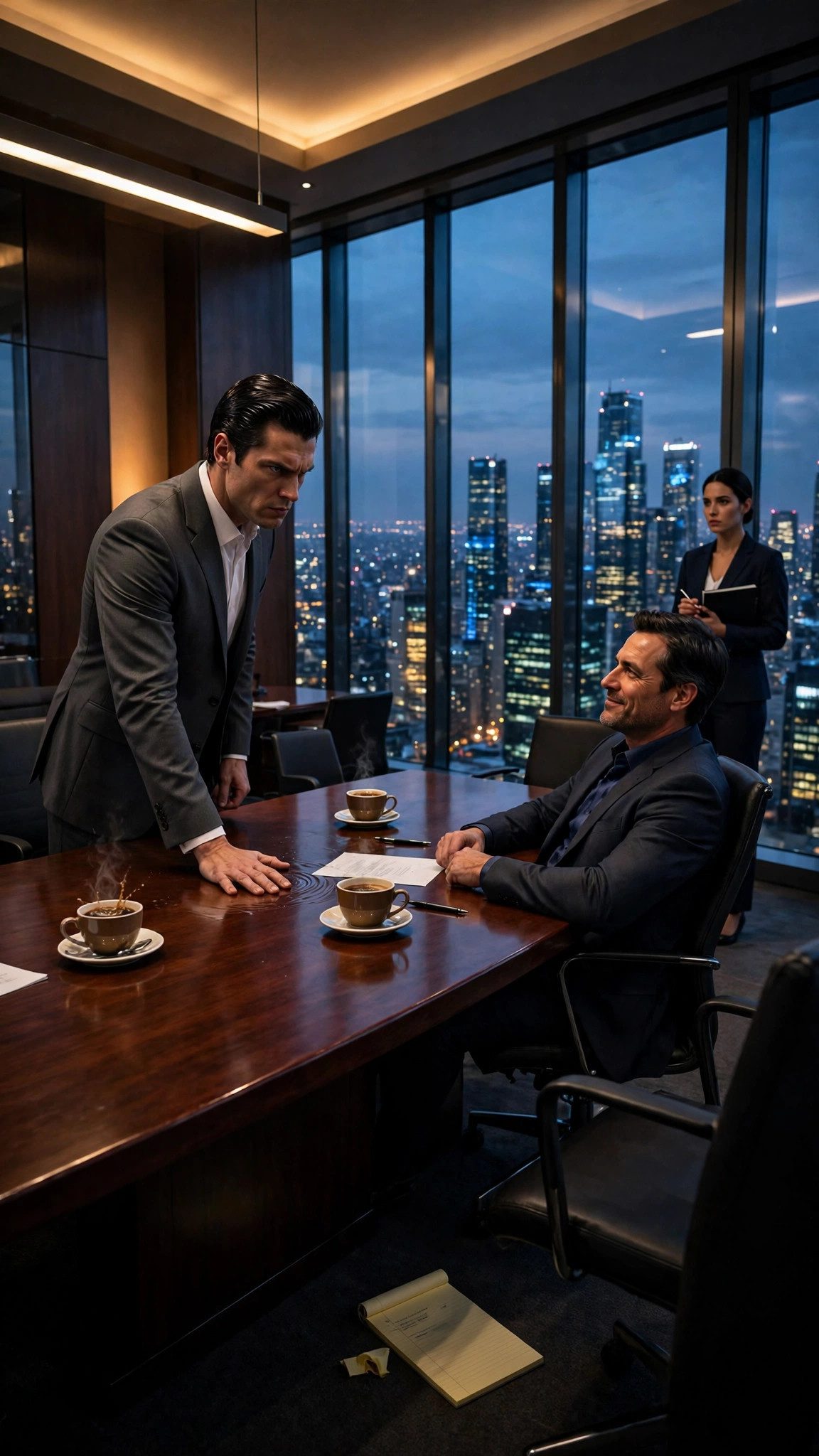
    Before I could respond, Adrian Vescari's hand slammed against the mahogany conference table.

    The sound exploded through the room like a gunshot. Coffee shook inside porcelain cups. A legal pad slipped off the edge of the table and landed on the carpet. Every person around the table froze. And I stood near the wall with my pen still hovering above my notebook, my heart beating so hard I was certain everyone in the room could hear it.

    For two years, I had worked as Adrian Vescari's executive secretary. I had watched politicians, investors, attorneys, and dangerous men walk into his office believing they had control, only to leave with quieter voices and nervous expressions. I knew Adrian's anger better than most people. He never screamed. He never needed to throw anything. He became silent. That was always when people should have been afraid.

    His gray eyes locked onto Vincent, and the silence after the impact was far more frightening than the sound itself.

    "This meeting is finished," Adrian said.

    Vincent blinked, almost offended by the interruption. "We're discussing a forty-million-dollar distribution agreement."

    "Not anymore."

    "Adrian, don't be ridiculous."

    Adrian slowly stood from his chair. At thirty-five, he carried himself with the kind of authority that made his perfectly tailored suit seem more intimidating than any weapon. He didn't need to remind people who he was. Everyone already knew.

    "No," Adrian said coldly. "You forgot where you were."

    Something shifted in Vincent's expression. Then he understood. And somehow, that scared me more than his question. This was never about a simple compliment. Vincent had not stumbled into that question by accident. He had aimed it. He had watched Adrian for two years, the way a hunter watches a man he intends to bring down, and he had finally found the place where the armor was thin.

    Vincent buttoned his jacket and looked toward me. "I meant no offense, Miss Morgan."

    I remained quiet. But Adrian didn't.

    "Don't look at her again."

    The room became completely still. Vincent's jaw tightened, but he didn't argue. He gathered his things, walked toward the door, and left without another word. His attorney followed, then the investors, then the rest of the men, filing out of the conference room like men leaving a church after a funeral, careful not to make a sound.

    The moment the doors closed, I realized I was alone with the most dangerous man I had ever known.

    Adrian stayed at the head of the table, staring at the closed doors as if part of his restraint had disappeared with Vincent. I slowly collected my notebook.

    "I'll return to my desk."

    "No."

    The single word stopped me. I turned around. Adrian was looking at me differently. I had spent two years studying every expression on his face. I knew when he was calculating a business deal, when he was disappointed by results, and when someone had betrayed him. But this was different.

    "Close the door, Tessa."

    My fingers tightened around the notebook. He had never called me Tessa inside the office. Never. At work, I was always Miss Morgan. Sometimes Morgan when there was an emergency. But never Tessa.

    I closed the door.

    When I turned back, Adrian was standing closer than before. His expression was impossible to read. Then he asked the question that changed everything.

    "Are you seeing someone?"

    I did not answer him right away. I could not. Because the truth was that I had been asking myself a different question for two years, and I had never dared to answer it either.

    The question was this: how long could a woman stand three feet away from a man like Adrian Vescari, day after day, and pretend she did not notice him?

    Two years earlier, I had walked into this building with a borrowed suit, a secondhand briefcase, and a resume that nobody in this city should have taken seriously. I was twenty-six years old, and I had exactly eleven dollars in my bank account and a mother in a hospital bed on the other side of town who needed medicine I could not afford. The job posting had said only this: Executive Secretary to the Chief Executive, Vescari Holdings. Discretion required. No exceptions.

    I had not known, then, what Vescari Holdings really was. I had not known that the polished glass tower on the river was the clean face of a family that had run half the city's docks and warehouses for three generations, or that the man at the top of it was feared by people who feared no one. I had only known that the salary would pay for my mother's medicine, and that the woman who interviewed me — a sharp-eyed office manager named Ruth Delgado — had looked at my hands and said, "You don't shake. Good. Mr. Vescari hates shaking hands."

    On my first morning, Ruth walked me to the thirty-fourth floor and told me the rules. "Mr. Vescari arrives at seven. His coffee is black, no sugar, in the blue cup, never the white one. His schedule is in the black binder. You do not knock on his door unless the building is on fire, and if the building is on fire, you send an email first. He does not like questions. He does not like small talk. He does not like anyone in his office after six o'clock. Do you understand?"

    "Yes," I said.

    "One more thing," Ruth said, lowering her voice. "Two years ago, Mr. Vescari lost his fiancée. Her name was Sofia. Do not mention her. Do not ask about her. There is a photograph of her in his office, on the shelf behind his desk, and if you ever see him looking at it, you leave the room. Do you understand?"

    "Yes," I said again, and I meant it.

    I understood grief. My father had died when I was nineteen, a heart attack in the middle of a warehouse shift, and my mother had never been the same afterward. I knew what it was to live in a house where one room was kept exactly as it had been, and where some names were never spoken aloud. So I made myself a promise on that first morning: I would be invisible, efficient, and unbreakable. I would be the best secretary Adrian Vescari had ever had, and I would never, ever become a problem in his life.

    For two years, I kept that promise. I learned his schedule down to the minute. I learned that he took his coffee at seven, his first meeting at eight, and his lunch — when he remembered to eat at all — at his desk, standing up, reading contracts. I learned that he signed documents with a black fountain pen and never with a ballpoint. I learned that he hated the sound of ringing phones and loved the sound of rain against the glass. I learned that he had a scar on his left hand, thin and white, that he rubbed with his thumb when he was thinking hard about something he did not want to decide.

    And I learned, slowly and against my will, that Adrian Vescari was not the monster the city believed him to be.

    The city believed he was cold. The city believed he was ruthless. The city believed he had no heart at all. But I saw the things no one else saw. I saw him pay, quietly and without a word to anyone, for the surgery of a warehouse foreman's little girl. I saw him stand in the rain at a dockworker's funeral, his suit ruined, his head bowed, because the man had worked for his family for forty years and Adrian believed a boss should bury his own. I saw him read, late at night, the letters that came from the families of men who had died working for him, and I saw him answer every single one by hand.

    I saw all of it. And I told myself it did not matter. I told myself that noticing a man's kindness was not the same as falling in love with him. I told myself that every morning when I put on my dark suit and picked up my notebook and pen, and I told myself that every night when I went home to my small apartment and my mother's voice on the phone, asking me if I had eaten, asking me if I was happy, asking me if there was a man in my life yet.

    "Not yet, Mama," I always said. "There's no one. There's no time."

    It was a lie. There was a man. There had been a man for two years. He was the man behind the glass wall, the man in the perfectly tailored suit, the man who called me Miss Morgan and never once looked at me the way a man looks at a woman he wants.

    Or so I had believed, until the morning Vincent Calder asked his question, and Adrian Vescari slammed his hand against the table, and the whole careful structure of the last two years came apart in a single second.

    That morning, before the meeting began, I had noticed Vincent Calder watching me. He had arrived twenty minutes early, which was unusual for a man who liked to make other people wait, and he had stood by the glass wall with his coffee, looking out at the river, while his attorney spread documents across the table. When I came in with the water carafe and the extra legal pads, he turned and smiled at me — the kind of smile that appraises a woman the way a buyer appraises a painting, deciding what she is worth and whether she can be bought.

    "You're new," he said. "I don't remember you from the last negotiation."

    "I've worked for Mr. Vescari for two years," I said.

    "Two years," he repeated, as if the number interested him more than the answer. "And in two years, has he ever once taken you to dinner?"

    I kept my face still. "Mr. Vescari does not take his staff to dinner."

    "No," Vincent said, and his smile widened. "He doesn't. That's what makes it interesting."

    I had not understood him then. I had thought he was only being rude, the way powerful men are rude to women they consider beneath them. I had set down the carafe, arranged the pads, and left the room without another word. Ruth was waiting by the elevator with a file in her hands, and she took one look at my face and said, "Don't let him get to you. Calder is a vulture. He circles until he finds something soft."

    "I'm not soft," I said.

    "I know," Ruth said. "That's why you're still here. Half the secretaries in this building would have quit in the first month. You didn't. But Tessa —" She lowered her voice. "Be careful today. Calder didn't come here for a distribution deal. He came here for something else. I can feel it."

    Ruth had worked in this building for nineteen years. She could feel a storm coming the way old sailors feel it in their knees. I should have listened to her more carefully. But I had a schedule to keep, and a notebook to carry, and a boss who expected the world to run on time. So I went back to my desk, and I waited for eight o'clock, and I told myself that nothing unusual would happen.

    I was wrong. Something unusual had already happened. It had happened the moment Vincent Calder walked into that conference room and decided that the way to bring down Adrian Vescari was not through his money, or his docks, or his warehouses.

    It was through me.

    Now Adrian stood three feet away from me in the empty conference room, and the question he had just asked hung between us like something alive.

    "Are you seeing someone?"

    I looked at his face. I looked at the gray eyes I had studied for two years. And for the first time, I saw what had been there all along, hidden under the silence and the rules and the name he never used.

    He was afraid. Adrian Vescari, the most feared man in the city, was afraid of my answer.

    And in that moment, I understood something that frightened me even more than his fear. Vincent Calder had not asked his question by accident. He had asked it because he already knew. He had seen what I had refused to see. He had found the one thing in the world that could make Adrian Vescari lose control.

    Me.

    "No," I said quietly. "I'm not seeing anyone."

    Something moved behind Adrian's eyes — relief, or grief, or something older than both. He took one step closer, and the whole room seemed to narrow down to the space between us, to the notebook in my hands, to the pen I had been holding for two years like a shield.

    "Tessa," he said, and my name in his voice sounded like a door opening after a very long winter. "There is something I have buried for two years. And I think it is time you knew what it is."

    Outside the glass walls, the city went on with its business. Cars moved along the river. People walked into buildings and out of them, carrying briefcases and coffee cups and ordinary lives. But inside the conference room on the thirty-fourth floor, the world had narrowed to two people and a question that had already ended a forty-million-dollar deal.

    And I knew, standing there with my notebook pressed against my chest, that whatever Adrian Vescari said next, there would be no going back to the way things had been. The two years of Miss Morgan were over.

    The two years of silence were over.

    And the most dangerous part of all of it was this: I did not want to go back.

  • Chapter 5: The Second Bullet

    Chapter 5: The Second Bullet

    The second attempt came that night, and it came the way the first one had come: quietly, without announcement, wearing an ordinary coat and knocking on an ordinary door.

    I was awake. I had not slept well since the shooting, and that night I did not sleep at all. I lay in the hospital bed with my eyes closed, listening to the sounds of the ward settling down for the night — the nurses' soft shoes, the carts rolling past, the faraway sound of an elevator — and I thought about Thursday, and Pier Nine, and the man with the briefcase who did not exist, and the woman who had told me she loved me, and the three men who had driven through the rain looking for things that were never there.

    And I thought about the restaurant. I thought about it the way I had thought about it every night since the shooting, frame by frame, because a man who has been shot does not stop replaying the moment. The private room at Santoro's. The white cloth. The candles burning low. Sal's voice, talking about the shipping schedules, about the captains who were unhappy, about the men who thought the docks should stay the way they were. Marco near the door. The lights going out, all at once, not a flicker, the whole room going black the way a room goes black when someone throws a switch on purpose. The gunfire, flat and ugly in the dark. The glass exploding. Frankie shouting my name. The taste of copper in my mouth. The floor coming up to meet me, hard and cold, and Leo's voice cursing in Italian, and the smell of blood and wine, mixed together, the way they mix when a dinner becomes a crime scene.

    I had replayed it a hundred times, and every time I replayed it, I came to the same conclusion: the shooter had known exactly where I would be sitting. He had fired in the dark, and he had still come within an inch of killing me. That was not luck. That was information. Someone had told him where the private room was, and where I sat, and when the lights would go out. Someone had drawn him a map of my death, and he had followed it almost all the way to the end.

    The ward was quiet now. The nurses had finished their rounds. The carts had stopped rolling. Somewhere down the hall, a machine beeped, steady and patient, counting someone else's heartbeats. I listened to my own monitor, and to the rain that had started again outside the window, thin and cold against the glass, and I thought about the boy who would come tonight — because I knew someone would come tonight, I had known it since Emily told me about Sal's call, and I had told Marco to watch the door, and Marco had told Frankie, and Frankie had told the men in the hallway, and we were all waiting, in our own ways, for the second bullet to arrive.

    At 2:14 in the morning, the door opened.

    I did not open my eyes. I kept them closed, and I kept my breathing slow and even, the way a sleeping man breathes, and I listened.

    Soft shoes. Not a nurse's shoes. Heavier. A man's shoes, moving carefully, the way a man moves when he does not want to be heard. The smell of disinfectant, and underneath it, something else — leather, and oil, and the cold metal smell of a gun that has been cleaned recently and oiled carefully.

    A hand touched the IV line. A voice, low and calm, said, "Mr. Moretti?"

    I did not answer. I kept my eyes closed, and I kept breathing, and I waited, because I had learned, a long time ago, that the most dangerous thing a man can do in a dark room is to let the other man know he is awake.

    The hand moved from the IV line to the pillow. It lifted the edge of the pillow, just slightly, and I understood, in a single cold second, what was happening. He was going to smother me. Quietly. Without a shot. Without a sound. A man with a fractured skull, found dead in his hospital bed in the morning, and the doctors would call it a complication, and the police would call it a tragedy, and Castellano would call it finished.

    I opened my eyes.

    The man standing over my bed was not a nurse. He was not a doctor. He was a young man, maybe twenty-five, with a shaved head and a face I did not recognize, wearing a white orderly's uniform that did not fit him properly, the sleeves too short, the collar too tight, the way a uniform fits when it has been stolen from someone else.

    He froze when he saw my eyes open. For one second, we looked at each other, and in that second I saw everything I needed to see: the fear in his face, the gun in his waistband, the way his hands were shaking, the way he had not expected me to be awake, because the men who sent him had told him I was a man with no memory, a man who would not fight back, a man who was already as good as dead.

    "Don't," I said, very quietly, and my voice was my own voice, not the confused voice, not the pretending voice, but the voice of Vincent Moretti, the man who ran the family, the man who had survived nine years of men trying to kill him. "Don't do this. You do not want to do this."

    He hesitated. His hands were still on the pillow, and I could see him deciding, the way a young man decides when he is in over his head and he knows it, and he is trying to find a way out that does not end with him in prison or in the ground.

    Then the door opened again, and Marco was there.

    Marco Benedetti, my right hand for eight years, standing in the doorway in his shirtsleeves, with his gun in his hand and his face like stone, and behind him, Frankie, and behind Frankie, two of my men, and behind them, Emily, standing in the hallway in her dark coat, holding the folder against her chest, watching everything with those eyes that missed nothing.

    "Step away from the bed," Marco said, and his voice was very calm, the way a man's voice is calm when he has already decided what he is going to do. "Step away, and put your hands where I can see them, and do not reach for the gun, because if you reach for the gun, I will shoot you where you stand, and I will not miss."

    The young man stepped away from the bed. His hands went up. They were shaking, badly, and I could see the tears in his eyes, and I understood, in that moment, that he was not a killer. He was a boy, sent by men who did not care whether he lived or died, to do a job he did not want to do, for money he would never live to spend.

    "Who sent you?" Marco asked.

    The boy did not answer. He looked at the floor, and his shoulders shook, and he said, in a voice so quiet I could barely hear it, "I don't know his name. A man in a black coat. He gave me five thousand dollars. He said the boss wouldn't wake up. He said it would be easy. He said no one would know."

    He was crying now, openly, the way a young man cries when he has done something terrible and he knows it, and he cannot take it back, and he is waiting for someone to punish him.

    "My mother is sick," he said, through the tears. "She needs medicine. It costs more than I make in a month. The man said five thousand dollars, cash, no questions. He said all I had to do was hold a pillow for one minute. He said the boss was already dying. He said I would not be killing anyone. He said I would be finishing something that was already finished."

    Marco looked at me, and I looked at the boy, and I saw what he was: not a killer, not a soldier, not a man of the family. A kid from the Bronx with a sick mother and an empty wallet, who had been bought for five thousand dollars by a man in a black coat, the way you buy a tool you intend to throw away when you are done with it.

    "What's your name?" I asked him, quietly, in my own voice, the way I would ask a man his name when I wanted to remember it.

    "Danny," he said. "Danny Cole."

    "Danny," I said, "listen to me. You are going to go with these men, and you are going to tell the police everything you just told me. The man in the black coat. The five thousand dollars. Your mother. All of it. And if you tell the truth, the law will help you. Agent Reyes will help you. Your mother will get her medicine. Do you understand?"

    He nodded, wiping his face with the back of his hand, and I saw the relief flood through him, the way relief floods through a man who has been expecting a bullet and has been given a second chance instead.

    "Castellano," Frankie said, from the doorway. "It has to be Castellano. The same man who paid for the shooting. The same man who is paying Sal."

    Marco looked at me, and I looked at him, and in that look there was a whole conversation, the same conversation we had been having since the day I woke up: I know you are loyal. I know you are not the traitor. I know you would die for me, and I know you almost did, standing in that doorway with a gun in your hand.

    "Take him to the police," I said, and my voice was steady, and it was my own voice, and I did not bother to pretend anymore, not in front of these people, not in front of Marco and Frankie and Emily, who all knew the truth already. "Take him to Agent Reyes. Tell him everything. Tell him about the five thousand dollars. Tell him about the man in the black coat. Tell him about Sal. And then come back here, because tomorrow is Thursday, and we have a meeting on Pier Nine."

    Marco nodded, and he took the boy by the arm, gently, the way a man takes a prisoner who is more frightened than dangerous, and Frankie went with him, and the two men went with them, and Emily came into the room, and she sat down in the chair, and she looked at me, and she did not say anything for a long time.

    Then she said, "You were awake."

    "Yes," I said. "I was awake. I have been awake every night since the shooting. I have not slept. I have been listening. And tonight, I heard him coming, and I was ready."

    She nodded, slowly, and she opened the folder, and she showed me the last page, and on it, in her small precise handwriting, was a note she had written that afternoon.

    "Sal DeLuca called Tommy Falco at 4:30 p.m. He told him to go to the hospital tonight. He told him the boss would not wake up. He told him to make it look natural. I have the call. I have the time. I have everything."

    She closed the folder and looked at me, and her eyes were steady, and her voice was calm, and she said the thing that mattered most.

    "Tomorrow," she said. "Pier Nine. It is no longer just a trap, Vincent. It is a rescue. Sal tried to kill you twice, and he failed twice, and tomorrow, he is going to walk into a room full of law enforcement officers, and he is going to tell them everything, because he will have no other choice. And Castellano, who paid for all of it, is going to fall with him. And when it is over, you are going to walk out of this hospital, and you are going to tell the family the truth, and you are going to be the boss again."

    I lay back against the pillows, and I closed my eyes, and for the first time since the shooting, I felt tired. Not the tiredness of a wounded man. The tiredness of a man who has been pretending for a long time, and who is finally, finally, almost done pretending.

    "Emily," I said, without opening my eyes. "Stay."

    "I am staying," she said. "I am not going anywhere. I told you that. And I meant it."

    And she stayed, in the chair by the bed, with the folder on her lap, watching the door, while the hospital slept around us, and the city slept outside the window, and the man who had tried to kill me was on his way to the police, and the man who had paid him was sleeping in his own bed, believing that by tomorrow night, I would be dead.

    A nurse came in an hour later, on her rounds, and she checked my bandage, and she checked the monitor, and she looked at Emily asleep in the chair, and she smiled, and she whispered, "She has not left your side all night. Not once. She is a good woman, Mr. Moretti. Hold on to her." And I nodded, because I already knew, and because I was already holding on, with everything I had.

    He was wrong. Tomorrow night, he would be the one in handcuffs. And I would be the one walking out of the hospital, alive, with my memory intact, and a woman beside me who knew everything, and three loyal men behind me, and the law on my side.

    The second bullet had missed, too. And this time, I was not going to pretend it had hit me.

  • Chapter 4: The Secretary Who Knew

    Chapter 4: The Secretary Who Knew

    The day before the trap, Emily came to the hospital early, before visiting hours, before the nurses had finished their rounds, before the city outside had fully woken up. She came with the folder, as always, and with a paper bag that smelled of coffee and fresh bread, and she set both down on the table beside my bed, and she sat in the chair, and she looked at me for a long moment without speaking.

    "You look better," she said at last.

    "I feel better," I said, and I let my voice sound like the voice of a man who was slowly remembering, the way a man sounds when the fog is lifting. "The headaches are less. The doctor says I can go home soon."

    "Good," she said. "Because we need to talk, and I do not want to talk about it in a hospital, where anyone can walk in. But there is no other place. So we will talk here, and we will talk quietly, and we will pretend it is about your schedule."

    She opened the folder, and she turned it toward me, and inside it was not a schedule. It was her life, written in small precise letters, page after page, the way she had written everything else in that folder: the dates, the times, the phone numbers, the photographs, the proof.

    "Before I tell you what I know," she said, "I want you to know who I am. Not your secretary. Not the girl from Queens who files your papers. I want you to know why I stayed, and why I am still here, and why I am going to be here on Thursday, when this ends."

    She told me then, quietly, in the white room with the morning light coming through the window, and I listened the way I had listened to nothing else in my life, because for three years this woman had managed my world and I had never once asked her who she was.

    Her name was Emily Carter. She was twenty-nine years old. Her mother had cleaned offices at night for thirty years, in buildings owned by men like me, and her father had driven a delivery truck until his back gave out, and she had grown up in a two-bedroom apartment in Queens where the radiators clanked all winter and the rent was always due on the first and always paid on the fifth. She had gone to college on scholarships and loans, and she had graduated with a degree in business, and she had applied to a hundred jobs, and the temp agency had sent her to me.

    "I thought you would be like the others," she said. "The men my mother cleaned up after. Men who left their coffee cups on the floor and their secrets on their desks and expected someone else to pick up after them. I thought I would last a month."

    She smiled, a small, tired smile.

    "But you were different. You said thank you. You learned my name on the first day, and you used it. You asked me about my mother, and you remembered what I told you, and when my mother got sick, you paid the hospital bill without telling me, and you let me believe it was the insurance. I found out later. I found out from the hospital, when I went to pay the rest of it, and they told me it was already paid. In full. By a man who had never met my mother."

    She paused, and her voice went quieter, the way a voice goes when it is remembering something that still hurts.

    "My mother was in that hospital for three weeks. Pneumonia, and then her heart, and then more pneumonia, the way it goes when a woman has cleaned other people's offices for thirty years and breathed in other people's dust. I sat beside her bed every night after work, and I watched the bills come, and I did the arithmetic, and the arithmetic did not work. The numbers were bigger than my salary. Bigger than my savings. Bigger than everything I had. And then one morning I went to the desk to pay what I could, and the woman behind the desk looked at her computer and said, 'There is nothing to pay. The account is settled.' And I thought she had made a mistake. I thought she had the wrong patient. But she had the right one. My mother. Paid in full. By a man whose name she would not give me, because he had asked her not to."

    Emily looked down at her hands, at the folder, at the pages of her own handwriting.

    "I stayed because of that. I stayed because you were the first powerful man I had ever met who did not treat power as a reason to be cruel. I stayed because I believed, even then, that a man who pays a cleaning woman's hospital bill in secret is a man worth working for."

    She looked up again, and her eyes were steady, and she went on, telling me the rest of it, the part I had never known: her first week in the office, when one of the captains had shouted at her for putting his calls through in the wrong order, and I had come out of my office and told him, in front of everyone, that he would apologize to her or he would not work for me anymore, and he had apologized, and he had never shouted at her again. The night she had stayed late, past midnight, to finish a report I needed for the morning, and I had found her asleep at her desk, and I had left my coat over her shoulders and a note that said, "Go home. It can wait." The morning she had brought me coffee and found me sitting alone in the dark office, the day after my father's birthday, the first birthday since he died, and she had not said anything, and she had not asked anything, and she had simply set the coffee down and left, and that was the morning she had decided, quietly, that she would never leave me, not for any other job, not for any amount of money, because a man who grieves for his father in the dark is a man who is still human, and she had spent her whole life working for men who were not.

    She told me, too, about the system she had built for me in those first months, the color-coded schedules and the coded names in the contact book, the way she kept two calendars — one the world could see, and one only she and I knew about — and how, in her second month, she had caught a scheduling conflict that would have put me in the same restaurant, on the same night, as a Castellano lieutenant who had sworn to kill me, and she had moved my meeting without telling me why, and I had never known, until now, that she had saved my life that night, quietly, the way she did everything, without asking for thanks, without even telling me what she had done. She had kept the old calendar, too, with the conflict circled in red ink, and she showed it to me once, years later, and she said, "I kept it so I would never forget that the most important thing I do is not the filing. It is the watching. I watch, Vincent. I always watch."

    "And I stayed because, after a while, I realized something else."

    She looked up at me, and her eyes were steady, and her voice did not shake.

    "I realized that I loved you. Not the way a secretary loves her boss. Not the way a woman loves a name or a title or a bank account. I loved the man who says thank you. I loved the man who remembers my mother's name. I loved the man who sits in a hospital bed with a bullet in his head and pretends to forget, because he would rather be weak for a little while than let a traitor kill anyone else. That is the man I love, Vincent. And I have loved him for a long time, and I have never told him, because I thought it was not my place, and because I thought he would never look at me that way."

    She stopped then, and the room was quiet, and the only sound was the monitor counting my heartbeats, which had gone faster, and I could not tell whether it was the wound or the words.

    "I am telling you now," she said, "because tomorrow, on Pier Nine, everything changes. Either Sal walks into the trap and the law takes him, or something goes wrong, and I do not want to spend the rest of my life wondering what would have happened if I had said it. So I am saying it. I love you. And I know everything. And I am not going anywhere."

    I looked at her for a long time. At the dark hair in its knot. At the hands that had written all those notes. At the eyes that had seen through my lie in less than a minute. And I thought about the three years she had worked for me, and all the times she had been in the room and I had not really seen her, because I had been looking at the men in the room, the captains and the drivers and the lawyers, and not at the woman in the corner with the folder, who knew everything and said nothing.

    "Emily," I said, and my voice was my own voice, not the confused voice, not the pretending voice, but the voice I had used before the bullet, the voice of the man who ran the family. "Do you know why I hired you?"

    She shook her head.

    "Because of the way you filed," I said. "On your first day, you took one look at my office and you reorganized the whole thing, and when I asked you why, you said, 'Because a man who cannot find his own papers cannot find his own enemies.' And I thought, that is the smartest thing anyone has said to me in years. And I kept you, because I knew that a woman who thinks like that is worth more than ten captains."

    I reached out, slowly, careful of the IV, and I took her hand. Her hand was warm. It did not tremble. It was steady, the way she was steady, the way she had always been steady, even when the world around her was falling apart.

    "I am not going to pretend anymore," I said. "Not with you. Not after this. You know I remember. You know Sal is the traitor. You know what is going to happen on Thursday. So here is what I know, and I am going to tell it to you, because you have earned it, and because it is the truth."

    I told her then, in the quiet room with the morning light, the things I had never told anyone: that my father had died and left me the family when I was twenty-nine, and that I had spent nine years trying to make it clean, and that the docks were the last of the old business, and that Sal had run them for thirty years, and that I had planned to take care of him, and that I had not yet told him, and that perhaps, if I had told him sooner, none of this would have happened.

    "I was going to give him a share of the legitimate business," I said. "A new position. A way to retire with dignity. I had the papers drawn up. They are in my office safe. I was going to give them to him after the meeting. After the docks went legitimate. I thought I was being generous. I thought I was being kind. I did not know he had already decided to kill me instead."

    Emily squeezed my hand. "You were being kind," she said. "And he was being greedy. That is not your fault. A man who sells his boss for money would have sold him for any reason, or for no reason at all. Greed does not need a reason. It only needs an opportunity."

    She stood up then, and she picked up the folder, and she held it against her chest, and she looked at me, and she said the last thing she was going to say before Thursday.

    "Tomorrow," she said. "Pier Nine. Agent Reyes will be there, and his men will be there, and Marco and Frankie and Leo will be there, and I will be there. And Sal will come, because he thinks he is meeting a man with a briefcase, and instead he is going to meet the law. And when it is over, you are going to walk out of this hospital, and you are going to tell the family the truth, and you are going to be the boss again. And then, Vincent, you are going to take me to dinner. A real dinner. And we are going to talk about what comes next. Not as a boss and a secretary. As a man and a woman who both know everything."

    And she smiled, the second smile I had seen from her in three years, and then she was gone, and I was alone in the white room, and the morning light was coming through the window, and the city outside was waking up, and I thought about the woman who had just told me she loved me, and the man who had just told her the truth, and the trap that was waiting on Pier Nine, and I thought about the fact that for the first time in nine years, I was not alone in the fight.

    I had Emily. I had Marco. I had Frankie. I had Leo. I had the law.

    And on Thursday, I was going to have justice, too.

  • Chapter 3: The Lie That Became a Diagnosis

    Chapter 3: The Lie That Became a Diagnosis

    On the third day in the hospital, the doctor brought a specialist to examine me, a neurologist with grey hair and a kind face who asked me questions in a slow, patient voice, the way you speak to a child or a man who has lost his way.

    "What is your name?" he asked.

    I pretended to think. "Vincent," I said, after a pause that was just long enough to be convincing. "Vincent Moretti. I think."

    "Do you know where you are?"

    "A hospital," I said. "In Manhattan. I think."

    "Do you remember the shooting?"

    I looked at the ceiling. I let my eyes go vague. "There was a room," I said. "People talking. Then loud noises. Glass. I remember glass."

    The neurologist nodded and wrote something down, and the doctor nodded too, and I could see them both filing me away in their minds under the same label: a man with a fractured skull and a fractured memory, a man who might recover and might not, a man who needed rest and patience and time.

    It was perfect. It was also terrifying, because the longer the lie lived, the more real it became, and the more real it became, the more dangerous it was. A boss who cannot remember is a boss who cannot lead, and a family that smells weakness will tear itself apart faster than any enemy ever could. Already, I could feel it happening in the hallways outside my room: captains arriving with questions I could not answer, men I had trusted for years watching me the way men watch a horse with a broken leg, wondering whether it is kinder to put it down.

    So I had to move quickly. I had to find the traitor before the family found out the boss was pretending, or before the traitor found out the boss was not.

    The plan was simple. It was the oldest trick in the world, and like all old tricks, it worked because it was simple. I would give each of the five a different lie, dressed up as a returning memory, and I would watch to see which lie traveled. The truth stays where it is. The lies do the walking. Whoever carried my lie to Castellano was the man who had sold me in the first place.

    I started with Marco, because Marco was the man I trusted most, and because a man you trust most is the man you must test first. If Marco failed the test, I would know the truth was worse than I thought. If he passed, I would know I had at least one man I could stand beside.

    It was late in the afternoon when he came to visit, carrying a paper bag with a sandwich in it, the way he always did when he visited someone in a hospital, because Marco believed that food was the answer to every problem, including the ones it could not possibly solve.

    "How are you feeling, boss?" he asked.

    I rubbed my bandage, the way a confused man rubs the place where it hurts. "There was something," I said, slowly, as if the memory were surfacing through deep water. "A place. A house, I think. On Long Island. A safe house. With a blue door. I think I hid something there. Money, maybe. Or papers. I can't remember what."

    Marco frowned. He set the sandwich down. "A safe house on Long Island? With a blue door? Boss, we don't have a safe house on Long Island."

    "I know," I said, and I let my voice sound frustrated, the way a man sounds when his own mind will not cooperate. "It doesn't make sense. But I keep seeing it. A blue door. A gravel driveway. A mailbox with no name on it."

    He wrote it down in his little notebook, the one he always carried, and he said he would look into it, and he left, and I watched him go, and I thought about the fact that I had just handed my right hand a lie and told him it was a memory.

    If Marco was the traitor, Castellano's men would be at a blue-doored house on Long Island within forty-eight hours, searching for money and papers that did not exist. If Marco was loyal, nothing would happen, and the lie would die where I had planted it, in the mind of an honest man.

    Next was Frankie. He came in the evening, after his shift, still in his driver's jacket, smelling of rain and gasoline, and he sat in the chair by the bed and looked at me with the same expression he had worn in the restaurant, the expression of a man who had pressed his jacket against a bleeding head and refused to let go.

    "Boss," he said. "You look better."

    "Frankie," I said, and I pretended to struggle with his name, the way I had struggled with Marco's. "Frankie Gallo. My driver."

    "That's right, boss."

    "There was something," I said, and I leaned closer, the way a man leans closer when he is telling a secret. "A boat. In Brooklyn. At the marina. I think I keep something on it. A ledger, maybe. With names in it. I keep seeing it. A white boat, with a blue stripe."

    Frankie nodded slowly. He did not write it down. Frankie never wrote anything down. He kept everything in his head, the way a driver keeps the city in his head, street by street.

    "I'll check the marina, boss," he said. "Don't worry about it. You just rest."

    If Frankie was the traitor, Castellano's men would be at a Brooklyn marina within forty-eight hours, looking for a white boat with a blue stripe that did not exist. If he was loyal, nothing would happen.

    Leo came the next morning, before the restaurant opened, carrying a container of soup his wife had made, because Leo believed, like Marco, that food was the answer to every problem. He set the soup on the table and sat down, and his hands were shaking, just a little, the way the hands of a man shake when he has seen his friend bleeding on the floor of his own restaurant.

    "Vincent," he said. "How are you?"

    I looked at him the way a confused man looks at an old friend. "Leo," I said. "Santoro's. The restaurant. The private room."

    "That's right," he said, and his voice was thick. "I'm sorry, Vincent. I'm sorry about what happened in my place. I should have had better security. I should have—"

    "It wasn't your fault," I said, and I meant it, because it was not his fault, and I wanted him to know that, even through the lie. "But there was something. A key. I keep thinking about a key. To a storage unit, I think. In Queens. Number fourteen. I think there's something in it I need."

    Leo nodded, and he wrote the number down on a napkin, the way he wrote down everything important, on whatever paper was nearest.

    "I'll go look, Vincent. I'll go today. Don't worry."

    If Leo was the traitor, Castellano's men would be at a storage unit in Queens within forty-eight hours, looking for a key that did not exist and a unit that did not exist. If he was loyal, nothing would happen.

    That left Sal.

    Sal DeLuca came to visit on the fourth day, in the late afternoon, when the light through the window had gone gold and the rain had finally stopped. He came alone, which was unusual for Sal, who was always surrounded by his own men, and he carried a small box of pastries from a bakery in Brooklyn, the way a man carries an offering to a king he is not sure still sits on the throne.

    "Vincent," he said, and he sat down in the chair, and he looked at my bandages, and his face did something I could not read. It might have been concern. It might have been calculation. "How are you feeling?"

    I let my eyes lose their focus. I let my voice go slow and uncertain.

    "There was something," I said. "A meeting. At the docks. Pier Nine. On Thursday. I think I was supposed to meet someone there. Someone important. I keep seeing it. The water. The cranes. A man waiting for me with a briefcase."

    Sal went very still. It was a small thing, the stillness, but I had spent nine years reading men, and I knew what stillness meant. Stillness meant a man had just heard something that mattered, and he was deciding what to do with it.

    "Pier Nine," he said, slowly. "On Thursday."

    "Yes," I said. "I think so. I can't remember who. But it felt important. Like something I had to do. Like something that would change everything."

    He nodded, and he wrote it down in his own notebook, a leather one, expensive, the kind of notebook a man carries when he wants the world to know he is important, and he said he would look into it, and he left, and I watched him go, and I thought about the fact that I had just handed the man I suspected most a lie dressed up as a memory, and that if he was the traitor, Castellano's men would be at Pier Nine on Thursday, waiting for a man with a briefcase who did not exist.

    And if he was not the traitor, nothing would happen, and I would have to start again.

    That night, Emily came back, after visiting hours, when the nurses were changing shifts and the hallway was quiet. She slipped into the room the way she always slipped into rooms, without a sound, and she sat down in the chair, and she opened the folder, and she showed me what she had found.

    "Marco did not call anyone about a house on Long Island," she said. "He drove to Long Island himself, yesterday, and he drove up and down the streets for three hours, looking for a blue door. He came back at midnight and told his wife he could not find it. He was looking for your money, Vincent. He was looking for it because he thought you had hidden it and forgotten where. He was trying to protect it for you."

    She turned the page. "Frankie did not call anyone about a boat in Brooklyn. He went to the marina himself, last night, and he walked the docks for two hours in the rain, checking every white boat with a blue stripe. There is no such boat. He came home soaking wet and told his brother he could not find it. He was looking for your ledger, Vincent. He was looking for it because he thought it was important to you."

    She turned the page again. "Leo did not call anyone about a storage unit in Queens. He drove there this morning, before the restaurant opened, and he tried every key he owns on unit fourteen. It is empty. It has been empty for a year. He stood there for ten minutes, staring at an empty room, and then he went back to his restaurant and cooked lunch for forty people, and he did not tell a soul."

    She closed the folder and looked at me, and her eyes were shining, the way the eyes of a woman shine when she has just proved something she already knew.

    "Three men," she said. "Three lies. Three men who went looking for things that do not exist, because they thought those things belonged to you, and they wanted to protect them. That is what loyalty looks like, Vincent. It looks like a man driving up and down Long Island in the rain, looking for a blue door that was never there."

    She leaned closer, and her voice dropped.

    "Sal did not go to Pier Nine. Not yet. But his driver did. His driver went to the docks this morning, and he stood on Pier Nine for twenty minutes, and he took photographs of the cranes and the water and the places where a man could hide. And then he drove back to Brooklyn, and he went into a building on Atlantic Avenue, and he stayed there for an hour. The building belongs to a company owned by Vincent Castellano."

    She opened the folder one more time, and she showed me the last page, and on it was a photograph, taken that morning, of a man standing on Pier Nine with a camera, and beside it, in her small precise handwriting, a note.

    "Sal DeLuca's driver. Name: Tommy Falco. He has worked for Sal for six years. He was paid in cash yesterday, four thousand dollars, by a man in a black coat, outside the restaurant where Sal eats lunch every day. I have the photograph. I have the time. I have the amount. I have everything."

    She closed the folder and stood up, and she looked at me, and she said the thing I had been waiting for her to say since the night she first whispered in my ear.

    "Thursday," she said. "Pier Nine. Sal will send Castellano's men to meet a man with a briefcase who does not exist. And when they come, we will be waiting for them. You and me and Marco and Frankie and Leo. And the law."

    "The law?" I asked.

    "Agent Daniel Reyes," she said. "FBI. He has been building a case against Castellano for two years, and he has been waiting for a witness who could put Castellano's men in the same room as the crime. Sal is that witness, Vincent. Sal is going to walk himself into a trap, and he is going to bring Castellano's men with him, and Agent Reyes is going to be there to meet them. All we have to do is let him."

    She picked up the folder and held it against her chest, and she looked at me, and for the first time since I had known her, I saw something in her face that was not precision and was not calm.

    It was anger. Quiet, controlled, furious anger, the kind of anger a woman feels when a man she respects has been betrayed by a man he trusted.

    "Sal DeLuca sold you for money," she said. "He sold the time and the place, and he took Castellano's cash, and he stood in this hospital and pretended to care about you. I am not going to let him get away with it. And I am not going to let you die pretending to forget. On Thursday, this ends. And on Friday, you are going to stop pretending, and you are going to tell the family the truth, and you are going to be the boss again. Do you understand?"

    I looked at her, at the folder, at the photograph of the man on Pier Nine, and I nodded, slowly, because she was right, and because the plan was working, and because the lie that had become a diagnosis was about to become a trap.

    "Thursday," I said. "Pier Nine."

    "Thursday," she agreed. "Pier Nine. And Vincent — when this is over, when Sal is gone and Castellano is gone, you are going to owe me a dinner. A real one. Not in a hospital. Not in an office. A real dinner, where you are not pretending to be anyone but yourself."

    And she smiled, just a little, the first smile I had seen from her in three years, and then she was gone, and I was alone in the white room, and the rain had stopped, and the city outside the window was shining, wet and clean, the way Manhattan shines after a storm, as if nothing had happened at all.

    But something had happened. Three men had proved their loyalty in the rain. One man had proved his guilt on a pier. And a woman who knew everything had just told me that on Thursday, the pretending would end, and the truth would finally come out to play.

  • Chapter 2: Five Names

    Chapter 2: Five Names

    The morning of the meeting, I had woken up in my apartment on the Upper East Side with no reason to believe it would be different from any other Tuesday. That is the thing about betrayal. It never announces itself. It wears an ordinary coat and knocks on an ordinary door, and by the time you recognize its face, it is already inside your house.

    My apartment was quiet that morning. The housekeeper had been and gone. Coffee was waiting in the kitchen, black and strong, the way I had drunk it since I was twenty-one years old and my father first sat me down and told me what the family really was, in words so plain they left no room for pretending. My father had been a careful man. He believed in books and ledgers and knowing exactly who owed you what. He died of a heart attack in his office when I was twenty-nine, and I took the family the next day, the way you take a coat off a hook — because it is yours, and because there is no one else to wear it.

    I had spent nine years making the family smaller and cleaner than my father had left it. Restaurants, real estate, imports — the legitimate businesses, grown until they were big enough to stand on their own. The old business, the one that paid for the apartment and the cars and the silence, I had been winding down, piece by piece, year by year, the way a man unwinds a rope he no longer wants to be tied to. That was the reason for the meeting that night. The docks. The last of the old business. A dispute between two of my captains over who controlled the shipping schedules, and a decision I had finally made: the docks would go legitimate, or they would go to no one at all.

    That decision was going to cost someone a great deal of money. I knew that. I had known it for weeks. What I had not known was that one of the five people I trusted most had already decided to collect on it in advance.

    The five names. I had made the list myself, that morning, in my head, the way I always did before a private meeting: who knows, who needs to know, who must never know. The meeting was not on any calendar. Emily had arranged it by phone, from a line that could not be traced, and she had told each of the five in person, in the same quiet voice she used for everything that mattered.

    Marco Benedetti, forty-one years old, my right hand for eight years. He had come to me as a driver when he was twenty-six, with hands that knew engines and a temper that knew no fear, and he had risen because he was loyal in the way that mattered most in my world: he was loyal when it cost him something. Three years ago, during the war with the Castellano family, Marco had taken a knife meant for me and carried the scar across his ribs ever since, and he had never once mentioned it, not to me, not to anyone. He was the man I trusted to stand near the door, and that night he had stood near the door of the private room at Santoro's, the way he always did, with his back to the wall and his eyes on the room.

    Emily Carter, twenty-nine, my secretary for three years. She had come to me through a temp agency, of all things, a girl from Queens with a degree in business and a mother who cleaned offices at night, and within six months she had reorganized my entire life — my schedules, my contacts, my money — with a precision that frightened my captains and impressed me. She knew my secrets because she filed them. She knew my movements because she scheduled them. She was the one person in the world who knew where I was every hour of every day, and she had never once let that knowledge slip, not even to Marco, not even when Marco asked her directly, the way he sometimes did, with a smile that was meant to be charming and was not.

    Sal DeLuca, fifty-four, a capo who had been with the family since before I was born. He had worked for my father, and his father had worked for my grandfather, and the DeLuca name was carved into the history of the family the way a name is carved into a church wall. Sal ran the docks. He had run them for thirty years, and the docks had made him rich, and the decision I was going to announce that night — that the docks would go legitimate — was going to cost him more than anyone else. I had known that, and I had planned to take care of him. A new position. A share of the legitimate business. A way to retire with dignity. I had not yet told him. That was my mistake, perhaps. Or perhaps it was not a mistake at all, and he had already decided he did not want my generosity. He wanted the docks, the way they were, and the money the way it was, and he was willing to pay a gunman to keep them.

    Frankie Gallo, thirty-two, my driver. He had driven for me for five years, and he knew the city the way a man knows his own house — every street, every alley, every place a car can disappear. He had driven me to the restaurant that night, and he had waited outside in the car, the way he always did, with the engine running and the radio low, and when the shooting started he had come through the front door with his gun out, before anyone else had moved. He had been the first person to reach me after the bullet, and he had pressed his jacket against my temple and held it there, and he had said, "Stay with me, boss. Stay with me," in a voice that did not shake, and I had believed him.

    Leo Santoro, forty-six, the owner of the restaurant. He had grown up with me on the same streets, the son of a baker, and he had built his restaurant with his own hands, table by table, until it was the place where the whole family came to eat and to talk and to settle things the way men settle things over good food and better wine. The private room at the back was mine whenever I needed it. No one else used it. No one else even knew it existed, except the five. Leo had been in the kitchen that night, arguing with his chef about the risotto, and when the lights went out he had come running with a meat cleaver in his hand, and he had stood over me while Frankie held the jacket to my head, and he had cursed in Italian, the way his father used to curse, until the ambulance came.

    Five people. Five names I had trusted with my life. One of them had sold the time and the place to Vincent Castellano, the head of the family that had been trying to kill me for nine years, the man who had ordered the war that put a knife in Marco's ribs and a bullet in my temple.

    That was the truth I woke up with in the hospital. And that was the truth I hid behind a lie.

    The afternoon after I woke up, they let Marco stay with me, and the two of us sat in the white room while the rain fell outside, and he told me what had happened after the shooting, the way a man tells a story to someone who cannot remember it.

    "You were in the private room," he said. "Just you and the captains. Sal and the others. The meeting was about the docks. You were about to speak when the lights went out. Not a flicker — all at once, the whole room, like someone threw a switch. Then the shooting started. Three shots, maybe four. Glass breaking. People shouting. Frankie came in through the front, and I came in from the hallway, and the shooter was already gone. Out the kitchen door, into the alley. Leo's chef saw a man in a black coat, but he didn't see his face."

    "And me?" I asked, in my confused voice, the voice of a man trying to remember.

    "You were on the floor," Marco said. "Bleeding from the head. Frankie had his jacket on you. The ambulance took twelve minutes. The doctors said another inch and you would have died."

    He said it the way a man says something he has said to himself a hundred times in the dark, trying to make it true by repetition.

    "Who would do this?" I asked, and I let the question sound innocent, the way a man who has lost his memory might ask it.

    Marco's jaw tightened. "Castellano," he said. "It has to be Castellano. But Castellano could not have known where you were. Someone told him. Someone in this room, or someone who knew about this room."

    He looked at me then, and I saw the fear in his eyes, and I understood what he was afraid of. He was afraid that I would look at him and see the traitor. He was afraid that the five names on my list would shrink to one, and that one would be his.

    "Do you think it was me?" he asked, quietly, and the question hung in the white room like smoke.

    I stared at him the way a confused man stares at a question he does not understand, and I said, "I don't know, Marco. I don't remember anything. I don't even remember if I trust you."

    It was cruel. I knew it was cruel even as I said it. But cruelty was the price of the plan, and the plan was the only thing standing between me and a second bullet.

    Marco nodded slowly, and his hands stopped shaking, and something in his face went very still, the way a man's face goes when he has decided to carry a weight without complaining about it.

    "Then I will earn it again," he said. "Whatever it takes. I will find who did this, and I will bring him to you, and then you can decide."

    After he left, Emily came back. She did not knock. She never knocked. She came in with the folder under her arm and a cup of coffee in her hand, and she set the coffee on the table beside my bed, and she stood there looking at me with those eyes that missed nothing.

    "You are not as good an actor as you think you are," she said, quietly, so that no one in the hallway could hear.

    I did not answer. I let my face stay confused, the way a man with no memory would.

    "The way you looked at Marco," she said. "You watched his hands. You watched his eyes. You were testing him. A man with no memory does not test people. A man with no memory asks questions. You were not asking questions. You were listening for lies."

    She sat down in the chair Marco had used, and she opened the folder, and she turned it toward me so I could see what was inside: a schedule, printed in her neat handwriting, with the meeting at Santoro's circled in red ink, and beside it, in the margin, a note in her own small, precise letters.

    "Sal DeLuca called the restaurant at 6:42 p.m.," the note read. "He asked to confirm the private room. He has never called the restaurant before. He has never needed to. Leo told me."

    She turned the page. Another note. "Sal DeLuca made a call from the pay phone on the corner of 52nd Street at 7:10 p.m. The call lasted ninety seconds. The number he called belongs to a phone that was bought with cash three days ago and has been used twice. Both times, the phone called a number registered to a company owned by Vincent Castellano."

    She turned the page again. A photograph, printed on ordinary paper, a little grainy, the way security camera photographs always are. It showed a man in a dark coat standing in the alley behind Santoro's restaurant, looking at his watch. The man's face was turned away from the camera, but his coat was open, and on his hip, in a leather holster, there was a gun.

    "Leo's kitchen camera," Emily said. "He gave it to me this morning, before the police asked for it. The time stamp is 8:47 p.m. Thirteen minutes before the shooting. The man is not one of ours. I have checked every face in the family. I do not know him. But the coat is the same coat the chef described, and the gun is the same shape as the one the police found in the alley."

    She closed the folder and looked at me, and her face was calm, and her voice was steady, and she said the thing I had been waiting to hear since I woke up.

    "I know everything," she said again, and this time there was no one else in the room to hear it. "I know you remember. I know Sal sold the meeting. I know Castellano paid for it. And I know Marco did not."

    "How do you know?" I asked, and I let my real voice come back, just for a moment, just for her, because she had earned it.

    "Because Marco was with me when the shooting started," she said. "He was in the hallway outside the private room, on the phone with me, asking me to check the delivery schedule for tomorrow. The call is on my phone. Eight minutes long. It started at 8:52 and ended at 9:00. The shooting was at 9:00. He could not have been in two places at once."

    She leaned closer, and her voice dropped even lower.

    "And because I know you, Vincent. I have worked for you for three years. I know the way you look at a man when you are deciding whether to trust him, and I know the way you look at a man when you already have. You looked at Marco the way you look at a man you have already decided to trust. You were testing him because you had to, not because you believed it. So I am telling you what I know, so you do not have to waste your time testing the wrong man."

    I looked at her for a long time. At the dark hair pulled back into its knot. At the hands that had written those notes in such small, precise letters. At the eyes that had seen through my lie in less than a minute, when the doctor had believed it, and Marco had believed it, and the whole hospital had believed it.

    "Why are you telling me this?" I asked.

    "Because someone has to know the truth besides you," she said. "And because if you die pretending to forget, the truth dies with you. And I am not going to let that happen. Not to you. Not to this family. Not while I am still standing."

    She picked up the folder and held it against her chest, the way she had held it when she first walked into the room, and she stood to leave.

    "One more thing," she said, at the door. "Sal does not know I have the photograph. He does not know I have the phone records. He thinks the only person who knows is the man he sold you to, and that man thinks you are dead, or as good as dead. That is your advantage. Use it. And when you are ready to stop pretending, tell me first. I will be ready."

    Then she was gone, and I was alone in the white room with the rain on the glass and the monitor counting my heartbeats, and I thought about the five names again.

    Marco. Emily. Sal. Frankie. Leo.

    Five names. One traitor. One woman who knew everything.

    And for the first time since the bullet, I felt something I had not felt since I woke up in that hospital bed.

    I felt like I might win.

  • Chapter 1: The Man Who Remembered Everything

    Chapter 1: The Man Who Remembered Everything

    Waking up with a bullet wound was not what frightened me most. Realizing that one of the five people closest to me had betrayed me was worse — so before anyone could ask what I remembered, I made the most dangerous decision of my life and pretended the bullet had stolen everything.

    My name is Vincent Moretti.

    In Manhattan, people knew my name for reasons polite newspapers preferred not to print. I had survived raids, family wars, betrayals, and men who smiled across dinner tables while arranging funerals before dessert. I had buried friends and enemies in the same cold ground and learned to tell the difference between a man who feared me and a man who loved me, which is a harder lesson than it sounds, because in my world the two often wore the same face.

    But that hospital room made me feel vulnerable in a way I hated.

    Rain tapped the glass. My skull throbbed beneath heavy bandages. The light in the room was too white, too clean, and every sound seemed too loud — the IV dripping, the monitor counting my heartbeats, the soft shoes of a nurse moving somewhere beyond the door. I lay still and did what I had done a hundred times in rooms full of dangerous men: I watched, and I waited, and I gave nothing away.

    "Mr. Moretti?" the doctor asked. "Can you hear me?"

    "I can hear you."

    He explained that the bullet had grazed my temple and fractured my skull. Another inch, and I would have died. He used words like "trauma" and "swelling" and "observation," and I nodded at the right places while my mind ran through the night before, frame by frame, the way a man replays a film he has already seen a dozen times, looking for the one detail he missed.

    I remembered everything.

    The private restaurant room in Midtown. The long table, the white cloth, the candles burning low. The meeting I had called myself, to settle a dispute over the docks before it became a war. Marco Benedetti near the door, as always, watching the room the way he had watched every room for eight years. The lights going out all at once, not a flicker, not a failure — a switch thrown by someone who knew where the panel was. Gunfire. Glass exploding. The smell of blood and wine. The taste of copper in my mouth when the bullet took a piece of my temple and kept going.

    Most importantly, I remembered that only five people had known where I would be that night.

    One of them was standing outside my hospital door. I could see his shadow through the frosted glass, tall and still, the way a man stands when he is waiting for news that will change his life.

    Marco entered a moment later.

    He had been my right hand for eight years. He had stood beside me through funerals, negotiations, and nights when one wrong decision could wipe out an entire family. He had carried my father's coffin beside me when I was twenty-nine years old and the whole weight of the Moretti name came down on my shoulders in a single afternoon. I trusted Marco Benedetti the way a man trusts his own hands.

    That was the problem. I trusted all five of them.

    "Boss," he said. "Thank God."

    I studied him. Red eyes. Trembling hands. Exhaustion. Maybe grief. Maybe guilt. He looked like a man who had not slept since the shooting, and I could not tell whether he had stayed awake because he was afraid I would die or because he was afraid I would live and remember.

    Then the doctor asked the question I had been waiting for.

    "Do you remember what happened before you lost consciousness?"

    I glanced toward the glass beside the door. Marco's shadow was visible outside, and through it I could see the hallway, the nurses moving past, the two men in dark suits standing guard at either end. My men. Or his men. That was the question, wasn't it?

    And the plan formed instantly, whole and clean, the way the best plans always do.

    If the traitor knew I remembered, he would become careful. He would cover his tracks, silence witnesses, disappear into the walls of the city I thought I owned. If he believed I remembered nothing, he would relax. He would make a mistake. Men made mistakes when they felt safe, and the man who had sold me to a gunman in a dark restaurant was about to feel very safe indeed.

    So I let confusion enter my face. I let my eyes lose their focus. I became, in a single breath, a man who had woken up in a hospital bed with a hole in his head and a hole in his memory.

    "I'm not sure," I murmured. "There was a room. People talking. Then loud noises."

    The doctor nodded, the way doctors do when a patient says exactly what they expect him to say.

    "Temporary memory loss after trauma is possible," he said, writing something on his clipboard. "We will monitor it. Sometimes the memories return on their own. Sometimes they do not. For now, rest is the best medicine."

    By the time Marco returned, my lie had become a diagnosis. That was the beauty of it. I had not simply told a lie; I had handed the hospital a story it already believed, and the hospital would now protect that story for me, with charts and clipboards and kind, professional voices.

    He sat beside me, pulling the chair close, the way he had done a hundred times in offices and restaurants and the backs of cars.

    "You scared us," he said.

    I stared at him as though recognition came slowly, the way a man stares at a face he thinks he should know but cannot quite place.

    "Marco?"

    His face changed. Just for a second. Relief. Pure, unguarded relief, the kind a man cannot fake, flooding across his features before he could stop it. That tiny reaction told me more than his words ever could — and it told me something I had not expected. It told me that Marco Benedetti had been terrified I would die, and that he was relieved I was alive, and that relief was the one thing a guilty man would never feel.

    Unless he was a very good actor. And Marco, for all his loyalty, had never been a good actor. That was one of the reasons I trusted him.

    "Yeah," he said. "It's me. You're safe."

    "Am I?"

    "I have men guarding every entrance."

    "Your men?" I asked, and I let the question sound like the confusion of a man who could not remember whose men were whose.

    He hesitated. Just a fraction of a second. "Our men."

    Interesting. He had corrected himself, and the correction mattered. A guilty man would have said "my men" without thinking, because a guilty man is already counting what belongs to him. Marco had said "our men" because that was how he had always thought of them — ours, not his, not mine. Ours.

    I pretended not to notice. I let my gaze drift toward the window, toward the rain running down the glass in thin silver lines.

    "What do I do?" I asked.

    Marco frowned. "What?"

    "My work."

    He leaned closer, watching me carefully, the way a man watches a wounded animal to see if it is still dangerous.

    "You're a businessman," he said. "Restaurants. Real estate. Imports. People respect you."

    Respect. That was one way of describing fear.

    "And the shooting?"

    His jaw tightened. "We're still investigating."

    I nodded slowly, acting confused while memorizing every movement: the way his hands shook when he said "investigating," the way his eyes went to the door, the way he kept his voice low even though there was no one else in the room. He was afraid. But afraid of what? Afraid for me, or afraid of me?

    Then the hospital door opened again, and a woman stepped inside carrying a folder against her chest.

    My secretary. Emily Carter.

    Quiet. Precise. Invisible when she wanted to be. For three years, she had managed my schedules, hidden my meetings, taken emergency calls in the middle of the night, and carried information in her head that even my captains did not know. She knew where I was every hour of every day, and she had never once let that knowledge slip. She was twenty-nine years old, with dark hair pulled back into a knot, and eyes that missed nothing, and a way of standing so still in a room that people forgot she was there.

    She stopped when she saw me. She looked at the bandages, at the IV, at the monitor, and her face did not change. But her hands tightened on the folder, just slightly, and I knew she was doing the arithmetic every good secretary does in a crisis: who knows, who needs to know, who must never know.

    Marco immediately stood.

    "He doesn't remember," he told her, and there was something in his voice I could not name. Relief again. Or warning. "The doctor says it's the trauma."

    Emily looked at him. Then at me. Her face barely moved. But her eyes did. They moved across my face the way they always did when she was reading a schedule and finding the mistake in it, and I knew, with a certainty that settled cold in my chest, that Emily Carter had already seen through me.

    She walked to the side of my bed and placed the folder down on the table beside it, carefully, precisely, the way she did everything.

    "Mr. Moretti?"

    I forced myself to look at her like a stranger. Like a man seeing his secretary for the first time and finding her unfamiliar.

    She swallowed. Then she leaned close enough that only I could hear, close enough that her breath warmed my ear, and she said three words that changed everything.

    "I know everything."

    My entire body went cold.

    Because Emily was not looking at me with fear. She was looking at Marco. And for the first time since waking up, I almost forgot to pretend.

    She straightened up, her face calm again, and picked up the folder, and said, in her normal voice, the voice she used for appointments and phone calls, "I brought the files you asked for, Mr. Moretti. From the office. In case you need them."

    Marco frowned. "What files?"

    "His schedule," she said. "His contacts. Everything he might need to remember who he is."

    And she looked at me, just once, and in that look there was a whole conversation: I know you are lying. I know why. And I know who did this.

    Then she left the room, and Marco followed her to the door, and I lay in the hospital bed listening to the rain and the monitor, and I thought about the five names on the list in my head.

    Marco Benedetti. Emily Carter. Sal DeLuca. Frankie Gallo. Leo Santoro.

    Five people had known where I would be. One of them had sold me to a gunman. One of them, I was now almost certain, knew exactly who it was.

    And I had just told the whole world that I remembered nothing at all.

    My father used to say that trust is a ledger. Every man you trust is a line in the book, and every line has two columns: what he has done for you, and what he has cost you. A wise man checks the ledger often, my father said, because a ledger that is never checked is a ledger that will ruin you. I had checked my ledger a hundred times over nine years, and every line had balanced. Marco had taken a knife for me. Sal had stood beside my father's coffin. Frankie had driven through a gunfight to get me home. Leo had hidden me in his kitchen when the Castellanos were searching the streets. Emily had never once let a secret slip.

    Now one of those lines was false. One of those men had written a lie in my ledger in red ink, and I did not know which one. But a ledger can be checked, line by line, and that was what I was going to do. I was going to check every line, and I was going to do it with lies of my own, because the only way to catch a man who lies to you is to give him a lie to carry, and watch where he carries it.

    That night, I lay awake while the hospital slept around me, and I planned. I would test them, one by one, the way a man tests a wall for the loose brick: gently, patiently, and without ever letting the wall know it is being tested. I would give each of them a different piece of false information, a different lie dressed up as a returning memory, and I would watch to see which lie traveled. The truth would stay where it was, locked inside my own head. The lies would do the walking.

    It was a dangerous plan. A man pretending to have no memory is a man with no power, and power was the only thing that had ever kept me alive. Every captain in the family would be watching to see whether the boss was finished. Every enemy in the city would be sharpening his knives. The man who had shot me would be listening for news, waiting to learn whether he needed to finish the job.

    But it was the only plan I had. And I had one advantage nobody else in that hospital knew about.

    I remembered everything. And the traitor did not know that.

    Outside the window, the rain kept falling on Manhattan, washing the streets clean for a little while, the way it always did, as if the city could pretend, for one night, that nothing had happened at all.

    I closed my eyes and pretended to sleep. And behind my closed eyes, I began to count the five names, over and over, like beads on a rosary, like the steps of a man walking toward the truth.

    Marco. Emily. Sal. Frankie. Leo.

    One of them had tried to kill me. And I was going to find out which one — by pretending I had already forgotten.