Story Genres: Mafia Romance

  • Chapter 4: The Name He Buried

    Chapter 4: The Name He Buried

    The morning after the gala, my photograph was in the newspapers.

    Not a big photograph. A small one, on page six of the society section, under a headline that read, "MYSTERY SINGER STUNS MORETTI GALA." The photograph showed me on the stage with the microphone in my hand, my black uniform and my white apron, my face lifted toward the chandeliers, and underneath it, the caption: "Unidentified waitress brings down the house with Mozart's Queen of the Night. Moretti promises marriage in jest — or was it?"

    I read it three times over my morning coffee, sitting at our little kitchen table in Queens while Gabriel ate his cereal and talked about a spelling test, and my hands shook so badly I nearly spilled the coffee on the paper.

    "Mamma, why is your face in the newspaper?" Gabriel asked, leaning over my shoulder.

    "Because I sang a song last night, tesoro," I said. "For some important people."

    "Did you sing the scary lady song?" he asked.

    "Yes," I said. "I sang the scary lady song."

    "Good," he said, and went back to his cereal, satisfied. "You should sing more."

    By noon, the telephone in the restaurant was ringing off the hook. Reporters wanted to know who I was. Opera companies wanted to know where I had trained. A talent agent from Los Angeles left three messages. And Alessandro Moretti sent a car.

    Not a note. Not a telephone call. A black car with a driver in a dark suit, waiting outside Lumière at the end of my shift, with instructions to bring me to the Moretti estate in Long Island, where his mother wanted to meet me.

    I almost did not go. I stood on the sidewalk outside the restaurant for a full five minutes, looking at that black car, and every instinct I had learned in five years of running screamed at me to turn around, to go home, to pack a bag and disappear again. Black cars had taken me to a warehouse once. Black cars meant men with guns and families who decided who lived and who died.

    But then I thought about my mother, and about the old woman upstairs at the gala, weeping when she heard the aria, and I thought about Gabriel, who deserved more than a two-room apartment above a laundromat, and I got into the car.

    The Moretti estate was not a house. It was a world. A long driveway lined with oak trees. Gardens that went on for acres. A mansion of gray stone with white columns and windows that glowed gold in the evening light. Inside, the floors were marble, the ceilings were painted with clouds, and the air smelled of beeswax and lilies.

    A nurse led me upstairs to a bedroom at the end of a long hall, a beautiful room with tall windows looking out over the gardens, and in a bed by the window lay Isabella Moretti.

    She was sixty-seven years old, thin and frail, with white hair spread across the pillow like spun silver and dark eyes that were still sharp and alive in a face that illness had worn down to the bone. There were machines beside the bed, and tubes, and a heart monitor that beeped softly, steadily, and on the nightstand there was a photograph in a silver frame: a young woman in a wedding dress, laughing, with a dark-haired man beside her.

    "Sofia's daughter," she said, when she saw me. Her voice was thin, but it was steady. "Come closer, child. Let me look at you."

    I went to the bed and I knelt beside it, and she took my hand in hers. Her fingers were cold and light as bird bones.

    "You have her eyes," she said. "And her chin. And when you sang last night, I closed my eyes, and for one moment I was twenty-five years old again, standing in a church in Naples, and your mother was singing at my wedding, and the whole world was beautiful. Do you know what your mother said to me that night? She said, 'Isabella, one day your son will need a voice like mine, and when that day comes, you will know it.' I thought she was joking. She was not joking."

    Tears filled my eyes. "I did not know she knew you so well."

    "We were girls together," Isabella said. "Before the families, before the business, before all of it. Your mother sang. I listened. That was our whole friendship, and it was enough." She squeezed my hand. "My son has searched for five years for a voice like your mother's. He has auditioned every soprano in New York. He has flown singers in from Milan and Vienna and London. None of them could sing it. And then a waitress spills wine on his shirt, and her name is Marchetti, and suddenly my son is laughing again for the first time in three years. Do you know what that means, child?"

    "No," I whispered.

    "It means God has a sense of humor," she said, and she smiled, a real smile, the first one I had seen on that frail face. "And it means my son is in more trouble than he knows."

    After I left Isabella's room, Alessandro was waiting for me in the hall. He led me down to his study, a dark room lined with books and a fire burning in the grate, and he poured two glasses of whiskey, and he handed me one, and he told me about the name he had buried.

    Caterina Voss was twenty-six when she died, beautiful and brilliant and laughing, the daughter of a shipping family, and Alessandro had loved her for four years and been engaged to her for one. They were to be married in June. Three months before the wedding, on a rainy night in March, her car went off the West Side Highway and into the river, and by the time they pulled her out, she was gone.

    "The police said it was an accident," Alessandro said, staring into the fire. "Rain. Speed. A bad curve. But I have spent three years wondering if it was something else. My family has enemies, Elena. Men like Vincent Castellano would kill a woman to hurt me, and they would call it an accident, and no one would ever prove otherwise."

    He turned to look at me then, and his eyes were dark and raw, and for the first time I saw not the King of New York but a man who had lost the only person he ever loved and had never forgiven himself for it.

    "At her funeral, I swore her name was buried with her," he said. "I swore I would never marry. Never love. Never give my heart to anyone again, because a heart is a weakness, and I cannot afford a weakness. And then last night, in front of two hundred people, I laughed, and I made a dare, and you threw my own words back in my face, and you sang, and for the first time in three years, I felt something other than anger."

    He set his glass down and he looked at me for a long moment.

    "I am not asking you to marry me, Elena," he said. "Last night was a joke, a stupid joke, and I am sorry for it. But I am asking you to sing for my mother. She does not have long. The doctors say weeks, maybe days. Her last wish is to hear the Queen of the Night sung live, in this house, by the daughter of the woman who sang it at her wedding. Will you do that?"

    I thought about it. I thought about the danger. I thought about the fact that I had spent five years hiding, and that singing for the King of New York was the opposite of hiding. I thought about Gabriel, and about the fact that a woman with a voice like mine did not belong in a black uniform carrying trays for the rest of her life.

    "Yes," I said. "I will sing for your mother."

    But I did not know then that Vincent Castellano already knew who I was.

    Vincent Castellano was sixty years old, fat and smiling, with a face like a kindly grandfather and eyes like a shark, and he wanted the Moretti docks the way a wolf wants a flock of sheep. For ten years he had tried to take them: with bribes, with threats, with arson, with murder. For ten years Alessandro Moretti had held him off.

    Castellano had men everywhere. He had a man in the port authority. He had a man in the mayor's office. And he had a man inside Alessandro's own house: Marco Hale, the head of Moretti security, a man Alessandro had trusted for fifteen years, who had been selling him out for two, for money and for promises, feeding Castellano every secret, every schedule, every weakness.

    And now Marco Hale had a new secret to sell. The waitress with the voice. The woman from Naples. The runaway wife of Matteo Bellini.

    Castellano knew the Bellini family. He knew Don Salvatore Bellini, the old man in Naples, and he knew that the old man had never forgiven his grandson for losing his wife and his heir. And Castellano knew that if Matteo Bellini learned where his wife and his son were, he would come to New York, and there would be a war between the Bellinis and the Morettis, and while the two families tore each other apart, Castellano would walk in and take the docks for himself.

    So Castellano made a telephone call to Naples, and he told Matteo Bellini exactly where his runaway wife was: a waitress at Lumière, in Manhattan, with a five-year-old son named Gabriel.

    And in Naples, in a dark office above the docks, Matteo Bellini put down the telephone, and he looked at the photograph of his wife and his son that he kept in his desk drawer, and he booked a flight to New York.

    He was coming to take back what was his. And he did not know that he was walking into a trap set by a man who wanted them all dead.
    I went back to see Isabella two days later, and this time I stayed for hours. She was stronger that day, sitting up in bed with pillows behind her, and she told me stories about my mother that I had never heard before.

    "Your mother was the funniest person I ever knew," Isabella said, her thin face bright with memory. "She could imitate the conductor so perfectly that the whole chorus would be in tears. And she was brave. When the theater manager told her she was too old to sing the Queen of the Night anymore, she laughed in his face and sang it better than ever, just to prove him wrong. You have her laugh, you know. I saw it at the gala, when you answered my son. That was Sofia's laugh."

    She showed me the music room that afternoon, or rather, she had the nurse wheel her there in her chair, and I pushed her through the wide doors into a beautiful room with tall windows and a grand piano in the center, its lid open, the keys gleaming in the sunlight. On the piano there was a photograph in a silver frame: two young women, laughing, their arms around each other, one dark and one fair, standing in front of a church.

    "That is your mother and me," Isabella said, "on my wedding day. She sang the Queen of the Night that night, and the whole church wept, and I have never forgotten it. Play something for me, Elena. Not the aria. Something soft. Something your mother taught you."

    I sat at the piano, and I played the opening of The Magic Flute, very simply, the way my father used to play it for me on his violin, and I sang the first gentle melody, Papageno's song, soft and sweet, and Isabella closed her eyes and hummed along, and for a little while, the illness and the machines and the dying did not matter, and we were just two women in a music room, remembering a girl who had sung at a wedding forty years ago.

    That night, at home, I told Gabriel about his grandmother Sofia. I showed him the photograph I kept in my drawer, my mother in her chorus dress, young and laughing, and I told him about her voice, and about the aria, and about how she used to sing me to sleep. Gabriel listened very carefully, the way he does, and then he said, "Mamma, was Grandma Sofia a queen?"

    "No, tesoro," I said. "She was a singer. But she sang like a queen."

    "Then I am the grandson of a queen," Gabriel said proudly, and he puffed out his little chest. "That means I am a prince."

    "Yes," I said, and I kissed the top of his head. "You are a prince. And your grandma Sofia would have loved you very much."

    Alessandro showed me the family photographs that week too, in his study, late one night after Gabriel was asleep. Photographs of his father, a stern man with Alessandro's dark eyes. Photographs of his sister Rosa as a little girl. And one photograph, in a frame by itself on the desk, of a beautiful young woman with dark hair and laughing eyes, standing on a beach with the wind in her hair.

    "Caterina," he said quietly. "Three months before the wedding. She was happy that day. I have never seen anyone so happy."

    I looked at the photograph for a long time, and I felt no jealousy, only sorrow, for him and for her, and for all the happiness that had been stolen from them both.

    "She would want you to be happy, Alessandro," I said softly. "Dead people do not want the living to be miserable. My mother would not want that. Your Caterina would not want that either."

    He did not answer. He just stood there, looking at the photograph, and I stood beside him, and the fire crackled in the grate, and outside the window, the rain began to fall on the gardens of the estate.

    That night, after I came home from the estate, I lay awake for a long time, listening to Gabriel breathing in the next room, and thinking about Matteo, somewhere in Naples, packing a bag, booking a flight, coming to take back what he believed was his. I was afraid, but not the way I had been afraid five years ago. Five years ago, fear had made me run. Now fear made me plan. I packed a small bag for Gabriel, just in case: clothes, his rabbit, his favorite book, some money folded into a sock, the way my mother used to hide money in the house in Naples. I put the bag in the back of the closet, where Gabriel would not find it, and I told Mrs. Deluca to watch the street, and to call me if she saw any black cars, any strangers, anyone asking questions. And then I sat by Gabriel's bed until morning, watching him sleep, and I promised him, silently, the way mothers promise their children in the dark, that no one would ever take him from me again.
  • Chapter 3: The Dare

    Chapter 3: The Dare

    For six weeks, I carried Alessandro Moretti's card in my apron pocket like a live coal.

    I told myself I would not go. I told myself every morning when I woke up in my little apartment in Queens, and every night when I came home with aching feet and a sore back from carrying trays at Lumière. I told myself that singing for the King of New York was the most dangerous thing I could do, that men like Alessandro Moretti did not ask waitresses to sing for their dying mothers out of kindness, that there was always a price, and that I had already paid every price I was willing to pay.

    But every night, after Gabriel fell asleep, I stood in our tiny kitchen and I sang. I sang the Queen of the Night the way my mother taught me, quietly at first, so as not to wake the neighbors, and then louder, and louder, until the whole apartment shook with it. I sang for my mother. I sang for my father. I sang for the nineteen-year-old girl in Naples who had believed in love. And every night, the aria came back stronger, cleaner, truer, as if my voice had only been waiting for permission to live again.

    Gabriel heard me once. He stood in the kitchen doorway in his pajamas, rubbing his eyes, and said, "Mamma, why are you singing the scary lady song?"

    "Because the scary lady is brave," I told him. "She is angry, and she sings her anger, and nobody can stop her."

    "I like it when you sing," he said. "You should sing more."

    On the morning of the gala, I woke up before dawn and I could not go back to sleep. I made Gabriel his breakfast, I walked him to school, I kissed him goodbye at the gate, and then I went to Lumière and worked my shift, carrying trays and smiling, and all day long my hands shook so badly that twice I nearly dropped a glass.

    The gala was at the Moretti Foundation's concert hall on the Upper East Side, a beautiful old building with marble floors and gold leaf on the ceilings and chandeliers that looked like they had been stolen from a palace. Two hundred people in black tie and diamonds. A string quartet. A champagne fountain. A stage at the front with a single microphone.

    I was not supposed to be there as a guest. I was there as a waitress, hired for the evening along with twenty other girls from Lumière, to carry trays and pour champagne and be invisible. I wore my black uniform and my white apron and I kept my head down, and I told myself that was all I was there to do.

    But Alessandro Moretti had other plans.

    He found me in the kitchen during the first course, standing by the coffee urns with a tray of empty glasses. He was wearing a black suit with a white shirt, no tie, the collar open at his throat, and he looked at me with those dark eyes that were not cold at all, and he said, "You came."

    "You gave me a card," I said. "I thought I should see what the evening was."

    "The evening," he said, "is a room full of people who have forgotten how to feel anything. My mother is upstairs, in a private room, too weak to come down. She can hear the music through the speakers. She asked me to find her a voice, Elena. I found you. Will you sing for her?"

    I looked at him for a long moment. I thought about my mother, dying in Naples, holding my hand and saying, "Sing, Elena. Whatever happens, sing." I thought about Gabriel, asleep in Queens with his stuffed rabbit. I thought about five years of running.

    "I will sing," I said. "But not as a favor. And not as a servant. If I sing, I sing as your equal, or I do not sing at all."

    Something flickered in his eyes. Respect, maybe. Or surprise. "Then sing as my equal," he said. "The whole room is waiting."

    He took me by the hand and led me out of the kitchen, through the swinging doors, into the concert hall, and two hundred faces turned to look at us. The string quartet stopped playing. The waiters froze. The room went silent, and then someone near the back laughed, a sharp, nervous sound, and then another person laughed, and then the whole room was laughing, because the King of New York was holding the hand of a waitress in a black uniform, and it was the funniest thing they had seen all year.

    Alessandro Moretti laughed too. He laughed in front of two hundred people, a big, easy laugh, and he turned to the room and raised his glass, and he said, in a voice that carried to every corner of the hall, "Ladies and gentlemen, this young woman tells me she can sing the Queen of the Night. The most impossible aria in all of opera. I told her that if she can sing it, I will marry her on the spot."

    The laughter swelled. Someone shouted, "Do it, girl! Marry the king!" A woman in emeralds giggled behind her fingers. The men at the head table slapped each other on the back and roared.

    And I stood there with a tray still balanced on my forearm, because no one had told the waitress she was allowed to put the tray down, and I looked at this man who thought he could buy my voice with a joke, and something in me rose up, cold and clear and furious, the way it had risen up five years ago in the warehouse by the docks in Naples, when three men with guns had told me I was a weakness.

    "If that is the truth," I said, and my voice did not shake, "then I will thank you for proving that the name you swore you had buried was never buried at all."

    The laughter died. It died so fast that the silence rang in my ears like a struck bell. Two hundred faces turned from me to him, and I watched the smile drain out of Alessandro Moretti's face, watched his dark eyes narrow, watched his hand tighten around his wine glass until I thought the stem would snap.

    Because everyone in New York knew the story. Everyone knew about Caterina Voss, the beautiful fiancee with the dark hair and the laughing eyes, who had died in a car crash three years ago on the West Side Highway, on a rainy night in March, and everyone knew that Alessandro Moretti had stood at her funeral in a black suit in the pouring rain and sworn, before God and his whole family, that her name was buried with her and he would never marry, never love, never give his heart to anyone again.

    And I, a waitress in a black uniform with a tray on my arm, had just said it out loud in front of two hundred people.

    For a moment, I thought he would have me thrown out. For a moment, I thought I had gone too far, that I had insulted the King of New York in his own house, and that I would pay for it. His face had gone white, and his jaw was clenched, and the whole room held its breath, waiting to see what the king would do to the girl who had dared to speak his dead fiancee's name.

    Then he set his wine glass down, very carefully, on the table. He stood up. He walked to the edge of the stage, and he looked at me, and his voice, when it came, was low and rough, and it was not a dare anymore. It was a command.

    "Sing," he said. "Sing the aria, and we will see whose name is buried."

    I set the tray down on the edge of the stage. I took the microphone in both hands. I closed my eyes, and I thought of my mother.

    I thought of Sofia Marchetti, standing in our little kitchen in Naples, teaching me to breathe from the belly, to open the throat, to let the sound come from the floor of the body. "This aria is not a song," she used to say. "It is a woman who has been pushed too far. You do not perform her. You become her."

    I opened my mouth, and I became her.

    The first notes came out low and dark, a mother's fury, a queen's curse, and the hall went so quiet I could hear the ice settling in someone's glass. Then the melody climbed, and my voice climbed with it, up through the coloratura runs, through the staccato daggers of sound, up to the high F's that rang off the chandeliers like struck crystal, each one clean and true and bright enough to hurt. I sang of hell's vengeance boiling in my heart. I sang of a mother who would rather see her daughter dead than disobedient. I sang five years of running, five years of fear, five years of being a girl with no name and no home, and I poured all of it into Mozart's notes until the aria was not a performance anymore but a confession.

    When the last note died, the hall was silent for one whole breath. Two breaths. Three.

    And then two hundred people rose to their feet at once, and the applause came down like thunder.

    I stood on the stage with the microphone shaking in my hand and tears running down my face, and I looked at Alessandro Moretti, and he was standing too, and he was not laughing anymore. He was looking at me the way a man looks at something he has searched for all his life and finally found.

    Upstairs, in the private room, his mother Isabella was weeping. I did not know it then, but later, one of the nurses told me: the old woman had heard the aria through the speakers, and she had closed her eyes, and she had whispered, "Sofia. My Sofia has come back to sing for me."

    After the applause died down, Alessandro Moretti walked to the stage, and he took my hand, and he lifted it to his lips, and he kissed it, gently, in front of two hundred people.

    "You sang," he said, very quietly, so only I could hear. "You sang, and my mother is crying upstairs, and for the first time in three years, I feel something other than anger. What is your name?"

    "You already know my name," I said.

    "Then tell me the rest," he said. "Tell me why a woman with a voice like that is carrying trays in my restaurant."

    I looked into his dark eyes, and I saw the sympathy there, and the curiosity, and something else, something I was afraid to name. And I knew, with a certainty that settled in my bones like cold water, that my five years of running were over.

    I had waited for this moment for five years. I just had not known it would look like this.

    The week after the gala, my life changed in ways I had never imagined. The telephone at Lumière rang all day, every day. Opera companies wanted to know who I was. A talent agent from Los Angeles left three messages, each one more desperate than the last, offering me auditions, contracts, a recording deal. A reporter from a music magazine came to the restaurant and tried to interview me during my shift, and my manager had to ask him to leave.

    I said no to all of them. I was not ready. I had spent five years being invisible, and suddenly the whole world wanted to look at me, and it frightened me more than I could say.

    But Alessandro came to Lumière for lunch the following Tuesday, and he sat at his usual table by the window, and he ordered the same thing he always ordered, and when I brought his food, he said, very quietly, "You are afraid."

    "Of course I am afraid," I said. "Yesterday I was a waitress. Today the whole city knows my name. What if they find out about Naples? What if they find out about Matteo?"

    "Then they will find out that you are a woman who survived," he said. "And they will admire you for it. The world loves a survivor, Elena. It is the one story everyone understands."

    That night, after the restaurant closed, the kitchen staff asked me to sing for them. Just a few bars, they said, just the beginning of the aria, so they could hear it up close. I stood in the middle of the kitchen, in my black uniform, with the dishwashers and the line cooks and the pastry chef gathered around me, and I sang the opening of the Queen of the Night, and when I finished, the pastry chef, a big man from Sicily with flour on his apron, had tears in his eyes, and he said, "Signorina, I have worked in kitchens for thirty years, and I have never heard anything like that. You do not belong in a kitchen. You belong on a stage."

    I went home that night to Gabriel, and he was waiting up for me, sitting on the couch with his spelling book, and he said, "Mamma, Mrs. Deluca says you are famous now. Are you famous?"

    "No, tesoro," I said. "I am just your mamma."

    "Good," he said, and he yawned. "I like it when you are just my mamma."

    But I knew, even then, that nothing would ever be just the same again. The world had heard my voice, and the world does not forget a voice like that. And somewhere in the city, in an office with dark windows, a man named Vincent Castellano was reading the same newspapers I was reading, and he was smiling, and he was making a telephone call to Naples.

    The next morning, a letter arrived at my apartment, delivered by hand in a cream-colored envelope with no stamp, only my name written on the front in a careful, old-fashioned hand. Inside, on thick paper, were a few lines: "My dear Elena, Thank you for giving an old woman her music back. Will you come to tea on Thursday? There is so much I want to tell you about your mother. — Isabella Moretti."

    I read the letter three times, standing in my little kitchen with Gabriel eating his toast, and I held it to my chest, and I thought about the fact that a dying woman, a stranger, a queen in her own way, had written to me by hand, and wanted to tell me about my mother, and I knew that I would go, no matter what it cost me, no matter who might be watching. Some invitations are not really invitations. They are doors. And this one was opening.

  • Chapter 2: Five Years of Running

    Chapter 2: Five Years of Running

    The first thing I learned about running is that you never really stop. You just get better at pretending you have.

    I pretended for five years. I pretended in Rome, where I worked three weeks in a cafe near the train station before the money ran out. I pretended on the plane to New York, holding a six-month-old baby who cried the whole way across the Atlantic while the woman next to me pretended not to notice. I pretended in Queens, in a two-room apartment above a laundromat where the radiators clanged all night and the cockroaches came out after dark like they owned the place. And I pretended at Lumière, where I smiled and carried trays and became invisible, because invisible women do not get found.

    But I was found anyway. Or rather, I was not found. I was recognized. There is a difference, and it took me five years to understand it.

    Before New York, there was Naples. Before Naples, there was a little girl with a violin for a father and an opera singer for a mother, growing up in an apartment full of music.

    My father, Antonio Marchetti, played second violin with the Naples orchestra, and he was the kindest man I ever knew. He had big hands and a soft voice, and he used to lift me onto his knee after dinner and play the opening of The Magic Flute for me on his violin, just the first few notes, and tell me that Mozart had written the Queen of the Night for a woman with a voice like a knife and a heart like a fire, and that one day I would understand her. He died of a heart attack in the middle of a rehearsal when I was twelve years old. He was forty-seven. The orchestra played at his funeral, and my mother stood beside his coffin in a black dress and did not cry, not once, and I thought that was what strength looked like.

    My mother, Sofia Marchetti, was a soprano. Not a famous one. She sang in the chorus of the Naples opera and sometimes, on the good nights, she sang small solo roles, and once, when I was eight, she sang the Queen of the Night for a private audience at a wedding, for a woman named Isabella Moretti, and she came home that night with her face shining and said, "Elena, tonight I sang for a queen, and the queen wept." I did not understand then. I was eight. I thought she meant a real queen.

    My mother taught me to sing the way other mothers teach their daughters to cook or sew. She taught me to breathe from the belly, to open the throat, to let the sound come from the floor of the body and not from the mouth. She taught me the Queen of the Night when I was fourteen, note by note, phrase by phrase, and she made me sing it until the high F's came clean, until the runs were like water over stones. "This aria is not a song," she used to say. "It is a woman who has been pushed too far. You do not perform her. You become her."

    My mother died when I was seventeen. It was her lungs, the doctors said, years of singing in cold theaters and damp dressing rooms. She died in the spring, in our little apartment full of sheet music, and I held her hand while she went, and the last thing she said to me was, "Sing, Elena. Whatever happens, sing."

    I was seventeen and alone in the world, with a dead father and a dead mother and a voice nobody wanted to pay for. I worked in a bakery. I worked in a flower shop. I sang in the church choir on Sundays because it was free and because it was the only place I could still hear music. And then, when I was eighteen, I met Matteo Bellini on the steps of the opera house, and he smiled at me like the sun coming out, and I thought God had finally remembered me.

    Matteo was twenty-one, tall and dark and laughing, with his grandfather's money and his mother's charm and not a single worry in the world. He courted me the way men in old songs court women: with flowers every day, with poetry copied out by hand, with long walks along the bay at sunset and promises whispered against my hair. He told me his family was in shipping. He told me his grandfather, Don Salvatore Bellini, was a respected businessman, a pillar of Naples. He told me he would take care of me forever, and that I would never be alone again.

    I believed him. I was eighteen years old, and I had been alone for a year, and a kind word felt like shelter.

    We married when I was nineteen, in a small church with white flowers and a hundred guests I did not know, and Matteo's grandfather sat in the front pew like a king holding court, an old man with white hair and cold eyes who looked at me the way a man looks at a horse he is thinking of buying. I told myself I was imagining it. I told myself that old men in important families always looked like that.

    For six months, I was happy. Or I thought I was happy. Matteo was tender and funny and attentive, and he bought me a little piano for our apartment, and on Sunday mornings he would sit and listen while I sang, and he would say, "Elena, your voice is the most beautiful thing in Naples," and I believed him.

    Then, on a Tuesday night in November, three men with guns took me from the street outside our apartment.

    I remember everything about that night. I remember the cold of the pavement through my shoes. I remember the smell of the car, leather and cigarettes. I remember the black hood going over my head and the way my own breathing sounded inside it, fast and shallow, like a trapped animal. I remember the warehouse by the docks, the concrete floor, the single bare bulb hanging from the ceiling, and the three men standing around me, polite and almost gentle, like doctors about to deliver bad news.

    "We are not going to hurt you, signora," the oldest one said. He had gray hair and a scar through his eyebrow. "We are here to teach you something. You are a weakness. Do you understand? A man like Matteo Bellini cannot have a weakness. His enemies will find you. They will use you to get to him. A wife who can be taken off the street is a liability, and the family has decided that you need to understand your place."

    They kept me for four hours. They gave me water. They let me sit in a chair. They talked to me about the family the way teachers talk to a slow student, patiently, as if I should be grateful for the lesson. And then they drove me home and let me out on the corner, and Matteo was waiting at the door, white-faced and shaking, and he held me and cried and swore he had not known, swore he would protect me, swore it would never happen again.

    But I saw the truth in his eyes. He had known. Maybe not the details, maybe not the night or the place, but he had known what his family was. He had known what they did to women who became inconvenient. And he had married me anyway, and brought me into a house where I was nothing but a soft spot in his armor, a door his enemies could walk through.

    He gave me a name. An heir. But he could not give me love, or even a single minute to call him his own, because every minute belonged to the family, to his grandfather, to the business, to the men with guns who decided who lived and who died in Naples.

    I stayed for another year. I stayed because I was pregnant, and then because I had a baby, a beautiful dark-haired boy I named Gabriel, after the angel, because I wanted him to have a guardian even if his father could not be one. I stayed because I had nowhere else to go, and no money, and no family, and because part of me still loved the laughing boy on the steps of the opera house, even though I knew he was gone.

    And then, one night, when Gabriel was six months old, I heard Matteo on the telephone in the next room, talking to his grandfather in a low voice. "She is still a problem," he said. "The boy too. The family thinks we should send them away. Somewhere they cannot be used."

    Send them away. Not protect them. Send them away, like luggage, like a problem to be stored somewhere safe and forgotten.

    That night, I packed a bag. Baby clothes. Three hundred euros I had saved from the household money, a little at a time, hidden in a shoebox. My mother's old score of The Magic Flute, pressed flat in the bottom of the suitcase. I waited until Matteo fell asleep, and then I picked up my son and I walked out of the apartment, and I did not look back.

    I took a train to Rome. I worked three weeks in a cafe near the train station, washing dishes and sleeping in a room above the kitchen with Gabriel in a drawer lined with blankets, because there was no crib. Then a woman in the cafe, an old American tourist with kind eyes, told me about a cheap flight to New York, and about a cousin who ran a boarding house in Queens, and I spent my last money on two tickets, one for me and one for a baby who did not yet know how to be afraid.

    New York swallowed us whole. It was cold and loud and enormous, and nobody knew my name, and that was the most beautiful thing in the world. I found work cleaning offices at night, and then waitressing at a diner in Queens, and then, after three years, at Lumière, the most elegant restaurant in Manhattan, where the pay was good and the customers never looked at the waitresses long enough to remember their faces.

    Gabriel grew up in that little apartment above the laundromat, and he grew up brave and stubborn and smart, the way children do when they have only one parent and that parent would die for them. He learned to walk holding onto the radiators. He learned to talk in two languages, Italian from me and English from the television. He learned to read from the backs of cereal boxes. And when he was old enough to ask questions, he asked the one I had been dreading for five years.

    "Mamma," he said one night, when he was four, sitting in the bathtub with his toy boat, "where is my papa?"

    I sat on the edge of the tub with a towel in my hands, and I looked at my beautiful boy with his father's dark hair and my mother's green eyes, and I told him the truth as I had chosen to tell it.

    "You simply have no father, Gabriel," I said. "No long explanations. No false stories. Some men are fathers, and some men are only names. Your papa is only a name."

    He thought about that for a long moment, the way he does, with his little forehead wrinkled. "Okay," he said finally. "Then you are my mamma and my papa too."

    "Yes," I said, and I kissed the top of his wet head. "I am both."

    That was the story we lived by for five years. I was both. I was the mother who cooked and cleaned and sang lullabies, and I was the father who fixed the broken toys and carried him on my shoulders and taught him to be brave. I was everything, and it was enough, until the night I spilled red wine on the white shirt of the King of New York, and he grabbed my wrist, and he said my mother's name out loud, and suddenly the past I had buried came back to life.

    I went home that night after my shift, to Gabriel asleep with his stuffed rabbit under one arm, and I sat by his bed for a long time, holding Alessandro Moretti's plain white card in my hand. A name. A number. An invitation to sing for a dying woman I had never met, whose last wish was to hear my mother's aria sung live.

    I thought about my mother, dying in our little apartment in Naples, holding my hand and saying, "Sing, Elena. Whatever happens, sing."

    I thought about Gabriel, and about Matteo, and about the three men with guns, and about five years of running.

    And I knew, even then, that I was going to sing. I just did not know that singing would bring the whole world crashing down around me.
    Our first winter in New York nearly broke me. The cold came down like a hammer in November, and our little apartment above the laundromat had radiators that clanged and hissed but never really warmed the rooms, and Gabriel caught a cold that turned into a cough that would not go away, and I sat up with him for three nights in a row, holding him against my chest while he wheezed, and I sang to him, very softly, the lullabies my mother used to sing to me, and on the third night his fever broke, and I cried with relief into his hair.

    Mrs. Deluca lived downstairs, an old Italian woman with a face like a walnut and a heart as big as the whole building. She had come to New York fifty years ago, a bride like me, and she knew what it was to be alone in a strange city with a child. She watched Gabriel when I worked nights, and she taught him to make fresh pasta on Sundays, flour all over the kitchen and sauce on his chin, and she never once asked me about my past. "Every woman has a past, cara," she used to say. "The only question is whether the past is finished with you."

    That first Christmas, I had thirty dollars to spend on Gabriel's present, and I bought him a stuffed rabbit from a discount store, gray and soft, with one ear slightly longer than the other. He named it Barnaby, and he carried it everywhere, and to this day, five years later, Barnaby still sleeps in his bed, worn and gray and missing one ear, the most precious thing my son owns.

    I sang in the church choir on Sundays, because it was free, and because it was the only place I could still hear music. The choir director was a kind old man named Mr. Okafor, and he heard me sing once, just once, a solo in the Christmas service, and after the service he took me aside and said, "Child, where did you learn to sing like that?" And I told him, "From my mother," and he said, "Then your mother was a great teacher, and you must never stop singing." I did not tell him the rest. I did not tell him about Naples, or Matteo, or the men with guns. I just nodded, and I kept coming to choir, and I kept singing, quietly, in the back row, where no one would notice me.

  • Chapter 1: The Voice He Could Not Forget

    Chapter 1: The Voice He Could Not Forget

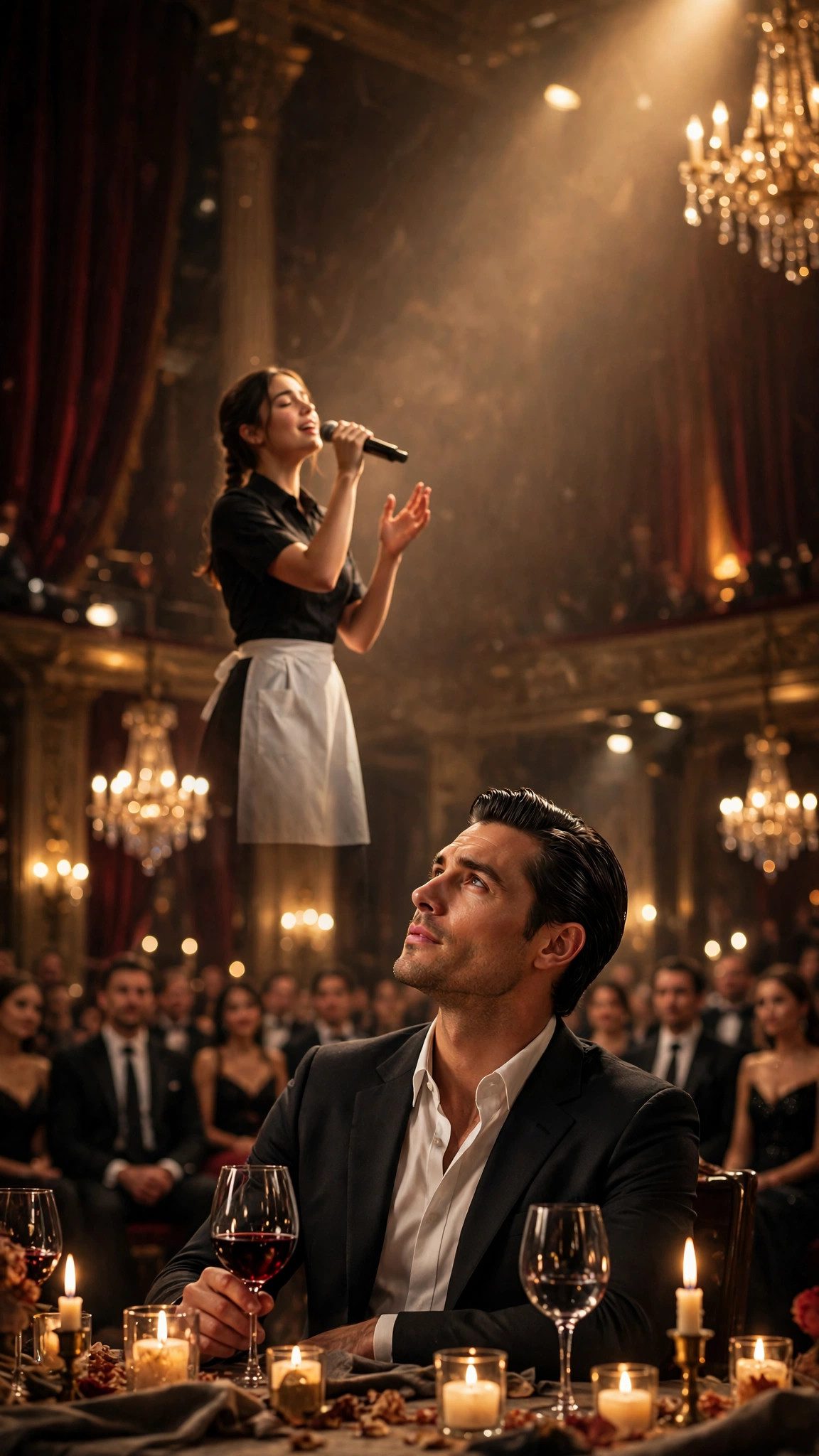
    The concert hall held two hundred people in black tie and diamonds, and every one of them was laughing at me.

    I stood on the small stage at the front of the Moretti Foundation gala with a borrowed microphone in my hand and a tray still balanced on my forearm, because no one had told the waitress she was allowed to put the tray down. The chandeliers burned above us like frozen fire. The men in their tuxedos and the women in their gowns had turned in their chairs to look at me, and their laughter rolled across the room in waves, the easy laughter of people who have never once been afraid of being the joke.

    And in the center of it all, at the head table, sat Alessandro Moretti, the King of New York, laughing harder than any of them.

    He was thirty-eight years old, tall even sitting down, with dark hair combed back from a face that newspapers called handsome and his enemies called carved from stone. He wore a black suit that must have cost more than a year of my rent, and a white shirt, and no tie, the collar open at his throat like a man who had decided the rules of the room did not apply to him. His eyes were cold and dark, the kind of eyes that made waiters stammer and grown men lower their voices, and they were fixed on me with something I could not name. Amusement. Curiosity. Hunger, maybe, though not the kind I had learned to fear.

    "If you can sing the aria," he said, and his voice carried across the hall without any effort at all, the way a king's voice does, "I will marry you on the spot."

    The laughter swelled. Someone near the back shouted, "Do it, girl! Marry the king!" A woman in emeralds pressed a hand to her mouth and giggled behind her fingers. The string quartet in the corner had stopped playing. The waiters along the wall had gone still, trays frozen in the air, watching the show like everyone else.

    I should have been terrified. Five years ago, terror would have swallowed me whole. Five years ago, I had been a nineteen-year-old girl in Naples who believed love was enough, and then three men with guns had taught me what the world did to girls who believed that.

    But I was not nineteen anymore. I was twenty-four, and I had a five-year-old son asleep in a two-room apartment in Queens, and I had spent five years running from men who thought they owned me, and something in me had gone very still and very quiet, the way the air goes still just before a storm breaks.

    I looked at Alessandro Moretti, and I smiled.

    "If that is the truth," I said, and my voice did not shake, "then I will thank you for proving that the name you swore you had buried was never buried at all."

    The laughter died.

    It died so fast that the silence rang in my ears like a struck bell. Two hundred faces turned from me to him, and I watched the smile drain out of Alessandro Moretti's face, watched his dark eyes narrow, watched his hand tighten around his wine glass until I thought the stem would snap. Because everyone in New York knew the story. Everyone knew about Caterina Voss, the beautiful fiancee who had died in a car crash three years ago on the West Side Highway, and everyone knew that Alessandro Moretti had stood at her funeral and sworn, before God and his whole family, that her name was buried with her and he would never marry, never love, never give his heart to anyone again.

    And I, a waitress in a black uniform with a tray on my arm, had just said it out loud in front of two hundred people.

    "Sing," he said. His voice had gone low and rough, and it was not a dare anymore. It was a command. "Sing the aria, and we will see whose name is buried."

    I set the tray down on the edge of the stage. I took the microphone in both hands. I closed my eyes, and I thought of my mother.

    My mother had been Sofia Marchetti, a soprano with a voice like cut glass and honey, and when I was a little girl she used to sing me to sleep with the hardest aria in all of opera, Mozart's Queen of the Night, "Der Hölle Rache kocht in meinem Herzen," the revenge aria, the one with the high F's that only a handful of women in the world can sing cleanly, the one that sounds like a woman tearing her own heart out of her chest and throwing it at the feet of the gods. My father had been Antonio Marchetti, a violinist with the Naples orchestra, and he used to say that my mother did not sing the aria, she survived it, and that one day I would too.

    My father died when I was twelve. My mother died when I was seventeen. I had not sung the aria in public since the day they buried her.

    I opened my mouth, and I sang.

    The first notes came out low and dark, a mother's fury, a queen's curse, and the hall went so quiet I could hear the ice settling in someone's glass. Then the melody climbed, and my voice climbed with it, up through the coloratura runs, through the staccato daggers of sound, up to the high F's that rang off the chandeliers like struck crystal, each one clean and true and bright enough to hurt. I sang of hell's vengeance boiling in my heart. I sang of a mother who would rather see her daughter dead than disobedient. I sang five years of running, five years of fear, five years of being a girl with no name and no home, and I poured all of it into Mozart's notes until the aria was not a performance anymore but a confession.

    When the last note died, the hall was silent for one whole breath. Two breaths. Three.

    And then two hundred people rose to their feet at once, and the applause came down like thunder.

    I stood on the stage with the microphone shaking in my hand and tears running down my face, and I looked at Alessandro Moretti, and he was standing too, and he was not laughing anymore. He was looking at me the way a man looks at something he has searched for all his life and finally found, and I knew, with a certainty that settled in my bones like cold water, that my five years of running were over.

    I had waited for this moment for five years. I just had not known it would look like this.

    My name is Elena Marchetti Bellini, and this is the story of how I ran away from one mafia family and straight into the arms of the King of New York.

    I was nineteen years old when I married Matteo Bellini in a small church in Naples, and I was young and in love, and I did not know that love could be a death sentence.

    Matteo was twenty-one, tall and dark and laughing, the grandson of Don Salvatore Bellini, and he had courted me for a year with flowers and poetry and promises whispered on the steps of the opera house where my mother used to sing. He told me his family was in shipping. He told me his grandfather was a respected businessman. He told me he would take care of me forever. And I believed him, because I was nineteen and my mother had just died and I was so lonely that a kind word felt like shelter.

    I found out the truth six months after the wedding, on a Tuesday night in November, when three men with guns took me from the street outside our apartment and put a black hood over my head and drove me to a warehouse by the docks. They did not hurt me. That was the worst part. They were polite, almost gentle, and they told me, very clearly, that I was a weakness. That Matteo's enemies would use me to get to him. That a boss's wife who could be taken off the street was a liability, and that the family had decided I needed to understand my place.

    They let me go after four hours. Matteo was waiting at home, white-faced and shaking, and he held me and cried and swore he had not known, swore he would protect me, swore it would never happen again. But I saw the truth in his eyes. He had known. Maybe not the details, but he had known what his family was, and he had married me anyway, and brought me into a house where I was nothing but a soft spot in his armor.

    He gave me a name. An heir. But he could not give me love, or even a single minute to call him his own, because every minute belonged to the family, to his grandfather, to the business, to the men with guns who decided who lived and who died in Naples.

    So I ran.

    I ran when Gabriel was six months old, with a bag of baby clothes and three hundred euros and my mother's old score of The Magic Flute pressed flat in the bottom of the suitcase. I took a train to Rome, a plane to New York, and I never looked back. For five years, I have been a ghost. A waitress. A mother. A woman with no past and no future, only the next shift and the next rent payment and the next morning when my son asks me about his father.

    Gabriel is five now. He has Matteo's dark hair and my mother's green eyes, and he is the smartest, bravest, most stubborn little boy in all of Queens. When he asks about his father, I tell him that he simply has no father. No long explanations. No false stories. Just the truth as I have chosen to tell it: some questions do not have answers, and some men do not deserve to be called father.

    I work at Lumière, the most elegant restaurant in Manhattan, where the chandeliers are real crystal and the wine list is thicker than a novel and the customers are the kind of people who have never once worried about the rent. I wear a black uniform and a white apron and I carry trays and I smile, and I am invisible. That is the point. Invisible women do not get found.

    Or so I thought.

    One evening in October, six weeks before the gala, I was carrying a tray of drinks to a table by the window when my foot caught on the edge of the carpet and the tray tipped. A glass of red wine slid off the silver and poured straight down the front of a white shirt, a beautiful white shirt, on a man in a black suit who was sitting alone at the best table in the house, reading a letter by candlelight.

    I panicked. Of course I panicked. I grabbed a napkin and tried to wipe the wine from his shirt, apologizing in a rush of Italian and English, and then his hand closed around my wrist like a steel band, and I froze.

    At first, it reminded me of my husband. The cold, dark eyes. The stillness. The sense that this man could tear me apart with one word and never lose a night of sleep over it. My whole body went rigid, and my breath stopped in my chest, and I waited for the shouting, for the cruelty, for the punishment.

    But when I looked into his eyes, my body stopped trembling.

    There was deep sympathy in them. Not pity. Sympathy, the kind that comes from a man who knows what it is to lose something and carry it anyway. He looked at me for a long moment, his fingers still around my wrist, and I felt something I had not felt in five years. I felt seen.

    "Do you know who I am?" he asked, very quietly.

    "No," I whispered. "Should I?"

    The corner of his mouth lifted, just barely, and he let go of my wrist. "Most people in this city would say yes. My name is Alessandro Moretti."

    I had heard the name, of course. Everyone in New York had heard the name. Alessandro Moretti, the King of New York, the head of the Moretti family, the man who owned half the docks and all of the fear in this city. But I had never seen him before, and standing there with a wine-stained napkin in my hand, I understood why people whispered his name the way they did.

    "I'm sorry about your shirt," I said. "I'll pay for the cleaning. I'll pay for the shirt."

    "Keep the napkin," he said. "And your name?"

    "Elena," I said. It was the first time in five years I had given my real name to a stranger, and I did not know why I did it. "Elena Marchetti."

    He repeated it slowly, as if tasting it. "Marchetti. Your father was a violinist, wasn't he? Antonio Marchetti, of the Naples orchestra."

    My heart stopped. "How do you know that?"

    "Because my mother knew your mother," he said. "Sofia Marchetti sang at my parents' wedding forty years ago. My mother has never forgotten it. She says your mother's Queen of the Night was the most beautiful thing she ever heard, and she has spent forty years waiting to hear it again."

    He stood up then, and he was taller than I had expected, and he looked down at me with those dark, cold eyes that were not cold at all.

    "My mother is dying, Elena Marchetti," he said. "Her heart is failing. Her last wish is to hear the Queen of the Night sung live, the way your mother sang it. I have searched for five years for a woman who can sing it. Every soprano in New York has auditioned. Every one of them has failed. And tonight, a waitress spills wine on my shirt and tells me her name is Marchetti."

    He took a card from his jacket and held it out to me. It was plain white, with only a name and a number.

    "Come to the gala in six weeks," he said. "Sing for my mother. That is all I ask."

    I took the card. I did not know then that taking it would change everything. I did not know that the man standing in front of me had spent five years searching for a voice, and that the voice belonged to me, and that the woman he had been searching for was the same woman who had spent five years running from a name she could not escape.

    All of those years, he had searched for a woman who could sing the Queen of the Night's aria for his mother. And the woman standing in front of him was me. The daughter of a violinist, raised by my mother with the opera legacy. The only woman who can sing the Queen of the Night's aria from Mozart's The Magic Flute.

    I went home that night to my little apartment in Queens, to my son asleep with his stuffed rabbit under one arm, and I sat by his bed and I cried for the first time in years. Because for the first time in five years, someone had said my mother's name out loud, and remembered her, and wanted her music to live again.

    And I knew, even then, that I was going to sing.

  • Chapter 7: Home Before Nine

    Chapter 7: Home Before Nine

    Three months after she left, on a cold morning in February, Aaron Moretti drove back to Milwaukee.

    Sophie was three months old by then, and she had grown so much that the pink sleeper with the tiny rabbits no longer fit her, and her hair had come in dark and soft, like her father's, and her eyes were gray, like his too, and when she smiled — which she did often now, at the sound of her mother's voice, at the mobile above her bassinet, at the face of her uncle Ethan when he made his terrible jokes — her whole face lit up, and Aaron thought, she is going to be all right. Whatever happens next, she is going to be all right.

    Ethan drove them. He did not ask if she was sure. He had stopped asking that weeks ago, when he had seen her reading Roman's letters for the third time, and he had understood that his sister had already decided. He just loaded the diaper bag into the trunk of his car, and he put Sophie's car seat in the back, and he drove south on Highway 41, past Oshkosh and Fond du Lac and West Bend, and he did not say a word until they crossed the city line, and then he said, "If he hurts you again, Aaron, you call me. Day or night. I don't care what he's done or what he's become. You call me."

    "I will," she said. And she meant it. That was the difference now. She was not going back because she had nowhere else to go. She was going back because she had somewhere else to go — the cabin on Lake Mendota, with the fire in the stone fireplace and the wicker bassinet beside the wood stove — and she was choosing to come home anyway.

    Roman was waiting for them in the driveway of a small house in a quiet neighborhood, a house Aaron had never seen before. It was not the house on Lake Drive. It was smaller, and plainer, and the paint on the shutters was a soft, ordinary blue, and there was a swing on the porch, and a garden in the front yard, covered in snow, waiting for spring.

    He was standing in the driveway in his coat, with his hands in his pockets, and when Ethan's car pulled in, he did not move. He just stood there, watching, the way a man watches for something he is afraid to hope for.

    Aaron got out of the car. She unbuckled Sophie from her car seat, and she held her daughter against her chest, and she walked across the driveway, through the snow, toward the man she had married, and she stopped three feet away from him, and she looked at him, and she said, "Show me."

    So he showed her. He showed her the house — the kitchen with the big windows, the living room with the fireplace, the nursery upstairs, painted a soft, warm yellow, with a white crib and a white rocking chair and a mobile above the crib, little wooden stars and moons, the same mobile he had hung in the old nursery, the one he had taken down himself and carried here, piece by piece. He showed her the thermostat, set to exactly seventy-two degrees. He showed her the dresser, full of tiny clothes, folded with impossible neatness. He showed her the notebook on the changing table, with the feeding times written in his handwriting, in the same neat letters she used.

    And then he showed her the last thing. A framed document, hanging on the wall of the nursery, beside the crib. It was a court order, stamped and signed, dissolving the Moretti family's criminal enterprises. Beneath it, a second document: the incorporation papers for a legitimate shipping company, Moretti Logistics, with audited books and a board of directors and not a single dollar that could not be explained.

    "It's done," he said. "All of it. Castellano was convicted last week. Life in prison, no parole. Laya took a plea — fifteen years. Her father got ten. The docks are sold. The warehouses are sold. The trucking company is legitimate. I testified for three days, Aaron. I told them everything. And when it was over, Agent Reyes shook my hand, and he said, 'You're a free man, Mr. Moretti. Don't waste it.'"

    Aaron looked at the documents on the wall. Then she looked at Sophie, asleep in her arms, her tiny fist curled against her cheek. Then she looked at Roman, standing in the doorway of the nursery, in a house she had never seen before, in a life she had never imagined, and she said, "There's one more thing I need."

    "Anything," he said.

    "I need you to promise me something. And I need you to mean it this time."

    "Tell me."

    "Promise me you'll be home before nine," she said. "Every night. Not most nights. Every night. Because Sophie deserves a father who comes home. And I deserve a husband who comes home. And if you can't promise that, then tell me now, and I'll go back to the cabin, and we'll be fine, because we're already fine. But if you can promise it — if you really mean it — then I'll stay."

    Roman looked at her. He looked at his daughter. He looked at the nursery, with its yellow walls and its white rocking chair and its mobile turning slowly in the warm air. And he said, very quietly, "I promise. I'll be home before nine. Every night. For the rest of my life."

    She believed him. Not because of the words — words were easy, and Roman had always been good with words — but because of everything else. Because of the letters. Because of the lists. Because of the court order on the wall and the legitimate shipping company and the three days of testimony and the small blue house with the swing on the porch. Because a man who had been the most feared mafia boss in Milwaukee had given it all up, not for power, not for money, but for a woman and a baby and a promise he had broken once and would never break again.

    "Then we'll stay," she said.

    He did not cry. He did not shout. He did not throw anything. He just stepped forward, very slowly, like a man approaching something fragile, and he put his arms around both of them — around Aaron and Sophie, his wife and his daughter, his whole world — and he held them, and the mobile turned, and the stars knocked together, and outside the nursery window, the snow fell softly over Milwaukee, covering the city in white, covering everything that had come before, and leaving only what was left.

    In the spring, they renewed their vows in the garden of the small blue house, with Ethan standing beside them and Claire holding Sophie, who was six months old by then, and who wore a white dress with a pink ribbon, and who laughed when the wind blew the petals from the cherry tree across the yard. There were no photographers from the society pages. There were no glittering rooms full of glittering people. There were only the people who loved them, and a cake from the bakery on the corner, and a promise, spoken quietly, in the sunlight, by a man who had finally learned what a promise was for.

    "I promise," Roman said, holding Aaron's hands, looking into her eyes, "to be home before nine. Every night. For the rest of my life."

    And he was. Every night, without fail, the black SUV turned into the driveway of the small blue house before nine o'clock, and Roman Moretti came through the front door, and he hung up his coat, and he washed his hands, and he went upstairs to the nursery, and he picked up his daughter, and he held her against his chest, and he whispered, "I'm here, sweetheart. Daddy's home."

    And Aaron, standing in the doorway of the nursery, watching them, would think about the night she had left — about the voicemail, about the rain, about the drive north in the dark — and she would think about how far they had come, from that night to this one, and she would understand something she had not understood before.

    She could not make him choose them. That had always been true. But she could decide what she and Sophie deserved. And what they deserved was a man who came home before nine. And that was exactly what they had.

    The first weeks back in Milwaukee were quieter than Aaron had expected. She had braced herself for whispers and stares, for the society pages and the questions, for the world she had left to come rushing back at her the moment she returned. But the world did not rush back. The world, it turned out, had moved on. Laya Crane's trial had been in the papers for a week, and then it was gone, replaced by other scandals, other names. Vincent Castellano's conviction had been a headline for a day. The Moretti family, which had once owned the city's attention the way it owned its docks, was now just a name people mentioned in the past tense, if they mentioned it at all.

    Aaron went back to work at the hospital two days a week, the way she had before Sophie was born, and her colleagues welcomed her back without asking too many questions. Priya found her in the supply room on her first day back, and she put her arms around her, and she said, "You look like you again," and Aaron laughed, because she did feel like herself again. Not the woman who had waited by the phone. Not the woman who had driven north in the rain. Herself. A nurse, a mother, a wife — in that order, on most days, and in a different order on others, depending on who needed her most.

    Priya came to dinner at the small blue house one Sunday, and she brought a casserole and a bottle of wine, and she sat on the porch swing with Aaron while Roman gave Sophie her bath upstairs, and she said, "Tell me the truth. Is he different? Really different?"

    Aaron thought about it. She thought about the letters, and the lists, and the court order on the nursery wall. She thought about the way Roman came home every night before nine, without fail, and the way he washed his hands and went upstairs, and the way he held Sophie like she was made of glass and sunlight at the same time.

    "He's trying," she said. "Every day. And trying is not the same as succeeding, but it's a lot more than I had before. And Priya — he chose us. When it cost him everything, he chose us. That's not nothing."

    "No," Priya said. "That's not nothing. That's everything."

    In May, Castellano's appeal was denied, and the news ran a short segment about it on the local station, and Roman watched it in the living room with Sophie asleep on his chest, and when it was over, he turned the television off, and he sat there in the quiet, and Aaron came downstairs with two cups of tea, and she sat beside him, and she said, "Are you all right?"

    "I am," he said. "For the first time in my life, I think I actually am. I spent eight years being afraid — afraid of losing power, afraid of looking weak, afraid of Castellano, afraid of my own men. And now I have nothing to be afraid of losing, because the only things that matter are sitting right here, in this room, and nobody can take them from me. Not Castellano. Not Laya. Not anyone."

    Sophie grew. She rolled over in June, on a blanket in the garden, while Aaron and Roman watched from the porch swing, holding hands like teenagers. She laughed for the first time in July, at the sound of her father's terrible singing in the bath, and Roman laughed too, and then he cried, just a little, because it was the first time he had heard his daughter laugh, and he understood, in that moment, everything he had almost lost.

    In August, on Sophie's eight-month birthday, Roman came home at 8:47, as he did every night, and he found Aaron in the kitchen, making dinner, with Sophie in her high chair, banging a wooden spoon against the tray, and he stood in the doorway for a moment, watching them, and he thought about the night he had come home at 1:12 in the morning to an empty house, and he thought about the note on the changing table, and the four words that had changed his life.

    You promised me, too.

    He had promised. And this time, he was keeping it. Not because someone was watching. Not because someone had threatened him. But because he had finally understood what his wife had known all along: that a promise is not a sentence you say to get out of a room. It's a life you live, one night at a time, coming home before nine, every night, for the rest of your life.

    On a November evening, one year to the day after Aaron had driven north in the rain, Roman came home at 8:52, and he found Aaron sitting in the nursery, rocking Sophie, who was nearly a year old now, and who had just learned to say her first word that morning.

    "What was it?" he asked, kneeling beside the rocking chair. "What did she say?"

    Aaron smiled, and her eyes were shining in the lamplight. "Mama," she said. "She said 'mama.' Clear as anything."

    Roman laughed, and he leaned in, and he kissed the top of Sophie's dark head, and then he kissed Aaron, slow and unhurried, the way a man kisses a woman he has finally learned to deserve.

    "She'll say 'dada' next," he said. "Just wait."

    "She will," Aaron said. "She has plenty of time. We all do."

    Outside the nursery window, the November rain was falling again, soft and steady against the glass, just as it had fallen a year ago. But inside the small blue house, the nursery was warm, and the mobile was turning, and the little wooden stars knocked together with a soft, hollow sound, and Aaron Moretti sat in the white rocking chair with her husband beside her and her daughter in her arms, and she thought about the night she had almost lost all of it, and she was glad — so glad — that she had been brave enough to leave, and brave enough to come back.

    The End.
    THE END

  • Chapter 6: The Choice

    Chapter 6: The Choice

    Tuesday came in gray and cold, the way Tuesdays in Milwaukee always came in November, with a low sky and a wind off the lake that cut through coats and found the skin underneath.

    Roman did not go to the south dock. He stayed home, in the house on Lake Drive, in the study with the curtains drawn, and he waited, and at 2:00 in the morning his phone rang, and it was Agent Reyes, and Reyes said three words that changed everything.

    "We got them."

    Castellano's men had come to the south dock at 2:00 in the morning, just as the message had said — four men in a black van, with rifles and rope and a plan to make Roman Moretti's death look like an accident at the warehouse. They had walked straight into an FBI tactical team, and within ninety seconds, all four of them were on the ground in handcuffs, and within an hour, two of them were talking, and by dawn, the FBI had enough to arrest Vincent Castellano himself at his home in the suburbs, in his bathrobe, in front of his wife, while the morning news cameras filmed from the street.

    Laya Crane was arrested the same morning, at her apartment, while she was packing a suitcase. The burner phone was in the locked drawer, exactly where Salvatore's people had said it would be. The money was in her bank account, seventy-five thousand dollars, paid in small amounts, always in cash, always on the first of the month. Her father, Charles Crane, was arrested at his office an hour later, and he confessed within the day, because Charles Crane had never been a brave man, and when the FBI showed him the evidence, he told them everything — about Castellano, about the routes, about the plan to kill Roman, about the eighteen months his daughter had spent beside a man she had been paid to destroy.

    Roman watched it all on the news, sitting in his study with the television turned low, and he felt nothing. Not triumph. Not relief. Not even anger. Just a hollow, echoing emptiness, the way a house feels after everyone has moved out.

    He had won. Castellano was in custody. Laya was in custody. The men who had come to kill him were in custody. The FBI had what they needed. And none of it mattered, because the house on Lake Drive was still empty, and the nursery was still empty, and the only two people he loved in the world were forty miles north, in a cabin he had never seen, and he did not know if they would ever come home.

    That afternoon, he drove north.

    He did not bring his men. He did not bring Salvatore. He did not bring a gun, or money, or threats, or any of the things he had always brought to solve his problems. He brought himself, in the black SUV, driving north on Highway 41 through the rain, past West Bend and Fond du Lac and Oshkosh, following the same road Aaron had driven a week earlier, in the dark, with their daughter in the back seat.

    He found the cabin the way he found everything — by asking the right people the right questions, quietly, until someone remembered a blue Honda with a Milwaukee plate, heading north in the rain, and a woman with a baby, and a man named Ethan Sullivan who had a cabin on Lake Mendota that his father had bought under a different name.

    When he turned down the gravel road, the headlights caught Ethan standing on the porch, and Ethan was holding a shotgun, and he did not look surprised to see Roman Moretti. He looked like a man who had been expecting this visit, and dreading it, and preparing for it, all at once.

    "Turn around, Roman," Ethan said. His voice was steady. "She doesn't want to see you."

    "I know," Roman said. He got out of the car slowly, with his hands where Ethan could see them. "I know she doesn't. But I need to ask her something, and I need to ask it in person. And then, whatever she says, I'll go."

    "She's not coming back with you," Ethan said. "You understand that, right? She's not a shipment. You can't just collect her."

    "I understand," Roman said. "I'm not here to collect her. I'm here to apologize. And then I'm here to leave."

    Ethan studied him for a long moment. Then he lowered the shotgun, very slowly, and he stepped aside, and he said, "She's inside. Sophie's asleep. Don't wake the baby. And Roman — if you hurt her again, I don't care who you are. I'll kill you myself."

    Roman nodded. He walked up the porch steps, and he opened the cabin door, and he stepped inside, into the warmth and the smell of wood smoke, and there she was.

    Aaron was sitting on the couch beside the fireplace, with a book open in her lap, and she looked up when the door opened, and for a moment — just a moment — he saw something flicker across her face. Not love. Not hate. Something older than both of those things. Recognition. The look of a woman seeing a man she used to know, a man she used to love, standing in her doorway like a stranger.

    "Roman," she said.

    "Aaron," he said. "I'm sorry."

    She closed the book. She set it down on the couch beside her, very carefully, the way a woman handles something fragile. "You're sorry," she said. "For what, exactly? For Laya? For the birthday dinner? For the toast? For the papers? Or for the eighteen months you spent lying to me while another woman sold your life to a man who wanted you dead?"

    "For all of it," he said. "For every piece of it. I know about Laya. I know about Castellano. I know about the routes and the money and the burner phone and the south dock. I know she was going to have me killed on Tuesday, and I know the FBI arrested them all this morning because I gave them the evidence. And I know none of that matters, because none of it brings back the six days I threw away, or the night you sat at home with our daughter waiting for a man who promised to be home before nine."

    She stared at him. The fire crackled in the fireplace. Somewhere in the back of the cabin, Sophie made a small sound in her sleep, and Aaron's head turned toward it, instinctively, the way a mother's head always turns toward her child.

    "Why did you come here, Roman?" she asked.

    "To tell you the truth," he said. "All of it. Finally. Laya was Castellano's plant. She was using me to get to my routes, and I was too blind to see it, because I wanted to believe that a beautiful woman wanted me for myself. I betrayed you, Aaron. Not once. Every day, for eighteen months, in a hundred small ways, until there was nothing left of the man you married. And then, on the sixth night of our daughter's life, I walked out the door to celebrate another woman's birthday, and you did the bravest thing anyone has ever done for me. You left. You protected our daughter. You did what I couldn't do. You chose us, even when I wouldn't."

    He knelt down then, in front of the couch, in the cabin on Lake Mendota, with the firelight on his face, and he looked up at her, and he said, "I'm not here to ask you to come home. I don't deserve that. I'm here to tell you that I've ended it. All of it. Laya is in custody. Castellano is in custody. I've given the FBI everything. I'm testifying. I'm dismantling the family businesses — the docks, the warehouses, all of it — and I'm making them legitimate, or I'm closing them. I'm done being the man who made grown men tremble. I want to be the man who comes home before nine. I want to be Sophie's father. But I understand if you never want to see me again. And if that's what you decide, I'll respect it. I'll send money. I'll stay away. I'll do whatever you ask. I just needed you to hear it from me, in person. I needed you to know that I know what I did. And I'm sorry."

    Aaron looked at him for a long time. She looked at his face — at the gray eyes, at the dark hair, at the lines around his mouth that had not been there a year ago — and she thought about the gala, and the chocolate fountain, and the plastic dinosaurs, and the rocking chair on the first night, and the empty nursery, and the voicemail, and the drive north in the rain, and she felt two things at once, both of them true.

    She still loved him. And she did not trust him.

    "Here's what I need," she said, finally, and her voice was steady, the way a woman's voice is steady when she has decided what she deserves. "I need time. I need you to prove it, not with words, but with your life. I need you to dismantle the family, like you said. I need you to testify. I need you to be a man Sophie can be proud of, not a man she has to be protected from. And I need you to understand that if you ever — ever — choose another woman over us again, I will leave, and this time I won't tell you where I'm going, and you won't find me. Do you understand?"

    "I understand," Roman said.

    "Then go home, Roman," she said. "Go home and do what you said you'd do. And when you've done it — when it's real, not just words — come back. And we'll see."

    He stood up. He looked at her for one more moment, and then he turned and walked to the door, and he opened it, and the cold November air came in, and he stepped out onto the porch, and Ethan was still standing there, watching him, and Roman nodded at him, and he got into the black SUV, and he drove away, south, toward Milwaukee, toward the empty house and the empty nursery and the long, hard work of becoming a man worth coming home to.

    Aaron watched the headlights disappear down the gravel road. Then she went to the back of the cabin, and she picked up Sophie from the wicker bassinet, and she held her daughter against her chest, and she whispered, "I'm here, sweetheart. I'm here. And your daddy is going to try. That's all we can ask. That's all anyone can ask."

    The weeks that followed were the hardest of Aaron's life, and also, in a strange way, the simplest.

    At the cabin, there were no parties. There were no phone calls from women with soft, wounded voices. There were no men watching the roads. There was only the lake, gray and cold in the November light, and the fire in the stone fireplace, and Claire's bread baking in the oven, and Ethan's terrible jokes, and Sophie, growing bigger every day, in the wicker bassinet beside the wood stove.

    Sophie smiled for the first time on a Tuesday, three weeks after they left Milwaukee. Not a gas smile, the nurse had told Aaron — a real smile, a social smile, the kind that means a baby recognizes you and is glad you're there. Aaron was changing her diaper on the couch when it happened, and she looked up at her mother and her whole face lit up, and Aaron laughed out loud, and then she cried, because it was the first time in weeks that something had felt purely, uncomplicatedly good.

    Claire found her there, laughing and crying at the same time, and she sat down beside her and put her arm around her, and she said, "That's your daughter, Aaron. That's what you saved. Remember that, when it gets hard."

    It got hard. On the nights when Sophie would not stop crying, and Aaron was so tired she could barely see, and she thought about the house on Lake Drive, with its marble floors and its chandeliers and its nursery kept at exactly seventy-two degrees, and she wondered if she had made a terrible mistake. On the mornings when she woke up and reached for her phone, and there was no phone, because she had left it on the changing table, and she realized she did not know what day it was, or what was happening in the world, or whether Roman was alive or dead.

    And then, in the fourth week, the first letter arrived.

    It came in a plain white envelope, with no return address, delivered by a courier Ethan did not recognize, and Aaron held it in her hands for a long time before she opened it. She was afraid of what it would say. She was afraid it would be a lie. She was afraid it would be the truth.

    It was neither. It was a list.

    "Things I have done this week," Roman had written, in his precise, slanted handwriting. "1. I testified before a federal grand jury about Vincent Castellano. 2. I gave the FBI the names of every man in my organization who took money from Castellano. 3. I closed the south dock warehouse. 4. I met with a lawyer about making the trucking company legitimate. 5. I went to the nursery every night at nine o'clock and sat in the rocking chair for one hour, because I promised I would be home before nine, and I am keeping that promise now, even though there is no one here to keep it for."

    There was no "I love you." There was no "Come home." There was only the list, and at the bottom, in smaller handwriting: "I am doing the work. I will keep doing the work. — R."

    Another letter came the next week. And another the week after that. Each one was a list. Each one was shorter than the last, and more specific. The trucking company was now fully legitimate, with audited books. The docks had been sold to a shipping firm from Chicago. The men who had taken Castellano's money were cooperating with the FBI. Salvatore Voss had retired to Florida. The house on Lake Drive was being sold, and Roman was buying a smaller house, in a quiet neighborhood, with a nursery that faced the morning sun.

    Aaron read every letter twice. She did not answer any of them. She was not ready. But she kept them, folded neatly, in the drawer of the nightstand beside her bed, and some nights, after Sophie was asleep, she took them out and read them again, and she thought about the man who had written them, and she wondered if he was really changing, or if he was just a very good actor, playing the part of a reformed man until she came home.

    Ethan watched her read the letters, and one evening, while they were sitting on the porch watching the sun go down over the lake, he said, "You don't have to decide today, Aaron. Or tomorrow. Or next month. But at some point, you're going to have to decide what you believe. Do you believe people can change? Because if you don't, then it doesn't matter what he does. And if you do — then you have to give him a chance to prove it."

    Aaron looked out at the lake, gray and still in the evening light, and she thought about her father, who had bought this cabin under a different name so that his family would always have somewhere safe to go. And she thought about Sophie, asleep in the wicker bassinet, who deserved a father. And she thought about Roman, sitting in an empty nursery every night at nine o'clock, keeping a promise to no one, because he had finally understood that a promise is not something you make to another person. It's something you make to yourself.

    "I believe people can change," she said, finally. "But I believe it slowly. And I believe it with proof."

    Ethan nodded. "Then let him prove it," he said. "And when you're ready, you'll know."

  • Chapter 5: What Laya Wanted

    Chapter 5: What Laya Wanted

    Salvatore Voss had worked for the Moretti family for forty years, and in forty years he had learned that the truth about a person was never in what they said. It was in what they did when they thought no one was watching. It was in the phone calls they made from borrowed phones. It was in the money that moved through accounts with no names on them. It was in the small, quiet patterns that only became visible when you stepped back far enough to see the whole picture.

    He had never liked Laya Crane. He had told Roman that, once, early on, in the careful way an old consigliere tells a young boss something the young boss does not want to hear.

    "She asks too many questions, boss," Salvatore had said. "A woman who loves a man asks about his health. A woman who loves his business asks about his routes."

    Roman had laughed it off. "She's curious, Sal. That's all."

    But Salvatore had kept watching. And now, with Aaron gone and Roman sitting in the empty nursery asking him to find out everything, Salvatore finally had permission to look as hard as he wanted.

    What he found, over three days of quiet phone calls and quieter favors, made his old hands shake.

    Laya Crane was not who she said she was. Her father, Charles Crane, was not a successful real-estate developer. He was a desperate one — a man who had borrowed millions from the wrong people and had run out of time to pay them back. The wrong people, in this case, were Vincent Castellano and his organization, the rival family that had been circling the Moretti empire for a decade, waiting for a weakness, waiting for a crack.

    Castellano had given Charles Crane a choice: give him your daughter, or give him your life. And Charles Crane, who had never been a brave man, had given him his daughter.

    Laya had been planted beside Roman eighteen months ago, at a charity dinner Castellano had arranged through three layers of intermediaries. Her job had been simple: get close to Roman. Learn his routes. Learn his schedules. Learn which warehouses held what, and when the trucks moved, and which men could be bought. And, most importantly, drive a wedge between Roman and his wife, because a man fighting at home is a man who is not watching his back.

    She had done her job very well. Too well. She had learned the trucking routes through the port. She had learned the warehouse codes. She had learned that Roman's men rotated their shifts on the first Tuesday of every month, and that for forty minutes, between 2:00 and 2:40 in the morning, the south dock was guarded by only two men, both of them new, both of them nervous.

    And she had passed all of it to Castellano, through her father, through a series of phone calls made from a burner phone she kept in a locked drawer in her apartment, a phone Salvatore's people found when they searched the place while she was at lunch with a girlfriend who did not exist.

    But the worst of it — the thing that made Salvatore sit down heavily in his chair and put his head in his hands — was the last piece. The piece he found in a coded message on that burner phone, sent two nights before Aaron left, the night of Laya's birthday dinner.

    The message said: The south dock. Tuesday. 2:00 a.m. He will be there. Make it look like an accident.

    Castellano was not just stealing Roman's routes. He was going to kill him. And Laya had set the table for it, the same way she had set the table for the birthday dinner — with a smile, and a red dress, and a toast to the future.

    Salvatore took everything he had found to Roman, and he laid it out on the desk in Roman's study, piece by piece, the way a surgeon lays out instruments before an operation.

    Roman read it all in silence. He read the phone records. He read the bank transfers — money from Castellano's accounts to Charles Crane's accounts, and from Charles Crane's accounts to Laya's, seventy-five thousand dollars over eighteen months, paid in small amounts, always in cash, always on the first of the month. He read the list of routes Laya had passed along, and the warehouse codes, and the shift rotations. And finally, he read the message about the south dock, and he sat very still for a long time, staring at those words, and Salvatore watched him, and Salvatore understood that he was watching a man learn that the woman he had betrayed his family for had been betraying him all along.

    "She was going to have me killed," Roman said, finally. His voice was flat. Empty. The voice of a man who has run out of feelings to feel. "On Tuesday. At the south dock. She was going to have me killed, and then she was going to marry my money."

    "Yes," Salvatore said. "And Aaron knew. Not about the killing — she couldn't have known about that. But she knew about Laya. She knew her husband was choosing another woman over his wife and his newborn daughter. And she left. And now you need to decide what you're going to do about all of it."

    Roman stood up. He walked to the window of his study and looked out at the city — at the lake, gray and cold in the November light, at the docks in the distance, at the streets he had ruled for eight years — and he thought about Aaron, somewhere north of Milwaukee, holding their daughter in a cabin he had never seen, and he thought about Laya, sitting in her apartment with her burner phone, waiting for Tuesday, and he thought about Castellano, sitting somewhere in his own office, smiling, thinking he had finally won.

    Then he turned back to Salvatore, and his eyes were clear for the first time in months.

    "Call the FBI," he said. "Agent Daniel Reyes. I've met him twice, at charity events. He hates me, and he hates Castellano more. Tell him I have evidence of a murder conspiracy, and that I'm willing to testify. Tell him everything. All of it. The routes. The money. The burner phone. All of it."

    Salvatore stared at him. "Boss, if you do that, there's no going back. The family will know. Castellano will know. You'll be a rat in their eyes."

    "I've already lost my wife and my daughter," Roman said. "What else do I have to lose?"

    That same afternoon, forty miles north, in a cabin on Lake Mendota, Aaron was learning something that changed everything she thought she knew about the night she left.

    Ethan had come home from Madison with a newspaper, and he had spread it out on the kitchen table, and he had pointed to a small article on the third page, the kind of article most people would never read.

    "Look at this," he said. "A warehouse fire at the south dock. Last Tuesday. Two men injured. The police are calling it an accident, but it's not an accident, Aaron. It's Castellano. He's been hitting Roman's warehouses for months, and nobody in the papers connects the dots, because nobody in the papers knows what to look for. But I know. I defended one of Castellano's men three years ago, and I know how he works."

    Aaron read the article twice. Then she looked at her brother, and she said, "Why are you showing me this?"

    "Because I need you to understand something," Ethan said. "Roman is in danger. Real danger. Not the kind of danger he can handle with his men and his money. Castellano is coming for him, and Laya is helping him, and if Roman doesn't see it coming, he's going to die. And I know what he did to you. I know he broke your heart. But Sophie deserves a father, Aaron. And you deserve to know that you tried."

    Aaron sat at the kitchen table with Sophie asleep in the wicker bassinet beside her, and she looked out the window at the gray lake, and she thought about the night she had left — about the voicemail, about the toast, about the future Mrs. Moretti — and she thought about Roman, standing in the empty nursery, reading her note, and she felt two things at once, both of them true.

    She hated him for what he had done. And she did not want him to die.

    She picked up the phone Ethan held out to her — a burner phone, bought with cash, impossible to trace — and she dialed a number she knew by heart, and she waited while it rang, and when Roman answered, his voice rough and broken, she said, very quietly, "It's me. Don't talk. Just listen. Laya is working for Castellano. He's going to kill you at the south dock on Tuesday at two in the morning. I don't know how I know. I just know. Don't go. Please. Don't go."

    There was a long silence on the other end of the line. Then Roman said, in a voice she had never heard him use before — a voice stripped bare of pride and power and everything else, a voice that was just a man, talking to the woman he loved — "Aaron. Thank you. I know about Laya. I know about all of it. And I'm sorry. I'm so sorry. Please — tell me where you are. Tell me you're safe."

    "I'm safe," she said. "Sophie is safe. That's all you need to know right now."

    "Aaron—"

    "Don't go to the dock on Tuesday," she said. And then she hung up, and she set the phone down on the kitchen table, and she picked up her daughter, and she held her against her chest, and she whispered, "I'm here, sweetheart. I'm here."

    She had warned the man who had betrayed her. She did not know if that made her a fool, or if it made her the only person in his life who had ever truly loved him. She only knew that she could not let him die, even after everything, because Sophie deserved a father, and because somewhere, underneath all the anger and all the hurt, she still remembered the man who had sat in the rocking chair on the first night, holding their daughter, promising to be better.

    And for the first time since she had left, she wondered if that man was still in there somewhere, waiting to be found.

    The meeting with Agent Daniel Reyes took place the next morning, in a diner on the edge of the city, the kind of place where the coffee was bad and the booths were cracked and nobody asked questions. Reyes was already there when Roman arrived, sitting in the back booth with a file folder in front of him and a look on his face that said he had been waiting a long time for this day.

    "Mr. Moretti," Reyes said, not standing up. "To what do I owe the pleasure?"

    Roman slid into the booth across from him and set a manila envelope on the table. Inside were copies of everything Salvatore had found — the phone records, the bank transfers, the burner phone logs, the message about the south dock.

    "I want to make a deal," Roman said.

    Reyes opened the envelope. He read the first page. Then the second. His eyebrows went up, very slowly, the way a man's eyebrows go up when he realizes the case he has been chasing for five years has just walked into a diner and sat down across from him.

    "This is Castellano," Reyes said. "This is a conspiracy to commit murder, wire fraud, money laundering — this is everything. Where did you get this?"

    "From my own house," Roman said. "From the woman I betrayed my family for. She was his plant, Agent Reyes. For eighteen months. She fed him my routes, my schedules, my warehouse codes. And now he's going to kill me on Tuesday at the south dock, and I need your help to stop him."

    "Why would you help me?" Reyes asked. "Men like you don't help the FBI. Men like you bury the FBI."

    "Because my wife left me," Roman said, and the words came out flat and honest, the way the truth always comes out when there is nothing left to protect. "Because my six-day-old daughter is gone, and my wife is gone, and they left because I chose another woman over them, and that woman was working for the man who wants me dead. And I have spent my whole life believing that power would protect me, and now I understand that power is the thing that destroyed me. So I'm done. I'm done with all of it. You want Castellano? I'll give you Castellano. You want Laya Crane? I'll give you Laya Crane. You want my trucking routes and my warehouses and my books? Take them. All I want in return is a chance to be a man my wife could come home to."

    Reyes studied him for a long moment. Then he closed the folder and said, "You understand that if you do this, you will be testifying against your own world. The family will call you a traitor. Castellano's people will want you dead. You will need protection, and even with protection, you will never be safe in this city again."

    "I know," Roman said.

    "And you understand that this doesn't erase what you've done. The FBI doesn't give out forgiveness, Mr. Moretti. We give out prison sentences, and sometimes we give out deals. But we don't give out clean slates."

    "I know that too," Roman said. "I'm not asking for a clean slate. I'm asking for a chance to earn one."

    Reyes nodded, slowly. Then he stood up, and he held out his hand, and Roman shook it, and in that moment, in a cracked vinyl booth in a diner on the edge of Milwaukee, the most feared mafia boss in the city made the first honest deal of his life.

    "Tuesday," Reyes said. "Two in the morning. South dock. We'll be there. And Mr. Moretti — if you're lying to me about any of this, I will bury you myself."

    "I'm not lying," Roman said. "For the first time in eighteen months, I'm not lying about anything."

    He drove home after that meeting, and he went upstairs to the nursery, and he sat in the white rocking chair, and he looked at the empty bassinet, and he thought about Aaron, somewhere north of Milwaukee, holding their daughter, and he thought about the phone call — her voice, quiet and steady, warning him not to go to the dock — and he understood something that he should have understood a long time ago.

    She had left him. But she had not stopped loving him. And that meant there was still something left to fight for.

  • Chapter 4: The Man Who Came Home

    Chapter 4: The Man Who Came Home

    Roman Moretti had not wanted to go to Laya Crane's birthday dinner.

    That was the part he would remember later, when he was standing in the empty nursery with the folded paper in his hands — that he had not even wanted to go. He had stood in the nursery doorway buttoning his coat, and he had felt Aaron's eyes on him, and he had felt Sophie sleeping in her bassinet, and some part of him, some small, buried part that still remembered how to be a decent man, had whispered, stay. Stay home. Stay with them. Nothing at that restaurant matters more than this room.

    He had gone anyway. Because Laya had called him three times that afternoon, and because she had said, "You promised," in that soft, wounded voice she used when she wanted something, and because he had told himself that one dinner would not hurt anyone, and because he was a coward in the particular way that powerful men are cowards — not afraid of other men, but afraid of disappointing a woman who smiled at him the way Laya smiled at him.

    The Drake Hotel restaurant was everything the house on Lake Drive was not. Loud. Bright. Full of people who wanted something from him. The private dining room smelled of expensive wine and fresh flowers, and there were twenty people at the long table, all of them smiling, all of them watching him, and at the head of the table, in a red dress that left nothing to the imagination, sat Laya Crane, glowing like a candle in a dark room.

    "Roman," she had said, rising to kiss his cheek, her perfume wrapping around him like smoke. "You came. I was afraid you wouldn't."

    "I promised," he had said, and even as he said it, he had thought of Aaron standing in the nursery doorway, saying, "You promised me, too." He had pushed the thought away. He was good at pushing thoughts away. He had been doing it for years.

    Dinner had been endless. Course after course. Toast after toast. Laya's father, Charles Crane, a silver-haired real-estate developer with a smile that never reached his eyes, had raised his glass to his daughter and said, "To Laya. The brightest light in this city." And then Laya had stood, and she had raised her own glass, and she had looked straight at Roman, and she had said, "To the man who makes all of this possible. To Roman. To the future."

    The whole room had cheered. Someone had shouted, "To the future Mrs. Moretti!" and everyone had laughed, and Laya had laughed too, and she had looked at Roman with those bright, hungry eyes, and he had laughed along with them, because that was what you did at a party like that. You laughed. You raised your glass. You pretended the joke was a joke.

    But it was not a joke. He knew that, even then, in the back of his mind, in the place where he kept the truths he did not want to look at. Laya did not want to be his mistress. She wanted to be his wife. She wanted the house on Lake Drive. She wanted the name. She wanted everything Aaron had, and she wanted Roman to give it to her, and she had been patient about it for months, waiting for him to choose.

    After dinner, she had pulled him aside, into the hallway outside the private dining room, where the light was low and the music from the bar was a distant throb.

    "Roman," she had said, and her voice was soft, and her hand was on his arm, and her eyes were shining. "I need to tell you something."

    "What is it?"

    "I've been thinking about us. About our future. My father has been talking to his lawyers. He says the divorce can be handled quietly. No scandal. No mess. Aaron will be taken care of — a settlement, a house, whatever she wants. And then you and I can stop hiding. We can be together properly. In the open. The way we should have been all along."

    He had stared at her. The hallway had seemed to tilt, very slightly, the way a room tilts when you have had too much to drink.

    "Laya," he had said. "I'm married. I have a wife. I have a daughter who is six days old."

    "I know," she had said, and she had stepped closer, and her perfume had filled his head. "And I know you love them. I'm not asking you to stop loving them. I'm asking you to be honest about what you want. You want me, Roman. You've wanted me for months. Everyone can see it. The only person who won't admit it is you."

    She had been right, and that was the worst part. He had wanted her. Not the way he wanted Aaron — not with the deep, quiet love of a man who has built a life with someone — but with the sharp, hungry wanting of a man who has been told no too many times and has started to believe that what he cannot have is the only thing worth having.

    But standing in that hallway, with Laya's hand on his arm and her eyes on his face, he had thought of Aaron. Not the Aaron of the last few months, tired and quiet and always watching him with those knowing eyes. The Aaron of the gala, standing by the chocolate fountain in a borrowed black dress, telling him about the little boy with the tonsils and the plastic dinosaurs. The Aaron who had laughed through her tears in the delivery room and said, "She has your eyes."

    "I need to go home," he had said.

    Laya's hand had tightened on his arm. "Roman—"

    "I need to go home," he had said again, and he had pulled away from her, and he had walked out of the Drake into the November rain, and he had driven home through the dark streets of Milwaukee with the windshield wipers beating and his head full of wine and guilt and the sound of that toast — to the future Mrs. Moretti — ringing in his ears like a bell.

    He had told himself, on the drive, that he would fix it. He would go home, and he would wake Aaron up, and he would tell her the truth — all of it, finally — and he would beg her to forgive him, and he would end it with Laya, and he would be the man he had promised to be in the rocking chair on that first night.

    He had told himself all of that. And then he had turned into the driveway, and he had seen the dark house, and the open front door, and he had known, before he even got out of the car, that he was too late.

    He stood in the empty nursery for a long time after he read the note. He did not cry. He did not shout. He did not throw anything. He stood very still, holding the folded paper in his hands, and he listened to the mobile turning, and the stars knocking together, and the rain on the roof, and he thought about the last six days — about the rocking chair, about the bottles at three in the morning, about the way Sophie's tiny hand had curled around his finger — and he understood that he had thrown all of it away for a dinner, for a toast, for a woman who wanted his name.

    Then he did what he had always done when something went wrong. He reached for his phone, and he called his men, and he gave orders.

    "Find my wife," he said to Salvatore Voss, his consigliere, who answered on the first ring, the way he always did, no matter the hour. "Find my daughter. I want every road out of Milwaukee watched. I want the airports. I want the bus stations. I want the train station. I want every man we have on the street tonight, and I want them to understand that this is not business. This is my family. If anyone so much as sees her, I want to know within the minute."

    "Boss," Salvatore said, and his voice was careful, the voice of a man who has worked for the Moretti family for forty years and has seen everything. "Boss, listen to me. She left because you gave her a reason to leave. If you send men after her like she's a shipment that went missing, you'll lose her forever."

    "She took my daughter," Roman said, and his voice cracked on the words, and he hated himself for it.

    "She took her daughter," Salvatore said, gently. "And she took her because she was afraid. If you want her back, you need to give her a reason to come home. Not men on the roads. A reason."

    Roman stood in the dark hallway with the phone pressed to his ear, and he looked at the empty nursery, and he thought about what Salvatore had said, and he knew the old man was right. He had spent his whole life solving problems with men and money and threats. But this was not a problem he could solve that way. This was a woman who had loved him, and a baby who needed him, and the only way to get them back was to become a man worth coming home to.

    But first, he had to find them. And to find them, he had to understand why they had left. So he did something he had never done before. He sat down in the nursery, in the white rocking chair, in the dark, and he thought — really thought — about the last six months, about Laya, about the phone calls and the dinners and the parties, about the way Aaron had gone quiet, about the way she had stopped asking him where he was going, and he began, slowly and painfully, to see the shape of what had happened to his life.

    He had not just cheated on his wife. He had abandoned her, piece by piece, month by month, until there was nothing left of the man she had married. And on the sixth night of his daughter's life, he had walked out the door to celebrate another woman's birthday, and his wife had finally, finally stopped waiting for him to come back.

    He sat in the rocking chair until dawn, and when the sun came up over Milwaukee, gray and cold through the nursery window, he stood up, and he folded the note and put it in his pocket, and he went downstairs, and he began to do the only thing he knew how to do.

    He started looking for the truth.

    The first thing he did, when the sun came up, was drive to the Drake.

    He did not bring his men. He did not bring Salvatore. He went alone, in the black SUV, through the gray morning streets, and he walked into the restaurant where he had spent the night before, and he asked for the manager, and he waited in the empty dining room with the chairs still stacked on the tables and the smell of last night's wine still in the air.

    The manager was a nervous man named Ortiz, who had run the Drake's restaurant for twelve years and had seen enough of the Moretti family to know that when Roman Moretti asked a question, you answered it.

    "Last night," Roman said. "The private dining room. Laya Crane's birthday. Someone from your staff called my wife."

    Ortiz went pale. "Mr. Moretti, I don't know anything about—"

    "Don't lie to me," Roman said, very quietly. "I'm not here to hurt anyone. I just need to know who it was, and what they said."

    Ortiz swallowed. Then he nodded, and he went into the back, and a moment later he came out with a young woman in a waitress's uniform, her dark hair pulled back, her hands twisted together in front of her apron. She could not have been more than twenty-two. Her name tag said Maria.

    "Mr. Moretti," she said, and her voice shook. "I'm sorry. I know I shouldn't have called her. But I was serving your table last night, and I heard what happened, and I kept thinking about your wife at home with a new baby, and I couldn't— I couldn't just stand there and say nothing."

    "What did you hear?" Roman asked.

    Maria looked at the floor. "Miss Crane stood up and raised her glass, and she said — she said, 'To the future.' And then Mr. Crane, her father, he stood up too, and he said, 'To the future Mrs. Moretti.' And everybody cheered. And then Miss Crane said the lawyers had already drawn up the papers, and that it was only a matter of time."

    Roman stood very still. The dining room was quiet around him. Somewhere in the kitchen, a dishwasher hummed.

    "Did I say anything?" he asked. "When they said that. Did I say anything?"

    Maria hesitated. "You laughed, Mr. Moretti. You raised your glass with everyone else. You didn't correct them."

    He closed his eyes. He had not corrected them. He had sat there and laughed and raised his glass, while his wife sat at home with their six-day-old daughter, waiting for a man who had promised to be home before nine.

    "Thank you, Maria," he said. "You did the right thing. If anyone gives you trouble over this, you tell them Roman Moretti said you did the right thing."

    He left the Drake and drove home, and when he got there, he went into the garage, and he saw what he should have seen hours earlier. The blue Honda was gone. Aaron's old car, the one she had driven in college, the one she had refused to sell because it had been her father's. She had taken the Honda, not the SUV. She had planned it. Someone had helped her plan it.

    He went into the kitchen and opened the cupboard above the stove, and the coffee tin was there, but it was light in his hands, and when he opened it, it was empty. Forty-seven hundred dollars, gone. He stared at the empty tin for a long moment, and then he laughed — a short, broken sound that was not really a laugh at all.

    She had been planning this. Not for weeks. Not for months. But she had known, somewhere in the back of her mind, that one day she might need to leave, and she had kept money in a coffee tin, and she had kept the Honda in the garage, and when the night came, she had been ready.

    He put the tin back on the shelf, very carefully, the way a man handles something fragile. Then he went upstairs to the nursery, and he sat down in the white rocking chair, and he picked up his phone, and he called the one person he trusted to tell him the truth, even when the truth hurt.

    "Salvatore," he said. "I need you to find out everything about Laya Crane. Not what she tells me. Everything. Her father. Her money. Who she talks to when she thinks no one is listening. I think I've been a fool, old friend. And I think it's time I found out exactly how much of a fool."

  • Chapter 3: The Voicemail

    Chapter 3: The Voicemail

    The night had started like every other night in the house on Lake Drive. That was the strangest part, when Aaron thought about it later. Nothing had felt different. The rain had been falling since late afternoon, soft and steady against the windows. The radiators had ticked as they warmed the rooms. Sophie had slept in her bassinet in the nursery, kept at exactly seventy-two degrees, and Aaron had moved through the evening the way she moved through every evening — quietly, carefully, like a woman walking through a house made of glass.

    She had fed Sophie at six. She had changed her diaper and dressed her in the pink sleeper with the tiny rabbits on the feet, the one her mother had bought before she died, the one Aaron had saved for a special night without knowing what the special night would be. She had rocked her until her eyelids grew heavy, and then she had laid her down in the bassinet and stood watching her breathe, the way new mothers do, counting the rise and fall of that small chest until her own breathing slowed to match it.

    At seven, she had gone downstairs and made herself a cup of tea she did not drink. She had stood at the kitchen window and watched the rain darken the street, and she had thought about calling her brother. Not to leave. Not yet. Just to hear his voice. Just to hear someone say her name like it mattered.

    She had not called. She had told herself she was being dramatic. She had told herself Roman would come home, that he had promised, that a promise meant something.

    At 8:42, Sophie woke and drank half her bottle. Aaron wrote it down in the little notebook the nurse had given her, in the same neat handwriting she used for everything. 8:42 p.m. Half bottle. 2 oz. She had been keeping records since the day they brought Sophie home from the hospital, because the nurse had told her to, and because keeping records made her feel like she had some control over a life that had become unrecognizable.

    At 9:03, she texted him. Sophie's awake. Are you coming home? She watched the word Delivered appear beneath the message, and then she watched the minutes crawl by, and the word never changed to Read. She set the phone down on the kitchen counter and picked up Sophie's bottle and began rinsing it in the sink, because her hands needed something to do, because if her hands stopped moving she might start screaming.

    At 9:31, she called. The phone rang four times. Then Roman's voicemail, his voice smooth and distant, the way it sounded on every recording: "You've reached Roman Moretti. Leave a message." She hung up without leaving one. What would she have said? Come home? Please? I need you? She had said all of those things a hundred times, in a hundred different ways, and none of them had worked.

    At 9:48, she tried again. Nothing. Not even a ring this time. Straight to voicemail, as if the phone were off, or as if he had seen her name on the screen and pressed the button to silence it.

    By 10:07, she had stopped watching the clock. She stood in the kitchen rinsing Sophie's bottle while the baby slept nearby in her bassinet, and her whole body ached, and her eyes burned from exhaustion, and somewhere across Milwaukee her husband was celebrating another woman's birthday while she struggled with their newborn alone.

    She thought about the first time she had seen Laya Crane, standing beside Roman near the bar at that fundraiser, her hand resting lightly on his forearm. She thought about the cashmere blanket at the baby shower, and the smell of Laya's perfume on it, and the way she had washed it twice and still could not get the smell out. She thought about the nights Roman had come home smelling of restaurants and expensive wine, and the mornings he had left before she woke, and the way he had stopped asking about her patients, and the way his eyes went somewhere else when she talked about the future.

    She thought about all of it, and then she stopped thinking about it, because her phone vibrated in her hand.

    Unknown number. A voicemail.

    She almost ignored it. She was so tired that the phone felt heavy, and for a moment she thought about letting it go, about finishing the bottle and going to bed and pretending the world did not exist. But something — some instinct, some small voice that had been whispering to her for months — told her to look.

    When the transcription appeared on the screen, she stopped breathing.

    "Mrs. Moretti, I work at the Drake. I shouldn't be calling you, but I thought you should know. Your husband just stood up in front of the whole room and raised a glass to Laya Crane. He called her the future Mrs. Moretti. He said the papers are already drawn up. I'm sorry. I thought you should hear it from someone before you hear it from everyone."

    She read it again. And again. The words did not change. The future Mrs. Moretti. The papers are already drawn up.

    She turned off the faucet. The kitchen went quiet except for the ticking of the radiators and the soft, even sound of Sophie breathing in the next room. Aaron stood there with her hands dripping water onto the floor, and she felt something inside her go very still and very cold, the way a lake goes still just before it freezes.

    He was not just cheating on her. He was replacing her. He had already decided. The divorce papers were drawn up, and he was toasting his future wife in a restaurant across the city while his wife and his six-day-old daughter waited at home in the dark.

    She looked toward the nursery. At the tiny pink sleep sack, folded neatly over the arm of the rocking chair. At the white rocking chair, still as a held breath. At the mobile she had hung before Sophie was born, the little wooden stars turning slowly in the warm air. She had imagined Roman standing beside her here, holding their daughter, smiling as they watched her sleep. She had imagined a hundred small, ordinary moments like that — the first bath, the first laugh, the first word — and now she understood that she had been imagining a life with a man who did not exist anymore.

    She picked up Sophie and held her gently against her chest. The baby stirred, then settled, her warm weight fitting perfectly into the curve of Aaron's arm, and Aaron kissed her forehead and whispered, "I'm here, sweetheart."

    And for the first time since becoming a mother, she understood something that hurt more than Roman's betrayal. She could not make him choose them. But she could decide what Sophie and she deserved.

    She looked down at the voicemail again. Then she opened her contacts and found a number she had not called in months. Her finger hovered over the screen.

    Ethan Sullivan. Her brother. The one person in the world who had warned her, and who had never once said "I told you so," even when he had every right to.

    Because leaving an ordinary husband was one thing. Leaving Roman Moretti, a mafia boss with men watching every road out of Milwaukee, was something else entirely. And if she was going to disappear with their daughter, she could not afford a single mistake.

    She pressed call.

    Two rings. Then a voice she had not heard in three years, rough with sleep and then suddenly, sharply awake.

    "Aaron? It's two in the morning. What's wrong?"

    "Ethan," she whispered, and her voice broke on his name. "I need you to help me disappear."

    There was a silence on the other end of the line. She could hear him breathing. She could hear a woman's voice in the background, asking who it was, and Ethan saying, "It's my sister," in a tone she had never heard him use before — a tone that was all at once afraid and furious and fiercely, completely certain.

    "Tell me what happened," he said.

    So she told him. She told him about Laya's birthday. About the promise to be home before nine. About the texts and the calls and the voicemail. About the future Mrs. Moretti and the papers already drawn up. She told him in a voice that shook and then steadied, because saying it out loud made it real, and making it real made it something she could finally do something about.

    When she finished, Ethan was quiet for a long moment. Then he said, "Listen to me very carefully, Aaron. I'm going to tell you exactly what to do, and you're going to do exactly what I say. Do you understand?"

    "Yes."

    "First. Don't pack a suitcase. A woman with a suitcase is a woman who is leaving, and Roman's men will see her. Pack one diaper bag. Diapers, formula, two changes of clothes for Sophie, and nothing else. Put the birth certificate in a plastic bag inside the diaper bag. Take cash from the kitchen drawer — there's a coffee tin on the top shelf with emergency money in it. How much is in there?"

    Aaron opened the cupboard with one hand, still holding Sophie against her chest with the other. The coffee tin was there, exactly where Ethan had put it three years ago, on the night he had helped her move into this house and told her, "Every woman needs money nobody else knows about. Don't argue with me. Just keep it full." Inside were forty-seven hundred dollars in twenties, folded neatly and held together with a rubber band.

    "Forty-seven hundred," she whispered.

    "Good. That's enough. Take it all. Leave your phone on the changing table. Leave your wedding ring on the nightstand. Leave your credit cards in your purse. Roman can track all of those. Do you have the old car? The blue Honda?"

    "Yes. It's in the garage. I haven't driven it in months."

    "Good. Roman's men watch the black SUV. They don't watch the Honda. Take the Honda. Drive north on Highway 41, not the interstate. The interstate has cameras. Take the back roads through West Bend and Fond du Lac. Don't stop for gas until you're past Oshkosh. Don't use your cards. Don't call anyone else. I'll meet you at the cabin on Lake Mendota. Do you remember how to get there?"

    "The cabin," she said. "Dad's cabin."

    "Yes. Dad's cabin. The one nobody knows about except us. Drive straight there. Don't stop. If you see headlights behind you for more than ten minutes, pull into a gas station and call me from the pay phone. Do you understand?"

    "Yes," she said. "Ethan —"

    "Aaron. Listen. You are not running away. You are protecting your daughter. There is a difference, and you need to remember it when it gets hard. And it will get hard. But you can do this. You are stronger than you think you are. Now go."

    She did what he told her. She dressed Sophie in the warmest sleeper she owned and wrapped her in the gray blanket her own mother had knitted before she died, the one with the tiny uneven stitches that Aaron had always loved because they proved a real person had made it with real hands. She packed one diaper bag — diapers, formula, two changes of clothes, the little notebook with the feeding times, Sophie's birth certificate folded inside a plastic bag. She took the cash from the coffee tin and put it in the inside pocket of her coat. She left her phone on the changing table. She left her wedding ring on the nightstand. She left a single sheet of paper, folded in half, with his name on it, and on the inside, four words she had been carrying for months.

    You promised me, too.

    Then she carried her daughter out into the November rain, and she did not look back.

    The Honda started on the third try, coughing and shuddering like an old animal waking from a long sleep. Aaron sat in the driver's seat with Sophie in her car seat behind her, and she looked at the house on Lake Drive one last time — at the dark windows, at the porch light that was out, at the nursery window where the amber glow should have been — and she put the car in gear and drove away, north, into the rain, toward the only person in the world who had ever told her the truth about the man she married.

    She drove for two hours through the dark, through towns with names she had never paid attention to before — West Bend, Fond du Lac, Oshkosh — and the rain never stopped, and Sophie slept the whole way, and Aaron cried twice, silently, without taking her hands off the wheel. Once when she passed the sign for Milwaukee and understood that she was really leaving. And once when she realized that she was not afraid anymore. She was free. Or as free as a woman with a six-day-old baby and forty-seven hundred dollars in her coat pocket could be, driving north in the rain, away from the most feared mafia boss in Milwaukee, toward a cabin on a lake she had not seen since she was a little girl.

    When she finally turned down the gravel road to her father's cabin, the headlights caught Ethan standing on the porch in the rain, holding a flashlight, and the sight of him — her big brother, in an old flannel shirt, with his hair wet and his face white with worry — broke something open inside her, and she got out of the car and walked into his arms, and for the first time in months, she let someone else hold her up.

    Inside the cabin, it was warm. A fire was already burning in the stone fireplace, and there were blankets on the couch, and a bassinet — an old wicker one, borrowed from a neighbor, Ethan said — set up beside the wood stove. Claire, Ethan's wife, a quiet woman with kind eyes and flour on her hands from the bread she had been baking when the phone rang, took Sophie without a word and held her against her shoulder, humming softly, while Ethan made Aaron sit down and put a mug of tea in her hands.

    "Drink," he said. "Then sleep. You're safe here, Aaron. Nobody knows about this place. Dad bought it under a different name, remember? It's not in any record Roman's men can find."

    Aaron drank the tea. It was too hot, and it burned her tongue, and she did not care, because the heat meant she was alive, and alive meant she could still fight. She looked around the cabin — at the low wooden beams, at the fishing rods leaning in the corner, at the photograph of her father on the mantel, smiling in a flannel shirt with a trout in his hands — and she thought about the house on Lake Drive, with its marble floors and its chandeliers and its empty nursery, and she understood something with sudden, startling clarity.

    The house on Lake Drive had never been a home. It had been a beautiful cage, and she had decorated it herself, and she had called it love. But this cabin — this small, drafty, ordinary cabin with its wood smoke and its borrowed bassinet — this felt like the first real home she had known since she was a little girl.

    She fell asleep on the couch with Sophie in the wicker bassinet beside her, and for the first time in six days, she slept without dreaming of empty rooms.