Story Genres: Mafia Romance

  • Chapter 2: The Night Nurse

    Chapter 2: The Night Nurse

    Martha did not sleep that night.

    She lay in the narrow bed of her small apartment in Pawtucket and stared at the ceiling, and every time she closed her eyes she saw the same thing: a foot pulling away from cold water, six inches, maybe less, and a man's face changing from stone to fear in the space of a single breath.

    She had spent six years in rehabilitation centers. She knew what a spinal cord injury looked like. She knew the difference between a reflex and a response. What she had seen in that bathroom was not a reflex. A reflex is fast and stupid and the same every time. What she had seen was a withdrawal — a deliberate, feeling movement, the kind a body makes when it knows something hurts and wants it to stop.

    A man paralyzed from the chest down was not supposed to do that.

    By three in the morning she was sitting at her kitchen table with a mug of tea gone cold, writing in a notebook she had bought at a drugstore on her way home. She wrote down everything she remembered, the way she had once written patient notes: time, temperature, observation, no conclusions.

    Seven twenty in the evening. Third-floor bathroom. Steam so thick the mirrors were gone. Water tested with the inside of the wrist — heat that bit immediately. Cold tap opened. Right foot pulled back, toes first, then the ankle. Six inches. Patient's face: fear, not surprise.

    She underlined the last line twice. Fear, not surprise. That was the part that would not leave her alone. A man who discovers he can feel his foot after fourteen months of nothing should look surprised. He should look amazed. He should weep. Maxwell Rourke had looked afraid, the way a man looks when a secret he has been guarding with his life has just been found out by a stranger.

    Which meant he had known. For how long? Weeks? Months? And why would a man hide the fact that he was getting better?

    There was only one reason Martha could think of, and she did not like it. A man hides his recovery when he believes the person who hurt him is still close enough to hurt him again.

    She went to work the next morning with the notebook in her coat pocket and her face arranged into the expression she had worn for two years: a woman who cleans rooms and asks no questions.

    Miss Delaney met her in the kitchen with a list. The library needed dusting. The dining room needed polishing. The front hall needed mopping. Nothing about the third floor. Nothing about the bath. Nothing about the towels. Martha worked through the list in silence, and while she worked, she listened.

    Rosa was rolling dough at the kitchen table when Martha came in to empty the dustpan. The cook had been at Rourke House for twenty years, and she talked the way old cooks talk — constantly, and as if every sentence were a recipe.

    "Mr. Bennett was late again last night," Rosa said, without looking up. "Forty minutes. He came in smelling like a brewery and went straight up to the third floor. Miss Delaney was furious, but what can she do? He is the only one Mr. Rourke trusts to help him with the bath."

    Martha kept her voice even. "Mr. Bennett draws the bath every night?"

    "Every night at seven-thirty. Has done since Mr. Rourke came home from the hospital. Hot water, eucalyptus oil, exactly the way the doctors wrote it down. Mr. Rourke likes it hot." Rosa slapped the dough. "Too hot, if you ask me. But he can't feel it, poor man, so what does it matter?"

    "It matters," Martha said quietly, "if the water is hot enough to burn."

    Rosa looked up at that, flour on her hands and suspicion in her eyes. "What do you know about it?"

    "I know burns," Martha said. "I worked in rehabilitation. I have seen what hot water does to skin that cannot feel pain. It does not heal. It blisters, and then it opens, and then it gets infected, and then a man who was shot once dies of something stupid."

    Rosa stared at her for a long moment. Then she wiped her hands on her apron and lowered her voice.

    "Fourteen months ago," she said, "Mr. Rourke was shot on the docks. One bullet, low in the back. The surgeons said the cord was bruised, not cut. They said there was a chance. A small one. But Mr. Rourke told everyone the chance was nothing. He told the newspapers he would never walk again. He told his own uncle the same thing." She leaned closer. "But Rosa has eyes. Three months ago, I saw his toes move when Tony was lifting him into the chair. Just the big toe on the right foot. A little twitch. I told myself I imagined it."

    "You didn't imagine it," Martha said.

    Rosa crossed herself. "Then God help him. Because if someone in this house wanted him in that chair, and they find out he is getting out of it—"

    She did not finish. She did not need to.

    That afternoon, while Miss Delaney was on the telephone in the study and Tony was out with the car, Martha did something she had promised herself she would not do. She went up to the second floor, where the staff rooms were, and she found the small room at the end of the hall where Cole Bennett slept between shifts. The door was unlocked. Inside, the room smelled of whiskey and unwashed clothes. On the nightstand sat a half-empty bottle, a glass, and a small notebook with a cracked leather cover.

    Martha opened it. She told herself later that she was looking for the bath schedule, and that was true, but it was not the whole truth. The whole truth was that her hands had always gone looking for answers when a patient was in danger, and her hands did not know how to stop.

    The notebook was a log. Dates down the left side, times down the right, in a cramped, hurried hand. Bath 7:30. Meds 8:00. Turn 10:00. Check 2:00. The entries were regular until three weeks ago. Then the handwriting changed. The times started slipping. Bath 7:50. Bath 8:10. One night, no bath at all, with a line drawn through the entry and the word "forgot" written beside it in a different pen.

    And then, on the page for last night, a single line that made Martha's blood go cold.

    Bath 7:30. Extra hot. V. says it helps the circulation.

    V. Victor Rourke. The uncle. The man who visited every Tuesday and closed the study door behind him.

    Martha put the notebook back exactly where she had found it. She went downstairs. She finished the library. She polished the dining room table until it shone. And all the while, her mind worked the way it had worked in the rehabilitation center, sorting facts into the shape of a patient chart.

    Fact one: Maxwell Rourke was regaining feeling in his right leg, and probably more. Fact two: he was hiding it from everyone, including his own staff. Fact three: his bathwater had been drawn far too hot, on the instruction of his uncle Victor, and the man who drew it had been drinking. Fact four: the shooting fourteen months ago had never been solved. The police had called it a robbery. No one had been arrested.

    A robbery, Martha thought, in which the thief shot once, low in the back, and took nothing.

    That evening, at seven o'clock, she was in the kitchen helping Rosa put away the dinner dishes when Miss Delaney came in with a familiar instruction.

    "Mr. Bennett has called in sick," the housekeeper said. "Take the towels to the third floor. Leave them and come straight back down."

    Martha took the towels. She went up the narrow stairs. Her heart beat hard against her ribs, but her hands were steady. Nurses' hands. She knocked on the bathroom door.

    "Come in," Maxwell said.

    He was already in the tub. The steam was thinner tonight, and she could see him clearly: shoulders above the water, one arm along the edge, his face turned toward the door. He watched her the way a man watches a door he is not sure is locked.

    "Put them down," he said.

    Martha put the towels on the rack. Then, instead of leaving, she took the digital meat thermometer from her apron pocket — the one she had found in the kitchen drawer on her fourth day — and she held it up so he could see it.

    "One hundred and eighteen degrees last night," she said quietly. "I tested it with my wrist. A burn starts at a hundred and twenty. You were two degrees from a second-degree burn on skin you supposedly cannot feel."

    His eyes did not leave her face. "You were told to say nothing."

    "I am saying nothing to anyone else. I am saying this to you." She lowered her voice. "I worked six years in rehabilitation, Mr. Rourke. I know what a cord bruise looks like when it starts to heal. I know what a withdrawal response looks like. And I know what fear looks like, because I have seen it on the faces of patients who were afraid to tell me they were in pain, because pain meant the treatment was working and the treatment was the only thing keeping them alive."

    Silence filled the bathroom. The water moved gently against the sides of the tub.

    "Who drew the bath last night?" she asked.

    "Cole."

    "And who told him to make it extra hot?"

    Maxwell's jaw tightened. "My uncle Victor says heat helps the circulation."

    "Heat does not help circulation in a man who cannot feel it. Heat burns him. Your uncle knows that. Cole knows that. I know that." She stepped closer to the tub. "Mr. Rourke, I lost my license because a patient died and the chart said my name. I know what it is to be blamed for something you did not do. I also know what it is to watch a man die slowly because no one in the room would say what they saw. I am not going to be that person again."

    He studied her for a long time. Then he did something she did not expect. He lifted his right hand from the edge of the tub and held it out toward her, palm down, fingers spread.

    "Touch my leg," he said.

    Martha stared at him.

    "Below the knee. Right leg. Touch it, and watch my face."

    She knelt beside the tub. She put her hand into the water, and she pressed her fingertips lightly against his right shin, below the knee.

    His eyes closed. His breath caught. Not much. Just enough.

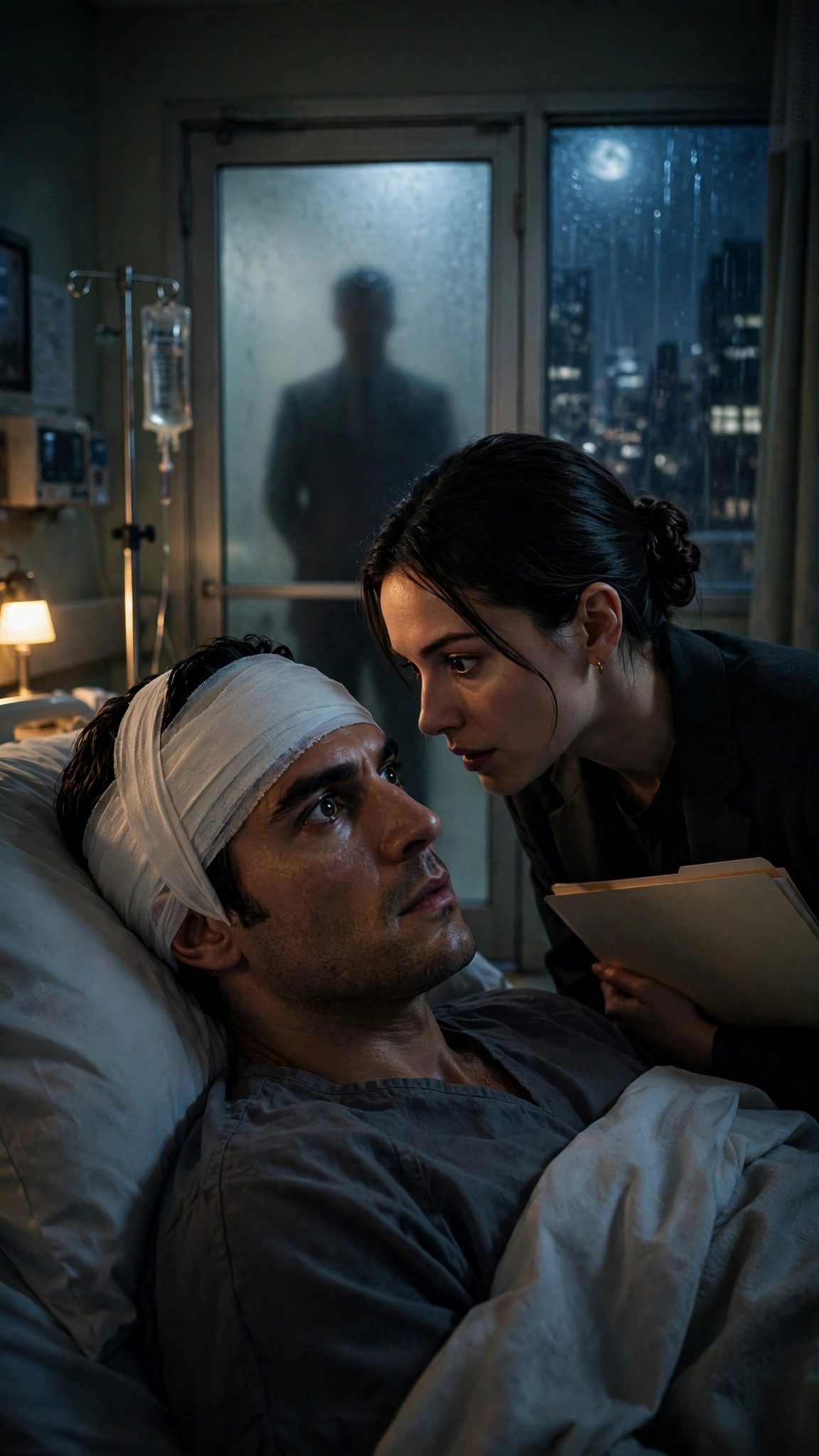
    "I feel that," he said, so quietly she almost missed it. "Not well. Not clearly. Like a hand through a thick glove. But I feel it. I have felt it for four months."

    "Four months," Martha repeated.

    "I feel temperature now. I feel pressure. Two weeks ago, I moved my big toe on purpose for the first time. I have not told a soul. Not Tony. Not Delaney. Not my doctors." He opened his eyes. "Do you know why?"

    "Because the man who shot you is still in your life," she said.

    "Because the man who shot me eats dinner at my table every Tuesday." His voice was flat and cold. "My uncle Victor runs the illegal side of this family. He has done it for thirty years. Fourteen months ago, I told the council I was going to shut it down. I was going to take the family legitimate — all of it. The docks, the trucking, the warehouses. Clean. Two nights later, someone shot me on the docks and took nothing. The police called it a robbery."

    "And you told everyone you would never walk again."

    "I told everyone I would never walk again so that the man who shot me would stop watching me." He looked down at the water. "It worked. For fourteen months, it worked. Victor stopped checking. He started planning. He thinks he will inherit everything when I die, and he thinks I am dying slowly in this chair. If he finds out I am healing, he will not wait."

    Martha stood up slowly. Her knees ached from the tile. Her heart ached from something else entirely — a feeling she had not felt in two years, since the day they took her license away. The feeling of being useful. The feeling of a patient trusting her with the truth.

    "Then we do this properly," she said. "Like a rehabilitation plan. Quietly. Carefully. With records. You need a real assessment, and you need someone in this house who is watching the water."

    "Why would you help me?" he asked. "You have been here six days. You owe me nothing."

    Martha thought of Walter Abernathy, seventy-one years old, a retired schoolteacher who liked crossword puzzles. She thought of the chart with her name on it, and the night nurse who could not remember who had written what. She thought of two years of cleaning other people's rooms because no one would let her do the work she had trained for.

    "Because I know what it is to lose everything to a lie," she said. "And because your foot moved, Mr. Rourke. And a foot that moves is a foot that can walk. And a man who can walk can stand up in a courtroom and point at the man who shot him."

    Maxwell Rourke looked at her for a long moment. Then, slowly, the hard line of his mouth softened into something that was almost a smile.

    "My name is Maxwell," he said.

    "Martha," she said.

    "Then we have a plan, Martha."

    She picked up the thermometer and slipped it back into her apron pocket. She took the towels from the rack and folded them again, neatly, the way Miss Delaney liked them. And as she turned to leave the bathroom, she heard him say, very quietly, behind her:

    "Thank you for checking the water."

    Martha walked down the narrow stairs, past the second floor, into the kitchen, where the evening went on as if nothing had happened.

    But something had happened. A man who had been hiding his healing for four months had just told a cleaning woman the truth. And Martha Kovak, who had spent two years believing her career was over, had just been handed the most important patient of her life.
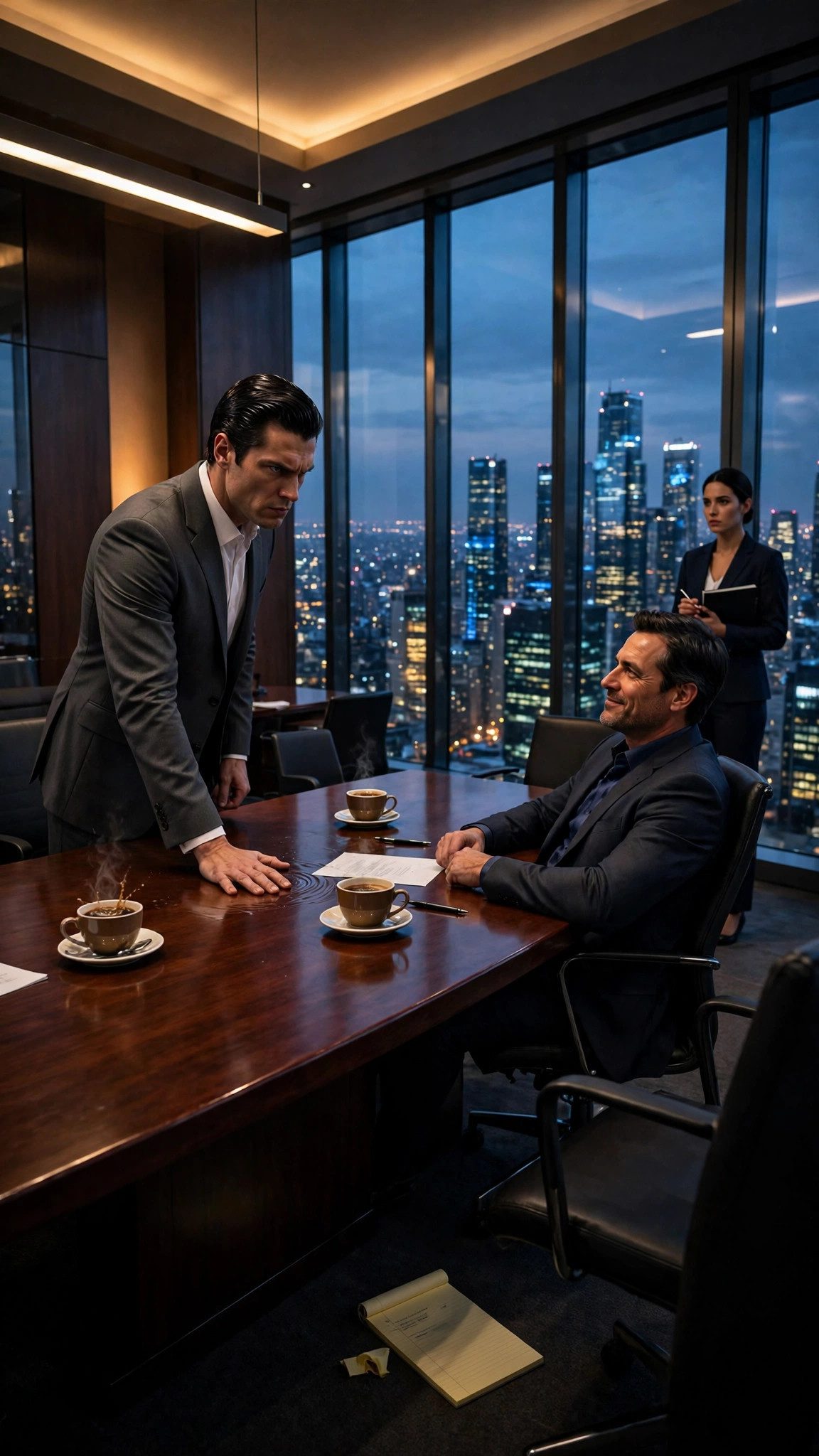

  • Chapter 5: The Price of a Weakness

    Chapter 5: The Price of a Weakness

    At 5:47 in the evening, thirteen minutes before I was supposed to meet Adrian in the empty conference room, my desk phone rang.

    It was a number I did not recognize. I almost did not answer it. Ruth had warned me that morning: don't answer calls from numbers you don't recognize. But the phone kept ringing, and the office was nearly empty, and I thought — foolishly, I know now — that it might be a client, or a courier, or someone from the building about a delivery.

    "Vescari Holdings, Tessa Morgan speaking."

    "Miss Morgan." The voice was smooth, and confident, and I knew it at once. "This is Vincent Calder. I hope I'm not interrupting."

    My hand tightened around the phone. "Mr. Calder. What do you want?"

    "Only to talk," he said. "I think we have a great deal to discuss, you and I. For instance, I think we should discuss what you are worth."

    "I don't know what you mean."

    "Oh, I think you do." There was a smile in his voice, the same smile he had worn in the conference room that morning. "This morning, in front of sixteen men, Adrian Vescari ended a forty-million-dollar deal because of you. Do you know what that means, Miss Morgan? It means you are worth forty million dollars. At least. Possibly more. And a woman who is worth that much should be very careful. Because there are men in this city who would pay a great deal of money to own something worth forty million dollars."

    "I am not something to be owned," I said. My voice was steady. I was proud of that. "And if you threaten me again, I will tell Mr. Vescari."

    "Threaten you?" Vincent laughed softly. "My dear, I am not threatening you. I am warning you. There is a difference. A threat is something a man says. A warning is something a man says because he knows what is coming, and he would rather you were prepared. Adrian Vescari has enemies, Miss Morgan. Powerful enemies. And now that they know about you, they will come for you. Not because they hate you. Because you are the easiest way to hurt him."

    "Then why are you calling me?" I asked. "If you're warning me, why not warn him?"

    "Because," Vincent said, and his voice went very quiet, "I am one of those enemies. And I wanted you to hear it from me first."

    The line went dead.

    I sat at my desk with the phone in my hand for a long time. The office was empty now. The sun was going down over the river, and the light in the room had turned the color of old gold. At six o'clock, Adrian would be waiting for me in the conference room. I should have gone to him. I should have told him about the call immediately. But I was frozen. I was thinking about Sofia, and about the car bomb, and about the fourteenth of March, and about the fact that Vincent Calder had just told me, in so many words, that I was going to die.

    Then the elevator opened, and Adrian walked out, and he took one look at my face and knew.

    "What happened?" he asked.

    "Vincent called," I said. "He said — he said I was worth forty million dollars. He said his enemies would come for me. He said he was one of them."

    Adrian's face went very still. It was the stillness I had seen a hundred times in meetings, the stillness that meant he was calculating, the stillness that came before a decision. Then he did something I had never seen him do before. He picked up my desk phone, dialed a number from memory, and spoke three words into it.

    "Now. My office."

    Five minutes later, a man I had never seen before walked into the office. He was in his forties, with short gray hair and a plain dark suit, and he carried himself the way policemen carry themselves — as if he had spent his whole life walking into rooms where people did not want him. Adrian introduced him as Daniel Reyes. Special Agent, Federal Bureau of Investigation.

    "Agent Reyes has been investigating Vincent Calder for two years," Adrian said. "The distribution deal was never just a deal. It was a front. Calder moves stolen goods, weapons, and drugs through his warehouses, and he has been using the Vescari distribution routes to do it. The forty million dollars was the price of my silence. If I signed, I would have become his partner. If I refused, he would have found another way to get what he wanted."

    "And now he has found another way," Reyes said. He looked at me. "Miss Morgan, I need you to listen to me very carefully. Vincent Calder is a dangerous man. He ordered the bombing that killed Sofia Marchetti two years ago. We have never been able to prove it. But we have been building a case against him for eighteen months, and we are very close. What happened this morning — what he did in that conference room — tells me he is getting desperate. Desperate men make mistakes. And I need you to help me make him make one."

    "What do you want me to do?" I asked.

    "Nothing," Adrian said, sharply. "She is not going to be bait. I will not use her that way."

    "Adrian," Reyes said, patiently, "I am not asking her to be bait. I am asking her to be careful, and to be smart, and to do exactly what I tell her. Vincent is going to try to reach her. He is going to try to frighten her, or bribe her, or take her. When he does, I need her to survive it, and I need her to remember everything. Can you do that, Miss Morgan?"

    I looked at Adrian. I looked at Reyes. And I thought about my mother, and about Sunday dinner, and about the man who had held my hand that morning and told me he loved me.

    "Yes," I said. "I can do that."

    Reyes nodded. He gave me a number to call, day or night. He told me to change my routine, to vary the time I left the office, to never walk to my car alone. He told me that two of his agents would be watching my building from tonight onward, and that if I saw anything strange — a car that followed me, a man who waited too long in the lobby, a phone call from a number I did not know — I was to call him immediately.

    Then he left. And Adrian and I were alone in the office, and the sun had gone down, and the city lights were coming on below the glass.

    "I should have told you sooner," Adrian said. "About Calder. About the deal. About all of it. I kept it from you because I wanted to protect you. But keeping secrets is what put Sofia in that car. I will not make the same mistake twice."

    "You didn't put Sofia in that car," I said. "Vincent did."

    "Then help me stop him," Adrian said. "Help me finish this. And then, Tessa — then we will have the rest of our lives to be ordinary."

    We stayed in the office until midnight, going through files, reading contracts, tracing the money that Vincent Calder had moved through his warehouses for three years. Adrian showed me everything: the shipping manifests, the bank transfers, the names of the men who worked for Calder, the routes he used, the warehouses where he stored what he was not supposed to store. He showed me the photograph of the car after the bombing. He showed me the police report. He showed me the card Vincent had sent to the funeral — white lilies, "My deepest condolences" — and I understood, finally, why Adrian had kept it in his drawer for two years.

    "It is the only proof I have that he did it," Adrian said. "He sent flowers to her funeral. He wanted me to know. He wanted me to know that he could reach anyone, at any time, and that there was nothing I could do about it."

    "There is something you can do about it," I said. "You can give it to Reyes. You can give him everything. And you can let the law do what your family has never been willing to do."

    Adrian looked at me for a long time. Then he opened the drawer, took out the card, and set it on the desk between us.

    "Tomorrow morning," he said, "I will give Reyes everything. Every file. Every contract. Every name. And then, whatever happens, we will face it together."

    At midnight, he walked me to my car himself. He did not let me go alone. He stood beside me in the parking garage, looking at every shadow, listening for every sound, until I was safely inside my car with the doors locked. And as I drove home through the empty streets, I saw, in my rearview mirror, a black car pull out from the curb three blocks behind me and follow me all the way home.

    I called Reyes from my apartment, my hands shaking. "There's a black car," I said. "It followed me from the office."

    "Stay inside," Reyes said. "Lock your door. My agents are outside your building. You are safe tonight. But Miss Morgan — from now on, you do not go anywhere alone. Do you understand?"

    "Yes," I said.

    I locked my door. I sat on my couch in the dark. And I thought about the morning, and the question, and the hand slamming against the table, and the forty-million-dollar deal that had died in a single second.

    The next morning, I arrived at the office at seven o'clock, the way I always did, and found a package on my desk.

    It was a small white box, tied with a black ribbon, with no return address and no note. Ruth was standing beside my desk, her face pale, and she said, "It came by courier ten minutes ago. The courier didn't leave a name. I didn't open it. I didn't think I should."

    I opened it. Inside the box, on a bed of white tissue paper, was a single white lily. And under the lily, folded in half, was a card. I knew what it would say before I read it. I had seen the card before — in Adrian's drawer, under a stack of contracts, kept for two years like a wound that would not heal.

    "My deepest condolences."

    My hands started to shake. Ruth took the box from me and set it down on the desk, very gently, the way you set down something that might explode.

    "Call him," she said. "Call Adrian. Now."

    Adrian came out of his office in less than a minute. He took one look at the box, one look at my face, and his own face went white — not with fear, but with a kind of cold, terrible anger I had never seen before, not even in the conference room when he slammed his hand against the table.

    "Reyes," he said, and picked up my phone. "It's the lilies. He sent her the lilies."

    Reyes arrived within the hour, with two agents and a forensics kit. They took the box. They took the card. They took fingerprints from the tissue paper. And while they worked, Adrian called a meeting of his council — the old men who had run the Vescari family for forty years, the men who had advised his father and his grandfather, the men who believed that problems in this city were solved with money, or with threats, or with silence.

    They met in the conference room at noon. I was not invited. But I stood outside the glass wall with my notebook, the way I had stood for two years, and I heard every word, because the glass was not as thick as they thought it was.

    "You should have signed the deal," said one of them — an old man named Carlo, who had been with the family since before Adrian was born. "Forty million dollars is forty million dollars. You do not throw away forty million dollars because of a secretary."

    "She is not a secretary," Adrian said. His voice was very quiet. "She is the woman I love. And if any man in this room calls her a secretary again, he will leave this family."

    There was a long silence. Then another voice — Salvatore, his uncle, old and shaking and unafraid. "He is right. I have watched this boy be alone for two years, and alone is no way for anyone to live. Not even him. Especially not him. If Calder wants a war, then let him have a war. But it will not be a war fought in the dark, the way our family has always fought. It will be a war fought in the light, with the law on our side, and the FBI at our backs. And if any man in this room disagrees, then he can leave now, and never come back."

    No one left. No one spoke. And when the meeting ended, the old men filed out of the conference room one by one, and each of them, as he passed my desk, nodded at me — not the way men nod at a secretary, but the way men nod at a woman who belongs.

    Adrian came out last. He stopped at my desk. He looked at the place where the white box had been. And he said, very quietly, "He sent you the lilies because he wanted me to know he could reach you. He wanted me to be afraid. But Tessa — I am not afraid anymore. I have been afraid for two years, and it did not save Sofia, and it did not save me. So from now on, I will not be afraid. I will be angry. And I will be patient. And I will let the law do what I could never do."

    He picked up my notebook from my desk and handed it to me.

    "Come with me," he said. "We are going to see Reyes. And we are going to end this."

    Vincent Calder had been right about one thing. I was worth forty million dollars. Not because of what I was, but because of who loved me.

    And that, I understood now, was the most dangerous thing in the world.

  • Chapter 2: Three Years of Winter

    Chapter 2: Three Years of Winter

    Three years earlier, my father's manufacturing company had been close to collapse.

    Mercer Manufacturing had been in my family for forty-one years. My grandfather started it in a rented warehouse on the South Side with six machines and eleven employees. My father built it into something real: three plants, four hundred workers, contracts with half the auto suppliers in the Midwest. I grew up on those factory floors. I learned to read sitting on crates of ball bearings. I learned to drive a forklift before I learned to drive a car. The smell of machine oil and hot metal was the smell of home to me.

    And then the contracts started drying up. A recession. A supplier that went bankrupt and took three months of our receivables with it. A bank that called in a line of credit two years early. My father did what good men do: he cut his own salary to nothing, he mortgaged the house, he took a second mortgage on the plants. It wasn't enough. By the spring of the year I turned twenty-four, Mercer Manufacturing was ninety days from bankruptcy, and four hundred families were ninety days from losing everything.

    That was when Arthur Ashford came to my father's office.

    I was there that day. I remember it because my father had asked me to sit in on the meeting — I had just finished my business degree, and he wanted me to learn how negotiations worked. Arthur Ashford walked in like a man who owned the building, the street, and the air inside it. Seventy-five years old, silver hair combed back, a suit that cost more than my father's car. He didn't sit down. He stood at the window and looked out over the factory floor, at the men working the machines below, and he said, "Your father built something worth saving, Miss Mercer. I'd like to save it."

    My father leaned forward. "What would that cost us, Mr. Ashford?"

    Arthur turned from the window. He smiled, and it was the smile of a man who had already won.

    "A marriage," he said. "My grandson Graham needs a wife. Your family needs capital. I need your family's legitimate business connections — the auto contracts, the supplier relationships, the clean books. Graham will marry your daughter. I will save your company. Everyone wins."

    Everyone wins. That was how Arthur Ashford described selling his grandson's future and my future in the same sentence.

    My father looked at me. I saw the war in his eyes. I saw the four hundred families. I saw the factory floor. I saw my grandfather's six machines and eleven employees. And I saw my own life, laid out on the table between two men who had already decided what it was worth.

    "I'll do it," I said, before my father could answer. Because someone had to say it, and I was tired of watching my father carry the weight alone.

    Arthur Ashford nodded, satisfied. "Good girl. Graham will be pleased."

    Graham was not pleased.

    I met him for the first time a week later, at a dinner Arthur arranged at a restaurant in the Gold Coast. Graham Ashford was thirty years old, tall, dark-haired, with the kind of face that made women in the restaurant turn their heads when he walked in. He shook my hand like a man shaking hands with a business partner he hadn't chosen. He ordered a whiskey. He looked at me for exactly three seconds, and in those three seconds I understood everything I needed to know about the next three years of my life.

    He didn't want me. He didn't want a wife. He wanted Vanessa Cole, and everyone in Chicago knew it.

    Vanessa Cole. Twenty-six years old, dark red hair, green eyes, a laugh that filled a room. She had been Graham's girlfriend for two years before the engagement was announced. She came from nothing — a waitress's daughter from Pilsen, a girl who had clawed her way into Graham's world on charm and nerve and nothing else. Arthur Ashford despised her. She had no family connections, no money, no business to offer. She was, in Arthur's words, "a distraction."

    Graham loved her anyway. Or thought he did. Or wanted to, which in Graham's world was close enough to the same thing.

    At dinner that night, he told me plainly, in the same calm, businesslike voice he would use three years later to end our marriage over the phone. "My grandfather is forcing this. I want you to know that. I don't blame you. I blame him. But I need you to understand — I loved someone before you, and I don't stop loving people because my grandfather signs a contract."

    "I understand," I said. And I did. I understood that I was marrying a man who had already given his heart away, and that I would spend my marriage competing with a ghost who was still very much alive and laughing in restaurants across the city.

    "I'm trapped too," I said quietly. "My father's company dies without this. So we're both trapped. Maybe we can at least be honest with each other about it."

    Something flickered in his eyes then. Surprise, maybe. Or respect. It was gone in a second, but I held onto it for months afterward, the way you hold onto a match in the dark.

    "Honest," he repeated. "All right. Honest it is."

    We were married six weeks later, in a ceremony at a cathedral on the North Side, with four hundred guests and a flower bill that could have paid a factory worker's salary for a year. I wore my mother's wedding dress, altered to fit me, the lace yellowed at the edges. My father walked me down the aisle, and I could feel his hand shaking on my arm. Graham waited at the altar in a black tuxedo, handsome and distant, like a man attending someone else's wedding.

    Arthur Ashford watched from the front pew, satisfied. He had gotten what he wanted. Mercer Manufacturing's contracts were already flowing into Ashford holding companies. My father's company was saved. The four hundred families kept their jobs.

    And I became Mrs. Graham Ashford.

    From our wedding day forward, Graham treated me like the woman who had stolen his future.

    It wasn't cruelty, exactly. Cruelty would have required effort, and Graham didn't bother to make the effort. It was absence. He was gone before I woke up and home after I fell asleep. He ate dinner at his club or at Vanessa's apartment. He never raised his voice to me. He never insulted me. He simply looked through me, the way you look through a window at something on the other side.

    I tried. God, how I tried. For three years, I tried to explain that I had been trapped too. I tried to make a home out of the penthouse on Lake Shore Drive, filling it with flowers and books and the smell of cooking, the way my mother had filled our house when I was a girl. I tried to learn the things Graham cared about — the horses, the art, the business. I tried to be interesting. I tried to be beautiful. I tried to be quiet. I tried to be loud. I tried everything except the one thing I should have tried first, which was to stop trying.

    Vanessa was always there. Not in our home — Graham was careful about that, at least at first. But in the restaurants. In the photographs in the society pages. In the stories his friends told when they thought I couldn't hear. Vanessa at the opera with Graham. Vanessa on his arm at a charity gala. Vanessa laughing beside him in the back of his car, her red hair catching the streetlights.

    I confronted him about it once, six months into the marriage. We were in the kitchen, late at night, and I had been waiting up for him the way a wife waits up for a husband she still hopes will come home.

    "Are you still seeing her?" I asked.

    He didn't deny it. That was the worst part. He didn't even have the decency to lie.

    "She was mine before you," he said. "Arthur took her from me. I'm not going to pretend otherwise."

    "I didn't take her from you," I said. "Your grandfather did. I was trapped too, Graham. I didn't choose this any more than you did."

    "I know," he said. And then he walked past me, up the stairs, and closed the bedroom door. Not our bedroom door. His bedroom door. We had slept in separate rooms since the wedding night.

    After that, I stopped asking. I stopped waiting up. I stopped cooking dinners that went cold on the table. I got a job — a real job, at a design firm downtown, because I refused to be the kind of wife who spent her days shopping and waiting. I made friends. I built a small life inside the hollow shell of my marriage, the way a bird builds a nest inside an abandoned house.

    Every Sunday, Arthur Ashford hosted dinner at the family estate in Lake Forest, and attendance was not optional. The long dining table could seat twenty, and the chandeliers threw gold light across silver that had been in the family for three generations. I sat beside Graham at those dinners, wearing the dresses his mother had helped me choose, smiling at the right moments, saying the right things, playing the part of the perfect Ashford wife while Arthur watched me the way a man watches an investment.

    "Mercer Manufacturing's quarterly numbers are excellent," he would say, carving the roast with precise, surgical strokes. "Your father's auto contracts have opened three new doors for us, Audrey. You chose well, marrying into this family."

    I chose well. As if I had chosen any of it. As if I had walked into a shop and picked a husband off a shelf.

    At one of those dinners, in the second year of our marriage, I found Vanessa's coat in the front hall closet. A red wool coat, expensive, smelling faintly of her perfume — something floral and sharp, like crushed lilies. It was hanging beside Graham's overcoat, as if it belonged there. As if she had been in that house, in that hallway, a hundred times before.

    I stood staring at it for a long time, my hand on the closet door, while the sound of the dinner party drifted in from the dining room. Arthur's voice. Graham's laugh. The clink of glasses. And I understood, finally and completely, that I was not a wife in this family. I was a contract. A signature on a page. A bridge between Mercer Manufacturing and the Ashford organization.

    That night, I went home and packed a bag. I drove to my father's house and slept in my old bedroom, under the quilt my mother had made when I was sixteen. My father found me there in the morning, sitting at the kitchen table with cold coffee.

    "Do you want to leave him?" he asked.

    I thought about it for a long time. I thought about the company, and the four hundred families, and the contracts that would collapse if the marriage ended. I thought about Arthur Ashford's face if I walked away from his arrangement.

    "I don't know how," I said finally. "I don't know how to leave a marriage that was never a marriage. There's nothing to leave, Dad. There's just an empty house and a man who wishes I were someone else."

    "Then stay until you do know how," he said. "And when you know, I'll be here."

    I went back to the penthouse that afternoon. Graham never asked where I had been. He never noticed I was gone.

    And then, one drunken Christmas night, our frozen marriage briefly became something else.

    It was the company Christmas party, at a hotel ballroom downtown. Graham had too much whiskey. I had too much champagne. We danced — actually danced, for the first time since our wedding — and he looked at me, really looked at me, and for one evening he didn't see the woman who had stolen his future. He saw me. Audrey. The girl who had grown up on factory floors and learned to read on crates of ball bearings.

    We went home together. We didn't talk about it. We didn't talk about it the next morning, either, when he woke up beside me and stared at the ceiling for a long time before getting up and going to his own room without a word.

    Weeks later, I discovered I was pregnant.

    I stood in the bathroom of the penthouse, holding the test in my shaking hands, staring at the two pink lines, and I felt something I hadn't felt in three years: hope. Stupid, stubborn, unreasonable hope. Maybe the baby would change him. Maybe a son would do what three years of trying could not. Maybe Graham would look at his child and finally understand what a family was supposed to be.

    I told him that night, at dinner, the first dinner we had eaten together in months. I set the test on the table between us like a peace offering.

    He stared at it for a long time. Then he looked up at me, and his face was cold.

    "Was this your plan?" he asked.

    The hope died right there, on the dinner table, between the salt and the bread basket.

    "No," I said. "It wasn't a plan, Graham. It was an accident. It was Christmas. It was one night. It was the only night in three years you actually looked at me."

    He stood up. He left the table. He didn't come home for three days.

    I went to every appointment alone. I picked out the crib alone. I painted the nursery alone, in a soft yellow that reminded me of my mother's kitchen. I read every book about pregnancy and childbirth alone, at night, in the room that was supposed to be ours. And some pathetic part of me still hoped. Some pathetic part of me believed that when the baby came, Graham would come too. That he would walk into the delivery room and see his son and something in him would finally wake up.

    Then I went into labor, and the bleeding started, and I called him from the hospital bed, and he told me to take the baby and disappear.

    And that was the end of three years of winter.

  • Chapter 1: The Man at the Mall

    Chapter 1: The Man at the Mall

    The first time I laughed that hard in six weeks, my husband decided to kill the man who made me laugh.

    It was a Tuesday afternoon in October, and the mall was full of the ordinary noise of ordinary people — teenagers arguing over sneakers, a mother pushing a stroller past the fountain, a man in a security uniform telling a boy to stop riding the escalator handrail. I had come to buy a birthday present for my housekeeper's granddaughter, a small thing, an excuse to leave the house for an hour without anyone in my husband's organization writing it down in a notebook. Six months into my marriage, I still needed excuses to leave my own home.

    I was standing near the food court, holding a shopping bag in one hand and a takeout container in the other, when a man leaned against the polished rail beside me and said my name the way only one person in the world ever said it.

    "Audrey."

    I turned, and the whole mall tilted sideways.

    It was Daniel. My brother. Daniel Bennett, twenty-nine years old, six feet of lanky, grinning trouble, the boy who had taught me to ride a bicycle by running behind me and letting go without telling me, the boy who had hidden my diary under the floorboards and then pretended for three years that he had no idea where it was. He had been in London for two years on a surgical fellowship, and he had missed my wedding, and I had not seen his face in person since the day he left, and now here he was, leaning on a mall railing in Chicago with a shopping bag in one hand and a takeout container in the other, wearing a jacket that did not fit him and a smile I had forgotten I missed.

    "Daniel," I said, and then I laughed. I laughed the way I used to laugh when we were children, loud and helpless and completely without dignity, the kind of laugh that comes out of your chest before your brain has time to approve it. People turned to look. I did not care. Six weeks. It had been six weeks since I had laughed like that, six weeks of careful smiles and measured words and dinners eaten in silence across a table the size of a small country, and here was my brother, and the laugh just came out of me like water through a broken dam.

    That was when the rumor started. I did not know it yet. That is how the worst misunderstandings always work — you are the last person to hear them.

    A man leaned against the polished rail, holding a shopping bag in one hand and a takeout container in the other. His face was familiar. His smile was the one I remembered from family dinners, the smile that used to appear across the table whenever our father said something pompous and Daniel caught my eye. I could not help but laugh. And because the world can be extremely cruel and perfectly timed, everyone else seemed ahead of me.

    I looked at the man again. And I understood. He was my brother.

    I never even got a chance to speak before a pair of dark eyes landed on me.

    We had a tradition. Every year, the first man to look at me that way gets a punch. And Julian Sterling has thrown plenty. At the gala last spring, he once threw a man across the room for staring too long. The second time, he knocked out two millionaires who would not stop looking at my dress. Even then, I had never seen a look this dangerous. Whoever the man I had been laughing with was, he was in serious trouble.

    The six associates behind Julian stepped forward silently, forming a line that blocked half the food court. One of them raised his phone, checking Julian's expression for instructions.

    "Boss, the property inspection—"

    "Later."

    Julian did not even look at me when he spoke, but the warning in his voice was unmistakable.

    "Boss, Mr. Huntington's mall chain agreement is waiting for your signature."

    "Later."

    "Boss…"

    "Shut up."

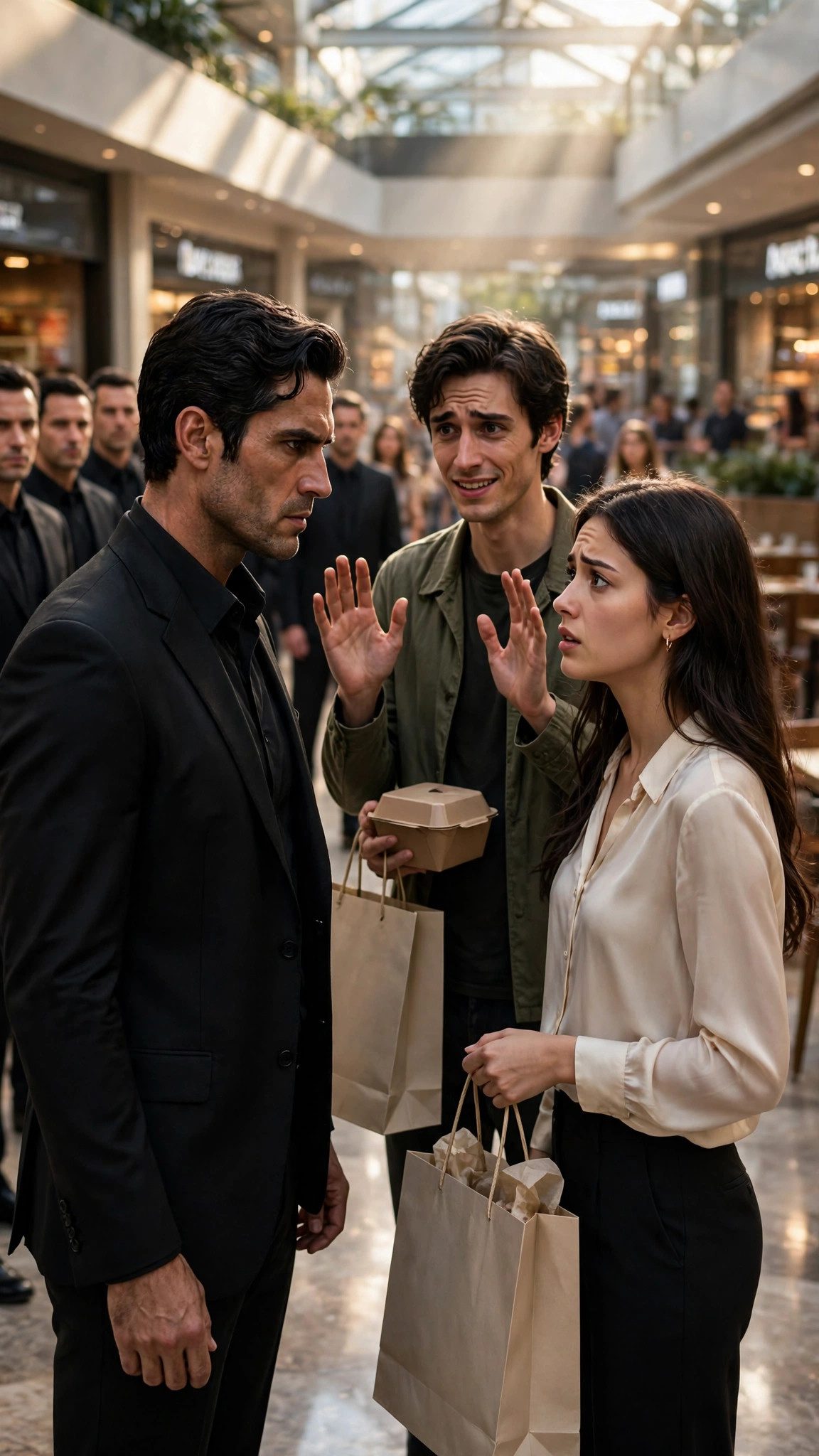
    And so began the real problem. It became clear that I was not going to avoid this situation. A hand grabbed mine; I began to make my way quietly toward the exit. A man beside me did not move for a moment, but when he did, he led me to one of the most expensive stores in the mall. It was a much nicer way to ensure people watching knew he had lost control. He never even smiled. He simply pulled me toward the escalator. He stopped walking. I did not see him move, but suddenly he was in front of me — right in front of everyone — his cologne and anger colliding like a thunderstorm.

    "Stop. You're coming with me."

    And there was no room for argument in that one. I glanced back toward my brother, not Julian. I was heading toward something dangerous, but the escalator had already closed.

    "You're very… persuasive."

    He pulled me into his arms. And for a moment, the room stopped. It was not sound. It was not the music. It was an intense, shameful urge to prove that I could be the one thing that controlled a man who ruled the city. His hands rested lightly on my waist, but he was already aware of everything else. He was strangely calm, and if he had retreated, I would have followed him. He stared at me directly. His expression was intense. He was clearly frustrated.

    "She's my wife."

    The mall fell silent.

    "Do you understand me? I don't care who you are, you don't touch what's mine."

    He turned to my brother, whose face had turned pale with shock.

    "My brother-in-law, I can't lose my wife to a man I don't even know."

    By the time Julian's words reached my ears, my voice was gone. It was the announcement that solved everything. And it was utterly ridiculous.

    "Brother-in-law?"

    For the first time, I realized how stupid I was not to understand. The man's cold expression dissolved into embarrassment. My brother held his hands up in surrender. And then, unexpectedly, a wave of warmth spread through me. By the time I realized Julian had stopped being angry, it was too late. He was also my brother-in-law.

    Because you see, I'm not Audrey Bennett. I'm Audrey Sterling. I'm the wife of Julian Sterling, head of one of Chicago's most powerful mafia organizations. Did you really think I would let a stranger hug me in public when I'm married to a mafia boss?

    That was the moment everything should have ended. The misunderstanding, the fury, the crowd staring at us like we were the afternoon's entertainment. My brother, alive and unpunched. My husband, embarrassed instead of murderous. The mall, slowly returning to its ordinary noise.

    But that was not the end. That was the beginning, because Julian Sterling had just announced to half of Chicago that he did not know his own wife's brother — and by the time we reached the food court, the rumor had already started. And someone in that crowd had already filmed the whole thing, and someone had already sent that film to a man who had been waiting six months for exactly this kind of gift.

    Six months earlier, I had been Audrey Bennett, twenty-six years old, the daughter of Robert Bennett, who owned a shipping company with forty-two vessels and a reputation for never breaking a contract. My mother had died when I was nineteen, and my father had raised Daniel and me the way he ran his ships — on schedules, on discipline, on the belief that a promise made was a promise kept even when it hurt. Daniel had gone to medical school and then to London. I had gone to art school, and then I had come home, and then one evening my father had sat me down in his study and told me that the Sterling family wanted an alliance, and that the alliance required a marriage, and that the marriage required me.

    I had not cried. I had asked one question.

    "Does he know who I am?"

    My father had looked at the decanter on his desk instead of at me.

    "He knows your name," he said. "He knows your family. That is enough for an alliance."

    It was not enough for a marriage. But nobody had asked me what a marriage needed.

    Julian Sterling was thirty-three years old, tall, sharp jaw, dark eyes and hair, and he wore a black tailored suit over a black shirt the way other men wore armor. At our first meeting, in a private dining room at the Drake, he had looked at me for exactly four seconds, nodded once, and said, "She will do."

    She will do. Not "she is beautiful" or "I am pleased to meet you." She will do, the way a man might speak about a car, or a house, or a shipment of steel.

    I married him six weeks later. Daniel was in London. He sent a letter, and a silver bracelet, and a promise to come home soon. He did not come to the wedding because the fellowship would not release him, and because, as he wrote in the letter, "someone has to stay alive to tell you if you married a monster." I read that letter three times on my wedding night, and then I put it in the bottom drawer of my dresser, under the sweaters I never wore.

    My wedding night, Julian came into the bedroom, loosened his tie, and said, "This is an arrangement. I expect loyalty. I expect discretion. I do not expect conversation."

    I said, "I expect the same."

    He looked at me for a moment longer than four seconds that time. Then he went to sleep on his side of a bed the size of a small boat, and I lay awake listening to a stranger breathe, and I thought about the fact that I had married a man who did not know my favorite color, my favorite food, the name of my best friend, or the fact that I had a brother who was currently saving lives in a hospital in London.

    He did not know. And I did not tell him. Because he had made it very clear that he did not want to know.

    Six months passed. Six months of breakfasts eaten in silence. Six months of galas where I stood beside him like a vase. Six months of his associates nodding at me in hallways and never once asking me a question. Six months of a house with eleven bedrooms and not one room that felt like mine.

    And then one Tuesday afternoon in October, I went to the mall to buy a birthday present for my housekeeper's granddaughter, and my brother leaned against a polished rail, and I laughed for the first time in six weeks, and my husband decided to kill the man who made me laugh.

    And that was the day Julian Sterling discovered that he did not know his own wife.

    I thought about my wedding day again that night, lying in the dark beside a man who breathed like a stranger. The cathedral had been full of flowers — white roses, hundreds of them — and my father's friends had filled the pews, and Julian's associates had filled the back rows, standing like a wall of black suits. I had walked down the aisle on my father's arm, and my father had whispered, "You are doing the right thing, Audrey. You are saving the family." And I had believed him, because my father had never lied to me, and because I had never learned that a thing could be right for a family and wrong for the woman inside it at the same time.

    The reception had been held in a hotel ballroom, and I had danced once with Julian — a slow, careful dance, his hand on my waist the way it had been on my waist in the mall, light and certain and completely without tenderness — and then I had danced with my father's oldest friend, and then I had sat at the head table and watched three hundred people eat and drink and congratulate a marriage that none of them understood, including the two people in it.

    Daniel's letter had arrived that morning, before the ceremony. Mrs. Okafor had slipped it into my hand while the hairdresser was pinning my veil, and I had read it standing in a bathroom with the door locked, my wedding dress pooled around my feet like spilled milk. "My dearest Audrey," he had written. "By the time you read this, you will be a married woman, and I will be in London, and I will be thinking of you every minute. Remember what Mother used to say — that a marriage is not a contract, it is a conversation, and a conversation only works if both people are speaking. If he will not speak to you, then you must speak louder, until he hears you. And if he will not hear you, write the word 'seagull' in your next letter, and I will come home. I promise. I love you. Your brother, Daniel."

    I had not written the word "seagull." Not once, in six months of letters. Not because there was nothing to say. Because I did not know what Daniel could do against a man who owned half of Chicago, and because I was afraid that if Daniel came home, Julian would look at him the way he had looked at the man in the mall — the way he looked at any man who stood too close to what was his — and I was afraid of what would happen next.

    So I had kept writing ordinary letters. The weather. The house. The garden I was not allowed to plant. The books I was reading. I had never once written about the silence, or the loneliness, or the way Julian's associates looked through me as if I were a piece of furniture that had come with the house. I had never once written about the night I heard two of his men in the hallway, talking about "the wife" as if I were a shipment, a contract, a signature on a page.

    That night, after the mall, I lay awake and thought about Daniel's letter, and about the word "seagull," and about the fact that my brother had come home anyway — without the word, without being asked, because he had noticed that I had stopped writing, and he had understood what that meant. He had come home because he loved me. And Julian, my husband, had nearly killed him for it.

    It was the strangest thought I had ever had in my life: that the two men I loved most in the world had met each other for the first time in a food court, over a shopping bag and a takeout container, and that one of them had wanted to kill the other, and that both of them were now sitting in my house, eating my housekeeper's roast chicken, pretending that everything was normal.

    Nothing was normal. Nothing would ever be normal again. But for the first time in six months, the strangeness felt like it belonged to me — like it was my story, and not just something that had happened to a woman named Audrey Sterling, who had once been Audrey Bennett, and who was still, underneath all of it, just a girl who liked to laugh, and who had forgotten how.

  • Chapter 2: Three Years of His Rules

    Chapter 2: Three Years of His Rules

    Harper Bennett had not planned to work for Dante Moretti.

    Three years earlier, she had been twenty-six years old, fresh out of a master's degree in public administration, working as a junior clerk in the city planning office, and quietly drowning in student loans and her mother's medical bills. Her mother, Ruth Bennett, had been a schoolteacher for thirty-one years, and her knees had given out, and the surgery she needed cost more than a schoolteacher's pension could cover. Harper had taken the city job because it was steady. She had hated it because it was slow. She had applied for the Moretti position on a dare from her best friend, a woman named Priya who worked in the mayor's office and who had said, "You are the only person I know who is not afraid of powerful men, so go work for the most powerful one and see what happens."

    She had gone to the interview expecting to be eaten alive.

    Instead, she had found a man in a charcoal suit sitting behind a desk the size of a small car, reading her resume with the focused attention of a man defusing a bomb, and when he looked up, his eyes were gray and direct and entirely without warmth.

    "You worked in city planning," he had said.

    "For eleven months," she said.

    "Why did you leave?"

    "Because my supervisor wanted me to lose a file," she said. "A traffic study. A developer paid him to make it disappear. I refused, and he made my life difficult, and I decided I would rather be unemployed than be someone's eraser."

    Dante had studied her for a long moment. Then he had said, "The job is sixty hours a week. The pay is three times what the city pays you. You will manage my schedule, my companies, my meetings, and my legitimate paperwork. You will see things you do not repeat. You will hear things you do not repeat. If you repeat them, I will know, and you will be finished in this city. Do you understand?"

    "I understand," she said.

    "One more thing," he said. "I have rules. Civilians are untouched. Secretaries especially. No one in my organization harms a civilian, ever, for any reason. If anyone threatens you, you tell me. If anyone follows you, you tell me. If anyone so much as raises their voice to you in my building, you tell me. Is that clear?"

    "It is clear," she said, and she had believed him, because the thing about Dante Moretti was that he never lied. He was many things, and most of them were frightening, but he was not a liar.

    She had taken the job. She had learned his world the way she learned everything: by reading every file, memorizing every name, and refusing to be intimidated. Within six months, she knew which politicians preferred envelopes and which businessmen required threats disguised as dinner invitations. She knew the difference between a legitimate meeting and a meeting that was only legitimate on paper. She knew the names of every council member, every port authority official, every union leader, and every lawyer in the city who mattered.

    In her first week, human resources had handed her an emergency contact form. She had stared at it for a long time. Her mother was in Ohio, three hundred miles away, with bad knees and a pension that barely covered her medicine. Her father was gone. Her friends were scattered across the country. In the end, she had written down the only name in Chicago she trusted to answer a phone at two in the morning: Dante Moretti, her employer. She had felt strange about it. She had almost erased it. But she had left it there, and then she had forgotten about it completely, the way people forget the small decisions that later turn out to matter most.

    Six months into the job, her mother had needed surgery, and the hospital in Ohio had wanted eight thousand dollars before they would schedule it, and Harper had not had eight thousand dollars. She had sat in Dante's office after hours, crying quietly into her hands, because she did not know what else to do. Dante had come in, and he had stood in the doorway, and he had asked her what was wrong, and she had told him, because she was too tired to lie. He had listened without interrupting. Then he had said, "It will be handled," and he had walked out. The next morning, the hospital had called to say the bill was paid in full, and Harper had never asked him if he did it, and he had never told her, but she knew. She had known then, and she knew now, that Dante Moretti was a man who took care of his own, quietly, without speeches, without expecting thanks.

    That was the thing about him that no one outside his office understood. The city feared him. The newspapers called him ruthless. The councilmen whispered about him in hallways. But the people who worked for him knew a different man: a man who remembered birthdays, who paid hospital bills, who called his mother every Sunday, and who had once spent an entire afternoon helping the security guard's daughter with her college application, because the girl wanted to study law and had no one else to ask.

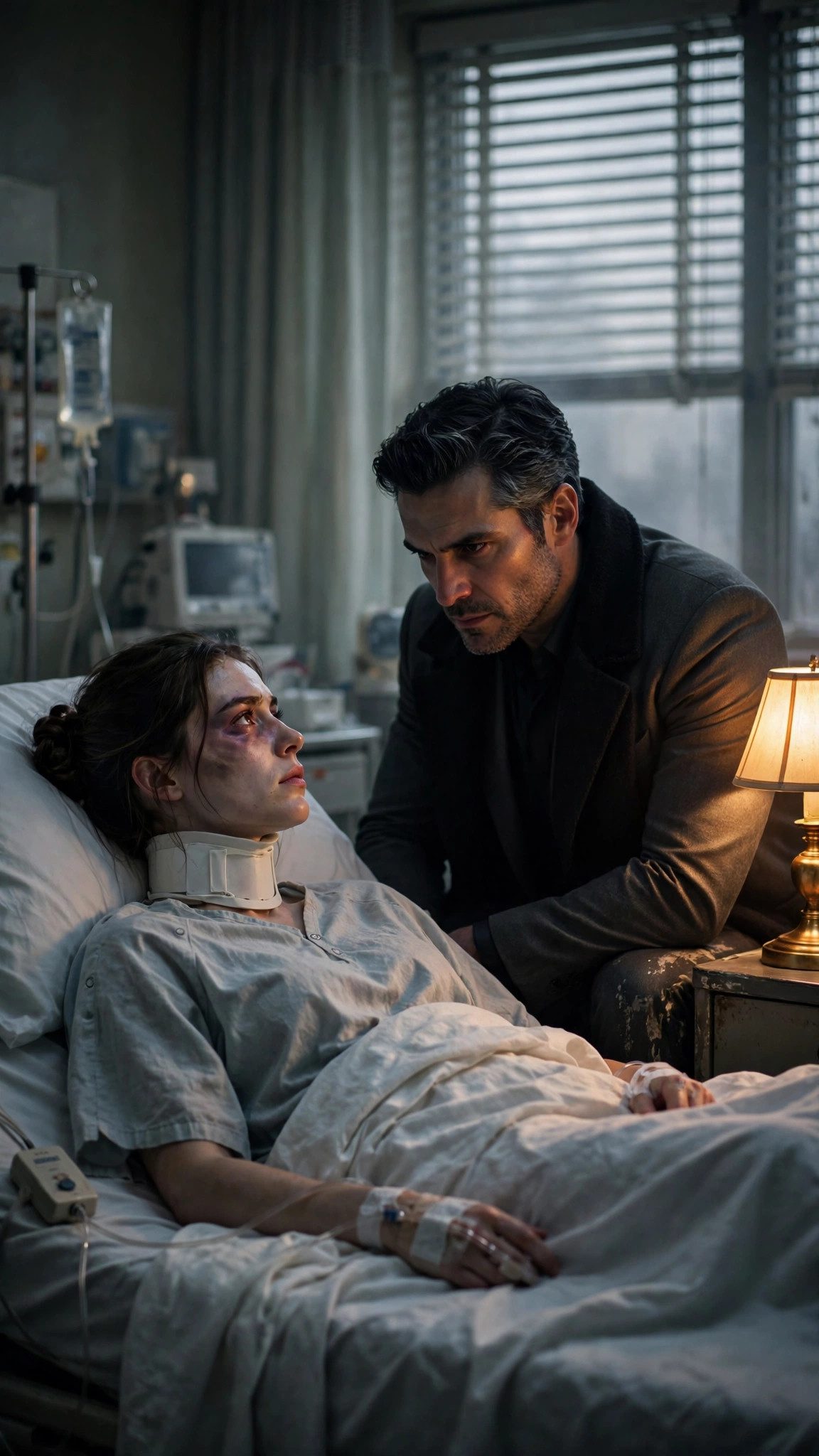
    Harper had learned, over three years, that Dante Moretti was two men at once: the monster the city feared, and the man who sat beside her hospital bed at six in the morning without being asked. She had spent three years pretending she only knew the first one. The beating had stripped that pretense away, and now she knew the second one, and she could not unknow him.

    And she knew Dante.

    She knew that he drank his coffee black and never before seven in the morning. She knew that he read the financial pages first and the obituaries second. She knew that he called his mother every Sunday evening and that his voice changed when he did, becoming softer in a way that would have shocked anyone who only knew him from a boardroom. She knew that he had built the legitimate side of his empire himself, piece by piece, and that he was prouder of the shipping company and the construction firm than of anything else he owned. She knew that he had a scar on his left hand from a fishing accident when he was twelve, and that he never talked about his father, and that he kept a photograph in his desk drawer of a young woman with dark hair who had died before Harper was born.

    She did not know the woman's name. She had never asked.

    She also knew, without ever being told, that she was safe. That was the unspoken contract of the job. Dante Moretti's people did not get hurt. His secretary did not get hurt. His reputation was a wall, and she lived behind it, and for three years the wall had held.

    Until Tuesday night.

    On the morning after the attack, Harper lay in her hospital bed at West End General and tried to put the pieces of her life back together in the right order. The doctor, a kind-eyed woman named Dr. Alvarez, came in at eight and told her what Dante had already told her: two cracked ribs, a concussion, a fracture near her left eye. She would be in the hospital for at least three days. She was not to work. She was not to drive. She was not to lift anything heavier than a book.

    "I need my laptop," Harper said.

    "Your laptop was stolen," Dr. Alvarez said gently. "The police have a report. I am sorry."

    Harper closed her good eye. The laptop was not just a laptop. It held the zoning board packet, the traffic study, the environmental addendum, the bid numbers for the waterfront parcel, and three years of notes on every meeting Dante had ever held. The drive was encrypted, and she was the only person who knew the password, but the loss of it still felt like losing a limb.

    "The police," she said. "Did they find anything?"

    Dr. Alvarez hesitated. "A detective came by while you were asleep. He left a card. He said the car was stolen from a lot in Cicero three days ago. The plates were fake. There were no fingerprints."

    "Of course there weren't," Harper said.

    A nurse came in with breakfast she could not eat. A different nurse came in to check her blood pressure. A police officer came in with a form, and Harper signed it with her right hand because her left was bruised, and she answered his questions in a flat, steady voice.

    Three men. Black Lincoln. Cheap suits. Street muscle. No, she did not recognize them. No, they did not rob her. Yes, her bag was gone. Yes, her laptop was inside it.

    The officer wrote it all down and left, and Harper was alone again, and she stared at the ceiling and thought about the one thing she had not told the police.

    She had not told them the message.

    She had told Dante. Only Dante. And she had seen his face when she said the words, and she knew that the message was not a threat. It was a declaration of war.

    The docks were the reason. She understood that now, in a way she had not understood it before the beating. The waterfront parcel was the last piece of the Chicago docks that had not yet been claimed, and Dante's bid was the strongest, and the zoning vote on Tuesday would decide who controlled the river for the next fifty years. Vincent Castellano had wanted the docks for two years. He had lost the council vote. He had lost the port authority vote. He had lost the union vote. And now he was losing the zoning vote, and he had decided to stop losing.

    He had sent three men to beat Dante Moretti's secretary in an alley and steal her laptop, because if Harper could not present the traffic study on Tuesday, the vote would be delayed, and a delayed vote was a vote Castellano could still steal.

    It was a good plan. It was a cruel plan. And it had almost worked.

    Except for one thing.

    The men had not known that Harper Bennett kept a second copy of everything. Not on the laptop. In her head. She had memorized the traffic study. She had memorized the bid numbers. She had memorized the environmental addendum, page by page, because that was what she did: she read things until she knew them by heart, and then she carried them with her, and no one could steal them out of her head.

    She was still thinking about this when the door opened and Dante came back in.

    He looked different. Not softer. Dante Moretti never looked softer. But the stillness was gone, replaced by something coiled and alert, like a man who had spent the last two hours making phone calls and now knew exactly what he was going to do.

    "The police found nothing," he said. "The car was stolen. The plates were fake. The men wore gloves."

    "I know," she said.

    "But I found something," he said, and he sat down in the chair beside her bed, and his elbows rested on his knees, and his voice was low and precise. "Five people knew your Tuesday routine. Five people knew you walked from the Drake to your car at nine forty, alone, every week. You, me, Tony, Chairwoman Voss, and Marcus Hale."

    Harper's stomach tightened. "Marcus Hale is your head of security."

    "Yes," Dante said. "He has been with me for nine years. He is the man who checks my cars, my offices, my routes. He is the man I trust with my life."

    "And?"

    "And someone sold your schedule," Dante said. "Someone told Castellano's men where to find you, and when. Someone who knew you would be alone, and that you would be carrying the zoning packet, and that no one would be watching."

    He did not say the name again. He did not have to.

    Harper thought about Marcus Hale. She had known him for three years. He was a broad-shouldered man in his forties with a graying buzz cut and a habit of standing too close to doors. He had always been polite to her. He had once carried her laptop bag up three flights of stairs when the elevator broke. He had brought her coffee on the morning her mother had surgery. He had seemed, in every way that mattered, like a loyal man.

    But she had also noticed something, once, a long time ago, and she had filed it away and forgotten it. She had seen Marcus Hale in the parking garage one evening, talking on his phone, and when he saw her, he had ended the call quickly and smiled too wide. She had thought nothing of it at the time. She thought about it now.

    "Dante," she said slowly, "what are you going to do?"

    "I am going to find the men who touched you," he said. "I am going to find the man who paid them. And I am going to make sure that no one in this city ever again believes that my secretary is a message they can deliver."

    He stood up, and he looked down at her, and for a moment the coldness in his eyes was replaced by something else. Something she had never seen there before. Something that looked almost like fear.

    "Rest," he said. "Do not worry about Tuesday. I have already called Chairwoman Voss. The vote is still on. And you will present the traffic study, Harper. Not from a hospital bed. From the podium. Because the day Castellano's men decide who speaks at a zoning meeting is the day I stop being who I am."

    "You want me to present on Tuesday?" she said. "With two cracked ribs and a fracture near my eye?"

    "I want you to be there," he said. "I want Castellano to see you walk into that room on your own two feet, holding the numbers he tried to steal, and I want him to understand that he did not delay anything. He only made you angry."

    Harper looked at him for a long moment. Then, despite the pain in her ribs, despite the collar around her neck, despite the bruise swelling shut her left eye, she smiled.

    "Then I had better start memorizing the addendum," she said. "I want every number perfect."

    Dante almost smiled back. It was the thirteenth time in three years.

    "Good," he said. "Because on Tuesday, we are going to take the docks. And after that, we are going to take Castellano."

    Then he walked out of the room, and Harper was alone again, and she closed her eyes, and for the first time since the black Lincoln had pulled up beside her, she was not afraid.

    She was angry. And anger, she was beginning to understand, was a much more useful thing than fear.

  • Chapter 1: The Water Was Too Hot

    Chapter 1: The Water Was Too Hot

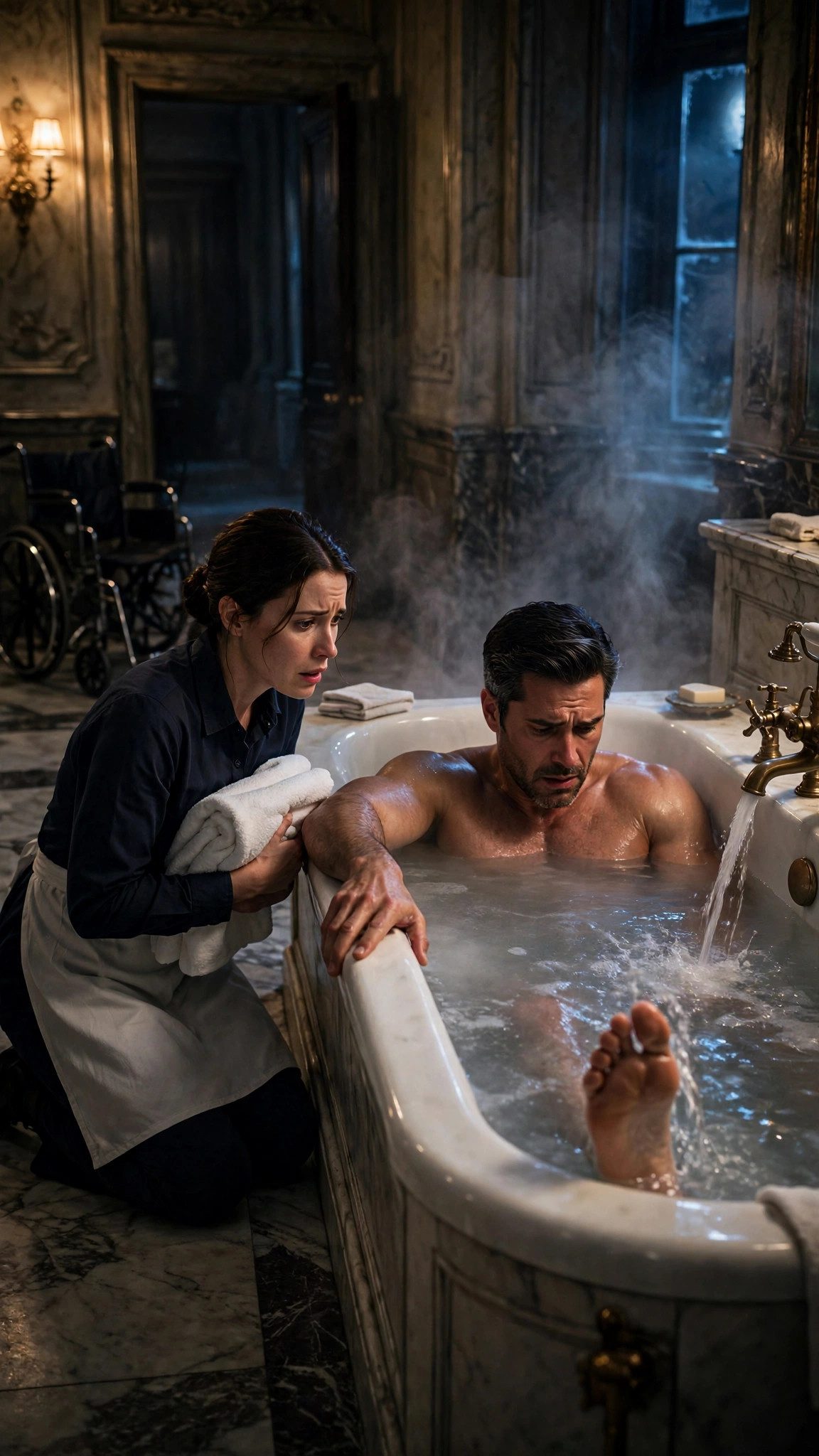
    The bathwater was hot enough to burn him, and Maxwell Rourke did not react.

    Then Martha Kovak turned on the cold tap, and his right foot pulled away.

    A man paralyzed from the chest down was not supposed to do that.

    Steam filled the third-floor bathroom of Rourke House until the mirrors disappeared. Martha stood just inside the doorway with six folded towels pressed against her chest and tried to remember exactly which mistake had brought her there.

    Six days earlier, she had been hired to clean downstairs rooms. Not bedrooms. Not offices. Definitely not the private third floor occupied by Maxwell Rourke, the thirty-nine-year-old shipping magnate newspapers called a waterfront entrepreneur and prosecutors called something less flattering when the microphones were off.

    Everyone in Providence knew the Rourke name. The legal side owned trucking companies, warehouses, marine terminals, and enough waterfront property to make city council members return calls quickly. The illegal side was never described quite as clearly. People said containers moved through the Rourke docks without inspection. They said bookmakers paid for protection. They said men who borrowed money from the wrong people occasionally left Rhode Island without notifying their landlords.

    Martha did not know which rumors were true. She knew only that grown men lowered their voices in his house. And that Maxwell Rourke had been in a wheelchair for fourteen months.

    "Out."

    His voice came from somewhere beyond the steam. Martha tightened her grip on the towels.

    "Sir, Miss Delaney told me these were needed."

    "Then leave them."

    She should have. She needed this job too badly to test the temperament of a man whose reputation could empty a hallway. But something in the bathroom felt wrong. Not dangerous in the way Maxwell was dangerous. Clinical. Familiar. Martha had spent six years working in nursing homes and rehabilitation centers before a medication error ended her career. Training stayed in the hands after paperwork took away the title.

    The room was too hot. Not just humid. Hot.

    She stepped closer. Maxwell sat in a wide therapeutic tub near the window, shoulders above the water, one arm resting along the edge. His chest and upper arms carried the hard strength of a man who had once used his body without thinking about it. Below the ribs, nothing moved.

    His face turned slightly. "Did you misunderstand me?"

    "No, sir."

    "Then why are you still here?"

    Martha put the towels down. The steam rolled over her face. She knelt beside the tub and lowered the inside of her wrist into the water. Heat bit immediately. She pulled back.

    "Because this water is too hot."

    His expression did not change. "It's fine."

    "It isn't."

    "I can't feel it."

    "That is exactly why it isn't fine."

    That got his attention. Not much. His eyes moved to her face. Dark gray. Cold. Too observant.

    "Who told you to check my bath?"

    "No one."

    "Then stop improvising."

    Martha leaned across the tub and opened the cold tap. Water rushed in beside Maxwell's right leg. His foot jerked away. Not violently. Six inches, maybe less. Enough.

    Martha stopped breathing. She stared. The toes had pulled back. The ankle had shifted.

    Maxwell's face changed. For the first time since she had entered Rourke House, he looked afraid. Not surprised. Afraid.

    Which told her something worse. He had noticed things before.

    —

    Six days earlier, Martha had stood on the front steps of Rourke House with a borrowed coat and a resume that ended in a lie of omission. The house rose three stories above the East Side of Providence, gray stone and black iron, with a view of the water that made the whole city look smaller than it was. A woman of fifty-eight with iron-gray hair pulled into a knot opened the door before Martha could knock twice.

    "Miss Delaney," the woman said, as if the name were a job description. "Housekeeper. You are the new girl."

    "Martha Kovak."

    "Downstairs rooms only. The kitchen, the dining room, the library, the hall. You do not go upstairs without being sent. You do not speak to Mr. Rourke unless he speaks to you. You do not ask questions about the family. Do you understand?"

    "Yes, ma'am."

    Miss Delaney looked at her the way people look at a stray dog they have decided, against their better judgment, to feed. "You worked at Harborview."

    "Six years. Rehabilitation."

    "And you left."

    Martha had rehearsed this answer in the mirror of her small apartment in Pawtucket for three nights. "I made a medication error. A patient died. I lost my license."

    She did not add the rest. She never added the rest, because the rest sounded like an excuse, and excuses were what guilty people made. The rest was that the chart had been wrong before she ever touched it. The dose on the page was ten times what the doctor had ordered, written in a hand that was not hers, and by the time anyone looked closely, the original order had been corrected in the system and her signature was the only one left on the page. The night nurse, Denise Fallon, had cried at the hearing and said she could not remember who had written what. The board had revoked Martha's license anyway. A dead man named Walter Abernathy, seventy-one years old, a retired schoolteacher who had liked crossword puzzles and called her "dear," was gone, and Martha had carried that weight for two years without ever being allowed to set it down.

    Miss Delaney studied her for a long moment. "We pay on Fridays. Cash. You start in the kitchen."

    That was how Martha Kovak, thirty-four years old, a former rehabilitation nurse with a revoked license and a dead patient she could not stop seeing in her sleep, came to clean the downstairs rooms of the most feared man in Providence.

    The first day, she learned the geography of the house the way nurses learn a ward: by walking it until her feet knew it. The kitchen was enormous and cold in the mornings, with a stove the size of a small car and a pantry full of things no one seemed to eat. The dining room had a table that could seat twenty and chairs that looked as if no one had sat in them for months. The library smelled of leather and pipe smoke, and the books were the kind people buy by the yard. The hall had a staircase that rose to the second floor and then, narrower and darker, to the third.

    She did not go up. She was not sent. She cleaned what she was told to clean, and she listened, because listening was the other thing training had left in her hands.

    The house talked the way houses do when the people in them think the help cannot hear. The driver, Tony Ferraro, a broad man of fifty with a voice like gravel, told the cook that Mr. Rourke had not left the house in three weeks except for a doctor's appointment. The cook, a round woman named Rosa who had been there twenty years, said the night nurse, Cole Bennett, had been coming late three nights running and smelled of whiskey when he arrived. Miss Delaney said Mr. Rourke's uncle, Victor Rourke, visited every Tuesday and always left the study door closed behind him.

    On the third day, Martha saw Maxwell Rourke for the first time. She was polishing the banister in the hall when the elevator at the back of the house opened — the house had an elevator, installed after the shooting — and Tony wheeled him through toward the library. Maxwell was bigger than Martha had expected. Broad shoulders, dark hair going gray at the temples, a face that had been handsome before something in it had gone hard. He wore a charcoal sweater and dark trousers, and his hands rested on the wheels of his chair with the easy strength of a man who had spent fourteen months learning to move himself.

    He did not look at her. She did not speak to him. Miss Delaney's rules were clear.

    On the fourth day, she found a thermometer in the kitchen drawer while she was looking for a corkscrew. It was a digital meat thermometer, the kind with a thin steel probe. She held it for a moment, turning it over in her hand, and then she put it back. She did not know why she had noticed it. She only knew that her hands had always remembered the tools of her old work, the way a musician's hands remember an instrument.

    On the fifth day, Rosa told her that Mr. Rourke took his bath at seven-thirty every evening, and that Cole Bennett drew it for him, and that the water had to be hot because Mr. Rourke liked it hot, and that no one was to disturb him during it.

    On the second day, Miss Delaney inspected Martha's work in the library with the slow thoroughness of a woman who had spent thirty years finding fault in other people's cleaning. She ran a gloved finger along the top of the bookshelves, checked the corners of the window frames, and looked at the polished table in the light from the window.

    "You clean well," she said at last, and it sounded like a reluctant admission. "Harborview taught you that."

    "Harborview taught me to be thorough," Martha said. "A dirty room in a rehabilitation center is not an inconvenience. It is an infection waiting to happen."

    Miss Delaney's expression softened, just a fraction. "My sister was in Harborview," she said. "After her hip. The nurses there were kind to her." She paused. "I read your file, you know. The medication error. The hearing. I read all of it before I hired you."

    Martha's hands went still on the polishing cloth. "And you hired me anyway."

    "I hired you because the file also said you had six years without a single complaint before that night, and because the file said the dose on the chart did not match the dose the doctor ordered, and because no one at the hearing could explain why." Miss Delaney folded her arms. "I have run this house for thirty years, Miss Kovak. I know the difference between a woman who makes a mistake and a woman who is blamed for one. Now finish the shelves. The dining room is next."

    That afternoon, Martha was polishing the dining room table when she saw Maxwell Rourke through the tall windows, out in the garden. Tony had wheeled him to the end of the path, where the garden overlooked the water, and left him there alone. He sat very still, his hands on the wheels of his chair, looking out at the harbor the way a man looks at a place he used to belong to. He stayed there for an hour, unmoving, while the light changed on the water. Martha watched him from behind the glass, and she thought about the patients she had known at Harborview — the ones who sat by the windows and stared at the parking lot, not because they wanted to go anywhere, but because they wanted to remember what going somewhere felt like.

    She thought about Walter Abernathy then, too, the way she always did when she saw a man sitting alone. He had liked to sit by the window in the day room with a crossword puzzle, and he had called her "dear," and on his last good day he had finished the whole puzzle without asking for help and held it up for her to see, proud as a schoolboy. The hearing had lasted three days. Denise Fallon had cried on the second day and said she could not remember who had written the dose on the chart. The board had looked at Martha's signature and made its decision. No one had asked why the original order had been corrected at two in the morning, four hours after Mr. Abernathy died. No one had asked who had been on the night shift. Martha had walked out of the hearing room with nothing — no license, no job, no way to do the only work she had ever been good at — and she had spent two years cleaning other people's rooms, telling herself that it did not matter, that hands were hands, that work was work.

    It mattered. It had mattered every single day.

    On the sixth day, at twenty minutes past seven in the evening, Miss Delaney found Martha in the kitchen and put six folded towels into her arms.

    "Take these to the third floor," she said. "Mr. Bennett is late again. Mr. Rourke is already in the bath. Leave the towels and come straight back down."

    Martha carried the towels up the narrow stairs, past the second floor with its closed doors, to the third floor where the air smelled of steam and eucalyptus and something medicinal. The bathroom door stood open. The mirrors had disappeared behind the fog. And the water, when she finally knelt beside the tub and tested it with her wrist, was hot enough to burn a man who could not feel it.

    She opened the cold tap. The water rushed in beside his right leg. And his foot pulled away.

    Six inches. Maybe less. Enough.

    Maxwell Rourke looked at her with fear in his dark gray eyes, and Martha Kovak understood, in the space of a single breath, that the most dangerous man in Providence had been keeping a secret for a very long time — and that someone in his own house had just tried to kill him with a bathtub full of scalding water.

    "Say nothing," he said quietly.

    Martha looked at the foot that had moved. She looked at the water. She looked at his face.

    "How long?" she asked.

    He did not answer. He did not have to. The fear in his eyes was answer enough. He had noticed things before. He had noticed them for months. And he had told no one, because the person who had shot him fourteen months ago was still close enough to finish the job.

    "Say nothing," he said again.

    Martha nodded slowly. She picked up the towels. She set them on the rack by the door, exactly where Miss Delaney would have wanted them. And as she turned to leave, she said, in the calm voice she had once used with patients who were afraid to tell her the truth about their pain, "The water was one hundred and eighteen degrees. I know, because I tested it. Whoever drew this bath wanted you hurt. And you already knew that before I walked in."

    She left the bathroom. She walked down the narrow stairs, past the second floor, into the kitchen, where Rosa was wiping down the counters and the evening went on as if nothing had happened.

    But something had happened. A foot had moved. A man who was supposed to feel nothing had felt the cold. And Martha Kovak, who had lost everything because of one mistake she did not make, had just walked into the one house in Providence where a mistake like that could get her killed.

  • Chapter 1: The Call at 2:04

    Chapter 1: The Call at 2:04

    At 2:04 in the morning, the personal phone of the most feared man in Chicago rang with the one kind of call even he could not control.

    Dante Moretti had been awake. He was almost always awake at that hour. The penthouse was dark except for the low lamp on his desk, and the city spread out below his windows in a grid of cold light, and he had been reading the same page of the zoning board's traffic study for twenty minutes without absorbing a word of it. When the phone rang, he looked at the screen and saw a number he did not recognize, and something in his chest went still in a way it had not gone still in years.

    He answered on the second ring.

    "This is West End General Hospital," a woman said. "We are calling about Harper Bennett. You are listed as her emergency contact."

    Dante did not speak for a moment. He could hear the hospital behind her voice, the soft beeping of machines and the rubber soles of nurses on polished floors, and he could hear his own breathing, slow and even, the way it sounded when he was deciding whether a man lived or died.

    "Is she alive?" he asked.

    "She is alive," the nurse said. "She was brought in just after ten o'clock. She has two cracked ribs, a concussion, and a fracture near her left eye. She is stable. She asked for no one, Mr. Moretti, but your name is the only one on her form."

    Dante was already standing. He did not remember standing. His coat was on the hook by the door, and his keys were in his hand, and Tony was on the phone before the elevator doors had finished closing, and the city slid past the windows of the car in wet black ribbons while Dante sat in the back seat with his hands folded and his face like stone.

    Twenty minutes later, he was sitting beside her bed in absolute silence, looking at her as if someone had just signed their own death warrant.

    The last thing Harper clearly remembered was leaving dinner and walking toward her car.

    Then a black Lincoln pulled up. Three men got out. After that, everything came in pieces. Hands grabbing her arms. Pavement against her knees. A fist connecting with her face. Someone telling her to stop fighting.

    She didn't.

    By the time she woke, gray morning light was leaking through the blinds. Her entire body hurt. One eye would barely open, her ribs felt as though someone had driven nails between them, and a stiff cervical collar held her neck in place.

    Then she saw him.

    Dante sat beside the bed in a charcoal suit and black overcoat, elbows resting on his knees. He looked exactly the way he did before destroying someone in a boardroom. Still. Quiet. Terrifying.

    "You're here," she whispered.

    "I'm here."

    "What time is it?"

    "After six."

    Her brain immediately reached for routine. "I have a nine o'clock meeting with the zoning board."

    For half a second, his mouth almost moved. "The meeting is canceled."

    She tried to sit up. Pain exploded through her side.

    "Don't move," Dante said sharply. "Two cracked ribs. Concussion. Fracture near your left eye."

    She sank back against the pillow, breathing carefully.

    "My bag."

    "Gone."

    "My laptop was inside."

    "The police didn't find it."

    She closed her good eye. "At least the drive is encrypted."

    Dante leaned closer.

    "Harper."

    Something in his voice made her look at him.

    "Who did this?"

    There was no anger in his tone. That frightened her more.

    "Three men," she said slowly. "Black Lincoln. Cheap suits. Street muscle."

    "Names?"

    "I didn't recognize them."

    "Did they rob you?"

    She almost laughed, but her ribs stopped her. "No."

    His expression changed by less than an inch. That was enough.

    For three years, she had managed Dante's schedule, companies, meetings, and legitimate paperwork. She knew which politicians preferred envelopes and which businessmen required threats disguised as dinner invitations. She also knew his rules.

    Civilians were untouched. Secretaries especially. His reputation was supposed to protect her.

    Instead, it had apparently made her useful.

    "They didn't want my money," she said.

    Dante became perfectly still.

    "What did they want?"

    She remembered one of them gripping her hair while another crouched in front of her. The smell of cigarettes. Cheap cologne. Rainwater dripping from his jaw. Then the sentence he had whispered before the next blow landed.

    Her stomach tightened.

    "Harper."

    She looked directly at Dante.

    "They wanted me to give you a message."

    His eyes went cold.

    "What message?"

    For the first time since waking, she hesitated. Because now that Dante Moretti was sitting three feet away from her, she understood something she had not understood in that alley.

    The beating had never really been about her.

    She swallowed. Then she told him the exact words the man had said.

    "Tell Moretti the docks are Castellano's. He pulls his bid before the zoning vote on Tuesday, or next time we don't stop at his secretary."

    And Dante stopped breathing.

    Twelve hours earlier, Harper Bennett had been having an ordinary Tuesday.

    She had woken at six in her small apartment on Maple Street, made coffee in the chipped blue mug her mother had mailed her from Ohio, and stood at the window while the city woke up below her. The apartment was small and plain and entirely hers: a secondhand couch, a bookshelf full of paperbacks, a framed photograph of her father on the mantel. Daniel Bennett had been a high school history teacher. He had died of a heart attack when Harper was sixteen, and his daughter had inherited his stubbornness, his terrible handwriting, and his absolute refusal to be intimidated by men who thought volume was the same thing as strength.

    She had dressed the way she always dressed for work: a navy blazer, a white blouse, a pencil skirt, low heels she could run in if she had to. Her dark brown hair went up in a low bun. She put on no jewelry except the small silver watch her mother had given her when she graduated from college. Then she had walked the six blocks to the Moretti Building in the rain, carrying her laptop bag and her umbrella, and she had taken the elevator to the forty-first floor, and the day had begun the way every day began.

    "Good morning, Miss Bennett," the security guard said.

    "Good morning, Ray," she said, and she meant it, because Ray was one of the few people in the building who smiled at her like she was a person and not a piece of furniture that happened to answer phones.

    Dante's office was already lit. He was standing at the window with his back to the room, a cup of black coffee in his hand, and he did not turn around when she came in.

    "The zoning board packet," he said.

    "On your desk," she said. "The traffic study is flagged on page twelve. Chairwoman Voss wants the environmental addendum by Thursday, and the Port Authority counsel called twice yesterday."

    "And?"

    "And I told him what you told me to tell him, which is that the Moretti bid is the only bid that keeps the longshoremen employed, and that he can read the numbers himself."

    Dante turned then, and for a moment the morning light caught the gray at his temples, and he looked almost human. "You enjoy that part too much."

    "I enjoy watching powerful men realize a secretary has read the file better than they have," she said. "It is the only real entertainment this job offers."

    He almost smiled. She had worked for him for three years, and she had seen him almost smile perhaps a dozen times, and each one felt like a small victory she kept in a private place no one else could touch.

    The day moved the way days in Dante Moretti's office always moved: fast, precise, and full of people who wanted something. There was a call with the lawyers about the waterfront parcel. There was a meeting with the architects about the new terminal design. There was a stack of contracts to be checked, a charity gala to be scheduled, a councilman's assistant to be politely but firmly refused. Harper kept it all moving the way she always did, with a calm voice and a color-coded calendar and a memory that had never once failed her.

    At five o'clock, she stood in his doorway with her bag over her shoulder.

    "Dinner with Chairwoman Voss is at seven," she said. "The Drake. She wants to go over the traffic study one more time before Tuesday."

    "Go," Dante said. "And Harper."

    "Yes?"

    "Take the car."

    "I walk home from the Drake every week," she said. "It is four blocks. I am not made of glass."

    He looked at her for a long moment, and something crossed his face that she did not know how to read. Then he nodded once, and she went home to change, and the evening began.

    Dinner was pleasant. Elaine Voss was a sharp-eyed woman in her sixties who had run the zoning board for eleven years and had never once been bribed, threatened, or fooled, and she liked Harper because Harper never tried any of the three. They talked about the traffic study. They talked about the longshoremen's union. They talked about the waterfront, and the old warehouses, and what the docks could become if the right hands held them.

    "You know what Castellano wants, don't you?" Voss said over dessert.

    "The docks," Harper said.

    "The docks," Voss agreed. "He has wanted them for two years, and he has lost every vote so far, and men like Vincent Castellano do not lose gracefully. Be careful, Harper. You are the one who carries the numbers. That makes you visible."

    Harper laughed. "I am a secretary, Mrs. Voss. Nobody notices secretaries."

    Voss looked at her for a long moment. "That is exactly why they notice you."

    At nine forty, Harper said goodnight, and stepped out into the rain, and started walking toward her car.

    The street was quiet. The rain was coming down in thin silver threads, and the streetlights made halos on the wet pavement, and her heels clicked softly against the sidewalk. She was thinking about the traffic study, and about Tuesday's vote, and about whether she should stop for milk on the way home, when the black Lincoln pulled up beside her.

    Three men got out.

    She did not have time to run. She did not have time to scream. Hands grabbed her arms. Pavement hit her knees. A fist connected with her face, and the world went white, and then red, and then it broke into pieces.

    She fought. She fought the way her father had taught her to fight, which was to say she fought dirty and without rules, and she kicked and scratched and bit, and she heard one of them curse, and she felt someone grip her hair and drag her head back, and then a man crouched in front of her, close enough that she could smell the cigarettes on his breath and the cheap cologne on his skin, close enough to see the rainwater dripping from his jaw.

    He leaned in, and his voice was soft, and that was the worst part of it, because a man who whispers while he hurts you is a man who has done this before.

    "Tell Moretti the docks are Castellano's," he said. "He pulls his bid before the zoning vote on Tuesday, or next time we don't stop at his secretary."

    Then the next blow landed, and the world went dark, and the last thing she heard before the dark took her completely was the sound of the Lincoln's doors closing, one after another, like the closing of a book.

    When she woke, Dante Moretti was sitting beside her bed in absolute silence.

    And she understood, finally, what the beating had been.

    It had never been about her at all.

    She was the envelope. The message was inside her. And the man who had sent it was Vincent Castellano, who had spent two years losing the waterfront vote by vote, and who had finally decided that if he could not win the docks in a boardroom, he would win them in an alley, using the one person Dante Moretti had always believed was untouchable.

    Her own secretary.

    Dante stood up slowly. He walked to the window and looked out at the gray morning light leaking through the blinds, and his hands were at his sides, and his shoulders were perfectly still, and Harper, who had watched this man destroy entire companies with a single phone call, felt something cold settle in her stomach.

    Because she knew that look. She had seen it once before, three years ago, on the day a councilman named Peter Walsh had tried to blackmail him. Walsh had come to the office with a smile and a folder full of photographs, and he had asked for two million dollars, and Dante had listened to the whole thing without moving, without blinking, without changing expression. Then he had made one phone call. By Friday, Walsh had resigned from the council, and the photographs had been returned, and the two million dollars had never been mentioned again. Harper had watched it happen from the doorway, and she had understood, in that moment, that Dante Moretti did not threaten people. He simply removed them, the way other men removed stains.

    Now he was standing at her hospital window with that same stillness, and she knew that somewhere in the city, three men in cheap suits had no idea what was coming for them.

    "Stay here," Dante said, without turning around. "Do not move. Do not call anyone. Do not speak to the police again until I tell you to."

    "Dante—"

    He turned, and his eyes were the coldest she had ever seen them.

    "They touched you," he said. "They used you like a piece of paper. And they think that frightens me."

    He walked back to the bed, and he leaned down, and his voice dropped to something low and quiet and absolutely final.

    "It doesn't frighten me, Harper," he said. "It signs their names."

    Then he straightened his coat, and he walked out of the room, and the door closed behind him with a soft click, and Harper was alone with the beeping machines and the gray morning light and the knowledge that the most feared man in Chicago had just gone to war for her.

  • Chapter 4: Are You Seeing Someone?

    Chapter 4: Are You Seeing Someone?

    "No," I said quietly. "I'm not seeing anyone."

    It was the truth. It was the simplest truth I had ever spoken in that office, and it changed everything, because the moment I said it, Adrian Vescari closed his eyes for one second — one single second — and when he opened them again, the man standing in front of me was not my boss anymore.

    He was a man. Just a man. Thirty-five years old, gray-eyed, tired, and afraid, standing in an empty conference room with his hands behind his back because they were shaking and he did not want me to see it.

    "Two years," he said. "I have carried this for two years, and I have never said it to anyone. Not to my uncle. Not to my priest. Not to the photograph on my shelf. I need you to know that before I say anything else. I need you to know that I did not plan this. I did not want this. I tried to bury it. I called you Miss Morgan. I kept my distance. I told myself that silence would keep you safe. But Vincent saw it anyway. He saw it in five minutes. And now he knows, and now I have to decide what kind of man I am going to be."

    He took a breath. His voice was low and steady, the way it always was when he was saying something that mattered.

    "I love you, Tessa. I have loved you since the first week you worked for me. I loved the way you walked into my office that first morning and were not afraid of me. I loved the way you learned my schedule in three days. I loved the way you made my coffee twice as strong on the fourteenth of every month without ever asking why. I loved the way you stood in the corner of every meeting with your notebook and your pen, and I loved the way you looked at me in the reflection of the glass when you thought I wasn't watching."

    My heart was beating so hard I could feel it in my throat. I wanted to speak. I wanted to tell him everything — that I had loved him for two years too, that I had hummed in my kitchen when I thought about him, that I had worn the blue scarf every winter and told myself it was only because it was warm. But the words would not come. I had spent two years being invisible and efficient and unbreakable, and now the man I loved was standing in front of me telling me he loved me, and I did not know how to be anything except a secretary.

    So I did the only thing I could do. I told him the truth.

    "I love you too," I said. "I have loved you for two years. And I have been terrified of it every single day."

    Something broke open in his face then — not anger, not grief, but something like light coming through a door that had been closed for a very long time. He took one step toward me. Then another. And then he was standing close enough that I could see the small scar on his left hand, and the tired lines around his eyes, and the faint shadow of stubble on his jaw, and all the details I had memorized for two years from a safe distance of three feet.

    "Tessa," he said, very quietly. "May I?"

    I did not know what he was asking. I did not know if he meant may I touch you, or may I kiss you, or may I simply stand here and look at you for a moment without the whole world falling apart. But I knew my answer.

    "Yes," I said.

    He reached out, slowly, the way a man reaches for something fragile, and he took my hand. His fingers were warm. His palm was rough. And the moment his skin touched mine, I understood something I had never understood about Adrian Vescari.

    He was not cold. He had never been cold. He had been holding himself back for so long, with so much discipline, that the warmth in him had nowhere to go. And now it was coming out all at once, through his hand in mine, through his eyes on my face, through the way he was looking at me as if I were the first real thing he had touched in two years.

    We stood like that for a long time. We did not kiss. We did not speak. We simply stood in the empty conference room, holding hands, while the city moved below us and the morning light came through the glass and fell across the mahogany table where a forty-million-dollar deal had died an hour earlier.

    And then, very gently, Adrian let go of my hand.

    "There is something you need to understand," he said. "Vincent Calder is not finished. He will not walk away from this. He came here today to find my weakness, and he found it. He found you. And now he will use you, the way he used Sofia. He will threaten you, or bribe you, or frighten you, or hurt you — whatever it takes to make me give him what he wants. I will not let that happen. But I need you to be honest with me. Are you afraid?"

    I thought about it. I thought about the man who had just held my hand. I thought about the woman in the silver frame. I thought about my mother, and my small apartment, and the life I had built for myself out of borrowed suits and secondhand briefcases. And I thought about the question my mother had asked me on the phone: don't be busy, my love. Be happy.

    "I am afraid," I said. "But I am more afraid of going back to the way things were. I am more afraid of two more years of Miss Morgan and three feet of distance and pretending I don't notice you. So no, Adrian. I am not going to run. I am going to stay. And we are going to face this together."

    He looked at me for a long moment. Then he nodded, once, the way he nodded when a deal was done and there was nothing left to argue about.

    "Then we do this my way," he said. "No more secrets. No more silence. From this moment on, you know everything. You will sit in on every meeting. You will read every contract. You will know every enemy I have and every move I make. Because if Vincent is going to come after you, then you need to be able to see him coming."

    He picked up my notebook from the table and handed it to me. Then he did something I had never seen him do before. He smiled. Not the cold, careful smile he wore in meetings. A real smile, small and tired and true.

    "And Tessa," he said. "From now on, when we are alone, you will call me Adrian."

    "Adrian," I said, and his name felt strange and wonderful in my mouth, like a word I had been saving for two years without knowing it.

    "Good," he said. "Now go back to your desk. Act as if nothing has changed. Smile at Ruth. Answer the phones. And at six o'clock, when the office is empty, come back here. We have a great deal to discuss."

    I went back to my desk. I smiled at Ruth. I answered the phones. I typed a memo about a warehouse lease, and I filed a contract, and I made coffee, black, no sugar, in the blue cup, never the white one. And all the while, my hand tingled where Adrian had held it, and my heart beat a little too fast, and I kept thinking about the way he had said my name.

    Tessa. Not Miss Morgan. Tessa.

    At noon, Ruth came to my desk with a file in her hands and a look on her face that told me she knew something had happened. Ruth had worked in this building for nineteen years. She could feel a storm coming the way old sailors feel it in their knees, and she had felt this one coming for two years.

    "Well?" she said.

    "Well what?"

    "Don't play games with me, Tessa Morgan. I saw the way he looked at you when he walked out of that conference room. I have worked for that man for nineteen years, and I have never seen him look at anyone the way he looked at you. So tell me. What happened in there?"

    I looked at her. I thought about lying. I thought about saying nothing had happened, that the meeting had simply ended early, that Vincent Calder had been rude and Adrian had been angry and that was all. But Ruth had been kind to me for two years. She had taught me the rules. She had warned me about Vincent. She deserved the truth.

    "He told me he loves me," I said quietly. "He has loved me for two years. And I told him I love him too."

    Ruth was silent for a moment. Then she put the file down on my desk, sat down in the chair across from me, and said the most practical thing anyone has ever said to me in my life.

    "Then you need to be very careful, my dear. Because a man like Adrian Vescari does not fall in love quietly. And a man like Vincent Calder does not lose quietly. You have just stepped into the middle of a war. And wars in this city have a way of hurting the people standing closest to the men who fight them."

    "I know," I said.

    "Do you?" Ruth asked. "Do you know what happened to Sofia?"

    I nodded. I did not tell her about the police report. I did not need to. Ruth knew. Everyone in this building knew, in the way that people know things they are never supposed to talk about.

    "Then be smart," Ruth said. "Be smarter than Sofia was. Don't go anywhere alone. Don't answer calls from numbers you don't recognize. And if Vincent Calder ever speaks to you again, you come straight to me, or to Adrian, and you do not speak to him alone. Do you understand?"

    "Yes," I said.

    "Good." Ruth stood up and picked up her file. "And Tessa —" She paused at the door. "For what it's worth, I'm glad. I've watched that man be alone for two years, and alone is no way for anyone to live. Not even him. Especially not him."

    She left. I went back to my work. And I waited for six o'clock, when the office would be empty, and Adrian would tell me everything, and we would decide together what happened next.

    At lunch, I called my mother from my desk. The office was quiet. Most of the staff had gone down to the cafeteria, and I was alone with the hum of the air conditioning and the view of the river below the glass.

    "Mama," I said. "There's something I need to tell you."

    "What is it, my love? Are you all right?"

    "I'm all right. Better than all right. Mama — there's a man."

    There was a silence on the other end of the line. Then my mother laughed — a soft, delighted laugh I had not heard in years.

    "Finally," she said. "Tell me everything. What is his name? What does he do? Is he kind?"

    "His name is Adrian," I said. "He's my boss. And yes, Mama. He is kind. Kinder than anyone I have ever known. But his life is… complicated. There are people who would hurt him. People who would hurt the people he loves."

    "Then you must be brave," my mother said. "Love is never simple, Tessa. Your father was a warehouse worker with no money and no future, and people told me I was a fool to marry him. But he was kind, and he was brave, and he loved me, and I never regretted it for a single day. If this man is kind, and if he is brave, and if he loves you — then you hold on to him. Do you understand?"

    "Yes, Mama."

    "Good. And Tessa — bring him to dinner on Sunday. I want to meet the man who finally made my daughter hum in the kitchen."

    I promised I would. I hung up the phone. And I sat at my desk for a long time, looking out at the river, thinking about Sunday dinner, and about my mother's laugh, and about how ordinary happiness could feel when it finally arrived.

    In the afternoon, Adrian called his uncle Salvatore. I know this because Ruth told me later, and because Salvatore came to the office himself that evening, walking slowly down the hallway with his cane, his white hair shining under the office lights, and went into Adrian's office and closed the door.

    I do not know exactly what they said. But I know Salvatore. I know he is the only man in the world who can tell Adrian Vescari that he is wrong. And I know that when he left Adrian's office an hour later, he stopped at my desk, looked at me for a long moment, and said, "So. You are the girl."

    "Yes, sir," I said.

    "My nephew has loved two women in his life," Salvatore said. "The first one died. The second one is sitting at this desk. Do you know what that means?"

    "It means I need to be careful," I said.

    "No," Salvatore said, and his old eyes were very serious. "It means he needs to be careful. Because a man who has lost once will do anything — anything at all — to keep from losing again. And sometimes, my dear, anything includes things a good man should not do. So you must be the wise one. You must be the one who reminds him that there are lines he must not cross. Do you understand?"

    "Yes, sir," I said.

    "Good." Salvatore nodded, once, and walked slowly toward the elevator. "And Miss Morgan —" He paused. "Take care of him. He has been alone for a very long time. And alone is no way for anyone to live. Not even him. Especially not him."

    I did not know, then, that six o'clock would come too late. I did not know that Vincent Calder had already made his first move. I did not know that by the time the sun went down over the river, my life would be in danger, and Adrian Vescari would have to choose between the woman he loved and the empire he had spent his life building.

    I only knew that my hand still tingled where he had held it, and that for the first time in two years, I was not afraid of being happy.

  • Chapter 1: Take the Baby and Disappear

    Chapter 1: Take the Baby and Disappear

    The nurses were calling for more blood when my husband told me to take our newborn son, leave Chicago, and disappear from his life.

    I remember the fluorescent lights first. Not the pain, not the fear, not even the sound of my own heartbeat hammering in my ears. The lights. Long white tubes humming above the delivery bed, too bright, too clean, turning everything the color of bone. A nurse pressed me back against the mattress with one hand while another rushed past with blood bags swinging from her fingers like lanterns. Someone said my name. Someone said "pressure dropping." Someone said "we need two more units, now."

    And through all of it, the phone was still pressed to my ear, because I had called the only person I thought would come.

    "Graham," I whispered, fighting to stay conscious. "I'm hemorrhaging."

    A nurse pressed me back against the bed while another rushed past with blood bags.

    On the other end of the line, Graham said nothing.

    Then I heard a woman laugh beside him. A low, familiar laugh, soft and unbothered, the kind of laugh a woman makes when she is exactly where she wants to be. Vanessa Cole. The woman he had loved before our marriage. The woman he had never stopped loving, not for one day of the three years I had been his wife.

    "Are you still talking to her?" Vanessa asked, her voice drifting through the phone like smoke.

    When Graham finally spoke, he didn't ask whether I was going to survive.

    "Was the baby born safely?"

    My heart went cold. Not broken. Cold. The way a lake goes cold in November, all at once, from the surface down.

    "Yes," I said. "He's healthy."

    Graham exhaled. I could hear the relief in it, and for one terrible second I thought it was relief for me. Then he kept talking, and I understood that it was relief for himself. The baby was alive. The problem was contained. The rest was paperwork.

    "Good," he said. "Then this is probably the right time to end things."

    He explained the divorce as if he were reviewing a business contract. His voice was calm. Businesslike. The same voice he used in boardrooms, the same voice he used when he told his men which warehouse to burn and which debt to collect. Five hundred thousand dollars. Two thousand a month in child support. Full custody for me. No visitation for him.

    I lay beneath the fluorescent hospital lights wondering whether I would live long enough to hold the son his father was already abandoning.

    "Can you please come here?" I asked. It was the last question I had left in me. The last small hope, laid out on the bed between the blood bags and the monitors. "Can you please come here?"

    He was silent.

    Then he said, "I can't leave Vanessa alone."

    Something inside me finally broke cleanly. Not shattered. Ended. Like a thread cut with one sharp snip, the two ends falling away from each other without a sound.

    "Send the papers," I said.

    He sounded surprised. "You're agreeing?"

    "I've been agreeable for three years, Graham."

    Then came the sentence I would remember longer than the pain. Longer than the blood loss, longer than the wedding vows, longer than the three frozen years of our marriage.

    "Take the baby and disappear," he said. "Anywhere outside Chicago. Preferably outside the country. I'll pay for it. Just stay out of my life."

    I swallowed. My throat was dry. My lips were cracked. Somewhere beyond the phone, a monitor beeped steadily, counting out the seconds I had left if the blood didn't stop.

    "You really want nothing to do with your son?"

    "He'll be better off with you."

    "Okay."

    That was the last thing I said to my husband.

    Hours later, I woke to daylight and saw a clear bassinet beside my bed. Inside was a six-pound, fifteen-ounce baby with dark hair, one fist tucked beside his cheek, and eyes that looked painfully like Graham's. Dark eyes. Ashford eyes. The same eyes that had looked at me across a ballroom three years ago and seen nothing but a business arrangement.

    When the nurse placed him in my arms, his tiny fingers curled around mine.

    Every thought I had ever had about saving my marriage disappeared.

    I named him Owen Mercer. Not Ashford. Mercer. My name. My father's name. The name of the family that had actually shown up for me, in the end.

    "You're mine," I whispered to him. "And I'm going to be enough."

    The next morning, Graham's attorney arrived with a black leather folder. He was a neat man in a neat suit, with neat hands that opened the folder on the rolling table beside my bed as if he were laying out a lunch menu. Graham was surrendering physical custody, legal custody, medical decisions, school decisions, holidays, birthdays, and every form of scheduled visitation. He hadn't even asked for photographs.

    "Has he asked how Owen is?" I whispered.

    The attorney's face answered before his mouth did.

    No.

    Then the hospital door opened, and my father walked in. Daniel Mercer. Sixty-one years old, silver at his temples, his suit rumpled from driving through the night from his office. He saw the IV. He saw the bassinet. He saw the divorce papers spread across the rolling table like a bad hand of cards.

    When I told him Graham wanted me gone, Dad said quietly, "You don't have to go anywhere."

    He was right. Graham couldn't force me to disappear. The law was on my side. The money was on my side. The baby was mine, the house in Lake Forest was in my name, and the divorce papers Graham had so carefully prepared gave me everything except the one thing I had actually wanted for three years, which was a husband who loved me.

    But I no longer wanted to stay.

    So I looked at the black folder and said, "Show me where to sign."

    Because Graham had asked me to vanish.

    And he still had no idea how completely I intended to give him exactly what he wanted.

    My father stared at me. "Audrey. Think about this."

    "I have thought about it," I said. "For three years, Dad. I've thought about nothing else."

    The attorney uncapped his pen with a small, precise click. He turned the pages one by one, pointing at the signature lines with the tip of his pen, the way a teacher points at a blackboard. I signed my name eleven times. Audrey Mercer Ashford. Audrey Mercer Ashford. Each signature a little smaller than the last, as if my hand were already learning how to be someone else.

    Owen slept through all of it, his fist still tucked beside his cheek, his breathing soft and even. The nurse had told me he was a calm baby. A good sleeper. I hoped she was right, because I was about to take him farther from everything he had ever known than any baby had a right to go, and I needed him to be calm. I needed him to be good. I needed the two of us to be enough for each other, because we were all we had now.

    "Where will you go?" my father asked when the attorney had gone, the folder tucked under his arm like a stolen thing.

    "I don't know yet," I said. "Somewhere he can't find us. Somewhere I can be Audrey Mercer again, not Mrs. Ashford, not the girl who stole Graham's future. Just me. And Owen."

    Dad sat down in the chair beside my bed. He looked older than he had looked that morning, and younger too, the way people look when they are finally seeing something clearly after years of looking away.

    "I should have stopped it," he said. "Three years ago. When Arthur Ashford came to my office with his offer. I should have let the company die."

    "No," I said. "You saved two hundred jobs, Dad. You saved the men on the factory floor and their families. Don't apologize for that. Arthur Ashford is the one who should apologize, and he never will, so let's not waste the breath."

    He took my hand. His palm was rough from years of walking factory floors, shaking hands with men who built things with their own hands. "Then let me help you now. Whatever you need. Money. A house. A plane ticket. A new name, if you want one. I'll sell the company tomorrow if it buys you a clean start."

    "I don't want your money," I said. "I want your blessing. That's all."

    "You have it," he said. "You've always had it."

    That night, after the nurses had checked my blood pressure and Owen had nursed and fallen asleep against my chest, I lay awake in the dark and made a list in my head. Not of what I was losing. Of what I was taking with me.

    I was taking my son. I was taking my name. I was taking the five hundred thousand dollars Graham had offered, but not to spend on myself — I would put it in a trust for Owen, untouched, so that one day, when he was old enough to ask about his father, I could tell him the truth: your father paid for you to disappear, and I made sure the money waited for you instead.

    I was taking the two thousand a month in child support, and I would bank every cent of it for Owen too. I would live on my own earnings. I had a degree. I had a brain. I had spent three years as Mrs. Ashford learning how the wives of powerful men survived, and I had learned the most important lesson of all: the only person you can count on to save you is yourself.

    And I was taking one more thing. A promise. Not to Graham. To Owen. And to myself.

    I would disappear so completely that Graham Ashford would never find us. Not because he would try — I knew he wouldn't try. He had made that clear on the phone, in the coldest voice I had ever heard from him. I would disappear because I needed to become someone who had never been married to Graham Ashford at all. Someone whose son had never been abandoned in a hospital bed. Someone who could walk down a street in a new city and not flinch when a man in a dark suit walked past her.

    Two weeks later, I stood in the kitchen of the Lake Forest house for the last time. The house was mine in the divorce. I sold it in nine days, to a couple from Milwaukee who had no idea that a marriage had died inside its walls. I packed three suitcases. One for me. One for Owen. One for the things I couldn't leave behind: my mother's photograph, my degree, Owen's first blanket, and a small wooden box that held every letter my father had ever written me from the factory floor when I was a girl at boarding school.

    My father drove us to O'Hare in the gray early morning, before the city woke up. Owen slept in his car seat. The sky was the color of wet concrete.

    "Where to?" Dad asked at the departures curb.

    "Boston," I said. I had chosen it the night before, looking at a map on my phone while Owen slept. Far from Chicago. A city with good hospitals, good schools, and no Ashfords. A city where a woman with a baby and a design degree could start over and nobody would ask her who her husband was.

    "Boston," Dad repeated, and nodded, as if the word were a prayer. "Good. Boston's a good city for starting over."

    He hugged me at the curb, hard, the way he had hugged me when I left for college. "Call me every day," he said. "Every single day. If you miss one, I'm getting on a plane."

    "I will," I promised.

    He kissed Owen's forehead through the car seat canopy. "Take care of your mother, little man. She's the bravest person I know."

    On the plane, Owen woke as we climbed through the clouds, and for a moment I was terrified that he would cry, that the whole cabin would turn and stare at the single mother with the newborn who couldn't keep him quiet. But he didn't cry. He opened his dark eyes — Graham's eyes, I thought, and then I corrected myself: his own eyes, eyes that happened to be dark — and he looked up at me with the solemn, unfocused stare of a two-week-old baby, and then he yawned, and then he fell asleep again against my chest, his cheek warm through my sweater.

    The woman in the seat beside me smiled. She was older, maybe seventy, with silver hair and a paperback folded open on her lap.

    "First flight with him?" she asked softly.

    "First flight anywhere," I said. "For both of us, in a way."

    "Where are you headed?"

    "Boston," I said. "We're starting over."

    She nodded, as if starting over were the most ordinary thing in the world, as if women did it every day with babies in their arms and three suitcases in the hold. Maybe they did. Maybe the sky was full of women like me, flying away from men who had told them to disappear, carrying everything they owned in their laps.

    "My daughter did the same thing once," the woman said. "Left a bad marriage with a baby and a suitcase. She's a judge now, in Portland. The baby's in medical school."

    I felt something loosen in my chest, something I hadn't known was clenched tight since the night in the hospital. "Thank you," I said, and I meant it more than she could know.

    "You're going to be fine," she said. "You already did the hardest part. You left."

    When the plane touched down in Boston, the rain was falling in thin gray sheets against the windows, and the city rose up out of the harbor fog like something being built in front of my eyes. I carried Owen through the terminal in his carrier, my suitcases bumping along behind me, and I thought about the list I had made in the hospital bed that night. My son. My name. My promise.

    I had all three. I had everything I needed.

    Then I walked into the terminal with my son in my arms and my three suitcases trailing behind me, and I did not look back. Not at my father. Not at Chicago. Not at the life Graham Ashford had told me to leave.

    Because I was leaving it.

    And I was never coming back.