Story Genres: Mafia Romance

  • Chapter 6: Four Small Targets

    Chapter 6: Four Small Targets

    The night Sloane Barrett was exposed under the glass roof, Vincent Castellano made his move.

    I should have expected it. A man like Castellano does not watch his investment collapse and do nothing. For two years, he had been funding the Barrett family through shell companies, keeping them afloat while they sank deeper into debt. The marriage between me and Sloane was supposed to be his way in: a Moretti wife with a Barrett name, a seat at my table, access to my shipping routes, and a family too compromised to fight back. When Isabella walked into that conservatory with four little boys, she did not just expose my fiancée. She exposed his entire plan. And men like Vincent Castellano do not forgive that.

    The call came at two in the morning. Rocco's voice was tight and low.

    "Boss," he said. "A van was spotted near the boys' school. Two men. They were asking the crossing guard about dismissal times. I have men on the building now, but you need to know: this is real. They're going to try to take one of them. Maybe all of them. Castellano wants leverage, and he knows exactly where your leverage sleeps."

    I was on my feet before he finished speaking. I drove to the South End myself, through empty streets, with my heart hammering against my ribs. Isabella's building was dark. Her windows were dark. I parked across the street and called her, and she answered on the second ring, her voice thick with sleep.

    "Dominic? What's wrong?"

    "Nothing's wrong," I said. "But I need you to listen to me very carefully. Lock your door. Lock the boys' bedroom door. Don't open it for anyone but me or Rocco. My men are outside your building right now, and they will be there all night. In the morning, the boys are not going to school. Do you understand?"

    There was a pause. Then she said, in a voice that was steady in the way only a mother's voice can be steady when she is terrified, "He's coming for them, isn't he?"

    "Yes," I said. "But he's not going to get them. I swear it, Isabella. Not while I'm breathing."

    "I believe you," she said. "That's the terrible thing. I believe you."

    I stayed outside her building until dawn, watching the street, watching the shadows, watching for a van that never came. In the morning, Rocco arrived with coffee and a plan.

    "We take them somewhere safe," he said. "My cousin has a house on the Cape. Quiet. Gated. No one knows about it. We move Isabella, her mother, and the boys there today. You stay here and deal with Castellano."

    "No," I said. "I go with them. Castellano wants me to choose between my family and my business. I've already chosen. My business can wait."

    Rocco looked at me for a long moment. Then he nodded, slowly, the way a man nods when he has just watched his boss become someone else.

    "All right, boss," he said. "Then we do it your way. But Castellano won't wait. He's going to come at you through the business. The docks. The trucks. He's going to make it expensive."

    "Let him," I said. "Money I can make back. My sons I can't."

    We moved them that afternoon. Isabella packed four small suitcases while the boys ran around the apartment, excited about an adventure, oblivious to the danger. Rosa Fontaine sat in her chair by the window, her hand pressed to her chest, watching her daughter with eyes full of fear and pride.

    "Mama," Isabella said gently, kneeling beside her. "We're going to the Cape for a little while. Just until things are safe. The air will be good for you there."

    Rosa took her daughter's hand. "I am not afraid, my love," she said. "I have been afraid for six years. I am tired of being afraid. Whatever comes, we face it together now. As a family."

    The drive to the Cape took two hours. The boys sang songs in the back seat, all four of them, off-key and out of time with each other, and Isabella laughed, and I drove, and for two hours the world was just a car full of noise and sunlight and the smell of the sea coming through the open windows. It was the happiest two hours of my life.

    The house on the Cape was small and weathered and perfect: a gray-shingled cottage with a view of the water, a yard full of wild grass, and a porch where Rosa could sit and watch the boats. The boys exploded out of the car and ran for the beach, and Isabella called after them to stay where she could see them, and I stood on the porch with Rocco and watched them go.

    "They're good boys," Rocco said quietly. "You did well, boss. All those years, you thought you'd lost everything. Turns out you had four of everything."

    "They're not mine to take credit for," I said. "She raised them. She did all of it alone. I just showed up at the end."

    "Showing up is the hardest part," Rocco said. "Most men never do."

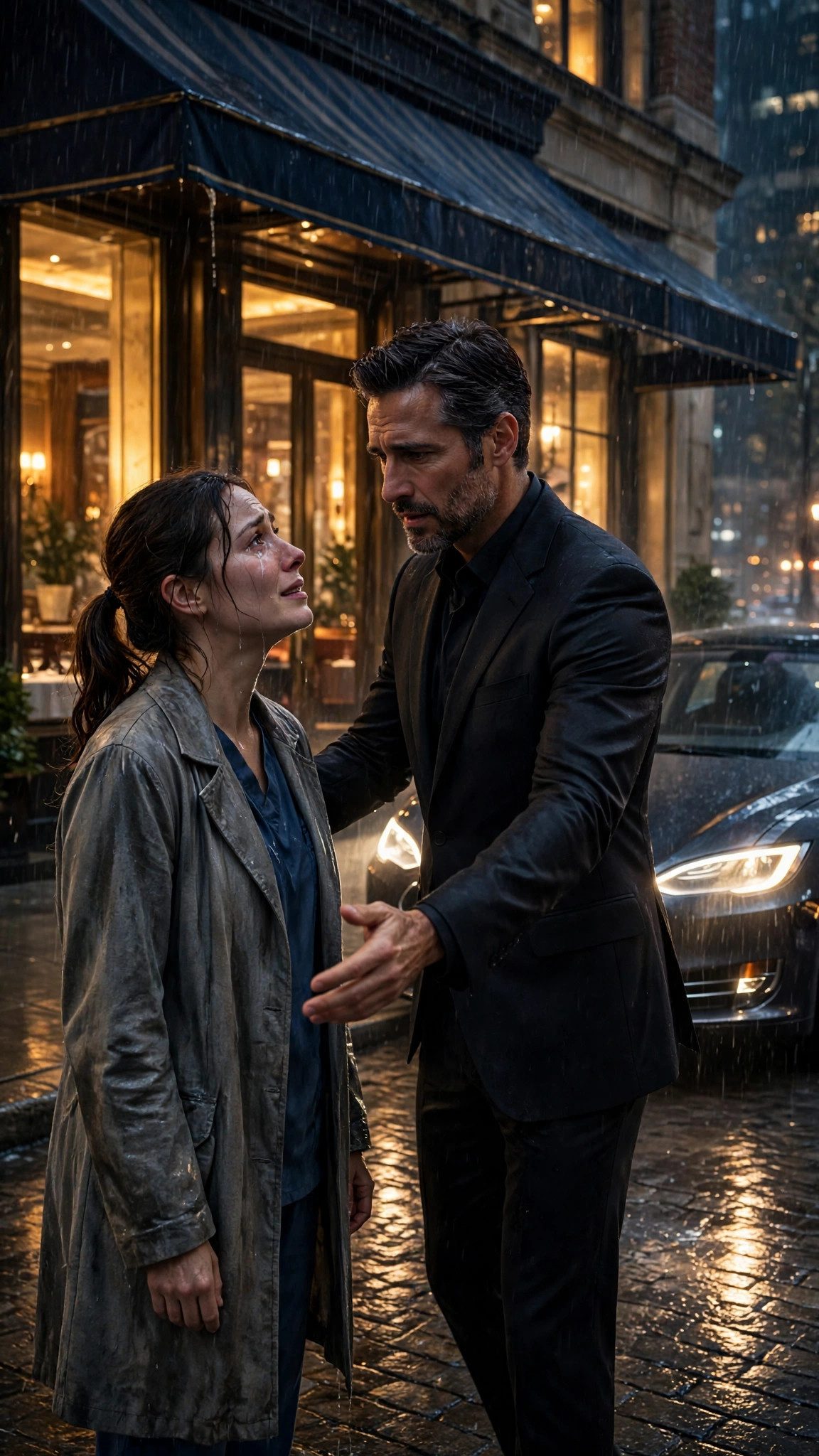
    The next morning, the boys woke up before dawn and pressed their faces to the windows, and when they saw the ocean, they went wild. They had never seen the ocean before. They had seen it in books, and on television, but they had never stood on a beach and felt the wind coming off the water, and they ran down to the sand in their pajamas, all four of them, shouting, and Isabella ran after them in her robe, laughing, and I followed with a bag of towels, and Rosa followed with a thermos of coffee, and for the first time in days, nobody was afraid.

    I taught Matteo to skip stones. He was terrible at it at first — every stone sank with a sad little plop — but he kept trying, his tongue stuck out in concentration, his small arm winding up the way mine used to wind up when I was his age. On the seventeenth try, the stone skipped twice, and Matteo shouted so loudly that a seagull took off in alarm, and Luca demanded a turn, and Enzo wanted to collect shells, and Nico wanted to dig a hole to China.

    "You're doing it wrong," Luca told Matteo, with the absolute confidence of a six-year-old. "You have to throw it like this." He threw his stone. It sank immediately.

    "You're doing it wrong too," Matteo said.

    "I'm doing it differently," Luca said. "That's not the same as wrong."

    Isabella sat on a blanket with her mother, watching them, and she looked more peaceful than I had ever seen her. The wind pulled at her hair. The sun was warm on her face. She looked like a woman who had finally, after six years of running, found a place to stand still.

    "We could stay here," she said quietly, when I sat down beside her. "Not forever. Just for a while. Until it's safe. The boys love it here. My mother loves it here. I love it here."

    "We can stay as long as you want," I said. "The house is ours for as long as we need it. But Isabella, I don't want to hide anymore. Not you. Not them. Not us. I spent six years living in the dark because I thought that's what my life was. I'm done with the dark."

    She looked at me, and she nodded, slowly, and she took my hand, and we sat there on the blanket while four small boys tried to dig a hole to China and argued about the correct way to skip a stone.

    That afternoon, Rocco called from Boston. His voice was calm, but I could hear the tension underneath it.

    "Boss, the federal agents want Doyle's records," he said. "All of them. They're building a case, and Doyle is the key. They want to talk to you, too. About Castellano. About the shell companies. About everything."

    "Tell them I'll talk," I said. "Tell them I'll tell them everything I know. But Rocco, I need something from you first. I need to know my boys are safe. I need to know that no one can get to this house."

    "No one can get to this house," Rocco said. "I have four men on the road, two on the beach, and one on the roof of the bait shop with binoculars. The only way anyone gets to those boys is over my dead body, and I don't plan on dying this week."

    "Good," I said. "Keep it that way."

    That night, after the boys were asleep in a row of small beds like peas in a pod, Isabella and I sat on the porch with two cups of tea, and she told me about the note. She told me about Frankie Lombardo, and the envelope, and the threat to her mother, and the handwriting she had never forgotten. She told me about the bus to Providence, and the motel room, and the four heartbeats on the ultrasound screen. She told me about the nights when all four babies cried at once and she sat on the floor of her apartment and cried with them, because she was twenty-five years old and alone and she had no idea how she was going to do it.

    "But I did it," she said. "I did it because they needed me to. And I would do it again. Every single day of it. Even the worst days. Because they were worth it."

    "I know," I said. "I can see it. In every part of them."

    She looked at me then, really looked at me, and I saw the question in her eyes before she asked it.

    "Dominic," she said. "What happens now? With Castellano. With your father. With all of it."

    "Now," I said, "we end it. All of it. My father has already agreed to cooperate with the federal agents. He's giving them everything: the ledgers, the routes, the names. He's seventy-one years old, Isabella. He's going to spend the rest of his life making this right. And Castellano—" I paused. "Castellano made a mistake. He tried to take my sons. Men in my world understand one thing, and it's this: you can steal money, you can steal territory, you can even steal a man's name. But you do not touch his children. When you do, every rule stops applying."

    I did not sleep that night either. I sat in the living room of the Cape house with the lights off, watching the dark road through the window, listening to the house breathe around me. Twice I got up and walked down the hallway to check on the boys, and twice I stood in the doorway of their room, watching four small chests rise and fall in the moonlight, and I thought about how fragile they looked, and how fiercely I would fight for them. Isabella found me there on the second trip, standing barefoot in the hallway, and she did not say anything. She just took my hand, and we stood there together in the dark, listening to our sons sleep, and it was enough.

    The next morning, Rocco's men found the van. It was parked three blocks from the boys' school, with two of Castellano's men inside and a bag full of rope and tape in the back. They were arrested before they could move. Within a week, Ray Doyle's testimony and the payment records led federal agents to Castellano's entire operation: the shell companies, the bribes, the shipments. Vincent Castellano was arrested on a Tuesday morning, in his own office, in front of his own lawyers, and the photograph of him being led out in handcuffs was on the front page of every newspaper in Boston by noon.

    Sloane Barrett was arrested the same week, charged with conspiracy and fraud. Her father resigned from his company in disgrace. The Barrett family, which had once been one of the most powerful names in Boston, collapsed in a matter of days, the way a house collapses when you pull out the one beam that was holding up the roof.

    I did not attend her trial. I did not need to. I had seen everything I needed to see in the conservatory, in the moment her smile finally broke. I felt no triumph. I felt only a vast, quiet relief, as if a weight I had been carrying for six years had finally been set down.

    My father came to the Cape on a Sunday, a week after the arrests. He stood on the porch in his old coat, looking smaller than I had ever seen him, and he asked if he could meet his grandsons. Isabella brought the boys out, one by one, and my father knelt down in the grass — my father, Vittorio Moretti, who had never knelt for any man — and he looked at four small faces with his own cheekbones, and he wept.

    "I am so sorry," he said to Isabella. "I did a terrible thing to you. I told myself it was for the family. But a family that begins with a threat is not a family. It is a prison. Forgive me, if you can. If you cannot, I understand."

    Isabella was quiet for a long time. Then she put her hand on his shoulder, and she said, "You can start by being their grandfather. That's all they need from you. The rest, we'll figure out as we go."

    Matteo tugged on my father's sleeve. "Are you our nonno?" he asked.

    My father looked at him, and his face broke into a smile so wide and so young that for a moment I saw the man he had been before the weight of the family had bent him.

    "Yes," he said. "I am your nonno. And you four are going to be the death of me, I can already tell."

    "Good," Luca said seriously. "Nonnos are supposed to be fun."

    And that was how Vittorio Moretti, the most feared man in Boston for forty years, spent his first afternoon as a grandfather: on his knees in the grass on Cape Cod, building a sandcastle with four six-year-old boys who had his cheekbones and his stubbornness and absolutely no fear of him at all.
  • Chapter 5: The Woman Who Exposed My Fiancée

    Chapter 5: The Woman Who Exposed My Fiancée

    The DNA results came back in twenty-four hours, as Rocco had promised. Four envelopes, four names, four identical conclusions: 99.99 percent probability of paternity. I sat in my office with the envelopes spread out on my desk, and I read each one twice, and I thought about the fact that a laboratory in Cambridge could tell me in a single page what I had known from the first second in a restaurant bathroom.

    They were mine. Matteo, Luca, Enzo, and Nico Moretti. My sons.

    Rocco stood by the door, watching me. "What now, boss?" he asked.

    "Now," I said, "we find out who has been watching them. And then we find out who drove their mother out of this city six years ago. And then, Rocco, we are going to have a very public conversation about it."

    Rocco nodded slowly. "Doyle talked," he said. "The private investigator. My men picked him up last night. He didn't need much persuading. He's been following Miss Fontaine and the boys for two years, on a monthly retainer of four thousand dollars. The money comes through a shell company. But Doyle kept records, boss. He kept everything. Dates, times, photographs. And the name on the account that hired him."

    "Tell me," I said.

    "Sloane Barrett," Rocco said. "She hired him herself. Two years ago, right after she learned that Isabella had moved back to Providence from—" He stopped. "Boss, there's more. Doyle says Sloane didn't just want the boys watched. She wanted to know everything. Their school. Their doctor. Their routines. She asked him, more than once, whether it would be possible to make them disappear. Not hurt. Disappear. A boarding school in Europe. A new identity. Something clean."

    The room went very quiet. I looked at the four envelopes on my desk, at the names of my sons typed in neat black letters, and I felt something cold and precise settle over me. It was the feeling I got before I did something that could not be undone.

    "And my father?" I asked. "What did Doyle say about my father?"

    "Nothing," Rocco said. "Doyle never dealt with your father. But boss, I looked into something else. The money for Rosa Fontaine's surgery, six years ago. It came from a private foundation. The foundation is controlled by the Barrett family."

    I closed my eyes. The pieces were falling into place, and every one of them had Sloane Barrett's fingerprints on it. She had not simply benefited from Isabella's departure. She had helped arrange it. She had been the one who told my father about Isabella in the first place. She had been the one who made sure the threat was delivered, and the money was paid, and the door was closed behind her.

    "There's one more thing," Rocco said, and he put a folder on my desk. "Isabella kept something. A note. She gave it to me this morning, when I went to talk to her. She said she kept it for six years because she was afraid of it, and then she kept it because she was angry, and now she wants you to have it."

    I opened the folder. Inside was a single sheet of paper, yellowed at the edges, with a handwritten note in elegant, looping handwriting.

    "Leave tonight and never come back. He was never yours. — S."

    I knew that handwriting. I had seen it a hundred times: on place cards, on thank-you notes, on the invitations Sloane sent out for her charity galas. Elegant. Looping. Certain.

    Sloane Barrett had gone to Isabella's apartment six years ago. She had stood in the same hallway where Frankie Lombardo had stood, and she had delivered her own message, in her own hand. She had looked a frightened young nurse in the eye and told her that the man she loved was never hers.

    And then she had spent six years waiting for her prize, and two years paying a man to watch four little boys, and asking whether they could be made to disappear.

    I stood up. I put the note in my pocket, next to my heart, and I looked at Rocco.

    "Is the conservatory still booked for Saturday?" I asked.

    "Your father kept the booking," Rocco said. "He said the families still expect an announcement."

    "Good," I said. "Then we're going to give them one."

    On Saturday morning, Isabella stood in front of the mirror in her small bedroom and stared at the dark blue dress hanging on the door, and she thought about not going.

    She had laid the dress out the night before, after Rocco had explained the plan: walk in, stand beside Dominic, let the room see four little boys with his face, and say the words she had rehearsed a hundred times in her head. It had sounded simple when Rocco said it. Standing in front of the mirror, it sounded like the most terrifying thing she had ever done.

    "What if they laugh at me?" she said to her mother, who was sitting on the bed, watching her with the calm eyes of a woman who had survived far worse rooms than a conservatory full of rich people.

    "Let them laugh," Rosa said. "You survived six years alone with four babies, my love. You survived a bus to Providence and a motel room and a doctor telling you to be brave. A room full of people in expensive clothes is nothing. You walk in there, and you hold your head high, and you let them see what a mother looks like."

    "But the boys," Isabella said. "What if they get frightened? What if someone says something cruel in front of them?"

    "Then their father will be standing right there," Rosa said. "And their nonno will be standing right there. And I will be standing right there. You are not walking into that room alone, Isabella. Not this time. Not ever again."

    Downstairs, Rocco was waiting in the car, and beside him sat Ray Doyle, the private investigator, pale and sweating in a suit that did not fit him, holding his folder of records like a shield.

    "Are you sure about this, Mr. Doyle?" Rocco asked him, not unkindly.

    "I've never been sure about anything," Doyle said. "But I've kept every receipt, every photograph, every bank statement for two years, and I know what I saw. She paid me to watch children, Mr. Rocco. Children. I told myself it was just surveillance. I told myself nobody was getting hurt. But I knew. I always knew. So yes. I'm sure. I'll tell them everything."

    My father called me that morning, too. His voice on the phone was careful, measured, the voice of a man walking across thin ice.

    "Dominic," he said. "Whatever you are planning tonight, I want you to know something. I was wrong six years ago. I have known it for six years, and I have said nothing, because saying it would mean admitting what I did. But I am saying it now. I was wrong. And tonight, whatever happens in that room, I will stand beside you. Not behind you. Beside you."

    "Thank you, Father," I said, and I meant it. It was not forgiveness. Forgiveness would take time. But it was a beginning.

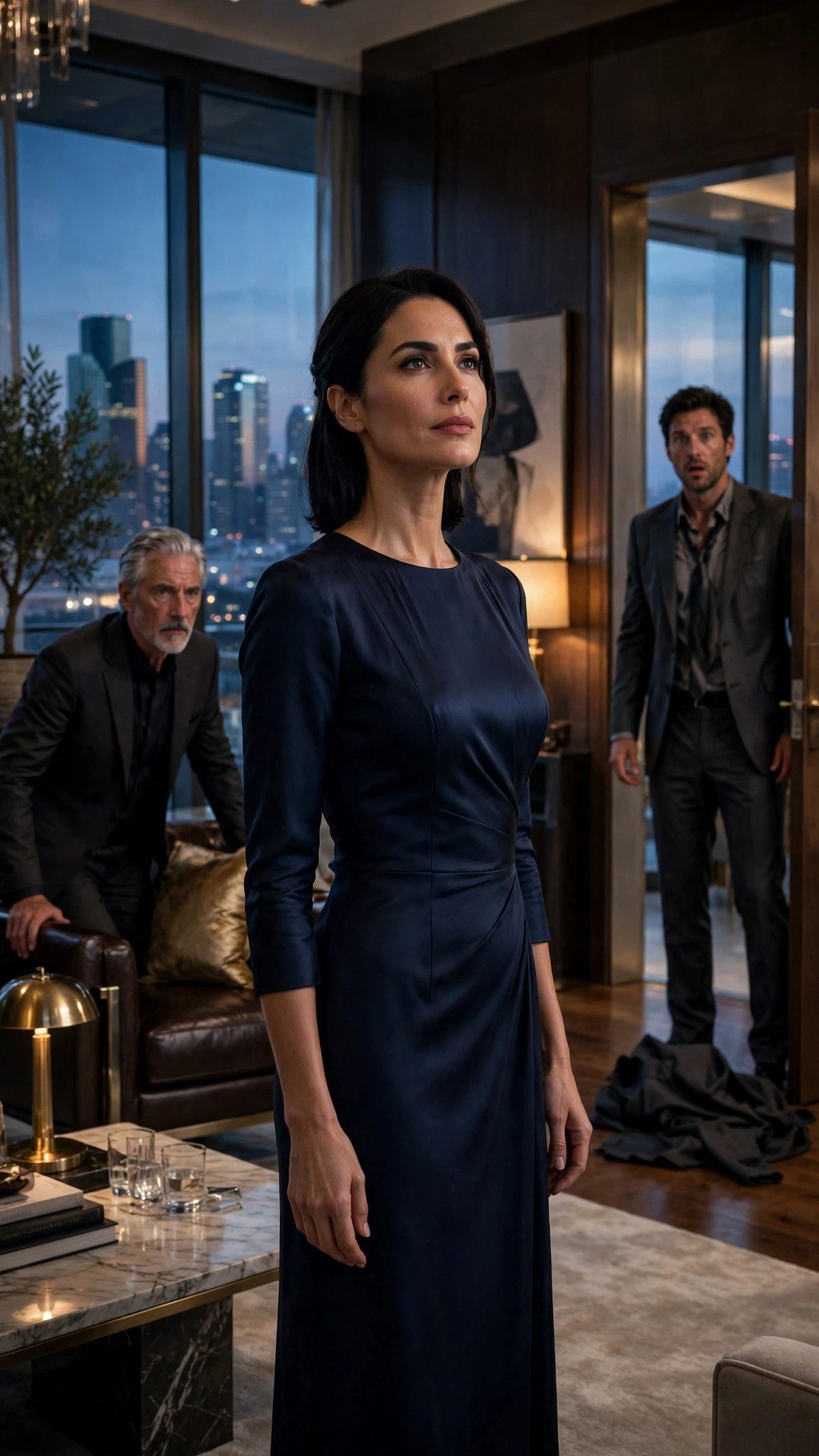
    On Saturday evening, the conservatory was full. My father stood by the glass wall, talking to Sloane's father in low voices. Sloane stood near the string quartet in a white dress, beautiful and composed, as if the last three days had never happened, as if I had never called off the engagement over the phone. Her mother was showing photographs to my father's friends. Waiters moved through the room with trays of champagne. Everyone was smiling. Everyone was pretending.

    I walked in with Rocco at my side, and the room went quiet in waves, the way a room does when the guest of honor arrives late and wrong. Sloane came toward me, her smile fixed in place.

    "Dominic," she said. "You're here. I knew you'd come to your senses."

    "I came to make an announcement," I said, loudly enough for the whole room to hear. "But it's not the one you're expecting."

    My father stepped forward. "Dominic," he said warningly. "Not here. Not like this."

    "Yes, here," I said. "And yes, like this. Because what happened six years ago happened in the dark, and it's time it happened in the light."

    I turned to the room. Fifty people. Two families. A string quartet. A glass roof full of stars.

    "Six years ago," I said, "a woman named Isabella Fontaine loved me. She was a nurse. She was kind, and brave, and she believed that love was enough. My father disagreed. He sent a man to her apartment to threaten her mother. He paid for her mother's surgery in exchange for her silence. And he told her that if she ever came back, the arrangement would end."

    The room was so quiet I could hear the ice melting in someone's glass.

    "But my father wasn't the only one who went to her apartment that night," I said, and I took the note from my pocket and held it up. "Someone else came too. Someone who wrote her a note in her own handwriting. Someone who told her to leave tonight and never come back. Someone who told her that I was never hers."

    I looked at Sloane. Her face had gone white under her makeup, but her smile was still there, stretched thin and terrible.

    "Would you like to read it, Sloane?" I asked. "Or should I read it for you?"

    "Dominic, this is absurd," she said, her voice steady, her hands steady, everything about her steady except her eyes. "You can't possibly believe—"

    "I believe evidence," I said. "And I have more. For two years, you paid a private investigator named Ray Doyle four thousand dollars a month to follow Isabella Fontaine and her four children. Her four children, Sloane. My four sons. You had their school photographed. You had their doctor's office watched. And you asked Doyle, more than once, whether it would be possible to make them disappear."

    A gasp went through the room. Sloane's mother put a hand to her mouth. Her father took a step forward, his face darkening.

    "That's a lie," Sloane said. "That man is a liar. He'll say anything for money."

    "Then you'll be happy to know," I said, "that Mr. Doyle is waiting in the next room, with his records, his photographs, and his bank statements. And he's very eager to talk to anyone who wants to listen."

    I turned to the door and nodded at Rocco. He opened it, and Ray Doyle walked in: a thin, nervous man in a cheap suit, carrying a folder thick with paper. He looked at Sloane, and he looked at me, and he said, "I'll tell you everything. I kept it all."

    Sloane's composure finally broke. It did not break loudly. It broke the way ice breaks on a river in spring: silently, and all at once, and with a sound like the world ending.

    "You don't understand," she said, and her voice was shaking now, really shaking, for the first time since I had known her. "You don't understand what your family is. What this life costs. I did what I had to do. I did what your father wanted. I did what anyone in my position would have done. She was a nurse, Dominic. A nobody. And you were going to throw away everything—everything your family built—for her."

    "She is not a nobody," I said. "She is the mother of my sons. And you are not a fiancée. You are a woman who tried to erase four children from the world because they were inconvenient to your plans."

    Then the door opened again, and Isabella walked in.

    She was wearing a simple dark blue dress, and her hair was down around her shoulders, and she was holding Matteo's hand on one side and Luca's on the other, with Enzo and Nico just behind her. She walked across the conservatory floor with her head high, and four little boys in matching navy sweaters walked with her, and every person in the room turned to look at them, and I heard someone whisper, "They look just like him," and someone else whisper, "My God, there are four of them."

    Isabella stopped in front of Sloane. She looked at the woman who had tried to erase her, and her voice, when she spoke, was calm and clear and carried to every corner of the room.

    "You told me he was never mine," she said. "You were wrong. He was never yours. He was mine from the first night he walked into my clinic with blood on his hands and a lie on his lips, and he has been mine every day since, even when I was a thousand miles away. You can buy a threat. You can buy a private investigator. You can buy a surgeon. But you cannot buy a man's heart, Sloane. And you cannot buy his children."

    Sloane stared at her. For a long moment, neither woman moved. Then Sloane did something I did not expect. She laughed. It was a small, bitter sound, like glass breaking far away.

    "You think you've won," she said. "You think this is a victory. But you have no idea what you've just done. The Castellanos—"

    "Will be dealt with," I said. "Starting tonight. Starting with you."

    Rocco stepped forward and took Sloane gently by the arm. Her father started to protest, and my father held up a hand, and the room went still.

    "Dominic," my father said, and his voice was old and tired in a way I had never heard before. "I'm sorry. I was wrong. I thought I was protecting you. I thought I was protecting the family. I was wrong about all of it."

    I looked at my father, at the man who had built an empire and broken a young nurse's heart to protect it, and I felt the anger drain out of me, replaced by something heavier and sadder.

    "Then help me fix it," I said.

    He nodded. He looked at Isabella, and at the four boys, and his eyes filled with tears.

    "They have your mother's eyes," he whispered. "All four of them."

    And in that moment, under the glass roof where I was supposed to propose to the wrong woman, the woman I loved exposed my fiancée in front of two families, and the truth finally came out into the light where it belonged.

  • Chapter 4: The Ring That Meant Nothing

    Chapter 4: The Ring That Meant Nothing

    I did not go to the conservatory that night. I went home, to my penthouse above the city, and I sat in the dark with the ring box open on the table in front of me, and I looked at the diamond the way a man looks at a stranger's photograph. It was a beautiful stone. Three carats, flawless, set in platinum. Sloane had picked it out herself, of course. She had sent me the link with a note that said, "This one. Don't get the other one." I had bought it without thinking, the way I did everything in those days: without thinking.

    Rocco called at eight o'clock. "Boss," he said, "Mrs. Barrett is asking where you are. The quartet has played the same song three times. Your father is asking questions."

    "Tell them I'm not coming," I said.

    There was a long silence on the other end of the line. Rocco had driven for my family for twenty years. He had seen my father humiliate grown men for lesser insults than standing up a Barrett. He knew what this would cost.

    "Boss," he said carefully, "are you sure?"

    "I've never been more sure of anything," I said. "And Rocco, I need you to do something for me. I need you to find a woman named Isabella Fontaine. She works at Boston Children's Hospital. She lives somewhere in the South End, with four little boys. I need her address. I need to know everything about where she's been for the last six years. And I need to know who has been watching her."

    "Watching her?" Rocco asked.

    "Someone has been watching her," I said. "I can feel it. Six years, Rocco. She hid for six years, and the moment she comes back to Boston, my father finds out? No. Someone knew she was here. Someone has been keeping track of her. Find out who."

    "Understood," Rocco said. "And Sloane?"

    "Sloane can wait," I said. "Everyone can wait."

    I hung up, and I sat in the dark for a long time, and I thought about the woman in the cream sweater and the four boys in matching navy sweaters, and I thought about the note she had left on her kitchen counter six years ago, and I thought about the way her face had gone white when she saw me in that restaurant.

    She had not left me. I understood that now, the way you understand something that has been true all along and you were simply too blind or too cowardly to see it. Isabella Fontaine had never once, in all the time I knew her, done something cruel. She had stitched my knuckles and made me terrible coffee and told me to come back whole. A woman like that does not vanish in the night without a reason. A woman like that is driven away.

    And the only person in the world with both the motive and the power to drive her away was sitting in my father's house, or standing under a glass roof waiting for a proposal, and I intended to find out which one it was.

    My phone rang again. Sloane. I answered it this time, because there are some conversations a man cannot avoid, and I would rather have it over the phone than face to face.

    "Dominic," she said, and her voice was cool and controlled, the way it always was when she was furious and determined not to show it. "Where are you? Your father is here. My parents are here. The photographer has been hiding behind a palm tree for forty minutes."

    "I'm not coming, Sloane," I said.

    There was a silence. Then, very quietly, she said, "What did you just say?"

    "I'm not coming," I said again. "I'm not proposing tonight. I'm not proposing ever. It's over."

    "Dominic, you can't be serious," she said, and for the first time I heard something crack in her perfect composure. "Do you have any idea what you're doing? Do you have any idea what this will do to both our families? My father has already told the board. Your father has already told the families. This isn't a dinner reservation you can cancel, Dominic. This is an alliance."

    "Then the alliance is cancelled," I said.

    "Why?" she demanded. "Give me one reason. One honest reason."

    I almost told her. I almost said the words: because I found the woman I actually loved, and she has four sons who look like me. But something stopped me. It was instinct, the same instinct that had kept me alive in rooms full of armed men. Sloane Barrett was not a woman to hand information to in anger. She was a woman to watch, carefully, until I understood exactly what she knew and exactly what she had done.

    "Because I don't love you," I said instead. It was true enough. "And I'm not going to marry a woman I don't love to make our fathers happy."

    "You don't love anyone," she said coldly. "That's the problem with you, Dominic. You're incapable of it. You were incapable of it six years ago, and you're incapable of it now."

    The words should have hurt. Six years ago, they would have. But standing in my dark penthouse with the ring box open in front of me, I heard something in her voice that I had never noticed before: not pain, not heartbreak, but calculation. She was not a woman losing the man she loved. She was a woman losing a merger.

    "Goodbye, Sloane," I said, and I hung up.

    Rocco called back an hour later. "I found her," he said. "Isabella Fontaine, thirty-one, pediatric nurse at Boston Children's. She lives on a quiet street in the South End with her four boys and her mother, Rosa. The boys are in kindergarten at a public school two blocks away. And boss—" He paused. "There's something else. There's a man. A private investigator named Ray Doyle. He's been following her for two years. Photographs, license plates, school schedules. He reports to someone. I don't know who yet, but I'm going to find out."

    "Two years," I said. "Someone has been watching my sons for two years."

    "Your sons," Rocco repeated quietly. "You know for certain?"

    "I know," I said. "But I want the test anyway. For them. For the record. For the day someone asks."

    "I'll set it up," Rocco said. "Discreet. A lab in Cambridge. Results in twenty-four hours."

    "Thank you," I said. "And Rocco, one more thing. I need you to look into Sloane Barrett. Not her family. Her. Her money. Her phone records. Who she talks to when she thinks no one is listening. I have a feeling she's been busy."

    "I'll start tonight," Rocco said.

    I did not sleep that night. I stood at the window of my penthouse and looked out over the city, and I thought about four little boys asleep in a small apartment in the South End, and I thought about the woman who had raised them alone for six years while I sat in rooms full of powerful men telling myself that she had chosen to leave me.

    My father came to my penthouse the next morning, before I was even dressed. He did not knock. He never knocked. He walked in with two of his men behind him, and he stood in the middle of my living room, and he looked at the ring box still sitting open on the table, and his face went dark.

    "Do you have any idea what you have done?" he asked. His voice was low and cold, the voice he used in rooms where decisions were made that could not be unmade. "The Barretts have already called me three times. Sloane's father is threatening to pull his money out of the shipping company. Do you understand what that means?"

    "I understand," I said. "I understand that I was about to marry a woman I don't love to protect a shipping company. And I understand that I'm not going to do it."

    "You're being a child," my father said. "A sentimental child. Love doesn't keep a family alive, Dominic. Alliances do. Money does. Power does."

    "Then why did you marry my mother?" I asked.

    The question stopped him cold. He stared at me, and for a moment the cold mask slipped, and I saw something raw underneath it.

    "Your mother," he said slowly, "was the only mistake I ever made that I didn't regret. And I spent forty years making sure no one could ever use her against me. That is the price, Dominic. That is what it costs."

    "And was it worth it?" I asked. "Was it worth it, keeping her at arm's length for forty years so no one could touch her?"

    My father did not answer. He looked at the ring box on the table, and he looked at me, and I saw something in his eyes that I had never seen before: not anger, but fear. The fear of an old man who has just realized that the thing he spent his life building might have been built on a mistake.

    "Something happened six years ago," I said quietly. "Something to do with a woman named Isabella Fontaine. And I think you know what it was."

    His face went very still. He picked up his coat. He walked to the door. And without turning around, he said, "Be careful, Dominic. There are things in this family you don't want to dig up."

    Then he was gone, and I stood alone in my penthouse, and I understood, with a clarity that frightened me, that my father had just confirmed everything I suspected without saying a single word.

    That afternoon, I did something I had never done before: I went to a toy store. I stood in the aisle for twenty minutes, feeling like an idiot in a suit that cost more than most people's cars, staring at a wall of trucks and trains and blocks. I had four sons. I had four sons I had never met, and I did not know what a six-year-old boy liked, and I did not know what their favorite colors were, and I did not know if they liked trucks or trains or dinosaurs. So I bought four identical red trucks, because red was the only color I was sure about, and I had Rocco deliver them to Isabella's building with a note that said only, "From someone who is glad you exist."

    Rocco called me an hour later. "She knows it was you," he said. "She took one look at the note and said, 'He always did have terrible handwriting.' Then she let the boys open them. Boss, you should have heard them. Four little boys, all shouting at once. It was the loudest thing I've heard in years."

    "Did she say anything else?" I asked.

    "She said to tell you that Matteo named his truck Lightning, Luca named his Thunder, Enzo named his Red, and Nico named his Truck," Rocco said, and I could hear the smile in his voice. "She said Nico is very literal."

    I sat in my office for a long time after that call, thinking about four red trucks and four small boys with names like a thunderstorm, and I thought about the fact that I had missed six years of birthdays and scraped knees and lost teeth, and I thought about how much time I had left to make up for, and whether it would ever be enough.

    It would have to be. It was all I had.

    In the morning, I drove to the South End myself. I did not bring Rocco. I did not bring anyone. I parked across the street from a small brick building with window boxes full of geraniums, and I sat in the car for twenty minutes, watching the door, trying to find the courage to walk up the steps.

    What if she slammed the door in my face? What if the boys were frightened of me? What if six years was too long, and the woman I had loved was gone, replaced by a stranger who hated me?

    Then the door opened, and Isabella came out with the four boys, and all four of them were wearing their matching navy sweaters, and she was carrying a bag of groceries in one hand and holding Nico's hand with the other, and Luca was telling a story with his hands, and Enzo was laughing, and Matteo was walking a half-step behind his mother, the way the oldest child always does, watching everything.

    I got out of the car before I could talk myself out of it.

    "Isabella," I called.

    She turned. The boys turned. Four pairs of dark eyes fixed on me, and for a moment nobody moved, and then Matteo said, "It's the tall man from the restaurant," and Luca said, "Hi, tall man," and Nico hid behind his mother's leg, and Enzo waved.

    Isabella looked at me for a long moment. Then she said, very quietly, "The boys have a doctor's appointment in an hour. You can walk with us to the corner. That's all I can give you right now."

    It was more than I deserved. I walked beside her, and the boys ran ahead to the corner and back, and she told me, in short, careful sentences, about the last six years. About Providence. About the clinic. About the night she found out she was carrying four babies, and the doctor who told her she would need to be very brave. About the apartment above the laundromat. About her mother's heart, and the specialist in Boston, and the job at Children's.

    She did not tell me about Frankie Lombardo. She did not tell me about the envelope, or the note, or the threat. Not yet. But she told me enough, and when we reached the corner, she stopped and looked at me, and her eyes were full of six years of exhaustion and pride and a grief so old it had become part of her.

    "They're yours," she said finally. It was the first time she had said it aloud. "All four of them. I never told them about you, because I didn't know how. But they're yours, Dominic. Matteo, Luca, Enzo, and Nico Moretti. They have your face. They have your temper. Matteo hums when he's nervous, did you know that? He hums the same song you used to hum when you were waiting for your coffee. I don't know how he knows it. He just does."

    I crouched down at the corner, in my suit, on a sidewalk in the South End, and I looked at four small faces, and I said, "Hi. I'm Dominic. I'm your dad."

    Luca grinned. "We know," he said. "You look like us."

    Nico peeked out from behind his mother's leg. "Are you going to stay?" he asked.

    It was the smallest question in the world, and it was the biggest question anyone had ever asked me.

    "Yes," I said. "I'm going to stay."

    And for the first time in six years, I meant something completely.

  • Chapter 3: The Price of Leaving

    Chapter 3: The Price of Leaving

    Isabella Fontaine had never been afraid of hard work. She had been afraid of many things in her life — her mother's heart stopping in the middle of the night, the rent coming due before her paycheck cleared, the sound of her own phone ringing with bad news — but hard work had never frightened her. Hard work was the one thing she could control.

    The morning Vittorio Moretti's men came to her apartment, she learned that there were things in this world that hard work could not fix.

    It was a Thursday, early November, cold enough that the radiators in her building had started to clank. She had just come home from a night shift at the hospital, exhausted, her scrubs smelling of antiseptic and her feet aching in her shoes. She was standing in her small kitchen, making tea, when the knock came at the door.

    Three knocks. Slow. Patient. The kind of knock that does not ask permission.

    She opened the door, and a man she had never seen before stood in the hallway. He was in his sixties, silver-haired, wearing an expensive coat, and he smiled at her the way a priest smiles at a sinner: with pity, and with absolute certainty.

    "Miss Fontaine," he said. "My name is Frankie Lombardo. I work for the Moretti family. May I come in?"

    She should have said no. She should have slammed the door and called the police. But her mother lived two streets away, alone, with a heart that could stop at any moment, and the man in the hallway knew it. She could see it in his eyes. He knew everything about her, and he wanted her to know that he knew.

    "Say what you came to say," she said, not opening the door any wider.

    He nodded, as if he had expected exactly that answer.

    "Mr. Moretti is very fond of his son," he said. "And Mr. Moretti is very fond of you, in his way. But Dominic is the head of this family now, and a man in his position cannot have a weakness. You understand me. You are a weakness."

    "I am not a weakness," Isabella said. "I am a nurse."

    "You are a woman he loves," Frankie said gently. "And in our world, that is the same thing. Men who want to hurt Dominic will not come for him. They will come for you. And when they do, they will not be polite. They will not knock."

    Isabella's hands were shaking. She hid them behind her back.

    "What do you want?" she asked.

    "I want you to leave Boston," Frankie said. "Tonight. Quietly. No goodbye. No phone call. No letter he can follow. You will go somewhere no one in this city can find you, and you will stay there, and you will never contact Dominic Moretti again."

    "And if I refuse?" she asked, and her voice came out smaller than she wanted it to.

    Frankie sighed, and for a moment he looked almost human. "Then I will have to tell Mr. Moretti that you refused. And Mr. Moretti is an old man, Miss Fontaine, and old men in his position do not like to be refused. Your mother is on a waiting list for a heart specialist at Mass General. A very long list. Mr. Moretti can move her to the top of that list tonight. Or he can make sure she never reaches the top of it at all."

    The words landed like a weight on her chest. Her mother. Rosa. Sixty-one years old, with a heart that the doctors said would need surgery within the year, and a waiting list that stretched for months, and a daughter who had spent her whole life trying to keep her alive.

    "You're threatening my mother," Isabella whispered.

    "I am explaining your choices," Frankie said. "Leave tonight, and your mother's surgery is paid for, in full, by a private foundation. No waiting list. The best surgeon in Boston. She will live to see her grandchildren. Stay, and—" He spread his hands. "I cannot promise anything."

    Isabella stared at him. She thought about Dominic, asleep in his penthouse across the city, a man who had never once raised his voice to her, who had fixed her dripping faucet and learned to cook her mother's pasta. She thought about the ring she had seen him looking at in a shop window on Newbury Street, the simple gold band he thought she hadn't noticed. She thought about the life they had been building, box by box, in her third-floor walk-up.

    And she thought about her mother, alone in her apartment two streets away, with a heart like a clock running down.

    "How do I know you'll keep your word?" she asked.

    "Because Mr. Moretti always keeps his word," Frankie said. "That is why he is still alive at seventy-one. You have his word, Miss Fontaine. Your mother will be taken care of. But you must go tonight, and you must never come back. If Dominic ever finds you, the arrangement ends. Do you understand?"

    She understood. She understood perfectly. She was being bought, and the price was her mother's life, and there was no version of this story in which she got to keep both the man she loved and the mother who had raised her.

    "There is one more thing," Frankie said, and he reached into his coat and took out an envelope. "This is for you. For the journey. There is enough here to start over somewhere new. Do not be proud, Miss Fontaine. Take it. You will need it."

    She took the envelope with numb fingers. Inside, she would later find five thousand dollars in cash, and a single sheet of paper with a handwritten note on it. The handwriting was not Frankie's. It was a woman's handwriting, elegant and looping, and the note said only this:

    "Leave tonight and never come back. He was never yours. — S."

    She did not know who S. was. Not then. She folded the note and put it in her purse, and she did not understand why the handwriting frightened her more than Frankie's threats. Perhaps some part of her already knew. Perhaps some part of her had already seen that elegant looping handwriting somewhere before, on a place card at a charity dinner, on a thank-you note sent to the clinic, on the arm of a beautiful blonde woman who had been circling Dominic Moretti for years.

    She packed one suitcase. She wrote the note to Dominic — the shortest note she had ever written, the hardest thing she had ever done — and she left it on the kitchen counter. She went to her mother's apartment, and she held Rosa in her arms, and she told her mother that she had to go away for a while for work, and that everything was going to be all right, and that the surgery would be paid for, and her mother cried, and Isabella cried, and neither of them said what they both knew: that this was not a choice. It was a ransom.

    By midnight, she was on a bus to Providence, Rhode Island, with one suitcase, five thousand dollars, a note in a stranger's handwriting, and a secret she did not yet know she was carrying.

    Her first week in Providence, she lived in a motel room with a buzzing neon sign outside the window and a lock on the door that did not quite catch. The landlady, a stout Irish woman named Mrs. Agnes O'Connor, took one look at her on the first morning — young, exhausted, carrying one suitcase and crying quietly into her coffee — and decided, without asking a single question, that Isabella was hers to look after.

    "You eat," Mrs. O'Connor said, putting a plate of toast and eggs in front of her. "Whatever it is, you eat first. Tears on an empty stomach never fixed anything."

    Isabella ate. She told Mrs. O'Connor nothing, and Mrs. O'Connor asked nothing, and that was the beginning of the first real friendship Isabella had made in years. In the evenings, Mrs. O'Connor would knock on her door with tea and sit on the edge of the bed and talk about her own life: a husband dead twenty years, a daughter in California, a motel that had been her whole world since she was thirty. She never asked Isabella what she was running from. She only said, once, "Whatever his name is, love, he isn't worth your health. Eat. Sleep. The rest will sort itself out."

    By the second week, Isabella had found work at a free clinic in Providence, three mornings a week, enough to pay for the motel room and a little food. The clinic director, a tired, kind man named Dr. Patel, hired her on the spot when she told him she was a nurse.

    "We need hands," he said. "We always need hands. You can start tomorrow."

    She started tomorrow. She worked mornings, and in the afternoons she walked the streets of Providence, learning the city the way she had once learned the North End: which bakery sold day-old bread for half price, which laundromat had the cheapest machines, which park had benches where she could sit and breathe. She wrote letters she never sent. She wrote one to Dominic, six pages long, telling him everything: about Frankie, about the envelope, about her mother, about the note in the looping handwriting. She read it twice, and then she tore it into small pieces and dropped it into the motel trash can, because Frankie's voice was still in her head, saying, "If Dominic ever finds you, the arrangement ends," and she believed him. She believed that a letter would be the thing that killed her mother.

    She found out three weeks later, in a bathroom in a cheap motel room in Providence, staring at a pregnancy test with shaking hands. She sat on the edge of the bathtub for an hour, and she cried, and then she laughed, and then she cried again, because the universe had a sense of humor so dark it bordered on cruelty. She had left Dominic Moretti to protect the people she loved. And she was carrying his child.

    Or rather, as the doctor told her at her first ultrasound, his children. Four of them.

    "Quadruplets," the doctor said, showing her the screen, four tiny heartbeats flickering like candles in the dark. "Miss Fontaine, this is a high-risk pregnancy. You will need bed rest. You will need help. You will need family."

    "I don't have family here," Isabella said.

    "Then you will need to be very brave," the doctor said.

    She was brave. She was brave in the way that only a woman with no other choice can be brave. She found a job at a clinic in Providence, working mornings until her belly grew too large for the chairs. She moved into a small apartment above a laundromat. She saved every dollar. She read every book about multiple births she could find at the library. And on a snowy night in May, she gave birth to four boys in a hospital room full of nurses and monitors and fear, and when they placed the first one in her arms, she looked at his dark hair and his stubborn little crease between his eyebrows, and she whispered, "Matteo," because it was the name Dominic had once told her he would give his first son, and she had never forgotten it.

    Matteo. Luca. Enzo. Nico. Four boys, four heartbeats, four copies of the man she had loved and lost. They were born small and loud and furious at the world, and she loved them with a ferocity that frightened her sometimes. She worked double shifts at the hospital. She learned to cook with one baby on her hip and another in a sling. She taught them to say "team" before they could say "Mama," because a team was what they were, and a team was what they would need to be.

    She never told them about their father. When they asked, and they did ask, she told them that their father was a good man who lived far away, and that one day, when they were older, she would tell them the whole story. It was not a lie. It was a delay. She told herself that she would know when the time was right.

    The time was never right. There was always a reason to wait. They were too young. They were too happy. Boston was too far away and too dangerous. And underneath all the reasons was the real one, the one she never said aloud: she was afraid. She was afraid that if Dominic ever found them, his world would swallow them whole, the way it had swallowed her. She was afraid that four small boys with his face would become targets the moment his enemies learned they existed.

    So she hid them. She hid them in plain sight, in Providence, in a life so ordinary that no one would ever think to look twice. And for six years, it worked.

    Until her mother's heart began to fail again.

    Rosa Fontaine needed a specialist, and the only specialist who could help her was in Boston, at Mass General. Isabella had no choice. Two months ago, she packed up her life in Providence, took a nursing job at Boston Children's Hospital, and moved her four boys into a small apartment in the South End, three miles from the Moretti penthouse and a world away from everything Dominic represented.

    She told herself it was temporary. She told herself that Boston was a big city, and that Dominic Moretti moved in circles so far above hers that they would never cross. She told herself that she could keep her boys safe if she was careful, if she kept her head down, if she never went to the restaurants where his kind of people ate.

    She had been careful for six years. She had been careful every single day.

    She had never once imagined that the danger would find them in a restaurant bathroom on a Friday night, in the form of four little boys and a man who had never stopped looking for her.

  • Chapter 2: The Girl at the Free Clinic

    Chapter 2: The Girl at the Free Clinic

    I met Isabella Fontaine on a Tuesday in June, six years ago, in a free clinic in the North End, and the first thing she ever said to me was, "Sit down, stop bleeding on my floor, and tell me who did this to you."

    I had walked in with a split knuckle and blood on my shirt, and she had taken one look at me and decided I was exactly the kind of trouble she did not have time for. She was twenty-five years old, a nursing student volunteering her evenings at the clinic, with dark brown hair pulled back in a messy ponytail and tired eyes and ink on her fingers from the charts she had been filling out. She wore a faded blue scrub top and sneakers with a hole in the left toe, and she was the most beautiful woman I had ever seen.

    "Who did this to you?" she asked again, snapping on gloves.

    "A door," I said.

    "A door," she repeated, in the flat voice of a woman who has heard every lie in the book and is not impressed by any of them.

    "A heavy door," I said. "It swung back."

    "Mm-hm." She cleaned the cut with something that stung, and I did not flinch, and she noticed that I did not flinch, and her eyes narrowed. "You don't feel pain like normal people."

    "I feel it," I said. "I just don't advertise it."

    She taped a butterfly bandage across my knuckle with quick, efficient fingers. "There. That door owes you an apology. Keep it clean, keep it dry, and if it gets hot or red, come back and let someone who actually went to medical school look at it."

    "You're not a doctor," I said.

    "I'm a nursing student," she said. "Which means I know enough to know when a man is lying to me about a door."

    I laughed. I had not laughed, really laughed, in longer than I could remember. Men in my world did not make me laugh. They made me careful. They made me watch the exits. Isabella Fontaine made me laugh, standing there in her faded scrubs with ink on her fingers, and I knew before I walked out of that clinic that I would be back.

    I came back the next Tuesday. And the Tuesday after that. I invented reasons: a bruised rib from "the gym," a headache that would not quit, a cut on my forearm from "a broken glass." She saw through every one of them, and she treated me anyway, and by the third week she was waiting for me with two cups of terrible clinic coffee and a look that said she had already decided I was hopeless.

    "You're a terrible liar," she told me one evening, handing me a cup. "Whatever you're doing on Tuesdays that gets you hurt, you should stop doing it."

    "And do what instead?" I asked.

    "Something that doesn't bleed," she said.

    "What if bleeding is the job?" I asked, and immediately wished I had not said it, because her face went very still.

    "I know who you are, Dominic Moretti," she said quietly. "Everyone in this neighborhood knows who you are. My mother crosses herself when your cars go past. So let me ask you something, and I want the truth this time. Why are you really here?"

    I could have lied. Lying was the thing I was best at. I had been lying since I was fourteen years old, lying to police, lying to rivals, lying to my own father. But sitting in that little clinic with the fluorescent lights buzzing overhead and her brown eyes fixed on mine, I found that I could not do it. Not to her.

    "Because this is the only place in Boston where nobody wants anything from me," I said. "And because you look at me like I'm a person, not a name."

    She was quiet for a long time. Then she said, "Then come back next Tuesday. But come back whole. I am tired of stitching you together."

    So I did. I came back whole, week after week, and I learned that Isabella Fontaine was the bravest person I had ever met. She had grown up in a two-room apartment above a bakery in the North End, raised by her mother Rosa, a seamstress with a weak heart who had worked herself half to death to put her daughter through nursing school. Isabella had spent her childhood translating for her mother at doctor's appointments, holding her mother's hand through tests, learning the language of hospitals before she learned the language of anywhere else. She volunteered at the clinic because she believed that nobody in her neighborhood should have to choose between medicine and rent.

    She told me all of this the way other people tell you the weather: plainly, without self-pity, as if it were simply a fact of the world. And I listened the way I had never listened to anyone. In my world, people talked to impress me, or to manipulate me, or to beg me. Isabella talked to me as if I were an ordinary man, and for the first time in my life, I wanted to be one.

    By August, I was in love with her. I knew it the way a man knows he is falling off a cliff: too late to stop, too fast to think, and strangely unafraid. I told her on a warm night at the end of summer, walking her home from the clinic past the closed bakeries and the darkened windows of Hanover Street, with the smell of bread still hanging in the air.

    "I love you," I said. "I know what I am. I know what my name means. But I love you, and I want you to know it before I ask you for anything."

    She stopped walking. She looked at me for a long time, and I saw the fear in her eyes, and the hope, and the war between them.

    "Do you know what you're asking?" she said. "Because if you love me, Dominic, you can't keep living the way you live. Sooner or later, your world comes for the people you love. That's how it works. Everyone in this neighborhood knows it."

    "I know," I said. "That's why I'm telling you first. Before I do anything else, I need you to know."

    She took my hand. Her fingers were warm and small, and they fit in mine as if they had been made for it.

    "Then prove it," she said. "Not with words. With a life."

    So I started to build one. Quietly, carefully, the way a man dismantles a bomb. I began moving my legitimate businesses into the light: the restaurants, the real estate, the shipping company. I started pulling back from the rooms where the real money changed hands. I told my father, Vittorio Moretti, that I intended to marry a nursing student from the North End, and I watched his face go hard and still in a way I had never seen before.

    "She is not one of us," he said.

    "That's the point," I said.

    "You don't understand what you're doing," he said. "This family has enemies, Dominic. Enemies who would use a wife against you. Enemies who would use children against you."

    "Then I'll protect them," I said.

    "You can't protect anyone from this life," my father said. "You can only keep them out of it."

    I should have listened to the warning inside his words. I should have heard what he was really telling me: that he would not allow it. But I was thirty-one years old, and I was in love, and I believed that wanting something badly enough was the same as being able to have it.

    By the end of August, I had done something I had never done for any woman: I took her to Sunday lunch with my mother. Not my father. My mother, Angela Moretti, had been dead for fifteen years by then, and I had never once brought a woman to the family table. But Rosa Fontaine was not the family table. Rosa was a seamstress with a weak heart who lived in a two-room apartment above a bakery, and she made lunch on Sundays, and she had decided that she wanted to meet the man her daughter kept smiling about.

    I arrived at her apartment with flowers and a bottle of wine, and I stood in the doorway feeling more nervous than I had ever felt walking into a room full of armed men. Rosa was small and gray-haired, with Isabella's brown eyes and a hand that trembled slightly when she shook mine.

    "So," she said, looking me up and down. "You're the one."

    "Yes, ma'am," I said.

    "My daughter tells me you come to the clinic every Tuesday," she said. "She tells me you are always hurt."

    "I've been more careful lately," I said.

    "Good," Rosa said. "Because my daughter has spent her whole life stitching other people together, Mr. Moretti. I would hate for her to spend the rest of it stitching you."

    Isabella laughed from the kitchen, and Rosa's stern face softened into a smile, and for the rest of the afternoon I sat at a small table covered in a plastic cloth and ate the best pasta I had ever tasted, and Rosa told me stories about Isabella as a little girl: how she had bandaged her dolls, how she had translated for her mother at the hospital when she was nine years old, how she had announced at twelve that she was going to be a nurse so that no one in their neighborhood would ever have to be afraid of a doctor again.

    "She has a good heart," Rosa said quietly, when Isabella went to the kitchen for more bread. "A good heart is a dangerous thing in this world, Mr. Moretti. People take advantage of it. I am telling you this because you look like a man who knows what a good heart is worth."

    "I do," I said. "That's why I'm here."

    Rosa studied my face for a long moment. Then she nodded, once, the way a woman nods when she has made a decision she intends to keep.

    "Then take care of it," she said. "That's all I ask."

    That same week, something happened at the clinic that I have never forgotten. A man came in with a broken arm, a dockworker, and he took one look at me sitting in the waiting room and went pale. He knew my name. He knew what my name meant. He tried to leave, and Isabella stopped him at the door, and she said, in a voice I had never heard from her before, sharp and certain, "Sir, your arm is broken. You are going to sit down, and you are going to let me fix it, and you are not going to worry about who else is in this room. In this clinic, everyone is just a patient. Do you understand?"

    He sat down. She set his arm. And when she was done, he looked at me, and he said, "You're a lucky man, Mr. Moretti," and he walked out.

    Isabella turned to me, and her hands were shaking a little, and she said, "Was that all right? I didn't want him to be afraid."

    "It was perfect," I said. "You were perfect."

    She looked at me for a long moment, and then she smiled, and in that smile I saw the whole of my future: a small apartment, a window over the rooftops, Sunday lunch with her mother, and a woman who was not afraid of my name and not afraid of my world, who looked at both and decided, calmly, that they would not rule her.

    In September, Isabella moved into a small apartment on the edge of the North End, a third-floor walk-up with a window that looked out over the rooftops. I helped her carry boxes up the stairs. I fixed the dripping faucet in her kitchen. I learned to cook pasta the way her mother taught her, with too much garlic and not enough patience. On Sunday mornings we went to the bakery below her building, and she would order in Italian, and the old men at the counter would nod at me with respect and a little fear, and for three months I lived a life I had never dared to imagine.

    I was going to propose to her at Christmas. I had already bought the ring, a simple gold band with a single small diamond, nothing like the stone I would one day carry for Sloane Barrett. I had it hidden in my desk drawer. I had planned the words. I had even practiced them in the mirror like a boy.

    Then, on a Friday in early November, she was gone.

    I came to her apartment after a long day and found the door unlocked and the rooms empty. The furniture was there. Her clothes were there. Her nursing books were stacked neatly on the kitchen table. But her suitcase was gone, and her toothbrush was gone, and there was a note on the counter in her neat, careful handwriting.

    "I'm sorry. I can't do this. Please don't look for me. — I."

    That was all. No explanation. No fight. No goodbye. Just a note, and an empty apartment, and a silence that swallowed the whole building.

    I did look for her. Of course I looked for her. I called her phone until it went dead. I went to the clinic, and the director told me she had resigned that morning without explanation. I went to her mother's apartment, and Rosa Fontaine opened the door a crack and looked at me with eyes full of tears and terror, and she said, "She's gone, Mr. Moretti. Please. Don't ask me where. I don't know. She wouldn't tell me. She said it was safer for everyone if I didn't know."

    I believed her. I believed her because her hands were shaking and her face was gray, and I thought the shaking was grief. I understand now that it was fear. But in those days, I believed what I wanted to believe: that Isabella had looked at my world, looked at my name, and decided that the price of loving me was too high.

    I went back to my life. I went back to the restaurants and the shipping and the rooms where the real money changed hands, and I told myself that she had made the right choice. I told myself that a woman like Isabella deserved a life without my shadow in it. I told myself that forgetting her was the last kind thing I could do for her.

    I never forgot her. Not for a single day. I carried her in my chest like a wound that had healed over on the surface and never stopped bleeding underneath. I threw myself into work. I made the family richer and more powerful than it had ever been. My father was proud. The old men at the social club clapped me on the back. And somewhere along the way, Sloane Barrett came into my life, beautiful and polished and useful, and everyone told me she was perfect, and I said yes to a courtship I did not want because I had stopped believing that the thing I wanted was still in the world.

    Six years. Six years of telling myself that Isabella Fontaine had chosen to leave me.

    And then four little boys walked into a restaurant bathroom wearing my face, and I understood, standing there at the sink with my hands braced on cold marble, that I had never once asked the only question that mattered.

    What if she hadn't chosen at all?

  • Chapter 1: Four Little Mirrors

    Chapter 1: Four Little Mirrors

    Hours before I was supposed to propose to another woman, four six-year-old boys walked into a restaurant bathroom looking so much like me that I forgot how to breathe. Then I heard their mother calling from outside the door, and I recognized the voice of the only woman I had ever truly loved. Suddenly, the diamond ring in my pocket felt completely meaningless.

    My name is Dominic Moretti.

    At thirty-seven, people in Boston knew better than to ask exactly how I made my money. My family owned restaurants, real estate, shipping interests, private clubs, and enough influence that the Moretti name could open doors most people never even knew existed.

    That night, though, even I was following someone else's plan.

    At 7:30, I was supposed to propose to Sloane Barrett beneath the glass roof of my family's private conservatory overlooking the Charles River. My navy suit had been tailored on Newbury Street. My grandfather's cuff links were fastened at my wrists. A diamond ring sat inside my jacket.

    Everything was perfect.

    Except I didn't love her.

    Sloane was beautiful, intelligent, polished, and came from exactly the kind of powerful family mine wanted connected to ours. Everyone kept calling the match perfect. I knew what they really meant.

    Useful.

    When my driver called to say he was running late, I found myself with almost an hour to kill. So I stopped at an upscale restaurant in Back Bay. I went into the men's room to wash my hands and straighten my tie.

    That was when I saw them.

    Four little boys stood beside the sinks. Matching navy sweaters. Khaki pants. Dark hair. One of them pushed his hair back, tilted his head slightly, and reached his left hand behind his neck. The other three copied him.

    My heart stopped.

    I had made that exact gesture since I was a child.

    Then the first boy turned toward me. I felt the floor disappear beneath my feet. His eyes. His mouth. The stubborn little crease between his eyebrows. It was like looking at an old photograph of myself.

    Then the others turned too.

    Four faces.

    Four copies of mine.

    I had sat across from armed men and watched them threaten my life without blinking. But those boys terrified me.

    "How old are you?" I finally managed to ask.

    One smiled.

    "Six."

    Six.

    That number hit me harder than any bullet ever could. Because six years earlier, there had been someone. A woman I loved enough to imagine leaving this life behind. The only woman I had ever pictured growing old with. And the woman I had lost.

    My hand moved automatically toward the ring inside my jacket.

    Then I heard footsteps outside.

    A woman's voice called for the boys.

    Everything inside me froze.

    I knew that voice.

    Six years had passed, but I would have recognized it in any room, in any city, after any amount of time.

    The boys ran toward the doorway.

    I stayed beside the mirror, unable to move.

    Tonight, all of Boston expected Dominic Moretti to announce an engagement that would strengthen two powerful families.

    But none of that mattered anymore.

    Because the woman I had loved six years ago was standing just outside that door.

    And four six-year-old boys wearing my childhood face were running straight toward her.

    I did not follow them right away. I stood at the sink with my hands braced on the cold marble and stared at my own face in the mirror, and for the first time in my adult life I did not recognize the man looking back at me. The suit was right. The tie was right. The cuff links my grandfather had worn on his own wedding day were right. But the man wearing them looked like a stranger who had been sleepwalking through someone else's life for six years.

    Six years. I did the arithmetic the way a man counts the years of a prison sentence. Six years ago, Isabella Fontaine had vanished from my life between one Friday and the next, and I had spent every year since telling myself that she had simply chosen to leave. That she had woken up one morning, looked at what I was, and decided she wanted no part of it.

    I had told myself that story so many times that I had almost started to believe it.

    But four six-year-old boys had just walked into a bathroom wearing my face, and the arithmetic did not lie. Six years ago, Isabella had left Boston. Six years ago, four boys had been conceived. And no story I had ever told myself could make those two facts sit comfortably side by side.

    My phone buzzed in my pocket. Sloane. Probably checking that I was on my way, that the string quartet was in place, that the photographer was hiding behind the right palm tree. I let it buzz. Then it buzzed again, and I took the phone out and looked at the screen, and I felt something cold and unfamiliar settle in my chest. It was not fear. I knew fear. Fear was a man pointing a gun at you across a table. This was something worse. This was the feeling of a man realizing that every choice he had made for six years had been built on a lie.

    I put the phone back in my pocket without answering.

    Outside the bathroom, the restaurant hummed with Friday-night money: low laughter, clinking glass, a piano playing something soft in the corner. I walked out slowly, the way a man walks when he is afraid of what he will find at the end of the hallway, and I stopped at the edge of the dining room.

    There she was.

    Isabella Fontaine was standing by a corner table with her back half-turned to me, herding four small boys into their chairs with the practiced hands of a woman who had done it a thousand times. Her hair was longer than I remembered, dark brown and pulled back in a low ponytail, and she was wearing a simple cream sweater and jeans in a room full of silk and diamonds, and she looked more beautiful than every polished woman in that restaurant combined.

    One of the boys said something, and she laughed, and the sound of it hit me so hard I had to grip the back of a chair to stay upright. It was the same laugh. Six years, and it was the same laugh, and it belonged to the only three months of my life when I had ever been happy.

    "Mama, can I have the bread?" one of the boys asked, and she reached for the basket without looking, the way mothers do, and said, "Matteo, wait for everyone, please," and the name landed in my chest like a fist.

    Matteo. My grandfather's name. The name I had once told her, lying in her narrow bed in the North End with the window open to the summer night, that I would give my first son.

    She had remembered.

    Or she had never needed to remember, because the name had never been mine to give away. It had been waiting for him all along.

    I must have made a sound, because she looked up. And for one long second, the whole restaurant went silent in my head. The piano stopped. The glasses stopped. The entire city of Boston stopped, and there was only her face, and the way the color drained out of it when she saw me.

    "Dominic," she said. It was barely a whisper, but I heard it across the room as clearly as I had heard her voice outside the bathroom door.

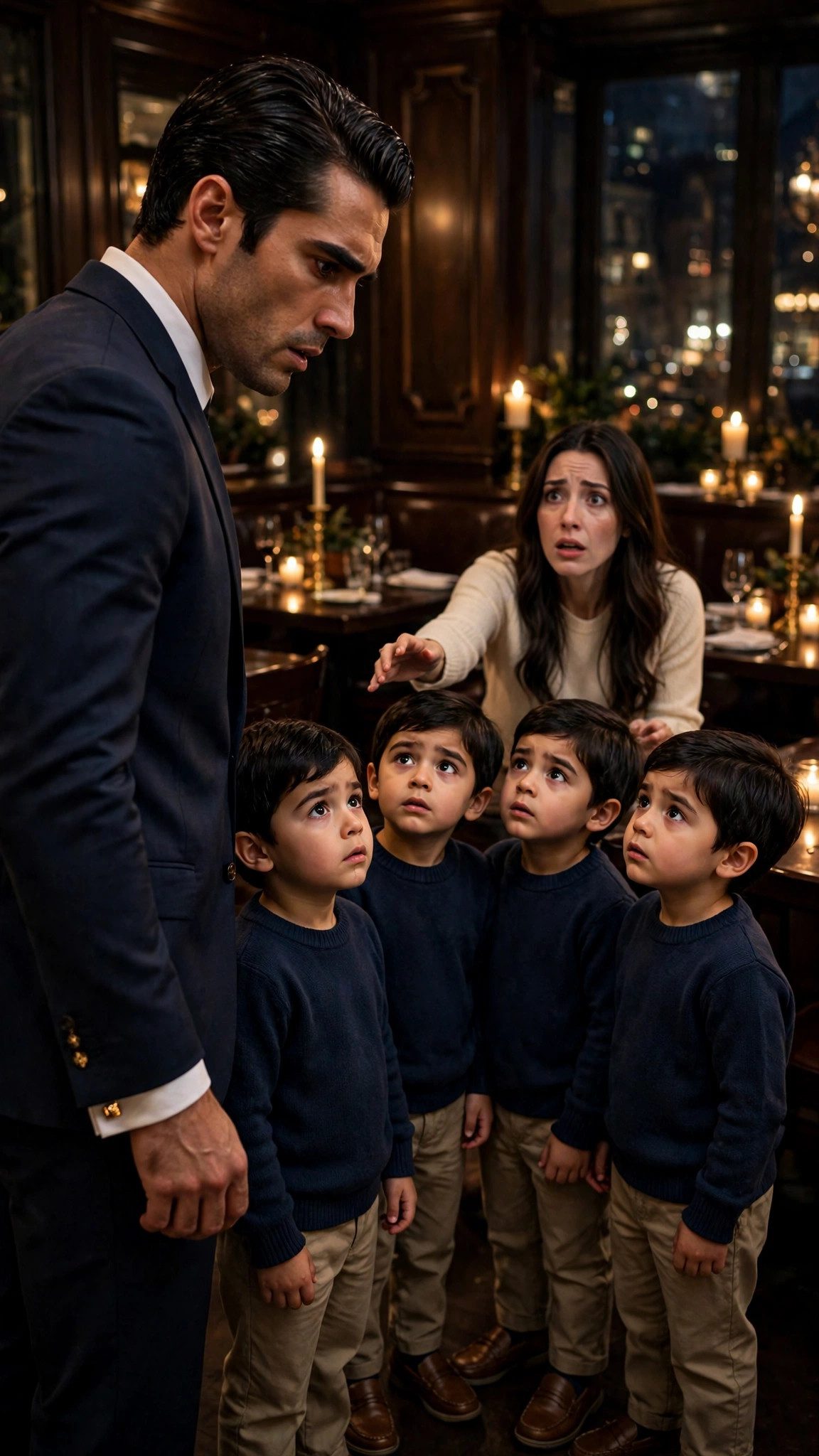
    The boys turned in their chairs to look at me. Four pairs of dark eyes. Four small faces with my cheekbones, my mouth, my stubborn crease between the eyebrows. The smallest of them, the one with a scrape on his knee, waved at me with the open, fearless friendliness of a child who has never been taught that strangers can be dangerous.

    "Hi," he said. "You're tall."

    "Luca," Isabella said quickly, too quickly, her voice tight. "Sit down, sweetheart. Eat your bread."

    But Luca kept looking at me, and then the others were looking at me too, and I realized with a strange, floating clarity that they were studying me the way children study a puzzle they almost recognize. One of them tilted his head, exactly the way I tilt mine. Another reached his left hand behind his neck.

    Isabella stood up. She came toward me fast, too fast, and she stopped a foot away from me with her hands clenched at her sides, and when she spoke, her voice was low and shaking and furious in a way I had never heard from her before.

    "You need to leave," she said. "Right now. Walk out that door and do not come back to this table."

    "Isabella," I said, and her name felt strange and perfect in my mouth after six years of not saying it. "Isabella, please. Just tell me—"

    "There is nothing to tell you," she said. "You are a stranger. These are my children. You will not frighten them."

    "I'm not trying to frighten anyone," I said. "I just need to know—"

    "You need to know nothing," she said, and her eyes were bright with tears she refused to let fall. "You made your choice six years ago, Dominic. You chose your family. You chose your name. You chose all of this." She gestured at the room, at the suit, at me. "So go back to it. Go propose to your perfect fiancée under your perfect glass roof. Leave us alone."

    The words hit me like a physical blow, because they were the words I had rehearsed in my own head a thousand times, the story I had told myself about why she left. She was throwing my own lie back at me, and hearing it from her mouth, I understood for the first time that she believed it too. She believed I had chosen. She believed I had let her go.

    "That is not what happened," I said quietly.

    "Then what happened?" she demanded. "Because I waited, Dominic. I waited three weeks. I called. I went to your building. Your doorman told me you were in New York. Your office told me you were in New York. Your father told me—" She stopped. Her mouth closed. Her face went very still, the way a person's face goes when they have almost said something they swore never to say.

    "My father told you what?" I asked.

    "Nothing," she said. "Go away, Dominic."

    "No," I said. "Not this time. Not again. Six years ago I let you walk away because I thought you wanted to go. I am not making that mistake twice."

    Behind her, the four boys had gone quiet. They were watching us with the wide, watchful eyes of children who understand far more than adults give them credit for. The oldest-looking one, the one who had smiled at me in the bathroom, slid off his chair and came to stand beside his mother, and he took her hand, and he looked up at me with open curiosity.

    "Are you the man from the bathroom?" he asked.

    "Matteo," Isabella said softly. "Go back to your seat."

    "But Mama, he looks like us," Matteo said, and the innocence of it nearly broke me in half. "He looks like all of us."

    I crouched down slowly, the way you approach a nervous animal, until I was at his eye level. The suit protested. I did not care.

    "What's your name?" I asked him, although I already knew.

    "Matteo," he said. "Matteo Fontaine. I'm six. These are my brothers. Luca, Enzo, and Nico. We're quadruplets. That means there are four of us. We were all born on the same day."

    "That's very impressive," I said, and my voice sounded rough to my own ears. "Four brothers. You must look after each other."

    "We do," Matteo said seriously. "Mama says we're a team."

    I looked up at Isabella. Her face was white. Her hand was shaking where it held Matteo's.

    "They're mine," I said. It was not a question. I had known it from the first second in the bathroom, from the first tilt of a small head, from the first hand reaching behind a small neck. But saying it aloud made it real in a way that knowing never had. "Isabella. They're mine. Aren't they?"

    She did not answer. She looked at me, and in her eyes I saw six years of nights alone with four crying babies, six years of working double shifts, six years of carrying a secret so heavy it had bent her spine. And I saw something else too, something that made my chest tighten with a fury I had never felt toward anyone in my life. I saw fear. Not fear of me. Fear of what my world would do to her children if it ever found them.

    "Please," she whispered. "Please don't do this here. Not in front of them."

    I stood up. I took a card from my jacket, my personal card, the one with only my private number on it, and I held it out to her. She stared at it as if it might bite her.

    "I am not proposing to Sloane Barrett tonight," I said, and I meant it with every part of me. The ring in my pocket suddenly weighed nothing at all. "I am going to walk out of this restaurant, and I am going to call off an engagement in front of two powerful families, and then I am going to find out what really happened six years ago. And Isabella—" I put the card down on the nearest empty table, where she could take it or leave it. "When you are ready to tell me the truth, call me. I will come. Wherever you are. Whenever it is. I swear it on my mother's grave."

    She said nothing. She gathered her boys with shaking hands, and she walked them out of the restaurant into the Boston night, and I watched the door close behind them, and I stood alone in a room full of people who had no idea that the entire course of my life had just changed.

    My phone buzzed again. Sloane. Then my father. Then Sloane again.

    I took the phone out, and I looked at the ring box in my other hand, and I thought about the glass roof and the string quartet and the photographer behind the palm tree, and I thought about four small faces with my cheekbones, and I made the easiest decision I had made in six years.

    I called my driver.

    "Rocco," I said. "Change of plan. I'm not going to the conservatory tonight."

    There was a pause on the other end of the line. Rocco had driven for my family for twenty years. He had seen everything. He had never once questioned an order.

    "Where are we going, boss?" he asked.

    "Home," I said. "And then, Rocco, I need you to find someone for me. A woman named Isabella Fontaine. I need to know where she lives, where she works, and who has been watching her. And Rocco—" I looked at the empty table where she had sat, at the bread basket with four small rolls missing. "Do it quietly. No one can know. Not my father. Not Sloane. No one."

    "Understood," Rocco said.

    I walked out of the restaurant into the cold Boston air, and the diamond ring sat in my pocket like a stone from someone else's life. Somewhere across the city, beneath a glass roof overlooking the Charles River, Sloane Barrett was waiting for a proposal that would never come.

    And somewhere in the dark, four six-year-old boys were going home with their mother, wearing my face, carrying my name in their blood, and I had six years to make up for.

    I had no idea yet what Sloane had done, or what my father had done, or how deep the lie went. I only knew one thing, and I knew it the way a man knows the ground is solid under his feet.

    I was not going to lose them twice.

  • Chapter 7: Home

    Chapter 7: Home

    We moved back into the house on Linden Lane on a Saturday in June, three months after my mother died, and the day was so beautiful it felt like the world was apologizing.

    The sun was shining. The garden my mother had planted forty years ago was in full bloom — roses along the fence, lavender by the front steps, the old oak tree in the backyard spreading its branches over the lawn like a blessing. Jason ran from room to room, shouting, opening every door, touching every wall, as if he needed to make sure it was all still there, as if he needed to prove to himself that home was still home.

    I stood in the kitchen, at my father's oak table, and I put my hands flat on the wood, and I closed my eyes, and I listened. The refrigerator hummed. The clock ticked in the hallway. A bird sang outside the window. And underneath it all, underneath the ordinary sounds of an ordinary house, I could hear my father's voice, from thirty years ago, standing on an empty lot on Linden Lane with me on his shoulders.

    "One day this will be yours, Clara-bear. Nobody can ever take that away from you."

    Nobody had. Not Marc. Not Falco. Not a developer from out of state. Not a forged signature. The house was mine. It was Jason's. It was ours, the way my father had always intended.

    Alexander came that afternoon, carrying a paper bag from the bakery and a toolbox — my father's toolbox, the one Marc had packed into a cardboard box and left on the porch, the one my father had left to Marc in his will "because a man should have something useful in his hands." Alexander had gotten it back. I never asked him how. I did not need to ask.

    "I thought you might want this," he said, setting the toolbox down on the kitchen table. "It belongs here. It belongs in this house."

    I opened the toolbox. Inside were my father's tools, arranged the way he always arranged them — the hammer on top, the screwdrivers in a row, the measuring tape coiled neatly, the level with the little bubble in the glass. They smelled of sawdust and oil and my father's hands. I ran my fingers over the hammer, and I thought about all the things that hammer had built — this house, that table, the window seat, the banister, my whole childhood — and I started to cry.

    Not the hard, gasping crying of grief. The soft, quiet crying of a woman who has finally come home.

    Alexander did not say anything. He did not try to fix it. He just stood beside me, in my father's kitchen, with his hands in his pockets, and he waited, the way he had waited twelve years to keep a promise, the way he had waited in the rain outside a restaurant for me to decide.

    When I stopped crying, I wiped my eyes with the back of my hand, and I said, "The porch needs fixing. The boards on the north side are loose. My father was going to fix them the spring he died, and he never got to it."

    Alexander looked at the porch through the kitchen window. "Then we'll fix it," he said. "Together. This weekend. I'll bring the wood. You bring the lemonade. Jason can hand us the nails."

    And that was how it started. Not with a grand gesture. Not with a declaration. With a porch. With loose boards and lemonade and a seven-year-old boy handing nails to a mafia boss like it was the most normal thing in the world.

    We fixed the porch that weekend. It took two days. Alexander worked the way my father had worked — slowly, carefully, measuring twice and cutting once, sanding every board smooth, because he said a little boy would be running his bare feet across that porch for the next twenty years and he did not want him to ever get a splinter. I watched him work, and I thought about my father, and I thought about the way some men build things with their hands because they love the people who will live in them, and I thought about how rare that is, and how lucky I was to have known two such men in my life.

    After the porch, we fixed the fence. After the fence, we painted the kitchen — a soft yellow, the color my mother had always wanted but never got around to choosing. After the kitchen, we planted a garden together, Jason and Alexander and me, kneeling in the dirt in the backyard, putting tomato plants in the ground the way my mother used to, and Jason got mud all over his face, and Alexander laughed, and I laughed, and for the first time in a very long time, the house on Linden Lane sounded like a home again.

    It was not fast. It was not easy. There were days when I woke up and the grief hit me fresh, like a wave, and I would stand in my mother's bedroom and look at her empty closet and feel the loss all over again. There were nights when Jason cried for his grandmother, and I held him, and I told him what my mother had told me: that she loved him first, before anybody, and that love does not end just because a person is gone.

    And there were days when I looked at Alexander — this man with his black suits and his black cars and his quiet power — and I wondered what I was doing, letting a mafia boss into my son's life, into my father's house, into my heart. I wondered if my father would approve. I wondered if my mother would approve. I wondered if I was making a terrible mistake.

    But then I would watch him with Jason — teaching him to hammer a nail straight, showing him how to tell oak from pine by the smell of the sawdust, sitting on the porch steps on summer evenings watching the fireflies — and I would see my father in him. Not the power. Not the money. Not the name that made people afraid. The patience. The steadiness. The way he kept his word.

    My father had seen it twelve years ago, in a hospital hallway at four in the morning. He had looked at a dangerous man and seen a good one. And he had been right.

    In September, on the first cool evening of the fall, Alexander asked me to walk with him in the garden. Jason was inside, doing his homework at the kitchen table — my father's table, where my family had eaten a thousand dinners — and the sun was setting, and the roses were still blooming along the fence, and the air smelled like rain and woodsmoke.

    We walked to the old oak tree in the backyard, the one my father had planted the year I was born, and Alexander stopped, and he turned to me, and he took my hands in his, and he said, "Clara Bennett. I have been waiting twelve years to ask you something. And I have been waiting three months to ask it properly. So here it is."

    He reached into his pocket and took out a small box. Inside was a ring — not a big ring, not a flashy ring, but a simple gold band with a single small diamond, the kind of ring a carpenter's daughter would wear.

    "Your father asked me to watch over you," Alexander said. "I did. I will. For as long as you will let me. But I don't want to watch over you from a distance anymore, Clara. I want to stand beside you. In this house. At this table. For the rest of our lives. If you'll have me."

    I looked at the ring. I looked at the oak tree. I looked at the house my father had built with his own hands, with its backwards R above the front door and its window seat and its oak table and its porch that Alexander and I had fixed together, board by board.

    And I thought about my mother, who had loved this family first, before anybody. And I thought about my father, who had built this house for me and told me nobody could ever take it away. And I thought about Jason, doing his homework at the kitchen table, waiting for me to come back inside.

    "Yes," I said. "Yes, Alexander. Yes."

    He put the ring on my finger. It fit perfectly. Of course it fit perfectly. Alexander Moretti did not do anything halfway.

    We were married the following spring, in the garden behind the house on Linden Lane, under the old oak tree my father had planted the year I was born. It was a small wedding. Rosa was there. Mr. Doyle was there. Mr. Hart was there. Enzo Moretti was there — thirty-one years old now, healthy and strong, with a wife and a baby daughter of his own — and he hugged me so hard I could barely breathe, and he said, "You saved my life, Clara. And now you're my sister. I couldn't be happier."

    Jason was the ring bearer. He carried the rings down the garden path in his navy suit — the suit my mother had bought him for Christmas, the one he had worn to her funeral, now a little too small in the shoulders — and he was so serious about it, so careful, that everyone laughed, and then everyone cried, because it was the most beautiful thing any of us had ever seen.

    Alexander and I said our vows under the oak tree, and when the minister asked if anyone objected, nobody did, because there was nothing to object to. There was only a house, and a garden, and a family, and a promise kept.

    After the wedding, we had dinner at my father's oak table — all of us, crowded around it, passing dishes, laughing, talking over each other, the way families do — and Jason stood up on his chair and raised his glass of apple juice and said, in his clear, serious, seven-year-old voice, "To Grandma. And to Grandpa. Thank you for building this house. Thank you for our family."

    And we all raised our glasses. And we all cried. And we all laughed. And the house on Linden Lane, the house my father had built with his own hands, plank by plank, board by board, held us all, the way it had always held us, the way it always would.

    Because a house is not just walls and a roof. A house is a promise. My father made that promise to me when I was four years old, standing on an empty lot with me on his shoulders. He kept it in his will. My mother kept it with her love. Alexander Moretti kept it with his word.

    And now, on quiet evenings, when the sun is setting and the fireflies are out and Jason is doing his homework at the kitchen table and Alexander is on the porch fixing something that does not really need fixing, I sit on the porch steps and I touch the backwards R above the front door, and I think about my father, and my mother, and everything they gave me.

    They gave me a house. They gave me a family. They gave me a promise.

    And nobody — not a husband, not a loan shark, not a forged signature, not all the money in Miami — nobody could ever take that away from me.

    Because the house her father built was never just a house.

    It was home. And it always will be.

    Our first Christmas in the house as a family was the best Christmas I have ever had, and I have had a lot of Christmases in that house.

    Alexander bought a tree so tall we had to cut six inches off the top to fit it under the ceiling, and Jason decorated it with ornaments my mother had collected over forty years — glass birds, wooden stars, a little angel with a chipped wing that my mother had loved more than any of them. Enzo and his wife came with their baby daughter, and Rosa came with her husband, and Mr. Doyle came with a bottle of wine older than Jason, and we all crowded around my father's oak table for dinner, and the house was so full of voices and laughter that I thought the walls might burst.

    After dinner, Alexander disappeared for a few minutes, and when he came back, he was carrying a small wooden box. He set it down in front of Jason, and Jason opened it, and inside was a child's toolbox — small, perfect, made of oak, with a tiny hammer and a tiny screwdriver and a tiny measuring tape, all arranged the way my father used to arrange his tools.

    "I made it myself," Alexander said. "In your grandpa's workshop. Well — in the garage, with your grandpa's tools. It took me three weeks. I wanted it to be right."

    Jason stared at the toolbox for a long time. Then he looked up at Alexander with wide eyes, and he said, "Is this mine? Really mine?"

    "It's yours," Alexander said. "A man should have something useful in his hands. That's what your grandpa used to say. And one day, when you're older, you're going to build things with those tools. Maybe you'll build a house. Maybe you'll fix a porch. Maybe you'll do something I can't even imagine yet. But whatever you build, you'll build it with your grandpa's tools, and his hands will be in yours."

    Jason hugged the toolbox to his chest like it was made of gold. And then he hugged Alexander, hard, around the neck, and Alexander closed his eyes, and for a moment the most feared man in Chicago looked like the happiest man in the world.

    On Christmas morning, before Jason woke up, Alexander and I drove to the cemetery where my parents are buried, side by side under the old oak tree, and we stood there in the cold, holding hands, with our breath fogging in the air.

    "Mom," I said quietly. "Dad. I want you to know — the house is safe. Jason is safe. I'm safe. And I'm happy. I know you worried about me. I know you wanted me to be strong. I am strong. But I'm not alone anymore. Alexander is here. He keeps his promises. Just like you said he would, Dad. Just like you knew he would, twelve years ago, in that hospital hallway."

    The wind moved through the oak tree above us. A bird sang, even though it was winter. And I swear, I swear on everything I have ever loved, that in that moment I felt my mother's hand on my shoulder, and my father's voice in my ear, saying what he used to say to me every night when he tucked me into bed.

    "Goodnight, Clara-bear. Sleep tight. The house will keep you safe. And so will I."

    I cried a little. Alexander held me. And then we drove home, to the house on Linden Lane, to the tree with the glass birds and the wooden stars, to Jason and his little oak toolbox, to Christmas morning and pancakes and the rest of our lives.

    That is the end of my story. Or maybe it is the beginning.

    The End.
    THE END

  • Chapter 7: The Name I Kept

    Chapter 7: The Name I Kept

    The divorce was finalized on a clear morning in March, six months after the night Helena was arrested.

    I stood in the courthouse in a navy suit I had bought for myself, with my own money, from an account that only I could access, and I listened to the judge read the terms. The house was mine to sell, and I had already sold it. The money was mine to keep. My name was mine to keep, too. Lauren Ellis Morgan. I had kept my father's name in the middle of it all along, and now I understood why my father had insisted on that, all those years ago, when I was a girl who thought a name was just a name.

    Luke sat across the room from me, in a gray suit, with his lawyer beside him. He did not contest anything. He did not ask for the house. He did not ask for the money. He signed every paper the judge put in front of him, and when it was over, he stood up, and he walked across the room, and he held out his hand to me.

    "Thank you," he said. "For telling me the truth. For giving me my father back. I know I don't deserve it. I know I hurt you in ways I can never undo. But thank you."

    I shook his hand. It was a strange thing to do, shaking hands with the man I had married at twenty-two, the man I had loved and lost and finally set free. But it felt right. It felt like the end of something, and the beginning of something else.

    "Take care of yourself, Luke," I said. "And take care of your father. He's been waiting a long time."

    "I will," Luke said. "I see him every Sunday now. We have dinner. He tells me stories about when I was a boy. He tells me about the bicycle. He tells me about the letters. I'm learning who he is. And I'm learning who I am, without my mother telling me."

    He paused, and he looked at me, and for a moment, he looked like the young man I had danced with at the charity gala, all those years ago, before the lies and the late nights and the gold hoops on my nightstand.

    "I hope you find someone who loves you the way you deserve to be loved," he said.

    "I already found her," I said, and I smiled. "Me."

    Helena's trial lasted four months. The evidence was overwhelming: the immunity agreement with her signature, the bank statements, the mechanic's notebook, Frank Calloway's testimony, Luke's testimony, and the photographs she had taken of Jennifer, which the FBI found in a safe in her bedroom, along with a second set of photographs she had taken of me, over the years, in my own apartment, through my own windows. She had been documenting all of us, for years, building files on the people she claimed to love, the way a general builds files on an enemy.

    The jury took three days to find her guilty on every count: murder, conspiracy, money laundering, obstruction of justice. The judge sentenced her to life in prison without the possibility of parole.

    She did not look at me when the sentence was read. She looked at the floor. And I thought, as I sat in that courtroom, that Helena Cross had spent her whole life making sure that no one could ever look down on her, and in the end, she had built a life that left her with nowhere to look but down.

    I did not go to see her in prison. I did not write to her. I did not forgive her. Forgiveness is a gift, and it is mine to give or not to give, and I chose not to give it to the woman who killed my father. That is my right. My father taught me that a record is a kind of power, and my record of Helena Cross is complete, and it is closed.

    Jennifer and I rebuilt our relationship slowly, the way you rebuild a house after a fire: one room at a time, carefully, with new materials, and with the understanding that some things can never be exactly the same as they were before.

    She apologized to me a hundred times, in a hundred different ways, and I told her, every time, that I heard her, and that I was trying, and that trying was enough for now. She moved into a small apartment of her own, and she started seeing a therapist, and she got a job at a gallery downtown, and she began to build a life that belonged to her, not to Luke, not to Helena, not to anyone else.

    One Sunday afternoon, six months after the divorce, Jennifer came to my new apartment for dinner. I had moved into a bright, airy place in the Heights, with a garden full of roses and a study where I kept my father's file and my leather notebook, side by side, on a shelf where I could see them every day.

    We cooked together, the way we used to when we were girls, and we laughed about the time Jennifer burned the Thanksgiving turkey and blamed it on the dog, and for a few hours, it felt like we were sisters again, not strangers who had hurt each other.

    "Lauren," Jennifer said, as we washed the dishes, "do you ever miss him? Luke, I mean. Do you ever miss what you had?"

    I thought about it for a long moment. I thought about the charity gala, and the dance, and the white dress, and the twelve years of Sunday dinners and late nights and insults counted in a leather notebook.

    "I miss the idea of him," I said. "I miss the man I thought I married. But that man never really existed. The real Luke was always his mother's son, until the day he chose to be his father's son instead. And I am proud of him for that. But I don't miss being married to him. I don't miss being quiet. I don't miss being counted."

    Jennifer nodded. She dried a plate and set it down.

    "I'm glad you found your voice," she said. "I always knew it was in there."

    Damian became a part of our lives in a way I had never expected. He came to Sunday dinners, not Helena's Sunday dinners, with their dark wood and their silver and their rules, but my Sunday dinners, in my bright apartment, with food we cooked ourselves and laughter that belonged to us.

    He told us stories about his life before prison, about the man he had been and the man he was trying to become. He told us about the security firm he had built, and the companies he helped protect, and the young men he mentored, men who had grown up the way Luke had grown up, without fathers, and who needed someone to tell them that a man's past does not have to be his future.

    He never tried to be my father. He knew better than that. My father was Daniel Ellis, and no one could replace him. But Damian became something else: a friend, an ally, a man who had stood beside me when I needed him, and who had kept his word.

    One evening, as we sat on my balcony watching the sun go down over Houston, Damian said to me, "Your father would be proud of you, Lauren. He told me once, in prison, that his daughter was the bravest person he knew. He said you had his stubbornness and your mother's kindness, and that one day, when it mattered, you would use both. He was right."

    I thought about my father that night, sitting in his study, reading his newspaper, doing all the voices, making me laugh until my stomach hurt. I thought about the file folder he had left me, and the photograph, and the page of handwriting that said: "Do not trust Helena. She killed a man once to protect a lie, and she will do it again."

    My father had been right about everything. He had been right about Helena. He had been right about Luke. He had been right about me.

    On the anniversary of my father's death, I went to the cemetery alone, early in the morning, before anyone else was there. I brought white roses — his favorite — and I set them on the stone, and I sat on the grass beside him, the way I used to sit beside his desk when I was a little girl, and I told him everything.

    I told him about the file, and the immunity agreement, and the mechanic's notebook. I told him about Damian Cross, and the fourteen letters, and the photograph of the boy on the bicycle. I told him about Helena's arrest, and the trial, and the sentence. I told him about the divorce, and the gallery I was planning, and Jennifer, and Luke, and the Sunday dinners that belonged to us now.

    "It's done, Dad," I said. "She's in prison. Luke knows the truth. Your name is clear. And I kept my own name on my own accounts, just like you told me to. I did what you asked. I came to the study first. And then I finished what you started."

    The wind moved through the oak trees above the cemetery, and the roses nodded on the stone, and for a moment, I could almost hear my father's voice, doing all the characters from the newspaper, making me laugh until my stomach hurt.

    I stayed there for an hour. And when I left, I did not cry. I felt something better than tears. I felt peace.

    That same week, Luke called me with news that made me laugh out loud for the first time in months.

    "Damian found the bicycle," he said. "The one from the photograph. It was in my mother's garage, under a tarp, behind boxes of Christmas decorations. She kept it all these years. She never threw it away. Damian and I spent the whole weekend rebuilding it. New tires. New chain. New paint. It's red now. The same red it was when I was nine."

    "Are you going to ride it?" I asked.

    "I'm going to give it to a boy at the community center," Luke said. "A nine-year-old boy whose father is in prison. Damian runs a mentoring program there now. He says every boy deserves a bicycle, and a father who shows up. I think he's right."

    I thought about that for a long time after we hung up. Helena had kept the bicycle, hidden under a tarp, for thirty years. She had kept the thing that proved her son had once been happy, and she had hidden it away, the way she had hidden the letters, the way she had hidden the truth. And now Luke and Damian had pulled it out of the dark, and rebuilt it, and given it to a boy who needed it.

    That was what redemption looked like. Not a grand gesture. Not a speech. A bicycle, rebuilt by a father and a son, given to a child who needed to know that someone would show up for him.

    A year after the divorce, I did something I had dreamed about since I was a girl, something I had put aside when I married Luke and became a wife and a hostess and a quiet girl at the end of a long table.

    I opened my own gallery.

    It was a small space in the Heights, with white walls and tall windows and a garden out back, and I filled it with art by women who had been overlooked, women who had been told they were too thin or too ordinary or too quiet, women who had stories to tell and no one to listen.

    The opening night was packed. Frank Calloway came, with Biscuit, who was not allowed inside but who sat by the door like a guardian. Jennifer came, and she cried when she saw her name on the wall as the gallery's first featured artist, because she had painted a series of portraits of our father, from memory, and they were beautiful. Luke came, with Damian, and they stood in the corner, two men who looked so much alike it made my chest ache, and they applauded when I cut the ribbon.

    And at the end of the night, when the last guest had gone and the gallery was quiet, I stood alone in the middle of the room, surrounded by art made by women who had refused to be erased, and I thought about the leather notebook, and the 237 insults, and the gold hoops, and the file folder, and the man in the armchair at 4:48 in the morning.

    I thought about everything I had lost, and everything I had found, and I understood something my father had tried to teach me a long time ago, on the night Luke proposed, when he told me to keep my own name on my own accounts.

    A name is not just a name. A name is a record. A name is a kind of power. A name is the proof that you existed, and that you mattered, and that no one, not a husband, not a mother-in-law, not a whole city full of whispers, could erase you.

    My name is Lauren Ellis Morgan.

    I am thirty-five years old, and I am free.

    In the gallery's first month, a woman came in, a stranger, and she stood in front of Jennifer's portraits of our father for a long time, and then she found me in the back room, and she said, "My mother-in-law told me I was too ordinary for her son, too. I stayed quiet for eleven years. Your gallery made me feel like I wasn't alone." She bought nothing. She just thanked me, and left, and I stood there for a long time afterward, thinking about all the women who keep count in silence, and about what happens when one of them finally decides to speak.

    And the man who never knew his father finally knows him. And the woman who was never acknowledged finally acknowledges herself.

    The End.

    THE END