Story Genres: Mafia Romance

  • Chapter 2: Twelve Years Ago

    Chapter 2: Twelve Years Ago

    I met Valerie Bennett on a Tuesday in October, in the waiting room of a free clinic on the west side of the city, and I was bleeding.

    Not badly. A knife had found the meat of my forearm during a disagreement in a warehouse that no longer exists, and my driver, a young man named Peter who had been with me less than a month, had driven me to the nearest place with a light on. I had told him to take me to our own doctor. He had panicked and taken me to a clinic with plastic chairs and a coffee machine that had not worked since spring.

    Valerie was twenty-six years old. She wore pale blue scrubs and her long brown hair was tied back in a knot that was coming loose. She took one look at my arm, one look at my face, and she did not flinch. She had seen worse, she told me later, on nights when the city brought its wounded to her door and asked no questions.

    "You need stitches," she said. "Eight, maybe ten. Sit down."

    "I don't sit in waiting rooms," I told her.

    "Then you'll bleed on my floor," she said, "and I'll have to mop it, and I hate mopping. Sit down."

    I sat down. I was thirty-three years old, already my father's right hand, already a man other men crossed the street to avoid, and I sat down in a plastic chair in a free clinic because a nurse with tired eyes told me to, and for the first time in my adult life I did what someone told me without calculating the cost.

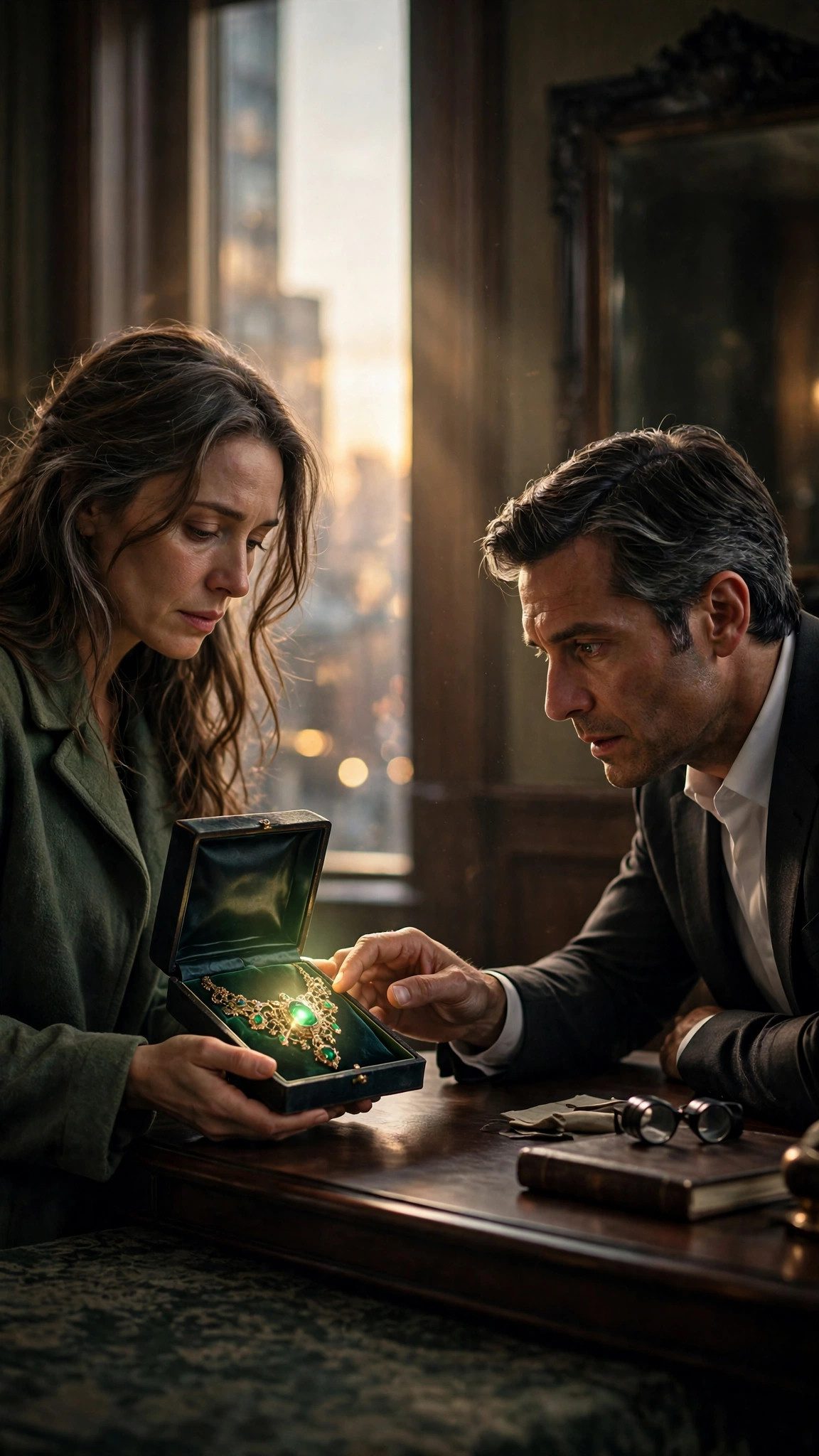
    She stitched my arm with hands that never shook. While she worked, she talked — not to me, really, but to the room, the way people talk when silence feels heavier than speech. She told me about her grandmother, Rose, who had raised her after her own mother went to work double shifts at a laundry. She told me about the necklace her grandmother kept in a velvet box at the back of a drawer, a 1921 emerald and gold necklace that Rose had worn exactly twice in her life: once on her wedding day, and once on the day her husband came home from the war.

    "She says it isn't jewelry," Valerie said, tying off the last stitch. "She says it's a promise. I never understood what she meant."

    I understood even less then. I understood only that her voice was warm and tired and that I wanted to hear it again.

    I came back the next week to have the stitches removed. I came back the week after that with a cut on my knuckle that did not need a doctor at all. By the third week, she was waiting for me with two cups of coffee from the machine that still did not work — she had brought a thermos from home — and by the fifth week, I was walking her home through streets my father would have forbidden me to walk, carrying her bag, listening to her talk about her patients and her mother and her grandmother's garden.

    Her mother, Margaret Ellis, was a laundry worker with hands red from hot water and a laugh that filled a room. Her grandmother, Rose Bennett, was eighty-one, sharp as a razor, with white hair pinned in a knot and eyes that missed nothing. Rose took one look at me the first time Valerie brought me to Sunday dinner and said, "You have your grandfather's eyes, young man. He had kind eyes too, before the world taught him to hide them."

    I did not know then what she meant. I thought it was the kind of thing old women say to be polite.

    Valerie and I fell in love the way people fall in love when neither of them is looking for it — slowly, then all at once. She taught me how to make soup from almost nothing. I taught her how to drive a car with a manual transmission in an empty parking lot at midnight, and she laughed so hard she cried when she stalled it for the sixth time. She told me about the boys who had asked her to dances in high school and the scholarship she had given up to help her mother. I told her nothing about my family. That was the first lie, and like most first lies, it made every lie after it easier.

    For six months, I lived two lives. In one, I was Nathaniel Cain, heir to the Cain family, sitting in rooms where men decided who lived and who lost everything. In the other, I was just Nathaniel, a man who carried groceries up four flights of stairs and fixed a leaking faucet with a wrench he had to borrow from a neighbor because he had never fixed anything in his life.

    My father, Victor Cain, found out in April. I do not know who told him. In my family, someone always tells. He summoned me to his office on the top floor of the building where, twelve years later, I would stand behind one-way glass and watch the woman I loved try to sell her grandmother's jewel.

    "You will end it," my father said. He did not raise his voice. My father never raised his voice. That was what made him terrifying.

    "She is a nurse, Father. She has nothing to do with our business."

    "Her grandmother is Rose Bennett," he said, and the name fell between us like a stone into still water. "Do you know who Rose Bennett was, Nathaniel? She was the woman your grandfather Elias loved before he married your grandmother. He gave her a necklace in 1921 — an emerald and gold necklace from the family collection. He promised her a life. Then he did his duty, married into the family, and left her with a jewel and a broken heart. That necklace is Cain property, stolen by sentiment, and it has been a shame on this family for ninety years."

    I stared at him. "Rose Bennett is an eighty-one-year-old woman who raised Valerie on a laundry worker's wages. The necklace is hers."

    "The necklace is ours," my father said. "And the girl is a reminder. You will go to her, and you will take back what belongs to this family, and you will end this before it costs us more than it already has. If you refuse, I will send men who will not be gentle, and I will make certain that Valerie Bennett and her family lose everything they have — her mother's job, her grandmother's apartment, the clinic where she works. Do you understand me?"

    I understood him perfectly. That was the worst of it. I understood that he was not bluffing, and I understood that the choice he offered me was not a choice at all.

    That night, I went to Valerie's apartment. It rained the way it rains when the sky has been holding it back all day. She opened the door in her green coat — new then, the color of spring leaves — with a chipped blue mug in her hands, and she smiled at me the way she always smiled, like I was the best part of her day.

    "Will you come back tomorrow?" she asked.

    I told her yes. I kissed her forehead. I held her for a long time, memorizing the way she fit against my chest, the smell of her hair, the sound of her breathing. And then I walked down four flights of stairs and out into the rain, and I never went back.

    I told myself I was protecting her. I told myself that a clean break was kinder than the truth. I told myself that my father would leave her alone if I disappeared quietly, and that the necklace — the jewel my grandfather had given her grandmother out of love — would stay where it belonged, with the woman who had kept it safe for ninety years.

    I never told my father that I had not taken the necklace. He assumed I had failed, or that I had chosen to leave it as a final mercy. He never asked, and I never offered. It was the one act of defiance I allowed myself, and I buried it under twelve years of empire-building, telling myself it did not matter.

    But it mattered. It mattered every single day, in every room where I stood behind glass and watched other people's lives, unable to live my own. It mattered in the way I never married, never let anyone close, never allowed myself to want anything the way I had once wanted a life with Valerie Bennett in a small apartment with a leaking faucet and a woman who laughed when she stalled a car.

    On the morning of the appraisal, Marcus had come to my office with a file and a face I had not seen on him in twenty years.

    "Mr. Cain," he had said, "a woman named Valerie Bennett has requested an appraisal of a 1921 emerald and gold necklace. She needs one thousand dollars for her mother's chemotherapy. She does not know the value of what she holds. She does not know who owns this building. She does not know you are here."

    I had looked at the file for a long time. Her name, written in Marcus's careful hand. Her address. The hospital where her mother lay. The electricity bill, marked for disconnection.

    "Set the appraisal for today," I had said. "I will watch from behind the glass."

    Marcus had nodded, but his eyes had held a question he did not ask. Twelve years ago, Marcus had driven me home from Valerie's apartment in the rain. He had sat in the car outside her building for an hour while I tried to stop shaking. He had never once mentioned that night, and he had never once asked me why I left her. That was Marcus. He knew everything, and he waited for me to be ready to know it too.

    There were Sundays, too — Sunday dinners at Rose's apartment, where the table was too small for four people and the food was always too much. Rose cooked the way women of her generation cooked: without recipes, without measuring, with a wooden spoon and a lifetime of practice. She made soup that could cure anything, or so Valerie claimed, and bread that Nathaniel ate until he was ashamed of himself, and a lemon cake that Rose served with a small, proud smile, as if the cake were a member of the family.

    At those dinners, Rose would watch Nathaniel the way old women watch young men they are deciding whether to trust — not with suspicion, but with attention. She asked him questions no one else had ever asked him: what he read, what he believed, whether he was happy. He did not know how to answer the last one. No one had ever asked him if he was happy. He told her the truth, which was that he did not know, and Rose nodded as if he had said something wise.

    "Your grandfather had the same look," she said one Sunday, refilling his cup. "Elias. He would sit at this very table and stare out the window like the answer was out there somewhere. He never found it, my boy. Don't be like him. Don't spend your life looking out the window."

    Nathaniel did not ask who Elias was. He assumed Elias was Rose's late husband, the man who had come home from the war. He was wrong, and it would take him twelve years to learn how wrong he was.

    There was also the parking lot — the empty lot behind the clinic where, on a cold night in November, Nathaniel taught Valerie to drive a car with a manual transmission. She stalled it six times, and each time she laughed harder, until she was crying with laughter, and he was laughing too, and the car was full of the sound of two people who had forgotten, for a little while, that the world was a hard place. On the seventh try, she got it right, and she drove in a slow, triumphant circle around the empty lot, and he cheered from the passenger seat like she had won a race.

    "You did it," he said, when she finally stopped the car and turned off the engine.

    "I did it," she said, breathless, her hands still on the wheel. "I actually did it."

    He kissed her then — not the careful kiss of a man who is afraid, but the real kiss of a man who has stopped being afraid, at least for one night, in an empty parking lot, with a woman who laughs when she stalls a car.

    There were other nights, too. Nights when Valerie worked late at the clinic and Nathaniel waited outside with coffee, and they walked home together through streets his father would have forbidden him to walk, past shops with their shutters down and windows lit gold. Nights when Margaret, Valerie's mother, invited him to stay for dinner, and he sat at their small kitchen table eating stew out of a chipped bowl, and Margaret told him stories about the laundry, and about raising Valerie alone after her husband died, and about Rose, who had raised them both with an iron will and a soft heart.

    "I don't know what you do for a living, Nathaniel," Margaret said to him once, in the kitchen, while Valerie was in the other room. "And I don't ask, because Valerie is happy, and that is enough for me. But I will tell you one thing, and I want you to remember it. My daughter has a heart like her grandmother. She loves completely, or not at all. If you are going to love her, love her completely. And if you are going to leave her, leave her cleanly, and do not come back to pick at the wound."

    He promised her he would love Valerie completely. It was the second lie he told, and like the first, it made every lie after it easier — until the night his father summoned him, and the lies ran out, and all that was left was the truth he was too afraid to speak.

    Now, standing behind the glass, watching the door open and a stranger walk in claiming the necklace belonged to his wife's family, I finally understood what Marcus had been waiting for me to see. The document he slid across the desk was not just a piece of paper. It was the truth my father had hidden from me for twelve years — and it was the reason Valerie Bennett was standing in that room, holding her grandmother's jewel, with a man who wanted to take it from her.
  • Chapter 1: The Woman Behind the Glass

    Chapter 1: The Woman Behind the Glass

    Grown men had begged me for mercy without stirring a single emotion in my chest, but the moment I saw the widow I had secretly loved selling her grandmother's last jewel, I forgot how to breathe.

    I stood behind the one-way glass on the fourteenth floor of a building I quietly owned, watching the private appraisal room the way I had watched a hundred rooms before it — cold, patient, untouchable. The city spread itself below us in late afternoon light, gold on glass and steel, and none of it mattered. None of it had mattered for twelve years, not since the night I walked away from the only woman I had ever loved and did not look back.

    Her name was Valerie Bennett. She was thirty-eight years old now. She wore a faded green coat pulled tightly across her soft figure, the kind of coat a woman buys once and wears for a decade because there is never money for another. Her long brown hair fell past her shoulders, threaded now with grey I had not put there, and exhaustion shadowed the warm brown eyes that had once made me dream of becoming a better man.

    She did not know I was watching. She had not known, for twelve years, that I had never truly stopped watching. Marcus had reported to me, quietly, once a year, in the way he reported everything — without judgment, without commentary, simply the facts. Valerie had married a schoolteacher named Thomas Bennett. She was happy, Marcus had said, and I had told him never to tell me more than that, because more than that would have broken me. Later, Marcus had told me that Thomas had died, and that Valerie worked at a care home, and that her mother was ill. I had sent money once, anonymously, through a charity — enough to cover a hospital bill — and I had told myself it was the least I could do, and the most I was allowed to do. I had been wrong about both. The least I could do was nothing. The most I was allowed to do was everything. It took me twelve years, and a widow in a faded green coat, to learn the difference. She believed she was alone in that room with my advisor, Marcus Hale, and a small velvet box that held everything her family had left.

    "Are you sure you want this one, Mr. Cain?" Marcus asked quietly from beside me. He was sixty-two, grey-haired, loyal in a way no other man alive had ever been loyal to me. He had never once contradicted a decision of mine. His disapproval now was written in the set of his shoulders, in the way he did not look at me.

    "She was never just anyone to me," I said in a low voice, believing she was too far away to hear.

    In the room beyond the glass, Valerie set the small box on the table. Her hands were steady when she opened it. They shook only when she spoke of what was inside.

    "I was hoping you could assess this," she said. "It belonged to my grandmother."

    Marcus stayed silent. He knew me better than anyone alive. He knew the cold expression I maintained during business negotiations, the face that had made grown men beg. He also knew the truth my father had forced me to accept years ago, the obligation that made me leave Valerie without explanation.

    "It is a 1921 emerald and gold necklace," Marcus said, hiding his surprise well. "A rare piece. From a personal collection. One of a kind."

    Valerie asked nothing more. She told him plainly that her mother's medical bills had drained every account she had. The electricity would be disconnected soon. She needed one thousand dollars, urgently, for her mother's chemotherapy. That was her only thought.

    One thousand dollars. The necklace in that box was worth nearly two hundred thousand.

    Openly deceiving her would have been simple. I had deceived better people than Valerie Bennett for far less reason, and I had slept soundly after every one of them. But for the first time in years, that option left a bitter taste in my mouth.

    Valerie moved toward the window, and the city light touched the grey threads in her long brown hair. My throat tightened. Twelve years apart had not touched her beauty, yet time had proven cruel to her. There were lines at the corners of her eyes now, and a thinness in her cheeks that spoke of meals skipped so someone else could eat. She had married after I left her. She had buried a husband. She had kept her mother alive on a nurse's aide salary and a will that should have broken years ago.

    I had built an empire in those twelve years. I had taken my father's business and made it larger, colder, and more feared than it had ever been. I owned buildings in three cities. I owned men who owned other men. And I had never once, in twelve years, been able to forget the sound of her laugh in a small kitchen on a rainy night, or the way she had looked at me like I was a man worth saving.

    Then the appraisal room door opened, and a man I recognized immediately walked in.

    "Excuse me," he demanded, his voice cutting through the quiet like a blade. "I am here about the necklace. It belongs to my wife's family."

    That moment changed everything I believed about the owner of that jewel.

    The man's cold smile and his casual certainty made it clear he was accustomed to taking what he wanted. His voice grew sharp as Valerie's grandmother's jewel was suddenly handled in a way that felt like a threat to my eyes.

    "That necklace belongs to my family," he said.

    I felt my pulse quicken as memories of our final night together came crashing back. Valerie had never mentioned family. What my father ordered me to force her to give up all those years ago had something to do with what this man wanted now.

    Marcus looked at me, his face suddenly pale, and slid one final document across the desk.

    I did not touch it yet. I stood behind the glass, watching the woman I had loved for twelve years in silence, and for the first time since my father's funeral, I was afraid — not of the man in the room, and not of what the document said, but of what I would have to become if I let history repeat itself.

    Twelve years earlier, on the last night I ever spent with Valerie Bennett, it had rained the same way it rained over the city now — hard, grey, and endless. She had stood in the doorway of her small apartment with a chipped blue mug in her hands, wearing the same green coat, new then, and she had asked me one question.

    "Will you come back tomorrow?" she had said.

    I had lied to her. I had told her yes, and then I had walked down four flights of stairs and out into the rain, and I had never gone back. My father had given me a choice that was not a choice at all: the family or the woman. The necklace or her life as she knew it. I had chosen the family, and I had told myself for twelve years that it was the only choice a man like me could make.

    Standing behind that glass, watching her hands shake over her grandmother's jewel, I understood for the first time that my father had not given me a choice. He had given me a cage, and I had lived in it for twelve years, calling it an empire.

    That morning, Valerie had woken before dawn, the way she always woke when something important was going to happen — not with an alarm, but with a jolt, her heart already racing before her eyes were open. She lay in the dark for a long time, listening to the radiators click and the street sweepers pass below, and she went over the plan the way she had gone over it a hundred times: the bus across the city, the building on the fourteenth floor, the appraisal, the one thousand dollars, the hospital before Friday. She got up and made tea she did not drink, and she stood at the kitchen window watching the sky turn from black to grey, and she thought about her mother sleeping in the next room, breathing the shallow, careful breaths of a woman whose lungs were losing a war.

    She dressed the way her grandmother had taught her to dress for important occasions: slowly, and with intention. The pale blue blouse with the least wear. The dark skirt Thomas had liked. The shoes she had polished the night before. She brushed her long brown hair until it shone, and she tied it back the way she had worn it when she was a nurse, because nurses are trusted, and today she needed to be trusted. She put on the green coat last, the way she always put it on last, and she stood in front of the hallway mirror for a moment, looking at the woman there — thirty-eight years old, tired, frightened, and still standing — and she said to her reflection, "For Mama," the way she had said it every morning for a year.

    The bus ride across the city took forty minutes. Valerie sat by the window with the velvet box in her bag on her lap, and she watched the city wake up: the bakery opening its shutters, the men in suits buying coffee, the mothers walking children to school. She thought about the necklace, and about Rose, and about the letter she had not read in years. She thought about the day Rose had pressed the velvet box into her hands, three years ago, in the hospital, with tubes in her arms and a voice so thin it was barely a whisper. "Keep it safe, my girl," Rose had said. "And when the day comes that you need it more than you love it, let it go without shame." Valerie had promised, and she had kept the box at the back of a drawer ever since, and now the day had come, and she was letting it go, and the shame she felt was not for selling it — it was for the relief she felt underneath the grief, the small, guilty relief that there was still something left to sell.

    The building was taller than any building she had ever entered. The lobby was all marble and quiet, and the receptionist looked at her green coat and her worn shoes and did not blink. The elevator was silent and fast, and it made her ears pop. On the fourteenth floor, a corridor of thick carpet and closed doors led to the appraisal room, and a young woman with a kind face offered her water, and Valerie said no, thank you, and sat down in a chair that was softer than her bed at home, and waited, with her hands folded in her lap, for a man named Marcus Hale to tell her what her grandmother's life was worth.

    On the other side of the one-way glass, Nathaniel Cain had arrived an hour earlier, and he had stood in the dark observation room with a cup of coffee he had not touched, watching the empty chair where Valerie would sit. Marcus had briefed him the way Marcus always briefed him: quietly, thoroughly, and without telling him what to feel.

    "She comes at two o'clock," Marcus had said. "She has asked for one thousand dollars. She does not know the value. She does not know you are here. She does not know anything except that her mother needs medicine."

    "Does she know about the will?" Nathaniel had asked.

    "No," Marcus had said. "Rose told me to keep it until the day someone came for the necklace. That day is today. I have kept my promise for twenty-eight years, Mr. Cain. Today, I intend to keep it."

    Nathaniel had stood at the glass for a long time after Marcus left, looking at the empty room, and he had thought about the last night with Valerie — not the lie he had told her, but the truth he had carried up four flights of stairs and out into the rain. He had thought about his father's office, and the choice that was not a choice, and the twelve years of empire he had built on top of a wound that had never healed. He had thought about the drive home that night, with Marcus in the driver's seat, saying nothing, and the rain on the windshield, and his own hands shaking so hard he had to press them flat against his knees to make them stop.

    He had not known, standing there in the dark, that a man named Vincent Castellano was already on his way to the building, with two men in dark suits and a folder full of forged papers, and a wife who had never met Rose Bennett and never would. He had not known that the day would end with a will, and a letter, and a truth ninety years old. He had known only one thing: that the woman he had loved for twelve years was about to walk into the room beyond the glass, and that for the first time since the night he left her, he would be in the same building as her, breathing the same air, and he would not be able to hide from what he had done.

    When the door opened and Valerie walked in, in her faded green coat, with the velvet box in her hands, Nathaniel Cain forgot how to breathe — and twelve years of silence began, finally, to end.

    Marcus's voice pulled me back to the room. "Mr. Cain," he said softly. "The document."

    I looked down at the paper he had slid across the desk. It was old, yellowed at the edges, written in a hand I recognized even after all these years. My grandfather's hand.

    And in that moment, I knew that nothing about the necklace — or about Valerie, or about the night I left her — had ever been what my father told me it was.

  • Chapter 7: The Ring, Returned

    Chapter 7: The Ring, Returned

    The fundraiser was held in the same ballroom where I had met Declan Mercer twenty-six years earlier, the grand ballroom of the Whitmore Hotel, with its chandeliers and its polished floors and its long tables covered in white linen. But this time, the fundraiser was different. This time, it was in memory of my grandmother, Rose Hamilton, and the money raised would go to the children's ward at St. Catherine's Hospital, to buy new monitors, and new beds, and new hope for the children who needed it most.

    I stood at the entrance in a dark green dress, with my hair swept up the way my grandmother used to wear hers, and I watched the people arrive, and I thought about how much had changed since the night I first walked into this room in a borrowed black dress, stepping on the hem, pretending to read the auction catalog. I was twenty-two then, and I believed that medicine was a clean profession, and that the world rewarded competence. I was forty-eight now, and I knew better, and I knew worse, and I knew that the world was complicated and dark and beautiful, all at the same time.

    Helen was beside me, in a silver dress, with her arm linked through mine, and she leaned close and whispered, "You look like your grandmother tonight."

    "Thank you," I said, and I meant it.

    Marcus arrived next, with his wife, Elena, and he kissed my cheek, and he said, "Sarah, whatever happens tonight, I want you to know that I owe you my life, and I will never forget it."

    "You do not owe me anything," I said. "You are family."

    Victoria arrived last, in a soft blue dress that showed the gentle curve of her stomach, and she walked in slowly, with her head high, and the room went quiet when people saw her, because everyone in the city knew who she was by now, and everyone knew what had happened, and no one knew what to say. She came straight to me, and she took my hand, and she said, "Thank you for asking me to come. Thank you for making me family."

    "You are family," I said, and I held her hand, and I did not let go.

    The evening went on. There were speeches. There was an auction. There was music, and dancing, and champagne, and all the glittering people of the city, congratulating themselves for caring about children. And I moved through it all like a woman in a dream, smiling, nodding, shaking hands, until the moment came for my speech.

    I had not planned to give a speech. Declan had planned it. He had arranged it with Helen, and with the hospital board, and with the organizers, and he had not told me, because he knew I would have said no. But when the master of ceremonies called my name, and the room went quiet, and the lights dimmed, and a single spotlight found me, I stood up, and I walked to the podium, and I looked out at the sea of faces, and I knew what I had to say.

    "My name is Sarah Hamilton," I said, and my voice was steady, because I was a doctor, and doctors do not break, not even now. "Twenty-six years ago, I walked into this ballroom in a borrowed dress, and I met a man who listened to me. Tonight, I am standing in this ballroom to tell you about the woman who taught me to listen. My grandmother, Rose Hamilton, came to this country with nothing but a diamond ring sewn into the pocket of her coat. That ring had survived the war. It had survived the invasion. It had survived the crossing of an ocean. She sold everything else she owned to keep us fed, but she never sold the ring. 'This ring is our family,' she used to tell me. 'As long as we have this ring, we have each other. It is protection. It is love. It is history. Never let anyone take it from you.'"

    The room was silent. I could see Declan standing at the back, in his pressed navy suit, watching me, and his face was pale, and his hands were clasped in front of him, and I knew what he was thinking, because I was thinking it too.

    "My grandmother gave me that ring on my eighteenth birthday," I said. "And on my wedding day, my husband took it from my finger, and he locked it away, and he promised me I would never need it again. He was wrong. I needed it. I needed it every day for four years. I needed it when I lost my son. I needed it when I spent a winter alone in Boston. I needed it when I learned that my husband had broken every promise he ever made to me."

    A murmur went through the room. People shifted in their seats. Someone coughed. I did not stop.

    "But tonight," I said, "I am not here to talk about what was taken from me. I am here to talk about what was returned. Because this week, I learned something about my husband, and about my family, and about myself. I learned that the man I married is not a perfect man. He is a man who has made terrible mistakes. But he is also a man who has spent four years trying to build a way out of the darkness, for me, for his brother, for this city. And I learned that the family I married into is not a perfect family. But it is a family that can change. It is a family that can choose love over law, and truth over tradition, and protection over power."

    I paused, and I looked out at the room, at the faces, at Helen, at Marcus, at Victoria, and finally at Declan, and I said, "My grandmother's ring is a symbol of protection, and love, and family history. Tonight, I am giving it back to the family it belongs to. Not because I am giving up. But because I am choosing. I am choosing this family. I am choosing this man. I am choosing this life. And I am choosing to believe that we can be better than we were."

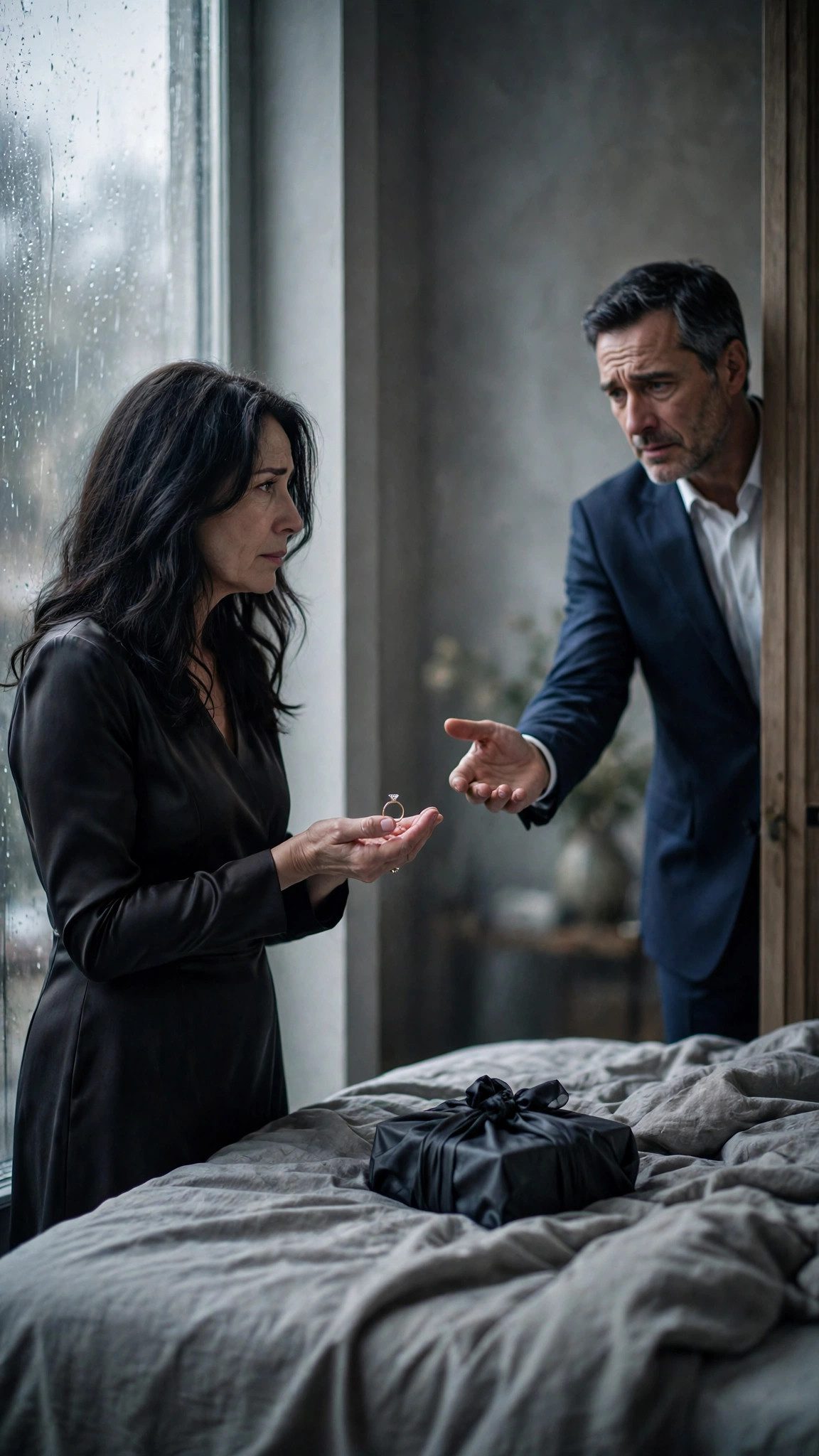
    I stepped away from the podium, and the room was silent, and then Declan was walking toward me, across the ballroom floor, through the sea of faces, and he was carrying something in his hand, something wrapped in dark silk, and when he reached me, he knelt down on one knee, in front of the whole city, and he unwrapped the silk, and there it was. My grandmother's diamond ring.

    "Sarah Hamilton," he said, and his voice was deep, and sad, and steady, and it carried across the silent ballroom. "Twenty-six years ago, I met you in this room, and you told me that the children's ward needed monitors more than it needed a ballroom full of people congratulating themselves. You were right then, and you are right now. I took your grandmother's ring from you on our wedding day, and I told you that you would never need it again. I was wrong. You needed it. You needed it every day. And I am sorry. I am sorry for Boston. I am sorry for the baby. I am sorry for every promise I broke. But I am here now, and I am telling you the truth, in front of everyone, and I am asking you to let me put this ring back where it belongs."

    He held out the ring, and I looked down at him, at the man I had married, at the man who had betrayed me and protected me and lied to me and loved me, all at the same time, and I thought about my grandmother, and about the war, and about the invasion, and about the crossing of an ocean, and about the five months I had carried my son, and about the winter in Boston, and about Victoria, and about the baby, and about the ledger, and about the council, and about everything that had brought us to this moment.

    And then I held out my hand.

    Declan slid the ring onto my finger, slowly, gently, the way you handle something sacred, and the diamond caught the light of the chandeliers, and it sparkled, and the room erupted. People stood up. People clapped. People cheered. Helen was crying. Marcus was crying. Victoria was crying, with her hand on her stomach, smiling through her tears. And I was crying too, because I was a doctor, and doctors do not break, but sometimes, on the best nights of their lives, they do.

    Declan stood up, and he took me in his arms, and he held me, and he whispered my name in the dark of the ballroom, the way he used to whisper it in the dark of our bedroom, and he said, "I love you, Sarah. I have always loved you. I will always love you. What is mine is yours. That was my promise, and from tonight, I keep it."

    "And what is mine is yours," I said. "That is my promise. And from tonight, I keep it too."

    We danced then, slowly, in the middle of the ballroom, while the orchestra played, and the city watched, and the ring sparkled on my finger, and I thought about my grandmother, and I knew, with a certainty that went deeper than words, that she was watching over us, and that she was proud.

    In the months that followed, everything changed, and nothing changed, both at the same time. Declan closed the gambling rooms. He sold the trucking companies to a legitimate corporation, and he used the money to fund the hospital, and the foundation, and the children's ward. He gave the family to Marcus, who led it with a steady hand and a clear heart. Aldo Mercer left the city and never came back. Vincent Castellano was arrested, and his empire fell apart, and the city breathed easier.

    Victoria's baby was born on a spring morning, a boy, with dark hair and dark eyes, and I was there, in the delivery room, with my hands steady and my heart full, and I held him when he took his first breath, and I whispered to him, "Welcome to the family, little one. You are loved. You are protected. You are home." We named him James, after the son I had lost, and after Declan's father, and Victoria smiled when she heard the name, and she said, "James Mercer. It is a good name. It is a strong name. It is a name that means family."

    I became his godmother. I held him at his christening, in the same chapel where Declan and I had been married, and I looked at the ring on my finger, and I thought about my grandmother, and I knew that the circle was complete.

    Declan and I moved to the house in Maine, the house he had bought under a company name I had never heard of, with the garden, and the porch, and the view of the sea. We kept the house on the hill too, for when we came back to the city, for Victoria and James, for Marcus and Elena, for Helen, for all the people we loved. We visited often. We had Sunday dinners. We celebrated birthdays. We argued, sometimes, the way married people do, and we made up, the way married people do, and we held hands in bed, and we whispered each other's names in the dark.

    And sometimes, on quiet evenings, Declan and I sit on the porch in Maine, and we watch the sea change color, and he holds my hand, and I look at my grandmother's ring, and I think about a ballroom, and a borrowed dress, and a man in a navy suit who listened to me the way no one had ever listened to me before.

    One year after the fundraiser, on the anniversary of the night Declan put the ring back on my finger, we returned to the city, and we held a second fundraiser, in the same ballroom, for the same children's ward, and this time I did not wear a borrowed dress. I wore a dress Declan had bought for me, dark green, the color of the sea in Maine, and my hair was swept up the way my grandmother used to wear hers, and Victoria was there, with James in her arms, and James was one year old, and he had Declan's dark eyes, and he reached for my ring, and he laughed when it caught the light.

    Helen was there, and Marcus, and Elena, and Frank DeLuca, who had become one of our closest friends, and the room was full of people who had once been afraid of the Mercer family, and who were now proud to stand beside it. And when the master of ceremonies asked me to say a few words, I stood up, and I walked to the podium, and I looked out at the sea of faces, and I said, "One year ago, I stood in this room and told you about my grandmother's ring. Tonight, I am standing here to tell you that the ring is home. And so am I."

    After the speeches, Declan took me by the hand, and he led me to the center of the ballroom floor, and the orchestra began to play, and we danced, slowly, the way we had danced a year before, and Victoria danced with James in her arms, and Marcus danced with Elena, and Helen danced with Frank, and the whole room danced, and the chandeliers sparkled, and the ring sparkled on my finger, and I thought about my grandmother, and about James, my son, who had lived for five months and who would live forever in my heart, and about James, Victoria's son, who was laughing in his mother's arms, and about the circle of life, and about how loss and love are not opposites, but companions, walking side by side, through every year of our lives.

    Later that night, when the ballroom had emptied, and the musicians had gone home, and the chandeliers had been dimmed, Declan and I stood alone on the dance floor, and he took my hand, and he looked at the ring, and he said, "Sarah, do you remember what I promised you on our wedding day?"

    "You promised me that what was yours was mine," I said.

    "And do you remember what you promised me?" he asked.

    "I promised you nothing," I said, and I smiled. "I was too young to know what to promise."

    "Then promise me now," he said. "Promise me that you will never let anyone take that ring from you again. Not me. Not the family. Not the world. Promise me."

    "I promise," I said, and I held up my hand, and the diamond caught the last light of the chandeliers, and it sparkled, and I knew, with a certainty that went deeper than words, that my grandmother was watching over us, and that she was proud, and that the ring was home, and that I was home, and that we were, finally, a family.

    And I think about how the most dangerous thing about Declan was never that he owned the entire city.

    The most dangerous thing about Declan was that he loved me enough to break every rule in his world to protect me, and that I loved him enough to forgive him for it.

    My name is Sarah Hamilton. I am forty-eight years old. I am a doctor. My hands have held life and death at the same time. And I have learned, finally, that the ring my grandmother gave me was never about the diamond.

    It was about the promise. The promise that no matter what happened, no matter how hard the world became, family would protect family. And as long as we have this ring, we have each other.

    The End.

    THE END

  • Chapter 6: Bloodlines

    Chapter 6: Bloodlines

    The council met in the back room of a restaurant that had belonged to the Mercer family for forty years, a room with no windows and a single long table, and a chandelier that cast more shadow than light. I had never been in that room before. Women were not invited to the council. Women were not even told that the council existed. I knew that, and I went anyway.

    Declan went in first. Then Marcus. Then me. Then Victoria, who walked in with her head high and her hand on her stomach, and Helen, who walked beside her like a bodyguard, which, in a way, she was.

    Aldo Mercer was already seated at the head of the table, with his white hair and his cold eyes, and around him sat the other men of the council — six of them, all older, all in dark suits, all with the faces of men who had spent their lives making decisions about other people's lives. They looked up when we walked in, and the room went silent, and I could feel the weight of their stares, and I did not look away.

    "What is this?" Aldo said, and his voice was calm, and that calm was the most dangerous sound in the room. "Declan, why have you brought women into this room? This is a council. This is not a place for women."

    "These women," Declan said, and his voice was steady, and I was proud of him in that moment, prouder than I had been in years, "are the reason this council exists. And they are the reason it is about to change."

    Aldo laughed. It was a short, cold laugh, and it did not reach his eyes.

    "Change?" he said. "The old law does not change, Declan. The old law has kept this family alive for three generations. A boss without an heir is a dead boss. You know this. You agreed to it. You produced an heir. The law is satisfied. Now sit down, and let us discuss the future."

    "The future," I said, and my voice carried across the room, clear and steady, the voice I used in the emergency room when I needed everyone to listen, "is what I am here to discuss, Mr. Mercer. And the future does not belong to you."

    Aldo turned his cold eyes on me, and he looked at me the way a man looks at an insect that has wandered onto his table.

    "Mrs. Mercer," he said, "you do not speak in this room."

    "I speak wherever I choose to speak," I said. "I am a doctor. I have held life and death in my hands at the same time. I am not afraid of you. I am not afraid of this room. And I am not afraid of the old law, because I have read your ledger, Mr. Mercer, and I know what the old law really is."

    The room went very still. Aldo's face did not change, but something in his eyes did, a flicker, a crack, the way ice cracks on a river in spring.

    "I do not know what you are talking about," he said.

    "Then let me explain it to you," I said, and Declan set the ledger on the table, and he opened it to the pages near the back, and he slid it across the polished wood toward Aldo, and the sound of the leather on the wood was the loudest sound in the room.

    "Two years," Declan said. "Two years of payments. Two years of routes. Two years of meetings with Vincent Castellano. Two years of selling our family to our greatest enemy, while you stood in this room and preached about bloodlines and the old law. The old law was never about an heir, Aldo. The old law was about you. It was always about you."

    Aldo looked down at the ledger, and he did not touch it, and for a long moment no one spoke, and then one of the other council members, an old man named Frank DeLuca, who had been Declan's father's closest friend, reached out with a shaking hand, and he turned a page, and then another page, and then he looked up at Aldo, and his face was gray.

    "Is this true?" Frank asked.

    Aldo did not answer. He stood up slowly, and he buttoned his jacket, and he looked around the room, at the men who had followed him for years, and he said, "Declan has lost his mind. His wife has poisoned him against his own family. This ledger is a forgery. This whole meeting is a disgrace."

    And then Victoria spoke.

    I had not expected her to speak first. I had expected Declan to speak, or Marcus, or me. But Victoria stood up, and she put her hand on her stomach, and she looked at Aldo, and her voice was calm and clear, and it filled the room.

    "Mr. Mercer," she said, "you told me it was an honor. You told me I would be taken care of. You told me the child would be the heir, and that I would be the mother of the heir, and that I would never have to worry about anything again. You did not tell me that you were selling the family to Vincent Castellano. You did not tell me that the arrangement was a mask for a theft. You did not tell me that the baby I am carrying would be born into a family that its own uncle was destroying."

    Aldo stared at her, and his face went white, and then red, and then white again.

    "You were paid," he said. "You were given a home. You were given security. You have no right to speak here."

    "I have every right," Victoria said. "I am carrying the heir you demanded. And I am telling this council that the heir will not be born into a family ruled by a thief. If you want my child, Mr. Mercer, then you will have to answer for what you have done first."

    The room erupted. Men stood up. Voices rose. Frank DeLuca was shouting. Another council member was pounding the table. Marcus had moved to stand between Aldo and the door, and his hand was inside his jacket, and I understood, with a cold clarity, that this was the moment when everything could go wrong, when the room could turn violent, when the council could become a bloodbath.

    And then Declan spoke, and his voice cut through the noise like a scalpel.

    "Enough," he said.

    The room went silent. Every man in it turned to look at him, and I saw, in that moment, why half the city trembled when Declan Mercer made a phone call. It was not his size. It was not his suit. It was not his money. It was the stillness. The absolute, terrifying stillness of a man who has already decided what he is going to do, and who will not be moved.

    "Aldo Mercer," Declan said, "you are finished. The ledger goes to the council tonight. The ledger goes to the men you betrayed. And tomorrow, the ledger goes to the police, unless you leave this city tonight and never come back. You will not take the family. You will not take the routes. You will not take my child, or my wife, or my brother. You are done."

    Aldo looked at him for a long moment, and then he looked at me, and then he looked at Victoria, and I saw something in his eyes that I had not expected to see. It was not anger. It was not defiance. It was fear. The old man was afraid, and in his fear, he was suddenly small, and ordinary, and human.

    "You cannot do this," he said, but his voice was shaking now. "The family needs me. Castellano —"

    "Castellano," Marcus said, stepping forward, "has already been told. His men were arrested an hour ago, at the docks, with the shipment Aldo promised them. The police have the ledger. The police have the recordings. The police have everything. Aldo, you are finished. The only question left is whether you walk out of this room, or whether you are carried out of it."

    Aldo stood there for a long moment, and then he unbuttoned his jacket, and he sat down, heavily, in his chair, and he put his head in his hands, and he said nothing at all.

    Frank DeLuca stood up, slowly, and he looked around the room, at the other council members, and he said, "The old law is dead. It died tonight. From this moment on, this family is led by Declan Mercer, and Declan Mercer alone. And if anyone in this room disagrees, they can leave with Aldo."

    No one left. No one spoke. The room was silent, and the silence was the sound of a family changing, the sound of an old world ending and a new one beginning.

    Declan turned to me, and he took my hand, and he held it, and his hand was steady, and so was mine, and Victoria was standing beside us, with her hand on her stomach, and Helen was standing behind us, and Marcus was standing at the door, and I looked around that windowless room, at the men who had ruled my husband's life for four years, and I understood that we had won.

    Not because we were stronger. Not because we were richer. But because we had told the truth, and the truth, in the end, was stronger than the old law.

    We left the restaurant together, all five of us, into the cold night air, and the city was quiet, and the rain had stopped, and the stars were out, and I took a deep breath, and I felt, for the first time in four years, like I could breathe.

    But there was still one thing left to do. One promise left to keep. One ring left to return.

    And that would happen tomorrow, at the hospital fundraiser, in memory of my grandmother, in front of the whole city.

    We did not go straight home that night. We went to Victoria's apartment, all of us, and we sat in her small living room, with the smell of bread from the bakery below, and we drank tea, and we talked about what would happen next, because Victoria deserved to know, and because Victoria deserved to choose.

    "The baby will be a Mercer," Declan said, and his voice was gentle, the way it had been when he first spoke to me at the fundraiser, all those years ago. "The baby will be my heir, if that is what you want. The baby will be protected. The baby will be loved. And you, Victoria, will be family. Not a servant. Not an arrangement. Family. That is my promise to you, and I do not break my promises anymore."

    Victoria looked at him for a long moment, and then she looked at me, and then she put her hand on her stomach, and she said, "I want my child to know his mother. I want my child to know that I chose this. I want my child to grow up in a house where women are asked, not told. If you can promise me that, Mr. Mercer, then I will stay."

    "I promise," Declan said.

    "And I promise too," I said, and I took her hand, and I held it, and I meant it. "I will be there when the baby is born, Victoria. I am a doctor. I will be there, and I will make sure that both of you are safe. And after that, I will be the child's godmother, if you will let me. I lost a son, Victoria. I know what it is to lose a child. I will not let this child grow up without love."

    She cried then, quietly, and I held her hand, and Helen made more tea, and Marcus stood by the window, watching the street, and Declan sat beside me, and for a while none of us spoke, and the silence was not the silence of fear. It was the silence of a family being born.

    Later, when we finally went home, Declan and I sat in the garden, in the chairs he had bought for me the first summer we lived in the house, and we looked up at the stars, and we talked, really talked, for the first time in four years.

    "I have been thinking about Boston," he said. "About the winter I left you there. I told you it was business, and it was, in a way, but it was not the whole truth. The whole truth is that Castellano's men were in the city, and they knew where you worked, and they knew what time you came home, and I was afraid. I was afraid that if I stayed, they would use you against me. So I sent you to Boston, where I thought you would be safe, and I stayed behind to fight a war you did not know existed. I thought I was protecting you. I understand now that I was abandoning you. And I am sorry. I am sorry for Boston. I am sorry for the baby. I am sorry for all of it."

    I listened, and I thought about the winter in Boston, and about the six months I had spent alone in the big house on the hill, and about the phone calls that grew shorter, and about the night I flew to Boston and stood outside in the cold and watched him through a window, and I understood, finally, that he had been fighting a war, and that I had been fighting a different war, and that neither of us had known how to tell the other.

    "I forgive you," I said, and I meant it, and it surprised me how much I meant it. "Not because what you did was right. It was not right. But because I understand now why you did it. And because you are here now, and you are telling me the truth, and that is enough. That is where we start."

    He took my hand, and he held it, and we sat in the garden until the stars faded, and the sky began to lighten, and the birds began to sing, and I thought about my grandmother, and about the ring in my pocket, and about the fundraiser the next day, and about the promise I had made to myself on the morning of my forty-eighth birthday.

    I had promised myself that I would not walk away until I knew the whole truth. Now I knew the whole truth. And the truth was this: my husband was not a monster. He was a man who had made terrible choices for reasons he believed were right, and who was trying, finally, to make better ones. And I was not a victim. I was a doctor. I was a woman who had held life and death in her hands and had not shaken. And I was going to decide for myself what happened next.

    The next morning, I woke early, and I went to the hospital, and I walked through the children's ward, past the new monitors Declan had paid for, past the rooms where I had saved lives and lost them, and I thought about the fundraiser that night, in memory of my grandmother, and about what I was going to do there.

    Helen found me in my office, and she sat down across from me, and she said, "Are you ready for tonight?"

    "No," I said. "But I am going to do it anyway."

    "Good," she said. "That is what brave people do. They do it anyway."

    She was right. And that night, at the fundraiser, in front of the whole city, I would do the bravest thing I had ever done. I would take back what was mine.

  • Chapter 5: The Ledger

    Chapter 5: The Ledger

    I opened the safe the next morning, while Declan was in the city, and my hands did not shake, because my hands never shook, not even then.

    The combination was the date we met. The night of the fundraiser. October the fourteenth. I turned the dial, and I heard the lock click, and I pulled the steel door open, and there they were, side by side, the two things that had defined my marriage: the ledger, bound in black leather, and my grandmother's ring, wrapped in dark silk.

    I took out the ring first. I held it in my palm, and it was warm, though it had been locked in cold steel for four years, and I thought about my grandmother, about the war, about the invasion, about the crossing of an ocean with a ring sewn into a coat pocket. I thought about how she had sold everything else she owned to keep us fed, but she had never sold the ring. "This ring is our family," she used to tell me. "As long as we have this ring, we have each other."

    I put the ring in my pocket. And then I took out the ledger, and I sat down at Declan's desk, and I opened it, and I began to read.

    The ledger was not what I expected. I had imagined a book of crimes, a record of violence, a list of the terrible things Declan Mercer had done to build his empire. And some of that was there, in the early pages, in a handwriting I recognized as his father's, and then his own: the debts, the routes, the warehouses, the men who had been paid and the men who had been silenced. But as the pages went on, the handwriting changed, and so did the story.

    Declan had been keeping two sets of books. The first was the family's business, the old business, the docks and the trucks and the quiet arrangements with politicians who pretended never to have met him. The second was something else entirely. It was a record of an exit.

    Page after page, in Declan's careful hand, I read the story of a man who had spent four years trying to buy his way out of his own life. Cash moved offshore, not to hide it, but to protect it, to put it somewhere the family could not reach. Trucking companies purchased, one by one, not to expand the empire, but to legitimize it, to turn the family's dirty money into clean businesses with real employees and real tax returns. Debts collected and forgiven. Old enemies paid off and sent away. A house in Maine, bought under a company name I had never heard of, with a garden, and a porch, and a view of the sea.

    He had been building us a way out. He had been building it for four years, quietly, patiently, the way a man builds a boat in his basement, piece by piece, knowing that one day he will need it to escape a flood.

    And then I found the pages about Aldo.

    They were near the back of the ledger, written in a different ink, in a hurry, with the letters pressed hard into the paper. Payments. Dates. Routes. The names of the men Aldo had sold to Castellano. The amounts Castellano had paid him. Two years of betrayal, recorded in Declan's own hand, because Declan had known. He had known for two years that his uncle was selling the family to its greatest enemy, and he had written it all down, and he had done nothing, because he had been waiting. Waiting for the right moment. Waiting for proof that would stand up in front of the council. Waiting for a way to use it without starting a war that would burn the city down.

    And then I found the last pages, and I understood everything.

    The last pages were about me.

    There were entries about my hospital, about the new monitors for the children's ward, paid for quietly, through a foundation, with no name attached. There were entries about Helen's mother, about the specialist in Boston, about the surgery that had saved her life, paid for the same way. There were entries about my colleagues, about the young resident whose student loans had been forgiven, about the nurse whose mortgage had been paid off, about the families of patients who had received money they never asked for and never knew where it came from.

    And there was an entry about James. About our son. A single line, in Declan's handwriting, pressed so hard into the paper that it had nearly torn through: "James Mercer. Five months. I will never forgive myself for not being there."

    I sat at that desk for a long time, with the ledger open in front of me, and I cried. I cried for James. I cried for the winter in Boston. I cried for the four years I had spent believing that my husband did not love me, when he had been loving me the only way he knew how — quietly, secretly, from a distance, the way a man who has never been loved properly loves someone.

    When Declan came home that evening, I was still sitting at his desk, with the ledger open, and the ring in my pocket, and my eyes red from crying, and he stopped in the doorway, and he looked at me, and he did not speak.

    "You knew about Aldo," I said. "You knew for two years."

    "Yes," he said.

    "And you did nothing."

    "I was waiting," he said. "I was waiting for the moment when I could use it without starting a war. I was waiting for the moment when I could protect you, and Marcus, and the family, all at once. I have been waiting for four years, Sarah. I am tired of waiting."

    "Then stop waiting," I said, and I stood up, and I held out the ledger, and I put it in his hands. "Use it. Use it now. Call the council. Call them tonight. Tell them what Aldo has done. Show them the ledger. End this."

    He looked down at the ledger, and then he looked at me, and his face was pale, and his hands were shaking, and I realized that Declan Mercer, the most feared man in the city, was afraid. Not of Aldo. Not of Castellano. Not of the council. He was afraid of me. He was afraid that I would leave him. He was afraid that I had already left him, in my heart, and that no ledger, no confession, no amount of truth would ever bring me back.

    "Declan," I said, and my voice was steady, because I was a doctor, and doctors do not break, not even now. "I am not leaving. Not tonight. Not until this is finished. But I need you to understand something. I need you to understand that what you did — the arrangement with Victoria, the baby, the bloodlines — was wrong. It was wrong even if you did it to protect me. It was wrong because you decided for me. You decided what my life was worth. You decided what I could survive. You never asked me. You never once asked me what I wanted."

    "I know," he said, and his voice broke, and the break in it was the most human sound I had ever heard from him. "I know. I have known it every day for a year. I am sorry, Sarah. I am sorry I failed you. I am sorry I was not the man you deserved. I am sorry I was the man I was."

    I looked at him, and I thought about the fundraiser, and the navy suit, and the man who had listened to me the way no one had ever listened to me before. I thought about the wedding, and the ring, and the dark silk, and the promise. I thought about James, and the empty nursery, and the winter in Boston. I thought about Victoria, in her small apartment above the bakery, with her hand on her stomach. And I thought about my grandmother, who had crossed an ocean with a ring sewn into her coat pocket, and who had never let anyone take it from her.

    "Then be a different man," I said. "Starting tonight. Starting now. Call the council. Show them the ledger. And then, when Aldo is finished, we will talk about us. About Victoria. About the baby. About the ring. About everything. But first, we finish this."

    He nodded slowly, and he took out his phone, and he made the call, and I stood beside him, and I held his hand, and for the first time in four years, I felt like his wife again. Not his possession. Not his secret. Not his debt. His wife. His partner. His equal.

    The council would meet the next night. Aldo would be there. Castellano's men would be watching. And Marcus would be waiting, with the evidence, and with the men he trusted, and with a plan that depended on all of us doing exactly what we had agreed to do.

    I went to bed that night with my grandmother's ring in my pocket, and I lay awake for a long time, listening to Declan breathe beside me, and I thought about the ledger, and about the names in it, about my family, my friends, my partners, my old colleagues, all written in that book, not because Declan had threatened them, but because he had protected them.

    And I understood, finally, that the ledger was not a record of crimes. It was a record of love. A strange, dark, dangerous kind of love, but love nonetheless. And it was my job now to make sure that love did not destroy us all.

    The next morning, before the council met, I did two things. The first was to go back to Victoria. The second was to call Helen. Both of them deserved to know what was about to happen, and both of them deserved a choice in it, because I had learned, finally, that the worst thing Declan had done was not the betrayal itself. The worst thing he had done was deciding for other people. I was not going to make the same mistake.

    Victoria opened her door before I knocked. She had been waiting by the window, watching the street, the way a person watches for news that will change their life.

    "Mrs. Mercer," she said. "You came back."

    "I came back," I said, "because I need to ask you something, and because you deserve to be asked, not told."

    I told her everything. About the ledger. About Aldo. About Castellano. About the council meeting that night, and about the plan Marcus and Declan and I had made. And then I asked her the question I had come to ask.

    "Victoria," I said, "will you come to the council tonight, and tell them the truth? Will you tell them that the arrangement was Aldo's, not Declan's? Will you tell them that you were used, the way I was used? I will not force you. If you say no, I will understand, and I will protect you anyway. But if you say yes, you will change everything. You will be the reason the old law falls."

    She was quiet for a long time, and she looked down at her hands, and then she put one hand on her stomach, and she said, "My baby will be born into this family. I have thought about that every day since I found out I was pregnant. I have thought about what kind of family it will be. A family that uses women, or a family that protects them. I want it to be the second kind. I want my child to grow up in a family where a woman's life is not currency."

    "Then come tonight," I said. "Come and help me build that family."

    She nodded, slowly, and then she did something I did not expect. She took my hand, and she held it, and her hand was warm, and steady, and strong.

    "Thank you," she said. "Thank you for asking me. No one has ever asked me anything before. They have only ever told me."

    I drove from Victoria's apartment to the hospital, and I found Helen in her office, and I told her everything too, and Helen listened, and then she stood up, and she closed her door, and she said, "Sarah Hamilton, I have known you for twenty-six years, and I have never been prouder of you than I am right now. You are about to walk into a room full of dangerous men and tell them that their law is a lie. Do you understand what you are doing?"

    "I understand," I said.

    "Then I am coming with you," she said.

    "Helen, no. It is too dangerous."

    "Sarah," she said, and her voice was the voice she used in the emergency room, the voice that did not accept argument, "I was there the night Marcus Mercer was carried into our emergency room with a bullet in his chest. I was there when you held his heart in your hands and brought him back to life. I was there when Declan Mercer stood at the foot of that bed and decided to marry you. I have been there for all of it. I am not going to stop being there now."

    I cried then, properly cried, for the first time since my birthday, and Helen held me, and she did not tell me it would be all right, because Helen never lied to me, and she said, "It will be hard. But you will survive it. You always survive it. That is what you do."

    That afternoon, I went home, and I stood in the nursery for a long time, in the chair beside the empty wooden crib, and I thought about James. I thought about the five months I had carried him, and about the ultrasound, and about the pale blue walls, and about the tiny clothes I had bought and never used. And I thought about the baby Victoria was carrying, a baby who would be born into a family at war, a baby who deserved better than that, a baby who deserved a family that would protect him.

    I took my grandmother's ring out of my pocket, and I held it up to the light, and it caught the sun through the nursery window, and it sparkled, and I thought about my grandmother, about the war, about the invasion, about the crossing of an ocean. I thought about how she had sold everything she owned to keep us fed, but she had never sold the ring. "This ring is our family," she used to tell me. "As long as we have this ring, we have each other."

    I understood her then, in a way I never had before. The ring was not about the diamond. The ring was about the promise. The promise that no matter what happened, no matter how hard the world became, family would protect family. And I had a family now, a strange, broken, complicated family — a husband who had betrayed me, a brother-in-law who owed me his life, a young woman carrying my husband's child, a best friend who would walk into danger beside me — and it was my job to protect them all.

    I put the ring back in my pocket, and I went downstairs, and I found Declan in the study, and I told him about Victoria, and about Helen, and about the plan, and he listened, and when I finished, he looked at me for a long moment, and then he said, "You are braver than I am, Sarah. You have always been braver than I am."

    "No," I said. "I am just a doctor. And doctors do not walk out of an operating room in the middle of a surgery."

    He took my hand, and he held it, and for the first time in a long time, his hand did not shake, and neither did mine.

    "Tonight," he said, "we finish this. Together."

    "Together," I said.

    And I meant it.

  • Chapter 4: Who Is Victoria?

    Chapter 4: Who Is Victoria?

    After the morning of my forty-eighth birthday, after Declan told me about Victoria and the baby and the bloodlines, after he gave me back my grandmother's ring and sat down in the chair by the window and began to tell me the truth, I did something I had not done in four years.

    I stopped believing him.

    Not all at once. Not in anger. I simply made a decision, the way a doctor makes a decision in an emergency room: I would listen to everything he said, and I would verify all of it myself. I would not take his word for anything anymore. Not about Victoria. Not about the council. Not about the ledger. Not about Boston. I would find out the truth the way I found out everything else in my life — by looking, by asking, by refusing to accept a diagnosis until I had seen the evidence with my own eyes.

    Declan told me his story in pieces, over three days, in the house that no longer felt like mine. He told me about the family council, led by his uncle Aldo Mercer, a man I had met twice in four years and had disliked both times. Aldo was seventy-one, with white hair and cold eyes, and he believed in the old law the way other men believe in religion. The old law said that the head of the family must produce an heir, a bloodline, a voice for the future. A boss without an heir was a dead boss. A boss without an heir could not leave. A boss without an heir could not protect his family, because the moment his enemies smelled weakness, they would come.

    Declan told me that Aldo had found out about his plan to leave, about the ledger, about the offshore accounts and the trucking companies and the quiet legitimizing of the family business. And Aldo had given him a choice. Produce an heir, or lose everything. Produce an heir, or watch Castellano burn the family to the ground. Produce an heir, or watch Sarah Hamilton die in a car accident that no one would ever investigate.

    "Victoria was the council's choice," Declan said. "She comes from a loyal family. Her father served mine for thirty years. The arrangement was made before I ever agreed to it. I was told, not asked."

    "And you agreed," I said.

    "I agreed because the alternative was your funeral," he said. "I agreed because I had already lost a son, and I was not going to lose you."

    I listened. I wrote nothing down. I nodded in the right places. And then, when he went to his study to take a phone call, I went to mine, and I began to work.

    The first thing I did was call Helen. I told her everything Declan had told me, and she listened, and then she said, "Sarah, I have known you for twenty-six years, and I have never once known you to take a man's word for a diagnosis. Go and find the patient. Go and see Victoria yourself."

    Victoria Hale lived in a small apartment above a bakery on the east side of the city, and I knew the address because I had seen it once, on a piece of paper in Declan's study, and I had memorized it without knowing why. I drove there on a Tuesday morning, in the rain, and I sat in my car across the street for twenty minutes, telling myself to turn around, telling myself that this was madness, telling myself that a doctor did not stalk her husband's mistress.

    And then I got out of the car, and I crossed the street, and I knocked on her door.

    Victoria opened it herself. She was twenty-nine, with dark blonde hair pulled back into a neat knot, and she was wearing a simple gray dress, and she was beautiful in the cool, efficient way I remembered, but up close she looked tired. There were shadows under her eyes. Her hands were clasped in front of her, the way a person clasps their hands when they are holding themselves together.

    "Mrs. Mercer," she said. She did not sound surprised. She sounded like a woman who had been expecting me for a long time.

    "May I come in?" I asked.

    She stepped aside, and I walked into a small, clean apartment that smelled of bread from the bakery below and of the lavender soap she used. There were no photographs on the walls. There were no flowers. There was a single chair by the window, and a small table with a teapot on it, and a bookshelf filled with medical textbooks, which surprised me so much that I stopped and stared.

    "You are a nurse," I said. It was not a question. I recognized the textbooks. I had owned the same ones.

    "I was," she said. "Before I went to work for Mr. Mercer. I trained as a nurse. I worked in the oncology ward for three years."

    "Why did you leave?"

    "Because my father owed the Mercer family money," she said simply, and she poured tea with steady hands, and she did not look at me when she said it. "My father drove a truck for them for thirty years. When he died, the debt did not die with him. Mr. Mercer offered me a job. Personal assistant. Good pay. The debt would be forgiven, slowly, over time. I took it. I did not have a choice."

    I sat down across from her, and I looked at her, really looked at her, and I saw what Declan had not told me. I saw a young woman who was trapped. I saw a woman who had been used, the way I had been used, by the same family, by the same old law, by the same men who believed that women's lives were currency.

    "Tell me about the baby," I said.

    She put her hand on her stomach, gently, protectively, and for the first time since I had walked in, her face softened.

    "I did not plan this," she said. "No one planned this. The council chose me. They told me it was an honor. They told me I would be taken care of. They told me the child would be the heir, and that I would be the mother of the heir, and that I would never have to worry about anything again. And I believed them, because I wanted to believe them, because I was tired of being afraid."

    "And Declan?" I asked. "What is he to you?"

    "Mr. Mercer is kind to me," she said, and her voice was careful, the way a person speaks when they are choosing every word. "He is not cruel. He has never raised his voice to me. He has never touched me except —" She stopped. She looked down at her hands. "He has never touched me except the one time the council required. And after that, he never touched me again. He brings me groceries. He asks about my health. He paid for my doctor. He is a good man, Mrs. Mercer. I know what he did to you. I know what this looks like. But he is not the villain in this story."

    "Then who is?" I asked.

    "The council," she said. "My uncle Aldo. The old law. Vincent Castellano, who has been waiting for years for the Mercer family to show weakness. They are the villains. Mr. Mercer and I are just the people they used."

    I believed her. I believed her the way I had believed Declan, and I hated that I believed her, because believing her meant that the world was more complicated than I had wanted it to be, and that the man I had married was not a monster, and that the woman I had come to confront was not a monster either, and that the real monsters were men I had barely met, men who made decisions about women's lives in rooms I had never been invited into.

    "Victoria," I said, "I need to ask you something, and I need you to tell me the truth. Did Declan ever tell you that he loved you?"

    She laughed, and the laugh was bitter, and it was the first real sound I had heard from her.

    "No," she said. "He never once told me he loved me. He told me he was sorry. He tells me that every time he comes here. He is sorry. He is sorry for the arrangement. He is sorry for the baby. He is sorry for you. He is a man who is sorry about everything, Mrs. Mercer, and he does not know how to fix any of it."

    I stayed for an hour. We drank tea. We talked about nursing, about the oncology ward, about the patients we had both lost. We talked about her father, and about my grandmother, and about the ring, and when I told her about the ring, about how Declan had taken it from me on my wedding day and locked it away, and how he had given it back to me on my forty-eighth birthday, she went very quiet, and then she said, "He kept it in the safe in his study. I have seen the safe. He opens it every night before he goes to sleep, Mrs. Mercer. He looks at that ring every night. I do not know why, but he does."

    I left her apartment with more questions than answers, and I drove to the hospital, and I sat in my office, and I thought about what I had learned. Declan had told me the truth about the council. Victoria had told me the truth about the arrangement. But there was something neither of them had told me, something I could feel the way a doctor feels a tumor beneath the skin, something large and dark and growing.

    I called Marcus.

    Marcus Mercer was the only person in Declan's family I trusted, and I trusted him because he had looked me in the eye, seven years ago, in a hospital bed with a bullet wound in his chest, and he had said, "Tell the doctor I owe her my life," and he had meant it. Marcus had never lied to me. Not once. Not about anything.

    "Marcus," I said, when he answered, "I need you to tell me the truth about Aldo, and about the council, and about what really happened in Boston."

    There was a long silence on the other end of the line, and then Marcus said, "Sarah, where are you?"

    "At the hospital."

    "Stay there," he said. "I am coming to you. And Sarah — do not tell Declan you called me. Not yet."

    He arrived an hour later, and he looked older than I remembered, and tireder, and he sat down across from me in my office, and he closed the door, and he told me the thing that neither Declan nor Victoria had told me.

    "Aldo is not working for the family," Marcus said. "Aldo is working for Castellano. He has been selling our routes to Vincent Castellano for two years. The bloodline law, the council, the heir — all of it is a performance. Aldo does not care about an heir. Aldo cares about the money Castellano is paying him. And the moment Declan produces an heir, Aldo will use the child as leverage to take the family for himself."

    I sat very still, and I listened, and I understood, finally, that the ledger was not just Declan's way out. The ledger was evidence. The ledger named every payment, every route, every meeting. And somewhere in that ledger was the proof that Aldo Mercer had betrayed his own family.

    "Does Declan know?" I asked.

    "No," Marcus said. "Declan thinks Aldo is a true believer. He thinks the old law is the problem. He does not know that the old law is just a mask for a theft."

    "Then we have to tell him," I said.

    "No," Marcus said, and he leaned forward, and his voice was low and urgent. "Not yet. If we tell Declan now, he will go to Aldo, and Aldo will deny it, and the council will close ranks, and we will lose our only chance. We need proof. We need the ledger. And the ledger is in Declan's safe, and only Declan knows the combination."

    I thought about the safe in Declan's study. I thought about the ring, wrapped in dark silk, locked inside it. I thought about the nights Declan spent standing in front of that safe, looking at my grandmother's ring, and I understood, finally, what he had been looking at. He had not been looking at the ring. He had been looking at the ledger. He had been looking at the way out, and he had not known how to use it.

    "Then I will get the ledger," I said.

    Marcus stared at me. "Sarah, that safe is in Declan's study. He will never give you the combination."

    "He will not have to," I said. "I am his wife. I live in that house. And I am a doctor, Marcus. I know how to stay calm when the world collapses. And I know how to open a door that someone does not want me to open."

    Marcus was quiet for a long moment, and then he nodded slowly, and he said, "Your grandmother would be proud of you."

    "My grandmother," I said, "would tell me to take back what is mine."

    And that was the moment I stopped being the wife who waited, and became the woman who acted.

    That night, I went home, and I found Declan in the study, standing in front of the safe, exactly the way Victoria had described. He did not hear me come in. He was staring at the steel door with his hands at his sides, and his shoulders were bent, and he looked like a man praying in front of an altar.

    I watched him for a long time, and I thought about everything I had learned that day. I thought about Victoria, in her small apartment above the bakery, with her medical textbooks and her steady hands. I thought about Marcus, and the bullet in his chest, and the debt he owed me. I thought about Aldo, and Castellano, and the routes being sold in the dark. And I thought about the safe, and the ledger inside it, and the ring wrapped in dark silk, and I understood that the safe held two things: the evidence that could destroy Aldo, and the symbol of everything I had lost.

    Declan turned, and he saw me standing in the doorway, and for a moment neither of us spoke.

    "Sarah," he said quietly. "You went to see her."

    It was not a question. He knew. Of course he knew. Declan Mercer knew everything that happened in his city, and he had probably known the moment I knocked on Victoria's door.

    "Yes," I said. "I went to see her. And I went to see Marcus. And I know about Aldo, Declan. I know he is selling our routes to Castellano. I know the bloodline law is a mask. I know the council is not protecting the family. I know all of it."

    He stared at me, and his face went pale, and then, slowly, he nodded.

    "Then you know more than I did," he said. "Marcus told you."

    "Marcus told me," I said. "And Victoria told me the rest. And now I am going to tell you something, Declan. I am not going to walk away. Not yet. Not until Aldo is finished. Not until Victoria and her baby are safe. Not until this family is free of the old law. I am a doctor, and I do not walk out of an operating room in the middle of a surgery. And this family is my patient now."

    He looked at me for a long moment, and then he did something I had not expected. He smiled. It was a small smile, and it was tired, and it was the first real smile I had seen from him since my birthday.

    "Your grandmother," he said, "would be proud of you."

    "Do not talk about my grandmother," I said, but my voice was not as hard as I wanted it to be. "Not yet. Not until you have earned the right."

    He nodded, and he turned back to the safe, and he put his hand on the steel door, and he said, "The combination is the date we met, Sarah. The night of the fundraiser. I have never changed it. I never will."

    And then he walked out of the study, and he left me alone with the safe, and with the knowledge that the way into it had been my own history all along.

  • Chapter 3: The Winter in Boston

    Chapter 3: The Winter in Boston

    The first two years of our marriage were the happiest years of my life, and I say that knowing what came after, and knowing that happiness, like a diagnosis, is only clear in hindsight. We lived in the big house on the hill, with the garden Declan had planted for me and the study where he kept the safe with my grandmother's ring inside it. I worked at St. Catherine's, long shifts in the emergency room, and Declan worked in the city, in offices I never visited, in meetings I never asked about. In the evenings we cooked together, badly, laughing at our failures, and he would hold my hand in bed, and whisper my name in the dark, and I would fall asleep believing that I was safe.

    In the second year, I became pregnant.

    I found out on a Tuesday morning, in the bathroom of the hospital, with a test I had bought on my way to work. I sat on the cold tile floor and stared at the two pink lines, and I cried, and then I laughed, and then I cried again, because I was a doctor and I knew exactly what those two lines meant and also because I knew nothing at all. I told Declan that night, over dinner, and he went very still, and then he stood up, and he came around the table, and he knelt beside my chair, and he put his head against my stomach, and he stayed there for a long time, not speaking, just breathing.

    "A child," he said at last, and his voice was rough. "Our child."

    "We will be a family," I said. "A real family."

    For five months, I carried our son. We did not know he was a son until the ultrasound, and Declan wept when the technician said it, openly, without shame, and he bought a small wooden crib the next day and put it together himself in the nursery, cursing softly at the instructions in a way that made me laugh until my sides hurt. We chose a name. James. James Mercer, after Declan's father, who had died before I ever met him. We painted the nursery pale blue. We bought tiny clothes. I talked to my belly on the drive to work, the way pregnant women do, telling him about the hospital and the patients and his father, who loved him already more than anything in the world.

    And then, in the fifth month, on an ordinary Thursday, I started to bleed.

    I knew what it meant before the ultrasound confirmed it. I was a doctor. I had told other women this news, in this same hospital, with this same terrible gentleness, and now it was my turn to hear it. The baby was gone. James was gone. There was nothing anyone could have done. These things happen. The doctors said all the right words, and none of them helped.

    Declan held me in the hospital bed, and he did not speak, and I could feel him shaking, and I understood, in that moment, that he was breaking in exactly the same way I was breaking, and that neither of us knew how to fix the other.

    The doctors told us, gently, that I could not safely carry another child. My body had been damaged in a way that no surgery could fully repair. Another pregnancy would risk my life. I listened to them the way I listened to bad news in my own emergency room, calmly, professionally, as if it were happening to someone else. And then I went home, and I sat in the nursery, in the chair beside the empty wooden crib, and I stayed there until morning.

    Declan never blamed me. Not once. Not in words, not in looks, not in silence. He grieved with me, and he grieved beside me, and for a while I thought we would survive it together, the way we had survived everything else.

    But grief changes people. It changes the shape of a marriage the way water changes the shape of a stone — slowly, invisibly, until one day you look at it and you do not recognize it anymore.

    Three months after we lost James, Declan came home one evening and told me he had to go to Boston. Business, he said. Something about the trucking companies, something about the docks. It would be six months, he said. Maybe less. He would call every night. He would come home on weekends when he could. It was temporary. It was necessary. I should not worry.

    "Why Boston?" I asked. "Why do you have to go? Why can't someone else go?"

    "Because it has to be me," he said, and he would not say more than that, and I believed him, because I always believed him.

    He left on a Monday morning, in the rain, and he kissed me goodbye at the door, and he held my face in his hands, and he said, "I love you, Sarah. Never doubt that."

    And then he was gone. And I was alone in the big house on the hill, with the empty nursery, and the garden he had planted for me, and the safe in his study with my grandmother's ring inside it.

    He called every night, as he had promised. But the calls grew shorter. And then they grew less frequent. And then one night he did not call at all, and when I called him, his phone went to voicemail, and when he called back the next morning, he sounded tired and distant, and he said the meetings were running long, and he would make it up to me, and I believed him, because I always believed him.

    I flew to Boston once, unannounced, in the fourth month. I told myself I was surprising him. I told myself I missed him. I told myself it would be romantic. I took a taxi to the address he had given me, a corporate apartment near the harbor, and I stood outside in the cold for ten minutes, working up the courage to knock, and then I saw him through the window. He was sitting at a table with three men I did not know, and there were papers spread across the table, and bottles, and ashtrays, and he looked older than I had ever seen him look. He looked like a man carrying a weight that was crushing him.

    I did not knock. I stood in the cold and watched him for a while, and then I went back to the airport, and I flew home, and I never told him I had been there. I told myself it was business. I told myself he was working. I told myself that a wife should trust her husband.

    But something in me had started to break, quietly, in the way that ice breaks on a river in spring — a crack here, a crack there, nothing dramatic, until the whole surface gives way at once.

    When Declan came home, six months after he left, he was thinner, and quieter, and there was a new hardness in his eyes that had not been there before. He told me the business in Boston was finished. He told me the trucking companies were ours now. He told me we were safe. He held me, and he whispered my name in the dark, and for a while I thought we had survived it.

    But the lies had already begun, and I did not see them for what they were, because they were small, and because I loved him, and because I wanted to believe that the worst was behind us.

    He had told me we had the same flight to Chicago for a medical conference, and then he emailed me the day before my trip to tell me it had been postponed. He would say he was listening, but I always knew he was not paying attention. If I found his phone, he would be messaging a name I had never heard before, and he deleted those messages before I could read them.

    Victoria. The name was always Victoria.

    Victoria scheduled his days. Victoria scheduled my visits with him. Victoria knew where he was when I did not. Victoria answered his phone when I called and he was in a meeting. Victoria's voice was cool and efficient and always polite, and she always said, "Mrs. Mercer, he is in a meeting. I will have him call you back." And sometimes he did call back, and sometimes he did not.

    I asked him about her, once, in the third year of our marriage, on a night when the house was quiet and the rain was falling and I could not sleep.

    "Who is Victoria?" I asked him.

    He was quiet for a long moment, and then he said, "Victoria is very special to our family. She is not my mistress. She is a personal assistant, and she has access to my phone sometimes. Her life is complicated and secretive-shy. She is a valued person who really cares about us."

    I believed him. I believed every word he said. I believed him because I needed to believe him, because the alternative was unthinkable, because I had already lost a son and a winter in Boston and I could not lose my husband too.

    In the final months of our marriage, Declan became withdrawn. He stayed away from work and hid his laptop. He stopped coming to the hospital to walk me home after my shifts. He stopped cooking with me in the evenings. He stopped holding my hand in bed. He was still there, in the house, in the room, in the bed beside me, but he was not there, not really, and I lay awake at night listening to him breathe, and I wondered when exactly I had lost him, and whether I had ever truly had him at all.

    I should have asked more questions. I should have demanded answers. I was a doctor. I was trained to ask the hard questions, to look at the symptoms and name the disease. But I did not. I waited. I hoped. I told myself that if I was patient enough, and kind enough, and good enough, he would come back to me.

    I was wrong. I was wrong about all of it.

    And on the morning of my forty-eighth birthday, gray and slow, Declan Mercer walked into our bedroom unannounced, and he looked calm, almost sad, and he said, "Family comes first. I am sorry."

    And then he told me about Victoria, and the baby, and the bloodlines, and he gave me back my grandmother's ring, and I understood, finally, that the winter in Boston had never ended. It had simply moved inside our house, and it had been living with us ever since, cold and quiet, waiting for the day when everything would freeze.

    There was one night, near the end of that winter, that I have never told anyone about, not even Helen, and it is the night I think of now whenever I try to understand when my marriage truly began to die.

    It was a Thursday, late, and I had come home from a double shift at the hospital, exhausted in the way that only emergency doctors get exhausted, the kind of tired that lives in your bones. The house was dark. Declan was supposed to be in Boston, but his car was in the driveway, and the light was on in his study, and I stood in the hallway for a long time, listening, because something about the house felt wrong.

    I found him in the study, sitting at his desk with the safe open and the ledger in front of him. Not the ledger he would show me years later, on my forty-eighth birthday, but a different one, or perhaps the same one, younger, thinner, with fewer names in it. He did not hear me come in. He was staring at a photograph. I could see it from the doorway, though I could not see whose face it was. He held it the way you hold something you are afraid of losing, and his shoulders were bent, and for a moment he did not look like the most feared man in the city at all. He looked like a boy who had lost something and did not know how to get it back.

    "Declan," I said softly.

    He closed the ledger so quickly that the sound cracked through the room like a gunshot, and he slid the photograph inside it, and he stood up, and he smiled at me, and the smile did not reach his eyes.

    "Sarah," he said. "You are home early."

    "I finished my shift," I said. "What are you doing here? I thought you were in Boston until Monday."

    "The meetings finished early," he said. "I came home to surprise you."

    He kissed my forehead, and he asked me about my day, and he made me tea, and he was gentle and attentive, and I told myself that I had imagined the strangeness, that he was simply tired, that we were both tired, that marriage was hard and we were doing our best.

    But I did not sleep that night. I lay awake beside him, listening to him breathe, and I thought about the photograph, and about the ledger, and about the way he had closed it so fast, and I thought about the winter in Boston, and about the six months he had been gone, and about the empty nursery down the hall, and I understood, with a clarity that frightened me, that there were rooms in my husband's life that I had never been invited into, and that the man lying beside me was keeping secrets that were bigger than I had ever guessed.

    The next morning, I went to Helen. Helen Marsh had been my best friend since my first day at St. Catherine's, and she was the only person in the world I trusted completely. We sat in the hospital cafeteria, with our coffee going cold between us, and I told her everything. The miscarriage. Boston. The phone calls that grew shorter. The messages he deleted. Victoria.

    Helen listened the way Declan had once listened to me, without interrupting, without looking away, and when I finished, she was quiet for a long moment, and then she said, "Sarah, I love you, and I am going to tell you something you do not want to hear. A man does not disappear for six months and come back the same man. Something happened in Boston. Something he is not telling you. And whatever it is, it is not going to fix itself because you are patient."

    "What should I do?" I asked her.

    "Ask him," she said. "Ask him directly, and do not let him change the subject, and do not accept half an answer. You are a doctor, Sarah. You do not accept half a diagnosis. Do not accept half a marriage."

    I went home that night determined to ask him. I rehearsed the words in the car. I would sit him down. I would ask him about Boston, about Victoria, about the ledger, about the photograph. I would demand the truth, all of it, and I would not stop until he gave it to me.

    But when I walked through the door, he was standing in the kitchen with a bouquet of white roses, and he had cooked dinner, badly, the way he always did, and he smiled at me, and he said, "I missed you," and he held my hand, and he whispered my name in the dark that night, and I did not ask him anything at all.

    I told myself I would ask him tomorrow. And then tomorrow became next week, and next week became next month, and the winter in Boston became a story we never talked about, and the empty nursery stayed empty, and the ring stayed locked in the safe, and the marriage went on, almost perfect, never quite perfect, until the morning of my forty-eighth birthday, when Declan Mercer walked into our bedroom and told me that Victoria was pregnant, and the baby was his, and I understood, finally, that I had been waiting four years for a conversation I should have had in Boston.

  • Chapter 2: The Girl at the Fundraiser

    Chapter 2: The Girl at the Fundraiser

    I was twenty-two years old, and I had been a doctor for exactly eleven months, and I believed, with the absolute certainty that only the very young can manage, that medicine was a clean profession. You studied. You learned. You saved people. The world rewarded competence. That was what I believed on the night I met Declan Mercer, and it took me twenty-six years to understand how wrong I was, and how right I was, both at the same time.

    The fundraiser was for the children's ward at St. Catherine's Hospital, where I was a resident. It was held in the grand ballroom of the Whitmore Hotel, and the tickets cost more than I earned in a month, and I was only there because Dr. Helen Marsh, my attending and my best friend, had insisted that I come. Helen was forty then, sharp-tongued and warm-hearted in equal measure, and she had taken me under her wing the day I arrived at St. Catherine's, terrified and determined in equal measure.

    "You need to meet people who are not dying, Sarah," she had said, pressing a borrowed black dress into my hands. "You need to remember that the world has music in it. Put on the dress. Smile. Talk to someone who is not a patient."

    I did not own a dress suitable for a ballroom. The borrowed dress was simple and black and a little too long, and I kept stepping on the hem, and my dark hair would not stay in the twist I had attempted, and I felt like a fraud among the glittering people with their champagne and their diamonds. I spent the first hour near the buffet, eating small pastries and pretending to read the auction catalog, and I was just deciding that I had fulfilled my social duty and could go home when a man stopped beside me and asked me what I thought of the children's ward.

    He was thirty-five. He was dressed in a pressed navy suit that fit him like it had been sewn onto him. He was tall, and broad-shouldered, and built like a man who had never known a single doubt, and his dark hair was swept back from a face that was handsome in a way that made you look twice, not because it was perfect, but because it was interesting. There was a scar through his left eyebrow, thin and white, and his eyes were a dark, deep brown, and when he looked at me, he actually looked at me, the way people rarely do.

    "I think," I said, because he had asked me a real question and I was too tired to be polite, "that the children's ward needs new monitors more than it needs a ballroom full of people congratulating themselves for caring about children."

    He laughed. It was a real laugh, low and surprised, and it changed his whole face.

    "And you are?" he asked.

    "Dr. Sarah Hamilton," I said. "Second-year resident. I work on the ward you are all here to save."

    "Declan Mercer," he said, and he held out his hand, and when I shook it, his grip was firm and warm, and he did not let go right away. "I own some of the buildings your hospital rents. I suppose that makes me part of the problem."

    "It makes you part of the solution, if you want to be," I said.

    We talked for an hour. Or rather, I talked, and he listened, and that was the remarkable thing. Declan Mercer listened the way no one had ever listened to me before. He did not interrupt. He did not glance at his phone. He did not look over my shoulder for someone more important. He asked me about the ward, about the children, about the monitors, about what it felt like to tell a mother that her son was going to be all right, and what it felt like to tell a mother that he was not. And when I told him, he did not flinch. He did not offer empty comfort. He simply listened, and then he said, "That sounds like a hard way to live."

    "It is," I said. "But it is the only way I know."

    He asked me to dinner before the night was over. I said no. I said no because I was twenty-two and he was thirty-five and he was rich and I was a resident who ate hospital cafeteria food, and because Helen had warned me, with a look, that the man in the navy suit was not the kind of man you said yes to lightly. But he asked again the next week, at the hospital, of all places, appearing in the corridor outside the children's ward with two cups of coffee and no explanation for how he had gotten past security, and this time I said yes, because I was curious, and because he had listened, and because no one had ever looked at me the way he did, as if I were the only interesting thing in the room.

    Dinner was at a small Italian restaurant with no sign on the door and candles on every table. He asked me about my grandmother. I do not remember why I told him about her. I had not planned to. But he asked, and I answered, and once I started, I could not stop.

    My grandmother, Rose Hamilton, had raised me after my parents died in a car accident when I was nine. She had come to this country with nothing but a diamond ring sewn into the pocket of her coat, a ring that had survived the war, survived the invasion, survived the crossing of an ocean. She had sold everything else she owned to keep us fed, but she had never sold the ring. "This ring is our family," she used to tell me, holding it up to the light so it caught the sun. "As long as we have this ring, we have each other. It is protection. It is love. It is history. Never let anyone take it from you, Sarah. Never."

    She gave it to me on my eighteenth birthday, pressing it into my palm the way I would one day press it into someone else's, and she made me promise to keep it safe. She died two years later, quietly, in her sleep, in the small apartment above the bakery where she had worked for thirty years. I wore the ring every day after that. It was the only piece of her I had left.

    Declan listened to all of it without interrupting, and when I finished, he was quiet for a long moment, and then he said, "She sounds like a woman who understood what matters."

    "She did," I said.

    He proposed after five months. Five months of dinners, and walks, and long conversations in hospital corridors at two in the morning, when I came off shift and he was somehow always there, waiting, with coffee and no questions. Five months in which he never once used his power with me, never once raised his voice, never once made me feel small. He held my hand in bed. He whispered my name in the dark. He defended the people I loved — quietly, without telling me, paying off a colleague's gambling debt, finding a specialist for Helen's mother, making problems disappear before I even knew they existed.

    I said yes. Of course I said yes. I was twenty-two, and I was in love, and I did not know yet that the man I was marrying was one of the most feared men in the city I called home. I did not know that his name made half the city tremble with a phone call. I did not know that his family had ruled the docks and the trucking routes and the quiet corners of the city for three generations. I learned those things later, piece by piece, the way you learn that the house you have moved into has rooms you have never seen.

    What I did know, on the day he proposed, was that he had listened to me. And that was enough.

    The wedding was small. Declan wanted it small, he said, because what mattered was us, not the city. I wore a simple ivory dress. Helen stood beside me. Marcus Mercer, Declan's younger brother, stood beside him, tall and laughing, with the same dark eyes and the same scar through his eyebrow — his from a childhood fall, he told me, grinning. I liked Marcus at once. He was warmer than Declan, quicker to laugh, and he treated me like a sister from the first hour.

    It was after the ceremony, in the small garden behind the chapel, that Declan did the thing that captured my heart completely. He took my hand, and he gently slid my grandmother's diamond ring from my finger, and he replaced it with a bigger one — a flawless stone in a platinum band that must have cost more than my grandmother had earned in her entire life.

    "You will never need this again," he promised, and his voice was soft, and his eyes were on mine, and I believed him completely. "What is mine is yours. You are safe now. You are mine now, and I will take care of you."

    And then he did something that made me love him more than anything he had ever done. He wrapped the old ring in dark silk, and he locked it away in the safe in his study, and he said, "Let her memory guide us and watch over us. She will always be with us, Sarah. I promise you that."

    I cried. I cried because it was beautiful, and because it was thoughtful, and because no one had ever treated my grandmother's memory with such reverence. I did not know then that the ring would stay locked in that safe for four years. I did not know that the promise he made that day — what is mine is yours — was a promise he would break, and break, and break again, in ways I could not yet imagine.

    From that moment, he took care of me. For four years, our life felt almost perfect. But it was never quite that easy, because I learned, slowly, that Declan hid things from me. Small things, at first. Then larger ones. Then things that frightened me.

    I should have seen it sooner. I was a doctor. I was trained to notice symptoms, to read the small signs before they became emergencies. But love, I have learned, is the one disease that makes even a doctor blind.

    The first sign was Victoria.

    Victoria Hale was twenty-nine, sharp, and beautiful in the cool, efficient way of a woman who has never needed anyone's approval. She was Declan's personal assistant, and she scheduled everything. She scheduled my visits with him. She scheduled his flights. She scheduled our dinners, our holidays, our anniversaries. At first I thought she was simply good at her job. Then I began to notice the small things. He had told me we had the same flight to Chicago, and then he emailed me the day before my trip to tell me it had been postponed. He would say he was listening, but I always knew he was not paying attention. If I found his phone, he would be messaging a name I had never heard before, and he deleted those messages before I could read them.

    "Who is Victoria?" I asked him one night, and I tried to keep my voice light, and I failed.

    "Victoria is very special to our family," he said, and he did not look at me when he said it. "She is not my mistress. She is a personal assistant, and she has access to my phone sometimes. Her life is complicated and secretive-shy. She is a valued person who really cares about us."

    I believed him. I believed every word he said. I wanted to believe him, and that is the same thing, in the end.

    But there was something else I did not know then, something I would not learn until much later, and it is the thing that explains everything that came after. Seven years before our wedding, before I ever met Declan Mercer at that fundraiser, I had saved his brother's life.

    Marcus Mercer was carried into my emergency room on a rainy night in October, with a bullet in his chest and his blood on the hands of the men who carried him. The men who shot him had meant to shoot Declan. That was the truth, though no one told me so at the time. I was the attending on call. I was twenty-six years old, and I had been a doctor for four years, and I had never lost a patient on my table, and I was not going to lose this one.

    I worked on him for six hours. I held his heart in my hands — literally, with my gloved hands inside his chest, massaging it back to life when it stopped — and I felt his cool skin under my fingers, and I watched his family cry in the waiting room while I told them there was nothing left to do, and then I went back in and did it anyway. When he opened his eyes the next morning, the first thing he said was, "Tell the doctor I owe her my life."

    Declan Mercer was standing at the foot of the bed when Marcus said it. He had been there all night, silent, in his navy suit, watching the door of the operating room the way a man watches the door of a room where his whole world is being decided. He looked at me, and he said, "Thank you, Doctor," and there was something in his voice that I did not understand then.

    I understand it now. That was the night Declan Mercer decided that Sarah Hamilton was the woman he would marry. Not because he loved me yet. He did not know me yet. But because I had held his brother's life in my hands and had not let go, and in Declan Mercer's world, that kind of debt was the only thing that mattered.

    He came to the fundraiser three weeks later because he knew I would be there. He listened to me because he had already decided to spend his life listening to me. And when he proposed, five months later, it was not a beginning. It was the end of a plan he had already made.

    I did not know any of this on my wedding day. I knew only that the man I loved had wrapped my grandmother's ring in dark silk and locked it away, and that he had promised me I would never need it again.

    I believed him. I believed every word.

    Until the day he proved me wrong.

  • Chapter 1: Family Comes First

    Chapter 1: Family Comes First

    The morning of my forty-eighth birthday arrived gray and slow, the kind of morning that made the whole city look like it was holding its breath. I woke alone in the bedroom of the house I had shared for four years with Declan Mercer, and for a moment I lay still and listened to the rain against the glass, and I told myself that forty-eight was not old, that I was a doctor, that my hands had held life and death at the same time and had not shaken, and that whatever this year brought I could survive it.

    Then the door opened, and Declan walked in unannounced.

    He did not knock. He never knocked in our own house. He stood in the doorway in his pressed navy suit, tall and still, the way he stood when he was about to deliver news that would ruin someone, and he looked at me with a calm that frightened me more than anger ever could.

    "Family comes first," he said.

    I sat up slowly. The sheets were cold against my skin. "What does that mean?"

    "I am sorry," he said.

    Those were the only two sentences he gave me before the world came apart, and I remember thinking, with the strange clarity that comes in the seconds before a disaster, that he looked almost sad. Not cruel. Not triumphant. Sad, the way a man looks when he has already decided to lose everything and has come only to say goodbye.

    "Declan," I said. "Talk to me. Whatever it is, talk to me."

    He crossed the room and stopped at the foot of the bed, and he did not touch me, and that was how I knew. Declan Mercer touched me every morning. He held my hand in bed. He whispered my name in the dark. He had done it for four years, and the morning he stopped was the morning I understood that my marriage was already over and I was only now being told.

    "Victoria is pregnant," he said simply.

    The words were so sharp that I felt no pain at first, only something rising in my throat, something hot and formless, like smoke.

    "The baby is mine," he said.

    I turned away from him. I looked at the rain on the window and at my own reflection in the glass, and I did not recognize the woman staring back at me. She had dark circles under her eyes that were different than usual, and her dark hair was loose around her shoulders, and she looked like a woman who had just been told that the last four years of her life had been a rehearsal for someone else's family.

    "It was never about love," Declan said, and his voice was steady, and that steadiness was the worst part of it, because it meant he had rehearsed this too. "It was about bloodlines. The family needed an heir. A voice. An heir for our future. And that was a promise I should never have broken in the first place."

    "In the first place," I repeated. My voice sounded like it belonged to someone else. "What promise, Declan? What promise did you make, and to whom?"

    He did not answer that. Not then. He reached into the inside pocket of his suit jacket, and he took out a small parcel wrapped in dark silk, and he set it on the bed between us with the care of a man handling something sacred, and my heart stopped, because I knew that silk. I had seen it once before, on the morning of my wedding day, when he had wrapped my grandmother's diamond ring in it and locked it away.

    "Sarah," he said quietly. "I am sorry I failed you."

    I unwrapped the silk with hands that did not shake, because my hands never shook, not even now, and there it was. My grandmother's diamond ring. The same one she had given me before she died. The same one that had survived all kinds of hardship, survived the war, survived the invasion, survived the crossing of an ocean in a coat pocket sewn shut by a woman who had nothing left but that ring and her name. It was a symbol of protection, and love, and family history. It was also, I realized as I held it, a symbol of everything my life had become after marrying him. It would never be mine. Not really. Not while I was his wife.

    I held the ring in my palm, and it seemed to grow heavier with each second. The warmth of the gold pressed against my skin, and in that moment I learned something new about my marriage. The damage of the past four years had reached its final stage. I was married to a man who loved me and, at the same time, owned the entire city, and those two facts had finally collided, and I was the one standing in the wreckage.

    "Take it back," I said. "I do not want it like this."

    "Sarah."

    "Take it back," I said again, and my voice broke, and I hated that it broke, because I was a doctor, and doctors did not break, and I had spent four years not breaking. "You took it from me on our wedding day, Declan. You said I would never need it again. You said what was yours was mine. And now you are giving it back to me like a settlement. Like I am a debt you are paying off."

    He flinched. It was the first real movement I had seen from him since he walked in, and it told me more than his words had. Declan Mercer did not flinch. Not for the city, not for his enemies, not for anyone. He flinched for me.

    The silence pressed against my shoulders, and I knew the right thing to do. I knew I should stand up, and pack a bag, and walk out of that house with my head high, and never look back. I had done it before, in smaller ways. I had walked out of rooms. I had walked out of hospitals. I had walked away from men who thought my silence was agreement. I knew how to leave.

    Until Declan appeared at the door and said one sentence that stopped me cold.

    "Sarah," he said, "I need to tell you why everything I did was for you."

    I stared at him. "For me? You got your assistant pregnant for me?"

    "And you need to understand why I left you in Boston."

    Boston. The word landed between us like a stone dropped into still water, and the ripples went outward through four years of my life, touching everything. The winter in Boston. The six months he had left me there alone, telling me it was business, telling me it was temporary, telling me not to worry. I had never forgiven him for Boston. I had never even told him I had not forgiven him. I had simply carried it, the way you carry a stone in your shoe, until you forget it is there and then one day you realize your foot has been bleeding for years.

    "Then tell me," I said. "Tell me everything. No more half answers. No more lies. I have believed every word you have ever said to me, Declan. I believed you when you said Victoria was just your assistant. I believed you when you said her life was complicated and secretive and shy. I believed you when you said she was a valued person who really cared about us. I believed all of it, and I was wrong about all of it, so now you will tell me the truth, all of it, and you will not stop until I tell you to stop."

    He nodded slowly, and he sat down in the chair by the window, the chair where he used to sit and watch me sleep, and he began to speak, and what he told me was worse than anything I had imagined, and also, in a way I did not expect, it was the first honest thing he had said to me in years.

    He told me about the money. How he had moved cash offshore, how he had purchased the trucking companies, how he had rebuilt the debt in the city, piece by piece, until the Mercer family no longer owed anyone anything. He showed me a ledger, a real ledger, bound in black leather, filled with debts and private flights and meetings that politicians pretended never happened. The names on that ledger terrified me. My family. My friends. My partners. My old colleagues. Everyone I had ever loved was written in that book, not because Declan had threatened them, but because he had protected them, quietly, for years, paying debts and burying threats before they ever reached my door.

    And then he told me about his brother.

    Marcus Mercer was Declan's younger brother, and I knew him. I had known him since the night he was carried into my emergency room with a bullet in his chest, seven years ago, when I was still a young attending and he was a man I had never met. I had held his life in my hands that night. I had felt his cool skin under my fingers, and I had watched his family cry while I told them there was nothing left to do, and then I had done it anyway. I had saved him. And Declan had never forgotten it.

    His brother had been the target of all that anger, Declan said, as he lost his head. His decisions were completely wrong, and I realized that my use was partly due to my work as a doctor. The men who had shot Marcus had meant to shoot Declan. The war that followed had nearly burned the city down. And Declan had walked away from the city afterward, with a blank look on his face, because he had understood, finally, what his power cost the people he loved.

    "I have spent four years trying to build a way out," he said. "A way for us to leave all of it behind. The ledger is the way out. The trucking companies, the offshore accounts, the debts I have collected — all of it is leverage. I was going to use it to walk away. I was going to give the family to Marcus and take you somewhere no one knows our name."

    "Then why Victoria?" I asked. "Why a baby? Why an heir?"

    "Because the council found out," he said. "My uncle Aldo found out I was planning to leave. And the old law says a boss without an heir cannot leave. A boss without an heir is a dead boss. If I walked away without an heir, Castellano would have come for everything. For the family. For Marcus. For you."

    "So you gave them an heir."

    "I gave them a child," he said, and his voice broke at last, and the break in it was the most human sound I had ever heard from him. "I gave them a child so they would let me keep you alive. That was the price, Sarah. You, or the child. I chose you. I have always chosen you. Even when it looked like I was choosing something else."

    I sat on the edge of the bed with my grandmother's ring in my palm, and I looked at the man I had married, and I understood, for the first time in four years, that I did not know him at all, and that I had never known him, and that everything I thought I knew about my marriage was only the surface of something much deeper and much darker.

    And I understood something else, too. Something that frightened me more than the betrayal.

    I believed him.

    I believed him, and I hated that I believed him, and I knew that believing him was going to change everything, because if he was telling the truth, then the enemy was not Declan Mercer. The enemy was the family itself. The enemy was the old law. The enemy was the council, and my uncle-in-law Aldo, and Vincent Castellano, who had been waiting for years for exactly this moment.

    I closed my fingers around the ring.

    "Start from the beginning," I said. "From the fundraiser. From the night I met you. Tell me all of it, and do not leave anything out. Not Boston. Not the baby. Not the ledger. All of it."

    Declan Mercer looked at me for a long moment, and then he nodded, and he began.

    My name is Sarah Hamilton. I met Declan Mercer when I was hardly twenty-two. He was thirty-five, dressed in a pressed navy suit and built like a man who had never known a single doubt. We met at a hospital fundraiser, and his charm and confidence in the way he listened made it impossible for me to say no to dinner.

    That is where this story really begins. Not on my forty-eighth birthday. Not in the bedroom with the ring in my hand. It begins twenty-six years ago, in a ballroom full of people raising money for a children's ward, with a man in a navy suit who listened to me the way no one had ever listened to me before, and with a decision I made that night that changed the entire course of my life.

    I did not know then what I know now. I did not know that the man who listened so carefully was the most feared man in the city. I did not know that the ring my grandmother gave me would one day be taken from my finger on my wedding day and locked away in dark silk. I did not know that I would lose a child, and lose a winter in Boston, and lose the woman I used to be.

    But I am a doctor. My hands have held life and death at the same time. I know how to stay calm when the world collapses. And on the morning of my forty-eighth birthday, with my grandmother's ring heavy in my palm and my husband's confession still hanging in the air, I made a decision.

    I was not going to walk away. Not yet. Not until I knew the whole truth. And then, whatever the truth was, I was going to decide for myself what happened next.

    This is that truth.