Story Genres: Mafia Romance

  • Chapter 6: Forty-Three

    Chapter 6: Forty-Three

    Three weeks later, Damian asked his security chief to count the videos in which he appeared.

    Rocco was fifty-eight years old, a man who had been with the Moretti family since he was a boy, and he had the instincts of a man who had survived three wars by noticing what other men missed. He sat in Damian's study with a laptop and a pot of black coffee, and he went through all 1,907 videos, one by one, marking each time Damian's face appeared on the screen.

    It took him two days.

    Out of 1,907 recordings, Damian was in only forty-three.

    Forty-three moments in his son's entire first year.

    Sofia appeared in more photographs on his phone from a single month.

    Rocco brought Damian the number on a piece of paper, and he laid it on the desk, and he did not say anything, because there was nothing to say. Damian stared at the number for a long time, and then he folded the paper, very carefully, and put it in his jacket pocket, next to my letter, over his heart.

    "Forty-three," he whispered. "My son lived for one year, and I was there for forty-three moments."

    That was the day Damian Moretti began to change. Not all at once. Men like Damian do not change all at once. They change the way a great ship changes course, slowly, with enormous effort, and with a great deal of noise below the deck. But he changed, and the first thing he changed was Sofia.

    He flew to Saint-Tropez, to the villa where they had spent so many weekends, and he found her on the terrace, waiting for him with champagne, as if nothing had happened, as if his son had not died, as if his wife had not left him.

    "Damian," she said, smiling. "You're back. I missed you."

    He looked at her for a long time, this beautiful woman who had cost him everything, and he felt nothing. Not love. Not anger. Not even hatred. Just a vast, cold emptiness, like a house after everyone has moved out.

    "It's over, Sofia," he said.

    Her smile faltered. "What do you mean?"

    "I mean it's over. The alliance. The weekends. All of it. My son is dead, Sofia. He died while I was sitting on this terrace with you, drinking champagne. He took his first steps toward a door he thought I was coming through, and the next morning he was gone, and I was here, with you. I will carry that for the rest of my life. But I will not carry you with it."

    "You can't just end the alliance," she said, her voice rising. "My father controls Marseille. If you break this, there will be consequences."

    "Let there be consequences," Damian said. "I have already lost the only thing that mattered. What else can anyone take from me?"

    He left her on the terrace, and he flew home to Miami, and he never saw her again. Her father, Henri Bellini, sent messages, then threats, then finally silence, because even a man like Henri Bellini understood that there are some losses after which a man has nothing left to negotiate with.

    The second thing Damian changed was the investigation.

    He sat Rocco down in his study, and he said, "I want to know everything. Who ordered it. Who paid for it. Who sold the route. I want names, and I want proof, and I want it before the week is out."

    Rocco was already working on it. He had been working on it since the night of the attack, because Rocco was a man who understood that the truth does not wait for permission. He had traced the truck to a shell company in the Bahamas. He had traced the money to an account in Geneva. And he had traced the route leak to a young bodyguard named Sal Ferraro.

    Sal was twenty-six, ambitious, and angry, and he had sold the route of my car for fifty thousand dollars. He had told himself it was nothing, that he was only selling information, that whatever Castellano did with it was not his business. He had told himself fifty thousand dollars would change his life.

    Rocco found him in a bar in Hialeah, drinking alone, his hands shaking, his eyes red. Sal did not run. He did not fight. He looked at Rocco, and he said, "I didn't know there was a baby in the car. I swear to God, I didn't know."

    "There was," Rocco said. "His name was Noah. He was one year old. He had just learned to walk."

    Sal wept. He wept the way Damian had wept, great tearing sobs, and he told them everything: the man from Castellano who had approached him, the money, the route, the time. He told them that Castellano had been waiting for months, watching Damian fly to Saint-Tropez again and again, waiting for the moment when the boss was distracted and the guard was down.

    And the man who had ordered it was Vincent Castellano, the head of the rival family, a man who had lost territory to Damian a decade earlier and had never forgiven it. Castellano had not wanted to kill a baby. He had wanted to kill Claire, to wound Damian where it would hurt most, to send a message that the Moretti family could be reached. He had not known, or had not cared, that a one-year-old boy would be in the car.

    Damian listened to all of it, sitting in his study with my letter in his pocket and the number forty-three burned into his mind, and then he did something no one expected.

    He did not kill Castellano. He did not send his men to burn down Castellano's house, or to settle the debt in blood, the way the old Damian would have. He called his brother Matteo, and Matteo called a man he knew in the FBI, a federal agent named Daniel Reyes, and Damian gave him everything: the shell company, the Geneva account, Sal Ferraro's confession, recorded, signed, witnessed.

    Three weeks later, Vincent Castellano was arrested on federal charges: conspiracy, murder, racketeering. The news showed him being led out of his house in handcuffs, his face gray, his hands shaking. Sal Ferraro testified against him in exchange for a reduced sentence, and then he disappeared into the federal witness program, a young man who would spend the rest of his life looking over his shoulder, knowing that fifty thousand dollars had cost him everything.

    Damian did not attend the trial. He did not need to. Justice, he was learning, did not always have to wear his face.

    The third thing Damian changed was the empire itself.

    He called a meeting of his captains, the men who ran the docks, the clubs, the trucks, the money, and he told them that the war was over. Not a truce. Not a pause. Over. He would no longer fight for territory. He would no longer take contracts that put families at risk. He sold the Saint-Tropez villa. He closed the gambling rooms. He gave the docks to a trust that would be run by people who had never held a gun.

    Some of his men left. Some of them called him weak. Some of them went to work for other families, men who still believed that power was the only thing that mattered. Damian let them go. He had learned, at a price no man should ever have to pay, that power was not the only thing that mattered. It was not even the most important thing.

    And then he did the last thing, the thing that mattered most. He built something in Noah's name.

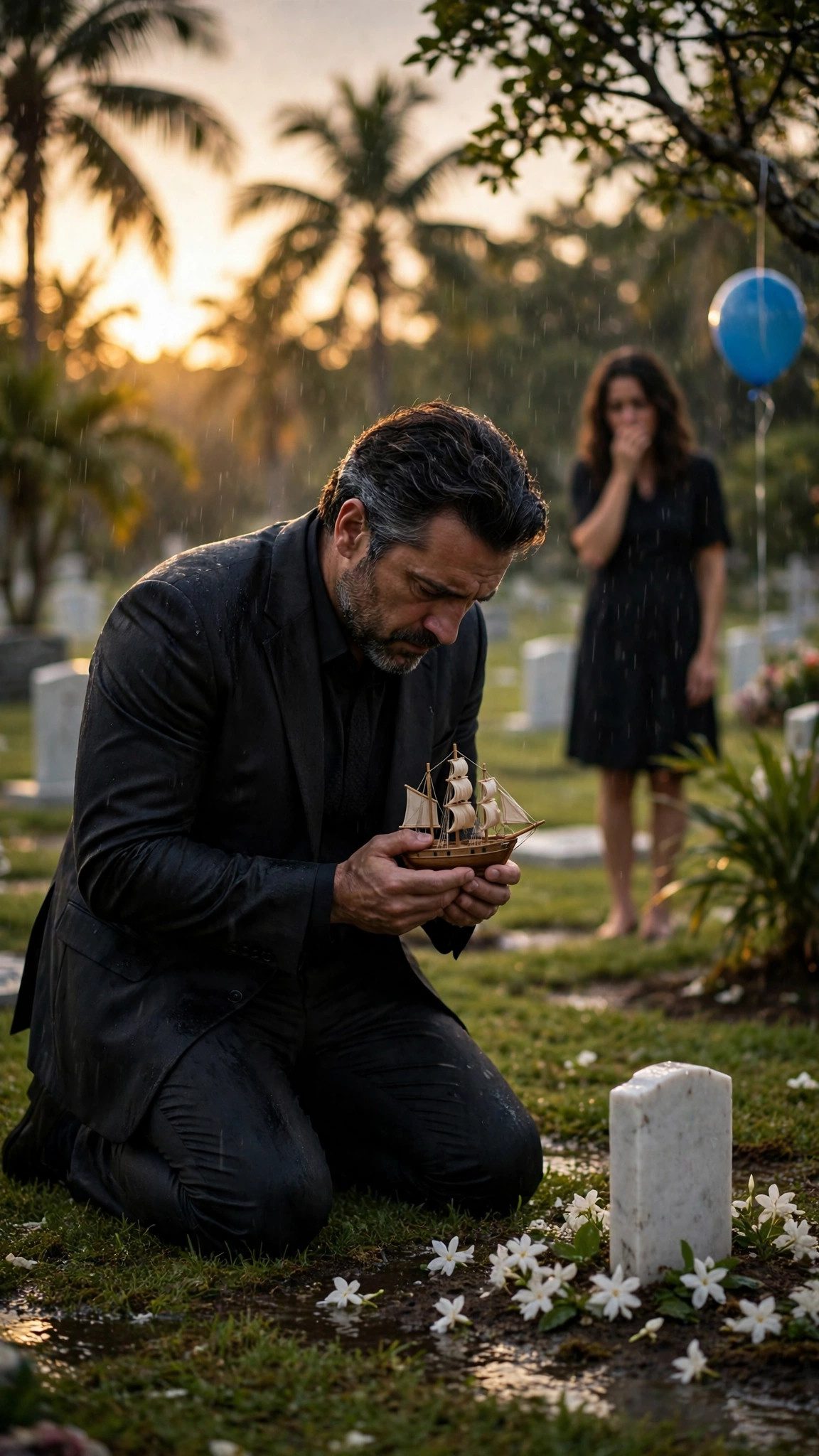
    The Noah Moretti Foundation. A children's hospital wing, first, at Jackson Memorial, the hospital where Noah was born, with the best pediatric equipment money could buy, and a playroom full of toys, and a garden where sick children could sit in the sun. And then a playground, in the neighborhood where Rosa lived, with swings and slides and a small wooden ship, painted bright red, like the rocking horse Matteo had given Noah on his birthday.

    He funded it with his own money. All of it. He did not ask for donations. He did not put his name on a plaque. He put Noah's name on everything, because it was Noah's, and because it was the only way he knew to make something good out of something unbearable.

    He visited the construction site every week, standing in the dust in his suit, watching the walls go up, talking to the workers by name, asking the foreman about the playroom windows, about whether the garden would get enough sun. One afternoon, while he was there, a nurse from the children's ward brought out a little girl named Lucia, seven years old, thin and bald from chemotherapy, with a stuffed rabbit tucked under her arm. She looked up at Damian, this tall, frightening man in a dark suit, and she said, "Are you the man building the garden?"

    "I am," Damian said, kneeling down so he was at her level, the way he had once knelt to be at Noah's level.

    "My brother says gardens are where flowers go to be happy," Lucia said. "Will there be swings?"

    "There will be swings," Damian said. "And slides. And a little wooden ship, painted red. Would you like that?"

    Lucia nodded, and she smiled, a small, brave smile, and she said, "My brother died last year. He was nine. I think he would have liked the ship."

    Damian felt something break open in his chest, and he had to turn away for a moment, because he was crying, and he did not want a seven-year-old girl to see the most powerful man in Miami crying in a construction site. But Lucia reached out, and she took his hand, her small fingers closing around his, and she said, "It's all right. I cry too, sometimes. It doesn't mean you're weak. It means you loved somebody."

    He carried those words with him for the rest of the year. "It doesn't mean you're weak. It means you loved somebody." He wrote them on a piece of paper, and he kept it in his jacket pocket, next to my letter, next to the number forty-three, and whenever he doubted himself, whenever he wondered whether he was doing the right thing, he would touch that pocket, and he would remember.

    Rosa came back to the house in the third week after Noah's death. She had stayed away out of respect, out of grief, because she did not know if Damian wanted to see anyone, least of all the woman who had rocked his son to sleep. But one morning, she appeared at the kitchen door with a pot of soup, and she said, "You need to eat, Mr. Damian. And this house needs to be lived in. A house that is not lived in forgets how to be a home."

    She cooked for him. She cleaned. She opened the windows and let the air in. She put fresh jasmine in the vases, the same white jasmine she had brought for Noah's birthday, and she said, "One day, señora will come home. I don't know when, but she will. And when she does, this house needs to be ready."

    Damian did not argue with her. He ate the soup. He let her open the windows. And in the evenings, after she had gone home, he would sit at the kitchen table, and he would write his monthly message to me, in a notebook, in his strong, slanting hand, before he sent it through Elena.

    "I am here," he would write. "I am not looking for you. I am waiting. Whenever you are ready, I will be here."

    He wrote those words twelve times over the course of a year, and each time, they meant more than the time before, because each time, he was a slightly different man than the one who had written them the month before.

    All the while, he searched for me. Not with his men, not with helicopters and phone calls and threats, the way he would have searched for an enemy. He searched for me the way a man searches for something he has lost and does not deserve to find: quietly, patiently, through my attorney.

    Elena Vasquez was my friend before she was my lawyer. She had been my college roommate, and she had held my hand through my father's funeral, and she was the first person I called from the hospital, before I called anyone else. She found me a small apartment in a quiet neighborhood in Fort Lauderdale, under a different name, and she told no one where I was, not even Matteo, not even Rosa, though it broke her heart to lie to them.

    Through Elena, Damian sent me one message a month. Not letters. Not pleas. Just one message, always the same.

    "I am here. I am not looking for you. I am waiting. Whenever you are ready, I will be here."

    I read every message, sitting in my small apartment with Noah's toy ship on the windowsill, and I cried every time, because I could hear the change in them. The first messages were desperate, full of promises and apologies. The later ones were quieter. Simpler. A man who had stopped trying to convince me, and had started trying to become someone worth coming back to.

    Elena told me about the foundation. She told me about Castellano's arrest. She told me about Sofia, and the closed gambling rooms, and the sold villa. She told me these things carefully, the way you tell a woman who has lost a child about the world continuing to turn without him, because she knew that every piece of news was both a comfort and a wound.

    "He's different, Claire," she said one evening, sitting across from me at my small kitchen table. "I don't know if it's enough. I don't know if anything will ever be enough. But he's different."

    I did not answer. I was not ready to answer. I was still the woman who had spent a year teaching her son to wait for a father who never came home, and I did not know how to forgive myself for that, let alone how to forgive Damian.

    But I kept the messages. All of them. I kept them in a box on my nightstand, next to Noah's hospital bracelet, and some nights, when the apartment was quiet and the toy ship cast a small shadow on the wall, I would take them out and read them again.

    "I am here. I am not looking for you. I am waiting."

    And I began, very slowly, to wonder if waiting was the one thing Damian had finally learned to do.

  • Chapter 5: Twelve Forty-Eight

    Chapter 5: Twelve Forty-Eight

    The morning after Noah's birthday began like any other morning. That is the cruelest thing about the worst day of your life: it does not announce itself. The sun comes up the same way. The birds sing the same way. The coffee tastes the same. Nothing warns you.

    Noah woke up coughing, a small, dry cough that worried me more than it should have. He had been fine the night before, laughing and clapping, but parties are hard on small children, and I told myself it was nothing, just a little irritation from the excitement and the cake and the late night. Still, I called the pediatrician's office as soon as it opened, and Dr. Alvarez, who had cared for Noah since he was born, told me to bring him in.

    "Just to be safe, Claire," she said. "Better to check."

    I dressed Noah in his blue shirt, the same blue shirt from the party, because he looked so beautiful in it, and because some foolish, hopeful part of me thought that if Damian saw a photograph of him in it, he might finally understand what he had missed. I packed his diaper bag. I put the toy ship in the car seat beside him, because he never went anywhere without it.

    At 9:16, Damian called. I did not answer. At 9:18, he called again. I did not answer. At 9:23, a message appeared on my phone.

    "How's my birthday boy?"

    I did not answer. I put the phone in my purse, and I carried Noah out to the car, and I buckled him into his seat, and I kissed his forehead, and I said, "We're going to see Dr. Alvarez, baby. Just a quick check, and then we'll come home, and Mommy will make you soup."

    He smiled at me, and he held up his toy ship, and he said, "Daddy?"

    "No, baby," I said, my throat closing. "Not today. Daddy is away."

    He looked out the window, and he did not say it again.

    At 10:07 A.M., we left the house. It should have been an ordinary trip. Less than forty minutes. The pediatrician's office was ten minutes away, down streets I had driven a hundred times, past the park where I took Noah to feed the ducks, past the bakery where Rosa bought her bread.

    Our car was passing through Coral Gables when it happened.

    I remember the sound first. Brakes screaming, tires skidding on asphalt, a horn blaring somewhere behind us. Then a shape, dark and fast, coming from the side street, and our driver, Marco, shouting, "Hold on!" and the world tilting sideways.

    Glass shattered. The car spun. Someone yelled my name, or maybe I yelled it myself. I wrapped my arms around Noah, pulling him tight against my chest, shielding his small body with mine, and I felt his heart beating against me, fast and frightened, and I whispered, "Mommy's here, baby. Mommy's here. I've got you."

    Then everything disappeared.

    I woke up at 1:32 P.M. in a hospital. White ceiling. White walls. The smell of antiseptic and something else, something cold and metallic that I could not name. My head throbbed. My ribs ached with every breath. There was a bandage on my arm, and wires on my chest, and a nurse standing beside my bed with tears in her eyes.

    My first words were, "Where's Noah?"

    Nobody answered.

    I asked again, louder, pulling at the wires, trying to sit up. "Where's my baby?"

    A doctor approached my bed. He was a kind man, older, with gray hair and gentle hands, and I could see in his eyes that he had rehearsed this moment a thousand times and still did not know how to do it. I saw his face.

    And I knew.

    But I kept shaking my head. "No," I said. "No. No. No. Tell me where he is. Bring him to me. Bring my baby to me."

    The doctor took my hand, and he said, very quietly, "Mrs. Moretti, I'm so sorry. We did everything we could."

    Noah had died at 12:48 P.M.

    One day after his first birthday.

    The night before, his little hands had been gripping the couch. That morning, they had held my finger in the car. Now mine were empty, and they would stay empty, and no one in the world could ever fill them again.

    I do not remember much of the hours that followed. I remember the nurse, a young woman with kind eyes, sitting beside my bed and holding a cup of water to my lips, because my hands were shaking too hard to hold it myself. I remember Dr. Alvarez arriving, still in her white coat from her office, her face white, because she had been expecting us for a check-up, a mild cough, nothing more, and now she was standing in a hospital room telling a mother that her son was gone. She held my hand, and she said, "Claire, I am so sorry. I am so, so sorry," and I could see that she meant it, that she carried it too, that she would carry it for a long time.

    I remember Elena arriving. My friend, my attorney, my college roommate, the woman who had held my hand at my father's funeral. She came the moment she heard, and she did not ask me what I needed. She simply sat beside me, and she held my hand, and she waited, because she knew that sometimes the only thing you can do for a person in grief is to sit with them in it.

    "He's on his way," Elena said quietly, after a while. "Matteo called him. He's coming home."

    "He's too late," I said. My voice sounded strange to my own ears, flat and far away, like it belonged to someone else. "He was too late for the birthday. He's too late for this. He will always be too late now."

    Elena did not argue with me. She knew better. She simply said, "What do you want to do, Claire? Whatever you want, I will make it happen."

    "I want to leave," I said. "I can't stay here. I can't stay in a place where my son died. I can't be here when Damian arrives, because if I look at his face, I will see the man who chose Saint-Tropez over his son's birthday, and I will never be able to unsee it."

    Elena nodded. She spoke to the doctors. She signed the papers. She arranged a car, a small hotel on the other side of the city, a room under a different name, where no one from the Moretti family would think to look for me. And before we left, the nurse brought me a small bag.

    Noah's sock. His hospital bracelet. The blue birthday shirt, folded neatly, still smelling faintly of cake. A toy ship with tiny white sails. And my phone.

    I held the bag against my chest, and I stood in that hospital room for one last moment, looking at the empty bed where they had laid my son, and I whispered, "Goodbye, baby. Mommy loves you. Mommy will always love you."

    Then I typed the note on my phone, with shaking hands, and I left it on the screen for Damian to find.

    "The hard drive is at home. Start with the first video."

    It was the only thing I could think to say to a man who had missed everything. Start at the beginning. Watch it all. See what you lost. See it the way I saw it, one video at a time, because that is the only way you will ever understand.

    Elena drove me to the hotel in silence, and I sat in the passenger seat, holding the small bag, staring out the window at the streets of Miami going by, at the palm trees and the traffic lights and the people walking their dogs, all of them living their ordinary lives, as if the world had not just ended.

    That night, in the hotel room, I lay on the bed in my clothes, and I stared at the ceiling, and I thought about Noah, and about the forty-three moments, though I did not know the number yet, and about the year I had spent recording videos for a man who was always somewhere else.

    And I made a promise to myself, there in that dark hotel room, holding my son's sock against my cheek.

    I would never again teach a child to wait for someone who would not come.

    They told me later what had happened. A truck had run a red light and struck our car on the driver's side, spinning us into a concrete barrier. It had not been an accident. The truck had been waiting. The driver had been paid. The route had been sold. But I did not know any of that then. I knew only that my son was gone, and that I had been holding him, and that my arms had not been enough to save him.

    Damian learned what happened at 1:41 P.M. He was having lunch with Sofia in Saint-Tropez, on a terrace overlooking the water, the sun on his face, a glass of champagne in his hand, when his younger brother Matteo called.

    Matteo told him, in words I will never know, because I was not there, and Matteo has never told me exactly what he said. But I know that Damian left immediately. A helicopter to Nice. His private jet to Miami. For once, his entire empire moved because he desperately wanted to get home, because for once, the most powerful man in Miami was not trying to get somewhere. He was trying to get back.

    But he arrived at the hospital at 11:09 P.M., nearly ten hours after our son died.

    I was already gone.

    I had left the hospital against the doctors' advice, with my attorney, Elena Vasquez, who had come the moment she heard, and who had held my hand while I signed the papers, and who had driven me to a small hotel on the other side of the city, where no one from the Moretti family would think to look for me. I could not stay in that hospital. I could not stay in a place where my son had died. I could not look at Damian's face and see the man who had chosen Saint-Tropez over his son's birthday, and then arrived ten hours too late to say goodbye.

    The nurse gave Damian a small bag. Noah's sock. His hospital bracelet. The blue birthday shirt, folded neatly, still smelling faintly of cake. A toy ship with tiny white sails. And my phone.

    On the screen was a note I had typed with shaking hands before I left.

    "The hard drive is at home. Start with the first video."

    Damian reached our mansion close to 2 A.M. The birthday balloons were still hanging from the ceiling, drooping now, their blue faded in the dark. The cake remained in the refrigerator. His chair was still empty.

    On the table sat a black hard drive.

    NOAH — YEAR ONE.

    He connected it to his computer, and there they were. One thousand nine hundred and seven videos. He watched Noah's first laugh. His first tooth. His first fever. His first crawl. Everything he had promised he would not miss.

    He watched them all night. He watched them as the sun came up, and he watched them as the light changed in the windows, and he did not eat, and he did not sleep, and he did not answer his phone. Matteo came and stood in the doorway for a long time, watching his brother watch his dead son, and he did not know what to say, because there was nothing to say.

    And finally, Damian opened the last file.

    1907_FIRST_STEPS_11-43PM.

    Noah stood beside the couch. A car passed outside.

    "Daddy!"

    One step. Two steps. Three steps. Then he fell.

    My voice burst through the speakers. "Oh my God, Noah! You walked!"

    Damian played it again. And again. And again. Five times. Until he could not press Play anymore, until his hand was shaking so hard he could not hold the mouse.

    Then he found my letter beneath the hard drive.

    I used to think the worst part was watching you miss our son's childhood.

    I was wrong.

    The worst part is realizing these 1,907 videos are his entire childhood now.

    You can watch his first laugh a thousand times. His first tooth. His first crawl. His first three steps.

    But you can never make video number 1,908.

    Last night, Noah walked toward the door because he thought you were home.

    This morning, he died before you could come home.

    Then my final words:

    I don't know how to forgive myself for spending an entire year teaching our son to wait for you.

    Damian read the letter three times. Then he folded it, very carefully, and put it in his jacket pocket, over his heart. And then he did something he had not done since he was twelve years old, since the day his mother died.

    He wept. Not the quiet tears of a man trying to hold himself together, but great, tearing sobs that shook his whole body, that came from somewhere so deep inside him that he did not recognize the sound of his own grief. He wept for his son. He wept for his wife. He wept for the year he had thrown away, one video at a time, for a woman in Saint-Tropez and an alliance in Marseille and an empire that had never once loved him back.

    And when the weeping stopped, when there were no more tears left, he stood up, and he looked at the empty chair, and at the drooping balloons, and at the hard drive on the table, and he said, out loud, to the empty room, "I will find out who did this. And then I will find my wife. And I will spend the rest of my life making this right, even if it takes forever."

    It was the first promise he had made in a year that he intended to keep.

  • Chapter 2: The House My Father Built

    Chapter 2: The House My Father Built

    My father built our house the way other men built boats or cathedrals — slowly, stubbornly, and as if the work itself were a kind of prayer.

    I was four years old when he started. I remember the lot on Linden Lane before there was a house on it at all: a patch of muddy ground with a For Sale sign leaning crooked in the weeds, and my father standing in the middle of it in his work boots with his hands on his hips, looking at that empty lot the way other men look at a woman they intend to marry.

    "Right here, Clara-bear," he said, picking me up and setting me on his shoulders so I could see the whole street. "Right here is where we're going to live. I'm going to build it with my own two hands, and one day it's going to be yours."

    He was a carpenter, my father. Thomas Bennett. Not a rich man, not a famous man, but a man whose hands could make a straight line out of a crooked board and a home out of an empty lot. He worked for other people all day — kitchens in Winnetka, bookcases in Lake Forest, a staircase once for a family on the Gold Coast that paid him enough to buy the lot — and then he came home and worked on our house half the night, by the light of a single bulb strung from a pole, while my mother sat on an overturned bucket with a thermos of coffee and told him he was crazy and wonderful in the same breath.

    It took him two years. Two years of weekends and evenings and frozen fingers in the winter and sunburn in the summer. He laid every floorboard himself. He sanded the banister until it was smooth as glass, because he said a little girl would be running her hand down that banister for the next twenty years and he did not want her to ever get a splinter. He built the window seat in the living room because my mother loved to read in the afternoon light. He built the kitchen table out of oak, thick and heavy, because he said a family needed a table that would not wobble, a table that would still be standing when his grandchildren were sitting at it.

    When I was six, he carved my name into the beam above the front door. CLARA, in crooked capital letters, because he was a carpenter and not a calligrapher, and he laughed when my mother pointed out that the R was backwards.

    "It's not backwards," he said. "It's rustic. There's a difference."

    My mother rolled her eyes and kissed his cheek, and the R stayed backwards for the next thirty years, and every time I walked through that front door I touched it with my fingertips, the way other people touch a lucky charm.

    "One day this will be yours, Clara-bear," my father told me a hundred times, in a hundred different ways, while he was teaching me to hammer a nail straight, while he was showing me how to tell oak from pine by the smell of the sawdust, while we sat on the porch steps on summer evenings watching the fireflies. "A house your father built with his own hands — nobody can ever take that away from you. Do you understand? It's yours. It's for you and for your babies, one day. That's what a house is for. It's for the people you love."

    I understood. Or I thought I did. I was a child. I thought he meant the walls and the roof. It took me thirty years to understand that he meant something else. He meant that a house built by hand, board by board, with love in every joint, was a promise. And a promise, once made, does not belong to anyone else.

    My father died when I was twenty-four. A heart attack, sudden, on a Tuesday morning, while he was carrying lumber into a job site in Evanston. He was fifty-nine years old. He had never been sick a day in his life, and then one morning his heart simply stopped, the way a clock stops when the spring breaks, and there was nothing anyone could do.

    My mother called me at the hospital — I was already a nurse by then, already working nights at Chicago General — and she said, "Clara, your father's gone," and I remember thinking that she had to be wrong, that my father was too strong, too solid, too much like the oak table he had built, to just be gone.

    But he was gone. And the house on Linden Lane became my mother's house, and then, years later, after the will was read and the papers were signed, it became mine. Not in the way Marc thought. In the way my father had always intended. The will was simple and clear, the way my father was simple and clear: the house and everything in it went to me, Clara Bennett, and after me to my son Jason. My mother had her own will, and it said the same thing, in her own neat handwriting: everything to Clara and Jason.

    Marc knew that. He had been there when Mr. Doyle read my father's will. He had sat in Mr. Doyle's office and listened and nodded, and he had said all the right things about what a wonderful man my father was, and then he had gone home and never mentioned the will again. Not once in twelve years. Not until my mother died.

    I married Marc Johnson when I was twenty-five, a year after my father died. I think now that I married him because I was lonely and grieving and he was handsome and funny and he knew how to make me laugh when I had forgotten how. He was a real estate agent then — a good one, charming, quick with a joke, always with a new listing, always with a new plan. He told me he loved the house on Linden Lane. He told me it was the most beautiful house he had ever seen. He told me my father had been a genius.

    For the first few years, it was good. Or good enough. We lived in the house with my mother — she insisted, she said the house was too big for one old woman, and she liked having us there — and Jason was born, and for a while it felt like the family my father had imagined when he built that table. Sunday dinners. Jason's first steps on the hardwood floor. Christmas mornings with the tree in front of the window seat.

    But slowly, the way a roof leaks slowly before it collapses, things changed. Marc started coming home late. Then later. Then not at all, some nights, with a text about a client dinner or a showing that ran long. Money got tight, and then tighter, and Marc started talking about the house differently — not as a home, but as an asset. As equity. As something we were sitting on.

    "Do you know what this place is worth now, Clara?" he said one night, scrolling through his phone at the kitchen table. "Three times what your father paid for the lot. Three times. We could sell and buy something smaller and have enough left over to start a business. I've been thinking about it."

    "It's my father's house," I said. "It's not for sale."

    "Everything's for sale, Clara. That's the first rule of real estate."

    He laughed when he said it. I did not laugh.

    The fights started after that. Small ones at first — about money, about his hours, about the way he never seemed to be home for Jason's bedtime anymore — and then bigger ones. I found receipts for restaurants I had never been to. I found a second phone charger in his car, for a phone I had never seen. I asked him about it, and he told me I was being paranoid, that I was imagining things, that grief had made me suspicious. He said it so smoothly, so reasonably, that for a while I believed him. I wanted to believe him. I had a seven-year-old son and a dying mother and a job that kept me on my feet for twelve hours at a time, and I did not have the energy to believe that my husband was lying to me.

    I should have believed myself. That is the thing I have learned, and I have learned it the hard way: when a woman's gut tells her something is wrong, she should listen the first time. Not the tenth time. Not after the will is challenged and the house is listed and the other woman is texting about Miami. The first time.

    The night I met Alexander Moretti was the worst night of my nursing career, and also, in a strange way, the night that saved my family — though I did not know it then.

    It was twelve years ago. I was twenty-four years old, three months out of nursing school, working the night shift in the emergency room at Chicago General. It was a Friday night in November, cold and raining, the kind of night when the ER fills up with car accidents and bar fights and people who have nowhere else to go.

    At 2:47 in the morning, they brought in a young man with a gunshot wound to the abdomen. Nineteen years old. Dark hair, dark eyes, beautiful in the way Italian boys are beautiful, and bleeding so fast that the trauma bay floor looked like someone had spilled a bucket of red paint across it.

    His name was Enzo Moretti. I did not know that then. I did not know who he was. I only knew that he was dying, and that he was nineteen, and that his hands were shaking, and that he kept saying, "Don't let me die. Please. Don't let me die. My brother will kill whoever did this, but please don't let me die."

    I stayed with him. That is what nurses do — we stay. I held pressure on the wound while the surgeons worked. I talked to him while they put in lines and hung blood. I told him my name. I told him he was in a good hospital. I told him he was going to be all right, even though I was not sure it was true.

    At one point, in the middle of the worst of it, he grabbed my hand with a bloody fist and said, "If I die, tell my brother — tell Alexander — tell him I wasn't scared. Tell him I wasn't scared."

    "You won't die," I said. "You're not going to die. Do you hear me? You're going to live, and you're going to tell him yourself."

    He lived. It was close — so close that the surgeon came out afterward with his scrubs soaked through and said, "Another ten minutes and we would have lost him" — but he lived. And I sat with him through the rest of the night, long after my shift ended, because he was scared and alone and nineteen years old, and because somebody had to sit with him.

    At four in the morning, the doors at the end of the hallway opened, and a man walked in.

    I knew immediately that he was dangerous. Not because he was shouting or threatening anyone — he was not. He was very calm. Very still. Very quiet. He was tall, with dark hair going grey at the temples and eyes the color of a winter sky, and he wore a black suit that cost more than I made in a month, and he walked down that hallway like he owned the hospital, the city, and the night itself.

    Behind him came two more men, just as still, just as quiet, and behind them came my father.

    My father. Thomas Bennett. In his work boots and his flannel shirt, carrying a paper bag with a sandwich in it, because my mother had sent him to bring me dinner on my night shift, the way she always did on Fridays.

    My father took one look at the man in the black suit, and then he looked at me, and then he looked at the young man sleeping in the bed behind the glass, and he understood something I did not understand yet.

    "Mr. Moretti," my father said.

    The man in the black suit stopped. He looked at my father. "You know who I am."

    "I read the papers," my father said. "And my daughter just spent six hours saving your brother's life. So I know who you are, and I know what you owe her."

    Alexander Moretti looked at me then. Really looked at me, the way a man looks at someone he intends to remember. "Is that true?" he asked me. "You stayed with him?"

    "He was scared," I said. "He's nineteen. Somebody had to stay."

    Alexander nodded slowly. He reached into his jacket and took out a card — plain, white, with a phone number written on it in black ink, no name — and he held it out to me.

    "Miss Bennett," he said. "My name is Alexander Moretti. My brother is alive because of you. I do not forget a debt like that. If you ever need anything — anything at all — you call this number. Day or night. I will come."

    I took the card because it seemed rude not to. I put it in my scrub pocket and forgot about it by the end of the week.

    But my father did not forget. On the drive home that morning, he said to me, "Clara-bear, that man meant what he said. Men like that — they don't make promises they don't intend to keep. If you ever need him, you call him. Do you understand?"

    "Dad, I don't need a mafia boss," I said, laughing. "I need sleep."

    "I'm serious, Clara," he said, and his voice was so grave that I stopped laughing. "I saw the way he looked at you. Like you mattered. Men like that don't look at many people that way. Remember this night. Remember his name. One day you might need him."

    I remembered his name. I kept the card in my jewelry box for twelve years, through my wedding, through Jason's birth, through my father's funeral. I never called the number. I never needed to. I had a husband, a house, a job, a family. I had everything I needed.

    Until the week my mother died, and my husband tried to steal my father's house, and I understood, finally, what my father had been trying to tell me on that drive home twelve years ago.

    Some promises are not made to be used. They are made to be kept. And some men keep them, even when twelve years have passed, even when the woman who saved their brother has forgotten they exist.

    My father had understood that. He had looked at Alexander Moretti in a hospital hallway at four in the morning and seen something I was too young to see: a man who kept his word.

    And now, on a wet Chicago night, with my mother's will in my bag and my son asleep twenty miles away, I was about to find out whether my father had been right.

  • Chapter 2: The Night My Father Died

    Chapter 2: The Night My Father Died

    My father died on a Tuesday night in October, three years into my marriage, on a stretch of highway outside Houston where there were no streetlights and no witnesses.

    The police said his car left the road at high speed and struck a concrete barrier. They said the brakes had failed. They said it was a tragic accident, the kind of thing that happens to a man of sixty-one who drives too fast on a dark road.

    I believed them for exactly eleven days.

    On the twelfth day, I went to my father's study, because I remembered what he had told me in that room years earlier: if anything ever happens to me, come to this study first. Before you call anyone. Before you do anything else. Come here.

    The study smelled of his pipe tobacco and old paper. His desk was exactly as he had left it. His reading glasses sat on top of a stack of budget reports. His favorite pen lay beside a half-finished crossword. I stood in the doorway for a long time, unable to move, because walking into that room meant accepting that he was really gone, and that the man who had raised me, who had taught me to keep records and to trust my own eyes, would never sit in that chair again.

    Then I opened the locked drawer.

    Inside was a file folder with my name written on it in his handwriting. Lauren. Just my name, in the careful, slanted script he had used on every birthday card I had ever received.

    The folder contained three things.

    A copy of an immunity agreement, signed by Helena Cross, dated the year Luke turned nine. I did not understand it at first. I read it three times before the words arranged themselves into meaning. Helena Cross, in exchange for immunity from federal prosecution, had provided the United States government with the financial ledgers of her husband, Damian Cross. She had handed them her husband's entire organization, wrapped in a bow, and in return she had walked away with her freedom and a portion of the seized assets so large that it made my hands shake to read the number.

    A photograph of a man I had never met, standing beside a black car, with Luke's eyes and Luke's jaw and a smile that Luke had never once worn in my presence. On the back, in my father's handwriting: "Damian Cross, 1998. The man Helena says abandoned his son."

    And a single page of my father's handwriting, which said: "Lauren, if anything happens to me, do not trust Helena. She killed a man once to protect a lie, and she will do it again. The proof is in the second drawer. Love, Dad."

    I read that page five times. Then I opened the second drawer.

    The second drawer contained my father's real work. Not the speeches or the budget reports or the newspaper clippings. The real work. A stack of bank statements, printed emails, and handwritten notes that told a story my father had been piecing together for years, in secret, without ever telling me.

    Helena Cross had not merely betrayed her husband. After Damian went to prison, she had taken control of what remained of his money, and she had laundered it through a network of shell companies, and one of those shell companies had made contributions to my father's campaign accounts. Small contributions. Careful contributions. Just under the reporting threshold, month after month, year after year. My father had discovered it during a routine audit of his own campaign finances, and he had traced the money back through four layers of companies to a single name: Helena Cross.

    He had also discovered something else. A mechanic in East Houston, a man named Roy Delgado, had been paid forty thousand dollars in cash, three days before my father's car went off the road. The payment had come from an account controlled by Helena Cross.

    My father had been driving to meet a federal agent the night he died. He had an appointment at nine o'clock in the evening, in a diner off the highway, with a man named Agent Paul Whitfield. He had the bank statements in his briefcase. He had the mechanic's name in his notebook. He never arrived.

    The police report said the brakes had failed. The police report did not mention that the brake lines had been cut cleanly, in a way that no wear and tear could explain. The police report did not mention that my father's briefcase was never recovered from the wreckage. The police report did not mention that Helena Cross had called my father's office three times on the day he died.

    I sat on the floor of my father's study for hours, surrounded by paper, and I understood for the first time in my life what kind of woman my mother-in-law really was.

    Helena Cross had not merely been cruel to me. She had not merely counted my flaws and recited them back to me at Sunday dinners. She had betrayed her own husband to the government, stolen his fortune, told her nine-year-old son that his father had abandoned him, laundered the stolen money through my father's campaign, and then, when my father found out, she had him killed.

    And Luke, her son, the man I had married, had spent his entire life believing his mother was a survivor and his father was a coward.

    I did not cry that day. I wanted to. I sat on the floor of that study with my father's handwriting in my lap, and I waited for the tears to come, and they did not come. What came instead was something colder and quieter and far more useful. It was the feeling of a woman who has just been handed a weapon she never asked for, and who suddenly understands exactly how to use it.

    But I was not ready yet. I had proof of nothing that would stand up in a courtroom. I had my father's notes, and a copy of an immunity agreement, and a photograph, and a mechanic's name. I had no witnesses. I had no living person who could confirm any of it. And Helena Cross had spent thirty years building a life on top of her lies, with lawyers and money and a son who would defend her with his last breath.

    So I did what my father had taught me to do. I kept records. I waited. I watched.

    I watched Luke come home later and later. I watched Helena arrive at our apartment in the afternoons, when Luke was at work, and walk through our rooms with the slow, proprietary air of a woman inspecting property she believes she owns. I watched her open drawers. I watched her pick up my perfume bottles and set them down again. I watched her stand at the window and look out over the city as if she were deciding which parts of it belonged to her.

    And I watched my younger sister Jennifer come to our apartment more and more often, first for Sunday dinners, then for weekday lunches, then for long evenings when Luke was supposed to be working late.

    Jennifer was twenty-seven then, seven years younger than me, bright and restless and always hungry for a bigger life than the one our parents had given her. She had my mother's dark hair and my father's quick laugh, and she had always looked up to me, the way little sisters do. When she started spending time with Luke, I told myself it was innocent. I told myself she was lonely. I told myself that Luke was only being kind to my little sister, the way a brother-in-law should be.

    I told myself a great many things in those years. I was very good at telling myself things.

    The night my father died changed something in me, though. It sharpened my eyes. After that night, I stopped telling myself stories, and I started writing down facts.

    The first fact was this: Jennifer's perfume was on Luke's collar on a Tuesday. I wrote it down.

    The second fact was this: Helena came to our apartment on a Wednesday afternoon, and she spent twenty minutes in our bedroom, and when she left, she was carrying a small plastic bag, and she was smiling.

    The third fact was this: Luke told me he was in Dallas on a Thursday, but his car was parked in the garage of a hotel three blocks from our apartment, and I know because I drove past it on my way to the grocery store.

    I wrote down every fact in the leather notebook, right underneath the 237 insults, and the notebook grew thicker and thicker, and I began to understand that my father had not left me a file folder. He had left me an education.

    The night after I found the file, I did not sleep. I lay in bed beside Luke, listening to his breathing, and I thought about the woman sleeping in the big house across town, the woman who had killed my father and stolen my husband's childhood, and I thought about how easy it would be to walk into her house the next morning and say everything I knew, all at once, and watch her face.

    But my father had taught me patience. A record is only useful if it is complete. And my record was not complete yet.

    The next morning, Helena came to the house. Not to the apartment — to my father's house, where I was packing his books into boxes. She arrived without calling, the way she always arrived, and she stood in the doorway of the study, looking at the desk, looking at the drawers, looking at me.

    "Lauren," she said, "I wanted to check on you. And I wanted to ask — Daniel kept a great many papers, didn't he? Files and such. A man in his position always does. It would be a shame for any of it to fall into the wrong hands. I could have my lawyers go through it for you, if you'd like. Make sure there's nothing… sensitive."

    She said the word sensitive the way a woman says the word poison.

    "Thank you, Helena," I said. "But my father's papers are my responsibility. I've already taken care of them."

    Her eyes went to the desk. To the locked drawer. To the file folder, which was no longer there, because I had already moved it to a safe deposit box that morning, under a name Helena did not know.

    "Of course," she said, and she smiled, but the smile did not reach her eyes. "Just remember, dear, that Daniel was a complicated man. He had enemies. He made mistakes. It would be a pity if anyone misunderstood his notes."

    "I don't think anyone will misunderstand them," I said. "My father was very clear. He always was."

    She left soon after that, and I stood in the study doorway, watching her car pull away, and I understood something that made my hands go cold: Helena knew. She didn't know exactly what I had found, but she knew that my father had left something behind, and she was afraid of it. A woman who has nothing to hide does not offer to send her lawyers through a dead man's papers.

    That was the day I stopped being afraid of Helena Cross. Fear is something you feel when you don't know what the other person is capable of. I knew exactly what she was capable of. And knowing was better than fearing.

    At my father's funeral, Helena wore black silk and wept into a handkerchief, and she held my hand in the receiving line and said, "Your father was a good man, Lauren. It's a tragedy. But you have us now. You have family."

    She said the word family the way a spider says the word dinner.

    Luke stood beside her, tall and handsome and cold-eyed, and he shook hands with senators and businessmen, and he did not once look at me until the service was over and we were alone in the car.

    "I'm sorry about your father," he said, staring out the window.

    "Thank you," I said.

    "He was a good man," Luke said. "He didn't deserve that."

    No, I thought. He didn't deserve any of it. He didn't deserve to be used as a laundry for your mother's stolen money. He didn't deserve to die on a dark highway because he found out the truth. And you don't deserve to keep believing the woman who killed him is a saint.

    But I said none of that. I was not ready. I smiled at my husband, and I took his hand, and I said, "Thank you for being here."

    And in the leather notebook, that night, I wrote a new line. Not an insult. Not a fact about perfume or hotel garages.

    I wrote: "Helena killed my father. Damian Cross can prove it. Find him."

    It would take me two more years to find him. Two more years of watching, and waiting, and writing things down. Two more years of Sunday dinners and late nights and my sister's perfume on my husband's collar.

    But I had my father's file, and I had my notebook, and I had time.

    And Helena Cross, for all her money and all her lawyers and all her lies, had made one terrible mistake.

    She had taught me to keep count.

    That night, I sat at my father's desk until nearly dawn, the file folder open in front of me, the leather notebook beside it, and I made a list. Not of insults. Not of facts. A list of everything I was going to do, in order, the way my father used to make lists when he was planning a campaign. Sell the house. Close the accounts. Find Damian Cross. Take back my life. And at the bottom of the list, in capital letters, I wrote the words that would carry me through the next two years: SHE WILL NOT WIN. I underlined them twice, and I closed the notebook, and I went to bed, and for the first time since my father's funeral, I slept through the night.

  • Chapter 4: Thirty-Six Balloons

    Chapter 4: Thirty-Six Balloons

    I spent six weeks preparing for Noah's first birthday. Six weeks, because I wanted it to be perfect, and because preparing for it gave me something to do with my hands while my marriage fell apart around me.

    I ordered thirty-six balloons in soft blue and white, and I spent an entire afternoon tying them to the backs of chairs, to the banister, to the corners of the living room, until the ceiling looked like a sky that had come indoors to celebrate my son. I baked the cake myself, a little ship with white sails made of frosting, because Noah loved the toy ship his grandmother in Naples had sent him, the one he carried everywhere, even into his bath. I made tiny sandwiches and cut fruit into stars. I hung a banner across the fireplace that said HAPPY FIRST BIRTHDAY NOAH in bright blue letters, and I stood back and looked at it, and I thought, this is what a home is supposed to look like.

    The blue shirt arrived the week before, in a box from the boutique on Worth Avenue where Damian bought his own shirts. He had chosen it himself, on one of his rare days home, holding it up against Noah's chest in the nursery, turning him this way and that, frowning in concentration the way he frowned over business contracts.

    "This one," he had said. "The blue brings out his eyes. His father's eyes."

    I had folded it with such care that I was almost afraid to let anyone else touch it. I laid it out on Noah's bed the night before the party, smoothing it with my hands, and I whispered to my sleeping son, "Your daddy picked this out for you. He loves you, baby. He really does."

    I wanted to believe it. I needed to believe it, because if I stopped believing it, I would have to admit that I had married a man who loved his son in photographs but not in person, and I was not ready to admit that yet.

    Rosa came early on the morning of the party, her arms full of flowers from her own garden, white jasmine that filled the whole house with sweetness. Rosa had been with our family since before I married Damian. She was sixty-four, small and round, with hands that had rocked three generations of Moretti babies, and she loved Noah like her own grandson. She had been there the day he was born, holding my hand when Damian stepped out to take a phone call, and she had been there every day since, singing to Noah in Spanish while she cooked, teaching him to clap his hands, wiping his chin with a tenderness that made my throat ache.

    "Today is a beautiful day, señora," she said, arranging the jasmine in vases. "The little one will be so happy."

    "He will," I said. "His father promised he would be here."

    Rosa did not say anything. She just looked at me, and in her eyes I saw everything she was too kind to say: that Damian had promised before, and that promises from men like Damian were like smoke, beautiful and impossible to hold.

    We spent the morning finishing the cake together, Rosa and I, in the kitchen, with Noah in his high chair watching us, banging a wooden spoon against the tray. The cake was shaped like a little ship, and I had made the sails out of white frosting, but they kept drooping, and Rosa laughed, and she showed me how to prop them up with toothpicks, the way her own mother had taught her when she was a girl in Cuba.

    "There," she said, stepping back to admire our work. "A ship fit for a captain."

    Noah clapped his hands, and Rosa gave him a tiny cupcake to practice on, a little one with blue frosting, and he put both hands into it immediately, smearing frosting across his face and his hair and the front of his shirt, and Rosa and I laughed until our sides hurt, because he looked so delighted with himself, so proud, as if he had just discovered the greatest joy in the world.

    I filmed it, of course. I filmed everything. I held up my phone, and I said, "Noah, show Mommy your cupcake!" and he held up his frosting-covered hands, and he laughed, and I thought, this is the video I will send Damian tonight, and this time, surely, he will understand what he is missing.

    Matteo arrived early, before the other guests, carrying a gift so large he could barely fit it through the front door. It was a wooden rocking horse, painted bright red, with a black mane and a golden saddle, and Noah's eyes went wide when he saw it. Matteo set it down in the middle of the living room, and he lifted Noah onto it, and he rocked him gently back and forth, and Noah laughed, that high, delighted laugh that sounded like wind chimes.

    "He's going to love this," Matteo said, grinning. "Every boy needs a horse."

    "He already loves it," I said. "Thank you, Matteo. You're a wonderful uncle."

    Matteo's smile faded a little. He looked at me, and he looked at the empty chair beside the table, the chair I had set for Damian, and he said, quietly, "He'll be here, Claire. I called him this morning. He said he's on his way."

    I nodded, and I did not say what I was thinking, which was that Damian had said he was on his way many times before, and that being on your way and being here are two very different things.

    My mother arrived next, with a cake of her own, because no grandmother trusts her daughter's baking entirely, and she hugged me, and she looked around the living room, at the balloons and the banner and the little ship cake, and she said, "You've done a beautiful job, sweetheart. Noah is a lucky boy."

    "He is," I said, and I meant it, because he had a mother who loved him, and a grandmother who loved him, and an uncle who loved him, and a housekeeper who loved him like her own grandson. He had so much love. The only love he did not have was the one that mattered most, and I could not give it to him, no matter how hard I tried.

    My mother helped me dress Noah in his blue shirt, the one Damian had chosen, and she smoothed his dark curls with her fingers, and she said, "He looks just like his father. The same eyes. The same chin."

    "He does," I said, and my throat closed, because it was true, and because it was the cruelest thing about all of it: Noah looked like Damian, and sounded like Damian when he laughed, and reached for Damian in his sleep, and Damian was not there to see any of it.

    The guests began to arrive at three in the afternoon. Matteo came first, with a gift so large he could barely carry it through the door, a wooden rocking horse painted bright red, and Noah's eyes went wide when he saw it. My mother came, with a cake of her own, because no grandmother trusts her daughter's baking entirely. A few of my friends from the hospital came, nurses I had worked with for years, women who knew how to laugh loudly and hold a baby at the same time. A few of Damian's men came with their wives, standing awkwardly in their suits in my living room, holding glasses of lemonade like they were afraid to break them.

    Everyone asked the same question, in different ways. "Where is Damian?" "Is the boss coming?" "When does he get in?"

    "He's on his way," I said, again and again, smiling until my face hurt. "He promised. He'll be here."

    At four in the afternoon, he was not home. The party was in full swing. Noah was in his high chair, wearing the blue shirt, his face covered in frosting, laughing at the balloons. I kept looking at the door.

    At five, still nothing. I went into the kitchen and called his phone. It went to voicemail. I called again. Voicemail.

    At six, the guests began to look at each other. My mother took my hand under the table and squeezed it. Matteo went outside to make a call, his face dark, and when he came back in, he would not meet my eyes.

    At 7:12, I could not wait any longer. I went into the bedroom, closed the door, and called him.

    "Damian, where are you?"

    There was a pause, and then his voice, too casual, too smooth. "I'm heading to the airport."

    Behind him, I heard music. Laughter. The sound of waves breaking on a shore, slow and rhythmic, a sound that belonged to another world.

    Then Sofia's voice, light and unbothered, floating through the line like perfume. "Damian, they're bringing the champagne."

    I looked at the empty chair beside mine, the chair I had left for him, with a place set before it and a glass of wine poured and waiting.

    "You're not coming," I whispered.

    "Claire, something came up."

    "No," I said, and my voice was steady now, steady in a way that frightened me, because it was the voice of a woman who had finally stopped hoping. "You chose not to."

    I ended the call. I stood in the bedroom for a long time, looking at myself in the mirror, at the woman in the blue dress who had spent six weeks preparing a perfect birthday for a little boy whose father could not be bothered to come home. And then I wiped my eyes, and I fixed my lipstick, and I went back out to the party, because my son was turning one year old, and he deserved a mother who could smile.

    We sang Happy Birthday without him. Everyone gathered around the cake, and Noah sat in his high chair, and we sang, and he clapped his tiny hands, and then he put both hands into the cake, right into the frosting, and everyone laughed, and I laughed too, because that is what mothers do. We laugh so our children will not be afraid.

    Rosa took the photograph. In it, Noah is laughing, his face covered in cake, his hands in the air. And beside me, there is an empty chair.

    By ten o'clock, the guests were gone. Matteo was the last to leave, and he hugged me at the door, hard, and he said, "I'm sorry, Claire. I tried to reach him. I told him he needed to be here."

    "I know," I said. "It's not your fault, Matteo. It was never your fault."

    He nodded, and he left, and I stood in the doorway for a moment, watching his car disappear down the street, and then I closed the door, and the house was quiet.

    Rosa had stayed to help me clean up, and we worked in silence, putting away the dishes, folding the tablecloths, gathering the leftover balloons. When she was ready to go, she kissed Noah's forehead, and she kissed my cheek, and she said, "You are a good mother, señora. The best mother. Don't ever forget that."

    "I won't," I whispered, but I was already forgetting, because I was starting to believe that being a good mother was not enough, that no amount of love from me could make up for the love my son was not getting from his father.

    I put Noah to bed in his blue shirt. I sat on the edge of his crib for a long time, just watching him breathe, his chest rising and falling, his dark curls damp with sweat, his little hand curled around the edge of his blanket.

    At 11:43 P.M., he woke up.

    I carried him into the living room, and I placed him on the rug, and he pulled himself upright using the couch, and then a car passed outside, and he turned toward the front door, and his little face lit up, and he said, "Daddy!"

    One step. Two steps. Three steps. Then he fell onto the rug.

    "Oh my God, Noah! You walked!"

    I scooped him into my arms and spun him around, and he laughed, and then he looked over my shoulder, toward the door, and he said it again, softer, like a question.

    "Daddy."

    I had recorded everything. Video number 1,907. His first three steps. All toward a father who wasn't there.

    For the first time in a year, I did not send Damian the video. I stared at the Send button until the screen went dark. Then I turned off my phone, and I carried my son back to his crib, and I lay down beside him on the floor, on the rug where he had taken his first steps, and I cried until I fell asleep.

    I dreamed that night, a dream so vivid I woke up believing it was real. In the dream, Damian came home. He walked through the front door, and Noah ran to him, and Damian picked him up and held him high in the air, and Noah laughed, and Damian looked at me, and he said, "I'm sorry, Claire. I'm here now. I'm never leaving again."

    I woke up with the sun on my face and Noah stirring in his crib, and for one beautiful, terrible second, I believed the dream was true.

    Then I remembered the empty chair. And the phone call. And Sofia's voice saying, "Damian, they're bringing the champagne."

    And I got up, and I dressed my son in his blue shirt, because he had developed a mild cough after the party, and I was going to take him to the doctor, and it was going to be an ordinary trip, less than forty minutes, there and back.

    It should have been an ordinary trip.

    It was the last trip I ever took with my son.

    I did not know it then. I know it now, and I will know it for the rest of my life, in every car I ever ride in, on every ordinary morning, whenever I hear brakes scream or glass break in a film. Some moments do not end. They simply wait for you, patiently, forever.

  • Chapter 1: The Hand That Let Go

    Chapter 1: The Hand That Let Go

    My mother died with my seven-year-old son holding her hand.

    I know that sounds like the kind of sentence a person writes when she is trying to be poetic about grief, the kind of line you put in a sympathy card because the truth is too ugly to say plainly. It is not poetry. It is the truest thing I have ever written. My mother, Margaret Bennett, died at 6:14 on a Tuesday morning in a hospital room that smelled of antiseptic and rain, and my son Jason sat on the edge of her bed in his dinosaur pajamas, holding her left hand in both of his, whispering to her about the tree house his grandfather had promised to build him one day, as if the sound of his small voice could keep her here a little longer.

    It could not. But God, he tried.

    I arrived at Chicago General Hospital at 5:40 that morning, still wearing my nurse's scrubs from the night shift, because the charge nurse had called me at 4:58 and said the words no daughter is ever ready to hear. "Clara, it's your mother. The stroke was massive. You need to come now." I had run out of the nurses' station with my locker still open and my coffee still steaming on the counter, and I had driven through the empty Chicago streets with my hands shaking so hard I could barely hold the wheel.

    My mother was in Room 412. I knew that room. I had worked that floor for nine years. I had held the hands of a hundred strangers in that room and told them that everything was going to be all right, and most of the time I had believed it. That morning I walked into Room 412 and I knew, the way nurses always know, that nothing was going to be all right.

    She was so small in that bed. My mother had never been a large woman — five foot two, bird-boned, with silver hair she wore in a braid down her back until the day she decided she was too old for braids and cut it short — but the stroke had made her smaller still, as if her body were already folding itself away, politely, not wanting to be a burden.

    "Mom," I said.

    Her eyes opened. Just barely. One of them, the left one, found me and held on.

    "Clara," she whispered. Her voice was thin as tissue paper. "Where's my boy?"

    "Jason's on his way," I said, and it was a lie, because Jason was at home asleep and Marc was supposed to be watching him, and Marc had not answered his phone. "He's coming, Mom. He loves you so much."

    She smiled. It was a crooked smile, the left side of her mouth rising while the right side stayed still, and it broke my heart in a way I had not known a heart could break while it was still beating.

    "Tell him," she said, and then she had to stop and breathe, and the breathing sounded like paper tearing. "Tell him his grandma loved him first. Before anybody. Tell him that."

    "I will, Mom. I promise."

    "And the house," she said. "Clara. The house. Your father built that house with his hands. It is yours. Yours and Jason's. Don't let anybody —"

    She stopped. Her eyes fluttered. The monitor beside the bed began to make a sound I had heard a hundred times and never once gotten used to.

    "Mom!" I said, and I was a nurse again, suddenly, automatically, my hands moving to her chest, my voice going calm and professional in the way it always did when everything was falling apart. "Mom, stay with me. Stay with me."

    The code team came running. I knew every one of them. Rosa from the night shift. Dr. Patel. Two residents whose names I could not remember because my mind had gone white and blank. They worked on my mother for eleven minutes while I stood in the corner of the room with my back against the wall, my scrubs still smelling of someone else's blood from the night shift, and I watched them do everything right and I knew it would not be enough.

    At 6:14, Dr. Patel looked at me over his mask and said, very quietly, "Clara. I'm sorry. We have to stop."

    I nodded. I do not remember nodding, but Rosa told me later that I did, that I was very calm, that I thanked them, that I asked them to leave the room so I could be alone with her.

    I sat on the edge of the bed and I took my mother's hand. It was still warm. That was the worst part. It was still warm, and she was gone, and the warmth was just the body not knowing yet.

    "I love you, Mom," I said. "Thank you for everything. Thank you for the house. Thank you for Jason. Thank you for loving us first."

    I do not know how long I sat there. Long enough for the rain to start outside the window. Long enough for the morning shift to begin and the hallway to fill with voices. And then my phone buzzed, and it was Marc, finally, and his text said, "Where are you? Jason's awake. He's asking for you."

    I called him back. "Mom's gone," I said. "She died at 6:14. Bring Jason. Bring him now. She wanted to see him."

    Marc was quiet for a moment. Then he said, "Jesus, Clara. I'm sorry. We'll be there in twenty minutes."

    He took forty-five. When he finally walked into Room 412, Jason was already crying before he saw the bed, because seven-year-old boys know, they always know, and I lifted my son up onto the mattress and I put his small hands around his grandmother's hand, and I said, "Hold her hand, baby. Just hold her hand. She loved you first, before anybody."

    Jason held her hand for a long time. He whispered to her about the tree house. He told her about the spelling test he had passed on Friday. He told her he would take care of me. And then, very quietly, he said, "Grandma, it's okay. You can go now. Mommy and me will be okay."

    My mother had been dead for almost an hour by then. But I swear to you, I swear on everything I have ever loved, that in that moment her face looked peaceful in a way it had not looked before. As if she had been waiting to hear that. As if she had needed permission from the smallest person in the room.

    That was the last morning my family was whole. I did not know it yet. I thought the worst thing that could happen to us had already happened.

    I was wrong.

    The funeral was three days later, on a Friday, at the little white church on Linden Lane where my parents had been married forty-one years earlier. It rained the whole morning, a thin grey rain that made the world look like an old photograph. My mother had loved that church. She had sung in the choir there for thirty years. The choir sang "Amazing Grace" and their voices shook, and Jason sat beside me in his navy suit — the suit my mother had bought him for Christmas, a little too big in the shoulders — and he held my hand so tightly his knuckles went white.

    Marc showed up late. Twenty minutes late, to his own mother-in-law's funeral, walking in during the second hymn with his tie crooked and his hair damp, sliding into the pew beside me as if he had just come from a business meeting instead of a funeral. He did not apologize. He did not put his arm around me. He sat there with his hands folded and his eyes on the coffin, and I told myself he was grieving in his own way, that men grieve differently, that I should not judge him on the worst day of my life.

    After the service, while people were filing past the coffin and hugging me and telling me how sorry they were, I saw Marc across the room, standing in the corner with Mr. Doyle, our family lawyer. They were talking in low voices, and Marc was leaning in close, and Mr. Doyle's face had gone very still in the way lawyers' faces go when someone is asking them something they do not want to answer.

    I walked over. "What are you two talking about?" I asked.

    Mr. Doyle looked at me with kind, tired eyes. He was seventy years old and he had drawn up my father's will and my mother's will, and he had known my family since before I was born. "Your husband was asking about the house, Clara," he said. "About your father's house."

    Marc smiled then. It was not a grieving smile. It was a quick, bright, businesslike smile, and it did not reach his eyes. "I was just asking about the paperwork," he said. "That's all. Somebody has to think about the practical things."

    I stared at him. "My mother was buried an hour ago."

    "I know that," he said, and his voice had an edge to it now. "I'm just saying, the house is an asset, Clara. We need to understand what we're dealing with."

    "We're not dealing with anything today," I said. "Today we bury my mother."

    He held up his hands, palms out, the way a man does when he wants you to think he is being reasonable and you are being emotional. "Fine. Fine. We'll talk about it later."

    We went back to the house on Linden Lane after the funeral. My father's house. The house he had built with his own hands, plank by plank, when I was a little girl, telling me every day that one day it would be mine. The house where my mother had cooked Sunday dinners for forty years. The house where Jason had taken his first steps on the hardwood floor in the living room.

    People came and went. Neighbors brought casseroles. Rosa from the hospital brought a chocolate cake and stayed to wash dishes. Jason fell asleep on the couch at eight o'clock with his shoes still on, and I carried him up to my old bedroom and tucked him in under the quilt my mother had made for me when I was twelve.

    And then it was just Marc and me in the kitchen, at the table where my father used to sit every morning with his coffee and his newspaper, and Marc poured himself a glass of whiskey — my father's whiskey, from the bottle on the top shelf — and he looked at me across the table and he said the words that ended my marriage.

    "Your father left that house to me," he said. "It's what he wanted. He called me his son."

    I stared at him. For a moment I could not speak. I could hear the rain on the kitchen window. I could hear the refrigerator humming. I could hear my own heart beating very fast and very loud.

    "That's not true," I said finally.

    "It is true," Marc said. "Your father and I talked about it. Before he died. He told me the house would be mine one day. He trusted me to take care of it. He called me his son, Clara. His son."

    "My father," I said, and my voice was shaking now, "told me since I was small that this house was for me and my son. He left it to me in his will. He left everything to me."

    Marc laughed. It was a cruel laugh, low and certain, the laugh of a man who believes he has already won. "Then show me the will, Clara. Show me the paper. Because I think you're remembering what you want to remember."

    I stood up. My legs were shaking, but I stood up, and I walked to the drawer in the hallway where my mother kept the important papers — the drawer with the rubber band around the folders, the drawer I had opened a hundred times as a girl looking for stamps — and I took out the folder marked WILL in my mother's neat handwriting, and I carried it back to the kitchen and I set it down on the table between us.

    "Look at the will, Marc," I said.

    He opened it. I watched his face while he read. I watched the smile fade. I watched his jaw tighten. I watched his eyes move across the page once, and then again, more slowly, as if the words might change if he read them a second time.

    The will was very clear. My father, Thomas Bennett, had left the house on Linden Lane to me, Clara Bennett, and to my son Jason after me. He had left everything to me. There was no mention of Marc Johnson anywhere in the document except in one line, near the end, where my father had written, in his own hand, that his son-in-law was to receive his fishing rods and his toolbox, "because a man should have something useful in his hands."

    Marc closed the folder slowly. He set it down on the table. He looked at me, and for a moment I saw something in his eyes I had never seen before. Not grief. Not love. Not even anger. Calculation. Cold, fast calculation, like a man adding up numbers in his head.

    "Well," he said. "That's that, then."

    He stood up. He finished his whiskey in one swallow. He walked upstairs without another word, and I heard the bedroom door close, and I sat alone at my father's kitchen table until two in the morning, listening to the rain, holding my mother's will in my hands like it was the only solid thing left in the world.

    I thought that was the end of it. I thought the will had settled it. I thought my husband had lost, and that the house was safe, and that grief was the worst thing I would have to survive that year.

    I was wrong about that too.

    Because a week later, I found out he had been trying to sell the house all along.

    It was Rosa who told me, in a way. Not directly. Rosa had a cousin who worked at a real estate office downtown, and the cousin had seen a listing draft — a beautiful old craftsman house on Linden Lane, four bedrooms, original hardwood, big garden, priced to move fast. The draft had Marc's phone number on it. The photos had been taken on a Tuesday afternoon, while I was at work and Jason was at school, by a photographer Marc had let into my father's house with a key I did not know he had copied.

    I drove home that night in a daze. I walked through the house room by room, touching the walls my father had built, the banister he had sanded smooth by hand, the window seat where I had read books as a girl, and I tried to understand how a man could stand in his mother-in-law's kitchen on the day of her funeral and lie to his wife's face about a will, and then go home and try to sell her father's house behind her back.

    That night, after Jason was asleep, I did something I had never done in eleven years of marriage. I looked at my husband's phone.

    I wish I could tell you I felt guilty. I did not. I felt cold and clear and furious, and the fury felt like the first honest thing I had felt since my mother's hand went still in Room 412.

    The messages were all there. Weeks of them. Months of them. A woman named Abi. Photos of a woman with dark red hair and a smile that looked expensive. Messages about Miami. About a boutique. About money. About how Abi needed the money to start her boutique in Miami, and how the house on Linden Lane was the answer, and how Marc just needed to get his wife to sign, or get around her, or get rid of her.

    "She's weak," one message from Marc said. "She doesn't have anything in writing. Her father never wrote anything down. I'll handle it."

    He thought I was weak. He thought I didn't have everything in writing.

    He was wrong about that, too. But by the time I understood how wrong he was, it was almost too late.

    I put the phone down. I walked upstairs. I looked at my husband sleeping in our bed — my mother's house, my father's house, the bed where I had slept as a girl — and I knew, with a clarity that felt like ice water, that I was done. Done with the lies. Done with the pretending. Done with the man who had stood at my mother's funeral and thought about real estate.

    The next morning, I called Mr. Doyle. I called a divorce lawyer named Sarah Whitfield, whose card Rosa had pressed into my hand at the funeral. I found a small apartment for Jason and me in another city — a two-bedroom on the third floor of a brick building in Evanston, with a radiator that clanked and a window that looked out over a parking lot, but it was ours, and nobody could sell it out from under us.

    And then, three days after we moved, on a wet Chicago night, I walked out of that apartment and into the rest of my life.

    I had gone back into the city to pick up Jason's medicine from the pharmacy near the hospital — he had a cough that would not quit, the kind of cough that keeps a mother awake at night listening to every breath — and the rain was coming down hard, and I was tired, and I was not paying attention to where I was walking, and I found myself standing in front of a restaurant.

    It was the kind of restaurant I would never have been able to afford on a nurse's salary. White tablecloths. Candles in tall glass holders. A doorman in a black coat holding an umbrella. And at the door, waiting in the rain like it had been waiting there all night, was a black Tesla.

    I knew him the moment I saw him.

    He was standing under the awning, tall and still, wearing a black suit that fit him like it had been made for him — because it had been, I was sure of it — and he was looking at me the way a man looks at someone he has been waiting a very long time to see.

    A man who had once promised to take care of my family. A man who had once promised my father, on the worst night of my life, that if I ever needed him, he would come.

    Alexander Moretti. One of Chicago's most powerful mafia bosses. A man feared by people who knew exactly what his name meant.

    And he was the man I had first met twelve years ago, in a hospital hallway, at four in the morning, while his little brother was bleeding to death on my table.

    "Clara," he said softly.

    I stopped in the rain. My umbrella tilted. The water ran down my face and I did not wipe it away.

    "I have been waiting for you," he said softly.

    And in that moment, standing on a wet sidewalk in front of a restaurant I could not afford, with my dead mother's will in my bag and my sleeping son twenty miles away and my husband's betrayal still fresh as a wound, I understood something I had not understood before.

    I had already made my choice. I had made it the day my mother died with my son holding her hand. I had made it the day my husband laughed at me across my father's kitchen table.

    I was not weak. I had everything in writing. And I was done being afraid.

    "Alexander," I said. "What are you doing here?"

    He stepped forward, out from under the awning, into the rain with me. He did not seem to notice the water. Men like Alexander Moretti never notice the rain.

    "Your father asked me to watch over you," he said. "Twelve years ago. In a hospital hallway. I gave him my word, Clara. And I keep my word."

    He held out his hand. Not demanding. Not grabbing. Just holding it out, steady, in the rain, waiting for me to decide.

    "Clara," he said. "I don't know how much he can lose, but he can't lose you."

    I looked at his hand. I looked at the restaurant. I looked at the black Tesla waiting at the curb like a promise.

    And I took his hand.

  • Chapter 1: The Man in His Chair

    Chapter 1: The Man in His Chair

    At 4:48 in the morning, my husband returned from spending the night with my younger sister, expecting to find divorce papers waiting for him. He didn't know I had already sold the house, liquidated our joint accounts, and then he opened the door to find a man waiting in the living room who knew secrets about him that even my sister didn't know.

    My name is Lauren Ellis Morgan.

    I am thirty-four years old, and my husband, Luke Morgan, nearly destroyed my life.

    Not with his infidelity.

    That part I had learned to accept long ago.

    No, he destroyed it when he chose a woman who would never betray him.

    His own mother.

    At 4:48 in the morning, Luke returned to our apartment, expecting to find my suitcases packed and divorce papers waiting for him on the kitchen table.

    Instead, he found our living room changed.

    The apartment smelled like my new perfume.

    And seated in his armchair was a man I'd only seen in framed photos, a man I had never once met during the twelve years of our marriage.

    Luke dropped his coat on the floor.

    "Who the hell is that?"

    "This is Damian Cross," I replied calmly.

    "Your real father."

    I watched the remaining warmth drain from Luke's face.

    Because Damian wasn't merely the man who had abandoned Luke as a child.

    Damian Cross was one of Houston's most powerful syndicate bosses, a man feared for his intelligence and his ability to make rivals disappear without a trace.

    And it was because of Damian that Luke had never once felt he had a father.

    Luke took a small step backward.

    I said, "He came because I invited him.

    "And because he wants to talk to you about your mother."

    For the first time in my life, I witnessed Luke Morgan feel genuine fear.

    I had rehearsed that moment for three weeks. I had rehearsed it in the shower, in the car, in the quiet of my father's old study while I read through the file he had left behind. I had rehearsed the exact angle of my chin, the exact calm in my voice, the exact stillness of my hands. And yet, when the moment finally arrived, when the front door opened at 4:48 in the morning and my husband walked in smelling of my sister's perfume, I felt nothing at all like triumph. I felt the strange, hollow quiet of a woman who has finally stopped waiting to be rescued.

    Twelve years earlier, I had married Luke Morgan believing I was the luckiest woman in Houston.

    I was twenty-two years old, a politician's daughter, fresh out of college with a degree in art history and no idea what to do with it. My father, Senator Daniel Ellis, was a man who believed in handshakes and town halls and the idea that a person's word was worth more than any contract. He raised me in a house where the doors were never locked during the day and where dinner was a place for arguments about books and budgets, never about who was winning.

    Luke Morgan was twenty-six when I met him at a charity gala for the children's hospital. He was six feet four inches tall, with eyes as cold as black marble even when he laughed, and a smile that made every woman in the room turn her head. He was the CEO of an investment company. He was the most intriguing bachelor in Houston. He asked me to dance, and when the music ended, he asked me for my number, and when I gave it to him, he called the next morning at exactly nine o'clock, because Luke Morgan was a man who did everything exactly when he said he would.

    My father liked him. That should have been my first warning. My father liked almost everyone, and he trusted almost everyone, and that was exactly the quality that would get him killed.

    "Lauren," my father said to me the night Luke proposed, "that boy has his mother's eyes and his father's silence, and I don't trust either one of those things. But you love him, and I have never once told you who to love. Just promise me you will always keep your own name on your own accounts."

    I laughed at the time. I thought he was being old-fashioned. I thought he was being a father.

    I married Luke in a white dress in a church full of white roses, and the whole city said we were the ideal pair. Galleries. Charity events. Sunday dinners with his mother.

    But perfection was a lie.

    His mother, Helena Cross, was a woman who had never once acknowledged my existence.

    She called me "too thin," "too ordinary," "far beneath her son" a total of 237 times.

    And I kept count.

    I kept count because my father had taught me that when someone hurts you in small ways, over and over, the only defense is a record. A record is a kind of power. A record means you are not imagining it. A record means that one day, when the time comes, you can lay the whole thing out on a table and say: here. Here is what happened. Here is how many times. Here is the proof.

    The first time Helena insulted me was at our engagement dinner. I wore a pale blue dress I had saved for months to buy, and Helena looked me up and down the way a woman looks at a piece of furniture that has been delivered to the wrong house.

    "Well," she said, "at least she's quiet. Quiet girls don't embarrass their husbands."

    That was number one.

    Number two came at the wedding rehearsal, when she told Luke, loud enough for the whole bridal party to hear, that I was "too ordinary for a Morgan, but perhaps ordinary is what you need after all your adventures."

    Number three came on our wedding day, when she embraced me at the altar and whispered, "Don't get comfortable, dear. Men like my son always come home to their mothers in the end."

    I smiled through all of it. I was twenty-two years old, and I believed that if I was patient enough, and kind enough, and quiet enough, Helena Cross would eventually decide I was worthy of her son.

    I was wrong about almost everything in those days. I was wrong about Helena. I was wrong about Luke. I was wrong about the kind of man who could look at a woman the way Luke looked at me and still spend his nights somewhere else.

    But I was right about one thing: the counting mattered.

    By the time I was thirty, I had a leather notebook hidden in the bottom drawer of my father's old desk, and in it, in my own handwriting, were 237 lines. Each line had a date, a place, and Helena's exact words. I did not know, when I started that notebook, what I would do with it. I only knew that a woman who is being erased needs a record of her own existence.

    What I did not know then, and what I would not learn until much later, was that Helena Cross was not merely a cruel mother-in-law.

    The first Sunday dinner at Helena's house should have told me everything. Her dining room was a museum of dark wood and silver, with a chandelier that threw hard light across a table set for twelve, even though only four of us were eating. Helena sat at the head of the table like a judge. Luke sat at her right hand. I sat at the far end, near the kitchen door, where the servers passed behind my chair with every course.

    "This soup is too salty," Helena said, after one spoonful. She did not look at me. She looked at the maid. "But then, Lauren chose the menu. Perhaps she likes her food the way she likes her clothes. Plain."

    Luke laughed. It was a small laugh, a polite laugh, the kind of laugh a man gives when he wants the moment to pass without costing him anything. He reached for his wine glass. He did not look at me.

    "How is the gallery work, Lauren?" one of the guests asked, an older woman with pearls and kind eyes.

    "Lauren doesn't work," Helena said before I could answer. "She arranges flowers and attends luncheons. It's a hobby, really. Luke provides everything."

    I was twenty-three years old, and I had a degree, and I had just been offered a position assisting the curator at the Museum of Fine Arts, and I had not yet told Luke because I wanted to tell him first, alone, in our own kitchen, the way a wife tells a husband something she is proud of. I sat there with the offer letter folded in my purse and the soup going cold in front of me, and I said nothing, because I had already learned that in Helena Cross's house, silence was the price of being allowed to stay at the table.

    On the drive home, Luke put his hand on my knee and said, "Mother doesn't mean it. That's just how she is with everyone."

    "She doesn't talk to you that way," I said.

    "I'm her son," he said, as if that explained everything.

    That was the night I understood the first rule of my marriage: Luke would always choose his mother, and I would always be expected to understand why.

    The late nights started a year later. At first they were business dinners, then conferences, then trips to Dallas and New York that stretched from two days into four. Luke came home smelling of hotel soap and other people's cologne, and when I asked him about it, he would kiss my forehead and say, "You're imagining things, Lauren. You always were too sensitive. Mother says so too."

    Mother says so too. Those four words became a kind of chorus in our marriage. Whenever I raised a question, whenever I noticed something wrong, whenever I dared to say that I was unhappy, Luke would answer with his mother's opinion, as if Helena Cross were a second wife in our marriage, a silent partner with a vote on everything.

    I tried to talk to my father about it once, on a Sunday afternoon in his study, while he was reading the newspaper and I was pretending to look at his bookshelves.

    "Dad," I said, "do you think Luke loves me?"

    My father folded his newspaper very carefully, the way he did when he was about to say something important.

    "I think Luke loves the idea of you," he said. "And I think his mother loves the idea of controlling him. And I think you are a stronger woman than either of them knows. Just remember what I told you the night you got engaged. Keep your own name on your own accounts. And Lauren—" he paused, and his eyes went to the locked drawer of his desk, and then back to me. "If anything ever happens to me, come to this study first. Before you call anyone. Before you do anything else. Come here."

    I didn't understand him then. I thought he was being dramatic. I thought he was an old man who worried too much.

    Three years later, my father was dead, and I remembered that conversation word for word, and I wished I had asked him what he meant.

    She was a woman with secrets of her own, secrets that went back further than my marriage, further than Luke's childhood, all the way back to a night when Luke was nine years old and his father disappeared from his life.

    Luke never talked about his father. In twelve years of marriage, he mentioned Damian Cross exactly three times, and each time his voice went flat and his eyes went somewhere far away, the way a man's eyes go when he is looking at a door he has decided never to open again.

    The first time was on our honeymoon, in a hotel in Charleston, when I asked him why there were no photographs of his father in his mother's house.

    "My father left when I was nine," he said. "He walked out one morning and never came back. My mother raised me alone. That's all there is to know."

    The second time was five years later, when a business associate asked him at a dinner party whether the Cross family still had interests in the shipping business, and Luke's hand tightened around his wine glass until I thought it would shatter.

    "My father is dead to me," he said. "Whatever he built, I built something better without him."

    The third time was the night my father died, when Luke held me in the hospital corridor and said, "At least you knew your father loved you. Mine never did."

    I believed him. I believed him for twelve years. I believed that Damian Cross was a coward who had abandoned his wife and his nine-year-old son, and that Helena Cross was a woman who had survived that abandonment with her dignity intact, and that Luke Morgan was a man who had built himself into something respectable out of the wreckage of his childhood.

    I believed all of it, because Helena Cross was very good at telling stories, and because Luke Morgan was very good at believing his mother, and because I was very good at being quiet.

    But my father, Senator Daniel Ellis, had not been quiet. My father had kept his own records. And when he died, he left them to me, in a locked drawer in his study, in a file folder with my name written on it in his own handwriting.

    The folder contained three things.

    A copy of an immunity agreement, signed by Helena Cross, dated the year Luke turned nine.

    A photograph of a man I had never met, standing beside a black car, with Luke's eyes and Luke's jaw and a smile that Luke had never once worn in my presence.

    And a single page of my father's handwriting, which said: "Lauren, if anything happens to me, do not trust Helena. She killed a man once to protect a lie, and she will do it again. The proof is in the second drawer. Love, Dad."

    That was the beginning of everything. That was the night I stopped being a quiet girl.

    And that was how, twelve years after I married the most intriguing bachelor in Houston, I came to be standing in my own living room at 4:48 in the morning, wearing a new dress and a new perfume, watching my husband's face go white as a man rose slowly from his armchair and said, in a voice like gravel and smoke, "Hello, son. We have a great deal to talk about."

  • Chapter 3: Video Number 223

    Chapter 3: Video Number 223

    Video number 223. Noah's first real laugh.

    I sent it at 2:11 P.M. on a Tuesday in May. Damian was in Geneva. Three hours later, he replied: "Wish I was there."

    I read those four words a hundred times that night, sitting in the nursery with Noah asleep in my arms, trying to find the love in them. There was love in them, I told myself. He wished he was there. That meant something. That had to mean something.

    But wishing is not being. Wishing is what you do when you have already chosen to be somewhere else.

    Video number 417. Noah rolled over for the first time, from his back to his stomach, on the rug in the living room, his little legs kicking with triumph. Damian was in Monaco. He sent back two words and a heart: "My boy."

    Video number 688. His first tooth, a tiny white edge breaking through his gum, and he bit my finger to show me, and I laughed so hard I cried. Damian was in Paris. He did not reply for two days, and when he did, it was a single emoji. A heart.

    Video number 911. Noah had a fever of 102.6 degrees. He slept against my chest all night, his small body burning hot, his breath coming in shallow little gasps that terrified me. I called Damian three times. I sent him the video at midnight, his son flushed and whimpering in my arms, and I wrote, "He needs his father."

    Damian never replied.

    Video number 1,102. Noah crawled from the rug to the couch, all the way across the living room, his diapered bottom in the air, determined as a mountain climber. I laughed behind the camera. "Daddy isn't going to believe this!" Damian sent a heart emoji at four the following morning.

    There was another video I never numbered, because I could not bear to. Noah was ten months old, sitting in his high chair, banging a spoon against the tray, and suddenly, clear as a bell, he said it. "Dada."

    I froze. I turned the camera on him, my hands shaking, and I said, "Say it again, baby. Say dada again."

    "Dada," he said, looking straight at the phone, at the dark glass, as if he could see his father inside it.

    I sent that video to Damian immediately, with shaking hands, and I wrote, "His first word was DADA. He said it to your picture on my phone."

    Damian called me that night, the first time he had called in weeks instead of texting. His voice was thick, and I thought, for one wild moment, that he was going to say he was coming home.

    "He said dada," Damian said. "My boy said dada."

    "He did," I said. "He says it to your photograph, Damian. He thinks you live inside the phone."

    There was a long silence on the line. Then Damian said, "I'll be home soon, Claire. I promise. After the Marseille meetings. Just a few more days."

    A few more days became a few more weeks. The Marseille meetings became a weekend in Monaco. The weekend in Monaco became a week in Paris. And Noah kept saying "dada" to the phone, and I kept filming it, and I kept sending it, because I did not know what else to do.

    One Sunday in September, when Noah was eight months old, there was a family dinner at the Moretti house, the big house on the water where Damian's mother had once ruled the kitchen. Matteo was there, and Rosa, and a dozen of Damian's men with their wives, and everyone asked where Damian was, and I said, "He's in Monaco. Business," and I smiled, and I held Noah on my lap, and I watched him reach for the breadsticks and laugh at the candles.

    An older woman, the wife of one of Damian's captains, leaned over to me and said, "You are a patient woman, Claire. Too patient, if you ask me. A man who is never home is a man who is home somewhere else."

    I did not answer her. I looked down at Noah, who was chewing on a breadstick, his dark curls falling over his forehead, and I thought, she is right, and I have known it for months, and I have been too afraid to say it out loud.

    That night, after the dinner, I went home, and I put Noah to bed, and I sat in the dark living room, and I opened Damian's laptop, which he had left behind, and I looked at his photographs. There she was. Sofia Bellini, smiling beside him at a gala in Geneva, her hand on his arm at a dinner in Monaco, laughing on a yacht in Saint-Tropez with the sun on her face. She was in more photographs from a single month than Damian was in videos of his son's entire first year.

    I closed the laptop. I did not scream. I did not throw it. I stood in the living room, in my dress from the family dinner, with my son asleep in his crib, and I felt something inside me go very still and very cold, the way the air goes still before a hurricane.

    Eventually, I understood.

    My husband wasn't living our son's childhood. He was watching the highlights. Like a movie he could pause whenever another woman needed his attention.

    I want to be fair to Damian, because fairness is the only thing I have left that he cannot take from me. He did love Noah. I believe that. I believe it because I saw the way he looked at our son in the delivery room, and because a man does not cry like that over something he does not love. But Damian loved Noah the way a man loves a painting in a house he never visits. He loved the idea of him. He loved the photographs. He loved the videos, the neat little files on his phone that he could open whenever he had a free moment between meetings, between dinners, between weekends in Saint-Tropez.

    What he did not love, or what he could not do, was the daily work of it. The two A.M. feedings. The fevers. The teething. The thousand small, boring, holy moments that make up a child's life. He wanted the highlights, and I gave them to him, because I was afraid that if I stopped giving them to him, he would forget us entirely.

    Sofia Bellini did not hide. That was the worst part. She did not hide, and Damian did not ask her to. She appeared in photographs on his phone, smiling beside him at a gala in Geneva, her hand on his arm at a dinner in Monaco, laughing on a yacht in Saint-Tropez with the sun on her face. She was in more photographs from a single month than Damian was in videos of his son's entire first year.

    I saw those photographs because Damian left his phone on the kitchen counter one morning, and it lit up with a message from her. I did not go looking for it. I did not need to. It found me, the way the truth always finds you eventually, not with a shout but with a quiet light on a screen.

    "Last night was perfect," she had written. "When are you coming back to me?"

    I put the phone down. I did not scream. I did not throw it. I stood in the kitchen, in my bathrobe, with my son in his high chair eating mashed banana, and I felt something inside me go very still and very cold, the way the air goes still before a hurricane.

    That night, when Damian came home for one of his rare dinners, I waited until Noah was asleep, and then I sat across from him at the table, and I said, "Tell me the truth about Sofia."

    He did not lie. I will give him that. He did not lie. He put down his fork, and he looked at me, and he said, "It started as business, Claire. Her father controls Marseille. The alliance keeps the peace. But somewhere along the way, it became more. I won't insult you by pretending otherwise."

    "Do you love her?" I asked.

    He was quiet for a long time. "I don't know what I feel for her," he said. "I know what I feel for you. You are my wife. You are the mother of my son. That is not nothing."

    "Is it enough?" I asked.

    He did not answer. He could not answer, because we both knew it was not enough, and we both knew that he knew it too.

    I should have left him then. I know that now. I should have taken Noah and walked out of that house and never looked back. But I was a mother with a baby who needed his father, and I was a wife who still loved her husband, and I believed, foolishly, stubbornly, that if I could just show Damian what he was missing, if I could just make the videos vivid enough, real enough, loud enough, he would finally hear them.

    So I recorded more. I recorded Noah's first words, which were "mama," and then, heartbreakingly, "dada," said to an empty room. I recorded him splashing in his bath. I recorded him reaching for the mobile above his crib. I recorded him sleeping, his fist curled around my finger, his breathing soft and even.

    And all the while, in the world beyond our house, something else was happening that I did not see, because I was too busy looking at my son to look at the men around my husband.

    Vincent Castellano had been watching the Moretti family for years. He was the head of a rival family, a man who had lost territory to Damian a decade earlier and had never forgiven it. He was patient, the way spiders are patient, and he had been waiting for a moment when Damian was distracted, when his attention was somewhere else, when his guard was down.

    Sofia gave him that moment. Not on purpose. Sofia did not work for Castellano. But her presence in Damian's life was a crack in the wall, and Castellano was the kind of man who could see a crack and know exactly how to widen it.

    Castellano found his opening in a young bodyguard named Sal Ferraro. Sal was twenty-six, ambitious, and angry, the kind of young man who believes the world owes him more than it has given him. He had been with the Moretti family for three years, driving cars, standing outside doors, holding an umbrella over Damian's head in the rain. He watched Damian fly to Saint-Tropez again and again, and he watched the other men get promoted past him, and he began to believe that loyalty was a currency that only flowed one way.

    A man of Castellano's came to Sal in a bar in Hialeah, on a night in late October, and offered him fifty thousand dollars for one thing: the route. The route of Claire Moretti's car, on the mornings she took her son to the doctor. Just the route. Just the time. Just the street.

    Sal told himself it was nothing. He told himself he was not a killer, that he was only selling information, that whatever Castellano did with it was not his business. He told himself fifty thousand dollars would change his life. He did not think about a baby in a blue shirt. He did not think about a woman who recorded videos for a husband who never came home. Men like Sal never think about those things, until it is too late.

    Rocco, Damian's security chief, noticed something was wrong before anyone else did. Rocco was fifty-eight years old, a man who had been with the Moretti family since he was a boy, and he had the instincts of a man who had survived three wars by noticing what other men missed. He noticed that the warnings were coming in more often. Anonymous tips. A car parked too long outside the mansion. A man asking questions at the docks about the family's movements.

    He brought the warnings to Damian the night before Noah's birthday. He laid them on the desk in Damian's study, three separate reports, and he said, "Boss, we need to change the routes. We need to double the detail on Claire and the boy. Something is moving."

    Damian was packing for Saint-Tropez. He had a plane to catch. Sofia was waiting. He glanced at the reports, and he said the words that would haunt him for the rest of his life.

    "Handle it, Rocco. And don't disturb me unless it's an emergency. I need this weekend."

    Rocco handled it the best he could. He doubled the detail. He changed what routes he could. But he could not change the route to the pediatrician's office, because that was the one route Claire insisted on taking herself, the ordinary trip, less than forty minutes, the one she had made a hundred times.

    And he did not know about Sal Ferraro. Nobody knew about Sal Ferraro, except Castellano, and Castellano was very good at keeping secrets.

    That night, while Damian was on a plane to France, while Sofia was waiting for him on a terrace in Saint-Tropez with champagne on ice, Castellano's men were already in position in Coral Gables. They had the route. They had the time. They had been told that the car would be lightly guarded, because the boss was away, and because the boss had ordered everyone not to disturb him.

    I did not know any of this then. I knew only that my husband was in Saint-Tropez, and that my son was turning one year old, and that I had thirty-six balloons and a cake shaped like a little ship and a blue shirt that Damian had chosen himself.

    I knew only that I had left one chair empty beside mine, for his father.

    And I knew, with a certainty that sat in my chest like a stone, that the chair would stay empty.

  • Chapter 2: Daddy Won’t Miss a Thing

    Chapter 2: Daddy Won’t Miss a Thing

    I met Damian Moretti in the emergency room of Jackson Memorial Hospital, on a Tuesday night in October, when his younger brother Matteo was brought in with a gunshot wound to the shoulder and a joke on his lips.

    I was a pediatric nurse. I had been a pediatric nurse for six years, and I had chosen that work on purpose, because children are honest in a way adults never are, and because a child's hand in yours is the most truthful thing in the world. I worked the night shift in the children's ward, but that Tuesday I had been pulled down to the ER to cover for a colleague, and I was standing at the nurses' station, trying to read a chart under fluorescent lights that made everything look slightly unreal, when the doors crashed open and they wheeled Matteo in.

    He was twenty-nine then, all dark hair and easy charm, bleeding through a white shirt and grinning like a man who had just won a bet. Behind the gurney came his brother.

    Damian Moretti was forty years old that night, and I knew who he was before anyone said his name. Everyone in Miami knew who he was. He was the head of the most powerful family in the city, a man whose name made waiters stand straighter and made grown men lower their voices. He was tall, broad-shouldered, with dark hair going gray at the temples and cold gray eyes that seemed to take in the entire room in a single glance and find it wanting.

    He looked at me, and for one second, the whole emergency room went quiet.

    "Is he going to be all right?" he asked. His voice was low and calm, the voice of a man who had given a thousand orders and expected every one of them to be obeyed.

    "He's stable," I said. "The bullet went through the muscle. No major vessels. He'll need surgery, but he'll be fine."

    "You're sure."

    "I am sure," I said, and I met his eyes, because I had learned a long time ago that you do not look away from frightened men, even powerful ones, especially powerful ones. "He is going to be fine. You can sit with him when he wakes up."

    He nodded once, and then he did something I did not expect. He said, "Thank you, Nurse…?"

    "Claire," I said. "Claire Bennett."

    "Thank you, Claire."

    He stayed all night. That was the first thing I learned about Damian Moretti: when something mattered to him, he was there. He sat in the waiting room in his charcoal suit, refusing coffee, refusing to leave, his phone buzzing constantly in his pocket, and every time it buzzed he looked at it and put it away without answering. Matteo woke up at four in the morning, groggy and in pain, and Damian was at his bedside before the nurse could even call him, holding his brother's hand.

    "He's awake," I told him, and Damian looked up at me, and his eyes were not cold anymore. They were wet.

    "I owe you," he said.

    "You don't owe me anything," I said. "I did my job."

    Three days later, he sent flowers to the nurses' station. Not roses. White lilies, because he had asked someone what I liked, and I had once told a colleague that lilies were the only flowers that smelled like clean air. There was a card, written in a strong, slanting hand.

    "Thank you for my brother. Dinner, if you will allow it. — D.M."

    I almost threw the card away. I knew who he was. I knew what he was. I had grown up in Miami, and I had heard the stories at every family gathering, whispered over coffee: the Morettis, the docks, the men who disappeared, the money that moved in the dark. My father had been a police officer, a good one, and he had taught me to stay far away from men like Damian Moretti.

    But my father had also been dead for three years, and I was twenty-nine years old, and tired of being careful, and there was something in the way Damian had sat in that waiting room all night, refusing to leave his brother, that would not leave me alone.

    I went to dinner.

    He took me to a small restaurant in Coral Gables, not one of the grand places with chandeliers and men in tuxedos, but a quiet family place with checkered tablecloths and a woman in the kitchen who called him "Damiano" and kissed his cheek like he was her own son. He ordered for both of us in Italian, and he asked me about my work, and he listened. Really listened, in a way I had never seen a man listen before, leaning forward, his gray eyes fixed on my face, asking questions about the children in my ward, about the little boy with leukemia who had taught me to play chess, about the girl with the broken arm who had been brave enough to make the nurses laugh.

    "Why children?" he asked.

    "Because they don't pretend," I said. "A child either trusts you or he doesn't, and you can see it in his face. Adults spend their whole lives learning to hide. Children haven't learned yet."

    He was quiet for a long time. Then he said, "My mother died when I was twelve. She was the only honest person I ever knew. After her, everyone wanted something from me. Everyone except Matteo." He looked down at his hands. "You remind me of her. Not your face. Your… clarity. You see things the way they are."

    That was the beginning. He courted me the way men in his world court women, I suppose: with flowers and quiet dinners and a patience I did not expect. But he also courted me the way no one ever had: he came to the hospital to pick me up after my shifts, sitting in his black car outside the emergency entrance at three in the morning, reading a book, waiting. He learned the names of my patients. He brought toys to the children's ward, not expensive ones, but the right ones — a stuffed elephant for a boy who was afraid of the dark, a set of colored pencils for a girl who missed her mother.

    Six months later, he asked me to marry him. We were walking on South Beach at dawn, the sky turning pink over the water, and he stopped, and he took both my hands, and he said, "Claire, I have spent my whole life building an empire out of fear. I want to build something else with you. Something clean. Will you marry me?"

    I said yes. I said yes because I loved him, and because I believed that love could be stronger than the life he had been born into, and because I was twenty-nine and foolish enough to think that a man could outrun his own name.

    Our wedding was small, by Moretti standards. Fifty people in a church in Coral Gables, my mother crying in the front row, Matteo standing as best man with his arm still stiff from the surgery. Damian cried when I walked down the aisle, and I had never seen him cry before, and I thought, this man will be a wonderful father. A man who cries at his own wedding will not be afraid to love his children.

    For the first year of our marriage, he was everything he had promised to be. He came home for dinner almost every night. He called me from the car on his way home. He asked about my day, and he told me about his, in careful, edited pieces, the way a man in his world tells his wife about his work. I did not ask questions I did not want answered. That was our arrangement, unspoken but clear: I would not ask about the business, and he would always come home.

    Then, in October, two years after we married, I told him I was pregnant.

    He was sitting at the kitchen table, reading the newspaper, when I put the little white test stick down beside his coffee cup. He stared at it for a long time, and then he looked up at me, and his face did something I had never seen before. It broke open. All the coldness, all the control, all the careful power, just fell away, and underneath it was a boy of twelve who had lost his mother and had just been told he was going to be a father.

    "A baby," he whispered. "Our baby."

    He stood up so fast his chair fell over, and he lifted me off my feet, spinning me around in the kitchen, laughing, and I laughed too, and Rosa, who was making breakfast, clapped her hands and cried, and for a moment, everything in the world was perfect.

    The pregnancy was not easy. I was sick for four months, so sick I could barely keep water down, and Damian was there for all of it. He held my hair back. He brought me crackers at three in the morning. He read every book about pregnancy he could find, underlining passages about what to eat and what to avoid, and he argued with my doctor about my vitamin levels like a man negotiating a treaty.

    He talked to my belly. Every night, he would put his hand on my stomach, and he would say, "Hello, little one. This is your daddy. I am going to be there for everything. Your first laugh. Your first tooth. Your first steps. Daddy won't miss a thing."

    I believed him. God help me, I believed him, because he said it with such conviction, with such tenderness, that it never occurred to me that a man could mean something so completely and still fail to do it.

    Noah was born on February 14, at 6:18 in the morning, after nine hours of labor. He weighed just 3.1 kilograms, small and perfect, with dark curls already on his head and his father's gray eyes and my smile.

    Damian stood beside me through all nine hours. He held my hand until his own fingers went numb. He wiped my forehead with a cool cloth. He whispered to me, "You are the bravest person I have ever known," and when the nurse placed Noah in his arms, he cried.

    Not the quiet tears of a man trying to hold himself together. Great, shaking sobs, the kind that come from somewhere deep and unguarded. He held our son against his chest, and he looked down at that tiny face, and he whispered, "Daddy won't miss a thing."

    I believed him. I believed him with my whole heart, because in that moment, he believed it too.

    For the first month, Damian came home almost every night. He changed diapers, badly at first, and then with a concentration that made me laugh. He walked the floor with Noah at two in the morning, singing him an old Neapolitan lullaby his mother had sung to him, off-key and beautiful. He took a thousand photographs. He called me from work just to hear Noah cry in the background.

    The second month, he came home less often. There were meetings in New York. A problem at the docks. A shipment that needed his personal attention. He called, but the calls got shorter. He sent flowers instead of coming home. He sent a diamond necklace for our anniversary, and I wore it to dinner alone.

    By the third month, Sofia Bellini appeared.

    She was thirty-one. The daughter of Henri Bellini, the head of a powerful Marseille family. Beautiful in the way of women who have never once doubted that the world was made for them: blonde, elegant, with dark eyes and a laugh that carried across rooms.

    Damian claimed their meetings were necessary to maintain peace between their organizations. He said it the way he said everything about business: calmly, reasonably, as if it were a fact of nature and not a choice.

    "She's the Bellini heir, Claire. Her father controls the Marseille docks. If we don't keep that alliance warm, there will be a war, and wars get people killed. You understand that, don't you?"

    I understood that my husband was asking me to understand why he needed to have dinner with another woman. I understood it, and I hated that I understood it.

    Then business meetings became dinners. Dinners became weekends. Geneva. Monaco. Paris. Saint-Tropez.

    And I became the mother who recorded her son's childhood for a father who was always somewhere else.

    I did not confront him, not at first. I told myself it was business. I told myself the alliance mattered. I told myself that a man like Damian could not simply walk away from a table where peace was being negotiated. I told myself all the things a wife tells herself when she is afraid of what she will find if she looks too closely.

    But late at night, when Noah was asleep in his crib and the house was quiet, I would stand at the window and look out at the dark street, and I would think about the man who had sat in a hospital waiting room all night for his brother, and I would wonder where that man had gone.

    And then one night, when Noah was three months old, I picked up my phone, and I pressed record, and I filmed him laughing for the first time, a real, bubbling, delighted laugh, and I sent it to Damian with shaking hands, because I thought, surely, surely this will bring him home.

    That was video number 223.

    It did not bring him home. Nothing ever did, after that.

    But I kept recording. I kept recording because somebody had to remember. Somebody had to be there. And if Damian would not be the one who was there, then I would be the one who made sure there was a record, so that one day, when Noah was old enough to ask where his father had been, I could show him.

    I did not know then that there would be no one day. I did not know that 1,907 videos would be the whole of my son's life.

    I only knew that my husband had promised he would not miss a thing, and that he was missing everything, one video at a time.

  • Chapter 1: The Empty Chair

    Chapter 1: The Empty Chair

    At 11:43 P.M., on his first birthday, my baby boy took his first three steps toward the front door, calling "Daddy!" because he thought his father had finally come home.

    He fell before he reached it.

    And the next morning, he died.

    My name is Claire Moretti. I am thirty-four years old, and I spent the first year of my son's life recording every video for his father, the man who missed all of them anyway.

    My husband, Damian Moretti, was forty-three. Handsome. Ruthless. The head of Miami's most powerful mafia family. He could shut down an entire street with one phone call. Send a helicopter anywhere in the city. Find almost anyone within twenty-four hours.

    But he could not find time for his own son.

    That is the story I have to tell you, and I am going to tell it the way it happened, because the truth is the only thing I have left of my boy. I am going to start at the end, on the night of Noah's first birthday, because that is the night everything I believed about my marriage finally broke open, and it is the night my son walked for the first time, toward a door his father would never come through.

    The party had been over for hours. I had spent six weeks preparing for it. Thirty-six balloons in soft blue and white, floating against the ceiling of our living room like a sky that had come indoors. A birthday cake shaped like a little ship, because Noah loved the toy ship his grandmother had sent from Naples, the one with the tiny white sails. And the blue shirt Damian had personally chosen for him, folded with such care in the drawer that I had been afraid to let anyone else touch it.

    I had left one chair empty beside mine at the head of the table. For his father.

    Damian had promised he would be there. He had looked me in the eye, two days before the party, with his hand over his heart, the way he used to do when he meant something, and he had said, "No matter what happens, Claire. I swear."

    But two days before the party, he flew to Saint-Tropez.

    At four in the afternoon, he was not home. At six in the evening, nothing. At 7:12, I called him, my voice shaking so hard I had to press the phone against my ear with both hands.

    "Damian, where are you?"

    "I'm heading to the airport," he said.

    I heard music behind him. Laughter. Waves breaking on a shore that was not mine.

    Then Sofia's voice, light and unbothered, floating through the line like perfume. "Damian, they're bringing the champagne."

    I looked at the empty chair. Noah was clapping his tiny hands beside his birthday cake, frosting on his chin, his dark curls falling over his forehead, laughing at nothing and everything the way only a one-year-old can.

    "You're not coming," I whispered.

    "Claire, something came up."

    "No," I said. "You chose not to."

    I ended the call before he could answer, because there was nothing left to say that I had not already said a hundred times in a hundred different ways, in a hundred rooms where I was always the only one listening.

    We sang Happy Birthday without him. Noah put both hands into the cake, and everyone laughed, and I laughed too, because that is what mothers do. We laugh so our children will not be afraid. But in our first birthday photograph, the one Rosa took with shaking hands, there was an empty chair, and everyone who looked at that photograph later would see it, even if they pretended not to.

    By ten o'clock the guests were gone. Rosa, our housekeeper, who had loved Noah like her own grandson since the day he was born, helped me clean up in silence, and then she went home to her little apartment in Little Havana, kissing Noah's forehead on her way out. I put Noah to bed in his blue shirt, and I sat on the edge of his crib for a long time, just watching him breathe.

    At 11:43 P.M., Noah woke up.

    I do not know what woke him. Maybe a car passing outside. Maybe a dream. Maybe some small, secret instinct that told him his father was supposed to be coming home. I lifted him out of his crib and carried him into the living room, and I placed him on the rug, and he pulled himself upright using the couch, his little fingers digging into the cushions.

    Then a car passed outside on the street, its headlights sweeping across our windows, and Noah turned toward the front door.

    His little face lit up like the sun coming out from behind a cloud.

    "Daddy!"

    He released the couch.

    One step.

    Two steps.

    Three steps.

    Then he fell onto the rug, soft as a sigh, and I screamed with happiness, because I had waited a year for this moment and it had finally come, and it was perfect, and it was ours.

    "Oh my God, Noah! You walked!"

    I scooped him into my arms and spun him around, and he laughed, that high, delighted laugh that sounded like wind chimes, and then he stopped laughing and looked over my shoulder, toward the door.

    "Daddy," he said again, softer this time, like a question.

    I had recorded everything. My phone had been in my hand the whole time, because that is what I did. I recorded everything. That was my job now, the job I had given myself when my husband stopped coming home. I was the keeper of the videos. I was the woman who made sure somebody was watching, even if it was only a camera.

    Video number 1,907. His first three steps. All toward a father who was not there.

    For the first time in a year, I did not send Damian the video.

    I stared at the Send button until the screen went dark. Then I turned off my phone, and I carried my son back to his crib, and I lay down beside him on the floor, on the rug where he had taken his first steps, and I cried until I fell asleep.

    The following morning, Damian finally called. 9:16. Then 9:18. Then a message at 9:23.

    "How's my birthday boy?"

    I did not answer.

    At 10:07 A.M., I took Noah to the doctor because he had developed a mild cough after his party. It should have been an ordinary trip. Less than forty minutes, there and back. The pediatrician's office was ten minutes away, and I had made the drive a hundred times.

    But Damian's enemies had been planning an attack. His security team had received warnings the night before. Important decisions had been delayed because Damian had ordered everyone not to disturb him while he was in Saint-Tropez.

    Our car was passing through Coral Gables when it happened.

    Brakes screamed. Glass shattered. Someone yelled my name, or maybe I yelled it myself. I wrapped my arms around Noah and pulled him tight against my chest, and I felt his small heart beating against mine, fast and frightened, and then everything disappeared.

    I woke up at 1:32 P.M. in a hospital. White ceiling. White walls. The smell of antiseptic and something else, something cold and metallic that I could not name.

    My first words were, "Where's Noah?"

    Nobody answered.

    I asked again, louder, pulling at the wires on my chest. "Where's my baby?"

    A doctor approached my bed. He was a kind man. I could see it in his eyes, the way he had rehearsed this moment a thousand times and still did not know how to do it. I saw his face.

    And I knew.

    But I kept shaking my head. "No," I said. "No. No. No."

    Noah had died at 12:48 P.M.

    One day after his first birthday.

    The night before, his little hands had been gripping the couch. That morning, they had held my finger in the car. Now mine were empty, and they would stay empty, and no one in the world could ever fill them again.

    Damian learned what happened at 1:41 P.M. He was having lunch with Sofia in Saint-Tropez, on a terrace overlooking the water, when his younger brother Matteo called. Matteo told him, and Damian left immediately. A helicopter to Nice. His private jet to Miami. For once, his entire empire moved because he desperately wanted to get home, because for once, the most powerful man in Miami was not trying to get somewhere. He was trying to get back.

    On the helicopter, flying low over the glittering coast, Damian sat with his head in his hands, and for the first time in his adult life, he prayed. He was not a religious man. He had not been inside a church since his mother's funeral, except for his own wedding. But in that helicopter, with the sea below him and the sky empty above him, he prayed to a God he was not sure he believed in, and he said, "Please. Please let him be all right. Please let this be a mistake. I will give up everything. The business. The money. Sofia. All of it. Just let my son be all right."

    On the jet, crossing the Atlantic, he called Matteo again and again, demanding details, demanding the name of the hospital, demanding to know if Claire was all right, if Noah was all right, if anyone could tell him anything at all. Matteo told him what he knew, and what he knew was not enough, and Damian shouted at him, and then he apologized, and then he shouted again, because grief and fear had taken hold of him, and he did not know how to carry them.

    He thought about the birthday party. He thought about the empty chair. He thought about the phone call at 7:12, and the way Claire's voice had sounded when she said, "You chose not to." He thought about video number 1,907, which he had not yet seen, which was sitting on his wife's phone, waiting for him. He thought about all the videos he had watched on his own phone, in hotel rooms and on airplanes, the highlights, the little movies, and he understood, suddenly and terribly, that he had been watching his son's life the way a man watches a film about a stranger.

    He arrived at the hospital at 11:09 P.M., nearly ten hours after our son died.

    I was already gone.

    The nurse gave him a small bag. Noah's sock. His hospital bracelet. The blue birthday shirt, folded neatly, still smelling faintly of cake. A toy ship with tiny white sails. And my phone.

    On the screen was a note I had typed with shaking hands before I left.

    "The hard drive is at home. Start with the first video."

    Damian reached our mansion close to 2 A.M. The birthday balloons were still hanging from the ceiling, drooping now, their blue faded in the dark. The cake remained in the refrigerator. His chair was still empty.

    On the table sat a black hard drive.

    NOAH — YEAR ONE.

    He connected it to his computer, and there they were. One thousand nine hundred and seven videos. He watched Noah's first laugh. His first tooth. His first fever. His first crawl. Everything he had promised he would not miss.

    And finally, he opened the last file.

    1907_FIRST_STEPS_11-43PM.

    Noah stood beside the couch. A car passed outside.

    "Daddy!"

    One step. Two steps. Three steps. Then he fell.

    My voice burst through the speakers. "Oh my God, Noah! You walked!"

    Damian played it again. And again. And again. Five times. Until he could not press Play anymore.

    Then he found my letter beneath the hard drive.

    I used to think the worst part was watching you miss our son's childhood.

    I was wrong.

    The worst part is realizing these 1,907 videos are his entire childhood now.

    You can watch his first laugh a thousand times. His first tooth. His first crawl. His first three steps.

    But you can never make video number 1,908.

    Last night, Noah walked toward the door because he thought you were home.

    This morning, he died before you could come home.

    Then my final words:

    I don't know how to forgive myself for spending an entire year teaching our son to wait for you.

    Damian searched for me. Of course he did. He had his men check every hotel, every airport, every friend I had ever had. But through my attorney, I sent one message.

    "Don't look for me until I can see your face without remembering the empty chair at Noah's birthday."

    Three weeks later, Damian asked his security chief to count the videos in which he appeared.

    Out of 1,907 recordings, he was in only forty-three.

    Forty-three moments in his son's entire first year.

    Sofia appeared in more photographs on his phone from a single month.

    And one year after Noah's death, Damian opened that final video again. He paused it before our son fell. Noah's little arms were outstretched. His eyes were fixed on the door. Waiting for Daddy.

    And Damian Moretti finally understood that his son had spent his entire life waiting for him to come home.

    Even on the last day of his life, Noah was still waiting.

    That is where my story ends, and where it begins. Because to understand how a man like Damian Moretti lost everything that mattered, you have to go back to the beginning, to the day I met him, and to the promise he made me in a delivery room at 6:18 in the morning, holding our newborn son in his arms, crying like a man who had just been given the whole world.

    "Daddy won't miss a thing," he whispered.

    I believed him.

    I believed him because I had to. Because a mother who has just given birth to a perfect, tiny boy needs to believe that the man beside her will be there for every moment that follows. Because the alternative was unthinkable. And because, in that delivery room, with the sun coming up over Miami and our son asleep in his father's arms, it was the truest thing anyone had ever said to me.