Story Genres: Mafia Romance

  • Chapter 7: A Marriage Worth More Than Twenty-Five Dollars

    Chapter 7: A Marriage Worth More Than Twenty-Five Dollars

    The family met on a Thursday night, in a private room at a restaurant on the river — the same restaurant, I realized when I walked in, where Alexander had eaten dinner on the night my father was shot. The room was wood-paneled and quiet, with a long table and candles, and twelve men sat around it, old and young, in dark suits, their faces closed and unreadable.

    Frank DeLuca sat at the head of the table. Alexander sat at the far end, alone, in a black suit, his hands folded in front of him. He looked older than I had ever seen him — older, and smaller, as if the last four days had taken something out of him that could not be put back.

    I sat in a chair by the door, where Frank had placed me — not at the table, but not outside it either. A witness. A daughter. A creditor.

    Frank stood. "We are here," he said, "because an oath was broken. Eighteen years ago, in a hospital room, Alexander Moretti swore, on his mother's grave and before God, that the daughter of Robert Hayes would live a life of honor and protection. Robert Hayes saved Alexander's life. He took a bullet that was meant for Alexander, and it damaged his heart, and it killed him, eighteen years later, in an intensive care unit at St. Mary's Hospital."

    He paused, and the room was silent.

    "Alexander married Robert's daughter," Frank said. "And for twelve years, he treated her as a debt, not a wife. He gave the ring of his mother — the ring that belongs to the wife of the head of this family — to his assistant. He sent his wife twenty-five dollars while her father was dying. He threatened to cut off her father's hospital money in front of three hundred people, not knowing the man was already dead. And his assistant — the woman he trusted — was feeding information to Vincent Castellano, the man who ordered the shooting that put a bullet in Robert Hayes's chest."

    He looked around the table. "This family was built on honor. On debts paid and oaths kept. What Alexander did was not honor. It was the opposite of honor."

    One by one, the men at the table nodded. Old men, young men, men I did not know — they nodded, slowly, the way men nod when they have heard something they cannot unhear.

    Frank turned to Alexander. "Do you deny any of it?"

    Alexander was silent for a long moment. Then he stood up, slowly, and he looked at me — across the long table, across twelve years, across the whole of our marriage — and he said, very quietly, "No. I deny none of it. It is all true."

    The room held its breath.

    "I have spent twelve years," Alexander said, "telling myself that I honored my debt by marrying Emma. I told myself that a palace and a pension and a name were enough. I told myself that she was safe, and that safety was the same as honor. I was wrong. I was wrong about all of it."

    He walked around the table, slowly, until he was standing in front of me. And then, in front of twelve men, in front of Frank DeLuca, in front of the whole of his world — Alexander Moretti, the most feared man in Chicago, went down on one knee.

    "I broke my oath," he said. "I broke it every day for twelve years, and I did not even see it. I gave your ring to another woman. I sent you twenty-five dollars while your father died. I threatened you in front of three hundred people. I am not asking you to forgive me, Emma. I am asking you to let me try to earn it."

    He reached into his jacket, and he took out a small velvet box, and he opened it. Inside was the ruby ring — the Moretti matriarch's ring, the ring that had been passed from mother to wife for four generations, the ring that belonged to the wife of the head of this family. It was clean. It had been taken from Vivian Cross that morning, and it had been polished, and it caught the candlelight, red as blood, red as a promise.

    "I gave this ring to the wrong woman," Alexander said. "I am giving it to the right one. Not because you are my wife. Not because of a debt. Because you are Emma Hayes, and you stood in front of three hundred people and told the truth, and you are the bravest person I have ever known. I am asking you — not telling you, asking you — to stay. To stay, and to let me learn how to be a husband. To let me learn how to be a man your father would be proud to have saved."

    I looked at the ring. I looked at Alexander, on his knee in front of me, his eyes wet, his hands shaking. I looked at Frank DeLuca, who nodded, very slightly. I looked at the twelve men around the table, who watched me in silence.

    And I thought about my father, in the ICU, breathing through a tube. I thought about my mother, crying in our kitchen. I thought about the bullet, and the debt, and the twenty-five dollars, and the twelve years. I thought about the woman I had been at twenty, who had not been given a choice. And I thought about the woman I was now, thirty-two years old, with a letter in her purse and a room full of powerful men waiting to hear what she would say.

    I took the ring out of the box, and I held it in my hand, and I said, "I will stay, Alexander. But not as your debt. Not as your receipt. I will stay as your wife — if you can learn what that word means. And I will stay on my terms. I will keep my job. I will keep my name — Emma Hayes Moretti, both names, because I am my father's daughter before I am anyone's wife. And you will visit my father's grave with me, every year, on the day he died, and you will tell him yourself that you have kept your oath. Those are my terms."

    Alexander nodded, tears on his face, the most feared man in Chicago crying in front of twelve men, and he said, "I accept. All of it. Every word."

    I slipped the ring onto my finger. It fit. It had always fit — it had only ever been waiting for the right hand.

    Frank DeLuca stood, and he raised his glass, and he said, "To Robert Hayes. A good man. A brave man. A man whose daughter has more courage than any of us."

    And the twelve men raised their glasses, and they drank, and the room that had been so quiet was quiet no longer — it was full of voices, and of relief, and of something I had not heard in a long time.

    It was full of respect.

    But the marriage did not become mine in a single night, in a single room, in front of twelve men. It became mine slowly, in the months that followed — in small things, in ordinary things, in the thousand tiny choices that make a marriage real.

    Alexander came to my office, for the first time, three weeks after the family meeting. He did not send a car. He did not call ahead. He walked into the small accounting firm downtown, past the receptionist, past my colleagues staring at him in his dark suit, and he stood in the doorway of my little office, holding a paper bag, and he said, "I brought lunch. Mrs. Okafor's lemon cake. I remembered you liked it."

    My colleagues stared. I stared. Alexander Moretti, the most feared man in Chicago, standing in my office with a paper bag, looking nervous — actually nervous, like a schoolboy on his first date.

    "I also," he said, clearing his throat, "wanted to ask you something. About the bakery on the corner. Their books. I thought — if you have time — you might explain to me how you balance them. I have never understood accounting. I have always had other people do it for me."

    I laughed. I could not help it. I laughed, and he laughed, a little, and we sat in my office and ate lemon cake, and I explained debits and credits to the most feared man in Chicago, and for the first time in twelve years, we talked — really talked — like two people who were curious about each other.

    He came back the next week. And the week after that. He learned the names of my colleagues. He learned that Mrs. Okafor's dance studio needed a new roof, and he paid for it — anonymously, through a foundation, because he had finally learned that generosity does not need a signature. He learned to cook — badly, at first, burning everything, setting off the smoke alarm in the palace kitchen twice, until Rosa took pity on him and taught him to make my mother's soup, the soup I had brought my father in a bowl with both hands when I was fourteen.

    He gave me a study of my own, in the palace — a real study, with a desk and a window looking out over the lake, where I could work, where I could be alone, where I could be myself. He planted a garden for my mother, with the flowers she had loved — white lilies, and roses, and lavender — and he tended it himself, on Sunday mornings, in old clothes, with dirt on his hands, because he said a garden planted by someone else was not a gift.

    And he visited my father's grave with me, every month, on the day he died, and he stood there, in the rain or the sun, and he told my father, in a low voice, what he had done that month to keep his oath — the roof for the dance studio, the foundation for the children's hospital, the men he had refused to hurt, the deals he had walked away from because they were not honorable.

    Six months after the family meeting, I found out I was pregnant.

    I was sitting in my study, in the palace, looking out over the lake, when the doctor called, and I sat very still for a long time, with the phone in my hand, and I thought about my father, and my mother, and the bullet, and the debt, and the ring, and the long road from a rainy street in Chicago to this quiet room by the water.

    I told Alexander that night, over dinner — a dinner he had cooked himself, badly, but with love — and he put down his fork, and he stared at me, and then he laughed, and then he cried, and then he came around the table and he knelt beside my chair, and he put his hand on my stomach, very gently, as if he were afraid to break something precious, and he said, "A daughter. I hope it is a daughter. A daughter like you."

    "It is a daughter," I said. "The doctors told me."

    He pressed his forehead to my stomach, and he whispered, "Hello, little one. I am your father. I am going to be a better father than I was a husband, I swear it. I am going to learn. I am going to learn every day."

    One year later, on a cold October morning, Alexander and I stood at my father's grave together. The rain had stopped, and the sky was clear, and the lake was blue in the distance. I placed a bouquet of white lilies on the stone, and Alexander placed his hand on the stone, and he said, very quietly, "Robert, I have kept my oath. Your daughter is honored. Your daughter is protected. Your daughter is loved. I swear it again, on my mother's grave, and I will keep it this time."

    I stood beside him, with his hand in mine, and with our child growing inside me — a daughter, the doctors said, a girl who would one day hear the story of her grandfather, the driver who took a bullet for a man he barely knew, and who would know that courage is not the absence of fear, but the decision to speak when silence would be easier.

    I took the twenty-five-dollar bill out of my purse — the bill I had taken back from the stage that night, the bill Alexander had sent me while my father died — and I folded it, carefully, and I placed it under the lilies on my father's grave.

    "Keep it, Papa," I whispered. "It is the price of a marriage that was never worth what you paid for it. But the marriage I have now — the marriage I chose — that one is worth more than twenty-five dollars. That one is worth everything."

    Alexander put his arm around me, and we stood there together, in the clear October morning, a husband and a wife, a family, and I thought about my mother, and my father, and the bullet, and the debt, and the ring, and the long road from a rainy street in Chicago to this quiet place by the lake.

    And I thought: the debt is paid. The oath is kept. The marriage is mine.

    We were married a second time, six months later — not in a church, not in front of three hundred people, but in the garden Alexander had planted for my mother, with white lilies and roses and lavender all around us, and only Rosa and Frank DeLuca and Mrs. Okafor as witnesses. There was no palace. There was no orchestra. There was only a man and a woman, standing in a garden, making promises they meant.

    Alexander held my hands, and he said, "Emma Hayes Moretti, I promise you this: I will never again measure you in money. I will never again make you a debt, or a receipt, or a silence. I will ask you what you want, and I will listen to the answer, and I will spend the rest of my life earning the right to hear it."

    And I said, "Alexander Moretti, I promise you this: I will stay, not because I owe you, but because I choose you. And I will tell you the truth, even when it is hard, especially when it is hard, because the truth is the only thing that ever set me free."

    Frank DeLuca cried. Rosa cried. Mrs. Okafor cried, and then she went home and baked us a lemon cake, and we ate it in the garden, under the trees, with dirt on our hands and the sun on our faces, and it was the best wedding I have ever had.

    Because this time, I chose it.

    The End.

    THE END
  • Chapter 6: The Letter in the Shoebox

    Chapter 6: The Letter in the Shoebox

    I did not go back to the palace that night.

    I went to my father's apartment — the small apartment near the lake, paid for from my own salary, the apartment where he had lived his last years among his books and his shirts and his old driver's cap. I sat on his bed, in the dark, and I listened to the rain on the windows, and I waited for the shaking to stop.

    It took a long time. My hands shook for hours. My whole body shook, as if the twelve years of silence had been stored in my muscles and were finally coming out. I thought about the ballroom, about the cameras, about Frank DeLuca standing up, about Vivian's white face, about Alexander reaching for the microphone. I thought about the twenty-five dollars, sitting on the stage, under the chandeliers, for three hundred people to see.

    I did not regret it. Not for one moment. But I was afraid — afraid of what Alexander would do, afraid of what the family would do, afraid of what came next. I had spent twelve years being afraid of Alexander Moretti, and one night of courage did not erase twelve years of fear.

    In the morning, when the shaking had finally stopped, I went through my father's shoebox — really going through it, for the first time, not just looking for the letter, but looking at everything he had kept, everything he had thought worth saving.

    There was his old driver's cap, the one he had worn for twenty years, the brim soft with wear. There was a photograph of him as a young man, standing beside a car, smiling, his arm around my mother, both of them laughing at something the camera had not caught. There were letters — dozens of them, in my mother's handwriting, from the early years of their marriage, when my father had worked long hours and my mother had written to him on scraps of paper left on the kitchen table: "Dinner is in the oven. I love you. Come home safe."

    There were the pension letters from Alexander — formal, typed, signed, each one the same: the amount, the date, the words "in recognition of your service." No warmth. No gratitude. Just numbers, the way Alexander measured everything.

    And there was a small notebook, bound in leather, with my father's handwriting on the first page: "For Emma, when I am gone."

    Inside it, he had written down the things he wanted me to know. The name of the street where he had been shot. The name of the hospital where he had woken up. The name of the surgeon who had saved him. The date of my mother's birthday, and the date of their wedding anniversary, and the recipe for my mother's soup — the soup I had brought him in a bowl with both hands, when I was fourteen.

    And on the last page, he had written: "Emma, if you are reading this, then I am gone, and you are on your own, and I am sorry. I am sorry for the debt. I am sorry for the marriage. I am sorry that I gave you to a man who did not deserve you. I did it because I thought I owed him my life, and I thought a life was worth a daughter. I was wrong. A daughter is worth more than a life. You are worth more than my life, more than his life, more than all the money in Chicago. Do not let anyone tell you otherwise. Not Alexander. Not anyone. You are my daughter, and you are free."

    I sat on the floor of my father's apartment, with the notebook in my lap, and I cried — not the quiet tears of a wife who has learned to be silent, but the deep, shaking sobs of a daughter who has finally heard her father say the words she needed to hear.

    I was still sitting there, with the notebook in my lap, when Rosa called. Her voice was low and careful, the way it always was when she was telling me something she was not supposed to tell me.

    "Mrs. Moretti," she said, "you should know. Mr. DeLuca came to the house last night, after the gala. He stayed for two hours. He was very angry. And this morning, Mr. Moretti's office called, and they said the assistant — Miss Cross — has been asked to clear her desk."

    I closed my eyes. "Thank you, Rosa."

    "There is something else," Rosa said. "Mr. DeLuca asked for your telephone number. He said he would like to speak with you. He said — " She paused. "He said your father was a good man, and the family remembers."

    I gave her permission to give him my number. An hour later, Frank DeLuca called.

    "Mrs. Moretti," he said, in his old, gravelly voice. "I would like to meet you. There is a café on the lake, the one with the blue awning. Come at noon. Come alone."

    I went. I wore a grey coat, and I carried my purse, and in my purse was my father's letter — Alexander's letter, written in his own hand, witnessed by Frank DeLuca himself, eighteen years ago — and my father's notebook.

    Frank was already there when I arrived, sitting at a table by the window, a cup of black coffee in front of him, untouched. He was seventy-two years old, with white hair and hands that had the tremor of age, but his eyes were sharp, and they did not leave my face.

    "Sit down, Emma," he said. "I knew your father. I was there, the night he was shot. I drove behind Alexander's car that night. I saw what he did. He was a brave man, your father. A good man."

    "Thank you," I said.

    "Last night," Frank said, "you said something in that ballroom that cannot be unsaid. You said Alexander broke an oath. You said it in front of the family. Do you understand what that means?"

    "I understand," I said. "I understand that an oath, once broken in front of the family, must be answered."

    Frank nodded slowly. "You are your father's daughter," he said. "He had the same courage. He put his body in front of a bullet without thinking. You put your reputation in front of three hundred people without thinking."

    He leaned forward. "Tell me about the ring."

    So I told him. I told him about the photographs, about the island, about the ring in every picture, about the promise Alexander had made to me on our wedding day — or rather, the promise he had never made, because he had never given me the ring that belonged to his wife. I told him about the twenty-five dollars. I told him about the hospital, and the funeral, and the lilies.

    And then I took my father's letter out of my purse, and I put it on the table between us, and I watched Frank DeLuca's face as he read it.

    He read it twice. His hands trembled — not with age, but with anger. When he looked up, his eyes were wet.

    "I witnessed this," he said, very quietly. "I was there. I signed it. I have not thought about this letter in eighteen years. I thought Alexander had honored it. I thought — " He stopped. "I thought he had married you out of gratitude. I did not know he had made you a receipt."

    "He married me to pay a debt," I said. "And then he spent twelve years making sure I knew what I had cost him."

    Frank folded the letter carefully and gave it back to me. "Keep this safe," he said. "It is the most valuable thing you own."

    Then I took out the notebook, and I opened it to the last page, and I showed him what my father had written. He read it, slowly, and when he looked up, his eyes were wet again, and he said, "Your father was a better man than any of us, Emma. He knew what he had done, and he spent eighteen years trying to make it right, in the only way he knew how — by loving you, and by telling you the truth, even if he could only tell it after he was gone."

    And then Frank told me his own story — the story of the night my father was shot, from the other side of the street.

    "I was driving behind Alexander's car that night," he said. "I was his consigliere even then, and I followed him everywhere, because that was my job. I saw the gunman step out from between the cars. I saw your father throw his door open. I saw him put his body between the gunman and the back seat. And I saw Alexander drive away — with your father bleeding in the back seat — while I stayed behind, with my own gun in my hand, and I faced the gunman down in the rain."

    He paused, and he looked out the window at the lake, and he said, "I have killed men, Emma. I will not lie to you about that. I have done things in this life that I am not proud of. But your father — your father was the bravest man I ever saw, because he had no gun, and no training, and no reason to die for a man he drove for wages, and he did it anyway. He did it because it was his job to get his passenger home safe. And I have spent eighteen years trying to live up to that."

    He turned back to me. "That is why I am here, Emma. That is why I will stand beside you tomorrow night, in front of the family. Because your father saved Alexander's life, and Alexander owes him, and Alexander owes you, and the family will hear it — from me, and from you, and from that letter, if it comes to that."

    "And now," Frank said, "I need to tell you something. Something you do not know."

    He told me about Vivian Cross.

    Vivian had not come to Alexander by accident. She had been placed there — by Vincent Castellano, the head of the rival family, the man who had ordered the shooting eighteen years ago, the man whose gunman had put a bullet in my father's chest. Castellano had spent years looking for a way inside Alexander's house, and he had found it in a beautiful, ambitious young woman who wanted power more than she wanted love.

    Vivian had been feeding Castellano information for two years — schedules, routes, names, numbers. She had leaked the island photographs herself, to humiliate me, to make me look like a fool, to push me toward a public scene that would weaken Alexander. And she had worn the ruby ring — Alexander had given it to her, yes, but she had asked for it, and she had worn it to send a message to Castellano's people: I am the new power in this house. I am the one who matters.

    "She was using him," Frank said. "And he was too blind — or too proud — to see it. But last night, after you left, Alexander's own men searched her office. They found a second phone. They found the messages to Castellano. They found everything."

    I sat very still. "What happens to her now?"

    "She is gone," Frank said. "Cast out. She will never work in this city again. Alexander did that himself, this morning, before I arrived. He did it because he finally saw what she was."

    He looked at me for a long moment. "And now, Emma, I must ask you something. What do you want?"

    It was the first time in twelve years that anyone had asked me what I wanted.

    I thought about it. I thought about my father, and my mother, and the bullet, and the debt, and the palace, and the twenty-five dollars, and the ring. I thought about the woman I had been at twenty, standing in a living room in jeans and a sweater, listening to a powerful man decide her future. I thought about the woman I was now, thirty-two years old, sitting in a café on the lake with a letter in her purse and nothing left to lose.

    "I want my father's name honored," I said. "I want the family to know what he did, and what it cost him. I want Alexander to stand before the family and admit that he broke his oath. And I want — " I stopped. I took a breath. "I want to choose. For the first time in my life, I want to choose what happens to me."

    Frank nodded. "Then that is what will happen," he said. "The family will meet tomorrow night. Alexander will be there. And you will be there, Emma. Not as his wife. As Robert Hayes's daughter. As a woman the family owes a debt to."

    He stood up, and he put his hand on my shoulder, gently, the way my father used to do. "Your father would be proud of you," he said. "He saved a man's life with his body. You saved your own life with your voice. That is the same courage."

    He left, and I sat at the table by the window for a long time, looking out at the lake, with my father's letter and my father's notebook in my purse and the rain coming down outside, and I thought about what it meant to choose.

    When I finally stood up to leave, the waitress — a young woman, no older than I had been when Alexander came to our house — came to clear the table, and she looked at me, and she said, "Are you all right, ma'am? You have been sitting here a long time."

    I smiled at her. "I am all right," I said. "I have just been learning how to choose."

    She nodded, as if she understood, though she could not have understood, and she said, "Good. Choosing is the hardest part. My grandmother always said that. Choosing, and then living with the choice."

    I walked home from the café, through the rain, without calling a car, without hurrying. I walked past the shops and the restaurants, past ordinary people living ordinary lives, and I thought about my father, and my mother, and the bullet, and the debt, and the ring, and the letter, and the notebook, and the twenty-five dollars. I thought about all of it, and I felt something I had not felt in twelve years.

    I felt like myself.

    Tomorrow night, the family would meet. Alexander would be there. And for the first time in twelve years, I would walk into a room full of powerful men not as a receipt, not as a debt, not as a wife — but as Emma Hayes, a woman who had finally learned the price of her own silence.

    And stopped paying it.

  • Chapter 5: Look at Her Hand

    Chapter 5: Look at Her Hand

    The ballroom was full of light and noise and money.

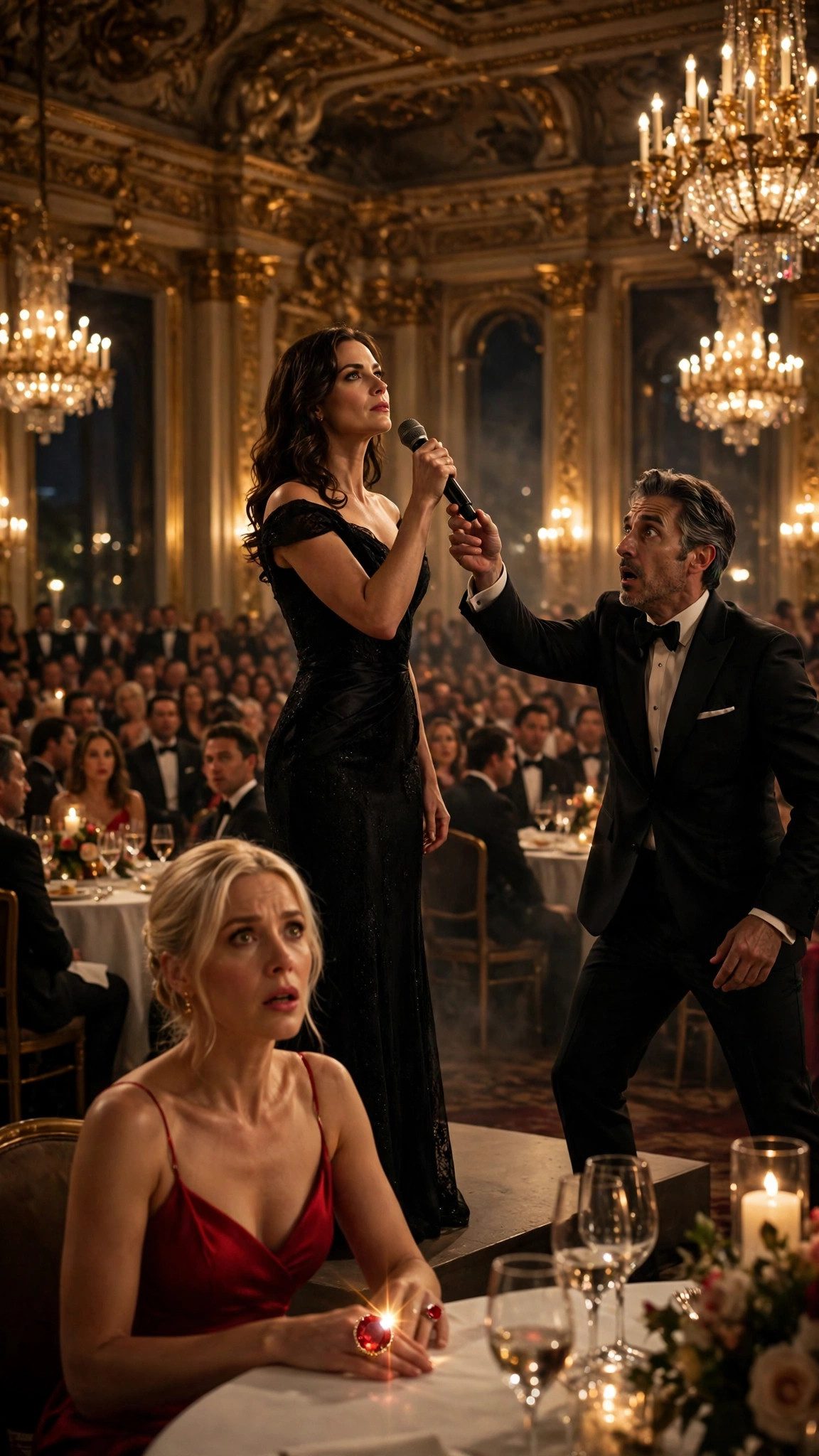
    Chandeliers hung from the ceiling like frozen fireworks. White tablecloths covered a hundred tables. Waiters moved between them with trays of champagne. Three hundred people — executives, associates, politicians, their wives in dresses that cost more than cars — talked and laughed and raised their glasses to Alexander Moretti, the man who owned the room, the man who owned the city, the man who owned me.

    I sat at the head table, beside an empty chair, because Alexander was on the stage, giving his speech. He stood in his black tuxedo, handsome and untouchable, and he talked about the company's year, about growth, about loyalty, about family. He used the word "family" the way he always did — as if it were a weapon, as if it were a wall.

    Vivian Cross sat in the front row, in a red dress, her blonde hair perfect, her hand resting on the table beside her wine glass. The ruby ring caught the light every time she moved. I watched it flash, red as blood, red as a warning, and I thought about my father's letter, folded in my purse, and the twenty-five dollars in the envelope beside it.

    Alexander finished his speech about loyalty, and the room applauded, and then he did something I had not expected. He stayed on the stage. He looked out across the room, and his eyes found me, and he smiled — the small, controlled smile of a man who is about to make an example of someone.

    "Before we continue," he said, into the microphone, "I want to address a small matter. My wife seems to have forgotten who pays for her father's care. The hospital bills are considerable, and I have been generous. But generosity has its limits. Perhaps a reminder is in order."

    The room went quiet. Three hundred people turned to look at me. Cameras turned toward me — the press, the photographers, the phones held up in the air.

    "The money stops tonight," Alexander said, "unless my wife remembers her place."

    He was threatening to cut off my father's hospital money. In front of hundreds of people. At a gala. With cameras rolling.

    He did not know there was no father left to save.

    My father had been dead for four days. He had been buried for three. And Alexander Moretti, who had not visited him once in twelve years, who had not come to his funeral, who had sent white lilies and a card in his assistant's handwriting, was standing on a stage threatening to cut off money for a man who was already in the ground.

    I stood up slowly. My chair scraped against the marble floor, and the sound carried through the whole hall. The entire room fell silent as the cameras turned toward me. I walked to the stage — I do not remember deciding to walk, I only remember the carpet under my heels and the chandeliers blurring above me — and I took the microphone from his hand.

    Alexander stared at me. For the first time in twelve years, he looked surprised. He looked, for one moment, like a man who has just realized that the receipt on his wall has learned to speak.

    I turned to the room. I turned to Vivian Cross, sitting in the front row in her red dress, her hand resting on the table, the ruby ring flashing in the light. I turned to Frank DeLuca, sitting at the next table, old and watchful, the consigliere, the keeper of oaths. I turned to the cameras.

    And I lifted the microphone to my lips, and I said four words that made every executive, every guest, every associate, and Alexander himself go pale.

    "Look at her hand!"

    The silence that followed was total. Three hundred people, and not one of them made a sound. Every eye in the room turned to Vivian Cross. Every camera turned to Vivian Cross. And Vivian Cross, who had smiled at cameras a thousand times, went white — because she knew, in that moment, what every person in that room knew.

    The ruby ring. The Moretti matriarch's ring. The ring that belonged to the wife of the head of the family. The ring that had been passed from mother to wife for four generations. The ring that Alexander's mother had worn, and that his wife — me — had never been given.

    It was on the hand of his assistant.

    Frank DeLuca stood up slowly from his table. He was seventy-two years old, and he moved like a man who had seen everything and forgotten nothing. He looked at Vivian's hand. He looked at Alexander. He looked at me. And he said, in a voice that carried to every corner of the room, "That ring belongs to the wife of the head of this family. Whose hand is it on?"

    No one answered. No one needed to.

    I turned back to Alexander, and I held the microphone steady, and I said, very clearly, so that every person in the room could hear me, "My father is dead, Alexander. He died four days ago. He was buried three days ago. You did not come to his funeral. You sent lilies. And tonight, you stood on this stage and threatened to cut off money for a man who is already in the ground."

    A murmur ran through the room like a wave. I saw wives put their hands to their mouths. I saw executives look at each other. I saw Frank DeLuca's face go hard as stone.

    "My father saved your life," I said. "He took a bullet that was meant for you, eighteen years ago, and it damaged his heart, and he lived eighteen years with that damage, and it killed him. And while he was dying in intensive care, you sent me twenty-five dollars, and you wrote, 'For nourishment.'"

    I reached into my purse, and I took out the envelope, and I took out the twenty-five-dollar bill, and I held it up so the cameras could see it.

    "Twenty-five dollars," I said. "That is what twelve years of marriage is worth to Alexander Moretti. Twenty-five dollars, and a ring that belongs to his wife, given to his assistant."

    The room erupted. Not all at once — first a gasp, then a murmur, then a roar of voices, of chairs scraping, of cameras flashing. Vivian stood up, her face white, her hand — the hand with the ring — pressed to her chest as if she could hide it. Alexander reached for the microphone, but I stepped back, out of his reach, and I looked at him, and I said the last thing I would ever say to him as his wife.

    "You swore an oath, Alexander. On your mother's grave, and before God, and before Frank DeLuca. You swore my father's daughter would live a life of honor and protection. You broke that oath. And tonight, in front of everyone who matters to you, I am calling it due."

    I put the microphone down on the stage. I put the twenty-five dollars on top of it. And I walked out of the ballroom, through three hundred staring people, through the doors, into the night, with my head high and my father's letter in my purse and my mother's tears finally, finally avenged.

    Behind me, I heard Frank DeLuca say, "The family will want to discuss this, Alexander."

    I did not look back. But later — much later, when Rosa told me what had happened after I left — I learned that the ballroom had stayed silent for a full minute after the doors closed behind me. A whole minute, three hundred people, not one of them speaking. And then the room had erupted, all at once, in a roar of voices, and Vivian Cross had stood up, her face white, her hand pressed to her chest, and she had tried to leave, and Frank DeLuca had stood in her path, and he had said, very quietly, "Sit down, Miss Cross. The family will want to hear from you, too."

    And Alexander — Alexander had stood on the stage, staring at the microphone, staring at the twenty-five dollars lying on top of it, and he had not moved. Rosa told me he stood there for a long time, while the room shouted around him, while the cameras flashed, while his whole world came apart in front of him. He stood there, and he looked at the twenty-five dollars, and for the first time in his life, Alexander Moretti understood what something was worth — not what it cost, but what it was worth.

    He understood, in that moment, that he had sent his wife twenty-five dollars, and that twenty-five dollars had just cost him everything.

    And I heard nothing else, because the doors closed behind me, and the night was cold and clean, and for the first time in twelve years, I was free.

    But I have never forgotten the hours before that moment — the hours inside the ballroom, when I sat at the head table and smiled, and waited, and watched the room the way a woman watches a storm gather on the horizon.

    I had arrived early, before most of the guests, because Alexander liked his wife to be seated when the room filled, like a piece of furniture that belonged to the house. I sat at the head table, beside the empty chair where my husband would sit, and I watched the ballroom fill — the executives in their black tuxedos, the wives in their gowns, the politicians shaking hands, the photographers setting up their lights. The chandeliers blazed. The waiters moved between the tables with trays of champagne. A string quartet played in the corner, soft and elegant, as if nothing in the world could ever go wrong in a room like this.

    A woman I barely knew — the wife of one of Alexander's executives, a woman named Caroline, with pearls at her throat and a practiced smile — leaned across the table and said, "Emma, darling, you look wonderful. Black is so brave for a gala. Is everything all right? You look a little pale."

    "I am fine," I said. "Thank you for asking."

    "And your father?" she asked. "How is he? Alexander mentioned he has been unwell."

    I looked at her — at her kind, curious face, at her pearls, at her practiced smile — and I said, very quietly, "My father is dead, Caroline. He died four days ago."

    Her face went white. Her hand flew to her mouth. "Oh, Emma. Oh, my God. I had no idea. I am so sorry. Why — why are you here?"

    "Because my husband expects me to be here," I said. "Because my husband has not yet noticed that my father is dead."

    She stared at me, and I could see her trying to decide whether I was joking, or mad, or telling the truth. And then she looked across the room, at Alexander, laughing with a group of men near the bar, and at Vivian Cross, in her red dress, at his elbow, and I saw understanding dawn on her face — slow, and terrible.

    "Emma," she whispered, "what are you going to do?"

    "I am going to tell the truth," I said.

    She nodded, very slowly, and she did not say anything else. But when Alexander came to the table, a few minutes later, and sat down beside me, and leaned close to ask me why I was not smiling, I saw Caroline watching us, and I saw her put down her champagne glass, and I knew that whatever happened next, at least one person in that room would believe me.

    The dinner was served — course after course, salmon and beef and chocolate, wine poured and poured again — and Alexander gave his speech, and the room applauded, and then he stayed on the stage, and he looked at me, and he said the words that would end our marriage.

    I have told you what he said. I have told you what I said. But what I have not told you is what happened in the minutes after I put the microphone down and walked out — because those minutes matter, too, and I remember them the way I remember everything from that night, in perfect, terrible detail.

    I walked through the ballroom, through three hundred staring people, and no one stopped me. No one spoke to me. The string quartet had stopped playing. The waiters had stopped moving. The only sound was the click of my heels on the marble floor, and my own breathing, loud in my own ears.

    At the doors, a young waiter — a boy, really, no more than twenty, with dark hair and frightened eyes — held the door open for me. As I passed him, he whispered, "Good luck, ma'am."

    I stopped. I looked at him. "Thank you," I said. And I meant it, because in that moment, his kindness — a stranger's kindness, freely given — meant more to me than twelve years of Alexander Moretti's money.

    Outside, in the lobby, the night air was cold through the glass doors. My phone was buzzing in my purse — message after message, calls I did not answer, from numbers I did not recognize, from reporters, from associates, from people who had been in that room and wanted to know more. I turned the phone off. I walked out of the hotel, into the night, and I stood on the steps for a moment, looking up at the sky, at the stars above the city, and I breathed — really breathed, for the first time in twelve years, as if my lungs had been closed and someone had finally opened them.

    A taxi pulled up. The driver — an older man, with a kind face — leaned out and said, "Where to, miss?"

    "Home," I said. And then I corrected myself, because the palace on the lake was not my home, and it had never been my home. "Take me to the lake," I said. "To a small apartment near the water. I will give you the address."

    He drove, and I sat in the back seat, and I watched the city go by through the window, and I thought about my father, and my mother, and the bullet, and the debt, and the ring, and the twenty-five dollars, and the four words that had changed everything.

    "Look at her hand!"

    I had said it. I had done it. And whatever came next — whatever Alexander did, whatever the family did, whatever the world did — I had finally, finally spoken.

    And no one could ever make me silent again.

  • Chapter 4: Twenty-Five Dollars

    Chapter 4: Twenty-Five Dollars

    The day my father died, the rain came back to Chicago.

    It rained the way it had rained eighteen years ago, on the night of the bullet — cold, steady, indifferent rain that washed the streets clean and made the lake look grey and endless. I stood at the window of my father's small apartment, looking out at the rain, and I thought about how much of my life had been measured in rain. The night he was shot. The day Alexander came to our house. The day of my wedding. The day of my mother's funeral. And now this day, the day I would bury my father, with rain on the roof and rain on the windows, as if the sky itself were grieving for a man who had never been anyone important.

    My father was a driver. He was not a soldier. He was not an executive, not a bodyguard, not anyone important. But he had been important to me. He had been the man who taught me to ride a bicycle, who helped me with my geometry homework even though he did not understand it, who pressed his hand to his chest when he was tired and smiled anyway, who walked me down the aisle with a shaking hand and whispered, "Forgive me."

    I forgave him. I forgave him on the day he died, standing in the ICU with his hand cold in mine. I forgave him for the debt, for the promise, for the marriage. He had done what he thought was right. He had done what a man who owes his life does — he had given what he could, and what he could give was me, and he had spent eighteen years regretting it.

    The funeral was small. My father had never been a man for crowds. Mrs. Okafor came, from the dance studio, with a lemon cake. Rosa came, from the palace, and stood at the back of the church with her hands folded. My colleagues from the accounting firm came, kind and awkward, not knowing what to say. Alexander did not come. He sent flowers — white lilies, expensive, impersonal — and a card that read, in his assistant's handwriting, "With sympathy, Alexander Moretti."

    I stood at my father's grave and I thought about the twenty-five dollars.

    I had not spent it. It sat in my bank account, untouched, a small, humiliating monument to twelve years of marriage. I had looked at the balance on my phone a dozen times since the transfer, and each time, I had felt the same thing — not anger, not at first, but a kind of cold clarity, as if someone had wiped a fogged window clean and I could finally see the room I had been living in.

    On the morning of the funeral, I went to the bank. I do not know why I did it — perhaps I needed to hold the thing in my hands, to make it real, to prove to myself that it had actually happened. I stood in line at the counter, among ordinary people depositing paychecks and withdrawing cash for groceries, and when my turn came, I asked the teller for twenty-five dollars, in a single bill, from my own account. She counted it out without looking at me, the way tellers do, and she handed me a crisp twenty-five-dollar bill, and I put it in an envelope, and I put the envelope in my purse, next to my father's letter.

    The teller smiled at me, a polite, professional smile, and said, "Have a nice day."

    I almost laughed. A nice day. My father was dead. My husband had sent me twenty-five dollars for nourishment. And a stranger at a bank wished me a nice day. I thanked her anyway, because kindness is kindness, even when it is wasted, and I walked out into the rain, with the envelope in my purse, and I thought: this bill is going to be the most expensive twenty-five dollars Alexander Moretti ever spent. Not because of what it cost him. Because of what it is going to cost him.

    Twenty-five dollars. For nourishment. As if I were a stray dog he had found on the street. As if my father's dying had been an inconvenience, and the money was meant to keep me quiet while he enjoyed his island.

    On the third day after the funeral, I did something I had never done before. I went through my husband's study.

    Alexander was in New York — or so Rosa told me — and the house was empty except for Rosa and the silence. I went into his study, the room behind the closed door, the room I had never been invited into, and I opened the drawers of his desk, one by one, looking for — I did not know what. Proof. Evidence. Something that would explain the last twelve years.

    I found photographs. Dozens of them, in a drawer, in envelopes marked with dates. Alexander and Vivian, in Miami, in Las Vegas, on a yacht, on a private island. Vivian in a red dress, Vivian in a white dress, Vivian laughing, Vivian with her hand on Alexander's arm. And in every photograph, on Vivian's left hand, a ruby ring.

    I knew that ring. I had seen it once, years ago, in a photograph on Alexander's desk — a photograph of his mother, a stern, beautiful woman in a black dress, wearing a ruby ring on her left hand. I had asked him about it once, in the early years, and he had said, "That ring belongs to the wife of the head of this family. It has been passed from mother to wife for four generations. My mother wore it. One day, my wife will wear it."

    One day, my wife will wear it.

    I was his wife. I had never worn it. I had never even seen it, except in that photograph. And now it was on the hand of his assistant, in photograph after photograph, catching the light, red as blood, red as a warning.

    I sat at his desk for a long time, with the photographs spread out in front of me, and I felt something inside me go very still and very cold. It was not jealousy. Jealousy would have been simpler. It was something older and deeper than jealousy. It was the understanding that Alexander had not merely been unfaithful to me. He had replaced me. He had given another woman the ring that belonged to his wife, the ring that said to everyone in his world: this is the woman who stands beside me. This is the woman who matters.

    And he had sent me twenty-five dollars.

    I put the photographs back in the drawer, exactly as I had found them, and I closed it, and I went to my room, and I took out my black dress — the one I had worn to my mother's funeral, the one I had worn to every gala where I had smiled and been polite — and I hung it on the door, ready.

    Because the gala was in four days. The company gala, the biggest event of Alexander's year, with hundreds of guests, and cameras, and the press, and all of his associates and their wives, and Vivian Cross in the front row in a red dress.

    And I had something to say.

    I spent the next three days preparing, the way I had once prepared for exams — quietly, carefully, without telling anyone. I went to the bank and I withdrew the twenty-five dollars in cash, a single crisp bill, and I put it in an envelope. I went to my father's apartment and I packed his things — his shirts, his books, his old driver's cap, the shoebox under his bed where he kept his letters and his papers — and I brought them home to the palace, to my room, where Alexander would never look.

    And on the morning of the fourth day, I found something in that shoebox that changed everything.

    It was a letter, folded and refolded so many times that the creases were soft and worn. It was written in Alexander Moretti's own hand, eighteen years ago, on the day after my father was shot. It was addressed to my father, and it was witnessed by a man named Frank DeLuca — the consigliere, the old guard, the one man in Alexander's world whose word was law.

    The letter said: "Robert Hayes saved my life. I owe him a debt that cannot be measured in money. I swear, on my mother's grave and before God, that his daughter will live a life of honor and protection, and that no harm will come to her through me or mine. If I break this oath, let the family judge me."

    I read it three times. And then I sat on the floor of my room, surrounded by my father's things, and I cried for the first time since he had died — not from grief, but from something like relief. Because I finally had, in my hands, the proof that Alexander had not merely been a bad husband. He had broken an oath. He had sworn, before God and before the family, to protect me — and he had spent twelve years doing the opposite.

    He had given my ring to another woman. He had sent me twenty-five dollars while my father died. He had threatened me in front of hundreds of people — or he was about to.

    And I had, in my hands, the paper that could end him.

    I folded the letter carefully and put it in my purse, next to the envelope with the twenty-five dollars. And I put on my black dress, and I did my hair, and I looked at myself in the mirror, and I saw a woman I had not seen in twelve years.

    I saw Emma Hayes. I saw a woman who was done being silent.

    The gala was that night. And Alexander Moretti had no idea what was coming.

    But before the gala, there were the three days in the intensive care unit — three days that felt like three years, three days that I will remember for the rest of my life, in every detail, because grief has a way of carving ordinary moments into stone.

    The ICU at St. Mary's was on the sixth floor. The corridor was long and pale, with linoleum floors that squeaked under your shoes, and a nurses' station in the middle where the nurses spoke in low voices and drank coffee from paper cups. My father's room was at the end of the corridor, behind a glass wall, and inside it, the machines breathed for him — a ventilator, sighing in and out, in and out, and a monitor that beeped, steady and green, and an IV bag that dripped, drip by drip, into his arm.

    There was a nurse named Angela. She was in her fifties, with grey hair pulled back and kind eyes, and she had worked in the ICU for twenty years, and she knew things that doctors did not know — like how to tell when a family needed to be left alone, and when they needed someone to sit with them. She brought me coffee, and she brought me a blanket for the chair, and she said, "Talk to him, honey. Even if he can't answer. They hear more than we think."

    So I talked to him. I sat beside his bed, holding his hand — his hand thin and cold, the veins standing out like blue rivers under the skin — and I talked to him about ordinary things. I told him about Mrs. Okafor's lemon cake. I told him about the accounting firm, about the bakery whose books I had balanced that week, about the dance studio and the little girls in their pink leotards. I told him about the weather, about the rain, about the traffic on the lake road. I told him everything and nothing, because Angela said he could hear me, and I wanted him to hear something kind.

    On the second day, the doctor came — a young man named Dr. Patel, with tired eyes and a gentle voice — and he took me into the corridor, and he said, "Mrs. Moretti, I need to be honest with you. Your father's heart is failing. The scar tissue from the old injury has been weakening the muscle for years, and now it is giving out. We are doing everything we can. But you should prepare yourself."

    "Prepare myself for what?" I asked, though I knew.

    "For the possibility," he said, "that he will not come home this time."

    I nodded. I thanked him. I went back into the room, and I held my father's hand, and I did not cry, because I had learned, over twelve years, that tears in the Moretti house were a currency no one accepted, and because I did not want my father's last days to be spent watching his daughter cry.

    On the third day, in the afternoon, my father opened his eyes.

    It was only for a moment — a brief, flickering moment of lucidity, the kind the nurses said sometimes happens, a last rally before the end. His eyes found mine, and they were clear, clearer than they had been in weeks, and he squeezed my hand — weakly, so weakly, but I felt it — and he whispered, so softly I had to lean close to hear him, "Emma. My Emma. You are not a debt. You never were. Remember that."

    Those were the last words he ever spoke to me.

    I held his hand, and I whispered back, "I remember, Papa. I remember. I love you."

    He closed his eyes, and he did not open them again.

    He died two days later, at four in the morning, while I was asleep in the chair beside his bed. The nurse — Angela, kind Angela — woke me gently, and she told me he had gone peacefully, in his sleep, and that he had not been in pain. I held his hand for a long time after that, until it was cold, and then I stood up, and I washed my face, and I went home to the palace on the lake.

    And I carried his last words with me, the way I carried the letter, the way I carried the twenty-five dollars. "You are not a debt. You never were."

    My father had paid the debt with his body, eighteen years ago, on a rainy street in Chicago. I owed Alexander Moretti nothing. And now, finally, I believed it.

  • Chapter 3: The Debt Becomes a Wife

    Chapter 3: The Debt Becomes a Wife

    The palace Alexander built for me stood on the lake, behind iron gates, at the end of a driveway lined with trees that had been planted fully grown, as if even the garden had not been allowed to take its time. It had marble floors and a staircase that curved like a river and a bedroom with windows that looked out over the water, and a kitchen bigger than the whole first floor of my parents' house. There were more rooms than people. There were rooms I never entered in twelve years.

    He promised me a life of luxury, and he kept that promise the way he kept all his promises — exactly, and without warmth. I had clothes I had never asked for, jewelry I never wore, a car I never drove. I had a housekeeper named Rosa who had worked for the Moretti family for thirty years and who looked at me with a mixture of pity and respect, as if I were a guest who had stayed too long and could not leave.

    My wedding night, Alexander came to my room — the room that was mine alone, because we had never shared a bedroom, not once — and stood in the doorway for a long time, looking at me the way he had looked at our living room that Tuesday in June. Like a man inspecting a property.

    "I will not force myself on you," he said. "I am not that kind of man. This marriage is a matter of honor, Emma. Your father saved my life. I will protect you and provide for you. That is the arrangement."

    "An arrangement," I repeated.

    "Yes," he said. "And I expect you to honor it. You will attend the events I require you to attend. You will be polite to my associates. You will not embarrass me. In return, you will want for nothing."

    He left, and closed the door softly behind him, and I sat on the edge of the bed in my white nightdress and listened to his footsteps going down the marble stairs, and I understood, finally, what my mother had been crying about.

    I was not a wife. I was a receipt, framed and hung on the wall of a palace.

    The first year was the hardest, because I still believed it might become something else. I still believed that a man who had sworn an oath on his mother's grave might one day look at me and see a woman instead of a debt. I cooked dinners he never ate. I waited up for him on nights he never came home. I learned the names of his associates and their wives, and I smiled at galas, and I wore the dresses he bought me, and I told myself that this was what marriage was — patience, and silence, and waiting.

    But Alexander did not come home. He came to the house, the way a man comes to an office — to sleep, to change his suit, to take a phone call in his study behind a closed door. He was polite to me, always polite, in the way powerful men are polite to people who cannot hurt them. He asked about my day. He never listened to the answer.

    I found work, because I needed something that was mine. I took a job at a small accounting firm downtown — not a Moretti company, not a company that owed him anything — and I worked there three days a week, balancing books for bakeries and flower shops and a dance studio run by a woman named Mrs. Okafor who made the best lemon cake I had ever tasted. My colleagues did not know who my husband was, or if they did, they were kind enough not to mention it. For three days a week, I was Emma Hayes again — a woman who was good with numbers, who drank too much coffee, who laughed at jokes about tax season.

    Alexander did not object to the job. He did not object to anything I did, as long as I did not embarrass him. I think he preferred it when I was out of the house. A receipt is easier to live with when it is not sitting across the table from you.

    In the third year of our marriage, my mother died. A stroke, sudden, in her sleep, in the small brick house where I had grown up. She was sixty-one. At her funeral, Alexander stood beside me in a black suit, and he held my hand during the service, and for one moment — one brief, stupid moment — I thought he might be human after all. Then, in the car on the way home, he said, "Your father will be taken care of. The pension continues. You have my word."

    That was all he said. That was the whole of his comfort.

    My father came to live with me after that, in a small apartment I rented for him near the lake, paid for from my own salary, because I did not want him living in Alexander's palace, and I did not want Alexander to own him the way he owned me. My father visited the house sometimes, on Sundays, and he would sit in the garden and look at the lake, and he would say, "Your mother would have liked this garden, Emma." And I would say, "She would have liked the garden, Papa. She would not have liked the price."

    He never answered that. He only patted my hand, the way he had always done, and changed the subject.

    In the fifth year, Vivian Cross arrived.

    She was twenty-three years old, blonde, beautiful in the sharp, polished way of women who have learned that beauty is a tool and have decided to use it well. She had a degree from a good university and a smile that made men forget what they were saying. Alexander hired her as his personal assistant, and within a month, she was traveling with him everywhere — to New York, to Miami, to Las Vegas, to meetings I was never invited to and dinners I never attended.

    I noticed, the way wives notice, in small pieces. A perfume on his jacket that was not mine. A second glass of wine at a dinner where I had not been present. A photograph in a magazine — Alexander at a charity event in Miami, and a blonde woman in a red dress standing just behind him, her hand on his arm, smiling at the camera as if she belonged there.

    I said nothing. I had learned, over five years, that saying nothing was the safest thing a wife of Alexander Moretti could do. I told myself she was only an assistant. I told myself that powerful men have assistants, and assistants travel, and there was nothing more to it than that.

    But I watched, and I remembered. And in the seventh year of our marriage, on my birthday, Alexander did not come home at all. He was on a private island with Vivian Cross and a group of women in dresses that cost more than my father's car, celebrating — I learned later, from a photograph in a magazine left open on Rosa's kitchen table — not my birthday, but hers. Vivian's birthday. He had flown a dozen people to an island for her birthday, and he had forgotten mine entirely.

    I sat alone that night in the palace on the lake, in a dress I had bought for a dinner that never happened, and I ate a piece of cake by myself in the kitchen, and I thought about my mother, standing alone in our kitchen, crying the whole evening. I thought about my father, in his small apartment, pressing his hand to his chest when he was tired. I thought about the bullet, eighteen years ago, and the promise, and the debt, and the price.

    And I thought: I have paid this debt for seven years. How much longer?

    I did not have an answer. I did not have an answer for five more years.

    In the ninth year, my father's heart began to fail in earnest. The doctors said the scar tissue from the bullet had been weakening the muscle for years, and now it was giving out. He tired after walking across a room. He slept most of the day. He was admitted to the hospital for the first time, and then the second, and then the third, and each time he came home a little weaker, a little smaller, a little more afraid.

    Alexander paid for the best doctors. I will give him that. He paid for a private room, for specialists, for medicine that cost more than my yearly salary. He paid, and he never once came to see my father. Not once in twelve years did Alexander Moretti visit the man who had saved his life in a hospital bed. He sent money. He sent flowers, once, through Rosa. He never came himself.

    I think that is the thing I cannot forgive. Not the island. Not the assistant. Not the twenty-five dollars. The fact that he never once sat beside my father's bed and said thank you.

    In the twelfth year, my father was admitted to the intensive care unit at St. Mary's Hospital, and the doctors told me, gently, that his heart was failing, and that this time, he might not come home. I stayed at the hospital for three days and three nights, sleeping in a chair beside his bed, holding his hand, watching the machines breathe for him.

    On the third day, I called Alexander. I had not spoken to him in four days. I told him my father was dying, and I asked him — I asked him, quietly, in the corridor outside the ICU — if he knew where his assistant was, and why she had needed to travel with him to a private island for her birthday.

    He was silent for a long moment. Then he said, "Emma, you are embarrassing yourself. And you are embarrassing me."

    And he hung up.

    An hour later, my phone buzzed. A bank notification. A transfer, from Alexander Moretti, to my account.

    Twenty-five dollars.

    The message attached to it read: "For nourishment."

    I stood in the corridor outside the ICU, with the smell of disinfectant in my nose and the sound of my father's ventilator sighing behind the glass, and I read that message twice, and I understood, finally and completely, what I was worth to Alexander Moretti.

    Twenty-five dollars. The price of a sandwich and a coffee.

    And I understood something else, too. I understood that I had been silent for twelve years, and that my silence had cost me everything — my youth, my choices, my father's pride, my mother's tears. I had been silent because I thought silence was the price of the debt. But the debt was my father's, not mine. My father had paid it with his body, eighteen years ago, on a rainy street in Chicago. I owed Alexander Moretti nothing.

    Nothing at all.

    I went back into my father's room, and I held his hand, and I whispered to him, "Papa, I'm going to be all right. I promise you. I'm going to be all right."

    He died two days later, at four in the morning, while I was asleep in the chair beside his bed. The nurse woke me gently and told me he had gone peacefully, in his sleep, and that he had not been in pain. I held his hand for a long time after that, until it was cold, and then I stood up, and I washed my face, and I went home to the palace on the lake, and I began to plan.

    Because Alexander Moretti had made a mistake. He had sent me twenty-five dollars, and he had shown me exactly what he thought I was worth. And a woman who knows what she is worth to her husband — and knows that it is not enough — is a woman who has nothing left to lose.

    Four days after my father died, Alexander Moretti held his company gala, in a ballroom full of hundreds of people, with chandeliers and white tablecloths and cameras. And he had no idea what was coming.

    Neither did I, entirely. I only knew that I would not be silent anymore.

    I had met Vivian Cross only once before that night — at a charity gala two years earlier, a glittering event for a children's hospital, where I had worn a blue dress and smiled until my face hurt. She had come up to me at the bar, holding a glass of champagne, and she had said, in a voice as smooth as silk, "Mrs. Moretti, I am such an admirer of yours. Alexander speaks of you so highly."

    I had looked at her — young, blonde, beautiful, her hand resting lightly on the bar, a diamond bracelet catching the light — and I had said, "Thank you, Miss Cross. I hope you enjoy working for my husband."

    "Oh, I do," she had said, smiling. "He is a wonderful man to work for. So — attentive."

    She had let the word hang in the air between us, just long enough for me to hear what she meant by it, and then she had drifted away, into the crowd, toward Alexander, toward the center of the room, toward the place where I was supposed to stand.

    Later that night, Rosa had found me in the ladies' room, staring at myself in the mirror, and she had said, very quietly, "Mrs. Moretti, be careful of that one. She has the eyes of a woman who is counting what other people own."

    I had laughed it off. I had told myself Rosa was old-fashioned, that she saw danger everywhere. But I remembered her words, and I watched, and over the next two years, I watched Vivian Cross move through my husband's life the way a tide moves through a house — slowly, quietly, and then all at once, everything is underwater.

    I watched her at the office Christmas party, laughing at Alexander's jokes a little too long. I watched her in the photographs from Miami, standing a little too close. I watched her hand, in every photograph, resting a little too easily on his arm.

    And I said nothing. For two years, I said nothing. Because I had learned, over twelve years, that saying nothing was the safest thing a wife of Alexander Moretti could do.

    But I am not silent anymore.

  • Chapter 2: The Bullet

    Chapter 2: The Bullet

    The night my father took the bullet, it was raining in Chicago, the kind of cold October rain that finds its way through coat collars and settles in your bones.

    Robert Hayes had been driving for Alexander Moretti for eleven years by then. He had started as a delivery driver for a warehouse on the South Side, and one day a man in a black car had offered him three times his wages to drive for a private employer who valued discretion. My father had never asked what the employer's business was. He drove. He opened doors. He waited outside restaurants and hotels for hours without complaint. He learned the streets of Chicago the way other men learn prayers — by heart, in the dark, without thinking.

    He was forty-one years old that night. He had a wife who ironed his shirts and a daughter who was failing geometry and a mortgage that would take twelve more years to pay. He had a heart that was strong and whole, and he had no idea that before the night was over, it would be broken in a way that could never be fully repaired.

    The dinner had run late. Alexander had been at a restaurant on the river with three men my father did not know and did not ask about. My father waited in the car for four hours, listening to the rain on the roof, reading a newspaper he had already read twice. At a quarter past midnight, Alexander came out, alone, his face closed and unreadable in the way it always was after those dinners. He got into the back seat and said, "Home, Robert."

    My father pulled away from the curb and turned onto the street. The rain was coming down harder now, and the wipers beat back and forth, back and forth, and the streetlights smeared across the wet asphalt like spilled paint.

    Two blocks from the restaurant, on a street lined with parked cars and dark shopfronts, my father saw him. A man standing between two parked cars, half-hidden by the dark, his arm raised. My father had driven through bad neighborhoods for twenty years. He knew the shape of a man holding a gun before his mind had time to name it.

    He did not think. He did not weigh the risk. He did not calculate what his life was worth against the life of the man in the back seat. Later, when people asked him why he had done it, he would say only, "It was my job to get him home safe." As if that explained everything. As if a man could put his body in front of a bullet the way he put his body in front of a door in the rain, holding an umbrella for someone else.

    He threw the car into park, threw his own door open, and stepped out into the rain, putting himself between the gunman and the back seat. The shot came a half-second later — a crack that sounded small in the rain, smaller than thunder, smaller than a car backfiring. My father felt it as a punch, high in his chest, and then as a heat, and then as a coldness spreading outward from the center of him.

    He fell against the car door. His legs gave way. The rain was on his face. He could hear Alexander shouting his name, and then he could hear nothing at all except his own heartbeat, slowing, slowing, and the rain.

    Alexander dragged him into the back seat and drove. He drove through red lights with my father's blood on his hands and on his suit, and he carried my father through the emergency room doors himself, shouting for a doctor, shouting that this man had saved his life.

    The surgeons worked for six hours. My mother sat in the waiting room with her purse on her lap, her hands folded so tightly that her knuckles were white, and she did not cry. Not once. She told me later that she could not cry, because if she started, she would not be able to stop, and someone had to be standing when the doctors came out.

    I was asleep at home. I was fourteen years old, and I dreamed about a geometry test, and I did not know that my father's heart had been nicked by a bullet, that a piece of lead had passed within an inch of killing him, that the muscle of his heart would bear a scar for the rest of his life and would never beat as strongly again.

    In the morning, my mother woke me and told me my father had been shot and was in the hospital, and the world tilted sideways. I remember the hospital corridor — the smell of disinfectant, the sound of machines, the nurses moving quickly and quietly. I remember my father's face, pale against the white pillow, and the tubes, and the way his chest rose and fell with the help of a machine.

    And I remember Alexander Moretti standing in the doorway of that hospital room, in a fresh suit, his hair perfect, looking at my father the way a man looks at a debt he has just discovered he cannot repay.

    "When he's old enough," Alexander said to my father — and to my mother, who stood in the doorway with her purse in both hands — "I will make sure his daughter is taken care of. I owe him my life."

    My father, weak as he was, reached out and took Alexander's hand. "Take care of her," he whispered. "That is all I ask."

    Alexander nodded. "I swear it," he said. "On my mother's grave, I swear it."

    My mother said nothing. She stood in the doorway and watched, and her face gave nothing away. But I saw her hands tighten on her purse, and I saw her look at me — at her fourteen-year-old daughter, standing in a hospital corridor in her school uniform — and I saw something cross her face that I did not understand then.

    It was fear. It was the fear of a woman who has just watched a powerful man swear an oath over her daughter, and who knows that powerful men keep their oaths in the way that suits them best.

    My father lived. The doctors said it was a miracle, or luck, or the fact that he was strong — but the truth was simpler and crueler. The bullet had damaged his heart. It would beat, but it would never be whole. He tired easily after that. He could not run, could not lift, could not climb stairs without stopping to catch his breath. He retired from driving four years later, when his hands began to shake on the wheel, and Alexander paid him a pension — generous, regular, silent.

    We lived on that pension, and on my mother's work cleaning houses, and on the quiet understanding that we owed Alexander Moretti, and Alexander Moretti owed us, and the debt sat between us like a third person at the table.

    I grew up in the shadow of that debt. I went to college on a scholarship, because my father insisted I have something of my own, something no one could take away. I studied accounting. I liked numbers. Numbers added up. Numbers did not make promises they could not keep.

    I had a boyfriend, Daniel, kind and ordinary, who worked at a bank and wanted to marry me and move to Milwaukee and have two children and a dog. I almost said yes. I had the ring picked out in my mind — a small, simple ring, nothing like the rings in the jewelry store windows on Michigan Avenue.

    And then, on a Tuesday in June, Alexander Moretti came to our house.

    The car pulled up in front of our small brick house — black, long, silent. My mother opened the door and her face went white. Alexander stepped into our living room in a suit that cost more than our house, and he looked at the faded sofa and the photographs on the wall, and he looked at me, twenty years old, standing in the doorway of the kitchen in jeans and a sweater, and he said, "I have come to collect on my promise."

    My father was in his chair by the window, his hand pressed to his chest. He looked at Alexander, and then he looked at me, and I saw the fear in his eyes.

    "Emma," he said. "Go to your room."

    "No," Alexander said. "Let her stay. She should hear this."

    He turned to me, and his voice was calm, and reasonable, and utterly final. "Your father saved my life, Emma. I owe him a debt I can never repay. So I will repay it the only way I can. I will marry you. I will give you a life of luxury. You will never want for anything. Your parents will be taken care of for the rest of their lives. This is my promise, and I keep my promises."

    I stood there, twenty years old, and I waited for someone to laugh. I waited for my father to tell him to leave. I waited for my mother to say this was madness.

    No one laughed. My father looked at his hands. My mother looked at the floor.

    "Emma," my father said at last, very quietly, "Mr. Moretti is a man of his word. And I am a man who owes him my life. If this is what he wants — if this is how he chooses to repay me — then I cannot refuse him. I will not refuse him."

    That night, my mother stood alone in our kitchen and cried the whole evening, her hands wrapped around a mug of tea that went cold. I sat on my bed and listened to her crying through the wall, and I told myself she was crying because she would miss me.

    I understand now that she was crying because she knew. She knew that a marriage built on a debt is not a marriage. She knew that Alexander Moretti was not offering me a life — he was collecting one. And she knew, as mothers know, that there was nothing she could do to stop it, because the debt was real, and the man who held it was the most feared man in Chicago.

    Three weeks later, I married Alexander Moretti in a small ceremony at a church on the lake, wearing a white dress my mother had sewn by hand, with only our two families present. My father walked me down the aisle, his hand shaking on my arm, his heart beating too fast under his suit. He kissed my cheek at the altar and whispered, "Forgive me, Emma. Forgive me."

    I did not understand what he was asking me to forgive. I do now.

    I forgave him a long time ago. It took me twelve years to forgive Alexander.

    But there are things I have never forgotten about my father, and they are not the things in the newspapers, or in Alexander's version of the story. They are small things. Ordinary things. The way he taught me to ride a bicycle on a Sunday morning on our street, running behind me with his hand on the back of the seat, shouting, "Pedal, Emma, pedal, don't look down!" The way he came home from work with his shirt smelling of gasoline and rain, and picked me up and swung me around the kitchen until my mother told him to stop before he broke something. The way he knew every street in Chicago by heart — every shortcut, every alley, every light that stayed green a second longer than the others — and told me, as if it were a great secret, "A good driver never hurries, Emma. Hurrying is how people get hurt."

    After the shooting, my father came home from the hospital after three weeks, thinner and paler, with a scar on his chest that he would never show anyone but my mother. The doctors told him to rest, to take it easy, to avoid lifting anything heavy, to avoid stairs. My father, who had never sat still in his life, tried. He really tried. He sat in his chair by the window and read the newspaper, and he watched the street, and he pressed his hand to his chest when he was tired, the way he would do for the rest of his life.

    I brought him soup. I was fourteen, and I did not know how to cook, but my mother taught me, standing beside me at the stove, showing me how to chop the carrots and the onions, how to let the broth simmer until the whole house smelled of it. I carried the bowl to my father's chair, carefully, with both hands, and he smiled at me, and he said, "Your mother taught you well, Emma. You will make someone a good wife one day."

    I did not know then how much those words would cost me.

    In the months after the shooting, men came to our house. Quiet men, in dark suits, who spoke to my father in low voices in the living room while my mother and I stayed in the kitchen. One of them was Frank DeLuca — old even then, with white hair and sharp eyes — and I remember him sitting across from my father, leaning forward, his hands folded, listening more than he spoke. I remember my father saying, "I did what any man would do." And Frank DeLuca saying, "No, Robert. Most men would have driven away. You stayed. The family remembers that."

    The family. I did not know what that meant then. I thought he meant Alexander's family, his wife, his children. I did not know that "the family" was something else entirely — a world with its own rules, its own debts, its own oaths, a world that had just reached into our small brick house and taken hold of us, and would not let go for eighteen years.

    My father went back to driving, eventually, though the doctors told him not to. He could not bear to sit in the chair by the window for the rest of his life. He drove Alexander for four more years, and his hands shook a little on the wheel, and he tired easily, but he drove, because driving was what he knew, and because Alexander paid him well, and because — I think — he believed that as long as he was useful, the debt would stay balanced. As long as he drove, Alexander owed him. The day he stopped driving, he feared, the debt would be collected.

    He was right to be afraid. He was wrong about when it would happen.

    It happened on a Tuesday in June, when I was twenty years old. But that is a story for later. First, you must understand what my father was, before the bullet, before the debt, before Alexander Moretti decided that my life belonged to him.

    He was a man who knew every street in Chicago by heart. He was a man who taught his daughter to ride a bicycle. He was a man who brought soup to his own bedside table and ate it with gratitude, as if it were a feast. He was a man who put his body in front of a bullet without thinking, because it was his job to get his passenger home safe.

    He was my father. And he deserved better than to die owing a man who would one day own his daughter.

  • Chapter 1: For Nourishment

    Chapter 1: For Nourishment

    My father was fighting for his life in intensive care when my husband sent me exactly twenty-five dollars and wrote, "For nourishment."

    I read the message twice, standing in the corridor outside the ICU at St. Mary's Hospital, with the smell of disinfectant in my nose and the sound of my father's ventilator sighing behind the glass. Twenty-five dollars. Twelve years of marriage, and that was what I was worth to Alexander Moretti — the price of a sandwich and a coffee, sent like a tip to a waitress.

    He was punishing me. Three days earlier I had asked him, quietly, in our own kitchen, why his beautiful assistant needed to travel with him to a private island for her birthday. I had not raised my voice. I had not accused him of anything. I had only asked. And Alexander Moretti, the man all of Chicago feared, had answered me the way he answered everyone who questioned him: by making them smaller.

    While my father died, Alexander was on that private island, celebrating Vivian Cross's birthday under palm trees, raising glasses of champagne that cost more than the twenty-five dollars he had sent his wife.

    I did not cry in the corridor. I had learned, over twelve years, that tears in the Moretti house were a currency no one accepted. I put my phone in my pocket, went back into my father's room, and held his hand until the nurse came to change the IV bag. My father was a driver. He was not a soldier. He was not an executive, not a bodyguard, not anyone important. But one evening, eighteen years ago, he had taken a bullet that was meant for Alexander Moretti — and Alexander had come to his hospital bed the next morning and said, "When he's old enough, I will make sure his daughter is taken care of. I owe him my life."

    My mother never told me the whole truth. But I remembered the day Alexander decided I would become his wife. My mother stood alone in our kitchen and cried the whole evening, her hands wrapped around a mug of tea that went cold. I was twenty years old and I thought she was crying because she would miss me. I understand now that she was crying because she knew what I did not: a marriage built on a debt is not a marriage at all. It is a receipt.

    He promised me a life of luxury. He even had a palace built for me — a house on the lake with marble floors and a garden my mother could never have dreamed of, a house with more rooms than we had people to fill them. But he would spend my birthday at a beach on a private island with women in dresses that cost more than my father's car.

    My name is Emma Moretti. For twelve years, I have been married to Alexander Moretti. A man everyone in Chicago feared.

    And four days after my father died, I stood in a ballroom full of hundreds of people at his company gala, wearing a black dress and a smile I had practiced in the mirror, and I watched my husband take a microphone and threaten to cut off my father's hospital money again — without realizing there was no father left to save.

    He stood on the stage in his black tuxedo, handsome and untouchable, and he looked straight at me across the sea of white tablecloths and said, "My wife seems to have forgotten who pays for her father's care. Perhaps a reminder is in order. The money stops tonight unless she remembers her place."

    The room went very quiet. Cameras turned toward me. I could feel three hundred pairs of eyes on my face, waiting to see the wife of Alexander Moretti break in public.

    I saw a photo of my father in the hospital in my mind. He was connected to machines, breathing through a tube, his hand thin and cold in mine. And facing me was Alexander, one of the most powerful and feared men in Chicago, threatening me in front of hundreds of people. My father once saved his life, but he couldn't save me from him.

    I stood up slowly. My chair scraped against the marble floor, and the sound carried through the whole hall. The entire room fell silent as the cameras turned toward me. I walked to the stage — I do not remember deciding to walk, I only remember the carpet under my heels and the chandeliers blurring above me — and I took the microphone from his hand.

    Alexander stared at me. For the first time in twelve years, he looked surprised.

    I turned to the room. I turned to Vivian Cross, sitting in the front row in a red dress, her blonde hair perfect, her hand resting on the table beside her wine glass, a ruby ring catching the light on her finger. I had seen that ring before — in the photographs from the island, in the photographs from the office Christmas party, in the photographs from every trip my husband had taken in the last two years. I had seen it and I had told myself I was imagining things.

    I was not imagining things.

    I lifted the microphone to my lips, and I said four words that made every executive, every guest, every associate, and Alexander himself go pale.

    "Look at her hand!"

    This was not over. Not even close. But to understand what happened in that ballroom — and what happened after — you have to understand the night my father took a bullet for a man who would one day own his daughter.

    It began eighteen years ago, on a rainy October night, on a street in Chicago that no longer exists the way it did then. My father was driving Alexander Moretti home from a dinner that had run late. I was fourteen years old, asleep in my bed, dreaming about a geometry test. My mother was in the kitchen, ironing my father's shirts for the next day.

    None of us knew that by morning, our lives would belong to Alexander Moretti.

    The gunman came out of the dark between two parked cars. My father saw him first — saw the muzzle flash before he heard the shot, the way men who have driven through bad neighborhoods for twenty years learn to see danger a half-second before it arrives. He did not think. He did not hesitate. He threw the car door open and he put his body between the gunman and the back seat where Alexander sat.

    The bullet was meant for Alexander Moretti. It found my father's chest instead, an inch from his heart.

    Alexander told me once, years later, in one of the rare moments when he spoke to me honestly, that he had watched my father's blood spread across the leather seat and thought, in that moment, that he had finally run out of luck. He said my father's eyes had found his in the dark and my father had said, "Drive, Mr. Moretti. Drive."

    So Alexander drove. He drove my father to the hospital himself, his hands on the wheel, my father's blood on his suit, and he stayed in the waiting room all night while the surgeons worked. And in the morning, when the doctors said my father would live — damaged, but alive — Alexander came to his bedside and made a promise.

    "When he's old enough," he said — he meant me, though I was a girl of fourteen and he had barely looked at me — "I will make sure his daughter is taken care of. I owe him my life."

    My mother stood in the doorway of that hospital room, holding her purse with both hands, and she said nothing. She said nothing for eighteen years, until the day she died, and I wish now — I wish with everything in me — that I had asked her what she was thinking in that doorway. Because I think she already knew. I think she saw it in Alexander's eyes that morning: he was not a man making a promise out of gratitude. He was a man buying something.

    He was buying my father's life, and the price was me.

    But I was fourteen, and my father was alive, and the world went back to normal. Or it seemed to. My father went back to driving, though he could never lift anything heavy again, though he tired easily, though the doctors said the bullet had nicked his heart and it would never be as strong as it was. He drove Alexander for four more years, and then he retired, and Alexander paid him a pension that was generous and silent, the way rich men pay for things they would rather not discuss.

    I grew up. I went to college. I studied accounting because numbers made sense to me in a way people never did, because numbers did not lie and did not change their minds. I had a boyfriend for a while, a kind boy named Daniel who wanted to marry me and move to Milwaukee, and I almost said yes.

    And then, on a Tuesday in June, when I was twenty years old, Alexander Moretti came to our house.

    I remember the car first — black, long, silent, pulling up in front of our small brick house like a shark arriving at a pond. I remember my mother opening the door and her face going white. I remember Alexander stepping into our living room in a suit that cost more than our house, looking at the faded sofa and the photographs on the wall as if he were inspecting a property he had already decided to buy.

    "I have come," he said, "to collect on my promise."

    My father was in his chair by the window, his hand pressed to his chest the way he always did when he was tired. He looked at Alexander for a long moment, and then he looked at me, and I saw something in his eyes I had never seen before. Fear. Not for himself. For me.

    "Emma," my father said, very quietly, "go to your room."

    But Alexander smiled — a small, controlled smile, the smile of a man who is used to getting what he wants — and said, "No. Let her stay. She should hear this."

    And that was the day Alexander Moretti decided I would become his wife.

    My mother stood alone in our kitchen that evening and cried the whole night. I sat on my bed and listened to her crying through the wall, and I told myself she was crying because she would miss me. I told myself that for twelve years.

    I know better now.

    This is the story of a marriage that cost twenty-five dollars. This is the story of a debt, a ring, and a woman who finally learned the price of her own silence — and stopped paying it.

    But before the gala, before the microphone, before the four words that changed everything — there was an afternoon in my bedroom in the palace on the lake, with the sun going down over the water, and Rosa standing in the doorway, watching me get ready.

    Rosa had worked for the Moretti family for thirty years. She had seen wives come and go, she had seen men rise and fall, and she had learned, as I had learned, when to speak and when to stay silent. That afternoon, she did not stay silent.

    "You are going to do something tonight," she said. It was not a question.

    I looked at her in the mirror. I was putting on the black dress — the dress from my mother's funeral, the dress I had worn to every gala where I had smiled and been polite. My hands were shaking. I had not expected them to shake.

    "I am going to tell the truth," I said.

    Rosa nodded, slowly, the way she always did when she had made up her mind about something. She came into the room and she took the hairbrush from my hand, and she brushed my hair the way my mother used to do, long, slow strokes, and she said, "Your mother would be proud of you, Emma. She cried the night you were married, and I know why she cried. She cried because she knew you were too good for that house. And tonight, you are going to show them."

    "Rosa," I said, "if this goes wrong — if Alexander — "

    "It will not go wrong," Rosa said firmly. "The truth does not go wrong. It only goes where it is needed."

    She helped me with the clasp of my necklace — a simple silver chain, my own, not one of Alexander's jewels — and she handed me my purse, and in my purse was the envelope with the twenty-five dollars, and my father's letter, folded soft as cloth.

    The drive to the ballroom took forty minutes. The driver — a young man named Paolo, who had replaced my father years ago and who had never known him — did not speak. I watched the city go by through the window, the lights coming on, the people walking home with groceries and children, ordinary people living ordinary lives, and I thought about how strange it was that I had lived twelve years in a palace and had never once felt as free as those people looked, walking home in the rain with bags of bread.

    When the car stopped in front of the hotel, I sat for a moment with my hand on the door handle, and I thought about my father, in the ICU, breathing through a tube. I thought about my mother, crying in our kitchen. I thought about the bullet, and the promise, and the debt, and the price. And I thought about the twenty-five dollars, sitting in my purse like a small, hard stone.

    Then I opened the door, and I stepped out into the light, and I walked into the ballroom, and I did not look back.

  • Chapter 7: The Right Woman Under the Glass Roof

    Chapter 7: The Right Woman Under the Glass Roof

    I proposed to Isabella Fontaine on a Tuesday evening in October, in the small Back Bay restaurant where I had first seen my sons, at the exact table where she had sat with them that night. I did not rent the conservatory. I did not hire a string quartet. I did not hide a photographer behind a palm tree. I asked Rocco to reserve the corner table, and I asked the chef to make the same bread the boys had eaten that night, and I asked Isabella to meet me there at seven o'clock, and I told her to bring the boys.

    She came in wearing a simple green dress, and her hair was down, and the boys came in wearing their matching navy sweaters, and they climbed into their chairs with the confidence of children who now owned every room they walked into, and Matteo said, "This is where Dad saw us first," and Luca said, "In the bathroom," and Enzo said, "That's disgusting," and Nico said, "I like the bread here," and Isabella laughed, and I thought: this. This is what a life is supposed to feel like.

    I waited until dessert. Then I stood up, and I took a small velvet box from my pocket, and I knelt down beside her chair, and four small faces turned to watch me with wide eyes.

    "Isabella," I said, "six years ago, I let you walk away because I thought you wanted to go. I was wrong. I was wrong about everything. I was wrong about why you left, and I was wrong about what I had to do to get you back, and I was wrong to think that a life without you was a life at all."

    I opened the box. Inside was my grandmother's ring: a simple gold band with a single small diamond, the ring my grandfather had given her when they had nothing but a restaurant and a dream. It was the ring I had meant to give Isabella six years ago, the ring I had hidden in my desk drawer and practiced words for in the mirror.

    "I bought a different ring once," I said. "A big one. An expensive one. For a woman I didn't love, under a glass roof, in front of two families. I threw it into the Charles River last week. It sank like a stone, and I have never felt lighter. This is the ring that matters. This is the ring I wanted to give you the first time. Will you marry me, Isabella? Will you let me be their father, and your husband, and the man who comes home to you every night for the rest of his life?"

    She looked at me, and her eyes were full of tears, and she opened her mouth, and before she could answer, Matteo stood up on his chair and said, very loudly, "Say yes, Mama. Say yes or we'll never stop asking."

    "Matteo," Isabella said, laughing through her tears. "Sit down."

    "No," Luca said. "He's right. Say yes, Mama."

    "Say yes," Enzo chanted, banging his spoon on the table. "Say yes, say yes, say yes."

    Nico, the smallest, climbed down from his chair and came to stand beside me, and he put his hand on my shoulder, and he said, very seriously, "Dad, if she says no, can I have the ring?"

    The whole restaurant laughed. Isabella laughed. I laughed, kneeling there on the floor of a Back Bay restaurant with a ring in my hand and four boys chanting at me and the woman I loved crying into her napkin.

    "Yes," Isabella said. "Yes, Dominic. Yes."

    I slid my grandmother's ring onto her finger, and it fit perfectly, as if it had been waiting six years to be there, and the boys cheered, and the waiters applauded, and the piano player in the corner started playing something soft and sweet, and Isabella pulled me up and kissed me, and for the first time in my life, I understood what my grandfather must have felt when he gave that ring to my grandmother: that a man can own restaurants and real estate and shipping lines and still own nothing at all, until he owns a moment like this.

    We were married three months later, in January, beneath the glass roof of the conservatory overlooking the Charles River. The same glass roof. The same stars. But this time, there was no string quartet playing the same song three times. This time, there was a small band, and my father gave a speech that made half the room cry, and Rosa Fontaine danced with her grandsons, and the four boys wore matching suits and carried the rings down the aisle in a velvet box, and when Isabella walked toward me in a simple white dress with her hair down and her mother's smile on her face, I thought my heart would stop.

    "I do," she said, and the words were the simplest words in the world, and they were the truest words I had ever heard.

    After the ceremony, my father took me aside. He put his hand on my shoulder, and he looked at me the way he had looked at me when I was a boy, before the family and the weight and all of it.

    "Your grandfather told me something on his wedding day," he said. "He said, a man doesn't know who he is until he knows who he would give everything up for. I spent forty years thinking the answer was the family. I was wrong. The answer is the person sitting across the table from you at breakfast. I hope you never forget that."

    "I won't," I said. "I never will again."

    The wedding preparations took three months, and they were, in their own way, as chaotic as everything else in our lives. Isabella refused a wedding planner. "I have planned my own life for six years," she said. "I think I can plan one wedding." She chose a simple white dress, and Rosa cried when she tried it on, and the boys insisted on being involved in every single decision, which meant that the flowers were chosen by a committee of four six-year-olds who voted, democratically, for sunflowers, because sunflowers were "the happiest."

    The rehearsal was a disaster. Matteo walked too fast. Luca walked too slow. Enzo forgot the ring box. Nico refused to walk at all, because, in his words, "walking is boring." Isabella laughed until she cried, and my father laughed until he cried, and Rocco, who had been assigned to keep the boys in line, gave up after ten minutes and sat down with a glass of whiskey and said, "Boss, I've guarded shipments, I've guarded witnesses, I've guarded your father. I have never guarded anything as difficult as these four."

    On the wedding day itself, everything went perfectly, which surprised no one more than me. The boys walked down the aisle in their matching suits, slow and solemn, carrying the velvet box between them like it was the crown jewels. Matteo carried it. Luca steadied it. Enzo watched it. Nico narrated the entire procession to the guests in a stage whisper: "Here comes the ring. Here comes the ring. It's very important. Don't touch it."

    For our honeymoon, we went back to the Cape house for a week, just the two of us, while Rosa and Rocco held the fort in Boston with the boys. It was the first week in six years that Isabella had not woken up to four small voices calling her name, and on the first morning she wandered around the cottage looking lost.

    "I don't know what to do with myself," she said, standing in the kitchen in her bare feet. "I keep listening for them."

    "They're fine," I said. "Rosa sent a photograph. They're building a fort out of couch cushions. Rocco is trapped inside it."

    She laughed, and then she was quiet, and she looked out at the ocean, and she said, "Do you ever think about what would have happened if you hadn't stopped at that restaurant that night? If your driver hadn't been late? If the boys hadn't gone into that bathroom?"

    "Every day," I said. "And every day, I'm grateful for a late driver and a bathroom and four little boys who needed to wash their hands."

    She came and stood beside me, and she put her head on my shoulder, and we watched the boats for a while without talking, and it was the most peaceful morning of my life.

    On our first anniversary, we went back to the small Back Bay restaurant, to the exact table where it had all begun. The boys were seven by then, and they insisted on sitting at the same table, and Matteo, who was now the self-appointed historian of the family, told the waiter, very seriously, "This is where our dad saw us first. In the bathroom. It was disgusting. But it was also the best day ever."

    The waiter, who had no idea what he was talking about, nodded politely and brought more bread.

    Isabella raised her glass, and she looked at me, and she said, "To late drivers, and restaurant bathrooms, and four little boys in matching sweaters."

    "To the woman who exposed my fiancée," I said, raising my glass, "and saved my life."

    We moved into a house in the South End, not far from Isabella's old apartment, with a yard big enough for four boys and a garden where Rosa grew tomatoes in the summer. My father came for Sunday dinner every week, and he taught the boys to play cards, badly, and they taught him to play video games, worse, and he pretended to be terrible at both so they could win. Rocco became their favorite person in the world, after their mother, because he taught them to drive the car in the driveway and let them sit on his shoulders at the parade.

    Isabella went back to work at Boston Children's Hospital, three days a week, because she loved it and because she refused to be a woman who gave up her life for a man's name. I restructured the family businesses, all of them, into the light: the restaurants, the real estate, the shipping company, all of it legitimate, all of it clean. It took two years, and it cost a fortune, and my father helped me every step of the way, because he had finally understood what I had understood in a restaurant bathroom on a Friday night: that a name is only worth something if the people who carry it are proud to carry it.

    The boys grew. Matteo grew tall and serious, the leader, the one who looked after the others. Luca grew loud and fearless, the one who talked to strangers and made friends everywhere he went. Enzo grew thoughtful and quiet, the one who read books under the table and asked questions no one could answer. Nico grew small and fierce, the one who hid behind his mother's leg and then came out swinging.

    They started first grade, and then second, and they learned to ride bicycles in the yard, and they fought over the last piece of bread at dinner, and they told their teachers that their father was a businessman and their mother was a nurse, and that they had a nonno who used to be scary but was now mostly funny.

    And every night, before bed, Isabella read them a story, and I sat on the floor with my back against the wall, and I listened, and I thought about how close I had come to losing all of it. How close I had come to standing under a glass roof and proposing to the wrong woman, and going home to the wrong life, and never knowing that four little boys with my face were eating bread three miles away.

    The boys started second grade that autumn, and I volunteered to coach their soccer team, which was a decision I regretted exactly once, when Luca scored an own goal and then celebrated it, and Matteo gave a halftime speech about teamwork that moved two of the parents to tears, and Enzo spent the entire game collecting interesting rocks from the edge of the field, and Nico refused to leave the goal because, in his words, "someone has to guard it." We lost every game that season. It was the best autumn of my life.

    On the boys' seventh birthday, we had a party in the backyard. My father brought a cake the size of a table. Rosa brought her famous tomato sauce. Rocco brought fireworks, which Isabella immediately confiscated. The boys ran around the yard in their matching navy sweaters — they insisted on matching, always matching, as if the world might forget they were a team — and when it was time for the candles, Matteo stood up on a chair and said, "Make a wish, Dad. You have to make a wish too."

    I closed my eyes. I thought about a free clinic in the North End, and a nurse with ink on her fingers, and a note on a kitchen counter, and a bus to Providence, and four heartbeats on an ultrasound screen. I thought about a bathroom in Back Bay, and four small faces, and a voice I would have recognized in any room, in any city, after any amount of time.

    I opened my eyes. Isabella was looking at me, and the boys were looking at me, and my father was looking at me, and Rosa was looking at me, and the candles were burning down, and the whole world was waiting.

    "I already got my wish," I said.

    And I blew out the candles with my four sons, and my wife laughed, and the smoke curled up into the October sky, and somewhere across the city, beneath a glass roof overlooking the Charles River, a diamond ring lay at the bottom of the river where I had thrown it, forgotten and meaningless, exactly where it belonged.

    The End.

    THE END