Story Genres: Mafia Romance

  • Chapter 7: On My Own Terms

    Chapter 7: On My Own Terms

    Vitale was arrested on a Tuesday, six days after I came back.

    I read about it in the newspaper, sitting at the wooden table in the back room of the empty bakery in Pilsen, drinking coffee that had gone cold. The headline said that federal agents had arrested Salvatore Vitale, a Chicago businessman, on charges of racketeering, murder, and conspiracy, and that the arrest had followed the delivery of a ledger to the FBI by an anonymous source. There was a photograph of Vitale being led out of his house in handcuffs, his face grey, his suit wrinkled, and I looked at that photograph for a long time, and I thought about the man who had sent Elena a photograph of a ballroom with red letters across it, and I thought about the fact that his stage had been taken away from him, and his performance was over.

    Adrian called me that afternoon. "It's done," he said. "The ledger did it. Elena's ledger. Every name, every date, every payment. Vitale's organization is finished. The docks are safe. The gala went ahead last night, and nothing happened, and no one was hurt."

    "And Elena?" I asked.

    "Gone," he said. "She left last night, before the arrest. New name. New city. New life. My lawyer arranged it. She'll be safe."

    "Did she say goodbye?"

    "She left you something," Adrian said. "A letter. It's on the desk in the study. Come and get it whenever you're ready."

    I went the next day. The letter was waiting on the desk, in a plain white envelope, with my name written on it in Elena's handwriting. Inside was a single sheet of paper, and on it, in her careful script, were the words: "Thank you for the door. I hope you find yours, too. — E."

    There was no return address. There never would be. That was the way women like Elena disappeared, cleanly and completely, leaving behind only a sentence and a debt that could never be repaid.

    I folded the letter and put it in my pocket, next to my ring, and I went downstairs, and Rosa was in the kitchen, and she took one look at my face, and she said, "You're ready."

    "Ready for what?" I asked.

    "To build something of your own," she said. "Adrian told me about the bakery. He bought the building in Pilsen, next to Sofia's. It's empty. It's yours if you want it."

    I wanted it. I had wanted it since the morning I woke up in Sofia's flat and smelled bread coming up from the bakery below and remembered who I had been before the estate, before the cameras, before the guards, before the fortress. I had been a girl who kneaded dough at midnight and pulled bread from the ovens at two in the morning, and I had been happy, and I had forgotten that happiness was something I could make with my own hands.

    The building was small and old, with brick walls and tall windows and a kitchen that needed work, and I stood in the middle of it on the first day with flour on my hands and dust on my shoes, and I thought about the fact that I was forty-seven years old and starting over, and I thought about the fact that starting over was not the same as giving up, and I thought about the fact that the bravest thing I had ever done was not walking out of Adrian's house.

    The bravest thing I had ever done was coming back and asking for what I needed.

    Adrian came to the bakery every morning. Not at three in the morning, the way he used to come to Bellini's, but at dawn, when the bread was warm and the coffee was fresh, and he sat at the counter, and he drank his coffee black, no sugar, and he talked to me about his day, and I talked to him about mine, and for an hour every morning, neither of us had to be anyone else.

    He told me everything now. Not every detail, because some details were still his to carry, but the truth about what mattered. The decisions. The risks. The men he trusted and the men he didn't. The study door stayed open, the way I had asked, and on the nights when he worked late, I could hear his voice through the open door, low and steady, and I knew what he was doing, and he knew that I knew, and the knowing was the marriage.

    The bakery took shape slowly. Sofia helped me choose the ovens. Enzo drove the first delivery of flour. Rosa's niece, a girl named Lucia with flour already on her hands at nineteen, came to work the counter. Old Mr. Bellini, eighty-two years old and still baking, came on the first morning we opened, and he stood in the doorway with his cane, and he looked around, and he said, "You did it, Claire. You built yourself a bakery. Your mother would be proud."

    I named it The Open Door. Sofia painted the sign herself, in blue letters on a white board, and we hung it above the entrance, and on the first morning, when I unlocked the door and turned the sign to OPEN, I stood in the doorway for a long time, looking at the street, looking at the city, looking at the ordinary people doing ordinary things, and I thought about the door I had walked through at 4:36 in the morning, and the door Elena had given me, and the door I had opened for myself.

    The first morning we opened, I was awake at midnight, the way I had been awake at midnight for three years at Bellini's, and I kneaded the dough with my own hands, and I pulled the first trays from the oven at two in the morning, and the smell filled the whole building, and Lucia came downstairs at four with sleep in her eyes and flour already on her apron, and she looked at the trays cooling on the counter, and she said, "Mrs. Bellandi, this smells like my grandmother's house."

    "Call me Claire," I told her. "And take a roll. The first one is always for the people who show up."

    Customers came slowly at first, the way customers always come to a new place, one at a time, curious, cautious, and then they came back, because bread that is made by hand at two in the morning tastes different from bread that is made by a machine, and people can tell the difference even if they don't know why. An old man came every morning at six and ordered the same thing, black coffee and a roll, and he sat by the window and read his newspaper, and on the third morning, I realized I was watching for the sound of the door opening, the way I had once watched for it at Bellini's, and I understood that some circles do not close. They simply come around again, wider this time, with more room inside them.

    Adrian came to the bakery every morning. Not at three in the morning, the way he used to come to Bellini's, but at dawn, when the bread was warm and the coffee was fresh, and he sat at the counter, and he drank his coffee black, no sugar, and he talked to me about his day, and I talked to him about mine, and for an hour every morning, neither of us had to be anyone else.

    He told me everything now. Not every detail, because some details were still his to carry, but the truth about what mattered. The decisions. The risks. The men he trusted and the men he didn't. The study door stayed open, the way I had asked, and on the nights when he worked late, I could hear his voice through the open door, low and steady, and I knew what he was doing, and he knew that I knew, and the knowing was the marriage.

    There were hard days, too. There were mornings when I woke up in the guest room and remembered the kiss, and the hallway, and the note, and I had to sit on the edge of the bed and remind myself that one second was one second, and that the man downstairs was the man who had ended it, and that the marriage I was rebuilding was not the marriage I had left. There were nights when Adrian came home and found me quiet, and he did not ask what was wrong, because he had learned that sometimes the kindest thing a husband can do is wait, and bring tea, and sit beside his wife in silence until she is ready to speak.

    Rosa came to the bakery on Sundays, after church, and she sat at the counter with her coffee, and she watched Lucia work, and she watched Adrian talk to the customers like an ordinary man, and she said to me once, "You see, Claire? The house is not the marriage. I told you that. The marriage is the people who come home to it. And look. He comes home to you now. Every morning. He comes home."

    Three months after I came back, Adrian asked me to marry him again.

    He did it at dawn, across the counter of my own bakery, with the smell of fresh bread around us and the city waking up outside the window. He did not kneel. He did not produce a ring from a velvet box. He simply looked at me across the counter and said, "Marry me, Claire. Again. Properly this time. With the door open."

    I looked at him, and I looked at the ring in my pocket, the ring I had carried for three months, the ring I had taken off in the dark and placed beside my phone, the ring that had been heavy for fifteen years, and I took it out of my pocket, and I held it in my hand, and I said, "I put this on myself this time. No one puts it on me. I choose it."

    And I slid the ring onto my own finger, and it fit, and it was still heavy, but the weight was different now. It was not the weight of a cage. It was the weight of a choice.

    We renewed our vows in the bakery, at dawn, with Sofia and Enzo and Rosa and Lucia and old Mr. Bellini standing around the counter, and there were no cameras, and there were no guards, and there was no fortress, and there was only bread and coffee and the people who loved us, and Adrian took my hand, and he said, "I will never lie to you," and I said, "I know," and for the first time in fifteen years, I believed it completely, because this time, I had seen the truth with my own eyes, and I had chosen it with my own hands.

    Sofia cried. Enzo pretended he had flour in his eye. Old Mr. Bellini raised his cup of coffee like a toast and said, "To Claire, who left and came back, and to Adrian, who learned to leave the door open." And Rosa put her arms around me, and she whispered in my ear, "See? I told you. The house is not the marriage. The marriage is this. Right here. Bread and coffee and people who show up."

    The estate is still there. The walls are still there. The cameras are still there, wired to both our phones now, so that if one ever goes dark, we will both know in the same second. But the estate is not our life anymore. Our life is here, in a small bakery in Pilsen, where the ovens are warm and the bread is fresh and the door is open.

    On the evening of the vow renewal, after everyone had gone home and the bakery was quiet, Adrian and I stayed behind to close up together. He washed the coffee cups while I wiped down the counter, and the work was ordinary and companionable, the way work is when two people have done it side by side for a long time, and the ovens ticked as they cooled, and the street outside grew dark, and the sign above the door glowed softly in the window.

    Lucia had asked me that morning what the name meant. "The Open Door," she had said, wiping flour from her hands. "Why that name? Most bakeries are named after people."

    "Because a door is a choice," I told her. "A closed door says stay out. An open door says come in. I spent fifteen years behind closed doors, Lucia. Cameras and guards and gates. I want this place to be the opposite of all that. I want people to walk in off the street and smell the bread and know they are welcome."

    She had nodded, the way young people nod when an older person says something they don't fully understand yet but want to remember anyway, and she had gone back to work, and I had watched her, and I had thought about the girl I had been at nineteen, working the night shift at Bellini's, and I had thought about how strange it was that life had brought me all the way around, back to a bakery counter, back to flour on my hands, back to the smell of bread at two in the morning.

    Adrian came up behind me at the counter, and he put his arms around my waist, the way he used to do in the small apartment above the bookshop, and he rested his chin on my shoulder, and he said, "Thank you, Claire. For coming back. For giving me a second chance I didn't deserve."

    "You didn't deserve it," I said. "I gave it to you anyway. That's what love is. Not deserving. Choosing."

    He was quiet for a moment. Then he said, "The eastern camera sent an alert today. A delivery truck came through at 4:42, right on schedule. I checked it on my phone, and you checked it on yours, and we both knew, in the same second, that everything was exactly as it should be."

    I laughed, and I turned in his arms, and I looked up at him, and I said, "That's the first time a camera has ever made me feel safe."

    "That's because this time," he said, "the camera belongs to both of us."

    We locked the bakery door together, and we walked home through the streets of Pilsen, hand in hand, like an ordinary couple coming home from an ordinary day, and the city moved around us, and the lights came on in the windows, and the smell of bread followed us down the street, all the way home.

    I walked away from the mafia king once. I walked out of his fortress in a housekeeper's coat, in the dark, in the cold, with nothing but five words and a wedding ring I had left behind.

    And I came back. Not because he asked me to. Not because he needed me to. Because I chose to. Because the woman who walked out of that house was the same woman who walked back into it, and she was not afraid anymore, and she was not waiting anymore, and she knew exactly who she was.

    My name is Claire Bellandi. I am the wife who walked away from the mafia king.

    And I am the wife who came back, on her own terms, through a door that will never be closed again.

    The End.
    THE END
  • Chapter 6: What the Camera Saw

    Chapter 6: What the Camera Saw

    I went back the next morning.

    Enzo drove me. He did not ask if I was sure. He simply opened the passenger door of the bakery truck, and I climbed in, and we drove through a Chicago morning that was grey and cold and ordinary, and the estate rose up in front of us the way it always had, walls and gates and cameras, and this time, when the truck rolled toward the eastern delivery gate, the gate did not open automatically.

    A guard came out. He looked at me. He looked at Enzo. He spoke into his radio. And then the gate opened, slowly, and the truck rolled through, and I was inside the walls again, and the first thing I felt was not fear.

    It was anger. Not at Adrian. At myself. Because I had walked out of this house believing I would never come back, and here I was, less than two days later, coming back through the same gate I had escaped through, and I did not know whether I was brave or foolish, and I was afraid it was both.

    Adrian was in the study.

    I found him there, sitting behind his desk, and he looked like a man who had not slept in two days. His shirt was unbuttoned at the collar. His hair was uncombed. There was a glass on the desk, untouched, and a stack of papers, and my wedding ring, sitting in the center of the desk like the smallest and heaviest thing in the world.

    He looked up when I came in, and his face did something I had never seen it do before. It broke. Not dramatically. Not the way men break in films, with shouting and tears. Quietly. The way a wall breaks when the foundation shifts, one small crack at a time.

    "You came back," he said.

    "I came back for the truth," I said. "Not for you. For the truth."

    He nodded, like a man who had expected exactly that answer. "Then I'll give it to you. All of it. Sit down, Claire."

    I sat. He opened a drawer in his desk, and he took out a small key, and he went to the bookshelf, and he opened a panel I had never noticed, and behind it was a safe, and he opened the safe, and he took out a small black recorder.

    "I record everything in this study," he said. "Every meeting. Every conversation. I told you that fifteen years ago, and you forgot, because it didn't matter then. It matters now."

    He pressed play.

    Elena's voice came out of the small speaker, frightened and fast. "Adrian, Vitale is going to strike at dawn. I got the warning an hour ago. His men are already moving. You have to be ready."

    Adrian's voice, calm and low. "I am ready. I've been ready since you arrived. Tell me exactly what the message said."

    And then Elena's voice again, softer, breaking. "Thank you. For taking me in. For keeping me safe. I don't know what I would have done—" And then silence. And then a sound I could not identify at first, a soft sound, close to the microphone. A kiss.

    And then Adrian's voice, sharp and clear, holding her at a distance. "That was twenty years ago. My wife is upstairs."

    Footsteps. A door opening. Elena's voice, small. "I'm sorry. I don't know why I did that."

    Adrian's voice, at her door, low and final. "Elena, I will keep you safe, because I promised. But do not ever do that again."

    The recording ended. The study was silent.

    Adrian looked at me, and he said, "One second, Claire. That was the whole of it. One second, and then I ended it. I have spent two days asking myself whether one second is enough to lose fifteen years, and I still don't know the answer. But I know this: I never lied to you. Not once. Not ever. That was the deal, and I kept it."

    I sat there for a long time, looking at the recorder, looking at my ring on the desk, looking at the man I had married across a bakery counter, and I thought about the eighteen hours I had spent believing I knew exactly what had happened in this room, and I thought about how easy it had been to write the ending of my marriage based on one second I had seen through a half-open door.

    "You should have told me about the warning," I said finally. "You should have told me Vitale was coming at dawn. You should have told me Elena was in danger, not just from Vitale, but from the men who were coming to this house."

    "I know," he said. "I thought I was protecting you. I thought that if you didn't know, you wouldn't be afraid. I was wrong. Secrets are just lies with better manners, and I promised you I would never lie to you."

    Elena came to the study then. She stood in the doorway, her coat on, a small bag in her hand, and she looked at me, and her eyes were red, and she said, "I'm leaving tonight. Adrian's lawyer has arranged everything. I wanted to say goodbye, and I wanted to say I'm sorry, in person, not over the phone."

    I stood up. I looked at her. The woman who had kissed my husband. The woman who had disabled the camera. The woman who had given me a door.

    "Why did you disable the camera?" I asked.

    "Because I saw you in the hallway," she said. "I saw your reflection in the glass, and I knew what you had seen, and I knew you would leave, and I knew that if the camera saw you, Adrian would stop you, and you deserved to leave on your own terms. I never had that. Twenty years ago, I left because I had no choice. I wanted you to have a choice."

    "And the warning? Why didn't you tell me Vitale was coming?"

    "Because Adrian swore me to secrecy," she said. "He said that if you knew, you would be in danger, and he said that the safest thing for you was not to know. He was wrong. I know that now. But he was trying to protect you. He has spent fifteen years trying to protect you, Claire. Sometimes he gets it wrong. But he has never once stopped trying."

    She came to me, and she took my hand, and her hand was cold, and she said, "I loved him twenty years ago. I won't pretend I didn't. But I love you more, in a different way, because you are the woman he chose, and you are the woman who opened her door to me when I had nowhere else to go, and I will spend the rest of my life being grateful for that."

    Then she left, and the study was quiet, and Adrian and I were alone, and the ring was still sitting on the desk between us.

    I picked it up. I held it in my hand. It was heavy, the way it had always been heavy, and I looked at Adrian, and I said the words I had been rehearsing since the phone call, the words I had practiced in Sofia's flat and in the bakery truck and in the back of Enzo's truck, the words that were the only honest thing I had left.

    "I'm not putting this back on yet," I said. "Not today. Not until I know who we are now."

    "Then tell me who we need to be," Adrian said. "Tell me what you need, Claire. I'll give it to you. Whatever it is."

    "I need the truth," I said. "All of it, all the time. No more secrets. No more closed study doors. No more warnings you don't tell me about. If this house is going to be a battlefield, I want to know when the battle is coming."

    "Done," he said.

    "I need my own life back," I said. "Not the estate. Not the guards. Not the cameras. I want to open a bakery. My own bakery. In Pilsen, near Sofia. I want to knead dough at midnight and pull bread from the oven at two in the morning, and I want to be a woman who makes something with her hands, not a woman who waits inside walls."

    "Done," he said. "I'll buy the building tomorrow."

    "I need time," I said. "I need to sleep in the guest room tonight, not our bedroom. I need to decide, day by day, whether this marriage is something I still want, or something I already left. And I need you to let me decide it. No pressure. No waiting outside my door. No grand gestures. Just time."

    He was quiet for a long moment. Then he said, "Done. All of it. Every word."

    Before I went upstairs, Adrian told me the rest of it, because he had promised me the truth, all of it, all the time, and he was keeping the promise in the only way he knew how: by saying the things that were hardest to say.

    "Nico is in custody," he said. "He's in the security room downstairs, under guard. Tomorrow morning, my lawyer is handing him to the FBI, along with the Russo ledger. Nico talked, Claire. He told us everything. Vitale paid him two hundred thousand dollars, and he promised Nico's family would be safe, and he promised him a new life in Florida. Nico believed him, because Nico is a man who has spent ten years guarding other people's gates and never once asked who was paying him to do it."

    "What happens to him?" I asked.

    "He goes to prison," Adrian said. "And his family goes into protection, because I promised him that, and I keep my promises, even to men who betray me. Especially to men who betray me, because a man who breaks his word to a traitor is a man whose word means nothing."

    "And Vitale?"

    "The ledger goes to the FBI tomorrow morning," Adrian said. "Elena's ledger. The accounts. The names. The dates. Everything Vitale has done for six years, written down in her handwriting. He'll be arrested within the week. His organization will fall apart without him. The docks will be safe. The gala will go ahead, and Elena won't be there, because she'll be gone, and that's the way it has to be."

    He stood up, and he went to the window, and he looked out at the garden, at the walls, at the cameras, and he said, "I've changed the codes, Claire. All of them. The security panel, the gates, the cameras. Only you and I will have them now. No one else. Not Nico's replacement. Not the guards. Just us. And I've ordered the eastern camera replaced, and the new one will be wired directly to my phone and yours, so that if it ever goes dark again, we'll both know in the same second."

    I looked at him, standing at the window in his unbuttoned shirt, looking out at the fortress he had built, and I thought about the man I had married across a bakery counter, and I thought about the king he had become, and I thought about the fact that, for the first time in fifteen years, he was asking me to help him guard the walls, instead of guarding me behind them.

    "That's a start," I said.

    He turned, and he looked at me, and he said, "Claire, I know a recording doesn't fix what you saw. I know that one second doesn't disappear because I can prove what happened after it. You saw me kiss another woman, and no recording in the world changes what your eyes told you. But I need you to know that I ended it. I ended it in one second, and I have spent two days trying to find the words to tell you that, and the only words I have are these: I chose you. Fifteen years ago, I chose you. Last night, I chose you. Today, I choose you. And tomorrow, if you let me, I will choose you again."

    I put the ring in my pocket, not on my finger, and I went upstairs to the guest room, and I closed the door, and I sat on the edge of the bed, and I listened to the house.

    That night, in the guest room, I could not sleep. The bed was strange. The room was strange. The house was strange, even though I had lived in it for fifteen years, because I was seeing it through new eyes, and new eyes notice everything: the crack in the ceiling I had never seen, the way the moonlight fell across the floor in a shape like a door, the sound of the guards changing positions outside, steady and rhythmic, like a heartbeat.

    There was a knock on the door, soft, and Rosa came in with a tray, tea and bread, the way she had come to my room a hundred times before, and she set the tray down on the small table by the window, and she sat on the edge of the bed, and she looked at me, and she did not ask how I was, because Rosa had never been a woman who asked questions she already knew the answer to.

    "Forgiveness takes time, Claire," she said. "It is not a door you walk through once. It is a road you walk every day, and some days you walk it quickly, and some days you stop and sit down in the middle of it, and that is all right. The road doesn't mind. The road waits."

    "I don't know if I can forgive him," I said. "I don't know if one second can be forgiven. I don't know if fifteen years can be rebuilt on a recording and a promise."

    "You don't have to know tonight," Rosa said. "You only have to know what you need tomorrow morning. And tomorrow morning, you need bread, and coffee, and a bakery to build. The rest will come when it comes."

    She poured the tea, and we drank it together in silence, and the house was quiet around us, and for the first time since I had come back, I felt something loosen in my chest, not forgiveness, not yet, but the beginning of it, the way a door opens a crack before you decide whether to walk through it.

    The house was quiet. But it was a different kind of quiet than the silence I had fled from two days earlier. This quiet had a door in it. And the door was open.

  • Chapter 5: The Hit

    Chapter 5: The Hit

    I woke up in Sofia's flat to the smell of bread and the sound of the city, and for a moment I did not know where I was. Then I remembered, and the remembering hit me like a wave: the kiss, the note, the coat, the truck, the compartment, the gate. I was free. I was also, for the first time in fifteen years, completely alone.

    Sofia had left coffee and bread on the table, and a note that said, "Eat. Rest. I'll be downstairs. Knock twice if you need me." I ate standing up, looking out the window at the street below, at the ordinary people doing ordinary things, and I tried to imagine what Adrian was doing at that exact moment.

    He would have found the ring by now. He would have read the note. He would have locked down the estate. He would be standing in the security room, looking at the dark screen where the eastern camera should have been, asking Nico Ferrante who had access to that panel.

    I did not know what I expected to feel. Relief, maybe. Triumph. Instead, I felt hollow, like a house after the furniture has been taken out. I had spent fifteen years building a life, and I had walked out of it in four hours, and now I was standing in a stranger's flat eating bread, and I did not know who I was anymore.

    At noon, Enzo came to the flat, and his face told me everything before he said a word.

    "They hit the estate at dawn," he said.

    I set my coffee down. My hands were shaking. "Who?"

    "Vitale's men. Three black SUVs. They came at the west gate at 6:15, just after first light." He sat down across from me, and he took off his cap, and he looked older than he had looked that morning. "Claire, they knew the layout. They knew the gate codes. They knew where the guards would be. Someone inside gave them everything."

    "Nico," I said. I did not know why I said his name. It came out of my mouth before I had time to think. "Nico Ferrante. The night-shift captain. Adrian walked the perimeter with him yesterday afternoon. He was pointing at the walls, at the gates."

    Enzo nodded slowly. "Nico opened the west gate from the inside. He was standing at the panel when Adrian's men caught him. He had the gate half open and his phone in his hand."

    "What happened?"

    "Adrian was ready." Enzo leaned forward, his voice low. "That's the part nobody understands yet. Adrian was ready for them. His men were in position before the SUVs even reached the gate. It was a trap, Claire. Adrian knew they were coming, and he let them walk into it."

    After Enzo left, I turned on Sofia's small television, the old set in the corner with the rabbit-ear antenna, and I found the news. There it was, on the local channel, a helicopter shot of a mansion behind high walls, police cars at the gates, a reporter standing on the road in a raincoat saying the words "shooting" and "organized crime" and "no injuries reported," and I sat on the edge of the bed and watched my own house on television, watched the place I had slept in for fifteen years turned into a crime scene on the morning news, and I thought about the fact that I had been inside those walls twelve hours earlier, and I had walked out just in time, and I did not know whether that was luck or whether someone had planned it that way all along.

    "How did he know?" I had asked Enzo, and Enzo had said, "Elena warned him. At midnight."

    "Elena warned him. At midnight. She got a message, a warning, that Vitale would strike at dawn. She went to the study to tell him. That's why they were in the study at 12:17, Claire. She wasn't there to seduce your husband. She was there to warn him that men were coming to kill her, and that the estate was about to become a battlefield."

    I stared at him. The room seemed to tilt.

    "How do you know this?" I asked.

    "Because I was there this morning," Enzo said. "I drove the truck back to the estate at seven, like always, and the gates were locked, and there were men everywhere, and Nico was on his knees in the driveway with two of Adrian's men holding his arms, and Elena was standing on the steps in her robe, crying, and Adrian—" He stopped. "Adrian looked like a man who had just watched his whole life catch fire."

    "What did he do to Nico?"

    "He didn't kill him. That's what surprised everyone. He had Nico taken to the security room, and he questioned him himself, and Nico talked. Vitale paid him two hundred thousand dollars. Promised his family would be safe. Promised him a new life in Florida." Enzo shook his head. "Two hundred thousand dollars. That's what it cost to buy the man who guarded Adrian Bellandi's gates."

    "And the attack?"

    "Failed. Two of Vitale's men arrested. One fled. No one in the house was hurt. Elena is alive. Adrian is alive." Enzo looked at me. "And the whole time, Claire, Adrian was asking one question. Not about Vitale. Not about Nico. He was asking where you were."

    My throat closed. "What did they tell him?"

    "Nothing. Nobody knows. Except me, and Sofia, and now you."

    Enzo stood up, and he put his cap back on, and he said, "There's something else. Elena asked me to give you her number. She said she needs to talk to you, and she said you'll want to hear it from her, not from me."

    He wrote the number on a piece of paper, and he left it on the table, and he left, and I sat in Sofia's flat with a dead phone and a piece of paper, and I stared at the number for a long time.

    I borrowed Sofia's phone. My own phone was still on the nightstand in the bedroom at the estate, beside my wedding ring, and I had not brought it, because a phone can be tracked, and I had not wanted to be tracked. I dialed the number with shaking hands.

    Elena answered on the first ring.

    "Claire," she said. "Thank God. I've been waiting."

    "Tell me," I said. My voice sounded strange to my own ears, flat and cold, like a stranger's voice. "Tell me everything. Start with the camera."

    There was a long silence. Then Elena said, "I disabled it. At 4:30. From the security panel in the hallway. I knew the code. Adrian gave it to me on the first night, in case of an emergency."

    "Why?"

    "Because I saw you," she said. "In the hallway. I saw your reflection in the glass of the study door. I saw you turn away. And I knew what you had seen, and I knew what you would do, and I knew you would try to leave, and I knew that if you left through the front gate, Adrian's men would stop you, and if you left through the service corridor, the camera would see you."

    "So you blinded the camera."

    "I blinded the camera so you could get out cleanly," Elena said. "And because I knew something you didn't know. Vitale's men were coming at dawn, Claire. I got the warning at midnight. That's why I was in the study. I went to Adrian to tell him, and I was frightened, and I was grateful, and I—" Her voice broke. "I kissed him. I kissed your husband, Claire, and I am sorry, and I will be sorry for the rest of my life. But you need to know what happened next. You need to know what you didn't see."

    "What didn't I see?"

    "He pulled away," Elena said. "After one second, he pulled away, and he held me at arm's length, and he said, 'That was twenty years ago. My wife is upstairs.' And then he walked me back to my room, and he stood at my door, and he said, 'Elena, I will keep you safe, because I promised. But do not ever do that again.' And then he went back to the study, and he stayed there until dawn, planning the trap, and he never came to my room. Not once. Not ever."

    I closed my eyes. The flat tilted around me. The bread on the table. The coffee going cold. Sofia's voice from downstairs, calling up to ask if I was all right.

    "Why are you telling me this?" I whispered.

    "Because I owe you the truth," Elena said. "And because I am leaving tonight. Adrian's lawyer has arranged a new identity for me. I am going somewhere Vitale will never find me. And the Russo ledger, the one Vitale wants so badly, is going to the FBI. Adrian's lawyer is delivering it tomorrow. Vitale will be arrested within the week. It will be over."

    "And you?" I asked. "What happens to you?"

    "I disappear," she said. "That's what women like me do. We disappear, and we start over, and we hope the next life is kinder than the last one."

    There was a long silence, and then Elena said, very quietly, "Claire, I disabled that camera because I wanted you to have a choice. Adrian never gave me a choice, twenty years ago. He chose the organization, and I left, and I have spent twenty years wondering what my life would have been if someone had given me a door. I gave you a door. What you do with it is yours."

    She hung up.

    I sat in Sofia's flat with a dead phone in my hand, and the city moved outside the window, and the bread went cold on the table, and everything I had believed for the last eighteen hours came apart in my hands like wet paper.

    The kiss had not been what I thought it was. The camera had not been what I thought it was. The woman I had believed was destroying my marriage had been the woman who gave me the door to walk out of it.

    And the man I had left, the man I had believed had chosen another woman over me, had spent the night after I left standing in his study, planning a trap for the men who had come to kill Elena, and asking his men, over and over, where his wife was.

    After the call, I went downstairs to the bakery, because I could not sit in that flat for one more minute with the walls closing in. Sofia was behind the counter, flour on her hands, and she looked up when the bell over the door rang, and she saw my face, and she wiped her hands on her apron and came around the counter and took me by the shoulders.

    "What did she say?" Sofia asked.

    I told her. All of it. The camera. The warning. The kiss. The one second. The words Adrian had said that I had not heard. Sofia listened without interrupting, the way she had listened to everything in her life, with her whole attention, and when I finished, she was quiet for a long moment.

    Then she said, "Claire, do you remember what you told me, fifteen years ago, on your last night at Bellini's? You said you were marrying a man who had never lied to you. You said that was the whole marriage. Not the money. Not the house. Not the name. The truth."

    "I remember," I said.

    "Then ask yourself this," Sofia said. "Did he lie to you? Or did you see one second of a story and write the ending yourself?"

    I did not have an answer. I had spent eighteen hours believing I knew exactly what had happened in that study, and in one phone call, Elena had taken that certainty away from me, and what was left was a question I could not answer from a flat above a bakery in Pilsen.

    I walked out of the bakery and down the street, and the afternoon was grey and cold, and the city moved around me, and I thought about Adrian, and I thought about the man I had married across a bakery counter, and I thought about the promise he had made me: I will never lie to you.

    And then I remembered something I had forgotten for fifteen years.

    In the early days, in the small apartment above the bookshop, Adrian had told me that he recorded everything in his study. Every meeting. Every conversation. Every phone call. "A man in my position can't afford to misremember," he had said. "And I can't afford to have anyone else misremember for me." There was a recorder built into the desk, and a backup in the bookshelf, and the recordings were kept in a safe that only he could open.

    If Elena was telling the truth, the recording would prove it. If she was lying, the recording would prove that too. The truth was sitting in a safe in Adrian's study, waiting for someone to ask for it.

    I walked back to the bakery, and I went up the stairs to the flat, and I sat at the wooden table, and I looked out the window at the street below, and I thought about the woman I had been for fifteen years, the woman who had believed her husband, and I thought about the woman I had become in eighteen hours, the woman who had left her wedding ring on a nightstand and climbed into the storage compartment of a bakery truck.

    Both women were me. And both women wanted the same thing, even if neither of them would admit it.

    The truth. All of it. Not Elena's version. Not my version. The truth, the way it actually happened, in that study, at twelve seventeen in the morning.

    I had a choice to make. I had always had a choice. That was the point Elena had been trying to make.

    The question was no longer whether Adrian had betrayed me.

    The question was whether I was going to go back and find out the truth for myself, or whether I was going to stay in Sofia's flat and let one second, one terrible second, decide the rest of my life.

  • Chapter 4: The Bakery Truck

    Chapter 4: The Bakery Truck

    At 4:36 a.m., I stepped into the service corridor wearing one of the housekeeper's spare coats.

    Rosa's coat. Grey wool, too big for me, smelling faintly of lavender and bleach. I had taken it from the hook in the laundry room, and my hands had shaken as I buttoned it, because taking Rosa's coat felt like the first truly dishonest thing I had done in fifteen years of marriage, and I knew Rosa would understand, and I knew she would forgive me, and I knew that knowing did not make it any easier.

    The service corridor was narrow and dim, lit by a single bulb that buzzed faintly, and the walls were painted a pale green that had not been refreshed in years, because no one important ever walked down this corridor, and the people who did walk down it were not the kind of people anyone thought to impress. I had walked down this corridor a hundred times in the last fifteen years, carrying trays, carrying laundry, carrying the small invisible tasks of running a large house, and no one had ever looked at me twice. That was the point. In this corridor, I was not the wife of the most feared man in Chicago. I was just a woman in a grey coat, going about her work before dawn.

    My heart was beating so hard I was certain the guards would hear it through the walls.

    I knew the rhythm of the house the way a musician knows a song. The night guards changed positions at 4:41. For ninety seconds, the east door was watched by no one, because the guard coming off duty walked west to the security room and the guard coming on walked east from the kitchen, and for ninety seconds, the kitchen door and the east door were both unguarded, and the service corridor belonged to whoever was quiet enough to use it.

    I had counted those ninety seconds in my head a hundred times since midnight. I had rehearsed them the way other women rehearsed speeches or prayers. At 4:41, I slipped through the kitchen while the night guards changed positions.

    The kitchen was warm and smelled of bread and coffee, and Rosa had already been there, because Rosa was always there before dawn, and the coffee pot was on, and there was a tray of rolls cooling on the counter, and for one terrible moment I thought about the mornings I had spent in this kitchen, drinking coffee with Rosa while Adrian slept upstairs, mornings when I had believed my life was mine.

    I did not stop. I could not stop. Stopping would have meant thinking, and thinking would have meant staying, and staying would have meant standing in the hallway of my own house and watching my husband walk toward another woman one more time.

    I went out the back door into the cold yard, and the air hit my face like a slap, and the sky was the grey of early morning, not quite dark and not quite light, and the delivery gate was already opening, because it opened automatically every morning at 4:42 for the bakery truck, and the truck was rolling toward it, slow and heavy, its headlights cutting through the dark.

    I had practiced this in my mind a hundred times, but practicing and doing are different things, and as I moved across the yard, low and fast, my coat flapping around my legs, I could hear my own breathing loud in my ears, and I could hear the blood pounding in my head, and I kept thinking that at any second a light would come on, a voice would shout, a hand would close around my arm, and it would all be over before it had even begun. But no light came on. No voice shouted. The yard stayed dark and silent, and the truck kept rolling toward the gate, and I reached the back of it, and I put my hand on the cold metal of the compartment door.

    One minute later, the bakery truck rolled toward the gate.

    Nobody saw me climb into the empty storage compartment beneath the rear shelving. The compartment was narrow and smelled of flour and old wood, and I curled myself into it the way I had curled myself into small spaces as a girl, back when the world was too big and too loud and the only safe place was somewhere nobody thought to look. The truck's engine shook the metal around me. The gate opened. The truck rolled forward, and I held my breath, and the estate fell away behind me like a dream I had finally woken from.

    The truck drove for ten minutes before it stopped. I heard the engine cut, and I heard the driver's door open and close, and I heard footsteps, and then the compartment door opened, and light came in, and a man's face looked down at me.

    Enzo. The delivery driver. My old coworker from Bellini's, fifteen years ago, when we had both been young and the nights had been long and the bread had been warm.

    He did not look surprised. He looked at me the way a man looks at something he has been expecting for a very long time.

    "Claire," he said.

    "Enzo," I said. "Please. Don't tell him."

    He was quiet for a moment. Then he said, "Get out of the compartment. Sit up front. If anyone stops us, you're my sister, and I'm driving you to work."

    I climbed out, my legs stiff, my coat too big, my hair wild, and I sat in the passenger seat, and Enzo closed the door, and he drove, and neither of us spoke for a long time, because there are some things that do not need to be said between people who have worked the same night shift in the same bakery.

    Finally, he said, "Where do you want to go?"

    "Somewhere Adrian can't find me in an hour," I said.

    He nodded. "My sister Sofia has a flat above her bakery in Pilsen. Nobody knows about it except family. You can stay there as long as you need."

    "Sofia won't mind?"

    "Sofia has been waiting fifteen years for you to leave that house," he said. "She used to say the bakery lost its best girl the day you married Adrian Bellandi. She'll be glad to have you back."

    I laughed, and the laugh surprised me, because I had not expected to laugh ever again, and the laugh turned into something else, something wet and shaking, and Enzo reached over and squeezed my hand once, hard, and then he let go, because some comforts are better delivered quickly, before they can become a reason to turn back.

    At 5:41, Adrian would sit on our bed holding my wedding ring.

    I knew his morning routine as well as I knew my own. He woke at 5:30. He reached for me first, always, his hand finding my side of the bed before his eyes were even open. That morning, his hand would find cold sheets. He would sit up. He would see the ring on the nightstand, beside my phone. He would see the card, folded, with five words written in my handwriting.

    You made your choice. Goodbye.

    He would read it once. He would read it twice. And then the man I had married, the man who built his life on discipline and fear and decisions that left no room for emotion, would do the one thing he had never learned to do in fifteen years of marriage.

    He would feel something he could not control.

    He would order every gate locked. Every camera checked. Every guard questioned. The estate would go into lockdown the way a body goes into shock, every system firing at once, every man at his post, every door sealed. And eventually, he would discover something far worse than the fact that his wife had left him.

    The camera covering the eastern service entrance had gone dark exactly six minutes before I disappeared.

    I hadn't disabled it. Someone else had.

    Adrian would learn that the camera had been disabled manually, from the security panel inside the house, by someone who knew the code. He would learn that the panel had been opened at 4:30, six minutes before I walked down the service corridor, and closed again at 4:31, and that no alarm had sounded, because whoever opened it knew how to silence the alarm too.

    He would stand in the security room with Nico Ferrante, the night-shift guard captain, and he would look at the dark screen where the eastern camera should have been showing the delivery gate, and he would ask Nico who had access to that panel, and Nico would list the names, and Adrian would hear his own name, and Nico's name, and the names of three other men, and he would understand that the list was short, and the list was people he trusted, and one of them had helped his wife disappear, or one of them had wanted her gone.

    Elena would come downstairs in her robe, her hair loose, her face pale, and she would see the note on the nightstand, and she would read the five words, and she would understand what she had done, and she would say nothing, because there was nothing to say that would make it better.

    And Adrian would sit on our bed holding my wedding ring, and he would look at the empty side of the bed where I had slept for fifteen years, and he would ask himself the question I had been asking myself since midnight: had he lost his wife because of one second, or had he lost her a long time ago, one small silence at a time, and the kiss was only the moment she finally saw it?

    I did not know the answer. I was sitting in the passenger seat of a bakery truck, watching Chicago wake up through a dirty windshield, with flour on my coat and freedom in my lungs, and I did not know the answer.

    Enzo drove me to Pilsen, to a narrow street where the buildings were brick and the signs were in Spanish and English, and he parked behind a small bakery with a hand-painted sign that read SOFIA'S, and he led me up a narrow staircase at the back, and he knocked twice on a green door, and a woman opened it.

    Sofia was older than Enzo by a few years, with grey in her hair and flour on her apron and eyes that missed nothing. She looked at me, standing in Rosa's too-big coat with my hair wild and my face pale, and she did not ask a single question. She simply stepped aside and said, "Come in, Claire. You're home."

    The flat was small and warm. There was a kitchen with a wooden table. There was a bedroom with a narrow bed and a window that looked out over the street. There was a bathroom with a mirror, and I stood in front of that mirror for a long time, looking at the woman staring back at me.

    She did not look like the wife of the most feared man in Chicago. She looked like a woman who had worked the night shift at a bakery and had flour on her hands and had just done the bravest thing she had ever done in her life. Her hair was loose. Her eyes were red. Her mouth was set in a line I did not recognize. She looked tired, and frightened, and free, all at the same time.

    Sofia brought me coffee and bread, and she sat across from me at the wooden table, and she said, "Enzo told me what happened. Not everything. Just enough. You can stay here as long as you need. No one knows about this flat except family, and family doesn't talk to men like Adrian Bellandi."

    "He'll find me," I said. "He has men everywhere. He has cameras and informants and people who owe him favors. He'll find me by tonight."

    "Maybe," Sofia said. "But he'll have to find you first, and finding is not the same as taking. You're not his prisoner, Claire. You're his wife. And a wife can walk away."

    I thought about that. I thought about the fifteen years I had spent inside walls, and the cameras, and the guards, and the coded gates, and I thought about the fact that I had never once, in all those years, considered the possibility that I could simply leave. Not because the doors were locked. Because I had locked them myself, from the inside, with love and loyalty and the belief that a marriage was a place you stayed, no matter what.

    "He'll come himself," I said. "He won't send men. He'll come himself, and he'll stand in the street, and he'll look up at this window, and he'll wait. That's what he does. He waits. He is very good at waiting."

    "Then let him wait," Sofia said. "You don't owe him an answer today. You don't owe him anything today. Today, you drink your coffee, and you eat your bread, and you rest. Tomorrow is tomorrow."

    Enzo stood in the doorway, his cap in his hands, and he said, "I have to go back. The truck is due at the estate by seven. If I'm late, they'll notice. If they notice, they'll ask questions."

    "Enzo," I said. "Thank you. If Adrian asks you—"

    "If Adrian asks me," Enzo said, "I'll tell him I drove my route and I saw nothing. And it will be the truth, because I didn't see you climb into that compartment, Claire. I didn't see anything at all."

    He smiled, a small, tired smile, and he left, and Sofia closed the door behind him, and the flat was quiet, and the smell of bread came up from the bakery below, and for the first time in fifteen years, I was in a room that belonged to no one but me.

    But I knew this: the camera had gone dark at 4:30, and I had not touched it, and someone had wanted me out of that house badly enough to blind the most heavily guarded estate in Chicago.

    And as the bakery truck carried me beyond Adrian's walls, I realized I might not have been the only person waiting for an opportunity to get me out of that house.

  • Chapter 3: Forty-Eight Hours

    Chapter 3: Forty-Eight Hours

    Three nights before everything ended, Adrian told me Elena was in danger.

    We were in the dining room, and the rain was coming down outside the tall windows in sheets, and the candles on the table were burning low. Dinner had been quiet. Adrian had barely touched his food. He had been on the phone all afternoon, his voice low, his answers short, and when he finally put the phone down, he looked at me across the table the way a man looks at his wife when he is about to ask her for something he knows she does not want to give.

    "Elena Russo is in danger," he said.

    I set my fork down. "What kind of danger?"

    "Her cousin's organization has fractured. There's a territory dispute. Someone has threatened her attendance at an upcoming charity gala." He said it the way he said everything about his world, flat and factual, as if danger were a weather report. "The estate is the safest place for her."

    "How long?" I asked.

    "Forty-eight hours."

    "There's nowhere else?"

    "Not somewhere I trust."

    I studied his face. At forty-eight, Adrian wore control as naturally as other men wore suits. He could make armed men nervous with a look, but I had always been able to see past it. Or so I believed.

    "Then bring her here," I said.

    His expression shifted. "You don't have to agree because you think it's expected."

    "I'm not agreeing because I'm your wife."

    "Then why?"

    "Because if she's truly in danger, I won't make another woman risk dying because I'm jealous of someone he loved before I existed."

    He stared at me. Then he quietly thanked me.

    I wish I could say I meant every word of it. I did mean it, in the moment, in the candlelight, with the rain coming down and my husband looking at me like I was the only decent thing left in his life. But there was another part of me, a smaller and meaner part, that whispered that I was inviting the past into my house and handing it a key.

    Fourteen hours later, rain was hammering Chicago when Elena arrived at our estate in a black SUV.

    I watched from the front window as the car came up the drive, its headlights cutting through the rain, and I watched her step out, and I watched Adrian go down the steps to meet her with an umbrella, and I watched the way he put his hand on her elbow, the way a man puts his hand on the elbow of a woman he has known for a very long time.

    She was beautiful. I had expected her to be beautiful, and she was, in the way that women who have survived difficult lives are beautiful, not soft and not young, but sharp and clear, like a knife that has been kept clean. Her hair was dark and pulled back. Her coat was black and wet. Her eyes found mine the moment she stepped into the foyer, and she looked at me the way a woman looks at the wife of the man she once loved, with a mixture of gratitude and guilt and something else I could not name.

    "Mrs. Bellandi," she said. "Thank you. I know what this costs you."

    "Claire," I said. "And it costs me nothing. You're in danger. That's all that matters."

    She smiled, but the smile did not reach her eyes. "You're kind. Adrian always said you were kind. He said it was the thing he loved most about you."

    I did not know what to say to that. I showed her to the guest room instead, the blue room at the end of the east wing, with the tall windows and the view of the garden. I put fresh towels in the bathroom. I turned down the bed. I did all the small, ordinary things a woman does when a guest comes to her house, and all the while I was thinking about the photograph in the bottom drawer of Adrian's desk, and the beach I did not recognize, and the two young people grinning like the world belonged to them.

    That first night, we ate dinner together, the three of us, and the conversation was careful and polite, the way conversations are when everyone at the table is avoiding the same subject. Elena talked about the charity gala, about the children's hospital, about the work she did for the foundation. Adrian talked about security, about the guards, about the new cameras on the eastern wall. I talked about the garden, about Rosa's cooking, about the rain. We were three people having three separate conversations at the same table, and the rain kept coming down outside, and the house kept holding its breath.

    After dinner, Elena and Adrian went into the study, and the door closed, and I went upstairs to our bedroom, and I sat on the edge of the bed in my burgundy silk robe and listened to the house.

    I told myself it was business. I told myself he was protecting her. I told myself that forty-eight hours was forty-eight hours, and then she would be gone, and the house would go back to being mine.

    But I lay awake until two in the morning, listening to the murmur of their voices through the floor, and I thought about the fact that my husband was downstairs in his study with the woman he had loved before me, and the door was closed, and I was upstairs alone.

    The second night was worse.

    Elena came to find me in the garden room, where I was reading, and she sat down across from me with a cup of tea, and she said, "Can I ask you something, Claire?"

    "Of course."

    "Do you ever feel like a stranger in your own house?"

    I looked at her. The question was so close to the truth of my life that for a moment I could not speak.

    "Sometimes," I said finally. "The house is big. It takes a while to learn all its rooms."

    She nodded, and she looked out the window at the rain, and she said, "Adrian told me you worked in a bakery. Before all this."

    "I did. Night shift. Three years."

    "He told me that's how he fell in love with you. He said you were the only person in Chicago who talked to him like he was an ordinary man."

    I felt something twist in my chest. "He told you that?"

    "He tells me things," she said, and then she stopped, and she looked down at her tea, and she said, "I'm sorry. That was the wrong thing to say."

    "No," I said. "It's all right. He can have friends. He can have a past. I knew about you before you came here. I always knew."

    She looked at me then, really looked at me, and I saw something in her eyes that I had not expected. Not triumph. Not guilt. Fear. Raw, undisguised fear, the kind of fear that lives in a person who has been threatened and knows the threat is real.

    "Claire," she said, very quietly, "if something happens to me while I'm here, I want you to know that I never meant to come between you and Adrian. I came because I had nowhere else to go. And I stayed because he asked me to. But I would never, ever take what is yours."

    I believed her. In that moment, in the garden room, with the rain coming down and her hands shaking around her teacup, I believed her completely.

    That night, I slept better. I told myself the fear in her eyes was real, and the danger was real, and my jealousy was small and ugly and unworthy of the woman I had promised myself I would be.

    The third night, the phone rang at eleven.

    I was already in bed, reading, when I heard Adrian's voice from the study, low and sharp, and then Elena's voice, higher, frightened, and then silence, and then footsteps on the stairs, and then a knock on our bedroom door.

    Adrian came in, and his face was the face he wore when the organization was in trouble, the face of a man who had just received news he did not want.

    "Vitale has moved up the timeline," he said. "The gala is tomorrow night, and his men have been seen near the Russo house. Elena can't leave. Not yet. Not until it's over."

    "How long?" I asked.

    "I don't know. A few more days. Maybe a week."

    I looked at him, and I looked at the door, and I thought about the forty-eight hours that had already become seventy-two, and I thought about the fear in Elena's eyes, and I thought about the woman I had promised myself I would be.

    "Then she stays," I said.

    He came to the bed, and he took my hand, and he said, "Thank you, Claire. I know what I'm asking."

    "You're asking me to trust you," I said. "So trust me back. Tell me the truth. All of it. What is Vitale after?"

    He was quiet for a long moment. Then he said, "Elena knows where the Russo money is. The ledger. The accounts. If Vitale gets to her, he gets the organization. If he gets the organization, he gets the docks, and the docks are everything. She is the key, Claire. That's why she's here. That's why she's in danger."

    I nodded. I understood. I had spent fifteen years married to a man whose world ran on ledgers and docks and keys, and I understood that a woman who knew where the money was hidden was a woman with a target on her back.

    "Then she stays," I said again. "And we keep her safe. That's what this house is for."

    He kissed my forehead, and he went back downstairs, and I lay awake for a long time, listening to the rain, listening to the house, listening to the murmur of voices from the study below, and I told myself that I was doing the right thing, and I told myself that trust was a choice you made every day, and I told myself that I had made it.

    On the afternoon of the third day, Elena came to my room, and she closed the door behind her, and she held out her phone with both hands, the way a person holds something that might explode.

    "Look," she said.

    On the screen was a photograph of the charity gala venue, the grand ballroom with its chandeliers and its white tablecloths, and across the photograph, in red letters, someone had written: SHE WILL NOT LEAVE ALIVE.

    "It came this morning," Elena said. Her voice was steady, but her hands were shaking. "Anonymous number. Adrian traced it. It bounced through six countries and died in a dead server in Prague. He says it's Vitale. He says Vitale wants me to know that the gala is his stage, and I am his performance."

    I looked at the photograph for a long time. The ballroom looked so ordinary. So bright and clean and civilized. It was hard to believe that someone could look at a room full of chandeliers and see a killing ground.

    "Have you told Adrian?" I asked.

    "He's the one who showed it to me," she said. "He found it first. He checks my phone every morning. He checks everything. He has doubled the guards. He has men on the roof now. He has men at every gate." She laughed, a short, broken sound. "Your husband is very thorough, Claire. I have never felt so protected in my life. And I have never felt so afraid."

    I took her hand. Her fingers were cold. "You're safe here," I told her. "This house has cameras and motion sensors and armed guards and coded gates. No one gets in here without Adrian knowing."

    "I know," she said. "That's what frightens me. If Vitale wants me badly enough to send that photograph, then he wants me badly enough to try. And if he tries, then this house stops being a house, and it becomes a battlefield. And you will be in the middle of it."

    "Then I'll be in the middle of it," I said. "I chose this life, Elena. Fifteen years ago, I married a man who builds fortresses. I knew what I was choosing."

    She looked at me, and her eyes filled with tears, and she said, "You are braver than I am. I ran from my life. You stayed in yours."

    After she left, I went downstairs and found Rosa in the kitchen, and I told her about the photograph, and she crossed herself, and she said, "Men like Vitale don't send warnings, Claire. They send warnings when they want you to be afraid. Fear makes people make mistakes. Don't be afraid. Be ready."

    "Ready for what?" I asked.

    "For whatever comes through that gate," she said. "And for whatever is already inside it."

    I did not understand what she meant, not then. I thought she was talking about Vitale's men. I thought she was talking about the guards and the cameras and the gates. It was only much later that I understood she had been talking about something else entirely, something that had already crossed the threshold of my house and was sitting at my dinner table, drinking my wine, and waiting.

    That evening, Adrian doubled the guards himself. I watched from the window as he walked the perimeter with Nico Ferrante, the night-shift guard captain, pointing at the eastern wall, at the service entrance, at the delivery gate, his voice too low for me to hear. Nico nodded, and he wrote something in a small notebook, and Adrian clapped him on the shoulder, and I thought about how much my husband trusted his men, how completely he believed that the walls he had built would hold.

    I should have been reassured. Instead, I felt cold. Because I had spent fifteen years watching Adrian build his fortress, and I knew something he seemed to have forgotten: a fortress is only as strong as the people inside it. And there were now three people inside this fortress, and one of them was a woman with a target on her back, and one of them was a man who had loved her twenty years ago, and one of them was me, standing at the window, watching my husband trust the walls.

    At midnight, I could not sleep. The bed was too warm. The room was too quiet. The robe felt too tight around my throat. I got up, barefoot, and I walked to the door, and I stood in the hallway, and I told myself I was only going to get a glass of water.

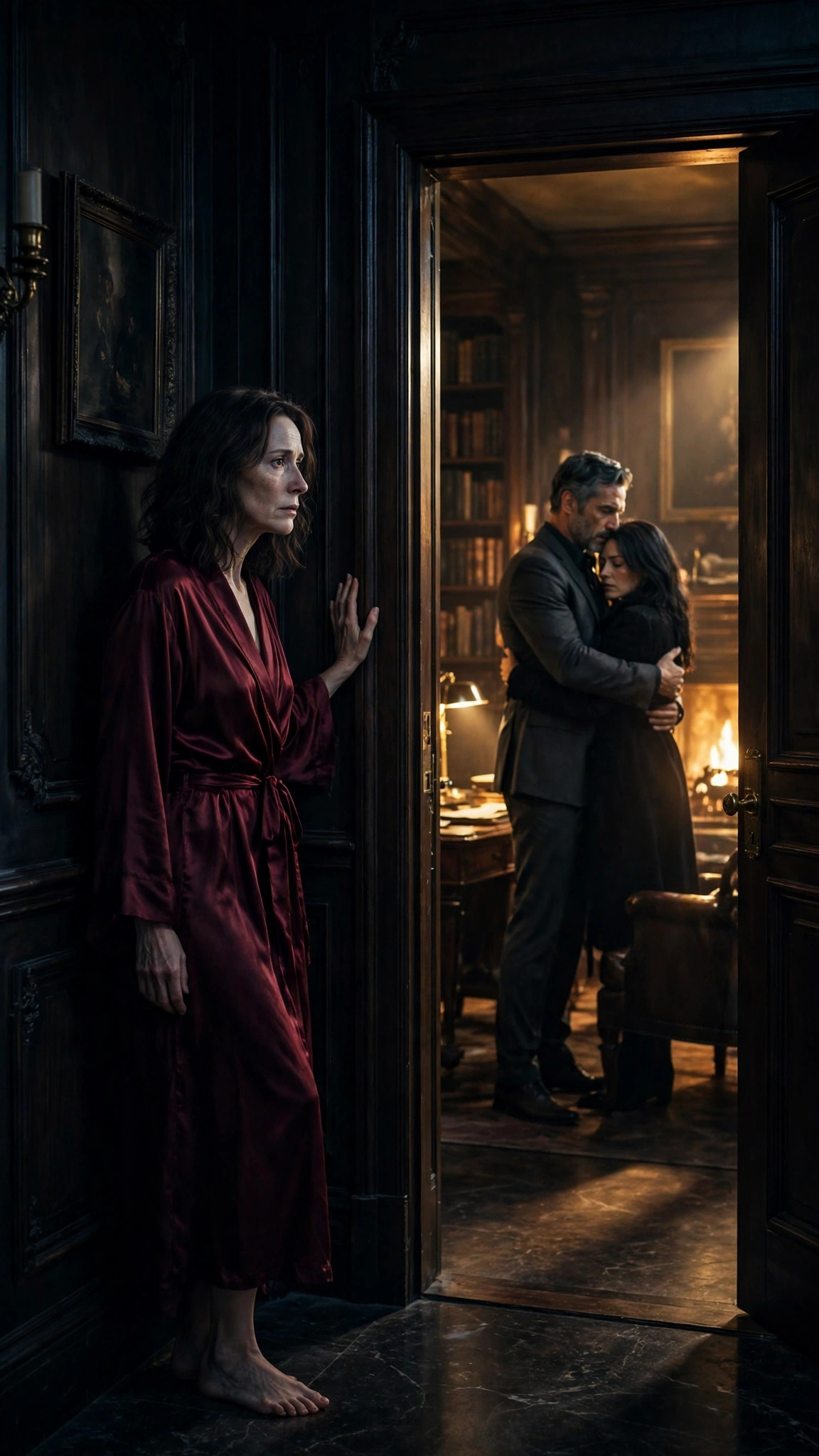
    But my feet did not take me to the kitchen. My feet took me to the study, and the study door was half open, and the light was on, and I heard Elena's voice, soft and low, and then Adrian's voice, answering her, and I stopped outside the door with my hand pressed flat against the wall, and I looked in.

    Elena's hand rested against his cheek. His arm circled her waist. Then she kissed him.

    For one terrible second, Adrian kissed her back.

    That second was enough.

  • Chapter 2: The Girl from the Bakery

    Chapter 2: The Girl from the Bakery

    Fifteen years earlier, I was nobody.

    I was twenty-nine years old, and I worked the night shift at Bellini's Bakery on Taylor Street, and my hands always smelled of flour no matter how many times I washed them. I kneaded dough at midnight. I pulled trays of bread from the ovens at two in the morning. I swept the floor at four, and I watched the city wake up through the bakery window at five, and I went home to a small apartment above a laundromat and slept through the noise of the day, and I did it all again the next night.

    I liked the night shift. The night was honest. The night did not pretend to be anything it was not. The people who came to a bakery at three in the morning were people who could not sleep, or people who worked while the rest of the city dreamed, or people who were running from something and needed a warm room and a cup of coffee while they decided what to do next. I understood all of them. I was all of them.

    Adrian Bellandi came in at 3:12 on a Tuesday in November. I remember the time because the clock above the counter had stopped at 3:12 three weeks earlier, and old Mr. Bellini kept saying he would fix it, and he never did, so every customer who looked up at that clock saw 3:12, and I had started to think of it as the bakery's own private time, the hour when the night was deepest and the bread was warmest.

    He was tall, and he wore a dark coat, and he had the kind of face that made the room quieter when he entered it. Not because he was loud. Because he was still. He stood at the counter the way a man stands when he is used to being watched, and he ordered black coffee, no sugar, and a roll, and he paid with a twenty and told me to keep the change, and then he sat by the window and read a newspaper while the coffee went cold.

    He came back the next night. And the night after that. Always at the same time, always the same order, always the same table by the window. He never spoke more than a few words. "Coffee." "Thank you." "Good night." I started to look forward to the sound of the door opening at 3:12, which was ridiculous, because I did not know his name and he did not know mine, and for all I knew he was a man who simply liked coffee at three in the morning.

    On the fourth night, I asked him.

    "You come here every night," I said, setting his coffee down. "Do you ever sleep?"

    He looked up at me, and his eyes were dark and tired in a way that had nothing to do with one bad night, and he said, "Not well."

    "Me neither," I said. "That's why I'm here."

    He almost smiled. It was not quite a smile. It was the beginning of one, the way a door opens a crack before you decide whether to walk through it.

    "I'm Claire," I said.

    "Adrian," he said.

    That was the whole conversation. But the next night, he asked me how long I had worked at the bakery, and I told him three years, and he asked me if I liked it, and I told him the truth, which was that I liked the bread and the quiet and the way the ovens made the whole room smell like morning even when it was the middle of the night. And the night after that, he asked me what I did during the day, and I told him I slept and I read and I walked along the river when the weather was good, and he nodded like a man filing away information he intended to keep.

    It went on like that for weeks. Small conversations. Short sentences. Coffee going cold while we talked about nothing important, which is how the most important conversations always begin.

    I did not know who he was. Not really. I knew his first name, and I knew he wore expensive coats, and I knew the men who sometimes waited for him outside in black cars were not the kind of men who waited for ordinary people. But in the bakery, at three in the morning, he was not a feared man. He was a tired man who liked his coffee black and his bread warm, and I was a tired woman who liked the quiet, and for an hour every night, neither of us had to be anyone else.

    The oven broke in January. It was the old oven, the one Mr. Bellini had bought secondhand twenty years earlier, and it died in the middle of the night shift with a sound like a sigh, and I stood in front of it with flour on my hands and thought about how I was going to tell Mr. Bellini that we had no bread for the morning.

    I came in the next night, and the oven was fixed. Not repaired. Replaced. A new oven, still smelling of factory oil, installed and working, with a note taped to the door in Mr. Bellini's handwriting: "A gift. Don't ask."

    I knew. Of course I knew. There was only one man who came to the bakery at three in the morning and had the means and the habit of fixing things without being asked.

    I waited for him that night, and when he came in, I did not bring him his coffee. I stood behind the counter with my arms crossed, and I said, "You bought my bakery an oven."

    "I bought the neighborhood its bread," he said.

    "That's the same thing, and you know it."

    He looked at me for a long moment, and then he said, very quietly, "I don't like the idea of you working in the cold."

    "Then you should have brought me a coat," I said. "Not an oven."

    "I'll bring a coat tomorrow," he said.

    He did. A grey wool coat, soft and warm, too expensive for a bakery girl, and when I tried to refuse it, he said, "Take it, Claire. Please. I need to know you're warm."

    That was the first time I understood that Adrian Bellandi was not a man who took things. He was a man who protected things, fiercely and quietly and without asking permission, and the things he chose to protect became the center of his world.

    He asked me to marry him six months later, at the bakery counter at dawn, with the smell of fresh bread around us and the city waking up outside the window. He did not kneel. He did not produce a ring from a velvet box. He simply looked at me across the counter and said, "Marry me, Claire. I will keep you safe for the rest of your life."

    I said yes, but I said it with one condition.

    "Never lie to me," I told him. "I don't care what you do out there. I don't care who you are when you leave this bakery. But with me, you tell the truth. Marriage without trust is just surveillance with matching rings."

    He took my hand, and his hand was warm and steady, and he said, "I will never lie to you."

    I believed him. I believed him for fifteen years.

    The wedding was small. Mr. Bellini baked the cake. Enzo, the delivery driver, drove us to the church in the bakery truck, because Adrian's car was in the shop and Enzo insisted, and I laughed until my ribs hurt, because there is nothing in the world less like a wedding carriage than a bakery truck, and nothing in the world more like us.

    We lived in a small apartment above a bookshop for the first two years. Adrian came home every night. He ate dinner at our table. He asked me about my day, and I asked him about his, and he told me what he could, and I did not ask him about the rest, because we had an agreement: the truth, but not every detail. The truth about what mattered. The truth about us.

    Then the organization grew, and the money came, and the threats came with it, and one night Adrian came home with blood on his cuff and a look on his face I had never seen before, and he said, "We need walls, Claire. Real walls. Men at the gates. Cameras."

    I did not argue. I had seen what the world did to men like Adrian, and I had seen what it did to the people they loved. So we moved into the estate, and the estate became a fortress, and the fortress became our life, and somewhere along the way, the man who had once sat in a bakery at three in the morning and talked to me about nothing became a king, and I became a queen in a house with cameras on every corner and guards at every gate.

    I told myself it was the same marriage. I told myself the walls were only walls. I told myself that love was love, whether it lived in a small apartment above a bookshop or in a mansion with motion sensors.

    I was wrong. Walls change things. Walls make you forget what the outside sounds like. Walls make you forget that there was ever a time when your husband came to you because he wanted your company, not because the house was the safest place in the city.

    Elena Russo was part of that forgetting. Adrian told me about her in our third year of marriage, on a night when the rain was coming down hard and we were sitting by the fire with two glasses of wine. He told me she had been his first serious love, twenty years earlier, before the organization, before the money, before any of it. They had parted when he chose the life he was building and she chose to leave Chicago. She married into the Russo family. Her husband died years ago. She stayed with the family because it was the only family she had left.

    "She's my past, Claire," he had said, and he had said it the way a man says a thing he has already buried. "You are my present. You are my future."

    I believed him. I believed him because I wanted to believe that the past was past, and because the man who had fixed my oven and brought me a coat and asked me to marry him across a bakery counter had never lied to me.

    Not once. Not ever. That was the deal.

    I found her photograph once, in the bottom drawer of his desk, in our second year of marriage. A young woman with dark hair and a laughing mouth, standing beside a young Adrian on a beach I did not recognize, his arm around her shoulders, both of them sunburned and grinning like people who believed the world belonged to them. I asked him who she was. He told me. I put the photograph back, and I never opened that drawer again, because some doors, once closed, should stay closed.

    That was the deal. That was the marriage. That was the life I had built, one night at a time, in a bakery and then in a fortress, with a man I believed would never lie to me.

    There were nights, in the first years at the estate, when I could not sleep for the silence. The house was so big that the silence had rooms of its own. I would get up in the dark, put on my robe, and go down to the kitchen, and I would bake bread the way I had learned at Bellini's, my hands in the dough, the flour on the counter, the ovens warming the room until it smelled like morning.

    Rosa found me there one night, at three in the morning, up to my elbows in flour.

    "Mrs. Bellandi," she said, and then she stopped, and she looked at me, and she said, "Claire. You bake like a woman who misses something."

    "I miss the noise," I told her. "I miss the ovens and the trays and the men coming in at three in the morning because they can't sleep. This house is too quiet. It's like living inside a held breath."

    She nodded, and she rolled up her sleeves, and she helped me shape the loaves, and while we worked she told me about her village in Sicily, about the bread her mother used to make, about the way a house sounds when it is full of people who love each other. "A house is not walls, Claire," she said. "A house is the people who come home to it. If the people stop coming home, the walls are just a prison with good furniture."

    I never forgot that. I thought about it on the nights when Adrian came home late, when the gates opened and closed and his footsteps sounded in the hallway like a stranger's. I thought about it when the cameras went up on the eastern wall, and then the western wall, and then the garden, until there was nowhere in that house where a person could stand without being watched. I thought about it when I realized that I had stopped baking bread at night, because the kitchen at three in the morning had started to feel like the only room in the house that still belonged to me, and I was afraid that if I kept going down there, I would have to admit why.

    Rosa understood. She never asked me about Adrian. She never asked me about the organization, or the guards, or the men in black cars. She just made coffee, and she set out two cups, and she waited, and on the nights when I needed to talk, I talked, and on the nights when I needed silence, she gave me silence, and that was the closest thing to friendship the estate ever allowed me.

    "The house is not the marriage," she told me once, wiping flour from her hands. "Remember that, Claire. The house is not the marriage."

    I remembered it. I held onto it like a rope. And for fifteen years, I believed it was true.

    And then the rain brought her to our door, and the past walked into my house wearing a wet coat, and I opened my own door to her, and I told myself I was being kind.

    I was being kind. That was the worst part. I was being kind, and kindness was the door she walked through.

  • Chapter 1: Twelve Seventeen in the Morning

    Chapter 1: Twelve Seventeen in the Morning

    At 12:17 in the morning, I watched my husband kiss the woman he had sworn belonged to his past, and I did not scream, confront him, or give him the chance to explain what my own eyes had already seen.

    I stood barefoot outside Adrian's half-open study door with my hand pressed flat against the wall, the cold plaster steadying me, and I watched Elena Russo's hand rest against my husband's cheek. I watched his arm circle her waist. I watched her lean in, and I watched him lean toward her, and then she kissed him.

    For one terrible second, Adrian kissed her back.

    That second was enough.

    I turned away before either of them saw me. I did not run. Running would have made noise, and noise would have brought questions, and questions would have given him the chance to explain, and I had spent fifteen years believing my husband when he told me Elena Russo was his past. I was not going to spend one more minute listening to him tell me what my own eyes had already told me.

    My name is Claire Bellandi, and for fifteen years, I believed my husband when he told me Elena Russo was his past.

    The Bellandi organization made my husband one of the most feared men in the city. He built it through discipline, fear, and decisions that left no room for emotion. But with me, Adrian was different. Or at least I thought so.

    That night, I stood barefoot outside Adrian's half-open study door, and I understood that everything I thought I knew about my marriage might have been a story I had told myself because I wanted it to be true.

    I walked back to our bedroom without making a sound. The hallway was long and dark, the marble floor cold under my feet, and every step felt like walking away from a life I had spent fifteen years building. I did not cry. I had cried enough in my life to know that tears would not change what I had seen. Tears would only make my eyes swollen in the morning, and I needed my eyes clear.

    No suitcase. No dramatic note. No slammed doors.

    Adrian's estate had cameras, motion sensors, armed guards, coded gates, and men trained to notice unusual behavior. If I wanted to leave, I could not leave like his wife. I had to disappear like someone escaping him.

    I stood in our bedroom in the dark and looked at the bed where I had slept beside Adrian Bellandi for fifteen years. The sheets were still warm where I had left them. His side of the bed was empty. He was downstairs in his study with Elena Russo, and I was standing in the dark deciding whether the woman I had been for fifteen years was going to survive the night.

    She was not.

    I removed my wedding ring and placed it beside my phone on the nightstand. The ring was heavy. It had always been heavy, but I had never noticed the weight until that moment, when I set it down and my hand felt lighter than it had felt in fifteen years.

    Then I found a piece of hotel stationery I had saved from our anniversary trip. I had kept it in the drawer of my nightstand for three years, a small white card with the hotel's name pressed into the corner in gold letters. I had saved it because it reminded me of the week Adrian and I had spent pretending we were ordinary people, a week when he had held my hand in public and laughed at bad jokes and eaten breakfast with me at a small table by a window. I had saved it because I thought we would go back there someday.

    My hand trembled only once as I wrote five words.

    You made your choice. Goodbye.

    Five words. Fifteen years. That was the exchange rate.

    I folded the card and placed it beside my ring, and then I stood in the dark bedroom and listened to the house. The estate was never truly quiet. There was always the hum of the security system, the soft footsteps of guards changing positions, the distant sound of the gates. But tonight the house sounded different. Tonight the house sounded like a cage, and I was the only person inside it who had just realized the door was locked from the outside.

    I had four hours until dawn. I had four hours to become someone else.

    I lay back down in the bed and stared at the ceiling and listened to the house breathe around me. The ceiling was white and smooth and expensive, and I had stared at it on a hundred sleepless nights over fifteen years, but tonight it looked like the lid of a box, and I was the thing inside the box, and someone had just shown me that the box had never been mine.

    I thought about the robe I was wearing. Deep burgundy silk, the one Adrian had given me on our tenth anniversary. I had loved that robe. I had worn it on quiet mornings when the house was still asleep and I could pretend, for an hour, that I was an ordinary woman in an ordinary house with an ordinary husband who came home from an ordinary job. Tonight the silk felt cold against my skin, and I understood that I had been dressing up in someone else's life for a very long time.

    My mind kept going back to the study door. To Elena's hand on his cheek. To his arm around her waist. I tried to be fair. I tried to be the woman I had always believed I was, the woman who had said, only three nights earlier, that she would not make another woman risk dying because she was jealous of someone her husband had loved before she existed. I tried to remember that Elena was in danger. I tried to remember that Adrian had told me she had nowhere else to go.

    But fairness had a limit, and that limit was one second. One second of his mouth on hers. One second in which the man I had trusted for fifteen years had kissed another woman in the house I had made a home, while I stood barefoot in the hallway in the robe he had given me.

    I thought about the first time I had ever seen Elena Russo. It had not been three nights ago. It had been twenty years ago, in a photograph Adrian kept in the bottom drawer of his desk, a photograph I had found by accident in our second year of marriage, back when I still opened his drawers without thinking twice. A young woman with dark hair and a laughing mouth, standing beside a young Adrian on a beach I did not recognize, his arm around her shoulders, both of them sunburned and grinning like people who believed the world belonged to them. I had asked him who she was, and he had said, "Someone from before you," and he had said it the way a man says a thing he has already buried, and I had believed him, because I was twenty-nine and in love and I wanted to believe that the past was past.

    I had never seen her in person until the rain brought her to our door. She was older now, of course. We all were. But standing in our foyer in a wet coat, with rain in her hair and fear in her eyes, she had looked at Adrian the way a person looks at the only safe place left in the world, and Adrian had looked at her the way a man looks at a debt he has never finished paying.

    I thought about the conversation three nights earlier, the one where he had told me she was in danger. Her cousin's organization had fractured during a territory dispute, and someone had threatened her attendance at an upcoming charity gala. "The estate is the safest place for her." "How long?" "Forty-eight hours." "There's nowhere else?" "Not somewhere I trust." I had studied his face while he said it, looking for the lie, looking for the crack, looking for anything that would tell me this was not what he said it was. At forty-eight, Adrian wore control as naturally as other men wore suits. He could make armed men nervous with a look, but I had always been able to see past it. Or so I believed.

    "Then bring her here," I had said. His expression had shifted. "You don't have to agree because you think it's expected." "I'm not agreeing because I'm your wife." "Then why?" "Because if she's truly in danger, I won't make another woman risk dying because I'm jealous of someone he loved before I existed." He had stared at me. Then he had quietly thanked me.

    Now, lying in the dark, I understood how foolish those words had been. I had opened my own door to the woman who would end my marriage, and I had done it out of kindness, and the kindness had been returned with a kiss in my husband's study at twelve seventeen in the morning.

    The clock on the nightstand said 1:04. Then 1:30. Then 2:00. Time moved the way it moves when you are waiting for something terrible to finish happening. I listened for footsteps in the hallway. I listened for Adrian's voice. I listened for the sound of the study door opening and closing, and when it finally came, soft and careful, I held my breath and counted his steps as they passed our bedroom door and continued down the hall toward the guest wing. Toward her.

    That was when I knew. Not when I saw the kiss. When I heard his footsteps go toward her room at two in the morning, I knew that whatever I had seen in the study was not a moment. It was a direction. And I was not going to stand in the hallway of my own house and watch my husband walk in that direction one more time.

    I got up. I did not turn on the light. I knew this room in the dark better than I knew any room in the world, and I moved through it like a ghost through a house that had already forgotten her.

    I had four hours until dawn. I had four hours to become someone else.

    I knew exactly how I was going to leave, because fifteen years earlier, before money and guards and bulletproof windows, I had worked nights at the bakery that still delivered to this house every morning. I knew the estate's routines the way only someone who had once been invisible inside a rich man's house could know them. The guards watched the front gate and the garden walls and the driveway. They watched the places where important people came and went. They did not watch the service corridor. They did not watch the kitchen. And they never searched the bakery truck.

    There was one weakness in Adrian's security system, and I knew about it because I had built my knowledge of it back when I was nobody, back when I was a girl in an apron who carried trays of bread through the back doors of houses like this one and learned which doors the guards never checked.

    The eastern delivery gate automatically opened for the bakery truck every morning at 4:42. Security never searched it. Adrian trusted the driver. More importantly, he trusted me.

    At 4:36 a.m., I stepped into the service corridor wearing one of the housekeeper's spare coats. Rosa's coat. Rosa had worked in this house for nine years, and her spare coat hung on a hook in the laundry room, grey wool, too big for me, smelling faintly of lavender and bleach. I buttoned it up to my throat and pulled the collar high, and in the dim light of the corridor I looked like any other woman who worked in this house before dawn.

    My heart was beating so hard I was certain the guards would hear it through the walls.

    At 4:41, I slipped through the kitchen while the night guards changed positions. I had timed it in my head a hundred times since midnight, counting the minutes, counting the steps, counting the seconds between the moment the night guard at the east door turned to speak to his replacement and the moment the kitchen door swung shut behind me. The kitchen was warm and smelled of bread and coffee, and for one terrible moment I thought about the mornings I had spent in this kitchen, drinking coffee with Rosa while Adrian slept upstairs, mornings when I had believed my life was mine.

    One minute later, the bakery truck rolled toward the gate.

    Nobody saw me climb into the empty storage compartment beneath the rear shelving. The compartment was narrow and smelled of flour and old wood, and I curled myself into it the way I had curled myself into small spaces as a girl, back when the world was too big and too loud and the only safe place was somewhere nobody thought to look. The truck's engine shook the metal around me. The gate opened. The truck rolled forward, and I held my breath, and the estate fell away behind me like a dream I had finally woken from.

    I heard the guard's voice through the metal of the compartment, muffled and bored, saying something to Enzo, and I heard Enzo answer, easy and familiar, the way a man answers a question he has answered a hundred times before. Then the wheels turned onto the street, and I lay in the dark with flour in my hair and my heart hammering against my ribs, and I did not breathe until I felt the truck turn the corner and pick up speed, and the estate was behind us, and no one had searched the truck, and no one had looked in the compartment, and no one had seen me at all.

    By sunrise, I had vanished from the most heavily guarded estate in Chicago, leaving Adrian Bellandi with only my wedding ring and five words that would tell him exactly why.

    At 5:41, Adrian would sit on our bed holding my wedding ring. He would order every gate locked. Every camera checked. Every guard questioned. And eventually, he would discover something far worse than the fact that his wife had left him.

    The camera covering the eastern service entrance had gone dark exactly six minutes before I disappeared.

    I hadn't disabled it.

    Someone else had.

    And as the bakery truck carried me beyond Adrian's walls, into a grey Chicago morning that smelled of rain and exhaust and freedom, I realized I might not have been the only person waiting for an opportunity to get me out of that house.

  • Chapter 7: The First Man Who Dared

    Chapter 7: The First Man Who Dared

    Grant Holloway was arrested on a Thursday morning, in his office, in front of his entire staff. Special Agent Ruth Calder walked in with six federal agents, and she read him his rights, and he did not say a word. He just looked at the floor, and his hands shook, and for the first time in thirty years, Grant Holloway was afraid.

    Marcus Hale was arrested the same day, at a motel outside Portland, trying to leave the state with a suitcase full of cash. He confessed within forty-eight hours. He told the agents everything — the dryer, the gas line, the fifty thousand dollars, the seven years of hush money. He said Grant had told him the laundromat would be empty, that no one would be hurt, that it was just a building. He said he had not known my mother was inside until it was too late. He said he was sorry. I did not care whether he was sorry. Sorry does not bring back the dead.

    The trial took four months. I testified. Dale Kessler testified. Daniel testified — against his own father, in open court, in front of the whole town. Madeline Cross sat in the gallery every day, and she did not look at Daniel once, and when the verdict came back — guilty on all counts — she stood up and walked out without a word, and I never saw her again.

    Grant Holloway was sentenced to life in prison. Marcus Hale was sentenced to twenty-five years. The Blackridge organization was dismantled, piece by piece, and the timber contracts went to companies that actually owned the land they were cutting, and the port contract went to Pinehaven, on fair terms, negotiated in the open, with no bribes and no threats.

    And my mother's laundromat — the land, the building, the shop where she had spent nineteen years of her life — came back to me. The court ruled that the deed transfer had been forged, and the land was mine again, and I stood on that half-acre lot on a cold morning in March, looking at the burned-out shell of the building, and I cried, because my mother was gone, and no court in the world could bring her back, but at least the land was mine, and at least the truth was known, and at least Grant Holloway would never hurt anyone else.

    Nathaniel stood beside me, in the cold, in the ruins of my mother's shop, and he said, "What do you want to do with it?"

    "I want to rebuild it," I said. "Not as a laundromat. As something new. A community center, maybe. Or a library. Something my mother would have liked. Something that helps people, instead of hurting them."

    "Then we'll rebuild it," he said. "Together."

    And we did. It took six months, and it took more money than I had ever seen in my life, and it took architects and builders and permits and a hundred small decisions, but by the end of the summer, the laundromat was gone, and in its place stood a small, beautiful building with big windows and a garden out front, and a sign over the door that said, "The June Calloway Community Center." Inside, there were books, and computers, and a kitchen where Agnes taught cooking classes, and a room where children could do their homework after school. My mother would have loved it. She had spent her whole life helping people, and now her name was on a building that would help people for years to come.

    The opening day of the June Calloway Community Center was the brightest day of that summer. The sun was high and warm, and the garden out front was full of roses — red ones, and white ones, and pink ones, because my mother had always said a garden should look like a celebration — and there were children everywhere, running across the new grass, laughing, chasing each other around the fountain that Nathaniel had insisted on building, even though I had told him it was too extravagant.

    Agnes had baked enough bread to feed an army, and she stood in the kitchen doorway with flour on her apron and tears in her eyes, watching the children eat. Elias Ward, who had once followed me through the house with suspicion in his eyes, stood by the front door in his best suit, greeting people like he owned the place, and in a way, he did — he had helped build it, nail by nail, beside the contractors, refusing to let anyone else do the work.

    I stood at the front of the room, holding a pair of oversized scissors, with a red ribbon stretched across the doorway, and Nathaniel stood beside me, and the mayor of Jackson stood on my other side, and there were cameras, and reporters, and more people than I had ever seen in one place. My hands were shaking. Nathaniel leaned down, very quietly, and he said, "You're doing fine. Just breathe."

    I cut the ribbon. The crowd cheered. The children ran inside, and they found the books, and the computers, and the art supplies, and the little reading nook by the window that I had designed to look like the corner of the laundromat where my mother used to sit and read to me when I was small. I stood in the doorway, watching them, and I thought about my mother — June Calloway, who had run a laundromat for nineteen years, who had raised a daughter alone, who had died because she would not sell her land to a cruel man — and I thought about how proud she would have been, to see her name on a building full of children, full of light, full of life.

    A little girl, no more than seven, tugged on my sleeve. "Is this your mommy's place?" she asked.

    "Yes," I said. "It was. And now it's yours, too."

    She smiled, and she ran off to join the other children, and I stood there, and I cried, quietly, happily, for the first time in years — not because I was sad, but because I was grateful. Grateful that the truth had come out. Grateful that Grant Holloway was in prison. Grateful that my mother's name meant something good now, instead of something sad. And grateful, most of all, for the man standing beside me, who had helped me build all of this, and who had never once asked for anything in return.

    Nathaniel put his arm around me, and he kissed the top of my head, and he said, "She'd be proud of you, Nora. I know she would."

    "I hope so," I whispered.

    "I know so," he said. "Because I'm proud of you. And I'm a much harder man to impress than your mother ever was."

    We stood there together, in the doorway of the June Calloway Community Center, watching the children, watching the sun, watching the future unfold in front of us, and I knew, with absolute certainty, that my mother was at peace. The fire had taken her. But it had not taken her name. It had not taken her daughter. And it had not taken the good she had put into the world.

    The contract — the one I had signed in Nathaniel's kitchen, the one that said one year, two hundred thousand dollars, freedom at the end — expired on a Tuesday in October, exactly one year after the night I had flown to Pinehaven. I woke up that morning, and I looked at the calendar, and I realized that I was free. I could leave. I could take the money and go anywhere in the world. I could go back to Jackson, or move to Seattle, or start over somewhere no one knew my name.

    I did not want to go anywhere. I wanted to stay.

    That evening, Nathaniel found me in the garden, picking roses, and he stood behind me for a long time without speaking, and then he said, "Nora."

    I turned around. He was holding a small velvet box, and his hands were shaking, and his gray eyes were bright in a way I had never seen before, and he looked, for the first time since I had met him, completely terrified.

    "I'm not good at this," he said. "I was terrible at it twelve years ago, and I'm probably terrible at it now. But I've spent a year learning how to be the man I want to be, and you've spent a year teaching me, and I don't want to lose that. I don't want to lose you."

    He opened the box. Inside was a ring — not a diamond, not a showpiece, but a simple sapphire, the exact color of the dress I had worn to the gala, set in a thin band of white gold. It was the most beautiful thing I had ever seen.

    "Nora Calloway," he said, and then he did something I had never seen him do. He got down on one knee, in the garden, in the dirt, in his good suit, and he looked up at me, and he said, "Will you marry me? Not for a contract. Not for a port. Not for appearances. For real. Because I love you, and because you are the bravest woman I have ever met, and because I want to spend the rest of my life trying to be worthy of you."

    I stared at him. I stared at the ring. I stared at the man who had crossed a ballroom for me, who had touched my scars without flinching, who had helped me bring my mother's killer to justice, who had poured my coffee every morning for a year and had never once asked for anything in return.

    "Yes," I said. "Yes. Yes, yes, yes."

    He stood up, and he took the ring out of the box, and he slid it onto my finger, and it fit perfectly, and then he took my face in his hands, and he kissed me, and it was nothing like Daniel's kiss beneath the fire escape. Daniel's kiss had been a promise he never intended to keep. Nathaniel's kiss was a vow. It was slow, and certain, and it tasted like the future.

    We were married three months later, in the garden at Pinehaven, with the water behind us and the pine forest around us, and Agnes cried, and Elias — who had once thought I was a gold digger — stood up and gave a toast that made everyone laugh and cry at the same time, and Daniel sent a letter, which Nathaniel read aloud, and which said, "I was wrong about many things, but I was right about one: she deserved to be chosen. I'm glad you chose her."

    The wedding was small. There were no chandeliers, no diamonds, no three hundred people waiting to judge me. There were forty people, and they were all people who loved us, and I wore a dress that showed my shoulders — my scars, all of them, in the open, in the sunlight — and nobody stared, and nobody whispered, and nobody laughed. Because these were my people now. And my scars were not something to hide. They were proof that I had survived.

    One year after the wedding, we went back to the Blackridge Alliance Gala. Not because we had to — Blackridge was gone, and the gala was run by new people now, honest people — but because I wanted to. I wanted to walk into that ballroom one more time, in a dress I had chosen for myself, on the arm of a man I loved, and show the room that the girl at table nineteen was not a victim anymore.

    I wore a sapphire dress. Not the same one — I had burned that one, in a small ceremony in the garden, with Nathaniel beside me, because it had been bought for a man who did not deserve it. This dress was new, and it was off the shoulder, and it showed my scars, and it was the most beautiful dress I had ever owned, because I had bought it for myself, with my own money, for my own reasons.

    Nathaniel wore his black suit, and he had his coat over his arm, and when we walked into the ballroom, the whole room went quiet, the same way it had gone quiet two years before. Only this time, nobody was laughing. This time, people were smiling. This time, when the clock struck midnight, Nathaniel took my hand, and he led me to the center of the dance floor, and he draped his coat over my shoulders — the same coat, the same gesture, the same man — and he leaned down, close enough that only I could hear him, and he murmured, "Stand up and act like you're mine."

    And I laughed, because this time, I was his. Not by contract. Not by pretense. By choice. My choice. And his.

    "I am yours," I said. "And you are mine. For real this time."

    He kissed my shoulder then — my left shoulder, the scarred one, the one no man had ever dared to touch — and his lips were warm against my skin, and I did not flinch, and I did not pull away, and I did not hide. I stood there, in the middle of the ballroom, in my sapphire dress, with the most feared man in the Pacific Northwest kissing my scars in front of everyone, and I thought about my mother, and the rule she had taught me, and I thought about how wrong she had been about one thing.

    She had taught me never to give cruel people proof they reached the bone. She was right about that. But she had never told me what to do when a kind person reached the bone, and found it, and held it gently, and said, "This is beautiful. You are beautiful. All of you."

    Nathaniel Mercer was the first man who dared to touch me. He was also the first man who ever saw me — all of me, scars and all — and stayed.

    And as we danced, in the ballroom where I had once been humiliated, with three hundred people watching, I knew, with absolute certainty, that I would never again be the girl at table nineteen that nobody chose.

    I was the woman Nathaniel Mercer chose. And I had chosen him back. And that was enough. That was everything.

    The End.
    THE END