
Story Genres: Mafia Romance

  • Chapter 6: What the Fire Took

    Chapter 6: What the Fire Took

    The investigation took three weeks, and it took everything Nathaniel had.

    He started with the land records. The laundromat sat on a half-acre lot on the edge of Jackson, and the deed had been in my mother's name for nineteen years, and then, one week after she died, it had been transferred to a holding company called Blackridge Property Management. The transfer had been signed by a lawyer I had never heard of, and the price listed on the deed was twelve thousand dollars — less than a tenth of what the land was worth. My mother would never have sold for twelve thousand dollars. She had turned down fifty thousand, cash, from a developer, two years before she died. I knew that because she had told me, laughing, that the man had looked like he was going to cry.

    "She didn't sell," I said, staring at the deed. "She would never have sold for twelve thousand dollars."

    "No," Nathaniel agreed. "She didn't sell. Someone forged her signature after she died. And the holding company that bought the land is owned by Grant Holloway."

    He moved on to the fire report. The original report, the one that had said "faulty heating element, nobody's fault," had been written by a fire inspector named Dale Kessler, who had retired six months after the fire and moved to Arizona. Nathaniel found him. Dale Kessler was an old man now, with shaking hands and a guilty conscience, and when Nathaniel showed him the report, he broke down and told the truth: Grant Holloway had paid him twenty thousand dollars to write "accident" on a fire that was not an accident. The dryer had been tampered with. Someone had cut the gas line and rigged the heating element to spark. It had been deliberate. It had been murder.

    "Who set the fire?" I asked Dale Kessler, when Nathaniel put him on the phone with me. My voice was steady, which surprised me, because nothing else about me was steady.

    "I don't know his name," Dale said, his voice thin and frightened. "He was a young man. Dark hair. A tattoo on his neck. Grant called him his 'fixer.' He came to the laundromat the night before the fire, and he asked about the dryers, and he said he was doing maintenance. Your mother let him in. She trusted him."

    A young man with dark hair and a tattoo on his neck. I closed my eyes, and I saw my mother's face, smiling at a stranger, letting him into her shop because she was kind, because she trusted people, because she had never once believed that anyone would hurt her.

    "Thank you," I whispered to Dale Kessler, and I hung up the phone, and I sat in the library for a long time, staring at the wall, thinking about my mother, and the fire, and the twelve thousand dollars, and the man with the tattoo on his neck.

    Nathaniel found me there, hours later, and he sat down beside me, and he said, "There's more."

    "More?" I said. "How can there be more?"

    "The payments to Cascadia Freight Consulting," he said. "They started the same month your mother died. And they didn't go to Ruth Calder. That was a lie — a lie Grant told people to keep them from looking closer. The money went to the fixer. The man with the tattoo. Grant has been paying him for seven years, Nora. Seven years of hush money. And the folder you kept — the folder with every payment, every date, every amount — is the only record that exists. Grant destroyed every other copy. He thought he destroyed them all. He didn't know about yours."

    I looked at him. "So the folder proves he paid the man who killed my mother."

    "It proves he paid someone a hundred and twelve thousand dollars through a fake company," Nathaniel said. "It doesn't prove why. But combined with Dale Kessler's testimony, and the forged deed, and the land records, it's enough. It's enough to take him to court. It's enough to put him in prison. And it's enough to give your mother justice."

    Justice. The word felt strange in my mouth. I had spent seven years believing that my mother's death was an accident, that nobody was to blame, that the fire was just a terrible thing that had happened. And now I knew that it was not an accident, that someone had chosen to kill her, that a man had walked into her shop and rigged a dryer to burn, all because she would not sell her land.

    I wanted to scream. I wanted to break something. I wanted to find Grant Holloway and make him feel what my mother had felt, trapped in a burning room, trying to save her shop with her bare hands.

    But I did not scream. I did not break anything. I sat in the library, and I looked at Nathaniel, and I said, "What do we do now?"

    "We go to the authorities," he said. "Special Agent Ruth Calder — the real one, not the lie Grant told. She's been investigating Blackridge for two years, and she's been waiting for exactly this. We give her the folder, and Dale Kessler, and the deed, and we let the law do what the law is supposed to do."

    "And if the law doesn't work?" I asked. "Grant owns half this town. He owns the sheriff. He owns the judges."

    "Then I'll handle it myself," Nathaniel said, and there was something in his voice that made me believe him completely. "But let's try the law first. Your mother deserves a trial, Nora. Not a revenge killing. A trial."

    I nodded. "All right. The law first."

    Before Daniel came, Ruth Calder came to Pinehaven.

    She arrived on a rainy afternoon, driving herself in an unmarked car, wearing a plain gray suit and no makeup, carrying a leather briefcase that had seen better days. Nathaniel met her at the door, and she shook his hand like a woman who had shaken a thousand hands and trusted none of them, and then she looked at me, and her sharp eyes softened, just slightly.

    "Miss Calloway," she said. "Thank you for coming forward. I know this isn't easy."

    We sat in the library, the three of us, with the rain drumming against the windows, and Ruth Calder opened her briefcase, and she laid out photographs on the table — photographs of Grant Holloway shaking hands with men I didn't recognize, photographs of the Portland mailbox, photographs of a young man with dark hair and a tattoo on his neck, walking into a bank with a duffel bag.

    "Marcus Hale," she said, tapping the photograph. "Twenty-nine years old. No fixed address. He's worked for Grant Holloway for eight years, doing the jobs no one else will do. Arson. Intimidation. Debt collection. We've been trying to tie him to Grant for two years, and we've never had anything solid. Your folder changes that."

    "How?" I asked.

    "Because money leaves a trail," she said. "Every payment to Cascadia Freight Consulting went through a bank, and every bank keeps records, and those records show the money moving from Blackridge Timber to a shell account, and from the shell account to Marcus Hale, in cash, on the same day, every month, for seven years. That's not a coincidence. That's a payroll. Grant Holloway has been paying a hitman the same way you pay an employee — on a schedule, through a company, with paperwork. And you, Miss Calloway, are the only person who kept the paperwork."

    I stared at the photographs, at the young man with the tattoo, at the duffel bag, at the bank, and I felt a cold, clear anger settle over me, the kind of anger that doesn't shout or shake, the kind that simply waits. "What happens next?" I asked.

    "Next, we build the case," Ruth said. "We need Dale Kessler's testimony on the record. We need the deed — the forged one. We need the land transfer documents. And we need you to testify, Miss Calloway. In court. In front of Grant Holloway. Are you prepared to do that?"

    I thought about my mother. I thought about the fire. I thought about the seven years I had spent believing it was an accident, and the three months I had spent collecting payments I didn't understand, and the folder in the bottom drawer of my desk that had turned out to be the most important thing I had ever owned.

    "Yes," I said. "I'm prepared."

    Ruth Calder nodded, and she closed her briefcase, and she stood up, and she said, "Then let's get your mother the justice she deserves."

    After she left, Nathaniel and I sat in the library for a long time, listening to the rain, and he took my hand, and he held it, and neither of us spoke, because there was nothing left to say. The truth was coming. Grant Holloway was going to fall. And my mother — my brave, stubborn, wonderful mother — was finally going to be heard.

    The next morning, Daniel Reeves came to Pinehaven.

    I was in the garden, picking roses with Agnes, when Elias came to find me, and he said, "There's a man at the gate. He says his name is Daniel Reeves. He says he needs to talk to you."

    I almost told Elias to send him away. I had said goodbye to Daniel at the engagement party, and I had meant it. But something in Elias's face — a flicker of surprise, maybe, or respect — made me pause. "Let him in," I said.

    Daniel looked terrible. He had lost weight, and his eyes were red, and his suit was wrinkled, and he looked like a man who had not slept in days. He stood in the garden, holding a manila envelope, and he said, "I know you don't want to see me. I know I don't deserve to be here. But I found something, and I think you need to see it."

    "What is it?" I asked.

    "My father's files," Daniel said. "Grant keeps a safe in his office. I found the combination. I took photographs of everything inside. There's a letter in there, Nora. A letter from Grant to the fixer. It has a name. And a date. And an amount."

    My heart stopped. "What's the name?"

    "Marcus Hale," Daniel said. "The fixer is Marcus Hale. And the letter says, 'Make sure the laundromat burns clean. No witnesses. Fifty thousand on completion.'"

    Marcus Hale. Fifty thousand dollars. The laundromat. My mother.

    Daniel held out the envelope. "I don't know if this helps. I don't know if it's enough. But I couldn't keep it to myself. Not after what my father did to you. Not after what he did to your mother."

    I took the envelope with shaking hands. "Why are you doing this?" I asked. "Your father will destroy you for this."

    "My father already destroyed me," Daniel said quietly. "The day he made me choose Madeline over you, he destroyed me. I've spent a month trying to live with that, and I can't. So I'm going to do the right thing, for once in my life. Even if it costs me everything."

    I looked at him, and I saw, for the first time since the gala, the man I had once loved — not the coward, not the puppet, but a man who was finally, finally standing up. "Thank you, Daniel," I said, and I meant it.

    He nodded, and he turned to go, and then he stopped, and he said, without turning around, "He loves you, you know. Mercer. I've seen the way he looks at you. He's not pretending, Nora. Whatever this started as, it's not pretend anymore."

    Then he was gone, and I stood in the garden with the envelope in my hands, and Agnes was watching me from the kitchen window, and the roses were bright against the green, and I thought about what Daniel had said.

    He loves you. He's not pretending.

    I had known, somewhere deep down, that the contract had stopped being a contract a long time ago. I had known it the night Nathaniel had touched my shoulder and not flinched. I had known it the night he had threatened Grant Holloway for me. I had known it every morning, when he poured my coffee before his own, and every evening, when he sat beside me in the library and read in silence, just to be near me. I had known it, and I had been afraid to say it, because saying it would make it real, and real things can be taken away.

    But Daniel had said it. And now I could not unhear it.

    That afternoon, Nathaniel and I drove to Jackson, to the federal building, and we met Special Agent Ruth Calder, a sharp-eyed woman in her fifties with graying hair and a handshake like a steel trap. We gave her the folder. We gave her Dale Kessler's statement. We gave her the deed. We gave her Daniel's photographs, and Marcus Hale's name, and the letter that said "Make sure the laundromat burns clean."

    Ruth Calder read everything, slowly, carefully, and when she was finished, she looked up at me, and she said, "Miss Calloway, I have been investigating Grant Holloway for two years, and I have never had evidence like this. This is enough. This is more than enough. I'm going to arrest him. And I'm going to arrest Marcus Hale. And I'm going to make sure they both pay for what they did to your mother."

    I cried then, in the federal building, in front of a stranger, and Nathaniel put his arm around me, and he held me, and he did not let go, and Ruth Calder pretended not to notice, and for the first time in seven years, I felt like my mother could rest.

    On the drive home, the sun was setting over the water, and the pine forest was dark and quiet, and Nathaniel was driving, and I was sitting beside him, and I reached across the seat, and I took his hand, and I held it, and he looked at me, and he smiled — a real smile, the first real smile I had ever seen on his face — and he said, "We did it, Nora. We actually did it."

    "We did," I said. "Together."

    And I thought about the girl at table nineteen, in the sapphire dress, who had waited to be chosen, and I thought about how far she had come, and I thought about the man beside me, who had crossed a ballroom for her, and who had touched her scars without flinching, and who had just helped her bring her mother's killer to justice.

    I was not that girl anymore. I was someone new. And I was not afraid.
  • Chapter 5: The Bracelet and the Ledger

    Chapter 5: The Bracelet and the Ledger

    The invitation arrived on a Tuesday, in a cream envelope with gold lettering, and it was addressed to "Mr. and Mrs. Nathaniel Mercer," which was the first time I had ever seen my name written next to his.

    Daniel Reeves and Madeline Cross request the pleasure of your company at their engagement celebration, Saturday evening, at the Grand Timber Lodge.

    I stared at the envelope for a long time. Agnes found me in the kitchen, holding it with both hands, and she read the look on my face, and she said, "You don't have to go, dear."

    "I do," I said. "If I don't go, they'll think I'm hiding. And I'm not hiding anymore."

    Nathaniel found me an hour later, standing in the library, staring out the window at the water. "We don't have to go," he said.

    "I want to go," I said, and I was surprised to hear how steady my voice sounded. "I want to look Daniel in the eye and show him that I'm not broken. I want to show Grant Holloway that I'm not afraid of him. And I want to show Madeline Cross that a silver bracelet doesn't make her better than me."

    Nathaniel studied me for a moment, and then he nodded. "Then we'll go. And we'll go together."

    The engagement party was everything the gala had been, only smaller, and meaner. The same chandeliers, the same diamonds, the same smell of expensive perfume. The same whispers. I walked into the Grand Timber Lodge on Nathaniel Mercer's arm, wearing a deep green dress that Agnes had chosen for me — a dress with a high back, because I had asked for a high back — and the whole room went quiet, the same way it had gone quiet at the gala. Only this time, nobody was laughing.

    Daniel was standing near the fireplace with Madeline, and when he saw me, his face went pale. He excused himself and crossed the room, and he stopped in front of me, and he looked at Nathaniel, and then he looked at me, and he said, "Nora. Can I talk to you? Alone?"

    "No," Nathaniel said, before I could answer. "Whatever you have to say to her, you can say in front of me."

    Daniel's jaw tightened. "It's personal."

    "Then it can wait," Nathaniel said.

    But I touched Nathaniel's arm, gently, and I said, "It's all right. Five minutes. I'll be fine."

    Nathaniel looked at me, and I could see the war in his eyes — the part of him that wanted to protect me, and the part of him that trusted me to protect myself. Finally, he nodded, and he stepped back, and Daniel led me to a quiet corner near the windows, away from the crowd, where the music was softer and the lights were dimmer.

    "Nora," Daniel said, and his voice was raw, like he had been rehearsing this speech for weeks and it still wasn't coming out right. "I need you to know something. I didn't want to choose Madeline. My father — Grant — he gave me a choice. Marry Madeline, or lose everything. The timber contracts. The house. My mother's medical care. He said if I chose you, he would destroy my family. He said a payroll clerk would never be accepted, and that if I humiliated the Cross family, they would pull their land out of the alliance, and Blackridge would collapse, and it would be my fault."

    I stared at him. "So you chose your family over me."

    "I chose to save my family," Daniel said. "And the relief you saw on my face — it wasn't relief that you were gone. It was relief that the secret was over. That I didn't have to lie to you anymore. That I didn't have to pretend I was free when I wasn't."

    "Did you love me?" I asked. It was the only question that mattered, and I had been carrying it for a month.

    Daniel was quiet for a long time. "I thought I did," he said finally. "But love isn't supposed to feel like a secret. Love isn't supposed to feel like something you're ashamed of. And I was ashamed, Nora. Not of you. Of myself. Because I knew what I was doing to you, and I did it anyway."

    I looked at him — really looked at him — and I saw, for the first time, that he was not the man I had loved. The man I had loved had brought me coffee and remembered what kind of pen I liked. The man standing in front of me was a coward who had let his father choose his wife, and who had let a room full of people laugh at a woman he claimed to care about, and who was now asking me to forgive him because his life was hard.

    "I forgive you," I said, and I meant it, because forgiveness is not the same as forgetting, and I did not want to carry his cowardice with me for the rest of my life. "But I don't love you anymore. And I never will again."

    Daniel's face crumpled. "Nora—"

    "Goodbye, Daniel," I said, and I walked away, and I did not look back.

    I found Nathaniel waiting for me near the bar, and he took one look at my face, and he said, "Are you all right?"

    "I will be," I said. And then, because I could not help it, I added, "He said his father forced him. Grant threatened his family."

    Nathaniel's expression did not change, but something in his eyes went cold. "Grant Holloway has been threatening people's families for thirty years. It's how he built Blackridge. It's how he controls everyone in this room. And it's why your folder matters, Nora. That folder is the first real evidence anyone has ever had against him."

    That was when Grant Holloway found us. He appeared at Nathaniel's elbow, smiling, holding a glass of champagne, and he said, "Mr. Mercer. Miss Calloway. How lovely to see you both. I trust you're enjoying the evening."

    "We are," Nathaniel said.

    "Good. Good." Grant took a sip of his champagne. "I couldn't help but notice, Miss Calloway, that you seem to have made yourself quite at home in Pinehaven. I hope you haven't forgotten where you came from. Blackridge has been very good to you. It would be a shame if something were to happen to your position there."

    "My position?" I said. "You fired me the Monday after the gala. Or did you forget?"

    Grant smiled. "Did I? How careless of me. Well. Perhaps I could arrange to have your job reinstated. And your lease. And your insurance. All it would take is a small favor."

    "What kind of favor?" Nathaniel asked, his voice dangerously calm.

    "The folder," Grant said, looking directly at me. "The one in your desk drawer. The payments to Cascadia Freight Consulting. I want it back. And I want you to forget you ever saw it."

    My heart was pounding so hard I was sure everyone in the room could hear it. "I don't know what you're talking about."

    "Don't lie to me, girl," Grant said, and his voice dropped, and the smile vanished, and for the first time I saw the man underneath the charm — cold, ruthless, and absolutely without mercy. "I know you have it. Harold Finch told me. He said you kept copies. Give me the folder, and I'll give you your life back. Refuse, and I'll take everything you have left. Your apartment. Your car. Your mother's laundromat. I own the land it sits on, did you know that? I've owned it for seven years. I've been waiting for you to fall behind on the rent so I can tear it down and build a parking lot."

    The laundromat. My mother's laundromat. The place where she had died. The place where I still lived, upstairs, in the tiny apartment with the radiator that made terrifying noises every winter. Grant Holloway owned the land. He had owned it for seven years. He had been waiting.

    I felt Nathaniel's hand on the small of my back, steady and warm, and I took a breath, and I looked Grant Holloway in the eye, and I said, "No."

    Grant's face went dark. "What did you say?"

    "I said no," I said, and my voice was shaking, but it was clear. "You don't get to threaten me. You don't get to threaten my mother. And you don't get the folder."

    Grant leaned in close, so close I could smell the champagne on his breath, and he said, very quietly, "Then you had better watch your back, Miss Calloway. Accidents happen in this town. Your mother would know."

    That was when Nathaniel moved. He stepped between us, and he was so tall and so still that Grant actually took a step backward, and Nathaniel said, in a voice so quiet that only the three of us could hear it, "If you ever speak to her like that again, Grant, I will end you. Not your company. Not your contracts. You. Do you understand me?"

    Grant understood. I could see it in his face. He turned and walked away, and the party went on around us, and nobody in the room had any idea what had just happened.

    But I did. I had just watched Nathaniel Mercer threaten the most powerful man in Blackridge for me. And I had just realized that the folder in my bag — the folder I had carried to Pinehaven, the folder with a hundred and twelve thousand dollars' worth of payments — was not just evidence. It was a weapon. And Grant Holloway was afraid of it.

    The drive back to Pinehaven was quiet. The road wound through the pine forest, dark and still, and the headlights cut a narrow tunnel through the trees, and I sat in the passenger seat with my hands folded in my lap, trying to stop them from shaking. Nathaniel drove with one hand on the wheel, steady and calm, and he did not speak, and he did not ask me how I was, and I was grateful for that, because I did not know how I was. I had just forgiven Daniel. I had just refused Grant Holloway to his face. I had just learned that my mother's laundromat sat on land Grant had owned for seven years, and that he had been waiting to tear it down. My whole life felt like it had been built on ground that was never mine to stand on.

    Halfway home, Nathaniel reached across the seat — not to hold my hand, not to touch me, but to turn up the heat, because he had noticed I was cold. It was such a small thing. Such a careful, quiet kindness. And it undid me more than anything Grant had said, because Grant had spent the whole evening trying to frighten me, and Nathaniel had spent the whole evening trying to keep me warm.

    That night, back at the house, I sat on the edge of my bed, shaking, and Nathaniel knocked on my door, and he came in, and he sat down beside me, and he did not touch me, and he did not speak, and we sat there in silence for a long time, until my shaking stopped.

    "Thank you," I whispered.

    "You don't have to thank me," he said. "You stood up to him yourself. I just made sure he heard you."

    "He threatened my mother's laundromat," I said. "He said he owns the land. He said he's been waiting to tear it down."

    "I know," Nathaniel said. "And I know something else. Grant Holloway didn't just buy that land seven years ago. He bought it the week your mother died. And I think — I think he didn't buy it after the fire, Nora. I think he bought it before."

    I stared at him. "What are you saying?"

    "I'm saying that the fire wasn't an accident," Nathaniel said quietly. "I'm saying that your mother refused to sell him the land, and a week later, her shop burned down. And I'm saying that the payments to Cascadia Freight Consulting started the same month."

    The room tilted. The fire. The dryer. The faulty heating element. The report that had said nobody's fault. My mother, dragging a burning machine away from the wall with her bare hands. My mother, alive for three more hours in the hospital, and then gone.

    "He killed her," I whispered.

    "I don't know that yet," Nathaniel said. "But I'm going to find out. And if he did, Nora, I promise you — he will pay for it."

    I started to cry then, for the first time since the gala, for the first time in seven years, really, because I had never cried for my mother. I had been too busy surviving. Too busy working. Too busy keeping the laundromat open and paying the rent and being strong. And now, sitting on the edge of my bed in a stranger's house, with a man I barely knew sitting beside me, I cried, and I cried, and I cried, and Nathaniel Mercer sat beside me, and he did not touch me, and he did not tell me to stop, and he did not look away.

    And then, slowly, carefully, he reached out, and he touched my shoulder. My left shoulder. The scarred one. His hand was warm, and it was gentle, and it did not flinch, and it did not pull away, and it did not ask what had happened. It simply rested there, on the worst part of me, like it belonged there.

    I froze. I had not been touched there, skin to skin, by anyone, since the fire. Not by the doctors. Not by the two men I had dated. Not by Daniel, who had kissed my forehead and my lips but had never once touched my shoulder. No man had ever dared.

    Nathaniel Mercer dared.

    And I did not pull away. I let his hand stay there, on my scars, on the part of me I had hidden for seven years, and I felt something inside me — something I had locked away the night my mother died — begin, very slowly, to open.

  • Chapter 4: The Man Nobody Marries

    Chapter 4: The Man Nobody Marries

    Pinehaven was not a town. Pinehaven was a house, a port, a forest, and a small army of people who all worked for one man, and the first thing I learned about Nathaniel Mercer was that he owned all of it, and the second thing I learned was that he had built all of it himself, from nothing, in fifteen years.

    The plane landed on a private airstrip carved out of the trees, and a black car took us up a long gravel road through pine forest so thick that the sunlight came down in green shafts, and then the trees opened, and there was the house. It was not a mansion. It was a long, low house of dark wood and glass, built into the side of a hill, looking out over the water, and it had the kind of quiet dignity that money cannot buy and only patience can build. A woman was waiting on the steps. She was in her sixties, with gray hair pulled back in a braid, and she wore a plain blue dress and an apron, and she looked at me with open curiosity.

    "This is Agnes," Nathaniel said. "She runs the house. Agnes, this is Miss Calloway. She'll be staying with us."

    "For how long?" Agnes asked, wiping her hands on her apron.

    "For a year," Nathaniel said. "Possibly longer."

    Agnes looked at me for a long moment, and then she smiled, and the smile transformed her whole face. "Well. It's about time he brought someone home. Come inside, dear. You look frozen."

    The inside of the house was warm and smelled of cedar and fresh bread, and there were books everywhere — on shelves, on tables, stacked on the floor beside the fireplace. I had expected a mafia boss's house to look like a fortress, all leather and dark wood and locked doors. Instead, it looked like the home of a man who liked to read. There was a piano in the corner of the living room, covered in dust, and a photograph on the mantel of a young man with Nathaniel's eyes, standing beside a fishing boat.

    "My brother," Nathaniel said, following my gaze. "Thomas. He died twelve years ago. He was twenty-four."

    "I'm sorry," I said.

    "He was the one who taught me to dance," Nathaniel said, and there was a strange softness in his voice. "He was the one who told me that a man who can't dance can't be trusted, because dancing is the only time a man has to lead without force. I never forgot that."

    I thought about the waltz at the gala, about the way his hand had been steady on my waist, about the way he had guided me without ever pushing me, and I understood, suddenly, that the dance had not been a performance. It had been a promise. A man who had learned to dance from his dead brother was not a man who used women as messages. He was a man who had once been a boy who loved his brother, and who had lost him, and who had built an empire out of grief.

    On my third afternoon in the house, I found Agnes in the kitchen, kneading bread dough with strong, practiced hands, flour dusting her forearms like snow. "Sit," she said, without looking up. "You're too thin. Eat something." She cut me a thick slice of bread, still warm, and spread it with butter and honey, and she watched me eat it with the satisfaction of a woman who believes that most problems can be solved with food.

    "Tell me about him," I said. "About Nathaniel. When he was young."

    Agnes was quiet for a moment, her hands still in the dough. "He was a sweet boy," she said finally. "Quieter than his brother. Thomas was the loud one — always laughing, always getting into trouble, always dragging Nathaniel along behind him. Nathaniel was the one who read books. He used to sit in that library for hours, reading about history, about ships, about the law. He wanted to be a lawyer, did you know that? Before his father died, before everything fell apart. He wanted to go to university and study law and argue in courtrooms. Then his father died, and the business needed someone, and Thomas — Thomas was never going to run a business. Thomas was a dreamer. So Nathaniel took it on. He was twenty-one years old, and he took on a trucking company, and a port, and a forest, and he built it into what it is now, because someone had to."

    "What happened to Thomas?" I asked.

    Agnes's hands stilled. "A boating accident. Twelve years ago. He was twenty-four. Nathaniel was supposed to be on that boat with him, but he stayed behind to finish some paperwork, and Thomas went out alone, and the weather turned, and he never came back." She wiped her hands on her apron. "Nathaniel never forgave himself. He still hasn't. That's why he works so hard. That's why he never rests. He thinks if he stops, he'll have to feel it."

    "And Catherine?" I asked. "The fiancée?"

    Agnes sighed. "She was a lovely girl. But she wanted a husband who would take her to parties and buy her things, and Nathaniel was grieving, and he was building an empire, and he didn't have time for parties. She left him at the altar, in front of four hundred people. He stood there for ten minutes, waiting, before someone finally told him she wasn't coming. He never spoke about it. Not once. But after that day, he stopped letting anyone close. You're the first person he's brought to this house in twelve years, Nora. The first. I want you to understand what that means."

    I sat there in the warm kitchen, with the smell of fresh bread around me, and I thought about a twenty-one-year-old boy who had wanted to be a lawyer, and who had lost his brother, and his father, and his fiancée, and who had built an empire out of grief, and I thought about how little I had understood about Nathaniel Mercer. He was not a monster. He was a man who had been broken, and who had rebuilt himself, piece by piece, into something hard and cold, because hard and cold was the only way he knew how to survive.

    "Thank you for telling me," I said.

    Agnes patted my hand. "He's a good man, Nora. Don't let anyone tell you otherwise. And don't break his heart. He's only got the one, and it's been broken enough already."

    That night, after dinner, he showed me the contract. It was a simple document, written in plain language, and it said exactly what he had told me at the gala: one year, a ceremony for appearances, two hundred thousand dollars, freedom at the end. There was also a clause I had not expected. It said that I could leave at any time, for any reason, with fifty thousand dollars and a plane ticket to anywhere in the world, and that Nathaniel Mercer would not stop me, would not follow me, and would not hold it against me.

    "Why would you put that in there?" I asked.

    "Because a contract is only fair if both sides can walk away," he said. "I learned that from my brother, too. He used to say that a deal you can't leave is not a deal. It's a cage."

    I signed the contract. My hand shook as I wrote my name, and Nathaniel watched me without speaking, and when I was finished, he took the pen from me, and he signed his own name below mine, and he folded the document and put it in a drawer, and he said, "Thank you, Miss Calloway. I won't forget this."

    "Call me Nora," I said. "If we're going to be married, even a pretend one, you should probably call me Nora."

    "Nora," he said, trying the name out, and it sounded different in his voice — slower, more careful, like he was handling something fragile. "Then you should call me Nathaniel. Not Mr. Mercer. Not sir. Nathaniel."

    "Nathaniel," I said, and it felt strange and new in my mouth, like a word in a language I was just beginning to learn.

    The days that followed were the strangest of my life. I had a bedroom of my own, with a window that looked out over the water, and a bathroom with hot water that never ran out, and a closet full of clothes that Agnes had bought for me without asking, in my size, in colors I liked. I had breakfast every morning with a man who read the newspaper in silence and who always, without fail, poured my coffee before his own. I had afternoons to myself, and evenings in the library, and a whole house full of books, and for the first time since my mother died, I felt safe.

    But I also felt watched. Not by Nathaniel — he was careful to give me space, and he never entered my room, and he never touched me, not once. He was watched by his own people. Elias Ward, his lieutenant, a broad man in his forties with a shaved head and a scar on his chin, followed me with his eyes whenever I was in the house, and I could tell he did not approve of me. He thought I was a gold digger. He thought I was a Blackridge spy. He thought I was a liability, and he was not entirely wrong. I was all of those things, in a way. I was a woman who had signed a contract to marry a man she barely knew, for money, and I had brought a folder full of evidence into his house, and I did not know whose side I was on.

    On the fifth day, Elias cornered me in the hallway. "What are you really doing here?" he asked, his voice low and hard.

    "I'm marrying your boss," I said, and I was proud of how steady my voice sounded.

    "You're using him," Elias said. "I've seen women like you before. You think you can walk in here with your pretty face and your sad story and take what he's built."

    "I have a sad story," I said. "But I'm not using him. He came to me. He offered me a contract. I signed it. If you have a problem with that, take it up with him."

    Elias stared at me for a long moment, and then, to my surprise, he laughed. It was a short, rough laugh, but it was genuine. "You've got spine," he said. "I'll give you that. Most people in this house are afraid of him. You're not."

    "I'm terrified of him," I said honestly. "I'm just more terrified of going back to Blackridge."

    Elias nodded slowly, and something in his face changed. "Fair enough," he said. "But if you hurt him, Miss Calloway — if you betray him the way the last woman did — I will know. And I will not be as polite as he is."

    "The last woman?" I asked.

    Elias hesitated, and then he said, "His fiancée. Twelve years ago. Her name was Catherine, and she was supposed to marry him, and then his brother died, and she decided that a grieving man with a scar was not the husband she wanted. She left him at the altar, in front of four hundred people. He has not trusted a woman since."

    I stood in the hallway long after Elias had walked away, thinking about that. Nathaniel Mercer, the most feared man in the Pacific Northwest, had been left at the altar. He had been humiliated in front of four hundred people, the same way I had been humiliated in front of three hundred. And he had carried that humiliation for twelve years, and it had made him cold, and careful, and impossible, and every powerful family that had tried to marry a daughter into his empire had failed, because he had already learned what it felt like to be discarded.

    That night, at dinner, I looked at him differently. I saw the scar across his temple — a pale line, old, from a fight he never talked about. I saw the way he held his fork, precise and controlled. I saw the way he never touched anyone, not even to shake hands, unless he had to. And I understood, suddenly, that Nathaniel Mercer was not a man who was afraid of being touched. He was a man who was afraid of being left.

    "Nathaniel," I said, when dinner was over, "can I ask you something?"

    "Yes," he said.

    "Why did you really come to my table that night? At the gala. You could have sent a message to Grant any other way. Why me?"

    He was quiet for a long time. He looked at his hands, and then he looked at me, and his gray eyes were tired in a way I had not seen before.

    "Because I saw your face," he said, "when Daniel walked past you. And I knew that face. I wore that face twelve years ago, standing at an altar, watching a woman I loved walk away. And I thought — if someone had crossed that room for me that day, if someone had draped a coat over my shoulders and told me to stand up, maybe I wouldn't have spent twelve years building walls around myself. So I crossed the room for you. That is the whole truth."

    I did not know what to say to that. So I did something I had never done before. I reached across the table, and I took his hand, and I held it, and I did not let go. His hand was warm, and rough, and it trembled, just slightly, under mine. He stared at our joined hands like he had never seen anything like it.

    "Nora," he said, very quietly.

    "I know," I said. "I know."

    We sat like that for a long time, in the warm kitchen, with the books and the piano and the photograph of his brother on the mantel, and for the first time since the gala, I did not feel like a woman who had been discarded. I felt like a woman who had been chosen — not by a family, not by a ritual, not by a bracelet, but by a man who knew what it felt like to be left, and who had decided, anyway, to reach across a table and take my hand.

    It was the first time anyone had ever held my hand like that. It was the first time I had ever let anyone.

  • Chapter 3: Stand Up and Act Like You’re Mine

    Chapter 3: Stand Up and Act Like You’re Mine

    The waltz was slow, and Nathaniel Mercer danced it like a man who had been taught by someone who believed that dancing was a form of warfare. His hand rested on my waist, firm and precise, and his other hand held mine, and he guided me across the floor with an ease that made me feel, for the first time in my life, like I knew what I was doing. I did not know what I was doing. I had never danced a waltz in my life. But his lead was so certain that my feet simply followed, and the ballroom turned around us in a slow blur of crystal and candlelight, and for three whole minutes, nobody in that room was laughing at me.

    "You're shaking," he said quietly, not unkindly.

    "I'm sorry," I whispered.

    "Don't apologize," he said. "Apologies are for people who have done something wrong. You haven't done anything wrong."

    I wanted to laugh. I had done everything wrong. I had believed a man who had never promised me anything. I had spent three months' savings on a dress for a man who had walked past me. I had sat at table nineteen and waited to be chosen like a prize at a raffle. But Nathaniel Mercer was looking at me with those cold gray eyes, and his hand was steady on my waist, and his coat was warm around my shoulders, and I did not want to argue with him.

    "Why did you do that?" I asked, when I finally found my voice. "Why did you come over to my table? You don't know me."

    "I know enough," he said. "I know your name is Nora Calloway. I know you work in the payroll office. I know you sat alone at table nineteen while a room full of people who are not fit to carry your coat laughed at you. And I know that Daniel Reeves is a coward."

    My breath caught. "You know my name?"

    "I make it my business to know the people in a room before I walk into it," he said. "Especially a room full of Blackridge."

    The music shifted, and he turned me smoothly, and I caught a glimpse of Daniel standing at the edge of the dance floor, watching us, his face pale. Madeline stood beside him, her hand on his arm, the silver bracelet bright on her wrist. She was smiling, but the smile looked painted on. Grant Holloway stood a few feet away, talking quietly to two men I did not recognize, and his eyes kept flickering toward us.

    "You're using me," I said. It was not a question. I was not stupid. A man like Nathaniel Mercer did not cross a ballroom for a payroll clerk out of kindness. "This is a message. To Grant. To all of them."

    "Yes," he said, without a flicker of hesitation. "It is a message. But that doesn't mean it isn't also true."

    "What does that mean?"

    "It means," he said, "that I don't like watching a room full of powerful people humiliate a woman for the crime of being poor. And it means that Grant Holloway has been trying to force me into an alliance for two years, and tonight I have decided to give him one he didn't expect."

    The waltz ended. He did not let go of my hand. He led me back to table nineteen, and he pulled out my chair, and he sat down beside me, in the empty seat that had been empty all night, and he poured himself a glass of water from the pitcher on the table as if he had been sitting there all evening. The people at the neighboring tables stared openly. I could feel their eyes on the back of my neck.

    "Mr. Mercer," Grant Holloway said, appearing at our table with a smile that did not reach his eyes. "What a pleasure. We weren't informed you would attend."

    "You weren't," Nathaniel said. "I prefer to keep my plans private."

    "Of course. Of course. And Miss Calloway —" Grant turned his smile on me, and I had seen that smile before, in the office, when he walked past my desk without ever learning my name. "I hope you're enjoying the evening."

    "She is now," Nathaniel said, before I could answer.

    Grant's smile tightened. "I see. Well. I trust you'll both excuse me. The closing toast is in an hour, and there are arrangements to make." He looked at Nathaniel for a long moment, and then he walked away, and I watched his back disappear into the crowd, and I felt the first real flicker of fear.

    "He's angry," I whispered.

    "He's afraid," Nathaniel corrected. "There's a difference. Grant Holloway has spent two years trying to bring Pinehaven to heel, and tonight he just watched me choose a Blackridge payroll clerk in front of three hundred witnesses. He doesn't know what it means yet. That frightens him more than anything I could have said to him."

    "But what does it mean?" I asked. "What did you just do?"

    Nathaniel was quiet for a moment. He looked at his glass of water, and then he looked at me, and his gray eyes were steady and serious.

    "I need a wife," he said. "Not a real one. A temporary one. Pinehaven is negotiating for the Blackridge port contract, and the old families in this room will not sign a contract with an unmarried man. They believe a man without a wife is a man without roots, and a man without roots cannot be trusted with their daughters' futures or their timber. It's an old rule, and a stupid one, but it is the rule, and I have spent three years failing to get around it."

    I stared at him. "You want me to pretend to be your wife."

    "I want you to consider it," he said. "One year. A contract, not a ceremony — although there would have to be a ceremony, for appearances. You would live in my house in Pinehaven. You would attend the functions that matter. In return, I will pay you two hundred thousand dollars, and at the end of the year, you will be free to go anywhere you want, with enough money to never work in a payroll office again."

    Two hundred thousand dollars. The number hung in the air between us like something solid. Two hundred thousand dollars was a lifetime for a woman who rented an apartment above a laundromat and drove a car with a hundred and forty-two thousand miles on it. Two hundred thousand dollars was freedom. Two hundred thousand dollars was also, I realized with a sinking feeling, the price of a soul.

    "No," I said.

    He did not argue. He simply nodded, once, as if he had expected the answer, and he picked up his glass of water and drank from it, and he looked out at the ballroom, and I thought the conversation was over.

    Then he said, "Your lease is held by Blackridge Property Management. Your job is with Blackridge Timber. Your health insurance is through Blackridge Mutual. Grant Holloway owns all three. Do you know what happens to a payroll clerk who embarrasses the head of the organization in front of three hundred people?"

    My blood went cold. "I didn't embarrass him. Daniel did."

    "You were the one in my coat," Nathaniel said quietly. "In Grant's eyes, that is the same thing. By Monday morning, you will be fired. By the end of the month, you will be evicted. And you have a folder in the bottom drawer of your desk with a hundred and twelve thousand dollars' worth of payments to a company that doesn't exist, which means you are also, as of tonight, the most dangerous woman in this building."

    I froze. My hands went numb. "How do you know about the folder?"

    "Because I have been looking for it for two years," he said. "Cascadia Freight Consulting is not a company. It is a mailbox in Portland, and the money that goes into it comes out again as cash, and the cash goes to a federal investigator named Ruth Calder, who has been paid to look the other way while Grant Holloway moves timber off land he doesn't own. I have known about the payments for two years. What I have not had is the proof. The proof is in your desk drawer, Miss Calloway. And now that Grant knows you exist, he will come for that proof, and he will come for you."

    I sat there, in my sapphire dress, in Nathaniel Mercer's coat, and I felt the floor of the ballroom tilt beneath me. The folder. The payments. The four thousand dollars that had become six, and then nine. I had thought it was a filing error. I had thought Harold Finch was right, that I should move on. Instead, I had spent three months collecting evidence of a crime, and I had not even known it.

    "Why are you telling me this?" I whispered.

    "Because I want you to understand your position," he said. "You have two choices. You can go home tonight, alone, and wait for Grant to destroy you. Or you can come with me, and I will protect you, and together we will use that folder to take Grant Holloway apart."

    "And the marriage?" I asked. "The contract?"

    "That is the price of my protection," he said, honestly. "I won't lie to you about that. But I will also tell you this: I have never forced a woman into anything in my life, and I won't start with you. If you say no, I will walk you to your car, and I will wish you luck, and that will be the end of it."

    The closing toast was announced. Glasses were raised. Grant Holloway stood at the front of the ballroom and thanked everyone for coming, and his eyes swept the room, and when they found our table, they stayed there for a moment too long. Daniel stood beside Madeline, and he did not look at me at all.

    I thought about my mother. I thought about the fire, and the laundromat, and the scars on my shoulder, and the rule she had taught me: never give cruel people proof they reached the bone. I thought about the folder in my desk drawer, and the hundred and twelve thousand dollars, and the fact that I had been sitting on evidence of a crime for three months without knowing it. I thought about my apartment, and my car, and my job, and how easily Grant Holloway could take all three of them away from me.

    And I thought about Nathaniel Mercer, who had crossed a ballroom full of laughing people to drape his coat over a woman he did not know, and who had just offered me two hundred thousand dollars and a year of his protection, and who had told me the truth when he could have lied.

    "I need time," I said.

    "You have until the end of the toast," he said. "After that, Grant will have decided what to do about you, and I would rather you had already decided what to do about him."

    The toast ended. The ballroom began to empty. Nathaniel stood, and he held out his hand, and I looked at his hand for a long moment — a strong hand, with a scar across the knuckles, a hand that had never touched me, a hand that was offering me a way out of a life I had never chosen.

    I did not take his hand. Not yet. But I stood up, and I let him walk me to the door, and when Grant Holloway stepped into our path in the lobby, Nathaniel stopped, and he looked down at the older man, and he said, very quietly, "She's with me, Grant. Remember that."

    Grant's face went white. Then red. Then white again. He stepped aside.

    Nathaniel walked me to my car. The night air was cold, and the stars were sharp over the Tetons, and my breath came out in white clouds. He opened my car door for me, and he waited while I got in, and he leaned down to the window, and he said, "My plane leaves at nine tomorrow morning. If you want to come with me, be at the airstrip by eight. If you don't come, I'll understand."

    He took off his coat — my coat, for the evening — and he handed it back to me, and for a moment, our fingers almost touched. Almost. He pulled his hand back before they could, and I sat there in my cold car, holding his warm coat, watching him walk away into the dark, and I thought about the fact that he had touched my shoulders only through wool, and that he had not once touched my skin, and that somehow, that restraint felt more respectful than anything Daniel Reeves had ever done.

    I drove home with the heater not working, and I kicked the dashboard twice, and I kept Nathaniel's coat wrapped around my shoulders the whole way, because it was warm, and because it smelled of cedar and cold air, and because for the first time all night I did not feel alone. I caught myself pressing my cheek against the collar at a red light, and I stopped, embarrassed, even though no one could see me. It was only a coat. It was only wool. But it was the first time in seven years that a man had covered me instead of uncovering me, and that meant something, even if I didn't yet know what.
    I sat in my apartment above the laundromat until three in the morning, staring at the ceiling, thinking about two hundred thousand dollars, and a folder full of payments, and a man with a scar across his temple who had just told me that I was the most dangerous woman in his world. and I sat in my apartment above the laundromat until three in the morning, staring at the ceiling, thinking about two hundred thousand dollars, and a folder full of payments, and a man with a scar across his temple who had just told me that I was the most dangerous woman in his world.

    At six in the morning, I packed a bag. At seven, I took the folder out of my desk drawer and put it in the bag. At seven-thirty, I drove to the airstrip, and Nathaniel Mercer was standing beside a small plane, waiting, and when he saw my car, he did not smile. He simply opened the door for me, and he said, "Welcome to Pinehaven, Miss Calloway."

    And just like that, my old life was over.

  • Chapter 2: The Woman in the Sapphire Dress

    Chapter 2: The Woman in the Sapphire Dress

    The first time Daniel Reeves spoke to me, I was twenty-three years old, and I was eating lunch at my desk because the payroll office at Blackridge Timber and Development did not believe in lunch breaks, and he was standing in my doorway holding two cups of coffee like he had gotten lost on his way to somewhere more important.

    "You look like you need this more than I do," he said, and he set one of the cups on the corner of my desk, next to a stack of time sheets that smelled faintly of sawdust.

    I stared at him. Daniel Reeves was the kind of man who belonged in the photographs on the walls of the Blackridge offices — tall, dark-haired, with his father's strong jaw and his mother's easy smile, wearing a suit that probably cost more than my car. I was the girl who processed his family's paychecks. I wore my hair down to cover my left shoulder, I bought my blouses on sale, and I had a coffee ring on my desk that no amount of scrubbing would remove.

    "I'm fine," I said, which was a lie, because I had been up since five in the morning and I had skipped breakfast to save money.

    "You've been here since seven," he said. "I checked with the front desk. That's not fine. That's a cry for help."

    He left before I could answer, and I sat there with the coffee going cold beside my time sheets, wondering if he had actually noticed me or if he was simply the kind of man who was kind to everyone. The coffee was the good kind, from the café on Main Street, with two sugars, which was exactly how I took it. I had never told him how I took my coffee. I spent the rest of the afternoon trying not to think about that, and failing completely.

    He came back the next day. And the day after that. Sometimes with coffee, sometimes with a sandwich he claimed the deli had made by mistake, sometimes just to lean against my doorframe and ask me how the numbers were behaving, as if numbers were pets that might misbehave. He remembered everything. He remembered that my car only produced heat when I kicked the dashboard, because I had mentioned it once, in passing, on a Tuesday, and on Thursday he left a small space heater on my desk with a note that said, "For the car. Don't argue." He remembered that my mother had died when I was seventeen. He remembered that I liked the blue pen, not the black one, and that I took my coffee with two sugars, and that I had once wanted to be a teacher before life had other plans.

    Nobody had ever remembered things about me before. My mother had, but my mother was gone. My father had walked out when I was six, and I had not heard from him since. The girls I had gone to school with had married loggers and moved to Idaho. The men I had dated — there had been two, both brief, both forgettable — had never once noticed what kind of pen I liked. Daniel noticed everything, and for eleven months, I let myself believe that noticing meant something.

    The truth is that I should have known better. Men like Daniel Reeves do not marry women like me. They marry women like Madeline Cross, whose father owns half the grazing land in the county, whose hair is always perfect, whose dresses never come from a sale rack. I knew that. I had always known that. But Daniel made it very easy to forget, because he was patient, and he was funny, and he looked at me like I was interesting, and after a while I stopped guarding myself. That was my mistake. I stopped guarding myself.

    Six weeks before the gala, he kissed me behind my apartment, beneath the fire escape, in the dark. It was late — past midnight — and he had driven me home because my car had refused to start in the cold, and we stood there in the narrow space between the laundromat and the wall, and he took my face in his hands, and he kissed me like he had been waiting months to do it. Then he pressed his forehead against mine and whispered, "Maybe people like us just need more time."

    I believed him. I went upstairs to my tiny apartment, and I sat on my bed in the dark, and I touched my lips, and I thought about time. I thought about how much time I had already given him — eleven months of coffee and text messages and remembered details — and I thought about how much more time I was willing to give. The answer was all of it. Every minute I had.

    The next morning, I did something I had never done before. I went to the dress shop on Main Street, the one with the blue awning and the dresses in the window that cost more than my rent, and I tried on a sapphire dress. It was off the shoulder, which meant it showed the scars on my left shoulder, and the saleswoman hesitated when she saw them, and I almost put the dress back. But then I looked in the mirror, and the blue was the exact color of the sky over the Tetons just before dark, and for the first time in seven years, I did not hate what I saw. I bought the dress. It took me three months to pay for it — three months of packed lunches and skipped coffees and walking to work when the weather allowed — but I bought it, because Daniel had said blue was my color, and because the gala was coming, and because I had decided, finally, to be brave.

    I did not tell Daniel about the dress. I wanted it to be a surprise. I imagined the way he would look at me when I walked into the ballroom. I imagined him crossing the floor, taking my hand, and choosing me in front of everyone. I imagined my mother smiling somewhere, wherever she was, because her daughter had finally been chosen.

    I should have known. I should have known the moment he started pulling away, two weeks before the gala. The texts came later at night, and then stopped coming at all. The coffee stopped appearing on my desk. He stopped leaning in my doorway. When I passed him in the hallway, he smiled, but the smile did not reach his eyes, and he always seemed to be in a hurry to be somewhere else. I told myself he was busy. The gala was coming, and his family was under pressure, and powerful families had expectations. I told myself that the kiss had meant something, that eleven months had meant something, that a man does not remember what kind of pen you like if he does not care about you.

    I was wrong. I was wrong about all of it.

    The night of the gala, I drove to the Grand Timber Lodge in my old car, and the heater did not work even after I kicked the dashboard three times, and by the time I arrived, my hands were so cold I could barely hold the steering wheel. I sat in the parking lot for a full five minutes, staring at the lodge with its lights blazing and its valets in their dark coats, and I almost turned around and drove home. My mother would have told me to go inside. My mother had never once backed down from a room full of people who thought they were better than her. She had run a laundromat for nineteen years, and she had raised a daughter alone, and she had never once apologized for being exactly who she was. So I went inside.

    I sat at table nineteen, alone, because the seating chart had placed me with the other junior staff, and the other junior staff had all found excuses to sit with their families instead. I watched the ballroom fill with diamonds and silk and the smell of expensive perfume, and I watched Daniel from across the room, laughing with his cousins, handsome in his tuxedo, and I waited for midnight.

    I waited, and I believed, right up until the moment he walked past my table.

    The fire that killed my mother happened on a Tuesday in October, when I was seventeen years old. I have never told anyone the full story, because there is not much of a story to tell. It was late. My mother was closing the laundromat. A dryer caught fire — that was what the report said, a faulty heating element, an accident, nobody's fault. I was upstairs, doing my homework, and I smelled the smoke, and I ran downstairs, and my mother was already there, trying to drag the burning machine away from the wall with her bare hands because she was afraid the fire would reach the gas line. I grabbed her arm. She pushed me back. The ceiling came down in pieces, and one of the pieces was burning, and it caught my left shoulder and the upper part of my back, and I screamed, and my mother screamed my name, and then the firefighters were there, and they pulled us both out, and my mother was alive for three more hours in the hospital, and then she wasn't.

    The scars are the shape of a hand, almost. A wide, uneven patch across my left shoulder blade, and a thinner line that runs down toward my spine. They are pale now, after seven years, but they are still there, and they still hurt when the weather turns cold, and I still wear my hair long and loose to cover them, and I still choose dresses with high backs. Except for the sapphire dress. The sapphire dress was the first time I had ever chosen to be seen, scars and all, and Daniel had not even looked at me.

    No man had ever touched my shoulder since the fire. Not the two men I had dated — I had always kept my clothes on, kept the lights off, kept that part of me hidden. Not the doctors, who had worn gloves and looked at the scars the way mechanics look at an engine. No one had ever touched me there, skin to skin, without flinching, without asking what had happened, without their eyes going soft with pity. I had decided, somewhere along the way, that no one ever would. That was the price of the fire. That was the thing the fire had taken from me that no one could see.

    It was also the reason I noticed, in the payroll office, the thing that would change everything. Because a woman who has learned to watch for the small details — the way a man remembers your coffee, the way a scar pulls when it rains — is a woman who notices when numbers do not add up.

    Three months before the gala, I found the first discrepancy. It was small. A payment of four thousand dollars to a company called Cascadia Freight Consulting, listed under "logistics support," with no contract on file and no employee attached to it. I flagged it. My supervisor, a tired man named Harold Finch who had been with Blackridge for thirty years, told me it was probably a filing error and to move on. I moved on. But I kept a copy of the record, because my mother had taught me to keep copies of everything, and because something about the payment bothered me. Four thousand dollars, every month, to a company that did not exist in any directory I could find. The next month, it was six thousand. The month after that, nine.

    The first time I flagged it, I took the printout to Harold Finch, my supervisor, a tired man of sixty who had been with Blackridge for thirty years and who kept a photograph of his grandchildren on his desk and a bottle of antacids in his top drawer. He looked at the numbers for a long moment, and then he looked at me, and he said, "Nora, some doors in this company are better left closed." I asked him what that meant. He sighed, and he folded the printout in half, and he handed it back to me, and he said, "It means you're a good payroll clerk, and good payroll clerks process what's in front of them and don't go looking for what's behind it." I nodded, and I went back to my desk, and I put the printout in the bottom drawer, and I told myself he was right. But I kept every payment after that one, too. Every single one. Because my mother had taught me to keep copies of everything, and because something in Harold Finch's voice had sounded less like advice and more like a warning.

    By the night of the gala, Cascadia Freight Consulting had received a hundred and twelve thousand dollars from Blackridge Timber and Development, and I had a folder in the bottom drawer of my desk with every payment printed out, every date, every amount, and no idea what any of it meant. I only knew that it was wrong, and that wrong numbers in a payroll office usually meant that someone was stealing, and that someone who steals a hundred and twelve thousand dollars does not stop at a hundred and twelve thousand.

    I did not know, sitting at table nineteen in my sapphire dress, that the folder in my desk drawer would save my life. I did not know that the man who was about to drape his coat over my shoulders had been looking for exactly that folder for two years. I only knew that Daniel Reeves had just chosen Madeline Cross, and that my dress had cost me three months of my life, and that I had never felt so alone in all my twenty-four years.

    Then the ballroom doors opened, and Nathaniel Mercer walked in, and everything changed.

  • Chapter 1: Twelve Minutes After Midnight

    Chapter 1: Twelve Minutes After Midnight

    Twelve minutes after midnight, the entire ballroom knew I had been publicly humiliated, and by thirteen minutes, people were already laughing.

    I sat alone at table nineteen inside the Grand Timber Lodge outside Jackson, Wyoming, wearing a sapphire dress that had taken me three months to afford, and I watched the man I had loved for almost a year kneel in front of another woman and fasten a silver bracelet around her wrist while three hundred people applauded.

    Then, at exactly fifteen minutes past midnight, the ballroom doors opened, and the most feared mafia boss in the room walked straight toward me, draped his coat over my bare shoulders, and murmured, "Stand up and act like you're mine."

    Three hundred people went silent as I stared at him in disbelief. Across the ballroom, Daniel Reeves — the man I had loved for almost a year — stopped smiling.

    My name is Nora Calloway. I am twenty-four years old. I work payroll for Blackridge Timber and Development, I rent a tiny apartment above a laundromat, and I drive a car with a hundred and forty-two thousand miles on it that only produces heat when I kick the dashboard. None of that is the sort of thing that gets a woman noticed at the Blackridge Alliance Gala, which is the most glamorous night in our world, when powerful families announce partnerships, engagements, and alliances that can change fortunes overnight. In reality, it feels like a wedding reception, a corporate merger, a beauty contest, and a public execution beneath the same crystal chandeliers.

    The dress had been for Daniel. For eleven months, he had found excuses to pass my desk, bring me coffee, text me after midnight, and remember every stupid little detail about me. Six weeks earlier, he had kissed me behind my apartment beneath the fire escape and whispered against my forehead, "Maybe people like us just need more time."

    I believed him. That was what made what happened next unbearable.

    When midnight struck, Daniel found my eyes from across the ballroom and smiled, making my heart leap painfully against my ribs. Men from the Blackridge families began approaching the women their families had approved, offering jeweled bracelets while relatives applauded and cameras flashed. Daniel started walking toward me. For three impossible seconds, I thought he had chosen me. Then he passed my table. He stopped in front of Madeline Cross, the polished blonde daughter of one of Blackridge's richest landowners, lowered himself onto one knee, and announced loudly, "Madeline Cross, I choose you before our families and before everyone gathered here tonight."

    Applause exploded around them as he fastened a silver bracelet around her wrist. Someone behind me whispered, "Oh my God," followed immediately by a laugh that sliced through me like broken glass. My knees gave out, forcing me back into my chair. Through the roaring in my ears, I saw Daniel glance toward me once, guilt flickering across his face before something even worse appeared. Relief. Like I had been an embarrassing problem he was grateful someone had finally removed.

    Leaving wasn't an option. Blackridge rules required every employee and family affiliate to remain until the closing toast, and my job, my apartment lease, and even my health insurance were tied to companies controlled by them. So I stayed while Daniel danced with Madeline. "Poor thing," a woman whispered behind me. "She actually thought Daniel was going to choose her." "Men flirt with women they'd never marry," another replied with a quiet giggle. My nails dug into my palm as I fought back tears, remembering something my mother had taught me before she died: never give cruel people proof they reached the bone.

    The band struck up a slow song, and Daniel took Madeline's hand, and they moved onto the dance floor together, and the whole room seemed to sigh with approval. I watched them turn in slow circles beneath the chandeliers, her blonde hair catching the light, his hand resting on the small of her back, and I felt something inside me go very quiet. Not angry. Not even sad, exactly. Just quiet, the way a house goes quiet after the power goes out.

    A woman from table eighteen leaned across the gap between our tables and touched my arm. "Are you all right, dear?" she asked, and her voice was kind, and that was somehow worse than the laughter. Kindness from a stranger felt like pity, and pity felt like proof that everyone in the room had seen what had happened to me and had decided I was a tragedy.

    "I'm fine," I said, because it was the only answer I had ever learned to give.

    "You don't have to stay," she said. "No one would blame you for leaving."

    But leaving wasn't an option, and she knew it as well as I did. Everyone in Blackridge knew the rules. So I stayed, and I watched Daniel dance with Madeline, and I watched Madeline's father, Everett Cross, raise his glass to Grant Holloway, and I watched Grant nod back, satisfied, like a man who had just closed a deal. Which, I suppose, he had. A daughter for a son. Land for timber. A marriage for an alliance. Everything in Blackridge was a transaction, and I had simply been the wrong currency.

    After a while, I couldn't stand it anymore. I stood up, and I walked to the ladies' room, and I locked myself in a stall, and I pressed my forehead against the cool metal of the door, and I breathed. In. Out. In. Out. My mother's voice was in my head, clear as if she were standing beside me: never give cruel people proof they reached the bone. I had not cried. I would not cry. Not here. Not in front of them.

    When I came out, I stood at the mirror and I looked at myself. The sapphire dress was still beautiful. My hair was still neat. My makeup had not smudged. The only thing wrong with the woman in the mirror was the look in her eyes — the look of someone who had just learned that the man she loved had never loved her back. I straightened my shoulders. I lifted my chin. I smoothed the sapphire fabric over my hips with both hands, slowly, deliberately, the way my mother used to smooth her apron before she opened the shop in the morning. I thought about the sapphire dress, and the three months it had cost me, and the way Daniel had said blue was my color, and I decided that the dress was still mine. Daniel had not paid for it. Daniel had not chosen it. I had chosen it, with my own money, and my own hope, and no man in that ballroom could take that away from me, not even the one who had walked past my table. The dress was mine. The night was mine. And if I had to sit at table nineteen until the closing toast, I would sit there with my head high, because my mother had spent nineteen years behind a laundromat counter with her head high, and I was her daughter. I walked back into the ballroom, and I sat down at table nineteen, alone, and I waited for the closing toast, because that was what the rules required, and because my mother had not raised a coward.

    That was when the ballroom doors opened.

    Then the ballroom doors opened. Conversation died table by table as a massive man in a perfectly tailored black suit stepped inside, broad shoulders nearly filling the entrance. A pale scar cut across his temple, his cold gray eyes swept the room once, and even the musicians seemed afraid to breathe. Grant Holloway, head of the Blackridge organization, stood immediately. "Mr. Mercer."

    Everyone knew that name. Nathaniel Mercer, thirty-six years old, controlled the Pinehaven crime syndicate along the Pacific Northwest and owned trucking companies, ports, warehouses, forestry contracts, and enough private property to make federal investigators miserable. People called him ruthless, impossible, controlling, and dangerously private — and every powerful family that had ever tried marrying a daughter into his empire had failed. Grant hurried toward him. "We weren't informed you would attend." "My plane was delayed," Nathaniel replied calmly. "Courtesy required someone from Pinehaven to appear. Unfortunately for everyone here, that someone became me."

    Then his eyes moved across the ballroom. Past Grant. Past Daniel. And stopped directly on me.

    I had never seen him in person before that night, but I knew his reputation the way everyone in the Northwest knew it: Nathaniel Mercer did not attend other people's ceremonies. He did not dance. He did not make small talk. He arrived, he decided, and he left, and whatever he had decided usually cost someone a fortune or a future. The last man who had tried to humiliate him in public had lost his company within a month. The last family that had tried to marry a daughter into Pinehaven had been sent home with a letter so cold that the girl's father framed it as a warning to his sons.

    And now he was walking toward me, across a ballroom full of people who had just watched me be discarded, and every step he took seemed to pull the air out of the room. The musicians had stopped playing. Somewhere to my left, a waiter froze with a tray of champagne balanced on one hand. Madeline Cross stood with her wrist still raised, the silver bracelet catching the light, her smile slowly dying as she realized that nobody was looking at her anymore.

    Nathaniel Mercer stopped in front of my table. Up close he was even larger than he had looked from the doorway, and his gray eyes were the color of a winter sky just before snow. He looked at my face. He looked at my bare shoulders. He looked at the sapphire dress that had cost me three months of careful saving, and at the hands I had folded in my lap to hide the fact that they were shaking.

    Then he took off his coat.

    It was a simple movement, unhurried, and yet the whole ballroom seemed to hold its breath while he did it. He draped the heavy black wool over my shoulders, and the weight of it settled around me like armor. It smelled of cold air and cedar and something clean and expensive, and for the first time all night I was warm. His hand did not linger. He did not touch my skin. He simply arranged the coat so that it covered me, and then he leaned down, close enough that only I could hear him, and murmured, "Stand up and act like you're mine."

    I stared at him. I could not have spoken if my life had depended on it. Across the ballroom, Daniel Reeves had stopped smiling. Grant Holloway had gone very still. And three hundred people waited to see what the payroll girl in the sapphire dress would do.

    I thought about my mother then, the way I always did when I was afraid. June Calloway had run the laundromat below my apartment for nineteen years, and she had taught me exactly one rule that mattered: never give cruel people proof they reached the bone. She had died when I was seventeen, in a fire that took the back half of her shop and most of the skin on my left shoulder and upper back, and I had carried her rule with me ever since, along with the scars. No man had ever touched my shoulder since the fire. No man had ever dared. I wore my dark hair long and loose to cover the worst of it, and I chose dresses with high backs, except tonight. Tonight I had chosen the sapphire dress because it was off the shoulder, because Daniel had once said blue was my color, because for once I had wanted to be brave enough to be seen.

    Now the most feared man in the room had covered my shoulders with his coat, and he was waiting for me to stand.

    So I stood. My knees shook. The coat was too big for me, and the sleeves hung past my hands, and I knew I must have looked ridiculous, a small woman in a borrowed coat in the middle of a ballroom full of diamonds. But I stood anyway, because my mother had not raised a coward, and because Nathaniel Mercer was looking at me like I was the only person in the room who mattered, and because Daniel Reeves was watching, and I wanted him to see me standing.

    "Good," Nathaniel said quietly, and there was something almost like approval in his voice. Then he turned, offered me his arm, and said, in a voice pitched to carry to every table in the room, "Shall we dance, Miss Calloway?"

    I did not know his name was Mercer until Grant Holloway said it. I did not know he was the head of the Pinehaven syndicate until the whispers started. What I knew, standing there with his coat around my shoulders and three hundred people staring, was that the night had just changed completely, and that whatever happened next, I would never again be the girl at table nineteen that nobody chose.

    I took his arm. His sleeve was warm from his body, and his arm was steady under my hand, and as he led me toward the dance floor, the musicians — who had been frozen like everyone else — suddenly remembered their instruments, and a slow waltz filled the ballroom. Daniel Reeves stood beside Madeline Cross with the bracelet still in his hand, and Grant Holloway watched us with an expression I could not read, and I thought, distantly, that I had just stepped into something far larger and far more dangerous than a humiliation.

    I had stepped into Nathaniel Mercer's world. And I had no idea whether he had just saved me or claimed me.

  • Chapter 7: One Year Later

    Chapter 7: One Year Later

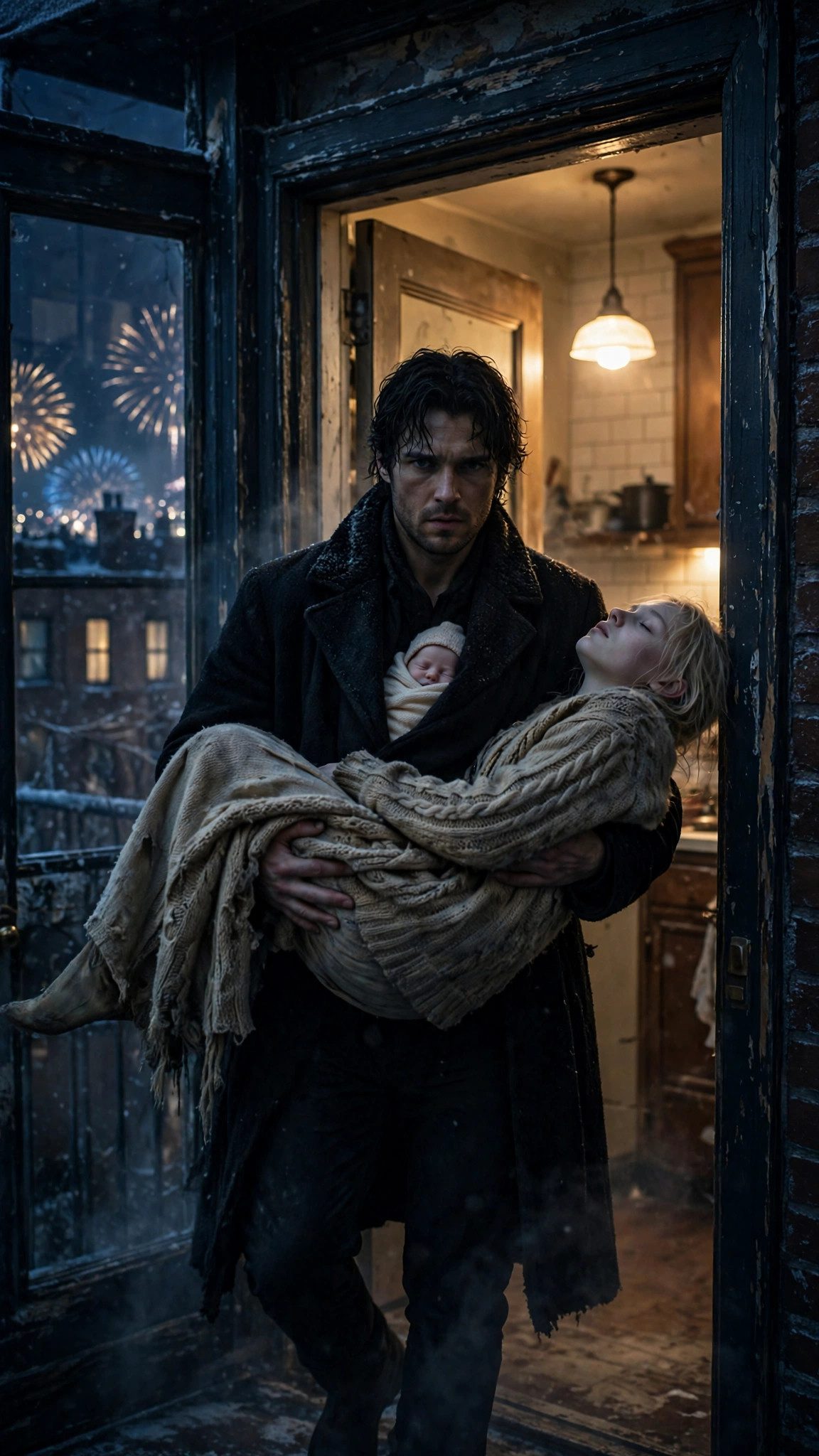
    One year later, on New Year's Eve, I stood in the doorway of our apartment and watched my wife get ready for the evening, and I thought about the last time I had stood in that doorway.

    A year ago, I had come home to darkness and cold and silence. A year ago, my wife had been bleeding and starving in a kitchen chair, and my son had been trembling beneath a blanket too thin for winter, and my family had been celebrating in South Beach with money that was meant to keep them alive.

    Tonight, the apartment was warm. The lights were on. Music was playing — soft jazz, the kind Maya liked, the kind that made her hum while she moved around the room. The refrigerator was full. The heat was on. And in the living room, Liam was sitting on the floor in a tiny suit, banging a wooden spoon against a pot and laughing at the noise he was making, while Rosa clapped her hands and laughed with him.

    Maya came out of the bedroom in a deep green dress, the color of pine trees in winter, and she turned in a slow circle for me, the way she used to when we were first dating and she wanted my opinion on something she was wearing.

    "Well?" she said.

    "You look beautiful," I said. And she did. She was healthy now. Her cheeks were full. Her hair was shiny. Her eyes were bright. She looked like the woman I had married, and she looked like someone new, too — someone stronger, someone who had been through something terrible and had come out the other side with her head held high.

    "You're staring," she said.

    "I'm allowed to stare," I said. "You're my wife."

    She laughed, and she came over and kissed me, and Liam banged his spoon against the pot, and Rosa said, "All right, enough, you two. Go. Have your evening. The baby and I will be fine."

    We were going to a small restaurant in Manhattan, just the two of us, for the first time in over a year. Chloe was meeting us there. My mother was not coming — not yet. She had been invited to the vow renewal we were planning for the spring, and she had cried when I told her, and she had said she would be there, and she would be on her best behavior, and she would bring the silver rattle, and I had believed her. But tonight was just for us. Tonight was for Maya and me.

    In the cab, Maya took my hand. "Do you remember last year?" she asked. "Do you remember what you said to me in the cab, on the way to the hospital?"

    "I said I would never leave your side again," I said.

    "You said that," Maya said. "And you kept your word. You have been here every single day. Every night. Every appointment. Every feeding. You have not missed a thing."

    "I missed eleven days," I said. "I'll never forgive myself for those eleven days."

    Maya squeezed my hand. "David, listen to me. You came home. That's what matters. You walked through that door, and you saw what was happening, and you did something about it. A lot of men would have believed their mother. A lot of men would have told themselves their wife was exaggerating. You didn't. You believed me. You chose me. You chose Liam. And you have chosen us every single day since then. That is what a husband does. That is what a father does. And that is enough. It has to be enough, because it is everything."

    The restaurant was small and warm, with candles on the tables and a string quartet in the corner. Chloe was already there, sitting at a table by the window, wearing a red dress and looking happier than I had seen her in years. She stood up when we came in, and she hugged Maya, and she hugged me, and she said, "Happy New Year, you two. You made it. You actually made it."

    We sat down. We ordered dinner. We talked about normal things — Liam's first steps, which he had taken three days earlier, wobbling across the living room floor with his arms out like a tiny tightrope walker. Chloe's new job. Rosa's granddaughter, who was getting married in the spring. The restaurant. The music. The year that was ending, and the year that was about to begin.

    At midnight, the lights dimmed, and the staff brought out champagne, and everyone in the restaurant stood up and counted down together. Ten. Nine. Eight. Seven. Six. Five. Four. Three. Two. One.

    Fireworks exploded over Manhattan, just like they had a year ago. But this time, I was not in a cab with my wife burning with fever beside me. This time, I was standing in a warm restaurant with my wife in my arms, and she was healthy, and my son was safe at home with a woman who loved him, and my sister was smiling at us from across the table, and the year that was ending had been the hardest year of my life, and the year that was beginning felt like a gift.

    I kissed Maya at midnight. I kissed her the way I had kissed her on our wedding day — like she was the only person in the room, like she was the only person in the world. And when I pulled back, she was crying, and she was laughing, and she said, "David Romano, you are the best thing that ever happened to me."

    "You're the best thing that ever happened to me," I said. "You and Liam. Both of you. Forever."

    In the spring, we renewed our vows. It was a small ceremony, in a garden, with forty people — the same number as our first wedding, but different people. Chloe was there, in a blue dress, holding Liam's hand. Rosa was there, crying before the ceremony even started. Elena, my new head of operations, was there, looking slightly confused by the whole thing but happy for us. And my mother was there, sitting in the back row, wearing a plain gray dress, holding the silver rattle in her lap, and crying quietly through the entire ceremony.

    Maya wore a white dress, simple and beautiful, and she carried a bouquet of white roses, and when she walked down the aisle toward me, Liam walked beside her, holding her hand, taking careful, wobbling steps in his tiny suit. The string quartet played. The sun shone. And when the officiant asked if I would take Maya as my wife, again, for the rest of my life, I said, "I do," and I meant it more than I had the first time, because this time I knew what those words cost, and I knew what they were worth.

    After the ceremony, my mother came up to us. She was nervous. Her hands were shaking. She held out the silver rattle to Liam, and he took it, and he shook it, and the bell made its soft, clear sound, and he laughed.

    "Thank you for inviting me," she said to Maya. Her voice was quiet. "I know I don't deserve to be here. I know what I did. I will spend the rest of my life trying to make it right."

    Maya took her hand. "You're here," she said. "That's a start."

    The reception was held in the garden, under strings of lights that glowed gold as the sun went down. There was music. There was dancing. There was a cake that Maya had made herself — white frosting, fresh strawberries, three tiers, exactly like the cake at our first wedding, except this time she had help. Chloe had been in the kitchen with her all morning, flour on both of their aprons, laughing at each other's mistakes. Rosa had supervised from a chair in the corner, offering opinions on everything and apologizing for none of them.

    I danced with Maya under the lights, the way we had danced at our first wedding, and the way we had danced in the restaurant on New Year's Eve. She put her head on my shoulder, and I held her close, and I thought about how far we had come. A year ago, she had been sitting on a hard plastic chair in a freezing kitchen, bleeding and starving, afraid to call me because she thought she would lose her son. Tonight, she was dancing in a white dress in a garden full of people who loved her, and she was laughing, and she was free.

    Chloe danced with Liam, spinning him around in the air while he squealed with delight. Elena danced with Rosa, who insisted she was too old to dance and then danced for twenty minutes straight. Even my mother danced — once, slowly, with Tony, who had known our family for fifteen years and who had seen everything, and who treated her with a kindness she did not expect and had not earned.

    When the music slowed, I took the microphone. I had not planned a speech. I am not a man who makes speeches. But I stood there, in the garden, with my wife beside me and my son asleep in Rosa's arms, and I looked at the forty people who had come to celebrate with us, and I found that I had something to say.

    "A year ago," I said, "I came home to an empty apartment and a note on the refrigerator, and I thought I had lost everything. I thought my family was gone. I thought my wife was gone. I thought my son was gone. And I was wrong. My family was not gone. My family was right here, waiting for me to see it clearly for the first time. My wife, who survived eleven days of cruelty and never stopped loving her son. My son, who held on to my finger in the back of a cab and refused to let go. My sister, who chose the truth when it would have been easier to look away. And all of you, who showed up tonight to celebrate something that almost didn't happen."

    I paused. The garden was quiet. The lights glowed. Maya was crying, and she was smiling, and she was holding my hand so tightly it hurt.

    "So thank you," I said. "Thank you for being here. Thank you for believing in us. And thank you, Maya, for marrying me twice. I promise you, I will spend the rest of my life earning it."

    Everyone cheered. Maya kissed me. Liam woke up and started crying, and Rosa handed him to me, and I held him against my chest, and he quieted down, and he looked up at me with his mother's eyes, and he smiled.

    The next morning, I woke up before Maya did, and I went into the nursery, and I stood over Liam's crib and watched him sleep. He was lying on his back with his arms thrown wide, the way babies do when they feel completely safe, and the silver rattle was on the blanket beside him, and the morning light was coming through the window, and I thought about the first time I had held him — in the back of a cab on New Year's Eve, wrapped inside my coat, his tiny hand curled around my finger. I thought about how far we had come from that night. I thought about the hospital, and the storage room, and Miami, and the café, and the garden, and all the days in between, and I understood something I had not understood before: that a family is not something you are given. It is something you build, day by day, choice by choice, and the choices that matter most are the ones you make when no one is watching, and the ones you make when everything is falling apart.

    Liam opened his eyes. He saw me standing there, and he smiled, and he reached up with both hands, and I picked him up, and I held him against my chest, and I carried him into the kitchen, and I made coffee, and I waited for Maya to wake up, and I thought about how ordinary it all was, and how extraordinary it was, too.

    That night, after everyone had gone home, Maya and I sat on the couch in our apartment, and Liam slept in his crib, and the apartment was warm, and the refrigerator was full, and the heat was on, and I thought about the night a year ago when I had unlocked the door at 11:27 p.m. and found my wife bleeding in a cold kitchen.

    I thought about the note on the refrigerator. I thought about the pharmacy bag on the high shelf. I thought about the face in the security camera, looking directly into the lens. I thought about all the things that had nearly broken us, and all the things that had not.

    And I thought about my father, and what he used to say about family. A man with no family is a man with no spine. He was right, in a way. But he was wrong about what a family was. A family was not the people you were born to. A family was not the people who shared your blood. A family was the people who showed up when it mattered. The people who told the truth. The people who stayed. The people who, when they failed you, did the hard work of earning their way back.

    I had a family now. A real one. A wife who had survived eleven days of cruelty and come out stronger. A son who smiled at me like I was the whole world. A sister who had chosen the truth over comfort. And a mother who was learning, slowly, what it meant to love someone without controlling them.

    It was not the family I had been born into. It was better. It was the family I had chosen, and the family that had chosen me, and it was forever.

    Maya leaned her head against my shoulder. "What are you thinking about?" she asked.

    "I'm thinking about how lucky I am," I said.

    She smiled. "Me too," she said. "Me too."

    Outside, the city was quiet. Inside, the apartment was warm. And in the crib, our son slept, safe and loved, beneath a blanket that was thick enough for winter.

    The End.
    THE END

  • Chapter 6: What a Family Is

    Chapter 6: What a Family Is

    Maya came home from the hospital nine days later, on a cold, bright morning in the middle of January. The apartment was different. I had hired a cleaning crew to scrub every room, and I had thrown away the thin blanket and the hard plastic chair and the cup of instant noodles, and I had restocked the refrigerator myself — salmon, fruit, broth, vitamins, milk, formula, bottled water, everything the doctors had recommended, twice over. I had hired a nurse to come every day for the first month, a kind woman named Rosa who had raised four children of her own and who looked at Maya the way a mother is supposed to look at a daughter. I had changed the locks. I had installed new cameras, in every room, with the feed going directly to my phone and to no one else's.

    Maya walked through the door slowly, holding Liam in her arms, and she looked around at the apartment like she was seeing it for the first time. She went to the kitchen. She opened the refrigerator. She stood there for a long moment, just looking at the food, and then she closed the door and she turned to me and she said, "It feels different. It feels like ours again."

    "It is ours," I said. "Just ours. No one else gets a key. No one else gets to decide what happens in this home."

    The first week at home was hard. Maya was still weak. Her incision was healing, but it hurt when she moved too fast, and she tired easily, and she woke up in the night with nightmares. In the nightmares, she was back in the cold kitchen, sitting on the plastic chair, and the phone was on top of the refrigerator where she couldn't reach it, and her mother-in-law was standing in the doorway, telling her that if she called David, she would lose her baby. She would wake up shaking, and I would hold her, and I would tell her the same thing every time: "You're safe. You're home. No one can hurt you here."

    Liam grew stronger every day. He gained weight. His cry got louder. He started to smile — not at first, but by the third week, he smiled at Maya, and then he smiled at me, and the first time he smiled at me I sat down on the floor of the nursery and cried like a child. I had missed the first eleven days of his life. I would never get those days back. But I was here now, and I was going to be here for every day after that.

    Chloe came to visit every other day. She brought food. She brought books. She sat with Maya and talked about normal things — movies, recipes, the weather — and slowly, carefully, the two of them built something new. It was not the relationship they had before. It was something more honest. Chloe did not pretend that nothing had happened. She apologized, more than once, and she meant it, and Maya forgave her, because Maya understood what it was like to trust the wrong person and to pay for it.

    Mark was gone. He had left the house in Queens the day after I confronted him, and he had not come back. Tony told me he had gone to stay with a cousin in New Jersey, and that he was working in a warehouse, paying off his debts a little at a time. I had given him a choice: pay back every cent he stole, or face the consequences through other channels. He had chosen to pay it back. It would take him years. That was his problem now, not mine. Chloe's divorce was moving forward. She cried about it sometimes, when she thought no one was looking. But she never once asked me to take him back, and she never once defended what he had done.

    My mother came back from Miami after two weeks, when the money ran out. She called me from the airport. Her voice was different now — smaller, thinner, the voice of a woman who had discovered that the world was not as soft as she had thought it was.

    "David," she said, "I'm home. Can I come see the baby?"

    "No," I said.

    "David, please. I'm your mother."

    "You were my mother," I said. "And then you went to Miami and left my wife to die. You don't get to come see the baby. You don't get to come to this apartment. You don't get to call yourself his grandmother until you understand what you did."

    "I didn't mean for it to go that far," she said. Her voice was shaking. "I didn't mean for her to get sick. I just wanted — I just wanted you to see that she wasn't right for you. I wanted you to come home to me. I wanted things to go back to the way they were before you married her."

    "Before I married her, you had a son who trusted you," I said. "Now you have a son who knows exactly who you are. That's what you wanted, isn't it? For things to go back to the way they were? Well, this is the way they are now."

    I hung up. I did not feel triumphant. I did not feel vindicated. I felt tired, and sad, and strangely empty, the way you feel after you have cut something out of your life that was poisoning you, and you know you did the right thing, and it still hurts.

    My mother called again the next day. And the next. And the next. Each time, her voice got a little smaller. Each time, she said a little more. She said she was sorry. She said she had made a mistake. She said she missed me. She said she missed Liam, even though she had never held him. I listened, and I did not answer, because I was not ready. I was not ready to forgive her, and I was not ready to let her back into our lives, and I was not going to pretend otherwise just because she was my mother.

    It was Maya who finally said the words I could not say to myself. We were sitting in the living room one evening, in late February, and Liam was asleep in his bassinet, and the apartment was warm, and Rosa had just left for the night, and Maya looked at me and said, "David, your mother called me today."

    I sat up straight. "What did she say?"

    "She said she was sorry," Maya said. "She cried. She said she had been wrong about me. She said she was afraid of losing you, and that fear made her cruel, and that she was sorry. And David — I believe her. Not all of it. Not yet. But I believe she is sorry."

    "Do you want me to let her back in?" I asked.

    "I want you to decide," Maya said. "She is your mother. But I want you to know something. I forgive her. Not because what she did was all right. It wasn't. It will never be all right. But I forgive her because I don't want to carry her around with me for the rest of my life. I don't want her to live in my head. I want to be free of her. And the only way I know how to be free is to forgive her and let her go."

    I thought about that for a long time. I thought about my father, and what he used to say about family. I thought about Maya, and Liam, and the life we were building. And I realized that forgiveness was not the same as forgetting, and it was not the same as letting someone back in. Forgiveness was something you did for yourself. Letting someone back in was something else entirely, and it had to be earned.

    I called my mother the next day. I told her that Maya had forgiven her, and that I was working on it, and that if she wanted to be part of our lives again, there were conditions. She would pay back the fourteen thousand dollars, every cent, on a schedule we agreed on. She would apologize to Maya in person, face to face, and she would mean it. She would never again speak to Maya the way she had spoken to her in that kitchen. She would never again threaten her, or manipulate her, or try to come between us. And her visits with Liam would be supervised, by me or by Maya, until we were sure — really sure — that she could be trusted.

    My mother agreed to all of it. She cried. She said she would do anything. She said she would pay back the money. She said she would apologize. And for the first time in my life, I believed that she meant it, because for the first time in my life, she had something to lose that she actually valued: us.

    I did not let her come to the apartment that day. I told her we would start slowly. A phone call. Then a visit, in a public place, with me there. Then, maybe, someday, she could hold her grandson. But slowly. On our terms. Not hers.

    That night, Maya and I sat together on the couch, and Liam slept in his bassinet beside us, and the apartment was warm, and the refrigerator was full, and the heat was on, and I thought about what a family really was. It was not blood. It was not obligation. It was not the people who shared your last name. A family was the people who showed up. The people who told the truth. The people who stayed. And the people who, when they failed you, did the hard work of earning their way back.

    I had lost a mother that winter. I had lost a brother-in-law. I had almost lost my wife and my son. But I had gained something too. I had gained a family of my own choosing — a wife who had survived eleven days of cruelty and come out stronger, a son who smiled at me like I was the whole world, and a sister who had chosen the truth over comfort. It was a small family. But it was real. And it was mine.

    The first visit happened in March, in a small café near the park, on a Sunday afternoon. I chose the place. I chose the time. I sat next to Maya, and Liam was in his stroller beside us, and my mother walked in alone, wearing a plain coat and no makeup, carrying a small wrapped package in her hands.

    She looked older than I remembered. The trip to Miami had not been kind to her. She had lost weight. Her hair was grayer. She sat down across from us, and she put the package on the table, and she looked at Maya, and she did not look away.

    "Maya," she said, "I owe you an apology. A real one. Not a phone call. Not a message. Face to face, the way it should have been from the beginning."

    Maya nodded. She did not speak. She waited.

    "I was cruel to you," my mother said. Her voice shook, but she kept going. "I took your food. I hid your medicine. I turned off the heat. I threatened you with losing your son. I did all of that, and I told myself I was doing it for the family, but I wasn't. I was doing it because I was afraid. I was afraid that David loved you more than he loved me. I was afraid that you would take him away from me. And instead of saying that out loud, like an adult, I tried to break you so that he would have no choice but to come back to me. It was wrong. It was evil. And I am sorry. I am so sorry, Maya. I don't expect you to forgive me. I don't deserve it. But I needed you to hear me say it."

    Maya was quiet for a long moment. Then she reached across the table and took my mother's hand. "Thank you," she said. "Thank you for saying it. Thank you for meaning it."

    My mother started crying. She cried the way a person cries when they have been holding something inside for a very long time and it finally breaks open. She cried, and Maya held her hand, and Liam made a small sound in his stroller, and the waitress brought us coffee, and for a moment, in that small café, it felt like something was beginning to heal.

    My mother opened the package on the table. Inside was a small silver rattle, old and tarnished, with a tiny bell inside it. "This was David's," she said. "When he was a baby. My mother gave it to me, and I gave it to David, and I have kept it all these years. I want Liam to have it now."

    I took the rattle. I held it in my hand. It was heavier than I expected. I shook it gently, and the bell made a soft, clear sound, and Liam turned his head toward it, and he smiled.

    "Thank you, Mom," I said. And I meant it. Not because everything was fixed. It wasn't. But because she had come, and she had told the truth, and she had brought the rattle, and that was a beginning.

    That spring, I made another change. I restructured the business. I closed the shipping accounts that Mark had used to steal from us. I brought in an outside auditor, a man with no connection to my family, and I told him to look at everything, every account, every transfer, every dollar, going back ten years. I hired a new head of operations, a woman named Elena who had run a logistics company in Chicago and who had no patience for secrets. And I started the long, slow process of moving the family business toward legitimacy — real contracts, real taxes, real books that anyone could look at. It would take years. It would cost money. But I was done with the old ways. I was done with ledgers hidden in safes and money moving through shell companies in the dark. I had a wife and a son, and I wanted to build something they could be proud of, something that would not require them to lie, or to hide, or to be afraid.

    Maya went back to work in the summer, part-time at first, baking in the mornings while Rosa watched Liam. She made a cake for Liam's first birthday that was so beautiful people took photographs of it before they ate it. Chloe got her divorce finalized in June, and she started a new job, and she laughed more than she had in years. And my mother — my mother paid back the fourteen thousand dollars, a little every month, on time, without being asked. She sent a check, and a note, and the note always said the same thing: "I am sorry. I am trying."

    It was not a perfect family. It would never be a perfect family. But it was an honest one. And that was enough.

  • Chapter 5: Miami

    Chapter 5: Miami

    On the morning of New Year's Day, I called my mother.

    She answered on the third ring, her voice warm and bright, the voice of a woman on holiday. "David, darling! Happy New Year! Chloe told me you called last night. Are you home already? How wonderful. How is Maya?"

    "Maya is in the hospital," I said. "She has an infection. She nearly died. Liam is in the neonatal unit. They found them in a freezing apartment with no food and no medicine."

    There was a silence. Then my mother laughed. It was a short, sharp laugh, the kind of laugh a person makes when they think you are joking and they are waiting for the punchline.

    "David, don't be dramatic," she said. "Maya is fine. She was fine when we left. You're exaggerating."

    "I photographed everything," I said. "The blood. The empty refrigerator. The note you left on the door. The medication hidden in the storage room. I have photographs, Mom. I have proof."

    Another silence, longer this time. When she spoke again, her voice had changed. The warmth was gone. What was left was something I had heard a hundred times growing up, whenever I had questioned her, whenever I had pushed back, whenever I had dared to suggest that she might be wrong about something.

    "Your wife is a liar," she said. "She is manipulating you. She has been manipulating you since the day you met her. She wants you to choose her over your own family, and you are falling for it. David, listen to me. I am your mother. I carried you for nine months. I raised you. I gave you everything. And this girl — this girl who came from nothing — she walks in and suddenly I am the villain?"

    "She nearly died," I said. "She nearly died because you took her food and hid her medicine and turned off the heat. That is not manipulation. That is a fact. The doctors told me so."

    "The doctors don't know what they're talking about," my mother said. "Women have been having babies for thousands of years without all this fuss. In my day, we didn't need antibiotics and special food and a heated apartment. We got up and we worked. Maya is soft, David. She is soft and she is spoiled and she has made you soft too."

    I stood in the hospital hallway with the phone pressed to my ear, and I looked through the glass at Maya sleeping in her bed, and I thought about the eleven days. I thought about the note. I thought about the pharmacy bag on the high shelf. I thought about the thermostat set to fifty degrees. And I realized, with a clarity that felt like ice water, that my mother was not going to apologize. She was not going to admit what she had done. She was going to blame Maya, and she was going to keep blaming Maya, for as long as I let her.

    "Where is the fourteen thousand dollars?" I asked.

    "What?" she said.

    "The fourteen thousand dollars I sent you. For Maya and Liam. Food, medicine, anything they needed. Where is it?"

    "I spent it," she said, and there was no shame in her voice at all. There was defiance. "I spent it on the trip. On the hotel. On clothes. On dinner. Do you know how long it's been since I've had a proper holiday, David? Do you know how much I have given up for this family? I raised you and Chloe on my own after your father died. I never asked for anything. And now I take one trip, one little trip to Miami, and you call me to interrogate me about money?"

    "You spent the money I sent for your daughter-in-law's medicine on a hotel in South Beach," I said. "While she was bleeding in a freezing apartment."

    "I did what I had to do," my mother said. "And if you can't see that, then maybe you are not the son I thought you were."

    I hung up. I did not say goodbye. I did not tell her I loved her. I put the phone in my pocket, and I went back into Maya's room, and I sat down in the chair beside her bed, and I tried to breathe.

    That afternoon, Maya's fever spiked. Her temperature climbed to a hundred and four, and the monitors started beeping, and nurses came running, and the doctor came in with a face that told me everything I needed to know before she opened her mouth.

    "The infection is spreading," she said. "We're moving her to intensive care. We're changing the antibiotics. I need you to understand that she is very sick, Mr. Romano. She is going to need you to be strong right now."

    They wheeled Maya away, and I stood in the hallway with my hands in my pockets, and I felt the way I had felt in the cab on New Year's Eve — like the ground had opened up underneath me and I was falling and there was nothing to hold on to.

    I called Tony. I told him to bring Mark to the hospital. Not to the room. To the parking garage. I needed to look at him again, and I needed to ask him the questions I had not asked the night before.

    Mark arrived an hour later, escorted by two of Tony's men. He looked smaller than he had the night before. His suit was wrinkled. His eyes were red. He had not slept.

    "Tell me about the money," I said. "All of it. Not just the four hundred thousand. Everything."

    He told me. He had been gambling for three years, since before he married Chloe. He had borrowed from a bookmaker, then from a loan shark, then from another loan shark to pay the first one. The debts had grown to almost six hundred thousand dollars. He had started stealing from the family accounts to keep up with the payments, and when my mother found out — because she had found one of his bank statements in the laundry — she had not told me. She had not told Chloe. She had made a deal with him instead.

    "She said she would keep my secret if I did what she told me," Mark said. "She said if I helped her with Maya — if I hid the medicine, if I kept Maya quiet, if I made sure Maya didn't call you — she would give me money from the family accounts to pay off my debts. She said Maya was a problem. She said Maya was turning you against the family, and that if Maya was gone, everything would go back to the way it was supposed to be."

    "Gone," I said. "What do you mean, gone?"

    Mark looked at the ground. "She never said it out loud. But I knew what she meant. If Maya got sick enough, if she couldn't take care of the baby, you would have to send Liam somewhere. You would have to make a choice. And my mother-in-law — your mother — she was sure you would choose the family. She was sure you would choose her."

    I stood in that parking garage, in the cold, with the smell of exhaust and concrete in the air, and I understood the full shape of what my mother had done. She had not simply been cruel to Maya. She had been building a plan. She had used Mark's debts to control him. She had used the fourteen thousand dollars to fund her holiday. She had used Chloe's trust to keep her quiet. And she had used my absence to try to break my wife, so thoroughly that I would have no choice but to turn to my mother for help raising my son.

    She had been wrong about one thing. She had been wrong about me.

    I told Tony to take Mark back to the house in Queens and keep him there. Then I went back upstairs to intensive care, and I sat outside Maya's room, and I waited. The nurses came and went. The monitors beeped. The hours passed. And sometime after midnight, on the second day of the new year, Maya's fever broke.

    The doctor came out and told me her temperature was coming down. The new antibiotics were working. She was going to be all right. She was going to need time — weeks, maybe a month — but she was going to be all right. And Liam, in the neonatal unit, was gaining weight. He was drinking his formula. He was crying louder now, the strong, angry cry of a healthy baby, and the nurses said that was the best sound they had heard all week.

    I went into Maya's room. She was awake. Her eyes were open, and she was looking at me, and she was smiling — a small, tired smile, but a real one.

    "You're still here," she whispered.

    "I'm still here," I said. "I'm not going anywhere. Not ever again."

    "Did you talk to your mother?" she asked.

    "I did," I said. "And I know everything now. All of it. And I want you to hear me, Maya. No one is going to take Liam away from you. No one. Not my mother. Not anyone. You are his mother. You are my wife. And from now on, this family is the three of us. Anyone who can't accept that doesn't get to be part of it."

    The next morning, Chloe arrived at the hospital. She had flown back from Miami on the first flight, leaving her mother alone in the hotel, and she looked like she had not slept at all. Her hair was pulled back. Her eyes were red. She was carrying a bag of baby clothes and a stuffed bear, and she stood in the doorway of Maya's room like she was afraid to come in.

    "Can I see her?" she asked.

    I nodded. She came in slowly and sat down in the chair on the other side of the bed. She looked at Maya for a long time. Maya was asleep again, but her color was better now. The gray was gone. There was pink in her cheeks for the first time in days.

    "David," Chloe whispered, "I need you to believe me. I didn't know. I swear on my life, I didn't know what Mom was doing. I thought — I thought she was taking care of Maya. I thought the money was for food and medicine. I didn't know she spent it on the hotel. I didn't know about the medication. I didn't know about any of it."

    "I believe you," I said. And I meant it. Chloe had always been the one who trusted too easily. It was her greatest flaw and her greatest virtue, and our mother had used it against her the same way she had used Mark's debts and my absence.

    "But I should have known," Chloe said. Her voice was shaking. "I was there for the first few days. I saw Maya. I saw how tired she was. I saw that she wasn't eating. And I told myself it was normal. I told myself Mom knew what she was doing. I let Mom answer the phone when you called. I let her tell you Maya was fine. I didn't check. I didn't look. I just believed her, because she's our mother, and I thought mothers didn't lie about things like that."

    "She lied to all of us," I said. "She lied to me. She lied to you. She lied to Mark. The only person she didn't lie to was Maya, and that's because she told Maya the truth about what she was going to do to her."

    Chloe started crying. She put her face in her hands, and her shoulders shook, and for a moment she looked like the little girl I remembered from when we were children, the girl who used to hide behind me whenever our father raised his voice.

    "What happens now?" she asked. "What happens to Mom? What happens to Mark?"

    I had been thinking about that question all night, sitting outside Maya's room, listening to the monitors beep. I had thought about what my father would have done. I had thought about what the old ways would have demanded. And I had thought about Maya, and Liam, and the kind of man I wanted to be for them.

    "Mark stole from the family," I said. "He stole four hundred thousand dollars, and he helped my mother hurt my wife. He is going to pay back every cent he took, and he is going to leave this family. You are going to divorce him, Chloe. I know that's hard to hear, and I know you love him, but he is a thief and a gambler, and he put my wife's life at risk, and I will not have him anywhere near my son."

    Chloe nodded. She did not argue. She did not defend him. She just nodded, and she wiped her eyes, and she said, "I already called a lawyer. On the plane. I already started the paperwork."

    "And Mom?" she asked.

    "Mom is cut off," I said. "The cards are already canceled. The accounts are closed. The apartment she lives in — I pay for that, and I am going to sell it. She can find her own way now. If she wants to be part of this family again, she is going to have to earn it. She is going to have to apologize to Maya, in person, and mean it. She is going to have to pay back the fourteen thousand dollars. And she is going to have to understand that Maya is my wife, and Liam is my son, and no one — no one — comes before them. Not her. Not anyone."

    Chloe was quiet for a long time. Then she said, "She won't do it. You know she won't. She will never apologize. She will never admit she was wrong."

    "Then she will live with the consequences," I said. "That is her choice."

    Chloe reached across the bed and took my hand. "I'm sorry, David," she said. "I'm sorry I didn't see it. I'm sorry I left. I'm sorry for all of it."

    "You're here now," I said. "That's what matters."

    She stayed for the rest of the day. She sat beside Maya's bed. She held Liam in the neonatal unit, rocking him gently, singing to him the way our mother used to sing to us when we were small. And as I watched her, I thought that maybe, just maybe, the family I had lost was not gone entirely. Maybe it was just smaller than I had thought. Maybe it was the people who showed up, and the people who told the truth, and the people who stayed.