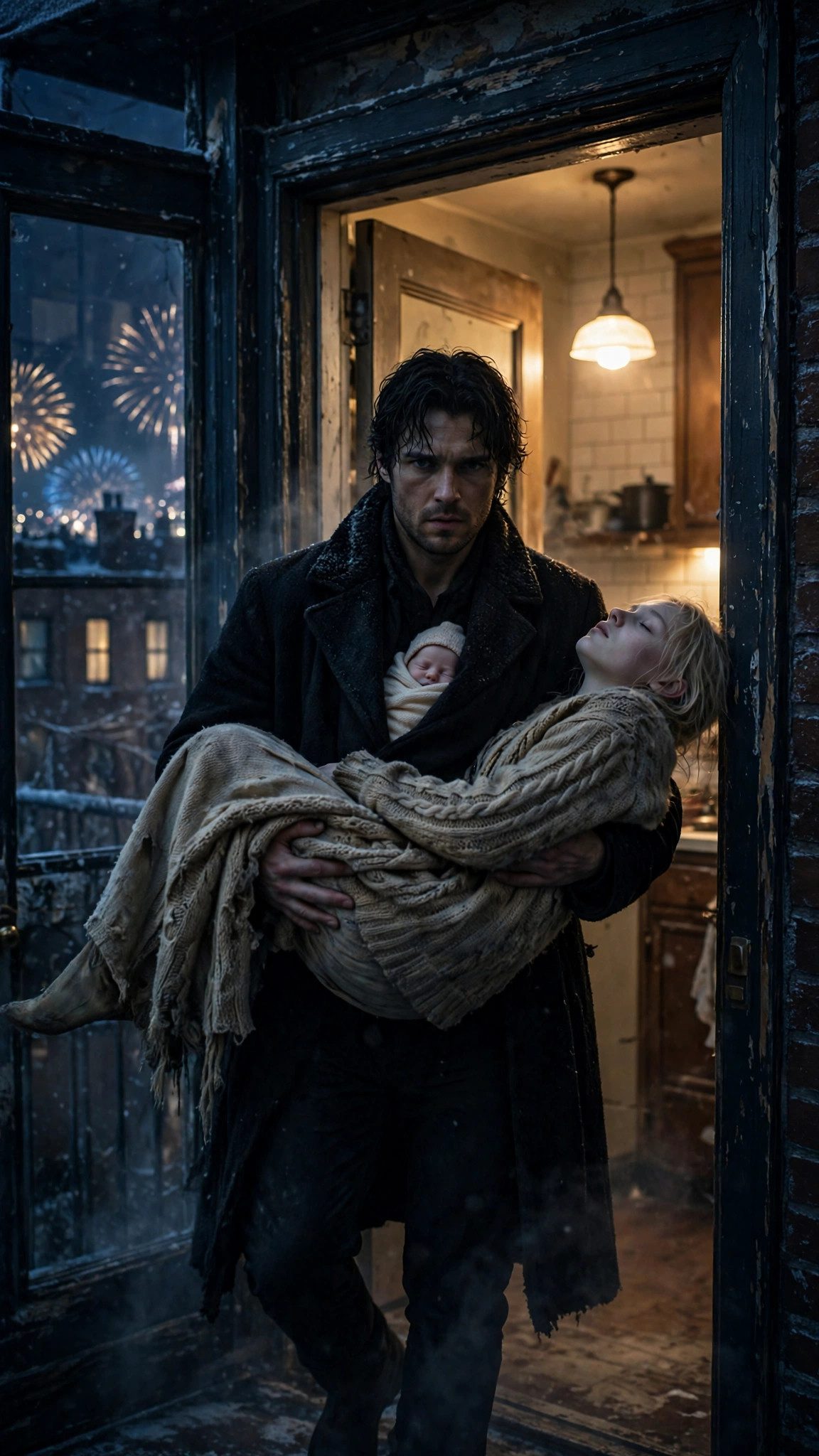
Story Genres: Mafia Romance

  • Chapter 4: The Man in the Storage Room

    Chapter 4: The Man in the Storage Room

    The hospital took Maya and Liam from me the moment we arrived. Nurses in blue scrubs, a doctor with tired eyes, a gurney, a curtain pulled closed. I stood in the hallway with Liam's blanket in my hands and watched them wheel my wife away, and I realized I was still holding my phone. The camera feed was still open. The face was still there, burned into the screen.

    It was Mark.

    My sister's husband. The man who was supposed to be in Miami with my mother and Chloe, celebrating New Year's in South Beach. He was standing in my storage room, in the dark, holding a flashlight and a canvas bag, and he was looking directly into the camera with an expression I had never seen on his face before. Not charm. Not warmth. Just cold, flat calculation, the look of a man who has been caught doing something he cannot explain.

    I called my head of security. His name is Tony, and he has worked for my family for fifteen years, and he is the one person in my organization I trust without reservation. I told him to bring two men to my apartment in Brooklyn, quietly, no sirens, no scene, and to make sure no one left the building.

    "What's going on, boss?" he asked.

    "Someone is in my storage room," I said. "Someone who is supposed to be in Miami. I want to know what he's doing there, and I want to know it tonight."

    Tony didn't ask another question. He said, "Twenty minutes," and hung up.

    I went back to the emergency room. The doctor came out and told me Maya had a serious infection in her surgical incision, that her fever was dangerously high, that she was dehydrated and malnourished, and that they were starting her on intravenous antibiotics immediately. She would need to stay in the hospital for at least a week. Liam was dehydrated too, and underweight, and they were keeping him in the neonatal unit for observation. Both of them would recover, the doctor said. Both of them were lucky. She said the word "lucky" twice, and I understood what she meant: lucky that someone had found them when he did. Lucky that it was New Year's Eve and not the second of January. Lucky that I had changed my flight.

    I asked the nurse if I could see Maya. She said Maya was asleep, and the best thing I could do for her right now was to let her rest. I asked if I could see Liam. She said the same thing. I stood in the hallway for a long time, looking at the closed curtain, and I thought about the fact that my wife and my son were alive because of luck, and that luck was not a plan, and that I had trusted the wrong people with the only things that mattered to me.

    Then I went back to the apartment.

    Tony was already there with two of his men, standing in the hallway outside my door. The building was quiet. It was past midnight now, and the fireworks had stopped, and the whole city felt like it was holding its breath between one year and the next.

    "He's still in there," Tony said. "We can hear him moving around. He hasn't tried to leave."

    "Good," I said. I unlocked the door. I walked in first.

    The apartment was exactly as I had left it an hour earlier. Dark. Cold. The note still taped to the refrigerator. The cup of cold noodles still on the kitchen table. The wicker bassinet still sitting there, empty now, with the thin blanket folded inside it. I walked past it all and went to the storage room door. It was closed. I could hear movement behind it — the soft scrape of a box being moved, the click of a lock being tried.

    I opened the door.

    Mark was standing in front of my safe, holding a canvas bag that was already half full. Inside the bag I could see stacks of cash, a leather folder, and a small black notebook. His flashlight was on the floor, still on, throwing a circle of light across the concrete. When the door opened, he turned around, and for a second his face was the face I had seen on the camera — cold, flat, calculating. Then it changed. The charm came back, fast, like a mask being pulled on.

    "David!" he said. "Jesus, you scared me. What are you doing here? You're supposed to be in Stuttgart until January."

    "What are you doing here?" I asked. My voice was very calm. I had not planned for it to be calm. It was just what came out. "You're supposed to be in Miami."

    Mark laughed. It was a short, nervous laugh. "I was just — your mother asked me to check on something. She forgot something in the safe. She asked me to come back and get it for her. I was going to fly down tomorrow. It's not a big deal."

    "My mother asked you to come back from Miami, alone, in the middle of the night, on New Year's Eve, to open my safe," I said. "Is that what you're telling me?"

    "That's what happened," Mark said. He was still holding the bag. He did not put it down.

    "Tony," I said, without taking my eyes off Mark, "take the bag."

    Tony stepped forward. Mark hesitated for a second, and then he handed it over. It was heavy. Tony opened it and looked inside, and his face changed.

    "Boss," he said quietly. "This is the ledger."

    I knew what he meant. The black notebook was my private ledger — the one that tracked every payment, every debt, every favor owed and every favor given, going back ten years. It was the most dangerous object I owned. In the wrong hands, it could destroy my family and half the families we did business with. I kept it in the safe, behind a combination that only I knew, and I had never told anyone it existed.

    "How did you open the safe, Mark?" I asked.

    He didn't answer. He looked at the floor.

    "How did you open my safe?"

    "I watched you," he said finally. His voice was very quiet now. The charm was gone. "Last year. When you opened it to put the ledger away. I was standing behind you, and I watched the numbers. I remembered them."

    "And the money in Stuttgart?" I asked. "The four hundred thousand dollars? That was you too, wasn't it?"

    Mark looked up. His eyes were wet. "I can explain."

    "Explain," I said.

    He told me everything. He had been stealing from the shipping accounts for six months, a few thousand at a time, routing it through the German shell company and into a private account. He had gambling debts. He had borrowed money from the wrong people, and the interest had grown, and he had started taking from the family to pay it back, telling himself he would replace it before anyone noticed. When the amounts got too big to hide, he had panicked. He had come back to the apartment to steal the ledger, because the ledger had the records that could prove what he had done, and he was going to burn it.

    "And the medication?" I asked. "Maya's painkillers. Her antibiotics. They were hidden in this room, on a high shelf. Did you hide them?"

    Mark's face went white. "I —"

    "Did you hide them, Mark?"

    "Your mother told me to," he said, and the words came out in a rush, like water breaking through a dam. "She said Maya was too weak to take care of the baby anyway, and the medicine would just make her sleepy, and if she was awake she would call you and complain. She said to put the bag where Maya couldn't find it. She said it was for the good of the family. David, I swear, I didn't want to do it. But your mother — she said if I didn't do what she said, she would tell Chloe about the gambling. She would tell Chloe about the money. She had me, David. She had me by the throat."

    I stood there in the storage room, looking at my brother-in-law, and I felt something inside me go very still. My mother had not simply neglected Maya. She had used Mark — a thief, a gambler, a man she could control — as her instrument. She had hidden the medicine. She had turned off the heat. She had emptied the refrigerator. She had threatened Maya with losing her child. And she had done it all while I was an ocean away, believing every word she said on the phone.

    "Where is my mother right now?" I asked.

    "Miami," Mark said. "South Beach. The Fontainebleau. She and Chloe checked in three days ago. I was supposed to fly down with them, but I told Chloe I had a business meeting. I stayed behind to get the ledger."

    "And Chloe?" I asked. "Does Chloe know about the money? Does she know about any of this?"

    Mark shook his head. "No. She doesn't know about the gambling. She doesn't know about the stealing. She thinks we went to Miami for New Year's and I stayed behind for work. She doesn't know any of it."

    I looked at Tony. "Take him to the house in Queens," I said. "Keep him there. Don't hurt him. Don't let him call anyone. I'll deal with him tomorrow."

    Tony nodded. His men took Mark by the arms. Mark didn't resist. As they led him out, he turned back to me, and he said, "David, I'm sorry. I know that doesn't mean anything. But I'm sorry."

    I didn't answer. I stood in the storage room, alone, with the safe open and the ledger in Tony's hands and the flashlight still burning a circle of light on the floor. Then I walked back through the apartment, past the kitchen, past the empty bassinet, past the note on the refrigerator, and I went out into the cold night, and I drove to the hospital to sit beside my wife while she slept, and I waited for morning.

    The hospital room was quiet except for the sound of the machines. Maya lay in the bed with an IV in her arm and an oxygen tube under her nose, and her face was the same gray color I had seen in the kitchen, except now someone was finally doing something about it. A nurse came in every hour to check her temperature and change the IV bag. Each time, she gave me a small, professional smile, the kind of smile that says "she's stable" without promising anything more.

    I sat in the chair beside the bed and I held Maya's hand. It was cold. I rubbed it between both of mine, trying to warm it, and I thought about the last time I had held her hand like this. It was on our wedding day, in the garden, right after we said our vows. Her hand had been warm then. She had been laughing. She had leaned over and whispered in my ear, "You look terrified," and I had whispered back, "I am terrified. I've never been this happy in my life."

    I thought about everything I had missed in the last eleven days. I had missed Liam's first bath. I had missed his first night in his own crib. I had missed Maya's first steps after surgery, the ones the nurses had helped her take down the hospital hallway while I was in Stuttgart looking at bank records. I had missed all of it because I had chosen business over family, and I had trusted my family to fill the gap, and my family had filled it with cruelty.

    Around three in the morning, my phone rang. It was Chloe. I stared at the screen for a long time before I answered. I did not want to talk to her. I did not know what I would say. But I answered, because I needed to hear what she knew, and what she didn't.

    "David?" she said. Her voice was bright and sleepy, the voice of someone who has been drinking champagne on a beach. "Happy New Year! Mom and I were just talking about you. We miss you. Are you still in Stuttgart?"

    "I'm in Brooklyn," I said.

    There was a pause. "Brooklyn? What are you doing in Brooklyn? You're supposed to be in Stuttgart until January."

    "I came home early," I said. "I wanted to surprise Maya."

    Another pause, longer this time. "Oh," Chloe said. "Well. That's nice. How is she?"

    "She's in the hospital," I said. "She has an infection. She's been bleeding for days. She hasn't eaten properly in a week. Liam is in the neonatal unit. He's dehydrated and underweight."

    The silence on the other end of the line was so complete that I thought the call had dropped. Then Chloe said, very quietly, "What?"

    "I found them in the apartment tonight," I said. "The heat was off. The refrigerator was empty. Maya's medication was hidden in the storage room. There was a note on the fridge from Mom, telling Maya not to call me and play the victim."

    "David, I —" Chloe's voice broke. "I didn't know. I swear to you, I didn't know any of that. Mom told me Maya was fine. She told me she had everything she needed. I was only there for the first few days, and then Mom said she had it handled, and I went home, and then Mom said we should go to Miami for New Year's, and I thought — I thought Maya was all right. I thought Mom was taking care of her."

    "Did you see her?" I asked. "In those first few days, did you actually look at her? Did you see how she was?"

    Chloe was crying now. I could hear it. "She was tired," she said. "She was so tired. But I thought that was normal. I thought new mothers were supposed to be tired. I didn't know she wasn't eating. I didn't know about the medicine. David, I swear, if I had known, I would never have left. I would never have gone to Miami."

    I believed her. I did not want to believe her, but I did. Chloe had always been the soft one in our family, the one who smoothed things over, the one who believed the best of everyone because it was easier than facing the worst. She had believed our mother. She had believed Mark. She had believed everyone except the woman who was actually suffering, right in front of her.

    "Where is Mom right now?" I asked.

    "She's asleep," Chloe said. "We're in the hotel. David, what are you going to do?"

    "I don't know yet," I said. "But I'm going to find out the truth. All of it. And then I'm going to decide."

    I hung up. I sat in the chair beside Maya's bed, and I watched her breathe, and I waited for morning. Sometime before dawn, her eyes opened. Just for a moment. She looked at me, and she whispered, "You're here."

    "I'm here," I said. "I'm not going anywhere."

    She closed her eyes again. She slept. And I stayed.

  • Chapter 3: Eleven Days

    Chapter 3: Eleven Days

    Maya remembers the day David left the way you remember the last warm day before winter. The apartment was full of food. The refrigerator was so full she had to rearrange the shelves to fit everything in. There was smoked salmon and fresh fruit and containers of medical broth stacked in neat rows, and a basket on the counter full of vitamins and a prescription for painkillers and antibiotics from the hospital. David had gone through it all with her before he left, pointing at each thing, telling her what it was for, making her promise she would eat three meals a day and take her medicine on time and call him if she needed anything at all.

    "Your mother and Chloe are coming to help," he said. "You won't be alone for a single day. That's the whole point."

    Maya believed him. She had no reason not to. She had been married to David for three years, and in three years she had learned that when he said he would handle something, he handled it. She did not know his mother very well — not really. She knew the version of his mother that showed up at holidays and smiled for photographs. She did not know the version that lived underneath that smile.

    The first day was fine. Her mother-in-law arrived in the morning with a suitcase and a smile, and Chloe came in the afternoon with a bag of groceries and a casserole she had made herself. They fussed over Maya. They told her to rest. They brought her tea. Maya thought, maybe this will be all right. Maybe this is what family is supposed to be.

    On the second day, the tone changed. Maya was in the kitchen, trying to make herself a bowl of soup, and her mother-in-law came in and stood in the doorway with her arms crossed.

    "You know," she said, "in my day, women didn't lie around after having a baby. They got up. They worked. They didn't need a man to bring them soup in bed."

    Maya laughed, because she thought it was a joke. Her mother-in-law did not laugh back.

    By the third day, the food was disappearing. Not all at once — that would have been too obvious. A container of broth here. A piece of salmon there. The fresh fruit went first, then the milk, then the vitamins. Maya asked about it, and her mother-in-law said, "Oh, I must have thrown that out. It looked old." Chloe said, "I think Mark ate it. You know how he is." Mark said nothing at all. He just smiled and helped himself to another serving.

    Maya was too tired and too sore to argue. Her incision burned every time she stood up. The baby woke every two hours to feed, and every feeding left her shaking. She needed the painkillers. She went to the kitchen to take them, and the pharmacy bag was gone. She searched the apartment. She searched the drawers, the cabinets, the bathroom, the bedroom. The bag was nowhere. She asked her mother-in-law about it, and her mother-in-law said, "You probably misplaced it, dear. New mothers are so forgetful."

    Maya knew she had not misplaced it. The bag had been on the kitchen counter the night before, right next to the kettle. She had seen it with her own eyes. But she was so exhausted, and her head hurt so badly from the fever that was starting to climb, that she let it go. She told herself she would look again tomorrow. Tomorrow, she was too weak to look at all.

    On the fourth day, the heating went off. Maya woke up shivering, and the apartment was cold enough to see her breath. She went to the thermostat and found it set to fifty degrees. She turned it back up. An hour later, it was set to fifty again. She asked her mother-in-law about it, and her mother-in-law said, "David pays enough for this apartment already. We don't need to heat the whole building. Put on a sweater."

    Maya put on a sweater. Then she put on another one. Then she wrapped herself in a blanket and sat in the kitchen with the baby in her arms, and she shivered, and she told herself that this was temporary, that David would be home soon, that her mother-in-law was just difficult, that difficult was not the same as cruel.

    On the fifth day, Chloe stopped coming. Maya asked where she was, and her mother-in-law said, "She's busy. She has her own life, you know. She can't sit here holding your hand all day." On the sixth day, Mark stopped coming too. On the seventh day, Maya realized she had not eaten a real meal in three days. There was a cup of instant noodles in the back of the pantry, and she made it, and she ate it sitting on a hard plastic chair in the kitchen because the dining chairs had been moved into the storage room and she was too weak to move them back.

    On the eighth day, her mother-in-law came into the kitchen with a suitcase. She was wearing her best coat and a pair of sunglasses, even though it was December and the sun had already set.

    "We're going to Miami," she said. "Chloe and Mark and I. Just for a few days. For New Year's. You understand, don't you? We've been cooped up in this apartment for over a week. We need some air."

    Maya stared at her. "You're leaving? Now? With the baby? With me like this?"

    "Oh, don't be dramatic," her mother-in-law said. "You'll be fine. There's food in the pantry. And honestly, Maya, you should be grateful. Do you know how many women would love to have a mother-in-law who stayed with them for a whole week after they gave birth? Most women are on their own from day one."

    Maya tried to stand up. Her knees gave out, and she caught herself on the edge of the table. Her mother-in-law watched her. She did not move to help.

    "One more thing," her mother-in-law said, and her voice dropped, and for the first time, Maya saw what was underneath the smile. It was not warmth. It was not love. It was something cold and flat and very old, something that had been there for a long time and had only been waiting for a moment when no one else was watching.

    "If you call David and turn him against this family," she said, "I will make sure he takes Liam away from you. I will tell him you are unfit. I will tell him you cannot even take care of yourself, let alone a baby. And he will believe me, because I am his mother, and you are just the girl he married. Do you understand me?"

    Maya understood. She understood perfectly. She nodded, because nodding was the only thing she had the strength to do.

    Her mother-in-law smiled. She patted Maya's cheek, the way you pat a dog that has finally learned to behave. "Good girl," she said. "Now, don't call David and play the victim. He works hard enough without listening to your complaints."

    Then she taped a note to the refrigerator door, picked up her suitcase, and walked out. Maya heard the front door close. She heard the elevator. She heard silence.

    For three more days, Maya sat in that cold kitchen with her baby, and she did not call anyone. She did not call David, because she was afraid of losing Liam. She did not call her own mother, because her mother lived in California and there was nothing she could do from three thousand miles away, and Maya did not want her to worry. She did not call the doctor, because she did not have the strength to explain what was happening, and because some part of her believed what her mother-in-law had said — that a real wife would have handled it, that she was weak, that she had proven her mother-in-law right.

    She ate the last of the instant noodles. She drank water from the tap when the bottled water ran out. She held Liam against her chest to keep him warm, because the blanket was too thin and the apartment was too cold, and she sang to him in a voice so weak she could barely hear it herself. She changed his diaper with the last clean cloth. She pressed her hand against her stomach and felt the heat coming off her incision, and she knew she had an infection, and she knew she needed the antibiotics that were sitting in a sealed pharmacy bag somewhere in the apartment, hidden from her, and she was too weak to find them.

    On the eleventh day, at 11:27 p.m., she heard the front door unlock. She thought it was her mother-in-law, come back to check on her, or to gloat, or to deliver one more threat. She did not look up. She sat on the hard plastic chair, wrapped in an old cardigan, with one hand pressed against her stomach, and she waited for whatever was coming next.

    Then she heard his voice. "Where are Maya and Liam?"

    It was David. It was David, and he was home, and for the first time in eleven days, Maya let herself believe that she might survive this.

    There was one night, the ninth night, when Maya almost called David anyway. Liam had been crying for hours, a thin, exhausted cry that sounded nothing like the strong wail he had made in the hospital, and his skin felt too warm against her chest. She was sitting in the dark kitchen with the phone in her hand, and she had already dialed the first six digits of David's number, and she was telling herself that her mother-in-law was lying, that David would never take Liam away, that David loved her and would believe her.

    Then her mother-in-law appeared in the doorway. She was wearing her robe. Her hair was in curlers. She looked at the phone in Maya's hand, and she smiled.

    "Who are you calling, dear?" she asked.

    Maya's hand shook. "I was just — Liam is so warm. I think he has a fever."

    "Babies get warm," her mother-in-law said. She walked over and took the phone out of Maya's hand, gently, the way you take a sharp object away from a child. "You don't need to bother David. He's in Germany, working. He has enough to worry about. And you know what I told you about calling him."

    "I wasn't going to say anything bad," Maya whispered. "I just wanted to hear his voice."

    Her mother-in-law put the phone on top of the refrigerator, where Maya could not reach it without standing on a chair, and she was too weak to stand on a chair. "You can hear his voice when he comes home," she said. "Now go back to bed. You're making yourself hysterical, and it's not good for the baby."

    Maya went back to the bedroom. She lay down with Liam on her chest. She did not sleep. She listened to the apartment — the creak of the pipes, the hum of the refrigerator, the silence from the room where her mother-in-law slept — and she thought about her own mother, three thousand miles away in California, who had told her on her wedding day, "If a man loves you, his family will love you too. And if his family doesn't love you, you will know exactly how much he loves you by what he does about it."

    She had not understood what her mother meant then. She understood now.

    On the tenth day, Maya found the pharmacy bag. She was looking for a clean cloth in the storage room — the last clean cloth, because she had used all the others and was too weak to do laundry — and she saw it sitting on a high shelf, behind a stack of boxes, where she could not have reached it even if she had been healthy. The bag was black. It had the pharmacy's logo on it. Inside were her painkillers, her antibiotics, and her discharge medication, all still sealed in their boxes, exactly as they had been when David left them on the kitchen counter.

    Someone had carried that bag into the storage room and hidden it on a high shelf on purpose. Someone had wanted her to be in pain. Someone had wanted the infection to spread. Someone had wanted her weak and silent and afraid, and that someone had succeeded for ten days.

    Maya stood in the storage room with the bag in her hands, and she cried for the first time since David had left. Not loudly. She did not have the strength for loud crying. Just tears, running down her face, dripping onto the black plastic of the bag. She thought about the baby in the other room. She thought about the blood soaking through the fabric over her incision. She thought about the note on the refrigerator and the empty shelves and the thermostat set to fifty degrees, and she understood, finally and completely, that this had not been neglect. Neglect was forgetting to buy milk. Neglect was being too busy to call. This was something else. This was deliberate. This was a campaign, carried out day by day, by people who had smiled at her wedding and called her family.

    She put the bag back on the shelf. She did not take the medicine. She was afraid that if she took it, they would know she had found it, and they would punish her for it. That was how afraid she was. That was how thoroughly they had broken her down in ten days.

    She went back to the kitchen. She sat on the hard plastic chair. She wrapped herself in the old cardigan. She pressed her hand against her stomach. And she waited for the eleventh day to end, not knowing that it would end with her husband walking through the door.

  • Chapter 2: Stuttgart

    Chapter 2: Stuttgart

    Three weeks before that night, I was sitting in a hotel room in Stuttgart, staring at a spreadsheet that did not make sense, and thinking about my wife.

    The business problem was simple on paper and ugly underneath. Money was disappearing from one of our shipping accounts. Not a lot at first — a few thousand here, a few thousand there, the kind of amounts that could be explained away as fees or exchange rates or bad timing. But over six months it had added up to nearly four hundred thousand dollars, and the pattern was too careful to be an accident. Someone inside the family was taking it. Someone who knew the accounts well enough to hide the gaps, and someone who knew I was too distracted to look closely.

    I knew who it had to be. There were only four people with access to those accounts: me, my head of operations, my accountant, and Mark. My head of operations had been with us for twenty years and had never taken a cent. My accountant was a nervous man who filed his own taxes three months early. That left Mark, my sister's husband, the man my mother had brought into the family five years earlier and treated like a second son.

    I did not want it to be Mark. Chloe loved him. My mother adored him. He was charming in the way that men who have never been tested are charming — quick with a joke, generous with other people's money, always ready to tell you what you wanted to hear. I had never trusted him completely, but I had never had a reason not to trust him either, and in my family, that had always been enough.

    I flew to Stuttgart because the money had passed through a German shell company, and because I needed to see the records with my own eyes before I accused anyone. If I was wrong about Mark, an accusation would tear my family apart. If I was right, I needed proof that would hold up in front of my sister and my mother, because they would not believe me without it.

    What I did not know, sitting in that hotel room, was that while I was chasing a thief across an ocean, my wife was fighting for her life in a hospital in Brooklyn.

    Maya went into labor two weeks early, while I was still in Stuttgart. The doctors called me at three in the morning, German time. Her blood pressure had spiked. The baby was in distress. They were taking her in for an emergency C-section, and they needed my consent over the phone because I was not there. I gave it. I remember the exact words I said to the surgeon — "Do whatever you have to do to save them both" — and I remember the silence on the other end of the line before she said, "We will do our best, Mr. Romano."

    Her name is Maya Romano now. She was Maya Chen when I met her, five years earlier, in a restaurant in Manhattan where she was working as a pastry chef. I had gone there for a business dinner, the kind of dinner where everyone talks about money and no one eats anything. She came to our table to apologize because the dessert I had ordered was going to take ten more minutes, and she was so direct about it — no groveling, no excuses, just "I'm sorry, it's going to be ten minutes, and it's worth the wait" — that I laughed for the first time in weeks. I asked her out before the dessert even arrived. She said no. She said she didn't date customers. I went back the next week and ordered the same dessert, and she said no again. I went back a third time, and she laughed at me, and she said, "You're persistent. I like persistent. But I still don't date customers." So I stopped being a customer. I waited outside the restaurant on a Tuesday night when her shift ended, and I asked her if she would have coffee with me, not as a customer, just as a man who thought she was the most interesting person he had met in a long time.

    She said yes to coffee. Six months later, she said yes to dinner. A year after that, she said yes to everything else.

    Maya was not impressed by money. That was the first thing I loved about her, and it was the thing my mother never forgave her for. My mother had grown up poor and had married into money, and she believed that money was the only thing that kept a woman safe. She believed a wife should be grateful, quiet, and useful. Maya was none of those things in the way my mother meant them. She was grateful for what mattered and unimpressed by what didn't. She was quiet when she had nothing to say and very loud when she did. And she was useful in the way that actually counts — she was kind, she was honest, and she could make a room full of strangers feel like they belonged there.

    My mother decided within a month of meeting Maya that she was wrong for me. She said it to my face, in my own kitchen, over a cup of coffee she had made too strong on purpose. "She's not one of us, David," she said. "She doesn't understand this family. She'll never understand what it takes." What she meant was that Maya would not bow to her. What she meant was that Maya had her own mind, her own career, her own opinions, and my mother had spent her entire life making sure that no woman in her house had any of those things.

    I married Maya anyway. We had a small wedding — forty people, a garden, a string quartet, a cake Maya made herself because she refused to let anyone else bake her wedding cake. My mother cried through the entire ceremony, and not in a good way. Chloe tried to smooth things over. Mark made a toast that was too long and too much about himself. But Maya and I danced under the lights, and for one evening, everything felt simple.

    The pregnancy was hard from the beginning. Maya was sick for the first four months, then tired for the next three, then in the last month she swelled up like a balloon and her blood pressure started climbing. The doctors watched her closely. They used words like "preeclampsia" and "careful monitoring" and "we may need to deliver early," and I nodded like I understood what any of it meant. I didn't. I just knew that my wife was in danger and my son was in danger, and there was nothing I could do except be there, which I was, until the business problem in Stuttgart pulled me away.

    I should not have gone. I know that now. I knew it then, too, if I'm honest. The morning I left, Maya was thirty-six weeks pregnant and her ankles were so swollen she could barely fit into her shoes. She stood in the doorway of our apartment and smiled at me, and she said, "Go. Fix it. Come home." And I believed her, because she always made it sound easy, and because I had spent my whole life believing that providing for my family meant leaving them to do it.

    Before I left, I did everything I thought a responsible husband would do. I stocked the apartment with food — smoked salmon, fresh fruit, medical broth, vitamins, milk, prescription formula, bottled water, everything the doctors had recommended. I left fourteen thousand dollars in the account my mother shared with me, with clear instructions: this is for Maya and Liam, food and medicine and anything they need, do not spend it on anything else. I asked my mother and Chloe to move into the apartment while I was gone, to help Maya, to make sure she was never alone. My mother put her hand on my cheek and said, "Of course, darling. She's family now. We'll take care of her."

    I believed her. God help me, I believed her.

    The call from the hospital came two days after I landed in Stuttgart. Maya's blood pressure had spiked during a routine checkup. The baby's heart rate was dropping. They were taking her in for an emergency C-section, and they needed my consent. I gave it over the phone, and then I sat in a hotel room in Germany while my wife was cut open on an operating table in Brooklyn, and I listened to a surgeon tell me that Maya had lost a dangerous amount of blood, that they had almost lost her twice, that Liam was small but stable, and that both of them would need weeks of careful recovery.

    I wanted to fly home that night. The doctors told me Maya was stable and that there was nothing I could do from her bedside that the nurses couldn't do better. My head of operations told me the Stuttgart records would be gone if I left — that whoever was stealing the money would cover their tracks the moment I stopped looking. So I stayed. I stayed for eleven more days, and every night I called Maya, and every night someone else answered the phone.

    It was always my mother. "She's sleeping, David. She's resting. Don't worry." Or Chloe. "She's fine. She's eating. The baby is beautiful." Short calls. Tight voices. No detail. I asked to speak to Maya and was told she was asleep, or in the shower, or feeding the baby. I asked about the money and was told everything was taken care of. I asked about the food and was told the refrigerator was full.

    I should have known. I should have heard it in their voices. But I was three thousand miles away, chasing a thief through bank records, and I wanted so badly to believe that my family was taking care of my wife that I let myself believe it.

    On the tenth day, I found what I was looking for in Stuttgart. The shell company. The forged signatures. The transfers, routed through three accounts and ending in a private account that belonged to Mark. Four hundred thousand dollars, taken over six months, a few thousand at a time, always just small enough to miss. I had the proof. I had the records, the dates, the account numbers. I was going to fly home on the third of January, walk into my apartment, and put the evidence on the table in front of my entire family.

    But on the eleventh day, something changed. I was sitting in my hotel room, and I realized I could not wait three more days to see my wife and hold my son. I did not know why. There was no phone call, no message, no sign. Just a feeling, low in my gut, that something was wrong at home. I changed my flight. I paid nearly triple for the last available seat. I packed my suitcase with winter clothes for the baby and recovery creams for Maya and chocolates for my mother and perfume for Chloe and a watch for Mark, and I flew home on New Year's Eve, thinking I was coming home to surprise the people I loved.

    I was coming home to find out what they had really done.

    The flight home was the longest of my life. I sat in a window seat in the last row, wedged between a businessman who snored and a woman with a crying toddler, and I could not sleep. Every time I closed my eyes, I saw Maya's face on the day I left — standing in the doorway, smiling, telling me to go. I kept thinking about the phone calls from the last eleven days. My mother's voice, too smooth. Chloe's voice, too quick. The way neither of them had ever let me speak to Maya for more than a few seconds. The way they had always answered for her, as if she were a child who could not speak for herself.

    I told myself I was being paranoid. I told myself that new mothers were tired, that babies were exhausting, that my family was doing their best and I was inventing problems because I felt guilty for being away. I told myself all of that, and I did not believe a word of it.

    Somewhere over the Atlantic, the woman with the toddler turned to me and said, "First baby?" I nodded. She smiled. "You're going to love it," she said. "There's nothing like holding your own child for the first time. Nothing in the world prepares you for it." I thanked her. I did not tell her that I had already missed the first eleven days of my son's life, or that I was flying home to a wife I had not seen since the day she nearly died, or that the only reason I was on this plane at all was a feeling in my gut that I could not explain to anyone, including myself.

    When we landed at JFK, it was already evening on New Year's Eve. The airport was full of people in party clothes, carrying bottles of champagne and bags of gifts, laughing and kissing under the holiday lights. I walked through them with my suitcase and my coat and my gifts, and I felt like I was walking through someone else's celebration. I took a cab to Brooklyn. I asked the driver to go slowly past the building first, because I wanted to see the windows. Our windows were dark. Every window in the apartment was dark, on New Year's Eve, with a newborn baby inside. I told the driver to stop. I paid him. I stood on the sidewalk and looked up at those dark windows for a long moment, and the feeling in my gut got worse.

    I did not knock. I did not ring the bell. I took out my key and I unlocked the door without making a sound, because some part of me already knew that whatever was waiting for me inside that apartment, I needed to see it exactly as it was, before anyone had a chance to explain it away.

  • Chapter 7: Home

    Chapter 7: Home

    Elias turned one year old on a warm day in late August, in the garden behind my mother's house in Bridgeport, under a sky so blue it looked painted. There were white tablecloths on the folding tables, and a cake with one candle, and balloons tied to the fence, and Rosa's apple pie, and my mother's garlic chicken, and a whole crowd of people who had become my family in the year since Elias was born — Grace the nurse, Mr. Patel the accountant, Amelia Hill in a sundress, Tony with his arm still stiff from the bullet wound, Eleanor with a sun hat, and Vincent.

    Vincent was standing by the grill, wearing an apron that said "World's Okayest Dad," and he was burning the hamburgers, and Elias was sitting in his high chair, smearing cake all over his face, and laughing — really laughing, the deep belly laugh of a baby who has never known a single day of fear — and I stood in the doorway with a tray of lemonade, and I thought: this is it. This is the whole world. This is everything.

    It had taken a year to get here. A year of court dates and board meetings and rebuilding a firebombed restaurant and learning to run a company and learning to be a mother and learning, slowly, to trust a man again. The divorce had never been finalized — Amelia had filed the papers, and the judge had signed the interim order giving me half of Carter Holdings, and then, somewhere along the way, Vincent and I had stopped talking about divorce, and started talking about something else entirely.

    It started small. Vincent came to dinner on Sundays. Then he came to read Elias a bedtime story on Wednesdays. Then he started showing up at the office, not to take anything back, but to help — sitting in on meetings, introducing me to people, teaching me the parts of the business I did not know yet, and learning from me the parts he had never bothered to learn. He learned how to change a diaper. He learned how to make a bottle at three in the morning. He learned how to hold Elias against his chest and walk him around the room, humming off-key, until the baby fell asleep.

    And I learned something too. I learned that the man who had abandoned me was not the whole of Vincent Carter. He was a part of him — a terrible part, a part that had cost us both more than I could measure — but he was not the whole. The whole of Vincent Carter was the boy in the waiting room, and the man who had wept when I told him I was pregnant, and the man who had taken a bullet's path for Tony, and the man who had given the FBI everything to destroy the people who tried to break us, and the man who stood in my mother's kitchen and said, "I'll be right here, for as long as it takes."

    And he had been. He had been right there, for as long as it took. Every Sunday dinner. Every Wednesday bedtime story. Every three-in-the-morning bottle. He had shown up. Again and again and again, until showing up became who he was, and not just something he was trying to do.

    On the morning of Elias's birthday, before the guests arrived, Vincent came into the kitchen while I was frosting the cake, and he stood behind me, and he put his arms around my waist, and he said, "Madison. I have something to ask you."

    "Vincent," I said, "if you burn the hamburgers again, I am going to divorce you for real this time."

    He laughed. And then he got down on one knee, right there in my mother's kitchen, with cake frosting on my hands and the smell of garlic chicken in the air, and he took a small velvet box out of his pocket, and he opened it, and inside was a ring — not a diamond the size of a headlight, not a showpiece, but a simple gold band with a small sapphire, the color of the sky on the day Elias was born.

    "Madison Carter," he said. "I married you once, and I did it wrong. I made promises I didn't know how to keep. I disappeared when you needed me most. I chose an empire over my family, and I lost both. And then you — you took half my empire, and you built something better with it, and you taught me what it means to show up. So I'm asking you now, not as a mafia boss, not as a businessman, not as anything except the boy who held your hand in a hospital waiting room a long time ago: will you marry me again? Will you let me be your husband — really your husband, this time — and will you let me be Elias's father, every single day, for the rest of my life?"

    I looked at him. I looked at the ring. I looked at Elias, asleep in his bassinet by the window, his tiny fist curled around a stuffed lion — the same lion from the story Vincent had told me when we were children, the lion who was afraid of the dark.

    And I thought about my mother, counting her tips at the kitchen table, telling me I was the backbone of my family. I thought about my grandmother, shelling peas, telling me that a person's true character is revealed by how they respond when you're weak. And I thought about Eleanor, telling me not to believe Vincent's story until I saw it with my own eyes.

    I had seen it with my own eyes. I had seen him show up, Sunday after Sunday, Wednesday after Wednesday, three in the morning after three in the morning. I had seen him give up an empire for his family. I had seen him stand between me and two men in the street. I had seen him hold our son and weep because the baby smiled at him.

    "Yes," I said. "Yes, Vincent. I will marry you again."

    He slid the ring onto my finger, next to my wedding band — I had never taken it off, not once, not even in the hospital, not even when I filed for divorce — and he stood up, and he kissed me, and Elias woke up and started crying, and we both laughed, and Vincent picked him up, and the three of us stood in my mother's kitchen, and for the first time in a year, we were a family.

    We renewed our vows a month later, in the small church in Bridgeport where we had been married the first time. My mother cried in the front pew. Eleanor sat in the second row, holding Elias, who wore a tiny suit and a bow tie and looked like the smallest, most serious best man in the history of weddings. Rosa was my maid of honor. Tony was Vincent's best man. Amelia Hill — who had filed my divorce papers and then watched the whole thing turn into something else entirely — sat in the third row, smiling like a woman who had just witnessed the strangest and most wonderful case of her career.

    Vincent's vows were simple. He looked at me, and he said, "Madison. I promise to show up. Every day. In the hospital room. On the phone. At the dinner table. At three in the morning. I promise to show up. And I promise that you and Elias will never again be second to anything in my life. Not my family. Not my business. Not my empire. You are my empire now. You and Elias. That's all. That's everything."

    My vows were simple too. I looked at him, and I said, "Vincent. I promise to see you with my own eyes. Not the photograph. Not the gossip. Not the fear. You. The boy in the waiting room. The man who came back. I promise to hold you to your promises, and to hold myself to mine. And I promise that this family — our family — will never be built on fear again. It will be built on showing up."

    After the ceremony, we walked out of the church into the autumn sunlight, and Elias reached for both of us at once, one hand for each of us, and Vincent took my hand the way he had taken it when we were children, and we walked down the steps together, the three of us, a family.

    Carter Holdings is mine now — half of it, legally, and all of it in practice, because Vincent and I run it together, as partners, the way a marriage is supposed to work. The hotels are thriving. The restaurants are thriving. The firebombed restaurant on Michigan Avenue reopened in December, better than before, with twice as many employees, and a plaque by the door that says, "Rebuilt by Madison Carter." The import company is gone, closed for good. The underground is gone, dismantled piece by piece, turned over to the FBI, and Vincent testified against Falcone and Bellini and Vanessa, and all three of them are in prison now, where they belong.

    Elias is growing up in a house where the radiators knock and the kitchen smells like garlic and coffee. He is growing up with a father who shows up. He is growing up with a mother who owns half an empire and runs it with her own two hands. He is growing up knowing that his name means something — that he was named after a man who never left, and that he is loved by two people who will never leave either.

    Sometimes, late at night, when Elias is asleep and the house is quiet, Vincent tells him the story of the lion who was afraid of the dark. And I lie beside them, and I listen, and I think about the girl in the hospital waiting room, holding a stranger's hand, believing that the dark could not hurt her if she did not let it.

    She was right. The dark could not hurt her. Because she had learned the most important thing of all: that love is not a grand gesture. Love is showing up. Love is answering the phone. Love is being there in the hospital room. Love is holding a hand when someone is scared.

    And love — real love, the kind that survives fifteen days of silence and a photograph and a divorce filing and a war — love is coming home. And staying.

    The restaurant reopened on a snowy evening in December, and the whole city seemed to come out for it. The dining room glowed with new chandeliers, the tables were set with white linen, and the smell of garlic and butter drifted out onto Michigan Avenue every time the door opened. I stood at the front of the room with Elias on my hip, and Vincent beside me, and I cut the ribbon with a pair of golden scissors while the crowd cheered, and a photographer from the Tribune took a picture — not a secret photograph, not a weapon, but a real one, of a family standing in front of something they had built together.

    Mr. Whitfield, the old chief financial officer who had once told me I had no experience running a company, came up to me after the ceremony, and he shook my hand, and he said, "Mrs. Carter. I was wrong about you. You are the best thing that ever happened to this company. And I want you to know — I have worked for the Carters for twenty years, and I have never seen this company run the way you run it. Clean. Honest. Fair. Your husband built an empire, Mrs. Carter. But you built a business. And there is a difference."

    I thanked him, and I meant it, because it had taken me a year to earn the respect of men like Whitfield, and I had earned it the hard way — by showing up, by learning the numbers, by firing the corrupt vendors, by rebuilding a burned restaurant, by refusing to be afraid.

    That night, after the party, Vincent and I sat in the nursery with Elias, and Vincent told him the story of the lion who was afraid of the dark, and Elias fell asleep with his head on Vincent's chest, and Vincent looked at me, and he said, "Madison. Do you remember what my mother told you, the night before our wedding? Don't believe my story until you see it with your own eyes."

    "I remember," I said.

    "I want you to know," he said, "that from now on, there will never be another story. No more secrets. No more blackouts. No more fifteen days. Whatever happens — whatever the family does, whatever the city does — you will see it with your own eyes, because I will show it to you. I will tell you everything. I will never disappear again. That is my promise. Not just for tonight. For the rest of our lives."

    "I believe you," I said. And this time, when I said it, I did not have to force myself to believe it. I believed it because I had seen it — with my own eyes, Sunday after Sunday, Wednesday after Wednesday, three in the morning after three in the morning. I believed it because belief, like trust, is built one showing-up at a time.

    Elias took his first steps the following spring, in the garden behind my mother's house, on a day when the lilacs were blooming and the air smelled like rain. He took three wobbly steps from me to Vincent, and he fell into his father's arms, and Vincent lifted him high into the air, and Elias laughed, and I laughed, and my mother cried, and Eleanor cried, and even Tony — who never cries about anything — wiped his eyes with his sleeve and pretended he had something in them.

    That was the moment I knew, really knew, that we had made it. Not just survived. Made it. We had taken a marriage that had been broken by fifteen days of silence, and we had rebuilt it, piece by piece, the way I had rebuilt the restaurant — better than before, stronger than before, with twice as many people inside it, and a plaque by the door that said, in so many words: this belongs to us now. All of us. Together.

    Vincent came home. And he stayed.

    And that is how the wife he abandoned took back the empire — and how the empire, in the end, gave her back her husband, and gave her son back his father, and gave all three of us back our home.

    The End.
    THE END

  • Chapter 1: The Door at 11:27 P.M.

    Chapter 1: The Door at 11:27 P.M.

    At 11:27 p.m. on New Year's Eve, I unlocked the door to my own apartment in Brooklyn without making a sound, and I knew within three seconds that something was terribly wrong.

    No one knew I was back. I was supposed to remain in Stuttgart until the first week of January, handling a business problem that could not be discussed over the phone. But I had changed my flight, paid nearly triple for the last available seat, and crossed the Atlantic in the middle of winter because I wanted to surprise my wife.

    Maya had nearly died giving birth to our son eleven days earlier. I had never even held him.

    Inside my suitcase were winter clothes for the baby, expensive recovery creams for Maya, chocolates for my mother, perfume for my sister Chloe, and a watch for her husband, Mark. Looking back, the gifts were almost insulting. I might as well have brought flowers to a house fire.

    The apartment was completely dark. No music. No food. No warmth. The heating system had been turned off, and the cold in the hallway bit through my coat the moment I stepped inside. I stood in the entryway with my suitcase in my hand and listened. A home with a newborn baby in it should never be this silent.

    Then I heard it. A weak, broken cry coming from the kitchen.

    "Where are Maya and Liam?" I called. No one answered.

    I set the suitcase down and followed the sound. I stopped in the kitchen doorway, and what I saw there is burned into me so deeply that I can still see it with my eyes closed, years later, whenever I walk into a dark room.

    Maya was sitting on a hard plastic chair, wrapped in an old cardigan that was not hers. Her skin looked gray beneath the kitchen light. Her lips were cracked, her hair was damp with sweat, and one hand pressed against her stomach. Blood had soaked through the fabric over her surgical incision, a dark stain spreading slowly across the front of her dress.

    On the table sat a cup of instant noodles that had gone cold hours ago. Beside her, our son lay inside a wicker bassinet, trembling beneath a blanket too thin for winter. His tiny fists were clenched. His cry was not the strong, angry cry of a healthy baby. It was thin and exhausted, the sound of a creature that had been crying for a long time and was running out of strength to do it.

    "David?" Maya whispered. She tried to stand. Her knees gave out. I caught her before her head struck the floor.

    "Where is everyone?" I asked. "Where is my mother? Chloe? Mark?"

    Maya looked away. That frightened me more than the blood.

    "They went to Miami," she said softly. "Your mother said they would only be gone for a few days."

    I stared at her. "I sent them fourteen thousand dollars."

    She said nothing. She did not have to. The silence was the answer.

    I opened the refrigerator. Empty. The smoked salmon, fresh fruit, medical broth, vitamins, milk, and prescription formula I had ordered before I left were all gone. Even the bottled water had disappeared. Only one thing remained. A note taped to the refrigerator door, written in my mother's neat, looping handwriting.

    We're celebrating New Year's in South Beach. Make do with what is left. Don't call David and play the victim. He works hard enough without listening to your complaints.

    I read it twice. The words did not change. My mother had written them. My mother had taped them to an empty refrigerator and left my wife, eleven days after a C-section that nearly killed her, alone with a newborn baby in a freezing apartment with a cup of cold instant noodles.

    Then Maya grabbed my wrist. Her fingers were cold. Her grip was weak, but there was terror in it.

    "Please," she whispered. "Don't confront them. Your mother said if I turned you against the family, she would make sure you took Liam away from me."

    For several seconds, I could not speak. I could not breathe. My mother had threatened my wife — my wife, who had nearly died bringing my son into this world — with losing her child. And Maya had believed her. She had sat in that cold kitchen for days, bleeding and starving, because she was afraid that if she asked for help, she would lose her baby.

    Then I noticed something behind her chair. A small black pharmacy bag. Inside were Maya's painkillers, antibiotics, and discharge medication — still sealed. Someone had hidden them from her. Someone had deliberately kept the medicine that would have stopped her pain and fought her infection out of her reach, and left it sitting there in the dark like a taunt.

    That was the moment I stopped being a son. I became something else entirely, something colder and clearer. I photographed everything. The blood. The empty refrigerator. The note. The unopened medication. I photographed the thin blanket and the cold noodles and the thermostat set to fifty degrees. I photographed it all because I knew, even in that moment, that my family would lie about it later. They would say it was a misunderstanding. They would say Maya was exaggerating. They would say I was overreacting. And I wanted proof that would survive every lie they could invent.

    Then I wrapped Liam inside my coat, lifted Maya into my arms, and carried them both downstairs. She weighed almost nothing. Eleven days ago she had been round and glowing and full of life. Now she felt like a bird in my arms, all bones and fever.

    As I carried her down the stairs, I passed the photographs on the landing wall. My mother holding me as a baby. Chloe at her wedding, laughing, Mark's arm around her waist. Maya and me on our own wedding day, her hand in mine, both of us smiling like people who believed the hardest part of life was already behind us. I had grown up in a house where family meant everything. My father, before he died, used to say that a man with no family was a man with no spine. He said it at every holiday dinner, every birthday, every christening, and I had believed him the way a child believes anything his father says with enough conviction.

    I thought about my father as I carried my wife down those stairs. I thought about what he would have said if he had walked into that kitchen and seen what I had seen. My father was not a gentle man. He had built everything we had with his hands and his nerve, and he had rules, and the first rule was that you protected your own. He would have looked at that empty refrigerator and that note on the door, and he would not have needed a second look. I knew that. I had always known that, somewhere underneath everything else. The difference between my father and me was that I had spent my whole adult life trying to be the reasonable one, the one who kept the peace, the one who paid for everything and asked for nothing and told myself that was what strength looked like.

    It was not strength. It was fear, wearing a good suit.

    In the stairwell, Maya stirred against my chest. "David," she whispered, "don't be angry. Please don't be angry. She said you would be angry with me."

    "I'm not angry with you," I said, and my voice sounded strange to my own ears, low and rough, like a voice coming from someone else's throat. "I will never be angry with you for this. Do you hear me? Never."

    "She said I was weak," Maya said. Her eyes were half closed. Her forehead was burning against my jaw. "She said a real wife would have handled it. She said you married beneath you and I proved her right."

    I stopped on the landing. The cab was waiting outside. The driver had his hazard lights on. But I stood there for a moment with my wife in my arms and my son pressed against my chest, and I let myself feel the full weight of what my mother had done. She had not simply been careless. She had not simply been selfish. She had spent eleven days systematically breaking my wife down — taking her food, hiding her medicine, turning off the heat, threatening her with the loss of her child — and she had done it while I was an ocean away, trusting her with the two people I loved most in the world.

    I had sent her fourteen thousand dollars. I had called her from Stuttgart and asked her, specifically, to take care of Maya. I had said the words out loud: take care of her, she nearly died, she needs food and medicine and warmth. And my mother had said, "Of course, darling. Don't worry about a thing." Then she had taken the money and gone to South Beach.

    "She was wrong," I told Maya. "About all of it. You are the strongest person I have ever known. You kept our son alive for eleven days with nothing. Nothing. Do you understand what that means? You did that."

    Maya's eyes opened, just barely. "Liam," she whispered. "Is he all right?"

    "He's going to be all right," I said. "We're going to the hospital right now. Both of you. And I am not leaving your side again. Not for Stuttgart. Not for business. Not for anyone."

    Outside, the cold hit us like a wall. The cab driver got out and opened the door, and when he saw Maya in my arms and the baby inside my coat, he didn't ask a single question. He just said, "Hospital, right? Which one?" and I told him, and he drove like the devil himself was behind us.

    In the cab, fireworks exploded above Manhattan as Maya's fever climbed. The driver kept glancing in the mirror. I told him to drive faster. I opened my banking app and canceled every card linked to my mother, Chloe, and Mark. Every single one. If they wanted to celebrate New Year's in South Beach, they could do it on whatever cash they had left in their pockets.

    I thought about the money as the cab crossed the bridge. Fourteen thousand dollars. I had sent it the day after Liam was born, the moment the doctors told me Maya had lost too much blood and would need weeks of careful recovery. I had wired it from Stuttgart with a note: for Maya and Liam — food, medicine, anything they need. My mother had called me that same evening to thank me. She had sounded warm. She had sounded grateful. She had said, "You take care of business, David. We'll take care of her." And I had believed her, because she was my mother, and because believing her was easier than admitting what I had known about her for years — that her love had always come with a price, and that the price was obedience.

    I looked down at Liam, tucked inside my coat. His face was red from the cold and from crying. His tiny hand had found its way out of the blanket and was curled around my finger, holding on with a strength that didn't make any sense for something so small. I thought about the fact that I had never held him before tonight. I had been in Stuttgart when he was born. I had heard his first cry over the phone. I had missed the first eleven days of his life because of business, and in those eleven days, my own family had nearly let him die.

    I made myself a promise in that cab, with fireworks going off over the river and my wife burning with fever beside me. I promised that I would find out exactly what had happened in that apartment, day by day, hour by hour, and that every person responsible would answer for it. Not with violence. I was done with the old ways, or at least I told myself I was. But with truth. With consequences. With the end of every privilege they had ever taken from me.

    I also promised myself something else, something smaller and more selfish: that I would never again leave my family in the hands of people who had not earned my trust. I had handed my wife and my newborn son to my mother because she was my mother, and I had not asked a single hard question about whether she was capable of caring for them. I had not asked whether she even wanted to. I had simply assumed that blood meant safety. That assumption had nearly cost me everything I loved, and I would not make it twice.

    The cab driver turned onto the avenue that led to the hospital. Maya's breathing had gone shallow. I pressed my hand to her forehead and felt the heat coming off her skin like a stove. "Stay with me," I whispered. "We're almost there. Stay with me, Maya." Her eyes fluttered open for a second, and she looked at me, and for a moment she looked like the woman I had married — the woman who had laughed at me across a crowded restaurant and told me I was too serious for my own good. Then her eyes closed again, and the fear came back, cold and sharp, because I did not know if the infection had already gone too far.

    Then my phone vibrated. It was a notification from the security system.

    Motion detected: Apartment storage room.

    No one was supposed to be inside. The storage room was locked. It held my safe, my papers, the things I kept separate from the rest of my life. I opened the live camera feed with one hand while I held Maya with the other. At first, I saw only darkness. Then someone stepped into view.

    Someone who was supposed to be in Miami.

    And when that person looked directly into the camera, I finally understood why my wife had been so afraid.

  • Chapter 6: The Price of Staying Away

    Chapter 6: The Price of Staying Away

    Vincent came to see me on a Sunday in November, on the first cold day of the season, when the wind off the lake cut through Bridgeport like a knife. He stood on my mother's porch with his hands in his coat pockets, and he looked smaller than I remembered him — not physically smaller, but somehow diminished, the way a man looks when he has been carrying something too heavy for too long and has finally set it down.

    "Can I come in?" he asked. "I need to tell you something. And I need you to hear it from me, before you hear it from anyone else."

    My mother took Elias upstairs. I made coffee. Vincent sat at the kitchen table — the same table where my mother had counted her tips, where my grandmother had shelled her peas, where I had signed the divorce papers in my head a hundred times before I ever signed them for real — and he told me the truth about the last two months.

    "I made a deal," he said. "With the FBI."

    I set the coffee pot down very carefully. "What kind of deal?"

    "The kind where I give them Falcone," he said. "Everything. The docks. The shipments. The money laundering through the import company. The names, the dates, the account numbers. All of it. In exchange, they give me immunity, and they give the family a way out — a way to go legitimate, all the way legitimate, not just the hotels and the restaurants, but all of it. No more underground. No more South Side empire. Just Carter Holdings. Just the clean half. Just — " He stopped. He looked at me. "Just the half that you own."

    "Why?" I asked. "Why would you do that? You would be giving up everything your grandfather built. Everything your father built. Everything you built."

    "Because I finally understood something," he said. "On the night Elias was born, my grandfather died, and I spent fifteen days trying to hold his empire together, and I lost my wife and my son in the process. And I realized — sitting in a safe house at three in the morning, eating cold food out of a paper bag, wondering if you were ever going to speak to me again — I realized that my grandfather's empire was never worth anything. It was built on fear. It was built on men like Bellini and Falcone, who smile at you and then put a knife in your back. It was built on midnight calls and photographs and women in red dresses. And I don't want my son to grow up in that world. I don't want Elias to grow up the way I grew up — learning that the people you love can disappear, and that the only thing that matters is power. I want him to grow up the way you grew up. In a house where the radiators knock and the kitchen smells like garlic and coffee. In a world where people show up."

    He reached into his coat and took out a folder, and he set it on the table between us.

    "This is everything," he said. "The FBI file. The recordings. The evidence against Falcone, against Bellini, against Vanessa. I recorded every meeting. I wore a wire for six weeks. I gave them the midnight calls — Vanessa's calls to you, the recordings of my voice, all of it. She was working for Falcone the whole time, Madison. She leaked the photograph. She made the midnight calls. She wanted to destroy our marriage so the Falcones could take the family while I was weak. And it almost worked. It almost worked, because I let it work, because I chose the family over you, and I will regret that choice for the rest of my life."

    I opened the folder. Inside were photographs, transcripts, bank statements — page after page of evidence, all of it in Vincent's handwriting in the margins, all of it annotated in his careful, precise script. And on the last page, there was a letter, in his handwriting, addressed to me.

    I read it out loud, because I needed to hear it in my own voice, to believe it was real.

    "Madison," I read. "I know that I abandoned you. I know that no reason makes it right. I know that you took half my empire because I gave you no choice. And I know that you may never forgive me. But I want you to know that I have spent the last two months dismantling everything that kept me away from you. I have given the FBI everything they need to destroy the Falcones. I have cut Bellini out of the family. I have closed the import company, the part that was never clean. I have fired every man who ever told me that my wife was less important than my business. And I have done it all for one reason: because I want to be the man you married. The boy in the waiting room. The man who held your hand and told you the dark couldn't hurt you. I want to be that man again. And if you will let me, I will spend the rest of my life proving it."

    I set the letter down. My hands were shaking. Vincent was watching me, and his eyes were wet, and he looked like a man who had just put his whole heart on the table and was waiting to see whether I would pick it up or push it away.

    "Vincent," I said. "Do you know what my grandmother used to say? She said a person's true character is revealed by how they respond when you're weak. You failed that test, Vincent. You failed it completely. But you know what she never said? She never said a person only gets one test."

    He leaned forward. "What are you saying, Madison?"

    "I'm saying that what you've done — the FBI, the recordings, dismantling the empire — that's a second test. And you passed it. You passed it because you did it without being asked, and without knowing whether I would ever forgive you. You did it because it was right. And that matters to me. That matters more than I can tell you."

    "Then — " He stopped. He swallowed. "Then is there a chance? Is there any chance at all that we could — "

    "I don't know," I said honestly. "I don't know yet. I need time. Elias needs time. And you need to understand something: if we do this — if we try again — it will not be the way it was before. I am not the same woman you married. I own half of your empire now. I run a company. I have a lawyer, and an accountant, and a boardroom full of men who answer to me. I will never again be the wife who waits at home while her husband disappears for fifteen days. I will never again be second to anything. Not your family. Not your business. Not your empire. Do you understand that?"

    "I understand," he said. "And I wouldn't want it any other way."

    That night, after Vincent left, I sat in the nursery with Elias, and I told him about his father. Not the whole story — he was three months old, and the whole story would take years — but the beginning of it.

    "Your father is trying, Elias," I whispered. "He made a terrible mistake, and he is trying to fix it. And trying matters. Trying is the difference between a man who abandons you and a man who comes back. Your father came back. He came back, and he is still coming back, every single day, and that has to count for something."

    Elias slept on, his tiny fist curled around my finger, and I thought about the lion who was afraid of the dark, and about the boy who had told me that story, and about the man that boy had become, and about the woman I had become in the fifteen days when no one came for me.

    I had survived the fifteen days. I had taken half an empire. I had built a company, and faced down Bellini, and faced down Falcone, and faced down Vanessa Reed. And now I had a choice to make — not about whether Vincent deserved forgiveness, but about whether I deserved a family that was whole.

    I did not decide that night. But for the first time in months, I let myself imagine what it would be like to decide yes.

    The arrests came on a cold morning in December, three weeks after Vincent's confession in my mother's kitchen. I watched it on the news, holding Elias in my arms, while the television showed federal agents leading Anthony Falcone out of his office building in handcuffs, and Marco Bellini out of a restaurant on Taylor Street, and Vanessa Reed — in a gray suit, not a red dress — out of a hotel downtown, her face blank, her hands cuffed in front of her.

    The news anchor said the words "organized crime" and "racketeering" and "money laundering," and I thought about the photograph of Vincent laughing with Vanessa in that hotel, and about the midnight calls, and about the fifteen days, and I felt something loosen in my chest — not forgiveness, not yet, but the beginning of justice. The people who had tried to destroy my marriage were going to prison. The people who had shot Tony were going to prison. The people who had firebombed my restaurant were going to prison.

    Tony called me that afternoon from the hospital, where he was finally being discharged. "Mrs. Carter," he said, his voice thick with emotion, "I just want you to know — Mr. Carter did the right thing. He did what his grandfather never could. He chose his family over the family. You should be proud of him."

    "I am," I said, and I was surprised to find that it was true. "I am proud of him, Tony. I just haven't told him yet."

    Eleanor came to the house that evening with a bottle of champagne and tears in her eyes. "Salvatore would have hated this," she said, pouring two glasses in my mother's kitchen. "He built that empire with his own hands, and Vincent just gave half of it to the FBI. But you know what? Salvatore also abandoned me for three weeks when Vincent was born, and I forgave him, and I spent thirty years wondering what my life would have been if I hadn't. Vincent is not his grandfather, Madison. Vincent is better. He proved it. And you — " She raised her glass. "You proved that a wife is not a possession. You proved that a woman can take half an empire and run it better than the man who built it. To you, Madison. To the bravest woman I know."

    We drank the champagne, and Eleanor held Elias, and she told him stories about Vincent as a little boy — how he had once brought home a stray dog and hidden it in his closet for a week, how he had cried when his goldfish died, how he had held her hand in the hospital when his own father had surgery, the way he had once held mine.

    "He was always a good boy," Eleanor said. "The world made him hard. But underneath it all, he was always a good boy. And you, Madison — you were the one person who ever saw that. Don't forget that you saw it first."

    The next day, Vincent asked if he could take Elias to the park.

    It was the first time he had asked to be alone with his son. I watched from the kitchen window as he carried the car seat out to his car, buckling it in with the careful, nervous movements of a man who had read the instruction manual three times and was still afraid of getting it wrong. He drove slowly — so slowly that my mother laughed and said he was going slower than her old bicycle — and when they came back two hours later, Elias was asleep, and Vincent was carrying him against his chest, and his face was transformed.

    "He smiled at me," Vincent said, his voice full of wonder. "He looked up at me, and he smiled, and I — " He stopped. His eyes were wet. "Madison, I have done a great many things in my life. I have built an empire. I have commanded men. I have stood in rooms where everyone was afraid of me. And none of it — none of it — felt like that. None of it felt like my son smiling at me."

    He sat down on the porch steps, still holding Elias, and he looked out at the street, and he said, very quietly, "I missed his first smile. I missed his first two months. I will never get those back. But I am here now. And I am not going anywhere. Not ever again. I promise you that, Madison. I promise you on my grandfather's grave, on my mother's life, on everything I have left. I am not going anywhere."

    I sat down beside him on the porch steps, and Elias slept between us, and the cold December wind moved through the bare trees, and for the first time in months, I felt something I had not felt since the night Vincent walked back into my house and said "I'm back."

    I felt hope.

    Not certainty. Not forgiveness. Not yet. But hope — the quiet, stubborn kind of hope that my grandmother had talked about, the kind that lives in the dark and waits for morning. Hope that the boy from the waiting room was still there. Hope that the man he had become could be better. Hope that my son would grow up in a world where his father showed up.

    "I believe you," I said. And I meant it. "I believe you, Vincent. But believing you and trusting you are two different things. Trust takes time. And I need you to give me time."

    "Take all the time you need," he said. "I'll be here. I'll be right here, for as long as it takes."

  • Chapter 5: Half the Empire

    Chapter 5: Half the Empire

    The hearing was scheduled for a Tuesday morning in late October, in a courtroom on the twenty-seventh floor of the Daley Center, with windows that looked out over the whole city. I wore a black suit that Amelia had helped me choose — not because black was fashionable, but because black was armor, and I needed armor that day.

    Vincent was already there when I arrived. He sat at the defendant's table with his own lawyer, a tall man named Mr. Sterling, who had the look of a man who had never lost a case and did not intend to start. Vincent wore a charcoal suit, and his hair was combed back, and he looked like the Vincent I had married — the man who had held my hand in the waiting room and told me the story of the lion. He looked at me when I walked in, and his eyes went to Elias, who was asleep in my arms, and something in his face broke open, just for a second, before he put it back together again.

    Judge Harlow was a woman in her sixties with iron-gray hair and a voice that could cut glass. She looked at the two of us, and she looked at the baby, and she said, "Mrs. Carter. Mr. Carter. I have read the filings. I have read the financial statements. And I have one question before we begin. Mr. Carter, is it true that you were absent for fifteen days while your wife underwent emergency surgery and gave birth to your son?"

    Vincent stood up. "Yes, Your Honor," he said. "It is true."

    "And is it true that you did not call her, not once, during those fifteen days?"

    "Yes, Your Honor. It is true."

    "And is it true that you never signed a prenuptial agreement with your wife?"

    "Yes, Your Honor. That is also true. I never asked her to sign one. I loved her. I still love her. A prenup felt like planning for the end of something I believed would last forever."

    Judge Harlow looked at him for a long moment. "Mr. Carter," she said, "I have been on this bench for thirty-one years. I have seen a great many men who believed their marriages would last forever. And I have seen a great many of those men sitting exactly where you are sitting now. Love is not a legal defense, Mr. Carter. Love is not a substitute for showing up."

    Amelia stood then, and she laid out our case with the precision of a surgeon. The marriage. The pregnancy. The preeclampsia. The emergency C-section. The fifteen days of silence. The photograph. The midnight calls. The financial statements showing two hundred million dollars in legitimate marital assets. The law, clear and simple: under Illinois statute, Madison Carter was entitled to half.

    Mr. Sterling stood, and he did his best. He talked about the family business. He talked about the succession crisis. He talked about Vincent's grandfather, and the coup, and the shooting, and Tony's bullet wound. He talked about a man who had been trapped between his family and his wife, and who had chosen wrong, and who was sorry.

    And then, to everyone's surprise — including mine — Vincent stood up and interrupted his own lawyer.

    "Your Honor," he said. "I would like to speak for myself."

    Judge Harlow raised an eyebrow. "Mr. Carter. Your counsel is present for a reason."

    "I know, Your Honor. But this is my marriage, and my son, and my wife. And I would like to say this myself." He turned and looked at me, and his eyes were wet, and his voice shook, and for the first time since I had known him, Vincent Carter — the most feared mafia boss in Chicago — sounded like a man who was afraid.

    "Madison," he said. "I abandoned you. There is no other word for it. I can tell you about my grandfather. I can tell you about Bellini. I can tell you about the shooting, and the blackout, and the war. And all of it is true. But none of it matters, because when you needed me, I was not there. When our son was born, I was not there. When you signed those papers alone, I was not there. And no reason in the world makes that all right."

    He took a breath. "I am not going to fight you, Madison. I am not going to fight for the money, or the hotels, or the company. If you want half of my empire, you can have it. If you want all of it, you can have that too. I built that empire for you and for our son, and if I have lost you, then the empire means nothing to me. It means nothing. You are the only thing that ever meant anything."

    The courtroom was silent. Even the court reporter had stopped typing.

    Judge Harlow cleared her throat. "Mr. Carter. Are you telling this court that you do not contest Mrs. Carter's claim to half of the marital estate?"

    "I am telling this court," Vincent said, "that my wife deserves half of everything I own, and more. I am telling this court that I will sign whatever she puts in front of me. And I am telling this court that I will spend the rest of my life trying to earn back the trust I threw away in fifteen days, whether she lets me or not."

    Judge Harlow looked at Amelia. "Mrs. Hill. Does your client accept?"

    Amelia looked at me. I looked at Vincent. I looked at Elias, asleep in my arms, his tiny fist curled around my finger, and I thought about everything that had brought us to this room — the hospital waiting room, the lion who was afraid of the dark, the wedding, the pregnancy, the surgery, the photograph, the midnight calls, Tony's bullet wound, my mother's kitchen, my grandmother's peas.

    "I accept," I said. "Half of the legitimate estate. Carter Holdings. The hotels, the restaurants, the real estate, the import company. And full custody of Elias, with visitation for Mr. Carter as the court sees fit."

    Judge Harlow nodded, and she signed the interim order, and just like that, half of Vincent Carter's empire belonged to me.

    But the story did not end in that courtroom. Because while we were inside, signing papers and dividing an empire, the real war was beginning outside.

    That afternoon, as I left the courthouse with Elias in my arms and Amelia at my side, a black car pulled up to the curb, and a man got out — a tall man with silver hair and a scar across his left cheek, wearing a suit that cost more than my mother's house.

    "Mrs. Carter," he said. "My name is Anthony Falcone. I believe we have a mutual acquaintance in Vanessa Reed. I wanted to congratulate you, personally, on your victory today. And I wanted to tell you something. Your husband's family has controlled the South Side for forty years. Today, you took half of it. Tomorrow, someone is going to try to take the other half. And when they do, Mrs. Carter, you will have to decide whether you are a businesswoman — or a widow."

    He smiled, and he got back in his car, and he drove away, and Amelia grabbed my arm so hard her nails dug into my skin.

    "Madison," she whispered. "Do you understand what just happened? He just told you that the Falcones are coming for Vincent. And he told you in front of witnesses, because he wants you to know that you are part of this now. You took half the empire. That makes you a player. And players get hurt."

    I held Elias tighter, and I looked up at the courthouse, and I thought about the promise I had made to my son in the dark, in the nursery, on the night I decided to take what was mine.

    I will build you a world where you are never second to anyone's empire.

    I had taken half of Vincent's empire. Now I was going to have to defend it — and defend him, and defend my son, and defend everything I had just won — against men who had been killing each other over this city for forty years.

    I was not afraid. I was angry. And anger, I was learning, was a much better fuel than fear.

    The first month of running Carter Holdings was the hardest month of my life — harder than the hospital, harder than the fifteen days, harder than anything I had ever done. Because in the hospital, I had only needed to survive. At Carter Holdings, I needed to build.

    I started with the vendors. Mr. Patel and I went through every contract, line by line, and what we found made my stomach turn. There were suppliers who had been overcharging the company for years, in exchange for kickbacks to men who no longer worked there. There were leases signed at three times the market rate, with the extra money flowing to shell companies with no addresses. There were "consulting fees" paid every month to a woman named Vanessa Reed — forty thousand dollars a month, for consulting work that no one could describe and no one had ever seen.

    I cancelled the contract the same day. I called Vanessa myself, because I wanted her to hear it from me.

    "Your consulting agreement with Carter Holdings is terminated, effective immediately," I said.

    There was a pause. Then Vanessa laughed — a low, cold laugh that sounded like ice cracking.

    "Madison," she said. "You think you've won something. You haven't won anything. You've just painted a target on your back. Vincent's world doesn't work the way your world works. In his world, a woman who takes half an empire doesn't get to keep it. She gets buried under it."

    "Then bury me," I said. "But you'll have to do it yourself, because I'm not going anywhere."

    I hung up, and my hands were shaking, but I did not cry. I had cried enough in the hospital. I was done crying.

    The second week, someone firebombed one of our restaurants on Michigan Avenue. At three in the morning, a man in a mask threw a bottle through the window, and the dining room went up in flames, and by the time the fire trucks arrived, there was nothing left but blackened walls and the smell of smoke. No one was hurt. That was the point, I think. It was a message, not a murder. The message was: we can reach you. We can reach anything you own.

    I stood in the ruins the next morning, holding Elias in his carrier, and I looked at the charred tables and the melted chandeliers, and I felt something cold and hard settle in my chest. Not fear. Resolve. Whoever had done this wanted me to be afraid. They wanted me to sell, or to quit, or to run back to Vincent and beg him to protect me. I was not going to do any of those things.

    I called Mr. Patel. "Rebuild it," I said. "Better than before. And hire twice as many people. I want this restaurant to be the best restaurant in Chicago by Christmas."

    "Yes, Mrs. Carter," he said. And I could hear the smile in his voice.

    The third week, something happened that I did not expect. I was leaving the office late one night, and a car pulled up beside me on the street — a gray sedan, the same kind Bellini's men drove — and two men got out. One of them reached into his jacket. I froze. Elias was at my mother's house. I was alone. There was no one to call.

    And then, out of nowhere, Vincent was there.

    I do not know where he came from. One moment the street was empty, and the next he was standing between me and the two men, and his voice was very quiet, and very calm, and very dangerous, and he said, "Walk away. Now. If you touch my wife, I will end you, and I will end everyone you work for, and I will burn your whole world to the ground. Walk away."

    The two men looked at each other. They looked at Vincent. And they walked away.

    Vincent turned to me, and his hands were shaking — not with fear, but with rage, barely held back — and he said, "Are you all right? Did they touch you?"

    "No," I whispered. "I'm all right. How did you know? How were you here?"

    "Because I've had men watching you since the day you filed," he said. "Not to spy on you. To protect you. Madison, the Falcones want you dead. Bellini wants you dead. Vanessa wants you destroyed. And I will not let that happen. I don't care if you hate me. I don't care if you never speak to me again. I will not let them hurt you or our son. Not while I'm alive."

    He started to walk away, and I called after him. "Vincent. Wait."

    He stopped. He turned around. And I looked at him — really looked at him, with my own eyes, the way Eleanor had told me to — and I saw a man who had lost everything that mattered to him, and who was standing in the street in the dark, protecting the woman who had taken half his empire, because he loved her more than the empire.

    "Thank you," I said.

    He nodded, once, and he disappeared into the dark, and I stood on the sidewalk for a long time, holding my keys in my hand, thinking about what I had just seen.

    Vincent Carter had chosen me. Not the family. Not the empire. Me. He had chosen me in the street, in the dark, with no one watching and nothing to gain. And for the first time since the night he walked back into my house and said "I'm back," I believed that the boy from the waiting room was still in there somewhere, underneath the mafia boss, underneath the fear, underneath all of it.

    I just didn't know yet whether believing it was enough.

  • Chapter 4: What Belongs to Me

    Chapter 4: What Belongs to Me

    I moved out on a Tuesday. I packed two suitcases — one for me, one for Elias — and I left everything else behind: the wedding photographs, the china, the crystal, the life I had built in that house with a man who had not been there to build it with me. Rosa drove me to Bridgeport, to my mother's narrow brick house where the radiators knocked and the kitchen always smelled of garlic and coffee, and my mother opened the door, took one look at my face, and pulled me inside without a single question.

    "You stay as long as you need," she said, setting Elias's car seat on the kitchen table as gently as if it were made of glass. "This is your home. It was always your home."

    That first night in my childhood bedroom, with Elias asleep in a borrowed bassinet beside the bed, I lay awake and listened to the radiators knock, and I thought about what Amelia had said. One hundred million dollars in clean, legitimate assets. Hotels. Restaurants. Buildings. A shipping company. Half of an empire, sitting in a file folder on Amelia's desk, waiting for me to decide what kind of woman I was going to be.

    My mother had told me I was the backbone of my family. My grandmother had told me that character is revealed by how you respond when you're weak. And now I was going to find out whether either of them had been right, because I was about to take half of the most feared mafia boss in Chicago's empire, and I was going to do it with a baby on my hip and a lawyer on the phone and no plan at all beyond the simple, stubborn belief that I deserved better than fifteen days of silence.

    The next morning, Amelia called. "The papers are filed," she said. "Vincent has been served. And Mrs. Carter — you should know that within one hour of being served, he called me personally."

    "What did he say?" I asked.

    "He said, 'Give her whatever she wants.' Those were his exact words. 'Give her whatever she wants.'"

    I did not know what to do with that. It was not the reaction I had expected. I had expected a fight. I had expected lawyers and threats and men in suits showing up at my mother's door. Instead, Vincent had simply said: give her whatever she wants.

    "Don't be fooled," Amelia warned. "Men like Vincent Carter do not surrender. They reposition. He is giving you what you want because he wants something in return, and we don't know what it is yet. Be careful, Mrs. Carter. Be very careful."

    But in the days that followed, Vincent did not fight. He did not call. He did not send men. He simply let the process move forward, and every document Amelia requested arrived at her office within hours, complete and organized, as if someone had been preparing them for months. Financial statements. Property deeds. Corporate records for Carter Holdings, the legitimate parent company that owned the Drake Hotel properties, the restaurant group on Michigan Avenue, the warehouse real estate along the river, and the import company that had been in Vincent's family for three generations.

    I began to learn the empire the way a student learns a language — slowly, and then all at once. Amelia brought in a forensic accountant, a quiet man named Mr. Patel, who spread spreadsheets across my mother's kitchen table and explained, in plain English, what I was about to own.

    "Carter Holdings is a real company, Mrs. Carter," Mr. Patel said, tapping a column of numbers with his pen. "The hotels are profitable. The restaurants are profitable. The real estate has tripled in value in ten years. Your husband built something genuine here, alongside everything else. If you take your half and you run it honestly, you will not just be wealthy. You will be powerful. You will be the largest single shareholder of a two-hundred-million-dollar company, and you will have a seat at every table in this city."

    "And the other half?" I asked. "The half that isn't clean?"

    Mr. Patel looked at me over his glasses. "The other half is not your problem, Mrs. Carter. The other half is your husband's problem. Your half is clean. Your half is yours. And no one — not Vincent, not his family, not the Falcones, not anyone — can take it from you once the judge signs the order."

    Eleanor came to see me on the fourth day after I moved out. She came alone, in her own car, without a driver, and she sat at my mother's kitchen table, and she held Elias in her arms, and she cried — really cried, for the first time since I had known her.

    "I told you not to believe his story until you saw it with your own eyes," she said, wiping her face with a handkerchief. "And you saw it. You saw the truth. And now you are doing what I never had the courage to do."

    "What do you mean?" I asked.

    "When I was your age," she said, "Salvatore — Vincent's grandfather — did the same thing to me. He disappeared for three weeks when Vincent was born. Three weeks. He came home and acted as if nothing had happened, and I forgave him, because in those days a wife forgave. I forgave him, and I spent the next thirty years forgiving him, and I never once asked for what was mine. You are braver than I was, Madison. You are doing what I should have done when I was twenty-eight years old."

    She reached across the table and took my hand. "I am on your side," she said. "Whatever happens, I am on your side. Vincent is my son, and I love him, but you are my daughter, and I love you, and Elias is my grandson, and I will not watch this family destroy you the way it destroyed me."

    That night, after Eleanor left, my mother sat with me in the kitchen, and she told me something she had never told me before.

    "Your father," she said, "was not a perfect man. He drank too much when he was young, and he gambled, and there was a year — the year you were seven — when he disappeared for two weeks, and I did not know where he was, and I thought he had left us for good. And when he came home, he got down on his knees in this very kitchen, and he cried, and he said he had been in a card game in Cicero and he had lost everything, and he was ashamed, and he did not know how to face me. And I forgave him. Not because he deserved it. Because I decided that our family was worth more than my anger."

    "Did you ever regret it?" I asked.

    "Every day," she said. "And never. Both things are true at the same time. That is what marriage is, Madison. It is two true things that contradict each other, held in the same hands. You have to decide which truth you can live with."

    I thought about that for a long time, holding Elias against my chest, listening to the radiators knock. I thought about Vincent on his knees — would he ever get on his knees? Would he ever cry in my kitchen and tell me he was ashamed? Or would he simply say, "Give her whatever she wants," and let the lawyers handle it, the way powerful men always let other people handle the things that matter?

    The next day, Vincent called me. Not Amelia — me. His voice on the phone was low and tired, and he sounded like a man who had not slept in weeks.

    "Madison," he said. "I know you're angry. I know I deserve it. But I need you to know one thing. I never signed a prenup because I never wanted you to feel like a contract. I wanted you to feel like my wife. And if you want half of everything I own, you can have it. All of it. I would give you all of it, if that's what it takes for you to believe that I love you."

    "Vincent," I said, "I don't want all of it. I want what's mine. And I want you to understand that what's mine isn't just money. It's respect. It's showing up. It's answering the phone. It's being there when your son is born. You can't buy those things, Vincent. You can't sign them over with a lawyer. You have to live them."

    "I know," he said. "I know. And I'm going to prove it to you. Not with words. With actions. Just — please. Don't let the Falcones use this divorce to destroy us. Please, Madison. Whatever you do, don't let them win."

    I hung up the phone, and I sat in my mother's kitchen, and I realized that Vincent was right about one thing: the divorce was not just the end of a marriage. In his world, it was an act of war. And the Falcones were watching. Bellini was watching. The whole city was watching to see whether Madison Carter would take half of Vincent Carter's empire — and what she would do with it once she had it.

    I looked down at Elias, asleep in my arms, and I made my decision.

    I was going to take it. All of it. Every hotel, every restaurant, every building, every dollar that belonged to me. And I was going to run it better than Vincent ever had. I was going to run it clean. I was going to run it honestly. And I was going to build something that no one — not Vincent, not Bellini, not the Falcones — could ever take away from me or my son.

    The empire was going to be mine. And that was only the beginning.

    Three days after the papers were filed, Amelia took me to see what I was fighting for.

    Carter Holdings occupied the top three floors of a glass tower on Wacker Drive, and the lobby alone was bigger than my mother's whole house. The receptionist knew my name before I said it. The elevator opened directly into a boardroom with a view of the river, and around the long mahogany table sat six men in suits who stood up when I walked in, as if I were a queen, or a judge, or a woman they were afraid of.

    "This is Mrs. Carter," Amelia said. "As of the court's interim order, she is the majority shareholder of the legitimate holdings, and she will be reviewing the company's operations."

    The men stared at me. One of them — a thin man with silver hair named Mr. Whitfield, who had been the company's chief financial officer for twenty years — cleared his throat and said, "Mrs. Carter. With all due respect. You have no experience running a company of this size."

    "You're right," I said. I was holding Elias in a sling against my chest, and he was asleep, and I could feel his heartbeat against mine. "I have no experience running a company. But I have experience running a household on a diner waitress's tips. I have experience stretching a dollar until it screamed. I have experience holding a family together when the man who was supposed to help me disappeared for fifteen days. And I can tell you this, Mr. Whitfield: I know the difference between money that is earned and money that is stolen. And from what Mr. Patel has shown me, this company has been mixing the two for a very long time."

    The room went silent. Mr. Whitfield's face went pale.

    "Starting today," I said, "Carter Holdings is going to be clean. Every contract, every vendor, every dollar — clean. If any part of this company's business cannot survive daylight, we are going to cut it out, the way a surgeon cuts out something rotten. And if any of you have a problem with that, you can resign right now, and I will wish you well, and I will replace you with someone who doesn't."

    No one resigned. Not that day.

    After the meeting, Amelia walked me to the elevator, and she said, "Mrs. Carter. Do you know what you just did?"

    "I told the truth," I said.

    "You did more than that," she said. "You just became the most powerful woman in Chicago. Those men have spent twenty years answering to Vincent Carter. Today, they answered to you. And they will remember it."

    On the drive back to Bridgeport, Rosa called. Her voice was tight with fear.

    "Madison," she said. "A man came to the diner today. He asked about you. He said his name was Marco Bellini, and he said to tell you that he admires your courage, and that he hopes you understand what you are doing, because in his world, when a wife takes half of her husband's empire, people get hurt."

    I held the phone very still. "Did he threaten you, Rosa?"

    "He didn't have to," she said. "He just smiled. And then he left a hundred-dollar bill on the counter, and he said, 'For the apple pie. It was delicious.'"

    That night, I sat in my mother's kitchen with Elias asleep beside me, and I thought about Marco Bellini, and about the Falcones, and about Vanessa Reed, and about all the people who were watching me now, waiting to see whether I would break. And I thought about my grandmother, shelling peas, telling me that a person's true character is revealed by how they respond when you're weak.

    I was not weak anymore. I had been weak in that hospital bed, and I had survived it, and I had come out the other side with a son in my arms and a hundred million dollars in my name and a fire in my chest that no one was going to put out.

    Let them watch. Let them all watch. I was not afraid anymore.

  • Chapter 3: The Woman in the Photograph

    Chapter 3: The Woman in the Photograph

    Vincent did not leave that night. I did not ask him to stay, and I did not ask him to go. He slept on the couch in the living room, with his suit jacket folded over the armrest and his shoes lined up neatly by the door, the way he had always done, as if nothing had changed, as if he had simply come home late from work. In the morning, I found him in the kitchen, making coffee with the careful, quiet movements of a man who knows he is not welcome but is trying anyway.

    "Madison," he said. "Please. Let me explain."

    "Explain what?" I asked. I was holding Elias against my shoulder, patting his back in slow circles. "Explain the fifteen days? Explain the photograph? Explain the midnight calls? Which one would you like to start with?"

    He went very still. "Midnight calls?"

    "Every night at midnight," I said. "An unknown number. Silence. And then, on the fourteenth night, a recording of your voice. Someone has been listening to you, Vincent. Someone has been listening to both of us. Did you know that?"

    His face changed. The color drained out of it, and for the first time since he had walked through my door, he looked afraid — not the controlled fear of a man in danger, but the raw, unguarded fear of a man who has just realized that the danger is worse than he thought.

    "Tell me exactly what the voice said," he said quietly.

    So I told him. I told him about the woman's voice, and the questions about the wife in the hospital and the grandfather who had passed away, and his own voice answering calmly on the recording. And as I told him, I watched his hands tighten around the coffee mug until his knuckles went white, and I watched him set the mug down very carefully, as if he were afraid of what he might do with it.

    "That was Vanessa," he said. "That was Vanessa Reed, playing you a recording of a conversation I had with her. She recorded me without my knowledge, and she has been calling you to break us apart."

    "Why would she do that?" I asked.

    "Because she works for the Falcone family now," he said. "Because when my grandfather died, the Falcones saw their chance to take the South Side, and Vanessa is their way in. She was my college sweetheart, Madison. She knows me. She knows what will hurt me. And she knows that the fastest way to destroy a man is to destroy his marriage first."

    I wanted to believe him. God help me, I wanted to believe him. But I had spent fifteen days learning how to live without believing him, and I was not going to unlearn it in one morning.

    "Then explain the photograph," I said. "Explain why you were in a hotel with her, laughing, while I was in the hospital."

    He sat down at the kitchen table, and he put his head in his hands, and for a long moment he did not speak. When he finally looked up, his eyes were red.

    "My grandfather died at 1:40 in the morning, Madison. Thirty-four minutes before they cut you open. I was holding his hand. He looked at me, and he said, 'Vincent. The family is yours now. Don't let them take it.' And then he was gone. And before his body was cold, Marco Bellini — my grandfather's lieutenant, a man who has wanted the top seat for twenty years — called a meeting of the capos and told them I was too young, too soft, too distracted by my pregnant wife to lead. He told them the family needed a real boss. He told them he was the real boss."

    "And Vanessa?" I asked.

    "Vanessa came to me on the third day," he said. "She said the Falcones wanted a truce. She said they would recognize me as the head of the family if I agreed to give them the docks at Calumet. She named the hotel. She named the time. She said no phones, no guards, no witnesses — just the two of us, the way it used to be, when we were in college and the world was simple. I went because I had to go. If I refused, the Falcones would have backed Bellini, and there would have been a war, and people would have died — people in our family, people on our streets. I went to that hotel to stop a war, Madison. I laughed because she told a joke about our old professor, and for one second I forgot where I was. One second. And someone took a photograph in that one second, and they sent it to you, and they have been using it to destroy us ever since."

    "Who took the photograph?" I asked.

    "Vanessa," he said. "Or one of her people. She sent it to your friend Rosa, knowing Rosa would send it to you. She has been calling you at midnight to play you recordings of my voice. She wants you to leave me, Madison. She wants you to take the baby and go, because a man with nothing to lose is a man who cannot be controlled, and a man who has lost his wife is a man who will burn the whole city down to get her back. The Falcones don't want me strong. They want me broken."

    I held Elias a little tighter. "And your phone? Eleven calls, Vincent. Twenty-three calls. Why didn't you answer a single one?"

    "Because the meeting was a blackout," he said. "No phones. No contact with the outside world. That was Bellini's rule — he said that if anyone in the family knew where I was during the succession, they would come for me. And he was right. On the fifth day, someone tried. They came to the hotel where I was staying, and they shot at my car, and Tony — " He stopped. His voice broke. "Tony took a bullet in the shoulder protecting me. He's been in the hospital for ten days. Did you know that? Did anyone tell you that Tony was shot?"

    No one had told me. No one had told me anything.

    "I didn't know," I whispered.

    "I know you didn't," he said. "Because no one was allowed to tell you. Bellini's men were watching our house. They were watching the hospital. If anyone had come to see you, they would have known where I was, and they would have come for me, and then they would have come for you and the baby. My mother was the only one who could move freely, because Bellini's men thought she was just an old woman bringing fruit to her daughter-in-law. She was the only one. And even she could only come once."

    I thought about Eleanor, sitting beside my hospital bed with the fruit basket, telling me the truth in pieces, because the whole truth would have put us in danger. I thought about Tony, shot in the shoulder, lying in a hospital somewhere while I cursed Vincent for not answering his phone. I thought about the midnight calls, and the photograph, and Vanessa's red dress, and I felt the ground shift under my feet.

    But I did not forgive him. Not yet. Because there was one thing he had not explained, and it was the most important thing of all.

    "Vincent," I said. "You knew I was in the hospital. You knew I was having our baby. You knew I was in danger. And you chose the family over us. You chose them. You chose the empire. And I need you to understand something: I will never be second to your empire again. Not me. Not Elias. Never."

    He looked at me for a long time. "I know," he said. "And I don't blame you."

    That afternoon, I went to see Amelia Hill.

    Her office was on the forty-second floor of a glass tower downtown, and the view from her window showed the whole city spread out below us like a map — the river, the bridges, the neighborhoods, the South Side where Vincent's world lived and breathed. Amelia was a small woman with silver hair and eyes like a hawk, and she listened to my whole story without interrupting once, and when I finished, she folded her hands on her desk and said, "Mrs. Carter. Do you know what your husband is worth?"

    "I know he has money," I said.

    "You don't understand," she said. "Your husband is worth approximately four hundred million dollars. Half of that is in legitimate holdings — Carter Holdings, the hotels, the restaurants, the real estate, the import company. The other half is in assets that the IRS would very much like to know about, and that we will not be discussing in this office. But the legitimate half — the clean half — is worth roughly two hundred million dollars. And because you never signed a prenuptial agreement — " She paused, and her eyes sharpened. "Did you sign a prenuptial agreement, Mrs. Carter?"

    "No," I said. "Vincent never asked me to. He said he married me for love, and that love doesn't need a contract."

    Amelia smiled. It was not a warm smile. It was the smile of a woman who had just been handed the case of her career.

    "Then under Illinois law," she said, "you are entitled to half of the marital estate. That is approximately one hundred million dollars in clean, legitimate assets. Hotels. Restaurants. Buildings. A shipping company. And because you are the mother of his only child, and because he abandoned you during a life-threatening medical emergency, a judge will look very favorably on your claim. Mrs. Carter, if you divorce Vincent Carter, you will not walk away with nothing. You will walk away with an empire."

    I sat there, looking out at the city, and I thought about my mother counting her tips at the kitchen table, telling me I was the backbone of my family. I thought about my grandmother, shelling peas, telling me that a person's true character is revealed by how they respond when you're weak. And I thought about Elias, asleep in his car seat in Amelia's waiting room, and about what kind of world I wanted him to grow up in.

    "Then let's do it," I said. "I want the divorce. And I want what's mine."

    Amelia nodded. "There's one more thing you should know," she said. "If you file, Vincent will fight you. Not because he doesn't love you — I believe he does — but because the moment you take half of Carter Holdings, the family will see him as weak, and Bellini will move against him, and the Falcones will move against both of you. Filing for divorce is not just the end of a marriage, Mrs. Carter. In your husband's world, it is an act of war."

    "Then it's a war I'm willing to fight," I said.

    That night, I sat in the nursery with Elias, and I told him the truth about his father. Not the whole truth — he was two weeks old, and the whole truth would have taken years — but the beginning of it.

    "Your father is a complicated man," I whispered to him. "He loves us. I believe that. But love is not enough when it doesn't show up. Love has to show up, Elias. Love has to be there in the hospital room. Love has to answer the phone. Love has to hold your hand when you're scared. And if it doesn't show up, then it doesn't matter how real it is. It doesn't count."

    Elias slept on, his tiny fist curled around my finger, and I made him a promise in the dark.

    "I will build you a world where you are never second to anyone's empire," I whispered. "Not even your father's. Especially not your father's."

    The next morning, Amelia filed the papers.

    And Vincent Carter, the most feared mafia boss in Chicago, came home to find an envelope on the kitchen table, and his wife gone, and his son gone, and half of his empire suddenly, legally, and very publicly, in the hands of the woman he had abandoned.

    The next morning, before I went to Amelia's office, I did something I had not planned to do. I drove to St. Anthony's Hospital, on the other side of the city, and I asked the nurse at the front desk for Tony Marino.

    Tony had been Vincent's driver for six years. He was a big man with a soft voice and a daughter in college, and he had once told me that the best part of his job was driving me to the farmer's market on Saturdays, because I always bought him an apple cider donut and ate one myself, and we would sit in the car eating donuts like two kids who had skipped school.

    The nurse took me to a room on the fourth floor, and there he was, propped up in bed with a bandage across his shoulder and a television murmuring in the corner. His face lit up when he saw me, and then it fell, because he saw Elias in my arms, and he understood what my being there meant.

    "Mrs. Carter," he said. "You shouldn't be here. If Bellini's people see you — "

    "I don't care about Bellini's people," I said. "Tony, I need you to tell me the truth. Was Vincent with his grandfather when he died? Was there really a shooting? Were you really shot protecting him?"

    Tony looked at me for a long moment, and then he nodded, slowly, like a man who had been waiting to be asked.

    "On the fifth day," he said. "We were leaving the hotel on Wabash, and a car pulled up alongside us, and a man leaned out the window with a gun. I threw myself across the seat. The bullet went through my shoulder. Mr. Carter dragged me out of the car and held pressure on the wound with his own jacket until the ambulance came, and he stayed with me until they took me into surgery, and then he disappeared again, because he had to. Mrs. Carter, your husband has not slept more than three hours a night in two weeks. He has been living in safe houses and back rooms, eating out of paper bags, holding this family together with his bare hands. And the whole time, the only thing he talked about was you. He talked about you and the baby. He said, 'When this is over, I have to go home and beg her to forgive me, because I chose the family over her, and I know what that cost her.'"

    I stood there, holding my son, listening to a man with a bullet wound in his shoulder tell me that my husband had been thinking of me the whole time, and I felt something crack open inside my chest — not forgiveness, not yet, but the beginning of understanding. Understanding that the truth was bigger and uglier than a photograph, and that Vincent's choices had been terrible, and that he had still made them, and that I still had the right to be angry, and that anger and understanding could live in the same heart at the same time.

    "Thank you, Tony," I said. "Get better. Elias will want to meet you properly one day."

    On the drive home, I saw the car. A gray sedan, parked across the street from my house, with a man in the driver's seat reading a newspaper he was not actually reading. Bellini's men were still watching. Even now, even after Vincent had come home, they were watching.

    I parked in the driveway, and I carried Elias inside, and I locked the door behind me, and I understood, finally, what Eleanor had meant all those years ago. Don't believe his story until you see it with your own eyes. I had seen it now. I had seen Tony's bandage. I had seen the fear in Vincent's eyes. I had seen the gray sedan across the street. The story was true. Every terrible, complicated part of it was true.

    And it still was not enough. Because the truth did not change what had happened to me in that hospital. The truth did not change the fifteen days. The truth did not change the fact that when I needed him most, he was not there. Understanding a man's reasons is not the same as forgiving him. I could understand Vincent completely, and still decide that understanding was not enough.

    That was the day I stopped asking whether Vincent had a good reason. Good reasons do not heal a wound. Only time heals a wound, and only actions prove a promise. Vincent had promised me, on the night I told him I was pregnant, that he would be there. He had not been there. And now he would have to prove, with more than words, that he could be the man he had promised to be.

    I just did not know yet that the proving would cost him half his empire.