Story Genres: Mafia Romance

  • Chapter 2: The Man in the Black Suit

    Chapter 2: The Man in the Black Suit

    The first time I spoke to Mr. Vale, I was holding my daughter too tightly and smiling too hard, and he looked at me like I was a problem he had already decided how to solve.

    It was a private event, a Thursday, the kind of night when the dining room filled with men in tailored suits and women in gowns that cost more than my yearly rent. The restaurant had hired extra staff, and I was working the private dining area near the mahogany doors, moving between the tables with a tray of bread and a smile I had practiced in the mirror. Ellie was in her carrier behind the hostess stand, because Dora had called that morning to say she had a migraine, and Dora's migraines always smelled like the cheap wine she kept in her kitchen.

    I had not planned to bring Ellie to work. I had never brought her to work. But that morning, when I went to drop her off, Dora's door had been locked, and through the thin wood I could hear the television blaring and a bottle rolling across the floor. I stood there for a long time with Ellie in my arms, listening, and then I turned around and carried her home, and I sat on the edge of my bed with her in my lap, and I thought about the rent, and the electricity bill, and the fact that Casa Vale paid more in one night than the diner paid in a week.

    So I brought her. I tucked the carrier behind the hostess stand, in the alcove where the coats hung, and I covered it with the faded blue blanket, and I told myself it would be fine. She was eight months old. She slept most of the evening. Nobody would even know she was there.

    Nobody, except Mr. Vale.

    I was passing the counter near the private dining area when I noticed him watching me. He was sitting on one of the leather-covered chairs, alone, a glass of whiskey untouched on the table beside him. He was not eating. He was not talking to anyone. He was just watching the room, the way he always did, like the room belonged to him and he was taking inventory of everything in it. And then his eyes stopped on me, and then they moved, very slowly, down to the carrier in my arms.

    Ellie had woken up. She was fussy, and she cried too loud, a thin, tired wail that cut through the low murmur of the dining room. I pulled her closer to my chest, and I held her close, and I smiled the way mothers smile when they are apologizing for something they have not done wrong.

    He stood up. He walked toward me, slowly, and the whole room seemed to go quiet around him, the way rooms always did when he moved. Grant, who had been hovering near the bar, went pale and obedient in an instant, and I understood then what everyone had told me on my first day: that even Grant, who enjoyed humiliating everyone beneath him, became a different man whenever the owner entered the room.

    Mr. Vale stopped in front of me. He looked down at Ellie. He did not lean over to help. He did not say a word. He just looked at her for a long time, and then he looked back at me, and his eyes were cold and green and unreadable.

    "Are you bringing a baby to work now?" he asked.

    My heart turned cold. I pulled Ellie closer to my chest, held her close, and smiled. "I'm so sorry," I said. "I brought her this week because her babysitter was drunk and nearly let her choke on a bottle. I didn't want to risk her life by leaving her with anyone else."

    He didn't explain himself. He lowered his eyes when I looked at his face, and for a moment, something moved behind the coldness — something I could not name. Then it was gone, and he was just a man in a black suit again, and he turned and walked back to his chair, and the room started breathing again.

    I stood there with Ellie in my arms, shaking, and I told myself that was the end of it. I told myself he would fire me in the morning. I told myself I would find another job, another restaurant, another city if I had to.

    He did not fire me. He did not say another word to me for a week. But every night, I felt his eyes on me from across the dining room, and every night, I wondered what he was thinking.

    I should explain about Grant, because Grant is the reason I learned how cruel a small man can be when he has a little power. Grant Hale was the floor manager, and he had been at Casa Vale for nine years, and he ran the floor like it was his own small kingdom. He had favorites, and he had targets, and I became a target the day I arrived, because I was young, and I was pretty in a way that made the male guests look twice, and because I did not laugh at his jokes.

    He corrected me in front of guests. He gave me the worst tables, the ones near the kitchen doors where the draft came through, the ones with the demanding regulars who sent food back twice. He timed my breaks. He counted my steps. He once made me re-polish an entire set of wine glasses because he said he could see a smudge, and when I held one up to the light and showed him there was no smudge, he said, "Then polish it again, so you learn to see."

    The worst day was the wallet. It was a Saturday, and the dining room was full, and a loud-mouthed guest at table four grabbed my wrist as I passed his table. He was drunk, red-faced, his tie loosened, and he held my hand up in the air like I was something he had caught.

    "She took my wallet!" he shouted, and the whole table went silent, and every head in the room turned toward us.

    "I didn't take anything," I said, and my voice was shaking, and I tried to pull my hand away, but he held it tighter.

    Grant appeared instantly. He always appeared instantly when there was a scene to enjoy. He did not ask me what had happened. He did not ask the guest to let go of my wrist. He looked at me, and he said, loud enough for the whole room to hear, "Lena. Empty your pockets."

    I did. I turned out my apron pockets in front of a room full of strangers. There was nothing in them but a pen, a crumpled order pad, and a hair tie. The guest's wallet was on the floor under his own chair, where it had fallen from his own jacket when he leaned back. The waiter at the next table picked it up and handed it to him without a word.

    The same wallet belonged to the man after all. Grant did not apologize. He just looked at me, and he said, "Get back to work," and he walked away, and I stood there with my pockets turned inside out, and I felt the eyes of the whole room on me, and I wanted to disappear into the floor.

    That night, after the last guest had gone, I was wiping down table four when I felt someone standing behind me. I turned around, and Mr. Vale was there, in his black suit, watching me. He had seen the whole thing. I knew he had seen it, because he had been standing near the mahogany doors when it happened, and he had not moved, and he had not said a word.

    "You should have said something," he said quietly.

    "To whom?" I asked. "To Grant? To the guest? To the whole room?"

    "To me," he said.

    I laughed, and it came out bitter. "You are the reason I still have a job," I said, and I meant it as a joke, but it did not sound like one. "Everyone says so. Mr. Vale is famously strict. You fire cooks for dropping a plate. You fire waiters for hesitating with an order. You fired one of your senior managers for laughing at the wrong moment during a quiet gala."

    He did not smile. "I did," he said. "And I would do it again."

    "Then why didn't you fire me?" I asked. "For bringing a baby to work. For making a scene. For embarrassing your restaurant."

    He looked at me for a long time. His green eyes were steady, and for a moment, I thought I saw something in them that I had seen once before, on a terrace at the Plaza, thirteen months ago, in the eyes of a stranger who had touched my locket with one fingertip.

    "I don't fire people for being mothers," he said. And then he turned and walked away, and I stood there with a cloth in my hand, staring after him, and my heart was beating so hard I thought it would crack my ribs.

    The next morning, I went to see my lawyer. Andrea Hardin was a woman in her fifties with graying hair and a small office above a bakery, and she had helped me once before, when Ellie was born, when I needed to know what rights I had as a single mother with no father on the birth certificate. She had drawn up a letter for me then — a declaration, signed by me, stating that Ellie was my sole legal child, that no man could claim custody of her without a court order, that I had raised her alone and I intended to keep it that way. I had never used it. I had kept it folded in my apron pocket for three months, like a shield, for the day I might need it.

    That morning, I took it out of my pocket, and I read it one more time, and then I went to the restaurant, and I waited until Mr. Vale was alone in the hallway near his office, and I held it out to him with both hands.

    "I gave him a letter from my lawyer, Andrea Hardin, that I had already signed," I told him, and my voice was steady, even though my hands were shaking. "It says Ellie is mine. It says no one can take her from me. I don't know what you want from me, Mr. Vale. But I need you to know that."

    He took the letter. He read it carefully, line by line, and his face did not change. Then he folded it, and he handed it back to me, and he said, "I don't want your daughter, Lena. I want you to be safe."

    "Safe from what?" I asked.

    He did not answer. He just looked at me, and then he looked at the locket at my throat, and then he turned and went into his office, and he closed the door, and I stood in the hallway with the letter in my hand, and I did not understand anything at all.

    That was the week everything changed. That was the week Dora called to say she was sorry, and that she was going to a meeting, and that she would never drink again, and I believed her for exactly one day, until she missed her next shift and I found her asleep on her couch with a bottle on the floor. That was the week Grant started watching me more closely, timing my breaks down to the minute, writing notes on his clipboard whenever I so much as looked at my phone. That was the week I started noticing the small things about Mr. Vale — the way he always ate alone, the way he lived in the big apartment above the restaurant with no one in it but him, the way his silence always said he had more power than a voice did.

    He wasn't a man who needed permission to do anything. He already had everything. And yet, every night, he sat alone in his dining room, watching a waitress carry plates, and I could not understand why.

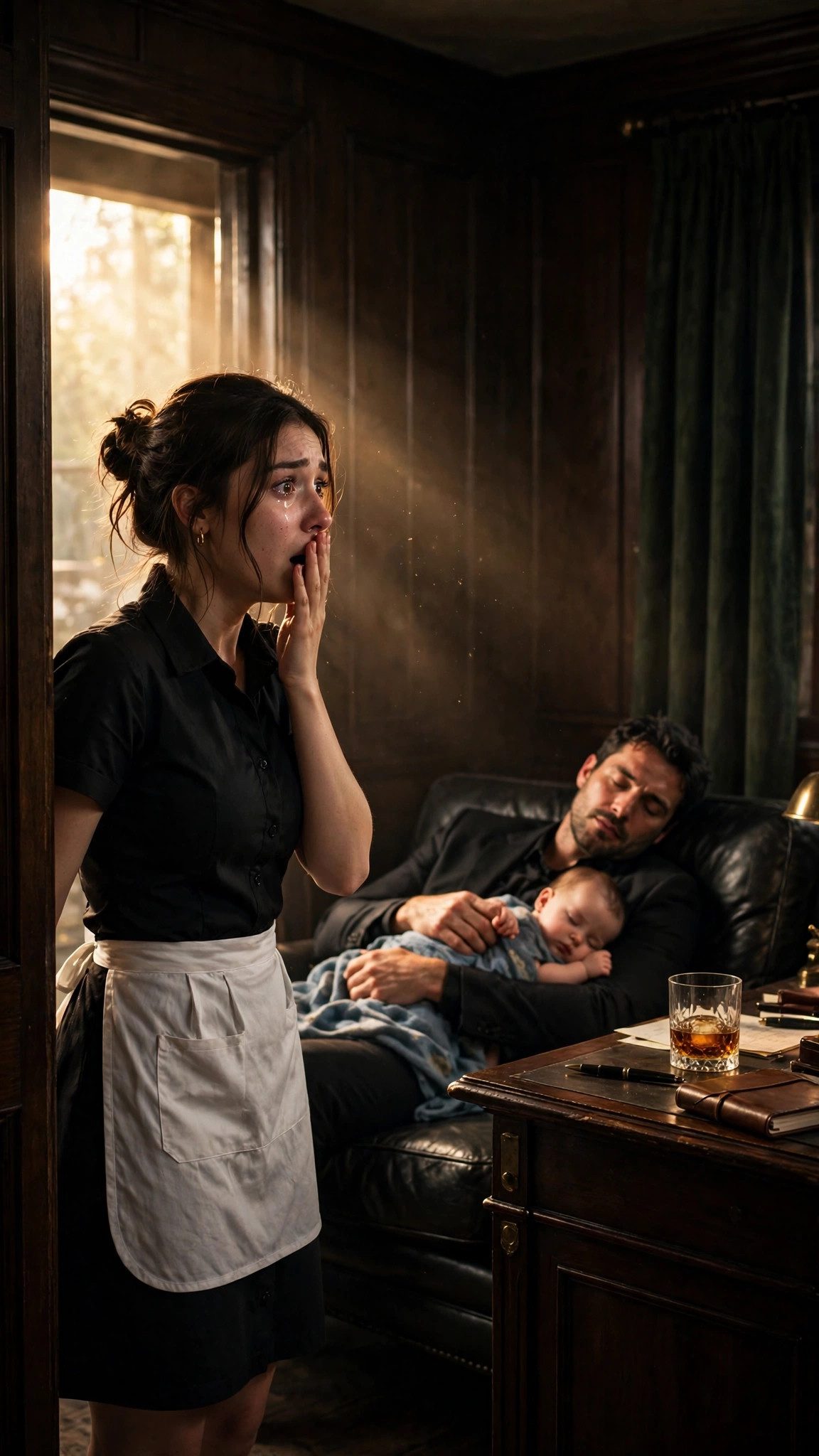
    A week after I gave him the letter, he called me into his office. It was the first time I had ever been inside it. The room was dark wood and heavy curtains, with a black leather couch and a desk the size of a small boat, and a glass of whiskey on the desk that he never seemed to drink. He was standing by the window, looking out at the street, and when I came in, he turned around, and he held out a folder.

    "This is my proposal," he said.

    I opened it. I read it line by line, three times. It said that Mr. Vale would give me an entire year of free food, shelter, transportation, and unlimited childcare if I agreed to stay in his private basement office, where he did his business. It said Ellie would have a nurse, and a room of her own, and a doctor on call. It said I would keep my job, and my salary, and my tips. It said nothing about what he wanted in return, except for one line at the bottom, in his own handwriting: *I want you both safe. That is all.*

    My supervisor was speechless. Even Grant was impressed, in his own bitter way, when he heard about it later — he could not understand why the most feared man in the city would offer a waitress a contract like that, and neither could I.

    I did not sign it that day. I took the folder home, and I read it again, and I called Andrea, and Andrea said, "Lena, this is either the kindest thing a man has ever done for you, or the strangest. Read it again. Then read it a third time." And I did, and I still did not understand it, and I lay awake all night with Ellie asleep beside me, listening to her breathe, and wondering what kind of man offers a stranger a year of safety and asks for nothing in return.

    The answer, I would learn much later, was a man who already knew the truth, and who did not know how to say it.
  • Chapter 1: Give Me My Baby Back

    Chapter 1: Give Me My Baby Back

    The night my baby disappeared, the restaurant was full of people in black ties and diamonds, and every single one of them was watching me fall apart.

    It was the busiest night of the year at Casa Vale, the most exclusive Italian restaurant in Manhattan, and I was supposed to be invisible. That was the job. A good waitress is a ghost in a black dress. She appears with the bread, she disappears with the empty plates, and nobody ever has to think about her at all. I had learned to be a ghost. I had learned to move through candlelight and crystal without making a sound.

    But ghosts do not have babies. And my baby was gone.

    "Ellie?" I whispered it first, because saying it out loud would make it real. I was standing in the service corridor with a tray of champagne balanced on my palm, and my hands had gone so cold that I could not feel the silver anymore. "Ellie?"

    The carrier was empty. I had set it down behind the hostess stand not twenty minutes earlier, tucked into the little alcove where the coats hung, where Ellie always slept in her faded blue blanket while I worked the floor. She had been asleep when I checked on her between courses. Her cheeks had been pink. Her tiny fist had been curled against her chin. And now the blanket was there, folded and warm, and my daughter was not.

    I set the tray down on a sideboard. I do not remember setting it down. I remember the glasses chiming against each other, and someone turning to look, and my own voice coming out of my throat like it belonged to a stranger.

    "Where is Ellie?"

    Grant was standing by the bar with his clipboard, watching me the way he always watched me, like I was a spill he was waiting to mop up. He was the floor manager, forty-something, thinning hair combed back with too much product, a smile that never reached his eyes. He enjoyed humiliating everyone beneath him, and I was beneath everyone.

    "Grant," I said, and my voice cracked on his name. "Where is Ellie?"

    "I don't know," he said, and he shrugged, and he looked at his clipboard, and he did not even put it down. "She's with a stranger. She's with a man named Mr. Vale."

    My breath froze in my chest. The whole room tilted. The candles blurred into long ribbons of light.

    "He took her," Grant said, and there was something in his voice I had never heard before, something almost like pleasure. "What are you talking about, Ellie?"

    I did not answer him. I was already running.

    I searched the kitchen first. The line cooks stared at me over the steam. "Have you seen my baby?" I asked them, and they shook their heads, and one of them, Marco, put down his tongs and said, "Lena, breathe," but I could not breathe. I searched the walk-in, the dry storage, the bar. I searched the supply room with its towers of napkins and its smell of lemon polish. I searched the closets where the extra chairs were stacked. I searched the ladies' lounge, the coat check, the little office where the reservations book lived.

    Ellie was nowhere.

    The dining room was a sea of black ties and bare shoulders, and the band was playing something soft, and a woman at table six was laughing with her head thrown back, and all I could think was that my daughter was eight months old and she could not call for me, and if something had happened to her, she could not tell anyone my name.

    I ran down the back stairs to the basement. The basement was where the wine lived, and the extra linens, and Mr. Vale's private office — the dark-wood room with the black leather couch where he did his business and where no one, not even Grant, ever went without being summoned. I had never been inside it. I had only ever stood at its door with a tray, waiting to be told to come in.

    The door was open a crack. Warm light spilled out into the hallway, gold against the dark wood. And inside, on the black leather couch, under the heavy curtains, lay the most feared man in the city, fast asleep.

    My daughter was pressed against his chest. Her tiny body rose and fell with his breathing. Her cheek rested on the white shirt he wore with the top button open. Her tiny fist was curled around his finger.

    She was sleeping soundly. She was safe. She was held.

    And I had never seen anything so terrifying in my life.

    "Give me my baby back!" I said, and my voice came out loud and shaking and furious, and it did not sound like a ghost at all.

    His eyes opened.

    They were green. Cold green, the color of deep water in winter, and they found my face in the doorway, and for a moment neither of us moved. The band upstairs played on. A glass clinked somewhere above us. Ellie's fist tightened around his finger, and he looked down at her, and then back at me, and something crossed his face that I could not read at all.

    "Mr. Vale," I said. "Give me my baby back."

    He did not move. He did not let go of her. He just looked at me, and in that moment, with my heart hammering against my ribs and my daughter asleep on the chest of the most dangerous man I had ever met, I understood something that would change everything.

    He had not stolen her. He had been holding her like she was the only safe thing in the world.

    But I did not know that yet. All I knew was that I had come from a small farming town with nothing, that I had already lost my mother, that my father had never come back, and that Ellie was the only thing I had ever truly owned. And I was not going to lose her to a man in a black suit, no matter how feared his name was.

    "Lena," he said quietly. His voice was low and rough with sleep. "I can explain."

    "Then explain," I said. "Explain why the most feared man in the city is asleep with my daughter pressed against his chest."

    He looked down at Ellie again. His thumb moved, just once, against her tiny curled fist. And when he looked back up at me, his face was different from anything I had ever seen on him. Not cold. Not frightening. Just tired. Just human.

    "Lena," he said. "There's something about Ellie—"

    And that is where I have to stop, because to understand what he said next, you have to understand how I got there. You have to understand the gala, and the locket, and the night I met a stranger on a terrace and never learned his name. You have to understand the babysitter, and the bottle, and the wallet, and the letter from my lawyer that I carried in my apron pocket for three months like a shield.

    My name is Lena Carter. I am twenty-six years old. I am a waitress. And this is the truth I never wanted to tell.

    I come from Millbrook, a farming town three hours north of the city, the kind of place where everybody knows whose truck is whose and the high school graduates about forty kids a year. My mother raised me alone in a house with a roof that leaked every spring. She cleaned other people's houses and took in sewing, and she saved every dollar she could in a coffee tin on top of the refrigerator. "For your future," she would say, tapping the tin. "For the day you get out of here."

    My father never returned. He left when I was four, for a job in another state, and the letters stopped after a year, and then the phone calls stopped, and then my mother stopped waiting by the window. She never said a bad word about him. She just worked harder.

    I studied long hours. I worked part-time jobs through high school and college — the diner on Route 9, the library desk, the farm stand in the summer. I got a scholarship to a small college and I studied business, because business sounded like a door. I did not know what was on the other side of the door. I only knew I wanted out of Millbrook, and I wanted my mother to be proud, and I wanted, someday, to be able to buy her a house with a roof that did not leak.

    She died the spring I graduated. A stroke, sudden, in the kitchen, with the coffee tin still on top of the refrigerator. I buried her in the churchyard in Millbrook, and I took the train to the city with two suitcases and the coffee tin and her silver locket — a small oval locket with a tiny rose engraved on the front, the only pretty thing she had ever owned. I have worn it every day since.

    The city was bigger and louder and colder than I had imagined. I rented a room above a laundromat. I worked catering jobs. I carried trays at weddings and galas and charity dinners, and I learned to be invisible, and I learned to smile while my feet ached, and I learned that in this city, nobody asks a waitress her name.

    Thirteen months ago, I worked a charity gala at the Plaza. It was a spring night, warm for April, and the terrace doors were open, and the air smelled like rain and lilies. I was carrying a tray of champagne when a man stepped out onto the terrace, and I nearly walked straight into him.

    He was tall and broad-shouldered, in a black suit, and his eyes were green — cold green, the color of deep water in winter. He had light stubble along his jaw, and his white shirt was open at the top button, and he looked at me like he was seeing something he had not expected to see.

    "I'm sorry," I said. "I didn't see you."

    "Neither did I," he said, and his voice was low and rough, and something about it made my hands stop shaking. "You, I mean. I didn't see you coming."

    I laughed, because I was nervous, and because nobody ever talked to me like that at a gala, and because he was beautiful in the way a storm is beautiful. He asked me my name. I told him. He told me his was Damian, and nothing else, and I did not ask for more, because at a gala, a waitress does not ask a guest for his last name.

    We talked on the terrace for an hour. He asked me about Millbrook, and about my mother, and about the locket — he noticed it, the little silver oval at my throat, and he touched it with one fingertip, so lightly I barely felt it, and he said, "Your mother had good taste." He told me he owned a restaurant, and that he lived alone above it, and that he had not talked to anyone like this in a long time. He did not tell me his last name. I did not tell him mine mattered.

    When the gala ended, he walked me to the service elevator. He kissed me, once, in the dark hallway behind the kitchens, and it was the kind of kiss that makes the whole world go quiet. Then he was gone. I never saw him again. I never learned his last name. I never even learned the name of his restaurant.

    Nine months later, I gave birth to a daughter in a small hospital uptown, alone, holding my mother's locket in my fist. I named her Ellie, after my grandmother, and when the nurse laid her in my arms, I saw her eyes. They were green. Cold green, the color of deep water in winter. And I knew, with a certainty that settled in my bones like cold, exactly whose daughter she was.

    I never tried to find him. I did not know his last name. I did not know where his restaurant was. And even if I had, what would I have said? I was a waitress. He was a man in a black suit at a gala. Men like that do not marry girls like me. Men like that forget.

    So I raised Ellie alone. I worked catering jobs with her strapped to my chest in a carrier, until she got too big, and then I found a babysitter, a woman named Dora Keane, who was cheap and kind and, I learned too late, drank. I saved every dollar. I told myself that someday, when Ellie was older, I would tell her about her father. I told myself that the green eyes were just a coincidence. I told myself a hundred lies, and I believed almost none of them.

    Three months ago, I saw a notice in a shop window: Casa Vale, an exclusive Italian restaurant in Manhattan, hiring waitstaff. The pay was better than anything I had ever earned. The hours were nights, which meant I could be with Ellie during the day. I applied the same afternoon.

    On my first shift, I noticed a tall, broad-shouldered man standing near the mahogany doors of the private dining area, watching the waiters carry plates across the room. He wore a black suit. His cold green eyes seemed to take in every detail. People lowered their voices when his car pulled up outside.

    It was only later that I learned he owned the building.

    His name was Mr. Vale. Damian Vale. And when he looked at me across the dining room on that first night, his face did not change at all. But his eyes stayed on mine for one second too long. And then they dropped, very slowly, to the silver locket at my throat.

    I told myself it was nothing. I told myself he was just a strict boss, famously strict, the kind of man who had fired cooks for dropping a plate and waiters for hesitating with an order. I told myself that the most feared man in the city had no reason to remember a waitress from a gala thirteen months ago.

    But every night after that, I felt his eyes on me. And every night, I checked Ellie's carrier twice as often as I needed to, and I told myself I was being foolish, and I did not sleep well at all.

    That was the beginning. The night Ellie disappeared was the end of the beginning. And what happened in that basement office, with my daughter asleep on his chest and his green eyes open and looking at me, was the moment everything I thought I knew about my life turned out to be wrong.

  • Chapter 7: Sophie’s Light

    Chapter 7: Sophie’s Light

    The trial lasted six weeks. I testified on the third day.

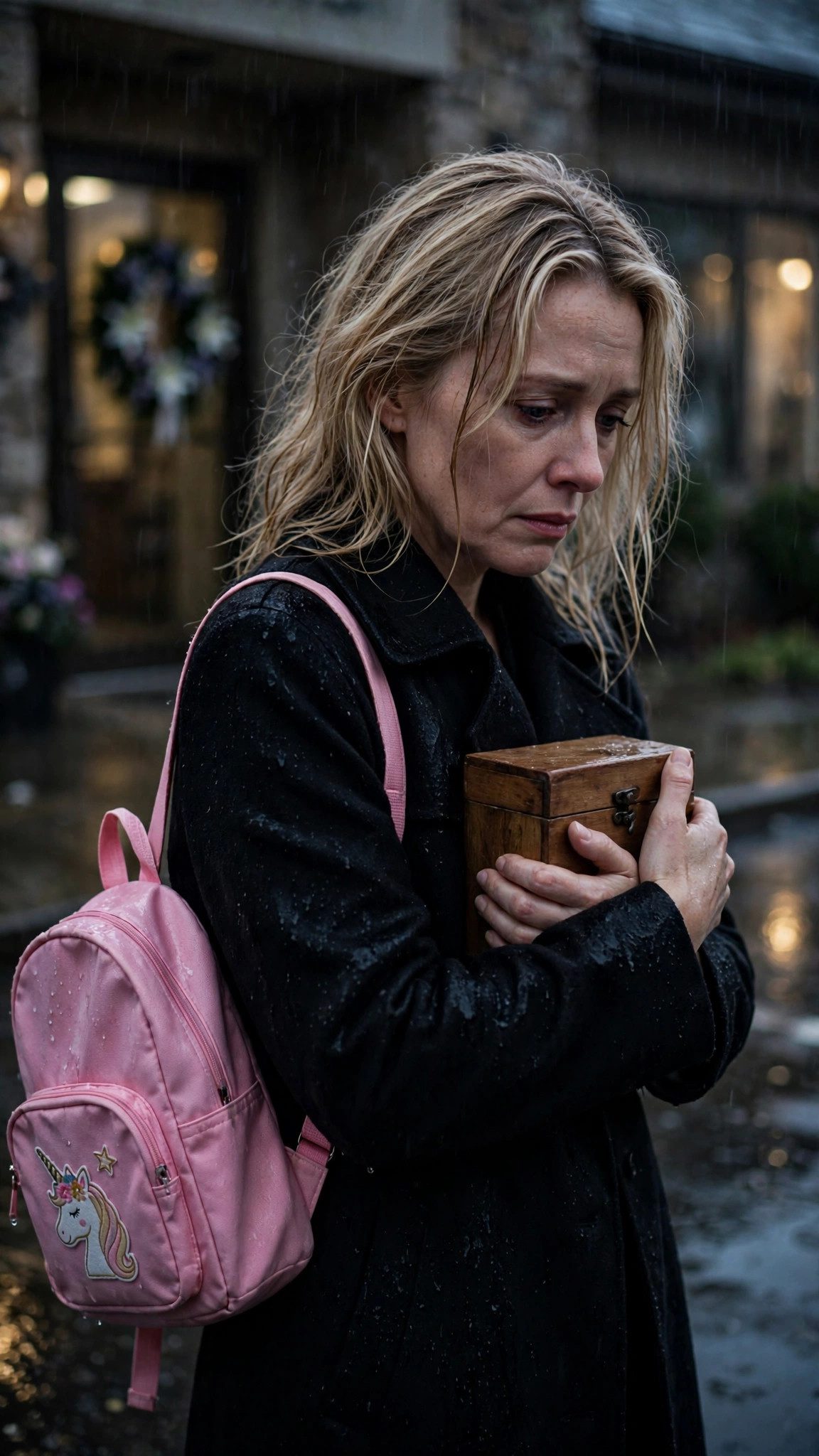
    I wore a navy dress, the one I had bought for Sophie's first day of school, because it was the only dress I owned that did not belong to the life I had lived with Adrian. I walked into the courtroom with Sophie's ashes in a small wooden box in my purse — not because I needed them there, but because I needed her with me, and she had always been with me, in every room, in every moment, since the day she was born.

    Adrian was sitting at the defense table. He looked smaller than I remembered. His suit was still expensive, but it hung on him the way clothes hang on a man who has stopped eating. When he saw me, he stood up. The judge told him to sit down. He sat down, and he looked at me, and I looked at him, and for one moment, I saw the man I had married — the man on the rooftop in December, with the snow coming down and the whole city lit up below us — and I felt something I did not expect to feel.

    Pity. Not love. Not forgiveness. Just pity, for a man who had everything and threw it away for a secret, and who was now going to spend the rest of his life paying for it.

    The prosecutor asked me to tell the jury what happened. So I told them. I told them about the hospital call at 4:12. I told them about the funeral, and the nurse, and Vivian Cole, and the airport. I told them about the brake lines, and the photographs, and Nicholas Cole, and the cliff. I told them everything, and my voice did not shake, not once, because the truth does not shake. The truth stands still, and everything else falls down around it.

    When I finished, the prosecutor asked me one last question. "Mrs. DeLuca," she said, "why did you come forward? Why did you not simply disappear and start a new life?"

    I looked at the jury. Twelve strangers, twelve ordinary people, and I said, "Because my daughter was seven years old. She had a loose tooth and a pink backpack with a unicorn patch sewn on crooked. She wanted an apple pie with a crisscross top. And she died because her father needed an alibi. If I had disappeared, then her death would have meant nothing. It would have been just another accident on a mountain road. And I could not let that happen. She deserved better than that. Every child deserves better than that."

    The jury was out for nine hours. I sat in the hallway with Detective Hale, and we did not talk much, because there was nothing left to say. At 6:47 in the evening, the bailiff came out and said the jury had reached a verdict.

    Guilty. On every count. Reckless driving causing death. Obstruction of justice. Conspiracy. Bribery.

    Adrian was sentenced to twenty-two years in prison. He would be sixty-six when he got out, if he lived that long. He looked at me as they led him away, and he said, "Claire, I am sorry. I loved her. I loved Sophie. I want you to know that."

    I did not answer him. I did not need to. I had already said everything I had to say, in that courtroom, to twelve strangers, and to the whole world.

    After the trial, I did something I had been thinking about for a long time. I took the money from the divorce settlement — the money Adrian had tried to hide, the money Hale's investigators had found in accounts in the Cayman Islands — and I started a foundation. I called it Sophie's Light.

    The foundation does two things. First, it pays for car safety inspections for families who cannot afford them — brake lines, tires, steering, all of it, free, no questions asked. Because if someone had inspected Adrian's SUV that morning, my daughter might still be alive. And second, it gives scholarships to little girls who want to be veterinarians, and ballerinas, and Presidents, in that order, because Sophie had wanted to be all three, and she saw no contradiction in any of it.

    On the first anniversary of Sophie's death, I went back to the cabin in Cedar Falls. I took Sophie's ashes, and I took the unicorn backpack, and I took the photograph of her on her pink bicycle, and I scattered her ashes in the lake at sunrise, where the water was so still it looked like glass. I said, "You are free now, baby. You are light now. Shine wherever you want to shine."

    And then I did something I had not done in a year. I made the apple pie. I peeled the apples. I made the dough. I did the crisscross top, the pretty one, exactly the way I had promised her. And when it came out of the oven, golden and steaming, I cut the biggest piece, and I put it on a plate, and I set it on the windowsill where the morning light could reach it.

    "For you, Sophie," I said. "The biggest piece. Just like I promised."

    Detective Hale came to the cabin that evening. He brought flowers — not roses, but white lilies, because he had noticed the small vase of lilies on my table and remembered. He sat with me on the porch, and we watched the sun go down over the lake, and we did not talk about the trial, or about Adrian, or about Nicholas. We talked about ordinary things. Books. The weather. The way the light looked on the water.

    Marcus Hale was a good man. He was patient. He was kind. He had believed me when no one else did. He had built a case, brick by brick, until the truth stood on its own. And somewhere along the way, without either of us planning it, we had become something more than a detective and a witness. We had become two people who had walked through the dark together and come out the other side.

    He did not propose that night. He did not need to. He took my hand, and I let him hold it, and that was enough. There would be time. There was a whole life ahead of us, and for the first time in a year, I was not afraid of it.

    I am forty-four years old now. I am no longer the naive wife I used to be. I am not the woman who peeled apples in the sunlight and believed that the world was safe. I am a woman who has buried her daughter, and faced down a killer on the edge of a cliff, and stood in a courtroom and told the truth to twelve strangers.

    But I am also a woman who makes apple pies with crisscross tops. I am a woman who runs a foundation in her daughter's name. I am a woman who sits on a porch in the evening and holds the hand of a good man and watches the light on the water.

    Sophie was seven years old, blonde, and so full of light she could make an entire room smile without even trying. She is gone. But her light is not gone. It lives in every little girl who gets a scholarship in her name. It lives in every family whose car is safe because of her foundation. It lives in me, every morning, when I wake up and choose to live, and to love, and to keep going.

    That is what my daughter gave me. Not just grief. Not just pain. Light. And I will carry that light for the rest of my life, and I will never, ever let it go out.

    The foundation's first scholarship ceremony was held on a Saturday in June, in a small community center in Pilsen, not far from the bakery where I grew up. There were forty people there. Forty ordinary people, in folding chairs, drinking lemonade out of paper cups. And there were three little girls, standing in a row at the front of the room, each holding a certificate with Sophie's name on it.

    The first girl was named Lily. She was eight years old. She wanted to be a veterinarian. She had a gap between her front teeth, and when she smiled, the whole room smiled with her. I looked at her, and I saw Sophie. Not her face — Lily did not look like Sophie — but her light. The same light. The same way of making a room smile without even trying.

    I gave Lily her certificate, and I knelt down so I was at her eye level, and I said, "Lily, this scholarship is named for my daughter, Sophie. She wanted to be a veterinarian too. And a ballerina. And the President. She wanted to be all three, because she saw no contradiction in any of it. I think you will be a wonderful veterinarian. And I think Sophie would have liked you very much."

    Lily hugged me. She hugged me hard, the way children hug, with her whole body, and I held her, and I closed my eyes, and for one moment, I could feel Sophie again. Not her weight. Not her warmth. But her light. Her light, shining through a little girl named Lily, in a community center in Pilsen, on a Saturday in June.

    Marcus was there. He stood at the back of the room, watching, and when it was over, he came up to me and said, "You did a good thing today, Claire." I said, "We did a good thing." And he smiled, and he took my hand, and we walked out into the sunlight together.

    We bought a house that autumn. A small house, with a garden, not far from the lake. I planted tomatoes and basil and roses, the way I had planted them on Astor Street, but this time the garden was mine. This time the house was mine. This time the life was mine, built by me, on my own terms, with no one else's secrets hiding in the walls.

    Marcus proposed on a cold morning in December, by the lake, where the water was so still it looked like glass. He did not have a ring. He had a small wooden box, and inside it was a photograph of Sophie on her pink bicycle, and he said, "I cannot give you back what you lost, Claire. No one can. But I can promise you this: I will never lie to you. I will never use you. I will never make you choose between me and the truth. And I will love Sophie's memory the way you love it — as light, not as grief."

    I said yes. Of course I said yes. What else do you say when a good man offers you honesty, and kindness, and a future?

    We married in the spring, in a small ceremony by the lake, with Ruth from the cabin in the front row, and Frank the mechanic, and Detective Hale's partner, and Lily and the other scholarship girls throwing flower petals. I wore a simple white dress. I did not wear a veil. I did not need one. I had nothing to hide anymore.

    That night, after the wedding, Marcus and I sat on the porch of our small house, and we watched the sun go down over the lake, and I thought about Sophie. I thought about her every day, and I always will. But the thought was different now. It was not a knife anymore. It was a light. A warm, steady light, shining in the corner of my heart, where she will live forever.

    "Mama," I whispered, to no one, to everyone, to the lake and the stars and the evening air, "look at me. I am still here. I am happy. I kept my promise. I found the truth, and I told it, and I built something good out of it. And your light — your beautiful, impossible light — it is still shining. It will always shine. I promise you that. I promise you forever."

    Marcus and I were married in the spring, but our life together began long before the wedding. It began in Hale's office, over a cold cup of coffee and a file thicker than a phone book. It began on the porch of a cabin in Cedar Falls, watching the sun go down over a lake. It began in a courtroom, where he sat behind me while I testified, close enough that I could feel him there, steady and solid, like a wall at my back.

    He was not Adrian. He was the opposite of Adrian in every way that mattered. Adrian had been exciting. Marcus was steady. Adrian had been generous with money. Marcus was generous with time. Adrian had made me feel chosen. Marcus made me feel safe. And after everything I had been through, safe was the most beautiful word in the world.

    We talked about Sophie often. Marcus never tried to make me stop talking about her. He never said, "It is time to move on," the way other people did. He said, "Tell me about her." And so I told him. I told him about the apple pie. I told him about the unicorn backpack. I told him about the loose tooth, and the pink bicycle, and the imaginary dog named Biscuit. I told him about the way she laughed, and the way she made friends with the mailman, and the way she gave her birthday money to a girl whose shoes had holes in them.

    And Marcus listened. He listened the way a good man listens — with his whole heart, without interrupting, without trying to fix anything. And when I finished, he said, "She sounds like she was the best person in the world." And I said, "She was." And he said, "Then we will make sure the world never forgets her." And that was when I knew I loved him. Not because he was handsome, or kind, or brave — although he was all of those things — but because he loved my daughter, a little girl he had never met, simply because I loved her.

    The foundation grew. In its second year, we gave out twelve scholarships. In its third year, twenty. In its fourth year, we opened a second office, in Milwaukee, and then a third, in Detroit. Every year, on Sophie's birthday, we held a ceremony, and I gave out the certificates, and I knelt down, and I told each little girl about Sophie, and about the apple pie, and about the unicorn backpack, and about the light.

    And every year, on the anniversary of her death, I went back to the lake in Cedar Falls. I sat on the porch of the cabin — Ruth had left it to me in her will, along with the chickens and the jam jars — and I watched the sun go down, and I thought about my daughter. And I thought about how far I had come, from a woman peeling apples in a kitchen in Chicago, to a woman sitting on a porch in Wisconsin, holding the hand of a good man, with a foundation in her daughter's name and a life built on the truth.

    Sophie would have liked that life. I know she would have. She would have liked the lake. She would have liked the chickens. She would have liked Marcus, who tells terrible jokes and laughs at his own punchlines. She would have liked Lily, and the other scholarship girls, and the community center in Pilsen, and the apple pies with the crisscross tops.

    She is gone. But she is not gone. She is in the light on the water. She is in the laughter of little girls. She is in the smell of apples in the autumn. She is in my heart, every morning, when I wake up and choose to live.

    And that, I have learned, is what love is. It is not a feeling. It is a choice. A choice you make every day, even when it hurts, even when it is hard, even when the person you love is gone. You choose to carry them. You choose to honor them. You choose to shine, because they shone, and because the world needs their light.

    I choose Sophie. Every day. Forever.

    The End.

    THE END

  • Chapter 6: What the Brakes Knew

    Chapter 6: What the Brakes Knew

    Detective Hale arrived before dawn, with two uniformed officers and a crime scene team. They went down to the rocks below the cliff, and they brought Nicholas Cole's body up in a bag, and Hale stood beside me on the porch of the cabin and said, "Tell me everything again. Slowly. From the beginning."

    So I told him. I told him about the hospital call at 4:12. I told him about the funeral, and the nurse, and Vivian Cole, and the airport. I told him about the photographs Frank had sent, and the brake lines cut clean by hand. I told him about Nicholas coming to the cabin, and his confession, and the chase, and the cliff. I told him everything, and I did not leave anything out, because I had learned that secrets were what had killed my daughter, and I was done with secrets.

    Hale listened without interrupting. When I finished, he was quiet for a long time. Then he said, "Mrs. DeLuca, I believe you. And I am going to prove all of it. But I need you to come back to Chicago with me. I need you to be safe. And I need you to testify."

    I looked at Sophie's ashes on the windowsill. "I will come," I said. "But I am not hiding anymore. If Adrian wants to find me, let him find me. I am not afraid of him. I am not afraid of anyone anymore."

    The drive back to Chicago took four hours. I sat in the back of an unmarked police car with Sophie's ashes in my lap, and I watched the cornfields give way to suburbs, and the suburbs give way to the city, and I thought about how strange it was to be coming home to a place that was no longer home.

    Hale had already been working. While I was hiding in Cedar Falls, he had been building a case — quietly, carefully, the way a man builds a house, one brick at a time. He showed me the file in his office at the precinct, and it was thicker than a phone book.

    The brake lines. Frank's photographs were the beginning, but Hale had gone further. He had gotten a warrant for Nicholas Cole's garage, and in a locked drawer he had found a set of cutting tools, and on one of them, a pair of heavy shears, there were traces of brake fluid and metal shavings that matched the SUV. He had found Nicholas's calendar, and on the day of the crash there was a single entry, written in Nicholas's handwriting: "A. — airport run, 2 PM." He had found phone records showing that Nicholas had called Vivian forty-seven times in the week before the crash, and that she had not answered a single one.

    "Vivian knew," Hale said. "She knew Nicholas knew about the affair. She was terrified of him. That is why she wanted to leave for Miami with Adrian. She was not running toward a new life. She was running away from her husband."

    And then there was Adrian. Hale's file on Adrian was even thicker. The police report on the crash, written by Sergeant Doyle, who had been on Adrian's payroll for six years. The bank records showing payments from Adrian's companies to Doyle, to the tow truck driver, to the impound lot manager. The phone records showing that Adrian had called Doyle seventeen minutes after the crash — before the ambulance had even arrived. The airport records showing that Vivian Cole had a ticket to Miami on a flight that left at 5:40 that afternoon, a flight she never took.

    "He knew," I said. "Adrian knew the brakes had been cut. He knew Nicholas had done it. And he covered it up."

    "Yes," Hale said. "He covered it up because if the truth came out, everyone would know he had taken his seven-year-old daughter on a drive to the airport to cover up his affair. And he covered up Vivian's murder because if the police investigated her death, they would investigate the crash, and if they investigated the crash, they would find the brakes. Adrian DeLuca was not protecting Nicholas. He was protecting himself."

    I sat in Hale's office and I felt something I had not felt in weeks. It was not happiness. It was not peace. It was clarity. For the first time since the hospital called at 4:12, I could see the whole picture, and the picture made sense. My daughter had died because her father needed an alibi. Vivian had died because her husband wanted revenge. And Adrian had buried the truth about both of them because the truth would have destroyed him.

    "Arrest him," I said.

    "We will," Hale said. "But I need your testimony. I need you to tell a grand jury everything you told me. I need you to tell them about the funeral, and the nurse, and the airport. I need you to be brave one more time."

    I thought about Sophie. I thought about the apples. I thought about the promise. And I said, "I will testify. I will tell them everything."

    The arrest happened three days later, at dawn, at the house on Astor Street. I was not there — Hale did not want me there — but he told me about it afterward. Adrian was in the kitchen, making coffee, wearing a robe, and when the officers came through the door, he did not run. He did not fight. He looked at them and said, "I know why you are here." And then he asked one question. "Where is Claire? Is she safe?"

    Hale told him I was safe. Hale told him I was the one who had brought him down. And Adrian — this man who had ruled Chicago for twenty years, this man who had never once admitted to being wrong — put his head in his hands and wept.

    I do not know if those tears were real. I hope, for Sophie's sake, that they were. Because if they were real, then somewhere inside that man, there was still a father who loved his daughter. And if they were not real, then he was exactly what I had come to believe he was: a man who had used his own child as a shield, and who would use anything, anyone, to save himself.

    The charges were read out on the television that night. Reckless driving causing death. Obstruction of justice. Conspiracy to conceal a crime. Bribery of a police officer. The news anchors said his name over and over again, and for the first time in nine years, I heard Adrian DeLuca's name spoken aloud without fear. It was just a name. A name attached to a man who was going to prison.

    Sergeant Doyle was arrested the same day. The tow truck driver. The impound lot manager. All of them, one by one, like dominoes falling. Hale called it "cleaning house." I called it justice. It was not enough — nothing would ever be enough, because nothing would ever bring Sophie back — but it was something. It was a beginning.

    And then Hale took me to the hospital morgue. I had asked to see Vivian Cole. I needed to see her, not because I loved her, but because I needed to understand her. She had been my husband's mistress. She had been in the car when my daughter died. She had been strangled in her own home. And in the end, she had been a victim too — a woman who had made terrible choices, and who had paid for them with her life.

    I walked into the morgue as fast as I could, knowing that she was lying in a drawer. I stood in front of it, and I said, "Vivian. I cannot believe you died. I need you to know something. I do not forgive you. But I understand you. You were afraid. You were running. And I am sorry that no one saved you. I am sorry that I could not save you, and I am sorry that I could not save my daughter. I am sorry for all of it."

    And then I turned around, and I walked out, and I did not look back, because looking back was what had kept me trapped for nine years, and I was done looking back.

    The truth was out. The brakes had told it. The photographs had told it. Nicholas had told it, with his dying breath on the edge of a cliff. And now it was time for the last chapter — the chapter where I stopped being the wife of Adrian DeLuca, and started being Claire again.

    The grand jury met on a Tuesday. I remember that it was a Tuesday because Tuesdays had always been the slowest days at the hotel, and now they were the days when my life changed.

    The prosecutor's name was Angela Torres. She was forty, sharp, with dark hair pulled back and eyes that missed nothing. She met me in her office the day before I testified, and she said, "Mrs. DeLuca, I need you to understand something. This case is not just about Adrian. It is about a system. It is about men who believe they can buy the truth, and bury it, and walk away. Your testimony is the thing that breaks that system. Are you ready?"

    I said I was ready. I was not ready. No one is ever ready to stand in front of strangers and tell them the worst thing that ever happened to her. But I did it anyway, because Sophie deserved it, and because the truth deserved it, and because I had come too far to stop now.

    Angela showed me the evidence, piece by piece, so I would understand what the jury would see. The bank records, showing payments from Adrian's companies to Sergeant Doyle — twelve payments, over six years, totaling more than four hundred thousand dollars. The phone records, showing Adrian's call to Doyle seventeen minutes after the crash. The tow truck driver's statement, given to Hale in exchange for immunity, saying that Adrian had told him, "Take the car to the south lot. Do not let anyone look at the brakes." The impound lot manager's statement, saying the same thing.

    And then there was Vivian's phone. Hale's team had found it — not in her apartment, where Nicholas had said he took it, but in a locker at Nicholas's garage, wrapped in a plastic bag, hidden behind a stack of tires. The phone had photographs on it. Photographs of Vivian and Adrian together. Photographs of the apartment on Wacker Drive. And a voice memo, recorded the night before the crash, in which Vivian said, "If anything happens to me, it was Nicholas. He knows. He has been following me. I am afraid of him. I am leaving with Adrian tomorrow, and I am never coming back."

    I listened to that voice memo in Angela's office, and I cried for the first time in weeks. Not for Adrian. Not for myself. For Vivian. For a woman who had been afraid, who had been running, who had known she was in danger, and who had died anyway. She had made terrible choices. But she had not deserved to die. No one deserves to be strangled in her own home by a man she once loved.

    "She was a victim too," I said to Angela.

    "Yes," Angela said. "She was. And the jury needs to hear that from you. They need to hear that you understand it. Because it makes your testimony stronger, not weaker. It shows them you are not here for revenge. You are here for the truth."

    The media found out about the case the week before the trial. There were cameras outside the courthouse. There were reporters who wanted to talk to me. I did not talk to them. I had nothing to say to the cameras. I had everything to say to the jury, and that was enough.

    On the morning I testified, I woke up at 4:12, the way I always did. I made coffee. I put on the navy dress. I put Sophie's ashes in my purse. And I drove to the courthouse with Detective Hale, and I walked through the doors, and I told the truth. And the truth, as it always does, stood still, and everything else fell down around it.

    Hale's investigation did not stop with Adrian and Doyle. Once the first domino fell, the rest followed, faster and faster, the way dominoes always fall.

    The tow truck driver, a man named Eddie Marsh, came forward on his own. He walked into the precinct one morning, sat down across from Hale, and said, "I want to make a deal." He told Hale everything — about the phone call from Adrian, about the money, about the instructions to take the car to the south lot and not let anyone look at the brakes. He told Hale that he had known it was wrong, and that he had done it anyway, because Adrian DeLuca had paid him ten thousand dollars, and ten thousand dollars was more money than he had ever seen at one time. He cried when he told Hale. He said, "I have a daughter too. She is nine. And every night since that crash, I have dreamed about her in the back seat of that car."

    The impound lot manager, a man named Carl Whitfield, was next. He did not come forward. Hale went to him, with a warrant and a team, and found the records — the real records, hidden in a safe behind a false wall in his office — showing that the SUV had been moved three times in the first forty-eight hours, each time to a different bay, each time further from the entrance, each time harder to find. "Adrian's people told me to lose it," Whitfield said. "They told me to make it disappear. I did what they told me. I am sorry. I am so sorry."

    And then there was the airport. Hale's team pulled the records from O'Hare, and there it was, in black and white: Vivian Cole, ticket to Miami, flight 1847, departure 5:40 PM, the day of the crash. Seat 14A. A window seat. She had chosen a window seat, because she liked to look at the clouds. She had packed a bag. She had told her neighbor she was going on vacation. She had been ready to disappear with Adrian, to start a new life in Miami, to leave Nicholas and Chicago and all of it behind.

    She never got on that plane. She died on a mountain road instead — not in the crash, but because of it. Because the crash broke her arm and her spirit, and because Nicholas found her afterward, and because she was afraid, and because she was going to tell the truth. And the truth, in Adrian DeLuca's world, was the most dangerous thing of all.

    I read all of this in Hale's file, sitting in his office, with a cup of coffee going cold in my hands. And I thought about how many people had known. How many people had taken money. How many people had looked the other way. And I thought about how alone Sophie had been, in the back seat of that car, with no one to protect her. And I made a promise to myself, right there in that office: I would never look the other way. Not again. Not ever. No matter what it cost me.

  • Chapter 5: The Edge of the Cliff

    Chapter 5: The Edge of the Cliff

    Frank's photographs arrived three days later, in a plain envelope with no return address. I spread them out on the cabin table, and I stared at them for a long time before I understood what I was looking at.

    The photographs showed the underside of Adrian's SUV, the brake lines, the steering column, the tires. Frank had circled things in red marker. In one photograph, a brake line was cut — not torn, not worn, but cut, cleanly, with a tool. In another, a second line showed the same clean cut. Frank had written in the margin, in his careful block letters: "CLAIRE — THIS WAS DONE BY HAND. THIS WAS NO ACCIDENT. SOMEONE WANTED THIS CAR NOT TO STOP."

    I sat down. My hands were shaking. Someone had cut the brake lines on my husband's SUV. Someone had wanted that car to crash. And my daughter had been in the back seat.

    I called Frank. He answered on the first ring. "You saw them," he said. It was not a question.

    "Who would do this?" I asked. "Who would cut brake lines?"

    "A mechanic," Frank said. "Or someone who knows cars. Someone who had access to the SUV. Someone who knew when Adrian would be driving it, and where, and with whom."

    "Vivian's husband," I said, and I did not know how I knew it, but I knew it. "Nicholas Cole. Vivian's husband."

    Frank was quiet for a moment. "Claire," he said slowly, "Nicholas Cole owns a garage on the west side. He does all the maintenance on DeLuca's fleet. He had access to every car Adrian owns. And I have heard things about him. He found out about the affair six months ago. He beat a man half to death in a bar for looking at Vivian the wrong way. He is not a man who forgives."

    I thanked Frank. I hung up. And then I called Detective Hale, and I told him what Frank had found, and there was a long silence on the other end of the line, and then he said, "Mrs. DeLuca, I need you to listen to me very carefully. Do not go anywhere. Do not talk to anyone. Nicholas Cole is dangerous. If he knows you know, he will come for you. Stay in that cabin. Lock the door. I am sending a car to you tonight."

    But it was already too late.

    I do not know how Nicholas found me. Perhaps Adrian's men found me first and sold the information. Perhaps Nicholas had been following Detective Hale. Perhaps he had simply been watching every road out of Chicago, the way a hunter watches a field. I only know that at sunset that evening, I heard a car on the dirt road, and I looked out the window, and I saw a man getting out of a black sedan, and I knew, before he even turned around, that he was the man who had killed my daughter.

    He was tall, broad-shouldered, with dark hair going gray at the temples and hands that looked like they had spent a lifetime working on engines. He walked up to the cabin door and knocked, politely, the way a neighbor might knock, and he said, "Mrs. DeLuca? My name is Nicholas Cole. I think it is time we cleared the air, put all my cards on the table, and let you know the truth."

    I did not open the door. I stood behind it with my back against the wood, my heart hammering, and I said, "Go away. I have nothing to say to you."

    "I am not someone who can be controlled by threats," he said through the door, "and I am not going to pretend that I have not cut off all contact. I have never been able to do it. I do not want to go back to being forced to choose. So let me tell you the truth, Claire. Let me tell you the truth about what happened to your daughter."

    I should not have opened the door. I know that now. But I needed the truth, and he was offering it, and I had spent weeks chasing it, and so I opened the door.

    He came inside. He sat down at the table. He looked at Sophie's ashes on the windowsill, and for one moment his face changed, and I saw something there that looked almost like grief. Then it was gone.

    "I cut the brakes," he said. "I will not lie to you. I cut the brakes on Adrian's SUV because I wanted Vivian dead. She was my wife. She betrayed me with your husband. She was going to leave me, take my money, disappear to Miami with him. So I cut the brakes. I thought she would die on that mountain road, and Adrian would die with her, and no one would ever know. I did not know Sophie was in the car. I swear to you, on everything I have, I did not know your daughter was in that car."

    I stared at him. I could not speak. I could not breathe.

    "And Vivian?" I whispered. "She survived the crash. Who strangled her?"

    He looked down at his hands. "I did," he said. "She came home from the hospital with a broken arm and a story about how Adrian had saved her. She was going to tell the police about the brakes. She had figured it out. She said, 'Nicholas, I know what you did. I am going to the police.' So I went to her apartment that night, and I strangled her, and I took her phone, and I tore up a photograph, and I walked out. And I have lived with it every day since."

    I stood up. My legs were shaking. "You killed my daughter," I said. "You killed Vivian. And now you have come here to kill me."

    "No," he said. "I have come here to ask you to understand. I never meant for Sophie to die. She was just a little girl. I think about her every day. I see her face—"

    "Do not say her name," I said. "Do not ever say her name."

    He stood up too. He was bigger than me, stronger than me, and suddenly his face changed again, and the grief was gone, and what was left was fear — the fear of a man who has confessed to two murders and realizes he cannot leave a witness alive.

    "You will pay for this," he said, and his voice was low and shaking. "I cannot let you leave here. I cannot let you tell anyone. I am sorry, Claire. I am truly sorry. But I cannot go to prison. I cannot."

    He lunged at me. I do not remember deciding to run. I only remember my body moving, out the back door, into the trees, toward the cliff at the edge of the lake, because the cabin was at the top of a bluff and the cliff was the only direction that was not the road. He chased me. His footsteps crashed through the underbrush behind me. I could hear him breathing. I could hear him saying my name.

    At the edge of the cliff, I turned. There was nowhere else to go. The lake was a hundred feet below, black and still. Nicholas came toward me with his hands out, and I saw in his eyes that he had already decided. He was going to push me off that cliff, and he was going to drive away, and no one would ever know.

    I looked at him, and I thought about Sophie, and I thought about the apples, and I thought about the promise I had made — save me the biggest piece of pie — and something inside me, something that had been still and cold since the funeral, woke up and roared.

    "No," I said. "Not me. Not this time."

    He reached for me. I pushed him. I pushed him with everything I had — with nine years of love and seven years of motherhood and all the grief in the world — and he stumbled backward, and his foot slipped on the wet grass at the edge, and he grabbed at the air, and he fell.

    I stood at the edge of the cliff and watched him fall. I heard him hit the rocks below. And then there was silence, and the lake, and the stars, and my own breathing, loud in my ears.

    I went back to the cabin. I called Detective Hale. I told him everything. I told him about the brakes. I told him about Vivian. I told him about the cliff. And when he asked me, in a quiet voice, "Mrs. DeLuca, what happened to Nicholas Cole?" I said the words I had to say, the words that were true, even though they were the hardest words I had ever spoken.

    "He is dead," I said. "Yes. I was the one who pushed him to the edge of the cliff."

    There was a long silence. Then Detective Hale said, "Stay where you are, Mrs. DeLuca. I am coming. And Claire — you did what you had to do. A man who had already killed two people was trying to kill you. That is self-defense. Do you understand me? That is self-defense."

    I understood. But understanding did not make it easier. I had pushed a man off a cliff, and he had died, and I had done it to save my own life, and I would carry that for the rest of mine, the way I carried everything else — the apples, the pie, the promise, the light.

    That night, I sat by the window with Sophie's ashes, and I whispered, "I did it, baby. I found the man who killed you. And he will never hurt anyone again. Mama promises."

    Nicholas Cole had not always been a killer. I learned that later, from Detective Hale, from the file he built, from the people who had known Nicholas before the affair broke him. He had been a good mechanic. He had been a good husband, once. He had married Vivian when she was twenty-two and he was twenty-four, and for ten years they had been happy, or as happy as people can be when money is tight and the work is hard and the winters are long.

    Vivian had wanted more. She had always wanted more — more money, more excitement, more of the world than a garage on the west side could give her. She got a job at Adrian's restaurant because the tips were good. She met Adrian because he ate there every week. And somewhere along the way, she decided that Adrian DeLuca was her way out — out of the garage, out of the small life, into the golden one.

    Nicholas found out the way husbands always find out. A text message left open on a phone. A receipt from a hotel. A smell on a collar that was not his. He confronted her, and she did not deny it. She said, "I am leaving you, Nicholas. I am going to Miami with Adrian. I am going to have a real life." And something inside him broke.

    He did not break all at once. He broke slowly, over months, the way a beam breaks under too much weight — first a crack, then another, then a groan, then a collapse. He started drinking. He started following her. He started keeping a notebook of Adrian's movements, of the cars, of the times, of the places. And one night, in his garage, with a wrench in his hand and hatred in his heart, he looked at Adrian's SUV and he made a decision.

    He would cut the brakes. He would wait for the airport run he knew was coming. And Adrian and Vivian would die together on a mountain road, and no one would ever know it was not an accident.

    He did not know Sophie would be in the car. He could not have known, because Adrian had never taken Sophie on those trips before. That day was the first time. That day was the only time. And that is the terrible, senseless truth at the center of all of this: my daughter died because of a coincidence. Because her father chose that day, of all days, to use her as cover. Because Nicholas chose that day, of all days, to cut the brakes. Two men, two decisions, and a little girl in the back seat who never had a chance.

    I think about that sometimes, in the quiet hours. I think about how fragile life is. How a single choice — a drive up a mountain, a cut in a brake line — can destroy everything. And I think about how I cannot change any of it. I cannot bring Sophie back. I cannot undo the crash. I cannot uncut the brakes. All I can do is what I did: tell the truth, and let the truth do its work.

    Nicholas Cole died on the rocks below a cliff in Wisconsin. He died because he tried to kill me, and I pushed him away, and he fell. I do not celebrate his death. I do not mourn it either. He was a man who made terrible choices, and those choices killed my daughter, and killed his wife, and finally killed him. That is the story of Nicholas Cole. It is not a happy story. But it is a finished one. And finished is enough.

    After Nicholas fell, I sat on the edge of the cliff for a long time. I did not go back to the cabin right away. I sat there with my legs hanging over the edge, looking down at the lake, and I thought about what I had just done.

    I had pushed a man off a cliff. I had watched him fall. I had heard him hit the rocks. And I did not feel guilty. That frightened me more than anything else — not the pushing, not the falling, but the fact that I did not feel guilty. I felt relief. I felt a terrible, cold relief, like a door closing on a room I never wanted to enter again.

    Was that wrong? Was I supposed to feel guilty? I had killed a man. He had killed my daughter, and he had killed his wife, and he had tried to kill me. And I had pushed him, and he had died. The law would call it self-defense. Detective Hale would call it self-defense. But what would Sophie call it? What would my little girl think of her mother, sitting on the edge of a cliff, having just killed a man?

    I thought about that for a long time. And then I thought about Sophie's face, the way she looked at people as if she could see straight through to whatever was good in them. And I realized that Sophie would not have judged me. Sophie would have understood. Because Sophie knew what I knew: that sometimes, the only way to stop a bad man is to stop him. That sometimes, being good means being brave. That sometimes, a mother has to do terrible things to protect the people she loves — even if the person she is protecting is only herself, and the memory of a little girl who is gone.

    I stood up. I brushed the dirt off my jeans. I walked back to the cabin, and I called Detective Hale, and I told him everything. And when he said, "Stay where you are, Mrs. DeLuca. I am coming," I felt something I had not felt in weeks. I felt safe. Not because the danger was over — it was not over, not yet — but because I had faced the danger, and I had survived it, and I had done what I had to do. And no one, not Adrian, not Nicholas, not anyone in the world, could ever take that away from me again.

  • Chapter 4: The Woman in the Morgue

    Chapter 4: The Woman in the Morgue

    The cabin was at the end of a dirt road in a town called Cedar Falls, Wisconsin, and it had a leaking roof and a wood stove and a view of a lake so still it looked like glass. I paid for a month in cash. The old woman who owned it asked no questions. She looked at my face — at the grief written all over it — and she said, "You will be safe here, dear. Nobody comes to Cedar Falls unless they mean to."

    I put Sophie's ashes on the windowsill, where the morning light could reach them. I put the unicorn backpack on a chair. I put the photograph of Sophie on her pink bicycle on the small table beside the bed. And then I sat down, and I did not know what to do next, because grief is not a task you can finish. It is a room you live in. You learn where the furniture is. You learn to move around in the dark.

    For two weeks, I did almost nothing. I walked by the lake. I cooked soup I did not eat. I slept in fits, waking at 4:12 every morning — the exact time the hospital had called — with my heart pounding and Sophie's name on my lips. I wrote in a notebook, pages and pages of questions. Who was Vivian Cole, really? How long had the affair been going on? Who else knew? And the question underneath all the others, the one I was afraid to ask: was the crash really an accident?

    Because something about it did not sit right. Adrian was a careful driver. I had ridden with him a hundred times, and he was always in control, always measured, always aware. A man like that does not simply lose control on a curve he has driven a hundred times. Unless he was distracted. Unless he was rushing. Unless something was wrong with the car.

    I did not have answers. But I had a phone, and I had time, and I had nothing left to lose. So I began to make calls. I called the nurse from St. Anthony's. I called a mechanic I had known since childhood, a man named Frank who had fixed my father's bus for thirty years. I called the funeral home. I called anyone who might know anything, and I wrote down everything they said.

    Frank was the one who changed everything. He said, "Claire, if you want to know whether that crash was an accident, you need to see the car. Cars tell the truth. People lie. Cars do not." He said the SUV had been towed to an impound lot on the south side of Chicago, and that it would be auctioned off in a month, and that if I wanted to look at it, I had to do it soon.

    I was not ready to go back to Chicago. Adrian's men were still looking for me. But Frank said he had a friend who worked at the impound lot, a man who owed him a favor, and that the friend could take photographs. "Brake lines, steering, tires," Frank said. "That is where the truth lives."

    I said yes. I sent Frank the money for the photographs by mail, in cash, wrapped in a birthday card so no one would ask questions. And then I waited.

    It was during that waiting that the phone rang at 1:28 in the morning.

    I froze for a few seconds, then stood. The cabin was dark. The lake was black outside the window. The phone — a cheap prepaid phone I had bought with cash — showed a number I did not recognize. I almost did not answer it. But something made me pick it up, and a voice I had never heard said, "Mrs. DeLuca? This is Detective Marcus Hale, Chicago Police. I am sorry to call at this hour. I need to ask you about Vivian Cole."

    My heart sank. "What about her?"

    "She is dead, Mrs. DeLuca. She was found strangled in her own home tonight."

    I sat down. I do not remember sitting down, but I must have, because the next thing I knew I was on the floor with my back against the wall, and the detective was still talking, and the words were coming to me from very far away.

    "Vivian Cole is dead," I said, my voice hollow. "Is it the hospital administrator?"

    "No," he said.

    "Is it the police?"

    "No."

    "Why did you want me to lie, Vivian?" I whispered, and I did not know I had said it aloud until the detective asked me to repeat myself, and I could not, because I did not know what I meant. I was scared. I was confused. The room was spinning.

    Detective Hale was patient. He told me that Vivian Cole had been found by a neighbor, strangled, in her apartment on Wacker Drive — the apartment Adrian had paid for. There were no signs of forced entry. Her phone was missing. Her lipstick was smudged. There was a single photograph on the floor beside her, a photograph of her and Adrian at a restaurant, and someone had torn it in half.

    "Do you know where your husband is tonight, Mrs. DeLuca?" he asked.

    "I have not seen my husband in two weeks," I said. "I left him. I am not in Chicago."

    "Where are you?"

    "I cannot tell you that."

    There was a long pause. Then Detective Hale said something I did not expect. He said, "Mrs. DeLuca, I believe you. And I think you should know something. I have read the police report on your daughter's accident. I have read it three times. And I do not believe it was an accident."

    I closed my eyes. "What do you mean?"

    "I mean the report is too clean," he said. "No skid marks. No mention of the brake condition. No toxicology on the driver. It reads like a report that was written before the crash happened. Like someone already knew what it was supposed to say."

    I felt something cold run down my spine. "Who wrote it?"

    "A sergeant named Doyle," he said. "Doyle has been on Adrian DeLuca's payroll for six years. I have been building a file on him for two."

    "Why are you telling me this?"

    "Because I think your daughter's death and Vivian Cole's death are connected," he said. "And because I think you are the only person in this city who wants the truth more than she wants to be safe. Am I wrong?"

    I thought about Sophie. I thought about the apples in the kitchen. I thought about the promise I had made — save me the biggest piece of pie — and I said, "You are not wrong, Detective. Tell me what you need."

    He told me he needed me to stay hidden. He told me he needed me to let him work. He told me that Adrian DeLuca was tearing Chicago apart looking for me, and that the safest thing I could do was stay exactly where I was and let the police do their job. But he also told me something else, something that made my hands stop shaking.

    "Mrs. DeLuca," he said, "Vivian Cole was not the only person in that car who was supposed to die. I think someone wanted her dead. And I think your daughter died because she was in the wrong seat at the wrong time. I am going to prove it. But I need time."

    After he hung up, I sat in the dark for a long time. I looked at Sophie's ashes on the windowsill, silver in the moonlight, and I whispered, "Did you hear that, baby? Someone wanted Vivian dead. Not you. Never you. You were just there. You were just a little girl in the back seat, and someone wanted your father's mistress dead, and you paid for it."

    I did not sleep that night. I sat by the window and watched the lake, and I thought about the woman in the morgue — Vivian Cole, thirty-one years old, strangled in her own home, her lipstick smudged, a torn photograph on the floor — and I thought about the man who had done it, and I knew, with a certainty that frightened me, that I was going to find him.

    Because Vivian Cole was dead. And Sophie was dead. And someone had arranged for at least one of those deaths. And I was the only person left who was willing to find out who.

    My days in the cabin fell into a rhythm. I woke at dawn and made coffee on the wood stove. I walked by the lake, where the mist rose off the water like breath. I ate what I could — bread, soup, eggs from the old woman who owned the cabin and kept chickens behind the shed. In the afternoons I sat by the window with my notebook and wrote down everything I knew, and everything I did not know, and all the questions in between.

    The old woman's name was Ruth. She was seventy-nine, with white hair in a braid and hands like tree roots, and she came by every few days with eggs or bread or a jar of jam. She never asked me why I was there. She never asked me about the small wooden box on the windowsill. But one afternoon she sat down at my table, looked at the notebook full of questions, and said, "You are looking for something, dear."

    "Yes," I said.

    "Is it a person?"

    "It is the truth."

    She nodded, as if that were the most ordinary thing in the world. "The truth is a hard thing to find," she said. "It hides. It runs. But it leaves tracks, if you know how to look." She tapped the notebook with one gnarled finger. "Keep writing, dear. Write it all down. The truth likes to be written down. It makes it harder for people to pretend it is not there."

    I took her advice. I wrote down the nurse's name. I wrote down Frank's phone number. I wrote down everything Detective Hale told me. I wrote down the name Vivian Cole, and the name Nicholas Cole, and the name Adrian DeLuca, and I drew lines between them, the way a detective draws lines on a board, until the picture began to make sense.

    I also wrote letters I never sent. I wrote a letter to my mother, telling her I was safe, telling her I loved her, telling her I would come home when it was over. I wrote a letter to Sophie, telling her about the lake, and about Ruth, and about the mist on the water in the morning, and about how I missed her so much it felt like my chest had been cut open. I wrote a letter to Adrian, telling him everything I thought of him, and then I burned it in the wood stove, because some letters are only meant to be written, not sent.

    At night, I dreamed about Sophie. In the dreams, she was always laughing. She was on her pink bicycle, riding up and down Astor Street, and the sun was shining, and her hair was flying behind her like a flag. I would wake up with tears on my face and her name on my lips, and I would go to the window and look at the lake, and I would whisper, "I am still here, baby. Mama is still here. And I am going to finish this. I promise."

    The lake was my church. The cabin was my chapel. And the truth was my prayer. Every morning, I said it to myself like a vow: I will find out what happened to my daughter. I will find out who did this. And I will make them answer for it. No matter how long it takes. No matter what it costs me. I will finish this.

    The phone call from Detective Hale was not the only call I received in those weeks. Frank called me twice more. The first time, he told me he had spoken to the trucker, Joe, the man who had pulled Vivian from the car. Joe had remembered something new. He had remembered that when he arrived at the crash, Adrian was not only holding Sophie — he was also shouting into his phone. "He was shouting at someone," Joe said. "He kept saying, 'Do not come here. Do not come here. Stay away.' I thought he was talking to the ambulance. But now I think he was talking to someone else. I think he was talking to the police. I think he was telling them not to come, or to come slowly, or to come the way he wanted them to come."

    The second time Frank called, he told me about the garage. "Claire," he said, "I went to Nicholas Cole's garage. I pretended I needed an oil change. And while I was waiting, I looked around. And I saw something. On the wall, behind the counter, there was a photograph. It was a photograph of Vivian, from their wedding day. And someone had drawn a line across her face with a black marker. A single line, right across her eyes. That is not the photograph of a man who loves his wife. That is the photograph of a man who has already decided to kill her."

    I wrote all of this down in my notebook. I drew more lines between the names. Nicholas to Vivian. Vivian to Adrian. Adrian to Doyle. Doyle to the crash. The crash to Sophie. And Sophie to me. And me to the truth. The picture was getting clearer, and the clearer it got, the colder I felt, because I could see now that my daughter had not died in an accident. She had died in a web. A web spun by three men, each pulling a different thread, and my little girl had walked straight into the center of it.

    I also began to think about Adrian differently. I had always thought of him as the villain of this story — the husband who cheated, the father who used his daughter as cover. And he was. But he was not the only villain. Nicholas was a villain too. And Doyle. And the tow truck driver. And the impound lot manager. And every man who had taken Adrian's money and looked the other way. There were so many villains. And there was only one victim who mattered to me: a seven-year-old girl in the back seat of an SUV, in her seatbelt, singing a made-up song about dogs and unicorns, who never had a chance.

    I went to bed that night with my notebook open on the table, and I dreamed about the web. In the dream, the web was made of brake lines, black and shining, and Sophie was caught in the middle of it, and I was trying to cut her free with a pair of scissors, but the scissors were too small, and the web was too strong, and I woke up crying, and Ruth was standing in the doorway with a cup of tea, and she said, "You are dreaming about her again, dear." And I said, "Yes." And she said, "That is good. Dreaming means you are still fighting. When you stop dreaming, that is when you have given up. And you have not given up. I can see it in your eyes."

  • Chapter 3: The Mountain Road

    Chapter 3: The Mountain Road

    The morning Sophie died was ordinary. That is the part I cannot forgive. It should have been extraordinary. The sky should have been dark. The birds should have stopped singing. There should have been some sign, some warning, some crack in the world that told me to hold my daughter tighter and never let her go.

    Instead, the sun came up over Chicago the way it always did, pale and gold through the kitchen window. Sophie came downstairs in her school uniform, her blonde hair in two braids I had done too tightly, and she complained about it the way she always did, and I loosened them the way I always did, and she ate her toast with strawberry jam and got it on her chin, and I wiped it off with my thumb, and she laughed.

    "Mama," she said, "can we make the apple pie today? The one with the crisscross top?"

    "After school," I said. "You help me with the apples, and I will teach you the crisscross."

    "Promise?"

    "I promise."

    Adrian came downstairs then, already dressed in his suit, his phone in his hand. He kissed Sophie on the top of her head and said, "Be good at school, princess. Daddy has a busy day." He kissed me on the cheek, and his cheek was smooth, and his cologne was the one I had given him for Christmas, and everything was normal, and nothing was normal, and I did not know it yet.

    At three o'clock I went to pick Sophie up from school. Her teacher, Mrs. Alvarez, told me Sophie had drawn a picture of our family that day — me, Adrian, Sophie, and a dog we did not have, because Sophie had decided we needed a dog and had already named him Biscuit. Mrs. Alvarez laughed when she told me. "She is a wonderful girl, Mrs. DeLuca. She has such a light in her."

    We drove home. Sophie talked the whole way about Biscuit the imaginary dog and about a girl in her class named Lily who had shared her crayons. I listened the way mothers listen, half with my ears and half with my heart, and I thought about the apples waiting in the kitchen and the dough resting in the refrigerator.

    At home, Sophie changed out of her uniform and into jeans and a yellow shirt, and she climbed onto the stool beside me and watched me peel apples. She asked if she could taste one. I gave her a slice, and she crunched it loudly, and juice ran down her chin, and she laughed, and I laughed, and for one perfect moment the world was exactly as it should be.

    Then Adrian called. I remember the sound of his voice on the phone. He said, "Claire, I am going to take Sophie for a drive. There is a place up in the mountains I want to show her. The leaves are turning. She will love it."

    I said, "But the pie—"

    "The pie will wait," he said. "This will not. The light is perfect right now."

    Sophie heard him. She was already pulling on her shoes, already excited, because her father so rarely took her anywhere alone, and a drive up the mountain sounded like an adventure. I helped her into her pink jacket. I zipped it up. I kissed her forehead and said, "Be good for Daddy. Stay in your seatbelt."

    "I will, Mama," she said. "Save me the biggest piece of pie."

    "I will," I said. "I promise."

    Those were the last words I ever said to my daughter.

    I watched from the front door as Adrian's black SUV pulled away from the curb. Sophie waved at me through the back window, her small hand flat against the glass, and I waved back, and I went inside, and I started peeling the rest of the apples.

    The hospital called at 4:12.

    I have gone over those hours a thousand times since, trying to understand what really happened on that mountain road. The police report said Adrian was driving too fast on a curve. It said the SUV left the road and struck a tree. It said Sophie died of internal injuries before the ambulance arrived. It said Adrian survived with cuts and bruises. It said nothing about Vivian Cole, because the police report had been written by men who owed Adrian DeLuca favors, and in Chicago, favors are worth more than truth.

    But here is what I know now. Adrian was not taking Sophie to see the leaves. He was taking Vivian Cole to O'Hare Airport. They were going to disappear together for a weekend — a secret trip, a stolen few days in a hotel in Miami, where no one knew them. And he had taken our seven-year-old daughter along so that no one would ask questions. A man driving his little girl to the mountains looks like a father. A man driving his mistress to the airport looks like exactly what he is.

    Vivian was in the passenger seat. Sophie was in the back, in her seatbelt, exactly as I had told her to be. Adrian was driving too fast because he was late for a flight, because Vivian had made him late, because they had spent too long saying goodbye to each other in the apartment on Wacker Drive. On a curve he had driven a hundred times, he took it too fast, and the SUV left the road, and the tree was there, and my daughter was gone.

    They told me Adrian held her. They told me he held her in his arms while she died, covered in blood, telling her he loved her. I do not know if that is true. I want it to be true, because if it is true, then at least in her last moments she was held by someone who loved her. But I also know that Adrian is a man who knows how to perform grief, and I do not know where the performance ends and the truth begins.

    The funeral was three days later. It was a small service, because Sophie was small, and because I could not bear a large one. The coffin was white. It was so small. I kept looking at it and thinking, this cannot be right, this cannot be my daughter, my daughter is seven years old and she has a loose tooth and she wants an apple pie. But it was right. It was my daughter. And the world had not stopped turning, and the sun had not stopped shining, and that was the cruelest thing of all.

    Adrian sat beside the coffin with his head in his hands. People came up to him and touched his shoulder and said, "I am so sorry." He nodded. He thanked them. He played the grieving father so well that I almost believed him, and then I saw the nurse from St. Anthony's standing in the hallway, watching me, and she came over and said, "Mrs. DeLuca, I thought you should know. Your husband was not alone in that car."

    She told me about Vivian Cole. She told me about the passenger seat. She told me about the airport. She told me everything, in a low voice, in a hallway, while my daughter lay in a white coffin twenty feet away, and I felt something inside me go very still and very cold.

    I did not confront Adrian at the funeral. I did not scream. I did not throw anything. I stood beside my daughter's coffin and I listened to the priest talk about angels, and I thought about the apples still sitting in a bowl in my kitchen, and about the dough still resting in the refrigerator, and about the promise I had made — save me the biggest piece of pie — and I understood that I would never make that pie, and that the woman I had been that morning, peeling apples in the sunlight, was dead too.

    That night, after everyone had gone, after Adrian had fallen asleep in the armchair with a glass of whiskey in his hand, I went upstairs. I took a suitcase from the closet. I packed clothes. I packed money from the drawer where I kept the household cash. I packed a photograph of Sophie, the one from her sixth birthday, where she is on her pink bicycle with the basket, laughing so hard her eyes are squeezed shut.

    And then I went to the small wooden box on the dresser. The funeral home had given it to me that afternoon. Sophie's ashes. My daughter, seven years old, reduced to a box I could hold in one hand. I picked it up. I held it against my chest. I whispered, "Come on, baby. Mama is taking you home."

    I took the unicorn backpack from beside the door. I walked out of the house on Astor Street. I did not look back.

    I drove north. I drove through the night, past the city limits, past the suburbs, past the cornfields, until the road was empty and the sky was full of stars, and I pulled over at a rest stop and I cried for the first time since the hospital called. I cried until my throat was raw and my hands were shaking, and then I wiped my face and I drove on, because crying would not bring her back, and only the truth could do anything now.

    Within days, Adrian was tearing Chicago apart trying to find me. His men knocked on doors. His lawyers called my mother — my poor mother, who knew nothing, who cried on the phone and said, "Claire, where are you? Please come home." His money bought eyes on every street, in every hotel, in every train station. But I was gone. I had rented a small cabin under a false name, paid in cash, in a town so small it did not have a traffic light. And I intended to stay gone, because I had one thing left in this world that was mine, and it was the truth about what had happened to my daughter, and I was going to find all of it, every last piece of it, before Adrian DeLuca ever found me.

    I did not know then that the truth would lead me to a dead woman in her own home, and to a man on the edge of a cliff, and to a confession I never expected to make. I only knew that my daughter was dead, and that her father had used her as cover, and that I would not rest until every person responsible had answered for it.

    Sophie had deserved better. She had deserved a father who loved her more than his secrets. She had deserved a life. And since I could not give her back her life, I would give her justice. That was the only promise I had left to keep.

    I have tried, many times, to imagine what those last minutes were like for Sophie. I have tried not to imagine them, too. Both are impossible. So I imagine them anyway, because a mother cannot help it.

    She was in the back seat, in her seatbelt, exactly as I had told her to be. She was probably singing. She liked to sing in the car, made-up songs about dogs and unicorns and the trees going by. She was probably looking out the window at the mountains, at the leaves turning red and gold, and she was probably happy, because her father had taken her on an adventure, and adventures were her favorite thing in the world.

    Adrian was driving too fast. I know this because the police report said so, and because Frank later told me the skid marks told their own story. He was rushing because Vivian had a flight to catch, because they had spent too long in the apartment on Wacker Drive, because they had lost track of time the way lovers do. He took the curve too fast. The SUV left the road. The tree was there — a great oak, older than the road itself, older than Adrian, older than all of us — and the car struck it at speed, and the world turned to noise and glass and metal.

    Vivian was in the passenger seat. She survived with a broken arm and cuts on her face. She was pulled from the car by a passing driver, a trucker named Joe, who stopped because he saw the smoke. Joe told the police later that Adrian was already out of the car, holding Sophie, screaming her name, and that there was blood everywhere, and that he had never seen anything like it in his life.

    The ambulance took twenty-three minutes to arrive. Twenty-three minutes. I have counted them, over and over, the way you count the minutes of a life. Twenty-three minutes is a long time when your daughter is dying in your arms. It is no time at all when you are sitting in a kitchen peeling apples and waiting for your family to come home.

    Adrian held her for all twenty-three minutes. He held her and told her he loved her, and he told her Daddy was there, and he told her to stay, to stay with him, to not go. And she went anyway. She went quietly, the way she had lived — without fuss, without complaint, with her hand in her father's hand.

    When the paramedics arrived, they took her from him. They worked on her in the back of the ambulance. They did everything they could. But Sophie was already gone, and no one could bring her back, not the paramedics, not the doctors at St. Anthony's, not her mother, who was still sitting in a kitchen in Chicago, peeling apples, believing that the world was safe.

    I think about Joe the trucker sometimes. I think about how he stopped, how he pulled Vivian from the car, how he held Adrian's hand while the ambulance came. He was a stranger. He owed us nothing. And he stopped. That is the thing I hold on to, on the worst nights — that in a world where a father can use his daughter as cover for an affair, a stranger can still stop on a mountain road and try to help. There is still good in the world. Sophie believed that. She believed it with her whole heart. And I am trying, every day, to believe it too.

  • Chapter 2: Nine Years of Gold

    Chapter 2: Nine Years of Gold

    I met Adrian DeLuca on a Tuesday in October, and I remember that it was a Tuesday because Tuesdays were the slowest days at the hotel, and on slow days I used to stand behind the front desk and watch the rain come down Michigan Avenue and dream about a life that was bigger than the one I had.

    I was twenty-six years old. I had been working at the hotel for three years, ever since I finished college with a degree in literature and discovered that a degree in literature qualifies you to do almost nothing except love books very much. My mother had wanted me to teach. My father had wanted me to be practical. I had wanted to write, but writing did not pay the rent on my small apartment, so I wore a navy blazer and a name tag that said CLAIRE, and I smiled at guests, and I told myself that someday, somehow, my real life would begin.

    Adrian walked into the lobby that Tuesday with two men behind him, and the whole room changed. I cannot explain it any better than that. The air itself seemed to rearrange around him. He was tall, dark-haired, with a scar through his left eyebrow that I would later learn came from a bottle in a bar fight when he was nineteen. He wore a charcoal suit that fit him like it had been sewn onto his body, and when he reached my desk, he looked at me — really looked at me, the way almost no one in that hotel ever did — and said, "You have kind eyes. I hope the rooms are as kind as you are."

    I laughed. I was not supposed to laugh at guests, but I laughed, and he smiled, and that was the beginning of everything.

    He stayed at the hotel for four nights. Every morning he came down to the desk, and every morning he found a reason to talk to me. The weather. The traffic. A restaurant recommendation. On the third morning he asked me if I would have dinner with him, and I said no, because I did not have dinner with guests, and he said, "Then I will not be a guest anymore. I will check out tomorrow and ask you again as a free man." And he did. He checked out the next morning, and that evening he was waiting outside the hotel with flowers — not roses, but white lilies, because he had noticed the small vase of lilies on my desk and remembered — and he took me to a restaurant on the river where the candles were real and the waiter knew his name.

    That was Adrian. He noticed things. He remembered things. He made a woman feel like she was the only person in the room, in the city, in the world. For a girl who had grown up in a two-bedroom apartment above a bakery, who had spent her whole life being ordinary, that feeling was intoxicating. It was also, I understand now, a skill. A man who runs an empire learns to make people feel chosen. It is how he gets them to stay.

    We dated for eleven months. He was patient. He was generous. He met my parents and charmed my mother so thoroughly that she called me the next day and said, "Claire, this one is different. This one looks at you like your father looked at me." My father, who had driven a bus for thirty-one years and never once raised his voice in our house, shook Adrian's hand and said, "Take care of my girl," and Adrian said, "I will, sir. I swear it on my life."

    He proposed on a rooftop in December, with the whole city lit up below us and snow coming down so gently it felt like the world was holding its breath. The ring was too big. I laughed when I saw it, and he laughed too, and said, "Then let us live in a movie." I said yes. Of course I said yes. What else do you say when a man offers you the world?

    The wedding was in a church with two hundred guests and a string quartet. I wore my mother's veil, re-sewn by a seamstress Adrian hired, and my father walked me down the aisle with tears in his eyes. Adrian cried when he saw me. I believed those tears. I believed them completely, and I would believe them for nine more years, because I wanted to believe them, and because the man who cried at his wedding could not possibly be the man who would one day use his daughter as a shield.

    Our first year of marriage was golden. We lived in a house on Astor Street with a garden I planted myself — tomatoes and basil and roses that my mother helped me choose. Adrian worked long hours, but he came home for dinner, and on Sundays he cooked, badly and joyfully, burning the garlic bread and laughing at himself. He bought me books, first editions, because he remembered that I loved literature. He listened when I talked about the novels I wanted to write someday. He said, "Write them, Claire. I will build you a room with a view and you will write them there." I never wrote them. I was too happy to write. Happiness, I have learned, is the enemy of art. It is also the enemy of suspicion.

    Sophie was born in the spring of our third year, on a morning so bright it hurt to look at the sky. I labored for fourteen hours, and Adrian stayed beside me for every one of them, holding my hand, telling me I was the bravest person he had ever known. When they put Sophie on my chest, wet and furious and perfect, Adrian leaned down and whispered to her, "She has your light, Claire. She has all your light." Then he cried again, and I believed those tears too.

    She was a beautiful baby. She had my blonde hair, fine as corn silk, and his dark eyes, and from the very beginning she had a way of looking at people as if she could see straight through to whatever was good in them. She smiled early. She talked early. By the time she was three she was making up songs about the mailman and the pigeons in the park. By the time she was five she had decided she wanted to be a veterinarian, a ballerina, and the President, in that order, and she saw no contradiction in any of it.

    Adrian adored her. I want to be honest about that, because honesty is the only thing I have left. He adored her. He read her stories in the armchair by the fire, doing all the voices, making her laugh so hard she would fall off his lap. He taught her to ride a bicycle in the park, running behind her with his hand on the seat, and when she finally rode alone, he cheered louder than anyone. He took her to the zoo, to the lake, to the ice cream shop on the corner where the owner knew her order by heart. On her sixth birthday he gave her a pink bicycle with a basket, and she rode it up and down Astor Street until the sun went down, and he stood on the porch watching her with a look on his face that I mistook for contentment.

    But there were cracks, even then. I see them now, looking back, the way you see cracks in a wall only after the house has fallen down. Adrian began staying late at the office more often. He began taking calls in the study with the door closed. He began traveling — to New York, to Las Vegas, to places he said were business, and I believed him, because I had no reason not to. He came home smelling faintly of a perfume that was not mine, and when I asked him about it, he smiled and said it was a client's wife, a hostess from the restaurant, a woman who had hugged him goodbye, and I believed him, because believing him was easier than the alternative.

    The alternative was that my husband was unfaithful. The alternative was that the golden years were only gold on the surface, and underneath, the metal was something else entirely.

    Vivian Cole came into our lives the way a storm comes into a city — slowly, and then all at once. She was thirty-one, dark-haired, beautiful in the sharp way that cuts. She worked in one of Adrian's restaurants on the river, a hostess, and then she did not work in the restaurant anymore, and then she had an apartment Adrian paid for on Wacker Drive, and then she had a car Adrian paid for, and then she had my husband. I found all of this out later, piece by piece, the way you find out about a fire after the house has already burned down — from the neighbors, from the bank statements, from the phone records, from the silence of men who had once called Adrian their friend and now would not meet my eyes.

    But I saw her once, before I knew who she was. It was a Saturday in June, the summer before Sophie died. Adrian had taken us to a charity gala at the Drake Hotel, and Sophie was in a white dress with a blue sash, dancing in circles on the ballroom floor while the band played. I was watching her when I noticed a dark-haired woman across the room, watching Adrian. She was not watching him the way a guest watches a host. She was watching him the way a woman watches a man she owns. Adrian caught her eye, and for one second his face changed — a flicker, a tightening, a warning — and then he turned back to me and smiled, and said, "Sophie looks beautiful tonight, doesn't she?"

    I said yes. I said she did. And I pushed the moment away, the way you push away a thought that frightens you, because I had a daughter in a white dress dancing in circles, and a husband who smiled at me, and a life that was golden, and I did not want to know what was underneath the gold.

    That was my mistake. Not the only one, but the first one. I chose not to know. And because I chose not to know, my daughter paid the price.

    Sophie was seven years old when she died. Seven. She had just lost her first tooth. She had a loose one beside it that she wiggled with her tongue when she was thinking. She wanted an apple pie with a crisscross top. She had a pink backpack with a unicorn patch sewn on slightly crooked. She had her whole life in front of her, and her father took her on a drive up a mountain road so that no one would ask why he was really going to the airport, and she never came home.

    I have spent nine years asking myself what I could have done differently. If I had asked harder about the perfume. If I had followed him. If I had looked at that dark-haired woman across the ballroom and trusted what I saw. If I had kept Sophie home that day, if I had said, "No, Adrian, she stays with me," if I had done any one of a hundred small things differently, my daughter might still be alive.

    But I cannot change the past. I can only do what I did that night after the funeral, when I took my daughter's ashes and drove north into the dark. I can find the truth. All of it. Every last piece of it. And I can make sure that the people who killed my daughter — all of them, not just the man who was driving — answer for what they did.

    That is what the next part of my story is about. It is not a happy story. But it is a true one. And it ends, I promise you, with light. Because Sophie was light, and light does not die. It only changes where it shines.

    Sophie's fifth birthday was the happiest day of that golden time. Adrian hired a magician, a real one, with a top hat and a rabbit that was not stuffed, and Sophie sat in the front row with her mouth open, absolutely certain that magic was real. He gave her a dollhouse — a beautiful wooden one, three stories, with tiny furniture and tiny curtains — and she played with it for hours, arranging and rearranging the tiny family inside, giving them names, giving them stories. "This one is the mama," she told me, pointing to a small wooden figure with yellow hair. "And this one is the baby. And the baby is never, ever sad, because the mama always keeps her safe."

    My mother came to the party. She stood in the garden, watching Sophie, and she said to me, "You have a good life, Claire. A good husband, a beautiful daughter, a beautiful house. Do not take it for granted." I said I would not. I meant it. I did not know then that a good life can be a performance, and that the people performing it can be lying to you the whole time.

    There was a dinner party that winter, at the house of one of Adrian's business associates, a man named Vincent who owned half the restaurants on the river. I wore a green dress Adrian had bought me, and I smiled, and I talked to the wives, and I listened to them talk about schools and vacations and charity galas, and I felt, for the first time, like an outsider in my own life. These women knew things I did not know. They spoke in a code I had not learned. When one of them mentioned Vivian Cole — just a name, dropped casually, "that hostess from the river restaurant, the dark-haired one" — the others went quiet for half a second, and then someone changed the subject, and I felt a cold finger run down my spine.

    I asked Adrian about it in the car on the way home. "Who is Vivian Cole?" He did not hesitate. "A hostess," he said. "She used to work at Vincent's place. Why?" I said, "No reason." And he said, "Good," and he turned on the radio, and we drove home in silence, and I told myself I was imagining things. I told myself that a name dropped at a dinner party meant nothing. I told myself that my husband loved me, and that my daughter was safe, and that my life was golden.

    I was wrong about all of it. But I did not know it yet. And sometimes I think that not knowing was the last gift my life ever gave me — those few more months of believing, before the truth came and took everything away.

  • Chapter 1: The Call at 4:12

    Chapter 1: The Call at 4:12

    The hospital called me at 4:12 that afternoon, and by 4:13 my whole life was already over. I just did not know it yet.

    I was standing in the kitchen of our house on Astor Street, peeling apples for a pie Sophie had asked for that morning, when the phone rang. Sophie was seven years old, blonde, and so full of light she could make an entire room smile without even trying. That morning she had climbed onto a stool beside me, her chin on her hands, and said, "Mama, can we make the apple pie with the crisscross top? The pretty one." I had promised her the pretty one. The apples were in a bowl. The dough was resting in the refrigerator. Her backpack was by the door, pink, with a unicorn patch she had sewn on herself, slightly crooked, which she loved precisely because it was crooked.

    The phone rang, and I wiped my hands on a dish towel and answered it with a smile still on my face.

    "Mrs. DeLuca?" a woman said. Her voice was calm in the way that only trauma nurses are calm, and I knew before she said another word. "This is St. Anthony's Hospital. Your husband has been in an automobile accident."

    Everything inside me froze. My first thought was a single desperate question: was Sophie thrown from the SUV? Because that was the only thing that mattered, the only question that had ever mattered since the day she was born. I had given birth to her in this same city, in a hospital not far from St. Anthony's, and from the first second I held her I had understood that my heart no longer lived inside my own body. It lived in hers.

    "Is my daughter all right?" I asked. "Is Sophie with him? Please tell me Sophie is all right."

    There was a pause. I can still hear that pause. It lasted perhaps two seconds, and it has lasted nine years.

    "Mrs. DeLuca," the nurse said, "your husband is alive. He is asking for you. But your daughter—"

    I do not remember dropping the phone. I do not remember the drive. I remember the apples rolling across the kitchen floor, one by one, like small red planets falling out of orbit. I remember a neighbor's hand on my shoulder. I remember the automatic doors of St. Anthony's opening in front of me like the mouth of something that wanted to swallow me whole.

    Adrian was sitting in a plastic chair in the emergency department, his suit torn, his hands covered in blood. Not his blood. Her blood. He looked up at me, and in his eyes I saw something I had never seen in nine years of marriage. It was not grief. Grief I could have understood. It was guilt. Raw, animal guilt, the kind that lives in a man who knows exactly what he has done.

    "Claire," he said.

    I went past him. I did not touch him. I walked to the room where they had put my daughter, and I held her cold hand, and I understood that the pie would never be finished, and the unicorn backpack would stay by the door forever, and that the light had gone out of every room in the world.

    They told me later that Adrian's SUV had gone off a mountain road and slammed into a tree. They told me he had been driving too fast on a curve he knew was dangerous. They told me Sophie had died in his arms, that he had held her and told her he loved her while her blood soaked into his shirt.

    What they did not tell me that day — what I learned at her funeral, standing beside a small white coffin that should never have existed — was the truth. Adrian had not been driving Sophie anywhere near that dangerous curve for any reason a father would understand. He had used our daughter as cover. He was taking his mistress, Vivian Cole, to the airport. They were going to disappear together, just for a weekend, just for a secret trip, and he had taken our seven-year-old daughter along so that no one would ask questions. A man driving his little girl to the mountains looks like a father. A man driving his mistress to the airport looks like exactly what he is.

    Sophie died because her father needed an alibi.

    That is the sentence I have carried for nine years. I have said it to myself in the dark a thousand times, and it has never once become easier to carry. Sophie died because her father needed an alibi.

    My name is Claire DeLuca. For nine years I was married to Adrian DeLuca, one of the most powerful men in Chicago. People who did not know him called him a businessman. People who did know him called him nothing at all, because you did not say his name aloud unless you had to. He owned restaurants and warehouses and a fleet of trucks that moved through the city at night, and everyone in Chicago understood that the trucks did not only carry restaurant supplies. But in our house, in the beginning, he was only Adrian. He was the man who had met me when I was twenty-six and working the front desk of a hotel on Michigan Avenue, and who had looked at me the way a man looks at a door he did not expect to open.

    I was not born into his world. I was born in a two-bedroom apartment above a bakery in Pilsen, the daughter of a schoolteacher and a bus driver. I had a small life and I liked it. I liked the smell of bread in the morning and the sound of the bus brakes outside and the way my mother hummed while she graded papers at the kitchen table. Adrian came into that life like weather. He was thirty-four, already powerful, already feared, and he pursued me with a patience I mistook for love. Flowers every Friday. Dinner reservations I could never have afforded. A ring with a diamond so large I laughed when I saw it, because it looked like something from a movie, and he laughed too, and said, "Then let us live in a movie."

    We married in a church with two hundred guests and a string quartet. I wore my mother's veil. Adrian cried when I walked down the aisle, and I believed those tears for nine years. I believed them when Sophie was born, when he held her against his chest in the delivery room and whispered, "She has your light, Claire. She has all your light." I believed them on every birthday, every Christmas morning, every night he came home and read Sophie a story in the armchair by the fire, doing all the voices, making her laugh so hard she would fall off his lap.

    Sophie was the best of both of us and none of the worst. She had my blonde hair and his dark eyes, and she had a way of looking at people as if she could see straight through to whatever was good in them. She made friends with the mailman and the woman who swept the church steps and the old man who sold newspapers on the corner. She once gave her birthday money to a girl at school whose shoes had holes in them, and when I asked her why, she said, "Mama, her feet were cold. I have warm feet. It was only fair."

    I look back now at those nine years and I try to find the moment when it all went wrong, and I cannot find a single moment, because there was no single moment. There were only small ones. Adrian staying late at the office more often. Adrian taking calls in the study with the door closed. Adrian coming home smelling faintly of a perfume that was not mine, and when I asked him about it, he said it was a client's wife, a hostess, a woman from the restaurant, and I believed him, because believing him was easier than the alternative, and because I had a daughter who needed her father to be a good man.

    Vivian Cole. I know her name now the way you know the name of a disease. She was thirty-one, dark-haired, beautiful in the sharp way that cuts. She worked in one of Adrian's restaurants, then she did not work in the restaurant anymore, and then she had an apartment Adrian paid for, and then she had a car Adrian paid for, and then she had my husband. I found out all of this later, piece by piece, the way you find out about a fire after the house has already burned down — from the neighbors, from the bank statements, from the phone records, from the silence of men who had once called Adrian their friend and now would not meet my eyes.

    But on the day Sophie died, I did not know any of it. On the day Sophie died, I only knew that my daughter was gone and my husband was sitting in a plastic chair with her blood on his hands, and that something in his eyes was wrong in a way I could not yet name.

    At the funeral, three days later, I learned the rest. I learned it from a woman I had never met, a nurse from St. Anthony's who came to the funeral home and found me in the hallway and said, "Mrs. DeLuca, I thought you should know. Your husband was not alone in that car." And then she told me about Vivian Cole. She told me Vivian had been in the passenger seat. She told me the airport. She told me everything the police report had left out, because the police report had been written by men who owed Adrian DeLuca favors, and favors in Chicago are worth more than truth.

    I stood in that hallway and I felt something inside me go very still and very cold. I looked through the doorway at the small white coffin, and at Adrian sitting beside it with his head in his hands, performing grief for the room, and I understood that the man I had married had used our daughter as a shield for his sin, and that shield had shattered, and my little girl had paid for it with her life.

    That night, after the funeral, I took Sophie's ashes and I disappeared.

    I did not leave a note. I did not take the jewelry or the money in the safe. I took a suitcase, my daughter's ashes in a small wooden box, and the unicorn backpack, because I could not bear to leave it by the door. I drove north, out of Chicago, into the dark, and I did not look back.

    Within days, my husband was tearing Chicago apart trying to find me. His men knocked on doors. His lawyers called my mother. His money bought eyes on every street. But I was gone, and I intended to stay gone, because I had one thing left in this world that was mine, and it was the truth about what had happened to my daughter, and I was going to find all of it, every last piece of it, before Adrian DeLuca ever found me.

    I was forty-three years old. I was no longer the naive wife I used to be. And I was not afraid anymore, because the worst thing that could ever happen to me had already happened, and a woman who has buried her seven-year-old daughter has nothing left to lose.

    That was the last thing I ever expected to say about myself. But it was the truth. And the truth, I was about to learn, was only the beginning.

    That night, after the hospital, I did not sleep. I sat in Sophie's bedroom, on the floor beside her small bed, with her stuffed rabbit in my lap. The rabbit was gray and worn, missing one button eye, and Sophie had named him Mr. Buttons even though he only had one button left. She had carried him everywhere. She had slept with him every night since she was three. I held him against my chest and I could still smell her on him — baby shampoo and strawberry jam and the clean, sweet smell of a child who has spent the day running in the sun.

    Adrian came home at midnight. I heard his key in the door. I heard him walk through the house, slow and heavy, like a man twice his age. He stood in the doorway of Sophie's room and looked at me sitting on the floor, and he said, "Claire." Just my name. Nothing else. He did not come in. He did not kneel beside me. He stood there, and I looked up at him, and I saw the blood was still on his shirt, dried now, dark brown, and I thought about how he had held her, and how her blood had soaked into him, and I wondered if he would ever be able to wash it out.

    "Go to bed, Adrian," I said. "There is nothing to say tonight."

    He went. I stayed. I stayed in Sophie's room until the sun came up, and when the light came through the window and fell across her empty bed, I understood something I had not understood before. The worst thing in the world had happened, and I was still alive, and being alive meant I had a job to do. I did not know what the job was yet. I only knew that it involved the truth, and that I would find it, no matter how long it took or how far I had to go.

    In the morning, the neighbors came. Mrs. Delgado from next door brought a casserole and cried on my shoulder. The mailman left a card in the mailbox. The woman from the church brought flowers. Everyone said the same thing — I am so sorry, I am so sorry, if there is anything I can do — and I nodded, and I thanked them, and I felt nothing, because grief had hollowed me out and there was nothing left inside to feel with. I was a house with the lights off. I was a room with the furniture covered in sheets. I was a mother without a daughter, and I did not know how to be anything else.