Story Genres: Mafia Romance

  • Chapter 4: What My Father Knew

    Chapter 4: What My Father Knew

    The car came at eleven the next night, exactly when Adrian said it would. Silas opened the door for me with a small, polite nod, and I slid into the back seat in the nicest dress I owned, a dark green thing I had bought on sale two years ago and never once worn, and I tried very hard not to look as terrified as I felt.

    Adrian was waiting at a small restaurant on the lakefront, the kind of place with white tablecloths and candles and a view of the water going black beyond the windows. He stood when I walked in, and he pulled out my chair himself, and for one strange, suspended moment, it felt almost normal. Almost like an ordinary date. Almost like I was an ordinary woman and he was an ordinary man.

    "You look beautiful," he said.

    "Thank you," I said. "You look. . . like you always look."

    "Like what?"

    "Like a man who owns the room."

    He almost smiled. It was the closest I had ever seen him come to one, a small, brief softening around his eyes. "I don't own this room," he said. "I just paid for it. There's a difference."

    We ordered. He ordered for both of us without asking, and I was too nervous to mind. The food came, course after course, small and perfect and beautiful, and I ate it the way a pastry chef eats, slowly, paying attention, and he watched me the way he always watched me, quietly, without apology.

    "Tell me about your father," he said, halfway through the main course.

    I set my fork down. "What do you want to know?"

    "Everything," he said. "Start at the beginning."

    So I did. I told him about Bell's Bakery, and the morning light, and the flour on the floor, and Dad singing off-key. I told him about Sunday mornings on the stool, and the strawberries in crooked circles, and the way Dad never measured anything. I told him about the morning Dad didn't come downstairs, and the ambulance, and the church, and the empty kitchen, and the developer who bought the building and tore the sign down. I told him things I had never told anyone, not even Claire, because Claire had been there and already knew, and there was no one else left to tell.

    He listened the way very few people listen. He didn't interrupt. He didn't look away. He didn't check his phone. He just listened, and when I finished, he was quiet for a long moment, and then he said, "Your father saved my life."

    I stared at him. "What?"

    "Your father saved my life," he repeated. "When I was seventeen years old, my father was murdered. Shot in his own office, in front of me. I ran. I had money in my pocket and nowhere to go, and I ended up in Milwaukee, because it was far enough away and nobody knew my name there. I was cold, and I was hungry, and I was angry at the whole world, and I walked past a bakery on a corner where the morning light came in low and gold, and your father was standing in the doorway, and he looked at me, and he said, 'You look hungry, son. Come inside.'"

    My hands had gone still in my lap. The restaurant had gone quiet around us. The candles flickered, and the lake went black beyond the windows, and Adrian Vale sat across from me and told me a story I had never heard, about a winter when I was twelve years old and my father was still alive and I was arranging strawberries on a cake in the back room, completely unaware that the tall, angry boy sweeping the floors out front would one day walk into my kitchen carrying my father's cake.

    "He gave me work," Adrian said. "Sweeping floors. Washing dishes. Carrying flour sacks. He paid me in cash and hot meals, and he never asked me where I came from or what I was running from. One night, after close, I asked him why. I asked him why he trusted a stranger, a boy with nothing, and he said, 'A man is measured by what he remembers, son. And by what he does when no one is watching. Remember that.'"

    Adrian's voice was steady, but his hands were not. They were clasped on the table, knuckles white, and I understood, suddenly, that this was the most honest thing he had said to anyone in years.

    "I stayed three months," he said. "Then my uncle found me, and I went back to Chicago, and I took over what was left of my father's business, and I became the man I am now. But I never forgot your father. I never forgot that bakery. And when I heard, years later, that he had died, and that the shop had been sold, I. . . I kept an eye on his family. On your mother. On your sister. On you."

    My throat had closed. "You kept an eye on us?"

    "From a distance," he said. "Your mother's dishwasher. I had it fixed, twice, through a repair company that doesn't exist. The roof on her house, after the storm two years ago. A man came, fixed it, left a bill marked paid. That was me. Claire's son, Noah, when he needed new cleats and a uniform for travel soccer. An envelope arrived at their door, no return address. That was me, too." He paused. "I told myself it was a debt. I told myself I was repaying what your father gave me. And for a long time, that was true."

    "And then?" I whispered.

    "And then I started coming to Sable," he said. "Because you were here. Because I wanted to see the girl who had grown up in that bakery, the girl who arranged strawberries in crooked circles and made birthday cakes for dishwashers' daughters. I told myself I was just checking on you. I told myself it was still a debt. But it wasn't a debt anymore. It hadn't been for a long time."

    I sat there, trying to breathe, trying to take it all in. My father, who I had thought was just a baker on a corner in Milwaukee, had saved the life of the most feared man in Chicago. And that man had spent years quietly fixing our dishwasher and our roof and our soccer cleats, and then he had spent six months eating in my restaurant, watching me work, and he had never once said a word about any of it.

    "Why didn't you tell me?" I asked. "Why didn't you just walk into my kitchen and tell me who you were?"

    "Because I didn't know how," he said, simply. "Because men like me don't get to walk into a woman's life and announce that her dead father saved them. Because I was afraid that if I told you, you would look at me the way the rest of the world looks at me. And because, for the first time in my life, I wanted something I couldn't take."

    "What did you want?" I asked.

    He looked at me across the candles, grey eyes steady, and he said, "You."

    The word hung in the air between us like smoke. I felt my heart pounding, and my hands shaking, and every sensible thought I had ever had leaving my head all at once. He wanted me. Adrian Vale, the man half of Chicago was afraid to discuss above a whisper, wanted me, a pastry chef from Milwaukee who made birthday cakes for dishwashers' daughters.

    "I don't know what to say," I whispered.

    "You don't have to say anything," he said. "I know who I am. I know what I am. I know the world I live in, and I know it is not a safe world. I will not lie to you about that. But I will tell you this. Your father gave a scared, angry boy a job and a warm meal and a reason to believe that good men still existed. I have spent twenty years trying to be worthy of that. I have not always succeeded. But I have never forgotten it. And I have never forgotten you."

    After dinner, he walked me to the car, and Silas opened the door, and Adrian took my hand, very gently, like it was something breakable, and he pressed it to his lips. Not a kiss. Almost a kiss. A promise.

    Before that, though, there had been dessert. Of course there had been dessert. The waiter brought out a small lemon tart, barely sweet, with a thin curl of candied lemon on top, and Adrian looked at it for a long moment before he touched it, the way he had looked at the panna cotta that first night in March.

    "My mother made a lemon cake every year on her birthday," he said, very quietly, setting his fork down. "Not a tart. A cake. Three layers, lemon curd between them, raspberry filling, and she always put too much frosting on top, because she said a cake should look generous. She hated anything too sweet, same as me, but she loved lemon. She said lemon was honest. It didn't pretend to be something it wasn't."

    He looked at the tart, and for a moment he wasn't in a restaurant on the lakefront at all. He was somewhere else, twenty years ago, in a kitchen I had never seen, watching a woman I had never met frost a cake with too much frosting.

    "She used to let me lick the spoon," he said. "When I was small. Before my father decided I was old enough to learn the business. She would make the cake, and she would give me the spoon, and she would say, 'Taste it, Adrian. Tell me what it needs.' And I would taste it, and I would say, 'More lemon,' and she would laugh and add more lemon, and it was always perfect, every single time."

    I watched him, and I thought about my own father, and about Sundays in Milwaukee, and about how strange it was that two people who had never met had both been raised by parents who believed that a cake could hold a whole childhood inside it.

    "I'll make her cake," I said. "The lemon cake. Three layers, lemon curd, raspberry filling, too much frosting. I'll make it exactly the way she made it. You just have to tell me everything you remember about it, and I'll do the rest."

    He nodded, slowly, and he told me. He told me about the frosting, and the way she always put the raspberries in a circle on top, and the way she always cut the first slice too big and then laughed and said, "Well, someone has to eat it." He told me about the birthday dinners, just the family, small and quiet, and about the way his mother would light the candles herself, even when his father said it was the birthday person's job, and about the way she always made a wish and never once told anyone what it was.

    "She wished for us," he said. "Every year. She wished for her family to stay together. I think that was her wish. I never asked. I wish I had."

    We sat there for a long time after the plates were cleared, talking about our parents, about the kitchens we had grown up in, about the recipes we had both inherited without ever writing them down. And somewhere between the lemon tart and the coffee, the distance between us got smaller, and the candlelight got warmer, and I realized that I was sitting across from a man who had lost his mother the way I had lost my father, and that grief was a language we both spoke fluently, even if we had never once spoken it out loud.

    "Goodnight, Ella," he said, when we finally stood to leave.

    "Goodnight, Adrian."

    I rode home in silence, watching the city slide past the windows, and I thought about my father, and about a boy sweeping floors in a bakery in Milwaukee, and about a man who had spent twenty years trying to be worthy of a kindness he had received when he was seventeen. And I thought about the way he had looked at me across the candles, and I understood, with a clarity that scared me, that I was falling in love with him, and that there was nothing I could do to stop it, and that I didn't want to stop it.

    When I got home, I stood in my kitchen for a long time, looking at the white bakery box in my refrigerator, and then I took out my phone and texted Claire.

    "He knew Dad," I wrote. "He knew Dad, and Dad saved his life, and he's been watching over us for years. Claire, I think I'm falling in love with him."

    She wrote back a minute later. "Then let yourself fall," she said. "Dad would want that. I want that. Just hold on tight."

    I held on tight.

    The next morning, I went to Sable early, before anyone else arrived, and I made the lemon cake. Three layers, lemon curd between them, raspberry filling, and too much frosting on top, exactly the way Adrian had described it. I put the raspberries in a circle, and I cut the first slice too big, and I laughed out loud, alone in the empty kitchen, because it felt like his mother was standing right there beside me, telling me to be generous.

    When Adrian came that night, I brought the cake out to table twelve myself, and I set it down in front of him, and I watched him look at it for a long moment. He cut a slice, and he ate it slowly, and when he set his fork down, his eyes were wet.

    "It tastes like hers," he said, very quietly. "Thank you, Ella. Thank you."

    "You're welcome," I said. "It's what I do. I make cakes for people who need them. It's the only thing I know how to do."

    "No," he said, and he took my hand across the table. "It's not the only thing you know how to do. It's just the thing you do best. And from now on, you're going to do it for the people who deserve it. Starting with me."
  • Chapter 3: I Remember Most Things You Say

    Chapter 3: I Remember Most Things You Say

    The morning after my birthday, I woke up in my small apartment above the laundromat to the sound of the radiators clanging and the smell of coffee from the shop downstairs, and for one disorienting second I thought I had dreamed the whole thing. The cake. The receipt. Adrian Vale standing in my kitchen, watching me cry into a slice of my father's birthday cake. It felt like the kind of dream you have when you're lonely and thirty-two and everyone forgot your birthday, the kind of dream that dissolves the second you open your eyes.

    Then I saw the white bakery box on my kitchen counter, tied with dark blue ribbon, and I knew it had been real.

    Half the cake was gone. I had eaten two slices standing up in Sable's kitchen, and Theo had eaten one, and Carmen had come in after close and eaten one with her fingers, standing at the counter in her coat, and said, "Whoever made this cake loves you, honey. Whoever it was, they love you." And then she had looked at me, and I had looked at her, and neither of us had said Adrian Vale's name out loud, because saying it out loud would have made it real in a way I wasn't ready for.

    I carried the box to the refrigerator like it was made of glass. I stood there for a long time with my hand on the refrigerator door, thinking about the way he had said "I remember most things you say," and about the ninety-second conversation in January that I had forgotten completely, and about all the small kindnesses he had listed, one by one, like beads on a string. My boss's anniversary cake. Carmen's baby-shower pastries. Eddie's daughter's birthday cake. He knew about all of them. He had been there. He had seen me.

    I had spent three years making myself invisible in that kitchen, and the most feared man in Chicago had been watching me the entire time.

    I went to work that afternoon with my stomach in knots. The kitchen felt different. The ovens sounded louder. The fluorescent lights seemed brighter. Every time the kitchen doors swung open, my head came up, and every time it wasn't him, I felt something I refused to name. Relief? Disappointment? Both at once?

    Theo cornered me by the walk-in before service. "So," he said, with the enormous, unsubtle grin of a twenty-four-year-old who has been waiting all day to ask a question. "Are we going to talk about last night?"

    "There is nothing to talk about," I said.

    "Ella." He leaned against the doorframe, arms crossed, enjoying himself far too much. "Adrian Vale stood in our kitchen for twenty minutes. He brought you a cake. A cake, Ella. From a bakery in Lincoln Park. With your dead father's recipe. Do you have any idea how insane that is?"

    "Yes," I said. "I have some idea."

    "And then he just left? He didn't say anything else? He didn't ask you out, or threaten you, or propose marriage, or anything?"

    "He asked me a question," I said, before I could stop myself.

    Theo's eyes went wide. "What question?"

    I shook my head. "I don't remember."

    That was a lie. I remembered perfectly. "Why were you noticing me?" I had asked, and he had looked at me for a long moment, and then he had said, "Because you were worth noticing," and then he had put on his coat and walked out of my kitchen, and his three men had risen from their table and followed him, and the dining room had exhaled like a held breath finally let go.

    I had stood there for a long time after he left, staring at the cake box, and then I had gone home, and I had not slept, and now here I was, pretending to check the berries, pretending my hands weren't shaking.

    Service that night was brutal. A party of twenty in the main room, a tasting menu at the chef's table, and a groom who sent back his dessert twice because it wasn't "romantic enough," whatever that meant. I worked the way I always worked, fast and clean and focused, but my mind kept sliding back to Adrian. To the cake. To the way he had looked at the candle, unlit, beside the chocolate thirty-two. To the way he had said, "Try," when I told him wishes didn't work anymore.

    At nine forty-five, Mr. Cross came into the kitchen, and my stomach dropped, because Mr. Cross never came into the kitchen during service unless something was wrong.

    "Ella," he said, in a low voice. "Mr. Vale is here. He would like to speak with you. After service. In the dining room."

    The kitchen went quiet. Theo stared at me. Carmen stared at me. Even the dishwashers stared at me. I wiped my hands on my apron and nodded, because what else was I supposed to do?

    The last hour of service crawled by. I burned a tart and had to start over. I dropped a spoon and it clattered across the floor like a gunshot. When the final dessert went out and the dining room settled into its soft, murmuring hour, I took off my apron, washed my hands, and walked through the kitchen doors with my heart hammering so hard I was sure the whole restaurant could hear it.

    He was sitting at table twelve, alone this time. No three men. No wine. Just Adrian Vale in a black suit, sitting in the low light, watching the door as if he had been waiting for it to open.

    "Sit," he said, and gestured to the chair across from him.

    I sat. My knees were shaking. I put my hands in my lap so he wouldn't see.

    "I owe you an explanation," he said. "And an apology. Last night was not fair. I surprised you, and I don't like surprising people. It was selfish. I wanted to see your face when you opened that box, and I didn't think about what it would cost you."

    "It didn't cost me anything," I said, and then, because I was tired of lying, I added, "It was the best birthday I have had in four years. Thank you."

    He nodded, slowly, like a man accepting something he wasn't sure he deserved. "I have a request," he said. "My mother would have been seventy-three next Tuesday. She died when I was twenty-four. Every year on her birthday, my family has a small dinner, just us, and there is always a cake. This year, I would like you to make it."

    I stared at him. "Me? You want me to make your mother's birthday cake?"

    "Yes."

    "Mr. Vale, I make desserts in a restaurant kitchen. I'm not—"

    "You are the only person I trust to do it right," he said, and the way he said it, flat and certain, left no room for argument. "She liked lemon. Lemon cake, with raspberry filling, and not too sweet. She hated anything too sweet, same as me. I suppose I get it from her."

    I swallowed. "What was she like? Your mother?"

    Something crossed his face then, so fast I almost missed it. Grief, maybe. Or something older and deeper than grief. "She was kind," he said. "In a family like mine, kindness is a dangerous thing. She was kind anyway. She used to say that a man is measured by what he remembers, and by what he does when no one is watching." He paused. "I think you would have liked her."

    I thought about my father, who had said almost the same thing, in different words, in a bakery in Milwaukee. The cake doesn't care. The people eating it don't care. Only the baker cares, and the baker should learn to forgive himself.

    "I'll do it," I said. "I'll make the cake."

    "Thank you," he said. And then he leaned forward, just slightly, and his voice dropped, and he said, "Ella, I have been coming to this restaurant for six months. I have watched you work. I have watched you stay late for other people's celebrations. I have watched you give away your time and your talent and your kindness like they cost you nothing, when I know they cost you everything. I know about the anniversary cake. I know about the baby-shower pastries. I know about the dishwasher's daughter. I know that you made a birthday cake on your day off for a seven-year-old girl you had never met, and you left it at the back door so no one would know it was you."

    "How—" I started, and then I stopped, because I already knew the answer. He was here. He had always been here.

    "I notice things," he said. "It is my job to notice things. But you are the first thing I have noticed in years that had nothing to do with business."

    The dining room was empty around us. The lights were low. The candles on the tables had burned down to stubs, and the air smelled like wine and woodsmoke, and I sat across from the most feared man in Chicago and felt, for the first time in my life, like someone was looking at me and actually seeing me.

    "Have dinner with me," he said. "Not here. Not at table twelve. Somewhere quiet. Tomorrow night, after your shift. I will send a car. You can say no. If you say no, I will not come back to this restaurant, and I will not bother you again. I promise you that."

    I should have said no. Every sensible part of me was screaming to say no. He was dangerous. He was powerful. He was everything my careful, quiet life had been built to avoid.

    But I thought about the cake. I thought about the strawberries in crooked circles. I thought about the way he had eaten that first panna cotta, slowly, like it mattered. And I thought about my father, who had believed that the best things in life were worth the risk of getting your hands dirty.

    "Yes," I said. "I'll have dinner with you."

    He nodded, once, like a man who had expected the answer and was still relieved to hear it. "Tomorrow," he said. "After your shift. Silas will bring the car at eleven. Wear whatever you like. I don't care about that. I care that you come."

    Then he stood, and put on his coat, and walked out of the dining room, and I sat at table twelve for a long time after he left, staring at the empty chair across from me, wondering what in the world I had just done.

    I walked home that night through streets that smelled like rain, and when I got to my apartment, I did the only sensible thing I could think of. I called my sister.

    Claire answered on the third ring, her voice thick with sleep. "Ella? It's midnight. Is everything okay?"

    "No," I said. "Everything is not okay. Everything is completely, totally, wonderfully not okay, and I need you to wake up and listen to me."

    So she did. She woke up, and she listened, and I told her everything. The cupcake. The receipt. The cake box. The strawberries in crooked circles. The ninety-second conversation in January. The list of kindnesses. The mother's birthday cake. The dinner invitation. All of it, spilling out of me in a rush, while the radiators clanged and the rain tapped against my windows.

    When I finished, there was a long silence on the other end of the line.

    "Ella," Claire said finally, very carefully, "do you know who Adrian Vale is?"

    "Yes," I said. "I know who he is. Everyone knows who he is."

    "Then you know he is dangerous. You know what people say about him."

    "I know what people say," I said. "But Claire, he brought me my father's cake. He remembered a conversation I forgot. He has been watching me for six months, and the only thing he has ever done is notice me. He didn't threaten me. He didn't demand anything. He asked me to make a cake for his dead mother, and he asked me to dinner, and he told me I could say no."

    Claire was quiet for another moment. Then she said, in a different voice, a softer voice, "Dad would have liked him."

    "What?" I said. "Claire, Dad would have—"

    "Dad would have liked him," she repeated. "Not the dangerous part. The noticing part. Dad always said the world is full of people who look and almost nobody who sees. This man sees you, Ella. He has seen you for months. I have been trying to get you to notice that you deserve to be seen for years, and you never listened to me. Maybe you should listen to him."

    I sat there in the dark with the phone against my ear, and I thought about my father, and about crooked strawberries, and about a man who had eaten a panna cotta he never ordered and come back every Tuesday and Thursday for six months just to be in the same room as me.

    "I'm scared," I whispered.

    "Good," Claire said. "Being scared means it matters. Just be careful, okay? Promise me you'll be careful."

    "I promise," I said, and I meant it, even though I had no idea what being careful even looked like anymore.

    After we hung up, I stood at my kitchen window and watched the rain for a long time. Tomorrow night, after my shift, a car would come at eleven. Silas would open the door. And I would get in, and I would go to dinner with Adrian Vale, and whatever happened next would happen, and there would be no going back to the girl who made cakes for other people and never once asked for anything for herself.

    I thought about the candle, unlit, beside the chocolate thirty-two. I thought about the wish I had made, and how it had already come true months ago, and I had been too busy and too tired and too used to being invisible to see it.

    Tomorrow, I would stop being invisible. Tomorrow, I would let myself be seen.

  • Chapter 2: The Girl in the Kitchen

    Chapter 2: The Girl in the Kitchen

    Bell's Bakery sat on a corner in Milwaukee where the morning light came in low and gold through the front windows, and for the first twenty-eight years of my life, that light was the most reliable thing in the world. My father, Thomas Bell, opened the shop at five every morning, and by six the whole street smelled like butter and yeast and sugar. He was a big man with flour permanently ground into the lines of his hands, and he sang while he worked, always off-key, always the same three songs, and he never once apologized for any of it.

    "Flour-covered Sunday mornings," I told Adrian once, in that ninety-second conversation in January that I had already forgotten and he had not. I had not been lying. Sundays were the best days. Dad would lift me onto a stool so I could watch his hands, and he would let me arrange the strawberries on his birthday cakes, and when I put them in crooked circles he would laugh and say, "Perfect circles are for people who don't love you enough to be careless." He never measured anything. He said recipes were for people who didn't trust their hands, and his hands had never once let him down.

    My mother worked the front of the shop, taking orders and remembering everyone's names and birthdays, and my older sister Claire worked the register after school, rolling her eyes at Dad's singing and sneaking cookies when she thought no one was looking. We were not rich. We were not important. But the bakery was warm, and the bread was good, and the whole neighborhood came through that door, and for a long time I believed that was how the whole world worked. You showed up. You worked hard. People loved you back.

    I learned to bake standing on that stool. By the time I was twelve I could frost a cake without tearing the crumb. By sixteen I was running the ovens on Saturday mornings while Dad did the farmers' market. By twenty I had stopped pretending I wanted to do anything else with my life. Claire went off to college and then to Chicago, married a kind man named Daniel who sold insurance, and had a son named Noah who played soccer and forgot his cleats every single week. I stayed. I stayed because someone had to, and because I loved the work, and because Dad's hands were starting to slow down and his knees hurt in the winter and I could see the shop needed me.

    Then, four years ago, on a Tuesday morning in February, my father didn't come downstairs.

    I found him in the kitchen above the bakery, still in his apron, flour on his hands, a tray of rolls half-shaped on the counter beside him. The doctors said it was his heart. They said it was quick. They said he wouldn't have felt anything. I have spent four years trying to believe them, and I have never quite managed it.

    We buried him on a cold, bright morning, and the whole neighborhood came, and the church smelled like lilies, and afterward I went back to the bakery and stood in the empty kitchen and listened to the ovens ticking as they cooled, and I understood, in a way I had never understood anything before, that a room can be full of everything your father loved and still feel completely empty.

    Mom tried to keep the shop going. She really did. But her heart wasn't in the ovens, and the bills were, and within a year we had to sell. A developer bought the building. He promised to keep the bakery sign up, and he did not. The last time I drove past that corner, there was a phone repair shop where my father's ovens used to be, and I sat in my car for twenty minutes and cried, and then I drove back to Chicago and never went back.

    Chicago was Claire's idea. "Come live near me," she said. "You need people. You need a fresh start." So I came, and I got a job at Sable, a fine-dining restaurant in River North where the lights are always low and the wine costs more than my first car, and I learned to make desserts for people who would never know my name. I told myself it was enough. I told myself the work was the work, wherever you did it, and that my father would have understood.

    Most days, I almost believed it.

    The truth is that I threw myself into other people's celebrations the way some people throw themselves into running or drinking or prayer. If someone in the restaurant needed a cake, I made it. If the owner, Mr. Cross, needed an anniversary cake for his wife, I stayed three hours late and made it perfect. If my sous-chef Carmen needed baby-shower pastries, I made them on my only day off that week, forty-eight tiny lemon tarts with sugared violets, and I delivered them myself in a paper bag so nobody would make a fuss. If Eddie, one of our dishwashers, mentioned that his daughter was turning seven and he couldn't afford a birthday cake, I made one on my day off, a pink strawberry cake with seven candles, and I left it at the back door with a card that said only "Happy birthday, princess."

    I did not do it to be noticed. I did it because it was the only way I knew how to be useful, and because every cake I made for someone else was a small, quiet way of keeping my father's shop alive inside me, one oven at a time.

    That was my life. That was all of it. Work. Cakes for other people. A small apartment above a laundromat where the radiators clanged all winter. Phone calls with my mother in Milwaukee, where her dishwasher leaked and her knees hurt and she pretended she was fine. Sunday dinners at Claire's when I could get away, where Noah showed me his soccer trophies and Daniel asked about work and Claire told me I needed to get out more, meet someone, live a little.

    "I live plenty," I always said, and she always gave me a look that said she didn't believe me, and she was right, but I didn't know how to fix it.

    Adrian Vale first came to Sable about six months before my birthday. I remember the night clearly, because Mr. Cross came into the kitchen himself, which he almost never did, and told us in a low voice that table twelve was Mr. Vale's table and that everything had to be perfect and that no one was to bother him.

    I peeked through the kitchen doors, the way everyone did that first night. He sat with three men, all of them big and quiet and watchful, and he barely touched his food. He drank one glass of red wine. He did not order dessert. He did not smile. He looked like a man who had come to the restaurant the way other men go to church, out of habit and obligation and something that looked almost like grief.

    After that, he came every Tuesday and Thursday, always at eight, always table twelve, always the same three men, always the same order. And I noticed something nobody else seemed to notice, or maybe nobody else cared enough to notice. He never ate dessert. Not once. The waiters would offer, and he would shake his head, and that was the end of it.

    One Thursday in March, I did something I had never done before. I sent out a dessert he hadn't ordered. A small pistachio panna cotta, barely sweet, with a single crushed pistachio on top and a thin drizzle of honey. I told the waiter to say it was on the house, from the kitchen, and then I hid behind the ovens and waited, my heart pounding like I had done something criminal.

    Through the kitchen doors, I watched him look at the plate for a long moment. I watched him take one bite. And then, very slowly, he ate the whole thing. He didn't smile. He didn't ask for the chef. He just set his spoon down, wiped his mouth, and went back to his conversation as if nothing had happened.

    But the next Tuesday, when the waiter offered dessert, Adrian said, "Whatever the kitchen suggests." And the Tuesday after that, he said it again. And after a few weeks, I realized I was planning my whole week around Tuesdays and Thursdays, around what I could make that was barely sweet enough for a man who hated anything too sweet, and I told myself it was just professional pride. Just a chef who liked a challenge.

    It was not just professional pride. I knew that, even then. I just didn't have a name for what it was, and I was too careful to go looking for one.

    My sous-chef, Carmen, noticed before I did. Carmen is forty-one, with two kids and a laugh that can be heard from the dining room, and she has worked in kitchens since she was seventeen. She misses nothing. One Thursday, after I had spent forty minutes perfecting a honeyed fig tart that I had no earthly reason to perfect, she leaned against the counter and said, "You know who eats at table twelve tonight, don't you?"

    "Mr. Vale," I said, very carefully not looking at her.

    "Mr. Vale," she repeated. "The man who never orders dessert. The man you have been cooking for like he's a food critic with a gun to your head."

    "I cook for everyone like that," I said.

    "No, honey," Carmen said. "You cook for everyone like they're hungry. You cook for him like he matters."

    I denied it, of course. I denied it to Carmen, and I denied it to myself, and I went right on doing it. I started paying attention to things I had never paid attention to before. The way he always arrived at eight, never early, never late. The way he sat with his back to the wall, facing the door, like a man who had learned the hard way never to sit with his back exposed. The way his men watched the room while he watched his wine, and the way they all went still when he lifted a hand, as if his smallest gesture were a command.

    Mr. Cross warned me once, in his careful, roundabout way. He found me in the walk-in, checking the berries, and he said, "Ella, Mr. Vale is a good customer. A very good customer. But he is not a man to be curious about. The people who get curious about Adrian Vale tend to regret it." He said it kindly. He meant it kindly. I nodded, and I thanked him, and I went back to my station and spent the next hour thinking about nothing else.

    The truth was that I had already started watching him back. I watched the way he ate the desserts I sent out, slowly, like a man tasting something he intended to remember. I watched the way he never once sent a plate back, never once complained, never once asked for anything more than what the kitchen suggested. And one night, in April, I watched him do something I could not forget. A waiter dropped a tray near his table, glasses shattering across the floor, and one of his men was on his feet in an instant, hand inside his jacket, and Adrian lifted two fingers, just two, and the man sat back down as if he had never moved. Calm. Controlled. Absolute. The dining room went back to its murmuring, and Adrian went back to his wine, and I stood behind the kitchen doors with my heart hammering and understood that I was looking at a man who could stop violence with a gesture, which meant he was also a man who could start it with one.

    I should have been afraid. Part of me was afraid. But another part of me, a part I did not want to examine too closely, kept thinking about the way he had eaten that first panna cotta. Slowly. Carefully. Like it mattered.

    Eddie's daughter's cake was the one that finally made me admit, at least to myself, that something had changed. Eddie is one of our dishwashers, a quiet man in his fifties with tired eyes and a daughter named Sofia who was turning seven. He mentioned it in passing one afternoon, the way tired fathers do, not asking for anything, just saying it out loud because it was on his mind. "She wants a pink cake," he said. "I can't swing it this month. Maybe next year." I went home that night and I couldn't sleep. I kept thinking about a seven-year-old girl who wouldn't get a birthday cake, and about my father, who had believed that every child deserved a cake on their birthday, no matter what. So the next day, on my only day off, I came in early and made a pink strawberry cake with seven candles, and I left it at the back door with a card that said only "Happy birthday, princess." Eddie found me later and tried to pay me, and I refused, and he hugged me so hard I thought my ribs would crack, and he said, "You don't know what this means." But I did know. I knew exactly what it meant, because I had been that girl once, and my father had never once let my birthday pass without a cake.

    That was the truth of my life before my thirty-second birthday. A girl in a kitchen, making cakes for other people, invisible in the best way I knew how to be invisible, and a man at table twelve who never ordered dessert and never smiled, watching me work through the kitchen doors without me ever once seeing him do it.

    I thought no one noticed me. I was wrong about that, too.

  • Chapter 1: Everyone Forgot

    Chapter 1: Everyone Forgot

    Everyone forgot my thirty-second birthday. My family forgot. My coworkers forgot. Even the people whose celebrations I had spent years making special forgot, and I told myself it was fine, because laughing was easier than admitting how badly it hurt.

    My sister Claire had called that afternoon to apologize, which was worse than no call at all. Her husband had a conference. Her son had soccer. Mom's dishwasher was leaking, and somehow my birthday had simply disappeared between everyone else's emergencies. "We'll do brunch next week," she promised, and then she hung up, and I stood in the kitchen of Sable with the phone in my hand and listened to the dinner rush build around me like a tide coming in.

    Sable is the kind of restaurant where the lights are always low and the wine costs more than my first car. It sits on a quiet corner in River North, all dark wood and brass and white tablecloths, and I have worked in its kitchen for three years, making desserts for people who will never know my name. I like it that way. Or I did. Tonight I did not like anything at all.

    After the dinner rush, when the last dessert had gone out and the dining room had settled into that soft, murmuring hour before close, I stood at my station and stared at the lonely chocolate cupcake I had made from leftover batter. It sat beneath the fluorescent lights without frosting, without a candle, without even a plate. Just a cupcake in a paper wrapper, like an apology nobody had bothered to write.

    Theo, one of our line cooks, walked in carrying parsley and spotted it. He is twenty-four, all elbows and enthusiasm, and he has the kind of face that cannot hide a single thought.

    "Whose birthday?" he asked.

    I should have lied. I should have said it was for a customer, or a joke, or nothing at all. Instead I heard myself say, very quietly, "Mine."

    His expression collapsed. "Oh, hell."

    "It's fine," I said, with that same practiced laugh I had been using all day. "Everyone forgot my birthday."

    "No."

    The voice came from beyond the kitchen doors, low enough to make my stomach tighten instantly, and every sound in the kitchen seemed to stop at once. The clatter of pans. The hiss of the stove. Theo's breathing. All of it just stopped.

    Adrian Vale rose from his private table.

    He is six feet three inches of tailored black suit and cold grey eyes, and half of Chicago seems afraid to discuss him above a whisper. Everyone around the city's restaurants and construction companies and private clubs and old money knows Adrian's name. Our owner personally checks his table whenever he comes in. I usually stay safely in the kitchen, making desserts and quietly adjusting them, because I know Adrian hates anything too sweet.

    Tonight he walked straight toward me, leaving three powerful-looking men sitting silently behind him at his table, and I could feel every eye in the dining room turn to follow him.

    "You said everyone forgot," he said.

    "I was joking," I said.

    "No, you weren't."

    Heat rushed into my face. I tried to retreat behind work, behind the counter, behind anything, but there was nowhere to go. He stopped on the other side of my station and looked at me the way a man looks at something he has already decided to protect, and then he calmly reminded me that it was ten thirty-eight and my final dessert had gone out twenty minutes earlier.

    Then he glanced toward my pathetic cupcake.

    "That's your birthday cake?"

    "It's technically a cupcake."

    "I can see that."

    "Then why did you ask?"

    The words escaped before common sense could stop them. I felt my stomach drop the second they left my mouth, because you do not talk to Adrian Vale that way. You do not talk to him at all unless he speaks first. Everyone in this city knows that.

    Something almost amused flickered across his face. It was gone so fast I might have imagined it. And then he reached inside his jacket, and every muscle in my body froze.

    I thought of all the stories I had heard. I thought of the whispers in the dining room and the way grown men went quiet when his name came up. I thought, absurdly, of my father, who used to say that fear makes fools of smart people, and I braced myself for whatever terrifying thing my imagination expected.

    He noticed. Of course he noticed. Adrian Vale notices everything.

    Instead of a weapon, he pulled out a folded receipt and placed it beside my cupcake. It was from a bakery in Lincoln Park, and beneath the order number, four words were printed in neat black type: Pickup October 17, 10 PM.

    "What is this?" I whispered.

    "Evidence," he said. "That your statement was inaccurate."

    Before I could answer, the back door opened, and Adrian's driver entered carrying a white bakery box tied with dark blue ribbon. He was a broad, quiet man with silver hair and a face that gave away nothing. "Happy birthday, Ms. Bell," he said, and set the box down on my station, and then he disappeared again, as if he had never been there at all.

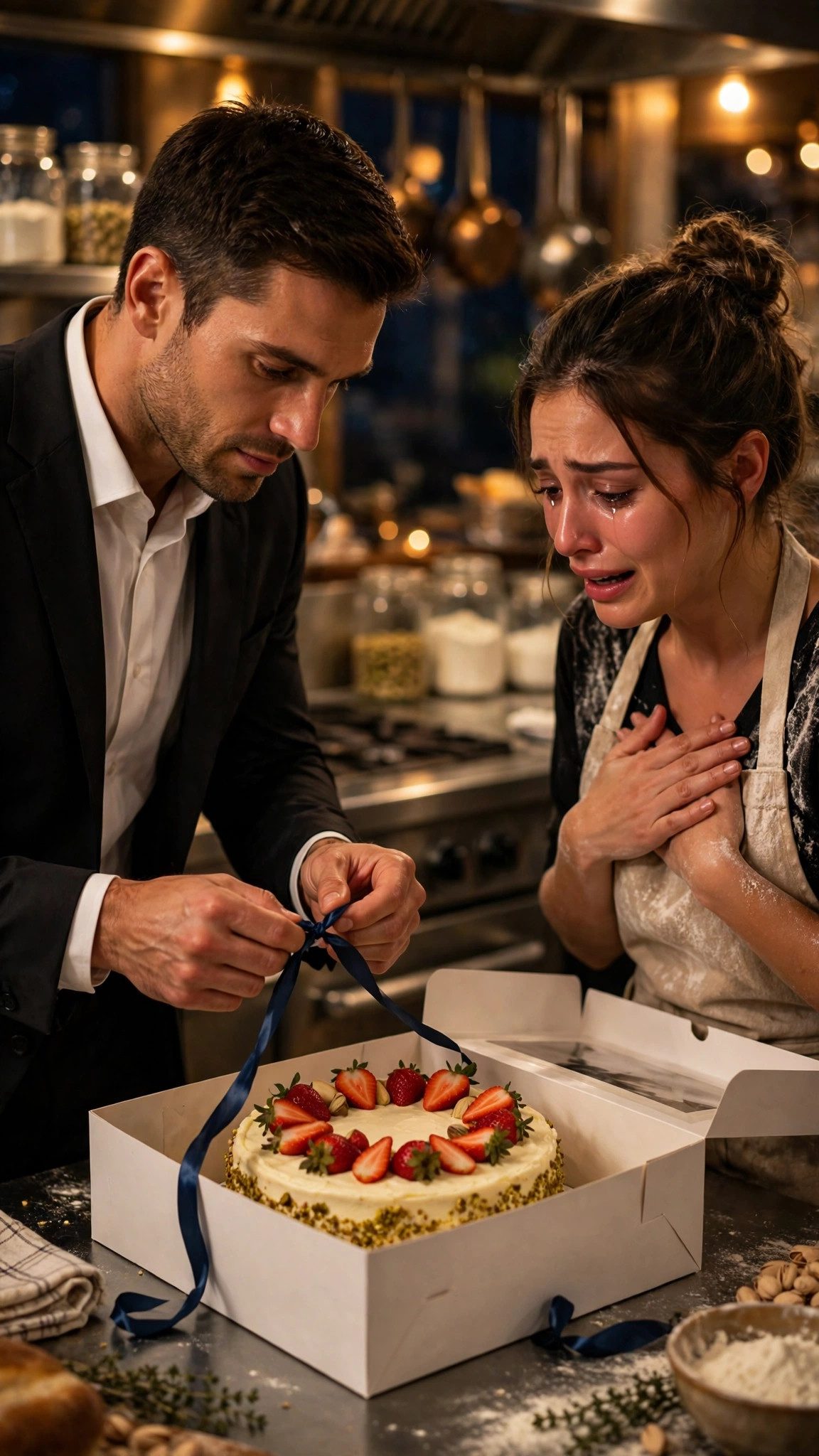
    Adrian untied the ribbon. He lifted the lid with the care of a man handling something sacred.

    My breath vanished.

    Vanilla buttercream. Fresh strawberries arranged around the edge in crooked circles. Crushed pistachios pressed unevenly along the sides. And one candle beside the number thirty-two, written in chocolate.

    It was my father's cake. Exactly.

    My father used to bake it every year on my birthday at Bell's Bakery in Milwaukee, back when the world was small and flour-covered and safe. He never measured anything. He arranged the strawberries in crooked circles because he said perfect circles were for people who didn't love you enough to be careless. He pressed the pistachios on with his bare hands. He wrote my age in chocolate with a shaking hand and always got one number wrong, and I always pretended not to notice.

    Dad had been dead for four years.

    "How?" I whispered. My voice sounded like it belonged to someone else.

    Adrian looked at me, and for the first time since he had walked into my kitchen, something in his face softened, just slightly, like a door opening a crack.

    He reminded me of a ninety-second conversation from January. I had been complaining that a pistachio dessert reminded me of how my late father used to bake at Bell's Bakery in Milwaukee. I had casually told him about flour-covered Sunday mornings, strawberries arranged in crooked circles, and Dad refusing to measure anything.

    I had forgotten that conversation completely. Adrian hadn't.

    "You remembered?" I said.

    "I remember most things you say."

    A chill moved through me, and it had nothing to do with the kitchen's cold air. He began listing things I had done that even I barely remembered. My boss's anniversary cake, the one I stayed three hours late to finish. My sous-chef's baby-shower pastries, the ones I made on my only day off that week. The birthday cake I had made on my day off for a dishwasher's daughter, because he couldn't afford one, and I had delivered it myself in a paper bag so nobody would know.

    "How do you know that?" I asked.

    "I was here."

    "I never saw you."

    His eyes held mine, grey and steady and unreadable. "I saw you."

    I looked down at the cake, because looking at him was suddenly too much. The strawberries were arranged in crooked circles, exactly the way Dad used to do it, and my throat closed so tight I could barely breathe. I had not seen that cake in four years. I had not tasted it in four years. I had stopped letting myself think about it, because thinking about it meant thinking about the morning my father didn't come downstairs, and the flour still on his hands, and the ambulance that came too late, and the bakery that went quiet in a way a bakery should never go quiet.

    "Eat," Adrian said, very quietly, and it wasn't a command. It was something gentler than that, something I didn't have a name for.

    My hands were shaking when I reached for the knife. Theo appeared at my elbow with two small plates, the way he always did when I needed something before I asked for it, and I saw that his eyes were wet. Behind the kitchen doors, the dining room had gone completely silent. Even the three men at Adrian's table had stopped talking. One of them, a broad man with a scar through his eyebrow, was watching us with an expression I couldn't read at all.

    I cut a slice. The knife went through the buttercream the way it used to go through Dad's cakes, soft and clean, and the smell rose up and hit me all at once. Vanilla. Butter. Strawberries. Pistachio. Sunday mornings in Milwaukee, flour on the floor and Dad singing off-key while the ovens warmed the whole shop, and me on a stool with my chin on the counter, watching his hands like they were doing magic.

    I put the fork in my mouth, and for one second I was eight years old again, and my father was alive, and the world was small and safe and sweet.

    Then I was thirty-two, standing in a restaurant kitchen in Chicago, crying into a slice of birthday cake in front of the most feared man in the city, and I didn't even care.

    "I'm sorry," I said, wiping my eyes with the back of my hand, which only smeared flour across my cheek. "I don't usually cry in front of customers. I don't usually cry at all, actually. I think I forgot how, and then today happened, and then you happened, and now I can't seem to stop."

    "You don't have to apologize," Adrian said. "Not to me. Not for this."

    He took the second plate Theo offered and cut a slice for himself with the same care he had used to open the box. He ate it slowly, the way a man tastes something he intends to remember, and when he set his fork down, he looked at the cake the way my father used to look at his own work. Like it mattered. Like it was worth doing right.

    "It tastes like his," I said. "How does it taste like his? You never met my father."

    "I had the recipe," Adrian said.

    My head came up. "What recipe? Dad never wrote anything down. He refused. He said recipes were for people who didn't trust their hands."

    "He told it to someone once," Adrian said. "A long time ago. Someone who never forgot it, either."

    I stared at him. The kitchen was warm and close around us, and the fluorescent lights hummed overhead, and somewhere in the dining room a glass clinked, and I felt like the floor had tilted under my feet. There was a story here. There was a whole hidden history here, running underneath my ordinary life like a river under a frozen lake, and I had been walking on top of it for months without knowing.

    "Who?" I asked. "Who did he tell?"

    Adrian didn't answer right away. He looked at the cake. He looked at the candle, still standing beside the chocolate thirty-two, unlit. He reached into his jacket again, and this time I didn't flinch, and he took out a small silver lighter and held it out to me.

    "Light it," he said. "Make a wish first."

    I laughed, and the laugh came out wet and shaky. "I'm thirty-two. I don't think wishes work anymore."

    "Try," he said.

    So I lit the candle, and I closed my eyes, and I wished for the one thing I had wanted all day without admitting it to anyone. I wished that someone, somewhere, would notice me. Really notice me. Not the cakes I made or the desserts I fixed, but me. And then I blew out the candle, and when I opened my eyes, Adrian Vale was watching me with an expression I had never seen on his face before, and I realized, with a jolt that went all the way down to my knees, that my wish might have already come true months ago, and I had been too busy, too tired, and too used to being invisible to see it.

    The last birthday cake my father made me was for my twenty-eighth birthday, four months before he died. I remembered it suddenly, with a clarity that hurt. He had been slower that year, his hands shaking a little as he wrote the twenty-eight in chocolate, and he had gotten the eight backwards, and we had both laughed until our stomachs hurt. "Even the best bakers make mistakes," he had said, wiping his hands on his apron. "The cake doesn't care. The people eating it don't care. Only the baker cares, and the baker should learn to forgive himself." I had not thought about that in years. Standing there in Sable's kitchen, with flour on my cheek and tears on my face and a strange, dangerous man watching me eat my father's cake, I thought about it, and I understood for the first time that my father had not been talking about cakes at all. He had been talking about living. About forgiving yourself for the things you cannot fix, and showing up anyway, and doing the work with the hands you have.

    I looked at Adrian, and I wondered what his hands had done. I wondered what he needed forgiving for. I wondered why a man like him would spend months watching a girl in a kitchen, and why he would go to a bakery in Lincoln Park and order a cake from a recipe he had no business knowing, and I understood, all at once, that I was standing at the edge of something I could not see the bottom of, and that stepping forward would change everything.

    Suddenly the kitchen felt impossibly quiet. The beautiful cake between us no longer felt like the biggest surprise waiting for me. It felt like the beginning of something much larger, something I did not understand and could not name, and my heart was pounding so hard I was sure he could hear it.

    I folded my arms tightly across my chest, as if that could hold me together, and finally asked the question that had begun pounding inside my head.

    "Why were you noticing me?"

  • Chapter 7: Home

    Chapter 7: Home

    Ellie turned one year old on a Sunday in October, in the garden behind the restaurant, under a sky so blue it looked painted.

    Mrs. Alvarez had made a cake — a small one, just for Ellie, with white frosting and a single candle — and Tony had strung lights in the trees, and Marco had made a special pasta, and the whole staff had come, and Andrea had come, and even the old landlord had come, with his cane and his hearing aid, and he had brought Ellie a tiny silver rattle, and he had said, "For the little girl with the green eyes."

    Ellie sat in her high chair in a yellow dress, with frosting on her nose and her hands, and she laughed at the lights, and she reached for the candle, and Mr. Vale — Damian — caught her hand just in time, and he held it, and he said, "Not yet, little one. Not yet."

    I stood in the doorway of the garden, watching them, and I thought about how far we had come. A year ago, I had been a waitress with a baby in a carrier, hiding behind a hostess stand, afraid of losing my job. Six months ago, I had been a woman with a contract and a nursery and a man who watched me from across a room and said nothing. And now, I was standing in a garden, watching the father of my child hold her hand away from a candle, and I was home.

    Home. It was a word I had not used in a long time. Millbrook had been home, once, when my mother was alive. The room above the laundromat had never been home. The apartment above the restaurant had become home slowly, one night at a time — the yellow nursery, the silver stars, the rocking chair, the smell of Mrs. Alvarez's soup, the sound of Damian humming in the hallway. Home was not a place. Home was the people who waited for you at the end of the day.

    After the cake, after the presents, after the landlord had gone home and Tony had taken down the lights, Damian asked me to walk with him. We walked through the garden, past the fountain, past the tables, to the small terrace at the back, where the city glittered beyond the walls, and the air smelled like rain and lilies, and I stopped walking, because I knew that smell. I had smelled it once before, thirteen months ago, on a terrace at the Plaza, on a spring night, when a stranger in a black suit had touched my locket with one fingertip.

    "Lena," Damian said, and he turned to face me, and he took both of my hands in his, and he looked at me the way he had looked at me that night — like I was something he had not expected to see, and like he was afraid I might disappear.

    "I have done this wrong," he said. "I have done everything wrong, from the beginning. I met you, and I left. I found you, and I watched you. I offered you a contract, when I should have offered you my heart. I built you a nursery, when I should have built you a home. I am not good at this, Lena. I have spent eleven years alone, and I have forgotten how to ask for what I want. So I am going to ask you now, properly, the way I should have asked you thirteen months ago."

    He let go of one of my hands. He reached into his pocket. He took out a small box, and he opened it, and inside was a ring — a simple gold band, with a single green stone, the exact color of Ellie's eyes, and the exact color of his.

    He got down on one knee. In the garden, under the lights, with the fountain behind him, and the city beyond the walls, and our daughter asleep in her high chair inside, with frosting on her nose.

    "Lena Carter," he said. "Will you marry me? Not because of a contract. Not because of a test. Not because of a baby, or a restaurant, or a building. Because I love you. Because I have loved you since a terrace at the Plaza, when you told me about a coffee tin on top of a refrigerator. Because I can't live without you. Because I don't want to live without you. Will you marry me?"

    I looked at him. I looked at the ring, and the green stone, and his green eyes, and his tired face, and his hands, shaking just slightly, holding the box open. And I thought about my mother, and the coffee tin, and the roof that leaked every spring, and the daughter asleep inside, and the man who had knelt in front of my chair in his office and said he could not live without me.

    "Yes," I said. "Yes, Damian. Yes."

    He stood up. He put the ring on my finger. He kissed me, in the garden, under the lights, and it was the kind of kiss that makes the whole world go quiet — the same kind of kiss as thirteen months ago, in a dark hallway behind the kitchens, only this time, there was no elevator waiting, and no goodbye, and no stranger walking away into the night. This time, he stayed.

    We were married three months later, in the garden, in the spring, with Ellie as our flower girl, in a white dress with a yellow sash, carrying a basket of rose petals, and throwing them everywhere except down the aisle. Mrs. Alvarez cried. Tony cried. Marco cried, and he blamed it on the onions. Andrea stood beside me, and she held my hand, and she said, "I told you. I told you he was either the kindest man I had ever met, or the strangest. It turns out he was both."

    Damian wore a black suit, with a white shirt open at the top button, and when I walked down the aisle toward him, he looked at me the way he had looked at me on the terrace — like I was something he had not expected to see, and like he was afraid I might disappear. And when I reached him, he took my hands, and he said, "You are the most beautiful thing I have ever seen. You were the most beautiful thing I had ever seen thirteen months ago, too. I just didn't know how to tell you."

    We said our vows under the lights, in front of the people who had stood beside us — Mrs. Alvarez, and Tony, and Marco, and Andrea, and the old landlord, and all the waiters and cooks who had watched us for months, and who had decided, quietly, that we belonged here. And when the minister said, "You may kiss the bride," Damian kissed me, and Ellie clapped her hands, and everyone cheered, and I thought about my mother, and I thought I could hear her voice, very faintly, saying, "For your future, Lena. For the day you get out of here." And I thought, Mama, I got out. And I found my way home.

    The restaurant changed after that, in small ways. We renamed the private dining room after Sofia — not because Damian had forgotten her, but because he had finally learned how to remember her without hurting. We hired a new floor manager, a kind woman named Rosa, who had run a restaurant of her own for twenty years, and who treated the waiters like people. We started a daycare in the basement, in the old office, for the children of the staff, with Mrs. Alvarez in charge, and a yellow room, and a mobile of silver stars. Grant never came back. Russo never came back. Dora sent a card at Christmas, and I sent one back, and that was enough.

    And Ellie grew. She grew the way babies grow — fast, and all at once, and then slow, and then fast again. She took her first steps in the garden, toward the fountain, with Damian holding her hands and me holding my breath. She said her first word in the nursery, under the silver stars, and the word was "Dada," and Damian cried, and I cried, and Mrs. Alvarez pretended not to cry, and failed completely.

    A month after the wedding, we went to Millbrook. I had not been back since my mother's funeral, and I had not wanted to go back, because Millbrook was the place where the roof leaked, and the coffee tin sat on top of the refrigerator, and my father never came home. But Damian said, "Your mother should meet her granddaughter," and he said it so simply, like it was the most obvious thing in the world, that I did not know how to argue with him.

    We drove up in Tony's car, with Ellie asleep in her car seat, and the fields went by, green and gold, and the town came into view — the church, the diner on Route 9, the farm stand, the high school with its forty graduates a year — and I felt my throat close up, because it was smaller than I remembered, and sadder, and more beautiful, all at once.

    We went to the churchyard. My mother's stone was simple, gray granite, with her name and her dates, and nothing else. I knelt down in the grass, with Ellie in my arms, and Damian knelt beside me, and I told her — I told my mother, out loud, in the churchyard, with the wind moving through the trees — I told her about the terrace, and the locket, and the green eyes, and the contract, and the nursery, and the man who had knelt in front of my chair and said he could not live without me. I told her that Ellie was hers, too, that she had her grandmother's smile, and her grandmother's stubbornness, and that I wished she could have met her. I told her that the coffee tin was empty now, because I had used the last of it, and that the roof did not matter anymore, because I had found a home with a roof that did not leak, and a man who fixed things before they broke, and a daughter who laughed at silver stars.

    Damian put his arm around me. Ellie reached out with her tiny fist, and she touched the stone, and she babbled something in her baby language, and I laughed, and I cried, and Damian held us both, and the wind moved through the trees, and I thought I could hear my mother's voice, very faintly, saying, "Good, Lena. Good. You did it. You got out. And you came back, and you brought them with you, and that is the bravest thing of all."

    We stayed in Millbrook for two days. We ate at the diner on Route 9. We bought apples at the farm stand. We walked past the high school, and I told Damian about the art room, and the sketchbook, and the teacher who had told me I had talent, and the day I had decided to leave. And on the second day, before we left, I took the coffee tin — the old tin, dented and faded, that I had carried to the city in a suitcase — and I put it on my mother's stone, and I said, "Thank you, Mama. For the tin. For the locket. For everything. I don't need it anymore. I have my own future now."

    We drove back to the city as the sun went down, with Ellie asleep in her car seat, and Damian holding my hand across the seat, and the skyline rising up in front of us, glittering and gold, and I thought about how strange life was — how a girl from a farming town, with a dead mother and a father who never came back, could end up married to the most feared man in the city, with a daughter who had green eyes, and a restaurant, and a garden, and a yellow nursery with silver stars.

    The daycare opened the following spring, in the basement, in the old office where it had all begun. We painted the walls yellow. We hung a mobile of silver stars from the ceiling. We hired Mrs. Alvarez to run it, and we hired two more nurses, and we opened it to the children of the staff — the cooks' children, the waiters' children, the dishwashers' children — all of them, free, because Damian said, "No parent should ever have to choose between their job and their child. Not in my restaurant. Not ever again." On the first day, there were six children. By the end of the month, there were twelve. By the end of the year, there were twenty, and the basement was full of laughter, and toys, and small shoes lined up by the door, and the dark-wood office with the black leather couch had become the brightest room in the building.

    Ellie loved it. She loved the other children, and the toys, and Mrs. Alvarez, and the silver stars. She loved to sit in the corner with her wooden horse — the little carved horse that Damian had kept in his desk drawer for thirty years, and that he had left outside my door that first week — and she would rock it back and forth, and babble to it, and I would watch her, and I would think about the boy who had once owned that horse, and the man he had become, and the father he was becoming, one day at a time.

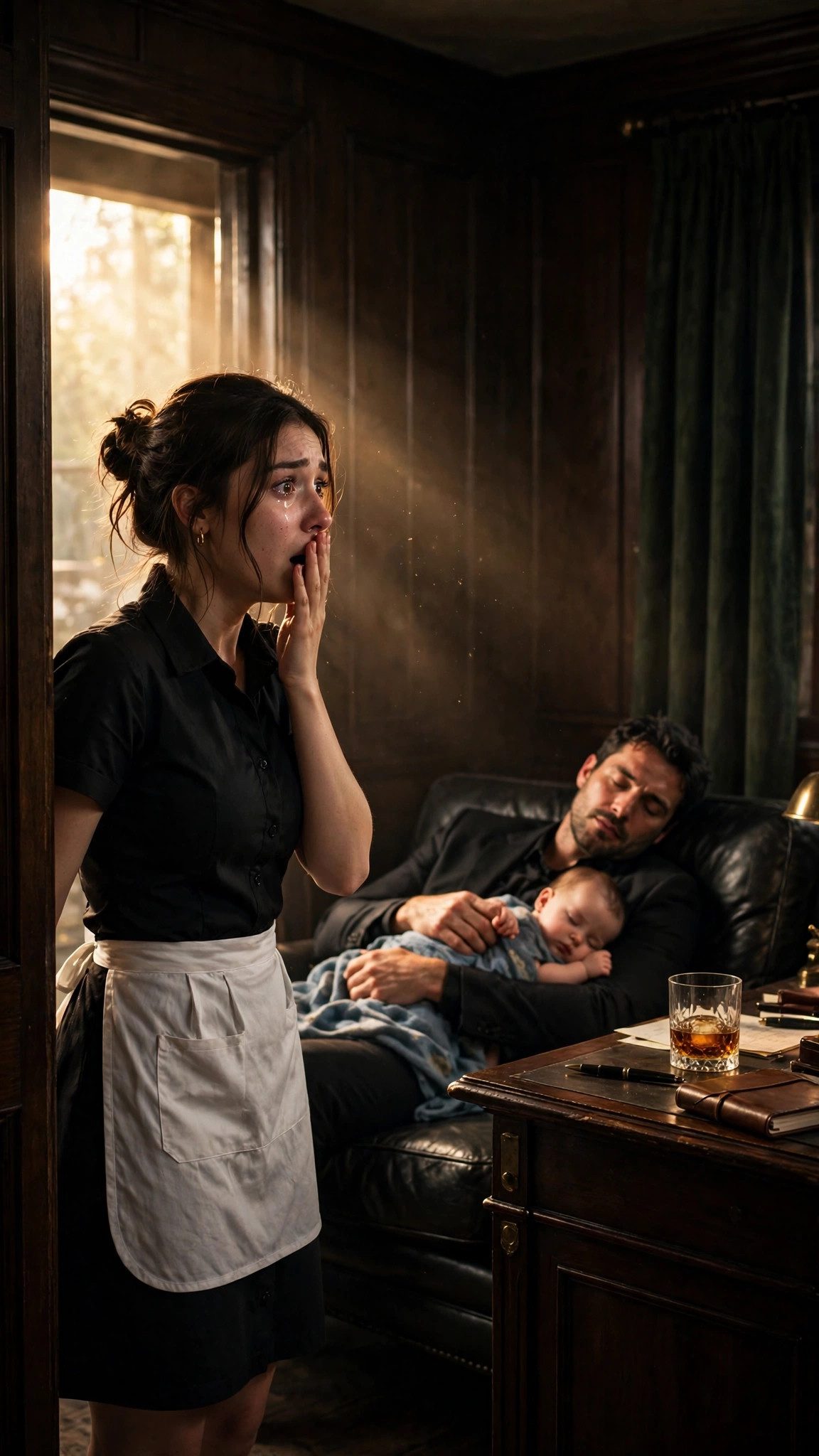
    Sometimes, on quiet evenings, after the last guest has gone and the dining room is dark, I go downstairs to the basement office — the dark-wood room with the black leather couch where it all began — and I find Damian there, fast asleep, with Ellie pressed against his chest. Her tiny body rises and falls with his breathing. Her cheek rests on his white shirt. Her tiny fist is curled around his finger. And I stand in the doorway, and I watch them, and I think about the night I found them like that for the first time, and how terrified I was, and how I shouted, "Give me my baby back!"

    And now, I do not shout. I just walk in, quietly, and I sit down beside them on the black leather couch, and I lean my head against his shoulder, and I close my eyes, and I listen to them breathe — my husband, and my daughter, asleep together, safe together, home together.

    That is the end of the story. Not the end of our story — our story is still going, every day, in a restaurant in Manhattan, with a yellow nursery upstairs, and a garden out back, and a mobile of silver stars turning slowly above a crib. But it is the end of the part where I was afraid. The part where I was alone. The part where I thought that a waitress and a feared man in a black suit could never belong to each other.

    We belong to each other. We always did. From a terrace at the Plaza, thirteen months ago, when a stranger touched my locket with one fingertip, and said, "Your mother had good taste." From the night he fell asleep with my daughter on his chest, and I found them, and I understood, finally, what he had been trying to tell me all along.

    He had not taken my baby. He had been holding her. He had been holding her like she was the only safe thing in the world. And now, he holds us both. And we hold him. And that is what a family is.

    The End.

    THE END

  • Chapter 6: What the Test Said

    Chapter 6: What the Test Said

    The test was done on a Wednesday, in a small clinic uptown, with Andrea sitting beside me and holding my hand.

    The nurse was a kind woman with short gray hair and a voice like warm milk. She swabbed the inside of Ellie's cheek with a cotton stick, gently, while Ellie stared up at her with wide green eyes and did not cry at all. Then she swabbed Mr. Vale's cheek, and he sat very still, with his hands folded in his lap, and he did not look at me, and he did not look at the nurse, and he looked at Ellie the whole time, like she was the only thing in the room.

    "That's it," the nurse said. "That's all we need. The results will be ready in five days. We will call you."

    Five days. Five days of waiting, and wondering, and lying awake at night listening to Ellie breathe, and thinking about green eyes, and terraces, and lockets, and contracts, and all the things I had believed and all the things I had refused to believe.

    Mr. Vale did not come upstairs during those five days. He did not knock on my door. He did not ask me to eat with him, or to sit with him, or to do anything at all. He stayed in his office, or in the dining room, and he worked, and he waited, and I could see the waiting in his face — in the lines around his eyes, in the way his hands shook, just slightly, when he picked up a glass.

    Grant, meanwhile, was unraveling. He knew that Russo's forty-eight hours had come and gone, and that the restaurant was still standing, and that Mr. Vale had not sold the building. He knew that the health inspector had found nothing — the kitchen was spotless, the nursery was licensed, Mrs. Alvarez's credentials were impeccable, and the alcove behind the hostess stand had been cleaned out weeks ago, because Ellie had not slept there since the day we moved upstairs. He knew that his lies were falling apart, and he was desperate, and desperate men do desperate things.

    On the fourth day, Tony caught him.

    Tony had been watching the clinic. Not because Mr. Vale had asked him to — Mr. Vale had not asked him to do anything — but because Tony had worked for the family for twenty years, and he knew what desperate men did, and he knew where they did it. He saw Grant go into the clinic just after closing, carrying a manila envelope, and he saw him talk to the receptionist, and he saw him offer her money, and he saw her refuse, and he saw him try again, with more money, and he saw her pick up the phone to call security.

    Tony walked in before security arrived. He took Grant by the arm, gently but firmly, and he walked him out of the clinic, and he drove him to the restaurant, and he brought him to Mr. Vale's office, and he stood him in front of the desk, and he said, "Tell him what you were doing."

    Grant told him. He told him everything, because there was nothing left to lie about. He told him that Russo had paid him five thousand dollars to lie to the health inspector, and another five thousand to talk to the reporter, and that he had been promised a manager's job at Russo's restaurant across the street, once Russo owned the building. He told him that he had gone to the clinic to swap the test results — to replace the real envelope with a fake one that said Mr. Vale was not the father — because if the test said no, then Lena would leave, and the contract would be over, and everything would go back to the way it had been, when Grant was the most important man in the restaurant after Mr. Vale.

    Mr. Vale listened to all of it without moving. His face did not change. His hands did not shake. When Grant had finished, Mr. Vale stood up, and he walked around his desk, and he stood in front of Grant, and he said, very quietly, "You are fired. You will leave this restaurant now, and you will never come back. If I ever see your name on a reference, if I ever hear that you have done this to another woman, in another restaurant, I will make sure everyone in this city knows what you are. Do you understand?"

    Grant nodded. He could not speak. He turned around, and he walked out of the office, and out of the restaurant, and nobody watched him go, because nobody cared anymore.

    The next day, the landlord came to the restaurant. He was an old man, eighty years old, with a cane and a hearing aid, and he had owned the building for fifty years. Russo had told him that Casa Vale was a scandal, that the health department was going to close it down, that the newspapers were going to destroy it. He had told him to sell.

    Mr. Vale met him in the dining room, and he did not argue, and he did not shout. He showed him the health inspector's report — clean, not a single violation. He showed him Mrs. Alvarez's license, and the nursery's license, and the contract, and the letter from Andrea. He showed him the photograph from the newspaper, and he said, "This is my daughter. Her name is Ellie. She is eight months old. She has my eyes. And this is her mother, Lena, who works in my restaurant, and who is the best waitress I have ever employed. If you want to evict us, you may. But you should know what you are evicting."

    The old man looked at the photograph for a long time. Then he looked at me, standing by the bar with Ellie in my arms, and he looked at Mr. Vale, standing beside me, and he said, "I have owned this building for fifty years, Mr. Vale. I have seen restaurants come and go. I have seen owners who cared about money, and owners who cared about food, and owners who cared about nothing at all. I have never seen an owner who cared about a baby. Keep your lease. And tell Russo, from me, that if he ever sets foot in my building again, I will have him removed."

    Russo never came back. A week later, his restaurant across the street closed for renovations, and it never reopened, and nobody in the neighborhood was sorry to see it go.

    And then, one afternoon, Dora came to see me. She was thinner than I remembered, and her hands shook, and she was wearing a clean coat, and she had been sober for six weeks. She stood in the doorway of the apartment, and she did not come in, and she said, "Lena. I heard what happened. I heard about the bottle. I heard about the night she nearly choked. I have thought about it every day since, and I am sorry. I am so sorry. I was drinking, and I was not watching her, and if anything had happened to her, I would never have forgiven myself. I just wanted you to know that I am getting help, and that I am sorry, and that I will understand if you never want to see me again."

    I looked at her for a long time. I thought about the night I had found her door locked, and the television blaring, and the bottle rolling across the floor. I thought about the morning I had carried Ellie home, and sat on the edge of my bed, and thought about the rent. And I thought about the fact that Dora was the reason I had brought Ellie to work that week, and that bringing Ellie to work was the reason Mr. Vale had asked me that cold question, and that cold question was the reason I had given him the lawyer's letter, and the lawyer's letter was the reason he had offered me the contract, and the contract was the reason we were all here now, in this apartment, with a yellow nursery and silver stars.

    "I forgive you, Dora," I said. "But I can't hire you again. Not as a babysitter. Not ever. Do you understand?"

    "I understand," she said. And then she smiled, a small, sad smile, and she said, "She is beautiful, Lena. She has your eyes. And his, too. Take care of her."

    She left. I stood in the doorway for a long time after she had gone, holding Ellie, thinking about the strange, tangled way that lives fit together — how a drunk babysitter and a lost wallet and a photograph in a newspaper could add up to a family, if you were lucky, and if you were brave enough to stay.

    That night, Mr. Vale came upstairs. He knocked on my door, and I opened it, and he stood in the hallway with his hands at his sides, and he said, "I fired Grant. Tony caught him at the clinic. He was trying to swap the test results. I wanted you to hear it from me."

    I looked at him. I thought about the five thousand dollars, and the reporter, and the health inspector, and the forty-eight hours, and the man who had stood in my kitchen and called me unfit. And I thought about the fact that Mr. Vale had fired him — not quietly, not with a severance package and a handshake, but in front of Tony, with the truth laid out on the table.

    "Thank you," I said.

    "Don't thank me," he said. "I should have seen it sooner. I should have protected you sooner. I have spent three months watching you, Lena, and I did not see the man standing right next to you, hurting you, every single day. I am sorry."

    He turned to go. But I caught his sleeve, and I said, "Wait. Stay. Just for a minute."

    He stayed. We sat at my kitchen table, with Ellie asleep in her crib in the next room, and we drank tea, and we did not talk about the test, or about Grant, or about Russo. We talked about Sofia, and the valley, and the restaurant, and my mother, and the coffee tin, and Millbrook, and the roof that leaked every spring. We talked until the tea went cold, and the city went quiet, and the silver stars turned slowly above Ellie's crib.

    And then, on the fifth day, the clinic called.

    Andrea and I went together, with Ellie in her carrier, and Mr. Vale met us in the waiting room, and we all sat in a small office with white walls and a potted plant, and the doctor — a woman in her forties with kind eyes — opened an envelope, and she read the results out loud.

    "The probability of paternity," she said, "is ninety-nine point nine nine percent."

    I sat there, holding Ellie's hand, and I did not cry, and I did not laugh, and I did not say anything at all. I just sat there, and I thought about a terrace at the Plaza, thirteen months ago, and a stranger in a black suit, and a kiss in a dark hallway, and a baby with green eyes, and a man who had known the truth for three months and had not known how to say it.

    Mr. Vale sat beside me, very still, with his hands folded in his lap, and when the doctor had finished, he looked at me, and he said, "Lena. I know this does not change what I did. I know I should have told you sooner. I know I should have told you the day you applied for the job, the day I saw the locket, the day I saw her eyes. But I need you to know — I have never been happier than I am right now, sitting in this room, hearing a doctor say that my daughter is my daughter. And I have never been more afraid, because I know that now that you know, you might take her, and go, and I would not blame you."

    I looked at him. I looked at his green eyes, and his tired face, and his hands, folded in his lap, shaking just slightly. And I thought about everything he had done — the contract, the nursery, the nurse, the wooden horse, the humming in the hallway, the note on the kitchen counter — and I thought about everything he had not done, and I understood, finally, that he was not a monster. He was just a man who had been alone for eleven years, and who had forgotten how to ask for what he wanted.

    So I did something I had never done before. I took his hand. I held it in mine, in front of the doctor, in front of Andrea, in front of Ellie, and I said, "I am not going anywhere. But I need you to hear me, Damian. No more contracts. No more silence. No more watching from across the room. If we are going to do this — if we are going to be a family — then we do it honestly, or we do not do it at all. Do you understand?"

    "I understand," he said. And then he did something I had never seen him do. He cried. Not loudly. Not dramatically. Just tears, running down his face, while he sat in a white office with a potted plant, holding my hand, and looking at our daughter.

    That night, I packed a small bag, and I took Ellie, and I went to stay with Andrea for one night — not because I was leaving, but because I needed one night to think, alone, about what it meant to be a family with a man I had loved since a terrace thirteen months ago, and only just learned the name of.

    Andrea made tea. She sat with me on her couch, and she said, "Lena. He is not a perfect man. He is a man who made a terrible mistake, and who tried to fix it in the strangest way possible, and who loves you, and who loves Ellie, and who will spend the rest of his life trying to make up for three months of silence. The question is not whether he is perfect. The question is whether you can forgive him. And whether you want to."

    I thought about it all night. I thought about the green eyes, and the locket, and the contract, and the nursery, and the wooden horse. I thought about Sofia, and the valley, and the restaurant, and the man who had built it all out of grief. I thought about Ellie, asleep in the next room, with her tiny fist curled around nothing, and I thought about what kind of life I wanted for her — a life with a father who loved her, or a life without one.

    In the morning, I packed the bag, and I took Ellie, and I went home — home to the yellow nursery, and the silver stars, and the apartment above the restaurant, and the man who was waiting for me in the hallway, with his hands at his sides, and his green eyes on my face, and his whole heart in his throat.

    "I forgive you," I said. "But no more silence. Ever again. Promise me."

    "I promise," he said. And for the first time since I had met him, on a terrace thirteen months ago, he smiled — a real smile, slow and wondering, like a man who had just been given something he thought he had lost forever.

  • Chapter 5: The Price of a Secret

    Chapter 5: The Price of a Secret

    The next morning, the story was not about a photograph anymore.

    It was about me.

    A gossip website ran a piece with the headline: "WAITRESS ENDANGERS BABY AT MAFIA BOSS'S RESTAURANT." It said that I had brought my infant daughter to work every night for months, that I had left her alone behind the hostess stand while I served drinks, that I had let the owner of the restaurant — a man with a reputation for violence — hold her unsupervised in a basement office. It quoted an anonymous source, a senior member of staff, who said I was "unfit" and "reckless" and "only interested in the boss's money."

    I read it on my phone, sitting on the edge of my bed, with Ellie asleep beside me, and my hands shook so badly I could barely hold the phone. Mrs. Alvarez came in with a tray of tea, and she took one look at my face, and she sat down beside me, and she said, "Do not read it again. It is poison. It is written by a man who has never held a baby in his life."

    By noon, a health inspector arrived. He was a thin man with a clipboard and a tired face, and he walked through the restaurant with Grant at his elbow, pointing at things, nodding, writing notes. Grant showed him the alcove behind the hostess stand. He showed him the basement stairs. He showed him the office. He told him, in a low voice that carried just far enough for me to hear, that I had "a history of poor judgment," that I had "brought the child to work against policy," that Mr. Vale had "covered for her because of their relationship."

    I stood in the dining room with a tray in my hands, and I listened to a man I had worked beside for three months describe me to a stranger like I was a criminal, and I felt the floor tilt under my feet.

    That afternoon, Russo came in person. Anthony Russo was a man in his sixties, silver-haired, with a smile that never reached his eyes, and he sat down at the best table in the dining room, and he ordered the most expensive wine on the menu, and he asked to speak to Mr. Vale. He did not ask. He demanded.

    I was serving the next table when I heard his voice, low and pleased, carrying across the room. "Damian. We need to talk about the lease. The landlord is concerned. The landlord has seen the newspapers. A restaurant is no place for a baby, Damian. Everyone knows that. And a man with your reputation, holding a baby — well. People talk."

    Mr. Vale did not raise his voice. He never raised his voice. He just looked at Russo, and he said, "Say what you came to say, Anthony. Then leave."

    "What I came to say is this," Russo said, and he leaned forward, and he smiled. "Sell me the building. Sell it now, while you still can, before the health department closes you down, before the landlord evicts you, before the newspapers finish what they started. I will give you a fair price. I am a fair man."

    "No," Mr. Vale said.

    Russo's smile widened. "Then I will take it another way. I have a witness, Damian. A senior member of your staff, who will testify that you have been using this restaurant to conduct an affair with a waitress, and that you have endangered her child, and that you have covered it up. I have a reporter who will print it. I have a lawyer who will file it. You have forty-eight hours."

    He stood up. He left a hundred-dollar bill on the table, for a glass of wine he had not finished. He walked out of the dining room, and the whole room watched him go, and nobody said a word.

    After Russo left, Grant found me in the kitchen. He was holding his clipboard, and he was smiling, and behind him, Marco the line cook was watching us over the steam, with his tongs in his hand, and his face set like a man deciding whether to step into a fight.

    "Well, Lena," Grant said. "Forty-eight hours. That's all he has. And when Russo takes this place, do you know what happens to you? You go back to being nobody. No apartment. No nurse. No contract. Just a waitress with a baby and a bad reputation."

    I put down the tray I was holding. I looked at him — really looked at him, for the first time, not as my manager, not as a man with power over me, but as what he was: a small, bitter man who had spent nine years making other people feel small, because it was the only way he knew how to feel big.

    "Grant," I said, and my voice was steady, "how much did Russo pay you?"

    His smile froze. "What did you say?"

    "How much?" I asked. "To lie to a health inspector. To call me unfit. To tell a reporter that Mr. Vale and I were having an affair. How much was it worth to you? Was it worth your job? Because when Mr. Vale finds out — and he will find out, Grant, because men like Russo always leave a trail — you will not have a job here anymore. You will not have a job anywhere in this city. Everyone will know what you did."

    Grant's face went white, and then red, and he took a step toward me, and Marco put down his tongs, and he stepped between us, and he said, very quietly, "Grant. Walk away. Now."

    Grant looked at Marco. He looked at me. He looked at the other cooks, who had all stopped working, and who were all watching him now, and he seemed to understand, all at once, that the room had changed. He turned around, and he walked out of the kitchen, and nobody said a word until the door had swung shut behind him.

    Marco turned to me. He was a big man, with flour on his apron and burns on his forearms from ten years at the line, and he said, "Lena. For what it's worth — we all know. We all know you are a good mother. We all know Grant is a liar. And we all know Mr. Vale would burn this city down before he let anyone hurt that baby. So don't you worry about Russo. You worry about Ellie. We will worry about the rest."

    I stood there in the kitchen, with the steam rising around me, and the smell of garlic and lemon in the air, and I thought about the waiters, and the cooks, and Mrs. Alvarez, and Tony, and all the people in this restaurant who had watched me for three months, and who had decided, quietly, that I belonged here. And I thought about Grant, alone in his little kingdom, with his clipboard and his smile, and I understood something I had not understood before: that power is not about who can fire you. Power is about who stands beside you when someone tries.

    That night, I went upstairs, and I held Ellie, and I told her about Marco, and about the kitchen, and about the way the cooks had all stopped working to watch Grant walk away. I told her that her father — and I used the word for the first time, out loud, in the dark nursery, to a baby who could not understand it — that her father was a man who had built a restaurant out of grief, and that he was trying, in his own clumsy way, to build a family out of it, too. And I told her that tomorrow, I was going to make him tell me the truth, all of it, no matter what it cost.

    That night, after the last guest had gone, I went to Mr. Vale's office, and I did not knock. I walked in, and I closed the door behind me, and I stood in front of his desk, and I said, "Tell me the truth. All of it. Tonight. No more half answers. No more tomorrow."

    He was sitting behind his desk, in the dark, with a glass of whiskey he had not touched. He looked up at me, and his face was gray with exhaustion, and for a moment, he looked like a man who had been carrying something too heavy for too long.

    "Lena," he said. "Sit down."

    "I don't want to sit down," I said. "I want you to tell me why Anthony Russo thinks he can take your restaurant. I want you to tell me why Grant is lying about me to a health inspector. I want you to tell me why you offered me a contract, and a nursery, and a nurse, and a year of safety, and asked for nothing in return. And I want you to tell me why my daughter has your eyes."

    He was quiet for a long time. The clock on the wall ticked. Somewhere upstairs, Ellie made a small sound in her sleep, and Mrs. Alvarez's voice murmured, soft and low, and then it was quiet again.

    "Thirteen months ago," he said, finally, "I met a woman on a terrace at the Plaza. She was carrying a tray of champagne. She was wearing a silver locket with a rose engraved on it. She told me her name was Lena, and she told me about a farming town, and a mother who had died, and a coffee tin on top of a refrigerator. I talked to her for an hour, and I had not talked to anyone like that in eleven years, since Sofia died. I kissed her in a hallway behind the kitchens. And then I left, because I did not know how to stay. I did not know her last name. I did not know where to find her. I told myself it was one night, and that one night did not mean anything, and that men like me do not get to keep things like that."

    He stopped. He looked at his hands. "Three months ago, a waitress applied for a job at my restaurant. She was wearing the same locket. She had the same voice. She had the same way of smiling when she was nervous. And she had a baby in a carrier, with green eyes — my eyes — and I knew, Lena. I knew the moment I saw her. I knew she was mine. Ours."

    My knees gave out. I sat down, hard, in the chair across from his desk, and I put my hands over my face, and I cried — not loud, not dramatic, just tears running down my face while I sat there, shaking, in the dark office of the most feared man in the city.

    "Why didn't you tell me?" I whispered. "You knew for three months. You watched me. You offered me a contract. You built a nursery. You hummed lullabies in the hallway. Why didn't you just tell me?"

    "Because I was afraid," he said, and his voice broke, just once, on the last word. "Because I knew what I was. A man who lives alone above a restaurant. A man people cross the street to avoid. A man whose name makes waiters go pale. What right did I have to walk up to you and say, 'I am the father of your child, and I have been watching you'? You would have run. You would have taken Ellie and run, and I would not have blamed you. So I did the only thing I knew how to do. I offered you safety. I offered you a contract. I told myself that if I kept you close, and I kept you safe, then someday, when the time was right, I would tell you. And then Ellie disappeared, and you found me asleep with her on my chest, and I knew the time had come, and I still could not say it."

    He stood up. He came around the desk. He knelt down in front of my chair, so that his face was level with mine, and he took my hands in his, gently, like he was afraid I would pull away.

    "Lena," he said. "There's something about Ellie. She is my daughter. She is our daughter. I have known since the first day. I have loved her since the first day. And I love you. I have loved you since a terrace at the Plaza, thirteen months ago, when you told me about a coffee tin on top of a refrigerator. I can't live without you. I tried. For eleven years, I lived without anyone, and I told myself that was enough, and it was not enough. It was never enough."

    I looked at him. I looked at his green eyes, and his tired face, and his hands holding mine, and I thought about the gala, and the locket, and the green eyes, and the contract, and the nursery, and the wooden horse, and the humming in the hallway. And I thought about my mother, and the coffee tin, and the roof that leaked every spring, and the daughter asleep upstairs with silver stars turning above her crib.

    "I want a test," I said. "A DNA test. Properly done. With papers. With Andrea present. I need to know, not just believe. Do you understand?"

    "I understand," he said. "I will do whatever you ask. I will sign whatever you ask me to sign. I will wait as long as you ask me to wait. But Lena — please don't take her away from me. Please don't disappear. I have already lost one family. I cannot lose another."

    I did not answer him. I went upstairs, and I picked up Ellie, and I held her against my chest, and I looked into her green eyes, and I whispered, "Did you know? Did you know all along who he was?"

    She did not answer. She just looked at me, and she reached up with her tiny fist, and she touched the silver locket at my throat, and she smiled in her sleep.

    And I thought about Grant, and Russo, and the health inspector, and the forty-eight hours, and I understood, finally, what the price of a secret was. It was not money. It was not a restaurant. It was this: three months of silence, and a photograph in a newspaper, and a man who had loved us from a distance because he did not know how to love us up close.

    The next morning, I called Andrea. I told her everything. And Andrea, who had been a lawyer for twenty-eight years, and who had seen everything, was quiet for a long time, and then she said, "Lena. We will do the test. We will do it properly. And then we will deal with Grant, and with Russo, and with all of it. But first, you need to decide one thing. Do you love him?"

    I looked out the window at the street below, where the reporters had been, and where Tony was now standing, watching the door, like a guard. I thought about the terrace, and the kiss, and the green eyes, and the man who had knelt in front of my chair and said he could not live without me.

    "Yes," I said. "I think I do. I think I have since the terrace. I just didn't know his name."

  • Chapter 4: Green Eyes

    Chapter 4: Green Eyes

    I did not get my baby back that night. Not right away. I got something else instead: the truth, told in pieces, in a dark office, while my daughter slept on the chest of the man who had been watching us for months.

    Mr. Vale sat up very slowly, with Ellie still pressed against him, one big hand spread flat across her tiny back to hold her steady. He did not hand her to me. He did not let go. He just looked at me, standing in his doorway with my hands shaking, and he said, "She was crying. Mrs. Alvarez had gone home. I heard her from the hallway, and I came down to check, and she stopped crying when I picked her up. I sat down for a moment. I must have fallen asleep."

    "For a moment," I said. "You fell asleep for a moment, with my daughter on your chest, in your office, behind a closed door."

    "I know how it looks," he said.

    "Do you?" I asked. "Do you know how it looks? Because it looks like the most feared man in the city took my baby without asking, and carried her down to his basement office, and fell asleep with her, and I had to search every room in this restaurant to find her."

    He was quiet. Ellie made a small sound in her sleep, and his hand moved, gently, across her back, and I watched his fingers — long fingers, a man's fingers, careful in a way I had never seen a man's fingers be careful — and something in my chest cracked open.

    "Give her to me," I said, and my voice was softer now, because I was not afraid anymore. I was just tired, and confused, and so angry I could barely see straight.

    He stood up, slowly, holding Ellie against his shoulder, and he carried her across the room to me, and he placed her in my arms like she was made of glass. Her cheek was warm. Her blanket smelled like his shirt, like cedar and whiskey and something clean. Her tiny fist was still curled, and when I touched it with my fingertip, it opened, and then it closed again, around nothing.

    "Thank you," I whispered, before I could stop myself. "For keeping her safe."

    "I would never hurt her," he said. "I would never hurt either of you. I need you to believe that, Lena, even if you don't believe anything else I say tonight."

    I carried Ellie upstairs. I laid her in her crib, under the silver stars. I sat in the rocking chair and I watched her sleep, and I thought about his face in the doorway, and the way he had looked at her, and the way his hand had moved across her back, and I thought about green eyes.

    The next morning, I did not go downstairs. I stayed in the apartment with Ellie, and I waited for him to come and fire me. I waited for Grant to come and tell me to pack my things. I waited for the contract to be torn up and the year of safety to be over before it had even begun.

    Nobody came. At noon, Mrs. Alvarez knocked on my door with a tray of soup and bread, and she said, "Mr. Vale says you may take the day off. He says Ellie needs her mother today." She said it like it was the most normal thing in the world. She did not ask me what had happened. She just set the tray down and left.

    That afternoon, Tony came to see me. Tony was Mr. Vale's driver, a man in his fifties with a gray mustache and kind eyes, who had driven for the family for twenty years. He had always been polite to me, in the distant way that people who work for powerful men are polite to everyone. But that afternoon, he knocked on my door, and he asked if he could come in, and he sat down at my kitchen table, and he told me a story I had never heard.

    "Mr. Vale was not always like this," Tony said. "He was not always cold. He was not always alone. When he was young, he was going to marry a girl from Brooklyn. Her name was Sofia. She was kind, and she laughed a lot, and she made him laugh, too, which was not an easy thing to do, even then. She died in a car accident, three weeks before the wedding. He buried her, and he buried the part of himself that laughed, and he has been alone ever since. He built this restaurant because Sofia loved to cook. He named it Casa Vale because Vale means valley, and Sofia used to say that love was a valley you walked into together. He has lived alone above it for eleven years."

    Tony looked at me for a long time, and then he said, "I have worked for him for twenty years, Lena. I have never seen him look at anyone the way he looks at you. And I have never, not once, seen him hold a baby. Not until Ellie."

    I did not know what to say. I thanked him, and he left, and I sat at the kitchen table with Ellie in my lap, and I thought about Sofia, and the valley, and the man who had built a restaurant out of grief, and I thought about the green eyes, and the locket, and the terrace at the Plaza.

    That evening, when my shift started, I went downstairs, and Grant was waiting for me by the bar with his clipboard, and his smile was worse than usual.

    "I heard about last night," he said. "I heard you made quite a scene. Running through the restaurant, shouting, searching rooms that aren't yours to search. Do you know what the guests thought? Do you know what Mr. Vale thought?"

    "I don't care what you heard," I said.

    "You should," Grant said. "Because I also heard that Mr. Vale carried your baby down to his office himself. I heard he held her for an hour. I heard he fell asleep with her. And I wonder, Lena, what kind of mother lets the most feared man in the city hold her baby for an hour?"

    I walked past him. I did not answer. I went to my tables, and I worked, and I smiled at the guests, and I carried plates, and I tried not to think about Grant's words. But they stayed with me, like a stain, all evening.

    In the days that followed, I began to see him differently — not as the feared man in the black suit, but as a man learning, clumsily and quietly, how to be near a child. In the late afternoons, before the dinner service, he would come to the nursery doorway and stand there, not coming in, just watching, while Mrs. Alvarez changed Ellie's clothes or fed her a bottle. Once, Ellie grabbed his finger through the bars of her crib, and he froze, like a man who had been handed something explosive, and then he laughed — a short, surprised sound, rusty from disuse — and Mrs. Alvarez and I looked at each other, and neither of us said a word.

    Another afternoon, I found him in the small garden behind the restaurant, holding Ellie up so she could see the fountain. She was wearing a yellow sun hat that Mrs. Alvarez had knitted, and he was pointing at the water, and he was talking to her in a low voice, telling her about the fish, and the birds, and the way the light came through the leaves. He did not notice me standing in the doorway. He did not notice anything except her. And I stood there for a long time, watching the most feared man in the city explain a fountain to an eight-month-old baby, and I felt something in my chest shift, like a door opening that I had kept locked for a very long time.

    I called Andrea that night. I told her about the photograph — no, the photograph had not happened yet. I told her about the basement office, and the note on the kitchen counter, and the wooden horse, and the humming in the hallway. I told her about Tony's story, about Sofia, about the valley. And then I told her the thing I had not said out loud to anyone, not even to myself.

    "Andrea," I said, "I think he is her father."

    Andrea was quiet for a long time. Then she said, "Lena. The green eyes. The gala. The locket. The contract. The nursery. A man does not do all of that for a stranger's baby. I have been waiting for you to say it."

    "What do I do?" I asked.

    "You do nothing," she said. "Not yet. You let him tell you. A man who has waited thirteen months to tell a woman the truth will tell it when he is ready, and if you force it out of him, you will get the words but not the man. And Lena — if he is her father, then you have rights, and he has rights, and Ellie has rights, and we will sort all of that out properly, with papers, and with a test, and with no one shouting in a hallway. Do you understand?"

    "I understand," I said. And I did. But understanding did not stop me from lying awake that night, listening to Ellie breathe, and wondering what it would mean if the stranger from the terrace had been the owner of Casa Vale all along, and if the man who had been watching me for three months had known the truth from the very first day.

    Over the next two weeks, something changed in the restaurant. It was small at first — a whisper here, a look there. The other waiters started watching me more closely. The hostess stopped saving my favorite station. The bartender, who had always been friendly, started serving my tables last. And Grant, who had always been cruel in small ways, became cruel in bigger ones. He gave me double sections. He changed my schedule without telling me. He wrote me up for being three minutes late, when I had been three minutes early.

    And then, one Thursday, a man came into the restaurant with a camera. He was not a guest. He did not order anything. He sat at the bar and he drank sparkling water and he watched the room, and when Mr. Vale came downstairs with Ellie in his arms — because by then, it had become a habit, the two of them, him carrying her through the dining room in the late afternoon, showing her the chandeliers, letting her grab at his tie with her tiny fist — the man lifted his camera, and he took a photograph.

    The photograph was in the newspaper the next morning. It showed Mr. Vale, in his black suit, holding a baby in a faded blue blanket, looking down at her with a face no one had ever seen on him before — soft, and wondering, and almost afraid. The headline said: "THE MOST FEARED MAN IN THE CITY HAS A SECRET BABY."

    I read it in the kitchen, with Ellie in my lap, and my hands shook so badly I nearly dropped the paper. Mrs. Alvarez read it over my shoulder, and she said nothing, and then she went to the window and looked out at the street, and she said, "There is a man outside. He has been there since seven."

    There was a reporter outside. And by noon, there were three. And by evening, there were cameras, and microphones, and a woman from a gossip website shouting questions at the door.

    Grant, of course, was delighted. He stood in the dining room, in front of the staff, and he said, "Well. Now we all know. Our Lena has been keeping secrets. Our Lena has been playing a game, and the boss has been playing it with her." He said it with a smile. He said it like a joke. Nobody laughed.

    That night, Mr. Vale called me into his office. He was standing by the window, looking out at the reporters on the street, and when I came in, he turned around, and his face was gray with exhaustion.

    "I am sorry," he said. "This is my fault. The man with the camera — his name is Russo. Anthony Russo. He owns the restaurant across the street, and he has wanted this building for five years. He hired the photographer. He planted the story. He wants the landlord to think I am unstable, that I am distracted, that I am not fit to hold the lease. He wants me gone."

    "Then tell them the truth," I said. "Tell them Ellie is not a secret. Tell them she is my daughter, and that you were helping me, and that there is nothing scandalous about it."

    "I have told them nothing," he said, "because the truth is more complicated than that, Lena. And I have not told you the truth yet, either."

    He looked at me then, and his green eyes were steady, and I saw it — I saw the thing I had been refusing to see for three months. I saw my daughter's eyes, looking back at me out of a man's face. I saw the terrace at the Plaza. I saw the locket. I saw the way he had touched it with one fingertip, thirteen months ago, and said, "Your mother had good taste."

    "Say it," I whispered. "Whatever it is. Say it now."

    He took a breath. He opened his mouth. And then, from upstairs, Ellie cried — a thin, tired wail — and he stopped, and he looked at the ceiling, and he said, "Not tonight. Not like this. Tomorrow, Lena. I promise you. Tomorrow, I will tell you everything."

    I went upstairs. I picked up my daughter. I held her against my chest, and I looked into her green eyes, and I thought about the man downstairs, and the promise he had made, and I wondered if tomorrow would be the day my life changed forever.

    I did not know then that tomorrow would be worse than I could have imagined. I did not know that Grant had already gone to Russo, and that Russo had already paid him, and that by morning, the story would not be about a photograph anymore. It would be about a mother who endangered her child, and a boss who covered it up, and a restaurant that was not safe for anyone.

    I did not know any of that yet. All I knew was that my daughter had green eyes, and that the man downstairs had the same eyes, and that whatever happened tomorrow, I was not going to let anyone take her from me.

  • Chapter 3: This Is My Proposal

    Chapter 3: This Is My Proposal

    I signed the contract on a Tuesday, in Andrea's office, with Ellie asleep in her carrier at my feet and the rain coming down outside in gray sheets.

    Andrea read it first, all four pages, slowly, with her reading glasses on the end of her nose. She checked every clause twice. She asked me questions I had not thought to ask. "Does it say you can leave whenever you want?" she asked, and I pointed to the line near the bottom, the one that said either party could end the arrangement with thirty days' notice. "Does it say he can touch the baby?" she asked, and I pointed to the line that said all childcare decisions remained mine. "Does it say what he wants from you?" she asked, and I shook my head, because it did not. It said nothing about what he wanted. It only said what he would give.

    "Lena," Andrea said, and she took off her glasses, and she looked at me the way she had looked at me the day Ellie was born, "I have been a lawyer for twenty-eight years, and I have never seen a contract like this. A man does not offer a stranger a year of food and shelter and childcare for nothing. Men always want something. The question is what, and whether you can live with it."

    "I know," I said. "But Dora is gone, and the daycare costs more than I make in a week, and Ellie nearly choked on a bottle because I left her with a woman who drinks. I can't keep doing this alone. I can't."

    Andrea was quiet for a moment. Then she said, "Then sign it. But sign it with your eyes open. And keep a copy. And if he ever asks you for something this contract doesn't promise, you call me the same day."

    I signed it. My hand was shaking so badly that my signature looked like a child's drawing. Andrea signed as witness. Ellie woke up and cried, and I picked her up, and I held her against my chest, and I told myself that I had just done the smartest thing I had ever done, and the most dangerous thing, and that they might be the same thing.

    The next morning, I brought the signed contract to the restaurant, and I gave it to Mr. Vale in the hallway outside his office, and he took it, and he read my signature, and he nodded once, like a man who had just closed a deal.

    "Thank you," he said.

    "That's it?" I asked. "Thank you?"

    "What else would you like me to say?" he asked, and there was something almost like amusement in his voice, almost like a smile trying to get out.

    "I don't know," I said. "Maybe tell me why. Why me? Why Ellie? Why this?"

    He looked at me for a long time. His green eyes were steady, and I thought, for one wild moment, that he was going to tell me the truth — whatever the truth was. And then he looked down at the contract in his hands, and he said, "Because you remind me of someone I used to know. And because I have a large apartment above this restaurant, and it is empty, and empty rooms are a waste."

    It was not an answer. But it was the only one I was going to get.

    The move took two days. The apartment was on the third floor, above the restaurant, and it was bigger than any place I had ever lived — a living room with tall windows and a fireplace that actually worked, a kitchen with a stove that had six burners, a nursery painted the softest yellow I had ever seen, with a crib and a rocking chair and a mobile of little silver stars hanging over it. Ellie stared at the stars for a long time, and then she reached for them with both hands, and she laughed, and I stood in the doorway with my suitcase in my hand, and I cried.

    There was a nurse, too — a kind woman named Mrs. Alvarez, sixty years old, with gray hair in a braid and hands that had held a hundred babies. She came every morning at seven, and she stayed until six, and she taught me things about Ellie I had not known — that she liked to be sung to while she ate, that she hated the feel of wool against her skin, that she calmed down fastest when you walked her in a circle, counterclockwise, near a window. Mrs. Alvarez never asked me questions about Mr. Vale. She just smiled, and she said, "He is a good man, underneath. You will see."

    I kept my job. I kept my tables. I kept my black dress and my white apron, and I kept my tips, and every night I went downstairs to work the floor, and every night Mrs. Alvarez stayed with Ellie in the yellow nursery, and every night, when my shift ended, I came upstairs to find my daughter asleep in her crib, and the apartment quiet, and the city glittering outside the tall windows.

    And every night, I felt like I was living someone else's life.

    Mr. Vale did not come upstairs. He did not knock on my door. He did not ask me to eat with him, or to sit with him, or to do anything at all. He stayed in his office, or in the dining room, or in his own apartment on the fourth floor, and the only time I saw him was at work, across the room, watching. He watched me carry plates. He watched me smile at guests. He watched me check on Ellie between courses. He watched, and he said nothing, and I began to wonder if the contract had been a mistake — not because he wanted something from me, but because he wanted nothing at all, and I did not understand a man who gave everything and asked for nothing.

    Grant understood it even less. Grant had heard about the contract — everyone had heard about it, because in a restaurant, secrets last about as long as a soufflé — and Grant could not understand why the most feared man in the city would offer a waitress a year of safety. He decided there had to be a reason, and he decided the reason had to be dirty, and he started watching me the way a man watches a crime he is waiting to catch.

    He timed my breaks. He counted my trips upstairs. He wrote notes on his clipboard whenever I spoke to Mr. Vale, whenever Mr. Vale spoke to me, whenever we were in the same room for more than a minute. He started telling the other waiters that I had "bought" my job, that I had "earned" the apartment in ways he was too polite to describe, and he said it with a smile, and the other waiters laughed, because Grant was the manager and it was easier to laugh than to argue.

    I ignored him. I had learned to ignore men like Grant. But at night, in the yellow nursery, with Ellie asleep in her crib and the silver stars turning slowly above her, I lay awake and I thought about what Andrea had said. Men always want something. The question is what.

    One night, late, after the last guest had gone and the dining room was dark, I came downstairs to get a glass of water, and I found Mr. Vale standing in the hallway outside his office, looking at the door to the basement stairs. He was not wearing his jacket. His white shirt was open at the top button. His hair was a little messy, like he had been running his hands through it.

    "Mr. Vale," I said. "Is everything all right?"

    He turned around. For a moment, he looked startled, like he had forgotten I lived upstairs now, like he had forgotten anyone lived upstairs at all. Then he said, "I was just checking the locks."

    "At one in the morning?"

    "I don't sleep well," he said. "I never have."

    I stood there in my bare feet, in my old t-shirt and my sweatpants, holding an empty glass, and I looked at him, and I thought about the terrace at the Plaza, thirteen months ago, and the stranger who had said he had not talked to anyone like that in a long time. And I thought about the green eyes, and the locket, and the way he had touched it with one fingertip. And I thought about Ellie, asleep upstairs, with eyes the exact same color as his.

    "Mr. Vale," I said, and my voice was quiet, "have we met before? Before Casa Vale. Before I worked here."

    He went very still. His face did not change. But his hand, the one hanging at his side, curled into a fist, and then opened again, slowly, like he was forcing himself to let go of something.

    "No," he said. "We have not met before."

    It was a lie. I knew it was a lie the moment he said it, because his eyes moved away from mine when he said it, and Mr. Vale never looked away from anyone. He was a man who held your gaze until you looked away first. But that night, in the hallway, he looked at the floor, and he said no, and I knew.

    I did not push him. I went back upstairs, and I got my glass of water, and I sat in the rocking chair in the yellow nursery, and I watched Ellie sleep, and I thought about the stranger on the terrace, and the green eyes, and the locket, and the contract, and the empty apartment, and the man who gave everything and asked for nothing.

    And for the first time since I had signed that contract, I was afraid — not of Mr. Vale, but of what he knew, and of what he was not telling me, and of what it would mean when he finally did.

    The next day, a Saturday, the restaurant was full, and Grant was in a worse mood than usual. He had heard that I had been seen in the hallway at one in the morning, talking to Mr. Vale, and he had decided that this was proof of whatever he had already decided about me. He gave me the worst tables. He sent back two of my orders for no reason. He stood near the bar with his clipboard, watching me, and every time I looked at him, he smiled.

    That night, after my shift, I went upstairs, and Mrs. Alvarez was gone, and Ellie was asleep, and there was a note on the kitchen counter in Mr. Vale's handwriting. It said: *Ellie laughed today. She laughed at the mobile. I heard her from the hallway. Thank you for letting me hear it.*

    I stood in the kitchen with that note in my hand, and I read it three times, and I cried, because it was the kindest thing anyone had said to me in a year, and because it was also the strangest, and because I did not understand the man who had written it at all.

    I put the note in the drawer with the contract. I told myself I would ask him about it in the morning. I told myself I would demand the truth, all of it, no more half answers.

    But in the morning, there was a black-tie gala to prepare for, and the restaurant ordered a large amount of wine from the dining room, and every waiter was on duty, and the day went by in a blur of polished glasses and folded napkins, and by the time the evening came, I had forgotten to ask him anything.

    There was one more thing I learned that week, and it was the thing that stayed with me longest. It happened on the second night after we moved in, when Ellie would not sleep. She cried, and cried, and nothing I did helped — not the rocking chair, not the song my mother used to sing, not the warm milk. Mrs. Alvarez had gone home. The apartment was quiet except for Ellie's crying, and I was so tired I could barely stand. I walked her in a circle near the window, counterclockwise, the way Mrs. Alvarez had taught me, and I whispered to her, and I told her I was sorry, and I told her I did not know what else to do.

    And then, from the hallway outside my door, I heard it. A low voice, humming. Not a song I recognized — just a slow, soft tune, the kind of tune a man hums when he is trying not to wake someone. It went on for a long time, patient and steady, and Ellie's crying slowed, and then it stopped, and her head grew heavy against my shoulder, and she slept.

    I opened the door a crack. The hallway was empty. But on the floor, just outside my door, there was a small wooden toy — a little carved horse, old and smooth, the paint worn down at the edges, the kind of toy that had been loved by a child a long time ago. I picked it up, and I turned it over in my hands, and I did not know what to think. I put it on Ellie's dresser, next to the silver stars, and I never asked anyone about it. But every night after that, when Ellie was fussy, I would hear the humming from the hallway, and she would calm, and I would stand in the dark nursery with my daughter in my arms, and I would think about the man on the fourth floor, alone in his big empty apartment, humming a lullaby to a baby that was not his — or so I thought then.

    I asked Mrs. Alvarez about the horse once, casually, while she was folding Ellie's blankets. She looked at it for a long time, and then she said, "That belonged to Mr. Vale, when he was a boy. His mother gave it to him. He has kept it in his desk drawer for thirty years." She said it like it was the most ordinary thing in the world. She did not explain why it was now on my daughter's dresser. She did not have to. I understood enough.

    That was the night Ellie disappeared. That was the night I found him asleep on the black leather couch with my daughter pressed against his chest. That was the night everything I thought I knew about my life turned out to be wrong — and the night I finally understood what he had been trying to tell me all along, without ever saying a word.